
Ione City Zoning Code
ARTICLE III
SITE PLANNING STANDARDS
Chapter 17.30 - BUILDING HEIGHT MEASUREMENT AND PROJECTIONS
Sections:
Chapter 17.32 - YARD MEASUREMENT AND PROJECTIONS
Sections:
Chapter 17.34 - PROPERTY AND UTILITY IMPROVEMENT
Sections:
Chapter 17.36 - FENCES AND WALLS
Sections:
Chapter 17.38 - ACCESSORY STRUCTURES
Sections:
Chapter 17.40 - PARKING
Sections:
Chapter 17.42 - SIGNS ON PRIVATE PROPERTY
Sections:
Chapter 17.44 - SIGNS ON CITY PROPERTY
Sections:
17.30.010 - Purpose.
The purpose of this chapter is to provide the rules for determining and calculating height of structures within the city. Additionally, it includes exceptions to the height requirements of the underlying zoning district based on use type and features. The intent of these regulations is to provide for compatibility of building height when adjacent lots have different maximum height limits or there are different grade levels between a development site and its adjacent roadway.
(Ord. No. 528, 2-15-2022)
17.30.020 - Definitions.
Terms unique to this chapter are listed in Chapter 17.300 (Glossary of terms).
(Ord. No. 528, 2-15-2022)
17.30.030 - Height regulations.
Except as otherwise provided by this chapter or any other provisions of this title, all structures shall be limited to the maximum height identified in the underlying (or applicable overlay) zoning district as identified in Article II (Zoning districts, allowed uses, and development standards), to the maximum height allowed for accessory structures as identified in Chapter 17.38 (Accessory structures), or to the maximum height allowed for wireless communication facilities as identified in Chapter 17.210 (Wireless communication facilities). The height provisions for buildings or structures shall be interpreted so that both the limitation as to the number of stories and the limitation of the height in feet shall both apply when both standards are listed.
(Ord. No. 528, 2-15-2022)
17.30.040 - Height measurement.
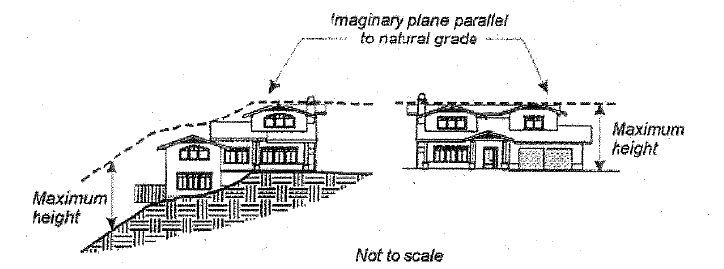
The height of a structure shall be measured as the vertical distance from the finish grade of the site to an imaginary plane located the allowed number of feet above and parallel to the grade. See Figure 17.30.040-1 (Measurement of Height).
Figure 17.30.040-1: Measurement of Height
(Ord. No. 528, 2-15-2022)
17.30.050 - Height exceptions.
Exceptions to the height regulations are as follows:
A.
General height exception. No penthouses or roof structures for the housing of elevators, stairways, tanks, ventilating fans or similar equipment; towers, steeples, roof signs, or other structures shall exceed the height limit provided in this title, except wireless communication facilities as provided for in Chapter 17.210 (Wireless communication facilities). Radio and television masts, flagpoles, chimneys, and smoke stacks may exceed not more than 30 feet above the height limit provided in this title, provided that the same may be safely erected and maintained at such height in view of the surrounding conditions and circumstances.
(Ord. No. 528, 2-15-2022)
17.32.010 - Purpose.
The purpose of this chapter is to establish rules and regulations for setback measurement, yard areas, and encroachments. These provisions, in conjunction with other applicable provisions of this title, are intended to ensure open areas around primary structures, maintain clear visibility for traffic safety and pedestrian access, buffer between property and land uses, and establish natural and visual light and air space privacy, landscaping, and recreation.
(Ord. No. 528, 2-15-2022)
17.32.020 - Definitions.
Terms unique to this chapter are listed in Chapter 17.300 (Glossary of Terms).
(Ord. No. 528, 2-15-2022)
17.32.030 - Yard and setback regulations.
A.
Required yard area. Except as otherwise specified in this title, required yard areas shall be kept free of buildings and structures.
B.
Vertical clearance. Except as otherwise provided in this title, every part of a required yard shall be open from its lowest point to the sky unobstructed. Building overhangs, bay windows, and other such elements may intrude as permitted.
C.
Lots abutting two or more streets. In the case of a lot abutting two or more streets, the primary structures and accessory buildings shall be erected so as not to encroach upon the required yards adjacent to any of the streets.
D.
Double frontage lots. On double frontage lots, both property lines separating the lot from a street are considered front lot lines.
1.
Interior double frontage lot. On an interior double frontage lot, the minimum front yard setback for each front yard shall be the average of the front yard depths of the adjacent lots on each side, if such lots are developed. If one or both of the adjacent lots are undeveloped, the required front yard setback is 20 feet.
2.
Corner double frontage lot. On a corner double frontage lot, the primary structure may be oriented toward any of the property lines. However, the distance between the front of the primary structure and the property line shall be not less than 20 feet.
3.
Lot depth of 125 feet or more. Where a double frontage lot has a depth of 125 feet or more, the lot may be developed with two primary structures, with the front yard setbacks determined as provided above (D.1., D.2.) and a 20-foot minimum separation between the primary structures. Such separation shall be maintained as a rear yard for each primary structure of not less than ten feet, measured from the furthest portion of the rear elevation of each primary structure.
E.
Lot area, depth, width, and setback reduction. At the time of plan check for the first primary structure to be constructed on a lot, where a lot area or a lot width, depth, or setback has been reduced for an existing legally created lot by not more than 15 percent as a result of acquisition or dedication for a highway, road, drain, or other public purpose, as a result of dedication pursuant to a condition of approval, the lot area or yard so reduced may be included in determining compliance with lot area or yard requirements in the same manner as if the acquisition or dedication has not taken place.
F.
Setback measurement. The setback of all buildings and structures shall be determined by the exterior boundaries of the streets and highways and their proposed widening and extensions as indicated on the circulation plan roadway system and sizing map of the city's general plan. The width of any street or highway that does not appear in the circulation plan shall be determined from the standards for street widths and improvements set forth in the city's improvement standards.
(Ord. No. 528, 2-15-2022)
17.32.040 - Allowed encroachments/projections into required yards.
Where yards are required in this title, they shall be not less in depth or width than the minimum dimensions specified for any part, and they shall be at every point open and unobstructed from the ground upward, except as follows:
A.
Cornices, canopies, eaves, chimneys, or other similar architectural features not providing additional floor space within the building may extend from the structure not more than two feet into a required front, side, or rear yard and shall not be less than two feet from any property line.
B.
Open, unenclosed, uncovered porches, platforms or landing places which do not extend above the level of the first floor of the building, may extend from the structure not more than six feet into a required front, side, or rear yard and shall not be less than two feet from any property line; provided, however, that an open work railing not more than 30 inches in height may be installed or constructed on any such porch, platform, or landing place.
C.
Detached accessory buildings may occupy side and rear yards as provided in Chapter 17.38 (Accessory Structures).
D.
Window bays, including roof overhangs, having a minimum surface area of 50 percent glass, may encroach two feet into the required yard area when the finished floor of the window bay is at least 15 inches above the finished floor of the room.
E.
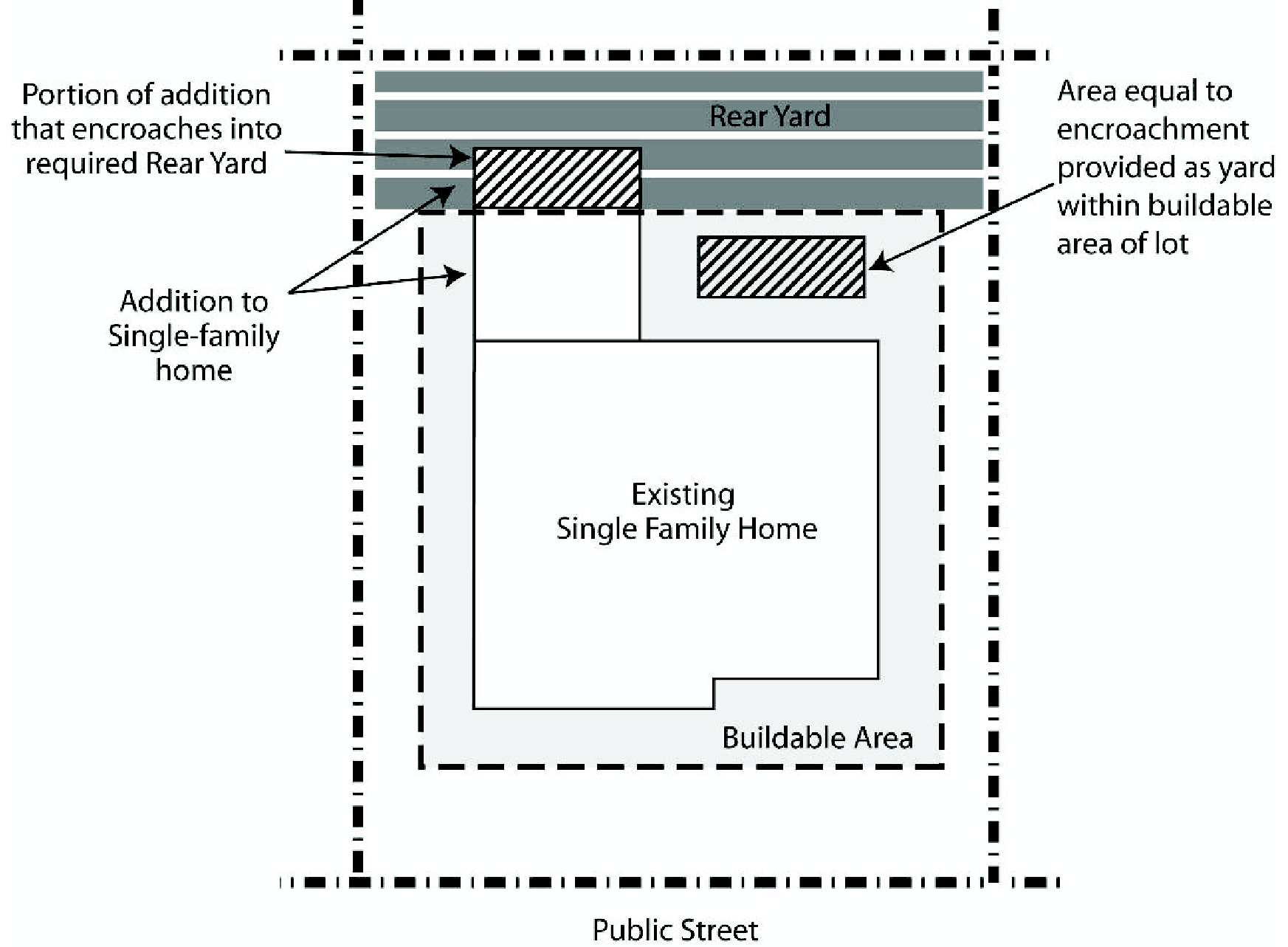
For single-family residential development, a portion of the primary structure may project into the required rear yard area, provided that an equal area of the buildable portion of the lot (this area can be anywhere on the lot) is provided as a yard or court. See Figure 17.32.040-1 (Single-Family Encroachment)
Figure 17.32.040-1: Single-Family Encroachment
(Ord. No. 528, 2-15-2022)
17.34.010 - Purpose.
The purpose of this chapter is to establish rules and regulations that govern the installation of curbs, gutters, and sidewalks and the undergrounding of all utilities in the city. These provisions, in conjunction with other applicable provisions of this title, are intended to establish standards of development in all new industrial, commercial, residential subdivisions and infill projects.
(Ord. No. 528, 2-15-2022)
17.34.020 - Curbs, gutters, and sidewalks.
Installation of curbs, gutters, and sidewalks shall be required for all new development projects, including new industrial, commercial, residential subdivisions and residential infill projects, subject to the following provisions:
A.
The requirement for sidewalks for an infill project may be waived by the planning commission during the project review process if the planning commission determines, based on discussions with the city engineer and the city planner, that continuous sidewalks within the area in which the infill project is located are not feasible and/or necessary. Where no other planning commission review of the project is required, sidewalk installation requirements may be waived through a variance procedure as described under Section 17.10.070 (Variance).
B.
The requirement for curb and gutter improvements for an infill project may be waived by the planning commission during the project review process if the planning commission determines, based on discussion with the city engineer, that such improvements are not and will not be necessary within the project vicinity. Where no other planning commission review of the project is required, curb and gutter installation requirements may be waived through a variance procedure as described under Section 17.10.070 (Variance).
C.
Specific streets where the city will not require curb, gutter and/or sidewalk improvements may be designated through action of the city council, based on discussion with the city engineer and city planner and recommendation of the planning commission.
(Ord. No. 528, 2-15-2022)
17.34.030 - Underground utilities.
The following provisions govern the undergrounding of public utilities:
A.
New developments. In new development areas (e.g., greenfield) of the city, all on-site utilities including, but not limited to, electrical (69kV or less), telephone, cable television, and similar distribution lines shall be installed underground. The city council may grant exceptions for new residential projects as part of the proposed development application. See Chapter 16.24 (Improvements).
(Ord. No. 528, 2-15-2022)
17.36.010 - Purpose.
This chapter provides regulations for the installation, construction, and placement of fences on private property. For the purposes of this zoning code, the term "fence" includes fences or walls. It is the intent of this chapter to regulate the height and location of fences to provide light, air, and privacy without obstructing views, to establish buffers between different land uses, and to safeguard against visual obstructions at the intersections of streets and/or driveways.
(Ord. No. 528, 2-15-2022)
17.36.020 - Permit requirements and exceptions.
Unless otherwise listed as exempt below, site plan review approval shall be required for fences and walls. The following fences and walls are exempt from site plan review approval, or land use or development permit approval.
A.
Retaining walls. Retaining walls less than 36 inches in height, provided that they are designed and constructed with an appearance similar to the buildings and other structures on the site, with compatible colors, finishes, and materials.
B.
Residential fences. Fences located on residential property constructed in compliance with the provisions of this chapter.
C.
Required fences. The provisions of this chapter shall not apply to a fence or wall required by any law or regulation of the city (including temporary construction site fencing), state, or any agency thereof (including the board of education).
(Ord. No. 528, 2-15-2022)
17.36.030 - Location and height restrictions.
A.
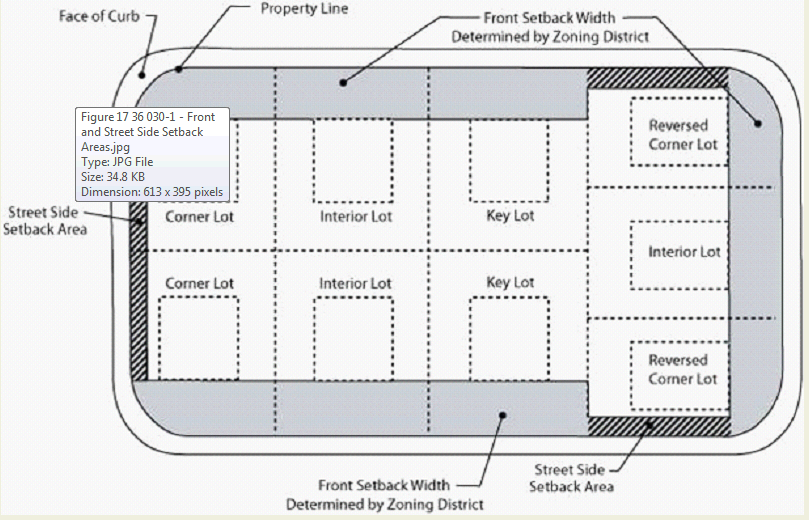
Maximum allowed heights. Fences and walls in the agricultural and residential zoning districts and for residential uses in the commercial transition zoning district shall not exceed the maximum heights in the corresponding required yard area as shown Table 17.36.030-1 (Maximum height of fences and walls in required yard area) and Figure 17.36.030-1 (Front and street side setback areas).
Table 17.36.030-1: Maximum Height of Fences and Walls in Required Yard Area
Notes:
1. As part of site plan review or other discretionary entitlement, the decision-making authority may grant additional height to enclose or screen specific areas or uses or for fences and walls designed for noise attenuation.
2. The agricultural zoning district may have fences within the required front yard area to a maximum height of six feet, provided the fencing is open-view type.
3. Setback area for street side yard is measured from back of sidewalk to the fence. In the event that no sidewalk has been constructed, the setback area shall be measured from five feet from the edge of right-of-way to the fence.
4. See definition of clear vision triangle in Section 17.300.020 (General definitions).
5. For all other areas of the lot, see applicable standards of Chapter 17.38 (Accessory structures).
6. Where, because of the orientation of the lots, a property line fence separates a front yard on one lot from a rear yard on an adjacent lot (i.e., a "key lot" situation), the maximum fence height shall be six feet. (See Figure 17.36.030-1 Front and Side Street Setback Areas.)
Figure 17.36.030-1 Front and Side Street Setback Areas
B.
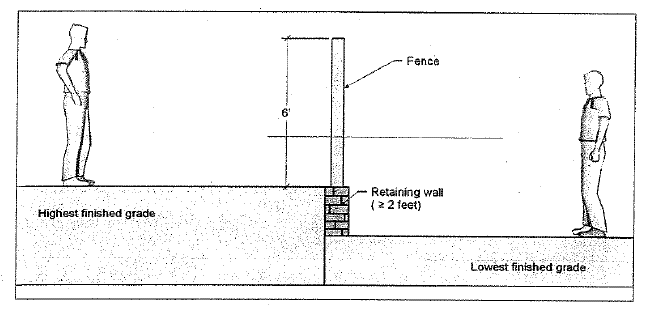
Height measurement. Fence height shall be measured from the finished grade at the base of the fence to the uppermost part of the fence, except when there is a difference in the ground level between two adjoining parcels of two feet or more, the fence height shall be measured on the side with the highest finish grade. See Figure 17.36.030-2 (Measurement of fence height on parcels with different elevations).
Figure 17.36.030-2: Measurement of fence height on parcels with different elevations
C.
Location. Fence location on any lot shall be in conformance with these standards, unless a more restrictive standard has been adopted as a development standard for the subdivision in which the lot is located.
(Ord. No. 528, 2-15-2022)
17.36.040 - Fence and wall design standards.
A.
Open view fencing. Where fencing is proposed along public frontages of non-residential and multifamily projects, such fencing shall be open view unless otherwise required to be solid for noise attenuation. Open view fencing shall also be required when located adjacent to open space areas. However, open view fencing for side yards of corner lots abutting open space areas may be designed with privacy fencing.
B.
Fencing materials. Fences and walls shall be constructed of attractive, long-lasting materials (e.g., masonry, wood, tubular steel, or stone).
C.
Prohibited fencing materials. Unless approved as a condition of approval or in conjunction with another entitlement, walls or fences of sheet or corrugated iron, sheet steel, concertina wire or sheer aluminum, are prohibited. Barbed wire fencing shall not be constructed or placed on top of a fence except where properly used for agricultural, open space, or industrial uses.
D.
Graffiti-resistant surface. Graffiti-resistant aesthetic surface treatment, where deemed appropriate to the location, shall be required for all masonry walls.
(Ord. No. 528, 2-15-2022)
17.36.050 - Special fence and wall requirements.
A.
Screening of outdoor storage. Outdoor storage within commercial and industrial zoning districts (including all dumpsters, commercial items, commercial construction or industrial related materials and equipment within commercial zones) shall be fenced or screened from view in a manner that is attractive and complementary to the principal use and/or structure that it serves. Such screening shall utilize enclosures including, but not limited to, fences, walls, landscaping, or earthen berms, so that no outdoor storage is visible from any public right-of-way, parks, public trails, and adjacent properties.
B.
Special fencing for company vehicles in industrial zones. In industrial zones, company vehicles less than one ton do not require screening and may be parked behind the required landscape area with or without security fencing, as set forth in this article. Company vehicles exceeding one ton that are permitted on the public highways and used in the daily operation of the company may be parked within the buildable portion of the lot without screen fencing. All company vehicles that exceed one ton and are either not permitted on the public highways or not used in the daily operation of the company shall be fenced or screened from view in a manner that is attractive and complementary to the structure it serves. The method of screening or fencing shall be architecturally compatible with other on-site development in terms of colors, materials, and architectural style.
C.
Special fencing for agricultural land uses. All fences which enclose livestock shall be constructed of an adequate height and shall be designed so as to control and contain such livestock at all times.
D.
Fencing for pools, spas, and similar features. Swimming pools, spas, and other similar water features shall be fenced in compliance with city-adopted building code requirements.
E.
Special screening for commercial and industrial uses adjacent to residential and agricultural zones. Commercial and industrial uses shall be screened from adjacent residential and agricultural zones or when necessary as determined by the decision-making authority as follows below, provided that screening between mixed-uses that consist of residential and non-residential uses need not be screened from adjacent commercial uses, unless otherwise required by the decision-making authority. The city encourages the integration and connection of compatible uses and to that end, this requirement is not intended to preclude the development of pedestrian/bicycle access points between commercial and residential zones.
1.
The screening wall shall be a solid masonry wall with a minimum height of six feet and shall also consist of plant materials (e.g., vines or other living plant cover on the wall).
2.
A landscaping strip with a minimum width of five feet shall be installed adjacent to a screening wall on the commercial or industrial side.
3.
The decision-making authority may waive or approve a substitute for the requirements above if it is determined that:
a.
The relationship of the proposed uses makes screening unnecessary or undesirable;
b.
The intent of this section is successfully met by alternative screening methods; and/or
c.
Physical characteristics and/or constraints on the site make required screening infeasible or unnecessary.
F.
Screening of commercial loading docks and refuse areas. Loading docks and refuse storage areas shall be screened from public view, adjoining public streets and rights-of-way and residentially zoned areas. The method of screening shall be architecturally compatible with other on-site development in terms of colors, materials, and architectural style. Exceptions may be permitted through site plan review for sites with unique characteristics (e.g., shallow lot depth, adjacency to single family residential).
G.
Temporary fences. Nothing in this chapter shall be deemed to prohibit the erection of a temporary fence around construction projects in compliance with the building code and other applicable provisions of the City Municipal Code.
H.
Maintenance. Fences and walls shall be continuously maintained in an orderly and good condition, at no more than their maximum allowed height.
(Ord. No. 528, 2-15-2022)
17.38.010 - Purpose.
The purpose of this chapter is to identify and regulate detached accessory structures to ensure that such structures do not create a public safety issue or public nuisance and do not create an adverse aesthetic from street right-of-ways or adjacent/neighboring properties. The intent of these regulations is to complement the requirements and standards of the city's adopted building code and fire code.
(Ord. No. 528, 2-15-2022)
17.38.020 - Definitions.
Terms unique to this chapter are listed in Chapter 17.300 (Glossary of Terms).
(Ord. No. 528, 2-15-2022)
17.38.030 - Permit requirements and exceptions.
Generally, no special planning permit or entitlement shall be required for accessory structures that are consistent with the standards herein, except that zoning clearance/plan check shall be conducted in the event that a building permit is required. Even if a building permit is not required a planning permit or entitlement may be. Certain structures may require site plan review, variance, or other permits or entitlements as specified in Chapter 17.10 (Permit and Entitlements).
(Ord. No. 528, 2-15-2022)
17.38.040 - Development standards.
A.
General development standards for all accessory structures. The development standards in this section shall only apply to accessory structures. Primary structures, and any other feature attached to the primary structure (e.g., patio cover), are subject to the setback, height, and other requirements for the zoning district in which they are located.
1.
Setback measurement. Minimum setback distances for accessory structures from property lines and between all structures shall be measured to any portion of the structure(s), inclusive of overhangs, projections, railings, etc.
2.
Construction phasing. Accessory structures may be constructed only in conjunction with or after construction of the primary building(s) on the site. However, in agricultural and residential zoning districts, accessory structures may be constructed prior to the primary residential dwelling.
3.
Maximum coverage. The total size of all accessory structure(s) on a lot may not exceed 30 percent of the actual rear yard area.
B.
Development standards by type of accessory structure. Table 17.38.040-1 (development standards for accessory structures) establishes development standards based on the type of accessory structure as defined in Chapter 17.300 (Glossary of Terms).
Table 17.38.040-1: Development Standards for Accessory
Structures
Notes:
1. Detached garages may be attached to a primary structure and may encroach into the required rear yard for the primary structure by not more than 15 feet if:
• It is less than 600 square feet in area;
• It shares a common wall of not less than five feet in length with the primary structure or is not located not more than six feet from the primary structure; and
• It is connected to the primary structure by a roof of not less than five feet in width.
2. An accessory structure may be located within the front 60 percent of the lot if it is screened from view by a fence or landscaping and is located a minimum of ten feet behind said screening.
3. On reverse corner lots, the street side yard setback shall be the same as the front yard setback for the adjacent key lot.
4. Measurement form water's edge. Related equipment shall be setback a minimum of three feet from all side and rear property lines.
5. See the city-adopted building code for separation requirements.
(Ord. No. 528, 2-15-2022)
17.40.010 - Purpose.
This chapter establishes regulations, which provide for safe, attractive, and convenient off-street parking and loading and to ensure that parking areas are compatible with surrounding land uses.
(Ord. No. 528, 2-15-2022)
17.40.020 - Applicability.
No structure shall be constructed, enlarged or increased in capacity, or the use changed or increased in intensity, unless off-street parking spaces for automobiles are permanently provided and maintained for the benefit of residents, employees, customers and visitors, within or outside of buildings or in a combination of both, in accordance with the requirements listed in this chapter.
Off-street parking and loading provisions of this chapter shall apply as follows:
A.
New development. For all buildings or structures erected and all uses of land established after the effective date of this title, parking for vehicles and bicycles, and loading facilities shall be provided as required by this chapter.
B.
Change in use. When the use of any building, structure, or premises is changed, resulting in an increase of more than ten percent in the required number of off-street parking spaces, additional off-street parking shall be provided consistent with Section 17.40.050 (Number of parking spaces required).
C.
Change of occupancy. Where a new business license is required, additional parking spaces shall be provided if the new occupancy would result in an increase of more than ten percent in the required number of off-street parking spaces.
D.
Modification to existing structures. Whenever an existing building or structure is modified such that it creates an increase of more than ten percent in the number of off-street parking spaces required, additional off-street parking spaces shall be provided in accordance with the requirements of this chapter.
(Ord. No. 528, 2-15-2022)
17.40.030 - Permit requirements.
New parking lots and modifications or expansions to existing parking lots require the following permits:
A.
Building permit. New parking lot design and modifications to existing parking lots in conjunction with a substantial change in use to an existing structure shall be reviewed in conjunction with the building permit and any other land use or development permit required for the project.
B.
Plan check. Modification or improvements to an existing parking lot that impact the parking space layout, configuration, number of stalls, landscape planters, etc. Shall require plan check certification, as outlined in Section 17.10.020 (Plan check), to authorize the change as consistent with the zoning code.
C.
Exempt activities. Parking lot improvements listed below shall be considered minor in nature if they do not alter the number or configuration of parking stalls. Such improvements shall be exempt from plan check.
1.
Repair of any defects in the surface of the parking area, including repairs of holes and cracks;
2.
Resurfacing, slurry coating, and restriping of a parking area with identical delineation of parking spaces;
3.
Repair or replacement in the same location of damaged planters and curbs; and
4.
Work in landscape areas, including sprinkler line repair, replacement of landscape materials, or refurbishment.
(Ord. No. 528, 2-15-2022)
17.40.040 - General parking requirements.
The layout of parking spaces, loading berths and parking aisles shall comply with all the following requirements:
A.
The required parking spaces, loading berths and parking aisles may not be located on any street right-of-way.
B.
Each parking space shall have a minimum size of nine feet by 18 feet when outdoors and shall be free of obstructions such as columns or walls. Each parking space shall be ten feet by 20 feet when indoors or where columns or walls are located within the parking area. Each loading berth shall be a minimum size of 12 feet by 30 feet whether indoors or outdoors.
C.
Parking aisles shall have a minimum width of 12 feet when spaces are parallel to the aisle or up to an angle of 40 degrees, 17 feet when spaces are at an angle of between 40 degrees and 70 degrees, and 23 feet when spaces are at an angle between 70 degrees and 90 degrees.
D.
Parking spaces and aisles shall have a maximum grade of seven percent.
E.
Each parking space and aisle shall have a minimum eight-foot vertical clearance. Each loading berth and access thereto shall have a minimum 15-foot vertical clearance.
F.
Each parking space and loading berth shall have vehicular access to the street, without passing over other parking spaces.
G.
Neither a required side yard abutting a street, nor a front yard, shall be used for off-street parking, except that for single-family residential uses, parking spaces beyond the minimum requirement (the two garage spaces) may be allowed within required interior side yards.
H.
Residential uses. Residential uses shall provide parking in compliance with Table 17.40.050-1 (Parking Requirements by Land Use).
1.
Conversion of a garage for a single-family residence shall be prohibited unless an equivalent space is provided in compliance with the requirements of Table 17.40.050-1 (Parking Requirements by Land Use).
2.
A single-family use that does not conform to the provision of this article shall be brought into compliance at the time additions or alterations are made that cumulatively increase the existing floor area by more than 25 percent, unless waived under Section 17.40.050(D) (Parking Reduction).
(Ord. No. 528, 2-15-2022)
17.40.050 - Number of parking spaces required.
A.
The following number of parking spaces shall be required to serve the uses or buildings listed, as established in Table 17.40.050-1 (Parking Requirements by Land Use). Multiple uses must provide the sum of the requirements for each individual use. In addition, the following provisions shall apply:
1.
"Square feet" means "gross square feet" and refers to building area unless otherwise specified.
2.
For the purpose of calculating residential parking requirements, dens, studies, or other similar rooms that may be used as bedrooms shall be considered bedrooms.
3.
Where the number of seats is listed to determine required parking, seats shall be construed to be fixed seats. Where fixed seats provided are either benches or bleachers, such seats shall be construed to be not more than 18 linear inches for pews and 24 inches for dining, but in no case shall seating be less than determined as required by the building code.
B.
When the calculation of the required number of off-street parking spaces results in a fraction of a space, the total number of spaces shall be rounded to the nearest whole number (< 0.49 round down, > 0.50 round up).
Table 17.40.050-1: Parking Requirements by Land Use
C.
Uses Not Listed. Other uses not specifically listed in this section shall furnish parking as required by the planning commission in determining the off-street parking requirements. The planning commission shall be guided by the requirements in this section generally, and shall determine the minimum number of spaces required to avoid interference with public use of streets and alleys.
D.
Parking reduction. Parking spaces provided to meet the requirements of this chapter shall not be reduced in size or number, modified, or eliminated without review by the planning commission under site plan review, as established in Section 17.10.090 (Site plan review).
(Ord. No. 532, 9-19-2023; Ord. No. 528, 2-15-2022)
17.40.060 - Parking requirements for the disabled.
A.
Number of spaces, design standards. Parking spaces for the disabled shall be provided in compliance with the building code and state and federal law.
B.
Reservation of spaces required. The number of disabled accessible parking spaces required by this chapter shall be reserved by the property owner/tenant for use by the disabled throughout the life of the approved land use.
C.
Upgrading of markings required. If amendments to state or federal law change standards for the marking, striping, and signing of disabled access parking spaces, disabled accessible spaces shall be upgraded in the time and manner required by state law.
(Ord. No. 528, 2-15-2022)
17.40.070 - Compact car requirements.
The following provisions apply to parking provided for all uses or buildings except one-family and two-family dwellings:
A.
Up to 20 percent of the required number of parking spaces may be sized for compact cars.
B.
Compact car parking spaces shall be at least eight feet in width and 16 feet in length, and shall be clearly marked, "COMPACT CARS ONLY," "COMPACT," or "C"
C.
Compact car space shall be distributed throughout the parking lot.
D.
Where a section of the parking lot is restricted to compact parking with an angle of 90 degrees, the aisle width may be reduced from the standard 23 feet to 21 feet. Such compact sections should be located so as to minimize the distance from the section to the appropriate building or activity.
(Ord. No. 528, 2-15-2022)
17.40.080 - Parking and driveway design and development standards.
A.
Surface parking area. All surface parking areas shall have the following improvements:
1.
Each parking space and aisle, except those accessory (i.e., beyond the minimum requirement) to one-family and two-family dwellings, shall be graded, drained and surfaced so as to prevent dust, mud, or standing water, and shall be identified by pavement markings bumper guards, entrance and exit signing, and directional signs, to the satisfaction of the city engineer.
2.
Lighting, giving a ground level illumination of one to five foot-candles, shall be provided in a parking area during the time it is accessible to the public after daylight. Lighting shall be shielded to prevent glare on contiguous residential properties.
3.
Where such parking area abuts a street, it shall be separated by an ornamental fence, wall or compact Eugenia or other evergreen hedge having a height of not less than two feet and maintained at a height of not more than four feet. Such fence, wall, or hedge shall be maintained in good condition.
4.
When the required off-street parking space for nonresidential uses is to be provided on a separate lot from the use or building, the lot shall be no further than 500 feet from the front entrance of the use or building. The parcel is to be under the same ownership as the use or building, or is leased to the effect that the owner or owners of the lot will continue to maintain such parking spaces so long as the use or building is maintained. Proof of such lease arrangement shall be demonstrated to the satisfaction of the planning commission.
5.
In addition to parking spaces, a minimum of one loading berth shall be required, for all commercial and industrial buildings in excess of 5,000 square feet or fraction thereof, plus one additional berth for every additional 20,000 square feet of floor area. Loading berths shall conform to the following standards:
a.
Dimensions. Each required loading berth shall be not less than ten feet wide, 35 feet long, and with 14 feet of clear height. Loading zones shall be separate from other required parking and maneuvering areas.
b.
Location. Where feasible, loading zones and docks shall be located to the rear of properties. No truck entrance door, loading zone and/or dock serving commercial vehicles shall be permitted to face a residential area within 500 feet.
6.
Screening. All loading zones and truck parking areas shall be screened from view by a minimum of a six-foot high hedge, vine-covered fence or wall plus landscaping as required by Chapter 17.36 (Fences and Walls).
B.
Driveway location standards. Development projects located at intersections shall be accessed as follows:
1.
Driveways to access parcels located at the intersection of two streets shall be gained through driveways from-the lesser street. Determination of which street is lesser shall be made based on total paving width, amount of traffic, adjacent traffic controls and likely destinations along each street in question.
2.
Driveways serving parcels located at the intersection of two streets shall be situated at the maximum practical distance from the intersection.
3.
Where a proposed driveway is located at least 75 feet from the nearest cross street, the provisions of subsections (B)(1) and (B)(2) may be waived.
C.
Driveway size and composition. All residential driveways shall be a minimum of 20 feet in length and width and shall be constructed with an impervious surface (i.e., concrete, asphalt, or similar material) and shall be constructed to appropriate standards as determined by the city. Driveways for secondary dwelling units may be a minimum of ten feet in width, subject to approval by the city fire chief. All driveways shall be connected to a street by an asphalt surface extending from the subject parcel's front property line to the paved road surface.
D.
Roads and parking for mobile home parks. All internal circulation aisles shall be at least 25 feet from curb to curb and shall be increased in width by ten feet for parking spaces on each side of the street on which such curb parking is permitted, consistent with Chapter 12.08 (Street Construction Standards). All roads and parking spaces shall be permanently paved.
(Ord. No. 528, 2-15-2022)
17.42.010 - Purpose.
This chapter establishes regulations for signs within the city for the purposes of safeguarding and protecting the public health, safety, and welfare through appropriate prohibitions. The city recognizes that signs and other graphics are an essential element of a community's visual appearance and provide a means to identify and promote businesses and are an important element in creating safer public streets and highways. Consequently, the purpose of this chapter is to provide sign regulations that are consistent with the goals and objectives of the city's general plan and the community's visual and aesthetic goals. In addition, these regulations are intended to:
A.
Promote an economically stable and visually attractive community and insure that the special character and image the city is striving for can be attained;
B.
Promote signs and graphics that are attractive, pleasing and harmonized with the physical character of the environment and surrounding properties, while serving the advertising needs of the business community;
C.
Promote traffic safety and the smooth and efficient flow of pedestrians and vehicles to their destinations; and
D.
Direct persons to various activities and enterprises, in order to provide for maximum public convenience.
(Ord. No. 528, 2-15-2022)
17.42.020 - Policies for sign regulations.
A.
Regulatory interpretations. The provisions of this chapter shall not be interpreted to nullify any easements, covenants or other private agreements which provide for more restrictive sign regulations than are required by this chapter.
B.
Enforcement. The city planner is authorized and directed to enforce and administer the provisions of this chapter. Whenever the application of this chapter is uncertain due to ambiguity of its provisions, the issue shall be referred to the city planner for an interpretation and such interpretation shall be made by the city planner within ten business days. Any decision made by the city planner may be appealed to the planning commission in accordance with Subsection 17.42.040 E. (Appeals).
C.
Message neutrality. It is the city's policy and intent to regulate both commercial and non-commercial signs in a viewpoint-neutral or content-neutral manner. The message of the sign shall not be reviewed except to the minimum extent necessary to identify the type of sign.
D.
Message substitution. Subject to the property owner's consent, a non-commercial message of any type may be substituted in whole or in part for the message displayed on any sign for which the sign structure or mounting device is authorized pursuant to this Code, without consideration of message content. Such substitution of message may be made without any additional approval or permitting. The purpose of this provision is to prevent any inadvertent favoring of commercial speech over non-commercial speech, or favoring of any particular non-commercial message over any other non-commercial message. In addition, any on-site commercial message may be substituted, in whole or in part, for any other on-site commercial message, provided that the sign structure or mounting device is authorized pursuant to this Code, without consideration of message content. This provision does not create a right to increase the total amount of signage on a parcel, lot, or land; does not affect the requirement that a sign structure or mounting device be properly permitted; does not allow a change in the physical structure of a sign or its mounting device; and does not allow for the substitution of an off-site commercial message in the place of an on-site commercial or non-commercial message.
E.
On-site/off-site distinction. Within this chapter, the distinction between on-site and off-site signs applies only to commercial messages.
F.
General prohibition. Permanent signs not expressly permitted by this chapter are prohibited.
(Ord. No. 528, 2-15-2022)
17.42.030 - Definitions.
Terms unique to this chapter are listed in Chapter 17.300 (Glossary of terms).
(Ord. No. 528, 2-15-2022)
17.42.040 - Permits and review procedures.
A.
Permit required.
1.
Sign permit required. A sign permit shall be required for all permanent signs (building attached or freestanding) prior to erection, relocation, alteration, or replacement of a sign, unless otherwise exempted by this chapter. The process for application, review, and decision regarding a sign permit shall be as established in Section 17.10.030 (Sign permit). A sign permit shall not be required for general maintenance of existing signs or the replacement of the sign face (including message) when the area of the sign is not being changed and a building permit is not required (e.g., the replacement of a sign face on a can sign). A sign permit is also not required for the establishment of temporary signs; however, such signs shall be consistent with the development standards and time duration limits established in this chapter.
2.
Creative sign program. A creative sign program provides for property owners and businesses to propose and the city to consider special deviations from the regulations for on-site permanent signs provided in this chapter under certain circumstances. The intent of this process is to (1) encourage signs of unique design that exhibit a high degree of imagination, inventiveness, spirit, and thoughtfulness; and (2) provide a process for the application of sign regulations in ways that will allow creatively designed signs that make a positive visual contribution to the overall image of the city, while mitigating the impacts of large or unusually designed signs. The process for application, review, and decision of the creative sign program shall be as established in Section 17.10.035 (Creative sign program).
3.
Uniform sign program required. To ensure compliance with the regulations of this chapter and except as otherwise exempted, a uniform sign program shall be required for all new non-residential developments of three or more separate tenant spaces that (1) share either the same parcel or structure; and (2) use common access and parking facilities within the city. The process for application, review, and decision regarding a uniform sign program shall be as established in Section 17.10.040 (Uniform sign program).
B.
Method of application. An application for a sign permit, creative sign program, or uniform sign program shall be made on the form(s) prescribed by the city planning department. The application shall be accompanied by any fees as specified by city council resolution. The required contents of the application shall be as specified in Section 17.10.030 (Sign permit), Section 17.10.035 (Creative sign program), or Section 17.10.040 (Uniform sign program) for each type of permit.
C.
Decision and application review procedures. At each level of review or appeal, the decision shall be rendered, in writing, within the time limits set forth herein. The time period begins running when the application is deemed complete, or the notice of appeal has been filed, whichever applies.
1.
Generally.
a.
Notwithstanding any of the time limits contained in this section, the city planner and planning commission shall endeavor to render decisions in a timely manner.
b.
Notwithstanding the time limits contained in this section, the city planning department and the applicant may mutually agree to an extension of the time limits. Such extension shall be in writing and shall be for no more than 90 days.
2.
Sign permit and creative sign program.
a.
Upon receipt of a completed sign permit or creative sign program application by the city planning department, the city planner shall review the contents of and approve, deny, deem incomplete, or refer the application to the planning commission within ten calendar days.
b.
If, within ten calendar days of receiving the application, the city planner determines that the application does not include the necessary information needed to review the proposal for consistency with this chapter, the city planner shall deem the application incomplete. If the application is incomplete, the applicant shall be notified in writing. The notification shall specify what information is missing and may also include information on the areas in which the submitted plans are not in compliance with city standards.
c.
Should the city planner fail to take action on a sign permit or creative sign program application within the prescribed time limits established by this section, such sign permit or creative sign program application shall be deemed automatically appealed to the planning commission to the extent it complies with the area and location requirements for signs imposed by this chapter.
3.
Uniform sign program. The application processing procedures for uniform sign programs shall be as described in Chapter 17.08 (Application processing procedures). The city planner shall determine whether a uniform sign program application is complete within 30 calendar days of application submittal and shall make the determination in writing to the applicant. Once the application is deemed complete, the city planner shall schedule the program for hearing with the planning commission. The planning commission hearing shall occur no later than 90 days from the date of that the uniform sign program application is deemed complete.
D.
Variances. Applications for a variance from the terms of this title shall be reviewed by the planning commission according to the variance procedures set forth in Section 17.10.070 (Variance).
E.
Appeals.
1.
Appeals of decisions of the city planner or planning commission may be appealed as specified in Section 17.08.060 (Appeals).
2.
A final determination of the city council may be appealed to a court of competent jurisdiction in accordance with applicable provisions of state law.
(Ord. No. 528, 2-15-2022)
17.42.050 - Exempt signs.
The following sign types are expressly exempted from the permit requirements of this chapter and title but still must satisfy any and all other applicable city permit requirements when necessary (e.g., building, electrical, plumbing, grading, encroachment, etc.). Any exception to the limitations for exempt signs listed herein shall require either a creative sign program pursuant to Section 17.10.035 (Creative sign program) or a variance pursuant to Section 17.10.070 (Variance). However, consideration of the variance request shall not evaluate the message or graphic design of a sign.
A.
Exempt signs without limitations. The following signs are exempt from sign permit and city review requirements:
1.
All devices which are excluded from the definition of a "sign" as set forth in this Code.
2.
Official traffic signs or other municipal governmental signs, legal notices, advertisements prescribed by law and placed by governmental entities, and signs indicating the location of buried utility lines or any notice posted by a governmental officer in the scope of his duties. The city has a compelling interest in allowing such signs in order to comply with state and local laws and to promote public safety.
3.
Direction, warning or information signs or structures required or authorized by law, or by federal, state, county, or city authority, including, but not limited to, traffic control signs (e.g., stop, yield), highway route number signs, and construction zone signs. The city has a compelling interest in allowing such signs in order to comply with state and local laws and to promote public safety.
4.
Existing ghost signs. Restoration of ghost signs is encouraged and shall not affect the exempt status of the sign, nor shall it count towards the maximum allowed area of any new on-site signage.
5.
Utility company signs identifying cables, conduits, danger, and so forth. The city has a compelling interest in permitting such signs in order to comply with state and local laws and to promote public safety.
6.
Street address signs consistent with the city-adopted building code or relevant provisions of the City Municipal Code. Notwithstanding anything in this section, street address signs may be illuminated and may contain reflective paint or material. The city has a compelling interest in permitting such signs to promote the identification of property to guide emergency response personnel.
7.
Historical and/or memorial tablets and identification plaques installed by or on behalf of a recognized governmental historical agency. The city has a compelling interest in permitting such signs to promote interest in historical structures and events and to promote public safety and identification.
8.
Time and temperature signs containing no advertising copy. The city has a compelling interest in permitting such signs to promote awareness of local conditions for individuals with medical problems and to promote public safety.
9.
Signs and advertising for the California State Lottery as authorized by California Government Code, Section 8880 et seq. The city has a compelling interest in permitting such signs in order to comply with state law.
10.
Gas pricing signs, as required by state law, which identify the brand, types, octane rating, etc. of gasoline for sale within the city. The city has a compelling interest in permitting such signs in order to comply with state law.
11.
Change of copy that does not alter the size, location, or illumination of a sign. The city has a compelling interest to permit such minor changes to make sign maintenance a less onerous burden on property owners and to promote public safety.
12.
Signs prohibiting trespassing or hunting. The city has a compelling interest to allow property owners to post these signs for the protection of life and private property and to promote public safety.
B.
Exempt signs with limitations. The following signs are exempt from sign permits and as such do not require city review. However, they shall be consistent with the size, height, duration, and/or maximum number limitations listed:
1.
Flags that are not included in the definition of a temporary promotional sign that display a non-commercial message, attached to poles, including, but not limited to, flags of the United States, the state and other countries and states, counties and municipalities, not to exceed three flags/poles on properties containing less than one acre of land, and not to exceed six flags/poles on properties containing more than one acre of land. Poles shall not exceed 30 feet in height and flags shall not exceed 42 square feet in surface area. Such flags shall be maintained in good condition and free of tattering or tearing.
2.
Permanent window signs (e.g., hanging on the interior of the window or stenciled on the inside or outside of the window) not exceeding four square feet per street frontage shall be permitted. Such signs should be encouraged to promote business identification, hours of operation and address information. Such signs may not be illuminated.
3.
Community interest group signs (e.g., fraternal, benevolent, social services, religious organizations) displaying a non-commercial message, such as time and place/location of meetings, provided said signs are combined onto a common sign structure, the overall area of which does not exceed 100 square feet, and the area devoted to any one organization does not exceed 20 square feet. Such signs may be located off-site from where the activity takes place; however, no more than four locations for such signs will be allowed within the city. Such signs must be set back a minimum of 25 feet from the public right-of-way in non-residential districts and set back a minimum of ten feet from the public right-of-way in non-residential districts, and must be located a minimum of 75 feet from any other freestanding sign.
4.
Construction signs not to exceed one sign per street frontage and a maximum of 20 square feet in area or a maximum of 36 square feet if combined with a future tenant sign. Construction signs may not be illuminated. Such signs shall be removed at the earliest of the following events: final building inspection approval, issuance of a valid certificate of occupancy, or opening for business to the public.
5.
Future tenant signs. One future tenant identification sign (e.g., banner) per property/establishment shall be permitted and shall not exceed ten square feet in area or a maximum of 36 square feet if combined with a construction sign. A future tenant identification sign listing the name of future tenants, responsible agent or realtor, and identification of the specific complex are encouraged. When a future tenant sign is independent of a construction sign, the future tenant sign is permitted until such time as a certificate of occupancy is issued for the building(s). The maximum height of future tenant signs shall be five feet and the sign may not be illuminated. Additionally, windows of future tenant spaces may be papered over to screen construction. Such window papering signage on said property is permitted and shall not count towards the sign area limitation.
6.
Garage, yard, estate, and other home-based sale signs advertising the one day sale of items from a garage, yard, estate, or other home-based sale. One day sale signs are not permitted for home occupations. The city has a compelling interest to allow these signs for the benefit of residents and local groups. A maximum of four signs, each a maximum of six square feet, may be allowed. Such signs shall not be affixed to any utility pole or street sign pole.
7.
Real estate signs are allowed on private property if set back five feet from the public right-of-way and out of any required clear visibility triangle, with the following limitations:
a.
For residential property, one sign with a maximum sign area of six square feet (each side). Additionally, a maximum of three attached rider signs are permitted on each real estate sign. On weekends and holidays, signs needed to direct traffic from major collector and arterial streets to the subject property are allowed as follows: one sign may be placed for each change in direction to a maximum of five signs, each with a maximum sign area of six square feet.
b.
For commercial property, one on-site sign per street frontage with a maximum sign area of 32 square feet for parcels with less than one acre and 48 square feet for parcels large than one acre with an eight-foot height limit.
c.
Removal. All real estate signs must be removed not later than five days after the close of the transaction proposed by the sign.
8.
On-site directional signs. Exit, entrance, or other on-site traffic directional signs are permitted. When located within a required front yard or street side yard area (as defined in Chapter 17.32 (Yard measurement and projections)), the maximum height of any directional sign shall be 30 inches and the maximum size shall be four square feet. No advertising or message other than for traffic direction shall be displayed.
9.
Nameplate signs for residential uses, provided that there is no more than one unlit sign per property, up to a maximum of one-half square foot in area, which is attached to and parallel with the front wall of the building and only contains the name and title or occupation of the occupant.
10.
Nameplate signs for commercial uses, identifying (and copy limited to) the address of the building, property, or tenant to a maximum of one square foot per sign. Nameplates for commercial uses may only be lit by either an indirect light source (e.g., porch light), low-wattage spotlight without glare to the adjoining property, or internal light source with opaque (non-transparent) background.
11.
Signs on residential property, not exceeding ten square feet in area, other than nameplates and street addresses, and of a non-commercial nature, are allowed provided that they are setback at least five feet from the public right-of-way and do not project over the roofline of any structure.
12.
Murals, on walls other than the main entrance to a building, installed and maintained to an area not exceeding a maximum of 100 percent of the exterior wall area of the first two stories upon the wall or facade where the mural sign is located.
13.
Menu/order board signs. A maximum of one menu/order board sign shall be permitted for each drive-in or drive-through establishment, provided that the sign does not exceed a maximum of 40 square feet in sign area and that the sign be limited in height to eight feet. The menu/order board sign does not count toward the total allowed signage for the establishment as described in Table 17.42.090-1 (Allowed permanent on-site sign standards). Additional signs, area, and/or height may be permitted through issuance of a creative sign program, provided that the location of the sign(s) does not interfere with on-site vehicle circulation or traffic in the public right-of-way (e.g., line of sight).
(Ord. No. 528, 2-15-2022)
17.42.060 - Prohibited signs.
It shall be unlawful to erect, and no permit shall be issued for, any of the following signs:
A.
Any sign not specifically in accordance with the provisions of this chapter;
B.
Signs painted or mounted on roofs or placed above the roof line (except for mansard roofs);
C.
Animated signs or flashing signs, with the exception of time and temperature signs and electronic reader signs;
D.
Pennants, banners, balloons or other paraphernalia composed of paper, cloth or other flexible material, except as otherwise permitted under Section 17.42.100 (Allowed temporary on-site sign standards);
E.
Signs which rotate, move, reflect, blink or incorporate elements that do so, except time and temperature signs and electronic reader signs;
F.
Signs placed on the public right-of-way or affixed to an element or structure on the public right-of-way, or located on a publicly owned tree, fence, or utility pole or otherwise posted on public property, except where required by a governmental agency or permitted as part of kiosk sign program, or as provided in Chapter 17.44 (Signs on city property);
G.
Inflatable balloon signs, including, but not limited to individual balloons, balloon strings, and other inflatable objects made of a flexible material and inflated so as to be lighter than air;
H.
"Can signs," except logos;
I.
"Pole signs" and other freestanding signs constructed with a single supporting pole that is not covered with architectural cladding or other covers so as to appear as a solid base or structure;
J.
Electronic message signs in the historic (H) district;
K.
Signs affixed to vehicles where the primary purpose of the vehicle is advertising. This does not apply to signs maintained on vehicles when such advertising is incidental to the primary purpose for which the vehicle is being uses (e.g., delivery service) or is required by state or federal law (e.g., contractor's license number) as exempted in the definition of a sign. Signs included in this definition include, but are not limited to, cars parked showing garage sale signs or vehicles that drive around the city with the express intent of communicating a message displayed on the vehicle (e.g., "rolling billboards").
L.
Signs attached to light standards unless part of a uniform sign program or street banner program.
(Ord. No. 528, 2-15-2022)
17.42.070 - General development, maintenance, and removal provisions.
A.
Construction of signs. Every sign and all parts, portions and materials thereof shall be manufactured, assembled, and erected in compliance with all applicable state, federal, and city laws and regulations, including the locally adopted building code. All signs shall comply with the following criteria:
1.
All transformers, equipment, programmers, and other related items shall be screened and/or painted to match the building or shall be concealed within the sign.
2.
All permanent signs shall be constructed of quality, low-maintenance materials such as metal, concrete, natural stone, glass, and acrylics. Techniques shall be incorporated during construction to reduce fading and damage caused by exposure to sunlight or degradation due to other elements.
3.
All freestanding signs that incorporate lighting shall have underground utility service.
4.
All temporary signs and banners shall be made of a material designed to maintain an attractive appearance for as long as the sign is displayed.
B.
Maintenance of signs. Every sign and all parts, portions and materials thereof shall be maintained and kept in proper repair. The display surface of all signs shall be kept clean, neatly painted, and free from rust and corrosion. Any cracked, broken surfaces, malfunctioning lights, missing sign copy, or other non-maintained or damaged portions of a sign shall be repaired or replaced within 30 days following notification by the city. Noncompliance with such a request will constitute a nuisance condition and zoning violation and will be enforced as such.
C.
Determination and measurement of sign area.
1.
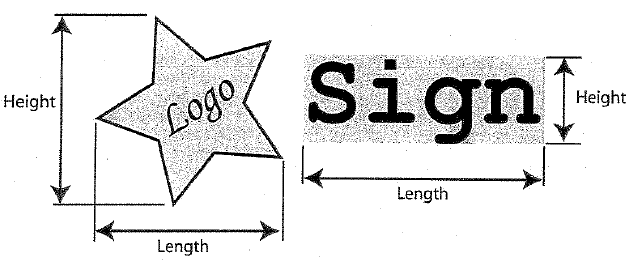
General area calculation. Generally, the area of a sign shall be measured as the overall length of the sign times the overall height of each segment of copy or logo exclusive of background. When the sign is composed of individual letters applied to the building without a distinctive background (e.g., channel letters), the area of the sign shall be measured as 75 percent of the area of the sign copy (height of the letters times the length of each line of letters, e.g., length × height × 75 percent). This practice of taking 75 percent of the area shall be known as the void rule. See Figure 17.42.070-1 (Sign area).
Figure 17.42.070-1: Sign Area
2.
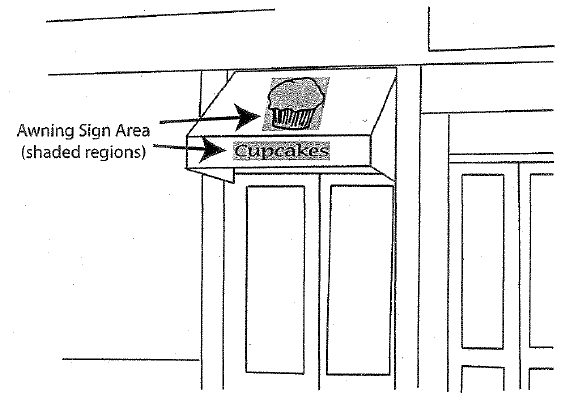
Awning or canopy signs. Sign copy which is applied to an awning or canopy shall be computed at 100 percent of the area within a single rectangle enveloping the sign copy. See Figure 17.42.070-2 (Awning or canopy sign area).
Figure 17.42.070-2: Awning or Canopy Sign Area
3.
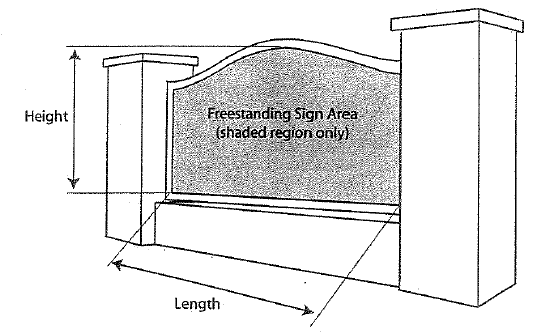
Freestanding signs. Freestanding signs are to be computed as total height by the total length of the sign for one side for double-faced signs, excluding framework of separate single wood post or masonry column and single wood or masonry beam. The base of a monument sign is not part of the sign when comprised of wood, stucco, or masonry. See Figure 17.42.070-3 (Freestanding sign area).
a. Freestanding signs that are spread with two faces (e.g., marquee sign) shall be computed as the greater of the area of one side or the projected area of two sides.
b. Freestanding signs that are spread with three faces shall be computed as the greater of the area of one side or the projected area of two sides or three sides.
c. Freestanding signs that are four-sided shall be computed as the greater of the area of two sides or the projected area of two sides.
Figure 17.42.070-3: Freestanding Sign Area
4.
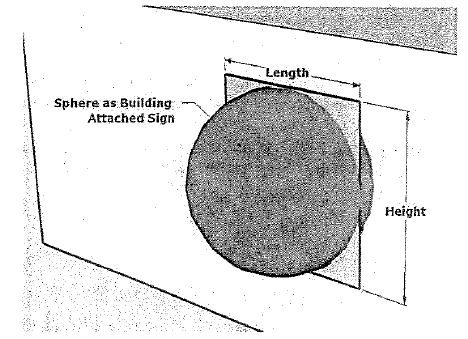
Three-dimensional objects. Where a sign consists of one or more three-dimensional objects (e.g., balls, cubes, clusters of objects, sculpture, or statue-like trademarks), the sign area shall be measured at their maximum projection upon a vertical plane, as viewed from a position in the public right-of-way which produces the largest visual projection. See Figure 17.42.070-4 (Area of three-dimensional objects).
Figure 17.42.070-4: Area of three-dimensional objects
D.
Measurement of sign height. Sign height shall be measured from the upper most part of the sign used in determining the area of the sign to the lowest elevation at the base of the sign.
E.
Setback and spacing of freestanding signs.
1.
The minimum setback distance for freestanding signs shall be measured from the back of the public right-of-way or side of a driveway, unless an encroachment permit is granted. All freestanding signs shall be located outside of the public right-of-way and any required clear visibility vision triangle.
2.
The minimum spacing distance between permanent freestanding signs, excluding on-site directory signs, should be 50 feet. The decision-making authority will review a proposed sign location on a case-by-case basis to ensure the sign is located outside the required clear visibility vision triangle and does not otherwise inhibit motorist safety.
F.
Sign removal or replacement. When a sign is removed or replaced, all brackets, poles, and other structural elements that support the sign shall also be removed. Affected building surfaces shall be restored to match the adjacent portion of the structure. This provision does not apply to routine maintenance.
(Ord. No. 528, 2-15-2022)
17.42.080 - Design standards.
The following criteria shall be utilized for permanent advertising displays and signs, and shall not be construed to govern the design of temporary signs:
A.
General design standards.
1.
Architectural style. Each sign shall be designed to be compatible with and relate to the architectural style of the primary structure or buildings upon the site where such sign is located. Each sign shall also be compatible with the style and character of the existing improvements upon the lots adjacent to the site. Signs located on commercial sites but in a predominately residential area shall be unobtrusive and designed to be compatible with such residential area.
2.
Relationship to buildings. Signs located upon a lot with one primary structure or several buildings shall be designed to incorporate at least one of the predominant visual elements of such building or buildings, such as the type of construction materials, color, or other design detail.
3.
Color. The color(s) of a sign should be harmonious and complementary to the colors of the building on or near which it is to be located. Fewer colors will generally produce the most attractive sign.
4.
Letter style. The letter style to be used on a sign should be compatible with the architectural style of the building on or near which it is to be located. For example, simple block letters are generally most compatible with Spanish style buildings. For those buildings that have been recently constructed and have no particular architectural style, simpler letter styles are desirable.
5.
Sign materials. The goal of sign design is to maintain moderate, attractive, and compatible styling so as not to conflict or distract from the architectural character of the area. The choice of materials shall be left to the discretion of the applicant, subject to the provisions of this chapter and the approval of the city.
6.
Relationship to other signs. Where there is more than one sign on a site or building, all permanent signs displaying a commercial message shall have designs that similarly treat or incorporate the following design elements to the extent feasible:
a.
Letter size and style of copy;
b.
Shape of total sign and related components;
c.
Type of construction materials;
d.
Sign/letter color and style of copy;
e.
Method used for supporting sign (e.g., wall or ground base); and
f.
Location.
7.
Sign illumination. The artificial illumination of signs, either from an internal or external source, shall be designed to minimize negative impacts on surrounding rights-of-way and properties. The following standards shall apply to all illuminated signs:
a.
External light sources shall be directed and shielded to limit direct illumination of an object other than the sign;
b.
The light from an illuminated sign shall not be of an intensity or brightness that will create glare or other negative impacts on residential properties in direct line of sight to the sign;
c.
Unless otherwise permitted by another provision of this chapter, signs shall not have blinking, flashing, or fluttering lights, or other illumination devices that have a changing light intensity, brightness, or color;
d.
Colored lights shall not be used at a location or in a manner so as to be confused or constructed as traffic control devices;
e.
Reflective type bulbs and incandescent lamps that exceed 15 watts shall not be used on the exterior surface of signs so that the face of the build or lamp is exposed to a public right-of-way or adjacent property; and
f.
Light sources shall utilize energy efficient fixtures to the greatest extent possible and shall comply with Title 24 of the California Code of Regulations (California Building Standards Code).
8.
The maximum coverage of copy allowed on a sign shall be 80 percent of the sign face.
B.
Design standards for special sign types.
1.
Awning and canopy signs. Awning and canopy signs may be permitted only as an integral part of the awning or canopy to which they are attached or applied, as follows:
a.
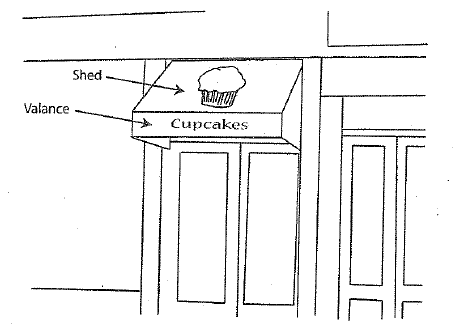
Lettering shall be allowed on awning valances only and shall not exceed 18 inches in height. Logos, symbols, and graphics that do not include text may be allowed on the shed (slope) portion of an awning and shall not exceed four square feet in area for each awning. See Figure 17.42.080-1 (Awning and canopy sign).
Figure 17.42.080-1: Awning and Canopy Sign
b.
Lettering shall be located within the middle 70 percent of the valance area.
c.
Only permanent signs that are an integral part of the awning or architectural projection shall be allowed. Temporary signs shall not be placed on awnings.
d.
Awning signs shall only be allowed for first and second story occupancies.
e.
Awnings shall not be lighted from under the awning (back-lit) so that the awning appears internally illuminated. Lighting directed downwards that does not illuminate the awning is allowed.
f.
Awnings shall be regularly cleaned and kept free of dust and visible defects.
g.
The style of the awning/canopy shall complement the architectural style of the building to which it is attached. Awnings should generally have a simple horizontal valance if located over rectangular or square window/door openings. Domed or barrel shaped awnings are appropriate for buildings with arched window/door openings.
2.
Blade/bracket signs.
a.
Location. Blade or bracket signs shall be placed only on ground floor facades, except for businesses located above the ground level with direct exterior pedestrian access.
b.
Height. The lowest point of a blade or bracket sign shall be a minimum of eight feet above grade.
c.
Projection. The sign may project a maximum of four feet from the building.
d.
Sign structure. Sign supports and brackets shall be compatible with the design and scale of the sign.
e.
Encroachment. Blade or bracket signs may not encroach into the public right-of-way or be located above it, or into city-owned property except with an encroachment permit.
3.
Wall signs.
a.
Wall signs shall be compatible with the predominant visual architectural elements of the building facade.
b.
Wall signs shall be placed to establish facade rhythm, scale, and proportion where such elements are weak. In many existing buildings that have a monolithic or plain facade, signs can establish or continue appropriate design rhythm, scale, and proportion.
c.
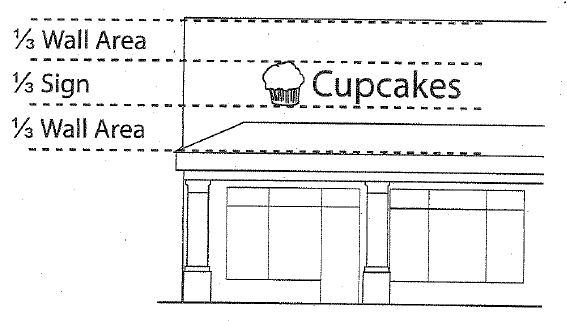
Wall signs shall utilize a consistent proportion of signage to building scale, such as ⅓ text to ⅔ wall area or ¼ text to ¾ wall area. See Figure 17.42.080-2 (Text scale).
Figure 17.42.080-2: Text Scale
d.
Wall sign raceways shall be concealed from public view (e.g., within the building wall or painted to match the exterior color of the building where the sign is located) or otherwise integrated with the design of the sign and building so as to not detract from the architectural character of the building.
e.
Direct and indirect lighting methods are allowed for wall signs provided that they are not harsh or unnecessarily bright. Light shall either be directed down or in such a way that it does not cause light trespass or glare onto adjoining properties or public rights-of-way.
f.
Can signs are prohibited. Channel letters, reverse channel letters, and push pin letters are preferred. Letters may not utilize gold-colored (or a shade of gold) trim cap.
g.
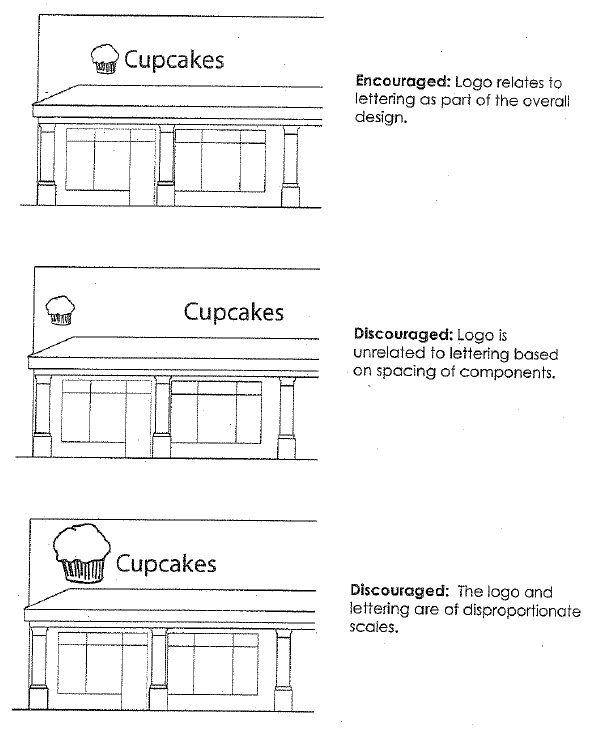
If a tenant's signage on one facade is comprised of multiple elements (e.g., logo and text), the elements shall be located and scaled with relationship to each other. See Figure 17.42.080-3 (Multiple element signs).
Figure 17.42.080-3: Multiple Element Signs
4.
Freestanding signs.
a.
Monument and pylon signs are preferred because they can be more fully integrated into the overall development design. As described in Section 17.42.060 (Prohibited signs), pole signs are prohibited. Pylon signs shall be constructed with architectural cladding or similar material covering the supporting framework so they are architecturally integrated with the rest of the sign.
b.
In an effort to promote full architectural integration of signs, voids between the sign face and the sign structure are prohibited. Either the sign face shall utilize the full width of the sign structure or coverings that are architecturally consistent with the rest of the sign shall be used to fill any voids.
c.
Materials and design for freestanding signs shall be complementary to the materials and design of the buildings for the related development. For example, if the facade of the building is made of brick or brick veneer, a complementary freestanding sign would also include brick.
d.
Landscaping shall be provided at the base of the sign equal to the area of the sign. Landscaping shall be complementary to and designed in concert with the landscaping for the overall site. The design of the landscaping shall be such that natural growth will not obscure the sign from the public right-of-way.
e.
The minimum letter height on a freestanding sign shall be 12 inches. The intent is to limit the clutter of text on the sign and increase readability for the public, thereby providing for public safety.
f.
The maximum letter height on a freestanding sign shall be 36 inches. The intent is to limit the negative visual impact of large text size.
5.
Marquee or changeable copy sign. These types of signs shall be considered to be the same as any other type of sign and shall be regulated based on their location, i.e., if located on a wall, they shall be deemed wall signs.
6.
Electronic message signs. Electronic message signs as part of an on-site sign may be permitted through a creative sign program or uniform sign program, provided that the message is an on-site message, except for public information messages, and shall be programmed so that the message does not change more than once every four seconds (scrolling messages are prohibited).
(Ord. No. 528, 2-15-2022)
17.42.090 - Allowed permanent on-site sign standards.
Table 17.42.090-1 (Allowed permanent on-site sign standards) lists the development standards for all permanent on-site signs based on use type and zoning district, as well as allowed sign type. As identified in Section 17.42.040 (Permits and review procedures), a sign permit is required before any of the sign types listed herein are installed, erected, or otherwise established. Only those signs that may be permitted are listed. Regulations for temporary promotional on-site signs are listed in Table 17.42.100-1 (Allowed temporary promotional on-site sign standards). Regulations for off-site signs are listed in Section 17.42.110 (Allowed off-site signage). The following general rules/standards apply to permanent signs regulated in this section:
A.
Minimal illumination. Where illumination of a sign is allowed under this title, such illumination may be achieved by any method that minimizes glare onto neighboring or abutting property, such as from behind the sign (e.g., light source behind the face of the sign, such as with the opaque, non-transparent face of channel letters; silhouette halo illumination behind letters) or by a low-level spotlight. In the case of electronic message signs, it is recognized that this standard is not applicable and, in such instances, the illumination level shall be regulated such that the intensity of the illumination is appropriate based upon the level of lighting of the surrounding environment (e.g., illumination by the sun or moon during day, dusk, night time, and dawn) through the use of such means as light meters and programmed illumination regulation or LEDs that are designed to limit the spread of light.
B.
Sign area allowance. Allowable sign area is either a set square footage per establishment or is based on a ratio of sign area to primary building frontage. Sign area is calculated as described in Subsection 17.42.070 C. (Determination and measurement of sign area). Where a ratio is described, it applies up to the listed maximum.
C.
Collective sign area. The total sign area allowed herein for each sign type may be distributed among the maximum number of signs permitted for that sign type. For example, the total allowed area for wall signs for a particular establishment may be distributed amongst the maximum number of wall signs allowed for that same establishment.
Table 17.42.090-1: Allowed Permanent On-Site Sign Standards
;sz=8q;Notes:
1. Must be located outside the clear visibility triangle.
2. Within median islands, sign must be set back three feet from sides and 12 feet from ends.
3. Freestanding pylon signs shall only be permitted as part of a uniform sign program for sites greater than or equal to ten acres.
4. Window signs may not occupy more than 20 percent of the individual window area. The void rule shall apply when calculating the area of the window sign when it is stenciled on the window pane.
5. New ghost signs must be treated such that they appear aged and weathered consistent with existing historic ghost signs in the downtown area.
(Ord. No. 528, 2-15-2022)
17.42.100 - Allowed temporary on-site sign standards.
This section describes standards for temporary promotional on-site signs. These signs do not require the issuance of a sign permit. Temporary signs may include, but are not limited to, commercial signs for grand openings, special product, sale, or event advertising. The development standards for temporary signs are listed in Table 17.42.100-1 (Temporary sign standards). The following general rules/standards apply to temporary promotional signs:
A.
Time duration. Display periods for temporary promotional signs shall be limited to a maximum of 120 days per calendar year. Longer time periods may be permitted with issuance of a temporary use permit (see Section 17.10.050 (Temporary use permit)).
B.
Illumination. Temporary signs may not be illuminated.
C.
Message. Temporary signs displaying a commercial message shall be limited to on-site signage only. Temporary off-site signage displaying a commercial message is prohibited.
D.
Encroachment. Temporary promotional signs shall not encroach on or above the public right-of-way or be attached to utility poles.
Table 17.42.100-1: Temporary Sign Standards
;sz=9q;Notes:
1. Must be located outside of the clear visibility triangle.
(Ord. No. 528, 2-15-2022)
17.42.110 - Allowed off-site signage.
A.
General off-site signage. Off-site permanent commercial signage is only permitted when consistent with the following development standards and after the decision-making authority has issued a sign permit for the sign:
1.
Allowed zones. Off-site commercial signage is only permitted in the C-3 and M-1 zoning district. Such signs may be permitted within a special purpose zoning district when the master plan or specific plan for such district specifically states that off-site commercial signage is permitted and the districts within which such signs are allowed.
2.
Minimum lot size. Off-site commercial signage is only permitted at sites with a minimum lot size of ten acres.
3.
Maximum signs per lot. One off-site commercial sign shall be allowed for the first ten acres of lot size. One additional off-site sign shall be permitted for each additional 25 acres of lot size.
4.
Maximum height. The maximum height for off-site commercial signage is 25 feet.
5.
Maximum area. The maximum area for off-site commercial signage is 100 square feet per sign.
6.
Lighting. Off-site commercial signs may be illuminated, provided that the illumination does not produce glare or spill onto the roadway or adjacent property. Electronic message signs may be used, provided that the sign is programmed so that the message does not change more than once every four seconds (scrolling messages are prohibited) and the intensity of the illumination changes based upon the level of lighting of the surrounding environment (e.g., illumination by the sun or moon during day, dusk, night time, and dawn).
B.
Weekend directional stake signs. Weekend directional stake signs are those signs customarily displayed on the weekends, measuring less than nine square feet in area, and mounted on wooden stakes. Such signs may be used to identify the name and location of active home sales as part of a new residential subdivision/condominium project, provided that each face of the sign does not exceed four square feet, it is mounted such that it is no more than four feet tall from the ground, and is setback a minimum of five feet from the edge of the roadway pavement. Additionally, such signs are only allowed on a temporary basis from noon on Friday to no later than noon on the following Monday. In the event that Friday is a nationally-recognized holiday, said signs may be erected on Thursday after noon. In the event that Monday is a nationally-recognized holiday, said signs may remain in place until noon on the following Tuesday. In no event may a weekend directional stake sign be located within a roadway median.
C.
Subdivision directional sign. Temporary off-site subdivision directional signs are permitted, subject to the issuance of a temporary use permit if placed for longer than 120 days, and require conformance with the following development standards:
1.
Location. The sign shall be located outside of the clear visibility vision triangle and within the buildable area of the lot as defined by the setback regulations of the underlying zoning district. The sign shall only be located a minimum of 100 feet from another freestanding sign. It shall only be located on streets classified as collector or arterial under the general plan.
2.
Height. The maximum height of the sign shall be 20 feet.
3.
Area. The maximum area of one face of the sign shall be 25 square feet when only one subdivision is listed. When two or more subdivisions are listed, the maximum area of one face shall be 120 square feet with each subdivision limited to a maximum of 30 square feet.
4.
Number of faces. Subdivision directional signs may have up to four faces with the angle between the faces no more than 90 degrees.
5.
Illumination. Subdivision directional signs may not be illuminated.
(Ord. No. 528, 2-15-2022)
17.42.120 - Nonconforming signs and abandoned signs.
A.
Nonconforming signs.
1.
Except as otherwise provided by this section, all existing signs which do not meet the requirements of this chapter shall be deemed nonconforming signs and shall either be removed or brought into compliance with the city's Municipal Code when a substantial alteration to the sign is made. For purposes of this section, a "substantial alteration" shall be defined as repair or refurbishing of any sign that alters its physical dimensions or height, or replaces any integral component of the sign including, but not limited to, alterations to exterior cabinets, bases, or poles. In addition, "substantial alteration" shall also include any repair or refurbishing of a sign that exceeds 50 percent of the depreciated value of the sign and structure, but excepting customary maintenance. "Customary maintenance" shall be defined as any activity or work performed for the purpose of actively maintaining the sign in its existing approved physical configuration and size dimensions at the specific location approved by the city and includes the following:
a.
Repainting the sign text, cabinet or other component of the sign without changing the advertising message; or
b.
Routine replacement of border and trim with substantially the same colors and materials.
2.
A nonconforming sign may remain in use provided no additions or enlargements are made thereto and no structural alterations are made therein, except as permitted for customary maintenance in Subsection A. If said nonconforming sign is destroyed or removed, or ceases to be used for the use in existence as of the effective date of the ordinance codified in this chapter, every future sign at the same location must be in conformance with the provisions of this chapter.
3.
It shall be the responsibility of the owner of any premises containing a nonconforming sign (including a sign painted directly upon the surface of a structure) to remove said nonconforming sign within 90 days of cessation of business at that location.
B.
Abandoned signs. Abandoned signs may be abated by the city. For regulatory purposes, any factors indicating abandonment shall not begin occurring until 120 days after this chapter first goes into effect.
(Ord. No. 528, 2-15-2022)
17.44.010 - Purpose and proprietary capacity.
The purpose of this chapter is to provide the process and standards for establishing signage on city property. In adopting this chapter, the city council acts in its proprietary capacity as to city property, as defined herein, within the city. This chapter is adopted pursuant to the city's general powers, property rights, Government Code Sections 65850(b), 38774, and 38775, Business and Professions Code Sections 5200 et seq., and Penal Code Section 556 et seq.
(Ord. No. 528, 2-15-2022)
17.44.020 - Intent as to public forum.
The city declares its intent that not all city property shall function as a designated public forum, unless some specific portion of city property is designated herein as a public forum of one particular type. In such case, the declaration as to public forum type shall apply strictly and only to the specified area and for the specified time period.
(Ord. No. 528, 2-15-2022)
17.44.030 - Definitions.
Terms unique to this chapter are listed in Chapter 17.300 (Glossary of terms).
(Ord. No. 528, 2-15-2022)
17.44.040 - General prohibition.
Unless specifically authorized by this chapter, no signs may be displayed on city property by private parties. Any sign posted on city property in violation of this chapter may be summarily removed by the city as a trespass and a public nuisance.
(Ord. No. 528, 2-15-2022)
17.44.050 - Certain governmental signs.
The following signs may be erected and displayed on city property:
A.
Traffic control and traffic directional signs erected by the city or another governmental unit;
B.
Official notices required or authorized by law;
C.
Signs placed by the city in furtherance of its governmental functions; and
D.
Signs allowable under Section 17.44.060 (Temporary signs displaying non-commercial message).
(Ord. No. 528, 2-15-2022)
17.44.060 - Temporary signs displaying non-commercial message.
In areas qualifying as traditional public forums, private persons may display non-commercial message signs thereon, provided that such signs conform to all of the following:
A.
The signs must be personally held by a person or personally attended by one or more persons. "Personally attended" means that a person is physically present within five feet of the sign at all times.
B.
The signs may be displayed only during the time period of sunrise to sunset, except on occasions when the city council and/or the planning commission are holding public hearings or meetings; on such occasions, the display period is extended to 30 minutes after such meeting is officially adjourned.
C.
The maximum aggregate size of all signs held or personally attended by a single person is six square feet. For purposes of this rule, apparel and other aspects of personal appearance do not count towards the maximum aggregate sign area.
D.
The maximum size of any one sign which is held or personally attended by two or more persons is 50 square feet, measured on one side only.
E.
The sign must have no more than two display faces and may not be inflatable or air-activated.
F.
In order to serve the city's interests in traffic flow and safety, persons displaying signs under this chapter may not stand in any vehicular traffic lane when a roadway is open for use by vehicles, and persons displaying signs on public sidewalks must give at least five feet width clearance for pedestrians to pass by. Persons holding signs may not obstruct the clear visibility triangle, as defined in this title.
G.
The message substitution policy of the sign ordinance applies only to traditional public forum areas.
(Ord. No. 528, 2-15-2022)
17.44.070 - Street banner program.
A.
The street banner program is reserved for the city's use to promote its own messages and those special events and activities that take place in the city.
B.
Notwithstanding any other section of the Municipal Code, the city manager (or his or her other designee), or the city council upon appeal, may authorize the temporary placement of banner signs within the public right-of-way on city property.
C.
Such banners shall be allowed for only a limited duration and must call attention to the city, its natural advantages, resources, enterprises, attractions, climate, facilities, businesses, and community.
D.
No person shall place, cause to be placed, or maintain a banner sign in the public right-of-way or on city property except as authorized herein.
E.
The city manager shall designate those streets, highways, alleys, other public rights-of-way, and those city properties on which banner signs as authorized herein may be placed.
F.
The city manager may issue a banner sign permit for an event and/or activity within 45 days after an application has been filed, subject to the following conditions:
1.
The permit shall expire after 60 days and the applicant shall cause the banners to be removed at applicant's expense;
2.
The banners may contain the name and date of the event;
3.
The banners are secured tightly to the structures on which they are authorized to be attached; and,
4.
For applicants that are co-sponsors with the city, the applicant must agree to indemnify and hold harmless the city from any damages arising from the placement, maintenance, and removal of banners in a form acceptable to the city attorney.
G.
Each banner sign permit shall designate on which specific structures within the public right-of-way or on city property the banners may be placed and methods for such placement.
H.
No permit shall be issued unless the city manager, or council on appeal, finds that the banners are so designated as not to block views significant for traffic and do not otherwise present a safety hazard.
(Ord. No. 528, 2-15-2022)
17.44.080 - Special event signage.
Signage associated with a special event shall be allowed under the following provisions:
A.
Special event signage may only be allowed at Howard Park as part of a permitted special event through issuance of a special event permit.
B.
Such signage may only be erected during the time specified and in the areas of Howard Park covered by the special event permit.
C.
Special event signs may not be illuminated and shall not be posted or affixed above the roof line of any structure or within the canopy of any tree.
D.
The maximum allowed size for any one special event sign shall be 100 square feet.
E.
Signs may not be located within any driveway, street, or parking area, other than to direct traffic. Signs shall be sited in such a way as to not limit vehicle visibility when entering or existing the facility.
(Ord. No. 528, 2-15-2022)
17.44.090 - Long term leased signage.
The city may establish a program of leasing space at city facilities to private individuals, companies, or other entities for the express purpose of erecting and maintaining off-site commercial message signage. Such a program is limited to Howard Park and its associated facilities including, but not limited to, Evalynn Bishop Hall, Ed Hughes Memorial Arena, the stables, and soccer and softball/baseball fields. Such signage may be located interior or exterior to a structure and may be illuminated, provided it does not produce glare or spill onto adjacent properties or the public right-of-way. The signage shall not be erected higher than 40 feet when within 500 feet of a property line. There shall be no limitation on the total square footage of such signage except as otherwise provided.
(Ord. No. 528, 2-15-2022)

