
Irondale City Zoning Code
ARTICLE V
- SPECIAL USE REGULATIONS
In this article certain land-use activities are identified for special zones or zoning requirements. The nature of these uses is such that when properly regulated they are appropriate in several zones. In order to bring about the proper integration of these uses into the community's land-use pattern, a special set of standards is provided for each use. Review of these standards will tend to maintain compatibility with adjoining land uses. It is intended that the planning and zoning commission will review all proposals for these special uses for compliance with the appropriate standards before application for building permits are approved.
Section 5:01.- Applicable uses.
Except when in conformance with the provisions of this article no building or structure or part thereof shall be erected or altered or used, or premises used, in whole or in part, when such building, structure, or part thereof, or premises is designed for or intended to be used for one or more of the following specified uses:
(1)
Planned shopping center.
(2)
Motel.
(3)
Drive-in theatre.
(4)
Drive-in restaurant.
(5)
Gasoline service station.
(6)
Carnivals and transient entertainment.
(7)
Hospitals, convalescent homes, nursing homes and sanitariums.
(8)
Cemeteries.
(9)
Mobile home parks or mobile home subdivisions.
(10)
Industrial parks.
(11)
Apartments or multiple housing developments.
(12)
Sanitary sewage disposal zone.
(13)
Privately developed wastewater treatment with a point discharge to streams.
(14)
Hazardous waste zone.
(15)
Country club zone.
(16)
Utilities zone.
(17)
Outdoor amusement zone.
(18)
Obnoxious odor zone.
(19)
See ordinance numbers 3-0297, 4-0297 and 5-0297.
(20)
Recreational vehicle park.
(Ord. No. 2023-27, § 3, 9-19-23)
Section 5:02. - Approval.
All special use zones and uses specified in this article shall require prior approval by the planning and zoning commission as a prerequisite to issuance of a building permit. Consideration for approval by the planning and zoning commission shall require the submission of evidence of intent to comply with requirements herein specified. The submission of a site development plan in conformance with section 6:03 of this ordinance shall be required for all uses applicable to this article. Such other evidence as may be required may take the form of certifications, specifications, building plans, and other pertinent drawings and documents.
Section 5:03. - Planned shopping centers.
(1)
Location.
No building or structure or part thereof which is integral to a planned shopping center shall be erected in any zone other than C-1, C-2, I-1 and I-2.
(2)
Requirements.
(a)
A market analysis showing the economic feasibility of the proposed shopping center.
(b)
A site development plan which provides for:
1.
A minimum site depth of three hundred (300) feet.
2.
An integrated parking area as specified in section 3:13 of this ordinance.
3.
Convenient vehicular servicing of the buildings, satisfactory circulation of traffic in the parking area, and no undue interference with through traffic in gaining ingress and egress from said proposed site.
4.
A greenbelt not less than twenty (20) feet wide where the shopping center abuts a residential zone.
5.
A building group that is architecturally unified.
6.
Vehicular loading space in conformance with section 3:12 of this ordinance.
7.
Convenient and safely located pedestrian walkways.
(c)
A traffic analysis indicating the estimated effect of the proposed shopping center on adjacent existing street traffic, including volume flows to and from the shopping center, prepared by a registered professional engineer.
(d)
A preliminary plan or engineering feasibility report providing for the site grading, storm drainage, sanitary sewerage, and water supply, prepared by a registered professional engineer.
(e)
A copy of brief of intended deed restrictions.
Section 5:04. - Motels.
(1)
Location.
No motel, building, or structure, or part thereof which is integral to a motel shall be erected in any zone other than C-1, C-2, and I-1.
(2)
Requirements.
(a)
Each unit shall be provided with a lot area of not less than 600 square feet for the first room of 80 or more square feet and an additional lot area equal to two times the room area for each additional room of 80 square feet or more.
(b)
When the motel site shall contain more than one building or structure there shall be a side yard of not less than ten feet on each side of said building, excepting the side yards adjacent to the property line which shall be equal to and not less than two-thirds the total height of the building adjacent to the side property line or 20 feet whichever is the greatest. When the motel shall contain one integrated building for all the units and accessory uses requiring a building, the side yard requirements shall be the same as the zone in which the motel is located.
(c)
A front yard depth shall be not less than 25 feet.
(d)
A rear yard depth shall be not less than 15 feet.
(e)
An eight-foot greenbelt as herein defined shall be located on all lot lines not bordering a public street.
(f)
Off-street parking facilities shall conform to requirements specified in section 3:13 of this ordinance.
(g)
Motel signs shall be of a non-flicker and non-flashing type.
Section 5:05. - Drive-in theatres.
(1)
Location.
No building or structure or part thereof which is integral to a drive-in theatre shall be erected in any zone other than C-2, I-1 and I-2.
(2)
Requirements.
(a)
There shall be a front yard depth of not less than 100 feet from the right-of-way which is used as primary vehicular access to the site.
(b)
The screen of a drive-in theatre shall be placed a minimum of 100 feet from the public right-of-way and be located so as to be hidden from the view of traffic contiguous to the entrance and exits of the site.
(c)
The ingress and egress from the highway shall be so designed and constructed as to permit only one-way traffic within the boundaries of the site upon which the drive-in theatre is developed.
(d)
Vehicle standing space shall be provided between the ticket office and the public right-of-way line, for patrons awaiting admission, equal in quantity to not less than 30percent of the vehicular capacity of the theatre.
(e)
All ground areas accessible to patrons vehicles shall be treated with suitable material to prevent the formation of dust.
(f)
An opaque wall or fence shall be provided, of adequate height to screen the patrons and cars in attendance at the drive-in theatre, from the view of surrounding properties.
(g)
A twenty-foot greenbelt, as herein defined, shall be required along the exterior of all fence lines.
(h)
Entrance and exit areas adjoining public highways or thoroughfares serving drive-in theatres shall be properly lighted to reduce traffic hazards.
(i)
Drive-in theatre signs shall not be closer than 50 feet to the public right-of-way line and shall be of a non-flicker and non-flashing type.
(j)
The vehicular approach to the drive-in theatre site from the public thoroughfare or highway should be so designed that uncontrolled left hand turns from the public thoroughfare or highway to the site shall be eliminated or reduced either by a frontage roadway or other suitable means deemed adequate by the planning and zoning commission.
(k)
Sight distance at all points of ingress and egress on public thoroughfares or highways shall be not less than 1,000 feet, except where a traffic signal lght is installed at the entrance to or exit from the site.
(l)
Where points of ingress from or egress to public thoroughfares having speed limits in excess of 30 miles per hour are located, there may be provided acceleration and deceleration lanes, the lengths of which shall be determined by the following schedule:
(m)
A preliminary plan or engineering feasibility report providing for the site grading, storm drainage, sanitary sewerage, and water supply, be prepared by a registered professional engineer.
(n)
Drive-in theatres shall be required to remain closed between the hours of 12:00 midnight and 6:00 a.m., except on Saturdays and holidays, when the closing hour may be 2:00 a.m.
Section 5:06. - Drive-in restaurants.
(1)
Location.
No building or structure or part thereof which is integral to a drive-in restaurant shall be erected in any zone other than C-1, C-2, I-1 and I-2.
(2)
Requirements.
(a)
A four-foot high solid masonry wall shall be located on all boundary lines of said drive-in restaurant premises not bordering a public street.
(b)
The front yard and any side yard adjacent to a public street shall be provided with a ten-foot wide greenbelt, except where driveway openings are necessary for ingress to and egress from the site.
(c)
A preliminary plan or engineering feasibility report providing for the site grading, storm drainage, sanitary sewerage, and water supply, be prepared by a registered professional engineer.
(d)
Fixed lighting shall be so arranged as not to shine, reflect, or glare into surrounding areas or public streets.
(e)
The outside premises of any drive-in restaurant shall be cleared of all used paper, trash, and other waste materials at least once every six hours prior to closing.
(f)
Drive-in restaurants shall not be permitted to install and/or maintain loud speakers or juke-boxes in a manner in which sounds coming therefrom can be heard outside the restaurant building.
(g)
Off-street parking space for drive-in restaurants shall be provided in accord with section 3:13 of this ordinance.
Section 5:07. - Gasoline service stations.
(1)
Location.
No gasoline service station or building or structure or part thereof which is integral to a gasoline service station shall be erected in any zone other than C-2, I-1 and I-2.
(2)
Requirements.
(a)
Gasoline service stations shall observe all regulations for such structures and their uses as required by the laws of the State of Alabama and any applicable ordinance of the city.
(b)
No gasoline service station shall be constructed without complying with all governmental regulations.
(c)
No gasoline service station shall hereafter be located, and no property shall be used as such except as approved by the Planning and Zoning Board and in compliance with the current building and safety codes and other governmental regulations.
(d)
Gasoline service stations shall provide a front yard and a side yard on any siding street of not less than 20 feet. Said front and side yard shall not be used for vehicles or other storage or for any service facility other than the approach drives. No portion of the service driveway apron shall be permitted within the front or side street yard.
(e)
All vehicular entrances to or exits from any curb opening shall be set back a minimum of 20 feet from the corner property lines. All curb openings shall not exceed 35 feet in width at the curb line, and 30 feet at the property line. There shall be a minimum of 30 feet measured along the property line between any series driveways.
(f)
Gasoline service stations shall be located on a plot of ground having a frontage along the commercial street of not less than 150 feet and having a minimum area of not less than 15,000 square feet. Such station shall be composed of the building housing the office and the facilities for servicing, greasing or washing, and the pumps for dispensing gasoline. Such facilities shall contain not more than five units as herein defined. Any station designed for more than five units shall provide an additional area of 3,000 square feet for each additional unit. For the purpose of this section a unit shall mean: One set of three pumps.
(g)
All permanent storage of material, merchandise, and equipment shall be within the principal building or within permanent stationary containers, located within the setback lines, with the exception of refuse, trash, and temporary storage which shall be located in an area enclosed by an opaque fence at least five feet high.
(h)
All lighting shall be arranged so as to prevent direct light or glare into public streets or surrounding properties.
(i)
Drains located on the premises without approved separators in the trap shall be prohibited.
(j)
All repair work to vehicles herein allowed shall be done within the principal building located on the premises of a gasoline service station as herein permitted.
(k)
The following are prohibited uses in gasoline service stations located in any zone other than industrial zones:
1.
Major motor overhauls.
2.
Body work, and spray painting.
3.
Any use performed inside or outside the building which is offensive or dangerous or which constitutes a nuisance to the occupants of adjacent properties, by reason of the emission of smoke, fumes, dust, odor, vibration, noise, or unsightliness.
(l)
An eight-foot greenbelt as herein defined shall be located on all property lines not bordering a public street.
(m)
Gasoline service station signs shall be of a non-flicker and non-flashing type.
(n)
Off-street parking facilities shall conform to requirements specified in section 3:13 of this ordinance.
(Ord. No. 2018-20, 7-19-18)
Section 5:08. - Carnivals and transient entertainment.
It is the intent that this section shall include within its jurisdiction circuses, carnivals, fairs, traveling shows, traveling acts, transient amusement parks, and other forms of transient entertainment on approval by the city council.
Section 5:09. - Hospitals, convalescent homes, nursing homes, sanitariums.
It is the intent that this section shall include within its jurisdiction hospitals, convalescent homes, nursing homes, sanitariums, old age homes, retirement homes, and other similar uses including those which provide, in addition to board and lodging, other services necessary for the health, safety, and welfare of the occupants, tenants, lessees, guests, or patients. For the purpose of this ordinance all such uses within the jurisdiction of this section shall be referred to hereinafter as "convalescent homes."
(1)
Location.
No building or structure or part thereof which is integral to a convalescent home shall be erected, or land developed, or used for a convalescent home in any zone other than Inst-2, C-1, C-2 or I-1.
(2)
Requirements.
(a)
No part of a convalescent home shall be located closer than 200 feet from the boundary of an I-2 zone, or 500 feet from a cemetery.
(b)
A twelve-foot greenbelt as herein defined shall be located on all property lines not bordering a public street, park, golf course, lake, river, or other use which affords a view not detrimental to the character and use of a convalescent home.
(c)
For each bed in a convalescent home there shall be 200 square feet of outdoor open space, exclusive of required front yards, side yards, greenbelts, parking area, loading space, or other space expressly required for other purposes. Said outdoor open space shall be open and unobstructed from the ground upwards.
(d)
Side yard requirements shall be as specified for the zone utilized.
The following use zones are special use zones and zoning must be filed for to the planning and zoning commission and the city council for approval of rezoning for the special use allowed under each zone. The planning and zoning commission and/or the city engineer may specify other requirements for the development of such zones and sites.
Section 5:10. - (C-4), (C-4-A) Cemetery zone.
No building or structure or part thereof which is integral to a cemetery shall be erected or land developed or used for a cemetery in any zone except C-4 and C-4-A and as hereafter specified.
Section 5:10-1—(C-4) Requirements.
Within a C-4 cemetery zone, a building or land shall be used only for the following purposes:
1.
Cemetery, provided that the site shall consist of not less than 40 acres, and that the following requirements are met:
a.
No part of a cemetery shall be located closer than 200 feet from the boundary of a R-1 or R-2 zone, or 500 feet from a convalescent home.
b.
No interments shall be made closer than 35 feet to any adjoining property lines.
c.
No interments shall be made within 150 feet of any well used for drinking water purposes.
d.
Building or structures, including materials, shall be set back from adjoining property lines a distance of 35 feet.
e.
No interments shall be made until paved streets have been completed, basic landscaping completed and all drainage problems eliminated.
f.
A six-foot protective wall of fence shall be located on all property lines except at points of ingress and egress, provided that gates with locks shall be maintained at such points of ingress and egress.
g.
All individual graves located within the earth shall be identified by a marker, which shall be flush with the surface of the earth.
h.
No approval for cemetery use will be issued until final approval has been obtained from the county health department and said cemetery resolution has been placed on the minutes of the City of Irondale.
i.
Identification signs in accordance with article 5, section 5:22.
Section 5:10-2—(C-4-A) Requirements.
Within a C-4-A pet cemetery zone, a building or land shall be used only for the following purposes:
1.
Pet cemetery, provided that:
a.
No part of a cemetery shall be located closer than 200 feet from the boundary of a R-1 of R-2 zone, or 500 feet from a convalescent home.
b.
No interments shall be made closer than 35 feet to any adjoining property lines.
c.
No interments shall be made within 150 feet of any well used for drinking water purposes.
d.
Building or structures, including materials, shall be set back from adjoining property lines a distance of 35 feet.
e.
No interments shall be made until paved streets have been completed, basic landscaping completed and all drainage problems eliminated.
f.
A six-foot protective wall or fence shall be located on all property lines except at points of ingress and egress, provided that gates with locks shall be maintained at such points of ingress and egress.
g.
All individual graves located within the earth shall be identified by a flush type marker only, which shall be flush with the surface of the earth.
h.
No approval for cemetery use will be issued until final approval has been obtained from the county health department and said cemetery resolution has been placed on the minutes of the county commission.
i.
Identification signs in accordance with article 5, section 5:22.
Section 5:11. - (R-5-A) Mobile home subdivision zone.
Section 5:11-1—Use regulations.
Within a R-5-A mobile home subdivision zone a building or land shall be used only for the following purposes:
a.
Mobile home subdivision. It must comply with city subdivision regulations.
b.
Customary accessory buildings or structures, in accordance with article 2, section 2:98 and article 3, section 3:11-4.
Section 5:11-2—Area and dimensional regulations.
In all of the above permitted uses, with the exception of accessory buildings, the area and dimensional regulations set forth in the following table shall be observed:
Section 5:12. - (R-5-B) Mobile home park zone.
Within a R-5-B mobile home park zone a building or land shall be used only for the following purposes:
a.
Mobile home park provided that such mobile home park meets the following site standards and requirements.
b.
On premise signs are permitted only in accordance with the regulations contained in article 5, section 5:22 of this ordinance.
c.
Customary accessory building or structures in accordance with article 2, section 2:98.
Section 5:12-1—Site standards.
1.
The minimum area for any mobile home park is five acres.
2.
The maximum density is ten mobile home sites per acre.
3.
The mobile home park site shall be designed and developed to be completely surrounded by a buffer strip having a width of 35 feet which shall have the characteristics of a yard as defined in this ordinance. The buffer strip shall be landscaped and maintained.
Section 5:12-2—Requirements.
(a)
Each mobile home lot shall not be less than 2,400 square feet in area and shall not be less than 40 feet in width.
(b)
There shall be a minimum side spacing between mobile homes of not less than 30 feet and no mobile home shall be placed less than five feet from the lot line and the end to end spacing of not less than 15 feet between mobile homes shall be adhered to.
(c)
No mobile home shall be located closer than 50 feet from the right-of-way line of any street nor any closer than 35 feet from any other boundary line of the mobile home park.
(d)
Only mobile homes with approved toilets and plumbing fixtures shall be permitted for occupancy for more than one two-week period of any single calendar year.
(e)
Plumbing fixtures shall be connected to a public sanitary sewer or city approved facility and shall meet the requirements of the city plumbing code, and applicable state requirements.
(f)
Running water from a public or state tested and approved water supply shall be piped to each mobile home and shall be adequately protected from frost. All sources of water to each individual mobile home site shall be underground and in no event shall rubber hose or other temporary measures be used.
(g)
The occupancy load of any mobile home shall be limited to provide no less than 300 cubic feet of air space per occupant exclusive of the cubic air space of toilet rooms and closets.
(h)
There shall be roadways in each mobile home park constructed under this ordinance reaching each mobile home lot therein. Such roadways shall be hard surfaced and shall meet requirements of the city specifications for residential streets and shall be 32 feet in width. All mobile home sites shall abut upon the roadway.
(i)
Fire hydrants of size and pressure satisfactory to and used by the Irondale fire department shall be placed within said mobile home park so that no mobile home shall be more than 300 feet from a fire hydrant.
(j)
The mobile home park walk system shall include thirty-inch wide concrete walks from the entrance of each trailer to the service facilities provided thereon.
(k)
No building or structure hereafter erected or altered in a mobile home park shall exceed one story or 15 feet in height.
(l)
The grounds of a mobile home park shall be graded to drain properly and all roads shall be concrete or bituminous hardtop and shall meet the requirements of the city specifications for residential streets.
(m)
Two parking spaces for each mobile home dwelling unit or office plus additional parking spaces equal to 50 percent of the number of mobile home spaces to provide for guest parking shall be required for each mobile home park as off-street parking.
(n)
Each mobile home site shall be provided with a concrete apron no less than ten feet in width, 45 feet in length and four inches in thickness upon which the mobile home shall be located.
(o)
Enclosed canopies shall not be permitted on any mobile home and each mobile home shall be jacked up on a uniform jack which shall be supplied by the mobile home park management. No mobile home shall have its wheels removed (except for repairs) to be placed on blocks, posts, walls, or any other temporary or permanent foundations and no other buildings or foundations shall be attached to it other than one metal utility cabinet. This provision shall not be interpreted to prevent the use of an awning of aluminum, canvas, or fiberglass, which space may be screened in. The screened area shall not be greater than nine feet in width nor shall said area be enclosed or glassed in.
(p)
There shall be provided an area of not less than 100 square feet for recreation for each mobile home space in the mobile home park with a minimum area of not less than 5,000 square feet, which recreation area shall be no longer than twice its width. Such area shall be developed and maintained by the management so as to provide a healthful place of recreation for the residents of the mobile home park.
(q)
There shall be no storage of any hazardous or odorous material underneath any mobile home and each mobile home shall be maintained in a clean and presentable condition at all times.
(r)
Each mobile home may be provided with one metal utility cabinet which shall not exceed four feet in width, three feet in depth, and five feet in height, which shall be uniform as to size and location throughout the mobile home park. All cabinets shall be kept clean and shall be maintained in a good condition on the exterior by the mobile home park proprietor or manager.
(s)
Fences on individual mobile home sites shall be uniform in height and shall not exceed 30 inches and shall be constructed in such a manner as to provide firemen access to all sides of each mobile home.
(t)
Every lot shall be provided with a substantial fly tight metal, in-the-ground garbage depository from which the contents shall be removed by the operator of the mobile home park in accordance with section 3:24 of this ordinance. Said depository shall be provided with suitable dry well drainage.
(u)
All fuel oil and gas tanks shall be located on each mobile home site in a uniform manner. All tanks shall be elevated on non-combustible stands placed on a concrete base if not of the underground type and shall comply with section 3:27(3) of this ordinance.
(v)
A greenbelt, eight feet wide, as herein before defined shall be located along all mobile home park property lines not bordering a public street.
(w)
The front yard and side yard adjacent to a public street shall be landscaped as per an approved plan and said landscaping shall be maintained in a presentable condition at all times.
(x)
No business of any kind, except the mobile home park business, shall be conducted in any mobile home building on the premises of a mobile home park.
(y)
Street and yard lights, sufficient in number and intensity to permit the safe movement of vehicles and pedestrians at night, shall be provided and shall be effectively related to buildings, trees, walks, steps, and ramps. Said lighting shall be so located and arranged that it will not shine, reflect or glare into public streets or residential areas.
(z)
All electric lines leading to each mobile home space shall be underground and shall be provided with three wire balance 115,230, volts supply. When separate meters are installed, each meter shall be located on a uniform, standard post on the lot line of each mobile home space. Wiring shall comply with applicable local and state electrical codes.
(aa)
Each mobile home park should be provided with a park and recreational area having a minimum area of 100 square feet per mobile home space. Such areas shall be consolidated into usable areas.
(bb)
All required yards should be permanently landscaped and maintained with ground cover, trees, and shrubs.
(cc)
Each mobile home space should be provided with decks or patios of at least 200 square feet combined area.
(dd)
All mobile home lots are to be leased or rented only and are not to be sold individually.
Section 5:12-3—Procedure for plan approval.
Layout plans of proposed mobile home parks shall be prepared and submitted to the office of the city clerk for review and approval by the planning and zoning commission prior to construction. A description of the site location, with regards to highways and public or private streets shall accompany the layout plans.
Section 5:13. - Industrial parks.
An industrial park shall, for the purposes of this ordinance, includes all land 40 acres or more in size, subdivided and platted into two or more lots, and used or intended to be used for predominantly industrial commercial purposes of an industrial character.
(1)
Location.
No building or structure or part thereof which is integral to an industrial park shall be erected or land developed, or used for an industrial park in any zone except I-1, I-2 and I-3 and as hereafter specified.
(2)
Requirements.
(a)
Access to an industrial park shall be by way of a major thoroughfare.
(b)
All streets or roadways within an industrial park shall have a minimum right-of-way width of 70 feet, a maximum gradient of five percent and shall conform to city standards for commercial streets, or as otherwise approved by the planning and zoning commission.
(c)
All uses within an industrial park shall conform to performance standards [section] 3:27 of this ordinance.
(d)
Uses within an industrial park shall conform to provisions of sections 4:11-2 through 4:11-4 inclusive, of this ordinance.
(e)
Off-street parking and loading shall be provided in accordance with sections 3:12 and 3:13 of this ordinance.
(f)
Outdoor storage in an industrial park shall be permitted only when accessory to a permitted principal use, and only when storage areas are suitably screened by either landscaping, fences or walls, and are located at least seventy-five (75) feet to any residential property lines and to rear of principal building. Such storage areas shall not cover more than 50 percent of the site areas rear yard. The planning and zoning commission shall approve plans for the location and screening of all outdoor storage areas before a building permit shall be issued for their construction.
(g)
A greenbelt not less than 20 feet wide shall be provided along all property lines of an industrial park which abut a residential zone.
(h)
Cul-de-sac streets as defined in section 2:20 of this ordinance, shall not be permitted in industrial parks when not more than 500 feet long, as measured from the terminal point of the dead-end street to the closest intersection, and when such terminal point is provided with a paved vehicle turn-around area having a minimum right-of-way radius of 70 feet.
(i)
Street lighting shall be provided in accord with the city street lighting standards, or as approved by the planning and zoning commission.
(j)
The vehicular approach to an industrial park site from the public thoroughfare or highway shall be so designed that uncontrolled left hand turns from the public thoroughfare or highway shall be eliminated or reduced either by a frontage roadway or other suitable means deemed adequate by the planning and zoning commission.
(k)
Sign distances at all points of ingress and egress to public thoroughfares or highways shall not be less than 1,000 feet, except where a traffic signal light is installed at the entrance to or exit from the industrial park site.
(l)
Where points of ingress from or egress to public thoroughfares having speed limits in excess of 30 miles per hour are located, there may be provided acceleration and deceleration lanes, the lengths of which shall be determined by the following schedule:
(m)
A report of subsurface soil conditions shall be provided to the planning and zoning commission by a registered professional engineer as evidence of suitable bearings or foundations in the construction of industrial structures of a nature intended to be used within the proposed industrial park.
(n)
A preliminary plan or engineering feasibility report providing for the site grading, storm drainage, sanitary sewerage, and water supply, be prepared by a registered professional engineer and submitted to the planning and zoning commission.
(o)
A copy of brief of intended deed restrictions shall be provided to the planning and zoning commission.
Section 5:14. - Apartments and multiple housing developments.
(1)
Location.
No building or structure or part thereof which is integral to an apartment or multiple housing development shall be erected or land developed, or used for an apartment or multiple housing development in any zone except R-4 and as hereafter specified.
(2)
Requirements.
(a)
More than one multiple dwelling building may be located upon a lot or tract, but such buildings shall not encroach upon the front, side or rear yards required herein for the R-4, district, and the open space between protruding portions of the same building measured at the closest point shall be not less than 20 feet for one story buildings, 30 feet when one or both are two-story buildings, and 40 feet when one or both are three or more story buildings.
(b)
A site development plan which provided for.
(1)
An integrated parking area or areas as specified in section 3:13 of this ordinance.
(2)
Convenient vehicular servicing of the building, satisfactory circulation of traffic in the parking areas, and no undue interference with through traffic in gaining ingress to and egress from said proposed site.
(3)
A greenbelt not less than 12 feet wide where the apartment or multiple housing site abuts a commercial or industrial zone.
(4)
Convenient and safely located pedestrian walkways.
(5)
A preliminary plan or engineering feasibility report providing for the site grading, storm drainage, sanitary sewerage and water supply, be prepared by a registered professional engineer.
(c)
Entrance and exit areas adjoining public highways or thoroughfares serving apartments or multiple housing developments shall be properly illuminated to reduce traffic hazards.
(d)
Fixed outside illumination shall be so arranged as not to glare into surrounding areas or public streets, in accord with this ordinance.
(e)
Reserved.
(f)
Maximum gradient for all vehicular parking areas shall be five percent.
(Ord. No. 2025-14, § 1, 10-21-25)
Section 5:15. - (I-5) Sanitary sewage disposal zone.
Section 5:15-1—Use regulations.
Within an I-5 sanitary sewage disposal district, a building or land shall be used only for the following purposes:
a.
Sanitary sewage disposal plant.
Section 5:15-2—Area and dimensional regulations.
In the above permitted use, the area and dimensional regulations set forth in the following table shall be observed:
Section 5:16. - (I-5-A) Privately developed wastewater treatment with a point discharge to streams.
Section 5:16-1—Use regulations.
Within an I-5-A privately developed wastewater treatment with a point discharge to streams zone, a building or land shall be used for the following purposes only: (Prior to the applicant filing for rezoning, applicant must have preliminary or final approval from ADEM, Jefferson County health department or other applicable governmental authorities)
a.
Privately developed wastewater treatment with a point discharge to streams.
Section 5:16-2—Area and dimensional regulations.
In the above permitted use, the area and dimensional regulations set forth in the following table shall be observed:
Section 5:17. - (HW-1) Hazardous waste zone.
Section 5:17-1—Use regulations.
Any use herein permitted/allowed shall have approval of the Alabama Department of Public Health Environmental Health Administration Division of Solid and Hazardous Waste or equivalent governmental agency before any rezoning becomes final. Within a HW-1 hazardous waste district, a building or land shall be used only for the following purposes:
a.
Facilities for storing, treating or disposing of hazardous waste.
Section 5:17-2—Area and dimensional regulations.
In the above permitted use, the area and dimensional regulations set forth in the following table shall be observed:
Section 5:18. - (CC-1) Country club zone.
Section 5:18-1—Use regulations.
Within a CC-1 country club zone, a building or land shall be used only for the following purposes:
a.
Country club - A country club is a chartered, membership club with or without dining facilities and cocktail lounge, catering primarily to its membership, providing one or more of the following recreational and social amenities: Golf, recreation, including tennis and swimming, club house, locker room, pro shop, and other accessory uses.
b.
On-premise signs only are permitted in accordance with the regulations contained in article 5, section 5:22.
Section 5:18-2—Area and dimensional regulations.
In all the above permitted uses, the area and dimensional regulations set forth in the following table shall be observed:
Section 5:19. - (U-1) Utilities zone.
Section 5:19-1—Use regulations.
Within a U-1 utilities zone, a building or land shall be used for the following purposes:
a.
Public utilities such as sewage pumping or lift stations, power substations, gas peak shaving stations, and water pumping stations, etc.
b.
Radio and television stations and towers, communication sites.
c.
See ordinance 3-0297.
Section 5:19-2—Area and dimensional regulations.
In all the above permitted uses, the area and dimensional regulations set forth in the following table shall be observed:
*Rear yard may be reduced to 15 feet if the adjoining property is zoned commercial, industrial or utilities.
**If the adjoining property is zoned commercial, industrial, utilities, or institutional-2 or 3, interior side yard setbacks may be reduced to zero feet; however, if the structure is not built to the side lot line, a minimum setback of at least ten feet shall be maintained.
Section 5:19-3—Buffer regulations.
Upon any side or rear lot line which abuts a single-family residential zoning district excluding A-1 not in a recorded subdivision district, there shall be a planted buffer strip along the rear and/or side lot line(s) abutting the residential properties as described in article 2, section 2:39 of this ordinance. This provision shall apply only to newly established uses.
Section 5:20. - (C-2-A) Outdoor amusement zone.
Section 5:20-1—Use regulations.
Within a C-2-A outdoor amusement zone, a building or land shall be used only for the following purposes:
a.
Archeries.
b.
Amusement parks.
c.
Athletic fields such as baseball, football, etc.
d.
Carnivals.
e.
Circuses.
f.
Drive-in theaters.
g.
Golf courses, both commercial and miniature.
h.
Merry-go-rounds.
i.
Miniature railroads.
j.
Other commercial amusement establishments.
k.
Picnic grounds or groves.
l.
Practice golf driving tees.
m.
Public swimming pools.
n.
Riding stables provided that article 3, section 3:26 is met.
o.
Roller and ice-skating rinks.
p.
Skeet, rifle or trap shooting range, provided that such use is not located nearer than 1,000 feet to any residence other than owner or lessor of the site.
q.
Signs in accordance with the provisions of article 5, section 5:22 of this ordinance.
r.
Shooting galleries.
s.
See ordinance 3-0297.
Section 5:20-2—Area and dimensional regulations.
In the above permitted uses, the area and dimensional regulations set forth in the following table shall be observed:
*Rear yard may be reduced to 15 feet if the adjoining property is zoned commercial, industrial, institutional-2, institutional-3, or utilities.
**If the adjoining property is zoned commercial, industrial, utilities, institutional-2 or institutional-3, interior side yard setbacks may be reduced to zero feet; however, if the structure is not built to the side lot line, a minimum setback of at least ten feet shall be maintained.
Section 5:21. - (OB-O) Obnoxious odor zone.
Section 5:21-1—Use regulations.
Within an OB-O obnoxious odors zone, a building or land shall be used only for the following purposes:
a.
Fertilizer plants.
b.
Glue factories.
c.
Incinerators.
d.
Oil refineries.
e.
Other establishments and/or plants giving off obnoxious fumes and gases.
f.
Other garbage disposal plants, landfills, and/or areas.
g.
Transfer stations.
h.
Paper and/or pulpwood plants.
i.
Rendering plants.
j.
Slaughter houses.
k.
Tanneries.
Section 5:21-2—Area and dimensional regulations.
In the above permitted use, the area and dimensional regulations set forth in the following table shall be observed:
Section 5:22. - Sign regulations.
Section 5:22.1—Purpose; Applicability; Intention.
1.
It is the finding and intent of the City Council that regulation of signs is necessary to protect the health, safety and welfare of the citizens and the general aesthetics of the city. The purposes of the City's sign regulations are as follows: to control the use of publicly legible signs; to lessen congestion in the streets; to preserve, protect and enhance areas of historical, architectural, cultural, aesthetic and economic value, regardless of whether they are natural or human-made to provide adequate light and air; to prevent the overcrowding of land; to promote traffic safety; to support and promote the use of signs to aid the public in the identification of businesses and other activities, to assist the public in its orientation within the city, to express the history and character of the city, to promote the community's ability to attract sources of economic development and growth, and to serve other informational purposes; to encourage the safe construction and effective use of signs as a means of communication to the public; to safeguard the public use and nature of city streets and sidewalks; to prevent the accumulation of trash; to preserve the views of natural resources, green space and other open spaces; to minimize adverse effects to nearby public and private property; to enhance the visual environment of the city; and to promote general health and welfare. These regulations have been made with reasonable consideration, among other things, to the character of the district and its peculiar suitability for particular uses and with a view to conserving the value of buildings and encouraging the most appropriate use of land throughout the city.
2.
In every zoning district in the city all signs hereafter installed or maintained, which are designed or intended to be seen by or attract the attention of the public and which are legible from any public property or private property other than the one on which the sign is located, must comply with the requirements of this §5:22, except as provided in §5:22-4(2).
Section 5:22-2—Definitions.
Certain words and terms, when used in this §5-22, are defined as follows, except where the context clearly indicates a different meaning:
1.
Abandoned Sign. A permanent sign (1) that has displayed no message for a continuous period of one year or more or (2) that the principal use to which it was accessory has not been active on the premises for a continuous period of one year or more. A sign is considered accessory to a use when the operator of the use or owner of the property, on which the use was located, installed, maintained or received a permit for the sign during the time the use was active on the premises.
2.
Attached Sign. A permanent sign other than a Freestanding Sign, including Wall Signs, Projecting Signs and Awning and Canopy Signs.
3.
Awning or Canopy Sign. A sign directly painted on or directly affixed to an awning or canopy.
4.
Changeable Copy Sign. A sign in which the message may be manually or electronically changed without otherwise altering the structure of the sign.
5.
Commercial Message. A sign message that identifies or directs attention to a business, commodity, service or entertainment sold or offered for sale or a fee.
6.
Electronic Message Center. A sign or part thereof designed so that characters, letters or illustrations can be displayed and changed or rearranged electronically.
7.
Freestanding Sign. A sign supported by its own structure, which support structure is mounted upon the ground and not attached to another structure.
8.
Holiday Decorations. Decorations and lighting, containing no commercial message, that are installed in a temporary manner and displayed during religious, national, state and cultural holidays and events. The term is limited to items that are mass-produced and marketed for decorative use, rather than as signs, and items of a similar design and use that are hand- or custom-made.
9.
Illumination, Direct. Lighting of a sign from a source within or affixed to the sign face and beaming outward from it.
10.
Illumination, Indirect. Lighting of a sign message from a separate outside source aimed toward it, including signs lit from above or below as well as "back-lit" signs.
11.
Install. To place, construct, erect, mount, paint, affix or attach a sign to a structure or to the ground.
12.
Legible. Able to be read by a person of ordinary eyesight, either standing at grade level or seated in a vehicle, at a location on an adjoining public right-of-way, public space or, if applicable, an adjoining private property.
13.
Noncommercial Message. Any message other than a Commercial Message including, but not limited to, signs expressing political or religious views, support for a public educational or other institution, support for a noncommercial public event, or opposition or comment on any of the above. This definition shall be broadly construed; however, there shall be a rebuttable presumption that any sign not bearing a commercial message and bearing any other message at all is a noncommercial message, protected under this §5-22. Noncommercial messages are not considered Off-premises messages.
14.
Nonconforming sign. Any sign within the jurisdiction of the zoning ordinance of the city on the effective date of this §5:22, which is prohibited by, or does not conform to the requirements of, these regulations.
15.
Official Sign. Any sign erected on public property and maintained by the City, State or Federal Government for dissemination of general information and matters of public interest.
16.
Off-Premises Sign. A permanent sign relating, through its message and content, to an activity, use, product or service that is not available on the premises on which the sign is erected. Any permanent sign located or to be located on a vacant, undeveloped property is considered an Off-Premises Sign.
17.
Permanent Sign. A sign constructed of durable materials, attached to the ground or a building in a manner to resist wind and other environmental loads and to prevent ready removal or movement.
18.
Portable Sign. Any freestanding sign greater than six square feet in area that is of permanent construction but that is readily movable and not permanently affixed to the ground, including signs mounted on a weighted base or wheeled chassis.
19.
Premises. One or more adjoining lots developed in a unified manner and design with shared parking and driveway facilities together with the structures thereon or an undeveloped property.
20.
Projecting Sign. An attached sign, other than an awning sign, extending from a building wall and oriented so that the sign face may be read from a vantage point along the plane of the building wall.
21.
Public Area. A public street, right-of-way, sidewalk, alley, park, or parking area or other public property, except for property used for public utility purposes, owned by a municipality, a county, the state, or the United States government.
22.
Sign. Any device, fixture, placard or structure, including its component parts, which draws attention to an object, product, place, service, event, person, activity, opinion, or organization, or which identifies or promotes the interests of any person or any group of people and which may be viewed from the private property of another or from any public area. For the purposes of these regulations, the term Sign includes the entire sign, sign structure, source of illumination and sign face. The term Sign does not include the following objects though they may be legible from a public area: cemetery markers, vending machines, express mail drop-off boxes, decorations, a building's architectural features, or a manufacturer's or seller's markings on machinery or equipment.
23.
Sign Face. The surface of the sign upon, against or through which the message of the sign is displayed.
24.
Sign Owner. Any property owner, person, firm, corporation, candidate or other entity identified on a sign, whether by name, address, product line, candidacy or telephone number, that is solely or jointly responsible for the placement of such sign. Ownership is a rebuttable presumption. Any owner of property which has been leased to any person, firm or corporation and over which the owner has no control by operation of said lease, shall not be deemed a sign owner upon proof by the owner of the same.
25.
Sign Structure. The supports, uprights, bracing, or framework of any structure exhibiting a sign.
26.
Temporary Sign. A sign used for a limited time that is not permanently attached to the ground or a structure, that is not intended for permanent display and that is designed and fabricated with materials of a temporary nature, including, but not limited to, paper, fabric, corrugated plastic, cardboard and vinyl.
27.
Wall Sign. A sign painted on or permanently affixed or fastened to the wall of a structure in such a manner that the sign face is parallel to the wall plane and in which the wall is the supporting structure of the sign.
28.
Window Sign. A sign applied or attached to a window or displayed within a first-floor window to attract attention of persons outside the building. Window Signs do not include merchandise in a window display.
Section 5:22-3—Prohibited Signs.
It shall be unlawful to erect, cause to be erected, maintain or cause to be maintained, any sign not expressly authorized by these regulations. In the interest of public safety and aesthetics, the following are prohibited in all zoning districts:
1.
Signs with moving, strobing or flashing lights, any design that may be confused with the lights of a police, fire or emergency response vehicle or that exceeds a maximum luminance level at night of 1,675 nits.
2.
Signs that contain or are an imitation of an official traffic signal or contain the words "stop", "go slow", "caution", "danger", "warning", or similar words, when used in such a manner that the sign may be mistaken for an official sign.
3.
Portable signs, except as allowed by §5:22-7.
4.
Signs wrapped around or otherwise affixed to bollards.
5.
Signs that obstruct a motorist's, cyclist's or pedestrian's line of sight on a street or at driveways and/or intersections in accordance with §5:22-6.3(c).
6.
Signs that move, rotate, whirl, spin or otherwise make use of motion to attract attention (this does not include Changeable Copy Signs), including, but not limited to, inflatable signs, streamers, pennants, string lights and other attention-getting devices that may be moved by the wind; this does not include flags installed on flagpoles or stanchions in accordance with §5:22-8.
7.
Signs that emit any detectable noise, smoke, vapor, odor, particles or that include any lighting or control mechanism that interferes with radio, television or electronic means of communication.
8.
Signs constructed of mirrors or other surfaces that reflect light.
9.
Signs that are in violation of the City Building Code.
10.
Any signs, other than official traffic control devices, highway identification markers, warning signs, and other official signs, erected within the right-of-way of any street or alley.
11.
Signs on public land, other than those erected at the direction or with the permission of the governmental authority that manages the land, in accordance with its established policies and procedures.
12.
Signs that are of such intensity or brilliance as to cause glare or impair the vision of motorists, cyclists, or pedestrians; or that illuminate adjacent residential development.
13.
Signs erected on public utility poles, even if they are located on private property, other than signs erected by a public authority for public purposes.
14.
Signs and or sign structures that have become deteriorated, damaged or have become structurally deteriorated by any means to an extent of more than 50% of the sign or sign structure as determined by the Building Official exclusive of foundations.
15.
Off-premises signs.
Section 5:22-4—Sign Permit.
1.
Sign Permit Required. No sign may be installed, replaced, altered or changed in location or size without first obtaining a valid Sign Permit issued by the City, unless exempted by this §5:22-4. Sign Permit applications must show the proposed location of the sign, any pavement, curb, public right-of-way or easement within 25 feet of the sign, sign type, size, height, type of foundation, electrical design, illumination design, and any other information required by the Building Official.
2.
Exempted Signs. The following are exempt from regulation under this article and do not require a Sign Permit, though they may require other types of permits, whenever applicable:
a.
Signs that are not legible from any public area or another property;
b.
Any permanent sign with a sign area of one square foot or less;
c.
Official signs and signs of a public utility including, but not limited to, traffic or similar regulatory devices, legal devices, warnings at railroad crossings, governmental survey or boundary markers, and notices of water lines or buried cables;
d.
Publicly owned memorial tablets or signs;
e.
Signs required by law or governmental order, rule, or regulation;
f.
Signs inside a building other than Window Signs;
g.
Holiday decorations; and
h.
Signs on an operable vehicle used in the normal course of business; except signs on vehicles that are kept, on a recurring basis, on the premises so that the sign is legible from the street.
3.
Signs and Actions not Requiring a Permit. The following signs and sign-related actions do not require a Sign Permit, unless the sign or action is of a nature that requires a Building Permit. However, they must nonetheless conform in all other respects to the requirements of this §5:22 and may not be directly illuminated:
a.
Temporary signs;
b.
Window signs;
c.
Changing of copy on Changeable Copy Signs provided there is no structural change or change in the primary lighting source;
d.
Routine sign maintenance, including bulb replacement, painting, cleaning or comparable maintenance of a sign that does not alter the design, electrical service, structure, size, image or message of the sign; and
e.
Signs and notices issued by any court in a proceeding in which the City is a party, and any officer of a higher governmental power acting in performance of a governmental duty.
4.
Sign Permit Application.
a.
Sign permit applications shall be made to the Building Official upon a form provided by the Building Official and shall be accompanied by such information and requisite documentation as may be required by the Building Official to assure compliance with all appropriate laws and regulations of the City, including, but not limited to, the following: (i) Name and address of owner of the sign; (ii) Name and address of owner of the person in possession of the premises where the sign is located or to be located; (iii) Clear and legible drawings with description definitely showing the location of the sign which is subject to the permit and all other existing signs; and (iv) Drawings showing the dimensions, construction supports, size, electrical wiring and component materials of the sign and method of attachment.
b.
The Building Official, only upon determination that all fees accompany the application form, will accept the application and shall review the application, plans, and specifications to determine whether the proposed sign conforms to all applicable requirements of these regulations and of the City Building Code.
c.
If the sign permit application conforms with all appropriate laws and regulations, then the Building Official shall notify the applicant in writing within 30 days of the date of receipt of the completed application whether the application will be approved or disapproved.
5.
Sign Fees.
a.
Application Fee. Sign permit applications shall be accompanied by a sign permit fee as specified in Table 5-22-1. Sign permit applications shall not be considered complete until the applicable sign permit fee is received by the city. The sign permit fee is in addition to, and not in lieu of, any other fees or licenses required by the municipal code of the City.
b.
Annual Fee. Each sign for which a sign permit has been issued is subject to an annual fee which must be paid to the city's Revenue Department. Annual sign fees must be paid to the City by January 31st of each year. No additional permits will be issued until all such annual fees have been paid, including permits that are pending.
Table 5-22-1 Sign-related Fees
6.
Sign Permit Expiration. Sign permits shall be valid for a period of 180 days from the date issued. Failure to fully construct the sign within the allotted time period shall void the permit and necessitate reapplication including payment of all applicable fees. Any sign erected after 180 days from the original issuance of the permit for which a new permit has not been issued for an additional 180 days, shall be considered an illegal sign and subject to removal pursuant to the requirements of this §5:22.
7.
Indemnification of City. Every Sign Permit application must include an agreement to indemnify and hold the City harmless for any damages or expenses that may be incurred because of the construction, posting, or operation of the sign, related structure and any portion of the premises altered or improved for installation of a freestanding sign.
8.
Decal Required. A permanent decal, bearing the permit number, will be issued by the Building Official for an Electronic Message Center. The applicant is responsible for ensuring that the decal is affixed to the permitted sign and in a manner that the decal is clearly and easily visible and readable.
9.
Permit Revocation. The City may revoke a Sign Permit if it is found that there has been concealment or misrepresentation of material facts in the Sign Permit application or submitted plans and a Sign Owner may be required to remove any structure built under such permit.
10.
Sign Inspections. The person erecting, altering, relocating, enlarging or converting any sign shall notify the Building Official upon completion of the work for which permits are required and issued. All freestanding signs shall be subject to a footing inspection and all electric-powered signs to an electrical inspection by the Building Official.
Section 5:22-5—Appeals.
An appeal of the denial for a sign permit or of other action taken by the Building Official under this Section 5:22 may be taken to the Zoning Board of Adjustment (hereinafter "Board"). Within 30 days of the time any such notice is received, the recipient shall have the right to submit an appeal for administrative review before the Board, on forms provided by the City Clerk, or such recipient is deemed to have waived the right of appeal. Appeals shall be heard at the next regularly scheduled meeting of the Board, after compliance with application and notification procedures for said appeal. Appeals from the Board shall lie to the circuit court in the same manner as all other appeals.
Section 5:22-6—General Sign Regulations.
1.
All signs must comply with the City Building Code.
2.
Safety and Maintenance.
a.
All signs and sign structures must be kept in a proper state of repair and legibility. The Building Official is authorized to order the painting, repair or alteration of signs, which may include correcting conditions such as rust or peeling paint on signs and faded messages. The Building Official may cause any structurally unsafe or insecure sign to be immediately removed if the sign presents an immediate peril to the public health or safety.
b.
Vegetation must be maintained beneath and for 10 ft in all directions from the perimeter of a permanent, freestanding sign. This area must also be maintained free of debris and rubbish and contain no condition that would constitute a fire or health hazard or nuisance.
c.
All electronic and illuminated signs that are no longer functional must be made functional within ten days of notice by the City or removed at the owner's expense within 30 days of written notice by the City.
d.
The sign owner is responsible for the costs of any required repair, painting, alteration or removal of signs.
e.
Should any sign or any portion thereof become damaged or structurally deteriorated by any means to an extent of more than 50% of the value of the structure as determined by the Building Official, it shall not be reconstructed except in conformity with the provisions of this §5:22.
3.
Placement.
a.
Permanent signs may not encroach into or interfere with any public right-of-way. However, the Building Official may permit a sign to encroach into a public right-of-way if the Building Official determines that:
(i)
there are conditions unique to the premises that are beyond the control of the applicant and that prevent the installation of allowable signage in conformance with placement restrictions, and
(ii)
the proposed location does not conflict with the public interest.
b.
No freestanding sign shall be located so as to cause a public hazard, obstruct or impair a motorist's vision, diminish safe ingress and egress to any property or impede the flow of pedestrian or vehicular circulation.
c.
No portion of a sign may be placed between the heights of 3.5 feet and 10 feet above street level, if the placement will obstruct a motorist's line of sight at intersections of streets, driveways or alleys, as determined by the City Engineer in accordance with the following or AASHTO Geometric Design of Highways and Streets, latest addition. The triangular area to remain unobstructed is determined as follows (refer also to Figure 5:22-1):
(i)
At the intersection of two streets: 30 ft from the intersection measured along each curb line/edge of pavement;
(ii)
At the intersection of a street and a driveway or alley: 20 ft from the intersection measured along the curb line/edge-of-pavement and 20 ft along the driveway or alley pavement; or
(iii)
At the intersection of a street, alley or driveway with a major street or railroad: 20 ft from the intersection measured along the curb line/edge-of-pavement of the street, alley or driveway and 70 ft along the curb line/edge-of-pavement of the major street or the railroad right-of-way.
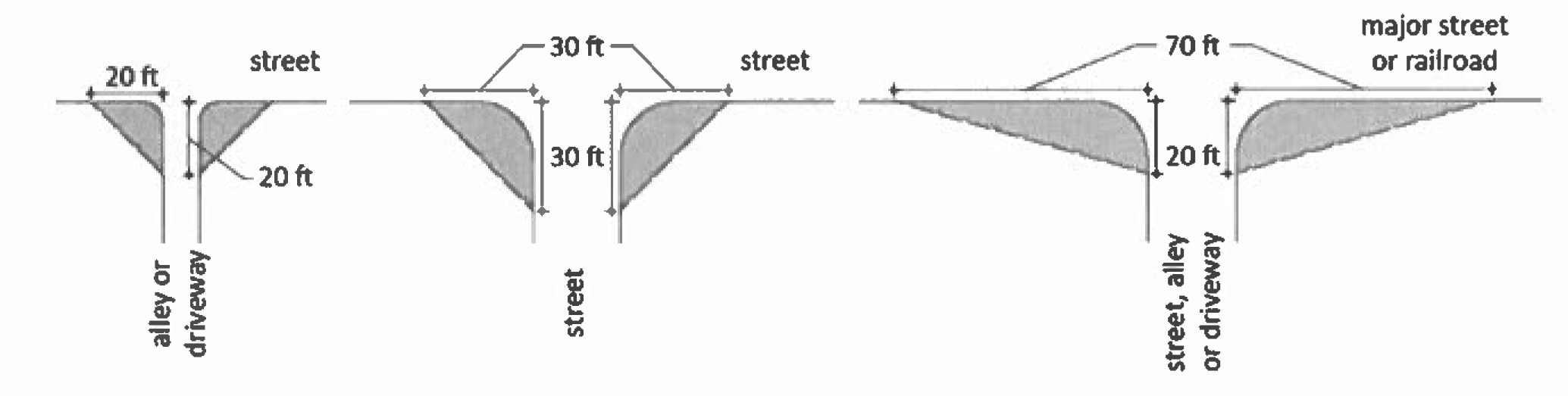
Figure 5:22-1 Intersection sight distance requirements
d.
Signs may not extend over a property line and may not be displayed on a property without the consent of the property owner except as required by law.
e.
Signs may not be installed at any location, whereby the position, size, shape, color, movement, or illumination would cause the sign to be confused with an official traffic signal, safety barricade or emergency vehicle.
f.
Signs may not be placed in such a manner as to obstruct the visibility of signs on adjoining properties from street view.
g.
Signs may not be painted on, drawn on nor attached to rocks, trees, utility poles, streetlights, light poles or placed on any public property except as authorized by the City Council.
h.
Signs may not extend above the wall or eave or parapet of the roof along which it is attached.
i.
On any premises where the principal structure is set back less than the required setback for freestanding signs, the Building Official may authorize a lesser setback provided the Building Official determines that a public hazard will not be created.
j.
Signs may not obstruct openings required for ventilation or means of egress, including any fire escape, window, door, stairway, exit, walkway, utility access or fire department connection.
k.
Wall signs are to be located on the front facade of a building, unless the property is in a non-residential zone. If a building is located within a non-residential zone, wall signs may be placed on facades other than the front, provided however that no wall signage is allowed on the side of a building facing an adjoining residential zone.
4.
Determining sign height, area and spacing.
a.
When only one sign face is legible from any vantage point along the street, the area of one side (the larger, if applicable) is counted toward allowable sign area. If the two sign face areas are legible from the same vantage point, the area of both sides is counted in determining sign area.
b.
For sign messages installed on a background panel, cabinet, or surface distinctively designed to serve as the background for the sign message, sign area is calculated as the smallest rectangle that encompasses the extreme limits of the background panel, cabinet or surface. See Figures 5:22-2 and 5:22-3.
c.
For sign messages where individual letters or elements are installed on a building wall and where there is no background panel, cabinet or surface distinctively designed to serve as the background for the sign message, sign area is calculated as the smallest rectangle that encloses all the letters or elements associated with the sign. When there are multiple sign elements on the same surface, the Building Official determines the outermost boundaries of individual sign elements. See Figure 5:22-4.
d.
For sign messages that are nonplanar, the sign area is calculated as the smallest rectangle that encompasses the profile of the sign message and any background object, panel, cabinet or surface distinctively designed to serve as the background for the sign message. The profile used is the largest area of the sign message and background visible from any one point. See Figure 5:22-5.
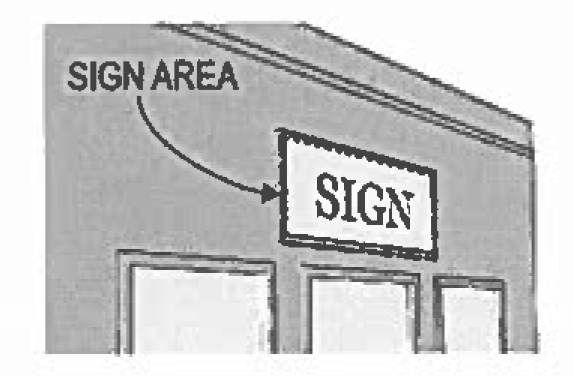
Figure 5:22-2 Wall Sign with panel
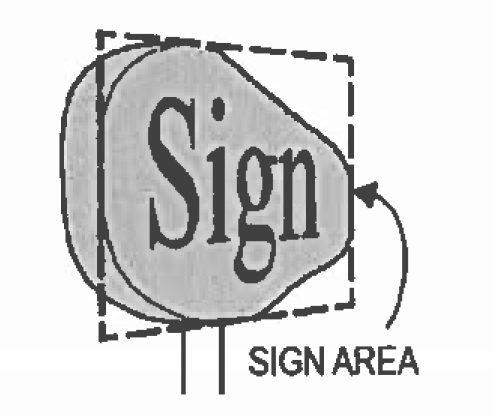
Figure 5:22-3 Freestanding Sign
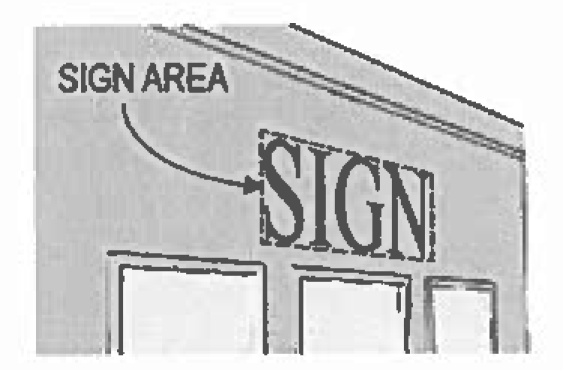
Figure 5:22-4 Wall Sign without panel

Figure 5:22-5 Nonplanar message
e.
Supporting framework, bracing, or decorative fences or walls are not included in calculating sign area.
f.
Sign height. For attached signs, clearance height is measured from grade level directly beneath the sign to the lowest point of the sign. For freestanding signs, including permanent, temporary and portable signs, height is measured from grade level at the base of the sign to the highest part of the sign. However, when the base of a freestanding sign is lower than that of the adjoining roadway, sign height is measured from the grade of roadway. Berms or fill material, which raise the base of the sign above the average elevation of the surrounding ground, shall not be used to increase the height of a freestanding sign.
g.
Sign spacing. Distance between freestanding signs is measured along the nearest edge of pavement of the main traveled way of the adjoining street or highway.
5.
Abandoned Signs. The Building Official may require the sign face of a conforming sign be covered or removed when such sign becomes abandoned.
Section 5:22-7—Sign Type Standards.
1.
Permanent Signs.
a.
Untreated wood and unfinished wood may not be used on the exterior of a sign, including any background panel, cabinet, surface, message or supporting structure.
b.
When visible from off the premises, the backs of signs must present a finished appearance and continue the color scheme of the front of the sign or be painted a single, neutral color.
c.
Freestanding signs on non-residential premises must be set back at least 15 ft from the nearest property line of any residential property.
2.
Attached signs, other than awning signs, may not extend outward more than three feet from the surface of the wall to which it is attached and may not extend beyond the ends of the wall surface on which such sign is placed.
3.
Portable Signs, existing on the effective date of this Zoning ordinance, must be secured, subject to the approval of the Building Official, to prevent unintended movement due to wind or other causes.
4.
Electronic Message Center ("EMC") Signs.
a.
EMC signs, regardless of the method of illumination measured 25 feet from the base of the EMS, may not be brighter than 4,690 nits throughout the daytime until at least one-half hour before Apparent Sunset and 1,675 throughout at the nighttime until Apparent Sunrise. Apparent Sunrise and Apparent Sunset are determined by the National Oceanic and Atmospheric Administration for the specific geographic location and date.
b.
EMC signs must be equipped with a dimmer control and photocell and must automatically adjust the display intensity as required herein.
c.
EMC signs must have a default mechanism that will freeze the display in a static message, turn off the display or revert to a black screen if a malfunction occurs.
d.
EMC signs may not display light of such intensity or brilliance to cause glare, impair the vision of an ordinary driver or constitute a nuisance to traffic and pedestrian safety.
e.
Message displays must be static, employing no motion, animation or changes in color or brightness, and may not change more frequently than eight seconds. Transitions between message displays must be instantaneous and may not simulate movement, such as flashing, racing, strobing, twinkling, or animation. The transition time between messages and graphics shall not exceed one second and shall not include visually distracting techniques.
f.
Exposed neon or fiber-optic tubing on EMC signs is prohibited.
5.
Illuminated Signs.
a.
Illuminated signs must conform in all respects to the City Electrical and Fire Codes. Any other provision of this §5:22 notwithstanding, the Building Official may order the repair or removal of any sign which does not conform to these codes.
b.
Any light mounted on, within or directed toward any sign must be shielded so that no direct illumination is cast upon any surrounding property or on or toward any public right-of-way or impair the vision of any motorist, bicyclist or pedestrian.
6.
Temporary Signs.
a.
Temporary signs may be used for commercial or noncommercial speech.
b.
Freestanding temporary signs are limited to a height of four feet when located on residential premises and six feet in all other cases.
c.
Temporary signs may not be posted in a public right-of-way and must be set back at least 20 ft from the nearest edge of pavement or back of curb, whichever is applicable, and at least three feet from the back of any sidewalk or other pedestrian or bicycle path. However, temporary signs may be placed on the sidewalk in the historic district provided:
(i)
The sign is no larger than six square feet and no taller than three feet;
(ii)
The sign is placed on the sidewalk by the operator or tenant of the business nearest its location, and the sign is removed from the sidewalk during the hours and days that the business is not regularly open to the public, or not open for a private event with specific limited hours; and
(iii)
A clear horizontal space of at least five feet in width is maintained along the sidewalk for pedestrian traffic and the sign does not interfere with a motorist's line of sight at intersections of streets, driveways, or alleys as determined by the Building Official.
Section 5:22-8—Flagpoles and Stanchions.
1.
Flagpoles and stanchions are allowed in all zoning districts.
2.
Unless otherwise required by state law, for each parcel and development site in residential use with at least one principal structure, one flagpole is allowed. There is no limit to the number of flags that may be displayed per flagpole.
3.
For each non-residential premises up to one-half acre in size, one flagpole may be installed. For each additional acre, one additional flagpole may be installed. Up to two flags may be displayed per flagpole.
4.
Flagpoles may not exceed 1.5 times the allowed building height for the district, but in no event may a flagpole be taller than 50 ft above grade.
5.
For each principal structure, up to two flag brackets or stanchions may be attached or placed on the structure for the display of flags.
Section 5:22-9—Residential Districts.
1.
General Standards.
a.
Only those signs expressly listed in §5:22-8 and this §5:22-9 are allowed.
b.
Signs authorized in residential districts by this section shall not be directly illuminated. Indirectly illuminated signs shall be constructed so that the light does not shine off the premises.
c.
EMC signs are allowed within residential districts only on the premises of conforming institutional uses and are counted toward the number and area of permanent signs allowed by this section. Only one EMC sign is allowed per premises. The display area of EMC signs may not be larger than 24 sf. EMC signs must be set back at least 100 ft from the nearest property line of any dwelling.
2.
Attached Signs.
a.
Each multifamily building is allowed one attached sign, which may not exceed 12 sf in area.
b.
Any building containing a permitted institutional use is allowed one attached sign. Attached signs may not be larger than one square foot of sign area per two linear feet of the entire length of the elevation containing the main entrance or 80 sf, whichever is more restrictive. One additional attached sign is allowed for a secondary façade along an adjoining public street or an on-premises parking area. The additional attached sign is limited to 40 sf in area.
3.
Freestanding Signs.
a.
Residential Subdivisions. Each residential subdivision is allowed one sign at each street entrance, which may not be taller than six feet above grade nor be larger than 24 sf in sign area and may not be within a public right-of-way unless placed, at the requestor's expense, within an easement for such purposes that has been favorably recommended by the City Engineer and Public Works Director and approved by the City Council. An acceptable legal entity must be identified, made responsible for the perpetual maintenance for the sign, and expressly agree within the easement agreement to such perpetual maintenance.
b.
Multifamily Developments, Manufactured Home Parks and Institutional Premises.
(i)
Each multifamily, manufactured home park and institutional premises is allowed one freestanding sign per facing street, which may not exceed six in height nor 72 sf in sign area.
(ii)
Signs not more than four sf in area and not more than four feet in height may be installed within six feet of the vehicular access to the premises. No more than one such sign is allowed per direction of travel at each vehicular access.
4.
Temporary Signs.
a.
During construction of a residential subdivision, manufactured home park or a multifamily or other permitted development, only the following temporary signs are allowed:
(i)
Up to two temporary signs are allowed at the primary entrance to the development. Each sign may be up to 32 sf in area. These signs must be removed within 30 days following the completion of the development. For residential subdivisions, "completion" refers to issuance of Certificates of Occupancy for 75% of the dwellings in the subdivision or phase thereof, as applicable, or 24 months after Final Plat approval, whichever comes first. In all other cases "completion" refers to issuance of a Certificate of Occupancy for the development.
b.
After initial construction, each residential and non-residential premises is allowed the following temporary signs:
(i)
At any time, three temporary signs with a combined area of 20 sf, with no sign larger than nine square feet in sign area.
(ii)
For non-residential uses, one additional temporary sign may be posted for up to 30 days from the time of its initial opening and up to 30 days prior to its final closing. The sign may not be larger than 32 sf in sign area.
c.
Undeveloped properties are allowed one temporary sign no larger than 12 sf in area.
Section 5:22-10—Nonresidential Districts.
1.
General Standards.
a.
In all Business, Manufacturing, Office and Institutional Districts, only those signs listed in §5:22-8 and this §5:22-10 are allowed.
b.
EMC signs are allowed on non-residential premises only and are counted toward the area and number of permanent signs allowed by this section. Only one EMC sign is allowed per premises. The display area of EMC signs may not be larger than 32 sf. EMC signs must be set back at least 50 ft from any residential district boundary.
2.
Attached Signs.
a.
Each multifamily building is allowed one attached sign, which may not exceed 12 sf in area.
b.
For non-residential and mixed-use premises, each ground floor tenant is allowed one attached sign and two canopy or awning signs subject to the following:
(i)
For each building wall along which tenants have a main entrance, the aggregate area of attached signs may not exceed two square feet of sign area per linear foot of building wall.
(ii)
One additional attached sign is allowed for tenant spaces with a second façade facing an adjoining public street or on-premises parking area. Such signs may not exceed one square foot of sign area per linear foot of building wall.
(iii)
The aggregate area of window signs may not exceed 50% of the total glass area of all windows on that building wall on the same floor.
3.
Freestanding Signs.
a.
Nonresidential and mixed-use premises are allowed freestanding signs as follows:
(i)
For premises with 300 ft or less of street frontage, one freestanding sign per street frontage. Premises with more than 300 ft along a street frontage may have one additional freestanding sign along the same street frontage provided a minimum sign spacing of 200 ft is met.
(ii)
The maximum height is six feet at the top of the sign area, measured from the height of the centerline of the adjacent right-of-way. The overall height of the sign structure shall not exceed eight feet, measured from the centerline of the adjacent right-of-way.
(iii)
Freestanding signs may have up to two sides, with a maximum of 32 sf per side. The maximum aggregate area for freestanding signs may not exceed 100 sf.
(iv)
Signs are to meet minimum setback at the property line.
(v)
Freestanding signs are not allowed within sight triangle of vehicular access to the premises.
4.
Temporary Signs.
a.
Nonresidential and mixed-use premises are allowed temporary signs as follows:
(i)
During construction, up to two temporary signs are allowed at the primary entrance to the premises. Each sign may be up to 32 sf in area. These signs must be removed within 30 days following the completion of the development. For residential subdivisions, "completion" refers to issuance of Certificates of Occupancy for 75% of the dwellings in the subdivision or phase thereof, as applicable, or 24 months after Final Plat approval, whichever comes first. In all other cases "completion" refers to issuance of a Certificate of Occupancy for the development.
(ii)
At any time after initial construction, each premises is allowed two temporary signs with a combined sign area of 32 sf on each frontage of 100 ft or more. For street frontages less than 100 ft, no individual sign may exceed 20 sf in area. Upon request and subject to conditions it deems necessary for the public safety, the Building Official may permit a portable sign to be used as one of the allowed temporary signs and for no more than 30 consecutive days.
(iii)
In the historic district, temporary signs allowed in accordance with §5:22-7.6.c. are counted toward the above allowed temporary signage.
(iv)
One additional temporary sign may be posted for up to 30 days from the time of the initial opening of a non-residential use and up to 30 days prior to its final closing. The sign may not be larger than 32 sf in sign area.
b.
Undeveloped properties are allowed one temporary sign no larger than 32 sf in area.
Section 5:22-11—Agricultural Districts.
1.
General Standards.
a.
Only those signs allowed in §5:22-8 and this §5:22-11 are allowed.
b.
Electronic message signs are prohibited.
2.
Attached Signs. Each agricultural or non-residential premises is allowed one attached sign as follows:
a.
The aggregate area of attached signs may not exceed one square foot of sign area per linear foot of building wall.
b.
One additional attached sign is allowed for premises with a second façade facing an adjoining public street or on-premises parking area. Such signs may not exceed 0.75 sf of sign area per linear foot of building wall.
c.
Window signs may not exceed 50% of the total glass area of the window in which it is placed.
3.
Freestanding Signs.
a.
Agricultural and non-residential premises. Agricultural and non-residential premises are allowed only one freestanding sign regardless of the number of street frontages. Freestanding signs may not be taller than 10 feet above grade and may not exceed 100 sf in sign area. In addition, signs not more than four sf in area and not more than four feet in height may be installed within six feet of the vehicular access to the premises. No more than one such sign is allowed per direction of travel at each vehicular access.
b.
Subdivisions. Each residential subdivision is allowed one sign at each street entrance, which may not be taller than six feet above grade nor be larger than 24 sf in sign area and may not be within a public right-of-way unless placed, at the requestor's expense, within an easement for such purposes that has been favorably recommended by the City Engineer and Public Works Director and approved by the City Council. An acceptable legal entity must be identified, made responsible for the perpetual maintenance for the sign, and expressly agree within the easement agreement to such perpetual maintenance.
4.
Temporary Signs.
a.
Residential premises.
(i)
During construction of a residential subdivision, up to two temporary signs are allowed at the primary entrance to the premises. Each sign may be up to 32 sf in area. These signs must be removed within 30 days following the completion of the development. For residential subdivisions, "completion" refers to issuance of Certificates of Occupancy for 75% of the dwellings in the subdivision or phase thereof, as applicable, or 24 months after Final Plat approval, whichever comes first. In all other cases "completion" refers to issuance of a Certificate of Occupancy for the development.
(ii)
After initial construction, each residential premises is allowed the following temporary signs at any time, three temporary signs with a combined area of 20 sf, with no sign larger than nine square feet in sign area.
b.
Agricultural and non-residential premises. Agricultural and non-residential premises are allowed temporary signs as follows:
(i)
During construction, up to two temporary signs are allowed at the primary entrance to the premises. Each sign may be up to 32 sf in area. These signs must be removed within 30 days following the completion of the development.
(ii)
At any time after initial construction, each premises is allowed two temporary signs with a combined sign area of 32 square feet on each frontage of 100 ft or more. For street frontages less than 100 ft, no individual sign may exceed 20 sf in area.
(iii)
One additional temporary sign may be posted for up to 30 days from the time of the initial opening of the agricultural or non-residential use and up to 30 days prior to its final closing. The sign may not be larger than 32 sf in sign area.
c.
Undeveloped properties are allowed one temporary sign no larger than 24 sf in area.
Section 5:22-12—Nonconforming Signs.
1.
Intent. It is the intent of this zoning ordinance to permit nonconforming signs to remain until they are removed, discontinued or altered, but not to encourage their survival.
2.
No lawful nonconforming sign shall be enlarged, extended, structurally altered, or reconstructed in any manner, except to bring it into full compliance with these regulations, except that these regulations shall not prohibit maintenance, minor repairs, or the replacement of the content of a sign provided there is no structural modification of its size, location or configuration. All lawfully nonconforming signs in existence or under construction with a valid permit upon the effective date of this §5-22 may continue subject to the following:
a.
The sign does not become damaged or deteriorated so as to become a public hazard. The Building Official may order the removal of any nonconforming sign which becomes a public hazard. Such sign must be removed within 30 days of the date of the order.
b.
The sign is not extended or maintained in such a way as to extend its nonconformity.
c.
The sign is not expanded and, if a permanent sign, relocated or removed for any length of time.
3.
Nonconforming on-premises signs.
a.
Nonconforming signs shall be maintained. If a structural alteration is required to accomplish maintenance, the sign shall, upon completion of the alteration, conform in all respects to the provisions of this § 5:22.
b.
The sign face of a directly-illuminated, nonconforming sign may be removed from the sign structure if the sign face is not an integral and permanent part of the sign structure without jeopardizing the legal nonconforming status of the sign.
c.
Maintenance of the sign face on a nonconforming sign in which the sign face is an integral and permanent part of the sign structure, shall require the sign to conform in all respects to the provisions of this zoning ordinance.
4.
Nonconforming off-premises signs. Structural alteration of a nonconforming off-premises sign shall require its removal. The message of a nonconforming off-premises sign may change without jeopardizing the legal nonconforming status of the sign.
5.
A sign shall lose its lawful nonconforming status and become an illegal sign if any of the following occurs:
a.
If such sign is damaged to an amount exceeding 50% of the sign's replacement value, as determined by at least two sign companies requested to provide a quote by the city;
b.
The sign structure is altered in any form, except as allowed herein;
c.
The sign is relocated; or
d.
The nonconforming sign and its structure are determined by the Building Official, to be unsafe or in violation of this zoning ordinance or any applicable code, and are declared a nuisance.
6.
Any nonconforming sign that becomes abandoned becomes an illegal sign and must be removed or brought into conformity with the provisions of this zoning ordinance at the owner's expense.
Section 5:22-13—Illegal Signs.
1.
Illegal Signs Defined. The following signs shall be considered to be illegal and a violation of the terms of this §5:22.
a.
A sign maintained after the effective date of §5:22 in a manner inconsistent with the terms contained herein.
b.
Any sign posted or installed in violation of the provisions of §5:22 after its effective date.
c.
An abandoned sign that does not comply with the provisions of §5:22.
d.
Any sign erected, placed or installed in the public right-of-way or on public property (excepting official federal, state or local government signs) shall be deemed abandoned and a public nuisance. Such signs may be removed by the City or its agents or employees and disposed of without notice to the party placing the sign or compensation to the owner. Removal by the City shall not affect penalties applicable for the unlawful erection or placement of the sign in the public right-of-way or on public property and shall be in addition to penalties and other remedies for violation of this zoning ordinance.
e.
Any sign which was illegal under the zoning ordinance(s) in effect prior to the adoption of this amended §5:22 and which does not conform with the provisions of this §5:22.
f.
Any sign that, in the opinion of the Building Official, due to structural, maintenance or other issues, constitutes a danger to the public, notwithstanding the fact that it may conform with the dimensional and other standards of this §5:22. The determination that a sign is a danger to the public shall be made in writing, and a copy thereof shall be promptly served on the permit holder for the sign or the property owner of record. Such determination shall specify the characteristics of the sign that constitute a danger. If sign owner or property owner responds within three business days with a proposed plan to eliminate the danger and begins and maintains diligent work to implement that plan, the sign shall no longer be considered "illegal." Otherwise, the sign shall be considered illegal, and the Building Official shall proceed in accordance with this section.
g.
A nonconforming sign that has lost its nonconforming status.
2.
Action Upon Determination. Upon determining that a certain sign is illegal, the Building Official shall act to remedy the violation, which may include:
a.
Causing the issuance of a notice of violation to the individual who owns, is responsible for or benefits from the display of such sign prescribing the action necessary to make the sign legal and conforming to the terms contained herein or ordering the removal of the illegal sign and also prescribing the time which the individual is afforded to accomplish such action;
b.
The removal of any illegal sign, in which case the City shall have the right to recover from the individual posting or installing such sign the full costs of removal and disposal.
c.
Failure to bring any illegal sign into conformity with the terms in this Section 5:22 or any other violation of the terms contained in this Section 5:22 shall be considered a violation of the zoning ordinance and shall be subject to the remedies and penalties provided by such ordinance and by state law.
3.
Responsibility for violations and cure. There shall be a rebuttable presumption that any sign owner is solely or jointly responsible for the placement of such sign and may be cited for violation of the zoning ordinance. The Sign Owner so cited may request a hearing on the citation in municipal court and shall have the burden of proving by a preponderance of the evidence that the particular sign involved in the violation was posted or installed without the knowledge or consent of the Sign Owner. However, any owner of property which has been leased to any Sign Owner and over which the property owner has no control by operation of said lease, shall not be subject to the civil or criminal provisions of the zoning ordinance upon proof by the property owner of the same.
(Ord. No. 2023-28, § 4, 9-19-23)
Section 5:23. - Special aesthetic concern sign ordinance.
Section I: Special aesthetic concern commercial overlay district requirements.
1.
Signs in new development must comply with City of Irondale Ordinance No. 1-0598, section 5.22 Sign Regulations.
2.
Signs within a commercially developed, planned commercial park and or any commercial development board project, or other City of Irondale owned properties, may submit an overall and combined individual sign package that is particular to the proposed development and or property. The city council may approve the request as submitted based upon the aesthetic and economical consideration of the development and the coordination of signage within the project. The signage package is not subject to being limited to the requirements of this section, but will be reviewed for and approved by the coordination of the highest and best overall aesthetic considerations for individual and group signage proposed for the development or property by the city council.
3.
Temporary signs, such as lease or rental signs, with prior design review committee approval, may be permitted, but shall not be posted for a period that exceeds 90 days. Flashing, moving signs, portable signs and banners shall not be permitted except with the approval of the city council for a 30 day time limit or as approved by the city council for special circumstances.
4.
Banners, logos and decorative insignia type signs may be approved and permitted by the city council's designated agent. (City clerk, building inspector or council representative: land use consultant). Such approval will be for a 21-day period with a limit of two permits issued to the permittee within a 90-day period, unless authorized for special circumstances by the city council.
5.
All existing signs in the new development not conforming to these requirements shall be removed within five years from the project initiation date (and or) at the expiration date of the lease for (existing) billboards, and outdoor advertising signs expiring after the project area has been established shall not be renewed except by approval of the design review committee and the city council.
Section II: Additional sign requirements—new development.
1.
A systematic and coordinated sign package is required for all new developments. Sign packages for new developments shall address signs for the entire site including, but not limited to, building identification, business name, tenant signage, parking, loading or service, informational and directional signs.
2.
Consideration shall be given to the provision of sign space in the building and site design.
3.
All signs shall reflect quality workmanship and materials.
4.
Special consideration shall be given to the quality and placement of light sources emitting from or directed toward signs.
5.
The design review committee may be required to review all sign packages and make recommendation to the city council.
6.
Final approval of sign packages shall be by the city council of the City of Irondale.
Section III: Design review committee.
The design review committee shall forward their recommendations to the city council as quickly as possible after a design review request from the city council or variance is received.
The design review committee shall be composed of three members of the City of Irondale Abatement Board and two members each from the City of Irondale Ordinance Committee and the City of Irondale Beautification Committee, and the Mayor, as ex officio member. The chairman and vice chairman shall be elected each year by vote of the committee. One monthly meeting date will be established by the committee, however, the committee may hold a special meeting to review a request by affirmative vote of the majority of the members or forgo a monthly meeting if no requests for approval are pending.
a)
A quorum of five members must be present to vote on any issue and a vote of the majority of the members present is necessary for approval.
(Ord. No. 99-72, §§ I—IV, 12-7-99; Ord. No. 00-13, 3-23-2000; Ord. No. 2000-81, §§ I—-IV, 10-17-2000; Ord. No. 2001-22, §§ I—III, 6-5-2001)
Editor's note— Ord. No. 99-72, §§ I—IV, adopted Dec. 7, 1999, did not specifically amend the Code; hence, inclusion herein as § 5:23 was at the discretion of the editor.
Section 5:24. - Tree and landscape ordinance.
Section 1. Ordinance authority.
1.1
The planning and zoning commission of the city, under the authority of Ordinance No. 1-0598, zoning ordinance of the city, has authority in all zoning districts as pertains to the regulation and requirements of landscaping and buffer areas.
1.2
The ordinance requires buffer/greenbelts in many of the zoning districts and, under article V, special use regulations, has the authority to cause or require additional plans and landscaping beyond the normal greenbelt requirements.
Section 2. Review.
The planning and zoning commission may refer all landscape projects that, in their opinion, require additional review to the design review committee established under Section IV of Ordinance No. 99-72 (section 5:23 of this article) and amendment Ordinance No. 2000-13. One member of the tree commission and the city arborist will also serve on the design review committee with respect to tree and landscape ordinance compliance. The design review committee will review the submitted plans and make written comments and recommendations with respect to compliance with this tree and landscape ordinance and may make recommendations for changes to be considered by the planning and zoning commission for their final decision.
Section 3. Purpose.
It is the purpose of this ordinance to promote and protect the public health, safety and general welfare by providing for the regulation of the planting, maintenance and removal of trees, shrubs and other plants in public street or highway rights-of-way, parks and other city-owned property as well as those on private property which, in the opinion of the city arborist, constitute a threat to life or property. By such regulation it is intended that the preservation, conservation and replacement of trees and other plants shall be practiced to the fullest practicable extent.
Section 4. Applicability.
The provisions of this ordinance shall apply to all properties within the city;
4.1
When new improvements require the submission to and approval of a site plan or subdivision plan by the planning and zoning commission.
4.2
When clearing and grading operations are planned in preparation for site development or modification.
4.3
When requests are made to cut or remove trees or shrubs from public property.
4.4
When, in the opinion of the city arborist, a tree on private property fits the definition of a problem tree.
4.5
When an individual citizen or property owner requests to be allowed to cut trees or shrubbery on or over public property.
4.6
When a major public improvement project includes new planting or the removal of existing plants.
Section 5. Definitions.
Except as listed below, words used herein shall bear the meanings given to them in the Random House Dictionary of the English Language, Second Edition, Unabridged.
Buffer: Space between adjacent properties either left in natural vegetation or planted in trees and or other vegetation.
Caliper: The diameter the trunk of a tree measured 12 inches above the ground.
City: The City of Irondale, Alabama, its agents and agencies.
City arborist: A person so certified by the Jefferson County Personnel Board and approved by the city council who is certified as such by the International Society of Arboriculture or holds a degree from an accredited school of forestry or in absence of a qualified employee, the person temporarily appointed by the mayor to discharge the duties thereof.
City-owned property: Rights-of-way and other property owned by the city.
Crown: The portion of a tree consisting of the branches whose tips extend farthest from the trunk and all branches above that level.
DBH: Diameter at breast height, a standard measure of tree size. It is the diameter of the trunk measured four and one-half feet above the ground. If a tree splits into two or more trunks below four and one-half feet, the trunk is measured where it is narrowest below the split.
Dripline: A vertical line extending from the outer extremities of a tree's crown down to the ground.
Landmark tree: A tree so designated by the historical commission, the city, the county, the state or the federal government, because of species rarity, old age, abnormality, scenic enhancement, association with a historical person or event or some other condition making the tree unique.
Large tree: A tree attaining a mature height of 15 feet or more.
Private tree: A tree growing on privately owned property.
Problem tree: A tree that is potentially unsafe due to a structural defect and constitutes a threat to public property or public safety.
Public tree: A tree growing in a park, in the right-of-way of a public street, highway or on other city-owned property.
Small tree: A tree attaining a mature height of less than 15 feet.
Species list: The city's list of plant species approved for planting in the city. (See subsection 8.2)
Topping: The severe cutting back of the trunk and/or limbs within a tree's crown, disfiguring the tree.
Tree: A self-supporting woody plant, usually having a single woody trunk and a potential DBH of two inches or more.
Tree cover: The area directly beneath the crown and within the dripline of the tree.
Tree lawn: The space between a street or highway right-of-way and the curbline or other edge of paving.
Section 6. Licensing and permitted activities.
6.1
Licensing. Any person or company paid a fee for the business of planting, cutting, trimming, pruning, removing, or otherwise modifying trees within the city shall obtain an appropriately classified business license.
6.2
Permit required for tree removal. No person shall remove, cut above ground, or otherwise disturb any tree within city-owned property without city approval and then procuring the necessary permit from the city clerk. This section is not applicable to removal of trees for site development and subdivision projects approved for construction by the city. The city shall determine if trees or shrubs on city-owned property are problem trees after examination by the city arborist and, if so determined, to cause such trees or shrubs to be removed.
6.3
Trees may be removed for the following reasons:
1.
Problem trees or trees that are deteriorated.
2.
Diseased or infectious trees and trees in decline.
3.
Trees or their root systems causing visible damage to structures, and or areas used for pedestrian and vehicle traffic.
4.
Trees within utility easements, which can not be properly pruned by the local utility company as determined by the city arborist.
5.
Trees to be removed, cut, pruned or disturbed as detailed on plans approved by the planning and zoning commission and after all other applicable permits for construction have been issued. Example: Clearing of existing right-of-way to provide proper sight distance at a new proposed street intersection.
6.4
Application. Applications for permits must be made at the office of the city clerk at least five business days in advance of the time the work is to be done on forms provided by the city. The city clerk will forward the permit application to the city arborist for his review and recommendations. The permit will contain a date of expiration and the work shall be completed in the time allowed on the permit. The city arborist will inspect the site and tree(s) and forward the approval application to the mayor for his approval. The city arborist may void the permit if any of the conditions of the permit as granted are violated. The applicant shall notify the city arborist upon completion of the work and request a final inspection and release from the terms of the permit.
6.5
Utility companies. Utility companies or their subcontractors engaged in removal or pruning of trees on city-owned property for the purpose of line clearance should notify the city arborist as to the location and scope of the work they will be performing. The city arborist will work with the companies to enhance the work for the best interests of the city to maintain an acceptable visual appearance and promote proper growth in the future. Rather than allow the topping of trees, the utility company may be required to completely remove said trees, including the stump to a minimum of six inches below the low point of the surrounding grade adjacent to the stump and to plant a replacement small tree or shrub as approved by the city arborist.
6.6
Request for new tree plantings. Requests from private citizens for new trees to be planted near their property and located in the street right-of-way or on the other public property will be accommodated in accordance with planting priorities set by the city council and reviewed and recommended for approval by the city arborist. The city arborist may request the design review committee, the beautification advisory committee and/or the tree commission for their review and recommendations.
6.7
Excavation within street rights-of-way. Excavation within the street right-of-way for the purpose of removing or planting trees by a contractor or individual shall not be undertaken without notification to and approval by the city. All necessary bonding requirements and street construction procedures must be followed. An underground utility request shall also be made to the Alabama Line Location Service or other approved line locator service which shall locate and mark all utility lines before the individual or contractor commences excavation.
6.8
Regulated activities. Unless specifically authorized in writing by the city, no person shall damage, cut, carve, transplant or remove any tree, shrub, or other plant materials on city-owned property, except for city employees under the supervision of the city arborist and who are performing their daily duties as assigned by the city arborist relating to landscaping and work incidental thereto. No person or other entity shall attach any rope, wire, nails, advertising posters or other similar objects to any tree or shrub in the public rights-of-way or other city-owned property.
6.9
Sight distances/obstruction of rights-of-way. It shall be the duty of the property owner of any parcel bordering on a public street to ensure that trees and shrubs on their property are planted and pruned in a manner that will not obstruct free passage or the vision of vehicular or pedestrian traffic, sidewalks, traffic signs, or the proper lighting of street intersections or alleyways.
6.10
Corrective action. Any person or other entity failing to comply with the provisions of this ordinance shall be notified in writing by the city attorney to take corrective action within ten days of the written notice. Such notice will be delivered by registered mail or hand delivered by an official of the city to the owner of record of the subject property. When a person or other entity to whom the notice was delivered shall fail to comply within the specified time, the city shall take appropriate action to correct the specified problem and all the cost incurred by the city to correct the problem shall be assessed to that person or other entity.
6.11
Emergency work. Any emergency work activity immediately necessary to protect life or property or to maintain safe access to any property in the event of a natural disaster shall be exempted from the provisions of this ordinance. The city arborist and/or the superintendent of public works shall be notified as soon as possible of the location and or locations of performed emergency work in order that the situation may be reviewed and proper guidance may be provided concerning public property, trees or shrubs involved in the emergency work.
6.12
Penalties. Any person, firm or corporation violating any of the provisions of this ordinance shall be guilty of a misdemeanor offense and shall be assessed the maximum fine provided for the destruction of public property.
Section 7. Landscaping.
Submittals for building permits for new subdivision and the development of commercial and industrial property, shall include landscape plans, designating all existing trees, showing trees and shrubs proposed for planting on city rights-of-way, at entrances and exits, in buffer areas, in parking lots and similar locations. Such plantings shall conform to the requirements set forth for buffers and greenbelts in the city's zoning ordinance (Ord. No. 1-0598).
Section 8. Tree planting, maintenance and removal.
8.1
General: No tree on public property shall be planted, removed, cut above the ground or otherwise damaged without prior written approval of the city arborist. All such operations shall comply with all provisions of this ordinance.
8.2
Species: All plants shall be selected from a list obtainable from the city clerk's office. Any other plants proposed for use in the city must be approved by the city arborist.
8.3
Spacing: Small trees shall be planted no closer together than thirty (30) feet; large trees, 40 feet unless a variance is granted by the city.
8.4
Utility lines: Only small trees shall be planted under or within ten lateral feet of overhead utility lines. No trees shall be planted directly over or within five lateral feet of buried utility lines.
8.5
Distance from curbs and sidewalks: Small trees shall be planted no closer to curbs or sidewalks than four feet; large trees no closer than six feet.
8.6
Topping: The topping of any tree is strictly forbidden except in rare cases approved in writing by the city arborist.
8.7
Clearing: All clearing of land shall be held to the minimum amount necessary to accomplish the purpose for which it is done. Clearing and all other land disturbance shall be carried out in strict compliance with the provisions of all applicable city ordinances and best management practices.
Section 9. Tree protection.
9.1
Disease or infestation: Upon discovery within the city limits of any disease or pestilence which will endanger the growth or health of trees, whether on public or private property, the city shall immediately cause written notice to be served upon the owner of the property where evidence of the problem is observed. The notice shall require said owner, whether a public or private entity, to eradicate, remove or otherwise control or abate such condition within a reasonable time as set forth in the notice. Failure to comply will be just cause for the city to take appropriate action and the cost incurred by the city shall be assessed against the property owner.
9.2
Trees to be retained on a building or development site shall be protected by the use of barriers, by preventing siltation, grading or the burying of utility lines within the trees' driplines and by refraining from any activity that may result in damage to the tree(s).
9.3
Landmark trees shall be diligently protected from any and all activities which may result in their being damaged in any manner.
Section 10. Nuisance trees.
The city may declare to be a public nuisance any tree, shrub, plant or plant part which:
(a)
Is a problem tree or is diseased or infected as described in 9.1 above, or
(b)
Is dead or dying and will fall onto public property, or
(c)
Is obstructing the free passage of pedestrians or vehicles; obstructing the view of traffic lights or signs, or is interfering with the proper lighting of a street or sidewalk and/or poses a threat to safety in any manner, as determined by the chief of police or his designee, and/or qualified engineer engaged by the city.
The city shall notify in writing the owner of any such public nuisance, requiring said owner to remove the public nuisance within a reasonable time as set forth in the notice. Upon the failure of the owner to comply with the terms of the notice, the city may cause the required removal to be done and the cost incurred by the city shall be assessed against the property owner.
Section 11. Authority of the city arborist.
11.1
Rules: The city arborist shall have the authority and the power to enforce rules and regulations approved by the city council and specifications concerning the trimming, spraying, removal, planting, pruning, maintenance and protection of trees, shrubs, vines, hedges and other plants on any public property within the city.
11.2
Master plan: The city arborist shall recommend rules, regulations and a master street tree plan to be adopted by the city council and which the city council may amend or add thereto from time to time as circumstances make it advisable to do so. Such plan shall specify by species and other particulars the types, placement and spacing of trees to be planted on the streets and other public property of the city. On and after the date of adoption by the city of the master street tree plan, all planting shall conform thereto.
(Ord. No. 00-12, §§ 1—11, 5-2-2000)
Editor's note— Ord. No. 00-12, §§ 1—11, adopted May 2, 2000, did not specifically amend the Code; hence, inclusion herein as § 5:24 was at the discretion of the editor.
Section 5:25. - Construction trailer(s).
Section 5:25-1—Construction trailer(s) are allowed upon application for an accessory structure permit. The request for approval of the use permit may be granted for a period of one (1) year by the city clerk and/or the building inspector. The permit application may be resubmitted at the end of the one (1) year time period for consideration for renewal. If construction trailer is vacated for more than sixty (60) days it must be removed immediately.
Section 5:25-2—The city clerk may, upon extenuating circumstances, direct that the request for a construction trailer must be reviewed and approved by the zoning board of adjustment.
(Ord. No. 2005-69, 11-15-05)
Editor's note— Ord. No. 2005-69, adopted Nov. 15, 2005, set out provisions intended for use as § 5:23. Inasmuch as there were already provisions so designated, these provisions have been included as § 5:25 at the discretion of the editor.
Section 5:26. - Mini-warehouse or self-service storage facility.
(1)
Location. A mini-warehouse and self-service storage facility may be erected in a C-2, I-1, I-2, or I-3 zone with conditional use approval as provided herein.
(2)
Requirements.
(a)
Submission of a site development plan.
(b)
The maximum gross floor area of an individual storage unit shall be 500 square feet.
(c)
Exterior light fixtures shall be designed and installed so that the light is focused down upon the premises and so that a minimum amount of light shines on adjacent property or the public right-of-way.
(d)
All storage shall be wholly within a building or shall be screened from view from the surrounding properties. There shall be no storage in any required front yard or flanking street yard.
(e)
A preliminary plan or engineering feasibility report providing for the site grading, storm drainage, sanitary sewerage, and water supply, prepared by a registered professional engineer.
(f)
Additional conditions are as follows:
1.
No hazardous or flammable materials shall be stored on site.
2.
No auctions, commercial sales/rentals, garage sales, or other activities not consistent with the approved storage use shall be conducted on the premises.
3.
No separate dedicated utility connections, namely, electricity, water, telephone, cable television, or gas will be provided to the individual units.
4.
No unit within a self-storage facility shall be utilized as a place of business.
(Ord. No. 2022-11, § 7, 6-22-22)
Section 5:27. - Automobile dealership.
(1)
Location. An automobile dealership may be erected in a C-1, C-2, 1-1, or C-PB zone with conditional use approval as provided herein.
(2)
New car dealership requirements. New car dealerships shall provide an overall plan detailing the use, location and type of structures to be constructed upon the proposed site. The plan shall include the proposed parking lot(s) for display of new vehicles and used vehicle areas detailing the size of spaces and aisle ways. A detailed signage plan will be required for all signage within the proposed area.
(3)
Used car dealership requirements.
(a)
The facility shall be adequate in size for the display and sale of not fewer than 12 used motor vehicles; all display spaces shall measure not less than nine (9) feet by twenty (20) feet, exclusive of unusable space and drives or aisles which give access to the space; aisle ways that adjoin display spaces shall comply with the dimensional standards for width as specified in governmental and building codes.
(b)
All used motor vehicles for sale shall be in operable condition.
(c)
All outdoor areas shall be either landscaped or paved in accordance with the provisions of the granted conditional use.
(d)
All lighting shall be directed so as not to shine upon land zoned RI, R2, R3, R4, RS, R6 or residential PD.
(e)
The premises shall have proper curb cuts for entrances and exits.
(f)
The premises shall be screened by six (6) foot high opaque walls where adjacent to, or across an ally from, land zones E-1, R l, R2, R3, R4, RS, R6 and R-7 Residential Districts, in according with the provisions of current zoning code buffer requirements.
(g)
A suitable building of permanent nature shall be erected that has at least two hundred (200) square feet of gross floor area, is constructed of wood, masonry, or other approved building material, and sits on a proper foundation, except that frame and all metal buildings less than two hundred (200) square feet of gross floor area may be erected as outlined in the current building code. However, in the event of cessation of used motor vehicle sales, said accessory uses may not continue, except upon issuance of a permit for said uses as the principal use of the land, which is subject to a Conditional Use public hearing where such is specified in the zoning districts use lists.
(h)
Vehicle preparation shall be permitted as an accessory use at the time of establishment of the used motor vehicle salesroom or sales lot. However, major motor vehicle services or minor motor vehicle services on the premises of the used motor vehicle salesroom or sales lot shall only be permitted upon issuance of a permit for the service facilities as a principal land use in conjunction with the salesroom or sales lot, which is subject to a Conditional Use public hearing where such is specified in the zoning districts use lists for said service facilities.
(i)
All used motor vehicle salesrooms or sales lots shall be licensed in accordance with all Governmental Requirement Codes.
(j)
In the C-2 Commercial District, used motor vehicle sales are prohibited except where incidental and accessory to a new car dealership.
(k)
Where used motor vehicles are sold on the same zoning lot upon which used tire sales are conducted, a separate principal land use is permit is required for used tire sales; the outdoor storage of used tires is prohibited.
(l)
All used motor vehicle salesrooms or ales lots shall be established and located a major thoroughfare only.
(m)
It is unlawful for any used motor vehicle salesroom or sales lot to display motor vehicles on the berm, sidewalk, or elsewhere in the public right-of-way.
(n)
It is unlawful for any used motor vehicle salesroom or sales lot to display an A-frame or other portable sign in the public right-of-way.
(o)
No new and/or newly established used motor vehicle salesroom or sales lot shall be located within one thousand (1,000) radial feet of any existing used motor vehicle salesroom or sales lot located within or outside the City of Irondale's boundaries.
(Ord. No. 2022-28, § 10, 10-18-22)

