
Jacksonville City Zoning Code
ARTICLE IV
OFF-STREET PARKING AND LOADING
Sec. 24-280.- Purpose.
It is the purpose of this article to define requirements for off-street parking and loading areas for specified uses.
(Ord. No. O-614-20, Exh. A, 1-13-2020)
Sec. 24-281. - Requirements.
The following identify the minimum number of automobile parking spaces for specified uses. Where a particular use is not specifically mentioned, the requirements of a similar or related use may apply as determined by the planning department or the planning commission shall establish the requirements for off-street parking for that particular use:
(1)
Assisted living facilities. One parking space for every two beds plus one parking space for each employee on the maximum shift.
(2)
Automobilerepair shops. Three parking spaces for each service bay or similar facility plus one for each employee.
(3)
Bed and breakfast home. A minimum of two paved parking spaces shall be provided for the owner and one paved parking space for each guest bedroom.
(4)
Bowling alleys. Three parking spaces for each alley.
(5)
Churches, theatres, auditoriums, stadiums or other places of public assembly. One parking space for each three seats in the largest assembly room or area.
(6)
Dwellings.
a.
Single-family. Two parking spaces per dwelling, plus one additional parking space for each bedroom over one per dwelling.
b.
Two-family (one structure on a single lot). Two parking spaces per dwelling, plus one additional parking space for each bedroom over one per dwelling.
c.
Apartments and multiple two-family. One parking space per bedroom, plus 20 percent additional parking spaces (rounded to the next higher number) for visitors.
(7)
Filling station. One parking space for each 200 square feet of area devoted in trade or service activity plus one parking space for each business controlled vehicle used directly in the conduct of the enterprise except, parking at gas pumps shall not be counted as a required parking space.
(8)
Golf driving range. One parking space per each tee, plus one parking space for each employee. Baseball/softball batting cages. Two parking spaces per each batting cage/machine plus one parking space for each employee.
(9)
Hospitals and sanitariums. Two parking spaces for each patient bed.
(10)
Miniature golf course. Twenty-four parking spaces for the first 18 holes, plus one parking space per hole thereafter.
(11)
Mini-warehouses. One parking space for each employee.
a.
Except: where ingress and egress is made through an inside lobby or interior corridor, one parking space for each five storage units shall be provided.
(12)
Mobile home parks. Two parking spaces per mobile home located on each site plus one additional parking space for each bedroom over two per mobile home.
(13)
Motels and hotels. One parking spaces for each guest room, plus one parking space for each employee on the maximum shift. Additional parking of one parking space for each three seats shall be provided for meeting and banquet halls.
(14)
Nursing homes. One parking space for every six beds plus one parking space for each employee on the maximum shift.
(15)
Offices or professional or public buildings. One parking space for each 200 square feet of floor area, or four spaces for each separate office, whichever is greater.
(16)
Private club or lodge. One space for each four members.
(17)
Restaurants. One parking space for each four seats, plus one parking space for each employee on the maximum shift, plus one parking space for each business owned vehicle used directly in the conduct of the enterprise.
(18)
Retail stores, service establishments, repair shops, wholesale trades. One parking space for each 200 square feet of area devoted in trade or service activity, plus one parking space for each business controlled vehicle used directly in the conduct of the enterprise.
(19)
Schools.
a.
Nursery school, kindergarten, elementary, and middle schools. No less than three parking spaces for each classroom.
b.
High schools. One parking space for every two students of maximum capacity plus one space for each employee.
c.
Additional parking requirements. For auditoriums, stadiums, gymnasiums, and/or other places of public assembly associated with and a part of a school the following is required:
1.
The total required parking spaces, including those required by subsections (19)a. and b. of this section, shall be one parking space for each three seats in the largest place of public assembly. At least 50 percent, but never less than that required under subsections (19)a. and b. of this section, of the total required parking spaces shall be constructed and marked in accordance with section 24-282, plans and specifications.
2.
All other additional parking spaces may be unpaved, but constructed of an all-weather material other than concrete of asphalt and such spaces can be unmarked. Provided, however, that the parking lot drainage plan be approved by the planning commission, that a 25-foot long paved or concrete apron with adequate radii be constructed at each driveway entrance from a public street, and that unobstructed emergency vehicle access lanes, properly constructed to support the weight of such emergency vehicles, be provided.
(20)
Shopping centers and malls. Four parking spaces for each 1,000 feet of area devoted to retail trade or service activity, plus one parking space for each business controlled vehicle used directly in the conduct of the enterprise.
(21)
Stores for the exclusive sale of furniture or appliances, machinery, equipment, hardware and building supplies, automotive sales or service. One space per 900 square feet of gross floor space, plus one space for each employee on the maximum shift and one space for each business controlled vehicle used directly in the conduct of the enterprise.
(22)
Townhouse. Two parking spaces per dwelling unit, plus one additional parking space for each bedroom over two per unit, preferably located in the rear yard.
(23)
Warehousing, manufacturing and industrial establishments. One parking space for each employee on the maximum shift plus one parking space for each business controlled vehicle used directly in the conduct of the enterprise.
(Ord. No. O-614-20, Exh. A, 1-13-2020; Ord. No. O-638-22, § I, 5-23-2022; Ord. No. O-657-24, § I, 8-26-2024)
Sec. 24-282. - Plans and specifications.
(a)
Size and location.
(1)
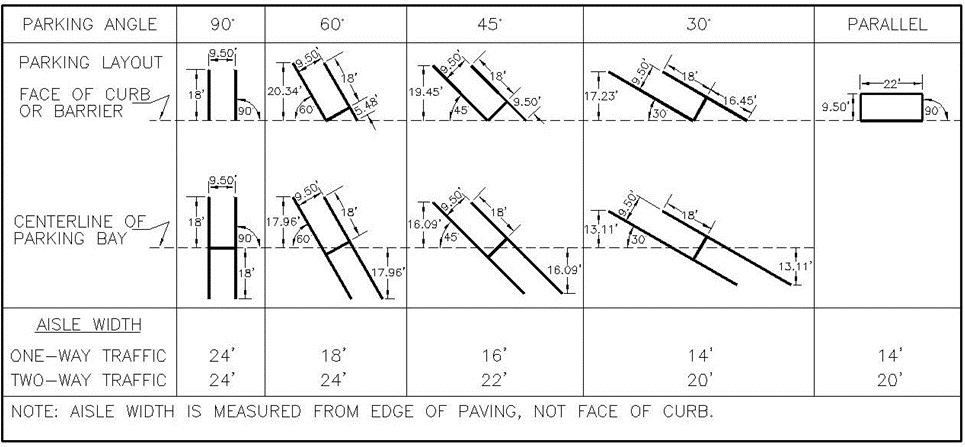
Each off-street parking space shall encompass a rectangular area not less than 9.5 feet wide and 18 feet long (except parallel parking spaces shall be not less than 22 feet long), exclusive of access or maneuvering area, ramps and other appurtenances (see figure 2). Off-street parking spaces shall be located entirely off of public rights-of-way.
(2)
Off-street parking spaces shall be located on the same parcel of land as the building or use as set forth in section 24-602, developments to be on one lot, except as set forth in subsection (a)(3) and (4) of this section and section 24-284, shared off-street parking.
(3)
Dwelling units located in the public square overlay district, if required off-street parking spaces cannot be provided on the same lot on which the dwelling is located, such parking spaces may be provided on other off-street property, provided that the required spaces are located no further than 400 feet from the main entrance of the dwelling unit. Such off-street parking spaces shall be associated with each particular use and shall not thereafter be reduced or encroached upon in any manner except with the approval of the planning commission.
(4)
On approval of the planning commission, the off-street parking requirement for any use in a B-2 general business district may be partially or fully met by public off-street parking facilities, if the required amount of parking is provided by such facilities within 400 feet of the use.
(5)
The design of parking areas shall be such that no vehicle will be required to back out into the street, except for single-family and two-family dwellings.
(b)
Construction and maintenance. Off-street parking areas shall be constructed, maintained and operated in accordance with the following specifications:
(1)
Configuration and size.
a.
Parking spaces and aisles shall be configured and sized based upon the angle of the parking spaces as follows (see figure 2):
Figure 2.
b.
The required aisles may serve as common access to parking spaces on opposite sides of said aisles.
c.
Parking areas and driveways shall have continuous concrete curbing or curb and gutter along all sides and around interior landscaped islands.
d.
Parking areas for all developments shall be designed so that sanitation, emergency, and other public service vehicles can serve such developments without the necessity of backing unreasonable distances or making other dangerous turning movements. Fire lanes may be required by the fire code.
e.
All parking spaces that front along a sidewalk less than seven feet wide shall have an anchored wheel stops (six feet long by six inches high) installed with a 24-inch separation from the sidewalk/curb to prevent the sidewalk from being blocked.
(c)
Surfacing and drainage. Surfacing of all parking areas shall be paved with concrete and/or asphalt. Except, if the planning commission finds it to be in the public's best interest, designated employee parking areas may be unpaved, but constructed of an all-weather material other than concrete or asphalt and such spaces can be unmarked. Such employee parking areas shall have signage designating "parking for employees only."
(1)
Parking areas shall be designed to meet the requirements of the ADA Standards for Accessible Design (current edition).
(2)
Parking areas shall be properly designed and graded for drainage and stormwater management.
(3)
All parking area shall be constructed to handle traffic and vehicle loads of its intended use, emergency vehicles, and public service vehicles.
(d)
Spaces marked. All off-street parking areas shall have individual spaces marked (painted), except for single-family dwellings, two-family dwellings, and unpaved designated employee parking.
(e)
Curb cuts and access points. Entrances and exits for parking areas shall be so located as to minimize traffic congestion. Entrances and exits for parking areas shall be separated by a minimum of 150 feet (measured from centerline to centerline of the entrance or exit). All entrances and exits shall open onto public streets, rather than alleys, except where the use of an alley is reasonably necessary for proper traffic flow. Any improvement required to the alley will be the responsibility of the owner/developer.
Entrances and exits for new developments and redevelopments located along state highways shall be subject to review and approval by the Alabama Department of Transportation (ALDOT).
(f)
[Requirements.] Curb cuts and access points shall be in accordance with the following requirements:
(1)
Curb cuts and other access points for single-family or two-family residential uses shall not be less than 12 feet wide or a maximum of 20 feet wide. For multi-family, commercial or manufacturing uses it shall not be less than 24 feet wide (excluding curb and gutter) or a maximum width as approved by the planning commission.
a.
Except for access to one- or two-family dwelling units, no curb cut or access point shall be within 150 feet of any other such curb cut or access point (measured centerline to centerline) on the same lot.
b.
The width of said curb cut shall be measured from edge of paving to edge of paving at the innermost end of the required radii.
c.
Notwithstanding any other provision of this section, fire stations and police stations shall be allowed curb cuts up to, and no wider than, the minimum necessary to provide access for official emergency vehicles that have limited maneuverability and that must rapidly respond to emergencies and such curb cuts may be within 150 feet of other curb cuts on the same lot.
(2)
Radii for curb cuts and other access points. Except for single-family and two-family dwelling units, a 15 feet minimum (50 feet minimum where trucks/trailers will access) curb radius (measured at curb face) shall be provided at any curb cut or other access point. Unless otherwise approved by the planning commission.
a.
Single-family and two-family uses shall have a five feet curb or paving radius (measured at curb face or edge of paving).
b.
Multi-family, commercial or manufacturing uses shall have a 15 feet minimum (50 feet minimum where trucks/trailers will access) curb radius (measured face to face) provided at any curb cut or other access point. Unless otherwise approved by the planning commission.
(3)
Location of curb cuts and other access points. At street intersections, no curb cut or other access point shall be located closer than 25 feet from the intersecting point of the two street right-of-way lines involved (or such lines extended in case of a rounded corner).
(4)
Existing curb cuts not utilized by a development shall be removed entirely and curbing reinstalled in a like manner.
(g)
Maintenance.
(1)
Parking areas shall be maintained in good condition, free of weeds, trash, and debris.
(Ord. No. O-614-20, Exh. A, 1-13-2020)
Sec. 24-283. - Large vehicle parking restrictions.
(a)
No parking of any vehicle with a manufacturer's gross vehicle weight rating greater than 14,000 pounds or having more than two axles, or which tow or haul disabled, wrecked or junk vehicles shall be permitted in any residential zoning district unless parked in an enclosed accessory structure.
(b)
Exemptions:
(1)
Vehicles with a manufacturer's gross vehicle weight rating greater than 14,000 pounds engaged in deliveries or as support to a necessary temporary activity such as construction or moving, but only for the time reasonable and necessary to support the activity or make the delivery.
(2)
Vehicles with a manufacturer's gross vehicle weight rating greater than 14,000 pounds operated and used for passenger or commuting purposes by a church, school or government facility and parked on the property of said church, school or government facility, but not within the required front setback.
(3)
One service truck owned by a public or quasi-public utility agency and parked at the driver's residence when that driver is required by his/her employment to respond to emergencies.
(Ord. No. O-614-20, Exh. A, 1-13-2020)
Sec. 24-284. - Shared off-street parking.
In order to reduce the amount of impervious surfaces and the resulting increases in stormwater runoff, and to promote and encourage business and commercial establishments within B-1 local shopping business districts and B-2 general business districts, the establishments may be allowed to share up to 25 percent of their required off-street parking spaces. In all cases where off-street parking is to be shared by business or commercial establishments on different parcels of land, the shared off-street parking spaces shall be within 400 feet, measured radially, of the main entrance of the establishments. Any new or altered off-street parking spaces and their associated drive aisles that are intended to be shared shall meet the size and surfacing requirements as set forth in article IV, off-street parking and loading, and shall meet the landscaping requirements as set forth in article V, division 1, landscaping. The intention to share parking facilities must be included in the application for development review and include a written shared parking agreement between the various property owners, or in the case of a single property owner with multiple tenants, a shared parking agreement between the property owner and the individual tenants. Said shared parking agreement shall be recorded in the Office of the Probate Judge of Calhoun County, Alabama and shall constitute a covenant running with the property(s) referenced and shall be binding upon the property owner(s), property owner(s) heirs, tenants, administrators, executors, assigns, and any other successor's interest. Should there be a change in the use, ownership or tenant within any individual property which is bound by said shared parking agreement, the transfer of or changes to said shared parking agreement shall be subject to the review and approval of the planning and building department, or if determined necessary, the review and approval of the planning commission.
Nothing in this chapter shall be construed to prevent shared off-street parking by two or more business or commercial establishments, if the total number of the off-street parking spaces when used together shall not be less than the sum of the required number of off-street parking spaces for the individual establishments computed separately.
(Ord. No. O-614-20, Exh. A, 1-13-2020)
Sec. 24-285. - Reduction of required off-street parking.
In order to reduce the amount of impervious surfaces and the resulting increases in stormwater runoff, and to promote and encourage developments within the area(s) designated as "mixed-use (commercial and residential)" on the land use plan (map 16) in the city's comprehensive plan, the number of required off-street parking spaces may be reduced by 35 percent.
(Ord. No. O-614-20, Exh. A, 1-13-2020)
Sec. 24-286. - Loading and unloading spaces.
All commercial and industrial structures hereafter erected or created are required to provide and maintain adequate off-street space for loading and unloading of materials, goods, or things, and for delivery and shipping, so that vehicles for these services may use this space without encroaching on or interfering with public use of parking areas, streets, and alleys by pedestrians and other vehicles; all such structures are also required to have sufficient off-street parking space for all vehicles controlled by such establishment.
(1)
Where any structure is enlarged, or any use is intended so that the site of the resulting occupancy comes within the scope of this article, the full amount of off-street loading and unloading space shall be supplied and maintained for the structure, or use in its enlarged size. Where the use of a structure or land, or any part thereof, is changed to a use requiring off-street loading and unloading space under this article, the full amount of off-street loading unloading space shall be supplied and maintained to comply with this article.
(2)
Off-street loading and unloading space shall be a marked and designated area of at least 12 feet wide by 45 feet long with 14½ feet of vertical clearance. Off-street loading and unloading spaces shall be provided and maintained in accordance with the following:
a.
For each retail store, storage warehouse, wholesale establishment, industrial plant, freight terminal, market, restaurant, funeral home, laundry, dry cleaning plant or similar use which has an aggregate floor space of:
1.
Less than 8,000 square feet; no off-street loading and unloading is required, unless determined to be necessary by the planning commission.
2.
Eight thousand square feet but less than 20,000 square feet; one space for off-street loading and unloading is required.
3.
Twenty thousand square feet but less than 60,000 square feet; two spaces for off-street loading and unloading is required.
4.
For each additional 50,000 square feet, or fraction thereof, over 60,000 square feet; one additional off-street loading and unloading space is required.
b.
For each auditorium, convention hall, exhibition hall, hotel, office building, stadium, or similar use, which has an aggregate gross floor area of:
1.
Less than 10,000 square feet; no off-street loading and unloading is required, unless determined to be necessary by the planning commission.
2.
Ten thousand square feet but less than 40,000 square feet; one space for off-street loading and unloading is required.
3.
For each additional 50,000 square feet, or fraction thereof, over 40,000 square; one additional off-street loading and unloading space is required.
4.
Where a particular use is not specifically mentioned, the requirements of off-street loading and unloading of a similar or related use may apply as determined by the planning department or the planning commission shall establish the requirements for off-street loading and unloading for that particular use.
c.
No area supplied to meet the required off-street loading and unloading area shall be utilized for or deemed to meet the requirements of this article for off-street parking areas.
d.
Nothing in this chapter shall be construed to prevent the joint use of an off-street loading and unloading area by two or more buildings or uses if the total of the area when used together shall not be less than the sum of the requirements for the individual buildings or uses computed separately.
e.
Plans for buildings or uses requiring off-street loading facilities under the provisions of this article shall clearly indicate the location, dimensions, clearance and access of all such required off-street loading facilities.
f.
Loading and unloading areas shall be physically separated from adjoining properties, public rights-of-way, and landscaped areas by a continuous curb or curb and gutter. Except for curb cuts and access points.
(Ord. No. O-614-20, Exh. A, 1-13-2020)
Sec. 24-287. - Continuing character of obligation.
(a)
Required off-street parking and loading areas associated with newly erected or altered buildings or newly established or altered uses of land shall be a continuing obligation of the owner of said building or land so long as the structure exists or the land use requiring said parking or loading areas continues, and it shall be unlawful for said owner to discontinue, change or dispense with, or to cause the discontinuance or change of the required parking or loading areas apart from the discontinuance, sale or transfer of the building or use without establishing alternative vehicle parking or loading areas which meet the requirements of and are in compliance with this chapter, or of any person to use a building or land without providing parking or loading areas which meet the requirements of and are in compliance with this chapter.
(b)
When a paved or unpaved off-street parking and loading area already exists for a building or use of land at the effective date of the ordinance from which this article is derived, such area may continue to be used. However, if the area is expanded by more than 50 percent of its area for said building or use of land, or if there is a change in the building use/occupancy or use of land, or if a nonconforming building or use of land is discontinued for any reason, except for damage or destruction by natural disasters or government action impeding access to the premises, for a period of more than six consecutive months, the entire off-street parking and loading area must be brought into conformity to the maximum extent feasible with the requirements of article IV and V, except for those requirements determined to be technically infeasible by the planning commission.
(Ord. No. O-614-20, Exh. A, 1-13-2020)
Sec. 24-288. - Maintenance.
The property owner, lessee, or his agents shall be responsible for maintaining all paved and unpaved off-street parking areas in a good and safe condition. All defective and unsafe conditions (such as potholes, poor drainage, signage, striping, and pavement markings) shall be replaced or repaired within one month after notification from the city.
(Ord. No. O-614-20, Exh. A, 1-13-2020)

