Jacksonville City Zoning Code
ARTICLE V
- LANDSCAPING, BUFFER, LIGHTING, FENCES, WALLS, AND HEDGES
Sec. 24-310.- Applicability.
The provisions of this article shall apply to all new construction, development, redevelopment, or change of use for any multi-family residential, business, manufacturing or other nonresidential use and shall become applicable to any property for which a building permit is required when site improvements are performed.
(Ord. No. O-614-20, Exh. A, 1-13-2020)
Sec. 24-311. - General.
(a)
All sites shall have at least ten percent landscaped areas (such as yard areas, interior landscaped islands and continuous planting strips), in addition to required buffers as per article V, division 2.
(b)
All sites shall have a five-foot wide minimum continuous planting strip adjacent to any portion of a parking area or access driveway that faces a public right-of-way or property used for residential purposes.
(c)
Sites with less than 40 parking spaces are not required to have interior landscaped islands, however, they are preferred.
(d)
Sites with 40 or more parking spaces shall provide interior landscaped islands of adequate size for turning radii at the ends of each row of parking, and interior landscaped islands (180 square foot minimum) at uniform locations along a row of parking to allow only 12 consecutive parking spaces.
(e)
Yard areas shall be grass (sod or seed). Installation shall provide for solid coverage.
(f)
Interior landscaped islands can have one or a combination of the following: grass (sod), shrubs, trees, ground cover plantings, or non-living ground cover (such as pine straw/bark, river rock, or similar materials).
(g)
Continuous planting strips shall have at minimum one tree and eight shrubs per 50 linear feet of planting strip. Trees and shrubs shall be evenly distributed.
(h)
Landscaping at street intersections and driveways shall conform to section 24-501, visibility areas at street intersections and driveways.
(i)
Landscaped areas (yards, interior islands, and continuous planting strips) shall have a built-in irrigation system or have hose bibs located within 100 feet, measured radially, of all landscaped areas. No component of a built-in irrigation system shall be installed within a public right-of-way.
(j)
A landscaped area five feet minimum in width shall be provided between any parking area, access driveway, sidewalk, and any building walls. This area shall have an average of eight shrubs per 200 square feet. Landscaped islands and/or continuous planting strips shall be increased in size and/or number where the installation of landscaped areas adjacent to building walls are problematic.
(k)
In addition to the required trees and shrubs, all continuous planting strips shall have a combination of ground cover (see plantings) and non-living ground cover (such as pine straw/bark, river rock, or similar materials), or only non-living ground cover.
(l)
All parking areas, loading/unloading areas, and access drives adjacent to landscaping areas (yards, interior islands, and continuous planting strips) shall be physically separated by a continuous curb or curb and gutter. Curb height shall be six inches. Gutter width shall be 12 inches minimum, 18 inches is preferred.
(m)
It is preferred, that existing trees and natural areas are maintained on all sites as practicable and as the landscape design allows.
(n)
All sites disturbing ground shall conform to the city's stormwater management program and are subject to obtaining an ADEM NPDES construction general permit. A copy of the permit shall be provided to the planning department.
(o)
It is preferred that all new developments and re-developments utilize low impact development (LID) and green infrastructure practices (GIP) in accordance with the "Low Impact Development Handbook for the State of Alabama."
(p)
Buffers shall be installed as set forth in article V, division 2.
(Ord. No. O-614-20, Exh. A, 1-13-2020)
Sec. 24-312. - Plantings.
(a)
Suggested trees:
(1)
Tree types should be of species listed below or species conducive for the location as approved by the planning commission.
a.
Large trees.
1.
Deciduous:
Bald Cypress
Dawn Redwood
Ginkgo (male only)
Nuttal Oak
Overcup Oak
Pin Oak
River Birch
Shumard Oak
Trident Maple
Tupelo Black Gum
Willow Oak
2.
Evergreen:
Deodora Cedar
Japanese Cryptomeria
b.
Small to medium trees.
1.
Deciduous:
Chinese Pistache
Crapemyrtle
Eastern Redbud
Flowering Dogwood
Fringetree
Hawthorne
Kousa Dogwood
Persian Ironwood
Vitex
2.
Evergreen:
American Holly
American Hornbeam
Bayberry Wax Myrtle
Dahoon Holly
Foster Holly
Japanese Maple Cultivars
Luster Leaf Holly
Magnolia 'Bracken's Brown Beauty'
Magnolia 'Little Gem'
Magnolia 'Sweet Bay'
Magnolia 'Teddy Bear'
Nellie Stevens Holly
Savannah Holly
Tea Olive
Virginia Pine
Weeping Yaupon
(2)
Trees shall be spaced no closer than ten feet to count toward the required ratio for continuous planting strips, except trees planted in excess of the minimum required may be closer than ten feet apart.
(b)
Suggested shrubs.
(1)
Shrubs should be of species listed below or species conducive for the location as approved by the planning commission.
a.
Species for planting strips and interior landscaping:
Abelia
Azalea
Carissa Holly
Dwarf Burford Holly
Dwarf Wax Myrtle
Dwarf Yaupon Holly
Florida Jasmine
Fountain Grass
Indian Hawthorne (cultivars that are resistant to entomsporium leaf spot)
Korean Holly
Loropetalum
Muhly Grass 'Adagio'
(c)
Minimum size of trees and shrubs (measured from finish grade to top of planting) at time of planting shall be as listed below:
(d)
Suggested ground cover.
Ajuga
Asiatic Jasmine
Carolina Jessamine
Liriope
Mondo Grass
Sedge
Shore Juniper
(e)
Suggested grass. Grass shall be either sod or seed of species conducive for the location in which they are planted and for the season in which they are planted.
(f)
Prohibited trees, shrubs, and ground covers.
Callery Pear
Chinaberry Tree
Chinese Privet
Chinese Tallowtree
Eleagnus
English Ivy
Heavenly Bamboo 'Nandina Domestica'
Leatherleaf Mahonia
Mimosa
Non-native Wisterias
Periwinkle
(Ord. No. O-614-20, Exh. A, 1-13-2020)
Sec. 24-313. - Landscape plan.
(a)
A landscape plan shall be submitted as part of the application for development review. The landscape plan shall include information as listed below:
(1)
General information, including date, north arrow, and scale of one inch to no more than 20 feet unless approved; all property lines, locations of all existing and proposed easements and rights-of-way; and the name and business affiliation of the person preparing the landscape plans.
(2)
Construction information, including the locations of buildings, parking spaces and driveways; utility fixtures, including light poles, power and service poles, above ground pedestals (low-voltage) and pad mounted (high-voltage) fixtures, underground electrical, communications, and television cables and conduits; hose bibs, irrigation systems, meters, control boxes, etc.; total number of parking spaces; and the total amount square footage of each landscaped island.
(3)
Landscaping details, including the locations, caliper, species (common name), and intended treatment (move, remove, or save) of existing trees eight inches or larger in caliper; locations, dimensions and treatments of all perimeter planting strips and landscaped islands.
(4)
A schedule of all new and existing plants proposed for landscaping, including size (caliper and height, container size, etc.), condition (bare-root, balled-and-burlapped, container-grown, or preexisting), common names and botanical names (genus, species, and variety) of trees, shrubs, and ground cover, and the type and amount of turf grasses.
(Ord. No. O-614-20, Exh. A, 1-13-2020)
Sec. 24-314. - Installation.
(a)
Trees should be located on extensions of parking space lines to minimize bumper, exhaust, and engine heat damage to the trees.
(b)
Shrubs should be located a few feet away from curbing to minimize bumper, exhaust, and engine heat damage to the shrubs.
(c)
In lieu of planting grass seed on steep slopes (3:1 or greater) and in ditch/swale bottoms, it is recommended to install sod and anchor as needed.
(d)
Planting grass seed on slopes and in areas subject to excessive runoff (such as ditch/swale bottoms) may require erosion control blankets of adequate type to be installed and anchored as needed.
(e)
Synthetic or artificial materials in imitation of trees, shrubs, turf, ground cover, or other plantings are prohibited.
(f)
Hedges, decorative retaining walls, and berms, though not required, are encouraged to help minimize the visual impact of parking and loading areas.
(Ord. No. O-614-20, Exh. A, 1-13-2020)
Sec. 24-315. - Maintenance.
The property owner, lessee, or designated property manager shall be responsible for providing, maintaining, and protecting all landscaping in a healthy and growing condition, and for keeping it free from refuse and debris. All unhealthy and dead materials shall be replaced within two months after notification from the city, or during the next appropriate planting period, whichever comes first.
(Ord. No. O-614-20, Exh. A, 1-13-2020)
Sec. 24-316. - Notice of completion.
Upon the completion of landscaping installation required by this article, the property owner, lessee, or designated property manager shall notify the building department. A representative of the building department shall make an inspection and will require correction of conditions contrary to the approved landscaping plan, this article, and replacement of plant materials that are dead, diseased, damaged, or planted so as to kill or injure the plants.
(Ord. No. O-614-20, Exh. A, 1-13-2020)
Sec. 24-317. - Bonding.
No certificate of occupancy shall be issued until the provisions of this article have been met. When circumstances preclude immediate planting, a certificate of occupancy may be granted after the owner or developer:
(1)
Has completed all curbing, irrigation systems, and other construction preliminary to planting; and
(2)
Posts a performance bond (surety bond, letter of credit, or cashier's check) with the city (to be approved by the city council) in an amount equal to 125 percent of the total cost of the required plantings, including materials and labor. Such performance bond shall be made payable to the City of Jacksonville. Landscaping must be completed and approved within 180 consecutive calendar days, after a certificate of occupancy is issued in order to redeem the performance bond.
(Ord. No. O-614-20, Exh. A, 1-13-2020)
Sec. 24-318. - Inspection.
The building department shall make inspections as necessary pursuant to this article and shall initiate appropriate action to bring about compliance with it. Upon becoming aware of any violation of the provisions of this article, the building department shall serve written notice of such violation upon the person responsible for compliance. No penalty shall be assessed until the expiration of the bond, if one has been posted, or otherwise until 60 days after notification of violation.
(Ord. No. O-614-20, Exh. A, 1-13-2020)
Sec. 24-340. - General.
(a)
In order to decrease incompatibility between adjacent land uses, an appropriate buffer shall be provided as specified in this chapter.
(b)
Buffers shall provide a visually impervious barrier and be uniformly dense at all heights from the ground. The buffer shall consist of one of or a combination of the following:
(1)
One row minimum of evergreen trees with an upright form spaced no more than six feet apart along the entire buffer. Height at time of planting shall be six feet minimum.
(2)
Two rows minimum of evergreen shrubs or hedges with an upright form spaced not more than four feet apart along the entire buffer. Height at time of planting shall be four feet minimum and will grow to be at least six feet within one year after planting.
(c)
Privacy fences and privacy walls may be allowed within the required buffer, however no such privacy fence or privacy wall may be used to reduce or exempt the property from compliance with buffer planting requirements.
(d)
Privacy fences and privacy walls located within a required buffer shall be finished on the side facing the adjoining property. All shrubs, hedges, or trees shall be planted on the side of the privacy fence or privacy wall facing the adjoining property.
(e)
The buffer shall be adjacent to and parallel with the specified property lines and rights-of-way.
(Ord. No. O-614-20, Exh. A, 1-13-2020)
Sec. 24-341. - Buffer widths.
The following widths and standards shall apply to all buffers required by this article:
(1)
Those conditional uses requiring a buffer in the R-1, R-2, and R-3 residential districts: ten feet minimum.
(2)
Those conditional uses requiring a buffer in the B-2 general business district: 15 feet minimum.
(3)
Those conditional uses requiring a buffer in the M-1 and M-2 manufacturing districts:
a.
Uses requiring a privacy fence or privacy wall: 15 feet minimum.
(4)
Uses not requiring a privacy fence or privacy wall: 20 feet minimum.
(Ord. No. O-614-20, Exh. A, 1-13-2020)
Sec. 24-370. - General.
Lighting shall be provided to promote visual surveillance, reduce the potential for criminal activity, and increase security in the parking, loading and pedestrian areas in all new developments. In the case of redeveloping an existing property, lighting shall be provided as specified herein for establishments that operate between dusk and dawn. In the case of redeveloping an existing property that does not operate between dusk and dawn, minimal lighting shall be provided for safety and security.
(Ord. No. O-614-20, Exh. A, 1-13-2020)
Sec. 24-371. - Fixtures.
(a)
Shall be protected by weather and vandal resistant covers.
(b)
Shall be located and fitted with appropriate shields (as needed) to prevent glare on adjacent properties and rights-of-way.
(c)
Shall be installed on poles 30 feet or less in height in parking and loading areas and 15 feet or less in height in pedestrian areas (measured from finish grade to bottom of fixture). Wooden poles are prohibited. A detail prepared by a qualified professional or the pole manufacturer shall be provided for the pole base/footing installation.
(d)
It is preferred that a fixture be utilized that directs the light downward in parking, loading and pedestrian areas, and on buildings.
(e)
On buildings, wall packs must be shielded so that no portion of the bulb extends below the bottom edge of the shield.
(f)
It is preferred that the use of floodlights in parking areas, loading areas, pedestrian areas and on buildings be limited. Except, low voltage floodlights used for landscape lighting to illuminate walls and tree canopies.
(g)
All electrical distribution lines and service connections for site lighting shall be installed underground.
(h)
Lighting under filling station canopies should utilize a fixture with a lens cover recessed flush with the bottom surface of the canopy or a lens cover shielded to direct the light downward.
(Ord. No. O-614-20, Exh. A, 1-13-2020)
Sec. 24-372. - Design.
(a)
Parking areas that accommodate 14 or less vehicles do not require a lighting plan, unless it is requested by the staff or planning commission. However, the site plans shall include the location, type, and height of poles and the type and wattage of light fixtures to be installed.
(b)
Parking areas that accommodate 15 or more vehicles requires a lighting plan as set forth in section 24-373, lighting plan. The plan shall be designed by a qualified professional or lighting manufacturer.
(c)
Parking areas, loading areas and pedestrian areas shall have a minimum light level of one footcandle. Lighting shall be uniform; i.e. the maximum measured lighting level in area divided by the minimum measured lighting level shall be ten or less. The light shall not cast more than 0.5 footcandle beyond the property line.
(d)
Where LED fixtures are utilized in parking, loading and pedestrian areas there shall be a minimum light level of 0.4 footcandle. Lighting shall be uniform; i.e. the maximum measured lighting level in area divided by the minimum measured lighting level shall be eight or less. The light shall not cast more than 0.5 foot candle beyond the property line.
(e)
Illumination requirements are measured at ground level.
(f)
Lighting shall be utilized during all hours of operation between dusk and dawn.
(Ord. No. O-614-20, Exh. A, 1-13-2020)
Sec. 24-373. - Lighting plan.
(a)
Shall clearly define the property lines, zoning classification, and current uses for all adjacent properties.
(b)
Shall specify the type of lamp to be used in each fixture, including the manufacturer's name and part number, lamp wattage, lumen output, and a copy of the manufacturer's lamp specifications.
(c)
Shall specify the pole heights and locations.
(d)
Shall specify the type of fixtures, including the manufacturer's name and model number, wattage and light loss factor.
(e)
Shall provide point-to-point photometric calculations at intervals of not more than ten feet at ground level demonstrating that the plan will provide a uniform intensity of lighting on parking, loading and pedestrian surfaces.
(f)
Shall provide the area of each photometric calculation, including an extra calculation to identify the light level produced at the property line, and all data used in each calculation.
(g)
The lighting plan shall be stamped and signed by a qualified professional registered in Alabama.
(Ord. No. O-614-20, Exh. A, 1-13-2020)
Sec. 24-374. - Maintenance.
The property owner, lessee, or his agents shall be responsible for maintaining all lighting in a working and safe condition. All defective and unsafe conditions shall be replaced or repaired within one month after notification from the city.
(Ord. No. O-614-20, Exh. A, 1-13-2020)
Sec. 24-500. - Fences, walls and hedges.
(a)
Fences, walls, or hedges may only be erected, placed, maintained, or grown on private property (not within a public right-of-way, alley, or easement).
(b)
No fences, walls, or hedges in any residentially zoned property shall exceed a height of eight feet above the ground. Except that no such fences, walls, or hedges located in a designated normal front yard, not the designated second front yard, shall exceed a height of four feet and shall meet the visibility requirements set-forth in section 24-501 visibility areas at street intersections and driveways.
(c)
No fences, walls, or hedges in any non-residentially zoned property shall exceed a height of ten feet above the ground, except that no fences, walls, or hedges located in a front yard shall exceed a height of six feet and shall meet the visibility requirements set forth in section 24-501, visibility areas at street intersections and driveways. Except, when a non-residentially zoned property has more than one front yard, the six feet fence height requirement shall only apply to the front yard with the main entrance for the business or use.
(d)
Fences on a residentially zoned lot or property used for residential purposes shall not be constructed of barbed wire, razor wire, or electric fencing materials. Except, for fencing areas to contain livestock.
(e)
Fences containing manmade materials shall be composed of materials manufactured, designed, and intended for such purposes and shall not include scrap materials or salvage materials. Fences shall be of materials of a uniform and consistent style.
(f)
The wooden portion of fences shall be of a decay resistant wood, or shall be covered with paint, stain, or other such substance which preserves wood from deterioration, dilapidation or decay.
(g)
Fences containing natural materials as rock or stone, shall be of a consistent style and shall not include scrap materials or salvage materials.
(h)
All walls and fences shall be finished on the side facing the adjoining property.
(i)
It shall be the responsibility of the owner/lessee to maintain the fence in good and proper condition and repair, free of loose or missing material and free of any defects, damage or decay so as to not present a potential safety hazard and so that at all times it represents a neat and orderly appearance to surrounding property owners and to the general public.
(j)
Fences shall be properly installed, constructed, and maintained to be vertical, self-supporting, and secured in a fashion to resist leaning, falling, collapse, or partial collapse and so as not to create a potential safety hazard.
(k)
Fence installation shall require a building permit. Depending upon the proposed fence location, the building department may require that a property survey be provided in order to verify the location of property corners, property lines, and easements.
(l)
See article V, division 2, buffer, for regulations in regard to privacy fences and privacy walls in a buffer.
(m)
The use of netting, cloth, or tarp type materials is prohibited for fencing or screening on fencing. Except, those materials specifically manufactured for screening may be attached to fencing around tennis courts and sporting fields.
(Ord. No. O-614-20, Exh. A, 1-13-2020; Ord. No. O-625-21, § III, 3-8-2021)
Sec. 24-501. - Visibility areas at street intersections and driveways.
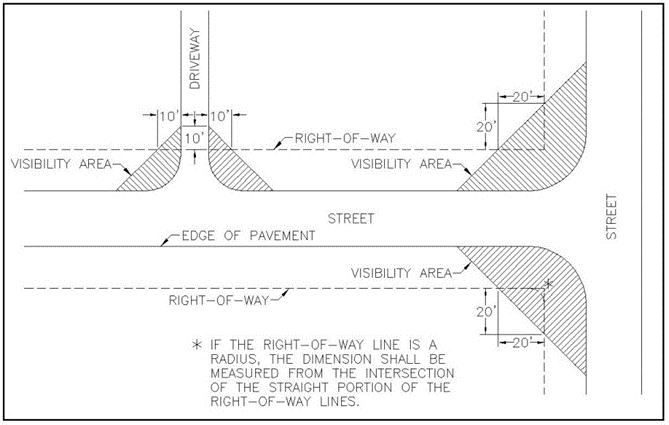
No fence, wall, sign, shrubbery, tree, planting, other structure or object capable of obstructing driver vision between the height of 2½ feet and 15 feet above the finished grade of adjacent streets shall be erected, permitted or maintained within 20 feet of the intersection of any public rights-of-way and within ten feet of the intersection of any driveways with public rights-of-way. Mailboxes, traffic control devices and appurtenances and those signs set forth in section 24-563(1) through (7) are excluded from this section. (See figure 3).
Figure 3.