
Jamestown City Zoning Code
ARTICLE 11
- JAMESTOWN VILLAGE SPECIAL DEVELOPMENT DISTRICT
Sec. 82-1100.- Purposes and intent.
This article is designed to encourage traditional neighborhood patterns such as those existing in Jamestown Village today. The implementation of article 11 is intended to protect and complete these patterns so that all new development will be harmonious and compatible with existing village character, while also encouraging housing that is diverse and affordable for residents at different stages of life.
(Ord. of 2-3-2025(1), § 1(Exh. A))
Sec. 82-1101. - Applicability.
A.
The Jamestown Village Special Development Overlay District is comprised of all lots within the R-20, R-8, CW, CL, CD, DC, and P Zoning Districts as shown on the Zoning Ordinance Map.
B.
Provisions of this article are activated by "shall" when required; "should" when recommended but optional; and "may" when permitted but optional.
C.
The provisions of this article, when in conflict with those of other sections or articles of this Code, shall take precedence.
D.
Section 82-104, Definitions, contains regulatory language that is integral to this article. Those terms not defined in section 82-104 shall be defined by the zoning enforcement officer and should be generally in accord with their commonly accepted meanings. In the event of conflicts between these definitions and those of the existing local codes, those of section 82-104 shall take precedence.
E.
The numeric standards contained in Table 11-1 are an integral part of this article. However, the diagrams that accompany them should be considered as instructional in nature.
F.
Where in conflict, numeric metrics shall take precedence over graphic metrics.
(Ord. of 2-3-2025(1), § 1(Exh. A))
Sec. 82-1102.1. - Planning commission as approving authority for formal development plan review.
In addition to the development plan review thresholds provided in the town's subdivision and land development regulations, the planning commission shall review and provide a decision on applications in accordance with the following provisions.
A.
The planning commission shall review any proposed substantial modification, as defined in section 82-104, Definitions, except where TRC is specifically granted jurisdiction over a substantial modification in section 1102.3 D below.
B.
The planning commission shall review any application where an addition to or modification of a building is actually or potentially eligible for inclusion on a state, local, or national historic register.
C.
The planning commission shall review any development application where existing conditions represent a legally established pre-existing non-conforming situation. Alterations or expansions of legally established pre-existing non-conforming buildings or parking areas may be allowed as part of planning commission DPR review, in accordance with section[s] 82-904 and 82-905, where they are considered a non-substantial modification and meet the standards of the Village Special Development District.
(Ord. of 2-3-2025(1), § 1(Exh. A))
Sec. 82-1102.2. - TRC in an advisory capacity.
Where the planning commission is the DPR approving authority for formal development plan review, the TRC shall serve in an advisory capacity regarding which standards apply and what is required for compliance.
Sec. 82-1102.3. - TRC as approving authority for administrative development plan review.
In addition to the development plan review thresholds provided in the town's subdivision and land development regulations, the TRC, in a process led by the administrative officer, shall review and provide a decision on applications that do not require planning commission review, but include one or more of the following:
A.
The development of new single-family or duplex dwelling in the R-8, R-20, CW, CL, CD, DC, and P Zoning Districts;
B.
A change in parking layout or the addition of up to 15 parking spaces;
C.
A change in site design or lot coverage that changes both the on-site drainage patterns and how stormwater may impact abutting or nearby properties; or
D.
Where a change in use category is the only factor that qualifies a proposal as a substantial modification, and no other thresholds for planning commission DPR apply under article 10.
(Ord. of 2-3-2025(1), § 1(Exh. A))
Sec. 82-1103. - Jamestown Village Special Development Overlay District design standards.
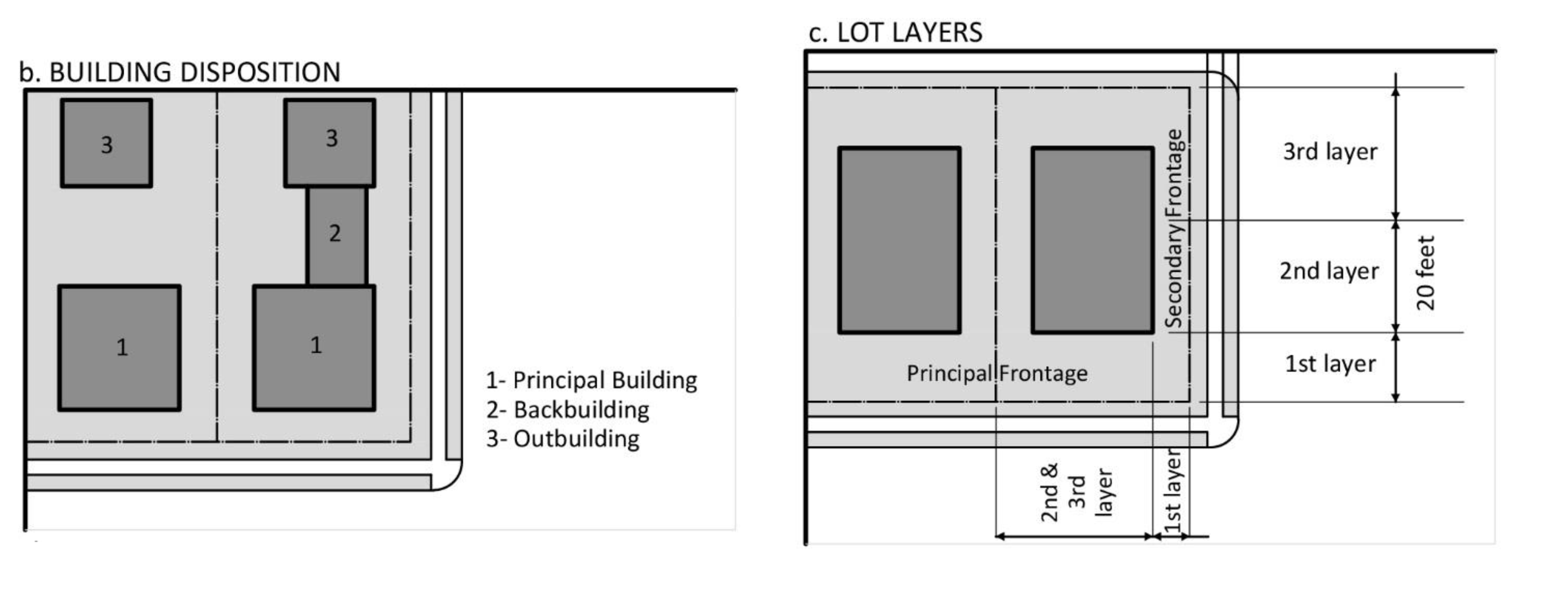
The following design standards are provided to ensure that development proposals in the Jamestown Village Special Development Overlay District meet the goals of that district. Several standards in article 11 apply only within certain "layers" of lots and of public roads. These are referred to throughout this article as the first layer, second layer, and third layer. For a diagram of where these layers are located, see Table 11-1.c, Lot Layers, below.
(Ord. of 2-3-2025(1), § 1(Exh. A))
Sec. 82-1103.1. - Building placement.
A.
General. The location of buildings and structures shall comply with the setback standards in Table 6-2.
1)
Setbacks for newly proposed buildings may only be reduced below the standards set forth in Table 6-2 through the granting of a variance from the zoning board.
2)
Pre-existing buildings that do not meet the setback standards of Table 6-2 shall be reviewed by the planning commission pursuant to section 82-1102.1.
B.
Specific to CW, CL, CD and P.
1)
In these districts, it is the intent of this chapter to use building placement as a means to create a vibrant public realm along the frontage of the property. The façade of the primary building serves as one boundary of the property frontage as further regulated in section 82-1103.2 below.
2)
Façades shall be built parallel to a rectilinear principal frontage line or to the tangent of a curved principal frontage line, and along a minimum percentage of the frontage length at the setback (for required setbacks, aka minimum yards, see Table 6-2).
3)
Building placement types shall be allowed in accordance with Table 6-2.
4)
One principal building at the frontage, and one accessory structure to the rear of the principal building, may be built on each lot as shown in Table 11-1.b, Building disposition. No accessory structures may be erected without a primary structure in place on the same lot. An accessory structure may be constructed before the primary structure where there is reasonable assurance that the primary structure shall be constructed within a year of the accessory structure's completion. The town may require documentation of the intended construction schedule as part of the permit review process.
C.
Commercial development on lots within the CD district that are adjacent to residential zoning districts are strongly encouraged to utilize the setbacks as prescribed in the CL Zone to allow a transition from the denser CD district into the village residential districts.
(Ord. of 2-3-2025(1), § 1(Exh. A))
Sec. 82-1103.2. - Property frontage.
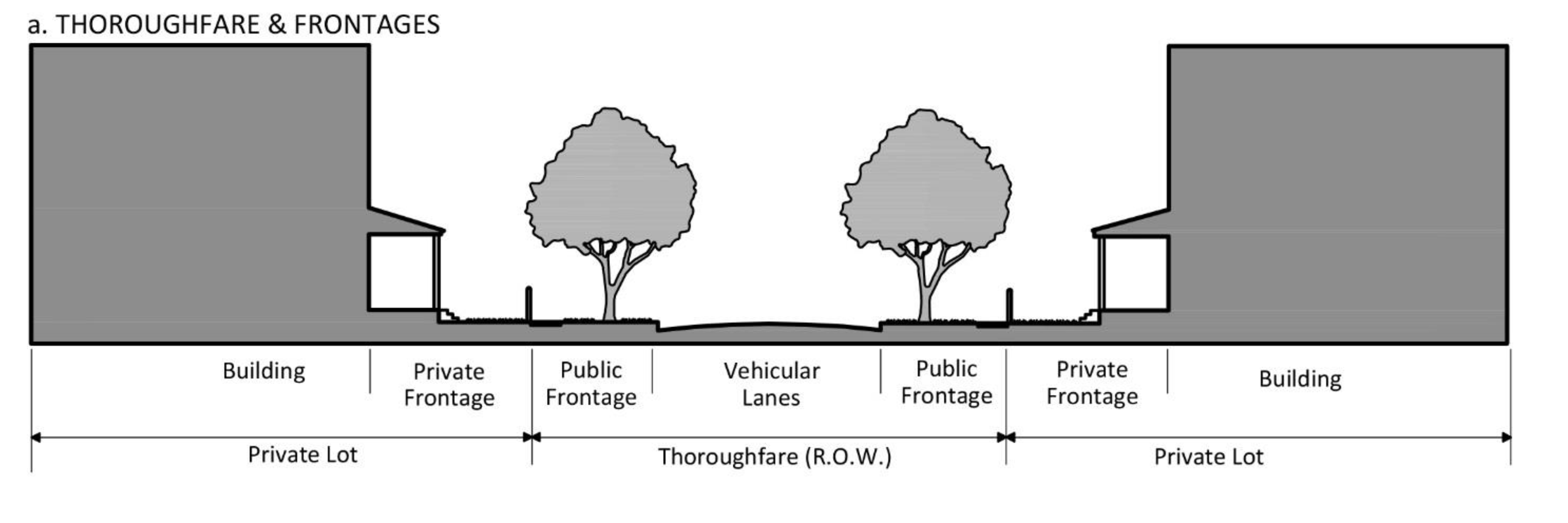
Property frontage areas include the area on private property between the primary building façade and the right-of-way (private frontage) and the edge of the right-of-way to the edge of street pavement (public frontage). Depending on the type of district, the relationship between the public and private areas will differ, but in every case, the design of these areas has a significant effect on how one experiences the district. The design of both frontage areas is therefore important to achieving the goals of village district development.
A.
General.
1)
Property frontage areas shall be designed and maintained to create a vibrant public realm in which pedestrians feel safe and comfortable walking along the street, crossing the street, and, where appropriate, entering into private property from the street.
2)
In residential districts, the division between the private and public realm should be clearly established through the use of landscape features including, but not limited to, vegetation and decorative walls or fencing that create a clear divide between public and private property.
3)
In commercial or mixed-use districts, the interface between the public and private way shall be designed to connect pedestrians from the sidewalk to the entranceways of primary buildings. Landscaped features such as decorative walls and fencing shall be used to separate pedestrians from travel lanes, parking lots or other areas where conflicts can occur with motorists.
4)
When located within any property frontage area, parking spaces for automobiles and travel lanes shall not be located in front of primary building façades.
B.
Frontage trees.
1)
On streets in residential districts, the town shall provide street trees to the extent that the design of the public right-of-way can accommodate trees. Where trees cannot be accommodated in the public right-of way, trees in the first layer are highly encouraged and should be selected from the list provided by the tree preservation and protection committee as updated periodically.
2)
On streets in commercial or mixed-use districts, the town shall provide frontage trees to the extent that the design of the public right-of-way can accommodate trees. The town may also approve the installation of frontage trees as part of development proposals for adjacent private property.
3)
Trees planted in or along the public right-of-way shall be planted in a linear fashion and spaced approximately 40 feet from each other.
4)
Trees planted in high traffic pedestrian areas shall be protected by permanent decorative barriers or tree grates.
5)
Where feasible, trees along the right-of-way should be installed as linear tree trenches or individual tree box filters specifically designed to treat stormwater runoff. Trees may also be planted as part of linear bioretention facilities along the frontage area.
6)
Trees planted in pedestrian areas shall be selected and maintained to have ten feet of vertical clearance from grade.
C.
Frontage - R-8, R-20, CW, CL, CD and P Districts.
1)
Buildings on corner lots shall have two private frontages as shown in Table 11-1.a.
2)
For waterfront lots, the applicant shall propose whether the street frontage, the waterfront, or both should serve as the primary frontage for the purposes of designating layers.
D.
Frontage - R-8 and R-20 Districts.
1)
Open covered porches may encroach upon the first layer up to 50 percent of the depth of the first layer. (Table 11-1.c)
2)
Balconies and bay windows may encroach upon the first layer up to 25 percent of the depth of the first layer.
E.
Frontage - CL District.
1)
Balconies, open covered porches and bay windows may encroach upon the first layer up to 50 percent of the depth of the first layer. (Table 11-1.c)
F.
Frontage - CW, CD, and P Districts.
1)
Awnings may encroach upon the sidewalk to within two feet of the curb but must clear the sidewalk vertically by at least eight feet.
2)
Stoops, lightwells, balconies, bay windows, and terraces may encroach upon the first layer up to 100 percent of the depth of the first layer.
3)
Loading docks and service areas shall not be permitted in frontage areas.
(Ord. of 2-3-2025(1), § 1(Exh. A))
Sec. 82-1103.3. - Parking areas.
A.
Parking areas - CL District.
1)
All parking areas and garages shall be located at the second or third layer. (Table 11-1.c)
B.
Parking areas - CW, CD and P Districts.
1)
All parking lots, garages, and parking structures shall be located at least five feet behind the principal building façade. (Table 11-1)
2)
Vehicular entrances to parking lots, garages, and parking structures shall be no wider than 18 feet at the frontage.
3)
A minimum of one bicycle rack place shall be provided within the public or private frontage for every ten vehicular parking spaces, rounded down.
4)
The restoration or rehabilitation of an existing building eligible for inclusion on a state, local or national historic register to National Park Service Historic standards or any local historic district standards shall not require the provision of parking in addition to what is already existing.
(Ord. of 2-3-2025(1), § 1(Exh. A))
Sec. 82-1103.4. - Building design.
A.
General standards. Building design within the Jamestown Village Special Development Overlay District shall be consistent with the guidance provided in "A Jamestown Vision: Pattern Book & Design Guidelines for Building in the Village, June 19, 2008" (as amended). The permit reviewing authority shall compare the contents of the proposal with the following sections to determine whether there is consistency between the application and these sections of the village guidelines:
1)
Building form
2)
Building elements
3)
Mixed use and retail
4)
Materials and methods
B.
Specific standards. In addition to the requirements of subsection A above, the following specific building design standards shall apply.
1)
The first story of all commercial or mixed-use façades shall be glazed with clear glass over no less than 30 percent of the façade area.
2)
Commercial and mixed-use building stories may not exceed 14 feet in height from finished floor to finished ceiling, except for a first-floor commercial use, which shall be a minimum of 11 feet and may be a maximum of 25 feet. A single floor level exceeding 14 feet, or 25 feet at ground level, shall be counted as two stories. Mezzanines extending beyond 33 percent of the floor area shall be counted as an additional story.
3)
The use of an attic, at its building limit height, shall be ancillary to the use on the level below, unless approved as an accessory dwelling unit as permitted in section 82-1201, Accessory dwelling units.
4)
The minimum size of a dwelling within a principal building shall be 300 sq ft in interior space. Accessory structures may be developed, as provided in section 82-1201.
5)
No flat-roofed buildings or structures may be constructed unless they meet the definition of green roof per section 82-104, Definitions. All roofs should have a minimum pitch of six inches on 12 inches (22.5 degrees).
(Ord. of 2-3-2025(1), § 1(Exh. A))
Sec. 82-1103.5. - Landscape design.
A.
Plant selection for multi-family, commercial, or mixed-use development.
1)
No tree, shrub or plant shall be proposed that has been identified as an invasive species by the Rhode Island Invasive Species Council.
2)
Landscaping shall be designed to remain functional and attractive during all seasons through a thoughtful selection of deciduous, evergreen, berrying, and flowering plant varieties including meadows of perennial and annual plants.
3)
Plant varieties shall be selected for resistance to drought, moisture, salt, urban conditions, or insects and other pests depending on the location of landscaping and the specific stressors anticipated for different areas of the site. Plants shall be selected, with preference to plant species native to Rhode Island in order to maximize biodiversity and the landscaping's contribution to Jamestown's ecosystem, so that landscaping can be maintained with minimal care and the need for watering, pesticides or fertilizers can be minimized or eliminated.
4)
The use of turf shall be minimized, but where it is used, turf should not be planted in strips less than six feet wide in any direction. Lawn seed mixes shall be drought resistant. To achieve a high level of drought tolerance, lawn mixes may include, but shall not be limited to, a predominance of fine fescues.
B.
General to zones CW, CL, CD and P.
1)
Landscaping shall be used as part of a site-wide stormwater management strategy to the maximum extent practicable. Vegetated management practices for stormwater runoff may include, but are not limited to:
a)
Rain gardens and/or bioretention facilities
b)
Grassed and/or vegetated swales
c)
Extensive or intensive green rooftops
d)
Tree trenches and/or individual tree box filters
2)
Cisterns and rain barrels are encouraged for use in landscape watering.
3)
The restoration or rehabilitation of an existing building eligible for inclusion on a state, local or national historic register to National Park Service Historic standards or any local historic district standards shall not require the provision of drainage infrastructure in addition to what already exists.
(Ord. of 2-3-2025(1), § 1(Exh. A))
Sec. 82-1103.6. - Signage standards.
A.
All signage within the Jamestown Village Special Development Overlay District shall conform to article 14, Sign regulations.
B.
In addition to compliance with article 14, signage design within the Jamestown Village Special Development Overlay District shall be consistent with the guidance provided in "A Jamestown Vision: Pattern Book & Design Guidelines for Building in the Village, June 19, 2008" (as amended). The permit reviewing authority shall compare the contents of the proposal with the signage and awnings section to determine whether there is consistency between the application and the village guidelines.
(Ord. of 2-3-2025(1), § 1(Exh. A))
Sec. 82-1104. - Special requirements.
A.
The Jamestown Zoning Map may designate the following special requirements for the Jamestown Village Special Development Overlay District when recommended by the planning commission and approved by the town council per article 17 (Amendment) of this chapter:
1)
recommended view corridor designation, advising that views remain open and visible from the public frontage.
2)
A building of value designation requiring that the building or structure may be altered or demolished only after demonstration to and approval by the planning commission that restoration, preservation or renovation of the building is unfeasible. Such buildings should be eligible for reductions in parking requirements and may be more readily considered for bed and breakfast or guest house permits. standards shall be developed for buildings of value in conjunction with or prior to designation.
(Ord. of 2-3-2025(1), § 1(Exh. A))
Sec. 82-1105. - Low- and moderate-income housing.
The Town of Jamestown, consistent with the housing chapter of its comprehensive plan, allows the development strategies as listed in article 16 to encourage the development of low and moderate income (LMI) housing in Jamestown, including in the Village Special Development Overlay District. All units developed under this section shall meet the definition of LMI housing in this chapter and G.L. 1956, ch. 45-53 and meet the affordability requirements in section 82-1605 H. The increase in density permitted by this section shall be considered a municipal subsidy.
A.
Affordable lots and homes. The Jamestown Village Special Development Overlay District allows the minor subdivision of existing lots that would not otherwise be eligible for subdivision based on the dimensional standards associated with the underlying zoning district. The table below provides dimensional regulations for the new "affordable" lots. Such lots/housing thus created shall remain affordable through a land lease (land trust model) which ensures affordability in perpetuity and/or a deed restriction for at least the minimum time period required by state law. Lots/homeownership units using a land lease shall be put in the Church Community Housing Corporation's Land Trust program (or one accepted by the Town of Jamestown) using a ground lease to ensure long term affordability. All new lots shall be created pursuant to the process and notice requirements in the Jamestown Subdivision and Land Development Regulations.
Due to the infill intent of this LMI housing strategy, only one new "affordable lot" shall be created per existing lot.
* The attic space of buildings may be a separate unit of LMI housing as defined and in accordance with section 82-1201, Accessory dwelling units. This allowance does not preclude compliance with any state or local life safety codes/requirements.
(Ord. of 2-3-2025(1), § 1(Exh. A))
Sec. 82-1106.1. - Development of undersized lots - R-8 and R-20 Districts
The town has determined that there are a number of undersized lots that exist today in the village and more will be created as a strategy to increase the stock of LMI housing in Jamestown. The guidelines outlined in this section are to ensure the preservation of existing neighborhood character (through a continuation of the patterns of design and the materials and methods of traditional architecture) in the development of these undersized lots for residential development.
A.
Development of existing vacant or new vacant lots or development of accessory buildings on lots that do not meet the required 20,000 square foot minimum lot size in the R-20 Zone and 8,000 square foot minimum lot size in the R-8 Zone shall adhere to the basic residential design guidelines in "A Jamestown Vision - Pattern Book and Design Guidelines for Building in the Village, June 19, 2008" (as amended).
B.
Prior to building permit approval, applications for new construction that meet these guidelines shall be reviewed and approved per section 82-1004.2, TRC as DPR approving authority. In cases where applications do not meet these guidelines the TRC shall determine whether review by the town architectural consultant is appropriate or review by the planning commission is appropriate or both. The cost associated with review by the town architectural consultant shall be borne by the applicant per section 82-1008 of the zoning ordinance, Project review fees.
C.
Summary of residential design guideline elements for undersized lots in the R-8 and R-20 Zoning Districts.
1)
Parking (page 5 in the village design guidelines). Parking shall be on the rear or side of the house, well behind the plane of the front door.
2)
Building massing and roof form (page 7 and 8 in the village design guidelines). Smaller homes may be one simple clear form where larger homes may incorporate a second or a third volume. Roofs shall have a clearly legible dominant roof form with roofs of secondary volumes deferring in scale to the main body of the building.
3)
Building types (pages 9 and 12 in the village design guidelines). Simple building shapes are preferred for the dominant structure and then add smaller, secondary forms for additional space.
4)
Openings (pages 11, 21, 22 in the village design guidelines). Windows and doors are generally organized and ordered in a fashion dividing the primary façade into thirds, fourths and fifths.
5)
Garages and accessory structures (page 13-14 in the village design guidelines). The design of any accessory structure should be harmonious with that of the main house and designed in a way that does not compete in scale or volume with the primary building mass. Garage doors (page 20 in the village design guidelines) deserve design attention and single 16-foot or wider doors should be avoided.
6)
Walls (page 15-16 in the village design guidelines). Exterior walls of individual buildings and multiple buildings on one site should be consistent in material throughout a major building form or volume. Where changes in material do occur, they should follow the guidelines on page[s] 15 and 16.
(Ord. of 2-3-2025(1), § 1(Exh. A))
Table 11-1: - Definitions illustrated.
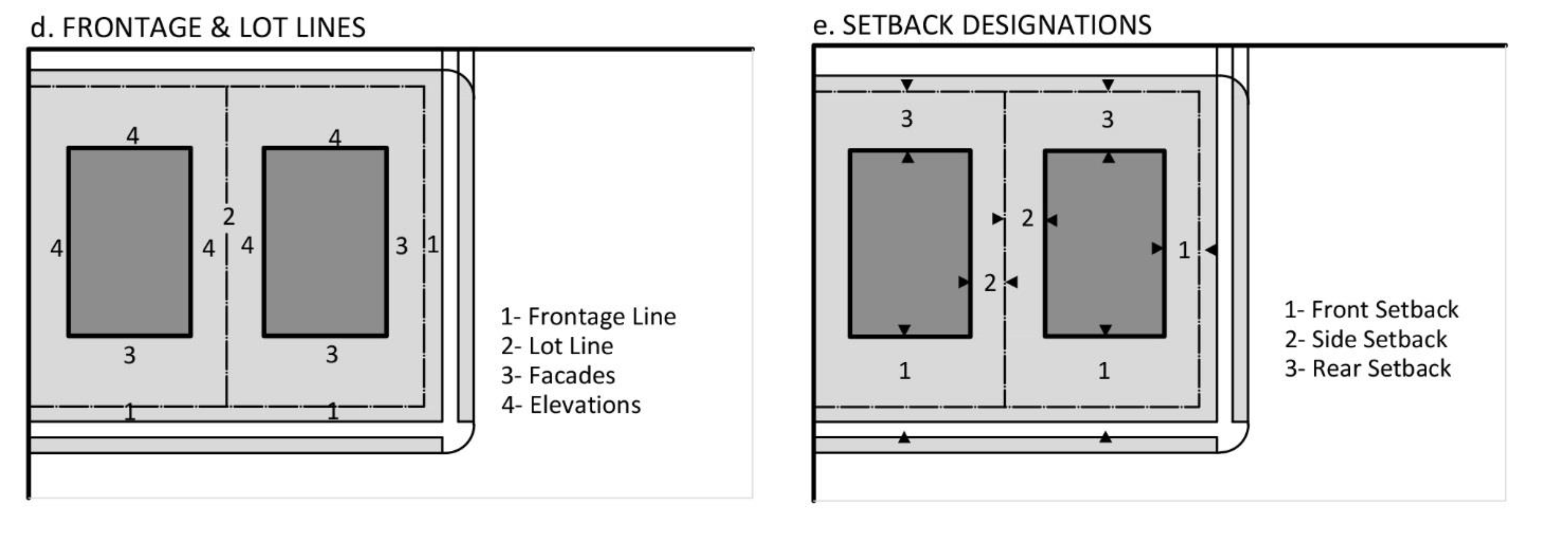
This table illustrates important concepts described in article 11, Jamestown Village Special Development Overlay District, and the Definitions provided in section 82-104.
(Ord. of 2-3-2025(1), § 1(Exh. A))

