
Jasper City Zoning Code
ARTICLE VII
LOT AND SITE DEVELOPMENT FEATURES
Sec. 94-111. - Lot standards.
(a)
Development shall conform to minimum lot standards in section 94-16, Lot and building regulations.
(b)
The term "lot" shall not include any portion of a dedicated right-of-way.
(c)
Lot size square footage calculations shall also exclude any areas reserved for easements or rights-of-way upon which, by the nature thereof, construction is prohibited (i.e., easements for ingress and egress to other lots or properties, major power line transmission easements, etc.).
(d)
Dimension, size, and shape orientation. The lot area, width, shape, and orientation in subdivisions must be in accordance with requirements of the city zoning and land development ordinances.
(e)
Creation of regular lots. Side lot lines shall be substantially at right angles or radial to street lines as they extend from the front lot line to the front building line.
(f)
Frontage. Each lot shall front upon an existing paved private or public street.
(g)
Buildable area. Lot shall contain adequate buildable area that is suitable for the intended use.
(h)
Through lots. Through lots are discouraged in subdivisions except along limited access highways, such as interstate highways. Where it is necessary to provide separation of residential development from arterials or to overcome specific disadvantages of topography and orientation, lots fronting such features may be platted in greater depth so that dwellings may be set back an additional distance from the arterial or other feature. Such lots may obtain vehicular access from a rear alley or internal subdivision streets and do not constitute prohibited through lots.
(i)
Spite strips. The creation of spite strips is prohibited.
(j)
Flag lots. The creation of flag lots is prohibited.
(k)
Common lots. Substandard lots may be created for the purposes of siting common amenities like pools, clubhouses, greenspaces, detention ponds, etc., provided appropriate access easements are properly recorded to facilitate ongoing maintenance and operations of the facilities. In no case shall a common amenity share a lot with an individual single-family detached residential lot.
(Ord. No. 2021-01, § 1(Attch.), 2-1-2021; Ord. No. 2023-07, § 1(a)(Exhs. 1—3), 6-5-2023)
Sec. 94-112. - Existing lots of record.
Any lot of record which is legal at the time of the adoption or amendment of the ordinance from which this chapter is derived, may be used, subject to the following exceptions and modifications:
(a)
Use of substandard lots. Where the owner of a lot, at the time of the adoption or amendment of the ordinance from which this chapter is derived, does not own sufficient area and width to enable him to conform to the dimensional requirements of this chapter, such lot may be used as a buildable lot.
(b)
Individual lot not meeting minimum lot dimension requirements. In addition to subsection (a) of this section, in any residential district, any lot of record existing at the time of adoption or amendment of the ordinance from which this chapter is derived which has a width or area less than that required by this chapter may be used as a building site for a single-family dwelling only. In the case of such a lot, when it is not possible to provide the required side yards and at the same time build a minimum width single-family dwelling, the city council is empowered to hear the request for a minimum variance.
(c)
Adjoining lots. When two or more adjoining lots of record with a continuous street frontage along each such lot are in one ownership at any time after the adoption of this zoning ordinance, as amended from time to time, and any lot, individually, has less area or frontage, depth or width than is required for a buildable lot as required by this chapter, then such contiguous lots shall be considered as one or more reconfigured single lots so long as the minimum area, frontage, depth and width requirements of this chapter are maintained for each such reconfigured lot.
(Ord. No. 2021-01, § 1(Attch.), 2-1-2021)
Sec. 94-113. - Underground electric and communication utilities.
(a)
Undergrounding utilities. Utilities, including telephone, electric power, and cable television in both public and private rights-of-way, shall be placed underground for all new developments with total floor areas 20,000 square feet or over. This requirement does not apply to high voltage power lines.
(b)
Fee in lieu. Except when extreme conditions of underlying rock, the expense to bury overhead utilities is deemed to be unreasonably costly due to the complexity of the work, or other conditions prevent this requirement from being met, the developer may request approval from the zoning official a fee-in-lieu arrangement with the project developers.
(1)
Developer shall contribute toward the city's utility conversion fund in lieu of requiring burial of the utilities. Such fee-in-lieu arrangement shall be based on a cost per linear foot of such underground relocation of utilities established by the city council, and it may be adjusted from time to time by city ordinance.
(2)
A city fund, known as the "The City of Jasper Utility Conversion Fund" is hereby created. The purpose of said fund is to accept deposits as described herein, along with other funds or grants apportioned by the mayor and city council, and the use of such funds shall be restricted for the sole purpose of offsetting the cost of projects undertaken by the city that bury or relocate power lines from streets and sidewalks.
(c)
Sequencing. Fee in lieu or burial of utilities shall be done prior to issuance of any certificate of occupancy being issued for structures in any phase abutting the right-of-way within which the overhead utilities are situated.
(d)
New residential dwellings shall be attached to a permanent foundation constructed in accordance with the building code or State of Georgia regulations, as applicable. The area beneath the ground floor of the dwelling shall either be a slab foundation or shall be enclosed around the exterior of the dwelling with a foundation wall of masonry at least four inches thick, penetrated by openings only for installed vents or access doors. No new residential dwelling shall be permitted connection to municipal water or sewer systems unless it is attached to a permanent foundation.
(e)
In all single and multi-family residential developments:
(1)
Individual systems for water, fuel/gas, and HVAC shall be required for each unit.
(2)
Individual metering shall be provided for water, electric, and fuel/gas.
(3)
Easements for utility lines shall be provided in the common ownership area where lateral service connections shall take place.
(4)
The zoning official is authorized to grant an administrative variance allowing relief to this subsection (d) in accordance with division 8.3.
(Ord. No. 2021-01, § 1(Attch.), 2-1-2021; Ord. No. 2023-07, § 1(a)(Exhs. 1—3), 6-5-2023)
Sec. 94-114. - Streets.
(a)
Street access. Except as otherwise permitted in these regulations, each building shall be located on a lot or parcel which abuts a public or private street.
(b)
Extension of existing streets. Existing streets shall be connected and extended appropriately within the limits of a development. However, streets or portions of streets adjacent to a proposed nonresidential use, which are developed and are being used exclusively for residential access shall not be connected, extended or in any way provide access to a nonresidential use. In addition, private drives which provide access to a nonresidential use shall not be permitted in any residential district.
(c)
Street access in nonresidential districts. Driveway cuts for service drives, entrances, exits, and other similar facilities on public streets in nonresidential districts shall not be located within 20 feet of any street intersection or within 50 feet on center of another curb cut. A curb cut shall be no greater than 30 feet in width and no closer than 20 feet to any property line.
(d)
Traffic control devices. If the traffic to be generated by a use in a nonresidential district will demand traffic control devices to ensure public safety, the developer shall install such necessary devices. Such determination shall be made by the zoning official, in consultation with the state department of transportation, and approved by the city council.
(e)
State department of transportation approval. All entrances or exits of any street or drive, public or private, from or to any state highway shall be approved by the state department of transportation prior to the construction of such street or drive, or the issuance of any development permit for any improvement to be served by such street or drive.
(f)
Private streets not to be used to satisfy off-street parking requirements. Private streets shall not be used to satisfy the off-street parking requirements of this chapter. Private streets shall be assigned names and locations and shall be shown on plans required for the issuance of building and development permits. All private street names shall be approved by the county or relevant governing body to avoid conflicting names.
(Ord. No. 2021-01, § 1(Attch.), 2-1-2021)
Sec. 94-115. - Covenants required.
All new subdivisions (or condominium/townhome/cottage developments) proposing common property, including amenity space, greenspace, stormwater features, private roads, etc. shall establish a mandatory homeowners association. The developer shall execute, record, and maintain documents for the homeowners or condominium association, which establish dues, fees, and responsibilities related to maintenance of units and common facilities.
(Ord. No. 2023-07, § 1(a)(Exhs. 1—3), 6-5-2023)
Sec. 94-116. - Purpose.
The purpose of this division is to provide regulations to foster safe and efficient circulation of vehicles and pedestrians on private and public streets, and to minimize nuisances from on-street parking.
(Ord. No. 2021-01, § 1(Attch.), 2-1-2021)
Sec. 94-117. - Off-street parking for nonresidential uses.
(a)
Applicability. This section shall apply to all commercial, mixed-use, multi-family, or other non-residential uses permitted by this chapter.
(b)
Off-street automobile parking and storage. Off-street automobile parking and storage spaces shall be provided on every lot on which any of the uses are hereafter established.
(c)
Off-street automobile parking and storage spaces shall be equal in number to at least the minimum requirements for the specific use set forth in Table 94-119 for each use on the property.
(d)
If the required off-street automobile parking or storage spaces cannot be provided on the same lot on which the principal use is located, the city council may permit such spaces to be provided on another property, provided such property is no more than 500 feet from the nearest boundary of the principle use, and is approved through the special use permit process of division 8.4 As part of the process, the properties shall provide a covenant requiring the parking spaces to remain a subservient use to the subject property, until such a time that the requirement is repealed through the same special use process.
(e)
Design.
(1)
Such automobile parking or storage spaces shall be provided with vehicular access to a street or alley.
(2)
Each automobile parking space shall be at least nine feet wide and 18 feet long.
(3)
Parking lots shall be paved with concrete, asphalt, or other finished material. Gravel and loose stone parking lots are prohibited.
(4)
Bumper guards. For each parking space adjacent to a pedestrian walkway, sidewalk, open space, or similar feature, a bumper guard or wheel stop shall be installed.
(5)
Marking. Each parking space shall be painted with stripes, not less than three inches wide, running the length of each of the longer sides of the space or by other acceptable methods, which clearly delineate the parking space within the parking lot.
(6)
All off-street automobile parking and storage spaces shall be so arranged that vehicles will not be required to back onto a public street, road, or highway when leaving the premises.
(7)
Off-street parking areas shall have curbs, gutters, and non-wooded parking light poles built to local power company specifications and in conformity with city specifications.
(8)
Off-street parking areas shall be graded to ensure proper drainage, surface with asphalt or concrete materials. Materials may be pervious, if designed and engineered as such.
(9)
Landscaping shall be provided in accordance with sections 94-137 and 94-138.
(10)
Driveways and surfaces that access outdoor storage of goods and materials including, but not limited to, model units or equipment and are accessible to the public shall be paved with concrete, asphalt, or other finished material. Gravel and loose stone are prohibited.
(f)
Handicapped parking. Parking for the handicapped within a nonresidential district shall be provided at a size, number, and location according to the requirements of the ADA accessibility guidelines (ADAAG), published by the U.S. Architectural and Transportation Barrier Compliance Board (ATBCB), as amended.
(Ord. No. 2021-01, § 1(Attch.), 2-1-2021; Ord. No. 2023-07, § 1(a)(Exhs. 1—3), 6-5-2023; Ord. No. 2024-10, § 3, 5-6-2024)
Sec. 94-118. - Off-street parking for residential uses.
(a)
Applicability. This section shall apply to all single-family detached or attached dwelling uses permitted by this chapter.
(b)
Off-street automobile parking and storage. Off-street automobile parking and storage spaces shall be provided on every lot on which any of the uses are hereafter established.
(c)
Such automobile parking or storage spaces shall be provided with vehicular access to a street or alley.
(d)
If garages or carports are converted to living area, then the off-street parking requirements must be met elsewhere on the lot.
(e)
No inoperable vehicle shall be permitted in any residential district for more than 14 days unless, it is in an enclosed garage. All repairs accessory to any residential use shall be in an enclosed garage.
(f)
No commercial vehicle as licensed by the state with gross vehicle weight (GVW) exceeding 11,000 pounds shall be allowed to park overnight in the R-1, R-2, R-3, DRI-6, SFA, or MFR zoning districts.
(g)
Commercial vehicles, licensed by the state, buses, and recreational vehicles shall not be allowed to park overnight on the street in the R-1, R-2, R-3, DRI-6, SFA, or MFR districts.
(h)
Recreational vehicles are prohibited from parking in the front yard of R-1, R-2, R-3, DRI-6, SFA, or MFR districts.
(i)
Driveways and parking surfaces shall be paved with concrete, asphalt, or other finished material. Gravel and loose stone are prohibited.
(j)
Driveways shall provide a minimum depth of 22 feet upon lots which have frontages that lack an existing sidewalk and where installation of a new sidewalk is not required.
(k)
Driveways shall provide a minimum depth of 24 feet upon lots which have frontages that have an existing sidewalk or where installation of a new sidewalk is required. No portion of the sidewalk shall be included in the calculation of the required driveway depth.
(l)
Vehicles parked in driveways shall stay clear of any road, sidewalk, or other transportation route. Furthermore, vehicles parked in driveways shall not obstruct the movement of vehicles or pedestrians.
(Ord. No. 2021-01, § 1(Attch.), 2-1-2021; Ord. No. 2023-07, § 1(a)(Exhs. 1—3), 6-5-2023)
Sec. 94-119. - Motor vehicle parking ratios for all uses.
Off-street motor vehicle parking spaces shall be provided in accordance with the minimum ratios established in Table 94-119.
(a)
Gross leasable area (GLA) is the building floor area in square feet that a developer may lease.
(b)
Gross floor area (GFA) is the sum of the areas of several floors of a building, including all areas for human occupancy, as measured from the exterior faces of the walls, but excluding unenclosed porches, interior parking spaces, or any space where the floor to ceiling height is less than 6.5 feet
(Ord. No. 2021-01, § 1(Attch.), 2-1-2021; Ord. No. 2023-07, § 1(a)(Exhs. 1—3), 6-5-2023)
Sec. 94-120. - Loading.
(a)
Every building or structure used for business, trade, or industry shall provide space as indicated herein for the loading and unloading of vehicles off the street or public alley.
(b)
Such spaces shall have access to an alley, or if there is no alley, to a street.
(c)
Such spaces shall be so arranged that no vehicle is required to back onto a public street, road, or highway in order to leave the premises.
(d)
Loading spaces shall have a vertical clearance of at least 14.5 feet within the main building or on the same lot, providing for the standing, loading, or unloading of trucks and other vehicles.
(e)
Loading shall be provided on-site as follows:
(1)
Commercial. One space sized ten feet by 25 feet for each 20,000 square feet of total floor area or fraction thereof.
(2)
Industrial. One space sized ten feet by 50 feet for each 10,000 square feet of floor area plus one additional space for each 60,000 additional square feet of total floor area or fraction thereof.
(3)
Bus and truck terminals. Sufficient space to accommodate the maximum number of buses or trucks to be stored or to be loading or unloading at the terminal at any one time.
(Ord. No. 2021-01, § 1(Attch.), 2-1-2021)
Sec. 94-121. - Access management.
(a)
All off-street parking lots shall have access to a paved public or private street and be served by a paved access drive.
(b)
Interparcel access is required between all abutting parking lots and sites based on site conditions and as determined by the zoning official, to provide a cross access drive and pedestrian access to allow circulation between sites.
(1)
Interparcel access is not required between nonresidential uses and single-family residential uses.
(2)
This shall be accomplished by stubbing a connection to each adjacent the property line. The property owner shall grant an access easement granting public access through the lot. This easement shall be submitted to the zoning official and recorded by the applicant or property owner with the Pickens County Superior Court.
(3)
Joint driveways between properties shall be established wherever feasible along a major thoroughfare or arterial or collector street.
(c)
All developments shall have access to a public right-of-way. The number of access points shall be in accordance with Table 94-121c.
(d)
The separation of access points on a thoroughfare, arterial, or collector street shall be determined by the speed limit of the road with the following minimum spacing requirements in accordance with Table 94-121d.
(1)
The distance between access points shall be measured from the centerline of the proposed driveway or street to the centerline of the nearest existing adjacent driveway or street.
(2)
Driveway spacing at intersections and corners shall provide adequate sight distance, response time, and permit adequate queuing space.
(3)
No driveway, except driveways providing residential access, shall be allowed within 100 feet of the centerline of an intersecting thoroughfare or arterial or collector street.
(4)
No nonresidential access except right in/right out channelized access shall be allowed within 100 feet of the centerline of any other thoroughfare or arterial.
(5)
The requirements of this section are not intended to eliminate all access to a parcel of land that was legally subdivided prior to the enactment of this section.
(e)
All street design and other development activities, including landscaping, shall be arranged on site so as to provide safe and convenient access for emergency vehicles.
(f)
Along thoroughfares, arterials, or collector streets, a deceleration lane, a turn lane, larger or reduced turning radius, traffic islands or other devices or designs, including traffic calming devices and designs, may be required to avoid specific traffic hazards which would otherwise be created by the proposed driveway location. The zoning official may require the submission of a traffic analysis based on the scale and scope of the project to determine required improvements.
(g)
Deceleration lanes are required for access to residential uses containing 20 or more units that provide less sight distance (in feet) than ten times the posted speed limit (in miles per hour) in accordance with Table 94-121g.
(1)
The minimum deceleration lengths shall be as specified below. The zoning official may vary length requirements based upon a consideration of available sight distances and other contextual features as determined by an engineering study to verify traffic safety.
(2)
Deceleration lanes located within 75 feet of an intersection radius may be extended to the intersection.
(Ord. No. 2021-01, § 1(Attch.), 2-1-2021)
Sec. 94-122. - Private streets.
(a)
Private streets are allowed only if the development seeking to have private streets is 15 acres or larger in area
(b)
Where this chapter measures minimum building setback lines and frontages, or imposes development standards in connection with, or with reference to public streets, such measurements or standards set forth in the district regulations and supplemental regulations of the zoning ordinance, in this chapter or elsewhere in this Code apply similarly for property abutting a private street where such private street has been approved by the city council. Nothing in this section is intended to authorize any kind of development on a private street that would not be authorized where there was public right-of-way.
(c)
Private streets within any zoning district may not be used to satisfy the off-street parking requirements of this Code. Private streets within any district must be assigned names and locations. The names of these streets must be shown on plans required for the issuance of building and development permits as provided by the building code in chapter 18 and the city zoning ordinance. The county must approve all private street names and addresses to avoid conflicting names and addresses.
(d)
Where sanitary or storm sewer lines are constructed underneath a private street, the developer is required to grant an easement to the applicable utility authority for their installation, maintenance and repair. In the case of private streets, the city is authorized to assign responsibility for maintenance of storm sewers to a property owners association.
(e)
Developers and property owners' associations must ensure access to all private streets by emergency and law enforcement vehicles and must ensure that private streets are constructed to allow access by all emergency vehicles and law enforcement vehicles.
(f)
The use of private streets may not result in an increase in permitted density above that which would otherwise be permitted by the applicable district regulations. Density calculations must be made based on a public street system that provides for a private street must be density neutral.
(g)
Private streets must comply with requirements for public streets found in the zoning ordinances and all other applicable sections of the city Code. Private streets must be surfaced with the same type of materials that are used by the city for the surfacing and resurfacing of public streets or with materials that are as protective as those used by the city to surface and resurface streets so long as such alternative materials are approved by the zoning official. The paving and/or the resurfacing of a private street shall be inspected by an engineer, and the applicant developing or paving the private street shall provide an inspection report by said engineer with the engineer's seal to the zoning official and which verifies that the private street complies with the requirements for public streets in the City of Jasper.
(h)
The city council may authorize a private street for a development or annexation under 15 acres in size where the zoning official has certified that the applicant has submitted all required documentation as set forth herein and where the city council finds that:
(1)
The location of the proposed private street will not adversely impact use of any existing surrounding public street;
(2)
The minimum standards for the construction of private streets outlined herein have been met;
(3)
The location of the proposed private street will not adversely impact adjacent existing communities or neighborhoods;
(4)
The applicant has shown that there is the requisite legal mechanism for the maintenance of the proposed private street; and,
(5)
The applicant has provided written evidence that the proposed private street system is acceptable to the city departments or divisions responsible for law enforcement, sanitation, transportation and fire and rescue.
(i)
Private street rights-of-way must be owned by a mandatory homeowners' or property owners' association created by recorded covenants and incorporated under state law for any development served by such private streets, or in the case of the condominium form of ownership, owned jointly by the unit owners and maintained by the mandatory homeowner's association required by statute. Required standards for homeowners' and property owners' associations:
(1)
A public access easement, utility easement, and or declaration of covenants must entirely overlay the rights-of-way and be recorded with the Pickens County Superior Court.
(2)
All applicable setbacks, lot widths, and lot areas must be measured from the association right-of-way. This provision is intended to prohibit the incorporation of any portion of the private street into any buildable lot.
(3)
Membership in the association must be mandatory for each original and successive purchaser of a lot, building, or unit within the development.
(4)
The association must be organized so that it has clear legal authority to maintain and exercise control over the private streets and required improvements associated with private streets, including, but not limited to, sidewalks, bikeways, curbs and gutters, traffic signs and markings, associated landscaping and lighting, entry signs, monuments, perimeter walls and fences, entry gates and gatehouses.
(5)
The recorded declaration of covenants and articles of incorporation creating the association must provide that all private streets and associated improvements are owned by the association or are held in common by the property owners within the development.
(6)
The streets must be properly maintained and insured with no liability or maintenance responsibilities accruing to the city. The recorded declaration of covenants and articles of association must specifically require the association repair and maintain each private street in the same manner as similar public streets are maintained by the city, and such maintenance and repair must be performed in compliance with all city standards and all applicable provisions of law.
(7)
The declaration of covenants and articles of association must provide for a street maintenance fund the proceeds of which may be used solely for the purpose of the regular maintenance of streets, whether for resurfacing or similar purpose. For the purposes of providing further assurance that city funds may not be used for maintenance of private streets the developer must submit proof of deposit of 50 percent of the current estimate of resurfacing costs as determined by the zoning official in an interest-bearing account on behalf of the association.
(8)
The association must be empowered to levy assessments against owners within the development for the payment of expenditures made by the association for maintenance of the private streets and other items set forth in this subsection. At least 15 percent of all fees or assessments paid must be set aside in the maintenance fund. Any unpaid assessments will constitute a lien in favor of the association on the lot, building, or unit of the owner.
(j)
Prior to any final plat approval, the developer must submit recorded articles of incorporation, declarations of covenants, bylaws for the association, and proof of the maintenance deposit.
(k)
At the end of the 12-month maintenance period provided for in this subsection, a developer must provide a maintenance bond or letter of credit, renewable annually to cover the cost of maintenance and repair for any private streets within a subdivision. The bond must be for an amount equal to 50 percent of the current estimate of resurfacing costs, as determined by the zoning official. The developer may avoid securing a maintenance bond if they submit proof to the zoning official that 100 percent of the then-current estimate of resurfacing costs, as determined by the zoning official, has been deposited in an interest-bearing account on behalf of the association. If the developer chooses this alternative the declarations of covenants and articles of association must specifically require the association to continuously maintain 100 percent of the then-current estimate of resurfacing costs of the private streets in this maintenance fund.
(l)
Within nine months following approval of the final plat, the zoning official must inspect the private streets to ensure compliance with all city standards and all applicable provisions of this Code including, but not limited to, the requirements set forth in law for public streets, curbs, sidewalks, signage and street lighting. The developer must be notified of any deficiencies in writing, and such deficiencies must be corrected within 60 days of the written notice of deficiencies unless the city agrees to extension of that period in writing.
(m)
Failure to correct the complete list of deficiencies constitutes a violation of this section and will subject the developer to prosecution for a code violation in the city municipal court. Any person found to have violated this section is subject to a fine of not less than $500.00 for each violation. Each day that the violation exists is a separate and distinct offense.
(n)
The zoning official must deny the issuance of certificates of occupancy until all deficiencies have been corrected.
(Ord. No. 2021-01, § 1(Attch.), 2-1-2021; Ord. No. 2023-07, § 1(a)(Exhs. 1—3), 6-5-2023)
Sec. 94-123. - Street abandonment.
(a)
Any abandonment of an actual existing paved public street by the city pursuant to this section must comply with the applicable requirements set forth in state law and this Code, including, but not limited to, the requirements set forth in O.C.G.A. §§ 32-7-2(b) and 32-7-4 and as may hereinafter be amended.
(b)
A property owner may petition the city council to abandon an existing public street that abuts the owner's property. The petition must include documents that comply with all of the requirements set forth in this section. The petition must contain evidence that each abutting landowner to the public street seeks to have the street abandoned.
(c)
The petition must contain evidence that once abandoned pursuant to the requirements of state law, all property owners that abut the street agree that ownership of the street must be placed in a property owners' association. The petition must include evidence that 100 percent of all property owners in the property owners' association have agreed that the street at issue may become private and have agreed to maintain and exercise control over the private street as required by this division.
(d)
The petition must contain evidence that the property owners' association has the financial ability to maintain the street and associated improvements in perpetuity.
(e)
The petition must include evidence that the declaration of covenants and articles of association or other legal instruments creating the property owners' association provide or have been amended to provide that membership in the property owners' association is mandatory for each original and successive purchaser of a lot, building, or unit on the street.
(f)
The petition must include evidence that the property owners' association must be organized so that it has absolute legal authority to maintain and exercise control over the private streets and required improvements associated with private streets, including, but not limited to, sidewalks, bikeways, curbs and gutters, traffic signs and markings, associated landscaping and lighting, entry signs, monuments, perimeter walls and fences, entry gates and gatehouses.
(g)
The petition must include evidence that the declaration of covenants creating the property owners' association must be recorded with Pickens County Superior Court, and the recorded declaration of covenants and articles of incorporation creating the property owners' association must provide that all private streets and associated improvements are owned by the property owners' association or are held in common by the property owners within the development in compliance with all requirements for private streets as provided in section 94-122.
(h)
The paving and/or the resurfacing of a private street shall be inspected by an engineer, and the applicant developing or paving the private street shall provide an inspection report by said engineer with the engineer's seal to the zoning official and which verifies that the private street complies with the requirements for public streets in the City of Jasper.
(i)
The city council shall not consider a petition for abandonment unless it:
(1)
Contains all of the evidence and documents required by this section;
(2)
Is supported by an analysis by the city that shows that the street is no longer used by the public to the extent that it serves no substantial public purpose and that the public at large will benefit from its closure since the public will no longer be responsible for any costs to maintain and repair the street; and
(3)
Is supported by an analysis by the zoning official that shows that the abandonment of the street does not negatively impact adjacent neighboring communities and the public at large.
(Ord. No. 2021-01, § 1(Attch.), 2-1-2021)
Sec. 94-124. - Trailers in city limits.
No trailers are permitted to park in the city limits. Those already parked may remain until removed by owner, but no replacements will be allowed.
(Ord. No. 2021-01, § 1(Attch.), 2-1-2021)
Sec. 94-125. - Traffic impact analysis.
(a)
Purpose and intent. By requiring traffic impact studies for proposed developments meeting certain thresholds, the city will be better able to determine the transportation demands of development proposals and provide for reduction of adverse impacts on the transportation system.
(b)
Objectives. The city finds that requiring a traffic impact study for proposed developments that meet certain thresholds will help to achieve the following objectives:
(1)
Forecast additional traffic associated with new development, based on accepted practices.
(2)
Determine the improvements that are necessary to accommodate the new development.
(3)
Allow the local government to assess the impacts that a proposed development may have and assist the local government in making decisions regarding development proposals.
(4)
Help to ensure safe and reasonable traffic conditions on streets after the development is complete.
(5)
Reduce the negative impacts created by developments by helping to ensure that the transportation network can accommodate the development.
(6)
Provide information relevant to comprehensive planning, transportation planning, transit planning and the provision of programs and facilities for traffic safety, road improvements, transportation demand management, pedestrian access and other transportation system considerations.
(c)
Thresholds of applicability.
(1)
All applications for development that meet or exceeds the following thresholds shall require a traffic impact study. For developments requesting a rezoning, the study shall be conducted and submitted with the rezoning request.
(2)
The zoning official may determine that a traffic impact analysis is necessary for developments that do not meet or exceed the aforementioned thresholds based on a finding of any one or more of the following conditions:
a.
There is a drive-thru proposed.
b.
There is gate or any access point design requiring stacking or vehicular queuing;
c.
There is modification to any existing access point.
d.
There is a need to remove or add access points.
e.
There will be a changing of the type of traffic control at the location.
f.
There will be a roundabout, left turn lane, or other traffic calming feature proposed or required.
g.
There are site visibility, roadway level of service, or emergency access concerns expressed by fire chief or city engineer during the development review process.
h.
The project requires annexation, rezoning, variance, or special use permit, or any combination thereof. Or in cases where an application has been filed to amend a past condition of approval for an annexation, rezoning, variance, or special use permit.
i.
Any other condition or special circumstance, for any project which generates 100 vehicle trips or more at peak hour onto city or county roadways abutting the property, as determined by the zoning official,
(d)
Exemptions. Any development of regional impact that complies with rules of the Georgia Regional Transportation Authority (GRTA) shall be exempt from this article.
(e)
Required contents of a traffic impact study. The traffic impact study shall be prepared following and meeting the standards of the GRTA Development of Regional Impact technical guidelines, dated March 1, 2014, as may be amended from time to time. In addition, the following components shall be included:
(1)
Existing, proposed, and needed multi-modal transportation (walking, bicycling, transit, etc.) options.
(2)
References. A listing of all technical documents and resources cited or consulted in preparing the traffic impact study.
(3)
Technical appendix. Relevant technical information, including, but not limited to: copies of raw traffic count data used in the analysis, calculation sheets and/or computer software output for all LOS and V/C calculations in the analysis, and warrant worksheets for signals, turn lanes, signal phasing, etc. used in the analysis.
(4)
Mitigation measures and costs. Listing of all intersections and road segments that are forecasted to be level of service "E" and "F" in the horizon year, or if phased, in the years that each phase is planned to be complete, and an identification and description of specific mitigation measures including signal, turn lane, or other warrant analyses as appropriate and necessary to bring these intersections and road segments into compliance with a level of service "D" or other city-adopted level of service for said road segment or intersection.
(5)
If roadway improvements are needed, the study shall show a drawing at an engineering scale of one inch equals 20 feet for all recommended lane configurations.
(6)
If signalization is warranted by the traffic signal warrants outlined in the Manual on Uniform Traffic Control Devices (MUTCD), a warrant analysis shall also be conducted as a part of the traffic impact study. If a traffic signal is warranted, the warrant package in the study shall show a drawing at an engineering scale of one inch equals 20 feet, detailing the signal design and phasing plans.
(7)
The estimated cost associated with implementing all such mitigation measures shall be provided in the traffic impact study. The traffic impact study may take into account any city/county/state-approved roadway, traffic signalization and other improvements in determining mitigation measures and providing recommendations.
(f)
Additional technical specifications. Staff is further authorized to promulgate and require the use of additional technical specifications for conducting traffic impact studies, which shall be consistent with analysis methods included in the most recent Highway Capacity Manual, Manual on Uniform Traffic Control Devices, "Trip Generation" published by the Institute of Transportation Engineers (ITE), and/or Traffic Access and Impact Studies for Site Development: A Recommended Practice (Washington, DC: Institute of Transportation Engineers, 1991), as may be amended or republished from time to time.
(g)
Recommendations for mitigation of impacts. As part of its application review, staff shall complete review of the study and submit to the applicant all recommendations for mitigation measures as stated in the traffic impact study and include any interpretations or recommended conditions of approving the discretionary development proposal that will mitigate traffic impacts of the proposed development.
(h)
Determination of project and system improvements. Planning and development department staff shall determine which mitigation measures constitute "project" improvements and which mitigation measures constitute "system" improvements within the context of the Georgia Development Impact Fee Act of 1990.
(i)
In the event that a particular improvement is called for in the traffic impact study or recommended by staff, if staff is unable to uniquely attribute the recommendation as a project or system improvement or finds that such improvement has characteristics of both a project improvement and a system improvement, staff shall determine the proportion of the cost of such improvement that can reasonably be attributed to the development as a project improvement, and the portion of such improvement that can reasonably be considered a system improvement.
(j)
Conditions of development. Upon the determination of project improvements needed to mitigate the traffic impacts of the discretionary development proposal as provided in this article, staff shall recommend that the project improvements be completed by the developer as conditions of approval of the discretionary development proposal.
Sec. 94-131. - Purpose.
The landscaping and screening regulations of this division are intended to advance the general purposes of this zoning ordinance and to help:
(a)
Maintain and enhance the city's appearance;
(b)
Maintain and improve air quality;
(c)
Protect surface water quality and reduce the negative impacts of stormwater run-off by reducing impervious surface area and providing vegetated areas that filter and retain greater amounts of stormwater on site;
(d)
Moderate heat by providing shade; and
(e)
Encourage preservation and replacement of existing trees and landscaping.
(Ord. No. 2021-01, § 1(Attch.), 2-1-2021)
Sec. 94-132. - Streetscape.
(a)
Applicability. Streetscape improvements and other pedestrian facilities shall be provided along all street frontages for any new or existing streets for the length of the full subject parcel or lot.
(b)
Streetscapes shall provide landscape and sidewalk zones in accordance with the following standards:
(1)
Landscape zone. A landscape and tree planting strip with a minimum width of eight feet. This shall be measured from the back of curb of the public or private road and shall apply to any property line which abuts a public or private road. Where no curbing is provided, landscape zone shall instead be measured from the right-of-way line of the public or private road.
a.
The planting strip shall be installed with overstory tree(s) offering a diameter of at least two caliper inches and eight feet in height at planting. Overstory trees shall be planted 40 feet on center for the entire length of the landscape zone. Understory trees shall be planted 20 feet on center for the entire length of the landscape zone.
b.
An understory tree may be used instead of an overstory tree only at locations where overhead utility lines hang at a height of 60 feet or less from street grade.
c.
Streetlights shall be located within the landscape zone and spaced a distance of 80 feet on center.
d.
Landscape zones shall be planted with grass, ground cover or flowering plants, or consist of brick pavers, concrete pavers, or granite pavers where pedestrian crossing and/or congregation is likely.
e.
For redevelopments where the required perimeter strip does not exist, trees are still required. However, in lieu of an eight-foot-wide planting strip, a pavement cutout of a minimum of 80 square feet and with a minimum dimension of five feet may be substituted. When a railroad or utility right-of-way separates the perimeter from a city right-of-way, the planting strip requirement and the tree planting requirements must still be met.
(2)
Sidewalk zones. The sidewalk zone starts at the inner edge of the landscape zone and extends inward (toward the lot) for the minimum distance of six feet. This area is intended exclusively to accommodate unimpeded pedestrian movement.
a.
Sidewalk zones shall be paved in concrete and kept clear and unobstructed for the safe and convenient use of pedestrians. There shall be a minimum ten feet vertical clearance maintained on all sidewalk zones.
b.
All sidewalk zones shall be paved with concrete, and paving materials shall be continued across any intervening driveway at the same prevailing grade and cross slope as on the adjacent pedestrian zone area.
c.
When newly constructed sidewalks abut existing adjacent sidewalks that do not match the required width, the newly constructed sidewalk shall provide safe facilitation of pedestrian traffic flow to adjacent sidewalks by tapering to match the width of the existing sidewalks.
d.
If no adjacent sidewalk exists, the new sidewalk shall terminate at the property line at the required width at the grade and location of the adjacent sidewalk zone. The sidewalk on the subject property shall be graded to facilitate a future direct connection to the sidewalk (e.g.: it shall not terminate at a retaining wall).
e.
Any development that disturbs existing sidewalks on the subject or adjacent property shall replace disturbed areas to their pre-disturbance state and condition.
f.
Safe and convenient pedestrian pathways shall be provided from sidewalks along streets to each publicly accessible building entrance, including pedestrian access routes to parking decks and through parking lots and between adjacent buildings within the same development. All such pathways shall be paved, with a minimum width of four feet.
g.
Payment in lieu of sidewalk construction. Payment in lieu of the installation of sidewalks along a public right-of-way is only applicable if there is an objective reason such as soil, shape, or topography and it cannot be safely installed, or installation will create an unsafe condition.
1.
The applicant must submit a letter to the city council of the payment request explaining how the situation meets the requirements set forth in the above section prior to site plan approval. This includes all types of development including residential, commercial, and industrial development.
2.
The payment amount shall be calculated using current costs to install a sidewalk in the area according to the Georgia Department of Transportation specifications with a 20 percent contingency.
3.
This sidewalk fund shall be used for engineering, repair, replacement, and creation of future sidewalks within the City of Jasper and shall be overseen by the street department with approval from the city council.
(Ord. No. 2021-01, § 1(Attch.), 2-1-2021; Ord. No. 2023-07, § 1(a)(Exhs. 1—3), 6-5-2023; Ord. No. 2024-10, § 2, 5-6-2024)
Sec. 94-133. - Open space.
(a)
Intent. To provide open space as an amenity that promotes physical and environmental health and access to a variety of active and passive recreation options in support of the vision for the character of the City of Jasper.
(b)
Applicability. On-site open space shall be provided for all development sites except single-family detached dwellings developed as individual lots.
(c)
Submittal of landscape plan. The location and description of landscape materials, treatments, decorative paving, amenities, sidewalk furniture or other decorative elements, if any, shall be indicated on a landscape plan to demonstrate compliance with all required provisions.
(d)
Minimum open space ratio. A minimum of ten percent on-site open space shall be provided for each applicable development site. Open space shall be at least fifty percent contiguous and located within the confines of the proposed development at a proximate location approved by the zoning official.
(e)
General requirements. On-site open space shall be provided on all sites in accordance with these regulations:
(1)
Timing and related features.
a.
Open space shall be constructed or dedicated as part of the first phase of construction.
b.
Multi-use paths, trails, or walking paths located within 75 feet of the top of a protected stream bank (i.e., located within a stream buffer) shall be publicly accessible and may be used to satisfy open space requirements.
c.
Stream buffers lacking a trail and public access, parking areas, required yard setbacks, driveways, detention ponds, grassed areas between dwelling units, and lot remnants shall not be used to satisfy open space requirements.
(2)
Access. All required open space shall be publicly accessible. Open spaces shall have unobstructed access from the nearest right-of-way or adjacent building, and a public access easement on a form created by the city shall be recorded with the Clerk of Superior Court of Pickens County.
a.
Each open space shall be adjacent to a public sidewalk, or other public space, or directly accessible with a connected path.
b.
When a building or individual ground-story commercial establishment adjoins an open space, pedestrian access (both ingress and egress), operable to residents or customers, shall be provided.
c.
Open space dedication shall be guaranteed through conservation easements on a recorded final plat, land donation to the city, or permanent deed restriction; and,
d.
Open space provided for commercial uses shall be open to the public during daylight hours.
(3)
Private open space. Rooftop patios, rooftop decks, shared tenant amenity spaces, green roofs, or any other controlled access or private open spaces are permitted and encouraged but shall not be used to satisfy open space requirements.
(4)
Landscape requirements.
a.
A minimum of one tree per 10,000 square feet of lot area or fraction thereof shall be.
b.
planted or preserved.
c.
Required tree plantings used to satisfy minimum open space requirements shall be in accordance with section 94-134, Plant and landscape material.
d.
Other landscape requirements of this Code (e.g.: parking lot landscaping or supplemental zones) shall not be counted to meet minimum open space landscape requirements.
(5)
Measuring size. The size of the open space is measured to include all landscape and paving, not including required streetscape sidewalks or other non-pedestrian paving surfaces.
(6)
Stormwater. Stormwater management practices, such as normally dry storage and retention facilities or ponds that retain water, may be integrated into open spaces, subject to the following:
a.
Stormwater features in required open spaces shall be designed by a qualified professional as formal or natural amenities with additional uses other than stormwater management, such as an amphitheater, sports field, or a pond or pool as part of the landscape design.
b.
Stormwater features may not be fenced or enclosed by retaining walls over 30 inches in height.
(7)
Certificate of occupancy. All open space requirements shall be fully met before issuance of a certificate of occupancy for the development. Bonds may be submitted in lieu of landscape installation per division 7.8, Guarantees and sureties.
(f)
Alternative compliance. Requirements of this section shall be met by open space provided on the subject development site, unless off-site open space or a fee in lieu of open space provision is approved in accordance with these standards:
(1)
Off-site. In lieu of open space dedication on site, a developer or property owner may transfer the required land area to be dedicated to open space to a receiving site.
a.
The purpose of the off-site open space program is to transfer required quantities of open space area from eligible sending sites (subject lots) to eligible receiving sites through a voluntary process that supports usable greenspaces of adequate scale and spacing without compromising efficient and sound land planning practices. This alternative compliance is anticipated to be used primarily in multi-lot projects being developed on similar construction schedules.
b.
To count toward the subject site's required open space, the following shall be met:
1.
The area counted toward the subject lot's open space shall be newly planned. It may not be already planned, under permit review, permitted, under construction, or completed at the time the open space is requested to be counted to the off-site alternative compliance provisions.
2.
The area on the receiving site shall be under construction within six months of the sending site (subject lot) receiving a certificate of occupancy.
3.
If the previous standard is not met, the sending site (subject lot) shall submit a bond equal to 150 percent of the value of the open space. The bond shall not be released until such a time that the open space is completed on the receiving site.
4.
The receiving site shall be located within one mile of the sending site.
5.
All other open space standards shall be met for the combined open space.
(2)
Fee in lieu. In lieu of open space dedication, a cash value contribution may be provided to the city's open space bank.
a.
Maximum area. A maximum of 50 percent.
b.
Purpose. The purpose of the fee in lieu provisions is to support and provide alternative funding mechanisms for city and other public open space projects in close proximity to the subject site that provide direct benefits to its residents and users in lieu of on-site open spaces.
c.
Value. Contribution shall be equivalent to the square footage value of subject land multiplied times the square footage of such open space requirement. The value of the subject land shall be equal to the land value as determined by the Pickens County tax assessor on the most recent property tax statement.
(2)
Fifty percent of the required open space is permitted to be fulfilled by this alternative compliance section. However, if the subject lot is less than one acre, 100 percent of the open space may be fulfilled by this alternative compliance section.
(Ord. No. 2021-01, § 1(Attch.), 2-1-2021; Ord. No. 2023-07, § 1(a)(Exhs. 1—3), 6-5-2023)
Sec. 94-134. - Plant and landscape material.
(a)
Deciduous trees used to satisfy the landscaping and screening regulations of this chapter shall have a minimum caliper size of two inches at time of planting. Evergreen trees shall have minimum height of six feet at time of planting. Trees shall have a minimum mature height of 30 feet. Tree varieties shall be selected from section 94-314.
(1)
Required street tree plantings and landscape zones shall not count toward the minimum open space tree plantings and vice versa.
(2)
On-site tree plantings shall be spaced a minimum of 25 feet on-center for understory trees and 60 feet on center for overstory trees.
(b)
Shrubs used to satisfy the landscaping and screening regulations of this division shall have a minimum container size of three gallons.
(c)
Ground cover plants or landscape material shall consist of shrubs, pine straw mulch, or other similar landscape material.
(d)
Preserved trees shall be credited toward satisfying the tree planting requirements of this chapter on the following basis:
(1)
Preserved trees three inches or more in diameter at breast height (DBH) up to six inches DBH will be credited as three trees;
(2)
Preserved trees larger than six inches DBH, up to 12 inches DBH will be credited as four trees;
(3)
Preserved trees that are more than 12 inches DBH up to 24 inches DBH will be credited as five trees; and
(4)
Preserved trees that are more than 24 inches DBH will be credited as ten trees.
(e)
Landscaped areas.
(1)
All landscaped areas shall be protected by wheel stops, curbs, or other physical barriers where adjacent to vehicle use areas and be covered with grass, organic mulch, or low maintenance ground cover.
(2)
Landscaped bioretention areas are encouraged for natural drainage channels to reduce runoff and increase infiltration of water into the soil.
(Ord. No. 2021-01, § 1(Attch.), 2-1-2021)
Sec. 94-135. - Maintenance.
(a)
Required landscaping and screening shall be continuously maintained, including necessary watering; weeding; pruning; pest control; litter and debris clean-up; and replacement of dead, diseased or damaged plant material.
(b)
Trees shall be limbed to ten feet in height above the sidewalk or any transportation route.
(c)
Failure to comply with an approved landscaping plan, including failure to maintain required landscaping and screening and failure to replace dead, diseased, or damaged landscaping, constitutes a violation of this zoning ordinance and is subject to penalties and enforcement under division 9.2, Enforcement.
(Ord. No. 2021-01, § 1(Attch.), 2-1-2021)
Sec. 94-136. - Alternative compliance.
(a)
Design alternatives. To accommodate creativity in landscape and screening design and to allow for flexibility in addressing atypical, site-specific development/redevelopment challenges, the zoning official is authorized to approve alternative compliance landscape plans prepared by a landscape architect licensed to practice in the State of Georgia. In order to approve such alternative compliance landscape plans, the zoning official shall determine that the proposed landscape plans will provide an equal or better means of meeting the intent of the landscaping and screening regulations of this division or that one or more of the following conditions or opportunities are present:
(1)
The site has space limitations or an unusual shape that makes strict compliance with the regulations of this division impossible or impractical;
(2)
Physical conditions on or adjacent to the site such as topography, soils, vegetation, or existing structures or utilities are such that strict compliance is impossible, impractical or of no value in terms of advancing the general purposes of this division; or
(3)
Safety considerations such as intersection visibility, utility locations, etc., make alternative compliance necessary.
(Ord. No. 2021-01, § 1(Attch.), 2-1-2021)
Sec. 94-137. - Parking lot perimeter landscape.
(a)
The parking lot perimeter landscape regulations of this section are intended to help mitigate the visual and operational impacts of parking lots when such areas are adjacent to public streets or residential zoning districts.
(b)
Unless otherwise expressly stated, the parking lot perimeter landscape regulations of this section apply to the construction or expansion of any parking area except those on lots occupied by residential buildings containing fewer than four dwelling units.
(c)
Parking lots subject to these regulations shall be screened from view of public streets using buildings, landscaping, or a combination of buildings and landscaping. Landscaping provided to meet this requirement shall comply with one of the following options:
(1)
A landscape strip at least five feet wide containing shrubs planted to provide a solid visual screen at least three feet in height at the end of the first growing season, with the remainder of the landscape strip covered with groundcover plants or annual or perennial vegetation; or
(2)
A landscape strip at least three feet in width containing a solid masonry wall at least three feet in height, with the remainder of the landscape strip covered with groundcover plants, sod, or annual or perennial vegetation.
(d)
Shade trees shall be provided within required parking lot perimeter landscape strips at the rate of at least one tree per 40 feet of parking lot frontage adjacent to a street or sidewalk.
(e)
Parking lots shall be screened from view of abutting residentially-zoned (R-A, R-1, R-2, R-3, DRI-6, or SFA) lots using buildings or one of the following options:
(1)
An opaque fence at least six feet in height and at least one tree per 25 linear feet of fence;
(2)
A masonry wall with a minimum height of six feet;
(3)
A dense evergreen hedge with a minimum height of five feet at the time of planting; or
(4)
A row of evergreen trees with a minimum height of six feet at the time of planting.
(Ord. No. 2021-01, § 1(Attch.), 2-1-2021; Ord. No. 2023-07, § 1(a)(Exhs. 1—3), 6-5-2023)
Sec. 94-138. - Interior parking lot landscape.
(a)
Unless otherwise expressly stated, the parking lot interior landscape regulations of this section apply to the construction or expansion of any parking area containing more than 20 motor vehicle parking spaces. In the case of a parking lot expansion triggering compliance with these regulations, the minimum requirements for landscape area and plant material are calculated solely on the expanded area.
(b)
Parking lots subject to these interior parking lot landscape regulations shall include at least 35 square feet of landscape area per motor vehicle parking space within the parking lot.
(c)
Plant material shall be provided within the interior of parking lots in accordance with Table 94-138.
(d)
Interior parking lot landscaping shall be reasonably distributed throughout the parking lot and provided in landscape islands or medians that comply with all of the following requirements:
(1)
They shall be at least 200 square feet in area;
(2)
They shall include at least one shade tree per island and be covered with ground cover plants or mulch;
(3)
They shall be protected by curbs or other barriers, which may include breaks or inlets to allow stormwater runoff to enter the landscape island; and
(4)
Parking rows that end abutting a paved driving surface shall have a landscape terminal island (end cap) at that end of the parking row. All other parking lot landscape islands shall be located to comply with all applicable regulations of this section.
(e)
The zoning official is expressly authorized to approve landscape plans that do not provide terminal islands at the end of each parking row or that otherwise provide for reduced dispersal of interior parking lot landscape areas when proposed landscape planting areas are combined to form functional bioretention areas or to preserve existing trees and vegetation.
(f)
Maintenance and specifications. The responsibility for maintenance of landscape areas shall remain with the owner of the property. Any required plant that has died shall be replaced. Maintenance of planted areas shall consist of mowing, removal of litter and dead plant materials, and necessary pruning. Fences and walls shall be kept in a condition that meets the requirements of this division.
(Ord. No. 2021-01, § 1(Attch.), 2-1-2021)
Sec. 94-139. - Determinations and requirements.
Buffers shall be provided for all proposed development on the subject lot in accordance with Table 94-139 and design requirements of this division.
(Ord. No. 2021-01, § 1(Attch.), 2-1-2021; Ord. No. 2023-07, § 1(a)(Exhs. 1—3), 6-5-2023)
Sec. 94-140. - Buffer design.
All buffers required by this division shall conform to the following specifications:
(a)
Buffer plan. Prior to development, a buffer plan shall be required to show the types and locations of all screening devices within a required buffer.
(b)
Screening of service areas. Landscaping within buffer areas shall be used to screen potentially objectionable views from streets or adjoining properties of parking areas and service areas used for refuse containers, HVAC equipment, and units and electrical transformers and similar purposes, in addition to section 94-158, Screening.
(c)
Existing trees and plants. Existing on-site trees and shrub plants may be credited as meeting the requirements of this division if the zoning official determines that such plant materials achieve the purposes of this division.
(d)
Buffer A design. Buffer A, as required by Table 94-139, shall consist of a minimum depth of 15 feet and shall consist of plantings and a fence, wall (not otherwise part of a structure or accessory structure), or a berm, which meets the standards of this division.
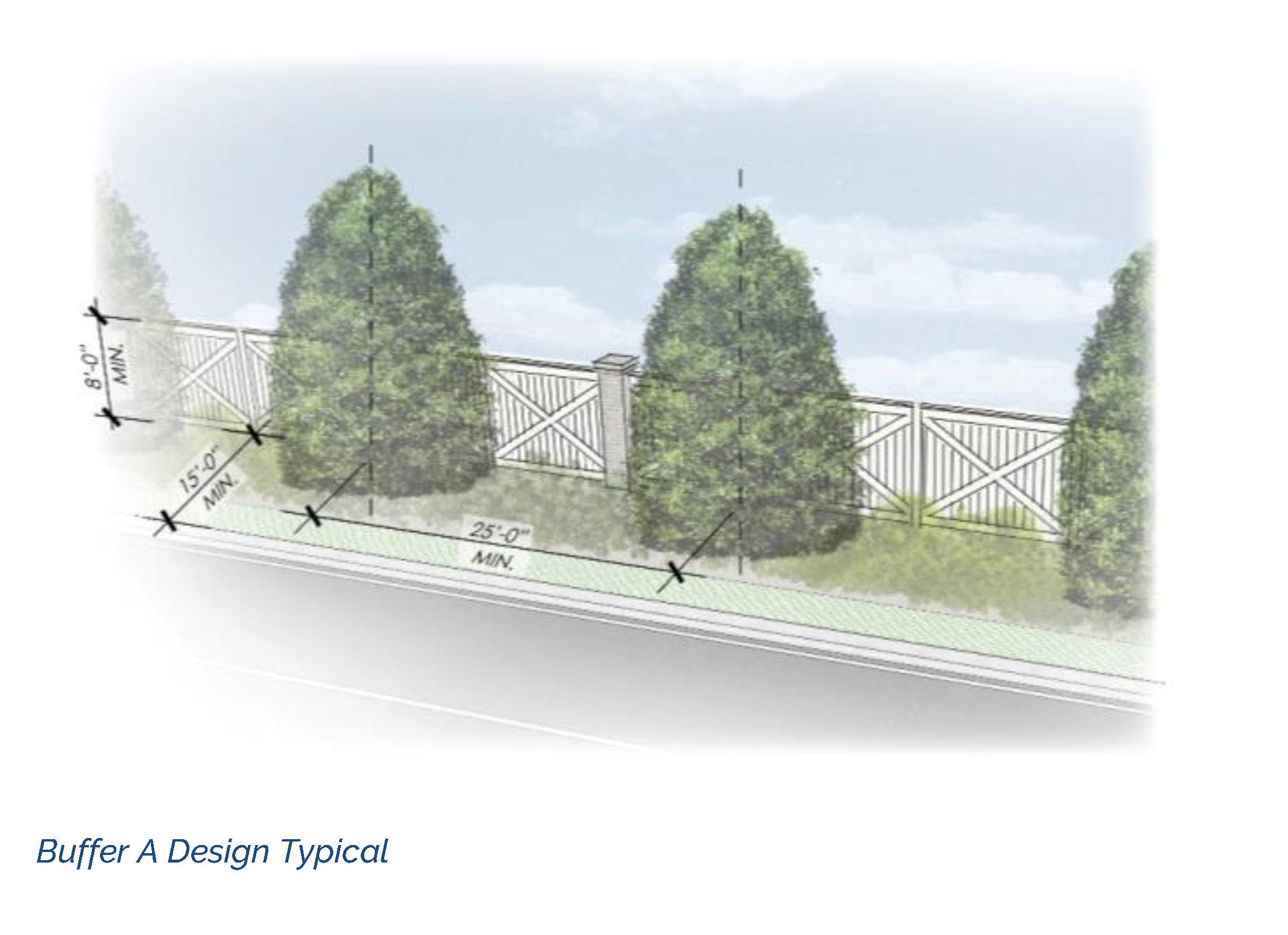
(e)
Buffer B design. Buffer B, as required by Table 94-139, shall have not less than a minimum depth of 30 feet and shall consist of plantings and a fence, wall (not otherwise part of a structure or accessory structure), or a berm, or any combination thereof, which meets the standards of this division.
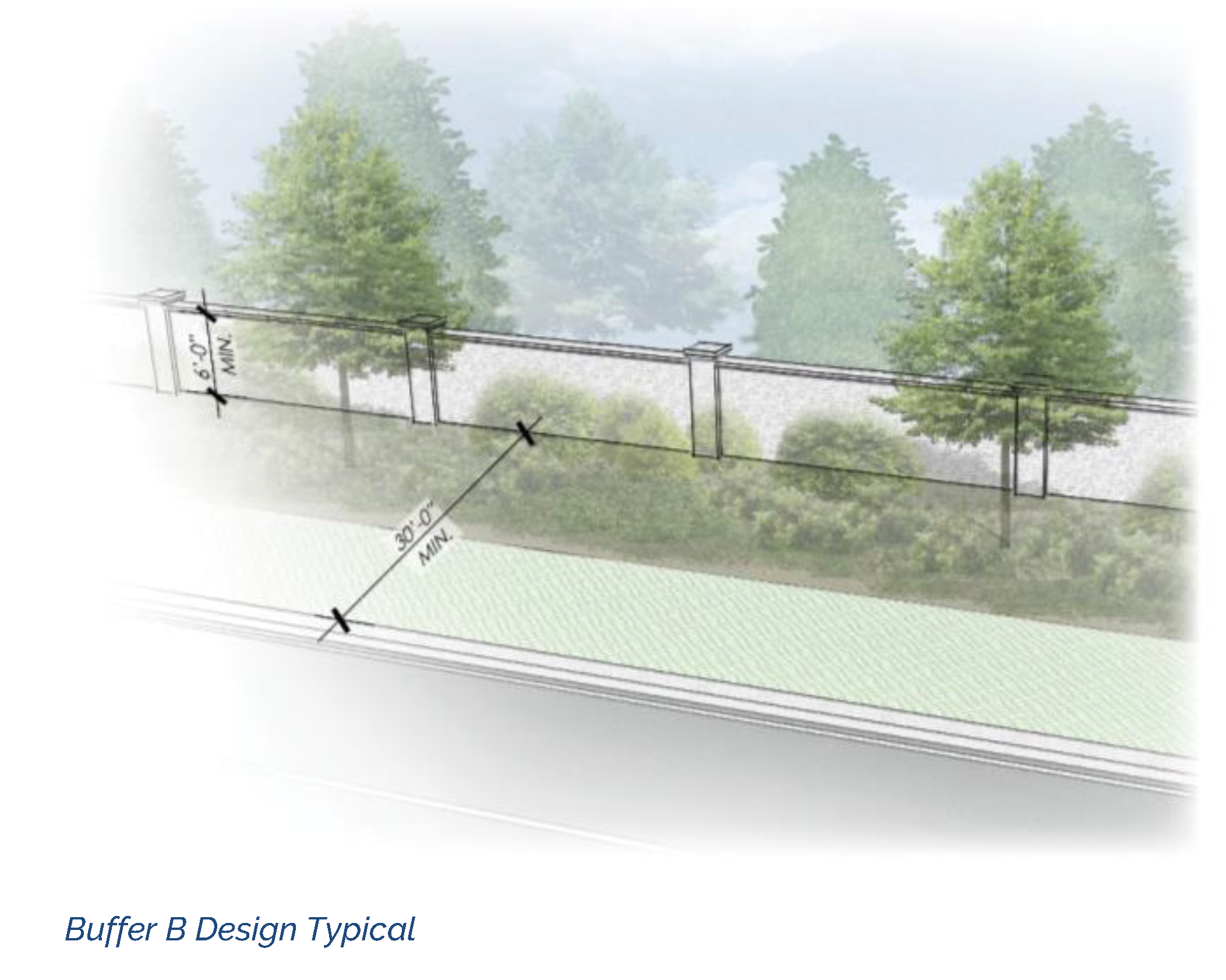
(f)
Planting area shall have a minimum width of 12 feet.
(1)
Plantings shall consist of either trees or shrubs or any combination of both. Planted areas shall be located along the abutting property lines or in areas that will provide the best screening effectiveness.
(2)
Trees used to meet the minimum screening requirements shall be any evergreen species identified in section 94-314. They shall be planted a minimum 25 feet on center.
(3)
Shrubs shall be a minimum of one gallon size at the time of planting and shall attain a minimum height of six feet within three years after planting.
(4)
Walls. Walls shall be of masonry construction and a minimum height of six feet in height.
(5)
Fences. Fences shall be a minimum of eight feet in height and constructed of standard wood fencing materials or vinyl-coated chain link with privacy slat inserts that will provide at least 90 percent visual blockage.
(6)
Berms. Earthen berms shall be a minimum of six feet in height.
(Ord. No. 2021-01, § 1(Attch.), 2-1-2021; Ord. No. 2023-07, § 1(a)(Exhs. 1—3), 6-5-2023)
Sec. 94-141. - Location of buffers.
Buffers shall be located within and along the outer perimeter of a lot or parcel adjacent to each district requiring a buffer. Buffers shall not be located on any portion of existing, dedicated, or reserved public or private street right-of-way.
(Ord. No. 2021-01, § 1(Attch.), 2-1-2021)
Sec. 94-142. - Use of buffers.
A buffer may be used for some forms of passive recreation such as pedestrian, bike or equestrian trails, or as a stormwater retention area, provided that:
(a)
No planted materials shall be eliminated for the purpose of making the buffer suitable for such a use.
(b)
The total width of the required buffer area shall be maintained.
(Ord. No. 2021-01, § 1(Attch.), 2-1-2021)
Sec. 94-143. - Applicability.
Requirements in this division apply to all districts except those zoned R-A.
(Ord. No. 2021-01, § 1(Attch.), 2-1-2021)
Sec. 94-144. - Height
(a)
Fences and walls shall not exceed four feet in height when located in the front yard or ten feet in height when located in any other (non-front) yard.
(b)
Gates may be up to six feet in height in front yards.
(c)
Vehicular gates are prohibited, unless a special use permit is secured through the process outlined in division 8.4.
(d)
Wing walls shall not exceed 12 feet in height or the height of the foundation wall to which it is attached, whichever results in a lower wing wall height.
(e)
Heights are measured from finished grade at the base of the fence or masonry wall to the highest point of the fence or wall.
(f)
Fence and masonry wall columns, posts and ornaments are permitted to exceed maximum allowed fence and wall heights by up to two feet.
(g)
Fences and walls surrounding entire developments are prohibited. For the purposes of this subsection, the term, "entire development" does not refer to an individual single-family lot.
(Ord. No. 2021-01, § 1(Attch.), 2-1-2021; Ord. No. 2023-07, § 1(a)(Exhs. 1—3), 6-5-2023)
Sec. 94-145. - Fence materials and design.
(a)
Chain link fences are prohibited along all street frontages in any residentially-zoned (R-A, R-1, R-2, R-3, DRI-6, SFA, or MFR) districts.
(b)
The finished side of all fences shall face the abutting property and public right-of-way.
(c)
Fences are not permitted to contain barbed wire, spikes or similar devices, or an electric charge.
(Ord. No. 2021-01, § 1(Attch.), 2-1-2021; Ord. No. 2023-07, § 1(a)(Exhs. 1—3), 6-5-2023)
Sec. 94-146. - Setbacks.
Retaining walls on lots shall be set back from side property lines by a distance of at least 50 percent of the required side building setback.
(Ord. No. 2021-01, § 1(Attch.), 2-1-2021)
Sec. 94-147. - Administrative relief.
(a)
The zoning official is authorized to grant an administrative variance allowing retaining walls and fences of up to 12 feet in height in accordance with division 8.3.
(b)
Lawfully established existing retaining walls that exceed the maximum height or setback limits of this section may be repaired and replaced as long as the repair or replacement does not result in an increase in the height of the retaining wall that is replaced and does not increase the footprint of the existing retaining wall by more than ten percent.
(Ord. No. 2021-01, § 1(Attch.), 2-1-2021)
Sec. 94-157. - Dumpsters.
(a)
A solid fence on three sides shall enclose all dumpsters.
(b)
The height of the fence shall be equal to or higher than the height of the dumpster and in accordance with division 7.5, Fences and Walls.
(c)
The operable side of the dumpster shall be concealed with a gate equal to or higher than the height of the dumpster. The gate shall be opaque and constructed of durable materials.
(d)
Dumpsters shall be placed in the rear yard and shall be located a minimum of five feet from property lines
(e)
In no case, shall loading activities hinder or obstruct the free movement of vehicle, and pedestrians over a street, sidewalk, alley, or to interrupt parking lot circulation.
(f)
Service activities within 300 feet of residential uses, including single-family detached, single-family attached, multifamily, and mixed-use development with a residential component shall only be permitted Monday through Friday from 7:00 a.m. to 10:00 p.m. and on Saturdays from 9:00 a.m. to 9:00 p.m. This measurement shall be the shortest distance between the dumpster enclosure and any point on the property line of the residentially used property. These restrictions shall also apply to any service activities within a mixed-use development located within 300 feet of any residential unit within that development. In this case, the measurement shall be the shortest distance between the dumpster enclosure to the exterior wall of a residential unit.
(g)
Temporary construction trash and recycling dumpsters, which are not enclosed, shall be permitted up until such time as the certificate of occupancy/completion is issued. If no permit is required for the associated work, a temporary dumpster may be permitted for a period up to 30 days.
(h)
Access to dumpsters shall be provided via a paved, dust-free surface.
(i)
Dumpsters shall have coverings that remain closed to prevent debris from being carried away by strong wind gusts onto adjacent rights-of-way or property. Oil separators have a primary function of removing liquid oil from wastewater. The following land uses shall include an oil separator: car washes, mining sites, vehicular workshops, gasoline service stations, and manufacturing facilities.
(j)
Grease interceptors have a primary function of removing fatty solids from wastewater to prevent blockages in drains. Service areas for the following uses shall include grease interceptors: commercial kitchens and restaurants, cafes and other similar uses which only serve or sell pre-made food products and do not produce new foodstuffs on site, may be exempt by the zoning official from this requirement.
(Ord. No. 2021-01, § 1(Attch.), 2-1-2021; Ord. No. 2023-07, § 1(a)(Exhs. 1—3), 6-5-2023)
Sec. 94-158. - Screening.
Building mechanical and accessory features/equipment shall be screened in accordance with the following:
(a)
Shall be located to the side or rear of the principal structure or on the roof and shall be in the location of least visible from the public right-of-way. Screening with plant or fence materials shall be required if the equipment is otherwise visible from any public space or public right-of-way.
(b)
When located on rooftops, these features shall be incorporated in the design of the building and screened with building materials similar to the building utilizing an architectural element such as a parapet.
(c)
Shall not be permitted between the building and any public street, with the exception of features less than eight cubic feet, provided they are screened.
(Ord. No. 2021-01, § 1(Attch.), 2-1-2021)
Sec. 94-159. - Insect and rodent control.
The following requirements apply to all properties in the city:
(a)
All buildings, structures, grounds, and storage areas shall be maintained free of insect and rodent harborage and infestation. Extermination methods and other measures to control insects and rodents shall conform with the requirements of the appropriate state regulatory authority.
(b)
Lumber, pipe, and other building materials shall be stored at least one foot above the ground.
(c)
Where the potential for insect and rodent infestation exists, all exterior openings in or beneath any structure shall be screened with appropriate wire mesh or other suitable materials.
(d)
The growth of brush, weeds, and grass shall be controlled to prevent harborage of ticks, chiggers, and other noxious insects. Open areas shall be maintained as to prevent the growth of ragweed, poison ivy, poison oak, poison sumac, and other noxious weeds considered detrimental to health.
(Ord. No. 2021-01, § 1(Attch.), 2-1-2021)
Sec. 94-160. - Outdoor lighting.
(a)
Purpose and intent. This section is intended to reduce the problems created by improperly designed and installed outdoor lighting. They are intended to eliminate problems of glare and minimize light trespass, with regulations that avoid unnecessary direct light from shining onto abutting properties or streets.
(b)
Applicability. Outdoor lighting installed in the city shall be in conformance with the requirements established by this section.
(c)
Exemptions. The following shall be exempt from the provisions of this section:
(1)
All temporary emergency lighting needed by police or fire departments or other emergency services;
(2)
All hazard warning luminaires required by federal regulatory agencies;
(3)
All vehicular luminaires;
(4)
Safety lighting, as defined in this section;
(5)
All outdoor light fixtures producing light directly by the combustion of natural gas or other fossil fuels;
(6)
Signs as permitted in chapter 95.
(7)
Aesthetic lighting limited to interior roadway lighting with a maximum height of two feet within a development, not intended to take the place of required street lighting, or lighting to be utilized within open space used to feature decorative plantings, sidewalks, walkways, or ornamental objects, such as fountains or similar features. Aesthetic lighting, although exempt from an isometric foot=candle plan, shall be identified on all design plans as to type of light and location to ensure appropriate use of aesthetic lighting in accordance with this section.
(d)
Outdoor lighting regulations.
(1)
Cutoff fixtures. All luminaires not exempted from this section hereafter installed for outdoor lighting shall be full cutoff luminaires or another luminaire which does not emit any direct light above a horizontal plane through the lowest direct-light-emitting part of the luminaire
(2)
Type of lighting. Outdoor lighting shall be CFL or LED.
(3)
Glare. See chapter 26, section 26-57(11).
(4)
No lighting plan shall be approved which will result in direct light that exceeds the requirements or is otherwise inconsistent with this section.
(5)
Intensity specifications. Illuminance levels for outdoor lighting fixtures shall comply with the standards in Table 94-160a. and b measured at three feet above ground or finished grade.
(e)
Plans required.
(1)
Applicants for any permit for any single-family detached or attached use proposing outdoor lighting fixtures shall submit evidence that the proposed work will comply with the outdoor lighting regulations of this section.
a.
The submission shall include a description, count, and location of all proposed outdoor illuminating devices, fixtures, lamps, supports, reflectors. The description may include, but is not limited to, catalog cuts and illustrations by manufacturers.
b.
Wood light poles are prohibited in all districts.
(2)
Applicants for any permit for any non-single-family use proposing outdoor lighting fixtures shall submit evidence that the proposed work will comply with the outdoor lighting regulations of this section in accordance with the following:
a.
Plans indicating the location on the premises of each outdoor illuminating device, both proposed and any already existing on the site.
b.
Description of all proposed illuminating devices, fixtures, lamps, supports, reflectors. The description shall include, but is not limited to, catalog cuts, and illustrations by manufacturers.
c.
Photometric data, such as that furnished by manufacturers or similar, showing the angle of cut-off of light emissions.
d.
Photometric plans shall include the maximum and average light layout.
(Ord. No. 2021-01, § 1(Attch.), 2-1-2021; Ord. No. 2023-07, § 1(a)(Exhs. 1—3), 6-5-2023; Ord. No. 2024-10, § 5, 5-6-2024)
Sec. 94-161. - Outdoor storage.
(a)
The outdoor storage regulations of this section apply to the storage of goods, materials, and equipment as an accessory use to commercial or industrial use types when located outside of enclosed buildings, including:
(1)
Material in boxes, in crates, or on pallets;
(2)
Overnight storage of vehicles awaiting repair (not including new vehicles for sale); construction and contractor's equipment, including lawnmowers;
(3)
Fleet vehicles; and
(4)
Construction material such as lumber, pipe, steel, unpackaged soil, mulch, recycled material, or similar items.
(b)
Outdoor storage is allowed only in C-2 and M-1 districts.
(c)
Storage shall be enclosed by a fence not less than six feet in height containing opaque material to provide visual screening from any rights-of-way or residentially-zoned (R-A, R-1, R-2, R-3, DRI-6, SFA, or MFR) lots. Fleet vehicles do not require screening.
(Ord. No. 2021-01, § 1(Attch.), 2-1-2021; Ord. No. 2023-07, § 1(a)(Exhs. 1—3), 6-5-2023)
Sec. 94-167. - General.
Before plat recordation or other project close-out, the zoning official must certify that the developer/subdivider has obtained the necessary bonds, other sureties, and/or agreements that ensure completion of all required public and private improvements on the subject property. Three types of guarantees and sureties may be provided for as a part of the final plat approval and development permitting process:
(a)
Performance guarantees.
(b)
Maintenance guarantees.
(c)
Maintenance agreements/inspections.
(Ord. No. 2021-01, § 1(Attch.), 2-1-2021)
Sec. 94-168. - Performance guarantees.
Performance guarantees shall be allowed for required site improvements (public or private) not yet completed. In lieu of requiring the completion, installation, and dedication of any and all improvements (e.g., water, sewer, street lights, landscaping, sidewalks, etc.) prior to approval of a final plat or certificate of occupancy/completion (CC/CO), the city may enter into a written agreement with the developer or subdivider whereby the developer or subdivider shall agree to complete all required improvements prior to the release of the performance guarantee.
(a)
The performance guarantee shall be payable to the city and shall be in an amount equal to 1.5 times the entire cost, as estimated by the developer or subdivider and verified by the city, of installing all outstanding required improvements.
(b)
The duration of the guarantee shall be for no longer than 12 months, or until such lesser time that the improvements are accepted by the city.
(Ord. No. 2021-01, § 1(Attch.), 2-1-2021)
Sec. 94-169. - Maintenance guarantees.
Maintenance guarantees shall be provided as required in this chapter for the ongoing maintenance of improvements and landscaping (public only). Prior to approval of a final plat or final certificate of occupancy/completion (CC/CO), the city may enter into a written agreement with the developer or subdivider whereby the developer or subdivider shall agree to maintain in good repair and living condition all applicable improvements prior to the release of the maintenance guarantee.
(a)
The maintenance guarantee shall be payable to the city and shall be in an amount equal to 60 percent of the construction value for all public improvements, as estimated by the developer or subdivider and verified by the city.
(b)
The duration of the surety shall be for a period of 36 months following the date of approval of development conformance, marked by the approval of a final plat or final certificate of occupancy/completion (CC/CO).
(Ord. No. 2021-01, § 1(Attch.), 2-1-2021; Ord. No. 2023-07, § 1(a)(Exhs. 1—3), 6-5-2023)
Sec. 94-170. - Maintenance guarantees (stormwater).
Stormwater maintenance guarantees shall be provided as required in chapter 26 for the ongoing maintenance of stormwater management facilities and features. Prior to approval of a final plat or final certificate of occupancy/completion (CC/CO), the city may enter into a written agreement with the developer or subdivider whereby the developer or subdivider shall agree to maintain in good repair and working order all applicable improvements prior to the release of the maintenance guarantee.
(a)
The stormwater maintenance guarantee shall be payable to the city and shall be in an amount equal to $5.00/cubic foot of storage provided by the stormwater management facility, as estimated by the developer or subdivider and verified by the city.
(b)
The duration of the surety shall be for a period of 24 months following the date of approval of development conformance, marked by the approval of a final plat or final certificate of occupancy/ completion (CC/CO).
(c)
The guarantee shall be accompanied by the appropriate agreements outlined in section 94-171.
(Ord. No. 2021-01, § 1(Attch.), 2-1-2021)
Sec. 94-171. - Maintenance agreements/inspections (stormwater).
Prior to the issuance of any project close-out, final plat, or certificate of completion/occupancy requiring a stormwater management facility or practice hereunder and for which the city requires ongoing maintenance, the applicant or owner of the site must, unless an on-site stormwater management facility or practice is dedicated to and accepted by the city, execute an inspection and maintenance agreement, and/or a conservation easement, if applicable, that shall be binding on all subsequent owners of the site.
(a)
The inspection and maintenance agreement, if applicable, must be approved by the city prior to approval, and recorded in the deed records of the office of the Clerk of the Superior Court of Pickens County, Georgia. The inspection and maintenance agreement shall identify, by name or official title, the person(s) responsible for carrying out the inspection and maintenance.
(b)
Responsibility for the operation and maintenance of the stormwater management facility or practice, unless assumed by a governmental agency, shall remain with the property owner and shall pass to any successor owner. If portions of the land are sold or otherwise transferred, legally binding arrangements shall be made to pass the inspection and maintenance responsibility to the appropriate successors in title. These arrangements shall designate for each portion of the site, the person to be permanently responsible for its inspection and maintenance.
(c)
As part of the inspection and maintenance agreement, a schedule shall be developed for when and how often routine inspection and maintenance will occur to ensure proper function of the stormwater management facility or practice, including their associated landscaping measures. The agreement shall also include plans for annual inspections to ensure proper performance of the facility between scheduled maintenance and shall also include remedies for the default thereof.
(d)
In addition to enforcing the terms of the inspection and maintenance agreement, the city may also enforce all of the provisions for ongoing inspection and maintenance in chapter 26, article IV.
(e)
The city, in lieu of an inspection and maintenance agreement, may accept dedication of any existing or future stormwater management facility for maintenance, provided such facility meets all the requirements of this chapter and includes adequate and perpetual access and sufficient area, by easement or otherwise, for inspection and regular maintenance.
(Ord. No. 2021-01, § 1(Attch.), 2-1-2021)
Sec. 94-172. - Guarantee specifications.
The developer or subdivider shall provide either one, or a combination, of the following guarantees in the amounts and durations specified in this division. Any expenses associated with the cost verification by the city shall be paid entirely by the applicant.
(a)
Bond. Bond(s) shall be secured from a surety bonding company authorized to do business in the state. The bond shall be payable to the city.
(b)
Cash or equivalent security. The developer or subdivider shall deposit cash, an irrevocable letter of credit, or other instrument readily convertible into cash at face value, either with the city or in escrow with a financial institution designated as an official depository of the city.
(c)
If cash or other instrument is deposited in escrow with a financial institution as provided above, then the applicant shall file with the City of Jasper an agreement between the financial institution and the applicant guaranteeing the following:
(1)
That said escrow amount will be held in trust until released by the zoning official and may not be used or pledged by the applicant in any other transaction during the term of the escrow; and
(2)
That in case of a failure on the part of the developer or subdivider to complete said improvements/maintenance, the financial institution shall, upon notification of the city to the financial institution of an estimate of the amount needed to complete the improvements, immediately pay to the city the funds estimated to complete the improvements, up to the full balance of the escrow account, or deliver to the city any other instruments fully endorsed or otherwise made payable in full to the city.
(Ord. No. 2021-01, § 1(Attch.), 2-1-2021)
Sec. 94-173. - Default.
Upon default, meaning failure on the part of the applicant to complete the required improvements in the time allowed by this chapter or as spelled out in the performance or maintenance bond or escrow agreement, then the surety, or financial institution holding the escrow account, shall, if requested by the city, pay all or any portion of the bond or escrow fund to the city up to the amount needed to complete the improvements or maintenance based on an estimate by the city. Notification may take place following abandonment of the project for more than 90 continuous days. Upon payment, the city, in its discretion, may expend such portion of said funds as it deems necessary to complete all or any portion of the required improvements. The city shall return to the applicant any funds not spent in completing the improvements.
(Ord. No. 2021-01, § 1(Attch.), 2-1-2021)
Sec. 94-174. - Release of guarantee security.
The city may release a portion of any security posted as the improvements are completed or maintenance period completed and approved by the zoning official. When the zoning official approves said improvements, the zoning official shall inspect the premises, and if work is found to be completed and satisfactory, the zoning official shall release the portion of the security posted which covers the approved cost of the improvements and maintenance of satisfactorily completed work that was subject to the security. It shall be the responsibility of the applicant to petition the city for release of guarantees and sureties and to warrant that all improvements subject to the guarantee or surety have been completed to fulfill the requirements of this chapter.
(Ord. No. 2021-01, § 1(Attch.), 2-1-2021)

