
Jonesboro City Zoning Code
ARTICLE VII
REQUIREMENTS FOR SPECIFIC USES
Sec. 117-248. - General.
Uses permitted, or those permitted subject to conditional use approval, shall be subject to the requirements of the district provisions as supplemented or modified by this article.
(Zoning Ord., § 14.32.01)
Sec. 117-249. - Adult entertainment.
All adult entertainment uses shall be subject to the following standards:
(1)
Separation from other adult entertainment uses. The building housing an adult entertainment use shall not be located within 3,000 feet of any other adult entertainment use. This 3,000 foot area shall be defined by a radius of 3,000 feet measured from the exterior wall of the subject building.
(2)
Separation from other uses. The building housing an adult entertainment use shall be located at least 2,000 feet from the following uses:
a.
Church;
b.
Library;
c.
Day care center;
d.
Elementary,
e.
Middle or high school; and
f.
Single-family, duplex or multifamily residential uses.
This distance shall be defined by a radius of 2,000 feet measured from the exterior wall of the subject building.
(3)
Prohibited activities. An adult entertainment use shall not be conducted in any manner that provides the observation of any material depicting, describing or relating to specified sexual activities or specified anatomical areas, from any public right-of-way. This provision shall apply to any and all displays, decorations or show windows.
(Zoning Ord., § 14.32.02)
Sec. 117-250. - Auto wrecker service.
A wrecker service is a business enterprise from which wrecker vehicles are dispatched to tow or haul inoperable or wrecked motor vehicles, and may or may not include the temporary storage, for a period not to exceed 30 days, of such vehicles. All temporary storage of said wrecked or inoperable motor vehicles shall be screened entirely within an enclosed opaque fence or wall, except driveway areas, from six to eight feet in height, and containing no advertising thereon. Any temporary storage between the street and such fence, or on street right-of-way, is expressly prohibited.
(Zoning Ord., § 14.32.03)
Sec. 117-251. - Auto wrecking yards, salvage yards, and junkyards.
Because of the nature and character of their operations, motor vehicle wrecking and salvage yards, junkyards, and similar uses of land can have a serious detrimental effect upon surrounding properties. Salvage and wrecking yards tend to create problems of noise, dust, traffic, and health hazards, and may adversely affect property values by their general appearance. For the purpose of evaluating whether the proposed utilization of land for a vehicular wrecking yard or junkyard properly minimizes its objectionable characteristics, the standards established below shall be used.
(1)
Location. Because of the tendency of salvage yards to promote the breeding of vermin, no such operation shall be permitted closer than 300 feet to any residential district.
(2)
Screening. The interior area of any existing salvage or wrecking operation shall be screened from view by fencing. New salvage and wrecking yards shall be so screened as a condition of approval. Such screening shall be uniform, consistent, and neat in appearance, and shall be properly maintained during the life of the use. Storage between the street and such screening is expressly prohibited, as is the stacking of such vehicles above or beyond such screening.
(Zoning Ord., § 14.32.04)
Sec. 117-252. - Carwashes.
Carwashes and similar such establishments shall provide paved parking for at least five vehicles, plus stacking space for a like number of vehicles. Where any such use is located on a lot abutting a residential district, and where any part shall be built along such line, any entrance or exit therefrom shall be by way of a major street. Wastewater from such establishments shall not be allowed to run into the street or storm sewer; rather, such discharge of wastewater shall be into a sanitary sewer.
(Zoning Ord., § 14.32.05)
Sec. 117-253. - Emergency housing units.
Emergency housing units may be approved as conditional uses in R-2, and less intensive districts for the purpose of providing temporary accommodations for persons in need of daily assistance due to health reasons. The following regulations shall apply to emergency housing units:
(1)
Hardship. Before approving a conditional use for an emergency housing unit, the planning commission shall determine that the applicant has a special need to provide temporary, nearby living quarters for a relative who needs daily assistance due to health reasons. The applicant shall provide proof of such hardship, evidenced by a letter from a physician or other appropriate professional. The commission shall also determine that allowing an emergency housing unit would alleviate a social, economic or physical hardship for the resident of the principal dwelling or the resident of the emergency unit. Consideration of the effect on adjoining property shall also be factored into the commission's decision. A permit granted for such purposes shall expire no later than one year from the date of approval. The commission may approve a one time extension of up to one year of this period if the applicant applies for such extension within the original one year time period.
(2)
Unit type. Only manufactured housing units or residential-design manufactured housing units may be approved for emergency placement.
(3)
Removal. Upon expiration of a conditional use permit for an emergency housing unit, the unit shall be promptly vacated, and within 90 days of permit expiration, be removed from the premises.
(Zoning Ord., § 14.32.06)
Sec. 117-254. - Floodplain development.
(a)
The designated floodplain area is inclusive of all land within the city subject to inundation by floodwater. The source of this delineation shall be the flood insurance study, including the flood insurance rate maps, for the city.
(b)
The uses of and/or development of land within the designated floodplain area shall be only those uses and structures permitted in the specific district regulations for the zone in which the proposed use and/or development is to be located. For the purposes of administration and review of applications for the use and/or development of land within designated floodplain areas, and article II of chapter 109, flood damage prevention are deemed the governing regulations.
(Zoning Ord., § 14.32.07)
Sec. 117-255. - Manufactured housing parks.
Manufactured housing parks are permitted uses in AG and RR districts, and may be allowed in R-3 zones subject to approval of a conditional use permit. The following minimum standards apply to new parks, and expansions of existing parks:
(1)
Setbacks. Each manufactured housing unit space shall be set back at least 30 feet from all street rights-of-way, and at least 20 feet from all other lot lines.
(2)
Minimum lot size and space size. Manufactured housing parks shall contain at least 4,350 square feet of gross site area for each manufactured housing unit space within the park. Each individual manufactured housing unit space shall be at least 3,000 square feet in area, but shall not occupy more than 50 percent of the lot area.
(3)
Separation of units. Each manufactured housing unit and accessory structure shall be separated by at least 20 feet of horizontal distance from all other manufactured housing units and accessory structures.
(4)
Parking. At least two paved parking spaces, 180 square feet in area in each space shall be provided as a part of each manufactured housing unit space. To provide for guests, one additional paved parking space, at least 180 square feet in area, shall be provided for each ten manufactured housing unit spaces. These guest parking spaces shall be centrally located within the park.
(5)
Driveways.
a.
Length and design. Internal driveways or courts designed to have one end permanently closed, shall be no more than 400 feet long unless approved by the planning commission. A turnaround having an outside roadway diameter of at least 80 feet shall be provided at the closed end of any driveway.
b.
Paving. All internal driveways shall be paved with asphalt. The minimum requirements are six inches of compacted SB2 gravel with three inches of asphalt surface on firm subgrade. Property owners shall be responsible for maintaining paving on all internal driveways.
c.
Width. Drive shall have a minimum paved width of 26 feet. One-way drives are specifically prohibited.
(6)
Signs. One detached, indirectly illuminated sign, not exceeding 20 square feet in area, may be erected at the main entrance to the manufactured housing park.
(7)
Refuse collection facilities. Refuse collection facilities and/or provisions shall be indicated on the site plan, and shall be provided in accordance with city sanitation department standards. There shall be opaque screening on three sides of dumpsters.
(8)
Fire protection. Fire lines and fire hydrants shall be shown on the site plan, and shall be in accordance with recommendations of the director of public safety. No mobile home or manufactured housing unit space shall be more than 250 feet from a fire hydrant.
(9)
Water and wastewater service. Each mobile home/manufactured housing unit shall be connected to the public sanitary sewer and a public water supply system.
(10)
Underground utilities. All light, gas, water, telephone and cable television distribution and service lines to each individual mobile home/manufactured housing unit shall be placed underground and conform to all state and local codes, ordinances and laws.
(11)
Inspections. It shall be the duty of the building inspector to make an annual inspection of each approved manufactured housing park and present to the park owner and unit owner a written list of existing violations, should there be any.
(12)
Resident managers. In manufactured housing parks containing 30 or more units, a manager must reside with the park area.
(Zoning Ord., § 14.32.08)
Sec. 117-256. - Manufactured housing units.
Manufactured housing units, those that do not meet the definition of residential design, manufactured housing units, shall be located only in approved locations. No permit or other approval shall be granted for the placement of a manufactured housing unit that is more than eight years old, as measured from the date that the permit or approval is sought, or be reconditioned to meet code requirements. Mobile home parks shall be exempt from the age requirement subject to all replacement units being reconditioned to meet code compliance and satisfying all state and local codes.
(Zoning Ord., § 14.32.09; Ord. No. 13:041, § I, 9-3-2013)
Sec. 117-257. - Manufactured housing units, residential design.
Compliance with all of the standards of this section is required in order for a manufactured housing unit to be classified as a residential design, manufactured housing unit.
(1)
Size.
a.
The minimum width of a residential design, manufactured housing unit shall be 22 feet, with width measured perpendicular to the longest axis at the narrowest part.
b.
The length of a residential design, manufactured housing unit shall not exceed four times its width, with length measured along the longest axis.
c.
A residential design, manufactured housing unit shall have a minimum area of 1,150 square feet enclosed and heated living area.
(2)
Roof.
a.
Pitch. The roof must be predominantly double-pitched and have a minimum vertical rise of two inches for every 12 inches of horizontal run.
b.
Materials. The roof must be covered with material that is customarily used on site-built housing units. Customary materials include wood, asphalt composition shingles, or fiberglass shingles, but not aluminum, corrugated fiberglass, or metal.
c.
Eaves. The roof shall have a minimum eave projection and roof overhang of ten inches, which may include a gutter.
(3)
Siding.
a.
Materials. Exterior siding must be of a material customarily used on site-built housing units. Customary materials include wood, composition, simulated wood, clapboards, conventional vinyl or metal siding, brick, stucco, or similar materials. Customary materials do not include smooth, ribbed or corrugated metal or plastic panels or material that has a high gloss finish.
b.
Design and placement. Siding material shall extend below the top of the foundation or curtain wall, or the joint between the siding and enclosure wall shall be flashed in accordance with the city's adopted building code.
(4)
Installation of unit.
a.
Guidelines. The unit shall be installed in accordance with the recommended installation procedures of the manufacturer, and the standards established by the International Conference of Building Officials and published in the most recent edition of Guidelines for Manufactured Housing Installations.
b.
Foundation. A continuous, permanent concrete or masonry foundation or masonry curtain wall, unpierced except for required ventilation and access which may include walk-out basements and garages, shall be installed under the perimeter of the unit, also in accordance with International Conference of Building Officials guidelines.
(5)
Entrance landing area. At the main entrance door to the unit there shall be a landing that is a minimum of five feet which is constructed in accordance with building code requirements.
(6)
Transport equipment. All running gear, tongues, axles, and wheels must be removed at the time of installation of the unit on the lot.
(7)
Finished floor elevation. The finished floor of the unit shall meet the manufacturer's specifications unless the unit is located in a floodplain, in which case floodplain regulations shall rule.
(8)
Additions. Attached additions and detached garages shall comply with the building code, and floodplain regulations, if applicable. All standards of this section shall apply to such additions and garages.
(Zoning Ord., § 14.32.10)
Sec. 117-258. - Mobile vending trailers.
(a)
Purpose. The purpose of this section is to establish standards to regulate the use and location of commercial trailers in the city. These standards are necessary to promote public safety and preserve property values.
(b)
Applicability. This section shall apply to any commercial trailer or vending stand that is transported to property within the city. A commercial trailer or vending stand is defined as a transportable structure not permanently attached to the ground which is used on a shortterm basis to conduct a commercial activity such as, but not limited to, the sale of merchandise or food. Vending carts and tables shall be included in this definition.
(c)
General provisions. The following provisions shall apply to commercial trailers.
(1)
Commercial trailers and vending stands shall be permitted only in zoning districts which permit the specific use for which the trailer is intended as permanent sited location, unless otherwise allowed by this section.
(2)
Prior to locating a commercial trailer or vending stand on any parcel, a building permit must be obtained. The trailer or stand must be permanently attached to a foundation with an approved permit issued; if wheels are to remain, then proper skirting shall be fully installed around the perimeter of the unit. Only one commercial trailer is permitted on each parcel, unless provide for otherwise within this section.
(3)
At the time a building permit is requested, a site plan shall be provided of the parcel on which the trailer is to be located. The site plan shall show the boundaries of the parcel, all existing buildings and their dimensions, parking areas and the number of spaces, and the proposed location of the trailer.
(4)
When applicable, a state health district approval letter shall accompany the permit application for products under the jurisdiction of the state health district. Use of the commercial trailer or vending unit shall not commence until a final occupancy certificate is issued by the building department.
(5)
A minimum of three parking spaces shall be provided for the use of employees and customers. This requirement is in addition to the number of parking spaces required for the existing buildings on the parcel. The trailer or stand may not be placed on the parcel if its placement would cause the parcel to no longer meet this zoning chapter requirements for minimum number of parking spaces.
(6)
The trailer must meet the minimum setback requirements for the zoning district in which it is located. In no instance may a commercial trailer or vending stand be located within a public right-of-way, unless otherwise permitted by this section.
(7)
The trailer unit must be inspected by the city electrical inspector to ensure the safety of the outside electrical connections.
(8)
The trailer must not be placed in a location which may be unsafe for its occupants, customers and the vehicles which must pass by.
(9)
Special exceptions and exempted activity.
1.
Seasonal inventory trailers shall be permitted by permit for a period not to exceed three months, and must be placed in the rear yard of the subject property or docking area.
2.
Vending units shall be permitted in the industrial park area at manufacturing plants zoned I-2 industrial, for a time duration not to exceed two hours, with a permit application including an approval letter from the ownership provided to the planning department.
3.
Vending units shall be permitted at citywide amusement fairs, festivals, parades, athletic events and games, if and only if, the business representative secures a valid business license after giving proof of owner's consent.
4.
Sidewalk sales that are located at the front entrance to the building structure, and not in parking areas nor along public rights-of-way shall be exempt from this section if the products sold are part of the principal use of the commercial property. Inventory sales shall satisfy all applicable building setbacks for the associated zoning district.
5.
Ice cream trucks shall exempted from this section, but must not be in business at a extended and stationary location.
6.
Temporary tent sales shall be permitted in areas zoned for C-3 commercial for a maximum of 30 days; the structure must be placed no close than 35 feet to any right-of-way line, and required parking for the principal use must not be utilized by the tent location. The business representative must secure site plan review and a valid business license after giving proof of owner's consent.
(d)
Itinerant street vendors units.
(1)
Definitions. The following words, terms and phrases, when used in this section, shall have the following meanings ascribed to them, except where the context clearly indicates a different meaning:
1.
Administrator means the planning director of the city or the designee;
2.
City means the City of Jonesboro, Arkansas;
3.
Itinerant street food vending units means a unit operated by a person dispensing food, goods, materials or services from such unit or other contrivance operated in regulated areas. This term shall not include or apply to a "temporary open air enterprise" or "mobile vending units" as those terms are defined in this section which do include the following: concession trailers, walk-in concession stands, charcoal smoke creating pit/trailers, tables and tents vending accessory and non-food items, of which are not permitted under these standards.
(2)
Itinerant units: Operating permit required.
1.
No person shall operate as an itinerant street vending unit in the city, except as expressly permitted under this code section.
2.
Each itinerant street vendor, in addition to a city business license, must obtain an annual operating permit from the city and business license renewal.
3.
Prior to issuing an operating permit, the city and/or the health department will inspect each itinerant street vending unit to ensure each unit is in a mechanically safe condition, and that all such units meet the equipment specifications of subsection (3) herein. The inspection/review shall be conducted by the administrator or assignee.
(3)
Equipment specifications. All itinerant street vending units shall be equipped with the following:
1.
Signs or decals on both the front and the rear of the unit identifying the unit as an itinerant street vendor and displaying the words "slow children crossing" in distinctive lettering at least six inches in height.
2.
A sign or decal that is visible at all times with the business address and telephone number of the business license holder printed on the side of the unit in letters of not less than two inches in height.
3.
A trash receptacle to dispose of all litter that is generated from products sold from the itinerant street vending unit.
4.
Stainless steel or FRP board for smooth, easily cleaned sanitized surfaces.
5.
Correct location and placement of work stations and storage cabinets as approved by the health inspector.
6.
Health Inspector approved compartment sinks and clean water accommodations.
7.
Health Inspector approved refrigeration.
(4)
Operational requirements/operator permit required.
1.
Required. No person shall operate an itinerant street vending unit in the city, and no person who owns or controls an itinerant street vending unit shall permit it to be so operated at any time, unless the operator of said itinerant street vending unit shall have first obtained an itinerant street vending unit permit issued under the provisions of this chapter.
2.
Qualifications. No itinerant street vending unit driver's permit shall be granted unless the applicant is at least 18 years of age, has a valid state issued driver's license, and the applicant has no active suspension on his or her driving privileges in any state. Further, no permit shall be issued or allowed if the applicant has been convicted or registered as a sex offender or of a violent felony.
3.
Only individually pre-packaged products or items may be sold from itinerant street vending units, unless the itinerant street vending unit has been issued a health department permit from the state department of health.
4.
A copy of a current, valid health department permit from the State of Arkansas or a letter from the state department of health stating that no permit is required, must be on file in the city collector's office and must be carried within the itinerant street vending unit.
(5)
Application for permits. Any person desiring an itinerant street vending unit permit shall apply in writing to the administrator. The form of such application shall be developed by the administrator and shall include, but not be limited to, the age, name and address of the applicant. The police department shall also have the authority to require additional documentation, as needed, to process the application.
1.
When the application is approved, the itinerant street vending unit permit shall be issued in card form designed by the administrator. The photograph of the driver shall be displayed on the card. Each operator will be given an itinerant street vending unit permit number and location, which will be on such permit. This card shall be posted in a prominent place in the itinerant street vending unit and shall be shown to any customer, police officer, or code enforcement officer upon request. Only one permit shall be posted in an itinerant street vending unit at any time.
2.
Acknowledgment of Application. The applicant shall acknowledge with any application that he or she understands that the itinerant street vending unit permit, if granted, will be for a specific period of time not to exceed one year, and an annual review and approval will then be required for renewal of said permit.
3.
Permit Issuance and Renewal Procedure. Itinerant Street Vending shall only be available for permit approval at the following approved locations within the C-1 downtown district:
a.
Permit locations are restricted to the approved and adopted locations V-1 thru V-13. Mapped allowable locations shall be maintained in both the planning department and city collector's office at all times. Permits shall be issued for a duration of 12 months.
Upon expiration, the itinerant vendor shall apply for permit renewal with the office of the planning director. Once all 13 approved locations are committed and reserved as permitted sites, the administrator shall generate a waiting list of applicants hoping to locate at one of the 13 approved locations. Once slots become available, the waiting list shall continue to rotate. If at time of expiration, no vendor is awaiting unit location assignment, a vendor's permit renewal may be approved and renewed at the same location or any available slot.
b.
Special location exceptions: temporary itinerant vending shall be permitted at large retail establishments having adequate parking to satisfy zoning code compliance, and where approval has been granted by the commercial management by letter. Such vending approval may be situated on the subject commercial property only in areas no closer than 25 feet from the street right-of-way. All health department inspections and approval shall be satisfied by such temporary itinerant operators.
(6)
Cleanliness required.
1.
The interior and exterior of each itinerant street vending unit, and all equipment therein, shall be kept clean and sanitary, and maintained in good repair at all times.
2.
The interior and exterior of each vending unit shall comply with all local, state, and federal codes and regulations governing the sale and distribution of food products.
3.
Trash canisters shall be visibly available and all associated trash and waste collection within the perimeter of the vending unit shall be the responsibility of the vendor.
(7)
Vending location restrictions. No itinerant street vendor shall vend within 500 feet of any property used as a school from one hour before the regular school day to one hour after the regular school day; provided, this subsection shall not apply on days when school is not attended by children.
1.
Itinerant street vendors may only vend from the side of the unit, which shall be away from moving traffic and as near as possible to the curb or edge of the roadway or street.
2.
No itinerant street vendor may vend to a person standing in the roadway.
3.
No itinerant street vendor may vend in areas that will cause non-compliance with the city's Code sections 66-188 and 117-327.
(8)
Penalty for violations. Any person violating any of the provisions of this article shall be subject to a fine in the amount of $75.00.
In the event of a continuing violation, each and every day the violation continues is considered a separate and punishable violation. Each sales transaction completed in violation of the terms of this subchapter shall be considered a separate violation.
(Zoning Ord., §§ 14.25.01—14.25.04; Ord. No. 08:005, 2-20-2008; Ord. No. 13:058, § 1, 11-5-2013; Ord. No. 14:025, § 1, 5-6-2014)
Sec. 117-259. - Off-premises outdoor advertising sign standards.
(a)
Purpose. This section establishes the regulations for the continuing use of off-premises outdoor advertising signs or billboards, herein after referred to by the term off-premises sign in order to encourage an attractive environment, to promote the development of businesses and organizations, to inform and direct the general public, to protect and enhance the physical appearance of the community, to ensure public safety along streets and highways. The purpose of regulating off-premises signs is to:
(1)
Ensure compatibility of billboards with surrounding land use;
(2)
Enhance the economy of the city;
(3)
Protect the public interest in streets and highways;
(4)
Promote and maintain the safety and general welfare of citizens and their property in the vicinity of outdoor advertising structures;
(5)
Allow property owners the opportunity to sell or lease their properties for outdoor advertising uses and maximize the value of their property; and
(6)
Provide and protect tax revenues by promoting the reasonable, orderly and effective display of outdoor advertising.
(b)
Definitions. The following words, terms and phrases, when used in this section, shall have the meanings ascribed to them in this subsection, except where the context clearly indicates a different meaning:
Back-to-back sign means an off-premises sign consisting of two sign facings oriented in opposite directions with not more than two faces per sign facing.
Directional sign means a sign erected for the convenience of the public, such as for directing traffic movement, parking, or identifying restrooms, public telephones, walkways and other similar features or facilities, and bearing no advertising message.
Double-faced sign means an off-premise sign with two adjacent faces oriented in the same direction and not more than ten feet apart at the nearest point between the two faces.
Facing means that portion of an off-premise sign upon which advertising is affixed or painted and visible in one direction at one time.
Freestanding sign means an off-premises sign erected on a freestanding framework supported and affixed by one or more uprights or braces in or upon the ground.
Multiple-faced sign means an off-premises sign comprised of sections which rotate to display a series of advertisements, each advertisement being displayed continuously for a short period of time without movement.
Off-premises outdoor advertising sign means a sign, including the supporting sign structure, which is visible from a street or highway and advertises goods or services not usually located on the premises and/or property upon which the sign is located; also called a billboard. This definition includes a junior outdoor advertising sign, which is differentiated by its six-foot by 12-foot sign faces. The following shall not be considered an off-premises sign for the purposes of this section:
(1)
Directional or official signs authorized by law;
(2)
Real estate signs; and
(3)
On-premises signs.
Official sign means a sign erected by a governmental agency or its designee, setting forth information pursuant to law.
On-premises sign means a sign which advertises the primary goods or services sold or taking place upon the premises or parcel of land on which the sign is located.
Real estate sign means a sign, which advertises the sale or lease of the property upon which, the sign is located.
Roof-mounted sign means an off-premises sign attached to the roof of a building.
V-type sign means an off-premises sign structure which consists of multiple sign facings placed at angles to each other, oriented in different directions and not exceeding ten feet apart at the nearest point to each other.
Wall sign means an off-premises outdoor sign attached to or painted on the wall of a building or structure.
(c)
Permitted locations. Off-premises outdoor advertising signs shall be permitted by right in the following zone districts except where the property on which the sign is to be located adjoins a residentially zoned property then it shall become a conditional use:
(1)
C-3-general commercial district;
(2)
I-1-limited industrial district; and
(3)
I-2-general industrial district.
(d)
Conditional use. Off-premises outdoor advertising signs shall be permitted as a conditional use in the following zone districts:
(1)
C-1-downtown core commercial district;
(2
C-2-downtown fringe commercial district;
(3)
C-4-neighborhood commercial district; and
(4)
C-5-(CR-1) neighborhood office district.
(e)
Scenic restrictions. Off-premises signs shall not be located in the residential portion of any area designated as a "scenic roadside" or "scenic byway."
(f)
Nonconforming signs. Any off-premises sign in existence on the effective date of the ordinance from which this section is derived, which does not meet the requirements of this section may be maintained as a matter of right as legal nonconforming signs, provided that:
(1)
Such signs are properly maintained and do not endanger the public;
(2)
The signs were installed in conformance with a valid permit or complied with all applicable laws on the effective date of the ordinance from which this section is derived; and
(3)
Legal nonconforming signs:
a.
May be replaced by a new sign provided it does not exceed the size of the sign it is replacing and meets all structural standards of this section;
b.
The sign facing may be structurally altered in order to maintain the appearance of a sign, prolong its life, or to change advertising content; and
c.
Sign structures affixed to the ground may be reestablished after damage or destruction provided the replacement sign does not exceed the size of the sign it is replacing and meets all structural standards of this section.
(g)
General provisions.
(1)
No off-premises sign shall be constructed which resembles any official marker erected by a governmental entity, or which by reason of position, shape, or color would conflict with the proper functioning of any official traffic control device.
(2)
Off-premises signs shall be constructed in accordance with local and state building and electrical codes. Structural engineering plans, sealed by a structural engineer licensed in the state, shall accompany applications for a sign permit and shall be subject to wind load requirements set forth in the International Building Code.
(3)
Off-premises signs shall be regularly maintained in good appearance and safe structural condition.
(4)
No off-premises sign shall be constructed on a property without the written consent of the property owner of record at the time of the sign's placement.
(5)
The general area in the vicinity of any freestanding sign on developed or undeveloped property shall be kept free and clear of sign materials, debris, trash and refuse.
(h)
Size of signs.
(1)
Signs may be back-to-back, double-faced, V-type, and multiple-faced with not more than two faces to each facing side. Such a structure shall be considered as one off-premises sign.
(2)
The maximum sign area for each facing side shall not exceed 1,200 square feet, with any one sign face not exceeding 672 square feet. These maximum areas exclude the base or apron, trim supports, other structural elements of the sign, and temporary embellishments. Temporary embellishments shall not exceed 20 percent of the maximum sign area allowed.
(3)
Rotating sign faces with variable messages will be measured while in a stationary position with one message visible.
(i)
Height of an off-premises sign.
(1)
A full-size off-premises sign shall maintain a minimum clearance of ten feet measured from the natural ground level at the base of the sign to the bottom of the framing around the sign face.
(2)
The base of a junior off-premises sign may be placed at natural ground level or may be elevated to a maximum of eight feet measured from ground level the to bottom of the framing around the sign face.
(3)
An off-premises sign shall have a maximum height not to exceed 50 feet measured from the grade level of the roadway to which the sign is oriented to the top of the framing along the sign face.
(4)
The natural ground level at the base of the sign shall not be altered so as to increase the height of the sign.
(j)
Spacing for off-premises signs.
(1)
No off-premises sign shall be established within 1,000 feet of any other off-premises sign, measured along the same side of Interstate 63 to which the sign is oriented. This regulation includes commercial lots fronting the access roads.
(2)
No off-premises sign shall be established within 1,500 feet of any other off-premises sign, measured from any angle or direction to which the sign is oriented in all other commercial areas of the city.
(3)
The spacing between signs does not apply to sign structures separated by buildings or other obstructions in such a manner that only one sign located within the spacing distances is visible from the street at any one time.
(4)
Spacing from directional and official signs, on-premises signs, or any other sign which does not constitute an off-premises sign shall not be counted nor shall measurements be made from such signs for the purpose of determining compliance with these spacing requirements.
(5)
The minimum distance between off-premises signs shall be measured along the nearest edge of the pavement between points directly opposite the center of the signs along each side of the street or highway and shall apply to sign structures located on the same side of the same street or highway.
(k)
Setback requirements. Required setbacks shall be measured from the applicable line of the property on which it is located to the signpost that is closest to said property line.
(1)
Street setback: five feet from the street right-of-way line.
(2)
Side setback: five feet from the side property line
(3)
Rear setback: an off-premises sign shall be set back a minimum of 25 feet from the rear line of the property on which it is located.
(4)
In no case shall any portion of an off-premises sign overhang or be placed in the public right-of-way.
(5)
In no case shall any portion of an off-premises sign overhang an adjoining private property.
(l)
Lighting.
(1)
Off-premises signs that contain, include, or are illuminated by flashing, intermittent or moving lights are prohibited.
(2)
Reflective surfaces or devices on sign faces are permitted provided such signs do not interfere with traffic safety.
(3)
Illuminated electronic variable message signs giving public information such as, but not limited to, time, date, temperature, weather or other similar information are permitted.
(4)
Illuminated electronic variable message signs giving commercial information are permitted, provided such signs do not interfere with traffic safety and do not resemble or simulate traffic control or safety devices or signs.
(5)
All off-premises signs including legal nonconforming signs shall be effectively shielded to prevent beams or rays from being directed toward any portion of street travelways and must not be of such intensity or brilliance to cause glare or impair the vision of the driver of any motor vehicle.
(6)
All off-premises signs including legal nonconforming signs shall be effectively shielded to prevent light beams or rays from being directed toward any residential properties.
(7)
No off-premises sign including legal nonconforming signs shall be so illuminated that it interferes with the effectiveness of or obscures an official traffic sign, device or signal.
(m)
Sign permit. No off-premises outdoor advertising sign shall be erected without securing a permit from the city and payment of a one-time permit fee as established by resolution by the Jonesboro City Council. An application for an off-premises sign shall be accompanied by a site survey and plan at a minimum scale of one inch equals 50 feet, prepared by a registered surveyor or engineer licensed in the state, showing the following information:
(1)
Name, address and telephone number of the property owner of record;
(2)
Ownership certificate signed by the property owner of record;
(3)
Name, address, and telephone of the owner of the proposed sign;
(4)
Name, address, and telephone number of the contractor proposed to install the proposed sign;
(5)
Existing property boundaries and any structures and other physical features of the site;
(6)
Location of existing streets and depicting the full right-of-way of said streets;
(7)
Location of structures and physical features on properties abutting the site of the proposed sign;
(8)
Location of any nearby off-premises outdoor advertising signs;
(9)
Zone district designation in which the proposed site is located;
(10)
Setback lines;
(11)
Elevation views of the proposed sign showing all faces, height and width dimensions, and dimension from ground level to the bottom of the sign faces;
(12)
Construction details of the proposed sign showing all structural components, electrical facilities, and lighting; and
(13)
Certified statement from a professional structural engineer licensed in the state that the sign meets all requirements of the International Building Code including wind load provisions.
Following issuance of a sign permit and completion of installation, the structural engineer shall verify, in writing, to the city planner that the sign has been installed in accordance with the approved plan and permit.
(n)
Correction of deficiencies or removal of off-premises signs.
(1)
Any off-premises sign that has been abandoned or that has been inspected and determined to be structurally unsafe and therefore a danger to public safety shall be renovated or removed by the owner of the sign within 60 days from receipt of a notice to correct or remove issued by the department of planning, inspection and code enforcement. If the deficiencies in the sign or the sign are not removed within this 60-day period, the city may have the sign removed and charge the sign owner with the cost of removal plus a $100.00 administrative service fee.
(2)
An off-premises sign installed after the effective date of this section of the zoning chapter without a sign permit and/or not conforming to this section, shall be removed by the owner. The sign owner shall not be entitled to compensation for the sign removal and shall reimburse the city for any cost incurred in connection with the removal.
(o)
Protection of first amendment rights. Any off-premises sign may contain any otherwise lawful, noncommercial message, including any political message, as well as advertising copy that directs attention to a business operated for profit or to a commodity or service for sale, and that complies with all other requirements of this chapter.
(Zoning Ord. § 43.32.11; Ord. No. 3447, 12-1-2005; Ord. No. 07.81, § 1, 7-3-2007; Ord. No. 18:014, § 1, 4-3-2018)
Sec. 117-260. - Wireless communication facility standards.
(a)
Purposes. The wireless communication facility development standards are designed to achieve the following purposes:
(1)
Provide a range of locations for wireless communication facilities, hereinafter referred to as throughout the city;
(2)
Encourage the location of wireless communication facilities onto existing structures to reduce the number of new communication towers needed to serve the city;
(3)
Encourage collocation and site sharing of new and existing wireless communication facilities;
(4)
Control the type of wireless communication support structures, including towers, that are constructed;
(5)
Protect residential areas and scenic corridors from uncontrolled development of wireless communication facilities by requiring reasonable location or siting conditions;
(6)
Ensure the harmonious, orderly and efficient growth and development of wireless communication facilities within the city;
(7)
Provide development standards for wireless communication facilities, that are consistent with the requirements of the Federal Telecommunications Act of 1996;
(8)
Provide clear performance standards for locating wireless communication facilities; and
(9)
Streamline and expedite the permitting procedures for wireless communication facilities to effect compliance with the Federal Telecommunications Act of 1996.
(b)
Interpretation and definitions.
(1)
Construction of other ordinances. To the extent the development standards of this section conflict with other ordinances of the city, these development standards shall control.
(2)
Rules for words and phrases. For the purposes of this section, words used in the present tense include the future tense; words in the singular number include the plural number; and words in the plural number include the singular number. The term "shall" is mandatory; the term "may" is permissive; the term "used" includes "designed" and "intended" or arranged to be used or occupied. The term "person" includes a firm, association, organization, partnership, trust, foundation, company or corporation as well as an individual.
(3)
Definitions. The following words, terms and phrases, when used in this section, shall have the meanings ascribed to them in this subsection, except where the context clearly indicates a different meaning:
Antenna array means one or more rods, panels, discs or similar devices used for the transmission or reception of radio frequency signals, which may include, but not be limited to, omnidirectional antenna (rod), directional antenna (panel) and parabolic antenna (disc). An antenna array, hereinafter referred to as an antenna, does not include the support structure.
Attached wireless communication wireless facility means an antenna that is attached to an existing building or structure such as utility poles, signs, water towers, rooftops, towers with any accompanying pole or device which anchor the antenna to the existing building or structure attachment structure along with associated connection cables and an equipment facility which may be located either inside or outside the existing building or structure.
Collocation/site sharing means use of a common wireless communication facility or common site by more than one wireless communication license holder, often referred to as the carrier, or by one wireless license holder for more than one type of communications technology and/or placement of an antenna on a structure owned or operated by a utility or other public entity.
Equipment compound means that portion of a wireless communication facility or an attached wireless communication facility that may contain a support structure and/or equipment facilities and is completely enclosed by security fencing.
Equipment facility means any structure used to contain ancillary equipment for a wireless communication facility and may include cabinets, shelter, and a build-out of an existing structure, pedestals, and other similar structures.
FAA means the Federal Aviation Administration.
FCC means the Federal Communications Commission.
FTA means the Federal Telecommunications Act of 1996.
Height means the vertical distance measured from the base of a tower or other support structure to the highest point on the wireless communication facility, including the antenna array and other attachments.
Metropolitan Area Planning Commission (MAPC) means the officially designated planning and zoning authority for the city.
Setback means the required distance from the property line of the parcel of land, on which the wireless communication facility is located to the base of the support structure and equipment shelter or cabinet; or, in the case of guy-wire supports, the guy anchors.
Stealth technology means the technique or process of disguising wireless communication facilities to fit into the natural or urban landscape.
Support structure means a structure designed and constructed specifically to support an antenna support structure and shall include a monopole, lattice tower, guy-wire support tower and other similar structures. Any attachment device used to anchor an attached structure shall be excluded from the definition and regulations applicable to support structures.
Temporary wireless communication facility means a wireless communication facility to be placed in use for 90 days or less.
Wireless communication facility, hereinafter referred to as a wireless facility, means any un-staffed wireless facility used for the transmission and/or reception of wireless telecommunication services, usually consisting of an antenna, connection cables, an equipment facility, and, if appropriate, a support structure to achieve the necessary elevation.
Wireless communications means any personal wireless service as defined in the Telecommunications Act of 1996 (FTA) that includes FCC licensed commercial wireless telecommunications services including cellular, personal communication services (PCS), specialized mobile radio (AMR), enhanced specialized mobile radio (ESMR), paging, and similar services that currently exist.
(c)
Preferred locations for wireless facilities.
(1)
Attached wireless facilities are allowed as a permitted use, a use by right, in all zone districts. Support structures shall be allowed in the various zone districts as shown in the following table:
Wireless Communication Facility Support Structures
By Type And Permitted Zone District
(2)
Locations for wireless facilities are listed below in order of preference:
a.
Antenna attachments onto an existing support structure including collocation with other wireless facilities.
b.
Attached wireless facilities.
c.
Location within an industrial zone district (I-1 or I-2).
d.
Location within a C-3, general commercial district.
e.
Location within a C-1, C-2, C-4 or CR-1 commercial district.
f.
Location within a AG or RR district.
g.
Location within a residential district.
h.
Prior to applying to the Metropolitan Area Planning Commission for a conditional use to permit a new location for a wireless facility, the applicant shall provide the city planner with adequate information to establish that equipment planned for the proposed wireless facility cannot be accommodated on existing or approved towers, buildings or alternative structures within the applicants search radius, or search ring, or within a less restrictive zone district due to one or more of the following reasons:
1.
The planned equipment would exceed the structural capacity of the existing or approved tower, building or structures, as documented by a qualified and licensed state professional engineer, and the existing or approved tower, building or structure cannot be reinforced, modified or replaced to accommodate planned or equivalent equipment at a reasonable cost.
2.
The planned equipment would cause interference materially impacting the usability of other existing or planned equipment at the tower, building or other structure as documented by a qualified and licensed state engineer and the interference cannot be prevented at a reasonable cost.
3.
Existing or approved towers, buildings or other structures within the search radius or ring, or combinations thereof, cannot accommodate the planned equipment at a height necessary to function reasonably as documented by an qualified radio frequency (RF) engineer.
4.
Other unforeseen reasons that make it infeasible to locate the planned telecommunication equipment upon an existing or approved tower, building or other structure, or within a less restrictive zone district.
(d)
Zoning permit and building permit required. No person shall install or construct any wireless facility unless and until a zoning permit, if applicable, and a building permit have been issued pursuant to the requirements of this zoning chapter.
(e)
Preexisting wireless communication facilities. Any wireless facility installed prior to the effective date of the zoning ordinance amendment from which this section is derived shall be considered as nonconforming.
(f)
Nonconforming facilities. Wireless communication facilities in existence on the date of the adoption of the amendment to the zoning ordinance from which this section is derived, which do not comply with the requirements of this section are considered to be nonconforming and are subject to the following provisions:
(1)
Expansion. Nonconforming wireless facilities may continue in use for their existing purpose, but may not be expanded without complying with this article except as further provided in this section.
(2)
Additions. Nonconforming wireless facilities may add additional antennas and ground equipment and may expand the footprint of the then-existing equipment compound belonging to the same service provider (carrier) or other providers subject to administrative review under this section.
(3)
Repairs or reconstruction. Nonconforming wireless facilities that become damaged due to any reason or cause may be repaired and restored to their former use, location, and physical dimensions subject to the provisions of this section.
(4)
Abandonment. Any nonconforming wireless facility not in use for six months shall be deemed abandoned and all rights as a nonconforming use shall cease.
(g)
Amateur radio exclusion. This section shall not govern the installation of any amateur radio wireless facility that is owned and operated by a FCC licensed amateur radio station operator.
(h)
Airport proximity. Any wireless facility located or proposed to be located in airport areas including approach zones governed by the FAA shall comply with the provisions of all applicable local, state and Federal Airport Regulations.
(i)
Development standards. The following development standards shall apply to all wireless facility installations constructed after the effective date of the amendment to the zoning ordinance from which this section is derived.
(1)
Height standards.
a.
Wireless facilities on attachment structures and existing support structures. Antennas mounted on an existing building, water tank or other attachment structure other than a freestanding support structure just not extend more than 30 feet above the highest part of the structure.
b.
Wireless facilities on new support structures.
In the event an applicant has a compelling reason to exceed these height standards, the matter may be referred to the board of zoning adjustment for review, consideration, and decision.
(2)
Setback standards.
a.
Wireless facilities on existing support structures shall conform to existing setbacks.
b.
Wireless communication facilities on new support structures shall be set back a minimum of 50 feet from all property lines including street right-of-way lines.
(3)
Landscaping.
a.
New construction. New wireless facilities on new support structures shall have a landscaped area a minimum of ten feet in width around the outside perimeter of the security fence and shall be planted with the following materials:
1.
One row of evergreen trees with a minimum caliper of 1.75 inches installed with maximum spacing of 25 feet.
2.
Evergreen shrubs capable of creating a continuous hedge and obtaining a height of eight feet shall be planted with a maximum spacing of five feet. Plants shall be at least three-gallon container plants and be 36 inches tall at the time of planting.
3.
All plants and trees shall be indigenous to this part of the state and shall be drought resistant.
b.
Land form preservation. Existing mature tree growth and natural landform of the wireless facility site shall be preserved to the extent feasible. However, this vegetation may be trimmed or removed if it causes interference with the support structure or antenna or inhibits access to the equipment compound.
c.
Vegetation. Existing vegetation on a wireless facility site may be used in lieu of required landscaping where approved by the city planner.
d.
Minimum site disturbance.
1.
Grading for a new wireless facility shall be minimized and limited only to the area necessary for the new structures and equipment, and for access and utility service to the wireless facility.
2.
Erosion control facilities, approved by the city engineering department, shall be correctly installed prior to any land disturbance or land alteration activities. These facilities shall be maintained in good, serviceable condition throughout the construction process.
(4)
Aesthetics, placement, materials and colors.
a.
Antenna attachments shall be designed to be compatible with the wireless facility to which it is to be affixed, including matching the proposed array with the support structure's design, facade colors, and camouflage or stealth technology.
b.
New wireless facilities shall be designed to be compatible with existing structures in the surrounding area to the extent feasible. The proposed wireless facility must be consistent with the tower type and height standards indicated in this section for similar properties in similar locations, including considerations of scale and space of the immediate vicinity of the new wireless facility, placement in a location that is consistent with proper functioning of the wireless facility, the use of compatible or neutral colors, and camouflage or stealth technology.
(5)
Lighting. Wireless facilities shall not be artificially illuminated, directly or indirectly, except for:
a.
Security and safety lighting of equipment buildings if such lighting is shielded to keep light within the boundaries of the site; and
b.
Illumination required by the FAA or other applicable authority provided all lighting fixtures are installed in a manner to minimize impacts on adjacent properties. Unless otherwise required, such lighting shall be red and a type of lens used to reduce ground lighting when the site is within 100 feet of a residential structure.
(6)
Fencing. An opaque fence, including slatted chainlink, not less than eight feet in height, shall enclose all wireless facilities. Security features may be incorporated into the buffer and landscaping areas around the outside perimeter of the equipment compound.
(7)
Signage. Wireless facilities shall not display any signage, logos, decals, symbols or any message of a commercial or noncommercial nature. Small message signs containing identification and contact information and emergency telephone numbers as required by local, state, and federal regulations and small no trespassing and other warning signs may be posted on the fence.
(8)
Radio frequency emissions and sound.
a.
Radio frequency impact. The FTA gives the FCC jurisdiction for regulating radio frequency (RF) emissions. The approval of wireless facilities shall not be conditioned or denied on the basis of RF impact.
b.
FCC compliance. Applicants for wireless facilities shall be required to provide information with the application on the periodic measurement of the effective radiated power of the wireless facility and how this meets FCC standards. A procedure or protocol shall be established for furnishing this information to the city so RF emission levels may be monitored.
c.
Sound prohibited. No unusual sound emissions such as alarms, bells, buzzers or the like are permitted.
(9)
Structural integrity.
a.
Wireless facilities with support structures shall be constructed to the Electronics Industries Association and Telecommunications Industries Association (EIA/TIA) 222 Revision F Standard entitled Structural Standards for Steel Antennas Towers and Antenna Support Structures, as it may be updated and amended. Each support structure shall be capable of supporting multiple antennas.
b.
All support structures shall be designed and constructed to collapse within the industry-approved radius of the centerpoint of the structure. However, in no case shall the collapse radius go beyond a property line.
c.
All support structures shall be designed and constructed to meet seismic requirements of all applicable codes.
d.
All support structures shall be designed and constructed to meet wind-load requirements of all applicable codes.
Compliance with these structural requirements shall be certified by an independent structural engineer registered in the state and also by the manufacturer of the structure. These certifications must be submitted to the city before a building permit can be issued for the structure.
(10)
Design and collocation support structure. All wireless facilities with a support structure up to a height of 150 feet shall be engineered and constructed to accommodate at least three antenna. All wireless communication facilities with a support structure 150 feet or greater shall be engineered and constructed to accommodate at least four antenna.
(11)
Collocation statement. All applicants for a wireless facility shall submit a statement with the application agreeing to allow and actively market collocation opportunities to other wireless communication providers or carriers. The statement shall include the applicant's policy regarding collocation of other providers and the methodology to be used by the applicant in determining reasonable rental rates for other providers. The collocation statement shall be conditioned on the issuance of a zoning permit and a building permit for the proposed wireless facility. These permits may not be issued unless the applicant complies with the collocation policy outlined in this section.
(12)
Compliance with building codes. In addition to the requirements of this section, construction of all wireless facilities shall comply with all local and state construction codes.
(j)
Review process.
(1)
All proposed wireless facilities that include support structures shall be subject to the conditional use procedure, standards, and guidelines set out in article V of this chapter. Provided, however, that all proposed attached wireless communication facilities as well as support structures in the I-1 and I-2 zone districts are allowed as permitted uses subject to the standards and guidelines as set out in article VIII of this zoning chapter.
(2)
Temporary wireless facilities may be permitted by administrative approval for a term not to exceed 90 days. Once granted, a temporary wireless facility permit may be extended for an additional 90 days upon evidence of need presented by the applicant. In cases of emergency, e.g., storm damage to an existing tower or other circumstances resulting in interruption of existing service, the administrative review shall be expedited to the extent feasible.
(k)
Approval process.
(1)
Application submission.
a.
Submission requirements. Each applicant requesting a conditional use permit, zoning permit, and building permit for a facility must be signed by the landowner of record, the developer of the support structure, and the initial communication provider or carrier. An application without all signatories shall be considered incomplete and will not be reviewed.
1.
Certificate of ownership giving the names, titles, relationships, and addresses of all landowners of record. Each owner of record must sign the certificate. A copy of the deed for the land proposed as the site for a wireless facility must accompany the certificate.
2.
Site survey prepared by a surveyor licensed in the state showing property boundaries, topography, major vegetation, existing structures, and other features. This survey should also illustrate, but not with survey accuracy, the location of structures on abutting land including land on the opposite side of an adjoining public street.
3.
Site plan showing the location of all proposed facilities including the support structure, equipment buildings or shelters, setback lines, access driveways, parking spaces, fencing, landscaping, and any other features deemed important in explaining the proposal. A site plan is not required if the wireless facility is proposed to be located on an existing structure.
4.
Elevation of the support structure showing dimensions of the base of the structure, height of the structure, location of antenna array, and other information necessary to adequately depict the structure.
5.
Specifications for the support structure and antenna including a description of design characteristics and materials.
6.
Photographic simulations of the site from four directions with the support structure in place. The purpose of these simulated photographs is to help evaluate the potential visual and aesthetic impacts the proposed structure will have on the surrounding area. In unusual situations, the city planner may require a balloon test to help evaluate the potential impact a support structure might have on the surrounding neighborhood.
7.
Evidence that a valid FCC license has been issued for the proposed wireless facility.
8.
Acknowledgment of the structural certification requirements and a statement affirming the intention to provide these certifications to the city prior to a request for a building permit.
9.
An agreement to remove the support structure within 90 days after cessation of use.
10.
Evidence that the applicant has made a reasonable good faith attempt to locate its wireless facility onto an existing structure. Competitive conflict and financial burden alone are not deemed to be adequate reasons against collocation.
11.
Evidence that an applicant proposing to place a wireless facility in a residential district cannot achieve the desired service coverage and capacity by placing the wireless facility in a nonresidential district.
12.
Evidence that the proposed wireless facility is to be designed engineered and constructed with the capability of sharing the wireless facility with other service providers.
13.
A collocation statement that allows and ensures active marketing of collocation opportunities to other wireless facility providers or carriers. This agreement shall include the applicant's policy regarding collocation of other providers and the methodology to be used by the applicant in determining reasonable rental rates for other service providers.
14.
A statement describing the applicant's proposed protocol for periodically monitoring radio frequency (RF) emissions and reporting the findings to the city.
b.
Application fee. A plan review fee in the amount established by the city shall accompany each application for a support structure or an antenna array.
c.
Additional technical assistance. In the course of its consideration of an application for a wireless facility, the city may deem it necessary, in complex situations, to employ an engineer or other consultant qualified in the design and installation of wireless facilities to assist the city in reviewing technical aspects of the application. In such cases, the actual cost incurred by the city in obtaining the technical review and recommendation shall be reimbursed by the applicant prior to the conditional use hearing before the Metropolitan Area Planning Commission. The proposal for technical review services, including a "not to exceed" cost estimate, shall be presented to the applicant for approval prior to employing an engineer or other consultant.
(2)
Administrative review.
a.
Review authority. An application for collocation of an antenna on an existing support structure already approved as a conditional use may be reviewed and approved by the city planner.
b.
Review criteria. Each application shall be reviewed for compliance with the development criteria specified in this section.
(3)
MAPC approval.
a.
Review authority. The Metropolitan Area Planning Commission shall be the review authority for all wireless facility applications not eligible for administrative review.
b.
Notice of public hearing. All notice of public hearing procedures prescribed for consideration of a conditional use shall be followed.
c.
Public hearing. MAPC shall review and consider a conditional use application at a public hearing. Interested persons may appear and offer information in support or opposition to the proposed wireless facility application. MAPC shall consider the following factors in reaching a decision:
1.
The complete conditional use application for a wireless facility shall be reviewed for compliance with the development criteria set forth in this section.
2.
MAPC may recommend alternative development criteria, impose stipulations, or add restrictions on the wireless facility proposal as it deems necessary to reduce or minimize any adverse effects and to enhance the compatibility of the wireless facility with the surrounding property, in accordance with the purposes and intent of this section of the zoning chapter. Provided, however, the alternative development criteria, conditions or restrictions are reasonable and capable of being accomplished. The inclusion of additional conditions, development criteria or restrictions shall be by specific inclusion in a motion for approval.
d.
Approval criteria. A conditional use permit for a wireless facility may be granted when each of the following finding of fact have been made by the MAPC:
1.
The wireless facility will not materially endanger the public health or safety if located where proposed by the application and developed according to the submitted plan;
2.
The wireless facility meets all required conditions, specifications and development standards of this chapter;
3.
The wireless facility will not substantially injure the value of adjoining or abutting property;
4.
The location and character of the wireless facility, if developed according to the submitted plan, will be in harmony with the area in which it is to be located and in general conformity with the city comprehensive plan;
5.
Any additional development conditions recommended by MAPC are based upon the purpose and goals of this section which is to promote, preserve, and protect the public interest;
6.
Any additional development conditions recommended by MAPC are reasonable and capable of being accomplished.
e.
Action. Following the public hearing and presentation of evidence the MAPC shall take one of the following actions:
1.
Approve the application as submitted;
2.
Approve the application with conditions or modifications;
3.
Deny the application in writing; or
4.
Refer the application to the city council for final disposition.
f.
Findings. All decisions rendered by the MAPC concerning a wireless facility application shall be supported by written findings of fact and conclusions of law based upon substantial evidence of record. All findings of fact and the reasoning behind a decision shall be provided to the applicant within 15 days following the decision.
g.
Appeals. A decision of the MAPC to deny the application may be appealed to the city council.
(l)
Removal of abandoned support structures. Any support structure that is not operated for a continuous period of 12 months shall be considered abandoned, and the city, at its election, may require the support structure owner to remove the support structure within 90 days after notice from the city. If there are two or more users of a single support structure, this provision shall not become effective until all service providers or carriers cease to use the support structure. If the owner of an abandoned support structure cannot be located or is no longer in business, the requirements of this section shall be the responsibility of the landowner on whose property the support structure is located.
(m)
Revocation zoning permit and building permit. A zoning permit and/or a building permit for development of a wireless facility may be revoked at any time during the construction process for any violation of the zoning chapter including this section. Permits may be reinstated once the violation is corrected.
(Ord. No. 3448, § 14.32.12)
Sec. 117-284. - Definitions.
The following words, terms and phrases, when used in this division, shall have the meanings ascribed to them in this section, except where the context clearly indicates a different meaning:
Abandoned sign means a sign that no longer identifies or advertises a location, product, or activity conducted on the premises on which the sign is located.
Animated sign means a sign employing actual motion or the illusion of motion. Animated signs, which are differentiated from changeable signs as defined and regulated by this Code, include the following types:
(1)
Environmentally activated. Animated signs or devices motivated by wind, thermal changes, or other natural environmental input. Includes spinners, pinwheels, pennant strings, and/or other devices or displays that respond to naturally occurring external motivation.
(2)
Mechanically activated. Animated signs characterized by repetitive motion and/or rotation activated by a mechanical system powered by electric motors or other mechanically induced means.
(3)
Electrically activated. Animated signs producing the illusion of movement by means of electronic, electrical, or electromechanical input and/or illumination capable of simulating movement through employment of the characteristics of one or both of the classifications noted below:
a.
Flashing. Animated signs or animated portions of signs whose illumination is characterized by a repetitive cycle in which the period of illumination is either the same as or less than the period of nonillumination. For the purposes of this division, flashing will not be defined as occurring if the cyclical period between on-off phases of illumination exceeds four seconds.
b.
Patterned illusionary movement. Animated signs or animated portions of signs whose illumination is characterized by simulated movement through alternate or sequential activation of various illuminated elements for the purpose of producing repetitive light patterns designed to appear in some form of constant motion.
Architectural projection means any projection that is not intended for occupancy and that extends beyond the face of an exterior wall of a building but that does not include signs as defined herein. See also: Awning, backlit awning, and canopy, attached and freestanding.
Area of sign means the total area within the extreme perimeter of the attraction area intended to draw attention to the sign, including all open spaces. See also: Copy area of sign.
Awning means an architectural projection or shelter projecting from and supported by the exterior wall of a building and composed of a covering of rigid or nonrigid materials and/or fabric on a supporting framework that may be either permanent or retractable. The term "awning" means any structure, such as canvas, projecting from the wall of a building over a window or entrance.
Awning sign means a sign displayed on or attached flat against the surface or surfaces of an awning. See also Wall or fascia sign.
Backlit awning means an awning having covering material exhibiting the characteristic of luminosity obtained by means of a source of illumination contained within its framework.
Banner means a flexible substrate on which copy or graphics may be displayed.
Banner sign means a sign utilizing a banner as its display surface.
Billboard. See Off-premises sign and commercial outdoor advertising sign.
Building facade means that portion of any exterior elevation of a building extending vertically from grade to the top of the parapet wall or eaves and horizontally across the entire width of the width of the building elevation.
Canopy, attached, means a multisided overhead structure or architectural projection supported by attachment to a building on one or more sides and either cantilevered from such building or also supported by columns at additional points. The surface and/or soffit of an attached canopy may be illuminated by means of internal or external sources of light, similar to a marquee.
Canopy, freestanding, means a multisided overhead structure supported by columns, but not enclosed by walls. The surface and or soffit of a freestanding canopy may be illuminated by means of internal or external sources of light.
Canopy sign means a sign affixed to the visible surface of an attached or freestanding canopy. May be internally or externally illuminated. Similar to a marquee sign.
Changeable sign means a sign with the capability of content change by means of manual or remote input, includes the following types:
(1)
Manually activated. Changeable sign whose message copy or content can be changed manually on a display surface.
(2)
Electrically activated. Changeable sign whose message copy or content can be changed by means of remote electrically energized on-off switching combinations of alphabetic or pictographic components arranged on a display surface. Illumination may be integral to the components, such as characterized by lamps or other light-emitting devices; or it may be from an external light source designed to reflect off the changeable component display. See also Electronic message sign or center.
Commercial outdoor advertising sign means a permanent off-premises sign erected, maintained or used in the outdoor environment for the purpose of providing copy area for commercial or noncommercial messages.
Copy means the graphic content or message of a sign.
Copy area of sign means the actual area of the sign copy as applied to any background. Copy area on any individual background may be expressed as the sum of the geometrically computed area encompassing separate individual letters, words, or graphic elements on the background.
Directional sign means any sign that is designed and erected for the purpose of providing direction and/or orientation for pedestrian or vehicular traffic.
Double-faced sign means a sign with two faces, back to back.
Electric sign means any sign activated or illuminated by means of electrical energy.
Electronic message sign or center means an electrically activated changeable sign whose variable message capability can be electronically programmed.
Exterior sign means any sign placed outside a building.
Facade. See Building facade.
Fascia sign. See Wall sign.
Flashing sign. See Animated sign, electrically activated.
Freestanding sign means a sign principally supported by one or more columns, poles, or braces placed in or upon the ground.
Frontage, building, means the length of an exterior building wall or structure of a single premises along either a public way or other properties that it faces.
Frontage, property, means the length of the property line of any single premises along either a public way or other properties on which it borders. Same as lot frontage. See also Qualified street frontage.
Ground sign means a sign not wholly supported on a building or on a structure other than a sign structure. See Freestanding sign.
Hanging sign means a sign suspended from a building or structure which is perpendicular or parallel to the facade of the building.
Illuminated sign means a sign characterized by the use of artificial light, either projecting through its surface, internally illuminated or reflecting off its surface, externally illuminated.
Interior sign means any sign placed within a building, but not including window signs as defined by this section. interior signs, with the exception of window signs as defined, are not regulated by this division.
Mansard means a rooflike facade comparable to an exterior building wall.
Marquee. See Canopy, attached.
Marquee sign. See Canopy sign.
Median monument sign means signs erected within the median of a street intersection leg within the public right-of-way but separating the ingress and egress of a subdivision or development.
Mobile sign means a sign mounted on trailer or frame, lighted or unlighted, which is not permanently attached to a structure or the ground.
Monument sign means an independent structure supported from grade to the bottom of the sign with the appearance of having a solid base. See also Ground sign.
Multiple-faced sign means a sign containing three or more faces.
Off-premises sign means a sign whose erected, maintained or used in the outdoor environment for the purpose of the display of messages appurtenant to the use of, products sold off the subject premises on which it is displayed. See Outdoor advertising signs and commercial outdoor advertising sign.
On-premises sign means a sign erected, maintained or used in the outdoor environment for the purpose of the display of messages appurtenant to the use of, products sold on, or the sale or lease of, the property on which it is displayed.
Outdoor advertising signs means a permanent sign erected, maintained or used in the outdoor environment for the purpose of the display of commercial or noncommercial messages not appurtenant to the use of, products sold on, or the sale or lease of, the property on which it is displayed.
Parapet means the extension of a building facade above the line of the structural roof.
Pole sign. See Freestanding sign.
Political sign means a temporary sign intended to advance a political statement, cause, or candidate for office.
Portable sign means any changeable-copy sign not permanently attached to the ground or to a building or building surface, or having wheels attached, on trailer meant to be moved.
Projecting sign means a sign other than a wall sign that is attached to or projects more than 18 inches from a building face or wall or from a structure whose primary purpose is other than the support of a sign.
Qualified street frontage means the width of storefront of a commercial in the case of downtown or for general commercial/industrial it shall mean development fronting on a major or secondary thoroughfare. In cases of corner or through lots, only one street frontage may be used as qualified street frontage for purposes of calculating permitted sign area. See also Frontage.
Real estate sign means a temporary sign advertising the sale, lease, or rental of the property or premises upon which it is located.
Revolving sign means a sign that revolves 360 degrees about an axis. See also Animated sign, mechanically activated.
Roof sign means a sign mounted on the main roof portion of a building or on the uppermost edge of a parapet wall of a building and which is wholly or partially supported by such building. Signs mounted on mansard facades, pent eaves, and architectural projections such as canopies or marquees shall not be considered to be roof signs.
Roofline means he uppermost line of the roof of a building or, in the case of an extended facade or parapet, the uppermost point of said facade or parapet.
Sign means any device visible from a public place whose essential purpose and design is to convey either commercial or noncommercial messages by means of graphic presentation of alphabetic or pictorial symbols or representations. Noncommercial flags or any other flags displayed from flagpoles or staffs will not be considered to be signs.
Sign structure means any structure designed for the support of a sign.
Temporary sign means a sign intended to display either commercial or noncommercial messages of a transitory or temporary nature. Portable signs or any sign not permanently embedded in the ground, or not permanently affixed to a building or sign structure that is permanently embedded in the ground, are considered temporary signs. The term "temporary sign" means a banner type sign constructed of a sturdy material, such as canvas, so as to prevent rapid deterioration. Such sign is intended to be displayed for a short period of time only.
Total wall surface area means the sum of the area calculation for a wall surface on a building frontage in a single plane.
Under canopy sign orunder marquee sign means a sign attached to the underside of a canopy or marquee.
V-type sign means a sign containing two faces of equal size, positioned at an interior angle subtending less than 179 degrees at the point of juncture of the individual faces.
Wall or fascia sign mean a sign that is in any manner affixed to any exterior wall of a building or structure and that projects not more than 18 inches from the building or structure wall. Also includes signs affixed to architectural projections that project from a building provided the copy area of such signs remains on a parallel plane to the face of the building facade or to the face of the architectural projection to which it is affixed.
Window sign means a sign affixed to the surface of a window with its message intended to be visible to exterior environment.
(Zoning Ord., § 14.32.11.13; Ord. No. 07.81, § 1, 7-3-2007)
Sign Figure 14.32.11a - GENERAL SIGN TYPES
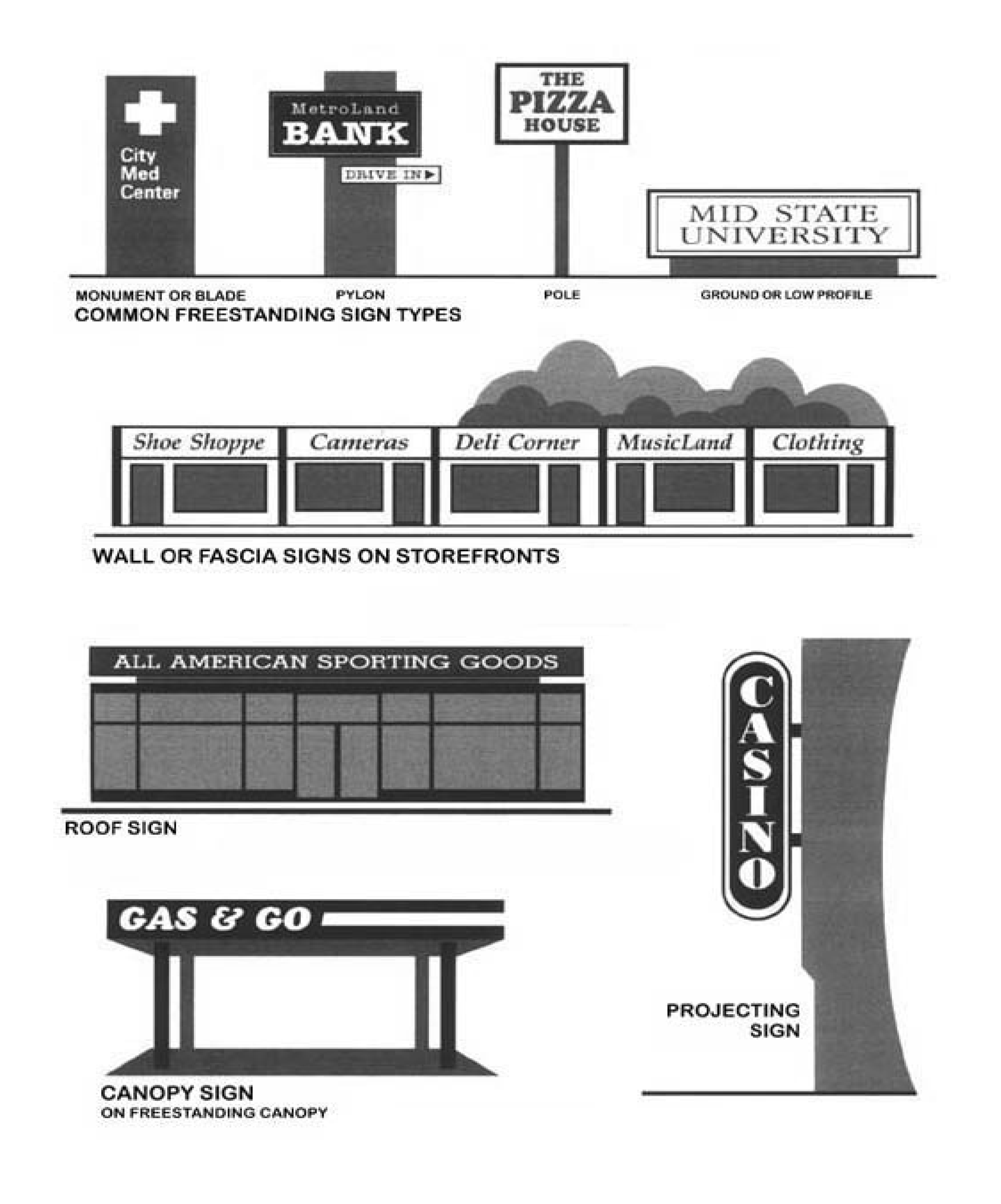
Sign Figure 14.32.11b - Computations
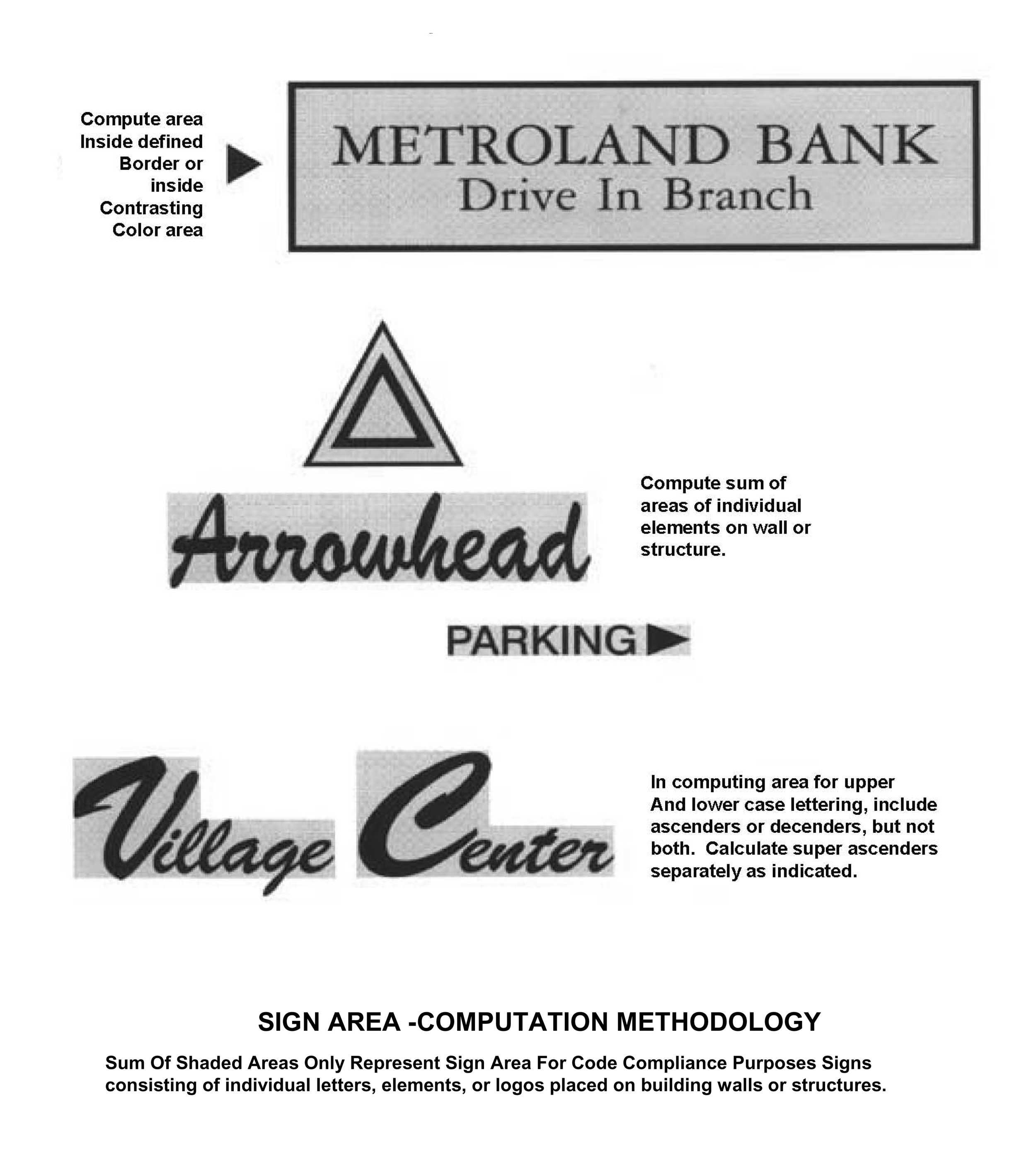
Sign Figure 14.32.11c COMPARISON - ROOF & WALL OR FASCIA SIGNS
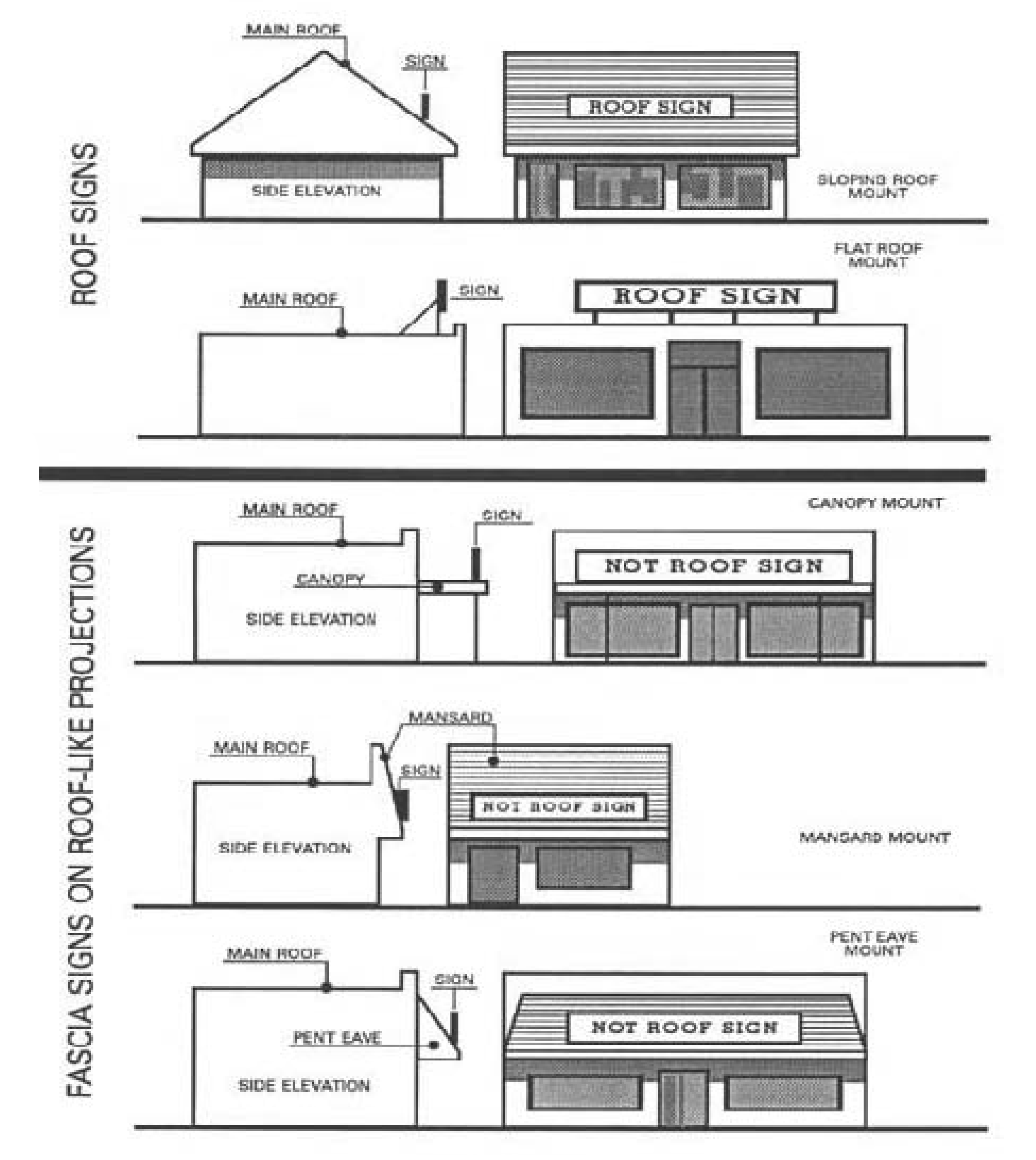
Sign Figure 14.32.11d: SIGN AREA - COMPUTATION METHODOLOGY
Sum of Shaded Areas Only Represent Sign Area
Signs constructed with panels or cabinets
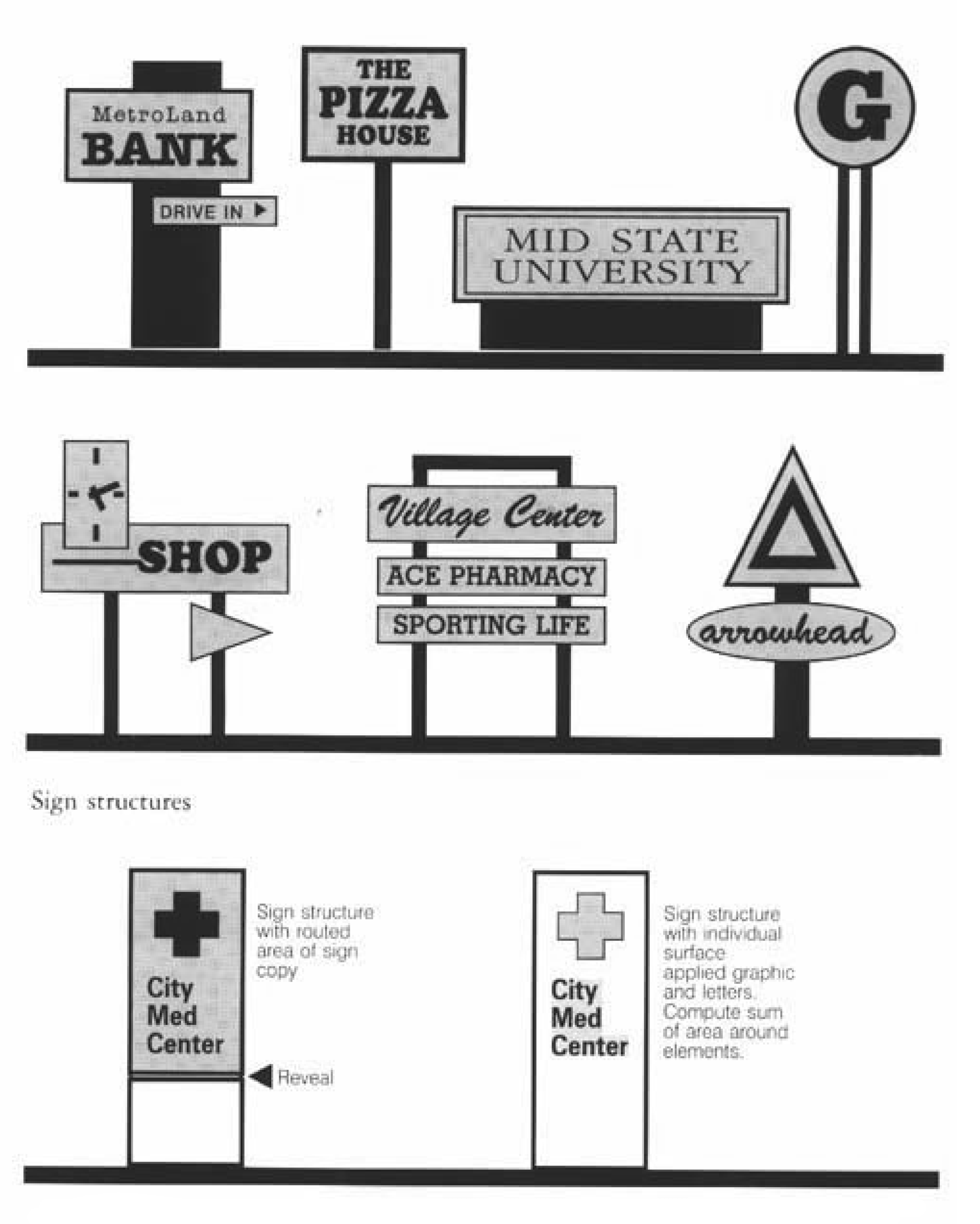
Sec. 117-285. - Purpose.
The purposes of the on-premises sign regulations are:
(1)
To encourage the effective use of signs as a means of communication in the city;
(2)
To maintain and enhance the aesthetic environment and the city's ability to attract sources of economic development and growth;
(3)
To eliminate, to the maximum extent feasible, clutter and to improve corridor visibility;
(4)
To improve pedestrian and traffic safety;
(5)
To minimize the possible adverse effect of signs on nearby public and private property; and
(6)
To ensure the protection of the public's first amendment rights.
(Zoning Ord., § 14.32.11.1)
Sec. 117-286. - Applicability.
(a)
The regulations contained within this division shall apply to all signs and to all zoning districts.
(b)
Unless otherwise provided by this division, all signs shall require a zoning certificate and a payment of fees. No zoning certificate is required for the maintenance of a sign.
(c)
Governmental/public/utilities and traffic signs are excluded from the scope of these regulations.
(Zoning Ord., § 14.32.11.2)
Sec. 117-287. - Compliance required.
(a)
It shall hereafter be unlawful for any person to erect, place, or maintain a sign in the city except in accordance with the provisions of these regulations.
(b)
All wiring, fittings, and materials used in the construction, connection and operation of electrically illuminated signs shall be in accordance with the provisions of the local electrical code in effect. Building permits may be required, verify permitting with the local building inspections department.
(c)
No sign of any classification shall be installed, erected, or attached to a structure in any form, shape, or manner that is in violation of the city's or state's building or fire codes.
(Zoning Ord., § 14.32.11.3)
Sec. 117-288. - Computations.
(a)
Principles. The following principles shall control the computation of sign area and sign height.
(1)
The area of individual signs. The area of a sign face, which is also the sign area of a wall sign or other sign with only one face, shall be computed by means of the smallest square, circle, rectangle, triangle, or combination thereof that shall encompass the extreme limits of the writing, representation, emblem, or other display, This measurement does not include any supporting framework, bracing, or decorative fence or wall when such fence or wall otherwise meets zoning resolution regulations and is clearly incidental to the display itself. See the following figure.
Figure 11.4.1: Examples of Measuring Sign Area
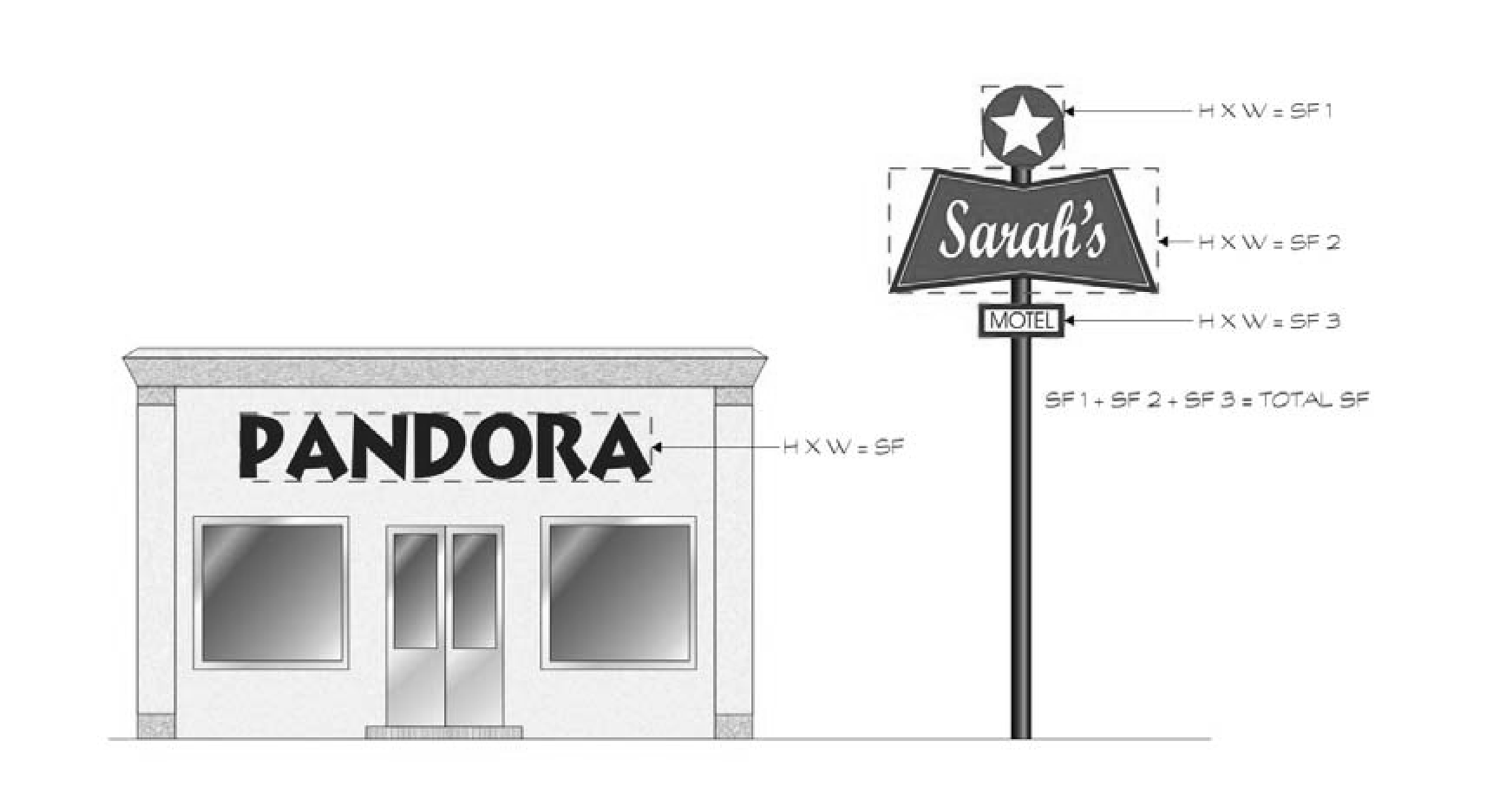
_____
(2)
The area of multifaced signs.
a.
The sign area for a sign with more than one face shall be computed by adding together the area of all sign faces visible from any one point. This methodology shall be utilized for banner signage face calculations also.
b.
When two identical sign faces are placed back to back, or in a V formation where the spread is not greater than the width of the face, so that both faces cannot be viewed from any one point at the same time, and when such sign faces are part of the same sign structure and are not more than 48 inches apart, the sign area shall be computed by the measurement of one of the faces.
c.
For cube signs or V-type signs with a spread greater than the width of the sign face where two faces may be viewed at the same point, the sign area shall be computed by the total measurement of both faces. (See sign figures in section 117-284)
(3)
Height. The height of a sign shall be computed as the distance from the crown of the fronting adjacent roadway to the top of the highest attached component of the sign. (See sign figures in section 117-284.)
(4)
Street/lot frontage. When a computation is based on the street or lot frontage, the longest street or lot frontage, and not the total street frontage, shall be used.
(Zoning Ord., § 14.32.11.4; Ord. No. 07.81, § 1, 7-3-2007)
Sec. 117-289. - Nonconforming signs.
(a)
Determination of legal nonconformity.
(1)
Existing signs that do not conform to the specific provisions of this division may be eligible for the designation of a legal nonconforming sign provided that they are not in violation of either of the following:
a.
The zoning administrator determines that such signs are properly maintained and do not in any way endanger the public or constitute a nuisance.
b.
The sign was covered by a valid permit or variance, or complies with all applicable laws on the effective date of the resolution from which this section is derived.
(2)
The owner may continue the use of a legal nonconforming sign provided the owner obtains a certificate of noncompliance from the city planning department within 90 days of the effective date of the resolution from which this division is derived.
(3)
Portable signs shall not be designated a legal nonconforming sign and shall be removed within 120 days of the effective date of the resolution from which this article is derived. Portable signs altered to be made nonportable shall still be considered to be portable.
(b)
Loss of legal nonconforming status. A legal nonconforming sign loses the legal nonconforming designation if:
(1)
The sign is relocated;
(2)
The sign is replaced for reasons other than vandalism or an act of God or other causes outside the influence of the owner or user.
(3)
The structure or size of the sign is altered in any way except towards compliance with this division. This provision does not refer to general maintenance, changeable marquees, or face and copy changes.
(4)
The sign is part of an establishment that discontinues its operation for a period of two years.
(c)
Maintenance and repair. The legal nonconforming sign is subject to all requirements of this division regarding safety, maintenance, and repair. However, if the sign suffers damage to an extent greater than 60 percent of the estimated replacement value, unless such damage was caused by vandalism or an act of God or other causes outside the influence of the owner or user.
(Zoning Ord., § 14.32.11.12; Ord. No. 07.81, § 1, 7-3-2007)
Sec. 117-290. - General sign standards.
(a)
Located in the right-of-way; obstructing vision or traffic.
(1)
No signs shall be placed in any public right-of-way except:
a.
Publicly owned signs, such as traffic control signs, city identification signs, and freestanding signs as permitted in section 117-292(a);
b.
Projecting, canopy, and awning signs may project over a public right-of-way if they are in conformity with all other applicable standards of this division.
(2)
No sign or other advertising structure as regulated by this division shall be erected:
a.
At the intersection of streets in such a manner as to obstruct free and clear vision; or
b.
At any location where, by reason of the position, shape or color, it may interfere with traffic, obstruct the view of traffic, or be confused with the use of words such as "stop," "danger," or any other word, phrase, symbol, or character in such a manner as to interfere with, mislead, or confuse traffic.
(b)
Illumination.
(1)
The light from any illuminated sign or from any light source shall be so shaded, shielded, or directed that the light intensity or brightness shall not adversely affect surrounding or facing residential districts, or adversely affect the safe vision and operation of vehicles moving on public or private roads, highways, or parking areas. Light shall not directly shine or reflect on or into residential structures.
(2)
Signs shall be subject to the outdoor lighting provisions of subsection (f) of this section (signs on awnings, canopies, fascia, or marquees) and other applicable regulations in this article.
(c)
Message changes.
(1)
Message changes are permitted and do not require a permit on any permitted or legal nonconforming sign with changeable copy. However, signs that flash intermittently are prohibited.
(2)
Signs having video capability shall be permitted, provided they changes at rate of 20 frames per second or less. This type of sign must be equipped with an auto dimmer that dims the brightness between dusk and dawn. These signs will be allowed in any zoning; however, they may not be located with 250 feet of a residential structure.
(3)
Signs shall not have moving or rotating mechanical parts that change position more often than every seven seconds. Signs that rotate continuously, 360 degrees, will be allowed provided they do not rotate at a rate of more than six rotations per minute.
(4)
Electronic information signs.
a.
Lighted electronic information signs whose only movement is the periodic changing of information against a solid background, shall be considered a changeable copy sign for the purpose of this division.
b.
Must be equipped with dimmers that will dim light intensity from dust to dawn.
c.
Any sign under this section shall meet all other zoning requirements.
d.
Electronic marquee signs shall be permitted but shall meet all zoning requirements regarding flashing and transitioning.
(d)
Address signs. All development shall have a sign providing the numeric address of the identification purposes to assist in fire and safety protection.
(e)
Required landscape area for signs.
(1)
Unless otherwise provided in this division, all monument type signs shall be located in a landscaped area with a minimum area equal to the total sign area. See figure in this subsection.
(2)
The landscape area for permanent freestanding signs shall consist of shrubs, flowers, sod and/or ground cover.
_____
Figure 11.5.5: Landscaping for Monument Signs
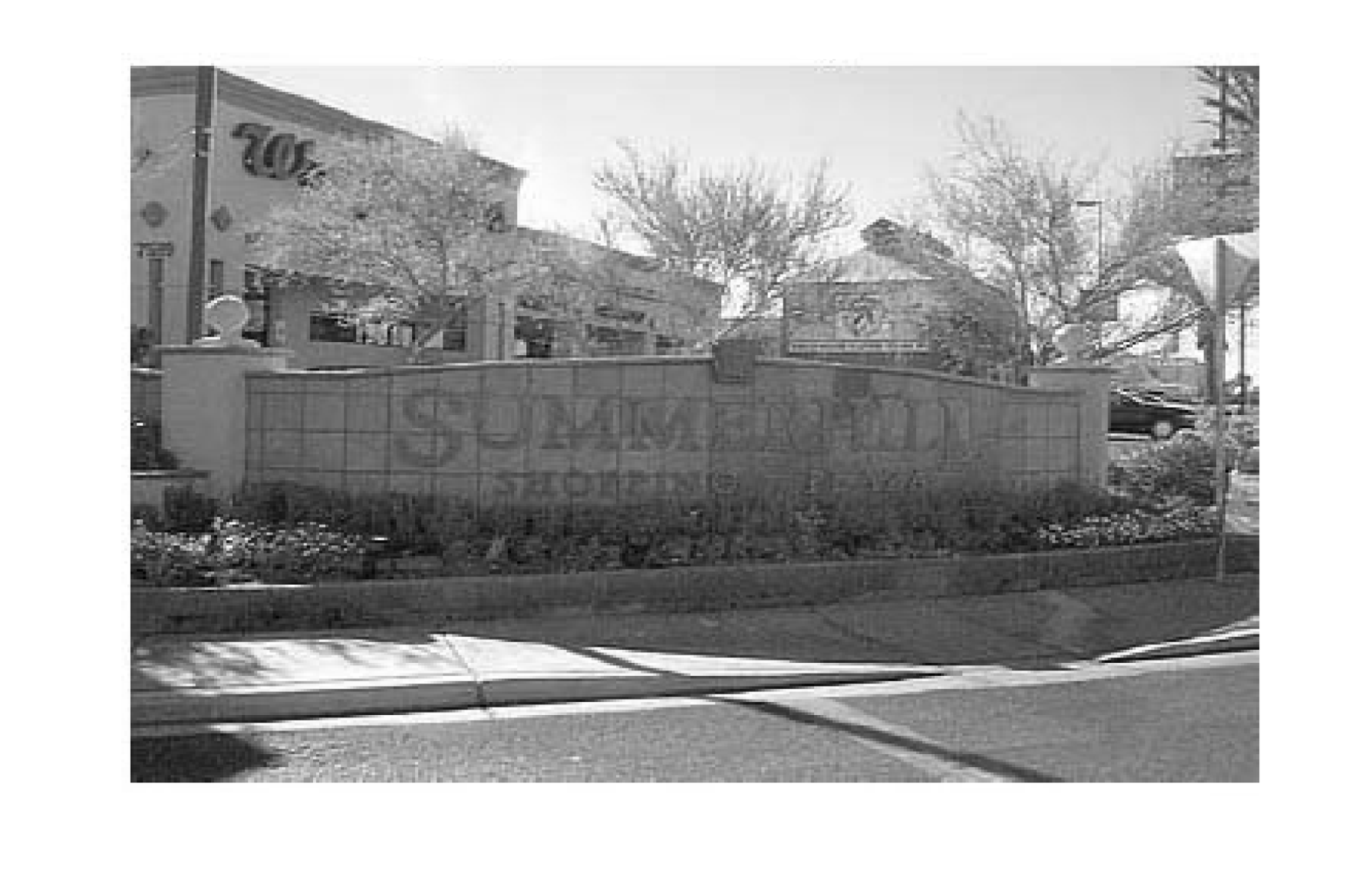
_____
(f)
Signs on awnings, canopies, fascia, or marquees.
(1)
Awnings, canopies, fascia, or marquees shall be designated as permanent parts of the building and shall meet all of the requirements of all applicable building and electrical codes.
(2)
Unless otherwise provided in this division, the sign area of the awning, canopies, fascia, or marquee shall be included as part of the wall sign area calculation.
(3)
In cases where the awning, canopy, fascia, or marquee is constructed of translucent material, is illuminated from within or behind the structure, and contains sign copy, the area of the sign copy shall be calculated in determining the sign area.
(g)
Wall signs. Wall signs excluding awnings shall not extend more than 12 inches as measured from the face of the building/parapet wall or extend above the roof of the structure, unless otherwise allowed within this division.
(Zoning Ord., § 14.32.11.5; Ord. No. 07.81, § 1, 7-3-2007)
Sec. 117-291. - Prohibited signs.
The following types of signs are prohibited in all districts:
(1)
Abandoned signs.
a.
Any sign now or hereafter existing that no longer advertises a commercial message for a bona fide business conducted on the premises or a product sold on the premises for a period of one year shall be deemed abandoned.
b.
Such a sign shall be taken down and removed or the face shall be changed as provided in subsection (1)c of this section by the owner, agent, or person having the beneficial use of the building or structure upon which the sign may be found within 30 days after notification to the owner from the zoning administrator.
c.
The face of the abandoned sign shall be replaced with a blank face so as to cover all internal light or structural systems or the existing face must be blanked out so that in no way may the previous message be read; otherwise, entire sign/structure must be removed.
d.
All signs shall be in conformance with section 117-295 regarding the maintenance of all signs.
(2)
No permanent sign shall contain or consist of banners, posters, pennants, ribbons, streamers, spinners, or other similar moving devices for the purpose of advertising or attracting attention for commercial or advertising purposes except to cover existing signs when faces must be changed immediately to allow time to produce and install the permanent faces or where otherwise permitted in this division;
(3)
Air activated graphics or balloons used for commercial or advertising reasons shall not be permitted except where otherwise permitted in this division;
(4)
Signs placed on vehicles or trailers that are parked or located for the primary purpose of displaying such signs. This provision does not apply to portable signs or lettering on buses, taxis, or vehicles operating during the normal course of business;
(5)
Signs imitating or resembling official traffic or governmental signs or signals;
(6)
No person shall display upon any sign or other advertising structure any obscene, indecent, or immoral matter;
(7)
Signs that consist of lights that revolve or flash are prohibited in all districts with the exception of electronic information signs. The following sign types shall also be prohibited unless otherwise permitted in this article:
a.
Bench signs, excluding publicly owned bus shelters.
b.
Portable signs* or portable black signs;
c.
Snipe signs;
d.
Graffiti; or
e.
Roof signs.
*Freestanding real estate, election signs shall be excluded from this provision.
(Zoning Ord., § 14.32.11.6; Ord. No. 07.81, § 1, 7-3-2007)
Sec. 117-292. - Signs not requiring a zoning certificate.
The following sign types shall be exempted from permit requirements but shall be in conformance with all other requirements of this division:
(1)
Signs conforming with the Manual of Uniform Traffic Control Devices and bearing no commercial message. Beautification award signs shall be exempt from zoning certificate permit requirements, however permission must be granted by the city;
(2)
Signs bearing no commercial message and installed by employees or officials of a city department, state or federal agency in the course of their governmental duties for identification, safety and traffic control purposes;
(3)
Signs required by a city, state or federal statute;
(4)
Signs required by an order of a court of competent jurisdiction;
(5)
Signs installed by public utilities in their rights-of-way or on their facilities and bearing no commercial message other than such message is necessary to identify the use;
(6)
Signs installed by a transit company with a franchise or other right to operate in the city, where such signs are installed along its routes and relate to schedules or other information about the transit route;
(7)
Certain temporary signs as regulated by section 117-294;
(8)
Permanent freestanding sign on a lot that is considered agricultural land based on the definitions in section 117-2 and provided the sign meets the following requirements:
a.
Such sign shall be located a minimum of 15 feet from a right-of-way.
b.
The maximum sign area shall be 32 square feet.
c.
The maximum sign height shall be six feet.
(9)
One nonilluminated wall sign of two square feet or less in a residential zoning district as part of a home occupation permitted pursuant to section 117-226(2);
(10)
Commemorative plaques placed by recognized historical agencies;
(11)
Mailbox identification when such is an integral part of such mailbox;
(12)
Warning signs including no hunting, no trespassing, keep off grass, no dumping, or signs of a similar nature provided that they do not exceed two square feet in area;
(13)
Window signs. The window signs shall be so located as to allow clear visibility into the building for the purposes of fire and police protection;
(14)
Beautification award signage bearing the name/logo of the award recipient and/ or sponsor without further advertisement of the commercial business.
(Zoning Ord., § 14.32.11.7; Ord. No. 07.81, § 1, 7-3-2007)
Sec. 117-293. - Permanent on-premises signs.
(a)
Signs permitted in any residential zoning district. The following on-premises signs may be permitted in an RS-1, RS-2, RS-3, RS-4, RS-5, RS-6, RS-7, RS-8, or PD-R districts:
(1)
All signs not requiring a zoning certificate pursuant to section 117-292;
(2)
Permanent freestanding signs for a subdivision, open space residential development, multifamily dwelling, public/institutional use, or commercial enterprise permitted in a residential zoning district, kennel, riding stable, etc., provided that the signs meet the following requirements (See figure in this section):
a.
Two permanent freestanding signs may be permitted, by zoning certificate, at each development entrance along a city or state road;
b.
The signs shall be ground monument mounted signs;
Figure 11.8.1: Development Sign

c.
The signs shall be set back 15 feet from the public right-of-way;
d.
Subdivision median monument signage may be reviewed and approved by the city street superintendent as a revocable permit which may be subject toremoval and relocation at the owner's expense if future city right-of-way projects cause such action;
e.
The maximum sign area for each sign shall be 150 square feet in area;
f.
No such sign or any portion of the structure shall exceed ten feet in height; and
g.
The sign may only be illuminated through external lighting.
(3)
Permitted public and institutional uses may be permitted to have one permanent freestanding sign per street frontage in a residentially zoned area provide the sign meets the following requirements:
a.
The sign shall be a ground mounted sign;
b.
The signs shall be set back a minimum of ten feet from the edge of street pavement/back of curb or off the street right-of-way, whichever is the greater setback;
c.
The sign shall have a maximum sign area of 75 square feet in area;
d.
No such sign or any portion of the structure shall exceed 15 feet in height; and
e.
The sign may only be illuminated through external lighting unless the applicant demonstrates that an internal illuminated sign will not spill lighting on residential abutting properties, satisfying section 117-290(b).
(b)
Signs permitted in any C-4 or CR-1 district. The following on-premises signs may be permitted in a C-4 or CR-1 district:
(1)
All signs not requiring a zoning certificate pursuant to section 117-292;
(2)
All signs shall be set back a minimum of ten feet from the edge of street pavement/back of curb or off the street right-of-way, whichever is the greater setback. In no location shall signage or sign structural parts be placed within the public right-of-way, unless otherwise authorized by this chapter;
(3)
Temporary signs pursuant to section 117-294;
(4)
Ground-mounted signs. One permanent ground mounted sign per parcel, lot, or site per street frontage, if on street corner totals may be combined with maximum height and size restrictions below satisfied, subject to the following requirements:
a.
The height of the sign shall not exceed ten feet.
b.
The maximum sign area for a single occupant building shall be equivalent to one square foot for each lineal foot of frontage, but shall not exceed 100 square feet. For each additional business or occupant, an additional 20 square feet will be allowed with area not to exceed 300 square feet.
(5)
Wall signs.
a.
Wall signs may be permitted up to a total square footage equal to 12 percent of the building facade area which the tenant occupies. These signs may be place on any walls desired by the tenant.
b.
Buildings located on a corner lot may be permitted to add the total of all frontages to come up with the maximum size for all signs.
c.
Incidental awnings bearing supplemental direction/identification shall be permitted for automatic teller machines, drive through and other protected entrances.
(6)
Secondary advertising display signs. Permanent freestanding signs in a C-4, C-5, CR-1 district under the following provision:
a.
The maximum height shall be six feet unless they are attached to a building as a wall sign in which case they shall not be attached in a manner as to exceed the height of the structure or unless otherwise allowed in this division.
b.
A maximum of two secondary advertising display signs are permitted on each property per street frontage provided they are 24 square feet or smaller in sign area and they are spaced no closer than 150 feet from another secondary advertising display sign.
c.
Drive-thru signage that is not meant to be read from the main road access shall be exempt from this requirement.
d.
Sign frame must be made from a rigid material and installed by means of direct embedded poles. The sign face shall be a rigid material or a banner material as per section 117-294(c)(5).
e.
Signs may only be single-sided or back to back. No V-type sign or other formation.
(c)
Signs permitted in any C-1, C-2, C-3, I-1, I-2, PD-B, PD-I, or PD-M district. The following signs may be permitted in a C-1, C-2, C-3, I-1, I-2, PD-B, PD-I, or PD-M district:
(1)
Not requiring zoning certificate. All signs not requiring a zoning certificate pursuant to section 117-292;
(2)
Temporary signs. Temporary signs pursuant to section 117-294;
(3)
Setback requirements. The signs shall be set back a minimum of ten feet from the edge of street pavement/back of curb or off the street right-of-way, whichever is the greater setback;
(4)
Freestanding signs. One freestanding pole or ground-mounted sign shall be permitted per parcel, lot, or site; or one per frontage on corner lots subject to the following requirements:
a.
The height of the sign shall be determined by the width of the street frontage as shown in the following chart:
b.
The maximum sign area for a single occupant building shall be equivalent to one square foot for each lineal foot of frontage, but shall not exceed 150 square feet. For each additional occupant, an additional 20 square feet will be allowed, but not to exceed 400 square feet.
(5)
Freestanding driveway directional signs. Permanent freestanding signs in a C-1, C-2, C-3, C-4, CR-1, I-1, I-2 or a PD-R or PD-C district under the following provisions:
a.
The sign shall be located within ten feet of the intersection of a public street and a private driveway;
b.
The sign may contain company logo/identifiers but must have the overall intent/content of direction;
c.
The maximum sign area shall be eight square feet in area;
d.
The maximum sign height shall be four feet;
e.
Vehicular vision obstruction cases may be waived to achieve maximum eight feet in height, located ten feet outside of public right-of-way; and
f.
Downtown district (C-1) freestanding shall be exempt from right-of-way setback requirements; however an encroachment permit shall be required. The administrator or superintendent of streets may require that sign be placed at or outside of right-of-way.
(6)
Secondary directional driveway signs. Permanent freestanding signs in a C-1, C-2, C-3, I-1, I-2 or a PD-C district under the following provisions:
a.
The sign shall be located within ten feet of the intersection of a public street and a private driveway and shall be located one foot outside of the public right-of-way;
b.
One sign may be permitted per individual driveway;
c.
The maximum sign height and sign area will be determined by its distance from the main identification sign as follows:
1.
If the secondary identification sign is 400 feet or more in distance from main identification sign, the maximum height shall be eight feet and the maximum sign area shall be 100 square feet.
2.
If the secondary identification sign is less than 400 feet in distance from the main identification sign, the maximum height shall be five feet and the maximum sign area shall be 50 feet square feet.
3.
Downtown district (C-1) freestanding shall be exempt from right-of-way setback requirements; however an encroachment permit shall be required. The administrator or superintendent of streets may require that the sign be placed at or outside of right-of-way.
(7)
Secondary advertising display signs. Permanent freestanding signs in a C-1, C-2, C-3, I-1, I-2 or a PD-C district under the following provision:
a.
The maximum height shall be six feet unless they are attached to a building as a wall sign in which case they shall not be attached in a manner as to exceed the height of the structure or unless otherwise allowed in the division.
b.
A maximum of two secondary advertising display signs are permitted on each property per street frontage provided they are 24 square feet or smaller in sign area and they are spaced no closer than 150 feet from another secondary advertising display sign.
c.
Drive-thru signage that is not meant to be read from main road access shall be exempt from this requirement.
d.
Sign frame must be made from a rigid material and installed by means of direct embedded poles. The sign face shall be a rigid material or a banner material as per section 117-294(c)(5).
e.
Signs may only be single-sided or back to back. No V-type sign or other formation.
Figure 11.8.3: High-Rise Sign Location Limit
(Allowed within shaded area only)
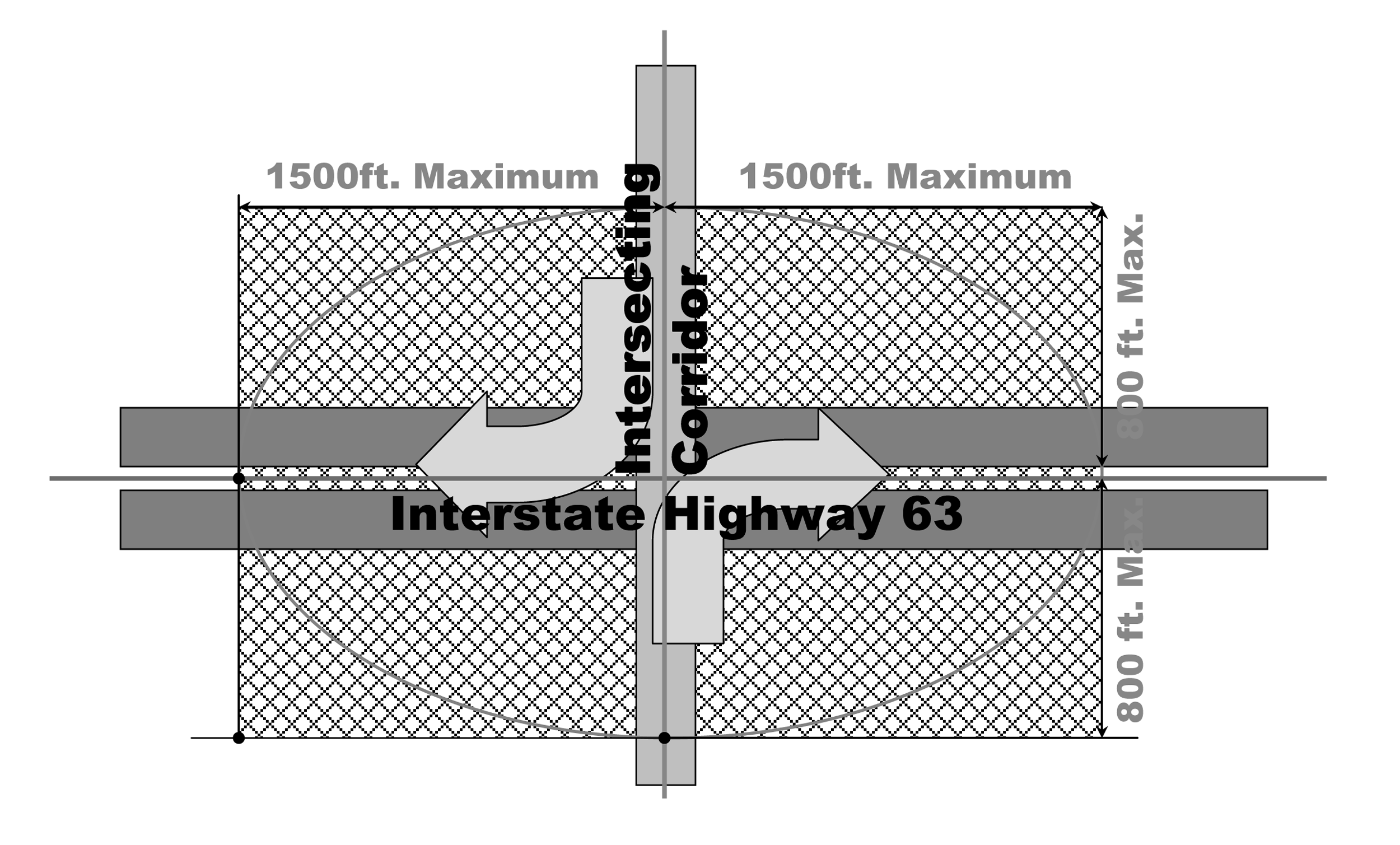
(8)
High rise signs. One high-rise pole sign is permitted on each lot located in the C-3 commercial district within a radius of 1,500 feet parallel to the intersecting corridor and Interstate 63 and within a radius point of 800 feet running parallel to Interstate 63 (See the figure in this section). All such signs shall be subject to the following, unless sign size and height fits the requirements for freestanding signs in subsection (c)(4) of this section.
a.
A zoning and building permit shall be required.
b.
All high-rise pole signs shall have a maximum height of 75 feet.
c.
The maximum sign area shall be 300 square feet.
d.
Setback shall be the same as for ground and pole signs.
(9)
Wall signs.
a.
Wall signs may be permitted up to a total square footage equal to 12 percent of each building wall face area which the tenant occupies for business/commercial with a maximum 350 square feet in area/size. Industrial zoning maximum sign area shall be 15 percent of the building wall face area with a maximum 1,000 square feet area/size.
b.
Incidental awnings bearing supplemental direction/identification shall be permitted for automatic teller machines, drive through and other protected entrances.
(Zoning Ord., § 14.32.11.8; Ord. No. 07.81, § 1, 7-3-2007)
Sec. 117-294. - Temporary signs.
(a)
General standards for all temporary signs.
(1)
No temporary sign shall be mounted, attached, affixed, installed or otherwise secured so as to protrude above the roof or extend above a parapet wall.
(2)
No temporary sign that is eight square feet or less in size shall be illuminated by anything other than nonreflected daylight, except by variance issued by the board of zoning adjustment.
(3)
Temporary signs shall be set back as follows:
a.
A minimum of ten feet from the edge of street pavement/back of curb or off the street right-of-way, whichever is the greater setback;
b.
A minimum of 20 feet from all lot lines adjacent to a residential use or residential zoning district;
c.
A minimum of five feet from all other property lines; and
d.
A minimum of five feet from any other temporary sign.
(4)
Use of temporary displays on days without approval by zoning certificate, when required, or beyond the stated date of approval, when applicable, shall be deducted from the allotted number of days.
(5)
Violations of zoning regulations applying to temporary signs shall be corrected within 24 hours of written notification of the violation.
(b)
Temporary signs permitted in a residential zoning district. This subsection addresses permitted temporary signs in a RS-1, RS-2, RS-3, RS-4, RS-5, RS-6, RS-7, RS-8, RM-4, RM-6, RM-8, RM-12, RM-16, or PD-R district.
(1)
The maximum height of all temporary signs in a residential district shall be seven feet. Exception; See subsection (b)(4) of this section for signage attributed to construction signage.
(2)
A maximum of five temporary signs are permitted on each property, during construction or remodeling, provided they are six square feet or smaller in sign area. After construction or remodeling is complete all such signs shall be removed within 14 days, except for sale, lease or rent sign per street frontage. These signs may remain for a period not to exceed 90 days after the property has sold or has been leased or rented. Such signs shall not require a zoning certificate or payment of a fee. The maximum height of all temporary signs in a residential district shall be seven feet.
(3)
A maximum of two temporary signs are permitted on each street frontage for a period up to 60 days; provided the signs are less than six square feet and they do not contain a commercial message. Such signs shall not require a zoning certificate or payment of a fee. The maximum height shall be seven feet.
(4)
Temporary signs greater than six square feet in size may be permitted under the following provisions:
a.
The owner of the property where the sign will be located applies for, and receives a zoning certificate for the sign;
b.
There shall be a limit of one sign with a maximum of two sides per single lot per street frontage and such signs shall not exceed the following maximum square footage:
1.
Lots one acre or less, 16 square feet.
2.
Lots larger than one acre, 32 square feet.
3.
The maximum height shall be seven feet.
c.
Signs larger that 32 square feet shall be allowed to announce the development and the sale of lots within a subdivision. There may be one sign per entrance and these signs shall not exceed the following maximum square footage:
1.
Developments less than five acres permitted, 32 square feet;
2.
Developments five acres or more, but less that ten acres permitted, 64 square feet;
3.
Developments ten acres or more permitted, 96 square feet; or
4.
The maximum height of 12 feet.
d.
The sign shall not be illuminated unless authorized by the board of zoning adjustment through the variance process;
e.
The time limit for the zoning certificate shall comply with the following:
1.
A temporary sign under this section may be posted during construction and/or development of the subject property without a specific time limit. The sign shall be removed within 14 days of completion of construction or development.
2.
A temporary sign for the purpose of selling, renting or leasing the site may remain for a period up to 30 days after the property has been sold, leased or rented.
3.
All other temporary signs under this section shall be displayed for not more than 30 days per zoning certificate, and not to exceed 90 days per year.
(5)
Public and institutional uses in a residential district may be permitted to have one additional temporary sign with a commercial message, without apply for a zoning certificate or paying a fee, under the following provisions:
a.
Such sign shall not exceed 32 square feet per side with a maximum of two sides;
b.
The sign shall not be illuminated unless authorized by the board of zoning adjustment through the variance process;
c.
The sign may be permitted for a maximum of two periods in a calendar year not to exceed 45 days each period;
d.
A minimum of 30 days between each 45-day period is required;
e.
Golf tournament signs are permitted without regulations on size or quantity, but only for a period not to exceed seven days and notification must be given to the planning office before installation.
(c)
Temporary signs permitted in a mixed use or nonresidential zoning district. This subsection addresses permitted temporary signs in a C-1, C-2, C-3, C-4, CR-5, CR-1, I-1, I-2 or a PD-C, PD-1, or PD-M district.
(1)
The maximum height of all temporary signs shall be 12 feet unless they are attached to a building as a wall sign in which case they shall not be attached in a manner as to exceed the height of the structure or unless otherwise allowed in this division.
(2)
A maximum of four temporary signs that are meant to be read from the roadway are permitted on each property provide they are 32 square feet or smaller in sign area and they are spaced no closer than 150 feet from another temporary sign. Such signs shall not require a zoning certificate or payment of a fee. Signs that are not meant to be read from the roadway are exempt from the 150 feet spacing regulation.
(3)
Temporary signs or special event signage greater than 32 square feet in area may be permitted under the following provisions:
a.
The owner of the property where the sign will be located applies for, and receives a zoning certificate for the sign;
b.
There shall be a limit of one sign per premises per frontage and such sign shall not exceed the following square feet per side with a maximum of two sides:
1.
Lots on less than five acres, 128 square feet.
2.
Lots five acres or larger, 360 square feet.
c.
The time limit for the zoning certificate shall comply with the following:
1.
A temporary sign under this section may be posted during construction and/or development of the subject property without a specific time limit. The sign shall be removed within 14 days of completion of construction or development.
2.
A temporary sign for the purpose of selling, renting or leasing the site may remain for a period up to 30 days after the property has been sold, leased or rented.
3.
All other temporary signs under this section shall be displayed for not more than 30 days per zoning certificate, and not to exceed 90 days per year.
(4)
Temporary signs consisting of banners, pennants, ribbons, streamers, spinners may be permitted in addition to other signs permitted as part of this division provided they meet the following requirements except for pole pocket banner described in subsection (c)(5) of this section:
a.
A zoning certificate shall be required for a banner sign or similar special event sign.
b.
The signs may be permitted for a maximum of four periods in a calendar year not to exceed 60 days each period.
c.
A minimum of 30 days between each 60-day period is required.
d.
Any certificate issued in the same calendar year as provided in subsection (c)(4)b of this section shall count as one of the four 60-day periods permitted in this section.
e.
Only one banner sign or one special event sign per use and per street frontage shall be used at a time.
f.
The maximum sign height shall be 12 feet.
g.
Lettering on banners shall be silk-screened, stenciled, created with vinyl letters or sewn into the fabric or material.
h.
All signs are subject to the minimum setback requirements of temporary signs.
(5)
Pole pocket banners may be permitted in addition to other signs as described in this subsection.
a.
Banners shall have pole pockets on at least two sides.
b.
Banners shall be mounted to permanent structures or poles by means of rods thru the entire length of the banner pocket.
(d)
Downtown core signage standards. All signs erected, maintained or located in the downtown core area (C-1), shall comply with the provisions described herein. In circumstances where said provisions do not address a particular aspect of signage, this division will take precedence. No sign shall be erected or altered before acquiring a sign permit. Moreover, no sign permit shall be issued for any additional sign or alterations to existing signs until all signs on the property or development conform to said provisions.
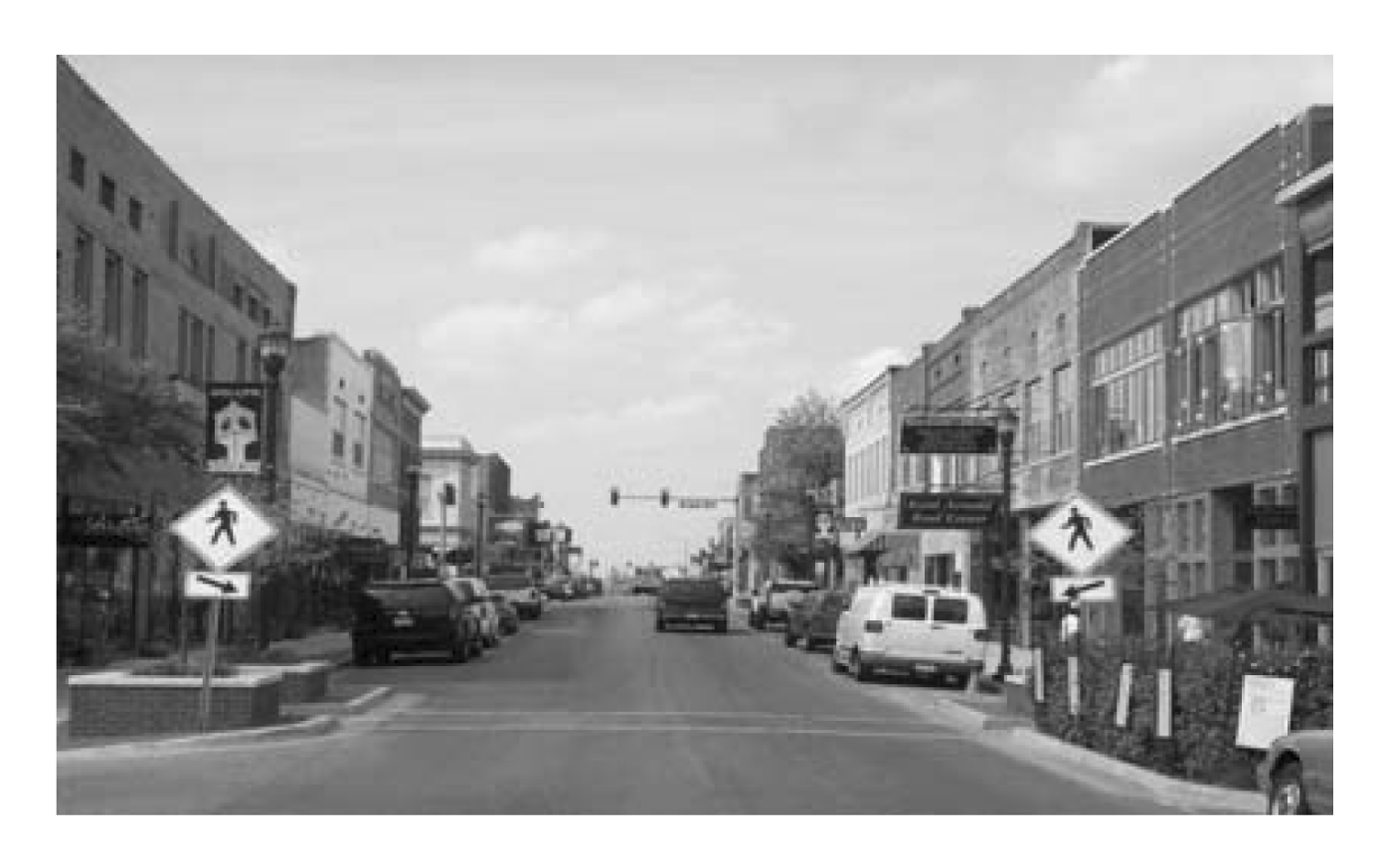
(1)
Signage types permitted. The types of signs permitted in the downtown core area will be limited to wall signs, temporary signs, hanging signs, and logo signs. Awnings and monument signs will also be permitted. Illuminated signs will be permitted and shall conform with this article. Following are restrictions for each sign type:
a.
Wall signs. Wall signs shall not exceed 12 percent of the exposed area of the wall on which they are located. Said 12 percent also to include valance, permanent window signs and temporary signs. Maximum allowable sign area shall be 350 square feet.
b.
Hanging signs. Hanging signs will be limited to 18 square feet in area and will be attached to the building. Material used for fastening or supporting hanging signs will be restricted to metals with porcelain enamel, stainless steel, brass or bronze finish. For adequate clearance, hanging signs will be placed no lower than eight feet above grade. Those signs projecting over publicly owned rights-of-way shall require an encroachment permit.
c.
Temporary signs. Temporary signs shall not exceed ten percent of the window.
d.
Monument signs. Monument signs shall be allowed but must satisfy the requirements of section 117-293(c).
(2)
Signage types not permitted. The following types of signs will be prohibited in the downtown core area (C-1):
a.
Ground/pole signs.
b.
Roof signs or any type of sign which is placed above the apparent flat roof or eaves of a building.
c.
External rotating, moving, flashing, changing, blinking signs.
d.
Permanent signs will be for business identification only; brand names or product advertising are not permitted.
e.
Permanent signs will not cover windows, building details, trim, roof or tower over the building.
(3)
Signage area. Total sign area allotment permitted will be one and one-half square feet of sign for each linear foot of qualified street frontage with a minimum allowance of 25 square feet. Maximum height of letters will be restricted to 18 inches; maximum height of letters on canvas awnings will be limited to ten inches. Business identification shall not exceed two feet, six inches.
(4)
Second story signage. Where office lease space occurs on a second level, signage will be allowed for building identification. Window signs consisting of lettering only shall be allowed for business identification. Letters can be no higher than six inches. On a parapet or windowless wall, signage may include representational graphics, symbols or logos not to exceed 16 square feet in area. This will not be counted as part of the allowable sign footage.
(Zoning Ord., § 14.32.11.10; Ord. No. 07.81, § 1, 7-3-2007)
Sec. 117-295. - Maintenance.
(a)
All on-site advertising signs as herein permitted shall be constructed and maintained and illuminated in a safe manner, comply with applicable codes and kept in good repair.
(1)
Signs shall be free from rust, dust, dirt, and other such debris.
(2)
Exposed surfaces shall be clean and painted if paint is required.
(3)
Defective parts shall be replaced.
(4)
Anytime a lighted sign has the face remove overnight the power must be disconnected.
(5)
Signs shall not be left without a face more than a three-month period.
(6)
The zoning administrator shall have the right to order the repair or removal of any sign that is defective, damaged, or substantially deteriorated.
(7)
See section 117-291(1), pertaining to abandoned signs.
(b)
Should any sign be or become unsafe or be in danger of falling, the owner, tenant, or lessee shall, upon receipt of written notice from the zoning administrator, proceed at once to correct the unsafe condition and/or remove the sign in question.
(c)
Signs shall not be constructed, maintained, and/or illuminated in such a manner as to create or allow the obstruction of vision of drivers, pedestrians, or the general public, or create a fire or safety hazard. Signs shall be subject to the vision clearance regulations of section 117-327 corner visibility, vision clearance triangle.
(Zoning Ord., § 14.32.11.11; Ord. No. 07.81, § 1, 7-3-2007)

