
Jonesboro City Zoning Code
ARTICLE VIII
OTHER STANDARDS AND REQUIREMENTS
Sec. 117-324.- Off-street parking and loading.
(a)
Applicability. Off-street parking and loading shall be provided in accordance with the regulations of this section for all new development, and for any existing development that is altered in a way that enlarges or increases capacity by adding or creating dwelling units, guest rooms, floor area or seats.
(b)
Parking and loading schedules.
(1)
Off-street parking schedule A. Off-street parking spaces shall be provided in accordance with the following off-street parking schedule (schedule A), provided that there shall be no minimum off-street parking requirement for uses located in the C-1 district. In some cases, the applicable off-street parking space requirement in schedule A refers to schedule B.
(2)
Number of spaces required. The number of parking spaces required for a use not listed herein shall be the same as for a similar use which is listed. Where the required number of spaces cannot be ascertained by this method, or the applicant and the city staff cannot agree, the matter shall be submitted to the planning commission for determination.
(3)
Approval. Such determination shall be subject to appeal to the city council.
_____
Schedule A
(4)
Off-street parking schedule B. Off-street parking for schedule B uses shall be provided in accordance with the following table:
Schedule B
(5)
Off-street loading schedule. Off-street loading spaces shall be provided in accordance with the following minimum standards:
Off-Street Loading Schedule
(c)
Computing off-street parking and loading requirements.
(1)
Multiple uses. Lots containing more than one use shall provide parking and loading in an amount equal to the total of the requirements for all uses.
(2)
Fractions. When measurements of the number of required spaces result in fractions, any fraction of one-half or less shall be disregarded and any fraction of more than one-half shall be rounded upward to the next highest whole number.
(3)
Area. Unless otherwise noted in the provisions, all square footage-based parking and loading standards shall be computed on the basis of gross floor area.
(4)
Employees, students and occupant-based standards. For the purpose of computing parking requirements based on the number of employees, students, residents or occupants, calculations shall be based on the largest number of persons working on any single shift, the maximum enrollment or the maximum fire-rated capacity, whichever is applicable and whichever results in the greater number of spaces.
(5)
American's With Disability Act Requirements (ADA). Pursuant to Federal ADA standards, a portion of the total number of required off-street parking spaces in each off-street parking area shall be specifically designated, located and reserved for use by person with physical disabilities. Responsibility for compliance, in all respects, shall rest with the applicant.
(d)
Location and design of off-street parking and loading spaces.
(1)
On-site. Except as otherwise specifically provided, required off-street parking and loading spaces shall be located on the same lot as the principal use.
(2)
Right-of-way. Off-street parking spaces shall be prohibited within the public right-of-way; and no portion of the abutting street right-of-way shall, except for the driveway, shall be paved or used in any manner except as green area.
(3)
Setbacks.
a.
In single districts, required off-street parking shall not be located within a street setback. Parking in excess of the required number of spaces is allowed in the street setback, but not off the driveway, and not in a manner which obstructs sidewalks or visibility.
b.
Where parking is to be provided in the street setback of a multifamily dwelling, there shall be established a setback line of ten feet. The area between the setback line and the front lot line shall be prepared and planted with grass, shrubs, trees, or ground cover not inconsistent with other landscaping provisions contained herein, and protected by interior curbing.
c.
In all commercial and industrial districts, required parking is allowed within the street setback.
(4)
Ingress and egress. Off-street parking and loading spaces shall be designed to permit exiting vehicles to enter the public right-of-way in a forward motion. No off-street parking or loading space shall be allowed that requires vehicles to back onto a public right-of-way, except single-family and duplex residential development on local and collector streets.
(5)
Surfacing. All required off-street parking and loading spaces, and the driveways serving off-street parking and loading spaces, except seasonal or event parking, shall be paved with asphalt, concrete or brick; provided driveways serving single-family dwellings shall only be required to pave the first 100 feet, as measured from the street. The area of the driveway from the edge of the street to the property line shall be paved.
a.
For seasonal or event parking, developers may propose alternative materials, methods, and designs in accordance with the U.S. Green Building Council, Leadership Energy and Environmental Design (LEED) voluntary rating system. Such proposals must include documented evidence from professional engineers, architects, or environmental planners demonstrating the effectiveness of the proposed alternative materials, methods, and designs in meeting the intent and purpose of these regulations. Any such proposals must be specifically approved by the city engineer. However, aggregate, chip and seal, or pea gravel and seal surfaces shall not be permitted.
(6)
Drainage. All off-street parking and loading areas shall be designed with drainage facilities adequate to dispose of all stormwater, and to not increase the stormwater runoff onto the surface of adjoining properties or streets.
(7)
Curbing. The perimeter of all off-street parking and loading areas and their access drives shall be curbed, with the exception of single-family, duplex, triplex and fourplex residences. Landscape islands and other interior features within parking lots shall also be protected by curbs. The area between the curb and the property line, except for the driveway, shall be maintained as green space.
(8)
Striping. Off-street parking areas containing five or more spaces shall be delineated by pavement striping.
(9)
Parking space dimensions. Off-street parking spaces shall contain a minimum area of at least 180 square feet, with a minimum width of nine feet and a minimum length of 18 feet.
(10)
Loading space dimensions. Off-street loading spaces shall be at least 14 feet by 45 feet in size, with a minimum 18-foot height clearance.
(11)
Aisle dimensions. Drive aisles within off-street parking lots shall comply with the following minimum width requirements:
(12)
Timing of construction. All required parking and loading spaces, driving aisles, and accessways shall be constructed prior to the issuance of a certificate of occupancy, provided that a temporary certificate of occupancy may be issued by the inspection department if it is determined, based on information provided by the applicant, that inclement weather or other factors beyond the control of the applicant have prevented compliance with this timing requirement. Before approval of a temporary certificate of occupancy, the parking area subgrade, stone base, shall be compacted in accordance with the city's construction standards. The temporary certificate of occupancy shall expire at the end of 120 days or within such shorter time-frame specified by the inspection department at the time of approval of the certificate.
(13)
Use of off-street parking and loading spaces. Required off-street parking spaces shall be used solely for the parking of motor vehicles in operating condition, and shall not be used for the storage of vehicles, boats, motor homes, campers, mobile homes, materials, tractor trailers or other temporary storage unless they are located in a designated staging area and are screened, fenced or otherwise fully shielded from public view.
(e)
Off-site parking. Required off-street parking shall be located on the same lot as the use it is intended to serve, provided that a portion, not to exceed 25 percent, of the required off-street parking spaces may be located on a remote and separate lot from the lot on which the principal use is located, if the off-site parking complies with the following standards.
(1)
Ineligible activities. Off-site parking shall not be used to satisfy the off-street parking standards for residential uses, restaurants, convenience stores, or other convenience-oriented uses.
(2)
Location. No off-site parking area shall be located more than 80 feet from the required parking lot of the use served, unless a shuttle service is provided. Distance shall be measured along the shortest legal, practical walking route.
(3)
Zoning classification. Off-site parking areas shall require the same or a more intensive zoning classification than that required for the use served.
(4)
Agreement for off-site parking. In the event that an off-site parking area is not under the same ownership as the principal use served, a written agreement shall be required. An attested copy of the agreement between the owners of record shall be submitted to the zoning official for recording. In addition, whether under the same ownership or not, a legal document to prevent development of the off-site parking area shall be executed and recorded. Recording of the agreement shall take place before issuance of a building permit for any use to be served by the off-site parking area or in the case of an existing building, prior to issuance of a certificate of occupancy.
(f)
Shared parking. The zoning official, subject to appeal to the planning commission, may authorize a reduction in the number of required parking spaces for multiple use developments and for uses that are located near one another that have different peak parking demands and operating hours. Shared parking shall be subject to the following standards.
(1)
Location. Shared off-street parking spaces shall be located no further than 500 feet from the building and uses they are intended to serve unless shuttle service is provided.
(2)
Study. An acceptable parking study shall be submitted which clearly established that uses will make use of the shared spaces at different times of the day, week, month or year.
(3)
Agreement. A shared parking plan shall be enforced through written agreement. Proof of recording of the agreement shall be presented prior to issuance of a building permit.
(4)
Revocation of certificate of occupancy. Failure to comply with the shared parking provisions of this article shall constitute a violation of this article, and shall specifically be cause for revocation of a certificate of occupancy.
(g)
Outdoor parking/storage of boats, trailers, and recreational vehicles. One boat, trailer and/or recreational vehicle may be parked outdoors on a lot in a residential district provided that:
(1)
The boat, trailer or recreational vehicle is owned and used by a resident of the premises;
(2)
The boat, trailer, or recreational vehicle is located in the side or rear yard;
(3)
The boat, trailer, or recreational vehicle is not parked in the area between the front of the residence and the street or other area between the structure and the street, except for the purpose of loading or unloading during a period of less than eight hours;
(4)
Any additional boats, trailers, or recreational vehicles must meet all other provisions of this section and be located in the rear yard;
(5)
The boat, trailer, or recreational vehicle is not used for living, sleeping or housekeeping purposes; and
(6)
The boat, trailer, or recreational vehicle is currently registered and licensed, as required by state law.
(7)
The administrative officer may approve the placement of such boat, trailer, or recreational vehicle in cases where the unit is located at a distance of 100 feet or greater from the street right-of-way.
(h)
Vehicle stack space for drive-through facilities. In addition to meeting the off-street parking requirements of the section, establishments with drive-through facilities shall comply with the following minimum vehicle stack space standards:
(1)
Stack space schedule.
a.
Fast-food restaurants, 110 feet measured from the order station.
b.
Banks, 70 feet measured from the teller drop.
c.
Automatic carwash, 50 feet measured from the entrance.
d.
Other uses, 30 feet measured from the pickup window.
(2)
Design and layout. Vehicle stack spaces shall be subject to the following design and layout standards:
a.
Stack spaces shall be designed so as not to impede pedestrian access to the building, on and off site traffic movements or movements into or out of parking spaces.
b.
Stack space lanes shall be a minimum of eight feet wide, and shall be separated from other internal driveways with painted lines or curbing.
(Zoning Ord., § 14.36.01; Ord. No. 11:066, 9-20-2011; Ord. No. 13:054, § I, 10-3-2013)
Sec. 117-325. - Driveways and access; multifamily and nonresidential.
The following standards shall apply to all driveways providing access to multifamily or nonresidential uses.
(1)
General standards.
a.
Access to property shall be allowed only by way of driveways, and no other portion of the lot frontage shall be used for ingress or egress. Continuous curb cuts are prohibited.
b.
Driveway design shall be such that minimization of interference with through street traffic is achieved, and shall be subject to approval of the city engineer. The types of vehicles that a driveway is intended to serve shall be a prime factor in determining the acceptable radii of driveways.
c.
Provisions for circulation between adjacent parcels should be provided through coordinated or joint parking system.
(2)
Driveway spacing.
a.
Arterial streets. Direct access to any arterial street shall be limited to the following restrictions:
1.
Spacing from signalized intersections. All driveways providing access to arterial streets shall be constructed so that the point of tangency of the curb return radius closest to a signalized or stop sign-controlled intersection is at least 120 feet from the perpendicular curb face of the intersecting street. In the event that this standard cannot be met because of an unusually narrow or shallow lot size, the city engineer may approve a reduction in spacing as long as the reduction does not result in an unsafe traffic condition.
2.
Spacing from other, nonsignalized, access points. All driveways providing access to arterial streets shall be constructed so that the point of tangency of the curb return radius closest to any nonsignalized street or driveway intersection is at least 80 feet from the perpendicular curb face of the intersecting street or driveway. In the event that this standard cannot be met because of an unusually narrow or shallow lot size, the city engineer may approve a reduction in spacing as long as the reduction does not result in an unsafe traffic condition.
b.
Collector streets. Direct access to collector streets shall be regulated in accordance with the following standards:
1.
Spacing from signalized intersections. All driveways providing access to collector streets shall be constructed so that the point of tangency of the curb return radius closest to a signalized or stop sign-controlled intersection is at least 120 feet from the perpendicular curb face of an intersecting arterial street and 80 feet from the perpendicular curb face of an intersecting collector or local street. In the event that this standard cannot be met because of an unusually narrow or shallow lot size, the city engineer may approve a reduction in spacing as long as the reduction does not result in an unsafe traffic condition.
2.
Spacing from other, nonsignalized, access points. All driveways providing access to collector streets shall be constructed so that the point of tangency of the curb return radius closest to a nonsignalized street or driveway intersection is at least 80 feet from the perpendicular curb face of the intersecting street or driveway. In the event that this standard cannot be met because of an unusually narrow or shallow lot size, the city engineer may approve a reduction in spacing as long as the reduction does not result in an unsafe traffic condition.
c.
Driveways per parcel.
1.
At least one driveway shall be permitted for any lot. Shared driveways shall be recommended for lots that have less than 150 feet of frontage.
2.
Driveways shall be located a minimum of 20 feet from the side property lines. A separation of 40 feet is required between the driveways on one lot and the driveways on the adjacent lots. Driveways on the same lot shall be no closer than 50 feet to each other.
3.
Driveways on corner lots shall be located as far away from the intersection as possible. In no case shall a driveway be installed closer than five feet to the beginning of the curb radius.
d.
Ingress/egress driveway width. The width of the driveway throat shall not exceed 40 feet in width. Driveway lanes shall be a minimum of 13 feet in width and shall not have more than three lanes in one entrance/exit.
(Zoning Ord., § 14.36.02)
Sec. 117-326. - Landscaping and screening.
(a)
This section sets out the minimum landscaping and screening and tree preservation requirements for new development in the city as follows:
(1)
Purpose.
a.
To mitigate the reduction of vegetative cover from the urban landscape.
b.
To mitigate the heat generated by the densely built urban landscape, known as the heat island effect.
c.
To mitigate the loss of aesthetics associated with the loss of vegetation.
d.
To mitigate the increase in the area of impervious surfaces in the urban landscape.
e.
To improve the appearance of buildings.
f.
To improve the appearance of vehicle use areas.
g.
To encourage the preservation of existing trees.
(2)
Applicability exemptions. The following shall be exempt from the standards of this section:
a.
The AG, RR, R-O, R-1, RS-1, RS-2, RS-3, RS-4, RS-5 RS-6, RS-7, RS-8, R-1, R-1A, RU-I, TC-O, VR-O, and PD districts shall be exempt from all standards of this section.
b.
The three existing industrial development parks listed: Craighead Technology Park north of Highland Drive, east of Barnhill Road, south of Deer Lake Road to Trinity Drive and over to Nestle Road, and west of Nestle Road and Nestle Way. Jonesboro Industrial Park north of Highland Drive, east of Commerce Road, south of C. W. Post Road to Nettleton Avenue, west of Nettleton Avenue to Sarah Street to Industrial Drive to Highland Drive. Henry P. Jones III Business Park north of Parker Road, east of CWL Wastewater Treatment, south of Longcrest Drive, west of Willow Road. Development in these listed parks shall only be required to landscape in the parking lots and front of their buildings and plant street trees along the road frontage of the building development. Trees must be installed on 40 feet centers along the main building area of the complex.
c.
Existing development. Improvements or repairs to existing development that do not result in an increase in floor area of 20 percent or more in any one expansion, or changes in use that do not result in an increase in floor area and do not result in an increase in intensity, shall also be exempt from all the standards of this section. If an existing industrial or commercial building is renovated or expanded to increase its total building square footage by 20 percent or more in any one expansion you are required to go by this section.
d.
Construction, installation and maintenance by city water and light plant of the City of Jonesboro, Arkansas (CWL) and other utilities. The following activities shall be exempt from all the standards of this section: (i) the construction and installation by CWL or other utilities of electric, gas, water, sewer or other utility lines, equipment, accessories, the City of Jonesboro, the Arkansas Department of Transportation, and Federal Highway Department and infrastructure in public rights-of-way and platted or private utility easements; and (ii) the cutting, pruning, trimming, or removing by CWL or other utilities of any plant material or trees that encroach or interfere with electric, gas, water, sewer or other utility lines, piping, equipment, appurtenances and other infrastructure located within any public right-of-way or platted or private utility easement or which are located outside the public right-of-way or platted or private utility easement but which encroach or interfere with utilities located within the public right-of-way or platted or private utility easement.
(3)
General landscaping requirements. All new development and redevelopment must provide a landscape plan meeting the requirements below.
(4)
A percentage of the total land area currently under development will be devoted to landscaping:
a.
If the total land area is two acres or more, the developer must provide either a minimum of 20 percent green space with at least one new tree or shrub meeting the plant criteria herein for each 2,000 square feet of the total land area; or, a minimum of 15 percent green space with one tree or shrub for every 1,000 square feet of total land area. If the developer opts to use the 15 percent green space option, tree size must be increase from two and one-half inch ball and burlap to four-inch ball and burlap. Detention/retention areas may count up to one-half of the greenspace requirements.
b.
If the development is less than two acres, at least one new tree or shrub meeting the plant criteria herein must be provided for each 1,000 square feet of the total land area for developments up to two acres.
c.
Public rights-of-way, private utility easements, and protected utility areas (as defined below) within platted utility easements shall not be included in the computation of minimum green space under this section.
(5)
Criteria for plant materials.
a.
A minimum of 25 percent of the plant materials required under this Code shall consist of trees of which 40 percent shall be native species.
b.
Parking lots containing ten or more spaces shall be landscaped with one of the following options:
1.
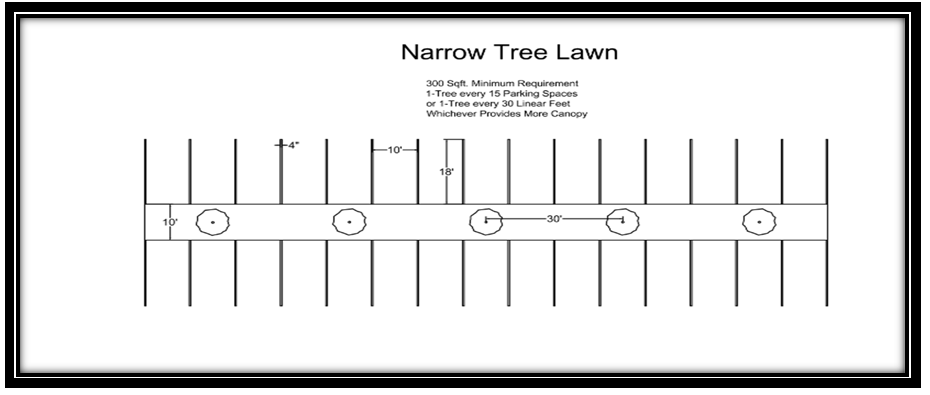
Option 1. Narrow tree lawn. A continuous landscape strip between rows of parking. The minimum width of a tree lawn shall be ten feet; the minimum area shall be 300 square feet. One tree every 15 parking spaces or one tree every 30 linear feet, whichever provides more canopy, shall be planted with this option. Trees may be grouped or spaced within the lawn area.
2.
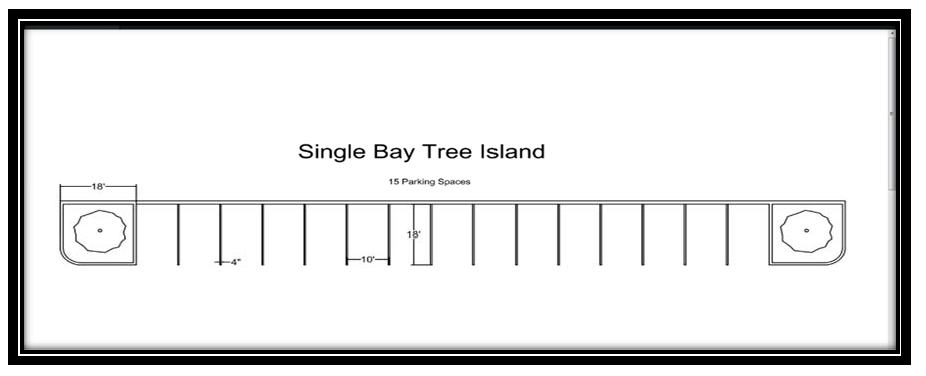
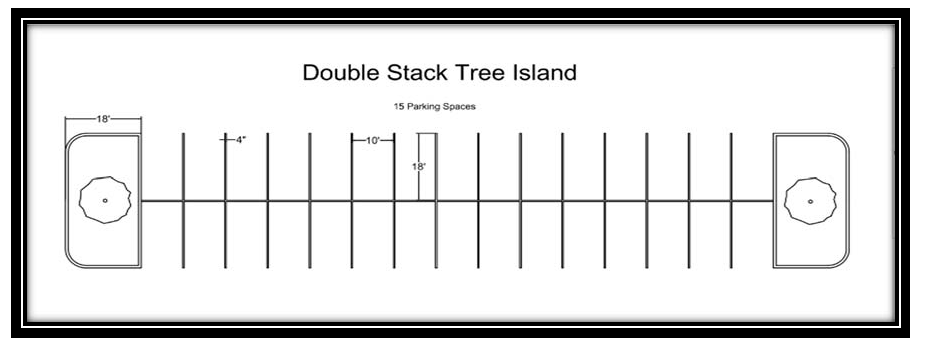
Option 2. Tree island. If the parking area is single bay parking area, the tree island shall be a minimum width of 18 feet and a minimum length of 18 feet, or an area of not less than 324 square feet. If the parking area is a double bay parking area, the tree island shall be a minimum width of 18 feet and a minimum length of 36 feet or an area of not less than 648 square feet. One tree shall be planted for every 15 parking spaces with this option, with a maximum run of 15 parking spaces permitted without a tree island. Interior trees shall be placed on either side of points of access (entrance drives, exit drives) within tree islands. In addition, all street trees must be spaced at a minimum of 40 feet. All tree planted to meet these requirements shall be deciduous shade trees.
EXHIBITS
c.
New plants may be selected from the recommended plants list provided by the planning and zoning department. Plants should be selected for hardiness in local zones. Plants should be arranged to facilitate growth and avoid damage by development. The following trees shall not be used in a landscape plan:
1.
Black locust (Robinia Pseqdoacacia).
2.
Cottonwood (Populous Trichocarps).
3.
Bradford pear (Pyrus Calleryana "Bradford").
4.
Southern live oak (Quercus Virginiana).
5.
Mimosa (Albizia Julibirssin).
6.
Privet (Ligstrum Sinese).
d.
Deciduous ornamental trees must be balled and burlapped, have at least two and one-half inch caliper, and be at least eight feet tall. Deciduous shade trees must be balled and burlapped, have at least two and one-half inch caliper by at least eight feet tall. Evergreen trees must be balled and burlapped and be at least ten feet in height above natural grade. No more than 25 percent of the total number of trees may be ornamental trees, and at least ten percent of the trees shall be evergreen. Shrubs are to be five-gallon size, minimum.
e.
Perennials from the recommended plants list qualify as a plant selection to meet minimum requirements in the ratio of 20:1. Twenty perennials, six inch pot size, equal one shrub. Perennials qualify as shrub selections to a maximum of 15 percent of the required number of shrubs.
f.
Credit to the plant requirement will be considered for existing trees, provided; they are of a desirable type, are healthy specimens, they contribute to the compatibility of the development, and they are not threatened by the construction or placement of the proposed development. Existing trees may not have a change in grade under the tree canopy greater than ± 4. In addition, the health of existing trees must be certified by a licensed arborist or other tree professional agreed upon by the developer and the planning and zoning department.
Qualification or placement of the proposed plant material must be verified with the planning and zoning department. Trees to be counted for tree credits must be protected during construction by protective fencing and shall not be used for material storage or for any other purpose. Tree protection barriers shall be a minimum of four feet high, constructed of chain link, or polyethylene laminar safety fencing or similar material, subject to approval by the planning and zoning department. "Tree protection area" signs shall be posted visibly on all sides of the fenced areas.
(6)
Landscape buffer zones, screening fences, or walls will be required where nonresidential zones abut residential zones. Landscape buffer zones, screening fences, or screening walls may also be required where multi-family zones abut low-density residential zones. The width of the required buffer shall be verified with the planning and zoning department. No public rights-of-way or private utility easements shall be included in any buffer zone. If plants or trees are to be used for screening, they must be evergreen and planted to provide a solid screen within three years. If any of such plants or trees are to be planted in a platted utility easement (excluding, however, protected utility areas), they must be of a species included in recommended plant list, "Utility easements" or otherwise approved in writing by CWL and any other affected utility. Any objections thereto shall be resolved in accordance with subsection (7) below. No plants or trees, however, may be planted in any protected utility area within a platted utility easement that are a part of any buffer zone.
(7)
Installation, maintenance, and replacement.
a.
Installation. All landscaping shall be installed according to sound nursery practices and in a manner designed to encourage vigorous growth. All landscape material, both living and nonliving, shall be in place prior to issuance of a certificate of occupancy or letter of credit for the full amount of the landscaping provided to the planning and zoning department.
b.
Maintenance and replacement. Trees, shrubs, fences, walls and other landscape features, which includes screening depicted on plans approved by the city, shall be considered as elements of the project in the same manner as parking, building materials, and other details are elements of the plan. The landowner, or successors in interest, or agent, if any, shall be jointly and severally responsible for the following:
1.
Regular maintenance of all landscaping must be kept in good condition and in a way, that presents a healthy, neat, and orderly appearance. All landscaping shall be maintained free from disease, pests, weeds and litter. This maintenance shall include weeding, watering, fertilizing, pruning, mowing, edging, mulching or other maintenance, as needed and in accordance with acceptable horticultural practices;
2.
The repair or replacement of required landscape structures e.g., fences and walls, to a structurally sound condition;
3.
The regular maintenance, repair, or replacement, where necessary, or any landscaping required by the section; and
4.
Continuous maintenance of the site.
c.
Nothing contained in this section shall be construed to prohibit CWL or any other utility from cutting, pruning, trimming or removing trees and other plant materials that encroach or interfere with any electric, gas, water, sewer or other utility lines and pipes, equipment, or infrastructure or access thereto.
(8)
Utility easements. No tree or plant material shall be located within a proposed or existing platted utility easement unless it meets the following requirements:
a.
For purposes of satisfying the requirements of subsection (3), there shall be excluded from the calculation of the minimum green space that portion of the platted utility easement that constitutes or will constitute a "protected utility area". A "protected utility area" shall mean the area that includes the physical location of any utility pole, junction box, transformer, water valve, manhole, water meter, fire hydrant, other related equipment, appurtenances or infrastructure along with an accompanying protected work and safety zone or radius as required or recommended by any applicable federal, state, or local law, electrical, plumbing or other building or safety code, or utility industry best practice.
b.
No plant materials or trees shall be planted in any protected utility area.
c.
Unless otherwise approved by CWL or any other affected utility, only plant materials or trees contained on the recommended plant list under the category, "utility easements", shall be planted in a platted utility easement (not, including, however, a protected utility area located within the platted utility easement).
d.
The proposed developer is responsible for identifying existing and proposed platted utility easements within the area to be developed and to be included within the landscape plan for the development.
e.
Any landscape plan, which includes any portion of an existing or proposed platted utility easement, shall be subject to approval of the City of Jonesboro Planning and Zoning Department and CWL and/or any other affected utility. Any landscape plan which includes any portion of an existing or proposed utility easement shall be submitted by the developer to the City of Jonesboro Planning and Zoning Department. Following submission of the proposed plans by the developer, the City of Jonesboro Planning and Zoning Department shall provide a copy of the proposed landscape plans to CWL and/or any other affected utility for their approval or objection to the proposed plans. CWL and/or any other affected utility shall have a period of ten business days following receipt of a copy of the proposed landscape plans from the City of Jonesboro Planning and Zoning Department to either approve or make written objection to the proposed plans. If no written objections are made within the applicable ten day period, CWL and/or any other affected utility shall be deemed to have approved the proposed plans. If written objections are timely made, any objections shall be resolved by the planning and zoning department, subject, however, to all rights of appeal as provided in this Code.
(b)
Recommended plant list. Trees and shrubs marked with * represent a native species plant.
Large Shrubs/Small Trees Appropriate for Platted Utility Easements
(other than protected utility areas).
Focal Trees
(Not to be used as a substitute for street trees)
Trees Appropriate in Urban Settings as Street Trees
Narrow or Columnar Trees
Shade or Lawn Trees
Shrubs
Perennials
Common Name
Rose Sensation False Hydrangea Vine
Prairie Glow Black Eyed Susan
Forever Pink Phlox
Josephine Clematis Vine
Pillow Talk Sedum
Border Music Reblooming Daylily
Allium Millenium
Mariachi Sombrero Helenium
Allium Summer Beauty
Gracillimus Miscanthus Grass
All Gold Japanese Forest Grass
Vera English Lavender
Balmy Beebop Bee Balm
Tuff Stuff Red Reblooming Hydrangea
Sapphire Blue Oat Grass
Black Sea Coral Bells
Green Twister Echinacea
Invicibelle Wee White Hydrangea
Snowflake Creeping Phlox
Lavance Deep Purple English Lavender
Big Blue Liriope Grass
Hot Lips Sage
Goldfinch Shasta Daisy
Pumila Dwarf Pampas Grass
Arizona Apricot Gaillardia
Luna Rose Hibiscus
Home Fires Creeping Phlox
EverColor Everillo Sedge Grass
Showtime Ruffles Helleborus
Little Goldstar Black Eyed Susan
Junior Walker Nepeta
Harvest Moon Sedum
Champagne Coral Bells
Giles Van Hees Veronica
Let's Dance Rave Reblooming Hydrangea
Amazing Grace Creeping Phlox
Pastor's Pride English Lavender
Bronze Beauty Ajuga
Tiny Tuff Stuff Reblooming Hydrangea
Black Mondo Grass
Rainbow Marcella Echinacea
Korean Feather Reed Grass
Wedding Party Helleborus Mix
Double Scoop Orangeberry Echinacea
Mary Reed Daylily
PowWow White Echinacea
Blue Moon Woodland Phlox
Blue Paradise Phlox
Monch Frikart's Aster
Silvery Sunproof Liriope Grass
Emerald Pink creeping Phlox
Aureola Japanese Forest Grass
Matrona Desum
Mayflower
Raspberry Ruffles Daylily
Siloam Double Classic Daylily
Stella'd Oro Daylily
Little Blue Stem Grass
Dwarf fountain Grass
Purple Coneflower
Goldstem Blackeyed Susan
Variegated Liriope
Native Perennials
Common Name
Butterfly Weed
Dense Blazing Star
Wild Bergamot
Rose Mallow
Swamp Coneflower
Swamp Milkweed
Gray Headed Coneflower
Purple Coneflower
Rattlesnake Master
Soft Rush
Carex Spp.
Native Grasses
Common Name
Little Bluestem
Indian Grass
Switch Grass
Prairie Dropseed
Gulf Muhly Grass
Blue Lovegrass
Sand Lovegrass
(Zoning Ord., § 14.36.03; Ord. No. 18:094, Att. A, 1-3-2019)
Sec. 117-326.1. - Tree preservation removal permit.
(a)
Any person proposing to engage in clearing, filling, cutting, quarrying, construction, or similar activities that would result (a) a disturbed area of one acre or larger, and (b) the removal of more than seven significant trees from the disturbed area within a 12 month period shall apply to the planning department for a tree removal permit as specified in this article. A site development plan shall be submitted to the city before removal of more than seven significant trees from a site within a 12 month period without first obtaining a permit. The city official may exempt the need for the permit on a limited case-by-case basis. No land shall be cleared to the extent regulated in this article, unless approved by a permit.
(b)
If more than seven significant trees are to be removed by the owner/developer he or she must submit a tree protection or replacement plan to the planning and zoning department. This plan must show all significant trees on site. This list shall include size and species of the trees. The plan shall show all roads, utilities, building footprints, driveways, and areas to be disturbed. If significant trees are in the disturbed area they are to be replaced at a rate of one to five (one tree to be planted for every five trees removed). If the drip line of the significant tree is adjacent to a construction area, measures must be made to protect the tree with fencing and other protective measures.
(c)
If a significant tree is removed from a nonconstruction area it must be replaced at a replacement rate of five to one.
(d)
If the owner/developer is unable to put replacement trees on the property they have the option to provide the same number of trees to the City of Jonesboro to be installed in area parks, along greenways, or trail and bike paths as approved by the City of Jonesboro. The owner/developer also has the option to pay a fee in lieu to be placed in a tree preservation account of the City of Jonesboro. The fee will be the cost of the trees as determined by a landscape professional and approved by the City of Jonesboro.
(e)
Replacement trees shall be replanted with trees that meet the following specifications:
(1)
Deciduous: At least two and a half inches in diameter and at least eight feet in height above natural grade;
(2)
Evergreen: At least ten feet in height above natural grade; and
(3)
Ornamental: At least two and a half inches in diameter and at least eight feet in height above natural grade.
(f)
A tree is significant, if it is a tree and it is:
(1)
At least 18 inches in diameter at the height of four and a half feet above natural grade;
(2)
Growing with multiple stems and at least one of the stems measured at a point six inches from the point where the stems digress from the main trunk is at least six inches in diameter;
(3)
An ornamental tree with a diameter in excess of six inches at the height eight inches above natural grade; or planted to meet the requirements of the current landscape ordinance.
(g)
A tree is not significant if it is less than 18 inches in diameter at four and a half feet above natural grade, unhealthy, or dead, or those included on the following list, regardless of size:
(1)
Black locust (Robinia Pseqdoacacia);
(2)
Cottonwood (Populous Trichocarps); and
(3)
Bradford pear (Pyrus Calleryana "Bradford").
(h)
Groups of trees and individual trees that are not to be removed and required undisturbed buffer areas shall be protected during construction by protective fencing and shall not be used for material storage or for any other purpose. Tree protection barriers shall be a minimum of four feet high, constructed of chain link, or polyethylene laminar safety fencing or similar material, subject to approval by the planning and zoning department. "Tree protection area" signs shall be posted visibly on all sides of the fenced areas. On large or multiple project sites, the planning and zoning department may also require that signs requesting subcontractor cooperation and compliance with tree protection standards be posted at site entrances. The tree protection barrier must be placed at the outside edge of the drip line of the existing trees.
(i)
The provisions of this section 117-326.1 shall not apply to any persons or locations exempt under section 117-326(a)(2)d.
(j)
Fees. A fee for each tree removal permit shall be paid to the city as currently established or as hereafter adopted by resolution of the city council.
(k)
Fines. Any person or persons who violates the provisions of this section shall be fined a minimum of $250.00 per day and up to a maximum of $500.00. Each day that a violation of this section continues without being remedied may be considered a separate offense and fined separately.
(Ord. No. 18:094, Att. A, 1-3-2019)
Sec. 117-327. - Corner visibility.
On corner lots at intersecting two-way streets, nothing shall be erected, placed, planted, or allowed to grow in such a manner as to materially impede vision between a height of two feet and eight feet above curb grade within the triangular area formed by an imaginary line that follows street side property lines, and a line connecting them, 25 feet from their point of intersection. This sight triangle standard may be increased by the city in those instances deemed necessary for promoting traffic safety, and may be lessened at intersections involving one-way streets.
(Zoning Ord., § 14.36.04)
Sec. 117-328. - Residential compatibility standards.
The compatibility standards of this section are intended to protect low density residential uses and neighborhoods from the adverse impacts sometimes associated with high density residential uses and nonresidential development. The standards are intended to mitigate the effects of uses with operating and structural characteristics that are vastly different than those associated with single-family and duplex uses.
(1)
Applicability, triggering property. Compatibility standards shall apply to all development in the C-1, C-2, C-3, C-4, CR-1, I-1 and I-2 zoning districts when such development is adjacent to triggering property, which shall include all property:
a.
Occupied by a single-family or duplex dwelling unit that is a use permitted by-right in the zoning district in which it is located; or
b.
Zoned in an RS or RM zoning district.
(2)
Exemptions.
a.
Notwithstanding the applicability provisions of subsection (1) of this section, compatibility standards shall not be triggered by property that is public right-of-way, railroad track, roadway or utility easement.
b.
The following uses and activities shall specifically be exempt from compliance with compatibility standards:
1.
Construction of a use permitted by right in a RS or RM district; provided that multifamily development shall be screened when abutting a single-family use or zone;
2.
Structural alteration of an existing building when such alteration does not increase the building's square footage or height; and
3.
A change in use that does not increase the minimum number of off-street parking spaces required.
(3)
Setback standards. The following setback standards shall apply to all development that is subject to compatibility standards:
a.
Small sites. On sites with 20,000 square feet of area or less that also have less than 100 feet of street frontage, structures shall be set back from the lot line of triggering property in accordance with the following requirements:
b.
Large sites. On sites with more than 20,000 square feet of area or 100 feet of street frontage or more, no structure shall be erected within 20 feet of the lot line of triggering property.
c.
Surface-level parking and driveways. Surface-level off-street parking areas and driveways shall not be subject to the above setback standards, however such standards shall apply to parking structures. Surface-level parking areas shall be setback a minimum of ten feet from the lot line of triggering property.
(4)
Building height. No structure shall exceed 35 feet in height within 50 feet of the lot line of triggering property. Structures located over 50 feet from the lot line of triggering property may increase height, if permitted by base district zoning regulations, at a ratio of one foot in height for each five feet of setback. For example, a building limited to a maximum of 35 feet in height at 50 feet from triggering property may be increased to a maximum height of 45 feet at a point that is 100 feet from the lot line of triggering property.
(5)
Screening standards. Decorative walls, vegetative screening, fencing or earthen berms shall be provided to completely screen off-street parking areas, mechanical equipment, storage areas, and refuse collection areas from view of triggering property.
(6)
Site design standards. The following additional site design standards shall apply to development that is subject to the compatibility standards of this section:
a.
No swimming pool, tennis court, ball field, or playground area, except those that are accessory to a single-family dwelling unit, shall be permitted within 50 feet of the lot line of triggering property.
b.
Dumpsters and refuse receptacles shall be located a minimum of 25 feet from the lot line of triggering property.
c.
Exterior lighting shall be designed to minimize light spilling onto surrounding property.
(Zoning Ord., § 14.36.05)
Sec. 117-329. - Fences (permit required).
Except as otherwise specifically provided in other codes and regulations, the following regulations shall apply to the construction of all fences:
(1)
Maximum height. Fences shall not exceed six feet in height, unless approved by the planning commission.
a.
Front yards. Fences that are 50 percent open may be erected to a maximum height of four feet in the front yard.
b.
Fencing in the I-1 and I-2 districts, areas abutting interstate highways, around tennis courts and other recreational amenities, and on lots or tracts containing five acres or more shall be exempt from the height limitation.
(2)
Corner visibility. Fences shall comply with the corner visibility standards of section 117-327.
(3)
Construction materials. Fences in all residential zoning districts shall be constructed so that the horizontal and vertical support posts are inside the fence area or hidden from view of those outside the fenced area. This requirement shall not apply to fences that abut nonresidential zoning districts, lots abutting interstate highways, or in situations where the owner of the lot adjacent to the fence gives written permission of a plan for placing support posts on the outside of the fence. All exposed steel, except galvanized metal, shall have a color finish coat applied to them and be preserved against rust and corrosion.
(4)
Design and maintenance. All fences shall be maintained in their original upright condition. Fences designed to be painted or have other surface finishes shall be maintained in their original condition as designed. Missing boards, pickets, or posts shall be replaced in a timely manner with material of the same type and quality.
a.
A permit is required to repair or replace more than two sections, or 16 feet, of preexisting fence. A permit is not required for non-structural vertical or horizontal repair actions such as replacement of existing fence planks.
b.
If a property owner is building or repairing a fence themselves, they are responsible for obtaining the necessary permit. However, if a contractor is hired, it is their responsibility to obtain the permit. The permit holder must comply with all City building codes and ordinances, as well as adhere to setbacks, easements, and rights-of-way.
(5)
Setbacks.
a.
Front Setbacks shall follow the zoning requirements for that district.
b.
Interior Side Setbacks are not required.
c.
Exterior Side Setbacks shall be a minimum of ten feet from the edge of the property line.
d.
Rear Setbacks are not required.
(6)
Prohibited.
a.
Barbed wire and electrified fences shall be prohibited on all lots of less than two acres in area.
b.
Fencing shall be prohibited within any street right-of-way. Exact location of fencing shall be the sole responsibility of the property owner.
c.
Fencing shall not obstruct the passage or storage of floodwater, surface runoff, or stormwater along lot lines as regulated in section 112-129 of chapter 112, Stormwater Management, of this Code.
(Zoning Ord., § 14.36.06; Ord. No. 09:086, 11-17-2009; Ord. No. 23:030, § 1, 9-19-2023)
Sec. 117-330. - Sidewalks.
(a)
General requirements. The following general requirements shall apply for the construction of sidewalks within the City of Jonesboro.
(1)
Sidewalks shall be constructed along the public street frontage, (excluding limited access highway frontage), of all industrial, commercial, single-family and multi-family residential developments.
(2)
Sidewalks shall be constructed on at least one side of all new public streets in residential developments, with placement determined at the time of plan review.
(3)
Sidewalks shall be constructed whenever an existing industrial or commercial building is renovated or expanded to increase its total building square footage by 20 percent or more in any one expansion.
(4)
The construction of required sidewalks shall be completed before a certificate of occupancy is issued.
a.
The owner/developer has the option to construct the sidewalks or to contribute money in lieu of construction in approved circumstances as covered in subsection (b).
b.
The decision to construct sidewalks or pay the fee in lieu of construction shall be made before receiving final plat approval for residential subdivisions or the issuance of the building permit for industrial or commercial projects.
c.
This timing is done to ensure uniformity of the development and to provide a mechanism for notification to be placed in the subdivision's bill of assurance.
d.
Depending upon the size of the project, situations could exist where a combination of actual sidewalk construction and payment of contributions in lieu of construction occur.
(5)
All sidewalks and related improvements shall be designed and constructed in accordance with chapter 58 of the Jonesboro Code of Ordinances.
(6)
Sidewalks shall be located as shown on the street typical sections for the various roadway classifications of the master street plan.
(7)
Sidewalks shall be constructed in accordance with the Americans with Disabilities Act. Handicapped curb ramps shall be provided whenever a sidewalk crosses a curb at crosswalks, driveways, and street intersections.
(b)
Exceptions. If one or more of the following conditions below exist, the metropolitan area planning commission may approve payment of the contribution in lieu of construction fee instead of installation of a sidewalk if it is determined that installation is impractical:
(1)
Installation of the sidewalk would require the removal of a protected tree (Defined as a tree species that is healthy and greater than 18 inches diameter at a height of 48 inches from the ground) or other major obstruction within the right-of-way;
(2)
A storm water drainage ditch or similar public facility prevents the installation of the sidewalk, and neither the sidewalks nor the facility can be reasonably relocated to accommodate both the sidewalk and the facility;
(3)
The topography would require construction of a retaining wall more than three feet high to accommodate the sidewalk; or
(4)
Other unusual circumstances make the sidewalk installation requirement unreasonable or inappropriate.
(5)
An industrial or commercial development within the confirmed boundaries of the Craighead County Technology Park.
(c)
Exemptions. The following situations would be exempt from the standards of this section and would not require in lieu of fees to be paid or sidewalks installed:
(1)
Individual single-family and two-family lots approved prior to the date of the passage of this section;
(2)
A multi-phased residential subdivision that is already 50 percent or more complete when the total number of phases is considered and sidewalks were not required on the prior phases;
(3)
Properties for which public sanitary sewer system is not available and the provision of such service is not planned within the next 12 months;
(4)
Sidewalks shall not be required on cul-de-sac or dead-end turnaround streets less than 250 feet in length.
If the owner should choose to install sidewalks in the exempted areas shown above, the design and construction of said sidewalks and related improvements shall be designed and constructed in accordance with chapter 58 of the Jonesboro Code of Ordinances.
(d)
Contribution in lieu of construction fee.
(1)
A contribution in lieu of construction fee shall be paid to the City of Jonesboro under the following circumstances:
a.
The property owner of industrial or commercial projects or the residential subdivision developer may request this option subject to approval of the metropolitan area planning commission at the time of final plat approval for residential developments or the issuance of the building permit for industrial and/or commercial projects under the provisions in subsection (b) of the section.
b.
An owner/developer may appeal the metropolitan area planning commission's refusal to grant a waiver or to approve the contribution in lieu of construction fee to the city council.
(2)
The contribution in lieu of construction fee shall be calculated as a fixed amount per linear foot. The city council will establish the rate by resolution upon the recommendation of the city engineer and the rate will be tied to the current weighted average to build sidewalks according to the most current Arkansas Department of Transportation pricing list. The approved rate will be reviewed periodically.
(3)
The fee shall be the amount of the sidewalk installation at a value determined by the design engineer and agreed to by the city engineer or his/her designated representative.
(4)
The city shall deposit said money into an account dedicated for sidewalk construction until such time the money is used by the city.
(5)
For single-family residential developments, the fee shall be paid in full for all platted lots with 90 days of the final plat being recorded or before the first building permit is issued. No building permit shall be issued until the fee is paid.
(6)
Each contribution in lieu of payment collected shall be used to construct, improve, or maintain a sidewalk or other pedestrian infrastructure improvements that furthers the intent of this section as determined by the city engineer with the primary consideration being connectivity between new and existing sidewalks.
(7)
Any project in the listed Jonesboro Industrial Parks that is operating under a temporary certificate of occupancy at the time of the passing of this section will be eligible to provide a fee-in-lieu payment for the amount of the sidewalk construction calculated at the current weighted average to build sidewalks according to the most current Arkansas Department of Transportation pricing list.
(e)
Maintenance of sidewalks. The City of Jonesboro shall be responsible for the maintenance of sidewalks and retaining walls that are constructed in the public right-of-way or in an easement that has been dedicated and accepted by the City of Jonesboro for the purpose of a sidewalk. Sidewalks located outside the public right-of-way or not in a dedicated easement shall be the responsibility of the owner of said property to maintain. Repair of non-routine sidewalk damage caused by others may be assessed to those who are responsible for such damage. Property owners are responsible for maintenance of grass strips or landscaping on either side of the sidewalk.
(Ord. No. 17:027, § 1, 4-17-2018; Ord. No. 25:005, § 1, 3-18-2025)
Editor's note— Ord. No. 17:027, § 1, adopted April 17, 2018, repealed the former § 117-330, and enacted a new § 117-330 as set out herein. The former § 117-330 pertained to sidewalks required and derived from Zoning Ord., § 14.36.07 and Ord. No. 15:061, § 1, adopted Dec. 15, 2015.
Sec. 117-331. - Sidewalk waiver process.
(a)
Upon application of the property owner, the metropolitan area planning commission shall waive the requirement of this section to provide plans for and construct a sidewalk if the commission determines that the sidewalk is not needed or that the impact of the proposed development does not justify the requirement that the sidewalk be constructed or that there is a reasonable likelihood that the sidewalk would have to be removed and reconstructed in the near future.
(b)
In determining the need for the sidewalk and whether the impact of the proposed development justifies the requirement that the sidewalk be built, the metropolitan area planning commission shall consider that all relevant factors have been demonstrated such as:
(1)
Pedestrian traffic generators such as parks and schools in the area;
(2)
The existence of a sidewalk network in the surrounding area;
(3)
The density of current and future development in the area;
(4)
The amount of pedestrian traffic likely to be generated by the proposed development; and
(5)
Whether the terrain is such that a sidewalk is physically feasible.
(Ord. No. 15:061, § 2, 12-15-2015)

