
Juno Beach City Zoning Code
ARTICLE III
- DISTRICT REGULATIONS
Sec. 34-236.- Official zoning map.
(a)
The town is hereby divided into zones, or districts, as shown on the official zoning map which is hereby adopted by reference and declared to be a part of this chapter.
(b)
The official zoning map shall be identified by the signature of the mayor attested by the town clerk, and bearing the seal of the town under the following words: "This is to certify that this is the official zoning map referred to in section 1 of Ordinance No. 207 of the town together with the date of the adoption of this ordinance."
(c)
If, in accordance with the provisions of this chapter and F.S. ch. 163, part II, changes are made in district boundaries or other matters portrayed on the official zoning map, such changes shall be entered on the official zoning map promptly after the amendment has been approved by the town council with an entry on the official zoning map as follows: "On (date), by official action of the town council, the following (change) (changes) were made in the official zoning map," which entry shall be signed by the mayor and attested by the town clerk. No amendment to this chapter which involves matters portrayed on the official zoning map shall become effective until after such change and entry has been made on said map. No changes of any nature shall be made on the official zoning map or matter shown thereon except in conformity with the procedures set forth in this chapter. Any unauthorized change of whatever kind by any person shall be considered a violation of this chapter and punishable as provided under section 34-34. Regardless of the existence of purported copies of the official zoning map which may from time to time be made or published, the official zoning map shall be located in a secure place under the jurisdiction of the town clerk and shall be the final authority.
(Ord. No. 207, § 3.10, 8-8-1979)
Sec. 34-237. - Replacement of official zoning map.
(a)
In the event that the official zoning map becomes damaged, destroyed, lost, or difficult to interpret because of the nature or number of changes and additions, the town council may by resolution adopt a new official zoning map which shall supersede the prior official zoning map, but no such correction shall have the effect of amending the original official zoning map or any subsequent amendment thereof. The new official zoning map may correct drafting or other errors or omissions in the prior official zoning map, but no such correction shall have the effect of amending the original official zoning map or any subsequent amendment thereof. The new official zoning map shall be identified by the signature of the mayor, attested by the town clerk, and bearing the seal of the town under the following words: "This is to certify that this official zoning map supersedes and replaces the official zoning map adopted August 8, 1979, as part of Ordinance No. 207 of the Town of Juno Beach, Florida."
(b)
Unless the prior official zoning map has been lost, or has been totally destroyed, the prior map or any significant parts thereof remaining shall be preserved, together with all available records pertaining to its adoption or amendment.
(Ord. No. 207, § 3.11, 8-8-1979)
Sec. 34-238. - Rules for interpretation of district boundaries.
Where uncertainty exists as to the boundaries of districts as shown on the official zoning map, the following rules shall apply:
(1)
Boundaries indicated as approximately following the centerlines of streets, highways, shall be construed to follow such centerlines;
(2)
Boundaries indicated as approximately following platted lot lines shall be construed as following such lot lines;
(3)
Boundaries indicated as approximately following town limits shall be construed as following such town limits;
(4)
Boundaries indicated as following shorelines shall be construed to follow such shorelines, or ocean mean high-water line, or intracoastal right-of-way line and, in the event of change in the shoreline, shall be construed as moving with the actual shoreline; except where such moving would change the zoning status of a lot or parcel; and in such case the boundary shall be interpreted in such a manner as to avoid changing the zoning status of any lot or parcel;
(5)
Boundaries indicated as approximately following the centerlines of streams, rivers, canals, lakes or other bodies of water shall be construed to follow such centerlines and to be at the limit of the jurisdiction of the town, unless otherwise indicated;
(6)
Boundaries indicated as parallel to or extensions of features indicated in subsections (1)—(5) of this section shall be so construed. Distances not specifically indicated on the official zoning map shall be determined by the legal description of the property;
(7)
Where physical or cultural features existing on the ground are at variance with those shown on the official zoning map, or in other circumstances not covered by subsections (1)—(6) of this section, the board of adjustment shall interpret the district boundaries;
(8)
Where a district boundary line divides a lot which was a single ownership at the time of passage of this chapter, the town council may permit, as a special exception, the extension of the regulations for either portion of the lot not to exceed 50 feet beyond the district line into the remaining portion of the lot.
(Ord. No. 207, § 3.20, 8-8-1979; Ord. No. 689, § 5, 1-25-2017)
Sec. 34-239. - Application of regulations.
Except as hereinafter provided:
(1)
No building shall be erected, added on to, reconstructed or structurally altered, nor shall any building or land be used which does not comply with all the district regulations established by this chapter for the district in which the building or land is located.
(2)
The minimum yards and other open spaces, including the intensity of use provisions contained in this chapter for each building erected, added on to, reconstructed or structurally altered subsequent to the enactment of this chapter shall not be encroached upon or considered as a compliance with yard or open space requirements or intensity of use requirements for any other building or adjoining building.
(3)
Every building erected, added on to, reconstructed or structurally altered subsequent to the enactment of the ordinance from which this chapter is derived shall be located on a lot fronting on a street.
(Ord. No. 207, §§ 3.30—3.33, 8-8-1979)
Sec. 34-240. - Unity of title declaration.
Where it is found necessary in order to obtain a building site of sufficient size and dimension to meet the minimum yard requirements, setback distances or plot area applicable thereto, that separate lots, plots, parcels or portions thereof must be combined, added or joined to the whole or portion of any other recorded lot, parcel, or acreage, the applicant for such building permit shall first place on record as public document in the official records of the clerk of the circuit court of the county an instrument hereinafter referred to as a unity of title declaration. Such unity of title declaration shall be in a form and content sufficient to unequivocally state that the aforesaid combination of separate lots, plots, parcels, acreage, or portions thereof, shall be regarded as unified under one title as an indivisible building site. The unity of title declaration will further state that the said property shall henceforth be considered as one plot or parcel of land and that no portion thereof shall be sold, assigned, transferred, conveyed or devised separately, and that any sale shall be in its entirety as one plot or parcel of land. The declaration shall further state that the declarer agrees that the unity of title declaration shall constitute a covenant to run with the land and further state that it shall be binding upon the declarer, his heirs, successors and assigns and all parties claiming under the declarer, until such time as the unity of title declaration may be released in writing under the order of the town council.
(Ord. No. 207, § 3.34.1, 8-8-1979)
Sec. 34-241. - Unity of control covenant.
In lieu of the unity of title declaration provided for in section 34-240, the applicant may execute and record a unity of control covenant, which shall be a covenant stipulating that lots, plots, parcels or portions thereof shall be developed according to a single site plan or master plan providing unified control. Such covenant shall be executed by all property owners and shall otherwise be subject to the same requirements and conditions as a unity of title declaration.
(Ord. No. 207, § 3.34.2, 8-8-1979)
Sec. 34-242. - Interpretation of use restrictions.
When uncertainty exists concerning the allowance of a specific use in a specific zoning district, the following procedure shall be used to determine its appropriateness:
(1)
If the use is specifically listed as permitted in any zoning district, then it is interpreted to be prohibited in any district in which it is not listed.
(2)
If the specific use is not listed in any zoning district, the director shall make a determination whether similar uses are listed within certain districts and whether this use would likewise be appropriate to these districts. The director shall consider the intent and purpose of the district in making this determination. The director's decision may be appealed to the board of zoning adjustment.
(3)
In the event of a conflict or inconsistency between different provisions of this chapter, the more restrictive shall apply.
(Ord. No. 207, § 3.35, 8-8-1979)
Sec. 34-243. - Establishment of zoning districts.
For the purpose of protecting, promoting and improving the public health, safety and the general welfare of the people, the town hereby establishes the following districts:
(Ord. No. 207, § 4.00, 8-8-1979; Ord. No. 454, 11-16-1994; Ord. No. 668, § 4, 5-28-2014; Ord. No. 689, § 5, 1-25-2017)
Sec. 34-264.- Purpose.
The purpose of the RS residential single-family districts is to provide for areas of the town which shall be exclusively used for single-family detached homes, and, further, that all the amenities and quality of life normally associated with single-family use are protected and enhanced in these districts. Further purposes of these districts include preserving the character of the existing neighborhoods and the enhancement of property values.
(Ord. No. 207, § 4.11, 8-8-1979; Ord. No. 421, 2-19-1992; Ord. No. 466, 12-14-1994; Ord. No. 485, 9-4-1996)
Sec. 34-265. - Uses permitted.
Permitted uses in the RS residential single-family districts are:
(1)
Single-family detached dwellings.
(2)
Group homes (see article IV, division 11 of this chapter).
(3)
Public safety facilities such as fire and/or police stations.
(Ord. No. 207, § 4.12, 8-8-1979; Ord. No. 421, 2-19-1992; Ord. No. 466, 12-14-1994; Ord. No. 485, 9-4-1996)
Sec. 34-266. - Accessory uses.
Accessory uses in the RS residential single-family districts are:
(1)
Private nurseries and greenhouses.
(2)
Private garages.
(3)
Private swimming pools.
(4)
Other accessory uses customarily incident to permitted or approved special exception uses, not involving the conduct of business.
(5)
Limited home occupations (see article IV, division 10 of this chapter).
(Ord. No. 207, § 4.13, 8-8-1979; Ord. No. 393, 5-16-1990; Ord. No. 421, 2-19-1992; Ord. No. 466, 12-14-1994; Ord. No. 485, 9-4-1996)
Sec. 34-267. - Special exception uses.
Special exception uses in the RS residential single-family districts are:
(1)
Public and private utility structures.
(2)
Churches, synagogues, and other houses of worship.
(3)
Planned unit development—residential only (single-family detached). (See article V of this chapter.)
(4)
Satellite dish antennas (see article IV, division 13 of this chapter).
(Ord. No. 207, § 4.14, 8-8-1979; Ord. No. 421, 2-19-1992; Ord. No. 466, 12-14-1994; Ord. No. 485, 9-4-1996)
Sec. 34-268. - Site plan review requirements.
A site plan review is required of all uses other than individual single-family detached dwellings, which shall be subject to review only by the town planning and zoning department.
NOTES:
* Screened pool enclosures are included.
** Screened pool enclosures are excluded.
(A) Corner lots: section 34-899 is modified for the RS districts as follows: One street side: minimum 20-foot setback *** ; Other street side: min. required front yard setback (see table above).
*** In the RS-2 district (first addition subdivision): A minimum 15-foot setback shall be required on both street sides when such corner lot abuts Zenith Lane.
*** Yard facing U.S. Highway 1 and/or Ocean Drive shall be set back a minimum of 20 feet.
*** In the RS-5 district: a minimum 15 foot setback.
(B) Through lots: section 34-900 is modified for the RS districts as follows: Those through lots which have frontage on both U.S. Highway 1 and a local residential street shall have the principal building setback the required front yard setback on both frontages. However, accessory structures in yards facing U.S. Highway 1 may be set back according to the accessory structure setback requirements for a side and rear yard. Those lots in the RS-2 district (first addition subdivision) which front on both North Juno Lane and Diana Lane shall have the front yard setback requirement apply to the North Juno Lane frontage, while the frontage facing Diana Lane shall be treated and regulated as a rear yard.
(C) A minimum 19-foot-long driveway or parking area is required in front of a garage or carport for stacking depth.
(D) Building height is the vertical distance measured from finished grade to the highest exterior point of the building roof, exclusive of chimneys, aerials, and other similar appurtenances. See Finished Grade.
(E) If accessory structure is in the front yard, the front yard setback shall apply. However, see note (B) for exception.
(F) If accessory structure is set back a minimum of ten feet from the side or rear property line, then section 34-873 shall apply and there shall be no maximum building dimension requirement.
(Ord. No. 207, § 4.15, 8-8-1979; Ord. No. 371, 7-19-1989; Ord. No. 421, 2-19-1992; Ord. No. 466, 12-14-1994; Ord. No. 485, 9-4-1996; Ord. No. 689, § 6, 1-25-2017)
Sec. 34-285.- Purpose.
The purpose of the RM-1 residential multiple-family—medium density district is to maintain a generally spacious residential environment, while permitting a desirable variety of housing types. Population density and building heights are low enough to be compatible with neighboring single-family development.
(Ord. No. 207, § 4.21, 8-8-1979; Ord. No. 469, 5-10-1995)
Sec. 34-286. - Uses permitted.
Permitted uses in the RM-1 residential multiple-family—medium density district are as follows:
(1)
Single-family detached dwellings.
(2)
Two-family dwellings.
(3)
Three-family dwellings.
(4)
Four-family dwellings.
(5)
Clustered single-family dwellings (townhouses).
(6)
Group homes (see article IV, division 11 of this chapter).
(7)
Community residential homes (see article IV, division 11 of this chapter).
(8)
Public safety facilities such as fire and/or police stations.
(Ord. No. 207, § 4.22, 8-8-1979; Ord. No. 469, 5-10-1995)
Sec. 34-287. - Accessory uses.
Accessory uses in the RM-1 residential multiple-family—medium density district are as follows:
(1)
Private nurseries and greenhouses.
(2)
Private garages.
(3)
Private swimming pools and/or cabanas.
(4)
Other accessory uses customarily incident to permitted or approved special exception uses, not involving the conduct of business.
(5)
Limited home occupations. (see article IV, division 10 of this chapter)
(6)
Accessory apartments.
(Ord. No. 207, § 4.23, 8-8-1979; Ord. No. 393, 5-16-1990; Ord. No. 469, 5-10-1995)
Sec. 34-288. - Special exception uses.
Special exception uses in the RM-1 residential multiple-family—medium density district are as follows:
(1)
Planned development district—residential (see article V of this chapter).
(2)
Public and private utility structures.
(3)
Public or private academic schools.
(4)
Churches, synagogues and other houses of worship.
(5)
Satellite dish antennas (see article IV, division 13 of this chapter).
(Ord. No. 207, § 4.24, 8-8-1979; Ord. No. 469, 5-10-1995)
Sec. 34-289. - Site plan and appearance review requirements.
A site plan and appearance review is required of all uses other than individual single-family detached dwellings, which shall be subject to review only by the town planning and zoning department.
(Ord. No. 207, § 4.25, 8-8-1979; Ord. No. 371, 7-19-1989; Ord. No. 469, 5-10-1995)
Sec. 34-290. - Building site area regulations.
The following building site area regulations shall apply to the RM-1 residential multiple-family—medium density district:
(1)
Minimum total area:
(2)
Minimum lot width:
(3)
Minimum lot depth:
(4)
Density:*
(5)
Front yard setback:**
(6)
Side yard setback:***
(7)
Rear yard setback:****
(8)
Ocean setback: 50 feet west of the Coastal Construction Control Line (CCCL).
(9)
High-rise setback: not applicable.
(10)
Minimum floor space per dwelling unit:
(11)
Maximum building height:
(12)
Maximum building dimension: 150 feet for all types of permitted principal structures. This maximum dimension shall not include parking and attached accessory structures less than 25 feet in height.
(13)
Distance between principal structures on same property. The minimum distance between principal structures on the same lot shall be 30 feet.
(14)
Maximum lot coverage:
(15)
Minimum landscaped open space:
(16)
Maximum tower height:
(17)
Maximum tower area:
(18)
Minimum parking: See article IV, division 4 of this chapter.
(19)
Loading: not applicable.
*Except for a planned unit development (PUD), in which case the average density per gross acre may be increased as set forth in section 34-1333(b)(4).
*Two additional dwelling units per gross acre may be permitted for up to every five acres that a minimum ten-foot-wide beach access easement is irrevocably dedicated for public use. (For example, if an eight-acre site provides two ten-foot-wide public beach access easements with the required improvements, then the project may be permitted an additional two dwelling units per gross acre for the total eight acres). The easement shall be located, constructed, and improved at a minimum with a paved walkway and a wooden dune walkover structure over the dune, covered and uncovered seating benches on the walkover, landscaping, irrigation, and lighting as determined by the town, and shall be at the expense of the property owner.
**See also section 34-873.
***See also section 34-899.
****See also section 34-900.
*****A 20-foot setback from the street line (R-O-W line) shall be permitted when a minimum 45-foot right-of-way is provided in front of the property.
(Ord. No. 207, § 4.26, 8-8-1979; Ord. No. 469, 5-10-1995; Ord. No. 689, § 7, 1-25-2017; Ord. No. 785, § 2, 6-26-2024)
Sec. 34-309.- Purpose.
The purpose of the RM-2 residential multiple-family—moderate density district is to provide for a variety of housing types at a moderate population density which are compatible with neighboring housing areas of lower density.
(Ord. No. 207, § 4.31, 8-8-1979; Ord. No. 469, 5-10-1995; Ord. No. 494, 9-24-1997)
Sec. 34-310. - Uses permitted.
Permitted uses in the RM-2 residential multiple-family—moderate density district are as follows:
(1)
Single-family detached dwellings.
(2)
Two-family dwellings.
(3)
Multiple-family dwellings.
(4)
Clustered single-family dwellings (townhouses).
(5)
Group homes (see article IV, division 11 of this chapter).
(6)
Community residential homes (see article IV, division 11 of this chapter).
(7)
Public safety facilities such as fire and/or police stations.
(Ord. No. 207, § 4.32, 8-8-1979; Ord. No. 469, 5-10-1995; Ord. No. 494, 9-24-1997)
Sec. 34-311. - Accessory uses.
Accessory uses in the RM-2 residential multiple-family—moderate density district are as follows:
(1)
Private nurseries and greenhouses.
(2)
Private garages.
(3)
Private swimming pools and/or cabanas.
(4)
Other accessory uses customarily incident to permitted or approved special exception uses, not involving the conduct of business.
(5)
Limited home occupations (see article IV, division 10 of this chapter).
(6)
Accessory apartments.
(Ord. No. 207, § 4.33, 8-8-1979; Ord. No. 469, 5-10-1995; Ord. No. 494, 9-24-1997)
Sec. 34-312. - Special exception uses.
Special exception uses in the RM-2 residential multiple-family—moderate density district are as follows:
(1)
Planned unit development—residential (see article V of this chapter).
(2)
Public and private utility structures.
(3)
Public or private academic schools.
(4)
Churches, synagogues and other houses of worship.
(5)
Satellite dish antennas (see article IV, division 13 of this chapter).
(Ord. No. 207, § 4.34, 8-8-1979; Ord. No. 469, 5-10-1995; Ord. No. 494, 9-24-1997)
Sec. 34-313. - Site plan and appearance review requirements.
A site plan and appearance review is required of all uses other than individual single-family detached dwellings, which shall be subject to review only by the town planning and zoning department.
(Ord. No. 207, § 4.35, 8-8-1979; Ord. No. 371, 7-19-1989; Ord. No. 469, 5-10-1995; Ord. No. 494, 9-24-1997)
Sec. 34-314. - Building site area regulations.
The following building site area regulations shall apply to the RM-2 residential multiple-family—medium density district:
(1)
Minimum total area:
(2)
Minimum lot width:
(3)
Minimum lot depth:
(4)
Density:*
(5)
Front yard setback:**
(6)
Side yard setback:***
(7)
Rear yard setback:****
(8)
Ocean setback: 50 feet west of the Coastal Construction Control Line (CCCL).
(9)
High-rise setback: not applicable.
(10)
Minimum floor space per dwelling unit:
(11)
Maximum building height:
a.
Upon request, the town may increase the maximum building height by up to one story and a maximum of ten feet in height where a combination of parking and storage is provided under a minimum of 75 percent of the building's floor area and the minimum parking percentages set forth below are met.
*Minimum parking percentage provided under the building's floor area (combination of parking and storage shall be total at least 75%).
The town shall consider the following criteria when making a decision to approve or deny an increase in building height:
1.
The proportion, scale and massing of the proposed structure as it relates to the proportion, scale and massing of other structures within the zoning district and within neighboring areas;
2.
The general character of the surrounding developed properties and established patterns of development; and
3.
The physical characteristics of the subject property, including, but not limited to, the slope and elevation, as they relate to the physical characteristics of other properties within the zoning district and within neighboring areas.
b.
The town's evaluation of such criteria shall not include matters related solely to design, style, architectural theme or other purely aesthetic issues.
(12)
Maximum building dimension: 150 feet for all types of permitted principal structures. This maximum dimension shall not include parking and attached accessory structures less than 25 feet in height.
(13)
Distance between principal structures on same property: The minimum distance between principal structures on the same lot shall be 30 feet.
(14)
Maximum lot coverage:
(15)
Minimum landscaped open space:
(16)
Maximum tower height:
(17)
Maximum tower area:
(18)
Minimum parking: See article IV, division 4 of this chapter.
(19)
Loading: see Section 34-985.
*Except for a PUD, in which case the average density per gross acre may be increased as set forth in section 34-1333(b)(4).
*Two additional dwelling units per gross acre may be permitted for up to every five acres that a minimum ten-foot-wide beach access easement is irrevocably dedicated for public use. (For example, if an eight-acre site provides two ten-foot-wide public beach access easements with the required improvements, then the project may be permitted an additional two dwelling units per gross acre for the total eight acres). The easement shall be located, constructed, and improved at a minimum with a paved walkway and a wooden dune walkover structure over the dune, covered and uncovered seating benches on the walkover, landscaping, irrigation, and lighting as determined by the town, and shall be at the expense of the property owner.
**See also section 34-873.
***See also section 34-899.
****See also section 34-900.
*****A 20-foot setback from the street line (R-O-W line) shall be permitted when a minimum 45-foot right-of-way is provided in front of the property.
(Ord. No. 207, § 4.36, 8-8-1979; Ord. No. 469, 5-10-1995; Ord. No. 494, 9-24-1997; Ord. No. 592, § 2(Exh. A), 5-24-2006; Ord. No. 689, § 8, 1-25-2017; Ord. No. 711, § 3, 9-11-2019; Ord. No. 785, § 2, 6-26-2024)
Sec. 34-332.- Purpose.
The purpose of the RMT residential, transient and multiple-family—moderate density district is to provide for a variety of housing types at a moderate population density which are compatible with neighboring housing areas of lower density and which may include transient facilities.
(Ord. No. 207, § 4.41, 8-8-1979; Ord. No. 469, 5-10-1995; Ord. No. 494, 9-24-1997)
Sec. 34-333. - Uses permitted.
Permitted uses in the RMT residential, transient and multiple-family—moderate density district are as follows:
(1)
Single-family detached dwellings.
(2)
Two-family dwellings.
(3)
Multiple-family dwellings.
(4)
Clustered single-family dwellings (townhouses).
(5)
Group homes (see article IV, division 11 of this chapter).
(6)
Community residential homes (see article IV, division 11 of this chapter).
(7)
Public safety facilities such as fire and/or police stations.
(Ord. No. 207, § 4.42, 8-8-1979; Ord. No. 434, 12-16-1992; Ord. No. 469, 5-10-1995; Ord. No. 494, 9-24-1997)
Sec. 34-334. - Accessory uses.
Accessory uses in the RMT residential, transient and multiple-family—moderate density district are as follows:
(1)
Private nurseries and greenhouses.
(2)
Private garages.
(3)
Swimming pools for tenants and guests.
(4)
Limited home occupations (see article IV, division 10 of this chapter).
(5)
Accessory apartments.
(Ord. No. 207, § 4.43, 8-8-1979; Ord. No. 393, 5-16-1990; Ord. No. 434, 12-16-1992; Ord. No. 469, 5-10-1995; Ord. No. 494, 9-24-1997)
Sec. 34-335. - Special exception uses.
Special exception uses in the RMT residential, transient and multiple-family—moderate density district are as follows:
(1)
Planned unit development—residential (see article V of this chapter).
(2)
Public and private utility structures.
(3)
Public or private academic schools.
(4)
Churches, synagogues and other houses of worship.
(5)
Transient residential facilities.
(6)
Satellite dish antennas (see article IV, division 13 of this chapter).
(Ord. No. 207, § 4.44, 8-8-1979; Ord. No. 434, 12-16-1992; Ord. No. 469, 5-10-1995; Ord. No. 494, 9-24-1997)
Sec. 34-336. - Site plan and appearance review requirements.
A site plan and appearance review is required of all uses other than individual single-family detached dwellings, which shall be subject to review only by the town planning and zoning department.
(Ord. No. 207, § 4.45, 8-8-1979; Ord. No. 371, 7-19-1989; Ord. No. 469, 5-10-1995; Ord. No. 494, 9-24-1997)
Sec. 34-337. - Building site area regulations.
The following building site area regulations shall apply to the RMT residential, transient and multiple-family—moderate density district:
(1)
Minimum total area:
(2)
Minimum lot width:
(3)
Minimum lot depth:
(4)
Density:*
(5)
Front yard setback:**
(6)
Side yard setback:***
(7)
Rear yard setback:****
(8)
Ocean setback: 50 feet west of the Coastal Construction Control Line (CCCL).
(9)
High-rise setback: not applicable.
(10)
Minimum floor space per dwelling unit:
(11)
Maximum building height:
a.
Upon request, the town may increase the maximum building height by up to one story and a maximum of ten feet in height where a combination of parking and storage is provided under a minimum of 75 percent of the building's floor area and the minimum parking percentages set forth below are met.
;adv=61;*Minimum parking percentage provided under the building's floor area (combination of parking and storage shall be total at least 75%).
The town shall consider the following criteria when making a decision to approve or deny an increase in building height:
1.
The proportion, scale and massing of the proposed structure as it relates to the proportion, scale and massing of other structures within the zoning district and within neighboring areas;
2.
The general character of the surrounding developed properties and established patterns of development; and
3.
The physical characteristics of the subject property, including, but not limited to, the slope and elevation, as they relate to the physical characteristics of other properties within the zoning district and within neighboring areas.
b.
The town's evaluation of such criteria shall not include matters related solely to design, style, architectural theme or other purely aesthetic issues.
(12)
Maximum building dimension: 150 feet for all types of permitted principal structures. This maximum dimension shall not include parking and attached accessory structures less than 25 feet in height.
(13)
Distance between principal structures on same property: The minimum distance between principal structures on the same lot shall be 30 feet.
(14)
Maximum lot coverage:
(15)
Minimum landscaped open space:
(16)
Maximum tower height:
(17)
Maximum tower area:
(18)
Minimum parking: See article IV, division 4 of this chapter.
(19)
Loading: see Section 34-985.
*Except for a PUD, in which case the average density per gross acre may be increased as set forth in section 34-1333(b)(4).
*Two additional dwelling units per gross acre may be permitted for up to every five acres that a minimum ten-foot-wide beach access easement is irrevocably dedicated for public use. (For example, if an eight-acre site provides two ten-foot-wide public beach access easements with the required improvements, then the project may be permitted an additional two dwelling units per gross acre for the total eight acres). The easement shall be located, constructed, and improved at a minimum with a paved walkway and a wooden dune walkover structure over the dune, covered and uncovered seating benches on the walkover, landscaping, irrigation, and lighting as determined by the town, and shall be at the expense of the property owner.
**See also section 34-873.
***See also section 34-899.
****See also section 34-900.
*****A 20-foot setback from the street line (R-O-W line) shall be permitted when a minimum 45-foot right-of-way is provided in front of the property.
(Ord. No. 207, § 4.46, 8-8-1979; Ord. No. 469, 5-10-1995; Ord. No. 592, § 2(Exh. A), 5-24-2006; Ord. No. 494, 9-24-1997; Ord. No. 689, § 9, 1-25-2017; Ord. No. 711, § 4, 9-11-2019; Ord. No. 785, § 2, 6-26-2024)
Sec. 34-363.- Purpose.
The purpose of the RH residential multiple-family—high-density district is to provide for a variety of dwelling types. Permitted population density falls in the lower range of what is generally considered high-density development.
(Ord. No. 207, § 4.51, 8-8-1979; Ord. No. 433, 12-2-1992; Ord. No. 469, 5-10-1995; Ord. No. 491, 2-12-1997)
Sec. 34-364. - Uses permitted.
Permitted uses in the RH residential multiple-family—high-density district are as follows:
(1)
Single-family detached dwellings.
(2)
Two-family dwellings.
(3)
Multiple-family dwellings.
(4)
Clustered single-family dwellings (townhouses).
(5)
Churches, synagogues and other houses of worship.
(6)
Group homes (see article IV, division 11 of this chapter).
(7)
Community residential homes (see article IV, division 11 of this chapter).
(8)
Public safety facilities such as fire and/or police stations.
(Ord. No. 207, § 4.52, 8-8-1979; Ord. No. 433, 12-2-1992; Ord. No. 469, 5-10-1995; Ord. No. 491, 2-12-1997)
Sec. 34-365. - Accessory uses.
Accessory uses in the RH residential multiple-family—high-density district are as follows:
(1)
Private nurseries and greenhouses.
(2)
Private garages.
(3)
Private swimming pools and/or cabanas.
(4)
Other accessory uses customarily incidental to permitted or approved special exception uses.
(5)
Limited home occupations (see article IV, division 10 of this chapter).
(6)
Accessory apartments.
(Ord. No. 207, § 4.53, 8-8-1979; Ord. No. 393, 5-16-1990; Ord. No. 433, 12-2-1992; Ord. No. 469, 5-10-1995; Ord. No. 491, 2-12-1997)
Sec. 34-366. - Special exception uses.
Special exception uses in the RH residential multiple-family—high-density district are as follows:
(1)
Planned unit development—residential (see article V of this chapter).
(2)
Public and private utility structures.
(3)
Public or private academic schools.
(4)
Satellite dish antennas (see article IV, division 13 of this chapter).
(Ord. No. 207, § 4.54, 8-8-1979; Ord. No. 433, 12-2-1992; Ord. No. 469, 5-10-1995; Ord. No. 491, 2-12-1997)
Sec. 34-367. - Site plan and appearance review requirements.
A site plan and appearance review is required of all uses other than individual single-family detached dwellings, which shall be subject to review only by the town planning and zoning department.
(Ord. No. 207, § 4.55, 8-8-1979; Ord. No. 371, 7-19-1989; Ord. No. 433, 12-2-1992; Ord. No. 469, 5-10-1995; Ord. No. 491, 2-12-1997)
Sec. 34-368. - Building site area regulations.
The following building site area regulations shall apply to the RH residential multiple-family—high-density district:
(1)
Minimum total area:
(2)
Minimum lot width:
(3)
Minimum lot depth:
(4)
Density:*
(5)
Front yard setback:**
(6)
Side yard setback:***
(7)
Rear yard setback:****
(8)
Ocean setback: 50 feet west of the Coastal Construction Control Line
(9)
High-rise setback: for multiple-family, all buildings shall be set back so as to provide at least a 30-foot setback from all property lines. There shall be added an additional five feet of setback at ground level for each additional story beyond the first two stories. Such setbacks need not exceed 60 feet. For those lots having a width of 200 feet or less as recorded in the office of the county property appraiser at the time of adoption of the ordinance from which this chapter is derived, maximum setbacks need not exceed 50 feet. However, the maximum building dimension on such lots shall not exceed 150 feet.
(10)
Minimum floor space per dwelling unit:
(11)
Maximum building height:
(12)
Maximum building dimension: the maximum dimension of any structure or group of attached structures shall not exceed 150 feet; provided, however, that along the building face having the maximum dimension, said dimension may be increased to not more than 175 feet.
(13)
Distance between structures on same property: The minimum distance between principal structures on the same lot for single-family detached, two-family, and townhouse structures shall be 30 feet. For high-rise multiple-family the minimum distance between principal structures on the same lot shall be equal to the average building heights up to a maximum of 120 feet. For high-rise multiple-family: the minimum distance between a principal structure and an accessory structure shall be 30 feet and a minimum distance between accessory structures shall be 15 feet.
(14)
Maximum lot coverage:
(15)
Minimum landscaped open space:
(16)
Maximum tower height:
(17)
Maximum tower area:
(18)
Minimum parking: See article IV, division 4 of this chapter.
(19)
Loading: see Section 34-985.
(20)
A1A vehicular access restrictions: Properties along State Road A1A from Loggerhead Park to the northern town limits shall not be allowed a motorized vehicular driveway connection onto State Road A1A. Provided, however, that this shall not prohibit an access used for emergency purposes only.
*Except for a PUD, in which case the average density per gross acre may be increased as set forth in section 34-1333(b)(4).
*Two additional dwelling units per gross acre may be permitted for up to every five acres that a minimum ten-foot-wide beach access easement is irrevocably dedicated for public use. (For example, if an eight-acre site provides two ten-foot-wide public beach access easements with the required improvements, then the project may be permitted an additional two dwelling units per gross acre for the total eight acres). The easement shall be located, constructed, and improved at a minimum with a paved walkway and a wooden dune walkover structure over the dune, covered and uncovered seating benches on the walkover, landscaping, irrigation, and lighting as determined by the town, and shall be at the expense of the property owner.
**See also section 34-873.
***See also section 34-899.
****See also section 34-900.
*****A 20-foot setback from the street line (R-O-W line) shall be permitted when a minimum 45-foot right-of-way is provided in front of the property.
(Ord. No. 207, § 4.56, 8-8-1979; Ord. No. 433, 12-2-1992; Ord. No. 469, 5-10-1995; Ord. No. 491, 2-12-1997; Ord. No. 689, § 10, 1-25-2017; Ord. No. 785, § 2, 6-26-2024)
Sec. 34-395.- Purpose.
The purpose of the RM-OO residential multiple-family—moderate density open space option district is to provide for a variety of housing types at a moderate population density or to provide for a resort hotel and its attendant uses, either of which are compatible with the natural terrain and neighboring housing areas. This zoning district contains natural terrain in the form of a portion of the coastal ridge which represents an asset to the town's overall appearance. To maintain or increase this asset, it is also the purpose of this district to provide the option of increased open space and encourage the preservation or improvement of the natural terrain in exchange for a decrease in dwelling unit density and an increase in building height for single-building residential or resort hotel developments.
(Ord. No. 207, § 4.141, 8-8-1979; Ord. No. 224, 2-25-1981; Ord. No. 433, 12-2-1992; Ord. No. 469, 5-10-1995; Ord. No. 494, 9-24-1997)
Sec. 34-396. - Uses permitted.
Permitted uses in the RM-OO residential multiple-family—moderate density open space option district are as follows:
(1)
Single-family detached dwellings.
(2)
Two-family dwellings.
(3)
Multiple-family dwellings.
(4)
Clustered single-family dwellings (townhouse).
(5)
Group homes (see article IV, division 11 of this chapter).
(6)
Community residential homes (see article IV, division 11 of this chapter).
(7)
Public safety facilities such as fire and/or police stations.
(Ord. No. 207, § 4.142, 8-8-1979; Ord. No. 224, 2-25-1981; Ord. No. 433, 12-2-1992; Ord. No. 469, 5-10-1995; Ord. No. 494, 9-24-1997)
Sec. 34-397. - Accessory uses.
Accessory uses in the RM-OO residential multiple-family—moderate density open space option district are as follows:
(1)
Private nurseries and greenhouses.
(2)
Private garages.
(3)
Private swimming pools and/or cabanas.
(4)
Other accessory uses customarily incident to permitted or approved special exception uses, not involving the conduct of business.
(5)
Limited home occupations (see article IV, division 10 of this chapter).
(6)
Accessory apartments.
(Ord. No. 207, § 4.143, 8-8-1979; Ord. No. 393, 5-16-1990; Ord. No. 224, 2-25-1981; Ord. No. 433, 12-2-1992; Ord. No. 469, 5-10-1995; Ord. No. 494, 9-24-1997)
Sec. 34-398. - Special exception uses.
Special exception uses in the RM-OO residential multiple-family—moderate density open space option district are as follows:
(1)
Planned unit development—residential.
(2)
Public and private utility structures.
(3)
Public or private academic schools.
(4)
Churches, synagogues and other houses of worship.
(5)
A single building in excess of three stories which reduces the overall density of dwelling units but increases the open space and preserves or enhances the natural terrain. An additional building in excess of three stories may be permitted for every four acres above a minimum of four acres.
(6)
Resort hotel and attendant uses. Attendant uses shall not be permitted unless there is a resort hotel. A resort hotel structure may contain attendant uses, or the attendant uses may be located in a separate structure or structures or in combination with the resort hotel.
(7)
Satellite dish antennas (see article IV, division 13 of this chapter).
(Ord. No. 207, § 4.144, 8-8-1979; Ord. No. 224, 2-25-1981; Ord. No. 295, 2-19-1986; Ord. No. 433, 12-2-1992; Ord. No. 469, 5-10-1995; Ord. No. 478, 2-28-1996; Ord. No. 494, 9-24-1997)
Sec. 34-399. - Site plan and appearance review requirements.
A site plan and appearance review is required of all uses other than individual single-family detached dwellings, which shall be subject to review only by the town planning and zoning department.
(Ord. No. 207, § 4.145, 8-8-1979; Ord. No. 224, 2-25-1981; Ord. No. 433, 12-2-1992; Ord. No. 469, 5-10-1995; Ord. No. 494, 9-24-1997)
Sec. 34-400. - Building site area regulations.
The following building site area regulations shall apply to the RM-OO residential multiple-family—moderate density open space option district:
(1)
Minimum total area:
(2)
Minimum lot width:
(3)
Minimum lot depth:
(4)
Density:*
(5)
Setbacks for special exception in section 34-398(5): the single building shall be set back so as to provide at least a 35-foot setback from all property lines. There shall be added an additional five feet of setback for each additional story beyond the first three stories. Such setbacks need not exceed 60 feet.
(6)
Setback for special exception in section 34-398(6):
a.
The resort hotel and all other structures must be set back a minimum of 100 feet from the south property line, 200 feet from the west property line, 50 feet west of the Coastal Construction Control Line (CCCL), and 100 feet from the north property line. If a public promenade is incorporated into the site plan adjacent to the Ocean Drive right-of-way, the town council may grant approval to located the promenade, all or portions of the primary hotel structure and attendant uses structures within the 50-foot setback from the Coastal Construction Control Line in accordance with section 34-1123 and where not otherwise prohibited by law. Modification of the south, west and north minimum setbacks may be granted only by the town council. Prior to a decision by the town council, the following conditions shall be met:
1.
Review and recommendations by the planning and zoning board;
2.
A public hearing with due public notice as provided in F.S. ch. 163 for all zoning actions.
b.
Setback modifications may be approved only if such modifications will not be detrimental to the natural characteristics of the site or to existing and potential adjacent land uses, and will contribute to a higher quality site plan than can be achieved with 76 required minimum setbacks. The town council shall consider the effects of such impacts as light, air, appearance, fire protection and security.
(7)
Front yard setback:**
(8)
Side yard setback:***
(9)
Rear yard setback:****
(10)
Ocean setback: 50 feet west of the Coastal Construction Control Line (CCCL).
(11)
Minimum floor space per dwelling unit:
(12)
Maximum building height:*
a.
Upon request, the town may increase the maximum building height by up to one story and a maximum of ten feet in height where a combination of parking and storage is provided under a minimum of 75 percent of the building's floor area and the minimum parking percentages set forth below are met.
*Minimum parking percentage provided under the building's floor area (combination of parking and storage shall be total at least 75%).
The town shall consider the following criteria when making a decision to approve or deny an increase in building height:
1.
The proportion, scale and massing of the proposed structure as it relates to the proportion, scale and massing of other structures within the zoning district and within neighboring areas;
2.
The general character of the surrounding developed properties and established patterns of development; and
3.
The physical characteristics of the subject property, including, but not limited to, the slope and elevation, as they relate to the physical characteristics of other properties within the zoning district and within neighboring areas.
b.
The town's evaluation of such criteria shall not include matters related solely to design, style, architectural theme or other purely aesthetic issues.
*The datum used to determine the building height need not be the crown of the road. Instead, it may be the average elevation of the crest of the dune. This will be determined during the site plan review process.
(13)
Maximum building dimension:
a.
Resort hotel: 150 feet. Underground parking shall not have maximum dimension limitations but shall be subject to review and approval by the town council with respect to distance and appearance from the property lines. Underground parking may be shared by the resort hotel and attendant structures. The town council shall consider the effects of such impacts as light, air, appearance, fire protection and security.
b.
All other uses: 150 feet for all types of permitted principal structures. This maximum dimension shall not include parking and attached accessory structures less than 25 feet in height.
(14)
Distance between structures on same property:
a.
For a resort hotel and attendant facilities, the minimum distance between structures shall be subject to review and approval by the town council, which shall consider the effects of such impacts as, light, air, appearance, fire protection and security. All other uses: the minimum distance between principal structures on the same lot shall be 30 feet.
b.
For all other uses: a minimum 75-foot distance shall be provided between a structure greater than 50 feet in height and any other principal structure on the same property, and the minimum distance between principal structures on the same lot which are 50 feet in height or less shall be 30 feet.
(15)
Maximum lot coverage:
(16)
Minimum landscaped open space:
(17)
Maximum tower height:
(18)
Maximum tower area:
(19)
Minimum parking:
a.
Resort hotel:
1.
1.25 spaces per each guest unit, plus one space for each three seats offered to the public for restaurant and lounge purposes. Additional parking for attendant facilities located with the resort hotel and in adjacent structures shall be calculated at one space per 200 gross square feet of building area. Additional parking for employees must be provided on the basis of one space per employee of the largest number employees in any one shift at the resort hotel.
2.
The resort hotel must have underground parking to accommodate a minimum of one-third of the required spaces for the resort hotel.
3.
The top of the roof of any underground parking structure is not to exceed the lowest point of the crown of the road of Ocean Drive adjacent to the property.
b.
Minimum parking: see article IV, division 4 of this chapter.
(20)
Loading: see section 34-985.
(21)
A1A vehicular access restrictions: Properties along State Road A1A from Loggerhead Park to the northern town limits shall not be allowed a motorized vehicular driveway connection onto State Road A1A. Provided, however, that this shall not prohibit an access used for emergency purposes only.
*Except for a PUD and Special Exception Use No. 5. In the case of a PUD, the average density per gross acre may be increased as set forth in section 34-1333(b)(4). For special exception use No. 5, the total number of dwelling units on a site must be decreased from the maximum permissible (12 units/acre) by a factor of 0.15 units × the number of additional floors × the total gross acreage of the site. A single building may not exceed 12 stories.
*Two additional dwelling units per gross acre may be permitted for up to every five acres that a minimum ten-foot-wide beach access easement is irrevocably dedicated for public use. (For example, if an eight-acre site provides two ten-foot-wide public beach access easements with the required improvements, then the project may be permitted an additional two dwelling units per gross acre for the total eight acres). The easement shall be located, constructed, and improved at a minimum with a paved walkway and wooden dune walkover structure over the dune, covered and uncovered seating benches on the walkover, landscaping, irrigation, and lighting as determined by the town, and shall be at the expense of the property owner.
**See also section 34-873.
***See also section 34-899.
****See also section 34-900.
(Ord. No. 207, § 4.146, 8-8-1979; Ord. No. 224, 2-25-1981; Ord. No. 433, 12-2-1992; Ord. No. 469, 5-10-1995; Ord. No. 478, 2-28-1996; Ord. No. 494, 9-24-1997; Ord. No. 592, § 2(Exh. A), 5-24-2006; Ord. No. 689, § 11, 1-25-2017; Ord. No. 711, § 5, 9-11-2019; Ord. No. 785, § 2, 6-26-2024)
Sec. 34-429.- Purpose.
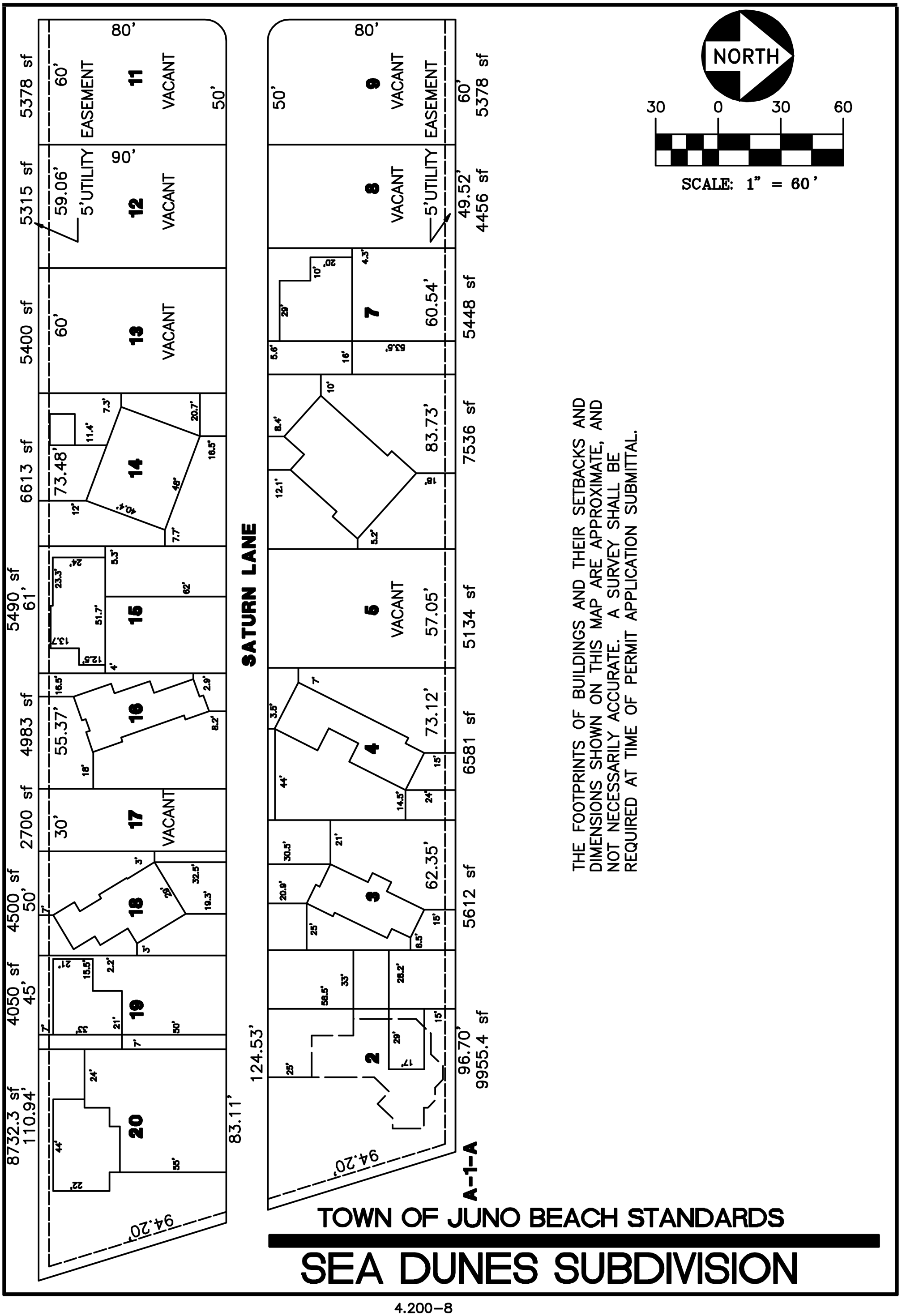
The purpose of the HIST-S Saturn Lane historic preservation district is to protect and maintain an area in town worthy of historical and architectural preservation so that present and future residents and visitors may experience the unique historical features and architectural styles of the town. Further purposes of this district include the enhancement of property values, the reduction or elimination of nonconformities, the preservation of scenic views, and the rehabilitation of the Saturn Lane district.
(Ord. No. 207, § 4.201, 8-8-1979; Ord. No. 409, 5-15-1991; Ord. No. 454, 11-16-1994)
Sec. 34-430. - Uses and structures permitted.
Permitted uses and structures in the HIST-S Saturn Lane historic preservation district are as follows:
(1)
Single-family residential dwelling unit.
(2)
Public safety facilities such as fire and/or police stations.
(3)
Group homes (see article IV, division 11 of this chapter).
(Ord. No. 207, § 4.202, 8-8-1979; Ord. No. 409, 5-15-1991; Ord. No. 454, 11-16-1994)
Sec. 34-431. - Accessory structures and/or uses permitted.
Accessory structures and/or uses in the HIST-S Saturn Lane historic preservation district are as follows:
(1)
Accessory apartments.
(2)
Private nurseries and greenhouses.
(3)
Private garages.
(4)
Private swimming pools.
(5)
Other accessory uses and/or structures customarily incidental to permitted uses.
(6)
Limited home occupations (see article IV, division 10 of this chapter).
(Ord. No. 207, § 4.203, 8-8-1979; Ord. No. 409, 5-15-1991; Ord. No. 454, 11-16-1994)
Sec. 34-432. - Applicability of chapter sections.
All sections of this chapter shall apply to the HIST-S Saturn Lane historic preservation district, except as otherwise provided in this division.
(Ord. No. 207, § 4.204, 8-8-1979; Ord. No. 409, 5-15-1991; Ord. No. 454, 11-16-1994)
Sec. 34-433. - Expansion of nonconforming structures.
Notwithstanding the provisions of article VI of this chapter, any structure made nonconforming as of the effective date of the ordinance from which this chapter is derived shall be permitted to expand its first floor structural footprint so long as:
(1)
The structure is expanded into a conforming front, side, or rear yard setback; and
(2)
All other regulations of this district are complied with.
However, an addition to a nonconforming structure, above the first floor level, is permitted to match an existing, nonconforming first floor footprint, so long as the front yard setback is met. (See article VI of this chapter.)
(Ord. No. 207, § 4.205, 8-8-1979; Ord. No. 409, 5-15-1991; Ord. No. 454, 11-16-1994)
Sec. 34-434. - Street lot lines.
The street lot line shall be defined as the edge of the Saturn Lane right-of-way and Ocean Drive right-of-way.
(Ord. No. 207, § 4.206, 8-8-1979; Ord. No. 409, 5-15-1991; Ord. No. 454, 11-16-1994)
Sec. 34-435. - Corner lots.
The corner lot provision of this chapter is modified for lots in the Sea Dunes subdivision. The lots adjacent to the Ocean Drive right-of-way shall maintain a minimum ten-foot front yard setback from the Ocean Drive lot line, and a minimum 25-foot setback from the Saturn Lane lot line.
(Ord. No. 207, § 4.207, 8-8-1979; Ord. No. 409, 5-15-1991; Ord. No. 454, 11-16-1994)
Sec. 34-436. - Extension of porches and balconies.
Porches, balconies, and similar structures may not extend into any front, side or rear yard setback, other than in the additional ten-foot front yard setback above the first floor level. Yard setback encroachments that may be authorized in sections 34-902 and 34-903 are expressly prohibited in the HIST-S Saturn Lane historic preservation district.
(Ord. No. 207, § 4.208, 8-8-1979; Ord. No. 409, 5-15-1991; Ord. No. 454, 11-16-1994)
Sec. 34-437. - Future subdivision of land.
All new lots subdivided in the Sea Dunes subdivision shall utilize the Saturn Lane lot line as the front lot line, in addition to meeting the minimum lot size, width and depth requirements. The Ocean Drive lot line shall not be utilized as a front lot line.
(Ord. No. 207, § 4.209, 8-8-1979; Ord. No. 409, 5-15-1991; Ord. No. 454, 11-16-1994)
Sec. 34-438. - Design criteria.
All development and construction shall be representative of and generally consistent with and complementary to the Old Florida cottage style of architecture (detailed in section 34-442) and which is commonly known and identified by its late Victorian architectural style, Spanish Revival architectural style, or combination thereof. Summarized briefly, distinguishing features of the Old Florida cottage style of architecture include wood or concrete block stucco siding; simple pitched roofs; tile, metal, or asphalt roofs; ornate details such as exposed soffits and individualized vent and louver shapes; lush landscaping with private yards; and use of porches and patios. All additions, alterations, and new construction shall be of a design and proportion which is in harmony with the existing structures in the district. The facade of a two-unit dwelling which is constructed and visible from the street shall appear in design as a single-family dwelling, similar to the design of existing two-unit dwellings.
(Ord. No. 207, § 4.210, 8-8-1979; Ord. No. 409, 5-15-1991; Ord. No. 454, 11-16-1994)
Sec. 34-439. - Site plan and appearance review requirements.
Site plan review by the planning and zoning department shall be required for all new construction, additions, and alterations to existing structures.
(Ord. No. 207, § 4.211, 8-8-1979; Ord. No. 409, 5-15-1991; Ord. No. 434, 12-16-1992; Ord. No. 454, 11-16-1994)
Sec. 34-440. - Appeals.
(a)
Design criteria and architectural standards. A decision by the director interpreting design criteria and architectural standards regulations may be appealed by an applicant by presenting his appeal to the planning and zoning board for review, and to the town council for a final decision on the appeal.
(b)
Other development regulations. Any other decision made by the director interpreting any other regulation set forth in the Saturn Lane historic preservation district shall be appealed to the board of adjustment.
(Ord. No. 207, § 4.212, 8-8-1979; Ord. No. 409, 5-15-1991; Ord. No. 454, 11-16-1994)
Sec. 34-441. - Administration and enforcement of regulations.
Any construction requiring a building permit shall be reviewed by the director prior to the issuance of a building permit. Any improvement which does not require a building permit, for example painting a structure or installing a screen door shall be required to comply with these regulations. Any improvement which does not comply with these regulations shall be deemed a code violation, and shall be subject to removal or modification, as appropriate.
(Ord. No. 207, § 4.213, 8-8-1979; Ord. No. 409, 5-15-1991; Ord. No. 454, 11-16-1994)
Sec. 34-442. - Architectural standards for Saturn Lane historic preservation district.
To maintain the historic character and architectural features of the Old Florida cottage style represented in the Saturn Lane historic preservation district, and to maintain and enhance property values, the following materials and design features are permitted for all additions, alterations, and new construction. Materials and design features other than those listed in this section shall be considered on a case-by-case basis by the town to determine, based on the intent and purpose of the Saturn Lane historic preservation district, if such materials or design features closely resemble the natural materials and are complementary to the architectural style and character of Saturn Lane.
(1)
Building wall materials:
*Concrete block and stucco (CBS).
*Board and batten (vertical wood siding).
*Lap board (horizontal wood siding).
*Cedar shingles.
*Wood frame with stucco finish.
(2)
Garden wall and fence materials and treatments:
*Hedges.
*Concrete block and stucco (CBS).
*Decorative concrete ornamentation.
*Lattice (PVC or wood).
*Decorative wood pickets.
*Gates and fences: wrought iron, wood, PVC, aluminum.
*Wood that is not pressure treated must be painted or sealed. Any wood with ground contact (i.e., posts) must be pressure treated.
*Chainlink is prohibited.
*The color of all fences and walls shall be compatible with the color of the principal structure. Natural wood color is considered compatible.
(3)
Landscaping features encouraged:
*Hedges.
*Arbors.
*Trellises.
*Fountains.
*Decorative concrete, stone, or brick patio/walkway.
*Wood decking/walkway (must be pressure treated).
*Xeriscape landscaping.
(4)
Porches and awnings:
*Concrete block and stucco (CBS) or wood framing.
*Porches may be open to the air, screened in, or enclosed with lattice.
*Porches enclosed with any glass or solid material are discouraged when visible from the street.
*Porch roof materials shall match principal building, unless a flat roof which may be tar and gravel or other acceptable material.
*Awnings must be of durable materials (may include fabric/vinyl).
*Awnings must be upgraded, replaced, or removed if torn, faded or in disrepair.
(5)
Roof materials and treatments:
*Tile roof.
*Asphalt shingle roof (min. 210 pounds per square) (straight cuts only, not to simulate other materials, i.e., wood shingles, tile, slate, and so forth).
*Metal roof.
*Built-up aggregate surface roof (tar and gravel), permitted only for roofs with a pitch less than 3 to12.
*Simple gable and hip roofs are permitted. Flat roofs are permitted but shall not extend over more than 30 percent of roof area.
*Roof pitch shall conform to existing buildings in the district.
*Bahama chimneys, cupolas, weather vanes, and decorative wood corners and detailing are encouraged.
*Rafters at overhangs shall be exposed (open soffits).
(6)
Shutters and window treatments:
*Side-mounted and Bahama shutters (wood, aluminum, vinyl or PVC).
*Awnings (see subsection (4) of this section).
*Mullions are encouraged on windows.
(7)
Door materials and treatments:
*Painted and stained wood.
*Embossed masonite (exterior grade only).
*Wood frame screen doors.
*Painted aluminum screen doors are encouraged over natural aluminum finish color.
*Windows in doors are encouraged to use mullions when visible from the street (i.e., French doors, sliding glass doors with mullions).
*If windows in doors do not use mullions, at a minimum such windows shall have a colored frame (i.e., a sliding glass door shall have a white frame, instead of the natural aluminum finish).
(8)
Vents and louvers:
*Decorative concrete, wood or painted aluminum ornamentation (exposed screening is not permitted).
(9)
Colors:
*Pastel, colonial, and neutral base (i.e., white, off-white, light earth tones).
*Trim may be any color, but must be compatible with building base color.
*Roof color shall be solid and compatible with building color scheme.
(10)
Accessory structures:
*Materials, design, and color shall match principal structure.
(11)
Historic preservation districts:
Building Site Area Regulations
Sea Dunes (Saturn Lane)
*Lots 2, 19, 20: 25 feet.
*Lots 3, 17, 18: 20 feet.
*Lots 4, 5, 15, 16: 15 feet.
*Lots 6, 14: Ten feet.
*Lots 7, 8, 9, 11, 12, 13: Five feet.
**All floors above the first floor level shall be set back an additional five feet from the first floor front yard setback, with the exception of Ocean Drive.
***If accessory structure is in the front yard, the front yard setback shall apply.
*****If the accessory apartment is 500 square feet or less, one parking space shall be required.
(Ord. No. 207, § 4.215, 8-8-1979; Ord. No. 409, 5-15-1991; Ord. No. 454, 11-16-1994; Ord. No. 632, § 2, 10-28-2009)
Sec. 34-468.- Purpose.
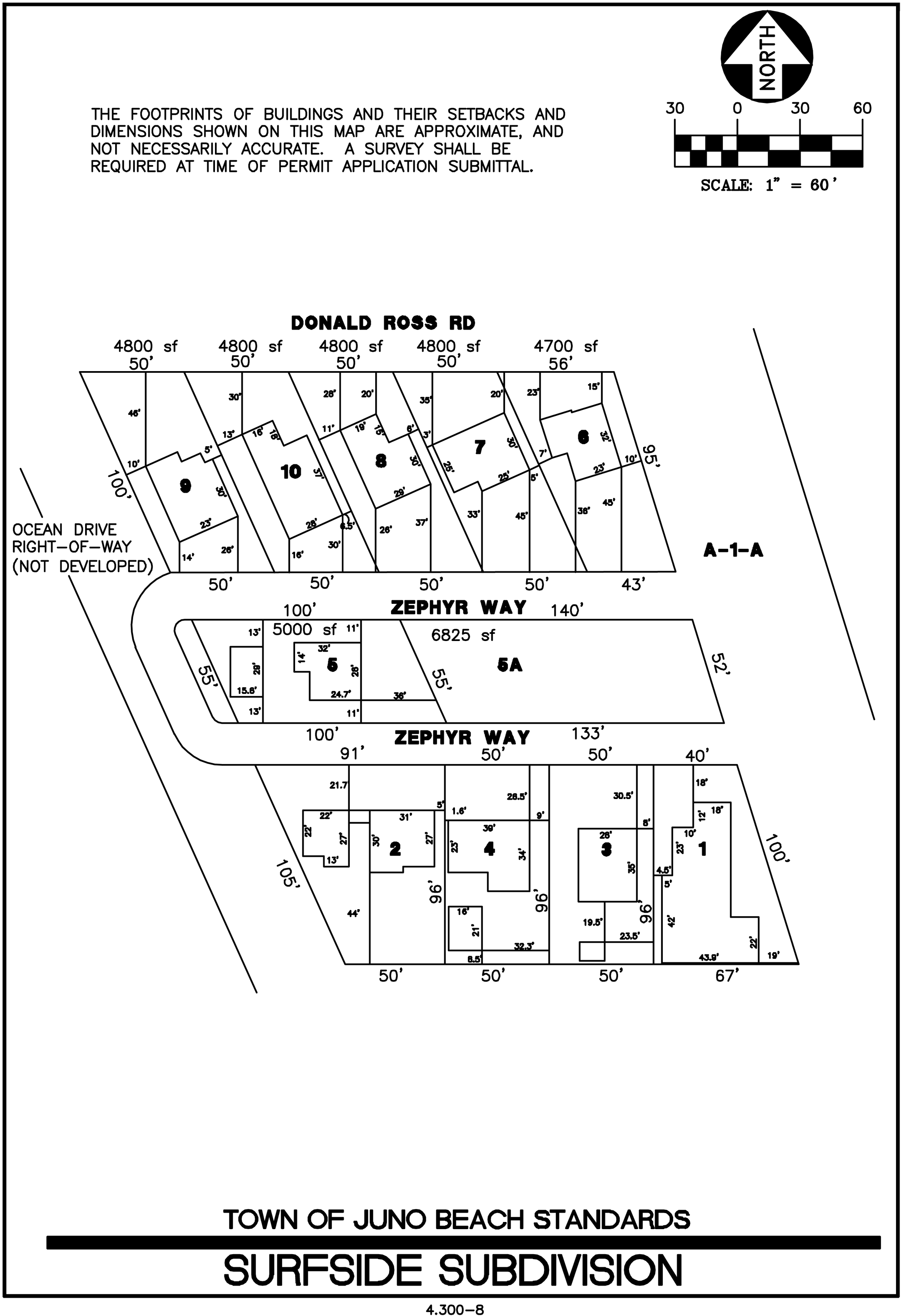
The purpose of the HIST-Z Zephyr Way historic preservation district is to protect and maintain an area in town worthy of historical and architectural preservation so that present and future town residents and visitors may experience the unique historical features and architectural styles of the town. Further purposes of this district include the enhancement of property values, the reduction or elimination of nonconformities, the preservation of scenic views, and the rehabilitation of the Zephyr Way historic preservation district.
(Ord. No. 207, § 4.301, 8-8-1979; Ord. No. 409, 5-15-1991; Ord. No. 454, 11-16-1994)
Sec. 34-469. - Uses and structures permitted.
Permitted uses and structures in the HIST-Z Zephyr Way historic preservation district are as follows:
(1)
Single-family residential dwelling units.
(2)
Public safety facilities such as fire and/or police stations.
(3)
Group homes (see article IV, division 11 of this chapter).
(Ord. No. 207, § 4.302, 8-8-1979; Ord. No. 409, 5-15-1991; Ord. No. 454, 11-16-1994)
Sec. 34-470. - Accessory structures and/or uses permitted.
Accessory structures and uses in the HIST-Z Zephyr Way historic preservation district are as follows:
(1)
Private nurseries and greenhouses.
(2)
Private garages.
(3)
Private swimming pools.
(4)
Other accessory uses and/or structures customarily incidental to permitted uses.
(5)
Limited home occupations (see article IV, division 10 of this chapter).
(Ord. No. 207, § 4.303, 8-8-1979; Ord. No. 409, 5-15-1991; Ord. No. 454, 11-16-1994)
Sec. 34-471. - Applicability of chapter sections.
All sections of this chapter shall apply to the HIST-Z Zephyr Way historic preservation district, except as otherwise provided in this division.
(Ord. No. 207, § 4.304, 8-8-1979; Ord. No. 409, 5-15-1991; Ord. No. 454, 11-16-1994)
Sec. 34-472. - Expansion of nonconforming structures.
Notwithstanding the provisions of article VI of this chapter, any structure made nonconforming as of the effective date of the ordinance from which this chapter is derived shall be permitted to expand its first floor structural footprint so long as:
(1)
The structure is expanded into a conforming front, side, or rear yard setback; and
(2)
All other regulations of this district are complied with.
However, an addition to a nonconforming structure, above the first floor level, is permitted to match an existing, nonconforming first floor footprint. (See article VI of this chapter.)
(Ord. No. 207, § 4.305, 8-8-1979; Ord. No. 409, 5-15-1991; Ord. No. 454, 11-16-1994)
Sec. 34-473. - Street lot lines.
The street lot line shall be defined as the edge of the Zephyr Way right-of-way, Ocean Drive right-of-way, and Donald Ross Road right-of-way.
(Ord. No. 207, § 4.306, 8-8-1979; Ord. No. 409, 5-15-1991; Ord. No. 454, 11-16-1994)
Sec. 34-474. - Corner lots.
The corner lot provision of this chapter is modified for lots in the Surfside subdivision. Lots fronting on three or more streets shall be required to have only one street frontage meet the minimum front yard setback, which shall average 20 feet. Yard setbacks for any additional street frontage are required to meet a minimum ten foot setback, in lieu of the required average 20-foot front yard setback.
(Ord. No. 207, § 4.307, 8-8-1979; Ord. No. 409, 5-15-1991; Ord. No. 454, 11-16-1994)
Sec. 34-475. - Extension of porches and balconies.
Porches, balconies, and similar structures may not extend into any front, side or rear setback. Yard setback encroachments that may be authorized in sections 34-902 and 34-903 are expressly prohibited in this district.
(Ord. No. 207, § 4.308, 8-8-1979; Ord. No. 409, 5-15-1991; Ord. No. 454, 11-16-1994)
Sec. 34-476. - Design criteria.
All development and construction shall be representative of and generally consistent with and complementary to the Old Florida cottage style of architecture (detailed in section 34-480) and which is commonly known and identified by its late Victorian architectural style, Spanish Revival architectural style, or combination thereof. Summarized briefly, distinguishing features of the Old Florida cottage style of architecture include wood or concrete block stucco siding; simple pitched roofs; tile, metal, or asphalt roofs; ornate details such as exposed soffits and individualized vent and louver shapes; lush landscaping with private yards; and use of porches and patios. All additions, alterations, and new construction shall be of a design and proportion which is in harmony with the existing structures in the district.
(Ord. No. 207, § 4.309, 8-8-1979; Ord. No. 409, 5-15-1991; Ord. No. 454, 11-16-1994)
Sec. 34-477. - Site plan and appearance review requirements.
Site plan review by the planning and zoning department shall be required for all new construction, additions, and alterations to existing structures.
(Ord. No. 207, § 4.310, 8-8-1979; Ord. No. 409, 5-15-1991; Ord. No. 434, 12-16-1992; Ord. No. 454, 11-16-1994)
Sec. 34-478. - Appeals.
(a)
Design criteria and architectural standards. A decision by the director interpreting design criteria and architectural standards regulations may be appealed by an applicant by presenting his appeal to the planning and zoning board for review, and to the town council for a final decision on the appeal.
(b)
Other development regulations. Any other decision made by the director interpreting any other regulation set forth in the Zephyr Way historic preservation district shall be appealed to the board of adjustment.
(Ord. No. 207, § 4.311, 8-8-1979; Ord. No. 409, 5-15-1991; Ord. No. 454, 11-16-1994)
Sec. 34-479. - Administration and enforcement of regulations.
Any construction requiring a building permit shall be reviewed by the director prior to the issuance of a building permit. Any improvement which does not require a building permit, for example painting a structure or installing a screen door shall be required to comply with these regulations. Any improvement which does not comply with these regulations shall be deemed a code violation, and shall be subject to removal or modification, as appropriate.
(Ord. No. 207, § 4.312, 8-8-1979; Ord. No. 409, 5-15-1991; Ord. No. 454, 11-16-1994)
Sec. 34-480. - Architectural standards for Zephyr Way historic preservation district.
To maintain the historic character and architectural features of the Old Florida cottage style of Zephyr Way and to maintain and enhance property values, the following materials and design features are permitted for all additions, alterations, and new construction. Materials and design features other than those listed in this section shall be considered on a case by case basis by the town to determine, based on the intent and purpose of this zoning district, if such materials or design features closely resemble the natural materials and are complementary to the architectural style and character of Zephyr Way.
(1)
Building wall materials:
*Concrete block and stucco (CBS).
*Board and batten (vertical wood siding).
*Lap board (horizontal wood siding).
*Wood frame with stucco finish.
(2)
Garden wall and fence materials and treatments:
*Hedges.
*Concrete block and stucco (CBS).
*Decorative concrete ornamentation.
*Lattice (PVC or wood).
*Decorative wood pickets.
*Gates and fences; wrought iron, wood, PVC, aluminum.
*Chainlink is prohibited.
*Wood that is not pressure treated must be painted or sealed. Any wood with ground contact (i.e., posts) must be pressure treated.
*The color of all fences and walls shall be compatible with the color of the principle structure. Natural wood color is considered compatible.
(3)
Landscaping features encouraged:
*Hedges.
*Arbors.
*Trellises.
*Fountains.
*Decorative concrete, stone, or brick patio/walkway.
*Wood decking/walkway (must be pressure treated).
*Xeriscape landscaping.
(4)
Porches and awnings:
*Concrete block and stucco (CBS) or wood framing.
*Porches may be open to the air, screened in, or enclosed with lattice.
*Porches enclosed with any glass or solid material are discouraged when visible from the street.
*Porch roof materials shall match principal building, unless a flat roof which may be tar and gravel or other acceptable material.
*Awnings must be of durable materials (may include fabric/vinyl).
*Awnings must be upgraded, replaced, or removed if torn, faded or in disrepair.
(5)
Roof materials and treatments:
*Tile roof.
*Asphalt shingle roof (min. 210 pounds per square) (straight cuts only, not to simulate other materials, i.e., wood shingles, tile, slate, and so forth).
*Built-up aggregate surface roof (tar and gravel), permitted only for roofs with a pitch less than 3 to12.
*Simple gable and hip roofs are permitted. Flat roofs are permitted but shall not extend over more than 30 percent of roof area.
*Roof pitch shall conform to existing buildings in the district.
*Bahama chimneys, cupolas, weather vanes, and decorative wood corners and detailing are encouraged.
*Rafters at overhangs shall be exposed (open soffits).
(6)
Shutters and window treatments:
*Side-mounted and Bahama shutters (wood, aluminum, vinyl or PVC).
*Awnings (see subsection (4) of this section).
*Mullions are encouraged on windows.
(7)
Door materials and treatments:
*Painted and stained wood.
*Embossed masonite (exterior grade only).
*Wood frame screen doors.
*Painted aluminum screen doors are encouraged over natural aluminum finish color.
*Windows in doors are encouraged to use mullions when visible from the street (i.e., French doors, sliding glass doors with mullions).
*If windows in doors do not use mullions, at a minimum such windows shall have a colored frame (i.e., a sliding glass door shall have a white frame, instead of the natural aluminum finish).
(8)
Vents and louvers:
*Decorative concrete, wood or painted aluminum ornamentation (exposed screening is not permitted).
(9)
Colors:
*Pastel and neutral base (i.e., white, off-white, light earth tones).
*Trim may be any color, but must be compatible with building base color.
*Roof color shall be solid and compatible with building color scheme.
(10)
Accessory structures: materials, design, and color shall match principal structure.
(11)
Historic preservation districts:
Building Site Area Regulations
Surfside (Zephyr Way)
***If accessory structure is in the front yard, the front yard setback shall apply.
(Ord. No. 207, § 4.314, 8-8-1979; Ord. No. 409, 5-15-1991; Ord. No. 454, 11-16-1994)
Sec. 34-499.- Purpose.
The purpose of the HIST-B Beachbound historic preservation district is to protect and maintain an area in town worthy of historical and architectural preservation so that present and future town residents and visitors may experience the unique historical features and architectural styles of the town. Further purposes of this district include the enhancement of property values, the reduction or elimination of nonconformities, the preservation of scenic views, and the rehabilitation of the Beachbound district.
(Ord. No. 207, § 4.401, 8-8-1979; Ord. No. 409, 5-15-1991; Ord. No. 454, 11-16-1994)
Sec. 34-500. - Uses and structures permitted.
Permitted uses and structures in the HIST-B Beachbound historic preservation district are as follows:
(1)
Single-family residential dwelling unit.
(2)
Public safety facilities such as fire and/or police stations.
(3)
Group homes (see article IV, division 11 of this chapter).
(Ord. No. 207, § 4.402, 8-8-1979; Ord. No. 409, 5-15-1991; Ord. No. 454, 11-16-1994)
Sec. 34-501. - Accessory structures and/or uses permitted.
Accessory structures and uses in the HIST-B Beachbound historic preservation district are as follows:
(1)
Private nurseries and greenhouses.
(2)
Private garages.
(3)
Private swimming pools.
(4)
Other accessory uses and/or structures customarily incidental to permitted uses.
(5)
Limited home occupations (see article IV, division 10 of this chapter).
(Ord. No. 207, § 4.403, 8-8-1979; Ord. No. 409, 5-15-1991; Ord. No. 454, 11-16-1994)
Sec. 34-502. - Applicability of chapter sections.
All sections of this chapter shall apply to the HIST-B Beachbound historic preservation district, except as otherwise provided in this division.
(Ord. No. 207, § 4.404, 8-8-1979; Ord. No. 409, 5-15-1991; Ord. No. 454, 11-16-1994)
Sec. 34-503. - Expansion of nonconforming structures.
Notwithstanding the provisions of article VI of this chapter, any structure made nonconforming as of the effective date of the ordinance from which this chapter is derived shall be permitted to expand its first floor structural footprint so long as:
(1)
The structure is expanded into a conforming front, side, or rear yard setback; and
(2)
All other regulations of this district are complied with. However, an addition to a nonconforming structure, above the first floor level, is permitted to match an existing, nonconforming first floor footprint. (See article VI of this chapter.)
(Ord. No. 207, § 4.405, 8-8-1979; Ord. No. 409, 5-15-1991; Ord. No. 454, 11-16-1994)
Sec. 34-504. - Street lot lines.
The street lot line shall be defined as the edge of the Galaxy Circle right-of-way and Celestial Way right-of-way.
(Ord. No. 207, § 4.406, 8-8-1979; Ord. No. 409, 5-15-1991; Ord. No. 454, 11-16-1994)
Sec. 34-505. - Side yard setback.
The side yard setbacks shall total a minimum of 13 feet, with no side being less than five feet.
(Ord. No. 207, § 4.407, 8-8-1979; Ord. No. 409, 5-15-1991; Ord. No. 454, 11-16-1994)
Sec. 34-506. - Corner lots.
The corner lot provision of this chapter shall apply to this division.
(Ord. No. 207, § 4.408, 8-8-1979; Ord. No. 409, 5-15-1991; Ord. No. 454, 11-16-1994)
Sec. 34-507. - Extension of porches and balconies.
Porches, balconies, and similar structures may not extend into any front, side or rear setback. Yard setback encroachments that may be authorized in sections 34-902 and 34-903 are expressly prohibited in the HIST-B Beachbound historic preservation district.
(Ord. No. 207, § 4.409, 8-8-1979; Ord. No. 409, 5-15-1991; Ord. No. 454, 11-16-1994)
Sec. 34-508. - Location of garden walls and fences.
Along Galaxy Circle, walls and fences are prohibited to run parallel with Galaxy Circle when located in the front yard.
(Ord. No. 207, § 4.410, 8-8-1979; Ord. No. 409, 5-15-1991; Ord. No. 454, 11-16-1994)
Sec. 34-509. - Design criteria.
All development and construction shall be representative of and generally consistent with and complementary to the Old Florida cottage style of architecture (detailed in section 34-513) and which is commonly known and identified by its late Victorian architectural style, Spanish Revival architectural style, or combination thereof. Summarized briefly, distinguishing features of the Old Florida cottage style of architecture include wood or concrete block stucco siding; simple pitched roofs; tile, metal, or asphalt roofs; ornate details such as exposed soffits and individualized vent and louver shapes; lush landscaping with private yards; and use of porches and patios. All additions, alterations, and new construction shall be of a design and proportion which is in harmony with the existing structures in the HIST-B Beachbound historic preservation district.
(Ord. No. 207, § 4.411, 8-8-1979; Ord. No. 409, 5-15-1991; Ord. No. 454, 11-16-1994)
Sec. 34-510. - Site plan and appearance review requirements.
Site plan review by the planning and zoning department shall be required for all new construction, additions, or alterations to existing structures.
(Ord. No. 207, § 4.412, 8-8-1979; Ord. No. 409, 5-15-1991; Ord. No. 434, 12-16-1992; Ord. No. 454, 11-16-1994)
Sec. 34-511. - Appeals.
(a)
Design criteria and architectural standards. A decision by the director interpreting design criteria and architectural standards regulations may be appealed by an applicant by presenting his appeal to the planning and zoning board for review, and to the town council for a final decision on the appeal.
(b)
Other development regulations. Any other decision made by the director, interpreting any other regulation set forth in the Beachbound historic preservation district shall be appealed to the board of adjustment.
(Ord. No. 207, § 4.413, 8-8-1979; Ord. No. 409, 5-15-1991; Ord. No. 454, 11-16-1994)
Sec. 34-512. - Administration and enforcement of regulations.
Any construction requiring a building permit shall be reviewed by the director prior to the issuance of a building permit. Any improvement which does not require a building permit, for example painting a structure or installing a screen door shall be required to comply with these regulations. Any improvement which does not comply with these regulations shall be deemed a code violation, and shall be subject to removal or modification, as appropriate.
(Ord. No. 207, § 4.414, 8-8-1979; Ord. No. 409, 5-15-1991; Ord. No. 454, 11-16-1994)
Sec. 34-513. - Architectural standards for Beachbound historic preservation district.
To maintain the historic character and architectural features of the Old Florida cottage style of Beachbound and to maintain and enhance property values, the following materials and design features are permitted for all additions, alterations, and new construction. Materials and design features other than those listed in this section shall be considered on a case by case basis by the town to determine, based on the intent and purpose of this zoning district, if such materials or design features closely resemble the natural materials and are complementary to the architectural style of Beachbound.
(1)
Building wall materials:
*Concrete block and stucco (CBS).
*Board and batten (vertical wood siding).
*Lap board (horizontal wood siding).
*Wood frame with stucco finish.
(2)
Garden wall and fence materials and treatments:
*Hedges.
*Concrete block and stucco (CBS).
*Decorative concrete ornamentation.
*Lattice (PVC or wood).
*Decorative wood pickets.
*Gates and fences; wrought iron, wood, PVC, aluminum.
*Wood that is not pressure treated must be painted or sealed. Any wood with ground contact (i.e., posts) must be pressure treated.
*Chainlink is prohibited.
*The color of all fences and walls shall be compatible with the principal building color. Natural wood color is considered compatible.
(Along Galaxy Circle, walls and fences are prohibited to run parallel with Galaxy Circle when located in the front yard.)
(3)
Landscaping features encouraged:
*Hedges.
*Arbors.
*Trellises.
*Fountains.
*Decorative concrete, stone, or brick patio/walkway.
*Wood decking/walkway (must be pressure treated).
*Xeriscape landscaping.
(4)
Porches and awnings:
*Concrete block and stucco (CBS) or wood framing.
*Porches may be open to the air, screened in, or enclosed with lattice.
*Porch roof materials shall match principal building, unless a flat roof which may be tar and gravel or other acceptable material.
*Awnings must be of durable materials (may include fabric/vinyl).
*Awnings must be upgraded, replaced, or removed if torn, faded or in disrepair.
(5)
Roof materials and treatments:
*Tile roof.
*Asphalt shingle roof (min. 210 pounds per square) (straight cuts only, not to simulate other materials, i.e., wood shingles, tile, slate, and so forth).
*Built-up aggregate surface roof (tar and gravel), permitted only for roofs with a pitch less than 3 to12.
*Simple gable and hip roofs are permitted. Flat roofs are permitted but shall not extend over more than 30 percent of roof area.
*Roof pitch shall conform to existing buildings in the district.
*Bahama chimneys, cupolas, weather vanes, and decorative wood corners and detailing are encouraged.
*Rafters at overhangs shall be exposed (open soffits).
(6)
Shutters and window treatments:
*Side-mounted and Bahama shutters (wood, aluminum, vinyl or PVC).
*Awnings (see subsection (4) of this section).
(7)
Door materials and treatments:
*Painted and stained wood.
*Embossed masonite (exterior grade only).
*Wood frame screen doors.
*Painted aluminum screen doors are encouraged over natural aluminum finish color.
*Windows in doors are encouraged to use mullions (i.e., French doors).
(8)
Vents and louvers:
*Decorative concrete, wood or painted aluminum ornamentation (exposed screening is not permitted).
(9)
Colors:
*Tropical pastel (i.e., white, light pink, grey, yellow, green).
*Trim may be any color, but must be compatible with building base color.
*Roof color shall be solid and compatible with building color scheme.
(10)
Accessory structures: materials, design, and color shall match principal structure.
(11)
Historic preservation districts:
Building Site Area Regulations
Beachbound (Galaxy Circle)
***If accessory structure is in the front yard, the front yard setback shall apply.
****Lots 9, 10, 11, 14, 15, 16: Nine feet set back from three-foot walkway; lots 14, 15, 16: Nine feet set back from Wexford Court property line.
(Ord. No. 207, § 4.416, 8-8-1979; Ord. No. 409, 5-15-1991; Ord. No. 454, 11-16-1994)
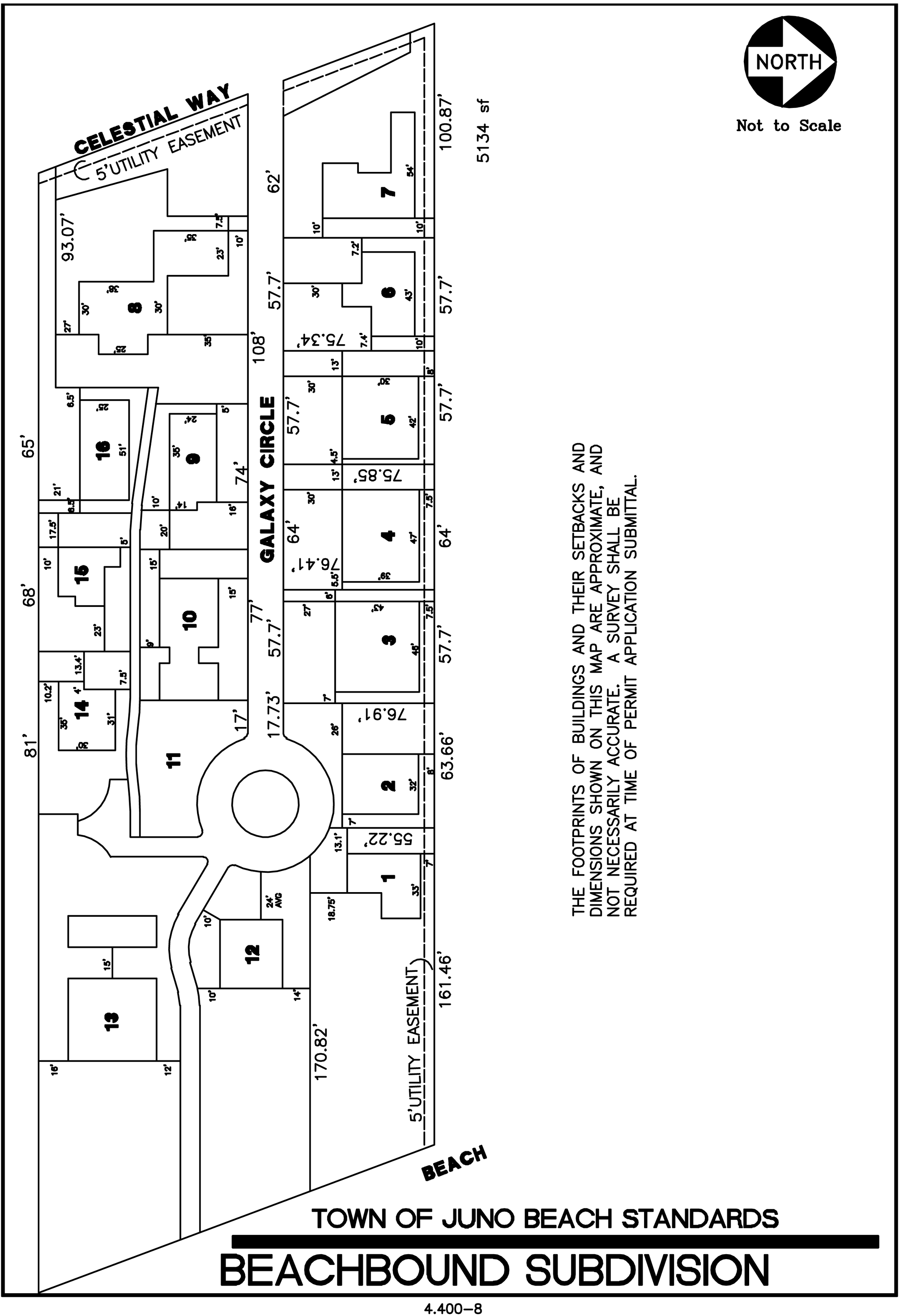
Sec. 34-535.- Purpose.
The purpose of the R-DUP two-family residential duplex district is to provide for an area in the town which shall be used exclusively for single-family detached or two-family homes.
(Ord. No. 207, § 4.501, 8-8-1979; Ord. No. 467, 12-14-1994; Ord. No. 485, 9-4-1996)
Sec. 34-536. - Uses permitted.
Permitted uses in the R-DUP two-family residential duplex district are as follows:
(1)
Single-family residences.
(2)
Two-family dwellings.
(3)
Group homes (see article IV, division 11 of this chapter).
(4)
Public safety facilities such as fire and/or police stations.
(Ord. No. 207, § 4.502, 8-8-1979; Ord. No. 467, 12-14-1994; Ord. No. 485, 9-4-1996)
Sec. 34-537. - Accessory uses.
Accessory uses in the R-DUP two-family residential duplex district are as follows:
(1)
Private nurseries and greenhouses.
(2)
Private garages.
(3)
Private swimming pools and/or cabanas.
(4)
Accessory uses customarily incident to the permitted uses.
(5)
Limited home occupations (see article IV, division 10 of this chapter).
(Ord. No. 207, § 4.503, 8-8-1979; Ord. No. 467, 12-14-1994; Ord. No. 485, 9-4-1996)
Sec. 34-538. - Special exception uses.
Special exception uses in the R-DUP two-family residential duplex district are as follows:
(1)
Public and private utility structures.
(2)
Churches, synagogues, and other houses of worship.
(3)
Planned unit development—residential only (single-family detached). (See article V of this chapter.)
(4)
Satellite dish antennas (see article IV, division 13 of this chapter).
(Ord. No. 207, § 4.504, 8-8-1979; Ord. No. 467, 12-14-1994; Ord. No. 485, 9-4-1996)
Sec. 34-539. - Site plan and appearance review requirements.
A site plan and appearance review is required of all uses other than individual single-family detached dwellings, which shall be subject to review only by the town planning and zoning department.
Building Site Area Requirements
Residential Zoning District (R-DUP)
NOTES:
*Screened pool enclosures are excluded.
(a) Corner lots: section 34-899 is modified for the RS districts as follows: one street side: minimum 15 feet setback; other street side: minimum required front yard setback (see table in section 34-539).
(b) A minimum 19-foot-long driveway or parking area is required in front of a garage or carport for stacking depth.
(c) The minimum living area (habitable space) for single-family homes in the R-DUP district shall be the same as in the R-DUP district: one-bedroom, 1,000 sq. ft.; two-bedroom, 1,200 sq. ft.; and three-bedroom, 1,400 sq. ft.
(d) Building height is measured from average existing grade (prior to land alteration) at structure's proposed location or from the crown of the road at its highest elevation abutting in the property, whichever is greater.
(e) If the accessory structure is in the front yard, the front yard setback shall apply.
(f) If the accessory structure is set back a minimum of ten feet from the side or rear property line, then section 34-873 shall apply and there shall be no maximum building dimension requirement.
(Ord. No. 207, § 4.505, 8-8-1979; Ord. No. 467, 12-14-1994; Ord. No. 485, 9-4-1996)
Sec. 34-557.- Purpose.
The purpose of the RV Park recreational vehicle park district is to create an area for the use of recreational vehicles (RVs), as defined by and according to F.S. §§ 320.01(1)(b) and 513.01(9).
(Ord. No. 207, § 4.601, 8-8-1979; Ord. No. 476, 12-13-1995; Ord. No. 485, 9-4-1996; Ord. No. 491, 2-12-1997; Ord. No. 527, 11-15-2000)
Sec. 34-558. - Uses permitted.
Permitted uses in the RV Park recreational vehicle park district are recreational vehicles (RVs) within an RV park.
(Ord. No. 207, § 4.602, 8-8-1979; Ord. No. 476, 12-13-1995; Ord. No. 485, 9-4-1996; Ord. No. 491, 2-12-1997; Ord. No. 527, 11-15-2000)
Sec. 34-559. - Accessory uses.
(a)
Generally. Accessory uses in the recreational vehicle park district are as follows:
(1)
Clubhouse/recreational building.
(2)
Rental office for RV lots.
(3)
Manager's office.
(4)
Bathhouses.
(5)
Laundry rooms.
(6)
Storage area/storage building.
(7)
Private swimming pools or cabanas.
(8)
Cooking/barbecue grill structure.
(b)
Individual lots within RV park. Accessory uses for individual lots within the recreational vehicle park district are as follows:
(1)
Screen room (three-sided only, RV shall form fourth side).
(2)
Storage building.
(3)
Porches (open air or enclosed with nonglazed windows; three-sided only, RV shall form fourth side).
(4)
Deck.
(5)
Cooking/barbecue grill structure.
(Ord. No. 207, § 4.603, 8-8-1979; Ord. No. 476, 12-13-1995; Ord. No. 485, 9-4-1996; Ord. No. 491, 2-12-1997; Ord. No. 527, 11-15-2000)
Sec. 34-560. - Special exception uses.
Special exception uses in the RV Park recreational vehicle park district are as follows: satellite dish antennas (see article IV, division 13 of this chapter).
Sec. 34-561. - Site plan and appearance review requirements.
A site plan and appearance review is required of all RV parks. However, individual RV lots within the park which are to have an RV remain on a lot consecutively for six months or more, or accessory structures which are to be affixed to the ground permanently, shall be subject to review by the town planning and zoning department.
(Ord. No. 207, § 4.604, 8-8-1979; Ord. No. 476, 12-13-1995; Ord. No. 485, 9-4-1996; Ord. No. 491, 2-12-1997; Ord. No. 527, 11-15-2000)
Sec. 34-562. - Building permit requirements.
All RVs remaining on a lot consecutively for six months or more at a time shall be required to obtain the following building permits: tiedown permit, plumbing permit, and electrical permit. In addition, during hurricane season, June 1—November 30, any RV that is on a lot unoccupied or unattended by the owner for more than five consecutive days shall be required to be tied down and a tiedown building permit obtained. A survey of the property, signed and sealed by a surveyor registered in the state, shall be submitted when applying for a building permit.
(Ord. No. 207, § 4.605, 8-8-1979; Ord. No. 476, 12-13-1995; Ord. No. 485, 9-4-1996; Ord. No. 491, 2-12-1997; Ord. No. 527, 11-15-2000)
Sec. 34-563. - Materials.
All materials to be used for an RV or accessory structure shall be constructed of metal or wood frame with aluminum, stainless steel, vinyl, and or fiberglass siding. However, an accessory storage building may also be made of commercially molded plastic if permitted by the Florida Building Code. Permanent cooking/barbecue grill structures may be made of brick, stone, metal or masonry block and shall meet Florida Building Code requirements.
(Ord. No. 207, § 4.606, 8-8-1979; Ord. No. 476, 12-13-1995; Ord. No. 485, 9-4-1996; Ord. No. 491, 2-12-1997; Ord. No. 527, 11-15-2000)
Sec. 34-564. - Nonconforming status.
(a)
As of the effective date of the ordinance from which this chapter is derived, all RVs which are properly tied down and accessory structures with valid building permits shall be considered structures, as defined in this chapter, provided they are documented by an as-built survey submitted to the town within 90 days of the effective date of the ordinance from which this chapter is derived. Therefore, article VI of this chapter shall apply to these structures. All as-built surveys shall meet the requirements of F.A.C. ch. 61G17-6.
(b)
In addition, a lot, as recorded in the public records prior to the effective date of the ordinance from which this chapter is derived, which does not meet the minimum lot size, lot width, or lot depth requirements shall be permitted to have an RV and accessory structures erected on the property, provided the remaining building site area requirements are adhered to.
(c)
However, all designated "C" lots on the original condominium documents of Yogi by the Sea, as recorded in the official record book 4693, page 1853, of the public records of the county, shall be permitted to be amended and recorded in the public records after the effective date of the ordinance from which this chapter is derived, even though the minimum lot size, width or depth requirements are not met, provided the lot boundaries are as shown on the unrecorded surveyor's exhibit to the Declaration of Condominium, prepared by Benchmark Land Surveying and Mapping, Inc., as revised on May 12, 1988. In addition, any of these lots which do not meet the minimum lot size, lot width, or lot depth requirements shall be permitted to have an RV and accessory structures erected on the property, provided the remaining building site area requirements are adhered to.
(d)
The existing Juno Ocean Walk RV Park (as recorded in the official record book 4693, page 1853, of the public records of the county as Yogi by the Sea condominium) shall have the following lot designations for setback purposes:
(1)
Perimeter lots (section A).
(2)
Interior lots (section C).
(3)
Common area lots (sections B, D, E, and F).
(Ord. No. 207, § 4.607, 8-8-1979; Ord. No. 476, 12-13-1995; Ord. No. 485, 9-4-1996; Ord. No. 491, 2-12-1997; Ord. No. 527, 11-15-2000)
Sec. 34-565. - Building site area requirements for RV park.
The following building site area requirements for RV parks shall apply:
(1)
Minimum RV park lot area: 20 acres
(2)
Minimum lot width: 300 feet
(3)
Minimum lot depth: 300 feet
(4)
Maximum density: 12 RV units/acre
(5)
Height of accessory structure: Two stories, 30 feet (max.)
(6)
Common area open space: 15 percent minimum
(7)
Perimeter landscape buffer or barrier: A minimum 15-foot-wide landscape buffer or barrier, as determined by the town during site plan and appearance review, shall be provided along the entire perimeter of the property.
(8)
RV park storage area requirements: Only the following items are permitted to be stored in this area: RVs, automobiles, car trailers, boats on trailers, and utility trailers. In order to allow for ingress/egress during emergency situations, no permitted items shall exceed 45 feet in total length. All permitted items must have a current registration and license tag. Also, RV park dumpsters and golf carts are permitted in this area.
(9)
All other requirements not stated herein shall comply with F.A.C. ch. 64E-15.
(Ord. No. 207, § 4.608, 8-8-1979; Ord. No. 476, 12-13-1995; Ord. No. 485, 9-4-1996; Ord. No. 491, 2-12-1997; Ord. No. 527, 11-15-2000)
Sec. 34-566. - Building site area requirements for individual lots within RV park.
(a)
The following building site area requirements for individual lots within an RV park shall apply:
NOTES:
(a) Section 34-899 shall not apply to these lots. Therefore, when a lot has frontage on two streets, the street frontage in which the hitch (the hooking device to transport the RV) faces shall be considered the front yard and the other street frontage shall be considered a side yard.
(b) Section 34-899 shall apply, except for those lots which abut a ten-foot-wide driveway easement, the yard facing that ten-foot-wide driveway easement shall have a front yard setback of ten feet. Those lots which do not abut a ten-foot-wide driveway easement shall have a minimum front yard setback requirement of five feet. Section 34-899 shall not apply to these interior lots; therefore, the street or driveway easement frontage in which the hitch (the hooking device to transport the RV) faces shall be considered the front yard and the other street frontage shall be considered a side yard.
(c) Those lots whose rear yard faces an adjacent lot shall be required to have a rear yard setback of five feet.
(d) RV and building height is measured from the finished floor elevation of the concrete foundation. Existing concrete foundations shall not be raised in height.
(e) All accessory structures shall be freestanding structures, not permanently attached to the RV and must not protrude beyond the front corner of the RV walls; however, protrusion may occur between tip-outs. No plumbing, air conditioning unit or ducts are permitted within an accessory structure. Electricity, however, shall be permitted to serve an accessory structure. Accessory structures, other than storage buildings, are permitted only when an RV is located on the lot. When an RV is removed from a lot, all accessory structures, other than storage buildings and cooking/barbecue grill structures, must also be removed. A freestanding air conditioning unit shall be considered an accessory structure (see definition of accessory structure in section 34-4).
(f) Those lots with a lot depth of 50 feet or less shall be permitted a five-foot front yard setback.
(g) Those lots whose rear yard faces and is adjacent to common area shall be permitted a zero-foot rear yard setback.
(h) Those lots whose side yard faces and is adjacent to common area (excluding roadways) at least ten feet wide shall be permitted a zero-foot side yard setback. Those lots whose side or rear yards face common area of less than ten feet wide shall be required to maintain a ten-foot-wide open area; these lots may reduce their setbacks to the extent that they maintain a ten-foot-wide open and unobstructed area.
(b)
All other requirements not stated herein shall comply with F.A.C. ch. 64E-15.
(c)
Definitions. The following words, terms and phrases, when used in this section, shall have the meanings ascribed to them in this subsection, except where the context clearly indicates a different meaning:
Common area lots means individual lots whose rear yard faces and is adjacent to common area, excluding any perimeter buffer common area.
Electrical permit means a permit required for hooking up an RV to electricity. A maximum of two 50-amp cord cap connections are the only acceptable electrical hookup for an RV. (In other words, the electrical hookup must be a plug in.)
Interior lots means individual lots that are not perimeter or common area lots.
Perimeter lots means individual lots that are adjacent to the perimeter property lines and/or perimeter landscape buffer or barrier of the development.
Plumbing permit means a permit required for hooking up an RV to a water and sewer connection.
Recreational vehicle (RV) means as defined by F.S. §§ 320.01(1)(b) and 513.01(9). However, in addition, all RVs must be temporary in that the wheels remain on the RV, all electrical and plumbing hookups must be plug in, and all skirting on RVs must be temporary.
Tip-outs means the sliding portion of the RV which extends beyond the typical eight to 8.5 feet RV width.
(Ord. No. 207, § 4.609, 8-8-1979; Ord. No. 476, 12-13-1995; Ord. No. 485, 9-4-1996; Ord. No. 491, 2-12-1997; Ord. No. 527, 11-15-2000)
Sec. 34-596.- Purpose.
The purpose of the MH manufactured home community district is to create an environment suitable for single-family manufactured homes.
(Ord. No. 207, § 4.701, 8-8-1979; Ord. No. 482, 4-10-1996; Ord. No. 485, 9-4-1996)
Sec. 34-597. - Uses permitted.
Permitted uses in the MH manufactured home community district are as follows:
(1)
Single-family manufactured homes within a manufactured home community.
(2)
Group homes (see article IV, division 11 of this chapter).
(Ord. No. 207, § 4.702, 8-8-1979; Ord. No. 482, 4-10-1996; Ord. No. 485, 9-4-1996)
Sec. 34-598. - Accessory uses.
Accessory structures for community or individual lots in the MH manufactured home community district may be of conventional block or frame construction or manufactured construction. Permitted accessory uses are:
(1)
Manufactured home community:
a.
Clubhouse/recreational building.
b.
Manager's office.
c.
Laundry rooms.
d.
Storage area/storage building.
e.
Private swimming pools or cabanas.
(2)
Individual lots within manufactured home community:
a.
Manufactured home accessory building or structure, as defined by the National Fire Protection Association Standards, NFPA 501A.
b.
Hot tub/whirlpool.
c.
Limited home occupations (see article IV, division 10 of this chapter).
(Ord. No. 207, § 4.703, 8-8-1979; Ord. No. 482, 4-10-1996; Ord. No. 485, 9-4-1996; Ord. No. 689, § 12, 1-25-2017)
Sec. 34-599. - Special exception uses.
Special exception uses in the MH manufactured home community district are as follows: satellite dish antennas (see article IV, division 13 of this chapter).
Sec. 34-600. - Site plan and appearance review requirements.
A site plan and appearance review is required of all manufactured home communities. However, individual manufactured home lots within the community shall be subject to review by the town planning and zoning department.
(Ord. No. 207, § 4.704, 8-8-1979; Ord. No. 482, 4-10-1996; Ord. No. 485, 9-4-1996)
Sec. 34-601. - Nonconforming status.
Within a manufactured home community zoning district, an individual lot, as recorded in the public records prior to the effective date of the ordinance from which this chapter is derived, which does not meet the minimum lot size, lot width, or lot depth requirements shall be permitted to have a manufactured home and accessory structures erected on the property, provided the remaining building site area requirements are adhered to.
(Ord. No. 207, § 4.705, 8-8-1979; Ord. No. 482, 4-10-1996; Ord. No. 485, 9-4-1996)
Sec. 34-602. - Building site area requirements for manufactured home community.
The following building site area requirements for manufactured home communities shall apply to the MH manufactured home community district:
(Ord. No. 207, § 4.706, 8-8-1979; Ord. No. 482, 4-10-1996; Ord. No. 485, 9-4-1996)
Sec. 34-603. - Building site area requirements for individual lots within manufactured home community.
The following building site area requirements for individual lots within manufactured home communities shall apply to the MH manufactured home community district:
NOTES:
*Lots that are designed to have the longest portion of the manufactured home (length) run parallel with the front property line shall have the following minimum requirements:
Minimum lot width: 90 ft.
Minimum lot depth: 25 ft.
Minimum front setback: 3 ft. (a)
Minimum side setback: 10 ft. (a)
Minimum rear setback: 5 ft.
(a) Corner lots: section 34-899 shall apply to this district. One street side: minimum three-foot setback; other street side: minimum three-foot setback. If adjacent to an arterial or collector street, the arterial or collector street side setback shall be a minimum of ten feet.
(b) Building height is measured from average existing grade (prior to land alteration) at the structure's proposed location or from the crown of the road at its highest elevation abutting the property, whichever is greater.
(c) If accessory structure is in the front yard, the front yard setback shall apply. However, a storage building shall be located only in the rear one-third depth of the lot.
(Ord. No. 207, § 4.707, 8-8-1979)
Sec. 34-625.- Purpose.
(a)
The purpose of the CG commercial general district is to provide attractive and efficient retail shopping and personal service uses, to be developed either as a planned unit or in individual parcels. Retail drive-in businesses are not permitted. To enhance the general character of the district and its compatibility with its residential surroundings, this district is also suitable for professional, administrative, and general sales offices together with certain commercial uses designed primarily to serve employees in the district.
(b)
Certain preferred uses are identified in the district and provided incentives to encourage their development. The purpose of the preferred uses is to encourage an environment which is particularly compatible and complementary to the adjacent residential area. The town desires a traditional town center atmosphere in its commercial areas, so as to link the commercial areas with the residential areas by both aesthetics and vehicular/pedestrian access, and to encourage residents to patronize such businesses.
(Ord. No. 207, § 4.61, 8-8-1979; Ord. No. 302, 6-25-1986; Ord. No. 375, 11-15-1989; Ord. No. 476, 12-13-1995; Ord. No. 491, 2-12-1997)
Sec. 34-626. - Uses permitted.
Permitted uses in the CG commercial general district are as follows:
(1)
Retail and service establishments, hardware stores, food stores, clothing stores, drugstores, barbershops, beauty salons and jewelry stores.
(2)
Business services.
(3)
Department stores.
(4)
Churches, synagogues or other houses of worship.
(5)
Nonprofit cultural centers.
(6)
Professional offices (greater than 40,000 gross floor area (GFA)).
(7)
Medical and dental offices.
(8)
Health spa/gym (greater than 20,000 GFA).
(9)
Banks and financial institutions (greater than 50,000 GFA).
(10)
Professional or studio-type schools (greater than 50,000 GFA).
(11)
Public safety facilities such as fire and/or police stations.
(12)
Day care centers, if not adjacent to a residential use or residentially zoned property.
(13)
Adult entertainment establishments.
(14)
Outpatient substance abuse treatment provider.
(Ord. No. 207, § 4.62, 8-8-1979; Ord. No. 302, 6-25-1986; Ord. No. 375, 11-15-1989; Ord. No. 434, 12-16-1992; Ord. No. 476, 12-13-1995; Ord. No. 491, 2-12-1997; Ord. No. 644, § 2, 1-12-2011; Ord. No. 668, § 4, 5-28-2014)
Sec. 34-627. - Preferred permitted uses.
Preferred permitted uses in the CG commercial general district are as follows:
(1)
Professional offices (40,000 gross floor area (GFA) or less).
(2)
Residential (single-family and/or multifamily dwellings). A maximum 75 percent of the total gross floor area on the site may be used for residential.
(3)
Health spa/gym (20,000 GFA or less).
(4)
Banks and financial institutions (50,000 GFA or less).
(5)
Retail deli, bakery, and sandwich shop.
(6)
Retail landscape nursery with outdoor displays.
(7)
Temporary festive outdoor markets (only fruits, vegetables, plants, flowers, arts, and handcrafted items shall be sold). Maximum two-year temporary permit, renewable at the discretion of the town council.
(8)
Professional or studio type schools (50,000 GFA or less).
(9)
Transient residential facilities (maximum 30 units or less for timeshare and maximum 15 rooms or less for bed and breakfast).
(10)
Hotel/motel (150 rooms/units or less).
(Ord. No. 207, § 4.62.1, 8-8-1979; Ord. No. 302, 6-25-1986; Ord. No. 375, 11-15-1989; Ord. No. 434, 12-16-1992; Ord. No. 476, 12-13-1995; Ord. No. 491, 2-12-1997; Ord. No. 581, § 2(exh. A), 8-24-2005; Ord. No. 644, § 3, 1-12-2011; Ord. No. 668, § 4, 5-28-2014; Ord. No. 689, § 13, 1-25-2017)
Sec. 34-628. - Accessory uses.
Accessory uses in the CG commercial general district are as follows:
(1)
Off-street parking and loading.
(2)
Signs.
(3)
Drive-in financial facilities.
(4)
Accessory uses customarily incident to the permitted or approved special exception uses.
(5)
Satellite dish antennas (see article IV, division 13 of this chapter).
(Ord. No. 207, § 4.63, 8-8-1979; Ord. No. 302, 6-25-1986; Ord. No. 375, 11-15-1989; Ord. No. 476, 12-13-1995; Ord. No. 491, 2-12-1997)
Sec. 34-629. - Special exception uses.
Special exception uses in the CG commercial general district are as follows:
(1)
Public parking garages
(2)
Public and private utility structures.
(3)
Fuel service stations (see section 34-869).
(4)
Supplemental off-site parking.
(5)
Public and private academic schools.
(6)
Assisted living facilities (see article IV, division 12 of this chapter).
(7)
Transient residential facility (greater than 30 units for timeshare).
(8)
Convenience stores (see section 34-868).
(9)
Vehicle minor repair facility (see section 34-870).
(10)
Hotel/motel (greater than 150 rooms/units).
(11)
Day care centers, if adjacent to a residential use or residentially zoning property.
(12)
Uses utilizing optional building site area development modifications identified in section 34-632.
(13)
Restaurants and drinking establishments.
(Ord. No. 207, § 4.64, 8-8-1979; Ord. No. 302, 6-25-1986; Ord. No. 375, 11-15-1989; Ord. No. 434, 12-16-1992; Ord. No. 476, 12-13-1995; Ord. No. 491, 2-12-1997; Ord. No. 581, § 2(exh. A), 8-24-2005; Ord. No. 644, § 4, 1-12-2011; Ord. No. 668, § 4, 5-28-2014)
Sec. 34-630. - Site plan and appearance review requirements.
A site plan and appearance review is required for all uses.
(Ord. No. 207, § 4.65, 8-8-1979; Ord. No. 302, 6-25-1986; Ord. No. 375, 11-15-1989; Ord. No. 476, 12-13-1995; Ord. No. 491, 2-12-1997)
Sec. 34-631. - Building site area regulations.
The following building site area regulations shall apply to the CG commercial general district:
(1)
Minimum total area: 40,000 square feet.
(2)
Minimum lot width: 150 feet.
(3)
Minimum lot depth: 150 feet.
(4)
Density: When applied to residential uses in this district, the maximum densities shall be those which are in effect for the RH zoning district, i.e., 18 dwelling units per gross acre for multiple-family dwellings. The maximum density for transient residential facilities and hotel/motel facilities within this district shall be 30 guest units per gross acre.
(5)
Setbacks:
a.
The following setback schedule shall apply, and all properties adjoining or adjacent to property with a residential or "R" zoning district designation shall incorporate a minimum of a 15-foot landscaped buffer within such adjoining yard or setback:
b.
For all buildings higher than two stories, all stories above the first two stories shall be set back a minimum of five feet from the first story building facade and shall include an architecturally compatible roof treatment or element along such building line break (see graphic representation in Exhibit 2 appended to the end of this section).
(6)
Ocean setbacks: 50 feet west of the Coastal Construction Control Line (CCCL).
(7)
High-rise setback: see subsection (5) of this section.
(8)
Maximum building height:
a.
For buildings having two stories, the maximum building height shall not exceed 30 feet. For buildings having three stories, the maximum building height shall not exceed 45 feet. No building shall exceed three stories, except for those buildings which contain a minimum of one floor of residential space which shall be permitted a maximum of four stories and 60 feet in height.
b.
For properties with a total lot area exceeding two acres, all structures within 60 feet of a rear or side property line adjoining property with an "R" or residential zoning district designation shall not exceed the maximum building height for the adjacent residential property (see graphic representation of this concept in Exhibit 1 and Exhibit 2 appended to the end of this section).
c.
A minimum 20-foot building separation shall be required between all principal structures on site.
(9)
Maximum building dimension: 200 feet.
(10)
Maximum lot coverage: 40 percent.
(11)
Minimum landscaped open space: 15 percent of total lot area. All building sides shall be required to install foundation planting materials along a minimum of 40 percent of the length of each facade. Such foundation plantings shall be at least four feet deep, as measured from the edge of the building.
(12)
Minimum parking:
a.
See article IV, division 4 of this chapter.
b.
A shared parking study shall be required for all mixed use projects proposing less than the amount of parking otherwise required. The town council, in the exercise of its discretion, may approve a shared parking plan if the study clearly demonstrates that all uses included in the shared parking will not require more than the proposed amount. Projects utilizing shared parking shall not designate spaces for any specific use within the project, with the exception of approved valet parking as provided in subsection (12)d of this section.
c.
Parking shall be located behind the principal buildings and screened from the roadway by structures and/or a heavily landscaped buffer unless the town council determines, in the exercise of its discretion, that this requirement shall create an unsafe or hazardous condition on site. In such event, the town council may allow parking in other locations on site.
d.
Any use proposing valet parking shall submit a plan to the town council for review and approval. Such plan shall be reviewed in conjunction with site plan review. Valet parking shall not utilize more than 30 percent of the required on-site parking for the approved use or uses. The valet parking plan shall address each of the following:
1.
The location of the valet parking booth or area;
2.
The location and number of parking spaces to be utilized for valet parking;
3.
Evidence that the business owns the parking spaces proposed for valet use or a copy of any agreement or lease that provides the business with the right to use spaces owned by another individual or entity for valet parking;
4.
The impacts of valet parking on the shared parking plan for the project (if one exists) and on patrons who do not utilize such service;
5.
The hours of operation; and
6.
The location and text of any signage associated with the valet parking operation and assigned spaces.
(13)
Loading: see section 34-985; however, if it can be proven that a preferred permitted use requires only typical nine-foot by 19-foot parking space to service the majority of loading needs, then said preferred permitted use shall be permitted a nine-foot by 19-foot loading space. If the use changes in the future, then the new use will have to meet the requirements of section 34-985 or, if the new use is a preferred permitted use, demonstrate that the majority of loading needs may be serviced by the existing loading space.
(14)
Specific requirements for preferred permitted uses:
a.
A temporary festive outdoor market must be of a design which creates a festive outdoor market atmosphere. This atmosphere shall be created by a site plan which integrates the site with the rest of the town by creating real streets on the site, creating a public square on which goods may be sold, and other similar means so as to create a traditional town center atmosphere. The majority of outdoor displays must be covered, but may be open aired. Such covered structures shall be made of high quality materials such as wooden posts, and the roofs may be of canvas, metal, or other high-quality materials, Such outdoor displays shall be of the Old Florida style of architecture as required in article II, division 4 of this chapter.
b.
If the quality and merits of a site plan for preferred permitted use warrant it, the town council may waive requirements in article IV, division 7 of this chapter. However, the landscape buffer requirements, along with barriers, trees and shrubs, on the sides and rear property lines shall not be waived.
(15)
Minimum architectural treatments: All sides of any building within the CG zoning district shall be designed with a variety of treatments matching the general architectural theme of the project. The intent of this requirement is to have all sides of the building appear as the front facade, including those fronting a roadway, alley or parking area.
EXHIBIT 1
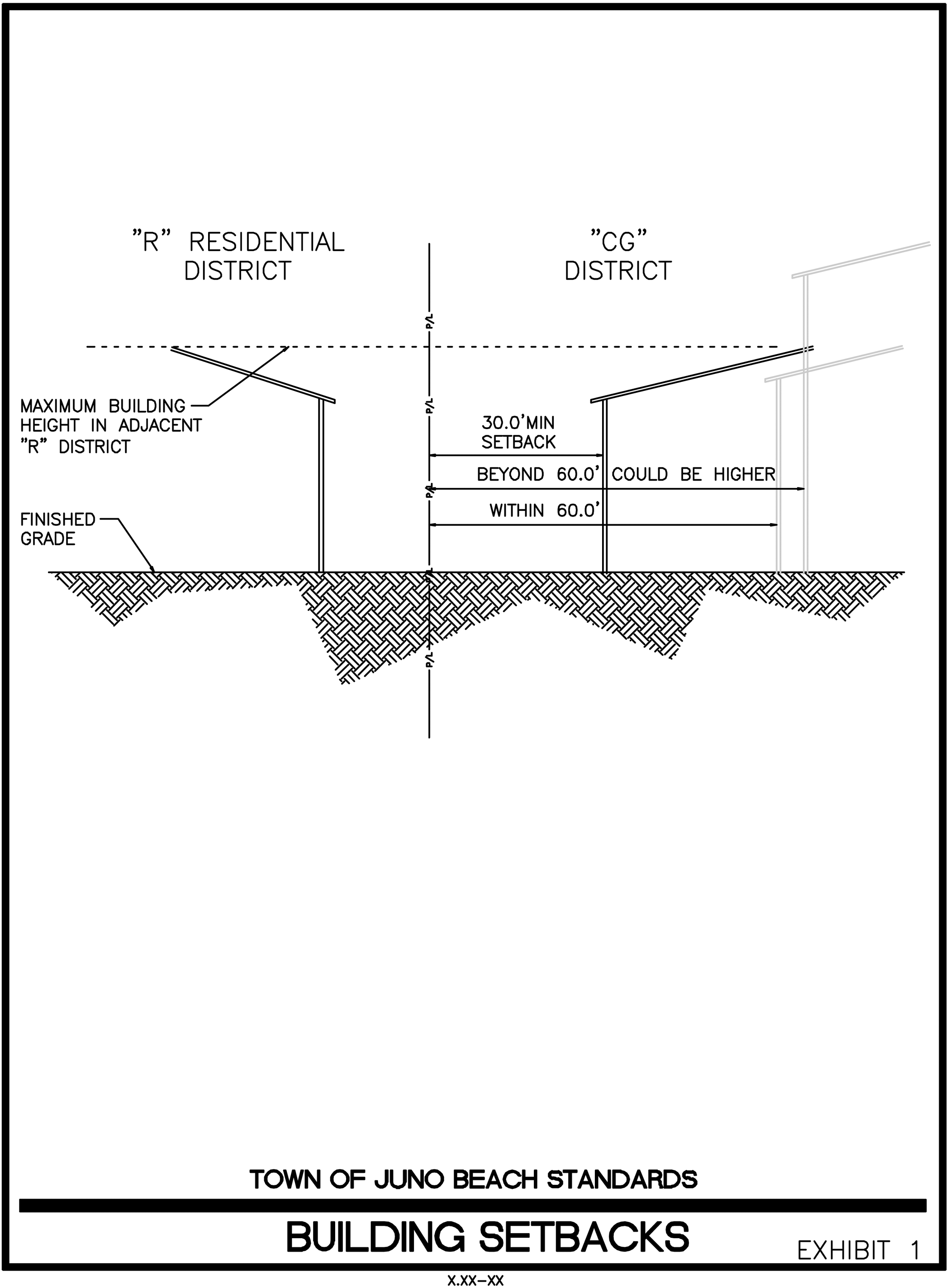
EXHIBIT 2
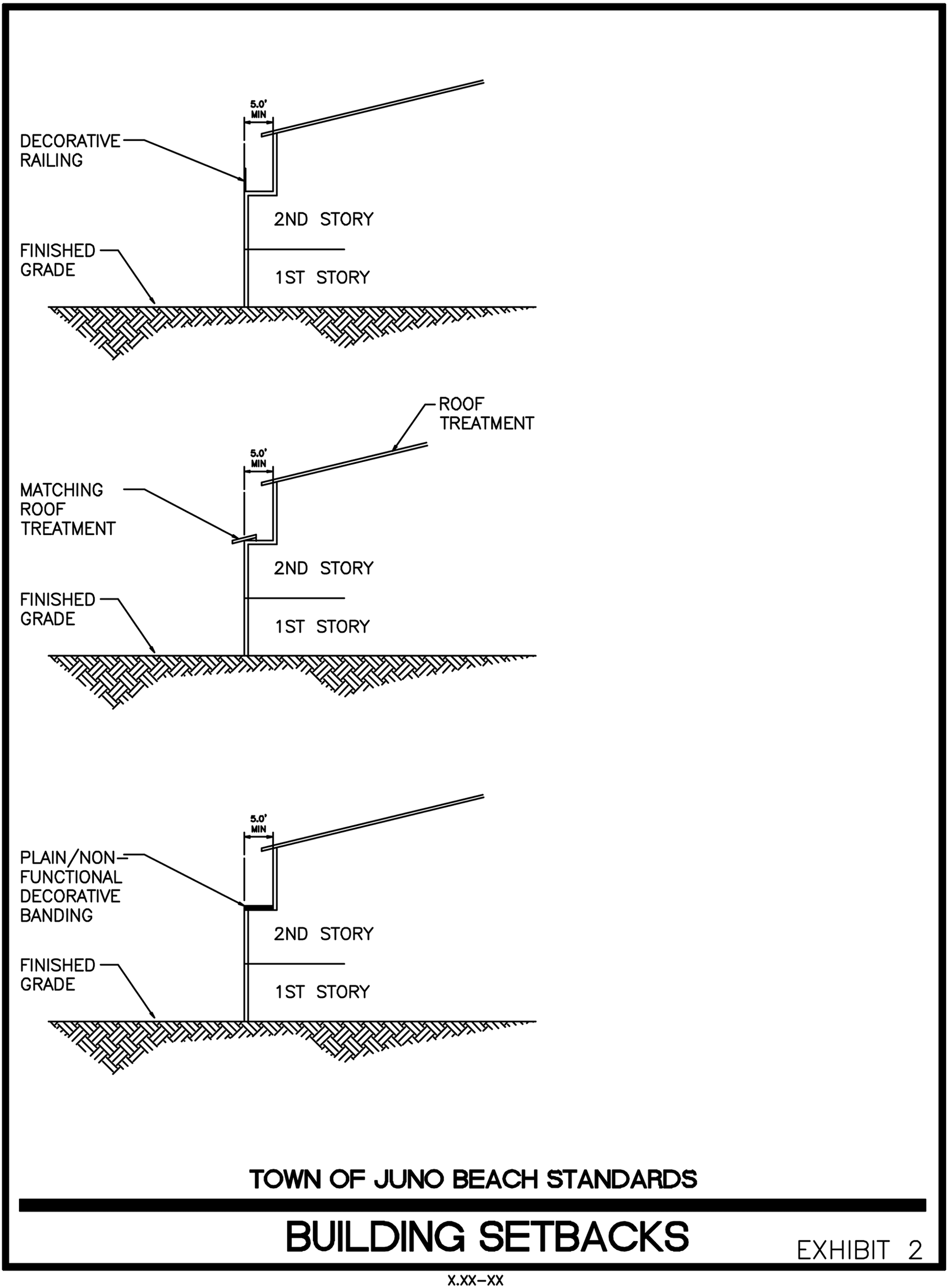
(Ord. No. 207, § 4.66, 8-8-1979; Ord. No. 302, 6-25-1986; Ord. No. 375, 11-15-1989; Ord. No. 434, 12-16-1992; Ord. No. 476, 12-13-1995; Ord. No. 491, 2-12-1997; Ord. No. 581, § 2(exh. A), 8-24-2005; Ord. No. 785, § 2, 6-26-2024)
Sec. 34-632. - Site area development modification option.
(a)
Purpose and intent.
(1)
The commercial general (CG) district incorporates the predominant business corridor along U.S. Highway 1, which serves as a gateway to the town. In order to foster quality development patterns and practices along this corridor, the town council may consider modifications to the building site area regulations specifically identified in this section. Any of the identified modifications shall be requested in the form of a special exception to the town council during site plan review and shall be subject to any additional conditions necessary to address the criteria set forth in section 34-93. No applicant shall be entitled to such modifications by right; rather, the applicant shall be required to demonstrate that the proposed project meets the purpose and intent of this section.
(2)
The purpose of this potential flexibility is to provide for creative and innovative designs and approaches by the applicant that will clearly promote a sustainable and livable mixed-use environment within the district.
(3)
The potential modifications are intended to provide a vehicle for quality, innovative development and redevelopment within the town's commercial corridors. Consequently, all applicants requesting such modification shall provide for the enhancement of the physical appearance of landscaping, architecture, signage and site development over and above the site plan appearance standards generally applicable within the town (see section 34-116).
(4)
Each applicant shall also identify the public benefits derived from the proposed development, such as the promotion of public use, the preservation of natural resources, and the integration of the project with the town's extensive natural environment.
(b)
Applicability. The provisions for modifications to the site area development requirements set forth herein shall be made by special exception, and may be applied to any proposed development order application within the CG district that involves any mix of uses (i.e., retail/office; retail/residential; office/residential, etc.).
(c)
Boundaries. The site area development modification shall apply within the CG commercial general zoning district.
(d)
Conflict with applicable regulations. Where the provisions of the modifications are in conflict with other zoning regulations applicable to the property, the provisions of this section shall control, and are subject to town council approval.
(e)
Performance standards. All development within the CG district shall comply with the rules and regulations of all agencies having jurisdiction within the town and with all applicable requirements of this chapter.
(f)
Additional criteria. All applicants seeking development approval in accordance with the CG district shall comply with the standards of the district, and with the town council's approval, as modified herein. Furthermore, all applicants shall demonstrate the following:
(1)
The proposed development is consistent with the goals, objectives and policies of the town comprehensive plan.
(2)
The proposed development is consistent with the purpose and intent of this section as set forth in subsection (a) of this section, including, but not limited to, innovative and enhanced architecture, landscaping, and public use areas.
(3)
The proposed development includes adequate, safe and appropriate public facilities and services.
(4)
The proposed development provides for pedestrian and vehicular interconnection between adjacent projects as well as a public focal point and/or public gathering place which shall include a water, landscape or art feature.
(5)
The proposed development is not detrimental to existing land uses or the native ecosystems within the district.
(g)
Potential building site area regulation modifications.
(1)
Minimum total lot area: 10,000 square feet; and the creation of any new lots must meet the minimum requirement of 40,000 square feet.
(2)
Minimum lot width: 100 feet.
(3)
Minimum lot depth: 100 feet.
(4)
Setbacks: See section 34-631(5); covered arcades, cafes, awnings and walkways may extend up to eight feet into a required front or side yard setback provided that the property adjacent to such yard or setback does not have a residential or "R" zoning district designation.
(5)
Maximum building height: See section 34-631(8). No building shall exceed 60 feet in height. Notwithstanding the foregoing, the town council may approve five stories within this overall height limitation for buildings with a mix of uses, including a residential component, provided that the town council determines that the applicant has demonstrated that the proposed project meets the purpose and intent of this section.
(6)
Maximum building dimension: 300 feet.
(7)
Maximum lot coverage: 45 percent.
(8)
Minimum landscaped open space: 15 percent. Additionally, all building sides shall be required to install foundation planting materials along a minimum of 30 percent of the length of each facade. Such foundation plantings shall be at least four feet deep, as measured from the edge of the building.
(9)
Parking:
a.
See section 34-631(12) for parking standards. A minimum of 90 percent of the parking provided for a project shall be located behind the principal buildings and screened from the roadway by structures and/or a heavily landscaped buffer.
b.
Preferred permitted nonresidential uses may be permitted up to a 25 percent reduction in the number of spaces required pursuant to section 34-981 (b)(5) provided that the town council determines that the applicant has demonstrated that the proposed project meets the purpose and intent of this section. This reduction in required parking shall not be available in conjunction with a shared parking plan.
(10)
Signage: Mixed use developments may be entitled to utilize both the commercial and residential sign standards (see article IV, division 6 of this chapter).
(11)
Residential (single-family and/or multifamily dwellings) uses: A maximum of 80 percent of the total gross floor area on the site may be used for residential provided that the town council determines that the applicant has demonstrated that the proposed project meets the purpose and intent of this section.
(Ord. No. 207, §§ 4.67—4.67.7, 8-8-1979; Ord. No. 302, 6-25-1986; Ord. No. 375, 11-15-1989; Ord. No. 476, 12-13-1995; Ord. No. 491, 2-12-1997; Ord. No. 581, § 2(exh. A), 8-24-2005; Ord. No. 668, § 4, 5-28-2014; Ord. No. 689, § 13, 1-25-2017; Ord. No. 747, § 2, 3-23-2022; Ord. No. 765, § 2, 7-26-2023)
Sec. 34-653.- Purpose.
The purpose of the CO commercial office district is to provide attractive and efficient office space together with appropriately related retail and service functions. Furthermore, this district is created to ensure compatibility with surrounding residential uses of all types.
(Ord. No. 207, § 4.71, 8-8-1979; Ord. No. 476, 12-13-1995; Ord. No. 491, 2-12-1997)
Sec. 34-654. - Uses permitted.
Permitted uses in the CO commercial office district are as follows:
(1)
Business or professional offices.
(2)
Banks and financial institutions.
(3)
Churches, synagogues and other houses of worship.
(4)
Nonprofit cultural centers.
(5)
Medical and dental offices.
(6)
Business and professional training facilities.
(7)
Public safety facilities such as fire and/or police stations.
(8)
Residential (single-family and/or multifamily dwellings). A maximum 75 percent of the total gross floor area on the site may be used for residential.
(9)
Outpatient substance abuse treatment provider.
(Ord. No. 207, § 4.72, 8-8-1979; Ord. No. 476, 12-13-1995; Ord. No. 491, 2-12-1997; Ord. No. 668, § 4, 5-28-2014; Ord. No. 689, § 14, 1-25-2017)
Sec. 34-655. - Accessory uses.
Accessory uses in the CO commercial office district are as follows:
(1)
Garage, off-street parking and loading.
(2)
Signs.
(3)
Drive-in financial facilities.
(4)
Helistop.
(5)
Newsstands, restaurants, dining rooms with or without kitchens, lounges, beauty shops, barbershops, and similar personal service uses for the convenience of personnel, trainees and bona fide guests of uses permitted.
(6)
Accessory uses customarily incident to the permitted or approved special exception uses.
(7)
Satellite dish antennas (see article IV, division 13 of this chapter).
(Ord. No. 207, § 4.73, 8-8-1979; Ord. No. 476, 12-13-1995; Ord. No. 491, 2-12-1997)
Sec. 34-656. - Special exception uses.
Special exception uses in the CO commercial office district are as follows:
(1)
Public and private utility structures.
(2)
Assisted living facilities (see article IV, division 12 of this chapter).
(3)
Planned unit developments (see article V of this chapter).
(4)
Community shopping centers.
(Ord. No. 207, § 4.74, 8-8-1979; Ord. No. 476, 12-13-1995; Ord. No. 491, 2-12-1997; Ord. No. 668, § 4, 5-28-2014)
Sec. 34-657. - Site plan and appearance review requirements.
A site plan and appearance review is required for all uses in the CO commercial office district.
(Ord. No. 207, § 4.75, 8-8-1979; Ord. No. 476, 12-13-1995; Ord. No. 491, 2-12-1997)
Sec. 34-658. - Building site area regulations.
The following building site area regulations shall apply to the CO commercial office district:
**See also section 34-873.
***See also section 34-899.
****See also section 34-900.
(Ord. No. 207, § 4.76, 8-8-1979; Ord. No. 476, 12-13-1995; Ord. No. 491, 2-12-1997; Ord. No. 516, 8-14-1999; Ord. No. 625, § 2, 8-26-2009; Ord. No. 785, § 2, 6-26-2024)
Sec. 34-690.- Purpose.
The purpose of the BCH beach district is to preserve the flora, fauna and overall natural environment in those areas determined in the comprehensive plan to be environmentally sensitive and in need of protection.
(Ord. No. 207, § 4.81, 8-8-1979)
Sec. 34-691. - Uses permitted.
No structures are permitted in the BCH beach district other than:
(1)
Dune walkover structures;
(2)
Government-owned minor structures.
(Ord. No. 207, § 4.82, 8-8-1979)
Sec. 34-692. - Accessory uses.
Accessory uses are not applicable in the BCH beach district.
(Ord. No. 207, § 4.83, 8-8-1979)
Sec. 34-693. - Special exception uses.
Special exception uses are not applicable in the BCH beach district.
(Ord. No. 207, § 4.84, 8-8-1979)
Sec. 34-694. - Site plan and appearance review requirement.
Site plan and appearance review requirements are not applicable in the BCH beach district.
(Ord. No. 207, § 4.85, 8-8-1979)
Sec. 34-695. - Building site area regulations.
Building site area regulations are not applicable in the BCH beach district.
(Ord. No. 207, § 4.86, 8-8-1979)
Sec. 34-719.- Purpose.
The purpose of the REC-PUB public recreation district is to create an environment especially suited for public recreation.
(Ord. No. 207, § 4.91, 8-8-1979; Ord. No. 468, 12-14-1994)
Sec. 34-720. - Uses permitted.
Permitted uses in the REC-PUB public recreation district are as follows:
(1)
Ball parks.
(2)
Tennis courts.
(3)
Playgrounds.
(4)
Swimming and fishing.
(5)
Boating.
(6)
Golfing.
(7)
Hiking, walking, jogging.
(8)
Bicycling.
(9)
Shuffleboard.
(10)
Handball and racquetball.
(11)
Any other similar recreational use.
(12)
Public safety facilities such as fire and/or police stations.
(Ord. No. 207, § 4.92, 8-8-1979; Ord. No. 468, 12-14-1994)
Sec. 34-721. - Accessory uses.
Accessory uses in the REC-PUB public recreation district are as follows:
(1)
Accessory uses customarily incident to the permitted uses.
(2)
Satellite dish antennas (see article IV, division 13 of this chapter).
(Ord. No. 207, § 4.93, 8-8-1979; Ord. No. 468, 12-14-1994)
Sec. 34-722. - Site plan approval criteria.
Due to the potential for townwide impact of public recreation uses, the following criteria shall be considered by the planning and zoning board and town council in addition to those required in section 34-116 for all site plans proposed in the REC-PUB public recreation zoning district:
(1)
Whether or not the proposed development will adversely affect groundwater and surface waters;
(2)
Whether the proposed development is compatible with land categorized as environmentally sensitive;
(3)
Whether the proposed development is compatible with adjacent land which is considered environmentally sensitive, considering buffers and mitigation areas along such adjacencies;
(4)
Whether or not the proposed development will constitute a nuisance;
(5)
Whether the proposed development will enrich human life in its educational and cultural dimensions;
(6)
Whether or not the proposed development will positively affect the economy or will create a positive image that will influence the future of the town; and
(7)
Weighing and balancing the affects and influences the proposed plan presents, whether the plan promotes the general improved economic development, as well as recreation value of the town.
(Ord. No. 207, § 4.94, 8-8-1979; Ord. No. 468, 12-14-1994; Ord. No. 517, 12-1-1999)
Sec. 34-723. - Site plan and appearance review requirements.
A site plan and appearance review is required for all uses in the REC-PUB public recreation district.
(Ord. No. 207, § 4.95, 8-8-1979; Ord. No. 468, 12-14-1994)
Sec. 34-724. - Building site area regulations.
The following building site area regulations shall apply to the REC-PUB public recreation district:
(1)
Recreational uses shall be permitted only upon authorization by the town council upon recommendation by the planning and zoning board through the special exception use procedure as set forth in section 34-93. Accessory uses to a permitted use are not required to go through the special exception use procedure.
(2)
A1A vehicular access restrictions: Properties along State Road A1A from Loggerhead Park to the northern town limits shall not be allowed a motorized vehicular driveway connection onto State Road A1A; provided, however, that this shall not prohibit an access used for emergency purposes.
(Ord. No. 207, § 4.96, 8-8-1979; Ord. No. 433, 12-2-1992; Ord. No. 468, 12-14-1994)
Sec. 34-747.- Purpose.
The purpose of the REC-PRIV private recreation district is to establish and protect certain areas for limited private recreational uses.
(Ord. No. 207, § 4.101, 8-8-1979; Ord. No. 465, 12-14-1994)
Sec. 34-748. - Uses permitted.
Permitted uses in the REC-PRIV private recreation district are golf courses.
(Ord. No. 207, § 4.102, 8-8-1979; Ord. No. 465, 12-14-1994)
Sec. 34-749. - Accessory uses.
Accessory uses in the REC-PRIV private recreation district are as follows:
(1)
Accessory uses customarily incident to the permitted uses, including, but not limited to:
a.
Caretaker housing (including but not limited to housing for maintenance superintendent, club manager, and their families).
b.
Private clubhouses.
c.
Maintenance buildings.
d.
Private restaurants.
e.
Pro shops.
f.
Swimming pools.
g.
Tennis courts.
h.
Croquet courts.
i.
Driving ranges and golf practice areas.
(2)
Private utility structures.
(Ord. No. 207, § 4.103, 8-8-1979; Ord. No. 465, 12-14-1994)
Sec. 34-750. - Special exception uses.
Special exception uses in the REC-PRIV private recreation district are as follows:
(1)
Satellite dish antennas (see article IV, division 13 of this chapter).
(2)
Public utility structures.
(Ord. No. 207, § 4.104, 8-8-1979; Ord. No. 316, 3-18-1987; Ord. No. 465, 12-14-1994)
Sec. 34-751. - Site plan and appearance review requirements.
A site plan and appearance review is required for all uses in the REC-PRIV private recreation district.
(Ord. No. 207, § 4.105, 8-8-1979; Ord. No. 465, 12-14-1994)
Sec. 34-752. - Building site area regulations.
(a)
The following building site area regulations shall apply to the REC-PRIV private recreation district:
(b)
Specific requirements for private utilities:
(1)
All private utility structures shall be required to be screened with landscaping or other appropriate material in order to be completely screened from view from all streets and adjacent properties. In addition, there shall be no noise, smell, or other nuisance generated from a private utility structure. All private utility structures, other than submersible wells which are no greater than 25 square feet in area and three feet in height, shall be located a minimum of 250 feet from the side and rear property lines, and a minimum 50 feet from the front property line.
(2)
Submersible wells no greater than 25 square feet in area and three feet in height shall be set back a minimum 15 feet from any property line.
(Ord. No. 207, § 4.106, 8-8-1979; Ord. No. 465, 12-14-1994)
Sec. 34-773.- Purpose.
The purpose of the UTL utilities district is to create an environment especially suited for operating and maintaining essential utility facilities.
(Ord. No. 207, § 4.111, 8-8-1979)
Sec. 34-774. - Uses permitted.
Permitted uses in the UTL utilities district are as follows: essential services and service structures relating to potable water, sanitary sewers, stormwater drainage, solid waste, telephone, gas, electric, cable television and any other related utility systems.
(Ord. No. 207, § 4.112, 8-8-1979)
Sec. 34-775. - Accessory uses.
Accessory uses in the UTL utilities district are as follows: accessory uses customarily incident to the permitted uses.
(Ord. No. 207, § 4.113, 8-8-1979)
Sec. 34-776. - Special exception uses.
A special exception is required for all uses in the UTL utilities district.
(Ord. No. 207, § 4.114, 8-8-1979)
Sec. 34-777. - Site plan and appearance review requirements.
A site plan and appearance review is required for all uses in the UTL utilities district.
(Ord. No. 207, § 4.115, 8-8-1979)
Sec. 34-778. - Building site area regulations.
The following building site area regulations* shall apply to the UTL utilities district:
*Utility uses and their related accessory uses shall be permitted only upon authorization by the town council upon recommendation by the planning and zoning board through the special exception use procedure. See section 34-93 for said procedure.
**See also section 34-873.
***See also section 34-899.
****See also section 34-900.
(Ord. No. 207, § 4.116, 8-8-1979)
Sec. 34-810.- Purpose.
The purpose of the GOV government district is to create an environment especially suited for the conduct of essential government functions.
(Ord. No. 207, § 4.121, 8-8-1979)
Sec. 34-811. - Uses permitted.
Permitted uses in the GOV government district are as follows:
(1)
Governmental office buildings.
(2)
Police stations.
(3)
Fire stations.
(4)
Courthouses.
(5)
Public works.
(6)
Other public safety facilities.
(Ord. No. 207, § 4.122, 8-8-1979)
Sec. 34-812. - Accessory uses.
Accessory uses in the GOV government district are as follows:
(1)
Accessory uses customarily incident to the permitted uses.
(2)
Satellite dish antennas (see article IV, division 13 of this chapter).
(Ord. No. 207, § 4.123, 8-8-1979)
Sec. 34-813. - Special exception uses.
A special exception is required for all uses other than accessory uses in the GOV government district.
(Ord. No. 207, § 4.124, 8-8-1979)
Sec. 34-814. - Site plan and appearance review requirements.
A site plan and appearance review is required for all uses in the GOV government district.
(Ord. No. 207, § 4.125, 8-8-1979)
Sec. 34-815. - Building site area regulations.
The following building site area regulations* shall apply to the GOV government district:
*All uses shall be permitted only upon authorization by the town council upon recommendation by the planning and zoning board .
**See also section 34-873.
***See also section 34-899.
****See also section 34-900.
(Ord. No. 207, § 4.126, 8-8-1979)
Sec. 34-839.- Purpose.
The purpose of INS institutional district is to create an environment especially suited for institutional facilities.
(Ord. No. 207, § 4.131, 8-8-1979)
Sec. 34-840. - Uses permitted.
Permitted uses in the INS institutional district are as follows:
(1)
Academic schools.
(2)
Colleges.
(3)
Churches, synagogues and other houses of worship.
(4)
Hospitals.
(5)
Medical and dental clinics.
(6)
Sanitoriums.
(7)
Public safety facilities such as fire and/or police stations.
(8)
Day care.
(Ord. No. 207, § 4.132, 8-8-1979)
Sec. 34-841. - Accessory uses.
Accessory uses in the INS institutional district are as follows: accessory uses customarily incident to the permitted uses.
(Ord. No. 207, § 4.133, 8-8-1979)
Sec. 34-842. - Special exception uses.
Special exception uses in the district are as follows: satellite dish antennas (see article IV, division 13 of this chapter).
(Ord. No. 207, § 4.134, 8-8-1979)
Sec. 34-843. - Site plan and appearance review requirements.
A site plan and appearance review is required for all uses in the INS institutional district.
(Ord. No. 207, § 4.135, 8-8-1979; Ord. No. 371, 7-19-1989)
Sec. 34-844. - Building site area regulations.
The following building site area regulations shall apply to the INS institutional district:*
*See also section 34-873.
**See also section 34-899.
***See also section 34-900.
(Ord. No. 207, § 4.136, 8-8-1979)
Sec. 34-850.- Purpose.
The purpose of the medical commercial (MC) district is to provide appropriate zoning locations where medical facilities may be established when the need exists, in addition to compatible commercial use such as retail shopping and personal service uses. Retail drive-in businesses are not permitted.
(Ord. No. 668, § 4, 5-28-2014)
Sec. 34-851. - Permitted uses.
Permitted uses in the medical commercial (MC) district are as follows:
(1)
Retail and service establishments, hardware stores, food stores, clothing stores, drugstores, barbershops, beauty salons and jewelry stores.
(2)
Business services.
(3)
Department stores.
(4)
Churches, synagogues or other houses of worship.
(5)
Nonprofit cultural centers.
(6)
Professional offices.
(7)
Medical and dental offices.
(8)
Health spa/gym.
(9)
Banks and financial institutions.
(10)
Professional or studio-type schools.
(11)
Public safety facilities such as fire and/or police stations.
(12)
Day care centers, if not adjacent to a residential use or residentially zoned property.
(13)
Adult entertainment establishments.
(14)
Retail deli/bakery.
(15)
Residential (single-family and/or multifamily dwellings). A maximum of 75 percent of the total gross floor area on the site may be used for residential.
(16)
Hotel/motel (150 rooms/units or less).
(17)
Retail landscape nursery with outdoor displays.
(18)
Temporary festive outdoor markets (only fruits, vegetables, plants, flowers, arts, and handcrafted items shall be sold). Maximum two-year temporary permit, renewable at the discretion of the town council.
(19)
Outpatient substance abuse treatment provider.
(20)
Residential substance abuse treatment provider, subject to a maximum permitted density of 18 dwelling units per acre.
(21)
Assisted living facilities (see article IV, division 12 of this chapter).
(22)
Transient residential facility (greater than 30 units for timeshare).
(Ord. No. 668, § 4, 5-28-2014)
Sec. 34-852. - Accessory uses.
Accessory uses in the medical commercial (MC) district are as follows:
(1)
Off-street parking and loading.
(2)
Signs.
(3)
Drive-in financial facilities.
(4)
Accessory uses customarily incidental to the permitted or approved special exception uses.
(5)
Satellite dish antennas (see article IV, division 13 of this chapter).
(Ord. No. 668, § 4, 5-28-2014)
Sec. 34-853. - Special exception uses.
Special exception uses in the medical commercial (MC) district are as follows:
(1)
Public parking garages.
(2)
Public and private utility structures.
(3)
Fuel service stations (see section 34-869).
(4)
Supplemental off-site parking.
(5)
Public and private academic schools.
(6)
Convenience stores (see section 34-868).
(7)
Vehicle minor repair facility (see section 34-870).
(8)
Hotel/motel (greater than 150 rooms/units).
(9)
Day care centers, if adjacent to a residential use or residentially zoned property.
(10)
Restaurants and drinking establishments.
(11)
Uses utilizing optional building site area development modifications identified in section 34-856.
(Ord. No. 668, § 4, 5-28-2014; Ord. No. 677, § 3, 11-18-2014; Ord. No. 701, § 3, 10-25-2017)
Sec. 34-854. - Site plan and appearance review requirements.
Site plan and appearance review is required for all uses.
(Ord. No. 668, § 4, 5-28-2014)
Sec. 34-855. - Building site area regulations.
The following building site area regulations shall apply to the medical commercial (MC) district:
(1)
Minimum total area: 40,000 square feet.
(2)
Minimum lot width: 150 feet.
(3)
Minimum lot depth: 150 feet.
(4)
Setbacks:
a.
The following setback schedule shall apply, and all properties adjoining or adjacent to property with a residential or "R" zoning district designation shall incorporate a minimum of a 15-foot landscaped buffer within such adjoining yard or setback:
b.
For all buildings higher than two stories, all stories above the first two stories shall be set back a minimum of five feet from the first story building facade and shall include an architecturally compatible roof treatment or element along such building line break (see graphic representation in Exhibit 2 to section 34-631 of this Code).
(5)
High-rise setback: See subsection (4) of this section.
(6)
Maximum building height:
a.
For buildings having two stories, the maximum building height shall not exceed 30 feet. For buildings having three stories, the maximum building height shall not exceed 45 feet. No building shall exceed three stories, except for those buildings which contain a minimum of one floor of residential space which shall be permitted a maximum of four stories and 60 feet in height.
b.
For properties with a total lot area exceeding two acres, all structures within 60 feet of a rear or side property line adjoining property with an "R" or residential zoning district designation shall not exceed the maximum building height for the adjacent residential property (see graphic representation of this concept in Exhibit 1 and Exhibit 2 to section 34-631 of this Code).
c.
A minimum 20-foot building separation shall be required between all principal structures on site.
(7)
Maximum building dimension: 200 feet.
(8)
Maximum lot coverage: 40 percent.
(9)
Minimum landscaped open space: 15 percent of total lot area. All building sides shall be required to install foundation planting materials along a minimum of 40 percent of the length of each facade. Such foundation plantings shall be at least four feet deep, as measured from the edge of the building.
(10)
Minimum parking:
a.
See article IV, division 4 of this chapter.
b.
Parking shall be located behind the principal buildings and screened from the roadway by structures and/or a heavily landscaped buffer unless the town council determines, in the exercise of its discretion, that this requirement shall create an unsafe or hazardous condition on site. In such event, the town council may allow parking in other locations on site.
c.
Any use proposing valet parking shall submit a plan to the town council for review and approval. Such plan shall be reviewed in conjunction with site plan review. Valet parking shall not utilize more than 30 percent of the required on-site parking for the approved use or uses. The valet parking plan shall address each of the following:
1.
The location of the valet parking booth or area;
2.
The location and number of parking spaces to be utilized for valet parking;
3.
Evidence that the business owns the parking spaces proposed for valet use or a copy of any agreement or lease that provides the business with the right to use spaces owned by another individual or entity for valet parking;
4.
The impacts of valet parking on the shared parking plan for the project (if one exists) and on patrons who do not utilize such service;
5.
The hours of operation; and
6.
The location and text of any signage associated with the valet parking operation and assigned spaces.
(11)
Loading: see section 34-985.
(12)
Minimum architectural treatments: All sides of any building within this district shall be designed with a variety of treatments matching the general architectural theme of the project. The intent of this requirement is to have all sides of the building appear as the front facade, including those fronting a roadway, alley or parking area.
(Ord. No. 668, § 4, 5-28-2014; Ord. No. 785, § 2, 6-26-2024)
Sec. 34-856. - Site area development modification option.
(a)
Purpose and intent.
(1)
The medical commercial (MC) district incorporates the predominant business corridor along U.S. Highway 1, which serves as a gateway to the town. In order to foster quality development patterns and practices along this corridor, the town council may consider modifications to the building site area regulations specifically identified in this section. Any of the identified modifications shall be requested in the form of a special exception to the town council during site plan review and shall be subject to any additional conditions necessary to address the criteria set forth in section 34-93. No applicant shall be entitled to such modifications by right; rather, the applicant shall be required to demonstrate that the proposed project meets the purpose and intent of this section.
(2)
The purpose of this potential flexibility is to provide for creative and innovative designs and approaches by the applicant that will clearly promote a sustainable and livable mixed use environment within the district.
(3)
The potential modifications are intended to provide a vehicle for quality, innovative development and redevelopment within the town's commercial corridors. Consequently, all applicants requesting such modification shall provide for the enhancement of the physical appearance of landscaping, architecture, signage and site development over and above the site plan appearance standards generally applicable within the town (see section 34-116).
(4)
Each applicant shall also identify the public benefits derived from the proposed development, such as the promotion of public use, the preservation of natural resources, and the integration of the project with the town's extensive natural environment.
(b)
Applicability. The provisions for modifications to the site area development requirements set forth herein shall be made by special exception, and may be applied to any proposed development order application within the MC district that involves any mix of uses (i.e., retail/office; retail/residential; office/residential, etc.).
(c)
Boundaries. The site area development modification shall apply within the MC medical commercial zoning district.
(d)
Conflict with applicable regulations. Where the provisions of the modifications are in conflict with other zoning regulations applicable to the property, the provisions of this section shall control, and are subject to town council approval.
(e)
Performance standards. All development within the CG district shall comply with the rules and regulations of all agencies having jurisdiction within the town and with all applicable requirements of this chapter.
(f)
Additional criteria. All applicants seeking development approval in accordance with the MC district shall comply with the standards of the district, and with the town council's approval, as modified herein. Furthermore, all applicants shall demonstrate the following:
(1)
The proposed development is consistent with the goals, objectives and policies of the town comprehensive plan.
(2)
The proposed development is consistent with the purpose and intent of this section as set forth in subsection (a) of this section, including, but not limited to, innovative and enhanced architecture, landscaping, and public use areas.
(3)
The proposed development includes adequate, safe and appropriate public facilities and services.
(4)
The proposed development provides for pedestrian and vehicular interconnection between adjacent projects as well as a public focal point and/or public gathering place which shall include a water, landscape or art feature.
(5)
The proposed development is not detrimental to existing land uses or the native ecosystems within the district.
(g)
Potential building site area regulation modifications.
(1)
Minimum total lot area: 10,000 square feet; and the creation of any new lots must meet the minimum requirement of 40,000 square feet.
(2)
Minimum lot width: 100 feet.
(3)
Minimum lot depth: 100 feet.
(4)
Setbacks: See section 34-631(5); covered arcades, cafes, awnings and walkways may extend up to eight feet into a required front or side yard setback provided that the property adjacent to such yard or setback does not have a residential or "R" zoning district designation.
(5)
Maximum building height: See section 34-631(8). No building shall exceed 60 feet in height. Notwithstanding the foregoing, the town council may approve five stories within this overall height limitation for buildings with a mix of uses, including a residential component, provided that the town council determines that the applicant has demonstrated that the proposed project meets the purpose and intent of this section.
(6)
Maximum building dimension: 300 feet.
(7)
Maximum lot coverage: 45 percent.
(8)
Minimum landscaped open space: 15 percent. Additionally, all building sides shall be required to install foundation planting materials along a minimum of 30 percent of the length of each facade. Such foundation plantings shall be at least four feet deep, as measured from the edge of the building.
(9)
Parking:
a.
See section 34-631(12) for parking standards. A minimum of 90 percent of the parking provided for a project shall be located behind the principal buildings and screened from the roadway by structures and/or a heavily landscaped buffer.
b.
Preferred permitted nonresidential uses may be permitted up to a 25 percent reduction in the number of spaces required pursuant to section 34-981(b)(5) provided that the town council determines that the applicant has demonstrated that the proposed project meets the purpose and intent of this section. This reduction in required parking shall not be available in conjunction with a shared parking plan.
(10)
Signage: Mixed use developments may be entitled to utilize both the commercial and residential sign standards (see article IV, division 6 of this chapter).
(Ord. No. 689, § 15, 1-25-2017)

