
Juno Beach City Zoning Code
ARTICLE IV
- SUPPLEMENTAL REGULATIONS
DIVISION 9. - SPECIAL EVENTS[2]
Editor's note— Ord. No. 709, § 3, adopted February 27, 2019 renamed art. IV, div. 9 from "special events (grand openings, sidewalk sales, etc.) to "special events."
DIVISION 12. - ASSISTED LIVING FACILITIES[3]
Editor's note— Ord. No. 668, § 5, adopted May 28, 2014 amended the title of Art. IV, Div. 12, to read as herein set out. Formerly, said division was entitled "Congregate Living Facilities."
Sec. 34-867.- Accessory uses.
Accessory uses shall be clearly supplementary and incidental to the principal use of the lot and shall be located on the same lot as the principal use to which it is subordinate.
(Ord. No. 207, § 5.31, 8-8-1979; Ord. No. 450, 5-11-1994)
Sec. 34-868. - Convenience stores.
(a)
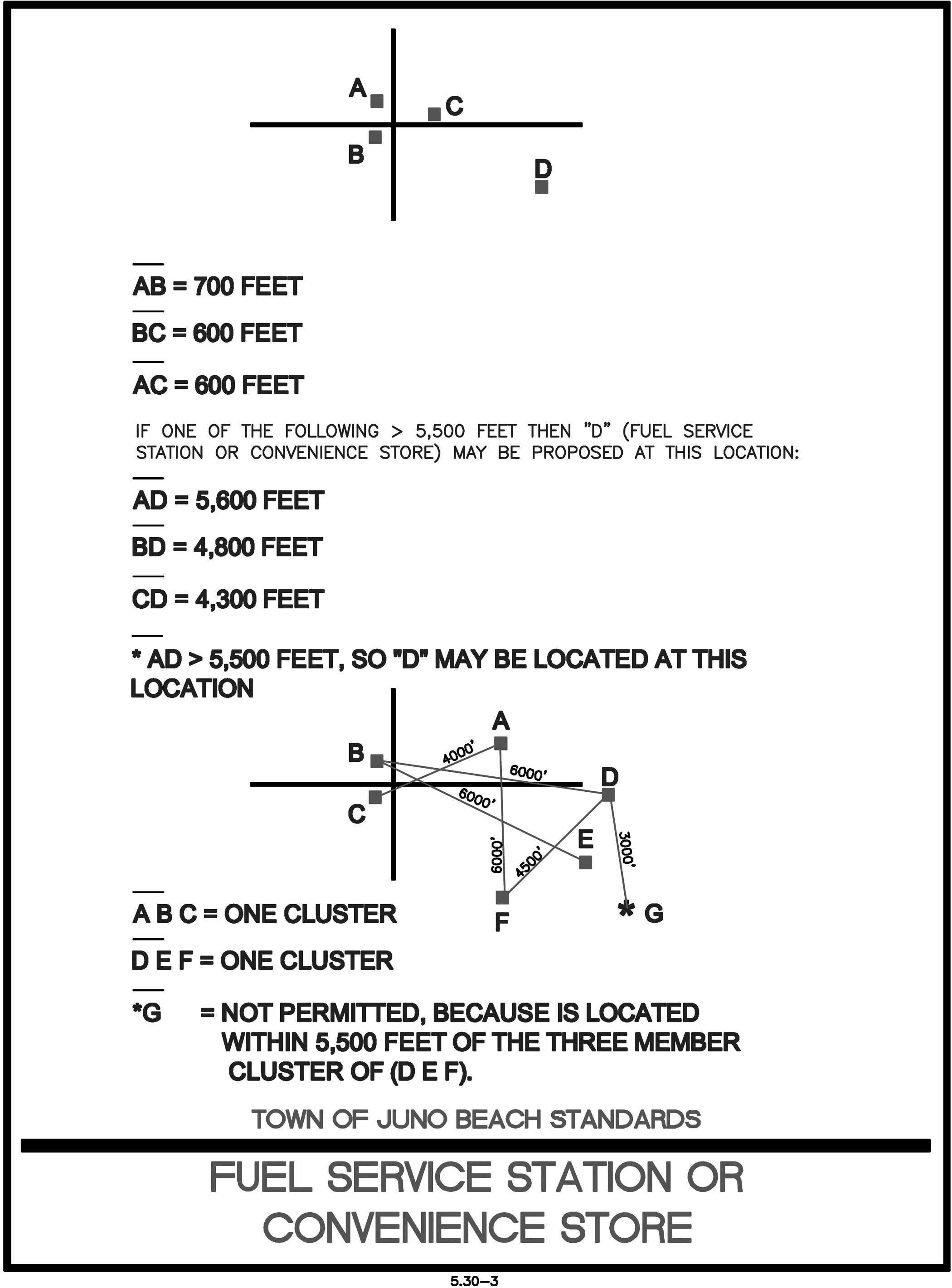
No more than three of any combination of convenience store and fuel service station shall be located within 5,500 feet of one another. For example, if three of any combination of convenience store and fuel service station (e.g., two convenience stores and one fuel service station, or three fuel service stations and no convenience store) are clustered in a group, each within 5,500 feet of one another, then a fourth convenience store or fuel service station must be located greater than 5,500 feet from at least one member of the cluster. For the purposes of this section, all measurements of distances shall be along a straight airline route from the nearest point on any property line of any property used as a convenience store or fuel service station. (See illustration following section 34-869.)
(b)
There shall be a minimum distance of 500 feet shortest airline measurement between the nearest points on a parcel of land occupied for convenience store purposes and to be occupied by a house of worship.
(c)
The proposed facility shall not have as a part of its operation amusement devices which may be operated by coin, currency or tokens.
(Ord. No. 207, § 5.32, 8-8-1979; Ord. No. 376, 11-15-1989; Ord. No. 450, 5-11-1994)
Sec. 34-869. - Fuel service stations.
(a)
No more than three of any combination of convenience store and fuel service station shall be located within 5,500 feet of one another. For example, if three of any combination of convenience store and fuel service station (e.g., two convenience stores and one fuel service station, or three fuel service stations and no convenience store) are clustered in a group, each within 5,500 feet of one another, then a fourth convenience store or fuel service station must be located greater than 5,500 feet from at least one member of the cluster. For the purposes of this section, all measurements of distance shall be along a straight airline route from the nearest point on any property line of any property used as a convenience store or fuel service station. (See illustration following this section.)
(b)
There shall be a minimum distance of 500 feet shortest airline measurement between the nearest points on a parcel of land occupied for fuel service station purposes which sells alcoholic beverages and a parcel to be occupied by a house of worship.
(c)
The proposed facility shall not have as a part of its operation amusement devices which may be operated by coin, currency or tokens.
(d)
All outdoor displays of merchandise are prohibited.
(e)
A raised curb of at least six inches in height shall be erected along all street property lines, except for driveway openings.
(f)
Curb breaks are limited to two per street frontage.
(g)
All fuel pumps, tanks, vents, pump islands and pump island canopies shall conform to setback requirements for the district except that no such pumps, tanks, vents, pump islands or pump island canopies shall be located closer than 25 feet to any side property line.
(h)
Off-street loading spaces which are provided for delivery of materials, merchandise, fuel oils, or any similar accessory or product, shall be located in such a manner on the site that they are completely separate from the customer parking area and access drives and aisles thereto.
(Ord. No. 207, § 5.33, 8-8-1979; Ord. No. 376, 11-15-1989; Ord. No. 450, 5-11-1994)
Sec. 34-870. - Vehicle minor repair facilities.
(a)
No more than two vehicle minor repair facilities shall be located within 8,000 feet of each other. For the purposes of this section, all measurements of distances shall be along a straight airline route from the nearest point on any property line of any property used as a vehicle minor repair facility.
(b)
A raised curb of at least six inches in height shall be erected along all street property lines, except for driveway openings.
(c)
Repairs shall be restricted to the enclosed bay areas, except when emergency repairs are required to transfer vehicles into the enclosed bay areas.
(d)
Quarterly testing and monitoring of environmental conditions on site shall be performed for review and approval by the town and appropriate environmental agencies.
(e)
Adsorbents shall be kept on site for oil spills, or a contract with a private vendor shall be provided to ensure that oil, grease and other spillage will be serviced.
(Ord. No. 207, § 5.34, 8-8-1979; Ord. No. 376, 11-15-1989; Ord. No. 450, 5-11-1994)
Sec. 34-871. - Swimming pools.
(a)
Swimming pools shall be set back at least 15 feet from the front property line and five feet from the side and rear property lines measured to the water's edge. Swimming pools may be enclosed by screening in the side and rear yards, providing a minimum five-foot setback is provided from the side and rear property lines to the screen enclosure. Screen enclosures for zero lot line homes may be placed on the property line on the zero setback side and must be set back five feet from the other side and rear property line. Screen enclosures for townhouses may be placed on the property lines on the zero setback sides and must be set back five feet from the rear property line.
(b)
Furthermore, hot tubs/whirlpools or pools within zero lot line communities may encroach into the minimum one-foot setback from the property line of the zero wall of the adjacent home, provided the following conditions are met:
(1)
If a planned unit development (PUD), no 25 percent reduction is applied to the minimum one-foot setback from the zero wall.
(2)
The hot tub/whirlpool or pool must have a maximum depth of 30 inches below grade within five feet of zero wall.
(3)
The hot tub/whirlpool or pool must be completely against the adjacent house wall and extend no closer than five feet to each end of the adjacent house wall. Beyond the house wall, in rear or front yard, the five-foot side and rear yard setbacks must be adhered to.
(4)
Pools, fountains, hot tubs/whirlpools, etc., that have jets, blowers, waterfalls, mechanical equipment, or any other mechanisms that generate noise, must be completely sound-insulated from adjacent houses with a minimum two-inch thick urethane insulation or better against all surfaces within two feet of the zero line.
(c)
In addition, hot tubs/whirlpools or pools within individual townhouse lots may encroach into the required side yard setback to a minimum of one foot from the side property line, provided the following conditions are met:
(1)
If a PUD, no 25 percent reduction is applied to the minimum one-foot setback from the side property line.
(2)
Pools, fountains, hot tubs/whirlpools, etc., that have jets, blowers, waterfalls, mechanical equipment, or any other mechanisms that generate noise, must be completely sound insulated from the adjacent property with a minimum two-inch thick urethane insulation or better around the noise generator within five feet of the property line.
(3)
A minimum five-foot-high wall or fence, consistent with the architecture of the building, shall be installed along the side property lines to screen the pool or hot tub/whirlpool from the adjacent properties.
(Ord. No. 207, § 5.35, 8-8-1979; Ord. No. 388, 4-18-1990; Ord. No. 450, 5-11-1994; Ord. No. 485, 9-4-1996; Ord. No. 689, § 16, 1-25-2017)
Sec. 34-872. - Tennis courts, shuffleboard courts.
Tennis courts, shuffleboard courts and similar uses not to be enclosed by a structure may be constructed within yard areas except the required front yard, as prescribed by this chapter; provided, however, that any walls or fences shall conform with section 34-905. However, in no instance shall any tennis court or shuffleboard court be closer than ten feet to a lot line. In determining the percentage of coverage of a lot by buildings, tennis courts, shuffleboard courts and similar uses shall not be counted in such computation.
(Ord. No. 207, § 5.36, 8-8-1979; Ord. No. 450, 5-11-1994)
Sec. 34-873. - Setback of accessory structures.
Accessory structures shall provide a minimum of ten feet from rear and side lot lines and shall be set back by the required front setback in the district which is applicable.
(Ord. No. 207, § 5.100, 8-8-1979; Ord. No. 383, 2-21-1990)
Sec. 34-874. - Hurricane and flood damage protection.
To minimize hazards to life and damage to property in portions of the town exposed to severe wave action during hurricanes or other periods of extraordinary wind-driven high tides and to portions exposed to flooding as a result of such occurrences or heavy rainfall, and to qualify for protection under the National Flood Insurance Program of the Federal Emergency Management Agency, Department of Housing and Urban Development, the following special requirements are enacted. For the purposes of these regulations, it is assumed that all of the area within the town is subject to either coastal damage due to such wave action or to flooding, or both. The laws and ordinances concerning land use and control and other measures designed to reduce flood losses shall take precedence over any conflicting laws, ordinances or codes. Upon certification by the administrator of the National Flood Insurance Program that any area within the town is not so subject to either of these perils, it is intended that the special requirements herein shall not be applied to such area. In the absence of such certification, the following special requirements shall apply: first floor slab shall be not less than 7.5 feet above mean sea level; building permit applications require special review.
(Ord. No. 207, § 5.110, 8-8-1979; Ord. No. 383, 2-21-1990)
Sec. 34-875. - Medical marijuana treatment center dispensing facilities.
Medical marijuana treatment center dispensing facilities are prohibited within the town's corporate limits.
(Ord. No. 677, § 4, 11-18-2014; Ord. No. 701, § 4, 10-25-2017)
Sec. 34-896.- Street lot lines.
The front lot line, side street line or rear street line of any lot shall be the right-of-way line (the street line) of the abutting street.
(Ord. No. 207, § 5.12, 8-8-1979; Ord. No. 383, 2-21-1990)
Sec. 34-897. - Lot area.
All lot, yard and bulk regulations for both the principal and accessory uses shall be calculated within the confines of a contiguous platted lot.
(Ord. No. 207, § 5.13, 8-8-1979; Ord. No. 383, 2-21-1990)
Sec. 34-898. - Intersection vision.
As an aid to free and safe movement of vehicles at and near street intersections and in order to promote more adequate protection for the safety of children, pedestrians, operators of vehicles and of property at all street intersections, no obstruction to vision (other than an existing structure) between 30 inches and six feet in height above the established grade of the street at the property line shall be erected or maintained on any lot within the triangle formed by the street lot lines of such lot and a line drawn between the points along such street lot lines 30 feet distance from their point of intersection.
(Ord. No. 207, § 5.14, 8-8-1979; Ord. No. 383, 2-21-1990)
Sec. 34-899. - Corner lots.
(a)
Where any lot is located on any street intersection or where two or more intersecting street lines outline any lot, or where any lot is located upon any corner, one side of the lot facing a street shall be determined to be the front street line of the lot by the orientation of the building facing a street and the other side of the lot facing a street shall be determined to be the street side of the lot. The required street side yard shall have the same setback as the front street yard of such lot, and shall have the same provisions, requirements and restrictions as a required front street yard.
(b)
The provisions of this section shall apply to the street side yard for a corner lot.
(Ord. No. 207, § 5.16, 8-8-1979; Ord. No. 383, 2-21-1990)
Sec. 34-900. - Through lots.
Where any lot extends the entire depth or width of a block and has frontage on more than one street at opposite ends of the lot, one side of the lot facing a street shall be determined to be the front street line of the lot by the orientation of the building facing a street and the other side of the lot facing a street shall be determined to be the rear street frontage. The required rear street yard shall have the same setback as the front of such lot, and shall have the same provisions, requirements and restrictions as a required front yard.
(Ord. No. 207, § 5.17, 8-8-1979; Ord. No. 383, 2-21-1990)
Sec. 34-901. - Restriction on use of required yards.
(a)
Every part of a required front, side and rear yard must be open to the sky and unobstructed except for accessory buildings in a rear or side yard, garden walls and fences, as permitted, and except for the ordinary projection of open porches, balconies, steps, sills, belt courses, cornices. (See sections 34-902(1) and 34-903.)
(b)
Metal storage accessory buildings shall be permitted only in the following zoning districts: CG commercial general, CO commercial office, UTL utility, RV Park recreational vehicle park, and MH manufactured home community. All metal storage buildings shall have skirting and landscaping around the entire base of the structure, except in the RV park and MH zoning districts, where only skirting shall be required if landscaping is not possible.
(Ord. No. 207, § 5.18, 8-8-1979; Ord. No. 383, 2-21-1990; Ord. No. 393, 5-16-1990; Ord. No. 494, 9-24-1997)
Sec. 34-902. - Yard restrictions—General, all districts.
The following restrictions shall apply to all districts:
(1)
Chimneys, cornices, bay windows and balconies may extend 24 inches from the main building into the yard area, and eaves may extend 36 inches from the main building into the yard area. Chimneys and bay windows shall not exceed ten feet in horizontal dimension measured parallel to the building wall, and the total lineal dimension for such projection shall not exceed 25 percent of the total dimension along the building wall from which such chimney and/or bay window may project.
(2)
First floor entrance platforms, open terraces or steps may extend six feet into the front yard or street area provided no closed part shall exceed four feet in height above the average lot level.
(3)
Any mechanical equipment, excluding public utility fixtures, including telephone, telegraph, electric and water and sewer facilities, shall not be located in the front yard and shall be located a minimum of five feet from any side or rear property line. When a nonresidential or multifamily use is located adjacent to any residential use, then such mechanical equipment shall be located a minimum of ten feet from any property line. Notwithstanding the foregoing, fuel oil and propane tanks that are placed completely underground may be located in the front yard provided that they are in compliance with the most current Florida Building Code and National Fire Protection Association (NFPA) standards and requirements.
(Ord. No. 207, § 5.19, 8-8-1979; Ord. No. 382, 2-21-1990; Ord. No. 383, 2-21-1990; Ord. No. 705, § 3, 9-12-2018)
Sec. 34-903. - Same—RM-1, RM-2, RMT, RM-OO and RH districts.
The following restrictions shall apply to the RM-1, RM-2, RMT, RM-OO and RH districts:
(1)
Cornices, chimneys and fire escapes may extend 48 inches from the main building into any yard areas.
(2)
Areaways, ramps, or steps may extend into side or rear yard area within 24 inches from adjacent property line.
(3)
Canopies or architectural features covering driveway access to any building may extend ten feet into the required yard.
(4)
Balconies may extend up to 72 inches only into yards which are 30 feet or more in width. Balconies may not extend into yards of less than 30 feet.
(5)
Canopies and/or architectural features covering a yard adjacent to a public or private alley may extend up to the adjacent right-of-way line of the alley.
(Ord. No. 207, § 5.20, 8-8-1979; Ord. No. 383, 2-21-1990; Ord. No. 454, 11-16-1994; Ord. No. 485, 9-4-1996)
Sec. 34-904. - Same—CG and CO districts.
The following restrictions shall apply to the CG and CO districts:
(1)
Cornices, solid canopies, or architectural features may extend 48 inches into the required yard area.
(2)
Marquees or canvas-covered fireproof canopies, no wider than entrance ways, may be constructed over main entrances to hotels, theaters and places of public assembly and may extend to the face of the curb, provided that no support shall be nearer than 18 inches to the face of the curb, and said installation shall have a minimum of nine feet of vertical clearance between any solid construction and the sidewalk.
(Ord. No. 207, § 5.21, 8-8-1979; Ord. No. 383, 2-21-1990; Ord. No. 426, 8-12-1992)
Sec. 34-905. - Walls and fences.
Walls or fences may be located or constructed within the required yard areas or on the lot line and shall conform to the following regulations except where special requirements are set forth for specific screening purposes elsewhere in this chapter:
(1)
Maximum height of walls and fences:
*Swimming pools in the front yard shall be permitted a maximum five-foot-high wall or fence in order to meet safety code requirements. Lots fronting on U.S. Highway 1 shall be permitted to have a maximum six-foot-high wall or fence.
**Corner and through lots (yards facing a street) shall conform to the front yard maximum height requirement, unless otherwise specified in other sections of this chapter.
The height shall be measured from the exterior side (side facing the adjacent property) of the wall or fence from the top of the wall or fence to the finished grade at any given point along the wall or fence.

Walls or fences for dangerous areas, such as utility plants or substations, may exceed the height limitation upon approval by the town council.
(2)
General regulations.
a.
Design, color, and materials must be compatible with the principal structures on site. Natural wood is considered a compatible color.
b.
Perimeter walls/fences around a development, excluding an individual single-family lot, must have an ornamental feature at least every 30 linear feet.

c.
Ornamental features, excluding wall caps, may exceed the height limitation upon approval by the director.

d.
All front yard walls and fences must have continuous landscaping along the street side of the wall or fence, unless it is an open wall/fence (such as railings), in which case, the landscaping may be on either side of the wall/fence.
e.
All wood fences shall have a minimum one-half-inch thick boards, have two-inch by four-inch pressure treated back rails (support structure), and have four-inch by four-inch pressure treated posts (0.40 pounds per cubic foot treatment for in ground use). Fasteners, clips and anchors shall be hot-dipped galvanized, coated to resist rust, or stainless steel.
f.
The finished side of a fence (the side that does not have the supports) shall face the street and any adjacent property. Only in those cases where the adjacent property has an existing fence, hedge or other structure which would hide the unfinished side of the fence shall the finished side not be required to face the adjacent property.
g.
Chainlink fences are prohibited in the front yard. In addition, all chainlink fences shall be hot-dipped galvanized, vinyl coated, or aluminum, in order to resist rust.
h.
Walls and fences must be maintained properly or removed when dilapidated, in need of paint, or in disrepair.
(3)
Combination wall/fence. Metal picket-style fences may be attached to a retaining wall, subject to the following conditions:
a.
The wall does not exceed to the maximum total height provided for in this section when measured from the exterior grade.
b.
The combined wall and fence does not exceed the maximum total height provided for in this section when measured from the interior grade.
c.
The interior grade is continually landscaped to the extent that the landscaping is visible for at least two feet in height when viewed from the exterior of the property.
d.
The design, color and materials must be compatible with the principal structures on site.
e.
All other requirements of this section are satisfied.
(Ord. No. 207, § 5.22, 8-8-1979; Ord. No. 383, 2-21-1990; Ord. No. 416, 9-25-1991; Ord. No. 454, 11-16-1994; Ord. No. 645, § 2, 1-12-2011)
Sec. 34-906. - Building site area regulations for individual townhouse units.
All individual townhouse units within a townhouse cluster shall comply with the following regulations:
(Ord. No. 207, § 5.23, 8-8-1979; Ord. No. 383, 2-21-1990)
Sec. 34-907. - Landscape buffers and landscape barriers separating CG commercial general and all residential zoning districts.
Whenever a commercial development in the CG commercial general zoning district abuts a residential development, the design and height of the landscape buffer and barrier shall take into account the following:
(1)
The building styles and building heights of the residential district and the building styles and building heights of the commercial district;
(2)
The location of traffic areas and service areas (e.g., truck deliveries, pickups, dumpster, etc.) of the commercial development, vis-a-vis those of residential development;
(3)
The design of delivery and service area (covered vs. open, exterior vs. interior); and
(4)
The relationship of the finished floor elevations of the residential commercial structures.
The minimum height of the landscape barrier shall be at least six feet. Greater heights may be required in accordance with the criteria cited herein. If a single wall is constructed, it must be set back from the property line to accommodate landscaping material on the side facing the residential development. If a proposed structure is in excess of eight feet, it must be terraced or accompanied by a berm on the side of the residential development. The maximum height of a landscape barrier shall not exceed 16 feet, exclusive of trees used as part of the landscape barrier.
(Ord. No. 207, § 5.24, 8-8-1979; Ord. No. 383, 2-21-1990)
Sec. 34-908. - Screening—Mechanical equipment.
All mechanical equipment, including but not limited to heating, ventilating, air conditioning, and pool equipment machinery; water filtration systems; fuel oil and propane tanks; accessory communications equipment such as signal sending and receiving dishes, etc.; public utility service boxes and similar fixtures, including telephone, telegraph, electric, natural or propane gas, potable water, and sewer facilities; and elevator facilities shall be screened from public view on all sides when feasible, or to the maximum extent possible. Such screening may include any combination of landscaping and opaque materials. Building materials to be utilized for screening purposes shall be consistent with the architectural design of the principal structure. Screening shall extend at least one foot above the object to be screened.
(Ord. No. 207, § 5.25, 8-8-1979; Ord. No. 383, 2-21-1990; Ord. No. 705, § 3, 9-12-2018)
Sec. 34-909. - Same—Solid waste disposal facilities.
All dumpsters or other solid waste containers shall be screened on all four sides from public view. Both sides and the rear of such facilities shall be screened by an opaque concrete wall, or similar quality material. The front of a screen enclosure shall be gated and shall consist of durable materials with a solid surface consistent with the overall design of the project. Walls shall be landscaped with shrubs and hedges planted at two foot intervals, unless there are physical limitations on the site which prevent this. All landscaping and materials utilized to screen an enclosure shall be consistent with the overall design of the principal structures located on the site. Screening shall extend at least one foot above the facility to be screened. All dumpsters or other solid waste containers shall be placed on a concrete pad appropriate to the size of the container, and enclosures shall appropriately house all dumpsters, garbage and recycle bins on site.
(Ord. No. 207, § 5.26, 8-8-1979; Ord. No. 383, 2-21-1990; Ord. No. 454, 11-16-1994; Ord. No. 512, 7-28-1999)
Sec. 34-910. - Storage areas for nonresidential and multiple-family uses.
All storage areas shall be screened on all four sides from public view. Both sides and the rear of the screening enclosure shall consist of an opaque concrete wall, pressure treated wood, or similar quality material. The front of the screen enclosure shall be gated and shall consist of durable materials with a solid surface consistent with the overall design of the project. Dependent upon the location of an enclosure, landscaping may be required in addition to the opaque screening material. All materials utilized in the screen enclosure shall be consistent with the overall design of the principal structures located on the site. A roof may be required on the enclosure at the discretion of the town. All enclosures shall be placed on a concrete pad or asphalt.
(Ord. No. 207, § 5.27, 8-8-1979; Ord. No. 383, 2-21-1990)
Sec. 34-911. - Required ingress and egress points for commercial uses and commercially zoned properties.
All commercially zoned properties or properties developed or utilized for commercial purposes shall be required to have ingress and egress points open directly onto collector or arterial roadways (as defined in the Unified County Land Development Code). Additional ingress and egress points shall be permitted to open directly onto any public roadway.
(Ord. No. 207, § 5.28, 8-8-1979; Ord. No. 383, 2-21-1990)
Sec. 34-912. - Simple lot split/subdivision.
(a)
A simple lot split (see definition) shall hereby be known as a de minimus development. Application and procedures for any de minimus development shall be administered and maintained by the director of planning and zoning, and may be amended from time to time by the town council (requiring approval by the town council). An application shall be reviewed and obtain acceptance of the director of planning and zoning, town engineer, and town manager who shall make professional recommendation to the town council regarding any application. Although the application may be amended, it shall always contain approval and acceptance signature lines and, where appropriate, seal spaces for the town officials and town council mentioned in this section.
(b)
Requirements/criteria for de minimus development. All subdivision requirements shall be adhered to as per the adopted town subdivision regulations. In supplementation to said regulations, for a de minimus development the following shall apply/be required:
(1)
The director shall consider a proposed de minimus development for recommendation upon the submission of the following materials:
a.
An application form provided by the town accompanied by the application fee established for this process, which shall be the same as the base fee for subdivisions and platting (identified in Resolution 93-23[N], including waiver requirements of section 34-206).
b.
Four paper copies of the proposed de minimus development.
c.
A statement from the appropriate provider indicating whether water and/or sanitary sewer service, capacity of power, as well as other utilities/services are available to the property.
d.
Legal descriptions including the acreage and square footage of the original and proposed lots and a scaled drawing showing the intended division shall be prepared, including any existing or required easements and/or restrictions. Such survey shall be prepared by a professional land surveyor registered in the state. In the event a lot contains any principal or accessory structures, a survey showing the structures on the lot shall accompany the application; and a metes and bounds description shall accompany each description.
e.
The director shall provide a copy of all materials to the town engineer for review, comments and acceptance/denial. The town engineer may require drainage, topographic or other specific information, as necessary.
f.
If the proposed de minimus development meets the conditions of this section and otherwise complies with all applicable laws and ordinances including, but not limited to, this chapter and the town subdivision regulations; and meets with the approval of the town engineer, then the director shall make recommendation of the de minimus development to the town council based upon the criteria set forth herein.
(2)
Each proposed lot must conform to the following standards:
a.
Each proposed lot must conform to the requirements of this chapter and shall maintain and provide necessary easements consistent with easement requirements as established by the town's subdivision regulations;
b.
Each lot shall abut a public or private street for the required minimum lot width for the zoning district where the lots are located, or otherwise stated in the town's subdivision regulations;
c.
If any lot abuts a right-of-way that does not conform to the design specifications provided in the town's subdivision regulations, the owner may be required to dedicate the appropriate width necessary to meet the minimum design requirement;
d.
The proposed de minimus development shall be consistent with surrounding lots. In determining consistency and compatibility with surrounding lots, the town council may consider, among other things, whether the existing or platted lots have been divided; and whether the majority of existing or platted lots are comparable in size or configuration along the same street within 250 feet of the subject lot;
e.
No further division of an approved de minimus development is permitted under this section, unless a development plan and plat/replat is prepared and submitted in accordance with the town's subdivision regulations, and this chapter;
f.
At any time, the director of planning and zoning may require approval and acceptance for a proposed de minimus development from other agencies, including but not limited to the county, department of transportation, South Florida Water Management District, department of environmental protection, or other agencies, as deemed necessary; and
g.
A de minimus development cannot be approved if property taxes are not current for any part or parent of a subject petition.
(Ord. No. 207, § 5.29, 8-8-1979; Ord. No. 383, 2-21-1990; Ord. No. 536, 5-9-2001)
Sec. 34-949.- Intent; findings of fact; definitions.
(a)
Legislative intent. This division is intended to provide for the proper location of adult entertainment uses in order to protect the integrity of adjacent neighborhoods, educational uses, religious uses, parks and other commercial uses. Proper separation of adult entertainment uses prevents the creation of skid row areas that result from the concentration of these uses and their patrons. It is the intent of this division to limit the secondary effects of adult entertainment uses as set out in subsection (b) of this section. The standards in this division are intended to ensure that residential districts, religious uses, educational uses, parks and other commercial uses are located in areas free from the secondary effects of adult entertainment uses. The location of residential districts, religious uses, educational uses, parks and other commercial uses within viable, unblighted and desirable areas supports the preservation of property values and promotes the health, safety and welfare of the public.
(b)
Findings of fact. Based on the evidence and testimony which was presented originally to the board of county commissioners, at the time that the county adopted Ordinance No. 88-31 in reference to adult entertainment establishments, which is hereby incorporated herein by reference, and based upon the evidence and testimony presented at first reading and at the public hearing before the town council, including the findings incorporated in the Adult Entertainment Study for City of New York (November 1994) prepared by the Department of City Planning; Seattle Washington Director's Report of Department of Construction and Land Use on Proposed Land Use Code Text Amendment Adult Cabarets (1989); A Study of Land Use Regulation of Adult Entertainment Establishments prepared by the Springfield, Missouri, Department of Community Development (November, 1986); Report of St. Paul, Minnesota, entitled Effects on Surrounding Area of Adult Entertainment Businesses (June, 1978); Study and Recommendations for Adult Entertainment Businesses in the Town of Islip, New York, Department of Planning and Development (1980); and United States Attorney General's Commission on Pornography (1986), A Summary of a National Survey of Real Estate Appraisers Regarding the Effect of Adult Bookstores on Property Values, conducted by the Division of Planning, Department of Metropolitan Development, City of Indianapolis, January 1984; the town council hereby finds that:
(1)
Commercial establishments exist or may exist within the unincorporated areas of the county, the town and adjacent municipalities, where books, magazines, motion pictures, prints, photographs, periodicals, records, novelties and/or devices which depict, illustrate, describe or relate to specified sexual activities are possessed, displayed, exhibited, distributed and/or sold;
(2)
Such commercial establishments are or may be located within the town, or are so close in proximity to the town that the same may seek location within the town for such purpose and wherein such establishments the following occurs:
a.
The superficial tissues of one person are manipulated, rubbed, stroked, kneaded, and/or tapped by a second person, accompanied by the display or exposure of specified anatomical areas;
b.
Dancers, entertainers or other individuals, who, for any form of commercial gain, perform or are presented while displaying or exposing any specified anatomical area; or
c.
Lap dancing;
(3)
The activities described in subsections (b)(1) and (2) of this section occur at commercial establishments for the purpose of making a profit, and as such, are subject to regulation within and by the town, in the interest of the health, safety, morals and general welfare of the people of the town;
(4)
This competitive commercial exploitation of such nudity and seminudity is adverse to the public's interest and the quality of life, tone of commerce, and total community environment in the town;
(5)
When the activities described in subsections (b)(1) and (2) of this section are presented in commercial establishments within the town, other activities which are illegal, immoral or unhealthful tend to accompany them, concentrate around them, and be aggravated by them. Such other activities include, but are not limited to, prostitution, solicitation for prostitution, lewd and lascivious behavior, possession, distribution and transportation of obscene materials, sale or possession of controlled substances, and violent crimes against persons and property;
(6)
When the activities described in subsections (b)(1) and (2) of this section are present in commercial establishments, they tend to blight neighborhoods, adversely affect neighboring businesses, lower property values, promote crime, particularly the kinds detailed in subsection (5) of this section, and ultimately lead residents and businesses to move to other locations;
(7)
There is a direct relationship between the display or depiction of specified anatomical areas in subsection (2) of this section and an increase in criminal activities, moral degradation and disturbances of the peace and good order of the community, and the occurrence of these activities is hazardous to the health and safety of those persons in attendance and tends to depreciate the value of adjoining property and harm the economic welfare of the community as a whole. These secondary effects are adverse to the public's interest and quality of life, tone of commerce and total community environment in the town;
(8)
There will be an increased demand on the town's limited law enforcement resources as a result of these secondary effects and increase in criminal activities associated with adult entertainment establishments located in or near the town;
(9)
Existing retail centers over 50,000 square feet within the town maintain on-site management/leasing offices and monitor the conduct of tenants which will assist the town in controlling criminal activity and reducing the secondary effects of adult entertainment establishments; and
(10)
Locating adult entertainment establishments in existing and future large retail centers within the town will reduce certain secondary effects and visual blight which often accompany such establishments as they will be less visible to the general public, and such retail centers regulate their own aesthetics and signage. In order to minimize the visibility and visual blight, such establishments should be prohibited from locating in outbuildings and on outparcels of retail centers.
(c)
Supplemental definitions. In addition to the definitions in section 34-4 of this chapter, the following supplemental definitions shall apply in the interpretation of this division:
Adult arcade means any place or establishment operated for commercial gain which invites or permits the public to view adult material. For purposes of this section, the term "adult arcade" is included within the definition of adult theater.
Adult bookstore/adult video store means an establishment which sells, offers for sale or rents adult material for commercial gain; unless the establishment demonstrates either:
(1)
The adult material is accessible only by employees and the gross income from the sale or rental of adult material comprises less than 40 percent of the gross income from the sale or rental of goods or services at the establishment; or
(2)
The individual items of adult material offered for sale or rental comprise less than ten percent of the individual items, as stock in trade, publicly displayed in the establishment and which is not accessible to minors at the establishment.
Adult booth means a small enclosed or partitioned area inside an adult entertainment establishment which is:
(1)
Designed or used for the viewing of adult material by one or more persons; and
(2)
Is accessible to any person, regardless of whether a fee is charged for access. The term "adult booth" includes, but is not limited to, a peep show booth or other booth used to review adult material. The term "adult booth" does not include a foyer through which any person can enter or exit the establishment, or a restroom.
Adult dancing establishment means an establishment where employees display or expose specified anatomical areas to others regardless of whether the employees actually engage in dancing.
Adult entertainment establishment means any adult arcade, adult theater, adult bookstore/adult video store, adult motel, or adult dancing establishment; or any establishment or business operated for commercial gain where any employee, operator or owner exposes specified anatomical areas for viewing by patrons, including, but not limited to: massage establishments, whether or not licensed pursuant to F.S. ch. 480, tanning salons, modeling studios or lingerie studios. Excluded from this definition are any educational institutions where the exposure of specified anatomical areas is associated with a curriculum or program.
Adult material means any one or more of the following, regardless of whether it is new or used:
(1)
Books, magazines, periodicals or other printed matter; photographs, films, motion pictures, videocassettes, slides or other visual representations; recordings or other audio matter; and novelties or devices which have as their primary or dominant theme subject matter depicting, exhibiting, illustrating, describing or relating to specified sexual activities or specified anatomical areas; or
(2)
Instruments, novelties, devices or paraphernalia which are designed for use in connection with specified sexual activities.
Adult motel means any hotel, motel, boardinghouse, roominghouse or other place of temporary loading which includes the word "adult" in any name it uses or which otherwise advertises the presentation of adult material. The term "adult motel" is included within the definition of adult theater.
Adult theater means an establishment operated for commercial gain which consists of an enclosed building, or a portion or part thereof or an open-air area used for viewing of adult material. Adult motels, adult arcade, adult hotel and adult motion picture theater are included within the definition of adult theater. An establishment which has adult booths is considered to be an adult theater.
Adult video store. See Adult bookstore.
Commercial establishment means any business, location or place which conducts or allows to be conducted on its premises any activity for commercial gain.
Commercial gain means operated for pecuniary gain, which shall be presumed for any establishment which has received a business tax receipt. For the purpose of this Code, commercial or pecuniary gain shall not depend on actual profit or loss.
Educational institution means a premises or site within a municipality or within the unincorporated area of the county, upon which there is an institution of learning, whether public or private, which conducts regular classes and/or courses of study required for accreditation by or membership in the state department of education, Southern Association of Colleges and Secondary Schools, the state council of independent schools, or a similar accrediting organization. The term "educational institution" includes a premises or site upon which there is a day care center, nursery school, kindergarten, elementary school, junior high school, senior high school, professional institution of higher education including a community college, junior college, four-year college or university, libraries, art galleries and museums open to the public or any special institution of learning. The term "educational institution," however, does not include a premises or site upon which there is a vocational institution operated for commercial gain.
Employee means any person who works, performs or exposes his specified anatomical areas in an establishment, irrespective of whether said person is paid a salary or wages by the owner or manager of the business establishment, or premises. The term "employee" shall include any person who pays any form of consideration to an owner or manager of an establishment for the privilege to work, perform or expose his specified anatomical areas within the establishment.
Establishment means the site or premises on which the adult entertainment establishment is located, including the interior of the establishment, or portion thereof, upon which certain activities or operations are being conducted for commercial gain.
Park means a tract of land within a municipality or unincorporated area which is:
(1)
Kept for ornament and/or primarily recreation, and which is open to the public whether or not the land is publicly owned; or
(2)
Land privately owned which is kept for ornament and/or primarily recreation purposes and which is limited to surrounding landowners. A playground shall be considered a park.
Person includes an individual, firm, association, joint venture, partnership, estate, trust, business trust, syndicate, fiduciary, corporation and all other or any other similar entity.
Religious institution means a premises or site which is used primarily or exclusively for religious worship and related religious activities. A church, ecclesiastical or denominational organization or established place of worship, retreat site, camp or similar facility owned or operated by a bona fide religious group for religious activities shall be considered a religious institution.
Residential zoning district, for the purpose of this division only, includes any residential zoning districts in unincorporated Palm Beach County, adjacent municipalities and the following zoning districts in the town:
Specified anatomical areas means:
(1)
Less than completely and opaquely covered:
a.
Human genitals and pubic region;
b.
Cleavage of human buttocks; or
c.
That portion of the human female breast encompassed within an area falling below the horizontal line one would have to draw to intersect a point immediately above the top of the areola (the colored ring around the nipple). This definition shall include the entire lower portion of the female breast, but shall not include any portion of the cleavage of the human female breast exhibited by a dress, blouse, shirt, leotard, bathing suit or any wearing apparel, provided the areola is not so exposed.
(2)
Human male genitals in a discernible turgid state, even if completely and opaquely covered.
Specified sexual activities means:
(1)
Human genitals in a state of sexual stimulation, arousal or tumescence;
(2)
Acts of human analingus, bestiality, buggery, cunnilingus, coprophagy, coprophilia, fellatio, flagellation, masochism, masturbation, necrophilia, pederasty, pedophilia, sadism, sadomasochism, sexual intercourse, or sodomy;
(3)
Fondling or other erotic touching of human genitals, pubic region, buttock, anus or female breast; or
(4)
Excretory functions as part of or in connection with any of the activities set forth in subsections (1) through (3) of this definition.
(Ord. No. 207, §§ 5.370—5.373, 8-8-1979; Ord. No. 354, 2-15-1989; Ord. No. 450, 5-11-1994; Ord. No. 514, 6-23-1999)
Sec. 34-950. - Applicable zoning districts.
Adult entertainment establishments may be permitted in retail centers of a minimum size of 50,000 square feet located in the CG commercial general zoning district and medical commercial (MC) zoning district provided the locational criteria of section 34-951 are met. Such establishments may not be located in outbuildings or on outparcels of such retail centers.
(Ord. No. 207, § 5.374, 8-8-1979; Ord. No. 450, 5-11-1994; Ord. No. 668, § 5, 5-28-2014)
Sec. 34-951. - Distance requirements for location.
(a)
No person shall cause or permit the operation of any proposed or existing adult entertainment establishment within 250 feet from the existing specified uses:
(1)
Another adult entertainment establishment.
(2)
Church or religious institution.
(3)
Educational institution.
(4)
Park.
(5)
Residential zoning district.
(b)
The subsequent approval of a religious institution, educational institution, park or residentially zoned land within these distances shall not require an existing adult entertainment establishment to relocate; however, such establishment shall be considered a nonconforming use.
(c)
Method of measurement. The location distances set forth shall be measured by drawing a straight line between the nearest point on the perimeter of the exterior wall or bay housing the proposed adult entertainment establishment to the nearest point on the property line of such religious institution, educational institution, park, residential zoning district or another adult entertainment establishment. Measurement shall be made in a straight line, without regard to intervening structures or objects.
(Ord. No. 207, § 5.375, 8-8-1979; Ord. No. 450, 5-11-1994)
Sec. 34-952. - Variances not applicable.
Variances to the locational standards of section 34-951 shall not be included within the scope of approval for the issuance of variances by the town, pursuant to the procedure for variances under section 34-64(b), and shall not be allowed.
(Ord. No. 207, § 5.376, 8-8-1979; Ord. No. 450, 5-11-1994)
Sec. 34-953. - Application process.
Any person desiring to operate an adult entertainment establishment in the town shall submit an application for the same to the town's planning and zoning director. A signed and sealed survey prepared by a licensed state surveyor shall also be submitted showing a 250-foot radius around the proposed structure or bay housing the proposed use. An affidavit, signed by both the surveyor and the applicant, shall accompany the survey indicating whether the locational criteria of section 34-951 have been met. Zoning approval or denial shall be issued within 14 days of submittal of a completed application. An aggrieved party has the right to immediately appeal a denial of zoning approval by the filing of a petition for writ of certiorari or other available relief within the timeframe provided by the Florida Rules of Civil Procedure and the Florida Rules of Appellate Procedure. Notwithstanding conformance with the zoning requirements of this division, no certificate of occupancy or completion shall be issued unless and until the proposed operator complies with and receives a license pursuant to the Palm Beach County Adult Entertainment Code, Ordinance No. 88-31, as amended.
(Ord. No. 207, § 5.377, 8-8-1979; Ord. No. 450, 5-11-1994)
Sec. 34-980.- Purpose and intent.
The regulations and requirements of this division are intended to minimize traffic congestion and facilitate vehicular and pedestrian safety by providing guidelines for the provision of off-street and on-street parking for all uses in all zoning districts of the town.
(Ord. No. 207, § 5.40.1, 8-8-1979; Ord. No. 485, 9-4-1996; Ord. No. 517, 12-1-1999)
Sec. 34-981. - General requirements; off-street parking plan.
(a)
General requirements.
(1)
All parking facilities which are required under this chapter shall be continued for as long as a use requiring parking is continued.
(2)
Any building or structure existing as of the date of the adoption of this chapter, may be renovated, altered or repaired without providing additional parking facilities if there is no increase in the number of dwelling units, square footage in nonresidential developments, or change in use which requires more parking than the existing use. Any additional number of dwelling units, square footage in nonresidential developments, or change in use which requires more parking than the existing use shall meet the requirements of this chapter.
(3)
A site plan drawn to scale showing parking shall be submitted to and reviewed by the planning and zoning board and approved by the town council before a permit is issued for the construction of or use of the building, structure, or facility being considered. This plan shall show the location, and accurately designate the number of required spaces, their size or sizes, access aisles, driveways, and their relation to the site plan. Landscaping of parking areas shall comply with the landscape requirements of article IV, division 7 of this chapter.
(4)
Parking facilities shall be maintained for as long as the use for which they are provided is continued.
(b)
Off-street parking plan.
(1)
Coordination. The building size and parking plan shall be coordinated for the following uses: three or more attached single-family residential, multiple-family residential, and nonresidential including but not limited to commercial, institutional, governmental, and recreational. Coordinating the parking layout, number of spaces and size of structures shall consist of the following two planning steps:
a.
Step 1. The minimum number of parking spaces shall be determined from the schedule of off-street parking required according to the intended use or uses and the corresponding number of spaces required. The minimum parking area shall then be determined by assuming each off-street parking space will occupy 200 square feet and the parking plan will meet required minimum aisles and backing space.
b.
Step 2. Additional parking may be created by then reducing the size of the parking space according to the off-street parking standards set forth in subsection (b)(5) of this section (standard stall dimensions, compact stall dimensions, and disabled parking stall dimensions).
(2)
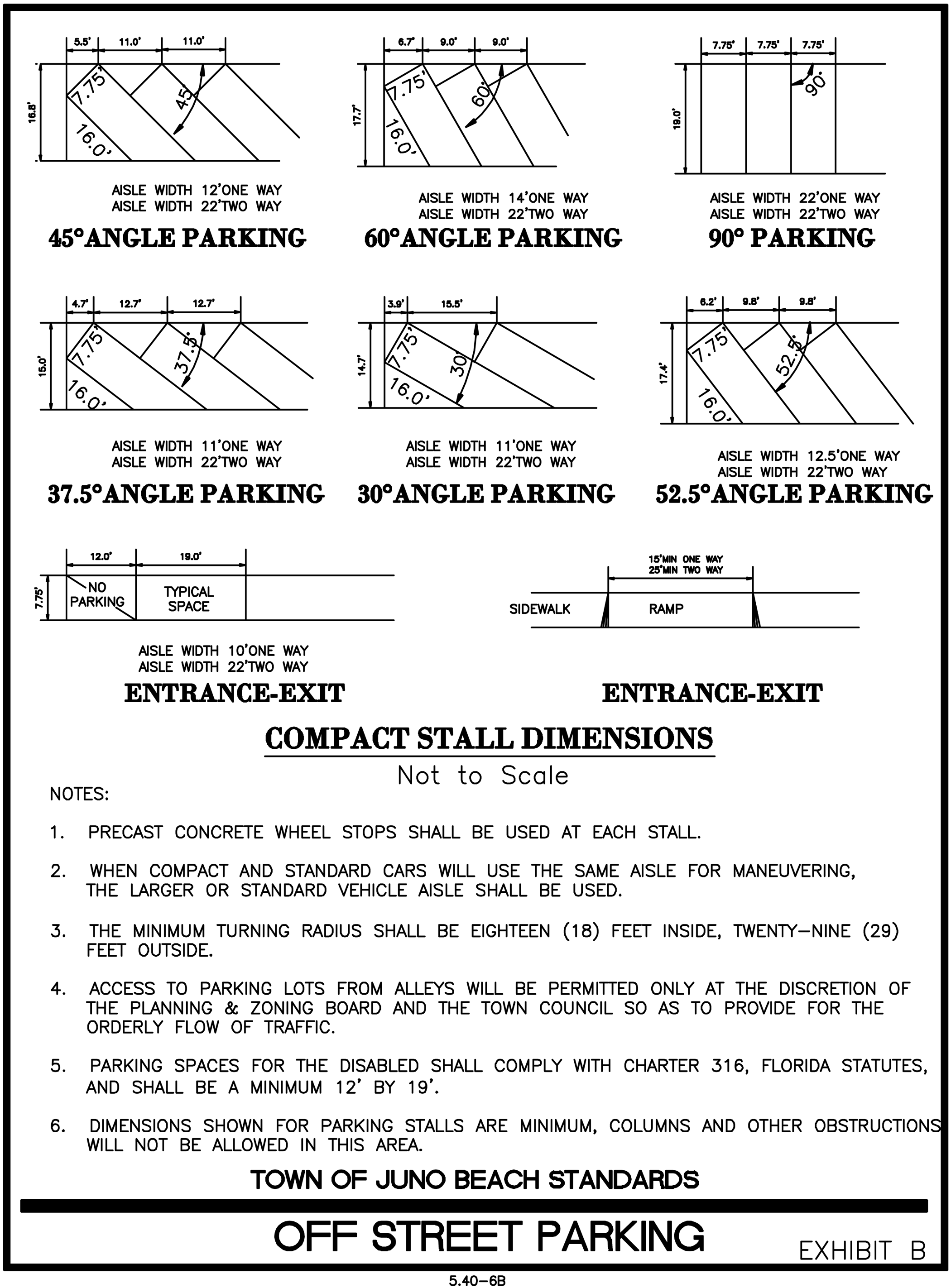
Compact car spaces. Compact car spaces shall be permitted only for office developments greater than 25,000 square feet in gross floor area, and the percentage of compact car spaces shall not exceed 15 percent of the total number of spaces provided. Furthermore:
a.
The location of compact car spaces shall be neither more nor less convenient than larger car spaces. Compact spaces shall be well-marked and quickly distinguished from standard spaces. Compact car spaces should not be sprinkled here and there in such a way that the individual parking the larger car is deceived by the size of any empty space, finding it too small for use.
b.
Compact spaces shall be identified in one of two ways:
1.
By signs only; or
2.
By signs and color-coded stall lines. A line can be painted at the entry to the smaller stall. The line is to be parallel to the aisle and mark the point beyond which the car should not extend.
(3)
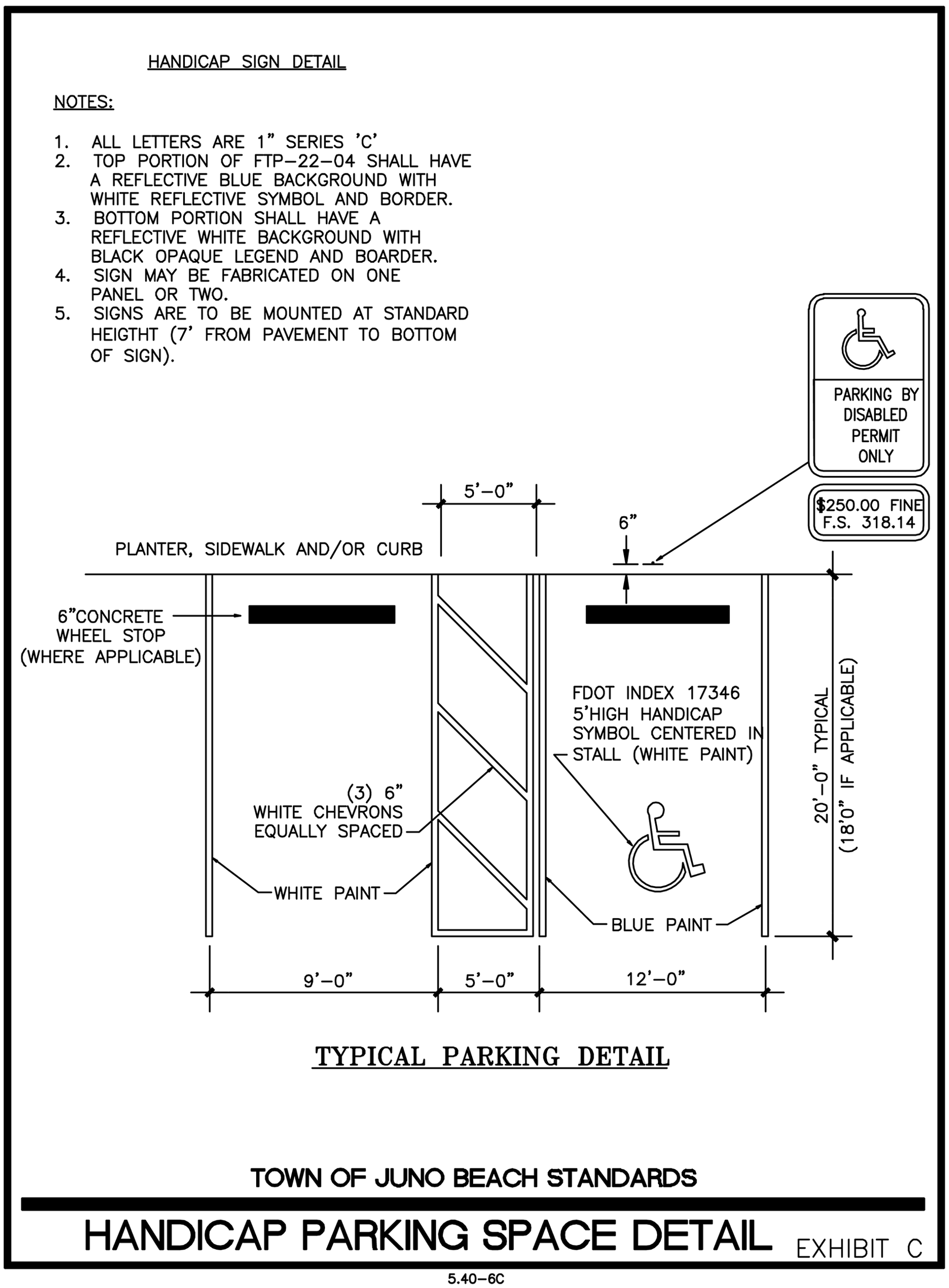
Disabled parking and sign detail. All parking regulations for persons with disabilities shall be governed by F.S. §§ 316.1957, 316.1958, 316.1959, and 553.501 et seq.
(4)
Vehicular and pedestrian access.
a.
Individual ingress and egress drives extending across the public sidewalks and curbs and connecting the off-street parking spaces to the public street area shall not exceed a maximum of 30 feet.
b.
Nonresidential developments approved after the effective date of the ordinance from which this chapter is derived shall be required to provide an internal accessway and/or alleyway connecting the approved development with adjacent future nonresidential development, providing for vehicular (automobile and bicycle) and pedestrian traffic. Existing nonresidential developments adjacent to new nonresidential developments shall be encouraged to provide internal cross access. Such cross access shall be provided in a recordable instrument in a form acceptable to the town attorney. A nonresidential development adjacent to a residential development may be required to provide a vehicular and/or pedestrian accessway if the residential development desires such connection.
c.
An efficient and safe pedestrian and vehicular (automobile and bicycle) traffic system shall be provided throughout the parking and other vehicular use areas.
d.
The design, number and placement of such drives, accessways, and alleyways shall be subject to review by the planning and zoning board and approval by the town council, and, if applicable, county and state authorities having jurisdiction over such matters.
(5)
Schedule of off-street parking requirements.
a.
Generally. The schedule of off-street parking requirements is as follows. The town encourages the use of angled parking for its residents.
SCHEDULE OF OFF-STREET PARKING REQUIREMENTS
JUNO BEACH, FLORIDA
b.
Exceptions. If a proposed use is not listed or if special circumstances exist for a particular use which causes it not to need the required minimum spaces or if shared parking is desired, a parking study acceptable to the town planning and zoning department shall be submitted for review by the planning and zoning board and approval by town council.
1.
If the number of required spaces is reduced, the area that would have been used for parking shall be reserved as landscape open space. The number of spaces reduced multiplied by 200 square feet (see subsection (b)(1)a of this section) shall be required to be maintained as landscape open space and shall not be counted toward the minimum landscape open space requirement.
2.
A shared parking plan shall be enforced through written agreement, unity of title, or unity of control.
c.
Parking in the side and rear yard. If a minimum of 75 percent of all parking spaces on site are located in the side and rear yard areas, then the total parking space requirement may be reduced by 15 percent.
(c)
On-street parking. Any new development constructed upon an entirely new roadway shall be permitted, at the discretion of the town, to have on-street parking directly fronting a lot provided said roadway is designed for continuous and successive on-street parking. Such on-street parking shall count toward fulfilling the off-street parking requirement.
(d)
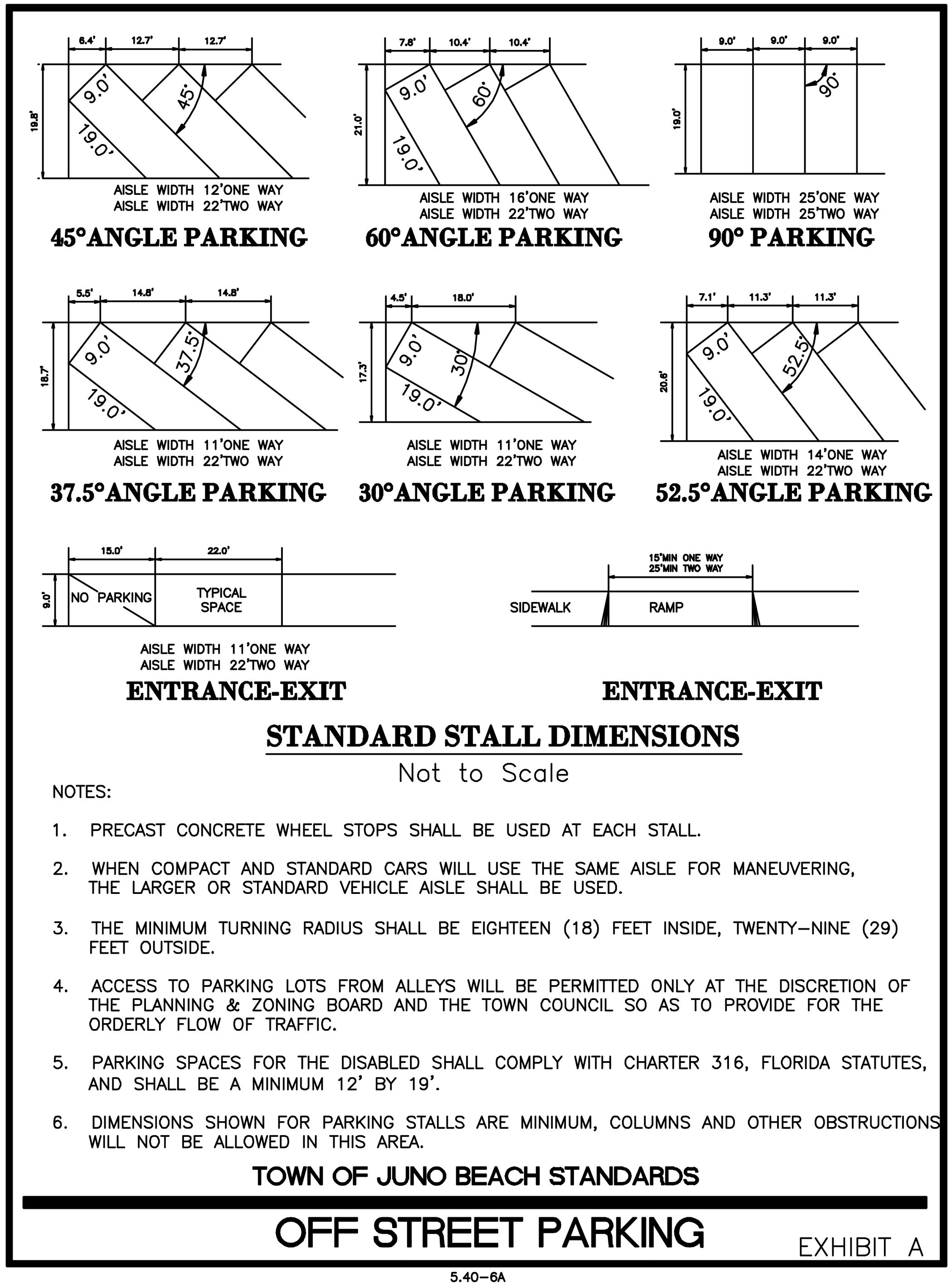
Parking dimensions for on-street and off-street parking. The parking dimensions for standard stalls, compact car stalls and disabled stalls shall be as specifically set in Exhibits A, B and C, respectively, at the end of this section. Based on the frequency of use, the planning and zoning director may recommend to the planning and zoning board and to the town council that guest spaces, excess spaces, and infrequently used parking spaces be provided in grassed areas, or other acceptable material, with a stabilized sub-base.
(e)
Bicycle parking facilities.
(1)
Bicycle parking facilities with a minimum of eight bicycle parking spaces, in a design acceptable to the town, shall be provided for each nonresidential development. In a mixed-use or shopping center development, a minimum of eight bicycle parking spaces shall be provided for each anchor tenant. The bicycle parking facilities shall be located close to the principal building entrance and shall be sheltered. The number of required bicycle parking spaces may be increased or decreased by the town, based upon its review of the proposed project and the reasonable amount of expected bicycle parking space needs. Shower and locker facilities, sufficient in amount to accommodate need, are encouraged in all nonresidential developments greater than 10,000 square feet in gross floor area.
(2)
All multifamily and three or more attached single-family residential developments shall be required to provide bicycle storage facilities. Such storage facilities shall be fully enclosed within a structure and shall be of a sufficient size to accommodate expected storage needs.
(Ord. No. 207, § 5.40.2, 8-8-1979; Ord. No. 287, 7-10-1985; Ord. No. 416, 9-25-1991; Ord. No. 485, 9-4-1996; Ord. No. 517, 12-1-1999; Ord. No. 668, § 5, 5-28-2014; Ord. No. 785, § 3, 6-26-2024)
Sec. 34-982. - Commercial areas.
(a)
The following restrictions shall apply to the parking of vehicles, recreational vehicles, boats and boat trailers in commercial areas:
(1)
Any vehicles parked in a commercial area for more than a 24-hour period must be owned or leased by the business owner on the property and parked at the rear of the building, unless no rear parking area is available.
(2)
No recreational vehicles, boats and boat trailers shall be parked or stored in a commercial area.
(b)
The restrictions set forth in subsection (a) of this section shall not apply to the temporary parking of vehicles when construction is underway, for which a current and valid building permit has been issued by the town and said permit is properly displayed on the premises.
(c)
See article IV, division 6 for vehicle signage requirements.
(Ord. No. 207, § 5.40.3, 8-8-1979; Ord. No. 485, 9-4-1996; Ord. No. 487, 9-18-1996; Ord. No. 517, 12-1-1999)
Sec. 34-983. - Residential areas.
(a)
Prohibited vehicles; exceptions. No dual-wheeled vehicles, vehicles exceeding three-fourths-ton rated capacity, and vans exceeding one-ton rated capacity; and no bus, pole trailer, semitrailer, trailer, truck, and truck tractor, as defined in F.S. ch. 316, shall be parked or stored on any residential property or public or private street rights-of-way or alleys within any residential district in the town except for the following situations:
(1)
This restriction will not apply to those vehicles described and regulated in subsections (b) and (c) of this section.
(2)
This restriction shall not apply to the temporary parking of such vehicles on private property in residential districts whereon construction is underway, for which a current and valid building permit has been issued by the town and said permit is properly displayed on the premises.
(3)
This restriction shall not apply to routine deliveries by tradesmen or the use of trucks in making service calls providing that such parking is actually in the course of business deliveries or servicing as the case may be.
(4)
This restriction shall not apply to the parking of emergency vehicles providing that the time parked is actually necessary for the emergency. Further, the restriction shall not apply to emergency vehicles driven by residents of the town and parked on their property.
(5)
This restriction shall not apply to a situation where such vehicle becomes disabled and, as a result of such emergency is required to be parked within a residential district for longer than the time allowed herein. However, any such vehicle shall be removed from the residential district within 24 hours by towing if necessary regardless of the nature of the emergency, and the cost of such towing shall be at the expense of the owner of the vehicle.
(6)
This restriction shall not apply the recreational vehicle park (RV park) zoning district.
(b)
Any commercial and noncommercial pickup truck, sport utility vehicle, automobile, or similar type of motor vehicle (as defined by F.S. ch. 316) not exceeding three-fourths-ton rated capacity and any van not exceeding one-ton rated capacity, may be parked on a lot improved with a permitted structure in any residential district in the town. All commercial motor vehicles shall adhere to the following:
(1)
Any equipment or inventory shall be placed in the interior of the vehicle or within the confines of the bed of a truck.
(2)
Any commercial vehicle that cannot abide by subsection (b)(1) of this section must be placed in a garage, carport, or in the side or rear yard and screened as described in subsection (c)(3) or (4) of this section.
(3)
See article IV, division 6 for vehicle signage requirements.
(c)
Boats, boat trailers, utility trailers; or recreational vehicles, excluding the park trailer (as defined by F.S. ch. 320) may be parked on a lot improved with a permitted structure in any residential district in town subject to the following conditions and restrictions:
(1)
One boat, one boat trailer, one utility trailer, and one recreational vehicle (RV), but not more than one of each, may be parked on a lot (See section 34-984 for exceptions).
(2)
The equipment described in this section must be owned and used primarily by a resident of the premises; provided, however, that a guest of the resident may park such equipment, excluding the utility trailer, in the front yard driveway for not more than three days in any 14-day period.
(3)
The location for such parked equipment, excluding the utility trailer, shall be in the rear yard or in the side yard placed to the rear of a line established by the front building wall or corner, whichever is applicable (see section 34-984 for exceptions). Such parked equipment, however, shall be screened on three sides against direct view from adjacent properties. Compliance with the screening described, herein, shall permit the planting of a minimum 42-inch-high hedge. The hedge shall be maintained in a healthy condition to a minimum height of six feet, which will become an effective opaque screen from adjacent properties in a reasonable period of time not to exceed two years. A six-foot-high fence/wall such as wood or concrete block stucco (CBS) will also be allowed as a screen in place of a hedge. (See figure 1, which follows this section, for examples.) See sections 34-905 and 34-1088.
(4)
All utility trailers must be parked in a garage or carport. Any other of the vehicles or equipment described herein may be parked in a garage or carport. The garage or carport must be effectively screened on three sides; provided however that no portion of the vehicle or equipment shall extend horizontally beyond the roof overhang (eave). (See figure 1, which follows this section, for examples).
(5)
Such equipment shall at all times have attached a current vehicle registration, license plate and, if required, a current sticker.
(6)
No vehicle major repairs or overhaul work on such equipment which constitute either a public or private nuisance shall be made or performed on the site.
(7)
When parked on the site such equipment shall not be used for living or sleeping quarters or for housekeeping or storage purposes and shall not have attached thereto any service connection lines except as may periodically be required to maintain the equipment and appliances.
(8)
All vehicles shall abide by the town's sign ordinance (see article IV, division 6 of this chapter).
(9)
The restrictions herein shall not prohibit the temporary parking of vehicles used for recreational purposes on lots within the town which are set aside specifically for recreational use, for example, the RV park zoning district.
(Ord. No. 207, § 5.40.4, 8-8-1979; Ord. No. 485, 9-4-1996; Ord. No. 487, 9-18-1996; Ord. No. 517, 12-1-1999)
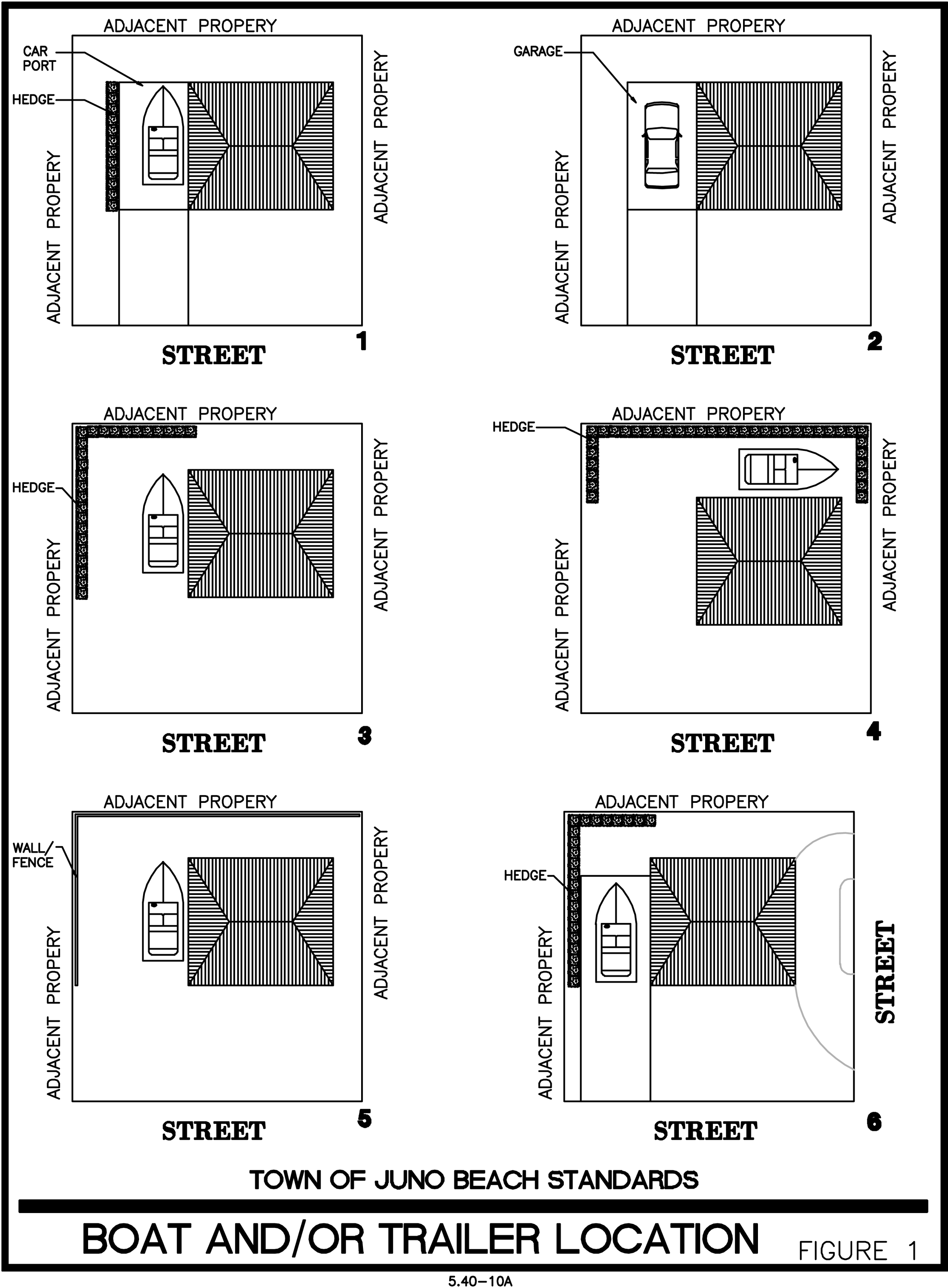
Sec. 34-984. - Legal nonconforming use status.
In the RS-5 and R-DUP zoning districts a maximum of two boats and two boat trailers shall be permitted to be parked in the front yard, provided neither boat and trailer can fit in the side or rear yard. Such boat and boat trailer shall be permitted as legal nonconforming uses for a limited period of time as specified herein provided the following conditions are satisfied:
(1)
The granting of the legal nonconforming use status shall only apply to those boats and boat trailers which are owned by the owner or current tenant of the residence as of the effective date of the ordinance from which this chapter is derived.
(2)
Property owners or tenants who own said boats and boat trailers shall register same as legal nonconforming uses with the town within 90 days of the adoption date of the ordinance from which this chapter is derived.
(3)
Upon registration, the town shall issue a registration decal which must be permanently affixed and displayed in a manner as to be visible from the street and renewable yearly. The town shall also issue a copy of a document to be recorded by the town clerk which limits the parking of said boats and boat trailers during the time the registering property owner or current tenant maintains ownership or rental of the real property upon which the boats and boat trailers are parked. The fee for this registration and decal and recording shall be such fee as is charged by the town to cover its administrative costs. After the September 18 renewal date a late penalty as currently established or as hereafter adopted by resolution of the town council from time to time may be assessed for each month of delinquency or part thereof. In the event a property owner or tenant does not register or renew its registration within 90 days from adoption of this chapter anniversary date, the property owner's or tenant's legal nonconforming status shall cease to exist and the town shall record a document in the public records evidencing same.
(4)
The legal nonconforming use status for said boats and boat trailers shall not be transferable to a subsequent owner or tenant of the property. However, owners or tenants may replace their boats and boat trailers for the cost of a new registration decal.
(5)
The conditions described in section 34-983(c)(5)—(8) shall be adhered to.
(6)
These boats and boat trailers shall be parked perpendicular to the street (except when on a corner lot) and shall not extend into any street right-of-way or create a vehicular traffic hazard.
(Ord. No. 207, § 5.40.5, 8-8-1979; Ord. No. 485, 9-4-1996; Ord. No. 487, 9-18-1996; Ord. No. 517, 12-1-1999)
Sec. 34-985. - Off-street loading.
(a)
In any district in connection with every building or building group or part thereof, thereafter created and having a gross floor area of 10,000 square feet or more, which is to be occupied by commercial uses or other uses similarly requiring the receipt or distribution by vehicles of material or merchandise, there shall be provided and maintained, on the same lot with such building, off-street loading or unloading berths in a number not less than that set forth in the following schedule:
(b)
A loading demand statement shall be required at the time of application submittal for all nonresidential uses, detailing the land use's projected normal demands for loading and unloading. The number of required loading berths may be increased or decreased by the town based upon its review of the loading demand statement.
(c)
The loading berth required in each instance shall not be less than 12 feet in width, 40 feet in length, and 14 feet in height, and may occupy all or any part of any required yard except for a required front yard; provided, however, that the loading berth shall be screened from the street or public way and any adjoining residential property.
(Ord. No. 207, § 5.50, 8-8-1979)
Sec. 34-1014.- Purpose.
The purpose of this division is to set forth the conditions and requirements under which a sidewalk cafe, as defined, may be permitted to operate on a sidewalk within the town.
(Ord. No. 207, § 5.56, 8-8-1979; Ord. No. 343, 9-21-1988)
Sec. 34-1015. - Limitations and requirements.
(a)
Where permissible. A sidewalk cafe may be permitted as an accessory use only in the CG commercial general zoning district which allows indoor restaurants and then only if the sidewalk cafe is situated adjacent, as specified in subsection (b) of this section, to an indoor restaurant.
(b)
A sidewalk cafe may be located on the sidewalk immediately adjacent to and abutting the indoor restaurant which operates the cafe, provided that the area in which the sidewalk cafe is located extends no farther along the sidewalk's length than the actual sidewalk frontage of the operating indoor restaurant or, in the instance where the restaurant occupies a corner of the building, both front and side can be utilized for these purposes, and all other applicable provisions of these regulations are fulfilled. A letter of consent shall first be received from the owner of the commercial center in which said sidewalk cafe is proposed. If the owner objects to the application for a sidewalk cafe, the town shall not consider said application.
(c)
Common open plazas may be used in front of an indoor restaurant if access to other businesses/tenants adjacent or next to the plaza area is not impeded or blocked. A letter of consent shall be received from the owner of the commercial center by the applicant. If the owner has no objections to such a use, then letters of consent shall be received from adjacent businesses/tenants and submitted to the planning and zoning department. If the owner objects to the application for a sidewalk cafe in an open plaza area, the town shall not consider such an application. If there are letters of objection from adjacent businesses/tenants, the matter shall be brought to the town pursuant to site plan review procedures. If there are no objections to using the open plaza area for sidewalk cafes, the planning and zoning department may process and administer said application and the letter shall be placed in the applicant's file.
(d)
Number of sidewalk cafes. An indoor restaurant may be permitted to operate only one sidewalk cafe and each sidewalk cafe shall be confined to a single location of the sidewalk or open plaza area:
(e)
Sidewalk clearance. A sidewalk cafe may be permitted only where the sidewalk is wide enough to adequately accommodate both the usual pedestrian traffic in the area and the operation of the proposed cafe.
(f)
Dining area shall be directly accessible to the physically disabled.
(g)
Dining areas shall be required to maintain adequate building egress as defined by the building code of the town.
(h)
Location of furniture. All tables and chairs comprising a sidewalk cafe shall be set back in a safe manner from any curb and from any sidewalk or street barrier, and shall not be situated within eight feet of any designated bus stop, alley or other such areas.
(i)
The design and colors used for chairs, tables, lighting and other fixtures including umbrellas shall be consistent with the architectural style and colors used on the building facade. Where an outdoor eating area is proposed adjacent to an existing one, the design of the new fixtures shall relate to, but need not be identical with, the fixtures of the existing outdoor eating area.
(j)
No signs are permitted in the outdoor dining area with the exception of signs which shall give notice to the cafe's customers that the drinking of alcoholic beverages or the carrying of any open container which contains alcoholic beverages is prohibited and unlawful outside the delineated area of the sidewalk cafe.
(k)
The use of landscaping and planters is encouraged to reinforce a plaza setting. However, large scale landscaping which will obscure important elements of the building facade is not allowed.
(l)
Lighting shall be incorporated into the facade of the building, and shall complement the style of the building. Lights on buildings shall not be glaring to pedestrians on the sidewalk and should illuminate only the outdoor eating area. No wired electrical fixtures will be allowed outside the face of the building.
(m)
Service requirements. The outdoor preparation of food and busing or service stations are prohibited at sidewalk cafes. All exterior surfaces within the sidewalk cafe shall be easily cleanable and shall be kept clean at all times by the permittee.
(n)
Trash and refuse storage for the sidewalk cafe shall not be permitted within the outdoor dining area or on adjacent sidewalk areas and the permittee shall remove all trash and litter as they accumulate. The permittee is responsible for maintaining the outdoor dining area, including the sidewalk surface and furniture and adjacent area in a clean and safe condition.
(o)
The maximum hours of operation of an outdoor eating area shall be established by the town and may be less than, but shall not exceed, the hours of operation of the associated indoor restaurant.
(Ord. No. 207, § 5.57, 8-8-1979)
Sec. 34-1016. - Permit—Conditions and limitations.
In connection with granting approval for any sidewalk cafe permit, the director shall make findings that the proposed operation meets the limitations of these regulations and the director may impose such conditions in granting its approval as he deems are needed or at his discretion may require that the application be subject to site plan review procedure to ensure that the proposed operation will meet the operating requirements and conditions set forth herein and to ensure that the public safety and welfare will be protected.
(Ord. No. 207, § 5.58, 8-8-1979)
Sec. 34-1017. - Same—Form; requirements; annual renewal; fee.
In addition to naming the permittee and any other information deemed appropriate by the director, the permit shall contain, and be subject to, the following conditions:
(1)
The applicant shall submit an exhibit that is drawn to scale and which shows the proposed location and placement of tables, chairs and other furniture in relation to the sidewalk, open plaza and or indoor restaurant.
(2)
The permit shall be specifically limited to the area shown on the exhibit attached to and made part of the permit.
(3)
Any future additions or revisions to the approved exhibit and permit, shall be subject to review pursuant to these regulations.
(4)
The permit issued shall be issued to the premises only and shall not be transferable in any manner.
(5)
The director may require the temporary removal of sidewalk cafes when street, sidewalk, or utility repairs necessitate such action.
(6)
The department of public works or the police department may immediately remove or relocate all or parts of the sidewalk cafe in emergency situations.
(7)
The town and its officers and employees shall not be responsible for sidewalk cafe components relocated during emergencies.
(8)
The permittee shall use positive action to ensure that its use of the sidewalk in no way interferes with or embarrasses sidewalk users or limits their free unobstructed passage.
(9)
Use of the sidewalk cafe shall be restricted to patrons of the permittee.
(10)
Tables, chairs, umbrellas, and any other objects provided with a sidewalk cafe shall be maintained with a clean and attractive appearances and shall be in good repair at all times.
(11)
Each permit shall be effective for one year subject to annual renewal and the permit fee shall be assessed by the town that is consistent with the town's existing fee structure for this type of use.
(Ord. No. 207, § 5.59, 8-8-1979)
Sec. 34-1048.- Purpose and intent.
The intent of this division is to:
(1)
Establish rules and regulations to control and regulate all signs in the town;
(2)
Maintain a high degree of excellence in the quality of all signs, both aesthetically and structurally;
(3)
Prevent the proliferation of signs which cause visual clutter and disharmony; and
(4)
Encourage a rational pattern of signs with regard to the area where such signs are located.
(Ord. No. 207, § 5.61, 8-8-1979; Ord. No. 309, 10-8-1986; Ord. No. 389, 5-16-1990; Ord. No. 421, 2-19-1992; Ord. No. 450, 5-11-1994; Ord. No. 454, 11-16-1994; Ord. No. 469, 5-10-1995; Ord. No. 476, 12-13-1995; Ord. No. 489, 12-11-1996; Ord. No. 491, 2-12-1997; Ord. No. 512, 7-28-1999; Ord. No. 538, 4-25-2001)
Sec. 34-1049. - Permit required; regulated by district.
Signs shall be permitted in the various districts as accessory uses in accordance with the regulations contained in this division. A permit is required.
(Ord. No. 207, § 5.62, 8-8-1979; Ord. No. 309, 10-8-1986; Ord. No. 389, 5-16-1990; Ord. No. 421, 2-19-1992; Ord. No. 450, 5-11-1994; Ord. No. 454, 11-16-1994; Ord. No. 469, 5-10-1995; Ord. No. 476, 12-13-1995; Ord. No. 489, 12-11-1996; Ord. No. 491, 2-12-1997; Ord. No. 512, 7-28-1999; Ord. No. 538, 4-25-2001)
Sec. 34-1050. - Prohibited signs.
The following signs shall be prohibited:
(1)
Any sign, other than an official sign, within the right-of-way lines of any street or public way.
(2)
Flashing, animated, emitting, reflectorized, glowing, radiating, moving signs (e.g., revolving signs).
(3)
Banner signs in all zoning districts, except the CG commercial general, medical commercial (MC) and CO commercial office zoning districts (see section 34-1051(12) for restrictions). Ornamental signs are regulated separately (see section 34-1055 for restrictions).
(4)
Off-premises signs (signs unrelated to the property upon which it is being displayed). Such signs do not further the town's goal for an aesthetically valuable environment, nor do they contribute to a safe environment. They may visually clutter highly traveled areas for vehicular, pedestrian and bicycle traffic and can contribute to unsafe travel conditions. They are, therefore, prohibited within the town.
(5)
Searchlights.
(6)
Changeable copy signs, except:
a.
Public, charitable, and religious signs;
b.
Fuel service station price signs;
c.
Theater signs;
d.
Permanent special event signs; and
e.
Temporary special event message area on a freestanding identification sign (as provided for herein).
(7)
Portable, folding, and similar movable signs (e.g., A-frame or sandwich board signs).
(8)
Flags (other than corporate flags for commercial uses and properly flown governmental flags for all uses, provided such flags do not exceed three per property), streamers, balloons, other air or gas-filled feature, pennants, streamers, wind-driven whirligigs, propellers or other devices.
(9)
Bench signs and bench shelter signs, except for those provided by the town for public use in public areas.
(10)
Any sign not provided for in this section, including, but not limited to, the background area such as an awning, canopy, or fixed ornamental banner, which becomes unsightly, unsafe, faded in color, or in need of repair.
(11)
Roof signs.
(12)
Painted wall signs.
(13)
Vehicles used for advertising purposes.
a.
Any sign displayed on an automobile, truck, or other motorized vehicle when that vehicle is used primarily for the purpose of such advertising display. Motor vehicles used solely for sign purposes or advertising purposes are prohibited. No person shall park any motor vehicle in a location visible from a public right-of-way, which has attached thereto or located thereon any sign, for the basic purpose of advertising products or directing people to a business or activity located on the same or nearby property or any other premises. This section is not intended to prohibit any form of informational vehicular signage which is limited to the name of a business, address, phone number, and products offered; provided that such sign is either painted on or attached by magnetic strips or bolts or other form of adhesive to the side of the vehicle. Such signage, however, shall not protrude from or above the exterior surface (front, back, side, roof, trunk, or truck bed) of the vehicle greater than one-half inch nor have a directional arrow as part of the message.
b.
This provision shall not apply to licensed taxicabs, the shortterm use of political campaign signs, nor temporary signs placed on vehicles when making a delivery and removed when parked at business location. This provision shall also not apply to any vehicle owned or operated by an individual, business, or other entity residing outside of the town, which is just passing through or temporarily serving or visiting any individual, business, or place in town.
c.
Nonmotorized vehicular signs or sign structures attached or affixed in any manner on or to any nonmotorized wheeled vehicle are expressly prohibited in any zoning district.
(14)
Billboard/off-premises signs.
(15)
Signs painted on, attached to or supported by a tree, utility pole, or other similar object.
(16)
Representational signs, permanent or temporary, such as beer cans or bottles, oil cans, soft drink cans or bottles, animals, or other similar device indicating a product.
(17)
Translucent awnings.
(18)
Permanent or temporary nuisance signs which utilize or incorporate such words as "stop," "look," "danger," etc.
(19)
Flashing or moving neon signs; however, nonmoving, nonflashing neon signs are permitted.
(20)
Signs made with fluorescent materials or paint, including both temporary and permanent signs.
(21)
Any abandoned signs or supporting structures, and signs displayed on property containing a discontinued or abandoned project. Such signs may include those which represent approved developments or projects where work associated with an approved permit has discontinued for a period of at least 60 days; or is deemed abandoned or discontinued by the town.
(Ord. No. 207, § 5.63, 8-8-1979; Ord. No. 309, 10-8-1986; Ord. No. 377, 10-18-1989; Ord. No. 389, 5-16-1990; Ord. No. 416, 9-25-1991; Ord. No. 421, 2-19-1992; Ord. No. 450, 5-11-1994; Ord. No. 454, 11-16-1994; Ord. No. 469, 5-10-1995; Ord. No. 476, 12-13-1995; Ord. No. 489, 12-11-1996; Ord. No. 491, 2-12-1997; Ord. No. 512, 7-28-1999; Ord. No. 538, 4-25-2001; Ord. No. 668, § 5, 5-28-2014)
Sec. 34-1051. - Signs exempt from permit requirement.
The following signs shall be exempt from the permit requirement:
(1)
Individual residential single-family nameplates and identification signs, not to exceed a total sign area of one square foot.
(2)
Sale or rental signs for individual single-family dwellings and multifamily residential developments with less than five units. Such signs shall not exceed a total of four square feet. (See section 34-1055(d).)
(3)
Garage sales and yard sales: a maximum of one sign is permitted on a lot hosting the sale, with a total sign area not to exceed two square feet. A maximum height of three feet is permitted with a minimum setback required. Such sign shall remain a maximum of five days on the property. (See section 34-1055(d).)
(4)
Signs indicating the private nature of a road, driveway, or other premises, and signs controlling the use of private property, such as the prohibition of trespassing, parking, fishing, etc., provided such signs do not exceed an area of four square feet.
(5)
Vehicle signs: See section 34-1050(13) for vehicle sign regulations.
(6)
Political signs: See section 34-1054(h) for political sign regulations.
(7)
Official signs (traffic signs, public notices).
(8)
At the discretion of the planning and zoning department, commercial sponsor names or logos printed on umbrellas, chairs and tables used in a sidewalk cafe. When such logos are used, the sidewalk cafe must have current approval for its use, as well as maintain a clean and orderly appearance. The applicant for such a cafe shall be responsible for the upkeep of the umbrellas, chairs and tables.
(9)
Holiday decorations. (See section 34-1055(d)(4).)
(10)
Special event signs for institutional and government uses, and charitable groups, provided town approval is received.
(11)
Temporary and permanent window signs (see section 34-1053(7) and 34-1054(g)).
(12)
Banner signs in the CG commercial general, medical commercial (MC) and CO commercial office zoning districts, provided such banner signs meet the following criteria:
a.
Such banner sign shall not be used in place of a permanent wall sign.
b.
There shall be only one banner per use/business.
c.
The banner shall be made of durable material, such as but not limited to, plastic or vinyl, and have professional lettering/characters/design. The paint on said banner shall be weatherproof.
d.
The banner shall not exceed 20 square feet in area and shall be attached to the building face or building columns.
e.
Banner signs shall be permitted to be flown in accordance with section 34-1055. Prior to flying the banner the applicant is required to submit a letter to the director of planning and zoning stating the date that the banner will begin flying, the size, material, and wording of the banner.
(13)
The outdoor display of merchandise in the CG commercial general and CO commercial office zoning districts, provided such outdoor displays meet the following criteria:
a.
The displays shall be permitted only during business hours. The displays shall be taken inside the building after business hours.
b.
The displays shall be placed adjacent to and against the front building wall on the sidewalk.
c.
A minimum five-foot-wide unobstructed pedestrian walkway shall be provided adjacent to the outdoor display and in no case shall the display extend more than three feet from the front building wall.
d.
Signage on outdoor displays shall not exceed two square feet in area.
e.
The maximum height of any display, including signage, shall not exceed five feet.
f.
The length of the outdoor display (horizontal dimension) shall not exceed 25 feet in length and/or two-thirds of the length of the store frontage (length of front building wall), whichever is less.
(14)
Open house signs (see section 34-1055(d)(5)).
(Ord. No. 207, § 5.64, 8-8-1979; Ord. No. 309, 10-8-1986; Ord. No. 389, 5-16-1990; Ord. No. 421, 2-19-1992; Ord. No. 450, 5-11-1994; Ord. No. 454, 11-16-1994; Ord. No. 469, 5-10-1995; Ord. No. 476, 12-13-1995; Ord. No. 489, 12-11-1996; Ord. No. 491, 2-12-1997; Ord. No. 512, 7-28-1999; Ord. No. 538, 4-25-2001; Ord. No. 593, § 5.64, 6-14-2006; Ord. No. 668, § 5, 5-28-2014)
Sec. 34-1052. - Permit procedure; fees and administration.
(a)
All temporary or permanent signs shall require a letter of approval from the property owner or property management prior to approval from the town.
(1)
Temporary signs.
a.
All temporary signs, other than those stated in section 34-1051, shall require submittal of a sign plan to the planning and zoning department for approval prior to erection, alteration, display, or reconstruction.
b.
All sign plans shall be drawn to scale, reveal the entire sign area, message, and supporting structure, show all dimensions (i.e., height, sign area, lettering, logo, etc.), and materials and colors to be used.
c.
Temporary signs shall be recorded with the town building department and recording shall identify the message, location, type of temporary sign, and the amount of time to be erected.
(2)
Permanent signs.
a.
All permanent signs, other than those stated in section 34-1051, are required to receive a sign permit prior to erection, alteration, reconstruction, illumination, display or painting.
b.
All permanent signs for a new project shall be part of the site plan review procedure. Any sign within an existing project shall be required to receive approval by the planning and zoning department prior to any change, or at the discretion of the town, may be required to be reviewed and approved by the planning and zoning board and the town council.
c.
In order to obtain a sign permit, a sign plan and application form must be submitted to the planning and zoning department. Such sign plan shall be drawn to scale and show:
1.
The location of the sign on the property (i.e., on a site plan if a freestanding sign, or on the building facade if a wall sign);
2.
The entire sign area, message, and supporting structure;
3.
All dimensions (i.e., height, sign area, lettering, logo, etc.);
4.
Materials and colors to be used;
5.
Lighting details if illuminated, and construction and attachment details;
(b)
For existing buildings, color photographs shall be submitted showing the facade of the building on which the sign is to be placed, together with adjacent existing signs on the building or abutting structure and any freestanding signs along the street frontage, if applicable.
(c)
If a sign is illuminated, an electrical permit will be required in addition to a sign permit.
(Ord. No. 207, § 5.65, 8-8-1979; Ord. No. 309, 10-8-1986; Ord. No. 389, 5-16-1990; Ord. No. 421, 2-19-1992; Ord. No. 450, 5-11-1994; Ord. No. 454, 11-16-1994; Ord. No. 469, 5-10-1995; Ord. No. 476, 12-13-1995; Ord. No. 489, 12-11-1996; Ord. No. 491, 2-12-1997; Ord. No. 512, 7-28-1999; Ord. No. 538, 4-25-2001)
Sec. 34-1053. - General regulations.
The following regulations shall apply to all permitted signs:
(1)
All permanent and temporary signs must have a professional appearance, meaning that said signs shall have no apparent flaws which would suggest that such sign was not made by a professional sign company or designer.
(2)
Signs and/or lettering visible from a public or private roadway, aisle, and/or sidewalk shall be classified as signs regardless of whether they are freestanding or attached to, painted on, or in the principal building to which they are accessory. In all cases, signs shall be constructed of durable materials which meet the Florida Building Code requirements, maintained in good condition, and not dilapidated.
(3)
Sign measurements. The entire area within a single continuous perimeter which encloses the extreme limits of the advertising message, announcement, display, logo, picture or any figure of a similar nature, together with any frame, background area of sign, structural trim, or other material, color, or condition which forms an integral part of the display, excluding the necessary supports, base or uprights on which such sign is placed provided that such supporting structures shall not exceed the maximum allowable sign area and shall carry only street numbers. A maximum of two sign faces are permitted per sign. When a sign has two faces then only one face shall be counted toward the sign area. A cube sign with adjacent sign faces is not permitted; and a V-shaped sign is not permitted.
(4)
Sign height measurement. The height of all signs shall be measured from the crown of the road, grade or walkway surface, whichever is applicable. Architectural features (such as roof structures, wall caps, varying forms) shall be permitted at the discretion of the town to add a proportional amount (which shall be no more than 20 percent) to the allowable height of any permanent sign. In no way shall this provision allow an increase in the allowable sign area square footage defined in this section.
(5)
Projection of signs. No sign shall project from the face of the main wall of a building more than one foot, provided, however, that no sign shall project into, or over a public way or sidewalk which is less than eight feet above the walkway or grade.
(6)
All signs on a site situated along the street frontage, including outbuildings and out-parcels, shall be separated a minimum of 100 feet, unless otherwise indicated in section 34-1055; however, at the town council's discretion these minimum distances may be waived if thought to be more aesthetically appealing.
(7)
Permanent window signs, including signs painted directly upon window glass and interior hanging signs within 12 inches of glass, shall not exceed 20 percent of total window area, a maximum height of 20 feet, and a letter and logo height of 12 inches. See section 34-1054 for temporary window sign regulations.
(8)
Each building, structure or tenant space with a separate street address shall install street address numbers over the main entrance or within ten feet of such entrance and be placed in a consistent location throughout the development. Street numbers must be in Arabic numerals no less than six inches in height and will not be calculated toward permitted sign area; and must occur within the top one-third portion of a sign. If no sign exists, street numbers will be required on the structure.
(9)
Nonconformance. Any signs made nonconforming as a result of this chapter shall be exempted from the provisions of this chapter. However, any sign which is nonconforming as a result of this section and which requires repair or replacement of more than 50 percent of the structure or sign face shall be discontinued from use rather than repaired or replaced, and any new sign put in its place shall conform to this chapter. An outparcel monument sign made nonconforming because more than one occupant locates on the outparcel shall be permitted to have only one tenant on the sign.
(10)
All signs must abide by the Florida Building Code and National Electrical Code adopted by the town.
(11)
All signs shall be erected so as to not obstruct or impair driver vision at ingress-egress points, aisles, and intersections, as regulated under sections 34-898 and 34-1089.
(12)
Illumination of signs.
a.
Lighting methods for internally lit signs shall be cabinet signs with an opaque/nontranslucent background and translucent copy, resulting in only the lettering color visible on a dark-appearing background; or backlit reverse channel letter signs. Internally lit individual letter signs are not permitted.
b.
Lighting methods are not to be harsh or unnecessarily bright. Ground- or sign-mounted lighting shall be directed only at the sign area, without spillover on adjacent areas.
c.
All lighting fixtures for signs must be concealed from public view.
d.
Lighting, including neon tubing or other similar devices, and fluorescent paint or materials shall not be used to outline any building, fence, landscaping, wall or any other structure except for strings of nonblinking white lights (with bulbs no greater than 1½ inches in length and diameter) may be permitted to permanently outline principal structures or decorate trees and shrubs on commercially zoned property provided that such display does not interfere with neighboring land uses.
e.
All awnings must be entirely opaque and nontranslucent. Signage on an awning, however, may be externally lit.
f.
Signs used on/near reflective or mirrored buildings shall be located in a manner which will not permit the reflection of the sign off the reflective or mirrored material on the building.
(13)
Standards for design, colors, and materials.
a.
The design, colors, and materials of a sign shall be compatible, and in addition, consistent with the architectural design of the building.
b.
Signs shall be of standard geometric shapes and shall not be cut out so as to form a particular object or logo (i.e., soda bottles, hamburgers, or other figures, etc.).
c.
The silhouette and outlined shape of freestanding signs shall be simple and compatible with the building to which it relates. Signs of excessively complicated outline or composed of many different connected shapes are prohibited.
d.
The silhouettes and outlined shapes of wall signs shall be compatible with the building facade they are mounted on. Signs with shapes that disrupt the architectural order and composition of a building facade are prohibited.
e.
The sign copy, color scheme, size, illumination, materials, design, and location of all signs within a development shall be coordinated and are required to be compatible with the architectural design of the principal building structure.
f.
No wall sign shall be installed on a flat building wall without an architectural feature such as a roof overhang, awning, widow, or similar feature appropriate to the architectural design of the building.
g.
All signs on canopies and awnings shall be on a vertically flat surface and shall not exceed 50 percent of the canopy or awning horizontal length. A maximum of two lines of sign copy are permitted for awning and canopy signs.
h.
Sign copy shall not be crowded onto the surface of a sign or building surface and shall be composed to leave ample space around the copy to preserve legibility.
i.
The number of different lettering styles on a sign or on a series of signs within a complex of buildings shall be minimized and shall relate to the overall architectural concept for the property.
j.
The base or supporting structures of a freestanding sign shall not exceed the sign area and shall be consistent with the materials used in the principal building structure.
k.
The maximum horizontal length of a freestanding sign shall be regulated by section 34-1055 where such a regulation is specifically mentioned, otherwise the maximum horizontal length of a freestanding sign shall be 12 feet for nonresidential signs and ten feet for residential signs.
l.
The vertical dimension for all wall signs shall not exceed four feet in height.
m.
A permanent special event sign shall have its message area enclosed with a clear plexiglass cover with a lock, to be controlled and maintained by property manager only.
(14)
Landscaping.
a.
The base (supporting structure) of a freestanding sign shall be erected within a landscaped area. The landscaped area shall extend a minimum of three feet in all directions from the sign face and ends thereof. The height of the landscaping shall be within a minimum one-foot distance of the lower edge of the sign area.
b.
The landscaped area shall be consistent with the overall landscaping plan for the site and provided with automatic irrigation when needed.
c.
Landscape/topiary signs may be permitted in place of a freestanding or monument sign for a residential multiple-family or commercial use. Sign areas and other regulations shall apply accordingly (see section 34-1055). Such landscape signs shall be maintained at all times to be legible, groomed and attractive (healthy plant materials), so as to keep with safe and aesthetic principals of the town.
(15)
Orientation. Freestanding monument signs shall be placed perpendicular or diagonal to approaching vehicular traffic. Other freestanding signs shall be placed perpendicular to approaching vehicular traffic.
(Ord. No. 207, § 5.66, 8-8-1979; Ord. No. 309, 10-8-1986; Ord. No. 389, 5-16-1990; Ord. No. 421, 2-19-1992; Ord. No. 450, 5-11-1994; Ord. No. 454, 11-16-1994; Ord. No. 469, 5-10-1995; Ord. No. 476, 12-13-1995; Ord. No. 489, 12-11-1996; Ord. No. 491, 2-12-1997; Ord. No. 512, 7-28-1999; Ord. No. 538, 4-25-2001)
Sec. 34-1054. - Temporary signs general regulations.
(a)
All temporary signs must have a professional appearance, meaning that said signs shall have no apparent flaws which would suggest that such sign was not made by a professional sign company or designer.
(b)
All temporary signs shall abide by the size, time, and other regulations described in this section.
(c)
All temporary signs shall be nonilluminated.
(d)
All freestanding temporary signs shall be of wood or other durable material.
(e)
All temporary signs shall be set back a minimum of ten feet from all property lines, unless otherwise indicated.
(f)
See article IV, division 9 of this chapter for special events (grand openings, sidewalk sales, etc.) regulations.
(g)
Temporary window signs, not exceeding ten percent of total window area, 20 feet in height, and a letter and logo height of 12 inches are permitted.
(h)
Political signs are permitted at a total aggregate sign area of 20 square feet per lot; four-foot height maximum; five-foot minimum setback from all property lines. They are limited only to the political event for which it is displayed and must be located on private property with the consent of the property owner. They shall be displayed only during the 60-day period preceding any local, state, or national election; and must be removed within 48 hours of the day of the election to which they apply.
(i)
Artisan signs are permitted at one sign per artisan per lot. Such signs shall have a maximum of four square feet per sign face, be a maximum of six feet in height; and be set back ten feet from all property lines. They must be attached to a construction sign if one is on the site and contain the name of the artisan only. No permit is required. The sign must be removed within 15 days of the artisan's completion of work, or abandonment of work.
(j)
Ornamental signs are permitted at one sign per lamppost or column. Such signs shall be 16 square feet maximum; eight feet minimum from bottom of sign to ground/walkway under lamppost or column, and shall not exceed the height of lamp base/column cap. The sign shall represent in some clear fashion the event, season, festivity for which it is being displayed (i.e., an art festival sign shall include the name of the festival, possibly identify the dates of the festival and/or display a logo representing such festival; or a seasonal sign shall be reflective of the season it represents). The sign must be placed on and secured to a lamppost or column in such a manner that is deemed safe and secure according to the building official, and may be subject to review by the building department to ensure this. The signs are not permitted to be illuminated internally or in such a way that would require an electrical permit; and shall not obstruct the view of vehicular or pedestrian traffic.
(Ord. No. 207, § 5.67, 8-8-1979; Ord. No. 309, 10-8-1986; Ord. No. 315, 3-18-1987; Ord. No. 389, 5-16-1990; Ord. No. 421, 2-19-1992; Ord. No. 450, 5-11-1994; Ord. No. 454, 11-16-1994; Ord. No. 469, 5-10-1995; Ord. No. 476, 12-13-1995; Ord. No. 489, 12-11-1996; Ord. No. 491, 2-12-1997; Ord. No. 512, 7-28-1999; Ord. No. 538, 4-25-2001)
Sec. 34-1055. - Signs permitted by use.
(a)
Permanent signs for commercial uses. The following permanent signs for commercial uses are permitted:
(1)
Freestanding identification/monument signs.
a.
Number of signs:
1.
If located on U.S. Highway 1 or Donald Ross Road with less than 600 feet frontage: one sign;
2.
If located on U.S. Highway 1 and Donald Ross Road: two signs, one per frontage, with a minimum of 450 feet linear, straight line, separation between signs;
3.
If located on U.S. Highway 1 or Donald Ross Road with greater than 600 feet frontage: two signs, with a minimum of 450 feet, linear, straight line separation between signs;
4.
If located on C.R. A1A and/or Ellison Wilson Road: one sign.
b.
Maximum sign area: 60 square feet per sign face.
c.
Maximum sign height: 12 feet, except signs on C.R. A1A and/or Ellison Wilson Road shall not exceed 7.5 feet.
d.
Minimum setbacks: ten feet from all property lines, except signs on C.R. A1A and/or Ellison Wilson Road shall be set back a minimum of five feet from all property lines.
e.
Sign copy limits:
1.
Generally. Lettering and logo height may not exceed 20 inches except those signs with total areas not exceeding 36 square feet, which may be permitted lettering and logos up to 48 inches. Where temporary messages are permitted, tenant usage of such sign shall be controlled by the property manager and may only display current messages. Street numbers are required and must be in Arabic numerals no less than six inches in height and will not be calculated toward permitted sign area.
2.
Single commercial buildings. Developments of a single commercial building may devote 100 percent of the sign area to individual tenants. Lettering or logos for tenants shall be a minimum of four square feet, not to exceed 20 inches in height.
3.
Commercial retail centers. Commercial retail centers may use a maximum of 30 percent of sign area to list a special event and/or building leasing information, unless a permanent special event sign is located on the property (excluding construction and real estate sale signs).
f.
Other limitations:
1.
C.R. A1A: No temporary messages are permitted on signs fronting on C.R. A1A.
2.
Ellison Wilson Road: May use a maximum of 30 percent of the sign area as a permanent or temporary special event and leasing message unless a permanent special event sign is located on the property.
(2)
Freestanding monument signs.
a.
Retail centers located on both U.S. Highway 1 and Donald Ross Road:
1.
Number of signs: one sign along its longest frontage (must be located a minimum of 300 feet linear, straight line, from any other freestanding sign).
2.
Maximum sign area: 60 square feet per sign face.
3.
Maximum height: six feet.
4.
Minimum setbacks: five feet from all property lines.
5.
Sign copy limits: Tenant names shall comprise a minimum of four square feet.
6.
Other limitations: Signs shall be low-profile freestanding signs with a solid base set on the ground of not more than ten feet; side supports shall be no more than two feet from the ground to the bottom edge of the sign when used. Such base or support structures shall be designed to incorporate building materials that complement the architectural theme and design style of the buildings on the premises. Street numbers required, must be in Arabic numerals no less than six inches in height and will not be calculated toward permitted sign area.
b.
Outparcels/outbuildings:
1.
Number of signs: one sign.
2.
Maximum sign area: 24 square feet per sign face.
3.
Maximum height: four feet.
4.
Minimum setbacks: 20 feet from building and five feet from all property lines.
5.
Sign copy limits: Tenant names shall comprise a minimum of four square feet.
6.
Other limitations: signs shall be low-profile freestanding signs with a solid base set on the ground of not more than six feet; side supports shall be no more than two feet from the ground to the bottom edge of the sign when used. Such base or support structures shall be designed to incorporate building materials that complement the architectural theme and design style of the buildings on the premises. Street numbers are required and must be in Arabic numerals no less than six inches in height and will not be calculated toward the permitted sign area.
(3)
Front entrance signs.
a.
Number of signs: two signs per entrance, with one sign on each side of entrance, but not to exceed a maximum of two signs per frontage and four signs per development.
b.
Maximum sign area: 24 square feet per side of entrance. For columns, if the entrance features are columns at the sides of an entrance, one sign per column is permitted, with each sign area not to exceed six square feet.
c.
Maximum height: six feet.
d.
Minimum setbacks: none.
e.
Sign copy limits: name of building or retail center only. Lettering shall not exceed 20 inches in height. Street numbers are required and must be in Arabic numerals no less than six inches in height and will not be calculated toward the permitted sign area.
f.
Other limitations: no temporary messages are permitted on the sign.
(4)
Wall signs, including awning, canopy and cabinet signs.
a.
In addition to any freestanding identification sign, freestanding monument sign or front entrance sign, commercial wall signs shall be permitted. Wall signs shall include flat wall signs, cabinet signs, canopy signs and awning signs.
1.
Number of signs:
i.
One per building occupant or two per building occupant with direct access from outside where building fronts on two or more streets; however, signs will be limited to one per frontage (in this case the shortest building frontage shall be used to calculate sign area). Except for outparcels/buildings, only one sign per building.
ii.
Sign bonus: two additional wall signs (which includes awnings and canopies) may be permitted if the property owner/lessee does not use a permitted freestanding identification sign, freestanding monument sign or front entrance sign. If this option is chosen, then a sign identifying the building name, main anchor or tenant shall be permitted on two building facades (excluding the rear of the building).
2.
Maximum sign area: 20 square feet per building of less than three stories or 12,000 square feet of facade area fronting street; or 0.5 percent of facade area, with buildings of three stories and more or more than 12,000 square feet of facade area fronting street; but not to exceed 80 square feet in any case. Corner lots shall use the shortest street frontage for calculation. If a commercial freestanding identification sign contains no more than four messages (i.e., name of the center and three major tenants), the wall sign area may be increased by four square feet per occupant.
3.
Maximum height: 20 feet, except when sign bonus option applies, then sign height may exceed 20 feet provided the sign does not extend beyond the eave line or parapet wall, whichever is higher.
4.
Minimum setbacks: not applicable.
5.
Sign copy limits: building name, business name, generic name only. The lettering and logo shall not exceed 20 inches in height. Where two signs are allowed, the contents and appearance of the signs need not be identical except when the sign bonus option has been used.
6.
Other limitations: Signs shall not face abutting residential property unless completely screened from such residential property, with landscaping being the primary screening material.
b.
Awning and canopy signs: Awning and canopy signs must be displayed on a vertically flat surface. The sign shall not occupy more than 50 percent of the horizontal length of the awning or canopy. Lettering and logos may not exceed 20 inches in height.
(5)
Walkway occupant signs.
a.
Number: one sign per principal entrance providing access from a walkway; and one additional walkway occupant directional sign at the ends of corridors may be permitted if all other criteria are met.
b.
Maximum sign area: six square feet per sign face.
c.
Maximum height: minimum eight feet above walkway surface to bottom of sign.
d.
Minimum setbacks: not applicable.
e.
Sign copy limits: Only the individual business name or generic business may be displayed. An arrow no longer than six inches long may be displayed on the sign.
f.
Other limitations: All signs must be uniform in design, shape, size, materials and colors; and they shall be nonilluminated.
(6)
Incidental signs.
a.
Number: one sign per secondary use/incidental structure.
b.
Maximum sign area: six square feet.
c.
Maximum height: Must be placed adjacent to the use/secondary structure and at the same height; or may be placed upon the incidental secondary structure.
d.
Minimum setbacks: not applicable.
e.
Sign copy limits: Lettering and logo shall not exceed 20 inches.
f.
Other limitations: Sign must be positioned on the outside of building and must direct users to a location (such as ATM, book depositories, etc.). If illuminated, it must be internally illuminated.
(7)
Directional signs.
a.
Number: one sign per entrance drive.
b.
Maximum sign area: four square feet per sign face.
c.
Maximum height: three feet.
d.
Minimum setbacks: two feet from all property lines.
e.
Sign copy limits: only directional words (enter/exit/parking/in/out, etc.) and/or the name/logo of the building or development.
f.
Other limitations: Landscaping shall be required around base of the sign. This is a nonadvertising sign to aid traffic and should be used to designate access drives and parking areas. May be placed on an entrance wall; if so, will be subject to all listed requirements except for the setback requirement.
(8)
Permanent special event signs.
a.
Number: one monument sign.
b.
Maximum sign area:
1.
For uses with total gross floor area from 15,000 square feet to 55,000 square feet: 20 square feet;
2.
For uses with total gross floor area from 55,001 square feet to 100,000 square feet: 25 square feet;
3.
For uses with total gross floor area over 100,000 square feet: 30 square feet.
c.
Maximum height: four feet.
d.
Minimum setbacks: three feet from all property lines.
e.
Sign copy limits: Usage shall be controlled by the property manager and may only display current messages. No more than four separate messages listing special events shall be permitted at one time. Special events shall only include grand openings, special holiday sales, sidewalk sales, and charity drives. Special sales on merchandise or services do not represent a special event. When no temporary messages are displayed, the sign shall list the name of the retail center. Lettering and logos shall be a minimum of four inches in height and a maximum of 20 inches in height.
f.
Other limitations: Signs shall be externally lit only.
(9)
Fuel service station signs. Fuel service stations are permitted one freestanding monument sign or front entrance sign; and one wall sign with symbolic logo and fuel service pump signs as follows:
a.
Freestanding monument sign:
1.
Number: one sign.
2.
Maximum sign area: 40 square feet per sign face plus 24 square feet for displaying the fuel price.
3.
Maximum height: eight feet.
4.
Minimum setbacks: ten feet from all property lines.
5.
Sign copy limits: Changeable copy on the sign is limited to type and price of fuel, and the words "cash" and "credit." Lettering and logos shall not exceed 20 inches in height. The changeable copy area of the sign shall not exceed 20 inches in height. Street numbers are required, must be in Arabic numerals no less than six inches in height and will not be calculated toward the permitted sign area.
6.
Other limitations: Price sign must be integral part of total sign area.
b.
Front entrance sign:
1.
Number: one sign at one side of the property entrance.
2.
Maximum sign area: 24 square feet per sign face.
3.
Maximum height: six feet.
4.
Minimum setbacks: none.
5.
Sign copy limits: The sign contents shall be limited to the name of the station only with lettering and logo height not exceeding 20 inches. Street numbers are required and must be in Arabic numerals no less than six inches in height and will not be calculated toward the permitted sign area.
6.
Other limitations: none.
c.
Wall signs:
1.
Number: one sign. The wall sign may also be an awning or canopy sign.
2.
Maximum sign area: 20 square feet for buildings with 30 feet or less of frontage. For each additional two feet of building frontage over 30 feet, one square foot may be added to the sign area, to a maximum of 80 square feet.
3.
Maximum height: 20 feet.
4.
Minimum setbacks: not applicable.
5.
Sign copy limits: individual business name only. Lettering and logos shall not exceed 20 inches in height.
6.
Other limitations: none.
d.
Symbolic logos. Symbolic logos may be displayed on the wall sign provided all requirements for the wall sign are met.
1.
Number: three symbolic logos.
2.
Maximum sign area: three feet in diameter or eight square feet per sign face. The sign shall not exceed five feet in diameter or 16 square feet per sign face.
3.
Maximum height: not applicable.
4.
Minimum setbacks: none.
5.
Sign copy limits: trademark, business name, or symbol identifying the business or service provided.
6.
Other limitations: none.
(10)
Gas pump/incidental signs.
a.
Number: unlimited.
b.
Maximum sign area: 18 inches by 18 inches (2.25 square feet per sign face).
c.
Maximum height: not applicable.
d.
Minimum setbacks: not applicable.
e.
Sign copy limits: Such signs shall relate to dispensing instructions such as "No Smoking", "Self Service", "Prepay After Dark", etc.
f.
Other limitations: Signs must be displayed on the pump fueling islands.
(11)
Internal site/directory signs.
a.
Number: one sign per driveway aisle entrance.
b.
Maximum sign area: 20 square feet per sign face.
c.
Maximum height: five feet.
d.
Minimum setbacks: 150 feet from front property line, 30 feet from side and rear property lines; must be located within site in a central, or conspicuous location so as to direct pedestrians throughout development.
e.
Sign copy limits: only information to guide or direct pedestrian traffic and the name or logo of the development.
f.
Other limitations: Shall be consistent with materials, architectural style, color, etc. of principal structures on site. Also, shall not impair in any way, internal/external traffic (including vehicular and pedestrian) circulation or driver vision.
(b)
Temporary signs for commercial uses. The following temporary signs for commercial uses are permitted:
(1)
Grand opening sign.
a.
Number: one sign per street frontage, not to exceed two per property.
b.
Maximum sign area: 20 square feet per sign face.
c.
Maximum height: eight feet.
d.
Minimum setbacks: ten feet from all property lines.
e.
Sign copy limits: Sign shall be displayed in accordance with article IV, division 9 of this chapter.
f.
Other limitations: signs shall not be displayed for more than 30 days.
(2)
Construction and real estate signs.
a.
Number: one sign per street frontage, not to exceed two signs per property.
b.
Maximum sign area: 20 square feet per sign face.
c.
Maximum height: eight feet.
d.
Minimum setbacks: ten feet from all property lines.
e.
Sign copy limits:
1.
Construction signs, name of development, picture or rendering of completed project, name of project, developer, contractor, architect and contractor for construction project proposed or underway on the site;
2.
Real estate signs, name, logo and phone number of realtor, owner, or developer, property description, price, and whether the property is for sale or lease.
f.
Other limitations:
1.
Construction signs shall not be erected until a valid building permit for the work has been issued by the town, and shall be removed within 15 days of receiving a certificate of occupancy or abandonment of project;
2.
Real estate signs may be erected upon the availability of a property for sale or lease and shall be removed upon the sale or lease of the premises. For existing retail centers with freestanding identification signs used in part for special events, the leasing or sale message must be placed in the 30 percent area of the sign permitted for special events.
(3)
Fixed banner signs for commercial building or center.
a.
Number: one sign per business or center.
b.
Maximum sign area: 20 square feet.
c.
Maximum height: 24 feet.
d.
Minimum setbacks: See subsection (b)(3)e of this section.
e.
Sign copy limits: Banners must be hung vertically and at a maximum dimension of 31 inches wide and 94 inches high. Banner must be a minimum eight feet above surface of a walkway. No more than 50 percent of the banner may contain a message or logo. The message may only display the name and logo of the building or retail center and/or a special event.
f.
Other limitations: Banners may be displayed for a maximum period of 45 days at a time, two times per year.
(c)
Permanent signs for residential uses. The following permanent signs for residential uses are permitted:
(1)
Single-family subdivisions, townhome developments and multiple-family developments. For single-family subdivisions, townhouse developments and multiple-family developments, either freestanding identification signs or front entrance wall signs are permitted:
a.
Freestanding identification sign.
1.
Number: one sign per street frontage with a maximum of two per development (minimum separation of 200 feet linear, straight line).
2.
Maximum sign area: if less than 50 total units, eight square feet per sign face; if 50 total units or more, 32 square feet per sign face and sign shall be a monument sign.
3.
Maximum height: if less than 50 total units, six feet; if 50 total units or more, six feet with a maximum length of ten feet.
4.
Minimum setbacks: if less than 50 total units, ten feet from all property lines; if 50 total units or more, five feet from all property lines.
5.
Sign copy limits: the name of the development and street address numbers. Lettering shall not exceed 18 inches in height; logos shall not exceed 24 inches in height. Street numbers required, must be in Arabic numerals no less than six inches in height and will not be calculated toward permitted sign area.
6.
Other limitations: A sign area bonus for an additional 12 square feet may be added to the maximum sign area allowance if a water feature is designed/integrated as part of the sign. Also, the maximum height/length limitation for developments with 50 total units or more may be altered to accommodate the water feature. Water features include fountains or other moving water elements.
b.
Front entrance sign.
1.
Number: two signs per street frontage, one per wall on each side of entrance. Maximum number of signs shall not exceed four signs per development.
2.
Maximum sign area: ten square feet per sign face. For columns, if the front entrance wall features are columns aligning both sides of an entranceway, then only one sign per column is permitted at a maximum sign area of six square feet per sign face.
3.
Maximum height: Signs shall not exceed the height of the wall upon which they are placed.
4.
Minimum setbacks: not applicable.
5.
Sign copy limits: the name of the development and street address numbers. Lettering shall not exceed 18 inches in height; logos shall not exceed 24 inches in height. Street numbers required, must be in Arabic numerals no less than six inches in height and will not be calculated toward permitted sign area.
6.
Other limitations: A sign area bonus for an additional 12 square feet may be added to the maximum sign area allowance if a water feature is designed/integrated as part of the sign. Water features include fountains or other moving water elements.
(2)
Transient facilities. For transient facilities in the RMT residential transient zoning district, either freestanding identification sign, front entrance wall signs, or wall signs shall be permitted as follows:
a.
Freestanding identification sign.
1.
Number: one monument sign.
2.
Maximum sign area: if under 20 total units, 20 square feet per sign face; if 20 total units or more, 40 square feet per sign face; if more than 50 total units and located along U.S. Highway 1, 60 square feet per sign face (in this case the sign must be located along U.S. Highway 1, otherwise a maximum of 40 square feet shall apply).
3.
Maximum height: if under 20 total units, eight feet; if 20 total units or more, ten feet.
4.
Minimum setbacks: ten feet from all property lines.
5.
Sign copy limits: name of the building. Lettering shall not exceed 18 inches in height. Logos shall not exceed 24 inches in height. Street numbers required, must be in Arabic numerals no less than six inches in height and will not be calculated toward permitted sign area.
6.
Other limitations: A sign area bonus for an additional 12 square feet may be added to the maximum sign area allowance if a water feature is designed/integrated as part of the sign. Water features include fountains or other moving water elements.
b.
Front entrance sign.
1.
Number: two signs with one per wall aligning each side of entrance. For columns, if front entrance wall features are columns aligning both sides of an entranceway, then only one sign per column is permitted. For arches, if the entrance feature extends over the entranceway, such as an archway, then a maximum of one sign may be placed on the archway wall.
2.
Maximum sign area: 24 square feet. For columns, six square feet; For arches, 50 percent of the length of the wall over the entranceway or 20 square feet, whichever is less.
3.
Maximum height: six feet; for arches, 20 feet.
4.
Minimum setbacks: not applicable.
5.
Sign copy limits: name of building. Lettering and logo shall not exceed 20 inches. Street numbers required, must be in Arabic numerals no less than six inches in height and will not be calculated toward permitted sign area.
6.
Other limitations: A sign area bonus for an additional 12 square feet may be added to the maximum sign area allowance if a water feature is designed/integrated as part of the sign. Water features include fountains or other moving water elements.
c.
Wall sign.
1.
Number: one sign per entrance, except for rear facade.
2.
Maximum sign area: 24 square feet.
3.
Maximum height: 20 feet.
4.
Minimum setbacks: not applicable.
5.
Sign copy limits: building name only. Lettering and logos shall not exceed 20 inches in height.
6.
Other limitations: none.
(3)
All residential uses. Directional and internal site/directory signs for all residential uses shall be permitted as follows:
a.
Directional signs.
1.
Number: one sign per entrance drive.
2.
Maximum sign area: four square feet per sign face.
3.
Maximum height: three feet.
4.
Minimum setbacks: two feet from all property lines.
5.
Sign copy limits: only directional words (enter/exit/parking/in/out, etc.) and/or the name/logo of the building or development.
6.
Other limitations: Landscaping shall be required around base of the sign. This is a nonadvertising sign to aid traffic, and should be used to designate access drives and parking areas. May be placed on an entrance wall; if so, will be subject to all listed requirements except for the setback requirement.
b.
Internal site/directory sign.
1.
Number: one sign per driveway aisle entrance.
2.
Maximum sign area: 20 square feet per sign face.
3.
Maximum height: five feet.
4.
Minimum setbacks: 100 feet from front property line, 30 feet from side and rear property lines; must be located within site in an central, or conspicuous location so as to direct pedestrians throughout development.
5.
Sign copy limits: only information to guide or direct pedestrian traffic and the name or logo of the development.
6.
Other limitations: Shall be consistent with materials, architectural style, color, etc. of principal structures on site. Also, shall not impair in any way, internal/external traffic (including vehicular and pedestrian) circulation or driver vision.
(d)
Temporary signs for residential uses. The following temporary signs for residential uses are permitted:
(1)
Construction and real estate sign.
a.
Number: one sign per street frontage, not to exceed two signs per property.
b.
Maximum sign area: four square feet per sign face; if five total units/residential dwellings or more are being displayed/represented with one sign, 20 square feet per sign face.
c.
Maximum height: six feet; signs allowed over four square feet, eight feet.
d.
Minimum setbacks: ten feet from all property lines.
e.
Sign copy limits: for construction signs, name of development, picture or rendering of completed project, name of project, developer, contractor, architect and contractor for construction project approved or underway on the site; for real estate signs, name, logo and phone number of realtor, owner, or developer property description, price, and whether the property is for sale or lease.
f.
Other limitations: Construction signs shall not be erected until a valid building permit for work has been issued by the town, and shall be removed within 15 days of receiving a certificate of occupancy or abandonment of project; real estate signs may be erected upon the availability of a site/building of an approved project for sale or lease and shall be removed upon the sale or lease of the premises or within one year after receiving a certificate of occupancy, whichever comes sooner.
(2)
Garage sale sign.
a.
Number: one sign per site/lot.
b.
Maximum sign area: two square feet per sign face.
c.
Maximum height: three feet.
d.
Minimum setbacks: five feet from all property lines.
e.
Sign copy limits: none.
f.
Other limitations: no permit required. Sign must be removed within five days of its placement.
(3)
Sale/rental sign.
a.
Number: one sign per street frontage, not to exceed two signs per property.
b.
Maximum sign area: four square feet per sign face.
c.
Maximum height: six feet.
d.
Minimum setbacks: five feet from all property lines.
e.
Sign copy limits: none.
f.
Other limitations: no permit required. Sign must be removed within 15 days of sale or rental of the property. For sale/rental signs displayed/representing more than five dwelling units, see subsection (f)(1) of this section for appropriate regulations.
(4)
Ornamental signs.
a.
Number: one sign per lamppost or column of a property or project site.
b.
Maximum sign area: 16 square feet.
c.
Maximum height: minimum of eight feet from bottom of sign to ground/walkway under lamppost or column.
d.
Minimum setbacks: not applicable.
e.
Sign copy limits: Sign shall represent in some clear fashion the event, season, festivity for which it is being displayed (i.e., an art festival sign shall include the name of the festival, possibly identify the dates of the festival and/or a logo representing such festival; or a seasonal sign shall be reflective of the season it represents).
f.
Other limitations: Sign must be placed on and secured to a lamppost or column in such a manner that is deemed safe and secure. May be subject to review by the building department to ensure this. Signs not permitted to be illuminated internally, or in such a way that would require an electrical permit.
(5)
Open house sign.
a.
Number: one per lot or unit.
b.
Maximum sign area: four square feet (each side).
c.
Maximum height: four feet.
d.
Minimum setback: five feet from all property lines or from the edge of the pavement of an adjacent roadway, whichever is less.
e.
Sign copy limits: Sign copy shall be limited to the term "open house," a graphic depiction of an arrow, and the name and contact information for the realtor or person conducting the open house. The name and contact information shall not occupy more than one-third of the sign face.
f.
Other limitations:
1.
Open house signs are limited to Saturdays, Sundays and legal holidays between the hours of 10:00 a.m. and 4:00 p.m.
2.
An open house sign must relate to the property upon which it is located or be placed within the immediately adjacent right-of-way.
(e)
Permanent signs for institutional, governmental, utility and recreational uses. Freestanding identification signs, front entrance wall signs, or wall signs are permitted as follows:
(1)
Freestanding identification sign.
a.
Number: one sign per street frontage, with a maximum of two signs per property. Properties with 600 feet or more of street frontage are permitted two signs per street frontage provided the signs are separated by a minimum of 250 feet.
b.
Maximum sign area: 24 square feet per sign face; if use is on U.S. Highway 1 and the sign is located on U.S. Highway 1, 60 square feet per sign face.
c.
Maximum height: ten feet; if sign is located on U.S. Highway 1, 12 feet.
d.
Minimum setbacks: ten feet from all property lines.
e.
Sign copy limits: name of building only. Lettering and logos shall not exceed 20 inches in height. Street numbers required, must be in Arabic numerals no less than six inches in height and will not be calculated toward permitted sign area.
f.
Other limitations: If the sign is greater than four feet in height, the sign must be a monument sign.
(2)
Front entrance sign.
a.
Number: two signs per street frontage with one sign on each side of entrance. Maximum of four signs per property; for columns, if front entrance wall features are columns aligning both sides of an entranceway, one sign per column is permitted. For arches, if the entrance feature extends over the entranceway, such as an archway, a maximum of one sign may be placed on the archway wall.
b.
Maximum sign area: 24 square feet. For columns, six square feet; for arches, 50 percent of the length of the wall over the entranceway or 20 square feet, whichever is less.
c.
Maximum height: six feet; for arches, 20 feet.
d.
Minimum setbacks: not applicable.
e.
Sign copy limits: name of building. Lettering and logos shall not exceed 20 inches in height. Street numbers required, must be in Arabic numerals no less than six inches in height and will not be calculated toward permitted sign area.
f.
Other limitations: A sign area bonus for an additional 12 square feet may be added to the maximum sign area allowance if a water feature is designed/integrated as part of the sign. Water features include fountains or other moving water elements.
(3)
Wall sign.
a.
Number: one sign per street frontage not to exceed a total of two signs per property.
b.
Maximum sign area: 24 square feet.
c.
Maximum height: 20 feet.
d.
Minimum setbacks: not applicable.
e.
Sign copy limits: building name only. Lettering and logos shall not exceed 20 inches in height.
f.
Other limitations: none.
(4)
Walkway occupant signs.
a.
Number: one sign per principal entrance providing access from a walkway; and, one additional walkway occupant directional sign at the ends of corridors may be permitted if all other criteria is met.
b.
Maximum sign area: six square feet per sign face.
c.
Maximum height: minimum eight feet above walkway surface.
d.
Minimum setbacks: not applicable.
e.
Sign copy limits: Only the individual business name or generic business may be displayed. An arrow no longer than six inches long may be displayed on the sign.
f.
Other limitations: All signs must be uniform in design, shape, size, materials and colors; and they shall be nonilluminated.
(5)
Incidental signs.
a.
Number: one sign per secondary use/incidental structure.
b.
Maximum sign area: six square feet.
c.
Maximum height: Must be placed adjacent to the use and at the same height as a wall sign or upon the incidental secondary structure.
d.
Minimum setbacks: not applicable.
e.
Sign copy limits: lettering and logo shall not exceed 20 inches.
f.
Other limitations: Sign must be positioned on outside of building and must direct users to a location (such as ATM, book depositories, etc.). If illuminated, it must be internally illuminated.
(6)
Directional signs.
a.
Number: one sign per entrance drive.
b.
Maximum sign area: four square feet per sign face.
c.
Maximum height: three feet.
d.
Minimum setbacks: two feet from all property lines.
e.
Sign copy limits: only directional words (enter/exit/parking/in/out, etc.) and/or the name/logo of the building or development.
f.
Other limitations: Landscaping shall be required around base of the sign. This is a nonadvertising sign to aid traffic, and should be used to designate access drives and parking areas. May be placed on an entrance wall; if so, will be subject to all listed requirements except for the setback requirement.
(7)
Permanent special event signs.
a.
Number: one monument sign.
b.
Maximum sign area: 20 square feet for uses with total gross floor area from 15,000 square feet to 55,000 square feet; 25 square feet for uses with total gross floor area from 55,001 square feet to 100,000 square feet; 30 square feet for uses with total gross floor area over 100,000 square feet.
c.
Maximum height: four feet.
d.
Minimum setbacks: three feet from all property lines.
e.
Sign copy limits: Content of the sign shall be controlled by the property manager and shall only display current messages. No more than four separate messages listing special events shall be permitted at one time. Special events shall only include grand openings, special holiday sales, sidewalk sales, and charity drives. Special sales on merchandise or services do not represent a special event. When no temporary messages are displayed, the sign shall list the name of the retail center. Lettering and logos shall be a minimum of four inches in height and a maximum of 20 inches in height.
f.
Other limitations: Signs shall be externally lit only.
(8)
Internal site/directory sign.
a.
Number: one sign per driveway aisle entrance.
b.
Maximum sign area: 20 square feet per sign face.
c.
Maximum height: five feet.
d.
Minimum setbacks: 100 feet from front property line, 30 feet from side and rear property lines; must be located within site in an central, or conspicuous location so as to direct pedestrians throughout development.
e.
Sign copy limits: only information to guide or direct pedestrian traffic and the name or logo of the development.
f.
Other limitations: Shall be consistent with materials, architectural style, color, etc. of principal structures on site. Also, shall not impair in any way, internal/external traffic (including vehicular and pedestrian) circulation or driver vision.
(f)
Temporary signs for institutional, governmental, utility and recreational uses. The following temporary signs for institutional, governmental, utility and recreational uses are permitted:
(1)
Construction and real estate signs.
a.
Number: one sign per street frontage, not to exceed two signs per property.
b.
Maximum sign area: 20 square feet per sign face.
c.
Maximum height: eight feet.
d.
Minimum setbacks: ten feet from all property lines.
e.
Sign copy limits: for construction signs, name of development, picture or rendering of completed project, name of project, developer, contractor, architect and contractor for construction project approved or underway on the site; for real estate signs, name, logo and phone number of realtor, owner, or developer property description, price, and whether the property is for sale or lease.
f.
Other limitations: Construction signs shall not be erected until a valid building permit for work has been issued by the town, and shall be removed within 15 days of receiving a certificate of occupancy or abandonment of project; real estate signs may be erected upon the availability of a site/building of an approved project for sale or lease and shall be removed upon the sale or lease of the premises.
(2)
Fixed banner signs for commercial building or center.
a.
Number: one sign per business or center.
b.
Maximum sign area: 20 square feet.
c.
Maximum height: 24 feet.
d.
Minimum setbacks: See subsection (f)(2)e of this section.
e.
Sign copy limits: Banners must be hung vertically and at a maximum dimension of 31 inches wide and 94 inches high. Banner must be a minimum eight feet above surface of a walkway. No more than 50 percent of the banner may contain a message or logo. The message may only display the name and logo of the building or retail center and/or a special event.
f.
Other limitations: Banners may be displayed for a maximum period of 45 days at a time, two times per year.
(3)
Ornamental signs.
a.
Number: one sign per lamppost or column of a property/site.
b.
Maximum sign area: 16 square feet.
c.
Maximum height: minimum of eight feet from bottom of sign to ground/walkway under lamppost or column.
d.
Minimum setbacks: not applicable.
e.
Sign copy limits: Sign shall represent in some clear fashion the event, season, festivity for which it is being displayed (i.e., an art festival sign shall include the name of the festival, possibly identify the dates of the festival and/or a logo representing such festival; or a seasonal sign shall be reflective of the season it represents).
f.
Other limitations: Sign must be placed on and secured to a lamp post or column in such a manner that is deemed safe and secure. May be subject to review by the building department to ensure this. Signs not permitted to be illuminated internally, or in such a way that would require an electrical permit.
Editor's note— Helpful exhibits 1 through 4 are displayed on the following pages.
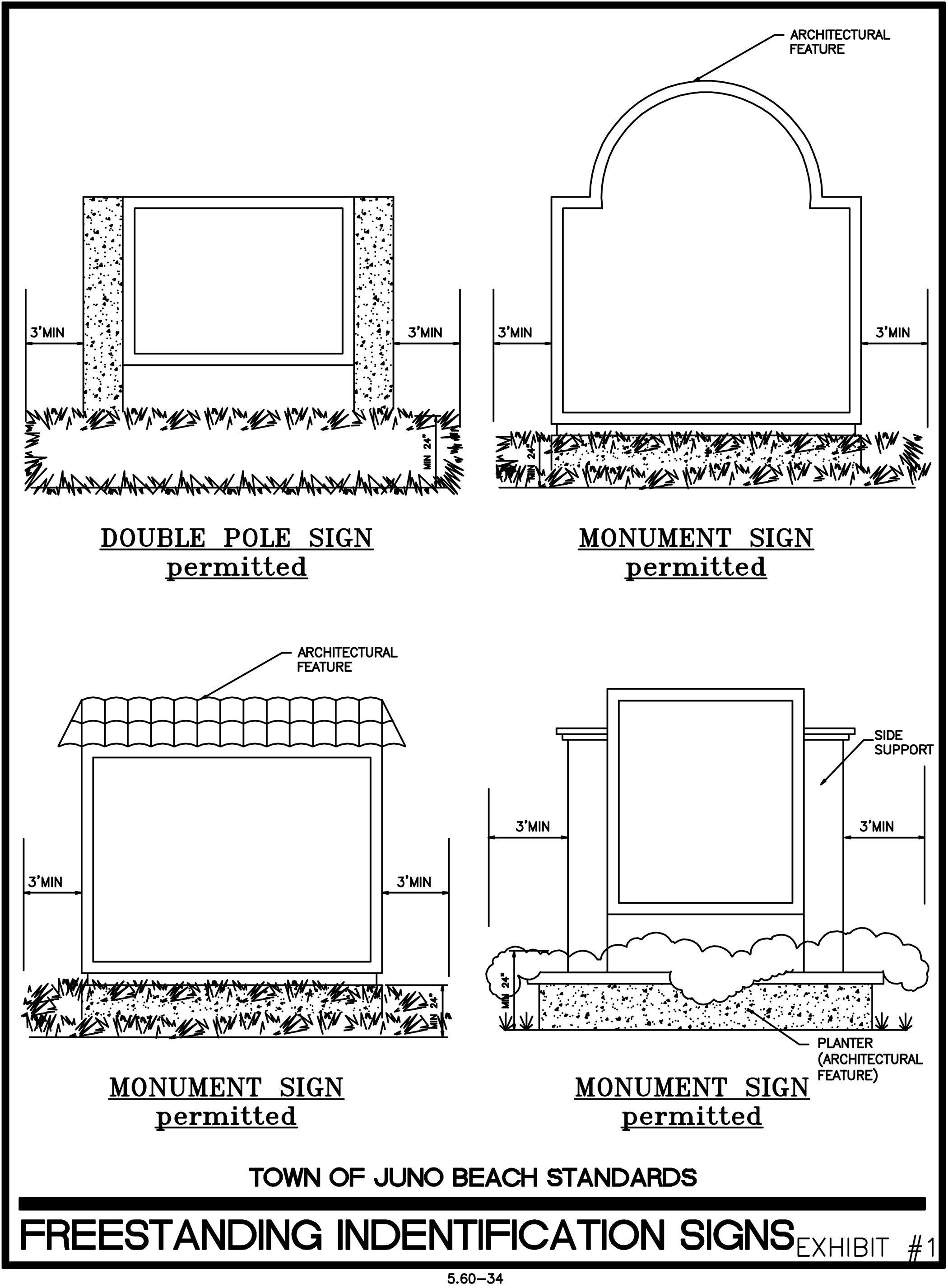
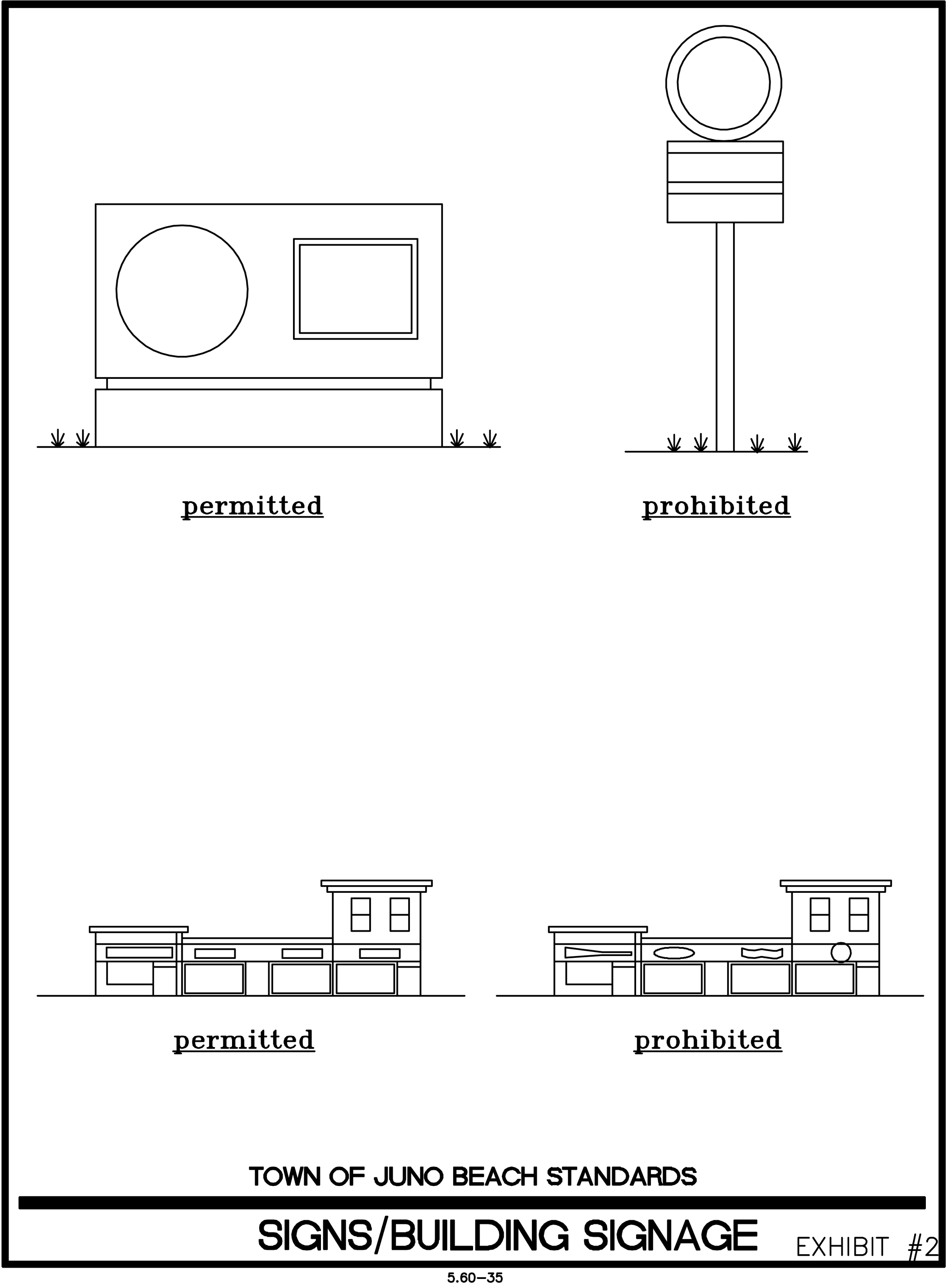
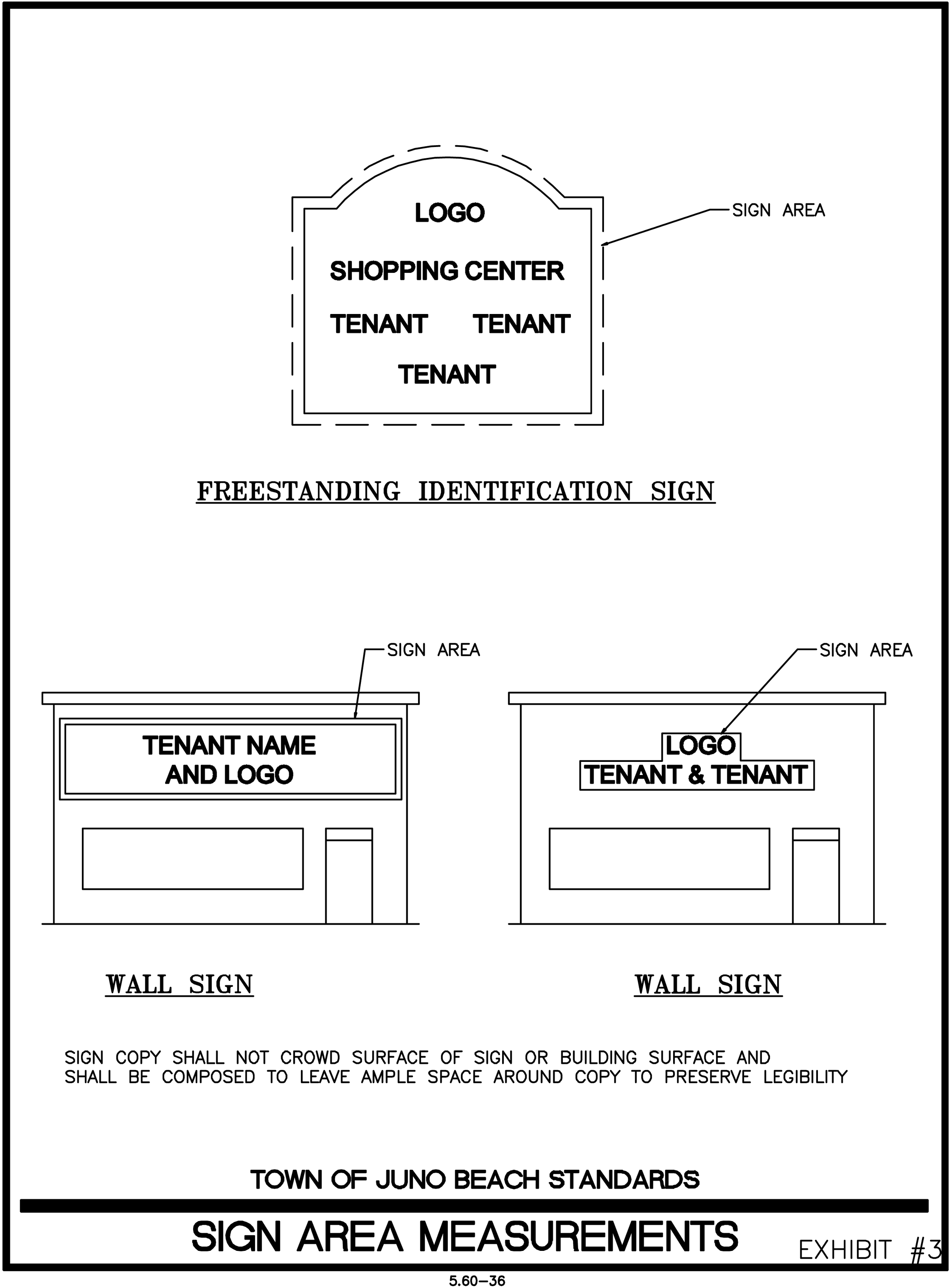
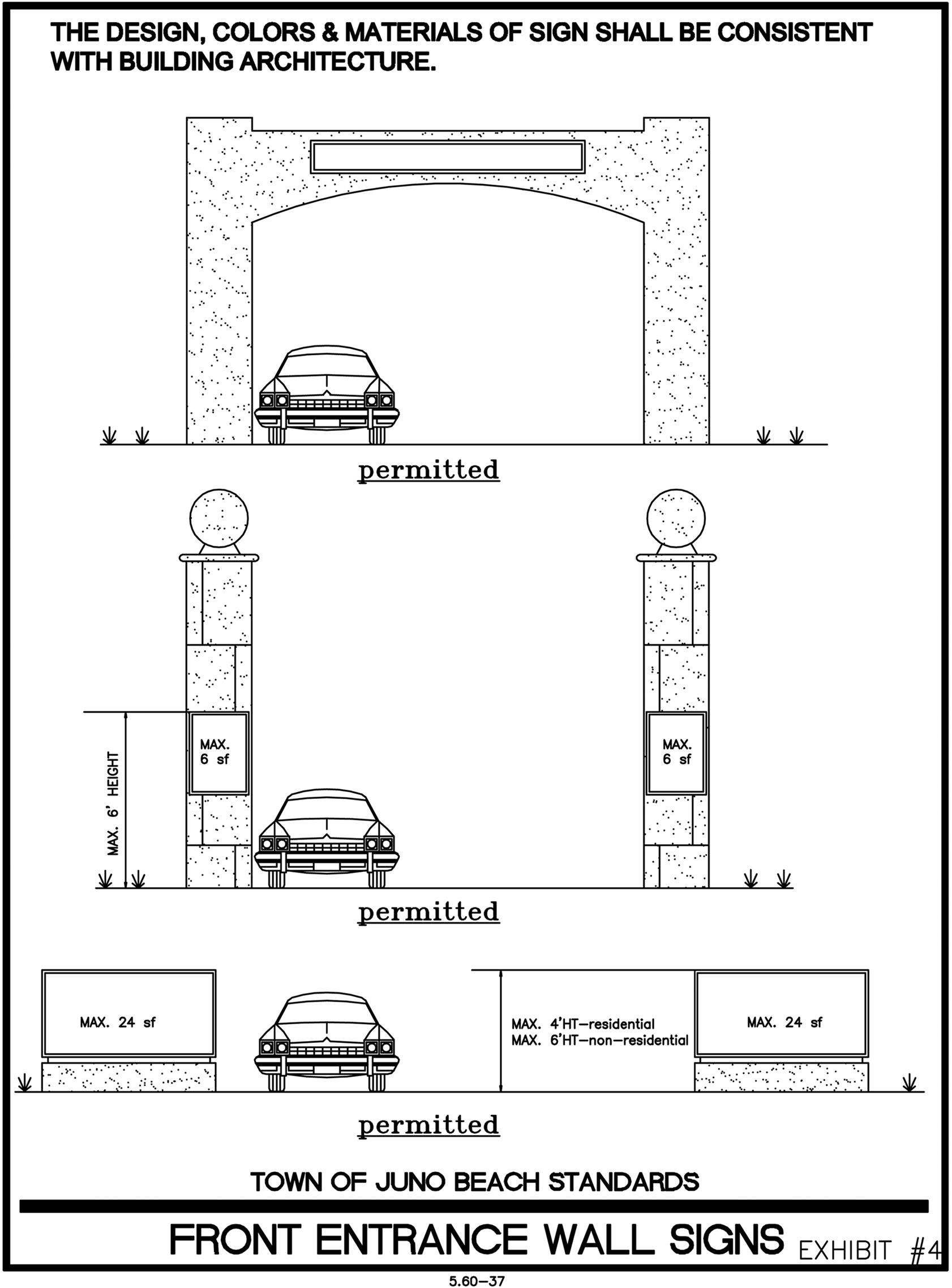
(Ord. No. 207, §§ 5.68—5.68.6, 8-8-1979; Ord. No. 258, 10-13-1982; Ord. No. 309, 10-8-1986; Ord. No. 389, 5-16-1990; Ord. No. 421, 2-19-1992; Ord. No. 426, 8-12-1992; Ord. No. 450, 5-11-1994; Ord. No. 454, 11-16-1994; Ord. No. 469, 5-10-1995; Ord. No. 476, 12-13-1995; Ord. No. 489, 12-11-1996; Ord. No. 491, 2-12-1997; Ord. No. 512, 7-28-1999; Ord. No. 538, 4-25-2001; Ord. No. 593, § 5.68.4, 6-14-2006)
Sec. 34-1056. - Noncommercial messages.
(a)
Notwithstanding anything in this division to the contrary, any sign erected pursuant to the provisions of this division may, at the option of the applicant, contain either a noncommercial message unrelated to the business on the premises where the sign is erected or a commercial message related to the business and located on the business premises.
(b)
The noncommercial message may occupy the entire sign face or portion thereof. The sign face may be changed from commercial to noncommercial messages as frequently as desired by the owner of the sign, providing each of the following is met:
(1)
The size and design criteria conform to the applicable portions of this article;
(2)
The sign is permitted by this article;
(3)
The sign conforms to the requirements of the applicable zoning designation; and
(4)
The applicant obtains all appropriate permits.
(c)
For purposes of this article, noncommercial messages shall never be deemed off-premises signs.
Sec. 34-1079.- Purpose and intent.
The purpose and intent of this division is to protect, preserve, and enhance the natural environment and beauty of the town by creating minimum standards for landscaping and vegetation protection. Landscaping that meets these standards will:
(1)
Improve the aesthetic appearance of the town.
(2)
Improve air and water quality by such natural processes as transpiration and the maintenance of permeable land areas for aquifer recharge and surface water filtration.
(3)
Reduce noise and pollution through the filtering and buffering capacity of living trees and vegetation.
(4)
Promote energy conservation through:
a.
The creation of shade which reduces heat gain in or on buildings and paved areas; and
b.
The channeling and control of breezes to facilitate the natural cooling of buildings.
(5)
Reduce erosion by stabilizing the soil.
(6)
Provide habitat for wildlife.
(7)
Conserve freshwater resources through the use of drought-tolerant plants.
(8)
Provide a visual buffer between otherwise incompatible types of land uses.
(9)
Increase land values by requiring landscaping in developments, thereby becoming a capital asset.
(10)
Provide direct physical and psychological benefits to humans by reducing noise and glare in addition to breaking up the visual monotony and softening the perception of an urban environment.
(11)
Promote innovative and cost-conscious approach to design, installation and maintenance of landscaping, and encourage water and energy conservation.
(12)
Require the removal of nuisance vegetation to ensure preservation of protected or native vegetation and encourage no disruption of native ecosystems.
(13)
Provide for the public health, safety and welfare.
(Ord. No. 207, § 5.70.1, 8-8-1979; Ord. No. 383, 2-21-1990; Ord. No. 450, 5-11-1994; Ord. No. 476, 12-13-1995; Ord. No. 517, 12-1-1999)
Sec. 34-1080. - Landscape plan submission and approval.
(a)
Applicability. The provisions of this division shall apply as follows:
(1)
To any new development or modification to existing development wherein that portion of the site which is being modified must comply with the requirements contained herein to the extent that it is physically practicable;
(2)
To any modification to existing development wherein there results an increase of ten percent of the gross floor area of the structure, or structures, situated on the site in which case the entire site shall be upgraded to present landscape standards. However, accessory structures which are no greater than 1,000 square feet in gross floor area shall not be required to meet these standards;
(3)
A single-family dwelling and a duplex shall be exempt from all provisions of this division with the exception of those regulations pertaining to swales and visibility at intersections, maintenance of rights-of-way, irrigation restrictions and automatic rain switches required on all new irrigation systems, and those properties greater than four acres in area which must adhere to the Environmentally Sensitive Lands Ordinance.
(b)
Landscape plan required. At the time of application for approval for all site plans and site plan revisions, special exceptions, planned unit developments, and variances, except for a single-family dwelling and a duplex, a landscape plan shall be submitted for review by the planning and zoning board and approval by the town council.
(c)
Contents of plan. The landscape plan, signed and sealed by a landscape architect registered in the state, shall be drawn to a scale of not less than one inch equals 30 feet, including dimensions and distances, and clearly delineate the existing and proposed parking spaces or other vehicular and/or water outlets, the location and size of buildings, if any, to be served, and the location, size, number, name and description of all landscape materials to be installed or, if existing, to be used in accordance with the requirements hereof. Such description shall include both scientific and common name and native or nonnative designation. The percentage of native plant material utilized for each type of plant including trees, shrubs, and ground cover shall be provided, and a notation stating that all landscape areas, excluding native preserve areas, shall be provided with 100 percent automatic irrigation shall be included on landscape plan.
(Ord. No. 207, § 5.70.2, 8-8-1979; Ord. No. 383, 2-21-1990; Ord. No. 392, 5-16-1990; Ord. No. 450, 5-11-1994; Ord. No. 476, 12-13-1995; Ord. No. 517, 12-1-1999)
Sec. 34-1081. - Administration.
The director shall administer these regulations under the direction of the town council.
(Ord. No. 207, § 5.71, 8-8-1979; Ord. No. 383, 2-21-1990; Ord. No. 476, 12-13-1995; Ord. No. 517, 12-1-1999)
Sec. 34-1082. - Letter required from project landscape architect.
Prior to the issuance of a certificate of occupancy, the project landscape architect is required to submit a signed and sealed letter to the town planning, zoning and building department certifying that the landscaping on site is in accordance with the approved landscape plan.
(Ord. No. 207, § 5.71.1, 8-8-1979; Ord. No. 383, 2-21-1990; Ord. No. 450, 5-11-1994; Ord. No. 476, 12-13-1995; Ord. No. 517, 12-1-1999)
Sec. 34-1083. - Performance surety.
In the event that the landscaping requirements of this chapter have not been met at the time that a certificate of occupancy or certificate of use is requested, the town council may approve such request provided the town council enters into an agreement with the owner or his agent that the provisions and requirements of this chapter will be complied with. The owner or his agent shall post a performance bond or other approved surety in an amount equal to 125 percent of the cost of materials and labor and other attendant costs incidental to the installation of the required landscaping. The surety shall:
(1)
Run to the town;
(2)
Be in a form satisfactory and acceptable to the town; and
(3)
Specify the time for the completion of the landscape requirements.
(Ord. No. 207, § 5.72, 8-8-1979; Ord. No. 383, 2-21-1990; Ord. No. 450, 5-11-1994; Ord. No. 476, 12-13-1995; Ord. No. 517, 12-1-1999)
Sec. 34-1084. - Landscape requirements.
(a)
In keeping with the purpose and intent of this division, the following general requirements shall apply in all zoning districts in the town.
(b)
A graphic survey of existing vegetation, delineating all viable native vegetation and all trees greater than four inches in diameter (caliper) at four feet above ground, shall be submitted. Such graphic survey shall be prepared by a landscape architect or land surveyor registered in the state and be of the same scale as the landscape plan.
(c)
Reasonable requirements for the preservation of outstanding natural and cultural features shall be required. These features include trees with trunks larger than eight inches in diameter measuring four feet above the ground, groves, watercourses, historic sites, and similar irreplaceable assets in which there is public interest.
(d)
All new trees shall be located so as to provide unrestricted flow or access to drainage swales or utility easements. Vegetation in easements and rights-of-way must have appropriate utility company and agency approval. In addition, the height of damage-prone trees shall be limited along hurricane evacuation routes.
(e)
New trees shall meet the specifications as set forth in section 34-1088(f).
(f)
Trees shall be hardy and suitable to local soil and climate.
(g)
The use of native vegetation plantings shall be prioritized, and all plant materials of each type, including trees, shrubs and ground cover, shall be at least 50 percent native. In addition, xeriscape principles shall be utilized in all landscape designs and installations (see section 34-1088(a)). For a list of native vegetation and guide for plant selection and landscape design, refer to the University of Florida's "The Florida Friendly Landscaping™ Guide to Plant Selection and Landscape Design."
(h)
Existing native vegetation shall be preserved to the maximum extent practicable. The town encourages applicants to make all native vegetation to be removed from the site available, either by fee or donation, to the town and its residents for reuse. The developer shall notify the town three weeks prior to vegetation removal, so that the town may notify residents by notice at town hall and phone message of such vegetation availability. Upon such notice residents shall have two weeks to contact the developer regarding removal of native vegetation.
(i)
The type and location of landscaping shall take into consideration the preservation of native vegetation areas, and the director may make exceptions to the regulations in this division to ensure the preservation of such native vegetation areas.
(j)
All conditions and requirements of the Environmentally Sensitive Lands Ordinance, article IV, division 14 of this chapter, and section 34-1123 shall be complied with.
(k)
Changing 30 percent or more of all trees and shrubs on a site from the originally approved landscape plan shall require submittal of a new plan showing new plant types and locations to the planning and zoning department for review and approval.
(l)
The public works, planning and zoning, and code compliance departments shall be responsible for managing the town's tree planting program. The public works department shall be responsible for the care and maintenance of trees present on town-owned property.
(Ord. No. 207, § 5.73, 8-8-1979; Ord. No. 383, 2-21-1990; Ord. No. 421, 2-19-1992; Ord. No. 434, 12-16-1992; Ord. No. 450, 5-11-1994; Ord. No. 476, 12-13-1995; Ord. No. 517, 12-1-1999; Ord. No. 740, § 3, 4-28-2021)
Sec. 34-1085. - Removal of invasive plants.
East of the Coastal Construction Control Line (CCCL), invasive exotic pest plants, including the Brazilian pepper, Australian pine, and melaleuca, shall be removed and replaced with appropriate native coastal vegetation. Any exotic plant recurrence shall be required to be removed and replaced with appropriate vegetation. Such native coastal vegetation shall serve to stabilize the coastal dune area. This provision shall apply to all properties.
(Ord. No. 207, § 5.73.1, 8-8-1979; Ord. No. 383, 2-21-1990; Ord. No. 450, 5-11-1994; Ord. No. 476, 12-13-1995; Ord. No. 489, 12-11-1996; Ord. No. 517, 12-1-1999)
Sec. 34-1086. - Protection of trees and other vegetation to be preserved on site.
Trees and other vegetation which are to be preserved on a site shall be protected from damage during the construction process according to appropriate tree and vegetation protection techniques. The Tree Protection Manual for Builders and Developers, published by the state division of forestry, department of agriculture and consumer services, shall be the standard for determining the appropriateness of proposed techniques for tree protection. All vegetation areas shall be fenced off with screening to prevent any damage. All trees and vegetation which are to be preserved and do not survive shall be replaced by a plant or tree of equal size, or an equivalent number of trees based on trunk diameter.
(Ord. No. 207, § 5.73.2, 8-8-1979; Ord. No. 383, 2-21-1990; Ord. No. 450, 5-11-1994; Ord. No. 476, 12-13-1995; Ord. No. 517, 12-1-1999)
Sec. 34-1087. - Parking area landscaping.
(a)
All areas used for parking of vehicles (including boats, trailers or construction equipment) or any other vehicular use shall conform to the minimum landscaping requirements provided herein, except under, on, or within buildings and parking areas serving a single-family dwelling and a duplex.
(b)
Adjacent to street. On the site of a building or open lot use providing an off-street parking area or other vehicular use area, where such area will not be entirely screened visually by an intervening building or structure (such as a wall or fence, provided landscaping is provided on the side facing the abutting street, see section 34-905) from any abutting street, excluding dedicated alleys, there shall be provided landscaping between such area and such street as follows:
(1)
A strip of land at least five feet in width located between the abutting street and the off-street parking area or other vehicular use area shall be landscaped;
(2)
Landscaping of land strips shall include at least one tree for each 30 lineal feet or fraction thereof. In addition, a hedge or other durable landscape barrier of at least four feet in height shall be placed within such landscaped strip. If a hedge is placed within such strip, plants shall be a minimum of 24 inches in height immediately after planting and shall be of a species that will grow to a height of four feet in one year's time.
(c)
Landscaping relating to abutting properties. On the site of a building or structure or open lot use providing an off-street parking area or other vehicular use area, such area shall be provided with a landscaped barrier, preferably a hedge that is a minimum of 24 inches in height immediately after planting and shall be of a species that will grow to a height of four feet in one year's time, to form a continuous screen between the off-street parking area or other vehicular use area and the abutting property in a planting strip of not less than five feet in width. In addition, at least one tree for each 30 lineal feet or fraction thereof shall be placed within such strip. The provisions of this subsection may not be applicable, at the discretion of the town council, when a property line abuts a dedicated alley.
(d)
Landscaping interior parking areas.
(1)
A minimum of 20 square feet of landscaping for each parking space shall be provided within the interior of an off-street parking area.
(2)
Each row of parking spaces shall be terminated by landscaped islands which measure not less than five feet in width (inside of curb to inside of curb) and 90 square feet in area. At least one tree shall be planted in each 90-square-foot island. In addition, no more than ten parking spaces may occur in a row without a landscape island as described in subsection (d)(1) of this section.
(3)
Landscaped divider medians shall be used to meet interior landscape requirements. The divider medians shall form a continuous landscaped strip between abutting rows of parking spaces. The minimum width of a divider median shall be five feet. One tree shall be planted for each 30 lineal feet of divider median or fraction thereof. Trees in a divider median may be planted singularly or in clusters. The maximum spacing of trees shall be 40 feet.
(4)
All interior landscaped areas not dedicated to trees or to preservation of existing vegetation shall be landscaped with grass, ground cover, shrubs or other appropriate landscape treatment. Sand or pavement shall not be considered appropriate landscape treatment.
(5)
All terminal landscape islands shall be surrounded with a continuous nonmountable concrete curb.
(6)
Exceptions to subsections (d)(2) and (3) of this section and the requirement for wheel stops in article IV, division 4 of this chapter may be made for an area in a parking lot no greater than 20,000 square feet where it is demonstrated that a public gathering place or square is desired to be available for special events. Such gathering place or square area must be bounded by either landscape islands or medians per subsection (d)(2) or (3) of this section, whichever is applicable, and subsection (d)(4) of this section, to form a greenbelt along the perimeter.
(e)
Landscaping between parking areas and buildings for single-family attached and multifamily residential and nonresidential uses. Parking rows and traffic aisles must be separated from principal structures on the sides, front, and rear (excluding designated loading areas) by a landscape strip at least four feet in width and a minimum four-foot-wide walkway, unless the town determines that, based on the site design, pedestrians would require no use of the sidewalk.
(Ord. No. 207, § 5.74, 8-8-1979; Ord. No. 383, 2-21-1990; Ord. No. 450, 5-11-1994; Ord. No. 476, 12-13-1995; Ord. No. 517, 12-1-1999)
Sec. 34-1088. - Design, installation, maintenance, irrigation and plant material standards.
(a)
Design. Xeriscape principles shall be utilized in landscape design and installations. Principles of xeriscape include:
(1)
Appropriate planning and design to include consideration of the size and shape of the lot, soil type, topography, intended use of area site-specific planting to minimize irrigation waste.
(2)
Use of soil analysis and appropriate amendments to provide better absorption of water and to provide beneficial plant nutrients.
(3)
Efficient irrigation systems which permit turf and other less drought-tolerant plantings to be watered separately from more drought tolerant plantings, consideration of low volume drip, spray or bubbler emitters for trees, shrubs and ground covers.
(4)
Reduction of turf areas, utilizing less water-demanding materials such as low water demand shrubs and living ground covers in conjunction with organic mulches.
(5)
Utilization of drought tolerant plant materials and the grouping of plants with similar water requirements.
(6)
Utilization of mulches to increase moisture retention, reduce weed growth and erosion and increase the organic content of soil upon degradation. Mulch should be initially applied at a three inch depth, but pulled away from direct contact with stems and trunks to avoid rotting. Mulched planting beds are an ideal replacement for turf areas.
(7)
Appropriate maintenance to preserve the intended beauty of the landscape and conserve water.
(b)
Installation. All landscaping shall be installed according to accepted good planting procedures with the quality of plant materials as hereinafter described, and shall be installed so as to meet all other applicable ordinances and code requirements. There shall be no vehicular encroachment over or into any landscaped area. Wheel stops and/or curbs shall be placed at least two feet from the edge of such landscaped area. Where a wheel stop or curb is utilized, the paved area between the wheel stop or curb and the end of the parking space may be omitted, provided it is landscaped with ground cover in addition to the required landscaping as set forth herein. A representative of the town charged with the issuance of building permits shall inspect all landscaping and no certificate of occupancy or similar authorization will be issued unless the landscaping meets the requirements herein.
(c)
Maintenance.
(1)
The owner, tenant, and their agent, shall be responsible for the continued proper maintenance of all landscaping located on their property and on adjacent rights-of-way which shall be maintained in good condition so as to present a healthy, neat, and orderly appearance and shall be kept free from refuse and debris. Proper maintenance shall include:
a.
Periodic watering to maintain healthy flora, more drought tolerant material, minimize fungus growth and stimulate deep root growth;
b.
Pruning to maintain the health and viability of the tree in accordance with the American National Standards Institute, ANSI A300-2001 (Tree, Shrub and other Woody Plant Maintenance), as amended; hat racking and excessive pruning is prohibited;
c.
Grasses shall be mowed as required;
d.
All roadways, curbs and sidewalks shall be edged when necessary to prevent encroachment of grasses;
e.
All lawns and planted areas shall be fertilized periodically to ensure continued healthy growth;
f.
Dead plant material shall be replaced; and
g.
Unprotected and/or prohibited harmful and illegal plants species, as outlined in subsection (f)(2) of this section, shall be removed.
(2)
Palm pruning requirements.
a.
Nor more than one-third of all fronds shall be removed. All brown fronds and hanging fronds (and those located immediately above such brown and hanging fronds) can be removed up to the horizon line.
b.
No pruning above the horizon line, except for dead or diseased fronds, in accordance with the graphic below:
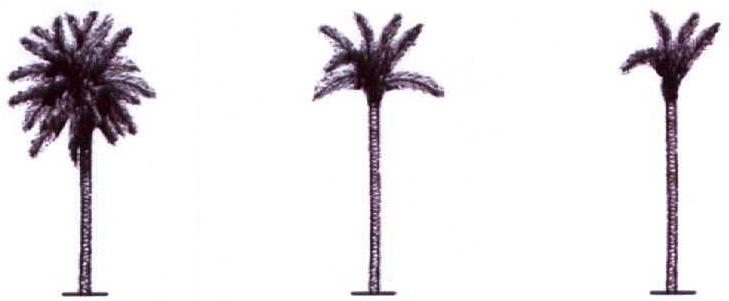
(3)
Landscaping may be inspected as needed, to ensure that the standards established in this section are maintained. The owner, tenant or his agent shall be notified in writing via certified mail by the town of any areas which are not being properly maintained and shall, within 30 calendar days from time of notification, address and rectify the deficiency.
(d)
Irrigation standards for all development, excluding a single-family unit.
(1)
Complete irrigation coverage. All landscaped areas shall be provided with a sprinkler system, automatically operated, to provide complete coverage of all plant materials and grass to be maintained. Exceptions to the requirement to provide irrigation are noted in subsections a and b of this subsection (d)(1).
a.
Irrigation of existing plant communities. Existing plant communities and ecosystems, maintained in a natural state, do not require and shall not have any additional irrigation water added in any form.
b.
Reestablished native plant areas. Native plant areas that are supplements to an existing plant community or newly installed by the developer may initially require additional water to become established. The water required during the establishment period shall be applied from a temporary irrigation system, a water truck or by hand watering from a standard hose bib source.
(2)
Irrigation design standards. The following standards shall be considered the minimum requirements for landscape irrigation design:
a.
All landscaped areas shall be provided with an irrigation system, automatically operated, to provide complete coverage of all plant materials and grass to be maintained. The use of recycled water is encouraged.
b.
Wherever feasible, sprinkler heads irrigating lawns or other high water demand landscape areas shall be circuited so they are on a separate zone or zones from those irrigating trees, shrubbery or other reduced water requirement areas.
c.
Irrigation spray, whenever possible, shall only cover permeable areas and in no instance spray onto any public access, sidewalk, street or other nonpervious area. Special attention should be paid to well water, as the iron and minerals in the water cause unsightly staining.
d.
The use of low trajectory spray nozzles is encouraged in order to reduce the effect of wind velocity on the spray system.
e.
The use of low volume or drip systems is encouraged.
f.
The use of pop-up sprinkler heads is required in the swale area between the property line and the edge of pavement of the adjacent right-of-way to minimize pedestrian hazards.
(e)
Plant material. Plant material used in conformance with the provisions of this chapter shall be of a root system adequate to promote continued growth, have healthy foliage or leaves and be free from apparent disease or insect infestation. Grass seed delivered on the job site in bags shall have state department of agriculture tags attached indicating the seed grower's compliance with the department's quality control program.
(f)
Trees.
(1)
Type and size. Trees shall be species having trunks which can be maintained in a clear condition over four feet of clear wood. Tree species shall be a minimum of 12 feet overall height immediately after planting with a minimum six-foot diameter spread of canopy measured at three radius points from the trunk and a minimum 2.5-inch caliper (trunk diameter) at four feet above ground. Three palms shall be considered equivalent to one tree, except for large specimen palms with a minimum overall height of 12 feet and a minimum 12-foot diameter spread of canopy, such as date palms, coconut palms, and royal palms, which shall be considered trees. A maximum of 50 percent of all required trees may be palms.
(2)
Prohibited trees and plants. No tree or plant listed in the most current edition of the Manual of Prohibited Invasive and Non-Native Plant Materials published by the South Florida Water Management District shall be utilized as landscape material.
(g)
Shrubs and hedges. Required shrubs and hedges shall be a minimum of 24 inches in height when measured immediately after planting. Hedges, where required, shall be planted and maintained so as to form a continuous, unbroken, visual screen within a maximum of one year after time of planting.
(h)
Ground covers. Ground covers, either vegetative or nonliving, used in whole or in part shall present a finished appearance and reasonably complete coverage within three months after planting.
(i)
Grass areas. Grass areas shall be planted in species normally grown as permanent lawns in the county. Grass areas may be sodded, plugged, sprigged or seeded except that solid sod shall be used in swales or other areas subject to erosion. In areas where other than solid sod or grass seed is used between the months of October and March, nursegrass seed shall be sown for immediate effect and protection until coverage is otherwise achieved.
(j)
Exemption. For single-family dwellings, the provisions of this section shall not apply to rear yards or other areas not visible from adjacent roadways and public rights-of-way.
(k)
Enforcement. Failure to install or maintain landscaping according to the terms of this section or any approved plan or permit shall constitute a violation of this section.
(l)
Violations. The following deficiencies shall be considered a separate and continuing violation of this section:
(1)
Each tree or shrub that is not properly installed or properly maintained on site as required by this section; and
(2)
Each day during which landscaping is not properly installed or maintained on site as required by this section.
(Ord. No. 207, § 5.75, 8-8-1979; Ord. No. 383, 2-21-1990; Ord. No. 392, 5-16-1990; Ord. No. 450, 5-11-1994; Ord. No. 476, 12-13-1995; Ord. No. 517, 12-1-1999; Ord. No. 617, § 2, 9-24-2008)
Sec. 34-1089. - Landscaping at street intersections.
When a driveway or other accessway intersects a street or when a subject property abuts the intersection of two or more streets, all landscaping within the triangular areas described in subsections (1) and (2) of this section shall provide unobstructed cross visibility at a level between 30 inches and six feet. The triangular areas referred to are:
(1)
The areas of property on both sides of a driveway or other accessway formed by the intersection of each side of the access way and the street line with two sides of each triangle being ten feet in length from the point of intersection and the third side being a line connecting the ends of the other two sides;
(2)
The area of property located at a corner formed by the intersection of two or more streets shall be the area described in section 34-898.
(Ord. No. 207, § 5.76, 8-8-1979; Ord. No. 383, 2-21-1990; Ord. No. 450, 5-11-1994; Ord. No. 476, 12-13-1995; Ord. No. 517, 12-1-1999)
Sec. 34-1090. - Recommended plant list.
The town's recommended plant list will be kept on file and will be available to the public in the planning and zoning department. This list will be continuously updated to eliminate those plants identified by the state as invasive, or otherwise detrimental to healthy local environments. It will include plants that are recommended and not identified as detrimental.
(Ord. No. 207, § 5.80, 8-8-1979; Ord. No. 383, 2-21-1990)
Sec. 34-1123.- Protection of coastal ridge.
It is the intent of this division to maintain and protect the vegetation and structural quality of the coastal dune as it occurs in the town and to protect rare, endangered, and threatened plant and animal species located along the coast in the town. In addition to the applicable requirements of F.S. ch. 161, and where the town has jurisdiction, the regulations set forth in this division shall be followed. (Note: all references to the Coastal Construction Control Line (CCCL) refer to that line which was established in 1979 and do not pertain to the revised line, established in August 1997.)
(Ord. No. 207, § 5.120, 8-8-1979; Ord. No. 384, 2-21-1990; Ord. No. 421, 2-19-1992; Ord. No. 450, 5-11-1994; Ord. No. 454, 11-16-1994; Ord. No. 499, 3-11-1998)
Sec. 34-1124. - Limitations east of the CCCL.
Except for dune restoration and revegetation projects and limited coastal vegetation trimming (according to the limited vegetation trimming requirements in this division), no soil, sand, rock or vegetation (excluding removal of exotic pest plants) shall be disturbed east of the Coastal Construction Control Line (CCCL). In addition, no wall, fence or other structure, excluding dune walkovers and viewing platforms less than 144 square feet in area which are an extension of the dune walkover, shall be erected eastwardly of the CCCL. Provided, however, where a dune walkover or other shared pedestrian access exists within a detached single-family home subdivision which serves the residents of that subdivision, the owners of individual lots within the subdivision may construct viewing platforms upon their individual lots. All dune walkover construction and dune restoration fill projects east of the CCCL require a state department of environmental protection (DEP) permit and town approval of the town planning and zoning department. Dune revegetation projects and removal of any exotic pest plants greater than ten feet in height require only town approval of the town planning and zoning department.
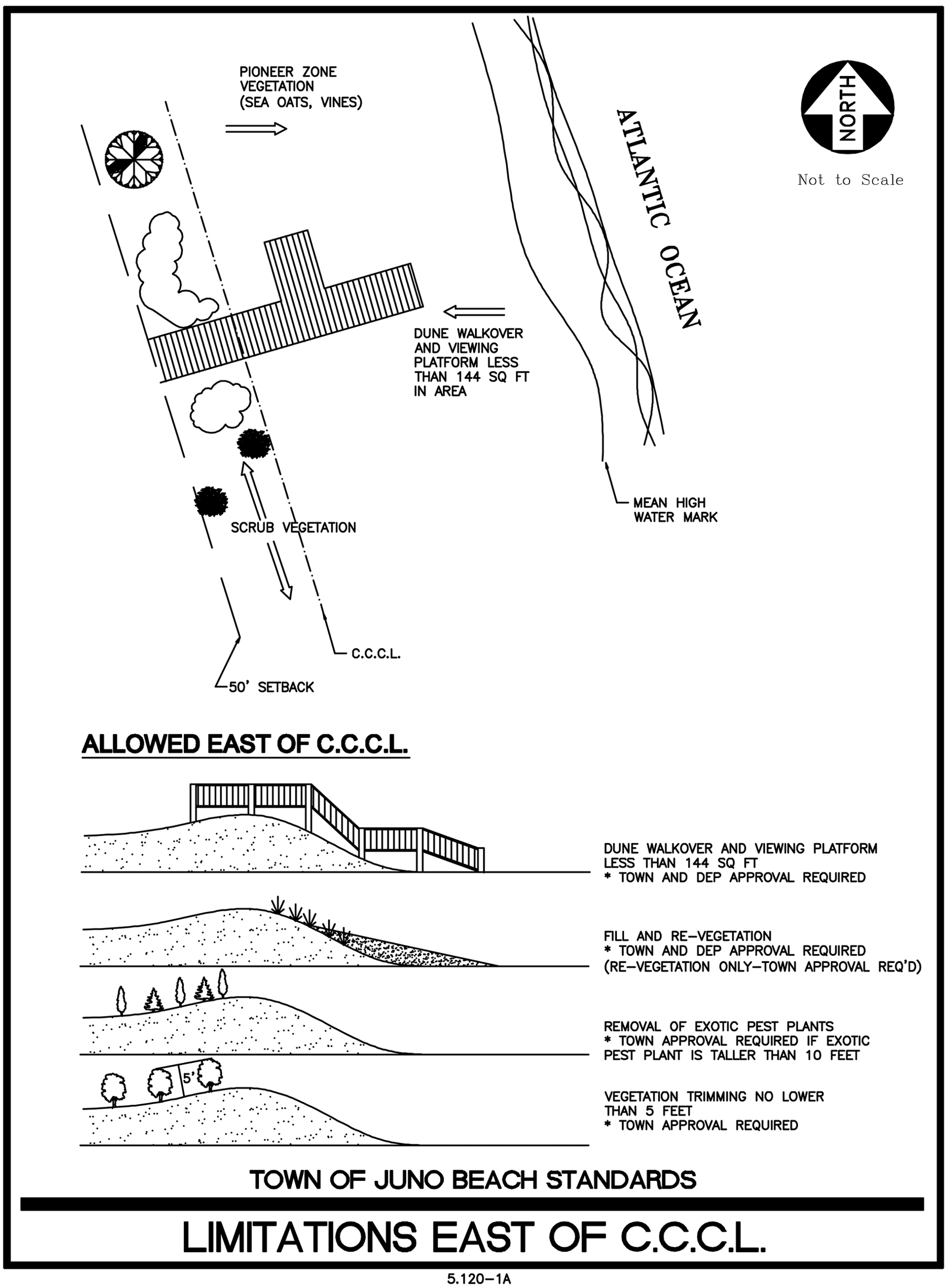
(Ord. No. 207, § 5.121, 8-8-1979; Ord. No. 421, 2-19-1992; Ord. No. 556, § 2(exh. A), 10-9-2002; Ord. No. 553, § 2(exh. A), 12-11-2002)
Sec. 34-1125. - Limitations between the CCCL and the town's 50-foot setback west of the CCCL.
(a)
Limitations on structures.
(1)
Minor structures shall be permitted to be constructed between the Coastal Construction Control Line (CCCL) and the town's 50-foot setback west of the CCCL after review and approval by the town planning and zoning department. However, privacy fences shall be allowed only to outline a pool and deck area and shall extend no further into the 50 foot setback area. Construction of dune walkovers and other minor structures shall be in accordance with state department of environmental protection (DEP) and town standards.
(2)
Structures, other than minor structures, shall require review by the planning and zoning board and approval by the town council. Such review and approval shall include a balance between the intent of this division with other goals, objectives, and policies of the comprehensive development plan, such as, but not limited to, decreasing densities in the coastal area.
(b)
Native dune vegetation within the town's 50-foot setback west of the CCCL shall be trimmed no lower than five feet above grade. The terms "trimming," "hedging," "cutting," "pruning," or any other term used to identify cutting any part of a sea grape plant shall be regulated by this division. If a petitioning party wishes to trim below the five-foot minimum, the following shall apply:
(1)
The petitioner shall obtain and complete an application for trimming native dune vegetation below the required five-foot minimum. The application will be provided by the town and may be amended from time to time by the director of planning and zoning. The applicant will be required to submit, as part of the application, a complete evaluation of the subject area proposed for trimming by a qualified environmental professional as defined herein; and will require an application fee, as well as a fee for any professional review by the town associated with the application process. The petitioner will be required to obtain approval from the state department of environmental protection (DEP) prior to approval from the town.
(2)
The bona fide environmental professional shall be proficient in all environmental aspects associated with the vegetation, trimming of vegetation, the dune, dune system and sea turtles. The town shall review the credentials of the individual claiming environmental professional status according to these disciplines. The applicant will be responsible for consulting with a party that has satisfactorily been approved by the town under this criteria.
(3)
The professional's evaluation shall include consideration of the proposed trimming height; and such proposed trimming's effect on the vegetation, the dune, the dune system and impacts from the proposed trimming on the natural sea turtle and other wildlife activities in the area.
(4)
Upon evaluation, the professional shall determine whether the impacts will positively or negatively affect, in any way, the vegetation, the dune, the dune system and/or natural sea turtle activity.
(5)
Said determination shall be made in writing and incorporated into the application/or attached thereto with an accompanying recommendation for a specific height.
(6)
The applicant shall be responsible for the town's fee for a bona fide professional review of said evaluation, consideration, determination and recommendation. The town's professional shall provide findings in writing within two weeks of a completely submitted application. Based on these findings the town may approve, deny or approve with specific conditions the petition.
(7)
Procedures for trimming shall be followed according to figure 3 following this section; or according to the approved professional recommendations.
(8)
Once approval is given for a property, such property shall be permitted to maintain the sea grapes according to said approval on a regular basis without further environmental review, however standard administrative trimming approval must still be obtained and the town's standard administrative form required every time trimming takes place. Additionally, if at any time after an approval is given, should any adverse impacts to the vegetation, the dune, the dune system, sea turtle and other wildlife activities in the area be questioned by the town, a reevaluation of the trimmed height effects will be required. In such a case, the town may require an adjustment, not to exceed the town's minimum five-foot height.
(c)
No native dune vegetation within the town's 50-foot setback west of the CCCL shall be removed, except for exotic pest plants. Removal of any exotic pest plants greater than ten feet in height requires approval of the town planning and zoning department prior to removal.
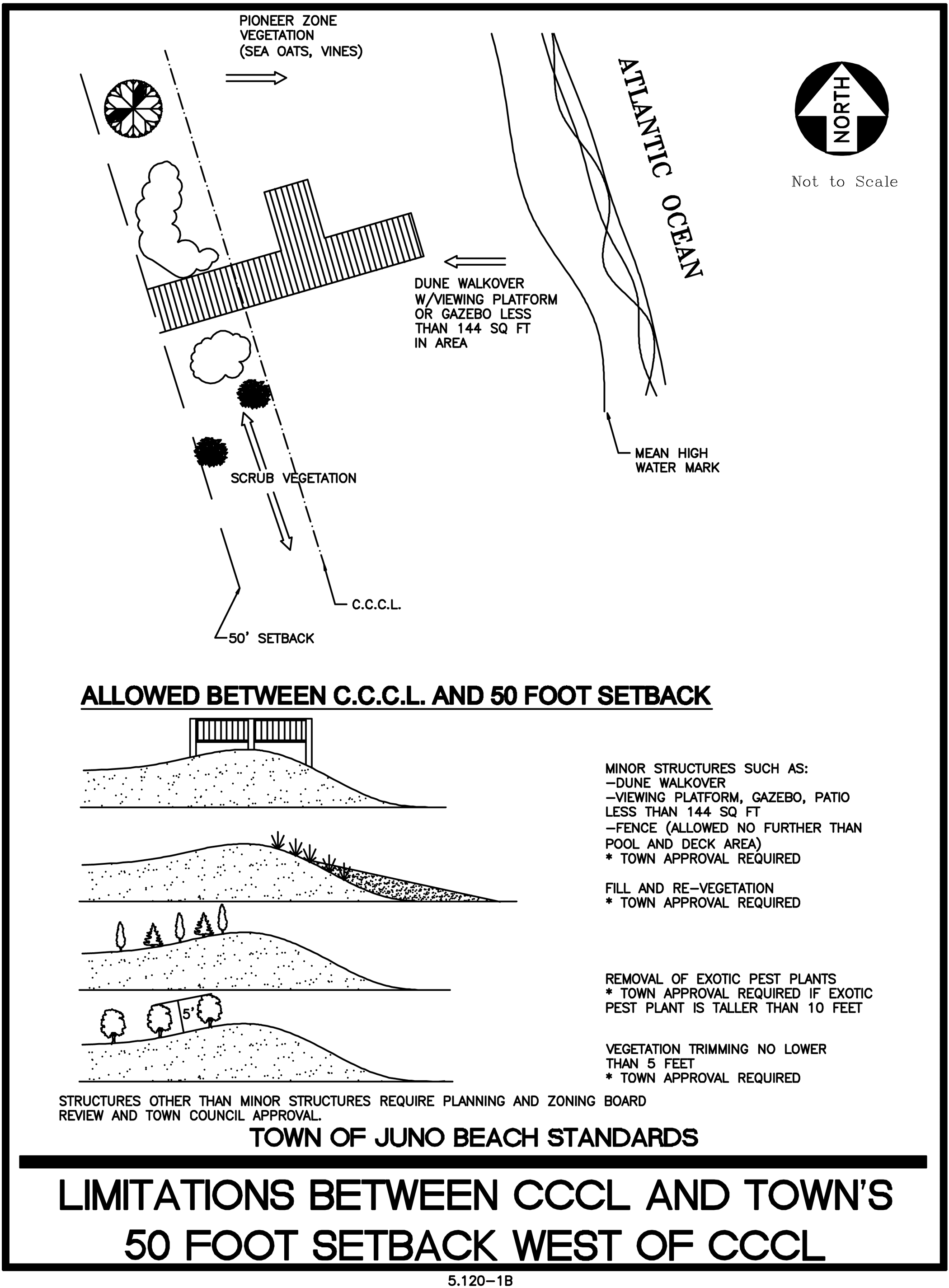
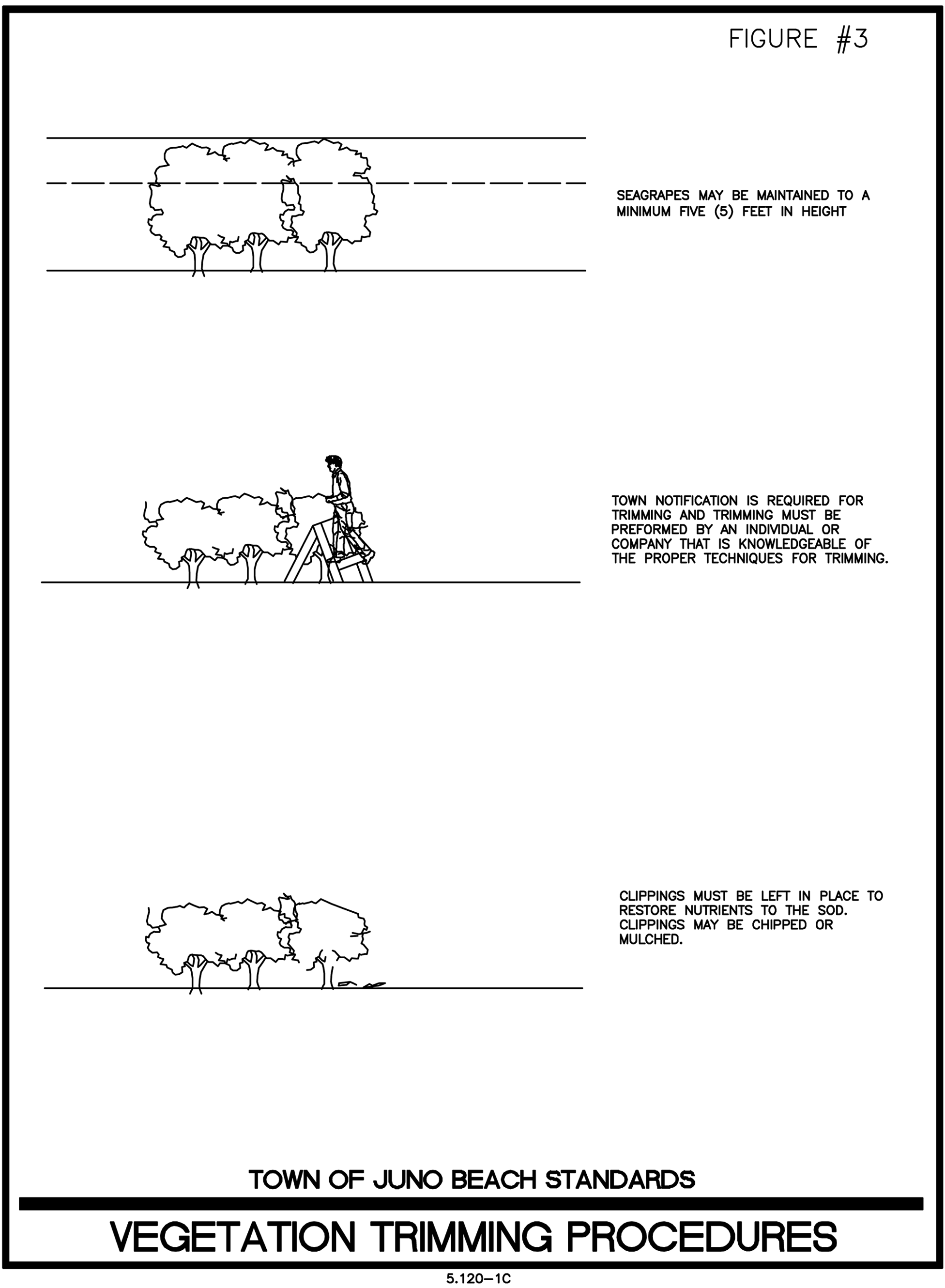
(Ord. No. 207, § 5.122, 8-8-1979; Ord. No. 421, 2-19-1992; Ord. No. 553, § 2(exh. A), 12-11-2002)
Sec. 34-1126. - New oceanfront developments or oceanfront redevelopment.
Any new oceanfront development or oceanfront redevelopment shall be required to protect and preserve existing dune vegetation, except when the town requires the dune to be rebuilt. Dunes shall be required to be rebuilt and revegetated where they have been destroyed. Historical data and/or nearby properties with existing dunes shall be used for determination of required dune height. In addition, as part of the development or redevelopment, areas in need of revegetation eastward of the town's 50-foot setback west of the CCCL shall be revegetated with appropriate native dune vegetation. During construction activities, all dune preserve areas which could be impacted shall be fenced off with screening to prevent any damage to vegetation.
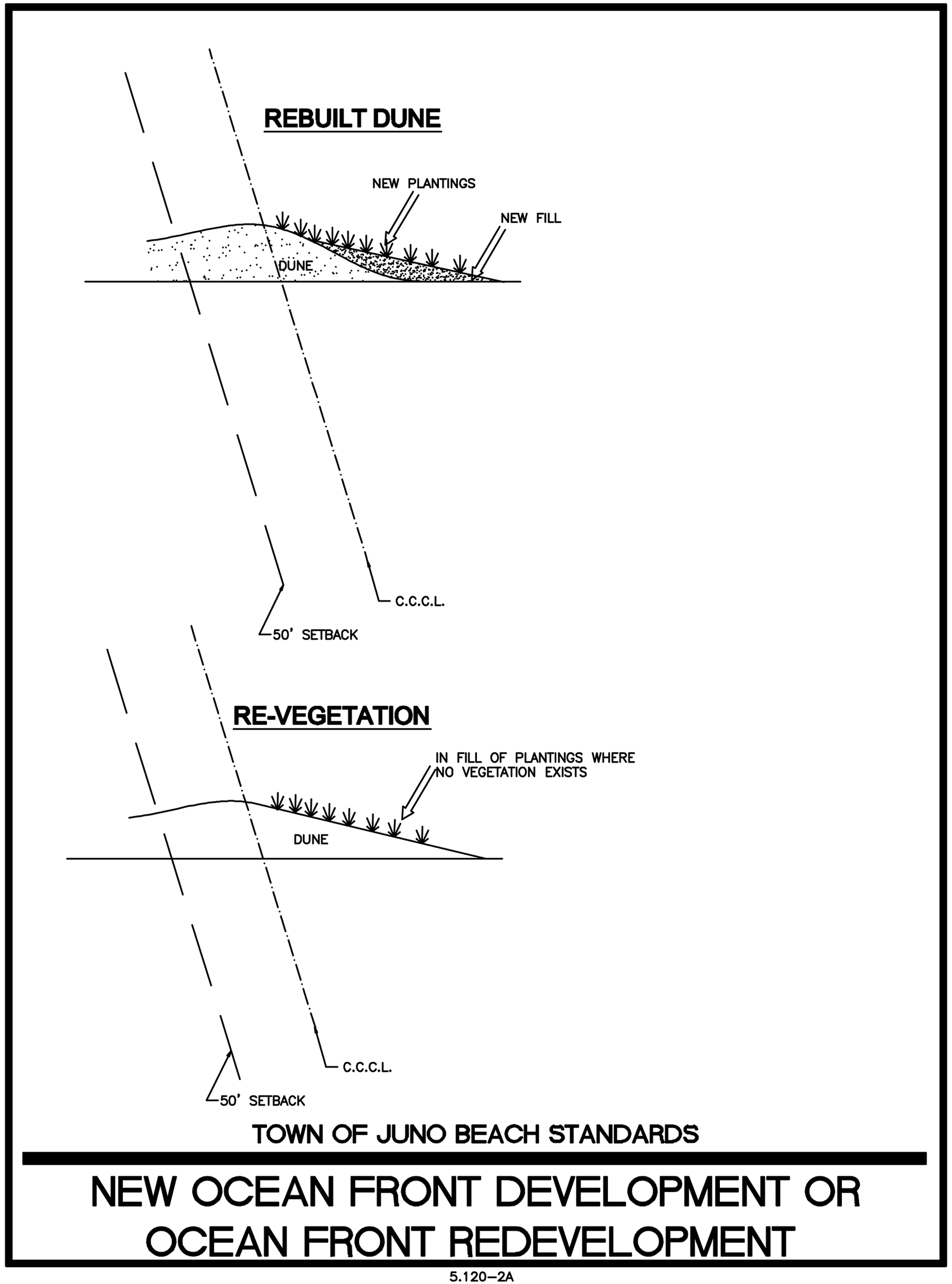
(Ord. No. 207, § 5.123, 8-8-1979; Ord. No. 421, 2-19-1992)
Sec. 34-1127. - Sand preservation zone, excavation.
Within the sand preservation zone, all excavated earth material shall be required to be either relocated on site and/or disposed of off site preferably in the town or otherwise elsewhere in the county within the sand preservation zone. The purpose of this requirement is to maintain the volume and quality of beach sand presently existing within the beach/dune system in the town and the county. An excavation permit shall be required from the town prior to any excavation in this zone. Prior to permit issuance, the applicant must supply a signed and sealed letter from a professional engineer stating the amount of material to be excavated and the relocation site. (Note: Any fill placed east of the CCCL requires a DEP permit.)
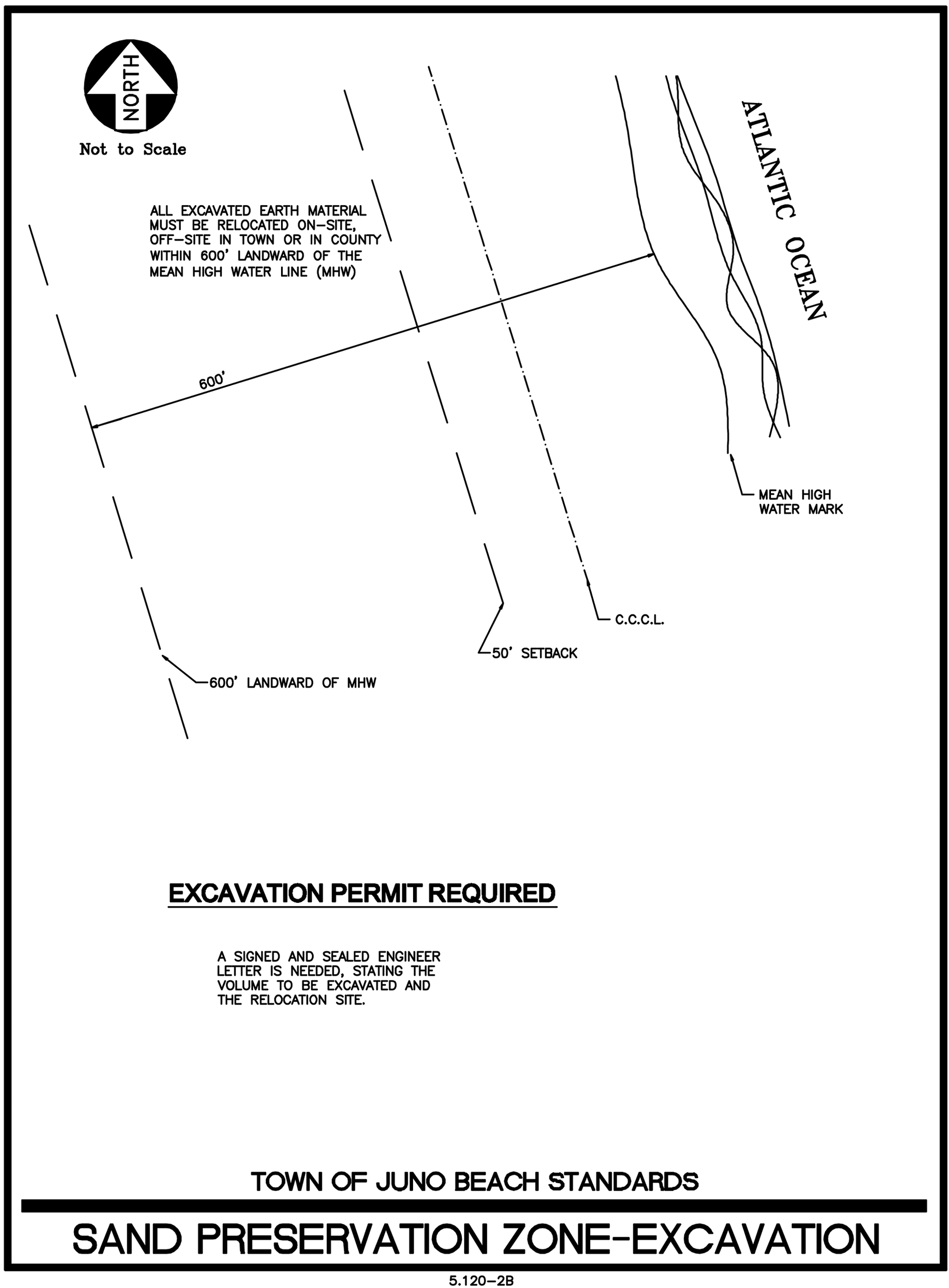
(Ord. No. 207, § 5.124, 8-8-1979; Ord. No. 421, 2-19-1992)
Sec. 34-1128. - Protection of sea turtles.
The town adheres to the county's turtle protection regulations as specified in article 14, chapter A of Palm Beach County's Unified Land Development Code, excluding, however, those provisions regarding sand preservation. No building permit or certificate of occupancy shall be issued until all requirements of the county's turtle protection regulations have been met.
(Ord. No. 207, § 5.125, 8-8-1979; Ord. No. 421, 2-19-1992)
Sec. 34-1129. - Applicability of chapter and county land development code.
See article IV, division 7 of this chapter and the county's Environmentally Sensitive Lands Ordinance per article 14, chapter C of the Palm Beach County Unified Land Development Code for additional requirements.
(Ord. No. 207, § 5.126, 8-8-1979; Ord. No. 421, 2-19-1992)
Sec. 34-1130. - Dune walkovers required for all beach accesses.
(a)
All existing and new public and private accesses to the beach which serve more than 15 dwelling units shall be required to be provided with a dune walkover per town and DEP division of beaches and shores standards.
(b)
Any existing dune walkovers (wooden structures) which do not meet town and DEP standards shall be considered nonconforming; however, when such structure requires replacement or repair of 50 percent or more of the total lineal feet of the structure, the entire structure shall be replaced and conform to town and DEP standards.
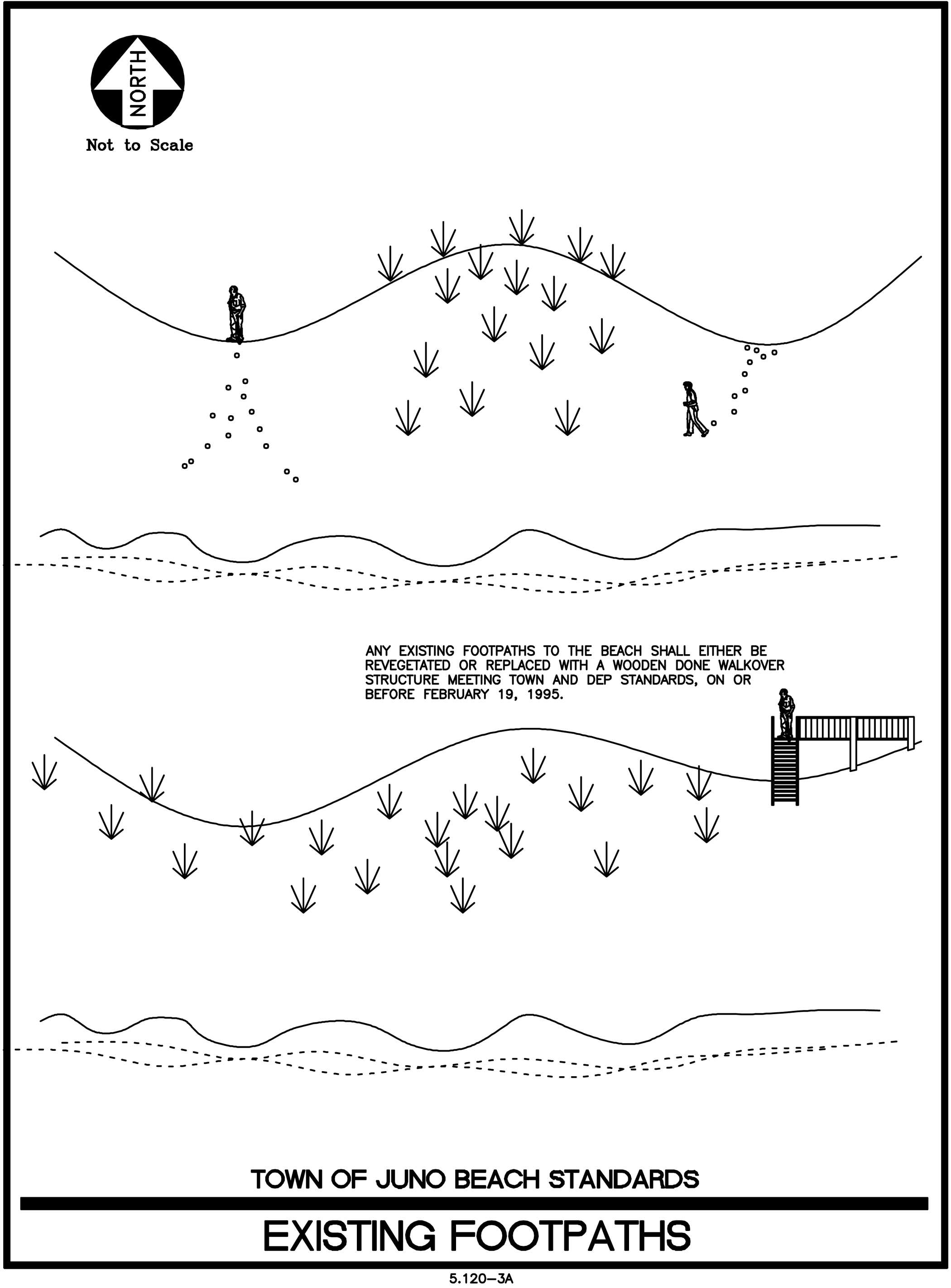
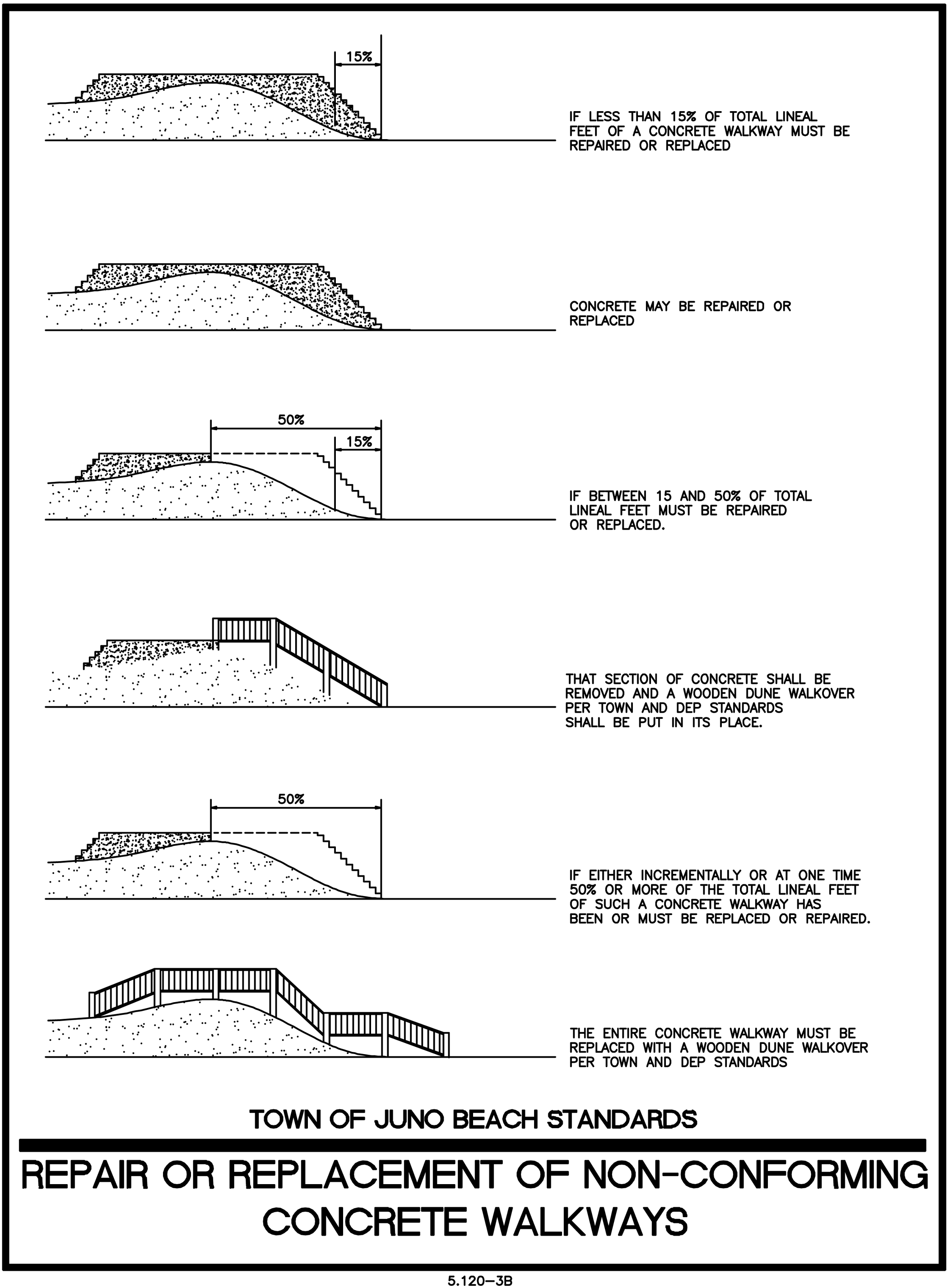
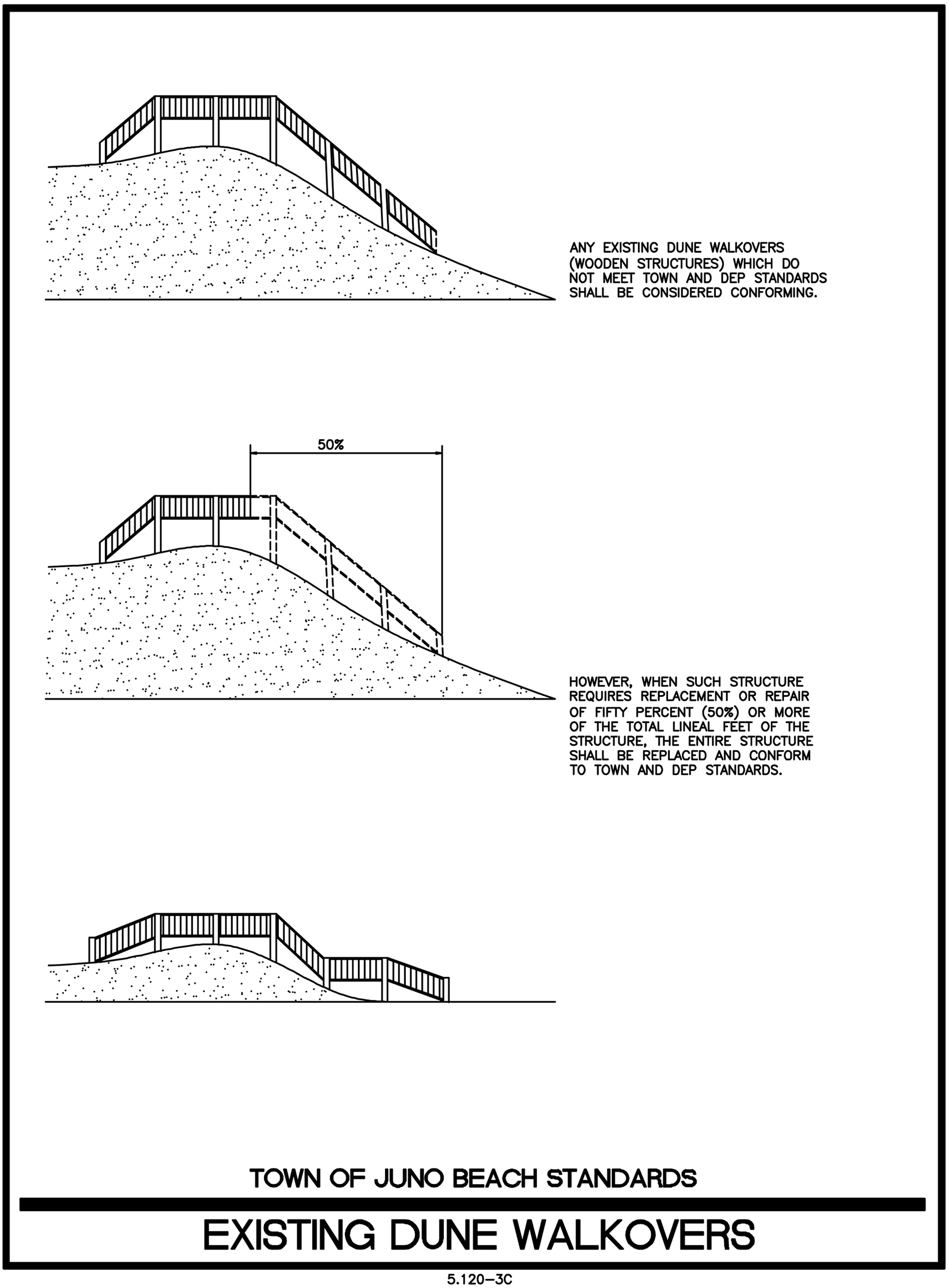
(Ord. No. 207, § 5.127, 8-8-1979; Ord. No. 421, 2-19-1992; Ord. No. 489, 12-11-1996)
Sec. 34-1131. - Emergencies and exemptions.
(a)
In the case of emergencies, for example, those caused by hurricanes, severe storms, or other similar events, the town manager may make exceptions to the regulations in this division, in consultation with DEP if required, to protect the health, safety, and welfare of town residents and visitors.
(b)
Exemptions to these regulations may be granted by town staff when the regulations established in this division conflict with other governmental agency requirements, or when minor modifications to existing improvements located within the town's 50-foot setback west of the CCCL will have no negative impact on the dune or other purposes of this division.
(Ord. No. 207, § 5.128, 8-8-1979)
Sec. 34-1132. - Exterior lighting in commercial districts.
All exterior lighting for the buildings and parking areas shall be directed away from residential areas.
(Ord. No. 207, § 5.130, 8-8-1979; Ord. No. 383, 2-21-1990)
Sec. 34-1133. - Use of reflective or mirrored material as exterior treatment of buildings.
Any building which utilizes reflective or mirrored material as building facing must be situated on its site in such a manner that at no time will the sun's reflection cast light into adjacent residential area and/or onto adjacent roads. The angles of the sun's reflection must be shown mathematically, taken into account for all seasons of the year.
(Ord. No. 207, § 5.140, 8-8-1979)
Sec. 34-1160.- Purpose.
The purpose of this division is to set forth the conditions and requirements under which any on-site or off-site special event may be permitted to operate within the town.
(Ord. No. 207, § 5.150, 8-8-1979; Ord. No. 390, 5-16-1990; Ord. No. 450, 5-11-1994; Ord. No. 709, § 3, 2-27-2019)
Sec. 34-1161. - Limitations and requirements for on-site special events.
(a)
Grand openings. The following limitations and requirements apply to grand openings:
(1)
Where permissible. Any commercial building or center. Institutional and government uses are exempted from these requirements; however, director approval is required.
(2)
Number of grand openings permitted. One grand opening is permitted per center, building, or individual tenant after business has officially commenced or a significant change in business activity has occurred (i.e., expansion, new owner).
(3)
Regulations. Activities permitted on site shall be related to such grand opening event, last no longer than 14 consecutive days, and abide by the regulations and procedures described in sections 34-1162—34-1164. If inclement weather has caused the grand opening event to be canceled, additional days may be granted by the director.
(b)
Other on-site special events. The following limitations and requirements apply to all on-site special events other than grand openings:
(1)
Where permissible. Other special events are permitted at any retail center or individual freestanding retail building or within any residential community. Institutional and government uses are exempted from these requirements; however, director approval is required.
(2)
Number of special events permitted. The number of other special events permitted is unregulated.
(3)
Regulations. Activities permitted on site shall be related to such special event, last no longer than three consecutive days unless extended by the director, and abide by the regulations and procedures described in sections 34-1162—34-1164.
(Ord. No. 207, § 5.152, 8-8-1979; Ord. No. 390, 5-16-1990; Ord. No. 450, 5-11-1994; Ord. No. 709, § 3, 2-27-2019)
Sec. 34-1162. - General regulations for on-site special events.
(a)
The property manager or other authorized agent must apply for the special event permit.
(b)
Location.
(1)
A special event may be located on the sidewalk immediately adjacent to and abutting a commercial building provided that the area in which the special event is located extends no farther along the sidewalk's length than the actual sidewalk frontage of the operating businesses and all other applicable provisions of these regulations are fulfilled.
(2)
Common open plazas may be used if access to businesses, tenants or residences adjacent or next to the plaza area are not impeded or blocked.
(3)
A special event which would require the use of any additional area on the site (i.e., parking area, open space, etc.) shall be reviewed by the town planning and zoning department and approved at the town's discretion.
(c)
Sidewalk clearance. Outdoor displays and activities shall be permitted on a sidewalk only where the sidewalk is wide enough to adequately accommodate pedestrian traffic in a safe manner. Walking space within the walkway shall be a minimum width of three feet.
(d)
Outdoor displays and activities shall be required to maintain adequate building egress as required by the Florida Building Code or any other federal, state or town regulation.
(e)
Lighting may be incorporated into the landscaping of the premises as long as existing codes are met.
(f)
Food and beverages. The outdoor preparation of food is prohibited at a special event unless a permit is obtained from the county health department. This, however, is not intended to prohibit hot dog vendor carts, commercial popcorn vendor carts, or similar types of food warming services. All exterior surfaces within the special event area shall be kept clean at all times by the permittee.
(g)
The permittee shall remove all trash and litter as it accumulates. The permittee is responsible for maintaining the outdoor areas, including the sidewalk surface and adjacent areas, in a clean and safe condition.
(h)
The maximum hours of operation of a special event shall not extend beyond the normal hours of operation of the associated business or center; however, an extension of hours may be applied for and granted at the discretion of the town. The hours for residential on-site special events shall be established by the town through the permitting process.
(Ord. No. 207, § 5.153, 8-8-1979; Ord. No. 390, 5-16-1990; Ord. No. 450, 5-11-1994; Ord. No. 709, § 3, 2-27-2019)
Sec. 34-1163. - Findings and conditions for approval of on-site special events.
In connection with granting approval for an on-site special event permit, the planning and zoning department shall make findings that the proposed event complies with the regulations set forth in this division. The planning and zoning department may impose such conditions in granting its approval as it deems necessary and the permittee shall comply with all conditions imposed by the town.
(Ord. No. 207, § 5.154, 8-8-1979; Ord. No. 390, 5-16-1990; Ord. No. 450, 5-11-1994; Ord. No. 709, § 3, 2-27-2019)
Sec. 34-1164. - Form and conditions of permit for on-site special events.
Any person seeking to hold an on-site special event at any location within the town shall be required to file an on-site special event application in the format required by the town, pay the applicable fee and provide all required information and assurances. The application shall, at a minimum, comply with and be subject to the following:
(1)
The applicant shall provide the following information:
a.
The dates the special event will be held;
b.
The number and percentage of tenants or residents participating and a list of participating tenants or residents:
c.
The location of displays and activities and a description of the minimum walk space width provided for pedestrian traffic;
d.
The type of activities planned during the special event, i.e., sidewalk sale, other outdoor displays, music, lights, food, musicians, etc.
(2)
The permit shall be specifically limited to the area shown on the plot/site plan submitted with the application which will be attached to and made part of the permit.
(3)
Any future additions or revisions to the approved permit shall be subject to review pursuant to these regulations.
(4)
The permit shall be issued to the premises only and shall not be transferable in any manner.
(5)
The planning and zoning department may require the temporary removal of any outdoor displays when street, sidewalk, or utility repairs necessitate such action.
(6)
The department of public works or the police department may immediately remove or relocate all or parts of the special event displays in emergency situations.
(7)
The town and its officers and employees shall not be responsible for special event components relocated during emergencies.
(8)
The permittee shall ensure that its use of the sidewalk or other common or public areas in no way interferes with pedestrians or others utilizing the common or public areas or limits their unobstructed passage.
(9)
All displays and any other objects provided with a special event shall be maintained with a clean and attractive appearance.
(10)
Each permit shall be effective solely for the time allotted.
(Ord. No. 207, § 5.155, 8-8-1979; Ord. No. 390, 5-16-1990; Ord. No. 450, 5-11-1994; Ord. No. 709, § 3, 2-27-2019)
Sec. 34-1165. - Off-site special events.
(a)
Any person seeking to hold an off-site special event at any location within the town shall be required to file an off-site special event application in the format required by the town, pay the applicable fee and provide all required information and assurances, including, but not limited to, the following:
(1)
Name and contact information of the applicant/sponsor;
(2)
Proposed location and plot/site plan;
(3)
A description of the event, including any proposed roadway closures;
(4)
Number of employees/volunteers;
(5)
Number of anticipated attendees;
(6)
Length of time for the event;
(7)
Town services requested;
(8)
Letters of approval from outside agencies, as applicable;
(9)
Insurance coverage certifications, as applicable; and
(10)
Approval of property owner, as applicable.
(b)
A person issued a permit for an off-site special event shall comply with all conditions imposed by the town, including those imposed by town staff and the town council, if applicable.
(Ord. No. 709, § 3, 2-27-2019)
Sec. 34-1166. - Enforcement; penalties.
Each violation of any condition or requirement applicable to an on-site or off-site special event shall be deemed a violation of the Town Code and each day the violation continues shall be considered a separate violation. Violations may be enforced in accordance with section 1-10 of this Code, through the code enforcement process set forth in chapter 2, article VI of this Code, or through any other manner authorized by law, including, but not limited to, injunctive relief.
(Ord. No. 709, § 3, 2-27-2019)
Sec. 34-1192.- Rules and regulations.
The following rules and regulations shall apply to limited home occupations:
(1)
The use must be conducted entirely within the dwelling by a member of the immediate family residing on the premises. No persons outside of immediate family members will assist or be employed.
(2)
No chemical equipment is to be used except that which is normally used for purely domestic or household purposes. No electrical or mechanical equipment which causes outside interference may be installed or used.
(3)
No commodity or product shall be dispensed on the premises, nor shall a display of products be visible from the exterior of the dwelling.
(4)
No external evidence or sign that the dwelling is being used for the home occupation shall be allowed.
(5)
There shall be no noise, dirt, fumes, vibration or electromagnetic disturbance that would disturb the neighborhood area.
(6)
The activity involved shall not noticeably detract from the outward residential character of the neighborhood.
(7)
There will be no pedestrian traffic, vehicle traffic or any type of public nuisance as a result of this minor business activity on the resident's premises.
(8)
Any equipment is to be stored inside an enclosed shelter, shed or garage. No outside storage shall be permitted.
(9)
There will be no vehicle over the size of a pickup truck or van parked at the residence.
(10)
If at any time there is a complaint of noncompliance with the provisions of this section which is sustained, then the right to conduct a limited home occupation shall be revoked.
(Ord. No. 207, § 5.161, 8-8-1979; Ord. No. 393, 5-16-1990)
Sec. 34-1218.- Family care homes.
Family care homes shall not be located within a radius of 1,000 feet of another existing such home measured along a straight airline route from the nearest point on any property line used as a family care home; and shall be required to file an appropriate state license with the town prior to issuance of a certificate of occupancy or occupancy of the building.
(Ord. No. 207, § 5.170(1), 8-8-1979; Ord. No. 416, 9-25-1991)
Sec. 34-1219. - Family day care homes.
Family day care homes shall be required to file an appropriate state license with the town prior to issuance of a certificate of occupancy or occupancy of building, and shall procure a business tax receipt from the town prior to being issued a certificate of occupancy or occupancy of building.
(Ord. No. 207, § 5.170(2), 8-8-1979; Ord. No. 416, 9-25-1991)
Sec. 34-1220. - Reserved.
Editor's note— Ord. No. 689, § 17, adopted January 25, 2017, repealed § 34-1220. Former § 34-1220 pertained to adult day care homes and derived from Ord. No. 207, adopted August 8, 1979 and Ord. No. 416, adopted September 25, 1991.
Sec. 34-1221. - Community residential homes.
Community residential homes:
(1)
Shall not be located within a radius of 1,200 feet of another existing such home, measured along a straight airline route from the nearest point on any property line used as a community residential home;
(2)
Shall not be located within a radius of 500 feet of an area of single-family zoning;
(3)
Shall meet all other siting and review criteria and requirements as set forth in F.S. ch. 419; and
(4)
Shall be required to file an appropriate state license with the town prior to issuance of a certificate of occupancy or occupancy of the building.
(Ord. No. 207, § 5.170(4), 8-8-1979; Ord. No. 416, 9-25-1991)
Sec. 34-1246.- Applicability.
The requirements of this division shall apply to all assisted living facilities (ALFs) within the town. These standards shall prevail over less restrictive standards applicable to such facilities imposed by this chapter or otherwise by law. All ALFs shall be subject to the requirements for special exception uses.
(Ord. No. 207, § 5.180.1, 8-8-1979; Ord. No. 416, 9-25-1991; Ord. No. 668, § 5, 5-28-2014)
Sec. 34-1247. - Maximum density.
The maximum density for any assisted living facility shall be 18 dwelling units per acre. For an assisted living facility providing a continuum of care with multiple housing types within a single facility, the town may apply a conversion rate of 2.39 beds (or residents) per permitted dwelling unit.
(Ord. No. 207, § 5.180.2, 8-8-1979; Ord. No. 416, 9-25-1991; Ord. No. 668, § 5, 5-28-2014; Ord. No. 749, § 2, 3-23-2022)
Sec. 34-1248. - Number of residents to be specified.
The total number of residents proposed, including resident staff, for a assisted living facility shall be specified in the initial application and on the approved site plan.
(Ord. No. 207, § 5.180.3, 8-8-1979; Ord. No. 416, 9-25-1991; Ord. No. 668, § 5, 5-28-2014)
Sec. 34-1249. - Conversion to conventional dwelling units.
(a)
Conversion to other uses. Assisted living facilities which are converted to other uses, including other residential uses, shall comply with all regulations in effect at the time of application for building permits for the new use.
(b)
Prior to conversion to conventional dwelling units, a building designed to accommodate a assisted living facility shall, if necessary, be structurally modified to comply with residential density restrictions in the comprehensive development plan and this chapter.
(c)
No site plan for a assisted living facility shall be certified until a declaration of restrictions in a form approved by the town attorney has been recorded to run with the land records maintained by the clerk of the circuit court in and for the county. This declaration of restrictions shall expressly provide that:
(1)
The conversion will not result in an increase in the number of dwelling units permitted on the site unless the converted project has obtained a valid PUD approval; if that approval has not been granted, the converted project will have to comply with the density permitted in the underlying zoning district; and
(2)
The total number of permitted units may be determined by referring to the approved site plan on file with the planning and zoning department.
(Ord. No. 207, § 5.180.4, 8-8-1979; Ord. No. 416, 9-25-1991; Ord. No. 668, § 5, 5-28-2014)
Sec. 34-1250. - Supplemental property development regulations.
(a)
Generally. Unless otherwise provided, assisted living facilities (ALFs) shall be governed by the building site area requirements for multiple-family dwellings in the RH residential multiple-family—high-density zoning district or the planned unit development in which it is established.
(b)
Cooking facilities.
(1)
Central dispensing and consumption of food. Each assisted living facility shall provide and continuously maintain central facilities for daily food dispensing and consumption.
(2)
Food preparation in individual living quarters. Individual kitchen facilities may be provided in the living quarters of a ALF.
(c)
Maximum occupancy of sleeping area. The maximum number of persons per sleeping area shall be determined by applying the space requirements of the state.
(d)
Accessory uses. Permitted accessory uses are:
(1)
Those accessory land uses customarily necessary to a multiple-family residence; and
(2)
Those noncommercial land uses customarily incidental to a assisted living facility, such as a common dining room, a central kitchen, a nursing station, a medical examining room, a chapel, a library, and offices necessary to manage the facility.
(e)
Commercial land uses. A limited amount of commercial uses may be established as a permitted use in a assisted living facility. Such uses shall be limited to retail and assisted living personal service uses designed to serve exclusively the residents of the facility, such as a barber or beauty shop, small convenience retail sales and banking services. No more than ten percent of the gross floor area of the facility shall be dedicated to such commercial uses. There shall be no exterior signage or other indication of existence of commercial uses which may attract nonresidents.
(Ord. No. 207, § 5.180.5, 8-8-1979; Ord. No. 416, 9-25-1991; Ord. No. 668, § 5, 5-28-2014)
Sec. 34-1251. - Location, concentration and neighborhood compatibility.
The following standards and guidelines shall apply to assisted living facilities:
(1)
Mandatory standards.
a.
Each assisted living facility shall:
1.
Be located within five road miles of a full service professional fire rescue station;
2.
Not be established on a septic tank; and
3.
Not obtain potable water from a private well.
b.
An assisted living facility shall be contiguous and have primary access to a paved collector or arterial street.
(2)
Qualitative guidelines. Each application for a special exception for an assisted living facility shall also be evaluated based on the following qualitative guidelines. No special exception shall be approved unless it is demonstrated that, to the greatest extent possible, each facility shall:
a.
Be physically designed to conform to and be compatible with the general architectural character of the neighborhood in which it will be established; and
b.
Each application for a special exception shall be accompanied by a mapped inventory of all approved and all existing licensed facilities, and all proposed facilities applications which have been filed with the planning and zoning department within a one-mile radius of the proposed facility.
(Ord. No. 207, § 5.180.6, 8-8-1979; Ord. No. 416, 9-25-1991; Ord. No. 668, § 5, 5-28-2014)
Sec. 34-1276.- Purpose.
The town lies adjacent to the Atlantic Ocean in southeast Florida. This area historically has been frequented by tropical storms and hurricanes which have produced very high winds and very significant property damage. Being that a satellite dish antenna possesses considerable surface area, far more so than conventional television, radio and amateur radio operator antennas, and being that very high winds frequent this area, a satellite dish antenna represents a real safety hazard in the event that it should be blown from its mounting in a high wind.
(Ord. No. 207, § 5.190.1, 8-8-1979; Ord. No. 290, § 1, 9-11-1985; Ord. No. 416, 9-25-1991; Ord. No. 476, 12-13-1995; Ord. No. 485, 9-4-1996)
Sec. 34-1277. - Appearance.
It is the intent of this division to provide for the reasonable, safe and aesthetic installation of satellite dish antennas.
(Ord. No. 207, § 5.190.2, 8-8-1979; Ord. No. 416, 9-25-1991; Ord. No. 476, 12-13-1995; Ord. No. 485, 9-4-1996)
Sec. 34-1278. - Permit.
(a)
No person shall construct or cause to be constructed a satellite dish antenna without first obtaining a permit therefor when required by the Florida Building Code.
(b)
A building permit shall be obtained when required by the Florida Building Code. Signed and sealed plans, drawn by a state-registered professional engineer, shall be submitted to the town for its review and approval, prior to the issuance of a building permit. Plans shall include a site sketch denoting proposed antenna location, building locations, property line dimensions and minimum lot setbacks; landscape and/or fence screening plans for the antenna; and structural drawings indicating dimensions of footing, placement of reinforcing rods, support lines and any other pertinent information. Construction plans shall comply with all town codes, including building, electrical and plumbing.
(Ord. No. 207, § 5.190.3, 8-8-1979; Ord. No. 416, 9-25-1991; Ord. No. 476, 12-13-1995; Ord. No. 485, 9-4-1996)
Sec. 34-1279. - Technical requirements.
(a)
Zoning districts. Satellite dish antennas shall be permitted as an accessory structure in all zoning districts, excluding the beach zoning district where they shall not be permitted under any circumstances. Satellite dish antennas shall be a permitted accessory use in the CG commercial general, MC medical commercial, CO commercial office, REC-PUB public recreation and GOV government zoning districts and special exception accessory use in all other permissible zoning districts.
(b)
Site area regulations.
(1)
In all zoning districts, other than RV park, MH manufactured home community, CG commercial general, MC medical commercial and CO commercial office, satellite dish antennas shall:
a.
Be freestanding and ground-mounted in the rear yard;
b.
Be roof-mounted if the dish is no greater than 32 inches in diameter;
c.
Be roof-mounted if the dish is no greater than 8½ feet in diameter and such dish is located above a seven-story building level (minimum 60 feet in height); or
d.
Be a dish with a professional umbrella covering on both the top and bottom of the dish and on its mechanical devices and be located in the side or rear yard.
(2)
In the CG commercial general, MC medical commercial and CO commercial office zoning districts, the satellite dish shall:
a.
Be freestanding and ground-mounted in the side or rear yard;
b.
Be roof-mounted if the dish cannot be sufficiently placed in the side or rear yard and the dish is not greater than 8½ feet in diameter; or
c.
Be a dish with a professional umbrella covering on both the top and bottom of the dish and on its mechanical devices and be located in the front, side or rear yard. The dish shall meet all required setbacks for an accessory structure and shall be permitted only when the dish does not negatively impact, and is compatible with, the surrounding area.
(3)
In the RV park and MH manufactured home community zoning districts, the satellite dish shall:
a.
Be mounted on the roof at the rear of an RV, manufactured home, screen room or porch, whichever is applicable. The mounting of the dish shall be as close to the roof as possible and the dish shall be a foldaway antenna and a maximum of 32 inches in diameter; or
b.
Be a maximum of six feet in diameter, be located in the rear or side yard, meet the required setbacks for accessory structures and have a professional umbrella covering on both the top and bottom of the dish and on its mechanical devices.
(c)
Size and height regulations.
(1)
The dish of the antenna shall not exceed 12 feet in diameter if circular in shape, or 12 feet in its maximum dimension if not circular but some other shape such as a square, rectangle or any polygon, unless specified otherwise in this division;
(2)
The maximum height from grade to the highest point of the antenna structure when the antenna is perpendicular to grade shall be 14 feet, unless specified otherwise in this division.
(d)
Use for display or advertising prohibited. Only satellite dishes which are actually required for obtaining the signal may be erected and maintained on the property. Satellite dishes may not be used for display or advertising purposes on the exterior of any structure. Where a commercial enterprise is engaging in the sale of satellite dishes, the erection of more than one dish shall be presumed to be for display or advertising purposes.
(e)
Screening for satellite dish antennas which are greater than 36 inches in diameter and located in a residential zoning district. The antenna and supporting structure shall be screened from view from any street right-of-way and the ground level of all adjacent properties. Such screening may include the use of shrubbery, trees, foliage, fencing, or other appropriate screening material. Any solid building materials to be utilized for screening purposes shall be consistent with the design and color of the principal building. A professional umbrella covering on both the top and bottom of the dish as well as on its mechanical devices as permitted in subsection (b) of this section shall not require any screening.
(f)
Color. The antenna and supporting structure shall be either green or black if ground-mounted, and white, black, or the color of the building if roof-mounted. All umbrella coverings shall be color coordinated with the principal buildings on the site.
(g)
Special exceptions. By special exception, the satellite dish antenna may be located in a side yard or be placed on the roof of the principal structure. The review and approval procedure is that contained in section 34-93. The application for the special exception shall include:
(1)
All information required for a building permit to install a satellite dish antenna;
(2)
Satisfactory evidence that a useable satellite signal cannot be obtained from the areas permitted in this section;
(3)
Suitable evidence of screening from any street right-of-way and the ground level of all adjacent properties;
(4)
Suitable evidence that the satellite dish antenna can withstand hurricane-force winds; and
(5)
Any other justification for said special exception.
(h)
Public purpose. When it can be demonstrated that the use of a satellite dish antenna by a governmental agency at a specific location will provide a significant public benefit and purpose and will contribute to the health, safety, and welfare of the general public, and in particular the residents of the town, upon review by the planning and zoning board and approval by the town council, any of the conditions or restrictions provided in subsections (a)—(g) of this section, pertaining to location, landscaping, diameter, height, setbacks, ground coverage, color and number permitted may be waived or appropriately modified in the best interest of the surrounding neighborhood.
(Ord. No. 207, § 5.190.4, 8-8-1979; Ord. No. 416, 9-25-1991; Ord. No. 439, 2-24-1993; Ord. No. 476, 12-13-1995; Ord. No. 485, 9-4-1996; Ord. No. 668, § 5, 5-28-2014)
Sec. 34-1302.- Intent and purpose.
The community appearance standards for the town are designed to enhance the appearance and environment of the streets, bicycle and pedestrian ways, and public spaces of the town as well as provide vehicular (motorized and nonmotorized) and pedestrian access to all public and private land.
(Ord. No. 207, § 5.200, 8-8-1979; Ord. No. 421, 2-19-1992; Ord. No. 450, 5-11-1994; Ord. No. 512, 7-28-1999; Ord. No. 517, 12-1-1999)
Sec. 34-1303. - Applicability.
The community appearance standards set forth in this division shall apply to all new residential (excluding an individual single-family or duplex residence) and nonresidential developments and major alterations resulting in an increase of ten percent or more of the gross floor area of a structure on a site. However, accessory structures which are no greater than 1,000 square feet in gross floor area shall not be required to meet these standards. The town council shall consider variations from these standards, on a case-by-case basis, to determine if such variations meet the intent and purpose of this division.
(Ord. No. 207, § 5.200, 8-8-1979; Ord. No. 421, 2-19-1992; Ord. No. 450, 5-11-1994; Ord. No. 512, 7-28-1999; Ord. No. 517, 12-1-1999)
Sec. 34-1304. - Permits required.
All improvements within a right-of-way, such as but not limited to road construction, landscaping, sidewalks, lights, and traffic signs, require town approval as well as a right-of-way permit from the right-of-way agency prior to installation. In addition, any improvements within an easement require approval from the easement holder.
(Ord. No. 207, § 5.200, 8-8-1979; Ord. No. 421, 2-19-1992; Ord. No. 450, 5-11-1994; Ord. No. 512, 7-28-1999; Ord. No. 517, 12-1-1999)
Sec. 34-1305. - Street enhancement; diagrams.
(a)
The diagrams that follow this division show how the streets and rights-of-way in the town shall be enhanced. A development shall be required to enhance the public street or right-of-way adjacent to its property up to the centerline as shown in the following diagrams. If a particular street is not shown, or a new public street is created within a development, then the general streetscape diagram shall be used for minimum requirements. The bike lanes shown on existing streets require approval and construction by the respective right-of-way agency, unless otherwise specified in a development approval. Notwithstanding the foregoing, the town council retains the discretionary authority to modify the sidewalk and walkway designs depicted in the diagrams referenced herein to delete or revise the requirements relating to brick pavers and brick accents.
(b)
The streetscape and design standards depicted in the diagrams that follow this division for signs within streets and rights-of-way throughout the town shall only be required for street signs, stop signs, combination street/stop signs, and any attachments thereto.
(c)
All improvements within a right-of-way shall meet the minimum requirements of the state Manual of Uniform Minimum Standards for the Design, Construction, and Maintenance of Streets and Highways (FDOT Green Book), as amended from time to time.
(Ord. No. 207, § 5.200, 8-8-1979; Ord. No. 421, 2-19-1992; Ord. No. 450, 5-11-1994; Ord. No. 512, 7-28-1999; Ord. No. 517, 12-1-1999; Ord. No. 622, § 2, 8-26-09; Ord. No. 649, § 2, 2-8-2012)
Sec. 34-1306. - Public parks, open spaces, and access easements.
Improvements within all public parks, open spaces, and access easements shall follow as closely as possible the standards in this division.
(Ord. No. 207, § 5.200, 8-8-1979; Ord. No. 421, 2-19-1992; Ord. No. 450, 5-11-1994; Ord. No. 512, 7-28-1999; Ord. No. 517, 12-1-1999)
Sec. 34-1307. - Landscaping of streets.
The landscaping of the streets should follow the street sections conceptually, shown on the diagrams that follow this division. The following landscaping types should be used; however, the town will consider other types not listed, on a case by case basis, to determine their suitability for the proposed location. The plant list was compiled to meet the unique conditions of the town and the selection criteria included; salt tolerance (when located east of U.S. Highway 1), freeze tolerance, water conservation, shade, and aesthetic/view preservation of the ocean.
(1)
Shade trees. All shade trees shall be planted at a minimum 16-foot overall height, minimum six feet of clear trunk (minimum eight feet of clear trunk if located in a county right-of-way), and spaced a maximum 30 feet on center. The town may permit additional distances between shade trees based upon site specific conditions.
(2)
Palm trees. Palm trees may be mixed in with shade trees; however, shade trees shall be spaced a maximum 45 feet on center with palm trees placed in between shade trees (three palms shall be considered equivalent to one shade tree). However, large specimen palms, such as coconut palms, canary island date palms, and royal palms, shall be considered shade trees if a minimum overall height of 16 feet.
(3)
Accent trees, shrubs and ground covers. Accent trees, shrubs and ground covers are encouraged along with shade trees. Accent trees shall be a minimum eight to ten feet overall height at time of planting. Shrubs shall be a minimum 24 inches overall height at time of planting and spaced a maximum 30 inches on center. Ground covers shall be a minimum 12 inches overall height at time of planting and spaced a maximum 18 inches on center.
(4)
Swale areas. All swale areas shall be sodded and graded to drainage standards acceptable to the town engineer and other right-of-way agencies, if applicable.
(5)
Protection and maintenance. All trees and vegetation in a right-of-way are protected and may not be removed except by the town or by private citizens who have obtained written approval from the public works department. The town's landscape code, section 34-1088, requires that all landscaping in a right-of-way be maintained by the adjacent property owner.
(6)
Irrigation. All landscaping in a right-of-way shall be provided with a 100 percent automatic irrigation system (for safety purposes, only pop-up sprinkler heads shall be permitted in rights-of-way). All shade trees shall be irrigated with individual bubblers.
(7)
Recommended plant list. The town's recommended plant list will be kept on file and will be available to the public in the planning and zoning department. This list will be continuously updated to eliminate those plants identified by the state as invasive, or otherwise detrimental to healthy local environments. It will include plants that are recommended and not identified as detrimental.
(Ord. No. 207, § 5.200, 8-8-1979; Ord. No. 421, 2-19-1992; Ord. No. 450, 5-11-1994; Ord. No. 512, 7-28-1999; Ord. No. 517, 12-1-1999)
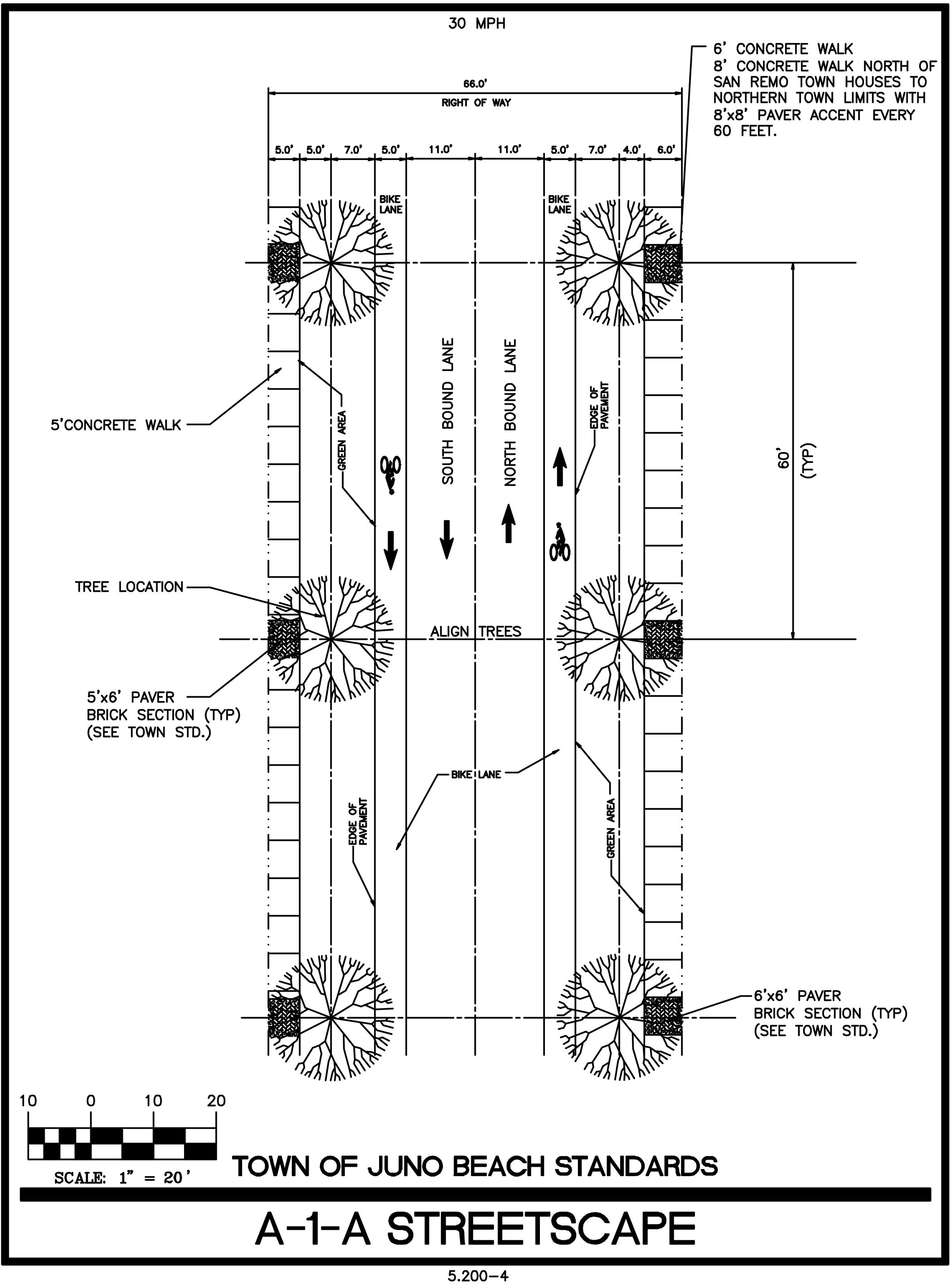
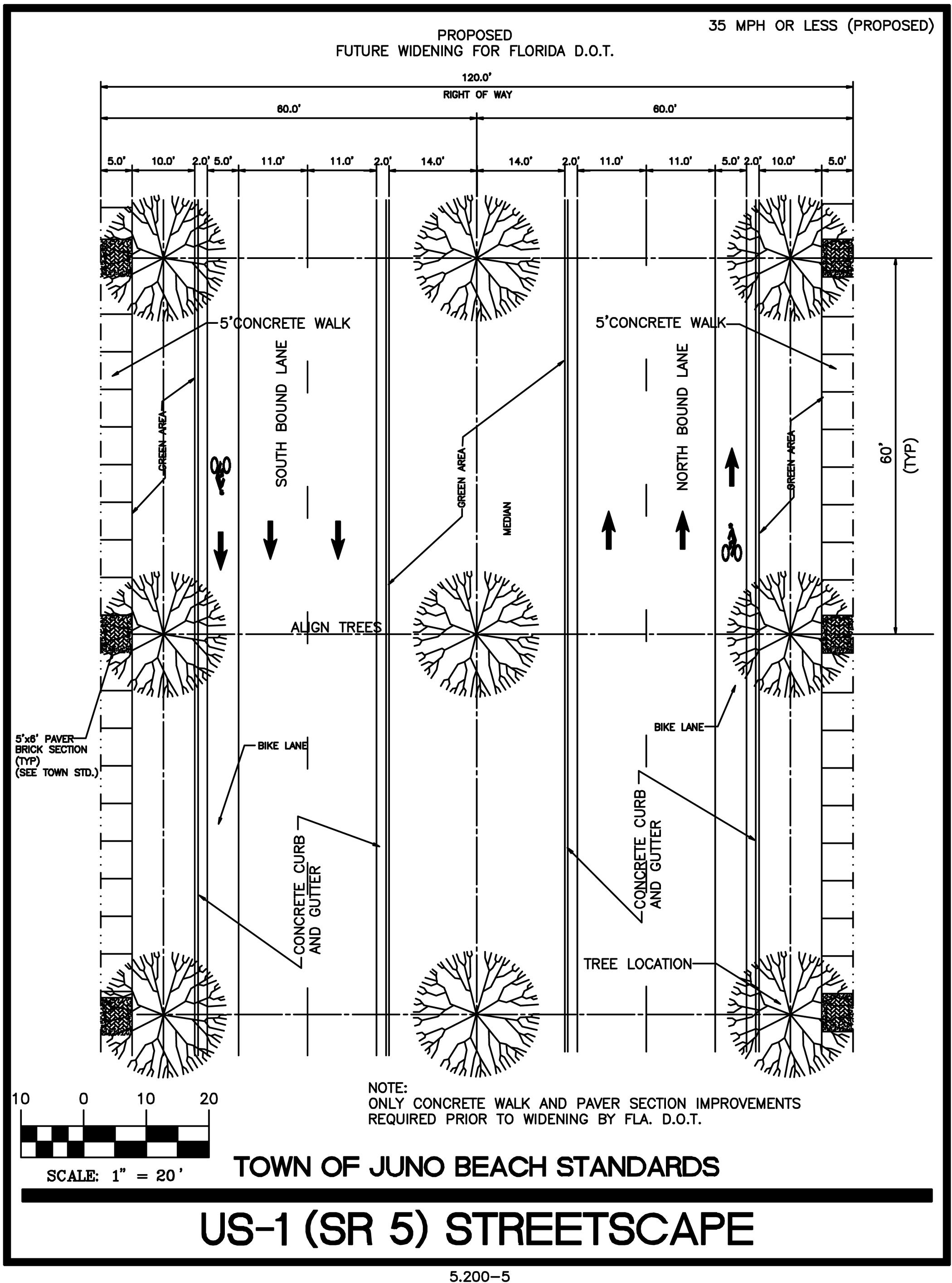
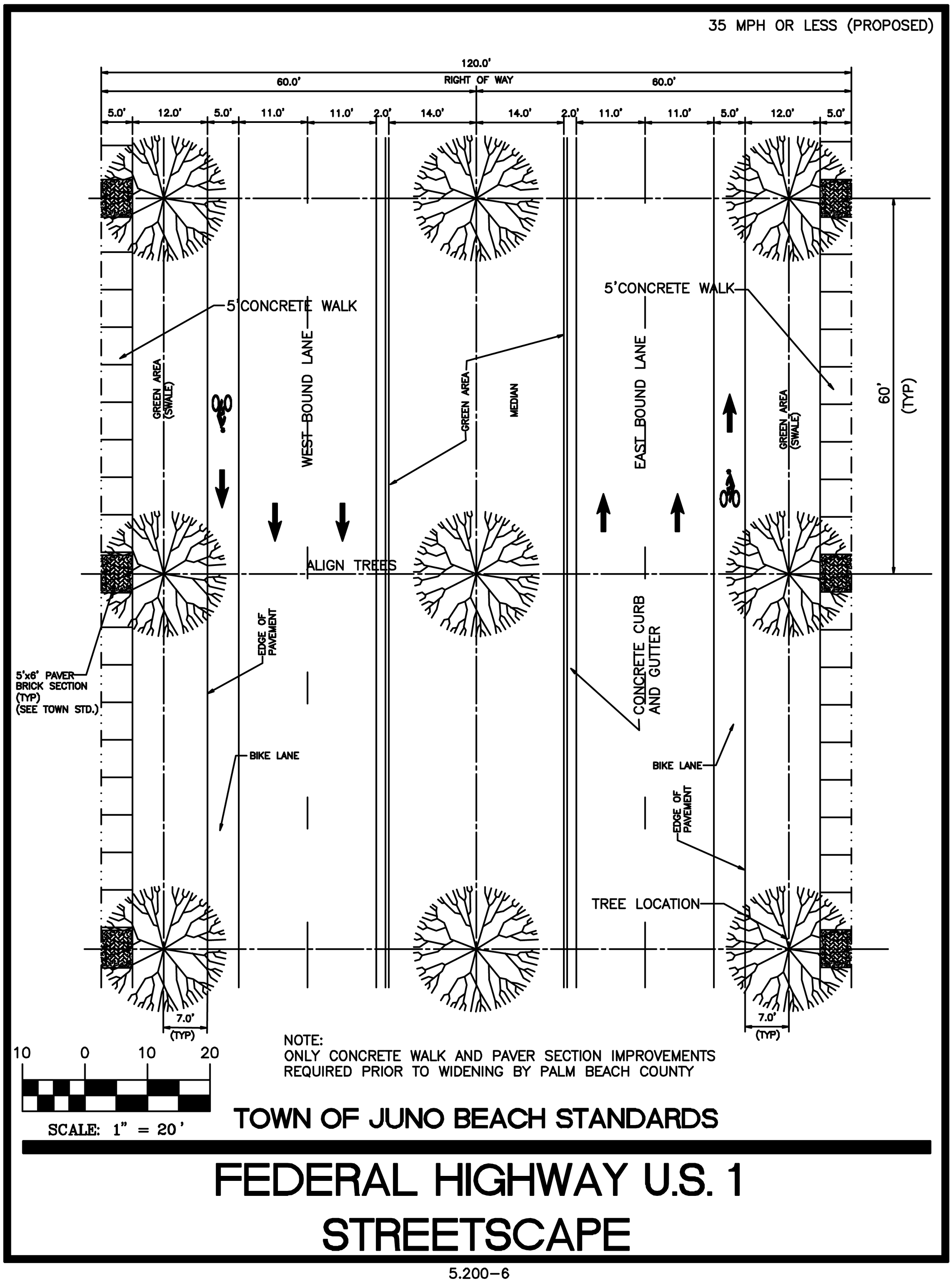
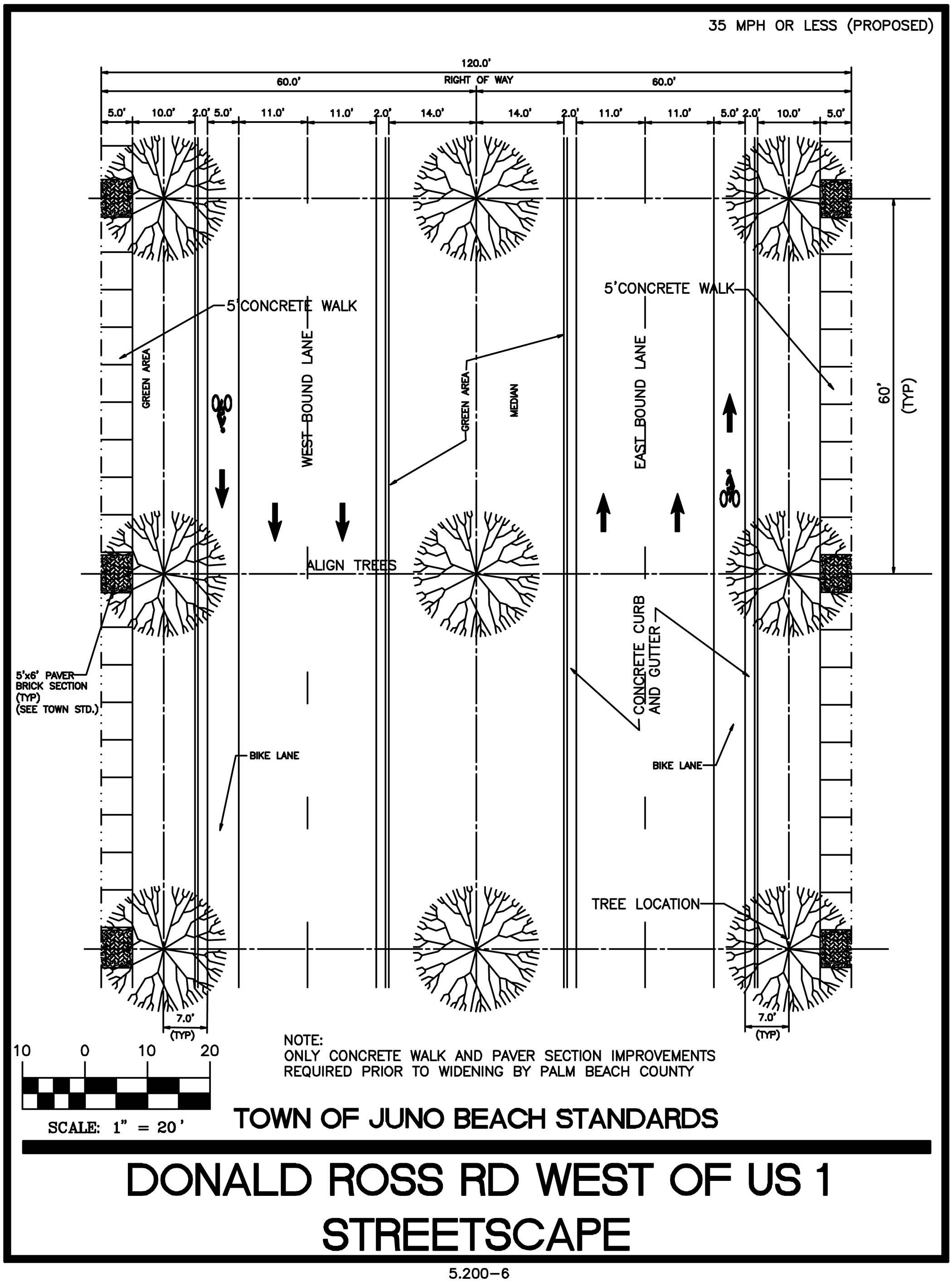
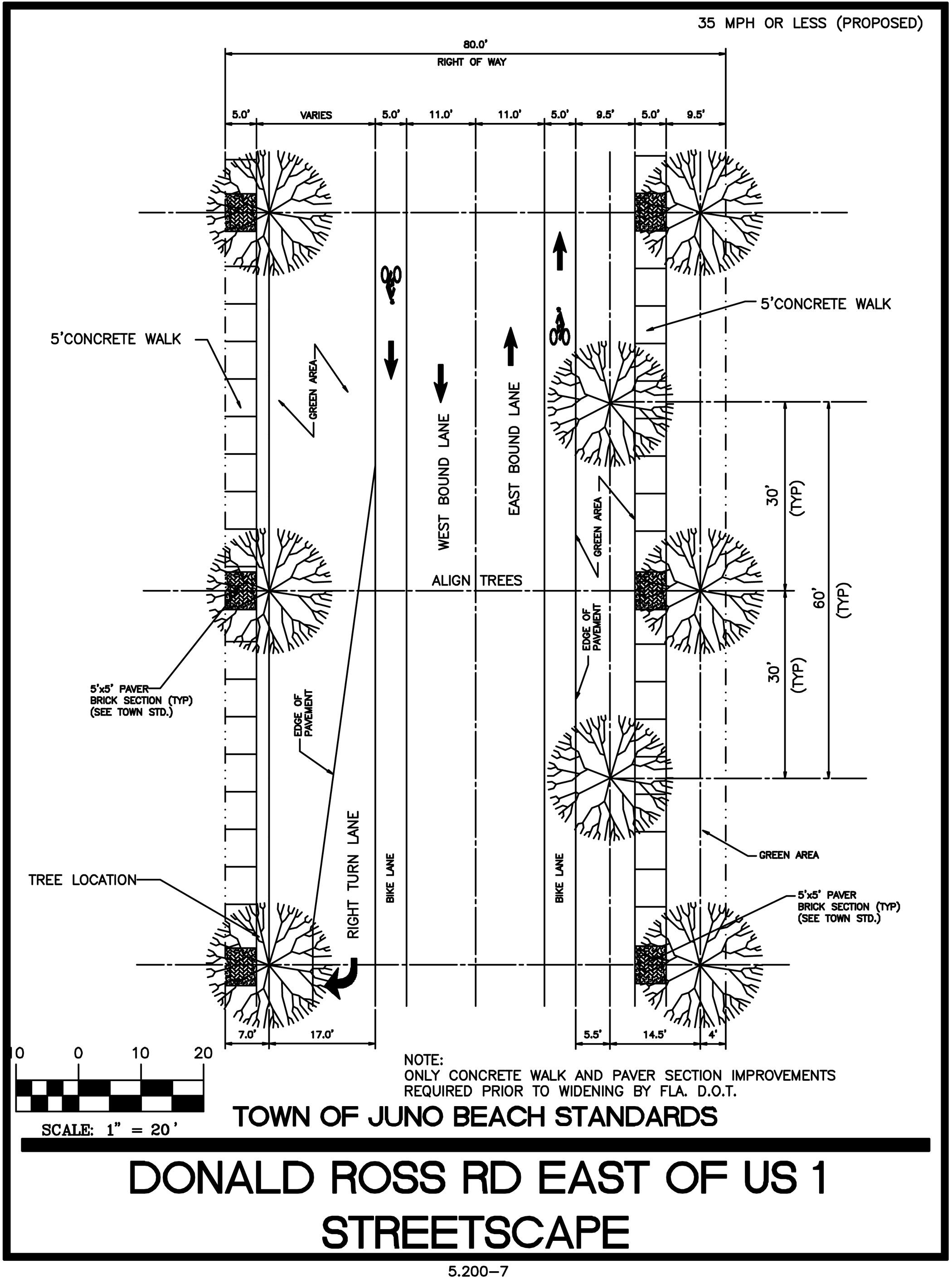
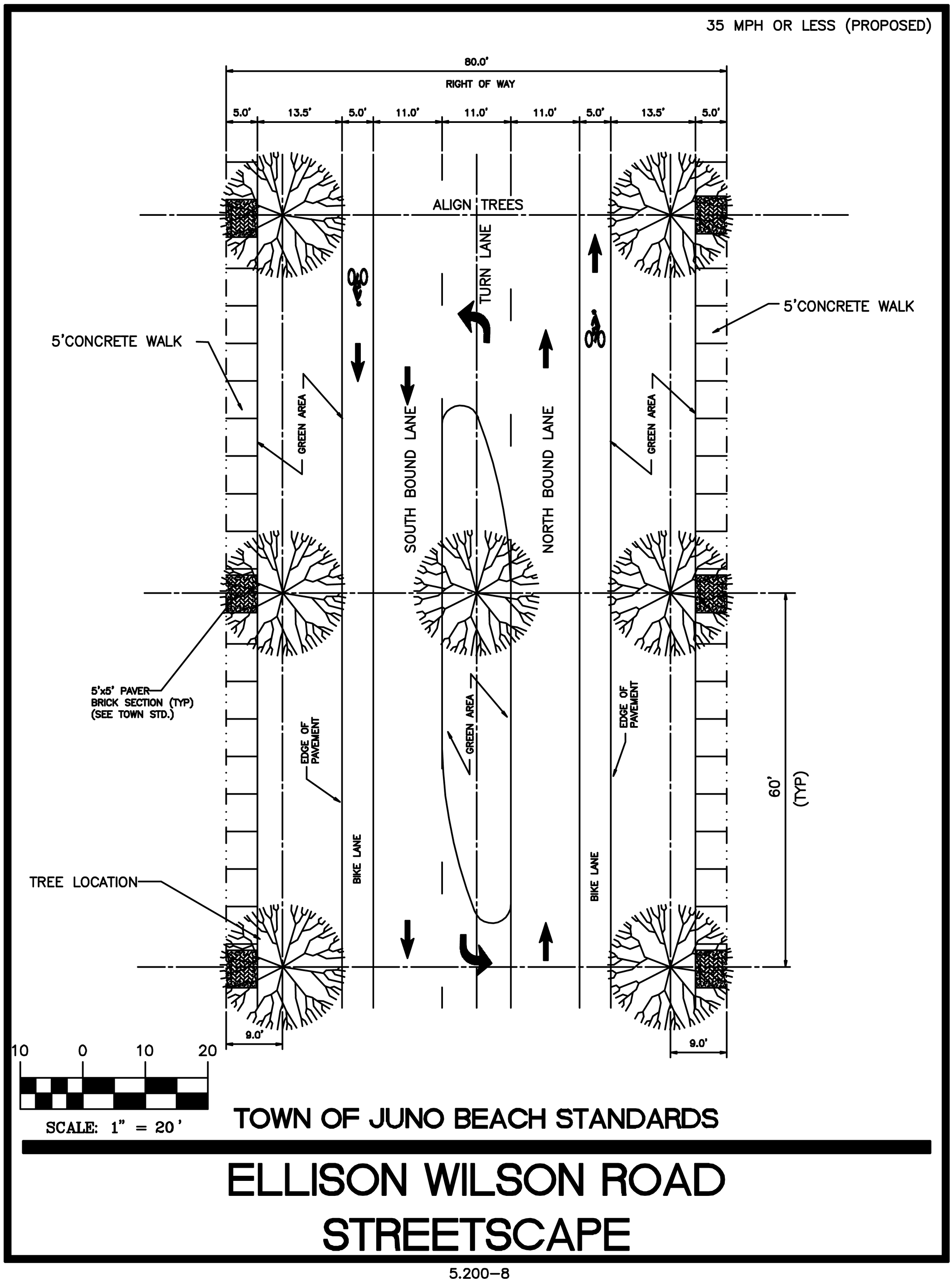
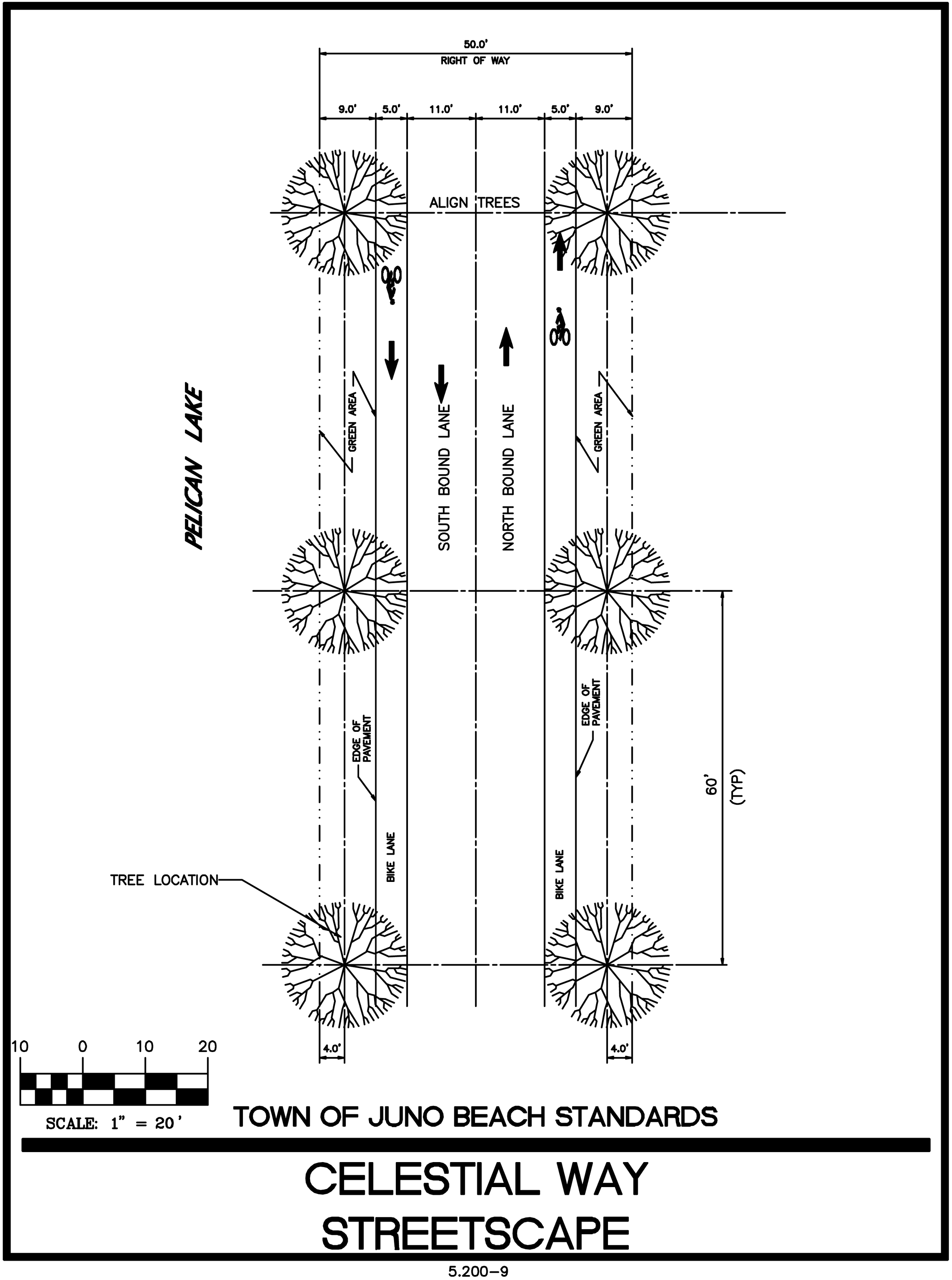
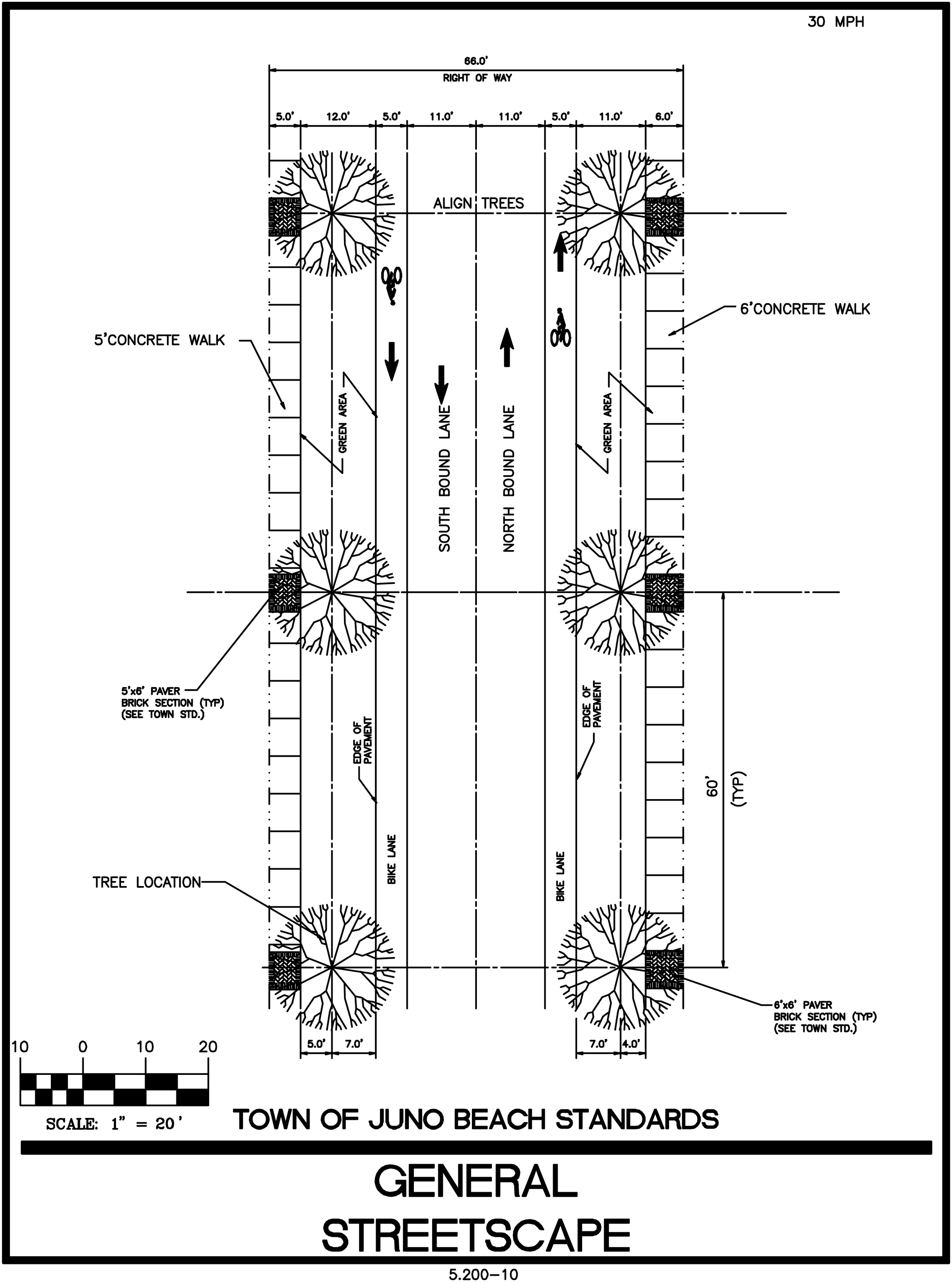
All new construction and alterations which meet the applicability section of these standards shall be required to provide sidewalks/pedestrian paths along the abutting right-of-way. When such new sidewalk shall be within 100 feet of existing pavement (for example, an existing sidewalk or drive). Such new sidewalk shall be required to extend to the existing pavement in order to connect the system.
Sidewalks/pedestrian paths shall be of poured concrete and meet the construction standards as shown in the details that follow.
Brick paver accents, as shown in the street sections, shall be provided every 30 feet along the sidewalk. In addition, sidewalks across driveways shall be brick paved.
Brick accents shall be "holland brick" by Paver Systems (or equal), Color Mix III and placed in a Herringbone pattern 90 degrees, or used in a running bond pattern as an edger.
All brick pavers shall be edged approximately per manufactures' requirements.
Brick pavers shall be required for crosswalks across streets, provided that the right-of-way agency approves such treatment.
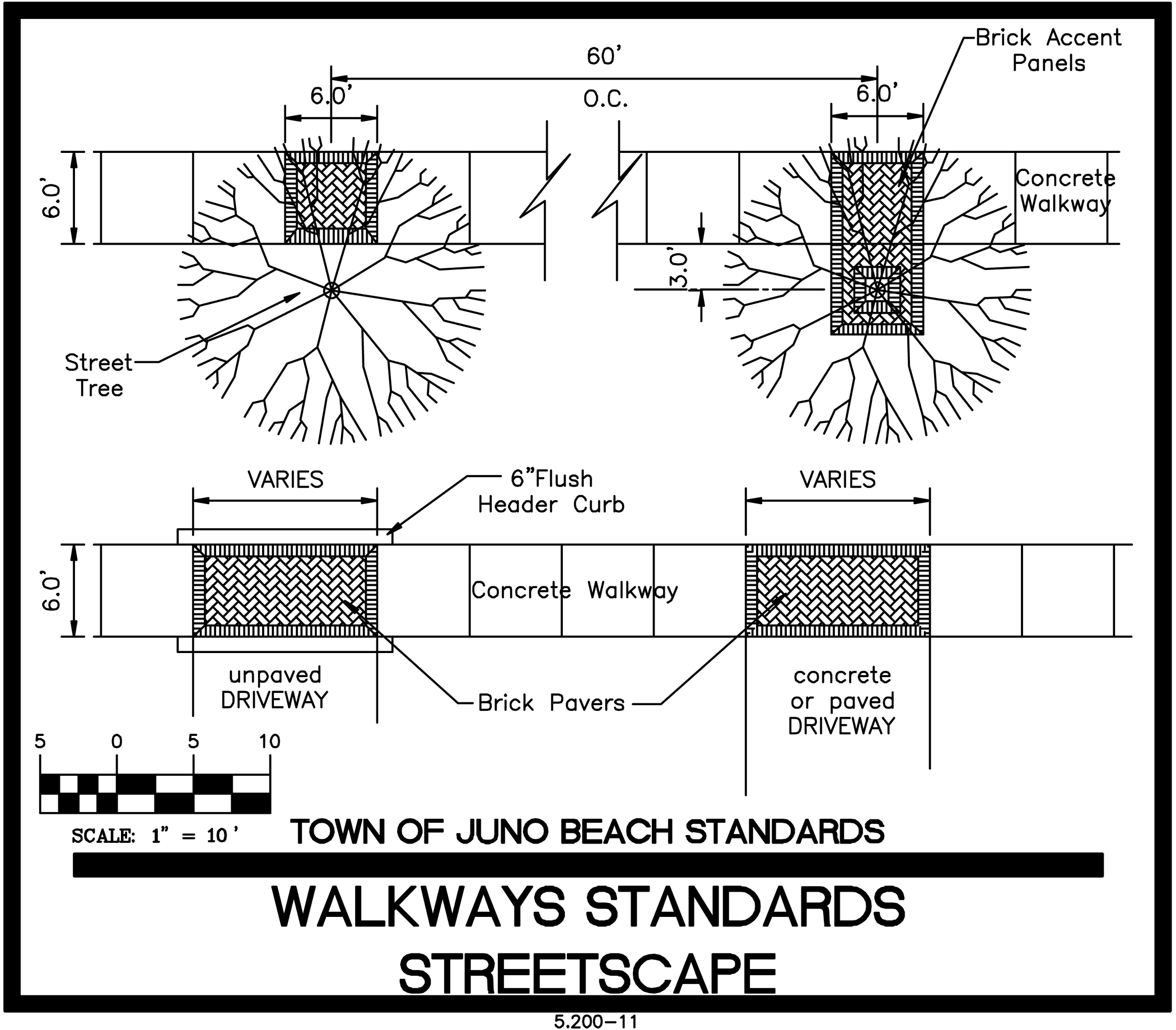
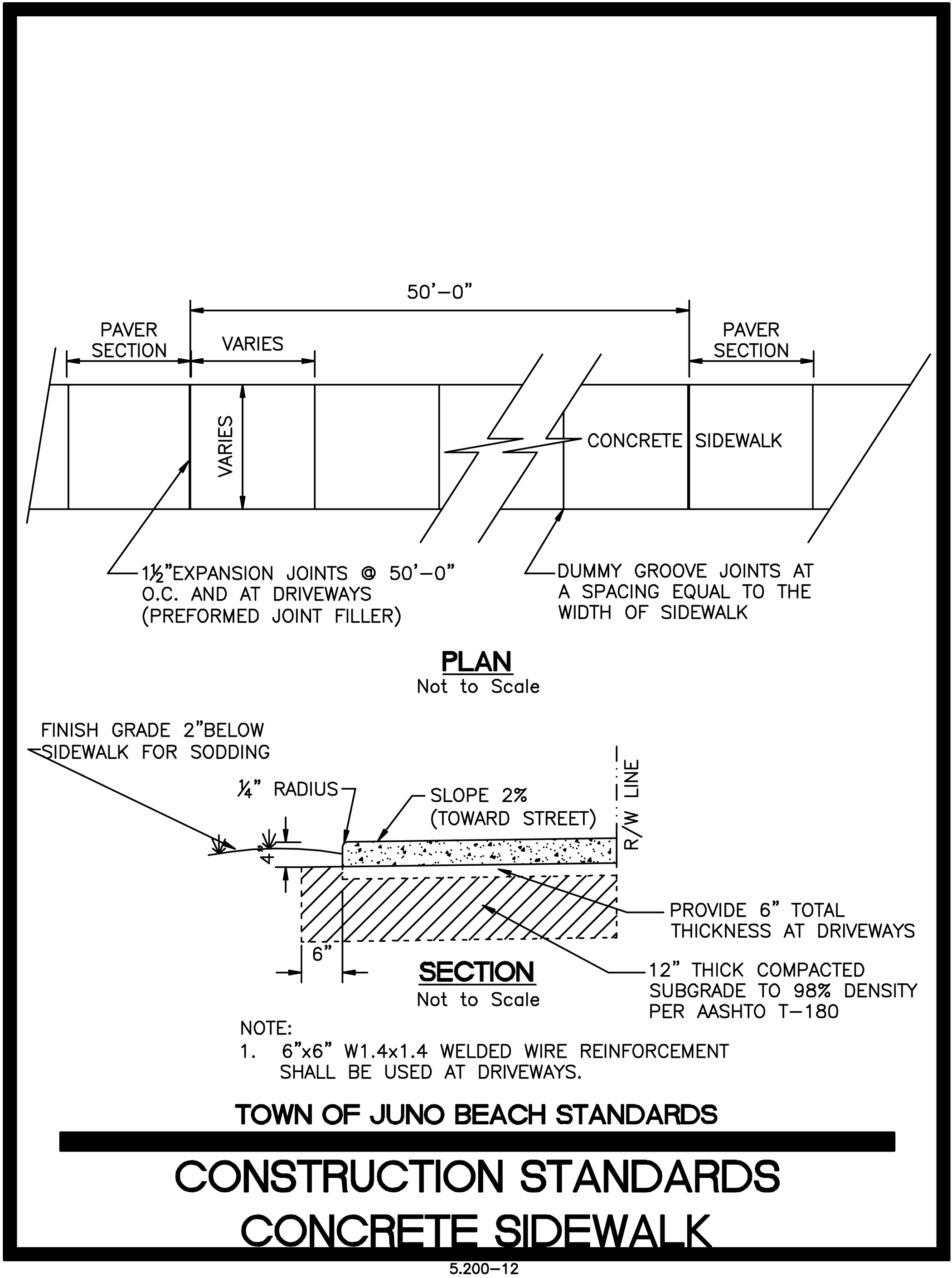
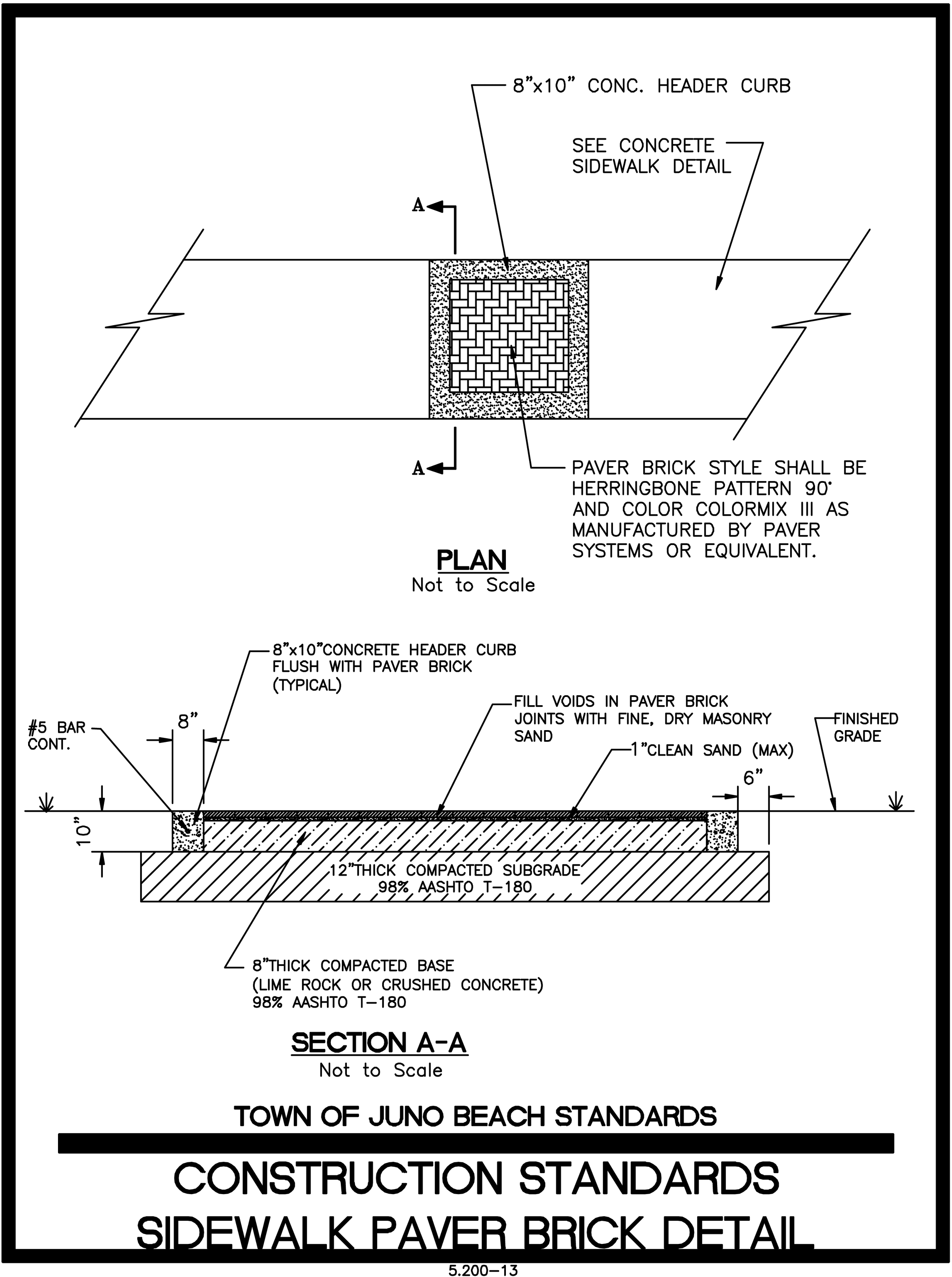
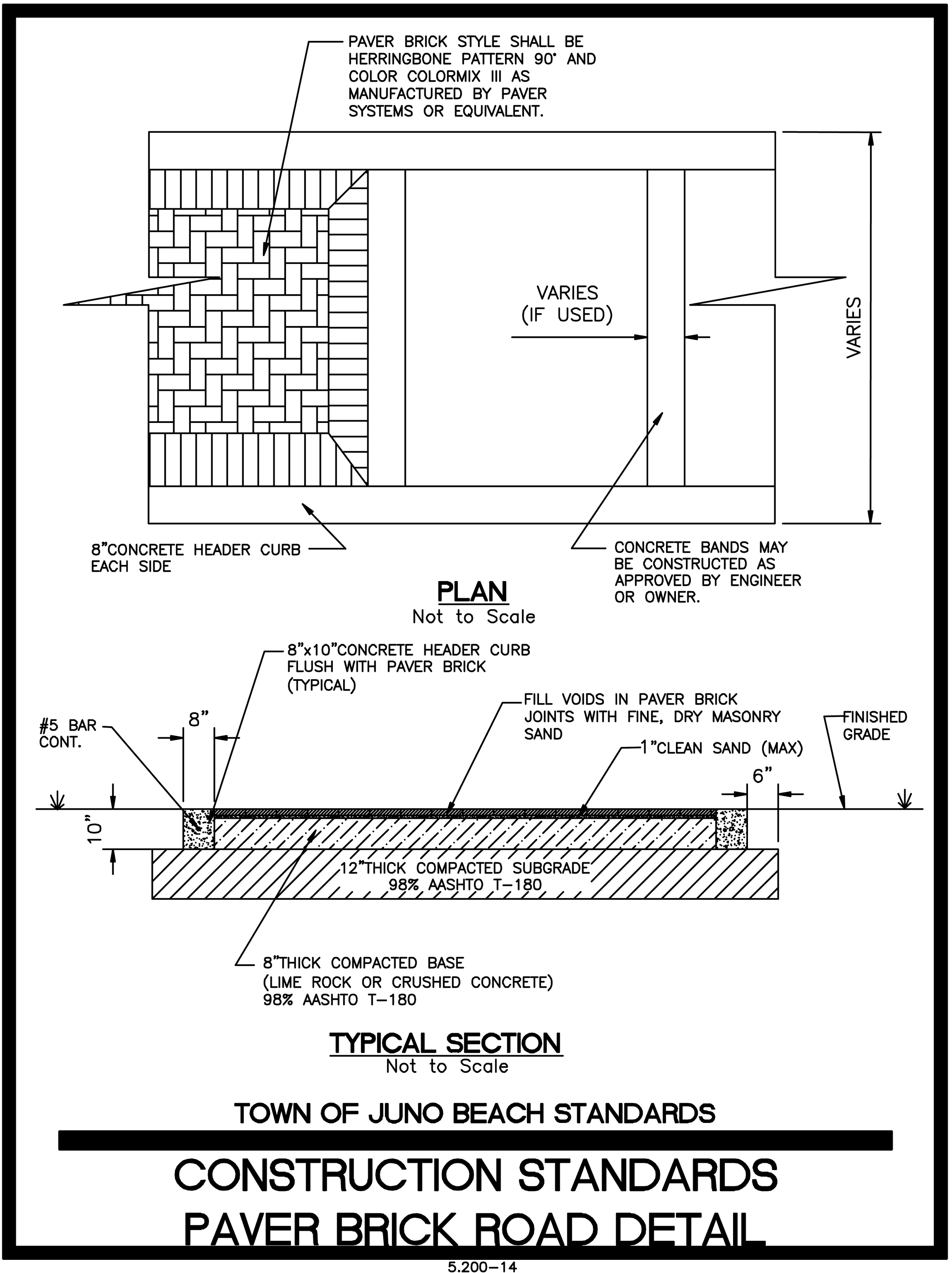
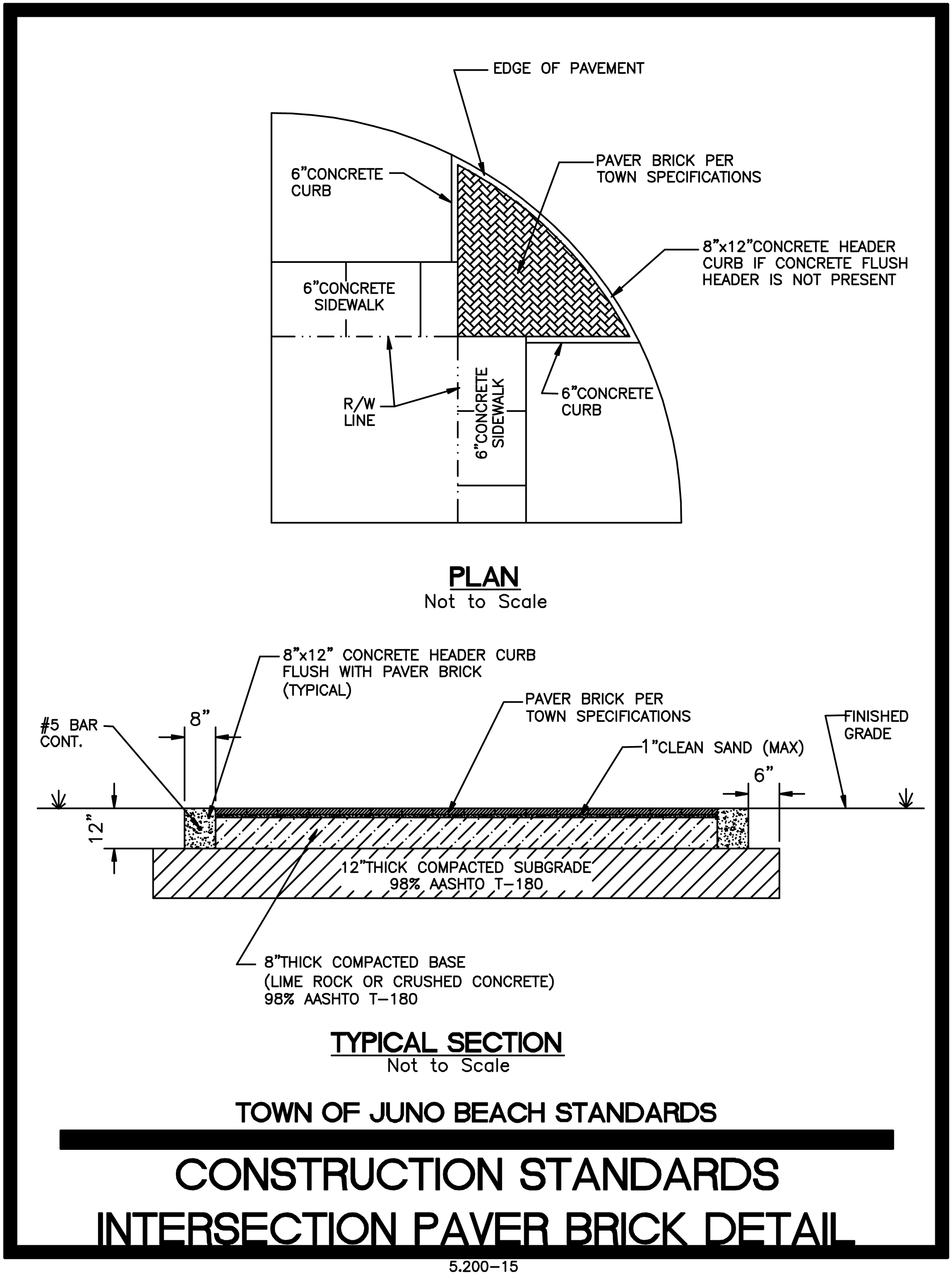
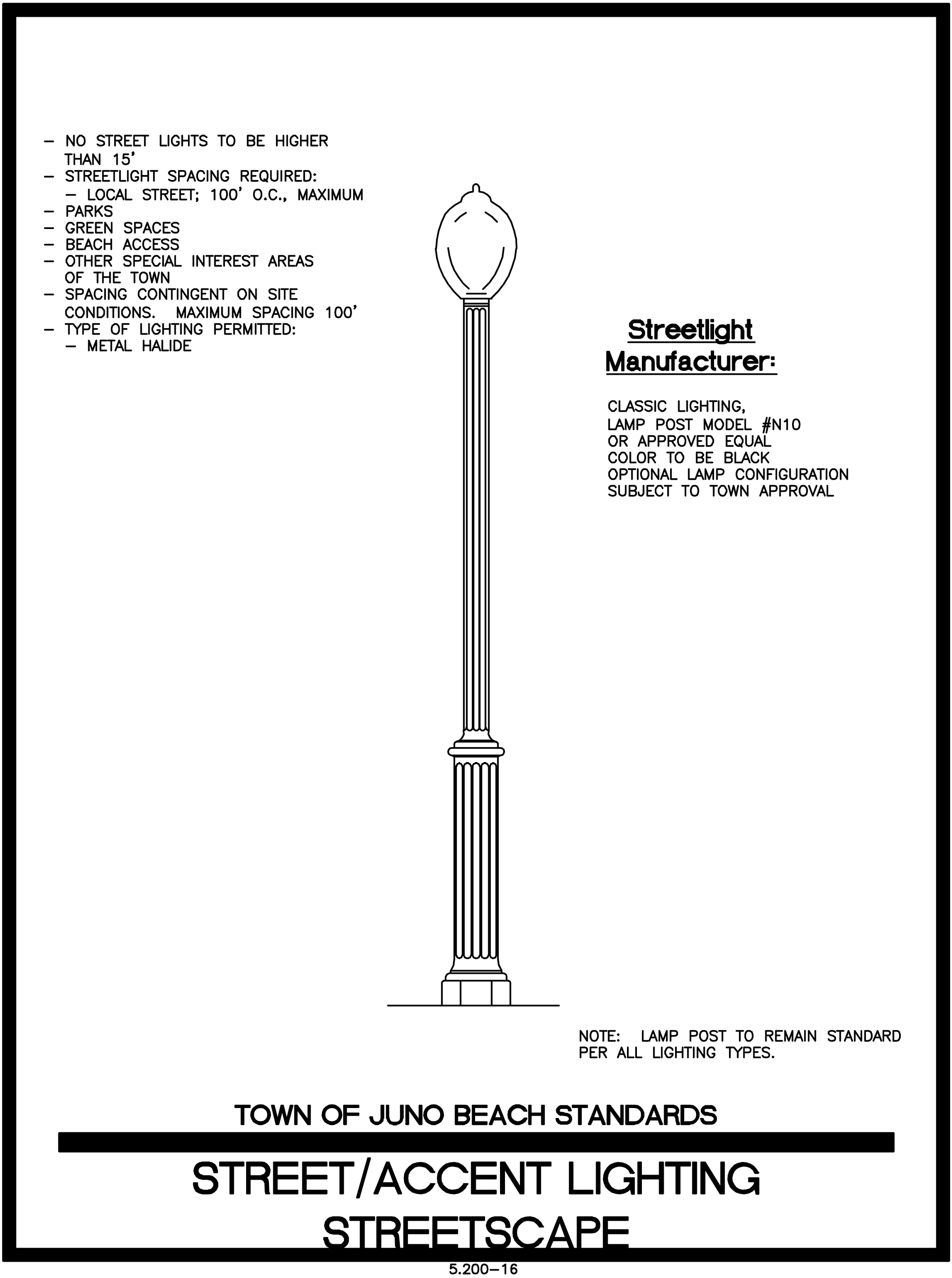
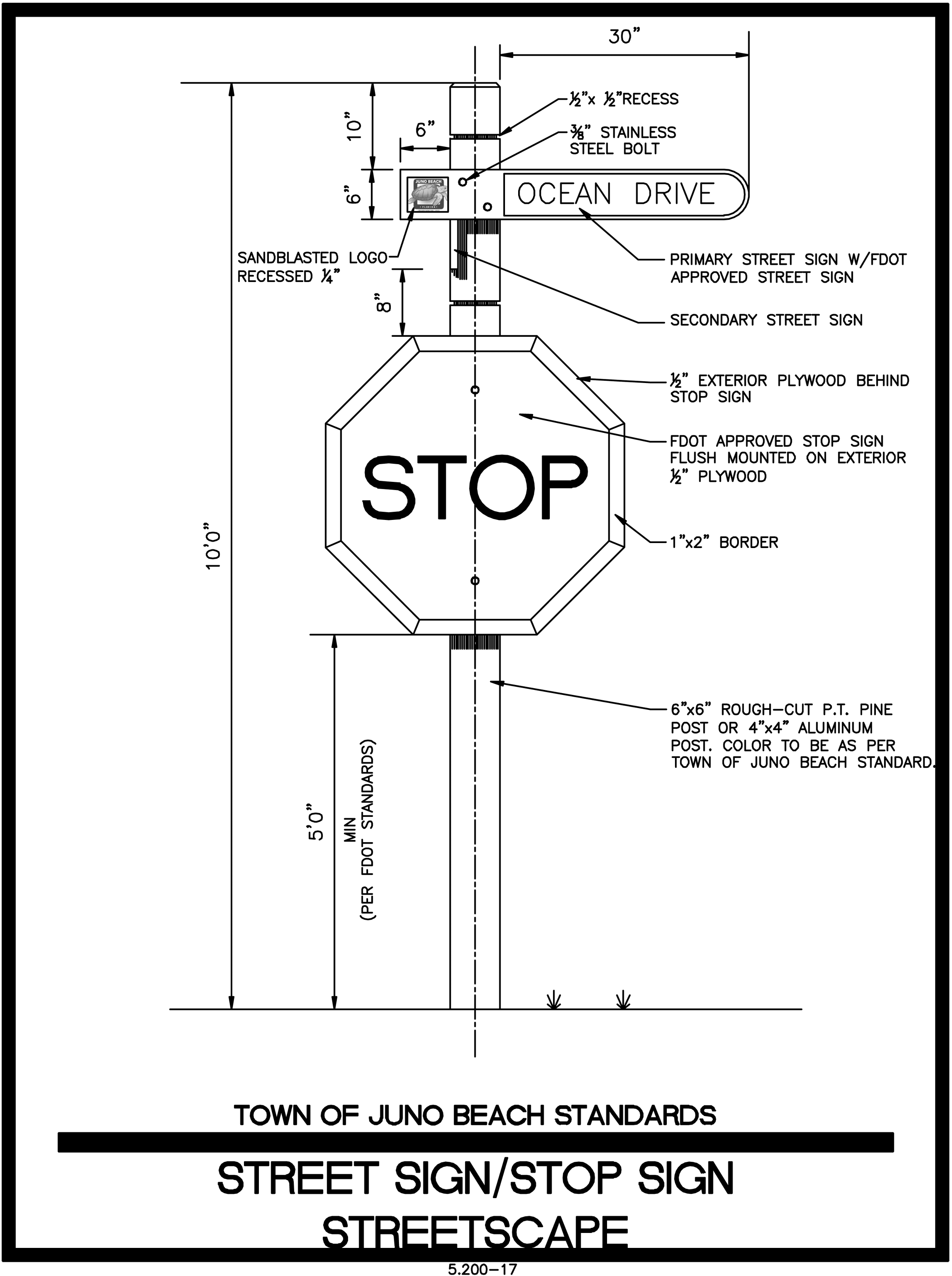
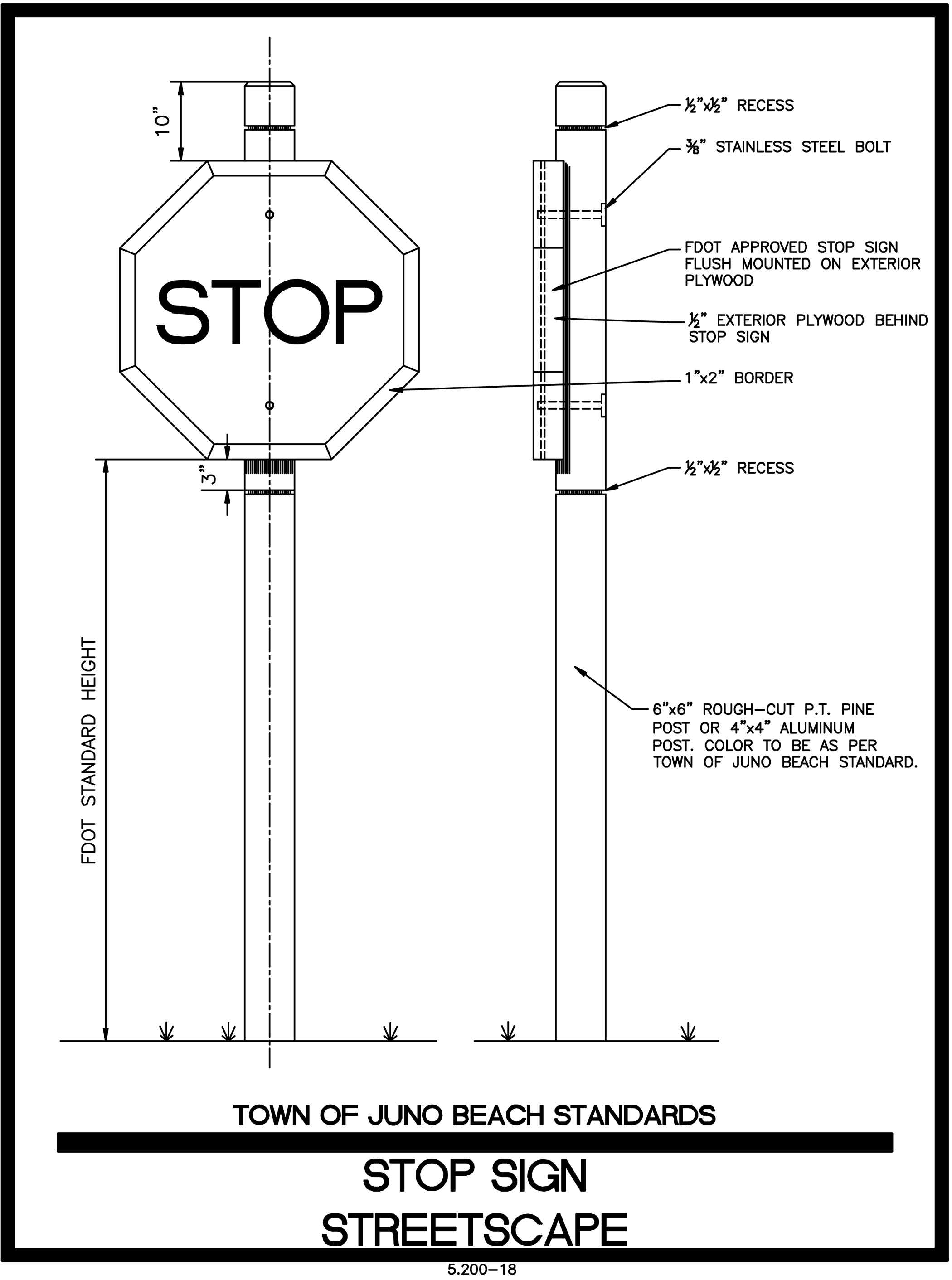
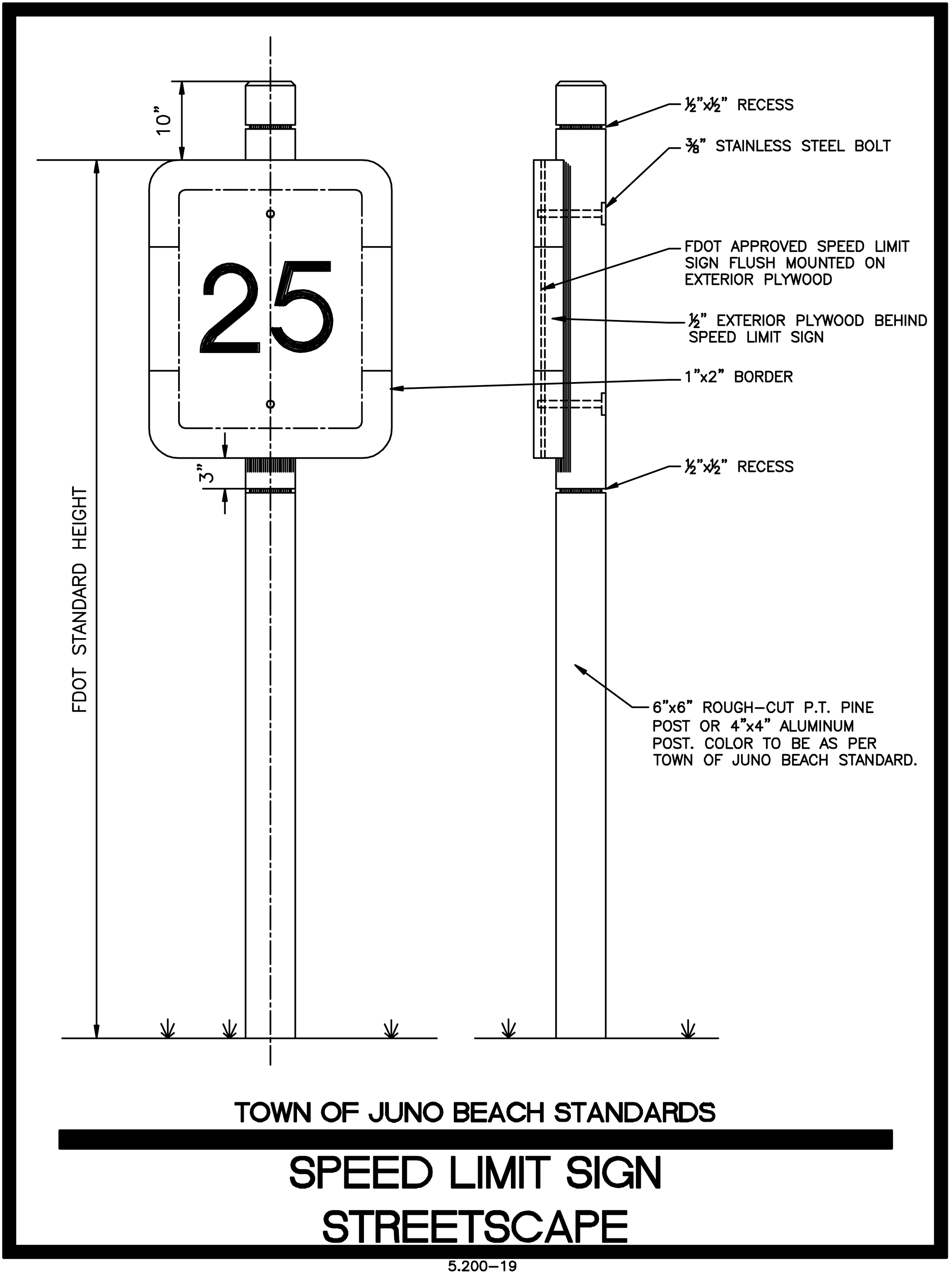
Sec. 34-1311.- Medical and dental offices.
(a)
Purpose. These regulations are enacted to discourage the misuse and abuse of narcotics and other controlled substances such as pain medications, and to address the impacts upon land uses that are associated with businesses that operate principally to dispense pain medications for chronic pain but without the services of typical medical offices that provide thorough on-site examinations, medical treatments or procedures and continued medical oversight. Such businesses have been determined to be associated with the excessive use of, addiction to, and subsequent illegal sales and distribution of controlled substances.
(b)
Applicability. This section applies to all medical or dental offices or clinics within the town, excluding veterinary offices or clinics.
(c)
On site dispensing of controlled substances. On-site dispensing of controlled substances that are identified in Schedules II, III or IV in F.S. §§ 893.03, 893.035 or 893.0356, is strictly prohibited, unless otherwise expressly permitted by statutory or general law. However, the following are exempt from this prohibition:
(1)
A health care practitioner when administering a controlled substance directly to a patient if the amount of the controlled substance is only intended to treat the patient during that particular treatment session.
(2)
A pharmacist or health care practitioner when administering a controlled substance to a patient or resident receiving care as a patient at a hospital, nursing home, ambulatory surgical center, hospice, or intermediate care facility for the developmentally disabled that is licensed by the State of Florida.
(3)
A health care practitioner when administering a controlled substance in the emergency room of a licensed hospital.
(4)
A health care practitioner when administering or dispensing a controlled substance to a person under the age of 16.
(5)
A health care practitioner when dispensing a one-time, 72 hour emergency re-supply of a controlled substance to a patient.
(d)
Acknowledgment of regulations. The health care practitioner responsible for the operation or supervision of any medical or dental office or clinic shall execute an affidavit acknowledging the regulations set forth in subsection (3) above prior to payment of the required business tax, and annually thereafter upon renewal of same prior the issuance of a business tax receipt. Failure or refusal to execute the required affidavit shall constitute prima facie evidence that the subject medical or dental office or clinic is operating in violation of the code of ordinances, which may result in code enforcement action, revocation of business tax receipt, and/or any other action permitted by law.
(Ord. No. 646, § 3, 4-13-2011)
Sec. 34-1312. - Drug stores and pharmacies.
(a)
Purpose. These regulations are enacted to discourage the misuse and abuse of narcotics and other controlled substances such as pain medications, and to address the impacts upon land uses that are associated with drug stores and pharmacies affiliated with medical or dental offices or clinics that operate principally to dispense pain medications. Such businesses have been determined to be associated with the excessive use of, addiction to, and subsequent illegal sales and distribution of controlled substances.
(b)
Applicability. This section applies to all drug stores and pharmacies within the Town.
(c)
Limitation. No more than 15 percent of the total number of prescriptions sold within a 30 day period can be derived from the sale of Schedule II controlled substances as listed in F.S. § 893.03. All pharmacies, including those located within drug stores, shall be staffed by a state licensed pharmacist who shall be present during all hours the pharmacy is open for business. This restriction shall not apply to a pharmacy operating as an accessory use to a facility licensed under F.S. ch. 395, (e.g., a hospital).
(d)
Acknowledgment of regulations. The owner or operator of a pharmacy or drug store shall execute an affidavit acknowledging the regulations set forth in subsection (3) above prior to payment of the required business tax, and annually thereafter upon renewal of same prior the issuance of a business tax receipt. Failure or refusal to execute the required affidavit shall constitute prima facie evidence that the subject pharmacy or drug store is operating in violation of the code of ordinances, which may result in code enforcement action, revocation of business tax receipt, and/or any other action permitted by law.
(Ord. No. 646, § 3, 4-13-2011)
Sec. 34-1316.- Intent.
The intent of this section is to implement the provisions of F.S. § 509.233, and provide a local exemption procedure to certain provisions of the Food and Drug Administration Food Code, as adopted by the Division of Hotels and Restaurants of the Florida Department of Business and Professional Regulation, in order to allow patrons' dogs within certain designated outdoor portions of public food service establishments.
(Ord. No. 676, § 2, 11-18-2014)
Sec. 34-1317. - Permit required.
(a)
Public food service establishments seeking to utilize the local exemption shall apply for and receive a permit from the town prior to allowing patrons' dogs on their premises. When applying for a permit, the applicant shall provide the following information on the form provided by the town:
(1)
The name, location and mailing address of the public food service establishment, including the license number issued by the Division of Hotels and Restaurants of the Florida Department of Business and Professional Regulation.
(2)
The name, mailing address, and telephone contact information of the permit applicant.
(3)
A diagram and description of the outdoor area to be designated as available to patrons' dogs including:
a.
The dimensions of the designated area;
b.
A depiction of the number and placement of tables, chairs, and restaurant equipment, if any;
c.
The entryways and exits to the designated outdoor area;
d.
The boundaries of the designated area and of other areas of outdoor dining not available to patrons' dogs;
e.
Any fences or other barriers; and
f.
The surrounding property lines and public rights-of-way, including sidewalks and common pathways.
(The diagram shall be accurate and to scale but need not be prepared by a licensed design professional).
(4)
A description of the days of the week and hours of operation that patrons' dogs will be permitted in the designated outdoor area.
(b)
A permit issued pursuant to this section shall expire automatically upon the sale of the establishment and shall not be transferred to a subsequent owner. A subsequent owner shall be required to apply for a new permit.
(c)
The town shall forward a copy of all approved applications and permits to the Division of Hotels and Restaurants of the Florida Department of Business and Professional Regulation.
(Ord. No. 676, § 2, 11-18-2014)
Sec. 34-1318. - Regulations and requirements.
The following regulations and requirements shall be applicable to all food service establishments issued a permit to allow patrons' dogs within designated outdoor areas pursuant to this section:
(a)
All public food service establishment employees shall wash their hands promptly after touching, petting, or otherwise handling dogs. Employees shall be prohibited from touching, petting, or otherwise handling dogs while serving food or beverages or handling tableware or before entering other parts of the public food service establishment.
(b)
The establishment shall advise patrons in a designated outdoor area to wash their hands before eating and shall provide waterless hand sanitizer at all tables in the designated outdoor area.
(c)
The establishment shall instruct patrons and employees that they shall not allow dogs to come into contact with serving dishes, utensils, tableware, linens, paper products, or any other items involved in food service operations.
(d)
Patrons shall keep their dogs on a leash no more than six feet in length and under reasonable control at all times.
(e)
Dogs shall not be allowed on chairs, tables or other furnishings, nor shall they be permitted to sit on the laps of patrons.
(f)
The establishment shall clean and sanitize all table and chair surfaces within the designated area with an approved product between seating of patrons. Spilled food and drink shall be removed from the floor or ground between the seating of patrons.
(g)
The establishment shall clean accidents involving dog waste immediately and sanitize the area with an approved product. The establishment shall keep a kit with the appropriate materials for this purpose within or in immediate proximity to the designated outdoor area.
(h)
The establishment shall provide at least one pet waste disposal bag station and an appropriate container for pet waste disposal bags. All contents shall be removed at least daily.
(i)
The establishment shall post signs at least 12 inches by 12 inches in size reminding employees of the applicable rules in the kitchen, the employee restrooms and all food or beverage service stations, if any, with the designated area.
(j)
The establishment shall post table top signs at least five inches by seven inches in size reminding patrons of the applicable rules on each table within the designated area.
(k)
The establishment shall post signs at least 12 inches by 12 inches in size that the designated outdoor area is available for the use of patrons and patrons' dogs, including one sign within the designated area and one sign at each entrance and exit to the designated area.
(l)
Dogs shall not be permitted to travel through indoor or non-designated outdoor portions of the public food establishment, and ingress and egress to the designated outdoor portions of the public food establishment must not require entrance into or passage through any indoor area of the food establishment.
(m)
Patrons shall not be forced to travel through the designated outdoor portion of the public food establishment in order to access the indoor portion or the non-designated outdoor portion.
(Ord. No. 676, § 2, 11-18-2014)
Sec. 34-1319. - Enforcement.
(a)
The town's code enforcement division shall be responsible for the enforcement of the provisions of this section and shall respond to all complaints filed pursuant to its provisions. The town shall provide copies of all complaints, along with the resolution of same, to the Division of Hotel and Restaurants of the Department of Business and Professional Regulation.
(b)
All violations of this division shall be treated as a violation of this chapter in accordance with sections 34-34 and 34-35 of this chapter.
(Ord. No. 676, § 2, 11-18-2014)
Sec. 34-1321.- Applicability.
The regulations set forth in this division shall apply to any building or structure utilized as a vacation rental within any town zoning district. A vacation rental is a dwelling unit that is also a transient public lodging establishment, but is not a time share project. A transient public lodging establishment, as defined by section F.S. § 509.013(4)(a), as amended, is any unit which is rented out to guests more than three times in a calendar year for periods of less than 30 days or one calendar month, whichever is less, or which is advertised or held out the public as a place regularly rented to guests for periods less than 30 days or one calendar month, whichever is less.
(Ord. No. 710, § 2, 1-23-2019)
Sec. 34-1322. - Registration and inspection.
(a)
Registration required. It shall be unlawful for any person or entity to operate a vacation rental within the corporate limits of the town without first registering the vacation rental with the planning and zoning department in accordance with the requirements of this division. All existing vacation rentals shall be required to be registered by October 1, 2019.
(b)
Initial registration. Every vacation rental owner or operator shall first register with the town by submitting to the planning and zoning department a properly completed and notarized registration form, as prescribed by the town, together with a registration fee in an amount established by resolution of the town council. A separate registration form shall be required for each vacation rental. The registration form shall be accompanied by the following:
(1)
A copy of the business tax receipt issued by the town;
(2)
A copy of the Florida Department of Business and Professional Regulation license as a transient public lodging establishment/vacation rental;
(3)
A copy of the vacation rental's current and active certificate of registration with the Florida Department of Revenue for the purpose of collecting and remitting sales taxes, transient rental taxes and any other taxes required by law to be remitted, as applicable;
(4)
Proof of the establishment of an account with the Palm Beach County tax collector for the payment of tourist development taxes or that payment is arranged through a third party;
(5)
Copies of the postings required by section 34-1323(5) below;
(6)
A copy of a sample lease agreement; and
(7)
A completed vacation rental responsible party designation, in the format prescribed by the town, which includes the information required by section 34-1323(4) below.
(c)
Registration renewal. After a vacation rental is initially registered, the registration shall be renewed by October 1 of each year through the execution of a renewal affidavit, in the format prescribed by the town, and the payment of the renewal fee established by resolution of the town council.
(d)
Registration updates. Any changes to the information or submittals included with the initial registration must be reported to the town within 30 days of the occurrence of such changes.
(e)
Incomplete registration/renewal. If the registration form or renewal form submitted pursuant to this section is incomplete, the registrant shall be informed of such deficiency and shall have ten days to correct the deficiency.
(f)
Inspection. Inspection by the town to verify compliance with the requirements of the division may be required subsequent to initial registration with the town and annually after each renewal. Noncompliance with the requirements of this division discovered during any inspection shall be treated as a violation of the Town Code and be processed in accordance with section 34-1324 below. Failure to allow the town to inspect the vacation rental within 20 days after the town notifies the owner or responsible party that the town is ready to conduct an inspection shall constitute a separate violation of the Town Code and be processed in accordance section 34-1324 below.
(g)
Evidence of vacation rental operation. Advertising, listing or posting a property on the internet, utilizing any mass communication medium or in any publication as being available for use as a vacation rental creates a rebuttable presumption that the owner or operator is utilizing the property as a vacation rental. Nothing set forth herein precludes the town from presenting other forms of evidence of vacation rental operation.
(h)
False information, it shall be unlawful for any person to give any false or misleading information in connection with the requirements and obligations set forth in this section.
(Ord. No. 710, § 2, 1-23-2019)
Sec. 34-1323. - Vacation rental standards.
No person or entity shall operate a vacation rental within the town unless such vacation rental complies with the following standards:
(1)
Minimum life/safety requirements:
a.
Swimming pool, spa and hot tub safety. A swimming pool, spa or hot tub shall comply with the current standards of the Residential Swimming Pool Safety Act, as set forth in F.S. ch. 515.
b.
Smoke and carbon monoxide (CO) detection and notification system. If an interconnected and hardwired smoke and carbon monoxide (CO) detection and notification system is not in place within the vacation rental, then one such system shall be required to be installed and maintained on a continuing basis consistent with the requirements of Section R314, Smoke Alarms, and Section R315, Carbon Monoxide Alarms, of the Florida Building Code-Residential.
c.
Fire extinguisher. A portable, multi-purpose dry chemical 2A:10B:C fire extinguisher shall be installed, inspected and maintained in accordance with NFPA 10 on each floor/level of the dwelling unit. The extinguisher(s) shall be installed on the wall in an open common area or in an enclosed space with appropriate markings visibly showing the location.
d.
Battery powered emergency lighting of primary exit. Battery powered emergency lighting which provides illumination automatically in the event of any interruption of normal lighting shall be provided for a period of not less than one hour to illuminate the primary exit.
e.
Emergency egress and maintenance. Halls, entrances and stairways within a vacation rental shall be clean and ventilated. Hall and stair runners shall be kept in good condition. Rails shall be installed on all stairways and around all porches and steps.
(2)
Maximum occupancy. Each vacation rental dwelling unit shall comply with the occupancy limitations set forth in the Property Maintenance Code referenced in section 6-104 of this Code, provided, however, that in no event shall maximum occupancy of such dwelling unit exceed two persons per bedroom plus two additional persons.
(3)
Lease requirements. There shall be a written or online lease, rental, tenant or other recorded agreement memorializing each vacation rental tenancy between the owner or responsible party and the occupant(s). The agreement shall, at a minimum, contain the following information:
a.
The maximum number of occupants for the unit as specified in subsection (2) above;
b.
The number of parking spaces associated with the vacation rental unit, if applicable, and the location of such spaces;
c.
The names and ages of all persons who will be occupying the unit;
d.
The dates of such occupancy; and
e.
A statement that all occupants must evacuate from the vacation rental following any evacuation order issued by local, state or federal authorities.
The town reserves the right to request and receive a copy of any vacation rental lease or rental agreement from the owner or responsible party at any time.
(4)
Vacation rental responsible party. Each vacation rental must designate a responsible party to respond to routine inspections as well as non-routine complaints and any other problems related to the operation of the vacation rental. The property owner may serve in this capacity or shall otherwise designate another person 18 years or older to perform the following duties:
a.
Be available by telephone at the listed phone number 24 hours per day, seven days per week and be capable of handling any issues relating to the operation of the vacation rental;
b.
If required, be willing and able to come to the vacation rental within two hours following notification from an occupant, the owner, or the town to address any issues relating to the operation of the vacation rental;
c.
Maintain a record of all lease or rental agreements for the vacation rental;
d.
Receive service of any legal notice on behalf of the owners for violation of the requirements set forth in this division; and
e.
Otherwise monitor the vacation rental to ensure compliance with the requirements set forth in this division.
(5)
Minimum vacation rental information required postings. The vacation rental shall be posted with the following information, either on the back of or next to the main entrance door or on the refrigerator:
a.
The name, address and telephone number of the vacation rental responsible party;
b.
The days of trash pick up and recycling pick up and a notification that all garbage or trash must be placed in a garbage or trash can or other approved garbage receptacle and that all recyclables must be placed in approved recyclable containers;
c.
The location of the nearest hospital;
d.
The location of designated parking spaces/areas, if applicable;
e.
Notice of restrictions during sea turtle nesting season; and
f.
For units located within multi-family buildings more than two stories in height, a building evacuation map (at least 8½ inches by 11 inches) shall be posted on or next to the interior portion of each bedroom door.
(6)
Other regulations. Vacation rentals must comply with all other regulations, standards and requirements set forth in the town Code of Ordinances, including, but not limited to, the requirements of Chapter 4 (Animals), Chapter 6 (Buildings and Building Regulations), Chapter 12 (Environment), Chapter 16 (Offenses), Chapter 30 (Traffic and Vehicles), and Chapter 34 (Zoning).
(Ord. No. 710, § 2, 1-23-2019; Ord. No. 718, § 2, 11-13-2019)
Sec. 34-1324. - Violations; remedies; enforcement.
(a)
Violations. Non-compliance with any provision of this division shall constitute a violation of the town Code of Ordinances and each day the violation exists shall constitute a separate and distinct violation.
(b)
Remedies and enforcement. Any violations of this division may be enforced pursuant to section 1-10 of the town Code of Ordinances, through the code enforcement process set forth in chapter 2, article VI of the town Code of Ordinances, or through any other manner authorized by law, including, but not limited to, injunctive relief.
(c)
No waiver. A valid vacation rental registration shall not be construed as a waiver of any of the requirements contained within the town Code of Ordinances or the town's Comprehensive Development Plan nor shall such registration be construed as approval of a use or activity that would otherwise be illegal under Florida law or prohibited by the Florida Building Code or the Florida Fire Prevention and Life Safety Code.
(Ord. No. 710, § 2, 1-23-2019)
Sec. 34-1325.- Applicability and intent.
(a)
The provisions of this division shall apply to all applications for the development of land for mixed-use projects with affordable multi-family residential units pursuant to Live Local Act, as set forth in Section 166.04151(7), Florida Statutes ("Act").
(b)
Such projects shall only be permitted in the Commercial General (CG), Commercial Office (CQ), and Medical Commercial (MC) zoning districts.
(c)
The intent of these regulations is to establish a regulatory framework for consideration of projects submitted pursuant to the Act. In adopting these regulations, the town council recognizes that there may be some ambiguity or need for additional interpretation. To the extent not expressly preempted by state law, town staff is directed to interpret these regulations in a manner that would best preserve the town's small-town, coastal character and its commitment to environmental preservation.
(Ord. No. 782, § 2, 4-24-2024)
Sec. 34-1326. - Procedure.
(a)
All projects shall be reviewed by the town's development review committee and shall be subject to the site plan and appearance review procedures and shall meet all criteria set forth in article II, division 4 of this chapter,
(b)
Within 48 hours of receipt of an application for development approval, the town shall notify the public by posting notice of the application on the town website and providing notice to the public through the town's e-mail database. The notice shall indicate that copies of all application materials shall be provided upon request.
(c)
The application shall be subject to administrative review as reguired by the Act, and the project shall be approved by the planning and zoning director only if it meets all applicable land development regulations, including the community appearance standards set forth in division 14 of article II of this chapter, and the requirements of this division. The director shall further determine that the project is consistent with the provisions of the comprehensive development plan, except those provisions expressly preempted by section 166.04151(7), Florida Statutes, relating to location with specified zoning districts, height, and density.
(d)
The application shall be subject to engineering review and approval during the building permitting process in the same manner as any other development application.
(Ord. No. 782, § 2, 4-24-2024)
Sec. 34-1327. - Limitations on height and density.
(a)
Height. Pursuant to section 166.04151(7), Florida Statutes, the maximum height permitted shall be limited to the height permitted as of right for a commercial or residential project within the town within one mile of the proposed development without consideration of any bonuses or modifications permitted through the special exception process or otherwise. In no event shall the height of any structure exceed 12 stories and 130 feet.
(b)
Density. Pursuant to section 166,04151 (7), Florida Statutes, the maximum density permitted shall be limited to density permitted as of right for a residential project within the town without consideration of any bonuses or modifications permitted through the special exception process or otherwise. In no event shall the residential density of any proposed development exceed 18 units per acre.
(Ord. No. 782, § 2, 4-24-2024)
Sec. 34-1327.1. - Development standards and criteria.
(a)
Required mix of uses. Consistent with the existing regulations governing mixed-use projects within the town's commercial zoning districts, all projects submitted pursuant to this division shall have a maximum of 75 percent of residential use based on total gross floor area.
(b)
Building site area regulations.
1.
If the project is utilizing the height and density permitted in the town's Residential High (RH) zoning district, the following site area regulations shall apply:
a.
Minimum total area: 40,000 square feet;
b.
Minimum lot width: 150 feet;
c.
Minimum lot depth: 200 feet;
d.
Front set yard setback: 30 feet from street line;
e.
Side yard setback: 35 feet with one side having a minimum of 15 feet;
f.
Rear yard setback: 30 feet;
g.
Minimum floor space per dwelling unit: 1,000 square feet of habitable space for a one bedroom; 1,200 square feet of habitable space for a two bedroom; and 1,400 square feet of habitable space for three or more bedrooms;
h.
Maximum building dimension: 150 feet, provided, however that along the building face having the maximum dimension, said dimension may be increased to no more than 175 feet;
i.
Maximum lot coverage: 50 percent; and
j.
Minimum landscaped open space: 15 percent of lot area.
In addition to the foregoing, all structures exceeding two stories shall comply with the high-rise setback, which requires 30 feet from all property lines and an additional five feet of setback at ground level for each additional story beyond the first two stories up to a maximum of 60 feet. For those lots having a width of 200 feet or less as recorded in the office of the county property appraiser, the maximum setbacks shall not exceed 50 feet; however, the maximum building dimension on such lots shall not exceed 150 feet.
2.
For purely non-residential components of the project or mixed-use structures where the height does not exceed four stories and 60 feet, the project shall comply with the building site area regulations of the applicable commercial zoning district.
(c)
Parking. The project shall provide for two spaces per residential unit and one quest space for every seven units as required for residential uses in commercial zoning districts. The parking for commercial uses shall be governed by division 4 of article IV of this chapter. Due to the lack of any major transit stops in the town, no parking reductions shall be considered. However, the project may propose, for consideration and approval by the town, shared parking in accordance with the criteria governing the minimum parking requirements for mixed-use projects in the town's commercial zoning districts.
(d)
Equivalent treatment of all dwelling units. All affordable dwelling units and market rate dwelling units shall be located within the same structure. All common areas and amenities shall be accessible and available to all residents of the development. Access to the required affordable dwelling units shall be provided through the same principal entrances utilized by all other dwelling units in the development. Additionally, the overall square footage and number of bedrooms in the affordable dwelling units shall be proportional to the overall sguare footage and number of bedrooms in the market rate dwelling units. By way of example, if 25 percent of the market rate dwelling units consist of two bedrooms, then 25 percent of the affordable dwelling units shall have two bedrooms, and the affordable dwelling units shall be similar in size to the market rate dwelling units.
(e)
Unified lot. All residential and non-residential components of the site plan shall be located on the same or unified lot.
(Ord. No. 782, § 2, 4-24-2024)
Editor's note— Ord. No. 782, § 2, adopted April 24, 2024, set out provisions intended for use as §§ 34-1328—34-1331. Inasmuch as there were already provisions so designated, said sections has been codified herein as §§ 34-1327.1—34-1327.4 at the discretion of the editor.
Sec. 34-1327.2. - Affordability.
(a)
Pursuant to Section 166.04151(7), Florida Statutes, at least 40 percent of the multi-family residential units shall remain affordable, as defined in Section 420.0004, Florida Statutes, for a period of at least 30 years. This requirement shall be incorporated as a condition into any administrative approval. Furthermore, as prerequisite to the issuance of a building permit, the applicant shall execute and deliver to the town for recordation in the public records, on a form approved by the town attorney, a covenant, declaration, or other deed restriction in favor of the town ensuring compliance with this affordability requirement.
(b)
The applicant shall provide to the town, on January 15 th of each year subsequent to the town's issuance of a certificate of occupancy for the project, copies of all leases then in effect for the affordable units, together with such documentation necessary to demonstrate that such leases meet the affordability criteria set forth in section 420.0004, Florida Statutes.
(Ord. No. 782, § 2, 4-24-2024)
Editor's note— See Editor's note at § 34.1327.1.
Sec. 34-1327.3. - Appeals.
Any aggrieved or adversely affected party may appeal an administrative order, decision, approval, or interpretation in the enforcement of the regulations of this division to the zoning board of adjustment and appeals in accordance with section 34-66 of the town code.
(Ord. No. 782, § 2, 4-24-2024)
Editor's note— See Editor's note at § 34.1327.1.
Sec. 34-1327.4. - Changes to state law and town zoning regulations.
(a)
In the event of a change in state law that affords the town greater regulatory authority over projects submitted pursuant to the Act, the town shall amend this division to reflect such change. However, all applicants are hereby placed on notice that all projects for which administrative development approval has not been issued shall comply with the revised regulations even if the town has not yet formally adopted amendments to this division to reflect the change.
(b)
In the event of a change in the town's zoning regulations applicable to projects submitted pursuant to the Act, including but not limited to revisions to the underlying building site area regulations and parking requirements, all applicants are hereby placed on notice that all projects for which administrative development approval has not been issued shall comply with the revised regulations even if the town has not yet formally adopted amendments to this division to reflect the change.
(Ord. No. 782, § 2, 4-24-2024)
Editor's note— See Editor's note at § 34.1327.1.

