
Kansas City City Zoning Code
DIVISION 11
SIGNS12
Editor's note— Ord. No. O-35-16, § 1, adopted June 30, 2016, amended Div. 11, §§ 27-722—27-738 and 27-745 to read as herein set out. The former Div. 11, §§ 27-722—27-738 and 27-745, pertained to signs, and derived from the Code of 1988, § 27-1371—27-1379; 27-1381; 27-1384—27-1390; 27-1396; 27-1398; Ord. No. 64690, § 1((27-71.1—27-71.7, 27-71.6(A), (B), (D), (E), (G), (I), (K)—(M), 8-30-1984; Ord. No. 65417, § 29, 4-6-1989; Ord. No. 65461, § 1, 8-17-1989; Ord. No. 65567, § 3—6, 9-20-1990; Ord. No. 65568, § 5, 9-5-1991; Ord. No. 65658, § 4, 6—8, 9-5-1991; Ord. No. 65814, § 16—27, 7-8-1993; Ord. No. 65903, § 1, 5-5-1994; Ord. No. O-65-98, § 2, 7-30-1998; Ord. No. O-2-99, § 3, 4 1-21-1999; Ord. No. O-111-01, § 1, 11-29-2001; ; Ord. No. O-9-15, § 1, 1-29-2015; Ord. No. O-55-15, § 1, 8-27-2015; Ord. No. O-62-15, § 1, Oct. 1, 2015.
Cross reference— Building code provisions relating to signs, § 8-23, 8-56 et seq.; bond for awning hangers or repairmen, § 19-21; signs in or adjacent to parks, § 25-60.
Sec. 27-720.- Purpose.
(a)
This division regulates the type, dimensions, design and other characteristics of signs throughout the unified government.
(b)
The purpose of this division is to:
•
Accommodate the rights of individuals to freedom of speech,
•
Recognize the business community's need for effective, individualized identity and public awareness,
•
Regulate and reduce what otherwise might be confusing and objectionable clutter,
•
Determine placement consistent with traffic safety, by reducing traffic hazards caused by distractions to motorists and impairment of sight lines,
•
Protect property values by enhancing the harmony between residential and commercial uses,
•
Incorporate new technologies for sign design and display,
•
Complement the character of the zoning districts' land uses,
•
Preserve the residential character of residential neighborhoods,
•
Protect property values,
•
Limit administrative burdens,
•
Avoid the creation of nonconformities,
•
Promote equity between businesses and other typical sign users,
•
Implement the comprehensive plan, and
•
Preserve, protect and promote the public health, safety and general welfare.
(c)
This section regulates only the sign structure or copy design, and not the sign's content. The city finds that the type, size, dimensions, setbacks, and physical design of signs permitted by this division protect the city's interests in traffic safety, community character, and aesthetics, while allowing adequate visibility, conspicuity, legibility, readability, and pedestrian or motorist reaction time for signs. The unified government finds and determines that the standards set out in this division were developed after a public process in which the design and dimensional standards were tested against industry criteria, past experience in administering sign standards, and community input as to the appropriate characteristics of signs in the unified government's various neighborhoods and business areas.
(Ord. No. O-35-16, § 1, 6-30-2016)
Sec. 27-721. - Applicability.
(a)
Generally.
(1)
This division applies to any sign within the corporate limits of the City of Kansas City, Kansas.
(2)
It is unlawful for any person to erect, operate, or otherwise use any sign that is prohibited by this division.
(3)
It is unlawful for any person to erect, operate, or otherwise use any sign at a time, place, or manner that is prohibited by this division.
(4)
The unified government is subordinate to the laws of the federal government and state of Kansas. This division does not prohibit signs, sign locations, or sign characteristics that are permitted by an express requirement of state or federal law.
(b)
Exemptions. This division does not apply to:
(1)
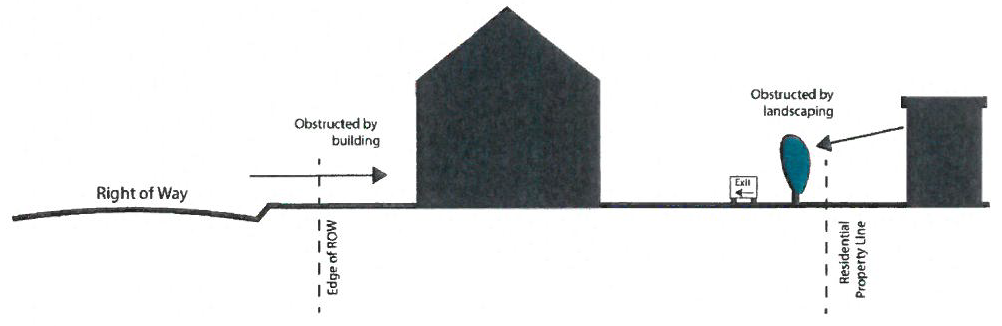
Signs that are not visible from a public street, highway or road, unless the sign is visible from the property line of an adjoining lot or parcel within an A-G, R, R-1, R-1(B), R-2, R-2(B), R-3, R-4, R-5, R-6, or R-M zoning district. A sign is considered not visible where it is fully obstructed by natural changes in grade, buildings, or landscaping that provides a complete year-round visual barrier. "Fully obstructed" means that the signs are not visible at ground level from the edge of the public right-of-way or residential property line, or from the upper level of a residential building on an adjoining property. However, these signs must comply with any applicable requirements of the building codes (Unified Government Code, Chapter 8).
(2)
Signs located entirely within the interior of a building or structure, except as otherwise provided for window signs.
(3)
In order to promote traffic and public safety, any public notice or warning posted or required by valid and applicable federal, state, or local law, regulation, or ordinance, including street addresses. Street addresses not exceeding four square feet in area are not counted toward the sign allocation for attached signs (see section 27-727).
(4)
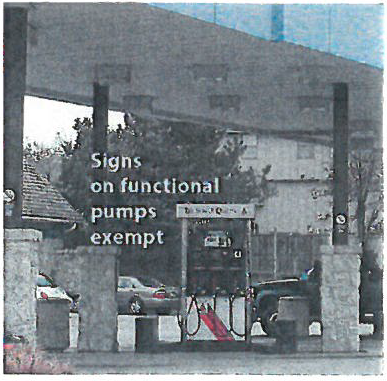
A sign that is integrated into or on a coin-operated machine, vending machine, or gasoline pump that is used for its intended purpose.
(5)
A sign carried by a person.
(6)
A sign affixed to an operable vehicle without flat tires, except as provided in subsection 27-722(d).
(c)
Districts and uses. This division calibrates sign size, types, and design to the unified government's zoning districts in order to protect community character, and to accommodate desired communications and economic activity appropriate to those districts. Signs relating to residential uses in nonresidential districts shall comply with the standards for signs in the highest applicable residential district. Signs for commercial uses in the industrial districts shall comply with the standards for the highest commercial district in which the commercial use is permitted. For purposes of this section, the hierarchy of zoning districts is established in section 27-407 where District A-G is the lowest district and District M-3 is the highest district.
(d)
Message neutrality. Despite any other provision of this division, no sign is subject to any limitation based on the content of its message. Any sign authorized in this division may contain any non-commercial copy in lieu of any other copy.
(e)
Obscenity. This division does not authorize any sign that unlawfully promotes obscenity under state or federal law.
(f)
False or misleading statements. This division does not excuse any person or entity from civil or criminal liability for false or misleading statements placed on a sign.
(Ord. No. O-35-16, § 1, 6-30-2016)
Sec. 27-722. - Prohibited signs.
The following types of signs are prohibited, except where specifically permitted by this division:
(a)
Any sign that is not included under the sign types permitted in this division.
(b)
Any attention-getting device such as a wind or banner sign (except as permitted in subsection 27-729(c)), portable sign, pennant, search light, twirling sign, or balloon or other gas or air filled object.
(c)
Pole signs, except for legally nonconforming pole signs, as follows:
(1)
The sign shall be maintained as provided in section 27-725; and
(2)
Legally nonconforming pole signs may expand up to the maximum area allowed for detached (monument) signs; and
(3)
The sign owner may reface or install a pole cover on a legally nonconforming pole sign. If the pole sign is refaced and the poles are not already covered, the sign owner shall install a pole cover over any existing pole.
(d)
Any sign mounted on a platform, trailer, or motor vehicle, whether operable or inoperable, that is placed on or near the premises of the business being advertised unless the sign is hidden from public view as provided in subsection 27-721(b)(1). This prohibition does not apply to trucks or other legitimate carriers and delivery vehicles that are parked on the premises in the course of their normal operations.
(e)
Any sign located in a public or private right-of-way, railroad right-of-way, or public and private utility easement, except those signs required by governmental authority. This subsection does not apply to:
(1)
A portable sign of no greater than 32 square feet in surface area is permitted during the 45 days prior to, and the two days following any public election, or
(2)
Awning/canopy/marquee signs, to the extent provided by subsection 27-728(b)(4),
(3)
Projecting signs, to the extent provided by subsection 27-728(b)(6), and
(4)
Sandwich/A-frame signs, to the extent provided by subsection 27-728(c)(4).
(f)
Any sign which, by reason of its size, location, movement, content, coloring, or manner of illumination:
(1)
May be confused with or construed as a traffic control sign, signal or device, or the light of an emergency vehicle, or
(2)
Hides from view any traffic or street sign, signal or device.
(g)
Any sign placed within a regulatory sight triangle, 25 feet of the edge of pavement, or any clear zone as defined by the American Association of State Highway and Transportation Officials.
(h)
Off-premises signs, except where specifically allowed in section 27-734.
(Ord. No. O-35-16, § 1, 6-30-2016)
Sec. 27-723. - Sign permits, inspections and bonds.
(a)
Applicability.
(1)
Generally.
a.
No sign (including the structure or sign surface) shall be erected, installed, altered, relocated, rebuilt, or refaced until the unified government issues a sign permit.
b.
Only those signs permitted in this division shall be granted a sign permit.
c.
Permits shall be issued only to licensed and bonded sign hangers for all signs except wall signs and monument signs. Any owner or authorized person may be issued a permit for wall signs and monument signs.
(2)
Exemptions.
a.
Maintenance.
1.
No sign permit is required for maintenance.
2.
Maintenance includes all care and minor repair needed to maintain a safe, attractive and finished structure, frame pole, brackets or surface and which does not enlarge or materially alter any face or display portion of the sign. Replacing a damaged or structurally unsound frame pole with another frame pole of the same size and height is considered maintenance.
3.
This Section does not prevent the maintenance, repainting, or posting of a legally established nonconforming billboard.
4.
With respect to on-premises signs, changing the copy on a sign without changing the sign dimensions is considered maintenance if the copy remains the same, if the graphic design is not substantially altered, and if the sign serves the same business establishment after the change as before.
b.
Temporary signs in residential districts. A sign permit is not required for temporary signs in the A-G, R, R-1, R-1(B), R-2, R-2(B), R-3, R-4, R-5, R-6, or R-M districts if:
1.
The principle use of the property is residential, and
2.
The sign does not exceed 8 square feet in sign area or 4 feet in height.
c.
Repainting/reposting. The sign surface of a billboard may be repainted or reposted without obtaining a new sign permit.
(b)
Applications.
(1)
The department of urban planning and land use ("department") shall prescribe forms and submittal requirements for sign permits as needed to administer this division. The form shall be made available at the department's office during regular business hours and on the department's public website.
(2)
After a complete application is filed [the] department shall approve, approve with conditions as needed to ensure compliance with division, or deny the sign permit with 30 calendar days unless the applicant consents in writing to a longer time period. The department's decision is appealable as provided in section 27-216.
(3)
No sign shall be erected without the prior written consent of the owner or authorized agent of the tract upon which the sign is to be placed being filed with the building official at the time an application for a sign permit is filed.
(4)
All persons shall plainly show the name and building permit number of the persons erecting and/or maintaining the sign. The information shall be displayed either on the sign, proximate to the sign on the same lot or parcel, or any window the building for which the sign is being erected.
(5)
At the time the application is submitted, the applicant shall deposit with the unified government director of revenue an application fee in the amount established by the county administrator, no portion of which shall be returned.
(6)
If the building permit expires before the sign for which it was issued is erected, the building official may issue a renewal of the building permit upon or 30 days after its expiration. The applicant shall pay a renewal fee in the amount established by the county administrator, surrender the old permit, and provide satisfactory proof that the sign is the sign for which the permit was originally issued.
(c)
Label. All signs shall have a permanent attached label indicating the permit number.
(d)
Inspections.
(1)
All signs (including any footings) for which a permit is required are subject to inspection by the building official.
(2)
All signs containing electrical wiring are subject to all applicable provisions of chapter 8, article III of the Unified Government Code, and the electrical components used shall bear the label of an approved testing agency.
(3)
The building official may order the removal of any sign that is not maintained in accordance with section 27-725.
(4)
All signs may be reinspected at the discretion of the building official to ensure compliance with this division and the Building Code.
(e)
Bond of installers.
(1)
No person shall construct or maintain any signs regulated by this division, except wall signs and monument signs, without first having filed with the unified government clerk a surety bond in the sum of $10,000.00.
(2)
The bond shall:
a.
Be conditioned upon the faithful compliance with the terms of this division, and
b.
Hold the city and its officials harmless from all damages, losses, expenses, or judgments that may be claimed against the unified government by reason of the erection or maintenance of any sign regulated by this division or for the failure of that person to meet the requirements of this division.
(Ord. No. O-35-16, § 1, 6-30-2016)
Sec. 27-724. - Design and construction.
(a)
Generally.
(1)
The supports for all signs or sign structures shall be placed in or upon private property (except as provided in subsection 27-722(e)) and shall be securely built, constructed and erected in conformance with the requirements of this division.
(2)
No portion of a sign surface or sign structure shall be located on or over a public right-of-way except as provided in subsection 27-722(e).
(3)
No sign shall be erected which is connected to or obstructs any portion of a fire escape or windows or doors leading to a fire escape.
(4)
No sign shall obstruct any opening to such an extent that light or ventilation is reduced to a point below that required by the International Building Code, as adopted and amended by the unified government.
(b)
Loads.
(1)
Wind loads for signs and sign structures shall be designed and constructed to resist wind forces as specified in the Building Code.
(2)
Seismic loads for signs and sign structures shall be designed and constructed to resist seismic forces as specified in the International Building Code, as adopted and amended by the unified government.
(3)
The design of wood, concrete, steel or aluminum sign members shall conform to the requirements of the International Building Code, as adopted and amended by the unified government.
(4)
Loads exerted on the soil shall not produce stresses exceeding those specified in the International Building Code, as adopted and amended by the unified government.
(c)
Materials.
(1)
Materials of construction for signs and sign structures shall be of the quality and grade as specified for buildings in the International Building Code, as adopted and amended by the unified government. Anchors and supports, when of wood and embedded in the soil or within six inches of the soil, shall be of all heartwood of a durable species or shall be pressure treated with an approved preservative.
(2)
Sign structure and surface materials shall be noncombustible. Any material conforming to Uniform Building Code Standard No. 4-1 is considered noncombustible within this subsection.
(3)
Where plastics are proposed to be used in the construction of signs and sign surfaces, the following requirements apply:
a.
Applications for building permits to erect signs in which plastic materials are used must set out the trade name used by the manufacturer of the sign as well as the common name of the plastic used in its construction.
b.
Approved combustible plastics shall mean only those combustible plastic materials which are tested in accordance with ASTM Standard Method of Test for Flammability of Plastics over 0.050 inch in thickness and burn no faster than 2½ inches per minute in sheets of 0.060 inch thickness.
(d)
Readability.
(1)
In designing a sign, an applicant for a sign permit shall consider and explain the sign's readability and comprehension in terms of:
a.
The size of the copy, including the minimum size of the letters based on the distance that the viewer is from the sign.
b.
The relationship of the copy to the background area—often referred to as the "white space" or "negative space"—of the sign.
c.
The thickness and spacing of the letters.
d.
The number items of information that can be comprehended in the short period of time that the viewer (typically the motorist) likely has available. This is particularly relevant to wall signs that need to be seen and comprehended instantaneously.
e.
Color contrasts between the message and the background.
f.
Font or letter style.
g.
Lighting.
(2)
Each sign displayed on a premise, or by an occupant of shopping center or multiuse building, may contain up to ten items of information. For purposes of this section, an "item of information" means a word, logo, abbreviation, symbol, or geometric shape.
(Ord. No. O-35-16, § 1, 6-30-2016)
Sec. 27-725. - Maintenance.
(a)
Generally.
(1)
All signs and sign structures are subject to the property maintenance code (Unified Government Code chapter 8, article VIII) and shall:
a.
Be of sound structural quality,
b.
Be maintained in good repair,
c.
Painted, where applicable (galvanized metals, aluminum and stainless steel portions of signs need not be painted),
d.
Have a clean and neat appearance, and
e.
Have adjacent land kept free from debris, weeds and trash.
(2)
No portion of any sign structure or sign surface shall be permitted to become insecure or otherwise unsafe.
(3)
Sign surfaces shall be maintained free of peeling paint and torn paper.
(4)
All signs shall be free of broken or bent structures.
(5)
Any lot or premises in the vicinity of a sign shall be kept clean, sanitary, inoffensive, and free of all noxious substances, including the removal of snow from the sidewalk and curb front abutting the sign's lot or parcel. If the grade at the base of the sign is altered, proper drainage for surface water shall be provided.
(6)
The building official may order the signs to be removed if they are not maintained as described and become a public safety hazard or nuisance.
(b)
Abandonment/failure to maintain.
(1)
If a sign is abandoned, or is not reasonably maintained for a period of 3 months, the building official shall proceed against the property owner by appropriate legal remedy to obtain compliance with the requirements of this section.
(2)
The building official shall not approve subsequent sign permits by the owner of record of any sign that remains in violation of this section.
(c)
Obsolete signs.
(1)
A sign shall be removed within six months after it is no longer used. A sign is no longer used when:
a.
The business the sign advertises has closed; or
b.
The property on which the sign is located has been vacant or unoccupied for at least 180 consecutive days.
(2)
For purposes of determining when the business closes, the department shall consider:
a.
The date that the business vacated the premises, discontinued sales, or moved its inventory off the premises, or
b.
If the events listed in subsection a cannot be determined, the date of closing as reported to the:
1.
Unified government clerk for purposes of ceasing payment of sales or occupation taxes, or
2.
Kansas Department of Revenue, notice of business closure form, or
3.
The date of business closing as reported to the Kansas Department of Labor, or
4.
The dissolution, cancellation or withdrawal of a business entity as reported to the Kansas Secretary of State, or
5.
The date at which its business occupation tax permit expired.
(3)
If the obsolete sign is a pole sign, the entire sign (including the pole, face, and other elements of the structure) shall be removed. However, if the sign is a monument or wall sign, only the sign face need be removed or covered.
(4)
The property owner is responsible for removing the sign.
(5)
This subsection does not prevent the maintenance, repainting, or posting of legally established signs.
(d)
Unsafe signs. If any sign becomes unsafe or in immediate danger of falling, the building official will give notice directing that the emergency defect be corrected within 48 hours.
(Ord. No. O-35-16, § 1, 6-30-2016)
Sec. 27-726. - Digital and illuminated signs.
(a)
Applicability. This section applies to any of the following:
(b)
Where permitted. The standards for individual sign types in section 27-728 below, indicate whether changeable copy or illumination is allowed, and the type of illumination allowed (internal illumination, external illumination, halo lit, or digital).
(c)
Illumination. An illuminated sign shall not:
(1)
Be illuminated by flashing, intermittent, or moving lights;
(2)
Contain or display animated, moving video, or scrolling advertising;
(3)
Consist of a static image projected upon a stationary object; or
(4)
Be a mobile sign located on a truck or trailer.
(d)
Generally. The following lighting requirements apply to all new signs:
(1)
No rotating beam or flashing beacon light shall be used on any sign or sign structure.
(2)
The light source for any sign shall not be directed toward any residentially zoned area.
(3)
Bare neon lighting is permitted. Fluorescent and incandescent lighting shall be diffused by translucent glass or plastic.
(4)
All signs shall comply with all applicable provisions of the electrical code of the unified government.
(5)
Illuminated signs or digital signs within 250 feet of a residential zoning district shall shut off between the hours of 11:00 p.m. and 6:00 a.m.
(6)
Illuminated signs or digital signs within a residentially zoned area shall shut off between the hours of 10:00 p.m. and 6:00 a.m. The sign shall include an automatic shut off mechanism to ensure that the signs are not illuminated during the time provided above.
(e)
Digital signs. Digital signs shall conform to the following standards:
(1)
Minimum display time. Each static message on the sign must be displayed for a minimum of eight seconds duration. Message changes shall be completed instantaneously and shall be imperceptible. All transition effects are prohibited.
(2)
Digital copy. Digital signs shall contain static messages only, and shall not have movement or the appearance or optical illusion of movement during the static display period of any part of the sign. Each static message shall not include any flashing or the varying of light intensity and the message shall not scroll.
(3)
Brightness.
a.
Digital signs shall not operate at brightness levels of more than 0.3 footcandles above ambient light as measured using a footcandle meter at a distance of 250 feet from the sign.
b.
Prior to the issuance of a sign permit, the applicant shall provide written certification from the sign manufacturer that the light intensity has been factory pre-set not to exceed (7,000) nits and that the intensity level is protected from end-user manipulation by password-protected software or other method as deemed appropriate by the director.
(4)
Light sensing device. Each digital sign must have a light sensing device that will adjust the brightness as ambient light conditions change.
(5)
Technology. The technology currently being deployed for digital billboards is LED (light emitting diode), but there may be alternate, preferred and superior technology available in the future. Any other technology that complies with the performance standards for digital billboards including the maximum brightness levels as stated in subsection (3) above is permitted.
(6)
Safety. A digital sign must:
a.
Include systems and monitoring to either turn the display off or show "full black" on the display in the event of a malfunction, and
b.
Be designed that in the event of a catastrophic power surge, the sign will go dark or will have maximum brightness limitations in place, and
c.
Contain a default mechanism that freezes the sign in one position if a malfunction occurs, and
d.
Automatically adjust the intensity of its display according to natural ambient light conditions.
(7)
Owner responsibilities. The sign owner shall provide to the Director the phone number and email address of a person who is available to be contacted at any time and who is able to turn off the electronic sign promptly after a malfunction occurs.
(8)
Maintenance. The light modules on digital billboards shall be repaired or replaced if they become broken, burned-out or substantially dimmed.
(Ord. No. O-35-16, § 1, 6-30-2016)
Sec. 27-727. - Maximum sign area allocation.
(a)
Purpose.
(1)
This section establishes an overall allocation of sign number and area by zoning district for three major categories: attached signs, detached signs, and temporary signs.
(2)
This system provides flexibility for persons and businesses who display signs, avoids sign distinctions that depend on a sign's message, and avoids potential traffic hazards and clutter. The city finds and determines that the typical sign allowance in this section is consistent with established methodologies in the sign industry for visibility, legibility, and placement needed for effective roadside communication that allows motorists to receive and respond to a sign's information content, allowing for adequate viewer reaction time and distance.
(b)
Standards. The maximum cumulative number and maximum cumulative area of all sign structures permitted for any lot or parcel within a zoning district are set out in Table VIII-11-1 sign allocation system, below. Individual signs are subject to the requirements of this division, including section 27-728 standards for sign types:
Notes:
1 Not applicable to awning/canopy/marquee signs subject to subsection 27-728(b)(3).
2 Detached signs and other than temporary or incidental signs are only permitted for lots or buildings that include non-residential uses permitted in the district.
(Ord. No. O-35-16, § 1, 6-30-2016)
Sec. 27-728. - Standards for sign types.
(a)
Generally.
(1)
This section establishes standards for individual sign types, including:
a.
Whether the sign type is permitted in the designated zoning districts.
b.
Whether a sign permit is required.
c.
The maximum number of signs (subject to the sign allocation system - see subsection (2), below) based on:
1.
Number per street frontage, or
2.
Number per each business or institution (occupying a multi-tenant building) which has its own ground floor entryway or storefront, or
3.
Number per single-tenant building or multi-tenant building with a single entry, or
4.
The total number of that sign type on a single lot or parcel.
d.
Maximum sign dimensions, including:
1.
Sign area (see subsection (2), below).
2.
Height.
e.
Location.
1.
Property line setback.
2.
Spacing between other signs.
f.
Design characteristics, including whether the following design features are allowed or required:
1.
Digital.
2.
Illumination, internal.
3.
Illumination, external.
4.
Illumination, halo lit.
5.
Channel letters.
6.
Changeable copy.
(2)
The maximum number and area of signs is subject to the sign allocation system in section 27-727 and this section, unless otherwise provided. The allowable sign area for an individual sign may be less than the maximum allowed by this section where needed to observe the maximum sign allowance in section 27-727.
(b)
Attached signs.
(1)
Applicability. This subsection applies to attached signs. An "attached sign" means a sign that is attached to a building (including and building component, such as a column, marquee or canopy) and that uses the building as its primary support.
(2)
Generally.
a.
Attached signs shall comply with the maximum sign area allocation in section 27-727, except for provided in this section.
b.
Attached signs shall not obscure or cover an architectural feature, such as a window, door, entryway, cornice, sill, or fire escape below the third story of a building.
(3)
Accessory signs.
a.
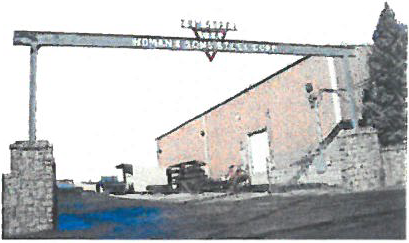
An "accessory sign" is a sign inscribed onto a fence, archway, berm, or similar accessory structure that is not erected for the sole purpose of mounting a sign. A sign posted on a placard, board, poster, banner, or similar appendage to an accessory structure is considered an incidental sign and regulated by section 27-729.
b.
Accessory signs are subject to Table VIII-11-2 accessory signs, but are not subject to the maximum allocation for attached signs if the accessory signs are within the maximum area prescribed in line 7, below:
(4)
Awning/canopy/marquee signs.
a.
Definitions.
| Awning Sign | A sign that is painted, stenciled or attached to the surface of an awning. An "awning" means a roof-like cover that projects from the wall of a building to shield a doorway, walkway, or window from inclement weather or the sun. Awnings are often made of fabric or flexible plastic supported by a rigid frame and may be retracted into the face of the building. | 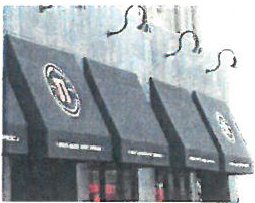 |
| Canopy Sign | A sign attached to the surface of a canopy. A "canopy" means an overhead structure made of solid material, other than an awning, that is either attached to a building wall and extends at least twelve (12) inches from the face of the building or a freestanding overhead structure supported by posts. | 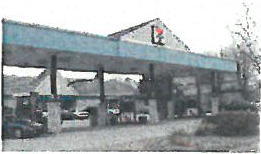 |
| Marquee Sign | A sign attached to the fascia of marquee. A "Marquee" means a hood or awning of permanent construction without pillars or posts which is supported from a building wall and extends beyond the building, building line, or property line. A sign attached to the bottom of a Marquee is considered an Under-Canopy Sign. | 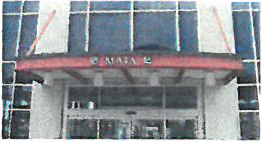 |
| Over Canopy Sign | A sign on the top of a roof overhang of a covered porch or walkway which identifies the tenant of the adjoining space. | 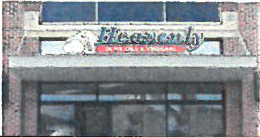 |
| Under Canopy Sign | A sign suspended from the underside of a canopy, a covered porch or a walkway. | 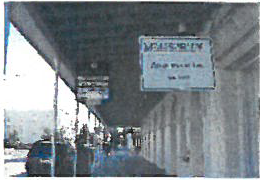 |
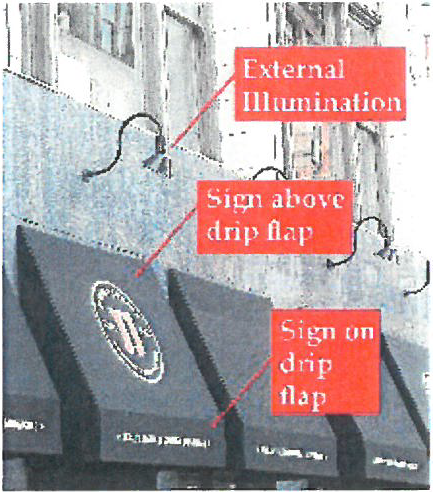
b.
Standards. Awning signs (located above the drip flap portion of the awning), canopy signs, marquee signs, and over canopy signs toward the maximum attached sign allowance (see section 27-727). Awning signs located only on the drip flap portion of the awning and with letters not exceeding 18 inches in height, and under canopy signs do not count toward the maximum attached sign allowance.
(5)
Murals.
a.
Definition. A "mural" is a hand produced or machined graphic applied or affixed to the exterior of a building wall through the application of paint, canvas, tile, metal panels, applied sheet graphic or other medium generally so that the wall becomes the background surface or platform for the graphic, generally for the purpose of decoration or artistic expression, including but not limited to, painting, fresco or mosaic.
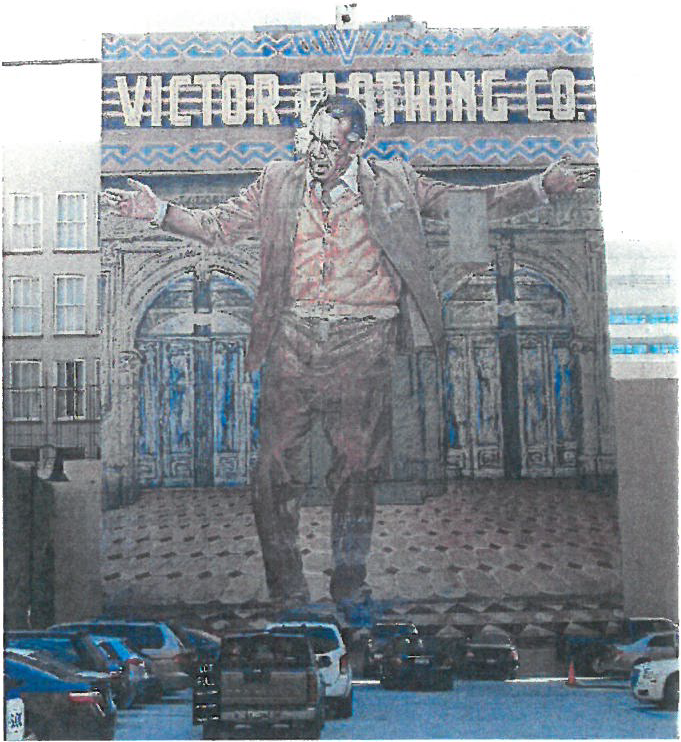
b.
Standards.
1.
Murals are not permitted on the primary façade. A primary façade is defined, for purposes of this section, as a building elevation that faces the adjacent street right-of-way and is the primary customer entrance. Buildings located on a block corner with the primary customer entrance located diagonally at the building corner to both intersecting streets has two primary facades.
2.
On lots that share a property line with a residential zoning district, murals are not allowed on building walls that face a residential zoning district.
3.
Up to 20 percent of a mural may include text or commercial copy. No more than five items of information (as defined in subsection 27-724(d)) may be included in the area used for text or commercial copy.
4.
The mural shall be kept in good condition for the life of the mural according to the maintenance schedule and responsibilities approved by the director and incorporated into the sign permit. A mural is in a state of disrepair when 25 percent or more of the display surface area contains peeling, faded or flaking paint, or is otherwise not preserved in the manner in which it was originally created.
5.
The display surface shall be kept clean, neatly painted, and free from corrosion.
* The wall area that may be covered by a mural is as follows:
(6)
Projecting signs.
a.
Definition. A "projecting sign" is a sign supported by and extending at least 18 inches from a building wall.
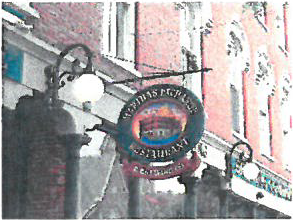
b.
Standards.
1.
No projecting sign shall extend more than five feet or beyond the outer edge of a sidewalk, whichever is greater. A projecting sign may not extend into any portion of the street right-of-way other than a sidewalk.
2.
The lower edge of the projecting sign shall be at least ten feet above any sidewalk and 14 feet above any alley surface where vehicles may pass below.
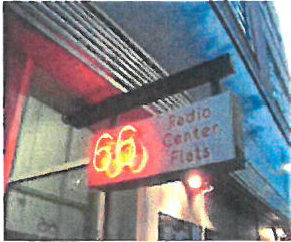
3.
The upper edge of a projecting sign shall not extend vertically above the eave line of a structure.
4.
All projecting signs shall be attached at right angles to the supporting structure and may be anchored no more than six inches from the structure.
(7)
Roof signs.
a.
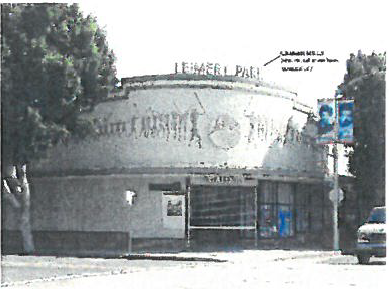
Definition. A "roof sign" means a sign that is mounted upon or above a roof or parapet of a building or structure that is wholly or partially supported by the building or structure, and which projects above the cornice or parapet line of a building with a flat roof, the eave line of a building with a gambrel, gable, or hip roof, or the deck line of a building with a mansard. A mansard having a pitch exceeding 1:3 (one foot horizontal and three feet vertical) is a wall. A mansard having a less vertical slope is a roof. A roof sign does not include a sign that is mounted flush on the surface of a roof, in which case the sign is classified as a wall sign.
b.
Standards.
1.
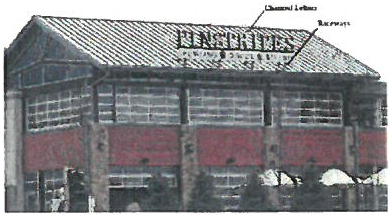
Structural members for roof signs shall be concealed, except for raceways that mount channel letters.
2.
Roof signs shall comply with the following standards. The maximum area is subject to the sign allocation system in section 27-727 and this section. The allowable sign area for an individual sign may be less than the maximum allowed by this section where needed to observe the maximum sign allowance in section 27-727.
(8)
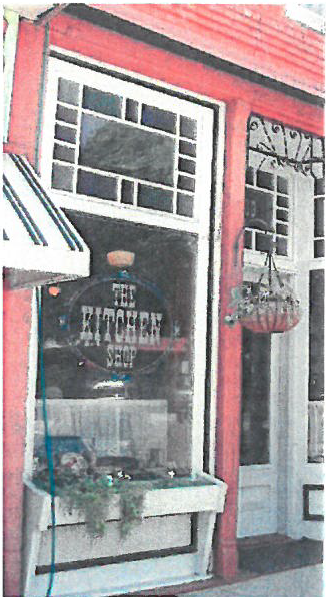
Wall signs.
a.
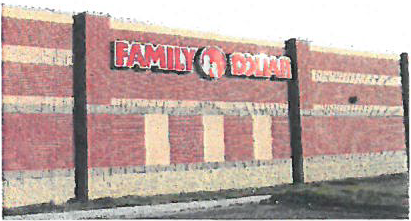
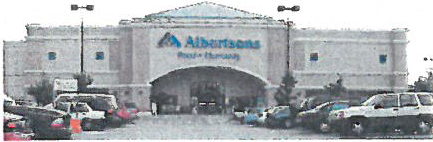
Definitions. A "wall sign" means a sign (other than a projecting sign, roof sign, or window sign) that uses a building wall as its primary source of support, and that:
1.
Is placed directly on and contained totally within the dimensions of the outside wall;
2.
Does not extend more than 18 inches from a building surface.
b.
Standards.
(9)
Window signs.
a.
Definition. Window signs are signs posted, painted, placed, affixed to a window and inside a building, but clearly visible from outside the building. Signs placed on the exterior of a window are not permitted.
b.
Standards. Window signs are counted toward the maximum sign area, but not the maximum number of signs, in the sign allocation system (section 27-727).
(c)
Detached signs.
(1)
Applicability. This subsection applies to detached signs allowed by this division. A "detached sign" means a single or double-faced sign placed upon or supported by the ground independent of any other structure, such as a monument sign.
(2)
Billboards. See section 27-733.
(3)
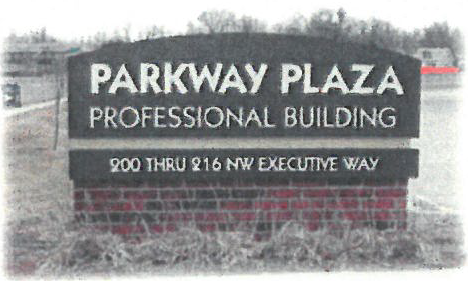
Monument signs.
a.
Definition. A detached sign whose sign surface is attached to a proportionate base or structural frame with a minimum width of one-half the width of the widest part of the sign face.
b.
Standards. Monument sign shall comply with table VIII-11-9 monument signs and the following:
1.
The base shall not exceed a height of five feet above the average finished grade.
2.
An enclosed or solid sign base is not required if the sign face is within two feet of the average finished grade.
3.
The materials of the base of a monument sign shall be either masonry, stone or concrete.
4.
Monument signs shall be located proximate to the principal entrance into the lot, site or premises. "Proximate" means that the sign is located within 25 feet of the edge of the street right-of-way abutting the driveway entrance.
5.
Maximum sign height at the minimum setback line is 15 feet in each nonresidential zoning district. For each one foot of additional setback, one foot of additional height and five square feet in sign area is allowed up until the maximum sign area allocation for detached signs established in section 27-727 is reached.
(4)
Sandwich/"A" frame signs.
a.
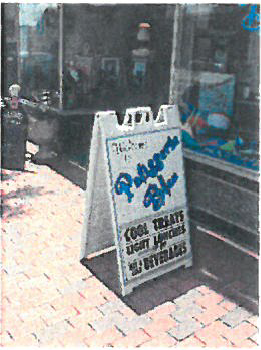
Definitions. A "sandwich board" means a portable sign that is ordinarily in the shape of an "A" with back to back sign faces, an easel, or a similar configuration.
b.
Standards.
1.
Sandwich/"A" frame signs are allowed in the right-of-way or on private property, subject to the standards in table VIII-11-10 sandwich/"A" frame signs below.
2.
Sandwich/"A" frame signs are allowed only where a building is within a build-to line established in the TND district, or where a front façade that includes an entryway open to the general public during normal business hours is within ten feet of the edge of a public sidewalk, subject to table VIII-11-10 below.
3.
Sandwich boards/"A" frame signs shall leave a minimum, unobstructed sidewalk clearance of 36 inches or as otherwise required by the ADA.
(d)
Hybrid signs.
(1)
Applicability. This section applies to signs that may either be attached or detached. The signs are subject to the applicable allocation for the sign depending upon whether it is attached or detached.
(2)
Flags.
a.
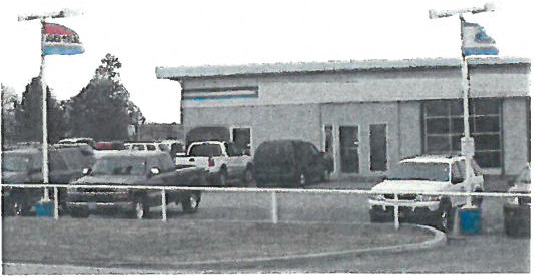
Definition. A piece of fabric or other flexible material, with distinctive colors and patterns, customarily mounted on a pole or similar freestanding structure.
b.
Standards. Flags shall comply with table VIII-11-11 flag standards below:
(Ord. No. O-35-16, § 1, 6-30-2016)
Sec. 27-729. - Temporary/incidental signs.
(a)
Applicability. This section applies to temporary signs or incidental signs. Each of the sign types described in this section (temporary signs, incidental signs, banners and feather signs) count toward the maximum allowance for temporary/incidental signs in section 27-727 except for pole banners where indicated in subsection (c)(4), below.
(b)
Temporary and incidental signs, generally.
(1)
Definitions.
| Temporary Sign | A sign typically made of lightweight or flimsy material that can be easily or quickly mounted or removed (such as cloth, canvas, vinyl, cardboard, wallboard, or other light temporary materials), with or without a structural frame, intended for a temporary period of display. Note: Examples include real estate signs, election signs, opinion signs, placards, construction signs, or signs that advertise a grand opening or special event. This paragraph is provided to clarify the regulations and does not limit the content of incidental signs. | 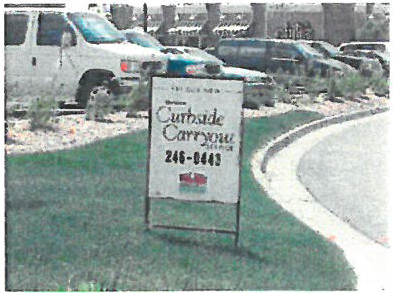 |
| Incidental Sign | A sign with copy located on a panel and mounted on a pole or a wall or similar structure, with or without a structural frame, that is normally incidental to the allowed use of the property, but can contain any message or content. Note: examples of incidental signs include directional signs, flags, menu boards, property or tenant identification names or numbers, names of occupants, signs on mailboxes or newspaper tubes, signs posted on private property relating to private parking, political signs or signs warning the public against trespassing or danger from animals. This paragraph is provided to clarify the regulations and does not limit the content of incidental signs. | 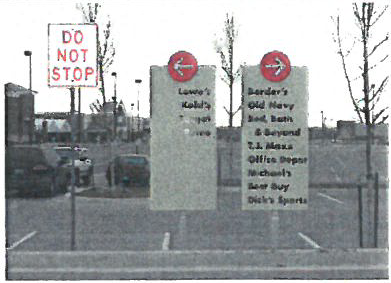 |
(2)
Generally. Temporary and incidental signs shall comply with table VIII-11-12 temporary & incidental signs (generally) and this section.
(3)
Height. The height of temporary or incidental signs shall not exceed three feet at the minimum setback line, and may increase one foot for every additional ten feet that the sign is set back up to the maximum height permitted in table VIII-11-12 temporary & incidental signs (generally).
(4)
Temporary signs.
a.
Holidays. During the following time periods, the number of temporary signs may increase to five in the residential districts, C-O, C-D district and TND T-6, the sign allocation shall increase by 50 percent, and the internal illumination is permitted:
1.
The fourth Thursday in November to January 2, and
2.
July 1—5.
b.
Materials. Temporary signs shall include a vinyl or plastic face, or a material of similar durability.
c.
Display period. A detached temporary sign may be erected for the following maximum continuous time periods:
1.
Signs mounted with standard wire stakes or T-posts: 30 days.
2.
Signs mounted with metal or wood frames, or mounting methods of similar durability: 90 days.
(c)
Banners.
(1)
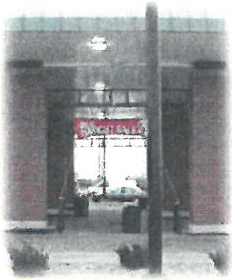
Definition. A "banner" means any strip of cloth, bunting, plastic, paper, or similar material, attached to any structure or framing. This definition does not include flags, pennants or streamers.
(2)
Standards. Banners shall comply with table VIII-11-13 banners and the following:
a.
A banner may be displayed for no more than 60 continuous days during any calendar year.
b.
Banners shall be replaced or removed if they deteriorate by becoming frayed, faded, torn, or shredded in any manner.
(3)
Wall banners. Banners mounted on a wall shall:
a.
Comply with the standards for attached signs (see subsection 27-728(b)(2)) and count toward the applicable attached sign allocation (see section 27-727), and
b.
Be securely attached flat against the building with metal brackets, expansion bolts, through bolts, or lag bolts and screws.
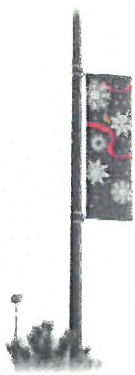
(4)
Pole banners. Banners are exempt from the maximum number, dimensions, and location requirements of table VIII-11-13 banners below and the sign allocation system in section 27-727, if they:
a.
Are mounted on a pole that provides a separate functional purpose such as street lighting, and
b.
Contain no text or other elements found in a "sign" as defined in this division.
(d)
Feather signs.

(1)
Definition. A "feather sign" means a banner in the shape of a feather, quill, sail, blade or teardrop, and mounted on a solid or flexible pole or cord. These are sometimes referred to as "quill signs" or "sail banners."
(2)
Standards. Feather signs shall comply with table VIII-11-14 feather signs and the following:
a.
Feather signs are not allowed in the public right-of-way. Where feather signs are installed in the right-of-way in violation of this ordinance, the unified government may require the applicant to pay the costs of removing the feather signs to the extent allowed by law.
b.
Feather signs may only be installed for a maximum of three continuous days during any 60 day period.
(Ord. No. O-35-16, § 1, 6-30-2016)
Sec. 27-730. - Sign area and height measurements.
(a)
Sign area.
(1)
Detached signs.
a.
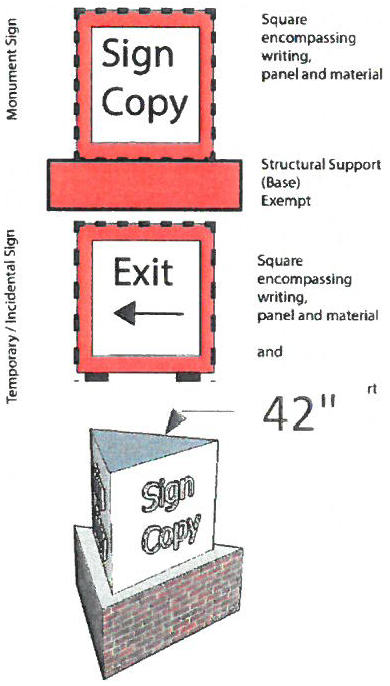
Generally. For a sign with one sign face, sign area is computed by means of the smallest square or rectangle that will encompass the extreme limits of the writing, representation, emblem, or other display, together with any panel or material forming an integral part of the background of the display against which it is placed, other than structural supports (for detached signs included in subsection 27-728(c)), but including structural supports for temporary or incidental signs).
b.
Computation of area of multi-faced signs. The sign area for a sign with more than one face is computed by adding together the area (measured as provided in subsection a., above) of all sign faces visible from any one point. When two sign faces are placed back to back, so that both faces cannot be viewed from any point at the same time, and when the sign faces are part of the same sign structure and are not more than 42 inches apart, the sign area is computed by the measuring one of the faces (as provided in subsection a, above).
(2)
Attached signs.
a.
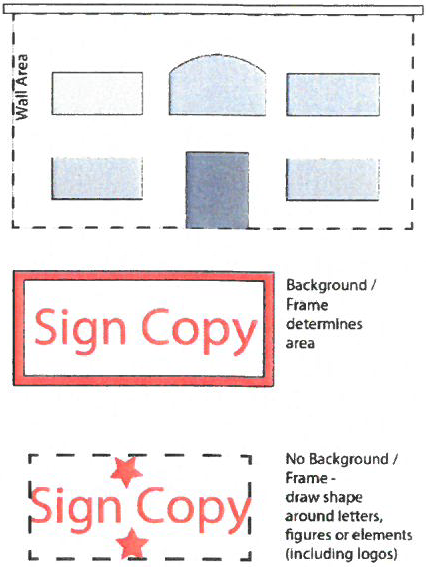
Where sign size is prescribed as a percent of wall area, the "wall area" is a continuous portion of a building facade below the roofline or major architectural feature as viewed by a person approaching the building consisting of a plane surface.
b.
For an attached sign which is framed, outlined, painted or otherwise prepared and intended to provide a background for a sign display, the area and dimensions include the entire portion within the background or frame.
c.
For an attached sign comprised of individual letters, figures or elements on a wall or similar surface of the building or structure with no distinct mounting surface (such as a board or plastic face) other than the wall, the area is calculated by:
1.
Applying a regular geometric shape (rectangle, circle, trapezoid, triangle, etc.) around the individual letters, figures or elements, or
2.
Up to the number of regular geometric shapes as provided for the maximum number of attached signs per facade in section 27-727 for each wall or face that enclose distinct clusters of individual letters, figures or elements.
d.
When separate elements are organized to form a single sign, but are separated by open space, the sign area and dimensions shall be calculated by determining the geometric form, or combination of forms, which comprises all of the display areas, including the space between different elements.
e.
The sign area does not include any supporting framework, bracing, or decorative fence or wall when the fence or wall otherwise meets zoning ordinance regulations and is clearly incidental to the display itself.
(3)
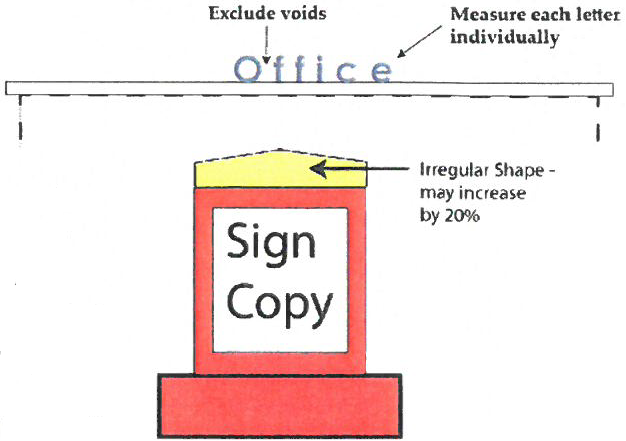
Artistic elements. Signs that are composed of individual letters, symbols, pictographics or other artistic elements without a distinct mounting surface (such as a board or plastic face), such as channel lettering, the sign area is the sum total of planar surface area of the individual sign components, excluding voids between the letters or components. The permitted sign area for an individual sign (see section 27-728) may increase by up to 20 percent to accommodate irregular shapes that extend beyond the mounting surface, but the overall sign area must fall within the maximum sign area allocation established in section 27-727. The 'planar surface' refers to the horizontal plane facing the public right-of-way, and excludes any three-dimensional elements that are perpendicular to the public right-of-way.
(4)
Incidental or temporary signs. Incidental or temporary signs are measured in accordance with subsection (1) if they are not attached to a building or structure, and subsection (2) if they are attached to a building or structure.
(b)
Sign height.
(1)
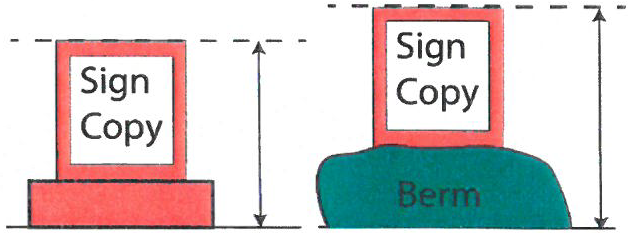
The height of a detached sign is measured from the base of the sign or supportive structure at its point of attachment to the ground, to the highest point of the sign. A detached sign on an artificial base, including a graded earth mound, is measured from the grade of the nearest pavement or top of any pavement curb.
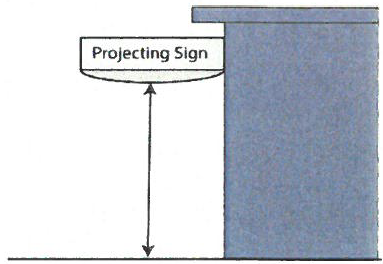
(2)
Clearance for detached and projecting signs is measured as the smallest vertical distance between finished grade and the lowest point of the sign, including any framework or other embellishments.
(Ord. No. O-35-16, § 1, 6-30-2016)
Sec. 27-731. - Master sign plans.
Purpose. This Section establishes as process to develop standards to assure harmony and visual quality throughout a master planned project.
(a)
Applicability. This section applies to an office park, hotel or motor hotel, shopping center, industrial park, or other grouping of three or more buildings, tenants or establishments.
(b)
Master sign plan required.
(1)
An applicant subject to this section shall submit a set of sign standards for all exterior signs with any application for a rezoning, special use permit, or site plan.
(2)
The master sign plan is approved concurrent with the rezoning, special use permit, or site plan.
(c)
Standards—Generally.
(1)
The master sign plan shall establish standards for the size, colors, materials, styles of lettering, appearance, type of illumination and location consistent with this division and table VIII-11-9 below.
(2)
The applicant and its successors and assigns shall comply with the approved master sign plan.
(3)
The standards for the master sign plan supersede any standards in sections 27-727 and 27-728 to the extent that they are inconsistent. Any signs not addressed in the master sign plan are subject to the standards in sections 27-727 and 27-728.
(4)
The approved master sign plan standards shall run with all leases or sales of portions of the development.
(d)
Additional standards for center/secondary signs.
(1)
If not located within the landscaped setback, the sign base shall be located within a curbed, landscaped area extending at least three feet on all sides of the sign base.
(2)
An additional sign may be incorporated into a structure such as a water feature, sculpture, topiary, or other art form if the director finds that:
a.
The sign is integrated visually with the structure,
b.
Is compatible with the scale and design of the feature or art form, and
c.
Is compatible with surrounding development.
(e)
Wall signs.
(1)
Generally. One wall sign is allowed in a center for each occupant with façade frontage (refer to sections 27-727 and 27-728 for dimensional standards).
(2)
Districts CI and CPI. Individual businesses in multitenant buildings in the CI or CPI districts are permitted, in lieu of the maximum wall sign allocation, to have a wall sign up to 25 square feet in area if the sign does not exceed 10 percent of the wall area.
(3)
Districts CP-O and MP-3. In districts CP-O through MP-3, single tenant buildings of more than 100,000 square feet may have one wall sign on each building facade in addition to any permitted detached sign. Sign area must comply with section 27-728.
(Ord. No. O-35-16, § 1, 6-30-2016)
Sec. 27-732. - Sight distance at intersections.
No sign that obstructs the view is allowed within the sight distance triangle of a street intersection, as provided in division 8 (section 27-637) of this article.
(Ord. No. O-35-16, § 1, 6-30-2016)
Sec. 27-733. - Residential land development signs.
(a)
Applicability. Each residential land development is permitted two monument signs (hereinafter "entrance signs") for each public street entrance into the development.
(b)
Standards.
(1)
The Entrance Signs shall not exceed five feet in height or 40 square feet in area.
(2)
Where the entrance sign is proposed to be incorporated into a larger structure such as a wall, entrance gate, fence or other substantial structure, the structure shall not exceed eight feet in height and the area of copy shall not exceed 32 square feet.
Sec. 27-734. - Billboards.
(a)
Compliance. No billboard shall be erected, installed or structurally altered except in conformance with this section.
(b)
Definitions. The following words, terms, and phrases, when used in this section, have the meanings assigned below, except where the context clearly indicates a different meaning:
(c)
District sign requirements. Billboards are allowed only in the M-2 and M-3 zoning districts. In addition:
(1)
In the M-2 zoning district, only junior poster panels and poster panels are allowed, not to exceed 300 square feet in sign surface area.
(2)
In the M-3 zoning district, junior poster panels and poster panels are allowed. A bulletin whose sign surface does not exceed 925 square feet is allowed when adjacent to freeways and expressways as defined by the unified government's major street plan.
(d)
Permitted and prohibited locations.
(1)
Billboards, except for digital billboards, are permitted on Argentine Boulevard, Southwest Boulevard, and Quindaro Boulevard, their boulevard designation notwithstanding.
(2)
Regardless of zoning district, billboards are prohibited on any lot or parcel abutting, or within 300 feet, of the following streets:
a.
Grandview Boulevard from 9th Street to Park Drive.
b.
Hoel Parkway from Minnesota Avenue to Washington Boulevard.
c.
Meadowlark Lane from State Avenue to Parallel Parkway.
d.
Parallel Parkway from 3rd Street to the western city limits.
e.
Park Drive from 18th Street to 38th Street.
f.
Parkwood Boulevard from 10th Street to Brown Avenue.
g.
Rainbow Boulevard from Southwest Boulevard to County Line Road.
h.
Washington Boulevard from 3rd Street to Orville Avenue.
i.
Wilson Boulevard from Grandview Boulevard to 23rd Street.
j.
57th Street from K-32 Highway to State Avenue.
k.
59th Street from Parallel Parkway to Leavenworth Road.
l.
77th Street from Parallel Parkway to Leavenworth Road.
m.
78th Street from K-32 Highway to Parallel Parkway.
n.
107th Street/110th Street/Hutton Road from 1-70 Highway to Wolcott Drive/95th Street/K-5 Highway.
o.
I-435.
p.
I-635.
q.
18 th Street from 1-670 to K-5.
r.
7 th Street.
s.
State Avenue.
(e)
Sign permits. Sign permits are required (see section 27-723) and as follows:
(1)
Any person owning, controlling, or maintaining any billboard within the city shall file annually, between December 15 and December 31 of each calendar year, a report with the building official, in a form approved by the building official, giving the location, size, and illumination of all existing signs that that person controls.
(2)
The building official shall annually inspect, during the month of January of each calendar year, all billboards within the city limits to determine their conformance with this division.
(3)
No renewal permit shall be issued for any legal, nonconforming billboard until the building official performs an inspection and determines that the billboard complies with this division. The county administrator shall establish the annual inspection fees. The inspection fee shall be paid at the time the annual report for each sign is filed with the building official.
(f)
Surface restrictions.
(1)
No portion of an outdoor advertising surface shall be more than 35 feet high. Where not located along a freeway or expressway, the vertical dimension shall be no more than 17 feet high.
(2)
No sign surface shall be more than 53 feet wide.
(3)
No sign surface shall be larger than 750 square feet in area.
(4)
Two sign surfaces located one above the other or side by side which have parallel sign surfaces visible from the same position, are located on the same sign structure, and collectively would not exceed the sign surface requirements for subsections (1)—(3) of this section for height, width, and area of a single sign surface, are not prohibited by this requirement.
(5)
Animated, flashing, smoking, or rotating sign surfaces and beacons are prohibited.
(6)
Except for digital billboards, sign copy on billboards shall not be changed more than once every twelve hours.
(g)
Digital billboards.
(1)
Locations.
a.
Digital billboards are permitted on legally established, existing billboard structures located adjacent to interstate highways, subject to the requirements of this Code.
b.
Digital billboards are permitted on existing off-premises billboard structures and shall comply with the requirements set forth in this section in addition to all other applicable requirements of this chapter. A stacked or side-by-side sign is not allowed under this section. Digital billboards are not permitted on billboard structures newly erected after the effective date of this section.
(2)
Operational limitations. Digital billboards shall comply with subsection 27-726(d).
(3)
Permitting. A special use permit is not required to convert an existing off-premises billboard to a digital billboard. However, the sign owner/applicant shall apply for and must obtain a sign permit from the planning director prior to any conversion. The sign owner/applicant shall provide the following information upon forms prescribed by the planning director, along with the applicable fee, and shall be accompanied by a written, detailed plan which sets forth:
a.
The location and size in square footage of the sign to be converted;
b.
The size in square footage of the existing billboards to be removed;
c.
The locations of the signs to be removed;
d.
The submission of stamped drawings from an engineer, showing required structural upgrades and alterations necessary to support the weight of the added digital technology necessary for the conversion; and
e.
A statement that the signs being removed meet the removal criteria of subsection (k) below.
(4)
Conversion of billboards. The conversion of an existing billboard to a digital billboard is not considered "maintenance" for purposes of subsection 27-723(a)(2)a or subsection 27-725(c)(5). Those conversions are subject to the permitting and fee requirements of this division.
(h)
Removal criteria for digital billboards. With respect to a digital billboard permit, as a condition of approval, the owner/applicant shall, at his or her sole expense, comply with the following requirements:
(1)
In the case of poster boards and junior poster boards, at least two and a half times the square footage of existing conforming or nonconforming outdoor advertising poster or junior poster board signage in Kansas City, Kansas shall be removed contemporaneously with the conversion of the approved digital advertising sign of the same square footage;
(2)
In the case of bulletins, at least one and a half times the square footage of existing conforming or nonconforming outdoor advertising bulletin signs in Kansas City, Kansas shall be removed contemporaneously with the conversion of the approved digital advertising sign of the same square footage.
(3)
Failure of the owner/applicant to remove the existing billboard within 30 days of the completed conversion of any new digital billboard violates this section and is grounds for revocation of the owner/applicant's permit for the digital billboard.
a.
A conversion shall be deemed complete when all supporting structures, cabinets and electronic fixtures are installed, even if messages have not yet begun displaying on the digital billboard.
b.
A written affidavit from the owner/applicant stating that removal is complete shall be filed with the planning director within seven business days after the 30-day removal period. Failure to provide the affidavit within seven business days after the 30-day removal period results in a $1,000.00 fine for every day that the applicant fails to provide the affidavit.
(4)
Spacing of outdoor signs. The exact locations of any conforming or nonconforming billboard or signs that are removed pursuant to this section shall continue to be used for the purpose of future calculations regarding spacing between billboards and digital billboards, such that the removal of one billboard does not allow for construction of a new billboard in the same area.
(5)
Limited number of permits. No owner/applicant is allowed to have more than seven permits for digital billboard surfaces in Kansas City, Kansas at any one time.
(i)
Sign height.
(1)
No sign structure or surface shall project higher than 40 feet above the average finished grade measured at the base of the sign structure.
(2)
If a street or highway surface to which the sign is oriented is higher than the average finished grade elevation at the base of the sign structure, the higher street elevation may be used in determining the permitted height.
(3)
In no case shall the height exceed 80 feet above the average finished grade elevation at the base of the sign structure. There shall be an open space of at least ten feet between the bottom of the sign surface and the finished grade elevation at the base of the sign structure.
(j)
Sign setback. No sign shall be closer than 25 feet to any property line. When a sign is located adjacent to residentially zoned property, the sign setback shall be equal to the overall sign height or the most restrictive setback, whichever is greater.
(k)
Sign spacing.
(1)
No new sign shall be less than 1,000 feet from any existing billboard surface. When adjacent to a freeway or expressway or class A thoroughfare, the minimum distance shall not be less than 1,000 feet. The required distance shall be measured along the centerline of the frontage street or streets from a point opposite any edge of a sign surface and perpendicular to the street's centerline. For the purpose of this division, frontage street or streets shall include exit and entrance ramps associated with the freeway or expressway or class A thoroughfare system as well as the main traveled roadway. Any sign that is farther than 660 feet from freeway, expressway or class A thoroughfare right-of-way shall not be considered adjacent. Double-faced sign structures having parallel sign surfaces and adjacent sign structures having touching sign surfaces with an angle no greater than 90 degrees between sign surfaces, and not exceeding the sign surface requirements, are not prohibited by this requirement.
(2)
No sign shall be located within 500 feet of a publicly owned park or publicly owned building.
(3)
No sign shall obstruct clear vision of any road or railroad intersection.
(4)
No sign shall be erected which obstructs any authorized traffic-control device.
(5)
No sign shall be erected which blocks the surrounding view within 500 feet of a residential structure located in a residential zoning district. When determining if a sign would block the view from a residential structure, the planning commission shall consider topographical conditions, sign elevation, sign placement, sign dimensions, sign lighting, and amount of view that would be obstructed.
(l)
Roof signs. No new billboard shall be located on or above the roof of any building.
(m)
Landscaping. All yard areas not covered by sign structures or paved areas and within 15 feet of the sign shall be landscaped with such landscaping continuously maintained. If the grade at base of the sign is altered, proper drainage for surface water shall be provided by the sign company of record.
(n)
Maintenance. The exposed upright superstructure or backside of all billboards shall be painted a neutral color such as light blue, gray, or white unless it is integral to the overall design of the sign.
(o)
Provisions not severable. The provisions of this section are declared to be not severable and if any provision, word, phrase or clause of this section or its application to any person or other entity is held invalid, that invalidity causes the remaining portions of this section to be invalid.
(Ord. No. O-35-16, § 1, 6-30-2016)
Sec. 27-735. - Freeway and expressway signs.
(a)
Generally. On sites meeting all the location and other requirements set out in this section, larger and taller detached signs are allowed. This is in deference to the higher speeds and limited access on freeways and expressways. This section does not allow additional signs or for center signs to be larger or taller than allowed under the provisions of section 27-731.
(b)
Standards.
(1)
Minimum frontage. Two hundred feet continuous linear feet of property abutting freeway or expressway right-of-way.
(2)
Sign location. No more than 100 feet from the freeway or expressway right-of-way and where adjacent only to the entrance or exit ramps, no more than 250 feet from the nearest portion of the actual paved ramp.
(3)
Sign orientation. Sign face must be oriented toward the expressway or freeway.
(4)
Sign setback. As set out in section 27-734.
(5)
Sign height. The maximum sign height allowed is twice that set out in section 27-734, as measured from the finished grade at the edge of the freeway or expressway right-of-way nearest the sign to the top of the sign.
(6)
Sign area. The maximum sign area allowed shall be twice that set out in section 27-734.
(Ord. No. O-35-16, § 1, 6-30-2016)
Sec. 27-736. - Variances.
(a)
Generally. Applicants may request a variance from the dimensional and design requirements of this division pursuant to section 27-216.
(b)
Traffic safety considerations. In requesting a variance from the size or illumination requirements of this section, the applicant may provide and the board of zoning appeals may consider factors relating to the appropriate sign size based on posted vehicle travel speeds, viewer reaction time, detection, and legibility as described in the following formula:
A sign = 3n/80 [(VRT)(MPH)/LI] 2
where:
A sign = area of the sign
Fixed value: 40/60 ratio of letter to negative space
Variable values:
n = number of letters
VRT = Viewer Reaction Time (seconds)
MPH= miles per hour (travel speed)
LJ = Legibility Index
Application of this formula is described in Street Graphics and the Law, Fourth Edition (American Planning Association, PAS Report 580, August 2015), chapter 4, which document is hereby incorporated by reference and maintained in the offices of the planning director.
(Ord. No. O-35-16, § 1, 6-30-2016)
Sec. 27-737. - Enforcement.
(a)
Generally.
(1)
No sign regulated under this division shall be installed, erected, or maintained in violation of the provisions of this division.
(2)
Signs in violation of this division are enforceable as provided in section 27-343, 27-344, and this section.
(b)
Notice of violation.
(1)
If a sign fails to meet the requirements of this division, the building official shall cause a notice to be sent to:
a.
The owner of record of the tract or building upon which the sign is situated, and
b.
For billboards, to the permit holder of the sign, by certified mail, return receipt requested.
(2)
The notice shall inform the owner or permit holder of the location of the sign and the nature of the violation.
(3)
The owner or permit holder has ten days from receipt of the notice in which to correct the violation. For good cause shown, the building official may extend the time for compliance.
(4)
Any owner or permit holder failing to timely correct the violation is subject to penalty as set forth in section 1-8 of the Unified Government Code. The building official shall not issue building permits for new signs to any person who is in violation of the provisions of this division.
(c)
Removal of signs on public property.
(1)
Signs posted or otherwise affixed to or on any of the following, or as described below, are unlawful and in violation of this division and are subject to immediate removal without notice. Any signs removed under this subsection will be held for ten days and, if not claimed within that time, will be disposed of:
a.
Any public building or any public bridge;
b.
Any sidewalk, crosswalk, or curb;
c.
Any public right-of-way;
d.
Any paved portion of any street or highway;
e.
Any median strip of any divided street or highway;
f.
Any street sign or on any traffic sign or signal or any railroad sign or signal;
g.
Any telegraph, telephone, electric light, power, or any other utility pole or any fire hydrant;
h.
Any tree on public property, including those in the public right-of-way;
i.
Any public park;
j.
In a manner that may cause a reduction in intersection sight distances or create any other hazard to life or safety;
k.
In a manner which obstructs clear vision of any road or railroad intersection; or
l.
In a manner which obstructs any authorized traffic control device.
(2)
This subsection does not apply to signs erected by, on behalf of, or pursuant to the authorization of a governmental body, including identification, informational, traffic, directional, or regulatory signs.
(d)
Failure to maintain. The unified government may declare a sign that is not properly maintained as provided in section 27-725 a nuisance, and seek abatement as provided in K.S.A. 12-1617e.
(Ord. No. O-35-16, § 1, 6-30-2016)
Sec. 27-738. - Definitions.
(a)
Generally. This division is subject to all definitions, rules of interpretation and enforcement provisions of:
(1)
The International Building Code, as adopted and amended by the city, and
(2)
Section 27-340 of this article.
(b)
The following words, terms, and phrases have the meanings assigned below, except where the context clearly indicates a different meaning:
| Advertising | Any sign text, logo, or other representation that, directory or indirectly, names, advertises, or calls attention to a business, product, service, or other commercial activity. |
| Attached sign | See subsection 27-728(b). |
| Awning sign | See subsection 27-728(b)(4)a (awning/canopy/marquee signs). |
| Balloon |
An inflatable device, tethered in a fixed location and greater than 18 inches in any
direction, that:
• has a sign with a message on its surface or attached in any manner to the balloon, or • is attached to a building or pole, or in a manner so that it projects higher than the roof of the main building on the lot or parcel. |
| Banner sign | See subsection 27-729(c) (banners). |
| Billboard | See section 27-734. |
| Building area | See "floor area, habitable" as defined in section 27-340. |
| Building code | The International Building Code, as adopted and amended by the unified government (see chapter 8, article II of the Unified Government Code). |
| Bulletin | See subsection 27-734(b) (billboards). |
| Canopy sign | See subsection 27-728(b)(4)a (awning/canopy/marquee signs). |
| Center |
A development or proposed development that:
• has multiple buildings or tenants under unified management, or • is created by a subdivision (see Article VII) in the C-O, C-1, C-D, C-2, C-3, M-1, B-P, M-2, M-3, TND T-5, TND T-6, TND D, CPO, CP1, CPD, CP2, CP3, MP1, BPP, MP2, MP3, CI, CPI, CPO, or MP-3 districts or transect zones where the proposed uses are not dwellings a defined in section 27-340 (but may include mixed use buildings as defined in section 27-471), or • is a single building with multiple non-residential tenants, or • has an approved master sign plan per section 27-731. |
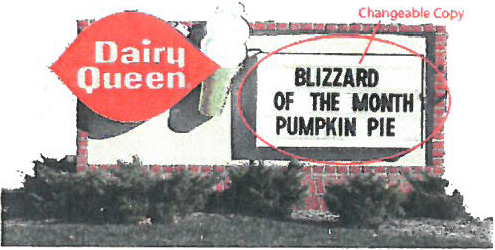
| Changeable copy | Characters, letters, numbers, or illustrations that can be manually replaced or altered through the placement of letters or symbols on a panel mounted or track system. |
 | |
| Changeable message sign | A manually, mechanically or electronically activated sign on which copy is changed two times per day or less. This includes reader boards, gas price signs, and theater marquees, but is not limited to them. Billboards, poster panels, junior poster panels and painted boards are not changeable message signs. |
| Channel Letter | A fabricated or formed three-dimensional letter. |
| Commercial copy | see "advertising." |
| Commercial district | Any of the following zoning districts: C-O, C-1, C-D, C-2, and C-3. |
| Conversion | A change in the face type of a billboard from a traditional static billboard face to a digital billboard face, or vice versa, which either maintains or reduces the length and width dimensions of the sign face. A conversion shall include any alterations to the sign structure which are necessary to support the weight of the digital technology as detailed in the requirements set forth in subsection 27-724(b)(4). |
| Copy | Any words, letters, numbers, figures, designs or other symbolic representations incorporated into a sign. |
| Detached sign | See subsection 27-728(c). |
| Digital billboard | See subsection 27-734(b) (billboards). |
| Digital sign | See subsection 27-726(a). |
| Director | The unified government director of planning or their designee. |
| Drip flap | The lower portion of an awning that hangs perpendicular above the ground. |
| Façade | The exterior wall of a building exposed to public view or that wall viewed by persons not within the building. |
| Façade frontage | The portion of a building façade that includes an entryway for customers or employees at the ground level. |
| Feather sign | See subsection 27-729(d). |
| Flag | See subsection 27-728(d)(2). |
| Flashing sign | Any sign that is internally or externally illuminated by flashing, flowing, alternating, or blinking lights. |
| Footcandle | See subsection 27-726(a). |
| Frontage | The property line that abuts a public street and/or right-of-way line. |
| Halo lit sign | See subsection 27-726(a). |
| Height | For attached signs, for attached signs, "height" refers to the maximum vertical dimensions of the sign. For detached signs, "height" refers to the sign's vertical extent from the natural grade to the highest point of the sign. |
| Illuminated sign | See subsection 27-726(a). |
| Illumination | See subsection 27-726(a). |
| Illumination, external | See subsection 27-726(a). |
| Illumination, internal | See subsection 27-726(a). |
| Incidental sign | See section 27-729. |
| Industrial district | Any of the following zoning districts: M-1, B-P, M-2, or M-3. |
| Items of information | See subsection 27-724(d). |
| Junior poster panel | See subsection 27-734(b) (billboards). |
| Main building | The primary building or structure on a lot or a building or structure that houses a principal use. A main building does not include an accessory building as defined in section 27-340. |
| Marquee sign | See subsection 27-728(b)(4)a (awning/canopy/marquee signs). |
| Menu Board | An incidental sign oriented to a driveway or drive-through lane, which may include a speaker box. A menu board is customarily used to list the menu and prices for a restaurant. |
| Monument sign | See subsection 27-728(c)(3). |
| Mural | See subsection 27-728(b)(5). |
| Neon | See subsection 27-726(a). |
| Nit | See subsection 27-726(a). |
| Original art display | A hand-painted, hand-carved or hand-cast work of visual art expressing creative skill or imagination in a visual form which is intended to beautify or provide an aesthetic influence to a public area or area. An original art display may be either affixed to or painted directly on the exterior wall of a structure with the permission of the property owner, or a three-dimensional statue that is placed in a park, courtyard, lawn, or similar area for public display. An original art display does not include: mechanically produced or computer generated prints or images, including but not limited to digitally printed vinyl; electrical or mechanical components; or changing image art display. |
| Non-commercial copy | Any copy other than advertising. |
| Nonresidential districts | Any commercial district or industrial district. |
| Off-premises sign | A sign advertising or directing attention to a name, a business, product, development, or service which is offered, manufactured, or sold at a location other than the lot or parcel upon which it is situated. |
| On-premises sign | Any sign other than an off-premises sign. |
| Over canopy sign | See subsection 27-728(b)(4)a (awning/canopy/marquee signs). |
| Pennant | An object or sign of lightweight fabric or similar material, suspended from a rope, wire or string, usually in series, and designed to move in the wind, also including streamers, pinwheels, balloons (less than 18 inches in any direction) and similar small objects. |
| Planar surface | Refer to section 27-730 (sign area and height measurements). |
| Pole | A vertical support such as an upright, brace, column, or other vertical member, that supports a sign face and that does not meet the width prescribed for the supporting element of a monument sign (see subsection 27-728(c)(3)a). |
| Pole or pylon sign | A detached sign supported by pole, is not attached to a building, and where the bottom edge of the sign face is located three feet or more above the average finished grade at the base of the sign. A "pole sign" does not include a flag mounted on a flagpole, where permitted by subsection 27-728(d)(2). |
| Pole cover | A material which encloses or decorates a pole or other structural support of a sign. |
| Portable sign | Any sign designed to be moved easily and not permanently affixed to the ground or to a structure or building. |
| Poster panel | See subsection 27-734(b) (billboards). |
| Projecting sign | See subsection 27-728(b)(6). |
| Roof sign | See subsection 27-728(b)(7). |
| Reface | To replace, restore, repaint or repair a sign face that is attached, annexed, or supported from the sign cabinet and/or main structure. It does not include any other rebuilding, reconstructing or reconfiguration of the existing sign cabinet and/or existing supporting structure. |
| Residential district | Any of the following zoning districts: A-G, R, R-1, R-1(B), R-2, R-2(B),R-3, R-4, R-5, R-6, and R-M. |
| Rotating sign | Any sign surface or sign structure or any portion thereof which rotates, moves, or is animated. |
| Sandwich or A-frame sign | See subsection 27-728(c)(4). |
| Search light | An apparatus containing an electric light and reflector on a swivel for projecting a far-reaching beam in any desired direction. |
| Setback | The distance from a property line to any edge of a sign. |
| Sign | Any outdoor announcement, device, design, figure, trademark or logo used for decoration, conveying information, identification, or to advertise or promote any business, product, activity, service or interest placed so as to be seen from outside a building or premises. For clarification, examples of items which typically do not satisfy the necessary elements of this definition include, but are not limited to, original art displays, architectural elements incorporated into the style or function of a building, or inscriptions on decorative rocks. |
| Sign face | The exterior area or surface on which is placed the copy. |
| Sign structure | The support, upright bracing, anchors, braces, and framework for any sign. |
| Sign surface | The entire area within a single continuous rectangular, triangular, or trapezoidal shape which encloses all elements that form the display, including any background which is different from or in contrast with any building wall surface upon which it is mounted. |
| Temporary use | See section 27-729. |
| Twirling sign | A sign that is designed to twirl, spin, or gyrate, either through mechanical activation or wind. |
| Under canopy sign | See subsection 27-728(b)(4)a (awning/canopy/marquee signs). |
| Unified management | Property or multiple buildings in single ownership or under the supervision of a single corporation, partnership, or other business entity. |
| Wall area | See subsection 27-730(a)(1). |
| Wall sign | See subsection 27-728(b)(8). |
| Wind sign | A sign consisting of one or more banners, flags, pennants, wind socks, ribbons, spinners, streamers, captive balloons, or other objects or material fastened in such a manner as to move upon being subjected to pressure by wind. |
| Window sign | See subsection 27-728(b)(9). |
(g)
Abbreviations.
(Ord. No. O-35-16, § 1, 6-30-2016)
Cross reference— Definitions generally, § 1-2.
Sec. 27-739. - Special on-site signage.
(a)
This section is established in reference to the special signage needs of major community entertainment and recreational attractions. Under subsection 27-593(a)(7) a special use permit may be approved that supersedes the provisions of this article to the extent designated and may be more and/or less restrictive than the provisions of this article. Such special on-site signage may only be approved for entertainment and/or recreational attractions which have improvements capable of serving at least 1,000 patrons at a time, or entertainment, shopping and/or recreational facilities of regional significance and unique to the community.
(b)
In addition to the factors to be considered for all special use permits, the planning commission and unified government board of commissioners shall consider the purposes set out under section 27-720 as well as the attractiveness, quality, and durability of the proposed signage.
(c)
No such request shall be approved until an overall set of sign standards for all exterior signs within the development in question has been submitted. The size, color, materials structures, styles of letters, appearance of any logo, type of illumination and locations shall be set out in such standards.
(Code 1988, § 27-1398; Ord. No. 65567, § 6, 9-20-1990; Ord. No. 65814, § 27, 7-8-1993; Ord. No. O-9-15, § 1, 1-29-2015)

