
Kansas City City Zoning Code
DIVISION 4
DISTRICT REGULATIONS
Sec. 27-452.- A-G agriculture district.
(a)
Generally. This section applies to the A-G agricultural district. The purpose of the A-G agriculture district is to provide for those areas on the periphery of the city where agriculture is the predominate land use. It is designed to protect agriculture from premature or disorderly intrusion by urban land uses, and as a holding zone for properties where more intense urban development is not yet feasible. Rezonings from this district shall be carefully considered in light of likely effects on the successful implementation of the comprehensive land use plan and the availability of public facilities. A subdivision that would create one or more lots of less than five acres will require rezoning to the appropriate residential or other zoning district.
(b)
Permitted uses. In the A-G agriculture district, no building, structure or land shall be used and no building or structure shall be hereafter erected, converted, or structurally altered unless otherwise provided in this article, except for one or more of the following uses:
(1)
One-family dwellings.
(2)
Agricultural use, excluding feedlots or confinement livestock or poultry operations. The keeping or raising of livestock, horses, or poultry shall be limited to ownerships of at least one acre. Buildings, pens or other structures devoted to such use shall be located at least 100 feet from any street or property line. Agricultural uses shall be subject to the applicable regulations of the public health department and other unified government regulations.
(3)
Publicly owned parks and playgrounds, including public recreation and service buildings and municipally owned swimming pools.
(4)
Municipal facilities of a governmental nature.
(5)
Railroad lead track rights-of-way, not including railroad yards, sidings, freight depots or train sheds, nor any other facilities which would encourage or require the stopping, starting, loading or unloading of trains.
(6)
Board of public utilities' facilities.
(7)
Crop and livestock testing facilities and laboratories.
(8)
Churches.
(9)
Golf courses and club houses appurtenant thereto, not including miniature golf courses, driving ranges, and other similar activities operated as a business.
(10)
Greenhouses, nurseries and truck gardens limited to the propagation and cultivation of plants.
(11)
Kennels for no more than ten dogs, provided the buildings and pens shall be located not less than 200 feet from any property line.
(12)
Riding stables, fishing lakes and picnic groves, provided no concession or retail sales shall be permitted.
(13)
Public and private schools, elementary and high, and institutions of higher learning, including stadiums and dormitories appurtenant thereto if located on the same campus.
(14)
Publicly owned and operated museums, libraries and community centers.
(c)
Plan approval. For all uses and structures listed as permitted uses in subsections (b)(6)—(b)(14) of this section, preliminary development plans and final plans shall be approved by the planning commission prior to the construction of new or expanded facilities, such plans shall include details as set out in section 27-212. Such uses shall provide parking and paving setbacks of six feet unless otherwise approved by the planning commission. Notice shall be sent to property owners within 200 feet except for plan approvals for governmental facilities. Approval or disapproval by the planning commission shall be based upon the following:
(1)
The capability of the site to accommodate the building, parking and drives with reasonable open space and safe and easy ingress and egress.
(2)
The degree of harmony that will prevail between the visual quality of the proposed use, building or church and the surrounding neighborhood.
The decision of the planning commission may be brought before the unified government board of commissioners for final determination.
(d)
Height and area standards. All buildings and structures and other uses of land shall conform to the following minimum standards:
(1)
Height shall be not more than 2½ stories or 35 feet.
(2)
Setback from property lines shall be as follows:
a.
Front yard: Not less than 50 feet.
b.
Side yard interior: Not less than 20 feet
c.
Side yard, corner: Not less than 50 feet.
d.
Rear yard: Not less than 50 feet.
(3)
Lot width and area shall be as follows:
a.
Lot width shall be not less than 250 feet measured at the building line; provided, however, that where a lot or tract has been in a single ownership since December 28, 1982, and has less width than required herein, this regulation shall not prohibit the erection of a single-family dwelling on a lot not less than 70 feet wide.
b.
Lot area shall be not less than five acres per dwelling unit; provided, however, that where a lot or tract has been in single ownership since December 28, 1982, and has less area than required herein, this subsection shall not prohibit the erection of a single-family dwelling on a lot not less than one acre in area.
(4)
Minimum floor area shall be 864 square feet of habitable floor area for each residence.
For additional standards and information, see division 8 of this article.
(e)
Parking standards. Two off-street parking spaces shall be provided on the premises for each single-family dwelling. For additional standards and information, see division 9 of this article.
(f)
Signs. Uses other than single-family dwellings shall be permitted one wall sign and one detached sign. For additional standards and information, see division 11 of this article.
(Code 1988, § 27-1157; Ord. No. 64690, § 1(27-17), 8-30-1984; Ord. No. 64884, § 1, 10-3-1985; Ord. No. 65515, § 1, 3-8-1990; Ord. No. 65814, § 6, 7-8-1993)
Sec. 27-453. - R rural residential district.
(a)
Generally. The purpose of the R rural residential district is to accommodate low density residential development in areas of the city which are not likely to receive sanitary sewers and other urban services in the foreseeable future, and which are not likely to disrupt the pattern of urban development now or in the future due to rough terrain, isolated location or other factors. Prior to zoning property to this district, consideration shall be given to the compatibility with neighboring land uses, size and topography of the subdivision site, and the ability of the neighborhood to accommodate the development without excessive damage to soils, roads and other elements in the environment. No area of less than 20 acres shall be rezoned to the R rural residential district unless it is abutting an area already so zoned. This section applies to the R rural residential district.
(b)
Permitted uses. In the R rural residential district, no building, structure or land shall be used and no building or structure shall be hereafter erected, converted or structurally altered unless otherwise provided in this article, except for one or more of the following uses:
(1)
Single-family dwellings.
(2)
Churches.
(3)
Any other use permitted in the R-1 district under the standards and requirements of that district.
(c)
Plan approval. For all uses listed as permitted uses in section 27-452(b)(5)—(b)(9), preliminary development plans and final plans shall be approved by the planning commission prior to the issuance of building permits. Such plans shall include details as set out in section 27-212. Approval or disapproval by the planning commission shall be based upon the following:
(1)
The capability of the site to accommodate the building, parking and drives with reasonable open space and safe and easy ingress and egress.
(2)
The degree of harmony that will prevail between the visual quality of the proposed use, building or church and the surrounding neighborhood.
The decision of the planning commission may be brought before the unified government board of commissioners for final determination.
(d)
Height and area standards. All dwellings and other uses of land shall conform to the following minimum standards:
(1)
Height shall be not more than 2½ stories or 35 feet.
(2)
Setback from property lines shall be as follows:
a.
Front yard: Not less than 50 feet.
b.
Side yard, interior: Not less than 20 feet.
c.
Side yard, corner: Not less than 50 feet.
d.
Rear yard: Not less than 50 feet.
(3)
Lot width and area shall be as follows:
a.
Lot width: Not less than 120 feet measured at the building line.
b.
Lot area: Not less than one acre per dwelling unit.
(4)
Minimum floor area shall be 864 square feet of habitable floor area for each residence.
For additional standards and information, see division 8 of this article.
(e)
Parking standards. Two off-street parking spaces shall be provided on the premises for each single-family dwelling. For additional standards and information, see division 9 of this article.
(f)
Signs. Uses other than single-family dwellings shall be permitted one wall sign and one detached sign. For additional information, see division 11 of this article.
(Code 1988, § 27-1158; Ord. No. 64690, § 1(27-19), 8-30-1984)
Sec. 27-454. - R-1 single-family district.
(a)
Generally. The purpose of the R-1 single-family district is to accommodate the bulk of single-family detached housing in the city, particularly in newly developing areas where similar density of development now exists. This section applies to the R-1 single-family district.
(b)
Permitted uses. In the R-1 single-family district, no building, structure, or land shall be used and no building or structure shall be hereafter erected, converted, or structurally altered unless otherwise provided in this article, except for one or more of the following uses:
(1)
Single-family dwellings.
(2)
Municipal facilities of a governmental nature.
(3)
Publicly owned parks and playgrounds, including public recreation and service buildings and municipally owned swimming pools.
(4)
Railroad lead track rights-of-way, not including railroad yards, sidings, freight depots or train sheds, nor any other facilities which would encourage or require the stopping, starting, loading or unloading of trains.
(5)
Board of public utilities facilities.
(6)
Churches, on parcels no less than 120 feet wide and 15,000 square feet and in converted dwellings only when all provisions of the building code for the appropriate occupancy are met.
(7)
Golf courses and club houses appurtenant thereto, not including miniature golf courses, driving ranges, and other similar activities operated as a business.
(8)
Public and private schools, elementary and high, and institutions of higher learning, including stadiums and dormitories appurtenant thereto if located on the same campus.
(9)
Publicly owned and operated museums, libraries and community centers.
(10)
Agricultural use, except that such uses that involve animals shall conform with section 27-609(3).
(c)
Plan approval. For all uses and structures listed as permitted uses in subsections (b)(5)—(b)(9) of this section, preliminary development plans and final plans shall be approved by the planning commission prior to the construction of new or expanded facilities. Such plans shall include details as set out in section 27-212. Such uses shall provide parking and paving setbacks of six feet unless otherwise approved by the planning commission. Notice shall be sent to property owners within 200 feet except for plan approvals for governmental facilities. Approval or disapproval by the planning commission shall be based upon the following:
(1)
The capability of the site to accommodate the building, parking and drives with reasonable open space and safe and easy ingress and egress.
(2)
The degree of harmony that will prevail between the visual quality of the proposed use, building or church and the surrounding neighborhood.
The decision of the planning commission may be brought before the unified government board of commissioners for final determination.
(d)
Height and area standards. All dwellings and other uses of land shall conform to the following minimum standards:
(1)
Height shall be not more than two and one-half stories or 35 feet.
(2)
Setback from property lines shall be as follows:
a.
Front yard: Not less than 25 feet.
b.
Side yard, interior: Not less than seven feet.
c.
Side yard, corner: Not less than 25 feet.
d.
Rear yard: Not less than 30 feet.
(3)
Lot width and area shall be as follows:
a.
Lot width: Not less than 65 feet measured at the building line.
b.
Lot area: Not less than 7,150 square feet per dwelling unit; provided, however, this provision shall not prohibit the use of any lot for the erection of a residence west of 1-635, if such lot contains less than 7,150 square feet and was owned as a separate lot on May 20, 1969, and is not and has not been a part of a larger ownership since that date. Residences east of 1-635 shall be in accordance with the narrow lot design guidelines incorporated herein by reference dated February 18, 2008.
c.
The narrow lot design guidelines dated February 18, 2008, are modified as follows:
1.
A residence built on a narrow lot may match elevations of adjacent residences within that street without a raised porch, except as may be required by the building code.
2.
If the residence is constructed utilizing state or federal tax credits and the regulations relating to those tax credits have requirements for ADA accessibility, exceptions to the raised front entry requirements of the narrow lot design guidelines may be granted by the director of planning.
3.
The raised front entry height is reduced from 30 inches to 14 inches.
4.
If the narrow lot has a rise from front to rear of more than seven feet, the lot is eligible for a front loaded garage.
5.
Alley and garage standards.
i.
If the narrow lot is on an unimproved or severely deteriorated alley, exceptions may be granted by the director of planning to the alley entrance requirements.
ii.
Garages in the rear yard shall be located to allow a sufficient turning radius to enter and exit the garage from the alley. Existing garage placement requirements should be utilized as guidelines.
6.
Siding standards.
i.
Any siding with a 50-year warranty will be allowed. This specifically replaces the cement board siding requirement.
(4)
Minimum floor area shall be 864 feet of habitable floor area for each residence.
For additional standards and information, see division 8 of this article.
(e)
Parking standards. Two off-street parking spaces shall be provided on the premises for each single-family dwelling, at least one of which shall be in a garage or carport. For additional standards and information, see division 9 of this article.
(f)
Signs. Uses other than single-family dwellings shall be permitted one wall sign and one detached sign. For additional standards and information, see division 11 of this article.
(Code 1988, § 27-1159; Ord. No. 64690, § 1(27-21), 8-30-1984; Ord. No. 64884, § 2, 10-3-1985; Ord. No. 65814, § 7, 7-8-1993; Ord. No. O-18-14, § 1, 2-27-2014)
Sec. 27-455. - R-1(B) single-family district.
(a)
Generally. The purpose of the R-1(B) single-family district is to provide for new and infill residential development in those older areas of the city where the existing development was substantially completed prior to World War II. It is designed to allow compatibility with the existing residential development and an efficient reuse of vacant parcels, while establishing a minimum standard to protect the health, safety and general welfare of the residents. This district is generally considered too intensive for single-family detached homes in developing sections of the city. This section applies to the R-1(B) single-family district.
(b)
Permitted uses. In the R-1(B) single-family district, no building, structure, or land shall be used and no building or structure shall be hereafter erected, converted or structurally altered unless otherwise provided in this article, except for one or more of the following uses: Any use permitted in the R-1 single-family district with uses other than single-family dwellings conforming to the standards and requirements of the R-1 single-family district.
(c)
Height and area standards. All dwellings and other uses of land shall conform to the following minimum standards:
(1)
Height shall be not more than 2½ stories or 35 feet.
(2)
Setback from property lines shall be as follows
a.
Front yard: Not less than 25 feet.
b.
Side yard, interior: Not less than ten percent of the width of the zoning lot, but no less than three feet.
c.
Side yard, corner: Not less than 25 feet.
d.
Rear yard: Not less than 25 feet.
(3)
Lot width and area shall be as follows:
a.
Lot width: Not less than 50 feet measured at the building line; provided, however, this provision shall not prohibit the use of any lot for the erection of a residence west of I-635 that is less than 50 feet wide and was owned as a separate lot on July 26, 1956, and is not and has not been a part of a larger ownership since that date. Residences east of I-635 can build at any width; given that the building is in accordance with The Narrow Lot Design Guidelines incorporated herein by reference dated February 18, 2008.
b.
Lot area: Not less than 5,000 square feet per dwelling unit; provided, however, this provision shall not prohibit the use of any lot for the erection of a residence west of I-635, if such lot contains less than 5,000 square feet and was owned as a separate lot on July 26, 1956, and is not and has not been a part of a larger ownership since that date. Residences east of I-635 shall be in accordance with The Narrow Lot Design Guidelines incorporated herein by reference dated February 18, 2008.
c.
The Narrow Lot Design Guidelines dated February 18, 2008, are modified as follows:
1.
A residence built on a narrow lot may match elevations of adjacent residences within that street without a raised porch, except as may be required by the building code.
2.
If the residence is constructed utilizing state or federal tax credits and the regulations relating to those tax credits have requirements for ADA accessibility, exceptions to the to the raised front entry requirements of the Narrow Lot Design Guidelines may be granted by the director of urban planning.
3.
The raised front entry height is reduced from 30 inches to 14 inches.
4.
If the narrow lot has a rise from front to rear of more than seven feet, the lot is eligible for a front loaded garage.
5.
Alley and garage standards.
a.
If the narrow lot is on an unimproved or severely deteriorated alley, exceptions may be granted by the director of urban planning to the alley entrance requirements.
b.
Garages in the rear yard shall be located to allow a sufficient turning radius to enter and exit the garage from the alley.
Existing garage placement requirements should be utilized as guidelines.
6.
Siding standards.
a.
Any siding with a 50-year warranty will be allowed. This specifically replaces the cement board siding requirement.
(4)
Minimum floor area shall be 750 square feet of habitable floor area for each residence.
For additional standards and information, see division 8 of this article.
(d)
Parking standards. Two off-street parking spaces shall be provided on the premises for each single-family dwelling. For additional standards and information, see division 9 of this article.
(e)
Signs. Uses other than single-family dwellings shall be permitted one wall sign and one detached sign. For additional standards and information, see division 11 of this article.
(Code 1988, § 27-1160; Ord. No. 64690, § 1(27-23), 8-30-1984; Ord. No. O-2-10, § 1, 1-7-2010; Ord. No. O-19-11, § 1, 6-2-2011)
Sec. 27-456. - R-2 two-family district.
(a)
Generally. The purpose of the R-2 two-family district is to accommodate the bulk of two-family dwellings or duplexes, particularly in newly developing areas and areas where similar density of development now exists. Duplex development may also be used as a suitable transition between single-family development and other land uses of a more harsh nature. This section applies to the R-2 two-family district.
(b)
Permitted uses. In the R-2 two-family district, no building, structure or land shall be used and no building or structure shall be hereafter erected, converted or structurally altered unless otherwise provided in this article, except for one or more of the following uses:
(1)
Any use permitted in the R-1 single-family district, under the standards and requirements of that district.
(2)
Two-family dwellings, commonly referred to as duplexes.
(c)
Height and area standards. All dwellings and other uses of land shall conform to the following minimum standards:
(1)
Height shall be not more than 2½ stories or 35 feet.
(2)
Setback from property lines shall be as follows:
a.
Front yard: Not less than 25 feet (see exceptions in subsection (d) of this section).
b.
Side yard, interior: Not less than eight feet.
c.
Side yard, corner: Not less than 25 feet.
d.
Rear yard: Not less than 30 feet.
(3)
Lot width and area shall be as follows:
a.
Lot width: Not less than 75 feet measured at the building line.
b.
Lot area: Not less than 3,575 square feet per dwelling unit for buildings erected, converted, or structurally altered for two-family occupancy.
(4)
Minimum floor area shall be 750 square feet of habitable floor area per dwelling unit.
For additional standards and information, see division 8 of this article.
(d)
Parking standards. Two off-street parking spaces shall be provided on the premises for each dwelling unit, at least one of which shall be in a garage or carport. When no more than two off-street parking spaces are provided for each dwelling unit on the premises, and when the lot has less than 20 feet of continuous street curb length for each dwelling unit, and where visitor and guest parking spaces are not provided elsewhere, the front yard setback measured from the front lot line to the garage door shall be not less than 36 feet, and space shall be provided in the drive for the parking of two passenger cars for each dwelling unit. For additional standards and information, see division 9 of this article.
(e)
Signs. Uses other than single-family or two-family dwellings shall be permitted one wall sign and one detached sign. For additional standards and information, see division 11 of this article.
(Code 1988, § 27-1161; Ord. No. 64690, § 1(27-25), 8-30-1984)
Sec. 27-457. - R-2(B) two-family district.
(a)
Generally. This section applies to the R-2(B) two-family district. The purpose of the R-2(B) district is to provide for new and infill residential development in those older areas of the city where the existing development was substantially completed prior to World War II. It is designed to allow compatibility with the existing residential development and an efficient reuse of existing buildings and vacant parcels, while establishing a minimum standard to protect the health, safety and general welfare of the residents. Conversion of residential buildings constructed as single-family dwellings shall be permitted only when parking, land, floor area and life safety requirements are fully met.
(b)
Permitted uses. In the R-2(B) two-family district, no building, structure or land shall be used and no building shall be hereafter erected, converted, or structurally altered unless otherwise provided in this article, except for one or more of the following uses:
(1)
Any use permitted in the R-1(B) single-family district, under the standards and requirements of that district.
(2)
Two-family dwellings, commonly referred to as duplexes.
(c)
Height and area standards. All dwellings and other uses of land shall conform to the following minimum standards:
(1)
Height shall be not more than 2½ stories or 35 feet.
(2)
Setback from property lines shall be as follows:
a.
Front yard: Not less than 25 feet.
b.
Side yard, interior: Not less than five feet.
c.
Side yard, corner: Not less than 20 feet.
d.
Rear yard: Not less than 25 feet.
(3)
Lot width and area shall be as follows:
a.
Lot width: Not less than 50 feet measured at the building line.
b.
Lot area: Not less than 2,500 square feet per dwelling unit for buildings erected, converted, or structurally altered for two-family occupancy.
(4)
Minimum floor area shall be 600 square feet of habitable floor area per dwelling unit.
For additional standards and information, see division 8 of this article.
(d)
Parking standards. One parking space for each dwelling unit shall be provided on the premises. For additional standards and information, see division 9 of this article.
(e)
Signs. Uses other than single-family or two-family dwellings shall be permitted one wall and one detached sign. For additional standards and information, see division 11 of this article.
(Code 1988, § 27-1162; Ord. No. 64690, § 1(27-27), 8-30-1984)
Sec. 27-458. - R-3 townhouse district.
(a)
Generally. The purpose of the R-3 district is to accommodate single-family attached residences at densities and with designs that bridge the gap between rental apartment units and single-family homes. The term "townhouse" includes duplexes, side by side units separated by a party wall, or units stacked one above the other. It is the intent of this zoning district that townhouse units be designed and constructed for individual ownership although rental units are not prohibited. This section applies to the R-3 townhouse district.
(b)
Permitted uses. In the R-3 townhouse district, no building, structure or land shall be used and no building shall be hereafter erected, converted, or structurally altered unless otherwise provided in this article, except for one or more of the following uses:
(1)
Any use permitted in the R-1(B) single-family district, under the standards and requirements of that district.
(2)
Residential buildings containing two to 12 dwelling units.
(c)
Height and area standards. All buildings, structures and other uses of land shall conform to the following minimum standards:
(1)
Height shall be not more than 2½ stories or 35 feet.
(2)
Setback from property lines shall be as follows:
a.
Front yard: Not less than 25 feet from any public street (see exceptions under subsection (c)(2)e of this section).
b.
Side yard, interior: Not less than ten feet between any building and any property line.
c.
Side yard, corner: Not less than 25 feet from any public street.
d.
Rear yard: Not less than 25 feet between any building and the property line of the project.
e.
For parking and other paved areas: Not less than six feet from any property line; provided, however, no setback is required for parking in drives on the premises of a dwelling unit.
(3)
Lot size and area shall be as follows:
a.
Lot size: no R-3 townhouse district project shall be constructed on a lot less than one acre.
b.
Lot area: not less than 4,000 square feet per dwelling unit.
(4)
Minimum floor area: Not less than 750 square feet of habitable floor area per dwelling unit.
For additional standards and information, see division 8 of this article.
(d)
Parking standards. Two off-street parking spaces shall be provided for each dwelling unit, at least one of which shall be in a garage or carport. When parking spaces are provided on the premises of each dwelling unit, when no more than two off-street parking spaces are provided for each dwelling unit on the premises, when the lot has less than 20 feet of continuous street curb length for each dwelling unit, and where visitor and guest parking spaces are not provided elsewhere, the front yard setback measured from the front line to the garage door shall not be less than 36 feet and space shall be provided in the drive for parking two passenger cars for each dwelling unit. For additional standards and information, see division 9 of this article.
(e)
Signs. Uses other than single-family or two-family dwellings shall be permitted one wall sign and one monument sign. For additional standards and information, see division 11 of this article.
(f)
Landscaping and screening. A reasonable amount of landscaping is required on all projects with emphasis on softening the visual impact of parking areas and enhancing the overall appearance. Trees are required at not less than one per 4,500 square feet of site area. For additional standards and information, see division 10 of this article.
(g)
Planned zoning. All rezoning cases are reviewed relative to likely impacts of the proposed use on neighboring property and on the community in general. It is recognized that the manner in which a building is designed and located on a site, the visual perception of the project by nearby property owners and the way that vehicular traffic and surface water are handled are important to the public welfare, yet may vary widely within the framework of these regulations and standards. Many such critical issues can be resolved in the public interest at the time of rezoning by use of the planned zoning process. This process involves submittal and approval of development plans at the time of zoning, a practice that may enhance neighborhood relationships and minimize traffic and other impacts on the public in general. The planned zoning equivalent to this district in RP-3 and the procedures are set out in section 27-212.
(Code 1988, § 27-1164; Ord. No. 64690, § 1(27-29), 8-30-1984; Ord. No. 66138, § 1, 8-15-1996)
Sec. 27-459. - R-4 garden apartment district.
(a)
Generally. The purpose of the R-4 garden apartment district is to accommodate low-rise multiple-family development at moderate densities. This is the most appropriate district for apartment development in the suburban areas of the city. It is anticipated that garden apartment buildings will be in clusters on sites large enough to allow several buildings. Sites should be carefully planned with maximum privacy and safety and adequate landscaping over the entire site. Such projects are most appropriate on arterial or collector streets or as transitions between business and single-family neighborhoods. This section applies to the R-4 garden apartment district.
(b)
Permitted uses. In the R-4 garden apartment district, no building, structure or land shall be used and no building shall be hereafter erected, converted, or structurally altered unless otherwise provided in this article, except for one or more of the following uses:
(1)
Any use permitted in the R-2 two-family district, under the requirements of that district.
(2)
Garden apartment buildings or townhouses.
(c)
Height and area standards. All buildings, structures and other uses of land shall conform to the following minimum standards:
(1)
Height shall be not more than 2½ stories or 35 feet, except that buildings designed for senior and/or retired persons my be up to three stories.
(2)
Setback from property lines shall be as follows:
a.
Front yard: Not less than 25 feet from any public street.
b.
Side yard, interior: Not less than ten feet between any building and any property line.
c.
Side yard, corner: Not less than 25 feet from any public street.
d.
Rear yard: Not less than 25 feet between any building and the property line of the project.
e.
For parking and other paved areas: Not less than 25 feet from any street line and not less than six feet from any property line.
(3)
Lot area shall be not less than 3,000 square feet per dwelling unit.
(4)
Minimum floor area shall be 380 square feet of habitable floor area for each dwelling unit.
For additional standards and information, see division 8 of this article.
(d)
Parking standards. One and one-half parking spaces shall be provided for each dwelling unit that has one bedroom or less. Two parking spaces shall be provided for each dwelling unit that has two bedrooms or more. For additional standards and information, see division 9 of this article.
(e)
Signs. Uses other than single-family or two-family dwellings shall be permitted one wall sign and one monument sign. For additional standards and information, see division 11 of this article.
(f)
Landscaping and screening. A reasonable amount of landscaping is required on all projects with emphasis on softening the visual impact of parking and enhancing the overall appearance. Trees are required at not less than one per 4,500 square feet of site area. For additional standards and information, see division 10 of this article.
(g)
Planned zoning. All rezoning cases are reviewed relative to likely impacts of the proposed use on neighboring property and on the community in general. It is recognized that the manner in which a building is designated and located on a site, the visual perception of the project by nearby property owners, and the way that vehicular traffic and surface water are handled are important to the public welfare, yet may vary widely within the framework of these regulations and standards. Many such critical issues can be resolved in the public interest at time of rezoning by use of the planned zoning process. This process involves submittal and approval of development plans at the time of zoning, a practice that may enhance neighborhood relationships and minimize traffic and other impacts on the public in general. The planned zoning equivalent to this district is RP-4 and the procedures are set out in section 27-212.
(Ord. No. 64690, § 1(27-31), 8-30-1984; Ord. No. O-65-02, § 5, 8-29-2002)
Sec. 27-460. - R-5 apartment district.
(a)
Generally. The purpose of the R-5 apartment district is to accommodate medium-density apartment buildings of more than two stories. At its higher range of permitted densities, this district is appropriate for infill or redevelopment sites and for areas of existing similar density near major business or employment centers, but not for suburban areas of the city. Conversions of residential buildings shall be permitted only when parking, land and floor area, and life safety requirements are fully met. This section applies to the R-5 apartment district.
(b)
Permitted uses. In the R-5 apartment district, no building, structure or land shall be used and no building shall be hereafter erected, converted, or structurally altered unless otherwise provided in this article, except for one or more of the following uses:
(1)
Any use permitted in the R-2 two-family district, under the requirements of that district.
(2)
Apartment buildings.
(c)
Height and area standards. All buildings, structures and other uses of land shall conform to the following minimum standards:
(1)
Height shall be not more than four stories.
(2)
Setback from property lines shall be as follows:
a.
Front yard: Not less than 25 feet from any public street.
b.
Side yard, interior: Not less than ten feet between any building and any property line.
c.
Side yard, corner: Not less than 25 feet from any public street.
d.
Rear yard: Not less than 25 feet between any building and the property line of the project.
e.
For parking and other paved areas: Not less than 25 feet from any street line and not less than six feet from any other property line.
(3)
Lot area shall be not less than 1,500 square feet per dwelling unit; provided, however, that an area equal to at least 40 percent of the site area is maintained as nonvehicular open space.
(4)
Minimum floor area: Not less than 380 square feet of habitable floor area per dwelling unit.
For additional standards and information, see division 8 of this article.
(d)
Parking standards. One and one-half parking spaces shall be provided for each dwelling unit that has one bedroom or less. Two parking spaces shall be provided for each dwelling unit that has two bedrooms or more. For additional standards and information, see division 9 of this article.
(e)
Signs. Uses other than single-family or two-family dwellings shall be permitted one wall sign and one monument sign. For additional standards and information, see division 11 of this article.
(f)
Landscaping and screening. A reasonable amount of landscaping is required on all projects with emphasis on softening the visual impact of parking areas and enhancing the overall appearance. Trees are required at not less than one per 4,500 square feet of site area. For additional standards and information, see division 10 of this article.
(g)
Planned zoning. All rezoning cases are reviewed relative to likely impacts of the proposed use on neighboring property and on the community in general. It is recognized that the manner in which a building is designed and located on a site, the visual perception of the project by nearby property owners, and the way that vehicular traffic and surface water are handled are important to the public welfare, yet may vary widely within the framework of these regulations and standards. Many such critical issues can be resolved in the public interest at the time of rezoning by use of the planned zoning process. This process involves submittal and approval of development plans at the time of zoning, a practice that may enhance neighborhood relationships and minimize traffic and other impacts on the public in general. The planned zoning equivalent in this district is RP-5 and the procedures are set out in section 27-212.
(Code 1988, § 27-1165; Ord. No. 64690, § 1(27-33), 8-30-1984; Ord. No. 65552, § 2, 8-9-1990)
Sec. 27-461. - R-6 high-rise apartment district.
(a)
Generally. The purpose of the R-6 high-rise apartment district is to accommodate high-density apartment development of five stories or more. Such development is most suitable in and around the downtown area and in other carefully selected areas where excellent transportation and other services exist. It is also intended that the relatively high density of population permitted in this district be housed in buildings taller than two or three stories in order that reasonable open space may be provided. This section applies to the R-6 high-rise apartment district.
(b)
Permitted uses. In the R-6 high-rise apartment district, no building, structure, or land shall be used and no building shall be hereafter erected, converted, or structurally altered unless otherwise provided in this article, except for the following uses:
(1)
Any use permitted in the R-2(B) two-family district under the requirements of that district.
(2)
Apartment buildings of less than five stories under the R-5 apartment district requirements.
(3)
Apartment buildings designed solely for senior or retired persons.
(4)
High-rise apartment buildings.
(c)
Height and area standards. All buildings, structures and other uses of land shall conform to the following minimum standards:
(1)
There shall be no minimum or maximum height requirement.
(2)
Setback from property lines shall be as follows:
a.
Front yard: Not less than 25 feet from any public street.
b.
Side yard, interior: Not less than ten feet between any building and any property line, plus an additional three feet for each story over four to a maximum requirement of 25 feet.
c.
Side yard, corner: Not less than 25 feet from any public street.
d.
Rear yard: Not less than the height of the building.
e.
For parking and other paved areas: Not less than 25 feet from any street line and not less than six feet from any other property line.
(3)
The building floor area shall not exceed three times the area of the site (floor area ration 3.0), and an area equal to at least 40 percent of the site area shall be maintained as nonvehicular open space.
(4)
Minimum floor area shall be 380 square feet of habitable floor area per dwelling unit.
For additional standards and information, see division 8 of this article.
(d)
Parking standards. One parking space shall be provided for each dwelling unit that has one bedroom or less; provided, however, that buildings designed solely for senior and retired persons need provide no more than one parking space for each three dwelling units. One and one-half parking spaces shall be provided for each dwelling unit that has two bedrooms or more; provided, however, that buildings designed solely for senior and retired persons shall provide parking as required by the planning commission. For additional standards and information, see division 9 of this article.
(e)
Signs. Uses other than single-family or two-family dwellings shall be permitted one wall sign and one monument sign. For additional standards and information, see division 11 of this article.
(f)
Landscaping and screening. A reasonable amount of landscaping is required on all projects with emphasis on softening the visual impact of parking areas and enhancing the overall appearance. Trees are required at not less than one per 4,500 square feet of site area. For additional standards and information, see division 10 of this article.
(g)
Planned zoning. All rezoning cases are reviewed relative to likely impacts of the proposed use on neighboring property and on the community in general. It is recognized that the manner in which a building is designed and located on a site, the visual perception of the project by nearby property owners, and the way that vehicular traffic and surface water are handled are important to the public welfare, yet may vary widely within the framework of these regulations and standards. Many such critical issues can be resolved in the public interest at the time of rezoning by the use of the planned zoning process. This process involves submittal and approval of development plans at the time of zoning, a practice that may enhance neighborhood relationships and minimize traffic and other impacts on the public in general. The planned zoning equivalent to this district is RP-6 and the procedures are set out in section 27-212.
(Code 1988, § 27-1166; Ord. No. 64690, § 1(27-35), 8-30-1984; Ord. No. 64884, § 3, 10-3-1985)
Sec. 27-462. - R-M mobile home park district.
(a)
Generally. The purpose of the R-M mobile home park district is to accommodate the particular needs and requirements of mobile homes in areas where such needs can be reasonably and efficiently met. Special consideration must be given to the movement of traffic both within the mobile home park and of the mobile homes themselves on public streets, to the provision of safety features peculiar to the needs of mobile homes, to the provisions of amenities suitable to the density of mobile home parks, and to the safeguarding of the public health, safety, and general welfare. This section applies to the R-M mobile home park district.
(b)
Permitted uses. In the R-M mobile home park district, no building, structure, or land shall be used and no building or structure shall be hereafter erected, converted, or structurally altered unless otherwise provided in this article, except for one or more of the following uses:
(1)
Mobile home dwellings in a mobile home park of at least five acres that shall be designed for a maximum density of seven mobile homes per acre. Each mobile home shall be placed on its own mobile home space.
(2)
Any legally established mobile home park including, those which are legally nonconforming uses, may use up to 30 percent of the mobile home pad sites for self-contained recreational vehicles. Such pad sites shall meet all R-M district requirements or be already legally established as an existing nonconforming use. No such pad within the mobile home park shall be located within 200 feet of a residential structure zoned R-1 single-family district. No recreational vehicle shall be used for permanent occupancy. Permanent occupancy shall be defined as remaining in one or more mobile home parks within the city for more than 180 days in any 365-day period, or as at least three separate times in a 365-day period, with each time separated by no less than 90 days.
(3)
In a mobile home park established prior to November 20, 1969, any self-contained recreational vehicle in place as of the effective date of the ordinance from which this section is derived may remain for up to 18 months beyond said effective date. The park owner must provide a list to the unified government specifically designating any such recreational vehicle proposed to remain under this exception within 30 days of the effective date of the ordinance from which this subsection is derived. Thereafter, the park owner must report all recreational vehicles on the annual mobile home listing required for filing with the county in accordance with K.S.A. 79-336(4) also to the unified government.
(4)
A special use permit may be sought for a campground and, if approved, variations from the standard set out herein may be permitted.
(c)
Mobile homes, where permitted. Mobile home, as used in this section, refers to manufactured housing built in compliance with 24 CFR 3280. Except as provided in this subsection, a mobile home may be permitted in the city only in an area zoned R-M mobile home park district.
(1)
A mobile home may be permitted elsewhere in the city by the unified government board of commissioners for the purpose of providing temporary housing following a disaster, such as fire, windstorm, flood or other emergency or hardship, provided such mobile home is removed from its location within one year of its original placement.
(2)
One or more mobile homes may be used as a temporary office or other nonresidential structure on the site of a construction project, provided such structure is removed upon completion of the project.
(3)
A mobile home may be utilized as a single-family residence in any district in which single-family residences are permitted, subject to the following:
a.
The home must be new when placed on the site.
b.
The home must be placed on a permanent foundation that complies with the unified government's building code for residential structures. The foundation must include a solid perimeter wall.
c.
The home must be oriented on the lot so that its long axis is parallel to the street. A perpendicular or diagonal placement is permitted only if the narrow dimension of the home nearest the street is no less than two-thirds of the lot width at the building line. Garages or other completely enclosed additions may be included to meet this requirement.
d.
The home must be at least 22 feet wide over the major part of the mobile home.
e.
The home must have a roof sloped at least four feet to 12 over no less than 40 percent of the total roofed area. Roof slope indicates the actual incline of a roof as a ratio of vertical rise to horizontal run, determination must be based on actual measurements and not on nominal designation or rules of thumb. It must consist of shingles or other material customarily used for conventionally built dwellings in the area.
f.
The roof overhang must not be less than one foot measured from the vertical side of the mobile home.
g.
The home and any attached building additions must be covered with an exterior material customarily used on conventional dwellings in the area. The exterior covering material must extend to the top of the foundation and no less than two feet from the ground. Exterior material customarily used on conventional dwellings does not include smooth, ribbed, or corrugated metal or plastic panels.
h.
The home must meet all requirements required of other single-family residences in the area where it is to be located.
(d)
Site location requirements. No site shall be zoned the R-M mobile home park district unless the following location requirements are met:
(1)
On a minimum 24-foot wide paved public street no more than 500 feet from a street designated and improved as a collector or thoroughfare on the major street plan.
(2)
All intersecting streets from the collector or thoroughfare to the mobile home court shall have intersections adequate to accommodate maneuvering with a 14-foot by 80-foot mobile home.
(e)
Height and area standards:
(1)
Height shall be not more than one story.
(2)
Setback from property lines shall be as follows:
a.
Setbacks around perimeter of mobile home park: Not less than 25 feet.
b.
Front yard: Not less than 25 feet from any public or private street or drive.
c.
Side yard, interior: Not less than 20 feet on the entry side of the mobile home and not less than five feet on the nonentry side from the side lot line.
d.
Side yard, corner: Not less than 25 feet.
e.
Rear yard: Not less than 15 feet from any lot line and not less than 25 feet from any street line.
(3)
Lot width and area shall be as follows:
Mobile home space size: Not less than 40 feet by 100 feet.
(f)
Required facilities. In the R-M mobile home park district, the following minimum facility requirements shall be provided:
(1)
A concrete patio 128 square feet or larger with a minimum width of eight feet for each mobile home space convenient to the entrance of the mobile home and appropriately related to the open area of the space.
(2)
A concrete or asphalt mobile home pad of adequate size for each mobile home space to fit the outside dimensions of the mobile home to be placed thereupon. Each home shall be equipped with skirts on all sides, such skirts to be of material harmonious to the mobile home and installed within ten days of home placement.
(3)
Where public streets are provided, they will meet all unified government standards and specifications. All private streets shall be built to standards determined by the unified government engineer and shall be at least 24 feet wide. The unified government may at any time require traffic-control devices to be installed and maintained by the developer or owner on private streets as are deemed necessary to protect the public safety.
(4)
A paved individual walkway not less than two feet wide shall be provided from each mobile home to a paved driveway or parking space.
(5)
Appropriate recreational areas at a rate not less than 200 square feet per mobile home space shall be provided. Required recreational areas shall not be less than 2,000 square feet in size.
(6)
If tenant storage facilities are to be provided outside the mobile home for or by the occupants, the location and design of the storage facilities shall be made a part of the final development plan. Storage facilities may be provided on each mobile home lot or in compounds located within 100 feet from each mobile home lot. If private fences between mobile home lots are to be allowed, they shall be of uniform height and approved as a part of the final development plan.
(7)
A storm shelter shall be provided for persons living in the mobile home park. The storm shelter shall be adequately designed to protect occupants, and shall have an area of not less than 12 square feet per mobile home lot. The storm shelter shall have adequate fresh air ducts to accommodate the occupants, and storm shelters shall be so located to provide a reasonable degree of safety for all residents.
(8)
All mobile homes newly installed shall be anchored to the ground by means of anchors attached both to the frame and with straps extending over the top and completely surrounding sides and roof in accordance with K.S.A. 75-1230.
(g)
Landscaping and screening. A reasonable amount of landscaping is required on all projects with emphasis on softening the visual impact of unsightly areas and enhancing the overall appearance. Trees are required at not less than one per 4,500 square feet of site area and buffer plantings are required adjacent to single-family and two-family zoned property. For additional standards and information, see division 10 of this article.
(h)
Parking standards. Two off-street parking spaces shall be provided for each dwelling unit. In addition, mobile home parks that do not have public streets shall provide visitor parking at a rate of one-quarter parking space for each mobile home lot, appropriately located and dispersed in separate parking lots having no more than eight parking spaces each. For additional standards and information, see division 9 of this article.
(i)
Management of mobile home parks. Each mobile home park shall have a resident manager on staff and shall be operated in a sanitary, orderly and efficient manner, and shall maintain a neat appearance at all times. No damaged or deteriorated mobile home shall be permitted to remain, and suitable and effective rules for regulating the outside storage of equipment, the removal of wheels and installation of skirtings, the collection of trash and garbage, and the attachment of appurtenances to the mobile homes shall be continually enforced. All drives, playground area and equipment, lawn and trees, and any recreational or accessory buildings shall be maintained at a level at least equal to the average residential neighborhood in the city. All portions of the mobile home park shall be open and accessible to fire, police and other emergency and protective vehicles and personnel, including unified government and state inspectors.
(j)
Signs. Each such project shall be permitted one wall sign and one monument sign. For additional standards and information, see division 11 of this article.
(k)
Planned zoning. All rezoning cases are reviewed relative to likely impacts of the proposed use on neighboring property and on the community in general. It is recognized that the manner in which a building is designed and located on a site, the visual perception of the project by nearby property owners, and the way that vehicular traffic and surface water are handled are important to the public welfare, yet may vary widely within the framework of these regulations and standards. Many such critical issues can be resolved in the public interest at the time of rezoning by use of the planned zoning process. This process involves submittal and approval of development plans at the time of zoning, a practice that may enhance neighborhood relationships and minimize traffic and other impacts on the public in general. The planned zoning equivalent to this district is RP-M and the procedures are set out in section 27-212.
(Code 1988, § 27-1167; Ord. No. 64690, § 1(27-37), 8-30-1984; Ord. No. 65417, § 11, 4-6-1989; Ord. No. 65690, § 6, 1-2-1992; Ord. No. 65814, § 8, 7-8-1993; Ord. No. 66012, § 1, 5-4-1995)
Sec. 27-463. - C-0 nonretail business district.
(a)
Generally. The purpose of the C-0 nonretail district is to accommodate services of an administrative, professional and governmental nature. It is intended that no products be handled on the premises other than documents involved in business transactions or items for display or training purposes. The size and bulk of buildings may vary, signs are modest in size and prominence, and the occupancy of the buildings is generally assumed to be in the 8:00 a.m. to 5:00 p.m. range, five days per week. Little noise or commotion is produced, and quality of architecture, screening and landscaping is emphasized to assure compatibility with nearby residential neighbors. Location should be on major streets, in or adjacent to the central business district, or as transition between retail uses and residential property. This section applies to the C-0 nonretail business district, except as stated otherwise.
(b)
Permitted uses. The sale of products and offering of services in this district are regulated both by performance standards and by enumeration of uses that are permitted. The following list is not all-inclusive but rather establishes a descriptive and typical range of activities that are appropriate in this district. All uses must be operated in conformance with the performance standards that follow:
(1)
Any use permitted in the RP-4 garden apartment district under the standards of that district, except that single-family and two-family dwellings are not permitted in this district.
(2)
Offices for the administrative functions of businesses, corporations, governmental agencies, utilities, social and philanthropic organizations.
(3)
Offices for the sale of insurance, real estate, securities, and travel services, as well as equipment, products and materials that are located off the premises.
(4)
Photographic studios, radio and television studios, hospitals and clinics for treatment of humans, dental laboratories, mortuaries, day care centers, beauty salons.
(5)
Offices for professions such as medicine, law, engineering, architecture, osteopathy, chiropractic and counseling.
(c)
Performance standards. No use of land or buildings in this district shall be allowed to exceed or violate the following standards:
(1)
All functions and activities shall be conducted within a fully enclosed building.
(2)
No stock in trade may be kept on the premises except that which is used in training, display or demonstration, all of which shall be kept inside a building.
(3)
No use is permitted that involves the parking, storage, or continued presence of vehicles of over 18,000 pounds GVWR.
(4)
No use, occupant, equipment or operation shall produce noise that is of higher pitch or volume than that which normally prevails in the surrounding neighborhood.
(d)
Height and area standards. All buildings and other uses of land shall conform to the following minimum standards:
(1)
Height shall be not more than three stories or 40 feet, except that in the CP-0 planned nonretail business district, buildings and structures shall not exceed 12 stories.
(2)
Setback from property lines shall be as follows:
a.
Front yard: Not less than 25 feet.
b.
Side yard, interior: Not less than ten feet plus one foot for each story over three.
c.
Side yard, corner: Not less than 25 feet.
d.
Rear yard: Not less than 25 feet.
e.
For parking and other paved areas: Not less than six feet from any property line or less than 25 feet from any street line.
For additional standards and information, see division 8 of this article.
(e)
Parking standards. Uses in this district, except those situated in the area herein described as the central business district, require paved off-street parking at a ratio of not less than four spaces per 1,000 square feet of floor area in the building. Buildings in the central business district, within the area bounded by Third Street and Eleventh Street, Ann Avenue and Washington Boulevard, need not provide off-street parking on the premises, if the planning commission determines that adequate alternative parking is available within a practical walking distance in order to protect the public safety and convenience. For additional standards and information, see division 9 of this article.
(f)
Signs. Signs are permitted in this district but are limited in size, number, location and type of illumination. One wall sign is permitted on each of three facades of the building and one monument sign is allowed in lieu of one wall sign. For additional standards and information, see division 11 of this article.
(g)
Landscaping and screening. A reasonable amount of landscaping is required on all projects in this district, with emphasis being placed on screening or otherwise softening the visual impact of parking or unsightly areas. Such features shall be depicted on a properly prepared plan. Trees are required at not less than one per 7,000 square feet of site area. Screening or buffer plantings are to be provided along all side and rear property lines common to or across an alley from single-family or two-family zoned property. For additional standards and information, see division 10 of this article.
(h)
Planned zoning. All rezoning cases are reviewed relative to likely impacts of the proposed use on neighboring property and on the community in general. It is recognized that the manner in which a building is designed and located on a site, the visual perception of the project by nearby property owners, and the way that vehicular traffic and surface water are handled are important to the public welfare, yet may vary widely within the framework of these regulations and standards. Many such critical issues can be resolved in the public interest at the time of rezoning by use of the planned zoning process. This process involves submittal and approval of development plans at the time of rezoning, a practice which may enhance neighborhood relationships and minimize traffic and other impacts on the public in general. The planned zoning equivalent to this district is CP-0, and the procedures are set out in section 27-212.
(i)
Building conversion. No building that was designed and constructed as a residential building shall be converted for use as an office or other business purpose unless the following conditions are met:
(1)
Setbacks comply with those required in this district.
(2)
All off-street parking required by this article or by the proposed use of the premises can be accommodated in the side or rear yard of the premises, and said premises has access and dimensions to permit the full and safe use thereof.
(3)
The building is made to comply with all building and other code requirements of a commercial building.
(4)
The premises is screened from any abutting property zoned or used for residential purposes.
(5)
A site plan and an architectural plan depicting the requirements of subsection (i) of this section, plus any changes to the exterior of the building, shall be prepared by a registered architect and submitted for review and approval by the planning commission prior to issuance of building permits or occupancy of the building.
(Code 1988, § 27-1168; Ord. No. 64690, § 1(27-39), 8-30-1984; Ord. No. 64884, § 4, 10-3-1985; Ord. No. 66269, § 1, 9-4-1997)
Sec. 27-464. - C-1 limited business district.
(a)
Generally. The purpose of the C-1 limited business district is to accommodate retail and service establishments that serve, for the most part, a limited, definable trade area and may have close relationships with the residential areas they serve. The size of buildings, the peak hour flow of traffic, the size and prominence of signs and the amount of noise and commotion created are assumed to be moderate to low in scale compared to regional shopping centers and highway-oriented businesses. Clusters or centers on major intersections are preferable to strip patterns. This section applies to the C-1 limited business district.
(b)
Permitted uses. The sale of products and offering of services in this district are regulated both by performance standards and by enumeration of uses that are permitted. The following list is not all-inclusive, but rather establishes a descriptive and typical range of activities that are appropriate in this district. All uses must be operated in conformance with the performance standards that follow:
(1)
Buildings to accommodate the sale of items such as and similar to:
a.
Antiques, jewelry, glassware, artwork, hobby supplies, gifts, flowers, novelties.
b.
Auto accessories.
c.
Books, paper products, office supplies, cameras.
d.
Sporting goods, music supplies and instruments, bicycles, pets.
e.
Foods and beverages, including consumption on the premises.
f.
Department store merchandise.
g.
Hardware, paint, toys, electronic devices, household appliances and furnishings.
h.
Clothing, shoes, pharmaceuticals and eyeglasses.
(2)
Services such as all uses permitted in the C-0 district under the requirements and performance standards of that district, including offices for administrative functions, medicine, dentistry, law, philanthropic organizations, counseling, insurance, real estate, securities, and preschools and day care centers.
(3)
Additional uses such as:
a.
Barbershops and beauty shops, churches, commercial parking lots.
b.
Dry cleaning shops, self-service laundry and pick-up stations.
c.
Dwellings, single-family under the R-1 requirements and two-family under the R-2 requirements.
d.
Financial institutions, health studios and centers.
e.
Locksmiths, shoe repair shops.
f.
Places of assembly for no more than 50 people to be rented out for a period of a week or less.
g.
Printing, arts and handicrafts, tailoring and dressmaking.
h.
Schools of a nonacademic nature, including vocational and trade schools, and training centers.
i.
Servicing of household appliances and small household equipment normally utilized within the home.
j.
Small animal hospitals and clinics.
k.
Theatres and commercial recreation, except those uses listed in less restrictive districts or in section 27-579.
(c)
Performance standards. No use of land or buildings in this district shall be allowed to exceed or violate the following standards:
(1)
All sales, services and storage shall be conducted within a fully enclosed building. No product may be handled or service rendered which cannot be accommodated within a building at all times, except that accessory storage and sale of landscaping and gardening supplies may occur outside during the spring planting season, and Christmas trees may be left outside during the period of sale if they do not reduce the capacity of a parking lot below that required by ordinance.
(2)
No use, occupant, equipment or operation shall produce noise that is of higher pitch or volume than that which normally prevails in the surrounding neighborhood. No public address, paging or music system shall be used which can be heard outside the building.
(3)
Beverages containing alcohol may be consumed on the premises only when food is also served on the premises. The sale of such beverages containing alcohol must total less in annual dollar volume than the sale of food. Private clubs are permitted in this district only by special use permit.
(4)
No drive-in or drive-through service directly to persons in automobiles is permitted where food and beverages are served.
(5)
A maximum of three vehicle fuel pumps may be provided where convenience food products are sold in a building having at least 1,000 square feet devoted to such convenience sales.
(6)
Sale of auto accessories shall be limited to those that do not require and do not normally involve installation in or on the vehicle on the premises. Tire and battery sales, transmission repair, body work and similar products and services are not allowed in this district.
(7)
Sales of products shall generally be directly to the ultimate consumer. Wholesale sales or the handling in bulk form of the products or merchandise specified herein is not intended.
(8)
No use is permitted that involves the parking, keeping, storage or continued presence of trucks of over 18,000 pounds GVWR, semitrailer rigs, contractor's equipment or large-scale items or materials. This does not apply to vehicles making normal deliveries or trips to serve the property.
(9)
Retail businesses with parking areas or other outside customer-oriented areas within 100 feet of any residence shall restrict hours of operation to between 6:00 a.m. and 1:00 a.m. of the following day.
(d)
Height and area standards. All buildings and other uses of land shall conform to the following minimum standards:
(1)
Height shall be not more than two stories or 35 feet.
(2)
Setback from property lines shall be as follows:
a.
Front yard: Not less than 15 feet.
b.
Side yard, interior: None, except where a property in this district abuts a zoning district wherein a setback is required, then that same setback shall be provided on that property in this district.
c.
Side yard, corner: Not less than 15 feet.
d.
Rear yard: None, except when abutting property is used for or zoned for residential use a rear yard of no less than 15 feet shall be provided.
e.
For parking and other paved areas: Not less than six feet from any property line.
For additional standards and information, see division 8 of this article.
(e)
Parking standards. Uses in this district require paved off-street parking spaces at a ratio of not less than four spaces per 1,000 square feet of floor area in the building. For additional standards and information, see division 9 of this article.
(f)
Signs. Signs are permitted in this district but are limited in size, number, location and type of illumination. Two wall signs and one detached sign are permitted each building. For additional standards and information, see division 11 of this article.
(g)
Landscaping and screening. A reasonable amount of landscaping is required on all projects in this district, with emphasis being placed on screening or otherwise softening the visual impact of parking or unsightly areas. Such features shall be depicted on a properly prepared plan. Trees are required at not less than one per 7,000 square feet of site area. Six-foot high architectural or landscape screening is to be provided along all side and rear property lines common to or across an alley from residentially zoned property. For additional standards and information, see division 10 of this article.
(h)
Planned zoning. All rezoning cases are reviewed relative to likely impacts of the proposed use on neighboring property and on the community in general. It is recognized that the manner in which a building is designed and located on a site, the visual perception of the project by nearby property owners, and the way that vehicular traffic and surface water are handled are important to the public welfare, yet may vary widely within the framework of these regulations and standards. Many such critical issues can be resolved in the public interest at the time of rezoning by use of the planned zoning process. This process involves submittal and approval of development plans at the time of zoning, a practice that may enhance neighborhood relationships and minimize traffic and other impacts on the public in general. The planned zoning equivalent to this district is CP-1 and the procedures are set out in section 27-212.
(i)
Building conversion. No building that was designed and constructed as a residential building shall be converted for commercial use, except that a residential building may be converted for office use under the conditions set out in section 27-463(i).
(Code 1988, § 27-1169; Ord. No. 64690, § 1(27-41), 8-30-1984; Ord. No. 64884, § 5, 10-3-1985; Ord. No. 65417, § 12, 4-6-1989)
Sec. 27-465. - C-D central business district.
(a)
Generally. The purpose of the C-D central business district is to accommodate and encourage a broad range of business activities in the downtown section of the city. It is the intent of this district to allow a broad range of land uses, including retail, wholesale, services, residential, governmental, educational, religious, recreational and others which can function without adversely affecting neighboring property or the public interest in general. Intensive use of land and the continued use and renovation of existing structures is encouraged. This section applies to the C-D central business district.
(b)
Permitted uses. The sale of products and offering of services in this district are regulated both by performance standards and by enumeration of uses that are permitted. The following list is not all-inclusive, but rather establishes a descriptive and typical range of activities that are appropriate in this district. All uses must be operated in conformance with the performance standards that follow:
(1)
Any use permitted in C-1 limited business district.
(2)
Custom maintenance and delivery services.
(3)
Dry cleaning and laundries.
(4)
Exhibition and convention halls.
(5)
Hotels and motels.
(6)
Mixed commercial and residential structures in the CP-D district.
(7)
Multifamily residential uses under the standards and requirements of the RP-6 planned apartment district, unless specifically reduced herein.
(8)
Offices, financial institutions.
(9)
Places of assembly and worship, health services.
(10)
Printing and publishing.
(11)
Multifamily residential uses in buildings of three stories or more originally constructed for office/commercial use.
(c)
Plan approval. Preliminary development plans and final plans shall be approved by the planning commission prior to the construction of new or expanded facilities except for single-family dwellings. Such plans shall conform to the requirements for preliminary and final plans as set out in section 27-212. Notices shall be sent to all property owners within 200 feet. Approval or disapproval by the planning commission shall be based upon the following:
(1)
The degree of harmony that will prevail between the visual quality of the proposed use and the surrounding development.
(2)
The degree of conformance with community plans and policies.
(3)
The ability of the site to meet its parking needs or the ability of public or other available parking to meet these needs.
(d)
Performance standards. No use of land or buildings in this district shall be allowed to exceed or violate the following standards:
(1)
All sales, services and storage shall be conducted within a fully enclosed building. No product may be handled or service rendered which cannot be accommodated within a building.
(2)
No use, occupant, equipment or operation shall produce noise that is of higher pitch or volume than that which normally prevails in the surrounding neighborhood.
(3)
No drive-in or drive-through service directly to persons in automobiles is permitted where food or beverages are sold.
(4)
Sale of auto accessories shall be limited to those that do not require and do not normally involve installation on the vehicle on the premises. Tire and battery sales, transmission repair, body work and similar products and services are not allowed in this district.
(5)
No use is permitted that involves the parking, keeping, storage or continuous presence of trucks of over 30,000 pounds GVWR rating, semitrailer rigs or portions thereof, contractors' equipment or large-scale items or materials. This does not apply to vehicles making normal deliveries or trips to serve the property.
(e)
Height and area standards. All buildings and other uses of land shall conform to the following minimum standards:
(1)
No minimum or maximum height requirement.
(2)
No setback is required, except that where a property in this district abuts a zoning district where a setback is required, then that same setback shall be provided on that property in this district.
(f)
Parking standards.
(1)
Uses in this district need not provide off-street parking, except that residential occupancies shall provide not less than one off-street parking space for each dwelling unit, and hotels shall provide one off-street parking space for each room. Such parking spaces shall be paved and shall be on the premises or off the premises within 200 feet of the main entrance to the building served.
(2)
The unified government may, in the planned zoning procedure, require that reasonable off-street parking be provided within a practical walking distance in order to protect the public safety and convenience. For additional standards and information, see division 9 of this article.
(g)
Signs. Signs are permitted in this district but are limited in size, number, location and type of illumination. One wall sign is permitted on each of three facades of the building, and one monument sign is allowed in lieu of one wall sign. For additional standards and information, see division 11 of this article.
(h)
Landscaping and screening. Where setbacks allow, a reasonable amount of landscaping is required on all projects in this district, all to be depicted on a properly prepared plan. Six-foot high architectural screening is to be provided along all side and rear property lines common to or across an alley from residentially zoned property. For additional standards and information, see division 10 of this article.
(i)
Planned zoning. All rezoning cases are reviewed relative to likely impacts of the proposed use on neighboring property and on the community in general. It is recognized that the manner in which a building is designed and located on a site, the visual perception of the project by nearby property owners, and the way that vehicular traffic and surface water are handled are important to the public welfare, yet may vary widely within the framework of these regulations and standards. Many such critical issues can be resolved in the public interest at the time of rezoning by use of the planned zoning process. This process involves submittal and approval of development plans at the time of zoning, a practice that may enhance neighborhood relationships and minimize traffic and other impacts on the public in general. The planned zoning equivalent to this district is CP-D and the procedures are set out in section 27-212.
(j)
Building conversion. No building that was designed and constructed as a residential building shall be converted for commercial use in this district.
(Code 1988, § 27-1170; Ord. No. 64690, § 1(27-43), 8-30-1984; Ord. No. 65417, § 13, 4-6-1989; Ord. No. O-31-99, § 1, 4-29-1999; Ord. No. O-48-02, § 1, 6-27-2002; Ord. No. O-35-05, § 1, 5-4-2005)
Sec. 27-466. - C-2 general business district.
(a)
Generally. The purpose of the C-2 general business district is to accommodate a broad range of retail, wholesale and service establishments that serve a wide range of markets. While concentration of these uses into clusters and groups is highly desirable, it is anticipated that strips and small clusters along major streets will accommodate a large portion of this type of business. Size and type of buildings and accompanying land areas will vary widely, and traffic and commotion will, in some cases, produce noise levels which may be adverse to nearby residential property. The intensity of the use of land is expected to be moderate to low, except in those occasional cases where high-rise buildings or regional shopping centers are placed. Prominence of establishments in this district will call for a higher level of visual quality, greater setbacks, more landscaping and screening than in previous business districts. This section applies to the C-2 general business district except as otherwise stated.
(b)
Permitted uses. The sale of products and offering of services in this district are regulated both by performance standards and by enumeration of uses that are permitted. The following list is not all-inclusive, but rather establishes a descriptive and typical range of activities that are appropriate in this district. All uses must be operated in conformance with the performance standards that follow:
(1)
Any use permitted in the C-1 limited business district.
(2)
Shops and stores for the sale of department store merchandise, new and used automobiles and small and medium trucks, automobile supplies, motorcycles, motor fuels.
(3)
Sales of such items as lawn and garden supplies and equipment, building supplies and materials.
(4)
Services such as:
a.
Automobile washing facilities.
b.
Clubs and membership organizations other than class A and class B private clubs.
c.
Dry cleaning and laundries.
d.
Appliance and household equipment repair.
e.
Maintenance and delivery services, exterminators.
f.
Limited automobile repair.
g.
Places of assembly.
h.
Printing and publishing, custom furniture reupholstery and repair.
i.
Hotels and motels.
(c)
Performance standards. No use of land or buildings in this district shall be allowed to exceed or violate the following standards:
(1)
All sales, services and storage shall be conducted within a totally enclosed building. No product may be handled or service rendered which cannot be accommodated within a building at all times, except that accessory sale and storage of landscaping and gardening supplies, Christmas trees, and vehicles for sale may be kept outside.
(2)
No use, occupant, equipment or operation shall produce noise that is of higher pitch or volume than that which normally prevails in the surrounding neighborhood.
(3)
Beverages containing alcohol may be consumed on the premises only when food is also served on the premises. The sale of such beverages containing alcohol must total less in annual dollar volume than the sale of food. Private clubs are permitted in this district only by special use permit.
(4)
Drive-in and drive-through facilities are permitted except for the sale of cereal malt beverages and alcoholic beverages, but only after vehicular approach and stacking space are deemed by the planning director and traffic engineer to be safe, workable and unlikely to produce congestion in the public streets. In the case of disagreement, the unified government board of commissioners shall make the final determination.
(5)
Servicing of motor vehicles in this district is limited to that which produces no noise, fumes or odor which is perceptible from off the premises and which involves no outside storage or outside keeping of parts.
a.
Permitted services. Except as accessory use to a new car dealership or department stores, activities, which involve machining, painting, removal, repair or rebuilding of major body, or chassis components, welding or sheet metal cutting are not permitted. Body and framework are not permitted. Servicing and repair is limited to vehicles of less than 12,000 pounds GVWR. Such operations as generator and starter repair, tire and battery installation, tune-ups and diagnosis, electrical and fuel injection servicing, CV joint and clutch and timing belt maintenance and replacement, glass and upholstery replacement, brake installation, rust proofing, air conditioner repair, lubrication, and any scheduled maintenance are typical permitted services in this district. Engine replacement may be done only on an occasional basis and shall not be an advertised service.
b.
Parking. All auto servicing businesses established after the date of this section shall provide no less than four off-street parking spaces for each 1,000 square feet of building floor area. Such auto servicing businesses shall be required to do the following prior to opening for businesses:
1.
A dimensioned sketch showing a proposed parking layout that includes parking space stripping, location of drive aisles, pavement and a screened trash enclosure being submitted and approved by the development review committee.
2.
Completion of the improvements necessary to implement the plan.
3.
The approved sketch shall represent a firm commitment on the improvement and maintenance of the site and repeated deviations from that layout in the field will be considered a violation of the provisions of this article and enforced accordingly.
(6)
No inoperable motor vehicles shall be kept for a period longer than 48 hours and no more than two such vehicles may be kept at one time unless within a totally enclosed building. Screened outside storage for vehicles including additional inoperable vehicles may be allowed adjacent to the main building in a rear or side yard subject to the requirements set out in subsection (c)(5)b of this section and subject to the area of the storage being the lesser of the area of the building or 2,000 square feet.
(7)
Sales of products shall generally be directly to the ultimate consumer. The handling in bulk form of the products or merchandise specified herein is not intended.
(8)
No use is permitted that involves the parking, keeping, storage or continued presence of trucks over 30,000 pounds GVWR rating, semitrailer rigs or portions thereof or outside storage of contractor's equipment or large-scale items or materials. This does not apply to vehicles making normal deliveries or trips to serve the property.
(9)
Automobile washing facilities shall provide reservoir parking spaces between the lot entrance and the car wash equal to five times the capacity of the car wash facility.
(d)
Height and area standards. All buildings and other uses of land shall conform to the following minimum standards:
(1)
Height shall be not more than three stories, except that in the CP-2 planned general business district, buildings and structures shall not exceed 12 stories.
a.
Front yard: Not less than 25 feet.
b.
Side yard, interior: No setback is required except where a property in this district abuts a zoning district wherein a setback is required, then that same setback shall be provided on that property in this district.
c.
Side yard, corner. Not less than 25 feet.
d.
Rear yard: No setback is required except where a property in this district abuts a zoning district wherein a setback is required, then a setback of ten feet shall be provided on that property in this district.
e.
Parking and other paved areas: Not less than six feet from any property line and not less than ten feet from any street right-of-way line.
For additional standards and information, see division 8 of this article.
(e)
Parking standards. Uses in this district require paved off-street parking at a ratio of not less than four spaces per 1,000 square feet of floor area in the building. For additional standards and information, see division 9 of this article.
(f)
Signs. Signs are permitted in this district but are limited in size, number, location and type of illumination. One wall sign is permitted on each of three facades of the building and one detached sign is allowed in lieu of one wall sign. For additional standards and information, see division 11 of this article.
(g)
Landscaping and screening. A reasonable amount of landscaping is required on all projects in this district, all to be depicted on a property prepared plan. Trees are required to be provided at not less than one per 7,000 square feet of site area. Six-foot high architectural screening is to be provided along all side and rear property lines common to or across an alley from residentially zoned property. For additional standards and information, see division 10 of this article.
(h)
Planned zoning. All rezoning cases are reviewed relative to likely impacts of the proposed use on neighboring property and on the community in general. It is recognized that the manner in which a building is designed and located on a site, the visual perception of the project by nearby property owners, and the way that vehicular traffic and surface water are handled are important to the public welfare, yet may vary widely within the framework of these regulations and standards. Many such critical issues can be resolved in the public interest at the time of rezoning by use of the planned zoning process. This process involves submittal and approval of development plans at the time of zoning, a practice that may enhance neighborhood relationships and minimize traffic and other impacts on the public in general. The planned zoning equivalent to this district is CP-2 and the procedures are set out in section 27-212.
(i)
Building conversion. No building that was designed and constructed as a residential building shall be converted for commercial use in this district.
(Code 1988, § 27-1171; Ord. No. 64690, § 1(27-45), 8-30-1984; Ord. No. 65417, § 14, 4-6-1989; Ord. No. 65814, § 9, 7-8-1993; Ord. No. O-115-02, § 1, 12-26-2002)
Sec. 27-467. - C-3 commercial district.
(a)
Generally. This section applies to the C-3 commercial district. The purpose of the C-3 district is to accommodate those businesses that are typically more offensive by reason of noise, commotion, appearance, hours of operation or general image as perceived by the public. The size, bulk and architectural quality of buildings will vary, exterior storage and display of merchandise and equipment will occur and varying degrees of adverse impacts will be experienced by nearby properties. Buildings will tend to be one and two stories in height and site locations will tend to be on major thoroughfares and peripheral to industrial districts or major business centers.
(b)
Permitted uses. The sale of products and offering of services in this district are regulated both by performance standards and by enumeration of uses that are permitted. The following list is not all-inclusive, but rather establishes a descriptive and typical range of activities that are appropriate in this district. All uses must be operated in conformance with the performance standards that follow:
(1)
Any use permitted in the C-2 general business district.
(2)
Buildings and yards for the sale or rental at retail or wholesale of items such as and similar to automotive equipment, cars, trucks, trailers, boats, mobile homes, camping accessories, farm equipment and supplies, manufactured homes, building supplies, lawn accessories, nursery stock, plumbing, heating and air-conditioning equipment and supplies.
(3)
Services such as:
a.
Auto and small- and medium-size truck repair and washing, farm machinery repair, adult motion picture theater, adult bookstore or adult video store, entertainment and recreation, except those listed in section 27-579.
b.
General repair and fix-it shop.
c.
Lawn, tree and garden services.
d.
Making or assembly of products to be sold at retail on the premises.
e.
Miniature golf courses and golf driving ranges.
f.
Self-storage buildings.
g.
General and special trades contractors.
(c)
Performance standards. No use of land or buildings in this district shall be allowed to exceed or violate the following standards:
(1)
Drive-in and drive-through facilities are permitted, except for cereal malt beverages and alcoholic beverages, but only after vehicular approach and stacking space are deemed by the planning director and traffic engineer to be safe, workable and unlikely to produce congestion in the public streets. In the case of disagreement, the unified government board of commissioners shall make the final determination.
(2)
Any making or assembly of products to be sold, including raw materials, and any servicing or repair activities shall be totally within an enclosed building.
(3)
No smoke, radiation, vibration or concussion, heat or glare shall be produced that is perceptible outside a building, and no dust, fly ash or gas that is toxic, caustic or otherwise injurious to humans or property shall be produced.
(4)
No operation shall produce noise that exceeds 60dB(A) at repeated intervals for a sustained length of time measured at any point on the property line. No use shall cause the day-night noise level average to exceed 65dB(A) for any residence for a sustained period.
(5)
Merchandise for sale or rent on the premises may be displayed or stored outside a building as appropriate only if it is kept off public sidewalks and streets and if it does not reduce the capacity of a parking lot below that required by this section. Such merchandise display need not be screened from view from the street, but shall not include auto parts, inoperable vehicles, junk or salvage. Such merchandise shall be a part of the main business of the property or clearly accessory to the activities and sales conducted within the enclosed building or be on a developed site of at least three acres which has had a business selling merchandise outside prior to January 2, 1999.
(6)
Any outside storage or keeping of parts, equipment, inoperable vehicles or residual materials which is necessary, normally related and accessory to the principal use of the premises shall be screened from view from off the premises. Such outside storage shall be limited to areas directly adjacent to the main building, not including more than 20 percent of the area of the main building and not in a required yard.
(7)
No use is permitted that involves the parking, keeping, storage or continual presence of trucks of over 30,000 pounds GVWR rating or semitrailer rigs or portions thereof, or heavy construction equipment. This does not apply to vehicles making normal deliveries or trips to serve the property.
(8)
Automobile washing shall provide reservoir parking spaces between the lot entrance and the car wash equal to five times the capacity of the car wash facility.
(9)
No adult motion picture theaters, adult bookstores or adult video stores shall be established within 500 feet of any church, schools (those permitted in residential districts), or any residentially zoned area.
(d)
Height and area standards. All buildings and other uses of land shall conform to the following minimum standards:
(1)
Height shall be no more than three stories, except that in the CP-3 planned commercial district, buildings and structures shall not exceed 12 stories.
(2)
Setbacks from property lines shall be as follows:
a.
Front yard: Not less than 25 feet.
b.
Side yard, interior: No setback is required except that where a lot in this district abuts a zoning district wherein a setback is required then that same setback shall be provided on that property in this district.
c.
Side yard, corner: Not less than 25 feet.
d.
Rear yard: No setback is required except where a lot in this district abuts a zoning district wherein a setback is required then that same setback shall be provided on that property in this district.
e.
Parking and other paved areas: Not less than six feet from any property line and not less than ten feet from any street right-of-way line.
For additional standards and information, see.
(e)
Parking standards. Uses in this district require paved off-street parking at a ratio of not less than four spaces per 1,000 square feet of floor area in the building. For additional standards and information, see division 9 of this article.
(f)
Signs. Signs are permitted in this district but are limited in size, number, location and type of illumination. One wall sign is permitted on each of three facades of the building and one detached sign is allowed in lieu of one wall sign. For additional standards and information, see division 11 of this article.
(g)
Landscaping and screening. A reasonable amount of landscaping is required on all projects in this district, all to be depicted on a properly prepared plan. Trees are required to be provided at not less than one per 7,000 square feet of site area. Six-foot high architectural screening is to be provided along all side and rear property lines common to or across an alley from residentially zoned property. For additional standards and information, see division 10 of this article.
(h)
Planned zoning. All rezoning cases are reviewed relative to likely impacts of the proposed use on neighboring property and on the community in general. It is recognized that the manner in which a building is designed and located on a site, the visual perception of the project by nearby owners, and the way that vehicular traffic and surface water are handled are important to the public welfare, yet may vary widely within the framework of these regulations and standards. Many such critical issues can be resolved in the public interest at the time of rezoning by use of the planned zoning process. This process involves submittal and approval of development plans at the time of zoning, a practice that may enhance neighborhood relationships and minimize traffic and other impacts on the public in general. The planned zoning equivalent to this district is CP-3 and the procedures are set out in section 27-212.
(i)
Building conversion. No building that was designed and constructed as a residential building shall be converted for commercial use in this district.
(Code 1988, § 27-1172; Ord. No. 64690, § 1(27-47), 8-30-1984; Ord. No. 64884, §§ 6, 7, 10-3-1985; Ord. No. 65079, §§ 1, 2, 11-6-1986; Ord. No. 65417, § 15, 4-6-1989; Ord. No. 65814, § 10, 7-8-1993; Ord. No. O-34-02, § 1, 4-25-2002)
Sec. 27-468. - M-1 light industrial and industrial park district.
(a)
Generally. The purpose of the M-1 light industrial and industrial park district is to accommodate those activities that are normally considered industrial in nature but which produce few if any external effects that may be adverse to nearby property or to the community in general. Goods which are handled or produced are typically small to moderate in bulk and weight; manufacturing or fabricating processes produce little noise, odors or airborne matter; and volumes of truck and rail traffic are light to moderate in relation to site area. Building sites usually have landscaped setbacks and open spaces, and outdoor service and storage areas are screened. The placement of this district should offer direct access to one or more major streets and involve land that can accommodate large one-story buildings and parking areas plus an adequate buffer for any adjoining residential property. This section applies to the M-1 light industrial and industrial park district except as otherwise stated.
(b)
Permitted uses. Occupancies of buildings and uses of land in this district are regulated both by performance standards and by enumeration of uses that are permitted. The following list is not all-inclusive but rather establishes a descriptive and typical range of activities that are appropriate in this district. All uses must be operated in conformance with the performance standards that follow:
(1)
Any use permitted in the CP-1 planned limited business district except dwellings, under all the standards and requirements of that district.
(2)
Manufacturing, processing, fabrication, assembling, disassembling, packaging, repairing, cleaning, servicing or testing any commodity except those permitted only in the M-3 heavy industrial district and those listed in section 27-469(b)(5).
(3)
Warehousing or wholesaling of any commodity except those permitted only in the M-3 heavy industrial district.
(4)
Public and private utility facilities.
(5)
Business services such as testing, photo processing, equipment rental, leasing, employment agencies, places of assembly, printing, exterminating, custom maintenance and delivery services.
(6)
General and special trades contractors.
(7)
Sales of building materials, contractor's equipment, furniture, office, hotel and restaurant supplies, machines, metals.
(c)
Performance standards. No use of land or buildings in this district shall be allowed to exceed or violate the following standards:
(1)
All operations shall be conducted within a fully enclosed building.
(2)
All storage of materials, products or equipment shall be within a fully enclosed building or in an open yard so screened that the contents are not visible at eye level within 100 feet of the property line. Outside storage areas for other than operable vehicles shall be limited to an area no greater than ten percent of the enclosed floor area of the use and shall not include storage of junk or salvage. Semitrailers not coupled with tractors shall be included in this area limitation.
(3)
No use shall be permitted or so operated as to produce or emit:
a.
Smoke, dust, fly ash, gas, or odorous emission not in compliance with chapter 3.
b.
Vibration or concussion perceptible without instruments at the property line.
c.
Noise greater than 75 dB(A) at repeated intervals for a sustained length of time at any point on the property line or noise which causes the day-night noise level average to exceed 65 dB(A) for any residence for a sustained period.
d.
Industrial waste which may overburden the public sewage facilities or produce odor or unsanitary effects beyond the property line.
(4)
All uses involving storage, handling, use or sale of hazardous and highly flammable or explosive materials (group H occupancies as defined by the Uniform Building Code) shall notify the building official prior to any such occupancy or any securing of unified government approval be it an occupational license, zoning approval, building permit, etc. The building official shall determine that all applicable requirements are met and may at his discretion submit the use to the development review committee for review.
(d)
Height and area standards. All buildings and other uses of land shall conform to the following minimum standards:
(1)
Height shall be not more than three stories or 50 feet, except that in the MP-1 planned light industrial and industrial park district, buildings and structures shall not exceed 150 feet.
(2)
Setback from property line shall be not less than 25 feet except that parking, loading and other paved areas shall be not less than ten feet from any property line.
For additional standards and information, see division 8 of this article.
(e)
Parking standards. Uses in this district require paved off-street parking at a ratio necessary to serve the employees, visitors, customers and others who may be on the premises. The ratio will vary among occupants and will be determined by the director of planning after receipt of a summary of parking needs and characteristics prepared by the owner or initial occupant. In no case, however, shall less than one space for each 500 square feet of building floor area be provided. For buildings larger than 20,000 square feet, only one space for each 1,000 square feet needs to be provided for building increments between 20,000 and 50,000 square feet. For buildings larger than 50,000 square feet the parking required for increments over 50,000 square feet will be determined by the director of planning. Where questions arise concerning increments over 50,000 square feet, the unified government board of commissioners shall make the final determination upon recommendation of the planning commission. Commercial uses shall provide parking as would be required in the C-1 district. For additional standards and information, see division 9 of this article.
(f)
Signs. Signs are permitted in this district, but are limited in size, number, location and type of illumination. One wall sign is permitted on each of three facades of the building, and one detached sign is allowed in lieu of one wall sign. For additional standards and information, see division 11 of this article.
(g)
Landscaping and screening. A reasonable amount of landscaping is required on all projects in this district with emphasis being placed on screening or otherwise softening the visual impact of unsightly areas. Such features shall be depicted on a properly prepared plan. Trees are required to be provided at not less than one per 10,000 square feet of site area. Six-foot high architectural screening in combination with a buffer area is to be provided along side and rear property lines common to or across an alley from residentially zoned property. For additional standards and information, see division 10 of this article.
(h)
Planned zoning. All rezoning cases are reviewed relative to likely impacts of the proposed use on neighboring property and on the community in general. It is recognized that the manner in which a building is designed and located on a site, the visual perception of the project by nearby property owners, and the way that vehicular traffic and surface water are handled are important to the public welfare, yet may vary widely within the framework of these regulations and standards. Many such critical issues can be resolved in the public interest at the time of rezoning by use of the planned zoning process. This process involves submittal and approval of development plans at the time of zoning, a practice that may enhance neighborhood relationships and minimize traffic and other impacts on the public in general. The planned zoning equivalent to this district is MP-1, and the procedures are set out in section 27-212.
(i)
Building conversion. No building that was designed and constructed as a residential building shall be converted to a nonresidential use in this district.
(Code 1988, § 27-1173; Ord. No. 64690, § 1(27-49), 8-30-1984; Ord. No. 65079, §§ 3, 4, 11-6-1986; Ord. No. 65417, § 16, 4-6-1989)
Sec. 27-469. - M-2 general industrial district.
(a)
Generally. The purpose of the M-2 general industrial district is to accommodate a broad range of industrial and certain commercial uses, many of which will be of less visual quality and constitute a more intensive use of land than those uses typical of the M-1 district. Location of sites will logically relate to highway, major street, rail or river access although frontage on such a means of access is not always essential. A wide diversity of building sizes, architectural character and occupancy from one property to another is typical. Many uses in this district will have adverse effects on nearby residential property unless substantial buffering, land use transition, and traffic controls are utilized. This section applies to the M-2 general industrial district.
(b)
Permitted uses. Occupancies of buildings and uses of land in this district are regulated both by performance standards and by enumeration of uses that are permitted. The following list is not all-inclusive but rather establishes a descriptive and typical range of activities that are appropriate in this district. All uses must be operated in conformance with the performance standards that follow:
(1)
Any use permitted in the C-3 commercial district except dwellings, under the standards and requirements of that district.
(2)
Any use permitted in the M-1 light industrial and industrial park district.
(3)
Sales and rental of such items as lumber and other construction materials and supplies, heavy machinery and equipment, steel, food and dairy products, mobile and manufactured homes, monuments, marble, slate, recreation vehicles and equipment, chemicals, fuel.
(4)
Services such as woodworking, machinery and equipment repair, cartage, lawn and building maintenance.
(5)
Services such as railroad terminals, trucking terminals, truck stops, junior poster panel and poster panel advertising, contractor's storage yards.
(6)
Telecommunication towers no more than 250 feet tall.
(c)
Performance standards. No use of land or buildings in this district shall be allowed to exceed or violate the following standards:
(1)
No use shall be permitted or so operated as to produce or emit:
a.
Smoke, dust, fly ash, gas, or odorous emission not in compliance with chapter 3.
b.
Vibration or concussion perceptible without instruments at the property line.
c.
Noise greater than 80dB(A) at repeated intervals for a sustained length of time at any point on the property line or noise which causes the day-night noise level average to exceed 65dB(A) for any residence for a sustained period.
d.
Industrial waste which may overburden the public sewage facilities or produce odor or unsanitary effects beyond the property line.
(2)
No equipment, material or vehicles, other than operable motor passenger cars, may be kept, parked, stored or displayed closer than 25 feet to a street line unless such area is screened from the street by a solid fence or other obstruction, set back not less than six feet from the street line and not less than three feet in height.
(3)
All accessory materials and products that have been previously used, such as lumber, steel and other metals and concrete products shall be totally screened from view from off the premises. Yards for junk, inoperable vehicles, or salvage storage are not permitted in this district.
(4)
All uses involving storage, handling, use or sale of hazardous and highly flammable or explosive materials (group H occupancies, as defined by the International Building Code as adopted and amended by the unified government) shall notify the building official prior to any such occupancy or any securing of unified government approval, be it an occupational license, zoning approval, building permit, etc. The building official shall determine that all applicable requirements are met and may submit the use to the development review committee for review.
(5)
No adult motion picture theaters, adult bookstores or adult video stores shall be established within 500 feet of any church, school (those permitted in residential districts), or any residentially zoned area.
(6)
Telecommunication towers shall comply with and be subject to the following:
a.
All towers shall be set back from any existing off-site residence a distance no less than the height of the tower.
b.
Any antenna or tower that is not operated for a continuous period of 12 months shall be considered abandoned, and the owner of such antenna or tower shall remove the same within 90 days of a receipt of notice from the governing authority notifying the owner of such abandonment. The landowner shall be responsible for the removal in the event the lessee fails to remove it upon abandonment. If such antenna or tower is not removed within said 90 days, the governing authority may remove such antenna or tower at the owner's expense. If there are two or more users of a single tower, then this provision shall not become effective until all users cease using the tower.
c.
Every telecommunication tower shall be subject to administrative review after three years regardless of the approved term of the special use permit or the date such tower was installed in an M-2 or M-3 industrial zone. Reviews will subsequently be required every three years thereafter. At the time of this review the applicant shall demonstrate to the satisfaction of the unified government that:
1.
The general appearance of the facility has been adequately maintained. This shall include landscaping, fencing, surfacing, tower appearance, etc.
2.
The structural integrity of the tower is uncompromised. A report from a licensed professional engineer shall be submitted by the applicant assuring this.
3.
A good faith effort has been made to cooperate with other providers to establish collocation at the tower site. Good faith effort shall include, but is not limited to, timely response to collocation inquiries from other providers and sharing of technical information to evaluation the feasibility of establishing collocation.
4.
The unified government may request that the applicant hire a qualified third party to prepare a report providing measurements of radio frequency radiation emissions and certifying compliance with all applicable regulations.
Failure to adequately demonstrate compliance on any one of these items shall result in the initiation of an enforcement action in municipal court or at district court of the county.
d.
In areas where surrounding buildings and facilities are served by underground utilities, all utility lines shall be underground.
e.
All towers over 100 feet shall be designed to accommodate at least three communication carriers.
(d)
Height and area standards. All buildings and other uses of land shall conform to the following minimum standards:
(1)
There shall be no minimum or maximum height requirements except that, where a property in this district abuts a zoning district wherein a height limitation is imposed by this division then that same height limitation shall apply to that property in this district within 25 feet of the common property line.
(2)
Setbacks from property lines shall be ten feet for buildings and structures, six feet for all parking, loading, display and storage areas, except that along side and rear property lines adjacent to residentially zoned property, a 15-foot setback is required.
For additional standards and information, see division 8 of this article.
(e)
Parking standards. Uses in this district require paved off-street parking at a ratio necessary to serve the employees, visitors, customers and others who may be on the premises. The ratio will vary among occupants and will be determined by the director of planning after receipt of a summary of parking needs and characteristics prepared by the owner or initial occupant. In no case, however, shall less than one space for each 500 square feet of building floor area be provided. For buildings larger than 20,000 square feet, only one space for each 1,000 square feet needs to be provided for increments between 20,000 and 50,000 square feet. For buildings larger than 50,000 square feet, the parking required for increments over 50,000 square feet will be determined by the director of planning. Where questions arise concerning increments over 50,000 square feet, the unified government board of commissioners shall make the final determination upon recommendation of the planning commission. Commercial uses shall provide parking as would be required in the C-3 district. For additional standards and information, see division 9 of this article.
(f)
Signs. A broad range of signs is permitted in this district, including wall signs, detached signs and outdoor advertising. One wall sign is permitted on each of three facades of the building and one detached sign is allowed in lieu of one wall sign. For additional standards and information, see division 11 of this article.
(g)
Landscaping and screening. A reasonable amount of landscaping is required on all projects in this district with emphasis being placed on screening or otherwise softening the visual impact of unsightly areas. Such features shall be depicted on a properly prepared plan. Trees are required to be provided at not less than one per 10,000 square feet of site area. Six-foot high architectural screening in combination with a buffer area is to be provided along side and rear property lines common to or across an alley from residentially zoned property. For additional standards and information, see division 10 of this article.
(h)
Planned zoning. All rezoning cases are reviewed relative to likely impacts of the proposed use on neighboring property and on the community in general. It is recognized that the manner in which a building is designed and located on a site, the visual perception of the project by nearby property owners, and the way that vehicular traffic and surface water are handled are important to the public welfare, yet may vary widely within the framework of these regulations and standards. Many such critical issues can be resolved in the public interest at the time of rezoning by use of the planned zoning process. This process involves submittal and approval of development plans at the time of zoning, a practice that may enhance neighborhood relationships and minimize traffic and other impacts on the public in general. The planned zoning equivalent to this district is MP-2 and the procedures are set out in section 27-212.
(i)
Building conversion. No building that was designed and constructed as a residential building shall be converted to a nonresidential use in this district.
(Code 1988, § 27-1174; Ord. No. 64690, § 1(27-51), 8-30-1984; Ord. No. 65079, § 5, 11-6-1986; Ord. No. 65417, § 17, 4-6-1989; Ord. No. 66177, § 2, 12-5-1996; Ord. No. O-48-02, § 4, 6-27-2002)
Sec. 27-470. - M-3 heavy industrial district.
(a)
Generally. The purpose of the M-3 heavy industrial district is to accommodate those uses permitted in the M-1 and M-2 districts plus the remainder of the industries that are not included in those districts. Visual qualities and external effects of occupants in this district are likely to be adverse, in some cases affecting a sizeable land area. Location of sites would logically be limited to five or fewer sections of the community and relatively large land areas zoned. A substantial amount of heavy vehicular traffic and rail activity will occur with some occupants, and activity may be continuous through night time and weekend hours. This section applies to the M-3 heavy industrial district.
(b)
Permitted uses. Occupancies of buildings and uses of land in this district are regulated both by performance standards and by enumerated uses that are permitted. The following list is not all-inclusive but rather establishes a descriptive and typical range of activities that are appropriate in this district. All uses must be operated in conformance with the performance standards that follow:
(1)
Any use permitted in the M-2 general industrial district.
(2)
Bulletin outdoor advertising signs adjacent to freeways and expressways.
(3)
Uses such as manufacturing or assembly of such large bulk products as railroad equipment, heavy contractor's equipment, aircraft, motor vehicles, bridge and bridge components, industrial production equipment concrete products, and watercraft. (Permitted in the more restrictive industrial districts if the standards and requirements of those districts can be met.)
(4)
Telecommunication towers no more than 250 feet tall.
(5)
Crematories, if the property is at least 500 feet from any residentially zoned land.
(6)
Dead animals or offal reduction or processing.
(7)
Extended or dead storage of motor vehicles, tow lots, and salvage yards for which a salvage special use permit is approved, as set out in division 6 of this article.
(8)
Grain elevators, railroad yards.
(9)
Hazardous waste disposal, storage (longer than 90 days) or treatment only if a special use permit is approved, as set out in division 6 of this article.
(10)
Manufacturing of industrial chemicals, pesticides and agricultural chemicals, paints and related products, plastics, synthetic resins, cement, fireworks or explosives and other manufacturing operations with similar environmental effects.
(11)
Metal smelting, refining of petroleum products, concrete and asphalt mixing plants.
(12)
Warehousing, wholesaling, or retailing of fireworks or explosives and other operations with similar potential environmental effects.
(c)
Plan review. No permit for construction, reconstruction or expansion of a building, structure, outdoor service or activity area shall be issued, for uses listed under subsections (b)(5)—(b)(11) of this section, until and unless a development plan is first prepared by the applicant and approved by the planning commission after public hearing. The decision of the planning commission may be brought before the unified government board of commissioners for final determination. Plans submitted shall include at least the following:
(1)
Site plan showing buildings, drives, parking, outdoor storage or other activity.
(2)
Area surrounding the site sufficient to indicate character, topography, current uses and street patterns.
(3)
Elevation sketches of any buildings or structures with approximate dimensions.
(4)
Indication of how wastewater, surface water, screening, and landscaping will be handled.
(5)
Brief description of the operation and how conformance with performance standards will be maintained.
(d)
Performance standards. No use of land or buildings in this district shall be allowed to exceed or violate the following standards:
(1)
No use shall be permitted or so operated as to produce or emit:
a.
Smoke, dust, fly ash, gas, or odorous emission not in compliance with chapter 3.
b.
Vibration or concussion perceptible without instruments at the property line.
c.
Noise greater than 85 dB(A) at repeated intervals for a sustained length of time at any point on the property line or noise which causes day-night noise level average to exceed 65 dB(A) for any residence for a sustained period.
d.
Industrial waste which may overburden the public sewage facilities or produce odor or unsanitary effects beyond the property line.
(2)
No equipment, material or vehicles, other than motor passenger cars, may be kept, parked, stored or displayed closer than 25 feet to a street line unless such area is screened from the street by a solid fence or other obstruction, set back not less than six feet from the street line and not less than three feet in height.
(3)
All accessory materials and products such as lumber, steel and other metals and concrete products that have been previously used shall be totally screened from view from off the premises.
(4)
All uses involving storage, handling, use of sale of hazardous and highly flammable or explosive materials (group H occupancies as defined by the International Building Code as adopted and amended by the unified government) shall notify the building official prior to any such occupancy or any securing of unified government approval be it an occupational license, zoning approval, building permit, etc. The building official shall determine that all applicable requirements are met and may submit the use to the development review committee for review.
(5)
No adult motion picture theaters, adult bookstores or adult video stores shall be established within 500 feet of any church, school (those permitted in residential districts), or any residentially zoned area.
(6)
Telecommunication towers shall comply with and be subject to the following:
a.
All towers shall be set back from any existing off-site residence a distance no less than the height of the tower.
b.
Removal of abandoned antennas and towers. Any antenna or tower that is not operated for a continuous period of 12 months shall be considered abandoned, and the owner of such antenna or tower shall remove the same within 90 days of a receipt of notice from the governing authority notifying the owner of such abandonment. The landowner shall be responsible for the removal in the event the lessee fails to remove it upon abandonment. If such antenna or tower is not removed within said 90 days, the governing authority may remove such antenna or tower at the owner's expense. If there are two or more users of a single tower, then this provision shall not become effective until all users cease using the tower.
c.
Every telecommunication tower shall be subject to administrative review after three years regardless of the approved term of the special use permit or the date such tower was installed in an M-2 or M-3 industrial zone. Reviews will subsequently be required every three years thereafter. At the time of this review the applicant shall demonstrate to the satisfaction of the unified government that:
1.
The general appearance of the facility has been adequately maintained. This shall include landscaping, fencing, surfacing, tower appearance, etc.
2.
The structural integrity of the tower is uncompromised. A report from a licensed professional engineer shall be submitted by the applicant assuring this.
3.
A good faith effort has been made to cooperate with other providers to establish collocation at the tower site. Good faith effort shall include, but is not limited to, timely response to collocation inquiries from other providers and sharing of technical information to evaluation the feasibility of establishing collocation.
4.
The unified government may request that the applicant hire a qualified third party to prepare a report providing measurements of radio frequency radio emissions and certifying compliance with all applicable regulations.
Failure to adequately demonstrate compliance on any one of these items shall result in the initiation of an enforcement action in municipal court or at district court of the county.
d.
In areas where surrounding buildings and facilities are served by underground utilities, all utility lines shall be underground.
e.
All towers over 100 feet shall be designed to accommodate at least three communication carriers.
(e)
Height and area standards. All buildings and other uses of land shall conform to the following minimum standards:
(1)
There shall be no minimum or maximum height requirements except as may be established by airport approach zones.
(2)
No minimum setback is set out herein, however such setbacks as are deemed in the public interest and reasonably protective of nearby property will be established in the plan review process prior to construction. Along side and rear property lines adjacent to residentially zoned property a 15-foot setback is required for all buildings, structures, parking, loading, display and storage areas.
For additional standards and information, see division 8 of this article.
(f)
Parking standards. Uses in this district require paved off-street parking at a ratio necessary to serve the employees, visitors, customers and others who may be on the premises. The ratio will vary among occupants and will be determined by the director of planning after receipt of a summary of parking needs and characteristics prepared by the owner or initial occupant. In no case, however, shall less than one space for each 500 square feet of building area be provided. For buildings larger than 20,000 square feet, only one space for each 1,000 square feet needs to be provided for increments between 20,000 and 50,000 square feet. For buildings larger than 50,000 square feet, the parking required for increments over 50,000 square feet will be determined by the director of planning. Where questions arise concerning increments over 50,000 square feet, the unified government board of commissioners shall make the final determination upon recommendation of the planning commission. Commercial uses shall provide parking as would be required in the C-3 district. For additional standards and information, see division 9 of this article.
(g)
Signs. A broad range of signs is permitted in this district, including wall signs, detached signs and outdoor advertising. One wall sign is permitted on each of three facades of the building and one detached sign is allowed in lieu of one wall sign. For additional standards and information, see division 11 of this article.
(h)
Landscaping and screening. All land area that is not covered by buildings or otherwise surfaced shall be brought to a finished grade and landscaped. Six-foot high architectural screening in combination with a buffer area is to be provided along all side and rear property lines common to or across an alley from residentially zoned property. For additional standards and information, see division 10 of this article.
(i)
Planned zoning. All rezoning cases are reviewed relative to likely impacts of the proposed use on neighboring property and on the community in general. It is recognized that the manner in which a building is designed and located on a site, the visual perception of the project by nearby property owners, and the way that vehicular traffic and surface water are handled are important to the public welfare, yet may vary widely within the framework of these regulations and standards. Many such critical issues can be resolved in the public interest at the time of rezoning by use of the planned zoning process. This process involves submittal and approval of development plans at the time of zoning, a practice that may enhance neighborhood relationships and minimize traffic and other impacts on the public in general. The planned zoning equivalent to this district is MP-3 and the procedures are set out in section 27-212.
(j)
Building conversion. No building that was designed and constructed as a residential building shall be converted to a nonresidential use in this district.
(Ord. No. 64690, § 1(27-53), 8-30-1984; Ord. No. 64884, § 8, 10-3-1985; Ord. No. 65079, § 6, 11-6-1986; Ord. No. 65417, § 18, 4-6-1989; Ord. No. 66177, § 3, 12-5-1996; Ord. No. 66255, § 1, 8-7-1997)
Sec. 27-471. - TND Traditional neighborhood design district.
(a)
Purpose. This section establishes and encourages innovative mixed-use development as an alternative to typical post World War II suburban, use-segregated developments. Specifically, the TND is intended to be used for the creation of developments that:
(1)
Create a dynamic, mixed-use environment, where walking is the predominant mode of transportation.
(2)
Provide for a range of housing choices in close proximity to each other, including vertical mixed use.
(3)
Create land development solutions that are not typically found elsewhere in the city.
(4)
Produce quality public spaces that are usable for a variety of public and semi-public activities.
(5)
Ensure higher standards of design and construction for buildings, public infrastructure, and landscaping.
(6)
Guarantee a high degree of connectivity for pedestrian and vehicular traffic.
(7)
Locate buildings close to the street, so that streets and squares are defined as "outdoor rooms".
(8)
Utilize all the streets for on-street parking.
(9)
Expedite the development process.
(10)
Provide numerous, narrow, slow-speed streets to ensure the safety of pedestrians and bicyclists.
(b)
Conceptual framework and T-zones. Because of the unique characteristics of TND, a sub-classification of organizing property and uses is established. The sub-classifications for TND are called "transect zones" (T-zones). T-zones help to regulate the creation of the built environment by utilizing land use, density, and intensity to create a quality environment by using them as assets rather than regulating them as potential detriments to the development.
(1)
T-zone definitions:
a.
T-1 Natural. Land that will permanently remain undeveloped.
b.
T-2 Rural. Large lot, rural and estate areas.
c.
T-3 Sub-urban. The most natural, least dense, most residential context of a community.
d.
T-4 General urban. A predominantly residential context, typically the largest zone within a community. It allows for the widest variety of housing choice.
e.
T-5 Urban center. A denser, mixed-use context, typically located near the center of a pedestrian shed or as a corridor along important thoroughfares.
f.
T-6 Urban core. The most dense, primarily mixed-use business, cultural and entertainment concentration of a region, typically assigned to major crossroads.
g.
D District. Specialized single-use sections of a community that have a regional scale. Examples are hospitals, universities, stadiums or large wholesale markets.
h.
CS Civic space. Sites reserved for civic buildings and civic open space. Zone CS includes land reserved for parks.
(c)
Design manual. In the TND district, a wide variety of uses and structures are permitted. To encourage this, the city requires any applicant seeking this zoning classification to submit as a part of the rezoning application a "design manual". The design manual shall include, but shall not be limited to:
(1)
A detailed summary of the project;
(2)
The scope and vision of the project;
(3)
An detailed analysis of the existing and surrounding zoning;
(4)
An detailed analysis of the existing site and development patterns at the neighborhood level;
(5)
A plan that illustrates the location of the T-zones contained in the project;
(6)
Illustrations of the building types contained in the project;
(7)
Illustrated thoroughfare standards;
(8)
Landscape standards;
(9)
Architectural standards;
(10)
A phasing diagram;
(11)
Unit count;
(12)
Illustrations of preliminary grading;
(13)
Illustrations of pedestrian sheds;
(14)
Illustrations of parks, open space, block patterns, and street network;
(15)
Illustrations of the overall master plan layout.
(d)
Performance standards. Performance standards shall be governed by the design manual. The intent of the district is to allow for a mixture of uses, often adjacent to or very close to each other. Issues of noise, trash, and operational hours are to be closely coordinated. Every application shall include the following elements:
(1)
The plan consists of a series of neighborhoods of an approximately ¼-mile radius, which correlates to a five minute walk from center to edge. This encourages walking and interaction among residents.
(2)
Each neighborhood has a discernible center.
(3)
Each neighborhood has a variety of dwelling types.
(4)
All TND developments of 80 acres or more allow civic uses within the neighborhoods.
(5)
Each neighborhood has a variety of open spaces.
(6)
The development has streets laid out in a connected network, so there are multiple alternate routes to various destinations.
(7)
Buildings are placed close to the street, so that streets and squares are defined as "outdoor rooms."
(8)
Street designs accommodate parking. Parking lots and garages rarely front the streets, and are typically relegated to the rear of the lot.
(9)
All T-5 and T-6 portions of a TND development abut and enter off a class A or B thoroughfare.
(10)
All TND developments of 80 acres or more include a minimum of three out of the six T-zones excluding zones T-1, D, and CS.
(11)
T-zones within the development are in succession (T-3, T-4, T-5 etc.), but may skip one zone. In no case may the T-zones skip over more than one zone (example T-2 to T-5). Zones D and CS do not occur in succession and may abut any other T-zone.
(e)
Development review board. There is hereby created a development review board (DRB). The DRB will act as the governing body for all areas zoned TND and shall enforce building layout, aesthetics, and the design manual.
(1)
Members. The DRB is to be composed of six members:
a.
The chairman of the planning commission, with the consent and approval of the planning commission, shall appoint two members of the planning commission to serve on the DRB.
b.
The planning director shall appoint one member of the city's planning staff to serve on the DRB.
c.
The public works director shall appoint one member of the city's public work's staff to serve on the DRB.
d.
The applicant, or his designee, shall serve on the DRB.
e.
The applicant's architect or designer shall serve on the DRB.
(2)
Organization and authority.
a.
Organization. The DRB shall elect officers as it deems necessary.
b.
Rules. The DRB shall have the power to make whatever rules and guidelines necessary for the execution of its duties as set forth in this section. All rules shall be approved by the board of commissioners by resolutions before becoming effective. If no rules are readopted, Robert's Rules (RR) shall apply.
c.
Meetings. The DRB shall meet on an as-needed basis, based upon the complete submission of applications.
d.
Records. The DRB shall keep minutes and records of all meetings and proceedings including voting records, attendance, resolutions, determinations, and decisions. All such material shall be public record.
e.
Vacancies. All vacancies on the DRB that are subject to appointment shall be reported to the planning commission.
(3)
Duties and powers. The DRB will act as the governing body for a TND district.
(f)
District size. All parcels zoned TND shall meet one of the following criteria:
(1)
Located west of Interstate 635 and containing a minimum of 80 acres.
(2)
Located east of Interstate 635, not located in the Downtown, and containing a minimum of five acres.
(3)
Located on an arterial collector.
(4)
Located within ¼-mile of an existing transit stop.
(5)
Located next to an existing TND zone and will connect with a public street to the existing TND zone.
(g)
Permitted uses. In the TND district, a wide variety of uses and structures are permitted. A use allowed by right or allowed by exception must occur within a structure intended for that use. Uses allowed by exception must be approved by the DRB. Structures and uses shall be regulated by T-zone:
(1)
Retail uses allowed by right.
a.
Barber and beauty shops.
b.
Churches.
c.
Multiple level commercial parking lots.
d.
Dry cleaning shops, self-service laundry and pick-up stations.
e.
Financial institutions, health studios and centers.
f.
Locksmiths, shoe repair shops.
g.
Places of assembly for no more than 50 people to be rented out for a period of one week or less.
h.
Printing, arts and handicrafts, tailoring and dressmaking.
i.
Servicing of household appliances and small household equipment normally utilized within the home.
j.
Small animal hospitals and clinics.
k.
Jewelry, house-wares, artwork, hobby supplies, gifts, flowers.
l.
Books, paper products, office supplies, cameras.
m.
Sporting goods, music supplies and instruments, bicycles, pets.
n.
Foods and beverages, including consumption on the premises.
o.
Toys, electronic devices, household appliances, and furnishings.
p.
Clothing, shoes, pharmaceuticals and eyeglasses.
q.
Custom furniture re-upholstery and repair.
r.
Grocery, hardware, department store under 50,000 square feet.
s.
Theaters and performance halls with up to three screens.
(2)
Retail uses allowed by exception.
a.
Automotive accessories.
b.
Schools of a nonacademic nature including vocational and trade schools, training centers.
c.
Taverns and private clubs.
d.
Gas stations and convenience stores.
(3)
Office uses allowed by right.
a.
Offices for the administrative functions of businesses, corporations, governmental agencies, utilities, social and philanthropic organizations.
b.
Offices for the sale of insurance, real estate, securities, and travel services, as well as equipment, products and materials which are located off the premises.
c.
Photographic studios, radio and television studios, hospitals and clinics for treatment of humans, dental laboratories, mortuaries, day care centers, beauty salons.
d.
Offices for the professions such as medicine, law, engineering, architecture, osteopathy, chiropractic and counseling.
e.
Day care and pre-schools.
(h)
Building types. In the TND, a variety of building types are permitted, from mixed-use buildings to single-family detached houses.
(1)
Building type definitions.
a.
Accessory unit. A dwelling unit (sometimes known as a granny flat) that is located over a garage on the same lot or premises as the main structure. An accessory unit may also be a single story dwelling unit, not associated with a garage, located on the same lot or premises as the main structure. Such units can be attached or detached from the main structure, and are located towards the rear of the lot. All accessory units shall have a maximum square footage equal to 50 percent of the main structure's finished space excluding garages and basements.
b.
Apartment building. A structure with more than two dwelling units on one lot. The apartment building type may also be used for lodging purposes.
[c.]
Flat over flat (duplex). A structure with two dwelling units placed one above the other.
[d.]
Live/work building. A dwelling unit that contains, to a limited extent, a commercial component. A live/work unit is a fee-simple unit on its own lot with the commercial component limited to the ground level.
[e.]
Mixed use building. A building or buildings that combines retail/commercial and/or service uses with residential or office use in the same building or on the same lot in one of the following ways:
1.
Vertical mixed use. A single structure with the above floors used for residential or office use and a portion of the ground floor for retail/commercial or service uses.
2.
Horizontal mixed use—Attached. A single structure which provides retail/commercial or service use in the portion fronting the public or private street with attached residential or office uses behind.
3.
Horizontal mixed use—Detached. Two or more structures on one site which provide retail/commercial or service uses in the structure(s) fronting the public or private street, and residential or office uses in separate structure(s) behind or to the side.
[f.]
Paired house (duplex). A structure with two dwelling units placed one beside the other sharing a common wall.
[g.]
Prominent civic building. A civic building located on a prominent community site. Prominent civic structures are allowed more design flexibility due to their role in the community and the plan. Prominent civic buildings are to be located in CS zones.
[h.]
Row house. One dwelling unit attached by a common wall to another dwelling unit. A row house is generally a fee simple unit, from ground to roof, with no units above or below.
[i.]
Single-family detached house. One dwelling unit on its own lot, detached from other adjoining lots.
[j.]
Small civic building. A civic building specifically designed for a civic function but not located in a civic space (CS) zone.
[k.]
Small commercial building. A single-use, one-story structure with either office or retail use.
(2)
Allowed building types. Building types are regulated by T-zone as listed in table 27-1176-1. Building types allowed by exception must be approved by the DRB.
Table 27-1176-1 Allowed Building Types
Interpretation of Table 27-2276-1: "R" means allowed by right; "E" means allowed by exception. A blank cell means that the building type is not allowed.
(i)
Frontage types. In the TND, a variety of frontage types are permitted.
(1)
Frontage type definitions.
a.
Arcade. A frontage wherein the facade is a colonnade that overlaps the sidewalk, while the facade at sidewalk remains the frontage line. This type is conventional for retail use, with other uses in the occupied space above the colonnade.
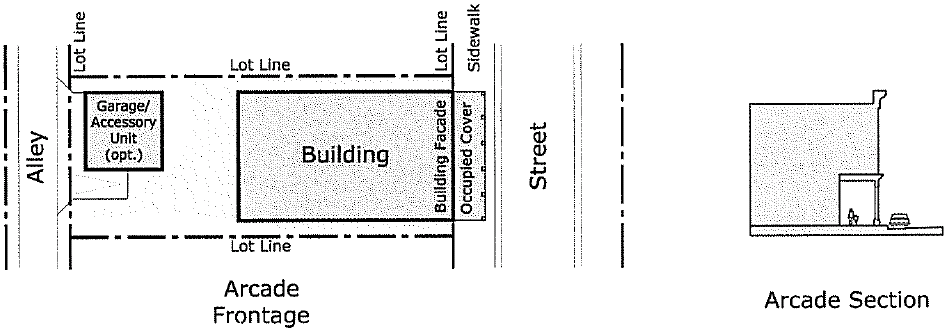
b.
Common lawn. A frontage wherein a group of buildings share a common lawn. The frontage has a visual relation to the street and to the buildings across the lawn.
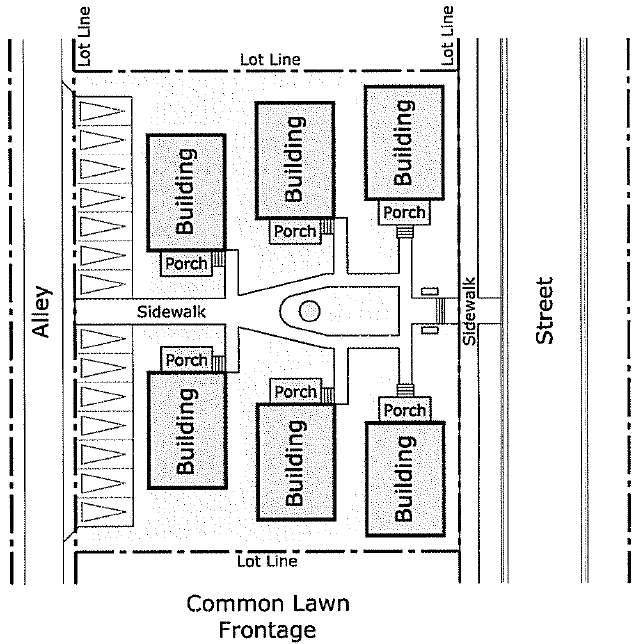
c.
Doorway. A frontage wherein the facade is aligned with the sidewalk and the entry is a door flush with the facade, or recessed into the facade. This type is similar to storefront frontages, except that they are primarily used for residential entries.
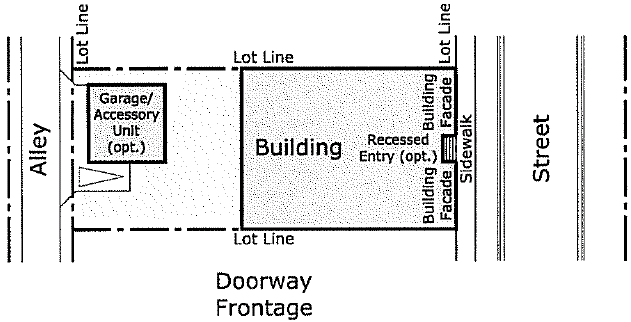
d.
Dooryard. A frontage wherein the facade is set back from the frontage line by an at-grade courtyard. This type buffers residential use from urban sidewalks and removes the private yard from public encroachment. The dooryard is suitable to conversion for outdoor dining.
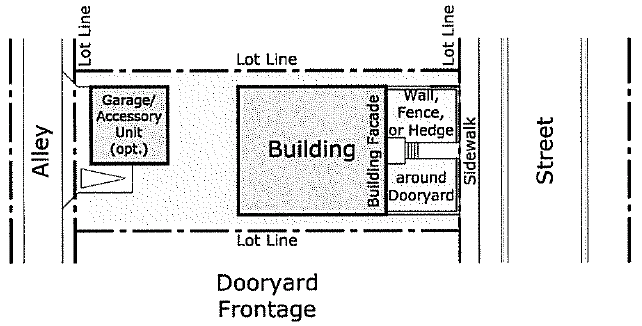
e.
Forecourt. A frontage wherein a portion of the facade is close to the frontage line and the central portion is set back. The forecourt created is suitable for vehicular drop-offs. This type should be allocated in conjunction with other frontage types. Large trees within the forecourts may overhang the sidewalk.
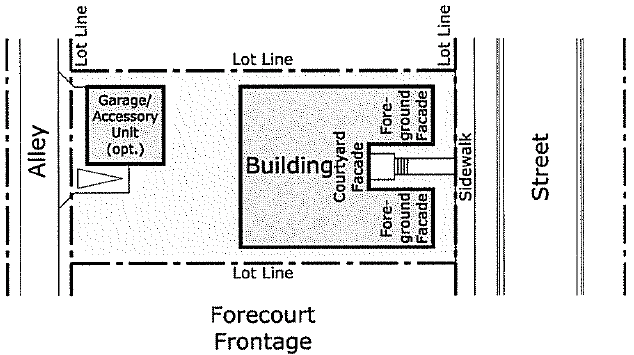
f.
Front yard. A frontage wherein the facade is set back from the frontage line with an attached porch permitted to encroach. A fence at the frontage line is optional.
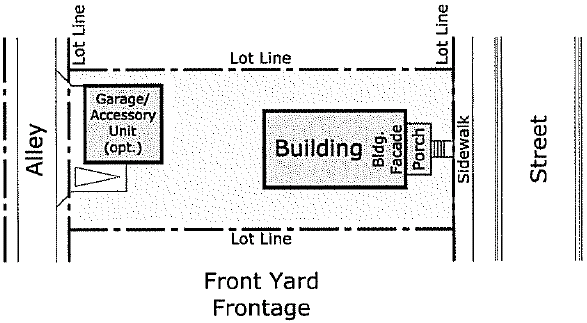
g.
Gallery. A frontage wherein the facade is aligned close to the frontage line with an attached cantilevered shed or a lightweight colonnade overlapping the sidewalk. This type is conventional for retail use.
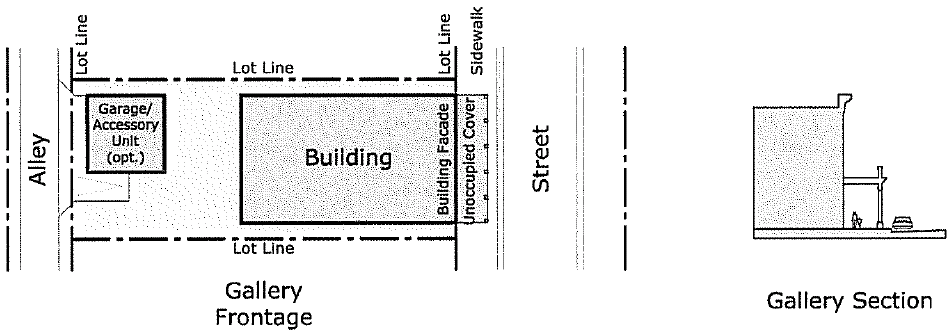
h.
Storefront. A frontage wherein the facade is aligned close to the frontage line with the building entrance at sidewalk grade. This type is conventional for retail use. It has substantial glazing on the sidewalk level and an awning that may overlap the sidewalk to the maximum extent possible.
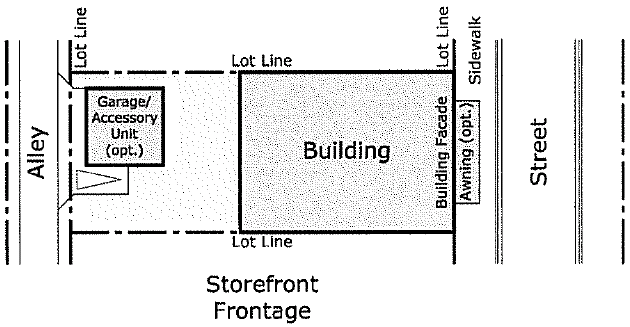
i.
Terrace or light court. A frontage where the facade is set back from the frontage line by an elevated terrace or sunken light court. The sunken court can potentially access an additional unit below grade. This type buffers residential use from urban sidewalks and removes the private yard from public encroachment. The terrace is suitable to conversion for outdoor dining.
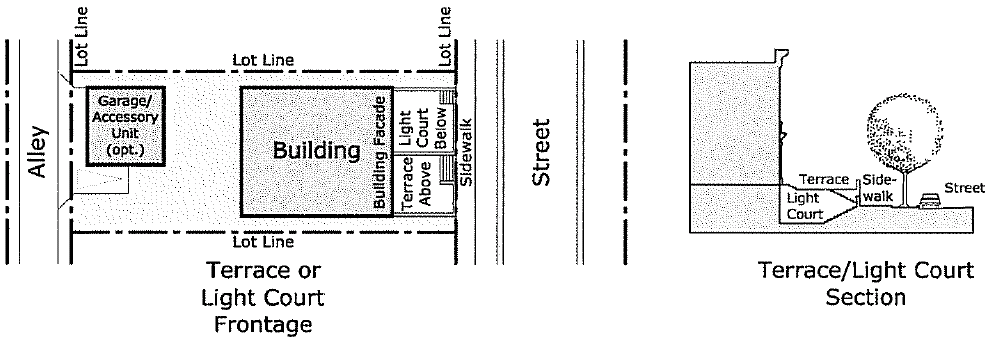
(2)
Allowed frontage types. Frontage types are regulated by building type as listed in table 27-1176-2.
Table 27-1176-2 Allowed Frontage Types
Interpretation of Table 27-2276-2: "A" means allowed. "A*" means allowed in all applicable zones except T-2. A blank cell means that the building type is not allowed.
(j)
Function intensity standards. The intensity of the uses are governed by T-zone, lot location, and parking requirements:
(1)
Applicable to all zones.
a.
Applicable to all uses. Use is limited by the parking requirement of subsection 27-1176(n).
b.
Residential. Only one accessory unit or accessory structure shall be allowed per main structure.
(2)
Zone T-2.
a.
Lodging. The number of bedrooms permitted on each lot for lodging is limited to a maximum of 12 bedrooms.
(3)
Zone T-3.
a.
Lodging. The number of bedrooms permitted on each lot for lodging is limited to a maximum of 12 bedrooms.
b.
Office. The building area available for office use on each lot is restricted to the first story of the principal or the ancillary building.
c.
Retail. The area in T-3 available for retail use must be designated on the regulating plan. The total area of retail in T-3 is limited to 500 square feet at the first story for each 100 dwelling units within the entire TND development.
(4)
Zone T-4.
a.
Lodging. The number of bedrooms permitted on each lot for lodging is limited to a maximum of 12 bedrooms.
b.
Office. The building area available for office use on each lot is restricted to the first story of the principal or the ancillary building.
c.
Retail. The building area available for retail use is restricted to block corner locations at the first story.
d.
Residential. In order to ensure a diversity of residential opportunities, a minimum of three of the allowed by right building types must be constructed, not including accessory units. Each type must account for at least ten percent of the total number of units within this zone only.
(5)
Zone T-5.
a.
Residential. In order to ensure a diversity of residential opportunities, a minimum of three of the allowed by right building types must be constructed, not including accessory units. Each type must account for at least ten percent of the total number of units within this zone only.
(k)
Height standards. The height of the primary building on a lot is regulated by T-zone:
(1)
Applicable to all zones. Accessory units (building type X) and accessory structures shall not exceed the height of the primary structure.
(2)
T-2. No more than two and one-half stories for all building types.
(3)
T-3. No more than two and one-half stories for all building types. Live/work buildings and flat over flat buildings shall at least two stories.
(4)
T-4. No more than three stories for all building types. Mixed-use buildings, live/work buildings, and flat over flat buildings shall be at least two stories. Mixed use buildings and live/work buildings shall have a first floor to ceiling height of 15 feet minimum.
(5)
T-5. At least two stories and no more than four stories for all building types. Mixed-use buildings, live/work buildings, and small commercial buildings shall have a first floor to ceiling height of 15 feet minimum.
(6)
T-6. At least two stories and no more than eight stories for all building types.
(7)
D. No more than four stories.
(8)
CS. No height limitation.
(l)
Setback standards. Setbacks are regulated by T zone and frontage type and are measured from the public right-of-way. Setbacks are regulated by transect zone and frontage type as listed in tables 27-1176-3 and 27-1176-4.
Table 27-1176-3 Front Setbacks
Interpretation of Table 27-2276-3: A blank cell means that a standard is not applicable.
Table 27-1176-4 Side and Rear Setbacks
(1)
Additional setback standards.
a.
For parking lots and parking garages. At least 25 feet from any public right-of-way and at least six feet from any property line.
b.
Minimum thoroughfare landscaping and buffering setbacks. The TND district thoroughfare landscaping and buffering setbacks shall comply with the landscape standards of this chapter.
(m)
Lot size and area standards.
(1)
Lot size. Lot sizes are regulated by T zone.
a.
T-2. Minimum of 20 acres average per dwelling unit.
b.
T-3. A mixture of lot widths is required in order to achieve residential diversity. The provision of small, medium, and large lot widths shall be achieved as follows:
1.
Small lots. At least 25 percent and no more than 50 percent of the total number of lots in T-3 shall be 25 feet to 45 feet wide.
2.
Medium lots. At least 25 percent and no more than 50 percent of the total number of lots in T-3 shall be 45 feet to 60 feet wide.
3.
Large lots. At least 15 percent and no more than 35 percent of the total number of lots in T-3 shall be more than 60 feet wide.
c.
T-4. Sixteen feet minimum lot width for attached housing, 25 feet minimum lot width for detached housing.
d.
T-5. No minimum lot size. Lot widths are limited to no more than 60 feet. Lots with common lawn frontages have no maximum lot width.
e.
T-6. No minimum.
f.
CS. No lot size regulation.
g.
D. By special review of the development review board.
(2)
Minimum floor area. Floor area requirements for the TND district are regulated by the currently adopted building code.
(n)
Parking standards. Parking standards are a component of the design manual, and shall be illustrated as such. Parking standards are regulated by T zone. Office and retail space may utilize the on-street parking adjacent to the lot frontage as part of the parking requirement.
(1)
T-2.
a.
Two off-street parking spaces shall be provided for each dwelling unit.
b.
One off-street parking space shall be provided for each lodging bedroom.
(2)
T-3.
a.
Two off-street parking spaces shall be provided for each dwelling unit.
b.
One off-street parking space shall be provided for each lodging bedroom.
c.
Two parking spaces per 1,000 square feet of office or retail space shall be required.
(3)
T-4 and T5.
a.
One off-street parking space shall be provided for each dwelling unit.
b.
One off-street parking space shall be provided for each lodging bedroom.
c.
Two parking spaces per 1,000 square feet of office or retail space shall be required.
(4)
Zone T-6. There is no parking requirement for dwelling units, lodging units, office space, or retail space.
(5)
Zone CB. No parking regulation.
(6)
Zone D. By the DRB.
(7)
Shared parking standard. When sharing uses on a particular lot, the parking requirement may be further reduced by the following factors:
a.
Residential and office. The combined requirement may be reduced by a factor of 0.75.
b.
Residential and retail. The combined requirement may be reduced by a factor of 0.9.
c.
Office and retail. The combined requirement may be reduced by a factor of 0.75.
d.
Lodging and residential. The combined requirement may be reduced by a factor of 0.9.
e.
Lodging and office. The combined requirement may be reduced by a factor of 0.8.
f.
Lodging and retail. The combined requirement may be reduced by a factor of 0.9.
(8)
If parking is reduced under subsection (7), above, the applicant must provide a written agreement between the owners and lessees of the parking spaces that complies with the following standards:
a.
The term of agreement is a minimum of 20 years.
b.
The agreement must provide that it is enforceable by the Unified Government of Wyandotte County.
c.
The agreement must provide that it binds all heirs, successors, and assigns to the lessor and lessee.
d.
The agreement must be recorded with the register of deeds of the county.
e.
If the agreement expires or terminates, the use for which the off-site parking was provided will be considered nonconforming. All approvals relating to the nonconforming use will be subject to revocation. Continuation or expansion of the nonconforming use is prohibited unless the use is brought into compliance with the parking regulations of this chapter.
(o)
Additional standards.
(1)
Businesses providing drive up or walk up services such as restaurants must be designed to match the character of the development. In no case shall the drive thru lane or window abut or face a public street.
(2)
Gas stations, bank drive-thrus, and convenience stores must be designed to match the character of the development. In no case shall the gas pump canopy abut a public street. Any canopy must be attached to the primary building. All canopy supports must match the primary building material and design of the primary building.
(3)
Sidewalk sales and display of merchandise may only occur adjacent to storefront businesses in T-zone 5 and 6 where the paved sidewalk is a minimum of ten feet wide. The merchandise shall only be displayed along the tenant space and up to five feet from the building face. No used merchandise may be displayed outside. All merchandise sold outside must be of the same character and nature as the goods sold inside.
(4)
Outdoor eating areas for restaurants and drinking establishments are allowed along the sidewalk in T-zones 5 and 6 where the paved sidewalk is a minimum of ten feet wide. The merchandise shall only be displayed along the tenant space and up to five feet from the building face.
(5)
Outdoor eating areas for restaurants and drinking establishments may not occupy an area greater than ten percent of the floor area of the adjoining establishment.
(6)
Communication antennas and towers shall comply with the accessory use section 27-1271 or special use permit section 27-1252(32) of the unified government zoning code.
(7)
All dwelling units within this district must be provided with a basement or with a FEMA standard safe room constructed to tornado standards for the protection of the occupants.
(p)
Signs. Each live/work unit shall be permitted a sign area that shall not exceed five percent of the first floor face. The sign area can be used in one wall-mounted sign, one projecting sign, or the sign area can be divided between a combination of the two sign types. In no case shall a projecting sign project more than three feet from the face of the building. All wall-mounted signs are to be individual channel lock letters. Portable signs such as sandwich boards are allowed but must be removed daily. Sandwich board signs are restricted to be no larger than two feet by two feet. All other commercial signs shall be governed by the C-1 or C-2 sign code.
(1)
Prohibited signs. The following signs are prohibited:
a.
Internal illuminated signs for live/work units.
b.
Attention-attracting devices for live/work units.
c.
Electronic signs.
d.
Pole signs.
e.
Roof signs.
f.
Obsolete signs.
g.
Signs that falsely state that the building or portions thereof is reserved for a use that is inconsistent with the existing zoning.
(q)
Roadway standards. All roadways shall be governed by the street standards portion of the design manual and Code, which govern the specific design of every roadway in the district, including the provision of on-street parking. In general, roadways are to be designed for slower design speeds, to ensure the safety of pedestrians, bicyclists, and motorists. This entails narrower lane widths, the provision of on-street parking on all roadways types, and small curb radii at intersections. A variety of roadways types is encouraged, and block perimeters should be small. Specific roadways standards are noted in the appendix A of this chapter: TND roadway design criteria.
(1)
Road type definitions.
a.
Alley. Very low capacity roadway with two-way yield operation along the rear of properties providing common access for parking, service areas, and accessory units as well as utility easements.
b.
Avenue. Medium capacity roadway with intensive pedestrian use appropriate as the main street of the commercial or mixed use zone.
c.
Courtyard. Low to very low capacity divided roadway with a landscaped median to provide direct local access along a dead-end alignment.
d.
Frontage road. Low to very low capacity roadway parallel to a thruway to provide access to abutting property.
e.
Lane. Low to very low capacity roadway with two-way yield operation to provide direct access to abutting land.
f.
Parkway. Low to medium capacity divided roadway with a landscaped center median appropriate as the main street of the commercial or mixed use zone.
g.
Public square. A configuration where the perimeter streets are all one way providing counter-clock-wise circulation, with a landscaped center median.
h.
Route. Low to medium capacity roadway that connects different parts of the TND but does not provide direct access or parking to abutting land.
i.
Street. Low capacity roadway to provide direct local access to abutting land. A street may have either two-way or one-way operation.
j.
Thruway. Medium to high capacity roadway that bisects or borders the TND and is part of the larger collector-arterial network of the city.
(r)
Block sizes. All blocks shall have the following maximum block perimeters:
(1)
Zone T-3: 3,000 feet maximum.
(2)
Zone T-4: 1,800 feet maximum.
(3)
Zone T-5: 2,000 feet maximum.
(4)
Zone T-6: 2,000 feet maximum.
(s)
Landscape standards. All landscaping shall be governed by a landscape standards portion of the design manual, which lists plant species, instructions, location criteria, and their application in the various T zones.
(1)
Frontage landscaping. Minimum landscaping at the completion of construction between the frontage line and the building facade is regulated by frontage and building type.
a.
Arcade.
1.
Applicable to all building types: Zero landscape plantings required.
b.
Common lawn.
1.
Applicable to all building types: Six landscape plantings required per dwelling unit. At lease one of the six required landscape plantings shall be a shade or ornamental tree.
c.
Doorway.
1.
Applicable to all building types: Zero landscape plantings required.
d.
Dooryard.
1.
Building types I, II, III, IV: Zero landscape plantings required.
2.
Building types V, VI, VII, VIII: Six landscape plantings required.
e.
Forecourt.
1.
Applicable to all building types: Fifteen landscape plantings required
f.
Front yard.
1.
Applicable to all building types: Eleven landscape plantings required. At least two of these landscape plantings shall be a shade or ornamental tree. Landscape plantings at approximately 30 inches on center shall be used along street-facing foundation walls.
g.
Gallery.
1.
Applicable to all building types: Zero landscape plantings required.
h.
Storefront.
1.
Applicable to all building types:
i.
Storefronts less than 60 feet in length: Zero landscape plantings required.
ii.
Storefronts greater than 60 in length: landscaping in the form of movable planter boxes and pots are required. One planter box with a minimum dimension of 18 inches by 18 inches shall be required per 25 feet of storefront length.
i.
Terrace/light court.
1.
Building types I, II, III, IV: Zero landscape plantings required.
2.
Building types V, VI, VII, VIII: Six landscape plantings required.
(2)
Street trees. Trees are required in the public right-of-way along streets, at a minimum of one shade tree every 40 feet, except where a park exists.
(3)
Buffering. In situations where the rear property of a detached single-family home abuts a public street, thoroughfare, or an existing detached single-family subdivision zoned R-1 or R-1(B), buffering shall be put in place to soften the impact of the development and protect future property owners from traffic sound and headlight glare. The necessary buffering shall be accomplished by the use of trees, shrubs, walls, and fences within a landscape easement or tract. The applicant shall submit a thorough landscape plan that addresses how this buffering will be accomplished. At least two of the following elements must be used:
a.
Evergreen trees planted at 30 feet on center.
b.
Evergreen shrubs planted at four feet on center.
c.
A six-feet high masonry wall or solid fence.
(t)
Building materials. All building materials and their use shall be governed by the architecture standards portion of the design manual, which shall list specific material instructions and usage criteria. Masonry building materials approved for this district are stone, brick, cast stone, and stucco. Synthetic stone, such as pre-manufactured fiberglass, cultured stone, or glass-fiber reinforced concrete is permitted, provided that it is identical in appearance and of equal or greater durability to natural stone. These masonry materials shall be required on 65 percent of the sum total of all building facades, except for building type X, single-family detached house, which shall have 25 percent of the sum total of all facades. Building type XI, accessory units, and accessory structures and garages shall be exempt from the masonry requirement but shall be constructed from the same materials as the main structure. Stucco in a TND development shall mean traditional stucco or gypsum concrete/plaster materials with smooth sand finish. Cement board siding may be used to fulfill the masonry requirement but the percentage of masonry becomes 100 percent excluding trim unless otherwise approved by the DRB. Exterior insulation and finish systems (EIFS) or pre-manufactured panels are not permitted. These provisions are intended to ensure a longer-lasting, sustainable appeal of the TND neighborhoods.
(u)
Planned zoning. This is a planned zoning district that involves the submittal and approval of preliminary development plans at the time of rezoning. Following zoning approval, all final plans are approved as follows:
(1)
The DRB is delegated the authority to approve the final plan, except as provided in subsection [2], below.
(2)
If the DRB does not reach a unanimous recommendation on a final plan, then the issue will be presented to the planning commission for final review following the normal criteria for final plan submission set out in subsection 27-211(i).
(v)
Definitions for this section.
(1)
Accessory structure. Detached non-dwelling unit structure, including a garage, that is located on the same lot or premises as the main structure. Accessory structures shall not be located in the front yard.
(2)
Block. The aggregate of private lots, passages, rear lanes, and alleys, circumscribed by thoroughfares.
(3)
Civic. The term defining not-for-profit organizations dedicated to arts, culture, education, recreation, government, transit, religion, and municipal parking.
(4)
Civic space. An open area dedicated for public use.
(5)
Design manual. A manual used as a tool for the applicant to present their vision for the TND development. The manual is accepted as the code for the development and is used as a guide for the DRB review board to assure that the original design, continuity and theme is carried through the marketing and building process.
(6)
Development review board. This board will act as the governing body for the TND development and enforce building layout, aesthetics and the design manual. (See subsection 27-1176(e))
(7)
Frontage line. The front property line and/or right-of-way line of a building lot.
(8)
Landscape planting. A deciduous or evergreen tree or shrub planted between the frontage line and the front facade of a building. Perennial or annual flowers and bulbs are not considered landscape plantings.
(9)
Lodging. Premises available for daily and/or weekly renting of bedrooms.
(10)
Masonry. Durable, long-lasting materials such as stone, brick, cast stone, stucco, synthetic stone, cultured stone, and, glass-fiber reinforced concrete.
(11)
Open space. An area or tract of land that is set aside and left natural or pristinely manicured for the enjoyment of the public. These areas should be accessible both physically and visually to residences of the community. Such land shall be owned and maintained by the developer, owner, or property owners association.
(12)
Outdoor room. An open space that is framed by buildings, fences, walls, landscaping, or berms in order to create the feel of a private open space.
(13)
Pedestrian shed. An area defined by the average distance that may be traversed at an easy walking pace from its edge to its center. This distance is applied to determine the size of a neighborhood or extent of a community. A standard pedestrian shed is one-quarter of a mile radius, or 1,320 feet. Pedestrian sheds should be conceived as oriented toward a central destination containing one or more important intersections, meeting places, civic spaces, civic buildings, and the capacity to accommodate a T-5 transect zone in the future.
(14)
Plan of record. The plan that is accepted by the city planning commission and unified government board of commissioners as a part of the TND rezoning process. This plan shows the general shapes and forms of buildings, building materials, building locations, landscaping, open space and all other details of the plan. (See subsection 27-1176(c and d)).
(15)
T-zone. A geographical cross-section, used to identify the level of urban character and intensity of a traditional neighborhood design project.
(16)
Use-segregated development. A method of development wherein different types of uses are separated and sorted by type, size, and setback from property lines.
(17)
Walkable neighborhoods. Neighborhoods that are designed to allow residents the ability and reason to walk around the neighborhood for goods, services, and social interaction.
APPENDIX A—TND ROADWAY DESIGN CRITERIA
Sheet notes:
1.
T4 and higher may use 10 feet minimum conc sidewalk with zero curb to walk clearance and 5 by 5 tree planters at maximum 40 feet spacing.
2.
In T3 zone tree planters may be placed in the parking lane.
3.
Minimum total pavement width shall be 20 feet on any roadway except alleys.
4.
Normal measurement is from centerline of right-of-way. Exception, when other streets intersect an avenue, or divided roadway (parkway, public square and courtyard) the intersection spacing shall be measured to the centerline of the nearest travel lane of the divided roadway not to the centerline of the right-of-way.
5.
Pavement width of alley shall be modified to provide passing opportunities consisting of 20 feet by 40 feet paved area to occur at least each 300 feet or once on every reach that is not visible from a higher capacity roadways at both ends of the reach.
6.
Separation of entry and exit of frontage road from other intersections will follow the minimum intersection spacing requirements of the intersected street, except where entry or exit is restricted by design elements to permit a right turn only then the distance from the edge of the nearest through lane of a second intersecting street upstream of the frontage road intersection to the edge of the frontage road may be a minimum of 40 feet.
7.
Each intersection onto a public square shall have a splitter island or other control to discourage wrong way entry to the public square.
The provisions of appendixes B—D to Ord. No. O-29-06 are hereby adopted by reference as if set out in this section at length.
(Ord. No. O-23-10, § 1, 4-29-2010)
Editor's note— Ord. No. O-23-10, § 1, Apr. 29, 2010, repealed the former § 27-471 and enacted a new § 27-471 as set out herein. The former § 27-471 pertained to TND traditional neighborhood design district and derived from Code 1988, § 27-1176; Ord. No. O-9-01, § 1, 1-25-2001; Ord. No. O-29-06, § 1, 3-2-2006.
Cross reference— Definitions generally, § 1-2.
Sec. 27-472. - B-P Planned business park district.
(a)
Generally. The purpose of the B-P planned business park district is to allow a mix of primarily office, research and light industrial uses with limited retail and service uses in a planned business park setting. The district is a planned zoning district with a minimum area of ten acres, designed to provide for moderate density, high quality development with attractive buildings, increased amenities and open space. In appropriate situations, B-P planned business park zoning may be located adjacent to residential uses. This section applies to the B-P planned business park district.
(b)
Permitted uses. Occupancies of buildings and uses of land in this district are regulated both by performance standards and by enumeration of uses that are permitted. The following list is not all-inclusive but rather establishes a descriptive and typical range of activities that are appropriate in this district. All uses must be operated in conformance with the performance standards that follow:
(1)
Any use permitted in the CP-1 planned limited business district except dwellings, under the parking and basic landscaping requirements of that district.
(2)
Manufacturing, processing, fabrication, assembling, disassembling, packaging, repairing, cleaning, servicing or testing any commodity except those permitted only in the M-3 heavy industrial district and those listed in section 27-469(b)(5).
(3)
Warehousing or wholesaling of any commodity except those permitted only in the M-3 heavy industrial district.
(4)
Public and private utility facilities.
(5)
Business services such as testing, photo processing, equipment rental, leasing, employment agencies, place of assembly, printing, exterminating, custom maintenance and delivery services.
(6)
General and special trades contractors.
(7)
Sales of building materials, contractor's equipment, furniture, office hotel and restaurant supplies, machines, metals.
(c)
Performance and design standards. No use of land or buildings in this district shall be allowed to exceed or violate the following standards:
(1)
All operations shall be conducted within a fully enclosed building.
(2)
All storage of materials, products or equipment (beyond customary building mechanical systems) shall be within a fully enclosed building unless otherwise approved by the planning commission. In such a case, outside storage areas for other than operable vehicles shall be limited to an area no greater than ten percent of the enclosed floor area of the use, shall not include storage of junk or salvage and shall be so screened that the contents are not visible at eye level within 100 feet of the property line. Semitrailers not coupled with tractors shall be included in this area limitation.
(3)
No noise, odors, vibration, or other impacts shall be discernible off the premises of the building.
(4)
Applicants for this district must include only land that is under unified control or under contract for sale that will provide unified control.
(5)
The preliminary and final plans shall include a coordinated architectural design for buildings, site improvements and landscaping.
(6)
Buildings are required to exhibit an attractive appearance especially toward the street and any nearby residential areas. Typically, such an attractive appearance would be characterized by significant use of glass, masonry, and other high quality finish materials and designs with significant offsets and articulation.
(d)
Height and area standards. All buildings and other uses of land shall conform to the following minimum standards:
(1)
Height.
a.
Not more than 50 feet.
b.
Not more than 100 feet for structures other than buildings, but must be set back from the property line a distance equal to the height of the structure.
(2)
Setback from property lines.
a.
From residentially zoned or developed property or property having a residential designation on the land use plan, the minimum building setback is 50 feet and the minimum setback for parking, loading, and other paved areas is 25 feet.
b.
From the perimeter of the business park the minimum building setback is 40 feet and the minimum setback for parking, loading, and other paved areas is ten feet.
c.
Elsewhere, the minimum building setback is 25 feet and the minimum setback for parking, loading and other paved areas is six feet.
d.
For additional standards and information, see division 8 of this article.
(e)
Parking standards. Uses in this district require paved off-street parking at a ratio necessary to serve the employees, visitors, customers and others who may be on the premises. The ratio will vary among occupants and will be determined by the director of planning and zoning after receipt of a summary of parking needs and characteristics prepared by the owner or initial occupant. In no case, however, shall less than one space for each 500 square feet of building floor area be provided for buildings of up to 20,000 square feet. For buildings larger than 20,000 square feet, only one space for each 1,000 square feet needs to be provided for building increments between 20,000 and 50,000 square feet. For buildings larger than 50,000 square feet, the parking required for increments over 50,000 square feet will be determined by the director of planning and zoning. Where questions arise concerning increments over 50,000 square feet, the unified government board of commissioners shall make the final determination upon recommendation of the planning commission. Commercial uses shall provide parking as would be required in the C-1 district unless otherwise approved. For additional standards and information, see division 9 of this article.
(f)
Signs. Signs are permitted in this district but are limited in size, number, location and type of illumination. One wall sign is permitted on each of three facades of the building and one detached sign is allowed in lieu of one wall sign. For additional standards and information, see division 11 of this article.
(g)
Landscaping and screening. A reasonable amount of landscaping is required on all projects in this district with emphasis being placed on screening or otherwise softening the visual impact of unsightly areas and enhancing the overall appearance. Such features shall be depicted on a properly prepared plan. Trees are required to be provided at not less than one per 8,000 square feet of site area. Six-foot high architectural screening in combination with a 25-foot buffer area is to be provided along side and rear property lines common to or across an alley from residentially zoned property. For additional standards and information, see division 10 of this article.
(h)
Building conversion. No building that was designed and constructed as a residential building shall be converted to a nonresidential use in this district.
(Code 1988, § 27-1177; Ord. No. O-9-01, § 2, 1-25-2001)

