
Kaukauna City Zoning Code
17 DISTRICT
REGULATIONS
17.15 Interpretation And Organization
- District regulations shall be as set forth in this chapter.
- Permitted principal and accessory uses and structures listed for any district shall be permitted by right, subject to conditions as specified.
- Special exception uses and structures listed for any district are permissible only upon approval by the city council subject to the conditions as specified and any other conditions as may be imposed as provided by this chapter. (See section 17.47.)
- All uses and structures, dimensional, sign and off-street parking requirements shall be subject to section 17.32 and, where applicable, sections 17.35 through 17.40.
- Off-street loading requirements for all districts are specified in section 17.32.
- In those instances where district regulations set forth limited examples of permitted or permissible uses with reference to the phrase "and the like" or "and uses of a similar nature," it is understood that the examples serve as a guideline in determining other permitted or permissible uses.
(Code 2011, § 17.15)
17.16 RSF Residential Single-Family District
- Purpose. This district is intended to provide for moderate density single-family detached residential development in traditional development forms. Certain structures and uses designed to serve governmental, educational, religious, and noncommercial recreational uses are also permitted or permissible as special exceptions subject to restrictions and requirements necessary to preserve and protect the residential character of the district.
- Permitted principal uses and structures.
- Single-family dwellings.
- Public and semipublic nonprofit institutional uses, provided that principal access is directly onto a collector or arterial street to include:
- Churches.
- Schools.
- Libraries.
- Parks, playgrounds, and community centers.
- One attached garage, one detached garage, one utility storage structure, and other allowed accessory structures customarily incidental to the residential principal use when located on the same lot.
- Home occupations.
- Special exception uses and structures.
- Day nurseries.
- Convalescent homes, children's homes, or nursing homes.
- Public utility installations.
- Cemeteries.
- Gardens, nurseries, and orchards, provided that no office or store is provided on the premises.
- Community living arrangements/group homes, subject to Wis. Stats. § 62.23(7)(i).
- Dimensional requirements.
- Principal structures.
- Single-family dwellings.
- Lot area: 7,200 square feet minimum.
- Lot width: 60 feet minimum.
- Front yard setback: 25 feet minimum, except that the front yard setback for a principal structure may be the average of the existing front yard setbacks of the adjacent lots, but not less than 15 feet.
- Side yard setback: seven feet minimum.
- Rear yard setback: 20 feet minimum.
- Lot coverage: 30 percent maximum.
- Height: 35 feet maximum.
- Other permissible principal uses and structures.
- Lot area: 10,000 square feet minimum.
- Lot width: 100 feet minimum.
- Front yard setback: 25 feet minimum.
- Side yard setback: 15 feet minimum.
- Rear yard setback: 25 feet minimum.
- Lot coverage: 25 percent maximum.
- Height: 35 feet maximum.
- Single-family dwellings.
- Accessory uses and structures.
- Attached garage. All dimensional regulations (i.e., setbacks and height) of an attached garage shall be the same as the principal structure.
- Detached garage in rear yard.
- Height: total building height of 18 feet, maximum side wall height of ten feet, and one story maximum.
- Front yard setback: 60 feet minimum.
- Rear yard setback: three feet minimum.
- Side yard setback: three feet minimum.
- Structure area: the maximum lot coverage by the total of all garage area, whether attached, detached, or combined, shall not exceed 1,400 square feet or exceed, in combination with the principal structure, 30 percent of the lot area.
- Five feet minimum between principal and accessory structure.
- Detached garage in side yard or less than 60 feet front yard setback.
- Height: total building height of 18 feet, maximum side wall height of ten feet, and one story maximum.
- Front yard setback: 25 feet or the same setback as the principal structure, whichever is greater.
- Rear yard setback: 20 feet minimum.
- Side yard setback: seven feet minimum.
- Structure area: the maximum lot coverage by the total of all garage area, whether attached, detached, or combined, shall not exceed 1,400 square feet nor exceed, in combination with the principal structure, 30 percent of the lot area.
- Five feet minimum between principal and accessory structure.
- Detached garage on corner lots.
- Height: total building height of 18 feet, maximum side wall height of ten feet, and one story maximum.
- Front yard and side street (front yard) setbacks: 25 feet or the same as the principal structure, whichever is greater.
- Rear yard setbacks: three feet minimum setback, provided that the accessory structure is a minimum of ten feet from a neighboring principal structure.
- Side yard setbacks: three feet minimum setback, provided that the accessory structure is a minimum of ten feet from a neighboring principal structure.
- Structure area: the maximum lot coverage by the total of all garage area, whether attached, detached or combined, shall not exceed 1,400 square feet or exceed, in combination with the principal structure, 30 percent of the lot area.
- Five feet minimum between principal and accessory structure.
- Utility storage structure.
- One utility storage structure when located on the same lot as the principal structure not occupied by nor involving the conduct of a business or home occupation.
- The location of the utility storage structure must be located in the rear yard and comply with all setback requirements governing a detached garage.
- Structure area: 170 square feet maximum.
- The utility storage structure, combined with all other accessory structures, shall not occupy more than 30 percent of the rear yard area.
- Principal structures.
- Permitted accessory signs.
- One subdivision identification sign limited to 25 square feet in area.
- One temporary sign for each street frontage advertising the sale or lease of real estate and one temporary sign advertising the development of property. No temporary sign shall be erected within ten feet of any adjacent side yard, and no temporary sign shall remain after the sale, lease, or development of the property.
- In connection with any public or semipublic institution, the following signs are permitted:
- One identification sign limited to 25 square feet in area.
- One bulletin board limited to 20 square feet in area.
- Not more than two temporary signs or banners limited to a combined area of 30 square feet in connection with special events, provided that no such sign or banner shall be displayed for a period of more than two weeks.
- Off-street parking requirements.
- Dwellings: 1 1/2 per unit.
- Churches: one per three fixed seats.
- High schools: one per three students and employees.
- Elementary schools, junior high schools, day nurseries: one per employee.
- Libraries, exhibits, community centers: one per three persons of maximum capacity.
- Convalescent homes, children's homes, nursing homes: one per four beds, plus one per employee.
- Other requirements. When property is used for any of the allowable uses in this section, it shall be landscaped and maintained in harmony with the surrounding area so as not to substantially interfere with the comfortable enjoyment of life or property by residents of the same area, nor to materially decrease the value of their properties. If a new construction, a lawn shall be planted within six months after the residence or other allowable building has been constructed.
(Code 2011, § 17.16)
17.18 RTF Residential Two-Family District
- Purpose. This district is intended to provide for moderate to medium density residential development with emphasis on two-family and single-family attached residential uses. This district is also intended to provide for alternative development types and for infilling opportunities for parcels which, for various reasons, have been bypassed for development. Nonresidential uses are limited to those which are compatible with the medium density character of the district.
- Permitted principal uses and structures.
- Single-family dwellings.
- Two-family dwellings.
- Single-family attached with zero lot line.
- Intent. The intent of allowing for single-family attached with zero lot line development is to accommodate quality single-family housing on an economic scale that facilitates and encourages energy efficiency, medium to low density development, and efficient use of public infrastructure.
- Character of site. All single-family attached with zero lot line development shall be suitable for placement on a lot in such a manner that, if one single-family residence is removed, the remaining residence is not compromised. Single-family attached with zero lot line shall be permitted only in RTF Residential Two-Family and RMF Residential Multifamily Districts.
- Area and density requirements.
- Lot area: 4,500 square feet minimum.
- Lot width: 35 feet minimum.
- Front yard setback: 25 feet minimum, except that the front yard setback for a principal structure may be the average of the existing front yard setback of the adjacent lots, but not less than 15 feet.
- Side yard setback: zero on one side, provided that the structure is built as a two-family attached dwelling with each unit on its own lot. Remaining side yards setbacks are seven feet minimum.
- Rear yard setback: 25 feet minimum.
- Lot coverage: 30 percent maximum.
- Height: 35 feet maximum.
- Utilities. Each single-family unit shall be provided separate sanitary sewer lateral, storm sewer lateral (if applicable), water lateral, gas meter, and electric meter without such infrastructure passing through an adjoining unit.
- Lotsplit. All lots shall be divided by certified survey map (CSM) or subdivision plat in compliance with chapter 18 of this Code and be clearly marked on the face of the CSM or plat as "single-family attached with zero lot line" for all applicable lots.
- Uniform control. Both units for a single-family attached with zero lot line shall receive occupancy permits prior to any one unit being occupied. Easements shall be provided upon each lot as may be necessary for water, sewer, and all other utility services. The easements shall be approved by each of the utility providers. Foundation drains shall have a separate sump pump located in each dwelling unit. Restrictive covenants shall be recorded with the appropriate county register of deeds providing declarations or bylaws similar to those typically recorded on a declaration of condominium. The covenants shall provide for mediation of any and all disputes between owners of each unit and any third party with regard to construction, use, and maintenance of the real property. Furthermore, the covenants shall specifically state that the city and all approving authorities shall not be held responsible for enforcing the same, and that the covenants shall inure to all heirs and assigns. Evidence of such recording shall be provided to, and placed on file with, the city's building inspection department prior to the issuance of an occupancy permit.
- Public and semipublic nonprofit institutional uses, provided that principal access is directly onto a collector or arterial street to include:
- Churches.
- Schools.
- Libraries.
- Parks, playgrounds, and community centers.
- One attached garage, one detached garage, one utility storage structure, and other allowed accessory structures customarily incidental to the residential principal use when located on the same lot.
- Home occupations.
- Special exception uses and structures.
- Day nurseries.
- Convalescent homes, children's homes or nursing homes.
- Public utility installations.
- Cemeteries.
- Gardens, nurseries, and orchards, provided that no office or store is provided on the premises.
- Community living arrangements/group homes, subject to Wis. Stats. § 62.23(7)(i).
- Cluster subdivisions per section 17.37.
- PUD Planned Unit Development per section 17.36.
- Dimensional requirements.
- Principal structures.
- Single-family dwellings.
- Single-family detached dwellings shall meet all RSF Residential Single-Family Dimensional Requirements, per section 17.16(4)(a).
- Lots fronting Plank Road from and Green Bay Road from Lawe Street to Myron Street shall have a minimum lot area of 6,900 square feet.
- Two-family dwellings.
- Lot area: 9,000 square feet minimum.
- Lot width: 70 feet minimum.
- Front yard setback: 25 feet minimum, except that the front yard setback for a principal structure may be the average of the existing front yard setbacks of the adjacent lots, but not less than 15 feet.
- Side yard setback: Seven feet minimum.
- Rear yard setback: 25 feet minimum.
- Lot coverage: 30 percent maximum.
- Height: 35 feet maximum.
- Single-family attached dwellings.
- Lot area: 18,000 square feet minimum.
- Lot width: 100 feet minimum.
- Front yard setback: 25 feet minimum, except that the front yard setback for a principal structure may be the average of the existing front yard setbacks of the adjacent lots, but not less than 15 feet.
- Side yard setback: 12 feet minimum.
- Rear yard setback: 25 feet minimum.
- Density: 12 dwelling units per net acre maximum.
- Lot coverage: 25 percent maximum.
- Height: 35 feet maximum.
- Not more than eight dwelling units shall be contiguous or in one group or series and not more than two dwelling units in one group or series shall have the same or approximately the same roof or building line. Not less than 40 percent of the total site area shall be landscaped in lawns, gardens, decorative plantings, or wooded areas. A site plan under site plans, under section 17.32(11), is required for all single-family attached developments. Common open space shall be subject to the requirements of common open space, per section 17.32(9).
- Other permissible principal uses and structures.
- Lot area: 10,000 square feet minimum.
- Lot width: 80 feet minimum.
- Front yard: 25 feet minimum.
- Side yard setback: ten feet minimum.
- Rear yard setback: 25 feet minimum.
- Lot coverage: 25 percent maximum.
- Height: 35 feet maximum.
- Single-family dwellings.
- Accessory uses and structures.
- Single-family detached dwellings. Single-family detached dwellings shall meet all RSF Residential Single-Family Dimensional Requirements, per section 17.16(4)(b).
- Attached garages. All dimensional regulations (i.e., setbacks and height) of an attached garage shall be the same as the principal structure.
- Detached garage in rear yard.
- Height: total building height of 18 feet, maximum side wall height of ten feet, and one story maximum.
- Front yard setback: 60 feet minimum.
- Rear yard setback: Three feet minimum.
- Side yard setback: Three feet minimum.
- Structure area: the maximum lot coverage by the total of all garage area, whether attached, detached or combined, shall not exceed 1,400 square feet or exceed, in combination with the principal structure, 30 percent of the lot area.
- Five feet minimum between principal and accessory structure.
- Detached garage in side yard or less than 60 feet front yard setback.
- Height: total building height of 18 feet, maximum side wall height of ten feet, and one story maximum.
- Front yard setback: 25 feet or the same setback as the principal structure, whichever is greater.
- Rear yard setback: 25 feet minimum.
- Side yard setback: Seven feet minimum.
- Structure area: The maximum lot coverage by the total of all garage area, whether attached, detached or combined, shall not exceed 1,400 square feet or exceed, in combination with the principal structure, 30 percent of the lot area.
- Five feet minimum between principal and accessory structure.
- Detached garage on corner lots.
- Height: Total building height of 18 feet, maximum side wall height of ten feet, and one story maximum.
- Front yard and side street (front yard) setbacks: 25 feet or the same as the principal structure, whichever is greater.
- Rear yard setbacks: Three feet minimum setback, provided that the accessory structure is a minimum of ten feet from a neighboring principal structure.
- Side yard setbacks: Three feet minimum setback, provided that the accessory structure is a minimum of ten feet from a neighboring principal structure.
- Structure area: The maximum lot coverage by the total of all garage area, whether attached, detached or combined, shall not exceed 1,400 square feet or exceed, in combination with the principal structure, 30 percent of the lot area.
- Five feet minimum between principal and accessory structure.
- Utility storage structure.
- One utility storage structure when located on the same lot as the principal structure, not occupied by nor involving the conduct of a business or home occupation.
- The location of the utility storage structure must be located in the rear yard and comply with all setback requirements governing a detached garage.
- Structure area: 170 square feet maximum.
- The utility storage structure, combined with all other accessory structures, shall not occupy more than 30 percent of the rear yard area.
- Principal structures.
- Permitted accessory signs.
- One subdivision identification sign limited to 25 square feet in area.
- One temporary sign for each street frontage advertising the sale or lease of real estate and one temporary sign advertising the development of property. No temporary sign shall be erected within ten feet of any adjacent side yard, and no temporary sign shall remain after the sale, lease, or development of the property.
- In connection with any public or semipublic institution, the following signs are permitted:
- One identification sign limited to 25 square feet in area.
- One bulletin board limited to 20 square feet in area.
- Not more than two temporary signs or banners limited to a combined area of 30 square feet in connection with special events, provided that no such sign or banner shall be displayed for a period of more than two weeks.
- Off-street parking requirements.
- Dwellings: 1 1/2 per unit.
- Churches: One per three fixed seats.
- High schools: One per three students and employees.
- Elementary schools, junior high schools, day nurseries: One per employee.
- Libraries, exhibits, community centers: One per three persons of maximum capacity.
- Convalescent homes, children's homes, nursing homes: One per four beds, plus one per employee.
- Other requirements. When property is used for any of the allowable uses in this section, it shall be landscaped and maintained in harmony with the surrounding area so as not to substantially interfere with the comfortable enjoyment of life or property by residents of the same area, nor to materially decrease the value of their properties. If a new construction, a lawn shall be planted within six months after the residence or other allowable building has been constructed.
(Code 2011, § 17.18; Ord. No. 1777, 9-18-2018)
17.19 RMF Residential Multifamily District
- Purpose. This district is intended to provide for medium to high density residential areas with emphasis on multifamily residential use. Nonresidential uses are limited to those which are compatible with the high density character of the district.
- Permitted principal uses and structures.
- Single-family dwellings.
- Public and semipublic nonprofit institutional uses, provided that principal access is directly onto a collector or arterial street to include:
- Churches.
- Schools.
- Libraries.
- Parks, playgrounds, and community centers.
- One attached garage, one detached garage, one utility storage structure, and other allowed accessory structures customarily incidental to the residential principal use when located on the same lot.
- Home occupations.
- Two-family dwellings.
- Single-family attached with zero lot line.
- Intent. The intent of allowing for single-family attached with zero lot line development is to accommodate quality single-family housing on an economic scale that facilitates and encourages energy efficiency, medium to low density development, and efficient use of public infrastructure.
- Character of site. All single-family attached with zero lot line development shall be suitable for placement on a lot in such a manner that, if one single-family residence is removed, the remaining residence is not compromised. Single-family attached with zero lot line shall be permitted only in RTF Residential Two-Family and RMF Residential Multifamily Districts.
- Area and density requirements.
- Lot area: 4,500 square feet minimum.
- Lot width: 35 feet minimum.
- Front yard setback: 25 feet minimum, except that the front yard setback for a principal structure may be the average of the existing front yard setback of the adjacent lots, but not less than 15 feet.
- Side yard setback: zero on one side, provided that the structure is built as a two-family attached dwelling with each unit on its own lot. Remaining side yard setbacks are seven feet minimum.
- Rear yard setback: 25 feet minimum.
- Lot coverage: 30 percent maximum.
- Height: 35 feet maximum.
- Utilities. Each single-family unit shall be provided separate sanitary sewer lateral, storm sewer lateral (if applicable), water lateral, gas meter, and electric meter without such infrastructure passing through an adjoining unit.
- Lot split. All lots shall be divided by certified survey map (CSM) or subdivision plat in compliance with chapter 18 of this Code and be clearly marked on the face of the CSM or plat as "single-family attached with zero lot line" for all applicable lots.
- Uniform control. Both units for a single-family attached with zero lot line shall receive occupancy permits prior to any one unit being occupied. Easements shall be provided upon each lot as may be necessary for water, sewer, and all other utility services. The easements shall be approved by each of the utility providers. Foundation drains shall have a separate sump pump located in each dwelling unit. Restrictive covenants shall be recorded with the appropriate county register of deeds providing declarations or bylaws similar to those typically recorded on a declaration of condominium. The covenants shall provide for mediation of any and all disputes between owners of each unit and any third party with regard to construction, use, and maintenance of the real property. Furthermore, the covenants shall specifically state that the city and all approving authorities shall not be held responsible for enforcing the same, and that the covenants shall inure to all heirs and assigns. Evidence of such recording shall be provided to, and placed on file with, the city's building inspection department prior to the issuance of an occupancy permit.
- Multifamily dwellings not exceeding three stories or 45 feet in height.
- Townhouse development.
- Intent. The intent of townhouse development is to accommodate quality single-family and two-family housing on an economical scale that facilitates and encourages energy efficiency, high density land management and desirable housing choices by allowing for high density land use and greater flexibility in design features for projects conceived and implemented as a comprehensive and cohesive development.
- Character of site. All townhouse developments shall be suitable for development in a manner consistent with the city's comprehensive plan for high-density residential development. Townhouse developments shall only be permitted in areas zoned RMF Residential Multifamily.
- Uniform control. All land proposed for townhouse development is under the legal control of the applicant whether the applicant is an individual, corporation, or partnership. The applicant shall have the unrestricted right to impose all of the conditions contemplated by the provisions of the regulations.
- Permitted uses. Single- and two-family residential units connected by zero lot lines on at least one side.
- Area and density requirements. A tract of land proposed for townhouse development shall contain a minimum of 20,000 square feet suitable for a minimum of six lots. There are no minimum front, side, or rear yard setbacks. A ten-foot setback is required for any building adjoining a side or rear yard on the periphery of the applicant's property. There is no minimum lot area or maximum lot coverage.
- Access. Every lot shall have access to a public street either directly or via an approved private road or alley.
- Plat requirements. All normal platting requirements shall be met, including requirements for public infrastructure and utilities.
- Design standards. The following design standards shall apply to townhouse developments:
- One and one half parking stalls per residential unit on the lot.
- Each structure shall have its own footings, foundation, utilities, laterals, independent design, and roof line.
- A site plan per site plans section 17.32(11) is required for each lot.
- Zoning. Where conflicts exist between interpretation of the RMF Residential Multifamily Zoning and interpretation of this section, this section shall apply.
- Special exception uses and structures.
- Day nurseries.
- Convalescent homes, children's homes, or nursing homes.
- Public utility installations.
- Cemeteries.
- Gardens, nurseries, and orchards, provided that no office or store is provided on the premises.
- Community living arrangements/group homes, subject to Wis. Stats. § 62.23(7)(i).
- Clinics.
- Cluster subdivisions per section 17.37.
- PUD Planned Unit Development per section 17.36.
- Multifamily dwellings exceeding three stories or 45 feet in height.
- Dimensional requirements.
- Principal structures.
- Single-family dwellings. Single-family dwellings shall meet all RSF Residential Single-Family Basic Dimensional Requirements, per section 17.16 (4)(a)1.
- Two-family dwellings. Two-family dwellings shall meet all RTF Residential Two-Family Basic Dimensional Requirements, per section 17.18(4)(a)2.
- Single-family attached dwellings. Single-family attached dwellings shall meet all RTF Residential Two-Family Basic Dimensional Requirements, per section 17.18(4)(a)3.
- Multifamily dwellings. Multifamily dwellings not exceeding three stories or 45 feet in height.
- Lot area: 10,000 square feet minimum.
- Lot width: 80 feet minimum.
- Front yard setback: 25 feet minimum, except that the front yard setback for a principal structure may be the average of the existing front yard setbacks of the adjacent lots, but not less than 15 feet.
- Side yard setback: ten feet minimum.
- Rear yard setback: 25 feet minimum.
- Density: 20 dwelling units per net acre maximum.
- Lot coverage: 30 percent maximum.
- Height: 45 feet maximum.
- Not less than 40 percent of the total site area shall be landscaped in lawns, gardens, decorative plantings, or wooded areas. A site plan under section 17.32(11) is required for all multifamily developments.
- Accessory structures/uses.
- Single-family dwellings. Single-family dwellings shall meet all RSF Residential Single-family, section 17.16(4)(b) dimensional requirements.
- Two-family dwellings. Two-family dwellings shall meet all RTF Residential Two-family, section 17.18(4)(b) dimensional requirements.
- Single-family attached dwellings. Single-family attached dwellings shall meet all RTF Residential Two-family, section 17.18(4)(b) dimensional requirements.
- Attached garages. All dimensional regulations (i.e., setbacks and height) of an attached garage shall be the same as the principal structure.
- Detached garage in rear yard.
- Height: total building height of 18 feet, maximum side wall height of ten feet, and one story maximum.
- Front yard setback: 60 feet minimum.
- Rear yard setback: three feet minimum.
- Side yard setback: three feet minimum.
- Structure area: maximum 30 percent of the rear yard or 500 square feet per unit, whichever is less. Combination of attached/detached garages on a lot may not exceed 500 square feet per unit.
- Five feet minimum between principal and accessory structure.
- Detached garage in side yard or less than 60 feet front yard setback.
- Height: total building height of 18 feet, maximum side wall height of ten feet, and one story maximum.
- Front yard setback: 25 feet or the same setback as the principal structure, whichever is greater.
- Rear yard setback: 25 feet minimum.
- Side yard setback: Seven feet minimum.
- Structure area: maximum 30 percent of the rear yard and side yard areas combined or 500 square feet per unit, whichever is less. Combination of attached/detached garages on a lot may not exceed 500 square feet per unit.
- Five feet minimum between principal and accessory structure.
- Detached garage on corner lots.
- Height: total building height of 18 feet, maximum side wall height of ten feet, and one story maximum.
- Front yard and side street (front yard) setbacks: 25 feet or the same as the principal structure, whichever is greater.
- Side yard setbacks: three feet minimum setback, provided that the accessory structure is a minimum of ten feet from a neighboring principal structure.
- Rear yard setbacks: three feet minimum setback, provided that the accessory structure is a minimum of ten feet from a neighboring principal structure.
- Structure area: maximum 30 percent of the rear yard or 500 square feet per unit, whichever is less. Combination of attached/detached garages on a lot may not exceed 500 square feet per unit.
- Five feet minimum between principal and accessory structure.
- Utility storage structure.
- One utility storage structure when located on the same lot as the principal structure not occupied by nor involving the conduct of a business or home occupation.
- The location of the utility storage structure must be located in the rear yard and comply with all setback requirements governing a detached garage.
- Structure area: 170 square feet maximum.
- The utility storage structure, combined with all other accessory structures, shall not occupy more than 30 percent of the rear yard area.
- Principal structures.
- Permitted accessory signs.
- One subdivision identification sign limited to 25 square feet in area.
- One temporary sign for each street frontage advertising the sale or lease of real estate and one temporary sign advertising the development of property. No temporary sign shall be erected within ten feet of any adjacent side yard and no temporary sign shall remain after the sale, lease, or development of the property.
- In connection with any public or semipublic institution, the following signs are permitted:
- One identification sign limited to 25 square feet in area.
- One bulletin board limited to 20 square feet in area.
- Not more than two temporary signs or banners limited to a combined area of 30 square feet in connection with special events, provided that no such sign or banner shall be displayed for a period of more than two weeks.
- Off-street parking requirements.
- Dwellings: 1 1/2 per unit.
- Churches: one per three fixed seats.
- High schools: one per three students and employees.
- Elementary schools, junior high schools, day nurseries: one per employee.
- Libraries, exhibits, community centers: one per three persons of maximum capacity.
- Convalescent homes, children's homes, nursing homes: one per four beds, plus one per employee.
- Other requirements. When property is used for any of the above allowable uses, it shall be landscaped and maintained in harmony with the surrounding area so as not to substantially interfere with the comfortable enjoyment of life or property by residents of the same area, nor to materially decrease the value of their properties. If a new construction, a lawn shall be planted within six months after the residence or other allowable building has been constructed.
(Code 2011, § 17.19)
17.20 CCD Commercial Core District
- Purpose. This district is established to provide for a centrally located intensely developed core of commercial activity. It is intended that the physical development of the district be highly concentrated and integrated offering a convenient and attractive shopping environment. It is also intended that, to the maximum extent practicable, various establishments be operated and managed in a coordinated manner. Permitted uses are limited to those which are highly compatible, mutually reinforcing, and conducive to common approaches in operation, area design improvements, traffic and pedestrian circulation, and parking. In addition, buildings and structures are subject to a certificate of appropriateness in section 17.48.
- Permitted principal uses and structures.
- Retail outlets for sale of food, home furnishings, appliances, and wearing apparel, including repair strictly incidental to sales, office equipment, hardware, toys, sundries and notions, books and stationery, leather goods and luggage, jewelry, art, camera or photographic supplies, including camera repair, alcoholic beverages for off-premises consumption, sporting goods, hobby and pet shops, delicatessen, bake shop (but not wholesale bakery), musical instruments, florist and gift shops, and similar products.
- Service establishments such as barber and beauty shops, shoe repair, restaurants, except drive-in restaurants, interior decorator, photographic studios, dance or music studio, tailor or dressmaker, laundry or dry cleaner, radio or television repair, and similar uses.
- Banks and other financial institutions, employment offices, business offices, professional offices, and similar establishments.
- Dwellings above or behind other principal uses so as to not interrupt business frontage.
- High density multifamily dwellings (minimum of 24 units) not exceeding five stories or 75 feet in height.
- Municipal parks.
- 3. Permitted accessory uses and structures.
- Uses and structures customarily accessory and clearly incidental to permissible principal uses and structures which do not involve operations or structures not in keeping with the character of the district; provided, however, that garbage and trash shall be kept in closed containers and that such containers shall not be visible from portions of the premises customarily open to pedestrian or automobile circulation or parking.
- Craft production, or small-scale on-site production and/or assembly of arts, crafts, foods, beverages or other type of product involving the use of small-scale equipment and/or hand tools. This use shall be an accessory use to a retail/eating/drinking/tasting component that occupies a minimum of 10 percent of usable space. The retail/eating/drinking/tasting component shall front the street at sidewalk level and shall remain open to the public. All production, processing and distribution activities shall occur within an enclosed building. Craft production includes, but is not limited to ceramic art, glass art, candle-making, custom jewelry manufacture, bakeries, confectionaries, butchers, coffee roasting establishments, food production.
- Craft beverage production, including, but not limited to alcoholic beverages such as beer, wine, cider and intoxicating liquor.
- Craft brewers shall meet the Wisconsin State Statute §§125.29 criteria for brewers and shall not manufacturing a total of more than 10,000 barrels of fermented malt beverages in a calendar year. Appropriate licensing shall be held to permit on-site tastings and retail purchase of fermented malt beverages.
- Craft vintners (includes wine and cider production) shall meet the Wisconsin State Statute §§125.53 criteria for winery permits. Appropriate licensing shall be held to permit on-site retail operations under a State-issued winery permit.
- Craft distillers (producing intoxicating liquor) shall meet the Wisconsin State Statute §§125.52 criteria for manufacturers' and rectifiers' permits. Appropriate licensing shall be held to permit on-site retail operations under a State-issued winery permit.
- Special exception uses and structures.
- Clubs and organizations.
- Printing and publishing establishments.
- Commercial recreation facilities in completely enclosed buildings, including theaters, arcades, and amusement centers.
- Hotels.
- Taverns.
- Bowling alleys.
- Automobile sales and service.
- Automobile filling stations.
- Mortuaries.
- Dimensional requirements. There are no minimum lot area or width requirements, no yard requirements or maximum height limitations; provided, however, that buildings and structures are subject to a certificate of appropriateness in section 17.48.
- Permitted accessory signs. Signs are allowed on walls fronting a street/public way. Name and logo must occupy at least 60% of the sign area. No advertising from manufacturers unless it's the business name (e.g., Domino's Pizza). No signs above the roofline or painted directly onto the building surface. Residential use properties in this district must adhere to the residential sign requirements in the matching district, for example a single family home in the Commercial Core District would follow the Residential Single family sign regulations.
- Flat Signs:
- Area: Limited to 15% of the wall area fronting a street/public way.
- Projection: May not project more than 18 inches beyond the building surface.
- Lighting: Can be illuminated but no blinking/flashing lights. Electrical elements must be concealed.
- Placement: Located in the signable area of the facade. The height between windows must not exceed two-thirds of the space.
- Multiple Businesses: Signable area can include a business directory (max 7 sq ft) and be divided among occupants.
- Projecting Signs
- Quantity: One per street front.
- Size: Max 16 sq ft.
- Projection: No more than 5 feet from the building face. Minimum 3 feet from side property line. Minimum 9 feet above ground.
- Shape: Simple geometric or symbolic shapes. Both sides must be finished.
- Awnings
- Material: Flameproofed fabric.
- Information: Only name, logo, and street number. Combined area over 15 sq ft counts towards total exterior sign area.
- Window Signs
- Area: Max 30% of window area.
- Content: Name, logo, address, phone number, product/service description. Not included in overall signage computation.
- Window signs from commercial advertisement are not allowed on residential use windows and second floor apartments.
- Detached Signs
- Quantity: One per 100 feet of lot frontage.
- Size: Max 50 sq ft per side (total 100 sq ft), max 25 feet in height. Building must be set back at least 35 feet from the street curb.
- Nonpermanent Signs
- Usage: Limited to special promotions/events. Max 14 consecutive days, up to 4 times per year with 30 days between uses. Max size 20 sq ft per face. Permit required.
- Roof Street Signs
- Area: Max 40% of signable area. If enclosed, total area including background counts. If individual letters, only letter area counts.
- Multiple Occupancies: Signable area can be divided among occupants. Properties that the lot dimensions meet the requirements of 17.22 may follow the sign requirements of that district by Plan Commission approval of the sign type, size and location for each requested sign not to exceed 300sqft in size per sign.
- Flat Signs:
- Off-street parking requirements.
- All permitted principal uses except dwelling units. Any exterior expansion of a building or construction of a building shall be subject to review by the city plan commission to ensure that adequate off-street parking is available in the area. New construction or expansion creating 750 square feet or more of floor space shall provide specific locations of employee and customer parking and attest to its availability in writing, specifically noting if the parking is private or public and what parking space is available. Lack of parking is grounds for denial of the building permit application. Denials for permits shall be provided in writing, noting the reasons for denial and any supporting documentation of the denial. Appeals from this determination can be submitted to the city common council within 45 days of written notice of the denial. The common council can override the city plan commission's denial by a three-fourths vote of the common council.
- Dwelling units. 1 1/2 parking stalls per dwelling unit. Dwelling units classified as elderly housing through applicable state or federal designations shall have one parking stall per dwelling unit.
- Parking surface requirements. All parking areas shall be surfaced with a durable, dust-proof surface consisting of concrete or bituminous concrete properly sealed and surface treated.
- Incompatible use buffer requirements. All areas wherein parking surfaces or vehicular traffic fall within ten feet of a property line abutting a single-family dwelling or two-family dwelling shall require a fence, hedge, or landscaped buffer, as set forth in section 17.32 Supplementary District Regulations.
(Code 2011, § 17.20; Ord. No. 1761, 10-17-2017; Ord. No. 1770, 1-16-2018)
HISTORY
Repealed & Replaced by Ord. 1844 on 10/5/2021
Repealed & Replaced by Ord. 1943-2025 on 11/18/2025
Repealed & Replaced by Ord. 1844 on 10/5/2021
Repealed & Replaced by Ord. 1943-2025 on 11/18/2025
17.21 BD Business District
- Purpose. This district is established to provide for a readily accessible area for business activities to occur. The central district should also provide convenient parking and safe traffic, circulation for all manner of vehicles.
- Permitted principal uses and structures.
- Drive in banks and restaurants.
- Building equipment and supply establishments
- Automobile,. boat, construction equipment, and farm implement sales and automobile filling stations.
- Whole and warehouse establishments.
- Veterinary hospitals.
- Senior Daycare or Nursery
- Printing and publishing establishments.
- Commercial recreation facilities including theaters, arcades, and amusement centers.
- Hotels.
- Financial and professional services.
- Medical, health, or social services.
- Light manufacturing uses, including bottling, packaging, laboratories, and uses of similar nature.
- Manufacturing uses, including production, cleaning, testing, and the distribution of materials and goods, except wrecking yards, fertilizers, chemical manufacturers, cement manufacturers, explosive storage, mini storage, smelting manufacturers, tanneries, and slaughterhouses. All manufacturing uses are subject to the provisions of 17.38.
- Transportation Terminals.
- Uses not explicitly enumerate in this section as permitted uses but determined by the Community Development Director to be closely related or similar to other uses permitted within this section.
- Permitted accessory uses and structures.
- Uses and structures customarily accessory and clearly incidental to permissible principal uses and structures.
- Outside storage of equipment and materials shall be located behind the principal structure's building setback line and screened from view of any public street or residential district boundary by a fence, wall shrubs, or combination. The screen shall be a minimum of six (6) feet tall and provide 75 percent opacity. All outside areas shall be clean and orderly.
- Special exception uses and structures.
- Uses permitted within the Residential Multi-family Zoning District (RMF).
- Public utility installations.
- Dimensional requirements.
- Minimum dimensions:
- Lot Area: 15,000 square feet.
- Lot Width: 75 feet.
- Front yard setback: twenty-five (25) feet.
- Side yard setback: ten (10) feet.
- Rear yard setback: ten (10) feet.
- Permitted accessory signs. For all permissible principal uses and structures, for each ten (10) lineal feet of frontage on a public street; frontage being determined by the principal entrance to the premises, a maximum of one (1) sign and thirty (30) square feet of sign area. The sign area may be used in a lesser number of signs permitted, but the maximum number of signs shall not be exceeded even though the total area permitted is not used. No sign shall be erected within five (5) feet of any lot line.
- Minimum dimensions:
- Off-street parking requirements.
- Dwelling units. 1 1/2 spaces per dwelling unit shall be required.
- Hotels. One parking space per sleeping room shall be required for hotels.
- Manufacturing or light manufacturing. One parking space per employee on maximum shift.
- Other uses. Sufficient off-street parking such that no public street shall be used for parking.
- Applicable parking requirements as specified in the Commercial Highway District (CHD). See Section 17.22(7).
(Code 2011, § 17.21)
HISTORY
Amended by Ord. 1882-2023 on 6/6/2023
Amended by Ord. 1882-2023 on 6/6/2023
17.22 CHD Commercial Highway District
- Purpose. This district is intended to provide highway-oriented uses convenient to major streets. Many of these uses require large lot areas, do not readily relate to pedestrian circulation, require significant parking and loading areas and require the use of the highway and other heavily travelled major street for commercial visibility or transportation.
- Permitted principal uses and structures.
- See section 17.21(2).
- Drive-in banks and restaurants.
- Building equipment and supply establishments.
- Taverns, billiard parlors, and bowling alleys.
- Automobile, boat, construction equipment and farm implement sales, service, repair, and automobile filling stations.
- Wholesale and warehouse establishments incidental to a permitted commercial use.
- Mortuaries.
- Veterinary hospitals and dog kennels.
- Senior care or day nursery.
- Medical, health, or social services.
- Financial and professional services.
- Uses not explicitly enumerated in the section as permitted uses but determined by the Community Development Director to be closely related or similar to other uses permitted within this section.
- Permitted accessory uses and structures. Uses and structures customarily accessory and clearly incidental to permissible principal uses and structures.
- Special exception uses and structures.
- Public utility installations.
- Light manufacturing uses, including packaging bottling, storage, and laboratory uses, provided all activities are conducted in completely enclosed buildings.
- Commercial recreational uses, such as golf and archery ranges, rinks, and the like.
- Residential Medical Facility.
- Uses permitted in Residential Multifamily Zoning (RMF). If RMF is the primary use of the site, all applicable standards and requirements from section 17.19 shall apply.
- Agricultural related uses.
- Gardens, orchards, and nurseries, including where an office or store is maintained on the premises.
- Dimensional requirements. For all permissible principal uses and structures, the following apply:
- Minimum dimensions.
- Lot area: 15,000 square feet.
- Lot width: 100 feet.
- Front yard setback: twenty-five feet (25').
- Side yard setback: ten feet each (10').
- Rear yard setback: ten feet.
- Maximum dimensions.
- Lot coverage: .Thirty five percent (35%). As a special exception, the Plan Commission may increase the lot coverage up to forty five percent (45%).
- Height: Fifty-six feet (56’) or four stories, whichever is less. As a special exception, the Plan Commission may increase the maximum height and stories up to eighty-four feet (84’) or six stories, whichever is less.
- Required yards. Any required yard adjacent to a residential district shall be subject to the landscaped buffer requirements of section 17.32(10). To eliminate hazards involved in unchanneled ingress and egress, a landscaped strip not less than five feet in depth if at the front and five feet in width if at the side shall be required along any lot line adjacent to a street. Except for accessways, such strip shall be continuous for the entire length of the lot line adjacent to the street.
- Minimum dimensions.
- Permitted accessory signs. For all permissible principal uses and structures, for each ten lineal feet of frontage on a public street, frontage being determined by the principal entrance to the premises, a maximum of one sign and 30 square feet of sign area. The sign area may be used in a lesser number of signs than permitted, but the maximum number of signs shall not be exceeded even though the total area permitted is not used. No sign shall be erected within five feet of any lot line.
- Off-street parking requirements.
- Applicable parking requirements as specified in the CBD district. See section 17.21(7).
- Wholesale and warehouse establishments. One per 300 feet of floor space.
- Light manufacturing. One per employee on maximum shift.
(Code 2011, § 17.22)
HISTORY
Repealed & Replaced by Ord. 1854 on 1/4/2022
Amended by Ord. 1880-2023 on 2/22/2023
Repealed & Replaced by Ord. 1854 on 1/4/2022
Amended by Ord. 1880-2023 on 2/22/2023
17.23 CSD Commercial Shopping Center District
- Purpose. This district is intended to provide for the establishment of new planned and unified shopping centers in areas not presently zoned for commercial uses, but the district may be applied to existing centers generally meeting the requirements of the district. This district is also intended to encourage the development of a variety of commercial establishments with depth rather than single purpose strip type commercial development. Since the shopping center may extend near residential areas, great care is required in fitting it into its surroundings. Rezoning to this district requires a showing of need for the establishment of new commercial development outside existing commercial areas.
- Permitted principal uses and structures. See section 17.20(2)(a) through (c), and (f). All uses are subject to the requirement that all sales, storage, and display shall be within completely enclosed buildings.
- Permitted accessory uses and structures. Uses and structures customarily accessory and clearly incidental to permissible principal uses and structures which do not involve operations or structures not in keeping with the character of the district; provided, however, that garbage and trash shall be kept in closed containers and that such containers shall not be visible from residential districts, from portions of the premises customarily open to customer parking, traffic, or public ways.
- Special exception uses and structures. Public utility installations.
- Dimensional requirements. For all shopping center developments, the following apply:
- Minimum dimensions.
- Lot area: two acres.
- Lot width: street frontage requirement, 200 feet.
- Maximum dimensions.
- Lot coverage: 25 percent.
- Height: 35 feet.
- Yards adjacent to streets or residential districts. All yards adjacent to streets or residential districts shall be at least 100 feet in depth if at the front or rear, and 100 feet in width if at the side. Yards adjacent to other than streets or residential districts shall be at least 50 feet in depth if at the front or rear and 50 feet in width if at the side. Any required yard adjacent to a residential district shall be subject to the landscaped buffer requirements of section 17.32(10). To eliminate hazards involved in unchanneled ingress and egress, a landscaped strip not less than 15 feet in depth if at the front and 15 feet in width if at the side shall be required along any lot line adjacent to a street. Except for accessways, such strip shall be continuous for the entire length of the lot line adjacent to the street. A site plan under section 17.32(11) is required for all shopping center developments.
- Minimum dimensions.
- Permitted accessory signs.
- For each shopping center development. One general identification sign limited to 200 square feet in area if mounted approximately parallel to the right-of-way or two signs limited to 100 square feet in area if mounted back to back or angled to be read from opposite directions for each frontage of the development.
- For each establishment. One sign and one square feet of sign area for each lineal foot of building frontage. Such signs shall refer only to the name and nature of the business conducted in the building and to goods and services offered, and shall be mounted flat against the wall of the building. Insofar as practicable, such signs shall be oriented away from surrounding residential areas.
- Off-street parking requirements. Shopping centers, one per 200 square feet of floor area.
(Code 2011, § 17.23)
HISTORY
Repealed & Replaced by Ord. 1844 on 10/5/2021
Repealed & Replaced by Ord. 1844 on 10/5/2021
17.24 IT Institutional District
- Purpose. The intent of this district is to provide for areas of the community where public or semipublic institutional uses are or can be established and to ensure that such areas will continue in this use unless otherwise approved by the city.
- Permitted principal uses and structures.
- Public parks, parkways, playgrounds, golf courses, and other uses of a similar nature.
- Public and semipublic zoos, arboretums, museums, exhibits, and libraries.
- Public and semipublic institutional uses, including churches, convents, elementary schools, high schools, colleges, hospitals, clinics, elderly homes, children's homes, convalescent homes, and other uses of a similar nature.
- Public administrative offices.
- Public utility installations, navigation works, flood control works, and other uses of a similar nature.
- Permitted accessory uses and structures. Uses and structures which are necessary and desirable adjuncts to permissible principal uses and structures and are under the management or control of the public or semipublic agency or entity responsible for the principal use and structure.
- Special exception uses and structures.
- Public garages, maintenance yards, equipment yards, and other uses of a similar nature.
- Non-residential structures placed within a required front yard per 17.24 (5).
- Dimensional requirements. Any lot adjacent to a public street shall have a front yard with a minimum set back of at least 25 feet. Structures under 45 feet in height and not used for residential occupancy can be located to within 10 feet of a front yard if granted a special exception per 17.24 (4). Any side or rear lot adjacent a residential district shall have a 25-foot setback. Maximum lot coverage shall not exceed 30 percent. Maximum height of any structure within 40 feet of a residential district shall not exceed 45 feet. There are no other minimum lot requirements.
- Permitted accessory signs. Identification, informational, or directional signs erected by public or semipublic agencies or entities in connection with permissible principal uses and structures or for other public purposes. No sign shall be erected within ten feet of any side or rear lot line.
- Permitted advertisement signs. Temporary signs placed or arranged upon the inside of fences of athletic fields within parks or inside of any dog walking park may be permitted by the health and recreation committee of the common council with conditions thereon as it finds necessary and appropriate to promote public health, safety and welfare, including, but not limited to:
- Placement of signage shall be such that its message is visible only to persons within the park, not passersby, and, in the case of a fence enclosing an athletic field within a park, only to persons within the athletic field and not other park users.
- Signage shall not be placed at points of ingress and egress to the park or athletic field.
- Permittee must be a not-for-profit group using the area to be signed.
- Any single sign shall not exceed 32 square feet in area.
- The term or duration of such permitted use shall be stated.
- The sign content shall be appropriate considering the permittee group.
- The sign, as installed, shall not compromise the structural integrity of a fence or wall on which it is placed.
- No view obstruction for traffic shall result from any sign.
- Permitted advertisement signs. Temporary signs placed or arranged upon the inside of fences of athletic fields within parks or inside of any dog walking park may be permitted by the health and recreation committee of the common council with conditions thereon as it finds necessary and appropriate to promote public health, safety and welfare, including, but not limited to:
- Off-street parking requirements.
- Applicable parking requirements as specified in the RSF district. See section 17.16(7).
- Offices. One per 250 square feet of floor space.
- Hospitals. One per three beds.
- Exhibits, museums, libraries. One per three persons of maximum capacity.
(Code 2011, § 17.24; Ord. No. 1719, 11-17-2015)
17.25 IND Industrial District
- Purpose. This district is intended to provide for industrial, warehousing and wholesaling, and certain service and commercial activities in areas already established for such uses.
- Permitted principal uses and structures.
- Supply establishments, wholesale, warehouse, and building equipment.
- Automobile, boat, construction and farm implement sales, service, and repair.
- Agricultural related uses, including feed mills and co-ops.
- Printing and publishing.
- Service establishments catering to commercial and industrial uses, including business machine services, linen supply, freight movers, communication services, canteen services, and uses of a similar nature
- Transportation terminals.
- Light manufacturing uses, including bottling, packaging, laboratories, and uses of a similar nature.
- Manufacturing uses, including production, cleaning, processing, testing, and the distribution of materials and goods, except wrecking yards, fertilizer, and chemical manufacture, cement manufacture, explosive storage or manufacture smelting, tanneries and slaughterhouse. All manufacturing subject to the provisions of 17.38.
- Municipal parks.
- Permitted accessory uses and structures.
- Uses and structures customarily accessory and clearly incidental to permissible principal uses and structures.
- Outside storage of equipment and materials shall be located behind the building setback line and screened from view of any public street or residential district boundary by a fence, wall, or shrubs. All outside areas shall be clean and orderly.
- Railroad spurs and service rails with side or rear yards only.
- Special exception uses and structures.
- Salvage or wrecking yards.
- Data centers.
- Dimensional requirements. For all permissible principal uses and structures, the following shall apply:
- Minimum dimensions.
- Lot area: 9,000 square feet.
- Lot width: 90 feet.
- Front yard: 25 feet.
- Side yards: 15 feet each; provided, however, that side yards shall be increased one foot in width for every three feet in building height above 35 feet.
- Rear yard: 30 feet.
- Railroad right-of-way. There are no side or rear yard requirements when a railroad right-of-way abuts at the side or rear property line.
- Required side or rear yard adjacent to residential district boundary. Any required side or rear yard adjacent to a residential district boundary shall be subject to the landscape buffer requirements of section 17.32(10).
- Minimum dimensions.
- Permitted accessory signs. For each principal structure, the following shall apply:
- Flat signs. Flat signs limited in aggregate area to 25 percent of the wall area fronting on a street.
- Detached signs. For every 90 feet of lot frontage, one detached sign limited in area to 200 square feet on each side (limit of two sides and 400 square feet) and 30 feet in height.
- Temporary signs. Temporary signs as provided in section 17.16(5}(b}.
- Off-street parking requirements.
- Applicable parking requirements as specified in the CH district. See section 17.22(7).
- Manufacturing and service uses. One per employee on maximum shift.
- Other uses. Sufficient off-street parking such that no public street shall be used for parking.
(Code 2011, § 17.25; Ord. No. 1677, 3-20-2012)
HISTORY
Repealed & Replaced by Ord. 1844 on 10/5/2021
Repealed & Replaced by Ord. 1944-2025 on 11/18/2025
Amended by Ord. 1947-2026 on 1/20/2026
Repealed & Replaced by Ord. 1844 on 10/5/2021
Repealed & Replaced by Ord. 1944-2025 on 11/18/2025
Amended by Ord. 1947-2026 on 1/20/2026
17.26 IPD Industrial Park District
- Purpose. This district is intended to provide for industrial, warehousing and wholesaling, and certain service and commercial activities in an industrial park setting or individual tract or parcel of substantial size.
Note: Development in this district may be subject to protective covenants and approval by the industrial and commercial commission. - Permitted principal uses and structures. Permitted principal uses and structures of section 17.25(2), subject to the industrial performance standards of section 17.38, provided that, to the maximum extent practicable, all primary production activities shall be conducted within completely enclosed buildings; the front of all buildings shall be faced with decorative masonry or other materials of suitable aesthetic, safety, and durability value; and such facing shall extend not less than 20 feet on each side of the building or to an appropriate natural dividing point.
- Permitted accessory uses and structures. (None)
- Special exception uses and structures.
- Salvage or wrecking yards.
- Dimensional requirements. For all permissible principal uses and structures, the following shall apply:
- Minimum dimensions.
- Lot area: 12,000 square feet.
- Lot width: 100 feet.
- Front yard: 50 feet or as shown in the applicable protective covenants with approval of the city industrial and commercial development commission.
- Side yards: ten feet for any one side yard, 30 feet aggregate width for both side yards.
- Rear yard: 25 feet.
- Railroad right-of-way. There are no side or rear yard requirements when a railroad right-of-way abuts at the side or rear property line.
- Required side or rear yard adjacent to residential district boundary. Any required side or rear yard adjacent to a residential district boundary shall be subject to the landscaped buffer requirements of section 17.32(10).
- Maximum dimensions.
- Lot coverage: 30 percent.
- Building height: 50 feet.
- Site plan. A site plan under section 17.32(11) is required for all development in the district.
- Minimum dimensions.
- Permitted accessory signs. See section 17.25(6).
- Off-street parking requirements. See section 17.25(7).
(Code 2011, § 17.26; Ord. No. 1677, 3-20-2012)
17.27 CH Conservancy District
- Purpose. This district is intended to provide for the conservation and protection of natural resources. Generally this district is intended to include marshlands, drainageways, river frontage, woodlands, and other lands of significant natural environmental or aesthetic value.
- Permitted principal uses and structures. Open space uses, including preserves, scenic areas, historic and scientific areas, fishing, soil and water conservation practices, sustained yield forestry, stream bank protection, and water retention and control; provided, however, that no such uses involve structures, fill, soil or peat removal, or disruption of the natural flow of any watercourse or natural topography.
- Permitted accessory uses and structures. Uses customarily and clearly incidental to permissible uses, provided that such uses do not require structures or fill.
- Special exception uses and structures.
- Structures and fill accessory to permitted principal uses.
- Parks, campgrounds, and accessory structures.
- Public shooting ranges and accessory structures.
- Fish hatcheries, raising of minnows, waterfowl and other lowland animals, and accessory structures.
- Public utilities.
- Dimensional requirements. For all permissible principal uses and structures, the following apply:
- Minimum dimensions.
- Lot area: 20,000 square feet.
- Lot width. There are no lot width requirements.
- Use involving a structure. Any use involving a structure shall provide front and rear yards of at least 50 feet in depth and side yards at least 50 feet in width each.
- Minimum dimensions.
- Permitted accessory signs. All permissible principal uses and structures are allowed one identification sign limited in aggregate area to 200 square feet.
- Off-street parking requirements. Sufficient off-street parking such that no public street shall be used for parking.
(Code 2011, § 17.27)
17.28 MH Mobile Home District
- Purpose. It is the intent of this district to provide for mobile homes as a means of providing balance and variety to dwelling types by allowing this type of housing in a conventional residential setting through a mobile home subdivision and, to a more limited extent, a mobile home park.
- Permitted principal uses and structures. All mobile homes shall be certified as meeting the mobile home construction and safety standards of the department of housing and urban development and, in addition, meet the following requirements:
- Minimum width. Minimum width of the main body shall not be less than 20 feet as measured across the narrowest portion.
- Length to width ratio. A length to width ratio shall not exceed 2.5:1.
- Roof pitch. The pitch of the main roof shall not be less than one foot of rise for every four feet of horizontal run, and the minimum distance from eaves to ridge shall be ten feet.
- Reflection from exterior surfaces. Reflection from exterior surfaces shall not be greater than from siding coated with clean, white, gloss exterior enamel.
- Foundation. Each mobile home shall have a permanent foundation.
- Permitted accessory uses and structures. See section 17.16(3).
- Special exception uses and structures. Mobile home parks: see section 17.39.
- Dimensional requirements.
- Mobile home subdivisions.
- Minimum dimensions.
- Tract area: two acres.
- Lot area: 4,800 square feet.
- Lot width: 60 feet.
- Front yard: 25 feet.
- Rear yard: 20 feet.
- Side yards: Ten feet each.
- Site plan. A site plan under section 17.32(11) is required.
- Minimum dimensions.
- Mobile home parks.
- Minimum dimensions.
- Tract area: Two acres.
- Site area: 4,000 square feet.
- Site width: 50 feet.
- Front yard: Two feet.
- Rear yard: 20 feet.
- Side yards: Ten feet each.
- Site plan. A site plan under section 17.32(11) is required. All mobile home parks are subject to the provisions of section 17.39.
- Minimum dimensions.
- Mobile home subdivisions.
- Permitted accessory signs. See section 17.16(6).
- Off-street parking requirements. Dwellings, one per unit.
- Floodplain requirements.
- Owners or operators of all existing mobile home parks and mobile home subdivisions located in the regional floodplain shall file an evacuation plan, indicating alternate vehicular access and escape routes, including mobile home hauler routes, with the appropriate local disaster preparedness authorities and shall provide for adequate surface drainage to minimize flood damage.
- All new, replacement, and substantially improved manufactured or mobile homes to be placed or improved on a site located in the regional floodplain shall be elevated to the flood protection elevation, shall be anchored so they do not float, collapse, or move laterally during a flood and shall meet the development standards contained in section 17.30(2).
(Code 2011, § 17.28)
17.29 GWP Groundwater Protection Overlay District
- Purpose. The residents of the City of Kaukauna depend exclusively on groundwater for a safe drinking water supply. Certain land use practices and activities can seriously threaten or degrade groundwater quality. The purpose of this Ordinance is to establish a groundwater protection overlay district to institute land use regulations and restrictions within a defined area which contributes water directly to the municipal water supply providing protection for the aquifer and municipal water supply of the City of Kaukauna and promoting the public health, safety and general welfare of City residents.
- Authority. Statutory authority of the City to enact these regulations was established by the Wisconsin Legislature in 1983, Wisconsin Act 410 (effective May 11, 1984), which specifically added groundwater protection, in §59.97(1) {which has since been renumbered as §59.69(1)} and §62.23(7)(c), Wis. Stats., to the statutory authorization for county and municipal planning and zoning to protect the public health, safety and welfare. In addition, §62.23(7)(c) and 60.10(2), Wis. Stats., the City has the authority to enact this ordinance, effective in the incorporated areas of the City, to encourage the protection of groundwater resources.
- Application. The regulations specified in this Wellhead Protection Ordinance shall apply within the area surrounding each municipal water supply well that has been designated as a “wellhead protection area” by the City in the most recent & up to date wellhead protection plan, and are in addition to the requirements in the underlying zoning district, if any. If there is a conflict between this chapter and the zoning ordinance, the more restrictive provision shall apply.
- Groundwater protection overlay district. The location and boundaries of the zoning districts established by this chapter are set forth in the City of Kaukauna’s most recent and up to date wellhead protection plan on the map titled “Wellhead Protection Area” [on file in the offices of Kaukauna Utilities and the City of Kaukauna Planning Department] incorporated herein and hereby made a part of this ordinance. Said figures, together with everything shown thereon and all amendments thereto, shall be as much a part of this chapter as though fully set forth and described herein. This ordinance and thus promotes public health, safety, and welfare. The groundwater protection overlay district is intended to protect the groundwater recharge area for the water supply from contamination.
- Note: Wellhead protection areas are derived from hydrologic studies and are based on the area surrounding a well where groundwater takes 5-years or less to travel from the land surface to the pumping well.
- Permitted Principal Uses and Structures. The following uses are permitted in the Groundwater Protection Overlay District subject to the separations distances in Section 8 Separation Distances.
- Parks, playgrounds or wildlife areas, provided there is no on-site waste disposal or fuel storage tank facilities associated with this use.
- Non-motorized trails, such as bike, skiing, nature and fitness trails.
- Residential, commercial and industrial establishments that are municipally sewered and whose use, Aggregate of Hazardous Chemicals in use, storage, handling and/or production may not exceed 20 gallons or 160 pounds at any time, with the exception for those uses listed as “conditional” or “prohibited” in Sections 4 or 5 (Hazardous chemicals are identified by OSHA under 29 CFR 1910.1200(c) and by OSHA under 40 CFR Part 370.).
- Routine tillage, planting, and field management operations in support of agricultural crop production, where nutrients from legume, manure, and commercial sources are accounted for and credited toward crop nutrient need. The combination of all nutrient sources applied or available on individual fields may not exceed University of Wisconsin soil test recommendations for that field.
- Conditional Uses. The following uses may be conditionally permitted under CHAPTER 1, ARTICLE E Conditional Uses, in the Groundwater Protection Overlay District subject to the separations distances found below in Section 8 Separation Distances.
- Hydrocarbon, petroleum or hazardous chemical storage tanks.
- Motor vehicle services, including filling and service stations, repair, renovation and body work.
- Residential, commercial and industrial establishments that are municipally sewered and whose use, Aggregate of Hazardous Chemicals in use, storage, handling and/or production exceeds 20 gallons or 160 pounds at any time.
- Stormwater infiltration basins
- Geothermal wells, also known as ground source heat pump along with any associated piping and/or ground loop component installations.
- Prohibited Uses. The following uses are prohibited in the Groundwater Protection Overlay District.
- Animal waste storage areas and facilities.
- Application of fertilizer to manicured lawns or grasses in excess of the nutrient requirements of the grass.
- Asphalt product manufacturing plants.
- Dry cleaning establishments.
- Fertilizer manufacturing or storage facilities.
- Foundries and forge plants.
- Hazardous chemical processing or manufacturing facilities.
- Industrial liquid waste storage areas.
- Landfills or other areas for dumping, disposal or transferring of garbage, refuse, recycling, trash, or demolition material, including auto salvage operations.
- Metal reduction or refinement facilities.
- Mining operations, including metallic, gravel pits, industrial or frac-sand mining.
- Motor freight terminals.
- Petroleum or hazardous chemical storage greater than 110 gallons in any single wall petroleum storage tank (double wall storage tanks installations shall meet the requirements of s. ATCP 93.260 and receive written approval from the department of safety and professional services or its designated Local Program Operator under s. ATCP 93.110).
- Road salt or de-icing materials storage areas.
- Separation Distances. The following separation distances as specified in s. NR 811.12(5), Wis. Adm. Code, shall be maintained within the Groundwater Protection Overlay District.
- Ten feet between a well and an emergency or standby power system that is operated by the same facility which operates the well and that has a double wall above ground storage tank with continuous electronic interstitial leakage monitoring. These facilities shall meet the installation requirements of s. ATCP 93.260 and receive written approval from the department of safety and professional services or its designated Local Program Operator under s. ATCP 93.110.
- Fifty feet between a well and a storm sewer main or a sanitary sewer main where the sanitary sewer main is constructed of water main class materials and joints. Gravity sanitary sewers shall be successfully air pressure tested in place. The air pressure test shall meet or exceed the requirements of the 4 psi low pressure air test for plastic gravity sewer lines found in the latest edition of Standard Specifications for Sewer & Water Construction in Wisconsin. Force mains shall be successfully pressure tested with water to meet the AWWA C600 pressure and leakage testing requirements for one hour at 125% of the pump shut-off head.
- Two hundred feet between a well field and any sanitary sewer main not constructed of water main class materials, sanitary sewer manhole, lift station, one or two family residential heating fuel oil underground storage tank or above ground storage tank or private onsite wastewater treatment system (POWTS) treatment tank or holding tank component and associated piping.
- Three hundred feet between a well field and any farm underground storage tank system or other underground storage tank system with double wall and with electronic interstitial monitoring for the system, which means the tank and any piping connected to it. These installations shall meet the most restrictive installation requirements of s. ATCP 93.260 and receive written approval from the department of safety and professional services or its designated Local Program Operator under s. ATCP 93.110, Wis. Admin. Code. These requirements apply to tanks containing gasoline, diesel, bio-diesel, ethanol, other alternative fuel, fuel oil, petroleum product, motor fuel, burner fuel, lubricant, waste oil, or hazardous substances.
- Three hundred feet between a well field and any farm above ground storage tank with double wall, or single wall tank with other secondary containment and under a canopy; other above ground storage tank system with double wall, or single wall tank with secondary containment and under a canopy and with electronic interstitial monitoring for a double wall tank or electronic leakage monitoring for a single wall tank secondary containment structure. These installations shall meet the most restrictive installation requirements of s. ATCP 93.260, Wis. Admin. Code, and receive written approval from the department of commerce or its designated Local Program Operator under s. ATCP 93.110, Wis. Admin. Code. These requirements apply to tanks containing gasoline, diesel, bio-diesel, ethanol, other alternative fuel, fuel oil, petroleum product, motor fuel, burner fuel, lubricant, waste oil, or hazardous substances.
- Four hundred feet between a well field and a POWTS dispersal component with a design capacity of less than 12,000 gallons per day, a cemetery or a storm water retention or detention pond.
- Six hundred feet between a well field and any farm underground storage tank system or other underground storage tank system with double wall and with electronic interstitial monitoring for the system, which means the tank and any piping connected to it; any farm above ground storage tank with double wall, or single wall tank with other secondary containment and under a canopy or other above ground storage tank system with double wall, or single wall tank with secondary containment and under a canopy; and with electronic interstitial monitoring for a double wall tank or electronic leakage monitoring for a single wall tank secondary containment structure. These installations shall meet the standard double wall tank or single wall tank secondary containment installation requirements of s. ATCP 93.260 and receive written approval from the department of safety and professional services or its designated Local Program Operator under s. ATCP 93.110. These requirements apply to tanks containing gasoline, diesel, bio-diesel, ethanol, other alternative fuel, fuel oil, petroleum product, motor fuel, burner fuel, lubricant, waste oil, or hazardous substances.
- One thousand feet between a well field and land application of municipal, commercial, or industrial waste; the boundaries of a land spreading facility for spreading of petroleum-contaminated soil regulated under state administrative regulations while that facility is in operation; agricultural, industrial, commercial or municipal waste water treatment plant treatment units, lagoons, or storage structures; manure stacks or storage structures; or POWTS dispersal component with a design capacity of 12,000 gallons per day or more.
- Twelve hundred feet between a well field and any solid waste storage, transportation, transfer, incineration, air curtain destructor, processing, wood burning, one time disposal or small demolition facility; sanitary landfill; any property with residual groundwater contamination that exceeds ch. NR 140 enforcement standards; coal storage area; salt or deicing material storage area; any single wall farm underground storage tank or single wall farm above ground storage tank or other single wall underground storage tank or above ground storage tank that has or has not received written approval from the department of safety and professional services or its designated Local Program Operator under s. ATCP 93.110, Wis. Admin. Code, for a single wall tank installation. These requirements apply to tanks containing gasoline, diesel, bio-diesel, ethanol, other alternative fuel, fuel oil, petroleum product, motor fuel, burner fuel, lubricant, waste oil, or hazardous substances; and bulk pesticide or fertilizer handling or storage facilities.
- Existing Non-Conforming Uses. In accordance with Sec. 16.08 - Nonconforming structures and uses, the lawful nonconforming use of a structure or land existing at the time of the adoption or amendment of this Chapter may be continued although the use does not conform with the provisions of this Chapter. However, only that portion of the land in actual use may be so continued and the structure may not be extended, enlarged, reconstructed, substituted, moved, or structurally altered except when required to do so by law or order or so as to comply with the provisions of this chapter.
- Conflict and Severability. If any section, subsection, sentence, clause, paragraph or phrase of this ordinance is for any reason held to be invalid or unconstitutional by the decision of any court of competent jurisdiction, or other applicable administrative or governing body, such decision shall not affect the validity of any other section, subsection, sentence, clause, paragraph or phrase thereof irrespective of the fact that any one or more sections, subsections, sentences, clauses, paragraphs, or phrases may be declared invalid or unconstitutional.
HISTORY
Adopted by Ord. 1821-2020 on 12/1/2020
Adopted by Ord. 1821-2020 on 12/1/2020
17.32 Supplementary District Regulations
- General application. The regulations set forth in this section shall supplement or modify the regulations set forth in other applicable regulations set forth in this chapter.
- Lots and yards.
- More than one building per lot. In any district, more than one building housing a principal use may be erected on a single lot, provided that yard and other requirements of these regulations shall be met for each building as though it were on an individual lot.
- Through lots. On through lots, the required front yard shall be as provided on each street, except that on through lots fronting limited access roads, the setbacks for fences, hedges, berms, or accessory buildings shall be as if for a rear yard setback in the yard adjacent a limited access road.
- Development in mapped streets. Where an official line has been established for the future widening or opening of a street, the depth of a front yard or the width of a side yard shall be measured from such official line to the nearest line of the building.
- Access. Every building housing a principal use erected or moved shall be on a lot with direct access to a public street and all such buildings shall be so located as to provide safe and convenient access for servicing and off-street parking.
- Building groups. In any nonresidential district, a group of buildings separated only by common or party walls shall be considered as one building.
- Yard encroachments. Every part of every required yard shall be open and unobstructed from 30 inches above the general ground level of the graded lot upward to the sky except as provided in this chapter or as otherwise permitted in these regulations:
- Roof eaves may project into a required side yard not more than three feet where the required side yard is eight feet or more in width. Roof eaves may project into a required side yard not more than two feet where the required side yard is less than eight feet.
- Sills, belt courses, cornices, vertical solar screens, and other ornamental features may project not over one foot into a required yard.
- Fire escapes, stairways, and balconies, whether unroofed, open and unenclosed, or enclosed, shall not intrude into required yards.
- Solar collectors which are part of the principal building may extend into a required rear yard for a distance not to exceed ten feet, and solar collectors may extend into a required side yard, provided that they have a minimum seven-foot clearance from grade, and provided, further, that such extension shall be at least five feet distant from the adjacent lot line and shall not extend more than three feet from the building.
- Corner lots. On corner lots, the street side yard shall equal the required front yard for lots fronting on that street.
- Through lot map. There shall be created and maintained for public review within the department of public works a through lot map that designates all through lots within the corporate limits of the city. The map shall label those roads listed as a limited access road for purposes of issuing building permits.
- Accessory uses and structures.
- Accessory buildings on vacant lots. In any residential district, no accessory building shall be built on a lot without a principal building.
- Fences, hedges and retaining walls.
- Definitions. The following words, terms and phrases, when used in this section, shall have the meanings ascribed to them in this subsection, except where the context clearly indicates a different meaning: Hedge means any combination of two or more vegetative plants that, when mature, provides an opaque visual barrier of 50 percent or more. Height of fence, hedge, or retaining wall means the vertical height of a fence, hedge or retaining wall shall be measured from the grade adjacent to the fence, hedge or foot of a retaining wall. Permanent fence means fences intended, designed, and constructed to be in place for longer than six months. Permanent fence materials. Permanent fences shall be constructed of naturally decay-resistant or treated wood, galvanized or vinyl-coated chain-link, prefabricated or manufactured vinyl, wrought iron, brick, masonry, concrete, stone or other similar materials as approved by the building inspector. Prohibited fences, except as may be permitted in areas zoned IND Industrial, no fence may be constructed with barbed or razor wire or designed to produce an electric shock or in any way designed to create a risk of injury to one crossing the fence. Retaining wall means a vertical or nearly vertical wall constructed to prevent lateral movement of soil. Retaining wall materials means retaining walls shall be constructed of naturally decay-resistant or treated wood, masonry brick and stone, landscape blocks designed for the purpose or other materials as approved by the building inspector. Temporary fences means fences intended, designed, and constructed to be in place for a maximum of six months, as evidenced by no permit being obtained prior to construction. Erosion control fences are an exception. Temporary fence materials means materials commonly known as "snow fence," "construction fence," "welded wire," "chicken wire" or other similar materials. Temporary fences may be supported with impact-driven posts.
- Permits and fees.
- Permits required. All permanent fences and retaining walls, regardless of length or height, shall require a permit to be issued by the building inspector. Hedges are exempt from permits and fees.
- Permit fees. Permit fees shall be established by common council resolution and fee schedules shall be kept on file in the office of the city clerk.
- Temporary fences in residential zoning:
- Temporary fences used for the protection of plantings, the control of snow or similar uses shall be permitted in residential zoning, provided that all of the height and location requirements for permanent fences are followed.
- Temporary fences are required to be removed no later than six months after placement. Temporary fences may not be re-established sooner than six months after removal.
- Permits are not required for temporary fences.
- Permanent fences and hedges in areas zoned residential.
- Fences and hedges in front yard.
- Height. Fences and hedges in front yards shall have a maximum vertical height of 42 inches.
- Visibility. Fences in front yards shall be constructed to provide a minimum of 50 percent through-visibility.
- Additional requirements. Additional requirements, as required under section 8.11 of this Code, to include streets, alleys, and driveways.
- Fences and hedges in side and rear yards.
- Fences. Fences in rear and side yards shall have a maximum vertical height of 72 inches.
- Hedges. Hedges in rear and side yards may be allowed to grow to a natural height.
- Additional requirements. Additional requirements, as required under section 8.11 of this Code, to include streets, alleys, and driveways.
- Locations of fences and hedges.
- Location of fences. Fences may be located such that the finished exterior surface is at the property line.
- Location of hedges. Hedges shall be planted such that, when mature, foliage will not extend beyond the property line. This planting requirement shall not subject an owner to city enforcement action for hedges planted prior to the adoption of this revision.
- Location of property lines. It shall be the responsibility of the property owner or permit holder to provide, to the satisfaction of the building inspector, an accurate, on-site representation of the property line. This shall include, but is not limited to:
- The physical recovery and exposure of official property stakes or irons and the provision of a string line identifying the property line.
- If unable to comply with subsection 3(b)(4)(C)(c)(1) of this section, then, if requested by the building inspector, and at the expense of the owner or permit holder, a survey, signed and sealed by a state-registered land surveyor certifying the location of the finished fence shall be provided to the building inspector.
- Appearance of fence: fences shall be constructed such that all supporting vertical and horizontal framing members of the fence shall face the interior of the lot on which the fence is erected.
- Structural integrity: all fences shall be constructed to withstand a wind load of at least 30 pounds per square foot. The construction of any opaque fence that is four feet or more in height shall be properly anchored into a depth of not less than 36 inches below grade.
- Fences and hedges in front yard.
- Retaining walls in residential zoning.
- Height.
- Requirements. A retaining wall within six feet of a property line shall have a maximum height of 24 inches. An additional wall may be erected, provided that a minimum 24-inch horizontal terrace is established between the lower and upper walls. Retaining walls with a total vertical height of greater than 48 inches shall be permitted only when designed through structural analysis by a registered professional.
- Additional requirements. Additional requirements, as required under section 8.11, to include streets, alleys, and driveways.
- Location. Retaining walls shall be located such that the finished exterior surface is one foot inside of the property line.
- Location of property lines. It shall be the responsibility of the property owner or permit holder to provide, to the satisfaction of the building inspector, an accurate, on-site representation of the property line. This shall include, but is not limited to:
- The physical recovery and exposure of official property stakes or irons and the provision of a string line identifying the property line.
- If unable to comply with subsection 3(b)(5)(C)(a) of this section, then, if requested by the building inspector, at the expense of the owner or permit holder, a survey, signed and sealed by a state-registered land surveyor, certifying the location of the finished retaining wall, shall be provided to the building inspector.
- Height.
- Fences, hedges, and retaining walls in commercial, business, and institutional zoning.
- Requirements. Except as provided in section 17.32(9), landscape buffers, fences, hedges and retaining walls shall comply with the requirements of fences, hedges and retaining walls in residential zoning.
- Special exceptions. Upon providing evidence of need, the city plan commission may grant a special exception to the requirements of this section.
- Fences, hedges, and retaining walls in industrial zoning. Fences, hedges, and retaining walls in industrial zoning shall comply with the requirements of fences, hedges, and retaining walls in residential zoning with the following exceptions:
- Fences within industrial zoning shall have a maximum vertical height of eight feet.
- In industrial zoning, a barbed wire topper is permitted on a seven-foot high fence, provided that
- The total height of the fence with the topper does not exceed eight feet.
- Topper arms that extend out may not extend over the property line.
- Except as provided in section 17.32{9), landscape buffers.
- Special exceptions: upon providing evidence of need, the city plan commission may grant a special exception to the requirements of this section.
- Accessory parking and storage.
- In all residential districts, driveways in the front yard setbacks emplaced to provide access to an open parking area in the side or rear yard or to a garage or carport in the rear yard shall not be wider than 12 feet. In no case shall a driveway, patio, or any concrete or nonpermeable surface be placed within two feet of a property line. Expansions of driveways after construction require a permit from the Building Inspection department. In RSF zoning, maximum driveway width at the curb shall be the width at the right of way plus the flared driving area width as determined by the City Engineer, or designee, in no case shall driveway width curb exceed 37'. Driveway width right of way in RSF zoning shall not exceed the least of the following:
- For Attached and Front Yard Detached Garages:
- 34' maximum
- Width of the Outer-most to Inner-most garage door opening plus 4'
- 40% of the lot frontage
- For Rear Yard Garage/Parking (Access from Street):
- 12' maximum
- For Rear Year Garage (Access from Alley):
- Width of the garage frontage+ 12'
- 50% of the lot frontage on the alley Exception: In all residential districts, driveways in the front yard setbacks emplaced to provide access to a garage or carport attached or adjacent to the front or side of the principal building shall be no more than 12 feet wider than the width of such garage or carport. All driveway expansions in the front or side yard setback shall remain a minimum of two feet off of a property line.
- For Attached and Front Yard Detached Garages:
- Persons who shall store any motor vehicle, vehicular-driven sports vehicle, boat, trailer, utility trailer, vehicular-driven camper, or any like business or recreational vehicle in the required front yard of any residential district, shall store such vehicles on the driveway emplaced to provide access to the garage. Such vehicles may be stored on driveway expansions in the side yard setback that extend beyond the width of the garage provided that the storage is in the side yard only - behind the garage opening, but not in the rear yard behind the garage or house. Any of the vehicles in this subsection parked within the front or side yards on the driveway shall be parked in such a manner as to maintain all wheels and the trailer tongues on the driveway surface.
- No person shall park or store such units as defined in this subsection or any other equipment on any terrace in the city except for those places where the common council has authorized the removal of a terrace for the purpose of parking.
- The parking and storage of unregistered or inoperable vehicles shall be as governed under section 10.07.
- No person shall store in the open more than three full cords of firewood in any residential district. No firewood shall be stored in any front yard or closer than two feet to any residential lot line.
- In all residential districts, driveways in the front yard setbacks emplaced to provide access to an open parking area in the side or rear yard or to a garage or carport in the rear yard shall not be wider than 12 feet. In no case shall a driveway, patio, or any concrete or nonpermeable surface be placed within two feet of a property line. Expansions of driveways after construction require a permit from the Building Inspection department. In RSF zoning, maximum driveway width at the curb shall be the width at the right of way plus the flared driving area width as determined by the City Engineer, or designee, in no case shall driveway width curb exceed 37'. Driveway width right of way in RSF zoning shall not exceed the least of the following:
- Height exceptions. The height limitations in sections 17.15, 17.16 and 17.18 through 17.28 do not apply to belfries, cupolas, antennas, water tanks, elevator bulkheads, chimneys, spires, flagpoles, or other appurtenances usually required to be placed above the roof level and not intended for human occupancy.
- Corner visibility. On a corner lot in all zoning districts, no fence, wall, hedge, planting, or structure shall be erected, placed, planted, or allowed to grow in such a manner as to obstruct vision between a height of 2 1/2 feet and ten feet above the centerline grades of the intersecting streets in the area bounded by the street lines of such corner lots and a line joining the points along such street lines 50 feet from the point of intersection.
- Off-street parking.
- Requirements not specified. Parking requirements for a use not specified shall be the same as required for a use of similar nature or sufficient off-street parking shall be provided such that no public street shall be used for parking.
- Fractional spaces. Where computation of the required parking spaces results in a fractional number, only the fraction of two or larger shall be counted as one.
- Changes in buildings or use. Whenever a building or use is changed, structurally altered, or enlarged to create a need for an increase of 25 percent or more in the number of existing parking spaces, such spaces shall be provided on the basis of the enlargement or change. Whenever a building or use is enlarged to the extent of 50 percent or more in the floor area, such building or use shall then comply with the parking requirements set forth in the district in which it is located.
- Mixed uses. In the case of mixed uses, the parking spaces required shall equal the sum of the requirements of the uses computed separately.
- Joint use. Two or more uses may provide required off-street parking spaces in a common parking facility less than the sum of the spaces required for each use individually, provided such uses are not operated during the same hours. A written agreement satisfactory to the city attorney shall accompany any joint use arrangement.
- Off-lot parking. Required off-street parking spaces shall be located on the same lot with the principal use, or when this requirement cannot be met such parking spaces may be located off lot, provided the parking spaces are located in the same district. Off-lot parking spaces shall also be held in fee simple ownership by the owner of the use requiring such parking or be leased or rented through a written agreement satisfactory to the city attorney. Off-lot parking spaces for residential uses shall be within 200 feet of the principal entrance or the entrance for the individual occupants for whom the spaces are reserved while the farthest portions of a parking lot for all other uses shall be within 300 feet of the entrance of the establishment.
- Off-street parking; measurement. Floor space or area shall mean the gross floor area inside exterior walls, where floor space is indicated in section 17.15, 17.16, and 17.18 through 17.28 as a basis for determining the amount of off-street parking required.
- Design standards.
- Each required off-street parking space shall have a stall width of at least nine feet and a stall length of at least 18 feet.
- Minimum width of aisles providing access to stalls for one-way traffic shall be as follows:
- 11 feet for 30-degree parking.
- 20 feet for 90-degree parking.
- Minimum width of aisles providing access to stalls for two-way traffic shall be 24 feet.
- No parking area of more than two spaces shall be designed as to require any vehicle to back into a public street.
- Any parking area of more than five spaces shall be sufficiently screened in the form of a solid fence or shrubbery to protect adjacent residential uses.
- Large expanses of unchanneled parking areas shall be avoided by interior landscaping and safety islands.
- All parking areas shall be surfaced with a durable, dustproof surface consisting of concrete or bituminous concrete or of compacted gravel or crushed stone properly sealed and surface treated.
- Off-street loading.
- Loading space requirements. The loading space requirements specified in the following table shall apply to all districts.
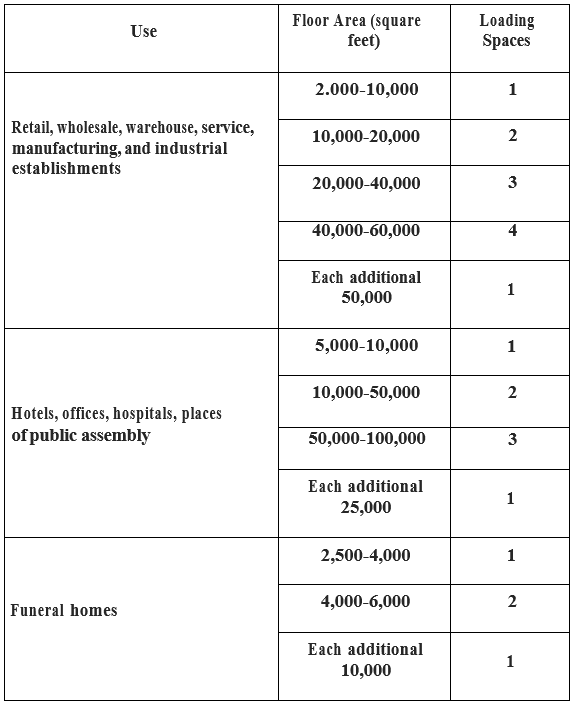
- Multiple or mixed uses. Where a building is devoted to more than one use or for different uses, and where the floor area for each use is below the minimum required for a loading space but the aggregate floor area of such uses is above such a minimum, then off-street loading space shall be provided as if the entire building were devoted to that use in the building for which the most loading spaces are required.
- Location. Required off-street loading spaces shall be located on the same lot with the principal use requiring such space. No loading space shall be located within 30 feet of the nearest point of intersection of two streets or require any vehicle to back into a public street.
- Design standards. Each off-street loading space shall have a width of at least 12 feet, a length of at least 45 feet and a vertical clearance of at least 14 feet. Dimensions for loading spaces in connection with funeral homes shall be reduced to ten feet in width, 25 feet in length, and eight feet in vertical clearance. Every loading space shall be sufficiently screened in the form of a solid fence or shrubbery to protect neighboring residences.
- Loading space requirements. The loading space requirements specified in the following table shall apply to all districts.
- Common open space.
- Nature. Common open space shall not include street right-of-ways, driveways, parking areas, or yards required in connection with any building.
- Buildings and structures. Common open space areas may contain complementary buildings and structures appropriate for the recreational use and enjoyment of the residents of the development for which it was established.
- Dedication. When common open space or any portion thereof is approved for dedication, and complementary improvements are completed and accepted, a deed shall be conveyed to the city and the supervision and maintenance shall be the responsibility of the city.
- Reservation. When common open space or any portion thereof is to be reserved for the exclusive use and enjoyment of the residents of the development from which it was established, the developer shall establish conditions as to the ownership, maintenance, and use of such areas as deemed necessary by the city to ensure preservation of its intended purposes. Land designated as common open space shall be restricted by appropriate legal instrument satisfactory to the city attorney as open space perpetually or for a period of not less than 99 years. Such instrument shall be binding upon the developer, his successors, and assigns and shall constitute a covenant running with the land and be in recordable form.
- Maintenance. If common open space is improperly maintained, the city may serve written notice upon any property owner or association setting forth the manner in which such property owner or association has failed to maintain the common open space and demanding that maintenance deficiencies be corrected within 30 days. If maintenance deficiencies, as originally set forth or subsequently modified, are not corrected within 30 days, the city may enter upon such common open space and correct maintenance deficiencies. The cost of such maintenance shall be assessed ratable against the properties within the development that have the right to use the area and shall become a tax lien on such properties. The city, at the time of entry, shall file notice of any liens in the office of the city treasurer.
- Site plans.
- Applicability and procedures. Where, by the terms of this chapter, a site plan is required prior to the issuance of a building permit, such site plan shall be submitted to the building inspector. The building inspector shall forward such site plan to the plan commission for their recommendation. No public notice and hearing is required for site plan consideration by the plan commission, but such matters shall be handled in a public session, as part of previously prepared agenda. All matters relating to plan commission consideration of site plans shall be a public record and approval shall require formal action of the plan commission. The site plan shall be submitted to the plan commission not less than 15 days prior to the public meeting of the plan commission at which approval is to be considered.
- Contents. A site plan required to be submitted by the requirements of this chapter shall include the following elements, where applicable:
- Statements of ownership and control of the proposed development.
- Statement describing in detail the character and intended use of the development.
- A site plan containing the title of the project and the names of the project planner and developer, date, and north arrow, and based on an exact survey of the property drawn to a scale of sufficient size to show:
- Boundaries of the project, any existing streets, buildings, water courses, easements, and section lines.
- Exact location of all buildings and structures.
- Access and traffic flow and how vehicular traffic will be separated from pedestrian and other types of traffic.
- Off-street parking and off-street loading areas.
- Recreation facilities, locations.
- All screening and buffers.
- Refuse collection areas.
- Access to utilities and points of utility hookups.
- Tabulations of total gross acreage in the project and the percentages thereof proposed to be devoted to:
- The various permitted uses.
- Ground coverage by structures.
- Impervious surface coverage.
- Tabulations showing:
- The derivation of numbers of off-street parking and loading spaces shown in subsection {11)(b)4 of this section.
- Total project density in dwelling units per net acre.
- Architectural definitions for buildings in the development; exact number of dwelling units, sizes, and types, together with typical floor plans of each type.
- Storm drainage and sanitary sewage plans.
- If common facilities, such as recreation areas or structures, common open space, etc., are to be provided for the development, statements as to how such common facilities are to be provided and permanently maintained. Such statements may take the form of proposed deed restrictions, deeds of trust, homeowners' associations, surety arrangements, or other legal instruments providing adequate guarantee to the city that such common facilities will not become a future liability for the city.
- Plans for signs, if any.
- Landscaping plan, including types, sizes, and locations of vegetation and decorative shrubbery, and showing provisions for maintenance.
- In the industrial districts, plans for the exterior walls of all buildings, lighting, outside storage, and industrial processes and materials pertinent to conformance with the industrial performance standards in this section.
- Such additional data, maps, plans, or statements as may be required for the particular use or activity involved or as the applicant may believe is pertinent.
- Placement of structures.
- No dwelling shall be erected, placed, or built within any district unless the structure has a minimum width of 22 feet for at least 70 percent of the structure's length and has a perimeter frost barrier footing.
- No dwelling built prior to June 15, 1976, shall be relocated to any residential lot within the city except to an approved mobile home lot. Dwellings built after June 15, 1976, must have proof of compliance with applicable department of housing and urban development (HUD) codes and bear the HUD seal of compliance in - order to be eligible for a moving permit. Proof of compliance must be provided by the applicant to the city plan commission along with a site plan for commission concurrence prior to the issuance of a moving permit.
- No non-dwelling structure exceeding 170 square feet in ground area, which has its place of origin off premises, shall be relocated onto any residentially zoned lot, unless the structure complies with current city building regulations and that a bond or irrevocable cashier's check be received by the city for 100 percent of the market replacement value of the structure. The bond or cashier's check shall be returned upon final inspection of the structure finding compliance with all applicable building codes and zoning ordinances. If 60 days after issuance of a permit for the moving of the structure, the structure fails to comply with the building codes and zoning ordinances, then in addition to any compliance action taken by the building inspector, the bond or cashier's check shall be retained and may be applied to the costs of effecting compliance and to any forfeiture, court costs, and cost of prosecution imposed by the court.
- Telecommunications antennas and towers.
- Purpose. The purpose of this subsection is to establish general guidelines for the siting of towers and antennas. The goals of this subsection are to:
- Encourage the location of towers in nonresidential areas and minimize the total number of towers throughout the community;
- Strongly encourage the joint use of new and existing tower sites;
- Encourage users of towers and antennas to locate them, to the extent possible, in areas where the adverse impact on the community is minimal;
- Minimize the adverse visual impact of the towers and antennas;
- Enhance the ability of the providers of telecommunications services to provide such services to the community quickly, effectively and efficiently; and
- Protect the public health, safety and general welfare of the city.
- Definitions. The following words, terms and phrases, when used in this section, shall have the meanings ascribed to them in this subsection, except where the context clearly indicates a different meaning: Antennas means any exterior apparatus designed for telecommunications, radio or pager services through the sending or receiving of electromagnetic waves, digital signals, radio frequencies, wireless telecommunication signals, including, but not limited to, directional antennas, such as panels, microwaves and satellite dishes, and omni-directional antennas, such as whip antennas. Antenna support structures means any building, pole, telescoping mast, tower, tripod or any other structure which supports an antenna. Co-location means the location of multiple antennas of more than one commercial wireless communication service provider or governmental entity on a single tower or alternative tower structure. FAA means the Federal Aviation Administration. FCC means the Federal Communications Commission. Height refers to the distance measured from ground level to the highest point on the tower or other structure, even if the highest point is an antenna. Personal communication services (PCS) means a provider of personal wireless service facilities as defined by federal law. Personal wireless facilities means transmitters, antenna structures, and other types of installations used to provide personal wireless services. Pre-existing towers and antennas means any legally placed tower or antenna permitted prior to the effective date of the ordinance from which this section is derived that shall not be required to meet the requirements of this section other than applicable federal or state requirements or city building codes. Tower means any structure that is designed and constructed primarily for the purpose of supporting one or more antennas, including self-supporting lattice towers or monopole towers. The term "tower" includes personal communication service towers, radio and television transmission towers, microwave towers, common carrier towers, cellular telephone towers, alternative tower structures and the like. The term "guy towers" are towers supported externally by a set or series of wires from the tower to the ground. Tower site means the area encompassing a tower and all supporting equipment, structures paved or graveled areas, fencing and other items used in connection with the tower. Wireless telecommunications services means licensed commercial wireless telecommunication services, including cellular, personal communication services (PCS), specialized mobilized radio (SMR), enhances specialized mobilized radio (ESMR), paging and similar services that are marketed to the general public.
- Special exception required. A special exception permit in accordance with section 17.47 shall be required for the locating and construction of a new tower or for the co-location of an antenna on an existing tower not previously granted a special exception.
- No special exception shall be granted for the placement of a tower in any residential zone or area zoned conservancy.
- Antennas not exceeding 30 feet in antenna height may be placed on existing structures that have an existing height greater than 45 feet, irrespective of the zoning district.
- No special exception for a tower site exceeding 30 feet in height shall be granted within 2,500 feet of an existing tower site whether the existing site is within or without the city.
- If a special exception permit is granted, the city council may impose conditions to the extent the city council concludes such conditions are necessary to minimize any adverse effect of the proposed tower on adjoining properties.
- Any information of an engineering nature required by the special exception that the applicant submits, whether civil, mechanical, or electrical, shall be certified by a licensed professional engineer.
- Private HAM radio operators and citizen band radio operators, along with their associated towers and apparatus, licensed under applicable FCC regulations, shall be exempt from the provisions of this section, provided that the facilities are situated on the same lot as the transmitter/receiver set.
- Information required. Each applicant requesting a special exception permit under this section shall submit a scaled site plan and a scaled elevation view and other supporting drawings, calculations, and other documentation, signed and sealed by appropriate licensed professionals, showing the location and dimensions of all improvements, including information concerning topography, frequency coverage, tower height requirements, setbacks, drives, parking, fencing, landscaping, adjacent uses, and other information deemed by the city council to be necessary to assess compliance with this section, including, but not limited to, the provision of co-location per subsection 17.32{11){f).
- Considered in granting special exception permits. The city council shall consider the following factors in determining whether to issue a special exception permit, although the city council may waive or reduce the burden on the applicant of one or more of these criteria if the city council concludes that the goals of this section are better served thereby:
- Height of the proposed tower.
- Capacity of the tower structure for additional antenna equipment to , accommodate expansion, or to allow for co-location of another provider's equipment.
- Proximity of the tower to residential structures and residential district boundaries.
- Nature of uses on adjacent and nearby properties.
- Surrounding topography.
- Surrounding tree coverage and foliage.
- Design of the tower, with particular reference to design characteristics that have the effect of reducing or eliminating visual obtrusiveness.
- Proposed ingress and egress to the tower site.
- Availability of suitable existing towers and other structures as discussed in section 17.32(11)(f).
- Compliance with current FAA and FCC regulations so as to, in part, minimize the possibility of interference with locally received transmissions.
- Co-location.
- Any proposed telecommunication tower and tower site shall be designed, structurally, electrically, and in all other respects to accommodate co-location of both the applicant's antennas and comparable antennas for at least two additional users. Towers and tower sites shall be designed to allow for future rearrangement of antennas upon the tower, to accept antennas mounted at varying heights, and to accommodate supporting buildings and equipment. The holder of a permit for a tower shall allow co-location for at least two additional users and shall not make access to the tower and tower site for the additional users economically unfeasible. If additional users demonstrate (through independent arbitration or other pertinent means) that the holder of a tower permit has made access to such tower and tower site economically unfeasible, the original permit on the tower site shall become null and void.
- No new tower shall be permitted unless the applicant demonstrates, to the reasonable satisfaction of the city council, that no existing tower or structure can accommodate the applicant's proposed antenna. Evidence submitted to demonstrate that no existing tower or structure can accommodate the applicant's proposed antenna may consist of any of the following:
- No existing towers or structures are located within the geographic area required to meet the applicant's engineering requirements.
- Existing towers or structures are not of sufficient height to meet the applicant's engineering requirements.
- Existing towers or structures do not have sufficient structural strength to support the applicant's proposed antenna and related equipment.
- The applicant's proposed antenna would cause electromagnetic interference with the antenna on the existing towers or structures, or the antenna on the existing towers or structures would cause interference with the applicant's proposed antenna.
- The applicant demonstrates that there are other limiting factors that render existing towers and structures unsuitable.
- The fees, costs or contractual provisions required by the owner to share an existing tower or structure or to adapt an existing tower.
- Setbacks and separation. The following setbacks and separation requirements shall apply to all towers and antennas for which a special exception permit is required; provided, however, that the city council may reduce the standard setbacks and separation requirements if the goals of this subsection would be better served thereby.
- Towers must be set back a distance equal to the height of the tower from any off-site residential structure.
- Towers, guys, and accessory facilities must satisfy the minimum zoning district setback requirements.
- Landscaping. The following requirements shall govern the landscaping surrounding towers for which a special exception permit is required; provided however, that the city council may waive such requirements if the goals of this subsection would be better served thereby.
- Tower sites shall be landscaped with a mixture of deciduous and evergreen trees and shrubs that effectively screens the view of the tower compound from adjacent residential property. The standard buffer shall consist of a landscaped strip at least four feet wide outside the perimeter of the compound.
- In locations where the visual impact of the tower would be minimal, the landscaping requirement may be reduced or waived altogether.
- Existing mature trees growth and natural land forms on the site shall be preserved to the maximum extent possible. In some cases, such towers sited on large wooded lots, natural growth around the property perimeter may be a sufficient buffer.
- Removal of abandoned antennas and towers. Any antenna or tower that is not operated for a continuous period of six months shall be considered abandoned, and the owner of such antenna or tower shall remove same within 90 days of receipt of notice from the city council notifying the owner of such abandonment. If such antenna or tower is not removed within the 90 days, the city council may remove such antenna or tower at the owner's expense. If there are two or more users of a single tower, then this section shall not become effective until all users cease using the tower.
- Applicability.
- District height limitation. The requirements set forth in this subsection shall govern the location of towers that exceed, and antennas that are installed, at a height in excess of the height limitations specified for each zoning district. The height limitations applicable to buildings and structures shall not apply to towers and antennas, however, in no case shall any tower, excluding antennas, exceed a height of 220 feet.
- Inventory of existing sites. Each applicant for an antenna and or tower shall provide to the planning department an inventory of all existing towers that are within a five-mile radius of the proposed site, on which the company is also located, leased or owned, including specific information about the location, height and design of each tower that applies. The city plan department may share such information with other applicants applying for special exception permits under this article or other organizations seeking to locate antennas within the jurisdiction of the city council; provided, however, that the planning and zoning department is not, by sharing such information, in any way representing or warranting that such sites are available or suitable.
- Purpose. The purpose of this subsection is to establish general guidelines for the siting of towers and antennas. The goals of this subsection are to:
- Small wind energy system ordinance.
- Authority. This section is adopted pursuant to authority granted by Wis. Stats. §§ 62.23{7) and 66.0401.
- Purpose. The purpose of this section is to:
- Oversee the permitting of small wind energy systems.
- Preserve and protect public health and safety without significantly increasing the cost or decreasing the efficiency of a small wind energy system (per Wis. Stats. § 66.0401).
- Definitions. The following words, terms and phrases, when used in this chapter, shall have the meanings ascribed to them in this section, except where the context clearly indicates a different meaning:
Administrator means the city building inspector.
Common Council means the city common council.
Meteorological tower (met tower) is defined to include the tower, base plate, anchors, guy cables and hardware, anemometers (wind speed indicators), wind direction vanes, booms to hold equipment, anemometers and vanes, data logger, instrument wiring, and any telemetry devices that are used to monitor or transmit wind speed and wind flow characteristics over a period of time for either instantaneous wind information or to characterize the wind resource at a given location.
Owner means the individual or entity that intends to own and operate the small wind energy system in accordance with this section.
Rotor diameter means the cross-sectional dimension of the circle swept by the rotating blades.
Small wind energy system means a wind energy system that
- Is used to generate electricity;
- Has a nameplate capacity of 100 kilowatts or less; and
- Has a total height of 170 feet or less. Total height means the vertical distance from ground level to the tip of a wind generator blade when the tip is at its highest point. Tower means the monopole, freestanding, or guyed structure that supports a wind generator. Wind energy system means the equipment that converts and then stores or transfers energy from the wind into usable forms of energy, as defined by Wis. Stats. § 66.0403{1)(m). This equipment includes any base, blade, foundation, generator, nacelle, rotor, tower, transformer, vane, wire, inverter, batteries, or other component used in the system. Wind generator means blades and associated mechanical and electrical conversion components mounted on top of the tower.
- Standards. A small wind energy system shall be a conditionally permitted use in all zoning districts subject to the following requirements:
- Setbacks. A wind tower for a small wind energy system shall be set back a distance equal to its total height from:
- Any public road right-of-way, unless permission is granted by the governmental entity with jurisdiction over the road. Such permission shall be in a form acceptable for recording in the county register of deeds office for the parcel on which the tower is located.
- Any overhead utility lines, unless permission is granted by the affected utility, such permission shall be in a form acceptable for recording in the county register of deeds office for the parcel on which the tower is located.
- All property lines, unless permission is granted from the affected landowner or neighbor, such permission shall be in a form acceptable for recording in the county register of deeds office for both the parcel on which the tower is located and the affected parcel.
- Access.
- All ground-mounted electrical and control equipment shall be labeled and secured to prevent unauthorized access.
- The tower shall be designed and installed so as to not provide step bolts or a ladder readily accessible to the public for a minimum height of eight feet above the ground.
- Electrical wires. All electrical wires associated with a small wind energy system, other than wires necessary to connect the wind generator to the tower wiring, the tower wiring to the disconnect junction box, and the grounding wires shall be located underground.
- Lighting. A wind tower and generator shall not be artificially lighted unless such lighting is required by the Federal Aviation Administration.
- Appearance, color, and finish. The wind generator and tower shall remain painted or finished the color or finish that was originally applied by the manufacturer, unless otherwise approved in the building permit.
- Signs. All signs, other than the manufacturer's or installer's identification, appropriate warning signs, or owner identification on a wind generator, tower, building, or other structure associated with a small wind energy system visible from any public road shall be prohibited.
- Code compliance. A small wind energy system, including tower, shall comply with all applicable state construction and electrical codes, and the National Electrical Code.
- Utility notification and interconnection. Small wind energy systems that connect to the electric utility shall comply with the public service commission of Wis. Admin. Code ch. PSC 119, "rules for interconnecting distributed generation facilities."
- Met towers. Met towers shall be permitted under the same standards, permit requirements, restoration requirements, and permit procedures as a small wind energy system.
- Setbacks. A wind tower for a small wind energy system shall be set back a distance equal to its total height from:
- Permit requirements.
- Building permit. A building permit shall be required for the installation of a small wind energy system.
- Documents. The building permit application shall be accompanied by a lot plan which includes the following:_
- Property lines and physical dimensions of the property.
- Location, dimensions, and types of existing major structures on the property.
- Location of the proposed wind system tower.
- The right-of-way of any public road that is contiguous with the property.
- Any overhead utility lines.
- Wind system specifications, including manufacturer and model, rotor diameter, tower height, tower type (freestanding or guyed).
- Tower foundation blueprints or drawings stamped by a design professional.
- Tower blueprint or drawing stamped by a design professional.
- The property lines and dimensions, with the names and addresses of the owners, of any properties proposed to be restricted from activities interfering with the system.
- Fees. The same fee required for a building permit for a permitted accessory use must accompany the application for a building permit for a small wind energy system.
- Expiration. A permit issued pursuant to this section shall expire if the small wind energy system is not installed and functioning within two years from the date the permit is issued.
- Abandonment.
- A small wind energy system that is out-of-service for a continuous two-year period, excluding time spent on repairs or improvements, will be deemed abandoned. The administrator may issue a notice of abandonment to the owner of a small wind energy system that is deemed abandoned. The owner shall have the right to respond to the notice of abandonment within 30 days from the notice receipt date. The administrator shall withdraw the notice of abandonment and notify the owner that the notice has been withdrawn if the owner provides information that demonstrates the small wind energy system has not been abandoned.
- If it is determined the small wind energy system is abandoned, the owner of same shall remove the wind generator from the tower at the owner's sole expense within three months of receipt of notice of abandonment. If the owner fails to remove the wind generator from the tower, the administrator may pursue a legal action to have the wind generator removed at the owner's expense and such expense shall be entered as a special charge on the tax roll.
- Building permit procedure.
- An owner shall submit an application to the administrator for a building permit for a small wind energy system. The application must be on a form approved by the administrator and must be accompanied by two copies of the lot plan identified above.
- Within 30 days of receipt of an application, the administrator shall determine whether the application is satisfactorily completed and, if no other properties are to be restricted by the permit, place the application on the agenda before the city plan commission. If the application identifies other properties to be restricted by the permit, the applicant shall provide notice to the owners of those properties personally or by certified mail; and provide receipts for the delivery of such notice to 'the administrator. The administrator shall provide the notice form. The hearing before the city plan commission shall, in such cases, be scheduled in compliance with the timelines of Wis. Stats. § 66.0403(3) and (4). The plan commission shall approve or deny the application based on the criteria as provided within this Code.
- If the application is approved, the administrator will return one signed copy of the application with the permit and retain the other copy with the application.
- If the application is rejected, the administrator will notify the applicant in writing and provide a written statement of the reason why the application was rejected. The applicant may appeal the administrator's decision pursuant to Wis. Stats. ch. 68. The applicant may re-apply if the deficiencies specified by the administrator are resolved.
- The owner shall conspicuously post the building permit on the premises so as to be visible to the public at all times until construction or installation of the small wind energy system is complete.
- Violations. It is unlawful for any person to construct, install, or operate a small wind energy system that is not in compliance with the ordinance from which this section is derived or with any condition contained in a building permit issued pursuant to this section. Small wind energy systems installed and operated prior to the adoption of this section are exempt.
- Administration and enforcement.
- The administrator or other designated official shall administer this section.
- The administrator may enter any property for which a building permit has been issued under this section to conduct an inspection to determine whether the conditions stated in the permit have been met.
- The administrator may issue orders to abate any violation of this section.
- The administrator may issue a citation for any violation of this section.
- The administrator may refer any violation of this section to legal counsel for enforcement.
- Penalties.
- Any person who fails to comply with any provision of this section or a building permit issued pursuant to this ordinance shall be subject to enforcement and penalties as provided in section 17.56.
- Nothing in this section shall be construed to prevent the common council from using any other lawful means to enforce this section.
- Portable storage units (containers).
- For the purpose of this section, the term "portable storage unit" shall mean any portable enclosed unit of whatever type construction or material, designed for permanent or temporary storage, which can be transported by vehicle and left on-site as determined by City Staff.
- In Residential Single Family (RSF), Residential Two Family (RTF), when incidental to a residential dwelling:
- One portable storage unit shall be the maximum number allowed on a lot for no more than 30 consecutive days and no more than 60 total days per calendar year.•
- The portable storage unit shall be placed on an impervious surface.
- The portable storage unit shall not be located within 3 feet of a property line.
- The portable storage unit shall not be located within the vision corner.
- Portable storage units shall not be used for the purposes of a garage or shed.
- All other zoning districts. When incidental to a permitted principal use:
- A temporary use permit is required pursuant to this section.
- No more than three temporary use permits per business shall be issued per calendar year.
- Two portable storage units shall be the maximum allowed per temporary use permit.
- The maximum time limit per temporary use permit shall be 30 days, unless t he plan commission approves a longer duration.
- Portable storage units shall be placed on an impervious surface.
- Portable storage units may be placed on a lot within a designated loading space.
- The portable storage unit shall not be located within the required front setback unless permitted by the Zoning Administrator.
- Portable storage units shall not be used for the purposes of a garage, shed or other on-site storage.
- Permanent use of a storage container at an Industrial or Commercial location may only be permitted by approval of the Plan Commission.
- Storage containers used in connection with a construction project may be permitted by the Zoning Administrator and must be only used for purpose related to the construction project, not placed withing 3 feet of a property line, not located within the vision corner and must be removed from the site upon issuance of occupancy of the permanent structure.
(Code 2011, § 17.32)
HISTORY
Amended by Ord. 1867-2022 on 10/4/2022
Repealed by Ord. 1874-2022 on 12/6/2022
Repealed & Replaced by Ord. 1917-2025 on 2/4/2025
Amended by Ord. 1945-2025 on 11/18/2025
Amended by Ord. 1867-2022 on 10/4/2022
Repealed by Ord. 1874-2022 on 12/6/2022
Repealed & Replaced by Ord. 1917-2025 on 2/4/2025
Amended by Ord. 1945-2025 on 11/18/2025

