
Kenmore City Zoning Code
ARTICLE XII
TELECOMMUNICATIONS TOWERS AND ANTENNAS
Sec. 25-290.- Purpose.
The purpose of this article is to establish general guidelines for establishing communication tower and antenna sites. The goals of this article are:
(1)
Protect residential areas and land uses from any adverse impacts of telecommunications facilities.
(2)
Encourage location of towers in nonresidential areas.
(3)
Encourage the use of pre-existing sites when establishing a telecommunication facility site.
(4)
Consider the public health and safety of telecommunication towers and antenna.
(5)
Encourage users of telecommunication facilities to establish sites which minimize adverse visual impact of the site through the establishment of careful design and siting.
(6)
Encourage users of telecommunication facilities to locate sites in areas where there will be minimal adverse effect upon the community.
(7)
Work with telecommunication providers in selecting and developing telecommunication sites so that the community may benefit from more efficient and effective service.
(8)
Maintain safety to the community, especially adjacent properties through careful inspection of telecommunication sites.
(L.L. No. 1-2000, § 1, 1-4-2000)
Sec. 25-291. - Applicability.
(a)
New telecommunication facilities. All new towers or antennas and all relocated, rebuilt or extended telecommunication facilities in the village shall be subject to these regulations.
(b)
Pre-existing telecommunication facilities. Pre-existing towers and antennas shall not be required to meet the requirements of this article, except for those requirements under section 25-293(a), (b), (k), (l), (m), (n) and (o).
(L.L. No. 1-2000, § 1, 1-4-2000)
Sec. 25-292. - Definitions.
As used in this article, the following terms shall have the meanings described thereto:
Co-location means the presence of a telecommunication facility on a pre-existing structure or building. Co-location also refers to the presence of more than one telecommunication facility located on the same tower, land, building or structure.
Facility means any telecommunication facility or part thereof.
Telecommunication facility means any commercial equipment used in connection with the provision of wireless communication services, including cellular telephone services, personal communications services, radio and television broadcast services and private radio communications services, which are regulated by the Federal Communications Commission in accord with federal law and the Telecommunications Act of 1996, including any amendments thereto. A telecommunications facility shall include antenna(s), principal and accessory telecommunication equipment and supporting masts, monopoles and structures, towers, buildings and appurtenances servicing same.
User means any telecommunications provider which enters into a lease with the village for purposes of establishing a telecommunications facility on land, buildings or structures owned by the village.
(L.L. No. 1-2000, § 1, 1-4-2000)
Sec. 25-293. - General requirements.
The following requirements shall apply to all applicants wishing to locate, rebuild, relocate or extend a telecommunications facility in the village:
(a)
Building permit required. All applicants must obtain a building permit from the village building department. The building inspector, or any person designated by the board of trustees, is hereby authorized to issue building permits under this article if the inspector determines that the applicant has met all requirements established under this article.
(b)
FCC license required for process of permit application. Applications for permits will only be processed when the applicant demonstrates that it is licensed by the Federal Communications Commission as a telecommunications provider or that the applicant has agreements with an FCC-licensed telecommunications provider for the use or lease of the support structure or tower already in existence.
(c)
Submission of site plan. All applicants under this article will be required to submit a site plan to the village building department for review. The site plan review will include an evaluation of the plans, examination of the specifications for the site, including, but not limited to, the number and type of antenna(s), frequency(ies), dimensions and location of the antenna, tower and/or accessory structure(s), the structural integrity and suitability of the facility and/or the pre-existing structure, a description of how the antenna will be affixed, details of all fixtures and couplings, and a visual environmental assessment form (visual EAF). The applicant will also provide a landscape plan which will demonstrate the visibility of the facility from key viewpoints. The building department may require the applicant to provide a report, prepared by a state-licensed professional engineer detailing the information contained within this paragraph.
(d)
Demonstration necessary height and location. All applicants proposing construction of a tower or the increase in height of an existing tower, and any applicant proposing to mount an antenna on an existing structure, must demonstrate that the tower or antenna height is the minimum height necessary to fulfill the site's function within the network. In addition, the applicant must demonstrate that the telecommunication facility's location is needed to satisfy the applicant's network. Technological evidence must be submitted to verify this information.
(e)
Agreement to remove. All applicants must agree, in writing, to remove the tower, antenna, accessory buildings, etc., if such facility becomes technically obsolete or ceases to be used for the purpose originally intended for twelve (12) consecutive months.
(f)
Good faith effort to establish on existing structure. All applicants are required to make a good faith effort to establish a telecommunication facility on an existing structure and/or public property. Failure to do so may result in denial of the application.
(g)
Response to inquiry for co-location. Any owner of a telecommunications facility located on a pre-existing structure or building must respond to any inquiry for the village building department or legal department concerning the availability of the site for co-location.
(h)
Demonstration that facility cannot be accommodated on existing structure. If the applicant does not seek a permit for establishment of a telecommunications facility site on a pre-existing structure, the applicant must demonstrate that the proposed telecommunications facility cannot be accommodated on an existing site due to one or more of the following reasons:
(1)
The planned equipment would cause radio frequency interference with other existing or planned equipment which cannot reasonably be prevented.
(2)
The existing structures do not have space on which the proposed equipment can be placed so it can function effectively and reasonably.
(3)
The property owner or owner of the existing tower, building or other structure refuses to allow co-location.
(4)
The planned equipment would exceed the structural capacity of the existing site.
(5)
Other technical reasons make it impracticable to place the equipment proposed by the applicant on the existing structure.
(i)
Aesthetics. New towers and antennas or rebuilt, relocated or extended towers and antennas shall meet the following requirements:
(1)
The telecommunication facility is designed and constructed in a manner which minimizes its visual impact to the surrounding community to the extent practicable.
(2)
Towers shall either maintain a galvanized steel finish or, subject to any applicable standards of the FAA, be painted a neutral color so as to make the antenna and related equipment visually unobtrusive. Any antenna or tower affixed to a pre-existing structure is to be designed and/or painted in a neutral color, or in the identical or similar color as the existing or supporting structure so as to blend in with the existing structure.
(3)
The telecommunications facility shall be separated from residential dwellings, schools, and designated historical landmarks and historical sites by the distance of five hundred (500) feet; provided, however, that a reduced distance may be allowed where the applicant seeks a permit on a pre-existing site.
(4)
No tower located in residential use 1 and residential use 2 districts may have towers or antennas which exceed thirty (30) feet in height.
(j)
Fencing. The tower or antenna shall be surrounded by a chain link or masonry fence, not less than six (6) feet in height from finished grade. No barbed wire shall be used. This shall not apply to telecommunication facilities established on a pre-existing site where the building inspector determines that the location of the telecommunication facility is not readily accessible and where the building inspector determines that the safety of the public will not be compromised by the absence of a fence.
(k)
Lighting. Towers shall be lighted as prescribed by the Federal Aviation Administration or other applicable authority. Towers shall not otherwise be lighted. If lighting is required, the lighting design and type chosen must cause minimal disturbance to the surrounding neighborhood.
(l)
State or federal requirements. All towers and antennas must meet or exceed current standards and regulations of the FCC, FAA and any other agency with the authority to regulate towers and antennas. The owners of the telecommunications facility will take all necessary steps to bring the facility into compliance with any changes in the regulations and/or standards governing telecommunication facilities within six (6) months of the effective date of such standards and regulations, provided the regulations and standards do not mandate a different compliance schedule.
(m)
Building codes. The facility shall be maintained in good order and repair at all times according to village Code requirements. The owner of the telecommunication facility shall also maintain the site in compliance with standards contained in applicable federal, state and local building codes. In addition, the owner of a telecommunication facility shall ensure that it is in compliance with standards established by the Electronic Industries Association. The building department shall conduct routine inspections of the telecommunications facility and the site, and, where the telecommunications facility is situated upon a pre-existing structure or building, upon the building or structure. If upon inspection, the village should conclude that the telecommunications facility, the site, or the pre-existing building or structure, fails to comply with such codes and standards and constitutes a danger to persons or property, notice shall be given to the owner of the telecommunications facility and the owner of the pre-existing building or structure. Upon receipt of such notice, the owner of the telecommunications facility and/or pre-existing building or structure shall be given thirty (30) days to correct any violations and to bring said property into compliance with such standards and requirements. Failure to bring said telecommunications facility and/or pre-existing building or structure into compliance shall constitute grounds for removal of the telecommunications facility at the telecommunications facility owner's expense.
(n)
Advertising. The use of any portion of a facility for signs or advertising purposes, including company name, banner, streamer, etc., is prohibited.
(o)
Compliance with state environmental quality law. All applicants under this article must comply with the state Environmental Quality Review Act.
(p)
Bond. The owner of the telecommunications facility shall provide to the village clerk a demolition bond equal to twice the cost of removal of the tower, antenna and any accessory structure. Said bond shall list the village as assignee. The applicant shall submit an analysis, certified by a state licensed professional engineer, outlining the cost of removal of the telecommunications facility and restoration of the surrounding area. The sufficiency of the bond shall be confirmed every five (5) years. If the bond amount in force is insufficient to cover the costs of removal of the telecommunications facility, it shall be immediately increased to cover such amount.
(L.L. No. 1-2000, § 1, 1-4-2000)
Sec. 25-294. - Use of premises owned by the village.
All applicants wishing to locate a telecommunications facility on village property must submit a completed application and detailed site plan to the building inspector. The applicant must comply with section 25-293 above. The applicant will also supply, within a reasonable time, all pertinent information requested by the village. Applications will be submitted with a non-refundable application fee, the amount of which will be determined by resolution by the board of trustees. The building inspector shall issue a permit within sixty (60) days of receipt of the completed application and fee provided the building inspector is satisfied that the applicant is in compliance with the requirements contained within this section. If the building inspector does not believe, after careful review, that the applicant is in compliance, the building inspector shall deny such application.
(a)
Location. Telecommunications facilities may be located on village property, provided that a lease agreement is approved by the village board of trustees and that the applicant complies with all provisions of this section.
(b)
Priority of users. The following priority of users is given to the following in descending order:
(1)
Village of Kenmore.
(2)
Public safety agencies including police, fire and ambulance services and private entities which have a public safety agreement with the village.
(3)
Governmental agencies.
(4)
Companies providing telecommunications services including Internet, paging, data, enhanced specialized mobilized radio (ESMR), cellular, personal communication services (PSC).
(c)
Placement. Placement of a telecommunications facility on village land must comply with the following requirements:
(1)
Telecommunications facility will not adversely impact on the surrounding private property.
(2)
Telecommunications facility will not interfere with the purpose for which the village land was intended.
(3)
Telecommunications facility will not interfere with other persons using village land.
(4)
The applicant must secure necessary land use permits and approvals.
(5)
The applicant will work with the village's objective to promote co-locations.
(6)
The applicant will continue to comply with the requirements of section 25-293.
(d)
Termination:
(1)
The village board of trustees may terminate any lease if one of the following conditions exist:
a.
A potential user with higher priority as described in section 25-294(b) is unable to locate another adequate location and its desired use is incompatible with the current use.
b.
A user's frequency broadcast unreasonably interferes with the uses of a higher priority, as established in section 25-294(b).
c.
A user violates any of the standards in this article or the conditions established in a village lease agreement.
(2)
The village will provide written notice to the user of its intent to terminate any lease. The notice will contain the reasons for such termination and provide an opportunity for the user to address the village board of trustees. This procedure may not be used in emergency situations.
(e)
Right to deny use. The village reserves the right to deny, for any reason, the use of any or all village land.
(L.L. No. 1-2000, § 1, 1-4-2000)
Sec. 25-295. - Buildings or other equipment storage.
Antennas mounted on structures or rooftops. The equipment cabinet or structure used in connection with antennas shall meet the following requirements:
(1)
Cabinet or structure shall not exceed three hundred (300) square feet and shall not exceed twelve (12) feet in height. For any buildings less than sixty-five (65) feet in height, shall locate the related equipment structure on the ground and not on the rooftop if the zoning board of appeals should allow for an equipment structure exceeding three hundred (300) square feet or exceeding twelve (12) feet in height.
(2)
If the equipment cabinet or structure is located on the roof of a building, the area of said structure, including other equipment and structures shall not occupy more than twenty-five (25) percent of the roof area.
(3)
Any storage buildings or cabinets shall comply with all applicable building codes.
(L.L. No. 1-2000, § 1, 1-4-2000)
Sec. 25-296. - Removal of abandoned antennas and towers.
Any telecommunication facility which is not operational for a twelve-month period shall be deemed abandoned. The owner of the telecommunication equipment shall remove all equipment and structures, including storage cabinets and sheds, antenna and towers within ninety (90) days of receipt of a notice from the village informing the owner of such abandonment.
(L.L. No. 1-2000, § 1, 1-4-2000)
Sec. 25-297. - Amateur (HAM) radio antennas
(a)
Purpose and intent. These regulations apply to amateur radio antennas within the village. These regulations are adopted to balance the federal interest in amateur radio operation and the village's interest in protecting the public health, safety, welfare, and character of the community. The purposes of this section are:
(1)
To establish an application process and standards for installation of amateur radio antennas, while preserving the community character and ensuring safety.
(2)
To promote the public health, safety, and welfare of the community, and to protect and preserve community character.
(3)
To accommodate reasonably the needs of licensed amateur radio operators in accordance with federal law.
(b)
Definitions.
(1)
Amateur radio antenna. Any equipment or device that is used for the purpose of transmitting and/or receiving radio signals in conjunction with an amateur radio station licensed by the Federal Communications Commission (FCC). The term amateur radio antenna is interchangeable with the term HAM radio antenna.
(2)
Antenna. Any system of wires, poles, rods, reflecting discs, or similar devises used for the transmission or reception of electromagnetic waves, including but not limited to both vertical and horizontal arrays.
(3)
Antenna structure. The supporting mast, pole or tower of one or more antenna(s).
(4)
Antenna/antenna structure. Collectively the antenna and its supporting structure, if any.
(5)
Antenna/antenna structure height. The distance from the highest point of the antenna/antenna structure to the natural grade at the point the structure touches, or if extended, would touch the ground.
(c)
Regulations generally.
(1)
No amateur radio antenna or support thereof shall be erected, installed, placed or maintained upon any lot or upon any building or structure except in compliance with this section.
(2)
No signage shall be allowed on any antennas and/or antenna structure, expect for requisite safety text and other labeling required by federal law.
(3)
No portion of any antenna and/or antenna structure shall be allowed within any required setback area. Any directional antenna that could extend across a property line when rotated is prohibited.
(4)
No more than one antenna structure shall be permitted on any lot or structure.
(5)
There shall be no maximum height established in this section for amateur radio antennas. However, the applicant is required to demonstrate that the established tower height is the minimum height necessary to achieve the stated objectives. In addition, in evaluating an application and in setting height limitations as conditions on any approval under this section, the village's reviewing boards must take into account the public health, safety, welfare, and community character. Factors such as height of surrounding structures, lot sizes, setbacks, impacts from tower collapse, alternatives available to the applicant, aesthetics, and safety concerns will be considered. The height for each tower will be dependent upon the balancing of federal and local interests required by federal law.
(d)
Special use permit/site plan review required.
(1)
The installation of an amateur radio antenna shall be a permitted use in all zoning districts within the village, subject to the issuance of a special use permit by the village board of trustees.
(2)
Pursuant to section 17-151 of the Village Code, site plan review is required.
(3)
The factors to be considered by the village board of trustees in evaluating an application for a special use permit will include those factors set forth in subparagraph (c)(5) above. In addition, the board shall consider the following:
a.
Whether the antenna, including the antenna structure and accessory equipment, is located, sized, and designed so as to minimize the amount of the antenna that is visible from surrounding properties, public streets, and all public rights-of-way, recognizing that complete screening may not be possible;
b.
Whether there is adequate space on the property for the antenna and antenna structure without conflicting with buildings on the property or encroaching into required setback areas;
c.
Whether the antenna/antenna structure is compatible with the surrounding neighborhood with respect to, including, but not limited to, scale and massing in comparison to lot size, impact on adjacent properties, and aesthetic impacts;
d.
Whether the permit and any conditions of approval attached thereto would accommodate reasonably the amateur radio operator's desire for communication, while at the same time requiring the minimum practicable regulation to accomplish the village's legitimate purpose of protecting the public health, safety, welfare, aesthetics and compatibility with the neighborhood. The village board of trustees may also consider other factors deemed relevant and appropriate by the board.
(4)
Both the village board of trustees and the planning board must conduct a balancing analysis, taking into account the federal interest in amateur radio operation and the village's interest in protecting the public health, safety, welfare, and community character. In doing so, the boards shall accommodate reasonably amateur radio communications, while taking into account the village's legitimate objectives.
(5)
Review of applications for a special use permit and site plan review under this section must comply with the New York State Environmental Quality Review Act.
(6)
The reviewing boards shall have the power to impose conditions, consistent with applicable law.
(e)
Application requirements.
(1)
An application fee of one thousand dollars ($1,000.00) is required for applications for a special use permit under this section. The village board has evaluated the costs of hiring a technical consultant to aid it in its evaluation and has determined that this amount is reasonable and designed to cover the costs of review.
(2)
The name, address, and call letters of the amateur radio operator.
(3)
Manufacturer's specifications of the antenna structure.
(4)
Visual representation to scale of the antenna structure and array through the preparation of project specific elevations drawn to scale and dimensioned so as to fully describe the proposed project.
(5)
A description of the intended use, including information explaining the need for the proposed antenna (for example, if an antenna of a certain size is needed to communicate with a particular location).
(6)
A demonstration of the technical and practical necessity for the height of the tower, including a demonstration that the tower is the minimum height necessary to provide a technologically practical and feasible facility.
(7)
A copy of licenses issued by the Federal Communications Commission (FCC), including station and operator licenses.
(8)
All documentation submitted to and/or required/requested by the FCC.
(9)
For site plan review, the applicant shall comply with the application requirements found in article V of chapter 17 of the Village of Kenmore Municipal Code.
(L.L. No. 2-2013, § 1, 12-3-13)
Sec. 25-298. - Small cell wireless facilities.
(a)
Conditions applying to all small wireless facilities.
(1)
Definitions. As used in this section, the following terms shall have the meanings indicated.
Camouflage means to use concealment techniques to blend the installation of the structure into the surrounding area by mimicking its surroundings or otherwise disguising it in the environment.
Concealed installation on building means building-mounted small wireless facilities that completely screen all associated equipment and facilities from public view by approved methods that are in keeping with the character of the building, surrounding area and any applicable design guidelines or standards as determined by the village.
Ground-based equipment or ground-based enclosures means any equipment associated with installation of a small wireless facility and/or support structure that will be located on the surface of the ground with some or all of the facility located above grade.
License means the document granted to an individual under this section, which permits its holder, the licensee (see definition), to have all the rights, privileges, and obligations arising under this local law. Any license issued under this section is non-exclusive and is subject to the limitations provided herein.
Licensee means any person having applied for a license under this section and holding such a license.
Permittee means an applicant that has received a special use permit under this section.
Pole means a legally constructed pole, such as a utility, lighting, traffic, or similar pole.
Right-of-way or ROW means the area on, below, or above a public roadway, highway, street, sidewalk, alley, utility easement, or similar property, under the jurisdiction of the village.
RF means radio frequency.
Small wireless facility or micro wireless facility, small cell,"SWF" means a wireless facility that meets both of the following qualifications: (i) each antenna is located inside an enclosure measuring no more than six (6) cubic feet in volume or, in the case of an antenna that has exposed elements, the antenna and all of its exposed elements could fit within an imaginary enclosure of no more than six (6) cubic feet; and (ii) all other wireless equipment associated with the facility measuring no more than twenty-eight (28) cubic feet in volume. The following types of associated ancillary equipment are not included in the calculation of equipment volume: electric meter, concealment elements, telecommunications demarcation box, ground-based enclosures, grounding equipment, power transfer switch, cut-off switch, and vertical cable runs for the connection of power and other services.
Support structure means a freestanding structure such as a utility pole, monopole, or other existing or proposed structure designed to support or be capable of supporting wireless facilities.
Utility pole means a pole or similar structure that is used in whole or in part for the purpose of carrying electric distribution lines or cables or wires for telecommunications; cable or electric service; or for lighting, traffic control, signage, or a similar function regardless of ownership, including village-owned poles. Such term shall not include structures supporting only small wireless facilities.
(2)
Purpose and legislative intent.
a.
The village desires to encourage small-cell wireless telecommunication infrastructure investment by providing a fair and predictable process for the deployment, while enabling the village to promote the management of its public ROW in the overall interests of the public health, safety, and welfare. The village recognizes that wireless facilities are critical to delivering wireless access to advanced technology, broadband, and 911 services to homes, businesses, and schools within the village, and new technology has increased the need for towers and antennas to serve the village. The village further recognizes that SWF often may be deployed most effectively in the ROW. The village desires to enact a legal framework which will permit the expedited review process for the deployment of such SWF when specified criteria are met and to permit placement of towers and antennas in locations which will allow telecommunications services to be rendered in conformity with both the Federal Telecommunications Act of 1996, and with the goals of local comprehensive plans and zoning ordinances.
b.
In enacting this section, the village is establishing uniform standards to address issues presented by SWF, including, without limitation, to:
1.
Prevent interference with the use of streets, sidewalks, alleys, parkways, and other public ways and places;
2.
Prevent the creation of visual and physical obstructions and other conditions that are hazardous to vehicular and pedestrian traffic;
3.
Prevent interference with existing facilities and operations of facilities presently lawfully located in rights-of-way or public property;
4.
Ensure reasonable efforts are made to preserve the character of neighborhoods in which facilities are installed;
5.
Protect community aesthetics and visual and historic resources;
6.
Protect against environmental damage, including damage to trees;
7.
Facilitate the installation of SWF to provide benefits of reliable access to wireless telecommunications technology, broadband, and 911 services to homes, business, and schools within the village.
(3)
Applicability. This section applies to all existing SWF and all applications and requests for approval to construct, install, modify, co-locate, relocate, or otherwise deploy SWF.
(4)
Application requirements.
a.
Special use permit application. All persons wishing to construct, install, modify, co-locate, relocate, or otherwise deploy SWF must submit an application for a special use permit for approval by the Village Board of the Village of Kenmore. The village board shall follow the procedures set forth in New York Village Law § 7-725-B for consideration of the special use permit applications. The SWF permit application shall contain the following, to include nine (9) hard copies and one digital copy:
1.
Letter application and applicable application fee(s). The letter application must contain a detailed description of the proposal, the number of SWFs involved in the subject application, their proposed locations, and a description of the proposed locations, including the zoning districts and nearby land uses. The letter application must also contain the applicant's name and contact information, as well as the names and contact information for all consultants acting on behalf of the applicant, if any.
2.
Owner's authorization and/or evidence of property rights. The applicant must demonstrate it has adequate real property rights for the installation and maintenance of the SWF. This would include, but not be limited to, owner authorization, an easement, a lease, and/or a license issued pursuant to this section.
3.
Project plans. The applicant must provide a fully dimensioned site plan and elevation drawings prepared and sealed by a New York licensed engineer showing any existing wireless facilities with all existing transmission equipment and other improvements, the proposed SWF with all proposed transmission equipment and other improvements and the legal boundaries of the leased or owned area surrounding the proposed SWF and any associated access or utility easements.
4.
Site photos and photo simulations. The applicant must provide photographs and simulations that show the proposed SWF in context of the site from reasonable line-of-sight locations from public streets or other adjacent viewpoints, together with a map that shows the photo location of each view angle. These simulations must indicate both location of the proposed SWF as well as design aesthetics that reflect compliance with this section.
5.
RF compliance demonstration. The applicant must provide an RF exposure compliance report prepared and certified by a New York licensed engineer acceptable to the village that certifies that the proposed SWF, as well as any co-located SWF, will comply with applicable federal RF exposure standards and exposure limits. The RF report must include the actual frequency and power levels (in watts effective radiated power ("ERPP") for all existing and proposed antennas at the site and exhibits that show the location and orientation of all transmitting antennas and the boundaries of areas with RF exposures in excess of the uncontrolled/general population limit (as that term is defined by the FCC) and also the boundaries of the areas with RF exposures in excess of the controlled/occupations limit (as that term is defined by the FCC)). Each such boundary shall be clearly marked and identified for every transmitting antenna at the project site in accordance with FCC requirements, if applicable.
6.
Acoustic analysis. The applicant must provide a written report that analyzes acoustic levels for the proposed SWF and all associated equipment. The acoustic analysis must be prepared and certified by an engineer and include an analysis of the manufacturer's specifications for all noise-emitting equipment and a depiction of the proposed equipment relative to all adjacent property lines.
7.
Project purpose statement/need demonstration. The applicant must provide a written statement that includes:
a.
A description of the technical objectives to be achieved;
b.
An annotated topographical map that identifies the targeted service area to be benefited;
c.
The estimated number of potentially affected users in the targeted service area; and
d.
Full-color signal propagation maps with objective units of signal strength measurements that show the applicant's current service coverage levels from all adjacent sites without the proposed site, predicted service coverage levels from all adjacent sites with the proposed site, and predicted service coverage levels from the proposed site without all adjacent sites.
8.
Alternatives analysis. The applicant must list all existing structures considered as alternatives to the proposed location, together with a general description of the site design considered at each location. The applicant must also provide a written explanation for why the alternatives considered were unacceptable or not feasible, unavailable or not as consistent with the design standards. This explanation must include a comparative analysis and such technical information and other factual justification as are necessary to document the reasons why each alternative is unacceptable, not feasible, unavailable, or not as consistent with the design standards in this section as the proposed location.
9.
The applicant shall provide manufacturer's information for the SWF and support structure, if applicable.
10.
The applicant shall provide technical specifications of the SWF and support structure, if applicable, and evidence that such structure is capable of handling the addition of SWF.
11.
The applicant shall provide a written maintenance and removal plan, made to and acceptable by the village, to include an agreement by the applicant and/or owner to remove all the components of the SWF in the event the facility becomes non-functional, ceases to be used for its originally intended purposes or is otherwise abandoned, as determined by the village. The maintenance and removal plan shall remain in full force for the life of the SWF. An acceptable bond and/or surety, for the purposes of removing the SWF, submitted to the village for review, shall be purchased and remain in force for the life of the SWF.
12.
The applicant shall provide any other items that the village shall deem necessary for a thorough and complete review of the proposal.
b.
One application required. Although each SWF requires its own special use permit, the applicant need submit only one application regardless of the number of proposed SWF or locations. The board may, in its sole discretion, deny the application, grant the application in full, or partially grant the application by issuing special use permits for only some of the SWF proposed in the application.
c.
Maintenance. Subject to the requirements for the initial application, an application shall not be required for routine maintenance, unless otherwise specified within this section. Replacement of any portion of a SWF shall require an amendment to the special use permit, requiring compliance with all applicable requirements and procedures set forth in this section.
d.
Application fees. The applicant shall pay the village a six hundred dollar ($600.00) fee for the special use permit application for the first SWF, plus one hundred fifty dollars ($150.00) per each additional SWF for which the applicant is requesting a permit.
e.
Third-party professional consultants. If, after reviewing the application, the village determines that it has a reasonable need to retain a third party consultant(s) to assist in the review of a proposed SWF, the cost of such third-party consulting services shall be reimbursed by the applicant to the village within sixty (60) days of the village receiving an invoice for third party consulting services.
(5)
Exceptions to the special use permit requirement. The following SWFs shall be exempt from the special use permit requirements of section 255-33(A)(5)(a) and, upon compliance with the substantive requirements of this section, require only an approval determination from the code enforcement officer. The fee for this review by the code enforcement officer shall be three hundred twenty-five dollars ($325.00) for the first SWF, plus seventy-five dollars ($75.00) per each additional SWF for which the applicant is requesting approval.
a.
SWFs that are concealed installations on buildings within the following zoning districts: General business use and industrial use.
b.
Collocation on existing poles that are within the following zoning districts: General business use and industrial use.
(6)
Site location guidelines.
a.
Preferred locations. The village prefers co-location and siting in general business use and/or industrial use districts, as defined in Chapter 25, over residential zoning districts.
b.
Discouraged locations. The village discourages new support structures and the location in residential zoning districts. Where possible, efforts should be made to co-locate or to locate in general business use and/or industrial use districts. If location in a residential zoning district is necessary, techniques to minimize aesthetic impacts are mandatory, including camouflage.
c.
Prohibited locations. The village prohibits any structures or parts of structures associated with SWF placement from obstructing access to above- or underground traffic control infrastructure, public transportation vehicles, shelters, street furniture, or other improvements, above- or underground utility infrastructure, fire hydrants, doors, gates, or other ingress and egress points to any building appurtenant to the ROW, or any fire escape. Ground-mounted equipment shall not be closer that twelve (12) feet from any permanent object, existing lawful encroachment in the ROW, and driveway aprons.
(7)
Design standards.
a.
Construction categories. Each SWF shall comply with the standards set forth for each location type.
1.
Existing support structure.
a.
Equipment. All equipment must be installed as close to the support structure as technically feasible to minimize its visibility from public view to the greatest extent feasible. All conduits, conduit attachments, cables, wires, and other connectors shall be concealed from the public view to the greatest extent feasible. Ground-mounted equipment is not preferred and shall be minimized to the greatest extent feasible. Where used, ground-mounted equipment must incorporate concealment techniques in compliance with the requirements of subsection (a)(7)c. of this section.
b.
Minimum clear height. With the exception of any ground-mounted equipment, no part of the SWF shall be less than ten (10) feet above grade.
c.
Maximum height. No part of the SWF shall exceed ten (10) feet above the existing support structure. Ground-mounted cabinets shall be secured to a concrete slab and shall not exceed three (3) feet in height.
d.
Maximum volume. The maximum volume of each antenna shall not exceed six (6) cubic feet.
e.
Maximum equipment volume. The maximum equipment volume shall not exceed twenty-eight (28) cubic feet, or fifteen (15) cubic feet for ground-mounted equipment.
f.
Reservation of rights. The village reserves its right to request additional information, analysis, studies, including further expert opinion, at the applicant's expense, pertaining to the application and any issues of concern.
g.
Each SWF shall be on one support structure.
h.
Each SWF shall be at least five hundred (500) feet from another SWF.
2.
New support structure.
a.
Basis. The village will consider new poles only if the applicant can demonstrate that replacing or utilizing an existing pole is not possible or feasible. Any new poles must meet all village and other applicable laws.
b.
Support structure requirements. All applicants shall propose new support structures that complement the community character of the area, and any applicable design guidelines that may exist for the area. When existing utility poles exist, new support structures may feature a similar design and aesthetic. Where no existing utility poles exist, architecturally significant support structures shall be proposed, including, but not limited to, flag poles and decorative light standards.
c.
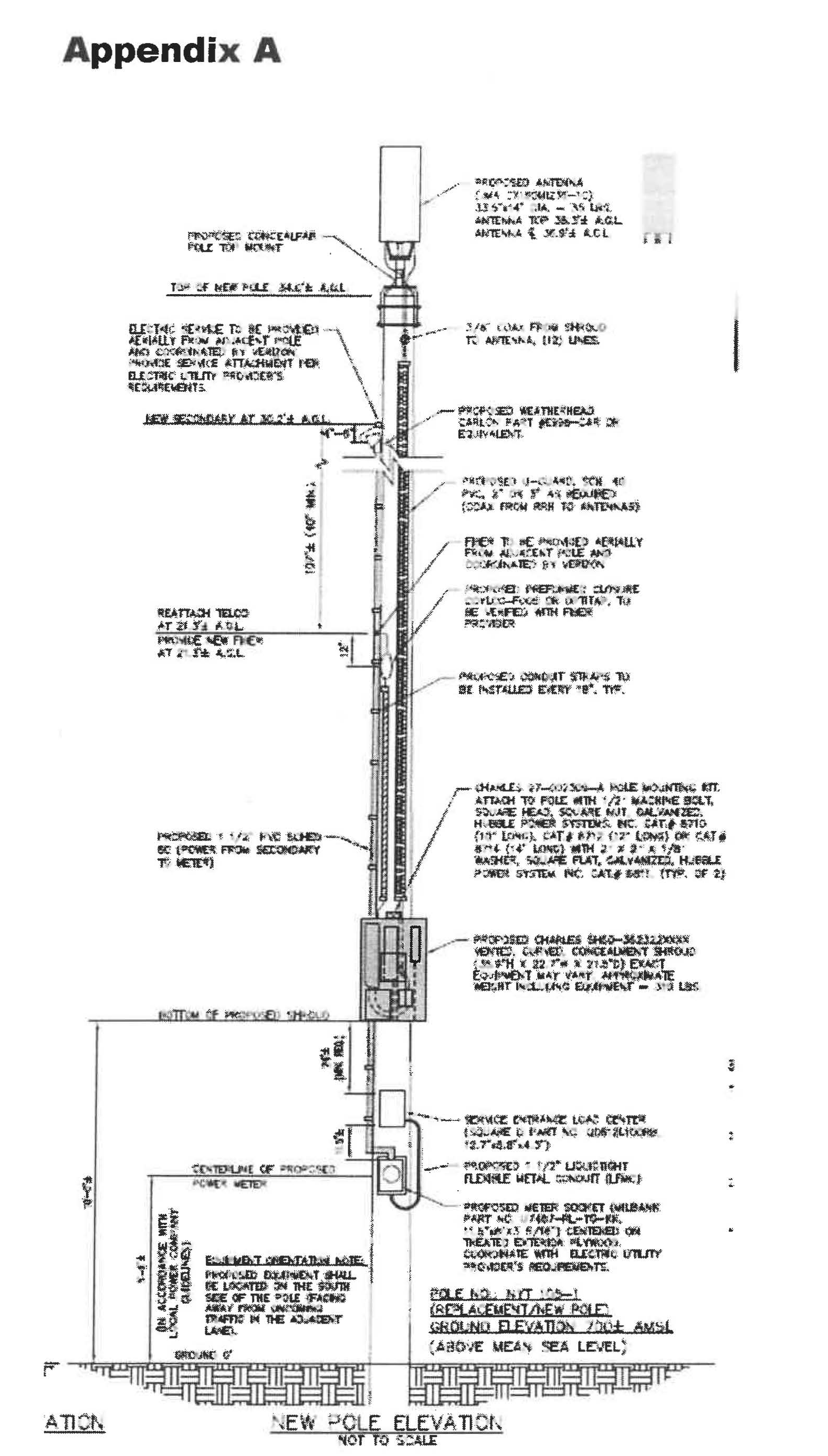
Equipment. All equipment must be installed as close to the support structure as technically feasible to minimize its visibility from public view. All conduits, conduit attachments, cables, wires, and other connectors shall be concealed from the public view to the greatest extent feasible ground-mounted equipment is not preferred and shall be minimized to the greatest extent feasible. Where used, ground-mounted equipment must incorporate concealment techniques in compliance with the requirements of subsection (a)(7)c. of this section.
d.
Minimum clear height. With the exception of any ground-mounted equipment, no part of the SWF shall be less than ten (10) feet above grade.
e.
Maximum height. No part of the SWF shall exceed forty (40) feet above ground level or ten (10) feet above the average height of all utility poles within a five hundred-foot radius, whichever is less. Ground-mounted cabinets shall be secured to a concrete slab and shall not exceed three (3) feet in height.
f.
Maximum diameter. The maximum diameter of any new poles not intended for public distribution shall not exceed eighteen (18) inches at the base.
g.
Maximum volume. The maximum volume of each antenna shall not exceed six (6) cubic feet.
h.
Maximum equipment volume. The maximum equipment volume shall not exceed twenty-eight (28) cubic feet, or fifteen (15) cubic feet for ground-mounted equipment.
i.
Installation. Any new poles not intended for public distribution shall:
i.
Be installed as far as practicable off the traveled way;
ii.
Not be taller than any existing poles adjacent to the proposed location;
iii.
Not be installed in the ROW unless fixed objects exist at the same or closer distance from the roadway;
iv.
Not be any closer to the roadway than any existing pole line;
v.
Be buried with no foundation unless an exception is justified and approved by the department of public works director of engineering or designee; and
vi.
To the extent practicable, be located outside of residentially-zoned neighborhoods.
j.
Reservation of rights. The village reserves its right to:
i.
Reject new poles for any of the following reasons: traffic, safety, conflict with existing structure or utility, conflict with pedestrian or complete street features, or future planned activities. Any notice of denial must be in writing and explain the basis for the denial, and be sent to the applicant and the authority controlling the ROW, if not controlled by the Village of Kenmore.
ii.
Request additional information, analysis, studies, including further expert opinion, at the applicant's expense, pertaining to the application and any issues of concern.
3.
Concealed installation on building.
a.
Equipment. All equipment must be installed such that its visual appearance is consistent with other accessory mechanical and/or building service appurtenances. All conduits, conduit attachments, cables, wires, and other connectors shall match the color of existing building mechanicals or the adjacent building material color. Ground-mounted equipment is not preferred and shall be minimized to the greatest extent feasible. Where used, ground-mounted equipment must incorporate concealment techniques in compliance with the requirements of subsection (a)(7)c. of this section.
b.
Minimum clear height. With the exception of any ground-mounted equipment, no part of the SWF shall be less than ten (10) feet above grade.
c.
Maximum height. No part of the SWF shall exceed ten (10) feet above the building roof or parapet wall. Ground-mounted cabinets shall be secured to a concrete slab and shall not exceed three (3) feet in height.
d.
Maximum volume. The maximum volume of each antenna shall not exceed six (6) cubic feet.
e.
Maximum equipment volume. The maximum equipment volume shall not exceed twenty-eight (28) cubic feet, or fifteen (15) cubic feet for ground-mounted equipment.
f.
Applications. Applicants must secure an approved building permit from the office of building inspections.
b.
Engineering requirements. The applicant must provide an installation design prepared by a professional engineer licensed in New York State that demonstrates the strength of the pole to be used.
c.
Aesthetic requirements. The character of the neighborhood and the visual quality of the surroundings must be taken into account when installing SWF, whether to new or existing poles. In order to avoid unnecessary adverse visual impacts and to preserve the area in which the SWFs are being installed, and in addition to the conditions set forth above, all SWFs shall meet the following requirements:
1.
Poles and equipment shall be painted in a neutral color that is consistent with other new and existing poles in the general geographic area so as to reduce visual intrusiveness.
2.
Poles shall be constructed of the same or similar material as other new and existing poles in the general geographic area.
3.
Poles shall be constructed in the same or similar shape as other new and existing poles in the general geographic area.
4.
Poles may be camouflaged or disguised as deemed appropriate.
5.
No artificial lighting is permitted on the pole unless otherwise required by law or permitted, e.g., where no existing utility poles exist and a decorative light pole is used with express permission. Any permitted lighting must be consistent in design and bulb type with other lighting fixtures in the general geographic area.
6.
Commercial signage is not permitted on any pole unless already existing at the time of the installation.
7.
Equipment shall be affixed to the pole in a tight, neat, and orderly fashion. Where possible, equipment shall be flush mounted with the pole and in no case shall offset mounting exceed six (6) inches. No wires may be loose or dangling, with a preference that the wires be enclosed within the pole where possible.
8.
Equipment shall consistent in size with the pole of which it is being attached and minimally shall be consistent with the suggested designs shown in the Appendix to this section.
a.
Maximum volume. The maximum volume of each antenna shall not exceed six (6) cubic feet.
b.
Maximum equipment volume. The maximum equipment volume shall not exceed twenty-eight (28) cubic feet.
9.
Ground-mounted equipment shall be minimized to the greatest extent feasible. Where used, ground equipment shall incorporate concealment techniques matching color and materials of the wireless support structure, unless other materials or colors are approved by the village. Applications shall include proposed concealment techniques for ground-mounted equipment, which may include, but are not limited to: strategic choice of color, paint, and/or materials, landscaping, placement in less visible locations, and placement within existing or replacement street furniture.
(8)
Standard conditions of approval. In addition to any other conditions imposed by the village board or the code enforcement officer in the case of applications exempt from the special use permit requirement, special use permits and approvals by the code enforcement officer for the installation of SWFs shall be automatically subject to the conditions set forth herein. The village board and/or the code enforcement officer shall have discretion to modify or amend these conditions on a case-by-case basis as may be necessary or appropriate under the circumstances to allow for the proper operation of the approved facility consistent with the goals of this section.
a.
Approved plans. Before the permittee submits any applications to the building department, the permittee must incorporate the permit, all conditions associated with this permit and the approved photo simulations into the project plans. The permittee must construct, install and operate the SWF in strict compliance with the approved plans. Any alterations, modifications or other changes to the approved plans, whether requested by the permittee or required by other departments or public agencies with, must be submitted in a written request subject to the office of planning and zoning prior to review and approval, who may refer the request to the original approval authority if it is found that the requested alteration, modification or other change implicates a significant or substantial land use concern.
b.
Build-out period. The permit will automatically expire one year from the issuance date unless the permittee obtains all other permits and approvals required to install, construct, and/or operate the approved SWFs and commences the installation and construction, which includes without limitation any permits or approvals required by any federal, state, or local public agencies with jurisdiction over the subject property, the SWF, or its use. The village may grant extensions to a date certain when the permittee shows good cause to extend the limitations period in a written request for an extension submitted at least thirty (30) days prior to the automatic expiration date in this condition.
c.
Maintenance obligations: Vandalism. The permittee shall keep the site, which includes without limitation any and all improvements, equipment, structures, and access routes, in a neat, clean, and safe condition in accordance with the approved plans and all conditions in the permit. The permittee shall keep the site area free from all litter and debris at all times. The permittee, at no cost to the village, shall remove and remediate any graffiti or other vandalism at the site within forty-eight (48) hours after the permittee received notice or otherwise becomes aware that such graffiti or other vandalism occurred.
d.
Compliance with laws. The permittee shall maintain compliance at all times with all federal, state, and local statutes, regulations, orders or other rules that carry the force of law applicable to the permittee, the subject property, the SWF or any use or activities in connection with the use authorized in the permit. The permittee expressly acknowledges and agrees that this obligation is intended to be broadly construed and that no other specific requirements in these conditions are intended to reduce, relieve, or otherwise lessen the permittee's obligations to maintain compliance with all applicable laws, regulations, orders, and rules.
e.
Inspections. The permittee expressly acknowledges and agrees that the village or its designee may enter onto the site and inspect the improvements and equipment upon reasonable prior notice to the permittee; provided, however, that the village may, but will not be obligated to, enter onto the site area without prior notice to support, repair, disable, or remove any improvements or equipment in emergencies or when such improvements or equipment threatens actual, imminent harm to property or persons. The permittee will be permitted to supervise the village or its designee while such inspection or emergency access occurs.
f.
Contact information. The permittee shall furnish the village with accurate and up-to-date contact information for a person responsible for the SWF, which includes, without limitation, such person's full name, title, direct telephone number, facsimile number, mailing address, and email address. The permittee shall keep such contact information up-to-date at all times.
g.
Rescission of permit for noncompliance. The village board may rescind any permit issued under this local law for review at any time due to noncompliance with applicable law or any approval conditions. At a duly noticed hearing and in accordance with all applicable laws, the village board may revoke any such permit or amend these conditions as the approval authority deems necessary or appropriate to correct any such noncompliance.
h.
Record retention. The permittee shall retain full and complete copies of all licenses, permits, and other regulatory approvals issued in connection with the SWF, which includes, without limitation, all conditions of approval, approved plans, resolutions, and other documentation associated with the license, permit, or regulatory approval.
(b)
Conditions applying to small wireless facilities located in the village ROW.
(1)
Applicability. The contents of this subsection (b) are applied in addition to the contents of subsection (a) for applicants proposing SWF located in the village ROW.
(2)
License. Where the proposed SWF is in the village ROW, before any application may be submitted, a non-exclusive license to place the SWF is required. No SWF is allowed in the village ROW unless first a non-exclusive license is obtained from the village by the applicant.
a.
No exclusive, irrevocable property right or any other interest is created by the license. There is no right to convey, express or implied, with the license.
b.
The license may not be assigned, except upon written consent of the village, which shall not be unreasonably withheld, provided the assignee assumes all obligations of the license, agrees to abide by its terms in writing, and meets all other criteria as set forth in this section.
c.
A general license will be granted per applicant for all village ROWs provided that the applicant meets the requirements for such a license.
d.
An applicant shall demonstrate the entitlement to use the land for the designated purpose, e.g., through demonstration that the village owns the fee of the highway at issue, through the grant of an easement or a pole attachment agreement, and, if requested, by a legal opinion of the applicant's counsel for the benefit of the village.
e.
The license agreement shall be in the general form as developed by the village.
f.
Each license agreement is subject to approval by the village board.
g.
By issuance of a license, the village does not represent or warrant title or ownership of the ROW.
h.
Indemnification. To the fullest extent permitted by law, the licensee, and, if applicable, the property owner upon which the wireless facility is installed or to be installed shall defend, indemnify, and hold harmless the village, its agents, officers, officials, employees, and volunteers from any and all (1) damages, liabilities, injuries, losses, costs, and expenses, including reasonable attorneys', experts', and consultants' fees, and from any and all claims, demands, law suits, writs and other actions or proceedings ("claims") brought against the village or its agents, officers, officials, employees, or volunteers to challenge, attach, seek to modify, set aside, void, or annul the village's approval of a license issued under this local law, and (2) other claims of any kind or form, whether for personal injury, death, or property damage, that arise from or in connection with the permittee's or its agents', directors', officers', employees', contractors', subcontractors, licensee's, or customers' acts or omissions in connection with such a license or the wireless facility. Any further indemnification requirements will be further outlined in the license.
i.
Performance bond. Before the building official issues any construction permit in connection with the wireless facility, the licensee shall post a performance bond from a surety and in a form acceptable to the village attorney in an amount equal to or greater than a written estimate from a New York licensed engineer with experience in SWF removal. The written estimate must include the cost to remove all equipment and other improvements, which includes without imitation all antennas, radios, batteries, generators, utilities, cabinets, mounts, brackets, hardware, cables, wires, conduits, structures, shelters, towers, poles, footings, and foundations, whether above ground or below ground, constructed or installed, in connection with the SWF. In establishing or adjusting the bond amount required under this condition, and in accordance with New York Code, the village shall take into consideration information provided by the licensee regarding the cost to remove the wireless facility.
j.
Insurance. Without limiting the indemnification provision herein, and in addition to the performance bond required herein, licensee shall procure, at licensee's expense, insurance as required by the license and this chapter.
(3)
Rates and fees. In addition to the fees outlined in subsection (a) of this section, the following fees apply for SWF to be located in the village ROW:
a.
License fee. The applicant shall pay the applicable license fee(s), as determined by the village board by resolution and incorporated into the license agreement. This shall include a separate charge where the applicant seeks to locate on village-owned infrastructure.
b.
ROW authorization fee. A wireless provider authorized to place SWF in the ROW shall pay the village a one-time authorization fee of five hundred dollars ($500.00) for the first SWF, plus one hundred dollars ($100.00) per each additional SWF for which the applicant is requesting authorization.
c.
Annual fee. A wireless provider authorized to place SWF in the ROW shall pay to the village annual compensation for use of the village ROW in the amount of two hundred seventy dollars ($270.00) per SWF in the village ROW.
(L.L. No. 4-2019, 4-15-19; L.L. No. 2-2020, §§ 1, 2, 11-17-20; L.L. No. 4-2021, §§ 1, 2, 11-17-20)

