
Kennett Square City Zoning Code
ARTICLE III
Zoning Districts and Use Regulations.
23-8 - Establishment of zoning districts.
(a)
For the purpose of this chapter, zoning districts and overlay areas are established as follows:
(b)
For the purposes of this chapter, the zoning districts and overlay areas named in subsection (a) of this section shall be of the number, size, shape and location shown on the official zoning map adopted and included in its entirety as a part of this chapter.
(Ord. No. 761, § 301; Ord. No. 778, § 4; Ord. No. 838, § 1; Ord. No. 844 (part); Ord. No. 858, § 1)
(Ord. No. 985, § 1, 8-4-2025)
23-9 - Application of district regulations.
(a)
Unless otherwise provided by law or specifically in this chapter, no land or building or structure shall be used or occupied except for any of the uses permitted in the zoning district within which the land or building or structure is located.
(b)
The regulations set by this chapter shall apply uniformly to each class or kind of structure or land, except as provided for in this chapter.
(c)
No building, structure, or land shall hereafter be erected, constructed, reconstructed, moved, or structurally altered and no building or structure or part thereof shall hereafter be used or occupied unless it is in conformity with the regulations herein specified for the use and district in which it is located.
(d)
No part of yard, or other open space, or off-street parking or loading space required about or in connection with any building for the purpose of complying with this chapter, shall be included as part of a yard, open space, or off-street parking or loading space similarly required for any other building, except for off-street parking spaces meeting the requirements of section 23-65(a)(5) or section 23-66(g) of this chapter.
(e)
No yard or lot existing at the time of passage of the ordinance codified in this chapter shall be reduced in dimension or area below the minimum requirements set forth herein. Yards or lots created after the effective date of this chapter shall meet at least the minimum requirements established by this chapter.
(f)
Any territory which may hereafter be annexed to the borough shall be classified as the zoning district of the borough most similar to the zoning of such territory before annexation (as determined by the zoning hearing board) until otherwise classified.
(g)
Forestry activities as defined in article II, Definitions, of this chapter shall be a permitted use by right in all zoning districts in the borough. Forestry activities shall be completed in accordance with any and all regulations adopted by the Department of Conservation and Natural Resources, and shall be in accordance with recognized natural resource conservation practices.
(1)
No retail sales of any of the lumber or any other product or by-product of the forestry activity is permitted unless the district in which the forestry activity is located would otherwise permit retail sales.
(2)
Deliveries or transport to and from the site, exterior storage, external illumination, and signage shall be as permitted in the zoning district in which the forestry activity is located.
(h)
The following additional development regulations shall apply for any development proposed in the borough:
(1)
Utilities. All utility lines (electrical, telephone, etc.) shall be placed underground.
(2)
Signs. Advertising signs and billboards are permitted as special exception uses in the C-1 Primary Retail District. All signs in this district, including advertising signs and billboards, shall be subject to the requirements of article IV, Signs, of this chapter.
(3)
Access. Provision shall be made for safe and efficient ingress and egress to and from public streets and highways serving the C-1 Primary Retail District development without causing undue confusion or interference with the normal traffic flow. The borough planning commission, with the advice of the borough engineer, shall satisfy itself as to the adequacy of the thoroughfares and access points intended to accommodate the traffic generated by the proposed C-1 Primary Retail District development, as well as to the street frontage of the proposed development.
(4)
Lighting facilities. Lighting facilities shall be provided as needed and arranged in a manner which will protect the highway and neighboring properties from unreasonable glare or hazardous interference of any kind and shall be installed in accordance with the provisions of chapter 18, Subdivisions.
(5)
Trash and refuse areas. Provision shall be made for the storage of trash, refuse and garbage either inside the building(s) or within a walled area outside the building(s). The walls of such trash and refuse areas must shield the trash and refuse from the direct view of any adjacent property and must be at least six feet in height.
(6)
Landscaped planting and buffer areas. Along a side or rear property line which is adjacent to a residential or institutional district, the owner shall place and maintain a planting area fifteen feet in width, containing hedges, evergreens, shrubbery or suitable vegetation of sufficient planted density to produce a total visual screening consistent with the topography. Wherever possible, the owner shall make every effort to retain existing natural screening such as vegetation and topography.
(A)
All evergreen vegetation to be installed shall not be less than five feet in height at the time of planting and shall be of such species that the expected height at maturity shall not be less than fifteen feet.
(B)
All deciduous material to be installed shall not be less than eight feet in height or two-inch caliper.
(Ord. No. 761, § 302; Ord. No. 844 (part))
(Ord. No. 985, § 2, 8-4-2025)
23-10 - Zoning map.
(a)
A map entitled "Zoning Map for the Borough of Kennett Square" accompanies the ordinance codified in this chapter and is declared a part of this chapter by reference.
(b)
The official zoning map shall be identified by the signature of the president of borough council attested by the borough secretary, and shall bear the adoption date of the ordinance codified in this chapter and the seal of the borough under the following words: "This is to certify that this is the Official Zoning Map adopted February 20, 1994, as part of the Kennett Square Borough Zoning Ordinance."
(c)
Changes of any nature to the official zoning map shall be made in conformity with the amendment procedures set forth in this chapter. All changes shall be noted by date with a brief description of the nature of the change.
(d)
Regardless of the existence of purported copies of the official zoning map which may from time to time be made or published, the official zoning map shall be located in the borough office and shall be the final authority on boundaries and districts. The zoning officer shall have a certified copy of the official zoning map for official use.
(e)
(1) If the official zoning map becomes damaged, destroyed, lost or difficult to interpret because of changes and additions, the borough council may, by resolution, adopt a new official zoning map which shall supersede the prior official zoning map.
(2)
The new official zoning map may correct drafting or other errors or omissions in the prior official zoning map, but no such correction shall include an amendment thereof.
(3)
The new official zoning map shall be identified by the signatures of borough council, attested to by the borough secretary, and bearing the following words: "This is to certify that this Official Zoning Map supersedes and replaces the Official Zoning Map adopted February 20, 1994, as part of the Kennett Square Borough Zoning Ordinance."
(4)
Unless the prior official zoning map has been lost or has been totally destroyed, the prior map or any part or parts thereof remaining shall be preserved together with all available records pertaining to its adoption or amendment.
(Ord. No. 761, § 303; Ord. No. 844 (part))
23-11 - Rules for interpreting district regulations.
(a)
Zoning boundaries drawn approximately following the centerlines of streams, drainageways, streets, alleys, railroads or other rights-of-way shall be construed to follow such centerlines. In the event of any change in the centerline, the zoning boundary shall be construed as moving with the actual centerline.
(b)
Boundaries approximately following property lot lines shall be construed as following such property lot lines.
(c)
Distances not specifically indicated on the official zoning map shall be determined by the scale of such map.
(d)
Where physical features existing on the ground vary with those shown on the official zoning map, or in other circumstances not covered by subsections (a) through (c) of this section, the zoning hearing board shall interpret the district boundaries.
(Ord. No. 761, § 304; Ord. No. 844 (part))
23-12 - R-1 Residential district.
(a)
Purpose. The purpose of the R-1 District is to encourage single-family detached homes at low density, and that fit with the purpose as set forth in section 23-3 of this chapter and maintain land use compatibility within existing areas. Residential uses will be protected from incompatible adjacent uses.
(b)
Uses Permitted by Right. Each of the following principal uses and their accessory uses are permitted by right in the R-1 Residential District, provided that the use type, dimensional, and all other applicable requirements of this chapter are satisfied. Any change in use, occupancy, or purpose, on a property within the Historic District shall be reviewed by Borough staff, who may make recommendations to borough council, including the imposition of conditions, in connection with any requests for a certificate of appropriateness under the HARB ordinance. Borough council shall have the power to impose those conditions on the approval of a certificate of appropriateness, as recommended by borough staff.
(1)
Public park.
(2)
Single-family detached dwelling.
(3)
Group home.
(c)
Special Exception Uses. Each of the following principal uses and their accessory uses may be permitted in the R-1 Residential District by the zoning hearing board in accordance with the standards contained in section 23-29 of this chapter:
(1)
Bed and breakfast inn.
(2)
Places of worship.
(d)
Accessory Structure or Uses as listed in section 23-27.
(1)
Each accessory use in the R-1 Residential District shall comply with the minimum yard requirements contained in subsection (f), except as specifically provided for in this chapter.
(e)
Lot Area, Width, Building Coverage, Impervious Surface Coverage and Height Regulations. Each of the following dimensional requirements shall apply to each use in the R-1 Residential District, except as specifically provided for in this chapter:
(f)
Minimum Yard Requirements. Each of the following minimum yard requirements shall apply to each use in the R-1 Residence District, except as specifically provided for in this chapter:
(g)
Off-Street Parking Requirements: All residential developments shall provide two off-street parking spaces, in accordance with article VII of this chapter.
(Ord. No. 761, § 305; Ord. No. 798, § 3; Ord. No. 844 (part); Ord. No. 913, § 2—4, 11-3-2014; Ord. No. 926, § 2, 2-1-2016; Ord. No. 933, § 1, 7-5-2016)
23-13 - R-2 Residential district.
(a)
Purpose. The purpose of the R-2 District is to encourage single-family detached homes at low density, that fit with the purpose as set forth in section 23-3 of this chapter, and maintain land use compatibility within existing areas. Residential uses will be protected from incompatible adjacent uses.
(b)
Uses Permitted by Right. Each of the following principal uses and their accessory uses are permitted by right in the R-2 Residential District, provided that the use type, dimensional, and all other applicable requirements of this chapter are satisfied. Any change in use, occupancy, or purpose, on a property within the Historic District shall be reviewed by borough staff, who may make recommendations to borough council, including the imposition of conditions, in connection with any requests for a certificate of appropriateness under the HARB ordinance. Borough council shall have the power to impose those conditions on the approval of a certificate of appropriateness, as recommended by borough staff.
(1)
Park.
(2)
Single-family detached.
(3)
Group home.
(c)
Special Exception Uses. Each of the following principal uses and their accessory uses may be permitted in the R-2 Residential District by the zoning hearing board in accordance with the standards contained in section 23-29 of this chapter:
(1)
Place of worship.
(2)
Bed and breakfast inn.
(d)
Accessory Structures or Uses as listed in section 23-27 of this chapter:
(1)
Each accessory use in the R-2 Residential District shall comply with the minimum yard requirements contained in subsection (f) of this section, except as specifically provided for in this chapter.
(e)
Lot Area, Width, Building Coverage, Impervious Surface Coverage and Height Regulations. Each of the following dimensional requirements shall apply to each use in the R-2 Residential District, except as specifically provided for in this chapter:
(f)
Minimum Yard Requirements. Each of the following minimum yard requirements shall apply to each use in the R-2 Residential District, except as specifically provided for in this chapter:
(g)
Off-Street Parking Requirements: All residential developments shall provide two off-street parking spaces per unit, in accordance with article VII of this chapter.
(Ord. No. 761, § 306; Ord. No. 798, § 4; Ord. No. 844 (part); Ord. No. 913, § 5—7, 11-3-2014; Ord. No. 926, § 3, 2-1-2016; Ord. No. 933, § 2, 7-5-2016)
23-14 - Cluster development option.
(a)
Purpose. The purpose of the Cluster Development is to encourage single-family detached homes that fit with the purpose as set forth in section 23-3 of this chapter, allow for a flexibility in the zoning ordinance and maintain land use compatibility within existing areas. Residential uses will be protected from incompatible adjacent uses.
(1)
Standards of approval:
(A)
Minimum tract size: five acres.
(B)
The tract shall be serviced by a municipal sewer system deemed acceptable by the borough council and approved by the Pennsylvania Department of Environmental Protection.
(C)
The applicant must submit a yield plan based on the requirements of the currently designated zoning district for a tract of land. The number of lots obtained on the yield plan will be the maximum number of lots permitted in the Cluster Option as reviewed and approved by the borough.
(i)
When a tract of land has two underlying zoning designations according to the zoning map of the borough, the yield plan must be designed to the requirements of the underlying zoning for each zone. The yield shall be the cumulative total yield as determined for each of the underlying districts.
(2)
Yield plan density bonus provisions: The following density bonuses may be approved for proposed development based on the number of units on an approved yield plan. Any combination of bonuses may be applied simultaneously to one contiguous tract of land, or group of tracts developed under one application, if the site qualifies based upon the prerequisite conditions as outlined below. When computing bonuses the number of dwelling units shall be rounded down to the next whole unit, provided, however, that in no case shall a bonus equal less than one dwelling unit. This calculation shall be applied to each appropriate bonus, and shall be computed individually. The number of units is based on the yield of an approved yield plan prior to the application of any development bonus.
(A)
Historic preservation density bonus of ten percent may be approved for the preservation and rehabilitation of any historic structure located in the Historic District in accordance with chapter 25, Historic District, of the Kennett Square Borough Code.
(i)
Applicant guarantees in a form acceptable to the borough solicitor that applicant shall rehabilitate, preserve, and reconstruct historic structures in a manner satisfactory to the borough council and in accordance with chapter 25, Historic District, of the Kennett Square Borough Code.
(ii)
The number of lots approved up to the maximum permitted ten percent shall be based on the applicant's demonstration of cost to implement subsection (a) above versus the value of additional lots to offset such cost.
(iii)
Approval of this option is at the sole discretion of the borough council in accordance with chapter 25, Historic District, of the Kennett Square Borough Code.
(B)
Environmental protection density bonus of ten percent may be approved for the protection or rehabilitation of any environmental feature of regional importance as outlined by the Kennett Square Comprehensive Plan (as adopted May, 2001), or otherwise determined worthy of preservation by the borough council.
(i)
Applicant guarantees in a form acceptable to the borough solicitor that applicant shall preserve all identified natural resources in a manner satisfactory to the borough council. The council may request the review of a density request under this subsection by a registered landscape architect and/or professional engineer.
(ii)
The number of lots approved up to the maximum permitted ten percent shall be based on the applicant's demonstration of cost to implement subsection (a) above versus the value of additional lots to offset such cost.
(iii)
Approval of this option is at the sole discretion of the borough council.
(C)
Combining Density Bonus Provisions. If both bonus provisions can be met, and approved by the borough council, an additional five percent may be added to the yield plan. Said bonus shall be a minimum of one dwelling unit.
(3)
The following dwelling units are allowable under this option:
(A)
Single-family detached.
(B)
Single-family semi-attached.
(4)
Dimensional standards:
(A)
Lot area, width, building coverage, impervious surface coverage, and height regulations. Each of the following shall apply to each use in or part of a conditional use application in this section.
(B)
Minimum open space: twenty-five percent of gross tract area.
(C)
Minimum yard requirements:
(i)
Front yard: thirty feet
a.
Front yard setbacks must be varied within a development.
1.
Front yard setback shall be staggered so that a maximum of twenty five percent of the lots in a Cluster Development shall have a front yard setback meeting the requirement above.
2.
No more than three lots with the same minimum front yard setback shall be located adjacent to each other on the same side of the street.
3.
The minimum differential of front yard setbacks on adjacent lots shall be ten feet.
(ii)
Side yards: ten feet (one), twenty feet (total).
a.
For single-family semi-detached the side yards will be measured on for the entire structure (the whole semi-detached structure).
(iii)
Rear yards: twenty feet.
(D)
When the rear yard abuts an existing residential development, not including those lots that abut a residential unit within the same development or phase of the same development, the rear yard must be increased by ten feet.
(5)
Design Standards:
(A)
All proposed lots shall front on an interior roadway. In no instance shall any newly created cluster subdivision lot be permitted to front on an existing public roadway.
(B)
Applicants are strongly encouraged to meet the objectives of the Traditional Neighborhood Development from the Pennsylvania Municipalities Planning Code, Article VII-A, Section 701-A, Subsection b.
(C)
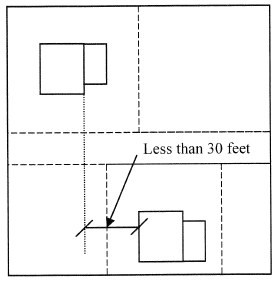
Façade treatment (i.e. architectural details) and overall color palate must be varied throughout a Cluster Development. In no instance shall more than one out of five contiguous dwelling units have the same façade treatment and color palate. Dwelling units directly across from each other on opposite sides of any street may not have identical façade treatments and overall color palates. In addition, dwelling units within thirty feet of each other on opposite sides of the street as measured between the closest sides of the dwellings, as shown in the sketch below, shall not have identical façade treatments and color palates.
(D)
All attached garages must be varied in their location. For side entry garages, no more than six in a row shall be on the same side of the dwelling. It is strongly encouraged that when it is feasible, garages should face each other on adjacent lots. If there are front entry garages, there shall be no more than three dwelling units adjacent to each other with front entry garages.
(E)
Shared driveways are encouraged throughout the development.
(6)
Other requirements:
(A)
A formal, binding homeowner association shall be responsible for any commonly owned and/or maintained improvements or lands, such as common open space, parking areas, recreation facilities, sidewalks, streets, alleys, utilities, storm water control facilities, and other similar improvements. This homeowner association shall be established and subject to the provisions of: (1) Section 705(f) of the Pennsylvania Municipalities Planning Code and (2) Title 68 Real & Personal Property Act, Part II Real Property, Subpart B, Condominiums, as amended by Senate Bill 65, 1979.
(B)
All documentation required in the formation or operation of any such condominium or homeowner association shall be provided to the borough solicitor for his or her review a minimum of thirty days before the final plan is recorded. If within those thirty days the borough solicitor determines in writing that such documentation is not in legally acceptable form with regard to concerns of the borough, the plan shall not be recorded until acceptable revisions are made.
(C)
Off-street parking, required by article VII of this chapter, is met; this may be provided through private or commonly owned and maintained areas.
(Ord. No. 844 (part); Ord. No. 926, § 4, 2-1-2016)
23-15 - R-3 Residential district.
(a)
Purpose. The purpose of the R-3 District is to provide for a wide variety of housing choices at medium densities. It provides for single-family homes, two-family dwellings, townhouses, low-rise garden apartments, other medium-density, multi-family dwellings, and other compatible uses that fit with the purpose as set forth in section 23-3.
(b)
Uses Permitted by Right. Each of the following principal uses and their accessory uses are permitted by right in the R-3 Residential District, provided that the use type, dimensional, and all other applicable requirements of this chapter are satisfied. Any change in use, occupancy, or purpose, on a property within the Historic District shall be reviewed by borough staff, who may make recommendations to borough council, including the imposition of conditions, in connection with any requests for a certificate of appropriateness under the HARB ordinance. Borough council shall have the power to impose those conditions on the approval of a certificate of appropriateness, as recommended by borough staff.
(1)
Garden apartment;
(2)
Group home [See section 23-29(c)(22)];
(3)
Public recreation;
(4)
Single-family attached dwelling (townhouse);
(5)
Single-family detached dwelling;
(6)
Single-family semi-detached dwelling;
(7)
Two-family detached dwelling;
(8)
Two-family semi-detached dwelling.
(c)
Special Exception Uses. Each of the following principal uses and their accessory uses may be permitted in the R-3 District by the zoning hearing board in accordance with the standards contained in section 23-29 of this chapter:
(1)
Institutional uses—Class I only;
(2)
Residential conversions;
(3)
Rooming/boarding house;
(4)
Bed and breakfast inn;
(5)
Mobile home park;
(6)
Places of worship.
(d)
Conditional Uses. Each of the following principal uses and their accessory uses may be permitted in the R-3 Residential District by borough council:
(1)
Cluster Development Option, as outlined in section 23-14 of this chapter.
(2)
Planned developments involving one or more of the permitted principal residential uses listed in subsection (b) of this section, provided:
(A)
The overall tract size is at least forty thousand square feet in size;
(B)
The overall density does not exceed twelve dwelling units per acre;
(C)
The maximum impervious surface coverage does not exceed sixty percent;
(D)
All buildings are separated a distance of at least sixteen feet;
(E)
In the case of townhouses, no more than eight dwelling units shall be permitted in a separate building (see the other townhouse provisions in section 23-43 of this chapter);
(F)
No buildings shall exceed one hundred and eighty feet in length or as determined by the borough code enforcement officer and the standards on safety;
(G)
Architectural treatment shall vary between buildings in the same development by exterior elevation, building setbacks, provision of balconies, architectural details, pitch of roof, exterior materials, or use of color where common maintenance areas exist:
(i)
A formal, binding homeowner association shall be responsible for any commonly owned and/or maintained improvements or lands, such as common open space, parking areas, recreation facilities, sidewalks, streets, alleys, utilities, storm water control facilities and other similar improvements. This home-owner association shall be established and subject to the provisions of: (1) Section 705(f) of the Pennsylvania Municipalities Planning Code and (2) Title 68 Real and Personal Property Act, Part II, Real Property, Subpart B, Condominiums, as amended by Senate Bill 65, 1979.
(ii)
All documentation required in the formation or operation of any such condominium or homeowner association shall be provided to the borough solicitor for his or her review a minimum of thirty days before the final plan is recorded. If within those thirty days the borough solicitor determines in writing that such document is not in legally acceptable form with regard to concerns of the borough, the plan shall not be recorded until acceptable revisions are made.
(iii)
Off-street parking, required by article VII of this chapter is met; this may be provided through private or commonly owned and maintained areas.
(H)
A tract of land developed under a planned development conditional use shall also meet the requirements of section 23-29 of this chapter.
(e)
Accessory Structure or Uses as listed in section 23-30.
(1)
Each accessory use in the R-3 District shall comply with the minimum yard requirements contained in subsection (g) of this section, except as specifically provided for in this chapter.
(f)
Lot Area, Lot Width, Building Coverage, Building Height, and Impervious Surface Coverage and Regulations. Each of the following dimensional requirements shall apply to each use in the R-3 district, except as specifically provided for in this chapter:
* Per dwelling unit for residential uses; lot size per construction site shall be a minimum of 5,000 square feet.
* * Measured at the Minimum Front Yard listed in section 23-15(g) for the particular use.
* ** See section 23-29 for Mobile Home Park lot area and density requirements.
(g)
Minimum Yard Requirements. Each of the following minimum yard requirements shall apply to each use in the R-3 District, except as specifically provided for in this chapter:
* The depth at which the minimum lot width shall be measured.
** Measured at the end of the row.
(h)
Off-Street Parking Requirements: All Residential developments shall provide two off-street parking spaces per unit, in accordance with article VII of this chapter.
(Ord. No. 761, § 308; Ord. No. 798, § 6; Ord. No. 831 (part); Ord. No. 844 (part); Ord. No. 913, § 8—10, 11-3-2014; Ord. No. 926, § 5, 2-1-2016; Ord. No. 933, § 3, 7-5-2016)
23-16 - R-3/PAO Residential/professional office district.
(a)
Purpose. The purpose of the R-3/PAO District is to provide for a wide variety of affordable land uses to provide for the orderly and planned establishment of small scale offices that serve the needs of the residential neighborhoods, create a mixed land use area with that will compliment the central retail and existing residential area, and that fit with the purpose as set forth in section 23-3.
(b)
Uses Permitted by Right. Each of the following principal uses and their accessory uses are permitted by right in the R-3/PAO Residential/Professional Office District, provided that the use type, dimensional, and all other applicable requirements of this chapter are satisfied. Any change in use, occupancy, or purpose, on a property within the Historic District shall be reviewed by borough staff, who may make recommendations to borough council, including the imposition of conditions, in connection with any requests for a certificate of appropriateness under the HARB ordinance. Borough council shall have the power to impose those conditions on the approval of a certificate of appropriateness, as recommended by borough staff.
(1)
Garden apartment;
(2)
Government services and facilities — Tier I, as defined by section 23-29;
(3)
Group home [See section 23-29(22)(J)];
(4)
Professional/administrative offices public recreation;
(5)
Public recreation center;
(6)
Single-family attached dwelling (townhouse);
(7)
Single-family detached dwelling;
(8)
Single-family semi-detached dwelling;
(9)
Two-family detached dwelling;
(10)
Two-family semi-detached dwelling.
(c)
Special Exception Uses. Each of the following principal uses and their accessory uses may be permitted in the R-3/PAO Residential/Professional Office District by the zoning hearing board in accordance with the standards contained in section 23-29 of this chapter:
(1)
Bed and breakfast inn;
(2)
(Reserved);
(3)
Institutional uses—Class I only;
(4)
Mobile home park;
(5)
Residential conversion;
(6)
Rooming/boarding house.
(d)
Conditional Uses. Each of the following principal uses and their accessory uses may be permitted in the R-3/PAO Residential/Professional Office District by borough council in accordance with the standards contained in section 23-29 of this chapter:
(1)
Planned developments involving one or more of the permitted principal residential uses listed in section 23-29 of this chapter provided:
(A)
The overall tract size is at least forty thousand square feet in size;
(B)
The overall density does not exceed twelve dwelling units per acre;
(C)
The maximum impervious surface coverage does not exceed sixty percent;
(D)
All buildings are separated a distance of at least sixteen feet apart;
(E)
In the case of townhouses, no more than eight dwelling units shall be permitted in a separate building (see the other townhouse provisions in section 23-43 of this chapter);
(F)
All buildings shall not exceed one hundred and eighty feet in length;
(G)
The developer shall vary architectural treatment within the development, individual dwellings and between buildings. Variation may include those of exterior elevation, building setbacks, provision of balconies, architectural details, pitch of roof, exterior materials or use of color;
(H)
Where common maintenance areas exist:
(i)
A formal, binding homeowner association shall be responsible for any commonly owned and/or maintained improvements or lands, such as common open space, parking areas, recreation facilities, sidewalks, streets, alleys, utilities, storm water control facilities and other similar improvements. This homeowner association shall be established and subject to the provisions of: (1) Section 705(f) of the State Municipalities Planning Code, and (2) Title 68 Real and Personal Property Act, Part II Real Property, Subpart B, Condominiums, as amended by Senate Bill 65, 1979.
(ii)
Any such condominium or homeowner association agreement shall be provided to the borough solicitor for his or her review a minimum of thirty days before the final plan is recorded. If within those thirty days the borough solicitor determines in writing that such document is not in legally acceptable form with regard to concerns of the borough, the plan shall not be recorded until acceptable revisions are made.
(I)
Off-street parking, required by article VII of this chapter is met; this may be provided through private or commonly owned and maintained areas.
(e)
Accessory Structures and Uses as listed in section 23-30 of this chapter.
(1)
Each accessory use in the R-3/PAO Residential/Professional Office District shall comply with the minimum yard requirements contained in subsection (g) of this section, except as specifically provided for in this chapter.
(A)
Each of the following accessory uses shall be allowed in conjunction with a professional/adminis-trative office and government services and facilities (Tier I), as allowable in this zoning district:
(f)
Lot Area, Width, Building Coverage, Impervious Surface Coverage and Height Regulations. Each of the following dimensional requirements shall apply to each use in the R-3/PAO Residential/Professional Office District, except as specifically provided for in this chapter:
* Per dwelling unit for residential uses; lot size per construction site shall be a minimum of five thousand square feet.
** Measured at the minimum front yard listed in section 23-16(g) for the particular use.
***See section 23-29 for mobile home park lot area and density requirements.
(g)
Minimum Yard Requirements. Each of the following minimum yard requirements shall apply to each use in the R-3/PAO Residential/Professional District, except as specifically provided for in this chapter:
* The depth at which the minimum lot width shall be measured.
** Measured at the end of the row for townhouses.
(h)
Off-Street Parking Requirements: All residential developments shall provide two off-street parking spaces, in accordance with article VII of this chapter.
(Ord. No. 761, § 309; Ord. No. 778, § 3; Ord. No. 798, § 7; Ord. No. 844 (part); Ord. No. 913, § 11—14, 11-3-2014; Ord. No. 926, § 6, 2-1-2016; Ord. No. 933, § 4, 7-5-2016)
23-18 - C-1 Primary retail district.
(a)
Purpose. The purpose of the C-1 Primary Retail District is to encourage a variety of retail uses in the core area of the Kennett Center. To preserve and expand first floor storefront uses to display goods and services available in, while keeping office uses limited to the second floor of existing structures. The district also permits other compatible commercial uses and upper floor offices and housing units that fit with the purpose as set forth in section 23-3 of this chapter.
(b)
Uses Permitted by Right. Each of the following principal uses and their accessory uses are permitted by right in the C-1 Primary Retail District, provided that the use type, dimensional, and all other applicable requirements of this chapter are satisfied. Any change in use, occupancy, or purpose, on a property within the Historic District shall be reviewed by borough staff, who may make recommendations to borough council, including the imposition of conditions, in connection with any requests for a certificate of appropriateness under the HARB ordinance. Borough council shall have the power to impose those conditions on the approval of a certificate of appropriateness, as recommended by borough staff.
(1)
Retail sale of goods, excluding the prohibited uses listed in subsection (d) of this section.
(2)
Services, excluding the prohibited uses listed in subsection (d) of this section.
(3)
Offices, located in upper floor and first floor, non-store front locations.
(4)
Restaurants without drive-in service, that do not fit the definition of a fast food restaurant in article II, Definitions.
(5)
Upper floor dwellings pursuant to the requirements of Chapter 8, Housing, of this Code.
(6)
Parking facilities.
(7)
Uses permitted by right in the retail use overlay area (RUA), an area solely within the C-1 Primary Retail District extending sixty feet north and sixty feet south from the center line of State Street and limited by Church Alley on the east and Maiden Lane on the west. Only the following uses shall be permitted on the first floor of buildings in the RUA:
(A)
Retail sale of goods, excluding the prohibited uses listed in subsection (d) of this section.
(B)
Business, bank and administrative offices, (excluding professional offices, professional, and administrative services and drive-in facilities), when operated within a single building having a gross floor area of not less than fifty thousand square feet.
(C)
Restaurants excluding drive-in facilities.
(D)
Day spa/salon.
(E)
Personal Service.
(8)
Brewpub.
(9)
Nanobrewery.
(10)
Wine bar/BYOF.
(11)
Personal Service.
(c)
Special Exception Uses. Each of the following principal uses and their accessory uses may be permitted in the C-1 Primary Retail District by the zoning hearing board in accordance with the standards contained in section 23-29 of this chapter:
(1)
Hotel/motel;
(2)
Institutional uses—Class I;
(3)
Planned development;
(4)
Open air markets;
(5)
Rooming house;
(6)
Bed and breakfast;
(7)
Office uses in a first floor storefront.
(d)
Conditional uses in accordance with the standards below and contained in section 23-29 of this chapter:
(1)
Auditorium;
(2)
Institutional uses—Class I:
(A)
The following dimensional requirements supersede the requirements listed in section 23-29 of this chapter for Class I Institutional Uses, which only applied to those tracts zoned C-1. These requirements are intended to provide for a dense urban institutional use within the central business district of the borough; while maintaining the walkable nature and character of the downtown area, and providing another alternative to development in the core of the borough:
(i)
Minimum lot size: thirty thousand square feet;
(ii)
Minimum lot width at building setback line: sixty feet;
(iii)
Minimum yard requirements: specifically, there are no dimensional requirements for the yard requirements within this conditional use in the C-1 Primary Retail District; however, the development should fit within the character of the existing neighborhood and reflect the historic nature of the central business district;
(iv)
Minimum impervious surface: eighty percent;
(v)
Spaces between proposed buildings should reflect the character of the existing buildings in the C-1 Primary Retail District.
(vi)
Architectural details should reflect the existing historic buildings within the borough.
(e)
Prohibited Uses. The following uses are expressly prohibited in the C-1 Primary Retail District:
(1)
Adult entertainment uses, as defined in article II, Definitions of this chapter;
(2)
Automobile service uses and automobile sales;
(3)
Drive in/through as an accessory to another use;
(4)
Warehousing or storage as a principal use;
(5)
Other principal uses not listed as permitted by right uses or special exception uses.
(f)
Accessory Structures and Uses:
(1)
Each accessory use in the C-1 Primary Retail District shall comply with the minimum yard requirements contained in section 23-30 except as specifically provided for in this chapter.
(2)
Each of the following accessory uses shall be permitted in the C-1 Primary Retail District only if such use complies with the relevant standards contained in section 23-30 of this chapter:
(A)
Accessory structure or use;
(B)
Bar only if accessory to a restaurant;
(C)
Fence and wall;
(D)
Home gardening, home nursery or home greenhouse;
(E)
No-impact home based business;
(F)
Off-street parking, in accordance with article VII of this chapter;
(G)
Signs, in accordance with article VI of this chapter;
(H)
Temporary structure or use;
(I)
Other accessory uses and structures which are clearly customary and incidental to the principal use;
(J)
Outdoor café/restaurant, only if accessory to a restaurant.
(3)
Each of the following accessory uses are prohibited in the C-1 Primary Retail District:
(A)
Any use which violates a provision of article IV or V of this chapter;
(B)
Open outdoor storage or display area.
(g)
Lot Area, Width, Building Coverage, Impervious Surface Coverage and Height Regulations. Each of the following dimensional requirements shall apply to each use in the C-1 Primary Retail District, except as specifically provided for in this chapter:
* Housing units shall also comply with the requirements of Chapter 8 of the Municipal Code of the Borough of Kennett Square
** (Amended Ordinance #778-9/16/96)
(h)
Minimum Yard Requirements. Each of the following minimum yard requirements shall apply to each use in the C-1 Primary Retail District, except as specifically provided for in this chapter:
(Ord. No. 311; Ord. No. 770; Ord. No. 778, § 4; (Ord. No. 798, §§ 8—11; Ord. No. 806, §§ 2, 3; Ord. No. 835, § 2; Ord. No. 838, §§ 2, 3; Ord. No. 844 (part); Ord. No. 905, § 2, 6-17-2013; Ord. No. 926, § 7, 2-1-2016; Ord. No. 933, § 5, 7-5-2016; Ord. No. 946, § 1, 2-4-2019)
23-19 - C-2 Secondary commercial district.
(a)
Purpose. The purpose of the C-2 District is to encourage a variety of commercial uses, moderate density residential uses, and other appropriate uses which support and reinforce the primary retail district and that fit with the purpose as set forth in section 23-3 of this chapter.
(b)
Uses Permitted by Right. Each of the following principal uses and their accessory uses are permitted by right in the C-2 Secondary Commercial District, provided that the use type, dimensional, and all other applicable requirements of this chapter are satisfied. Any change in use, occupancy, or purpose, on a property within the Historic District shall be reviewed by borough staff, who may make recommendations to borough council, including the imposition of conditions, in connection with any requests for a certificate of appropriateness under the HARB ordinance. Borough council shall have the power to impose those conditions on the approval of a certificate of appropriateness, as recommended by borough staff.
(1)
The retail sale of dry goods, variety and general merchandise, clothing, food, flowers, beverages, drugs, household goods, supplies or furnishings, and the sale and repair of jewelry, watches, clocks, optical goods, radios and televisions, or musical, professional, or scientific instruments are permitted by right, unless that use is listed in subsection (c), Special Exception Uses, below.
(2)
Business offices, banks, financial services, medical office buildings, professional offices, and professional/administrative services.
(A)
Uses may not include a drive in/through facility without meeting the special exception requirements for a land use with a drive in/through facility as outlined in section 23-29 of this chapter.
(3)
Commercial indoor recreation.
(4)
Commercial warehousing and storage, when incidental to a retail use. The warehousing and storage shall be related to that retail use and serving no other facility.
(5)
Essential public uses including, but not limited to, arts centers, offices for a civic organization, museum, library, and post office (not including a post office distribution center).
(6)
Group home. [See subsection 23-29(c)(22)]
(7)
Hotel/motel.
(8)
Movie theater.
(9)
Nursery/greenhouse.
(10)
Residential uses—Any use allowed as a by right use in the R-3 Zoning District.
(11)
Outdoor recreation, including public parks, private membership clubs (i.e. swimming, skate parks, tennis), and picnic groves.
(12)
Restaurant, without drive in/through service.
(13)
Parking facilities.
(14)
Brewpub.
(15)
Microbrewery.
(16)
Nanobrewery.
(17)
Regional brewery.
(18)
Wine bar/BYOF.
(19)
Personal Service.
(20)
Alternative learning center.
(21)
Revitalization/Additional uses of properties, pursuant to section 23-19(k).
(c)
Special Exception Uses. Each of the following principal uses and their accessory uses may be permitted in the C-2 Secondary Commercial District by the zoning hearing board in accordance with the standards contained in section 23-29 of this chapter:
(1)
Adult day care center;
(2)
Adult entertainment uses;
(3)
Animal hospital/ kennel;
(4)
Auditorium/theater;
(5)
Automobile oriented uses and automobile sales;
(6)
Bar/tavern;
(7)
Bus station/terminal;
(8)
Commercial outdoor recreation;
(9)
Fast food restaurant;
(10)
Fire station;
(11)
Health club;
(12)
Hospital;
(13)
Institutional uses—Class I or Class II;
(14)
Land uses with a drive in/drive-through feature;
(15)
Open air seasonal market;
(16)
Planned development;
(17)
Public uses that are not otherwise listed herein;
(18)
Rooming house/boarding house;
(19)
Warehouse and industrial uses—Limited to the following uses:
(A)
Major auto repairs;
(B)
Recycling collection facilities;
(C)
Radio/television transmitter;
(D)
Truck or bus repair.
(20)
Telephone exchange building;
(21)
Tennis club.
(d)
Conditional Use—RC Neighborhood Development (RCND).
(1)
Purpose. The RCND is designed for the redevelopment of large tracts situated within the C-2 Secondary commercial district in order to foster the creation of human scaled, pedestrian friendly, residential and mixed use neighborhoods, including appropriate dimensional requirements, yard requirements and design standards.
(2)
Applicability.
(A)
RCND requires conditional use approval, subject to the requirements of section 23-29.
(B)
RCND is mandatory for all tracts within the C-2 Secondary commercial district that have a minimum lot area, as defined in section 23-7, of four acres. The dimensional requirements, yard requirements and design standards in this subsection (d) shall apply.
(C)
If any provisions of this subsection (d) differ from or conflict with the provisions of other sections of the zoning ordinance or of the subdivision and land development ordinance, the provisions in this subsection (d) shall control.
(3)
Uses.
(A)
In addition to all other principal uses permitted by the provisions of section 23-19, a building may be erected, altered or used and land may be used or occupied for one or more of the following principal uses, subject to the design standards of subparagraph (6) or (7) of this subsection (d), as applicable:
(i)
Single-family detached dwelling.
(ii)
Single-family semi-detached; two-family detached dwellings.
(iii)
Single-family attached dwelling (townhouse).
(iv)
Mixed-use building.
(B)
Attached accessory garage.
(C)
Any of the accessory uses and structures provided for in section 23-30.
(4)
Dimensional Requirements.
(A)
Lot Area, Width, Building Coverage, Impervious Surface Coverage and Height Regulations. Each of the dimensional requirements in Table 12-A shall apply to each RCND.
TABLE 12-A
DIMENSIONAL REQUIREMENTS
RC Neighborhood Development
* Dwellings shall also comply with the requirements of chapter 8, Housing.
** Per dwelling unit for residential uses.
*** Measured at the minimum front yard listed in subsection 23-15(g) for the particular use.
**** Garages which are attached to residential dwellings.
(5)
Minimum Yard Requirements.
(A)
Each of the minimum yard requirements in Table 13-A shall apply to each RC Neighborhood Development.
TABLE 13-A
MINIMUM YARD REQUIREMENTS
RC Neighborhood Development
† Garages which are attached to residential dwellings.
‡ Side yards may be reduced to zero feet when a residential dwelling or attached accessory structure adjoins the same kind of structure on an adjacent lot.
(6)
Residential Design Standards. All residential uses shall comply with the following design standards.
(A)
Central Green.
(i)
Neighborhoods composed of thirty residential dwellings or greater shall have a central green for the use and enjoyment of the neighborhood residents. The central green shall be no less than ten thousand contiguous square feet in size.
(ii)
The central green shall have at least one deciduous shade tree shall be provided for every one thousand square feet of area. Each tree shall be at least two to two and one half inches in caliper at the time of planting.
(iii)
Shrubbery shall be planted on the edges of the central green where it abuts a neighborhood street, alley or vehicular court to visually define its edges. At least one shrub shall be provided for every two hundred square feet of area. Each shrub shall be at least twenty-four inches in height at the time of planting. Shrubs shall be selected which can be maintained at an approximate height of thirty-six to forty-two inches at maturity.
(iv)
Pedestrian walkways shall be no less than sixty inches in width and shall be composed of brick, decorative concrete pavers, patterned and/or colored concrete or a combination thereof.
(v)
Central greens, and all improvements therein, shall be owned and maintained by a homeowner or community association in accordance with the provisions of subsection (d)(8)(A).
(B)
Frontage on a Central Green.
(i)
Neighborhoods composed of thirty or more residential dwellings may have up to twenty-five percent of the lots without frontage on a public street, provided that all such lots have frontage on the central green and are serviced by rear alleys.
(ii)
In addition to the two off-street parking spaces required by subsection (d)(6)(G), at least one off-street parking space shall be provided for every two lots that do not have frontage on a public street.
(iii)
When a central green abuts a vehicular court, off-street parking spaces shall be provided adjacent to, but not within, the central green.
(iv)
Off-street parking spaces accessed from a vehicular court may be perpendicular or parallel to the cartway.
(C)
Neighborhood Streets.
(i)
Neighborhood streets shall have a right-of-way fifty feet in width.
(ii)
Neighborhood streets shall have a paved cartway of thirty-two feet in width with on-street parking on both sides.
(iii)
Grass strips which are four and one-half feet in width shall be provided on both sides of a neighborhood street. Grass strips shall be parallel and adjacent to the curb line. Sidewalks shall be provided parallel to the street and grass strip.
(iv)
Sidewalks shall be provided parallel to the street and grass strip on each side of a street where residential dwellings or associated off-street parking facilities are proposed.
(v)
Sidewalks shall be no less than four feet in width and be composed of poured-in-place concrete, brick, decorative concrete pavers, patterned and/or colored concrete or a combination thereof. At least twenty percent of the total area of sidewalks parallel to streets shall be composed of brick, decorative concrete pavers, patterned concrete, colored concrete or a combination thereof.
(vi)
Street trees shall be planted within the grass strips on both sides of a street at intervals no greater than forty feet. Street trees are intended not only to provide shade along streets, but also to reduce wind, glare, pollution and heat island effects.
(vii)
Each street tree shall be at least two to two and one-half inches in caliper at the time of planting.
(viii)
A neighborhood street may be terminated by a vehicular court, in lieu of a cul-de-sac, provided that the length of the cartway from the closest intersecting street to the nearest edge of the vehicular court does not exceed two hundred feet.
(ix)
Ornamental street lights shall be provided on each side of a street where residential dwellings or associated off-street parking facilities are proposed.
(D)
Vehicular Courts.
(i)
Vehicular courts shall be designed with sufficient area to enable passenger vehicles and small delivery vehicles to make a three-point turn.
(ii)
Vehicular courts shall be surfaced with a combination of poured in place concrete, decorative concrete pavers, patterned concrete or a combination thereof. Concrete surfaces shall be divided into sections no greater than twelve square feet in area.
(iii)
If required by the Fire Chief, an emergency accessway, free of obstructions, with a compacted aggregate base no less than fifteen feet in width, capable of supporting an emergency vehicle shall be provided as a secondary means of vehicular access. Such emergency accessways shall be permitted to exist on private lots within the required side yard area. The surface of the aggregate base may be covered with soil and planted with an all season vegetative ground cover, paved with a pedestrian walkway or combination thereof.
(iv)
Breakaway or sleeved/removable bollards may be used to block non-emergency access to an emergency accessway.
(v)
Vehicular courts, and all improvements therein, shall be owned and maintained by a homeowner or community association in accordance with the provisions of subsection (d)(8)(A).
(E)
Alleys.
(i)
Alleys shall have a public right-of-way sixteen feet in width. The entire width of the right-of-way shall be improved with an aggregate base as required for cartway construction.
(ii)
Alleys shall have a paved cartway not greater in width than sixteen feet or less than twelve feet in width. The paved cartway shall be sixteen feet in width where it intersects a street. The cartway may taper in width from sixteen feet to twelve feet over a horizontal distance of no less than fifty feet as measured from the nearest edge of the intersecting street.
(iii)
Where alleys intersect streets, the radius provided at the edge of the paved cartway shall be no less than fifteen feet.
(iv)
Alleys shall be designated for one-way or two-way traffic, as determined by the Borough Council.
(v)
Underground utilities should be located, to the extent practicable, within the right-of-way of the alleys. If utility providers will not comply with this guideline, written notice must be provided to the Borough Council.
(vi)
Alleys shall have a minimum illumination of 0.2 footcandles.
(F)
Rear Loaded Garages.
(i)
All garages in residential neighborhoods shall be serviced by alleys.
(ii)
Garages shall be located at least four feet, but no further than sixteen feet from the alley right-of-way.
(iii)
Garage parking spaces shall be counted as off-street parking spaces and the declaration required by subsection (d)(8)(A) shall prohibit conversion of a garage to use for storage only.
(G)
Off-Street Parking.
(i)
No less than two off-street parking spaces shall be provided for each residential dwelling.
(ii)
All off-street parking areas shall be accessed from an alley or a vehicular court. All such parking areas shall be exempt from compliance with the general provisions of sections 23-66 and 23-67.
(iii)
To reduce impervious coverage, paved wheel strips may be used in off-street parking areas. Wheel strips shall be at least eighteen inches in width. An all season vegetative groundcover shall be used in between the wheel strips.
(iv)
Off-street parking spaces accessed from an alley shall be perpendicular to the cartway.
(H)
Ornamental Street Lights.
(i)
Ornamental street lights shall be substantially identical in style, size and color to the existing ornamental street lights within the central business district of the borough; provided, however, that fixtures from other manufacturers will be considered.
(ii)
Ornamental street lighting shall be subject to the provisions of section 23-56.
(iii)
Electrical service for ornamental street lighting shall be coordinated with respect to street tree planting so as to avoid tree/utility conflicts.
(I)
Houses should enhance the street experience of the pedestrian and should present a welcoming face to the street or other public areas through porches, stoops, doorways and well proportioned windows. All garages shall exhibit the same high standard of design and materials as the houses.
(J)
Houses should define and protect private space. The effective design of houses and of screening can contribute to the quality of private space by avoiding direct views into adjacent homes and shielding rear yards and gardens from outside eyes.
(K)
Houses should exhibit balance and restraint while creating variety and interest. Neighborhood streets shall be comprised of houses that create visual interest through varied massing, fenestration, materials and color while respecting the architectural heritage of the borough and eastern Pennsylvania.
(L)
Materials.
(i)
Exterior building walls shall be finished in high-quality building materials such as brick, stone, synthetic stone, stucco, or siding made of fiber-cement, vinyl or wood.
(ii)
Foundation walls and piers shall be finished with stucco, brick, formed concrete with brick textured finish, stone or synthetic stone.
(iii)
Chimneys shall be faced with stucco, brick, synthetic stone, stone or siding made of fiber-cement, vinyl or wood.
(iv)
Foundation walls of stoops and porches must be consistent with the foundation treatment of the building.
(M)
Fenestration.
(i)
The design and articulation of windows and doors should be kept simple. Windows may be divided by muntins or grilles into actual or simulated multiple panes.
(ii)
When exterior shutters are used, they shall be sized and mounted appropriately to fit their window. It is inappropriate to mount a single shutter on a double window.
(N)
Porches and Stoops.
(i)
Porches and stoops are central to the character of a traditional neighborhood. Porches foster a friendly community with enhanced chances for greeting passers-by, and a safer neighborhood with "eyes on the street." Porches and stoops provide an opportunity to create a transition between the public life of the street and the private life of the home.
(ii)
A minimum of twenty-five percent of the residential dwellings shall include a front door accessed via a front porch.
(iii)
A minimum of twenty-five percent of the residential dwellings shall include a front door accessed via a stoop.
(iv)
Stoops shall be concrete or masonry.
(v)
Porch posts and piers may be finished with wood, stucco, stone, simulated stone or brick.
(vi)
Balustrades may be made of wood, large section aluminum or plastic product.
(7)
Mixed-Use Building Design Standards. All mixed-use buildings shall be defined as and comply with the following design standards.
(A)
Uses.
(i)
Mixed-use buildings shall have two or more uses.
(ii)
The use or uses on the ground floor shall be different from the use or uses of the upper floors.
(iii)
Uses may include all primary and accessory uses permitted by right in subsection 23-19(b) of the zoning ordinance, provided that accessory uses shall be on the same floor as the principal use except as provided in subsection (d)(7)(A)(iv) below.
(iv)
No residential dwelling units shall be permitted on the ground floor; however, uses which are accessory to residential dwellings such as an entrance lobby, foyer, stair tower or mechanical room may be located on the ground floor.
(v)
Multifamily residential dwellings shall be permitted on all floors other than the ground floor.
(B)
Off-Street Parking.
(i)
Off-street parking requirements for individual uses within a mixed-use building shall be determined in accordance with the standards outlined in section 23-65 and shall comply with the requirements of sections 23-66 and 23-67.
(ii)
At least one deciduous shade tree shall be provided within parking areas for every ten parking spaces. All such trees shall be two to two and one-half inches in caliper at the time of planting.
(C)
Sidewalks.
(i)
Sidewalks shall be provided along neighborhood streets as defined in subsection (d)(6)(C) above and shall be no less than four feet in width and composed of poured in place concrete, brick and/or decorative concrete pavers. At least twenty percent of sidewalks parallel to neighborhood streets shall be composed of brick or decorative concrete pavers.
(D)
Ornamental Street Lights.
(i)
Ornamental street lights shall be substantially identical in style, size and color to the existing ornamental street lights within the central business district of the borough, provided, however, that fixtures from other manufacturers will be considered.
(ii)
Ornamental street lighting shall be subject to the provisions of section 23-56.
(iii)
Electrical service for ornamental street lighting shall be coordinated with respect to street tree planting so as to avoid tree/utility conflicts.
(8)
Common Maintenance Areas.
(A)
Where common areas are part of an RCND, a homeowner or community association shall be formed and shall be responsible for maintenance of all common areas and any improvements therein, such as central greens, vehicular courts, parking areas, private alleys, street trees, sidewalks, storm water management facilities or other similar improvements. The documents that create the association shall provide that common areas may be subject to an offer of dedication to the borough and they shall establish the right, but not the obligation, of the borough to maintain these areas should the association fail or refuse to do so and the right of the borough to assess the cost of such maintenance against the members of the association and the right to collect said costs (including attorneys fees) by, among other remedies, a municipal lien against the dwelling units and common areas in the RCND. The association shall be formed pursuant to the Pennsylvania Uniform Condominium Act or the Pennsylvania Uniform Planned Communities Act. The declaration for the association shall be submitted to the borough solicitor for review and approval a minimum of thirty days before the final plan is recorded and as a condition of plan approval. If, within those thirty days, the borough solicitor determines, in writing, that that the declaration is not in acceptable form to the borough, the plan shall not be recorded until acceptable revisions are made to the declaration.
(e)
Accessory Uses.
(1)
Each accessory use in the C-2 Secondary Commercial District shall comply with the minimum yard requirements contained in subsection (g) of this section.
(2)
Each of the following accessory uses shall be permitted, in conjunction with primarily non-residential uses, in the C-2 Secondary Commercial District only if such use complies with the relevant standards contained in section 23-30 of this chapter:
(A)
Accessory structure or use, accessory apartment;
(B)
Bar only if accessory to a restaurant;
(C)
Fence and wall;
(D)
No-impact home based business;
(E)
Off-street parking, in accordance with article VII of this chapter;
(F)
Radio/television receiver;
(G)
Signs, in accordance with article VI;
(H)
Temporary structure or use;
(I)
Other accessory uses and structures which are clearly customary and incidental to the principal use;
(J)
Outdoor café/restaurant, only if accessory to a restaurant.
(3)
Accessory uses and structures for primarily residential land uses, as listed in section 23-30, will comply with the minimum yard requirements contained in subsection (g) of section 23-15, R-3 Zoning District.
(f)
Each of the following accessory uses are prohibited in the C-2 District:
(A)
Any use which violates a provision of article IV or V of this chapter;
(B)
Unscreened outdoor storage.
(g)
Lot area, width, building coverage, impervious surface coverage and height regulations. Each of the following dimensional requirements shall apply to each use in the C-2 Secondary Commercial District, except as specifically provided for in this chapter:
* Housing units shall also comply with the requirements of the Kennett Square housing code.
** Alternative learning centers shall be subject to the requirements contained in subsections (j)(2) and (j)(5) hereof (regardless of whether new development is proposed or not), provided that under the requirements of (j)(2) a designated drop-off and pick-up plan shall also be required for approval by the borough planning commission, with the advice of the borough engineer.
(h)
Minimum Yard Requirements. Each of the following minimum yard requirements shall apply to each use in the C-2 Secondary Commercial District, except as specifically provided for in this chapter:
(i)
All development within this district must front onto a street classified as a principal local street, or higher as defined by Chapter 18, Subdivisions, of the Municipal Code of the Borough of Kennett Square.
(j)
The following additional development regulations shall apply for any development proposed in the C-2 Secondary Commercial District:
(1)
Utilities. All utility lines (electrical, telephone, etc.) shall be placed underground.
(2)
Access. Provision shall be made for safe and efficient ingress and egress to and from public streets and highways serving the C-2 Secondary Commercial District development without causing undue confusion or interference with the normal traffic flow. The borough planning commission, with the advice of the borough engineer, shall satisfy itself as to the adequacy of the thoroughfares and access points intended to accommodate the traffic generated by the proposed C-2 Secondary Commercial District development, as well as to the street frontage of the proposed development.
(3)
Lighting facilities. Lighting facilities shall be provided as needed and arranged in a manner which will protect the highway and neighboring properties from unreasonable glare or hazardous interference of any kind and shall be installed in accordance with the provisions of Chapter 18, Subdivisions.
(4)
Trash and refuse areas. Provision shall be made for the storage of trash, refuse and garbage either inside the building(s) or within a walled area outside the building(s). The walls of such trash and refuse areas must shield the trash and refuse from the direct view of any adjacent property and must be at least six feet in height.
(5)
Landscaped planting and buffer areas. Along a side or rear property line which is adjacent to a residential or institutional district, the owner shall place and maintain a planting area fifteen feet in width, containing hedges, evergreens, shrubbery or suitable vegetation of sufficient planted density to produce a total visual screening consistent with the topography. Wherever possible, the owner shall make every effort to retain existing natural screening such as vegetation and topography.
(A)
All evergreen vegetation to be installed shall not be less than five feet in height at the time of planting and shall be of such species that the expected height at maturity shall not be less than fifteen feet.
(B)
All deciduous material to be installed shall not be less than eight feet in height or two-inch caliper.
(k)
Revitalization/Additional Uses of Properties. In order to achieve the purpose of helping to transform portions of the borough's central business district, to provide increased housing opportunities, to encourage the revitalization of unoccupied, underperforming commercial and/or non-residential uses, and to encourage a mix of residential and non-residential properties that are complimentary to one another, the rehabilitation, revitalization and reuse of properties is permitted within the C-2 Zoning District, on properties with direct frontage on State Street, within the C-2 District Revitalization/Additional Use Overlay District, pursuant to the following provisions:
(1)
In addition to those uses permitted in section 23-19(b) above, single family, townhouse and multifamily uses shall be permitted by right as part of a revitalization/additional uses of properties.
(2)
Design and development regulations.
(A)
The minimum overall tract area shall be two acres, if not contiguous within fifty feet, and no individual lot or non-contiguous lot shall be less than fifteen thousand square feet.
(B)
Density: apartments—1/500 square feet of gross lot area; attached and semi-detached dwellings—1/1,800 square feet of gross lot area; and detached dwellings—1/2,000 square feet of gross lot area.
(C)
A minimum of two percent of the tract area shall be built and maintained for public facilities such as a pocket park and/or parkette, or other similar recreational and/or public gathering area.
(D)
No more than three bedrooms shall be built and maintained for each multi-family dwelling unit proposed hereunder.
(E)
All buildings shall be built and maintained with variations to the front facades. At a minimum, there shall be a two-foot horizontal break every linear fifty feet of frontage in the form of recesses and/or projections in order to create visual interest.
(F)
All single-family, townhouse and multi-family dwelling units shall have at least one of the following features: balconies, bay windows, porticoes, stoops, pent eave roofs, or other like-type elements, in order to add visual interest to the building.
(G)
No building shall exceed four hundred feet in width along a street frontage.
(H)
Off-street parking shall be provided at one parking space per bedroom.
(I)
No mid-block curb cuts shall be permitted along a primary street frontage, except as required by the Americans with Disabilities Act.
(J)
All proposed development shall have shade trees an average interval of forty feet on center.
(K)
All proposed development shall have sidewalks along the frontages at a minimum width of four feet six inches.
(3)
The following lot area, lot width, building coverage, impervious surface coverage and height regulations shall apply to the Revitalization/Additional Uses of Properties.
* Architectural features including, but not limited to, parapets, to conceal roof-mounted mechanical equipment shall be limited to forty-eight inches. Elevator penthouses shall be limited to seventy-two inches.
Minimum Yard Requirements.
* If the use is multi-family residential and the building has no facing windows to the property line, the setback may be reduced to five feet for no more than fifty percent of the property line.
(Ord. No. 761, § 312; Ord. No. 770; Ord. No. 798, §§ 12, 13; Ord. No. 806, § 4; Ord. No. 838, § 4; Ord. No. 844 (part); Ord. No. 879, §§ 2, 3, 11-16-2009; Ord. No. 905, § 3, 6-17-2013; Ord. No. 913, § 15, 16, 11-3-2014; Ord. No. 926, § 8, 2-1-2016; Ord. No. 933, § 6, 7-5-2016; Ord. No. 946, § 2, 2-4-2019; Ord. No. 947, §§ 2, 3, 4-15-2019; Ord. No. 949, § 2, 3, 6-17-2019)
Editor's note— Ord. No. 949, § 2, adopted June 17, 2019, set out provisions intended to be added as § 23-19(b)(19). Because § 23-19(b)(19) already existed, and at the editor's discretion, these provisions have been included as § 23-19(b)(21).
23-20 - C-3 Mixed use commercial district.
(a)
Purpose. The purpose of the C-3 Mixed Use Commercial district is to encourage mixed uses of commercial/residential and industrial development in areas accessible to rail and highway transportation, which can be a good neighbor without creating pollution or overloading the utility or street system. Further, it is the intent of this article to provide performance standards, setbacks and buffering requirements to ensure that the type and magnitude of commercial/residential and industrial development will cause minimal negative impact on the surrounding residential neighborhoods and on the sensibilities of local residents.
(b)
Uses Permitted by Right. A building or group of buildings within the C-3 Mixed Use District may be erected, altered or used and a lot may be used or occupied for any of the following uses and no other.
(1)
Automotive services, including ,but not limited to, car/truck repair garages, and automotive and recreational vehicle sales facilities;
(2)
Business offices, bank, financial services, medical office buildings, professional office, veterinary office, and professional/administrative services;
(3)
Limited industrial uses, including the assembly of previously prepared component parts, fabrication of light metals, processing and dying of yarns and fabrics, and other limited industrial processes which do not generate heat, light, noise or dust beyond the confines of the structure in which they occur, subject to the further environmental requirements of article V of this chapter;
(4)
Manufacturing uses including, but not limited to: metal fabrication and millwork and other wood production facilities;
(5)
Mini warehouse;
(6)
Offices, corporate headquarters and administrative buildings or centers;
(7)
Printing, publishing, lithographic and similar processes;
(8)
Public utility facility, including government services and facilities;
(9)
Scientific or industrial research, engineering, testing or experimental laboratory or similar establishment for research, training or product development, provided that there is no commercial production of any commodity or substance;
(10)
Wholesale, including food processing, lumber yard or building supply, fuel oil delivery depots, and other uses based on truck delivery and redistribution of materials;
(11)
Warehouse;
(12)
Fire station;
(13)
Craft brewery;
(14)
Microbrewery;
(15)
Regional brewery;
(16)
Open-air restaurant;
(17)
Conference center;
(18)
Makerspace;
(19)
Distillery;
(20)
Retail sales;
(21)
Cultural center;
(22)
Restaurant;
(23)
Mixed use building with multiple residential housing units on other than the ground floor;
(24)
Live/Work Unit. A dwelling unit or sleeping unit in which a significant portion (sixty-five percent) of the space includes a nonresidential use that is operated by the tenant. Notice this is a singular unit—mixed use is multiple units;
(25)
The retail sale of dry goods, variety and general merchandise, clothing, food, flowers, beverages, drugs, household goods, supplies or furnishings, and the sale and repair of jewelry, watches, clocks, optical goods, radios and televisions, or musical, professional, or scientific instruments are permitted by right.
(c)
Special Exception Uses. Each of the following principal uses and their accessory uses may be permitted in the C-3 Mixed Use Commercial District by the zoning hearing board in accordance with the standards contained in section 23-29 of this chapter:
(1)
Bed and breakfast inn;
(2)
Commercial radio/television transmitter/tele-communication tower;
(3)
Criminal treatment center;
(4)
Planned development;
(5)
Public or private heliport or helistop;
(6)
Mineral extraction;
(7)
Recycling collection facility.
(8)
Hotel per 23-29(18).
(d)
Conditional Uses. Each of the following principal uses and their accessory uses may be permitted in the C-3 Secondary Commercial District by borough council in accordance with the standards contained in article V, Environmental Protection.
(1)A
medical and/or dental clinic for the treatment of humans;
(2)
A nursery or day-care center;
(3)
A passenger station for public transportation;
(4)
A gasoline service station, provided that not less than thirty thousand square feet of lot area shall be devoted to this use and provided that an attendant is on duty during operating hours;
(5)
A recreational facility: means a building or portion thereof designed and intended to accommodate one or more leisure or sporting activities and shall include an arena, aquatic center, tennis, squash and racquetball courts, dance studios and fitness center.
(e)
Each of the following principal uses and their accessory uses may be permitted in the C-3 District accordance with the standards contained in article V, Environmental Protection.
(1)
Chemical products industry;
(2)
Hazardous uses;
(3)
Cluster development option, as detailed in section 23-14.
(f)
Accessory Uses.
(1)
Each accessory use in the C-3 mixed use commercial district shall comply with the minimum yard requirements contained in subsection (i) of this section.
(2)
Each of the following accessory uses shall be permitted, in conjunction with primarily non-residential uses, in the C-3 mixed use commercial district only if such use complies with the relevant standards contained in section 23-30 of this chapter:
(A)
Accessory structure or use;
(B)
Bus shelter;
(C)
Fence and wall;
(D)
Nursery or greenhouse;
(E)
Off-street parking, in accordance with article VII of this chapter;
(F)
Radio/television transmitter or receiver;
(G)
Recreational vehicle;
(H)
Satellite earth stations;
(I)
Signs, in accordance with article VI;
(J)
Temporary structure or use;
(K)
Other accessory uses and structures which are clearly customary and incidental to the principal use;
(L)
Open-air seating area;
(M)
Tap room;
(N)
Tasting room.
(g)
The following accessory use is prohibited in the C-3 mixed use commercial district:
(1)
Any use which violates a provision of article IV or V of this chapter.
(h)
Lot area, width, building coverage, impervious surface coverage and height regulations. Each of the following dimensional requirements shall apply to each use in the C-3 mixed use commercial district, except as specifically provided for in this chapter:
TABLE 14—DIMENSIONAL REQUIREMENTS—C-3 DISTRICT
* Measured at the minimum front yard listed in subsection (i) of this section for the particular use.
(i)
Minimum Yard Requirements. Each of the following minimum yard requirements shall apply to each use in the C-3 mixed use commercial district, except as specifically provided for in this chapter:
TABLE 15—MINIMUM YARD REQUIREMENTS—C-3 DISTRICT
* The depth at which the minimum lot width shall be measured.
(j)
Performance Standards. Notwithstanding the applicable laws and regulations of the United States Environmental Protection Agency and the Pennsylvania Department of Environmental Protection, Regional Office, the following performance standards shall be used by the borough council, planning commission and borough engineer in reviewing the suitability and possible hazardous impacts of a proposed use within the C-3 mixed use commercial district:
(1)
In determining whether a proposed use is or may become noxious, hazardous or offensive, the following standards shall apply. The proposed use may not:
(A)
Constitute a nuisance or damage to health or any property by reason of dissemination of noxious, toxic or corrosive fumes, smoke, odor or dust in the immediately surrounding area or, in the case of an C-3 mixed use commercial district, beyond the district boundary line.
(B)
Result in noise or vibration clearly exceeding the average intensity of noise or vibration occurring from other causes at the property line or, in the case of the C-3 mixed use commercial district, beyond the district boundary line.
(C)
Endanger surrounding areas by reason of radiation, fire or explosion.
(D)
Produce objectionable heat or glare beyond the property line or, in the case of an C-3 mixed use commercial district, beyond the district boundary line.
(E)
Result in electrical disturbance in nearby residences or adversely affect the operation of equipment other than on the property on which the disturbance is located.
(F)
Discharge any untreated sewage or industrial waste into any stream or otherwise contribute to the pollution of surface or underground waters.
(G)
Endanger the underground water level or supply for other properties.
(H)
Create an objectionable traffic condition on the highway or in an adjacent area or generate a nuisance to surrounding property by reason of truck traffic.
(I)
Create any other objectionable condition in an adjoining area which will endanger public health and safety or be detrimental to the environmental quality of the surrounding area.
(2)
The applicant shall demonstrate to the borough engineer that:
(A)
The proposed use(s) will comply with the standards contained in subsection (1) above.
(B)
Adequate provisions will be made to reduce and minimize any objectionable elements to the degree necessary to ensure that the proposed use(s) will not be noxious, hazardous or offensive as defined in subsection (1) above.
(C)
The borough engineer may require, in order to determine that adequate safeguards are provided, that:
(i)
The applicant shall submit necessary information, impartial expert judgment and written assurances.
(ii)
The applicant shall obtain the advice of appropriate local, state and federal agencies and of private consultants.
(iii)
The applicant's proposed use(s) comply with such tests or provide such safeguards as are deemed necessary by the borough council, upon the advice of the borough engineer.
(3)
Special exception approval shall be required for freestanding signs.
(A)
Advertising or signage for a use that is not conducted, or goods not sold on the premises shall not be permitted.
(4)
Each use shall have its required off-street parking on its lot, except for off-street parking spaces meeting the requirements of section 23-65(a)(5) or section 23-66(g) of this chapter.
(5)
Outdoor storage areas shall be adequately screened by an attractive fence or natural planted screen, which complies with the requirements of section 23-34(d)(3)(B).
(k)
General Regulations. The following general regulations shall apply for any development or redevelopment proposal within the C-3 mixed use commercial district:
(1)
Ownership. The tract of land to be developed shall be in one ownership or shall be the subject of an application filed jointly by the owners of the entire tract. The tract will be developed under single direction in accordance with an approved plan.
(2)
Sewer and Water Facilities. The tract of land shall be served by public sewer facilities and water facilities deemed acceptable by the borough, upon recommendation of the borough engineer or borough public works director.
(3)
Development/Redevelopment Plan. The application for development shall be accompanied by a plan or plans showing the detailed use of the entire tract. The plan or plans shall comply with all requirements of chapter 18, subdivisions, and other applicable ordinances. The plan shall clearly designate the proposed use(s) of each building, structure, and area of the tract.
(4)
Development/Redevelopment Stages and Permits. The development of a tract carried out in either a single or two or more phases shall be constructed and improved in accordance with a development agreement among the borough, landowner, and developer, to be recorded concurrently with the approved final land development plan in the office of the Chester County Recorder of Deeds. The terms of the agreement shall be binding on the landowner, its successors, and assigns.
(l)
The following additional development regulations shall apply for any development proposed in the C-3 mixed use commercial district:
(1)
Utilities. All utility lines (electrical, telephone, etc.) shall be placed underground.
(2)
Reserved.
(3)
Access. Provision shall be made for safe and efficient ingress and egress to and from public streets and highways serving the C-3 mixed use commercial district development without causing undue confusion or interference with the normal traffic flow. The borough planning commission, with the advice of the borough engineer, shall satisfy itself as to the adequacy of the thoroughfares and access points intended to accommodate the traffic generated by the proposed C-3 mixed use commercial district development, as well as to the street frontage of the proposed development.
(4)
Lighting Facilities. Lighting facilities shall be provided as needed and arranged in a manner which will protect the highway and neighboring properties from unreasonable glare or hazardous interference of any kind and shall be installed in accordance with the provisions of chapter 18, Subdivisions.
(5)
Trash and Refuse Areas. Provision shall be made for the storage of trash, refuse and garbage either inside the building(s) or within a walled area outside the building(s). The walls of such trash and refuse areas must shield the trash and refuse from the direct view of any adjacent property and must be at least six feet in height.
(6)
Landscaped Planting screening Areas. Along a side or rear property line which is adjacent to a residential or institutional district, the owner shall place and maintain a plant screening area fifteen feet in width, containing hedges, evergreens, shrubbery or suitable vegetation of sufficient planted density to produce a total visual screening consistent with the topography. Wherever possible, the owner shall make every effort to retain existing natural screening such as vegetation and topography.
(A)
All evergreen vegetation to be installed shall not be less than five feet in height at the time of planting and shall be of such species that the expected height at maturity shall not be less than fifteen feet.
(B)
All deciduous material to be installed shall not be less than eight feet in height or two-inch caliper.
(7)
Off-Street Parking and Loading Facilities. All off-street parking facilities serving a proposed C-3 mixed use commercial district development shall comply with the pertinent requirements of article VII, Off-Street Parking and Loading, hereof.
(8)
Minimum distance between buildings. The minimum distance between a building and group of buildings shall be twenty-five feet, except that all structures connected by common roof lines or covered walkways shall be considered as one building.
(Ord. No. 967, § 1(Exh. A), 7-19-2021; Ord. No. 985, § 3, 8-4-2025)
23-21 - OI-2 Office and industrial district.
(a)
Purpose. The purpose of the OI-2 Office and Industrial District is to encourage industrial development in areas accessible to rail and highway transportation, and to provide areas for manufacturing or assembly operations, and other industrially-related establishments, which can be a good neighbor without creating pollution or overloading the utility or street system. Further, it is the intent of this article to provide performance standards, setbacks and buffering requirements to ensure that the type and magnitude of office and industrial development will cause minimal negative impact on the surrounding residential neighborhoods and on the sensibilities of local residents.
(b)
Uses Permitted by Right. A building or group of buildings may be erected, altered or used and a lot may be used or occupied within the OI-2 Office and Industrial district for any of the following uses and no other.
(1)
Automotive services, including, but not limited to, car/truck repair garages, and automotive and recreational vehicle sales facilities.
(2)
Limited industrial uses, including the assembly of previously prepared component parts, fabrication of light metals, processing and dying of yarns and fabrics, and other limited industrial processes which do not generate heat, light, noise or dust beyond the confines of the structure in which they occur, subject to the further environmental requirements of article V of this chapter.
(3)
Manufacturing uses including, but not limited to: metal fabrication and millwork and other wood production facilities.
(4)
Mini Warehouse.
(5)
Offices, corporate headquarters and administrative buildings or centers.
(6)
Printing, publishing, lithographic and similar processes.
(7)
Public utility facility, including government services and facilities.
(8)
Scientific or industrial research, engineering, testing or experimental laboratory or similar establishment for research, training or product development, provided that there is no commercial production of any commodity or substance.
(9)
Wholesale, including food processing, lumber yard or building supply, fuel oil delivery depots, and other uses based on truck delivery and redistribution of materials.
(c)
Accessory Uses. Each accessory use in the OI-2 Office and Industrial District shall comply with the minimum yard requirements contained in subsection (f) of this section.
(1)
Each of the following accessory uses shall be permitted, in conjunction with primarily non-residential uses, in the OI-2 Office and Industrial District only if such use complies with the relevant standards contained in section 23-30 of this chapter:
(A)
Accessory structure or use;
(B)
Bus shelter;
(C)
Fence and wall;
(D)
Nursery or greenhouse;
(E)
Off-street parking, in accordance with article VII of this chapter;
(F)
Radio/television transmitter or receiver;
(G)
Recreational vehicle;
(H)
Satellite earth stations;
(I)
Signs, in accordance with article VI;
(J)
Temporary structure or use;
(K)
Other accessory uses and structures which are clearly customary and incidental to the principal use;
(d)
The following accessory use is prohibited in the OI-2 Office and Industrial District:
(1)
Any use which violates a provision of article IV or V of this chapter.
(e)
Lot area, width, building coverage, impervious surface coverage and height regulations. Each of the following dimensional requirements shall apply to each use in the OI-1 Office and Industrial District, except as specifically provided for in this chapter:
TABLE 14—DIMENSIONAL REQUIREMENTS—OI-2 DISTRICT
* Measured at the minimum front yard listed in subsection (f) of this section for the particular use.
(f)
Minimum Yard Requirements. Each of the following minimum yard requirements shall apply to each use in the OI-2 Office and Industrial District, except as specifically provided for in this chapter:
TABLE 15—MINIMUM YARD REQUIREMENTS—OI-2 DISTRICT
* The depth at which the minimum lot width shall be measured.
(g)
Performance Standards. Notwithstanding the applicable laws and regulations of the United States Environmental Protection Agency and the Pennsylvania Department of Environmental Protection, Regional Office, the following performance standards shall be used by the borough council, planning commission and borough engineer in reviewing the suitability and possible hazardous impacts of a proposed use within the OI-2 Office and Industrial District:
(1)
In determining whether a proposed use is or may become noxious, hazardous or offensive, the following standards shall apply. The proposed use may not:
(A)
Constitute a nuisance or damage to health or any property by reason of dissemination of noxious, toxic or corrosive fumes, smoke, odor or dust in the immediately surrounding area or beyond the district boundary line.
(B)
Result in noise or vibration clearly exceeding the average intensity of noise or vibration occurring from other causes at the property line or beyond the district boundary line.
(C)
Endanger surrounding areas by reason of radiation, fire or explosion.
(D)
Produce objectionable heat or glare beyond the property line or beyond the district boundary line.
(E)
Result in electrical disturbance in nearby residences or adversely affect the operation of equipment other than on the property on which the disturbance is located.
(F)
Discharge any untreated sewage or industrial waste into any stream or otherwise contribute to the pollution of surface or underground waters.
(G)
Endanger the underground water level or supply for other properties.
(H)
Create an objectionable traffic condition on the highway or in an adjacent area or generate a nuisance to surrounding property by reason of vehicular traffic.
(I)
Create any other objectionable condition in an adjoining area which will endanger public health and safety or be detrimental to the environmental quality of the surrounding area.
(2)
The applicant shall demonstrate to the borough engineer that:
(A)
The proposed use(s) will comply with the standards contained in subsection (1) above.
(B)
Adequate provisions will be made to reduce and minimize any objectionable elements to the degree necessary to ensure that the proposed use(s) will not be noxious, hazardous or offensive as defined in subsection (1) above.
(C)
The borough engineer may require, in order to determine that adequate safeguards are provided, that:
(i)
The applicant shall submit necessary information, impartial expert judgment and written assurances.
(ii)
The applicant shall obtain the advice of appropriate local, state and federal agencies and of private consultants.
(iii)
The applicant's proposed use(s) comply with such tests or provide such safeguards as are deemed necessary by the borough council, upon the advice of the borough engineer.
(3)
Special exception approval shall be required for freestanding signs.
(A)
Advertising or signage for a use that is not conducted or goods not sold on the premises shall not be permitted.
(4)
Each use shall have its required off-street parking on its lot.
(5)
Outdoor storage areas shall be adequately screened by an attractive fence or natural planted screen, which complies with the requirements of section 23-34(d)(3)(B).
(h)
General Regulations. The following general regulations shall apply for any development or redevelopment proposal within the OI-2 Office and Industrial District:
(1)
Ownership. The tract of land to be developed shall be in one ownership or shall be the subject of an application filed jointly by the owners of the entire tract. The tract will be developed under single direction in accordance with an approved plan.
(2)
Sewer and Water Facilities. The tract of land shall be served by public sewer facilities and water facilities deemed acceptable by the borough, upon recommendation of the borough engineer or borough public works director.
(3)
Development/Redevelopment Plan. The application for development shall be accompanied by a plan or plans showing the detailed use of the entire tract. The plan or plans shall comply with all requirements of chapter 18, subdivisions, and other applicable ordinances. The plan shall clearly designate the proposed use(s) of each building, structure, and area of the tract.
(4)
Development/redevelopment Stages and Permits. The development of a tract carried out in either a single or two or more phases shall be constructed and improved in accordance with a development agreement among the borough, landowner, and developer, to be recorded concurrently with the approved final land development plan in the office of the Chester County Recorder of Deeds. The terms of the agreement shall be binding on the landowner, its successors, and assigns.
(i)
The following additional development regulations shall apply for any development proposed in the OI-2 Office and Industrial District:
(1)
Utilities. All utility lines (electrical, telephone, etc.) shall be placed underground.
(2)
Reserved.
(3)
Access. Provision shall be made for safe and efficient ingress and egress to and from public streets and highways serving the OI-2 Office and Industrial District development without causing undue confusion or interference with the normal traffic flow. The borough planning commission, with the advice of the borough engineer, shall satisfy itself as to the adequacy of the thoroughfares and access points intended to accommodate the traffic generated by the proposed OI-2 Office and Industrial District development, as well as to the street frontage of the proposed development.
(4)
Lighting Facilities. Lighting facilities shall be provided as needed and arranged in a manner which will protect the highway and neighboring properties from unreasonable glare or hazardous interference of any kind and shall be installed in accordance with the provisions of Chapter 18, Subdivisions.
(5)
Trash and Refuse Areas. Provision shall be made for the storage of trash, refuse and garbage either inside the building(s) or within a walled area outside the building(s). The walls of such trash and refuse areas must shield the trash and refuse from the direct view of any adjacent property and must be at least six feet in height.
(6)
Landscaped Screening and Buffer Areas. Along a side or rear property line which is adjacent to a residential or institutional district, the owner shall place and maintain a plant screening area fifteen feet in width, containing hedges, evergreens, shrubbery or suitable vegetation of sufficient planted density to produce a total visual screening consistent with the topography. Wherever possible, the owner shall make every effort to retain existing natural screening such as vegetation and topography.
(A)
All evergreen vegetation to be installed shall not be less than five feet in height at the time of planting and shall be of such species that the expected height at maturity shall not be less than fifteen feet.
(B)
All deciduous material to be installed shall not be less than eight feet in height or two-inch caliper.
(7)
Off-Street Parking and Loading Facilities. All off-street parking facilities serving a proposed OI-2 Office and Industrial District development shall comply with the pertinent requirements of article VII, Off-Street Parking and Loading, hereof.
(8)
Minimum distance between buildings. The minimum distance between a building and group of buildings shall be twenty-five feet, except that all structures connected by common roof lines or covered walkways shall be considered as one building.
(Ord. No. 967, § 1(Exh. B), 7-19-2021)
23-22 - OI-1 Office and industrial district.
(a)
Purpose. The purpose of the OI-1 Office and Industrial District is to encourage industrial development in areas accessible to rail and highway transportation, and to provide areas for manufacturing or assembly operations, and other industrially-related establishments, which can be a good neighbor without creating pollution or overloading the utility or street system. Further, it is the intent of this article to provide performance standards, setbacks and buffering requirements to ensure that the type and magnitude of office and industrial development will cause minimal negative impact on the surrounding residential neighborhoods and on the sensibilities of local residents.
(b)
Uses Permitted by Right. A building or group of buildings may be erected, altered or used and a lot may be used or occupied for any of the following uses and no other:
(1)
Automotive services, including, but not limited to, car/truck repair garages, and automotive and recreational vehicle sales facilities;
(2)
Business offices, bank, financial services, medical office buildings, professional office, veterinary office, and professional/administrative services;
(3)
Limited industrial uses, including the assembly of previously prepared component parts, fabrication of light metals, processing and dying of yarns and fabrics, and other limited industrial processes which do not generate heat, light, noise or dust beyond the confines of the structure in which they occur, subject to the further environmental requirements of article V of this chapter;
(4)
Manufacturing uses including, but not limited to: metal fabrication and millwork and other wood production facilities;
(5)
Mini Warehouse;
(6)
Offices, corporate headquarters and administrative buildings or centers;
(7)
Printing, publishing, lithographic and similar processes;
(8)
Public utility facility, including government services and facilities;
(9)
Scientific or industrial research, engineering, testing or experimental laboratory or similar establishment for research, training or product development, provided that there is no commercial production of any commodity or substance;
(10)
Wholesale, including food processing, lumber yard or building supply, fuel oil delivery depots, and other uses based on truck delivery and redistribution of materials;
(11)
Warehouse;
(12)
Fire Station;
(13)
Craft brewery;
(14)
Microbrewery;
(15)
Regional brewery;
(16)
Open-air restaurant;
(17)
Conference center;
(18)
Makerspace;
(19)
Distillery;
(20)
Retail sales;
(21)
Cultural center;
(22)
Restaurant;
(23)
Mixed use building with residential multiple housing units on other than the ground floor;
(24)
Live/Work Unit. A dwelling unit or sleeping unit in which a significant portion (sixty percent) of the space includes a nonresidential use that is operated by the tenant. Notice this is a singular unit—-mixed use is multiple units;
(25)
The retail sale of dry goods, variety and general merchandise, clothing, food, flowers, beverages, drugs, household goods, supplies or furnishings, and the sale and repair of jewelry, watches, clocks, optical goods, radios and televisions, or musical, professional, or scientific instruments are permitted by right.
(c)
Special Exception Uses. Each of the following principal uses and their accessory uses may be permitted in the OI-1 Office and Industrial District by the zoning hearing board in accordance with the standards contained in section 23-29 of this chapter:
(1)
Bed and breakfast inn;
(2)
Commercial radio/television transmitter/tele-communication tower;
(3)
Criminal treatment center;
(4)
Planned development;
(5)
Public or private heliport or helistop;
(6)
Mineral extraction;
(7)
Recycling collection facility;
(8)
Hotel per 23-29 (18).
(d)
Conditional Uses. Each of the following principal uses and their accessory uses may be permitted in the OI-1 Office and Industrial District by borough council in accordance with the standards contained in article V, Environmental Protection.
(1)
A medical and/or dental clinic for the treatment of humans.
(2)
A nursery or day-care center.
(3)
A passenger station for public transportation.
(4)
A gasoline service station, provided that not less than thirty thousand square feet of lot area shall be devoted to this use and provided that an attendant is on duty during operating hours.
(5)
A recreational facility.
(6)
A conference center.
Each of the following principal uses and their accessory uses may be permitted in the OI-1 District accordance with the standards contained in article V, Environmental Protection.
(A)
Chemical products industry;
(B)
Hazardous uses.
(9)
Cluster development option, as detailed in section 23-14.
(e)
Accessory Uses.
(1)
Each accessory use in the OI-1 Office and Industrial District shall comply with the minimum yard requirements contained in subsection (h) of this section.
(2)
Each of the following accessory uses shall be permitted, in conjunction with primarily non-residential uses, in the OI-1 Office and Industrial District only if such use complies with the relevant standards contained in section 23-30 of this chapter:
(A)
Accessory structure or use;
(B)
Bus shelter;
(C)
Fence and wall;
(D)
Nursery or greenhouse;
(E)
Off-street parking, in accordance with article VII of this chapter;
(F)
Radio/television transmitter or receiver;
(G)
Recreational vehicle;
(H)
Satellite earth stations;
(I)
Signs, in accordance with article VI;
(J)
Temporary structure or use;
(K)
Other accessory uses and structures which are clearly customary and incidental to the principal use;
(L)
Open-air seating area;
(M)
Tap room;
(N)
Tasting room.
(f)
The following accessory use is prohibited in the OI-1 Office and Industrial District:
(1)
Any use which violates a provision of article IV or V of this chapter.
(g)
Lot area, width, building coverage, impervious surface coverage and height regulations. Each of the following dimensional requirements shall apply to each use in the OI-1 Office and Industrial District, except as specifically provided for in this chapter:
TABLE 14—DIMENSIONAL REQUIREMENTS—OI-1 DISTRICT
* Measured at the minimum front yard listed in subsection (h) of this section for the particular use.
(h)
Minimum Yard Requirements. Each of the following minimum yard requirements shall apply to each use in the OI-1 Office and Industrial District, except as specifically provided for in this chapter:
TABLE 15—MINIMUM YARD REQUIREMENTS—OI-1 DISTRICT
* The depth at which the minimum lot width shall be measured.
(i)
Performance Standards. Notwithstanding the applicable laws and regulations of the United States Environmental Protection Agency and the Pennsylvania Department of Environmental Protection, Regional Office, the following performance standards shall be used by the borough council, planning commission and borough engineer in reviewing the suitability and possible hazardous impacts of a proposed use within the OI-1 Office and Industrial District:
(1)
In determining whether a proposed use is or may become noxious, hazardous or offensive, the following standards shall apply. The proposed use may not:
(A)
Constitute a nuisance or damage to health or any property by reason of dissemination of noxious, toxic or corrosive fumes, smoke, odor or dust in the immediately surrounding area or, in the case of an OI-1 Office and Industrial District, beyond the district boundary line.
(B)
Result in noise or vibration clearly exceeding the average intensity of noise or vibration occurring from other causes at the property line or, in the case of an OI-1 Office and Industrial District, beyond the district boundary line.
(C)
Endanger surrounding areas by reason of radiation, fire or explosion.
(D)
Produce objectionable heat or glare beyond the property line or, in the case of an OI-1 Office and Industrial District, beyond the district boundary line.
(E)
Result in electrical disturbance in nearby residences or adversely affect the operation of equipment other than on the property on which the disturbance is located.
(F)
Discharge any untreated sewage or industrial waste into any stream or otherwise contribute to the pollution of surface or underground waters.
(G)
Endanger the underground water level or supply for other properties.
(H)
Create an objectionable traffic condition on the highway or in an adjacent area or generate a nuisance to surrounding property by reason of truck traffic.
(I)
Create any other objectionable condition in an adjoining area which will endanger public health and safety or be detrimental to the environmental quality of the surrounding area.
(2)
The applicant shall demonstrate to the borough engineer that:
(A)
The proposed use(s) will comply with the standards contained in subsection (1) above.
(B)
Adequate provisions will be made to reduce and minimize any objectionable elements to the degree necessary to ensure that the proposed use(s) will not be noxious, hazardous or offensive as defined in subsection (1) above.
(C)
The borough engineer may require, in order to determine that adequate safeguards are provided, that:
(i)
The applicant shall submit necessary information, impartial expert judgment and written assurances.
(ii)
The applicant shall obtain the advice of appropriate local, state and federal agencies and of private consultants.
(iii)
The applicant's proposed use(s) comply with such tests or provide such safeguards as are deemed necessary by the borough council, upon the advice of the borough engineer.
(3)
Special exception approval shall be required for freestanding signs.
(A)
Advertising or signage for a use that is not conducted or goods not sold on the premises shall not be permitted.
(4)
Each use shall meet its required off-street parking per 23-65.
(5)
Outdoor storage areas shall be adequately screened by an attractive fence or natural planted screen, which complies with the requirements of section 23-34(d)(3)(B).
(j)
General Regulations. The following general regulations shall apply for any development or redevelopment proposal within the OI-1 Office and Industrial District:
(1)
Ownership. The tract of land to be developed shall be in one ownership or shall be the subject of an application filed jointly by the owners of the entire tract. The tract will be developed under single direction in accordance with an approved plan.
(2)
Sewer and Water Facilities. The tract of land shall be served by public sewer facilities and water facilities deemed acceptable by the borough, upon recommendation of the borough engineer or borough public works director.
(3)
Development/Redevelopment Plan. The application for development shall be accompanied by a plan or plans showing the detailed use of the entire tract. The plan or plans shall comply with all requirements of chapter 18, subdivisions, and other applicable ordinances. The plan shall clearly designate the proposed use(s) of each building, structure, and area of the tract.
(4)
Development/redevelopment Stages and Permits. The development of a tract carried out in either a single or two or more phases shall be constructed and improved in accordance with a development agreement among the borough, landowner, and developer, to be recorded concurrently with the approved final land development plan in the office of the Chester County Recorder of Deeds. The terms of the agreement shall be binding on the landowner, its successors, and assigns.
(k)
The following additional development regulations shall apply for any development proposed in the OI-1 Office and Industrial District:
(1)
Utilities. All utility lines (electrical, telephone, etc.) shall be placed underground.
(2)
Reserved.
(3)
Access. Provision shall be made for safe and efficient ingress and egress to and from public streets and highways serving the OI-1 Office and Industrial District development without causing undue confusion or interference with the normal traffic flow. The borough planning commission, with the advice of the borough engineer, shall satisfy itself as to the adequacy of the thoroughfares and access points intended to accommodate the traffic generated by the proposed OI-1 Office and Industrial District development, as well as to the street frontage of the proposed development.
(4)
Lighting Facilities. Lighting facilities shall be provided as needed and arranged in a manner which will protect the highway and neighboring properties from unreasonable glare or hazardous interference of any kind and shall be installed in accordance with the provisions of chapter 18, Subdivisions.
(5)
Trash and Refuse Areas. Provision shall be made for the storage of trash, refuse and garbage either inside the building(s) or within a walled area outside the building(s). The walls of such trash and refuse areas must shield the trash and refuse from the direct view of any adjacent property and must be at least six feet in height.
(6)
Landscaped Planting and screening Areas. Along a side or rear property line which is adjacent to a residential or institutional district, the owner shall place and maintain a planting area fifteen feet in width, containing hedges, evergreens, shrubbery or suitable vegetation of sufficient planted density to produce a total visual screening consistent with the topography. Wherever possible, the owner shall make every effort to retain existing natural screening such as vegetation and topography.
(A)
All evergreen vegetation to be installed shall not be less than five feet in height at the time of planting and shall be of such species that the expected height at maturity shall not be less than fifteen feet.
(B)
All deciduous material to be installed shall not be less than eight feet in height or two-inch caliper.
(7)
Off-Street Parking and Loading Facilities. All off-street parking facilities serving a proposed OI-1 Office and Industrial District development shall comply with the pertinent requirements of article VII, Off-Street Parking and Loading, hereof.
(8)
Minimum distance between buildings. The minimum distance between a building and group of buildings shall be twenty-five feet, except that all structures connected by common roof lines or covered walkways shall be considered as one building.
(Ord. No. 905, § 4, 6-17-2013; Ord. No. 940, §§ 4—7, 8-7-2017; Ord. No. 967(Exh. C), 7-19-2021)
23-23 - TBO Tall building overlay conditional use district.
(a)
Purpose. This area shall supplement and overlay the existing zoning districts and requirements of such districts which are included within its boundaries. The tall building overlay conditional use district is a special purpose district created to promote and protect the health, safety and general welfare of the borough and its citizens; to promote and protect the economic growth and stability of the core of the borough; and to encourage the convenient and coordinated use and development of land within this district by allowing building heights that exceed the maximum in each underlying zoning district.
(b)
Description. The Tall Building Overlay Conditional Use District (TBO) will be specifically delineated on the official zoning map as an overlay district and generally includes the following portions of the borough as shown on the zoning map dated March 21, 2005:
(1)
Bounded on the east by the centerline of Race Street;
(2)
Bounded on the west by the centerline of South Union Street;
(3)
Bounded on the south by the centerline of East and West Cypress Street;
(4)
Bounded on the north by the centerline of East and West State Street;
(5)
The tall building overlay conditional use includes portions of the following zoning districts: C-1, C-2, R-3;
(6)
The tall building overlay conditional use boundary lines shall be subject to the provisions of section 23-11 of this chapter.
(c)
Uses permitted by right: per underlying zoning district.
(d)
Minimum lot size: ten thousand square feet.
(e)
Maximum building coverage: one hundred percent.
(f)
Maximum impervious coverage: one hundred percent.
(g)
Minimum front, side and rear yard requirements: none.
(h)
Conditional use requirements shall be subject to the provisions of section 23-29 of this chapter.
(i)
Design Requirements.
(1)
The height of any new building or structure shall not exceed seventy-five feet provided that:
(A)
For any tall building, the architectural design and detailing of the building should be varied in order to minimize the impact and scale of the building and to visually enhance the appearance of the building. Upper story setbacks, variations in yard setbacks, the use of varied compatible materials and colors and additional architectural detailing shall be employed to the greatest extent appropriate. Architectural plans showing compliance with this section shall be submitted as part of the conditional use application.
(B)
Maximum height shall be inclusive of church spires, belfries, clock towers and like portions of a building not intended for use and occupancy.
(C)
Utility appurtenances such as transformers, coolers, and the like that are placed on the roof of a tall building shall be no taller than twelve feet, and shall be set back from the street edge of the building by not less than eighteen feet and shall be screened as approved by borough council.
(D)
Off-street loading shall be in accordance with section 23-68 except that the dimensional requirements for each loading and unloading space shall meet the requirements and conditions of the borough council.
(E)
Portions of the TBO which are also contained in section 23-26 MSD Main Street Development Overlay District shall be subject to the provisions of subparagraph (c) Design Guidelines except those provisions concerning building height (subparagraph (c)(3)(E)).
(F)
Portions of the TBO which are also contained in section RUA Overlay shall be subject to the provisions of RUA Overlay District section 23-18(b)(7)(A), (B), (C) and (D).
(2)
Parking. Parking shall be provided in accordance with article VII, section 23-65 for proposed nonresidential uses in the C-1 district or TBO district.
(Ord. No. 858, § 2)
23-24 - Reserved.
Editor's note— Ord. No. 939, § 1, adopted Aug. 7, 2017, repealed § 23-34, which pertained to FP Flood overlay districts and derived from Ord. No. 691, § 317; Ord. No. 791, § 317; Ord. No. 797, §§ 1, 2; and Ord. No. 860, §§ 1(part), 2—7.
23-25 - SS Steep slope overlay district.
The Steep Slope Overlay District shall supplement and serve as an overlay area to all of the underlying zoning districts. In addition to the underlying district regulations, all uses and activities in the Steep Slope Overlay District also shall comply with the additional provisions of section 23-48 of this chapter.
(Ord. No. 761, § 318; Ord. No. 844 (part))
23-26 - Reserved.
Editor's note— Ord. No. 923, § 1, adopted Nov. 16, 2015, repealed § 23-26, which pertained to MSD Main Street development overlay district and derived from Ord. No. 761, § 319; and Ord. No. 844 (part).
23-27 - Uses allowable as special exception, conditional use, or expressly prohibited.
(a)
The following uses are allowable in all districts by special exception, and must follow the requirements outlined in section 23-28 of this chapter:
(1)
Bed and breakfast inn.
(2)
Place of worship.
(b)
The following chart shows where special exceptions (SE) and conditional uses (C) are allowed, and where specific uses are expressly prohibited (P):
* Subject to compliance with Kennett Square Borough Code chapter 8, article VII.
(Ord. No. 879, § 4, 11-16-2009; Ord. No. 913, § 17, 11-3-2014; Ord. No. 984, § 3, 8-4-2025)
23-28 - Uses and structures allowable on the same lot and customarily incidental to a permitted use.
The following uses are allowable [A] OR prohibited [P], and must follow the requirements outlined in section 23-30 of this chapter:
* As an accessory to a non-residential or apartment use only.
** As an accessory to a residential use only.
*** Subject to compliance with Kennett Square Borough Code chapter 8, article VII.
(Ord. 844 (part))
(Ord. No. 984, § 4, 8-4-2025)
23-29 - Additional regulations for certain permitted by right uses, special exception uses and conditional uses.
(a)
Process for Uses Permitted By Right with Additional Requirements. Some uses listed as permitted by right uses shall comply with the conditions listed in subsection (c) of this section. The determination of compliance shall be made by the zoning officer. A site plan submission and review may also be required under section 23-39 of this chapter, to determine compliance.
(b)
General Standards.
(1)
Special Exception Uses.
(A)
Purpose. Before a zoning permit is granted for any use listed as a special exception use in this chapter, a site plan shall be reviewed and approved by the zoning hearing board. The zoning officer at his or her discretion may waive the site plan requirements in cases where a non-complicated special exception is sought.
(B)
Special Exception Use Procedure.
(i)
The zoning officer shall deny a zoning permit for the proposed development until written approval of the zoning hearing board is obtained.
(ii)
All applicants for a special exception use shall submit ten sets of site plans for the proposed use to the zoning hearing board as part of the application for a zoning permit.
(iii)
All site plans shall contain the information required in section 23-39(c) of this chapter.
(iv)
The zoning officer shall review the plan to determine compliance with this chapter and report to the zoning hearing board.
(v)
The board shall not decide the case without reviewing the reports received from the zoning officer if the zoning officer elects to submit such reports. Failure of the zoning officer to submit a written report prior to the next regularly scheduled meeting shall not prevent the board from hearing and deciding the request.
(vi)
The board shall hear and decide such request for a special exception use under the procedures of article VIII of this chapter within sixty days from the date an application has been properly submitted.
(vii)
The decision of the board, notifying the zoning officer of the board's decisions, shall be in writing and shall be communicated to the zoning officer and applicant personally or mailed to him or her at his or her last known address not later than fifteen days following the decision.
(C)
Approval of Special Exception Uses.
(i)
The zoning hearing board shall not approve any proposed special exception use if any proposed use will not meet:
a.
All of the general standards listed in subsection (b)(3) of this section, and
b.
All of the specific standards for the proposed use listed in subsection (c) of this section;
(ii)
In granting a special exception, the board may require such reasonable conditions and safeguards (in addition to those expressed in this chapter) as it may deem necessary to implement the purposes of this chapter.
(2)
Conditional Uses.
(A)
Purpose. Before a zoning permit is granted for any use listed as a conditional use in this chapter, a site plan shall be reviewed by the planning commission and approved by borough council. This procedure is provided because of the impact that these uses tend to have on a community.
(B)
Conditional Use Procedure.
(i)
The zoning officer shall deny a zoning permit for the proposed development until written approval of the borough council is obtained.
(ii)
All applicants for a conditional use shall submit ten sets of site plans for the proposed use to the zoning officer as part of the application for a zoning permit.
(iii)
All site plans shall contain the information required in section 23-39 of this chapter.
(iv)
The zoning officer shall distribute copies according to established procedures within five days of receiving the submission.
(v)
The zoning officer shall review the plan to determine compliance with this chapter and report to borough council.
(vi)
The planning commission shall review the plan to determine compliance with this chapter and submit a report to borough council.
(vii)
Borough council shall review the reports provided by the zoning officer and planning commission.
(viii)
Borough council shall hear and decide such request for a conditional use within sixty days from the date an application has been properly submitted.
(ix)
The decision of borough council, notifying the zoning officer of borough council's decisions, shall be in writing and shall be communicated to the zoning officer and applicant personally or mailed to him or her at his or her last known address not later than fifteen days following the decision.
(C)
Approval of Conditional Uses.
(i)
Borough council shall not approve any proposed conditional use if any proposed use will not meet:
a.
All of the general standards listed in subsection (b)(3) of this section, and
b.
All of the specific standards for the proposed use listed in subsection (c) of this section.
(ii)
In granting a conditional use, borough council may require such reasonable conditions and safeguards (in addition to those expressed in this chapter) as it may deem necessary to implement the purposes of this chapter.
(3)
General Standards. Each special exception use and conditional use shall comply with all of the following general standards:
(A)
In conformance with the spirit, purposes, intent and all applicable requirements of this chapter;
(B)
In conformance with all applicable provisions of all other borough ordinances;
(C)
In accordance with the borough's comprehensive plan and the goals and policies of this plan;
(D)
In conformance with all applicable state and federal laws, regulations and requirements;
(E)
Suitable for the particular location in question.
(F)
Not detrimental to the public health or welfare.
(G)
The borough's review of an applicant prepared environmental impact report detailing the impact proposed development will have on local traffic, noise, glare, etc.
(H)
Unless specifically detailed in subsection (c) below, the following additional development regulations shall apply for any development proposed as a special exception or conditional use:
(i)
Utilities. All utility lines (electrical, telephone, etc.) shall be placed underground.
(ii)
Signs. Advertising signs and billboards are permitted as separate special exception. All signs, including advertising signs and billboards, shall be subject to the requirements of article IV, Signs, of this chapter.
(iii)
Access. Provision shall be made for safe and efficient ingress and egress to and from public streets and highways serving proposed development without causing undue confusion or interference with the normal traffic flow. The borough planning commission, with the advice of the borough engineer, shall satisfy itself as to the adequacy of the thoroughfares and access points intended to accommodate the traffic generated by the proposed development, as well as to the street frontage of the proposed development.
(iv)
Lighting facilities. Lighting facilities shall be provided as needed and arranged in a manner which will protect the highway and neighboring properties from unreasonable glare or hazardous interference of any kind and shall be installed in accordance with the provisions of Chapter 18, Subdivisions.
(v)
Trash and refuse areas. Provision shall be made for the storage of trash, refuse, and garbage either inside the building(s) or within a walled area outside the building(s). The walls of such trash and refuse areas must shield the trash and refuse from the direct view of any adjacent property and must be at least six feet in height.
(vi)
Landscaped planting and buffer areas. Along a side or rear property line which is adjacent to a residential or institutional district, the owner shall place and maintain a planting area fifteen feet in width, containing hedges, evergreens, shrubbery or suitable vegetation of sufficient planted density to produce a total visual screening consistent with the topography. Wherever possible, the owner shall make every effort to retain existing natural screening such as vegetation and topography.
(I)
All evergreen vegetation to be installed shall not be less than five feet in height at the time of planting and shall be of such species that the expected height at maturity shall not be less than fifteen feet.
(J)
All deciduous material to be installed shall not be less than eight feet in height or two-inch caliper.
(4)
Specific Standards. Each special exception use and conditional use shall comply with all of the specific standards listed in subsection (c) of this section for that use.
(c)
List of Standards and Conditions for Certain Permitted By Right (with Additional requirements) Uses, Special Exception and Conditional Uses. The standards and conditions listed in this subsection shall be satisfied for each of the following uses. These requirements should serve as a minimum for approval, in addition to all other requirements of this chapter.
For any uses listed in this chapter when specifically permitted in a particular district as special exception or conditional uses for which no additional regulations are stated in this section, no additional standards are specifically required other than the general standards of subsection (b)(3) of this section and the other provisions of this chapter. The following requirements shall apply:
(1)
Adult Day Care Center (see Institutional Uses).
(2)
Adult Entertainment Uses.
(A)
No such use shall be located within three hundred lineal feet of any school, church or public park, residential zoning districts, and public recreation areas.
(B)
No such use shall be located within one thousand lineal feet of any existing adult store, adult movie theater, massage parlor or cabaret.
(C)
A twenty foot buffer yard shall be provided along the side and rear lot lines in accordance with section 23-34(d) of this chapter.
(D)
No obscene material shall be placed in view of the general public. Precautions shall be made to prohibit minors from entering the premises.
(E)
Shall be located along an arterial or a collector street.
(F)
Shall have adequate traffic controls.
(G)
The applicant shall prove that the use will provide adequate on-site parking.
(3)
Animal Hospital/Kennel.
(A)
Buildings shall be adequately soundproofed so that sounds generated within the buildings do not exceed the noise levels stated in Section 23-53 of this chapter.
(B)
Outdoor animal runs may be provided for small animals so long as no animal shall be permitted to use the outdoor runs from 8:00 p.m. to 8:00 a.m. There shall also be a visual barrier at least four feet in height between the runs and a double evergreen screen at least six feet in height provided around the runs.
(4)
Auditorium/Theater.
(A)
No lighting shall be permitted which will shine on adjacent property.
(B)
Adequate parking shall be provided in accordance with the provisions of article VII of this chapter.
(i)
When an auditorium is developed in the C-1 District, the applicant must provide a traffic impact report to ensure that the public parking provided in the District is adequate and that events will not conflict with time when parking is in the highest demand.
(5)
Automobile Oriented Uses and Automobile Sales — Involving any motorized transportation, including but not limited to cars, trucks, buses, recreational vehicles, motor homes, and boats (herein after referred to as "vehicles"); including, but not limited to auto service station, public garage, gasoline/retail store, sales of automobiles, recreational vehicles, and boats, and car wash.
(A)
All provisions shall be made to prevent or minimize noise, odor, vibration, light or electrical interference to adjacent lots.
(B)
All activities except those to be performed at the fuel pumps shall be performed within a completely enclosed building.
(C)
Fuel pumps shall be at least twenty-five feet from any street right-of-way or fifty feet from the street centerline, whichever is greater.
(D)
All vehicle parts and dismantled vehicles are to be located within a building.
(E)
Full body paint spraying or body and fender work shall not be permitted.
(F)
Automobiles that are taken to a service station for outside storage may remain no longer than seven days from the day the car arrives at the station.
(G)
Any vehicle on the premises longer than seven days shall be deemed stored.
(H)
Stored vehicles shall not be kept outside unless the area for outdoor storage is less than three times the indoor repair area, and the area is behind or beside the building but not in front of the building, and is no closer than twenty feet from side an rear lot lines. Any storage areas must be screened with a double evergreen buffer at least six feet in height.
(I)
Access points shall be limited to two on each street abutting the lot.
(J)
On-lot traffic circulation channels and parking areas shall be clearly marked.
(K)
Adequate provisions shall be made for the proper and convenient disposal of refuse.
(L)
Centralized sewage disposal facilities and centralized water supply facilities shall be provided.
(M)
A fee may be imposed, subject to the borough, for maintenance, including but not limited to ice removal from public properties caused directly or indirectly by the use.
(6)
Bar/Tavern.
(A)
Shall be located along an arterial or a collector street..
(B)
Shall have adequate traffic controls.
(C)
The applicant shall prove that the use will provide adequate on-site parking.
(7)
Bed and Breakfast Inn.
(A)
A Bed and Breakfast Inn must be located in a building listed as "contributing" to the Borough of Kennett Square Historical District Register.
(B)
The building used for the bed and breakfast inn shall be an accessory use. The principle use is as a single-family, detached residence. The bed and breakfast inn shall be an accessory use to such a residence.
(C)
The use must be operated by the permanent resident.
(D)
Every room occupied for sleeping purposes by one person shall contain at least one hundred square feet of floor space and every room occupied for sleeping purposes by more than one person shall contain at least sixty square feet for each person. A minimum ceiling height of at least seven and one-half feet shall be provided for the entire floor area that is required above.
(E)
There shall be no more than six guest bedrooms.
(F)
For every two guest bedrooms, there shall be provided one full bathroom facility (in addition to the owners) including a lavatory, toilet and bath (shower or bath combination).
(G)
Use by guests shall be temporary and not exceed fourteen consecutive days.
(H)
Guest rooms shall not have separate cooking facilities. Breakfast may be served to guests only, as part of accommodations and is the only meal permissible. Owners shall comply with rules and regulations of Chester County regarding eating and drinking licensure requirements.
(I)
Continental breakfasts may be served. A continental breakfast may consist of pastries, toast, fresh fruit, coffee, tea and juice. Any service beyond these items will require compliance with the Chester County and State of Pennsylvania requirements for public eating and drinking places (i.e. installation of a commercial kitchen and acquisition of a food handler's license).
(J)
Catered service from a licensed facility is permitted without additional licensing requirements.
(K)
The owner/operator shall at all times maintain the guest rooms, bathroom facilities, residence and premises generally in a clean, sanitary and safe condition and in good maintenance and repair.
(L)
The use of amenities provided (i.e. swimming pool, tennis courts, etc.) shall be restricted to use by guests.
(M)
There shall be no use of show windows or any type of display or advertising visible from outside the premises, except for a single sign in accordance with the sign regulations of article VII of this chapter.
(N)
There shall be one off-street parking space per guest room and two additional off-street parking spaces for owners.
(O)
Bed and breakfast uses shall also comply with applicable State and local regulations, including those of the Pennsylvania Department of Labor and Industry and those in the borough's building, fire and preventive maintenance codes.
(8)
Bus Station/Terminal.
(A)
The use shall be on a lot abutting an arterial or collector street (as defined on the Official Street Classification Map).
(B)
The use shall involve only serviceable and licensed vehicles.
(C)
Bus maintenance and repair shall be clearly accessory and incidental to the principal use; no more than twenty-five percent of the building area shall be devoted to incidental repair and maintenance.
(D)
Incidental repairs shall only be permitted inside of buildings.
(E)
The use shall not include the outdoor storage of bus parts, junked buses or abandoned motor vehicles, and junk.
(F)
The use shall include an appropriate system to contain and properly dispose of any fuel, grease, oils or similar pollutants that may spill or leak where such substances are stored or where vehicles are fueled or maintained.
(G)
A double evergreen buffer at least six feet in height shall be provided along the side, rear and front lot lines, except for vehicle and pedestrian access areas traversing the yard areas.
(9)
(Reserved)
(10)
Community Center (see Institutional Uses).
(11)
Use converting residences to greater occupancy.
(A)
Residential conversions are permitted in R-3 and R-3/PAO zoning districts by conditional use.
(B)
The lot area shall not be reduced to less than the amount stated for the district in which the structure is located.
(C)
The yard, building area, off-street parking and other applicable requirements for the district shall not be reduced.
(D)
Adequate capacity of sewer, water and other utilities shall be available and shall be certified.
(E)
The resulting residential use shall be a permitted use in the district.
(F)
Conversion of historic structures to a different use, occupancy, or purpose must follow conditional use procedures specified in section 23-29(b)(2)(B) of this chapter and must meet the requirements of chapter 25, Historic District.
(G)
Conversions of existing single-family detached dwellings into a greater number of dwelling units must comply with the following:
(i)
The building shall maintain the appearance of a single-family detached dwelling unit with a single front entrance. Additional entrances may be placed on the side or rear of the structure.
(ii)
Off-street parking places must be located in rear yards.
(H)
A residential building shall maintain a clearly residential appearance except as may be necessary for installation of handicapped access.
(I)
Applicable state fire safety requirements shall be met.
(J)
Minimum floor area requirements contained in applicable borough ordinances shall be met.
(12)
Criminal Treatment Center (see Institutional Uses).
(13)
Day Care Center/Nursery School (see Insti-tutional Uses).
(14)
Fast Food Restaurant.
(A)
Shall screen all trash containers;
(B)
Shall provide landscaping on all areas not covered by buildings, structures, parking areas or access drives;
(C)
May provide an outdoor menu board (which shall not be considered a sign) if drive-up service is provided from within the building to customers in their vehicles;
(D)
Shall provide a visual planting screen, in accordance with section 23-34(d)(3) of this chapter, when adjacent to residential properties;
(E)
Any drive-in window(s) shall follow all requirements of Land Uses with a Drive-in/Through Feature (subsection (20) of this section);
(F)
Shall provide an environmental impact report detailing the impact proposed development will have on local traffic, noise, glare, etc.
(15)
Group Home.
(A)
Must meet the requirements of the definition of "Group Home" in article II of this chapter.
(B)
There shall be adequate supervision as needed by a person trained in the field for which the group home is intended.
(C)
The use shall be licensed or certified under an applicable state, county or federal program for group housing, if applicable. A copy of any such license or certification shall be filed with the borough, and also shall be required to be provided to the zoning officer upon request.
(D)
Any medical or counseling services provided on the lot shall be limited to residents and up to three nonresidents during any day.
(E)
Two off-street parking spaces shall be provided, plus one additional off-street parking space shall be provided for each employee on duty at any one time.
(F)
The use shall not meet the definition of a "criminal treatment center." See definition in article II of this chapter.
(G)
If the group home is located in a residential district: the building shall be maintained and/or constructed to ensure that it is closely similar in appearance, condition and character to the other residential structures in the area; and no exterior signs shall identify the use.
(H)
The group home shall register its location, maximum number of residents, and sponsoring agency with the borough.
(I)
The group home shall notify the borough within fourteen days if there is a change in the type of clients in the home, or if an applicable certification or license expires, is suspended or is withdrawn.
(J)
Maximum number of residents at any one time is four persons.
(K)
The required amount of square footage of living area and sleeping area per resident shall be provided in accordance with the requirements of the 2009 International Building Code, or such other code as may be adopted by the borough from time to time.
(L)
(Reserved).
(M)
Employees of the group home shall be prohibited from having visitors on the premises, unless such visitation is necessary for the operation of the group home and except for emergencies.
(N)
The group home shall comply with building safety requirements of the State Department of Labor and Industry and with the requirements of the borough building, fire and preventive maintenance codes that relate to fire safety, emergency exits, occupancy, maximum floor area allowances and other items.
(O)
Reasonable accommodations. In any case where an applicant seeks a reasonable accommodation of any of the standards and conditions listed in subsections (A) through (N) pursuant to provisions of the Federal Fair Housing Act, a written application shall be filed with the zoning hearing board. See also provisions for modifications to comply with federal law in section 23-72(e)(9).
(16)
Health Club.
(17)
Hospital.
(A)
Shall be located on a lot abutting an arterial or collector street as defined by the Official Street Classification Map.
(B)
The applicant shall prove that the use will provide adequate on-site parking.
(C)
Shall provide an environmental impact report detailing the impact proposed development will have on local traffic, noise, glare, etc.
(18)
Hotel/Motel.
(A)
Shall be located on a lot abutting an arterial or collector street as defined by the Official Street Classification Map.
(B)
A restaurant may be permitted as an accessory use to a hotel or motel.
(C)
No hotel or motel shall have a lot area of less than one acre, or a lot area per sleeping unit of less than two thousand square feet.
(D)
Hotels and motels shall utilize public sewers connected with a sewage disposal system approved by the Pennsylvania Department of Environmental Protection, Regional Office.
(19)
Institutional Uses.
(A)
Intent. The intent of this institutional use subsection is to:
(i)
Provide suitable areas within the borough to accommodate education, emergency, medical, treatment, religious, or similar institutional uses having a special character.
(ii)
Provide special standards for institutional uses which will ensure the compatibility of adjacent uses and which will minimize any adverse traffic or environmental impacts.
(B)
Classification. There shall be three classes of institutional uses as outlined below:
(i)
Class I uses are limited to the following:
a.
Adult day care;
b.
Civic organization;
c.
Community center;
d.
Day care center/nursery school;
e.
Government services and facilities - Tier I - limited to the following uses:
1.
Government administrative offices;
2.
Emergency services including EMS Stations, fire stations, police departments;
3.
Enclosed pumping stations;
4.
Elevated storage for water and/or waste water;
f.
School, public or private.
g.
Colleges, universities and theological schools; dormitories and other uses customarily incidental to such uses.
(ii)
Class II uses are limited to the following:
a.
Government services and facilities - Tier II - limited to the following uses:
1.
Public works facilities;
2.
Vehicle maintenance and storage;
3.
Water treatment and processing plants.
b.
Nursing home.
c.
Personal care facilities.
(iii)
Class III uses are limited to the following:
a.
Criminal treatment center; and
b.
Any other land use defined as institutional by this chapter and specifically enumerated in this section.
(C)
Dimensional Standards.
(i)
Minimum lot size:
a.
Class I - one acre;
b.
Class II - two acres;
c.
Class III - two acres.
(ii)
Minimum lot width at building setback line:
a.
Class I - one hundred feet;
b.
Class II - two hundred feet;
c.
Class III - two hundred feet.
(iii)
Minimum lot frontage for all Institutional Classes: fifty feet.
(iv)
Minimum building setback from ultimate right-of-way or property line for all institutional classes: fifty feet.
(v)
Maximum Building Height:
a.
Class I - thirty-five feet or no greater than the average height of the adjacent structure within two hundred feet on the same street or streets, whichever is less;
b.
Class II - thirty-five feet;
c.
Class III - thirty-five feet.
(vi)
Maximum Building Area:
a.
Class I - thirty percent;
b.
Class II - thirty-five percent;
c.
Class III - thirty-five percent.
(vii)
Maximum Impervious Surfaces (includes building area):
a.
Class I - fifty-five percent;
b.
Class II - sixty-five percent;
c.
Class III - seventy percent.
(viii)
Minimum Distance Between Buildings:
a.
Class I - twenty-five feet;
b.
Class II - twenty-five feet;
c.
Class III - thirty-five feet.
(ix)
Minimum parking setback from ultimate right-of-way or property lines:
a.
Class I - twenty feet;
b.
Class II - twenty-five feet;
c.
Class III - thirty feet.
(D)
Additional Criteria.
(i)
Master facilities plan showing present and proposed uses and proposed development of the subject property and other abutting and adjacent properties within five hundred feet under common ownership, occupancy or operation. Plan shall include all structures, loading and unloading zones, parking and circulation, tanks, trash storage areas, and their screening.
(ii)
Neighborhood impact analysis. Impact of the proposed use on the surrounding properties and neighborhood shall be considered. The use shall not adversely affect the general welfare and orderly development of the general neighborhood in which it is proposed.
a.
The scale, form, and appearance of structures and open space shall be compatible with the general character of any adjacent residential area.
(iii)
Profile drawings shall show the views of the proposed development from adjacent properties which are either used for or zoned to permit single-family detached residential uses, and which will have a view of any proposed building greater than two stories in height.
a.
The views shall be taken from a point on each adjacent property at the minimum rear or side yard setback (depending upon whether a rear or side lot lines abuts the proposed development) where the proposed development will be most visible. The view shall be taken from a height of five and a half feet above grade at the designated point. Depending upon specific circumstances of a proposed development, the borough reserves the right to request additional profiles or to request the view be considered from a different point or from a different height.
b.
The views shall be drawn with identical horizontal and vertical scales. The scale shall be no less than one inch equals twenty feet.
c.
Views shall show proposed buildings, or portions thereof, which would be seen from the prescribed vantage point. Proposed landscaping and berming which would be installed, as part of the proposed development should also be shown so that their impact on the views can be evaluated.
d.
Wherever the views indicate that a building or portion thereof, greater than two stories will be clearly visible, the applicant shall propose mitigating actions. These may include relocating the building, reducing the building's height, adding landscaping and/or berms or other appropriate actions to be approved by the borough.
(iv)
The architectural character of buildings shall be harmonious.
a.
The borough wishes to encourage the creation of visual interest in buildings and to discourage visual monotony due to long, flat building planes. There are many ways to develop visual interest, e.g., wing walls, patios, fences, walls, landscaping, overhanging roofs, projecting rooms from the building face, balconies, detailing, and building breaks, vertical and horizontal. The borough recommends use of any or all of the above methods.
b.
In order to establish a minimal involvement with aesthetic concerns and to encourage buildings to conform to the surface grade, the following standards are proposed for building breaks. These are not to be considered mandatory or inflexible. However, if the developer does not conform to these standards they should demonstrate to the borough's satisfaction what other steps have been taken to alleviate aesthetic monotony and conform to grade.
1.
Vertical breaks: A total break footage of four vertical feet in minimum increments of sixteen inches in every one hundred sixty horizontal building feet or within three firewalls.
2.
Horizontal breaks: A total break footage of eight horizontal feet in minimum increments of thirty-two inches in every one hundred sixty horizontal building feet or within three firewalls. In addition, angles in the building wall of twenty-two degrees or more will be considered equivalent to the five-foot break.
(v)
The developer shall present evidence of the need for the proposed use, including data on the location of similar uses in the borough and surrounding areas.
(vi)
Traffic impact study which shall determine among other requirements, that the proposed use shall not impact any street surrounding the proposed institutional use by a peak hour increase in traffic volume of more than five percent or an average daily traffic volume increase exceeding five percent as a result of the proposed use or expansion of an existing use.
(vii)
Environmental impact study of:
a.
Noise;
b.
Odors;
c.
Pollution of glare;
d.
Artificial light;
e.
Outdoor recreation;
f.
Outdoor storage;
g.
Waste disposal;
h.
Screening of loading areas.
(E)
Buffers. Where an institutional use abuts or is contained within a residential use or district, a screen buffer of at least twenty feet in width shall be provided along the property boundary and shall be landscaped with plant material and/or opaque fence to a minimum height of seven feet. 23-29
(20)
Land Uses with a Drive-In/Through Feature.
(A)
Must follow all requirements of subsection (14) of this section.
(B)
Any drive-in window(s) shall be located, along with attendant lane(s) for vehicles, to ensure that traffic conflicts and hazards are avoided within the site and along the streets and highways adjoining the development.
(21)
Mineral Extraction.
(A)
The activities and residual effects shall not create conditions hazardous or otherwise adverse to the value and use of adjacent properties or the well-being of the surrounding area and its residents.
(B)
The site shall be reclaimed to a non-hazardous state permitting some economically productive future use that extracting activities and resulting condition of the site will not result in environmental degradation of the surrounding area.
(C)
A buffer yard shall completely enclose the site which complies with all of the standards of section 23-34(d) of this chapter (except such buffer yard shall be at least fifty feet in width) and shall be set back from adjacent properties by at least one hundred feet and from residential structures by at least two hundred feet (or such greater distance as may be required by site conditions to protect adjacent properties as determined necessary by the zoning hearing board).
(D)
Unique or environmentally significant natural features and significant historic or architectural structures and sites shall be protected from disruption or adverse effects from quarrying and/or mining activities.
(22)
Nursing Home (see Institutional Uses).
(23)
Mobile Home, Manufactured Homes, Mobile Home Parks.
(A)
Individual Mobile Homes.
(i)
Shall be constructed in accordance with the safety and construction standards of the U. S. Department of Housing and Urban Development;
(ii)
Shall have a site graded to provide a level, stable and well-drained area;
(iii)
Shall have wheels, axles and hitch mechanisms removed;
(iv)
Shall be placed on a permanent foundation as described in the borough's building code or as required by the following, whichever has the greater requirements for stability and approved by accepted engineering practices:
a.
The foundation system shall consist of ten-inch diameter concrete piers, concrete footing perpendicular to the main longitudinal frame or equivalent and shall be installed from ground level to below the frost line (thirty-six inches minimum). This foundation system shall be placed on eight feet centers along each of the two main longitudinal frames for each section of the home with no more than three feet overhang at each end of the section.
b.
One-half-inch diameter by twelve-inch long eyebolts shall be cast in-place at each corner and at two midpoints in the concrete piers, concrete footing or equivalent. Concrete blocks shall be used to support the home on the foundation system and wood shims may be used for final leveling. The concrete support blocks shall not be wider than the support foundation.
(v)
The mobile/manufactured home shall be securely anchored or tied down with cable and buckles or equivalent connecting the frame to the cast in-place eyebolts on at least four corners and two midpoints. The tiedown shall also be in accordance with the manufacturer's recommendations furnished with each home.
(vi)
Homes shall not be placed more than four feet above the supporting ground area.
(B)
Mobile Home Park.
(i)
The mobile home park shall have a minimum tract size of twenty thousand square feet and a maximum gross density of no more than seven dwelling units per acre.
(ii)
There shall be a twenty-foot buffer yard around the perimeter of the site, planted in accordance with buffer treatment provisions specified in section 23-34(d) of this chapter and the development ordinance.
(iii)
A minimum separation distance of at least twenty feet shall be provided between the homes.
(iv)
There shall be setback distance of at least thirty feet from all street right-of-way lines.
(v)
Each unit shall comply with the requirements for manufactured homes in section 23-29(c) of this chapter.
(vi)
The sale of manufactured homes within the mobile home park, as a commercial use shall be limited to no more than six units and shall be conducted only near the entrance to the park.
(vii)
The proposed mobile home park shall comply with the borough subdivision and development ordinances.
(24)
Nursery School/Day Care Center (See Institutional Uses).
(25)
Nursing Home (See Institutional Uses).
(26)
Open Air Markets/Non-Permanent Seasonal Markets.
(A)
Shall be located on an arterial or collector street, as defined by the Official Street Classification Map.
(B)
Shall have maintained restroom facilities and shall comply with Pennsylvania Department of Environmental Protection, Regional Office facilities regulations.
(C)
Shall have adequate on-site parking, including areas for customer parking and vendor loading/unloading.
(27)
Personal Care Center (See Institutional Uses).
(28)
(Reserved)
(29)
Planned Development.
(A)
The overall density does not exceed the density permitted for such use in the district; and, if not permitted by right, or by special exception or conditional use, then the minimum density for a single-family detached dwelling. Provided, the density may be increased by the borough council when the applicant adds, upgrades or substitutes appropriate improvements deemed to be needed or desired by the borough council. Provided further, that such increase not exceed fifty percent of the above allowable density.
(B)
Shall be in accordance with the performance standards of this chapter and in accordance with all development standards of the borough subdivision and land development ordinance.
(C)
Shall contain at least two individual uses permitted in the district and meet the definition of "Planned Development" as defined in article II of this chapter.
(D)
A planting screen shall be provided and maintained in accordance with section 23-34(d) of this chapter, where nonresidential planned developments are located adjacent to existing residential dwellings or to R-1, R-2 or R-3 Districts.
(30)
Public uses that are not listed as permitted by right uses (see Institutional Uses).
(31)
Rooming House/Boarding House.
(A)
Separate cooking facilities in each rental unit shall be prohibited.
(B)
Every room occupied for sleeping purposes by one person shall contain at least one hundred square feet of floor space and every room occupied for sleeping purposes by more than one person shall contain at least sixty square feet of floor space for each person. A minimum ceiling height of at least seven and one-half feet shall be provided for the entire floor area that is required above.
(C)
Each rental unit shall have separate access to the outside or to a common hallway or balcony.
(D)
The yard, building area, off-street parking and other applicable requirements for the district shall be met.
(E)
Adequate capacity of sewer, water and other utilities shall be certified.
(F)
Each rental unit shall be subject to an annual use and occupancy inspection by the zoning officer.
(G)
The use may not be established until there is compliance with all Commonwealth of Pennsylvania and borough rules and regulations including, but not limited to, use and occupancy, fire safety and health.
(H)
The use shall be carried on by members of the immediate family, who must reside on the premises. Failure of owner to continue to reside on the premises shall terminate any special exception granted under this section.
(I)
Each room shall have its own bathroom and sleeping facilities.
(32)
Warehouse and Industrial Uses.
(A)
Generally all uses of this type shall meet the following requirements:
(i)
Truck parking and loading shall meet the minimum standards of this chapter and in unique situations shall be provided according to maximum standards of the industry for the specific type of warehouse, wholesale or distribution activity to be conducted.
(ii)
Truck or rail access and operations shall not conflict with the convenience and safety of auto traffic and parking.
a.
No storage of trash, garbage, refuse, animals, animal carcasses or skins, or similar items shall be permitted. The storage of explosives or flammable materials and hazardous substances shall comply with applicable state, federal and local regulations, relating to fire and safety.
(B)
Lumber yards must also meet the following requirement:
(i)
Shall be on a lot abutting an arterial street (as defined by the Official Street Classification Map); ingress and egress shall be to and from the arterial street only.
(C)
Motor freight terminals must also meet the following requirements:
(i)
There shall be at least a five acre minimum lot size, plus one acre for every five truck bays.
(ii)
The use shall be on a lot abutting an arterial or collector street (as defined on the Official Street Classification Map).
(iii)
The amount of building area devoted to truck maintenance shall not exceed twenty-five percent of the total building area.
(iv)
Maintenance and incidental repairs shall be performed within a building.
(v)
All maintenance and incidental repairs shall be performed only on those trucks which use the motor freight terminal.
(vi)
The outdoor storage of truck parts shall be prohibited. The use shall include an appropriate system to contain and properly dispose of any fuel, grease, oils or similar pollutants that may spill or leak where such substances are stored or where vehicles are fueled or maintained.
(D)
Radio/television transmitters/telecommuni-cation towers must also meet the following requirements:
(i)
An eight-foot security fence that allows off-site visual inspection shall be provided around all accessory structures.
(ii)
Any antenna or tower shall be set back a distance equivalent to the height of the antenna or tower from all property lines and street right-of-way lines.
(E)
Recycling collection facilities must also meet the following requirements: outdoor play areas involving the care of twenty-five or more children at any one time shall be set back a minimum of twenty-five feet from the exterior walls of an abutting existing occupied dwelling.
(i)
No burning or incineration shall be carried out.
(ii)
No hazardous waste shall be collected, stored, recycled, or processed on the site.
(F)
Truck/bus repair must also meet the following requirements:
(i)
All repair and paint work shall be performed within an enclosed building.
(ii)
A double evergreen buffer at least six feet in height shall be provided along the side, rear and front lot lines, except for vehicle and pedestrian access areas traversing the yard areas.
(iii)
Outdoor storage of trucks, buses or similar vehicles shall not exceed three times the indoor repair area, shall only be located back of the front yard line, and shall be no closer than twenty feet from the side and rear lot lines.
(iv)
Any vehicle on the premises longer than seven days shall be deemed a stored vehicle. No vehicle shall be stored in excess of forty-five days.
(v)
The use shall include an appropriate system to contain and properly dispose of any fuel, grease, oils, or similar pollutants that may spill or leak where such substances are stored or where vehicles are fueled or maintained.
(Ord. No. 791, § 322; Ord. No. 798; Ord. No. 831 (part); Ord. No. 838, § 5; Ord. No. 844 (part); Ord. No. 860, § 1 (part); Ord. No. 913, § 18, 11-3-2014; Ord. No. 926, § 9, 2-1-2016; Ord. No. 940, §§ 8, 9, 8-7-2017)
23-30 - Accessory uses.
(a)
In General. An accessory use on the same lot and customarily incidental to a permitted principal use is permitted by right.
(1)
No commercial or industrial activities shall be permitted unless specifically permitted by the applicable underlying zoning district.
(2)
No activities shall be permitted which create a public nuisance and/or interfere with the use of adjacent land.
(3)
No structure or buildings shall be permitted specifically designed for animals except for dog houses and bird houses.
(4)
The following uses are allowed as accessory uses to residential uses:
(A)
Accessory Habitation:
(i)
An accessory apartment as an accessory use.
(ii)
An accessory dwelling unit (limited to one per property).
(B)
Accessory buildings and structures.
(C)
Fence and wall.
(D)
Home gardening, home nursery, or home greenhouse.
(E)
Noncommercial swimming pool.
(F)
Off-street parking, in accordance with article VII.
(G)
Radio/television receiver.
(H)
Recreation vehicle.
(I)
Satellite earth stations.
(J)
Signs, in accordance with article VI of this chapter.
(K)
Temporary structure or use.
(L)
Tennis court.
(M)
No-impact home based business.
(5)
Accessory Use Restrictions in Multiple Family Dwellings
(A)
Uses Permitted. Accessory uses in multiple family dwellings shall be restricted to those accessory uses permitted in the particular zoning district and shall comply with the following regulations of this section and other applicable regulations of this chapter.
(B)
Washing Machines and Dryers. Area for such purpose shall be properly ventilated and accessible; and use of laundry facility shall be limited to tenants.
(C)
Lockers or Storage Area. Each dwelling unit shall be provided a minimum of ninety-six cubic feet of storage area either in an enclosed room which shall be capable of being locked or in the dwelling.
(b)
Yard Requirements. Every accessory use shall comply with the yard regulations for the district in which it is located, except as otherwise specifically provided in this chapter.
(c)
Special Standards. Each accessory use shall comply with all of the following standards listed for that use:
(1)
Accessory Apartment:
(A)
Shall be incidental to the principal dwelling, not exceeding fifty percent of the square footage of the principal dwelling unit;
(B)
Shall be located in the upper floors, basement, to the rear of the principal building, or in a carriage house or garage;
(C)
Shall be on the same lot as the principal dwelling;
(D)
Shall have its own sanitary, sleeping, and kitchen facilities, and either a separate access to the outside or a common hallway or balcony.
(2)
Accessory Buildings and Structures.
(A)
Attached Accessory Structures. Accessory structures which are attached to the principal building shall comply with all the yard requirements for a principal structure.
(B)
Detached Accessory Structures. Detached accessory structures may be erected within a rear yard, provided they conform with the following:
(i)
Maximum height — fifteen feet, with a maximum of one story, except for Accessory Dwelling Units as set forth below.
The maximum building height for detached ADUs shall not exceed twenty-five feet or the height of the principal dwelling unit on the parcel, whichever is lesser. If an ADU is proposed for an accessory structure existing at the time of adoption of this section in excess of twenty-five feet, the height of the existing structure is considered the maximum height permitted for such structure.
(ii)
An accessory structure other than an accessory dwelling unit shall not be less than three feet from the side lot line. Accessory dwelling units shall not be less than six feet from the side lot line.
(iii)
An accessory structure other than an accessory dwelling unit shall be not less than three feet from the rear lot line. Accessory dwelling units shall not be less than six feet from the rear lot line unless the rear of the property backs up to an alley.
(iv)
No more than two accessory structures, including a private detached garage, shall be located on one lot unless on a lot that is fifteen thousand square feet or larger in size. Only one of those accessory structures may be an accessory dwelling unit. Lots of between fifteen thousand and twenty-nine thousand square feet may have no more than three accessory structures; larger lots may have one additional structure for each additional fifteen thousand square feet of lot size (again noting that no more than one of those accessory structures may be an accessory dwelling unit).
(v)
There shall not be more than one accessory dwelling unit created on any single parcel.
(vi)
An ADU shall be limited to a maximum of one thousand square feet of living space (defined as the square footage of the interior rooms therein) and no more than two bedrooms.
(vii)
ADUs built on lots adjacent to alleys. Alleys are part of the rich historic public realm of the borough. Any detached ADU placed along an alley should contribute to the character and "sense of place" of the historic alleys. The following standards are required for detached ADUs;
To ensure compliance with this chapter, an engineered or architectural plan shall be submitted as part of a building permit application, accurately drawn to scale, indicating the relationship and size of the dwelling units on the property and with respect to adjoining properties, compliance with all applicable area and bulk criteria, compliance with the borough's stormwater management ordinance, as well as parking areas and any proposed exterior alterations.
(viii)
An accessory dwelling unit shall not be subdivided from the principal parcel, and shall remain under single ownership.
(3)
Bar.
(A)
Must be a bar only as an accessory to a restaurant.
(4)
Day Care Center as an Accessory Use to a Residential Use.
(A)
The following shall be the maximum number of children under the age of fifteen that may be cared for in any dwelling unit:
(i)
In a single-family detached dwelling: maximum of six children who are not related to a permanent resident of the dwelling by blood, marriage, adoption or formal foster relationship, provided that such non-related children shall only be permitted if the total of such non-related children, plus related children who are present in the dwelling, is not greater than a total of eight children.
(ii)
In any dwelling unit other than a single family detached dwelling: maximum of two children, beyond those children who are related to a permanent resident of the dwelling by blood, marriage, adoption or formal foster relationship.
(B)
The dwelling shall retain a residential appearance with no change to the exterior of the dwelling to accommodate the use, other than cosmetic improvements.
(C)
Any day care center involving seven or more children shall be considered a principal use and meet the standards of section 23-29(c) of this chapter for such a use, if permitted.
(D)
The use shall be actively operated by a permanent resident of the dwelling.
(E)
The regulations of the Pennsylvania Department of Public Welfare shall be complied with if applicable.
(5)
Driveways.
(A)
No driveways shall be within two feet of any property line unless such driveway is shared by an adjacent house.
(B)
No driveway shall be constructed in such a way as to create a drainage problem on an adjacent property.
(6)
Dumpsters.
(A)
Excluding commercial trash receptacles in excess of one cubic yard, commonly known as "dumpsters," temporarily placed for construction, all dumpsters utilized for the collection of garbage, rubbish and/or refuse must be located entirely on private property and in an area enclosed by opaque screening to a height of at least eight feet. Such screening must prevent access to the dumpster(s) by animals and be constructed of wood or other materials approved by the zoning officer to accomplish the above two purposes of this provision. Screening shall be maintained in good repair at all times.
(B)
All landowners shall comply with subsection (A) above within one hundred twenty days of the effective date of the ordinance from which this section is derived for dumpster(s) existing on said effective date and within sixty days for all new or added dumpsters after the effective date of the ordinance codified in this chapter.
(7)
Fences and Walls.
(A)
A zoning permit shall be required for the erection, alteration or substantial replacement (more than twenty-five percent) of a fence or retaining wall. An application for a permit shall be submitted to the zoning officer and shall be accompanied by two sets of plans acceptable to the zoning officer showing the location of the lot, the location of the building and fence or retaining wall on the lot and all open spaces. Upon approval of the plans and specifications by the zoning officer, one set of each so marked will be returned to the applicant and must be kept together with the permit at the building site and shall be accessible at all times to the proper authorities. No change in those plans shall be made without notification to and approval by the zoning officer. If the zoning officer is aware of a property line dispute, he or she may require a survey by a licensed professional land surveyor as part of the application. A survey is required if the fence is closer proposed within two feet of the property line.
(B)
No fence over four feet in height shall be erected in the front yard area of any residential lot, tract or parcel of land in the borough, unless it is natural living vegetation (i.e., plants, trees, hedges).
(C)
No fence in a residential district shall be constructed to a height of greater than six feet on any portion of the side yard or rear yard on any lot or on any lot or piece of ground.
(D)
No fence or wall shall be constructed or maintained that contains barbed wire, spikes or dangerous protrusions. Electrified fences shall be prohibited.
(E)
Retaining walls used in support of earth shall not extend more than six inches above the top of the earth on the upper side.
(F)
No fence (including natural vegetation) and/or wall, at any time shall prevent the clear view of the motor vehicle traffic entering or leaving from adjoining streets and driveways. [Reference: section 18-17(g)(4), chapter 18, Subdivisions, of this Municipal Code.]
(G)
An owner of a property which has an unopened street as a side or rear yard line may erect a wall or fence to the right-of-way line provided the owner agrees in writing to the removal of the fence if the street is opened at a later date.
(H)
No fence in an industrial and/or commercial district shall be constructed to a height of greater than eight feet on any portion of the side and rear yard on any lot or piece of ground.
(I)
Corner Lot Situations. In corner lot situations two front yards exist, which shall comply with the regulations for a front yard.
(J)
Fences, as described throughout this section, shall be placed so as to present the most attractive side of the fence (painted, finished constructed, structural supports to be placed on inside facing installer's side), planted, etc., to the neighbor on whose adjoining land it faces or to the street on which the fence faces.
(8)
Home Gardening, Nurseries, and Greenhouses.
(A)
No outdoor storage of equipment shall be permitted.
(B)
No sales may occur on the same lot as a residential dwelling.
(9)
Non-commercial Swimming Pool, Hot Tubs
(A)
A non-commercial swimming pool or hot tub designed to contain a water depth of thirty inches or more shall not be located, constructed or maintained on any lot or land area except in conformity with the following requirements:
(i)
Permit. A building permit shall be required to locate, construct or maintain a noncommercial swimming pool or hot tub.
(ii)
Location. Such pool or hot tub shall be located in a rear or side yard only. No above or inground pool or hot tub shall be located within eight feet of a side or rear lot line or under any electrical lines.
(iii)
Fence. Every in-ground noncommercial swimming pool shall be entirely enclosed with a screened childproof fence of not less than four feet in height equipped with a self-closing gate or platform. Hot tubs shall either be fenced in accordance with the above requirements or have a child-proof cover when not in use.
(iv)
Construction. The borough building code regulations regarding pool construction shall be met, when applicable.
(10)
No-Impact Home Based Business.
(A)
The no-impact home based business shall not be conducted on the premises outside of a building.
(B)
The no-impact home based business shall not exceed twenty-five percent of the floor area of the principal dwelling unit, including basement area.
(C)
There shall be no outside storage of materials and no exterior evidence of the home occupation shall be visible, other than a sign as provided herein.
(D)
Any sign shall comply with the sign regulations of article VI of this chapter.
(E)
No more than one employee may work on the premises at the same time who is not a resident of the principal dwelling unit.
(F)
The following uses shall not be permitted as a home occupation: nursery schools/day care center, animal hospital, stable, kennels, funeral parlor, retail store or restaurant and other similar uses.
(G)
No machinery or equipment shall be permitted that produces noise, odor, vibration, light or electrical interference beyond the boundary of the property.
(H)
No-impact home based businesses may only use twenty-five percent of the total floor area of any residential dwelling
(I)
Off-street parking shall comply with the requirements of article VII of this chapter.
(11)
Outdoor Cafe/Restaurant. Outdoor cafe/restaurant seating shall be located directly in front of an applicant's existing indoor cafe/restaurant. The seating areas shall be located within the property lines of the applicant's cafe/restaurant. Tables and chairs must not obstruct or interfere with ADA clear width use of sidewalks, alleyways, parking areas and must be arranged to maintain unobstructed aisles and exit ways to the indoor cafe/restaurant. Tables and chairs shall be removed at the close of business.
(A)
A zoning permit is required for outdoor cafe/restaurant seating on the sidewalks and other outside areas. The application for permit must include a plan drawn to scale showing the location of tables and chairs, required setbacks, and all clear pathway widths. The application shall also include images of the proposed tables and chairs and a description of the composition of materials of which the tables and chairs are constructed. No plastic tables and chairs are permitted.
(B)
The permit applicant shall maintain the cafe/restaurant in accordance with all borough ordinances and state and federal laws, as well as rules and regulations promulgated and adopted by the borough which pertain to the use of cafe/restaurants.
(C)
Outdoor cafe/restaurant seating shall be located directly adjacent to the front or side of the building in which the cafe/restaurant is located. Seating areas shall be located within the lot lines of the lot on which the cafe/restaurant is located. Seating areas shall have at least a three-foot-wide walking lane across the lot. Tables and chairs shall not obstruct or interfere with the use of sidewalks, alleyways, walkways, or parking areas and shall be arranged to maintain unobstructed aisles and exit ways to the indoor cafe/restaurant. Tables and chairs shall be removed at the close of business.
(D)
Surfaces of tables shall be smooth, durable and sealed to render them easily cleanable. Convenient and adequately sized trash receptacles, with self-closing lids, shall be provided.
(E)
All beverages and food must be served in glass, metal or ceramic containers, cups or dishes. Paper/Styrofoam cups/dishes are prohibited. Food preparation, dispensing of bulk food, buffets and salad bars are prohibited outdoors. Food cannot be displayed outdoors.
(F)
Adequate personnel shall be specifically assigned to the outdoor seating area to remove all left-over food items, containers, cups, dishes, eating utensils and paper products as the customer leaves.
(G)
No alcoholic beverages shall be served unless licensed by and subject to regulations of the Pennsylvania Liquor Control Board.
(H)
Music is allowed in accordance with section 23-53 — Noise Control for Commercial or Business.
(I)
Operation of outdoor cafe/restaurant seating shall be from March 1st to December 31st, but may be extended upon written approval of the borough. Hours of operation shall be between 6:30 a.m. and 11:00 p.m., local time.
(12)
RESERVED.
(13)
Patio, Paved Terrace, and Open Porch.
(A)
No structure extending two feet above the ground level shall be constructed in any required yard setback
(14)
RESERVED.
(15)
Recreation Vehicle, parking of.
(A)
Must not be located in any yard designated as a front yard.
(B)
If parked in a side yard, the recreation vehicle must be screened from neighboring properties.
(C)
The surface under any parked recreation vehicle must be a non-erosive material.
(16)
Satellite Earth Stations larger than three feet in diameter.
(A)
Location. Satellite earth stations shall be permitted in rear yards and on roofs of the principal building on the lot. Roof installation shall be permitted only if it is impossible to obtain a usable satellite signal (as defined in this chapter) from the rear yard. Satellite earth stations shall be designed and sited so as to reduce visual impact at ground level and from public streets.
(B)
Number of Stations Per Lot. There shall be a maximum allowable limit of one satellite earth station per lot with the use limited to the lot on which it is located.
(C)
Size and Height. No satellite earth station located in the rear yard shall exceed fourteen feet in height. The height restriction of the district shall apply for roof-mounted satellite earth stations. No satellite earth stations shall exceed ten feet in diameter.
(D)
Structure. Satellite earth stations shall be a color that blends with the surrounding environment. Every roof-mounted satellite earth station must-be adequately grounded for protection against a direct strike of lightning.
(E)
Screening. Natural evergreen plant screening shall be required around all yard-mounted satellite earth stations to the maximum extent possible without obstructing the sight line of the station. Such evergreens shall be equal in height to two-thirds of the total height of the satellite dish antenna and base. Full screening shall be accomplished within four years. Planting must be initiated during the first growing season following installation.
(F)
Permits. Prior to installation of any satellite earth station, a permit application shall be filed with the building inspector. All applications must be accompanied by mounting and stress analysis specifications sealed by a registered engineer (roof-mounted dishes only). Final approval of the permit is contingent upon approval by the borough engineer.
(G)
Administrative Standards. When, in the course of administration and enforcement of this section, it is necessary or desirable to make any administrative decision, then, unless other standards are provided in this chapter, the decision shall be made so that the result will not be contrary to the spirit and purpose of this section or injurious to the surrounding neighborhood.
(H)
Signs shall comply with the standards set forth in article VI of this chapter.
(17)
Temporary Structure or Use — A temporary permit may be issued by the zoning officer for structures or uses necessary during construction or other special circumstances of a nonrecurring nature subject to the following additional provisions:
(A)
Duration. The life of such permit shall not exceed one year and may be renewed for an aggregate period of not more than two years.
(B)
Approval of zoning officer and is limited to a period of thirty days out of a twelve month period.
(C)
Removal. Such structure or use shall be removed completely upon expiration of the permit without cost to the borough.
(18)
Tennis Court.
(A)
A tennis court must not be located in any yard designated as a front yard. A tennis court shall not be located in front of the principal building and shall not be located within any required yard areas or within ten feet of any property line.
(B)
No lighting shall shine directly beyond a boundary of the lot where the tennis court is located.
(C)
A tennis court shall have a permanent fence adequate to keep tennis balls within the property.
(Ord. No. 761, § 323; Ord. No. 798; § 18; Ord. No. 806, § 9; Ord. No. 844 (part); Ord. No. 888, § 1, 5-2-2011; Ord. No. 918, § 2, 9-8-2015; Ord. No. 943, §§ 1, 2, 12-3-2018; Ord. No. 983, §§ 2, 3, 8-4-2025)

