
King William County Unincorporated
City Zoning Code
City Zoning Code
ARTICLE II
DEFINITIONS
For the purpose of this chapter, the following alphabetical listing of terms and their definitions shall apply.
Abattoir means a commercial slaughterhouse, designed for the purpose of killing animals, skinning, dressing, and cutting up of carcass, wrapping for sale for human consumption with cooler and freezer storage. Includes confinement of animals while awaiting slaughter and may include cooking or process relating to processing plants, such as smoking. May include wholesale and/or retail sales of product on the premises from a separate room designated to that purpose, as a secondary use.
Accessory dwelling unit means a smaller, independent residential dwelling unit located on the same parcel as a separate single-family dwelling.
Accessory structure means a subordinate building or a portion of the main building, the use of which is clearly incidental to or customarily found in connection with, and (except as otherwise provided in this chapter) located on the same lot as the main building or principal use of the land.
Accessory use means one which is clearly incidental to or customarily found in connection with, and (except as otherwise provided in this chapter) is located on the same lot as the principal use of the premises.
Acreage means a parcel of land, or portion thereof regardless of area, that may be described by metes and bounds but is not necessarily a numbered lot on any recorded subdivision plat.
Act of nature shall mean any natural disaster or phenomena including a hurricane, tornado, storm, flood, high water, wind-driven water, tidal wave, earthquake or fire caused by lightning or wildfire. Nothing herein shall be construed to enable the property owner to commit an arson as defined by the Code of Virginia, §§ 18.2-77 or 18.2-80 and obtain vested rights under this chapter.
Administrative review-eligible project means a wireless project, per Code of Virginia § 15.2-2316.3, that provides for:
(1)
The installation or construction of a new structure that is not more than 50 feet above ground level, provided that the structure with attached wireless facilities is (i) not more than ten feet above the tallest existing utility pole located within 500 feet of the new structure within the same public right-of-way or within the existing line of utility poles; (ii) not located within the boundaries of a local, state, or federal historic district; (iii) not located inside the jurisdictional boundaries of a locality having expended a total amount equal to or greater than 35 percent of its general fund operating revenue, as shown in the most recent comprehensive annual financial report, on undergrounding projects since 1980; and (iv) designed to support small cell facilities; or
(2)
The co-location on any existing structure of a wireless facility that is not a small cell facility.
Administrator means and refers to the Zoning Administrator.
Affordable housing means legally permitted dwelling units that are affordable to families with incomes at or below 80 percent of the area median income, provided that the occupant pays no more than 30 percent of his or her gross income for gross housing costs, including utilities.
Agriculture means the tilling of soil, raising of crops, horticulture, aquaculture, hydroponics, gardening, livestock and fowl keeping and breeding, and the production of natural products with resources primarily derived from the land upon which it is produced. These include preliminary processing of products such as eggs, milk, wool, and the like, as well as the small-scale processing of animals for consumption, dairies, and similar farm production uses.
Agriculture, intensive means the commercial keeping of animals or the drying and storage of agricultural products with accessory uses including storage bins and litter/manure storage. The operations of the use may generate dust, noise, odors, pollutants, or visual impacts that could adversely affect adjacent properties.
Agritourism means pursuant to the Code of Virginia, any activity carried out at a farm winery, farm brewery, farm distillery, or an agricultural operation that allows members of the general public, for recreational, entertainment, or educational purposes, to view or enjoy rural activities, including farming, wineries, ranching, historical, cultural, harvest-your-own activities, or natural activities and attractions, regardless of whether or not the participant paid to participate in the activity. These rural activities also include, but are not limited to, farm tours, tours of an individual agricultural operation, hayrides, heirloom plant and animal exhibits, crop mazes, and educational programs, workshops, or demonstrations related to agriculture or silviculture; all agritourism events shall take place on an operational farm and be subordinate to the agriculture operation. The use does not include event venue as defined in this chapter.
Airport means a place, either on land or on water, where aircraft may land to discharge or receive cargo and passengers, make repairs, or take in fuel.
Alley means a public or private way less than 30 feet in width and affording a secondary means of access to abutting property.
Alteration. See structural alteration.
Amateur radio antenna means, pursuant to all conditions set forth in the Code of Virginia § 15.2-2293.1, an antenna, or any combination of a mast or tower plus an attached or mounted antenna, which transmits noncommercial communication signals and is utilized by an operator licensed by the Federal Communications Commission.
Antenna means any exterior apparatus designed for telephone, radio, or television communications through the sending and/or receiving of electromagnetic waves.
Apartment means a part of a building containing cooking and housekeeping facilities, consisting of a room or suite of rooms intended, designed, and used as a residence by an individual or a single family.
Applicant means any person submitting any application required or permitted pursuant to any of the provisions of this chapter, including his successors and assigns.
Approve means to officially agree or accept and shall also include the term "or disapprove" when used in connection with an action to be taken by a board, commission, or officer in the administration and maintenance of this chapter.
Assisted living facility. See life care facility.
Auction house means a commercial establishment that stores merchandise in an enclosed area and sells its merchandise in an auction format.
Automobile auction house means a commercial establishment that sells automobiles in an auction format.
Automobile dealership means the use of any building, land area or other premises for the display of new and used automobiles, trucks, vans, or motorcycles for sale, lease, or rent, including any warranty repair work and other major and minor repair service conducted as an accessory use.
Automobile graveyard means any lot or place which is exposed to the weather upon which more than five motor vehicles of any kind, incapable of being operated, and which it would not be economically practical to make operative, are placed, located, or found. Operability is the determination of the zoning administrator.
Automobile repair service means the repair of automobiles, noncommercial trucks, motorcycles, motor homes, recreational vehicles, or boats, including the sale, installation, and servicing of equipment and parts. Typical uses include tire sales and installation, wheel and brake shops, oil and lubrication services, paint, and auto body modifications and similar repair and service activities where repairs and routine maintenance are conducted.
Awning means a shelter constructed of rigid or nonrigid materials on a supporting framework, either freestanding, or projecting from and supported by an exterior wall of a building.
Bakery means an establishment engaged in the production and/or sale, either wholesale or retail, of baked goods. The products may be prepared either on or off site.
Base parcel means the remaining acreage of a parcel after the subtraction of the acreage of perennial water features. The base parcel is comprised of the land acreage of a parcel. All development standards, density requirements, and submission requirements will be applied to the acreage of the base parcel.
Base station means a station that includes a structure that currently supports or houses an antenna, transceiver, coaxial cables, power cables, or other associated equipment at a specific site that is authorized to communicate with mobile stations, generally consisting of radio transceivers, antennas, coaxial cables, power supplies, and other associated electronics (Code of Virginia, § 15.2-2316.3).
Basement means a story partly underground and having more than one-half of its height above the ground.
Bed and breakfast means a dwelling unit occupied by the owner that provides up to five bedroom accommodations. Buildings being used as a bed and breakfast at the time of adoption of this chapter having more than five bedrooms and/or occupied by a resident manager rather than the owner may continue to operate with the same number of bedrooms and/or may continue to be occupied by a resident manager rather than by the owner of the building.
Best management practices or "BMPs" means a practice, or combination of practices, determined by a state or area-wide planning agency to be the most effective, practicable means of preventing or reducing the amount of pollution generated by nonpoint sources to a level compatible with water quality goals.
Bikeway means a bicycle pathway: either a bike lane, a bike trail, or bike route.
Biomass means agricultural-related materials including vineyard, grain or crop residues; straws; aquatic plants; and crops and trees planted for energy production.
Block means that property fronting on one side of a road and lying between two intersecting roads or otherwise limited by a railroad right-of-way, a live stream, or unsubdivided tract, or other physical barrier of such a nature as to interrupt the continuity of development.
Board of zoning appeals or board means the King William County Board of Zoning Appeals.
Boarding house (rooming house) means an owner-occupied building other than a hotel or motel where, for compensation, lodging with or without meals, is provided for four or more persons and in which the length of stay usually exceeds one week in duration. A lodging house is also included in this definition.
Boathouse means an over-water roofed structure used for storing a boat as defined in Code of Virginia, § 28.2-1203(A), such structure being larger than 700 square feet in area or having at least one wall. Boathouses must be fitted with reflectors and lighting as to make them visible at night to water traffic.
Boathouse, residential means an over-water roofed structure used for storing a boat as defined in Code of Virginia, § 28.2-1203(A), such structure being larger than 700 square feet in area or having at least one wall and with a height no greater than 16 feet. The height of a boathouse is measured from the surface of the floor serving the boat berths to either the highest point of the roof ridgeline or, for boathouses without ridgelines, to the highest point of the structure, including any railing. Flagpoles, weathervanes, and other non-structural fixtures are not included when measuring the height of boathouses. Boathouses must be fitted with reflectors and lighting as to make them visible at night to water traffic. Boathouses are required to obtain approval from VMRC, the ACOE, and obtain a zoning and building permit.
Boatshed means an over-water wall-less roofed structure used for storing a boat as defined in Code of Virginia § 28.2-1203(A), such structure being 700 square feet in area or less. Boatsheds must be fitted with reflectors and lighting as to make them visible at night to water.
Boatshed, residential means an over-water wall-less roofed structure used for storing a boat as defined in the Code of Virginia, § 28.2-1203(A), such structure being 700 square feet in area or less. Boatsheds must be fitted with reflectors and lighting as to make them visible at night to water traffic. Boatsheds are required to obtain approval from VMRC, the ACOE, and to obtain a zoning and building permit.
Bond means a security representing the debt of the applicant, property owner, or developer.
Boundary line adjustment means the adjustment of the boundary line between two or more lots, or the vacation of a lot line for the purpose of combining two or more lots, but not including any action which would result in a creation of additional building lots or the vacation of any street, alley, easement for public passage or other public feature (Code of Virginia, § 15.2-2275).
Brewery or distillery means the use of land, licensed by the Commonwealth of Virginia, where beer or spirits are manufactured for sale. Breweries have a capacity greater than 1,000 barrels a year and distilleries have a capacity greater than 5,000 gallons a year. Consumption of products produced on the premises is permitted as an accessory use.
Brewpub means a craft/micro-brewery that operates in conjunction with a retail tavern or pub/restaurant on the premises.
Broadcasting or communication tower means any unstaffed facility for the transmission and/or reception of radio, television, radar, cellular telephone, personal paging device, specialized mobile radio (SMR), and similar services. A broadcasting or communication tower usually consists of an equipment shelter or cabinet, a support tower or other structure used to achieve the necessary elevation, and the transmission or reception devices or antenna. Excluded are amateur radio antennas, which are described separately.
Buffer area means an area of natural or established vegetation managed between uses or to protect other components of a resource protection area and state waters from significant degradation due to land disturbances.
Buildable area means the area of that part of the lot not included within the yards or open spaces required in this chapter.
Buildable width means the width of that part of a lot not included within the open spaces required in this chapter.
Building means any structure, or part thereof, permanently affixed to a lot or lots and having a roof supported by columns or walls for the housing or enclosure of persons, animals or property of any kind.
Building, completely enclosed, means any building having no outside openings other than ordinary doors, windows and ventilators.
Building coverage (lot coverage) means that percentage of a lot which when viewed from above would be covered by a structure or structures or any part thereof, excluding roof eaves.
Building height means the vertical distance from the average established road grade or from the average level of the finished grade at the front building line, if higher, to the highest point of the coping of a flat roof, or to the deck line of a mansard roof, or to the mean height level between eaves and ridge for gavel, hip, shed, and gambrel roofs. When the highest wall of a building with a shed roof is within 35 feet of a road, the height of such building shall be measured to the highest point of coping or parapet.
Building, main, means the principal building or one of the principal buildings on a lot, or the building or one of the principal buildings housing the principal use on the lot.
Building official means an appointed official of the county who is responsible for making and certifying building inspections.
Building setback line means a line parallel to the front line of rectangular lots or, in the case of curved front lot lines, parallel to the chord of the curve, denoting the minimum distance by which any structure must be separated from the street right-of-way line. In the case of existing flag lots and irregularly shaped lots, the setback line shall be drawn on the plat in a position acceptable to the agent. In such cases, the setback line shall be perpendicular to the longer axis of the lot insofar as practicable.
Building site means a piece of land consisting of the minimum area of required square footage of the zoning district where it is located where a permitted use or structure may be placed.
Bulk means the size and shape of a building or structure and its relationship to other buildings, to the lot area for a building, and to open spaces and yards.
Camp, day or youth means an establishment, either publicly or privately owned, with its services designed for the recreation and education of youth. However, this facility does not accommodate the overnight stay of its patrons.
Camp, recreational means an establishment consisting of facilities used periodically by an association of persons where seasonal accommodations for recreational purposes are provided to the members of the association.
Camp unit means a tent, camping cabin, recreational vehicle, camping trailers, pick-up campers, yurts, or other type of portable shelter intended, designed, or used for temporary living quarters or shelter during periods of recreation, vacation, leisure time, or travel.
Camper or camping trailer. See recreational vehicle.
Campground means any area, place, parcel, or tract of land, by whatever name called, on which three or more campsites are occupied or intended for occupancy, or facilities are established or maintained, wholly or in part, for the accommodation of camping units for periods of overnight or longer, whether the use of the campsites and facilities is granted gratuitously, or by rental fee, lease, or conditional sale, or by covenants, restrictions, and easements, including any travel trailer camp, recreation camp, family campground, camping resort, or camping community. "Campground" does not mean a summer camp, migrant labor camp, or park for manufactured homes as defined in this section and in §§ 32.1-203 and 36-85.3, or a construction camp, storage area for unoccupied camping units, or property upon which the individual owner may choose to camp and not be prohibited or encumbered by covenants, restrictions, and conditions from providing his sanitary facilities within his property lines.
Campsite means a site with or without connections to water supply, electrical service, or sewage systems, used by one camping unit.
Canopy means a detachable, roof-like cover, supported from the ground, or deck, floor, or walls of a building, for protection from sun and weather.
Carport means a roofed space having one or more sides open to the weather, primarily designed or used to park motor vehicles. In no case shall a carport be located in any required front or side yard.
Car wash means a facility for the washing and cleaning of vehicles. Typical uses include automatic conveyor machines and self-service car washes.
Cemetery means a place for interment of human or animal remains, above the ground or below the ground, with or without sale of lots. A cemetery includes all uses necessarily or customarily associated with interment of human remains, including benches, ledges, walls, graves, roads, paths, landscaping, and soil storage consistent with federal, state, and local laws on erosion sediment control. Additionally, a cemetery includes mausoleums, columbaria, chapels, administrative offices, and maintenance and storage areas (Code of Virginia, § 15.2-2288.5).
Central sewage system means a system which provides for sewage collection, treatment, and disposal for a single development. This does not include on-site individual lot systems.
Central water system means a system which provides for water distribution for a single development. This does not include on-site individual lot wells.
Certificate of occupancy means a document issued by the building official allowing the occupancy or use of a building and certifying that the structure or use has been constructed or will be used in compliance with all applicable County codes and ordinances.
Chesapeake Bay Preservation Area (CBPA) means any land designated by the County pursuant to the Chesapeake Bay Preservation Area and Management Regulations, 9 VAC 25-830 et seq., and Code of Virginia § 62.1-44.15:67 et seq. The Chesapeake Bay Preservation Area consists of a resource protection area (RPA) and a resource management area (RMA).
Clerk means the Clerk of the Circuit Court of King William County.
Club, private, means buildings and facilities owned or operated by a corporation, association, or persons for a social, educational or recreational purpose, but not primarily for profit and not primarily to render a service which is customarily carried on as a business.
Cluster development means a development design technique that concentrates buildings on a part of a site to allow the remaining land to be used for recreation, common open space, and the preservation of environmentally sensitive features.
Co-locate means to install, mount, maintain, modify, operate, or replace a wireless facility on, under, within, or adjacent to a base station, building, existing structure, utility pole, or wireless support structure. "Co-location" has a corresponding meaning (Code of Virginia, § 15.2-2316.3).
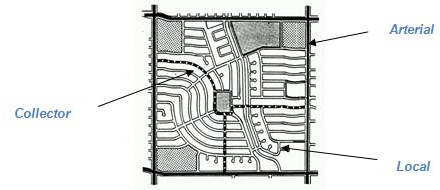
Collector means streets that provide service to smaller communities and link local traffic generators with local (minor) roads. These routes usually have lower speed limits and are spaced at intervals consistent with the population density. May be grouped with major collector and referenced as collector or collector street.
Diagram illustrating Collector Streets:
Commercial indoor amusement means establishments which provide multiple coin operated amusement or entertainment devices or machines as other than an incidental use of the premises. Such devices would include pinball machines, video games, and other games of skill or scoring, and would include pool and/or billiard tables, whether or not they are coin operated. Typical uses include game rooms, billiard and pool halls, and video arcades.
Commercial indoor entertainment means predominantly spectator uses conducted within an enclosed building. Typical uses include, but are not limited to, motion picture theaters, and concert or music halls.
Commercial indoor sports and recreation means predominantly participant uses conducted within an enclosed building. Typical uses include bowling alleys, ice and roller skating rinks, indoor racquetball, swimming, and/or tennis facilities.
Commercial outdoor entertainment means predominantly spectator uses conducted in open or partially enclosed or screened facilities. Typical uses include, but are not limited to, sports arenas, animal racing facilities, and outdoor amusement parks.
Commercial outdoor sports and recreation means predominantly participant uses conducted in open or partially enclosed or screened facilities. Typical uses include, but are not limited to, driving ranges, golf courses, miniature golf, swimming pools, tennis courts, outdoor racquetball courts, paintball facilities, and motorized model airplane flying facilities.
Commercial vehicle repair service means a facility with the primary purpose of the repair of construction equipment, commercial trucks, agricultural implements, and similar heavy equipment, including automobiles, where major engine and transmission repairs are conducted. Typical uses include automobile and truck repair garages; transmission shops; radiator shops; paint, body and fender shops; equipment service centers; machine shops; and other similar uses where major repair activities are conducted.
Commission means the Planning Commission of King William County.
Common open space means all open space within the boundaries of a planned "cluster" residential development designed and set aside for the common use of all residents of the development.
Communications service means an establishment primarily engaged in the provision of broadcasting and other information relay services accomplished through the use of electronic and telephonic mechanisms. Excluded from this use type are facilities classified as utility services, major or broadcasting or communication towers. Typical uses include television studios, telecommunication service centers, telegraph service offices or film and sound recording facilities.
Community center means a non-profit community entertainment, recreation, and meeting place.
Community sewage collection and treatment system means a publicly or privately owned sewer system designed to serve more than one dwelling unit or nonresidential structure, and which consists of collection and transmission lines, pumping stations if necessary, and a sewage treatment and disposal facility. Such system functions by transmission of sewage away from points of origin, collection and treatment of the sewage at a sewage treatment facility which is not located on any of the lots or parcels served by the system, and disposal or discharge of the treated effluent either on land or in surface waters.
Community water supply system means a publicly or privately owned water supply system designed to serve more than one dwelling unit or nonresidential structure. Such system consists of a well or wells which are not located on any of the lots or parcels served by the system, pumps, transmission lines or mains, and storage tanks if necessary.
Comprehensive plan means the officially adopted comprehensive plan for the county.
Concept plan means a generalized plan indicating the boundaries of a tract or tracts of land, and presenting the general arrangement of proposed facilities, uses, structures, and improvements.
Conditional use means a use listed as a conditional use in this chapter and which may be permitted in a specified district under certain conditions; such conditions to be determined in each case by the terms of this chapter and by the board of supervisors after a public hearing and report by the planning commission in accordance with the procedures specified by this chapter and Code of Virginia, § 15.1-486 et seq. A conditional use is a class of "special exception" which the board of supervisors reserves to itself the right to grant under Code of Virginia, § 15.1-491(c).
Conservation area means any land preserved to remain as permanent open space. Conservation areas may be preserved for one or more of the following: habitats for endangered or threatened species; wetlands, flood plains, water bodies, shorelines, and associated buffers; agricultural and forestal production; historic, cultural heritage, and archaeological sites; protection of steep slopes and other land or natural resource conservation purposes; parks or recreation areas; scenic purposes; and, to assist in shaping the character, direction, and timing of community development.
Conservation easement means the granting of a property's development rights to an agency that stipulates that the described land will remain in its natural state and precludes or restricts future or additional development.
Construction footprint means the area of all impervious surface, including but not limited to, buildings, roads and drives, parking areas, and pedestrian paths, the area necessary for construction of such improvements, and septic tank and primary drainfield locations.
Consumer repair service means an establishment or place of business primarily engaged in the provision of repair services to individuals and households, rather than businesses, but excluding automotive and equipment repair use types. Typical uses include appliance repair shops, shoe repair, watch or jewelry repair shops, bike repair, or repair of musical instruments.
Convalescent home (nursing or rest home) means any institution, however named, whether conducted for charity or for profit, which is advertised, announced or maintained for the express or implied purpose of caring for more than eight unrelated persons admitted thereto for the purpose of nursing or convalescent care. Nursing and convalescent care include care given because of prolonged illness or defect or during the recovery from injury or disease, and includes any and all of the procedures commonly employed in waiting on the sick, such as administration of medicine, preparation of special diets, giving of bedside care, application of dressings and bandages, and the carrying out of treatments prescribed by a duly licensed practitioner of medicine.
Correctional institution means any place designated by law for the keeping of persons held in custody under process of law, or under lawful arrest, including state prisons, county and local jails, and other facilities operated by the department of corrections or local governmental units primarily for the purposes of punishment, correction, or rehabilitation following conviction of a criminal offense.
Country club means a land area and buildings which may include a golf course, clubhouse, dining room, swimming pool, tennis courts and similar recreational or service uses available only to members and their guests.
Court, open, means an open, unoccupied space, other than a yard, associated with a building or group of buildings and which is bounded on two or more sides by such building or buildings and every part of which is clear and unobstructed upward from its lowest point.
Crematory means a commercial establishment that specializes in the cremation of corpses, including pets.
Cross-walkway means a public way intended for pedestrian use and excluding motor vehicles, which cuts across a block in order to furnish improved access to adjacent streets or properties.
Cul-de-sac means a minor street having but one end open for vehicular traffic and with the other end permanently terminated by a turnaround for vehicles.
Cultural institution means a publicly or privately owned facility with the primary purpose of displaying historical, cultural, or artistic materials to be viewed by patrons. These institutions can include museums, libraries, and art galleries.
Dam break inundation zone means the specific areas of land that would become flooded and covered with water if a particular dam were to break or fail and is known as the inundation area.
Dark sky lighting means a term that refers to shielded light fixtures that cast light downward and generally conform to the specifications endorsed by the International Dark Sky Association.
Day care center means any facility operated for the purpose of providing care, protection and guidance. This term includes nursery schools, preschools, day care centers for individuals including adults, and other similar uses but excludes public and private educational facilities or any facility offering care to individuals for a full 24-hour period. Excluded from this definition is family day home as defined by this chapter.
Dedication means the transfer of private property to public ownership upon written acceptance.
Density means the number of dwelling units or residential lots permitted on a given unit of land. Density is determined by dividing the total number of residential units or lots to be located on the parcel by the area of the base parcel itself.
Development means any man-made change to improved or unimproved real estate including but not limited to buildings or other structures, roads, and other paving, utilities, filling, excavation, mining, dredging, or drilling.
Development standard means regulations which limit the size, bulk, or siting conditions of particular types of buildings or uses located within any designated district or permitted as conditional uses.
Director of community development means the director of the department of community development hired by the county administrator.
Disabled person means an individual with a physical or mental impairment that substantially limits one or more of a person's major life activities, may impair their ability to live independently, or a person with record of having such an impairment, or being regarded as having such impairment, not to include use or addiction to a controlled substance.
District. Refer to zoning district.
Dripline means the imaginary perpendicular line extending downward from the outermost tips of the tree branches to the ground.
Driveway means a private access for vehicles to a parking space, garage, dwelling, or other structure.
Dwelling, or dwelling unit, means a building or portion thereof designed or used exclusively for residential occupancy, but not including boats, trailers, motor homes, hotels, motels, or motor lodges, with a room or group of rooms connected together containing cooking, bathroom and sleeping facilities constituting a separate, independent housekeeping unit, physically separated from any other dwelling unit in the same structure.
Dwelling, attached single-family means a single-family dwelling that shares one or more exterior walls with a separate single-family dwelling.
Dwelling, detached single-family means a single-family dwelling entirely surrounded by a yard or other separation from other main buildings on the same lot or on adjacent lots. The term "single-family dwelling," as used in this chapter, shall be considered to mean a detached single-family dwelling unless specified as attached. A modular home shall be considered the same as a detached single-family dwelling of conventional construction.
Dwelling, manufactured home, means a structure constructed to federal standards, transportable in one or more sections, which, in the traveling mode, is eight feet or more in width and is 40 feet or more in length, or when erected on a site, is 320 or more square feet, and which is built on a permanent chassis and designed to be used as a dwelling with or without a permanent foundation when connected to the required utilities, and includes the plumbing, heating, air conditioning, and electrical systems contained therein. Some manufactured homes are also referred to as mobile homes.
Dwelling, modular home, means a residential unit that is manufactured in a factory pursuant to the Uniform Statewide Building Code of Virginia and transported to the site where it is established on a permanent foundation as a dwelling unit.
Dwelling, multi-family, means a building arranged or designed to be occupied by three or more dwelling units for permanent occupancy, regardless of the method of ownership. Included in the use type would be garden apartments, low- and high-rise apartments, apartments for elderly housing and condominiums.
Dwelling, single-family, means a dwelling designed for or occupied exclusively by one family.
Dwelling, townhouse, means a grouping of three or more attached single-family dwellings in a row in which each unit has its own front and rear access to the outside, no unit is located over another unit, and each unit is separated from any other unit by one or more common walls.
Dwelling, two-family, means the use of an individual lot for two single-family dwelling units which share at least one common wall, each occupied by one family. Each dwelling unit may be vertically stacked. The exterior appearance of the whole resembles a single structure. Also referred to as a "duplex."
Easement means an authorization by a property owner for use by another of any designated part of his property for one or more specified purposes, which purposes are consistent with the general property rights of the owner.
Educational facility means a public or private institution for the teaching of children or adults including primary and secondary schools, colleges, and similar facilities.
Emergency shelter means a facility providing temporary shelter and feeding of indigents or disaster victims, operated by a public or nonprofit agency.
Engineer means an engineer registered by the Commonwealth of Virginia.
Equipment sales and rental means establishments primarily engaged in the sale or rental of tools, trucks, tractors, construction equipment, agricultural implements, and similar industrial equipment, and the rental of mobile homes. Included in this use type is the incidental storage, maintenance, and servicing of such equipment.
Erected means built, constructed, reconstructed, moved upon, placed altered, or any physical operations on the premises required for building. Excavations, fill, drainage, and the like shall be considered a part of erection.
Establishment means any entity or individual conducting a business, profession, or trade; and any entity or individual conducting a civic, community service, or nonprofit activity.
Event venue means a location that hosts affairs, including but not limited to, banquets, dinners, parties, weddings and the like for up to three consecutive days, for which attendance is permitted only by invitation or reservation.
Extermination business means a commercial establishment specialized in the killing of animals, garden and agricultural pests.
Façade means an entire outside wall of a structure, including wall faces, parapets, fascia, windows, and doors, of one complete elevation.
Fair market value means the price at which property would change hands between a willing buyer and a willing seller, neither being under any compulsion to buy or to sell and both having reasonable knowledge of relevant facts.
Family means two or more persons related by blood, marriage, adoption, or a group of not more than four persons not related by blood, marriage, or adoption, occupying a dwelling unit as an individual housekeeping organization. Does not include group homes.
Family day home (four or less children) means a single-family dwelling in which one to four individuals, are received for care, protection and guidance during only part of a 24-hour day. Individuals related by blood, legal adoption or marriage to the person who maintains the home shall not be counted towards this total (Code of Virginia, § 15.2-2292). The care of four or fewer individuals for portions of a day shall be considered as a home occupation Type I.
Family day home (5—12 individuals) means a single-family dwelling in which five to 12 individuals, are received for care, protection and guidance during only part of a 24-hour day. Individuals related by blood, legal adoption or marriage to the person who maintains the home shall not be counted towards this total (Code of Virginia, § 15.2-2292).
Family health care structure, temporary means pursuant to all conditions set forth in the Code of Virginia § 15.2-2292.1, a transportable residential structure, providing an environment facilitating a caregiver's provision of care for a mentally or physically impaired person, that (i) is primarily assembled at a location other than its site of installation; (ii) is limited to one occupant who shall be the mentally or physically impaired person or, in the case of a married couple, two occupants, one of whom is a mentally or physically impaired person, and the other requires assistance with one or more activities of daily living as defined in Code of Virginia, § 63.2-2200, as certified in writing by a physician licensed in the commonwealth; (iii) has no more than 300 gross square feet; and (iv) complies with applicable provisions of the Industrialized Building Safety Law (§ 36-70 et seq.) and the Uniform Statewide Building Code (§ 36-97 et seq.).
Farm supply and service establishment means to implement sales, rentals and service, feed and seed store, custom milling, milk depots and creameries, fertilizer storage in bags, or bulk storage of liquid or dry fertilizer in tanks or in a completely enclosed building.
Farmer's market means the retail sale of fresh fruits and vegetables, and other food and related items, at a facility with spaces occupied by several different temporary tenants on a short term or daily basis; indoor or outdoor; but this term does not include roadside stands.
Financial institution means an establishment whose principal purpose is the provision of financial services, including but not limited to, an insured depository institution, a credit union, a federal home loan bank, a small business investment company, a depository institution holding company, a mortgage lending business, or other institutions as defined by federal statute.
Fish hatchery means an establishment in which young fish are produced and reared especially for later release in natural waters.
Flag lot means a lot fronting on and abutting public roads and where access to the public road is by a narrow private right-of-way that is part of the lot itself.
Flea market, indoor, means a commercial establishment that is located within a building and hosts the sale of secondhand articles and antiques by individual vendors.
Flea market, outdoor, means a commercial establishment that is held in the open air and hosts the sale of secondhand articles and antiques by individual vendors.
Flood means a general and temporary inundation of normally dry land areas.
Flood, 100-year, means a flood that, on the average, is likely to occur once every 100 years (i.e., that has a one percent chance of occurring each year, although the flood may occur in any year).
Flood proofing means the combination of structural provisions, changes, or adjustments to properties and structures subject to flooding required for new construction in the floodway by the Virginia Uniform Statewide Building Code.
Floodplain means a relatively flat or low land area, adjoining a river, stream or watercourse, which is subject to partial or complete inundation as a result of a storm every 100 years, or an area subject to the unusual and rapid accumulation or runoff of surface waters from any source.
Floodway means the designated area of the floodplain required to carry and discharge floodwaters of a given magnitude. For the purpose of this chapter, the floodway shall be capable of accommodating a flood of the 100-year magnitude.
Floor area means the sum of the gross horizontal areas of each floor of the building or buildings on a lot, measured from the exterior walls or from the centerline of party walls separating two buildings.
Florist means a commercial establishment that sells flowers or grows flowers for sale on the premises.
Forestry means the use of land for the raising and harvesting of timber, pulp wood, and other forestry products for commercial purposes, including the temporary operation of a sawmill and/or chipper to process the timber cut from that parcel or contiguous parcels. Associated uses include accessory offices, equipment sheds, timber tracts, tree farms, forest nurseries, sawmills, and onsite wood gathering for transport to a processing facility.
Frontage, lot (road frontage), means the lot width along the property line parallel to the road and may dictate the front of the property.
Full cutoff luminaire means an outdoor light fixture shielded in such a manner that all light emitted by the fixture is projected below the horizontal plane; also, a type of dark sky lighting.
Funeral home means an establishment engaged in undertaking services such as preparing the dead for burial and arranging and managing funerals. Typical uses include mortuaries and crematories.
Garage, accessory, means an accessory building used for storage purposes only and having a capacity of not more than four automobiles and a floor area of not more than 900 square feet or not more than two automobiles per family housed in the building to which the garage is accessory, whichever is the greater. Space therein may be used for not more than one commercial vehicle, of not more than one-ton capacity, and space may be rented for not more than two vehicles to persons other than occupants of the buildings to which such garage is accessory.
Garage, parking, means a building or portion thereof, other than a private garage, designed or used for storing of motor vehicles.
Garden center means an establishment or place of business primarily engaged in retail sales from the premises including trees, shrubs, seeds, fertilizers, pesticides, plants, and plant materials primarily for agricultural, residential and commercial consumers. Such an establishment typically sells products purchased from others, but may sell material which they grow themselves.
Gardening means any use of land unenclosed except for fencing for the raising of grass, flowers, vegetables, crops, trees, or other botanical objects of natural growth, generally for the use and/or consumption of the occupants of the premises, but not including accessory structures used for the same purpose.
Gasoline station means any place of business with fuel pumps and underground storage tanks that provides fuels and oil for motor vehicles. A store associated with automobile fuel sales shall be considered a gasoline station.
General retail means buildings for display and the sale of merchandise at retail (but specifically exclusive of coal, wood, and lumber yards). Typical uses include drugstore, newsstand, candy shop, dry goods and notions store, antique store and gift shop, hardware store, household appliance store, furniture store, florist, music and radio store, tailor shop.
Glare means lighting entering the eye directly from luminaires or indirectly from reflective surfaces that causes visual discomfort or reduced visibility. Also, the effect produced by brightness sufficient to cause annoyance, discomfort, or loss in visual performance and visibility.
Golf course means any golf course, publicly or privately owned, on which the game of golf is played, including accessory uses and buildings customary thereto, but excluding golf driving ranges as defined herein. See commercial outdoor sports and recreation.
Golf driving range means a limited area on which golf players do not walk, but onto which they drive golf balls from a central driving tee. See commercial outdoor sports and recreation.
Governing body means the Board of Supervisors of King William County, Virginia, as applicable.
Governmental facility means a building or structure owned, operated, or occupied by governmental agency, local, state or federal level agency, to provide a governmental service to the public. These facilities can include police stations, fire stations, governmental agency offices, and the like.
Grade means that which is determined by averaging the elevations of the finished ground adjacent to all the corners and/or principal points in the perimeter wall of the building.
Grandfathered means a term referencing a use or structure that is not in conformance with the current ordinance but that was legal at the time it was established or constructed. Also referred to and defined as a legally, nonconforming use/structure.
Greenhouse, commercial means a greenhouse operation in which plants are offered for sale to the public, either at wholesale or at retail.
Greenhouse, private means a building with transparent walls and roof; for the cultivation and exhibition of plants under controlled conditions.
Greenway means a corridor of open space managed for conservation, recreation, and nonmotorized transportation. Greenways often follow natural geographic features such as ridge lines, stream valleys, and rivers, but may also be built along canals, utility corridors, abandoned rail lines, and the like. Greenways may include a trail or bike path or may be designed strictly for environmental or scenic protection.
Ground floor area means the area of the lowest floor, whether or not on the same level, comprised primarily of livable floor area.
Group home means a licensed residential facility in which no more than eight mentally ill, intellectually disabled, mentally impaired, or developmentally disabled persons or no more than eight aged, infirmed or disabled persons reside, with one or more resident counselors or other staff persons, shall be considered a residential occupancy by a single family. Mental illness and developmental disability shall not include current illegal use of or addiction to a controlled substance as defined in the Code of Virginia, § 54.1-3401. Such facility shall be licensed by the Commonwealth of Virginia Department of Behavioral Health and Development Services, in order to qualify as a single family use.
Guesthouse means living quarters within a detached accessory building located on the same premises with the main building for use by temporary guests of the occupants of the premises, and not rented or otherwise used as a separate dwelling unless permitted by the terms of this chapter.
Halfway house means an establishment providing accommodations, supervision, rehabilitation, counseling, and other guidance services to persons suffering from alcohol or drug addiction, to persons re-entering society after being released from a correctional facility or other institution, or to persons suffering from similar disorders.
Health officer means the legally designated health authority of the state department of health, for the county or its authorized representative.
Height means the vertical distance of a structure measured from the average elevation of the finished grade within 20 feet of the structure to the highest point of the structure. See also building height.
Helipad means an area designated for the landing or departure of helicopters (Code of Virginia, § 15.2-2293.2).
Historic area means an area containing one or more buildings or places where historic events occurred or having special public value because of noticeable architectural, archaeological or other features relating to the cultural or artistic heritage of the community, or of such significance as to warrant conservation and preservation, and which has been so designated by the historic landmarks commission or some other local, state, or federal government agency.
Home occupation, Type I means an accessory use of a dwelling unit for gainful employment involving the provision of goods or services and which does not generate any additional employees or more than five customers daily.
Home occupation, Type II means an accessory use of a dwelling unit for gainful employment involving the provision of goods and/or services and which generates employees and/or more than five customers daily.
Hospital means a building or group of buildings, having room facilities for overnight patients, used for providing services for the in-patient medical or surgical care of sick or injured humans, and which may include related facilities, central service facilities and staff offices; provided, however, that such related facility must be incidental and subordinate to the main use and must be an integral part of the hospital operations.
Hotel also referred to as a motel or motor lodge; means a building or group of attached or detached buildings containing lodging units intended primarily for rental or lease to transients by the day, week, or month. Such uses generally provide additional services such as daily maid service, restaurants, meeting rooms, and/or recreation facilities.
Hunt camp means an area of a property devoted to the temporary, seasonal use for a camp dedicated for hunting that often includes a structure for sleeping, but not for permanent use. The structure may or may not include such features as a kitchen, indoor plumbing, and other amenities found in a typical dwelling unit. A hunt camp may include facilities such as private kennels or pens.
Impervious cover means a surface composed of any material that significantly impedes or prevents natural infiltration of water into the soil. Impervious surfaces include, but are not limited to; roofs, buildings, streets, parking areas, and any concrete, asphalt, or compacted gravel surface.
Industry, heavy, means manufacturing with significant external effects, or which pose significant risks due to the involvement of explosives, radioactive materials, poisons, pesticides, herbicides, or other hazardous materials in manufacturing or other processes
Industry, light, means processing, manufacturing, compounding, assembly, packaging, treatment or fabrication of materials and products, from processed or previously manufactured materials. Light industry is capable of operation in such a manner as to control the external effects of the manufacturing process, such as smoke, noise, soot, dirt, vibration, odor, and the like. Uses may include, but are not limited to, a machine shop, the manufacturing of apparel, electrical appliances, electronic equipment, camera and photographic equipment, ceramic products, cosmetics and toiletries, business machines, paper products (but not the manufacture of paper from pulpwood), musical instruments, medical appliances, tools or hardware, plastic products (but not the processing of raw materials), pharmaceuticals or optical goods, bicycles, any other product of a similar nature.
Industry, medium, means goods which are generally mass produced from raw materials on a large scale through the use of an assembly line or similar process, usually for sale to wholesalers or other industrial or manufacturing uses. Medium industry produces moderate external effects such as smoke, noise, soot, dirt, vibration, odor, and the like.
Intersection means the area embraced within the prolongation of the lateral boundary lines of two or more streets which join one another at an angle whether or not one such street crosses the other.
Junkyard means any area of land lying within 100 feet of a state highway or more than 200 square feet of land area in any location used as an establishment or place of business which is maintained, operated or used for storing, keeping, buying or selling junk, and the term includes garbage dumps and sanitary fills.
Kennel, commercial means any location where raising, grooming, caring for, or boarding of dogs, cats, or other small animals for commercial purposes is conducted.
Kennel, private means keeping of five or more dogs which are all owned and licensed by a single owner and kept on the same property.
Land disturbance or land disturbing activity means any activity which may result in soil erosion or the movement of sediments including grubbing, grading, excavating, utility line installation, or any surface preparation for the support of development or redevelopment, but not including silvicultural or agricultural activities
Landscaping means the improvement of the appearance of an area by the planting of trees, grass, shrubs, or other plant or related materials.
Life care facility means a residential facility primarily for the continuing care of the elderly, providing for transitional housing progressing from independent living in various dwelling units, with or without kitchen facilities, and culminating in nursing home type care where all related uses are located on the same lot. Such facility may include other services integral to the personal and therapeutic care of the residents. An assisted living facility would be included in this definition.
Light pollution means any adverse effect of man-made light including sky glow, glare, light trespass, light clutter, and decreased visibility at night.
Light trespass means light sources casting excessive light upon adjacent property or upon a public right-of-way, also called light spillover.
Liquor means any alcoholic beverage other than beer, wine, or cider, as those terms are defined in Code of Virginia, §§ 4.1-100 and 4.1-213.
Livestock means any animal customarily kept by humans for the purpose of providing food, clothing, or work, including but not limited to, cows, goats, horses, pigs, and poultry but not including cats, dogs, or other house pets.
Livestock market means a commercial establishment wherein livestock is collected for sale and auctioned off.
Living quarters means a residence for persons employed on the premises.
Loading space means a space within a building or on the premises providing for the standing, loading or unloading of vehicles.
Lot means a land intended to be separately owned, developed, or otherwise used as a unit, established by plat, subdivisions or as otherwise permitted by law
Lot, area means the total horizontal area within the lot lines of the lot.
Lot, corner means a lot abutting upon two or more streets at their intersection where the interior angle of intersection is not greater than 135 degrees. A lot abutting upon a curved street shall be considered a corner lot if the tangents to the curve at the points of intersection of the side lot lines intersect at an interior angle of less than 135 degrees. A reversed corner lot is a corner lot that is turned, with reference to an adjoining lot, to front on another street. A corner lot will have two front setbacks on each side that fronts the street and two side setbacks.
Lot, depth means the average horizontal distance between the front and rear lot lines.
Lot, double or reverse frontage means a lot, other than a corner lot, which has frontage on two streets.
Lot, interior, means any lot other than a corner lot.
Lot, line means the boundary line of the lot.
Lot line, front means the line separating the lot from a street on which it fronts. On a corner lot, the front shall be deemed to be along the shorter dimension of the lot; and where the dimensions are equal, the front shall be on that street on which a predominance of the other lots in the block front. For an existing flag lot the front yard shall be determined as in the definition of "building setback line."
Lot line, rear means the lot line opposite and most distant from the front lot line.
Lot line, side means any lot line other than a front or rear lot line.
Lot of record means a lot shown upon a plan of subdivision or upon a plat attached or referred to in a deed described by metes and bounds in a deed recorded in the clerk's office of the county circuit court.
Lot width means the horizontal distance between the side lot lines measured at the required front building setback line.
Luminaire means a complete lighting unit or fixture, consisting of a lamp, or lamps and ballast(s), together with the parts designed to distribute the light (reflector, lens, diffuser), to position and protect the lamps, and to connect the lamps to the power supply.
Manufacture and/or manufacturing means the processing and/or converting of raw, unfinished materials, or products, or either of them, into articles or substances of different character, or for use for a different purpose.
Manufactured building means a building which is:
(1)
Mass produced in a factory;
(2)
Designed and constructed for transportation to a site for installation and use when connected to required utilities; and
(3)
Either an independent, individual building or a module for combination with other elements to form a building on the site.
Manufactured home. See dwelling.
Manufactured home park means a lot or parcel of land under single ownership on which are located or which are arranged or equipped with water, sewer and electrical facilities, for the accommodation of two or more manufactured homes occupied for living purposes. A manufactured home park may feature continuing general management and include special facilities for common use by the occupants, such as recreational buildings and laundries.
Manufactured home sales means establishments primarily engaged in the sale or rental of manufactured homes.
Marina means a commercial, waterfront establishment whose business is offering the sale or rental of boats and marine sporting equipment and the servicing, repair, or storage of same. These establishments may provide boat slip rental, gasoline sales, sanitary pump out service, and food and drink accommodations.
Micro-wireless facility means a small cell facility that is not larger in dimension than 24 inches in length, 15 inches in width, and 12 inches in height and that has an exterior antenna, if any, not longer than 11 inches (Code of Virginia, § 15.2-2316.3).
Mini-warehouse means a building designed to provide rental storage space in cubicles where each cubicle has a maximum floor area of 400 square feet. Each cubicle shall be enclosed by walls and ceiling and have a separate entrance for the loading and unloading of stored goods.
Minor street means a street other than a major thoroughfare or collector street and intended primarily for providing low volume traffic access to abutting properties of limited number.
Motor home or camper means a unit or subunit which is or becomes self-propelled and is designed for human habitation on a short-term basis.
Nonconforming building means any building the size, dimensions, or location of which was lawful when erected or altered, but which fails to conform to the current standards and regulations due to the adoption, revision, or amendment of this chapter.
Nonconforming lot means an otherwise legally platted lot that does not conform to the minimum area, width or depth requirements of this chapter for the district in which it is located either at the effective date of the ordinance from which this chapter is derived or as a result of subsequent amendments to this chapter.
Nonconforming structure means a building or structure that does not conform with the lot area, yard, height, lot coverage, or other area regulations of this chapter, or is designed or intended for a use that does not conform to the use regulations of this chapter, for the district in which it is located, either at the effective date of the ordinance from which this chapter is derived or as a result of subsequent amendments to this chapter.
Nonconforming use means the otherwise legal use of a building or structure or of a tract of land that does not conform to the use regulations of this chapter for the district in which it is located, either at the effective date of the ordinance from which this chapter is derived or as a result of subsequent amendments to this chapter.
Nonpoint source pollution means pollution consisting of constituents such as sediment, nutrients, and organic and toxic substances from diffuse sources, such as runoff from agriculture and urban land development and use.
Nontidal wetlands means those wetlands other than tidal wetlands that are inundated or saturated by surface or groundwater at a frequency and duration sufficient to support, and that under normal circumstances do support, a prevalence of vegetation typically adapted for life in saturated soil conditions, as defined by the U.S. Environmental Protection Agency in 33 CFR 328.3(c).
Noxious weeds means weeds that are difficult to control effectively, such as Johnson grass, kudzu, and multiflora rose.
Nursery means a place where plants are grown commercially, either for sale direct to the public or to other retailers.
Nursing home. Refer to Convalescent home.
Occupancy means the period during which one owns, rents, uses, or occupies a certain premises or land.
Occupant means a person who, on a regular basis, spends nights at a residence. A person is considered an occupant regardless of whether they spend the majority of their nights at a residence, if the times they do stay overnight are regular and recurrent. In addition, a person shall be considered an occupant if their clothes or other daily living supplies are maintained at the residence.
Office, general means the use of a site for business, professional, or administrative offices, excluding medical offices. Typical uses include real estate, insurance, management, travel, computer software or information systems research and development, or other business offices; organization and association offices; or law, architectural, engineering, accounting or other professional offices. Retail sales do not comprise more than an accessory aspect of the primary activity of a general office.
Office, medical means the use of a site for facilities which provide diagnoses, minor surgical care and outpatient care on a routine basis, but which does not provide overnight care or serve as a base for an ambulance service. Medical offices are operated by doctors, dentists, or similar practitioners licensed by the Commonwealth of Virginia. Emergency treatment is not the dominant type of care provided at this facility.
On-site sewage disposal means treatment and disposal of sewage on the same lot or parcel on which the sewage is created, through means approved by the health official.
On-site water supply means a well, approved by the health official, located on the lot or parcel on which water supplied by such well will be consumed or used.
Open space (usable residential common open space) means any outdoor area of such location, size and shape as to provide for specific outdoor living such as patios, swimming pools, and the like, or outdoor service functions such as laundry drying. Area considered as usable common open space must be available for all residential occupants of a given building or project and may include only those spaces enclosing an area of at least 300 square feet, with a least dimension of 15 feet or more.
Outdoor display means the permanent and/or continuous keeping, displaying, or storing, outside of a building, of any goods, materials, merchandise or equipment to be sold to the public.
Outdoor storage means the keeping, in other than a building, of any goods, materials, or merchandise on the same parcel for more than 24 consecutive hours.
Parcel means a tract of land consisting of one or more lots of record.
Parking facility means a commercial site for surface parking or a parking structure use which provides one or more parking spaces together with driveways, aisles, turning and maneuvering areas, incorporated landscaped areas, and similar features meeting the requirements established by this chapter.
Parking lot, public means an area containing one or more parking spaces for self-propelled passenger vehicles, designed for and available to the public as an accommodation for patrons, customers or employees, either with or without charge.
Parking space, off-street means an all-weather surfaced area not in a road or alley and having dimensions of not less than nine feet wide by 18 feet deep, exclusive of driveways, permanently reserved for the temporary storage of one vehicle and connected with a road or alley by a paved driveway which affords ingress and egress for an automobile without requiring another automobile to be moved.
Patio means a level surfaced area directly adjacent to a principal building which has an average elevation of not more than 30 inches from finished grade, and without walls or a roof. A patio may be constructed of any materials.
Pawn shop means a use engaged in the loaning of money on the security of property pledged in the keeping of the pawnbroker and the incidental sale of such property.
Pedestrian path means paved, marked or otherwise designated pedestrian treatments that are installed to comply with the Americans with Disabilities Act (ADA).
Pen means a small enclosure used for the concentrated confinement and housing of animals or poultry, a place for feeding and fattening animals, a coop. Enclosed pasture or range with an area in excess of 100 square feet for each hog or small animal or 200 square feet for each larger animal shall not be regarded as a pen.
Penalty, civil means a punitive measure that imposes an associated fee for the violation of a provision included in this chapter.
Permanent foundation means a building foundation as defined in the BOCA National Building Code or other building codes recognized by the commonwealth.
Person means an individual, firm, corporation, or association.
Personal improvement services mean establishments primarily engaged in the provision of informational, instructional, personal improvements and similar services. Typical uses include driving schools, health or physical fitness studios, dance/music/art studios, handicraft and hobby instruction.
Personal services mean establishments or places of business engaged in the provision of frequently or recurrently needed services of a personal nature. Typical uses include beauty and barber shops; grooming of pets; seamstresses, tailors, or shoe repairs; florists; and laundromats and dry cleaning stations serving individuals and households.
Petroleum or chemical storage over 30,000 gallons means the storage of chemicals, petroleum products and other materials in above-ground containers in a quantity that totals more than 30,000 gallons, for subsequent resale to distributors or retail dealers or outlets.
Petroleum or chemical storage up to 30,000 gallons means the storage of chemicals, petroleum products and other materials in above-ground containers in a quantity that totals 30,000 gallons or less, for subsequent resale to distributors or retail dealers or outlets.
Picnic area means a facility with one or more picnic shelters that can be used or reserved by the public.
Picnic shelter means a structure with no more than two walls, which provides protection or shelter to persons which are picnicking. Picnic shelters shall not be used for human habitation.
Pier, commercial means a fixed waterfront structure in which the owner of the pier charges a fee for members of the general public to use the pier. Allowed uses include crabbing, fishing, sunning, swimming and similar activities, but not boating or the docking of boats.
Pier, community means a fixed waterfront structure used by a residential community, including guests, for crabbing, fishing, sunning, swimming, and similar activities, but not for boating or the docking of boats.
Pier gazebo, large, means a roofed structure located over a pier as defined in Code of Virginia, § 28.2-1203(A), which is over 400 square feet in area or a structure of any size containing walls.
Pier gazebo, small, means a wall-less roofed structure located over a pier as defined in Code of Virginia, § 28.2-1203(A), which is 400 square feet in area or smaller.
Pier, private means a waterfront structure, fixed or floating, used for the docking of boats owned and registered by the property owner or a guest visiting the owner, or for recreational uses such as fishing.
Planned unit development means a form of development characterized by unified site design for a variety of housing types and densities, clustering of buildings, common open space, and a mix of building types and land uses in which project planning and density calculation are performed for the entire development rather than on an individual lot basis.
Plat means a map or plan of a tract or parcel of land which is to be, or which has been subdivided. The word "plat" includes the words "map," "plan," "replat," "plot" and "replot." When used as a verb, "plat" is synonymous with "subdivide."
Porch means a roofed open area, which may be glazed or screened, usually attached to or part of and with direct access to, or from, a building.
Post office means postal services directly available to the consumer operated by the United States Postal Service.
Poultry means domestic fowl normally raised on a farm, such as chickens, ducks, geese, turkeys, peafowl, guinea fowl, and the like.
Power generation plant means a facility that converts one or more energy sources, including but not limited to waterpower, fossil fuels or nuclear power into electrical energy or steam. A power generation plant may also perform either or both of the following: (a) operation of a transmission system that conveys the energy or steam from the generation facility to a power distribution system; (b) operation of a distribution system that conveys energy or steam from the generation facility or the transmission system to final consumers. This definition excludes solar generation.
Premises means a lot, together with all buildings and structures thereon.
Preservation means the act or process of applying measures to sustain the existing form, integrity, and material of a site, structure, or landmark and their existing form and vegetative cover. Preservation may include initial stabilization work, where necessary, as well as ongoing maintenance of these elements.
Primary highway means a highway designated as a state primary highway or U.S. highway by the adopted comprehensive plan of the county or by the Virginia Department of Transportation (VDOT).
Property means any tract, lot, parcel or several of the same collected together for the purpose of subdividing.
Public assembly means facilities that accommodate public assembly for sports, amusements, or entertainment purposes. Typical uses include auditoriums, sports stadiums, convention facilities, and incidental sales and exhibition facilities.
Public building means a building, or part thereof, owned or leased and occupied and used by an agency or political subdivision of the United States of America, the commonwealth, a county or a town or city.
Public maintenance and service facility means a public facility supporting maintenance, repair, vehicular or equipment servicing, material storage, and similar activities including street or sewer yards, equipment services centers, and similar uses having characteristics of commercial services or contracting or industrial activities.
Public park and recreational area means publicly owned and operated parks, picnic areas, playgrounds, indoor/outdoor athletic or recreation facilities, indoor/outdoor shelters, amphitheaters, game preserves, open spaces, and other similar uses. This shall not include public recreation assembly.
Public recreation assembly means publicly-owned and operated community, civic, or recreation centers, year-round swimming facilities, or indoor performing arts/auditoriums.
Public water and sewer system means a water or sewer system owned and operated by a municipality or county, or owned and operated by a corporation approved by the board of supervisors and properly chartered and certified by the State Corporation Commission, and subject to special regulations as set forth in this chapter, or the county ordinances.
Railroad facility means an area of land, a portion of which is covered by a system of tracks that provides for the making up of trains by one or more railroads or private industry concerns. Necessary functions of a rail facility include but are not limited to the classifying, switching, storing, assembling, distributing, consolidating, moving, repairing, weighing, or transferring of cars, trains, engines, locomotives, and rolling stock.
Recreation, active means those recreational pursuits which require physical alteration to the area in which they are performed including, but not limited to, pedestrian ways, bikeways, tennis courts, swimming and boating areas, playgrounds, and play fields.
Recreation, passive means recreational activities that generally do not require a developed site such as hiking, horseback riding, and picnicking.
Recreation facility, private means a private recreational facility for use solely by the residents and guests of a particular residential development, planned unit development, or residential neighborhood, including indoor and outdoor facilities. These facilities are usually proposed or planned in association with development and are usually located within or adjacent to such development.
Recreation facility, public means a publicly owned or operated recreation facility.
Recreational vehicle means a vehicular type or portable structure without a permanent foundation which can be towed, hauled, or driven and primarily designed as temporary living accommodations for recreational, camping, and travel use and including, but not limited to; travel trailers, truck campers, camping trailers and self-propelled motor homes.
Recreational vehicle sales and service means the retail sales of recreational vehicles and boats, including service and storage of vehicles and parts and related accessories.
Recycling center means a facility used by the general public for the collection of materials for recycling or reuse, including bins, boxes, buildings, self-propelled motor vehicles, trailers and other enclosures or receptacles. Except for county or other governmental sponsored programs to collect and/or recycle household hazardous wastes, this definition shall not include facilities for the collection of non-recyclable materials, such as business and household refuse, garbage, organic materials, medical waste, trash, junk, toxic substances, or similar materials.
Refuse collection site means a facility for the collection of non-recyclable materials, such as business and household refuse, garbage, organic materials, medical waste, trash, junk, toxic substances, or similar materials.
Regulations means the whole body of regulations, text, charts, tables, diagrams, maps, notations, references and symbols, contained or referred to in this [chapter], article, or division.
Religious assembly means a use providing regular organized religious worship and related incidental activities, except primary or secondary schools and day care facilities.
Research and development means a business which engages in research, or research and development of innovative ideas in technology-intensive fields. Examples include research and development of communication systems, transportation, geographic information systems, multimedia and video technology. Development and construction of prototypes may be associated with this use.
Resident engineer means a resident engineer of the Virginia Department of Transportation.
Residential use means any place, building, or establishment used in whole or in part as a dwelling, or used for the care, protection, or guidance of any persons during any part of the day, including, but not limited to, single-family and multi-family dwellings, manufactured homes, family day care homes, group homes, and homes for adults.
Resource extraction means a use involving on-site extraction of surface or subsurface mineral products or natural resources. Typical uses are quarries, borrow pits, sand and gravel operation, mining, soil mining, and other major excavations. Specifically excluded from this use type shall be grading and removal of dirt associated with an approved site plan or subdivision, or excavations associated with, and for the improvement of, a bona fide agricultural use.
Resource management area (RMA) means a component of the Chesapeake Bay Preservation Area. The resource management area shall include all lands within the county not otherwise designated as an RPA. RMAs include land types that, if improperly used or developed, have the potential for causing significant water quality degradation or for diminishing the functional value of the resource protection area. Components of the RMA include floodplains; highly erodible soils, including steep slopes; highly permeable soils; nontidal wetlands not included in RPAs; and other sensitive lands affecting water quality.
Resource protection area (RPA) means the "shoreward" component of the Chesapeake Bay Preservation Area. RPAs are composed of tidal wetlands, nontidal wetlands connected by surface flow and contiguous to tidal wetlands or water bodies with perennial flow, tidal shores, such other lands considered necessary to protect the quality of state waters and 100 feet of riparian buffers adjacent to and landward of these features. The full buffer area shall be designated as the landward component of the RPA notwithstanding the presence of permitted uses, encroachments, and permitted vegetation clearing in compliance with this chapter.
Restaurant means any building in which, for compensation, food or beverages are dispensed to persons not residing on the premises for consumption on the premises including, among other establishments, cafés, delicatessens, or refreshment stands.
Restaurant, drive-in means an eating and/or drinking establishment which caters to motor-driven vehicle businesses where the person being served may consume his food and/or drink while sitting in a motor-driven vehicle, as opposed to a restaurant serving exclusively inside or adjacent to the main building.
Restaurant, fast food means an establishment primarily engaged in the preparation of food and beverages, for either take-out, delivery or table service, served in disposable containers at a counter. This use type does not employ a drive-up or drive-through service facility and does not offer curb service.
Restaurant, general means an establishment engaged in the preparation of food and beverages containing more than 2,000 gross square feet and characterized primarily by table service to customers in non-disposable containers.
Restaurant, mobile means a readily moveable wheeled vehicle or towed vehicle designed and equipped for the preparation and sale of food and/or drink, which is provided to walk-up customers. This term includes mobile food units, food trucks, and similar apparatuses. Mobile restaurants (food vendors) are by definition itinerant and not permanent fixtures to a specific property.
Restaurant, small means an establishment engaged in the preparation of food and beverages containing no more than 2,000 gross square feet and characterized primarily by table service to customers in non-disposable containers. Typical uses include cafés, coffee shops, and eat-in delis.
Rezoning means a reclassification of land from one zoning district to another by the board of supervisors after review by the planning commission, notices, and public hearings as prescribed by law.
Right-of-way means the dedication for public use of streets and utilities.
Riparian buffer means a vegetated buffer no less than 100 feet wide, located adjacent to and landward of all tidal shores, tidal wetlands, non-tidal wetlands connected by surface flow and contiguous to tidal wetlands or along water bodies with perennial flow. The riparian buffer is a component of the resource protection area.
Road or roadway means a public or private thoroughfare which affords the principal means of access to abutting properties, and whether designated as a freeway, expressway, thoroughfare, highway, road, parkway, avenue, boulevard, lane, place, circle, or however otherwise designated.
Road or roadway line (rights-of-way line) means a dividing line between a lot, tract, or parcel of land and a contiguous street, and also referred to as a rights-of-way-line.
Road or roadway, major, or major thoroughfare means a street or road designated as a major thoroughfare (a U.S. highway, state primary highway, or state secondary highway) on the adopted comprehensive plan of the county.
Road or roadway, private means a private thoroughfare or easement of access established in accord with the terms of this chapter and which is not publicly owned or publicly maintained.
Road or roadway, public means a street designed and constructed in accordance with subdivision street standards of the Virginia Department of Transportation and intended to be accepted into the department's secondary highway system, whether or not such acceptance has been granted.
Road or roadway, width means the horizontal distance between street lines measured perpendicular to the street centerline.
Salvage and scrap service means a place of business primarily engaged in the storage, sale, dismantling or other processing of used or waste materials which are not intended for reuse in their original forms. Typical uses include paper and metal salvage yards, automotive wrecking yards, junk yards, used tire storage yards, or retail and/or wholesale sales of used automobiles parts and supplies.
Sanitary landfill means an engineered land burial facility for the disposal of solid waste (as defined by the Virginia Department of Waste Management) which is so located, designed, constructed, and operated to contain and isolate the solid waste so that it does not pose a substantial present or potential hazard to human health or the environment.
Sawmill, permanent means a sawmill permanently located for the purpose of processing timber from the property on which located, from adjoining property, or from other properties removed from the sawmill or its environs without regard to point of origination. Such mill may or may not be held out for the processing of timber bought or sold on a price basis.
Sawmill, temporary means a portable sawmill located on private property for the processing of timber cut only from that property or from property immediately contiguous and adjacent thereto, or incidental processing of timber transported from other property.
Screening means a method of visually shielding or obscuring one abutting or nearby structure or use from another by fencing, walls, berms or densely planted vegetation. Screening is intended to substantially, but not necessarily totally, obscure visual impacts between adjoining uses.
Secondary highway means a highway designated as a state secondary highway by the Virginia Department of Transportation.
Service drive means a minor street which is parallel to and adjacent to a major thoroughfare, and which provides access to abutting properties and restricts access to the major thoroughfare.
Setback means the minimum distance by which any building or structure must be separated from the lot lines.
Setback line means a line generally parallel with and measured from the front lot line, defining the limits of a defined yard in which no building or structure may be located above ground.
Sewage treatment system, private, individual alternative, means any device or system which results in a point source discharge of treated sewage for which the department of health may issue a permit authorizing construction and operation when such system is regulated by the state department of environmental quality pursuant to a general Virginia Pollutant Discharge Elimination System permit issued for an individual single-family dwelling with flows less than or equal to 1,000 gallons per day on a yearly average. Such a system is designed to treat sewage from a residential source and dispose of the effluent by discharging it to an all-weather stream, an intermittent stream, a dry ditch, or other location approved by the department of health.
Shooting range, indoor means the use of a structure for firearms or other projectiles for the purpose of target practice or competitions, and in return for compensation.
Shooting range, private means the use of land for target shooting and other recreational activities, other than hunting, involving the use of firearms or other projectiles (e.g., archery) by the owner or occupant of a parcel and their guests, not in return for compensation and not including formal competitions.
Shooting range, outdoor means the use of land for shooting clubs and other facilities for the discharge of firearms or other projectiles for the purposes of target practice, skeet and trap shooting, mock war games, or formal competitions, or in return for compensation.
Shopping center means a group of commercial establishments planned, developed, owned and managed as a unit related in location, size and type of shops to the area that the unit serves and providing site parking in relationship to the types and sizes of stores.
Short term business rental means the rental of any legally permitted dwelling unit for occupancy, or any portion of any legally permitted dwelling unit for occupancy, for dwelling, lodging, or sleeping purposes for a period of less than 30 consecutive calendar days.
Sidewalk means a paved public or private walkway for pedestrians and the term is used interchangeably with pedestrian path. Public sidewalks are located within right-of-ways or easements.
Sign means an identification, description, illustration, or device which is affixed to or represented directly or indirectly upon a building, structure, or land and which directs attention to a product, place, activity, person, institution, or business.
Sign, abandoned, means a sign or structure of a former sign shall be deemed to be abandoned when for a period of 30 consecutive days it does not identify or advertise a lawful, bona fide, and operational business, service, lessor, owner, product, or activity located at, or offered upon, the premises.
Sign, agricultural, means signs advertising products raised or made on the premises.
Sign, animated means a sign utilizing any form of movement, including, without limitation, animation, revolution, vertical or horizontal motion, whether electrical, mechanical, wind-blown, or through change in lighting.
Sign, area means the smallest square, rectangle, triangle, circle, or combination thereof encompassing the entire advertising area, excluding architectural trim and structural supports.
Sign, awning means a sign painted on, printed on, or attached flat against the surface of an awning. Such sign shall not extend above the height of the awning.
Sign, banner means a temporary sign made of cloth, paper, vinyl or like material.
Sign, canopy. See sign, awning.
Sign, construction means a temporary sign providing information about future development or current construction on a site and the parties involved in the project.
Sign, contractor means one sign per licensed contractor performing, or having performed within the past 31 days, construction or building renovation work on the premises.
Sign, directional means a sign giving directional instructions, but containing no advertising copy, (e.g., parking or exit and entrance signs). Such signs shall not exceed four feet in height and two square feet in area.
Sign, double-faced means a sign with two parallel or nearly parallel faces, a-frame, back to back, upon which advertising is displayed. Double-faced signs shall be considered a single sign, provided that the faces are parallel or are not separated by an angle greater than 15 degrees and are part of the same structure. If one face contains a larger sign area than the other, the larger face shall be used in calculating the sign area.
Sign, electronic message board means any sign containing light emitting diodes (LEDs), fiber optics, light bulbs, plasma display screens or other illumination devices, or a series of vertical or horizontal slats or cylinders that are capable of being rotated at intervals, that are used to change the messages, intensity of light, or colors displayed by such sign.
Sign, flag means cloth or similar flexible fabric attached to a pole at one end such that the material can bend or flutter from the point(s) of attachment.
Sign, flashing means any illuminated sign on which there is artificial light which is not stationary or constant in intensity or color at all times when such sign is in use.
Sign, freestanding means a sign supported by one or more upright poles, columns, or braces placed in or on the ground and not attached to any building or structure.
Sign, freestanding, combined means a sign supported by one or more upright poles, columns, or braces placed in or on the ground and not attached to any building or structure that advertises for more than one business or entity.
Sign, government means signs erected and maintained pursuant to and in discharge of any federal, state, or county governmental function, or as may be required by law, ordinance, or governmental regulation, including official traffic signs, warning devices, and other similar signs.
Sign, grand opening means one grand opening sign pertaining to a recently opened, licensed business.
Sign, height, means the vertical distance from the road grade or the average lot grade at the front setback line, whichever produces the greater vertical distance, to the highest point of the sign.
Sign, illuminated means any sign with an artificial light source incorporated internally or externally for the purpose of illuminating the sign.
Sign, individual letter means a sign made up of letters that are only attached directly to the building.
Sign, inflatable means any display capable of being expanded by air or other gas and used on a temporary or permanent basis to advertise a product or event.
Sign, monument means a sign affixed to a structure built at grade, in which the sign and the structure are an integral part of one another; not a pole sign.
Sign, off-premises means any sign, including billboards, which directs attention to a business commodity, service or establishment conducted, sold or offered at a location other than the premises on which the sign is erected.
Sign, portable means a freestanding sign that is trailer mounted, or otherwise designed to be relocated, or is constructed on a chassis or carriage with permanent or removable wheels, and has an area not exceeding 60 square feet on each of two parallel sides.
Sign, real estate means signs offering individual real property or properties within a platted subdivision or multi-unit development for sale or rent.
Sign, temporary means a sign not intended for permanent use to be displayed and removed within a limited period of time and neither permanently installed in the ground nor permanently affixed to a building or structure permanently installed in the ground. Temporary signs include but are not limited to contractor, construction, grand opening, and real estate signs.
Sign, temporary agricultural means temporary signs pertaining to an agritourism activity and/or the related retail, farmer's markets, farm produce stands, wayside stands, roadside stands, and wayside markets.
Sign, roof means any sign erected, constructed, and maintained wholly upon or over the roof of any building.
Sign, wall means a sign painted on, or attached to, and erected parallel to the face of an outside wall of a building, and not projecting more than 18 inches from the wall.
Sign, window means a sign, which is physically affixed to a building window and legible from any vehicular public right-of-way through a building window. For purposes of this chapter, any sign (including illuminated signs) located inside a building and otherwise legible from any vehicular public right-of-way shall be deemed not to be a "window sign" if such sign is less than six square feet in area and is located at least ten feet away from such window(s) through which it is viewed.
Silvicultural activities means forest management activities, including but not limited to the harvesting of timber, the construction of roads and trails for forest management purposes, and the preparation of property for reforestation that are conducted in accordance with the silvicultural best management practices developed and enforced by the state forester pursuant to Code of Virginia, § 10.1-1105 and are located on property deemed as real estate devoted to forest use under the land use taxation provisions of Code of Virginia, § 58.1-3230.
Site. See building site.
Site plan means a plan prepared by a professional engineer or land surveyor licensed by the state showing all proposed improvements to the site. The site plan shall include all covenants, grants, or easements and other conditions relating to use, location, and bulk of buildings, density of development, common open space, public facilities, and such other information as is required in applicable sections of this chapter such as with conditional use, rezoning, or variance applications.
Small cell facility means a wireless facility that meets both of the following qualifications: (i) each antenna is located inside an enclosure of no more than six cubic feet in volume, or, in the case of an antenna that has exposed elements, the antenna and all of its exposed elements could fit within an imaginary enclosure of no more than six cubic feet and (ii) all other wireless equipment associated with the facility has a cumulative volume of no more than 28 cubic feet, or such higher limit as is established by the Federal Communications Commission. The following types of associated equipment are not included in the calculation of equipment volume: electric meter, concealment, telecommunications demarcation boxes, back-up power systems, grounding equipment, power transfer switches, cut-off switches, and vertical cable runs for the connection of power and other services (Code of Virginia, § 15.2-2316.3).
Small-scale conversion of biomass means the conversion of any renewable biomass into heat, power, or biofuels (Code of Virginia, § 15.2-2288.01).
Soils, highly erodible means (excluding vegetation) with an erodibility index (El) from sheet and rill erosion equal to or greater than eight. The erodibility index for any soil is deemed as the product of the formula RKLS/T, where K is the soil susceptibility to water erosion in the surface layer; R is the rainfall and runoff; LS is the combined effects of slope length and steepness; and T is the soil loss tolerance.
Soils, highly permeable means soils with a given potential to transmit water through the soil profile. Highly permeable soils are identified as any soil having a permeability equal to or greater than six inches of water movement per hour in any part of the soil profile to a depth of 72 inches (permeability groups "rapid" and "very rapid") as found in the latest edition of the "National Soil Survey Handbook" of November 1996, in the "Field Office Technical Guide" of the U.S. Department of Agriculture, Natural Resources Conservation Service.
Solar facility, medium-scale means a facility that generates electricity from sunlight primarily to reduce onsite consumption of utility power for commercial and industrial applications. Sites are between one to three acres with a maximum capacity of 999 kilowatts.
Solar facility, roof means a system consisting of solar panels, modules, accessory structures and related equipment (e.g., heat exchanger, pipes, inverter, wiring, storage) that collects solar energy and converts it into heat and/or electricity in which the solar panels are located on the roof of a residential dwelling unit (Code of Virginia, § 15.2-2288.7).
Solar facility, small-scale means a facility that either: (a) generates less than 15 kilowatts electricity from sunlight, consisting of one or more photovoltaic (PV) systems and other appurtenant structures and facilities within the boundaries of the site; or (b) utilizes sunlight as an energy source to heat or cool buildings, heat or cool water, or produce electrical or mechanical power by means of any combination of collecting, transferring, or converting solar-generated energy; and (c) meets at least one of the following criteria: has a disturbance zone equal to or less than an acre; is mounted on or over a building, parking lot, or other previously disturbed area; or utilizes integrated PV only.
Solar facility, utility-scale means a facility that generates electricity from sunlight which will be used to provide electricity to a utility provider. Sites are generally over two acres and have a capacity in excess of one megawatt.
Solid waste means any garbage, refuse, sludge and other discarded material, including solid, liquid, semisolid or contained gaseous material, resulting from industrial, commercial, mining and agricultural operations and from community activities.
Special event means circuses, fairs, carnivals, festivals, weddings, family reunions or other types of special events that:
(1)
Run for no longer than two weeks.
(2)
Are intended to or likely to attract substantial crowds.
(3)
Are unlike the customary or usual activities generally associated with the property where the special event is to be located.
Special event—Charity or religious means an event such as a fund raiser held by a non-profit organization or a church affiliation. The zoning permit fee will be waived for charity or religious special events.
Special event—Private means a private event such as a birthday party, family reunions, that is by invitation only. Private events are defined as events that include persons who have not been charged an admission or made a contribution towards the costs of such gathering or assembly for the purposed of amusement, entertainment, or similar common purpose on private property where the special event is to be located.
Special event—Public means an event such as a circus, fair, carnivals, festivals which is advertised to the public. Events in which the public is invited on public and private property which may affect public safety, health, or welfare or its impact on surrounding property.
Special exception means a special use exception, yard exception or height exception specifically listed in this chapter that is a use not permitted in a particular district except by a conditional use permit granted under the provisions of this chapter.
Specialty food shop means the use of land, such as a coffee, candy, or ice cream shop, where the primary client consumption is off-site with limited seating and the product is limited to one type or line of food service and the food preparation is such that:
(1)
All odors must be contained within the establishment and specialized equipment may be required to contain the odors;
(2)
It does not involve "cooking" but the application of heat, by microwave or the boiling of water for beverages, shall not be considered "cooking" for purposes of this definition; and
(3)
No open flame heat source is used.
Specialty shop means a small-scale (less than 2,500 square feet per business) retail use which offers for sale items of art or crafts, or which offers for sale items related to a specific theme, such as kitchen wares and pet care.
Stable, commercial means the sheltered boarding of horses or ponies, or other livestock, for a revenue generating purpose. Included in this definition are horse riding academies and horse, or livestock, grooming operations.
Stable, private means the keeping, breeding, or raising of horses or ponies, or other livestock, exclusively for the personal use and enjoyment of the owner or occupant of the property or the riding of horses or ponies by the owner or occupant of the property and their guests.
Stockyard means a facility intended for the keeping and storing of livestock in association with a slaughterhouse or abattoir.
Store, general. See general retail.
Store, grocery means a retail business primarily engaged in the sale of unprepared food for personal or household preparation and consumption. Such a facility may engage in incidental sales of prepared foods for personal consumption on- or off-site.
Store, neighborhood convenience means an establishment primarily engaged in the provision of frequently or recurrently needed goods for household consumption, such as prepackaged food and beverages, and limited household supplies and hardware. Convenience stores shall not include fuel pumps or the selling of fuel for motor vehicles. Typical uses include neighborhood markets and country stores.
Story means that portion of a building included between the surface of any floor and the surface of the floor next above it, or if there is no floor above it, then the space between such floor and the ceiling next above it. For the purpose of height measurement for any building other than a detached single-family dwelling, a basement shall be counted as a story if its ceiling is five feet above the level from which the height of the building is measured.
Story, half, means a partial story under a gable, hip, or gambrel roof, the wall plates of which on at least two opposite exterior sides are not more than two feet above the floor of such story; provided, however, that any such story used as a separate dwelling unit, by other than a janitor or other employee and his family, shall be counted as a full story.
Street means a public or private thoroughfare which affords the principal means of access to abutting properties, and whether designated as a freeway, expressway, thoroughfare, highway, road, parkway, avenue, boulevard, lane, place, circle, or however otherwise designated.
Street line (right-of-way line) means a dividing line between a lot, tract, or parcel of land and a contiguous street, and also referred to as a right-of-way-line.
Street, major, or major thoroughfare means a street or road designated as a major thoroughfare (a U.S. highway, state primary highway or state secondary highway) on the adopted comprehensive plan of the county.
Street, private. See road or roadway, private.
Street, public. See road or roadway, public.
Street width means the horizontal distance between street lines measured perpendicular to the street centerline.
Structural alteration means any change in the supporting members of a building or structure, including bearing walls, partitions, columns, beams, girders, or similar parts of a building or structure, and any substantial change in the roof of a building.
Structure means anything constructed or erected, the use of which requires permanent location on the ground, or attachment to something having a permanent location on the ground, including, but without limiting the generality of the foregoing, manufactured homes, signs, swimming pools, backstops for tennis courts, gazebos and pergolas.
Subdivide means to divide any lot, parcel or tract of land into two or more parts. The term "subdivide" shall include the term "resubdivision," but shall not include a division or partition of land by a court of competent jurisdiction; a division for the sole purpose of rearranging or straightening a property line; a division for the purpose of conveying part of a lot or parcel of land to an adjoining lot or parcel, provided that if both lots currently meet the minimum area requirements of the zoning ordinance, neither shall be reduced in size below such minimum area requirements; or a division among legal heirs of a parcel, provided that such legal heirs retain title to all lots or smaller parcels so created and further provided that each part after the division meets the minimum area and dimension requirements of the zoning ordinance.
Subdivider means any person or persons dividing or proposing to divide land so as to constitute a subdivision as defined in this section, and including any agent of the subdivider.
Subdivision means the result of subdividing a tract or parcel of land platted with contiguous lots, streets, public areas or easements, and containing provisions for drainage, utilities and other necessary facilities and services to serve residents. Unplatted and unnumbered remainders of a tract or parcel shall not be considered part of a subdivision.
Subdivision agent means the officer or agency or both of them designated by the board of supervisors to review and approve the subdivision of land and the plats of such subdivision, when located wholly or partly within the county.
Subdivision, cluster means a subdivision utilizing a design technique that concentrates single family dwellings in specific areas on the site with 70 percent of the original parcel as a permanent conservation area.
Subdivision, family means a division made pursuant to Code of Virginia, § 15.2-2244, i.e., a single division of a lot or parcel for the purpose of sale or gift to a member of the immediate family of the property owner, including the family member's spouse, subject only to any express requirement contained in the Code of Virginia and to any requirement imposed by the governing body that all lots of fewer than five acres have reasonable right-of-way of 20 feet providing ingress and egress to a dedicated recorded public street or thoroughfare. Unless otherwise constructed to meet standards eligible for addition to the secondary system of highways, access to such divisions shall be deemed to be privately maintained roads and the deeds and plats of such divisions shall include the language required under this chapter. Only one such division in the county shall be allowed per family member, and shall not be for the purpose of circumventing this chapter. Each such division shall remain in the name of the qualified family member for a minimum of five years from the date of recordation, unless the lot is the subject of an involuntary transfer such as foreclosure, death, divorce, judicial sale, condemnation or bankruptcy. For the purpose of this subsection, a member of the immediate family is defined as any person who is a natural or legally defined offspring, stepchild, spouse, sibling, grandchild, grandparent or parent of the owner.
Subdivision, farmstead means a subdivision of two to seven lots where the lots are a minimum of 15 acres in size.
Subdivision, major means a subdivision with more than four lots and may contain lots of less than 15 acres. The term "major subdivision" shall include any subdivision of more than four lots, which is designed and developed as a single unit, regardless of the number of owners and/or subdividers involved, or the number of parcels or tracts of land encompassed, by the subdivision. The term "major subdivision" shall also include any subdivision which initially contains fewer than five lots, but which is intended to become a subdivision of more than four lots at some future time through additions. Any proposed subdivision which standing alone would qualify as a minor subdivision, but which will adjoin an existing minor subdivision shall be classified as a major subdivision and shall meet all the requirements of this article pertaining thereto if the total number of lots in the two subdivisions exceeds four and:
(1)
The proposed minor subdivision will be created from the remainder of the tract or parcel of land from which the existing subdivision was created, irrespective of any change of ownership of such remainder since the creation of the existing subdivision;
(2)
Access to the proposed subdivision is through the existing minor subdivision;
(3)
The two subdivisions have the same or similar names; or
(4)
The lot numbering system for the two subdivisions suggests that the proposed subdivision is an expansion of the existing one.
Subdivision, minor means a subdivision other than a major subdivision or a single-lot subdivision that results in the creation of no more than four platted lots.
Subdivision, single-lot means a subdivision with only one lot, whether or not exempt from the requirements of article XVIII—division 3.
Substantial alteration means an expansion or modification of a building or development that would result in a disturbance of land exceeding an area of 2,500 square feet in the resource management area only.
Tasting room means an establishment with the primary purpose of serving alcoholic beverages, along with food, that are produced either on site or off site by the brewery, distillery, or winery that owns the tasting room.
Taxidermy means the art of preparing, stuffing, and mounting the skins of animals, which may include freeze drying.
Temporary open-air stands for seasonal sales of products raised on the premises. A zoning permit is required.
Temporary sales means temporary stands or outdoor areas for sale of Christmas trees, and the like not to exceed 90 days. A zoning permit is required.
Temporary stands for sale of fireworks not to exceed 14 days per calendar year. A zoning permit is required.
Temporary structure means a structure that will not remain erected on a parcel for a length longer than 60 days. The erection of a temporary structure requires a temporary structure permit.
Tidal shore means land contiguous to a tidal body of water between the mean low water level and the mean high water level.
Tidal wetlands means vegetated and non-vegetated wetlands as deemed in the Code of Virginia, § 28.2-1300.
Townhouse development means one or more single-family dwellings containing townhouses with accessory parking, open space, and recreational and management facilities.
Tract means one or more parcels of land under the same ownership with at least one boundary in common between parcels.
Trade school means a secondary school that teaches and certifies students in a skilled trade.
Transfer station means any storage or collection facility which is operated as a relay point for municipal solid waste which ultimately is to be transferred to a landfill.
Tree means a woody perennial plant having a single main stem.
Truck/freight terminal means an area of land used for the switching, storing, assembling, distributing, consolidating, moving, repairing, weighing, or transferring of freight.
Trust means a property interest held by a person or a combination of firms or corporations formed by a legal agreement.
U.S.C. means the United States Code.
Use means the purpose or activity for which land or buildings thereon are designed, arranged or intended, or for which they are occupied or maintained, and any manner of performance of such activity with respect to the performance standards of this chapter.
Use, temporary means a use established for a fixed, short period of time, with the intent to discontinue such use upon the expiration of such time.
Utility lot means a parcel(s) of land, area of water, or combination of land and water, within a subdivision or development site designed and intended for the use of residents, occupants of the development or the general public and set aside for nonresidential and/or public service purposes; not including streets, off-street parking, or private yard space.
Utility pole means a structure owned, operated, or owned and operated by a public utility, local government, or the commonwealth that is designed specifically for and used to carry lines, cables, or wires for communications, cable television, or electricity (Code of Virginia, § 15.2-2316.3).
Utility service, major means service of a regional nature which normally entails the construction of new buildings, or structures such as electric generating plants and sources, electrical switching facilities and stations or substations, community wastewater treatment plants, and similar facilities. Included in this definition are also traditional methods of electric, gas, and other utility provisions as well as non-traditional methods such as windmills, but not including solar power stations. All overhead service, distribution, and transmission lines are included in this definition.
Utility service, minor means service which is necessary to support development within the immediate vicinity and involve only minor structures. Included in this use type are small facilities such as transformers, relay, and booster devices, and well, water, and sewer pump stations. Also included in this use type are wireless communication antennas which are attached to an existing building or structure, including but not limited to utility poles, signs, broadcasting or communication facilities, and water towers, and which are not greater than 20 feet in length.
VAC means the Virginia Administrative Code.
Variance means a reasonable deviation from those provisions regulating the size or area of a lot or parcel of land, or the size, area, bulk, or location of a building or structure when the strict application of this chapter's provisions would result in unnecessary or unreasonable hardship to the property owner, and such need for a variance would not be shared generally by other properties, and provided that such variance is not contrary to the intended spirit and purpose of this chapter, and would result in substantial justice being done. It shall not include a change in use which change shall be accomplished by a rezoning or by a conditional zoning (Code of Virginia, § 15.2-2201).
VDOT means the Virginia Department of Transportation.
Veterinary hospital means any establishment rendering surgical and medical treatment of animals. Boarding of domestic animals shall only be conducted indoors, on a short-term basis, and shall only be incidental to such hospital/clinic use, unless also authorized and approved as a commercial kennel. Agricultural livestock such as horses and cows may be boarded outdoors as appropriate.
Warehousing and distribution means uses including storage, warehousing and dispatching of goods within enclosed structures, or outdoors. Typical uses include wholesale distributors, storage warehouses, moving/storage firms.
Water control structure means a structure in a water management system that conveys water, controls the direction or rate of flow, maintains a desired water surface elevation or measures water. Includes flood and watershed control structures.
Water-dependent facility means a development of land that cannot exist outside of a resource protection area and must be located on the shoreline by reason of the intrinsic nature of its operation. These facilities include but are not limited to: ports; the intake and outfall structures of power plants, water treatment plants, sewage treatment plants, storm sewers; marinas and other boat docking structures; beaches and other water-oriented recreation areas and fisheries or other marine resource facilities.
Water tower means a water storage tank, or a standpipe or an elevated tank situated on a support structure, originally constructed for use as a reservoir or facility to store or deliver water (Code of Virginia, § 15.2-2316.3).
Wayside stand means an establishment for the seasonal retail sale of agricultural or forestal goods and merchandise primarily produced by the operator on the site, or on nearby property. Agricultural goods produced on other properties owned or leased by the operator may also be allowed provided a majority of the produce comes from land surrounding the wayside stand. This use type shall include agricultural products picked by the consumer. Also referred to as a roadside or farm stand or wayside market.
Wetlands means waters of the United States, including land where, at least some of the time, water saturates the soil enough to result in a hydric soil (soil that is characterized by an absence of free oxygen some or all of the time). Wetlands limits must be determined in accordance with the current federally approved method of delineation.
Wholesale sales means an establishment or place of business primarily engaged in selling and/or distributing merchandise to retailers, to industrial, commercial, institutional, or professional business users, or to other wholesalers.
Wildlife reservation means land set aside to achieve the preservation or conservation of wildlife including associated habitat. Includes game refuge and forest preserve uses.
Winery means a facility licensed in accordance with Code of Virginia, § 4.1-207 and regulations of the board of alcoholic beverage control to manufacture wine and to sell, and deliver or ship such wine in closed containers for the purpose of resale outside the state or by persons licensed by the state to sell the wine at wholesale. The use may include the licensed operation of distilling equipment on the premises to manufacture spirits from fruit or fruit juices only, where used solely to fortify wine produced by the winery.
Wireless facility means equipment at a fixed location that enables wireless communications between user equipment and a communications network, including (i) equipment associated with wireless services, such as private, broadcast, and public safety services, as well as unlicensed wireless services and fixed wireless services, such as microwave backhaul, and (ii) radio transceivers, antennas, coaxial, or fiber-optic cable, regular and backup power supplies, and comparable equipment, regardless of technological configuration (Code of Virginia, § 15.2-2316.3).
Wireless infrastructure provider means any person that builds or installs transmission equipment, wireless facilities, or wireless support structures, but that is not a wireless services provider (Code of Virginia, § 15.2-2316.3).
Wireless services means (i) "personal wireless services" as defined in 47 U.S.C. § 332(c)(7)(C)(i); (ii) "personal wireless service facilities" as defined in 47 U.S.C. § 332(c)(7)(C)(ii), including commercial mobile services as defined in 47 U.S.C. § 332(d), provided to personal mobile communication devices through wireless facilities; and (iii) any other fixed or mobile wireless service, using licensed or unlicensed spectrum, provided using wireless facilities (Code of Virginia, § 15.2-2316.3).
Wood yard means a location where raw or partially processed logs and other wood or forest products are stored.
Working waterfront means an area or structure on, over, or adjacent to navigable waters that provides access to the water and is used for water-dependent commercial, industrial, or governmental activities, including commercial and recreational fishing; tourism; aquaculture; boat and ship building, repair, and services; seafood processing and sales; transportation; shipping; marine construction; and military activities; also, any parcel located adjacent to a waterway that supports a water based business (Code of Virginia, § 15.2-2201).
Writ of certiorari means an order a higher court issues in order to review the decision and proceedings in a lower court and determine whether there were any irregularities (Code of Virginia, § 15.2-2314).
Yard means an open space other than a court, on a lot, and unoccupied and unobstructed from the ground upward, except as otherwise provided in this chapter.
Yard, front, means a yard lying between the front lot line and the nearest part of the building or use not excepted in this chapter, and extending across the full width of the lot. The front yard depth shall mean the distance, measured horizontally, between any part of the building or use not specifically excepted and the front lot line.
Yard measurement means, in measuring a yard, the building line shall be deemed to mean a line parallel to the nearest lot line drawn through the point of a building or the point of a group of buildings nearest to such lot line, and the measurement shall be taken at right angles from the building line to the nearest lot line.
Yard, rear, means a yard lying between the rear lot line and the nearest part of the building not excepted in this chapter, and extending across the full width of the lot. The rear yard depth shall mean the distance, measured horizontally, between any part of the building not specifically excepted and the rear lot line.
Yard, side, means a yard lying between a side lot line and the nearest part of the building or use not excepted in this chapter, and extending from the front yard to the rear yard, or if there is no front or rear yard, to the front or rear lot lines. Side yard width shall mean the shortest distance, measured horizontally, between any part of the building or use not specifically excepted and the nearest side lot line.
Zoning administrator means the officer of the county who is responsible for administering this chapter.
Zoning district means a specifically delineated section of the county in which the regulations are uniform and so designated on the zoning district map.
Zoning permit means a document issued by the zoning administrator certifying that the proposed use, structure or building complies with the zoning regulations of this chapter or a variance thereof.
(Ord. No. 09-21R2, Att. A, 9-27-2021; Ord. No. 08-22, 8-22-2022; Ord. No. 13-24, 7-22-2024)

