
Kingsburg City Zoning Code
CHAPTER 17
42 - FBC—DOWNTOWN FORM BASED CODE
[17.42.005] - Preamble—Kingsburg Downtown Form Based Code.
Introduction and Overview.
The Downtown Form Based Code replaces the existing zoning code for Downtown Kingsburg. The foundation for this Code began in 2006 when the City completed the Kingsburg Downtown Revitalization Plan. This process focused on revitalization of the historic core of the City and identified several common goals, including preservation of Kingsburg's unique character and a desire to maintain the significance of the Downtown as the community grows. The Code preserves, enhances, and creates a "pedestrian friendly community" by reinforcing the unique character of Downtown Kingsburg. Form Based Codes. Form based codes are an alternative approach to zoning that reinforces walkable mixed-use development and builds on the character of a place. Form based codes foster predictable built results and high-quality public spaces by using physical form (rather than the separation of uses) as the organizing principle. Form based codes are an alternative to conventional zoning. The following standards are typically found in a form based code:
a.
"Transect zones" provide the basic building standards and list allowed building types and permitted uses.
b.
"Building types" provide detail about the appropriate massing and form of buildings within a zone.
c.
"Private frontage types" provide details on how a building relates to the street or public space.
d.
"Thoroughfare types" provide components of walkable streets that balance the needs of vehicles, pedestrians and bicyclists.
e.
"Civic spaces" provide standards for a broad range of civic and open space.
In addition, the Code contains standards including parking, landscaping, fencing, screening, and signage.
The Downtown Form Based Code Transects. The transect is an organizing principle often used in Form Based Codes that focuses first on the character and type of place and second on the mix of uses. This differs from the framework found in conventional zoning in which use, rather than form, is the primary focus. The Downtown Form Based Code transects have been defined to respond to the places within the downtown and include the Swedish Village core and supporting mixed use neighborhoods as follows:
A.
FBC 1—Neighborhood Transition. The FBC 1 Neighborhood Transition Zone provides a flexible area adjacent to Kingsburg's downtown that can evolve to accommodate a variety of medium-density building types and compatible commercial uses while maintaining its existing form and character.
B.
FBC 2—Main Street Transition. The FBC 2 Main Street Transition Zone provides a flexible area that can accommodate a range of neighborhood serving commercial, service, and residential uses in a medium-to high density, "Main Street" form. This Zone provides the ability for the City's Swedish Village to mature and expand over time, accommodating a range of building types.
C.
FBC 3—Main Street. The FBC 3 Main Street Zone reinforces and enhances the walkable urban Swedish Village and enables its evolution into a complete neighborhood that provides locally and regionally serving retail and entertainment uses, civic and public uses, and a variety of urban housing choices.
(Ord. No. 2015-10, § 1(Exh. A), 9-16-2015; Ord. No. 2024-07, § 1, 12-18-2024)
17.42.010 - Purposes and Application.
A.
Title 17 of the Kingsburg Municipal Code constitutes the City of Kingsburg ("City") Zoning Ordinance. The Code is declared to be consistent with the Kingsburg General Plan, as required by Government Code Sections 65000 et seq, California Statutes. A primary purpose of this Development Code is to implement the General Plan.
B.
The Code is adopted to preserve, protect and promote the public health, safety, peace, and general welfare. More specifically, the Code is adopted to achieve the following objectives:
1.
To guide the development of the City in such a manner as to achieve progressively the general arrangement of land uses described and depicted in the General Plan and to foster a wholesome, serviceable and attractive living environment, the beneficial development of areas which exhibit conflicting patterns of use, and the stability of existing land uses;
2.
To provide neighborhoods with a variety of housing types to serve the needs of a diverse population;
3.
To promote the greater health benefits of a pedestrian-oriented environment;
4.
To reinforce the character and quality of downtown neighborhoods;
5.
To remove barriers and provide incentives for walkable urban projects;
6.
To protect and promote appropriately located commercial and industrial activities in order to preserve and strengthen the City's economic base.
7.
To protect and enhance real property values and the City's natural beauty and setting; and
8.
To provide and protect open space in accordance with policies of the open space element of the General Plan.
(Ord. No. 2015-10, § 1(Exh. A), 9-16-2015; Ord. No. 2024-07, § 1, 12-18-2024)
17.42.021 - Responsibility for Administration.
A.
Responsible bodies and individuals. This Code shall be administered by: the Kingsburg City Council; the Planning Commission; the Planning Director, hereafter referred to as the "Director;" and the Kingsburg Planning Department.
B.
Exercise of discretion. In the event that a provision of this Code allows the exercise of discretion in the application of a specific standard or requirement, but does not identify specific criteria for a decision, the following criteria shall be used in exercising discretion:
1.
The proposed project complies with all applicable provisions of this Code;
2.
The exercise of discretion will act to ensure the compatibility of the proposed project with its site, surrounding properties, and the community; and
3.
The decision is consistent with the General Plan.
(Ord. No. 2015-10, § 1(Exh. A), 9-16-2015; Ord. No. 2024-07, § 1, 12-18-2024)
17.42.022 - Applicability of the Form Based Code.
This Form Based Code applies to all land uses and development within the Form Based Code area, as follows:
A.
New land uses or structures, changes to land uses or structures. It shall be unlawful and a violation of this Code for any person to construct, reconstruct, alter, or replace any land use or structure, except in compliance with the general requirements for development and land use requirements of this Code. No Planning Permit, Building Permit, or Grading Permit shall be issued by the City unless the proposed construction complies with all applicable provisions of this Code.
B.
Minimum requirements. The provisions of this Code shall be minimum requirements. When this Code provides for discretion on the part of a City official or body, that discretion may be exercised to impose more stringent requirements than set forth in this Code, as may be determined by the City Council to be necessary to promote appropriate development, environmental protection, and other purposes of this Code.
C.
Property owned by Federal or State agencies. This Code shall not apply to property owned by the United States of America or any of its agencies; by the State of California or any of its agencies or any local agency not required to comply with this code by State law; or by any other city or county. All exempt agencies are urged to submit proposed projects in conformance with the procedures set forth in this Code and to cooperate in meeting its goals and objectives and the Kingsburg General Plan.
D.
City of Kingsburg. The City will comply with the standards of this Code, except that it may exempt a particular project from the application of this Code where the City Council determines the exemption is necessary to further the health, safety, or general welfare of Kingsburg residents.
E.
Conflicting Requirements.
1.
Form Based Code and Municipal Code provisions. If a conflict occurs between requirements of this Code and requirements of the Kingsburg Municipal Code or other regulations of the City, the most restrictive shall apply.
2.
Development agreements or specific plans. If a conflict occurs between the requirements of this Code and standards adopted as part of any development agreement or applicable specific plan, the requirements of the development agreement or specific plan shall apply.
3.
Private agreements. This Code applies to all land uses and development regardless of whether it imposes a greater or lesser restriction on the development, land use, or land than a private agreement or restriction (for example, CC&Rs).
F.
Other requirements may apply. Nothing in this Code eliminates the need for obtaining other permits required by the City, or any permit or entitlement required by any other applicable special district or agency, and/or the regulations of any State, or Federal agency.
(Ord. No. 2015-10, § 1(Exh. A), 9-16-2015; Ord. No. 2024-07, § 1, 12-18-2024)
17.42.031 - Interpretation.
The provisions of this Code are held to be minimum requirements except where they are expressly stated to be otherwise. No provision of this Code is intended to annul or interfere with any existing ordinance of the City, except as specifically repealed, or with any existing deed restriction, covenant, easement, or other agreement between parties, provided that where this Code imposes greater restrictions or regulations than required by an existing ordinance, deed restriction, covenant, easement, or agreement between parties, the Code shall control.
(Ord. No. 2015-10, § 1(Exh. A), 9-16-2015; Ord. No. 2024-07, § 1, 12-18-2024)
17.42.032 - Authority.
The Director has the authority to interpret any provision of this Code. Whenever the Director determines that the applicability of any Code requirement is subject to interpretation, the Director may issue an official interpretation. The Director may also refer any issue of interpretation to the Commission for their determination.
(Ord. No. 2015-10, § 1(Exh. A), 9-16-2015; Ord. No. 2024-07, § 1, 12-18-2024)
17.42.033 - Rules.
A.
Language. The following rules of construction shall apply unless inconsistent with the plain meaning of the context of this Code:
1.
Shall and Should. The words "shall," "must," "will," "is to," and "are to" are always mandatory. "Should" is not mandatory but is strongly recommended; and "may" is permissive.
2.
Tense. The present tense includes the past and future tenses; and the future tense includes the present.
3.
Number. The singular number includes the plural number, and the plural the singular, unless the natural construction of the word indicates otherwise.
4.
Including. The words "includes" and "including" shall mean "including, but not limited to,..."
5.
Gender. The masculine shall include the feminine and the neuter.
6.
Headings. In the event that there is any conflict or inconsistency between the heading of an article, section or paragraph of this Code and the context thereof, the said heading shall not be deemed to affect the scope, meaning or intent of such context.
B.
State law requirements. Where this Code references applicable provisions of State law, the reference shall be construed to be State law provisions as they may be amended from time to time.
(Ord. No. 2015-10, § 1(Exh. A), 9-16-2015; Ord. No. 2024-07, § 1, 12-18-2024)
17.42.034 - General Terminology.
A.
The word "City" means the City of Kingsburg, California.
B.
The words "Secretary to the Planning Commission" and "Secretary" mean the Secretary to the Planning Commission of the City of Kingsburg.
C.
The word "Department" means the Planning Department of the City of Kingsburg.
D.
The word "Director" means the Planning and Development Director or his or her duly appointed designee.
(Ord. No. 2015-10, § 1(Exh. A), 9-16-2015; Ord. No. 2024-07, § 1, 12-18-2024)
17.42.041 - Establishment of Zoning Districts.
A.
Zoning Map. The City Council hereby adopts zoning for the Downtown Form Based Code area as part of the City of Kingsburg Zoning Map ("Zoning Map"), which is on file with the Department. The Zoning Map is hereby incorporated into this Code by reference.
B.
Zones established. The Downtown shall be divided into transect zones that implement the Form Based Code as shown in Figure 17.42.1. The zones shown are hereby established, and shall be shown on the Zoning Map.
C.
Interpretation of Zone Boundaries. Where uncertainty exists as to the boundaries of any zone, the Director shall determine the location of such boundaries. The Director may also refer any boundary issue to the Commission for their determination. Zoning shall extend to the center-line of the street such that all public streets are zoned.
(Ord. No. 2015-10, § 1(Exh. A), 9-16-2015; Ord. No. 2024-07, § 1, 12-18-2024)
17.42.042 - Overlay Districts.
Overlay districts include areas of the City subject to additional design standards, such as the Highway Beautification Overlay District.
(Ord. No. 2015-10, § 1(Exh. A), 9-16-2015; Ord. No. 2024-07, § 1, 12-18-2024)
17.42.043 - Land Use Table.
Table 17.42.A: Land Use Regulations, indicates permitted uses, uses requiring administrative approval, and uses requiring a Conditional Use Permit by transect zone.
(Ord. No. 2015-10, § 1(Exh. A), 9-16-2015; Ord. No. 2024-07, § 1, 12-18-2024)
17.42.051 - Applicability.
The requirements of this Section shall apply to all proposed development and shall be considered in combination with any applicable standards in 17.42.060 (Overlay Zones) and the building type standards for the applicable zone in Section 17.42.070.
(Ord. No. 2015-10, § 1(Exh. A), 9-16-2015; Ord. No. 2024-07, § 1, 12-18-2024)
17.42.052 - Overview of Transect Zones in the Downtown Form Based Code Area.
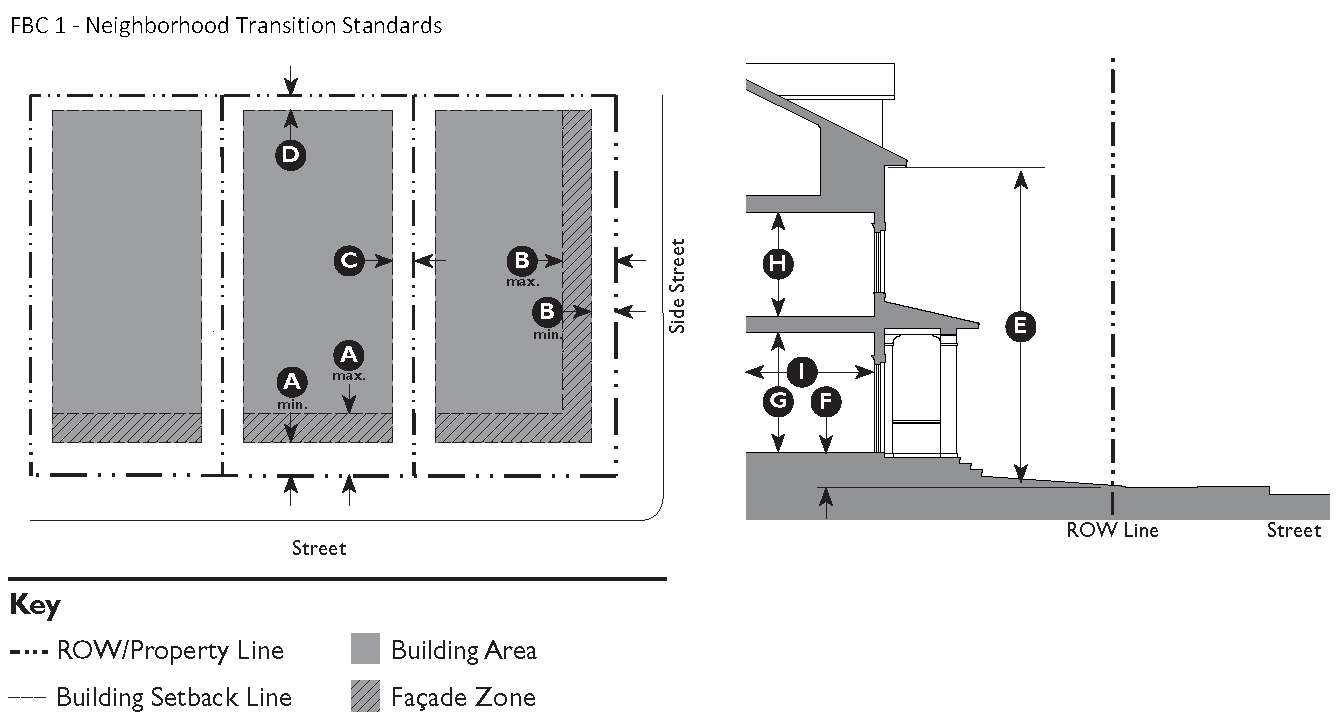
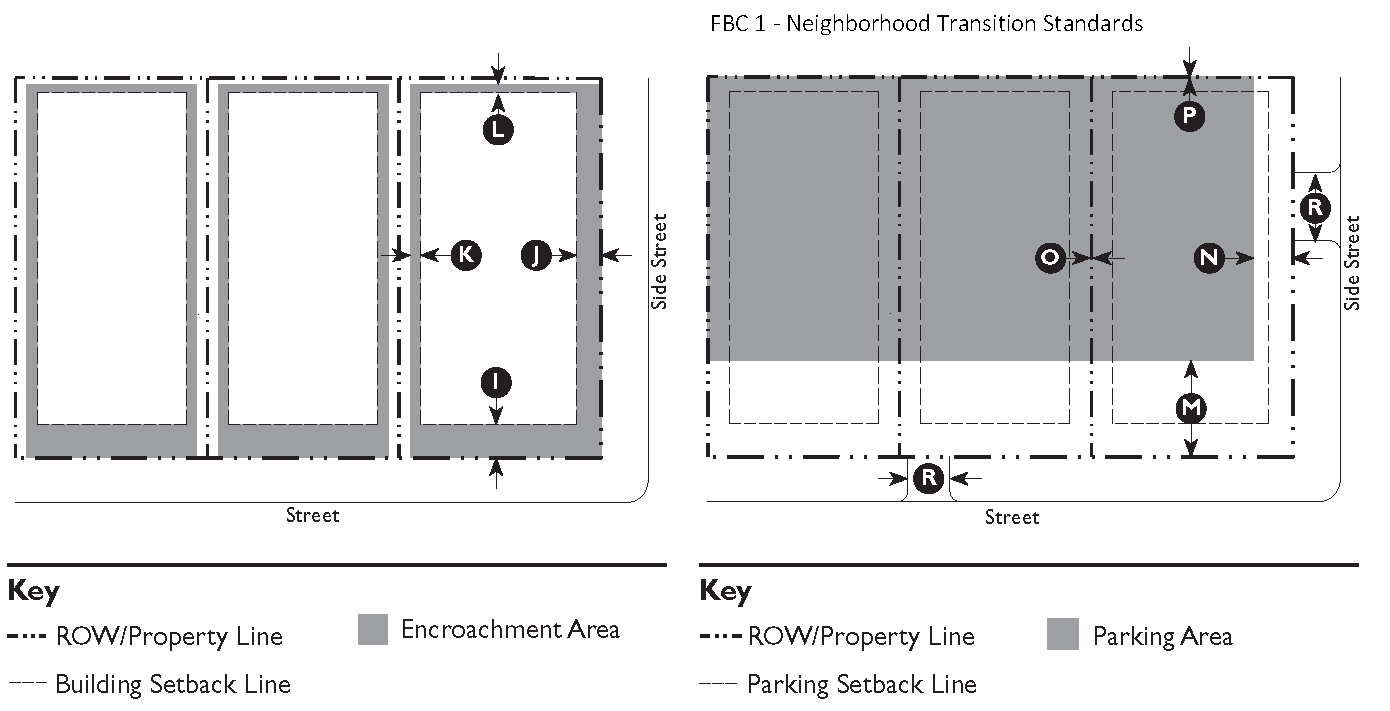
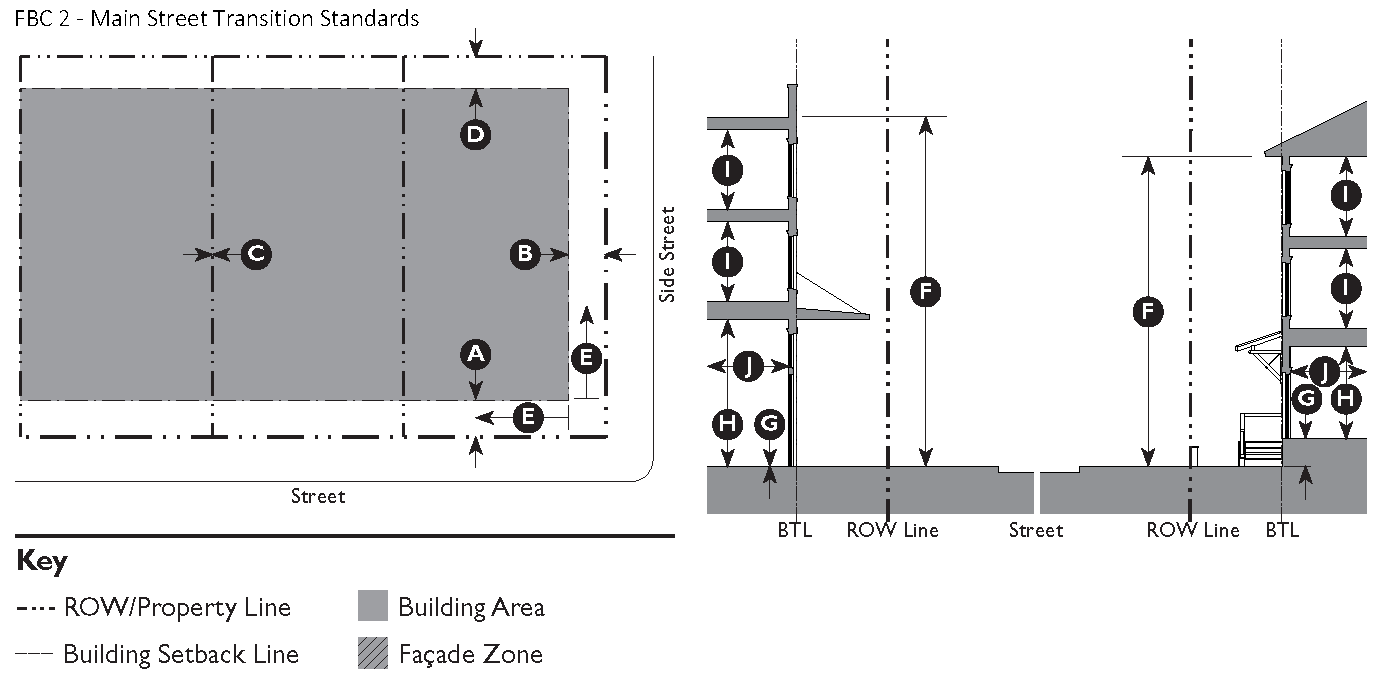
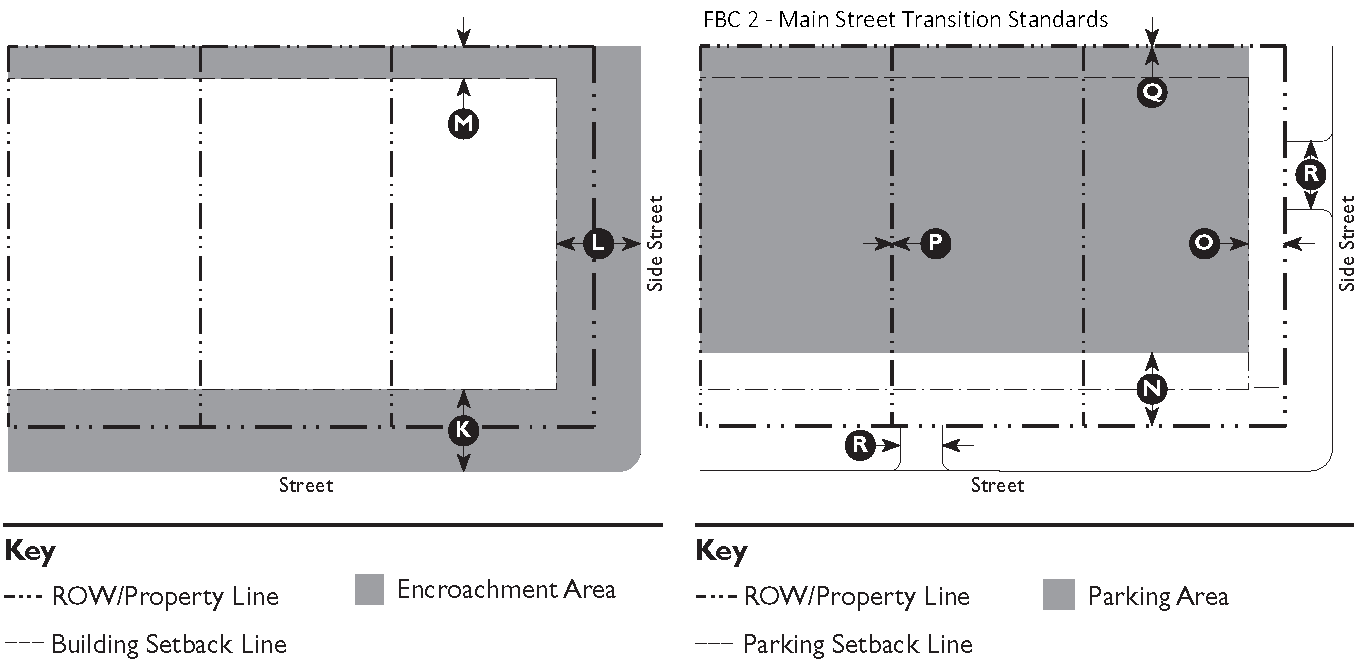
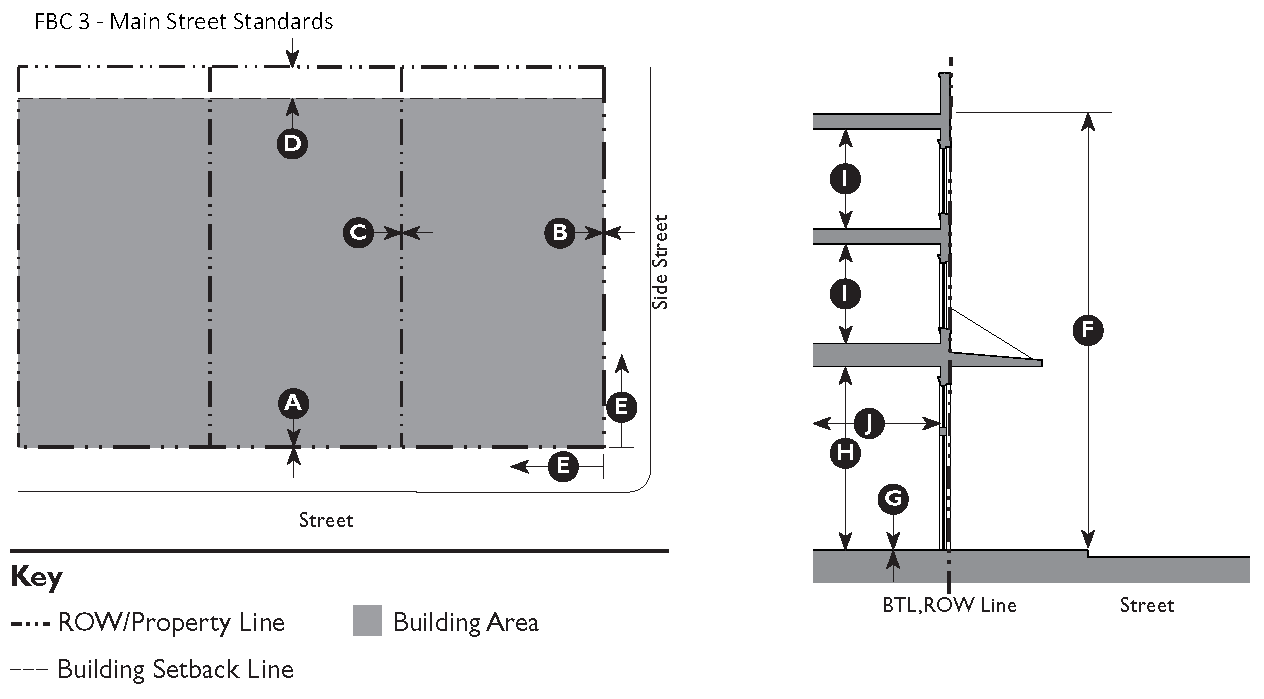
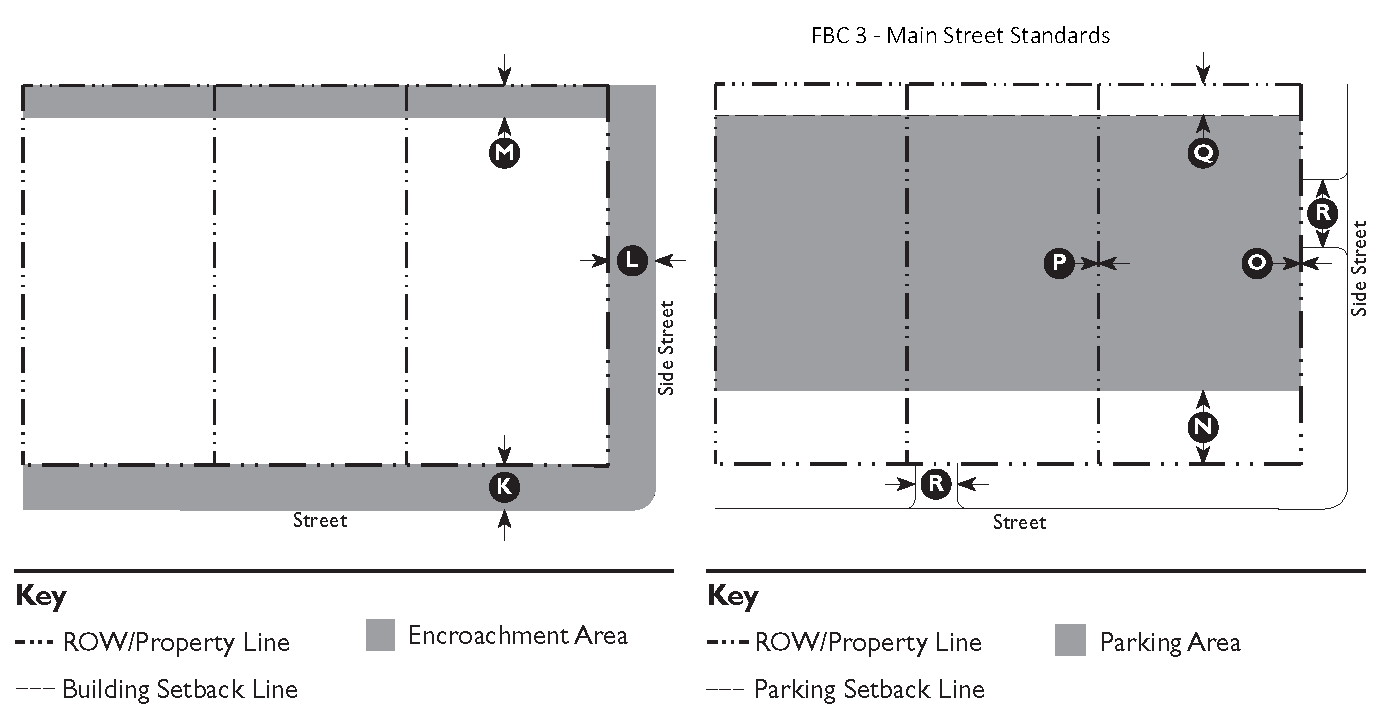
Regulatory standards for the three transect zones in the Downtown Form Based Code Area are shown in Table 17.42.B. Included are standards for building placement, building form, encroachment and private frontage types, and parking.
FBC 1 Neighborhood Transition
A.
Zone Intent and Description.
1.
Intent. To provide a flexible area that allows medium-density building types while accommodating compatible small commercial and service uses.
2.
Desired Form. Attached or closely spaced detached residential form, setback from the street.
3.
General Use. Residential, Live/Work, Commercial, Home Occupation, or Civic/Open Space.
4.
Parking. Low to moderate parking requirements to promote walkability and minimize visual impact on the neighborhood. On-street parking should be counted toward required parking.
B.
Allowed Building Types.
Carriage House; Townhouse; Single-Unit House Cottage; Mansion Apartment; Single-Unit House Village; Apartment House; Bungalow Court; Courtyard Apartment; and Duplex. See Section 17.42.070 (Specific to Building Types) for building type descriptions and regulations.
Figure 17.42.1: Kingsburg Downtown Form Based Code Transects
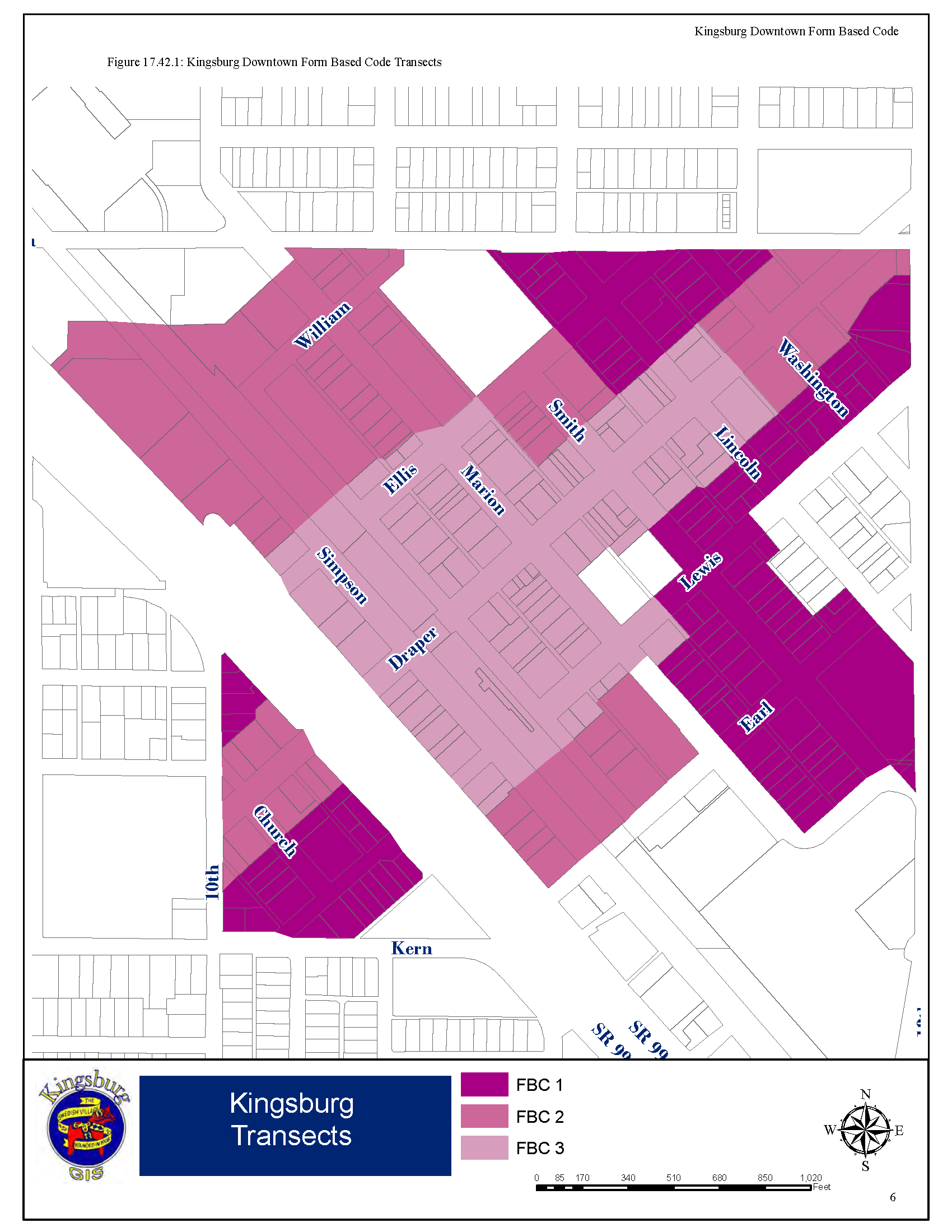
Table 17.42.A Specific Land Use Regulations in the Downtown Form Based Code Area
FBC 2 Main Street Transition
A.
Zone Intent and Description.
1.
Intent. To provide a flexible area that accommodates a range of neighborhood-serving commercial and residential uses in a medium- to high-density main street form.
2.
Desired Form. Attached or closely spaced detached main street form, located close to or at the street.
3.
General Use. Live/Work, Commercial, or Residential Upper Floor Residential or Commercial.
4.
Parking. Low parking requirements to promote walkability, commercial parking as a part of a downtown commercial district, off-street residential parking. Shared or individual parking lots, on-street parking.
B.
Allowed Building Types.
Townhouse; Apartment House; Courtyard Apartment; and Main-Street Mixed-Use. See Section 17.42.070 (Specific to Building Types) for building type descriptions and regulations.
FBC 3 Main Street
A.
Zone Intent and Description.
1.
Intent. To reinforce and enhance the walkable urban downtown and to enable it to evolve into a neighborhood that provides commercial, retail, and entertainment uses, civic and public uses, as well as a variety of urban housing choices.
2.
Desired Form. Attached or detached main street form located close to or at the street.
3.
General Use. Ground floor commercial, upper floor residential or commercial.
4.
Parking. Low parking requirements to promote walkability, commercial parking handled as a part of a downtown commercial district, off-street residential parking. Shared or individual parking lots, on-street parking.
B.
Allowable Building Types.
Main-Street Mixed-Use, Mid-Rise. See Section 17.42.070 (Specific to Building Types) for building type descriptions and regulations.
Table 17.42.B. Regulatory Standards in the Downtown Form Based Code Area
| Building Placement | ||
| Setbacks (Distance from Property Line/ROW) | ||
| Front | 10' min.; 15' max. 1 |  |
| Side Street | 5' min.; 10' max. 1 |  |
| Side |  | |
| Main Building | 5' 2 | |
| Ancillary Building | 0' | |
| Rear |  | |
| Main Building | 5' | |
| Ancillary Building | 0' | |
| Adjacent to Alley | 5' | |
| Facade within Facade Zone | ||
| Front | 75% min. | |
| Side Street | 75% min. | |
| Lot Size | ||
| Width | 100' max. (¼ block) | |
| Depth | 150' max. (½ block) | |
| 1 Where existing adjacent buildings are in front of the regulated front setback, the building may be set to align with the facade of the front most immediately adjacent property. | ||
| 2 No side setback is required along the shared property line between side-by-side duplexes or townhouses. | ||
| Building Form | ||
| Height | ||
| Main Building | 2½ stories max. |  |
| Ancillary Building | 2 stories max. | |
| Ground Floor Finish Level |  | |
| Residential | 18" min. | |
| Commercial | 6' max. | |
| Ground Floor Ceiling |  | |
| Residential | 10' min. | |
| Commercial | 12' min. | |
| Upper Floor(s) Ceiling | 8'—6" min. |  |
| Footprint | ||
| Width | 75' max. | |
| Depth, Ground-Floor Space | 20' min. |  |
| Lot Coverage | 80% max. | |
| Miscellaneous | ||
| Loading docks, overhead doors, and other service entries may not be located on street-facing facades. | ||
| Encroachments & Private Frontage Types | ||
| Allowed Encroachments 3,4 | ||
| Front | 10' max. |  |
| Side Street | 10' max. |  |
| Side | 2'—6" max. |  |
| Rear | 2'—6" max. |  |
| Allowed Private Frontage Types | ||
| Common Yard | Forecourt | |
| Porch, Projecting | Dooryard | |
| Porch, Engaged | Shopfront | |
| Stoop | ||
| 3 Maximum allowed encroachments, see Frontage Types for further refinement of the allowed encroachments for frontage elements. | ||
| 4 Encroachments are not allowed within a street or alley ROW or across a property line. | ||
| Parking | ||
| Required Spaces | ||
| Residential Uses | ||
| ≤1,500 sf | 1 space/1,000 sf min. | |
| >1,500 sf | 1.5 spaces/unit max. | |
| Lodging Uses | 0 spaces min. | |
| Retail or Services Uses | ||
| Ground Floor < 5,000 sf | 0 spaces min. | |
| Ground Floor > 5,000 sf | 2 spaces/1,000 sf max. | |
| Upper Floor(s) | 2 spaces/1,000 sf max. | |
| Off-site parking within 600' may be used to meet parking requirements for non-residential uses. | ||
| Shared parking may be used to meet parking requirements for non-residential uses. | ||
| Location (Distance from Property Line/ROW) | ||
| Front Setback | 30' |  |
| Side Street Setback | 10' |  |
| Side Setback | 0' |  |
| Rear Setback | 0' |  |
| Miscellaneous | ||
| Parking Drive Width |  | |
| Front | 12' max. | |
| Side Street/Alley | 20' max. | |
| Building Placement | ||
| Build-to Lines (Distance from Property Line/ROW) | ||
| Front | 0' min.; 10' max. 1 | |
| Side Street | 0' min.; 10' max. 1 | |
| BTL Defined by a Building | ||
| Front, lots < x' wide | <50'; 100% | |
| Front, lots > x' wide | ≥50; 75% | |
| Side Street | 50% | |
| Building Facade at Front BTL | 75% | |
| Setbacks (Distance from Property Line/ROW) | ||
| Side | 0' | |
| Rear | | |
| Adjacent to T5 Zones | 0' | |
| Adjacent to all other Zones | 5' | |
| Adjacent to Alley | 5' | |
| Lot Size | ||
| Width | 200' max. (½ block) | |
| Depth | 150' max. (½ block) | |
| Miscellaneous | ||
| Where existing adjacent buildings are in front of the regulated BTL, the building may be set to align with the facade of the front most immediately adjacent property. | ||
| 1 The exact location of the BTL within the range listed above shall be established by the first building along each block frontage to receive planning department approval. All subsequent buildings along that block frontage must match the first building's BTL. | ||
| BTL must be defined by a building within 30' of corner along the front. | | |
| A building form with a chamfered corner is permitted only if a corner entry is provided. | ||
| Entire ROW must be defined by a building or a 24" to 48" high fence or stucco or masonry wall. | ||
| Building Form | ||
| Height | ||
| Main Building | 20' min.; 3 stories max. | |
| Accessory Structure | 2 ½ stories max. | |
| Ground Floor Finish Level | | |
| Residential, Setback < 8' | 24" min. | |
| Residential, Setback ≥ 8' | 18" min. | |
| Commercial | 6" max. | |
| Ground Floor Ceiling | ||
| Residential | 10' min. | |
| Commercial | 12' min. | |
| Upper Floor(s) Ceiling | | |
| Residential | 8'—6" min. | |
| Commercial | 9' min. | |
| Footprint | ||
| Depth, Ground-Floor Space | | |
| Residential | 20' min. | |
| Commercial | 30' min. | |
| Miscellaneous | ||
| Distance Between Entries | ||
| to Ground Floor | 50' max. | |
| to Upper Floor(s) | 100' max. | |
| All upper floors must have a primary entrance along the front. | ||
| Loading docks, overhead doors, and other service entries may not be located on street-facing facades. | ||
| Any buildings wider than 75' must be designed to read as a series of buildings no wider than 50' each. | ||
| Encroachments and Private Frontage Types | ||
| Allowed Encroachments2,3 | ||
| Front | 10' max. | |
| Side Street | 10' max. | |
| Rear | | |
| Adjacent to T5 Zones | 0' | |
| Adjacent to all other Zones | 5' | |
| Adjacent to Alley | 5' | |
| Allowed Private Frontage Types | ||
| Stoop | Dooryard | |
| Forecourt | Shopfront | |
| 2 Maximum allowed encroachments, see Frontage Types for further refinement of the allowed encroachments for frontage elements. | ||
| 3 Encroachments are not allowed within an alley ROW or across a property line | ||
| Parking | ||
| Required Spaces | ||
| Residential Uses | 1 space/1,000 sf min. | |
| Lodging Uses | 0 spaces min. | |
| Retail or Services Uses | ||
| Ground Floor < 5,000 sf | 0 spaces min. | |
| Ground Floor > 5,000 sf | 2 spaces/1,000 sf max. | |
| Upper Floor(s) | 2 spaces/1,000 sf max. | |
| Off-site parking within 600' may be used to meet parking requirements for residential uses. | ||
| Off-site parking within 1200' may be used to meet parking requirements for non-residential uses | ||
| Location (Distance from Property Line/ROW) | ||
| Front Setback | 30' | |
| Side Street Setback | 0' 6 | |
| Side Setback | 0' | |
| Rear Setback | 0' | |
| 6 Parking may not be located in front of BTL. | ||
| Miscellaneous | ||
| Parking Drive Width | | |
| Front, ≤ 40 spaces | 12' max. | |
| Front, > 40 spaces | 20' max. | |
| Side Street/Alley | 20' max. | |
| % of Frontage along Front | 20% max. | |
| Building Placement | ||
| Build-to Lines (Distance from Property Line/ROW) | ||
| Front | 0' | |
| Side Street | 0' | |
| BTL Defined by a Building | ||
| Front, Lots <50' wide | 100% | |
| Front, Lots ≥50' wide | 75% | |
| Side Street | 50% | |
| Building Facade at Front BTL | ||
| Front | 100% | |
| Setbacks (Distance from Property Line/ROW) | ||
| Side | 0' | |
| Rear | | |
| Adjacent to T5 Zones | 0' | |
| Adjacent to all other Zones | 5' | |
| Adjacent to Alley | 5' | |
| Lot Size | ||
| Width | 200' max. (½ block) | |
| Depth | 150' max. (½ block) | |
| Miscellaneous | ||
| BTL must be defined by a building within 30' of corner along the front. | | |
| A building form with a chamfered corner is permitted only if a corner entry is provided. | ||
| Building Form | ||
| Height | ||
| Main Building | 20' min.; 3 stories max. | |
| Ground Floor Finish Level | 6" max. | |
| Ground Floor Ceiling | 12' min. | |
| Upper Floor(s) Ceiling | | |
| Residential | 8'—6" min. | |
| Commercial | 9' min. | |
| 4 stories max. permitted for buildings with affordable or senior housing units. | ||
| 4 stories max. permitted for LEED certified buildings. | ||
| 4th floor and above must be setback 10'. | ||
| Within 20' of the rear property line, buildings may not be more than a half-story taller than the allowed height of adjacent buildings. | ||
| Footprint | ||
| Depth, Ground-Floor Space | | |
| Commercial, Front | 50' min. | |
| Commercial, Side Street | 30' min. | |
| Miscellaneous | ||
| Distance Between Entries | ||
| to Ground Floor | 50' max. | |
| to Upper Floor(s) | 100' max. | |
| All upper floors must have a primary entrance along the front. | ||
| Miscellaneous (continued) | ||
| Loading docks, overhead doors, and other service entries may not be located on street-facing facades. | ||
| Any buildings wider than 75' must be designed to read as a series of buildings no wider than 50' each. | ||
| Encroachments and Private Frontage Types | ||
| Allowed Encroachments1,2 | ||
| Front | 10' max. | |
| Side Street | 10' max. | |
| Rear | | |
| Adjacent to T5 Zones | 0' | |
| Adjacent to all other Zones | 5' | |
| Adjacent to Alley | 5' | |
| Allowed Private Frontage Types | ||
| Stoop | Shopfront | |
| Forecourt | ||
| 1 Maximum allowed encroachments, see Frontage Types for further refinement of the allowed encroachments for frontage elements. | ||
| 2 Encroachments are not allowed within an alley ROW or across a property line | ||
| Parking | ||
| Required Spaces | ||
| Residential Uses | 1 space/unit max. | |
| Lodging Uses | 0 spaces min. | |
| Retail or Services Uses | ||
| Ground Floor < 5,000 sf | 0 spaces min. | |
| Ground Floor > 5,000 sf | 2 spaces/1,000 sf max. | |
| Upper Floor(s) | 2 spaces/1,000 sf max. | |
| Off-site parking within 600' may be used to meet parking requirements for residential uses. | ||
| Off-site parking within 1200' may be used to meet parking requirements for non-residential uses. | ||
| Location (Distance from Property Line/ROW) | ||
| Front Setback | 50' | |
| Side Street Setback | 0' | |
| Side Setback | 0' | |
| Rear Setback | 0' | |
| Miscellaneous | ||
| Parking Drive Width | | |
| Front, ≤ 40 spaces | 12' max. | |
| Front, > 40 spaces | 20' max. | |
| Side Street/Alley | 20' max. | |
| % of Frontage along Front | 20% | |
(Ord. No. 2015-10, § 1(Exh. A), 9-16-2015; Ord. No. 2024-07, § 1, 12-18-2024)
17.42.061 - Applicability.
The provisions of this Section apply to proposed land uses and development in addition to all other applicable requirements of this Code.
A.
Mapping of overlay zones. The applicability of any overlay zone to a specific site is shown on the Zoning Map.
1.
Allowed land uses, permit requirements, development standards. Except as may be otherwise provided by this Section for a specific overlay zone Development and new land uses within an overlay zone shall comply with all applicable standards of the primary zone, all other provisions of this Code and other City guidelines or procedures, as applicable.
(Ord. No. 2015-10, § 1(Exh. A), 9-16-2015; Ord. No. 2024-07, § 1, 12-18-2024)
17.42.062 - Highway Beautification Overlay Zone.
Applicability. The Form Based Code Area within the HB Overly Zone shall be subject to the requirements of Section 17.48.040 of the Zoning Ordinance.
(Ord. No. 2015-10, § 1(Exh. A), 9-16-2015; Ord. No. 2024-07, § 1, 12-18-2024)
17.42.063 - Planned Unit Development Overlay Zone.
Applicability. The PUD Overlay applies to areas of the City designated as PUDs prior to the effective date of this Form Based Code and shall be subject to the requirements of Section 17.48.010 of the Zoning Ordinance.
(Ord. No. 2015-10, § 1(Exh. A), 9-16-2015; Ord. No. 2024-07, § 1, 12-18-2024)
17.42.071 - Applicability.
The requirements of this Section apply to all proposed development within transect zones, and shall be considered in combination with the standards for the applicable zone.
(Ord. No. 2015-10, § 1(Exh. A), 9-16-2015; Ord. No. 2024-07, § 1, 12-18-2024)
17.42.072 - Building Types Overview.
A.
The names of the building types are not intended to limit uses within a building type. For example, a single-unit house may have non-residential uses within it, such as a restaurant or office.
B.
The Lot Size Standards designate the range of lot sizes that the given building type is allowed to be built on. If the lot is smaller or larger than the allowed lot size, a different building type must be selected.
C.
The building types and permissible transect zones are described below. Full descriptions, including photographs and lot standards, follow this section in Table 17.42.C.
Carriage House. This Building Type is a secondary structure typically located at the rear of a lot. It typically provides either a small residential unit, home office space, or other small commercial or service use that may be above a garage or at ground level. This Type is important for providing affordable housing opportunities and incubating small businesses within walkable neighborhoods.
Permissible Transect Zone: FBC 1 FBC 2
Single-Unit House, Village. This Building Type is a medium-sized detached structure on a medium-sized lot that incorporates one unit. It is typically located within a primarily single-family residential neighborhood in a walkable urban setting, potentially near a neighborhood main street.
Permissible Transect Zone: FBC 1 FBC 2
Single-Unit House, Cottage. This Building Type is a small detached structure on a small lot that incorporates one unit. It is typically located within a primarily single-family residential neighborhood in a walkable urban setting, potentially near a neighborhood main street. This Type enables appropriately scaled, well-designed higher densities.
Permissible Transect Zone: FBC 1 FBC 2 FBC 3
Bungalow Court. This Building Type consists of small, detached structures arranged to define a shared court that is typically perpendicular to the street. The shared court takes the place of a private rear yard and becomes an important community-enhancing element. This Type is appropriately scaled to fit within primarily single-family or medium-density neighborhoods. It enables appropriately-scaled, well-designed higher densities.
Permissible Transect Zone: FBC 1 FBC 2
Duplex. This Building Type is a small- to medium-sized structure that consists of two side-by-side or stacked dwelling units, and within a single building massing. This Type has the appearance of a medium to large single-family home and is appropriately scaled to fit within primarily single family neighborhoods or medium-density neighborhoods.
Permissible Transect Zone: FBC 1
Townhouse. This Building Type is a small to medium-sized attached structure that consists of three to eight dwelling units placed side-by-side. This Type is typically located within medium-density neighborhoods or in a location that transitions from a primarily single-family neighborhood into a neighborhood main street. This type enables appropriately-scaled, well designed higher densities.
Permissible Transect Zone: FBC 1 FBC 2
Mansion Apartment. This Building Type consists of three to six side-by-side and/or stacked dwelling units, typically with one shared entry or individual entries along the front. This Type has the appearance of a medium sized family home and is appropriately scaled to fit in sparingly within primarily single-family neighborhoods or into medium density neighborhoods. This Type enables appropriately-scaled, well designed higher densities.
Permissible Transect Zones: FBC 1 FBC 2
Apartment House. This Building Type is a medium- to large-sized structure that consists of seven to 12 side-by-side and/or stacked dwelling units, typically with one shared entry. This Type is appropriately scaled to fit in within medium-density neighborhoods or sparingly within large lot predominantly single-family neighborhoods. This Type enables appropriately scaled, well-designed higher densities.
Permissible Transect Zones: FBC 1 FBC 2
Courtyard Building. This Building Type is a medium- to large-sized structure that consists of multiple side-by-side and/or stacked dwelling units accessed from a courtyard or series of courtyards. Each unit may have its own individual entry, or up to three units may share a common entry. This Type is appropriately scaled to fit in sparingly within primarily single-family or medium density neighborhoods. It enables appropriately-scaled, well designed higher densities.
Permissible Transect Zones: FBC 1 FBC 2
Main Street Mixed-Use. This Building Type is a small- to medium-sized structure, typically attached, intended to provide a vertical mix of uses with ground-floor commercial, service, or retail uses and upper-floor commercial, service, or residential uses. Smaller versions of this Type include live/work units. This Type makes up the primary component of a neighborhood main street and portions of a downtown main street, therefore providing walkability.
Permissible Transect Zones: FBC 2 FBC 3
Table 17.42.C. Building Types by Transect
Carriage House
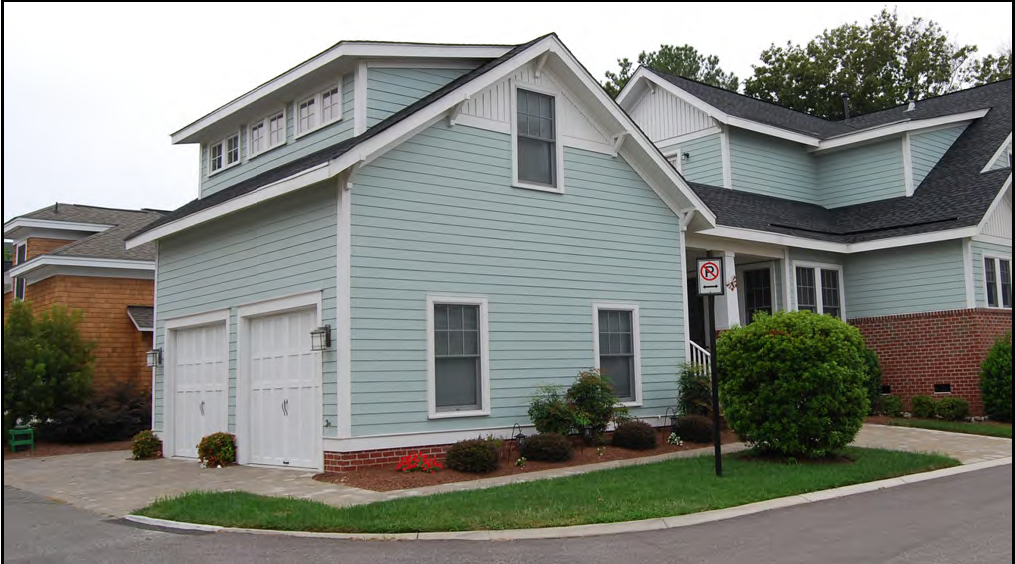
One-and-a-half-story carriage house connected to main house by a breezeway.
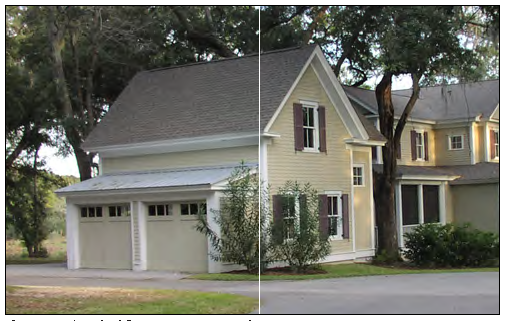
One-and-a-half-story carriage house.
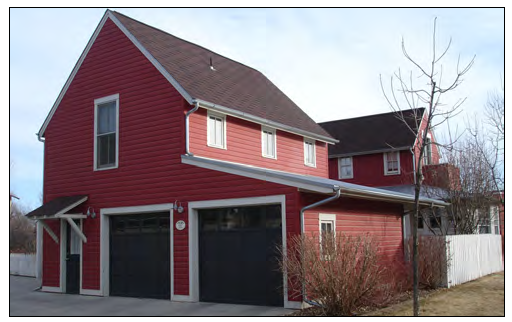
One-and-a-half-story carriage house with an internal stair.
Description. The Carriage House Building Type is a secondary structure typically located at the rear of a lot. This structure typically provides either a small residential unit, home office space, or other small commercial or service use that may be above a garage or at ground level. This Building Type is important for providing affordable housing opportunities and incubating small businesses within walkable neighborhoods.
FBC 1 Neighborhood Transitions
FBC 2 Main Street Transition
General Note: Photos on this page are illustrative, not regulatory.
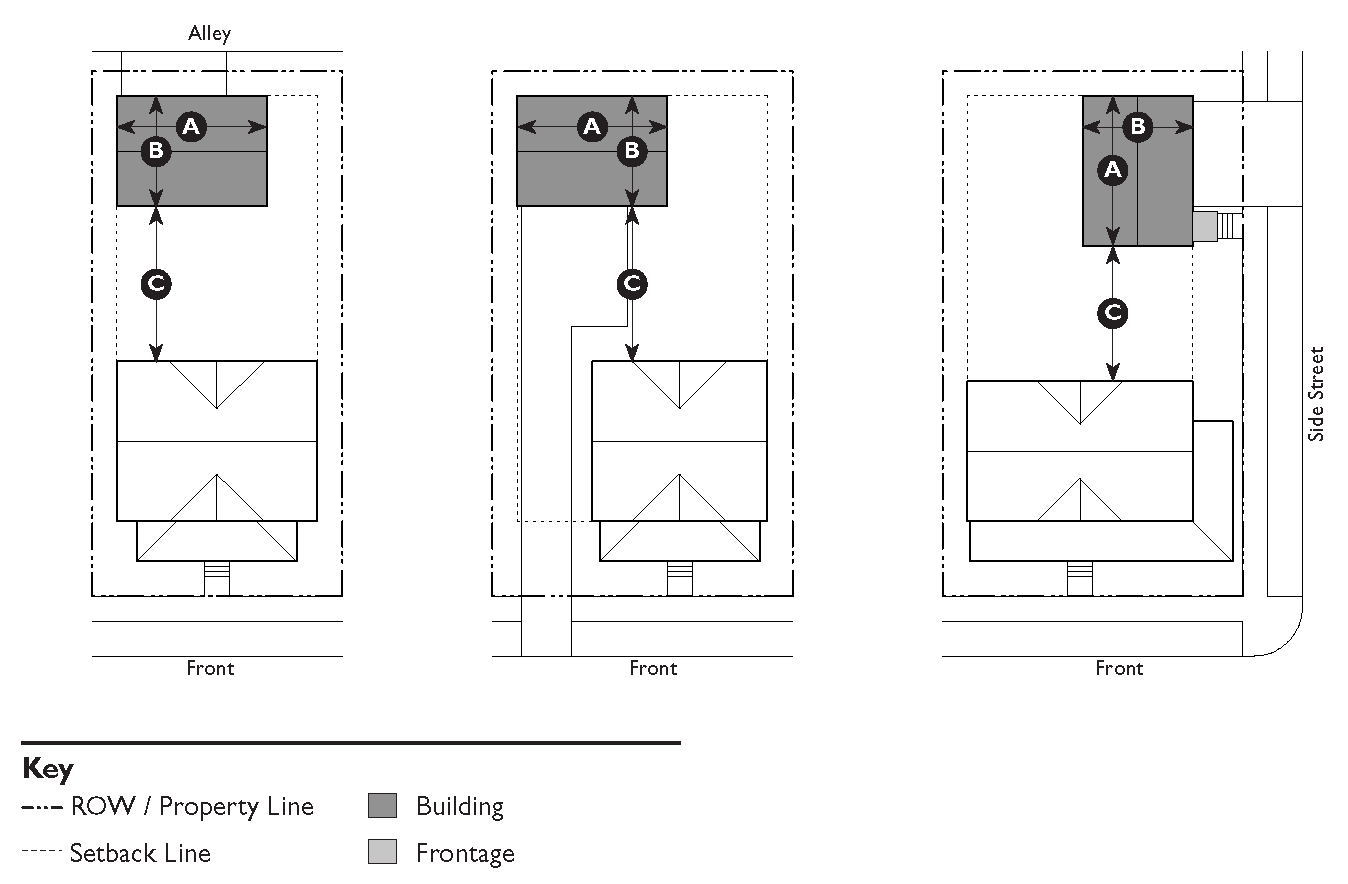
| Lot | ||
| Allowed on lots when accompanying a Residential Use. | ||
| Allowed on lots when accompanying the following building types: Single-Unit Houses, Duplexes, Townhouses, Mansion Apartments. | ||
| The Carriage House Building Type is the only detached accessory dwelling unit (ADU) allowed in transect zones. | ||
| Number of Units | ||
| Units | 1 max. | |
| Building Size and Massing | ||
| Height | ||
| Per Building Form Standards based on transect zone | ||
| Main Body | ||
| Width | 36' max. | |
| Depth | 30' max. | |
| Separation from Main Building | 10' min. 1 | |
| 1 Carriage houses may be connected to the main building by uninhabitable space such as a breezeway | ||
| Miscellaneous | ||
| Carriage houses shall not be taller or have a larger footprint than the main building on the lot. | ||
| Allowed Frontages | ||
| Stoop | ||
| Carriage houses are not required to have a Frontage Type. | ||
| Pedestrian Access | ||
| Main Entrance Location | Side Street, Alley, or internal to the lot | |
| The main entrance may not be through a garage. | ||
| Vehicle Access and Parking | ||
| Parking may be accessed from the alley, side street or front. | ||
| Parking may be accessed from the front only when there is no adjacent alley or side street. | ||
| All parking spaces provided shall be separate from the principal building and may be enclosed, covered or open. | ||
| Private Open Space | ||
| The private open space requirements for the lot shall be determined by the principal building on the lot. No additional private open space is required for a carriage house. | ||
Single-Unit House, Village
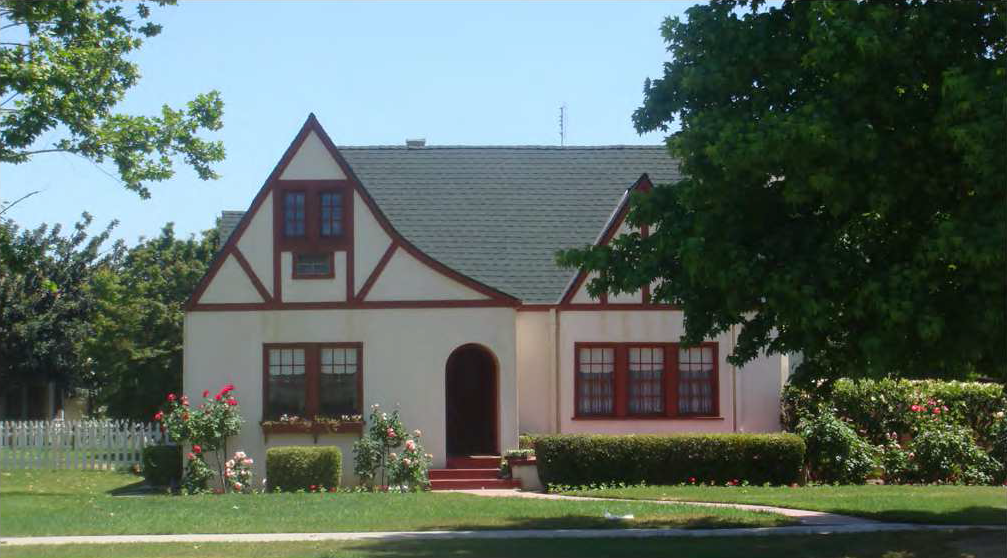
One-and-a-half-story front-loaded village house.
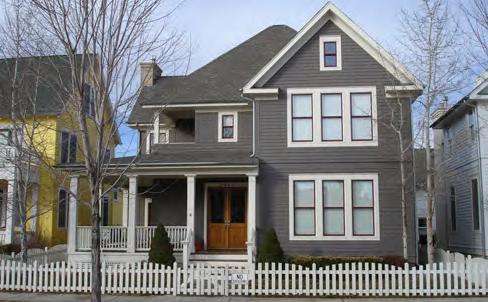
Two-story village house with an engaged porch.
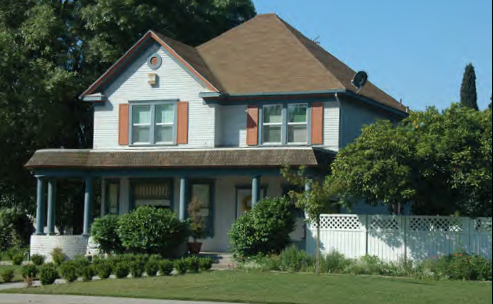
Two-story village house on a corner lot with a wrap-around porch.
Description. The Single-Unit House, Village Building Type is a medium-sized detached structure on a medium-sized lot that incorporates one unit. It is typically located within a primarily single-family residential neighborhood in a walkable urban setting, potentially near a neighborhood main street.
FBC 1 Neighborhood Transition
FBC 2 Main Street Transition
General Note: Photos on this page are illustrative, not regulatory.
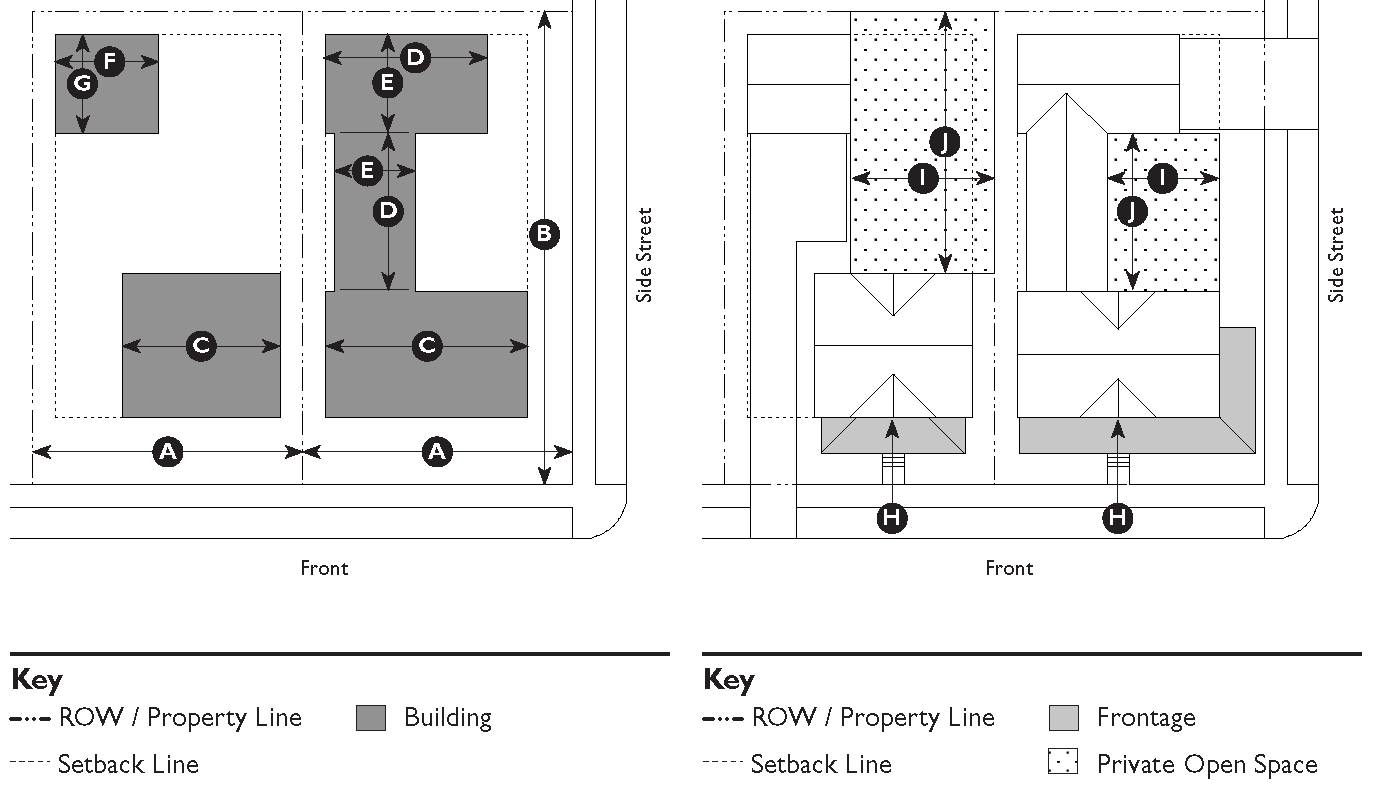
| Lot | ||
| Lot Size | ||
| Width | 50' min.; 75' max. | |
| Depth | 75' min. | |
| Area 1 | 5,000 sf min. | |
| 1 Smaller lot size permitted only if building type is already existing on lot at time of code adoption, 09/16/2015 | ||
| Number of Units | ||
| Units | 1 max. | |
| Building Size and Massing | ||
| Height | ||
| Per Building Form Standards based on transect zone | ||
| Main Body | ||
| Width | 48' max. | |
| Secondary Wing(s) | ||
| Width | 30' max. | |
| Depth | 30' max. | |
| Accessory Structure(s) | ||
| Width | 24' max. | |
| Depth | 30' max. | |
| Allowed Frontages | ||
| Porch, Engaged | ||
| Porch, Projecting | ||
| Pedestrian Access | ||
| Main Entrance Location | Front | |
| Vehicle Access and Parking | ||
| Parking may be accessed from the alley, side street or front. | ||
| Parking may be accessed from the front only when there is no adjacent alley or side street. | ||
| Parking spaces may be enclosed, covered or open. | ||
| Private Open Space | ||
| Width | 20' min. | |
| Depth | 20' min. | |
| Area | 500 sf min. | |
| Required street setbacks and driveways shall not be included in the private open space area calculation. | ||
| Required private open space must be located behind the main body of the house. | ||
Single-Unit House, Cottage
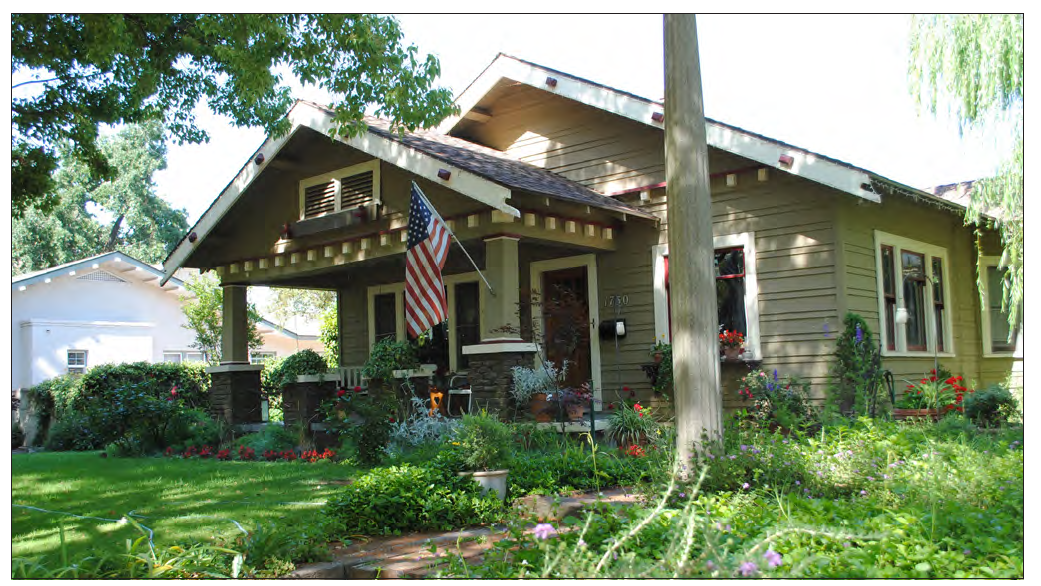
Small one-story cottage house.
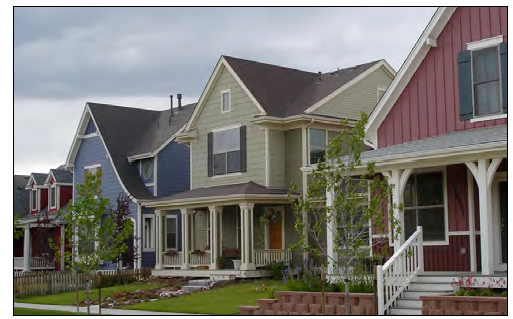
Newly constructed two-story cottage houses.
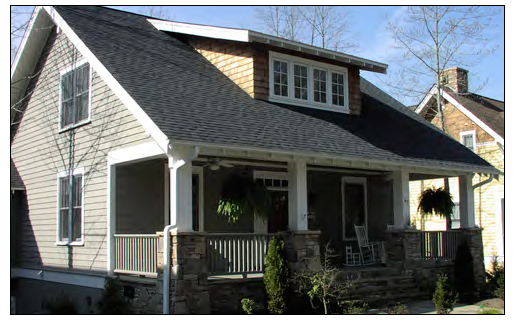
One-and-a-half story cottage house with integral porch.
Description. The Single-Unit House, Cottage Building Type is a small detached structure on a small lot that incorporates one unit. It is typically located within a primarily single-family neighborhood in a walkable urban setting, potentially near a neighborhood main street. This Type enables appropriately-scaled, well-designed higher densities and is important for providing a broad choice of housing types and promoting walkability.
FBC 1 Neighborhood Transition
FBC 2 Main Street Transition
FBC 3 Main Street
General Note: Photos on this page are illustrative, not regulatory.
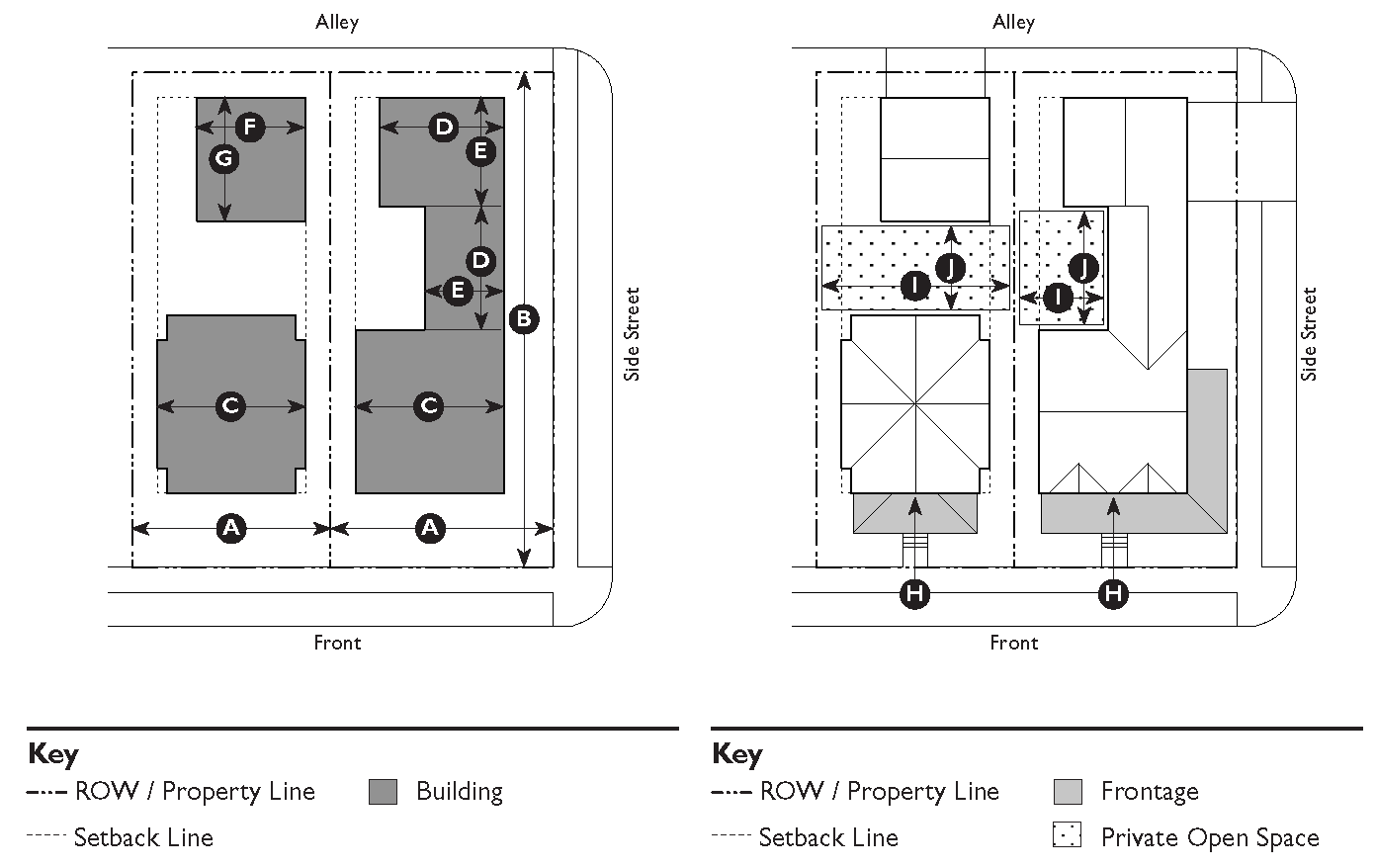
| Lot | ||
| Lot Size | ||
| Width | 30' min.; 50' max. | |
| Depth | 50' min.; 150' max | |
| Area 1 | 2,500 sf min. | |
| 1 Smaller lot size permitted only if building type is already existing on lot at time of code adoption, 09/16/2015 | ||
| Number of Units | ||
| Units | 1 max. | |
| Building Size and Massing | ||
| Height | ||
| Per Building Form Standards based on transect zone | ||
| Main Body | ||
| Width | 36' max. | |
| Secondary Wing(s) | ||
| Width | 30' max. | |
| Depth | 30' max. | |
| Accessory Structure(s) | ||
| Width | 24' max. | |
| Depth | 30' max. | |
| Only one accessory structure is allowed per lot. | ||
| Allowed Frontages | ||
| Porch, Projecting | ||
| Stoop | ||
| Pedestrian Access | ||
| Main Entrance Location | Front | |
| Vehicle Access and Parking | ||
| Parking shall be accessed from a side street or alley. | ||
| Parking spaces may be enclosed, covered or open. | ||
| Private Open Space | ||
| Width | 15' min. | |
| Depth | 15' min. | |
| Area | 300 sf min. | |
| Required street setbacks and driveways shall not be included in the private open space area calculation. | ||
| Required private open space must be located behind the main body of the house. | ||
Bungalow Court
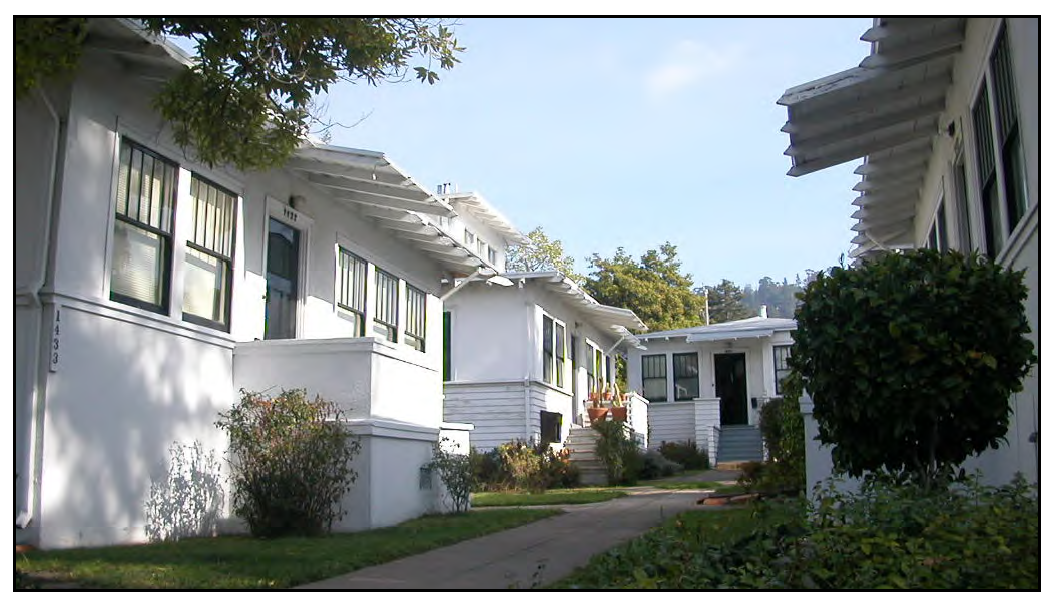
Prairie-style bungalow court with raised stoop entries.
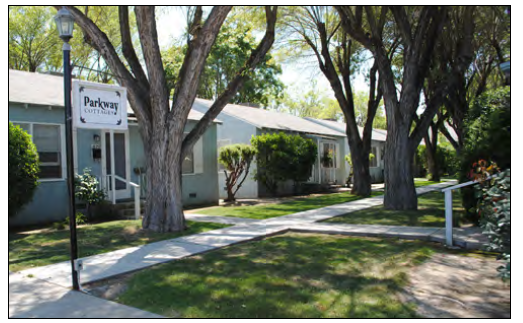
A bungalow court in Kingsburg.
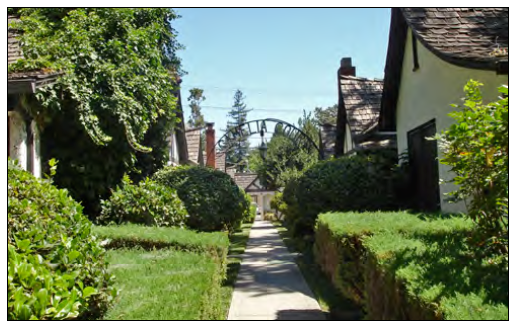
Bungalow court with a heavily landscaped court.
Description. The Bungalow Court Building Type consists of a series of small, detached structures, providing multiple units arranged to define a shared court that is typically perpendicular to the street. The shared court takes the place of a private rear and becomes an important community-enhancing element of this Type. This Type is appropriately scaled to fit within primarily single-family or medium-density neighborhoods. It enables appropriately-scaled, well-designed higher densities and is important for providing a broad choice of housing types and promoting walkability.
FBC 1 Neighborhood Transition
FBC 2 Main Street Transition
General Note: Photos on this page are illustrative, not regulatory.
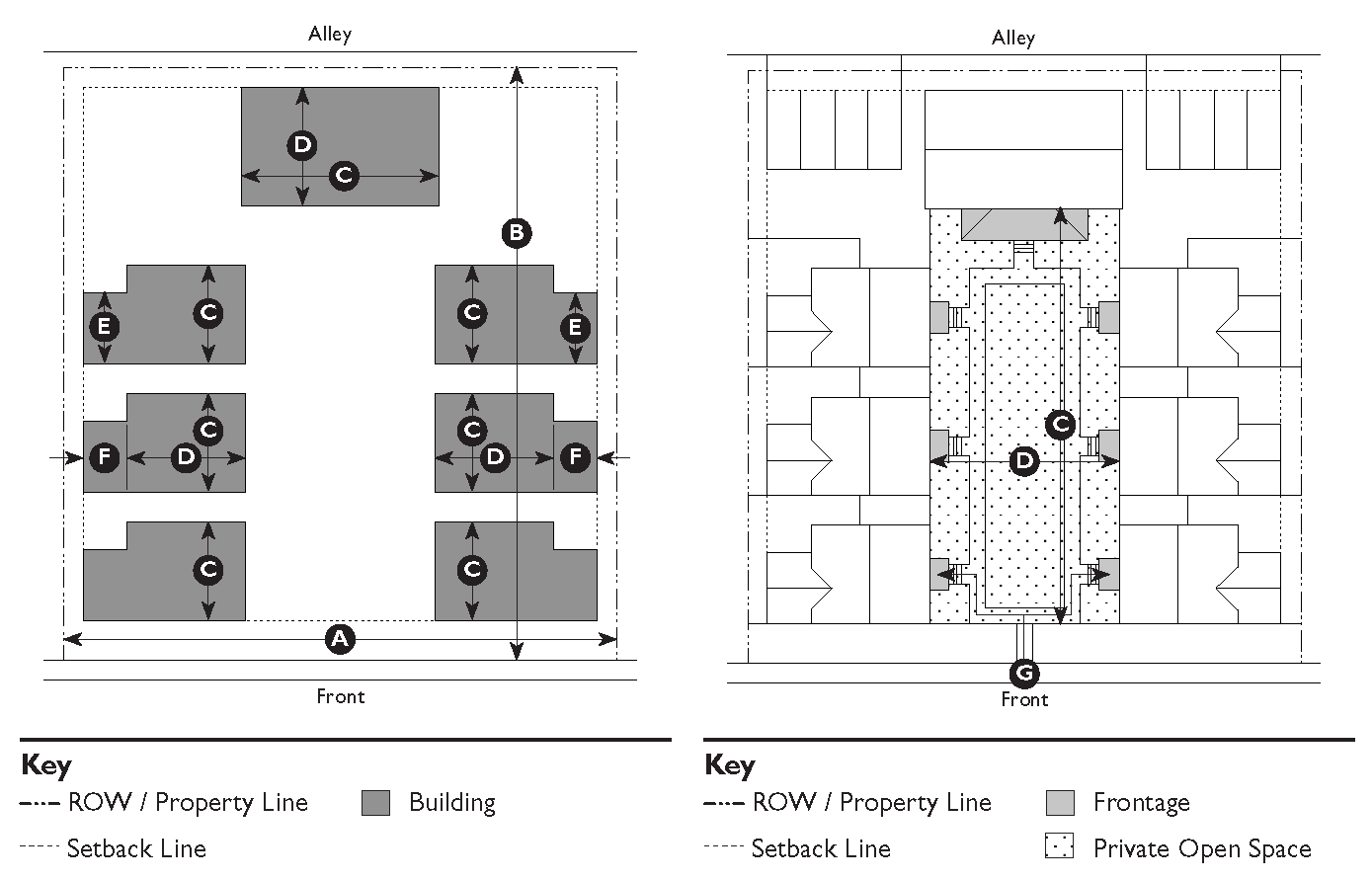
| Lot | ||
| Lot Size | ||
| Width | 75' min.; 150' max. | |
| Depth | 100' min.; 150' max | |
| Number of Units | ||
| Units | 3 min.; 9 max. | |
| Building Size and Massing | ||
| Height | ||
| Height | 1½ stories max. | |
| Main Body | ||
| Width | 32' max. | |
| Depth | 24' max. | |
| Secondary Wing(s) | ||
| Width | 24' max. | |
| Depth | 12' max. | |
| Accessory Structure(s) | ||
| Width | 24' max. | |
| Depth | 24' max. | |
| Allowed Frontages | ||
| Porch, Projecting | ||
| Stoop | ||
| Pedestrian Access | ||
| Main Entrance Location | Front | |
| Vehicle Access and Parking | ||
| Parking may be accessed from the alley, side street or front. | ||
| Parking may be accessed from the front only when there is no adjacent alley or side street. | ||
| Parking spaces may be enclosed, covered or open. | ||
| Private Open Space | ||
| Width | 20' min. | |
| Depth | 20' min. | |
| Area | 400 sf min. | |
| Required street setbacks and driveways shall not be included in the private open space area calculation. | ||
Duplex
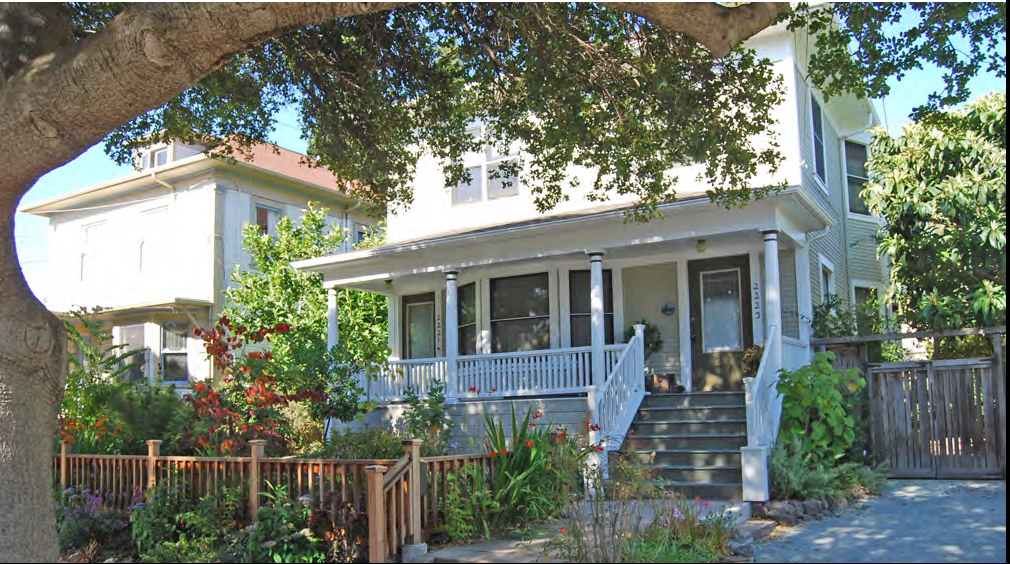
The difference in the form between this duplex and single-unit houses in the neighborhood
is barely perceivable.
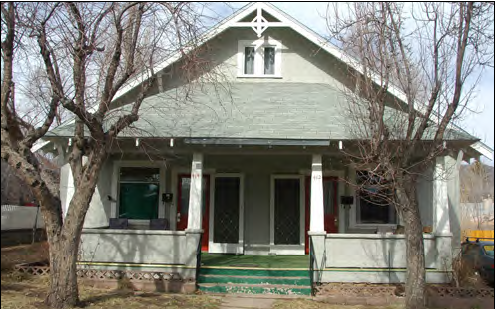
A side-by-side duplex with a shared porch.
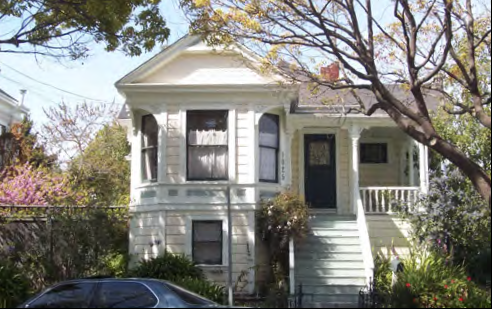
A stacked duplex with one unit on top of the other.
Description. The Duplex Building Type is a small- to medium-sized structure that consists of two side-by-side or stacked dwelling units, both facing the street, and sharing one common party wall. This Type has the appearance of a medium to large single-family home and is appropriately scaled to fit within primarily single-family neighborhoods or medium-density neighborhoods. It enables appropriately-scaled, well-designed higher densities and is important for providing a broad choice of housing types and promoting walkability.
General Note: Photos on this page are illustrative, not regulatory.
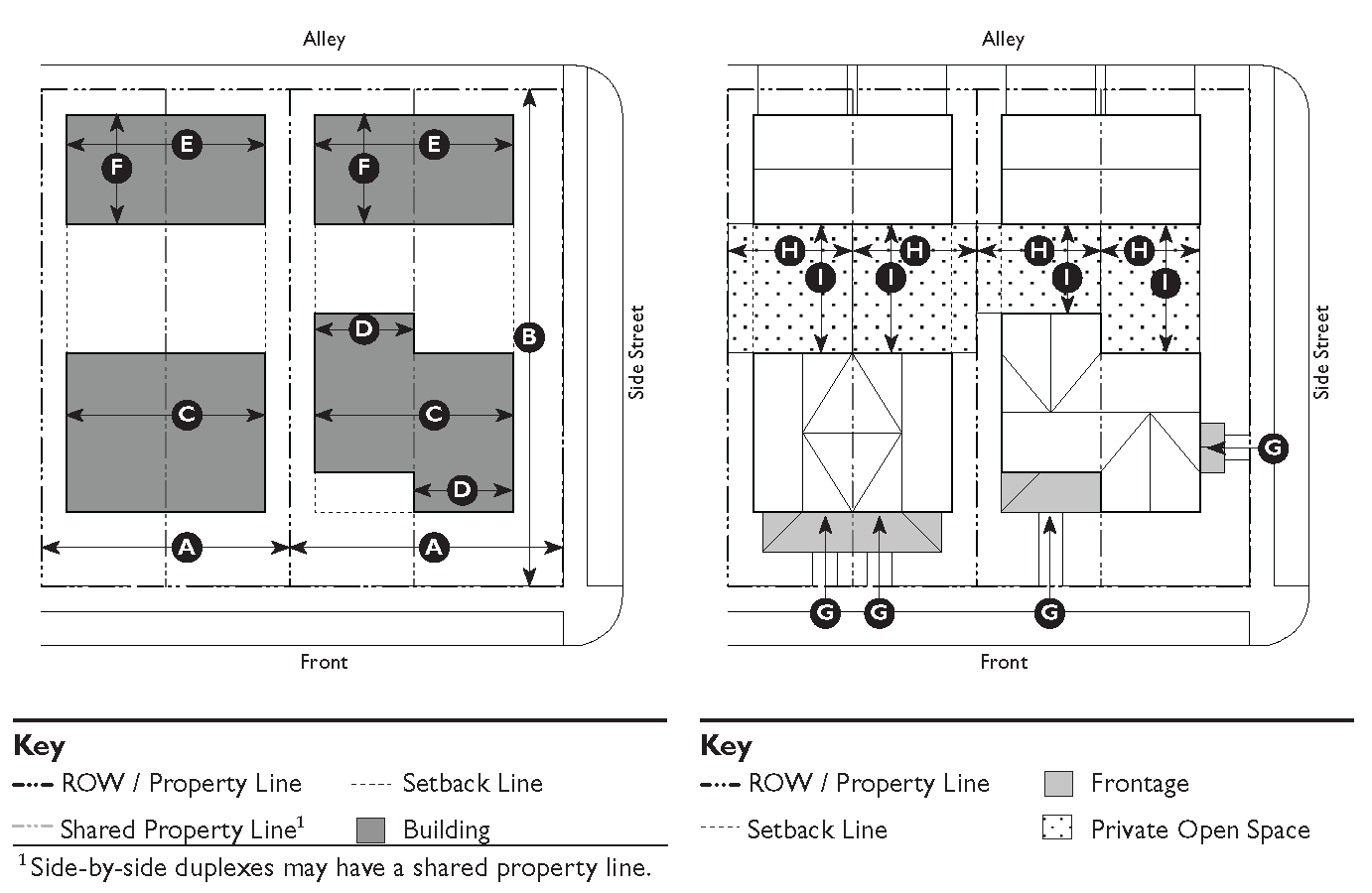
| Lot | ||
| Lot Size | ||
| Width 2 | 50' min.; 75' max. | |
| Depth | 100' min.; 150' max | |
| 2 Total width of lot(s) if there is a shared property line. | ||
| Number of Units | ||
| Units | 2 max. | |
| Building Size and Massing | ||
| Height | ||
| Per Building Form Standards based on transect zone | ||
| Main Body | ||
| Width | 48' max. | |
| Secondary Wing(s) | ||
| Width | 30' max. | |
| Accessory Structure(s) | ||
| Width | | |
| Individual unit ownership | 24' max. | |
| Shared between units | 48' max. | |
| Depth | 30' max. | |
| Allowed Frontages | ||
| Porch, Engaged | Stoop | |
| Porch, Projecting | ||
| Pedestrian Access | ||
| Main Entrance Location | Front 3 | |
| Each unit shall have an individual entry facing the street on or no more than 10' behind the front facade. | ||
| 3 On corner lots, each unit shall front a different street. | ||
| Vehicle Access and Parking | ||
| Parking may be accessed from the alley, side street or front. | ||
| Parking may be accessed from the front only when there is no adjacent alley or side street. | ||
| Parking spaces may be enclosed, covered or open. | ||
| Private Open Space | ||
| Width | 15' min. | |
| Depth | 15' min. | |
| Area | 300 sf min. | |
| Required street setbacks and driveways shall not be included in the private open space area calculation. | ||
| Required private open space must be located behind the main body of the house. | ||
Townhouse
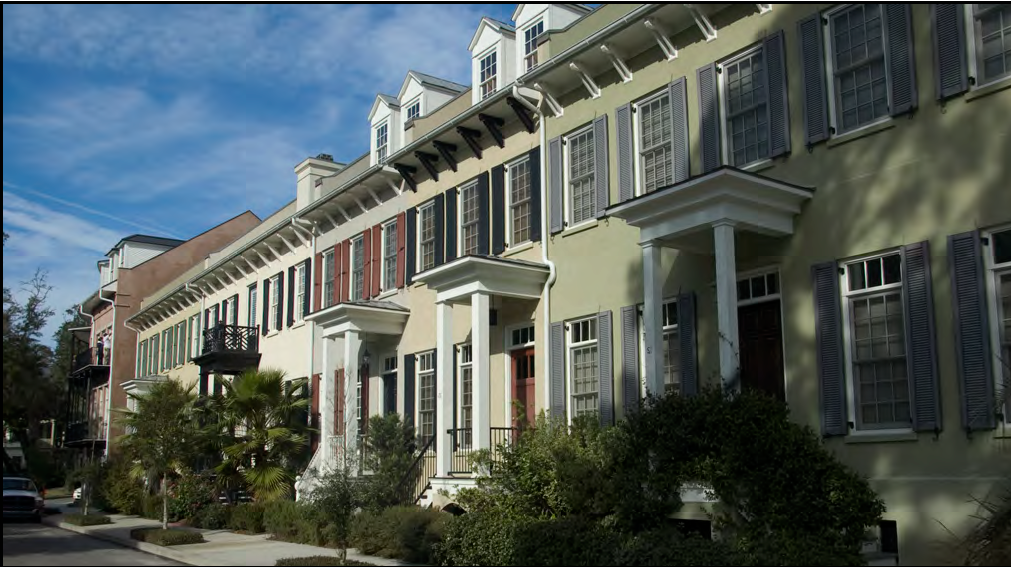
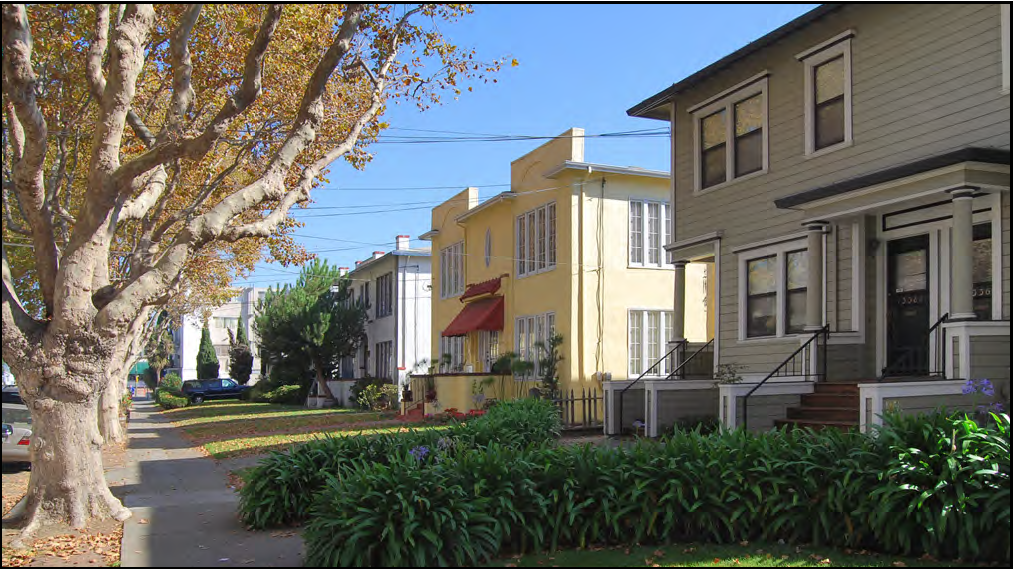
Individual stoops and dormers help to break down the overall massing of this row of
townhouses.
A series of townhouses which read as a single large building.
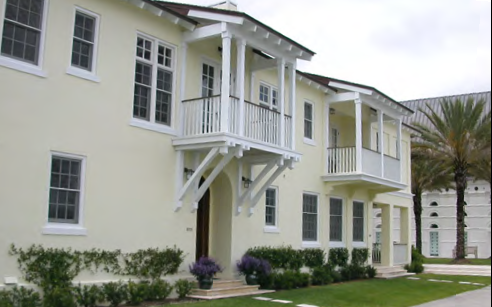
Minor differences in detailing and fenestration articulate the units.
Description. The Townhouse Building Type is a small- to medium-sized attached structure that consists of three to eight dwelling units placed side-by-side. This Type is typically located within medium-density neighborhoods or in a location that transitions from a primarily single-family neighborhood into a neighborhood main street. This Type enables appropriately-scaled, well-designed higher densities and is important for providing a broad choice of housing types and promoting walkability.
Syn: Rowhouse
FBC 1 Neighborhood Transition
FBC 2 Main Street Transition
General Note: Photos on this page are illustrative, not regulatory.
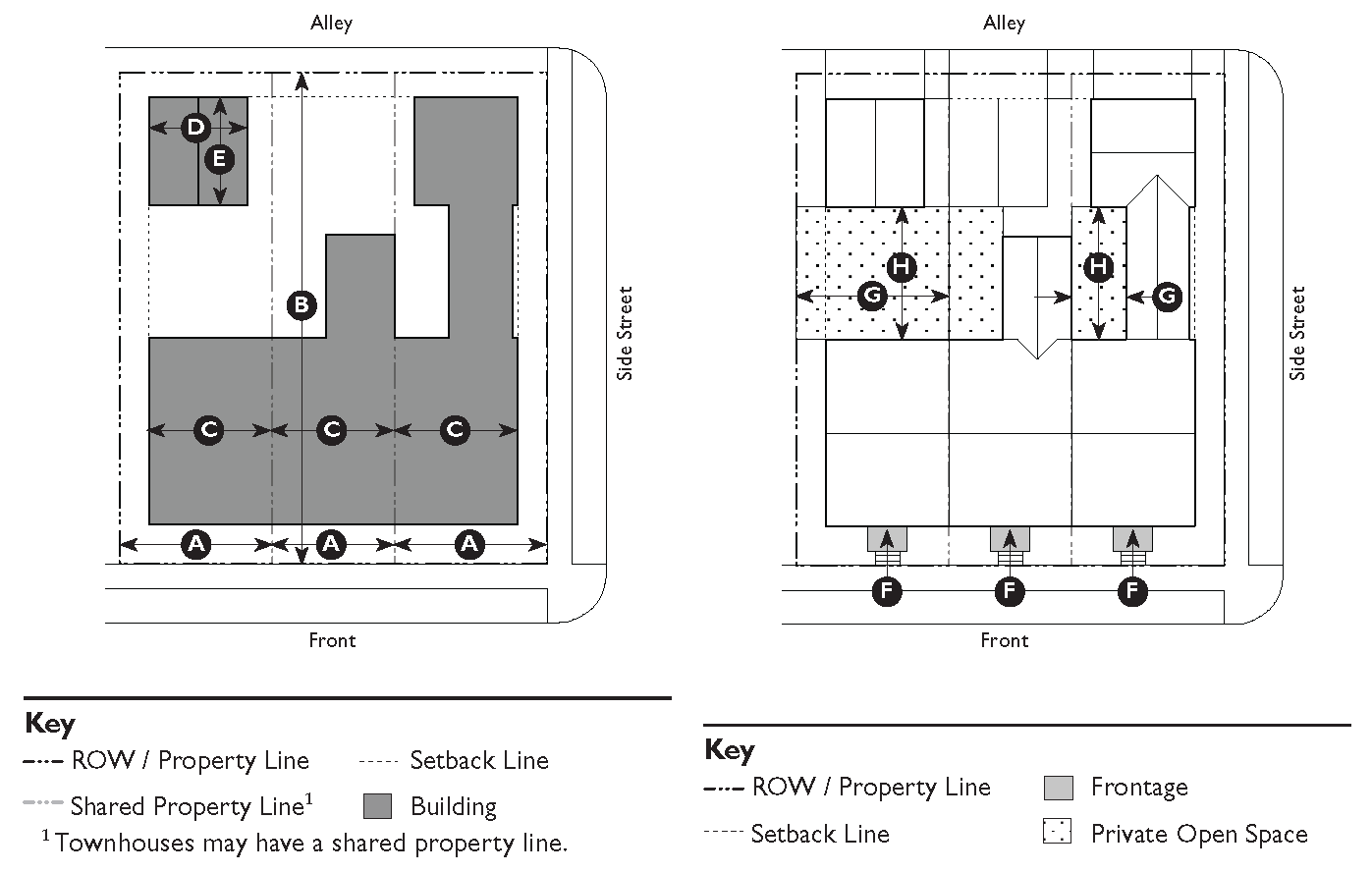
| Lot | ||
| Lot Size | ||
| Width | 18' min. | |
| Depth | 80' min. | |
| Number of Units | ||
| Units | 3 min.; 8 max. | |
| Building Size and Massing | ||
| Height | ||
| Per Building Form Standards based on transect zone | ||
| Main Body | ||
| Width | 18' min.; 36' max. | |
| Secondary Wing(s) | ||
| The footprint area of the secondary wing(s) may not exceed the footprint area of the main body. | ||
| Accessory Structure(s) | ||
| Width | 24' max. | |
| Depth | 30' max. | |
| The footprint area of an accessory structure may not exceed the footprint area of the main body. | ||
| Allowed Frontages | ||
| Porch | ||
| Stoop | ||
| Pedestrian Access | ||
| Main Entrance Location | Front | |
| Each unit shall have an individual entry facing the street. | ||
| Vehicle Access and Parking | ||
| Parking may be accessed from the alley, side street or front. | ||
| Parking may be accessed from the front only when there is no adjacent alley or side street. | ||
| When accessed from the front, a single shared drive shall be used. | ||
| Parking spaces may be enclosed, covered or open. | ||
| Private Open Space | ||
| Width | 8' min. | |
| Depth | 8' min. | |
| Area | 100 sf min. | |
| Required street setbacks and driveways shall not be included in the private open space area calculation. | ||
| Required private open space must be located behind the main body of the house. | ||
Mansion Apartment
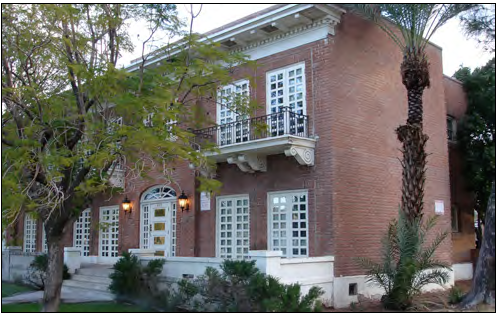
A group of apartment houses that have the scale and character of large single-family
houses.
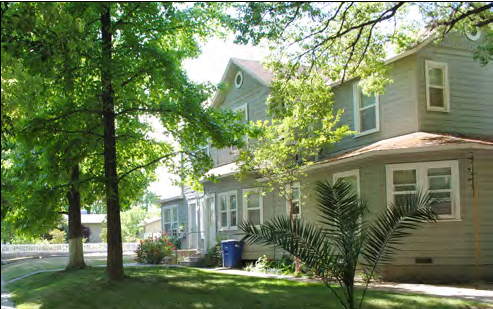
An example of a mansion apartment in Kingsburg.
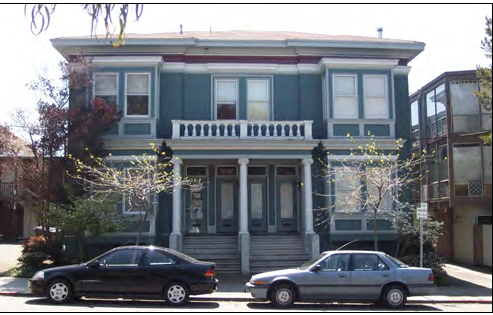
A mansion apartment with multiple entries along the front.
Description. The Mansion Apartment Building Type is a medium structure that consists of three to six side-by-side and/or stacked dwelling units, typically with one shared entry of individual entries along the front. This Type has the appearance of a medium-sized family home and is appropriately scaled to fit in sparingly within primarily single-family neighborhoods or into medium-density neighborhoods. This Type enables appropriately-scaled, well-designed higher densities and is important for providing a broad choice of housing types and promoting walkability.
FBC 1 Neighborhood Transition Standards
FBC 2 Main Street Transition Standards
General Note: Photos on this page are illustrative, not regulatory.
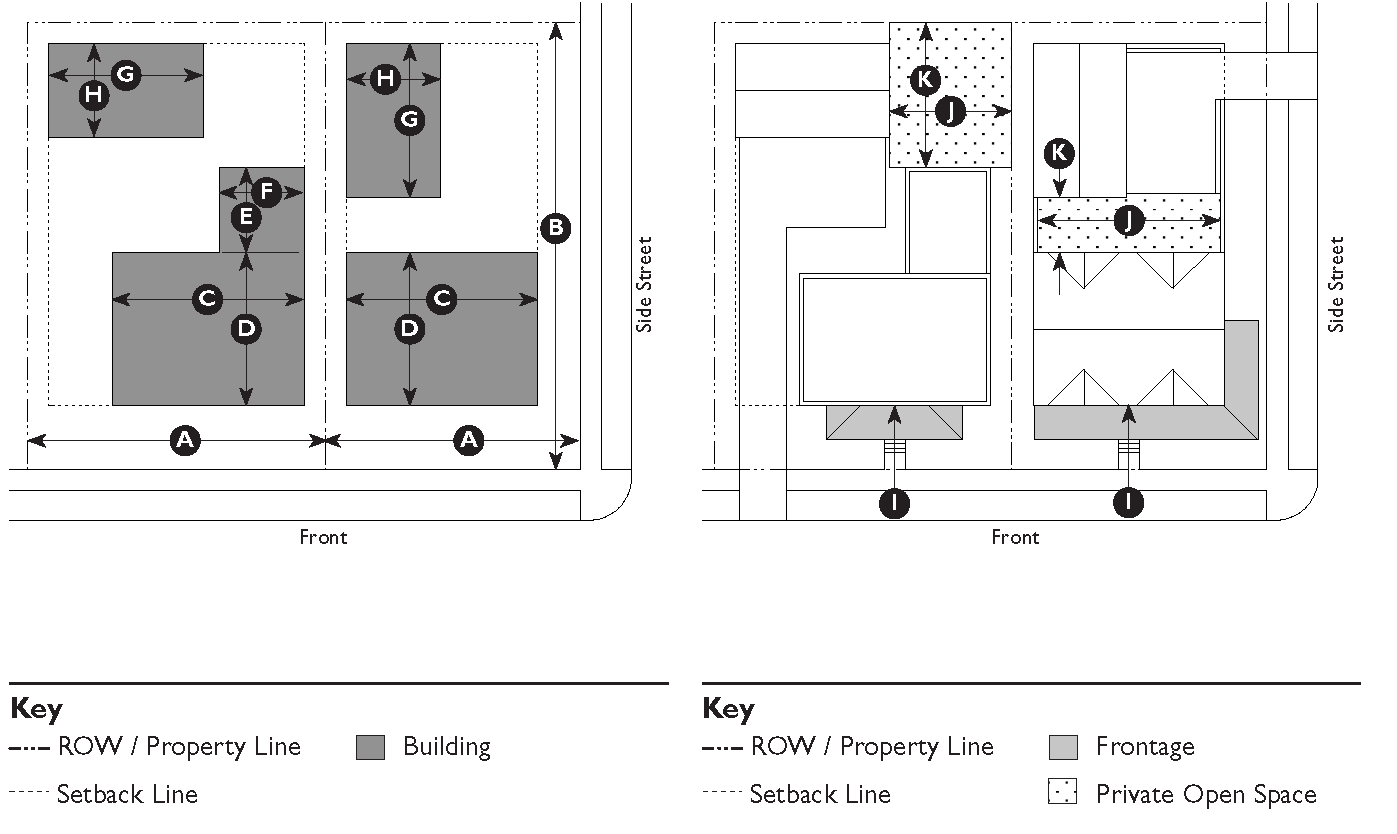
| Lot | ||
| Lot Size | ||
| Width | 50' min.; 100' max. | |
| Depth | 100' min.; 150' max. | |
| Number of Units | ||
| Units | 3 min.; 6 max. | |
| Building Size and Massing | ||
| Height | ||
| Per Building Form Standards based on transect zone | ||
| Main Body | ||
| Width | 48' max. | |
| Depth | 36' max. | |
| Secondary Wing(s) | ||
| Width | 30' max. | |
| Depth | 30' max. | |
| Accessory Structure(s) | ||
| Width | 48' max. | |
| Depth | 30' max. | |
| The footprint area of an accessory structure may not exceed the footprint area of the main body. | ||
| Allowed Frontages | ||
| Porch, Engaged | Stoop | |
| Porch, Projecting | ||
| Pedestrian Access | ||
| Main Entrance Location | Front | |
| Each unit shall have an individual entry. | ||
| Vehicle Access and Parking | ||
| Parking may be accessed from the alley, side street or front. | ||
| Parking may be accessed from the front only when there is no adjacent alley or side street. | ||
| Parking spaces may be enclosed, covered or open. | ||
| Shared Open Space | ||
| Width | 8' min. | |
| Depth | 8' min. | |
| Area | 100 sf min. | |
| Required street setbacks and driveways shall not be included in the private open space area calculation. | ||
| Required shared open space must be located behind the main body of the house. | ||
Apartment House
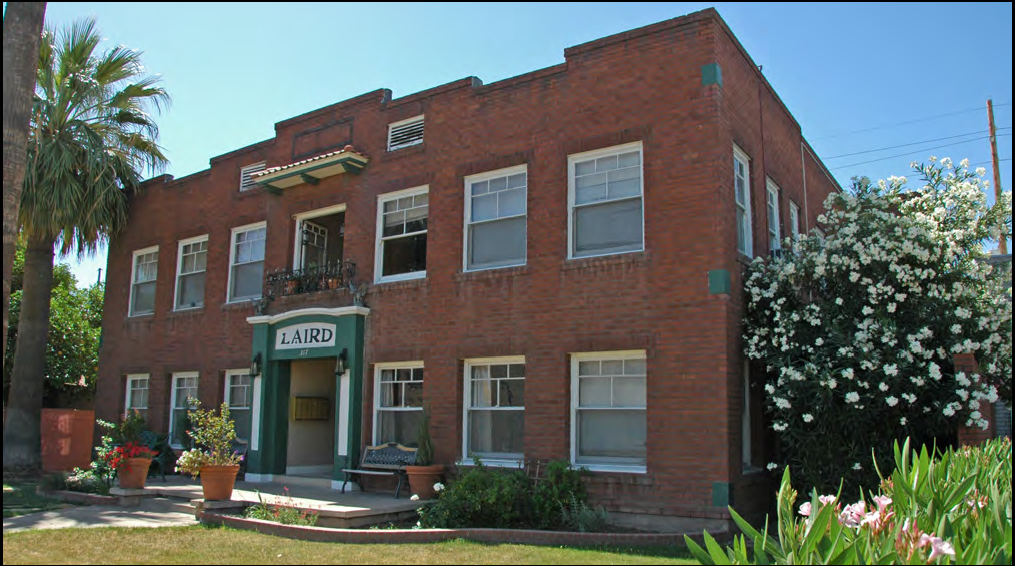
An apartment house with a recessed stoop.
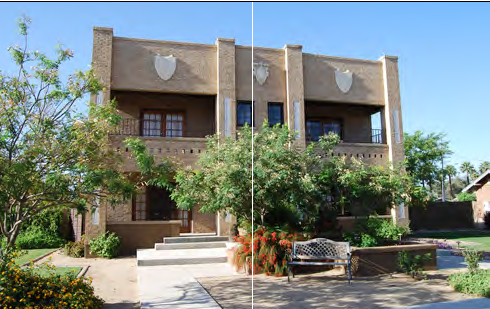
A mansion apartment with individual entries for ground floor units.
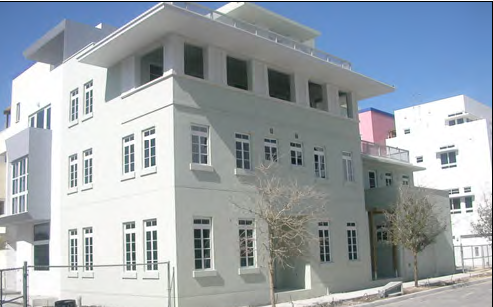
A newly constructed mansion apartment.
Description. The Apartment House Building Type is a medium- to-large-sized structure that consists of seven to 12 side-by-side and/or stacked dwelling units, typically with one shared entry. This Type is appropriately scaled to fit in within medium density neighborhoods or sparingly within large lot predominantly single-family neighborhoods. This Type enables appropriately-scaled, well-designed higher densities and is important for providing a broad choice of housing types and promoting walkability.
FBC 1 Neighborhood Transition Standards
FBC 2 Main Street Transition Standards
General Note: Photos on this page are illustrative, not regulatory.
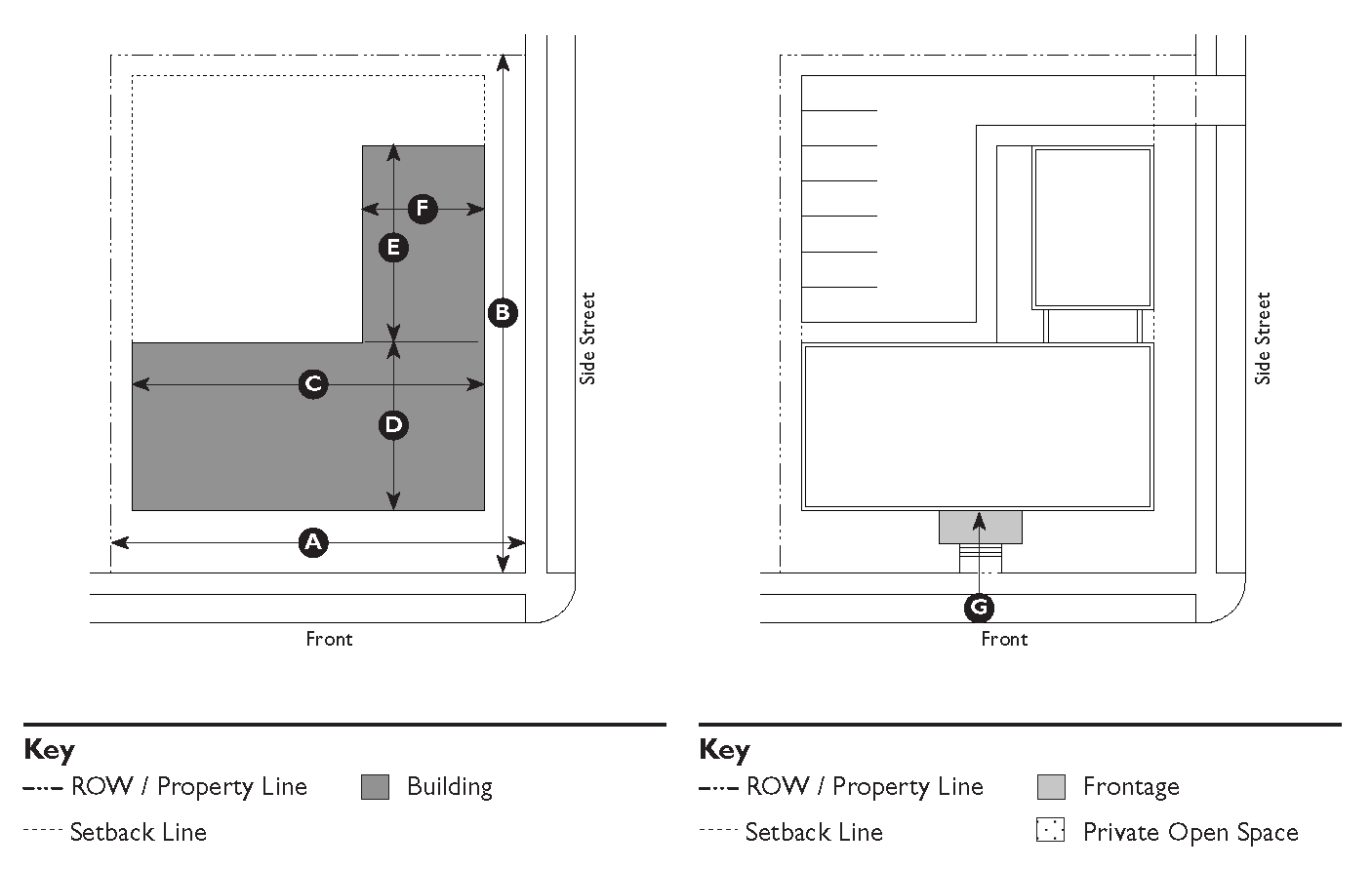
| Lot | ||
| Lot Size | ||
| Width | 75' min.; 150' max. | |
| Depth | 100' min.; 150' max. | |
| Number of Units | ||
| Units | 3 min.; 6 max. | |
| Building Size and Massing | ||
| Height | ||
| Per Building Form Standards based on transect zone | ||
| Main Body | ||
| Width | 60' max. | |
| Depth | 50' max. | |
| Secondary Wing(s) | ||
| Width | 48' max. | |
| Depth | 36' max. | |
| Accessory Structure(s) | ||
| Width | 48' max. | |
| Depth | 30' max. | |
| The footprint area of an accessory structure may not exceed the footprint area of the main body. | ||
| Allowed Frontages | ||
| Porch, Projecting | Forecourt | |
| Stoop | ||
| Pedestrian Access | ||
| Main Entrance Location | Front | |
| Units located in the main body shall be accessed by a common entry along the front. | ||
| On corner lots, units in a secondary wing may front the side street. | ||
| Vehicle Access and Parking | ||
| Parking may be accessed from the alley, side street or front. | ||
| Parking spaces may be enclosed, covered or open. | ||
| Private Open Space | ||
| No private open space requirement. | ||
Courtyard Building
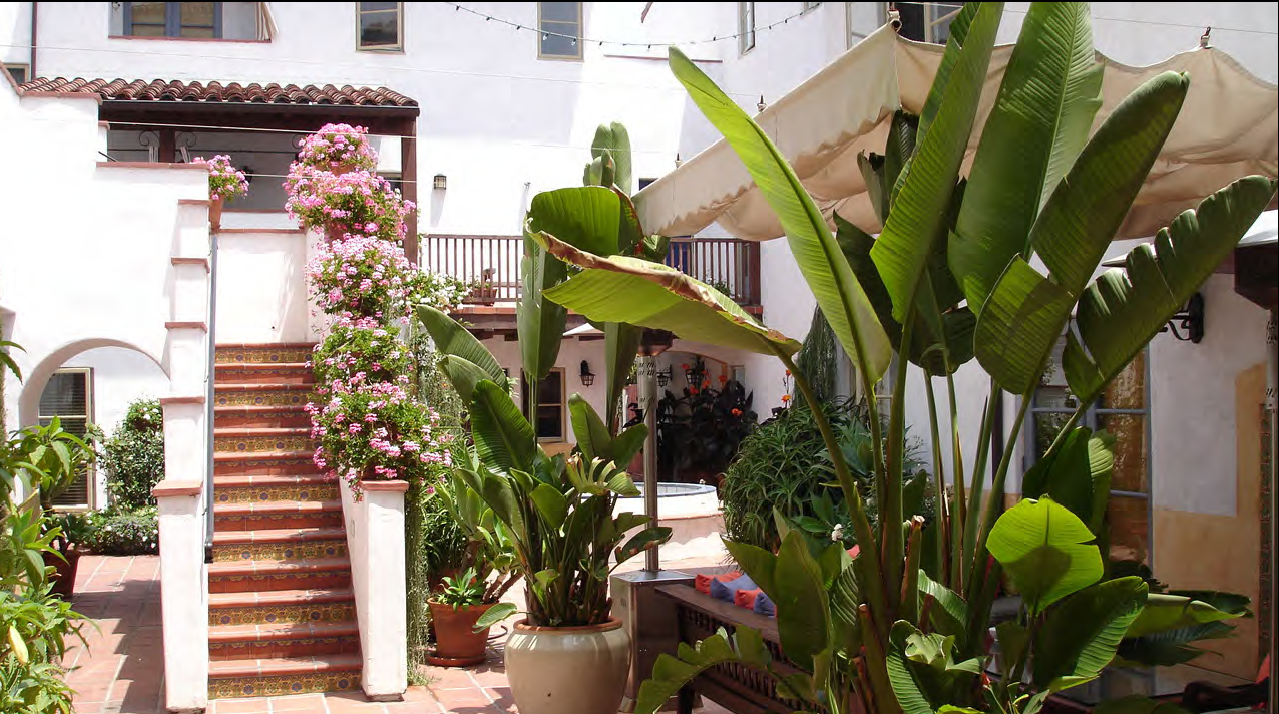
A courtyard building with all units accessed from a central courtyard that provides
communal open space.
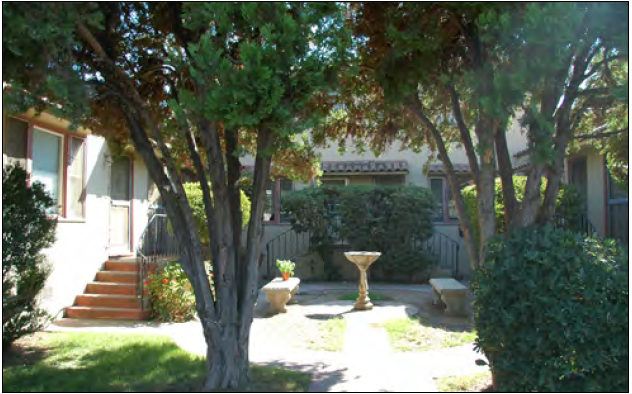
A courtyard with communal seating for residents and guest.
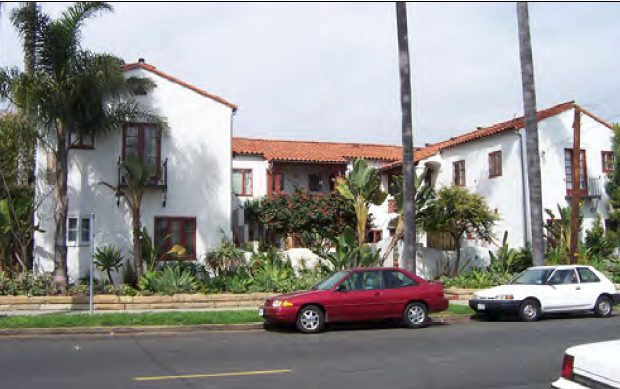
C-shaped courtyard building; all units enter from courtyard.
Description. The Courtyard Building Type is a medium-to- large-sized structure that consists of multiple side-by-side and/or stacked dwelling units accessed from a courtyard or series of courtyards. Each unit may have its own individual entry, or up to three units may share a common entry. This Type is appropriately scaled to fit in sparingly within primarily single-family or medium-density neighborhoods. It enables appropriately-scaled, well-designed higher densities and is important for providing a broad choice of housing types and promoting walkability.
FBC 1 Neighborhood Transition Standards
FBC 2 Main Street Transition Standards
General Note: Photos on this page are illustrative, not regulatory.
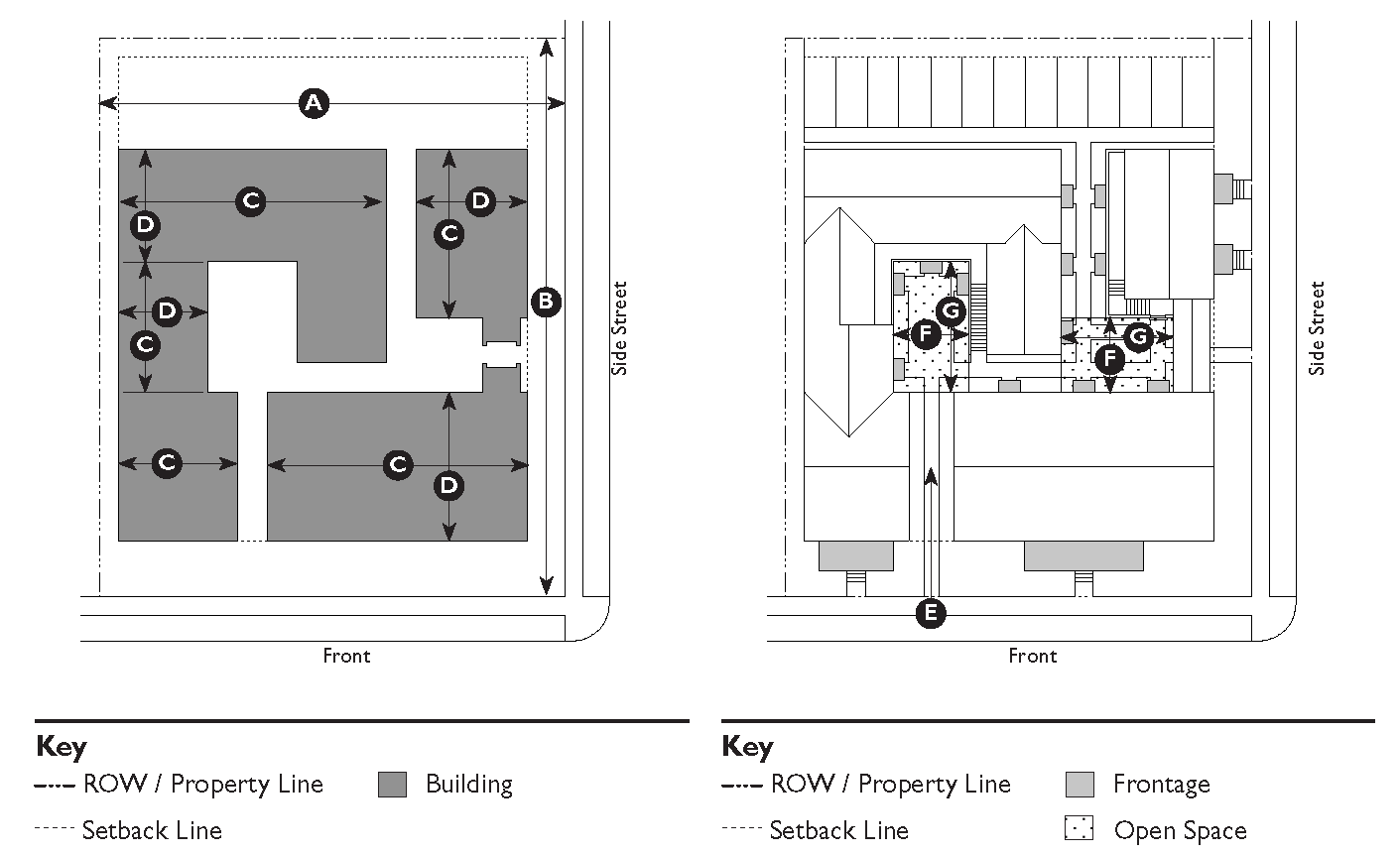
| Lot | ||
| Lot Size | ||
| Width | 100' min.; 200' max. | |
| Depth | 100' min.; 150' max. | |
| Number of Units | ||
| Units | 4 min.; 24 max. | |
| Building Size and Massing | ||
| Height | ||
| Height | 1 story min.; 40% of footprint 2 story min.; 4 stories max. 1 | |
| 1 Height must also comply with Building Form Standards. | ||
| Main Body/Secondary Wing(s) | ||
| Width | 150' max. | |
| Depth | 65' max. | |
| Accessory Structure(s) | ||
| No accessory structures are allowed. | ||
| Allowed Frontages | ||
| Porch, Projecting | Forecourt | |
| Stoop | ||
| Pedestrian Access | ||
| Units shall front a courtyard or a street. | ||
| Courtyards shall be accessible from the front. | | |
| Each unit may have an individual entry. | ||
| Vehicle Access and Parking | ||
| Parking shall be accessed from a side street or alley. | ||
| Parking spaces may be structured, tuck-under, or open. | ||
| Private Open Space | ||
| No private open space requirement. | ||
| Courtyard(s) | ||
| Width | 20' min.; 50' max. | |
| Width-to-Height Ratio | 1:2 to 2:1 | |
| Depth | 20' min.; 150' max. | |
| Depth-to-Height Ratio | 1:1 to 3:1 | |
| Area (total) |
400 sf min.;
50 sf/unit min. | |
| Courtyards may be at-grade or on an upper level. | ||
Main Street Mixed-Use
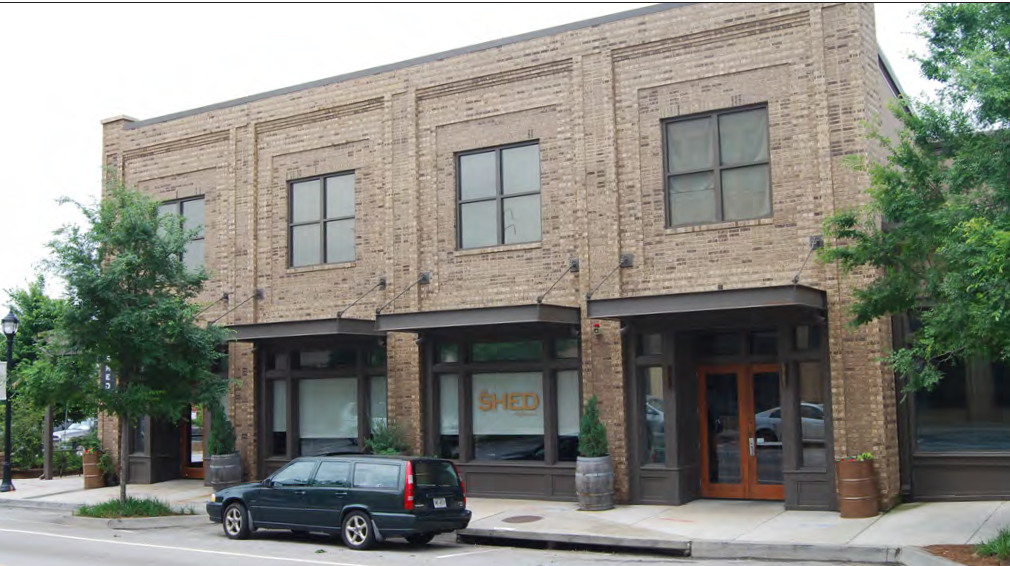
Renovated historic main street mixed-use building.
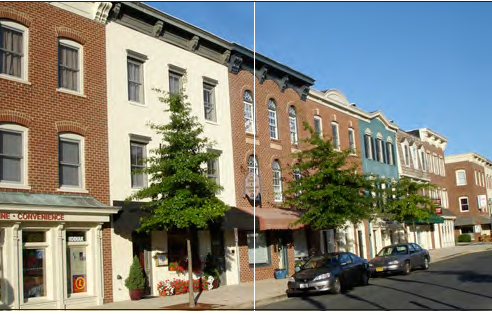
A series of small live/work type main street-mixed use buildings.
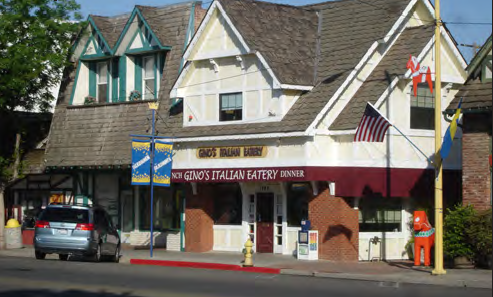
An example of a main street mixed-use building in Kingsburg.
Description. The Main Street Mixed-Use Building Type is a small- to medium-sized structure, typically attached, intended to provide a vertical mix of uses with ground-floor commercial, service, or retail uses and upper-floor commercial, service, or residential uses. Smaller versions of this Type include live/work units. This Type makes up the primary component of a neighborhood main street and portions of a downtown main street, therefore being a key component to providing walkability.
FBC 2 Main Street Transition
FBC 3 Main Street
General Note: Photos on this page are illustrative, not regulatory.
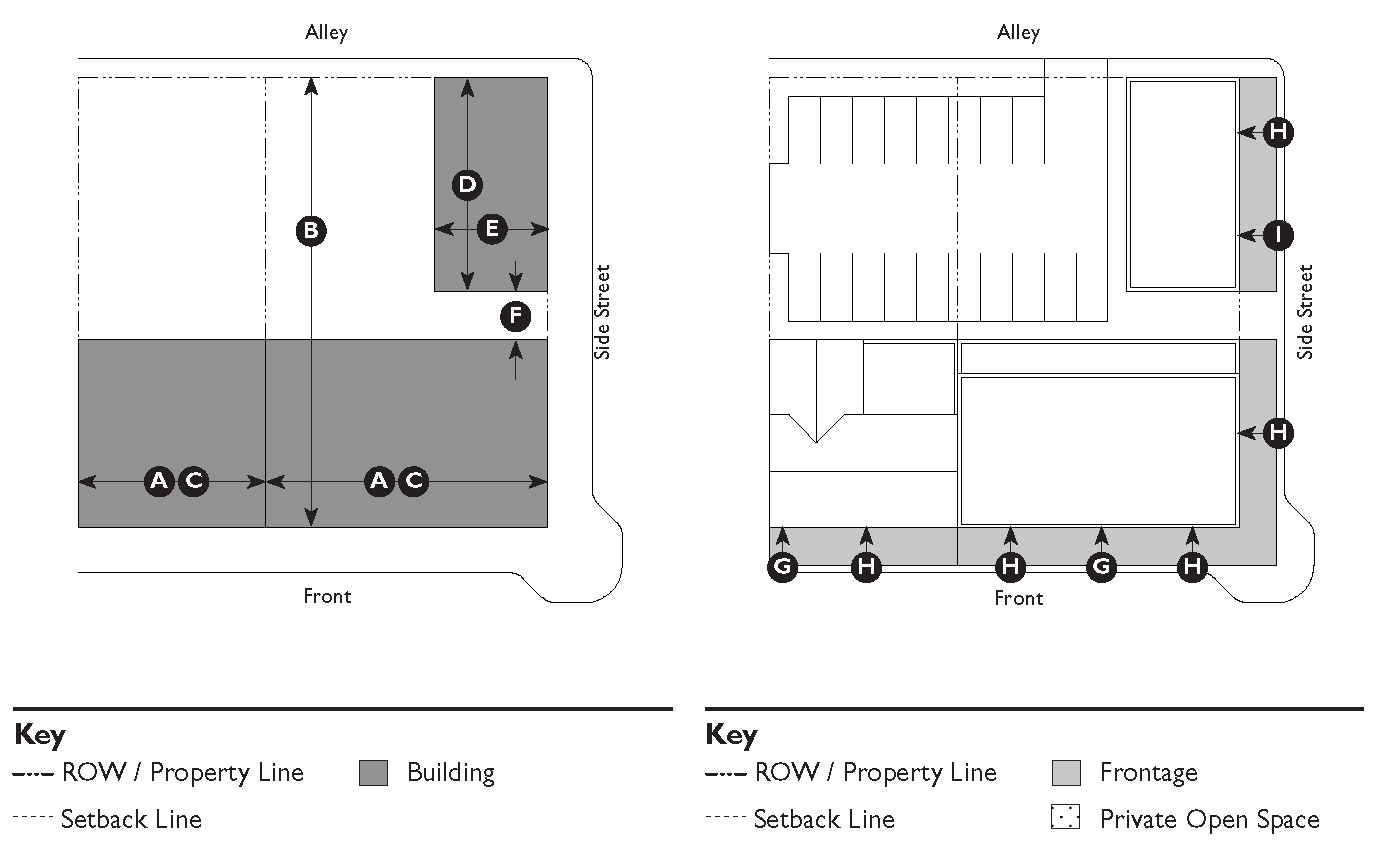
| Lot | ||
| Lot Size | ||
| Width | 25' min.; 150' max. | |
| Depth | 100' min.; 150' max. | |
| Number of Units | ||
| Units | 2 min. | |
| Building Size and Massing | ||
| Height | ||
| Height | 2 stories min.; 4 stories max. 1 | |
| 1 Height must also comply with Building Form Standards. | ||
| Main Body | ||
| Width | 150' max. | |
| Secondary Wing(s)/Accessory Structure(s) | ||
| Width | 100' max. | |
| Depth | 65' max. | |
| Accessory Structure Separation | 10' min. | |
| A secondary wing/accessory structure shall have a smaller footprint, a narrower width, and a depth not greater than the main body. | ||
| Allowed Frontages | ||
| Forecourt | Dooryard | |
| Shopfront | Gallery | |
| Terrace | ||
| Pedestrian Access | ||
| Upper floor units located in the main body shall be accessed by an entry along the front. | | |
| Ground floor units may have individual entries along the front or side street. | | |
| On corner lots, units in a secondary wing/accessory structure may front the side street. | | |
| Vehicle Access and Parking | ||
| Parking shall be accessed from a side street or alley. | ||
| Parking drives and access may be shared on adjacent lots. | ||
| On-site parking spaces may be enclosed, open, or structured. | ||
| Residential garages (if provided) may be detached or tuck-under. | ||
| Private Open Space | ||
| No private open space requirement. | ||
(Ord. No. 2015-10, § 1(Exh. A), 9-16-2015; Ord. No. 2024-07, § 1, 12-18-2024)
17.42.081 - Applicability.
Private frontages are the components of a building that provide the transition between the public realm (street and sidewalk) and the private realm (yard or building). These standards supplement the standards for each zone that the frontage types are allowed within. For each private frontage type, a description, a statement of the type's intent, and design standards are provided. These standards are intended to ensure development that reinforces the highly-valued existing character and scale of Kingsburg's neighborhoods and downtown.
(Ord. No. 2015-10, § 1(Exh. A), 9-16-2015; Ord. No. 2024-07, § 1, 12-18-2024)
17.42.082 - Private Frontages Overview.
Table 17.42.D. (Private Frontages General) provides an overview of the allowed private frontage types.
(Ord. No. 2015-10, § 1(Exh. A), 9-16-2015; Ord. No. 2024-07, § 1, 12-18-2024)
17.42.091 - Applicability.
This Section provides site planning, development, and operating standards for certain land uses allowed by Section 17.42.050 and for activities that require special standards to ensure their compatibility with site features and existing uses.
(Ord. No. 2015-10, § 1(Exh. A), 9-16-2015; Ord. No. 2024-07, § 1, 12-18-2024)
17.42.092 - Bed and Breakfast.
A.
Operator. Bed and breakfast inns shall be operated by the property owner/manager living on the site.
B.
Number of rooms. Bed and breakfast inns shall be limited to a maximum of six guest rooms for lodging, plus accommodations for the property manager/owner.
C.
Additions, modifications, and new construction. Additions, modifications, and new construction of bed and breakfast structures shall be compatible with the surrounding neighborhood and follow the City's Design Standards and Guidelines.
D.
Food service. Food may only be served to registered overnight guests. Guest room cooking facilities are prohibited.
E.
Fencing. A six-foot high fence or wall shall be constructed on all property lines that abut a residential district. All fences or walls shall be solid and decorative in compliance with Section 17.42.110 (Landscaping, Fencing and Screening).
F.
Signs. Signs are limited to a maximum of four square feet and are subject to the sign permit approval and provisions of Section 17.42.120 (Specific to Signage).
G.
Parking. Parking shall be provided in compliance with Section 17.42.100 (Specific to Parking).
Private Frontages General. The private frontage is the area between the building facade and the lot line.
| SECTION | PLAN | |
|---|---|---|
 | | |
| Permitted in FBC 1; not permitted in FBC 2 or FBC 3 Porch, projecting. The main facade of the building has a small to medium setback from the frontage line. The resulting front yard is typically very small and can be defined by a fence or hedge to spatially maintain the edge of the street. The projecting porch is open on three sides, and all habitable space is located behind the setback line. | 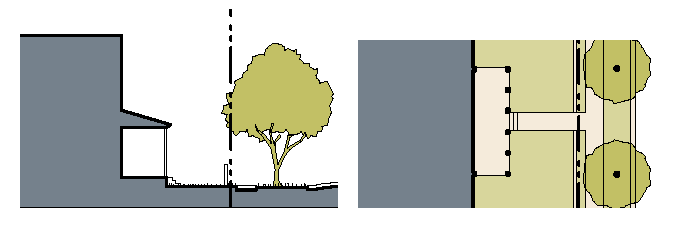 | |
| Permitted in FBC 1, not permitted in FBC 2 or FBC 3 Porch, engaged. The main facade of the building has a small to medium setback from the frontage line. The resulting front yard is typically very small and can be defined by a fence or hedge to spatially maintain the edge of the street. The engaged porch has two adjacent sides of the porch that are engaged to the building while the other two sides are open. | 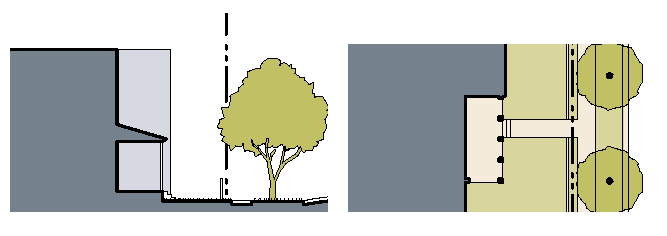 | |
| Permitted in FBC 1, FBC 2 and FBC 3 Stoop. The main facade of the building is near the frontage line and the elevated stoop engages the sidewalk. The stoop shall be elevated above the sidewalk to ensure privacy within the building. Stairs from the stoop may lead directly to the sidewalk or may be side-loaded. This Type is appropriate for residential uses with small setbacks. | 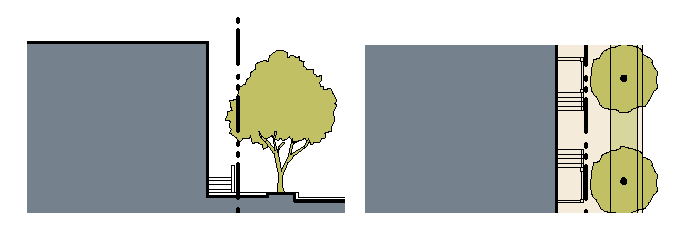 | |
| Permitted in FBC 1, FBC 2 and FBC 3 Forecourt. The main facade of the building is at or near the frontage line and a small percentage is set back, creating a small court space. The space could be used as an entry court or shared garden space for apartment buildings, or as an additional shopping or restaurant seating area within commercial areas. | 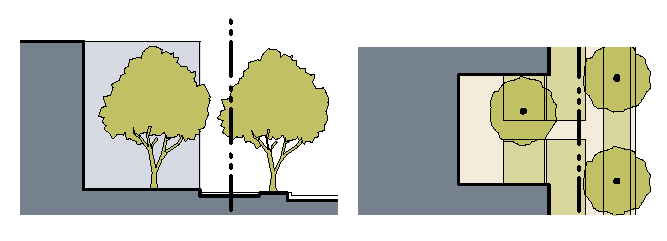 | |
| Permitted in FBC 1, FBC 2 and FBC 3 Dooryard. The frontage line is defined by a low wall or hedge and the main facade of the building is set back a small distance creating a small dooryard. The dooryard shall not provide public circulation along a ROW. The dooryard may be raised, sunken, or at grade and is intended for ground floor residential in flex zones, live/work, and small commercial uses ≤2,500 sf. | 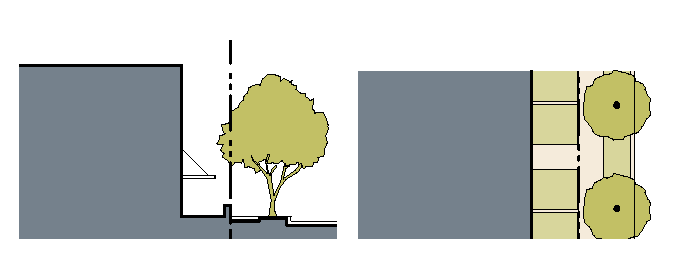 | |
| Permitted in FBC 1, FBC 2 and FBC 3 Shopfront. The main facade of the building is at or near the frontage line with an at-grade entrance along the public way. This Type is intended for retail use. It has substantial glazing at the sidewalk level and may include an awning that may overlap the sidewalk. It may be used in conjunction with other frontage types. Syn: Retail Frontage, Awning. | 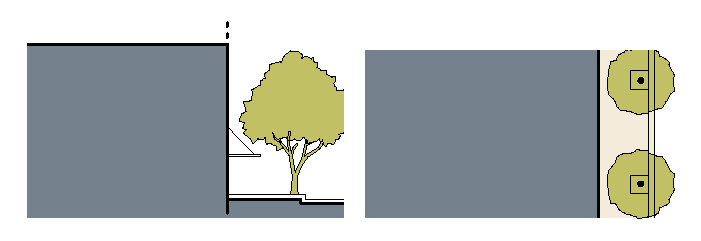 | |
| Permitted in FBC 1, FBC 2 and FBC 3 Gallery. The main facade of the building is at the frontage line and the gallery element overlaps the sidewalk. This Type is intended for buildings with ground-floor commercial uses and may be one or two stories. The gallery should extend far enough from the building to provide adequate protection and circulation for pedestrians and extend close enough to the curb so that a pedestrian cannot bypass it. | 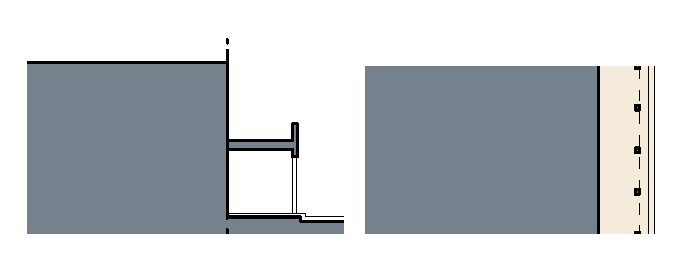 | |
| Permitted in FBC 1, FBC 2 and FBC 3 Terrace. The main facade is at or near the frontage line with an elevated terrace providing public circulation along the facade. This Type can be used to provide at-grade access while accommodating a grade change. Frequent steps up to the terrace are necessary to avoid dead walls and maximize access. This Type may also be used in historic industrial areas to mimic historic loading docks. | 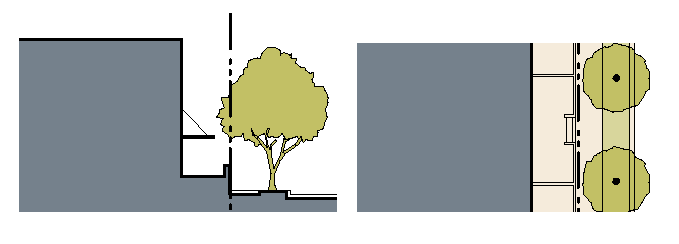 | |
| Description | ||
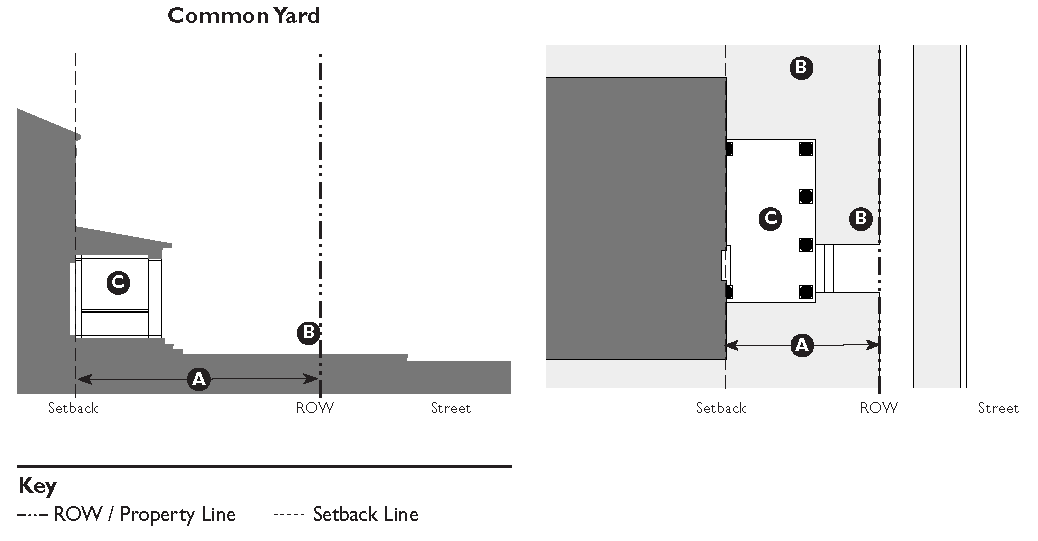
| The main facade of the building has a large planted setback from the frontage line in order to provide a better living environment adjacent to higher-speed thoroughfares. The front yard created remains unfenced and is visually continuous with adjacent yards, supporting a common landscape and working in conjunction with the other private frontages. | ||
| Size | ||
| Depth | 20' min. | |
| Miscellaneous | ||
| Fences between front yards or between the sidewalk and front yard are not allowed. | | |
| Common Yard Frontages shall be used in conjunction with another allowed private frontage type, such as porch. | | |
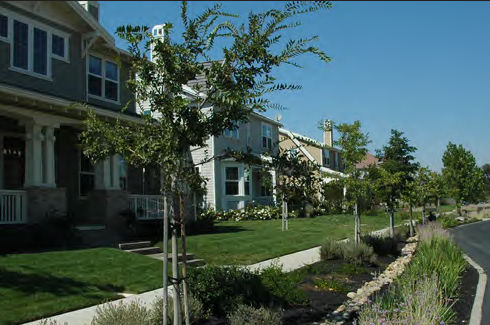
The front yards of these houses form a continuous common yard.
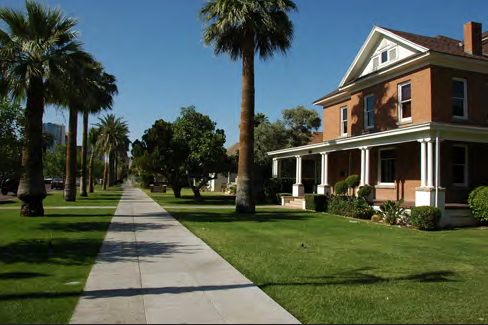
An example of a common yard.
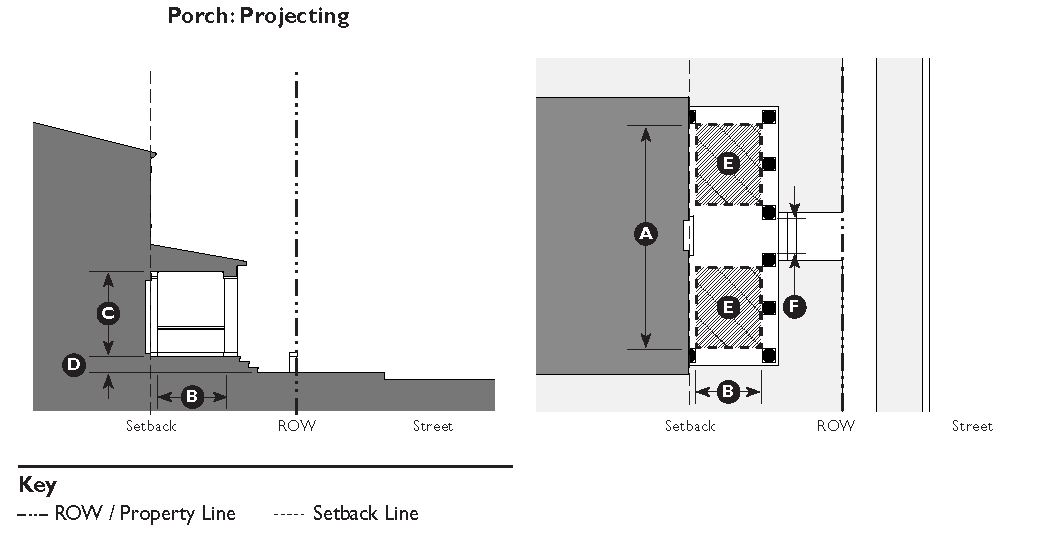
| Description | ||
| The main facade of the building has a small to medium setback from the frontage line. The resulting front yard is typically very small and can be defined by a fence or hedge to spatially maintain the edge of the street. The projecting porch is open on three sides, and all habitable space is located behind the setback line | ||
| Size | ||
| Width, Clear | 10' min. | |
| Depth, Clear | 8' min. | |
| Height, Clear | 8' min. | |
| Height | 2 stories max. | |
| Finish Level above Sidewalk | 18" min. | |
| Furniture Area, Clear | 4' x 6' min. | |
| Path of Travel | 3' wide min. | |
| Miscellaneous | ||
| Projecting porches are open on three sides and must have a roof. | ||
| In transect zones where both porches and encroachments are allowed, a porch is an allowable encroaching element. | ||
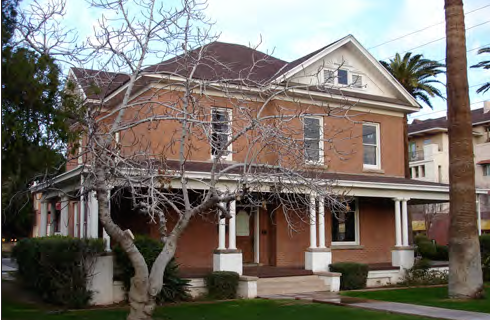
A wrap-around projecting porch.
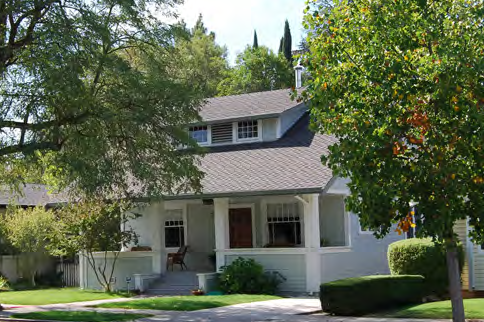
Projecting porch integrated into the overall massing.
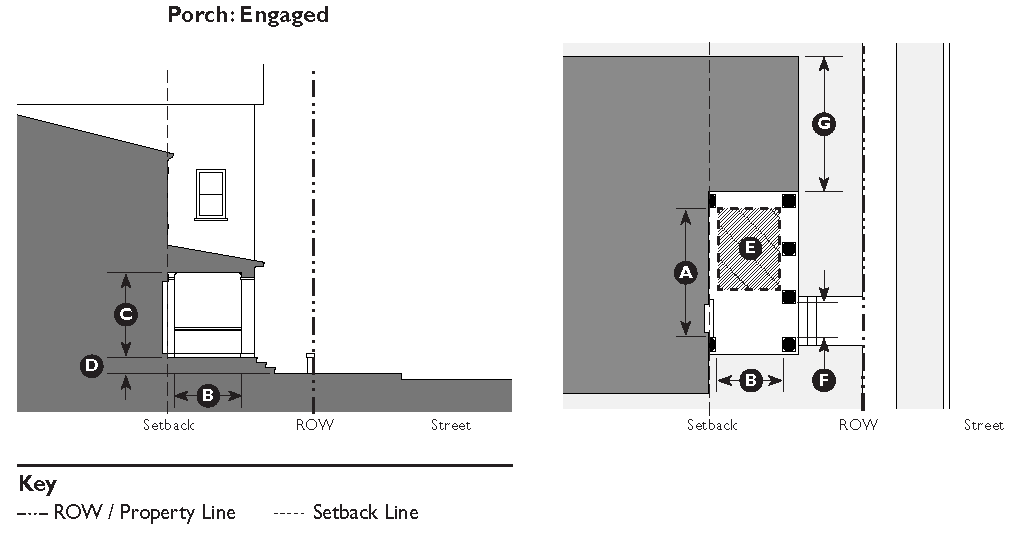
| Description | ||
| The main facade of the building has a small to medium setback from the frontage line. The resulting front yard is typically very small and can be defined by a fence or hedge to spatially maintain the edge of the street. The engaged porch has two adjacent sides of the porch that are engaged to the building while the other two sides are open. | ||
| Size | ||
| Width, Clear | 10' min. | |
| Depth, Clear | 8' min. | |
| Height, Clear | 8' min. | |
| Height | 2 stories max. | |
| Finish Level above Sidewalk | 18" min. | |
| Furniture Area, Clear | 4' x 6' min. | |
| Path of Travel | 3' wide min. | |
| Miscellaneous | ||
| Up to ⅖ of the building facade may project beyond the setback line into the encroachment area for this frontage type. | | |
| Engaged porches must be open on two sides and have a roof. | ||
| In transect zones where both porches and encroachments are allowed, a porch and up to ⅖ of the building facade is an allowable encroaching element. | ||
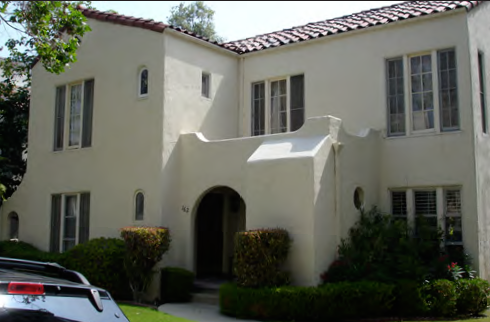
Engaged porch as an attached element.
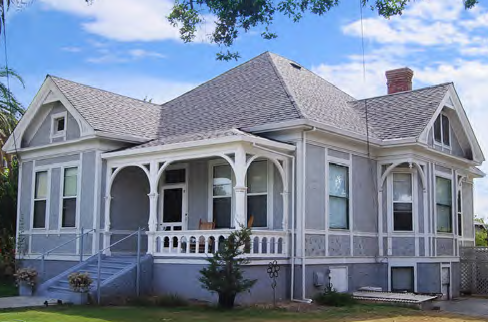
An example of an engaged porch.
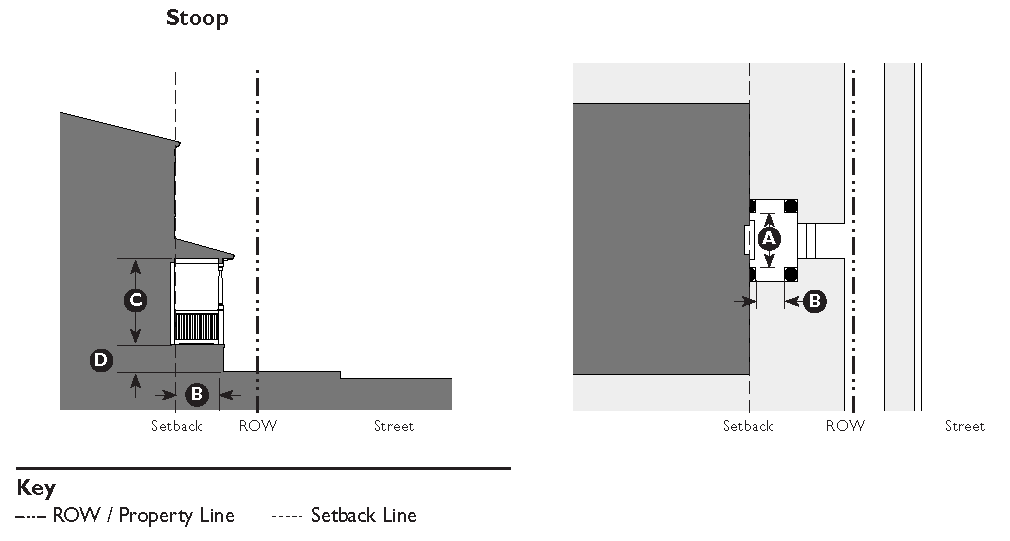
| Description | ||
| The main facade of the building is near the frontage line and the elevated stoop engages the sidewalk. The stoop shall be elevated above the sidewalk to ensure privacy within the building. Stairs from the stoop may lead directly to the sidewalk or may be side-loaded. This Type is appropriate for residential uses with small setbacks. | ||
| Size | ||
| Width, Clear | 5' min.; 8' max. | |
| Depth, Clear | 5' min.; 8' max. | |
| Height, Clear | 8' min. | |
| Height | 1 story max. | |
| Depth of Recessed Entries | 6' max. | |
| Finish Level above Sidewalk | 18" min. | |
| Miscellaneous | ||
| Stairs may be perpendicular or parallel to the building facade. | ||
| Ramps shall be parallel to facade or along the side of the building. | ||
| The entry door shall be covered or recessed to provide shelter from the elements. | ||
| All doors must face the street. | ||
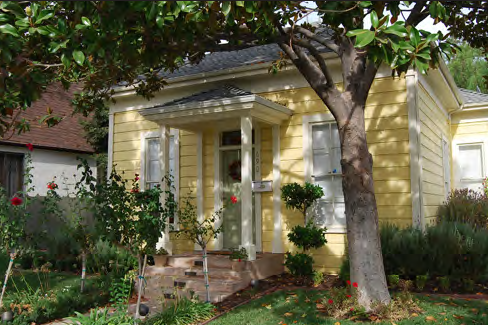
This stoop on a single-family dwelling with a medium setback engages the street.
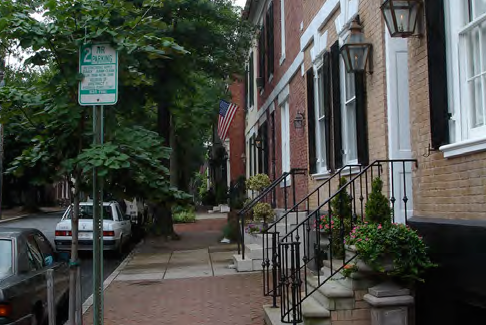
These stoops on townhouses with slightly recessed entries and a minimum setback allow
the steps to engage the street.
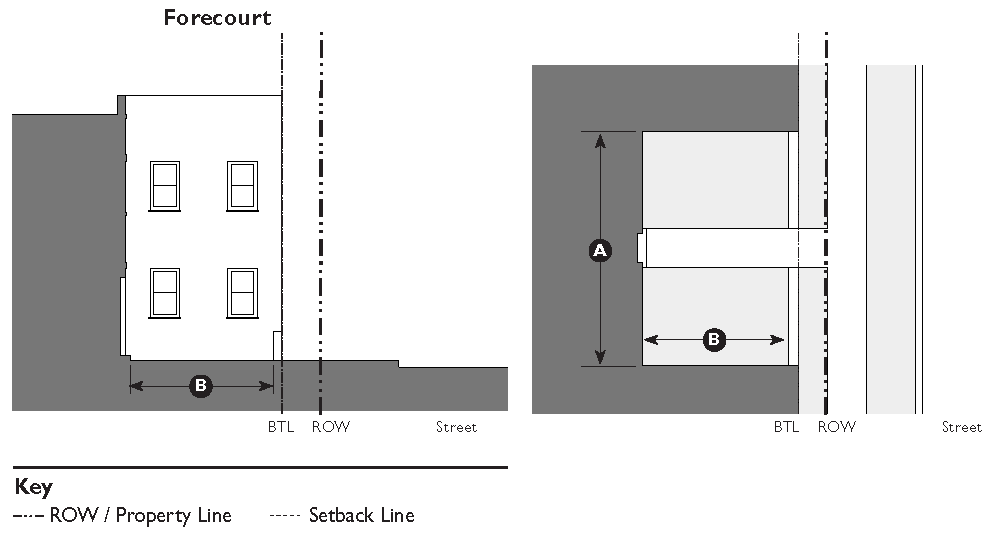
| Description | ||
| The main facade of the building is at or near the frontage line and a small percentage is set back, creating a small court space. The space could be used as an entry court or shared garden space for apartment buildings, or as an additional shopping or restaurant seating area within commercial areas. | ||
| Size | ||
| Width, Clear | 12' min. | |
| Depth, Clear | 12' min. | |
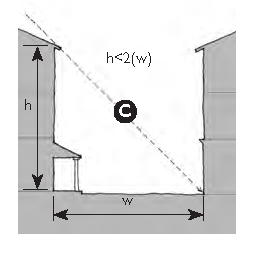
| Ratio, Height to Width | 2:1 max. | |
| Miscellaneous | ||
| Forecourts should be used sparingly and should not be repeated along a block frontage. | ||
| The proportions and orientation of these spaces should be carefully considered for solar orientation and user comfort. | ||
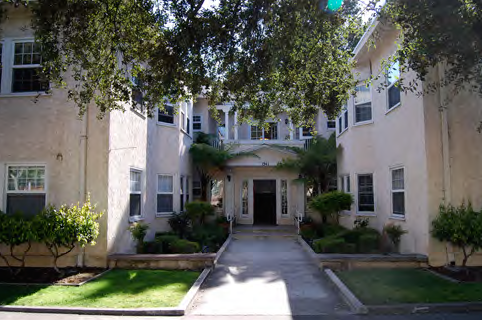
This residential forecourt provides prominent entry yard and breaks down the overall
massing along the street.
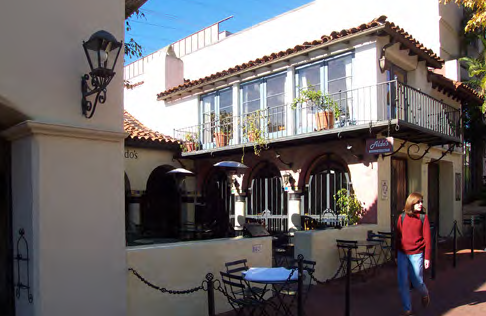
This commercial forecourt provides an outdoor dining area along a vibrant commercial
street. The ROW is defined by a low wall as required by this Code.
| Description | ||
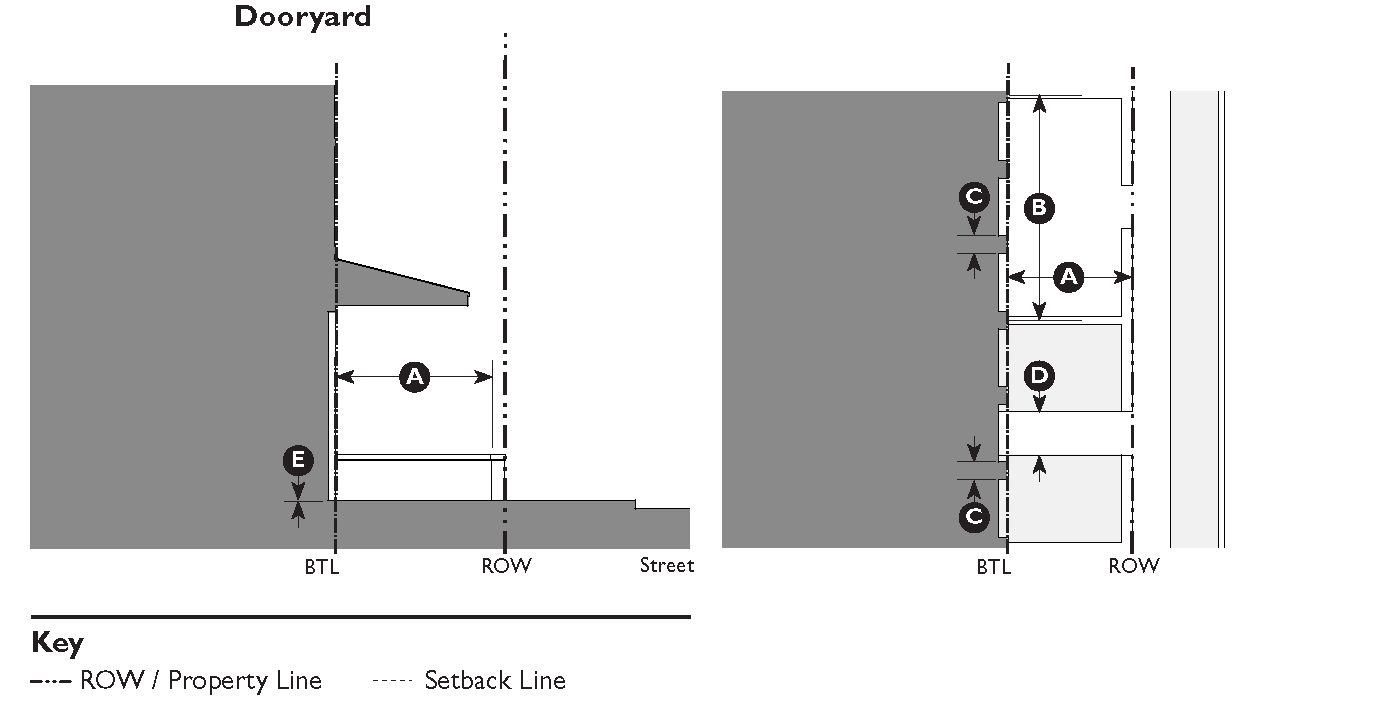
| The frontage line is defined by a low wall or hedge and the main facade of the building is set back a small distance creating a small dooryard. The dooryard shall not provide public circulation along a ROW. The dooryard may be raised, sunken, or at grade and is intended for ground floor residential in flex zones, live/work, and small commercial uses ≤2,500 sf. | ||
| Size | ||
| Depth, Clear | 8' min. | |
| Length | 50' max. | |
| Distance between Glazing | 4' max. | |
| Ground Floor Transparency | 50% min. 1 | |
| Depth of Recessed Entries | 5' max. | |
| Path of Travel | 3' wide min. | |
| Finish Level above Sidewalk | 3'—6" max. | |
| Finish Level below Sidewalk | 6' max. | |
| Miscellaneous | ||
| For live/work and commercial uses, these standards are to be used in conjunction with those for the Shopfront Frontage Type. In case of conflict between them, the Dooryard Frontage Type standards shall prevail. | ||
| Low walls used as seating are encouraged. | ||
| Shall not be used for circulation for more than one ground floor entry. | ||
| 1 For live/work and commercial uses only. | ||
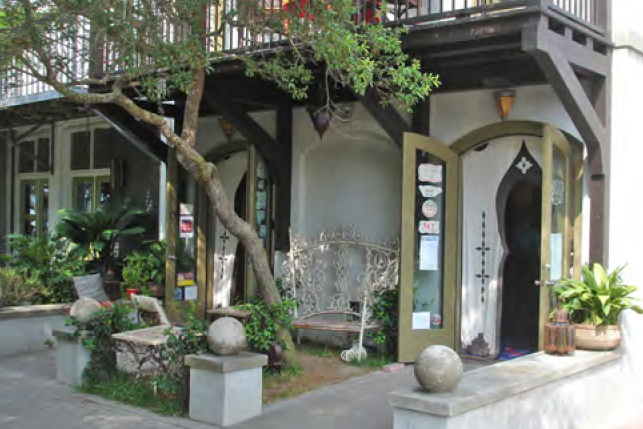
An example of a series of small commercial dooryards.
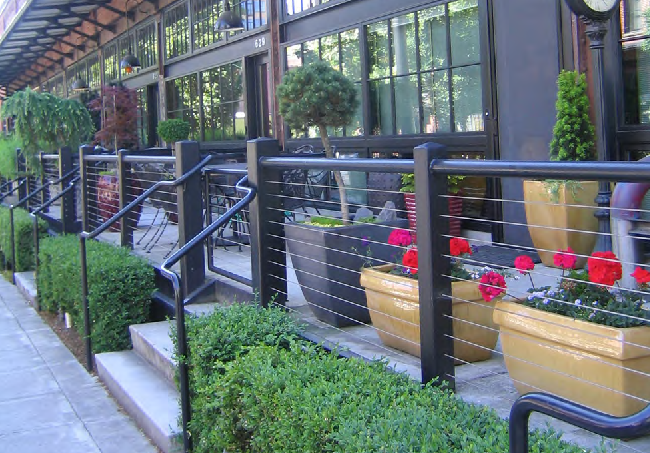
An example of a series of residential dooryards. Each dooryard has its own steps with
railings providing separation between the dooryards of adjacent units.
| Description | ||
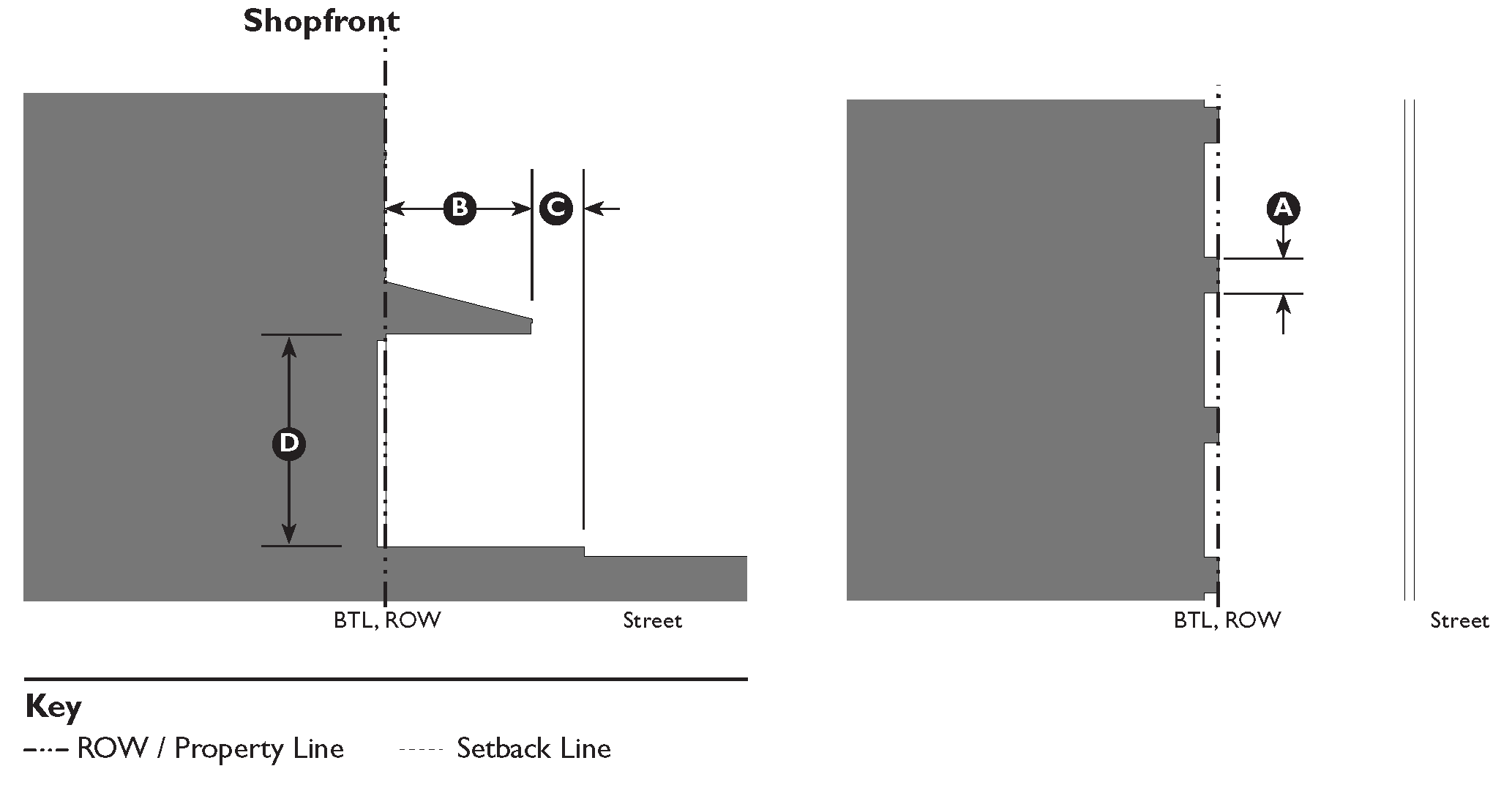
| The main facade of the building is at or near the frontage line with an at-grade entrance along the public way. This Type is intended for retail use. It has substantial glazing at the sidewalk level and may include an awning that may overlap the sidewalk. It may be used in conjunction with other frontage types. | ||
| Size | ||
| Distance between Glazing | 2' max. | |
| Ground Floor Transparency | 75% min. | |
| Depth of Recessed Entries | 5' max. | |
| Awning | ||
| Depth | 4' min. | |
| Setback from Curb | 2' min. | |
| Height, Clear | 8' min. | |
| Miscellaneous | ||
| Residential windows shall not be used. | ||
| Doors may be recessed as long as main facade is at BTL. | ||
| Operable awnings are encouraged. | ||
| Open-ended awnings encouraged. | ||
| Rounded and hooped awnings are discouraged. | ||
| Shopfronts with accordion-style doors/windows or other operable windows that allow the space to open to the street are encouraged. | ||
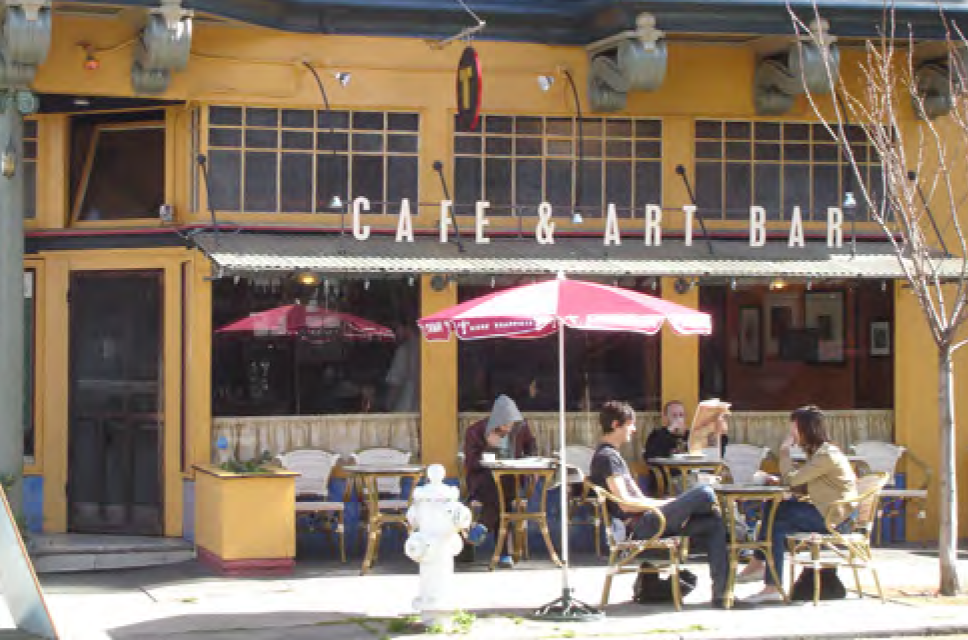
An example of a shopfront with a chamfered corner entry.
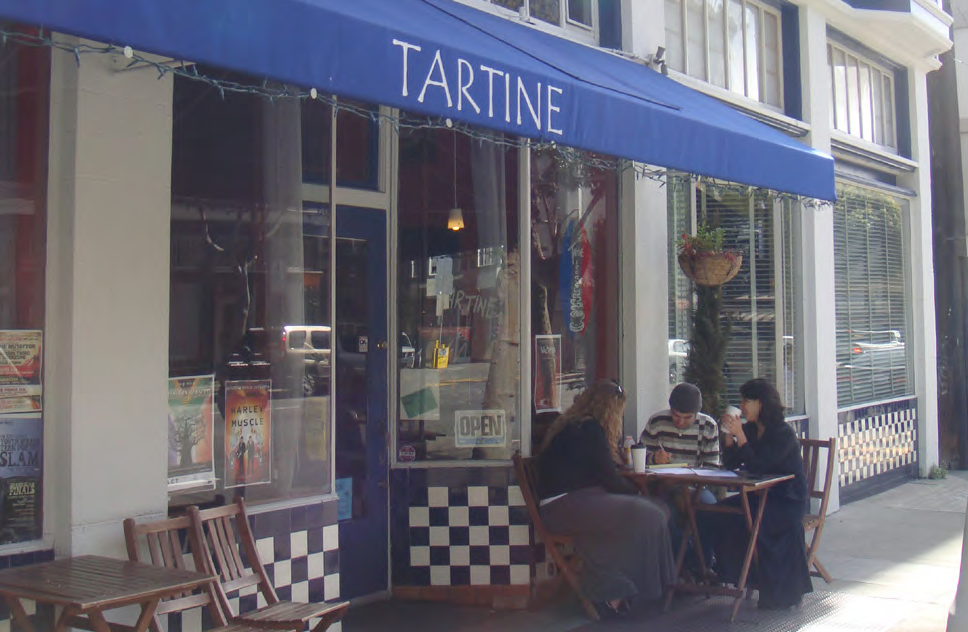
An example of a shopfront with a recessed doorway.
| Description | ||
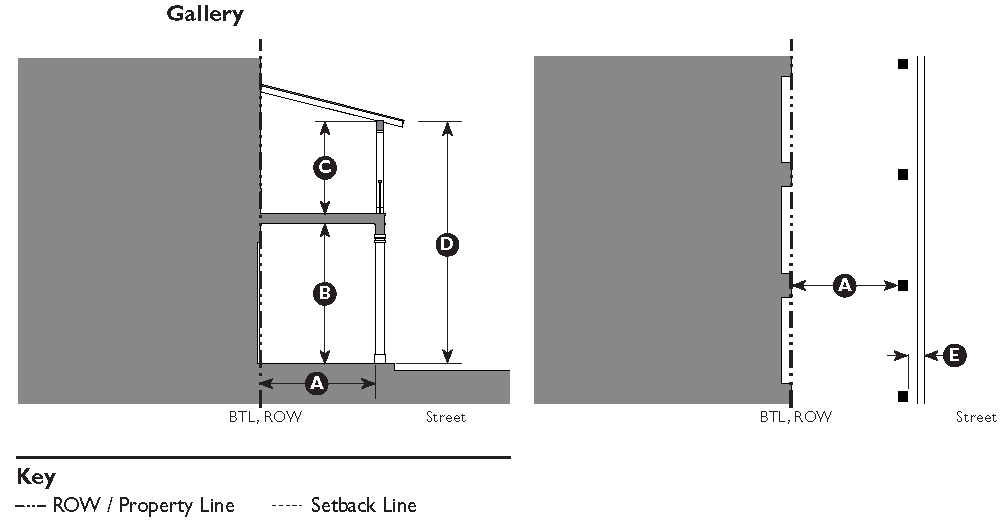
| The main facade of the building is at the frontage line and the gallery element overlaps the sidewalk. This Type is intended for buildings with ground-floor commercial uses and may be one or two stories. The gallery should extend far enough from the building to provide adequate protection and circulation for pedestrians and extend close enough to the curb so that a pedestrian cannot bypass it. | ||
| Size | ||
| Depth, Clear | 8' min. | |
| Ground Floor Height, Clear | 11' min. | |
| Upper Floor Height, Clear | 9' min. | |
| Height | 2 stories max. | |
| Setback from Curb | 2' min.; 3' max. | |
| Miscellaneous | ||
| These standards are to be used in conjunction with those for the Shopfront Frontage Type. In case of conflict between them, the Gallery Frontage Type standards shall prevail. | ||
| Upper-story galleries facing the street must not be used to meet primary circulation requirements. | ||
| Galleries must have a consistent depth along a frontage. | ||
| Gallery must project over a sidewalk. | ||
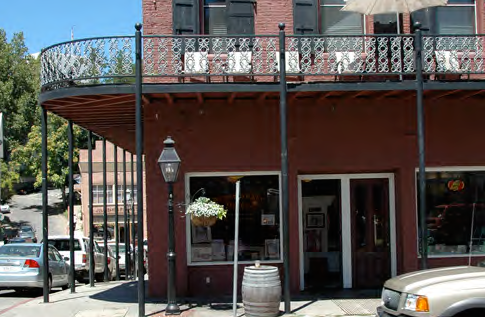
A one-story gallery with second floor access.
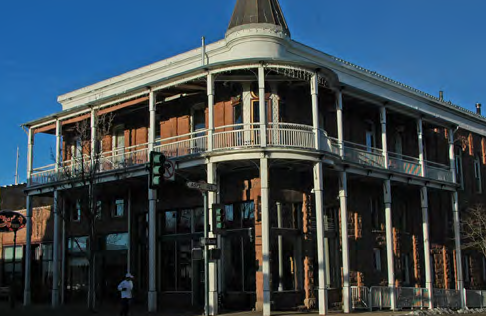
A two-story gallery.
| Description | ||
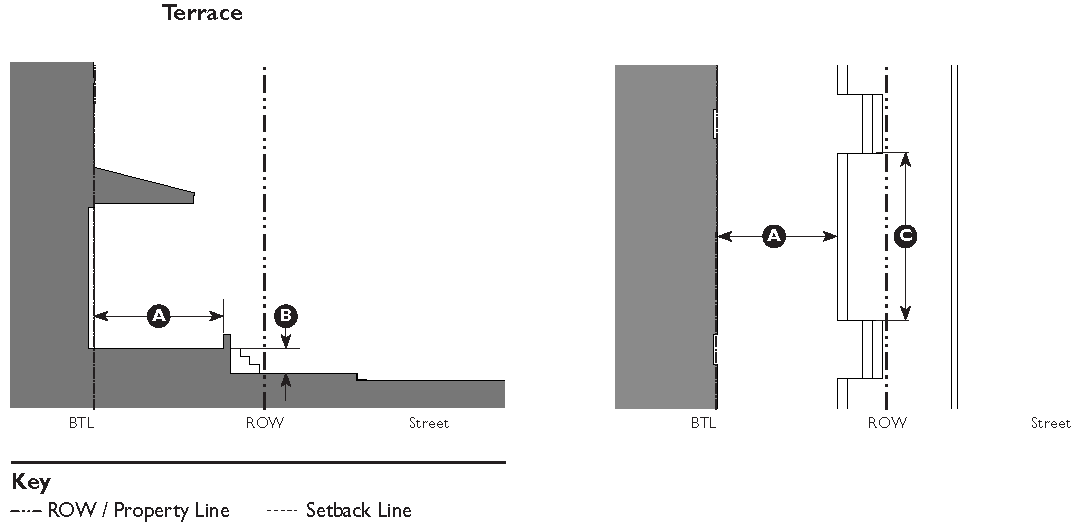
| The main facade is at or near the frontage line with an elevated terrace providing public circulation along the facade. This Type can be used to provide at-grade access while accommodating a grade change. Frequent steps up to the terrace are necessary to avoid dead walls and maximize access. This Type may also be used in historic industrial areas to mimic historic loading docks. | ||
| Size | ||
| Depth, Clear | 8' min. | |
| Finish Level above Sidewalk | 3'6" max. | |
| Length of Terrace | 150' max. | |
| Distance between Stairs | 50' max. | |
| Miscellaneous | ||
| These standards are to be used in conjunction with those for the Shopfront Frontage Type. In case of conflict between them, the Terrace Frontage Type standards shall prevail. | ||
| Low walls used as seating are encouraged. | ||
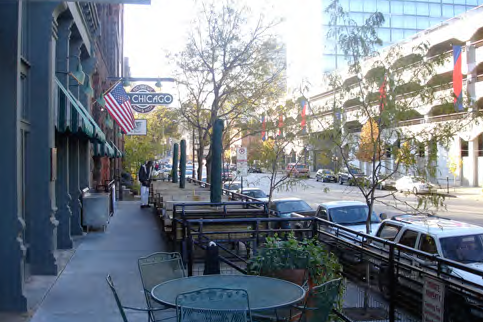
An example of a terrace in a historic industrial district.
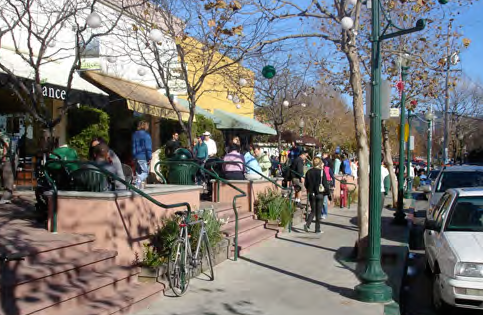
An example of a terrace used to accommodate a change in grade. The low walls are used
to provide seating.
(Ord. No. 2015-10, § 1(Exh. A), 9-16-2015; Ord. No. 2024-07, § 1, 12-18-2024)
17.42.093 - Child Day Care Facilities.
This Section establishes standards for City review of child day care facilities in conformance with State law (Health and Safety Code Section 1596.78), including limitations on the City's authority to regulate these facilities. These standards apply in addition to all other applicable provisions of this Development Code and any requirements imposed by the California Department of Social Services through its facility licensing procedures. Licensing by the Department of Social Services is required for all child day care facilities and evidence of the license shall be presented to the Planning Department prior to establishing any child day care facility.
A.
Small family day care home. A small family day care home is permitted in all residential zones as allowed by Health and Safety Code Sections 1597.44 et seq.
B.
Large family day care home. As allowed by Health and Safety Code Sections 1597.465 et seq., a large family day care home shall be approved if it complies with the following standards:
1.
The facility shall comply with all applicable State and fire codes.
2.
A separation of 300 feet shall be required from any other large family day care home.
3.
A six-foot high fence or wall shall be constructed on all property lines or around the outdoor activity areas, except in the front yard or within a traffic safety visibility area.
4.
The facility shall not exceed City noise limits as established by the City's General Plan.
5.
On-site exterior lighting shall be allowed for safety purposes only, shall consist of low wattage fixtures, and shall be directed downward and shielded.
6.
Parking shall be provided in compliance with Section 17.42.100.
7.
No swimming pool/spa shall be installed on the site after establishment of the family day care center due to human safety considerations. Any pool/spa existing on the site prior to application for a family day care center shall be removed prior to establishment of the use, unless the Director determines that secure separation exists between the pool/spa and facilities used by the children.
C.
Family day care centers. The following standards apply to family day care centers:
1.
The facility shall comply with all applicable State and fire codes.
2.
Noise sources shall be identified through the Use Permit approval process. The facility shall not exceed City noise limits as established by the City's General Plan.
3.
Parking shall be provided in compliance with Section 17.42.100.
4.
On-site exterior lighting shall be allowed for safety purposes only, shall consist of low wattage fixtures, and shall be directed downward and shielded.
5.
A six-foot high fence or wall shall be constructed on all property lines or around the outdoor activity areas, except in the front yard or within a traffic safety visibility area.
(Ord. No. 2015-10, § 1(Exh. A), 9-16-2015; Ord. No. 2024-07, § 1, 12-18-2024)
17.42.094 - Home Occupations.
Home Occupations shall be subject to the requirements of Section 17.56.010 of the Zoning Ordinance.
(Ord. No. 2015-10, § 1(Exh. A), 9-16-2015; Ord. No. 2024-07, § 1, 12-18-2024)
17.42.095 - Live/Work.
A.
Purpose. This Section provides standards for live/work units and for the reuse of existing commercial and industrial structures to accommodate live/work where allowed. A live/work unit shall function predominantly as a work space with incidental residential accommodations. The standards of this Section do not apply to mixed use projects.
B.
Application requirements. In addition to the information required for a Conditional Use Permit application, the City may require a Phase I Environmental Assessment for the site, including whether lead based paint or asbestos hazards are present. If hazards are determined to be present, a Phase II Environmental Assessment may be required.
C.
Limitations on use. The nonresidential component of a live/work project shall only be a use allowed within the applicable zone. A live/work unit shall not be established or used in conjunction with any of the following activities:
1.
Adult-oriented businesses;
2.
Vehicle maintenance or repair;
3.
Storage of flammable liquids or hazardous materials beyond that normally associated with a residential use;
4.
Welding, machining, or any open flame work; and
5.
Any other activity or use, as determined by the Director, to not be compatible with residential activities or to have the possibility of affecting the health or safety of live/work residents.
D.
Occupancy requirement. The residential space within a live/work unit shall be occupied by at least one individual employed in the business conducted within the live/work unit.
E.
Design standards.
1.
Floor area requirements. The floor area of the work space shall be at least 30 percent of the total floor area. All floor area other than that reserved for living space shall be reserved and regularly used for working space.
2.
Separation and access. Each live/work unit shall be separated from other live/work units or other uses in the structure. Access to each live/work unit shall be provided from a public street, or common access areas, corridors, or halls. The access to each unit shall be clearly separate from other live/work units or other uses within the structure.
3.
Facilities for commercial or industrial activities, location. A live/work unit shall be designed to accommodate commercial or industrial uses as evidenced by the provision of flooring, interior storage, ventilation, and other physical improvements of the type commonly found in exclusively commercial or industrial facilities used for the same work activity. The ground floor of a live/work unit shall be used only for non-residential purposes.
4.
Integration of living and working space. Areas within a live/work unit designated as living space shall be an integral part of the live/work unit. The living space shall be accessed only by an interior connection from the work space, and shall have no exterior access except as required by the Building Code or Fire Code.
5.
Mixed occupancy structures. If a structure contains mixed occupancies of live/work units and other nonresidential uses, occupancies other than live/work shall meet all applicable requirements for those uses, and proper occupancy separations shall be provided between the live/work units and other occupancies, as determined by the Building Official.
6.
Parking. Each live/work unit shall be provided with at least two off-street parking spaces. The City may modify this requirement for the use of existing structures with limited parking.
F.
Operating requirements.
1.
Sale or rental of portions of unit. No portion of a live/work unit may be separately rented or sold as a commercial or industrial space for any person not living in the premises or as a residential space for any person not working in the same unit.
2.
Notice to occupants. The owner or developer of any structure containing live/work units shall provide written notice to all live/work occupants and users that the surrounding area may be subject to levels of dust, fumes, noise, or other effects associated with commercial and industrial uses at higher levels than would be expected in more typical residential areas. State and Federal health regulations notwithstanding, noise and other standards shall be those applicable to commercial or industrial properties in the applicable zone.
3.
On-premises sales. On-premises sales of goods is limited to those produced within the live/work unit; provided, the retail sales activity shall be incidental to the primary production work within the unit. These provisions shall allow occasional open studio programs and gallery shows.
4.
Nonresident employees. Up to two persons who do not reside in the live/work unit may work in the unit, unless this employment is prohibited or limited by the Use Permit. The employment of three or more persons who do not reside in the live/work unit may be allowed, subject to Use Permit approval, based on an additional finding that the employment will not adversely affect parking and traffic conditions in the immediate vicinity.
5.
Client and customer visits. Client and customer visits to live/work units are allowed subject to any applicable conditions of the Use Permit to ensure compatibility with adjacent commercial or industrial uses, or adjacent residentially-zoned areas.
G.
Changes in use. After approval, a live/work unit shall not be converted to either entirely residential use or entirely business use unless authorized through Use Permit approval. No live/work unit shall be changed to exclusively residential use in any structure where residential use is not allowed, where two or more residential units already exist, or where the conversion would produce more than two attached residential units.
H.
Required findings. The approval of a Conditional Use Permit for a live/work unit shall require that the City first make all of the following findings, in addition to those findings required for Conditional Use Permit approval by Section 17.68 of the Zoning Ordinance:
1.
The proposed use of each live/work unit is a bona fide commercial or industrial activity consistent with this section;
2.
The establishment of live/work units will not conflict with nor inhibit commercial or industrial uses in the area where the project is proposed;
3.
The structure containing live/work units and each live/work unit within the structure has been designed to ensure that they will function predominantly as work spaces with incidental residential accommodations meeting basic habitability requirements in compliance with applicable regulations; and
4.
Any changes proposed to the exterior appearance of the structure will be compatible with adjacent commercial or industrial uses where all adjacent land is zoned for commercial or industrial uses.
(Ord. No. 2015-10, § 1(Exh. A), 9-16-2015; Ord. No. 2024-07, § 1, 12-18-2024)
17.42.096 - Accessory Dwelling Units.
Accessory dwelling units shall be subject to the requirements of Section 17.56.060 of the Zoning Ordinance.
17.42.097 - Adult Entertainment Establishments.
Adult Entertainment Establishments shall be subject to the requirements of Section 17.86 of the Zoning Ordinance.
(Ord. No. 2015-10, § 1(Exh. A), 9-16-2015; Ord. No. 2024-07, § 1, 12-18-2024)
17.42.098 - Medical Marijuana Dispensaries, Cooperatives and Cultivation.
Medical Marijuana Dispensaries, Cooperatives and Cultivation shall be subject to the requirements of Section 17.97 of the Zoning Ordinance.
(Ord. No. 2015-10, § 1(Exh. A), 9-16-2015; Ord. No. 2024-07, § 1, 12-18-2024)
17.42.101 - Applicability.
A.
Parking within the Form Based Code Area shall be subject to the requirements of Section 17.52 of the Zoning Ordinance, with the following exception:
1.
Required parking spaces may be reduced by up to 20 percent maximum, as approved by the Director, for any use located within 300 feet of a bus stop or other transit stop.
(Ord. No. 2015-10, § 1(Exh. A), 9-16-2015; Ord. No. 2024-07, § 1, 12-18-2024)
17.42.111 - Applicability.
A.
This Section establishes requirements for landscaping to enhance the appearance of development projects, reduce heat and glare, control soil erosion, conserve water, screen potentially incompatible land uses, preserve the integrity of neighborhoods, improve air quality, and improve pedestrian and vehicular traffic and safety.
B.
The provisions of this Section apply as follows:
1.
New Projects. Each new nonresidential and multifamily residential project shall provide landscaping in compliance with this Chapter.
2.
Existing Development. The approval of a permit for physical alterations and/or a change in use within an existing development may include conditions of approval requiring compliance with specific landscaping and irrigation requirements of this Chapter.
3.
Timing of Installation. Required landscape and irrigation improvements shall be installed before final building inspection. The installation of landscaping for a residential project may be deferred for a maximum of 90 days.
4.
Alternatives to Requirements. The City may modify the standards of this Section to accommodate alternatives to required landscape materials or methods, where the City first determines that the proposed alternative will be equally or more effective in achieving the purposes of this Chapter.
(Ord. No. 2015-10, § 1(Exh. A), 9-16-2015; Ord. No. 2024-07, § 1, 12-18-2024)
17.42.112 - Landscape and Irrigation Plans.
A.
Landscape Plan. A landscape plan shall be submitted as part of each application for new development, or the significant expansion (e.g., 25 percent or more of floor area), or redevelopment of an existing use, as determined by the Director. After review of the landscape plan by the Director and any required revisions, the landscape plan will be considered final. A final landscape plan shall be approved by the Director before the start of grading or other construction, and before the issuance of a Building Permit.
B.
Content and Preparation.
1.
Required Information. Landscape plans shall contain the information required for landscape plans by the Department. However, at a minimum, these plans shall include the following information:
a.
Landscape Plans. Landscape plans shall include the locations of proposed materials, including the identification of groundcovers, shrubs, and trees. Detailed drawings and specifications shall clearly identify the name, size, and precise location of all materials, as well as the precise location and technical description of the irrigation system and its individual components.
2.
Preparation by Qualified Professional. Each landscape plan submitted shall be prepared by a California licensed landscape architect, licensed landscape contractor, certified nurseryman, or other professional determined by the Director to be qualified.
C.
Review and Approval. After initial application, the Director shall review each landscape plan to verify its compliance with the provisions of this Chapter. The Director's decision may be appealed to the Planning Commission and the Planning Commission may approve the final submittal, or may deny or require changes to a submittal if it is not in compliance.
D.
Statement of Surety. When required by the Director, security in the form of cash, performance bond, letter of credit, or instrument of credit, in an amount equal to 150 percent of the total value of all plant materials, irrigation, installation, and maintenance shall be posted with the city for a two-year period. The Director may require statements of surety for phased development, a legitimate delay in landscape installation due to seasonal requirements and similar circumstances where it may not be advisable or desirable to install all approved landscaping before occupancy of the site.
E.
Changes to Approved Landscape Plans. The Director may authorize minor changes to an approved landscape plan.
(Ord. No. 2015-10, § 1(Exh. A), 9-16-2015; Ord. No. 2024-07, § 1, 12-18-2024)
17.42.113 - Required Landscaping.
A.
Required landscape areas identified below shall be landscaped and maintained in compliance with requirements of this section.
Table 17.42.E Required Landscaping Components
(Ord. No. 2015-10, § 1(Exh. A), 9-16-2015; Ord. No. 2024-07, § 1, 12-18-2024)
17.42.114 - Landscaping Standards.
A.
Minimum dimensions. Each area of landscaping shall have a minimum interior width of six feet within the residential and commercial zones, and five feet in the industrial zones. These dimensions may be reduced where the Review Authority determines they are infeasible because of limited site area. Wherever this Zoning Code requires a landscaped area of a specified width, the width shall be measured within any curb or wall bordering the landscaping area.
B.
Protective curbing. Required landscaping shall be protected with a minimum six-inch high concrete curb, except adjacent to bicycle paths, or where otherwise deemed unnecessary by the Director.
C.
Safety requirements. Landscape materials and screening shall be located so that at maturity they do not:
1.
Interfere with safe sight distances for bicycle, pedestrian, or vehicular traffic;
2.
Conflict with overhead lights, traffic control signage, utility lines, or walkway lights; or
3.
Block bicycle or pedestrian ways.
D.
Use of lawns or turf. Lawns or turf shall be limited to 20 percent of the total landscaped area on the site and only where the applicant provides calculations approved by the Qualified Professional preparing the landscape plan that demonstrate that the irrigation requirements will not exceed standard low water usage.
E.
Water features. Decorative water features (e.g., fountains, ponds, waterfalls) shall have recirculating water systems.
F.
Maximum amount of single dwelling paving allowed.
1.
Paving shall be limited to no more than 50 percent of the front or street side setback areas in order to limit the amount of hardscape paving in these areas; except that the review authority may reduce this requirement where it determines that an irregularly shaped or small lot lacks sufficient area for adequate driveway and pedestrian access.
2.
Increases in the maximum amount of allowable hardscape paving may be approved by the Director if necessary to provide safe ingress and egress for the site.
3.
No parking shall be allowed in the landscaped areas.
4.
Single dwelling front and street side setback areas shall only be used for the temporary parking of motor vehicles. Storage of vehicles in these areas shall not be allowed.
5.
No vehicles shall be parked in the front and/or street side setback areas other than on a paved driveway.
(Ord. No. 2015-10, § 1(Exh. A), 9-16-2015; Ord. No. 2024-07, § 1, 12-18-2024)
17.42.115 - Parking Lot Landscaping Standards.
A.
Installation and maintenance of shade trees and landscaping. Parking lots shall be improved and permanently maintained by the property owner in accordance with the following standards.
1.
Amount of landscaping. The Review Authority may grant an exception for small infill parking lots (particularly in the Transect zones) where compliance with these standards is not feasible without significantly reducing the development potential of the zone it is located within.
B.
Location of landscaping. Landscaping shall be evenly dispersed throughout the parking area, as follows:
1.
Orchard-style planting (the placement of trees in uniformly-spaced rows) is required for parking areas over 15 cars.
2.
Parking lots with more than 50 spaces shall provide a concentration of landscape elements at primary entrances, including, at a minimum, specimen trees, flowering plants, enhanced paving, and project identification.
3.
Landscaping shall be located so that pedestrians are not required to cross unpaved landscaped areas to reach building entrances from parked cars. This shall be achieved through proper orientation of the landscaped fingers and islands, and by providing pedestrian access through landscaped areas that would otherwise block direct pedestrian routes.
Table 17.42.F. Required Interior Parking Lot Landscaping
Table 17.42.G. Tree Requirements for Parking Lot Landscaping
C.
Parking lot screening. All parking areas shall be screened from streets and adjoining properties, and the open areas between the property line and the public street right-of-way shall be landscaped.
1.
Adjacent to streets.
b.
A parking area for a non-residential use adjoining a public street shall be designed to provide a landscaped planting strip between the street right-of-way and parking area equal in depth to the setback required by the applicable zone or 10 feet, whichever is greater; except that the required width of the landscape strip may be reduced by the Review Authority where it determines that overall site area is insufficient to accommodate allowable structures and required parking along with a landscape strip of the otherwise required width.
c.
A parking area for a residential use, except for a single family dwelling, shall be designed to provide a landscaped planting strip between the street right-of-way and parking area equal in depth to the setback required by the applicable zone.
d.
Landscaping shall be designed and maintained to screen cars from view from the street to a minimum height of 36 inches, but shall not exceed any applicable height limit for landscaping within a setback.
e.
Screening materials may include a combination of plant materials, berms, raised planters, decorative masonry walls, or other screening devices that meet the intent of this requirement.
f.
Shade trees shall be provided at a minimum rate of one for every 25 linear feet of landscaped area, or other spacing as determined by the Review Authority to be appropriate to the site and surrounding development.
2.
Adjacent to side or rear property lines. Parking areas for non-residential uses shall provide a perimeter landscape strip at least five feet wide (inside dimension) where the parking area adjoins a side or rear property line. The required width of the landscape strip may be reduced by the review authority where it first determines that certain factors would justify the reduction (e.g., the overall site area is insufficient to accommodate the allowable structures and required parking along with a landscape strip of the otherwise required width or that the otherwise required width would be inconsistent with the existing development patterns on adjacent properties). The requirement for a landscape strip may be satisfied by a setback or buffer area that is otherwise required. Trees shall be provided at the rate of one for each 25 linear feet of landscaped area, or other spacing as determined by the review authority to be appropriate to the site and surrounding development.
3.
Adjacent to structures. When a parking area is located adjacent to a non-residential structure, a minimum five-foot wide (inside dimension) landscape strip shall be provided adjacent to the structure, exclusive of any building entries, or areas immediately adjacent to the wall of the structure that serve as pedestrian accessways. The required width of the landscape strip may be reduced by the review authority where it first determines that certain factors would justify the reduction (e.g., the overall site area is insufficient to accommodate the allowable structures and required parking along with a landscape strip of the otherwise required width or that the otherwise required width would be inconsistent with the existing development patterns on adjacent properties).
4.
Adjacent to residential use. A non-residential parking area abutting a residential use shall provide a landscaped buffer setback with a minimum of 10-foot between the parking area and the property line of the residential use; provided that the review authority may reduce this requirement where it determines that site area is severely constrained.
a.
A seven-foot high solid decorative masonry wall or fence, except for approved pedestrian access, and landscape buffer shall be provided along the property line to address land use compatibility issues (e.g., light/glare and nuisance noise) as determined by the review authority.
b.
Trees shall be provided at the rate of one for each 25 linear feet of landscaped area, or other spacing as determined by the review authority to be appropriate to the site and surrounding development.
(Ord. No. 2015-10, § 1(Exh. A), 9-16-2015; Ord. No. 2024-07, § 1, 12-18-2024)
17.42.116 - Maintenance of Landscaped Areas.
A.
A landscaped area provided in compliance with this Section shall be planted with live and healthy plant materials suitable for screening or ornamenting the site, whichever is appropriate.
B.
Plant materials shall be replaced as needed to screen or ornament the site.
C.
Landscaped areas shall be watered, weeded, pruned, sprayed or otherwise maintained to assure compliance with the regulations requiring landscaped areas.
(Ord. No. 2015-10, § 1(Exh. A), 9-16-2015; Ord. No. 2024-07, § 1, 12-18-2024)
17.42.117 - Fences and Screening.
A.
Applicability. The requirements of this Section apply to all fences and walls unless otherwise stated.
1.
Fences or wall in flood hazard area. A fence or wall in an area subject to flooding identified on a Federal Flood Insurance Rate Map (FIRM) shall require a building permit, and shall comply with all requirements of the City Engineer in addition to the requirements of this Section.
2.
Exemptions. These regulations do not apply to fences or walls required by regulations of a State or Federal agency, or by the City for reasons of public safety.
B.
Height limits.
1.
Each fence or wall shall comply with the height limits shown in Table 17.42.G.
Table 17.42.G: Maximum Height of Fences or Walls
C.
Measurement of fence and wall height. Fence height shall be measured as the vertical distance between the finished grade at the base of the fence and the top edge of the fence material.
D.
Specific fence and wall requirements.
1.
Fencing between different land uses. Fencing between different land uses shall be provided in compliance with Subsection F. (Screening).
2.
Outdoor equipment, storage, and work areas. Nonresidential outdoor uses and equipment adjacent to a residential use shall be fenced and/or screened in compliance with Subsection F (Screening).
3.
Swimming pools, spas, and similar features. Swimming pools/spas and other similar water features shall be fenced in compliance with Uniform Building Code (UBC) requirements, regardless of the other requirements of this Section.
4.
Temporary fencing. Temporary fencing may be necessary to protect archaeological or historic resources, trees, or other similar sensitive features during site preparation and construction. This fencing shall be approved by the Director.
E.
Prohibited materials. The following fencing materials are prohibited in all zones except where they are required by a State or Federal law or regulation, and except as noted.
1.
Razor or concertina wire in conjunction with a fence or wall, or by itself, and chain link fencing within a front or street side setback; and
2.
Barbed wire, or electrified fence; except where approved by the Director for animal control.
F.
Screening. This Subsection establishes standards for the screening and separation of adjoining land uses, and equipment and outdoor storage areas.
1.
Landscaping Recommended. Uses proposed in Transect Zones are encouraged to provide landscaping within interior side and/or rear setbacks when adjacent to other residential uses.
(Ord. No. 2015-10, § 1(Exh. A), 9-16-2015; Ord. No. 2024-07, § 1, 12-18-2024)
17.42.121 - Applicability.
A.
These sign regulations apply to all signs within the Transect Zones, except directional/instructional signs and real estate signs, which shall instead comply with Zoning Code Requirements.
B.
The provisions of this Section do not regulate the message content of a sign (sign copy), regardless of whether the message content is commercial or non-commercial.
C.
Sign installation within Transect Zones shall require sign permit approval in compliance with this Code and per Zoning Code Requirements.
D.
The following signs are exempt from regulation under this Chapter:
1.
A public notice or warning required by a federal, state, or local law, regulation, or ordinance.
2.
Public signage within the right-of-way including:
a.
Public signs erected by or on behalf of a governmental agency to convey public information, identify public property, post legal notices, or direct or regulate pedestrian or vehicular traffic;
b.
Bus stop signs installed by a public transit company;
c.
Informational signs of a public utility regarding its lines, pipes, poles or other facilities; or
d.
Emergency warning signs erected by a governmental agency, a public utility company, or a contractor doing authorized work within the public right-of-way.
3.
A nonelectrical nameplate, displaying only the name and/or address of the occupant, and which is one square foot or less.
4.
A traffic control or directional sign on private property which does not exceed four square feet.
5.
A clock, thermometer, barbershop pole, or similar device where not part of a permanent sign.
6.
A flag of any nation, state or city if displayed in a manner conforming to the Flag Code (36 USCA, Section 173 et seq.).
7.
A display behind a shop front window.
8.
A sculpture, statue, relief, mosaic or mural which is a work of art or otherwise decorative and does not contain a commercial message or symbol.
9.
A property address number consisting of numerals or letters 12 inches or less in height.
(Ord. No. 2015-10, § 1(Exh. A), 9-16-2015; Ord. No. 2024-07, § 1, 12-18-2024)
17.42.122 - Allowed Signs.
Each proposed commercial sign shall be designed per the regulations for the sign type established in this Section. Table 17.42.H describes the types of signs allowed by transect. Table 17.42.I includes descriptions and standards for all allowed signs.
Table 17.42.H Allowed Commercial Sign Types by Transect
(Ord. No. 2015-10, § 1(Exh. A), 9-16-2015; Ord. No. 2024-07, § 1, 12-18-2024)
17.42.123 - Prohibited Signs.
All sign types not expressly allowed by this Section, particularly those listed below, shall be prohibited:
A.
Signs that mimic a regulatory sign.
B.
Signs attached to or suspended from a vehicle or other moveable object that is parked within a public right-of-way, or located on private property so that it is visible from a public right-of-way; except a sign painted directly upon, magnetically affixed to, or permanently affixed to the body or other integral part of a vehicle.
C.
A sign that includes noise-making devices.
D.
A billboard or roof sign.
E.
The following are prohibited within FBC 3: inflatable blow-up signs, signs held by persons, mechanical signs, costumes worn by persons intended for commercial purposes, and similar signs.
(Ord. No. 2015-10, § 1(Exh. A), 9-16-2015; Ord. No. 2024-07, § 1, 12-18-2024)
17.42.124 - Sign Area and Height Measurement.
A.
The area of a sign shall be measured by enclosing the shape in the simplest regularly shaped geometric figure, such as a circle, triangle, diamond, square, rectangle, or other figure having not more than six sides. Where one or more messages consist of letters, panels, or symbols attached to a surface, then the sign area shall be the sum of the areas of each message. The area of a sphere shall be computed as 50 percent of its surface.
B.
The area of a multi-sided sign shall be the total of each exposed sign face, except where signs are parallel back-to-back and attached to opposite sides of a supporting structure. The area of a motor fuel price sign shall be the total of each exposed face, regardless of the orientation of each face.
C.
The overall height and clear height of a sign shall be measured from the top of the curb of the nearest street.
Table 17.42.1. Allowed Signs
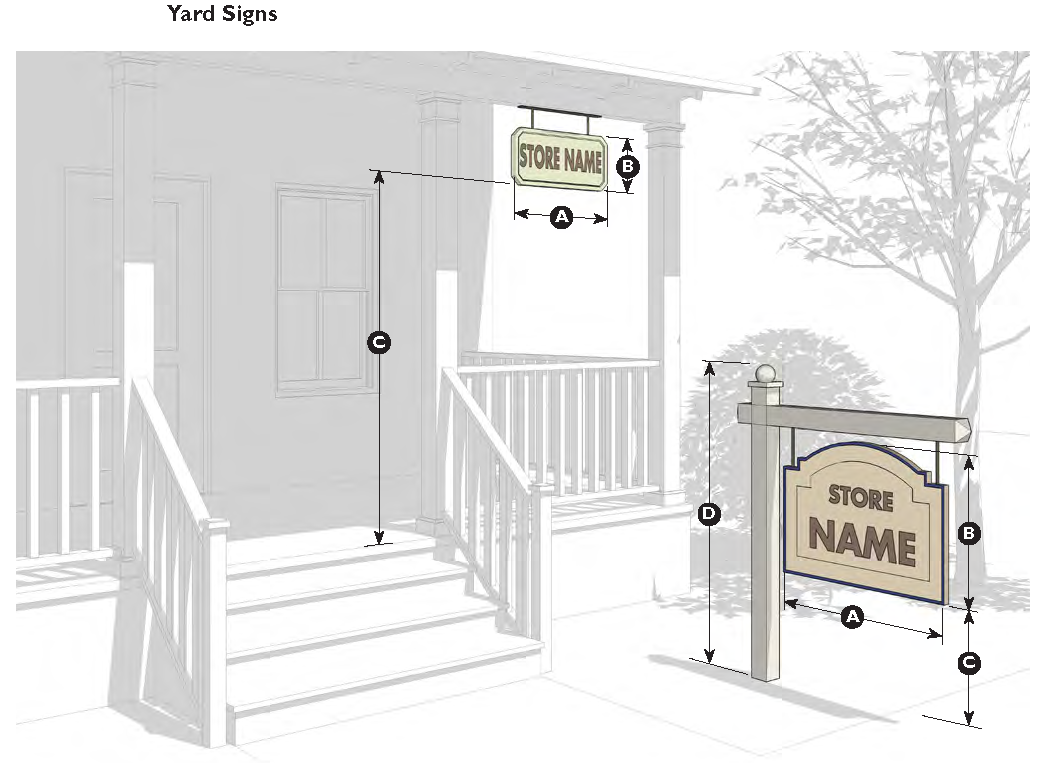
| Description | ||
| Yard signs are signs mounted on a porch or in a yard between the public ROW and the building facade. Yard signs mounted on a porch are placed parallel to the building's facade. Yard signs mounted in a yard are placed parallel or perpendicular to the ROW. | ||
| Size | ||
| Width | 36" max. | |
| Height | 36" max. | |
| Location | ||
| Clear Height | | |
| Mounted on Porch | 6'8' min. | |
| Mounted in Yard | 12" min. | |
| Overall Height | 5' max | |
| Signs per Building | ||
| Mounted on Porch | 1 max. | |
| Mounted in Yard | 1 max. | |
| Miscellaneous | ||
| Yard signs may not be located within a public ROW. | ||
| Yard mounted signs shall be parallel or perpendicular to the ROW. | ||
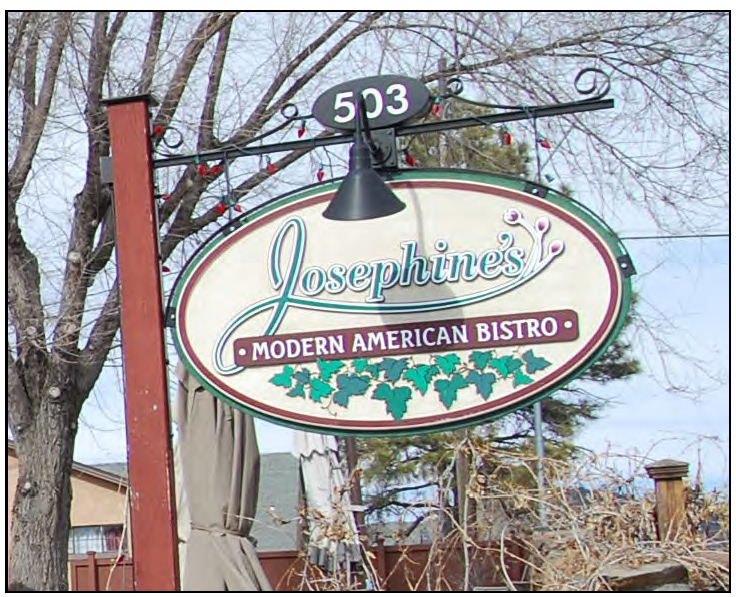
A simple yard sign advertising a small neighborhood cafe.
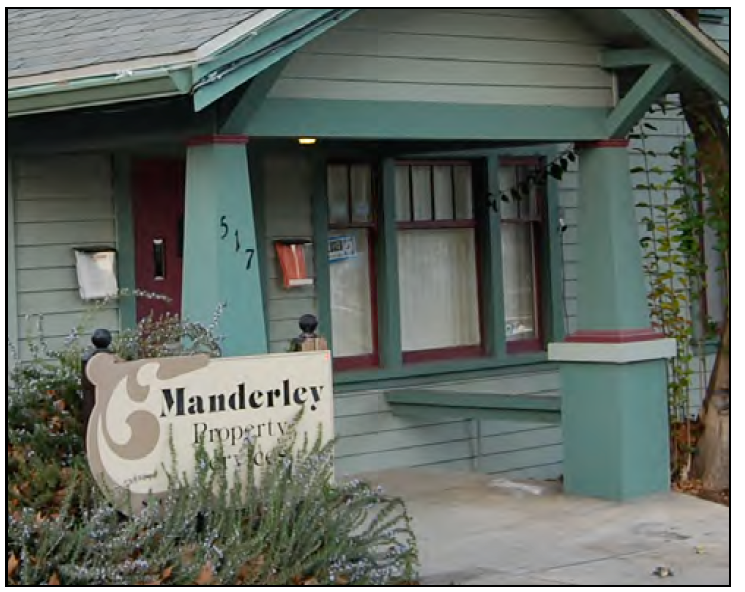
Yard Sign in front of a cottage located parallel to the ROW.
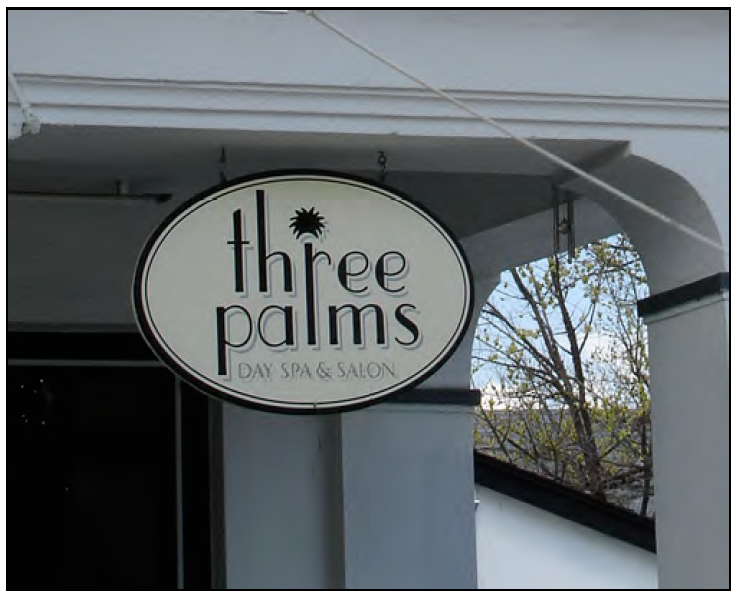
Yard Sign mounted on porch.
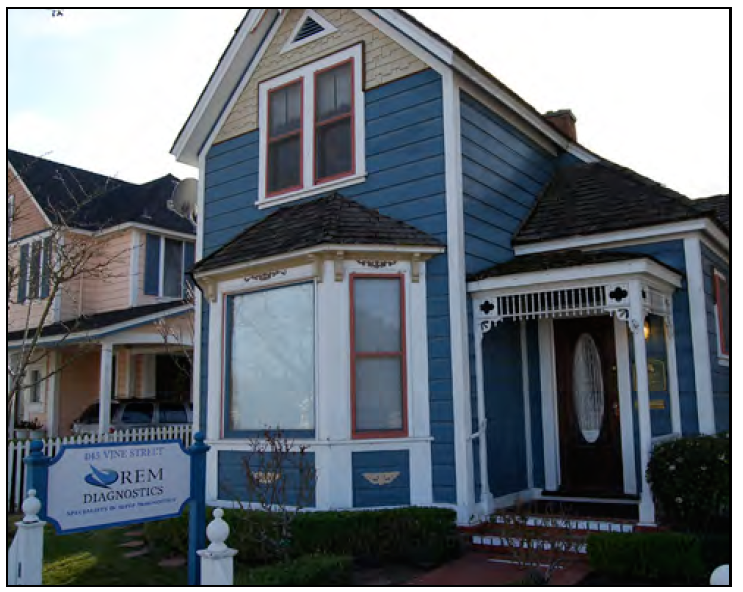
Yard sign mounted perpendicular to the ROW in a residential neighborhood.
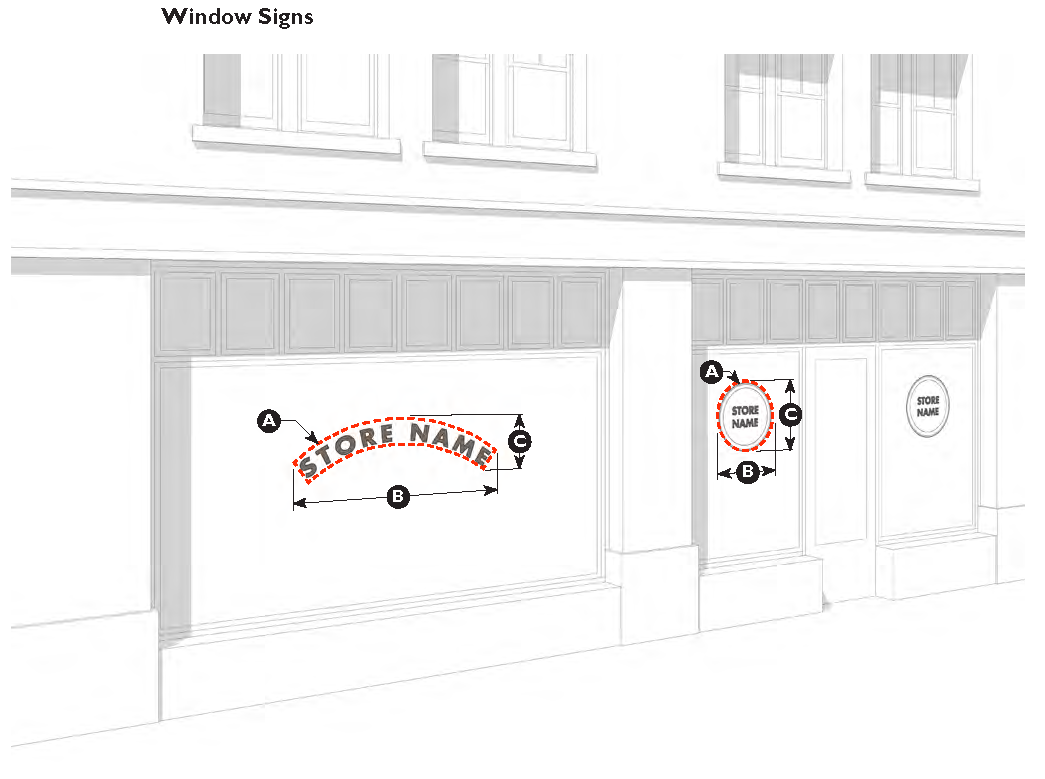
| Description | ||
| Window signs are professionally painted consisting of individual letters and designs, gold leaf individual letters and designs, applied directly on the inside of a window. Window signs offer a high level of craftsmanship and visibility, and are often used for small professional offices. Window signs are often repeated on storefronts with several divided openings, however, repetition should be done with great care to ensure that the entrance to the business is clearly marked. | ||
| Size | ||
| Sign Area | | |
| Per Shopfront Bay | 25% max. | |
| Per Shopfront | 15% max. | |
| Width | 5' max. | |
| Height | 36" max. | |
| Location | ||
| Window signs shall be placed at or above eye level. | ||
| Window signs shall be applied directly to the inside of the glass. | ||
| Miscellaneous | ||
| Applied plastic or vinyl cut letters are discouraged. | ||
| Window signs must have a clear background. | ||
Window sign examples

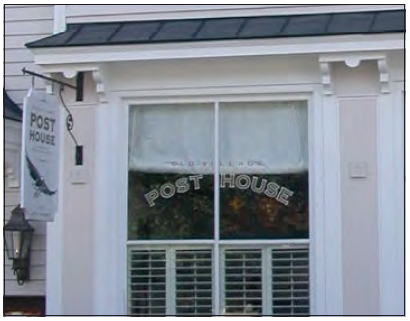

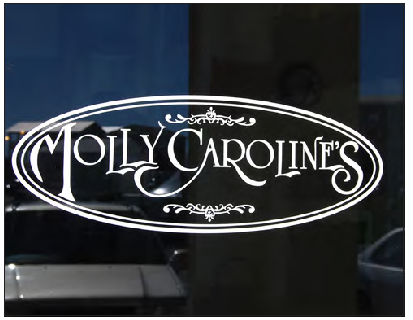

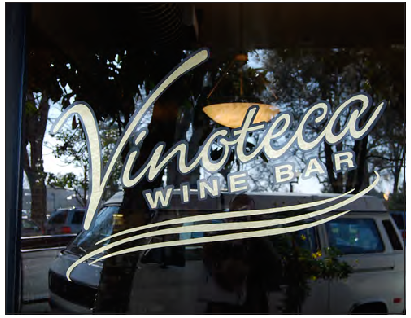
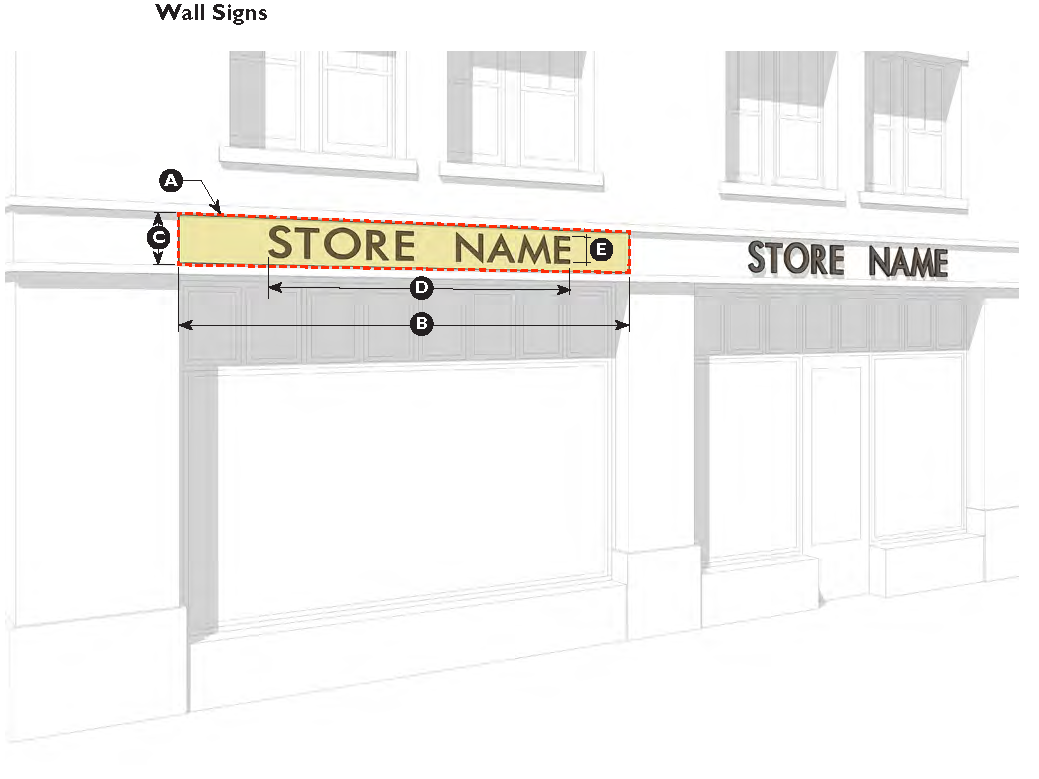
| Description | ||
| Wall signs are signs flat against the facade consisting of individual cut letters applied directly to the building, or painted directly on the surface of the building. Wall signs are placed directly above the main entrance and often run horizontally along the "expression line" or entablature of traditional buildings. Other buildings may have signage locations integrated into a decorative cornice or sign band at the top of the building, as some of the photographs illustrate. Wall signs do not protrude beyond the roof line or cornice of a building. Wall signs are typically intended to be seen from a distance and are often accompanied by additional pedestrian-scaled signage. | ||
| Size | ||
| Signable Area | ||
| Area | 1 square foot per linear foot of shopfront, max. | |
| Width | Storefront width, max. | |
| Height | 12" min.; 5' max. | |
| Lettering | ||
| Width | 75% of signable width, max. | |
| Height | 75% of signable height, max.; 36" max. | |
| Location | ||
| Projection from Facade | 8" max. | |
| Signs per Building | 1 per shopfront max. | |
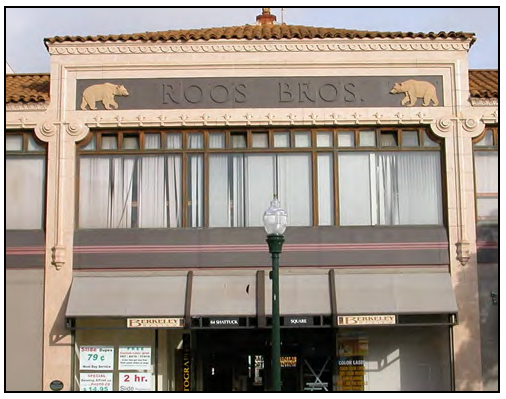
Wall sign located in entablature frieze.
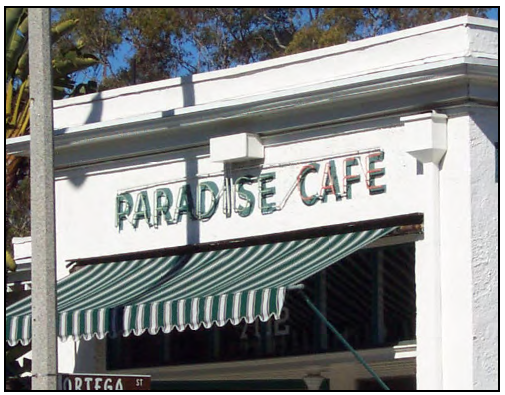
Painted wall sign with neon lettering.
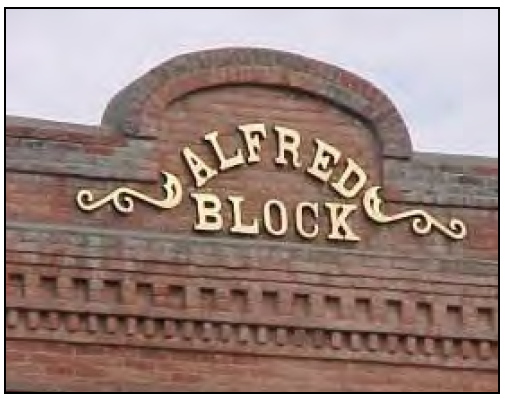
Metal wall sign.
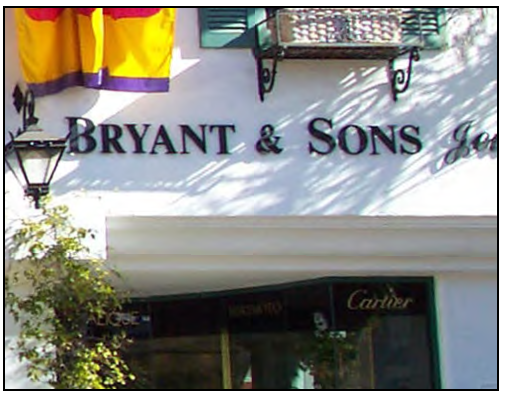
Raised wall sign.
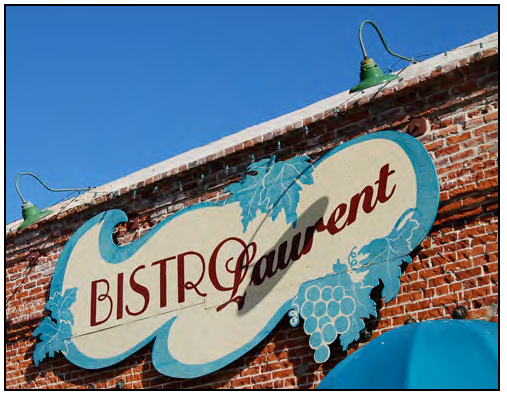
Painted wall sign applied to facade.
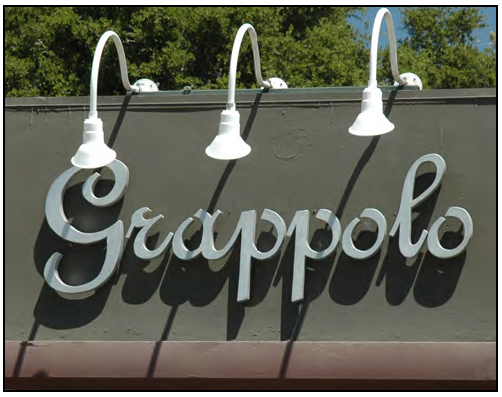
Metal wall sign, offset from building facade.
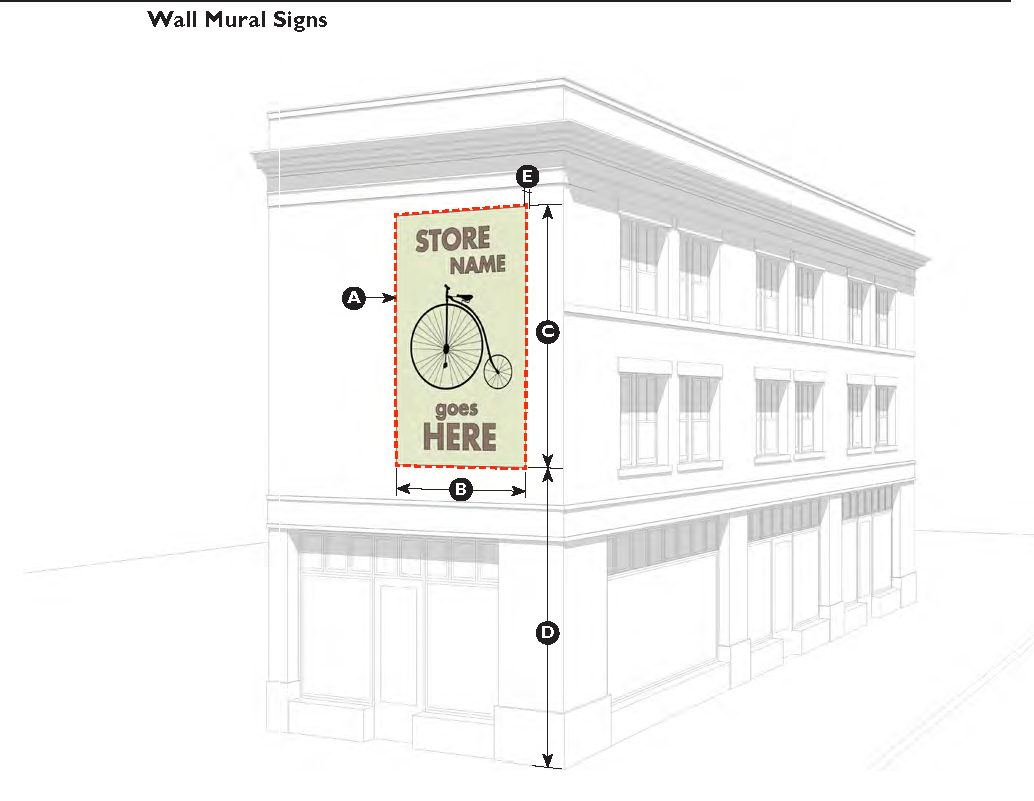
| Description | ||
| Wall mural signs are flat against the facade and are located on a secondary facade, typically along a side street, alley, or paseo. These signs are typically painted directly on the building and contain a combination of text and graphic elements. These signs are intended to be visible from a greater distance and must be accompanied by additional signage on the primary facade at the business entrance. Wall Mural signs that provide off-site signage for a business or do not provide signage for a specific business (artistic wall mural) are subject to approval by the Architectural Design Review Committee. Billboards are not considered wall mural signs and are prohibited within Transect Zones. | ||
| Size | ||
| Sign Area | 1000 sf max. | |
| Width | 200' max. | |
| Height | 50' max. | |
| Location | ||
| Height above Ground | 3' min. | |
| Projection | 8" max. | |
| Signs per Building | 1 max. | |
Painted wall murals

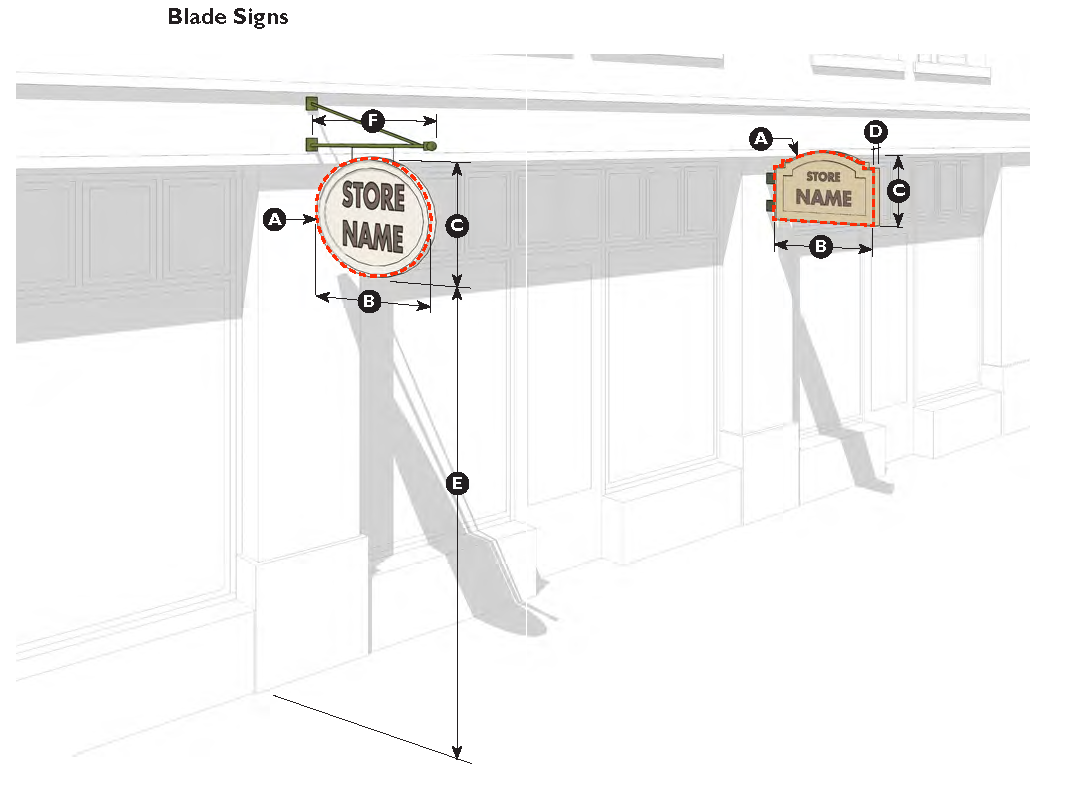
| Description | ||
| Blade signs mount perpendicular to a building's facade. They are typically hung from decorative cast or wrought iron brackets in a manner that permits them to swing slightly. These signs are small, pedestrian-scaled, and easily read from both sides. Often, a projecting sign offers the opportunity for a more creative or "playful" sign. Blade signs should be hung well out of reach of pedestrians and all exposed edges of the sign should be finished. | ||
| Size | ||
| Sign Area | 6 sf max. | |
| Width | 48" max. | |
| Height | 36" max. | |
| Thickness | 4" max. 1 | |
| 1 Special and creative signs that have a three dimensional quality may have a greater thickness subject to approval by the review authority. | ||
| Location | ||
| Clear Height | 8' min. | |
| Projection | 5' max. | |
| Signs per Building | 1 per storefront max. | |
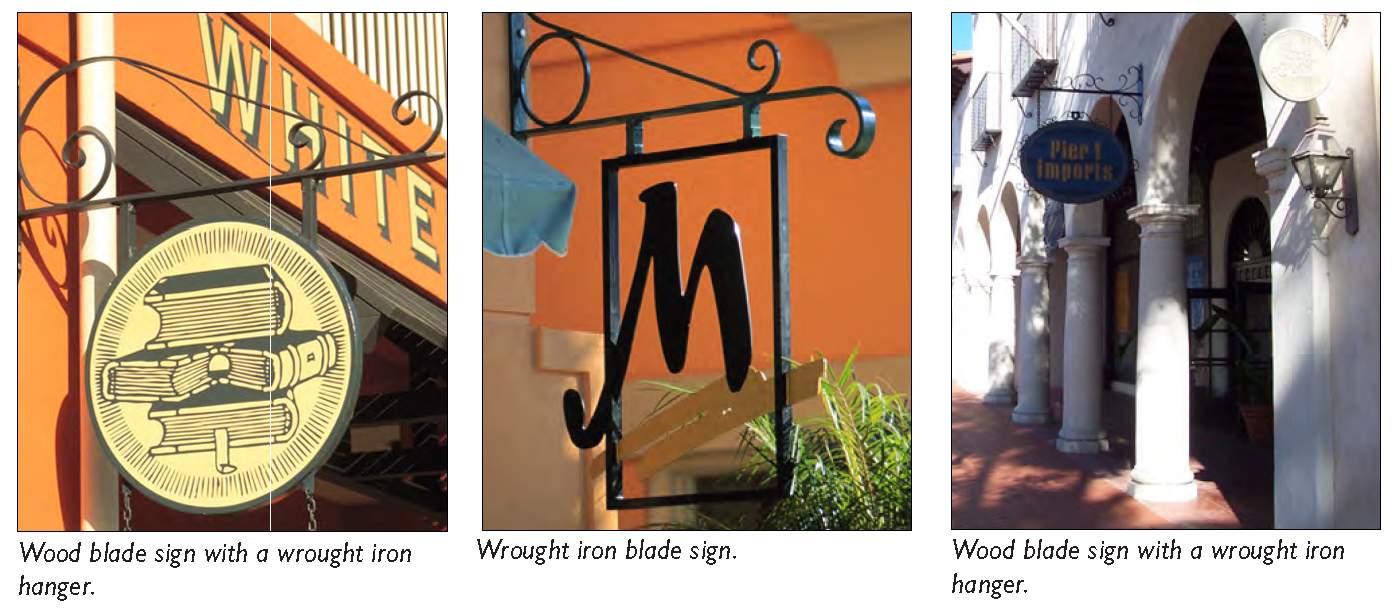
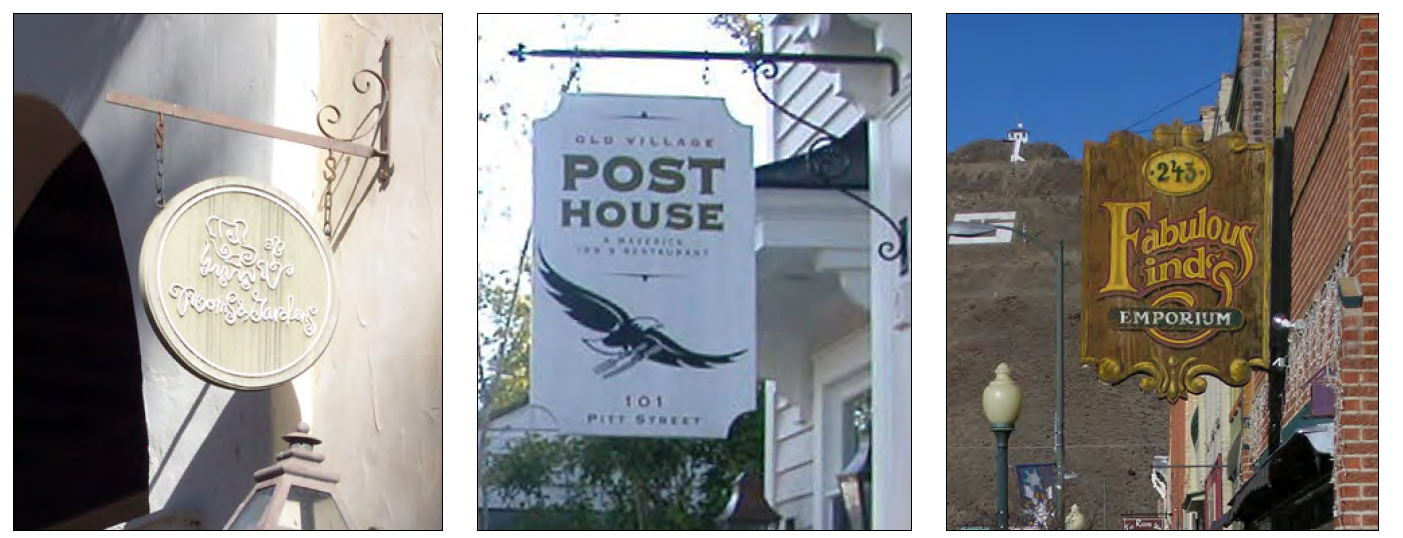
Examples of blade signs.
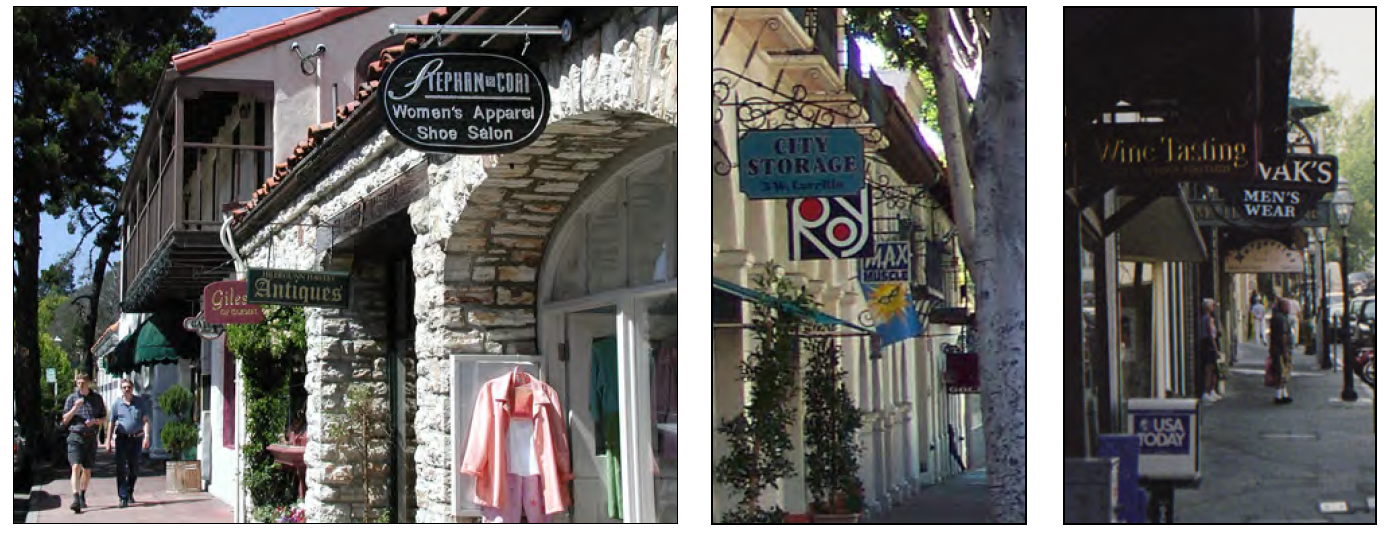
Examples of streetscapes with blade signs.
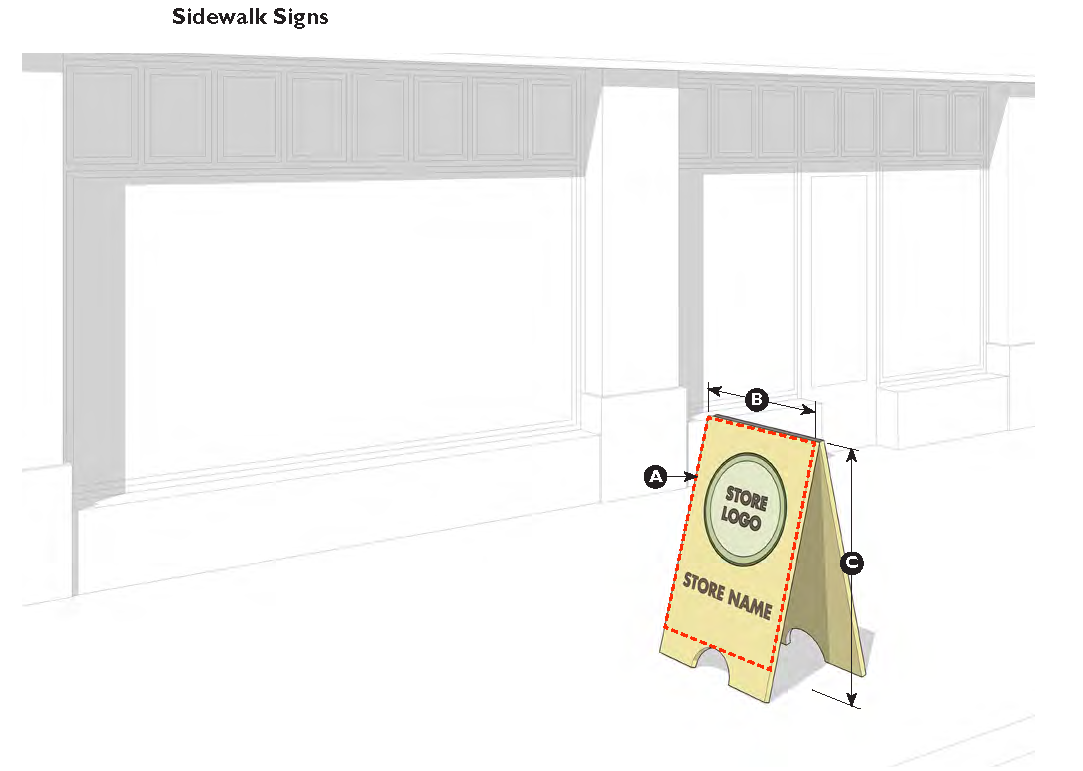
| Description | ||
| Sidewalk signs provide secondary signage and may be used to announce daily specials, sales, or point to shops off the sidewalk (i.e. a shop located along a paseo). They may be painted wood panels or cut wood shapes. Traditional slate boards are highly recommended. Chaser lights or illuminated signs may not be used. | ||
| Size | ||
| Sign Area | 6 sf max. | |
| Width | 30" max. | |
| Height | 42" max. | |
| Location | ||
| Signs per Building | 1 per storefront max. | |
| Sidewalk signs must not interfere with pedestrian travel or encroach upon the required accessible path. | ||
| Sidewalk signs may only be displayed during business hours and must be removed when the business is closed. | ||

Wood and slate sidewalk sign.
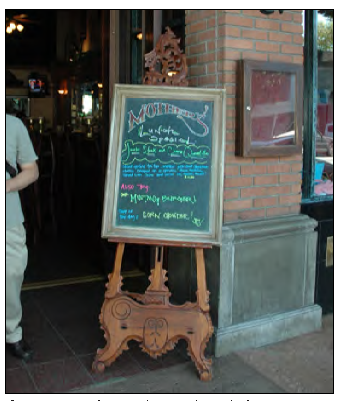
Ornamental wood stand and slate sign.
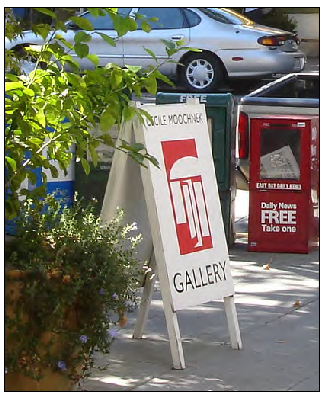
Painted wood sidewalk sign.
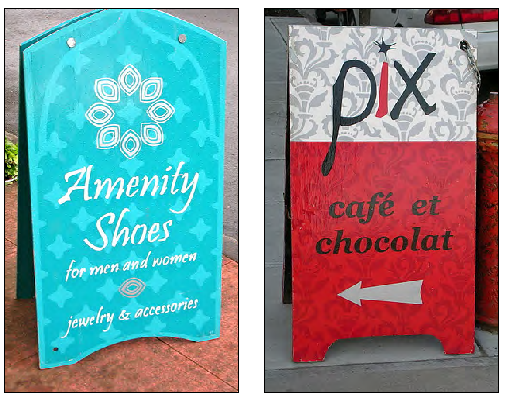
Painted sidewalk sign.
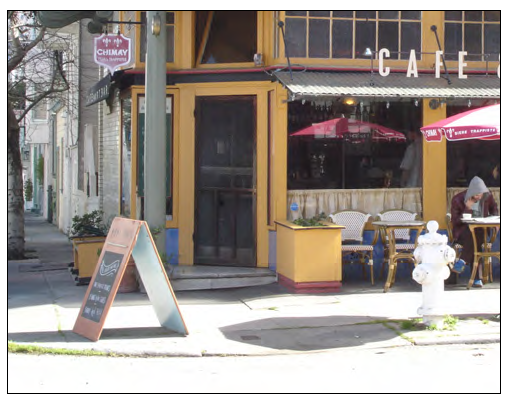
Sidewalk sign complements primary signage.
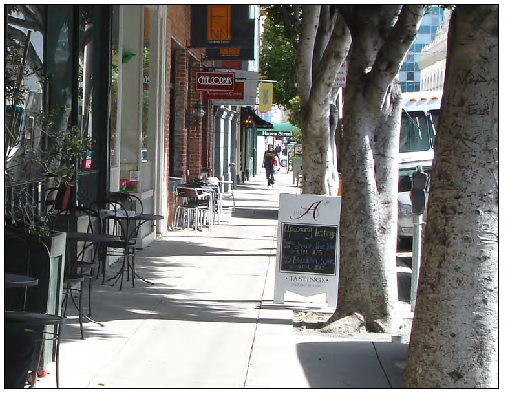
Sidewalk sign located to maintain accessible route.
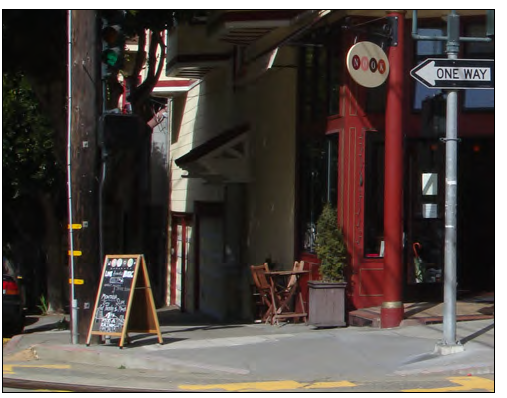
Slate sidewalk sign located on corner of intersection.
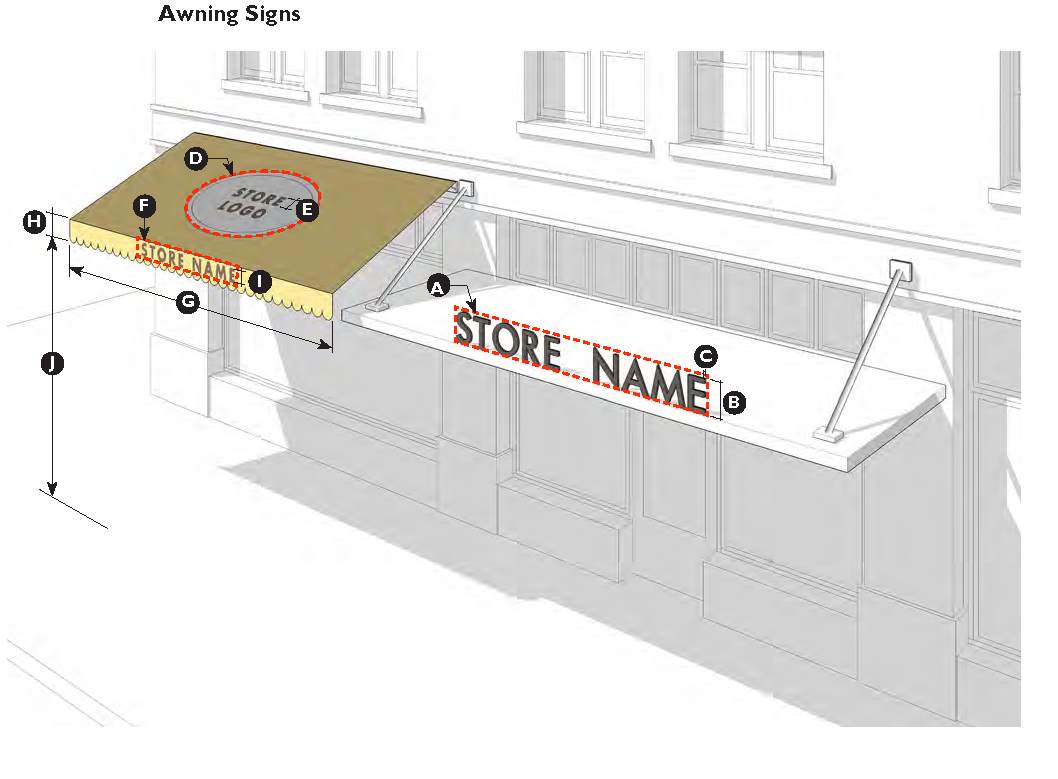
| Description | ||
| Awnings are a traditional storefront fitting and can be used to protect merchants' wares and keep storefront interiors shaded and cool in hot weather. Retail tenant signs may be painted, screen printed, or appliquéed on the awnings. | ||
| Size | ||
| Projecting | ||
| Sign Area | 1 square foot per linear foot of shopfront, max. | |
| Lettering Height | 16" max. | |
| Lettering Thickness | 6" max. | |
| Sloping Plane | ||
| Sign Area | 25% coverage max. | |
| Lettering Height | 18" max. | |
| Valance | ||
| Sign Area | 75% coverage max. | |
| Width | Storefront width, max. | |
| Height | 8" min.; 16" max. | |
| Lettering Height | 8" max. | |
| Location | ||
| Clear Height | 8' min. | |
| Signs per Awning | 1 projecting; or 1 valance and 1 sloping plane max. | |
| Miscellaneous | ||
| Only the tenant's store name, logo, and/or address should be applied to the awning. Additional information is prohibited. | ||
| Open-ended awnings are strongly encouraged. | ||
| Vinyl or plastic awnings are strongly discouraged. | ||
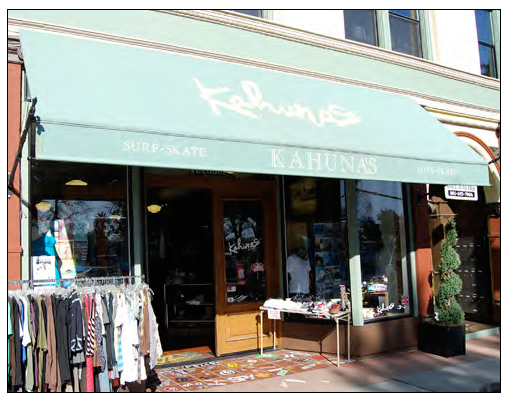
Awning with valance and sloping pane signage.
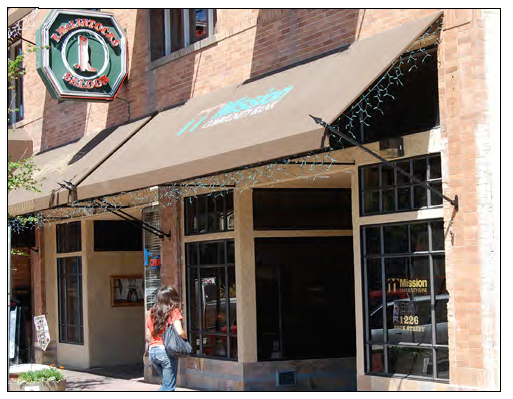
Awning with decorative supports and open end.
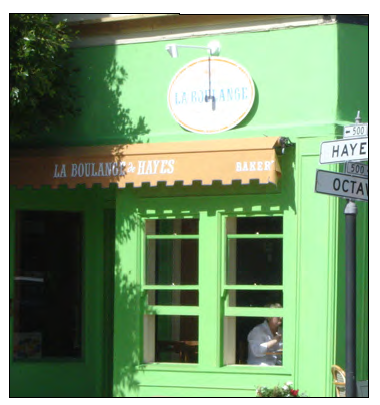
Retractable awning.
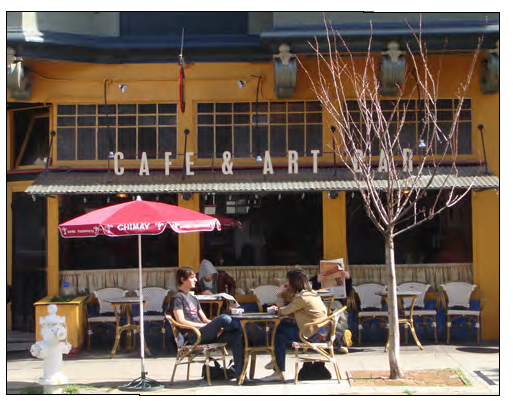
Projecting signage on a metal awning.
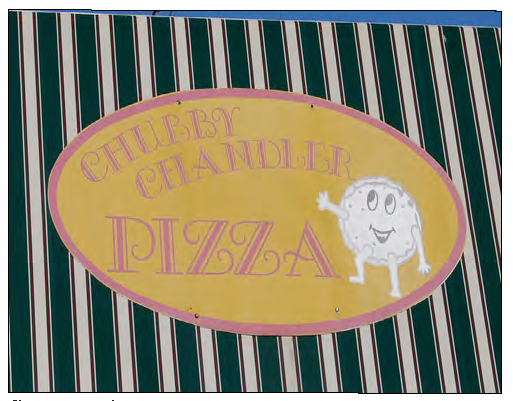
Sloping panel signage on awning.
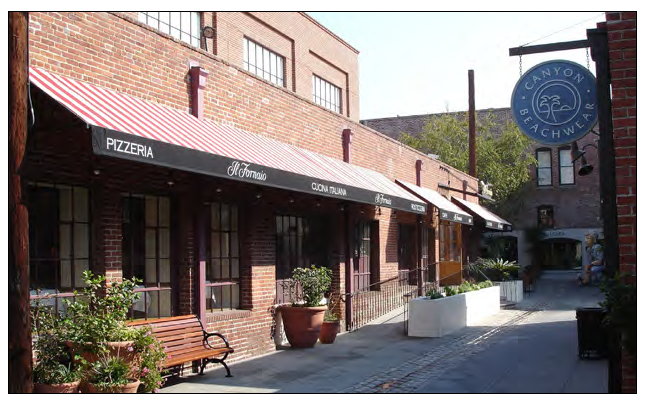
Series of awnings along a frontage.
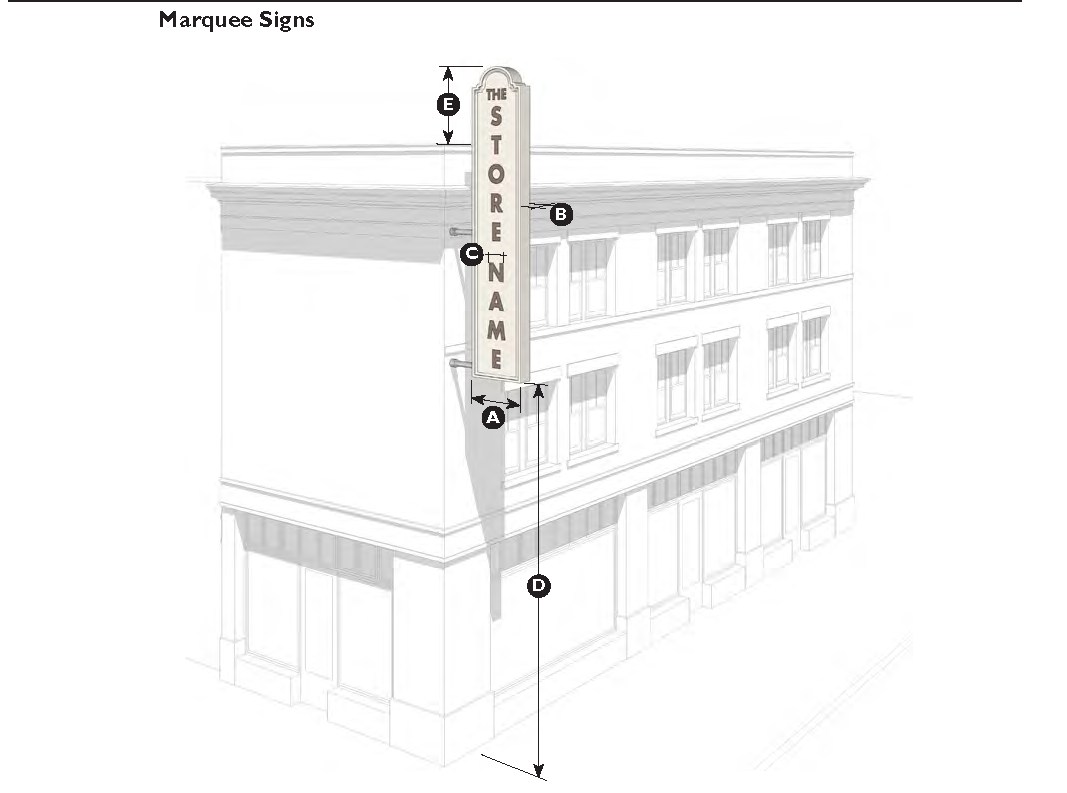
| Description | ||
| Marquee signs are vertical signs that are located either along the face where they project perpendicular to the facade; or at the corner of the building where they project at 45 degree angle. Marquee signs often extend beyond the parapet of the building, but may also terminate below the cornice or eave. Marquee signs often have neon lettering used in conjunction with painted lettering. | ||
| Size | ||
| Width | 6 max. | |
| Height | 24" max. | |
| Lettering Width | 75% of sign width max. | |
| Location | ||
| Clear Height | 12' min. | |
| Extension | 10' max. 1 | |
| Signs per Building | 1 max. | |
| 1 Marquee signs may not extend beyond the eave of a pitched roof | ||
| Miscellaneous | ||
| Neon lettering may only be used in conjunction with painted lettering; signs consisting only of neon lettering are not permitted. | ||
| This signage type should be used sparingly and should not be repeated along a frontage. | ||
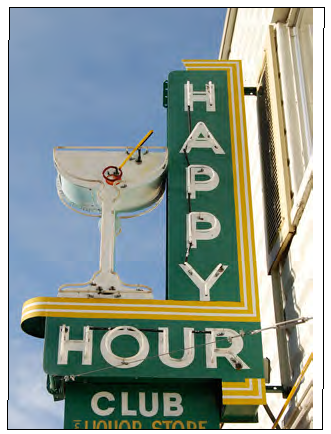
Marquee sign combining text and graphics.
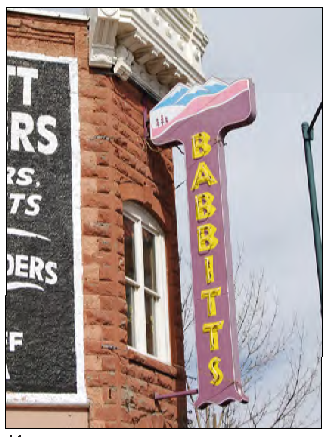
Marquee sign.
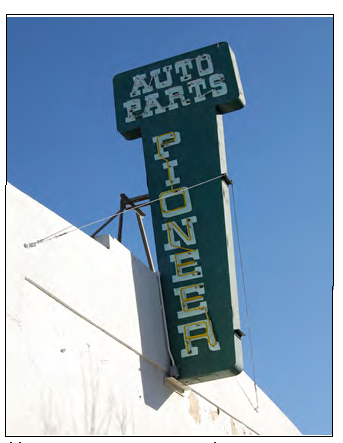
Marquee sign projecting above parapet.
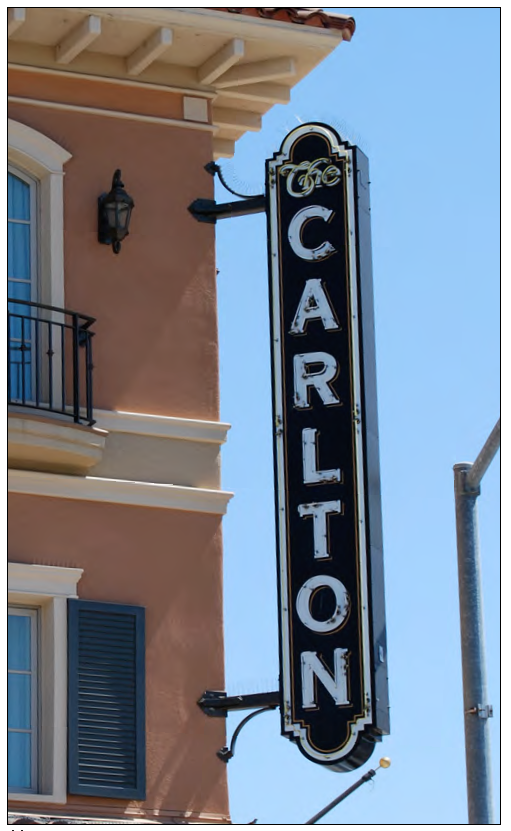
Marquee sign at corner terminating at eave.
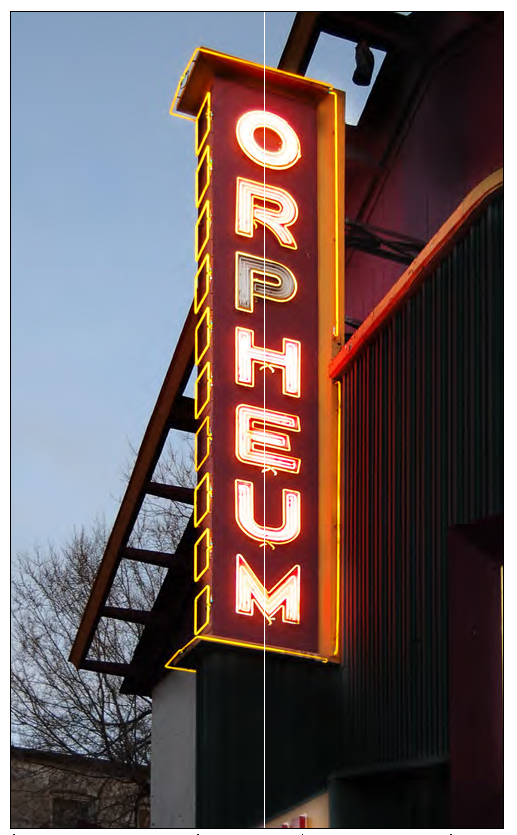
Lit marquee sign; neon lettering used in conjunction with painted lettering.
(Ord. No. 2015-10, § 1(Exh. A), 9-16-2015; Ord. No. 2024-07, § 1, 12-18-2024)
17.42.125 - Sign Location Requirements.
A.
Each sign shall be located on the same site as the subject of the sign, except for roof and alley/passage signs used for off-premise signage in a location approved by the Director per the requirements of this Code.
B.
Each sign shall comply with the allowed encroachments of the transect zone in which the sign is located.
C.
No sign shall be placed so as to interfere with the operation of a door or window.
D.
No sign shall be placed so that they cover prominent architectural features of the building.
E.
Any sign installed or placed within the public right-of-way other than in compliance with this Section may be forfeited to the public and be subject to confiscation.
(Ord. No. 2015-10, § 1(Exh. A), 9-16-2015; Ord. No. 2024-07, § 1, 12-18-2024)
17.42.126 - Sign Design.
The following criteria shall be used in reviewing the design of individual signs. Compliance with each of the following design criteria shall be required before a sign permit can be approved.
A.
Colors on signs and structural members should be harmonious with one another and relate to the dominant colors of the buildings on the site. Contrasting colors may be utilized if the overall effect of the sign is still compatible with the building colors.
B.
The design and construction of signs shall adhere to the following criteria:
1.
Except for sidewalk signs, banners, flags, temporary signs, and temporary window signs conforming with the requirements of this Code, each sign shall be constructed of permanent materials and shall be permanently attached to the ground, building or another structure by direct attachment to a rigid wall, frame, or structure.
2.
Each permanent sign shall be designed by a professional (e.g. architect, building designer, landscape architect, interior designer, or others whose principal business is the design, manufacture, or sale of signs), or who are capable of producing professional results.
3.
Each permanent sign shall be constructed by persons whose principal business is building construction or a related trade including sign manufacturing and installation, or others capable of producing professional results. The intent is to ensure public safety, achieve signs of careful construction, have neat and readable copy, and have durability, to reduce maintenance and prevent dilapidation.
4.
Vinyl banner signs may not be used as permanent signage.
C.
The materials and structure of signs shall adhere to the following criteria:
1.
Sign materials (including framing and supports) shall be representative of the type and scale of materials used on the site where the sign is located. Sign materials shall match those used on the buildings on the site and any other signs on the site.
2.
No sign shall include reflective material.
3.
Materials for permanent signs shall be durable and capable of withstanding weathering over the life of the sign with reasonable maintenance.
4.
The size of the structural members (e.g. columns, crossbeams, and braces) shall be proportional to the sign panel they are supporting.
5.
The use of individual letters incorporated into the building design is encouraged, rather than a sign with background and framing other than the structure of the wall.
D.
The City does not regulate the message content (copy) of signs; however, the following are principles of copy design and layout that can enhance the readability and attractiveness of signs. Copy design and layout consistent with these principles is encouraged, but not required.
1.
Sign copy should relate only to the name and/or nature of the business or building.
2.
Permanent signs that advertise information such as continuous sales, special prices, or include phone numbers should be avoided. Information should be conveyed briefly or by logo, symbol or other graphic manner. The intent should be to increase the readability of the sign and thereby enhance the identity of the business.
3.
Sign lighting shall be designed to minimize light and glare on surrounding rights-of-way and properties and adhere to the following criteria:
a.
External light sources shall be directed and shielded so that they do not produce glare off the site, or on any object other than the sign.
b.
Signs that blink, flash, flutter, or change light intensity, brightness, or color are not allowed.
c.
Neither the direct nor reflected light from primary light sources shall create hazards for pedestrians or operators of motor vehicles.
d.
For energy conservation, light sources shall be hard-wired fluorescent or compact fluorescent lamps, or other lighting technology that is of equal or greater energy efficiency. Incandescent lamps are prohibited.
(Ord. No. 2015-10, § 1(Exh. A), 9-16-2015; Ord. No. 2024-07, § 1, 12-18-2024)
17.42.127 - Temporary Signs.
Temporary Signs, such as banners or posters placed along a commercial frontage or displayed within a shopfront are allowed provided they are in compliance with the following design criteria:
A.
Temporary signs may only be used to announce an upcoming or occurring event/sale and must be removed upon the conclusion of the event.
B.
Temporary banners may be displayed for a maximum of 30 days.
C.
Temporary posters may be displayed for a maximum of 60 days.
D.
The combined area of any signage within a shopfront (temporary and permanent) may not exceed 20% of total shopfront area.
E.
A Temporary banner placed within the public ROW must provide a minimum clear height of eight feet.
F.
Temporary signage must be in clean and good repair.
G.
Political campaign signs must comply with Municipal Code 17.56.040.B.8.
(Ord. No. 2015-10, § 1(Exh. A), 9-16-2015; Ord. No. 2024-07, § 1, 12-18-2024)
17.42.131 - Applicability.
A.
The following architectural standards and guidelines achieve the architectural theme of a "Swedish Village" for the Downtown Form Based Code area. Rather than providing a strict set of standards that preclude innovation and creativity in achieving the Swedish Village concept, these standards and guidelines establish parameters by which the Architectural Design Review Committee can judge the acceptability of a given proposal with respect to the Swedish Village Concept. Design review provisions of this Section shall apply to any permitted or conditional use that requires Planning Commission review other than single-family dwellings or multiple-family dwellings of no more than two units. There shall be no exceptions to such application except as may be granted for historic structures designated by resolution of the City Council.
B.
Exemptions. Structures designated as historic shall be exempt from these standards and guidelines. Exemptions shall be made for all structures which have been officially designated on the National Register of Historic Places or which are designated as a Registered Historical Landmark by the State of California. Exemptions may also be designated by the City Council upon the advice of the Kingsburg Historical Society. The City Council shall maintain a Master List of Historic Structures exempt from these standards and guidelines. For purposes of City designations, only structures which meet the criteria below will be eligible for consideration by the City Council:
1.
A structure may be designated a Local Architectural Landmark if it is a prototype or an outstanding example of a period, style, architectural movement or method of construction, or if it is a notable work or the best surviving work of a pioneer architect, designer or master builder.
2.
An architectural landmark generally will be considered only on its original site if its significance is basically derived from its design relationship to its site.
3.
A reconstructed or extensively rehabilitated building generally will not be considered unless no other authentic structure of its type survives within the community.
4.
Local Architectural Landmarks achieving recognition since 1940 will be considered only if they possess exceptional design merit of transcendent significance.
5.
The site must be visibly accessible to the public.
6.
Only the exterior walls, roof and other exterior features of a structure shall be subject to the application of these criteria. Interiors may be modified as necessary to accommodate approved uses or changes.
(Ord. No. 2015-10, § 1(Exh. A), 9-16-2015; Ord. No. 2024-07, § 1, 12-18-2024)
17.42.132 - Purpose and Organization.
Standards and guidelines contained in Table 17.42.J provide guidance with regards to architectural character, quality, and aesthetics and are summarized as follows:
A.
General to Swedish Village Design. These guidelines describe different approaches to Swedish architectural expression that applicants may utilize and establish a range of acceptable precedents appropriate to the Swedish Village.
B.
General Massing and Roofs. These standards and guidelines describe different techniques for building massing, including approaches to bases and foundations, wall treatments, and roof forms and orientations.
C.
Openings (Windows and Doors). These standards and guidelines describe different approaches to facade composition, and appropriate placement, proportion, and treatments for windows, doors, and storefronts.
D.
Exterior Elements. These standards and guidelines describe different approaches to important exterior elements, including balconies, awnings, light fixtures, and planter boxes.
E.
Colors and Materials. These standards and guidelines describe the range of exterior colors and materials that are appropriate and acceptable.
Table 17.42.J Swedish Village Standards and Guidelines
Swedish Village Style
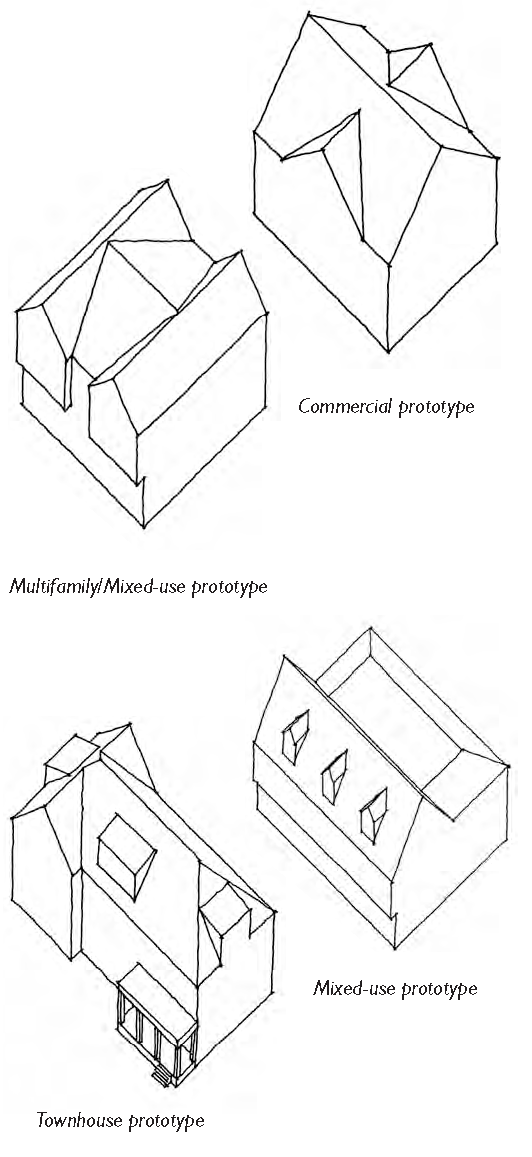
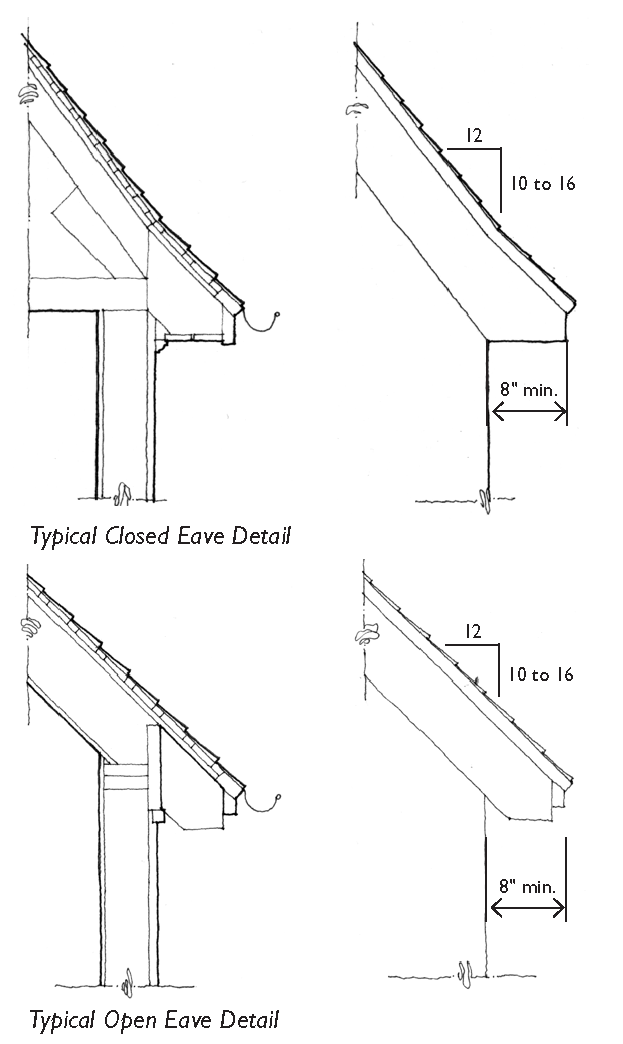
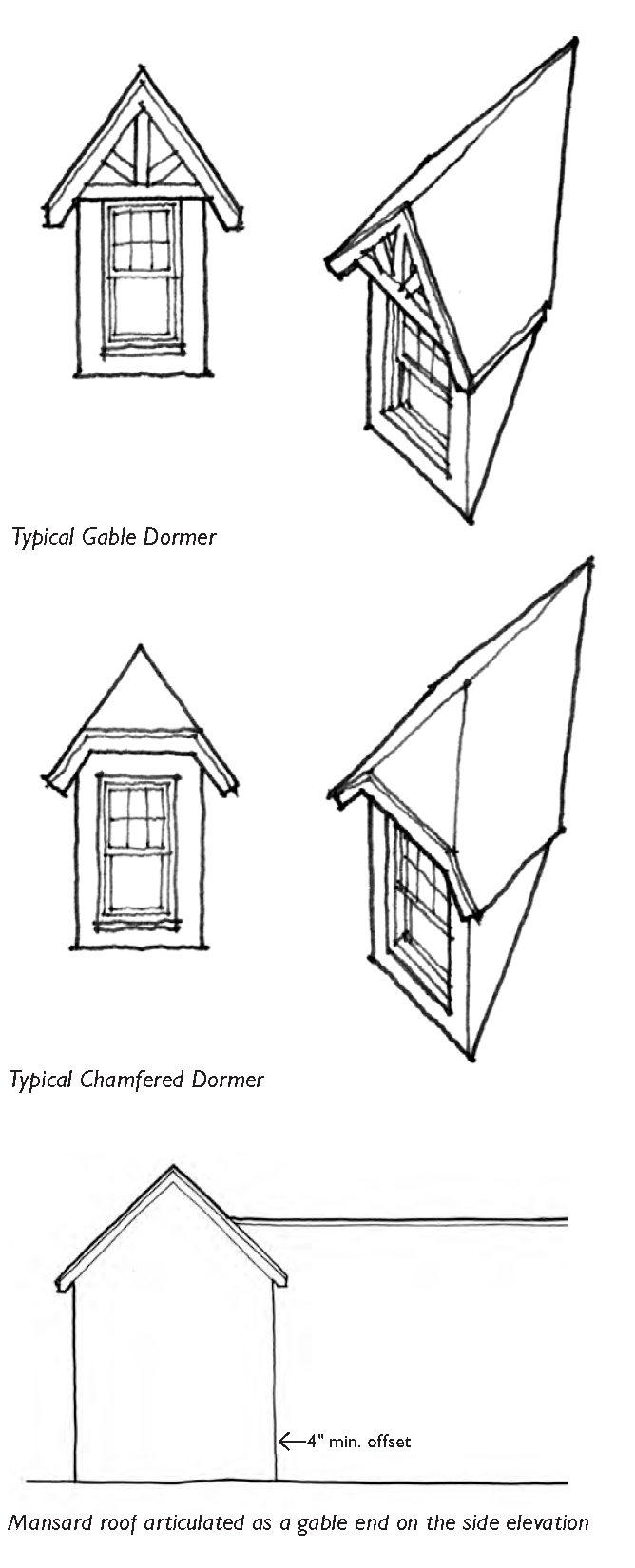
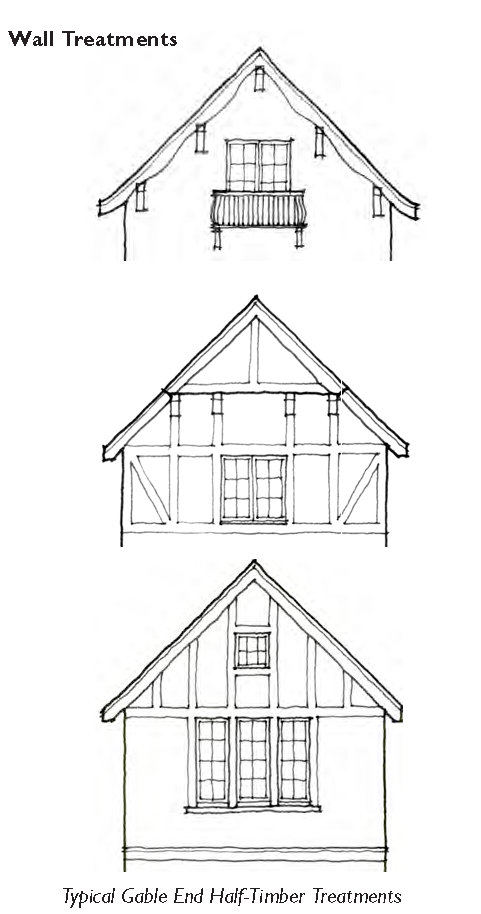
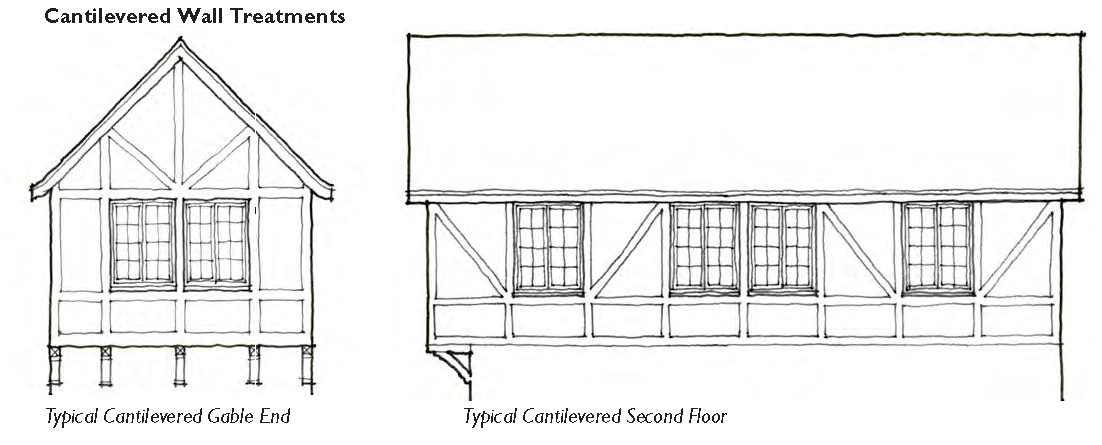
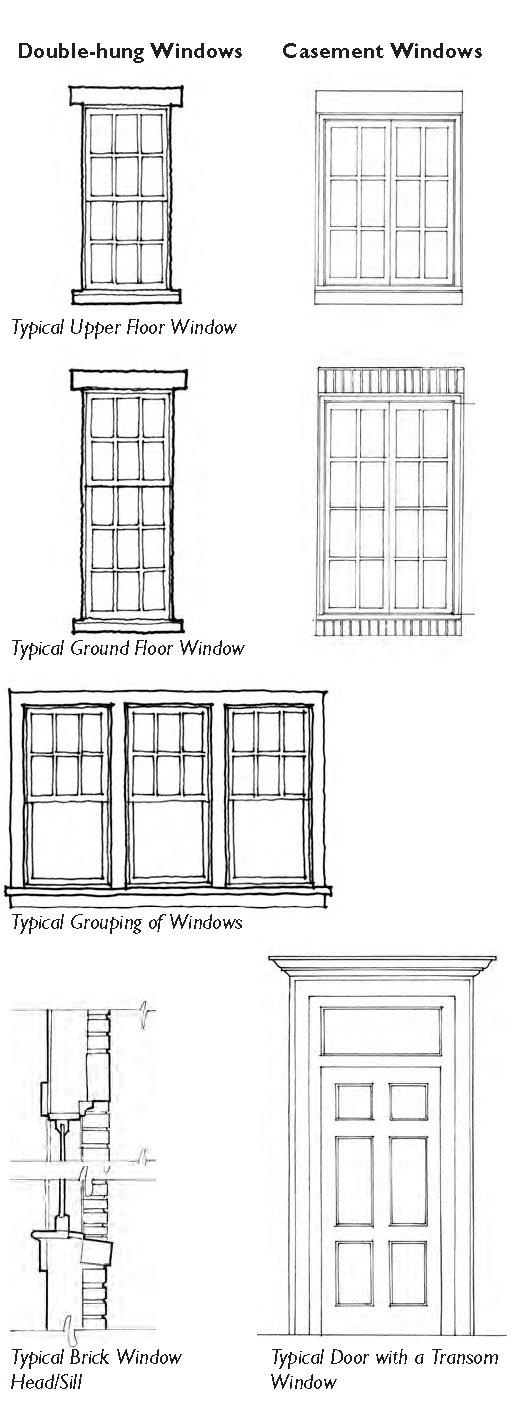
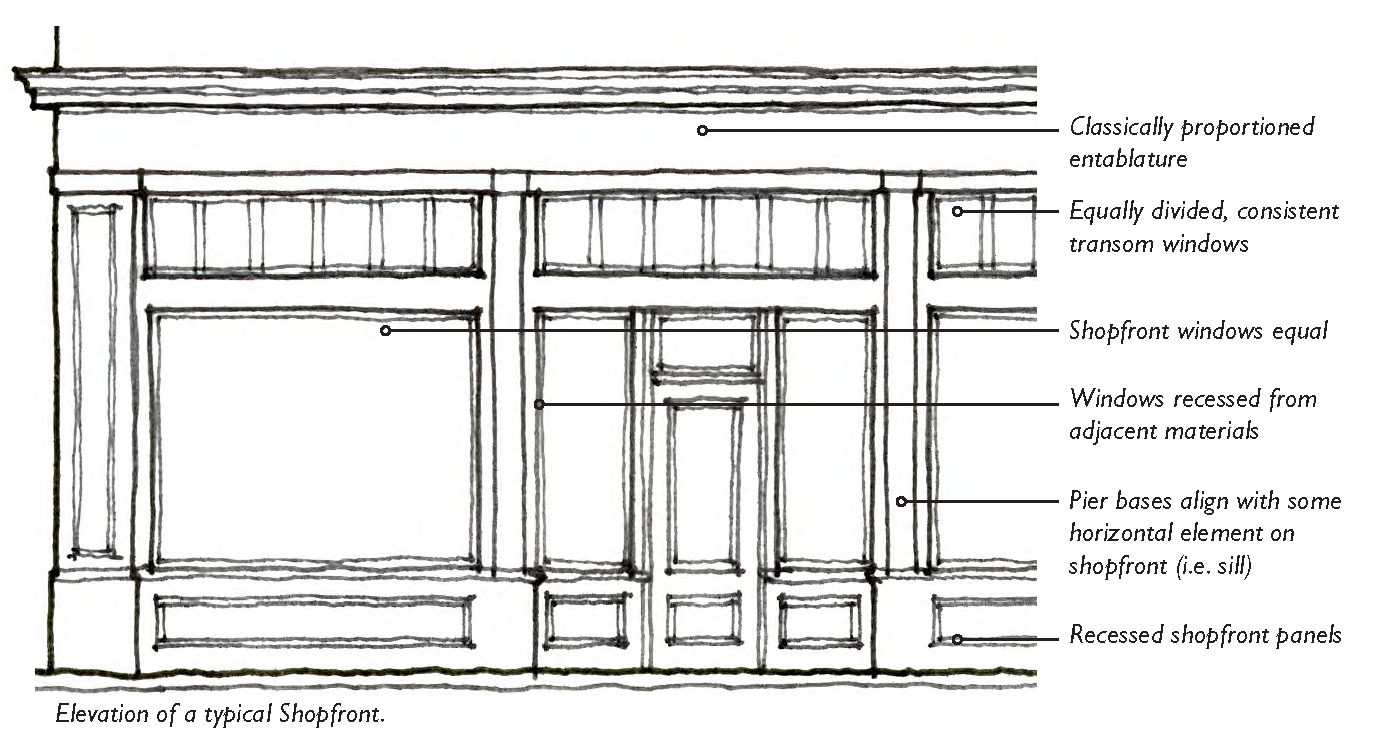
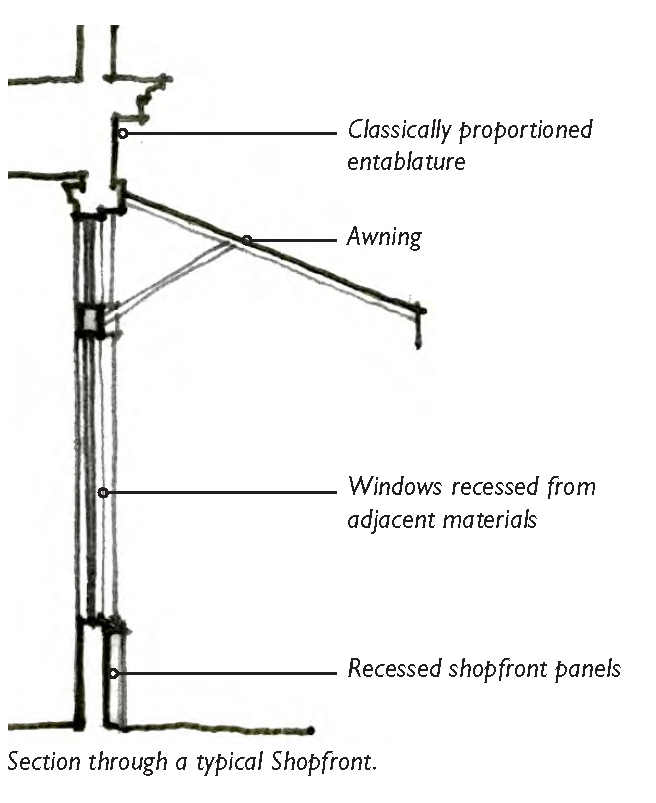
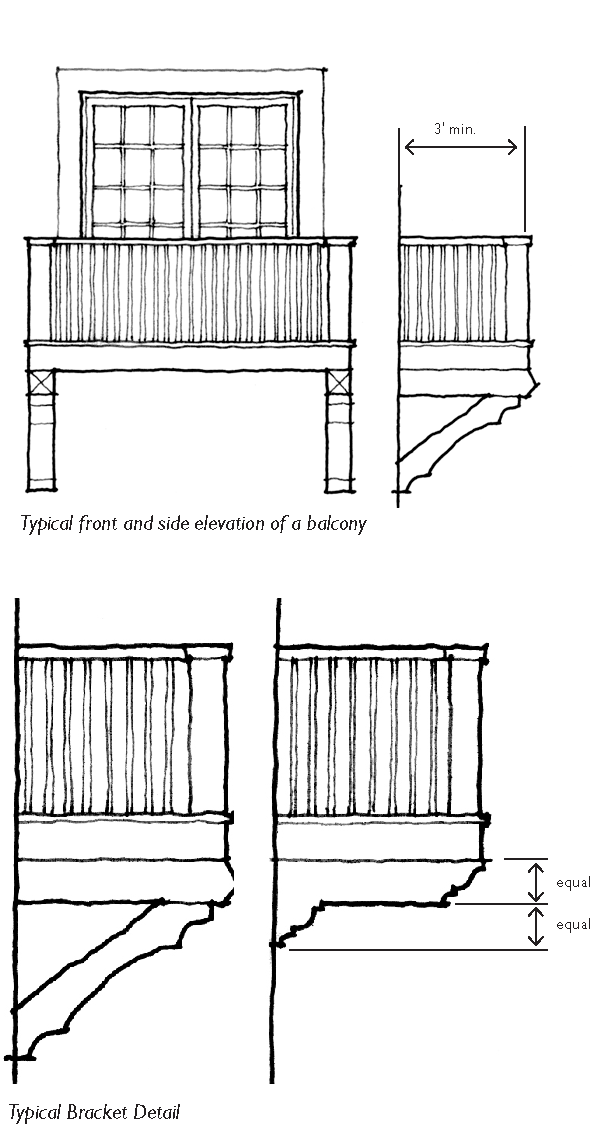
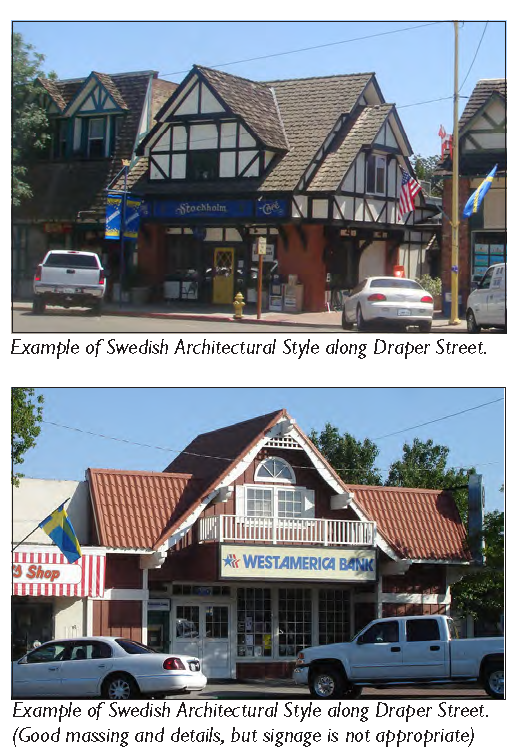
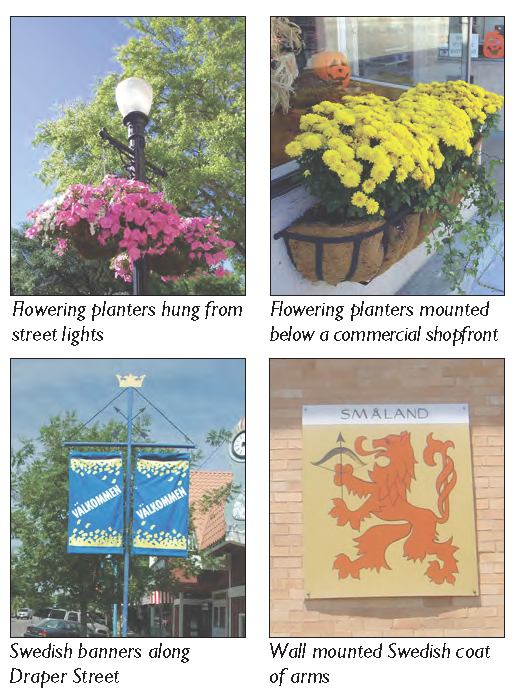
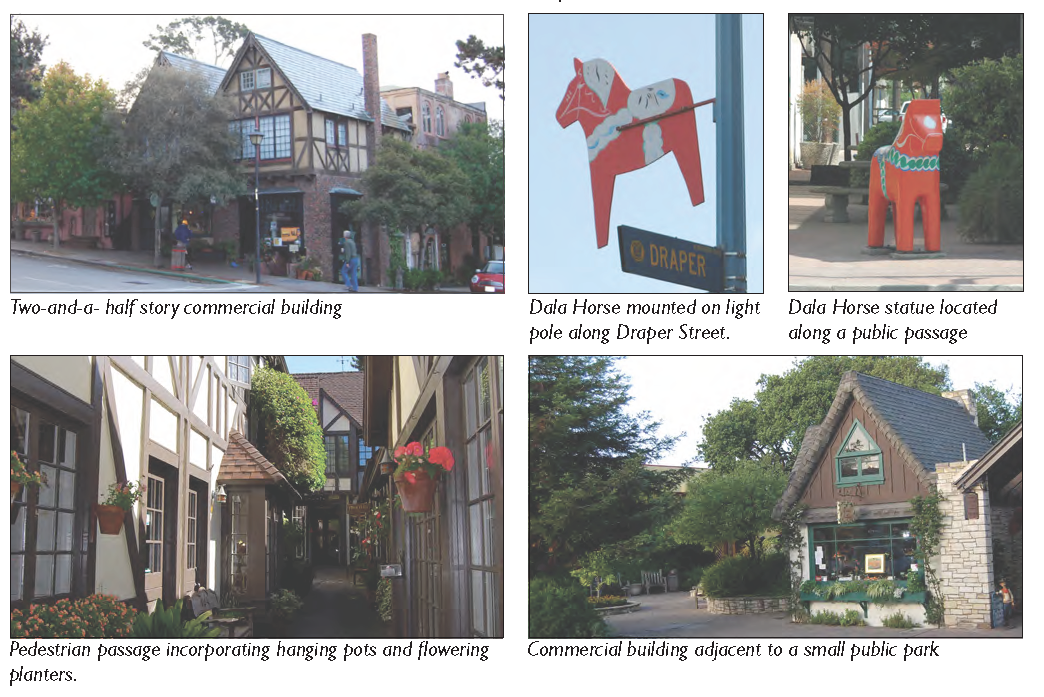
(Ord. No. 2015-10, § 1(Exh. A), 9-16-2015; Ord. No. 2024-07, § 1, 12-18-2024)
17.42.141 - Applicability.
A.
Table 17.42.K describes frontage, planting and lighting components approved for the development of roadways in the Downtown Form Based Code area. Where these standards conflict with the City's adopted "Improvement Standards", the standards of this Section shall prevail.
B.
Additional standards can be integrated as they are approved by the City.
(Ord. No. 2015-10, § 1(Exh. A), 9-16-2015; Ord. No. 2024-07, § 1, 12-18-2024)
17.42.142 - Public Frontages.
A.
General to All Transect Zones.
1.
The public frontage contributes to the character of the transect zone, and includes the types of sidewalk, curb, planter, and street trees.
2.
Within the public frontages, the prescribed types of public planting and public lighting may be adjusted with the approval of the Director to accommodate specific site conditions.
B.
Specific to Transect Zones FBC 1, FBC 2, FBC 3.
1.
The introduced landscape shall consist primarily of durable species tolerant of soil compaction.
C.
Specific to Transect Zones FBC 1.
1.
The public frontage shall include trees planted in a regularly-spaced pattern of single or alternated species with shade canopies of a height that, at maturity, clears at least one story.
D.
Specific to Transect Zones FBC 2, FBC 3.
1.
The public frontage shall include trees planted in a regularly-spaced pattern of single species with shade canopies of a height that, at maturity, clears at least one story. At retail frontages, the spacing of the trees may be irregular, to avoid visually obscuring the shopfronts.
Table 17.42.K Roadway Standards
Public Frontage Types
The public frontage is the area between the curb of the vehicular lanes and the Property Line/ROW. Dimensions are provided in Table F (Public Frontage Standards).
| Public Frontage Type |  | Transect Zone |
|---|---|---|
| (ST) For Street. The For Street Frontage has raised curbs drained by inlets and sidewalks separated from the vehicular lanes by individual or continuous planters. The landscaping consists of street trees of a single or alternating species aligned in a regularly spaced allee. 1 | 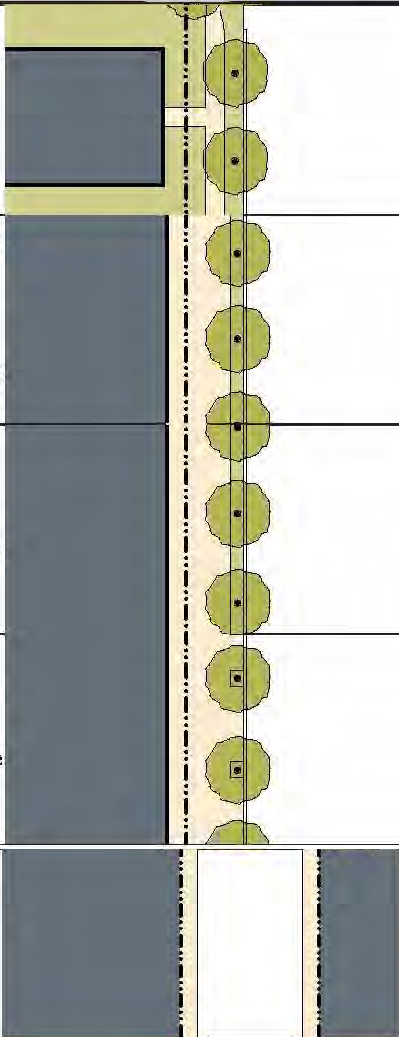 |
All
FBC Zones |
| (DR) For Drive. The For Drive Frontage has raised curbs drained by inlets and a wide sidewalk or paved path along one side, related to a Civic Space. it is separated from the vehicular lanes by individual or continuous planters. The landscaping consists of street trees of a single or alternating species aligned in a regularly spaced allee. |
All
FBC Zones | |
| (AV) For Avenue. The Avenue Frontage has raised curbs drained by inlets and wide sidewalks separated from the vehicular lanes by a narrow continuous planter with parking on both sides. The landscaping consists of a single tree species aligned in a regularly spaced alley. |
All
FBC Zones | |
| (CS) For Commercial Street or Avenue. The For Commercial Street or Avenue Frontage has raised curbs drained by inlets and very wide sidewalks along both sides separated from the vehicular lanes by separate tree wells with grates. The landscaping consists of a single tree species aligned with regular spacing where possible. |
All
FBC Zones | |
| (RA) For Rear Alley. The Rear Alley Frontage is located to the rear of lots. It consists of a paved surface and ribbon curb at the edges adjacent to property lines or buildings. Alleys are typically not landscaped. |
All
FBC Zones |
Public Frontage Standards
This table assembles prescriptions and dimensions for the public frontage elements-curbs, walkways, and planters-relative to specific frontage types within transect zones. The Assembly row assembles all of the elements for the various frontage types.
| Transect Zone | All FBC Zones | All FBC Zones | All FBC Zones | FBC 1 |
|---|---|---|---|---|
| Public Frontage Type | ST-DR-AV-BV | CS-DR-AV-BV | CS-DR-AV-BV | ST-DR-AV-BV |
| Assembly: The principal variables are the type and dimension of curbs, walkways, planters and landscape. |  | |||
| Total Width | 12'—16' | 12'—19' | 12'—30' | 10'—17' |
| Curb: The detailing of the edge of the vehicular pavement, incorporating drainage. |  | |||
| Type | Raised Curb | Raised Curb | Raised Curb | Raised Curb |
| Walkway: The pavement dedicated exclusively to pedestrian activity. |  | |||
| Type | Sidewalk | Sidewalk | Sidewalk | Sidewalk |
| Width | 6' min. | 7' min. | 12' min. | 5' min. |
| Planter: The layer which accommodates street trees and other landscape |  | |||
| Arrangement | Regular | Regular | Opportunistic | Regular |
| Species | Single/Alternating | Single | Single | Multiple |
| Type | Continuous Planter | Continuous Planter | Tree Well | Continuous Planter |
| Width | 5' min. | 5' min. | 4'—6' (tree wells located within Walkway width) | 5' min. |
Public Planting
This table shows common street tree types and their appropriateness within the transect zones. The City of Kingsburg Comprehensive Street Tree Planting Guide and Street Tree List provides additional information with regards to locating, spacing, selecting, preparing, and maintaining street trees. The City of Kingsburg Engineering Design and Construction Standards and Specifications for New Construction provides detailed specifications for landscaping along thoroughfares. Trees designated with a (*) should be used sparingly as street trees.
| Standards | Illustration | Recommended Species |
|
All FBC Zones
Tree Shape: Oval Placement: Spacing 20'—35' o.c. |  | Chinese Elm, Chinese Pistache, Southern Live Oak, Southern Magnolia, Maidenhair Tree*, Sweet Gum (Fruitless), Golden Rain tree, Japanese Blueberry Tree |
|
All FBC Zones
Tree Shape: Ball Placement: Spacing 20'—30' o.c. |  | Camphor Tree, Chinese Hackberry, Crape Myrtle, Eastern Redbud, Olive (Fruitless), Sawleaf Zelkova, Valley Oak. Purple-Leaf Plum (Fruitless)*, Interior Live Oak*, American Ash, London Plane, Holly Oak, Sweet Bay Laurel, Chinese Tallow, Strawberry Tree |
|
FBC 1
Tree Shape: Pyramid Placement: Spacing 25'—35' o.c. |  | Canary Island Pine, Aleppo Pine, Mondell Pine |
|
FBC 1
Tree Shape: Umbrella Placement: Spacing 20'—30' o.c. |  | Chaste Tree, Cork Oak, Australian Willow, Chinese Fringe Tree, Chinese Scholar Tree |
|
FBC 1
Tree Shape: Vase Placement: Spacing 25'—35' o.c. |  | Shoestring Acacia |
|
Tree Shape: Palm
Placement: Spacing 20'—30' o.c. |  | Mexican Blue Palm, Mexican Fan Palm, California Fan Palm, Canary Island Date Palm, Texas Sabal Palm, Queen Palm |
Public Lighting
Lighting varies in brightness and also in the character of the fixture according to the transect zones. This table shows the types of light poles and fixtures that may be approved by the City of Kingsburg Public Works Department and PG&E assigned to the transect zones. Within these fixture types, the Public Works Department and PG&E must be included in the selection of light poles and light fixtures. Street light fixtures must be equipped with LED lamps.
| Transect Zone | FBC 1 | All FBC Zones | FBC 3 |
| Fixture Type | Post | Column | Double Column |
| Illustration | 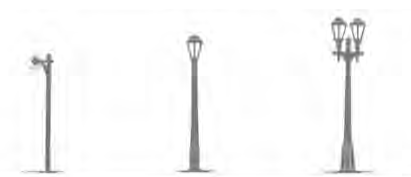 | ||
(Ord. No. 2015-10, § 1(Exh. A), 9-16-2015; Ord. No. 2024-07, § 1, 12-18-2024)
17.42.151 - Applicability.
The standards established in this Section shall apply to all proposed development within the transect zones. Standards established in this Section may also be used in other zone districts with Director approval.
(Ord. No. 2015-10, § 1(Exh. A), 9-16-2015; Ord. No. 2024-07, § 1, 12-18-2024)
17.42.152 - Civic Spaces.
A.
The standards established in this Section provide a diverse palette of parks and other publicly accessible civic spaces that are essential components of walkable urban environments.
B.
Table 17.42.K depicts nine different civic space types. Two of the civic space types, Playgrounds and Community Gardens, may be incorporated into any of the other nine types or may stand alone.
C.
The illustration and description of each civic space type are illustrative in nature and not regulatory.
D.
The service area, size, frontage and disposition of elements standards of each civic space type are regulatory.
1.
Service Area. Describes how the civic space relates to the City as a whole and the area that will be served by the civic space.
2.
Size. The overall range of allowed sizes of the civic space.
3.
Frontage. The relationship along property lines of a civic space to adjacent buildings or lots.
a.
Building. Civic spaces that are listed as having a "Building" frontage shall have the fronts of buildings, either attached to the park or across a thoroughfare, facing on to the civic space for a minimum of three quarters of the perimeter.
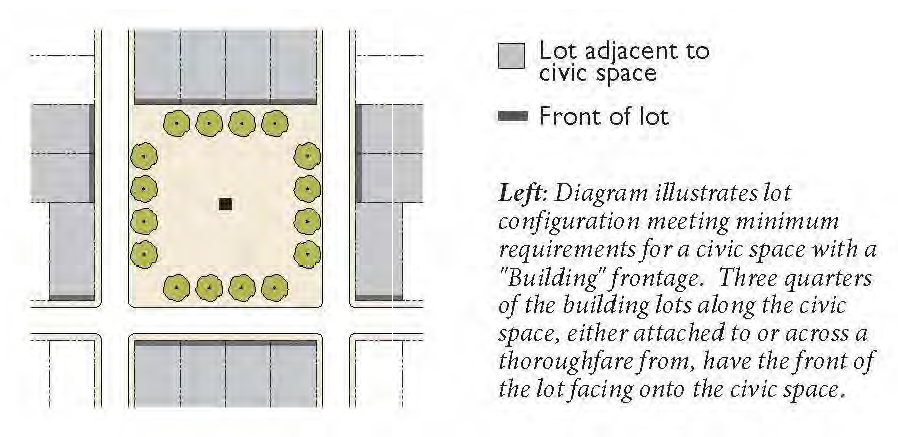
b.
Independent. Civic spaces that are listed as having an "Independent" frontage shall have the fronts of buildings, either attached to the park or across a thoroughfare, facing onto the civic space to the maximum extent possible, but may have the side or rear of a building or lot front onto the civic space.
4.
Disposition of Elements. The placement of objects within the civic space.
a.
Natural. Civic spaces with natural character are designed in a natural manner with no formal arrangement of elements.
b.
Formal. Civic spaces with a formal character have a more rigid layout that follows geometric forms and has trees and other elements arranged in formal patterns.
c.
Informal. Civic spaces with an informal character have a mix of formal and natural characteristics.
E.
Typical Facilities. A list of the typical facilities found within the civic space. This list is not intended to be a complete list of facilities allowed nor is it intended that every civic space would contain each of the facilities listed.
Table 17.42.K Civic Space Type Standards
| Transect Zone | All FBC zones | All FBC Zones | FBC 1 |
|---|---|---|---|
| Civic Space Type | Playground | Community Garden | Community Park |
| Illustration | 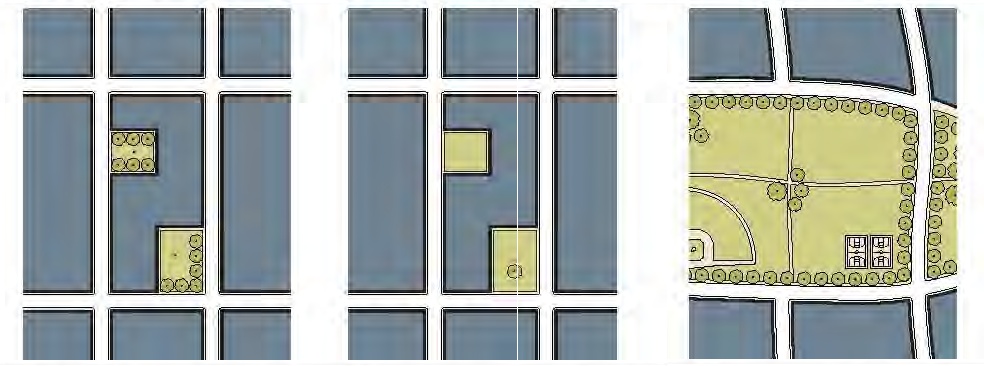 | ||
| Description | An open space designed and equipped for the recreation of children. A Playground should be fenced and may include an open shelter. Playgrounds may be included within other civic spaces. | An open space designed as a grouping of garden plots that are available to nearby residents for small-scale cultivation. Community Gardens may be included within other civic spaces. | An open space available for unstructured recreation and a limited amount of structured recreation. |
| Location and Size | |||
| Location | |||
| Service Area | Neighborhood | Neighborhood | Multiple Neighborhoods |
| Size | |||
| Minimum | - | - | 12 acres |
| Maximum | - | - | - |
| Character | |||
| Frontage | Independent or Building | Independent or Building | Independent |
| Disposition of Elements | Formal or Informal | Formal or Informal | Informal |
| Typical Facilities | |||
| Accessory Structure, Drinking Fountains, Paths and Trails | Accessory Structure, Drinking Fountains, Paths and Trails | Passive and Active Recreation, Accessory Structure, Drinking Fountains, Community Facility < 5,000 gsf, Paths and Trails | |
| Transect Zone | FBC 1 | All FBC Zones | All FBC Zones |
|---|---|---|---|
| Civic Space Type | Greenway | Green | Square |
| Illustration | 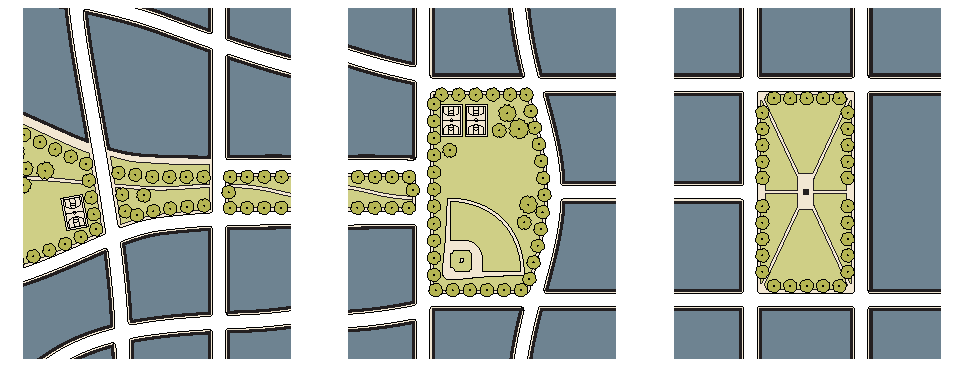 | ||
| Description | A linear open space that may follow natural corridors providing unstructured and limited amounts of structured recreation. | An open space available for unstructured and limited amounts of structured recreation. | An open space available for civic purposes, unstructured and limited amounts of structured recreation. |
| Location and Size | |||
| Location | |||
| Service Area | Multiple Neighborhoods | Neighborhood | Neighborhood |
| Size | |||
| Minimum | 8 acres (60' wide by 1 mile long) | 1 acre | ½ acre |
| Maximum | - | 15 acres | 5 acres |
| Character | |||
| Frontage | Independent or Building | Building | Building |
| Disposition of Elements | Natural or Informal | Informal | Formal |
| Typical Facilities | |||
| Passive and Active Recreation, Accessory Structure, Drinking Fountains, Community Facility < 5,000 gsf, Paths and Trails | Passive and Active (unstructured or structured) Recreation, Accessory Structure, Drinking Fountains, Community Facility < 5,000 gsf, Paths and Trails | Passive and Active (unstructured or structured) Recreation, Accessory Structure, Drinking Fountains, Community Facility < 5,000 gsf, Paths and Trails | |
| Transect Zone | All FBC Zones | All FBC Zones | All FBC Zones |
|---|---|---|---|
| Civic Space Type | Plaza | Pocket Plaza | Pocket Park |
| Illustration | 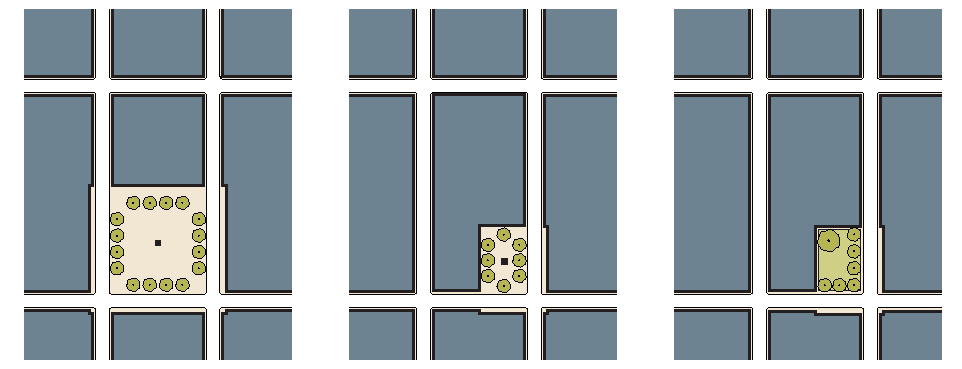 | ||
| Description | A formal open space available for civic purposes and commercial activities. Plazas are typically hardscaped. | A formal open space available for civic purposes and commercial activities. Pocket Plazas are typically hardscaped. | An open space available for informal activities in close proximity to neighborhood residences. |
| Location and Size | |||
| Location | |||
| Service Area | Neighborhood | Neighborhood | Neighborhood |
| Size | |||
| Minimum | ½ acre | 4,000 sf | 4,000 sf |
| Maximum | 2½ acres | ½ acre | 1 acre |
| Character | |||
| Frontage | Building | Building | Building |
| Disposition of Elements | Formal | Formal | Formal or Informal |
| Typical Facilities | |||
| Passive Recreation, Accessory Structure, Drinking Fountains, Paths and Trails | Passive Recreation, Accessory Structure, Drinking Fountains, Paths and Trails | Passive Recreation, Accessory Structure, Drinking Fountains, Paths and Trails | |
F.
The civic spaces specified are allowed by right or with the specified approvals in the designated transect zones. The City may require the applicant pay a fee towards a Lighting and Landscaping District to pay for ongoing costs associated with maintaining the civic space.
(Ord. No. 2015-10, § 1(Exh. A), 9-16-2015; Ord. No. 2024-07, § 1, 12-18-2024)
17.42.153 - Additional Standards.
Accessory Structure Standards. All accessory structures within parks and open spaces, including restrooms, gazebos, picnic shelters and outdoor theaters shall be designed and furnished to be consistent with the character of the transect zone in which they are located. Such consistency may require accessory structures to maintain building setbacks, frontage, massing, disposition and character similar to adjacent development as determined by the Director.
(Ord. No. 2015-10, § 1(Exh. A), 9-16-2015; Ord. No. 2024-07, § 1, 12-18-2024)
17.42.161 - Applicability.
This Section provides procedures for the review and approval or denial of the applications and other review requirements established by this Code.
(Ord. No. 2015-10, § 1(Exh. A), 9-16-2015; Ord. No. 2024-07, § 1, 12-18-2024)
17.42.162 - Design Review.
Design Review shall be subject to the requirements of Section 17.80 of the Zoning Ordinance.
(Ord. No. 2015-10, § 1(Exh. A), 9-16-2015; Ord. No. 2024-07, § 1, 12-18-2024)
17.42.163 - Home Occupation Permit.
Home occupations shall be subject to the requirements of Section 17.56 of the Zoning Ordinance.
(Ord. No. 2015-10, § 1(Exh. A), 9-16-2015; Ord. No. 2024-07, § 1, 12-18-2024)
17.42.164 - Site Plan Review.
Site Plan Review shall be subject to the requirements of Section 17.72 of the Zoning Ordinance.
(Ord. No. 2015-10, § 1(Exh. A), 9-16-2015; Ord. No. 2024-07, § 1, 12-18-2024)
17.42.165 - Temporary Use Permits.
A.
Purpose. The purpose of this Section is to allow for short term activities that are interim, non-permanent, and/or seasonal in nature and would be compatible with adjacent and surrounding uses when conducted in compliance with this Chapter.
B.
Applicability. A Temporary Use Permit allows short term activities identified in Subsection H (Allowed Temporary Uses) that might not meet the normal development or use standards of the applicable zone, but may otherwise be acceptable because of their temporary nature. Exempt temporary uses are identified in Subsection G (Exempt Temporary Uses).
C.
Review Authority. The Director may approve a Temporary Use Permit for a temporary use that would be operated in compliance with Subsection F (Conditions of Approval) below; or the Director may deny the application or refer the application to the Planning Commission for review and final decision.
D.
Application Filing, Processing and Review.
1.
Filing. An application for a Temporary Use Permit shall be filed with the Planning Department in compliance with Section 7.010 (Application Processing Procedures).
2.
Public hearing not required. A public hearing shall not be required for the Director's decision on a Temporary Use Permit application.
E.
Findings. The Director (or the Planning Commission on a referral) may approve a Temporary Use Permit application, with or without Conditions of Approval (Subsection F), only after first making all of the following findings:
1.
The operation of the requested temporary use at the location proposed and within the time period specified will not endanger, jeopardize, or otherwise constitute a menace to the public convenience, health, safety, or general welfare;
2.
The operation of the requested temporary use will not be detrimental to adjoining properties through the creation of excessive dust, light, noise, odor, or other objectionable characteristics;
3.
The proposed parcel is adequate in size and shape to accommodate the temporary use without detriment to the enjoyment of other properties located adjacent to and in the vicinity of the subject parcel;
4.
The proposed parcel is adequately served by streets or highways having sufficient width and improvements to accommodate the kind and quantity of traffic that the temporary use will or could reasonably be expected to generate; and
5.
Adequate temporary parking to accommodate vehicular traffic to be generated by the use will be available either on-site or at alternate locations acceptable to the Director.
F.
Conditions of Approval. In approving a Temporary Use Permit application, the Director (or the Planning Commission on a referral) may impose conditions that are deemed reasonable and necessary to ensure that the permit would be in full compliance with the findings required by Subsection E (Findings). Other City departments (e.g., Building, Engineering, Fire, and Police) may also recommend conditions for incorporation into the approved Temporary Use Permit. These conditions may address any pertinent factors affecting the operation of the temporary event, or use, and may include the following:
1.
Fixed period of time. A provision for a fixed period (e.g. 30 days for a temporary use not occupying a structure, including promotional activities, or 12 months for all other temporary uses);
2.
Operating hours and days. Regulation of operating hours and days;
3.
Temporary pedestrian and vehicular circulation. Provision for adequate temporary pedestrian and vehicular circulation, parking facilities (including vehicular ingress and egress), and public transportation;
4.
Regulation of nuisance factors. Regulation of nuisance factors including prevention of glare or direct illumination on adjacent parcels, dirt, dust, gases, heat, noise, odors, smoke, trash, and vibration;
5.
Regulation of temporary structures. Regulation of temporary structures and facilities, including placement, height and size, location of equipment and open spaces, including buffer areas and other yards;
6.
Sanitary and medical facilities. Provision for sanitary and medical facilities;
7.
Waste collection, recycling, and/or disposal. Provision for solid, hazardous, and toxic waste collection, recycling, and/or disposal;
8.
Police/security and safety measures. Provision for police/security and safety measures;
9.
Signs. Regulation of signs;
10.
Performance bond or other security. Submission of a performance bond or other security measures, in compliance with Section 7.030.050 (Performance Guarantees) and satisfactory to the Director, to ensure that any temporary facilities or structures used will be removed from the site within a reasonable time following the event and that the property will be restored to its former condition, or better, as determined by the Director;
11.
Condition of Site. The site shall be cleaned of debris, litter, or any other evidence of the temporary use upon completion or removal of the use, and shall continue to be used in compliance with this Development Code.
12.
Compliance with applicable provisions. A requirement that the approval of the requested Temporary Use Permit is contingent upon compliance with applicable provisions of the Municipal Code and the successful approval of any/all required permits from any other department or governing agency; and
13.
Other conditions. Other conditions that would ensure that the operation of the proposed temporary use would be conducted in an orderly and efficient manner, and in full compliance with the purpose of this Chapter.
G.
Exempt Temporary Uses. The following minor and limited duration temporary uses are exempt from the requirement for a Temporary Use Permit.
1.
Emergency facilities. Emergency public health and safety needs/land use activities, as determined by the City Council or City Manager. Emergency facilities shall include emergency temporary housing.
2.
Construction Yards - On-Site.
a.
On-site contractors' construction/storage yard(s), in conjunction with an approved construction project on the same parcel.
b.
The construction yard shall be removed immediately upon completion of the construction project, or the expiration of the companion Building Permit, authorizing the construction project, whichever first occurs.
3.
Garage/yard sales. Garage/yard sales (e.g., personal property sales) only when conducted on residentially zoned property in compliance with the following standards:
a.
Only one garage/yard sale may be conducted within any four-month period and the sale shall be limited to not more than three consecutive days or to two consecutive weekends not to exceed four days in all.
b.
All signs advertising a garage/yard sale shall be in compliance with Section 17.42.120 (Temporary Signs). All garage/yard sale signs shall be removed within 24 hours following the final close of the sale.
c.
The sale shall not be conducted between the hours of 8:00 p.m. and 7:00 a.m. of the following day.
d.
The sales shall not encroach or be made on or from public streets or rights-of-way.
e.
No licensed retail or wholesale dealer shall be allowed to consign or offer for sale any goods or merchandise.
4.
Special Event Permits. A Special Event Permit shall be obtained before conducting athletic events, parades, and public assemblies, occurring on or within the public rights-of-way or other publicly owned property.
H.
Allowed Temporary Uses. The following temporary uses are allowed on private property, subject to the issuance of a Temporary Use Permit.
1.
Contractors' construction yards - off-site. The temporary use of a site for an offsite contractor's construction/storage yard(s). The permit may be effective for up to 12 months, or the expiration of the companion Building Permit, authorizing the construction project, whichever first occurs.
2.
Entertainment events. Amusement rides, arts and crafts exhibits, auctions, carnivals, circuses, concerts, fairs, festivals, flea markets, food events, outdoor entertainment/sporting events, and other similar events as determined by the Director for a period not to exceed 10 days twice per year, separated by at least 30 days between uses.
3.
Outdoor displays and sales. Outdoor displays and sales conducted by a retail business holding a valid business license, issued in compliance with Municipal Code Title 5 (Business Licenses and Regulations), may be allowed for a maximum of four outdoor sale events (excluding City sponsored activities). For purposes of this Subsection an outdoor display and sales shall be no longer than four consecutive days in duration.
4.
Seasonal sales events. Seasonal sales (e.g., Halloween pumpkin sales and Christmas tree sale lots) not to exceed 40 days or four events per year with a maximum of five days for each event.
5.
Storage of structures or equipment. Temporary storage structures within residential areas, not to exceed 30 days.
6.
Mobile homes. A mobile home to be utilized as a temporary dwelling while a single-family dwelling is under construction on the same parcel subject to all of the following provisions:
a.
The mobile home may only be located and occupied while actual construction activities are taking place upon the parcel. In no case may the period of placement and use exceed 12 months.
b.
The mobile home may only be occupied by the property owner; who is also the builder designated on the Building Permit, and the owner's/builder's family.
c.
City may require surety adequate to ensure the timely removal and compliance with all conditions of approval.
d.
The minimum yards for the zone shall be maintained.
7.
Temporary real estate sales office and model home complex.
a.
The office shall be used only for the sale of property located within the subdivision in which the office is located.
b.
The temporary real estate office shall be removed at the end of two years following the date of the recording of the Final Map of the subject subdivision.
c.
If any parcels within the subdivision have not been sold at the end of the original two-year period, the Director may approve extensions.
8.
Temporary work trailers.
a.
A trailer or mobile home may be used as a temporary work site for employees of a business:
(1)
During construction or remodeling of a permanent commercial, industrial, or mixed-use structure, when a valid Building Permit is in force; or
(2)
Upon demonstration by the applicant that the temporary work site is a short term necessity, while a permanent work site is being obtained.
b.
A permit for temporary work trailer(s) may be approved for up to 12 months. The Director may approve extensions.
9.
Other similar temporary uses. Similar temporary uses that, in the opinion of the Director, are compatible with the subject zone and surrounding land uses.
(Ord. No. 2015-10, § 1(Exh. A), 9-16-2015; Ord. No. 2024-07, § 1, 12-18-2024)
17.42.166 - Conditional Use Permits.
Conditional Use Permits shall be subject to the requirements Section 17.68 of the Zoning Ordinance.
(Ord. No. 2015-10, § 1(Exh. A), 9-16-2015; Ord. No. 2024-07, § 1, 12-18-2024)
17.42.167 - Uses Permitted By Administrative Approval.
Uses Permitted by Administrative Approval shall be subject to the requirements Section 17.64 of the Zoning Ordinance.
(Ord. No. 2015-10, § 1(Exh. A), 9-16-2015; Ord. No. 2024-07, § 1, 12-18-2024)
17.42.168 - Variances.
Variances shall be subject to the requirements of Section 17.84 of the Zoning Ordinance.
(Ord. No. 2015-10, § 1(Exh. A), 9-16-2015; Ord. No. 2024-07, § 1, 12-18-2024)
17.42.169 - Development Agreements.
Development Agreements shall be subject to the requirements of Section 17.90 of the Zoning Ordinance.
(Ord. No. 2015-10, § 1(Exh. A), 9-16-2015; Ord. No. 2024-07, § 1, 12-18-2024)
17.42.170 - Public Hearings, Appeals, Enforcement.
A.
Public hearings shall be subject to the requirements of Section 17.88.030 of the Zoning Ordinance and to the individual hearing requirements for Conditional Use Permits (Section 17.68) and Variances (Section 17.84).
B.
Appeals shall be subject to the requirements of Section 17.04 of the Zoning Ordinance.
C.
Enforcement of all provisions of the Form Based Code shall be in accordance with Section 17.92 of the Zoning Ordinance.
(Ord. No. 2015-10, § 1(Exh. A), 9-16-2015; Ord. No. 2024-07, § 1, 12-18-2024)
17.42.180 - Amendments.
Amendments to provisions of the Form Based Code shall be subject to the requirements of Section 17.12.030 of the Zoning Ordinance.
(Ord. No. 2015-10, § 1(Exh. A), 9-16-2015; Ord. No. 2024-07, § 1, 12-18-2024)
17.42.190 - Non-conforming Uses.
Non-conforming uses shall be subject to the requirements of Section 17.060.080 of the Zoning Ordinance.
(Ord. No. 2015-10, § 1(Exh. A), 9-16-2015; Ord. No. 2024-07, § 1, 12-18-2024)
Appendix A: Assessor's Parcels in the Form Based Code Area by Zone District

