
Kingsport City Zoning Code
ARTICLE I
- IN GENERAL
Sec. 114-1.- Definitions.
The following words, terms and phrases, when used in this chapter, shall have the meanings ascribed to them in this section, except where the context clearly indicates a different meaning:
Adult bookstore means an establishment having, as more than 50 percent of the face value of its stock in trade, books, magazines, motion pictures, periodicals and other materials which are distinguished or characterized by depicting, describing or relating to specified anatomical areas, as defined in this section.
Adult cabaret means any restaurant, bar, dancehall, nightclub or other such place which features dancers, strippers, male or female impersonators or similar entertainers for the entertainment of a predominantly adult clientele.
Adult motion picture theater means any public place, whether open or enclosed, used for presenting material distinguished or characterized by an emphasis on matter depicting, describing or relating to specified sexual activities or specified anatomical areas, as defined in this section, for observation by patrons therein.
Adult-oriented establishment means a business or facility that is sexually explicit and that caters exclusively or predominately to adult clientele, including but not limited to adult bookstores, adult theaters, adult motion picture theaters, cabarets or other enterprises which regularly features materials, acts or displays involving the display of the human form, wholly or partially clothed, static or animated.
Adult theater means a theater, concert hall, auditorium or similar establishment which, by any form of consideration, regularly features live performances which are characterized by the exposure of specified anatomical areas, as defined in this section, or by specified sexual activities.
Agriculture means the use of land for farming, dairying, pasturage, animal and poultry husbandry and other similar uses and the necessary accessory uses for packing, treating or storing the produce; provided, however, that the operation of any such accessory use shall be secondary to that of the principal agricultural activities.
Alley. See Street.
Animated sign means an electronic message board that uses physical movement or change of lighting to depict motion, with a slightly progressive change. The display of video shall be prohibited.
Automobile and truck repair, major, means the rebuilding or reconditioning of engines or transmissions, vehicles or trailers; repair and collision service, such as body, frame or fender straightening; painting; upholstering; auto glass work; and the like.
Automobile and truck repair, minor.
(1)
The term "minor automobile and truck repair" means minor repairs including auto inspection lanes, engine tune-ups; adjusting lights and brakes; upholstering.
(2)
The term "minor automobile and truck repair" does not include any operation specified under the definition of automobile and truck repair, major.
Automobile service station means a building or structure used for the retail sale and dispensing of fuel, lubrication, tires, batteries, accessories, supplies, including installation and minor services customarily incidental thereto; facilities for washing and for chassis and gear lubrication.
Boarding house means a building or part thereof, including a lodging house, with sleeping rooms available for hire with or without meals to five or more persons primarily not transients. Where cooking equipment or provisions for cooking are included in a sleeping room, such room shall be deemed a dwelling unit.
Brewery means a facility where malt liquors, regardless of alcohol content by volume, are produced in accordance with any manufacturing or wholesaling license required by Tennessee Code Annotated
Brewpub means a type of eating or drinking establishment that includes as an accessory use the production of malt liquors, regardless of alcohol content by volume, for consumption on the premises; except that sales for off-premises consumption, if not prohibited by other local ordinance or state or federal law, shall be allowed in specialty containers holding no more than one U.S. gallon (128 U.S. fluid ounces), commonly referred to as growlers. The area of the establishment devoted to the production of malt liquors shall not exceed 5,000 square feet.
Buffer means any land maintained in either a natural or landscaped state and used to screen or mitigate the impacts of development on surrounding areas, properties, or rights-of-ways.
Building means any structure used or intended for supporting or sheltering any use or occupancy. The term is further defined as follows:
Building, accessory. See Use, accessory use and accessory structure.
Building, principal, means a building in which the primary use of the lot, on which the building is located, is conducted.
Climate controlled indoor storage facility means a building or a group of buildings utilizing a common entrance with indoor access to individual climate controlled units used for the storage of personal property with no commercial transactions permitted other than the rental of the storage units.
Club, private, means a building and facilities for social, educational or recreational purpose, generally open to members, but not primarily for profit or to render a service which is customarily carried on as a business.
Cluster (or clustering) means a site planning technique that concentrates building and structures in specific areas on a lot, site, or parcel to allow the remaining land to be used for recreation, open space or preservation of features or structures with environmental, historical or cultural significance.
Commission means the municipal-regional planning commission, or simply the planning commission.
Communication facilities means a land-use facility supporting antennas and microwave dishes that sends or receives radio frequency signals. The term "communication facilities" includes the structure, towers and accessory buildings.
Community center means a building and facilities for a social, educational or recreational purpose generally open to the public but not primarily for profit or to render a service customarily carried on as a business.
Comprehensive plan or community plan means the official document or elements thereof adopted by the planning commission and intended to guide the development of the community or portions thereof.
Court means an open space, other than a yard, on the same lot with a building.
Court, outer, means a court which extends directly to and opens for its full width on a street or other permanent open space or on a required yard at least 20 feet wide or deep or on a side yard at least 50 percent wider than the required side yard's least width, but not less than ten feet.
Craft brewery, winery and distillery means a type of brewery, winery or distillery wherein the area of the establishment devoted to the production of malts and liquors may not exceed 10,000 square feet in commercial zone districts or 20,000 square feet in industrial zone districts. The establishment may include a tasting room and may also include office, retail, eating and drinking establishment or event facility components in addition to the area devoted to the production of malts and liquors.
Decorative lighting means any lighting that is intended to attract attention to a business as does signage. Decorative lighting is different from illuminating lighting whose purpose is to provide visibility, safety and security on the premises of a business. Decorative lighting is deemed to be an accessory usage to the building and property which it decorates and it is intended that such decorative lighting be appropriate, but not excessive in performing its function. Decorative lighting can be neon lighting, incandescent lighting, LED lighting, string of lights, and any other form of lighting that serves to attract attention to a business.
Director means planning director for the planning department.
Distillery means a facility where distilled liquors are produced in accordance with any manufacturing or wholesaling license required by Tennessee Code Annotated.
Driveway means that space or area of a lot that is specifically designated and reserved for the movement of vehicles from the street to the required off-street parking and loading areas.
Dwelling means a building or portion thereof occupied for residence purposes, but not including travel trailers or motels, boarding houses, hospitals or other accommodations used more or less for transient occupancy. The term "dwelling" is further defined as follows:
Dwelling, multiple-family, means a building or portion thereof occupied by more than two families or more than two housekeeping units.
Dwelling, single-family, means a building occupied exclusively for residence purposes by one family or housekeeping unit.
Dwelling, two-family, means a building occupied exclusively by two families or two housekeeping units, commonly known as a duplex.
Dwelling unit means one room or rooms connected together, constituting a separate, independent housekeeping establishment for occupancy by a family as owner, by rental or lease on a weekly, monthly or longer basis, and physically separated from any other rooms or dwelling units which may be in the same building, and containing independent cooking and sleeping facilities.
Electronic message board means a sign that uses electronic technology to display information.
Family means a person living alone or two or more persons customarily living together as a single housekeeping unit and using common cooking facilities, but not including a group occupying a hotel, club, boarding house, lodging house, fraternity or sorority house, institution for human care or other similar building.
Flood-hazard-related definitions. See section 114-251.
Floor area.
(1)
The term "floor area" means the sum of the gross areas of the several floors of a building, measured from the exterior faces of exterior walls or from the centerlines of walls separating two buildings. In particular, the term "floor area" includes basement space; elevator shafts or stairwells at each floor; penthouses; attic space, whether or not a floor has been laid, providing structural headroom of eight feet or more; interior balconies; mezzanines; hallways; lobbies; floor space in accessory buildings, except for floor space used for off-street parking; and any other floor space not specifically excluded.
(2)
The term "floor area" does not include cellar space, where the cellar ceiling is less than four feet above grade, except that cellar space used for retailing shall be included for the purpose of calculating requirements for accessory off-street parking spaces and accessory off-street loading berths; elevator or stair bulkheads; accessory water tanks or cooling towers; outside steps that are uncovered; attic space, whether or not a floor actually has been laid, providing structural headroom of less than eight feet; floor space used for mechanical equipment; floor area used exclusively as parking space for motor vehicles.
Floor area, parking, means the floor area of a structure, less storage and warehouse areas used principally for nonpublic purposes of the structure.
Floor area ratio means the floor area of a building on a lot, divided by the ground area of the lot on which it is located.
Franchised auto dealership means an auto seller that sells new and used cars for auto manufacturers such as Ford, General Motors, Honda and other major brands. The manufacturer is often listed in the dealerships name (i.e. Hoffman Ford).
Funeral and interment services means a building or part thereof used for funeral services. Such building may contain space and facilities for the accessory uses of (a) embalming and the performance of other services used in the preparation of the dead for burial; (b) the storage of caskets, funeral urns, and other related funeral supplies; (c) the storage of funeral vehicles; and (d) facilities for cremation. Where funeral and interment services are permitted, a funeral chapel shall also be permitted.
Garage, community, means a structure only for the storage of vehicles or trailers of residents of the neighborhood.
Garage, private, means a space or structure, including a carport, on the same lot with or in the building to which it is accessory, primarily for storage only of automobiles of the residents of the premises.
Grade means a reference plan representing the average of the finished ground level adjoining a building at all exterior walls.
Group residential project means a building or group of buildings used for the purpose of providing a family-like atmosphere for mentally retarded, mentally handicapped, physically handicapped or socially disadvantaged persons, which may include two persons, not residents, acting as house parents or guardians, who need not be related to each other or to any of the mentally retarded, mentally handicapped, physically handicapped or socially disadvantaged persons residing in the home. The term "group residential project" is further defined as follows:
Large group residential projects means group residential projects which house eight to 15 residents.
Small group residential projects means group residential projects which house no more than eight residents.
Height means the vertical distance to the highest point of the roof for flat roofs; to the deck line of mansard roofs; and to the average height between eaves and the ridge of gable, hip and gambrel roofs, with all measurements made from the curb level, if the building is within ten feet of the property line, or from the grade in all other cases.
Height-to-yard ratio means the height of a building as related to the minimum rear yard and each side yard permitted as used in some zoning districts (i.e., for 2:1 ratio, a 40-foot building must have a minimum of 20 feet for the rear yard and each side yard).
Highway identification signs means those signs that are for the purpose of directing interstate traffic to establishments which conduct business on a premises.
Home occupation means professional offices, studios or customary incidental home occupations conducted within the principal building, but only by a person resident in the dwelling, provided that:
(1)
Not more than one person, not a resident of the premises, is employed;
(2)
Not more than 25 percent of the total floor area in any dwelling unit is devoted to such use; and
(3)
The use does not adversely affect the uses permitted in the immediate neighborhood by excessive traffic generation, parking, noise or other disturbing characteristics.
Hotel, motel means a building or group of buildings containing individual sleeping or living units designed for the temporary occupancy of transient guests and including hotels, tourist courts, motor lodges, motor hotels or auto courts, but not including boarding houses or lodging houses.
Institution for human care means a building or group of buildings providing health, medical or rehabilitation services to individuals such as hospitals, convalescent homes, nursing homes, rest homes, orphanages, rehabilitation centers.
Interstate highway means a divided highway with fully controlled access (owners of abutting property have no legal right of access except by the public authority) by the public authority giving preference to through traffic.
Junkyard means a place where waste, discarded or salvaged materials are bought, sold, exchanged, stored, baled, cleaned, packed, disassembled, handled, including auto wrecking yards, used lumberyards and places or yards for use of salvaged house wrecking structural steel materials and equipment, but excluding such uses when conducted entirely within a completely enclosed building and excluding pawnshops and establishments for the sale, purchase or storage of used cars in operable condition, salvaged machinery, used furniture and household equipment, and the processing of used, discarded or salvaged materials as part of manufacturing operations.
Lot means a parcel of land of at least sufficient size to meet the minimum zone requirements for use, coverage and area and to provide such yards and open spaces as required under this chapter and includes the term "plot" or "parcel." The term "lot" is further defined as follows:
Lot area means the computed ground area inside the lot lines, excluding any public right-of-way or public water body.
Lot, corner, means a lot abutting upon two or more streets at their intersection or upon two parts of the same street and where, in either case, the interior angle formed by intersection of the street lines does not exceed 135 degrees.
Lot or ground coverage means the computed ground area occupied by all buildings within a lot.
Lot depth refers to the mean horizontal distance between the front and rear lot lines.
Lot frontage means the distance between the side lot lines measured along the front building line of the lot, as determined by the prescribed front yard requirement.
Lot line, front, means, for a lot line abutting upon only one street, the line separating such lot from such street. For any other lot, the owner shall, for the purpose of this chapter, have the privilege of electing any street lot line as the front lot line, provided that such choice, in the opinion of the zoning administrator, will not be injurious to the existing or to the desirable future development of adjacent properties.
Lot line, rear, means ordinarily, that lot line which is opposite and most distant from the front lot line. For an irregular, triangular or gore-shaped lot, a line ten feet in length entirely within the lot, parallel to and most distant from the front lot line, shall, for the purpose of this chapter, be considered the rear lot line. In other cases not covered in this definition, the zoning administrator shall designate the rear lot line.
Lot line, side, means any lot line other than a front or rear lot line.
Lot line, street or alley, means a lot line separating the lot from a street or alley.
Lot lines means the property lines bounding the lot.
Lot width means the mean horizontal distance across the lot measured at right angles to the depth.
Manufactured home means a structure having the same general appearance as required for site-built homes and transportable in two or more sections which in the traveling mode is eight body feet or more in width or 40 body feet or more in length and which is built on a permanent chassis and designed to be used as a dwelling, with or without a permanent foundation, when connected to the required utilities, and includes the plumbing, heating, air conditioning and electrical systems contained therein. The term "manufactured home" includes any structure which meets all the requirements, except the size requirements, and with respect to which the manufacturer voluntarily files a certification required by the Secretary of the United States Department of Housing and Urban Development and complies with the standards established under T.C.A. § 68-126-202(4), (6) and (7).
Medical clinic means a facility properly licensed in the state for examining and treating patients with medical problems on an outpatient basis. A medical clinic is not a methadone treatment clinic or facility or substance abuse treatment facility as may be defined or used in this Code.
Methadone treatment clinic or facility means a facility properly licensed in the state for counseling of patients and the distribution of methadone for outpatient, nonresidential purposes only. Such facility is not included in the meaning of a medical clinic, substance abuse treatment facility, or institution for human care as may be defined or used in this Code.
Mobile home means any vehicle or similar portable structure having been constructed with wheels, whether or not such wheels have been removed, or without wheels but designed to be moved on the highway when attached to a suitable wheeled undercarriage and not meeting the requirements to be classified as a manufactured home.
Monopole means a freestanding sign which is supported by one pole.
Motel. See Hotel.
Nit means a unit of measurement of luminous intensity or brightness of electronic message boards as determined by the PR-650 SpectraScan Colorimeter.
Occupied includes the term "arranged, designed or intended to be occupied."
Open Space means the portion of a site set aside for the enjoyment of the residents and owners of the development. The only structures allowed to be constructed inside open space are those specific to the use of open space as shown on the plan. Streets and street right-of-way are not to be considered part of open space.
See also Usable open space.
Parking area or structure means an off-street area or structure for required parking or loading spaces including driveways, accessways, aisles, parking and maneuvering space, but excluding a required front yard or public right-of-way. The term "parking lot or structure" also means a street area or structure, other than the parking or loading spaces or areas required or permitted under this chapter, for the parking of automobiles, and available to the public customarily for a fee.
Personal services or personal service establishments means commercial businesses providing services to individuals such as beauty shops and barbershops, shoe repair, dressmaking and tailoring.
Planned development means a project area consisting primarily of residential uses in mixed densities with opportunities for commercial development.
Primary point of intersection means the point at which the centerline of the median on the interstate facility intersects with the centerline of the cross road. When the cross road has more than two lanes, the centerline of the median, bridge, or the exact center of the roadway surface crossing the interstate main line will be used.
Restaurant means an eating establishment where food is served and consumed within the building or off the premises.
Restaurant, drive-in, means an eating establishment where food is generally served by employees or by self-service on the premises outside the building and generally consumed on the premises outside the building or off the premises.
Roadside stand means a temporary structure designed or used for the display and sale of agricultural or other products grown or produced on the premises upon which such a stand is located.
Scrolling means a type of animated sign that uses change of lighting to create the appearance of words, numbers, or objects moving across the face of the sign horizontally, vertically, or diagonally.
Sexual encounter establishment.
(1)
The term "sexual encounter establishment" means an establishment, other than a hotel, motel or similar establishment, offering public accommodations which, for any form of consideration, provides a place where two or more persons may congregate, associate or consort in connection with specified sexual activities or the exposure of specified anatomical areas.
(2)
The term "sexual encounter establishment" does not include an establishment for a medical practitioner, psychologist, psychiatrist or similar professional person engaging in sexual therapy and licensed by the state.
Short-term bicycle parking facility means a parking area with a typical use duration of less than two hours, unsheltered, and used for business and related uses as set out in subsection 114-564(4).
Shopping center, planned, means a retail business development, planned as a unit, and characterized by groups of retail uses having the common use of specifically designated off-street areas for access, parking and service, whether in a B-4P district or other zone.
Sign means any name, identification, description, display, illustration or device which is affixed to or represented directly or indirectly upon a building, structure or land, in view of the general public, and which directs attention to a product, place, activity, person, institution or business. The term "sign" is further defined as follows:
Sign area means the area of the sign contained within the smallest square, rectangle, circle, or combination thereof which will encompass the entire sign inclusive of all border, trim, ornamental base, apron supports, structural members and sign surface area.
Sign, complex, means a freestanding sign for a commercial development containing one or more businesses on the same parcel, sharing common access, parking, or other amenities.
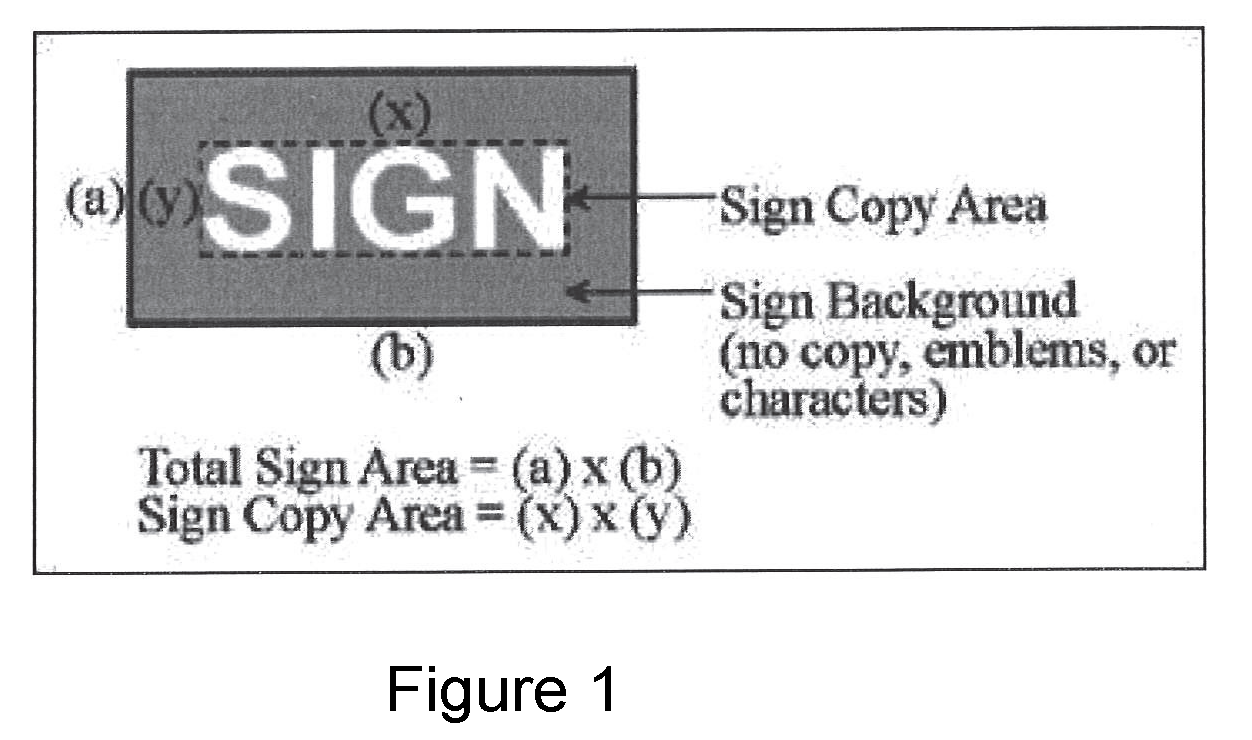
Sign, copy area, means alphabetic, pictorial, numerical and/or graphic display of permanent or removable words, letters, numbers, figures, characters, symbols, logos or insignia that are used on a sign display surface area for advertising and/or informational purposes. Copy area shall be measured as defined in Figure 1 below.
Sign, directional, means any noncommercial sign of an instructional nature, bearing no business advertising and displayed for the convenience of the public.
Sign, fascia, means a wall sign.
Sign, flashing.
(1)
The term "flashing sign" means a sign, the illumination of which is not kept constant in intensity at all times when in use.
(2)
The term "flashing sign" does not mean illuminated signs that indicate time, temperature, weather or other similar public service information.
Sign, gasoline price, means signs for any establishment that offers the sale of gasoline and or diesel for the purpose of refueling any motorized vehicle.
Sign, identification, means a sign which indicates only the name and address of the building or management and which has no direct advertising value.
Sign, illuminated, means a sign designed to emit artificial light.
Sign, indirectly illuminated, means any sign designed to reflect artificial light from any source.
Sign, interstate identity, means a high-rise freestanding sign within a TA/C district, adjacent to the Federal Interstate System having copy that identifies a particular development and tenants within the development by utilizing an electronic billboard or stationary sign face.
Sign, mobile, means a sign which is affixed to a frame having wheels or capable of being carried, or otherwise portable, and designed to stand free from a building or other structure. A sign designed to be affixed to the surface of real estate shall be deemed a freestanding sign and not a mobile sign, but the mere removal of wheels or the temporary securing of a sign to the surface of real estate shall not prevent its being a mobile sign within this definition.
Sign, monument, means a permanent, freestanding sign mounted on a base or other supports and where the bottom of the sign face is located within three feet of ground level.
Sign, mural, means any mosaic, painting, photograph, graphic art technique, or combination thereof placed on the wall and containing no copy, advertising symbols, lettering, trademarks or other references to the premises or to the products and/or service offered for sale on the premises.
Sign, non-illuminated, means any sign which is not artificially lighted, either directly or indirectly.
Sign, off-premises means a sign which directs attention to a business, product, service or activity generally conducted, sold or offered elsewhere than on the premises where such sign is located.
Sign, on-premises, means a sign which directs attention to a business, profession, product, activity or entertainment sold or offered upon the premises where such sign is located.
Sign, projecting, means a sign which is attached directly to a canopy, marquee or wall of a building or other structure and which extends horizontally outward from such canopy, marquee or wall more than 12 inches.
Sign, single-tenant, and multi-tenant identity, means a monument or low profile freestanding sign used to identify single and multi-tenant centers located at the entrance drive adjacent to parking areas of single or multitenant center.
Sign, site wayfinding, means a monument style freestanding directional sign within the TA/C district along internal roadways and driveways at major decision points to assist individuals in finding their destinations.
Sign, street level identity, means a monument style freestanding sign within the TA/C district; provided at street level along the intersection of major streets having direct access to the road system within the development and identify center and tenants within the center to the major street in front of the development.
Sign surface area.
(1)
The term "sign surface area" means the entire aggregate area of the actual sign surface.
(2)
The term "sign surface area" does not include any structural elements outside the limits of such sign and not forming an integral part of the display.
Sign, temporary, means any sign, banner, pennant, valance or advertising display constructed of cloth, canvas, light fabric, cardboard, wallboard or other light materials, with or without frames, intended to be displayed for a limited period of time only.
Sign, tenant identity, means a wall-mounted backlit letters, canopy and or awning-mounted signs on tenants exterior building walls to identify the business location.
Sign, tract, means a temporary sign advertising the original sale of property in a subdivision.
Sign, wall, means any sign, including a fascia sign, which is attached parallel to the face of the wall of a building or other structure.
Site plan means the development plan for one or more lots on which is shown the existing and the proposed conditions of the lot.
Solid underpinning/screening means solid material, such as brick, which shall be used to screen the foundation system of all residential dwellings, to prevent the creation of a habitat for vermin, to provide covering for utilities, to prevent freezing of water and sewer lines and to aid in the anchorage and stabilization of homes.
Specified anatomical areas means any of the following:
(1)
Less than completely and opaquely covered human genitals, pubic regions, buttocks, anus or female breast below a point immediately above the top of the areola; or
(2)
Human male genitals in a discernibly turgid state, even when completely and opaquely covered.
Specified sexual activities includes, but is not limited to, the following:
(1)
Human genitals in a state of sexual stimulation or arousal.
(2)
Acts of human masturbation, sexual intercourse or sodomy.
(3)
Fondling or other erotic touching of human genitals, pubic regions, buttocks or female breasts.
(4)
Flagellation or torture in the context of sexual relationship.
(5)
Masochism, sadism, erotic or sexual oriented torture, beating or infliction of pain.
(6)
Erotic touching, fondling or other contact with an animal by a human being.
(7)
Human excretion, urination, menstruation, vaginal or anal irrigation as part of or in connection with any of the activities set forth in subsections (1) through (6) of this definition.
Story means that portion of a building, other than a cellar or mezzanine, including between the surface of any floor and the surface of the floor next above it, or, if there is no floor above it, the space between the floor and ceiling next above it.
Street means any vehicular way, which is a general term used to describe a right-of-way, that provides a channel for vehicular and pedestrian movement between certain points in the community that may provide for vehicular and pedestrian access to properties adjacent to it, and that may also provide space for the location of underground or aboveground utilities. Streets are classified by function as follows:
(1)
Freeways. The first rank in the classification of streets, and which are used only for movement of vehicles, providing for vehicular or pedestrian access to adjoining properties; interchange of traffic between a freeway and any other streets is accomplished by grade separated interchanges with merging deceleration and acceleration lanes, and no at-grade intersections are permitted. (Interstate highways are an example.) Freeways generally carry higher volumes, require greater right-of-way width and permit higher speed limits than any other class of street and should be depressed in urban or urbanizing areas. Arterials are the only class of street which generally should be connected with expressways at interchange points.
(2)
Arterials. The second rank in the classification, and should be used only for the movement of vehicles and preferably should not provide for vehicular access to adjacent properties. Interruption of traffic flow should contain medians, deceleration lanes, and left-turn storage lanes. Arterials are the link between freeways and collectors and rank next to freeways in traffic volumes, speed limits and rights-of-way widths.
(3)
Collectors. The third rank in the classification of streets, and are used more for movement of vehicles than for providing access to adjacent properties. Access to adjoining properties should be planned and controlled so that minimum disturbance is made to the traffic moving efficiently on the collector street. Intersections should contain medians, deceleration lanes and left-turn storage lanes. Collectors are the link between arterials and local streets and generally rank next to arterials in traffic volumes, speed limits and rights-of-way widths.
(4)
Locals. The fourth rank in the classification of streets, and are used primarily for providing access to adjacent properties. Vehicles moving on these streets should have an origin or destination in the immediate vicinity, and all types of through traffic should be eliminated through initial design of its connections with other streets. Local streets are the primary link between trip generation points (homes, offices, stores, work, etc.) and collector streets. Locals have the least right-of-way, the lowest speed limit and the least amount of vehicular traffic. Local streets can be subdivided further into the following six subclasses:
a.
Continuing streets. Continuing streets are local streets having two open ends, with each end generally connecting with different streets, one or more other streets may intersect it between its two open ends and property fronts on both sides of the streets.
b.
Marginal access streets. Marginal access streets are local streets or service roads generally having two or more open ends which are sometimes referred to as access points, other streets may intersect between the ends and property fronts on only one side of the streets, the other street side is parallel and adjacent to a higher classification street such as a collector or arterial.
c.
Loop streets. Loop streets have two open ends, with each end generally connecting with the same street; other streets generally intersect between its two ends and property fronts on both sides of the street.
d.
Cul-de-sac streets. Cul-de-sac streets are local streets having only one open end providing access to another street, the closed end provides a turnaround circle for vehicles, no other street generally intersects between the two ends and property fronts on both sides of the streets.
e.
Dead-end streets. Dead-end streets are similar to cul-de-sacs except that they provide no turnaround circle at their closed end and are not permitted as streets in any proposed subdivision.
f.
Alleys. Alleys generally have two open ends, with each end connecting with different streets, and property generally backs onto both sides of the alley. Special permission from the planning commission is required whenever alleys are used for development.
Structure means anything built or constructed, the use of which may require permanent location on the ground or attachment to something having permanent location on the ground and includes the term "building". The term "structure" is further defined as follows:
(1)
Accessory structure means a detached structure, the use of which is incidental and subordinate to that of the principal structure on the same lot and is constructed after the principal structure. See also "Use".
(2)
Principal Structure means a structure in which the primary use of the property is conducted. The principal structure must be erected prior to the construction of an accessory structure.
Substance abuse treatment facility means a facility properly licensed in the state with the purpose of providing outpatient treatment, counseling, or similar services to individuals who are dependent on legal and illegal drugs, opiates, alcohol or other similar substances. Such facility is not included in the meaning of a medical clinic or methadone treatment clinic or facility, or institution for human care as may be defined or used in this Code.
Tasting room means a facility, or portion of a facility, accessory to a brewery, winery or distillery at which guests may sample the manufacturer's products and consume other nonalcoholic beverages.
Townhouse means a single-family dwelling, attached or detached, with each dwelling designed and erected as a unit on a separate lot and separated from one another by a yard or common wall.
Trailer means any portable structure having no foundation, other than wheels, jacks or skirtings, or a vehicle so designed or constructed as to permit:
(1)
Temporary occupancy for dwelling or sleeping purposes;
(2)
The conduct of any business, trade, occupation, profession or use as a selling or advertising device; or
(3)
The transportation of personal property and including automobile trailers, campers and tourist trailers, but not including a mobile home.
Travel plaza or truck stop means use primarily engaged in the maintenance, servicing, storage, parking or repair of commercial vehicles, including the sale of motor fuels or other petroleum products and the sale of accessories or equipment for the over-the-road trucks and similar commercial vehicles. A travel plaza or truck stop may also include overnight accommodations, showers, vehicle scales, restaurant facilities, game rooms and/or other services and diversions intended mainly for the use by truck drivers and interregional travelers.
Usable open space means the outdoor area of a lot or tract which is designed and used for outdoor living, recreation, pedestrian access or landscaping. Such areas may be:
(1)
Ground or roof space 75 percent open to the sky;
(2)
Balconies a minimum of five feet wide;
(3)
An enclosed deck, porch; or
(4)
Ground floor portions of a building constructed on columns.
Off-street parking and loading areas, driveways, unenclosed fire escapes or required front and street side yard areas do not qualify as usable open space; provided, however, that those portions of the required street side yard not located between the building and the adjacent property line may qualify as usable open space; provided that such open space is separated from the street right-of-way by an open fence or solid screen planting.
Use means any purpose for which a structure or tract of land may be designed, arranged, intended, maintained or occupied; also, includes any activity, occupation, business or operation carried on or intended to be carried on in or on a structure or on a tract of land. The term "use" is further defined as follows:
Use, accessory, means a use or structure subordinate to the principal use or structure on a lot and clearly and customarily incidental thereto.
Use, principal, means the main use of land or a structure, as distinguished from a secondary, or accessory, use.
Used includes the phrase "arranged, designed or intended to be used."
Variance means a grant of relief from the requirements of this chapter which permits construction in a manner otherwise prohibited by this chapter, where specified enforcement would result in unnecessary hardship.
Video means the display or transmission of moving pictures (not animated) such as television images or video recordings.
Winery means a facility where vinous liquors are produced in accordance with any manufacturing or wholesaling license required by Tennessee Code Annotated.
Yard means any open space on the same lot with a building or group of buildings, lying between the building or building group and the nearest lot line, unobstructed from the ground upward and unoccupied except by specific uses and structures allowed in such open space by this chapter. The term "yard" is further defined as follows:
Yard, front, means an open space extending the full width of the lot between a building and the front lot line, unoccupied and unobstructed from the ground upward except as specified in the definition of yard. The least depth of a front yard is the shortest distance, measured horizontally, between any part of a building, exclusive of such parts excepted, and the front lot line.
Yard, rear, means an open space extending the full width of a lot between a building and the rear lot line, unoccupied and unobstructed from the ground upward, except as specified in the definition of yard. The least depth of a rear yard is the shortest distance, measured horizontally, between any part of a building, exclusive of such parts excepted, and the rear lot line.
Yard, side, means an open space extending from the front yard to the rear yard between a building and a side lot line, unoccupied and unobstructed from the ground upward, except as specified in the base definition of yard. The least width of a side yard is the shortest distance, measured horizontally, between any part of a building, exclusive of such parts excepted, and the nearest side lot line, except that where the sidewall of a building is not parallel with the sideline, the least width is the average distances.
(Code 1981, app. A, art. I, § 9; Code 1998, § 114-1; Ord. No. 4018, § I, 3-21-1995; Ord. No. 4083, § I, 7-18-1995; Ord. No. 4276, § I(art. I), 9-3-1996; Ord. No. 4456, § 1, 11-18-1997; Ord. No. 4497, § 1, 4-7-1998; Ord. No. 4517, § 1, 5-5-1998; Ord. No. 4518, § 1, 5-5-1998; Ord. No. 5613, § I, 11-6-2007; Ord. No. 5616, § I, 11-6-2007; Ord. No. 6001, § I, 9-7-2010; Ord. No. 6187, § I, 3-20-2012; Ord. No. 6306, § I, 5-7-2013; Ord. No. 6354, § I, 10-15-2013; Ord. No. 6387, §§ I, II, 4-1-2014; Ord. No. 6451, § I, 12-2-2014; Ord. No. 6533, § I, 1-19-2016; Ord. No. 6730, §§ I, II, 6-19-2018; Ord. No. 6827, § I, 11-5-2019)
Sec. 114-2. - Zoning map adopted by reference.
The map referred to in this chapter, which is identified by the title "Zoning Map of Kingsport, Tennessee," dated June 16, 1981, as amended, and all explanatory matter thereon is adopted by reference and made a part of this chapter.
(Code 1981, app. A, art. I, § 1; Code 1998, § 114-2)
Sec. 114-3. - Purpose and authority.
(a)
The purpose of this chapter is to:
(1)
Promote the public health, safety, morals and general welfare of the city.
(2)
Facilitate orderly and harmonious development in the visual or historic character of the community.
(3)
Regulate the density of population and intensity of land use in order to provide for adequate light and air.
(4)
Provide for vehicle parking and loading space.
(5)
Improve the appearance of vehicular use areas and property abutting public rights-of-way.
(6)
Require buffering between incompatible land uses.
(7)
Protect, preserve and promote the aesthetic appeal, character and value of the surrounding neighborhoods.
(8)
Promote public health and safety through the reduction of noise pollution, air pollution, visual pollution, air temperature and artificial light glare.
(9)
Facilitate fire and police protection.
(10)
Prevent the overcrowding of land, blight, danger and congestion in the circulation of people and commodities.
(11)
Prevent the loss of life, health or property from fire, flood or other dangers.
(12)
Protect airports, highways and other transportation facilities, public facilities, including schools and public grounds, historic districts, central business districts, natural resources and other specific areas of the city which need special protection.
(b)
This chapter is adopted in accordance with and authority has been conferred by the state legislature in T.C.A. §§ 13-7-201—13-7-210.
(Code 1981, app. A, art. I, § 2; Code 1998, § 114-3; Ord. No. 4318, § I, 12-17-1996)
Sec. 114-4. - Interpretation.
In their interpretation and application, the provisions of this chapter shall be held to be minimum requirements adopted for the promotion of health, safety, morals, comfort, prosperity and general welfare. It is not intended by this chapter to repeal, abrogate, annul or in any way impair or interfere with any existing provisions of law, ordinance or resolution (except the prior zoning ordinance which this chapter has replaced) or with any rules, regulations or permits previously adopted or issued or which shall be adopted or issued pursuant to law, relating to the use of buildings or premises, or with any private restrictions placed upon property by covenant, deed or recorded plat; provided, however, where this chapter imposes a greater restriction upon the use of buildings or premises or upon the heights of buildings or where this chapter requires greater lot areas, larger yards, courts or other open spaces than are imposed or required by such existing provisions of law or ordinance or by permits or by such private restrictions, the provisions of this chapter shall control.
(Code 1981, app. A, art. I, § 3; Code 1998, § 114-4)
Sec. 114-5. - Conflict with other ordinances.
Whenever this chapter or the development plans or subdivision plats approved in conformance within this chapter are in conflict with other local ordinances, regulations or laws, the more restrictive ordinance, regulations or law shall govern and shall be enforced by appropriate local agencies. When subdivision and development plans, approved by the planning commission, contain setback or other features in excess of the minimum requirements of this chapter, such features as shown on the approved plan shall govern and shall be enforced by the zoning administrator. Private covenants do not fall within the jurisdiction of enforcement by any local agency and cannot be enforced by the zoning administrator.
(Code 1981, app. A, art. I, § 4; Code 1998, § 114-5; Ord. No. 6730, § II, 6-19-2018)
Sec. 114-6. - Zoning map atlas.
(a)
Adopted; composition. The city is divided into zones and districts as provided in this chapter and as shown on the zoning map atlas. The zoning map atlas, together with all explanatory matter thereon, is adopted by reference and declared to be a part of this chapter. The zoning map atlas is composed of a series of map sheets, each of which represents a different geographical area of the city. Each map sheet shall be identified as part of the zoning map atlas, shall be the official record of zoning status of all land in the city, shall be kept on file in the office of the planning commission and shall be known in this chapter as "the zoning map" or "zoning map atlas."
(b)
Posting map amendments. Zoning map amendments, after official passage by the city, shall be promptly posted on the appropriate map sheets along with a numerical designation referring to the planning commission record of the amendment proceeding.
(c)
Interpreting zoning district boundaries. Where uncertainty exists as to the boundaries of zoning districts, the following shall apply:
(1)
Streets. Boundaries indicated as approximately following the centerlines of streets, highways or alleys shall be construed to follow such centerlines.
(2)
Lot lines. Boundaries indicated as approximately following platted lot lines shall be construed as following such lines.
(3)
City limits. Boundaries indicated as approximately following the city limits shall be construed as following such city limits.
(4)
Railroads. Boundaries indicated as following railroad lines shall be construed to be midway between the main tracks.
(5)
Shorelines, streams. Boundaries indicated as following shorelines shall be construed to follow such shorelines and, if the shorelines are changed, shall be construed as moving with the actual shoreline; boundaries indicated as approximately following the centerlines of streams, rivers, canals, lakes or other bodies of water shall be construed to follow such centerlines.
(6)
Extensions. Boundaries indicated as parallel to or extensions of features indicated in the subsections (c)(1) through (5) of this section shall be so construed. Distances not specifically indicated on the zoning map atlas shall be determined by the scale of the map.
(7)
Lot division. Where a zone or district boundary line divides a lot which was in single ownership on June 16, 1981, the board of zoning appeals may permit, as a conditional use, the extension of the regulations for either portion of the lot not to exceed 50 feet beyond the zone or district line into the remaining portion of the lot.
(8)
Determination by board of zoning appeals. Where the rules in this subsection (c) do not indicate the exact location of the zone or district boundaries, the boundaries shall be determined by appeal before the board of zoning appeals.
(d)
Annexation. All territory which may be annexed by the city shall be shown on the appropriate zoning map atlas sheet as an agriculture zoning district, unless already zoned in another manner by the city prior to annexation. Any further change shall follow the required procedure for any zoning ordinance map amendment.
(Code 1981, app. A, art. I, § 6; Code 1998, § 114-6)
Sec. 114-7. - Amendment procedure; fees.
Any amendment to this chapter shall be in conformance with the following:
(1)
Procedure. Such regulations, restrictions and boundaries as are provided for in this chapter may be amended, supplemented, changed, modified or repealed. All changes and amendments shall be effective only after official notice and public hearings. An application for an amendment to this chapter that has been denied shall not be reinstituted sooner than 12 months from the date of the denial, unless substantial changes in conditions or circumstances have occurred in the opinion of the planning commission.
(2)
Approval of planning commission. No amendment shall become effective unless it is first submitted to and approved by the planning commission or, if disapproved, unless it shall receive a majority vote of the entire membership of the board of mayor and aldermen. Prior to planning commission action on any proposed zoning map revision or amendment, the planning commission may give public notice of such proposed revision or amendment by erecting an appropriate sign on the property that would be affected by the proposed change, and it may send a notice of the time and place for a public discussion of the proposed change to owners fronting or abutting the property in question.
(3)
Applications and fees. Applications for amendments to this chapter shall be filed in the offices of the planning department and shall contain information and shall follow the procedures established by the planning commission. The commission also may establish a schedule of fee payments for such amendments and may require such fees to accompany the filing of an application in order to defray administrative costs of application processing.
(Code 1981, app. A, art. I, § 7; Code 1998, § 114-7)
State Law reference— Amendment of municipal zoning ordinances, T.C.A. § 13-7-105.
Sec. 114-8. - Nonconforming uses.
Under this chapter, nonconforming uses shall be governed by the following:
(1)
Conditions for continuation. Any building or use existing on June 16, 1981, or whenever a district is changed by an amendment may be continued, subject to subsections (3) and (4) of this section, even though such building or use does not conform to this chapter.
(2)
Extension of uses. No building or land containing a nonconforming use shall be extended unless such extension shall conform with the sections of this chapter for the district in which it is located; provided, however, that a nonconforming use may be extended throughout those parts of a building which were manifestly arranged or designed for such use prior to June 16, 1981.
(3)
Damage or deterioration. Any nonconforming structure damaged by fire, flood, wind or other act of God or man, including dilapidation, to the extent of more than 50 percent of the assessed value, as established from time to time by the appropriate county property assessor, shall not be reconstructed. However, any structure suffering such degree of damage or dilapidation may be reconstructed and the nonconforming use permitted to continue if the reconstruction is completed within 12 months of the date of such damage or finding of dilapidation. All reconstruction authorized by this subsection shall be accomplished in conformity with the applicable provisions of the building code, as set forth in chapter 22, and the applicable sections of this chapter in force immediately preceding the date of the zoning change by which the structure or its use became nonconforming.
(4)
Discontinuance. When a nonconforming use of any building or land has ceased for a period of one year, it shall not be reestablished or changed to any use not in conformity with this chapter without the written approval of the board of zoning appeals.
(Code 1981, app. A, art. I, § 8; Code 1998, § 114-8)

