
Kingsport City Zoning Code
ARTICLE VI
PARKING AND LOADING
Sec. 114-562.- Intent and applicability.
It is the intent of this article to provide for on-site provision of parking, loading and unloading of those vehicles reasonably expected to be generated by or the responsibility of the use on the site. This conforms to the city's transportation needs, wherein the community's streets are intended primarily for the movement of vehicular traffic and not for vehicular storage. Thus, to ensure that streets will function efficiently and with minimum hazard, off-street parking and loading facilities shall be provided by all land uses as described in this article.
(Code 1981, app. A, art. XIV, § 1; Code 1998, § 114-601)
Sec. 114-563. - General standards for parking.
Under this chapter, the following general standards shall apply for parking.
(1)
Location of spaces on same lot. All required off-street parking spaces shall be located on the same lot as the structure or use to which they are accessory or on a lot contiguous thereto which has the same zoning classification and is under the same ownership. However, where there are practical difficulties or if the public safety and public convenience would be better served by the location other than on the same lot or on a contiguous lot with the use to which it is accessory, the zoning administrator, acting upon a specific application, may authorize such alternative location subject to the conditions that the required space shall be located:
a.
On land in the same ownership as that of the land on which is located the use to which such space is accessory or, in the case of cooperative parking as provided in subsection (2) of this section, in the ownership of at least one of the participants in the combination; and
b.
Within 500 feet walking distance of a building entrance to the use that such space serves.
(2)
Cooperative parking. Required off-street parking facilities may be provided cooperatively for two or more uses, subject to arrangements that will ensure the permanent availability of such spaces to the satisfaction of the zoning administrator.
(3)
Reserved.
(4)
Residential areas. Unless approval has been secured from the board of zoning appeals, no buses, trucks, heavy equipment or for sale vehicles shall be parked or stored in residential areas. Parking and loading requirements for business and industrial activities shall be met on land zoned for such activities, except that the board of zoning appeals may consider permitting such accessory uses on residentially zoned property if such can be effected without creating a public hazard or effectively reducing the value of adjoining residential properties. When permitted, the board shall require any necessary screening, landscaping, lighting, signing, access control or other physical design or operational restrictions that would help ensure the compatibility of the parking activities with adjoining residential activities.
(5)
Parking in yard space. Except as may be qualified elsewhere in this chapter, off-street parking spaces that are located on the ground and are open to the sky may be located in any required yard but not nearer to any front lot line than eight feet. Except as may be qualified elsewhere in this chapter, parking structures and carports shall be subject to the minimum yard requirements applicable in the zoning district in which located, except parking structures that are completely underground may be located in any required yard, but not closer than one foot to any lot line, provided that no visible indication of the underground structure, to include entrances or ventilation stacks, shall be located closer than 25 feet to any lot line.
(6)
Car repairs. All off-street parking facilities shall be used solely for the parking of vehicles in operating condition by patrons, occupants or employees of the use to which such parking is accessory. No motor vehicle repair work except emergency service shall be permitted in association with any required off-street parking facilities.
(7)
Access to street. All off-street parking spaces shall be provided with safe and convenient access to a street. If any such space is located contiguous to a street, the street side thereof shall be curbed, and ingress and egress shall be provided only through driveway openings of such dimension, location and construction as shall be approved by the traffic engineering department.
_____
(8)
Geometric design standards. In no event shall parking area dimensions be less than the following:
_____
(9)
Landscaping and lighting. Parking areas shall conform to any landscaping requirements and shall provide lighting sufficient for the intended purpose but not so as to create a traffic hazard, glare or to otherwise be offensive. Except for necessary security lighting, such areas shall be lighted only during activity hours of the principal use.
(10)
Parking ratios. Parking spaces required on an employee/person basis shall be based on the maximum number of employees/persons on duty or residing or both on the premises at any one time or the occupancy load of the building, whichever is greater. Where a given use or building contains a combination of uses, parking shall be provided on the basis of the sum of the required spaces for each use.
(11)
Uncertainty. If there is uncertainty with respect to the amount of parking space required by this chapter as a result of an indefiniteness as to the proposed use of a building or of land, the maximum requirement for the general type or use that is involved shall govern. Where the required number of parking spaces is not set forth for a particular use in section 114-564 and where there is no similar general type of use listed, the zoning administrator shall determine the basis of the number of spaces to be provided.
(12)
Parking surface. All parking lots other than single- and two-family residential shall be paved with asphalt, concrete, permeable pavers, or other similar material recommended by the city engineer.
(Code 1981, app. A, art. XIV, § 2; Code 1998, § 114-602; Ord. No. 5083, § VIII, 2-4-2003; Ord. No. 6475, § IV, 114-563, 4-21-2015; Ord. No. 6730, §§ XIII—XV, 6-19-2018)
Sec. 114-564. - Minimum required parking spaces.
The minimum off-street parking spaces as accessory to the uses designated in this section shall be as follows:
(1)
Residential uses. Residential uses shall be as follows:
a.
Single-family: two spaces per unit, provided that only one such space must have convenient access to a street.
b.
Multifamily dwelling and mobile homes: 1½ spaces per unit.
(2)
Lodging uses. Lodging uses shall be as follows:
a.
Tourist home, boarding house, rooming house: one space per guest accommodation.
b.
Dormitory, fraternity, sorority: one space for each two sleeping accommodations based on maximum occupancy, plus one space for each housemother, manager or employee.
c.
Hotel, motel: one space per rental unit plus four spaces per 50 rental units, plus spaces for any restaurant, assembly room or other facility as determined by the zoning administrator.
d.
Nursing or convalescent facility: one space per three residents, plus one space per employee.
(3)
Public, semipublic, cultural, recreation, similar uses. Public, semipublic, cultural, recreation and similar uses shall be as follows:
a.
Airport, airpark: one space per employee plus one space per establishment vehicle plus sufficient space for other users as determined by the zoning administrator.
b.
Ambulance service or rescue squad: adequate space to accommodate all motor vehicles operated in connection with such use and two additional parking spaces per each such vehicle.
c.
Church, chapel, temple, synagogue or other place of worship: one space per four seats in the principal place of worship, provided that the number of spaces thus required may be reduced by not more than 50 percent if the place of worship is located within 500 feet of any public parking lot or any commercial parking lot where sufficient spaces are available by permission of the owner without charge, during the time of service, to make up the additional spaces required.
d.
College or university: one space per employee plus a sufficient number of spaces to accommodate students and visitors as determined by zoning administrator.
e.
Cultural center, museum or similar: one space per 1,000 square feet of gross floor area.
f.
Country club: one space per four members based on maximum anticipated membership.
g.
Funeral home: one space per four seats in the main chapel or parlor plus one space per two employees, plus one space for each vehicle used in connection with the business.
h.
Group day care: two spaces per each three employees, plus a sufficient number of spaces to accommodate all persons who may be at the establishment at any one time under normal operating conditions.
i.
Hospital: one space per two beds, plus 1.5 spaces per each emergency room examination table or bed, plus one space per employee on the major shift other than doctors, plus one space per doctor assigned to the staff.
j.
Intensive special medical or mental care or welfare institution: one space per two patients, based on the occupancy load, plus one space per employee or staff member on a major shift.
k.
Library: one space per 2.5 patrons based on the occupancy load plus one space per employee on a major shift.
l.
Private, civic, fraternal lodge or club: one space per three members based on maximum anticipated membership.
m.
Public utility: one space per 1.5 employees on the major shift, plus one space per company vehicle.
n.
School, elementary or intermediate: one space per employee plus four visitor spaces, plus any other space as determined by zoning administrator after reviewing total facility.
o.
School, secondary: same as elementary plus one space per eight students based on maximum attendance.
p.
Swimming pool: one space per employee plus one space per each six persons lawfully permitted in the pool at any one time.
q.
Tennis club: four spaces per court plus such additional space as may be required for restaurants or other facilities.
(4)
Business and related uses. Business and related uses shall be as follows:
a.
Automobile service station: two spaces per bay, plus one space per employee, but never less than five spaces.
b.
Bowling alley: four spaces per alley, plus one space per employee, plus such additional spaces as may be required in this section for affiliated uses such as restaurants.
c.
Business service and supply service establishment: one space per 300 square feet of gross floor area.
d.
Carwash: four stacking spaces per bay/stall plus one parking space per employee for self-service establishment.
e.
Convenience center: 5½ spaces for each 1,000 square feet of gross floor area or in proportion thereto.
f.
Eating establishment: one space per four seats plus one space per two employees where seating is at tables, or one space per two seats plus one space per two employees where seating is at the counter.
g.
Eating establishment, drive-in with no seating facilities: one parking space per 60 square feet of floor area; a minimum of four stacking spaces.
h.
Financial institution: one space per 500 square feet of net floor area.
i.
Financial institution with drive-in lanes: one parking space per 500 square feet of floor area; sufficient area for five stacking spaces if there is only one drive-in-lane, or three stacking spaces for the first drive-in lane and two stacking spaces for each additional lane.
j.
Furniture or carpet store: one space per 500 square feet of net floor area plus one space per each employee.
k.
Medical, dental practitioner's office: three spaces per practitioner plus one space for each employee.
l.
Office: four spaces per 1,000 square feet of net floor area plus one space per company vehicle.
m.
Outdoor sales/display area other than vehicle sale, rental and service establishment: one space per 500 square feet of open sales/display area plus one space per employee.
n.
Personal service establishment: one space per 200 square feet of gross floor area.
o.
Recreational facility other than theater, auditorium, stadium, bowling alley or swimming pool: one space per three seats or three persons based on the occupancy load plus one space per employee.
p.
Repair service establishment: one space per 200 square feet of gross floor area.
q.
Retail sales establishment except furniture or carpet store: one space per 200 square feet of net floor area for the first 1,000 square feet, plus six spaces per each additional 1,000 square feet.
r.
Shopping center, planned: Four parking spaces per 1,000 square feet of building ground coverage (BGC) for all shopping centers.
s.
Theater, auditorium or stadium: one space per four seats or similar vantage accommodation provided, plus one space per two employees.
t.
Vehicle sale, rental and service establishment: one space per 500 square feet of enclosed sales/rental floor area, plus one space per 2,500 square feet of open sales/rental display lot area, plus two spaces per service bay, plus one space per employee, but never less than five spaces.
u.
Wholesale trade establishment: one space per 1.5 employees, plus one space per company vehicle, but with a minimum of one space per 1,000 square feet of gross floor area.
(5)
Manufacturing, industry and related uses. Manufacturing, industry and related uses shall be as follows:
a.
Manufacturing establishment or establishment for production, processing, assembly, compounding, preparation, cleaning, servicing, testing, repair or storage of materials, goods or products, and business offices accessory thereto: one space per 1.5 employees on major shift, plus one space per company vehicle and piece of mobile equipment.
b.
Scientific research and development establishment: one space per 500 square feet of gross floor area.
c.
Warehousing, heavy equipment storage yard, lumberyard and building material yard, motor freight terminal or junkyard: one space per 1.5 employees on major shift plus one per company vehicle, plus sufficient space to accommodate the largest number of visitors that may be expected at any one time, but with a minimum of one space per 1,000 square feet of gross floor area.
d.
Manufacturing, industry, and related uses: Within these districts the board of zoning appeals may waive the requirements for on-site or contiguous parking and loading providing it finds that sufficient space is provided in the immediate area, under public or private ownership, or other compelling reasons exist.
(Code 1981, app. A, art. XIV, § 3; Code 1998, § 114-603; Ord. No. 4031, § 1, 4-18-1995; Ord. No. 5083, §§ IX—XI, 2-4-2003; Ord. No. 6008, § I, 10-5-2010; Ord. No. 6730, §§ XVI—XIX, 6-19-2018)
Sec. 114-565. - General standards for off-street loading.
Under this chapter, all structures built or expanded and all uses established shall provide accessory off-street loading spaces in accordance with the following:
(1)
Location of spaces on same lot. All required off-street loading spaces shall be located on the same lot as the use served, except that required off-street loading spaces may be provided cooperatively for two or more uses, subject to arrangements that will ensure the permanent availability of such spaces to the satisfaction of the zoning administrator.
(2)
Location. No loading space or berth shall be located within 40 feet of the nearest point of intersection of the edges of the travel way or the curbs of any two streets or located in a required front yard. If located in a required rear yard the loading space or berth shall be either underground or open to the sky.
(3)
Relation to parking. No required off-street loading area shall be used to satisfy the space requirement for any off-street parking facilities, and no loading area shall be so located as to interfere with the free circulation of vehicles in any off-street parking area.
(4)
Vehicle repair work. No motor vehicle repair work, except emergency service, shall be permitted in association with any required off-street loading facility.
(5)
Street access. All off-street loading space shall be provided with safe and convenient access to a street. If any such space is located contiguous to a street, the street side thereof shall be curbed, and ingress and egress shall be provided only through driveway openings through the curb at such dimension, location and construction as may be approved by the zoning administrator.
(6)
Loading area dimensions. All off-street loading areas shall be no less than 15 feet wide, 25 feet long and 15 feet high, except that where one such loading space has been provided, any additional loading space lying alongside, contiguous to and not separated from such first loading space need not be wider than 12 feet.
(7)
Lighting and landscaping. All lighting and lighting fixtures used to illuminate off-street loading areas shall be sufficient for the purpose intended and shall not present glare or traffic safety hazards, and any landscaping requirements shall be complied with fully and designed for protection from vehicle maneuvering.
(8)
Combination of uses or uncertainty. Loading facilities shall be provided on the basis of the sum of spaces required for each use where a given use contains a combination of uses as set forth in section 114-566. Where uncertainty exists, the zoning administrator shall impose the maximum requirement for the general type of use involved.
(9)
Maximum spaces. Notwithstanding the standards set forth in this section, in no instance shall more than five off-street loading spaces be required for a given use or building except as may be determined by the zoning administrator.
(Code 1981, app. A, art. XIV, § 4; Code 1998, § 114-604; Ord. No. 6730, §§ XX—XXIII, 6-19-2018)
Sec. 114-566. - Minimum required loading spaces.
(a)
Conformance to loading space schedule. The minimum off-street loading spaces shall conform to the standards in the following schedule:
(b)
Standards. Loading spaces for the standards noted in the table in subsection (a) of this section shall be as follows:
(1)
Standard A. One space for the first 5,000 square feet of gloss floor area, plus one space for each additional 30,000 square feet or major fraction thereof.
(2)
Standard B. One space for the first 10,000 square feet of gross floor area, plus one space for each additional 15,000 square feet or major fraction thereof.
(3)
Standard C. One space for the first 10,000 square feet of gross floor area, plus one space for each additional 20,000 square feet or major fraction thereof.
(4)
Standard D. One space for the first 10,000 square feet of gross floor area, plus one space for each additional 25,000 square feet or major fraction thereof.
(5)
Standard E. One space for the first 10,000 square feet of gross floor area, plus one space for each additional 30,000 square feet or major fraction thereof.
(6)
Standard F. One space for the first 10,000 square feet of gross floor area, plus one space for each additional 100,000 square feet or major fraction thereof.
(7)
Standard G. One space for the first 25,000 square feet of gross floor area, plus one space for each additional 100,000 square feet or major fraction thereof.
(Code 1981, app. A, art. XIV, § 5; Code 1998, § 114-605)
Sec. 114-567. - Parking and loading in Business Conference Center District.
(a)
Parking and loading provisions for the BC, Business Conference Center District shall be as set out in this article and shall also include the minimum off-street parking spaces following:
(1)
Art galleries: one space per 300 square feet of gross floor area.
(2)
Child day care, elderly care, nursery school, kindergarten: one space per employee plus one off-street passenger loading space for every eight clients.
(3)
Convention/conference centers: one space per 200 square feet of net meeting space plus one space per employee at peak levels and sufficient loading space to accommodate the largest anticipated event as determined by the planning commission.
(4)
Golf courses, other than golf courses operated as part of or in conjunction with a country club: three spaces per golf hole plus one space per two employees.
(5)
Headquarters, corporate: 3.5 spaces per 1,000 square feet of gross floor area.
(6)
Health clubs: one space per each 200 square feet of gross floor area.
(7)
Meeting centers: one space per four seats or one space per 30 feet of gross floor area, whichever is greater.
(8)
Telecommunications facilities: four spaces per 1,000 square feet of gross floor area.
(9)
Training centers: one space per 200 square feet of gross floor area.
(b)
Park-and-ride, bus and shuttle service facilities, including bus lanes, shelters and special parking areas, may be required by the planning commission.
(c)
Required parking and loading areas shall be paved with a hard-surface material. Vehicular access areas shall be paved with a hard surface material.
(Code 1981, app. A, art. XI, § 7(G); Code 1998, § 114-606)
Sec 114-568. - Required bicycle parking.
(a)
Short-term bicycle parking facilities shall be provided for all new structures built for business and related uses as set in subsections 114-564 (4), b,c,e—s, and inside a parcel contained within a 500 foot buffer of the streets identified in section 114-569.
(1)
The minimum number of bicycle parking spaces required shall be equal to five percent of the number of automobile parking spaces required, provided, however, in no event shall the minimum number of bicycle parking spaces be less than two spaces.
(2)
Standards. Required bicycle parking shall meet the following standards:
a.
Bicycle parking spaces shall be at least two feet by six feet;
b.
An aisle 5 feet in width shall be provided between rows of bicycle parking spaces;
c.
Spaces shall be at the same grade as the sidewalk or at a location that can be reached by an accessible route; and
d.
Spaces shall be located outside a building, with a minimum of 8 feet vertical clearance, and within the following distances of the main entrance:
(1)
A building with one entrance shall have spaces within 50 feet of the main entrance as measured from the most direct pedestrian access route (figure A).
(2)
A building with more than one main entrance shall have spaces along all facades with a main entrance, and within 50 feet of a main entrance as measured from the most direct pedestrian access route (figure B). An alternative to bicycle parking for a building with more than one main entrance is to cluster the required bicycle parking spaces every 150 feet along each façade with a main entrance. This alternative may only be applied to building facades with a minimum length of 500 feet.
(3)
Design criteria.
a.
Bicycle racks shall be capable of supporting the bicycle in an upright position and enable the user to lock the bicycle.
b.
A hard surfaced parking area is required. Racks shall be securely anchored to this hard surface.
c.
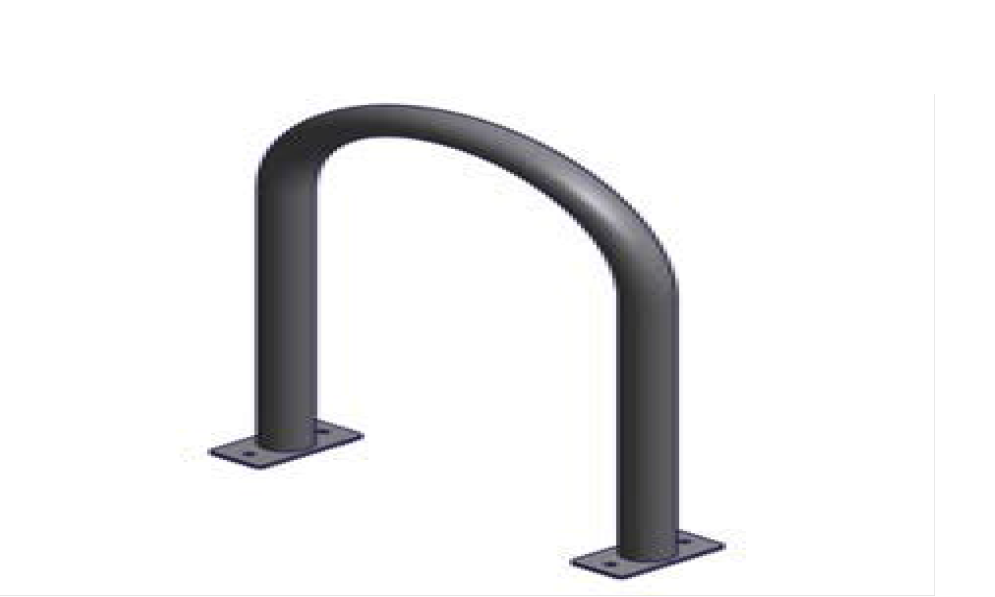
Unless otherwise specified by overlay or other aesthetic districts, steel, galvanized finish, inverted "U" shaped bicycle racks conform to minimum standards (figure C). Bicycle racks designed to park multiple bicycles are encouraged when necessary to meet the required bicycle parking.
(4)
Automobile parking space bonus. Automobile parking requirements may be reduced pursuant to the following formula: one automobile parking space for one bicycle parking space, provided the reduction for automobile parking does not exceed ten percent of the required total of automobile parking spaces. The automobile parking space bonus is available to all new structures whether bicycle parking spaces are required or not required.
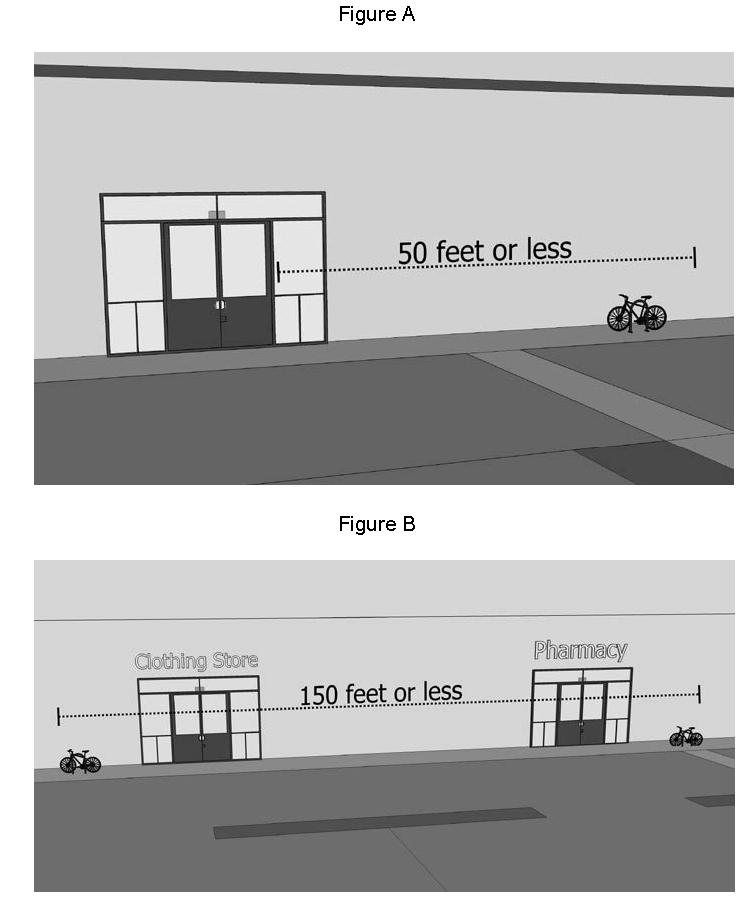
Figure C
(Ord. No. 6451, § II, 12-2-2014)
Sec. 114-569. - Streets requiring bicycle parking.
For parcels that are within 500 feet of the centerline of the greenbelt and streets listed in this section, the entire parcel is included, not just that portion within the 500 feet of the centerline:
(1)
Streets in the central business district area bounded by Clinchfield Street, Main Street, and Sullivan Street.
(2)
Barton Street (Greenbelt connector).
(3)
Boone Street.
(4)
Cleek Road.
(5)
Clinchfield Street.
(6)
East Center Street.
(7)
East Ravine Road (Broad Street to Watauga Street).
(8)
East Sevier Avenue (Tennessee Street to North Wilcox Drive).
(9)
East Stone Drive.
(10)
East Sullivan Court.
(11)
East Sullivan Street.
(12)
Eastman Road.
(13)
Fort Henry Drive (East Center Street to John B. Dennis Highway).
(14)
Holston Valley Drive.
(15)
Indian Trail Drive.
(16)
Industry Drive.
(17)
Keller Street (Greenbelt connector).
(18)
Konnarock Road.
(19)
Lincoln Street (Konnarock Road to John B. Dennis Highway).
(20)
Lynn Garden Drive.
(21)
Main Street.
(22)
Meadowview Parkway (I-26 to South Wilcox Drive).
(23)
Memorial Boulevard (Fort Henry Drive to Briarwood Road).
(24)
Netherland Inn Road (Ridgefields Road to Gilliam Street).
(25)
Netherland Inn Road (West Stone Drive to east end of Holston River Bridge).
(26)
North Wilcox Drive.
(27)
Orebank Road (Exchange Place to Cleek Road).
(28)
South Wilcox Drive (East Sullivan Street to Old Wilcox Drive/South Wilcox Drive intersection).
(29)
Warpath Drive.
(30)
West Center Street.
(31)
West Ravine Road (Holston Valley Drive to Broad Street).
(32)
West Stone Drive.
(33)
West Sullivan Street.
(Ord. No. 6451, § III, 12-2-2014)

