
Kingsville City Zoning Code
SIGN REGULATIONS
Sec. 15-6-115.- Signs restricted.
(A)
The size, number, characteristics, and location of signs are restricted by this article, except for political signs that are also governed by the Texas Election Code, more specifically Section 259.003. Signs owned by or required by governmental entities are not regulated by this article. Advertising signs (signs not on the lot occupied by the business identified or signs aimed at products sold on site) are limited to business, industrial, and agricultural districts with property having frontage on numbered U.S. and State Highways.
(B)
Owner identification signs are permitted in all retail, commercial, industrial and agricultural districts (C-1, C-2, C-3, C-4, I-1, I-2, Ag), but in the case of freestanding signs, all signage shall be limited to a monument type signage.
(C)
Monument sign means a sign resting on the ground immediately below it or with the bottom of the sign within 18 inches of the ground immediately below it.
(Ord. 97041, passed 12-8-97; Ord. 2012-03, passed 2-27-2012; Ord. 2013-32, § I, passed 7-22-2013; Ord. 2024-15, § I, passed 2-26-24)
Sec. 15-6-116. - Residential signs permitted.
No signs other than one real estate sign per street frontage (for rent or for sale) with a maximum area of ten square feet, occupant's name signs (two) with no business reference and a maximum area of three square feet shall be permitted in the R-1 Single-Family and R-2 Two-Family Districts. In the R-3 Multi-Family and R-4 General Residential Districts, all signs permitted in the R-1 District and one sign per street frontage (maximum size of 80 square feet per sign) identifying the name of apartments are permitted. No sign shall be placed within 20 feet of the point of intersection of any two right-of-way lines.
(Ord. 97041, passed 12-8-97; Ord. 2013-32, § I, passed 7-22-2013)
Sec. 15-6-117. - Owner identification signs permitted.
(A)
Owner identification signs in permitted districts shall comply with the standards of this section. Freestanding signs are limited to one sign per street frontage. The maximum size of any freestanding owner identification sign shall be 200 square feet. Freestanding signs shall be only of a monument type sign. The square footage of a multitenant sign may be increased by 16 square feet for each additional tenant over the first, with a maximum of 500 square feet overall. No sign shall be placed within the arc formed by a 20 foot radius from the point of intersection of two street right-of-way lines unless it complies with § 15-6-120. Each business may possess one sign intended for temporary use such as banners. Temporary signs and banners shall not be larger than 32 square feet and shall be permitted to comply with §15-6-126(c).
(B)
Flat wall signs shall have a total sign area limited to 10% of the facade on which the sign(s) is/are located computed against the first 20 feet in building height. Roof signs shall not be permitted. Wall signs shall not project more than one foot from the building and it shall be anchored to withstand wind conditions as specified by the adopted Building Code.
(C)
Temporary sandwich board signs may only be located in front of commercial properties within the Historic District where sidewalks area minimum of eight feet wide. These temporary signs shall be located on a sidewalk during business hours. Under no exception shall the signs be placed over any commemorative pavers. The total size of the sign is not to exceed 42 inches by 24 inches (height × width). The signs must be internally weighted to withstand strong winds. The temporary sandwich board signs shall be placed on the sidewalk one foot from the curb. Sandwich boards should not obstruct pedestrian traffic flow. The minimum clear width of a pedestrian access rout shall be 48 inches exclusive of the width of the curb. Only one sandwich board sign shall be permitted per business, and the sign shall be located in front of that specific business, not at another location. If the business is a corner property, the sign may only be placed in one location. Historical Development Board design approval is required prior to a permit being issued by the city.
(D)
Hanging signs shall be allowed for commercial properties within the Main Street District when such signs have a minimum clearance of 6′8″ (80″) from the sidewalk and do not extend beyond the awning or canopy. These signs shall be a maximum size of 42″ in width and 24″ in depth.
(E)
Window signs on commercial properties within the Main Street District shall cover no more than 30% of the total glass area of the windows on which they are placed.
(Ord. 97041, passed 12-8-97; Ord. 98003, passed 2-23-98; Ord. 98013, passed 7-13-98; Ord. 2006-57, passed 10-23-06; Ord. 2012-03, passed 2-27-2012; Ord. 2013-32, § I, passed 7-22-2013; Ord. 2019-12, § I, passed 4-8-2019)
Sec. 15-6-118. - Advertising signs.
Advertising signs shall not exceed 200 square feet.
(Ord. 97041, passed 12-8-97; Ord. 2013-32, § I, passed 7-22-2013)
Sec. 15-6-119. - Projecting signs.
No sign shall be permitted on or to project into the public right of way except in the Central Business District(C-3) zoning district upon receipt of a special use permit. In no case shall any sign be less than eight feet above the sidewalk. Special use permits for signs may be revoked upon 30 days notice by the City Commission and signs must be removed from the public right of way by the end of the 30 day period.
(Ord. 97041, passed 12-8-97; Ord. 2013-32, § I, passed 7-22-2013; Ord. 2019-12, § I, passed 4-8-2019)
Sec. 15-6-120. - Obstructing signs.
Signs shall be designed and located so as not to significantly obstruct sight lines of driveways or intersections of public streets.
(Ord. 97041, passed 12-8-97; Ord. 98013, passed 7-13-98; Ord. 2013-32, § I, passed 7-22-2013)
Sec. 15-6-121. - Prohibited signs.
The following signs shall be prohibited in all zoning districts:
(1)
Signs that interfere with free use of building entrances and exits, including emergency exits, or which obstruct doors or windows or impede light and ventilation otherwise required by city ordinance, code or regulation;
(2)
Signs in a public right-of-way other than those permitted under § 15-6-119;
(3)
Signs within a driveway or street intersection sight visibility triangle which are between three feet and eight feet in height;
(4)
Vehicle signs which are signs on vehicles or trailers that are moving parked or located so that they can be seen from a street right-of-way and for the primary purpose of displaying the sign. It shall be primafacie evidence that the primary purpose of a vehicle or trailer is to display a sign if the vehicle or trailer is parked on the same property for a continuous period exceeding 72 hours. The intent of this subsection is to prohibit the use or display of signs on vehicles and trailers to otherwise circumvent the purpose and intent of the sign code;
(5)
Signs such as beacons or tethered balloons which are otherwise permitted but which by their design or location interfere with aircraft safety;
(6)
Strobe, revolving and rapidly flashing light displays which has light displayed every 60 cycles per minute shall be prohibited. Any display resembling traffic-control devices, emergency signals, or caution signals are prohibited. Any display utilizing sirens, bells, whistles, or otherwise emitting noise detectable beyond the property line shall be prohibited. Revolving signs shall be limited to no more than one revolution every ten seconds.
(7)
Obsolete signs as defined in § 15-6-131;
(8)
Advertising on street furniture, including but not limited to, park benches, trash receptacles, dumpster enclosures, bus shelters, etc.
(9)
Signs on public property. Signs found on public property in violation of this section will be removed by the City and disposed of.
The following signs, defined in § 15-6-132, shall be prohibited in the Main Street District:
(1)
Feather flag signs;
(2)
Inflatable signs;
(3)
Handmade or non-professional signs;
(4)
Signs placed directly on top of an awning;
(5)
Nuisance signs.
(Ord. 97041, passed 12-8-97; Ord. 2013-32, § I, passed 7-22-2013; Ord. 2019-12, § I, passed 4-8-2019)
Sec. 15-6-122. - Traffic flow signs.
Signs to facilitate or direct traffic flow shall be permitted as needed. Traffic signs containing advertising or owner identification information shall be counted as owner identification or advertising signs. All such signs shall meet the requirements of the manual and specifications for a uniform system of traffic control devices adopted by the Texas Transportation Commission. No sign may be posted on or in view of a highway which attempt to direct the movement of traffic or prohibits viewing of a traffic sign or signal.
(Ord. 97041, passed 12-8-97; Ord. 2013-32, § I, passed 7-22-2013)
Sec. 15-6-123. - Irregular shaped signs.
Signs of irregular shape (other than square, rectangle, triangle, or circle) shall have their area computed by drawing a rectangle around the sign and computing the enclosed area.
(Ord. 84-009, passed 6-18-84; Ord. 97041, passed 12-8-97; Ord. 2013-32, § I, passed 7-22-2013)
Sec. 15-6-124. - Maximum size; US77/I-69 corridor.
(A)
Owner identification and advertising signs located within 300 feet of the U.S. Highway 77 Bypass/Interstate 69 right-of-way, may utilize steel poles or monument signs.
(1)
When utilizing steel poles, the signs shall not have their total display face area exceed 400 square feet, with a sign maximum height of 50 feet, and a maximum sign length of 40 feet; inclusive of border and trim, but excluding the base or apron.
(2)
When utilizing monument signs, the sign shall not have their total sign area exceed 400 square feet, with a maximum height equal to that which is allowed in the respective zoning district, inclusive of sign frame, cabinet, border and trim as measured from grade.
(B)
The maximum size limitations apply to each side of the sign structure or structures visible to approaching traffic.
(C)
Signs may be placed back-to-back, side by side, or stacked, with not more than two display faces visible to approaching traffic on the Highway 77 Bypass. Such sign structure or structures shall be considered one sign.
(D)
Signs that exceed 200 square feet in area, including cutouts, may not be stacked or placed side by side.
(Ord. 97041, passed 12-8-97; Ord. 2013-32, § I, passed 7-22-2013; Ord. 2014-47, 8-11-2014; Ord. No. 2020-20, § I, passed 4-2-20)
Sec. 15-6-125. - Banners.
Banners are allowed and shall be located as allowed by § 15-6-126. Only City banners are allowed to be placed on street lights. The term "Portable signs" does not include banners.
(Ord. 97041, passed 12-8-97; Ord. 98003, passed 2-23-98; Ord. 98013, passed 7-13-98; Ord. 2013-32, § I, passed 7-22-2013; Ord. 2019-12, § I, passed 4-8-2019)
Sec. 15-6-126. - Permits.
(A)
All signs and banners are required to be permitted prior to installation. See Texas Election Code Section 259.003 to determine if a political sign needs a permit.
(B)
Exempt signs. The following signs are exempt from the permit requirements of these sign regulations. No sign, including exempt signs, may be posted within a street right-of-way without written approval from the Director of Public Works or his designee.
(1)
Advertising and identifying signs located on currently licensed vehicles such as taxicabs, buses and trucks, as well as on bus benches, except for those vehicle signs prohibited under § 15-6-121;
(2)
Any legal or public notice or warning required by a valid and applicable federal, state or local law, regulation or ordinance;
(3)
Noncommercial signs in all zoning districts, including but not limited to religious and social commentary signs and personal emblems. Such signs shall be no greater than nine square feet in area within a residential zoning district or 32 square feet in a nonresidential district and may be free standing or attached flat against a wall so long as they are not painted directly on a structure. Political signs may be placed no more than 90 days prior to the election and can remain throughout the period of primary elections to the conclusion of the general election for those who are still viable political candidates. Upon the completion of the general election all political signs must be removed within ten days after said election. See Texas Election Code Section 259.003 for other political sign regulations.
(4)
Holiday and seasonal lights and decorations with no commercial message;
(5)
Signs advertising temporary activity on the property such as sale, rent or lease of the property; construction; grand openings; garage and yard sales; and special events and which meet the following requirements:
a.
One sign shall be permitted on the property at any one time and shall be removed within 48-hours following the end of the temporary activity or event.
b.
May be either installed flat against a structure or affixed in the ground as a freestanding sign.
c.
In residential zoning districts, the maximum size shall be nine square feet.
d.
In nonresidential zoning districts, the maximum size shall be 32 square feet.
(C)
Temporary signs generally, except as otherwise permitted in this sign code, are not classified as exempt signs under § 15-6-126 of the sign code; therefore temporary signs shall:
(1)
Obtain a sign permit to be valid for 30 consecutive days, and no more than two temporary sign permits shall be issued for each business per any 180 day period;
(2)
Not be placed in street rights-of-way or otherwise diminish public safety such as placement in an intersection visibility triangle;
(3)
Not be mounted on a roof or above the roofline;
(4)
Not be artificially illuminated; and
(5)
Be a maximum of 20 square feet in area when located in residential zoning districts (R3 & R4 districts only);
(6)
Be a maximum of 100 square feet in area when located in nonresidential zoning districts;
(7)
Be limited to one sign per parcel for each street frontage.
(8)
Signs advertising a temporary event may be placed no more than 60 days prior to the event and shall be removed no later than 10 days after the event has ended.
Permit fees will be as follows: $25 (review fee) and $0.20/square foot.
(Ord. 97041, passed 12-8-97; Ord. 98003, passed 2-23-98; Ord. 98013, passed 7-13-98; Ord. 200022, passed 11-20-00; Ord. 2013-32, § I, passed 7-22-2013; Ord. 2019-12, § I, passed 4-8-2019; Ord. 2024-15, § I, passed 2-26-24; Ord. No. 2024-70, § II, passed 9-23-24, eff. 10-14-24)
Sec. 15-6-127. - Historical district.
Any sign or banner to be located within the Historical District shall be reviewed by the historic preservation officer without review by the Historical Development Board to determine if the sign or banner is in compliance with the Historical Ordinance.
(Ord. 91034, passed — ; Ord. 97041, passed 12-8-97; Ord. 2013-32, § I, passed 7-22-2013; Ord. 2018-74, § I, passed 12-10-2018)
Sec. 15-6-128. - Penalty.
If the owner fails to obtain a permit within three business days of being notified to obtain a permit, a written notice shall be sent by certified mail notifying the owner that he has two days from receipt of the written notice to obtain the required permit. Failure to comply with the written notification will result in a complaint being filed in Municipal Court. For each day the permit is not obtained, it will result in a separate offense. The fine per offense shall not exceed $500.00.
(Ord. 97041, passed 12-8-97; Ord. 2013-32, § I, passed 7-22-2013)
Sec. 15-6-129. - Grandfather clause.
Signs already in existence are exempted from permitting, but in the event of repair and/or replacement, other than routine maintenance, all existing signs shall comply with §§ 15-6-115 through 15-6-132 at that time. Notwithstanding anything else herein, all signs must comply with this article.
(Ord. 98013, passed 7-13-98; Ord. 2013-32, § I, passed 7-22-2013; Ord. 2019-12, § I, passed 4-8-2019)
Sec. 15-6-130. - Changeable electronic variable message signs.
(A)
Purpose and Intent. More businesses desire to utilize advancements in technology which permit signs to change copy electronically (e.g., utilizing a Changeable Electronic Variable Message (CEVMS) or a Light Emitting Diode (LED) type of sign). These newer technologies pose additional risks of impacting adjacent areas and adversely affecting the environment in which they operate unless regulated in a reasonable fashion. The intent of this section is to establish operating standards and regulations for signs which utilize these newer technologies in order to minimize the secondary effects that often accompany the unregulated display of digital signs, preserve the character of adjacent areas (with a principal focus on residential neighborhoods), protect property values, and reduce traffic hazards caused by undue distractions.
(B)
Definitions.
Changeable electronic variable message sign (CEVMS) shall mean a sign which permits light to be turned on or off intermittently or which is operated in a way whereby light is turned on or off intermittently, including any illuminated sign on which such illumination is not kept stationary or constant in intensity and color at all times when such sign is in use, including an LED or digital sign, and which varies in intensity or color. A CEVMS sign does not include a sign located within the right-of-way that functions as a traffic control device and that is described and identified in the Manual on Uniform Traffic Control Devices (MUTCD) approved by the Federal Highway Administrator as the National Standard.
Off-premises sign shall mean any sign, commonly known as a billboard, that advertises a business, person, activity, goods, products or services not located on the premises where the sign is installed and maintained, or that directs persons to a location other than the premises where the sign is installed and maintained.
On-premises sign shall mean any sign identifying or advertising the business, person, activity, goods, products or services sold or offered for sale on the premises where the sign is installed and maintained when such premises is used for business purposes.
Sign code application area shall mean the corporate limits of the city and the area of its extraterritorial jurisdiction as defined by Tex. Local Gov't Code § 42.021.
(C)
Permitted Uses. Lighted CEVMS shall be permitted within all non-residential zoning districts of the Sign Code Application Area (excluding Ag Districts), provided information can be shown indicating they meet the below criteria prior to permitting and are maintained to perform as such after installation:
(1)
Comply with the size and placement criteria as prescribed within Section 15-6-115 through 15-6-120.
(2)
The luminance/brightness shall be limited to 5,000 NIT's during daylight, and 250 NIT's from dusk to dawn.
(3)
The luminance/brightness of the sign shall be controlled by an ambient light monitor which shall automatically adjust the brightness levels based on ambient light levels.
(4)
The sign display shall remain static for a minimum of five seconds, and shall require instantaneous change of the display.
(5)
No animation or video shall be allowed utilizing the CEVMS.
(6)
The CEVMS display shall be programmed to go dark in the instance of a malfunction.
(D)
Prohibitions. Prohibition of new off-premises sign. From and after the effective date, no new construction permit shall be issued for the erection of an off-premises sign including, but not limited to, billboards, new off-premises CEVMS or the conversion of an existing non-CEVMS off-premises sign to a CEVMS, within the Sign Code Application Area.
(E)
Grandfather clause. CEVMS signs already in existence on the passage of this ordinance are allowed to remain as is; however, in the event of repair and/or replacement, other than routine maintenance, such signs must comply with this section.
(Ord. 2008-19, § I, passed 5-19-08; Ord. 2013-32, § I, passed 7-22-2013; Ord. No. 2015-01, § I, passed 1-12-2015)
Sec. 15-6-131. - Unsafe and obsolete signs.
(A)
Unsafe signs. If, in the opinion of the Director of Development Services, Building Official, or other designated representative, any sign is or has become dangerous or unsafe in any manner whatsoever, the Director, Building Official, or designated representative shall issue an order to the real property owner directing that the sign shall be immediately repaired and made safe, or taken down and removed.
(B)
Obsolete or abandoned signs and sign structures. Any sign or sign support structure, whether existing on or installed after the effective date of this sign code: (1) which, for at least 90 consecutive days, has not identified or advertised a bona fide business, lessor, service, owner, product, or activity, or advertised a time which has passed or an event which has occurred; or (2) which has been dilapidated for 30 days or more; or (3) for which the city cannot determine the identity of a legal owner.
(C)
Dilapidated Sign. A sign which is decayed, deteriorated, or which has fallen into partial ruin that: (1) has any portion of the finished material or surface of the message portion of the sign that is visibly faded, flaked, broken off, missing, cracked, splintered, or defective or that is otherwise visibly deteriorated or in a state of disrepair so as not to substantially appear as it was intended or designed to appear when originally constructed; or (2) has an element, structural support, or frame member that is visibly bent, broken, dented, torn, twisted, leaning, or at angles other than those at which it was originally erected.
(D)
Removal. The owner, agent, or person in control of any premises on which there is displayed or maintained an unsafe, abandoned, obsolete or dilapidated sign or supporting structure or the owner or person in control of an unsafe, abandoned or dilapidated sign or supporting structure shall comply with the following requirements:
a.
Any sign that is unsafe, abandoned, obsolete or dilapidated shall be removed.
b.
If a supporting structure used or designed to be used with a sign is unsafe, abandoned, obsolete or dilapidated, the supporting structure shall be removed.
c.
If an unsafe, abandoned, obsolete or dilapidated supporting structure does not have a can, frame, or similar part of the supporting structure that would hold the sign or to which the sign would be attached, the supporting structure shall be removed.
Failure to remove shall be a violation of this ordinance. It shall be a rebuttable presumption that a sign is abandoned if it meets the definition of a dilapidated, abandoned or obsolete sign.
(E)
Process. Should the director of Development Services, Building Official, or other designated representative, determine that any sign is not properly maintained, is unsafe or insecure or has otherwise been constructed, erected or maintained in violation of the provisions of this code, he shall declare it to be a public nuisance and give written notice of same via hand delivery or certified mail return receipt requested to the real property owner of record.
a.
Such notice and order shall contain substantially the following: (1) location, type, and business name of the sign that is sufficient for identification of such sign; (2) a statement that the designated city employee has found such sign to be in violation of this code or other laws, together with a general description of such violation; (3) the amount of time required to bring the sign into compliance with this code or any other law, said time not to exceed ten (10) days, which may be extended by the designated city employee when it is shown that such corrections cannot be accomplished within the original ten-day time period.
b.
Should the owner of the premises where the sign in question is located fail to remove or repair the sign within the time period specified in this section, the city may remove or repair the sign and assess the cost for same against the owner of record of the real property from which it was removed or repaired. If said costs are not paid, then said costs shall constitute as a valid lien. The City shall assess the costs as a valid lien against such property with the lien accruing interest at eight (8) percent per annum, simple interest until such time as paid in full.
c.
In addition to the above, the Director of Development Services, or other designated representative, may issue citations or pursue any other administrative or legal remedy in order to abate any sign which is in violation of this code or any other law.
d.
Notwithstanding anything to the contrary, the Director of Development Services, or other designated representative, may cause any sign which is dangerous as an immediate hazard to persons or property to be removed summarily and without notice.
(Ord. 2012-03, passed 2-27-2012; Ord. 2013-32, § I, passed 7-22-2013)
Sec. 15-6-132. - Definitions.
Banner. A temporary sign, either attached or freestanding, with or without characters, letters, illustrations or ornamentations, applied to cloth, paper, flexible plastic or fabric of any kind, attached to the exterior structure or freestanding on the site with temporary fastening devices such as rope, string, wire, twine or similar materials, which is in addition to the permitted permanent signs, announcing a special event for a business, i.e., business openings, grand openings, sales or promotional events.
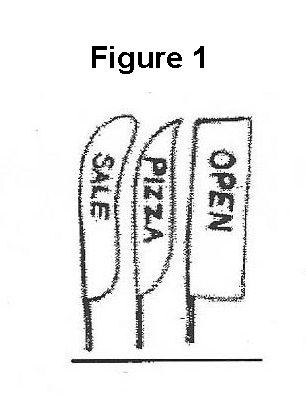
Feather flag. A vertical portable sign that contains a harpoon-like style pole or staff driven into the ground for support or supported by means of an individual stand (see Figure 1).
Hanging sign. A sign attached to underneath the canopy or awning.
Inflatable sign. A sign manufactured of plastic, cloth, canvas, or other flexible or light fabric, inflated with air, secured to the ground, does not float, does not move freely in the wind, and does not exceed 30 feet in height.
Nuisance signs. Any sign which annoys and disturbs one in possession of his property, rendering its ordinary use or occupation physically uncomfortable to him, or which is illuminated to an intensity to cause glare or brightness to a degree that could constitute a hazard or nuisance. Nuisance signs shall include, but not be limited to, the following:
(1)
Signs containing statements, words, or pictures of an obscene, indecent, or immoral character, such as will offend public morals or decency.
(2)
Signs which imitate an official traffic sign or signal, or which contain the words 'stop,' 'go slow,' 'caution,' 'danger,' 'warning,' or similar words.
(3)
Signs which are of a size, location, movement, content, coloring, or manner of illumination which may be confused with or construed as a traffic-control device, which hide from view any traffic or street sign or signal, or which obstruct the view in any direction at a street or road intersection.
(4)
Signs which are moving, flashing, intermittently lighted, changing color, beacons, revolving, or similarly constructed, except as otherwise permitted in this chapter.
Window sign. A sign painted or applied to a window or door glass intended for permanent use.
(Ord. 2019-12, § I, passed 4-8-2019)

