
Kirksville City Zoning Code
ARTICLE I
- IN GENERAL
Sec. 44-1.- Definitions.
The following words, terms and phrases, when used in this chapter, shall have the meanings ascribed to them in this section, except where the context clearly indicates a different meaning:
Accessory building or use means a subordinate building having a use secondary to any location on the lot occupied by the main building, or any use secondary to the main use of the property. A building housing an accessory use is considered an integral part of the main use with respect to setbacks for the back or side lines of properties otherwise abutting on a street.
Adult entertainment means any live exhibition, performance, display or dance of any type, conducted in an adult entertainment business, including, but not limited to, posing or serving food or beverages or soliciting for the sale of food, beverages or entertainment or pantomiming or modeling or removal of clothing on an adult entertainment business premises where such exhibition, performance, display or dance is intended to seek to arouse or excite the sexual desires of the entertainer, other entertainers or patrons or members, and such exhibition, performance, display or dance is characterized by emphasis on matters depicting, describing or relating to specified sexual activities or specified anatomical areas for observation by patrons or members.
Adult entertainment business means any enterprise to which the public, patrons or members are invited or admitted, and where providing adult entertainment, as defined herein, is a portion of its business.
Adult motel means an enterprise where a regular and substantial business purpose is offering public accommodations for consideration for the purpose of viewing closed circuit television transmissions, films, motion pictures, videocassettes, DVDs, slides or other photographic reproductions which are distinguished or characterized by an emphasis on the depiction or description of specified sexual activities or specified anatomical areas and rents room accommodations for less than six hours at a time.
Adult motion picture theater means an establishment containing a room with seats facing a screen or projection area, where a regular and substantial business purpose is the exhibition to customers of films, videotapes, DVDs or motion pictures which are intended to provide sexual stimulation or sexual gratification to the customers and which are distinguished by or characterized by an emphasis on matter depicting, describing or relating to specified sexual activities or specified anatomical areas.
Bathhouse means an enterprise where a regular and substantial business purpose is offering baths with other persons present who are nude or displaying specified anatomical areas.
Body painting studio means an establishment where a regular and substantial business purpose is the maintaining, operating, or offering for compensation the applying of paint or other substance to or on the human body by any means of application, technique or process when the subject's body is displaying for the customer's view specified anatomical areas.
Apartment means a room or suite of rooms within an apartment house arranged, intended or designed for a place of residence of a single housekeeping unit.
Apartment hotel means an apartment house which furnishes for the use of its tenants services ordinarily furnished by hotels, but the privileges of which are not primarily available to the public.
Apartment house means a building or portion thereof designed, used or intended to be used as a residence for three or more families, living in separate apartments.
Average block setback means the average front setback for structures located on the same side of the street and within one block.
Basement means a story below the first story, as defined under the term "story," counted as a story for height regulations if subdivided and used for dwelling purposes, other than by a janitor or watchman employed on the premises.
Bed and breakfast means an owner-occupied short-term lodging facility that houses at least one lodging room, which may provide meals and lodging for compensation on a daily basis for no more than 31 days (see article VIII of this chapter).
Block means an area of land entirely bounded by streets, highways, barriers, or right-of-way (except alleys, pedestrian ways, or exterior boundaries of a subdivision unless exterior boundary is a street, highway, or right-of-way) or bounded by a combination of streets, public parks, cemeteries, railroad rights-of-way, waterways, or corporate boundary lines.
Boardinghouse orlodginghouse means a dwelling occupied as a single housekeeping unit, where lodging or meals are provided for three or more persons for compensation, pursuant to previous arrangements, but not for the public or transients.
Building means a structure having a roof supported by columns or walls for the shelter, support or enclosure of persons, animals or chattels.
Building, attached, means a building having two walls in common with other buildings except that end buildings may have only one wall in common.
Building, detached, means a building having no walls in common with other buildings.
Building line, front, means a line parallel to the front lot line that separates all parts of a building from the open spaces adjacent thereto on the same lot.
Building, main or primary, means the building in which is conducted the main or primary use of the lot on which it is located.
City planner shall have the same meaning as zoning administrator.
Code enforcement director shall have the same meaning as building official and floodplain manager.
Communal houses, nonresidential, means any building or structure owned or occupied by persons having a common association which is not used for residential lodging purposes, and which is used primarily for assembly purposes (e.g., recreational or social). Nonresidential communal houses shall be considered as assembly halls.
Communal houses, residential A, means a dwelling occupied as a single housekeeping unit, where residential lodging is provided for five or more persons not related by blood or marriage, with rooms or spaces which are available for use as common areas for assembly purposes (e.g., recreational or social) that are not greater than 40 percent, cumulatively, of the gross floor area of said dwelling.
Communal houses, residential B, means a dwelling occupied as a single housekeeping unit, where residential lodging is provided for five or more persons not related by blood or marriage, with rooms or spaces which are available for use as common areas for assembly purposes (e.g., recreational or social) that are greater than 40 percent, cumulatively, of the gross floor area of said dwelling.
Court means an open space, other than a yard, on the same lot with a building, which is bounded on two or more sides by, but is not totally enclosed by, the walls of such buildings.
Day care means a state department of health and senior services licensed, regulated, or child care subsidized facility where care is provided for children by a child care provider for any part of the 24-hour day.
Driveway means an area intended for the operation of private automobiles and other vehicles from a lot line to a garage, approved parking area, building entrance, structure or approved use located on the property.
Driveway approach means an area intended for the operation of private automobiles and other vehicles giving access between a street and/or alley edge and abutting a lot line.
Dwelling means a building or portion thereof designed exclusively for residential occupancy, including single-family, two-family and multiple-family dwellings, boardinghouses and lodginghouses, apartment houses and apartment hotels, but not hotels.
Dwelling, multifamily, means a building or portion thereof arranged, intended or designed for occupancy by three or more families, including apartment houses, row houses, tenements and apartment hotels.
Dwelling, single-family.
(1)
The term "single-family dwelling" means a detached building, other than a mobile home, arranged, intended, or designed for occupancy by one family and where lodging or meals may be provided for not more than two persons for compensation.
(2)
The term "single-family dwelling" also includes any home in which eight or fewer unrelated mentally or physically handicapped persons reside, together with two additional persons acting as house parents or guardians who need not be related to each other or to any of the persons residing in the home.
(3)
The term "single-family dwelling" also includes any private residence licensed by the division of family services or department of mental health to provide foster care to one or more but less than seven children who are unrelated to either foster parent by blood, marriage or adoption.
Dwelling, two-family, means a building arranged, intended or designed for occupancy by two families.
Dwelling unit means one or more rooms connected together, constituting a separate, independent housekeeping establishment for owner-occupancy or rental or lease on a weekly, monthly or longer basis, physically separated from any other rooms or dwelling units which may be in the same structure and containing independent cooking and sleeping facilities.
Family means one or more persons who are related by blood or marriage, living together and occupying a single housekeeping unit with kitchen facilities, or a group of not more than four persons (excluding servants) living together, by joint agreement, and occupying a single housekeeping unit with single kitchen facilities on a nonprofit, cost-sharing basis.
Foundation, permanent, means foundation walls that are considered permanent in nature and meet the criteria of the current building code adopted by the city. In the case of manufactured homes, in addition to load bearing interior piers, permanent foundation shall also include any abutting perimeter masonry or concrete walls.
Garage, private, means an accessory building primarily for the storage of motor vehicles.
Garage, public, means a building or portion thereof designed or used for the storage, sale, hiring, care or repair of motor vehicles and which is operated for commercial purposes.
Garage, storage, means a building or portion thereof providing storage for motor vehicles with facilities for washing, but no other services.
Gross floor area. Gross floor area shall be considered as the floor area within the perimeter of the outside walls of the building under consideration without deduction for hallways, stairs, closets, thickness of walls, columns, or any other features.
Heights of buildings means the vertical distance measured from the highest of the following three levels:
(1)
From the street curb level;
(2)
From the established or mean street grade in case the curb has not been constructed;
(3)
From the average finished ground level adjoining the building if it sets back from the street line to the level of the highest point of the roof beams of flat roofs or roofs inclining not more than one inch to the foot or to the mean height level of the top of the main plates and highest ridge for other roofs.
Historic district means an area designated as all lots being zoned "H, Historic" by ordinance of the city council which may include individual landmarks, as well as other properties or structures which, while not of such historic and or architectural significance to be designated as landmarks, nevertheless contribute to the overall visual characteristics and historical significance of the historic district.
Hotel means a building occupied or used as a more or less temporary abiding place of individuals or groups of individuals who are lodged with or without meals, and in which there are more than 12 sleeping rooms, and no provisions for cooking in individual rooms.
Landmark means a property or structure designated as a landmark by ordinance of the city council, pursuant to procedures prescribed in chapter 2, article X, which is worthy of rehabilitation, restoration, interpretation and preservation because of its historic, architectural or archaeological significance to the city, and zoned appropriately as an "H, Historic" overlay property.
Lot means a parcel of land of, at least, sufficient size to meet the minimum zoning requirements for use, coverage and area and to provide such yards and other spaces as are required in this chapter. Such lot shall have frontage on an improved public street or on an approved private street and may consist of:
(1)
A single lot of record;
(2)
A portion of a lot of record;
(3)
A combination of complete lots of record and portions of lots of record or of portions of lots of record;
(4)
A parcel of land described by metes and bounds;
provided that in no case of division or combination shall any residual lot or parcel be created which does not meet the requirements of this chapter.
Lot, corner, means a lot abutting upon two or more streets at their intersection. A corner lot shall be deemed to front on that street on which it has its least dimension, unless otherwise specified by the zoning administrator.
Lot depth means the mean horizontal distance from the front street line to the rear line.
Lot, interior, means a lot whose side lines do not abut upon any street.
Lot line, exterior side, means a side boundary line which abuts upon a public right-of-way containing a street.
Lot line, front, means the boundary between a lot and the street on which it fronts.
Lot line, interior side, means a side boundary line which abuts upon private property and does not abut upon a public right-of-way containing a street.
Lot line, rear, means the boundary line which is opposite and most distant from the front street line, except that in the case of uncertainty, the zoning administrator shall determine the rear line.
Lot lines means the lines bounding a lot as defined herein.
Lot line, side, means any lot boundary line not a front or rear line thereof. A side lot line may be a party lot line, a line bordering on an alley or place or a side street line.
Lot of record means a lot which is part of a subdivision recorded in the office of the county recorder; or a lot or parcel described by metes and bounds, the description of which has been so recorded.
Lot, through, means an interior lot having frontage on two streets.
Lot types. The diagram which follows illustrates terminology used in this chapter with reference to corner lots:
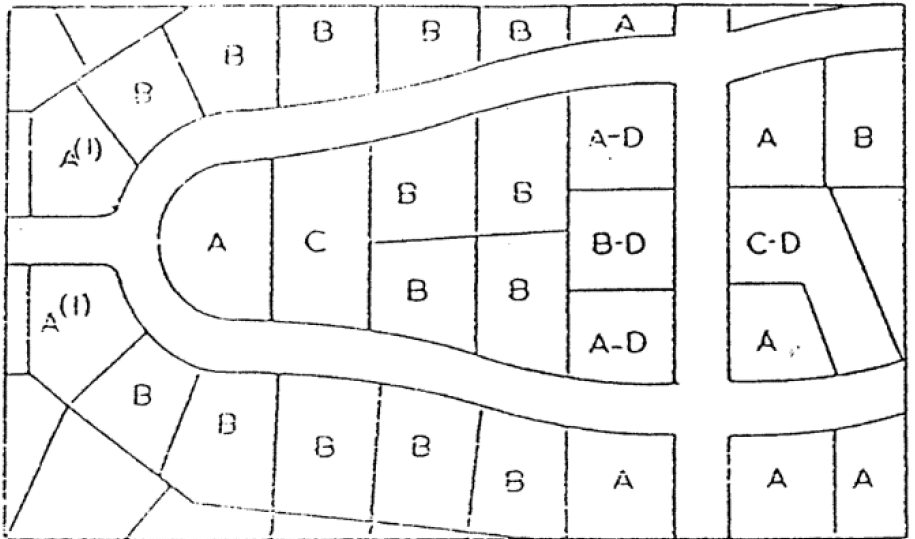
In the diagram:
A = Corner lot. A lot abutting on a curved street shall be considered a corner lot if straight lines drawn from the foremost points of the side lot lines to the foremost point of the lot meet at an interior angle of less than 135 degrees. See lots marked A(1) in the diagram.
B = Interior lot.
C = Through lot. Through lots abutting two streets may be referred to as double frontage lots.
D = Reversed frontage lot; defined as a lot on which the frontage is at right angles or approximately right angles (interior angle less than 135 degrees) to the general pattern in the area. A reversed frontage lot may also be a corner lot (A-D in the diagram), an interior lot (B-D) or a through lot (C-D).
Lot width means the mean horizontal distance between side lines, measured at right angles to the depth.
Manufactured housing, double-wide.
(1)
The term "double-wide manufactured housing" means the same as the term "mobile home, double-wide," except that double-wide manufactured housing:
a.
Must be a minimum of 26 feet wide and transported in more than one single unit as a finished dwelling unit;
b.
May be located in any R-2-S, R-3-S, R-4-S zone or planned unit development (PUD) if:
1.
Placed on a permanent foundation. Foundations shall meet the most current adopted building code of the city.
2.
Location on the site meets all standard zoning requirements contained in this chapter.
(2)
In addition, a double-wide manufactured home shall be subject to the following:
a.
The home must be occupied only as a one-family dwelling or as a two-family dwelling if so designed, and meets proper zoning criteria.
b.
Roof must be gable or hip roof of three in 12 (3:12) pitch or greater and covered with material that is residential in appearance. All roof structures shall provide an eaves projection of no less than 12 inches and no greater than 30 inches excluding gutter dimensions.
c.
Have proper guttering attached.
d.
Have exterior surface and window treatments that, to the maximum extent possible, are architecturally compatible with those of neighboring properties.
e.
Have the tongue and running gear including axles removed.
f.
Maintain a minimum of 18 inches of crawl space under the entire structure.
g.
Have permanent steps set at all exits.
h.
Must be serviced by and connected to city utilities.
i.
Property owner shall declare the manufactured or modular home as real property and must so record said property with the county assessor.
Manufactured housing, modular, means a dwelling that meets local and federal building code regulations.
Marijuana ormarihuana means Cannabis indica, Cannabis sativa, and Cannabis ruderalis, hybrids of such species, and any other strains commonly understood within the scientific community to constitute marijuana, as well as seed thereof and resin extracted from the plan and marijuana-infused products. The term "marijuana" does not include industrial hemp containing a crop-wide average tetrahydrocannabinol concentration that does not exceed three-tenths of one percent on a dry weight basis, or commodities or products manufactured from industrial hemp.
Marijuana-infused products means products that are infused with marijuana or an extract thereof and are intended for use or consumption other than by smoking, including, but not limited to, edible products, ointments, tinctures and concentrates.
Medical marijuana cultivation facility means a facility licensed by the state to acquire, cultivate, process, store, transport, and sell marijuana to a medical dispensary facility, medical marijuana testing facility, or to a medical marijuana-infused products manufacturing facility.
Medical marijuana dispensary facility means a facility licensed by the state to acquire, store, sell, transport, and deliver marijuana, marijuana-infused products and drug paraphernalia used to administer marijuana as provided for in this section to a qualifying patient, a primary caregiver, another medical marijuana dispensary facility, a medical marijuana testing facility, or a medical marijuana-infused projects manufacturing facility.
Medical marijuana-infused products manufacturing facility means a facility licensed by the state to acquire, store, manufacture, transport, and sell marijuana-infused products to a medical marijuana dispensary facility, a medical marijuana test facility, or to another medical marijuana-infused projects manufacturing facility.
Medical marijuana testing facility means a facility certified by the state to acquire, test, certify, and transport marijuana.
Mixed-use means a building, structure, or development containing more than one land use.
Mobile home means a single-family dwelling unit that has the following characteristics:
(1)
Designed for long-term occupancy containing sleeping accommodations, a flush toilet, tub or shower bath, and kitchen facilities, with plumbing and electrical connections provided for attachment to outside systems;
(2)
Designed to be transported after fabrication and remain on its own wheels, flatbed, frame or detachable wheels;
(3)
Arrives at the site where it is to be occupied as a dwelling unit ready for occupancy, except for minor and incidental unpacking and assembly operations, location on foundation support as approved by manufacturer's design, connection to utilities and the like;
(4)
Less than 26 feet wide as a finished dwelling unit;
(5)
A mobile home must be located in a mobile home park.
Mobile home park means a plot of ground upon which two or more mobile homes, occupied for sleeping or dwelling purposes, are located, regardless of whether or not a charge is made for such accommodations.
Mobile home, double-wide. See Manufactured housing, double-wide.
Motel means a building or a group of buildings, whether detached, semidetached or attached, providing lodging for primarily transient automobile travelers. A motel may contain restaurants and other accessory services for serving its residents as well as the public.
Nonconforming use, building or yard, means a use, building or yard which does not, by reason of design, use or dimensions, conform to the regulations of the district in which it is situated. A nonconforming use, building or yard shall be a legal nonconforming use if it is legally established prior to the passage of this chapter, and it shall be an illegal nonconforming use if it is established after the passage of this chapter and not otherwise approved as provided in this chapter.
Parking. See article III of this chapter.
Parking space. For off-street parking computations, a parking space shall have minimum dimensions of nine feet by 18 feet for both commercial and residential usage.
Place means an open, unoccupied space, other than a street or alley, permanently established or dedicated as the principal means of access to property abutting thereon.
Planned unit development (PUD) means a zoning method which permits a variety of uses in a development. The PUD is permitted in any zoning class except M-2, Heavy Industrial. PUDs shall require a development plan and follow the procedures for rezoning found in section 44-12. Example: (PUD) A single-family neighborhood with a car wash, fuel station and convenience store in the proposal.
Planned zoning district means the zoning designation of a lot or tract which permits development as is specifically depicted on plans approved in the process of rezoning that lot or tract.
Right-of-way, undeveloped public, means the space of land located between the back of the curb or street edge to the edge of the sidewalk or the property line that extends parallel to the street. The term "undeveloped public right-of-way" is also referred to as unimproved right-of-way.
Sea-going container, also known as sea container, sea cargo container, or sea storage container, means a rectangular metal container primarily used on ocean-going ships that contain freight or goods and provides protection from the elements; has a large door at one end of the container; many times has advertising on the sides with the company name of the original owner.
Sex offender means any individual who has been sentenced for committing a sexual offense, has a past conviction for an offense involving sexually deviant behavior, has displayed sexually deviant behavior in the commission of any offense, or has admitted to committing sexually deviant behavior.
Special use permit.
(1)
The term "special use permit" means an act of granting permission to use land in a manner not permitted in a given zoning district. The process of granting a special use permit requires a public hearing before the planning and zoning commission and approval of a special use permit ordinance by the city council setting forth the terms and conditions of said special use.
(2)
The granting of a special use permit should be conditional to the findings that there will be no substantial injury to the value of other property in the neighborhood in which it is to be located, public conveniences will be served by the proposed special use, and that the proposed special use is compatible with surrounding permitted uses. The granting of a special use permit may be subject to certain conditions reasonably necessary to meet such standards. Examples of standards could be site buffering or screening, landscaping, setting hours of operation, restriction of merchandise sold, building setbacks, noise level management, stormwater management, advertising signage limits, building exterior standards, number of employees, etc.
Specified anatomical area means:
(1)
Human male or female genitals or pubic area with less than a fully opaque covering;
(2)
Human buttocks including any portion of the anal cleft or cleavage of the male or female buttocks with less than a fully opaque covering;
(3)
The female breast below a point immediately above the top of the areola encircling the nipple with less than a fully opaque covering, or any combination of the foregoing; or
(4)
Human male genitals in a discernibly erect state, even if completely and opaquely covered.
Specified sexual activities means sexual conduct, being actual or simulated, acts of human masturbation; sexual intercourse; or physical contact, in an act of apparent sexual stimulation or gratification, with a person's clothed or unclothed genitals, pubic area, buttocks, or the breast of a female; or any sadomasochistic abuse or acts including animals or any latent object in an act of apparent sexual stimulation or gratification.
Stable, private, means an accessory building for the keeping of horses, ponies, mules or cows, owned by occupants of the premises and not kept for remuneration, hire or sale.
Stable, public, means a stable other than a private or riding stable as defined herein.
Stable, riding, means a structure in which horses, ponies or mules, used exclusively for pleasure riding or driving, are housed, boarded or kept for hire, including a riding track.
Story means that part of a building included between the surface of one floor and the surface of the floor next above or, if there is no floor above, that part of the building which is above the surface of the highest floor thereof. A top story attic is a half-story when the main line of the eaves is not above the middle of the interior height of such story. The first story is the highest story having its interior floor surface not more than four feet above the curb level, established or mean street grade or average ground level, as mentioned in the definition of the term "height of buildings."
Street means a thoroughfare which affords the principal means of access to property abutting thereon.
Street line means the dividing line between the street and the abutting property.
Structural alteration means any change in the supporting members of a building, such as bearing walls, columns, beams or girders.
Structure means anything constructed or erected, which requires location on the ground or attached to something having a location on the ground, including, but not limited to, advertising signs, billboards and poster panels, but exclusive of customary fences or boundary or retaining walls. The term "structure" includes the term "building."
Swimming pool means a permanent structure containing a body of water intended for recreational uses, including wading pools.
Tandem parking means a parking space that is only accessed by passing through another parking space from a street, driveway, or alley.
Tavern, saloon, bar or lounge means a building where alcoholic beverages are sold to be consumed on the premises, but not including restaurants where the principal business is serving food.
Temporary rental of a residence means the entire rental of a dwelling, which houses at least one lodging room, for a period of no more than 31 days.
Tourist and trailer camp means a tract or parcel of land where temporary accommodations are provided for two or more travel trailers, campers, trailer coaches or tents open to the public, either free or for a fee.
Travel trailer means a vehicular, portable, structure built on a chassis, designed to be used as a temporary dwelling for travel and recreational purposes, having a body width not exceeding eight feet.
Used for includes the meaning "designed for" or "intended for."
Variance means a modification or variation of the provisions of this chapter, as applied to a specific piece of property, as distinct from rezoning.
Yard means an open space at grade between a building and the adjoining lot lines, unoccupied and unobstructed by any portion of a structure from the ground upward, except as otherwise provided. In measuring a yard for the purpose of determining the width of a side yard, the depth of a front yard or the depth of a rear yard, the least horizontal distance between the lot line and the main building shall be used. The following diagram shall designate the location and measurements of yards on lots:
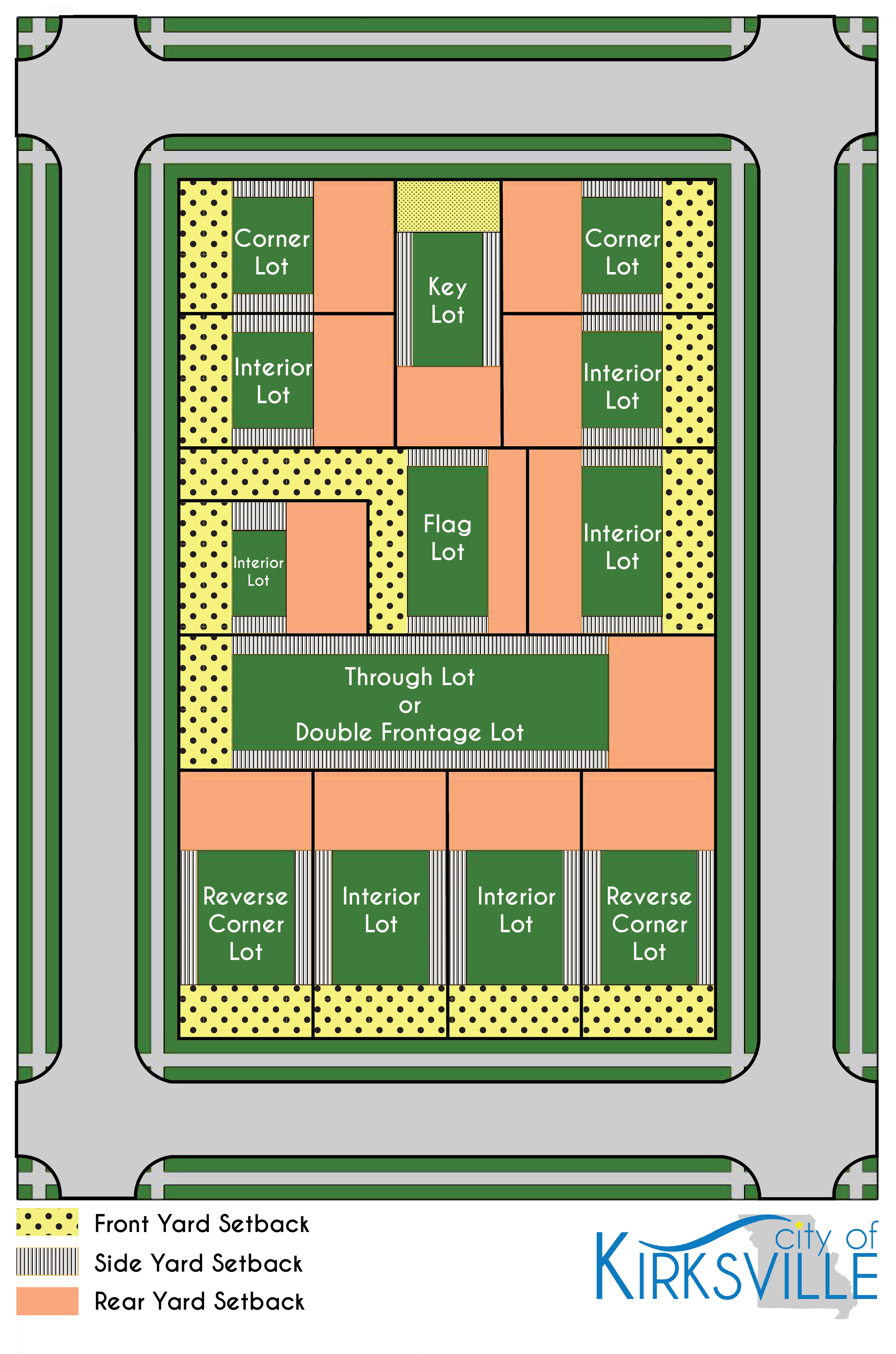
The illustration here assumes front yard depths required at 25 feet, side yard width is 15 feet, and rear yard depth is 30 feet.
Yard, exterior side, means a yard between the main building and the exterior side lot line, extending entirely from the front yard to the rear yard thereof.
Yard, front, means a yard across the full width of the lot extending from the front line of the main building to the front line of the lot.
Yard, interior side, means a yard between the main building and the interior side lot line, extending entirely from the front yard to the rear yard thereof.
Yard, rear, means a yard between the rear lot line and the rear line of the main building and the side lot lines.
(Code 1989, app. A, § 25-1; Ord. No. 10904, 3-19-1990; Ord. No. 11029, § 1, 4-6-1992; Ord. No. 11296, 6-16-1997; Ord. No. 11440, §§ 1, 2, 3-20-2000; Ord. No. 11744, § 1, 2-6-2006; Ord. No. 11813, 11-6-2007; Ord. No. 11858, 2-23-2009; Ord. No. 11996, § 1, 3-19-2012; Ord. No. 12157, § 1, 4-20-2015; Ord. No. 12277, § 1(25-1), 4-16-2018; Ord. No. 12315, § 1(25-1), 3-18-2019; Ord. No. 12469, § 8, 8-16-2021)
Sec. 44-2. - Compliance with chapter.
(a)
No building or structure shall be erected, constructed, reconstructed, moved or altered, nor shall any building, structure or land be used for any purpose other than is permitted in the district in which such building, structure or land is situated.
(b)
No building or structure shall be erected, constructed, reconstructed, moved or altered to exceed the height or area limit established in this chapter for the district in which such buildings or structures are located.
(c)
No lot area shall be reduced or diminished so that the yards or other open spaces shall be smaller than prescribed by this chapter, nor shall the density of population be increased in any manner, except in conformity with the area regulations established in this chapter.
(d)
A driveway or walk to provide access to any premises in districts O-1P, C-1, CBD, C-3, M-1 and M-2 shall not be permitted in districts R-1, R-2, R-2-S, R-3, R-3-S, R-4, R-4-S, and RP-5.
(Code 1989, app. A, § 25-2; Ord. No. 11296, 6-16-1997; Ord. No. 12157, § 2, 4-20-2015)
Sec. 44-3. - Administration and enforcement generally; recommendations of administrator.
(a)
A zoning administrator designated by the city shall administer and enforce this chapter.
(b)
The zoning administrator shall notify any person found to be in violation of any provision of this chapter, indicating the nature of the violation and the required action necessary to correct the violation. The zoning administrator shall recommend any or all of the following:
(1)
The discontinuance of illegal use of any structure or land;
(2)
The removal of any illegal structures or of any addition, change or alteration thereto;
(3)
The discontinuance of any illegal work being done;
(4)
Other action to ensure compliance with or to prevent violation of its regulations and standards.
When necessary, the zoning administrator, after investigation and recommendation, shall inform the appropriate city officials, who shall, in turn, institute appropriate legal action to restrain, correct or abate such violation.
(Code 1989, app. A, § 25-3; Ord. No. 11296, 6-16-1997)
Sec. 44-4. - Building permits, certificates of occupancy and fees.
(a)
Building permits; required, issuance. No building or other structure shall be erected, moved, added to or structurally altered without a permit therefor, issued by the zoning administrator. No building permit shall be issued by the zoning administrator except in conformity with the provisions of this chapter.
(b)
Building permits; applications.
(1)
All applications for building permits shall be accompanied by:
a.
Plans drawn, showing the actual dimensions and shape of the lot to be built upon. This requires a survey, location of property pins, or other definite means of establishing boundaries;
b.
The exact sizes and locations on the lot of already existing buildings, if any;
c.
The locations and dimensions of the proposed building or alteration;
d.
Such other information as lawfully may be required by the zoning administrator, including the following:
1.
Existing or proposed building or alteration;
2.
Existing or proposed uses of the building and land;
3.
The number of families, housekeeping units or rental units the building is designed to accommodate;
4.
Conditions existing on the lot;
5.
Such other matters as may be necessary to determine conformance with and provide for the enforcement of this chapter.
(2)
The zoning administrator shall approve or disapprove submitted plans, returning one copy of the plans to the applicant, delineating approval or disapproval on such copy. The original and one copy of the plans similarly marked shall be retained by the zoning administrator.
(c)
Building permits; expiration. If the work described in any building permit has not begun within 180 days from the date of issuance thereof, such permit shall expire; it shall be canceled by the zoning administrator, and written notice thereof shall be given to the persons affected. If the work described in any building permit has not been substantially completed within two years of the date of issuance thereof, such permit shall expire and be canceled by the zoning administrator and written notice thereof shall be given to the persons affected, together with notice that further work, as described in the canceled permit, shall not proceed until and unless a new building permit has been obtained.
(d)
Approval, variances from approved use, etc. Building permits or certificates of zoning compliance issued on the basis of plans and applications approved by the zoning administrator authorize only the use, arrangement or construction set forth in such approved plans and applications, and no other use, arrangement or construction. Any use, arrangement or construction at variance with that authorized shall be deemed a violation of this chapter and punishable as provided by section 44-14.
(e)
Fees. Each application for a building permit shall be accompanied by payment according to the city fee schedule.
(f)
Landmarks or structures within a historic district. Before a landmark or any building within a historic district can be issued a building, remodeling, or demolition permit, an approved certificate of appropriateness signed by the Kirksville Historic Preservation Commission must be presented to the codes department.
(Code 1989, app. A, § 25-4; Ord. No. 11296, 6-16-1997; Ord. No. 11813, 11-6-2007; Ord. No. 11858, 2-23-2009)
Sec. 44-5. - Districts—Generally enumerated.
(a)
For the purpose of regulating and restricting the use of land and the erection, construction, reconstruction, alteration or use of buildings, structures or land, the city is hereby divided into 20 districts as follows:
(1)
District R-1, Single-Family Residential District;
(2)
District R-2, Two-Family Residential District;
(3)
District R-2-S, Two-Family Special Residential District;
(4)
District R-3, Multifamily Residential District;
(5)
District R-3-S, Multifamily Special Residential District;
(6)
District R-4, General Residential District;
(7)
District R-4-S, General Special Residential District;
(8)
District RP-5, Planned Mobile Home Park District;
(9)
District OP-1, Planned Office District;
(10)
District C-1, Local Business District;
(11)
District CBD, Central Business District;
(12)
District CMD-SQ, Central Mixed District, Square;
(13)
District CMD-G, Central Mixed District, General;
(14)
District CMD-C, Central Mixed District, Corridor;
(15)
District CND-SF, Central Neighborhood District, Single-Family;
(16)
District CND-MF, Central Neighborhood District, Multifamily;
(17)
District C-3, Extensive Business District;
(18)
District M-1, Light Industrial District;
(19)
District M-2, Heavy Industrial District;
(20)
District H, Historic District.
(b)
Planned zoning districts. Each of the districts, except for the CBD, herein set forth shall have a separate and distinct counterpart known and herein referred to as a planned district. A planned district shall be for the purpose of permitting and regulating the uses heretofore permitted in the equivalent district, and further provide for and encourage latitude and flexibility in the location of buildings, structures, roads, drives, variations in yards and open spaces all subsequent to approval of the plan by the planning commission and city council. The purpose is to allow development of tracts of land to their fullest extent and at the same time observe the general intent and spirit of these regulations. Planned districts shall be as follows:
(1)
District RP-1, Planned Single-Family Residential District;
(2)
District RP-2, Planned Two-Family Residential District;
(3)
District RP-2S, Planned Two-Family Special Residential District;
(4)
District RP-3, Planned Multifamily District;
(5)
District RP-3S, Planned Multifamily Special District;
(6)
District RP-4, Planned General Residential District;
(7)
District RP-4S, Planned General Special Residential District;
(8)
District RP-5, Planned Mobile Home Park District;
(9)
District OP-1, Planned Office District;
(10)
District CP-1, Planned Local Business District;
(11)
District CBDP, Planned Central Business District;
(12)
District CP-3, Planned Extensive Business District;
(13)
District MP-1, Planned Light Industrial District;
(14)
District MP-2, Planned Heavy Industrial District;
(15)
PUD, Planned Unit Development.
(Code 1989, app. A, § 25-5; Ord. No. 11296, 6-16-1997; Ord. No. 11858, 2-23-2009; Ord. No. 12469, § 9, 8-16-2021)
Sec. 44-6. - Districts—Adoption of map; changes, amendments or additions to map.
Boundaries of the districts, as enumerated in section 44-5, are hereby established as shown on a map prepared for that purpose, which map is hereby designated as the "zoning district map." Such map and all the notations, references and information shown thereon are hereby made as much a part of this chapter as if the same were set forth in full herein. It shall be the duty of the city planning and zoning commission to keep on file in the zoning administrator's office an official copy of such map and all changes, amendments or additions thereto. It shall be the duty of the zoning administrator to make such changes, amendments or additions thereto. Changes shall be entered on the official zoning district map promptly after the amendment has been approved by the city council.
(Code 1989, app. A, § 25-6; Ord. No. 11296, 6-16-1997)
Sec. 44-7. - Districts—Interpretation of boundaries; classification of annexed territory, vacated streets, etc.
(a)
When definite distances in feet are not shown on the zoning district map, the district boundaries are intended to be along existing street, alley or platted lot lines or extensions of such lines. If the exact location of such lines is not clear, it shall be determined by the zoning administrator, due consideration being given to location as indicated by the scale of the zoning district map.
(b)
When streets or alleys on the ground differ from the streets or alleys as shown on the zoning district map, the zoning administrator shall apply the district designations on the map to the streets or alleys on the ground in such manner as to conform to the intent and purpose of this chapter.
(c)
Whenever any street or alley is vacated, the particular district in which the adjacent property lies shall be automatically extended to the centerline of any such street or alley.
(d)
All areas which may hereafter be annexed to the city shall first be tentatively zoned by the city council, following study and recommendations by the planning and zoning commission; such tentative zoning shall take effect upon the effective date of the annexation.
(Code 1989, app. A, § 25-7; Code 1974, § 25-7)
Sec. 44-8. - Districts—Planned districts.
(a)
Purpose. The zoning of land in the city to one of the planned districts (RP-1 through MP-2, inclusive) shall be for the purpose of requiring orderly development on a quality level generally equal to that of the equivalent standard zoning districts, by permitting variations from the normal and established development techniques. The use of planned zoning procedures is intended to encourage innovative and imaginative site planning, conservation of natural resources, minimum waste of land and the maximum protection of property values.
(b)
Conditions and standards.
(1)
A proposal to rezone land to a planned district shall be subject to the same criteria relative to compliance with the comprehensive plan, land use polices, neighborhood compatibility, adequacy of streets and utilities and other elements, as is normal in rezoning deliberations;
(2)
The submittal by the developer and the approval of development plans by the planning commission and city council represent a firm commitment by the developer that development will indeed follow the approved plans in concept, intensity of use, aesthetic levels and quantities of open space;
(3)
Deviations in yard requirements, setbacks and relationships between buildings are acceptable and may be approved within the limits set out in this subsection (b), if it is deemed that other amenities or conditions will be gained to the extent that an equal or higher quality of development will result than under standard zoning procedures;
(4)
Residential areas will be planned and developed in a manner that will produce more useable open space, better recreational opportunities, safer and more attractive neighborhoods than under standard zoning and development techniques;
(5)
Commercial areas will be planned and developed to result in attractive, viable and safe centers and clusters, as opposed to strip patterns, along thoroughfares. Control of vehicular access, architectural quality, landscaping and signs will be exercised to soften the impact on nearby residential neighborhoods and to assure minimum adverse effects on the street system and other services of the community;
(6)
The developer will be given latitude in using innovative techniques in the development of land not feasible under application of standard zoning requirements;
(7)
Planned zoning shall not be used as a refuge from the requirements of the equivalent district as to intensity of land use, amount of open space or other established development criteria;
(8)
No use will be permitted in the planned district that is not clearly permitted in the equivalent district;
(9)
Any building or portion thereof may be owned in condominium under appropriate state statutes;
(10)
The maximum height of buildings and structures shall be as set out in the equivalent district;
(11)
The intensity of land use, the floor area and bulk of buildings, the concentration of population, the percentage of lot coverage, the amount of open space, light and air shall be generally equal to that required in the equivalent zoning district;
(12)
The density of residential dwelling units, the parking requirements and the performance standards shall be the same as in the equivalent district;
(13)
The permitted uses shall be the same as those permitted in the equivalent district, provided that limitations may be placed on the type of occupancy of certain premises, if such limitation is deemed essential to the health, safety or general welfare of the community;
(14)
The planning and zoning commission may, in the process of approving preliminary and final plans, approve deviations from the minimum standards in the equivalent district as follows:
a.
Setbacks of buildings and paved areas from a public street may be reduced to 75 percent of the chapter requirement;
b.
Setbacks of buildings and paved areas from a property line of the project (other than a street line) may be reduced to 85 percent of the chapter requirement;
c.
Side yards between buildings may be reduced to zero;
d.
A portion of the parking area required under this chapter may remain unimproved until such time as the city council deems it must be improved to serve the demand adequately.
The foregoing deviations may be granted by the planning and zoning commission only where there is ample evidence that such deviations will not adversely affect neighboring property, and shall not constitute the mere granting of a privilege. Reduction setbacks or other open space shall be compensated by additional open space in other appropriate portions of the project. In all cases such deviations shall be in keeping with good land planning principles, and must be specifically set out in the minutes of the commission, as well as on plans and other exhibits in the record.
(c)
Planned district rezonings and amendments.
(1)
A tract of land may be rezoned to RP-1 through MP-2, inclusive, only upon application by the owner or agent, and only upon approval of a preliminary development plan. Land which is currently zoned as a planned district with or without an existing plan approved by city council may be amended to allow for new preliminary development plan.
(2)
Additional regulations regarding rezonings and amendments, such as public hearings and certified mailings, can be found in section 44-12.
(3)
The proponents of a planned district rezoning or amendment shall prepare and submit to the zoning administrator the following:
a.
A preliminary development plan showing the property to be included in the proposed development, plus the area within 200 feet thereof.
b.
The following items shall be included on the property to be developed:
1.
Existing topography with contours at five-foot intervals, provided that where natural slopes are sufficiently flat, the zoning administrator may require contours at lesser intervals. In the case of small tracts of land where grade changes are not critical to the quality of development, the zoning administrator may waive the contour information;
2.
Proposed location of buildings and other structures, parking areas, drives, walks, screening, drainage patterns, public streets and any existing easements;
3.
Sufficient dimensions to indicate relationship between buildings, property lines, parking areas and other elements of the plan;
4.
General extent and character of proposed landscaping.
c.
The following items shall be shown on the same drawing within the 200-foot adjacent area:
1.
Any public street which is of record;
2.
Any drives which exist or which are proposed to the degree that they appear on plans on file with the city, except those serving single-family houses;
3.
Any buildings which exist or are proposed to the degree that their location and size are shown on plans on file with the city. Single- and two-family residential buildings may be shown in approximate location and general size and shape;
4.
The location and size of any drainage structures, such as culverts, paved or earthen ditches or storm sewers and inlets.
d.
A schedule shall be included indicating total floor area, dwelling units, land area, parking spaces and other quantities relative to the submitted plan in order that compliance with chapter requirements can be determined.
(4)
The planning and zoning commission shall hold a public hearing on the rezoning application or plan amendment, including the plan as provided by law. If preliminary plans meet requirements and receive approval of the commission, the same shall be duly approved, properly endorsed and identified and sent on to the council for action.
(5)
Prior to issuance of building permits, the final plans for buildings and site improvements shall be submitted to the city code enforcement director, to review with the engineering department, as to compliance with the development plan. The development may proceed in stages and final plans for each stage shall be submitted and approved prior to permit issuance. The final plans, in addition to building construction plans, shall include a landscape and screening plan showing species and size of all plant materials, areas to be seeded, sodded, etc., all to be in keeping with the development plan as approved.
(6)
If, in the judgment of the code enforcement director and the city engineer, the concept of development, as depicted on the final plans, deviates substantially from the concept of the preliminary development plan submitted for zoning or amending, the code enforcement director shall deny the request for final plan approval.
(7)
In the event that construction of all improvements shown on the final plan is not completed within a period of three years following the date the preliminary plan was approved by the city council, then the zoning district classification for said tract of land shall automatically revert to its former classification immediately preceding such rezoning.
(8)
In the event that development proceeds in stages, then the construction of all improvements shown on the final plan for the first stage shall be completed within a period of three years following the date the preliminary plan was approved. The construction of all improvements shown on the final plan for each subsequent stage shall be completed within a period of three years following the date the final plan for that particular stage was approved. Failure to construct the improvements within the time periods specified herein shall cause the zoning district classification with respect to that portion of the tract of land shown on such final plan, together with all sequentially following stages, to automatically revert back to the zoning district classification immediately preceding such rezoning.
(9)
The applicant, in case of denial, may apply for a new hearing, with publication as required in this section, and the commission and council may approve or deny the final plans after said hearing. All decisions of the planning commission may be appealed to the city council, who may reverse or affirm the same.
(d)
Conformance to comprehensive plan. In the consideration of a change to a planned zoning district, the planning and zoning commission and governing body shall determine whether the proposal conforms to land use and thoroughfare plans, special studies and policies normally utilized in making zoning decisions in the city.
(Code 1989, app. A, § 25-7.1; Ord. No. 11296, 6-16-1997; Ord. No. 11813, 11-6-2007)
Sec. 44-9. - Nonconforming uses prior to December 18, 1972.
(a)
Continuation. A nonconforming use of land existing lawfully on December 18, 1972, may be continued, but shall not be extended, expanded or enlarged. The lawful use of a building existing on December 18, 1972, may be continued, although such use does not conform with the provisions of this chapter, and such use may be extended throughout such portions of the building as are arranged or designed for such use, provided that no structural alterations, except those required by law, provisions of this Code or other ordinances of the city, are made therein.
(b)
Alteration; removal. If no structural alterations are made, a nonconforming use of a building may be changed to another nonconforming use of the same or more restricted classifications. If such nonconforming building is removed, the future use of such premises shall be in conformity with the provisions of this chapter.
(c)
Reestablishment of discontinued use. When a nonconforming use has been discontinued for one year or more, it shall not be reestablished.
(d)
Changes to conforming or more restricted use. A nonconforming use, if changed to a conforming use or a more restricted, nonconforming use, may not thereafter be changed back to a less restricted nonconforming use than that to which it was changed.
(e)
Amendments to chapter. If, by amendment to this chapter, any property is hereafter transferred to a more restricted district by a change in the district boundaries, or the regulations and restrictions in any district are made more restrictive or of a higher classification, the provisions of this chapter relating to the nonconforming use of buildings or premises existing on December 18, 1972, shall apply to buildings or premises occupied or used at the time of the passage of such amendment.
(f)
Repairs, etc. Repairs and alterations may be made to a nonconforming building, provided that no structural alterations or extensions shall be made, except those required by law or ordinance, unless the building is changed to a conforming use; provided that, by special permit in the case of evident hardship, an extension may be granted of a nonconforming use not exceeding 25 percent of the ground area of the building.
(g)
Nothing contained in this chapter shall require any change in the plans, construction or designated use of a building for which a building permit has been heretofore issued and plans for which are on file with the zoning administrator on December 18, 1972, and the construction of which in either case shall have been diligently prosecuted within one year of the date of such permit, and to the ground story framework of which, including the second tier or beams, shall have been completed, according to such plans as filed, within two years from December 18, 1972.
(h)
Nothing in this chapter shall be taken to prevent the restoration, within 12 months, of a nonconforming building destroyed to not more than 75 percent of its reasonable value, exclusive of foundations, by fire, explosion or other casualty, act of God or the public enemy, provided that when such restoration becomes involved in litigation, the time required for such litigation shall not be counted as a part of the 12 months allowed for reconstruction; and nothing in this chapter shall be taken to prevent the continued occupancy or use of such building or part thereof which existed at the time of such partial destruction; but any building so damaged more than 75 percent of its value may not be rebuilt, repaired or used unless it is made to conform to all regulations for buildings in the district in which it is located.
(i)
The provisions of this chapter shall not apply to prevent the extension of any building, existing in any district on December 18, 1972, to the height to which the walls, foundation and framework of such existing building originally were intended, designed and constructed to carry, provided that the actual construction of the extension in height permitted by this subsection shall have been duly commenced within ten years from December 18, 1972.
(Code 1989, app. A, § 25-8; Ord. No. 11296, 6-16-1997; Ord. No. 11813, 11-6-2007)
Sec. 44-10. - Nonconforming uses prior to July 1, 1997.
(a)
Continuation. A nonconforming use of land existing lawfully on July 1, 1997, may be continued, but shall not be extended, expanded or enlarged. The lawful use of a building existing on July 1, 1997, may be continued, although such use does not conform with the provisions of this chapter, and such use may be extended throughout such portions of the building as are arranged or designed for such use, provided that no structural alterations, except those required by law, provisions of this Code or other ordinances of the city, are made therein.
(b)
Alteration; removal. If no structural alterations are made, a nonconforming use of a building may be changed to another nonconforming use of the same or more restricted classifications. If such nonconforming building is removed, the future use of such premises shall be in conformity with the provisions of this chapter.
(c)
Reestablishment of discontinued use. When a nonconforming use has been discontinued for one year or more, it shall not be reestablished.
(d)
Changes to conforming or more restricted use. A nonconforming use, if changed to a conforming use or a more restricted, nonconforming use, may not thereafter be changed back to a less restricted nonconforming use than that to which it was changed.
(e)
Amendments to chapter. If, by amendment to this chapter, any property is hereafter transferred to a more restricted district by a change in the district boundaries, or the regulations and restrictions in any district are made more restrictive or of a higher classification, the provisions of this chapter relating to the nonconforming use of buildings or premises existing on July 1, 1997, shall apply to buildings or premises occupied or used at the time of the passage of such amendment.
(f)
Repairs, etc. Repairs and alterations may be made to a nonconforming building, provided that no structural alterations or extensions shall be made, except those required by law or ordinance, unless the building is changed to a conforming use; provided that, by special permit in the case of evident hardship, an extension may be granted of a nonconforming use not exceeding 25 percent of the ground area of the building.
(g)
Nothing contained in this chapter shall require any change in the plans, construction or designated use of a building for which a building permit has been heretofore issued and plans for which are on file with the zoning administrator on July 1, 1997, and the construction of which in either case shall have been diligently prosecuted within one year of the date of such permit, and to the ground story framework of which, including the second tier or beams, shall have been completed, according to such plans as filed, within two years from July 1, 1997.
(h)
Nothing in this chapter shall be taken to prevent the restoration, within 12 months, of a nonconforming building destroyed to not more than 75 percent of its reasonable value, exclusive of foundations, by fire, explosion or other casualty, act of God or the public enemy, provided that when such restoration becomes involved in litigation, the time required for such litigation shall not be counted as a part of the 12 months allowed for reconstruction; and nothing in this chapter shall be taken to prevent the continued occupancy or use of such building or part thereof which existed at the time of such partial destruction; but any building so damaged more than 75 percent of its value may not be rebuilt, repaired or used unless it is made to conform to all regulations for buildings in the district in which it is located.
(i)
The provisions of this chapter shall not apply to prevent the extension of any building, existing in any district on July 1, 1997, to the height to which the walls, foundation and framework of such existing building originally were intended, designed and constructed to carry, provided that the actual construction of the extension in height permitted by this subsection shall have been duly commenced within ten years from July 1, 1997.
(Code 1989, app. A, § 25-9; Ord. No. 11296, 6-16-1997; Ord. No. 11813, 11-6-2007)
Sec. 44-11. - Interpretation of chapter.
In interpreting and applying the provisions of this chapter, they shall be held to be the minimum requirements for the promotion of the health, safety, morals or general welfare. Whenever this chapter requires a greater width or size of yards, courts or other open spaces or requires a lower height of buildings or a less number of stories or requires a greater percentage of a lot to be left unoccupied or imposes higher standards than are required in any other statute, local ordinance or regulation, the regulations of this chapter shall govern. Whenever the provisions of any other statute, local ordinance or regulation requires a greater width or size of yards, courts or other open spaces or requires a lower height of buildings or a less number of stories or requires a greater percentage of a lot to be left unoccupied or imposes other higher standards than are required by the regulations of this chapter, the provisions of such statute, local ordinance or regulations shall govern.
(Code 1989, app. A, § 25-11; Ord. No. 11296, 6-16-1997)
Sec. 44-12. - Amendments, changes, etc., to chapter.
(a)
Authority generally. The city council may, from time to time, on its own motion or on petition after the public notice and hearings thereon, as provided herein, amend, supplement, change, modify or repeal the regulations and restrictions as established in this chapter. Before taking any action upon any proposed amendment, supplement, change or modification, the same shall be referred by the city council to the planning and zoning commission for hearing, report and recommendations.
(b)
Protests. In case of a protest against such amendment, supplement, change, modification or repeal, duly signed and acknowledged by the owners of ten percent or more either of the areas of land included in such proposed change or within an area determined by lines drawn parallel to and 185 feet distant from the boundaries of the district proposed to be changed, such amendment shall not be passed except by the favorable vote of two-thirds of the members of the city council.
(c)
Notice of hearings. No action of an amendment, change, modification or repeal shall be taken until after a public hearing is held before the planning and zoning commission in relation thereto, at which hearing the parties in interest and citizens shall have an opportunity to be heard. At least 15 days' notice of time and place of such hearing shall be published in a paper of general circulation in the city. All reasonable effort shall be made to notify the owners of property to be rezoned and owners of all land within an area determined by lines drawn parallel to and 185 feet distant from the boundaries of the district proposed to be rezoned, by certified mail, addressed to their last-known address.
(d)
List of property owners, etc.; scale drawings, etc. Any person, property owner or other interested parties requesting that a tract or parcel of land, lots or blocks be changed, amended or rezoned shall provide the planning and zoning commission with a complete list of the names, addresses and legal description of land of all adjacent and adjoining property owners within 185 feet of the proposed area to be changed or rezoned. Such list shall be certified as to accuracy by an abstractor, and the costs of such list and certification shall be paid by the requesting person, owner or parties, which shall also include the expense of notice by certified mail to adjacent and adjoining property owners or owner entitled to such notification. The planning and zoning commission shall have the further right to require the requesting party to provide a scale plat, drawing plat or drawing of the area proposed to be changed and the surrounding area if, in their opinion, the circumstances warrant such drawing.
(e)
Rezoning property to historic. A property or district that is rezoned to a historic zoning designation does not require a notice to adjacent property owners within 185 feet. It does require approval from the historic preservation commission, the planning and zoning commission, and the city council. A property zoned historic by recommendation and action of the above entities retains its underlying original zoning district requirements concerning the use of the property, setbacks, parking, and other requirements of the district. The historic zoning designation is overlaid on the original zoning district.
(Code 1974, § 25-12; Code 1989, app. A, § 25-12; Ord. No. 11029, § 2, 4-6-1992; Ord. No. 11296, 6-16-1997; Ord. No. 11813, 11-6-2007; Ord. No. 11934, 9-20-2010)
Sec. 44-13. - Complaints in regard to violations.
Whenever a violation of this chapter occurs or is alleged to have occurred, any person may file a written complaint. Such complaint shall fully state the causes and basis thereof and shall be filed with the zoning administrator. The administrator shall record properly such complaint, immediately investigate and take action thereon as provided by this chapter.
(Code 1974, § 25-13; Code 1989, app. A, § 25-13; Ord. No. 11296, 6-16-1997)
Sec. 44-14. - Remedies and penalties for violations.
(a)
In case any building or structure is erected, constructed, reconstructed, altered, converted or maintained, or any building, structure or land is used in violation of this chapter, the proper local authorities of the city, in addition to other remedies, may institute any appropriate action or proceedings to prevent such unlawful erec
tion, construction, reconstruction, alteration, conversion, maintenance or use to restrain, correct or abate such violation, to prevent the occupancy of such building, structure or land or to prevent any illegal act, conduct, business or use in or about such premises. Such regulations shall be enforced by the code enforcement director, who is empowered to cause any building, structure, place or premises to be inspected and examined and to order, in writing, the remedying of any condition found to exist therein in violation of any provision of the regulations enumerated herein.
(b)
The owner or general agent of a building or premises in or upon which a violation of any provision of this chapter has been committed or shall exist; or the lessee or tenant of an entire building or entire premises in or upon which such violation has been committed or shall exist; or the owner, general agent, lessee or tenant of any part of the building or premises in or upon which such violation has been committed or shall exist; or the general agent, architect, building contractor or any other person who commits, takes part or assists in any violation of this chapter or who maintains any building or premises in or upon which a violation of this chapter shall exist, shall be guilty of an ordinance violation punishable by a fine as provided in section 1-8 by imprisonment not to exceed 90 days for each and every day that such violation occurs, or by both such fine and imprisonment.
(Code 1974, § 25-14; Code 1989, app. A, § 25-14; Ord. No. 11296, 6-16-1997; Ord. No. 11813, 11-6-2007)

