
Kitty Hawk City Zoning Code
ARTICLE I
- IN GENERAL
Sec. 42-1.- Definitions.
The following words, terms and phrases, when used in this chapter, shall have the meanings ascribed to them in this section, except where the context clearly indicates a different meaning:
Accessory business use is any use that occurs in conjunction with a principal business use and is subordinate to the primary or majority business activity.
Accessory dwelling unit means a secondary dwelling unit established in conjunction with and clearly subordinate to a principal dwelling unit, whether part of the same structure as the principal dwelling unit, or as a detached structure on the same lot, with or without independent cooking facilities. The use of manufactured homes, travel trailers, motorhomes, campers or similar vehicles as an accessory dwelling unit is prohibited.
Accessory structure means a non-habitable building on the same lot, but detached from the principal building, for which the use is incidental and subordinate to the principal use. In residential districts, accessory buildings may be detached garages, workshops, storage sheds, hobby-type greenhouses or similar minor buildings (roofed structures). Shipping containers shall not be used as accessory structures.
Accessory use means a use which is clearly incidental to and customarily found in connection with the principal use and located on the same lot with such principal use.
Accessory use workforce habitation means the use of a building or portion of a building for habitation by seasonal or year-round Outer Banks workforce as an accessory use to approved permitted or special uses within non-residential zoning districts, or as an accessory use to approved permitted or special use multi-family residential uses; short-term occupancy by any individual(s) intended for a period of less than 30 consecutive days is specifically excluded from this definition.
Accessory workforce housing means real property improvement specifically for the purpose of housing accessory workforce habitation; housing may be within or attached to a primary structure, or may be a separate accessory structure, within a non-residential zoning district or an approved multi-family development site; housing gross area shall not exceed ten percent of the approved primary use gross floor area; a dwelling unit shall not exceed 750 square feet gross area, and shall not have an occupancy of greater than two persons plus a dependent of either of the two aforementioned persons; no on-site parking space shall be required provided for each dwelling unit.
Aircraft means any machine or device, including airplanes, helicopters, gliders, dirigibles, hangliders (whether or not motor powered) and motor-powered parachutes capable of atmospheric flight.
Alley means a minor right-of-way, dedicated to public use, which affords a secondary means of vehicular access to the back or side of properties otherwise abutting a street, and which may be used for public utility purposes.
Animated sign means any sign that uses movement or change of lighting to depict action or create a special effect or scene.
Approval authority means the town council or other board or official designated by ordinance or this chapter as being authorized to grant the specific zoning or land use permit or approval that constitutes a site specific development plan.
Approved parking and driveway surfaces means those surfaces approved from time to time by the town planning board and the town council.
Average footcandles means the average of a number of points of footcandle calculations or footcandle measurements in a given area.
Banner means any piece of cloth, lightweight fabric or other similar material bearing a design, motto, slogan or message, whether commercial or noncommercial.
Beacon means any light with one or more beams directed into the atmosphere or directed at one or more points not on the same lot as the light source; also, any light with one or more beams that rotate or move.
Bed and breakfast facility means a single-family dwelling which consists of a single dwelling unit together with the rental of one or more dwelling rooms on a daily or weekly basis. The dwelling rooms shall not be equipped to allow the preparation of meals, although a single meal may be provided in a common area by the proprietor of the establishment. The term "bed and breakfast" shall be considered synonymous with tourist home, guesthouse and other such similar uses, but is not intended to include group home.
Buffer means a planted or constructed divide of material and space used to provide sight and incidental sound screening from adjoining properties. The required height and width of the buffer strip and the materials used in its construction vary according to use. The term "buffer" is not a use and falls within the definition of open space. Unless specified otherwise in the various district regulations, buffers shall be in accordance with article VI, division 5 of this chapter.
Buffer strip means a device of material and/or space used to provide sight and sound screening from adjoining properties. The required height and width of the buffer strip and the materials used in its construction vary according to use.
Building means any structure enclosed and isolated by exterior walls constructed or used for residence, business, industry or other public purposes. The term "building" includes the term "structure."
Building, accessory, means a subordinate building consisting of walls and a roof, the use of which is clearly incidental to that of a principal building on the same lot. The term "accessory building or structure" shall not include a manufactured home, trailer, or existing structure previously used as a manufactured home, and manufactured homes, trailers, or structures previously used as manufactured homes shall not be used as accessory structures within the town.
Building footprint means the outline of the building exterior walls, including any attached additions and projections or similar attached protrusions. The term "building footprint" does not include roof overhangs or eaves.
Building marker means any sign indicating the name of a commercial or historical building and date and information about its construction. Such sign shall be cut into a masonry surface or made of bronze or other permanent material. Residential cottage identification markers shall be considered building markers so long as they do not exceed six square feet in area and are permanently mounted to the wall of such cottage in a location which does not interrupt architectural details.
Building, principal, means a building in which is conducted the principal use of the lot on which it is located.
Building setback line means a line parallel to or concentric with the street right-of-way establishing the minimum allowable distance between such right-of-way and the nearest portion of any building, and for oceanfront lots, the oceanfront setback as established by state coastal resources commission.
Building sign means any sign attached to any part of a building, as contrasted to a freestanding sign.
Building site means an area of disturbed land and vegetation required for placement of a structure, its accessways, and utilities, including areas disturbed for parking lots, power lines, driveways, septic tank nitrification fields, cemeteries and hiking trails.
Call center is a centralized service facility used for the purpose of receiving or transmitting a large volume of requests by telephone or email.
CAMA means the Coastal Area Management Act of 1974 (G.S. 113A-100 et seq.).
Canopy sign means any sign that is a part of or attached to an awning, canopy or other fabric, plastic or structural protective cover over a door, entrance, window or outdoor service area. A marquee is not a canopy.
Changeable copy sign means a sign or portion thereof with characters, letters or illustrations that can be changed or rearranged without altering the face or the surface of the sign. A changeable copy sign shall use exposed bulbs to display the changeable message. A sign on which the message changes more than eight times per day shall be considered an animated sign and not a changeable copy sign for purposes of this chapter. A sign on which the only copy that changes is an electronic or mechanical indication of time or temperature shall be considered a "time and temperature" portion of a sign and not a changeable copy sign for purposes of this chapter.
Commercial message means any sign wording, logo or other representation that, directly or indirectly, names, advertises or calls attention to a business, product, service or other commercial activity.
Commercial nudity establishment means any establishment which the public may enter, with or without admission charge or membership, wherein nudity is exhibited by employees or entertainers. For the purposes of this chapter, the term "nudity" means any exposure to public view of the human male or female genitals, pubic area or buttocks, with less than fully opaque covering, or any portion of the areola of the breast of the female with less than a fully opaque covering.
Commercial piers and boat slips means piers and boat slips that are used for commercial purposes or piers from which commercial uses are conducted in the general vicinity of the pier and boat slips. Commercial piers and boat slips are open to the general public.
Community piers and boat slips means piers and boat slips that are owned by two or more residential property owners; or that are owned and maintained by a property owner's association, and the facility is used by all of the property owners as part of an overall plan of development.
Condominium means ownership in common with others of a parcel of land and certain parts of a building thereon which would normally be used by all the occupants together with individual ownership in fee of a particular condominium unit in such building.
Cottage court means a group of buildings on one property which provide sleeping accommodations for transients on a daily, weekly, or similar shortterm basis, which is operated as a business establishment in a manner similar to a hotel, motel, or inn with an on-site office, front desk, and typical hotel services, with units that are not designed for use as single-family residences.
CRC means the state coastal resources commission.
Customer service area means that area of a building available for servicing customers, but not including kitchen or storage.
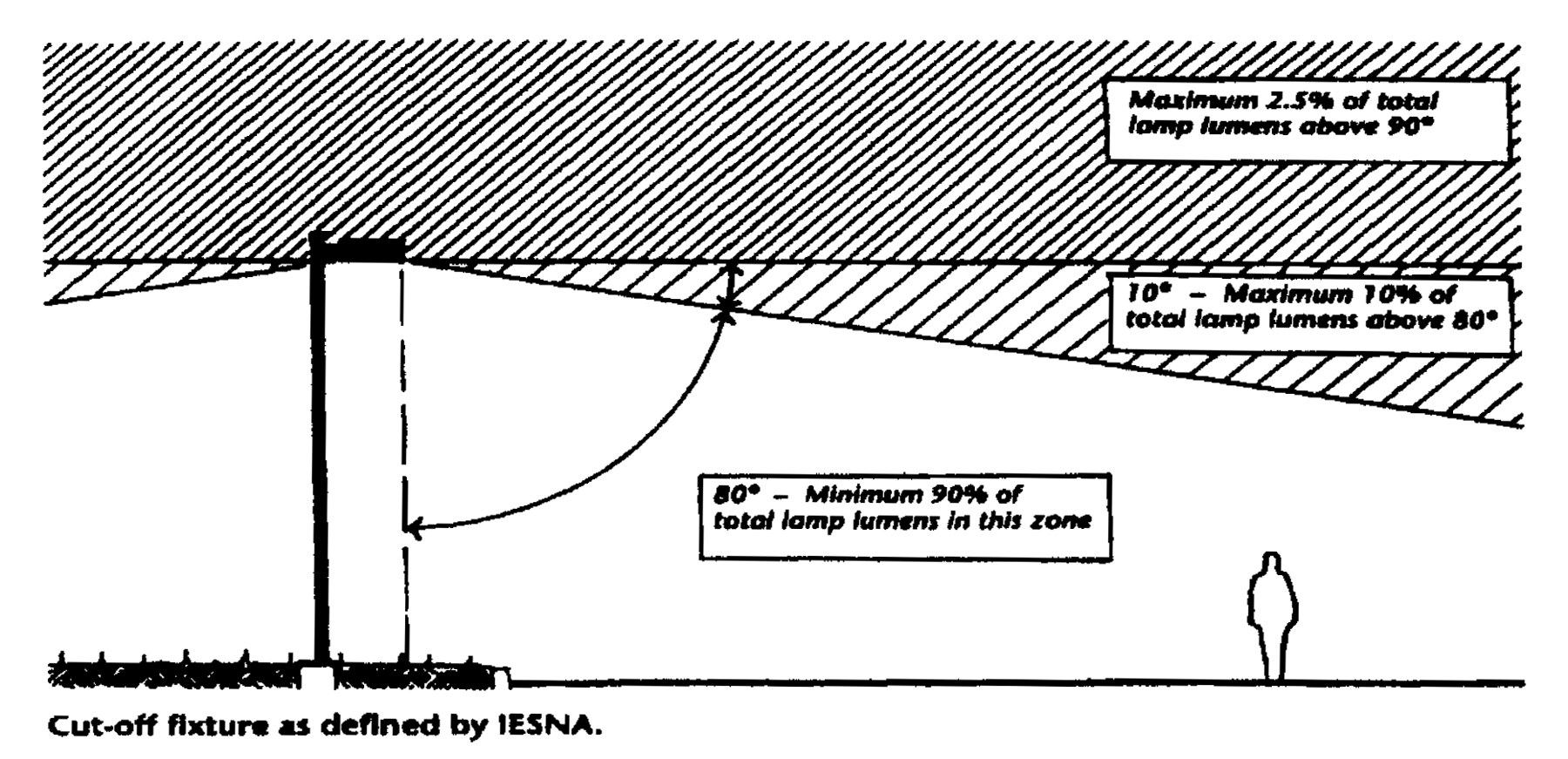
Cutoff fixture means a flat lens, full cutoff fixture that by its design, directs a minimum of 90 percent of total lamp lumens within 80 degrees of the vertical plane of the light fixture and a maximum of ten percent of the total lamp lumens above 80 degrees from the vertical plane, and no more than 2.5 percent of total lamp lumens above 90 degrees. Full cutoff fixtures must be installed in a horizontal position as designed.
Day care center means a child day care facility as defined in G.S. 110-86(3). An adult day care facility as defined in G.S. 131D-6(b).
Delicatessen means a retail store with no customer seating specializing in the sale of prepared cooked meats, smoked fish, cheeses, sandwiches and other specialty food items.
Density means the number of dwelling units or hotel units which may be constructed upon a parcel of land, as allowed by the various zoning districts. Marsh and wetland areas, as determined by CAMA and/or CRC regulations, which are contiguous with estuarine waters, sounds and bays, and areas waterward of the oceanfront vegetation line, as determined by CAMA regulations, may not be used for density calculations.
Directional sign means signs containing directional information about public places owned or operated by federal, state or local governments or their agents; publicly or privately owned historic, cultural, educational and religious sites; and areas of natural scenic beauty or naturally suited for outdoor recreation.
Dog park means a facility set aside for dogs to exercise and play off-leash in a controlled environment under the supervision of their owners or handlers.
Drive-in restaurant orrefreshment stand means any place or premises used for sale, dispensing, or serving of food, refreshments, or beverages in automobiles, including an establishment where customers may serve themselves and may eat or drink the food, refreshments, or beverages on the premises.
Dwelling means a building that contains one or two dwelling units used, intended or designed to be used, rented, leased, let or hired out to be occupied for living purposes.
Dwelling, multifamily, means a building or portion thereof used or designed as a residence for three or more families living independently of each other and doing their own cooking therein, including apartment houses.
Dwelling, single-family, means a detached building designed for or occupied exclusively by one family.
Dwelling, two-family (duplex), means a detached building, divided horizontally or vertically, and designed for or occupied by two single-family housekeeping units contained entirely under one roof and having one dividing partition common to each unit, or having the ceiling structure of the lower unit the floor structure of the unit above. A single-family home with an attached ADU meeting the size restrictions of 42-528(b) is not considered a two-family dwelling (duplex).
Dwelling unit means one room, or rooms connected together, constituting a separate, independent housekeeping unit for owner occupancy, or rental or lease, and physically separated from any other rooms or dwelling units which may be in the same structure, and containing independent cooking and sleeping facilities for a single family.
Eating establishment.
(1)
The term "eating establishment" means any establishment which provides as a principal use, the sale of food, frozen desserts or beverages in a state ready for consumption within the establishment and the design or principal method of operation of which includes both of the following characteristics:
a.
Customers are provided with an individual menu and are served their food, frozen desserts or beverages by a restaurant employee at the same table or counter at which said items are consumed.
b.
The food, frozen desserts or beverages are served on nondisposable plates or containers and nondisposable eating utensils are provided. Customers are not expected to clear their table or dispose of their trash.
(2)
Notwithstanding subsection (1) of this definition, a cafeteria where food, frozen desserts or beverages are:
a.
Generally consumed within the establishment; and
b.
Served on nondisposable plates or containers and nondisposable eating utensils are provided;
shall be deemed an eating establishment.
(3)
An eating establishment may provide a carryout service provided that such carryout service is clearly not the principal business of such establishment.
(4)
A fast food restaurant shall be deemed an eating establishment.
(5)
Accessory uses in an eating establishment are as follows:
a.
Entertainment which is provided for the enjoyment of the patrons shall be considered an accessory to an eating establishment, to include dancing by patrons, provided that the space made available for such dancing shall not be more than one-eighth of that part of the floor area available for dining.
b.
The sale of T-shirts and souvenirs shall be considered an accessory if the area of that secondary commercial use is less than five percent of the square footage of the seating area of the restaurant.
(6)
The term "eating establishment" shall not be deemed to:
a.
Include a snack bar or refreshment stand at a public or nonprofit recreational facility which is operated solely by the agency or group operating the recreational facility for the convenience of the patrons of the facility.
b.
Be a commercial nudity establishment.
Electronic gaming operation is any for-profit business enterprise, whether principal or accessory, where persons utilize electronic machines or devices, including, but not limited to, computers and gaming terminals, to conduct games of odds or chance, including sweepstakes, and where cash, merchandise, or other items of value are redeemed or otherwise distributed, whether or not the value of such distribution is determined by electronic games played or by predetermined odds. Such business or enterprises have as a part of its operation the running of one or more games or processes with any of the following characteristics:
(1)
Payment, directly or as an intended addition to the purchase of a product, whereby the customer receives one or more electronic sweepstakes tickets, cards, tokens or similar items entitling or empowering the customer to enter a sweepstakes, and without which the customer would be unable to enter the sweepstakes; or
(2)
Payment, directly or as an intended addition to the purchase of a product; whereby the customer can request a no purchase necessary free entry of one or more sweepstakes tickets or other item entitling the customer to enter a sweepstakes. The term electronic gaming operations includes, but is not limited to, cyber-gaming establishments, internet cafes, internet sweepstakes, beach sweepstakes, video sweepstakes or cybercafes, who have a finite pool of winners. This definition does not include any lottery permitted by the State of North Carolina.
Electronic machine or device is a mechanically, electrically or electronically operated machine or device for use by a single customer or player, that is owned, leased, or otherwise possessed by a sweepstakes sponsor or promoter, or any of the sweepstakes sponsor's or promoter's partners, affiliates, subsidiaries or contractors, that is intended to be used by a sweepstakes entrant, that uses energy, and that is capable of displaying information on a screen or other mechanism. This section is applicable to an electronic machine or device whether or not:
(1)
It is server-based.
(2)
It uses a simulated game terminal as a representation of the prizes associated with the results of the sweepstakes entries.
(3)
It utilizes software such that the simulated game influences or determines the winning or value of the prize.
(4)
It selects prizes from a predetermined finite pool of entries.
(5)
It utilizes a mechanism that reveals the content of a predetermined sweepstakes entry.
(6)
It predetermines the prize results and stores those results for delivery at the time the sweepstakes entry results are revealed.
(7)
It utilizes software to create a game result.
(8)
It requires a deposit of any money, coin, or token or the use of any credit card, debit card, prepaid card, or any other method of payment to activate the electronic machine or device.
(9)
It requires direct payment into the electronic machine or device, or remote activation of the electronic machine or device.
(10)
It requires purchase of a related product.
(11)
The related product, if any, has legitimate value.
(12)
It reveals the prize incrementally, even though it may not influence if a prize is awarded or the value of any prize awarded.
(13)
It determines and associates the prize with an entry or entries at the time the sweepstakes is entered.
(14)
It is a slot machine or other form of electrical, mechanical, or computer game.
Facade means the front of a building facing the street from the ground level to the ceiling joist. The roof structure shall not be included in any sign calculations.
Family means one or more persons occupying a single-family dwelling unit, provided that unless all members are related by blood or marriage, no such family shall contain more than five persons.
Fast food restaurant.
(1)
Characteristics. The term "fast food restaurant" means any establishment which provides as a principal use the sale of food, frozen desserts or beverages in a ready to consume state for consumption either within the restaurant, within a motor vehicle parked on the premises, or off-premises, and whose design or principal method of operation includes one or more of the following characteristics:
a.
Food, frozen desserts or beverages are served in edible containers or in paper, plastic or other disposable containers. Eating utensils, if provided, are disposable.
b.
Food, frozen desserts or beverages are usually served over a general service counter for the customer to carry to a seating facility within the restaurant, to a motor vehicle or off-premises. If consumed on premises, customers generally are expected to clear their own tables and dispose of their trash.
c.
Forty-five percent or more of the gross floor area of the establishment is devoted to food preparation, storage and related activities, which space is not accessible to the general public.
d.
Food, frozen desserts or beverages are served to the occupants of a motor vehicle while seated therein, such as through a drive-in window.
(2)
Types. The term "fast food restaurant" shall include the following eating establishments when they meet the criteria of this definition:
a.
Drive-in;
b.
Carryout;
c.
Deli;
d.
Snack bar;
e.
Ice cream; and
f.
Yogurt shop.
(3)
Eating establishment. A fast food restaurant shall be deemed an eating establishment.
Firewall means a fireproof or fire retardant wall that is required by the state building code to prevent fires from spreading to one section of a building from another. The firewall may project beyond the exterior wall of a building or structure.
Fitness center means a building where exercise activities take place, including weight lifting (free weights and machines), aerobic machines and equipment, aerobic, yoga and dance classes or other similar physical activities. It may include steam rooms, sauna rooms, tanning booths, and massage rooms. A fitness center can be a membership or commercial operation. A fitness center can include an indoor or outdoor swimming pool. It may also include sales of dietary supplements as an accessory use within the building.
Flag means any fabric or bunting containing distinctive colors, patterns or symbols.
Flag, banner means any freestanding flag or banner not attached to a permanent flagpole (including smaller flags, vertical banners, feather flags, blade flags, teardrop flags, windsocks, and similar products).
Flag, business means any flag containing the name, logo, product, service, or promotion of a business.
Flag, government means any flag of the United States, State of North Carolina, Town of Kitty Hawk, other legally recognized governments, or otherwise sanctioned by the Town of Kitty Hawk.
Flagpole means a pole on which a flag is raised.
Flagpole, standard means any flagpole comprised of a single vertical pole.
Flagpole, nautical means any flagpole consisting of a vertical pole with an attached yardarm and/or gaff.
Flag lot or panhandle lot means a lot which has a narrow frontage on a street and a thin strip of land which provides access from the street right-of-way to a wider portion of the lot.
Floodlight means a light fixture usually capable of being pointed in any direction that is designed to project a light beam to an object or surface area to a luminance considerably greater than its surroundings.
Floor area, gross, means the total area of a building measured by taking the outside dimension of the building at each floor level intended for occupancy or storage.
Footcandle means the unit of measure of illuminance on a surface. Footcandles are the ratio of the quantity of light in lumens divided by the surface area in square feet on which the lumens are falling. One lumen per square foot is one footcandle.
Forest canopy means the light intercepting layer formed by all of the treetops and ultimate leaf-bearing branches in a forest. It is the uppermost layer of vegetation in a forest. In the Kitty Hawk Woods, the forest canopy may be kept to near constant height by the pruning effect of salt mist nearer the ocean or it may become irregular in the height where salt impact is less.
Forest subcanopy means a light-intercepting understory layer formed by shade-tolerant saplings, shrubs, and small trees beneath the canopy of a forest. The Kitty Hawk Woods subcanopy species include dogwood, muscle wood, hop hornbeam, and holly.
Foundation means and includes a piling.
Freestanding sign means any sign supported by structures or supports that are placed on, or anchored in, the ground and that are independent from any building or other structure.
Front building setback line means a line parallel to or concentric with the street right-of-way establishing the minimum allowable distance between such right-of-way and the nearest portion of any building, excluding the outermost four feet of any uncovered porches, steps, eaves, gutters and similar fixtures; and for oceanfront lots, the oceanfront setback as established by state coastal resources commission.
Fully shielded means a light fixture that is constructed or sufficiently shielded by an opaque housing, in such a manner that all light emitted is below the horizontal plane as determined by photometric test or certified by the manufacturer.
General use district means a zoning district with designated permitted uses and designated special uses.
Glare means the sensation produced by luminance within the visual field that is significantly greater than the luminance to which the eyes are adapted, causing annoyance, discomfort, or loss of visual performance. It results from high luminances or insufficiently shielded light sources in the field of view or from reflecting areas of high luminance. There are two types:
(1)
Disability glare. The term "disability glare" affects visual performance and reduces the ability to see or identify objects. It is often accompanied by discomfort.
(2)
Discomfort glare. The term "discomfort glare" produces discomfort but does not necessarily interfere with visual performance or visibility.
Golf courses does not include a miniature golf or Putt-Putt type of golf course.
Gravel means clean, washed natural or crushed stone, with less than 50 percent passing a ¼-inch screen, with 100 percent passing a ¾-inch screen, and with less than two percent fines passing an ASTM #200 sieve. The term "gravel" includes open-graded crushed rock, pea gravel or river rock meeting the size criteria. The term "gravel" excludes crushed aggregate generally described or designated as "crusher run" or "ABC."
Ground cover means the lowest layer of vegetation in a forest. Generally, these plants are within one foot of the ground. Ground cover may be excluded where the canopy or subcanopy is dense. Ground cover species typically consist of weedy annual herbs, grasses, and vines. Partridge berry is a common ground cover within the dune ridge maritime forest in Kitty Hawk Woods while poison ivy is common on recently logged sites or where the canopy has been opened by ice storm or blowdowns.
Ground elevation means the mean elevation of the final grade computed at the perimeter of the proposed building's foundation or piling location.
Ground stabilization plan means a plan that will ensure the stabilization and subsequent revegetation of all areas that have been disturbed in accordance with chapter 12, article II and chapter 32.
Groundwater recharge area means a catchment basin or watershed underlain by layers of alternating permeable and impermeable strata such that excess rainfall not lost by evapotranspiration or runoff is retained and stored in subterranean porous layers of soil. Essentially the entire Kitty Hawk Woods acts as a groundwater recharge area since porous sandy soils permit little runoff of excess precipitation. For the purposes of this chapter, components of this system include ponds, wetland swales, bay forests, dunes and marsh.
Height means the vertical distance measured from the highest point of the top plate of the permitted structure to the ground elevation.
Height, total, means the distance from ground elevation to the horizontal plane of the highest point of the building.
Home improvement warehouse means the wholesale and retail sales of home improvement and building construction products, residential fixtures and appliances, flooring and wall coating products, and landscaping plants, materials and supplies.
Home occupation means a profession or occupation carried on by a member of a family or a member of a recognized profession residing on the premises (see section 42-522 for conditions and standards).
Home occupation sign means any sign located in a district zoned for residential uses that contains no commercial message except advertising for goods or services legally offered on the premises where the sign is located, if offering such service or such goods at such location conforms with all the requirements of this chapter.
Horse means and includes a pony, mule and donkey.
Horse enclosure means an area containing or holding horses that is enclosed by or as if by a fence.
Horse rental means and includes a pony, mule, and donkey rental.
Horse shelter means something that provides cover or protection for horses, as from the weather. The term horse shelter includes stables.
Hose lay distance means the shortest distance measured from the fire hydrant to the building over an improved public or private right-of-way or a private driveway upon which a fire hose can be dropped from a fire truck in order to provide water at the building site. The term "hose lay distance" does not include unimproved yards, open spaces, wetland areas, and areas not intended or appropriate for activities associated with fire suppression.
Hospital means an institution providing physical services primarily for human inpatient medical or surgical care for the sick or injured. A hospital may include related facilities such as laboratories, outpatient services, training facilities, central service facilities, mental health and staff offices. A hospital shall include an on-site heliport.
Hotel or motel means a building or portion thereof or a group of buildings which provide sleeping accommodations for transients on a daily, weekly or similar shortterm basis, whether such establishment is designated as a hotel, inn, cottage court, automobile court, motel, motor inn, motor lodge, tourist cabin, tourist court, tourist home or otherwise. The term "hotel" or "motel" shall be deemed to include any establishment which provides residential living accommodations for transients on a shortterm basis, such as an apartment hotel. A time share is specifically not a hotel or motel by definition.
IESNA means the Illumination Engineering Society of North America.
Impervious surface means any material that prevents absorption of stormwater into the ground.
Incidental sign means any sign, generally informational, that has a purpose secondary to the use of the lot on which it is located, such as "no parking," "entrance," "loading only," "telephone," and other similar directives. No sign with a commercial message legible from a position off the lot on which the sign is located shall be considered incidental.
Indoor ramp park means a skateboard ramp park completely enclosed within a building.
ISO footcandle diagram means lines plotted on a set of coordinates to show all points on a surface where equal levels of illuminance occur.
Lamp means a bulb or tube that is a light source.
LED sign means any sign containing light emitting diodes (LED) or lighting with similar characteristics. LEDs are diodes that emit visible light when electricity is applied, much like a lightbulb. When many LEDs are placed side by side, they can be lighted in patterns to create text, symbols, or pictures. The term "LED sign" includes any sign containing incandescent lights or exposed lightbulbs.
Light fixture means any electrically powered illuminating device, reflective surface, lamp or any similar device, permanently installed or portable, used for illumination or advertisement, including illuminated signs.
Long-term tenant means a person or persons using a dwelling unit for living, sleeping, cooking, or eating purposes for a period of 31 or more continual days.
Lot means a parcel of land which fronts on and has ingress and egress by means of a public right-of-way or any approved private street and upon which there is located or intended to be located thereon a building or groups of buildings as provided herein with the customary accessories and open spaces. The term "lot" includes the term "plot," "parcel" or "tract."
Lot area means the total horizontal area included within lot lines.
Lot, corner, means a lot with at least two adjoining sides abutting for their full lengths on a street, provided that the interior angle at the intersection of two such sides is less than 135 degrees.
Lot coverage means a measure of the developed intensity of land use. The term "lot coverage" includes, but is not limited to, all areas covered by buildings, accessory structures, improved driveways, roads, sidewalks, decks and any area of concrete or asphalt.
(1)
The "wet" or water area of a swimming pool shall be exempt from the lot coverage calculations up to 500 square feet. Any pool water area in excess of 500 square feet will count towards lot coverage calculations.
(2)
For single-family residential applications:
a.
Artificial turf, plastic turf reinforcing grids (PTRGs or geocells) shall be exempt from lot coverage calculations, provided that the materials and construction methods have been certified by a state licensed engineer to be 100 percent pervious and will remain so for the life of the installation.
b.
Uncovered open-slatted decks that allow water to penetrate through to open, pervious material shall be exempt from lot coverage calculations.
c.
Gravel or loose stone used for walkways, patios or landscaping shall be exempt from lot coverage calculations.
Lot coverage physical area means the total area of all areas physically covered by buildings, parking areas, accessory structures, driveways, roads, sidewalks, any area of concrete or asphalt including impervious areas and permeable coverage. Lot coverage physical area shall not exceed the limits set out in the dimensional requirements of each zoning district.
Lot depth means the average distance from the street line of the lot to its rear line measured in the general direction of the side lines of the lot.
Lot lines means any of the following lines:
(1)
Front. The front lot line means the line separating a lot from that street which is designated as the front street on the building permit, certificate of occupancy or subdivision plat.
(2)
Rear. The rear lot line means the lot boundary opposite and most distant from the front lot line. In the case of a pointed or irregular lot, it shall be an imaginary line parallel to and farthest from the front lot line, not less than 30 feet long and wholly within the lot.
(3)
Side. The side lot line means any lot boundary line which is not a front lot line or a rear lot line.
Lot of record means a lot which is part of a subdivision recorded in the office of the county register of deeds, or a lot or parcel described by metes and bounds, the description of which has been so recorded.
Lot width means the width of a lot at the required building setback line measured at right angles to its depth.
Lumen means the unit of measure of the quantity of light emitted by a light source, irrespective of direction.
Maintained footcandles means footcandles (minimum, maximum, or average) that are calculated with an adjustment for a maintenance factor that includes dirt buildup, lamp lumen depreciation, ballast factor, etc. The system is in effect over designed initially and then over time allowed to reach a maintained footcandle level.
Manufactured home means a structure, transportable in one or more sections, which in the traveling mode is eight body feet or more in width, or 40 body feet or more in length, or, when erected on site, is 320 or more square feet; and which is built on a permanent chassis and designed to be used as a dwelling, with or without permanent foundation when connected to the required utilities, including the plumbing, heating, air conditioning and electrical systems contained therein. "Manufactured home" includes any structure that meets all of the requirements of this subsection except the size requirements and with respect to which the manufacturer voluntarily files a certification required by the Secretary of HUD and complies with the standards established under the Act.
For manufactured homes built before June 15, 1976, "manufactured home" means a portable manufactured housing unit designed for transportation on its own chassis and placement on a temporary or semipermanent foundation having a measurement of over 32 feet in length and over eight feet in width. "Manufactured home" also means a double-wide manufactured home, which is two or more portable manufactured housing units designed for transportation on their own chassis that connect on site for placement on a temporary or semipermanent foundation having a measurement of over 32 feet in length and over eight feet in width.
Manufactured home park means a parcel, tract or contiguous parcel of land under single ownership that has been designated and improved for the placement of manufactured homes for dwelling purposes.
Marquee means a wall sign for a theater which may have manually changeable copy to identify movies currently being screened and the times of day movies will be shown.
Maximum footcandle means the maximum footcandle point calculation or measurement in a given area.
Medical clinic means a building or structure or portion thereof where medical services are provided from licensed practitioners, for outpatients only. This definition shall include doctor's and dentist's offices, and the offices of any other licensed and/or certified health care providers.
Migrating dune means an area of unstabilized sand, subject to movement under the influence of winds. Migrating dunes occur in the Kitty Hawk Woods all along the eastern boundary of the dune ridge maritime forest.
Mini-warehouse means any storage facility within an enclosed building, containing multiple storage units or rooms, which are available to the general public for rental where the tenant or lessee has sole control over the property that is stored in such units or rooms.
Minimum footcandle means the minimum footcandle point calculation or measurement in a given area.
Minimum lot size means the minimum lot area as required by the various zoning districts. Marsh and wetland areas, as determined by federal, state, and local agency regulations, may not be used for the minimum lot size. All upland areas must be continuous, contiguous and connected to meet minimum lot size requirements except as provided by the various zoning districts.
Mobile vehicular sign means a sign consisting of not more than four display surfaces or panels on a truck designed and built for the purpose of displaying rotating or changing advertisements within the display area and for which a permit has been issued by the town.
Modification, major means a modification to an approved commercial site plan or a condition cited by town council in rendering final approval of an application which includes, but is not limited to, a relocation of structural elements and open spaces; changes in lot coverage or building sizes greater than 15 percent of that which was originally approved; changes in specific conditions of approval.
Modification, minor means a modification to an approved commercial site plan or special use permit that does not change the material facts or substance upon which town council based its original approval, explicitly excluding a modification of use or density. A minor modification to a site plan shall include changes to approved lot coverages or building sizes not to exceed 15 percent of originally approved lot coverage or building size, provided lot coverage does not exceed the maximum allowed by zoning district.
Modular unit means a factory-fabricated transportable building designed to be used by itself or to be incorporated with similar units at a building site into a modular structure. The term "modular unit" is intended to apply to major assemblies and does not include prefabricated panels, trusses, plumbing trees, and other prefabricated supplements which are to be incorporated into a structure at the site.
Multifamily dwelling development means a development composed in whole or in part of structures designed and built for occupancy by more than one family unit.
Natural features site plan means a site plan and accompanying report detailing existing vegetation and topography, which must be submitted to develop any subdivision or building site.
Nonconforming sign means any sign that does not conform to the requirements of this chapter.
Nonconforming use means a use of building or land which does not conform with the regulations of the district in which such building or land is situated, but was lawful before August 18, 1986.
Oceanfront setback means a line defined by state coastal resources commission regulations under the Coastal Area Management Act of 1974 (G.S. 113A-100 et seq.).
Off-site sign means a sign, other than a directional sign or mile marker sign, that is located off the property on which the use or activity advertised is sold.
Open commercial activity means any activity done for compensation (or as a result of compensation paid to another in order to engage in such activity) where the activity undertaken is conducted outside of the perimeter walls of the structure.
Open space means that area within the boundaries of a lot or parcel that is intended to provide natural or manmade landscaped green space. The term "open space" may include, but not be limited to, lawns, decorative planting, undisturbed natural areas, wooded areas, natural water bodies and watercourses and those areas where landscaping and screening are required by this Code. The term "open space" shall not include driveways, paved or unpaved, parking lots, building footprints and any other paved areas.
Open storage means an unroofed storage area, whether fenced or not.
Open vertical fixture means an unshielded high intensity discharge fixture with an open bottom acrylic refractor.
Parking space means a vehicular storage space, plus the necessary access space.
Pennant means any lightweight plastic, fabric or other material tapering to a point, whether or not containing a message of any kind, suspended from a rope, wire or string, usually in series, designed to move in the wind.
Permanent sign means any sign that is not a temporary sign.
Permeable pavement means pedestrian or vehicular pavement materials installed, operated, maintained, tested and repaired to permit passage of water through the pavement, including porous concrete, porous asphalt, permeable interlocking concrete pavers, concrete grid pavers (e.g., turfstone), reinforced turf, pavement edge restraints, and other similar proven technologies. All permeable paving systems shall comply with the criteria of the North Carolina Division of Water Quality Stormwater Best Management Practices Manual (current edition); for permeable pavement not evaluated by the NC DEQ Stormwater Design Manual, as confirmed by NC DEQ Stormwater Section upon evaluation.
Permeable pavement confinement means concrete, timber, corrosion resistant metal, or other pavement perimeter confinement means approved by the town to retain permeable pavement (other than permeable concrete or permeable asphalt) within approved site plan limits.
Permeable pavement failure means a permeable pavement condition at any time after installation that cannot be, or is not, promptly corrected and restored to the condition and performance represented for the permeable pavement at the time of Town of Kitty Hawk approval and initial installation.
Permeable pavement operation, maintenance, testing and repair means operation, maintenance, testing in accordance with North Carolina State University Simplified Infiltration Test, and repair as appropriate of a permeable pavement installation in accordance with recommendations and requirements of the permeable pavement manufacturer, supplier, or trade association; the NC DEQ Stormwater Design Manual; and/or the Town of Kitty Hawk approval. Testing shall be required for all permeable pavement installations unless such requirement is waived by the Town of Kitty Hawk. Testing shall be executed at least annually commencing with the date of the certificate of occupancy for the facility being served by the permeable pavement, and test results shall be provided to the Town of Kitty Hawk within 30 days of execution. Permeable pavement repairs, as appropriate, shall be completed promptly.
Person means any association, company, corporation, firm, organization or partnership, singular or plural, of any kind.
Place of worship means churches, mosques, synagogues, temples and the like.
Planned unit development means the complete development of land that is under central control or for which central control mechanisms have been established. The plan will be in accordance with such guides and objectives as may be established by the planning board and town council in article V of this chapter.
Pond means a small body of standing water with rooted plants growing across it (or at least capable of supporting plants all the way across). In Kitty Hawk Woods, ponds often exhibit moderate seasonal variations in water depth.
Portable sign means any sign not permanently attached to the ground or other permanent structure, or a sign designed to be transported including, but not limited to, signs:
(1)
Designed to be transported by means of wheels;
(2)
Converted to A-frame or T-frames;
(3)
Menu and sandwich board signs;
(4)
Balloons used as signs;
(5)
Umbrellas used for advertising; and
(6)
Attached to, painted on, or placed upon vehicles parked and visible from the public right-of-way, unless such vehicle is registered, licensed and used in the normal day-to-day operations of the business.
Principal business use is the business activity which comprises the primary or majority of the commercial activity that occurs on a site as permitted by the Town of Kitty Hawk.
Private piers and boat slips means piers and boat slips that are owned by the person or entity that owns the single-family residential lot to which the pier and boat slips are attached, and the private pier and boat slips are used by the lot owner, his family and guest.
Projecting sign means any sign affixed to a building or wall in such a manner that its leading edge extends more than six inches beyond the surface of such building or wall.
Rare plants means those plant species listed as "Reasons For Priority Rating" numbers 2, 4, 5, 6, and 7 (pages 1 and 2) in the Basic Inventory and Natural Diversity Summary of the Nags Head Woods, Dare County, North Carolina, 1978.
Recessed or flush-mounted means a fixture that is mounted above the ceiling with the opening, lens, or cover of the fixture recessed or level with the ceiling surface, and all light emitted is below the horizontal plane.
Recreational vehicle (RV) includes any of the following:
(1)
Camping trailer. The term "camping trailer" means a folding structure of canvas or other material mounted on wheels and designed for travel, recreation, and vacation use.
(2)
Motor home. The term "motor home" means a portable, temporary dwelling to be used for travel, recreation and vacation, constructed as an integral part of a self-propelled vehicle.
(3)
Pickup coach. The term "pickup coach" means a structure designed to be mounted on a truck chassis for use as a temporary dwelling for travel, recreation, and vacation.
(4)
Travel trailer. The term "travel trailer" means a vehicular, portable structure built on a chassis, designed to be used as a temporary dwelling for travel, recreational, and vacation uses, and, when factory-equipped for the roads, it shall have a body width not exceeding eight feet, and a body length not exceeding 45 feet.
Residential sign means any sign located in a district zoned for residential uses that contains no commercial message except advertising for goods or services legally offered on the premises where the sign is located, if offering such service at such location conforms with all requirements of this chapter.
Restaurant. SeeEating establishment.
Ridgeline forest means a type of maritime forest in which the pruning effect of salt mist is moderated by distance from the ocean source. The forest canopy is dominated by various evergreen oaks (live, laurel, water) and an understory subcanopy of dogwood, muscle wood, hop hornbeam, and holly. In the Kitty Hawk Woods, the dune ridge maritime forest occupies the highest dunes along a major north-south oriented dune ridge.
Roof overhang means the part of the roof structure that extends beyond the external wall of the building or structure. The term "overhang" shall include the "eaves."
Roof sign means any sign erected, constructed or placed on or over the roof of a building.
Roof sign, integral, means any sign erected or constructed as an integral or essentially integral part of a normal roof structure of any design.
Salt forest means a plant community that forms a border of irregular width between the forested ridge and the frontal dune system. Characteristic scrub forest vegetation includes loblolly pine, evergreen oaks, northern bayberry and wax myrtle. The area is sparsely to densely vegetated, having some areas of bare sand. This plant community is found on USDA soil types of duneland, newland, fine sand, and duneland-newland canopies.
Salt marsh means a flat bed of salt-resistant grasses, sedges and/or rushes that is periodically flooded by salt or brackish water. In Kitty Hawk Woods, salt marsh extends in an irregular band along the foot of the westernmost forested dunes westerly to the edge of the estuary. Characteristic plants include cattails, giant cordgrass, and black needle rush.
Setback means the distance between a property line or right-of-way and the building. It is synonymous with the yard. (Also see yards, and minimum yard requirements in section 42-504(g)).
Sign means any device, fixture, placard or structure that uses any color, form, graphic, illumination, symbol or writing to advertise, announce the purpose of or identify the purpose of a person or entity, or to communicate information of any kind to the public. However, the content or substance of the message or symbol appearing on a sign shall not be subject to or governed by the standards of article VI, division 3, except to define or categorize the sign type subject to regulation.
Sign area means that area of a sign composed in whole or in part of freestanding letters, symbols, devices or sculptured matter not mounted on a measurable surface and shall be construed to be the area of the least square, rectangle or circle that will enclose the letters, devices and/or sculptured matter. The area of a double-faced sign shall be the area of one face of the sign, provided that the two faces are of the same size and are parallel to one another with no more than 24 inches between each sign face.
Sill girder means the lowermost structural beam of a building which rests on the foundation wall or pilings and which supports the floor and exterior structure walls.
Site specific development plan means a plan of land development submitted to the town for purposes of obtaining one of the following zoning or land use permits or approvals by the town council of the:
(1)
Development plan and site plan pursuant to section 42-250(e).
(2)
Development plan and site plan pursuant to section 42-251(e).
(3)
Development plan and site plan pursuant to section 42-252(f).
(4)
Preliminary development plan and commercial site plan for BHMD (BH-1) pursuant to section 42-253.
(5)
Commercial site plan for BH-2 pursuant to section 42-254(e).
(6)
Development plan and site plan pursuant to section 42-276(e).
(7)
Development plan and site plan pursuant to section 42-277(e).
(8)
Development plan and site plan pursuant to section 42-278(e).
(9)
Preliminary approval of detailed site or project development and construction plans pursuant to section 42-389(e).
(10)
Preliminary approval of development plan and site plan pursuant to section 42-418.
(11)
Preliminary approval of development plan and site plan pursuant to section 20-299.
(12)
Preliminary approval of subdivision plat pursuant to section 38-92.
(13)
Manufactured home or trailer park pursuant to the provisions of section 42-618.
Notwithstanding subsections (1) through (13) of this definition, neither a variance, a sketch plan or any other document that fails to describe with reasonable certainty the type and intensity of use for a specified parcel or parcels of property shall constitute a site specific development plan.
Skirting area means that area beneath a manufactured home from the underside of the floor area to the ground.
Sleeping unit means a room or space in which people sleep, which can also include permanent provisions for living, eating, and either sanitation or kitchen facilities but not both. Such rooms and spaces that are also part of a dwelling unit are not sleeping units.
Special use district means a general zoning district in which uses which are not permitted as a right may be permitted upon the issuance of a special use permit.
Special use permit means a permit issued to authorize development or land uses in a particular zoning district upon presentation of competent, material, and substantial evidence establishing compliance with one or more general standards requiring that judgment and discretion be exercised as well as compliance with specific standards. The term includes permits previously referred to as special use permits or special exceptions.
Stable means a building in which horses are sheltered and fed.
Street means any of the following:
(1)
Any permanently dedicated public right-of-way which has been accepted for maintenance by the state department of transportation or the town.
(2)
Any other open area providing the principal means of access for vehicles or pedestrians from a public right-of-way to a building or use of land and which complies with all of the following:
a.
Is at least 30 feet in width.
b.
Has been approved by the town council as a street.
c.
Satisfies the requirements of this chapter.
d.
Is covenanted by its owner to remain open and unobstructed throughout the life of any building or use which depends thereon to satisfy any requirement of this chapter.
Street, private, means a street that has not been dedicated to public use and for maintenance by the town.
Structure means anything constructed or erected, including parking lots, the use of which requires location on the ground, or attachment to something having location on the ground.
Structure highlighting means:
(1)
Exposed or channel neon, argon, krypton or similar gas tube lighting, not utilized to illuminate a permitted sign, and directs attention to a building, or structure;
(2)
Any light source that illuminates a translucent two or three dimensional surface, or object, that is not part of a permitted sign, and directs attention to a building or structure.
Subdivision sign orsubdivision identification signs means a sign displaying the name of a subdivision, which may be located at each entrance to the subdivision. Only one subdivision identification sign may be located at each entrance road.
Suspended sign means a sign that is suspended from the underside of a horizontal plane surface and is supported by such surface.
Sweepstakes is any game, advertising scheme or plan, or other promotion, which, with or without payment of any consideration, a person may enter to win or become eligible to receive any prize, the determination of which is based upon chance.
Tattoo studio means an establishment which the activity of tattooing occurs. Tattooing means the inserting of permanent markings or coloration, or the production of scars, upon or under human skin through puncturing by use of a needle or other method.
Temporary outdoor market means a temporary outdoor retail operation that may be comprised of multiple vendors and temporary accessory structures in which goods, wares, or merchandise are offered for sale, barter or exchange.
Temporary sign means any sign that is used only temporarily and is not approved for permanent installation and use.
Theme overlay district means a district in which additional requirements are imposed on properties within the underlying general use district. The additional requirements may include the regulation and restriction of the erection, construction, reconstruction, alteration, repair or use of buildings, structures or land as well as the creation of architectural themes and standards regulating the general exterior facade, color, and material consistent with the designated architectural theme of the district.
Top plate means the structural member of a building located at the point where the structural wall framing and the structural roof framing join together at the top of the uppermost habitable floor and should the building be designed having top plates at more than one horizontal level, the uppermost plate shall be considered insofar as usage in this chapter is concerned.
Tourist-oriented direction sign (TDODS) means a guide sign that displays the business identification of an directional information for tourist-oriented business and tourist-oriented facilities (as defined in G.S. 136-140.15) or for a class of businesses or facilities that are tourist-oriented.
Townhouse means a single-family dwelling on its own individual lot but connected on two sides, by means of a common wall for at least ten feet of its length, to two other single-family dwellings or an end dwelling of a row of such dwellings. No more than six such dwelling units may be attached in a single group.
Use means any of the following:
(1)
Any purpose for which a building or other structure or a tract of land may be designed, arranged, intended, maintained, or occupied.
(2)
Any activity, occupation, business, or operation carried on, or intended to be carried on, in a building or other structure or on a tract of land.
Use, special, means a use that would not be appropriate generally or without restriction throughout a particular zoning district but which, if controlled as to number, area, location or relation to the neighborhood, would preserve the intent of this chapter to promote the public health, safety, morals, and general welfare.
Used or occupied, as applied to any land or building, includes the words "intended, arranged or designed to be used or occupied."
Variance means a relaxation of the terms of this chapter where such variance will not be contrary to the public interest and where, owing to conditions peculiar to the property and not the result of the actions of the applicant, a literal enforcement of this chapter would result in unnecessary and undue hardship.
Vehicular sign means any message, symbol or design painted on or attached to a vehicle or trailer.
Wall sign means any sign attached parallel to, but within six inches of, a wall, painted on the wall surface of, or erected and confined within the limits of an outside wall of any building or structure, which is supported by such wall or building, and which displays only one sign surface.
Wetland swales means seasonally flooded or water-saturated depressions located between drier adjacent dune ridges. The vegetation cover includes a tree canopy. The general aspect of a swale greatly resembles that of a forested swamp, of which it may be considered a subunit. In the Kitty Hawk Woods, dominant wetland swale vegetation includes sweet gum, black gum, red maple, buttonbush, and cattails. Swales may become flooded seasonally or following heavy rainfall.
Window sign means any sign, pictures, symbol or combination thereof, designed to communicate information about an activity, business, commodity, event, sale or service, that is placed inside a window or upon the window panes or glass and is visible from the exterior of the window.
Workstation is a work or office area assigned to one person, often accommodating a computer terminal or other electronic equipment.
Yard means a required open space other than a court unoccupied and unobstructed by any structure or portion of a structure from 30 inches above the general ground level of the graded lot upward, except that handrails may extend more than 30 inches above the undisturbed ground level, provided the area between the support post or piers remains open and unobstructed by pickets, siding or material unnecessary for the structural strength of the handrails. Any pedestrian walkway and handrail must meet applicable CAMA standards and requirements and structural requirements of the state building code.
Yard, front, means a yard extending between side lot lines across the front of a lot adjoining the public street.
Yard, rear, means a yard extending across the rear of the lot between side lot lines.
Yard, side, means a yard extending from the rear line of the required front yard to the rear yard.
Zoning vested right means a right pursuant to G.S. 160D-102 to undertake and complete the development and use of property under the terms and conditions of an approved site specific development plan.
(Code 1990, § 20-1; Ord. of 8-18-1986, §§ 2.01, 2.02; Ord. No. 88-16A, 10-24-1988; Ord. No. 89-27, 11-6-1989; Ord. No. 90-5, § 6(i), 4-23-1990; Ord. No. 90-7, § 2, 5-21-1990; Ord. No. 90-17, 12-3-1990; Ord. No. 91-14, 10-21-1991; Ord. No. 91-19, 12-10-1991; Ord. No. 93-2, 1-4-1993; Ord. No. 94-2, 1-10-1994; Ord. No. 95-17, 9-5-1995; Ord. No. 95-18, 9-5-1995; Ord. No. 96-7, 4-1-1996; Ord. No. 96-11, 5-6-1996; Ord. No. 97-6, 1-6-1997; Ord. No. 99-7, 3-1-1999; Ord. No. 99-11, 6-7-1999; Ord. No. 99-21, 9-7-1999; Ord. No. 99-24, 10-4-1999; Ord. No. 00-25, 7-10-2000; Ord. No. 00-37, 12-4-2000; Ord. No. 01-9, 4-2-2001; Ord. No. 02-17, § 20-1, 9-9-2002; Ord. No. 02-31, § 2, 12-2-2002; Ord. No. 03-02, § 20-1, 2-3-2003; Ord. No. 03-05, § 20-1, 2-3-2003; Ord. No. 03-26, § 20-1, 5-5-2003; Ord. No. 03-53, § 20-1, 10-6-2003; Ord. No. 03-56, § 20-1, 10-6-2003; Ord. No. 04-14, § 20-1, 4-19-2004; Ord. No. 06-16, § 20-1, 11-6-2006; Ord. No. 06-17, § 20-1, 12-4-2006; Ord. No. 07-25, 8-6-2007; Ord. No. 07-31, 11-5-2007; Ord. No. 08-12, 6-2-2008; Ord. No. 08-16, 10-6-2008; Ord. No. 09-06, 3-2-2009; Ord. No. 10-10, 10-4-2010; Ord. No. 11-03, 3-7-2011; Ord. No. 12-01, 1-9-2012; Ord. No. 12-10, 11-5-2012; Ord. No. 13-12, 12-2-2013; Ord. No. 16-05, 4-4-2016; Ord. No. 18-02, 2-5-2018; Ord. No. 18-06, 6-4-2018; Ord. No. 20-03, 9-8-2020; Ord. No. 21-03, Att., 4-6-2021; Ord. No. 21-10, 10-4-2021; Ord. No. 21-11, 10-4-2021; Ord. No. 22-03, 1-10-2022; Ord. No. 22-06, 2-7-2022; Ord. No. 22-17, 9-6-2022; Ord. No. 23-03, 6-5-2023; Ord. No. 23-06, 8-7-2023; Ord. No. 23-07, 9-5-2023; Ord. No. 23-10, 10-2-2023; Ord. No. 23-11, 12-4-2023; Ord. No. 24-01, 4-1-2024; Ord. No. 24-08, 7-1-2024; Ord. No. 24-09, 7-1-2024; Ord. No. 24-10, 8-5-2024; Ord. No. 24-11, 8-5-2024; Ord. No. 24-14, 11-4-2024)
Sec. 42-2. - Purpose.
In accordance with the provisions of G.S. 160D-604, the town council having designated the planning board as the planning agency to prepare a land use plan showing proposed development patterns and to recommend a zoning ordinance and having received from the planning board a plan taking into consideration the character of each district and its peculiar suitability for particular uses with a view to conserving the value of buildings and encour-aging the most appropriate use of land throughout the town, adopts this chapter. This chapter has been prepared in accordance with the land use plan for the development of the town and is designed to lessen congestion in the streets; to secure safety from fire, panic, and other dangers; to promote health and the general welfare; to provide adequate light and air; to prevent the overcrowding of land; to avoid undue concentration of population; to facilitate the adequate provision of transportation, water, sewerage, schools, parks and other public requirements; and to give reasonable consideration to the expansion and development of districts within the town so as to provide for their orderly growth and development.
(Code 1990, § 20-2; Ord. of 8-18-1986, § 1.03; Ord. No. 21-03, Att., 4-6-2021)
State Law reference— Purpose of zoning ordinances, G.S. 160D-701.
Sec. 42-3. - Territorial applicability.
The provisions of this chapter shall apply to all lands and structures and uses thereon, within the zoning areas designated on the Official Zoning Map of the Town of Kitty Hawk, North Carolina.
(Code 1990, § 20-3; Ord. of 8-18-1986, § 1.08)
Charter reference— Planning jurisdiction, § 6-1.
Sec. 42-4. - Compliance.
(a)
No building, structure, or land shall be used or occupied, and no structure or part thereof shall hereafter be constructed, except in conformity with all of the provisions specified in this chapter for the district in which it is located.
(b)
No building or other structure shall hereafter be erected or altered:
(1)
To exceed the applicable height or bulk requirements of this chapter.
(2)
To accommodate or house a greater number of families than allowed by this chapter.
(3)
To occupy a greater percentage of lot area than allowed by this chapter.
(4)
To have narrower or smaller rear yards, front yards, side yards, or other open spaces than allowed by this chapter.
(5)
In any other manner contrary to the provisions of this chapter.
(Code 1990, § 20-4; Ord. of 8-18-1986, § 1.04)
Sec. 42-5. - Interpretation, purpose and conflict.
In interpreting and applying the provisions of this chapter, the requirements of this chapter shall be held to be the minimum requirements for the promotion of the public safety, health, convenience, property, and general welfare. It is not intended by this chapter to interfere with or abrogate or annul any easements, covenants, or other agreements between parties; provided, however, that where this chapter imposes a greater restriction upon the use of buildings or premises or upon the height of buildings, or requires larger open spaces than are imposed or required by other ordinances, rules, regulations, or by easements, covenants, or agreements, the provisions of this chapter shall govern.
(Code 1990, § 20-5; Ord. of 8-18-1986, § 7.01; Ord. No. 21-03, Att., 4-6-2021)
State Law reference— Zoning conflicts with other development standards, G.S. 160D-706.
Sec. 42-6. - Computation of required spaces.
(a)
No part of a yard, or other open space, or off-street parking or loading space required about or in connection with any building for the purpose of complying with this chapter, shall be included as part of a yard, open space, or off-street parking or loading space similarly required for any other building.
(b)
The area of a lot or commercial site deemed covered for the purpose of the lot coverage calculation shall consist of all areas of the lot or site utilized in the conduct of the commercial activity on the site or in support thereof, whether improved or unimproved, but shall not include landscaped borders and buffers or buffers upon which there are no commercial activities on or above the ground surface, green areas, open spaces and common areas and facilities approved by the planning board on the commercial site, and stormwater retention and disposal areas on site. Areas approved for outdoor storage and display shall be included as covered area.
(c)
All development standards and requirements must be satisfied within the boundaries of the site, tract, parcel, or lot submitted for review by the town except as provided in subsection (d) of this section. A sewage treatment system may be located on a parcel other than the parcel containing the facility served by the sewage treatment system, subject to the standards found in subsection 42-514(c)(2)a. and provided that the sewage treatment system is permitted by the applicable state agencies and/or Dare County Environmental Health Department.
(d)
In the BC-2 district where a parcel or lot described by deed or map recorded in the county registry prior to January 1, 1998, has been divided by the town corporate boundary, and the parcel or lot of land containing land inside and outside of the town boundary limit has been submitted as a commercial site plan for town approval, then the town may issue a special use permit to allow the applicant to include the area that portion of the commercial site located outside of the town for the purpose of complying with the lot coverage standard set forth in section 42-251(d)(5), subject to and provided the following conditions are satisfied:
(1)
The applicant must file a special use permit application with the town and pay such special use permit fees as may be adopted by the town council;
(2)
The applicant must file a copy of the deed or plat recorded in the county registry with the town which describes the lot or parcel of land existing on January 1, 1998, which is currently divided by the town corporate boundary limit;
(3)
That portion of the site lying outside of the corporate limits cannot be separated by a street or vehicular accessway from the commercial site within the town corporate limits;
(4)
The land area of the site outside of the town limits cannot be subdivided, sold, conveyed or otherwise transferred separate from that portion of the commercial site within the town if such sale, conveyance, transfer, or subdivision would cause that portion of the site remaining in the town to violate the coverage standard or any other zoning standard then applicable to commercial lots, and such a sale, conveyance, transfer or subdivision of land shall be a basis for revoking the special use permit and the commercial site approval for the area of the site remaining in the town as well as the issuance of an injunction by a court which prohibits further use of the site until the site is brought into compliance with the current zoning standards of the town;
(5)
The area of the site located outside of the corporate limits shall be used only as open space-green area, as access into and out of the site, driveway and for subsurface wastewater drainfield purposes as may be approved by the appropriate regulatory authorities;
(6)
The applicant must submit, prior to approval by the town, a written statement from the appropriate office of the adjoining municipality that the proposed development shown on the site plan within the adjacent municipality complies with all applicable regulations and laws of the adjacent municipality.
(Code 1990, § 20-6; Ord. of 8-18-1986, § 7.02; Ord. No. 98-7, 3-2-1998; Ord. No. 14-09, 10-6-2014)
Sec. 42-7. - Structures excluded from height limitations.
(a)
Cupolas, domes, ornamental towers, similar architectural features, and architectural elements housing mechanical equipment are allowed to extend up to four feet above the maximum building height in all zoning districts when not used for human occupancy.
(b)
Certain structures, including church spires, water towers, conveyors, and communication towers are allowed to exceed maximum height limitations of the zoning district in which the structures are located, subject to standards and limitations found below and elsewhere in this Code:
MAXIMUM HEIGHT FOR EXCLUDED STRUCTURES
(Ord. No. 07-20, 06-05-2007; Ord. No. 07-04, § 20-7, 2-5-2007)
Sec. 42-8. - References to certain roads.
All references in any zoning ordinances to the US 158 Bypass shall be changed to US 158. All references in any zoning ordinances to the US 158 Business shall be changed to NC 12.
(Code 1990, § 20-8; Ord. No. 88-15A, 10-24-1988)
Sec. 42-9. - Termination of town approvals.
Unless otherwise provided by this Code, any town approval required under this chapter as a precondition to undertaking any land use activity, including the construction of improvements to real property or the division or recombination of land, shall expire 365 days following the date of final approval by the town. No action otherwise authorized by such approval shall be undertaken until a subsequent approval has been granted by the town.
(Code 1990, § 20-9; Ord. No. 92-18, 11-2-1992)

