
Lafayette City Zoning Code
PART 2
- General Regulations
Chapter 6-3 - DEFINITIONS[4]
Editor's note—Ord. No. 697, § 3(Exh. A), adopted July 28, 2025, repealed the former Ch. 6-3, §§ 6-301—6-308, 6-312, 6-313, 6-316, 6-317, 6-319—6-328, 6-331—6-39, 6-342, 6-343, 6-346—6-348, 6-350, 6-351, 6-353—6-355, 6-358, 6-359, and enacted a new Ch, 6-3 as set out herein. The former Ch. 6-3 pertained to similar subject matter and derived from Ord. 221 § 4 (part), adopted in 1980; Ord. 240 §§ 3-5, adopted in 1981; Ord. 243 § 1, adopted in 1981; Ord. 433 § 1, adopted in 1994; Ord. 468 §§ 1, 2, adopted in 1998; Ord. 494 §§ 1, 2, adopted in 1999; Ord. No. 618, § 3, adopted Aug. 12, 2013; Ord. No. 631, § 4(exh. B), adopted Oct. 27, 2014; and Ord. No. 655, § 3, adopted Dec. 20, 2016.
Chapter 6-4 - ACTIVITY CLASSIFICATIONS[5]
Editor's note—Ord. No. 697, § 3(Exh. A), adopted July 28, 2025, repealed the former Ch. 6-4, §§ 6-401—6-403, 6-405—6-408, 6-410—6-421, 6-423—6-434, 6-436—6-442, and enacted a new Ch. 6-4 as set out herein. The former Ch. 6-4 pertained to similar subject matter and derived from Ord. 221 § 5 (part), adopted in 1980; Ord. 245 § 1, adopted in 1981; Ord. 266 §§ 2, 3, adopted in 1982; Ord. 342 § 1, adopted in 1985; Ord. 359 §§ 2(B)—2(G), adopted in 1987; Ord. 433 § 2, adopted in 1994; Ord. 443 § 1, adopted in 1995; Ord. No. 635, § 4(exh. A), adopted Oct. 14, 2014; Ord. No. 643, § 4, adopted Feb. 8, 2016; and Ord. No. 660, § 2, adopted Nov. 27, 2017.
Chapter 6-5 - GENERAL PROVISIONS
Sections:
Chapter 6-6 - OFF-STREET PARKING[7]
Sections:
Editor's note— Ord. No. 665, § 2 (exh. A), adopted November 13, 2018, repealed the former Ch. 6-6, and enacted a new Ch. 6-6 as set out herein. The former Ch. 6-6 pertained to similar subject matter and derived from Ord. No. 635, § 4 (exh. A), 10-14-2014; Ord. No. 522, § 2, 2005; amended during the 10-98 supplement; Ord. No. 457, §§ 1, 2, 1996; Ord. No. 431, §§ 1—3, 1994; Ord. No. 403, §§ 1—6, 1993; Ord. No. 378, §§ 1, 2, 4—6, 1989; Ord. No. 361, § 1, 1987; Ord. No. 312, § 1 (part), 1984; Ord. No. 291, § 1, 2, 1983; Ord. No. 277, § 1, 1982; Ord. No. 261, §§ 1—5, 1982; Ord. No. 239, § 1, 1981; Ord. No. 181, § 2 (part), 1977.
6-301 - General.
The definitions in this chapter govern the construction of this title unless the context otherwise requires.
Unless the natural construction of the word indicates otherwise, the present tense shall include the future and the plural number shall include the singular.
(Ord. No. 697, § 3(Exh. A), 7-28-2025)
6-302 - Accessory building.
"Accessory building" means a subordinate building of 120 square feet or less, the use of which is incidental to that of a main building on the same lot.
(Ord. No. 697, § 3(Exh. A), 7-28-2025)
6-303 - Accessory use.
"Accessory use" means a use incidental and accessory to the principal use of a lot, or a use accessory to the principal use of a building located on the same lot.
(Ord. No. 697, § 3(Exh. A), 7-28-2025)
6-304 - Accessory sign.
"Accessory sign" means any surface, or portion thereof, on which lettered, figured or pictorial matter is displayed for the purpose of advertising or identifying goods and services sold or produced on the property upon which the surface is located.
(Ord. No. 697, § 3(Exh. A), 7-28-2025)
6-305 - Agriculture.
"Agriculture" means the tilling of soil, the raising of crops, horticulture, dairying and the raising and managing of livestock, including all uses customarily incident, but not including slaughterhouses, fertilizer yards, bone yards, plants for the reduction of animal matter, or any other industrial use which may be objectionable because of odor, smoke, dust or fumes.
(Ord. No. 697, § 3(Exh. A), 7-28-2025)
6-306 - Apartment unit.
"Apartment unit" means a separate suite, including kitchen facilities, designed for and occupied as the home, residence or sleeping place of one or more persons living as a single housekeeping unit.
(Ord. No. 697, § 3(Exh. A), 7-28-2025)
6-307 - Average dwelling unit density.
"Average dwelling unit density" is expressed as one dwelling unit per the unit of area that results from dividing the entire area of a parcel of residentially zoned land proposed for subdivision by the proposed number of lots. In computing average dwelling unit density, those portions of lots lying within the exterior boundaries of an existing or proposed public road, street, highway, right-of-way or easement owned, dedicated or used for purposes of vehicular access shall not be included in order to satisfy minimum area requirements. Example: eight hectares is proposed to be divided into four lots. A private road easement will require 0.2 hectare, an area which cannot be counted in the calculation of average dwelling unit density. Therefore, since eight hectares minus 0.2 hectare equals 7.8 hectares, which, when divided by four lots, equals 1.95 hectares, the proposed average dwelling unit density is one unit for each 1.95 hectares. That is, average dwelling unit density H (8 F 0.2 % 4) H 1.95 hectares per unit.
(Ord. No. 697, § 3(Exh. A), 7-28-2025)
6-308 - Average width.
"Average width" of a lot is the total area of the lot divided by the depth of the lot.
(Ord. No. 697, § 3(Exh. A), 7-28-2025)
6-312 - Building.
"Building" means any structure with a roof supported by columns or walls and intended for the shelter, housing or enclosure of persons, animals or chattels.
(Ord. No. 697, § 3(Exh. A), 7-28-2025)
6-313 - Building height.
"Building height" means the vertical distance between the average of the highest and lowest grade at the lowest foundation wall (measured at existing grade or finished grade, whichever is lower) and the (1) highest point of a flat roof or (2) deck line of a mansard roof or (3) average height of the highest gable of a pitched or hip roof.
(Ord. No. 697, § 3(Exh. A), 7-28-2025)
6-316 - Depth of a lot.
"Depth of a lot" means the distance normal to the frontage to the point of the lot farthest from the frontage.
(Ord. No. 697, § 3(Exh. A), 7-28-2025)
6-317 - District.
"District" means a portion of the territory of the city within which certain uses of land, buildings and structures are permitted; certain other uses of land, buildings and structures are not permitted; certain yards and other open spaces are required, and certain minimum lot areas and maximum heights are established for buildings and structures, under the regulations of this title.
(Ord. No. 697, § 3(Exh. A), 7-28-2025)
6-319 - Duplex.
"Duplex" means a detached building or part of it, designed for occupancy as the residence of two families living independently of each other.
(Ord. No. 697, § 3(Exh. A), 7-28-2025)
6-320 - Dwelling—Dwelling unit.
"Dwelling" or "dwelling unit" means a room or suite of rooms designed or occupied as separate living quarters for one of the persons or groups specified in Section 6-323 of this chapter.
(Ord. No. 697, § 3(Exh. A), 7-28-2025)
6-321 - Existing grade.
"Existing grade" means the elevation of the ground surface prior to any disturbance of the site resulting from construction of the proposed improvements.
(Ord. No. 697, § 3(Exh. A), 7-28-2025)
6-322 - Flag lot.
"Flag lot" means a lot, which is configured in the general shape of a flag on a pole, in which access from the street is accomplished by an easement, license or fee interest at least 20 feet in width through or along side another lot for creation of a private driveway (pole portion) connecting the building site (flag portion) of the lot to the street.
(Ord. No. 697, § 3(Exh. A), 7-28-2025)
6-323 - Family.
"Family" means one or more persons occupying a dwelling unit as a single housekeeping unit. (See "single housekeeping unit.")
(Ord. No. 697, § 3(Exh. A), 7-28-2025)
6-324 - Front yard.
"Front yard" means an open area extending across the front of a lot, measured toward the rear of the lot to the nearest line of any building on it. If any setback is established by this Part 2 of this title for a lot, the area between the setback line and the boundary line that determines the position of the setback line shall constitute the front yard of the lot.
(Ord. No. 697, § 3(Exh. A), 7-28-2025)
6-325 - Frontage.
"Frontage" of a lot means the distance measured between the two points on the principal road, street or access that are farthest apart.
(Ord. No. 697, § 3(Exh. A), 7-28-2025)
6-326 - Half story.
"Half story" means that portion of a building under a gable, hip or gambrel roof, the top wall plates of which on at least two opposite exterior walls are not more than three feet above the floor of such building portion.
(Ord. No. 697, § 3(Exh. A), 7-28-2025)
6-327 - Home occupation.
"Home occupation" means an activity conducted by a person at his principal place of residence as a means of livelihood or in expectation of profit, which may involve not more than one nonresident employee employed in the home occupation, and which:
(a)
Does not change the residential character of the dwelling;
(b)
Is not detrimental to the health, safety or welfare of the occupants of nearby property or of the community generally;
(c)
Involves no evidence outside any structure or visible from outside the structure that the activity is being conducted on the premises;
(d)
Requires no vehicular or pedestrian traffic or parking in excess of that normally associated with a strictly residential use of the premises;
(e)
Is not a use which is an otherwise prohibited use in a residential area.
(Ord. No. 697, § 3(Exh. A), 7-28-2025)
6-328 - Hotel.
"Hotel" means a building or part of it containing six or more guest rooms designed, intended to be used, or used by six or more persons for money, goods, services or other compensation. Excepted are buildings where occupants are housed or detained under legal restraint, buildings for the refuge, maintenance or education of needy, aged, infirm or young persons and buildings where patients or injured persons receive medical or surgical treatment.
(Ord. No. 697, § 3(Exh. A), 7-28-2025)
6-331 - Kitchen.
"Kitchen" means any room or portion thereof containing facilities designed or used for the preparation of food, including, but not limited to, stoves, ranges, ovens and/or hot plates.
(Ord. No. 697, § 3(Exh. A), 7-28-2025)
6-332 - Inner court.
"Inner court" means a court enclosed either in whole or in part on all sides by buildings.
(Ord. No. 697, § 3(Exh. A), 7-28-2025)
6-333 - Landscaping.
"Landscaping" means the following unless specifically noted to the contrary: walks, fences, retaining walls, stairs, terraces, surface drainage necessary for landscape development, irrigation (lawn and hose bibb systems), pools, fountains, recreation areas, garden lighting; rough grading, excavation, filling and fine grading required for preparation of an area for planting; and general planting (lawns, shrubs, trees and ground covers). Excluded are roads, parking areas, driveways, general site drainage, fire hydrants, public sidewalks and public utility items.
(Ord. No. 697, § 3(Exh. A), 7-28-2025)
6-334 - Livestock.
"Livestock" means domestic farm animals such as horses, cows, sheep, goats, ostrich and emu.
(Ord. No. 697, § 3(Exh. A), 7-28-2025)
6-335 - Lot.
"Lot" means a parcel or area of land occupied or to be occupied by a building and buildings accessory thereto, together with such open and yard spaces as are required by the provisions of Part 2 of this title. In computing the area of a lot, those portions lying within the exterior boundaries of an existing or proposed public or private road, street, highway, right-of-way, or easement owned, dedicated or used for purposes of vehicular or pedestrian access to the lot shall not be included in order to satisfy minimum area, yard or dimensional requirements.
In the case of a flag lot, the pole portion of the lot, the primary function of which is connecting the building site (flag portion) to a public or private street must be at least 20 feet wide and is excluded from the calculation of the lot area requirements.
(Ord. No. 697, § 3(Exh. A), 7-28-2025)
6-336 - Motel.
"Motel" means detached or attached dwelling units providing automobile storage space for each dwelling unit and providing transient living accommodations primarily for automobile travelers.
(Ord. No. 697, § 3(Exh. A), 7-28-2025)
6-337 - Multiple-family building.
"Multiple-family building" means a detached building designed and used exclusively as a dwelling by three or more families occupying separate suites or apartments.
(Ord. No. 697, § 3(Exh. A), 7-28-2025)
6-338 - Multiple-family building group.
"Multiple-family building group" means two or more detached single-family buildings, duplexes or multiple-family buildings occupying a parcel of land in one ownership, with common yards.
(Ord. No. 697, § 3(Exh. A), 7-28-2025)
6-339 - Multiple-family dwelling.
"Multiple-family dwelling" means a dwelling including one and only one kitchen and designed for occupancy as a residence of one family, and located in a multiple-family building.
(Ord. No. 697, § 3(Exh. A), 7-28-2025)
6-342 - Nonaccessory sign.
"Nonaccessory sign" means any surface, or portion thereof, on which letters, figures or pictorial matter is displayed for purposes of advertising other than the name and occupation of the user of the premises on which such surface is located, or advertising other than the nature of the business or activity conducted thereon, or advertising of goods and services other than those primarily sold or produced thereon.
(Ord. No. 697, § 3(Exh. A), 7-28-2025)
6-343 - Nonconforming use.
"Nonconforming use" means a use of land, building or structure on land that does not conform to this Part 2 of this title for the district in which it is situate.
(Ord. No. 697, § 3(Exh. A), 7-28-2025)
6-346 - Rear yard.
"Rear yard" means an open area extending across the rear of a lot, measured from the rear line toward the front to the nearest line of any building on the lot.
(Ord. No. 697, § 3(Exh. A), 7-28-2025)
6-347 - Residential business.
"Residential business" means an activity conducted by a person at his principal place of residence as a means of livelihood or in expectation of profit, which may involve more than one nonresident employee employed in the business at the residence, and which:
(a)
Does not change the residential character of the dwelling;
(b)
Is not detrimental to the health, safety or welfare of the occupants of nearby property, or of the community generally;
(c)
Involves no activity which is incompatible because of noise, vibration, glare, odor or appearance with the surrounding land uses; and
(d)
Requires no vehicular or pedestrian traffic or parking in excess of that normally associated with a strictly residential use of the premises.
(Ord. No. 697, § 3(Exh. A), 7-28-2025)
6-348 - Retail business.
"Retail business" means the sale, barter and exchange of retail goods, wares, merchandise, services or other personal or real property or any interest in them for profit or livelihood; and includes all types of business and professional offices.
(Ord. No. 697, § 3(Exh. A), 7-28-2025)
6-350 - Single-family dwelling.
"Single-family dwelling" means a dwelling including one and only one kitchen, designed for occupancy as a residence of one family and located on a single lot of its own. This includes manufactured homes certified under the National Manufactured Home Construction and Safety Standards Act of 1974, and any subsequent revisions thereto, and conforming to the requirements of Section 6-527 of this code. Employee/farmworker housing that serves six or fewer persons is included in this definition.
(Ord. No. 697, § 3(Exh. A), 7-28-2025)
6-350.5 - Single housekeeping unit.
"Single housekeeping unit" means use of a dwelling unit in a way that satisfies each of the following criteria:
(a)
The residents have established ties and familiarity and interact with each other.
(b)
Membership is fairly stable as opposed to transient or temporary.
(c)
Residents share meals, household activities, expenses, or responsibilities.
(d)
All adult residents have chosen to jointly occupy the entire premises of the dwelling unit and they each have access to all common areas.
(e)
If the dwelling unit is rented, each adult resident is named on and is a party to a single written lease that gives each resident joint use and responsibility for the premises.
(f)
Membership of the household is determined by the residents not by a landlord, property manager or other third party.
(g)
The residential activities of the household are conducted on a nonprofit basis.
(h)
Residents generally do not have separate entrances or separate secured food-storage facilities such as cabinets or refrigerators.
(Ord. No. 697, § 3(Exh. A), 7-28-2025)
6-351 - Side yard.
"Side yard" means an open area between each side line of a lot and the nearest line of any building on the lot and extending from the front line to the rear line of the lot.
(Ord. No. 697, § 3(Exh. A), 7-28-2025)
6-353 - Small farming.
"Small farming" means horticulture on a small area of land and the raising and keeping of more than 24 fowl, rabbits, other grain-fed rodents, or livestock.
(Ord. No. 697, § 3(Exh. A), 7-28-2025)
6-354 - Story.
"Story" means that portion of a building included between the upper surface of any floor and the upper surface of the floor next above, except that the topmost story shall be that portion of a building included between the upper surface of the topmost floor and ceiling or roof above. If the finished floor level directly above a basement, cellar or unused under-floor space is more than six feet above the ground adjacent to the building for more than 50 percent of the total perimeter or is more than 12 feet above ground at any point, such basement, cellar or unused under-floor space shall be considered a story.
(Ord. No. 697, § 3(Exh. A), 7-28-2025)
6-355 - Structure.
"Structure" means anything constructed or erected and permanently attached to land, except (a) a building as defined in Section 6-312 of this title; and (b) sidewalks, gateways, pipes, meters, meter boxes, manholes, mailboxes, poles and wires, and appurtenant parts of all devices for the transmission and transportation of electricity and gas for light, heat or power, devices for the transmission of telephone and telegraphic messages, and devices for the transportation of water.
(Ord. No. 697, § 3(Exh. A), 7-28-2025)
6-358 - Townhouse.
"Townhouse" means an attached or detached family unit with air space or air space and yard space for each individual unit. Townhouse ownership may include ownership of common grounds or facilities.
(Ord. No. 697, § 3(Exh. A), 7-28-2025)
6-358.5 - Vacant lot.
"Vacant lot" means any parcel or lot that has no permanent structures, is undeveloped, or contains a permanent structure that is abandoned, uninhabitable, and tenant free for a period of at least one year.
(Ord. No. 697, § 3(Exh. A), 7-28-2025)
6-359 - Yard.
"Yard" means an open space other than a court, on the same lot with the building, which open space is unobstructed from the ground upward to the sky, except as otherwise provided in this Part 2 of this title. In determining the dimensions of a yard as provided in this Part 2, the line of the building shall mean a line drawn parallel to the nearest lot line through the point of a building which is the nearest building to the lot line, without regard to parts of the building designated in this Part 2 as parts not to be considered in measuring yard dimensions.
(Ord. No. 697, § 3(Exh. A), 7-28-2025)
6-401 - General.
The planning director shall assign each type of business or other economic activity to one of the activity classifications defined in this chapter. His decision as to each assignment shall be appealable once as provided in Section 6-234 of this title. The planning director shall keep a list of uses that have been determined to be included in each activity classification.
(Ord. No. 697, § 3(Exh. A), 7-28-2025)
6-402 - Administrative activity.
"Administrative activity" means the executive, management, administrative and clerical activities of private, profit-oriented firms, including public utility administrative offices.
(Ord. No. 697, § 3(Exh. A), 7-28-2025)
6-403 - Administrative civic activity.
"Administrative civic activity" means the local offices of state and federal legislators, city administrative offices and chamber of commerce offices.
(Ord. No. 697, § 3(Exh. A), 7-28-2025)
6-405 - Animal care commercial activity.
"Animal care commercial activity" means the provision of animal care, treatment, grooming and boarding services.
(Ord. No. 697, § 3(Exh. A), 7-28-2025)
6-406 - Automotive repair and cleaning activity.
"Automotive repair and cleaning activity" means the major repair or painting of motor vehicles, including body work and installation of major accessories, as well as the washing and polishing of motor vehicles.
(Ord. No. 697, § 3(Exh. A), 7-28-2025)
6-407 - Automotive sales, rental and delivery activity.
"Automotive sales, rental and delivery activity" means the retail or wholesale sale or rental, from the premises, of motor vehicles, with incidental maintenance, as well as the retail or wholesale sale or rental, from the premises, of any type of goods where orders are placed predominantly by telephone or mail order with delivery being provided by motor vehicle.
(Ord. No. 697, § 3(Exh. A), 7-28-2025)
6-408 - Automotive servicing activity.
"Automotive servicing activity" means the sale, from the premises, of goods and the provision of services which are generally required in the operation and maintenance of automotive vehicles and the fulfilling of motorist needs, including sale of petroleum products together with sale and servicing of tires, batteries, automotive accessories and replacement items, lubricating services, and performance of minor repairs.
(Ord. No. 697, § 3(Exh. A), 7-28-2025)
6-409 - Boarding house.
"Boarding house" means a dwelling unit, other than a hotel, where two or more of its occupants are subject to separate rental agreements, leases, or subleases, either written, oral, or implied; or the occupants do not operate as a single housekeeping unit. A boarding house is a transitory-lodging use.
(Ord. No. 697, § 3(Exh. A), 7-28-2025)
6-410 - Community assembly and education activity.
"Community assembly and education activity" means and consists of activities typically performed by, or at, the following institutions or installations:
(a)
Churches, temples, synagogues and other religious institutions;
(b)
Private clubs, lodges, meeting halls and recreation facilities, such as golf clubs, swimming pools and tennis clubs, whether or not operated for profit;
(c)
Public, parochial and private schools, including elementary, intermediate and high schools.
(Ord. No. 697, § 3(Exh. A), 7-28-2025)
6-411 - Business and communication service activity.
"Business and communication service activity" means the provision to firms and individuals of services of a clerical, communication or minor processing nature, including multicopy and blueprinting services, but excluding printing of books, other than pamphlets and small reports.
(Ord. No. 697, § 3(Exh. A), 7-28-2025)
6-412 - Commercial automotive fee parking activity.
"Commercial automotive fee parking activity" means the parking and storage of motor vehicles on a fee basis, including those fee or non-fee basis facilities operated by or contracted by the city.
(Ord. No. 697, § 3(Exh. A), 7-28-2025)
6-413 - Commercial laundry or dry cleaning activity.
"Commercial laundry or dry cleaning activity" means the wholesale cleaning or repair of personal apparel or other household or institutional goods, but excluding self-service laundry and retail dry cleaning.
(Ord. No. 697, § 3(Exh. A), 7-28-2025)
6-414 - Commercial recreation activity.
"Commercial recreation activity" means the provision of entertainment, amusement and athletic services to assembled groups of spectators or participants.
(Ord. No. 697, § 3(Exh. A), 7-28-2025)
6-415 - Consultative service activity.
"Consultative service activity" means the provision of advice, designs, information or consultation of a professional nature, such as architects, engineers, attorneys or accountants.
(Ord. No. 697, § 3(Exh. A), 7-28-2025)
6-416 - Construction sales and service activity.
"Construction sales and service activity" means construction storage and incidental storage activities performed by construction contractors on lots other than construction sites, also the storage of heavy equipment, trucks or other vehicles, as well as the retail or wholesale sale, from the premises, of materials used in construction of buildings or other structures, other than paint, fixtures and hardware.
(Ord. No. 697, § 3(Exh. A), 7-28-2025)
6-417 - Convenience market activity.
"Convenience market activity" means the retail sale of food, beverages and small personal convenience items, primarily for off-premises consumption and typically found in establishments with long or late hours of operation and a relatively small building; but excludes delicatessens, other specialty food shops and establishments which have a sizable assortment of fresh fruits and vegetables and fresh-cut meat.
(Ord. No. 697, § 3(Exh. A), 7-28-2025)
6-418 - Day-care and educational services activity.
"Day-care arid educational services activity" means the following:
(a)
Child-care services for seven or more children, provided, however, that care for four or more children be provided only in facilities licensed by a state or county agency;
(b)
Nursery schools and kindergartens.
(Ord. No. 697, § 3(Exh. A), 7-28-2025)
6-419 - Fast-food restaurant activity.
"Fast-food restaurant activity" means the retail sale of ready-to-eat cooked foods and beverages, for on-premises or off-premises consumption, wherever the foods and beverages are available upon a short waiting time and primarily served in or on disposable wrappers, containers or plates.
(Ord. No. 697, § 3(Exh. A), 7-28-2025)
6-420 - Financial service activity.
"Financial service activity" means the provision of financial advice, receiving, deposit, lending or changing of money, such as banks, savings and loans, and finance companies.
(Ord. No. 697, § 3(Exh. A), 7-28-2025)
6-421 - Firearm sales.
"Firearm sales" means the sale, transfer, lease, offer or advertising for sale or lease of a firearm, which includes a gun, pistol, revolver, rifle or any device designed to be used as a weapon from which is expelled through a barrel a projectile by the force of any explosion or other form of combustion.
(Ord. No. 697, § 3(Exh. A), 7-28-2025)
6-423 - Full-service restaurant activity.
"Full-service restaurant activity" means a place which is regularly and in a bona fide manner used and kept open for the serving of at least lunch or dinner to guests for compensation and which has suitable kitchen facilities connected therewith, containing conveniences for cooking and assortment of foods which may be required for such meals. The sale or service of sandwiches (whether prepared in a kitchen or made elsewhere and heated up on the premises) or snack foods does not constitute a full-service restaurant.
(Ord. No. 697, § 3(Exh. A), 7-28-2025)
6-424 - General commercial sales and service activity.
"General commercial sales and service activity" means the retail or wholesale sale of goods, or provision of services, of a nature which are not readily carried by a pedestrian and usually necessitates the use of a motor vehicle to transport the goods or materials, and requires that parking or loading areas be provided on-site to facilitate convenient loading or unloading of goods by patrons. Generally these uses by their nature are almost totally reliant upon on-site patron parking and loading facilities.
(Ord. No. 697, § 3(Exh. A), 7-28-2025)
6-425 - General food sales activity.
"General food sales activity" means the retail sale from the premises of a comprehensive variety of generally used foods and beverages, including sizable assortments of fresh fruits and vegetables and fresh-cut meat; but excludes convenience markets.
(Ord. No. 697, § 3(Exh. A), 7-28-2025)
6-426 - General personal service activity.
"General personal service activity" means the provision to individuals of informational, instructional, personal care, repair of personal apparel, and similar services of a nonprofessional small-scale nature which are not needed frequently, such as barber and beauty care and shoe repair.
(Ord. No. 697, § 3(Exh. A), 7-28-2025)
6-427 - General retail sales activity.
"General retail sales activity" means the retail sale from the premises of shopper goods which are generally of a nature that are easily carried or transported from place to place by a pedestrian, and does not normally necessitate the use of motor vehicles for portage of goods or the provision of parking in close proximity to the place of business.
(Ord. No. 697, § 3(Exh. A), 7-28-2025)
6-428 - Light manufacturing and research activity.
"Light manufacturing and research activity" means a limited-volume function of on-site production, processing or examination of goods when the goods or the materials which are used in the production, processing or examination of the goods, or the process itself, do not create noise, odor, dust, smoke or vibration which might be obnoxious or offensive to persons residing or conducting business on neighboring properties.
(Ord. No. 697, § 3(Exh. A), 7-28-2025)
6-429 - Limited child-care activity.
"Limited child-care activity" means the provision of day-care service for six or fewer children, provided, however, that care for four or more children be provided only in facilities licensed by a state or county agency.
(Ord. No. 697, § 3(Exh. A), 7-28-2025)
6-429.5 - Cannabis uses.
For purposes of this code, the following definitions shall apply.
(a)
"Cannabis" means all parts of the plant cannabis sativa linnaeus, cannabis indica, or cannabis ruderalis, whether growing or not; the seeds thereof; the resin, whether crude or purified, extracted from any part of the plant; and every compound, manufacture, salt, derivative, mixture, or preparation of the plant, its seeds, or resin. "Cannabis" also means the separated resin, whether crude or purified, obtained from marijuana. "Cannabis" also includes marijuana as defined by Section 11018 of the Health and Safety Code. Cannabis includes "cannabis" as defined in Business and Professions Code, Section 26001, as may be amended from time to time.
(b)
"Cannabis cultivation" means any activity involving the planting, growing, harvesting, drying, curing, grading, or trimming of cannabis.
(c)
"Cannabis delivery" means the commercial transfer of cannabis or cannabis products to a customer. "Delivery" also includes the use by a cannabis retailer of any technology platform that enables customers to arrange for or facilitate the commercial transfer by a licensed retailer of cannabis or cannabis products.
(d)
"Cannabis distribution" means the procurement, sale, and transport of cannabis and cannabis products.
(e)
"Cannabis manufacture" means to compound, blend, extract, infuse, or otherwise make or prepare a cannabis product. Cannabis manufacture includes the production, preparation, propagation, or compounding of manufactured cannabis, or cannabis products either directly or indirectly or by extraction methods, or independently by means of chemical synthesis or by a combination of extraction and chemical synthesis at a fixed location that packages or repackages medical cannabis or cannabis products or labels or relabels its container.
(f)
"Cannabis products" means cannabis that has undergone a process whereby the plant material has been transformed into a concentrate, including, but not limited to, concentrated cannabis, or an edible or topical product containing cannabis or concentrated cannabis and other ingredients. Cannabis products includes "cannabis products" as defined in Business and Professions Code, Section 26001, as may be amended from time to time.
(g)
"Cannabis retailer" means a facility where cannabis or cannabis products are offered, either individually or in any combination, for retail sale, including an establishment that delivers cannabis and cannabis products as part of a retail sale. For purposes of this code, cannabis retailer includes medical cannabis dispensaries, patient collectives and cooperatives operating, or proposing to operate, pursuant to the Compassionate Use Act and Health and Safety Code Section 11362.775.
(h)
"Cannabis testing laboratory" means a facility, entity, or site in the state that offers or performs tests of cannabis or cannabis products and that is both of the following:
(1)
Accredited by an accrediting body that is independent from all other persons involved in the commercial cannabis activity in the state; and
(2)
Licensed by the bureau of cannabis control.
(i)
"Commercial cannabis uses" includes all cannabis cultivation, cannabis manufacture, cannabis distribution, cannabis testing laboratories, cannabis retailers, cannabis delivery, and sale of cannabis and/or cannabis products, whether intended for medical or adult-use, and whether or not such activities are carried out for profit. Commercial cannabis uses includes "commercial cannabis activity" as defined in Business and Professions Code, Section 26001, as may be amended from time to time, and includes any activity that requires a license from a state licensing authority pursuant to the Medicinal and Adult-Use Cannabis Regulation and Safety Act, Business and Professions Code, Section 26000 et seq., as may be amended from time to time. Commercial cannabis activity does not include possession or cultivation of cannabis for personal use that is not sold and in strict accordance with Health and Safety Code, Section 11362.1 et seq.
(j)
"Digital currency" means a digital representation of value that can be digitally traded and is used to facilitate the sale, purchase, and exchange of goods, services, or other digital representations of value. Sometimes referred to as virtual currency.
(k)
"Electronic payment method" means any kind of non-cash payment method, including, but not limited to, credit cards, debit cards, electronic funds transfers, automated clearing house (ACH) networks or digital currency.
(l)
"Indoor" means any location that is totally contained within a fully enclosed and secure private residence or building.
(m)
"Outdoor" means any location that is not totally contained within a fully enclosed and secure accessory building or primary residence.
(n)
"Private residence" means a house, an apartment unit, a mobile home, or other similar dwelling occupied for residential purposes.
(o)
"Secure" means in a locked area or room, safe, or vault, and in a manner reasonably designed to prevent loss, and access or theft, particularly by persons under the age of 21 years.
(Ord. No. 697, § 3(Exh. A), 7-28-2025)
6-430 - Medical service activity.
"Medical service activity" means the provision of therapeutic, preventive or corrective personal treatment services by physicians, dentists and other medical practitioners, and includes medical testing and analysis services.
(Ord. No. 697, § 3(Exh. A), 7-28-2025)
6-431 - Kennel activity.
"Kennel activity" means the keeping of more than 20 cats and/or dogs over six months old; or the keeping of any cats or dogs for certain commercial purposes, including boarding, breeding, sales for resale (wholesaling), training and similar purposes, but not including veterinary or medical treatment, grooming, hospitalization, impoundment or retail sales, nor killing of such animals.
(Ord. No. 697, § 3(Exh. A), 7-28-2025)
6-432 - Multiple pet activity.
"Multiple pet activity" means keeping more than three dogs over six months old, or more than five cats over six months old, but not more then 20 dogs and/or cats, none of which are kept for commercial purposes.
(Ord. No. 697, § 3(Exh. A), 7-28-2025)
6-433 - Real estate service activity.
"Real estate service activity" means the provision of real estate sales or brokerage services, or both, and includes provision of advice, information or consultation relative to the sale, rental, lease or financing of real estate.
(Ord. No. 697, § 3(Exh. A), 7-28-2025)
6-434 - Self-service laundry or retail dry cleaning activity.
"Self-service laundry or retail dry cleaning activity" means a facility providing one or more of the following:
(a)
Coin-operated washing, drying or dry-cleaning machines for self-service;
(b)
Drop-off, pick-up station; or
(c)
On-site professional dry cleaning of personal apparel and household goods brought into the facility by retail customers.
(Ord. No. 697, § 3(Exh. A), 7-28-2025)
6-436 - Hotels and motels activity.
"Hotels and motels activity" means the provision of lodging services to transient guests on a less-than-weekly basis other than in the case of activities involving the provision of a special kind of care such as in nursing homes or orphanages.
(Ord. No. 697, § 3(Exh. A), 7-28-2025)
6-437 - Undertaking service activity.
"Undertaking service activity" means the provision of undertaking and funeral services involving the care and preparation of the human dead prior to burial or cremation.
(Ord. No. 697, § 3(Exh. A), 7-28-2025)
6-438 - Utility distribution and civic service activity.
"Utility distribution and civic service activity" means the maintenance and operation of the following installations:
(a)
Communications equipment installations and exchanges;
(b)
Electrical substations;
(c)
Gas substations;
(d)
Police stations and fire stations;
(e)
Neighborhood newscarrier distribution centers;
(f)
Recycling center.
(Ord. No. 697, § 3(Exh. A), 7-28-2025)
6-439 - Home/business furnishings activity.
"Home/business furnishings activity" means the sale or rental of home or business furnishings.
(Ord. No. 697, § 3(Exh. A), 7-28-2025)
6-440 - Sales representatives and goods brokers activity.
"Sales representatives and goods brokers activity" means the sales of goods by contract, provided that the associated sales tax is coded and credited to the city. The use must be in compliance with the purpose section of the zoning district in which the business is located. The use may include display and storage of goods in appropriate amounts in compliance with the purpose section of the zoning district in which the business is located.
(Ord. No. 697, § 3(Exh. A), 7-28-2025)
6-441 - Hospital.
"Hospital" means an institution providing medical or surgical treatment and care for the recovery of people with major illnesses or injuries on an inpatient and outpatient basis including ambulance bays, trauma units, maternity wards, intensive care units or pharmacies.
(Ord. No. 697, § 3(Exh. A), 7-28-2025)
6-442 - Supportive care.
"Supportive care" means supportive housing, transitional housing, emergency shelters, low barrier navigation centers, or residential care facilities.
(Ord. No. 697, § 3(Exh. A), 7-28-2025)
6-443 - Domicile.
"Domicile" means an individual's legal residence and permanent home. A domicile is not lodging, which is only a temporary residence. (See "lodging.") A dwelling unit that is rented by a person on a month-to-month, or longer, basis is presumed to be the renter's domicile if the renter has no other legal residence or permanent home. Indicia of legal residency include, but are not limited to, evidence that the resident uses the street address for government identification purposes, such as a driver's license, and for tax-filing purposes.
(Ord. No. 697, § 3(Exh. A), 7-28-2025)
6-444 - Foster home.
"Foster home" means a foster family home as defined by Health and Safety Code Section 1502: "any residential facility providing 24-hour care for six or fewer foster children that is owned, leased, or rented and is the residence of the foster parent or parents, including their family, in whose care the foster children have been placed. The placement may be by a public or private child placement agency or by a court order, or by voluntary placement by a parent, parents, or guardian. It also means a foster family home described in Section 1505.2." Foster homes are a type of residential care facility.
(Ord. No. 697, § 3(Exh. A), 7-28-2025)
6-445 - Group home.
"Group home" means a residential care facility.
(Ord. No. 697, § 3(Exh. A), 7-28-2025)
6-446 - Lodging or lodgings.
"Lodging" or "lodgings" means a temporary residence or place to live, which includes sleeping accommodations. Lodging is not a domicile because the former is a temporary residence and the latter is a permanent one. (See "domicile.")
(Ord. No. 697, § 3(Exh. A), 7-28-2025)
6-447 - Low barrier navigation center.
"Low barrier navigation center" has the same meaning as in Government Code section 65660: "a Housing First, low-barrier, service-enriched shelter focused on moving people into permanent housing that provides temporary living facilities while case managers connect individuals experiencing homelessness to income, public benefits, health services, shelter, and housing."
(Ord. No. 697, § 3(Exh. A), 7-28-2025)
6-448 - Residential care facility.
"Residential care facility" means an intermediate care facility/developmentally disabled-habilitative or an intermediate care facility/developmentally disabled-nursing, as defined by California Health and Safety Code Section 1250; a congregate living health facility, as defined by California Health and Safety Code Section 1250; a community care facility, as defined by California Health and Safety Code Section 1502; a residential care facility for the elderly, as defined by California Health and Safety Code Section 1569.2; a residential care facility for persons with chronic life-threatening illness, as defined by California Health and Safety Code Section 1568.01; an alcoholism or drug abuse recovery or treatment facility, as defined by California Health and Safety Code Section 11834.02; a pediatric day health and respite care facility, as defined by California Health and Safety Code Section 1760.2; or a family care home, foster home,. or group home serving persons with mental health disorders or other disabilities or dependent and neglected children under California Welfare and Institutions Code Section 5116.
Residential care facilities except for those with a valid state license to serve six or fewer persons are a subset of boarding houses.
(Ord. No. 697, § 3(Exh. A), 7-28-2025)
6-449 - Supportive housing.
"Supportive housing" has the same meaning as in Government Code Section 65582: "housing with no limit on length of stay, that is occupied by the target population, and that is linked to onsite or offsite services that assist the supportive housing resident in retaining the housing, improving their health status, and maximizing their ability to live and, when possible, work in the community."
(Ord. No. 697, § 3(Exh. A), 7-28-2025)
6-450 - Transitional housing.
"Transitional housing" has the same meaning as in Government Code Section 65582: "buildings configured as rental housing developments, but operated under program requirements that require the termination of assistance and recirculating of the assisted unit to another eligible program recipient at a predetermined future point in time that shall be no less than six months from the beginning of the assistance."
(Ord. No. 697, § 3(Exh. A), 7-28-2025)
6-451 - Transitory lodging.
"Transitory lodging" means the use of any structure or portion of a structure to provide lodging in exchange for compensation on either: (a) a short-term basis (regardless of the number of rental agreements); or (b) a long-term basis under multiple agreements. Boarding houses, hotels, and short-term rentals are examples of transitory-lodging uses.
(Ord. No. 697, § 3(Exh. A), 7-28-2025)
Article 3. - Accessory Dwelling Units[6]
Editor's note— Ord. No. 678, § 3(exh. A), adopted April 27, 2020, amended Article 3 in its entirety to read as herein set out. Former Article 3, §§ 6-560—6-569, pertained to similar subject matter, and derived from Ord. No. 655, § 2(exh. A), adopted Dec. 20, 2016; and Ord. No. 676, § 3(Exh. A), adopted Jan. 27, 2020.
6-601 - Purpose.
It is the intent of this chapter is to support the livability and success of the city as a whole through parking supply management. The goals of these regulations is to ensure that all new development will be served by sufficient parking and to improve the management of existing resources to meet the needs of persons employed, residing at or patronizing such land uses. No use shall be established or expanded and no building or structure shall be erected, enlarged or structurally altered, unless parking is provided or the requirement is otherwise fulfilled, as indicated in this chapter.
Additionally, this chapter implements the Downtown Parking Management Strategy that will, when implemented, make all on and off street parking available and accessible to the public while preserving the existing fabric of the downtown and encouraging attractive, small-town development.
(Ord. No. 665, § 2 (exh. A), 11-13-2018)
6-602 - Applicability.
This chapter is applicable to all zoning districts and land use classifications for:
(a)
Single-Family Residential. New development; demolition and rebuild; expansion or modification to a garage.
(b)
Multi-Family Residential. New development; enlargement, expansion or intensification of existing development.
(c)
Commercial/Office. New development; enlargement, expansion or intensification of existing development.
This chapter is not applicable to properties that have opted into the Plaza Way Overlay district.
(Ord. No. 665, § 2 (exh. A), 11-13-2018)
6-603 - Definitions.
(a)
"Accessory uses." Uses incidental and secondary to the principal use within tenant space.
(b)
"Automatic Load Management System (ALMS)." A system designed to manage load across one or more electric vehicle supply equipment (EVSE) to share electrical capacity and/or automatically manage power at each connection point.
(c)
"Calculation of a parking space." Where the computation of required off-street parking spaces results in a fractional number, only the fraction of one-half or more shall be counted as one.
(d)
"Electric Vehicle (EV) Capable Space." A vehicle space with electrical panel space and load capacity to support a branch circuit and necessary raceways, both underground and/or surface mounted, to support EV charging.
(e)
"Electric Vehicle (EV) Ready Space." A vehicle space which is provided with a branch circuit; any necessary raceways, both underground and/or surface mounted; to accommodate EV charging, terminating in a receptacle or a charger.
(f)
"Gross Floor Area (GFA)." For the purpose of this chapter, gross floor area is the total floor area contained within the tenant space as measured to the internal face of the external walls. Gross floor area shall be used in calculating the required parking. No exceptions or exclusions of interior spaces within a tenancy are allowed. Walkways, breezeways and hallways separating individual tenants within a multi-tenant building are excluded.
(g)
"Level 2 Electric Vehicle Supply Equipment (EVSE)." The 208/240 Volt 40-ampere branch circuit, and the electric vehicle charging connectors, attachment plugs, and all other fittings, devices, power outlets, or apparatus installed specifically for the purpose of transferring energy between the premises wiring and the electric vehicle.
(h)
"Low Power Level 2 Electric Vehicle (EV) Charging Receptacle." A 208/240 Volt 20-ampere minimum branch circuit and a receptacle for use by an EV driver to charge their electric vehicle or hybrid electric vehicle.
(i)
"Mixed use building or mixed use complex." A combination of different use classifications in different tenant spaces on the same parcel or within the same building.
(j)
"Principal uses." The primary use which makes up the majority of the gross floor area of a tenant space.
(k)
"Public parking." Parking that is available to the public and not reserved for the exclusive use of the tenant or tenants.
(Ord. No. 665, § 2 (exh. A), 11-13-2018; Ord. No. 682, § 3, 10-24-2022)
6-604 - Parking ratios and requirements.
(a)
Parking spaces required. Off-street parking spaces for each use shall be provided consistent with the ratios identified in Section 6-604 c. Each new use or change in tenancy requires a parking table to document the number of required spaces and any reductions approved or in-lieu fees paid. For a use not specified in this chapter, the number of required off-street parking spaces shall be determined by the zoning administrator upon an analysis of similar uses.
(b)
Mixed uses. When two or more principal uses are proposed for a property, the number of parking spaces shall be calculated separately for each use, and the results shall be totaled to determine the number of parking spaces required for the property, except as otherwise provided in Section 6-606(b) of this chapter. In cases with accessory uses, parking shall be calculated using the principal use ratio on the full GFA.
(c)
Parking requirements.
(d)
Dimensions.
(1)
Single-Family. Each parking space shall have minimum dimensions of at least ten feet by 20 feet;
(2)
Commercial/Office/Multifamily All parking spaces with 90 degree angles shall have standardized dimensions of eight and one half feet by 18 feet and compact spaces shall have standardized dimensions of seven and one half feet by 15 feet. For parking spaces with angles less than 90 degrees shall have minimum dimensions as set forth in table 6-604(d) below. Parking lots of ten or more spaces may include compact spaces for employees only. No more than 25 percent of the parking spaces in any lot shall be reserved for employee compact spaces. For parking spaces adjacent to poles, pillars columns, and structural elements the space shall be widened by three feet.
Table 6-604 (d)
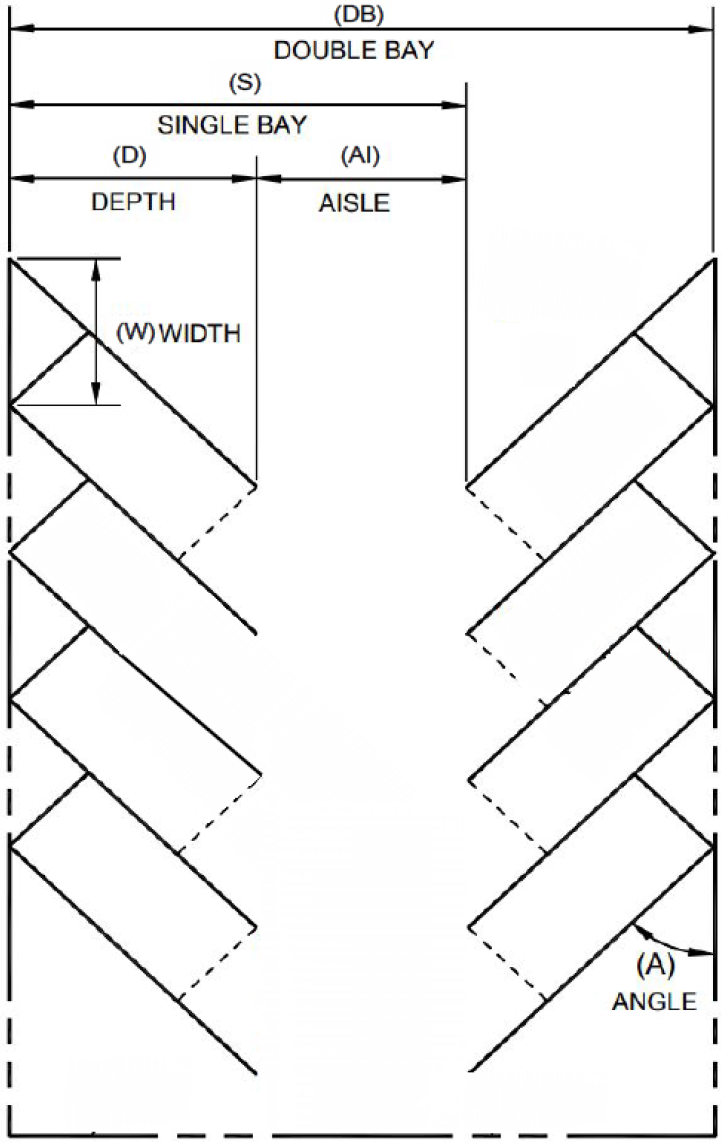
* For one-way aisles only. Minimum width for primary two-way aisles is 26.0 feet and for secondary two-way aisles is 19.0 feet.
** For one-way aisles only. Minimum width for primary two-way aisles is 26.0 feet and for secondary aisles is 21.0 feet.
(e)
Charging stations requirements for new multifamily development projects and hotels and motels.
(1)
Space counting. For the purposes of fulfilling the requirements outlined in this Section 6-604(e), the required charging spaces may count towards the total number of parking spaces required. In addition, calculations to determine the number of EV spaces shall be rounded up to the nearest whole number.
(2)
Requirements for multifamily development projects with less than 20 dwelling units; and hotels and motels with less than 20 sleeping units or guest rooms.
(A)
EV capable. Ten percent of the total number of parking spaces on a building site, provided for all types of parking facilities, shall be electric vehicle charging spaces (EV spaces) capable of supporting future Level 2 EVSE. Electrical load calculations shall demonstrate that the electrical panel service capacity and electrical system, including any on-site distribution transformer(s), have sufficient capacity to simultaneously charge all EVs at all required EV spaces at a minimum of 40 amperes.
The service panel or subpanel circuit directory shall identify the overcurrent protective device space(s) reserved for future EV charging purposes as "EV CAPABLE" in accordance with the California Electrical Code.
(B)
EV ready. Twenty-five percent of the total number of parking spaces shall be equipped with low power Level 2 EV charging receptacles. All remaining dwelling unit parking spaces not otherwise provided with low power Level 2 EV charging receptacles or EV capable spaces shall be EV ready spaces capable of Level 1 (e.g., a 120-volt, 15-ampere standard residential outlet) or faster EV charging. For multifamily parking facilities, no more than one receptacle is required per dwelling unit when more than one parking space is provided for use by a single dwelling unit.
(i)
Exceptions: (1) Areas of parking facilities served by parking lifts and (2) Visitor or common area parking is not required to be EV ready.
(C)
EV chargers. Level 2 EVSE are not required. However, for each Level 2 EVSE that is installed to service a dwelling unit parking space (as opposed to visitor or common area parking spaces), one fewer EV capable or EV ready space will be required.
(3)
Requirements for multifamily development projects with 20 or more dwelling units; and hotels and motels with 20 or more sleeping units or guest rooms.
(A)
EV capable. Ten percent of the total number of parking spaces on a building site, provided for all types of parking facilities, shall be electric vehicle charging spaces (EV spaces) capable of supporting future Level 2 EVSE. Electrical load calculations shall demonstrate that the electrical panel service capacity and electrical system, including any on-site distribution transformer(s), have sufficient capacity to simultaneously charge all EVs at all required EV spaces at a minimum of 40 amperes.
The service panel or subpanel circuit directory shall identify the overcurrent protective device space(s) reserved for future EV charging purposes as "EV CAPABLE" in accordance with the California Electrical Code.
(B)
EV ready. Twenty-five percent of the total number of parking spaces shall be equipped with low power Level 2 EV charging receptacles. All remaining dwelling unit parking spaces not otherwise provided with low power Level 2 EV charging receptacles, EV capable spaces, or EV chargers shall be EV ready spaces capable of Level 1 (e.g., a 120-volt, 15-ampere standard residential outlet) or faster EV charging. For multifamily parking facilities, no more than one receptacle is required per dwelling unit when more than one parking space is provided for use by a single dwelling unit.
(i)
Exceptions: (1) Areas of parking facilities served by parking lifts and (2) Visitor or common area parking is not required to be EV ready.
(C)
EV chargers. Five percent of the total number of parking spaces shall be equipped with Level 2 EVSE. Where common use parking is provided, at least one EV charger shall be located in the common use parking area and shall be available for use by all residents or guests.
(i)
If additional EV chargers are installed such that more than five percent of parking spaces are equipped with Level 2 EVSE, then for each additional EV charger that has been installed, one fewer EV capable or EV ready space will be required.
(ii)
When low power Level 2 EV charging receptacles or Level 2 EVSE are installed beyond the minimum required, an automatic load management system (ALMS) may be used to reduce the maximum required electrical capacity to each space served by the ALMS. The electrical system and any on-site distribution transformers shall have sufficient capacity to deliver at least 3.3 kW simultaneously to each EV charging station (EVCS) served by the ALMS. The branch circuit shall have a minimum capacity of 40 amperes and installed EVSE shall have a capacity of not less than 30 amperes. ALMS shall not be used to reduce the minimum required electrical capacity to the required EV capable spaces.
(4)
For instances where there are inconsistencies between this section and the 2022 California Building Code regarding electric vehicle charging requirements for new multifamily development projects, the requirements in Section 6-604(e) apply.
(f)
Bicycle parking required. Bicycle parking shall be provided in addition to all required parking spaces. For mixed use multifamily residential and commercial/office requirements shall be calculated for each use.
(1)
Bicycle parking shall be provided as follows:
(2)
Bike Parking Design:
(A)
Each bicycle parking space shall provide a secure, stationary, parking device to adequately secure the bicycle frame and one wheel with both wheels left on the bicycle. One such structure may provide multiple bicycle parking spaces.
(B)
Bike parking shall be located no more than 50 feet, and shall be visible from, the entrance of a commercial use. Signage shall be posted at the entrance of the property indicating the location of bicycle parking.
(C)
Bike parking for multifamily uses shall be located on the same parcel and fully enclosed or in a secure location.
(D)
Where multiple retail stores, offices, or related commercial uses operate in close proximity to each other, the property and/or designated business representatives may apply to the city to cluster required bicycle parking spaces in a secure connected bicycle rack or corral, provided this type of parking arrangement can be implemented within reasonable distance to the entrances of all uses.
(g)
Loading spaces required. All new or expanded non-residential buildings over 20,000 square feet shall provide off-street loading spaces which shall be evaluated by the hearing body reviewing the application based on the following criteria:
(1)
Use, size, and operational characteristics such as hours of operation and type of deliveries needed shall be considered in determining length, width and number of loading zones.
(2)
Location of the required loading zone shall not be along the frontage facing Mt. Diablo Boulevard within the Downtown Core.
(3)
Each off-street loading space shall be accessible from a public street.
(4)
Vertical clearance for delivery vehicle vehicles shall be accommodated.
(5)
Loading zones shall be designed such that they can be utilized as a pick up point for car-hailing services when not in use as loading zones.
(h)
Location and configuration of off-street parking.
(1)
The required spaces shall not be located within any setback or yard area of a principal structure, except for accessory dwelling units.
(2)
Mechanical parking lifts are permitted in multifamily and commercial developments and shall be fully enclosed except for ingress and egress. A structure enclosing the lift may be subject to design review.
(3)
Tandem spaces may be allowed for employee or multifamily residential parking upon approval by the zoning administrator. Not more than 25 percent of the required number of stalls shall be tandem.
(4)
For new development in the Plaza District and Downtown Retail District, parking shall be located behind the new structure to allow for a continuous pedestrian-oriented building frontage, consistent with the Downtown Design Guidelines.
(5)
Parking lots and structures in the Plaza District and Downtown Retail District are prohibited on prominent corners along Mt. Diablo Blvd.
(6)
Required off-street parking shall normally be provided on the same lot or premises as the main use it serves or on an adjoining lot.
(A)
Where providing parking on the same lot is impractical, the zoning administrator may authorize parking on any parcel of land located within 1,000 feet of the lot containing the main use, except parcels in single-family residential zoning districts.
(B)
For parking lots in single-family residential zoning districts, the planning commission shall act on a land use permit.
(7)
Whenever any required off-site parking facilities are located on a lot other than the lot containing the activity served, the owner or owners of both lots shall prepare and execute to the satisfaction of, and on a form provided by, the city, an agreement guaranteeing that such facilities will be maintained and reserved for the activity served, for the duration of proposed use.
(Ord. No. 665, § 2 (exh. A), 11-13-2018; Ord. No. 682, § 4, 10-24-2022)
6-605 - Nonconforming parking supply.
(a)
Single Family Residential. Existing single family residences that do not meet current parking requirements are permitted to continue until such time as the residence is demolished and rebuilt or when one or more walls of the non-conforming garage is being modified. In no case shall a non-conforming parking space be made more non-conforming.
(b)
Multi-Family Residential. Existing multi-family residential development in the downtown districts that do not meet parking requirements are permitted to continue until there is a change of use or an increase in the number of units.
(c)
Commercial/Office. Existing development in the downtown districts that do not meet parking requirements are permitted to continue until there is a change of use or a building expansion. When a change of use or a building expansion warrants the provision of additional parking, those parking spaces required by the increase in demand shall be provided.
Commercial and office land uses which do not comply with the parking requirements prescribed in this chapter, shall be permitted to continue for not more than one year from date of vacancy or until such time as development is intensified on the property. Property owners are responsible for providing documentation that demonstrates that the tenant space has been vacant for less than one year.
(Ord. No. 665, § 2 (exh. A), 11-13-2018)
6-606 - Reductions and exceptions.
The reductions to minimum parking requirements provided for in this section are meant to further the goals of the Parking Management Strategy. This section is applicable to multifamily and commercial zoning districts. The reductions must be applied in the order specified below with a primary focus on mitigating the demand for the number of spaces required and better using existing resources. Reductions and exceptions can be additive; however, any reductions exceeding 40 percent of the total number of spaces required must be reviewed by the planning commission through a land use permit.
Table 1—Reductions and Exception
(a)
Reductions through implementation of the strategy. The zoning administrator may grant reductions up to a maximum of 20 percent of the parking requirement, without payment of in lieu fees, through any of the following measures implemented and documented on an annual basis, verified by staff.
(1)
Public Parking. A ten percent reduction when a private property owner allows the public unrestricted use of the entirety of the commercial parking on a parcel or in a shopping center. If the property later reverts to private use, the property owner would then become responsible to provide the required parking and/or in lieu fee in effect at the time of the reversion to private use. In a mixed use development, residential parking is not required to be made public in order to qualify for the parking reduction.
(2)
Transit. A five percent reduction when a multifamily residential use is located in the downtown within a ½ mile of the BART station.
(3)
Employee Parking. A five percent reduction when a property owner or tenant creates a Transportation Demand Management (TDM) program for trip reduction. A TDM program shall contain at least two of the following:
(A)
Providing or contributing ten percent of the project cost to a downtown shuttle service.
(B)
Providing incentives to employees to carpool or use transit like purchasing bulk transit passes or providing free transit passes.
(C)
Providing shower and clothing locker facilities.
(D)
Participating in California's Parking Cash-Out Law.
(E)
Providing or promoting alternative management strategies that demonstrably reduce the demand for employee parking.
(4)
Car Share. A five percent reduction when publicly available car sharing services of no less than three cars are provided on site in residential or office developments or within a block of the subject site.
(b)
Shared parking. When a property owner can demonstrate that two or more uses proposed on a parcel or a shopping center have distinct and different peak hours of parking demand, a reduction of the required number of parking spaces may be allowed.
(1)
The zoning administrator may act on an application for a reduction of up to 20 percent of the required number or five spaces, whichever is less. The planning commission shall act on an application for reductions that exceed five spaces through a land use permit.
(2)
The reduction may be granted in accordance with the following:
(A)
The amount of reduction shall be determined based on quantitative information provided by the applicant that documents the number of spaces required for each use and the peak hours or parking demand for each use;
(B)
Approval shall require a recorded restriction running with the land, guaranteeing the proposed uses and hours of operation;
(C)
Any change to the uses or the hours of operation or peak demand shall be subject to city approval and additional parking facilities may be required if the change to a use will create a greater demand for parking.
(c)
Exceptions to required parking. When a property owner demonstrates that the parking reduction measures listed above cannot be accomplished or can be only partially accomplished, for reasons including, but not exclusive to, site constraints, a request for an exception to the providing the number of parking spaces required may be filed.
(1)
The zoning administrator may act on an application for an exception of up to 20 percent of the required number or five spaces, whichever is less, through an administrative process. The planning commission shall act on an application for exceptions that exceed five spaces through a land use permit and public hearing process.
(2)
The following criteria shall be considered by the hearing body regarding the request for a parking exception:
(A)
Compliance with the goals of the Parking Management Strategy.
(B)
Proximity of the property and ease of pedestrian access to BART.
(C)
The extent of the parking deficiency on the subject property.
(D)
A parking demand analysis provided by the applicant demonstrating a reduction in parking is warranted.
(Ord. No. 665, § 2 (exh. A), 11-13-2018)
6-607 - Parking development payment.
(a)
An off-street parking account is established in the general fund. Revenues credited to the account under Section 6-610 shall be used to manage parking facilities and make all parking in the downtown available and accessible to the public. The management of parking facilities includes the installation of parking meters, enforcement, access agreements and other techniques described in the Parking Management Strategy, and for the acquisition, construction, operation and maintenance of municipally-owned parking facilities.
(b)
If the hearing body grants a parking exception as described in Section 6-606(c) it shall impose, among other reasonable conditions, a requirement that the applicant pay into the city's off-street parking account an amount of money, referred to as a parking development payment ("PDP").
(c)
The PDP is set by the city council and published in the planning department fee schedule. The PDP fee is based on the cost of land and improvements for a 350 sq. ft. surface parking space. The surface parking fee is based on the assumptions of land and improvement costs per square foot outlined in the parking fee study. The fee amount shall be reviewed and revised every five years or as recommended in the parking fee study.
(d)
Upon approval of an application for an exception, the tendered PDP becomes nonrefundable.
(e)
If the PDP cannot be tendered as a lump sum, an applicant may submit a written request to be billed on a yearly basis over three years with an agreement to pay that is recorded against the property. Failure to pay will result in actions consistent with the city's delinquent accounts policy on file with the financial services manager and the revocation of the planning commission's approval.
(f)
The number of parking spaces for which a PDP has been made shall be credited in processing any subsequent applications for the subject property.
(Ord. No. 665, § 2 (exh. A), 11-13-2018)
6-608 - Parking lot design.
(a)
All new parking lots shall comply with the design standards contained in this chapter. The purpose of the design standards is to address aesthetic and safety concerns.
(1)
Parking lots shall be designed and located in a manner to promote the accumulation, combination, interconnection and mutual use with other existing or planned parking lots on contiguous or nearby properties.
(2)
Underground parking is preferable to surface parking or garages.
(3)
Parking lots must comply with the downtown design guidelines.
(4)
Consideration for future use of the space.
(b)
Access driveways.
(1)
All off-street parking facilities shall be designed with appropriate maneuvering areas and means of vehicular access to the main and auxiliary streets.
(2)
Curb cuts to the street shall be kept to a minimum and cross access between properties is highly encouraged.
(3)
Driveways shall be so located as to ensure an efficient and safe traffic flow into the parking areas and along the public streets as determined by the city engineer or designee.
(4)
Where the parking area does not abut on a street, there shall be provided an access drive not less than 12 feet in width in the case of one-way traffic, and not less than 20 feet in width in all other cases, or as determined by the city engineer.
(5)
Backing onto streets prohibited. For any new parking lots created pursuant to Section 6-608 located within any of the business and commercial, office and multifamily residential land use districts, parking areas shall be designed so that vehicles are not permitted to back out of the parking areas onto streets.
(c)
Parking lot landscaping requirements.
(1)
A planting or landscape strip at least five feet wide shall be provided adjacent to all public street rights-of-way. Low walls, earth berms, dense landscaping, or other similar material shall be used to screen the parking lot from the adjacent street or residential area.
(2)
A planting strip not less than three feet wide (exclusive of auto overhangs and curbs) shall be provided between parking lots and adjoining buildings, private road easement lines, fences, property lines or other non-street edges of the parking lot, wherever practical.
(3)
Dead corners and other unused areas shall be landscaped to provide a visual break in the paved area.
(4)
Parking areas of more than 15 spaces shall provide, within the interior of the lot and in addition to the required perimeter landscaping, an area of planting strips equal to that shown in the following table:
(5)
To be counted in this calculation the area may not include that portion under car overhangs. In addition, the planting strip must have a minimum dimension of five feet.
(6)
Where total parking provided is located in more than one place on a site separated by at least ten feet of non-paved area, each such area shall be considered a separate facility.
(7)
Rows of 15 or more adjoining parking spaces shall, in addition to other required landscaping, be interrupted by a landscape area at least five feet in width at intervals no greater than every ten spaces.
(8)
Trees shall be a major design feature in all parking lots. Canopy trees shall be provided at a maximum spacing of one tree per 27 lineal feet and with a minimum of one tree per four parking stalls. The final location and spacing of trees is dependent on the type of tree used, but the overall effect should be a relatively consistent tree cover which at maturity will shade the majority of the pavement and vehicles.
(9)
An automatic irrigation system shall be installed within all landscaped planters and strips. In most cases low-volume spray, bubbler or drip systems will be required.
(10)
Where a minimum-width planting strip is required by subsection (a) or (b) of this section, and the planter is proposed to be used as an overhang for vehicles, the planter strip shall be increased two feet in width greater than that otherwise required. Vehicle overhangs shall not be permitted over sidewalks or other pedestrian walkways. Measurement of parking lot landscape areas required by this section shall be exclusive of curbing.
(11)
Site plans and landscape plans for parking lots must also show dumpsters, utility boxes or underground vaults, loading areas, wheel stops if required, and vehicular overhangs.
(12)
Unless specifically excluded by the city in the design review process, all landscaped areas within or abutting parking lots and access driveways shall be protected by a six-inch-minimum-high concrete curb.
(13)
Additional requirements may be imposed through the design review procedure.
(14)
For parking lots of five or less parking spaces, or the addition of five or less spaces to an existing lot the requirements contained in subsection (a) through (k) are advisory rather than mandatory.
(15)
Landscaping shall be designed to accommodate storm water runoff using current best management practices.
(16)
When adjacent to a residentially zoned property, screening shall be provided either with fencing or planting, or both, to protect nearby residences from noise, light and other detrimental effects.
(d)
Pedestrian navigation.
(1)
Dedicated pedestrian paths of travel shall be incorporated in new parking lots. The path may be marked with striping or specialized materials, such as textured or colored paving or other means to delineate the pedestrian right-of-way. The pathway shall be a minimum width of three feet and take a direct path to a building entrance.
(e)
Lighting.
(1)
Lighting, if provided, shall be directed downward and away from residential areas and public streets so as not to produce a glare as seen from such areas, in order to ensure the general safety of other vehicular traffic and the privacy and well-being of the residential areas, and the lighting intensity shall be no greater than reasonably required to light the parking area.
(Ord. No. 665, § 2 (exh. A), 11-13-2018)
6-609 - Maintenance and operation.
All required parking facilities shall be provided and well maintained so long as any uses exist which require the parking facilities. Off-street parking facilities shall not be reduced in total area or in number of parking stalls, except when such reduction is in conformity with the requirements of this chapter.
(a)
Uses prohibited.
Parking areas shall not be used for automobile sales, storage, repair work, dismantling or servicing of any kind.
(Ord. No. 665, § 2 (exh. A), 11-13-2018)
6-610 - Modifiable sections.
6-502 - Synonymous symbols and phrases.
(a)
Map symbol "R-2" is synonymous with "D-1."
(b)
"Transitional residential agricultural district" is synonymous with "single-family residential district-20" and map symbol "R-A" is synonymous with "R-20."
(Ord. 54 § 2 (part), 1971)
6-503 - Enforcement.
(a)
No land in the city shall be used for any purpose not permitted under Part 2 of this title, nor shall any building or structure be erected, constructed, altered, moved or maintained contrary to this Part 2. Any use of land, building or structure contrary to this Part 2 is unlawful and may be subject to provisions of Chapters 1-9 and/or 8-21 of this municipal code.
(b)
All property improvements or other changes permitted under this title shall be maintained in accordance with such permits. Violations of permits may be subject to enforcement in accordance with Chapters 1-9 and/or 8-21 of this municipal code.
(Ord. 560 § 5 (part), 2006: Ord. 54 § 2 (part), 1971)
6-504 - Land use permits.
(a)
A qualified applicant may apply for a land use permit to apply to land in any land use district established in this Part 2 of this title, for one or more of the uses for which land use permits may be granted in the district. A qualified applicant is any person having a freehold interest in land, a possessory interest entitling him to exclusive possession, or a contractual interest which may become a freehold or exclusive possessory interest and is specifically enforceable. An application shall be filed with the planning director.
(b)
The planning commission shall administer land use permits.
(Ord. 54 § 2 (part), 1971)
6-505 - Variances in new subdivisions.
(a)
A modification or variance in the requirements of lot area, side yards, height or setback necessary to the consideration of a tentative map of a subdivision shall be considered and granted or denied as an exception, under Division 4 of Title 8 of the Contra Costa County Ordinance Code; notice of the hearing of the exception shall be given as for notice of the hearing on an application for a land use permit.
(b)
The planning commission shall administer modification or variance in lot area, side yard, height or setback necessary to the consideration of the tentative map of a subdivision.
(Ord. 54 § 2 (part), 1971)
6-507 - Division and consolidation of lots.
(a)
Except as otherwise provided in this section, a person shall not divide any lot or parcel of land and shall not convey any lot or parcel of any part of it if the division or conveyance so reduces the area, width, yard or setback of the lot or parcel or creates a lot or parcel with an area, width, yard or setback so small that it does not conform to this Part 2 of this title.
(b)
No land providing the required area, width, yard or setback for a dwelling unit shall be considered as providing the required lot area, width, yard or setback for any other dwelling unit.
(c)
Any lot or parcel of the land of less width or area than the minima established in this Part 2 may be occupied by a single-family dwelling and its accessory buildings if:
(1)
The owners of the lot or parcel do not own enough adjoining property to make the lot or parcel of proper width and area;
(2)
The setback, side yard and rear yard requirements of this Part 2 are met; and
(3)
The lot is delineated on a recorded subdivision map, or its ownership is of record in the county recorder's office on the effective date of the adoption of the zoning district applicable to the lot or parcel.
(Ord. 287 § 2, 1982; Ord. 54 § 2 (part), 1971)
6-508 - Required area reduced by public use.
If part of the lot or parcel of land having not less than the required area for its land use district is acquired for public use in any manner, including dedication, condemnation or purchase, and if the remainder of the lot or parcel has not less than 80 percent of the area required for its land use district, the remainder shall be considered as having the required area, but setback, side yard and rear yard requirements shall be met. If a lot or parcel of land has an authorized nonconforming status as to area under any city ordinance, the parcel shall retain its nonconforming status if the acquisition for public use does not reduce the remainder below 80 percent of the existing nonconforming area. The setback, side yard and rear yard requirements of the land use district shall be met, except for buildings or structures in existence at the time of public acquisition.
(Ord. 54 § 2 (part), 1971)
6-509 - Lots divided by district.
When any zoning district boundary divides a lot or parcel owned of record as one unit, the regulations of the least restricted district shall extend for 30 feet into the more restrictive district, provided both zoning districts are generally similar (commercial to commercial, residential to residential).
(Ord. 361 § 2, 1987: Ord. 54 § 2 (part), 1971)
6-510 - Highway setback lines.
(a)
No building or structure (other than excepted structures as herein defined) shall hereafter be erected, constructed or placed on any land in this city between the highway setback lines hereby established and the common boundary line of the land and any state highway or public road in this city. The highway setback lines shall be lines parallel to the boundary lines of highways and public roads. In determining the location of highway setback lines the distance from the boundary of the state highway or public road to the setback line shall be measured inward on the land, at right angles to the boundary lines. The setback line on land bounded on one or more sides by a public road other than a state highway shall be ten feet inward from each boundary line.
(b)
Land use permits to modify the provisions of subsection (a) of this section may be granted after application in accordance with Part 1 of this title.
(Ord. 54 § 2 (part), 1971)
6-511 - Sight obstructions at intersections.
(a)
Obstructions Prohibited. No structure (including but not limited to fences and gateways) or vegetation which obstructs the visibility of and from vehicles approaching the intersection of a state highway, public road or street with another state highway, public road or street shall be constructed, grown, maintained or permitted higher than two and one-half feet above the curb grade, or three feet above the edge of pavement, within a triangular area bounded by the right-of-way lines and a diagonal line joining points on the right-of-way lines 25 feet back from the point of their intersection, or, in the case of rounded corners, the triangular area between the tangents to the curve of the right-of-way line and a diagonal line joining points on said tangents 25 feet back from the point of their intersection. The tangents referred to are those at the beginning and at the end of the curve of the right-of-way line at the corner.
(b)
Exceptions. This section does not apply to existing public utility poles, or existing permanent structures or existing supporting members or appurtenances thereof; official traffic signs or signals; or corners where the contour of the land itself prevents visibility.
(c)
Enforcement. Violations of this section may be subject to enforcement in accordance with Chapters 1-9 and/or 8-21 of this municipal code.
(d)
Repealed by Ordinance 560.
(Ord. 560 § 5 (part), 2006; Ord. 54 § 2 (part), 1971)
6-512 - Setback requirements.
On a corner lot the setback requirements applicable to the district in which the lot is located shall apply to all state highway, public road and street frontages of the lot. The setback lines established by this Part 2 shall apply wherever any boundary line of a lot or parcel of land is common with the boundary line of any state highway, public road or street.
(Ord. 54 § 2 (part), 1971)
6-513 - Building height.
The limits of heights of structures established in this Part 2 of this title for any district shall not apply to chimneys, stacks, fire towers, radio towers, television towers, water towers, windmills, oil and gas well derricks, wind chargers, grain elevators, penthouses, cupolas, spires, belfries, domes, monuments, flagpoles, telephone poles, telegraph poles, silos, water tanks and necessary mechanical appurtenances attached to buildings. In all cases parapet or fire walls on buildings or structures otherwise conforming to the regulations established in this Part 2 may be constructed not higher than three feet.
(Ord. 54 § 2 (part), 1971)
6-514 - Obstructions in yard areas.
Every part of a required yard area shall be open and unobstructed to the sky, except that fire escapes, open stairways, chimneys and the ordinary projections of sills, belt-courses, cornices, eaves and ornamental features which do not obstruct the light and ventilation on any adjoining parcel of land shall not constitute obstruction nor violate required yard regulations.
(Ord. 54 § 2 (part), 1971)
6-515 - Side yards on lots established before effective date of zoning.
Notwithstanding any other provisions of this Part 2 of this title, side yards shall be permitted in any single-family residential district, multiple-family residential district, and forestry recreational district, according to the following table, for any lot or parcel of land which was established by records in the office of the recorder before the effective date of the initial zoning by Contra Costa County for the area or district in which the lot or parcel of land is situated:
(Ord. 54 § 2 (part), 1971)
6-516 - Local agencies, utilities and pipelines.
(a)
The use of land for rights-of-way for the construction, maintenance and repair of public utilities and publicly owned facilities, and for privately owned pipelines for the transportation of oil, gas, water and other substances transportable by pipelines, is not regulated or restricted by this title.
(b)
A local agency (an agency of the state for the local performance of governmental or proprietary functions within limited boundaries) is regulated as provided in Government Code Sections 53091 through 53096.
(Ord. 358 § 1, 1987: Ord. 59 § 2, 1971)
6-517 - Accessory uses in rear yards.
An accessory building or accessory use may occupy not more than 30 percent of a required rear yard.
(Ord. 54 § 2 (part), 1971)
6-518 - Rear yard abutting on side yard.
In all single-family residential districts and multiple-family residential districts, there shall be a rear yard of not less than five feet wherever the rear yard of a lot or parcel of land abuts on a side yard.
(Ord. 54 § 2 (part), 1971)
6-519 - Contract zoning.
The city council may, pursuant to a written and recorded agreement between the city and all owners of record of the property, impose reasonable conditions to the land use reclassification of property, where it finds that the conditions must be imposed so as not to create problems inimical to the public health, safety and general welfare of the city.
(Ord. 50 § 2, 1971)
6-520 - Drilling for oil, gas and minerals.
Land use permits may be granted, after application in accordance with the provisions of Chapter 6-1 of this title, for exploration and drilling for the production of oil, gas or minerals in all land use districts.
(Ord. 59 § 3, 1971)
6-522 - Drainage requirements.
Drainage facilities shall be installed under a permit issued pursuant to Divisions 1, 2 or 3 of Title 8 of the Contra Costa County Ordinance Code, adequate to meet and comply with the drainage design standards and requirements set forth in Chapter 3 of Division 4 of Title 8 of said code. A permit for the installation of drainage facilities will not be issued until applications, plans and exhibits for such facilities are submitted which comply with the requirements of this title.
(Ord. 59 § 5, 1971)
6-523 - Livestock.
(a)
Livestock may be kept in the single-family residential-10 (R-10), single-family residential-12 (R-12), single-family residential-15 (R-15), single-family residential-20 (R-20), single-family residential-40 (R-40), single-family residential-65 (R-65), single-family residential-100 (R-100) and low-density residential (L-R) land use districts, subject to the following requirements:
(1)
Livestock may be kept only on a parcel of land of not less than 40,000 square feet in area in single fee ownership.
(2)
No more than one head of livestock shall be maintained per 20,000 square feet of area.
(3)
In the R-10, R-12 and R-15 zoning districts a land use permit shall be obtained for the keeping of livestock. Development in these districts, however, is of such a nature, because of small lots, narrow side yards and close development, that the keeping of livestock in such highly developed areas is seldom appropriate. Land use permits for the keeping of livestock will be issued only where it can be demonstrated that the lot involved in the application and lots in the surrounding area are of such a size and configuration that the keeping of livestock on such lots is compatible and consistent with the surrounding development and that such area is comparable to other areas within the city where a land use permit is not required for the keeping of livestock.
(b)
Variance permits to modify subsection (a)(1) of this section may be granted in accordance with the applicable provisions of Chapter 6-2 of this title.
(Ord. 232 § 1, 1980: Ord. 80 § 1, 1972: Ord. 63 § 2, 1972)
6-524 - Animal structures.
Notwithstanding the setback, side yard and rear yard provisions in the single-family residential land use districts, the following provisions shall apply to the location of animal structures in all such districts, provided such structures are permitted at all:
(a)
Barns, stables and similar accessory structures used to shelter livestock shall be located in the rear yard of the principal structure.
(b)
Barns, stables and similar accessory structures used to shelter livestock shall be set back not less than 60 feet from the front property line and from any street line and shall be not less than 55 feet from any point on an adjoining parcel of land, at which point the exterior wall of a dwelling unit either exists or could legally be constructed.
(c)
Fenced pasture, paddocks or other enclosures for livestock shall not be located nearer than ten feet to any property line.
(d)
Variance permits to modify subsections (a), (b) and (c) of this section may be granted in accordance with the applicable provisions of Chapter 6-2 of this title.
(Ord. 125 § 1, 1974: Ord. 80 § 2, 1972: Ord. 63 § 3, 1972)
(Ord. No. 631, § 4(exh. A), 10-27-2014)
6-526 - Height limitations in required yards.
(a)
Accessory buildings, as defined in Section 6-302 of this title, and structures, as defined in Section 6-355 of this title, shall not exceed the following height limits, if constructed in the required setback (front yard), side yard or rear yard which is applicable to the main building or principal structure on the lot:
(1)
Accessory buildings, 12 feet;
(2)
Structures, six feet.
For example, if the rear yard for the principal structure is 15 feet, but the rear yard for an accessory building is three feet, any accessory building within the 15-foot rear yard required for the principal structure shall not exceed 12 feet in height.
(b)
For the purpose of this section, the height of a structure shall be determined by measurement on its tallest side between natural grade and its highest part; and the height of an accessory building shall be determined as provided in Section 6-313 of this title.
(c)
Variance permits to modify the provisions of this section may be granted in accordance with the applicable provisions of Chapter 6-1 of this title.
(Ord. 274 § 1, 1982: Ord. 243 § 2, 1981)
6-527 - Manufactured home.
(a)
Definition. "Manufactured home" means a structure with a permanent foundation designed to be used as a residence and certified under the National Manufactured Home Construction and Safety Standards Act of 1974. "Manufactured home" does not include recreational vehicle, trailer or motor home.
(b)
Standards. The following standards apply to manufactured homes:
(1)
Manufactured homes are a permitted use on any lot in any zoning district that permits single-family residential uses. Except as otherwise provided in this title, manufactured homes shall be subject to the same regulations as conventional single-family dwellings.
(2)
Manufactured homes shall be subject to same parking standards as required for single-family dwellings in the same zoning district.
(3)
Requirements for building height, lot coverage, side yard setbacks, front yard setbacks, rear yard setbacks, landscape, and useable open space shall be same for manufactured homes as for single-family dwellings in the same zoning district.
(4)
Roof overhangs, roof pitch, roofing materials, and siding materials shall be in character with those commonly used in conventional single-family dwellings in the surrounding area. Manufactured homes installed in an area or district with design guidelines shall comply with such guidelines.
(5)
The exterior covering material shall extend to the ground.
(c)
Foundation systems.
(1)
A manufactured home shall be built on a foundation system in accordance with the California Building Standards Code.
(2)
All manufactured homes constructed on a foundation system shall comply with the requirements of Health and Safety Code section 18551 and California Code of Regulations, Title 25, Division 1, as they may be amended from time to time.
(3)
No existing, lawfully erected manufactured home on private property shall be required to be placed on a foundation system.
(Ord. 275 § 4, 1982)
(Ord. No. 618, § 4(exh. A), 8-12-2013)
Editor's note— Ord. No. 618, § 4(exh. A), adopted Aug. 12, 2013, retitled § 6-527 from "Mobilehomes" to "Manufactured home."
6-528 - Prohibited uses and activities.
The following uses and activities are prohibited in all land use classification (zoning) districts:
(a)
Any use or activity which is prohibited by local, regional, state, or federal law unless expressly and affirmatively authorized by this code; and
(b)
Construction or use of helicopter landing pads, heliports and all other helicopter facilities.
(Ord. 282 § 1, 1982)
(Ord. No. 601, (exh. A), 7-11-2011; Ord. No. 643, § 5, 2-8-2016; Ord. No. 660, § 3, 11-27-2017)
Editor's note— Ord. No. 601, (exh. A), adopted July 11, 2011, changed the title of § 6-528 from helicopter facilities to prohibited uses and activities.
6-529 - Temporary sales.
Notwithstanding other provisions in this title, the temporary sales of perishable goods from vehicles or from temporary structures or facilities may be conducted subject to written conditional approval of the planning director for each such use, and subject to the restrictions contained in this section.
(a)
The planning director may authorize the conduct of these uses in any zoning district except the RB and SRB districts, provided that:
(1)
The property fronts on either Mt. Diablo Boulevard, Moraga Road, St. Mary's Road, Pleasant Hill Road or Deer Hill Road;
(2)
The property owner gives written consent thereto;
(3)
The use will, in the planning director's opinion, neither create nor aggravate a traffic hazard nor a parking problem; and
(4)
Not more than two advertising or identification signs, totaling not more than 50 square feet in total area, and not more than 25 square feet in area for a single sign, are displayed.
(b)
A person who desires to conduct a temporary sale as defined in this section shall submit a written application therefor, in a form acceptable to the planning director, and containing such information as he may reasonably require.
(c)
There shall be a nonrefundable application fee for the processing of an application submitted pursuant to this section. The city council shall by resolution prescribe the amount of said fee, or the method of calculating it.
(d)
Approval of a temporary sales use shall be for not more than three months, subject to reconsideration by the planning director and renewal by him for additional periods of three months each.
(e)
The planning director may impose reasonable conditions on such temporary sales uses. Such conditions may include, but are not limited to, restricting the days and/or hours of operation, prescribing the appearance, location and size of signs, controlling the locations for customer and employee parking, limiting the scope or size of the activity, requiring a minimum number of persons to be on duty, controlling refuse collection and cleanup of the premises, and prescribing the appearance of the vehicles, structures or facilities to be used.
(f)
Upon request by any person, the planning director shall refer the application for conduct of temporary sales to the planning commission for action.
(g)
The temporary sales allowed by this section are exempted from the provisions of this title which may otherwise be in conflict with the provisions of this section.
(h)
The provisions in this section shall not exempt these temporary uses, their structures or facilities, from the requirements of any applicable construction code, nor from any applicable health or safety law or ordinance.
(i)
This section is not intended to prohibit permanent sales from movable structures, such as carts, kiosks, etc., if such sales are conducted pursuant to the necessary permits under this chapter; or the conduct of special events for short periods of time, if such special events are conducted pursuant to the necessary city approvals.
(Ord. 281 § 1, 1982)
6-530 - Satellite dish antennas.
(a)
Purpose and Definition. This section regulates the installation of satellite dish antennas in all residential and agricultural districts of the city. A satellite antenna is any parabolic or spherical antenna over three feet in diameter which receives television or other signals from orbiting satellites or other devices.
(b)
Findings. The council finds that the installation of satellite dish antennas, unless regulated, may adversely affect the aesthetic values and safety of residential areas of the city. Therefore, the installation of these antennas is regulated to protect views from public rights-of-way and from adjacent properties, while not preventing the installation of such antennas in an unobtrusive and aesthetically pleasing manner.
(c)
Regulations. The following regulations apply to the installation of a satellite dish antenna (unless a modification to subparagraphs (7) through (10) of this subsection is approved under subsection (e) of this section).
(1)
A satellite dish shall be constructed and erected in a secure and wind-resistant manner.
(2)
A satellite dish shall be constructed of noncombustible and noncorrosive materials.
(3)
A satellite dish shall be constructed of nonreflective materials, and its color shall blend in with the surroundings. Perforated or wire-mesh dishes are encouraged.
(4)
No advertising or signage of any type is permitted on a satellite dish.
(5)
All wires or cables necessary for the operation of the satellite dish should be placed underground. Guy wires are discouraged.
(6)
A satellite dish shall be maintained in an operable state with no structural defects or visible damage.
(7)
There shall be no more than one satellite dish per lot.
(8)
For a ground-mounted antenna located in an interior side or rear yard, a setback equal to the height of the antenna is required between the property line and any part of the antenna, notwithstanding Section 6-526.
(9)
The maximum height permitted is 12 feet, measured from ground level immediately under the antenna to the highest point of the antenna or any appurtenance attached to it. The height is measured when the satellite dish is directed at a point 20 degrees above horizontal.
(10)
In any case where a side or rear yard abuts a public right-of-way or private street, a setback of 15 feet is required between the public right-of-way or the right-of-way of a private street and any portion of the satellite dish.
(11)
For hillside lots, additional attention, evaluation and conditions may be imposed by the city to assure that visual impacts on other properties are minimized.
(12)
The planting of screening landscape materials or provision of solid fencing is encouraged and may be required by the city to screen satellite dishes from public rights-of-way and other properties.
(d)
Procedures.
(1)
The planning director shall establish submittal requirements for applications for satellite dish antennas. Each application shall be accompanied by a fee in an amount established by city council resolution.
(2)
Except as provided in subsection (d)(3), the planning director is authorized to review and approve an application for a satellite dish antenna provided he sends written notice to all property owners within 300 feet at least ten days beforehand and considers any comments received before making a decision. The planning director may impose conditions of approval consistent with the intent and purpose of this section.
(3)
The planning director (A) may refer any application to the design review commission and (B) shall refer to the design review commission an application for a satellite dish antenna to be placed in one of the sensitive locations listed in subsection (e) of this section. Before approving a satellite dish antenna in one of the listed sensitive locations, the design review commission shall hold a noticed public hearing in accordance with Section 6-211(b). The design review commission may impose conditions of approval consistent with the intent and purpose of this section.
(4)
A decision by the planning director or design review commission may be appealed under Section 6-280.
(e)
Sensitive Locations and Required Findings.
(1)
An application for a satellite dish antenna to be placed in one of these sensitive locations requires approval by the design review commission:
(A)
On a roof top;
(B)
In a required front setback, or street sideyard on a corner lot;
(C)
Between the required front setback, or street sideyard of a corner lot, and a dwelling when the antenna is visible from the abutting street;
(D)
At a location in conflict with subsection (c), subparagraphs (7) through (10).
(2)
Before approving a satellite dish antenna in one of the listed sensitive locations, the design review commission shall make the following findings:
(A)
There is no other location which can effectively receive incoming signals; and
(B)
Because of topography, house design or location or landscaping, the proposed satellite dish will not have a significant adverse impact on any surrounding property.
(Ord. 350 § 1, 1986)
6-531 - Residential conversions and replacements.
(a)
The city shall not approve or issue a building permit for a housing development project that will require the demolition of one or more residential dwelling units unless the project will create at least as many residential dwelling units of equivalent size as will be demolished.
(b)
The city shall not approve or issue a building permit for a housing development project that will require the demolition of occupied or vacant protected units, unless the housing development project meets all of the requirements of California Government Code Section 65915(c)(3).
(c)
The following words and phrases, whenever used in this section, shall be defined as the following:
"Equivalent size" means that the replacement units contain at least the same total number of bedrooms as the units being replaced.
"Housing development project" shall have the same meaning as defined in paragraph (3) of subdivision (b) of Section 65905.5 of the California Government Code, however, shall not include a housing development project located within a very high fire hazard severity zone.
"Protected units" has the same meaning as set forth in California Government Code Section 66300.
"Very high fire severity zone" has the same meaning as provided in California Government Code Section 51177.
(d)
Inclusionary Housing or Density Bonus. Affordable replacement units required by this section may count toward any affordable housing set-aside units required in connection with the granting of a density bonus, or the requirements of the city's inclusionary housing program, if applicable.
(e)
The affordable replacement units shall be subject to the requirements for affordable units as established in Chapter 6-37, Inclusionary Housing.
(f)
This section shall remain effective despite the possible expiration of Government Code Section 65915.
(g)
A housing development project that submits a preliminary application pursuant to Section 65941.1 of the California Government Code before January 1, 2030, remains subject to this section after January 1, 2030.
(Ord. No. 696, § 3(Exh. A), 1-13-2025)
Editor's note— Ord. No. 696, § 3(Exh. A), adopted Jan. 13, 2025, repealed the former § 6-531 and enacted a new § 6-531 as set out herein. The former § 6-531 pertained to residential conversions and derived from Ord. 349 § 8, adopted in 1986; Ord. 359 § 1(A), adopted in 1987; and Ord. No. 634, § 4(exh. A), adopted Sept. 22, 2014.
6-532 - Criteria for retail dry cleaners.
A retail dry cleaners shall comply with all of the following:
(a)
The dry cleaning system shall be a self-contained enclosed system, nonvented to the atmosphere;
(b)
Evidence of approval of the proposed system by the Bay Area air quality management district shall be submitted prior to commencement of use; and
(c)
Maximum square footage of the facility shall be 2,000 square feet total.
(Ord. 359 § 1(B), 1987)
6-533 - Firearm sales.
(a)
Purpose. It is the purpose of this section to provide for the appropriate location of firearm sales activity and regulate such activity through the permitting process.
(b)
Permit Requirement. The sale of firearms is permitted on the issuance of a land use permit, and a police permit as provided under Chapter 8-6, Article 2, in the Retail Business District (RB), General Commercial District (C), Special Retail Business District (SRB) and General Commercial District 1 (C-1). Firearm sales are prohibited in all other land use districts.
(c)
Procedure. An applicant for a land use permit for sale of firearms shall apply to the planning commission by application prescribed by the city in the manner provided by Section 6-201 et seq.
(d)
Criteria. In addition to the findings required under Section 6-215, the planning commission shall review an application for a land use permit for the sale of firearms for satisfaction of the following criteria:
(1)
Locational compatibility of the proposed use with other existing uses in close proximity, in particular elementary, middle or high school, pre-school or day-care center, other firearms sales business, liquor stores and bar, and residentially zoned area;
(2)
Architectural compatibility of the proposed use with other existing uses in the vicinity, due to the requirements of Chapter 8-6, Article 2 regarding a "secure facility."
(e)
Conditions. An approved land use permit is not valid until the applicant satisfies the following terms and conditions:
(1)
Possession of a valid police permit as required under Section 8-605 et seq.;
(2)
Possession of all licenses and permits required by federal and state law; and
(3)
Compliance with the requirements of the city's building code, fire code and other technical code and regulation which governs the use, occupancy, maintenance, construction or design of the building or structure. The use permit shall also contain a condition that the applicant must obtain a final inspection from the city building official demonstrating code compliance before the applicant may begin business at the premises at issue.
(f)
Nonconforming Use. An operator of a firearm sales activity in a residential zone who is the holder of a valid seller's permit issued by the State Board of Equalization and a valid certificate of eligibility issued by the California Department of Justice, all of which were issued prior to October 24, 1994, may continue his/her firearms sales activity provided a police permit are obtained from the city within 60 days of the effective date of the ordinance codified in this section, and provided the operator remain fully licensed by all agencies listed above.
(Ord. 433 §§ 3, 4, 1994)
(Ord. No. 623, § 2, 10-28-2014)
6-534 - Supportive care.
(a)
Transitional Housing. Transitional housing is a residential use of property, subject only to those restrictions that apply to other residential dwellings of the same type in the same zone.
(b)
Supportive Housing.
(1)
Supportive housing is a residential use of property, subject only to those restrictions that apply to other residential dwellings of the same type in the same zone.
(2)
Notwithstanding the above, supportive housing is a use by right in all zones where multifamily and mixed uses are permitted, in accordance with Government Code Section 65650 et seq.
(c)
Residential Care Facilities. Residential care facilities may be established and operate where other boarding house uses may not, subject to the following:
(1)
Residential care facilities with a state license to serve six or fewer persons are regulated as single-family residential uses.
(2)
Other residential care facilities must comply with each of the following standards:
(A)
Maximum Occupancy. Occupancy is limited to two persons per bedroom, except that one bedroom must be reserved for an on-site house manager.
(B)
Separation. No residential care facility may be located within 650 feet of another.
(d)
Low Barrier Navigation Centers. As required by Government Code Section 65662, Low Barrier Navigation Centers are permitted by right in all areas zoned for mixed use and nonresidential zones that permit multifamily housing if the following criteria are all met:
(1)
It offers services to connect people to permanent housing through a services plan that identifies services staffing.
(2)
It is linked to a coordinated entry system, so that staff in the interim facility or staff who co-locate in the facility may conduct assessments and provide services to connect people to permanent housing. "Coordinated entry system" means a centralized or coordinated assessment system developed pursuant to Section 576.400(d) or Section 578.7(a)(8), as applicable, of Title 24 of the Code of Federal Regulations, as those sections read on January 1, 2020, and any related requirements, designed to coordinate program participant intake, assessment, and referrals.
(3)
It complies with Chapter 6.5 (commencing with Section 8255) of Division 8 of the Welfare and Institutions Code.
(4)
It has a system for entering information regarding client stays, client demographics, client income, and exit destination through the local Homeless Management Information System as defined by Section 578.3 of Title 24 of the Code of Federal Regulations.
(Ord. No. 635, § 4(exh. A), 10-14-2014; Ord. No. 697, § 3(Exh. A), 7-28-2025)
Editor's note— Ord. No. 697, § 3(Exh. A), adopted July 28, 2025, amended § 6-534 and in doing so changed the title of said section from "Supportive care criteria" to "Supportive care," as set out herein.
6-535 - Cannabis uses.
(a)
Purpose. This section regulates the cultivation of cannabis in Lafayette for personal use in accordance with state law. In addition, this section prohibits all commercial cannabis uses from establishing or operating within the City of Lafayette, including all medical and adult-use cannabis business types licensed by state licensing authorities pursuant to the Medicinal and Adult-Use Cannabis Regulation and Safety Act (Business and Professions Code, Section 26000 et seq.), except cannabis deliveries originating from outside of the city.
(b)
Personal Cultivation Indoors. A person age 21 or older may cultivate and possess no more than six living cannabis plants at any one time for his or her own personal use inside a private residence or inside an accessory structure to a private residence, so long as all of the following minimum standards are met:
(1)
All areas used for cannabis cultivation shall be located within a fully enclosed and secure structure.
(2)
Indoor grow lights shall not exceed a total of 1,000 watts or incandescence equivalent, and all lighting shall comply with the California Building, Electrical, and Fire Codes as adopted and amended by the City of Lafayette.
(3)
The use of gas products (CO 2 , butane, propane, natural gas, etc.) or generators for cultivation of cannabis is prohibited. Use of gas products shall be limited to those allowed by the California Building, Electrical, and Fire Codes as adopted and amended by the City of Lafayette.
(4)
Any private residence or accessory building used for the cultivation of cannabis must have a ventilation and filtration system installed that shall prevent cannabis plant odors from exiting the building.
(5)
There shall be no exterior visibility or evidence of cannabis cultivation outside the private residence from the right-of-way, a public place, or any adjacent property including, but not limited to, any cannabis plants, equipment used in the growing and cultivation activities, and any light emanating from the structure due to cultivation lighting (grow lights).
(6)
The residence shall include fully functional and usable kitchen, bathroom, and bedroom areas for their intended use by the resident(s), and the premises shall not be used primarily or exclusively for cannabis cultivation.
(7)
The cannabis cultivation area shall not result in a nuisance or adversely affect the health, welfare, or safety of the resident(s) or nearby residents by creating dust, glare, heat, noise, noxious gasses, odors, smoke, traffic, vibration, or other impacts, or be hazardous due to use or storage of materials, processes, products or wastes.
(8)
No more than six cannabis plants, mature or immature, per residence are permitted for indoor personal cultivation, regardless of the number of individuals residing at the residence.
(9)
The living plants and any cannabis produced by plants in excess of 28.5 grams shall be kept in a locked space on the grounds of the private residence.
(c)
Personal Cultivation Outdoors. Cultivation of cannabis outdoors in the City of Lafayette is prohibited.
(d)
Commercial cannabis uses prohibited; exception.
(1)
All commercial cannabis uses are prohibited from establishing or operating within the City of Lafayette.
(2)
Exception for Deliveries from Licensed Cannabis Retailers. Cannabis retailers, microbusinesses and non-profits licensed pursuant to Business and Professions Code, Section 26070.5 (whether medical or adult-use) are prohibited in the City; however, delivery of cannabis and cannabis products from cannabis retailers, microbusinesses or licensed nonprofits located outside of the City of Lafayette is allowed, subject to the following restrictions:
(A)
Only cannabis retailers, microbusinesses or licensed nonprofits that are licensed under the applicable laws of the state of California, including but not limited to the Medicinal and Adult-Use Cannabis Regulation and Safety Act (Business and Professions Code, Section 26000 et seq.), and are operating in compliance with the applicable laws and regulations of the local jurisdiction in which the cannabis business is physically located may provide cannabis delivery to locations in the City of Lafayette; and
(B)
Provided that such delivery transactions within Lafayette utilize an electronic payment method.
(Ord. No. 660, § 4, 11-27-2017)
6-536 - Boarding houses.
Boarding houses are prohibited in all zoning districts within the city. No person shall operate, establish, maintain, or permit the operation of a boarding house on any property.
(Ord. No. 697, § 3(Exh. A), 7-28-2025)
6-550 - General.
(a)
Unless otherwise stated in the regulations for a specific zoning district, the regulations in this article shall apply to all nonconforming uses.
(b)
The use of land, or the use of a building, structure or improvement, existing on May 1, 1980, which does not conform to the land use regulations in this title, may continue as provided in this article, so long as the use does not violate any other ordinance or law.
(c)
"Land, building, structure or improvement," as used in this section, refers only to that portion which is actually utilized for the nonconforming but preexisting use. The term does not include an improvement which is not a part of the existing use; and any land, building, structure or improvement which is not a part of the existing use shall be disregarded in the application of the provisions of this article.
(Ord. 221 § 7 (part), 1980)
6-551 - Regulations.
The following regulations apply to each nonconforming use:
(a)
No physical change in the use is permitted other than ordinary maintenance and repair, except as provided by Section 6-553.
(b)
No increase or enlargement of the area, space or volume occupied and used is permitted.
(c)
No change in the nature or character of the nonconforming use is permitted.
(d)
If the nonconforming use is replaced by a conforming use, the right to continue the nonconforming use is automatically terminated.
(e)
If the nonconforming use discontinues active operation, except for reasons defined by Section 6-554 for a continuous period of 120 days, the nonconforming use terminates and the facilities accommodating or serving such activity shall thereafter be utilized only for uses permitted or conditionally permitted by the regulations of the applicable zoning district.
(f)
If the nonconforming use is a non-permitted residential conversion in the downtown, the property owner shall apply for a land use permit or restore the property back to its original residential use when the following occurs:
(1)
At or before the end of a five-year period from the date of discovery; or
(2)
When the property is sold; or
(3)
When the property is developed.
(Ord. 221 § 7 (part), 1980)
(Ord. No. 634, § 4(exh. B), 9-22-2014)
6-552 - Certificates.
(a)
The planning director shall compile a list of all nonconforming uses which exist within the commercial districts of the city and shall issue a "certificate of nonconforming use" to the proprietor of each such use and to the owner of property upon which the nonconforming use exists. No use of land, building or structure may be made other than that specified in the certificate of nonconforming use unless the use conforms with the regulations of the land use district in which the property is located. Failure of the proprietor or owner to receive such certificate of nonconforming use, or failure of the planning director to issue such certificate, shall not affect the nonconforming status of such use.
(b)
The planning director shall file a copy of each certificate of nonconforming use in the office of the building inspection department. No building permit may be issued to an applicant for property for which a certificate of nonconforming use exists, without the prior written approval of the planning director.
(Ord. 221 § 7 (part), 1980)
6-553 - Alterations.
Physical changes may be made in a building or structure which contains a nonconforming use, and the use may continue after said changes are made, provided that:
(a)
A land use permit is obtained prior to the making of, and authorizing, the physical changes; and
(b)
There is no expansion or extension of the nonconforming use, nor any change in the nature, character or intensity of such use.
(Ord. 221 § 7 (part), 1980)
6-554 - Reconstruction.
A building or structure containing a nonconforming use may be rebuilt and the use continued if the building or structure is damaged by fire, collapse, explosion or act of God, occurring after May 1, 1980; and if the expense of the work to restore the building to its former status prior to the damage does not exceed 50 percent of the fair market value of the building or structure in its damaged state at the time immediately before the proposed work will be undertaken. The 50-percent factor is a determinant of whether or not a nonconforming use may continue and is not a maximum limit of moneys which could be expended for restoration work. The value of the structure shall be determined by an independent appraisal and approved by the planning commission. The floor area and overall outside dimensions of any building, or portion thereof, devoted to the nonconforming use shall not be increased; no open parking, loading, sales, display, service, production or storage area accommodating or serving the nonconforming use shall be relocated or increased in size; and no such building or open area shall be wholly reconstructed.
(Ord. 221 § 7 (part), 1980)
6-555 - Rezoning or changes in district boundaries.
When the city changes the boundaries of a land use district or rezones an area from one land use district to another, the provisions of this article apply to a nonconforming use created by the change in boundaries or change in land use district classification.
(Ord. 221 § 7 (part), 1980)
6-560 - Purpose and findings.
(a)
Purpose. The purpose of this article is to allow and regulate accessory dwelling units (ADUs) and junior accessory dwelling units (JADUs) in compliance with California Government Code sections 65852.2 and 65852.22.
(b)
Effect of Conforming. An ADU or JADU that conforms to the standards in this section will not be:
(1)
Deemed to be inconsistent with the city's general plan and zoning designation for the lot on which the ADU or JADU is located.
(2)
Deemed to exceed the allowable density for the lot on which the ADU or JADU is located.
(3)
Considered in the application of any local ordinance, policy, or program to limit residential growth.
(4)
Required to correct a nonconforming zoning condition, as defined in Section 6-561(h) below.
(Ord. No. 678, § 3(Exh. A), 4-27-2020)
6-561 - Definitions.
As used in this article, terms are defined as follows:
(a)
"Accessory dwelling unit" or "ADU" means an attached or a detached residential dwelling unit that provides complete independent living facilities for one or more persons and is located on a lot with a proposed or existing primary residence. An accessory dwelling unit can also include the following:
(1)
An efficiency unit, as defined in Health and Safety Code Section 17958.1.
(2)
A manufactured home, as defined in Health and Safety Code Section 18007.
(b)
"Accessory building" means a structure that is accessory and incidental to a dwelling located on the same lot.
(c)
"Affordable rent" means a rental rate that results in monthly housing costs, including utilities, that collectively do not exceed the following:
(1)
For a very low-income household, 50 percent of the AMI, adjusted for household size, multiplied by 30 percent and divided by 12. (2) For a low-income household, 80 percent of the AMI, adjusted for household size, multiplied by 30 percent and divided by 12.
(d)
"Area median income" or "AMI" mean the area median income for Contra Costa County.
(e)
"Bonus ADU" means an accessory dwelling unit authorized under Section 6-569 that meets all of the following criteria:
(1)
It is no more than 500 square feet in floor area.
(2)
It is contained entirely within an existing or proposed single-family building. An enclosed use within the residence, such as an attached garage, is also considered to be a part of the single-family structure and may be converted to a bonus ADU.
(3)
It includes its own separate bathroom or shares a bathroom with the existing or proposed single-family building. If the unit does not include its own separate bathroom, then it contains an interior entrance to the main living area of the existing or proposed single-family structure in addition to an exterior entrance that is separate from the main entrance to the primary dwelling, so that the bonus ADU inhabitant may use the shared bathroom facility.
(4)
It includes an efficiency kitchen, as defined in subsection (g) below.
(f)
"Complete independent living facilities" means permanent provisions for living, sleeping, eating, cooking, and sanitation on the same parcel as the single-family or multifamily dwelling is or will be situated.
(g)
"Efficiency kitchen" means a kitchen that includes all of the following:
(1)
A cooking facility with appliances.
(2)
A food preparation counter and storage cabinets that are of a reasonable size in relation to the JADU.
(h)
"Floor area" means the total habitable and non-habitable area contained within a building footprint as measured to the internal face of the external walls.
(i)
"Height" means the vertical distance between the average of the highest and lowest grade at the lowest foundation wall (measured at existing grade or finished grade, whichever is lower) and the highest point of the structure. Mechanical appurtenances attached to buildings are excepted from the height limit calculation.
(j)
"Junior accessory dwelling unit" or "JADU" means an accessory dwelling unit that meets all of the following criteria:
(1)
It is no more than 500 square feet in floor area.
(2)
It is contained entirely within an existing or proposed single-family building. An enclosed use within the residence, such as an attached garage, is also considered to be a part of the single-family structure and may be converted to a JADU.
(3)
It includes its own separate bathroom or shares a bathroom with the existing or proposed single-family building. If the unit does not include its own separate bathroom, then it contains an interior entrance to the main living area of the existing or proposed single-family structure in addition to an exterior entrance that is separate from the main entrance to the primary dwelling, so that the JADU inhabitant may use the shared bathroom facility.
(4)
It includes an efficiency kitchen, as defined in subsection (g) above.
(k)
"Livable space" means a space in a dwelling intended for human habitation, including living, sleeping, eating, cooking, or sanitation.
(l)
"Living area" means the interior habitable area of a dwelling unit including basements and attics but does not include a garage or any accessory building.
(m)
"Low-income household" means a household whose annual income does not exceed 80 percent of area median income, adjusted for household size as published by the State of California Department of Housing and Community Development for Contra Costa County.
(n)
"Nonconforming zoning condition" means an existing physical improvement on a property that does not conform with current zoning standards.
(o)
"Passageway" means a pathway that is unobstructed clear to the sky and extends from a street to one entrance of the ADU or JADU.
(p)
"Primary unit" or "primary residence" means a single-family or multi-family residential dwelling unit.
(q)
"Proposed dwelling" means a dwelling that is the subject of a permit application and that meets the requirements for permitting.
(r)
"Public transit" means a location, including, but not limited to, a bus stop or train station, where the public may access buses, trains, subways, and other forms of transportation that charge set fares, run on fixed routes, and are available to the public.
(s)
"Tandem parking" means that two or more automobiles are parked on a driveway or in any other location on a lot, lined up behind one another.
(t)
"Very low-income household" means a household whose annual income does not exceed 50 percent of area median income, adjusted for household size as published by the State of California Department of Housing and Community Development for Contra Costa County.
(u)
"Zoning administrator" means the city's planning and building services manager or designee.
(Ord. No. 678, § 3(Exh. A), 4-27-2020; Ord. No. 695, § 3(Exh. A), 12-9-2024)
6-562 - Process and timing.
(a)
An ADU permit is considered and approved ministerially, without discretionary review or a hearing.
(b)
The city must approve or deny an application to create an ADU or JADU within 60 days from the date that the city receives a completed application. If the city has not approved or denied the completed application within 60 days, the application is deemed approved unless either:
(1)
The applicant requests a delay, in which case the 60-day time period is tolled (paused) for the period of the requested delay, or
(2)
The application to create a ADU or JADU is submitted with a permit application to create a new single-family or multifamily dwelling on the lot, in which case the city may delay acting on the permit application for the ADU or JADU until the city acts on the permit application to create the new single-family or multifamily dwelling, but the application to create the ADU or JADU will still be considered ministerially without discretionary review or a hearing.
(c)
If the city denies an application to create an ADU or JADU, the city must provide the applicant with comments that include, among other things, a list of all the defective or deficient items and a description of how the application may be remedied by the applicant. Notice of the denial and corresponding comments must be provided to the applicant within the 60-day time period established by subsection (b) above.
(d)
A demolition permit for a detached garage that is to be replaced with an ADU is reviewed with the application for the ADU and approved by the City at the same time.
(e)
The city's planning and building director, or his or her designee, will review and act on all applications for ADUs.
(f)
Expiration of Permit. If the applicant does not begin the work authorized by the ADU permit within 12 months from the date of issuance or such other expiration date stated in the permit, the permit shall expire.
(Ord. No. 678, § 3(Exh. A), 4-27-2020; Ord. No. 695, § 3(Exh. A), 12-9-2024)
6-563 - General ADU and JADU requirements.
The following requirements apply to all ADUs and JADUs (Class A, Class B and Class C):
(a)
Zoning.
(1)
An ADU subject only to a building permit under Sections 6-564 (Class A) and 6-565 (Class B) below may be created on a lot in a residential or mixed-use zone.
(2)
An ADU subject to an ADU permit under Section 6-566 (Class C) below may be created on a lot that is zoned to allow single-family dwelling residential use or multifamily dwelling residential use.
(3)
A JADU may only be created on a lot zoned for single-family residences, in accordance with Government Code section 66333(a).
(b)
Height.
(1)
Except as otherwise provided by subsections b(2) and b(3) below, a detached Class A or Class B ADU created on a lot with an existing or proposed single family or multifamily dwelling unit may not exceed 16 feet in height. Except as otherwise provided by subsections b(2) and b(3) below, a detached Class C ADU may not exceed 17 feet in height.
(2)
A detached ADU may be up to 18 feet in height if it is created on a lot with an existing or proposed single-family or multifamily dwelling unit that is located within one-half mile walking distance of a major transit stop or high quality transit corridor, as those terms are defined in Public Resources Code Section 21155, and the ADU may be up to two additional feet in height (for a maximum of 20 feet) if necessary to accommodate a roof pitch on the ADU that is aligned with the roof pitch of the primary dwelling unit.
(3)
A detached ADU created on a lot with an existing or proposed multifamily dwelling that has more than one story above grade may not exceed 18 feet in height.
(4)
An ADU that is attached to the primary dwelling may not exceed 25 feet in height or the height limitation imposed by the underlying zone that applies to the primary dwelling, whichever is lower. Notwithstanding the foregoing, ADUs subject to this subsection (b)(4) may not exceed two stories.
(c)
Fire Sprinklers.
(1)
Fire sprinklers are required in an ADU if sprinklers are required in the primary residence.
(2)
The construction of an ADU does not trigger a requirement for fire sprinklers to be installed in the existing primary dwelling.
(d)
Address. All ADUs shall be assigned an address. The planning and building department will inform local agencies and service providers and the United States Postal Service of the address of the ADU, which will be the primary residence number followed by an identifying letter or number.
(e)
Passageway. No passageway, as defined in Section 6-561(o) above, is required for an ADU.
(f)
Rental Term. No ADU or JADU may be rented for a term that is shorter than 30 days. This prohibition applies regardless of when the ADU or JADU was created.
(g)
No Separate Conveyance. An ADU or JADU may be rented, but except as otherwise provided in Government Code Section 66341 relating to nonprofit corporations, no ADU or JADU may be sold or otherwise conveyed separately from the primary residence (in the case of a single-family lot) or from the lot and all of the dwellings (in the case of a multifamily lot).
(h)
Septic System. If the ADU or JADU will connect to an onsite wastewater-treatment system, the owner must include with the application a percolation test completed within the last five years or, if the percolation test has been recertified, within the last ten years.
(i)
Owner Occupancy.
(1)
ADUs created under this article on or after January 1, 2020 are not subject to an owner-occupancy requirement.
(2)
As required by state law, all JADUs are subject to an owner-occupancy requirement. A natural person with legal or equitable title to the property must reside on the property, in either the primary residence or JADU, as the person's legal domicile and permanent residence. However, the owner-occupancy requirement of this paragraph does not apply if the property is entirely owned by another governmental agency, land trust, or housing organization.
(3)
The foregoing owner-occupancy requirement may be excused for up to 12 consecutive months for health, family, employment or military reasons. The zoning administrator may grant two 12-month extensions at the request of the owner for such reasons.
(j)
Deed Restriction. Prior to issuance of a certificate of occupancy for an ADU or JADU, a deed restriction must be recorded against the title of the property in the county recorder's office and a copy filed with the zoning administrator. The deed restriction must run with the land and bind all future owners. The form of the deed restriction will be provided by the city and must provide that:
(1)
The ADU or JADU may not be sold separately from the primary residence except as otherwise provided in Government Code Section 66341.
(2)
The ADU or JADU is restricted to the approved size and to other attributes allowed by this article.
(3)
An ADU or JADU may not be rented for a term that is shorter than 30-days minimum rental.
(4)
The deed restriction runs with the land and may be enforced against future property owners.
(5)
The deed restriction may be removed if the owner eliminates the ADU or JADU, as evidenced by, for example, removal of the kitchen facilities. To remove the deed restriction, an owner may make a written request of the zoning administrator, providing evidence that the ADU or JADU has in fact been eliminated. The zoning administrator may then determine whether the evidence supports the claim that the ADU or JADU has been eliminated. Appeal may be taken from the zoning administrator's determination consistent with other provisions of this code. If the ADU or JADU is not entirely physically removed, but is only eliminated by virtue of having a necessary component of an ADU or JADU removed, the remaining structure and improvements must otherwise comply with applicable provisions of this code.
(6)
The deed restriction is enforceable by the zoning administrator or his or her designee for the benefit of the city. Failure of the property owner to comply with the deed restriction may result in legal action against the property owner, and the city is authorized to obtain any remedy available to it at law or equity, including, but not limited to, obtaining an injunction enjoining the use of the ADU or JADU in violation of the recorded restrictions or abatement of the illegal unit.
(k)
Building and Safety.
(1)
Must Comply with Building Code. Subject to subsection (k)(2) below, all ADUs and JADUs must comply with all local building code requirements.
(2)
No Change of Occupancy. Construction of an ADU does not constitute a Group R occupancy change under the local building code, as described in Section 310 of the California Building Code, unless the building official or code enforcement division officer makes a written finding based on substantial evidence in the record that the construction of the ADU could have a specific, adverse impact on public health and safety. Nothing in this subsection (k)(2) prevents the city from changing the occupancy code of a space that was uninhabitable space or that was only permitted for nonresidential use and was subsequently converted for residential use in accordance with this section.
(Ord. No. 678, § 3(Exh. A), 4-27-2020; Ord. No. 695, § 3(Exh. A), 12-9-2024)
6-564 - Class A ADUs.
If an ADU or JADU complies with each of the general requirements in Section 6-563 above, and the specific requirements of either subsection (a) or (b) below, it is a Class A ADU and is allowed with only a building permit in the following scenarios:
(a)
Limited Detached on Single-family Lot: One detached, new-construction ADU on a lot with a proposed or existing single-family dwelling (in addition to any JADU that might be established on the lot), if the detached ADU satisfies all of the following limitations:
(1)
The side- and rear-yard setbacks are at least four feet.
(2)
The total floor area is 800 square feet or smaller.
(3)
The height above grade does not exceed the applicable height limit provided in Section 6-563(b).
(b)
Limited Detached on Multifamily Lot: No more than two detached ADUs on a lot that has a proposed multifamily dwelling, or up to eight detached ADUs on a lot with an existing multifamily dwelling, if each detached ADU satisfies all of the following:
(1)
The side- and rear-yard setbacks are at least four feet. If the existing multifamily dwelling has a rear or side yard setback of less than four feet, the city will not require any modification to the multifamily dwelling as a condition of approving the ADU.
(2)
The height above grade does not exceed the applicable height limit provided in Section 6-563(b)(b).
(3)
If the lot has an existing multifamily dwelling, the quantity of detached ADUs does not exceed the number of primary dwelling units on the lot.
(Ord. No. 678, § 3(Exh. A), 4-27-2020; Ord. No. 695, § 3(Exh. A), 12-9-2024)
6-565 - Class B ADUs.
If an ADU or JADU complies with each of the general requirements in Section 6-563 above, and the specific requirements of either subsection (a) or (b) below, it is a Class B ADU and is allowed with only a building permit in the following scenarios:
(a)
Converted on Single-family Lot: Up to one ADU as described in this subsection (a) and one JADU are permitted on a lot with a proposed or existing single-family dwelling on it, either individually or together, where it/they:
(1)
Is/are either: within the space of a proposed single-family dwelling; within the existing space of an existing single-family dwelling; or (in the case of an ADU only) within the existing space of an existing accessory building, plus up to 150 additional square feet if the expansion is limited to accommodating ingress and egress;
(2)
Has/have exterior access that is independent of that for the single-family dwelling;
(3)
Has side and rear setbacks sufficient for fire and safety, as dictated by applicable building and fire codes; and
(4)
The JADU complies with the requirements of Government Code Sections 66333 through 66339.
(b)
Converted on Multifamily Lot: One or more ADUs within portions of existing multifamily dwelling buildings that are not used as livable space, including, but not limited to, storage rooms, boiler rooms, passageways, attics, basements, or garages, if each converted ADU complies with state building standards for dwellings. Under this subsection (b), at least one converted ADU is allowed within an existing multifamily dwelling, up to a quantity equal to 25 percent of the existing multifamily dwelling units. In the case the resulting number of permitted ADUs contains a fraction, the number shall be rounded up to the nearest whole number.
(Ord. No. 678, § 3(Exh. A), 4-27-2020; Ord. No. 695, § 3(Exh. A), 12-9-2024)
6-566 - Class C ADUs.
The following section applies to ADUs that do not qualify as Class A or Class B ADUs. The planning and building director, or his or her designee, shall approve an ADU permit for a Class C ADU that complies with all the general requirements in Section 6-563 above, and with all the following specific requirements of this section:
(a)
Maximum Unit Size.
(1)
The maximum size of a detached or attached ADU subject to this section is 1,200 square feet of floor area.
(2)
An attached ADU that is created on a lot with an existing primary residence is further limited to 50 percent of the floor area of the existing primary residence except as permitted by subsection (a)(3) below.
(3)
Application of other development standards in this Section 6-566, might further limit the size of the ADU, but no application of the percent-based size limitation in subsection (a)(2) above or of an FAR, front setback, lot coverage limit, or open-space requirement may require the ADU to be less than 800 square feet in floor area.
(b)
Setbacks.
(1)
A setback of no more than four feet from the side and rear lot lines shall be required; except no setback shall be required for an ADU that is constructed in the same location and to the same dimensions as an existing structure.
(2)
Subject to subsections (a)(3) and (b)(1), above, front yard setbacks shall be as follows:
(A)
R-6, R-10, R-12, R-15, D-1, M-R-A, M-R-B, M-R-O districts: At least 20 feet; on corner lots the principal frontage shall have a setback of at least 20 feet and the other setback shall be at least four feet.
(B)
R-20, R-40, R-65 districts: At least 25 feet; on corner lots the principal frontage shall have a setback of at least 25 feet and the other setback shall be at least four feet.
(C)
R-100 district: At least 30 feet; on corner lots, the principal frontage shall have a setback of at least 30 feet and the other setback shall be at least four feet.
(D)
L-R-5 and L-R-10 districts: A minimum of 50 feet.
(E)
RB, C, SRB, C-1, and PHC districts: 50 feet on the ground floor from frontages facing Mt Diablo Boulevard. For all other frontages no setback is required.
(c)
Floor Area Ratio (FAR). Subject to subsection (a)(3) above, no ADU subject to this section may cause the total FAR of the lot to exceed the following thresholds, as applicable:
(1)
M-R-A district: .25 for lot sizes less than 10,000 square feet; .30 for lot sizes at least 10,000 square feet and less than 11,000 square feet; increasing .01 for every 1,000 square feet of lot size above 11,000 square feet.
(2)
M-R-O district: The maximum floor area shall be no greater than that allowed if the parcel were in the M-R-A zoning district as provided in subsection (c)(1) above, except that it need not be less than 0.50 times the area of the site.
(d)
Lot Coverage. Subject to subsection (a)(3) above, no ADU subject to this section may cause the total lot coverage of the lot to exceed the following thresholds, as applicable:
(1)
D-1 district: 50 percent.
(2)
M-R-A district: 35 percent.
(3)
M-R-B district: 25 percent.
(e)
Minimum Open Space. Subject to subsection (a)(3) above, no ADU subject to this section may cause the total percentage of open space of the lot to fall below the following thresholds, as applicable:
(1)
M-R-A district: 45 percent. 20 percent of the ground level of the lot shall be planted open space (maintained with growing plants) with a minimum dimension of 15 feet.
(2)
M-R-B district: 50 percent. 30 percent of the ground level of the lot shall be planted open space (maintained with growing plants) with a minimum dimension of 15 feet.
(3)
M-R-O district: 30 percent. 20 percent of the ground level of the lot shall be planted open space (maintained with growing plants) with a minimum dimension of ten feet.
(4)
M-R-T district: 50 percent.
(f)
Parking.
(1)
Generally, one off-street parking space is required for each ADU subject to this section that has one or more separate bedrooms. Off-street parking is not required for ADUs without separate bedrooms (studio). The parking space may be provided in setback areas, provided it is uncovered, or as tandem parking, as defined by Section 6-561(s) above, unless the zoning administrator makes specific findings that parking in setback areas or tandem parking is not feasible based upon specific site or regional topographical or fire and life safety conditions.
(2)
Exceptions. No parking under subsection (f)(1) above is required in the following situations:
(A)
The ADU is located within one-half mile walking distance of public transit, as defined Section 6-561(r) above.
(B)
The ADU is located within an architecturally and historically significant historic district.
(C)
The ADU is part of the proposed or existing primary residence or an existing accessory building under Section 6-565(a) above.
(D)
When on-street parking permits are required but not offered to the occupant of the ADU.
(E)
When there is an established car share vehicle stop located within one block of the ADU.
(F)
When the permit application to create an ADU is submitted with an application to create a new single-family or new multifamily dwelling on the same lot, provided that the ADU or the lot satisfies any other criteria listed in subsections (f)(2)(A) through (E) above.
(3)
No Replacement. When a garage, carport, covered parking structure, or uncovered parking space is demolished in conjunction with the construction of an ADU or converted to an ADU, those off-street parking spaces are not required to be replaced.
(g)
Architectural Requirements. Each ADU subject to this section shall comply with the following development standards:
(1)
The ADU's exterior, including the walls, trim, roof, windows, and doors shall each be the same material, texture, and color as those of the primary dwelling.
(2)
If the passageway or entrance provided for the ADU is visible from the street or right-of-way used to access the primary residence, such entrance shall not be located on the same side and facing the same direction as the entrance to the primary unit. If an ADU is accessed by an outside stairway which is visible from the street or right-of-way, the stairway shall not be on the same side as the entrance to the primary unit.
(3)
The off-street parking for an ADU shall be accessed by the primary unit's existing curb cut(s).
(4)
All exterior lighting for an ADU must be shielded and down-facing. Exterior wall-mounted lighting may only be placed on the two faces of the building that are furthest from the perimeter of the property, except that one wall light may always be placed adjacent to the exterior access door to the ADU. Shielded and downward-facing path lighting, with an above-grade height of no more than 20 inches, is permitted on all sides of an ADU.
(h)
Tree Protection. For each tree of the following species with a trunk diameter measuring greater than or equal to 12 inches as measured at a height of four and one-half feet from grade removed to provide for the location of an ADU subject to this section, one 15-gallon tree of the same species shall be planted onsite: Arroyo willow (Salix lasiolepis); Bigleaf maple (Acer macrophyllum); Black walnut (Juglans hindsii); Black oak (Quercus kelloggii); Blue oak (Quercus douglasii); Blue elderberry (Sambucus Mexicana, aerulea, or glauca); Boxelder (Acer negundo); California bay (Umbellularia californica); California buckeye (Aesculus californica); Canyon oak (Quercus chrysolepis); Coast live oak (Quercus agrifolia); Cork oak (Quercus suber); Cottonwood (Populus fremontii); Interior live oak (Quercus wislizenii); Madrone (Arbutus menziesii); Oregon white oak (Quercus garryana); Red willow (Salix laevigata); Valley oak (Quercus lobata); White alder (Alnus rhombifolia). No separate tree permit and no additional replacement trees shall be required for tree removal as described in this section.
(i)
Creek Setback. Subject to subsection (a)(3) above, to protect from flooding and land subsidence, an ADU subject to this section shall be set back from an unimproved creek channel as follows:
(1)
Channel Depth of Zero through 21 Feet. If the side slopes of the channel are steeper than 2:1 (horizontal:vertical), the width of the structure setback is determined by a line measured from the toe of the slope a distance of twice the channel depth plus the appropriate top-of-bank setback as follows:
If the side slopes of the channel are flatter than 2:1 (horizontal:vertical) the structure setback is the appropriate setback indicated in the table above, measured from the top of the bank.
(2)
Channel Depth Exceeding 21 Feet. If the depth of a channel exceeds 21 feet, the width of the structure setback is determined by measuring from the toe of the slope a distance of three times the channel depth.
(Ord. No. 678, § 3(Exh. A), 4-27-2020)
6-567 - Impact fees.
All Class A, B and C ADUs shall be subject to any applicable impact fees adopted by the city, except as provided below.
(a)
No impact fee is required for an ADU that is less than 750 square feet in floor area. For purposes of this section, "impact fee" means a "fee" under the Mitigation Fee Act (Government Code Section 66000(b)) and a fee under the Quimby Act (Government Code Section 66477). "Impact fee" here does not include any connection fee or capacity charge for water service.
(b)
Any impact fee that is required for an ADU that is 750 square feet or larger in floor area must be charged proportionately in relation to the square footage of the primary residence unit. (E.g., the floor area of the primary unit, divided by the floor area of the ADU, times the typical fee amount charged for a new dwelling.)
(Ord. No. 678, § 3(Exh. A), 4-27-2020)
6-568 - Nonconforming zoning code conditions, building code violations, and unpermitted structures.
(a)
Generally. The city will not deny an ADU or JADU application due to a nonconforming zoning condition, building code violation, or unpermitted structure on the lot that does not present a threat to the public health and safety and that is not affected by the construction of the ADU or JADU.
(b)
Unpermitted ADUs Constructed Before 2020.
(1)
Permit to Legalize. As required by state law, the city may not deny a permit to legalize an existing but unpermitted ADU or JADU that was constructed before January 1, 2020, if denial is based on either of the following grounds:
(A)
The ADU violates applicable building standards, or
(B)
The ADU does not comply with the state ADU law or this article.
(2)
Exceptions.
(A)
Notwithstanding subsection (b)(1) above, the city may deny a permit to legalize an existing but unpermitted ADU that was constructed before January 1, 2020, if the city makes a finding that correcting a violation is necessary to comply with the standards specified in California Health and Safety Code Section 17920.3.
(B)
Subsection (b)(1) above does not apply to a building that is deemed to be substandard in accordance with California Health and Safety Code Section 17920.3.
(Ord. No. 695, § 3(Exh. A), 12-9-2024)
6-569 - ADU bonus program.
(a)
As authorized by Government Code Section 66325(b), in addition to the maximum number of ADUs or JADUs otherwise permitted under this article, the city shall allow a Bonus ADU (as defined in Section 6-561(e)) if at least one of the units will be temporarily deed-restricted at affordable rent levels to very low-income households as defined by Section 6-561 (t) or low-income households as defined by Section 6-561(m), subject to the following terms of affordability:
(1)
For very low-income, the affordability restrictions shall apply for a minimum of ten years.
(2)
For low-income, the affordability restrictions shall apply for a minimum of ten years.
(b)
The bonus ADU shall comply with all other applicable provisions of this chapter.
(Ord. No. 695, § 3(Exh. A), 12-9-2024)
Editor's note— Ord. No. 695, § 3(Exh. A), adopted Dec. 9, 2024, repealed the former § 6-569 and enacted a new § 6-569 as set out herein. The former § 6-569 pertained to appeals and derived from Ord. No. 678, § 3(Exh. A), adopted April 27, 2020.
6-570 - Purpose.
The purpose of this article is to reduce the impacts of recreation courts and their appurtenant fencing and lighting in residential land use districts, and to implement the Lafayette general plan which envisions maintaining the semi-rural character of the city. This article is intended to:
(a)
Protect the health and welfare of residential neighborhoods;
(b)
Prevent nuisance situations that can change the nature of a residential neighborhood;
(c)
Minimize the impacts of noise and visual appearance of recreation courts; and
(d)
Permit the use of reasonable recreational activity within the yards of properties within a residential land use district.
(Ord. 541 § 1 (part), 2004)
6-571 - Definitions.
In this article unless the context requires otherwise:
(a)
"Fence height" means the vertical distance from the court surface to the top of the fence at any given point;
(b)
"Recreation court" means an area primarily designed or intended to be used for a sport, athletic or game activity, such as but not limited to tennis, handball, volleyball, basketball, shuffleboard and ball batting. Recreation court encompasses such elements as fencing, lighting, overhead enclosure, netting, equipment and other structures designed, used or intended to be used in an activity conducted on a recreation court;
(c)
"Residential land use district" means both single family and multifamily land use districts.
(Ord. 541 § 1 (part), 2004)
6-572 - Courts subject to land use permit approval.
A recreation court in a residential land use district is subject to land use permit approval as provided in this article.
(Ord. 541 § 1 (part), 2004)
6-573 - Procedures for review.
The procedure for land use permit approval of a recreation court is as follows:
(a)
An application for a land use permit shall be submitted to the zoning administrator accompanied by the required fee;
(b)
If the zoning administrator finds that the proposed recreation court fully complies with the purpose, intent and development standards of this article and meets the findings required for a land use permit set forth in Section 6-215 of this code, the zoning administrator may issue a land use permit without the requirement for a public hearing;
(c)
If the zoning administrator determines that a public hearing is necessary to address potential impacts or to act on a request for an exception, written notice of an application shall be provided as prescribed in Section 6-211 of this code;
(d)
The zoning administrator may refer the application to the design review commission or to the planning commission, or both, for review and action;
(e)
The hearing authority may approve, conditionally approve or deny the application;
(f)
The decision of the hearing authority is subject to the right of appeal in the manner as set forth in Chapter 6-2, Article 3.
(Ord. 541 § 1 (part), 2004)
6-574 - Development standards.
A recreation court shall comply with each of the following development standards.
(a)
No court shall be sited closer than 50 feet to a residence on an adjacent parcel;
(b)
No court shall be located within the setbacks governing main dwelling units in the zoning district in which it is proposed to be located;
(c)
No court shall be located in the front yard area between the front property line and the primary residence;
(d)
No court shall be illuminated with court lighting;
(e)
No court shall adversely impact existing natural or manmade drainage systems of the neighborhood. The applicant shall implement on-site detention or other means to achieve zero net increase to peak storm water runoff. Off-site improvements may be required to mitigate an increase in runoff from the site;
(f)
A recreation court shall be landscaped with plantings that provide mitigation screening for each side of the court which has the potential to have an adverse visual or aural impact on a neighboring property;
(g)
A recreation court shall be used solely for the recreational use and enjoyment of the occupants of the property and their guests and may not be used for other uses such as but not limited to a commercial activity, parking lot, storage or other use not meeting the definition of a recreation court;
(h)
Fencing and other court enclosures shall be dark in color and designed to be unobtrusive. The height shall be no taller than ten feet above the finished surface of the court.
(Ord. 541 § 1 (part), 2004)
6-575 - Exceptions.
(a)
If a recreation court does not comply with the development standards in Section 6-574 (1-4), an applicant may submit a request to the zoning administrator for an exception. The zoning administrator shall act on each request for an exception to Section 6-574 (1-3). The reviewing body for an exception to Section 6-574 (4) is the planning commission. The reviewing body for an exception shall make the following finding to grant an exception.
(b)
The grant of an exception will not result in a recreation court that has the potential to adversely impact a neighboring property, the local neighborhood, a street, a public walk-way, trail or other public space.
(Ord. 541 § 1 (part), 2004)
6-576 - Fees.
(a)
The fee for the exception authorized in Section 6-575 is the same as that required for a variance application, as fixed by city council resolution.
(b)
The fee for the land use permit authorized in Section 6-572 is the same amount required for a land use permit application by the zoning administrator or by the planning commission, as fixed by city council resolution.
(Ord. 541 § 1 (part), 2004)
6-580 - Purpose.
The purpose of this article is to require discretionary review of a proposal that involves demolishing, moving, or removing a structure in the downtown in order to protect structures with historical, cultural or civic importance to Lafayette; and preserve the supply of commercial and residential units in the downtown.
(Ord. No. 616, § 5(exh. A), 1-28-2013)
6-581 - Definitions.
In this article, unless the context otherwise requires:
(a)
"Demolish" means to move, remove or destroy all or any exterior portion of any structure, with "move" meaning to transfer all or part of any structure from its current location to alternative on-site or off-site location, and "remove" meaning to move all or part of any structure from its current location to an alternative off-site location, as determined by the manager.
(b)
"Downtown" means any land that falls within the boundaries of the area designated as the downtown, as shown on General Plan Map I-3.
(c)
"Manager" means the planning and building services manager or the manager's designee.
(Ord. No. 616, § 5(exh. A), 1-28-2013)
6-582 - Demolition permit required.
No structure in the downtown may be demolished without a demolition permit issued as provided in this article.
(Ord. No. 616, § 5(exh. A), 1-28-2013)
6-583 - Demolition permit process; application, hearing body, issuance and appeal.
The procedure for a demolition permit in the downtown is as follows:
(a)
An application for a demolition permit shall be submitted with an application for design review describing the proposed development, rehabilitation, or physical change for the site, in a form prescribed by the manager;
(b)
The application for a demolition permit shall be reviewed concurrently with the application for design review;
(c)
The hearing body for the application for a demolition permit shall be the hearing body designated for the design review application as established in Title 6;
(d)
The hearing body may approve, conditionally approve, or deny the application; and
(e)
The decision of the hearing body is subject to the right of appeal in the manner as set forth in Chapter 6-2, Article 3, of this Code.
(Ord. No. 616, § 5(exh. A), 1-28-2013)
6-584 - Findings.
In order to approve or conditionally approve an application for a demolition permit, the hearing body shall make the following findings:
(a)
The proposed demolition and development, rehabilitation or other physical change are consistent with the goals and policies of the General Plan and all applicable specific plans; and
(b)
The proposed demolition will not eliminate an integral structure located in a historic block that would negatively impact the character and aesthetics of that block; or
(c)
The proposed demolition will not eliminate a structure of architectural or historical significance in the downtown, unless the benefits to the community from the proposed development, rehabilitation, or physical alteration significantly outweigh the historic, civic, or cultural significance of the existing structure.
(Ord. No. 616, § 5(exh. A), 1-28-2013)
6-585 - Conditions of approval.
The hearing body may apply such conditions in connection with the approval of a demolition permit as it deems necessary in order to fulfill the purposes of this article, and may require reasonable guarantees and evidence that such conditions will be complied with. Such conditions may include, but are not limited to, the following:
(a)
Making a good faith effort to preserve, relocate, or reuse all or part of a structure within the city;
(b)
Salvaging fixtures and architectural features from the existing structure and reusing them in the replacement building or elsewhere within the city;
(c)
Documenting the existing structure following the historical, drawing, or photographic guidelines for Historic American Building Survey standards prescribed by the National Park Service under their Heritage Documentation Programs, or to an alternative widely-established standard as determined by the hearing authority;
(d)
Replacing the demolished structure with one commensurate in scale and style with the surrounding development;
(e)
Applying measures to mitigate the visual impact of the structure on surrounding properties, such as landscape screening, fencing, walls, or other means;
(f)
Maintaining the property in a condition so as to not be detrimental to the public health, safety, or general welfare, or in such a manner as to constitute a public nuisance.
(Ord. No. 616, § 5(exh. A), 1-28-2013)
6-586 - Exemptions.
Structures in the downtown classified as historical landmarks under Chapter 6-21 of this Code are exempt from the provisions of this article. Historical landmarks are subject to regulations contained in Chapter 6-21.
(Ord. No. 616, § 5(exh. A), 1-28-2013)
6-590 - Purpose.
The purpose of this article is to maintain the semi-rural quality of Lafayette and promote sustainability by allowing small farm animals in single-family residential zoning districts while protecting the health, safety and general welfare of the community.
(Ord. No. 631, § 4(exh. A), 10-27-2014)
6-591 - Definitions.
In this article, unless the context otherwise requires the following definitions shall apply:
(a)
"Animal farming" means the raising and keeping of small farm animals.
(b)
"Beehive" shall mean any container made or prepared for the intended use of bees or a container of which bees have taken possession.
(c)
"Small farm animals" means small un-hooved animals including chickens, turkeys, doves, pigeons, quail, game birds, rabbits and honey bees (Apis mellifera). Small farm animals do not include:
(1)
Companion animals, also known as pets, kept primarily for a person's company or protection, including dogs, cats, hamsters, parakeets, and exotic animals.
(2)
Livestock as defined in Section 6-334.
(Ord. No. 631, § 4(exh. A), 10-27-2014)
6-592 - Applicability
This article applies to all single-family residential zoning districts within the city. Individuals must comply with the more restrictive of federal, state or local law with respect to the topics covered in this article.
(Ord. No. 631, § 4(exh. A), 10-27-2014)
6-593 - Standards.
The keeping of small farm animals, with the exception of bees, is permitted subject to the following standards:
(a)
Small farm animals shall be kept for personal enjoyment or home consumption;
(b)
Small farm animals and small farm animal products shall not be sold for commercial purposes;
(c)
Small farm animals may be kept on parcels in the R-6, R-10, R-12, R-15, R-20, R-40, R-65, R-100, LR-5 or LR-10 zoning districts; and
(d)
Excepting bees, the number of small farm animals permitted on a given parcel, based on gross lot area, is:
(1)
Parcels 6,000 square feet—10,000 square feet maximum of four;
(2)
Parcels 10,001 square feet—20,000 square feet maximum of six;
(3)
Parcels 20,001 square feet—40,000 square feet maximum of eight;
(4)
Parcels more than 40,000 square feet maximum of 16.
(Ord. No. 631, § 4(exh. A), 10-27-2014)
6-594 - Prohibited.
(a)
Roosters, waterfowl, peacocks, guinea hens and other animals which produce undue noise and/or create a nuisance to neighboring residents are prohibited.
(Ord. No. 631, § 4(exh. A), 10-27-2014)
6-595 - Beekeeping.
(a)
Beekeeping Permit Required.
(1)
A beekeeping permit is required prior to placement of beehives on a property.
(2)
An application for beekeeping permit shall be submitted to the planning and building department along with the required fee set by city council resolution and submittal requirements set forth on the application form.
(3)
Staff shall provide notice of the application to all property owners within 300 feet of the subject property a minimum of ten days prior to taking action on the application.
(4)
The zoning administrator shall approve the application for beekeeping permit if all of the standards in subsection (b) below are met.
(b)
Beekeeping Standards.
(1)
Number: The number of beehives permitted on a given parcel, based on gross lot area, is:
(A)
Parcels 6,000 square feet—40,000 square feet maximum of two;
(B)
Parcels 40,001 square feet—Five acres maximum of six;
(C)
Parcels more than five acres maximum of 12.
(2)
Size: Notwithstanding any support structure, a beehive shall not exceed two feet by two feet by six feet. A beehive, including any support structure, shall not exceed six feet in height or length.
(3)
Location: Beehives shall be located in the rear yard and shall comply with the setbacks applicable to the primary residence, but in no case less than 15 feet from a property line.
(4)
Orientation: Beehives shall be placed so the opening is oriented away from the nearest neighboring residence or outdoor living area (e.g. patio, deck, pool).
(5)
Flyway Barrier: Wherever a beehive is less than 100 feet from a neighboring residence or outdoor living area a flyway barrier is required. The flyway barrier shall be:
(A)
A minimum six feet high, consisting of a solid wall or fence or dense vegetation, and
(B)
A minimum of 20 feet long, centered on and perpendicular to the shortest line that could be drawn between the hive and the neighbor's residence or outdoor living area.
(6)
Water: A convenient source of water shall be made available to the bees at all times during the year so that the bees are not encouraged to visit swimming pools, hose bibs, pet watering bowls, or other water sources where they may cause human or domestic pet contact.
(7)
Minimal Risk to Neighbors: A beehive or hives may not be installed if a neighbor with a residence or outdoor living area within 300 feet of a proposed hive location demonstrates a serious health risk associated with bees (for example, a letter from a doctor stating the neighbor has a systemic allergic reaction to bee stings, submitted prior to the zoning administrator taking action on the permit application).
(Ord. No. 631, § 4(exh. A), 10-27-2014)
6-596 - Enclosure.
(a)
Small farm animals, with the exception of bees, shall be kept within a structure or fenced area at all times to ensure against trespass onto neighboring or public property.
(b)
Small farm animals shall have access to a coop, cage, or similar structure, which:
(1)
Provides protection from the elements and predators; and
(2)
Is located in the rear or side yard; and
(3)
Does not exceed eight feet in height as defined in Section 6-1903(b), and
(4)
Meets the minimum front, side and rear setbacks required for the primary residence.
Structures to house small farm animals do not qualify for reduced side or rear yard setbacks for accessory buildings or structures.
(Ord. No. 631, § 4(exh. A), 10-27-2014)
6-597 - Maintenance.
(a)
Enclosures, animal products and manure storage must be maintained to be free from odor, and prevent a breeding place for flies, pests or vermin.
(b)
Animal feed shall be stored in a rodent and predator proof container.
(Ord. No. 631, § 4(exh. A), 10-27-2014)
6-598 - Slaughtering.
Slaughtering of small farm animals is permitted on any parcel where the keeping of small farm animals is permitted, provided that:
(a)
Slaughtering shall take place in the privacy of the property, taking necessary precautions to ensure the privacy of neighbors and shall not be seen from adjoining properties; and
(b)
Remains shall be disposed of in accordance with local waste regulations and in a timely manner to prevent deterioration of the remains and odor.
(Ord. No. 631, § 4(exh. A), 10-27-2014)
6-599 - Exceptions.
(a)
An application seeking an exception from Sections 6-593(d), 6-594, 6-595(b) or 6-596 may be filed on a form prescribed by the city, along with the required fee.
(b)
Notification to neighbors shall be provided at least ten calendar days prior to the decision on the application consistent with Section 6-211(a)(3).
(c)
The burden is on the applicant to demonstrate that potential impacts are adequately mitigated.
(d)
The director may deny, approve, approve subject to conditions, or refer the application to the planning commission.
(e)
The director or planning commission shall consider the potential for noise, odor, safety, health and other impacts to neighboring properties, and whether the impacts are adequately mitigated.
(f)
The director may impose reasonable conditions to protect the health, safety and general welfare of the community.
(Ord. No. 631, § 4(exh. A), 10-27-2014)

