
Lake Charles City Zoning Code
PART 2
- REGULATIONS OF GENERAL APPLICABILITY
Sec. 24-5-201. - Permitted uses.
No structure or land in the City of Lake Charles shall hereafter be constructed, built, moved, remodeled, reconstructed, used or occupied except in accordance with the requirements of the zoning district in which the structure or land is located as a nonconformity under the provisions of Section 24-5-205 and the regulations of general applicability of Part 2 of Article V of this Ordinance.
Sec. 24-5-202. - Conditional uses.
No structure or land shall be constructed, built, moved, remodeled, reconstructed, used or occupied as a conditional use under this Ordinance except as provided under the procedures and requirements of Section 24-4-203.
Sec. 24-5-203. - Development standards.
(1)
General. Except as modified by the provisions for conditional uses, structures or parts thereof shall not be constructed, built, moved, remodeled, reconstructed, occupied or used such that the development standards exceed that specified in the zoning district in which the structure or use is located and the regulations of this part.
(2)
Sight triangle.
(a)
General provisions. Typical sight obstructions include: young trees, shrubbery, banners, A-frame or other temporary or portable signs, parked vehicles or such permanent obstructions as monument signs, above-ground utility vaults, service points, buildings, earth berms with or without landscaping, retaining walls, rockeries, fences, etc. Landscaping exceeding 30 inches in height as measured from the flow line of the curb and gutter or edge of pavement where curbs are not constructed. Street light poles, sign poles and similar obstructions must have a diameter equal to or less than 24 inches. In addition, only the pole is permitted between heights of 2.5 feet and nine feet. Similarly, mature trees may be permitted in the sight triangle if the diameter is equal to or less than 24 inches and that the first spreading branch is located at least nine feet above the flow line of the adjacent gutter or above the edge of the street pavement where gutters do not exist.
All plans submitted to the planning department (subdivision and site plans) are required to show the sight triangle for corner lot property.
In order to ensure that proper sight distance is maintained at all intersections, no obstructions as previously defined will be permitted within the sight triangle.
(b)
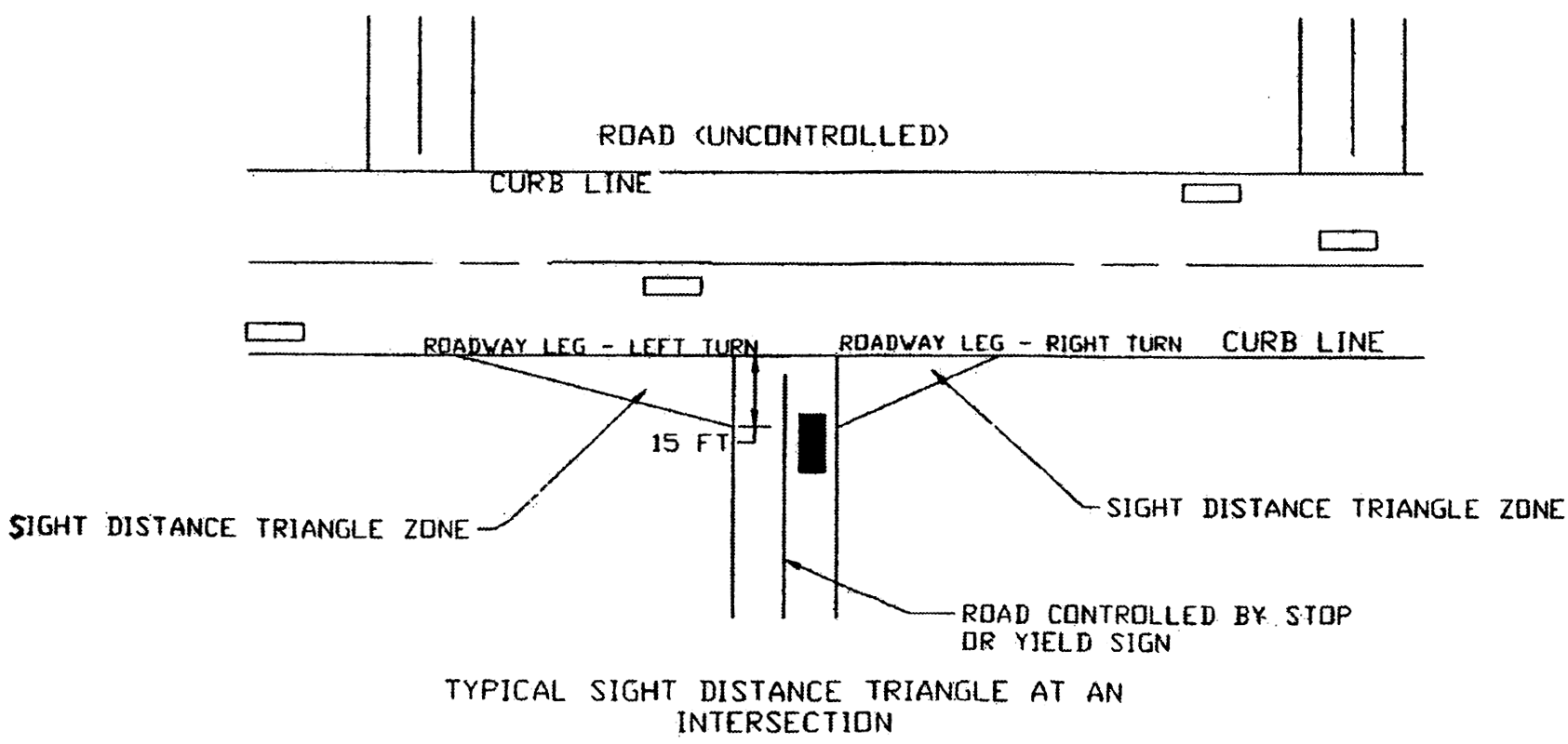
Sight triangle at intersection of public roads. The sight triangle for left and right turns from a controlled (stop or yield sign) road intersecting an uncontrolled road will be defined as a triangular area formed by the intersecting street curbs and a straight line joining said street curb lines at points defined by the roadway leg distances set forth on the diagram below, unless specified otherwise herein. Exhibit "A" illustrates the sight triangle at the intersection of a controlled and uncontrolled roadway and 15 feet along controlled road curb line.
Roadway Leg Distances
Exceptions
Roadway Leg Distance (ft) at
Exhibit "A"
(c)
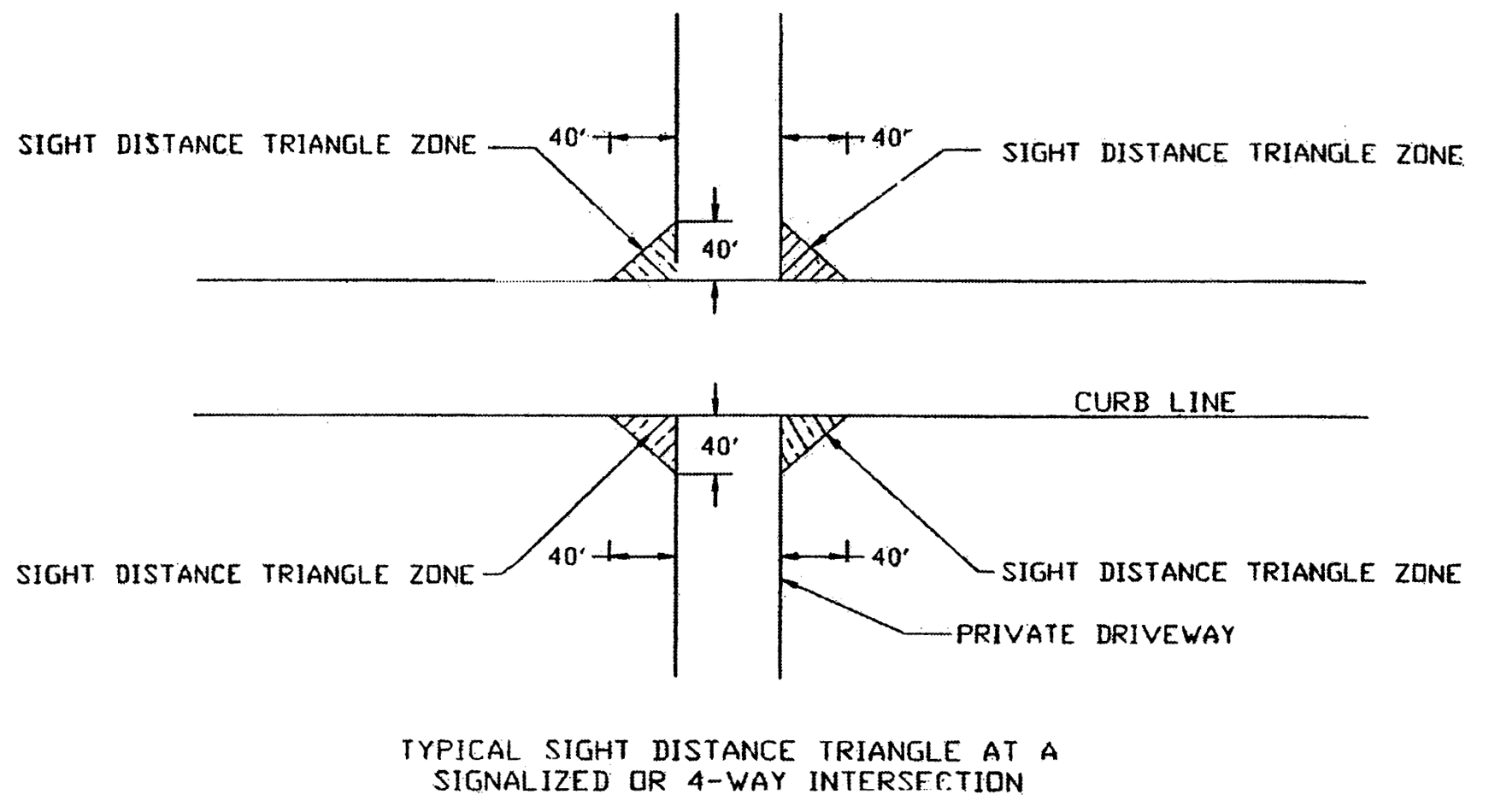
Sight triangle at controlled intersections. Those intersections controlled by a four-way stop or signal are subject to a 40-foot sight triangle formed by the intersecting street/pavement lines and a straight line joining said street and pavement lines at points which are 40 feet from the point of intersection, measured along said street/pavement lines. The diagram set forth in Exhibit "B" illustrates sight triangle at the intersection of two controlled roadways.
Exhibit "B"
(3)
Curb cuts. No structure, except single-family residential structures and critical facilities including, but not limited to, Police, Fire, and Public Works facilities, shall be constructed, built, moved, reconstructed, occupied, or used on any parcel of land unless access from the parcel to public roadways complies with the following standards:
Definitions:
Frontage - The distance between property lines as in Illustration 1.
Number of curb cuts
1.
Driveway entrance(s) to all building sites shall be limited to a maximum of two curb cuts per street frontage and shall be located in such a way as to maximize safety, and efficient traffic circulation, and minimize the impact on the surrounding area as determined by the city engineer or his designee.
2.
The permissible number of driveways is governed by the road frontage of abutting private property. Frontages of 150 feet or greater are limited to:
a.
Two two-directional driveways with a minimum 20 feet and a maximum of 30-foot wide throat; or
b.
Four one-directional driveways with a minimum of 12 feet or maximum of 14 feet wide throat; or
c.
Combination of driveways in which two one-directional = one two-directional.
Frontages of less than 150 feet are limited to:
a.
One two-directional driveway with a minimum of 20 feet and maximum of 30-foot wide throat; or
b.
Two one-directional driveways with a minimum of 12 feet and a maximum of 14 feet wide throat.
Adjacent uses may share a common driveway provided that appropriate access easements are granted between or among the property owners.
NOTE:
1.
All measurements between two curb cuts shall be done inner edge to inner edge as seen in Illustration 2.
2.
Curb cut widths are measured outer edge to outer edge as seen in Illustration 3.
Safety Zone
Between any two driveways, there shall be a safety zone of a minimum of 50 feet along the curb line measured from inner edge to inner edge (see Illustration 2).
Corner Lot
A development on a corner lot will be allowed two points of access. However, no more than one access shall be onto each street. No curb cut shall be located nearer than 150 feet to the projection of any intersecting street right-of-way line. If 150 feet is not available, then the curb cut shall be placed at the furthest practical point from the intersection. If a development fronts three or more streets, only two curb cuts will be allowed for the development as defined above.
Radius of curb cut
All driveways governed by this section, unless otherwise specified, shall have a radius of no less than ten feet and no greater than 30 feet. For any access where multi-unit vehicles, or single unit vehicles exceeding 30 feet in length, are intended to use the access on a daily basis, the radii of the access should be determined using the minimum turning path for the larger vehicle.
Angle of intersection with roadway
The angle formed by the intersection of the centerline of a two-way roadway and the centerline of a driveway shall not be less than 60 degrees, except that an access driveway for frontage abutting a one-way roadway may have an angle of not less than 45 degrees.
Conform to state regulations
Notwithstanding any other part of this Ordinance, all sites fronting a street or highway that is controlled by the Louisiana Department of Transportation and Development shall adhere to regulations for curb cut, and driveway connection permits as administered by the Louisiana Department of Transportation and Development.
Alternative Designs
Where natural features or spacing of existing driveways and roadways cause the foregoing access requirements to be physically infeasible, alternate designs may be approved through the various processes.
Schools. Schools may have one additional access provided the additional access drive is limited to school bus use only.
Existing Nonconforming Curbs. If an establishment does not currently meet the curb cut standard, the city may elect to reconstruct the curb to bring hazardous access points into compliance. Otherwise, that driveway will be classified as a nonconforming use.
(4)
Calculation of permitted density. In calculating the amount of development permitted on a lot of land, density or intensity shall be based on the gross area of any lot, excluding installed on-site improvements, such as roads, provided, however, that the gross area of any lot of land shall be utilized for the calculation of permitted density or intensity in the event that on-site improvements have not been installed at time the application for development approval is filed.
(5)
Corner lots. The front yard of a corner lot may be designated by the landowner in his application for development approval. In making such designation, consideration shall be given to the predominant front yards in the immediate vicinity. The minimum required yard on any other side of a corner lot which adjoins a public street shall be ½ of the minimum front yard required for the use proposed to be located on the lot by the particular provisions of Article V, Part 3, applicable to such use.
(6)
Required front yard for developed areas. Notwithstanding any other provision in this Ordinance regarding required front yard setbacks, if 40 per cent or more of the block face is improved with buildings or structures with less than required setback front yard for the applicable district, the required front yard setback shall be the average setbacks of the front yards along the block face (See figure 4).
(7)
Minimum building setback. Notwithstanding any other provision of this Ordinance, no building or portion thereof shall hereafter be constructed, moved, reconstructed, or enlarged within a distance of ten feet from edge of the street or roadway surface of any public street or highway.
(8)
Activities limited to authorized structures. Except as otherwise permitted for an approved temporary use, no equipment or device which is designed for use primarily as a conveyance or for the transportation of persons or moveable property, shall be placed on any parcel of land for the purpose of providing shelter or enclosure for the storage or sale of goods, the conduct of services, the housing of persons, or any other activity normally conducted within a building or structure. Temporary uses shall comply with Section 24-5-206.
(9)
Setbacks—General. Driveways, parking surfaces, paved areas, and similar improvements shall not be closer than one foot to any property line unless a curb not less than three inches in height is provided which will prohibit water overflow onto the adjacent property. Joint use between adjacent parking areas or similar uses is allowed provided the joint or common area at the adjacent property lines does not exceed 40 feet in width.
(10)
Notwithstanding any other provisions of this Ordinance, it shall be a mandatory requirement that for all developments which front any street corridor designated as an arterial or collector corridor, or along any federal or state designated route, there shall be an additional five-foot setback from the existing right-of-way line. This includes parking lots, parking areas, buildings, and any other permanently installed improvements. An additional ten feet will be required for facilities that include retail fuel sales.
(11)—(13)
Reserved.
(14)
Façade building materials.
(a)
Except as provided herein, the façade of the principal building in a Business or Mixed Use District shall not be constructed with any metal materials; however, architectural metal cladding or architectural metal cladding features integrated into the façade design may be permitted subject to the procedures for issuance of a minor conditional use permit as outlined in Section 24-4-203. Further, metal materials may be used for any façade which does not face a public street and does not allow for public ingress and egress.
(b)
Any façade(s) of a principal building in a Residential and/or a Neighborhood District may be constructed with metal building materials if all of the following conditions are met: (i) there is at least a 12-inch eave on all sides; (ii) there is the presence of elements that contribute to the residential or neighborhood character of the District; and (iii) the metal is similar in character to traditional residential horizontal lap style siding and/or horizontal simulated wood lap style siding.
(c)
Notwithstanding any of the aforementioned provisions, the street facing façade(s) of any newly built principal building situated in any of the following locations shall be constructed with traditional building materials which is described in subsection (14)(b)(1) as brick, wood, or concreted/cement board: (1) structures located in the Nellie Lutcher Cultural District facing Enterprise Boulevard from South Railroad Avenue to Broad Street; and (2) structures located in the Nellie Lutcher Cultural District facing South Railroad Avenue from Ryan Street to South Franklin Street.
(15)
Construction or installation of retaining wall(s) in excess of four feet shall be prohibited in any Zoning District.
(16)
Crematory. All crematory units or operations are considered a service use. It shall be prohibited to locate/establish a crematory within a distance of 750 feet of a Residential or Neighborhood Zoning District, such distance to be measured from the nearest point of the building used for cremation to the nearest property line of any land located in a Residential or Neighborhood Zoning District.
(17)
Motor vehicle repair or service in single-family or multifamily residential developments. The following restrictions to repair, servicing, or maintenance of motor vehicles shall apply:
(a)
The motor vehicle repaired, serviced or maintained must be owned by a person who resides on the parcel or in the development. Commercial repair of motor vehicles is prohibited.
(b)
Not more than one motor vehicle shall be repaired, serviced, or maintained at any time.
(c)
All vehicle parts, components, and repair tools shall be stored within an enclosed garage or accessory structure or shall be kept out of view of the general public.
(d)
Repairs, servicing, or maintenance shall not be performed in a public right-of-way or street.
(18)
Building setback distances shall, in no case, allow construction of a building on a dedicated city easement/servitude. Where the building setbacks specified in Part 3 District Regulations are inadequate to prevent this restriction, the distance shall be increased. A building, in this case, shall include swimming pools and other such structures that are not easily removed for maintenance activities within the city easement/servitude.
(19)
Portable buildings prohibited. Notwithstanding the provisions of Section 24-5-206 (Temporary Uses), prefabricated buildings, portable buildings, and any other building/structure to be used as an office, food and beverage establishment, storage, or similar type use, and not constructed on site on a permanent foundation, shall be prohibited along all interstate, Arterial, and Collector roadway corridors as identified in Appendix B (Corridor Classifications).
(Ord. No. 12726, § 1, 4-2-03; Ord. No. 12872, § 1, 10-1-03; Ord. No. 13891, § 1, 9-6-06; Ord. No. 14118, § 1, 3-21-07; Ord. No. 14452, § 2, 2-20-08; Ord. No. 14951, § 1, 3-18-09; Ord. No. 15507, § 1, 7-21-10; Ord. No. 16051, § 1, 10-5-11; Ord. No. 16520, § 1, 2-20-13; Ord. No. 16694, § 1, 7-17-13; Ord. No. 17316, § 1, 7-15-15; Ord. No. 17853, § 1, 4-19-17; Ord. No. 18632, § 1, 2-5-20; Ord. No. 18697, § 2, 5-20-20; Ord. No. 18783, § 5, 10-21-20; Ord. No. 18826, § 1, 2-3-21; Ord. No. 18906, § 1, 6-16-21; Ord. No. 18948, § 1, 9-1-21; Ord. No. 19315, § 1, 7-20-22; Ord. No. 19450, § 1, 12-21-22; Ord. No. 20032, § 1, 8-21-24; Ord. No. 20165, § 2, 12-4-24; Ord. No. 20392, § 1, 9-17-25)
Sec. 24-5-204. - Accessory uses.
(1)
Authorization. Accessory uses and structures are permitted in any zoning district in connection with any principal use or structure lawfully existing within such district provided that all development standards and regulations are complied with.
(a)
No accessory structure or use shall exceed the height of the principal structure to which it is accessory.
(2)
Development standards.
(a)
All detached accessory structures and uses in any residential or neighborhood district, other than fences, garages and carports used in conjunction with the main structure shall be located in the rear or side yard of the residential unit;
(b)
Except as provided in Section 24-5-203(2), fences may be located at any point on the lot provided it does not create a traffic hazard or any similar type problem to the surrounding area. No fence shall exceed ten feet in height or extend beyond the front setback line of the building along any arterial or collector roadway corridor. All fences shall be constructed with a recognized fencing material of wood, chainlink/decorative iron, vinyl fencing, or masonry and maintained in good condition so as not to create an eyesore, nuisance, or hazard to the surrounding area.
(c)
No detached accessory structure or use within a residential or neighborhood district shall occupy more than 40 per cent of the total floor area of the principal structure on the lot.
(d)
No accessory structure or use shall exceed the height of the principal structure to which it is accessory.
(e)
An accessory use connected to the principal structure by an open unenclosed breezeway must be architecturally compatible and constructed in character to the main structure to be considered an accessory use as part of the principal structure.
(f)
Commercial trash receptacles shall be considered as accessory structure. Large trash receptacles, dumpsters, and other containers for receiving residential or commercial waste shall be placed at least 15 feet from an adjoining property line, notwithstanding any other provision of this Ordinance. Any dumpster or other trash receptacle located closer than 15 feet to any property line or that is visible from any public street, shall be screened with a permanently installed buffer fence made of wood, chain-linked with slats or masonry.
(Ord. No. 15068, § 1, 6-17-09; Ord. No. 15408, § 1, 5-5-10)
Sec. 24-5-204.1. - Cargo containers and portable storage containers.
(1)
Definitions.
(a)
Cargo Container: Any metal or primarily metal container designed or constructed to ship, store, or handle bulk goods or items, or which appears substantially similar to such containers in appearance. Such containers include reusable steel boxes, freight containers, and bulk shipping containers; originally, a standardized reusable vessel that was designed and used for shipping, movement, transportation or storage of freight, articles of good or commodities; generally capable of being mounted or moved on a rail car, or loaded on a ship.
(b)
Portable Storage Container: A portable or moveable, weather resistant receptacle designed and used for the storage or shipment of household goods, wares, valuables or merchandise (i.e., PODS or MODS), and which is typically leased on a short-term basis for temporary storage purposes.
(2)
Permitted Use of Cargo Containers.
(a)
Cargo Containers. Cargo containers are permitted as an accessory use in all zoning districts subject to the requirements of this Section. The following regulations apply to all cargo container use:
(i)
Cargo containers shall not be stacked above the height of a single container device.
(ii)
Cargo containers shall meet all required setbacks.
(iii)
Cargo containers shall be located in the rear or side yard not to extend beyond front setback of the principal structure.
(iv)
Cargo containers shall be installed on a permanent foundation in compliance with the International Residential or International Building Codes as amended by the Louisiana State Uniform Construction Code Council.
(v)
Cargo containers must be screened with a permanently installed buffer fence made of wood, chain-linked with slats, or masonry, so as to not be visible from the street or abutting property, drives, and roads.
(vi)
No plumbing, electrical, or mechanical equipment may be installed in, on, or connected to a cargo container.
(vii)
Cargo containers shall not be used to store hazardous materials, as defined by the Louisiana State Fire Marshall.
(viii)
Cargo containers shall not occupy required off-street parking, fire lanes, loading or landscaping areas.
(ix)
No cargo container shall be placed in a location which may cause hazardous conditions or constitute a threat to public safety.
(x)
No cargo container may be used as living quarters.
(xi)
No structural modifications may be made to cargo containers.
(xii)
No livestock or pets may be housed in cargo containers.
(b)
Cargo Containers for Permanent Storage. Cargo containers may be permanently placed on the property for storage purposes upon issuance of a land use and set-down permits from the Director of Planning or designee. The following regulations shall also apply:
(i)
Applicant shall demonstrate compliance with all relevant building codes as amended by the Louisiana State Uniform Construction Code Council.
(ii)
A permanent foundation compliant with the International Residential or International Building Codes as amended by the Louisiana State Uniform Construction Code Council is required. Cargo containers shall be positively anchored to foundation to resist overturning, lateral displacement, or buoyancy forces.
(iii)
Cargo containers shall be painted in solid colors (colors which blend into the surrounding area). Paint shall be maintained to provide protection from the effects of weather.
(iv)
Cargo containers shall not be used for any advertising purpose and shall be kept clean of all alpha-numeric signage and writing.
(v)
Any writing or graffiti that may be placed on the container is the responsibility of the property owner and shall be promptly removed.
(c)
Cargo Containers for Temporary Use. Property owners will be required to obtain temporary land use and set-down permits from the Director of Planning for the temporary use of cargo containers. The following regulations shall also apply:
(i)
Cargo containers shall be removed from the property within 180 calendar days from the date of the permit issuance. Director of Planning or designee shall have the authority to provide an extension of the original temporary use approval for a period not to exceed 180 days. Request for extension shall be in writing by the original applicant.
(ii)
Cargo containers associated with an approved building construction project shall be permitted to remain on-site until the earlier occurrence of approval of the project's final building inspection or the expiration of the building permit.
(3)
Portable Storage Containers.
(a)
Portable storage containers are permitted as an accessory use in all zoning districts upon issuance of temporary land use and set-down permits from the Director of Planning and shall adhere to the following restrictions:
(i)
No portable storage container may be stacked or elevated more than 12 inches above grade.
(ii)
Portable storage containers shall not be used to store hazardous materials, as defined by the Louisiana State Fire Marshall.
(iii)
No plumbing, electrical, or mechanical equipment may be installed in, on, or connected to a cargo container.
(iv)
Portable storage containers associated with a residential use must be placed on a driveway or paved area. Containers shall not be closer than ten feet from the front property line.
(v)
Portable storage containers associated with a non-residential use shall not occupy required off-street parking, loading or landscaping areas. Containers shall not be closer than ten feet from the front property line.
(vi)
No portable storage container shall be placed in a location which may cause hazardous conditions or constitute a threat to public safety. Containers shall not be placed within public right-of-way.
(vii)
No portable storage container may be used for living quarters.
(viii)
No livestock or pets may be housed or kept in a portable storage containers.
(ix)
Portable storage containers may not be placed on a vacant lot, unless that lot is associated with an approved building construction project.
(b)
Time Limits.
(i)
Portable storage containers shall be removed from the property within 180 calendar days from the date of the permit issuance. The Director of Planning or designee may provide an extension of this approval not to exceed 180 days.
(ii)
Portable storage containers associated with an approved building construction project shall be permitted to remain on-site until the earlier occurrence of approval of the project's final building inspection or the expiration of the building permit.
(Ord. No. 20285, § 1, 4-16-25)
Sec. 24-5-205. - Nonconformities.
(1)
Purpose. The purpose of this section is to regulate the continued existence of uses, lots, and structures lawfully established prior to the effective date of this Ordinance or any amendment thereto which do not conform to the provisions of this Ordinance and which have not obtained special exception status under the provisions of Section 24-4-206. Nonconforming uses, structures and lots of record may continue in accordance with the provisions of this section.
(2)
Nonconforming uses.
(a)
Ordinary repair and maintenance. Normal maintenance and repair of nonconforming uses may be performed.
(b)
Extensions and additions. Unless a special exception is granted under the provisions of Section 24-4-206, nonconforming uses shall not be extended or enlarged. This prohibition is to prevent the enlargement of nonconforming uses by external additions to the structure in which nonconforming uses are located.
(c)
Relocation. A structure housing a nonconforming use may not be moved unless the use shall thereafter conform to the limitations of the district into which it is moved.
(d)
Change in use. A nonconforming use shall not be changed to any other use unless such use conforms to the provisions of this Ordinance. However, a nonconforming use may be changed to another nonconforming use provided;
(i)
A special exception is granted under the provisions of Section 24-4-206; or
(ii)
The change of use is 25 per cent less intense in use with 25 per cent less impact on the surrounding area.
(e)
Termination.
(i)
Abandonment or discontinuance.
(aa)
Subject to subsection (bb) below, where a nonconforming use is discontinued or abandoned for six months or more, then such use may not [be] reestablished or resumed and any subsequent use must conform to the provisions of this Ordinance, unless a special exception is granted under the provisions of Section 24-4-206.
(bb)
In construing whether a use has been discontinued or abandoned, the intention of the owner or anyone else to continue a nonconforming use shall not be considered; abandonment of a nonconforming use by a lessee shall not bind the owner provided that the owner obtains legal control of the use within a reasonable time after abandonment by lessee; abandonment due to institution of foreclosure proceedings shall not constitute abandonment under the provisions of this section until the mortgagee or purchaser at foreclosure sale takes possession or gains by a recorded legal transfer.
(ii)
Damage or destruction. If a structure housing a nonconforming use is damaged or destroyed by 50 per cent or more of the fair market value of the structure, then the structure may not be restored unless its use thereafter conforms to the provisions of this Ordinance, unless a special exception is granted under the provisions of Section 24-4-206.
(3)
Nonconforming structures.
(a)
Ordinary repair and maintenance. Normal maintenance and repair of nonconforming structures may be performed.
(b)
Relocation. A nonconforming structure which is moved shall thereafter conform to the regulations of the district in which it is located after such move.
(c)
Termination.
(i)
Abandonment. Where a nonconforming structure is abandoned for one year, then such structure shall be removed or converted to a conforming structure, unless a special exception is granted under the provisions of Section 24-4-206.
(ii)
Damage or destruction. A nonconforming structure which is damaged or destroyed to the to the extent of 50 per cent or more of the fair market value of said structure shall not be restored unless it conforms to the provisions of this Ordinance.
(4)
Nonconforming lots of record. Notwithstanding any other provision of this Ordinance, a nonconforming lot of record may be developed with a single-family dwelling, provided that such a lot was not in common ownership with an adjoining lot of record at the time the nonconformity was created.
(5)
Nonconforming accessory uses and structures. No nonconforming accessory use or structure shall continue after the principal structure or use shall have ceased or terminated unless such structure or use shall thereafter conform to the provisions of the district in which it is located, unless a special exception is granted under the provisions of Section 24-4-206.
(6)
Termination by amortization. Any nonconforming use or structure may be terminated by the city council in accordance with the following procedures::
(a)
The planning commission, upon recommendation of the director of planning, may designate an area within the city which merits special attention in regard to nonconforming uses, signs or structures.
(b)
The planning department shall conduct an inventory of uses and/or structures within the area so designated in order to identify those uses and/or structures which do not conform to the provisions of this Ordinance.
(c)
Upon completion of the inventory, the director of planning shall notify the owners of said uses and/or structures that they are nonconforming [and] that there are two alternatives available:
(i)
The owner may register his use and/or structure with the director of planning and request special exceptions status under the provisions of Section 24-4-206; or
(ii)
If the owner fails to register and obtain special exception status, the director of planning may recommend termination of the use or structure in accordance with an amortization schedule.
(d)
If the director of planning has recommended termination, the commission shall conduct a public hearing in accordance with the provisions of Section 24-4-201(4) and if it concurs, submit its recommendation to the city council.
(e)
The city council shall review the recommendations of the director of planning, the commission, and the testimony at the public hearing and adopt an ordinance terminating the use or structure within a specified period or deny the recommendations of the director of planning and the commission.
Sec. 24-5-206. - Temporary uses.
(1)
Authority. Temporary uses are permitted in any zoning district, subject to the standards hereinafter established, provided that all temporary uses shall meet the bulk regulations and parking requirements for the zoning district in which the use is located and provided that no temporary use shall be permitted to continue for such a length of time that it constitutes in effect a permanent use.
(2)
Particular temporary uses permitted. Notwithstanding any of the provisions of [Section] 24-5-206(1) above the following temporary uses are permitted:
(a)
Garage sales.
(b)
Indoor and outdoor art and craft shows, exhibits and sales.
(c)
Contractor's offices and equipment sheds, provided that such uses shall be limited to the period of actual construction and shall be terminated within 120 days of the completion of construction.
(d)
Sales of Christmas trees or other seasonal goods, provided that such sales are located on property with direct access to collector or arterial.
(e)
Religious revival tents.
(f)
A manufactured home, not otherwise permitted in the zoning district, for temporary, emergency housing in medical hardship cases, for a nonrenewable period of up to six months provided the following conditions are met: (1) Written certification of medical hardship is presented to the director of planning stating the nature and extent of the medical condition; (2) the manufactured home is adjacent to the lawfully permitted housing of one related by body or marriage; (3) a building permit for construction, repair or addition to the lawfully permitted housing has been issued; and (4) it is shown that there is no economically feasible alternative.
(g)
Other temporary uses which are, in the opinion of the director of planning, consistent with the provisions of this section.
(h)
Truck trailers used for the temporary storage of goods or equipment in connection with general retail sales and service establishments or industrial uses, provided that such use shall be limited to a nonrenewable period of 60 days.
(i)
Portable signs in addition to signage permitted as of right, provided that such use shall not exceed 45 days in duration and shall be nonrenewable within six months after issuance.
Sec. 24-5-207. - Home occupations.
(1)
Authority. Home occupations shall be permitted in any residential dwelling unit provided that the home occupation complies with the lot size, bulk regulations and parking requirements of the zoning district in which the home occupation is located.
(2)
Purpose. The regulations of this section are designed to protect and maintain the residential character of established neighborhoods while recognizing that particular professional and limited business activities are traditionally carried on in the home and are compatible with the long-term integrity of a residential neighborhood.
(3)
Particular home occupations permitted. Permitted home occupations are:
(a)
Homebound employment of a physically, mentally, or emotionally handicapped person who is unable to work away from home by reason of his disability;
(b)
Office facilities for salesmen, sales representatives, and manufacturer's representatives when no retail or wholesale sales are made or transacted on the premises;
(c)
Studio or laboratory of an artist, musician, photographer, craftsman, writer, tailor, seamstress, or similar person provided that the existence of the home occupation will not increase the number of average daily automobile trips generated by the residence in which the home occupation is located;
(d)
Office facilities for accountants, architects, beauticians, brokers, doctors, engineers, lawyers, insurance agents, realtors and members of similar professions, provided that the existence of the home occupation will not increase the number of average daily automobile trips generated by the residence in which the home occupation is located;
(e)
Day care facilities provided that no more than nine children are on the premises at any time.
(4)
Use limitations. In addition to the requirements of the zoning district in which it is located, all home occupations shall comply with the following restrictions:
(a)
No stock in trade shall be displayed or sold on the premises;
(b)
The home occupation shall be conducted entirely within the enclosed principal structure, and shall not be visible from any residential structure or a public way;
(c)
The home occupation shall not occupy more than ten per cent of the floor area of the dwelling unit;
(d)
There shall be no outdoor storage of equipment or materials used in the home occupation;
(e)
No more than one vehicle shall be used in the conduct of the home occupation and any such vehicle, which is of a commercial type with advertising or other such characteristics which distinguish it from a private automobile, shall be stored in an enclosed garage when not in use;
(f)
No mechanical, electrical, or other equipment which produces noise, electrical or magnetic interference, vibration, heat, glare or other nuisance outside the residential or accessory structure shall be used;
(g)
No home occupation shall be permitted which is noxious, offensive or hazardous by reason of vehicular traffic, generation or emission of noise, vibration, smoke, dust or other particulate matter, odorous matter, heat, humidity, glare, refuse, radiation or other objectionable emissions;
(h)
No employee shall be permitted other than a resident of the dwelling;
(i)
No sign shall advertise the presence or conduct of the home occupation, other than a nonilluminated name plate, which:
(i)
Does not exceed one square foot; or
(ii)
Does not exceed two square feet if attached and mounted on the principal structure.
(j)
Automotive repair shall not qualify as a home occupation. Non-routine automobile repairs for persons residing in the home are allowed per Section 24-5-203(17) of the zoning ordinance, but city officials may conduct inspections to ensure that no business activity is occurring.
(Ord. No. 17853, § 2, 4-19-17)
Sec. 24-5-208. - Off-street parking requirements.
(1)
Purpose. This section is intended to establish standards for the provision of off-street parking in order to reduce congestion in the public streets and promote the public's safety and welfare by ensuring the availability of adequate off-street parking facilities in the city.
(a)
All parking and driving surfaces abutting and/or directly accessible from the public roadway in business and mixed use districts shall be concrete and/or asphalt.
(2)
Number of required spaces.
(a)
Off-street parking spaces shall be provided for each use in accordance with the following requirements:
(b)
When calculating the number of required off-street parking spaces, fractions of less than ½ shall be disregarded, and fractions of ½ or more shall be counted as one space.
(c)
Two or more uses can satisfy the number of required parking spaces by providing the spaces in the same structure or lot. Except as provided in subsection [(3), paragraphs (a) and (b)] the number of spaces in the jointly used structure shall be equal to the sum of the requirements for each use set forth in subsection (a).
(3)
Reduction of required spaces.
(a)
Joint use up to 50 per cent of required parking spaces may be permitted for two or more uses provided that:
(i)
The applicant for development approval can demonstrate that the uses will not substantially overlap in hours of operation; or
(ii)
The proposed development is a bank, office, retail sales establishment, or manufacturing company and the applicant intends to share parking facilities with a church, theater or restaurant.
(b)
Joint use of up to 100 per cent of the required parking spaces may be permitted for churches or schools if the parking will be provided off-site, the total amount of required parking, provided in conjunction with a bank, office, retail sales establishment or manufacturing company.
(c)
A reduction in parking requirements for any proposed use permitted as of right in the Downtown and Lakefront District may be permitted if an applicant for development approval can demonstrate that adequate parking facilities will be provided off-site within 1,000 feet of the development site, or a special exception is granted under the provisions of Section 24-4-206, provided that:
(i)
There is adequate parking available within a reasonable distance from the site;
(ii)
Achievement of an overriding public policy requires the reduction of required parking.
(d)
If an applicant for development approval can demonstrate that employee parking facilities will be provided off-site, the total amount of required parking, provided on-site or within 500 feet of the site, may be reduced up to 15 per cent.
(4)
Location of required parking spaces. Required parking spaces shall be located as follows:
(a)
Single-family detached and up to 20 single-family attached dwelling units: On the same lot.
(b)
All other uses: On the same lot or, subject to subsection (c), on a lot up to 500 feet from the principal building or use unless a special exception is granted under the provisions of Section 24-4-206.
(c)
If the parking spaces are to be located on a lot other than the same lot of the principal building or use, a legal instrument assuring the continued availability of those required parking spaces shall be approved by the city attorney and recorded prior to issuance of development approval.
(5)
Design of required parking spaces.
(a)
Except as provided in subsection (b), each required parking space shall have minimum dimensions of nine feet by 18 feet;
(b)
Up to 30 per cent of required parking spaces may be designated for use by subcompact automobiles, provided that each space is clearly marked for such use and no space so designated is less than eight feet by 16 feet;
(c)
Parking structures shall be set back from the property line the same distance as required for the principal structure in the district in which it is located. This does not apply to driveway, parking lots or similar type surface improvements.
(d)
A bumper rail or wheel barrier shall be installed so that no part of parked automobiles can extend into the public right-of-way or into the landscaped area required in Section 24-5-209 hereof or under an approved conditional use. A minimum of three feet shall be provided from the property line to the wheelguard;
(e)
Sufficient maneuver and access aisle shall be provided to permit vehicles to enter and leave in a forward motion in accordance with detailed design standards on file with the department of planning; and
(f)
If lighting is provided, it shall be installed so that it does not reflect on adjacent properties or interfere with traffic.
(6)
Limitations on use of parking lots and structures. No parking lot or structure may be used for the servicing, repair or washing of motor vehicles.
(Ord. No. 12789, § 1, 7-2-03; Ord. No. 13528, § 1, 11-16-05; Ord. No. 14473, § 1, 3-5-08; Ord. No. 19979, § 1, 7-3-24)
Sec. 24-5-209. - Bufferyards.
(1)
Purpose. The purpose of this section is to promote the harmonious use of land through effective site planning and the use of landscaped, constructed or natural bufferyards between uses that are different in character and/or magnitude.
(2)
Bufferyards required.
(a)
Bufferyards shall be required for a proposed use when:
(i)
A proposed use is greater in character or magnitude than an existing use located on an abutting parcel aft as established in subsection (3) of this section; or
(ii)
A proposed use in an industrial district abuts any other district; or
(iii)
A proposed use in a Business or Downtown/Lakefront District abuts a Residential, Neighborhood, or Mixed Use District; or
(iv)
A proposed use in a Mixed Use District abuts a Residential or Neighborhood District; or
(v)
A proposed use in a Neighborhood District abuts a Residential District; or
(vi)
A proposed use which is permitted as a conditional use by the provisions of Article V Part (3) — (District Regulation) — Authorizing such use with buffer requirements.
(vii)
A proposed use in which bufferyards are specifically required as a condition attached to the issuance of a Conditional Use Permit—Section 24-4-203, Variances—Section 24-4-205, or Special Exception—Section 24-4-206.
(b)
Bufferyards shall be provided along the abutting property line from the point of the required front yard to the point of the required rear yard of the parcel proposed for development.
(c)
Except for permitted fencing, no principal structure, accessory structure, parking area or similar use shall be allowed in a required bufferyard.
(d)
For the purpose of this section, the term "existing use" shall include any vacant or undeveloped parcel of land abutting a parcel proposed for development, and the degree of difference in land use between such a parcel and a proposed development shall be that which would exist if the vacant or undeveloped parcel were used or developed to the greatest magnitude or intensity which is permitted as a matter of right by the particular provisions of this Ordinance which are applicable to that parcel.
(e)
For the purpose of this section, the degree of difference in land use between a proposed development abutting a vacant or undeveloped parcel of land shall be considered that use which could exist as of right should the vacant or undeveloped parcel be used or developed.
(f)
For the purpose of this section, Bufferyard Screening shall require that wooden fence planks be no wider than ¼ inch apart.
(3)
Degree of difference of abutting land uses.
(a)
Major. The following shall be considered to be major differences in the character or magnitude of land use:
(i)
Any residential use and a commercial use, or collection of uses, occupying more than 2,500 square feet of floor area;
(ii)
Any residential use and an industrial use;
(iii)
Residential uses that differ in density by a factor greater than three;
(iv)
A structure that differs in height by more than 20 feet;
(v)
Any uses that differ in traffic generation, as calculated on an average daily basis, by more than a factor of four; and
(vi)
Any uses that differ in floor area ratio by a factor or more than two.
(b)
Intermediate. The following shall be considered to be intermediate differences in the character or magnitude of land use:
(i)
Any residential use and a commercial use or collection of uses occupying less than 2,501 square feet of floor area;
(ii)
Any commercial use and any industrial use;
(iii)
Residential uses that differ in density by a factor of two but less than three;
(iv)
Structures that differ in height by 15 or more, but less than 20 feet;
(v)
Any uses that differ in traffic generation, as calculated on an average daily basis, by more than a factor of two but less than four; and
(vi)
Any uses that differ in floor area ratio by a factor of 1.5 but less than two.
(c)
Minor. The following shall be considered to be minor differences in the character and magnitude of land use:
(i)
Attached and detached residential uses;
(ii)
Residential uses that differ in density by a factor of more than one but less than two;
(iii)
Structures that differ in height more than ten feet and less than 15 feet;
(iv)
Any uses that differ in traffic generation, as calculated on an average daily basis, by more than a factor of 1.25 but less than two; and
(v)
Any uses that differ in floor area ratio by a factor of more than one but less than 1.5.
(4)
Types of bufferyards.
(a)
Major. A bufferyard between major differences in land use shall have the following characteristics:
(i)
A bufferyard of at least 15 feet in width;
(ii)
A six-foot wooden fence at the property lines to obscure view of the proposed development.
(b)
Intermediate. A bufferyard between intermediate differences in land use shall have the following characteristics:
(i)
A bufferyard of at least eight feet in width;
(ii)
A six-foot wooden fence at the property lines to obscure view of the proposed development.
OR
Plant shrubs, berms or similar foliage sufficient in size to obscure on a year-round basis at least 75 per cent of the view of the proposed development from the abutting parcel, as defined in paragraph (d) of this subsection. The shrubs, when planted, shall not be less than three feet in height, spaced no further than three feet on center and be capable of growing to five feet in height within one year of planting.
(c)
Minor. A bufferyard between minor differences in land use shall have the following characteristics:
(i)
A width of at least five feet, with additional building setback as required by subsection (6) of this section; and
(ii)
A six-foot wooden fence at the property lines to obscure view of the proposed development.
OR
Plant shrubs, berms or similar foliage sufficient in size to obscure on a year-round basis at least 50 per cent of the view of the proposed development from the abutting parcel as defined in paragraph (d) of this subsection. The shrubs when planted shall not be less than two feet in height, spaced no further than 42 inches on center and capable of growing to a four-foot in height within one year of planting.
(d)
For the purposes of this subsection, the view of a proposed development from an abutting parcel shall be the area of a plane drawn between the grade along the common property line and a line parallel to grade and eight feet above grade, running the entire length of the common property line.
(5)
General requirements of plant material. Plant material used to comply with the provisions of this section shall conform to the rules and regulations for nursery plants promulgated by the Louisiana Department of Agriculture on file with the director of planning and shall be in accordance with the landscaping standards on file with the director of planning.
(6)
Minimum building setbacks in addition to required bufferyards. Where a bufferyard is required by this section for any proposed development of a building which exceeds 35 feet in height, such building shall be set back from the interior line of the required bufferyard a distance of at least one foot for each two feet of a building height in excess of 35 feet.
(Ord. No. 12231, § 1, 8-16-01; Ord. No. 20179, § 1, 12-18-24)
Sec. 24-5-210. - Landscape requirements.
(1)
Purpose. Landscaping is accepted as adding value to property and is in the interest of the general welfare of the city. Therefore, landscaping is hereafter required of new development.
(2)
Scope and enforcement.
(a)
The provisions of this section shall be administered by the director of planning or designee. The standards and criteria contained within this section are deemed to be minimum standards and shall apply to all new construction or any existing development which is altered by increasing the floor area by 30 per cent or more of the originally approved floor area, either by a single expansion or by the cumulative effect of a series of expansions, or a structure with substantial damage or substantial improvement.
(b)
All existing structures which are a conversion or change in use requiring the expansion of or substantial improvements to meet parking standards shall upgrade landscaping on the site and meet these requirements to the extent practical. The director of planning or his designee shall have the ability to waive landscape requirements on a case-by-case basis if unique circumstances exist on the property that make application of these regulations unduly burdensome on the applicant. These regulations may be waived only if there will be no adverse impact on current or future development and will have no adverse impact on the public health, safety, and general welfare.
(c)
If at any time after the issuance of a certificate of occupancy, the approved landscaping is found to be in nonconformance to the standards and criteria as approved on the landscape plan, the director of planning or designee shall issue notice to the owner, citing the violation and describing what action is required to comply with this section. The owner(s), tenant(s), and/or agent(s) shall make reasonable progress within 30 days from date of said notice and shall have 90 days to completely restore the landscaping as required. A 30-day extension may be granted by the director of planning or designee if a hardship due to extreme seasonal conditions can be demonstrated by the owner(s), tenant(s), and/or agent(s). If the landscaping is not restored within the allotted time, such person shall be held in violation of this Ordinance.
(3)
Permits.
(a)
No permits shall be issued for building, paving, grading, or construction until a detailed landscape plan is submitted and approved by the director of planning or designee. Prior to the issuance of a certificate of occupancy for any building or structure, all screening and landscaping shall be in place in accordance with the landscape plan.
(b)
In any case in which a certificate of occupancy is sought at a season of the year in which the director of planning determines that it would be impractical to plant trees, shrubs or grass, or to lay turf, a temporary certificate of occupancy may be issued, if a letter of agreement from the property owner is provided stating when the installation shall occur. All landscaping required by the landscape plan shall be installed within six months of the date of issuance of the temporary certificate of occupancy or the site shall be deemed to be in violation of this Ordinance and the temporary certificate of occupancy shall be revoked.
(4)
Landscape plan.
(a)
A landscape plan shall be shown as part of the site plan development review. Prior to the issuance of a building permit, paving, grading, or construction permit for any new use, a final landscape plan shall be submitted to the planning department. The director of planning or designee shall review such plans and shall approve same if the plans are in accordance with the criteria of these regulations and the approved site plan. If the plans are not in accord, they shall be disapproved and shall be accompanied by a written statement setting forth the changes necessary for compliance.
(b)
Landscape plans shall be prepared by a person knowledgeable in plant material usage and landscape design (e.g. landscape architect, landscape contractor, landscape designer, etc.). Conceptual and final landscape plans shall contain the minimum following information:
1.
Minimum scale of one inch equals 40 feet, or the same scale as the associated site plan;
2.
Location, size, and species of all trees to be preserved (do not use "tree stamps" unless they indicate true size and location of trees);
3.
Location of all plant and landscaping material to be used, including plants, paving, benches, screens, fountains, statues, earthen berms, ponds (to include depth of water), topography of site, or other landscape features (except that location of plants and landscaping materials may be generalized on a conceptual landscape plan);
4.
Species, size, spacing, and quantities of all plant material to be used in a tabular form (except that conceptual landscape plans may provide general plant types in-lieu-of species);
5.
Affidavit on the plan stating that irrigation, sprinkler, or water systems, including placement of water sources, shall be provided;
6.
Person(s) responsible for the preparation of the landscape plan, including affidavit of their qualifications to prepare said plan;
7.
Mark indicating North;
8.
Date of the landscape plan, including any revision dates;
9.
Planting details; per centage of total site in permanent landscaping;
10.
Per centage of street yard in permanent landscaping;
11.
Dimensions of all landscape areas;
12.
Number of required trees and number of trees provided.
(5)
General standards.
(a)
The following criteria and standards shall apply to landscape materials and installation. For the purposes of this section, caliper shall be defined as the diameter measurement of a tree trunk.
1.
Required landscaped open areas shall be completely covered with living plant material. Nonliving landscaping materials such as wood chips and gravel may be used only under trees, shrubs, and other plants.
2.
Plant materials shall conform to the standards of the approved plant list for the City of Lake Charles (Exhibit A). Grass seed, sod and other material shall be clean and reasonably free of weeds and noxious pest and insects.
a.
Where specific conditions reduce the likelihood that any of these plant materials will survive, other plants on the list may be substituted.
b.
Other plants not on the list may be substituted at the discretion of the director of planning. The applicant may be required to provide substantiation as to the hardiness, adaptability, and water demands of the plant when used in this area.
c.
Applicants should maintain all required landscape materials in perpetuity.
3.
Class 'A' trees shall be a minimum of three inches in caliper as measured 36 inches above the ground and seven feet in height at time of planting.
4.
Class 'B' trees shall be a minimum of one inch in caliper as measured 36 inches above the ground and five feet in height.
5.
Shrubs or berms not of the dwarf variety shall be a minimum of two feet in height when measured immediately after planting.
6.
Hedges, where installed for buffering purposes required by this section, shall be planted and maintained so as to form a continuous, unbroken, solid visual screen which will be three feet high within two years after time of planting.
7.
Landscaping, except required grass and low ground cover, shall not be located closer than three feet from the edge of any parking space.
8.
Grass areas shall be sodded, plugged, sprigged, hydro-mulched, or seeded, except that solid sod shall be used in swales, or when necessary to prevent erosion. Grass areas shall be established with complete coverage within a six-month period of time from planting, and shall be re-established, if necessary, to ensure grass coverage of all areas.
9.
Ground covers used in-lieu-of grass shall be planted in such a manner as to present a finished appearance and reasonably completed coverage within one year of planting.
(b)
All required landscaped open space shall be provided with an automatic underground irrigation system, except for required landscaping in single-family or two-family development. Said irrigation system shall be designed by a qualified professional and installed by a licensed irrigator after receiving a permit, as may be required under the construction code.
(c)
No tree shall be planted closer than four feet to a right-of-way line nor closer than eight feet to a public utility line (water or sewer), unless no other alternative is available. Further, a landscaping area in which trees are to be provided shall not conflict with a utility easement, unless no alternative is available.
(d)
No tree which has a mature height of 25 feet or greater shall be planted beneath an existing or proposed overhead utility line.
(6)
Minimum landscaping requirements.
(a)
For all non-residential and multiple-family at least 15 per cent of the street yard shall be permanent landscape area. The street yard shall be defined as the area between the front property line and the minimum front set back line.
(b)
For all nonresidential and multiple-family parcels, a minimum of ten per cent of the entire site shall be devoted to living landscape which shall include grass, ground cover, plants, shrubs, or trees.
(c)
Landscape setbacks on thoroughfares.
1.
Landscape setbacks are required along all street rights-of-way. For all non-residential and multiple-family parcels, a minimum ten-foot landscape buffer adjacent to the right-of-way of any street is required. If the lot is a corner lot, all frontages shall be required to observe the ten-foot buffer. Slight variances may be allowed to the minimum ten-foot landscape buffer in unusual circumstances, as approved on the site plan.
2.
If unique circumstances exist which prevent strict adherence with this requirement, the planning and zoning commission may consider a granting of a variance during the site plan approval process to reduce the minimum ten-foot landscape buffer, provided that site design considerations have been incorporated to mitigate the impact of the variance. Unusual circumstances include, but are not limited to: insufficient lot depth or size of the existing lot, existing structures and drives, and floodplain and existing trees to be preserved. A variance may be granted if:
a.
Unique circumstances exist on the property that make application of this item unduly burdensome on the applicant; and
b.
The variance will have no adverse impact on current or future development; and
c.
The variance is in keeping with the spirit of the zoning regulations, and will have a minimal impact, if any, on the surrounding land uses; and
d.
The variance will have no adverse impact on the public health, safety and general welfare; and
e.
A financial hardship shall not be considered a basis for the granting of a variance.
(d)
For all non-residential and multi-family parcels, developers shall be required to plant one Class 'A' tree or two Class 'B' trees per 40 linear feet, or portion thereof, of street frontage. Trees may be grouped or clustered to facilitate site design.
(e)
Landscape areas within parking lots should generally be at least ten feet by 18 feet (180 square feet).
(f)
No landscape area counting toward minimum landscaping requirements shall be less than 25 square feet in area or less than five feet in width.
(g)
For all nonresidential and multi-family parcels, internal landscape areas shall:
1.
have a landscaped area with at least one Class 'A' or two Class 'B' trees within 65 feet of every parking space;
2.
have a minimum of one Class 'A' or two Class 'B' trees planted in the parking area for every ten parking spaces within parking lots with more than 20 spaces.
(h)
Within parking lots, landscape areas should be located to define parking areas and assist in clarifying appropriate circulation patterns. A landscape island shall be located at the terminus of each parking row, and should contain at least one tree. All landscape areas shall be protected by a monolithic curb or wheel stops and remain free of trash, litter, and car bumper overhangs.
(i)
All existing trees which are to be considered for credit shall be provided with a permeable surface (a surface which does not impede the absorption of water) within a minimum five-foot radius from the trunk of the tree. All new trees shall be provided with a permeable surface under the drip line a minimum two and one-half-foot radius from the trunk of the tree.
(j)
Parking lots, adjacent to a public right-of-way, within the street yard shall be screened from public streets with evergreen shrubs planted three feet on center attaining a minimum height of three feet, an earthen berm of a minimum height of three feet, a low masonry wall of a minimum height of three feet, or a combination of the above with a minimum combined height of three feet. A wall used for parking lot screening should be accompanied with landscape planting in the form of low shrubs and ground cover to soften the appearance of the wall.
(k)
A minimum of 50 per cent of the total trees required for the property shall be Class 'A' canopy trees as specified on the approved plant list.
(l)
Necessary driveways from the public right-of-way shall be allowed through all required landscaping areas in accordance with city regulations. Shared drives shall be allowed through perimeter landscape areas.
(m)
For all nonresidential and multifamily parcels, whenever an off-street parking area or vehicular use area abuts an adjacent property line, a perimeter landscape area of at least five feet shall be maintained between the edge of the parking area and the adjacent property line.
(n)
Bufferyards: When a buffer is required under the provisions of Section 24-5-209, the minimum bufferyard and screening requirements must be provided along with the minimum of one Class "A" tree (minimum three-inch caliper measured 36 inches above the ground and seven feet in height at time of planting) or two Class "B" (minimum one-inch caliper measured 36 inches above the ground and five feet in height at time of planting) for every 40 linear feet or fraction thereof.
(o)
Evergreen shrubs (acceptable for six-foot screening) shall be provided around dumpster screening wall, and the plant materials must be a minimum of three feet in height at the time of planting, unless not visible from public right-of-way or a public use area.
(p)
For all single-family and duplex parcels, builders shall be required to plant two Class 'A' trees per lot. At least one of the trees shall be located in the front yard. Existing quality trees of at least three inches caliper size located on the lot shall count to meet this standard.
(7)
Tree preservation.
(a)
Any trees preserved on a site meeting the herein specifications may be credited toward meeting the tree requirement of any landscaping provision of this section for that area within which they are located, according to the following table:
For purposes of this section, caliper measurement shall be taken at a height of 4½ feet above the ground, and shall be rounded to the nearest whole number.
(b)
Any tree preservation proposed shall designate the species, size, and general location of all trees on the conceptual or general landscape plan.
(8)
Sight distance and visibility.
(a)
The requirements set forth herein shall comply with Section 24-5-203(2) of this Ordinance.
(9)
Maintenance.
(a)
The owner(s), their transferee(s), tenant(s), and/or their agent(s), if any, shall be jointly and severally responsible for the maintenance of all landscaping. All required landscaping shall be maintained in a neat and orderly manner at all times. This shall include, but not be limited to:
1.
Mowing (of grass of six inches or higher);
2.
Edging;
3.
Pruning;
4.
Fertilizing;
5.
Watering;
6.
Weeding; and
7.
Other such activities common to the maintenance of landscaping.
(b)
Landscape areas shall be kept free of trash, litter, weeds, and other such material or plants not a part of the landscaping. All plant material shall be maintained in a healthy and growing condition as is appropriate for the season of the year.
(c)
Plant materials used to meet minimum required landscaping provisions which die or are removed for any reason shall be replaced with plant material of similar variety and size, within 90 days.
1.
If any tree which was preserved and used as a credit toward landscaping requirements is later removed for any reason, it shall be replaced by the number of trees for which it was originally credited. Replacement trees shall have a minimum trunk diameter of three inches measured 36 inches above the ground.
2.
A time extension may be granted by the Director of Planning if substantial evidence is presented to indicate abnormal circumstances beyond the control of the owner, tenant, or his agent.
(10)
Screening requirements for permanent stormwater detention and retention basin. Purpose: Due to their nature as service features, stormwater control features, detention and/or retention basins that front a street, alley or parking lot can have a negative visual impact where they are located as well as upon adjacent properties and the adjacent public realm. The purpose of this Ordinance is to mitigate the negative visual impact from certain stormwater control facilities by requiring screening from on-site and off-site views.
(a)
Screening and amenity requirements. All permanent detention and retention basins shall require landscaping atop each side of retention and detention basins that front a street, alley or parking lot.
1.
Such landscaping shall consist of trees, evergreen shrubs, and emergent plantings in accordance with the City of Lake Charles Zoning Ordinance Section 24-5-210, Landscape requirements. Furthermore, said permanent detention and retention barriers and screening shall be subject to the same front yard setbacks as provided for other structures in the underlying zoning district.
2.
In situations where the detention and retention basin utilizes a fence, all vegetative material associated with screening the facility shall be located outside the fence; and the fence and gate shall be an ornamental type (non-chain-link) colored black, forest green, dark brown or similar dark color so as to recede from view, unless the fence is constructed of masonry, wood, or similar natural materials, in which case it may be left to weather naturally.
3.
Screening used for detention and retention basins using vegetative screening materials shall not count towards other required landscaping credits.
4.
Rock riprap or other "hard armoring" shall be limited to ten per cent or less of the entire surface area of the stormwater control facility above the low pool line.
5.
Permanent stormwater retention ponds and detention basins shall incorporate features designed to reduce mosquito populations through provision of non-chemical mosquito mitigation measures, including, but not limited to: cyclical alteration of the pond level, installation of aeration/agitation features to disrupt larval growth, providing nesting boxes for mosquito-predacious birds, or stocking ponds with mosquito-predacious fish.
(b)
Plan submittal. The detention and/or retention basins screening shall be shown as part of the site plan development review. Plans shall be prepared by a person knowledgeable in plant materials usage and landscape design (e.g. landscape architect, landscape contractor, landscape designer, etc.). Plans are to be submitted in accordance with City of Lake Charles Zoning Ordinance Section 24-5-210, Landscape requirements, subsection (4) Landscape plan.
(Ord. No. 13700, § 1, 5-3-06; Ord. No. 17483, § 1, 2-17-16; Ord. No. 19366, § 1, 9-21-22)
EXHIBIT A
LIST OF TREES AVAILABLE TO
SATISFY REQUIREMENTS OF SECTION 24-5-210
Class A—Deciduous Trees
Class A—Evergreen Trees
Class B—Deciduous Trees
Class B—Evergreen Trees
EXHIBIT B
LISTS OF SHRUBS AVAILABLE
TO SATISFY SECTION 24-5-209 AND 24-5-210
Eight-foot Hedge
Waxleaf Ligustrum (Ligustrum lucidum)
Viburnum Macrophyllum
Burfordi Holly (Ilex cornuta burfordi)
Cherry Laurel (Prunus caroliniana)
Oleander, hardy varieties
Six-foot Hedge
Cleyera Japonica (Ternstroemia gymnathera)
Eleagnus Pungens Fruitlandii
Camelia Sasanqua
Japanese Yew, large leaf (Podocarpus macrophyllus)
Youpon Holly (Ilex vomitoria)
Oleander, dwarf hardy varieties
Four-foot Hedge
Dwarf Burfordi Holly (Ilex cornuta dwarf burfordi)
Needlepoint Holly (Ilex cornuta needlepoint)
Japanese Yew, small leaf (Podocarpus macrophyllus)
Azaleas southern indica varieties
Indian Hawthorn (Raphiolepsis indca "springtime" or similar)
Two-foot Hedge
Dwarf Youpon Holly (Ilex vomitoria nana)
Dwarf Chinese Holly (Ilex cornuta rotunda)
Crissa Holly (Ilex cornuta rotunda)
Dwarf Pittosporum (Pittosporum tobira wheeler dwarf)
Sec. 24-5-211. - Signs.
(1)
Purpose. To ensure that signage in the City of Lake Charles does not constitute a visual blight on the landscape and character of the city and poses no hazard to vehicular or pedestrian traffic. Digital technology is rapidly transforming outdoor signage for a variety of land uses, including religious facilities, professional offices, restaurants, retail stores, government services, recreational facilities, through high definition displays. Size, brightness, and motion are the focus of emerging LED digital signage utilization; and standards are established in this Code section for application to all new sign permits.
(2)
General prohibition. No person shall develop, install, locate or construct any sign in any district in the City of Lake Charles except as expressly authorized in this section and in conformance with all other ordinances of the city. Except as expressly authorized by Section 24-4-206 with respect to the continuation of nonconformities, the requirements of this section shall not be varied or modified by any development approval granted under the provisions of this Ordinance.
(3)
Regulations of general applicability.
(a)
Notwithstanding any other provision to the contrary, only Monument Signs or Wall Signs are permitted. A Monument Sign shall be monolithic type construction. The sign's base or support shall be of uniform composition with the material comprising the sign face or reinforced concrete. The base or support of said sign shall be directly affixed in or to the grounds. No posts or vertical supports will be visible after the monument sign is fully installed. The appearance, color, size, position, method of attachment, texture of materials and design should conform to the character of the proposed buildings.
(b)
Location of signs.
(i)
No portion of any sign or sign structure shall be located within:
(aa)
A distance of five feet from the street right-of-way line; or
(bb)
Ten feet from the street edge, whichever is the greater distance from the street.
(ii)
In addition to the restrictions in subsection (3)(b)(i) of this section, no portion of any sign or sign structure shall be located over a city utility within an easement outside of the street right-of-way, unless there is approval from the Planning and Public Works Department and the property owner/developer agrees to the following:
(aa)
Acknowledges that he is locating a sign within a utility easement; and
(bb)
Agrees that he will, at his cost, move or relocate the sign should access to the line be required for repairs or for any other reason. If the City must move the sign based on an emergency repair or other work, then the owner/developer shall reimburse the City for its expenses.
(iii)
Sight triangle. No portion of any sign shall be located within any sight triangle required by Section 5-203(2) of this Ordinance, nor shall any sign otherwise be located or installed in such manner as to create a traffic hazard.
(iv)
Façade signs. A sign which is integrated into or mounted on the façade or face of a building. The sign shall not exceed more than 50 per cent of the façade. The sign shall not extend more than one foot beyond such building face toward any public street.
(v)
Portable signs. Shall comply with Section 18-8.1 of the Code of Ordinances.
"Section 18-8.1. Commercial portable signs; other signs regulated; enforcement and penalties.
Not more than one portable sign used for any other commercial purposes shall be allowed on one parcel of land.
It shall be unlawful to erect or display a portable sign or signs for commercial purposes.
No permissible portable sign shall be located closer than 20 feet to the nearest roadway, nor within the sight triangle defined in Section 5-203(2) of the zoning code, nor on publicly owned property.
All signs permitted under this section shall be safely displayed and located, and maintained in a safe and sound structural condition at all times, including repair, replacement of defective parts, painting and cleaning. Any and all electrical portable signs must comply with the regulations set forth in Section 6-95 of this Code.
Violations of the provisions hereof shall be subject to the punishment provided in Section 1-8 of this Code. In addition to any penalties otherwise provided for violations of the provisions hereof, the city may, through its officers charged with enforcement of City ordinances, institute actions to prevent unlawful erection, alteration, maintenance, use or display of portable signs, and restrain, correct, or abate such violations.
It shall be unlawful for any person to erect, display, install, or maintain any portable sign allowed under the foregoing provisions without first obtaining a portable sign permit from the mayor or his designee. Application for sign permits shall be made to the mayor or his designee on the form provided and shall be accompanied with an annual permit fee of $50.00 and any other pertinent information that may be required to assure compliance with applicable laws and regulations.
(c)
Maximum height. No portion of any sign or sign structure shall exceed the following maximum heights:
(i)
Signs mounted on or integrated into the façade of a building shall not extend above the top of such façade.
(ii)
Freestanding monument signs or sign structures shall not exceed a height of ten feet, except within interstate highway corridors where the height limit for all signs shall be 15 feet above existing grade elevation height to the top of the sign.
(d)
Illumination of all signs. All digital and LED lumens must be reduced automatically by 75 per cent from dusk to dawn.
(4)
Permitted on-premises signs.
(a)
Neighborhood district. One free-standing sign structure and one building mounted sign per nonresidential use, with no more than 50 square feet of total sign face area visible from any single point of view.
(b)
Mixed Use, Business, Industrial, and Downtown and Lakefront Districts.
(i)
Subject to the provisions of paragraph (c) below, the total amount of sign face area visible from any single point of view shall not exceed the average of the following:
(aa)
One square foot per 200 square feet of land area;
(bb)
One square foot per 50 square feet of gross floor area;
(cc)
One square foot per two linear feet of street frontage.
(ii)
No more than one freestanding sign structure shall be located on any parcel of land, except that parcels having more than one frontage on arterial or collector streets shall be permitted one freestanding sign structure for each such frontage. However, the Planning Commission may review a request for an additional multi-tenant monument/directional sign that serves or identifies an office park or similar type development and its individual tenants or occupants. Each face of such a monument/directional sign shall not exceed a total of 300 square feet or exceed 50 square feet for each owner and/or tenant and/or occupant collectively. These signs shall comply with all other provisions for on-premise signs as set forth in the Code of Ordinances and zoning ordinances and shall not exceed 15 feet in height. The size limitations set forth herein shall not include the base or supporting structure. However, the base or supporting structure shall have no advertisements and may only list a street name and address. This request shall be reviewed as a Special Exception under Section 4-206.
Notwithstanding any of the above mentioned in subsection (a) and (b). Every location will be allowed 40 square feet of on-premise free-standing signage and 40 square feet of façade signage.
(5)
Off-premises signage.
(a)
All off-premise signage within the City of Lake Charles, including the I-10 and I-210 corridors, in all zoning districts shall require a Minor Conditional Use Permit issued by the Planning Department. New off-premise signage shall only be considered by removing a previously permitted off-premise sign from within the City of Lake Charles. This movement of existing permits to relocate signs is subject to the same rules and regulations for placement and size. However, the face area of any sign relocated in the city shall not be larger than the sign it replaces. No sign shall be installed on the location of a sign that is relocated under the terms of this Ordinance.
(b)
Roadway corridors. No off-premises sign shall be located outside of a roadway corridor. For the purposes of this section, a roadway corridor shall be an area parallel to and lying on either side of the centerline of a roadway as follows:
(i)
Collector: 100 feet on each side;
(ii)
Arterial: 200 feet on each side; and
(iii)
Interstate: 300 feet on each side.
(c)
Spacing. In adjoining or intersecting roadway corridors, the minimum distance between any off-premise sign shall be no less than 300 feet in any direction from any other off-premises sign. No off-premises sign shall be located less than the following minimum distances from any other off-premises sign in the same roadway corridor:
(i)
If neither sign has more than 250 square feet area per individual sign face, 500 feet;
(ii)
If either sign has more than 250 but neither has more than 500 square feet of area per individual sign face, 750 feet; and
(iii)
If either sign has more than 500 square feet of area per individual sign face, 1,000 feet.
(d)
Landscaping or architectural treatment of off-premises signs.
(i)
All off-premises signs having more than 100 square feet of area per individual sign face shall be landscaped or installed on a wood, stone or other base structure that meets the following standards:
(aa)
Signs of 250 or less square feet of area per individual sign face shall be installed with a base treatment of at least two feet in height which is at least one-half as wide as the sign face erected on the sign structure and one-fourth as deep as the width of the sign face erected on the sign structure;
(bb)
Signs of greater than 250 square feet of area per individual sign face shall be installed with a base treatment of at least three feet in height which is at least one-fourth as wide as the sign structure, not to exceed 15 feet, and at least one-half as deep as the base is wide.
(ii)
In the event a sign is erected on a multiple pole or piling structure, the base treatment required herein shall be apportioned among each of the upright members. All base treatment shall be low maintenance plants and/or constructed of stone, masonry or wood treated against water damage and insect assault.
(e)
Signs per structure. No more than one sign face may be installed on a sign structure unless the configuration of the signs is such that no more than one face of a sign or any portion thereof is visible from any point of view. For the purposes of this section, visible shall mean so much of a sign so that the viewer is able to determine the type or identity of product or message displayed on the sign. In no case shall the interior angle between any two sign faces erected on the same structure exceed a maximum of 45 degrees.
(6)
Directional/wayfinding signage (on-site).
(a)
Each development site entrance shall be allowed one directional or wayfinding sign not to exceed two square feet and a maximum height of two feet.
(7)
Subdivision/residential development monument signs.
(a)
Subdivision and residential development signs may be located at each entrance to the development provided the following requirements are met:
(i)
Such sign shall only contain the name of the development;
(ii)
Shall not create a physical or visual hazard;
(iii)
Shall not exceed seven feet in height; and
(iv)
Shall not exceed 50 square feet in area.
(Ord. No. 16775, § 1, 10-2-13; Ord. No. 17044, § 1, 9-3-14; Ord. No. 17759, § 1, 12-21-16; Ord. No. 19906, §§ 1—6, 4-17-24)
Sec. 24-5-212. - Towers.
(1)
Purpose. In order to accommodate the communication needs of residents and business while protecting the public health, safety, and general welfare of the community.
(2)
General prohibition. No person shall develop, install, locate or construct any tower in any district in the City of Lake Charles except as expressly authorized in this section and in conformance with all other ordinances of the city.
(3)
Regulations of general applicability.
(a)
Co-location requirements. All wireless telecommunication towers erected, constructed, or located within the city shall comply with the following requirements:
(i)
A proposal for a new wireless telecommunication service tower shall not be approved unless the planning department finds that the telecommunication equipment planned for the proposed tower cannot be accommodated on an existing or approved tower or building within a one-mile radius if the proposed tower equals or exceeds 120 feet in height.
(ii)
A proposal for a new wireless telecommunication service tower shall not be approved unless the planning department finds that the proposed tower cannot be accommodated on an existing or approved tower or building within one-half-mile radius if the proposed tower is less than 120 feet in height.
(iii)
Any wireless telecommunication service tower owner shall not prohibit any other wireless telecommunication service provider from co-locating on a tower owner's existing tower so long as the other wireless telecommunications service provider pays the tower owner reasonable compensation according to industry standards for space on the tower and pays for any and all costs, if any are required, to ensure that the existing tower is structurally safe according to industry engineering parameters to place additional antennas on the tower.
(iv)
All towers must be buffered according to Section 24-5-209 for an intermediate difference in land use and meet the minimum landscaping requirements in Section 24-5-210 of this Code.
(b)
Tower setbacks. Towers shall conform to the following minimum setback requirements:
(i)
Towers shall be set back from all property lines by a minimum distance equal to ½ of the height of the tower including all antennas and attachments.
(c)
Tower lighting. Towers shall be illuminated by artificial means and not display strobe lights unless such lighting is specifically required by the Federal Aviation Administration or other federal or state authority for a particular tower. When tower lighting is not required by the FAA, red beacons shall be installed on towers greater than or equal to 100 feet in height.
(d)
Signs and advertising. The use of any portion of a tower for other than warning or equipment information signs is prohibited.
(e)
Utility buildings. All utility buildings and other structures located on the same lot as a tower shall be architecturally designed to blend in with the surrounding environment and shall meet the minimum setback requirements of underlying zoning district.
(f)
Abandoned towers. In the event the use of any communication tower has been discontinued for a period of 180 consecutive days, the tower shall be deemed abandoned. Determination of the date of abandonment shall be made by the director of planning and development who shall have the right to request documentation and/or affidavits from the communication tower owner/operator regarding this issue of tower usage. Upon such abandonment, the owner/operator of the tower shall have an additional 180 days within which to: (1) reactivate the use of the tower or transfer the tower to another owner/operator who makes actual use of the tower, or (2) dismantle and remove the tower. At the earlier of 181 days from the date of abandonment without reactivation or upon completion of dismantling and removal, any special and/or variance approval for the tower shall automatically expire.
(g)
Antennas mounted on roofs, walls, and existing towers. The placement of wireless telecommunication antennas on roofs, walls, and existing towers may be approved by the director of planning, provided the antennas meet the requirements of this Code, after submittal of a final site and building plan and a prepared report by a qualified and licensed professional engineer indicating the existing structure or tower's suitability to accept the antenna, and the proposed method of affixing the antenna to the structure.
(h)
Additional submittal requirements. In addition to the information elsewhere in this Code, development applications for towers shall include the following supplemental information:
(i)
Applicant must submit plans and specifications certified by a licensed professional engineer in the State of Louisiana, that demonstrate compliance with the building code as adopted by the City of Lake Charles.
(ii)
Identification of the owners of all antennas and equipment to be located on the site.
(iii)
Written authorization from the site owner for application.
(iv)
Additional information as required to determine that all applicable zoning regulations are met.
(v)
Evidence that a valid FCC license for the proposed activity has been issued.
(vi)
Documentation that the proposed tower complies with regulations administered by the Federal Aviation Administration.
(vii)
Documentation that all reasonable options for joint use have been exhausted.
(viii)
A current map, or update for an existing map on file, showing locations of applicant's antennas, facilities, existing towers, and proposed towers which are reflected in public records, serving any property within the city.
(ix)
Documentation that all manufactured equipment to be installed on the structure meets or exceeds the Federal Communication Commission's standards.
(x)
Applicant must file with the director of planning and development a written indemnification of the municipality and proof of liability insurance or financial ability to respond to claims up to $1,000,000.00 in the aggregate which may arise from the operation of the facility during its life, at no cost to the municipality, in form approved by the city attorney.
(xi)
Applicant must submit to the director of planning, structural integrity reports for the telecommunication tower on a biannual basis commencing two years after completion of such tower.
(Ord. No. 11074, § 2, 8-6-97)
Sec. 24-5-213. - Standards and services for residential and commercial developments.
(1)
Purpose. To identify Standards/Requirements for Residential and Commercial Developments and the services that the City will provide for such Developments.
(2)
Definitions.
Access Servitude: A servitude over the private road to allow for maintenance of City utilities.
Apartments: Any building or portion thereof used as multiple dwelling units for the purpose of providing complete, independent living facilities for one or more persons including permanent provisions for living, sleeping, eating, cooking, and sanitation. These multiple dwelling units may be attached or detached, are located on one lot identified by one legal description, and are available for lease. All roads, drives and utilities are maintained by the owner of the property.
Condominium: Any building or portion thereof used as multiple dwelling units for the purpose of providing complete, independent living facilities for one or more persons with permanent provisions for living, sleeping, eating, cooking, water, sewer and other sanitation. These multiple dwelling units may be attached or detached, are located on one lot identified by one legal description or unit designation and are available for sale. Condominium owners typically share ownership of the common property associated with the development and typically pay fees for maintenance of "common areas" including the road and utilities. The definition of condominium shall also include the definition set forth in the Louisiana state statutes which provide for same.
Dwelling Unit: A single unit providing complete, independent living facilities for one or more persons including permanent provisions for living, sleeping, eating, cooking, and sanitation.
Mobile Home (Manufactured Home): A movable or portable structure constructed on its own chassis and designed to be connected to utilities for year-round occupancy as a dwelling. Mobile homes, manufactured on or after June 15, 1976, shall comply with the Federal Manufactured Home Construction and Safety Standards and shall bear the label or seal stating the same.
Mobile Home (Manufactured Home) Community: A development designed to accommodate Mobile Homes that are available for sale or lease and located on one lot identified by one legal description. All roads, drives, and utilities maintained by the owner of the property.
Mobile Home Subdivision: Developments designed to accommodate mobile homes (dwelling units) located on individual lots identified by separate legal descriptions within the subdivision. Each dwelling unit shall have access to and front on a public street with public utilities.
Private Roads: Roads that are not owned and maintained by the City. Private roads are required to be constructed to City specifications unless the private road/drive meets all of the exception requirements of Section 24-5-213(5)b.
Public Right-of-Way/Servitude: A right of passage over another's property that may be lawfully used for utilities or other services.
Recreational Vehicle (RV): Any camp trailer, travel trailer, motor home or fifth wheel designed to provide temporary living quarters for recreational camping or travel use, constructed with integral wheels to make it mobile and/or towable by motor vehicle as defined in Section 6-42 of this Code.
RV Park: Any lot, tract, or parcel of land upon which accommodations are provided for two or more recreational vehicles used as temporary living or sleeping quarters where recreational spaces and/or recreational vehicles may be rented by the day, week, or month, as defined in Section 6-42 of this Code. An RV Park is a unified development of RV spaces provided for RV use with or without community facilities and permitted permanent buildings. The RV Park is typically located on one lot identified by one legal description.
Residential Subdivision: Developments designed to accommodate dwelling units located on individual lots identified by separate legal descriptions. Each dwelling unit shall have access to and front a public street with public utilities and be available to be sold or leased.
Townhome Subdivision: Developments designed to accommodate dwelling units located on individual lots identified by separate legal descriptions within the subdivision. Each dwelling unit shall have access to and front a public street with public utilities ad is typically available to be sold or leased.
(3)
Apartments, Condominiums, RV Parks, Mobile Home Communities or any other similar type developments located on one lot identified by one legal description.
(a)
Development Standards and City Service Provided:
(i)
General: Streets (drives and drainage, water and sewer lines/systems, street lighting within the development shall be privately owned and maintained.
(ii)
Water: The water meter for the development shall be placed in the Utility Servitude/Right-of-Way at the Public Street. The Developer/Owner is responsible for connecting the privately owned water line to the water meter. If Municipal water is not available, the owner will be responsible for providing a privately owned water system approved by the Louisiana Department of Health and Hospitals.
(iii)
Wastewater: The Developer/Owner is responsible for connecting the privately owned sewer line to the City sewer main located in the Utility Servitude/Right-of-Way at the Public Street. If Municipal sewer is not available, the owner will be responsible for providing a privately owned sewer system approved by the Louisiana Department of Health and Hospitals.
(iv)
Garbage and Trash Collection: Garbage and trash pick-up within the development is the responsibility of the Developer/Owner. Apartments, Condominiums, and Mobile Home Communities consisting of four or fewer dwelling units that have access to and front a public street may be provided City garbage and trash collection service.
(v)
Street Lighting: Street lighting within the development is the responsibility of the Developer/Owner.
(4)
Residential Subdivisions, Mobile Home Subdivisions, Townhome Subdivisions or any other similar type developments consisting of individual lots identified by separate legal description where each lot may be sold or leased.
(a)
Development Standards and City Services Provided:
(i)
General. Streets/curb and gutter drainage, sidewalks, water and sewer lines/systems, street lights, and fire protection systems shall be designed and constructed to City Public Works and subdivision standards, placed in a Servitude/Right-of-Way, and dedicated at the completion of the project to the City for ownership and maintenance.
(ii)
Street/Utility Servitude.
1.
A minimum 50-foot road/utility servitude shall be provided.
(iii)
Streets and Drainage.
1.
Public streets shall not be gated or restricted from public access.
2.
Drainage studies shall be completed when required by City ordinance.
(iv)
Water.
1.
Water meters shall be installed at each lot and shall be placed in the Utility Servitude/Right-of-Way at the Public Street.
2.
If Municipal water is not available, the owner will be responsible for providing a privately owned water system approved by the Louisiana Department of Health and Hospitals.
(v)
Wastewater.
1.
If Municipal sewer is not available, the owner will be responsible for providing a privately owned wastewater system approved by the Louisiana Department of Health and Hospitals.
(vi)
Garbage and Trash Collection.
1.
The City will provide garbage and trash collection within the development as approved by City Ordinance.
(vii)
Street Lighting.
1.
The installation of street lights within the development is the responsibility of the Developer/Owner, shall be designed and constructed to meet City requirements.
2.
The street lights shall be placed in a Utility Servitude/Right-of-Way.
(5)
Use of Private Roads in Residential Subdivisions, Mobile Home Subdivisions, Townhome Subdivisions or any other similar type developments consisting of individual lots identified by separate legal descriptions were each parcel may be sold or leased.
(a)
Development Standards and City Services Provided:
(i)
General: Streets/curb and gutter drainage, sidewalks, water and sewer lines/systems, street lights, and fire protection systems shall be designed and constructed to City Public Works and subdivision standards and placed in a Servitude/Right-of-Way.
(ii)
Utility Servitude.
1.
The Developer/Owner shall provide a minimum 15-foot utility servitude adjacent to one side of the private road for municipal water, wastewater and any other utility approved by the City. The City may accept 7½-foot utility servitude adjacent to each side of the roadway. The servitude and utility improvements shall be dedicated to the City at the completion of the project for ownership and maintenance.
2.
The City shall have the exclusive right to make repairs or improvements to the utilities located in the utility servitude.
3.
NOTE: Additional servitudes/Rights-of-way for electricity, cable, phone service, etc. are the responsibility of the developer.
(iii)
Private Road.
1.
The private road in a residential subdivision shall have a minimum width of 23 feet from back of curb to back of curb and shall be placed in a right-of-way that is owned and maintained by the owners of the Subdivision.
2.
The Developer/Owner shall provide an access servitude to the City and all other public safety, postal and utility companies.
3.
The Developer/Owner shall post a permanent sign not less than 24 inches by 18 inches at the entrance of the private road stating that the road is private and the maintenance of the road is the responsibility of the property owners.
4.
Security Gates.
a.
Security gates across the private road are allowed, provided the following conditions are met:
A.
The gate shall be placed a minimum of 25 feet from the edge of the Public road to eliminate stacking of vehicles into the public road.
B.
The Developer/Owner shall provide a means of access to the City and to all public emergency response (911/fire/police) agencies. An emergency Knox box may also be required. The City will not be held responsible for any damages to the gate when servicing an emergency.
(iv)
Water.
1.
Water meters shall be installed at each lot and shall be placed in the 15-foot utility servitude adjacent to the private road.
2.
If Municipal water is not available, the owner will be responsible for providing a privately owned water system approved by the Louisiana Department of Health and Hospitals. This system shall be designed to connect to the City system in the future, if City water becomes available.
(v)
Wastewater.
1.
If Municipal sewer is not available, the owner will be responsible for providing a private owned wastewater system approved by the Louisiana Department of Health and Hospitals. This system shall be designed to connect to the City system in the future, if City wastewater becomes available.
(vi)
Garbage and Trash Collection.
1.
Garbage and trash pick-up within the development is the responsibility of the Developer/Owner.
(vii)
Street Lighting.
1.
The installation of street lights within the development is the responsibility of the Developer/Owner, shall be designated and constructed to meet City requirements.
2.
The street lights shall be placed in a utility servitude/right-of-way outside of the 15-foot utility servitude reserved for City utilities.
3.
The maintenance and operations of the street lights are the responsibility of the property owners.
(b)
Exceptions to private road requirements in Section 24-5-213(5)(a). A private road (drive) not meeting all of the city standards may be allowed in Residential uses provided all of the following conditions apply:
(i)
The private road/drive does not exceed 200 feet in length, measured from its intersection with the public street.
(ii)
The development consists of no more than ten residential attached or detached dwelling units served by the private road/drive.
(iii)
The proposed Development served by the private road/drive shall occupy one acre or less defined by a legal description.
(iv)
The privately owned sewer line within the development shall be connected to the City owned sewer main located in the utility servitude/right-of-way at the public street.
(v)
The water meters for each dwelling unit shall be installed in the utility servitude/right-of-way at the public street. A single meter may be installed in the utility servitude/right-of-way at the public street with approval by the City Public Works department.
(vi)
The Developer shall post a permanent sign not less than 24 inches by 18 inches at the entrance of the private road stating that the road is private and the maintenance of the road is the responsibility of the property owners.
(vii)
Security Gates: Security gates across the private road/drive are allowed provided the following conditions are complied with:
1.
The gate shall be placed a minimum of 25 feet from the edge of the Public road to eliminate stacking.
2.
The Developer/Owner shall provide a means of access to the City and to all public emergency response (911/fire/police) agencies. An emergency Knox box shall be provided if requested by the Fire Department. The City will not be held responsible for any damages to the gate when servicing an emergency.
(viii)
The developer or owner(s) of the property is responsible for the following:
1.
Maintenance of the private road.
2.
Trash and garbage collection within the development, unless the cans are placed at the Public Street.
3.
Maintenance and Operation of roadway and security lighting.
4.
Maintenance of the private water and sewer lines within the development.
(c)
Development Agreement. A Development Agreement shall be filed at the Courthouse identifying the requirements and responsibilities of the developer/owners as set forth in Section 24-5-213(5)(a) and (5)(b) above. This filing is made to ensure that all property owners are aware of the provisions of the agreement.
(6)
Approval Process. The use of private roads in an existing legally platted subdivided tract of property and the conditions of the Development Agreements, as referenced in Section 24-5-213(5)(c) shall be reviewed and approved as a minor conditional use permit subject to review by the Planning Commission. If subdivision of the property is requested concurrently with the use of a private road, a major conditional use review is required.
(7)
Property Addresses, Street Signs.
(a)
Standards for developments located on one lot identified by one legal description (see Section 24-5-213(3)).
(i)
A municipal address (not less than four inches in height) shall be posted for the development and shall be clearly visible from the roadway as provided in Chapter 18, Article III of this Code.
(ii)
For developments consisting of multiple dwelling or business units, each unit shall be clearly identified by numbers, letters, or other symbols (not less than two inches in height). These markings will be used by response personnel in emergency situations.
(b)
Standards for developments consisting of individual lots identified by separate legal descriptions (See Section 24-5-213(4) and 24-5-213(5)).
(i)
A municipal address (not less than two inches in height for residential and four inches for commercial) shall be posted for each lot within the development and shall be clearly visible from the roadway as provided in Chapter 18, Article III of this Code.
(ii)
Street names shall be assigned to each public or private road in each proposed development.
(iii)
Street names, once established, may not be changed without the approval of the City of Lake Charles.
(iv)
Street signs meeting City subdivision standards shall be installed on all public and private streets.
(Ord. No. 17552, § 1, 5-4-16; Ord. No. 17687, § 1, 10-5-16; Ord. No. 17809, § 1, 3-1-17; Ord. No. 17894, § 1, 6-26-17)

