
Lake Placid City Zoning Code
ARTICLE III
- SUPPLEMENTAL REGULATIONS
§ 154-8. - Lake Placid Regional Plan Overlay District.
(a)
Purpose and intent. The purpose of the Lake Placid Regional Plan (LPRP) Overlay District is to implement the goals established in Objective 6 of the Future Land Use Element of the Lake Placid 2030 Comprehensive Plan for the area described on FLU Map 3, 2030 LPRP Growth Management Areas of the Lake Placid Future Land Use Map Series. The LPRP Overlay District standards included herein are designed to protect the character and intent of the Lake Placid area: recognize private property rights; and encourage sustainable development and conservation of environmentally sensitive lands and open space. The LPRP Overlay District is a planning tool to guide the transition of the Lake Placid area into a planned community and allows the annexation of properties into the town to ensure development has public infrastructure.
(b)
Applicability.
(1)
This section applies to development within the LPRP Overlay District, the boundaries which are shown on FLU Map 3, 2030 LPRP Growth Management Areas of the Lake Placid Future Land Use Map Series. The LPRP Overlay District is geographically described as including the lands on the Lake Wales Ridge bounded approximately by the State Road 70 corridor to the south, and near Lake Apthorpe and Lake Francis to the north. The major platted subdivisions, Placid Lakes, Leisure Lakes, Sun 'N Lake Estates, and Highlands Park Estates, are not included in the LPRP, but are considered for their potential affect on the LPRP Overlay District roadway network. Comprehensive plan future land use map amendments and zoning changes in place or in process, and ultimately approved, which establish land use greater than those established in this overlay district are not impacted by this overlay district relative to density; provided however, all other aspects of the overlay district apply.
(2)
Development (defined in section 152-4 under Lake Placid Regional Plan) within the LPRP Overlay District shall be accomplished using a planned development (PD) ordinance including without limitation, commercial, residential, industrial, parks, and lake shore parks. There shall be no land use change, plat, or rezoning or subdivision without a PD ordinance. At the land owner's option, the PD ordinance may be created at the same time or after a future land use change. Development may proceed using zoning or land use existing at the time of the adoption of the LPRP without a PD ordinance. Planned developments shall be consistent with section 154.27.1. Exemptions to this subsection 154-8(b)(2) include existing single-family dwelling units following annexation. Parcels two and one-half (2.5) acres or less within the developed historic town area may be considered for exemption to the PD requirement; however such parcels must meet all of the requirements of the proposed zoning district. The town planning and zoning official may make this determination.
(3)
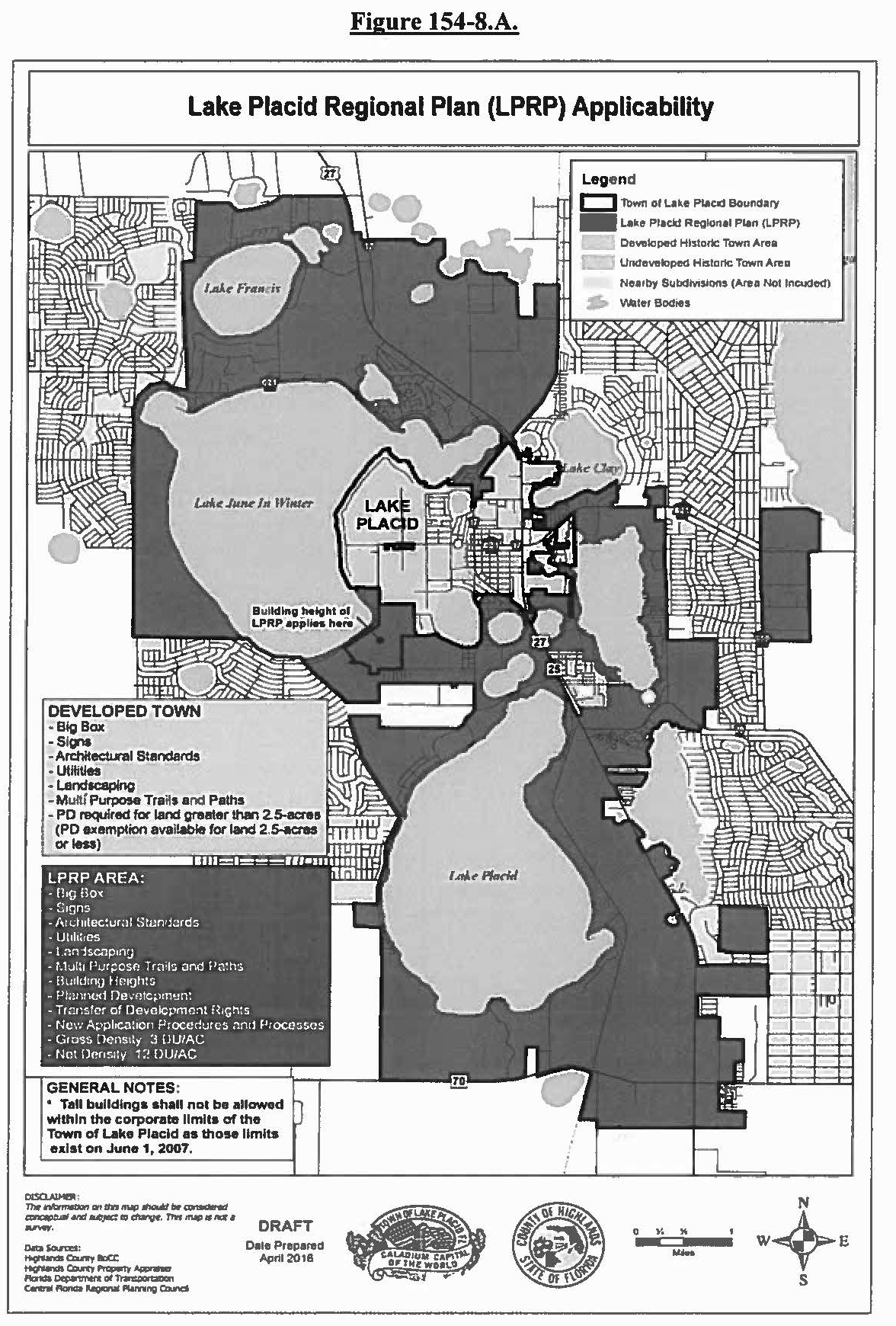
The Lake Placid Regional Plan (LPRP) Applicability Map (Figure 154-8.A.) indicates the areas in which the LPRP Overlay District applies. The developed historic town area is reflected on the map. Regulations specific to the developed historic town area include design requirements for Big Box retail, signs, architectural standards, utilities, and landscaping. Parcels two and one-half (2.5) acres or less within the developed historic town area may be considered for exemption to the PD requirement; however such parcels must meet all of the requirements of the proposed zoning district. The town planning and zoning official may make this determination.
(4)
The LPRP outside of the developed historic town area shall be guided by density policies allowing for a maximum of three (3) dwelling units per gross acre by encouraging clusters with net densities not to exceed twelve (12) units per net acre.
(5)
If there is any conflict between the provisions of this section and the underlying zoning district or other general provisions of the Land Development Code (LDC), the provision imposing the greater restriction or requirement shall prevail.
(6)
Development within the LPRP Overlay District shall be consistent with Objective 6 of the Future Land Use Element of the Town of Lake Placid 2030 Comprehensive Plan.
(7)
The Town of Lake Placid Land Development Code and the Highlands County Land Development Regulations regarding the Lake Placid Regional Plan areas shall be consistent in implementing the Lake Placid Regional Plan (similar to the consistency between Objective 6 of the Town of Lake Placid 2030 Comprehensive Plan Future Land Use Element and Objective 12 of the Highlands County 2030 Comprehensive Plan Future Land Use Element).
(8)
While the town's and county's future land use designations are comparable with regard to density and intensity, a future land use map amendment shall be required specific to the county's medium and high density future land use categories to allow for variances to these categories. While the town recognizes these categories, the town does not allow for mobile homes and mobile home parks as allowed in unincorporated Highlands County.
(c)
Development principles of the Lake Placid Regional Plan. Upon implementation of a Lake Placid Regional Plan Area, the following development principles shall be used as a guide to facilitate sustainable development:
(1)
Planned development process required. All development within the Lake Placid Regional Plan Area shall be accomplished using a planned development (PD). There shall be no land use change, plat, rezone or subdivision without a PD (with the exception of existing agricultural uses and developed lands including existing single-family dwelling units, following annexation). The PD may be created at the same time or after land use change; provided, however that development may proceed using zoning or land use existing at the time of the adoption of this policy without a PD, at the landowner's option.
a.
Property rights. Property rights regarding density, and land use (including land use and zoning changes in process) or property rights vested before the adoption of the LPRP Overlay District Land Development Regulations (LDRs) will continue to be vested or may select to utilize the standards created herein through the PD process. All other parts of the LPRP Overlay District LDRs apply to all development. However, this vision and plan does not establish density in platted or developed lands. The effective date of the Lake Placid Regional Plan Area Overlay is July 1, 2017.
b.
Planning framework. The LPRP Overlay District LDRs establishes the framework for development of the Lake Placid Area. In some cases, it establishes minimum criteria for development. However, the LPRP Overlay District LDRs does not establish all development parameters needed for the Lake Placid Area. The PD process will apply reasonable development standards based upon the site and surrounding lands which may be set at a level beyond minimum standards within the LPRP Overlay District LDRs.
(2)
Density. The Lake Placid Regional Plan Area Overlay outside of the developed historic town area shall be guided by density policies allowing for a maximum of three (3) dwelling units per gross area and twelve (12) units per net acre which encourages clustering open space and pedestrian connectivity.
a.
Density. The residents of the Lake Placid Area like the quality of life provided by its low to medium residential densities. New residents are attracted to the Lake Placid area for the same reason. New development (not developed lands) in the area shall have a gross density of up to three (3) residential dwelling units per acre. Existing residential platted or otherwise developed lands may apply to redevelop said platted lands at the densities herein addressed.
b.
Clustering and transfer of density. In order to maximize open space and green areas including sustainable agriculture, development clustering and transfer of density within a specific area is permitted. To achieve these goals, the use of innovative development techniques, such as but not limited to the following: varying lot patterns and sizes, taller buildings with varied heights and roof lines, mixed uses, including residential above or as part of commercial, and office development. Maximum density per development parcel for residential land use shall be twelve (12) units per net acre within the overall gross density cap of three (3) units per acre for the area.
1.
Residential density may be transferred or clustered only through the PD process.
2.
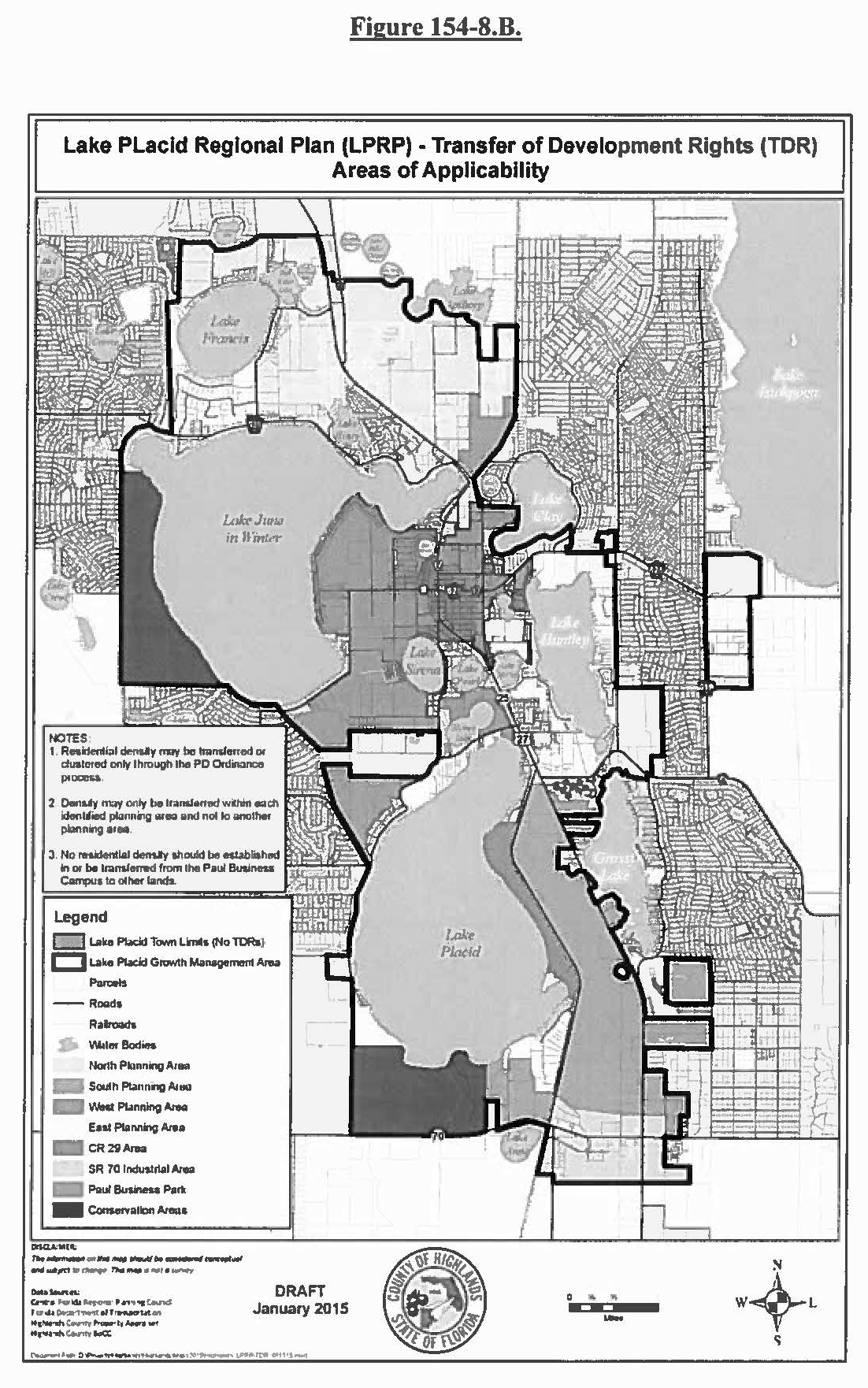
Density may only be transferred within each identified planning area and not to another planning area.
3.
No residential area should be established in or be transferred from the Paul Business Campus to other lands.
4.
The Highlands County Land Development Regulations section 12.13.300 shall apply to all transfer of development rights applications.
5.
Residential density may be transferred or clustered only through the PD process to achieve the vision of the Lake Placid Area and upon the following general concepts:
(i)
Legislative approval. Transfer and clustering of density is not an automatic right. The PD process shall be used to assure that transfer and clustering of density remains reasonable and within the LPRP Overlay District LDRs. For cluster and transfer of density purposes, density on a parcel of land is vested for the sending parcel when the owner joins this plan (once approved) by recorded document. Transfer of density is set forth in section 12.13.300 of the Highlands County Land Development Regulations as adopted in section 155.13.5).
(ii)
Land standards compatibility with surrounding development. Consideration shall be given to the surrounding uses when transferring or clustering density to an area. Appropriate safeguards shall be applied in the PD process to protect surrounding land uses.
(iii)
Environmental lands. Transfer and clustering of density should be used to encourage the dedication to public use, ownership, and protection of environmentally significant lands.
(iv)
Net density. Within the three (3) units per gross acre, individual parcels ranging in size may be developed at a residential density of up to and including twelve (12) units per net acre.
(v)
Density transfer. Subject to the provisions of this section, density may be transferred only within an area identified within this Lake Placid Regional Plan Area Plan. For example, density may be transferred within the south area, but not from the south area to any other property or area (i.e. north area). Density may be transferred from the SR 8 Sub-Area to the balance of the south area. Density may not be clustered to or transferred to the SR 8 Sub-Area. The Lake Placid Regional Plan (LPRP) - Transfer of Development Rights (TDR) Areas of Applicability Map identifies the planning areas referenced above.
(vi)
Protection of clustered and transferred density. When density is transferred or clustered, the land relieved of density shall be encumbered by a recorded easement or conservation easement, and PD prohibiting the re-imposition of density forever. Such instruments may prohibit any development of the restricted area or reduce density of a defined area.
(vii)
Lakes. When considering the transfer and clustering of density to lake areas, additional safeguards for the lake and existing riparian owners, such as preservation of shore line, height restriction, open space, setbacks, and lake size shall be required in the PD.
(viii)
Developed or platted lands. Density may not be clustered or transferred to or from developed or platted lands.
(Ord. No. 2016-723, § 8, 6-12-17)
§ 154-9. - Performance standards.
These regulations shall apply in all districts in which a permitted use would fit the conditions regulated herein.
(a)
Smoke, dust and dirt. There shall be no emission of visible smoke, dust, dirt, fly ash or any particulate matter from any pipes, vents or other openings, or from any other sources, into the air. All fuel shall be either smokeless in nature or shall be used so as to prevent any emission of visible smoke, fly ash or cinders into the air.
(b)
Fumes, vapors and gases. There shall be no emission of any fumes, vapors or gases of a noxious, toxic or corrosive nature which can cause any damage or irritation to health, animals, vegetation or to any form of property.
(c)
Sewage. There shall be no discharge at any point of liquid or solid waste into any sewage disposal system which will overload such system or create detrimental effects in the flow and treatment of sewage. There shall be no discharge of industrial wastes into any sewage disposal system, stream, lake or into the ground of a kind or nature which would contaminate any water supply or otherwise cause the emission of dangerous or objectionable health elements or conditions. There shall be no accumulation of solid wastes conducive to breeding of rodents or insects.
(d)
Heat, cold, dampness or movement of air. Activities which shall produce any adverse effects on the temperature, motion or humidity of the atmosphere beyond the lot line shall not be permitted.
(e)
Noise. The permitted level of noise or sound emission at the property line of the lot on which the principal use is located shall not at any time exceed the average noise level prevailing for the same hour, as generated by street and traffic activity in the neighborhood. When in question, the determination of noise levels shall be measured by a sound level meter that conforms to the specifications published by the American Standards Association.
(f)
Odor. There shall be no emission of odorous gases or other odorous matter in such quantities as to be offensive, obnoxious or unpleasant beyond the property line of the lot on which the principal use is located. Any process, including the preparation of food, which may involve the creation and emission of such odors shall be provided with both a primary and a secondary safeguard system so that odor control may be maintained in the event of failure of the primary safeguard system.
(Ord. No. 2016-723, § 9, 6-12-17)
§ 154-10. - Swimming pools.
(a)
Use of swimming pools is permitted in C Districts under the same regulations as a commercial retail use and may be used for commercial purposes. Pools located in any PD, R or A-1 District shall meet the following requirements. All pools shall meet county health department regulations with respect to water purity and filtration.
(b)
Requirements for pools located in PD, R or A-1 Districts:
(1)
Location. Swimming pools shall be located only within areas which permit the principal building or the accessory buildings, as measured to the edge of the water.
(2)
Fencing. All swimming pools shall be completely enclosed by a protective fence or a wall not less than four (4) feet high.
(3)
Private use only. No pool in any PD, A-1 or R District may be used for commercial purposes.
(4)
Screen enclosures. Screen enclosures over and around swimming pools shall be erected so as to conform to setback requirements of accessory buildings; however, such enclosures may be attached to the principal building.
(5)
Lighting. Lighting for pools shall be located and installed such that no direct light nor reflected light is visible on adjoining property.
(Ord. No. 174, 4-9-90; Ord. No. 2016-723, § 10, 6-12-17)
§ 154-11. - Height exceptions.
The provisions of this section shall apply to all districts in which the use to which they pertain is permitted. Building height regulations specific to tall buildings are provided in section 154-13 and on Figure 154-8.A.
(a)
Building projections and towers. Chimneys; water, fire, radio and television towers; church spires; domes; cupolas; cooling towers; elevator bulkheads; smoke stacks; flagpoles; parapet walls and similar structures, and their necessary mechanical appurtenances, may be located above the height limits herein established; however, the heights of these structures or appurtenances thereto shall not exceed the height limitations set forth by any airport zoning regulations affecting the area.
(b)
Fences, walls and hedges shall adhere to the following limitations and requirements:
(1)
Within residential zones, fences or walls may be erected, placed or maintained on any lot line or within any rear or side yard if not more than six (6) feet in height, or four (4) feet high in front yard areas, measured from the natural contour of the ground on the adjoining lot or on the particular lot, whichever is lower.
(2)
Where a residential lot abuts nonresidentially zoned property, a screen or fences, walls or hedges not less than six (6) feet nor more than eight (8) feet in height shall be required.
(3)
Where unusual circumstances indicate a present or potential need of such barrier, the board of zoning adjustment may require a barrier of up to ten (10) feet in height.
(4)
On a corner lot in a residential area, no fence, wall, structure, hedge, planting or foliage shall be erected, maintained or established within twenty-five (25) feet of the lot corner which will obstruct the view of a driver of a vehicle approaching a street intersection, and in no case shall such fence, wall hedge, structure, planting or foliage be of a height greater than four (4) feet above the abutting street level.
(Ord. No. 2016-723, § 11, 6-12-17)
§ 154-12. - Open yard storage.
(a)
C-1 and C-2 Districts:
(1)
In areas classified as C-1 and C-2, no lot may be utilized for open yard storage unless the storage is fenced and solely used to store products incident to the operation conducted on the same lot; provided the use is a permitted use.
(2)
The open yard storage area may not exceed fifty (50) percent of the enclosed business area; provided, however, that no fence shall exceed eight (8) feet in height or less than six (6) feet minimum. Any variance to maximum or minimum height may be granted by the Board of Adjustment. No sheet metal shall be used for fence construction, and all such fences shall be maintained in good order.
(b)
C-3 Districts:
(1)
On C-3 zoned properties, the entire area may be fenced for open yard storage, provided that adequate off-street parking is provided within the confines of the fence. In the event that parking is not provided, then all fencing shall be offset from the front lot line not less than twenty (20) feet.
(2)
The type of construction and minimum and maximum heights shall be the same as provided in C-1 and C-2.
(c)
Exemptions:
(1)
This Section does not apply to nurseries and/or the sales and display of new automobiles, utility trailers, boats, and/or heavy machinery.
(2)
This Section does not apply to sales and display of merchandise under the overhang of the building, on private property.
(d)
In the event there is a violation to any of the conditions listed in Subsections (a) and (b) of this Section, the Town of Lake Placid Business Tax License shall be revoked upon ten (10) days' notice, provided that the infraction is not corrected within said ten-day period.
(e)
Any requirement of this Section that cannot be met, may be granted by Special Exception from the Town Council with a detailed site plan.
(Ord. No. 144, 8-13-84; Ord. No. 2016-723, § 12, 6-12-17; Ord. No. 2020-804, § 1, 11-9-20)
§ 154-13. - Tall building height.
The town shall manage building height to ensure the community's "neighborly small town" integrity is maintained and many view sheds are protected for present and future residents of the Town of Lake Placid and the Greater Lake Placid Area.
(a)
Tall buildings are not a right. The appropriateness of a tall building, including site, architecture, and height, shall be determined through the PD zoning process.
(b)
Tall buildings are defined as follows: Tall buildings exceed the height allowed by existing zoning and may be as tall as, but not more than one hundred eight (108) feet tall for residential and commercial structures; or one hundred twenty-eight (128) feet tall, which would include two (2) parking floors, excluding the architectural roof treatment complementing the building. There shall be no more than nine (9) residential/commercial floors. Tall buildings shall have architectural features on the top. Roof treatments are required and therefore not included in the calculation of the building height. Mechanical features, such as cooling, heating, and elevators, shall not be open to exterior view. The height of the architectural treatments must be approved through the PD zoning process.
(c)
Tall buildings may be allowed within areas specified as residential, commercial, and mixed use through the use of PD zoning, and upon the following:
(1)
Town. Tall buildings, as defined in this section, as amended from time to time, shall not be allowed within the corporate limits of the Town of Lake Placid as those limits existed on June 1, 2007 as shown in Figure 154-8.A in section 154-8.
(2)
Impact. The actual height of individual buildings and the location of buildings over three (3) stories will be determined at the time of PD zoning approval for the proposed development.
(3)
Density. Tall buildings may not be used to increase gross density. However, density may be clustered in the area of tall buildings up to twelve (12) dwelling units per net acre on the subject parcel.
(4)
Added green space. The impact of tall buildings shall be offset by the addition of green space, not parking or water management facilities. The additional green space shall be in the vicinity of the tall building and shall increase proportionately with the mass of the building.
(5)
Neighborhood opinion. Neighborhood opinion should be considered.
(6)
Minimum land area. Tall buildings shall be on proportionately larger parcels of land, not counting natural waterbodies.
(7)
Commercial nodes. Tall buildings, especially mixed use tall buildings, shall be encouraged in commercial nodes.
(8)
Mitigation. Tall buildings shall be situated on the site in such a way as to minimize negative impacts on scenic vistas, which may include lake or significant natural landscape features. A variety of building heights in residential structures may be allowed in order to create a panorama and interest in the horizon.
(9)
Enforcement. The final development shall be documented by a PD development order and a deed restriction, condominium covenant or easement.
(10)
Architecture. Tall buildings shall have significant architectural features.
(11)
Green space requirements. Green space requirements shall increase to at least forty (40) percent if residential and/or commercial development is proposed for four (4) or more stories in height to encourage the use of structured parking and to mitigate building height. This additional green space shall be in the area of the taller building.
(Ord. No. 2016-723, § 13, 6-12-17)
§ 154-14. - Nonconforming uses.
(a)
Purpose and intent. It is the purpose and intent of this section to permit the continuation of those lots, structures, uses, characteristics of use or combination thereof, which were lawful prior to the passage of this code or future amendment thereto. For purposes of this code, a nonconforming lot, structure, use, or characteristic of use, is defined as a platted lot, structure, or use, or combination thereof that does not comply with the use or site development standards of the zoning district in which the lot, structure, use, or characteristic of use, or combination thereof is located, but which was legally established and in existence before the effective date of this code.
This section is designed to provide reasonable and equitable standards and guidelines for the control of nonconforming lots, structures, uses, and characteristics of uses in the regulation of change of use, change in kind or quality of use, change in volume or intensity of use, change in location of use, change of ownership or tenancy of use, accessory or incidental uses to nonconforming lots, structures, uses, or characteristics of uses, enlargement of use, replacement of use, addition or expansion of facilities, new activities, products or services connected with the nonconforming lot, structure, repair of a nonconforming structure, restoration of a nonconforming structure, and abandonment or discontinuance of a nonconforming structure or use, or any combination thereof.
It is the further purpose and intent of this section to allow nonconforming lots, structures, uses, and characteristics of use and combinations thereof to continue, subject to specific conditions, in order to not interfere with the existing circumstances surrounding land development within the Town of Lake Placid, prior to the effective date of this code any more than is necessary for the proper exercise of police powers relating to the general public welfare of the residents of the Town of Lake Placid.
(b)
Nonconforming classifications. Within the zoning districts established by this code, or amendments that may be later adopted to this code, there may exist:
(1)
Nonconforming lots;
(2)
Nonconforming structures;
(3)
Nonconforming uses;
(4)
Nonconforming characteristics of use;
(5)
Combinations of nonconforming lots, nonconforming structures, nonconforming uses and nonconforming characteristics of use.
These nonconforming classifications are declared by this section to be incompatible with present permitted uses and all or part of the site development standards regulating permitted uses in the district where the nonconforming classifications are located and, therefore, are the proper subject regulations as provided for herein.
(c)
Scope. In order to avoid undue hardship, nothing in this section shall be deemed to require any change in the plans, construction or designated use of any structure on which actual construction was lawfully done prior to the effective date of adoption of this code and upon which actual building construction has been carried on diligently.
For the purposes of this section, the term "actual construction" is hereby defined to include the placing of construction materials in permanent position and fastened in a permanent manner according to approved plans for the specific improvement. Where evacuation or demolition or removal of an existing structure has been substantially begun, preparatory to building, such evacuation or demolition or removal shall be deemed to be actual construction; provided, however, that work has been and shall be carried on diligently pursuant to a valid building permit.
(d)
Nonconforming lots of record. In any district in which single-family dwellings are permitted, a single-family dwelling and customary accessory building may be erected on a single lot, tract, or parcel of land of record at the effective date of adoption of this code, notwithstanding limitations imposed by other provisions of this section.
Such lots must be in separate ownership and not be of continuous frontage with other lots on the same ownership. This provision shall apply even though such lot fails to meet the requirements for area, width or depth, that are applicable in the zoning district in which the lot, parcel, or tract is located, provided, however, that required yard or area dimensions and requirements other than those site development standards applying to area, width or depth shall conform to the regulations for the zoning district in which such lot is located. The lots should be in compliance with setbacks and living area for lots in the R-1 Zoning District.
If two (2) or more lots, or combination of lots, or portion of lots with continuous frontage and single ownership are of record at the time of the passage of this code, and if all or part of the lots do not meet the requirements established for lot areas, width or depth, the lands involved shall be considered to be an undivided parcel and no portion of such parcel shall be used or sold in a manner which diminishes the degree of compliance with established lot width, area and depth requirements, unless approved by town council to be separate, buildable, lots for single-family dwellings.
(e)
Nonconforming uses of land. The lawful use of land existing at the time of the passage of this code or an amendment thereto, although such uses do not conform to provisions of this code may be continued subject to the following limitations and restrictions:
(1)
Change in location of use. A nonconforming use shall not be moved in whole or in part to any other portion of the lot parcel occupied by such use at the effective date of adoption of this code.
(2)
Change in ownership or tenancy. All rights and obligations associated with a nonconforming use of land run with the land and are not personal to the present owner or tenant of the nonconforming use of land and are not affected by a change in ownership or tenancy, except if abandoned.
(3)
Accessory uses. Uses, accessory to a nonconforming use, not in existence at the time of the effective date of adoption of this code, are not permitted.
(4)
Change to a more restrictive category of use. A nonconforming use may be changed to a more restrictive category of nonconforming use as the resulting change reduces the degree of the nonconformity with applicable site development standards and use regulations. For the purpose of this section, a more restrictive category shall be a use or site development standard contained within a more restrictive zoning district.
(5)
Expansion or extension of use. No nonconforming use shall be enlarged, increased, expanded or intensified beyond what existed at the time it became nonconforming.
(6)
Replacement of use. In the event that any existing nonconforming use as provided for in this section is destroyed by more than fifty (50) percent of its assessed value at the time of destruction as determined by the official records of the Highlands County Property Appraiser by any means, including fire, flood, wind, explosion, demolition, act of God, or act of a public enemy, such use shall not be replaced.
If such nonconforming use is destroyed to a level of less than fifty (50) percent of its total assessed value at the time of destruction as determined by the official records of the Highlands County Property Appraiser, it may be replaced, except that replacement can only occur in compliance with those building, plumbing, electrical, gas, fire, and other construction and safety related regulations in effect at the time of application for a permit to allow replacement. In no event shall the destroyed nonconforming use be replaced to a degree or level more restrictive than the original use as to height, lot coverage, total floor area, bulk, or yard setback requirements.
(7)
Abandonment or discontinuance of use. The abandonment or discontinuance of a nonconforming use for a period of one hundred eighty (180) consecutive days or six (6) months shall render the nonconforming use status of the specific nonconforming use null and void. In the factual determination of whether a nonconforming use has been abandoned or discontinued, the following factors shall be used, but not be limited to:
a.
An intent to discontinue the nonconforming use through removal of stock in trade or removal of operating equipment.
b.
Some overt act or failure to act which carries with it a sufficient implication that the owner neither claims nor retains any interest in the use of the abandoned property as it stood before the abandonment occurred. The mere renewal and maintenance of an active occupational license, without further positive action, shall not constitute continuance of a nonconforming use.
c.
Inactive water, sewer, and electrical services at the existing facility.
(f)
Nonconforming structures. Where a lawful structure exists at the effective date of adoption or amendment of this code, and it could not be built under the terms of this code by reason of restrictions on area, lot coverage, height, yards, location of the lot, or other site development standards concerning the structure, such structure, except as otherwise specifically provided, may be continued so long as it remains otherwise lawful, subject to the following provisions:
(1)
Alteration, enlargement, or expansion of nonconforming structure. No such alteration, enlargement, or expansion of a nonconforming structure shall be permitted in a way which increases its noncompliance with present property development and use standards of the zoning district in which it is located, but any nonconforming structure or portion thereof may be altered to decrease its noncompliance with present site development and use standards of the zoning district in which it is located. Nothing herein shall prohibit the director from ordering the compliance with all applicable building construction and safety related codes.
(2)
Replacement, restoration and reconstruction of nonconforming structure. In the event that any existing nonconforming structure is destroyed by any means, including fire, flood, wind, explosion, act of God, or act of a public enemy by less than fifty (50) percent of its total appraised value according to the latest records of the Highlands County Property Appraiser, such structure shall be permitted to be replaced, restored, or reconstructed according to the site development standards in effect at the time of its original construction except that replacement, restoration and reconstruction can occur only in compliance with all other applicable building, plumbing, electrical, gas, fire and other construction and safety related regulations in effect at the time of application for permit to allow replacement, restoration or reconstruction. In no event shall the destroyed nonconforming structure be replaced to a degree or level more restrictive than the original structure as to height, lot coverage, floor area, yard setbacks or other applicable site development standards at the time of its original construction.
(3)
Repairs and maintenance of nonconforming structures. Routine repairs and maintenance of nonconforming structures on fixtures, wiring or plumbing or on the repair or replacement of walls shall be permitted.
(4)
Change in location of nonconforming structure. Should any nonconforming structure be moved for any reason to any distance whatever from its original permitted location, it shall then conform to the regulations for the zoning district in which it is located after it is moved.
(5)
Accessory structure. Structures normally accessory or incidental to a permitted structure or use in the zoning district in which the nonconforming structure is located may be permitted as accessory structures to the nonconforming structure.
(6)
Abandonment or discontinuance of nonconforming structure. The abandonment or discontinuance of a nonconforming structure for a period of one hundred eighty (180) consecutive days or six (6) months shall render the nonconforming structure status of the specific nonconforming structure null and void.
(g)
Nonconforming characteristics of use. Characteristics of use, such as off-street parking, off-street loading, and landscaping requirements, shall be interpreted to be synonymous with a part of the nonconforming classification of uses and structures legally permitted and existing at the time of the passage of this code or an amendment thereto, although such characteristics of use do not conform to the provisions of this code.
(h)
Nonconforming lots, structures, uses and characteristics of use in combinations. If on the effective date of this code, a lot of record, structure, use or characteristics of use of land, in any combination thereof, exists that would not be permitted under the terms of this code, but was lawful at the time of its original existence, that use may be continued unless otherwise deemed abandoned or terminated or required to be eliminated or brought into conformance by other applicable provisions of this code. Subsections (e) and (f) shall apply to all nonconforming lots or record, structures, uses and characteristics of use, and combinations of any or all of them.
(Ord. No. 98-304, § 3, 3-8-99; Ord. No. 07-553, § 1, 5-14-07; Ord. No. 2016-723, § 14, 6-12-17)
§ 154-15. - Signs.
154-15.1. Purpose and intent.
1.
The regulations and requirements herein set forth shall be the minimum requirements to promote the public health, safety and general welfare, and to protect the character of residential, business, and industrial areas throughout the town.
2.
The requirements regarding placement, installation, maintenance, size and location of signs, are intended to minimize unnecessary distractions to motorists, protect pedestrians and provide safe working conditions for those persons who are required to install, maintain, repair and remove the signs and their structures.
3.
The town and the community at large have invested tremendous resources toward the esthetic improvement and beautification of the Town of Lake Placid. This ordinance is intended to further the community's effort to make Lake Placid an esthetically pleasing place to live, work and visit.
4.
When left unregulated, signs can become a threat to public safety as a traffic hazard, and a detriment to property values and the town's overall public welfare as an aesthetic nuisance. The intent of these sign regulations is to:
a.
Preserve the right of free speech and expression in the display of signs;
b.
Further the objectives of the Town of Lake Placid's Comprehensive Plan;
c.
Avoid excessive competition and clutter and sign displays;
d.
Reduce traffic and pedestrian hazards;
e.
Protect property values by minimizing signs' possible adverse effects;
f.
Promote economic development; and
g.
Ensure the fair and consistent enforcement thereof.
154-15.2. Substitution of noncommercial speech for commercial speech and content neutrality.
1.
Substitution of noncommercial speech for commercial speech. Notwithstanding anything contained in this chapter or code to the contrary, any sign erected pursuant to the provisions of this chapter or code may, at the option of the owner, contain a noncommercial message in lieu of a commercial message. The noncommercial message (copy) may occupy the entire sign face or any portion thereof. The sign face may be changed from commercial to noncommercial messages, or from one noncommercial message to another noncommercial message, provided that the size, height, setback and other dimensional criteria contained in this chapter and code have been satisfied.
2.
Content neutrality as to sign message (viewpoint). Notwithstanding anything in this chapter or code to the contrary, no sign or sign structure shall be subject to any limitation based upon the content (viewpoint) of the message contained on such sign or displayed on such sign structure.
154-15.3. Definitions.
Definitions for this chapter are provided in chapter 152, section 152-4, under "Sign".
154-15.4. Sign permits.
1.
Permit required. To obtain town review and avoid expensive mistakes, all signs shall be required to comply with this code. Unless specifically exempt, no temporary sign greater than thirty-two (32) square feet in size, and no permanent sign shall be placed, newly constructed, enlarged, or relocated in the Town of Lake Placid until a sign permit has been issued by the town.
2.
Application and permit fees. Applications for permits shall be submitted to the town clerk with an application fee as established by the town council.
a.
Sign application contents. All applications for sign permits shall be made on the forms provided by the town and shall include the following. More than one (1) sign may be included in one (1) permit application so long as the proposed signs are located on the same subject property.
1.
Name, address, telephone number, and signature of the owner or authorized agent of the premises granting permission for the sign;
2.
Name, address, telephone, and license number of the sign contractor;
3.
A description of the signs indicating the number, size, shape and dimensions of each proposed sign;
4.
A drawing of the site showing the proposed location of the sign in relation to on-site buildings and streets, property and right-of-way lines;
5.
The number, in aggregate sign area, of signs on the premises (existing and proposed); and
6.
Brightness of proposed lighted signs.
3.
Permit exemptions. Permit exemptions are as follows:
a.
A permit is not required for signs listed in this chapter as exempt from this sign code. Confirmation of an exemption may be obtained by submitting an exception application. No fee shall be required to confirm an exemption.
b.
In addition to any sign otherwise exempted, the changing of a face or normal and regular maintenance that does not alter the supports, structure or location of the sign, nor increases the sign area shall not require a permit.
c.
Exemptions as provided in section 154-15.8.
4.
Other applicable codes. No permit shall be issued until the proper officials determine that the application complies with the requirements of this chapter, and the proper officials determine that the sign will not violate the applicable building or electrical codes. A building permit may also be required as determined by the town's building official.
5.
Permitting authority. The town planning and zoning official shall act on all applications for a sign permit, a variance from the terms of this code, and exemptions requests, except as otherwise stated herein.
6.
Variances. Variances for sign structure setback, height, face size, will be considered by the town planning and zoning official. Variance applications must be in writing and must show why the subject should be treated differently from others, and how the variance will not be detrimental to the public or give unfair advantage to the applicant. The variance may be granted in whole or in part or denied. Each variance shall be for the minimum deviation from this section as needed to equitably apply the stated purpose of this section.
7.
Appeals. Decisions of the town planning and zoning official regarding this chapter may be appealed to the Lake Placid Town Council. Appeals must be in writing, state all supporting arguments, include all supporting evidence and be filed with the town clerk within thirty (30) days of the planning and zoning official's decision. Twenty (20) days' written notice of the appeal hearing must be given by the appellant to the owner of every parcel contiguous to the parcel upon which the appeal pertains. The notice shall include a complete copy of the appeal.
8.
Removal of illegal signs. The code enforcement official (or such other town employee directed by the mayor) shall remove all illegal signs from public property immediately.
9.
Mandatory sign permit contents. Every sign permit shall contain the following provision:
"The sign herein permitted must be operated and maintained according to the provisions of section 154-15 of the Code of the Town of Lake Placid. Specifically, the town may require modification of the operation of the sign to assure safety and compliance with the town Code, as amended from time to time."
10.
Expiration of permit. A sign permit shall become null and void if the work for which the permit was issued has not been started within a period of six (6) months after the date of the issuance of the permit. Additionally, any work started, but discontinued for a period greater than six (6) months shall cause the permit to become null and void.
154-15.5. General requirements.
Unless otherwise provided in this chapter, the following requirements apply to all signs in the Town of Lake Placid:
1.
Sign area and height calculations.
a.
Wall sign area computation. In computing sign area in square feet, standard mathematical forms for known common shapes will be used. Common shapes shall include squares, rectangles, cones, spheres, trapezoids, triangles, circles, ovals, cylinders and other simple forms for which surface area formulas are established. The area of a wall sign shall include the areas between all letters, logos and things within the signage so that all area within the perimeter of the sign shall be included. All words and components of a sign or related message shall be included as one (1) sign.
b.
Sign border calculation. When signs are enclosed in a border or highlighted by background graphics, the perimeter of such border or background will be used to compute area.
c.
Deviations. The town planning and zoning official shall have the discretion to make minor adjustments and/or deviations from the principles stated herein in order to assure that the reasonable intent of this section is fulfilled, that equality is achieved in the computation, and that reasonable advertising exposure is allowed.
d.
Double-face signs. All surfaces of a double-face sign shall be equally sized back-to-back parallel faces and contained within a common perimeter. Only one (1) side of a double-face sign shall be considered in computing square footage requirements for area limitations.
e.
Measurement of sign height. The height of a sign shall be measured at the bottom from the finished grade of the parcel in the area of the sign (not from an artificially created mound) to the highest point of the sign.
f.
Logos. Logos are to be counted as part of a permitted sign as to height and size.
2.
Location.
a.
Roof line. No sign attached to any building shall be located above the roof line of the portion of the building upon which it is situated.
b.
Right-of-way. No sign, except those placed by an authorized governmental agency, shall be placed on the public right-of-way.
c.
Traffic safety. No sign shall interfere with traffic or be confused with or obstruct the view or effectiveness of any official traffic sign, traffic signal, or traffic marking or obstruct the sight distance of motorists or pedestrians.
d.
In right-of-way. Supports for signs or sign structures shall not be placed in or upon a public right-of-way or public easement, except those placed by an authorized governmental agency.
e.
Over right-of-way. No sign shall project over a public right-of-way, except those placed by an authorized governmental agency.
f.
Blocking exits, fire escapes, etc. No sign or sign structure shall be erected that impedes use of any fire escape, emergency exit, or standpipe.
g.
Sign separation. Ground, monument, and pole signs located along street frontages shall comply with all sign separation requirements.
h.
No sign shall obstruct the sight distance triangle area as consistent with town Code requirements.
3.
Reserved.
4.
Illumination standards.
a.
Sign lighting may not be designed or located to cause confusion with traffic lights.
b.
Illumination by floodlights, spotlights, or unshielded bulbs is permissible so long as none of the light emitted shines directly onto an adjoining property or into the eyes of motorists or pedestrians using or entering public streets. This standard applies to sign illumination originating inside of business windows or sign illumination originating on signs which are outside.
c.
Lights used for external sign illumination shall not have lighting mechanisms that project more than eighteen (18) inches perpendicularly from any surface of the sign or over public space.
d.
Lights used for external sign illumination shall be so designed as to concentrate the illumination upon the sign, and such lights shall not glare upon the street or upon adjacent property.
e.
Unshielded lights used for external sign illumination that produce glare or are a hazard or a nuisance to motorists or occupants of adjacent properties are prohibited.
f.
See section 154-15.6.1., Specific signs, for changeable copy sign (digital) illumination standards.
154-15.6. Specific signs.
The following provisions apply to the indicated type of sign:
1.
Changeable copy sign (digital). On-premises, freestanding, changeable copy signs (digital) shall only be allowed in the General District and the United States Highway 27 Sign Districts subject to compliance with all applicable requirements contained in this sign code and the following standards:
a.
No more than one (1) changeable copy sign (digital) shall be allowed per site.
b.
No more than one-third of the sign area may be composed of changeable copy signage.
c.
Changeable copy signs (digital) shall be allowed provided the copy is included within an allowed ground-mounted, monument, or pole sign, it does not constitute more than one-third of the allowed sign area of any one (1) side of the sign, and is architecturally integrated into the sign.
d.
Changeable copy signs (digital) shall display static images only and the copy may be changed or re-presented only once every twenty-four (24) hours. The change of copy must be completed instantly. Other than change of copy, the changeable copy sign (digital) shall not flicker, vary in light intensity or color, or otherwise violate section 154-15.7.
e.
Continuous scrolling and/or traveling, flashing, spinning, rotating and similar moving effects are prohibited.
f.
Changeable copy signs (digital) located on properties along state and county highways may be subject to state and county sign and permitting requirements.
g.
All changeable copy signs (digital) shall come equipped with automatic shut-off technology so that the display will go dark during sign malfunction.
h.
All changeable copy signs (digital) shall comply with the building and electrical codes.
i.
Changeable copy signs (digital) shall not be placed or illuminated so as to obscure or interfere with traffic control devices.
j.
All changeable copy signs (digital) shall come equipped with automatic dimming technology which automatically adjusts the sign's brightness based on ambient light conditions.
k.
No changeable copy sign (digital) shall exceed a brightness level of 0.3 foot candles above ambient light, as measured perpendicular to the face of a sign using a foot candle (Lux) meter at a preset distance in relation to sign area as follows:
Table 154-15.6
Sign Area vs. Measurement Distance
For signs with an area in square feet other than those specifically listed in the
table (e.g., 12 sq. ft., 200 sq. ft., etc.) the measurement distance may be calculated
with the following formula: Measurement Distance = √(Area of Sign Sq. Ft. x 100).
(Source: International Sign Association (ISA), Recommended Night-Time Brightness Levels
for Electronic Message Centers (EMC's). A Compilation Summary with Extracts from Industry
Reports, April 2011.)
2.
Changeable copy sign (manual). No more than one (1) on-premises, freestanding, changeable copy sign (manual) shall be allowed per site and only within the General and United States Highway 27 Sign Districts. Such signs shall be allowed provided the copy is included within an allowed freestanding sign, it does not constitute more than one-third of the allowed sign area of any one (1) side of the sign, and is architecturally integrated into the sign.
3.
Internal site signs. Permanent, freestanding, menu boards of no more than thirty-six (36) square feet each shall be allowed for signage internal to the site, including but not limited to, drive-thru facilities. Such signs shall not exceed seven (7) feet in height and shall be located adjacent to, or oriented toward, the drive-thru areas or other areas internal to the site. The square footage for menu boards shall not count towards, or be included in sign area requirements. These signs are designed to be viewed on-site only.
4.
Public events permits. Public events not advertising any single business may be issued directional signs, parking signs and event signs. An event sign plan showing all signs to be used shall be submitted to the chief of police for approval and permitting. Additional requirements may be established by town council resolution or by the permit process.
5.
Community projects and contributions. The town council upon application submitted to and recommendation of the town's planning and zoning official, may by resolution allow signs recognizing projects and contributions benefiting the town. These signs shall be uniform in style and shall not exceed two (2) square feet each, and shall be no more than three (3) feet above grade. The location of the sign should reasonably relate to the respective contribution.
6.
Welcome signs. The existing welcome signs maintained by the chamber are hereby permitted in their current form. Those signs may be modified upon and after town council approval by resolution.
7.
Town shopping district. The town council may authorize the installation and landscaping of two (2) signs; one (1) sign facing each travel lane of U.S. 27 (after required permitting), generally directing travelers to Uptown Lake Placid and the Welcome Center. The specific design shall be subject to the town council's approval.
8.
Banners. Banners shall only be allowed consistent with section 154-15.6 (community event banner), section 154-15.6 (one-time display event), section 154-15.15, Lake Placid Regional Plan Sign District (community events), and section 154-15.18, (post disaster signage). A parcel may display banner signs with an aggregate sign area of up to fifteen (15) square feet in a residential zoning district, and forty-eight (48) square feet in a non-residential zoning district.
9.
Community event banner. A community event is one pertaining to recreational events, sporting events, events promoting a local industry (but not a particular business), concerts, noncommercial events and held primarily on public property and within the Greater Lake Placid area. Community events shall be open to the general public and may charge an admission fee. Banners for community events may be allowed by permit issued by the town council for the day(s) of the community event, and up to twenty-one (21) days leading up to the community event. Conditions of the permit shall include: At least one million dollars ($1,000,000.00) of public liability insurance coverage related to the banner; indemnification by the event sponsor (including at least one (1) live person) for claims related to the banner; up to twenty-eight (28) days of display; a rendering to scale of the banner contents; description of the banner's proposed dimension and materials; and the specific location of the banner. Banner locations shall be approved by resolution of the town council, and if across a county road, shall be approved by the county engineer. Additional requirements may be included in the permit or by council resolution.
10.
Sandwich board signs. Entities owning or leasing a parcel of land in the town (in any sign district) with a business situated thereon may place a single sandwich board sign on the property owned or leased by the said entity. Sandwich board signs may only be displayed outside of the business when the business is open; shall be secured inside of the business at all other times; and shall not contain flags, lights, banners, or sound. There may be only one (1) sandwich board sign per business.
A sandwich board sign shall not be placed on public property (including without limitation, streets, alleyways, parking and sidewalks). Sandwich board signs shall be well maintained and shall consist of good quality materials that are safe and have no protruding or sharp edges that are a danger to the public.
11.
Temporary freestanding signs. A temporary freestanding signs may be allowed in all sign districts and shall comply with the following requirements:
a.
Generally.
1.
Temporary signs shall not be allowed as permanent signage and may not be illuminated.
2.
One (1) additional temporary sign, not to exceed the square footage requirements provided in subsection 11.b., Dimensional requirements, below, is allowed for a parcel that has no permanent sign, provided that such sign is not displayed for a period of more than sixty (60) days or until installation of the permanent sign, whichever occurs first.
b.
Dimensional requirements.
1.
The square footage of a temporary sign shall not be included in the calculation of the total sign area allowance for a parcel.
2.
A parcel may display temporary signs with an aggregate sign area of up to twelve (12) square feet.
3.
Parcels of two (2) or more acres and multiple tenants (e.g., strip shopping centers or strip malls) shall be permitted temporary signs not to exceed sixteen (16) square feet of aggregate sign area for the parcel. The owner of the strip shopping center or mall shall be responsible for any penalties accrued for non-compliance by the tenants.
4.
Temporary signs shall not exceed six (6) feet in height in the U.S. Highway 27 Sign District.
5.
Temporary signs shall not exceed four (4) feet in height in all other sign districts.
6.
Temporary signs shall have a minimum five-foot setback from the property line.
c.
Duration. Temporary signs shall be removed within five (5) calendar days after the end of the scheduled occurrence or purpose to which it relates.
d.
Maintenance. Temporary signs are subject to the standards provided in section 154-15.9, Construction and maintenance standards.
12.
One-time display (event) signs. The owner of record of a non-residential use, as determined through a business tax receipt, may apply for a sign permit to display one-time display (event) signs once during the lifetime of their non-residential use, for a period of up to thirty (30) consecutive calendar days. Signs may include banners and other allowable temporary signs, and the sign area of such signs shall not exceed the square footage requirements provided herein section 154-15.6. A new application for a one-time display (event) sign shall be allowed on the same property if there is a change in use and/or ownership that requires a new or revised business tax receipt.
154-15.7. Prohibited signs and violations.
The following signs are prohibited, constitute a violation of this code, and shall not be permitted, erected or allowed by variance in the Town of Lake Placid, Florida:
1.
Prohibited signs; generally. Any sign not specifically permitted by these sign regulations is prohibited.
2.
Prohibited signs; specifically. Unless otherwise permitted, the following signs are prohibited and no variance shall be granted which would authorize same:
a.
Abandoned signs. Abandoned signs shall be removed by the property owner. In determining whether a sign is abandoned, the following factors, among other factors shall be considered, to wit: The existence of a current occupational license; utilities service deposit at that location; use of the premises and relocation of a business. Signage shall be presumed (a rebuttable presumption) abandoned if the business advertised is closed for sixty (60) consecutive days.
b.
Signs on public right-of-way, unless otherwise expressly permitted by this Code.
c.
Billboards. Billboards, whether off-premises or on-premises.
d.
Bus stop signs. Signs placed upon, or attached to, bus stop shelters.
e.
Bench signs.
f.
Signs with moving lights. Signs with lights or illuminations that flash, move, rotate, scintillate, blink, flicker, or vary in intensity or color, running, visible moving, revolving, or rotating parts or visible mechanical movement of any description or other apparent visible movement achieved by electrical, electronic, or mechanical means, except as otherwise expressly permitted by this Code for public service signs. This includes signs with the optical illusion of movement by means of a design that presents a pattern capable of giving the illusion of motion or changing of copy.
g.
Hazardous signs. No sign shall be erected in such a manner as to obstruct the vision of pedestrians or drivers. Any sign, which by glare, or methods of illumination or intensity, constitutes a hazard to traffic, is prohibited. No sign may use the words, phrases, symbols, or characters in such a manner as to interfere with traffic, mislead or confuse drivers or pedestrians. Signs may not create a visual impairment for motorists.
h.
Parasite signs.
i.
Laser-lights.
j.
Off-premises signs.
k.
Portable signs.
l.
Searchlights.
m.
Trailer signs.
n.
Unsafe signs.
o.
Wind signs.
p.
Banners. Banners are prohibited, except as otherwise expressly permitted by this Code. To the extent not otherwise permitted, banners shall not exceed fifteen (15) square feet in residential zoning districts and forty-eight (48) square feet in non-residential zoning districts.
q.
Animated signs, except as otherwise expressly permitted by this Code.
r.
Flying things. Signs containing flying paraphernalia.
s.
Noise signs. Signs which produce noise or sound capable of being heard even though the sounds produced are not understandable sounds.
t.
Emissions. Signs which emit visible smoke, vapor, particles, or odor.
u.
Communication interference signs. Signs with any lighting or control mechanism which causes radio or television or other communication interference.
v.
Motion pictures. Motion picture mechanism in conjunction with any outdoor advertising structure, accessory sign, or advertising statuary used in such a manner as to permit or allow the images to be visible from any public street or sidewalk.
w.
Unsafe fixtures. Signs erected, constructed, or maintained so as to obstruct, or be attached to any firefighting equipment, window, door, or opening used as a means of ingress or egress or for firefighting purposes, or placed so as to interfere with any opening required for proper light and ventilation.
x.
Snipe signs.
y.
Vehicle signs. Signs attached to or painted onto a vehicle parked on a public thoroughfare for the sole purpose of advertising.
z.
Obscenity. This sign ordinance does not regulate the content of the message of the sign. However, signs containing any statement, word, character or illustration of an obscene, indecent or immoral nature that are not protected by the First Amendment of the United States and Article I §4 of the Constitution of the State of Florida are prohibited.
aa.
Signs that are painted, pasted, or printed on any curbstone, flagstone, pavement, sidewalk or street, except house numbers and traffic control signs.
ab.
Blade signs.
154-15.8. Exemptions from permit requirements.
The following signs may be erected without a permit in any sign district, subject, however, to all remaining requirements of these regulations, including but not limited to construction and maintenance standards:
1.
Tablet signs. One (1) tablet sign per building, not exceeding two (2) square feet in area, when cut into any masonry surface, or when constructed of bronze or other durable material and attached to the surface of a building. No tablet sign shall be mounted at a height greater than six (6) feet from the ground or sidewalk to the bottom of the sign.
2.
Public purpose, service, and/or safety signs. Any public purpose, service, and/or safety sign, including regulatory signs and any other notice or warning signs required by local, state, or federal government law, ordinance, regulation or resolution.
3.
On-premises signs. On-premises signs, which do not exceed two (2) square feet in area.
4.
Directional and notice signs. Directional and notice signs or symbols located on and pertaining to a parcel of private property, each not to exceed two (2) square feet.
5.
Temporary signs. Temporary signs less than thirty-two (32) square feet in area.
6.
Signs incorporated into machinery or equipment. Signs incorporated into machinery or equipment by a manufacturer or distributor.
7.
Signs carried by a person. Signs held by a person and less than six (6) square feet.
8.
Flags. Flags where the aggregate sign area of such flags shall not count as chargeable square footage, provided that the number and size of such flags and flagpole are consistent with F.S. ch. 720.
9.
Street numbers. Street address numbers are assigned by the county's emergency management office (911) and are required for all buildings and are exempt from this code.
10.
Window signs. Signs up to a total area of fifty (50) percent (one hundred (100) percent in the Traditional District) of the window space may be displayed inside of a building's window. Side or rear windows cannot be used to calculate allowable window signs on the front.
11.
School signs. The Highlands County School Board shall have exclusive jurisdiction over signage on school board property, provided that signs shall not be visible from a public street (except Green Dragon Drive and South Tangerine Drive).
12.
Murals. Murals consisting of original, painted, artwork.
154-15.9. Construction and maintenance standards.
All signs shall be constructed and maintained in accordance with the following standards, and no certificate of occupancy shall be issued for a building unless permitted signs have conformed to these standards:
1.
All permanent signs shall be constructed and maintained in accordance with the provisions and requirements of the Florida Building Code, as adopted by the Town of Lake Placid, the National Electrical Code, or the currently prevailing electrical code, and all other applicable codes, ordinances or requirements. Where inconsistency exists between these sign regulations and applicable codes, the more restrictive requirement shall apply.
2.
All signs must be sturdy enough to permit those persons working on the signs to do so safely.
3.
With the exception of signs consisting of a chalkboard surface, dry erase marker board (whiteboard), or a comparable type surface, all copy shall be commercially produced or consist of professionally lettered typeface. All copy shall be maintained and legible.
4.
All signs shall be maintained and it shall be the responsibility of the sign owner for sign maintenance.
5.
Damaged or faded sign faces, or structural members shall be repaired, replaced or removed within thirty (30) calendar days unless given a time extension by the town administrator, or his or her designee. If said faces or structural members become insecure or in danger of falling, in disrepair or deteriorated, or otherwise unsafe in the opinion of the code enforcement officer or the town building official, they shall be removed in accordance with the requirements provided in section 154-15.17.2 for unsafe signs.
6.
Electrical systems, fasteners, and the sign and structure as a whole shall be maintained at all times in a safe condition.
7.
Weather. All movable temporary signs shall be moved to a secure location upon a warning of high winds or hurricane by the National Weather Service.
154-15.10. Non-conforming signs.
It is the intent of this section to allow certain non-conforming signs permitted through the building department before the adoption of this chapter to continue until they are no longer used, or become hazardous, but not to encourage their non-conforming status. Such signs are hereby declared to be incompatible with the overall intent of this chapter.
154-15.10.1. Removal of non-conforming signs.
All non-conforming and non-permitted signs, except as provided herein, shall be removed immediately or as otherwise provided under section 154-15.10 of this chapter.
154-15.10.2. Continuance of non-conforming signs.
A non-conforming sign use may be continued, subject to the following provisions:
A.
A non-conforming sign shall not be enlarged or increased in any way from its existing size at the time of the adoption of this sign code.
B.
Non-conforming signs or sign structures that are defined as abandoned signs under this sign code shall not be permitted for reuse.
C.
There may be a change of tenancy or ownership of a non-conforming sign without the loss of non-conforming status, if the property sign is not abandoned as defined in this chapter.
154-15.10.3. Repairs, maintenance and improvements.
Normal repairs, maintenance and improvements may be made however, the cost of such improvements made during a two-year period shall not exceed fifty (50) percent of the replacement cost of the sign at the end of the two-year period.
154-15.10.4. Reconstruction after catastrophe.
If any non-conforming sign is damaged by fire, flood, explosion, collapse, wind, war, or other catastrophe to such an extent that the cost of repair and reconstruction will exceed fifty (50) percent of the replacement cost at the time of damage, it shall not be used or reconstructed except in full conformity with the provisions of this chapter.
154-15.10.5. Casual, temporary or illegal use.
The casual, temporary or illegal use of any sign shall not be sufficient to establish the existence of a non-conforming use or to create any rights in the continuance of such use.
154-15.11. Sign districts.
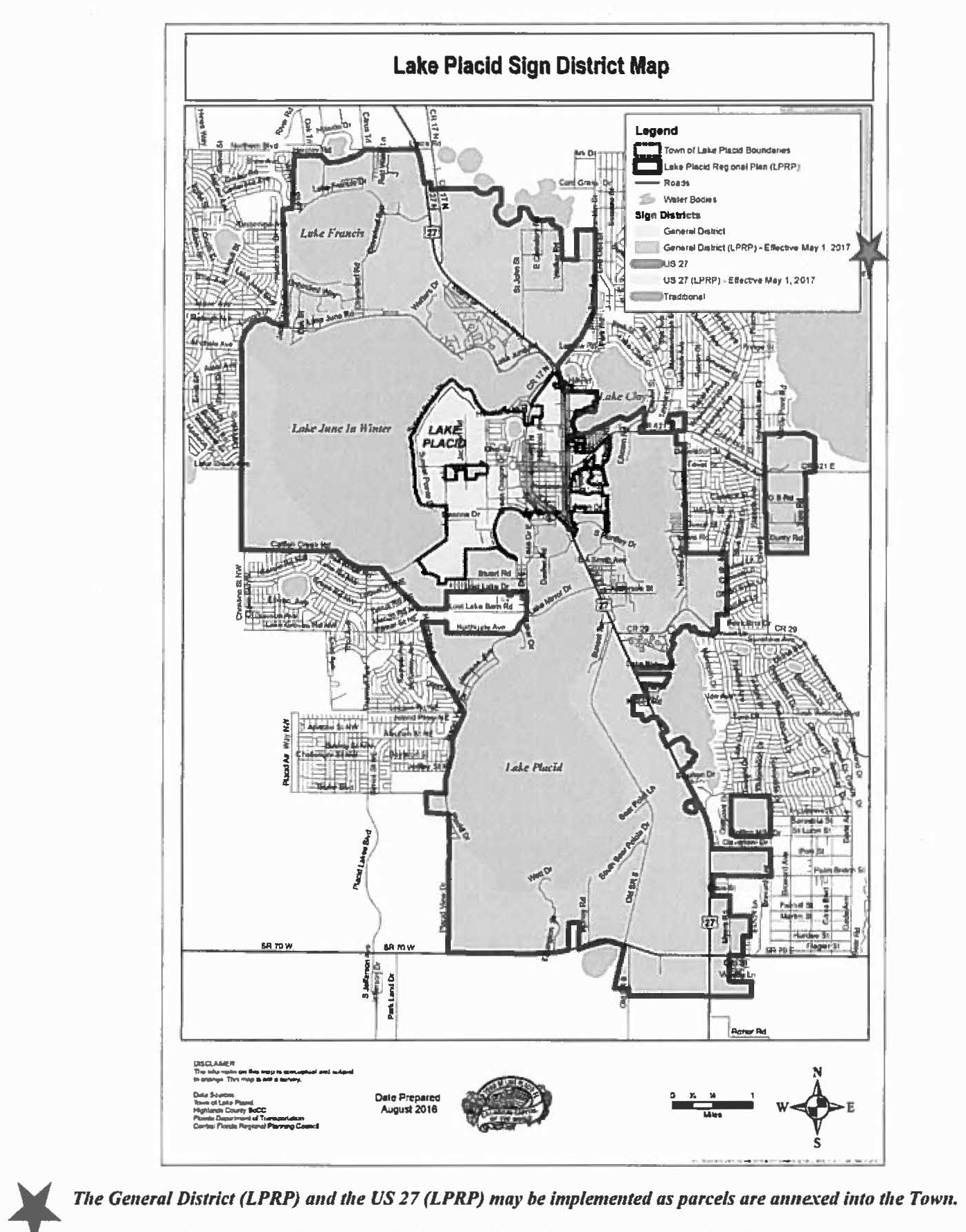
The Town of Lake Placid hereby establishes and divides its jurisdiction into the hereinafter setout sign districts with the following specific regulations applicable in each district. Every parcel of property with any frontage on the street designated as a separate district shall comply with the hereinafter established regulations for that district. The balance of the town is considered to be in the General District.
Map of Sign Districts
1.
Traditional District. This district shall consist of every parcel with any frontage on either of the following roads:
A.
North Main Street from Interlake Boulevard North to Lakeview Street; and
B.
Interlake Boulevard from the west boundary of the South Florida State College on the south side of Interlake Boulevard and the west line of the school board lands on the north side of Interlake Boulevard both running west to the railroad tracks; and
C.
South Main Street from Interlake Boulevard South to the southerly town limits.
2.
United States Highway 27 District. This district shall consist of non-residential parcels having frontage on United States Highway 27 including within the Lake Placid Regional Plan. Properties within the Lake Placid Regional Plan District shall also comply with Lake Placid Regional Plan District regulations for signs. The more restrictive shall apply.
3.
General District. This district shall consist of all other parcels within the Town of Lake Placid not included in another sign district including within the Lake Placid Regional Plan. Properties within the Lake Placid Regional Plan District shall also comply with Lake Placid Regional Plan District regulations for signs.
4.
Lake Placid Regional Plan District (U.S. 27 and General). This district shall consist of parcels outside of the town limits as of May 1, 2017, that are located within the LPRP. The U.S. 27 (LPRP) District regulations shall apply to non-residential parcels with frontage on U.S. 27. The General (LPRP) Sign District shall apply to all other areas in the LPRP annexed after May 1, 2017.
154-15.12. General Sign District.
The General Sign District consists of every parcel within the Town of Lake Placid that is not contained in another sign district. The following signage is permitted in this district, and the following sign development standards are also provided in Table 154-15.16 (A). Unless otherwise expressly permitted by this sign code, all other signage is prohibited in this district:
1.
Ground-mounted and monument signs. Ground-mounted and monument signs are permitted in the district. Illumination (if provided) shall be light fixtures mounted on the subject sign or indirectly from lights mounted near the sign. The maximum height of, ground-mounted and monument signs in this district shall not exceed six (6) feet. Said ground-mounted signs may have two (2) sign faces, each up to sixty (60) square feet.
2.
Building signs. Signs on buildings are permitted within this district. Each parcel may have signs on the building wall or mansard roof (but not sloped roof) containing up to but not more than thirty (30) percent of the respective wall or thirty (30) percent of the face of the respective roof, but not both.
3.
Additional signage. Additional building signage (three (3) signs up to ten (10) square feet each) may be used on awnings, doors, canopies, marquees and windows.
4.
One (1) changeable copy sign is allowed per business. Changeable copy shall not make up greater than one-third of the total sign area.
154-15.13. United States Highway 27 Sign District.
The United States Highway 27 Sign District consists of every non-residential parcel with any frontage on United States Highway 27. The following signage is permitted in this district and the following sign development standards are also provided in Table 154-15.16.(B). Unless otherwise expressly permitted by this sign code, all other signage is prohibited in this district:
1.
Maximum total building signage. The total signage allowed on one (1) building (wall, roof and additional building signage) shall not exceed one (1) square foot of signage for each linear foot of street frontage, for each street frontage (up to three (3) street frontages). The square foot signage shall be restricted to the street the signage fronts. Signs fronting two (2) streets shall count in both.
2.
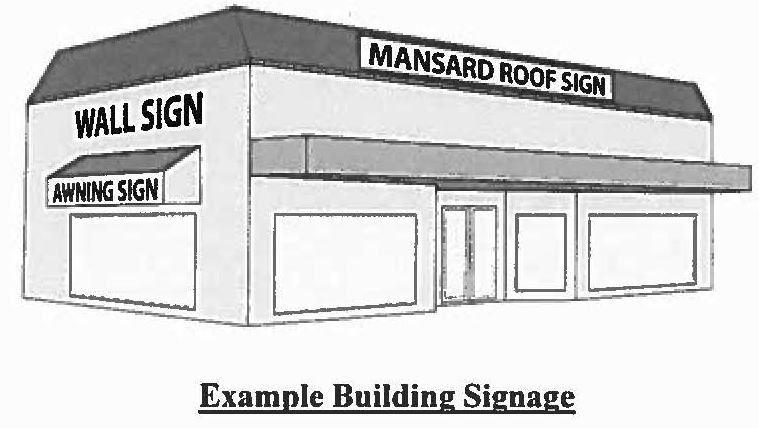
Awning sign. Awning signs as herein defined are permitted in this district. An awning sign built in accordance with the Standard Building Code and so as not to interfere with safe vehicle traffic flow shall be permitted, and shall count in allowable signage for the building.
3.
Mansard roof signs. Mansard roof signs as herein defined are permitted in this district. Mansard roof signs and sign structures shall not extend beyond the roof. Mansard roof signs shall extend no more than twenty-four (24) feet above ground, and shall be no more than thirty (30) percent of the road front roof face upon which it is situated.
4.
Wall sign. Each business is entitled to signage on any wall of its building. The sign may occupy up to thirty (30) percent of the respective wall. Signage and graphics may not extend beyond the wall surface (top or sides).
No wall sign or supporting structure shall project more than twelve (12) inches horizontally from the wall of the building. Where an exterior parapet wall projects above the roof line, such signs may extend to the top of such wall. However, no wall sign shall extend more than twenty-four (24) feet above ground level to the top of the sign, nor above the roof line.
5.
Ground-mounted, monument or pole signs. Ground-mounted, monument or pole signs as herein defined are permitted in this district. A ground-mounted, monument or pole sign shall only be permitted when the lot upon which it is to be placed has a minimum of sixty (60) linear feet of road frontage. No ground-mounted, monument or pole sign shall be erected closer than forty (40) feet to any other ground-mounted, monument, or pole sign, except where the locations of existing ground-mounted, monument or pole signs on adjacent lots would make this requirement impossible to meet. No part of any sign shall extend beyond any right-of-way line. Any such ground-mounted, monument, or pole sign may have two (2) faces. The maximum allowable area for each face shall be one hundred twenty-five (125) square feet of sign area with a maximum height of twenty-four (24) feet.
6.
One (1) changeable copy sign may be allowed per site providing the copy is included within a allowed permitted monument sign, it does not constitute more than one-third of the allowed sign area of any one (1) side of the sign, and it is architecturally integrated into the sign. Section 154-15.6 of this code provides specific standards for changeable copy signs.
7.
Shopping center ground-mounted and monument signs. Ground-mounted and monument signs for shopping centers must be approved by the local planning agency. Each shopping center or strip mall is allowed one (1) sign for each road frontage contiguous to the shopping center parcel. Each sign should be no more than twenty-four (24) feet tall with a sign face of up to one hundred twenty-five (125) square feet. A solid support structure (not mere poles) devoid of signage and lighting may not be counted as sign face.
8.
Multiple advertisers. Shopping centers with more than five (5) separate stores may petition the local planning agency for up to two hundred (200) square feet of sign face on each sign side. A maximum of one (1) changeable copy sign (manual or digital) may be permitted per site. No more than one-third of the sign area may be composed of changeable copy.
154-15.14. Traditional District.
The Traditional District consists of every parcel with any frontage on any of the following roads. The following sign development standards are also provided in Table 154-15.16.(C):
A.
North Main Street from Interlake Boulevard North to Lakeview Street; and
B.
Interlake Boulevard West of the South Florida State College on the south side of Interlake Boulevard and west of the school board lands on the north side of Interlake Boulevard both running west to the railroad tracks; and
C.
South Main Street from Interlake Boulevard South to the southerly town limits.
The following signs are permitted in this district. Unless otherwise expressly permitted by this sign code, all other signage is prohibited in this district:
1.
Awning sign. An awning sign built in accordance with the Standard Building Code and so as not to interfere with safe vehicle traffic flow shall be permitted, and shall count in allowable signage for the building. No awning shall extend on or over public property, unless authorized by resolution of the town council. Such must identify the scope of encroachment and may be for no more than ten (10) years.
2.
Ground-mounted, monument or pole signs. A ground-mounted, monument or pole sign as herein defined shall be allowed in this district and shall-only be permitted when the lot upon which it is to be placed has a minimum of forty (40) linear feet of frontage. No ground-mounted, monument or pole sign shall be erected closer than forty (40) feet to any other ground-mounted, monument or pole sign, except where the locations of existing ground-mounted, monument or pole signs on adjacent lots would make this requirement impossible to meet. No part of any sign shall extend beyond any right-of-way line. Any such ground-mounted, monument, or pole sign may have two (2) faces. The maximum allowable area for each face shall be thirty-five (35) square feet of sign area with a maximum height of twelve (12) feet.
3.
Mansard roof signs. Mansard roof signs as herein defined are permitted in this district. No part of any roof sign or sign structure shall project beyond the roof upon which it sits. Roof signs shall extend no more than twenty-four (24) feet above ground. The sign may occupy up to thirty (30) percent of the mansard roof face upon which it is situated.
4.
Wall sign. Each business is entitled to signage on the front wall of its building and on any side wall which faces a public street. The sign may occupy up to thirty (30) percent of the respective wall. Signage may not extend beyond the wall surface (top or sides).
No wall sign or supporting structure shall project more than twelve (12) inches horizontally from the wall of the building. Where an exterior parapet wall projects above the roof line, such signs may extend to the top of such wall. However, no wall sign shall extend more than twenty-four (24) feet above ground level to the top of the sign, nor above the roof line.
5.
Right-angle sign. A business located on a public sidewalk may display one (1) right-angle sign (containing two (2) sides with six (6) square feet of sign face each) for each street faced. The sign must also:
a.
Not extend over the public property, unless authorized by resolution of town council as a permitted encroachment. The resolution may permit the encroachment up to five (5) years (it may be renewed), and must include the following terms: The sign must clear the sidewalk by at least eight (8) feet in height and project no more than five (5) feet from the building or one-half the width of the sidewalk, whichever is less;
b.
Project from the wall at an angle of ninety (90) degrees;
c.
Not be higher than the window sill of the second story;
d.
Not project at the corner of the building except at a building front;
e.
Not be displayed closer than thirty (30) feet from any other right-angle sign;
f.
Not be used if the business has a ground-mounted sign on the same frontage; and
g.
Not contain more than six (6) square feet on each of two (2) faces.
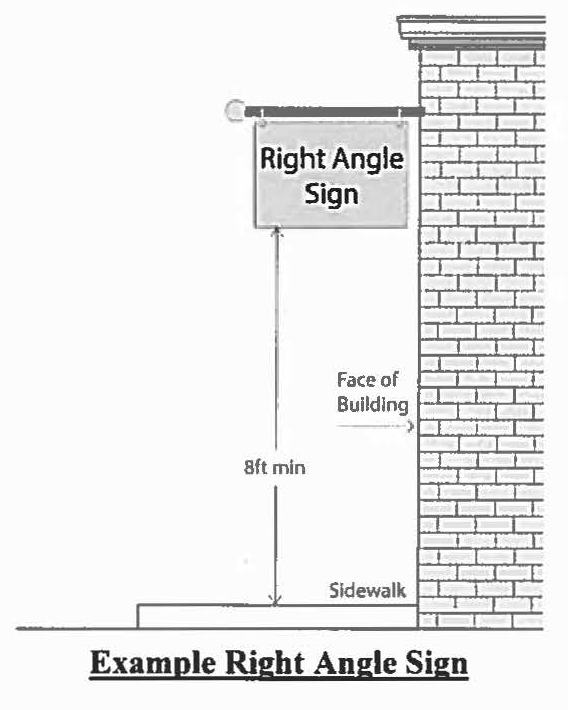
6.
Pedestrian signs. If any part of the building overhangs a public sidewalk, a business shall be entitled to an additional sign to be hung from the overhang which shall not be lower than eight (8) feet from the sidewalk. It may contain up to three (3) square feet of sign face on each side.
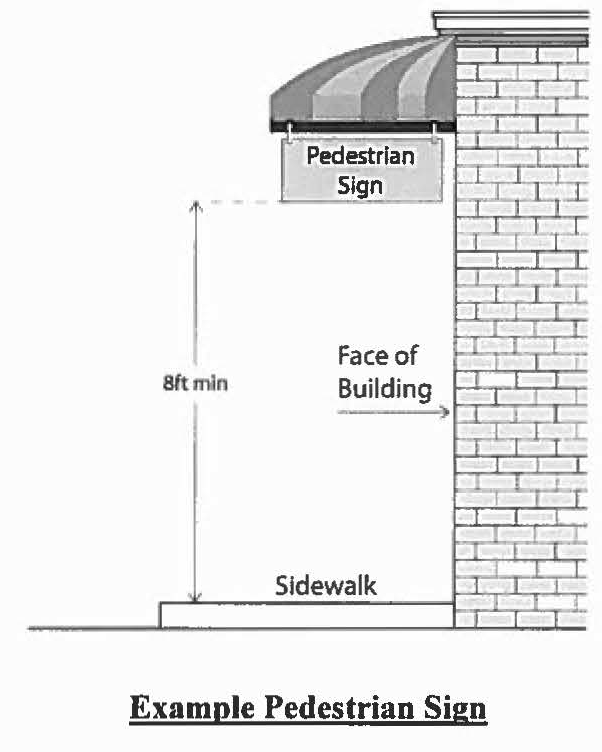
154-15.15. Lake Placid Regional Plan Sign District (U.S. 27 and General).
When annexed, the Lake Placid Regional Plan (LPRP) Sign District will consist of every parcel within the area outside of the town limits as of May 1, 2017, that are located within the Lake Placid Regional Plan. This district shall consist of parcels outside of the town limits as of May 1, 2017, that are located within the LPRP. The U.S. 27 (LPRP) District regulations shall apply to non-residential parcels with frontage on U.S. 27. The General (LPRP) Sign District shall apply to all other areas in the LPRP annexed after May 1, 2017. Signs in place prior to May 1, 2017 are grandfathered to the extent of their current lease.
In addition to the regulations in the U.S. 27 District and the General District, the following regulations shall apply throughout the Lake Placid Regional Plan District. Where inconsistency exists between these sign regulations, the more restrictive requirement shall apply.
The districts are indicated on the signage map earlier in this section.
1.
Small directional off-premises signs. Small directional off-premises signs may be permitted.
a.
Such signs shall not exceed two (2) square feet.
b.
No more than two (2) signs shall be permitted and shall be located within a one and one-half (1-1/2) mile radius of the geographic center of the property referenced on said sign.
2.
Sign height. Sign height in the LPRP Sign District shall not exceed eight (8) feet.
3.
Sign face area. Sign face area in the LPRP Sign District shall not exceed sixty-four (64) square feet.
4.
Community and public events. Banners and other attractors are prohibited within public right-of-way with the exception of those placed by local government to announce upcoming community and public events consistent with section 154-15.6.
5.
One-time event signs. The owner of record of a non-residential use, as determined through a business tax receipt, may apply for a sign permit to display one-time display (event) signs once during the lifetime of their non-residential use, for a period of up to thirty (30) consecutive calendar days. Signs may include banners and other allowable temporary signs, and the sign area of such signs shall not exceed the square footage requirements provided herein section 154-15.6. A new application for a one-time display (event) sign shall be allowed on the same property if there is a change in use and/or ownership that requires a new or revised business tax receipt.
6.
Monument signs. Monument signs rather than pole signs and ground signs are permitted to create a pedestrian scale signage and to allow for uniform signage throughout this district. Pole signs are prohibited.
154-15.16. Tables of sign development requirements by sign district.
Table 154-15.16.(A) Table of Sign Development Requirements for the General Sign District.
General Sign District
(Cross Reference: Section 154-15.12)
Note:
Additional building signage (three (3) signs up to ten (10) square feet each) may
be used on awnings, doors, canopies, marquees and windows.
1 Mansard roof sign and sign structures shall not extend above the roof line.
2 Either one (1) on building or one (1) on roof. Cannot be sloped roof.
3 Either one (1) on roof or one (1) on building. Cannot be sloped roof.
Table 154-15.16.(B) Table of Sign Development Requirements for the United States Highway 27 Sign District.
United States Highway 27 Sign District
(Cross Reference Section 154-15.13)
Note:Maximum total building signage. The total signage allowed on one (1) building (wall, roof and additional building signage) shall not exceed one (1) square foot of signage for each linear foot of street frontage, for each street frontage (up to (3) street frontages). The square foot signage shall be restricted to the street the signage fronts. Signs fronting two (2) streets shall count in both.
4 No part of any permanent freestanding sign shall extend beyond any right-of-way line or building setback.
5 Awnings are allowed and shall count in allowable signage for the building.
6 Mansard roof sign and sign structures shall not extend above the roof line.
7 Except where the locations of existing ground or pole signs on adjacent lots would make this requirement impossible to meet.
8 Signage is allowed on the front wall of the building. See 154-15.13.4., for additional information.
9 Signage and graphics may not extend beyond the wall surface (top or sides).
United States Highway 27 Sign District
(Cross Reference Section 154-15.13)
10 Must be approved by the LPA. See 154-13.7, for additional information.
11 Shopping centers with more than five (5) separate stores may petition the local planning agency for up to two hundred (200) square feet of sign face on each sign side.
Table 154-15.16.(C) Table of Sign Development Requirements for the Traditional Sign District.
Traditional Sign District
(Cross Reference Section 154-15.14)
Notes for Pedestrian Sign:
If any part of the building overhangs a public sidewalk, a business shall be entitled
to an additional sign to be hung from the overhang which shall not be lower than eight
(8) feet from the sidewalk. It may contain up to three (3) square feet of sign face
on each side. A sign is allowed a maximum two (2) sign faces.
12 No part of any permanent freestanding sign shall extend beyond any right-of-way line or building setback.
13 Awnings are allowed and shall count in the allowable building/wall signage requirements.
14 Mansard roof sign and sign structures shall not extend above the roof line.
15 Except where the locations of existing ground or pole signs on adjacent lots would make this requirement impossible to meet.
16 Signage is allowed on the front wall of the building and on any side wall which faces a public street.
17 Signage may not extend beyond the wall surface (top or sides).
Table 54-15.16.(D) Table of Sign Development Requirements for the Lake Placid Regional Plan Sign District.
U.S. 27 Sign District (Lake Placid Regional Plan)
(Cross Reference Section 154-15.15)
Note:Maximum total building signage. The total signage allowed on one (1) building (wall, roof and additional building signage) shall not exceed one (1) square foot of signage for each linear foot of street frontage, for each street frontage (up to (3) street frontages). The square foot signage shall be restricted to the street the signage fronts. Signs fronting two (2) streets shall count in both.
18 No part of any permanent freestanding sign shall extend beyond any right-of-way line or building setback.
19 Awnings are allowed and shall count in allowable signage for the building.
20 Mansard roof sign and sign structures shall not extend above the roof line.
21 Except where the locations of existing ground or pole signs on adjacent lots would make this requirement impossible to meet.
22 Signage is allowed on the front wall of the building. See 154-15.13.4., for additional information.
23 Signage and graphics may not extend beyond the wall surface (top or sides).
General Sign District (Lake Placid Regional Plan)
(Cross Reference Section 154-15.12)
Note:Additional building signage (three (3) signs up to 10 square feet each) may be used on awnings, doors, canopies, marquees and windows.
24 Mansard roof sign and sign structures shall not extend above the roof line.
25 Either one (1) on building or one (1) on roof. Cannot be sloped roof.
26 Either one (1) on roof or one (1) on building. Cannot be sloped roof.
154-15.17. Sign Removal.
154-15.17.1. Removal of illegal or prohibited signs.
A.
Prohibited signs on public property or rights-of-way shall be removed immediately and may, without notice, be removed by the town or its agent.
B.
Illegal or prohibited temporary signs or parasite signs shall be removed within twenty-four (24) hours after receipt of written notification of the code enforcement officer or town building official.
C.
Other signs prohibited in section 154-15.7, shall be removed by the owner, agent or person in charge of the premises, within twenty-four (24) hours after receipt of written notification by the code enforcement officer or town building official. If the sign is not removed within this time frame, the town may remove it at the owner's expense and/or the code enforcement officer may refer the violation to the Town of Lake Placid Code Enforcement Special Magistrate.
D.
Written notification shall be provided in the manner prescribed in the Code of the Town of Lake Placid, chapter 26, section 26-105, Notices, which allows said notifications to be delivered by certified mail or by hand.
E.
Repeat violations of this section are subject to chapter 26, of the Code of the Town of Lake Placid.
154-15.17.2. Removal of unsafe or abandoned signs.
Should any sign become insecure or in danger of falling, in disrepair or deteriorated, or otherwise unsafe in the opinion of the code enforcement officer or the town building official, the owner thereof, or person or firm maintaining it, shall upon written notification from the town, immediately remove the sign in the case of imminent danger, or secure the sign in conformance with the provisions of this code within thirty (30) days in other instances, or the code enforcement officer or designee shall have the sign removed at the expense of the owner.
When a business leaves a location, the signs pertinent to that business shall be removed by either the tenant or the landlord. If a new business will be moving in immediately, a box-type sign cabinet may be re-used by the new business operator by inserting a new "face" in the sign.
If a new business is not moving in within sixty (60) days of the former leaving, then one of the following shall be required until a new business rents the space:
1.
A blank panel may be inserted to replace the sign face of the prior business;
2.
The existing sign face may be reversed so that the blank side of the panel is showing;
3.
A sock or boot may be used to cover the sign.
In no case shall a sign box be left with a broken or missing sign panel. In cases where totally new signs or awnings are being installed for a business, the old signs they replace shall be completely removed.
154-15.18. Signs after disaster.
This section grants relief for permitted signs damaged or destroyed by disaster (fire, hurricane, calamity or similar events).
154-15.18.1. Permits.
This section does not exempt disaster signage from permitting. A permit is required for signs allowed under this section. However, there is no permit fee. Two (2) types of permits are available:
1.
The town's mayor or mayor's designee may issue a temporary disaster sign permit allowing an approved disaster sign to be displayed for sixty (60) days.
2.
The town's planning and zoning official may issue a disaster sign permit allowing an approved disaster sign to be displayed for sixty-day increments, up to a total of one hundred eighty (180) days. Temporary disaster sign permits and disaster sign permits under this section expire when:
1.
The time stated in the permit expires;
2.
The regularly permitted signage is erected; or
3.
The regularly permitted signage could reasonably be erected, as determined by the town's planning and zoning official.
154-15.18.2. Post disaster signage.
Total post disaster signage may not exceed the signage allowed for the respective parcel by the town Code. However, the following post disaster signage may be approved:
A.
Where pole, ground, or monument signs are permissible, a temporary wooden sign (plywood and posts) may be erected. However, the temporary sign may not be higher or have greater square feet than the permissible pole, ground or monument sign.
B.
When signs affixed to the face of a building or roof have been damaged or destroyed, they may be replaced temporarily with a banner affixed to the same structure (if said structure remains).
154-15.19. Violations and penalties.
It is a violation of this code for property owners, tenants or occupants of property to maintain, install or allow a sign which is not permitted, exempt from the permit requirements of this code, or otherwise not in compliance with this code, to be on property which they own, lease or otherwise occupy.
154-15.19.1.
Violations of section 154-15 shall be prosecuted and otherwise punished under the code enforcement provisions of chapter 26 of the Code of the Town of Lake Placid, Florida.
154-15.19.2.
The following are unlawful and violations of the Code of the Town of Lake Placid, to wit:
A.
Constructing or maintaining a sign in violation of section 154-15.7, Prohibited signs and violations, of the town Code is a class II violation which shall be penalized according to subsection 26-482(a) of the town Code.
B.
The initial illegal placement of a snipe sign is a class I violation of the town Code which shall be penalized according to subsection 26-482(a) of the town Code.
154-15.19.3.
All notices required or allowed under this chapter shall be made according to section 26-105 of the Code of the Town of Lake Placid, Florida.
154-15.19.4.
Violations of section 154-15 shall be penalized and fined as a class II violation according to section 26-482 of the Code of the Town of Lake Placid, Florida.
154-15.20. Severability.
If any part, section, subsection, paragraph, subparagraph, sentence, phrase, clause, term, or word of this chapter is declared unconstitutional by the valid judgment or decree of any court of competent jurisdiction, the declaration of such unconstitutionality shall not affect any other part, section, subsection, paragraph, subparagraph, sentence, phrase, clause, term, or word of this chapter.
154-15.20.1. Severability where less speech results.
Without diminishing or limiting in any way the declaration of severability set forth above in section 154-15.20, or elsewhere in this chapter, this code, or any adopting ordinance, if any part, section, subsection, paragraph, subparagraph, sentence, phrase, clause, term, or word of this chapter is declared unconstitutional by the valid judgment or decree of any court of competent jurisdiction, the declaration of such unconstitutionality shall not affect any other part, section, subsection, paragraph, subparagraph, sentence, phrase, clause, term, or word of this chapter, even if such severability would result in a situation where there would be less speech, whether by subjecting previously exempt signs to permitting or otherwise.
154-15.20.2. Severability of provisions pertaining to prohibited signs.
Without diminishing or limiting in any way the declaration of severability set forth above in section 154-15.21, or elsewhere in this chapter, this code, or any adopting ordinance, if any part, section, subsection, paragraph, subparagraph, sentence, phrase, clause, term, or word of this chapter or any other law is declared unconstitutional by the valid judgment or decree of any court of competent jurisdiction, the declaration of such unconstitutionality shall not affect any other part, section, subsection, paragraph, subparagraph, sentence, phrase, clause, term, or word of this chapter that pertains to prohibited signs, including specifically those signs and sign-types prohibited and not allowed under section 154-15.7 of this chapter. Furthermore, if any part, section, subsection, paragraph, subparagraph, sentence, phrase, clause, term, or word of section 154-15.7 is declared unconstitutional by the valid judgment or decree of any court of competent jurisdiction, the declaration of such unconstitutionality shall not affect any other part, section, subsection, paragraph, subparagraph, sentence, phrase, clause, term, or word of section 154-15.7.
(Ord. No. 95-221, §§ 2—24, 11-6-95; Ord. No. 96-236, § 2, 4-1-96; Ord. No. 04-418, §§ 1, 2, 8-9-04; Ord. No. 2004-430, §§ 1—4; 11-29-04; Ord. No. 05-435, §§ 1, 2, 3-14-05; Ord. No. 05-451, §§ 1, 2, 5-9-05; Ord. No. 06-484, §§ 1—4, 3-13-06; Ord. No. 2006-485, §§ 1—3, 2-13-06; Ord. No. 2010-610, § 1, 7-12-10; Ord. No. 2011-641, § 1, 11-28-11; Ord. No. 2015-702, § 1, 10-12-15; Ord. No. 2016-726, § 1, 3-13-17)
§ 154-16. - Side yards on corner lots.
The side yard adjacent to the secondary street on a corner lot shall provide a setback of twenty (20) feet for the rear portion of the lot within fifty (50) feet of the rear lot line and at least twelve (12) feet for the remainder of the lot to the front building line.
(Ord. No. 2016-723, § 15, 6-12-17)
§ 154-17. - Commercial architectural standards.
In addition to all other applicable requirements of this Code, commercial buildings must adhere to the standards set out herein (except in areas zoned C-3) (See subsection 154-27(j) for regulations in C-3). All buildings within the agricultural future land use and zoning districts within the Lake Placid Regional Plan (LRPR) areas are exempt from the regulations in section 154-17. The town may adopt a resolution containing graphics and images of desired architectural styles to serve as a guide for developers.
154-17.1. Facades on commercial buildings.
Facades on commercial buildings shall be constructed according to the following standards:
(1)
Definitions.
A.
Facade means the exterior face of the building.
B.
Primary facade means a facade that faces a public or private street, entry courtyard or right-of-way. A maximum of two (2) facades will be considered primary facades, when more than two (2) facades of a building have frontage on public streets.
(2)
Color. An earth tone palette (browns and beiges) are encouraged to the maximum extent possible. The use of black, fluorescent, primary and secondary colors should be limited to no more than ten (10) percent of the affected facade, or the roof area. Building trim and accent areas may feature any color.
(3)
Exterior building materials.
A.
The following is a list of preferred exterior building materials:
i.
Stucco;
ii.
Concrete;
iii.
Brick;
iv.
Wood; and
v.
Stone veneer.
B.
The use of neon or neon-type tubing is not permitted to outline the exterior or the roof of a building.
C.
The following shall not be used as exterior finishes: Metal (except for the roof, mansard, soffit, fascia and ten (10) percent exterior finish), struck concrete block, plywood, T-111 and similar products.
D.
Upon temporary approval by the mayor in an emergency, a mobile and/or modular unit shall be exempt from the exterior building material requirement. Mobile and modular units shall not be used as temporary or permanent commercial or industrial buildings, except as approved by the mayor in an emergency and for less than nine (9) months or until not needed, whichever comes first.
(4)
Primary facades.
A.
Buildings located along a public or private street or pedestrian right-of-way shall be designed with an entrance to the building or an entry courtyard facing or abutting the street or pedestrian right-of-way.
B.
Design features. The design of the primary facades shall include, at a minimum, two (2) of the following design features:
i.
Glazing covering at a minimum thirty (30) percent of the primary facade area, consisting of window and glazed door openings.
ii.
Projected, or recessed covered public entry providing a minimum horizontal dimension of eight (8) feet, and a minimum area of one hundred (100) square feet.
iii.
Covered walkway, or arcade (excluding canvas type). The structure shall be permanent, and its design shall relate to the principal structure. The minimum width shall be eight (8) feet, with a total length measuring sixty (60) percent of the length of the associated facade.
(5)
Out-parcels.
A.
Primary facades. All facades on an out-parcel building which face a street (public or private) are considered primary facades and shall be constructed as primary facades (provided however that one (1) side of the building may be constructed without facade compliance). Out-parcels are not limited by subsection 154-17.1(1)(B) to two (2) facades.
B.
When the use of common wall, side-by-side development occurs, continuity of facades and consolidated parking for several businesses on one (1) parking lot may be used.
C.
Out-parcel structures that are adjacent to each other must provide for vehicular connection between their respective parking lots and provide for connection of pedestrian walkways.
154-17.2. Roof treatments.
Roof treatments on commercial buildings shall be constructed to the following standards:
(1)
Roof types and materials.
A.
The following roof types are permitted:
i.
Dome;
ii.
Gable;
iii.
Hip; or
iv.
Parapet.
B.
The following roof materials are permitted, exclusively:
i.
Tile;
ii.
Metal; or
iii.
Shingles, except that asphalt shingles are prohibited, unless such asphalt shingles are laminated, three hundred twenty (320) pound, thirty-year architectural grade asphalt shingles or better.
C.
Mansard roofs and canopies are prohibited, unless they meet the following standards including the Florida Building Code, whichever is more restrictive:
i.
Minimum height clearance of eight (8) feet is required for buildings larger than twenty thousand (20,000) square feet;
ii.
Minimum height clearance of seven (7) feet is required for buildings of up to twenty thousand (20,000) square feet of gross floor area;
iii.
The roof angle shall not be less than twenty-five (25) degrees, and not greater than seventy (70) degrees.
(2)
Parapets.
A.
Capped parapets are required on all flat roofs.
B.
If a roof contains rooftop equipment, the parapet must be sufficient to conceal such rooftop equipment from ground-level public view.
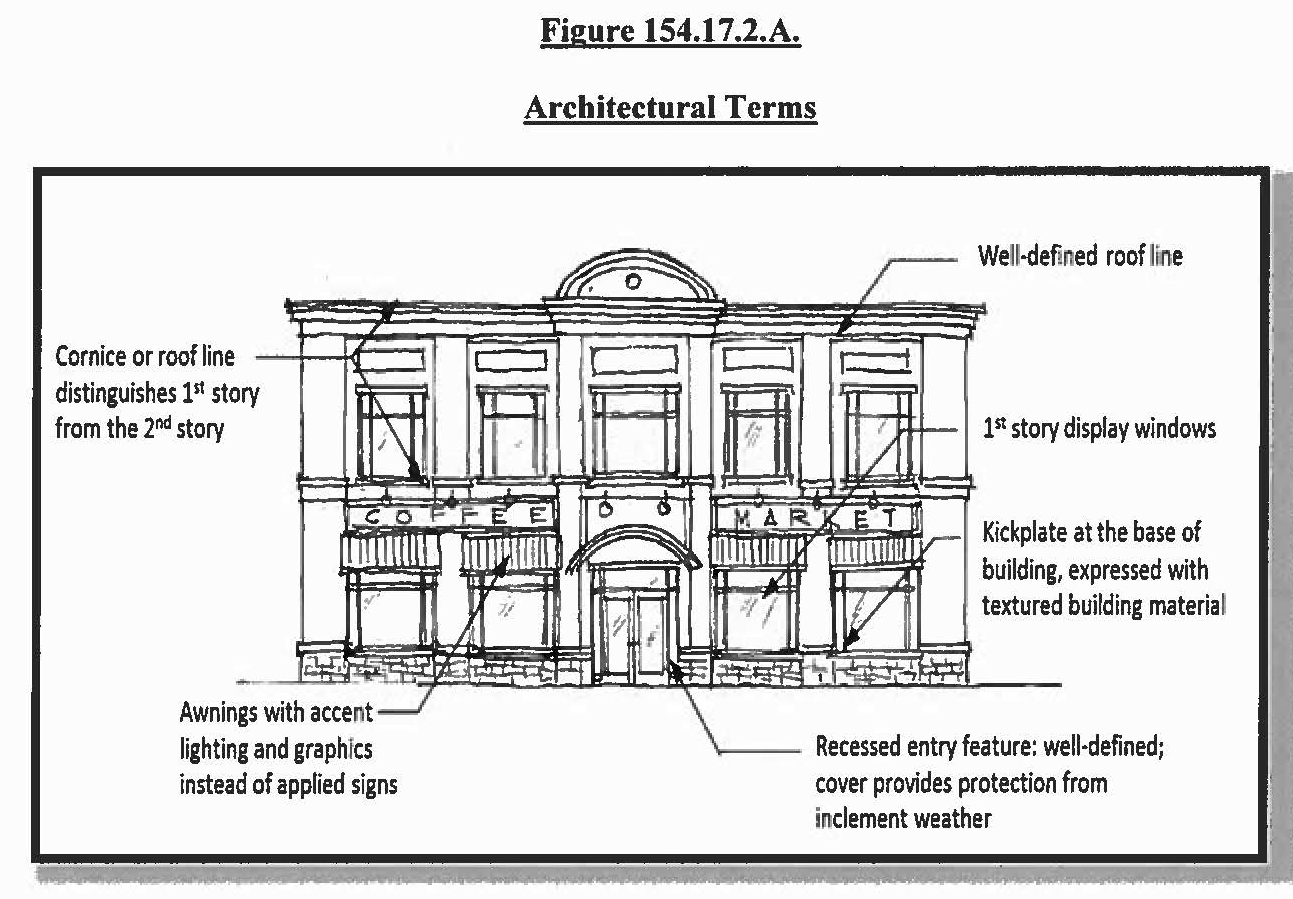
154-17.3. Ceilings in commercial buildings.
(1)
Interior ceilings in commercial buildings shall be no less than ten (10) feet above the floor height immediately below the ceiling section in question.
(2)
Pre-existing, noncomplying buildings are exempt from this requirement.
154-17.4. Commercial Architectural Standards Variance Process.
The Town Council may grant a variance from the commercial architectural standards following the process outlined in this section.
(1)
Application. The following shall be provided for any variance request:
A.
The applicant shall submit an application, drawings and detailed description of proposed alternative, and application fee to the Planning and Zoning Official, or his or her designee.
B.
The drawings and detailed description shall detail the proposed exceptions to the strict application and enforcement of the Architectural Standards contained in this Section.
(2)
Required findings:
A.
The particular characteristics of the use of alternative materials and/or design and/or color choices, will be consistent with the overall Architectural Standards and in keeping with the desired character for the town.
B.
The effect of the variance does not nullify the purpose and intent of the Town's Architectural Standards.
C.
The approval of the variance upholds the public interest.
D.
The approval of the variance is not contrary to the Town's Comprehensive Plan.
(Ord. No. 05-463, § 1, 8-8-05; Ord. No. 2016-723, § 16, 6-12-17; Ord. No. 2022-06, §§ 1, 2, 7-11-22)

