
Lake Waccamaw City Zoning Code
ARTICLE I
- PURPOSE, AUTHORITY, AND DEFINITIONS
Sec. 1-1. - Purpose.
The purpose of this ordinance is to guide the development of Lake Waccamaw, North Carolina, and to facilitate the adequate provision of transportation, sewerage and water systems, parks and other public improvements, to regulate the location and use of land and buildings, the erection, reconstruction and alteration of buildings, the height and size of buildings, and the density of population, to divide the town into districts of such number, shape and size as may be best suited to carry out said purposes; and to encourage the appropriate use of land throughout the town utilizing the recommendations of the Land Use Development Plan to promote the health, safety, and general welfare of the Town of Lake Waccamaw.
Sec. 1-2. - Authority.
This ordinance is adopted pursuant to the authority vested in the Town of Lake Waccamaw by its Charter, Chapter 160A of the General Statutes of North Carolina, and other local legislation.
Sec. 1-3. - Definitions.
For the purpose of this ordinance, the following words, phrases, terms and their derivations shall have the meaning given herein.
Unless the context clearly indicates to the contrary, words used in the present tense include the future; words used in the plural number include the singular, and words used in the singular include the plural; the word "herein" means in this ordinance; the words "shall" or "must" are mandatory and not directory; the word "building" includes the word "structure," and the words "structure" and "building" shall include any part thereof; the words "used" or "occupied" shall be construed to include the words "intended, arranged or designed to be used or occupied."
A person shall include a corporation, a partnership and an unincorporated association such as a club; the word "development" shall be construed so as to include development by cooperative or collective or other similar means of development through common ownership or through the use of lease-hold estates; and the words "immediately adjacent" shall be construed to mean all land abutting the subject property and extending two hundred (200) feet there from or, when said property so defined includes right-of-way, it shall mean all land abutting the right-of-way and extending two hundred (200) feet therefrom.
The term "town board" means the Lake Waccamaw board of commissioners; the term "planning board" means the planning board of Lake Waccamaw; the term "board of commissioners" means the Columbus County Board of Commissioners; and the term "board" means the Lake Waccamaw board of adjustment.
1.
Accessory buildings. A subordinate building including private garages and noncommercial buildings such as greenhouses and workshops, the use of which is customarily incidental and subordinate to that of a principal use or building located on the same lot. Accessory buildings may neither connect to nor share a common roof with the main structure. Accessory buildings may not be occupied or rented. Indoor water or sewer service may not be allowed to such structures, unless a primary building already exists on site. In addition, not more than one camping trailer, motor home, or similar recreational vehicle may be parked by any property owner on his/her own property, nor shall the camping trailer, motor home, or similar recreational vehicle be occupied, connected to water, sewage, or power supply, and must be parked within applicable setback lines. This provision shall not apply to trailer parks, whether or not the property is being used for a conforming or for a permissible nonconforming use.
2.
Accessory use. A structure or use that:
(a)
Is clearly incidental to and customarily found in connection with a principal building or use;
(b)
Is subordinate to and serves a principal building or a principal use;
(c)
Is subordinate in area, extent, or purpose to the principal building or principal use served;
(d)
Contributes to the comfort, convenience, or necessity of occupants, business, or industry in the principal building or principal use served; and
(e)
Is located on the same lot as the principal building or use served.
3.
Adult entertainment business. Any place defined as an "adult establishment" by G.S. 14-202.10 as such statute may be amended, except that the definition of massage business shall not include any establishment or business where massage is practiced that is a health club, exercise studio, hospital, physical therapy business, or similar health related business. Adult oriented business specifically includes however, any massage business where massages are performed on any clients "specified anatomical areas" as this term is defined by G.S. 10-202.10, as amended. This term may also be used interchangeably with sexually oriented business.
4.
Adult establishment. An adult bookstore, adult motion picture theater, adult cabaret, or a massage business as defined in this chapter.
5.
Agriculture.
Agriculture—Vegetative. The activity of cultivating the soil and/or producing crops; and
Agriculture—Livestock. The activity of raising livestock. Minimum lot size for livestock activities:
Fowl averaging under five (5) pounds in weight. The number of such fowl shall not exceed twenty-five (25) per acre or a maximum of four hundred (400). All housing structures, outdoor feeding pens and feeding areas shall be set back one (1) foot per fowl from all property lines. All fowl must be confined or fenced together.
Fowl averaging over five (5) pounds in weight. The number of such fowl shall not exceed three (3) per acre or a maximum of thirty-five (35). All housing structures, outdoor pens and feeding areas shall be set back ten (10) feet per fowl from all property lines. All fowl must be confined or fenced together.
Livestock, other than fowl shall not exceed three (3) per acre or a maximum of thirty-five (35). All housing structures, outdoor pens and feeding areas for such animals shall be set back ten (10) feet per animal for all property lines. Such animals shall not be confined together. Offspring less than thirty (30) days old shall not be included in the number per acre.
The proposed definition described above will be used in the zoning districts within the town limits and within the extraterritorial jurisdiction as follows:
By definition, "livestock" means domestic animals kept for use on a farm or raised for sale or profit.
6.
Alley. A roadway which affords only a secondary means of access to abutting property is not intended for general traffic circulation.
7.
Amphitheater. An oval or circular building with rising tiers of seats about an open space called the arena.
8.
Amusement establishment. An establishment offering sports, theatrical productions, game playing, or similar amusements to the public within a fully enclosed building. This shall include, but is not limited to, theaters, bowling alleys, billiard parlors, and skating rinks. This shall not include recreation centers or such amusements, which are accessory to churches, schools, or colleges.
9.
Apartment. A suite of rooms or a room in a multifamily dwelling arranged and intended as a place of residence for a single family.
10.
Automobile service station. Any building, structure, or lot used for one or more of the following:
(1)
Dispensing, selling, or offering for retail sale, gasoline, kerosene, lubricating oil, or grease for the operation and maintenance of automobiles, including the sale and installation of tires, batteries and other minor accessories and services for automobiles; or
(2)
The business of repairing automobiles. This shall not include car washes, the retreading and/or recapping of tires, or convenience stores which sell gasoline or lubricating oil, but not other automotive accessories or services.
11.
Awning. Any non-rigid material such as fabric or flexible plastic that is supported by or attached to a frame and that extends from the exterior wall of a building.
12.
Bakery plant. A place for baking and sale of bread, cookies, pastries and similar items.
13.
Bed and breakfast inn. An owner-occupied dwelling or portion thereof offering rooms to transient lodgers in return for compensation, with or without meals. The use of a dwelling as a Bed and Breakfast Inn shall not be considered as an accessory use or a customary home occupation.
14.
Boat repair area. A place designated for the repair and storage of boat for a period not to exceed thirty days.
15.
Boarding school. An educational facility where students are provided with meals and lodging
16.
Buffer zone. A strip of land created to separate and protect one type of land use from another.
17.
Building area. The total area of a lot covered by a structure measured on a horizontal plane at mean grade level exclusive of uncovered patios, terraces and steps.
18.
Building height. The height of a building shall be measured from the average finished grade at the front of a building or structure to the highest point of the building.
19.
Child day care center. A place receiving a payment, fee or grant for the care of more than five (5) children, thirteen (13) years of age or less, for more than four (4) hours per day, without transfer of custody.
20.
Child day care home. A home or facility, registered in Article 7 of chapter 110 of the North Carolina General Statutes, wherein at least two (2) but not more than five (5) children less than thirteen (13) years of age receive care away from their own home by persons other than their own parents, legal guardians, or relatives within the fourth degree of kinship, on a regular basis more than once per week for more than four (4) hours per day. The facility must operate twelve (12) hours per day or less. All children other than the children of the operator must be counted. Cooperative arrangements among parents to provide care for their own children as a convenience rather than for employment are not included, provided there are no paid staff. Child day care homes shall be considered a home occupation. The operator of the home must reside on the premises. The home must meet applicable requirements of the North Carolina State Building Code. Child day care homes are permitted by right in all residential districts.
21.
Children's home. A facility where childcare for at-risk children in residential care, family foster care and emergency care placement is provided. The program of care may include educational, social, and spiritual development.
22.
Church or house of worship. Any permanent structure designed or adapted for use by members of a church, temple, synagogue, mosque, or the like for the purpose of prayer, religious service or other rite showing reverence or devotion for a deity. Where permitted by right or condition in this ordinance, activities at such facilities shall its members or congregation associate limited to those with worship or fellowship. Prohibited without further approval are such activities as education for preschool, primary, secondary and post secondary students, dormitory facilities, and ongoing commercial enterprise.
23.
Clubs and lodges, civic or fraternal. Private not-for-profit associations, corporations, or other entity consisting of persons who are bona fide paying members and which own, lease, or use a building, a parcel of land, or a portion thereof, the use of such premises being restricted primarily to members and their guests, including offices for local, state and regional officials of that organization.
24.
Commercial outdoor recreation. Includes intensely developed, for-profit recreational uses including, but not limited to: golf driving ranges not built or operated in conjunction with full-scale golf courses, par-3 golf courses, amusement park miniature golf courses, batting cages, skate board courses, bicycle moto-cross courses, water slides, drive-in movie theaters and courses for para-military games.
25.
Concealed or camouflaged communication tower. Communication towers and associated equipment which are totally concealed within an architectural feature of a building, within a structure or camouflaged so it is architecturally indiscernible shall be exempt from the regulations contained in the Telecommunications Ordinance. However, such towers shall comply with the sections governing EMF emissions and interference limitations.
26.
Conditional use. A use that may locate in certain zoning districts, provided it will not be detrimental to the public health and general welfare and will not of itself impair the integrity and character of the district as determined by the commissioners.
27.
Construction. Any new construction, building, reconstruction, erection, extension, betterment, or improvement of land providing a building or structure or any part thereof, which provides, adds to, repairs, or increases the floor area of a residential or nonresidential use.
28.
Convenience store. A small retail store that is open long hours and that typically sells staple groceries, snacks, and sometimes gasoline.
29.
Conversion. The alteration of the use of an existing building to another type of use.
30.
Day care home, large. A day care facility established in a residential dwelling for the care and keeping of unrelated children meeting the definitions set forth in G.S. 110-86 and T-10 N.C. Administrative Code 3U.0102.
31.
Day care home, small. A day care facility established in a residential dwelling for the care and keeping of unrelated children meeting the definition set forth in G.S. 110-86 and T-10 N.C. Administrative Code 3U.0102.
32.
Deck. An unenclosed structure designed for open-air recreation and leisure. A deck may be covered by the floor of another room or deck, but not by a roof. The installation or permanent screening to wall or roof enclosures shall be regarded as the conversion of a deck into a porch.
33.
Dependent living unit. A dwelling unit, which is part of a life care community that does not include complete facilities for independent living. A dependent living unit is typically associated with such ancillary services including but not limited to central dining, nursing care, more than occasional medical care and physical therapy.
34.
Detached. Not physically connected to another building or structure.
35.
Developable acreage. That portion of a parcel of land which is developable under the provisions of this ordinance, not including rights-of-way for collector or larger streets, areas of special flood hazard or areas with slopes of greater than twenty percent (20%).
36.
Dimensional nonconformity. A nonconformity situation that occurs when the height, size, or minimum floor space of a structure or the relationship between an existing building or lot line does not conform to the regulations applicable to the district in which the property is located.
37.
Dwelling, attached. A building which contains two to four dwelling units which share one or more common walls for 50 percent [(50%)] or more of their width, with each dwelling unit located on a separate lot.
38.
Dwelling, detached. A building which is developed with open yards on all sides and contains one dwelling unit, not being attached to any other building or dwelling unit and does not sit on the same lot as any other dwelling unit. This shall not include a manufactured home or mobile home, but shall include single-family detached and patio homes.
39.
Dwelling, duplex. A building that contains two dwelling units that share a common wall or ceiling/floor and sit on the same lot, with open yards on all sides and not being attached to any other building.
40.
Dwelling, patio. A single-family detached or semi-detached dwelling unit built in groups of two or more. Each dwelling unit is built on a small lot owned in fee simple by the owner of the dwelling unit. Each group of two or more dwelling units with their appurtenant lots are located on a larger lot which is owned in common by the owners of dwelling units and fee simple lots.
41.
Dwelling unit, multifamily. A building designed to be occupied by two (2) or more families living independently of each other and each unit containing sleeping, kitchen, and bathroom facilities.
42.
Dwelling unit, single-family. An enclosure containing sleeping, kitchen and bathroom facilities designed for and used or held ready for use as a permanent residence by one (1) family. If house has [an] upstairs, stairs must be placed inside of structure.
43.
Easement. Authorization by a property owner for the use of another party, for a specific purpose, of any designated part of said property without conferring exclusive possession.
44.
Educational facility. A site, usually including a building or series of buildings, that is intended to be used to provide a learning experience.
45.
Extra-territorial jurisdiction. A defined area extended one (1) mile beyond the town limits and an area within two thousand (2,000) feet from the shoreline of Lake Waccamaw.
46.
Extended care facility. An establishment with support and supervisory personnel that provides health care and rehabilitation services for elderly or handicapped persons.
47.
Family. One (1) or more persons living together that are related by blood, adoption, or marriage, living and cooking together as a single housekeeping unit, exclusive of household servants. A number of persons but not exceeding two (2) living and cooking together as a single housekeeping unit though not related by blood, adoption, or marriage, shall be deemed to constitute a family.
48.
Family care home. A home, licensed pursuant to G.S. chapter 131D, article I that provides room and board, personal care and habitation services in a family environment for not more than six (6) permanent resident handicapped persons.
49.
Farm, bona fide. The raising of crops, livestock, or other plants and animals, including orchards, vineyards, and nurseries, along with any buildings and structures that are customarily and necessarily incidental to such activities. This shall include the retail sale of products grown or raised on the premises.
50.
Farm market. An area which is used by one or more operators of bona fide farms for the sale of agricultural products which are not grown or raised on the same premises as the market.
51.
Fence. A structure used to delineate a boundary or as a barrier or means of protection, confinement, or screening.
52.
Forestry (production and harvesting). The science of planting and caring for forests and the management of growing and harvesting of timber.
53.
Frontage. The property abutting one (1) side of a street or public way, measured along the right-of-way line.
54.
Garage, private. A building used as an accessory to the main building permitted in any district, and providing for the storage of motor vehicle and in which no business, occupation, or service is conducted.
55.
Garage, public. Any building, except those described as a private garage, used for the storage or care of motor vehicles.
56.
Golf course. A tract of land designed for and laid out for the game of golf and containing at least nine [(9)] tees, fairways, greens and holes. A clubhouse and buildings and facilities ordinarily associated with a golf course are included.
57.
Guesthouse (tourist home, boarding house). Any dwelling occupied by owner or operator in which five (5) rooms or less are rented for lodging of transients and travelers for compensation.
58.
Halfway house. Therapeutic residences that provide a sheltered and transitional environment for persons emerging from mental or penal institutions or drug treatment centers.
59.
Home occupation. A use that is clearly a customary, incidental, and secondary use of a residential dwelling unit. Criteria for the permitting of a home occupation is contained in article IV, section F.
60.
Housekeeping unit. Any part of a living area used to prepare food in any manner for human consumption, the existence of two (2) or more of such areas shall create a conclusive presumption that the dwelling unit was designed for or is being used by two (2) or more families.
61.
Hotel. A building occupied or used as a more or less temporary abiding place of individuals or groups who are lodgers and in which there are six (6) or more sleeping rooms.
62.
Intersection obstructions. In order to provide an unobstructed view to persons using the streets and roads of the Town of Lake Waccamaw, corner lots shall be clear of all obstructions above 2.5 feet and below ten (10) feet in height, except tree trunks and poles, for a distance of twenty (20) feet in each direction from the intersecting point of the edges of pavement of the streets or road.
63.
Junkyard. An area where scrap metal or other waste is bought, sold, exchanged, or handled on an ongoing basis, including automobile salvage and wrecking yards.
64.
Kindergarten. A program or class for children that serves as an introduction to school. Kindergartens may be in a private or public facility.
65.
Land use plan. The adopted land use development plan of the Town of Lake Waccamaw.
66.
Livestock. Domestic animals kept for use on a farm or raised for sale or profit.
67.
Lot. A parcel of land occupied or capable of being occupied by a building or group of buildings devoted to a common use, together with the customary accessories and open spaces belonging to same.
68.
Lot area. The total horizontal area enclosed with lot lines.
69.
Lot, corner. A lot which has at least two (2) adjoining sides which abut a street or other public right-of-way, provided that the angle of intersection of the two (2) lines is less than one hundred thirty-five (135) degrees.
70.
Lot coverage. That portion of a lot occupied by a structure, either at ground level or the equivalent thereto when a structure is elevated on pilings.
71.
Lot depth. The distance between the midpoints of straight lines connecting the foremost points of the side lot lines in front and the rearmost points of the side lot lines in the rear.
72.
Lot frontage. That portion of a lot abutting a street. For the purpose of determining yard requirements on corner lots and through lots, all sides of a lot adjacent to streets shall be considered frontage, and yards shall be provided as indicated under "yards" in this section. No lot shall front on an alley.
73.
Lot, interior. A lot other than a corner lot.
74.
Lot lines. The lines bounding a lot as defined herein.
75.
Lot line, front. The lines separating said lot from the street right-of-way.
76.
Lot of record. A lot which is a part of a subdivision recorded in the office of the Columbus County register of deeds, or a lot or parcel described by metes and bounds, the description of which has been recorded in the office of the Columbus County register of deeds.
77.
Lot, through. An interior lot having frontage on two (2) streets.
78.
Lot types. Figure 1 illustrates terminology used in this chapter with reference to corner lots, interior lots, reversed frontage lots and through lots.
Corner lot (A). A lot located at the intersection of two (2) or more streets. A lot abutting on a curved street or streets shall be considered a corner lot if straight lines drawn from the foremost points of the side lot lines to the foremost point of the lot meet at an interior angle of less than on hundred thirty-five (135) degrees. See lots marked A (1) in the diagram.
Interior lot (B). A lot other than a corner lot with only one frontage on a street.
Through lot (C). A lot other than a corner lot with frontage on more than one street. Through lots abutting two (2) streets may be referred to as double frontage lots.
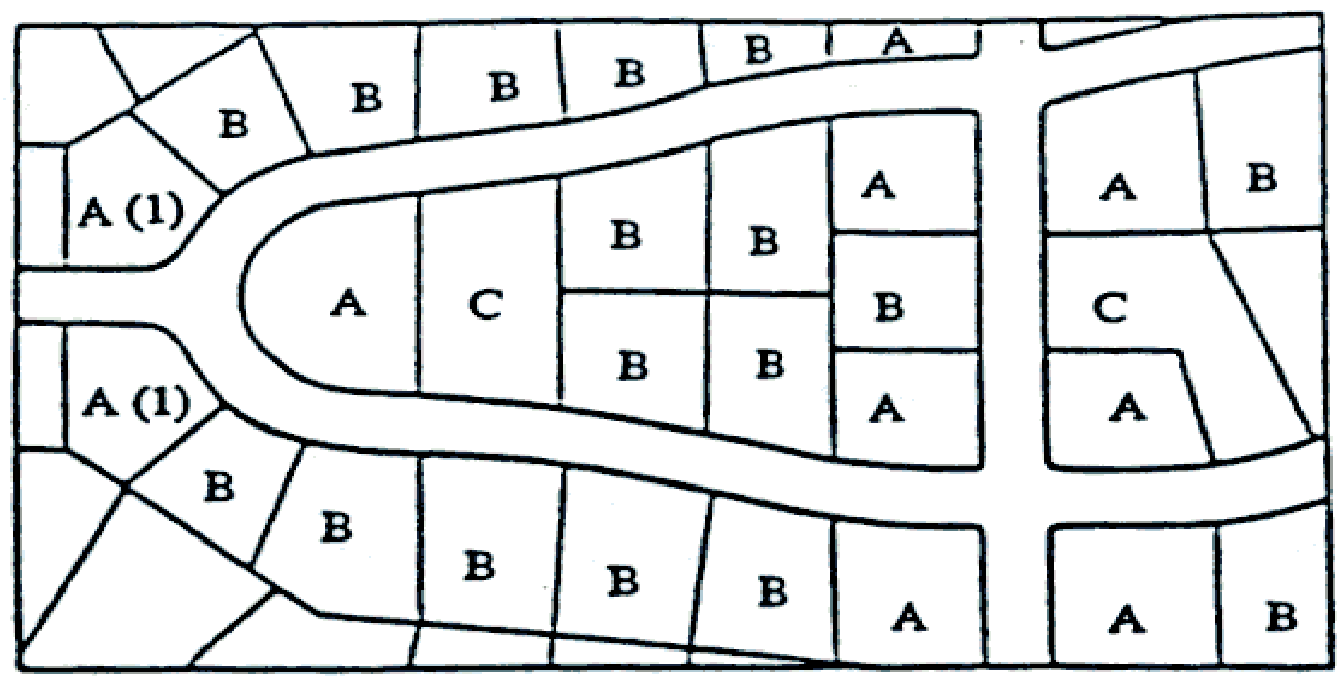
Figure 1
79.
Lot width. The distance between the side lot lines as measured at the rear of the required front yard, except for lots on the turning circle of cul-de-sacs which shall be at least eighty (80) percent of the required lot width and maintain an average lot width between the front and rear property lines of at least the minimum lot width for the zoning district in which the lots are located. The width between side lot lines at the foremost points (where they intersect with the street line) shall be at least eighty (80) percent of the required lot width, except on lots on the turning circle of cul-de-sacs.
80.
Major and/or multi-unit development. Development consisting of:
[(1)]
Structures on a tract of two (2) acres or more; or
[(2)]
Nonresidential structures having a total floor area of ten thousand (10,000) square feet or more shall submit a site plan as outlined in this chapter. This definition shall not apply to detached single and two-family housing units and uses customarily accessory thereto.
81.
Manufactured home/mobile home. A structure, transportable in one or more sections, which in the traveling mode is eight (8) body feet (2,438 body mm) or more in width or forty (40) body feet (12,192 body mm) or more in length, or, when erected on site, is three hundred twenty (320) square feet (30 m2) or more, and which is built on a permanent chassis and designed to be used as a dwelling with or with out a permanent foundation when connected to the required utilities, and includes the plumbing, heating, air conditioning and electrical systems contained therein; except that such term shall include any structure that meets all the requirements of this paragraph except the size requirements and with respect to which the manufacturer voluntarily files a certification required by the secretary (HUD) and complies with the standards established under this title. For mobile homes built prior to June 15, 1976, a label certifying compliance to the Standard for Mobile Homes, NFPA 501, in effect at the time of manufacture is required. For the purpose of these provisions, a mobile home shall be considered a manufactured home.
(Amended 05/10/2011)
82.
Manufactured home, Class A. A manufactured home constructed after July 1, 1976 that meets or exceeds the construction standards promulgated by the U.S. Department of Housing and Urban Development that were in effect at the time of construction and that satisfies the following criteria:
[(1)]
The manufactured home has a length not exceeding four (4) times its width, with length measured along the longest axis and width measured at the narrowest part of the other axis;
[(2)]
The manufactured home has a minimum of nine hundred sixty (960) square feet of enclosed and heated living space;
[(3)]
The pitch of the roof of the manufactured home has a minimum vertical rise of two and two-tenths (2.2) feet for each twelve (12) feet of horizontal run and the roof is finished with a type of shingle that is commonly used in standard residential construction;
[(4)]
All roof structures shall provide an eave projection of no less than six (6) inches, which may include a gutter;
[(5)]
The exterior siding consists predominantly of vinyl or aluminum horizontal lap siding (whose reflectivity does not exceed that of gloss white paint), wood, of hard board, comparable in composition, appearance and durability to the exterior siding commonly used in standard residential construction;
[(6)]
The manufactured home is set up in accordance with the standards set by the North Carolina Department of Insurance and a continuous, permanent masonry foundation or masonry curtain wall, unpierced except for required ventilation and access, is installed under the perimeter of the manufactured home; Class B manufactured homes can be underpinned with either vinyl, masonry, or aluminum;
[(7)]
Stairs, porches, entrance platforms, ramps, and other means of entrance and exit from the home shall be installed or constructed in accordance with the standards set by the North Carolina Department of Insurance, attached firmly to the primary structure and anchored securely to the ground; and
[(8)]
The moving hitch, wheels and axles, and transporting lights have been removed;
[(9)]
Class A and Class B manufactured homes cannot be used for commercial purposes.
83.
Manufactured home, Class B. A manufactured home constructed after July 1, 1976, that meets or exceeds the construction standards promulgated by the U.S. Department of Housing and Urban Development that were in effect at the time of construction, and that meet or exceed criteria (6), (7), (8), and (9) for Class A homes.
84.
Manufactured home, Class C. A manufactured home that does not meet the definitional criteria of a Class A or Class B manufactured home.
85.
Marina. A boat basin that has docks, moorings, supplies, and other facilities for boats.
86.
Medical clinic. A place where physicians and other licensed health care practitioners are located and treat patients.
87.
Mobile home park. A parcel of land, which has been planned and improved for the placement of mobile homes for residential purposes.
88.
Modular home.
(a)
A dwelling unit constructed in accordance with the standards set forth in the North Carolina State Building Code and composed of components substantially assembled in a manufacturing plant transported to the building site for final assembly on a permanent foundation and must contain a numbered North Carolina State Building Code Seal. Blueprints are required to show points of sections and details for the building inspector. Among other possibilities, a modular home may consist of two (2) or more sections transported to the site in a manner similar to a manufactured home (except that the modular home meets the North Carolina State Building Code), or a series of panels or room sections transported on a truck and erected together on the site.
(b)
A modular home must be transported to the site by a conveyance.
(c)
A modular home must meet the same engineered foundation requirements as a site built house, i.e., it must have a permanent poured concrete footer/footings with load bearing block or brick walls and support piers. The dwelling must be permanently attached to the foundation according to North Carolina State Building Code.
(d)
The roof pitch shall be a minimum of three (3") [inch] rise on a twelve (12") inch horizontal run and the gable overhang shall be in accordance with the North Carolina Building Code, Volume VII, Section 40.
Modular homes that do not meet the required definition for residential areas may be allowed in the mobile home overlay district.
89.
Motel. Land developed for a single structure or a group of structures of permanent construction that contains guest rooms with vehicle parking space and utility structures provided to support the primary use.
90.
Museum. A depository for collecting and displaying objects having scientific, historical or artistic value.
91.
Nature exhibits. A site (usually but not exclusively outdoors) that is primarily devoted to exhibits of plants and animals typically in their natural setting.
92.
Neighborhood. A residential area whose residents have public facilities and social institutions in common and generally within walking distance of their homes.
93.
Nonconforming lot. A lot existing at the effective date of this ordinance or any amendment to it that cannot meet the lot requirements of the district in which the lot is located.
94.
Nonconforming project. Any structure, development, or undertaking that is incomplete at the effective date of this ordinance and would be inconsistent with any regulation applicable to the district in which it is located if completed as planned.
95.
Nonconforming situation. A situation that occurs when, on the effective date of this ordinance or any amendment to it, an existing lot or structure or use of an existing lot or structure does not conform to one (1) or more of the regulations applicable to the district in which the lot or structure is located.
96.
Nonconforming use. A nonconforming situation that occurs when property is used for a purpose or in a manner made unlawful by the use regulations applicable to the district in which the property is located.
97.
Nonprofit camp and recreation center. One (1) or more buildings or structures located on one (1) or more lots providing housing in conjunction with temporary religious activities, shared food preparation and dining areas, related service facilities, recreational opportunities as well as significant social and counseling facilities to meet the needs of the youth, adults and their guardians that reside in the camp. (Ex. The Anchorage, Ambassador Camp)
(Adopted, April 8, 2003)
98.
Off-street parking facilities. Any area, either open or enclosed, off the public right-of-way that is designed for the parking of motor vehicles.
99.
Open space. Any portion of a parcel or area of land or water which is open and unobstructed by structures from the ground to the sky including areas maintained in a natural and undisturbed character. Open space may include recreational facilities such as swimming pools, golf courses, greenways and tennis courts.
100.
Open space, common. Any portion of a parcel or area of land or water, which is open and unobstructed from the ground to the sky including areas maintained in a natural and undisturbed character. Open space may include recreational facilities such as swimming pools, golf courses, greenways and tennis courts. Such property shall be owned by a public entity or a homeowners association. The future uses of such property shall be limited to uses not incompatible with the definition of open space by covenant or other deed restriction.
101.
Ordinary high-water mark. The line on the shore established by the fluctuations of water and indicated by physical characteristics such as a clear, natural line impressed on the bank, shelving, changes in the character of soil, destruction of terrestrial vegetation, the presence of litter and debris, or other appropriate means that consider the characteristics of the surrounding areas.
102.
Parking lot. An area or plot of land used for the storage or parking of vehicles.
103.
Person. Any individual, partnership, firm, association, joint venture, public or private corporation, trust, estate, commission, board, public or private in situation, utility, cooperative, interstate body, or other legal entity.
104.
Planned unit development (PUD). A PUD is a land development project planned as a single entity by means of a unitary site plan which permits flexibility on building, siting, mixtures of housing types and land uses, usable open space, and the preservation of significant natural features.
105.
Porch. A projection from an outside wall of a dwelling which is covered by a roof and/or sidewalls (other than the sides of the building to which the porch is attached), and which is no more than two [(2)] feet in height. A porch which projects beyond a required yard, setback, or building restriction line may be screened, but may not be enclosed with glass, jalousies, canvas, plastic, or any solid material to a height greater than two [(2)] feet.
106.
Porous pavement. A pavement surface used for vehicular use areas which are privately maintained, in which water can penetrate the surface so as to percolate to the soil beneath.
107.
Private club. An organization of persons for special purposes, or for the promulgation of sports, arts, literature, politics, or the like, but not operated for profit.
108.
Public park. An area of land set aside for public use, with few or no buildings and generally maintained for both active and passive recreational purposes.
109.
Public playgrounds. An outdoor area set aside for recreation and play, usually containing equipment such as seesaws and swings for use by children.
110 .
Radio and TV. transmission towers. A structure of wires, poles, rods, reflecting discs or similar devices used for transmitting ore receiving television, radio, telephone communication and/or telecommunications, excluding satellite dish antennas.
111.
Recycling drop-off station. One or more outdoor containers designed and intended for the depositing of clean, separated, and recyclable paper, metal, glass, or plastic materials and the collection of such materials for processing at another location, but itself having no mechanical facilities for the processing of such materials.
112.
Residence. A building designed to be used as permanent living quarters for one (1) or more families.
113.
Resort. Hotel or motel that serves as a destination point of visitors. A resort generally provides recreational facilities for persons on vacation. A resort shall be self-contained and provide personal services customarily furnished at hotels including the serving of meals.
114.
Restaurant. An establishment whose principal business is the sale of foods, frozen desserts, or beverages to a customer in a ready-to-consume state, and whose design and principal method of operation determines its classification as follows:
Standard.
Customers are provided with an individual menu and served by an employee at the same table or counter at which their food and/or beverages are consumed; or
A cafeteria-type of operation where foods and/or beverages generally are consumed within the restaurant.
Carry-out.
Foods and/or beverages are usually served in edible containers or in paper, plastic, or other disposable containers by an employee at a standing counter or drive-in window; and
Consumption is normally off the premises, but may be allowed within a motor vehicle parked on the premises, or at other facilities on the premises outside the principal building.
Fast food. Same as "carry-out," includes allowing consumption within the principal building.
115.
Right-of-way. Land occupied or intended to be occupied by a street, crosswalk, railroad, utility line or other special purpose and held exclusive from abutting properties.
116.
Satellite dish antenna. A device incorporating a reflective surface that is solid, open mesh, or bar configured and is in the shape of a shallow dish, cone, or horn. Such device shall be used to transmit and/or receive radio or electromagnetic waves between terrestrially and/or orbital based uses. This definition is meant to include but not be limited to what are commonly referred to as satellite earth stations, TVROs (television reception only satellite dish antennas), and satellite microwave antennas. Satellite dish antennas are accessory uses and must be installed and permitted according to the standards set forth in the zoning ordinance.
117.
Septic tank. A tank used in combination with leaching fields or trenches in which sewage is purified by bacterial action. It is distinct from a cesspool which retains solids and must be periodically pumped out.
118 .
Setback line. A line specifically established upon a plat or established by the zoning ordinance which identifies an area into which no part of a building shall project except as provided by these regulations. In the case of a corner lot, the boundary with the shortest dimension in linear feet abutting a street right of way line shall be considered the front lot line.
The Town of Lake Waccamaw shall have authority to:
(i)
Classify all or a portion of the streets in the town according to their size, present and anticipated traffic loads, and other characteristics relevant to the achievement of the purposes of this section; and
(ii)
Establish by ordinance minimum distances that buildings and other permanent structures or improvements constructed along each class or type of street shall be set back from the right-of-way line or the center line of an existing or proposed street.
Portions of any street may be classified in a manner different from other portions of the same street where the characteristics of the portions differ.
A setback shall be designed to:
(1)
Promote the public safety by providing adequate sight distances for persons using the street and its sidewalks, lessening congestion in the street and sidewalks, facilitating the safe movement of vehicular and pedestrian traffic on the street and sidewalks and providing adequate fire lanes between buildings; and
(2)
To protect the public health by keeping dwellings and other structures an adequate distance from the dust, noise, and fumes created by traffic on the street and by insuring an adequate supply of light and air.
Setback lines shall be determined as follows:
[(1)] Front yard setbacks shall be measured from the road right of way.
[(2)] Side yard setbacks shall be measured from the adjacent property lines on either side.
[(3)] Rear setback lines shall be measured from the rear property line or if the lot abuts the lake, it shall be measured from the ordinary high-water mark as defined by the U.S. Army Corps of Engineers.
Should a discrepancy arise in the determination of the ordinary high-water mark, the property owner will contact the Army Corps of Engineers for a determination. Town staff will meet all parties on site to witness the determination. The town will defer to the Corps and will use their determination to measure setback lines on the rear of the said lot.
All other discrepancies shall follow the standard rules that govern appeals in the Lake Waccamaw Zoning Code.
119.
Setback (corner). In the case of a corner lot, the boundary with the shortest dimension in linear feet abutting a street right of way line shall be considered the front lot line; the other dimension shall be referred to as the side lot line and adhere to the side setbacks for that zoning district. However, at the time of submission of a preliminary subdivision plat, the applicant may designate the front and side yards for corner lots on the preliminary plat.
120.
Shed. Any structure built for the support, shelter, or enclosure of persons, animals, chattels, or property of any kind that has enclosing walls of less than fifty (50) percent of its perimeter.
121.
Shopping center. Three (3) or more commercial establishments, containing twenty-five thousand (25,000) square feet of gross floor area, planned and constructed as a single unit with off-street parking and loading facilities provided on the property. Shopping centers are related in location, size and type of uses to the trade area which they serve and are considered as such at the owner's discretion. This definition includes malls, commercial plazas and community shopping areas.
122.
Sewage system. A facility designed for the collection, removal, treatment and disposal of waterborne sewage generated within a given service area.
123.
Sexually oriented business. Any business activity, club or other establishment, within which the exhibition, showing, rental, or sale of materials distinguished or characterized by an emphasis on material depicting, describing, or exhibiting specified anatomical areas or relating to specified sexual activities is permitted. Sexually oriented businesses shall include but are not limited to adult arcades, adult bookstores, adult motion picture theaters and massage businesses.
124.
Sign. A structure that is arranged, intended, designed or used as an advertisement, announcement or direction; and includes a sign, sign screen, billboard, poster panel and advertising devices of every kind that are displayed out-of-doors.
124 .
Sign area. The surface area of a sign shall be computed as including the entire area within a regular geometric form or combination of forms comprising the total display area of the sign. When calculating sign area, only one (1) side of a double-faced sign shall be considered.
125.
Stable, commercial. An operation where horses are kept for purpose such as boarding, hire, training or sale.
126.
Stable, private. A stable with a capacity of not more than one (1) horse for three thousand five hundred (3,500) square feet of lot area whereon such stables are located and where such horses are owned by the owners or occupants of the premises and are not kept for remuneration of any kind.
127.
Stable, public. Any stable other than a private stable.
128.
Storage facility, commercial. A building or group of buildings in a controlled access and/or fenced compound that contains varying sizes of individual, compartmentalized and controlled access stalls or lockers for the dead storage of customers' goods or wares. Such a facility is intended for a commercial use.
129.
Storage facility, residential. A building on residential property that is accessory to the principal building and is used for the storage of items ordinarily associated with a residence.
130.
Story. That portion of a building included between the surface of any floor and the surface of the next floor above it, or if there is no floor above it, then the space between such floor and the ceiling above it.
131.
Street classifications.
Freeway. A major thoroughfare that is a divided street or road and serves through traffic with full control of access and with grade separations at intersections.
Major thoroughfare (arterial). Major streets that provide for the expeditious movement of volumes of traffic within and through urban areas.
Minor thoroughfares (collectors). Perform the function of collection traffic from local access streets and carrying it to the major thoroughfare system. They may supplement the major thoroughfare system by facilitating minor through traffic movement and may also serve abutting property.
Local street (minor). A street that serves primarily to provide direct access to abutting property. It offers the lowest level of mobility and through traffic is usually deliberately discouraged.
Marginal access streets (frontage road). Streets that are parallel to and adjacent to major streets and highways and provide access to abutting properties and protection from through traffic.
Cul-de-sac. A street designed to have one (1) end permanently closed; the closed end terminated by a vehicular turnaround.
133.
Structure. Anything constructed or erected, the use of which requires location upon the land, or attachment to something having a permanent location on the land.
134.
Structural alterations. Any change except for repair or replacement in the supporting members of a building, including bearing walls, columns, beams and girders.
135.
Sweepstakes/video gambling business facility. Any enterprise (as a principal use or an accessory use) utilizing electronic machines, including computers, as game promotions. In a game promotion, a person may conduct a game of chance in connection with the sale of consumer products or services and/or for which the elements of chance and prize are present. This term includes, but is not limited to, sweepstakes or internet cafes. This does not include any lottery approved by the State of North Carolina.
(Amended August 24, 2009)
136.
Swimming beaches. Beaches generally available for and devoted to sunbathing and swimming
137.
Swimming pools. Private swimming pools shall be permitted in rear yards only provided that they meet the requirements outlined in the supplemental regulations.
138.
Temporary storage container. A transportable unit designed for the temporary storage of household goods, personal items and other materials which is placed on a site for the use of occupants of a dwelling or building on a limited basis. Such containers are uniquely designed for their ease of loading to and from a transport vehicle.
139.
Tool manufacturing facility. A location designed to make tools from raw materials.
140.
Travel trailer camp. Any lot or parcel of land set aside and offered by any person to the transient public for the parking and accommodation of two (2) or more travel trailers which are to be occupied for sleeping or eating.
141.
Travel trailer/recreational vehicle. A vehicular type unit primarily designed as temporary living quarters for recreational, camping, or travel use that either has its own motive power or is mounted on, or towed by, another vehicle. The basic entities are camping trailer, fifth-wheel travel trailer, motor home, travel trailer, and truck camper.
a.
Motor home. As defined in G.S. 20-4.01(27)d.2.
b.
Travel trailer. A vehicular unit mounted on wheels, designed to provide temporary living quarters for recreational, camping, or travel use, and of a size or weight that does not require a special highway movement permit when towed by a motorized vehicle.
c.
Fifth-wheel trailer. A vehicular unit mounted on wheels designed to provide temporary living quarters for recreational, camping, or travel use, of a size and weight that does not require a special highway movement permit and designed to be towed by a motorized vehicle that contains a towing mechanism that is mounted above or forward of the tow vehicle's rear axle.
d.
Camping trailer. A vehicular portable unit mounted on wheels and constructed with collapsible partial sidewalls that fold for towing by another vehicle and unfolds at the campsite to provide temporary living quarters for recreational, camping, or travel use.
e.
Truck camper. A portable unit that is constructed to provide temporary living quarters for recreational, camping, or travel use, consisting of a roof, floor, and sides and is designed to be loaded onto and unloaded from the bed of a pickup truck.
(Amended 05/10/2011)
142.
Utilities (public or private). A commodity or service, such as electricity, water, sewer, telephone or cable TV that is provided by a public or private endeavor.
143.
Yard. An open space on the same lot with a building, unoccupied and unobstructed from the ground upward, except by trees or shrubbery, or as otherwise provided herein.
144.
Yard, front. A yard across the full width of the lot measured between the building line of the main building and the street right-of-way line. For purposes of determining setbacks, the front yard shall be designated according to street address for lots which abut more than one street. If a lot abuts more than one (1) street, the front yard setback shall be used for any side of the structure placed on the lot which faces a street.
145.
Yard, rear. A yard extending across the full width of the lot and measured between the rear line of the lot and the rear line of the main building.
146.
Yard, side. A yard extending from the front building line of the main building to the rear building line of the main building.
147.
Zoning amendment. Changes in the zoning ordinance text or map, adopted by the town board upon recommendation by the planning board.
148.
Zoning variance. A modification or variation of the provisions of this article, as applied to a specific piece of property, as distinct from a zoning amendment.

