
Lake Worth Beach City Zoning Code
ARTICLE 1
- GENERAL PROVISIONS
Sec. 23.1-1. - Title.
This chapter shall be known as and referred to as the Land Development Regulations "LDRs" or "these regulations") of the City of Lake Worth, Florida.
Sec. 23.1-2. - Authority.
These regulations are enacted pursuant to the requirements and authority of the city's home rule powers under the Florida Constitution and F.S. Ch. 166, Florida Statutes.
Sec. 23.1-3. - Purpose of these LDRs.
The purpose of these LDRs is to implement the comprehensive plan of the city pursuant to F.S. Ch. 163 for the protection and promotion of the safety, health, comfort, morals, convenience, peace, prosperity, appearance and general welfare of the city and its inhabitants, and more specifically for the following purposes:
a.
Protect the distinctive historic and architectural character of the city.
b.
Continue to foster community pride and a sense of stewardship that have motivated the property owners and residents of the city in the improvement and maintenance of property in the city.
c.
Preserve the basic subdivision, design and layout of the city by its forefathers.
d.
Ensure the application and administration of these regulations imposed herein continue to improve the overall quality of life and promote development of the city as it has been guided since its establishment.
e.
Preserve residential properties to assure that future development will be in conformity with the foregoing distinctive character, with respect to type, intensity, design and appearance.
f.
Provide for the preservation and protection of flora and fauna.
g.
Provide for efficiency and economy in the process of stable and orderly development, for the appropriate and best use (not necessarily the most economic use) of land in accordance with standards established by the will of the residents, while protecting property values.
h.
Promote preservation, protection, development and conservation of the natural resources of land, water and air, for convenience of traffic and circulation of people and goods, for the use and occupancy of buildings, for healthful and convenient distribution of population, in accordance with the comprehensive plan.
i.
Provide for adequate and efficient public utilities and facilities for the preservation and promotion of the natural and civic amenities of beauty and visual interest.
j.
Establish zoning districts as a means of achieving unified civic design and proper relationship between the uses of land by regulating the location and use of buildings, signs and other structures, and land or water for trade, agriculture, industry and residence, by providing adequate buffers, by regulating and limiting or determining the height, bulk and access to light and air of buildings and structures, the area of yards, and other open spaces, and the density of use. To accomplish these objectives, the regulations and districts and accompanying maps have been designed with reasonable consideration, among other things, to maintain the character of the districts, and their peculiar suitability for particular uses, and they are to be regularly reevaluated in order to best accomplish the above objectives.
k.
Protect property values and the enjoyment of property rights by minimizing and reducing conflicts between various land uses through the application of regulations designed to assure harmonious relationships among land uses.
l.
Promote planned development districts as a means of achieving better land use and design as well as in accord with the city's comprehensive plan.
m.
Establish a formal Sustainable Bonus Incentive Program to facilitate increased development potential where the additional impacts resulting from such development are documented and mitigated.
n.
Ensure orderly, systematic and sustainable development that supports the goals and objectives of the city's comprehensive plan.
Sec. 23.1-4. - Jurisdiction and applicability.
a)
These regulations shall govern the development and use of land, buildings and structures within the corporate limits of the city.
b)
No building, structure, water or land shall be used or occupied, and no building, structure or land shall be developed unless in conformity with all of the provisions of the zoning district in which it is located, all other applicable regulations and all development approvals.
c)
The minimum yards and other open spaces, including the intensity of use provisions contained in these LDRs for each building erected, added on to, reconstructed or structurally altered subsequent to the enactment of these LDRs shall not be encroached upon or considered as in compliance with yard or open space requirements or intensity of use requirements for any other building or adjoining building.
d)
Every building erected subsequent to the enactment of these LDRs shall be located on a lot duly platted in accordance with city ordinances. Alterations or improvements to existing structures are exempt from this requirement.
e)
Except where otherwise specified, the provisions of these LDRs shall be construed to mean minimum or maximum standards, as applicable.
f)
Any violation of any portion of Chapter 23 or any violation or non-compliance with any condition placed on any permit or any approval given to any development or project by a board or administratively shall be deemed a violation of this Code and shall be subject to the city's code compliance process as well as any other legal action available to the city including but not limited to injunctive relief.
(Ord. No. 2016-25, § 2, 9-20-16)
Sec. 23.1-5. - Comprehensive plan and future land use map.
The comprehensive plan and future land use map (FLUM) of the City of Lake Worth are the official statements of policy of the city with regard to the use and development of land within the city. All use or development of land undertaken pursuant to these regulations shall be consistent with the comprehensive plan and the future land use map.
(a)
FLUM adoption procedure and policy. The boundaries of the future land use designations including any duly enacted amendments are set forth and administered in a digital data format within a geographic information system (GIS) under the direction of the development review official (DRO) or designee that together with all explanatory matter and data therein shall constitute the city's official FLUM. The FLUM shall be available for viewing by the public upon the city's webpage. The city clerk or designee shall certify, upon validation by the DRO or designee, a signed paper copy of official FLUM from time to time and upon request as consistent with Comprehensive Plan Policy 1.1.2.1. The digital GIS data shall supersede any paper map copies in the event of a conflict. The city's development review official (DRO) or designee shall have the authority to correct errors in the map data if they are discovered. No other changes of any nature shall be made to the official FLUM or matters shown thereon except in conformity with the procedures set forth in these LDRs and the city's comprehensive plan.
(Ord. No. 2020-11, § 3(Exh. B), 8-18-20)
Sec. 23.1-6. - Official zoning map.
The official zoning map is established and incorporated into these regulations by this reference. The official zoning map designates the boundaries of all zoning districts as adopted by the city commission pursuant to the procedures of these regulations. The official zoning map, as amended from time to time, shall be maintained in accordance with the provisions of section 23.3-2, official zoning map. See also Article 3, Zoning Districts.
(Ord. No. 2020-11, § 3(Exh. B), 8-18-20)
Sec. 23.1-7. - Transitional rules.
a)
Existing unlawful uses and structures. A structure or use not lawfully existing at the time of the adoption of these LDRs is lawful only if it conforms to all of the requirements of these regulations.
b)
Existing approved uses. An existing use which is lawful on the date of adoption of these LDRs, whether permitted as a "permitted use", a "special land use", or a "conditional use" in the zoning district in which it is located, shall not be deemed nonconforming solely because the procedure for approval has changed through the adoption of these regulations and shall hereafter be deemed a permitted conditional use in the district in which it is located. In the event the use was approved subject to one or more conditions, those conditions shall continue in full force and effect unless a new approval is obtained. If the existing use is nonconforming under either the prior Zoning Code or these LDRs, then such use shall come into conformance with these regulations if required by the provisions of Article 5.
c)
Previously granted variances. All variances granted under this or any prior zoning code which are still in effect on the adoption of these LDRs shall remain in full force and effect, including any conditions attached thereto, and the recipient of the variance may proceed to develop the property in accordance with the approvals previously granted. However, if the recipient of the variance has failed to commence construction before the variance expires, the provisions of these LDRs shall govern and the variance shall have no further force and effect.
d)
Previously approved special uses. All special uses approved prior to the adoption of these LDRs, and any conditions attached thereto, shall remain in full force and effect, and the recipient of the approved special use may proceed to develop the property in accordance with the previous approval. However, if the recipient of the approved special use has failed to commence construction before the approval expires or if the approval is abandoned, the provisions of these LDRs shall govern.
e)
Prior zoning districts. Unless provided otherwise on the official zoning map, upon the adoption of these regulations, land which is presently zoned within an existing zoning classification shall be classified within one (1) of the zoning classifications set forth in Article 3 of these regulations and as shown on the official zoning map, as follows:
Sec. 23.1-8. - Rules of construction.
For the purposes of these regulations, the following rules of construction apply:
a)
In interpreting and applying the provisions of these regulations, they shall be held to be the minimum requirements for the promotion of the health, safety, morals, order, convenience and general welfare of the community.
b)
The provisions of these regulations shall be construed to achieve the purposes and intent for which they are adopted.
c)
Nothing in these regulations is intended to abrogate any easement, covenant, deed restriction or other private agreement; however, where these regulations are more restrictive or impose higher standards or requirements than such easement, covenant, deed restriction or other private agreement, the requirements of these regulations shall govern.
d)
In the event of a conflict between the text of these regulations and any caption, figure, illustration, table, or map, the text of these regulations shall control. In the event of a conflict between a chart and an illustration, the chart shall control. All illustrations included in these regulations are for illustrative purposes only.
e)
In the event of any conflict in limitations, restrictions, or standards applying to an individual use or structure, the more restrictive provisions shall apply.
f)
In the event of a conflict between these regulations and any federal, state, or county statute or provision which pre-empts local regulation, the federal, state, or county statute or provision shall apply.
g)
The words "shall," "must," and "will" are mandatory in nature, implying an obligation or duty to comply with the particular provision.
h)
The word "and" indicates that all connected items or provisions shall apply. The word "or" indicates that the connected items or provisions may apply singly or in any combination.
i)
The words "should" and "may" are permissive in nature.
j)
Words used in the present tense include the future tense.
k)
The singular number includes the plural number and the plural, the singular.
l)
Words utilizing the masculine gender include the feminine gender and use of the feminine gender includes the masculine.
m)
The words used and occupied as applied to any land or building shall be construed to include the words "intended, arranged or designed to be used or occupied."
n)
The word "herein" means "these regulations."
o)
Any act authorized by these regulations to be carried out by a specific official or agency of the city is authorized to be carried out by a designee of such official or agency.
p)
The time within which an act is to be done shall be computed by excluding the first and including the last day; if the last day is a Saturday, Sunday or a legal holiday, that day shall be excluded.
q)
Any words and terms not defined herein shall have the meaning indicated by standard dictionary definition.
r)
Any reference to Federal Statutes, Florida Statutes, Florida Administrative Code, Palm Beach County Code, or any other official code shall be construed to be a reference to the most recent enactment of such statute, code or rule, and shall include any amendments as may, from time to time, be adopted.
Sec. 23.1-9. - Severability.
It is the intent of the city commission of the City of Lake Worth that the articles, divisions, sections, subsections, paragraphs, subparagraphs, sentences, clauses and phrases of these LDRs are severable, and if any of the articles, divisions, sections, subsections, paragraphs, subparagraphs, sentences, clauses and phrases of these LDRs are declared invalid or unconstitutional by the valid judgment or decree of a court of competent jurisdiction, such invalidity or unconstitutionality shall not affect the balance of these regulations.
Sec. 23.1-10. - Invalid zoning district.
It is the intent of the city commission of the City of Lake Worth that all property within the city shall be regulated by these LDRs. Therefore, if the zoning district of a particular parcel of land is declared invalid or unconstitutional, either on its face or as applied, it is the intent of the city commission that the zoning district applied to the parcel of land shall be the next more restrictive zoning district that is consistent with the future land use map designation within which the parcel of land is located.
Sec. 23.1-11. - Time limitations—Building permits.
a)
Application.
1.
Unless specified otherwise herein, approvals granted pursuant to these regulations shall require the owner to submit an application for a building permit(s) within twelve (12) months from the date of the approval. Failure to submit an application for a building permit(s) within that timeframe shall render the approval null and void unless an extension is granted as set forth herein.
2.
Building permit application time frames do not change with successive owners, provided however two (2) separate but successive six (6) month extensions of time to apply for a building permit may be granted by the development review official for good cause shown.
b)
Building permit. After a building permit application has been approved, a request to extend the building permit may be granted by the building official or designee in the building official's or designee's discretion in six-month increments or as otherwise provided by the Florida Building Code. In no event may a building permit exceed the time limitations set forth in section 23.2-37, nor may it be interpreted as extending the time limitations of the underlying order as set forth in section 23.2-37.
(Ord. No. 2020-13, § 3(Exh. B), 10-20-20)
Sec. 23.1-12. - Definitions.
The following defined terms are arranged in alphabetical order and should be referenced by this subsection and specific term.
Accent lighting: An arrangement of incandescent lamps or electric discharge lighting to outline or call attention to certain features such as the shape of a building or the decoration of a window. (Also referred to as neon border tubing or outline lighting.)
Accessory building: A building, structure, or use on the same lot with, and of a nature customarily incidental and subordinate to, the principal building, structure, or use. Examples would include detached garages or tool sheds. Accessory buildings shall count toward overall floor area ratio (FAR) and lot coverage. Such buildings must maintain the same setback or greater from public streets as the principal structure and may not be constructed between any principal structure and a public street right-of-way.
Accessory dwelling unit (ADU): is an additional living unit that has separate kitchen, sleeping and bathroom facilities, detached from the primary residential unit on a single-family or two-family lot. ADUs provide housing opportunities through the use of surplus space adjacent to a single-family or two-family dwelling. Accessory dwelling units shall count toward overall floor area ratio (FAR) and lot coverage.
Accessory storage: Indoor storage area(s) that are incidental and subordinate to a permitted principal use on a property. Accessory storage shall not exceed thirty (30) percent of the total use area. Indoor storage exceeding thirty percent of the total use area shall be considered a principal use and shall be subject to the requirements in the use table, section 23.3-6.
Accessory use: A use customarily incidental and subordinate to the principal use and located on the same lot with such principal use. For non-residential or mixed-use properties, an accessory use shall not exceed thirty (30) percent of the total use area.
Acre: For the purpose of calculating dwelling units, an area or parcel of land containing forty-three thousand five hundred sixty (43,560) square feet.
Acreage: That land lying within the city limits which has not been subdivided according to the records on file in the office of the clerk of the circuit court, in and for the County of Palm Beach.
Adjacent: That which is joined or united; actually touching, exclusive of public rights-of-way or water bodies.
Administrative and professional office uses: Uses that are within this description include the following and those that are substantially similar or related:
Accounting offices.
Administrative offices and other business offices.
Architectural, engineering, and similar offices.
Business service establishments, including, but not limited to:
Adjustment and collection agencies.
Advertising offices.
Commercial art studios.
Computer and data processing services.
Consumer credit reporting agencies.
Graphic arts services.
Mailing services, but not including envelope or package pick-up and delivery services.
Management consulting services.
Mercantile reporting agencies.
News syndicate offices.
Secretarial and stenographic services.
Employment agent offices.
Insurance agent and broker offices, but not insurance claims centers.
Legal offices.
Non-profit organization offices (but not meeting halls), including:
Civic, social, and fraternal organizations.
Political organizations.
Professional membership organizations.
Labor unions.
Real estate offices.
Administrative use permit: A land use that can be approved administratively under specific restrictions that would not be appropriate generally or without restriction throughout the zoning district but which, if controlled as to number, area, location, or relation to the neighborhood, would promote the public health, safety, welfare, morals, order, comfort, convenience, appearance, prosperity, or general welfare. Such uses may be permitted in such zoning districts as administrative uses, if specific provision for such administrative uses is made in the section.
Adult bookstore or adult video stores: Adult bookstore means a place having as a substantial or significant portion of its stock in trade and selling or offering for sale, for any form of consideration, one (1) or more of the following:
a.
Books, magazines, periodicals or other printed matter, or photographs, films, motion pictures, video cassettes, slides or other visual representations or recordings, novelties and devices, which have as their primary or dominant theme matter depicting, illustrating, describing or relating to specified sexual activities or specified anatomical areas; or
b.
Instruments, devices or paraphernalia which are designed for use in connection with specified sexual activities.
Adult theater: A theater or other facility used for performances distinguished or characterized by a substantial amount of material depicting, describing or relating to specified sexual activities or specified anatomical areas. The term "material," as used herein, shall include live performances, transmitted performances, filmed performances, videotape performances or any other performances. The term "material" shall also include, but not necessarily be limited to, dramatic performances, dancing and similar or related activities. The term "performances" shall include performances and presentations of any kind. For the purpose of this definition, any hotel or motel, boarding house, rooming house, or other lodging facility to transient persons which presents such material shall be deemed to be an adult theater.
Advertising structure: Any structure installed for advertising purposes, with or without any advertisement displayed thereon, situated upon or attached to real property upon which any poster, bill, printing, painting, device or other advertisement of any kind whatsoever may be placed, posted, painted, tacked, nailed or otherwise fastened, affixed or displayed, provided however, that such term shall not include buildings.
Affected party: That party whose interests would be adversely affected and is aggrieved such that under Florida law it has standing to challenge the action of the relevant city commission, board or agency. An applicant is an affected party. An affected party is different than an interested property owner.
Affordable housing: Housing whose overall cost is no more than thirty (30) percent of the annual gross income of the household.
Alley: Any right-of-way less than sixteen (16) feet but not less than ten (10) feet in width which has been dedicated or deeded to the city for public use, and which affords only secondary means of access and is not intended for general circulation.
Altered: For sign code purposes, shall mean change in sign copy, sign faces or repainting of sign(s), etc.
Alteration: For historical preservation purposes, any change affecting the exterior appearance of an existing structure or improvement by additions, reconstruction, remodeling, maintenance, or structural changes involving changes in form, texture, materials, color or any such changes in appearance in a specially designated historic site or historic interior; or, as applied to a building or structure, a change or rearrangement in the structural parts of the existing facilities, or an enlargement, whether by extending on a side, or by increasing the height, or the moving from one (1) location or position to another.
Annual gross household income: Total gross income of all wage-earning residents residing within a single dwelling unit.
Apartment, efficiency: A dwelling unit consisting of two (2) rooms, one (1) of which is a bathroom, the other consisting of living, sleeping and cooking facilities.
Apparatus: Technical equipment, machinery, or structure used to assist in the mechanical or chemical transformation of materials or substances into new products such as cranes, conveyor belts, construction hoppers, and silos.
Appropriate to surroundings: Does not mean uniformity in style or subordination to existing buildings, but rather bringing new buildings into an orderly relationship with landscape and nature, surrounding buildings and open areas. Scale and composition play an important role, as related to other properties within the immediate vicinity. Surroundings encompass not only the buildings within a neighborhood, but shall be considered the total "picture" of the neighborhood as a whole. Future surroundings must also be weighed. Advertising signs on buildings must be appropriate to the surroundings in the same way.
Appurtenance: A part, possession or other incidental part which is generally subordinate to or adjoins the principal use of a structure (e.g., fences, walls, steps, paving, sidewalks, signs, light fixtures, street furniture, parking areas, public art, fountains, etc.).
Arborist: An ISA certified professional or equivalent who possesses the technical competence through experience and related training to provide for or supervise the management of trees and other woody plants in the residential, commercial, industrial and public landscape.
Archeological resources: All evidence of past human occupation which can be used to reconstruct the lives of past peoples or evidence of past animal or plant life in the form of nonhuman fossils. These include sites, artifacts, environmental and all other relevant information and the contexts in which they occur. Archeological resources are found in prehistoric and historic period sites and areas of occupation and activity.
Architectural features: These include, but are not limited to the architectural style, mass, general design, and general arrangement of the exterior of a building or structure, including the type, style, or color of roofs, windows, doors, and appurtenances. Architectural features will include interior architectural features where the interior has been given historic designation.
Architectural break: A change in the horizontal or vertical façade of a building, or a change in texture or materials used, or a change of architectural style.
Architectural features: Architectural features include the architectural style, scale massing, siting, general design and general arrangement of the exterior of a building or structure, including the type, style or color of roofs, type and texture of building material, open courtyards which are accessible to the public, windows, doors and appurtenances. Interior spaces are included only if they have been specifically designated as landmarks.
Area: May be construed as "zone."
Area, minimum building: See "minimum building area."
Area regulations: The regulation of building size, setbacks or yards, parking and loading requirements and similar regulations not determining use of property.
Area of shallow flooding: A designated AO, AH, or VO zone on the city's flood insurance rate map (FIRM) with a one (1) percent or greater annual chance of flooding to an average depth of one (1) to three (3) feet where a clearly defined channel does not exist, where the path of flooding is unpredictable and where velocity flow may be evident. Such flooding is characterized by ponding or sheet flow.
Area of special flood hazard: The land in the flood plain within the city subject to a one (1) percent or greater chance of flooding in any given year. The area may be designated as zone A on the FHBM (flood hazard boundary map). After detailed ratemaking has been completed in preparation for publication of the FIRM, zone A usually is refined into zones A, AO, AH, A1-30, AE, A99, VO, or V1-30, VE, or V or as amended from time to time by FEMA.
Art deco: Design characterized by a linear, hard edge or angular composition often with vertical emphasis and highlighted with stylized decoration. The façade of the building is arranged in a series of setbacks emphasizing the geometric form. Ornamental detailing is executed in the same material as the building or in various metals, colored glazed bricks or mosaic tiles.
Artisan studio: Studios for artists, photographers and craftspeople including but not limited to, painters, sculptors, cabinet makers, dancers, graphic artists, silk screeners and musicians.
Artisanal: Refers to small batch manufacturing and productions of food and goods. Artisanal uses are typically less than seven thousand five hundred (7,500) square feet of use area and have less use impacts than typical manufacturing and production processes.
Artisanal arts: Arts related activities of skilled manual workers, artists or craftspeople related to items that may be functional, culinary or strictly decorative, including but limited to furniture, clothing, and jewelry, household items, and tools or even machines.
Artist studio, single artist (or "Single-artist studio"): A building, or portion thereof, used as a place of work by a single artist engaged in (i) the visual arts, including, but not limited to, painting, sculpting, photography and folk arts, or (ii) the performing arts, including, but not limited to, music, dance, and theatre. A single-artist studio includes the creation of work and the accessory sale of work produced only by the artist in his or her own studio. Works from other artists may not be offered for sale. This does not include a studio for tattooing or body piercing.
Artist studio, multiple-artists (or "Multiple-artists studio"): A building, or portion thereof, used as a place of work by multiple artists engaged in (i) the visual arts, including, but not limited to, painting, sculpting, photography and folk arts, or (ii) the performing arts, including, but not limited to, music, dance, and theatre. A multiple-artists studio includes the creation of work and the accessory sale of work produced by multiple artists using or sharing the studio(s). Works from other artists may not be offered for sale. This does not include a studio for tattooing or body piercing.
Arts related personal improvement services: Establishments primarily engaged in providing instruction in (i) the visual arts, including, but not limited to, painting, sculpting, photography and folk arts, or (ii) the performing arts including, but not limited to, music, dance, and theatre. This does not include any instruction related to tattooing or body piercing.
Assisted living center/facility: An institution, building, residence, private home, or other place, including independent living units, whether operated for profit or not, including a place operated by a county or municipality, which undertakes through its ownership or management to provide for a period exceeding twenty-four-hour nursing care, personal care, or custodial care for three (3) or more persons not related to the owner or manager by blood or marriage, who by reason of illness, physical infirmity, or advanced age require such services, but does not include any place providing care and treatment primarily for the acutely ill.
Association: For historical preservation purposes, the direct link between an important historic event or a person and a historic property.
Attainable housing: See "affordable housing."
Auction house: The use of a building for the auction of objects of value such as antiques, art objects, jewelry, vintage items and the like.
Auction rooms: Space for the sale to bidders of art, jewelry, furniture and collectibles. Such rooms specifically exclude the sale of animals, fowl, automobiles and equipment.
Auto body shop: See vehicle service and repair, major.
Auto parts store, retail: Retail sales of new and remanufactured auto parts.
Auto rental: A business providing automobiles to the public for rent.
Automotive/vehicular uses: Any activity involving the provision of services or sales and dealing with any type of automobile and motorized vehicle. For the purposes of these LDRs, automotive/vehicular activities shall be divided into low intensity or less than two thousand five hundred (2,500) square feet, which are generally approved as administrative land uses, medium intensity or between two thousand five hundred (2,500) square feet and seven thousand five hundred (7,500) square feet, which are generally approved as conditional land uses, or high intensity or seven thousand five hundred (7,500) or more square feet, which are generally approved as conditional land uses. Refer to permitted use table article III, section 23.3-6 for uses allowed within the city's zoning districts.
Awning: An appurtenant structure either temporary or permanent which is supported by an open framework and further designed to provide limited shelter and shade over windows, doorways and driveways.
Background area or sign: Includes the entire background area of a sign upon which copy could be placed. In computing the area of a sign background, only that face or faces which can be seen from any one (1) direction at a time shall be counted.
Banner: Any sign having the characters, letters, illustration or ornamentations applied to cloth, paper, balloons or fabric of any kind with only such material for foundation and shall include pennant or any animated, rotating or fluttering device, with or without lettering for design, and manufactured and placed for the purpose of attracting attention.
Bar: An establishment, which can operate until 2:00 a.m., where alcoholic beverages are licensed to be sold, consumed or distributed on the premises.
Barber pole: Any pole, box, case, projection sign or other structure of any nature painted or faced with any material whatsoever to advertise any admission, association or intention that a barber shop is operating.
Barrier: A protective, temporary barricade, at least three (3) feet in height, which is formed with a minimum radius of six (6) feet from the base of the tree up to a maximum distance that is consistent with the drip line of the tree.
Base flood: The flood having a one (1) percent chance of being equaled or exceeded in any given year.
Basement: Any area of a building having its floor subgrade (below ground level) on all sides.
Bed and breakfast inn: Any building or structure used, maintained, advertised or held out to the public as a place where furnished sleeping accommodations are provided for pay to transient or vacationing guests, in which no more than nine (9) private bedrooms, each having its own individual bath, and a common dining room that only serves breakfasts.
Billboard: Any sign, framework or portion of a building thereof installed for the purpose of advertising merchandise, services or entertainment, sold, produced, manufactured or furnished at a place other than the location of such structure.
Boarding house: Any building or structure that is used, maintained, advertised as, or held out to the public to be a place where sleeping accommodations are supplied for pay to transient or permanent guests, or tenants, in which nine (9) or less rooms are furnished for the accommodation of guests, and having one (1) or more dining rooms where meals are served to transient guests or tenants. Such sleeping accommodations and dining rooms being located in the same building, and for the exclusive use by guests of the facility.
Branch: A secondary shoot or stem arising from one (1) of the main axes (i.e., trunk or leader) of a tree or woody plant.
Breakaway wall: A wall that is not part of the structural support of the building and is intended through its design and construction to collapse under specific lateral loading forces, without causing damage to the elevated portion of the building or supporting foundation system.
Brewery or distillery—Micro: An indoor establishment engaged in the production and packaging of alcohol for distribution, wholesale or retail, on or off premise consumption, and limited to thirty thousand (30,000) square feet of use area with a tasting or tap room for the purchase or consumption of alcoholic beverage produced on-site. Food service may be permitted as accessory to micro-brewery or micro-distillery.
Brewery or distillery—Specialty: An indoor establishment engaged in the production and packaging of alcohol for distribution, wholesale or retail, on or off premise consumption, and limited to a maximum of seven thousand five hundred (7,500) square feet of use area with a tasting or tap room for the purchase or consumption of alcoholic beverage produced on-site. Specialty brewery or distillery shall be accessory to or located in the same building as a full service restaurant, or shall require approval as bar.
Buildable area: The portion of the lot remaining after required yards have been provided.
Building: Any structure, either temporary or permanent, having a roof, and used or built for the shelter or enclosure of persons, animals, vehicles, goods, merchandise, equipment, materials, or property of any kind. For purposes of this definition, equipment shall exclude mechanical and conveyance equipment. All buildings are structures, but not all structures shall be considered buildings.
Building façade: That portion of any exterior elevation of a building extending from grade to the top of the parapet wall or eaves and the entire width of the building elevation.
Building, front line of: The line of that face of the building nearest the front line of the lot, which line shall be parallel to the front lot line.
Building height: The vertical distance measured from the minimum required floor or base flood elevation or twelve (12) inches above the crown of the road, whichever is greater, to (a) the highest point of a flat roof; (b) the deck line of mansard roof, (c) the average height between eaves and ridge for gable, hip, and gambrel roofs, (d) the average height between high and low points for a shed roof or (e) the average height of a parapet. The measurement of height shall not include decorative architectural elements, chimneys, mechanical equipment, church steeples, stair and/or elevator overruns and architecturally integrated signage, which may extend an additional ten (10) feet but cannot cover cumulatively more than ten (10) percent of the roof surface. In no instance shall any part of a building exceed the overall height as described in the city's Charter provisions section 11, building height limitation.
Building line: Any line established by this chapter or any plat regulation on any legally platted lot beyond which no building shall extend, except as otherwise specifically provided by this chapter.
Building lot coverage: The area of a lot covered by the impervious surface associated with the footprint(s) of all buildings and structures on a particular lot. Exceptions: Structured parking garages are exempt from building lot coverage calculations unless habitable space is provided above or on top of the structured parking, then that portion of the parking garage would be included in the calculation. The first three (3) feet of depth of an overhanging roof, decorative eyebrow, awning, or other substantially similar architectural feature shall not count towards building lot coverage calculations; provided that the eave maintains a minimum side setback of at least three (3) feet from the property line.
Building official: The building official of the city.
Building, principal: A building in which is conducted the main or principal use of the lot on which the building is situated.
Building setback line: The building setback line as established by these LDRs.
Building site: A portion or parcel of land considered as a unit, devoted to a certain use or occupied by a building or group of buildings that are united by a common interest or use, and the customary accessories and open spaces belonging to the same.
Build-to line: A line on a parcel, measured parallel from the front and/or side lot line, where the structure must be located. The building facade must be located on the build-to line.
Bulk: The overall size and volume of a building or structure.
Business frontage: For the purpose of calculating maximum sign area shall mean the front lineal footage of that portion of an enclosed building which is occupied by a licensed business.
Business services: Any commercial activity primarily conducted in an office, not involving the sale of goods or commodities available in the office and not dispensing personal services, and including such businesses as real estate broker, insurance offices, accountants, financial institutions, photographic studios, credit reporting agencies, telephone answering services, or any similar use.
CFR: Code of Federal Regulations.
Cabana (pool house): An accessory structure used in connection with outdoor bathing, providing enclosed space for showering or changing clothes, with recreational cooking or bar facilities, but no sleeping rooms.
Canopy: The upper portion of a tree consisting of limbs, branches and leaves. Canopy also means the layer of branches and leaves of trees when viewed from above. This serves as an indicator of urban forest quantity and quality, and is one (1) of the most useful benchmarks of urban environmental quality.
Certificate of appropriateness: A written permit issued by the city pursuant to the terms and conditions of this article, allowing specified alterations to, demolition of, new construction of, relocation of, or other changes to a designated landmark or to a building or structure within a designated historic district.
Certified local government: A government satisfying the requirements of the United States National Historic Preservation Act Amendments of 1980 (P.L. 96-515) and the implementing regulations of the U.S. Department of the Interior and the State of Florida. A government which is certified will review all nominations to the National Register of Historic Places within its jurisdiction prior to reviews at the state and federal levels.
Champion tree: A tree so designated by the city commission as an exemplary specimen of its species, by measurement of the following three (3) dimensions: circumference, height, and crown spread. A champion tree is deemed irreplaceable by the city due to the size, age and the historic, aesthetic or cultural significance of the tree.
Circumference: A measurement of the circular distance around a tree trunk measured at a point four and one-half (4½) feet above the ground level from the base of a tree.
Cistern: A receptacle for holding water, especially a tank for catching and storing rain water for irrigation.
City: The City of Lake Worth, a Florida municipal corporation.
City commission: The city commission of the City of Lake Worth, Florida.
City register of historic places: The official list of buildings, structures, sites, districts and objects significant in city history, architecture, archeology, engineering and culture, which have been designated by the city commission (also referred to as the "city register").
Club, private: Buildings or facilities, not open to the general public, operated for social or recreational purposes for members and their bona fide guests and which may render, as an accessory use, services which are customarily carried on as a business. A private club may provide living quarters for its bona fide employees only.
Coastal construction control line (CCCL): That line which marks the most seaward extent of construction as determined by the State of Florida Department of Environmental Protection and which is marked along the dune line by permanent survey markers.
Coastal high hazard area: An area of special flood hazard extending from offshore to the inland limit of a primary frontal dune along an open coast and any other area subject to high velocity wave action from storms or seismic sources.
Coffee shop, hotel or motel: A hotel or motel coffee shop is a facility which is operated as an accessory to a hotel or motel for the sole purpose of providing pre-packaged pastries and pre-packaged light snacks exclusively for the guests of the hotel or motel to which it is accessory. No food preparation permitted on-site.
Commercial business or service vehicles: Vehicles no larger than a class 3 vehicle as defined by the Federal Highway Administration with a curb weight of less than eight thousand (8,000) lbs that a reasonable person would associate with commercial activity, or includes the display of a business name, logo, address, telephone number, or business license number. Commercial business or service vehicles includes but is not limited to: small delivery vans, fleet vehicle parking, and light duty pick-up trucks or vehicles that meet the size and weight requirements without openly visible and unconcealed equipment.
Commercial recreation uses, indoor: The following are examples of indoor commercial recreation uses and those that are substantially similar or related:
Bowling alleys.
Game arcades.
Physical culture and health services, commercial, including gymnasiums, swimming pools, tennis and racquetball facilities and fitness centers.
Shooting ranges, indoor.
Skating rinks, indoor.
Theaters, indoor.
Commercial recreation uses, outdoor: The following are examples of outdoor commercial recreation uses and those that are substantially similar or related:
Miniature golf courses.
Batting cages.
Go-cart tracks.
Water slides.
Wave pools.
Commercial uses: Any activity involving the sale of goods or services. For the purposes of these LDRs, commercial uses shall be divided into low intensity or less than two thousand five hundred (2,500) square feet, which generally are approved at a staff level (either permitted by right or as an administrative use permit); medium intensity or between two thousand five hundred (2,500) square feet and seven thousand five hundred (7,500) square feet, which generally are approved as administrative land uses; or high intensity or seven thousand five hundred (7,500) or more square feet, which generally are approved as conditional land uses. Refer to permitted use table article III, section 23.3-6 for uses allowed within the city's zoning districts.
Commercial vehicle: A vehicle that is defined herein as either a commercial business or service vehicle, or a medium and heavy duty commercial vehicle or construction vehicle.
Common area: The total area not designed for rental to tenants or sale to owners and which is available for common use by all tenants or owners and their invitees, including such areas as parking lots and their appurtenances, malls, sidewalks, landscaping areas, public restrooms, truck and service facilities, etc.
Common open space: That area of a development site which is unencumbered by buildings, other structures, driveways for vehicular access, or automobile parking areas and storage. This area shall include all yard areas as well as those other open land areas located within the site.
Communication uses: Establishments furnishing point-to-point communication services, whether by wire or radio, either aurally or visually, including radio and television broadcasting stations and the exchange or recording of messages.
Communication tower: Any structure to support radio, cellular telephone and television transmission antennas; microwave relay towers; monopoles; and similar structures for transmission or reception and retransmission of electronic signals. "Communications tower" includes accessory equipment buildings that do not have office space. "Communications tower" does not include amateur radio operator antennas which are accessory to a residential use and television antennas which are accessory to a residential use.
(a)
A "freestanding tower" stands without support of guy wires or cables.
(b)
A "guyed tower" depends upon a pattern of supporting cables for its stability.
Community benefit: A project component that would not be obtainable through the basic zoning code requirements or impact mitigation that provides a benefit to the general public. Community benefits may be provided as part of an overall development project in order to obtain additional development allowances such as increased height or intensity through the Sustainable Bonus Incentive Program. The program may be utilized, where indicated, to gain additional stories above the initial two (2) stories permitted by right or to obtain additional floor area.
Community residence: A form of permanent housing that may include the following residents:
a.
A disabled adult or frail elder as defined in F.S. § 429.65(8) and (9).
b.
A physically disabled or handicapped person as defined in F.S. § 760.22(7).
c.
A developmentally disabled person as defined in F.S. § 393.063(9).
d.
A non-dangerous person with a mental illness as defined in F.S. § 394.455(18).
e.
A child as defined in F.S. § 39.01(12) and (14).
Community residences include the following:
(1)
Type I. A dwelling unit of six (6) or fewer residents that meets the definition in F.S. § 419.001;
(2)
Type II. A dwelling unit licensed to serve clients of a state agency, and provides a living environment for seven (7) to fourteen (14) unrelated residents who operate as the functional equivalent of a family, including such supervision and care by supportive staff as may be necessary to meet the physical, emotional and social needs of the residents;
(3)
Type III. An adult family-care home as defined in F.S. § 429.65, which provides a full-time, family-type living arrangement, in a private home, under which a person who owns or rents the home provides room, board and personal care, on a twenty-four-hour basis, for no more than five (5) disabled adults or frail elders who are not relatives.
(4)
Type IV. An assisted living facility for less than fifteen (15) persons. An assisted living facility means any building or buildings, section or distinct part of a building, private home, boarding home, home for the aged, or other residential facility, whether operated for profit or not, which undertakes through its ownership or management to provide housing, meals, and one (1) or more personal services for a period exceeding twenty-four (24) hours to one (1) or more adults who are not relatives of the owner or administrator.
Comparison commercial uses: These are commercial and retail uses for purposes of the zoning districts, to include the following and those that are substantially similar or related:
Antique stores.
Art merchandising studios (galleries).
Art supply stores.
Bathroom and kitchen contractor showrooms.
Book and stationery stores, not adult.
Business machine sales.
Camera stores.
Carpet, rug, and other flooring stores.
Clothing stores.
Coin and philatelic stores.
Department stores.
Furniture stores.
Garden equipment and supply stores.
Gift shops.
Hearing aid stores.
Hobby and craft stores.
Household appliance stores.
Interior decorators in business service.
Jewelry stores, costume.
Jewelry stores, fine.
Leather and luggage stores.
Lighting fixture show rooms.
Mail order and catalogue stores.
Mirror and glass stores.
Musical instrument sales.
Music and record stores.
Novelty shops (does not include adult themed or oriented shops).
Office supply and furniture stores.
Optician retail sales.
Party goods store (non-alcoholic provisions).
Pet stores (see City Ordinance No. 2011-05).
Picture framing.
Security equipment stores, but not the installation of equipment on motor vehicles.
Sporting goods.
Toy stores.
Video stores, not adult.
Compatible: In terms of buildings, orderly and efficient arrangement of massing components, height, setbacks, fenestration patterns, size, bulk, architectural details and other design elements in relationship to other buildings in the general vicinity, neighborhood, district or historic area.
Conservation districts: A conservation district is applied to a neighborhood that: does not meet the architectural or density requirements of a traditional historic district: is a distinctive neighborhood that is not yet fifty (50) years old; or is a low-to moderate-income neighborhood. It is intended to provide a land use and zoning tool that will promote compatible development by regulating new construction, and major additions/alterations to existing buildings. The concentration is often more on massing and scale of buildings in the district.
Conditional use permit: A land use that would not be appropriate generally or without restriction throughout the zoning district but which, if controlled as to number, area, location, or relation to the neighborhood, would promote the public health, safety, welfare, morals, order, comfort, convenience, appearance, prosperity, or general welfare. Such uses may be permitted in a zoning district as conditional uses, if specific provision for such conditional uses is made for the district.
Construction or industrial equipment: Any motor vehicle or implement used in construction or industry. The term includes, but is not necessarily limited to, bulldozers, cranes, excavators, forklifts, mixers, tow trucks and lot clearing equipment.
Contiguous: Touching at a point or along a boundary.
Contractor: A business or person engaged to construct, alter, repair, dismantle, or demolish buildings, roads, bridges, viaducts, sewers, water and gas mains or engages in the business of construction, alteration, repairing, dismantling or demolition of buildings, roads, bridges, viaducts, sewers, water and gas mains. For zoning purposes, the business office of a contractor with no retail or accessory outdoor storage may be permitted as a professional services office. Each contractor that maintains a business location within the municipal limits must obtain a license as a contractor through the department of community sustainability.
Contractor—Showroom: A showroom where no manufacturing, assembly, processing or any other industrial uses are located. A contractor showroom greater than two thousand five hundred (2,500) square feet is not permitted in the DT districts. Outdoor storage uses are not permitted as accessory to a contractor showroom outside of industrial districts. The business office of a contractor and a contractor showroom may occur within the same structure.
Contributing building: A building contributing to the historic significance of a district which, by virtue of its location, design, setting, materials, workmanship, or association with local historic events or personalities, lends to the district's sense of time and place within the context of the tent of historic preservation. Typically, these resources are more than fifty (50) years old.
Contributing resource: A building, structure, site or object adding to the historical, cultural, social, economic, political, aesthetic, architectural or archeological significance of a designated landmark or a designated historic district.
Convenience store: An establishment serving a limited market area and engaged in the retail sale of food, beverages and other frequently recurrently needed items for household use.
Copy area of sign: The area of any regular geometric shape which contains the entire surface area of a sign upon which copy may be placed. The areas of a sign shall be the area within the smallest square, rectangle, parallelogram, triangle, circle or semicircle, the sides of which touch the extreme points or edges of the sign face. In the case of painted wall signs, channel letters or other similar installations, the sign area shall be calculated by drawing an imaginary border around the extreme points of the sign copy.
Core area: The core area shall mean the central-most properties of the downtown, more particularly described as: Those properties which are bounded on the west by "A" Street and on the east by Golfview, and on the north by 2nd Avenue North, and on the south by 1st Avenue South. Those properties shall also include those located in the Arts Overlay District from Dixie Highway on the west to Federal Highway on the east, and from 3rd Avenue North to 2nd Avenue South.
Corner lots: Lots which abut two (2) or more improved twenty-foot or larger rights-of-way.
Crown: The leaves and branches of a tree or shrub; the upper portion of a tree from the lowest branch on the trunk to the top.
Cul-de-sac or dead-end street: A street with only one (1) outlet and terminates at the opposite end with or without a circular turn around.
Cultural and artisanal arts uses: Any activity involving cultural and/or artisanal arts activities. For the purposes of these LDRs, cultural and artisanal arts uses shall be divided into low intensity or less than two thousand five hundred (2,500) square feet, which generally are approved at a staff level (either permitted by right or as an administrative use permit); medium intensity or less than seven thousand five hundred (7,500) square feet, which generally are approved as administrative land uses; or high intensity or seven thousand five hundred (7,500) square feet or more, which generally are approved as conditional land uses. Refer to permitted use table article III, section 23.3-6 for uses allowed within the city's zoning districts.
Cultural arts: Arts related activities related to the transformation or collaboration of different art forms of various cultural traditions, regions, ethnicities, and locales, which include visual art, literature, culinary art, music, theatre, film, and dance.
Cultural facilities: Establishments that document the social and religious structures and intellectual and artistic manifestations that characterize a society and include museums, art galleries, and botanical and zoological gardens of a natural, historic, education, or cultural interest.
Curb level: The officially established grade of the curb in front of the midpoint of the lot.
Dark sky lighting: Lighting products and designs that comply with Dark Sky International's Five Lighting Principles for Responsible Outdoor Lighting to minimize glare, reduce light trespass, and reduce light pollution.
Day care center: A place, house, building, or location where care or instruction is provided for five (5) or more persons not related to the operator, for compensation and on a regular basis. Day care may be included as part of private schools, nursery schools, and kindergartens. Excluded is any institution operated by or under the jurisdiction of the state, a political subdivision thereof, or the public school system. A day care center affiliated with a place of worship shall be operated on the site of the place of worship.
Day spa: A business providing personal services such as the following, but do not include invasive medical procedures, and those that are substantially similar or related:
Make up artistry.
Facial or skin care treatments.
Massage therapy by or under the direct personal supervision of a Florida licensed massage therapist.
Hydrotherapy using a commercial-grade spa.
Thermage.
As used in this definition, "direct personal supervision" means that a Florida licensed massage therapist is on the premises and training a person who is giving massage therapy, such training being part of a course of study leading to licensing by the State of Florida as a licensed massage therapist.
DBH: Diameter breast height, the average cross-sectional measurement of the trunk of an existing tree at four and one-half (4½) feet above grade.
Demolition: Any act or process that destroys, wrecks, razes, removes or permanently impairs the structural integrity, in whole or in part, of a landmark, or a building or structure in a designated historic district. Also, the complete removal of buildings, appurtenances, or other structures from a lot.
Demolition by neglect: Improper or inadequate maintenance of any designated historic resource which results in its substantial deterioration and threatens its continued preservation.
Density: The number of dwelling units per acre on a building site. In computing the maximum allowable density of any building site, acreage shall not include public property or right-of-way. Where the computation of density results in a whole number plus a fraction of dwelling units per acre, the fraction shall be disregarded, i.e., four and nine-tenths (4.9) shall mean four (4) dwelling units per acre.
Design integrity: Adherence to a specific design vocabulary attributable to a particular identifiable architecture style. Utilization of specific materials, methods of construction, arrangement of solids and voids, fenestration patterns, massing elements, roofing shapes and architectural details each play a role in articulating a specific style correctly. Also referred to as design authenticity.
Designation: For historical preservation purposes, an official act of the city commission recognizing and memorializing historic resources according to the procedures set forth in these LDRs, either as individual landmarks or as historic districts by placing them upon the city register. The term shall also refer to an interim or emergency act of the HRPB or the city commission establishing a potential landmark.
Development: Any man-made change to improved or unimproved real estate, including but not limited to buildings or other structures, mining, dredging, filling, grading, paving, excavation or drilling operations.
Development review official: The development review official of the planning, zoning and historic preservation division of the department for community sustainability or any evolution or reclassification of said position as may occur from time to time.
Diameter breast height (DBH): The diameter of a tree trunk measured at a level of four and one-half (4½) feet above ground level from the base of the tree.
Dining room: A building or part thereof, or any room or part thereof, in which food is dispensed or served for profit or gratis to a restricted and limited clientele consisting of tenants and residents of the same premises and their bona fide guests.
District, historic: For historical preservation purposes, an area defined as a "district" by city, state or federal authorities, which may contain within definable geographic boundaries one (1) or more landmarks having historical, cultural or archeological significance, including their accessory buildings and appurtenances, and natural resources. A district may have within its boundaries other buildings or structures that, while not of such historical, cultural, architectural or archeological significance to be designated landmarks, nevertheless contribute to the overall visual setting of or characteristics of the landmarks located within the district. "District" may also mean any historic district so designated by the city.
Dock: A structure built on piling over the water which is designed or used to provide anchorage for and access to one (1) or more boats at mooring. Necessary services such as water and other utilities are considered a part of a dock; however, no cooking, sleeping or business activity shall be permitted or conducted on a dock.
Downtown core area: The area in the City of Lake Worth bounded by Golfview Road to the east, Second Avenue North to the north, A Street to the west and, First Avenue South to the south and generally encompassing the entirety of the city's historic downtown.
Dripline: A vertical line run through the outermost portion of the crown of a tree and extending to the ground; provided, however, that the same shall be not less than a ten-foot diameter circle which is drawn from the center of the trunk of a tree.
Drive-in business: A drive-in business is an establishment, other than a drive-in restaurant, such as a drive-in bank or financial institution, or drive-in theater, where a patron is provided products or services without departing from the automotive vehicle.
Drive-in and drive-through restaurants: A restaurant which is laid out and equipped to serve food and beverages to patrons in automobiles, or allow consumption of food and beverages by patrons in automobiles on the premises.
Drive-through facility: A commercial facility which provides a service directly to a motor vehicle or where the customer drives a motor vehicle onto the premise and to a window or mechanical device through or by which the customer is serviced without exiting the vehicle.
Dual front: A building designed or constructed so as to present the appearance of having two (2) fronts.
Due public notice: Publication of notice of the time, place and purpose of a public hearing in a newspaper of general circulation in the area as provided in these LDRs.
Dwelling: A building or portion thereof designed or used exclusively for residential occupancy, but not including transient facilities.
Dwelling, multiple or multi-family: A building, or portion thereof, used or designed as a residence for three (3) or more families living independently of each other, having individual living units with each unit having cooking facilities and containing a living room or one (1) or more bedrooms, but not including transient facilities.
Dwelling, single-family: A detached building designed for or occupied exclusively by one (1) family, but not including transient facilities, nor more than one (1) kitchen.
Dwelling, two-family; A detached building designed for or occupied exclusively by two (2) families living independently of each other, under one (1) roof, but not including transient facilities.
Dwelling unit (du): A group of rooms including a kitchen designed, used exclusively or occupied as separate living quarters by a single-family, but not including transient facilities.
Easement: Authorization by a property owner for another to use the owner's property for a specified purpose.
Easement, utility: For purposes of subdivision, a strip of land reserved by the subdivider for public utilities, drainage and other public purposes, the title to which shall remain with the property owner, subject to the right of use designated in the reservation of the easement.
Eave: The projecting overhangs at the lower edge of roof.
Economic return: A profit or capital appreciation from use or ownership of a building, site or structure that accrues from investment or labor.
Efficiency apartment: See "apartment, efficiency."
Electrical main distribution feeder line: "Electrical main distribution feeder line" (23KV—13KV) is a line from substation to transformer to serve a single phase lateral.
Electrical transmission line: "Electrical transmission line" (69KV—240KV) is a main trunk line which is a line from power plant to substation.
Eligible owner: The owner of record of a parcel of improved real property within a proposed historic district. Only eligible owners shall be entitled to vote in any ballot to establish a historic district. Owners of unimproved real property are not eligible owners.
Enforcing official: The official or employee of the City of Lake Worth, Florida to whom the duty of enforcing these LDRs is assigned. See "development review official."
Engineer: A person registered as a professional engineer by the state.
Entertainment facility: A place of business serving the amusement and recreational needs of the community. Such facilities may include: cinemas, billiard parlors, teen clubs, dance halls, and video arcades.
Equipment rental and leasing: A business that involves the leasing and rental of medium and heavy duty equipment, medium and heavy duty construction equipment, and medium and heavy duty commercial and construction vehicles.
Essential services: Public and private facilities related to electrical, water, sanitary sewer, storm drainage, solid waste, emergency services, phone, gas, and cable television selection and distribution systems serving the city, including single pole transmission and distribution lines, underground lines, conduits and pipes, pumps, transformers and other equipment, and appurtenances thereto, and necessary protective enclosures not designed to be occupied by employees; and public safety facilities such as fire, ambulance, police stations or emergency operating centers. In addition, this category shall include the City of Lake Worth or the Lake Worth Community Redevelopment Agency constructing and maintaining publicly owned parking facilities in any districts in which transitional parking facilities are allowed.
Existing manufactured home park or subdivision: A manufactured home park for which the construction of facilities for servicing the lot on which the manufactured homes are to be affixed (including, at a minimum, the installation of utilities, either final site grading or the pouring of concrete pads, and the construction of streets) are completed before the effective date of floodplain management regulations adopted by the City of Lake Worth.
Extended stay hotel/motel (extended stay lodging facility): A type of motel or hotel that offers lodging for extended periods up to sixty (60) days, and may include a kitchen.
Fabric: The physical material of a building.
Façade: That portion of any exterior elevation of a building extending from grade to the top of the parapet wall or eaves.
Façade, primary: Any one (1) or more exterior façades of a building, structure or site which faces a public right-of-way including the Intracoastal Waterway and other public water bodies.
Façade, secondary: Any one (1) or more exterior façades of a building, structure or site which does not face a public right-of-way.
Factory built housing: A residential building comprised of one (1) or more dwelling units, or habitable rooms or component parts thereof, which is either wholly manufactured or is in substantial part manufactured in manufacturing facilities. However, this definition does not include mobile homes.
Family: An individual or two (2) or more persons related by legal adoption, blood, or a licit marriage, or a group of not more than three (3) persons who need not be related by blood or marriage, living together as a single housekeeping unit in a dwelling. This definition shall not apply where state law regulating community residential homes provides a superseding definition.
Feeling: For historical preservation purposes, the quality of integrity through which a historic property evokes the aesthetic or historic sense of past time and place.
Fence: A man-made barrier not comprised of masonry products or vegetation located out-of-doors. Fence height shall be measured based on the average height of the natural grade on either side of the fence. In locations where a fence serves as a required guard rail, it may not exceed forty-two (42) inches in height.
Fenestration: The design, style, size and placement of windows and other exterior openings in a façade of a building.
Final plat: The final linen tracing or other acceptable material on which the subdivider's plan of subdivision is presented to the city commission, and if approved and accepted will be submitted by the city to the county engineer for processing and recording with the clerk of the circuit court.
Financial institution: An establishment engaged in deposit banking which may include but is not limited to commercial banks, savings institutions, and credit unions, but excludes money business services.
Fitness center: An enclosed building or structure containing facilities used in conducting, including but not limited to, the following recreational activities: aerobic exercises, weight lifting, running, swimming, racquetball, handball and squash. A fitness center may also include the following customarily accessory activities as long as they are primarily intended for the use of members of the center and not for the general public: bath house, retail sales, food service, and the serving of alcoholic beverages consumed on the premises.
Flag: A piece of cloth or other material of individual size, color and design, used as a symbol, signal or emblem, or to convey a message. Flags are distinct by the way they are displayed. Flags are secured on one (1) side, usually on a flag pole, and usually at two (2) points leaving the remainder of the cloth hanging limply or drooping. A flag that is displayed so that it does not droop shall be considered a banner.
Flood or flooding:
a.
A general and temporary condition of partial or complete inundation of normally dry land areas from:
(1)
The overflow of inland or tidal waters; or from
(2)
The unusual and rapid accumulation or runoff of surface waters from any source;
(3)
Mudslides (i.e., mudflows) which are proximately caused by flooding as defined in subsection (a)(2) of this definition and are akin to a river of liquid and flowing mud on the surfaces of normally dry land areas, as when earth is carried by a current of water and deposited along the path of the current; or
b.
The collapse or subsidence of land along the shore of a lake or other body of water as a result of erosion or undermining caused by waves or currents of water exceeding anticipated cyclical levels or suddenly caused by an unusually high water level in a natural body of water, accompanied by a severe storm, or by an unanticipated force of nature, such as flash flood or an abnormal tidal surge, or by some similarly unusual and unforeseeable event which results in flooding as defined in subsection (a)(1) of this definition.
Flood evaluation study: An examination, evaluation and determination of flood hazards and, if appropriate, corresponding water surface elevations, or an examination, evaluation and determination of mudslide (i.e., mudflow) or flood-related erosion hazards.
Flood hazard boundary map (FHBM): An official map of a community, issued by the Federal Insurance Administrator, where the boundaries of the areas flood, mudslide (i.e., mudflow) related erosion areas having special hazards have been designated as zones A, M, or E.
Flood insurance rate map (FIRM): An official map of a community, on which the federal insurance administrator has delineated both the special hazard areas and the risk premium zones applicable to the community.
Flood insurance study: See "flood evaluation study."
Floodway: See "regulatory floodway."
Floor: The top surface of an enclosed area in a building (including basement), i.e., top of slab in concrete slab construction or top of wood flooring in wood frame construction. The term does not include the floor of a garage used solely for parking vehicles.
Floor area ratio: A regulatory technique which relates to total developable site area and the size (square feet) of development permitted on a specific site. A numeric rating assigned to each land use category that determines the total gross square feet of all buildings as measured from each building's exterior walls based upon the actual land area of the parcel upon which the buildings are to be located. Total gross square feet calculated using the assigned floor area ratio shall not include such features as parking lots or the first three (3) levels of parking structures, aerial pedestrian crossovers, open or partially enclosed plazas, or exterior pedestrian and vehicular circulation areas.
Floor area total: The sum of the gross horizontal area of all of the floors of a building, except a basement or sub-basement as defined, measured from the exterior faces of exterior walls or supporting columns.
Florida Friendly Landscaping Principles TM : Principles that guide users toward quality landscapes that conserve water, protect the environment, are adaptable to local conditions, and are drought tolerant. The principles include planting the right plant in the right place, efficient watering, appropriate fertilization, mulching, attraction of wildlife, responsible management of yard pests, recycling yard waste, reduction of stormwater runoff, and waterfront protection.
Florida Green Building Coalition (FGBC): The Florida Green Building Coalition (FGBC) is a nonprofit 501(C)3 Florida corporation dedicated to improving the built environment. Their mission is "to lead and promote sustainability with environmental, economic, and social benefits through regional education and certification programs." The organization is the leading certifier of green projects in Florida. www.floridagreenbuilding.org
Frontage, business: See "business frontage."
Gallery: A building or portion thereof, used as a place to exhibit and offer for sale the works of visual artists, including, but not limited to, painting, sculpting, photography and folk arts.
Gaming arcade: A business or establishment that offers games which operate by means of the insertion of a coin, and which by application of skill may entitle the person playing or operating the game or machine to receive points or coupons, the cost value of which does not exceed seventy-five (75) cents on any game played, which may be exchanged for merchandise. The term does not include casino-style games in which the outcome is determined by factors unpredictable by the player or games in which the player may not control the outcome of the game through skill. A gaming arcade must have at least fifty (50) coin-operated amusement games or machines on premises which are operated for the entertainment of the general public as a bona fide amusement facility.
Garage apartment: An accessory building which contains living facilities for not more than one (1) family, and a private garage for one (1) or more automobiles.
Garage, mechanical: Any premises, except those described as a private or storage garage where automotive vehicles are mechanically repaired, rebuilt or reconstructed.
Garage, parking: A building except those described as a private garage, used for the parking only of automotive vehicles.
Garage, private: An accessory building or a portion of the main building designed or used for the storage of vehicles owned or used by the occupants of the building to which it is an accessory use. A garage attached to the principal structure shall not exceed forty (40) percent of the total area of the principal structure.
Garish: Too bright or gaudy; showy; glaring; cheaply brilliant or involving excessive ornamentation.
Glass products manufacturing: Manufacturing establishments producing flat glass and other glass products which are blown, pressed, or shaped from glass produced in the same establishment. Also includes large-scale artisan and craftsman type operations producing primarily for the wholesale market.
Grade: The finished grade of premises improved by a building is the elevation of the surfaces of the ground adjoining the building. The minimum grade of premises, whether vacant or improved, is the curb level. The natural grade is the actual grade of the building site before the ground has been disturbed from its natural or original state.
Grassed parking: That portion of a development's total required off-street parking requirement that:
a.
Has gained approval through the site plan review process;
b.
Is used for parking no more than an average of two (2) days or nights per week;
c.
Is covered by viable grass and properly irrigated; and
d.
Is accessory to a principal use and when not on the same lot is subject to transitional parking lot criteria.
Green roof: A vegetated roofing system which is functionally integrated onto a roof area. Green roofs may be considered extensive, semi-intensive, or intensive, depending on the depth of the growing medium and diversity of plant selection. A green roof may count either as a semi-permeable surface or as a qualifying sustainability feature for the Sustainable Bonus Incentive Program.
Grey wood: The outer bark from the soil surface to the attachment of frond sheath on palm trees, (also known as clear trunk).
Grocery store: An establishment exceeding ten thousand (10,000) square feet serving an unlimited market area and engaged in the retail sale of food stuff, meats, produce, beverage and other frequently or recurrently needed household items. The establishment may also provide delicatessen, pharmacy, photo and banking services.
Gross floor area: The sum of the total areas taken on a horizontal plane of a floor or several floors of a building measured between the outside face of exterior walls.
Gross leasable area (GLA): The total floor area designed for tenant occupancy and exclusive use; including basements, mezzanines, and upper floors, if any; expressed in square feet and measured from the center line of joint partitions and from outside wall faces. GLA is all that area on which the tenants pay rent; it is the area producing income. GLA includes all areas less common areas. See definition, "common area."
Gross rent: Total all-inclusive dollar amount required from a lessee by a lessor for a single dwelling unit.
Ground cover: Plant materials in the interest of water conservation are encouraged to be used in lieu of grass in whole or in part. They shall be planted in such a manner as to present a finished appearance and reasonably complete coverage.
Ground coverage: That portion of a lot on which rests any structure or building except for walls, fences and recreational equipment or any portion of a lot which is not vertically open to the sky from the finished grade of the lot.
Guest house: A small, detached accessory structure on the grounds of a larger single-family or two-family residence, used for accommodating guests of the owner/occupant of the principal dwelling unit. A guest house functions as an extension of and subordinate to a single-family or two-family residence. A guest house shall not be rented or used separately from the rental or use of the principal dwelling unit. A guest house shall not function as an Accessory Dwelling Unit (ADU).
Guidelines: Standards set forth in a Design Guidelines Handbook, which is adopted, amended or replaced by the HRPB, and which are subsequently ratified and adopted by the city commission, intended to preserve the historic, cultural and architectural character of an area or a building, site or structure.
Gymnasiums/gyms: A building containing space and equipment for various indoor sports activities and usually including spectator accommodations, locker and shower rooms, offices, classrooms, and a swimming pool.
Habitable space: Building space whose use involves human presence with direct view of the fronting streets or open space, excluding parking garages, self-service storage facilities, warehouses, and display windows separated from retail activity.
Hatracking: To flat cut the top of a tree, severing the leader or leaders; or pruning a tree by stubbing off mature wood larger than two (2) inches in diameter; or reducing the total circumference or canopy spread not in conformance with the current National Arborist Association standards as may be amended from time to time and incorporated herein by reference except where removal of branches is necessary to protect property and public safety.
Heading: Cutting a currently growing or one-year-old shoot back to a bud, or cutting an older branch or stem back to a stub or lateral branch not sufficiently large enough to assume the terminal role. Heading should rarely be used on mature trees.
Health care clinic/urgent care: A medical facility operated by one or more licensed practitioners providing a wide range of medical related services on an outpatient basis, not providing overnight accommodations.
Heat island: An unnaturally high temperature area resulting from sunlight reflection off of unshaded impervious surfaces.
Hedge: A row of shrubs, trees, or other plantings which, regardless of length, by freedom of growth or by trimming constitutes a barrier to adjacent property.
Helistop: A designated landing area used for the operation of rotocraft where no basing facilities are provided.
Highest adjacent grade: The highest natural elevation of the ground surface prior to construction next to the proposed walls of a structure.
High-intensity automotive/vehicular uses: These are retail sales uses that typically generate high volumes of customer traffic, to include the following and those that are substantially similar or related:
Vehicle filling stations.
Vehicle towing services and storage yards.
Vehicle service and repair-major.
Vehicle sales and rentals.
Parking facilities.
Transit facilities.
Transportation services.
High-intensity commercial uses: These are commercial uses that typically generate high volumes of customer traffic, to include the following and those that are substantially similar or related:
Bars/clubs with live entertainment.
Banks, with drive throughs.
Cold storage.
Credit unions, with drive throughs.
Hotels.
Indoor commercial recreation.
Mini warehouses.
Motels.
Outdoor commercial recreation.
Restaurants, with drive throughs or high turnover.
Savings and loan institutions, with drive throughs.
Check cashing establishments.
Warehouse facilities.
Western Union or similar company.
Wholesale and distribution facilities.
High-intensity cultural arts and artisanal uses: These are cultural arts and artisanal uses that typically generate high volumes of customer traffic, to include the following and those that are substantially similar or related:
Artisanal manufacturing.
Commissary kitchens.
Performing arts facilities.
Recording studios.
Television production studios.
High-intensity industrial uses: These are industrial sales uses that typically generate high volumes of customer traffic, to include the following and those that are substantially similar or related:
Building and construction trades/contractors with or without outdoor storage
Boat repair and maintenance.
Equipment rental and storage.
Factories.
Fabrication, manufacturing, processing facilities.
Microbreweries.
Plant nurseries.
Recycling processing center.
Regional distribution center.
Storage outdoor and indoor.
Utility facilities.
High-intensity institutional uses: These are institutional uses that typically generate high volumes of customer traffic, to include the following and those that are substantially similar or related:
Colleges and universities.
Day care centers.
Hospitals.
Museums.
Schools.
Places of worship.
High-intensity offices uses: These are commercial office uses that typically generate high volumes of customer traffic, to include the following and those that are substantially similar or related:
Administrative/professional services.
Business services.
Call center.
Governmental administrative office.
Health clinics/urgent care.
Medical offices.
Outpatient clinics.
High-intensity personal services uses: These are personal services uses that typically generate high volumes of customer traffic, to include the following and those that are substantially similar or related:
Ballroom/banquet/meeting rooms.
Dry cleaners.
Exercise gyms/studios.
Gymnastics studios/training facilities.
Large household appliance repair.
Music and dance studios.
High-intensity public uses: These are public uses that typically generate high volumes of customer traffic, to include the following and those that are substantially similar or related:
Amphitheaters.
Community gardens.
Recreation public outdoor or indoor.
Recreation park.
Sports arenas.
High-intensity retail uses: These are retail sales uses that typically generate high volumes of customer traffic, to include the following and those that are substantially similar or related:
Cellular phone store.
Convenience store.
Drive through facilities.
Drug store full service.
Grocery store.
Home improvement center.
Single destination retail.
Vehicular sales.
High-intensity specialty uses: These are specialty uses that typically generate high volumes of customer traffic, to include the following and those that are substantially similar or related:
Adult establishments.
Cemetery/mausoleum.
Flea markets.
Mobile food vending courts.
Outdoor farmer's market.
Private clubs.
Shooting ranges.
High-intensity uses: Those uses that have the potential of generating high levels of vehicular or pedestrian traffic, noise or other adverse impacts based on the nature of the activity, hours of operation, extent of use or size. For the purposes of this Code, uses with similar high-intensity impacts and that are typically seven thousand five hundred (7,500) square feet or more are considered high intensity and are generally approved as conditional land uses. In addition, the DRO may allow a use permitted under the high-intensity use level to be reviewed as a medium-intensity use requiring either a conditional use or administrative use approval if the use is less than seven thousand five hundred (7,500) square feet, has impacts similar to medium-intensity uses, and is not otherwise regulated as a separate specified use.
Historic district: A geographically defined area which has been designated by the city commission as a historic district under the procedures described in these LDRs. Any historic district may have within its area non-historic buildings or other structures that contribute to the overall visual character of the district.
Historic resource: A source or collection of buildings, structures, sites or areas that exemplify the historical, cultural, social, economic, political, aesthetic, architectural or archeological history of the city, the state or the nation.
Historic resources preservation board: See "HRPB."
Historic site: Any site, building, structure, feature, or improvement that has been designated by the city commission as a historic site. (Also referred to as individually designated site/property.)
Historic site survey: A comprehensive survey designed to identify, research, and document building sites, and structures of any historic, cultural, architectural, or landmark importance in the city, which may be compiled in cooperation with state and local public and non-profit historic preservation organizations.
Historic tree: A tree that has been designated by the city commission to be of notable public interest because of its historic association.
Holistic health care facility: A health-related use conducting natural, non-invasive procedures to promote self-healing. Holistic health care facilities offer singular or multiple services including but not limited to diet counseling, exercise, psychotherapy, relationship and spiritual counseling, acupuncture, chiropractic care, massage therapy, naturopathy.
Home nameplate: Any nameplate not more than one (1) square foot in area indicating only the name, address, or both of the occupant.
Home occupations: Any regularly pursued activity conducted on a building site which is secondary to the principal use of such premises as a residence, and which produces a reliable and regular livelihood income for the resident so employed. Home occupations are those occupations customarily practiced in the home which have limited client presence on the residential site. Such occupations are incidental and secondary to the principal use of the premises as a residence. Home hobbies where services or products are not sold are not considered home occupations.
Homeowner's association: A contract agreed upon and signed by more than three (3) homeowners in any given area for the purpose of the operation and maintenance of commonly owned facilities or open space.
Home hobby: Any occasionally pursued activity conducted on a building site which may not produce an income for the resident thereof so engaged.
Honest design construction: Concerns proper design of all work and its details, the use of weather-resistant materials, and materials appropriate to the south Florida environment. The concept applies equally to advertising.
Hotel: A building in which lodging are provided and offered to the public for compensation and in which ingress and egress to and from all rooms is made through an inside lobby or office supervised by a person in charge at all hours. A hotel does not offer kitchen facilities. As such, it is open to the public in contradistinction to a boarding home, or an apartment house, each of which is herein separately defined. Refer to transient public lodging.
Household: See "family" definition.
HRPB: The City of Lake Worth Historic Resources Preservation Board.
Hurricane cut palm trees: Pruning of live palm fronds which initiate above the horizontal plane is prohibited. Green palm fronds should not be cut off, as they are necessary to feed the tree.
Impermeable/impervious surface: All surfaces on a lot incapable of being penetrated by water under normal circumstances, wherein moisture runs off the surface instead of penetrating the material to be absorbed in the underlying soil. Impermeable materials include, but are not limited to, asphalt, concrete, pavers and compacted shell rock and roofs. Impermeable surfaces shall have a minimum eighteen (18) inch setback from the side property lines and rear property lines, unless the surfaces are used to access parking.
Improvement: Any building, structure, fence, gate, wall, walkway, parking facility, light fixture, bench, foundation, sign, work of art, earthwork, landscape, sidewalk or other man-made object constituting a physical change or improvement of real property, or any part thereof.
Independent senior living: Public or private institution, building, residence, private home, or other place including independent living units, whether operated for profit or not, including a place operated by a county or municipality, providing living accommodations and recreational services for senior individuals including accessory uses incidental to such use but not inclusive of medical care, supervision, diagnosis, treatment or prevention of diseases, illness, injury or other physical or mental impairments.
Industrial facilities: Establishments connected with a business or activity involving manufacturing; fabrication; assembly; distribution; disposal; warehousing and/or bulk storage, trucking and equipment facilities, and other business serving primarily industrial needs.
Industrial uses: Any activity involving manufacture, fabrication, assembly, distribution, disposal, recycling, storage, warehousing or bulk storage, trucking and/or equipment facilities. For the purposes of these LDRs, industrial uses shall be divided into low intensity or less than two thousand five hundred (2,500) square feet, which generally are approved as administrative uses; medium intensity or between two thousand five hundred (2,500) square feet and seven thousand five hundred (7,500) square feet, which generally are approved as administrative land uses or as conditional land uses; or high intensity or seven thousand five (7,500) or more square feet, which generally are approved as conditional land uses. Refer to permitted use table article III - section 23.3-6 for uses allowed within the city's zoning districts.
Infill: Descriptive of buildings that have been designated and built to replace missing structures or otherwise fill gaps in the streetscape.
Institutional use: A nonprofit, educational, religious or public use, such as a house of worship, library, public or private school, hospital or government owned or operated building, structure or land used for public purpose. For the purposes of these LDRs, institutional uses shall be divided into low intensity or less than two thousand five hundred (2,500) square feet, which generally are approved at a staff level (either permitted by right or as an administrative use permit); medium intensity or between two thousand five hundred (2,500) square feet and seven thousand five hundred (7,500) square feet, which generally are approved as administrative land uses; or high intensity or seven thousand five hundred (7,500) or more square feet, which generally are approved as conditional land uses. Refer to permitted use table article III, section 23.3-6 for uses allowed within the city's zoning districts.
Integrity: Historic integrity refers to the authenticity of a property, as evidenced by the survival of its physical characteristics. Historic integrity is the composite of these seven (7) qualities: location, design, setting, materials, workmanship, feeling and association.
Interested property owner: An owner of property within the geographic proximity set forth in the relevant code section herein, for a specific purpose of this code. The owner of the property shall be deemed to be the person shown on the current tax assessment roll as being the owner.
Junk yard: An open area where waste, used or second hand materials are bought, sold, exchanged, stored, processed, or handled. Materials shall include, but not be limited to, scrap iron and other metals, paper, rags, rubber tires and bottles.
Kitchen: Facility within a dwelling unit inclusive of all of the following: cooking and food preparation appliances, cold storage, plumbing and ventilation. A microwave, sink and refrigerator shall not constitute a kitchen.
Lake Worth Utilities Department: A utilities department to be known and designated as the Lake Worth Utilities Department of the City of Lake Worth, which shall be responsible for the development, production, purchase and distribution of all electricity, water, sanitary sewer collection, and disposal and other utility services by the city.
Land development regulations (LDRs): The entirety of Chapter 23 of the City of Lake Worth Code of Ordinances.
Landmark: A building, site or property meeting one (1) or more of the criteria contained in Article 5, Supplemental Regulations. A "landmark" shall include:
(1)
The location of significant archaeological resource or of a historical event;
(2)
The site on which a landmark, its related buildings and appurtenances are located and the land that provides the grounds, the premises or the setting for the landmark.
Landmark site: The land on which a landmark and related buildings and structures are located and the land that provides the grounds, the premises or the setting for the landmark. A landmark site, as designated by the city, may also include the location of significant archeological features or of a historical event, and shall include all significant trees, landscaping and vegetation as determined by the board.
Landscape open space: Open space which is covered and maintained with cultivated vegetation.
Landscape screen (or "landscape hedge"): A line, row, or group of plant material installed and maintained at a minimum height of twenty-four (24) inches so as to form a continuous buffer acting as a visual screen that may include shrub hedging or decorative landscaping.
Landscaped open space: Open space which is covered and maintained with landscaping.
Landscaping: Any of the following or combination thereof: materials such as, but not limited to, grass, living ground covers, shrubs, vines, hedges, trees or palms. A landscape area shall contain a maximum of fifty (50) percent mulch or rock in planting beds.
a.
Shrub: A woody perennial plant of low stature characterized by persistent stems and branches springing from the base.
b.
Vines: Plants which normally require support to reach mature form.
c.
Ground cover: Plant materials in the interest of water conservation are encouraged to be used in lieu of grass in whole or in part. They shall be planted in such a manner as to present a finished appearance and reasonably complete coverage.
d.
Palm: Mostly tropical and subtropical evergreen trees and shrubs usually with unbranched trunks bearing a crown of pinnate or palmate leaves.
e.
Tree: Any self-supporting perennial plant that attains a height of at least fifteen (15) feet at maturity and whose one (1) main stem attains a diameter of at least three (3) inches at four and one-half (4½) feet above ground level and a minimum canopy at maturity of twenty (20) feet.
LEED: Leadership in Energy and Environmental Design is redefining the way we think about the places where we live, work and learn. As an internationally recognized mark of excellence, LEED provides building owners and operators with a framework for identifying and implementing practical and measurable green building design, construction, operations and maintenance solutions. LEED certification provides independent, third-party verification that a building, home or community was designed and built using strategies aimed at achieving high performance in key areas of human and environmental health: sustainable site development, water savings, energy efficiency, materials selection and indoor environmental quality. www.usgbc.org.
Legal lot frontage: Legal lot frontage shall mean the narrowest width of any lot abutting public street right-of-way.
Legal lot, double frontage: Legal lot, double frontage, shall mean a lot having a frontage on two (2) nonintersecting streets as distinguished from a corner lot.
Light utility facilities: Uses in this definition shall include the following and those that are substantially similar or related:
Electrical substations.
Gas regulator stations.
Major transmission lines.
Telephone exchange and transmission equipment buildings.
Railroad rights-of-way.
Water pumping stations.
Limited access highway or freeway: A roadway which does not permit access except at authorized and controlled points, the acquisition of rights-of-way for such highway usually including the acquisition of access rights thereto. Access may also be limited through methods other than acquisition of access right.
Liquor store: A store for which more than half the dollar volume of sales comes from spirits of more than twenty (20) proof.
Living area, minimum: See "minimum building area."
Local Register of Historic Places: A listing and means by which to identify, classify, and recognize various archaeological sites, buildings, structures, improvements, districts, and appurtenances as historically or architecturally significant.
Lodging facility: As listed in section 23.3-6, use tables, shall include hotel or motel uses as defined in this section, but shall exclude extended stay lodging facilities.
Logo: Any corporate seal, service mark or national trademark. A logo depicts a specific commercial corporation or product, and is not a mural. The area of the logo shall be calculated as part of the total allowable signage for any building or business location. This definition includes slogans, mottos and other written commercial messages.
Lot: For zoning purposes, as covered by this chapter, a lot is a parcel of land of at least sufficient size to meet minimum zoning requirements for use, coverage and area, and to provide such yards and other open spaces as are herein required. A lot shall also refer to plot, parcel, tract, and premises. Such lot may consist of:
a.
A single lot of record;
b.
A portion of a lot of record;
c.
A combination of complete lots of record, of complete lots of record and portions of lots of record, or of portions of lots of record;
d.
A parcel of land described by metes and bounds; provided that in no case of division or combination shall any residential lot or parcel be created which does not meet the requirements of this chapter.
e.
A portion of a subdivision or other parcel of land, however designated, intended as a single building site or as a unit of land for development.
Lot, corner: A lot abutting upon two (2) or more streets at their intersections.
Lot coverage: That area of the lot covered by impervious surfaces associated with the footprint(s) of all buildings and improved surfaces on a particular lot, including structured parking garages, driveways, walkways, patios, pool decks, screen enclosures, equipment pads, hardscapes and any surface covered by impervious or semi-pervious materials. Exception: Swimming pools are exempt from lot coverage calculations. For semi-pervious surfaces, two (2) square feet of semi-pervious surface shall be equivalent to one (1) square foot of impervious surface for the purpose of calculating lot coverage.
Lot depth: The depth of a lot is the distance measured in the mean direction of the side lines of the lot from the midpoint of the front lot line to the midpoint of the opposite mean rear line of the lot.
Lot, double frontage: A lot having a frontage on two (2) nonintersecting streets as distinguished from a corner lot.
Lot, front line: The line of the property boundary which abuts a street and which defines the shortest side of the lot.
Lot, grade of: The average elevation taken immediately adjacent to the lot line on both sides of the lot line.
Lot, interior: A lot other than a corner lot having frontage on one (1) street.
Lot lines: The lines bounding a lot as established by ownership.
Lot of record: Any legally subdivided and/or platted lot of record irrespective of size and entitled to be developed under these LDRs and shall be categorized as one (1) of the following: small lot, medium, or large lot. See Lot, size.
Lot, size: The overall gross area of a lot in square feet. For the purposes of these LDRs, lot size shall be divided into three (3) categories:
a.
Small lot: Lots up to four thousand nine hundred ninety-nine (4,999) square feet;
b.
Medium lot: Lots between five thousand (5,000) square feet and seven thousand four hundred ninety-nine (7,499) square feet; and
c.
Large lot: Lots seven thousand five hundred (7,500) or more square feet.
Lot, through: An interior lot having frontage on two (2) streets, other than a corner lot.
Lot width: The width of a lot is the distance measured along the front building line between the side lot lines of a lot.
Lowest floor: The lowest floor of the lowest enclosed area (including basement). An unfinished or flood resistant enclosure, usable solely for the parking of vehicles, building access or storage in an area other than a base area is not considered a building's lowest floor; provided, that such enclosure is not built so as to render the structure in violation of the applicable non-elevation design requirements.
Low-intensity automotive/vehicular uses: These are automotive/vehicular uses that typically do not generate high volumes of customer traffic, to include the following and those that are substantially similar or related:
Automobile charging station.
Automotive parts sales.
Motorcycle/motor scooter rentals.
Special interest automotive dealer, no outdoor storage.
Vehicle broker, no outdoor storage.
Low-intensity commercial uses: These are commercial uses that typically do not generate high volumes of customer traffic, to include the following and those that are substantially similar or related:
Coffee shop.
Dry cleaning or laundry drop-off services.
Restaurants low turn over.
Safe deposit establishments.
Single destination commercial.
Stock, bond, and other brokerage establishments.
Trust companies.
Low-intensity cultural arts and artisanal uses: These are cultural arts and artisanal uses that typically do not generate high volumes of customer traffic, to include the following and those that are substantially similar or related:
Artisan studio.
Arts and crafts studio/gallery.
Art gallery.
Ceramics studio without kiln.
Craft galleries.
Bakery.
Custom jewelry fabrication/studio.
Galleries.
Photography studio/gallery.
Pottery shop/studio/gallery.
Recording studio.
Sculpture studio/gallery.
Stained glass studio/gallery.
Stationery/paper printing/engraving studio.
Low-intensity industrial uses: These are industrial uses that typically do not generate high volumes of customer traffic, to include the following and those that are substantially similar or related:
Small scale building and construction trades/contractors/manufacturing without outside storage yards.
Small scale fabrication services excluding retail display and sales.
Small scale manufacturing excluding retail display and sales.
Small scale manufacturing/fabrication with retail display and sales.
Small scale processing excluding retail display and sales.
Small scale processing including retail display and sales.
Garment/clothing/apparel manufacturing.
Medical and dental laboratories.
Low-intensity institutional uses: These are institutional uses that typically do not generate high volumes of customer traffic, to include the following and those that are substantially similar or related:
Environmental nature centers.
Museum.
Low-intensity offices uses: These are commercial office uses that typically do not generate high volumes of customer traffic, to include the following and those that are substantially similar or related:
Administrative/professional services non medical.
Contractor office no outdoor storage.
Home occupation.
Management office.
Low-intensity personal services uses: These are personal services uses that typically do not generate high volumes of customer traffic, to include the following and those that are substantially similar or related:
Barber's shop.
Beauty parlor/salon/esthetician/make-up artist.
Clothing alterations.
Day spa.
Exercise gyms/studios.
Holistic health care facilities.
Licensed tanning salons.
Nail salon.
Personal training/gym/studio.
Pet grooming.
Shoe repair.
Tailor/dressmaker/milliner.
Watch/clock/watch repair.
Low-intensity public uses: These are public uses that typically do not generate high volumes of customer traffic, to include the following and those that are substantially similar or related:
Nature/foot/bicycle trail.
Pocket parks.
Picnic facilities/play grounds/passive recreation/restrooms.
Public or private nature preserves.
Recreation park (passive) less than two (2) acres.
Low-intensity retail uses: These are retail sales uses that typically do not generate high volumes of customer traffic, to include the following and those that are substantially similar or related:
Card shop.
Drug stores and pharmacies.
Dry goods and notions stores.
Flower shops.
Gift boutiques.
Key shops.
Hardware stores no outdoor storage.
Hobby shops.
Paint and wallpaper stores.
Special product food stores, including:
Bakeries.
Butcher shops.
Candy shops.
Gourmet shops, including wine and cheese.
Health food stores.
Produce markets.
Stationery/paper shop.
Sundry shop.
Ticket agencies, entertainment.
Ticket agencies, transportation.
Tobacco shops.
Travel agencies.
Low-intensity specialty uses: These are specialty sales uses that typically do not generate high volumes of customer traffic, to include the following and those that are substantially similar or related:
Essential services.
Open space conservation area.
Private club.
Special interest automobile dealership indoor only.
Water conservation area.
Low-intensity uses: Those uses that have the potential of generating low levels of vehicular or pedestrian traffic, noise or other adverse impacts based on the nature of the activity, hours of operation, extent of use, or size. For the purposes of these LDRs, uses with similar low-intensity impacts and less than two thousand five hundred (2,500) square feet are considered low intensity and are generally approved by the DRO or as administrative land uses.
Lumen: A unit of measure of the quantity of light that falls on an area of one square foot every point of which one foot from the source of one candela. A light source of one candela emits a total of 12.57 lumens.
Mailing service: A business which provides a service to its patrons of preparing correspondence and packages for the mailing and handling by others.
Major thoroughfares: Major thoroughfares in Lake Worth shall include the following streets and roadways:
a.
Lake and Lucerne Avenues from the Intracoastal to Interstate 95 and within the Old Town Historic District.
b.
Lake Worth Road.
c.
6th Avenue South from Dixie Highway west to the West City Limit.
d.
10th Avenue North from Dixie Highway west to the West City Limit.
e.
Federal Highway from the South City Limit to the South Boundary of College Park.
f.
Dixie Highway from the South City Limit to the North City Limit.
Mangrove stand: An assemblage of mangrove trees which are mostly low trees noted for a copious development of interlacing adventitious roots above the ground and which contain one (1) or more of the following species: black mangrove (Avicennia Nitida); red mangrove (Rhizophora Mangle); white mangrove (Languncularia Racemosa); and buttonwood (Conocarpus Erecta).
Manufactured home: A structure, transportable in one (1) or more sections, which is built on a permanent chassis and is designed for use with or without a permanent foundation when connected to the required utilities. The term "manufactured home" also includes park trailers, travel trailers, and other similar vehicles placed on a site for greater than one hundred eighty (180) consecutive days.
Manufactured home park or subdivision: A parcel (or contiguous parcels) of land divided into two (2) or more manufactured home lots for rent or sale.
Manufacturing facilities: Establishments engaged in the mechanical or chemical transformation of materials or substances into new products, including the assembling of component parts, the creation of products, and the blending of materials, such as lubricating oils, plastics, resins or liquors.
Manufacturing or processing facilities with apparatus: Establishments that utilize specialized equipment and structures, including apparatus, to transform materials or substances mechanically or chemically into new products.
Mapped street: Any approved street shown on the official map, or the projection of an existing street through an unsubdivided parcel of land and shown on the comprehensive plan, whether the street is dedicated, in existence, or not.
Marginal access street: A street which is parallel and adjacent to arterial streets, limited access highways or freeways and which provides access to abutting properties and protection from through traffic.
Mass: The relationships and sizes between different volumes of a building or structure.
Massage establishment: A site or premises, or portion thereof, wherein a person administers manipulation of the superficial tissues of the human body with the hand, foot, arm, or elbow, whether or not such manipulation is aided by hydrotherapy, including colonic irrigation, or thermal therapy; any electrical or mechanical device; or the application to the human body of a chemical or herbal preparation, for compensation.
Massing: The arrangement of various geometric forms of a building into a comprehensive whole.
Master plan: The comprehensive plan adopted by the city commission indicating the general locations recommended for the various functional classes of public works, places and structures and for the general physical development of the city and includes any plan or part of such plan separately adopted and any amendment to such plans or parts thereof.
Maximum lot coverage: The total area of a particular lot covered with impervious or semi-pervious surface material. Includes but is not limited to building footprints, structures, driveways, screen enclosures, terraces, patios and pavement. For semi-pervious surfaces, two (2) square feet of semi-pervious surface shall be equivalent to one (1) square foot of impervious surface for the purpose of calculating development regulation requirements for permitted, administrative or conditional uses.
Mean high water mark, non-tidal: That line on the shore established by the fluctuations of water and indicated by physical characteristics such as clear, natural line impressed on the bank, shelving, changes in the character of soil, destruction of terrestrial vegetation, the presence of litter and debris, or other appropriate means that consider the characteristics of the surrounding areas. The mean non-tidal high water mark shall be further defined by the overflow elevation of any controlling device, structure, pipe, or ditch.
Mean high water mark, tidal: The average height of the high waters over a nineteen-year period. For shorter periods of observation, "mean high water" means the average height of the high waters after corrections are applied to eliminate known variations and to reduce the result to the equivalent of a mean nineteen-year value. See also the South Florida Water Management District Basis of Review for Environmental Resource Permits, latest edition.
Mean sea level: For purposes of the National Flood Insurance Program, the National Geodetic Vertical Datum (NGVD) of 1929 or other datum, to which base flood elevations shown on the Flood Insurance Rate Map of the City of Lake Worth are referenced.
Mechanical systems/equipment: Heating, ventilating, air conditioning, satellite dish antennae, electrical, air conditioner compressor, pool pump and plumbing systems and similar facilities which are on the roof, on the grounds of, or on the exterior of any site, building or structure. Mechanical systems/equipment are not permitted to be located in the front setback of any property.
Median household income: Gross income for four (4) people, also known as Area Median Income, published annually for Palm Beach County by the U.S. Department of Housing and Urban Development.
Medical based uses: Uses that have the potential to generate biomedical or biohazardous waste, and those that are substantially similar or related:
Medical day spa.
Medical offices.
Urgent care facility.
Blood bank.
Medical marijuana treatment center dispensing facility: Any facility where marijuana, as defined in F.S. § 381.986, or any product derived therefrom is dispensed at retail.
Medical office: A facility operated by one or more licensed practitioners that provides a single category of services including but not limited to general and specialty medical care, dental care, chiropractic care, vision care, psychotherapy or related care, and medical care related to the treatment of disabilities under the Americans with Disabilities Act (ADA), and shall not include bed patient care or overnight accommodations.
Medium and heavy duty commercial vehicles or construction vehicles: Vehicles that include any construction vehicle or equipment, other motor vehicles classified by the Federal Highway Administration as a class 3 or greater with a curb weight more than eight thousand (8,000) lbs, towed trailers regardless of size and weight, vehicles with an openly visible or an unconcealed load of equipment, cargo, tools, construction materials, mounted accessories that a reasonable person would associate with commercial activity. Such may vehicles may include the display of a business name, logo, address, telephone number, or business license number. Medium and heavy duty vehicles or construction vehicles includes but is not limited to: commercial trailers (e.g. landscape trailers), tow trucks, service trucks, rental trucks, tracker trailers and construction vehicles or equipment, such as a bulldozer, backhoe, and vehicles with blades attached for plowing or grading.
Medium-intensity automotive/vehicular uses: These are automotive/vehicular uses that typically generate moderate volumes of customer traffic, to include the following and those that are substantially similar or related:
Automobile charging facility/station.
Automotive filling station.
Automobile lubrication establishment.
Automobile rust proofing and undercoating establishments.
Automobile tune up establishments.
Automobile washing establishments attended and unattended.
Automobile washing and polishing establishments.
Automobile parts sales.
Boat docks and boat lifts.
Bus charter services.
Limited dockage.
Limousine rentals w/drivers.
Motorcycle/motor scooter rentals.
Parking facilities.
Parking lots public and private.
Recreational vehicle sales and service.
Sightseeing buses.
Special interest automobile dealership.
Tire/rim sales and services.
Tourism related trades.
Transitional parking facility.
Vehicle broker.
Medium-intensity cultural arts and artisanal uses: These are cultural arts and artisanal uses that typically generate moderate volumes of customer traffic, to include the following and those that are substantially similar or related:
Artisan foods.
Artisanal manufacturing/fabrication/processing.
Artisan studio.
Arts and crafts studio.
Art gallery.
Bakery.
Book binding.
Ceramics studio with kiln.
Commissary kitchen.
Culinary arts.
Custom jewelry studio.
Indoor motion picture studio/cinema/theatre.
Microbrewery with or without sales.
Performing arts center/theatre.
Perfumery.
Photography studio.
Pottery shop/studio.
Recording studio.
Sculpture studio with kiln.
Stationery/engraver/printer.
Medium-intensity commercial uses: These are commercial uses that typically generate moderate volumes of customer traffic, to include the following and those that are substantially similar or related:
Bars with live entertainment.
Bed and breakfast inns.
Catering/caterer.
Contactor (office only, no outdoor storage yards).
Contractor (office with outdoor storage yards).
Dry cleaners.
Eating and drinking establishments, without drive through.
Extended stay hotel/motel.
Financial institution, without drive through.
Hotels/motels.
Indoor commercial recreation.
Laundromat self service.
Linen service/uniform service.
Printing services.
Restaurants - medium turn over.
Sandwich shops and snack bars.
Safe deposit establishments.
Social service centers.
Stand alone commercial.
Stock, bond, and other brokerage establishments.
Storage lockers.
Take out restaurants.
Trust companies.
Veterinary offices without kennels.
Medium-intensity industrial uses: These are industrial uses that typically generate moderate volumes of customer traffic, to include the following and those that are substantially similar or related:
Aquaculture/hydroponic farming.
Auction house with or without outdoor storage.
Building and construction trades/contractors with or without outdoor storage.
Boat repair and maintenance.
Cabinetry manufacturing.
Cleaning and maintenance services.
Disinfecting and exterminating services.
Distillery.
Equipment rental and storage.
Factories.
Fabrication, manufacturing, processing facilities without apparatus, excluding retail displays and sales
Furniture stripping/finishing/refinishing.
Furniture manufacturing.
Garment/clothing/apparel manufacturing.
Import/export business.
Landscaping contractors with or without storage yards.
Lawn/garden/tree maintenance services.
Mail delivery services.
Medical/biotech/pharmaceutical manufacturing and distribution.
Microbreweries with or without sales.
Packaging and labeling services.
Plant nurseries (with or without sales).
Recycling processing center.
Regional distribution center.
Steam and pressuring cleaning services.
Storage outdoor and indoor.
Utility facilities.
Vintner/winery.
Medium-intensity industrial uses: These are industrial uses that typically generate moderate volumes of customer traffic, to include the following and those that are substantially similar or related:
Botanical research and education.
Colleges and universities (satellite campus).
Day care center.
Fabrication, manufacturing, processing facilities without apparatus, excluding retail displays and sales
Marine research and education.
Museums.
Nursing homes/assisted living facilities.
Places of worship.
Welcome centers.
Medium-intensity offices uses: These are commercial office uses that typically generate moderate volumes of customer traffic, to include the following and those that are substantially similar or related:
Administrative/professional services (non medical).
Business incubation office.
Business services.
Call center.
Outpatient clinics/medical office.
Governmental administrative office.
Interior design studio with sales.
Kitchen/millwork design studio.
Medium-intensity personal services uses: These are personal services uses that typically generate moderate volumes of customer traffic, to include the following and those that are substantially similar or related:
Barber's shop.
Beauty parlor/salon/esthetician/make-up artist.
Clothing alterations.
Day spa.
Exercise gyms/studios.
Holistic health care facilities.
Licensed tanning salons.
Martial arts studios.
Music/dance studios.
Nail salon.
Personal training/gym/studio.
Pet grooming.
Physical fitness studios/facilities (group, multi-client services).
Shoe repair.
Small household appliance repair.
Social service centers.
Tailor/dressmaker/milliner.
Tattoo studio/body art/piercing.
Watch/clock/watch repair.
Medium-intensity public uses: These are public uses that typically generate moderate volumes of customer traffic, to include the following and those that are substantially similar or related:
Amphitheaters - less than 250 seats.
Community gardens.
Concession stands in conjunction with recreational facilities.
Light utility facility services.
Recreation public (indoor) without team sports facilities.
Recreation public (outdoor) without team sports facilities.
Medium-intensity retail uses: These are retail sales uses that typically generate moderate volumes of customer traffic, to include the following and those that are substantially similar or related:
Convenience stores.
Drug stores/pharmacies limited service.
Dry goods and notions stores.
Eating and drinking establishments, without drive through.
Flower shops.
Grocery store.
Hardware stores.
Home improvement center.
Key shops.
Paint and wallpaper stores.
Produce market.
Single destination retail.
Specialty retail.
Special product food stores, including:
Bakeries.
Butcher shops.
Candy shops.
Gourmet shops, including wine and cheese.
Health food stores.
Produce markets.
Stand alone retail.
Sundry shop.
Ticket agencies, entertainment.
Ticket agencies, transportation.
Tobacco shops.
Travel agencies.
Medium-intensity specialty uses: These are retail sales uses that typically generate moderate volumes of customer traffic, to include the following and those that are substantially similar or related:
Cemetery/mausoleum (public or private).
Private club.
Radio television broadcasting studios without communication towers.
Special interest automobile dealership.
Temporary help marshalling and dispatch services.
Non-motorized recreational equipment rental.
Outdoor farmer's market.
Flea market.
Mobile food vending courts.
Medium-intensity uses. Those uses that have the potential of generating moderate levels of vehicular or pedestrian traffic, noise or other adverse impacts based on the nature of the activity, hours of operation, extent of use or size. For the purposes of this Code, uses with similar medium-intensity impacts and less than seven thousand five hundred (7,500) square feet are considered medium intensity and are generally approved as administrative land uses or as conditional land uses.
Micro-unit: A small residential unit with a total square footage between two hundred and fifty (250) square feet and seven hundred fifty (750) square feet with a fully functioning kitchen and bathroom; and may include a maximum of two (2) bedrooms with each unit equivalent to 0.75 residential dwelling units only for determining density.
Minimum building area (minimum living area): The total floor area of a building measured from the outside of the exterior walls to the center line of dividing walls, excluding the area for garages, whether separate or integral, carports, open porches, open breezeways, or storerooms not accessible from the interior of the building.
Mini-warehouse: A building consisting of a building or group of buildings that contain individual stalls or lockers for the storage of customers' items and goods. A mini-warehouse may be a building with small multi-compartments or bays, which do not have electrical receptacles, for the long term storage of goods.
Minor street: A street serving the immediate area.
Mitigation: A process designed to ameliorate adverse impact of an activity on a historic resource by the systematic removal of archeological, historic or architectural data or artifacts in order to acquire the fundamental information necessary to understand the property within its proper historic context.
Mixed use: The combination of uses on a site or within a project involving more than one (1) of the following types: residential, retail, commercial, office, personal services, vehicular, industrial, institutional, artisanal, public and/or specialty.
Mixed use structure: A structure involving more than one (1) type of use including but not limited to residential, retail, commercial, office, personal services, vehicular, industrial, institutional, artisanal, public and/or specialty.
Mobile food vendor: Any person, group of persons, firm or corporation who individually or by or through an agent or employer, offers for sale, sells, attempts to sell, exposes for sale or gives away any food intended for human consumption from any vehicle or by a person afoot. "Mobile food vendor" does not include home delivered meal service.
Mobile home or mobile home dwelling unit: A manufactured detached, transportable, single-family dwelling unit designed for long term occupancy and arriving at the site where it is to be occupied as a complete dwelling unit, containing all conveniences and facilities, with plumbing and electrical connections provided for attachment to approved utility systems. To retain mobility, undercarriage and axles must remain attached to the unit.
Mobile home park: A parcel of land held under unity of title (i.e., under single ownership) which has been planned and improved for the placement of mobile homes for non-transient use.
Moderne: A design style characterized by soft or rounded corners, flat roofs, smooth wall finish without surface ornamentation, and horizontal bands of windows which create a distinctive streamlined or wind tunnel look. The streamline effect is emphasized by the use of curved window glass that wraps around corners.
Modular home: A prefabricated residential dwelling unit consisting of a series of modules or multiple sections constructed in a remote facility and meeting all of the requirements of the Florida Building and Fire Codes as amended. Also known as prefabricated home.
Motel: A series of attached or semi-attached sleeping rooms where each unit has convenient access to parking space for the use of the unit's occupants. The units, with the exception of the apartment of the manager or caretaker, are designed to provide sleeping accommodations for automobile transients or overnight guests and no kitchen facilities are offered.
Motel or hotel, extended stay. A type of motel or hotel that offers lodging for extended periods up to sixty (60) days, and may include a kitchen.
Motorcycle service and repair, minor: A business providing tune ups, oil changes and installation of accessories.
Motorcycle service and repair, major: A business providing any motorcycle repair or service including painting, body and fender work and engine overhaul.
Motor home: A vehicular unit designed to provide temporary living quarters for recreational, camping or travel use built on or permanently attached to a self-propelled motor chassis or on a chassis cab or van which is an integral part of the completed vehicle.
Movie theater: Any premises in which motion pictures, slides or similar photographic reproductions are shown as the only use of the premises or are shown as an adjunct to some other business activity which is conducted on the premises and constitutes a major attraction; and wherein fees of any kind are charged; and wherein such movies are shown on a regular basis; and not to include school or public auditoriums used for generally noncommercial purposes on an infrequent basis.
Mulch: A protective covering, usually or organic matter such as leaves or wood chips, placed around plants to prevent the evaporation of moisture. Cypress mulch is not recommended. Natural leaf litter, pine needles or mulch nuggets from a sustainable source are preferred.
Multiple occupancy: A commercial use, other than residential, consisting of a parcel of property, or parcel of contiguous properties, existing as a unified or coordinated project with a building or buildings housing more than one (1) occupant.
Multiple-family structure: Multiple-family structures are those which contain three (3) or more principal dwelling units, each for occupancy by one (1) family or household.
Mural: Any picture or graphic design painted on or otherwise applied to the exterior of a building or structure, or to a window.
National Register of Historic Places: The official list of districts, sites, buildings, structures, and objects significant in American history, architecture, archaeology, engineering and culture. These contribute to an understanding of the historical and cultural foundations of the nation. (See also "city register.")
Native: A plant, indigenous to Florida prior to European contact, that lives or grows naturally in this climate of south Florida without direct or indirect human intervention.
Neighborhood retail: Uses which serve the retailing needs of communities and specific areas, typically require easy access by pedestrians and private automobiles and are generally located along arterial or collector roadways.
Net lot area: The land space contained within the various lines forming the perimeter boundary of any described lot, tract or parcel of land.
New construction: Structures for which the "start of construction" commenced on or after the effective date of a flood plain management regulation adopted by the City of Lake Worth.
Night club: A restaurant, dining room or other establishment, which operates until 2:00 a.m., where food or alcoholic beverages are licensed to be sold, consumed or distributed on the premises, and where music, "DJs"; dance, floor shows or other forms of entertainment are provided for guests and patrons.
Noncontributing building: A building within a historic district which does not add to a historic district's sense of time and place and historical development; or a building where the location, design, setting, materials, workmanship, and association have been so changed or have so deteriorated, that the overall integrity of the building has been irretrievable lost. Typically, these resources are less than fifty (50) years old.
Noncontributing resource: For historical preservation purposes, a resource that does not add to the historical, cultural, social, economic, political, aesthetic, architectural or archeological significance of a designated landmark or a designated historic district.
Nonconforming structure: A structure existing at the time of enactment of these LDRs and which does not conform to the area regulations of the district or zone in which it is situated. Such structure shall have been lawfully permitted at the time it was constructed.
Nonconforming use: A building, structure or parcel of land lawfully occupied by a use that does not conform to the regulations of the use district on which it is situated. Such use shall have been lawfully permitted at the initial inception of the use.
Nursing home: An institution, building, residence, private home, or other place which undertakes through its ownership or management to provide for a period exceeding twenty-four-hour nursing care, personal care, or custodial care for three (3) or more persons not related to the owner or manager by blood or marriage, who by reason of illness, physical infirmity, or advanced age require such services, but does include accommodations for providing care and treatment primarily for the acutely ill.
Obstructing: To hinder, block, close off, or be in the way of, to hinder or retard a desired effect or shape.
Office uses: Buildings and areas used primarily for conducting the affairs of a business, profession, service, industry, government, or like activity, and may include ancillary services for office workers such as a restaurant, coffee shop, or child care facilities. For the purposes of these LDRs, office uses shall be divided into low intensity or less than two thousand five hundred (2,500) square feet, which generally are approved at a staff level (either permitted by right or as an administrative use permit); medium intensity or between two thousand five hundred (2,500) square feet and seven thousand five hundred (7,500) square feet, which generally are approved as administrative land uses; or high intensity or seven thousand five hundred (7,500) or more square feet, which generally are approved as conditional land uses. Refer to permitted use table article III, section 23.3-6 for uses allowed within the city's zoning districts.
Official map: "Official map" is a map adopted by the city commission showing the official boundaries of the city and the streets, highways and parks laid out, adopted and formally accepted by the city or additions thereto resulting from the acceptance of deeded lands and from the approval of subdivision plats by the city commission and the subsequent filing of such approved plats.
Open air retail operations: The conduct of retail sales from licensed vending carts, open air booths or similar facilities.
Open space: That area of a lot which is unencumbered by buildings, other structures, areas defined as impermeable/impervious surface, driveways, or automobile parking areas, except for garden walls and fences and recreational equipment as provided herein. Such space is to be generally maintained in a natural or cultural living landscape and shall include the water surface area of swimming pools. Open space shall be considered pervious in the lot coverage and maximum lot coverage calculations.
Open storage: The safekeeping of any goods or product in an unoccupied space open to the sky for eventual removal not expected within seventy-two (72) hours, or for continuous replacement by same or similar goods or products.
Operational: Operational means having active business hours and holding an active occupational license for that building.
Ordinary repair and maintenance: Any work done on any building, structure or site to real property for which a building permit is not required, the purpose and effect of which is to correct or prevent any deterioration of, decay of or damage to the exterior of such building, structure or site or any part thereof, and to restore the same as nearly as may be practicable to its condition prior to such deterioration, decay or damage, using the same materials or those materials available which are as close as possible to the original.
Outdoor sales: The display and sale of products and services primarily outside of a building or structure, including vehicles, garden supplies, gas, tires and motor oil, food and beverages, boats and aircraft, farm equipment, motor homes, burial monuments, building and landscape materials
Outline lighting: See "accent lighting."
Overall housing expense: Total homeowner expenses for mortgage, mortgage insurance, property insurance and taxes.
Owner, eligible: See "eligible owner."
Palm: Mostly tropical and subtropical evergreen trees and shrubs usually with unbranched trunks bearing a crown of pinnate or palmate leaves.
Parapet: That portion of a façade which extends above the roof line. A parapet may include a balustrade or protective railing up to forty-two (42) inches above the roof line, subject to City Charter limitations.
Parcel: Any designated portion of land, excluding streets, alleys, easements and rights-of-way.
Parking lot, public or private: An open area or plot of land used for the storage or parking of motor vehicles to provide off-street parking, either for profit or gratis, for commercial or residential uses, other than single-family.
Parking lot, remote: A parking lot which is contiguous to, adjoining or across a public right-of-way or easement no more than twenty-five (25) feet in width and serving a business or industrial use on an appropriately zoned lot. Such a transitional parking lot is designed solely for the parking of passenger vehicles as a free service in connection with the business or industry conducted on the lot in the business or industrial district.
Parking lot, transitional: A parking lot which is designed and maintained to provide parking for a specific business and to minimize the adverse effects of the business or parking on adjoining or nearby residential lot.
Parking required: Those parking facilities determined as the minimum facilities necessary to comply with this chapter as set forth in the schedule of off-street parking requirements.
Party wall: A wall used or adapted for joint service between two (2) buildings or units.
Pawn shop: An establishment whose principal business is to lend money on security of personal property deposited with the establishment in pledge for the debt, redeemable by the pledger on the terms and conditions agreed to by the pawnbroker and as set forth in F.S. § 539.001, and with the implied power of sale on default. The term does not include a financial institution as defined in F.S. § 655.005, or any person who regularly loans money or any other thing of value on stocks, bonds or other securities. This use is classified as a single-destination commercial use with accessory money business services. The use table provisions in section 23.3-6 imposing the greater restriction, and the review criteria in section 23.4-13 are both applicable in determining the permitted use location.
Permeable paving materials: Paving materials with a percolation rate of at least fifty (50) percent relative to the ground percolation rate that are specifically designed to be semi-pervious and also provide a stable surface. Permeable paving materials include but are not limited to pervious pavers, pervious concrete, porous asphalt, grasscrete and substantially similar materials.
Person: Shall include individuals, partnerships, associations and corporations.
Personal grooming services and day spa: An establishment engaged in the provision of recurrent services of a personal nature related to the grooming of people. Personal services may include but are not limited to beauty salon, barbershops, nail salon, licensed therapeutic massage studios, day spa, diet and weight reducing centers, and tanning salons.
Personal service uses: Establishments primarily engaged in providing services involving the care of a person or personal goods or apparel, including the following: laundry cleaning and garment services, garment pressing, linen supply, diaper service, coin operated laundries, dry cleaning plants, carpet and upholstery cleaning, beauty shops, barber shops, shoe repair, and health clubs and those uses that are substantially similar or related. For the purposes of these LDRs, personal service uses shall be divided into low intensity or less than two thousand five hundred (2,500) square feet, which generally are approved at a staff level (either permitted by right or as an administrative use permit); medium intensity or between two thousand five hundred (2,500) square feet and seven thousand five hundred (7,500) square feet, which generally are approved as administrative land uses; or high intensity or seven thousand five hundred (7,500) or more square feet, which generally are approved as conditional land uses. Refer to permitted use table article III, section 23.3-6 for uses allowed within the city's zoning districts.
Pervious/permeable surface: Any surface that is capable of being penetrated by water with a percolation rate that is generally equivalent to the ground percolation rate.
Pharmaceutical and medicine: An establishment primarily engaged in one (1) or more of the following: (1) manufacturing biological and medicinal products; (2) processing (i.e., grading, grinding, and milling) botanical drugs and herbs; (3) isolating active medicinal principals from botanical drugs and herbs; and (4) the collection, destruction, disposal, or other related processes.
Physical culture disciplines: Athletic training centers including: physical culture or other exercising studios; judo, ju jitsu, karate studios or schools, or like classes for the instruction in the martial arts; weight lifting; or other similar uses.
Pier: A structure extending into navigable water for use as a landing place, promenade or fishing.
Pilaster: Architectural ornament that imitates columns but is flush with the wall surface and stands out in relief. In classical architecture, it follows the height and width of related columns, with similar base and capital.
Place of assembly: A building or portion of a building in which facilities are provided for civic, fraternal, educational, political, religious, or social purposes.
Place of worship: Any building or structure or location, within the city, used exclusively and regularly for religious services or education of any denomination, and the title, lease, or rental agreement of such building, structure or location is owned or held by a not for profit organization devoted to religious services or education. This may include, in addition to the principal structure, accessory structure(s) or dwelling units for personnel located within an accessory structure(s) which is utilized primarily for religious training or educational purposes.
Plant material: Plant material shall mean living plants conforming to the Standards for Florida No. 1, or better, as given in the current "Grade and Standards for Nursery Plants" Department of Agriculture, State of Florida. Living plants must be healthy, disease free, and tolerant of South Florida's unique climate.
Plat: A map, plan or layout of the city, town, section, or subdivision indicating the location and boundaries of individual properties.
Plot: A parcel of ground containing more than one (1) lot upon which a building and its accessory buildings have been or may be erected.
Porch: A roofed spaced attached to the outside of an outer wall of a building, open on one (1) or more sides, which may have railings, screen or glass enclosure. An open or unenclosed porch is without railings, glass, canvas, screen or similar materials on the open sides. Porches, unless enclosed and provided with conditioned air, shall not count toward minimum building area or minimum living area.
Potential landmark: A building, structure or site which is identified in the survey as having the characteristics needed to be designated as a landmark or which may be designated pursuant to these LDRs, and which has been so designated pursuant to section 23.5-4.
Prefabricated structure: Any structure manufactured at a remote facility in sections or modules and meeting all requirements of the Florida Building and Fire Codes as amended.
Premises: A distinct unit or parcel of land including the appurtenances thereon.
Preservation: The identification, evaluation, recordation, documentation, analysis, recovery, interpretation, curation, acquisition, protection, management, rehabilitation, restoration, stabilization, maintenance or reconstruction of historic properties, including the process of applying measures that will sustain the existing form, integrity, and material of a building or structure. This may include initial stabilization of the building or its features and ongoing maintenance.
Principal use: The use which constitutes the primary activity function or purpose to which a parcel of land or building is put.
Principal structure: That structure on an individual lot that is dominant in size and which houses the principal use.
Professional services: The conduct of business in any of the following and those that are substantially similar or related categories: law, accounting, architecture, engineering, medicine, dentistry, osteopaths, chiropractors, opticians, or consultants in these or related fields.
Proper design concepts: Refers to architectural planning and to the analysis of the whole structure in terms of form and function as it relates to aesthetics and composition, color, materials and surface decorations. It includes scale in relationship to scale of adjacent buildings and landscape as well as scale in reference to size of parcel. It applies to the inner character of an individual project. It applies in the same manner to alterations and advertising on a project or building. Aesthetics is not necessarily a component or aspect of proper design.
Property frontage: See "legal lot frontage."
Proportion: Proportion means the relationship of one (1) portion to another, or of a portion to the whole, or of one (1) thing to another, with respect to magnitude, quality or degree and ratio. Proportion is closely tied to the scale of a building.
Protected land use: For the purposes of these LDRs, a protected land use means a school (public or private, including pre-k through 12th grade), house of worship, child care facility, residential zoning district (including a mixed use district containing a residential component); cemetery, columbarium or mausoleum; public (P) district; Public Recreation and Open Space (PROS) district, Conservation (C) district and Beach and Casino district (BAC) except where the subject property is a preserved natural area not accessible to the general public that was legally established prior to the establishment of the applicable zoning district.
Protected root system for a historic, specimen or champion tree: Protected root system for a historic, specimen or champion tree means one and one-half (1½) times (×) the diameter of the canopy or to be determined by the city horticulturist.
Protected tree: A tree three (3) inches DBH or greater but does not include prohibited or invasive trees.
Protection: For historical preservation purposes, the act or process of applying measures designed to affect the physical condition of a property by defending or guarding it against deterioration, loss or attack, or to cover or shield the property from danger or injury. In the case of buildings or structures, such treatment is generally temporary in nature and anticipates future historic preservation treatment; in the case of archeological sites, the protective measure may be temporary or permanent.
Pruning: The removal of dead, dying, diseased, weak or objectionable branches in a manner consistent with the National Arborist Association standards as incorporated herein.
Public agency: Any government or governmental agency, board, commission, authority or public body of the City of Lake Worth, Palm Beach County, State of Florida, of the United States Government, or any legally constituted district.
Public areas: Parks, playgrounds, trails, paths, and other recreational areas and open spaces; scenic and historic sites; schools and other buildings and structures; and other places where the public is directly or indirectly invited to visit or permitted to congregate.
Public building: Any building, structure, facility or complex used by the general public, whether constructed by any state, county or municipal government agency or instrumentality or any private individual or agency, such as but not limited to assembly buildings, such as auditoriums, libraries, schools and theaters.
Public use: The use of any land, water, or building by a public agency for a public service or purpose. Public uses shall be divided into low intensity or less than two thousand five hundred (2,500) square feet, which generally are approved at a staff level (either permitted by right or as an administrative use permit); medium intensity or between two thousand five hundred (2,500) square feet and seven thousand five hundred (7,500) square feet, which generally are approved as administrative land uses; or high intensity or seven thousand five hundred (7,500) or more square feet, which generally are approved as conditional land uses. Refer to permitted use table article III, section 23.3-6 for uses allowed within the city's zoning districts.
Public utility: Includes any public or private utility, such as, but not limited to, storm drainage, sanitary sewers, electric power, water service, gas service, telephone lines, whether underground or overhead.
Public utility space: The physical area occupied by the utilities facilities and the additional space required to ensure its operation.
Push cart: A mobile light cart pushed by hand as would be used by a vendor.
Rain barrel: A container specifically designed to catch and store rain for irrigation. See "cistern."
Reconstruction: For historical preservation purposes, the act or process of reassembling, reproducing or replacing by new construction the form, detail and appearance of a property and its setting as it appeared at a particular period of time by means of the removal of later work or by the replacement of missing earlier work or by reuse of the original materials.
Recreational facility: A place designed and equipped for the conduct of sports and leisure-time activities. A recreation facility may be operated by a nonprofit organization, public organization or private organization.
Recreational vehicle (RV): Any "motor home," "converted bus," "camper shell," "camper cabins," "travel trailers," "collapsible camper trailers," "light-duty utility trailers," "all-terrain and/or sport vehicles," "boats," "rafts," "watercraft," "horse/animal trailers," and their trailers.
Regulatory floodway: The channel of a river or other watercourse and the adjacent land areas that must be reserved in order to discharge the base flood without cumulatively increasing the water surface elevation more than designated height.
Rehabilitation: For historical preservation purposes, the act or process of returning a property to a state of utility through repair, remodeling or alteration which makes possible efficient contemporary use while preserving those portions or features of the property which are significant to its historic architectural or cultural value.
Relocation: Any change of the location of a building, structure or site from its present site to another site.
Repair and maintenance services—Major: An establishment engaged in the repair, maintenance and customization of recreational vehicles, boats, personal watercraft; the repair and maintenance of commercial appliances, heavy equipment or machinery, commercial vehicles or trailers, marine vessels, or similar; or media blasting, paint stripping, and paint or body work. Major repair and maintenance services are an industrial use that may include vehicle upholstery, machine shops, welding, paint and body, and other equipment and processes associated with major alteration or customization of vehicle or boat structures and interiors.
Repair and maintenance services—Minor: An indoor commercial and industrial establishment engaged in the minor repair or maintenance of lawn mowers, major household appliances, or household furniture such as upholstery or restoration, washers and dryers, refrigerators, stoves and dishwashers. Outdoor storage and activities are prohibited.
Repair and maintenance services—Specialty: An indoor personal services establishment that provides limited repair services of personal or small household items including but not limited to jewelry repair, clock and watch repair, phone or computer repair, bicycle repair, shoe repair, apparel repair and alterations, and excluding the repair of large household items and appliances. For zoning purposes this use may be allowed as principal or accessory use, including as accessory to specialty retail uses or single-destination commercial uses.
Research and development, scientific/technological: An establishment engaged in conducting original investigation undertaken on a systematic basis to gain new knowledge (research) and/or the application of research findings or other scientific knowledge for the creation of new or significantly improved products or processes (experimental development). Excluding treatment, storage, or processing of human or animal bodies or body parts. Medical or scientific research which involves the use, treatment, storage, or processing of human or animal bodies or body parts would require conditional use approval.
Residential uses: Uses such as single-family, two-family, and multi-family providing living accommodations to households including but not limited to the following types of structures: Single-family dwelling/residence, duplex dwelling/residence, apartment building, condominium, and independent senior living.
Restaurant: Every building or part thereof and all accessory buildings used in connection therewith or any place or location kept, used, or held out to the public to be a place where meals or foodstuffs are prepared and served to the general public. Restaurants may have catering and/or bakery as an accessory use.
Restaurants—Take-out: A full service restaurant with indoor dining where both the "take-out" or "pick-up" use area is greater than twenty-five (25) percent and less than fifty (50) percent of the use area accessible to customers, and where the waiting area is located indoors only. Take-out restaurants with a "take-out" or pick-up" use area greater than fifty (50) percent shall be classified as a take-out establishment.
Restoration: The act or process of accurately recovering the form and details of a building, structure or site and its setting as it appeared at a particular period of time by means of the removal of later work or the replacement of missing earlier work.
Resort housing: Structures containing accommodations made available to people for temporary occupancy. Each unit of such housing, whether denominated a hotel or motel room, apartment, condominium unit, single-family residence, duplex, time-share unit, or otherwise available for dwelling purposes for periods up to sixty (60) days.
Retail sales uses: Establishments engaged in selling goods or merchandise to the general public for personal or household consumption and rendering services incidental to the sale of goods. For the purposes of these LDRs, retail uses shall be divided into low intensity or less than two thousand five hundred (2,500) square feet, which generally are approved at a staff level (either permitted by right or as an administrative use permit); medium intensity or between two thousand five hundred (2,500) square feet and seven thousand five hundred (7,500) square feet, which generally are approved as administrative land uses; or high intensity or seven thousand five hundred (7,500) or more square feet, which generally are approved as conditional land uses. Refer to permitted use table Article III, section 23.3-6 for uses allowed within the city's zoning.
Retirement center/facility: Public or private institution, building, residence, private home, or other place including independent living units, whether operated for profit or not, including a place operated by a county or municipality, providing living accommodations and recreational services for retired individuals including accessory uses incidental to such use but not inclusive of medical care, supervision, diagnosis, treatment or prevention of diseases, illness, injury or other physical or mental impairments.
Ribbon driveway: A ribbon driveway consists of two strips of impermeable or semi-permeable surface to accommodate vehicle tires. Ribbon driveways are a common and historically appropriate alternative to standard residential driveways, as they reduce a property's overall impermeable surface coverage. Ribbon driveways are subject to the same minimum dimensions as standard parking spaces. Individual "ribbons" are only permitted within the property (not the right-of-way) and shall measure between eighteen (18) inches and thirty (30) inches in width.
Ridge: The highest point of a roof, running from end to end.
Right-of-way: A strip of ground dedicated by the subdivider, or deeded by the owner, for public use.
Room hotel or motel: Individual sleeping room, chamber or suite providing sleeping accommodations for transient purposes in either a hotel, a motel or a bed and breakfast inn.
Roof overhang: That portion of any roof that extends beyond the perimeter walls of a structure.
Sand dunes: Naturally occurring accumulations of sand ridges or mounds landward of the beach.
Sandwich shops and snack bars: Small restaurants serving snacks and light meals at a counter for consumption on the premises, at tables or at a stand-up bar or for consumption off the premises, sized smaller than one thousand (1,000) square feet in total area and providing no parking. The great majority of patrons come from the occupants of the building in which it is located or nearby buildings or from visitors to such occupants. Virtually none of the patrons come to the general area in which a sandwich shop or snack bar is located primarily for the purpose of visiting the sandwich shop or snack bar.
Scale: The character of any architectural work as determined both in its internal space and in its external volume by the fundamental factor of scale, the relation between the dimensions of man. The proportions of a building in relation to its surroundings, particularly other buildings in the surrounding context.
School, academic: A structure or structures, or portions thereof, designed or used for instructing one (1) or more persons either children or adults, in either general or specialized education and including accessory uses such as administrative offices, physical education facilities and group housing facilities for student or staff, provided, however, that instruction received by children or adults in their place of residence shall not constitute a school.
School, vocational: A school which provides post secondary training in a skill or trade by which one may hope to earn a living. As used here, a "skill or trade" includes, but is not necessarily limited to:
a.
Any skill or trade which may be useful in an office work place such as but not limited to typing, word processing and computer operation;
b.
Any skill or trade related to the construction industry such as but not limited to electrical, masonry, plumbing, sheet metal fabrication;
c.
Any skill or trade such as barber or beautician.
The fact that an activity may be defined as a skill or trade does not necessarily mean that it is permitted where a vocational school is permitted. No vocational school shall be permitted to conduct activities which would not be permitted if they were not associated with a vocational school.
Search light: See "animated sign."
Secondary dwelling unit: See "accessory dwelling unit."
Secretary of the Interior's "Standards for Rehabilitation and Guidelines for Rehabilitating Historic Buildings." A federal document currently set forth in 36 C.F.R. 68 establishing standards and guidelines for the appropriate rehabilitation and preservation of historic resources, as it may be amended from time to time.
Semi-pervious surface: A surface covered by materials with a percolation rate of at least fifty (50) percent relative to the ground percolation rate. Semi-pervious surface may include but are not limited to permeable paving material and other semi-pervious materials such as gravel, small stone, and other substantially similar materials. For semi-pervious surfaces, two (2) square feet of semi-pervious surface shall be equivalent to one (1) square foot of impervious surface for the purpose of calculating development regulations. The semi-pervious surface credit shall not reduce the required open space and landscape area requirements. Semi-pervious surfaces shall have a minimum eighteen (18) inch setback from the side property lines and rear property line, unless the surfaces are used to access parking.
Service station: A building or lot where gasoline, oil and greases are supplied and dispensed to the motor vehicle trade, or where battery, tires, and other repair services except for major auto repairs.
Service vending machine: See "vending machine" definition.
Setback: The horizontal distance between the front line, side line or rear of the building site to the front, side or rear of the building or structure respectively.
Setting: The physical environment of a historic property. It involves how, not just where, the property is situated and its relationship to surrounding features and open space.
Shed: A one-story accessory structure used primarily for storage purposes. Sheds are not designed to be served by plumbing. A permit shall not be required for a shed under one hundred twenty-one (121) square feet that does not require a concrete pad; this exemption shall only apply to one (1) shed on a property and the shed must still comply with requirements for setbacks and accessory structure location established in the associated zoning district regulations. If a shed is placed on a concrete pad/foundation, is larger than one hundred twenty-one (121) square feet, or the property has more than one shed in total, a permit shall be required.
Shopping center: Any commercial establishment or group of commercial establishments related in its location, size and types of shops such facilities shall contain five (5) or more tenant bays.
Shrubs: A woody perennial plant of low stature characterized by persistent stems and branches springing from the base. Minimum size at planting must be eighteen (18) inches tall × eighteen (18) inches wide.
Shutter dog: Refers to the decorative hardware that is used to keep window shutters in an open position.
SIC group: An SIC group is a group of land uses listed in the Standard Industrial Classification Manual published by the Executive Office of the President, Office of Management and Budget, and available from the Superintendent of Documents, U.S. Government Printing Office, Washington, D.C. 20402. SIC groups referred to in this chapter are those from the 1972 Standard Industrial Classification Manual and the 1977 Supplement to the Standard Industrial Classification Manual of 1972.
Signs: Lettering, pictures, illustrations or trademarks, logograms, posters or characters, visible from a public or private roadway or sidewalk shall be classified as signs regardless of whether they are freestanding or attached or painted on a building, structure, display board, screen surface or wall, or are projected thereon by artificial lighting.
Sign, abandoned: A sign shall be considered abandoned if a business advertised on that sign is no longer in operation with a valid, current City of Lake Worth Business Tax Receipt and valid, current use and occupancy certificate or is no longer doing business at that location.
Sign, add-on: Any additional sign area added to a previously permitted sign.
Sign, A-frame: Any movable sign not secured or attached to the ground as provided for in the sign code, article V.
Sign, animated: Any sign with action or motion using electrical energy, electronic or manufactured sources of supply, or wind actuated elements, including rotating, revolving or flashing signs or ornaments or any sign which produces noise or sounds capable of being heard even though the sound produced are not understandable sounds, or signs which emit visible smoke, vapor, particles, or odor. This definition shall not include time and temperature signs or automobile filling station pricing signs.
Sign, changeable copy: Any freestanding, ground sign or wall sign or portion thereof comprised of letters, illustrations or symbols which are replaced automatically, digitally and/or manually and which indicate the names of persons associated with or events conducted upon, or products or services offered on the premises where the sign is maintained.
Sign, construction: Any temporary sign identifying those engaged in construction of any building site. This includes the builder, contractor, developer, architect, engineer, painter, plumber or other persons or artisans concerned in said constructions.
Sign, development: Any temporary sign advertising the sale or rental of structures under construction or proposed construction upon land which is under development or proposed development.
Sign, directional: Any sign permanently or temporarily installed on public property by or with approval of the city or any authorized governmental agency.
Sign, double-faced: Any sign with two (2) faces which are parallel to each other and back to back.
Sign, election: A sign urging the election or defeat of any candidate seeking any political office, or urging the passage or defeat of any ballot measure.
Sign, electric: See "illuminated sign."
Sign, entrance: Any identification structure located at the main entrance to a city-approved subdivision or development and shall advertise only the name of the subdivision or development.
Sign, fixed projecting: Any sign projecting at an angle from the outside wall or walls of any building and rigidly affixed thereto.
Sign, flashing or light: Any sign or lighting used for identification, directional, advertising or promotional purposes that includes, but not limited to, lighting fixtures which flash, blink, turn on and off intermittently and are used as exterior signs or interior signs visible from the public right-of-way. Time and temperature signs shall not be considered flashing signs.
Sign, flat or wall: Any sign erected on the outside wall of any building and supported throughout its length by the wall of the building.
Sign, free-speech: A sign containing political or other non-commercial beliefs, viewpoints, or communications.
Sign, freestanding: A detached sign, including any sign supported by uprights or braces placed upon or in or supported by the ground and not attached to any building, and does not include a pole sign or pylon sign. Freestanding sign is commonly referred to as a monument sign.
Sign, ground: A freestanding sign which is supported solely by the foundation.
Sign, identification: A building or freestanding sign giving the nature, logo, trademark, or other identifying symbol, address, or combination of name, etc.
Sign, impression: Any symbols or lettering which are struck into masonry or stuccoed wall or surface.
Sign, instructional: Any sign conveying instructions with respect to the premises on which it is maintained, such as, but not limited to, "exit," "entrance," "parking," etc.
Sign, mansard: Any sign which is placed on the lower slope of a mansard roof.
Sign, memorial or tablet: Any sign depicting the name of the building and date of erection when cut into any masonry surface or when constructed of bronze or other incombustible materials.
Sign, module: Any sign which is composed of a series of individual letters or numerals for use together for the purpose of advertising, promotion or identifying a place of business.
Sign, multiple-faced: Any sign with more than two (2) faces.
Sign, neon: Any electric discharge tubing manufactured into shapes that form letters, parts of letters, skeleton tubing, outline lighting, other decorative elements, or other art forms and filled with various inert gases.
Sign, nonconforming: Any lawfully permitted sign existing at the time of enactment of these LDRs which does not comply with the regulations contained herein.
Sign, nostalgia: Any sign having historical, cultural or special character as to render the sign worthy of protecting and preserving as a nonconforming sign beyond the date of amortization as provided in this section.
Sign, occupational: See "professional and occupational."
Sign, off-premises: See "billboard."
Sign, on-premises: See "point-of-purchase sign."
Sign, painted: Any sign painted on any building surface, including the roof of any building, visible from any public right-of-way.
Sign, point-of-purchase: Any structure, device, display, board, screen surface or wall, and any characters, letters, or illustrations placed thereon or thereunder by any method or means whatsoever, where the matter displayed is used for advertising on the premises, a product or service actually or actively offered for sale or rent thereon or therein. The premises shall be limited to the area of occupancy by the business so advertised.
Sign, pole: A freestanding sign which is supported by one (1) or more exposed columns, uprights or braces in or upon the ground.
Sign, professional and occupational: Any professional or occupational sign denoting only the name, profession, or both of an occupant in a commercial building or public institutional building and not exceeding two (2) square feet in area.
Sign, projecting: Any sign which is attached to a building or other structure and extends beyond the line of the building or structure or beyond the surface of that portion of the building or structure to which it is attached.
a.
Horizontal projecting sign shall mean any sign which is greater in width than in height.
b.
Vertical projecting sign shall mean any sign which is greater in height than in width.
Sign, pylon: An advertising structure projecting from the wall or extending over the roof of any building, comprising a framework and display surface, the structural members of which are an integral part of the building upon which the sign is installed.
Sign, real estate: Any sign installed by the owner or his agent on a temporary basis, advertising the real property upon which the sign is located for rent or for sale.
Sign, revolving: See "animated sign."
Sign, roof: Any outdoor advertising display sign, installed, constructed or maintained on or above the roof of any building.
Sign, rotating: See "animated sign."
Sign, sandwich: See "A-frame sign."
Sign, sidewalk: See "A-frame sign."
Sign, snipe: Any sign of any size, made of any materials, including paper, cardboard, wood and metal, when such sign is tacked, nailed, posted, pasted, glued or otherwise attached to trees, poles, fences or other objects. Handwritten or hand-lettered signs affixed to a window surface shall be considered a snipe sign.
Sign, swinging: Any sign that swings freely from or on supports.
Sign, temporary: A sign which is intended to be in use for a limited period of time or which is not constructed for permanent placement. Temporary signs include, but are not limited to, the following: election signs, real estate signs, special event signs, grand opening signs, construction signs, free-speech signs, and banners.
Sign, time and temperature: Any display containing illuminated numerals flashing alternately to show the time, temperature, or both.
Sign, V-shaped: Any sign attached to a building, other than a flat or wall sign, which has two (2) faces which are not parallel.
Sign, vehicular: Any sign affixed to or painted on a vehicle, for the purpose of business advertising, but does not include signs affixed to vehicles or trailers for identification purposes as required by licensing ordinances of the city.
Sign, wall: See "flat or wall sign."
Sign, window: A sign located on a window or within a building ten (10) feet from a window which is visible from the exterior or other opening intended to attract the attention of the general public.
Single-destination commercial uses: A commercial establishment offering a wide array of commercial activity and services open to the general public that typically also contains a combination of uses, including but not limited to retail, service or business office. The following commercial uses are categorized as single destination for zoning district purposes and those that have substantially similar or related use impacts:
Auction rooms or on-line auction services, accessory only.
Appliance or equipment sales, retail.
Bait shops.
Building material or trade supply establishments, retail.
Contractor with a retail component and excluding outdoor storage and warehouse.
Medical and dental supply sales and rental sales.
Monument sales establishments.
Pool supply stores.
Single-destination retail or stand alone retail establishment that includes other services as part of the same building or business, including but not limited to money business services, optical services, banking or contracting services, which may include big-box stores.
Taxidermists.
Trade schools not involving industrial, motor vehicles, or other heavy equipment.
Single-destination retail uses: Retail establishment providing a wide array of retail items that are complimentary and similar in nature that are offered in a singular location. For zoning purposes, these uses have substantially similar or related use impacts and include but are not limited to the following: convenience stores, beauty supply, sundry shop, grocery/food stores including accessory pharmacy, retail hardware stores, antique shops, sports equipment, retail furniture stores, discount stores and hobby shops.
Single-family structure: Single-family structures are designed for occupancy by one (1) family or household. Single-family structures do not include accessory apartments or other facilities which permit occupancy by more than one (1) family or household.
Site: For historical preservation purposes, the location of a significant event, a prehistoric or historic occupation or activity, or a building or structure, whether standing, ruined or vanished, where the location itself maintains historical or archaeological value regardless of the value of any existing structure. Site may also mean any building or structure, including appurtenances and historic landscaping, designated by the city as a landmark under this article, or under its predecessor article.
Skeleton tubing: Neon tubing that is itself the sign or outline lighting and not attached to an enclosure or sign body.
Social justice: The political and philosophical theory that focuses on the concept of fairness and equity in relations between individuals in society and equal access to wealth, opportunities and social privileges.
Social service agency: Establishment primarily engaged in providing one (1) or more of a variety of individual and family, social, counseling, welfare or referral services such as offender rehabilitation programs, alcoholism and drug abuse counseling, including self-help programs, outreach programs, offender self-help programs and old age assistance programs.
Soffit: The finished underside of a lintel, arch or other spanning member, usually overhead.
Solar access: The access of a solar energy system to direct sunlight.
Solar energy system: Any device or structural design feature with the primary purpose of providing for the collection, storage, or distribution of solar energy for space heating, space cooling, electricity generation, or water heating that is connected to the electrical system of the structure.
Solar energy system, ground-mounted: A solar energy system that is structurally mounted to the ground and is not roof-mounted.
Solar energy system, large scale: A solar energy system that occupies more than forty thousand (40,000) square feet of surface area.
Solar energy system, medium scale: A solar energy system that occupies more than one thousand seven hundred fifty (1,750) but less than 40,000 square feet of surface area.
Solar energy system, roof-mounted: A solar energy system that is structurally mounted to the roof of a building or structure.
Solar energy system, small scale: A solar energy system that occupies one thousand seven hundred fifty (1,750) square feet of surface area or less.
Solids and voids: A concept that can apply to both streetscapes and elevations, but is most frequently used to evaluate the relationship between infill (new construction) and the façades of historic structures within a historic district. Solids refers to a wall mass, while voids may represent windows, doors, open porches, porte cocheres, or other elements of a building that open up the wall mass.
Space: The experience of space, a characteristic of architecture, has its extension in the city, in the streets, squares, alleys and parks, in the playgrounds and in the gardens, wherever man has defined and limited a void and still has created an enclosed space. If in the interior of a building, space is defined by six (6) planes (floor, ceiling and four (4) walls). This does not mean that a void enclosed by five (5) planes instead of six (6), as, for example, a roofless courtyard or a public square, cannot be regarded with equal validity as space. All urban space, wherever the view is screened off, whether by stone wall or rows of trees or embankments, presents the same features we find in architectural space. Every building creates two (2) kinds of space: its internal space and its external space, completely defined by that building and the others around it. All objects, bridges, fountains, groups of trees, walls and in particular the size of buildings, are to be taken into consideration in evaluating urban space.
Special interest automobiles dealership: An establishment for the display and sale of antique, classic and collectible vehicles. Antique vehicles are manufactured more than twenty-five (25) years prior to the current year and classic vehicles are manufactured more than fifteen (15) years prior to the current year. Collectible vehicles are limited production vehicles, and do not include vehicles that have been altered in appearance or from manufacturers' specifications.
Specialty retail uses: Small retail establishments less than seven thousand five hundred (7,500) square feet providing specialty retail and gift items that have a similar nature, region or product type offered in a singular location. For zoning purposes, these uses have substantially similar or related use impacts and include but are not limited to the following: specialty food stores, bike or sport specific equipment shops, boutique apparel shops, specialized vintage or antique shops, tobacco shops, and gift stores. Retail establishments greater than seven thousand five hundred (7,500) square feet shall be considered single-destination retail or stand alone retail uses.
Specialty use: Specific uses that do not generally conform to the definition, intensity and/or intent as described for all other permitted uses. Specialty uses shall be divided into low intensity or less than two thousand five hundred (2,500) square feet, which generally are approved at a staff level (either permitted by right or as an administrative use permit); medium intensity or less than seven thousand five hundred (7,500) square feet, which generally are approved as administrative land uses; or high intensity or seven thousand five hundred (7,500) or more square feet, which generally are approved as conditional land uses. Refer to permitted use table article III, section 23.3-6 for uses allowed within the city's zoning.
Specified anatomical areas: Less than complete and opaquely covered: human genitals or pubic region; human buttocks or the cleavage of human buttocks or human female breasts below a point immediately above the top of the areola, the colored ring around the nipple; and human male genitals in a discernibly turgid state, even if completely and opaquely covered.
Specified sexual activities: Specified sexual activities means human genitals in a state of sexual stimulation, arousal or tumescence; acts of human analingus, bestiality, buggery, cunnilingus, coprophagy, coprophilia, fellatio, masturbation, necrophilia, pederasty, pedophilia, sexual intercourse, sodomy, urolagnia or zooerasty; fondling or other erotic touching of human genitals, pubic region, buttocks, anus or female breasts; and excretory functions as part of or in connection with any of the said activities.
Special land use: See "conditional use permit."
Specimen tree: A tree that has been determined in the judgment of the city horticulturist to be of high value because of its type, size, age, stature or other professional criteria and appearance contributes to the aesthetics of an area.
Specialty retail: Retail establishment providing a single or limited, specific selection of retail items that are substantially similar in nature.
Square footage: When used in these LDRs the term square footage shall mean gross square footage unless otherwise specified.
Stabilization: The act or process of applying measures designed to re-establish a weather-resistant enclosure and the structural stability of an unsafe or deteriorated building, structure or site while maintaining the essential form as it exists at the present.
Stand alone retail: A single retail use occurring in a singular structure. See "single-destination retail uses."
Standby generator/permanent: Is a back-up electrical system that operates automatically. Within seconds of a utility outage an automatic transfer switch senses the power loss, commands the generator to start and then transfers the electrical load to the generator. The standby generator begins supplying power. After utility power returns, the automatic transfer switch transfers the electrical load back to the utility and signals the standby generator to shut off. It then returns to standby mode where it awaits the next outage.
Start of construction (for other than new construction or substantial improvements under the Coastal Barrier Resources Act (Pub. L. 97-348)): The date the building permit for a substantial improvement was issued, provided the actual start of construction, placement, or other improvement was within one hundred eighty (180) days of the permit date. The actual start means either the first placement of permanent construction of a structure on a site, such as the pouring of slabs or footings, the installation of piles, the construction of columns, or any work beyond the stage of excavation; or the placement of a manufactured home on a foundation. Permanent construction does not include land preparation, such as clearing, grading and filling; nor does it include the installation of streets or walkways; nor does it include excavation for a basement, footings, piers, or foundations or the erection of temporary forms; nor does it include the installation on the property of accessory buildings, such as garages or sheds not occupied as dwelling units or not part of the main structure.
Storage—Indoor: A warehouse or other building used for the storage of raw materials, equipment, or products. Typical uses include moving companies, cold storage, and dead storage facilities, but excludes specialty storage and mini-warehouse uses.
Storage—Mini-warehouse: A building or group of buildings that contain individual stalls or lockers for the storage of customers' items and goods. A mini-warehouse may be a building with small multi-compartments or bays, which do not have electrical receptacles, for the long term storage of goods.
Storage—Outdoor, industrial: The storage of construction material, mechanical equipment, and commercial vehicles used by building trades and services or associated with other permitted industrial uses. Outdoor storage is only allowed as accessory to a permitted principal use and shall be appropriately screened from adjacent properties and all rights-of-way.
Storage—Outdoor, other: The storage of mechanical equipment and commercial vehicles associated with permitted commercial uses. Outdoor storage is only allowed as accessory to a permitted principal use and shall be appropriately screened from adjacent properties and all rights-of-way.
Storage—Specialty: A limited access climate controlled indoor facility consisting of individual, self-contained units that are leased for the storage of business, household, or other personal goods. This use shall only be permitted in mixed use districts and shall have a retail, office and/or commercial use that activates the street frontage.
Storage and distribution facilities: A place of business primarily engaged in long-term or short-term storage, selling, and/or distributing merchandise to retailers; commercial, institutional, or business professional users, or other wholesalers or individuals. This includes: container yards; crating, packing and shipping service; heavy equipment sales, service and storage; storage, warehousing and/or distribution establishments, public storage facilities and outdoor storage of building materials.
Story: That portion of a building included between the surface of any habitable floor and the surface of the floor next above it, or, if there is no floor above it, then the space between any habitable floor and the ceiling next above it. Mezzanines shall be counted as a story as well as attics if provided with conditioned living space.
Street, arterial: A heavily traveled street of considerable continuity used primarily as a main traffic artery.
Street, collector: A street which carries traffic from minor streets to arterial streets and includes the principal entrance streets of a residential development and streets for circulation within such development.
Street, minor: A street which carries a low volume of traffic; typically residential in nature.
Street centerline: The line midway between the street right-of-way lines or the surveyed and platted centerline of a street which may or may not be the line midway between the existing right-of-way lines.
Street right-of-way: The line which abounds the right-of-way set aside for use as a street.
Streetscape: A view or vista of a specific street, the distinguishing characteristics of which are created by the width of the design of street furniture, the potential use of the street and sidewalks, their paving materials and color, the plant materials such as trees and shrubs, and the setback, mass, proportion and scale of those buildings which enclose the street.
Street wall: A decorative wall or portion of a wall installed at the build-to line to enhance the continuation of building walls along a street. Street walls are required to be designed in a manner to compliment the architecture of a site's existing structure/s.
String lights: Small electric lights spaced evenly along a cable and used for decoration. String lights, also called café lights, may be clear, white or a color and those that are substantially similar.
Structural alterations: Any change in the supporting members of a building, such as bearing walls, or partitions, columns, beams, or girders, or any substantial change in the roof or in the exterior walls, excepting such repairs or replacements as may be required for the safety of the existing building.
Structure: Anything that is constructed or erected, the use of which requires a permanent location on the ground and requires a foundation or other form of permanent anchoring to the ground and shall include but not be limited to buildings, sheds on a foundation, and towers, water towers, and permanent ground signs. For the purpose of this section of the Code, this definition shall not include fences, walls, screen cages for in-ground pools, portable/movable sheds, stand-by emergency generators, and decorative fountains and other similar residential amenities that are not constructed or installed on a poured foundation.
Structure, accessory: Any detached structure which houses an accessory use which is customarily incidental and subordinate to the principal structure. Accessory structures shall count toward overall lot coverage. Such structure may not be located within the front setback.
Structure lot coverage: See "building lot coverage."
Structured parking garage: A built structure of two (2) or more levels used for the storage or parking of motor vehicles to provide off-street parking, either for profit or gratis, for commercial or residential uses, other than single-family. It may be an independent structure or incorporated as an integrated part of an overall building. The first three (3) levels of such a structure shall be exempt from floor area ratio calculations but its footprint shall be incorporated as part of calculating overall and maximum lot coverage.
Subbasement: A floor beneath a main basement of a building.
Subdivider: Any individual, firm, association, syndicate, co-partnership, corporation, trust or any other legal entity commencing proceedings under these LDRs to effect subdivision of land.
Subdivision: The word "subdivision" shall apply to all ordinances containing the word "subdivision" and shall mean one (1) of the following:
a.
A tract of land which is to be platted, improved and divided into lots for sale.
b.
A tract of land upon which a hotel, an apartment, a multiple dwelling, or two (2) or more buildings (excluding accessory buildings such as garages) are to be constructed.
c.
The dedication by plat of a public right-of-way or easement over, through or across a tract of land regardless of area.
d.
The resubdivision of land heretofore divided or platted into lots, sites or parcels.
Substantial improvement: Any repair, reconstruction, or improvements of a structure, the cost of which equals or exceeds fifty (50) percent of the market value of the structure either, (a) before the improvement or repair is started, or (b) if the structure has been damaged, and is being restored, before the damage occurred. For the purposes of this definition "substantial improvement" is considered to occur when the first alteration of any wall, ceiling, floor, or other structural part of the building commences, whether or not that alteration affects the external dimensions of the structure. The term does not, however, include either (1) any project for improvement of a structure to comply with existing state or local health, sanitary, or safety code specifications which are solely necessary to assure safe living conditions, or (2) any alteration of a structure listed on the National Register of Historic Places or a State Inventory of Historic Places.
Sundry shop: A retail store that sells a variety of merchandise for public convenience, but does not include packaged alcohol sales or sit down restaurant service.
Survey, historic resource: A systematic listing of the cultural, historical, architectural or archeological resources of the city prepared by a knowledgeable historic preservation authority, following standards set forth in federal, state and city regulations for evaluation of such resources.
Sustainability: The three principles of economy, society (social and human) and environment that focus on the needs of the present without compromising the ability of future generations to meet their needs.
Swimming pools: Any pool which is constructed, used or maintained to provide recreational facilities for swimming, bathing or wading and which is capable of containing water to a depth greater than eighteen (18) inches and equipment, and appurtenances thereto. The water surface area of a swimming pool shall not be included in the calculation of impervious area for the purposes of maximum lot coverage.
Take-out establishments: A food service or retail business with a dedicated "take-out" or "pick-up" use area that is greater than twenty-five (25) percent of the total use area accessible to customers, and/or where the designate waiting area is located outdoors.
Take-out food service: Establishment selling food and beverages in a form ready for consumption. All food and beverage is consumed off premises with no seating provided.
Temporary help marshalling and dispatch services: A business where workers gather to be picked up or dispatched for work at one (1) or more other locations. Such workers may be either permanent or temporary employees of the temporary help marshalling and dispatch service. They will normally be working on a temporary basis at the locations to which they are dispatched.
Tentative plat: "Tentative plat" is a preliminary reproduction of the proposed final plat indicating the proposed layout of the subdivision and submitted for approval to the planning and zoning departments in accordance with their adopted rules of procedure.
Testing laboratory: An establishment primarily engaged in performing laboratory analysis of natural, biological resources and manufactured materials. The scientific analysis is generally performed for an outside customer to support the work of that customer.
Thrift store: A retail business selling merchandise which has been previously owned by another consumer or other end-user prior to being stocked or sold on the premises.
Timeshare: An agreement or arrangement in which parties share the ownership of or right to use property (as a resort condominium) and that provides for occupation by each party esp. for periods of less than a year.
Topping: See "heading."
Townhouse: Also known as rowhouse, shall mean a residential structure consisting of at least three (3) but no more than six (6) attached single-family dwelling units with a combined street frontage width of no more than one hundred twenty (120) feet wherein each dwelling unit has at least one (1) vertical wall extending from ground to roof dividing it from adjoining units and having separate and individual front and rear entrances. Each unit within the townhouse is separately owned, with the owner of such unit having title to the land on which the unit sits.
Townhouse complex: For the purpose of this chapter, shall mean a group of not less than four (4), or more than eight (8), townhouses connected by party walls.
Trailer: A separate vehicle, not driven or propelled by its own power, but drawn by some independent power; to include any portable or movable structure or vehicle including trailers designed for living quarters, offices, storage, or for moving or hauling freight, equipment, or merchandise of any kind, including boats and boat trailers.
Trailer park: See "mobile home park."
Transient: A residential use of sixty (60) days or less.
Transient public lodging: Any unit, group of units, dwelling, building, or group of buildings within a single complex of buildings which is rented to guests more than three (3) times in a calendar year for periods of sixty (60) days or less, or two (2) calendar months, whichever is less, or which is advertised or held out to the public as a place regularly rented to guests. Excluded from this definition is a unit or dwelling that is not advertised or held out to the public as a place regularly rented for periods of less than one (1) calendar month, provided that no more than four (4) rental units within a single complex of buildings are available for rent.
Transparent: Having the property of transmitting light with appreciable scattering so that bodies lying beyond are seen clearly.
Transit technology hub/space: Space for the short term use of personal electronic devices within a transit or intermodal facility. May contain electrical outlets, charging facilities and internet capabilities for the use of transit riders.
Transitional parking facility: See "parking lot, transitional."
Transportation facilities: Establishments primarily engaged in furnishing local and suburban passenger transportation, including taxicabs, passenger transportation charter service, school buses, and terminal and service facilities for motor vehicle passenger transportation.
Transportation services: A business that provides for the movement of people, animals or goods.
Travel trailer: Any vehicle or structure so designed and constructed in such manner as will permit occupancy thereof as sleeping quarters for one (1) or more persons, and so designed that it is mounted on wheels and used as a conveyance on highways or city streets, propelled or drawn by its own or other motive power.
Tree canopy restoration fund: Tree canopy restoration fund means a city account that shall include all funds derived from donations, penalties and fines established pursuant to these LDRs. The account may also include funds derived from violations of landscape regulations. Funds in the account shall be spent only for tree protection, tree preservation, tree education, and purchase and replacement of trees in the city as approved by the city horticulturist.
Tree, large: Any self-supporting, perennial, woody plant that attains a height of at least forty (40) feet at maturity and whose main stem attains a diameter of at least three (3) inches at four and one-half (4½) feet above ground level and a minimum canopy at maturity of twenty (20) feet.
Tree, medium: Any self-supporting, perennial, woody plant that attains a height of at least twenty-five (25) feet at maturity and whose main stem attains a diameter of at least three (3) inches at four and one-half (4½) feet above ground level and a minimum canopy at maturity of fifteen (15) feet.
Tree, protected: A tree three (3) inches DBH or greater but does not include prohibited or invasive trees.
Tree, replacement: Shall be no less than ten (10) feet in height, and with an appropriate canopy as consistent with the Florida Grades and Standards for Nursery Stock as amended. Native trees are preferred with possible reduced size requirements on some species. Palms shall not be used as replacement for shade trees.
Tree, shade: Any tree that is classified as a medium or large tree at maturity shall be considered a shade tree.
Tree, small: Any self-supporting, perennial, woody plant that attains a height of at least ten (10) feet at maturity and whose main stem attains a diameter of at least three (3) inches at four and one-half (4½) feet above ground level and a minimum canopy at maturity of ten (10) feet.
Tree, street: See "tree, shade."
Tree survey: Tree survey means a comprehensive survey document or site plan that provides site specific information for trees three (3) inches or greater DBH or for palm trees with a grey wood trunk height of eight (8) feet that are on the site. The tree survey shall be performed by an arborist.
Trip end: Any destination for which a vehicular trip is made.
Truck: Any motor vehicle which is designed primarily for the transportation of property or cargo and not including a pickup truck or light van.
Truck tractor: Any motor vehicle, other than a pickup truck, which is designed for or equipped with a fifth-wheel hitch or similar device for drawing semi-trailers.
Truck/van rentals: A vehicle rental/leasing business that includes the rental of moving vans and trucks, or commercial trucks or vans considered commercial business or service vehicles less than eight thousand (8,000) lbs. to consumers. Rental stock of trucks and van rentals shall be not be considered to be the parking, storing or keeping commercial vehicles.
Turfgrass: A continuous plant coverage consisting of a grass species that is mowed to maintain an established height.
Two-family structure: Two-family structures are those which provide two (2) principal dwelling units, each for occupancy by one (1) family or household.
Undue hardship: A condition running with a property, not including an economic hardship, that renders the strict application of these LDRs an unnecessary burden on such property which burden is not shared by other properties so regulated; or a finding of fact justifying the granting of a variance or waiver.
Unreasonable economic hardship: For historical preservation purposes, an onerous, extreme and exceptional economic burden that would be placed upon a property owner by the denial of a certificate of appropriateness or similar burden which would be imposed on a property owner by conditions of approval which the HRPB or city commission may seek to place on granting a certificate, which burden deprives the owner of all reasonably beneficial use of, or reasonable economic return from, the property, in accordance with the holdings and reasoning set forth in the U.S. Supreme Court decision of Penn Central Transportation Co. v. New York City, 438 U.S. 104 (1978); and in the Florida Supreme Court decision of Graham v. Estuary Properties, 399 So.2d 1374 (Fla. 1981), and their progeny.
Use: The purpose for which land or water or a structure thereon is designed, arranged, or intended to be occupied or utilized or for which it is occupied or maintained. The use of land or water in the various zoning districts is governed by this chapter.
Use area: The portion of property physically occupied or used by the principal and accessory land uses for which the required parking is calculated. The use area does not include areas required for other on-site improvements that generally support the use of the site.
Use impacts: Effects of development on adjacent property owners or within a neighborhood which may include but not limited to noise, odor, dust, pollution, effluent, traffic, number of employees, hours of operation and customer turnover. For the purposes of this code, permitted uses are categorized by the intensity of their impacts as well as by the size of the use area into the following categories: low intensity, medium intensity and high intensity.
USGBC: United States Green Building Council. The USGBC is committed to a prosperous and sustainable future through cost-efficient and energy-saving green buildings and is working to make green buildings available to everyone within a generation. www.usgbc.org.
Utility facilities: Establishments involved with the generation, transmission or distribution of electricity, gas, steam, communications, and water; the collection and treatment of sewage and solid waste; and the provision of mass transportation.
Vacant or under construction: Vacant or under construction means properties not open to the public, or to clientele of any sort, and buildings not being used for the display or merchandising of any product or otherwise furnished.
Vacation rental: See "resort housing" definition.
Vacation time-sharing plan: Any arrangement, plan or scheme or similar device, whether by membership agreement, tenancy in common, sale, lease, deed, rental agreement, security, or by any other means, whereby a purchaser, in exchange for advanced consideration, receives a right to use a time-share estate.
Variance: A variance is a relaxation of the terms of these LDRs where such variance will not be contrary to the public interest and where, owing to conditions peculiar to the property and not the result of the actions of the applicant, a literal enforcement of this chapter would result in unnecessary and undue hardship on the land. A variance is authorized only for height, area, and size of structure or size of yards, parking requirements and other area requirements and open spaces. Establishment or expansion of a use or density otherwise prohibited or not permitted shall not be allowed by variance.
Vehicle: Any self-propelled conveyance designed and used for the purpose of transporting or moving persons, animals, freight, merchandise, or any substance, and shall include passenger cars, trucks, buses, motorcycles, and scooters. All vehicles shall have a minimum engine size of one hundred fifty (150) cubic centimeters or equivalent.
Vehicle broker: Office use primarily engaged in brokering the retailing, leasing, or wholesaling of new or used automobiles, motorcycles, boats, recreational vehicles and light trucks; such as passenger and cargo vans and sport utility vehicles. Broker activities include but are not limited to the following: researching and locating a desired vehicle or buyer; price negotiations; processing the transaction, including securing the necessary financing; and arranging vehicle delivery. This use does not include on-site vehicle inventories. If vehicles are temporarily stored on-site during the transaction, all vehicles must be stored indoors.
Vehicle fueling/charging service station: For zoning purposes, a vehicle fueling/charging service station use shall be reviewed as a combination of vehicle fueling/charging station and a vehicle service and repair, minor; the most restrictive requirements herein shall apply.
Vehicle fueling/charging stations: A fueling/charging station is an establishment whose principal business is the retail dispensing of fuels and energy, but whose business may include the following:
(1)
Provision of air for tires;
(2)
Sales of cold drinks, candies, tobacco products and similar goods for service station customers, but only as accessory and incidental to the principal business operation with a total retail area of less than two hundred fifty (250) square feet. A full convenience store use is considered a single destination retail use;
(3)
Provision of road maps and other informational material for customers;
(4)
Provision of restroom facilities.
Vehicle junk yard: Any place where one (1) or more motor vehicles not in running condition, or not properly licensed, or parts thereof, are kept or stored in the open and are not being restored to operating condition, or any land, building or structure used for wrecking or storage of such motor vehicles or parts thereof; stored in the open and not being restored to operating condition; and including the commercial salvaging and scavenging of any other goods, articles or merchandise.
Vehicle service and repair, major: A business providing any repair or service beyond basic standard maintenance to motor vehicles, including repairs that require the removal of the engine or other major vehicle components, painting and body work, frame repair, upholstery, engine, transmissions, air conditioning systems, electrical systems, operational systems, drive trains, and other general repairs.
Vehicle service and repair, minor: A business providing brake repairs, tire repair and installation, muffler replacement, and oil changes not including repairs to the drive train or requiring the removal of the engine block, drive train or other major engine components. This includes establishments engaged in the installation, maintenance and repair of motor vehicle parts or systems that require basic standard maintenance and shall include but not be limited to: air conditioning systems, audio systems, brakes, oil and fluid changes, shock absorbers, tune-ups, window tinting, washing and detailing, and wheel alignment and balancing for automobiles, trucks, and motorcycles. Any minor vehicle service and repair use that requires outdoor storage or activities and overnight parking of vehicles being serviced will be considered a major vehicle service and repair use.
Vehicle service station: A vehicle service station is an establishment whose principal business is the retail dispensing of automobile fuels, but whose business may also include the selling and installation of oil, grease, batteries, tires and other vehicle accessories. The following services may be rendered and sales made, and no other:
(1)
Fuel, oil and grease sales;
(2)
Sales and servicing related to spark plugs, batteries, distributors and distributor parts;
(3)
Tire sales;
(4)
Tire servicing and repair, but not recapping or regrooving;
(5)
Replacement of water hoses, fan belts, brake fluid, light bulbs, fuses, floor mats, wiper blades, grease retainers, wheel bearings, mufflers, shock absorbers, mirrors and the like;
(6)
Provision of water and supplements for radiator fluids, and the like;
(7)
Washing and polishing, limited to facilities for washing one (1) car at a time, and sale of automotive washing and polishing materials, but not the operation of automobile washing establishments;
(8)
Providing and preparing fuel pumps and lines;
(9)
Minor servicing and repair of carburetors;
(10)
Minor servicing of air conditioners;
(11)
Automotive wiring repairs;
(12)
Brake repair;
(13)
Motor repairs not involved in removal of the head or crankcase;
(14)
Greasing and lubrication;
(15)
Provision of air for tires;
(16)
Sales of cold drinks, candies, tobacco products and similar goods for service station customers, but only as accessory and incidental to the principal business operation;
(17)
Provision of road maps and other informational material for customers;
(18)
Provision of restroom facilities.
Vehicle storage yard: Any place, off-street, where one (1) or more motor vehicles which may or may not be in running condition, are kept or stored in the open on a short-term basis. Example would be a yard used in connection with a towing operation.
Vehicle trip: A single or one-way motor vehicle movement either to or from an origin point to a destination point.
Vehicular/automotive uses: Any activity involving the provision of services or sales and dealing with any type of automobile and motorized vehicle. For the purposes of these LDRs, automotive/vehicular activities shall be divided into low intensity or less than two thousand five hundred (2,500) square feet, which are generally approved as administrative land uses, medium intensity or between two thousand five hundred (2,500) square feet and seven thousand five hundred (7,500) square feet, which are generally approved as conditional land uses, or high intensity or seven thousand five hundred (7,500) or more square feet, which are generally approved as conditional land uses. Refer to permitted use table article III, section 23.3-6 for uses allowed within the city's zoning districts.
Vehicular use area: An area used for the circulation, parking or display of any or all types of vehicles, boats, or heavy construction equipment, whether self-propelled or not, and all access ways thereto. This term shall also include and not be limited to activities of a drive-in nature, such as service stations, convenience stores, banks, restaurants and the like.
Vending machine, merchandise: Electronic machine used to disperse a product to a consumer after a certain amount of money has been put into the machine.
Vendor: A seller of merchandise from a portable or mobile facility, such as a push cart.
Vines: Plants which normally require support to reach mature form.
Visibility triangle: A triangular shaped portion of land established at the corners of all intersections of streets and at the corners of all street-alley and alley-alley intersections in which nothing is erected, or allowed to grow in such a manner as to limit or obstruct the sight distance of motorists entering or leaving the intersection.
V.O.C.s: Volatile organic compounds.
Waiver: For historical preservation purposes, the relaxation of development standards such as lot coverage, building coverage, setbacks and height in order to preserve the intrinsic character, integrity and significance of a contributing resource.
Wall: A manmade barrier comprised of masonry products located out-of-doors and not a part of an exterior side of a building. Wall height shall be measured based on the average height of the natural grade on either side of the wall. In locations where a wall serves as a required guard rail, it may not exceed forty-two (42) inches in height.
Warehouse: An enclosure specifically designed for the storage of certain goods and merchandise.
Width of street: The width of right-of-way and shall be measured perpendicular to the designated center line of the street.
Window components: For historical preservation purposes:
Frame: The fixed non-operable frame of the window that receives and holds the sash or casement and its hardware.
Glazing: Setting glass into an opening.
Light: A pane of glass.
Muntin: A secondary framing member that holds panes within the window. Used interchangeable with mullion.
Mullion: A secondary framing member that holds panes within the window. Used interchangeable with muntin.
Rail: A horizontal piece in the framework of a window sash.
Sash: Any framework of window, which may be operable or fixed; may slide in a vertical plane, as in a double-hung window; or may be pivoted, as in a casement window.
Stile: One of the vertical structural members of a frame, at the outer edge of a window sash.
Window types:
a.
Awning window: A window that is comprised of a series of top hinged horizontal sashes one (1) above the other. The bottom edges swing outward, operated by one (1) opener.
b.
Casement window: A window sash that swings open along its entire length, usually on hinges
c.
Double-hung sash window: A window having two (2) vertically sliding sashes, each closing a different part of the window. The weight of each sash is counterbalanced for east of opening and closing.
d.
Jalousie: A collapsible window or door blind of moveable slats.
e.
Single-hung sash window: A vertically sliding window in which one (1) of the sashes (usually the lower) may be opened and the other sash is fixed.
Wholesale facilities: Establishments or places of business primarily engaged in selling merchandise to retailers; to industrial, commercial, institutional, or professional business users; to other wholesalers; or acting as agents or brokers and buying merchandise for, or selling merchandise to, such individuals or companies.
Workforce housing: Housing that is affordable to those households earning 121 percent to 150 percent of the area median income (AMI).
Xeriscape: A type of landscaping utilizing native plants and ground cover and needs little maintenance, which is detailed in the South Florida Water Management District publication, Xeriscape, Plan Guide II, incorporated herein by reference. See also, "Florida Friendly Landscape Practices™".
Yard: A required open space, other than a court, unoccupied and unobstructed by any structure or portion of a structure except roof overhang (see definition "roof overhang"), from thirty (30) inches above the general ground level of the graded lot upward, except as otherwise provided herein; provided, however, that fences, walls, vegetation, poles, posts and other customary yard accessories, ornaments and furniture may be permitted in any yard subject to height limitations and requirements limiting obstruction of visibility. A "court" is an uncovered open space enclosed on two (2) or more sides by external walls of a building.
Yard diagram: The diagram below indicates the location of yards on rectangular lots.
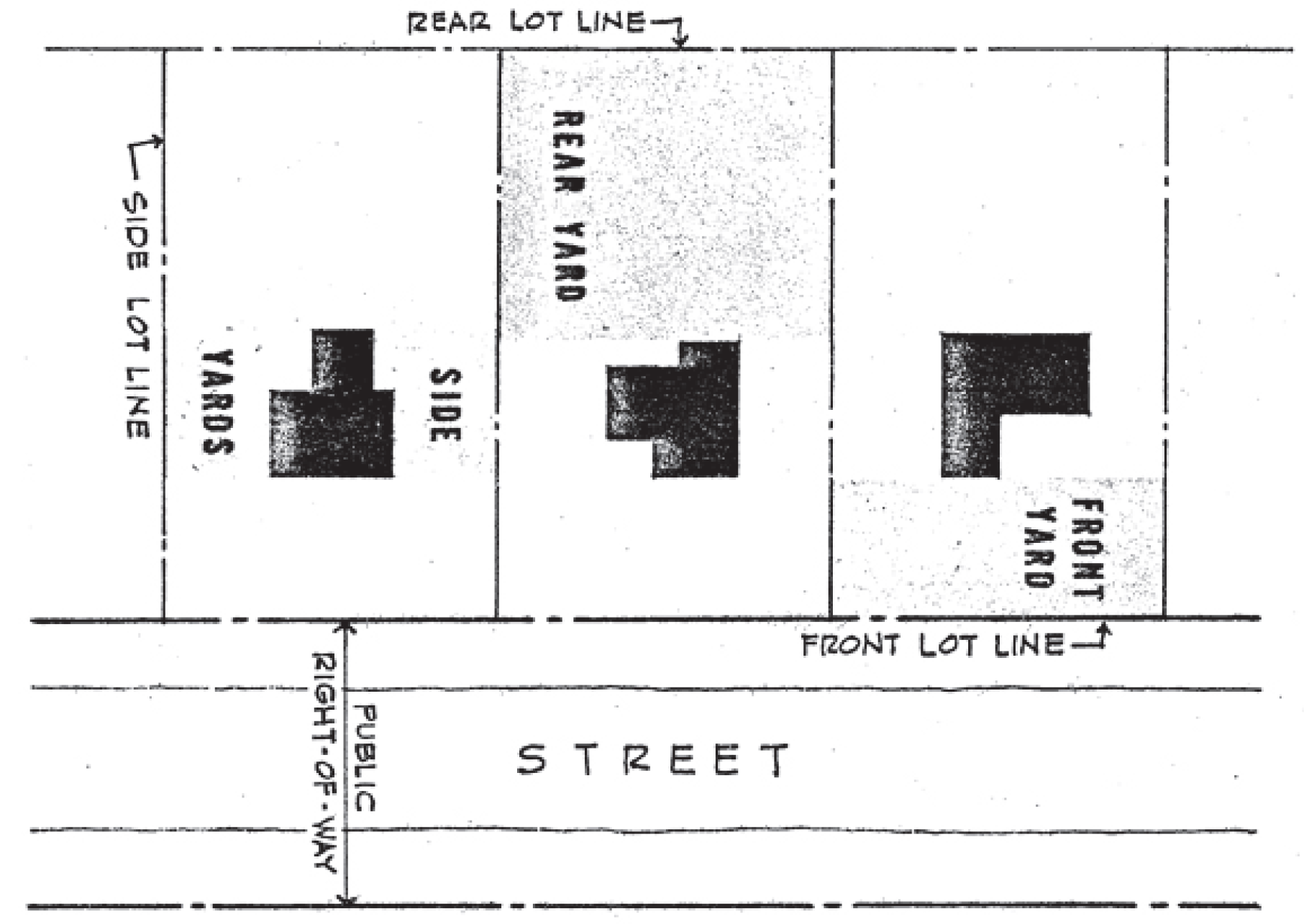
Yard, front: A yard adjacent to a public street and extending across the entire front of the lot. Lots extending through blocks in such a way as to have frontage on two (2) public streets shall provide both a front yard and a rear yard adjacent to each street of sufficient setback as to maintain the rhythm and continuity of a front yard setback on both street frontages. Depth of required front yards shall be measured perpendicular to a straight line joining the foremost points of the side lot lines. The foremost points of side lot lines, in the case of rounded property corners, as at street rights-of-way, intersections, or irregular corners, shall be assumed to the points at which lines would have met without rounding or irregularity. For the purposes of these LDRS, the front yard shall be the narrow end of said lot whether or not the physical structure is oriented toward the narrow side.
Yard, rear: A yard extending across the entire rear of the lot. In the case of lots having more than one (1) front yard, remaining yards shall be considered side yards. Depth of a required rear yard shall be measured so that the yard established is a strip of the minimum depth required with its inner edge parallel to the rear lot line.
Yard, side: A yard extending between required front and rear yards. In the case of corner lots, all yards adjacent to streets shall have a minimum setback as to be appropriate to maintain a safe separation between the public right-of-way and any structure constructed on the property. Width of a required side yard shall be measured so that the yard established is a strip of the minimum depth required with its inner edge parallel to the side lot line.
Yard, special: A yard behind any required yard adjacent to a public street, required to perform the same functions as a side or rear yard, but adjacent to a lot line and so placed or oriented that neither the term "side yard" nor the term "rear yard" clearly applies. In such cases, the development review official shall require a yard with minimum dimensions as generally required for a side yard or a rear yard in the district, determining which shall apply by the relation of the portion of the lot on which the yard is to be located to the adjoining lot or lots, with due regard to the orientation and location of structures and build able areas thereon.
Yard, water frontage: A yard required between the Intracoastal Waterway and the upland use. Such water yard shall be measured from the water edge of the bulkhead.
(Ord. No. 2014-02, § 2(Exh. A), 1-7-14; Ord. No. 2014-22, § 2(Exh. A), 9-9-14; Ord. No. 2014-31, § 2(Exh. A), 11-4-14; Ord. No. 2015-04, § 2(Exh. A), 8-4-15; Ord. No. 2016-13, § 2 (Exh. A), 5-17-16; Ord. No. 2016-15, § 2 (Exh. A), 5-17-16; Ord. No. 2018-08, § 2, 7-17-18; Ord. No. 2018-10, § 2(Exh. A), 7-17-18; Ord. No. 2018-12, § 2, 9-13-18; Ord. No. 2019-04, § 2(Exh. A), 4-2-19; Ord. No. 2020-02, § 2, 3-3-20; Ord. No. 2020-07, § 2(Exh. A), 6-16-20; Ord. No. 2020-11, § 4(Exh. C), 8-18-20; Ord. No. 2020-12, § 2(Exh. A), 8-18-20; Ord. No. 2020-15, § 2(Exh. A), 12-1-20; Ord. No. 2021-01, § 2(Exh. A), 4-20-21; Ord. No. 2022-12, § 2, 10-6-22; Ord. No. 2022-13, § 2, 10-6-22; Ord. No. 2022-14, § 2, 10-6-22; Ord. No. 2023-06, § 2(Exh. A), 8-15-23; Ord. No. 2024-06, § 2(Exh. A), 5-21-24; Ord. No. 2024-13, § 2(Exh. A), 11-19-24; Ord. No. 2025-04, § 2(Exh. A), 10-7-25; Ord. No. 2025-30, § 2(Exh. A), 1-20-26)

