
Lansing Township City Zoning Code
CHAPTER 85
- USE, HEIGHT, AREA REGULATIONS
Section 85-1.- "A" residential zone.
The "A" residential zone is designed to provide a district for single-family detached dwellings with suitable open space at a medium density. Community facilities and open uses which serve the residents or are benefited by an open residential environment are also included with special provisions to protect the residential character of the zone.
Section 85-1.1. Uses permitted. The specific uses permitted in the "A" residential zone shall be the erection, construction, alteration, conversion or use of buildings and/or land for:
(1)
Uses permitted as of right:
a.
One-family dwellings.
b.
Public parks and playgrounds.
c.
Golf courses, except miniature courses and driving ranges operated for commercial purposes. A clubhouse is permitted as an accessory building of a private golf course: Provided, it is located 100 feet or more from all its property lines.
d.
Licensed or accredited schools.
e.
Museums, libraries, fire stations, and other public buildings except garages and maintenance buildings.
f.
Railroad rights-of-way but not including road yards, shops, roundhouses, or commercial activity within the railroad right-of-way.
g.
Pipeline rights-of-way not to exceed 20 feet in width in which may be laid, maintained, and operated any number of pipelines: Provided, that the surface of the lands disturbed in laying and maintaining said lines shall be restored as near as may be to their original condition by the owner of the right-of-way.
h.
Accessory buildings not exceeding 24 feet by 24 feet or 576 square feet with a maximum door opening of six feet in width. Provided, such buildings shall be erected and maintained only as accessories to the main use situated on the same lot and shall not involve an activity connected with any business or manufacturing or be used as storage buildings of construction equipment and materials.
i.
Pets, but not kennels as defined herein.
j.
Private garages with one-car capacity for each 20-foot unit of street frontage up to three-car total combined car capacity of attached and detached garages. A two-car garage shall not exceed 24 feet by 26 feet or 624 square feet and a three-car garage shall not exceed 32 × 24 feet or 768 square feet.
k.
Temporary buildings or trailer offices for uses incidental to on-site construction work, which buildings or trailer office shall be removed upon the completion or abandonment of the construction work.
l.
One nonilluminated trespassing, safety, or caution sign not over two square feet in area shall be permitted on one lot.
m.
Not more than one nonilluminated subdivision sign advertising the sale or rental of premises for subdivision development on which it is maintained and having an area not to exceed 100 square feet nor three square feet for each lot within the subdivision shall be permitted in a subdivision. The overall height of any ground sign permitted herein may extend not more than 12 feet above the ground. Such signs shall set back from any street lot line at least a distance in feet equal to the number of square feet area of the sign but in no case less than 20 feet or more than 100 feet; when attached to a building they shall be attached flat, not projecting from the face of the building. Such subdivision signs are permitted only on a temporary permit basis which shall be issued for a maximum legal effective period of not over two years. Such signs shall be removed when the permit becomes void or when active real estate sales operations cease, whichever condition comes first.
n.
A sign advertising the rental, lease, or sale of an individual or single isolated parcel upon which it is maintained shall not exceed six square feet in area.
o.
One bulletin board for a church or school, not over 12 square feet in area, when located at least 12 feet from all property lines. Such sign may be illuminated if the source of light is not visible.
One ground sign for a church or school with a maximum height of eight feet above ground and a maximum display area of 40 sq. ft. A sign greater than three feet in height above ground must not be within ten feet of the property line.
p.
Private swimming pool: As an accessory use provided that the requirements established by chapter 103 of this Code are met.
q.
Family day care homes:
(1)
There shall be fenced contiguous open space of a minimum of 3,000 square feet provided on the subject parcel. Said open space shall not be located within a required front setback area.
(2)
The family day care home shall be properly licensed by Michigan Department of Social Services.
(2)
The board of trustees may authorize the following uses by special permit if the following conditions are satisfied: a public hearing is held in conformance with section 88-2.4, the specific standards of the particular use stated herein are met, and the general spirit and purpose of this zone are maintained.
a.
Churches: Provided, the site is a minimum of one acre in size (43,560 square feet), the building to be used as a church is not a tent, basement or cellar structure, the parking area is adequately screened from the surrounding residential area and not in the front yard, the site is on a collector street (secondary major thoroughfare) or major thoroughfare capable of serving the extra traffic, a convent is not permitted as an accessory use, and standards stated for this use elsewhere in this title shall be fulfilled.
b.
Parsonages or ecclesiastic residences not located upon a church site: Provided not more than three unrelated persons will permanently reside in the premises, including domestic help, and provided further that the applicant shall demonstrate that the premises are to be used for residential and not for office or business purposes.
c.
Public utility buildings for gas, water, electrical service, telephone exchanges, transformer stations and substations: Provided, that any facilities used in connection therewith and located in the open air shall not be within 50 feet from any lot line; have a greenbelt at least four feet in width around the entire inside perimeter of the lot, but with due consideration given to points of ingress and egress and traffic visibility; shall not be used for the storage of equipment or vehicles; shall be judged as being not injurious to the surrounding neighborhood.
d.
Home occupations: Provided, the requirements as set forth in the definition in section 82-2(29)(35) [sic] are fulfilled. Any home occupation requiring persons not members of the immediate family to bring, or appear at the home to obtain articles shall have the effective period of the special permit limited to one year with the possibility of renewal annually after review.
e.
Supporting towers or masts exceeding ten feet above the highest point of the roof if conditions stated in section 85-9.2 are met.
f.
Group day care homes:
(1)
There shall be a fenced contiguous open space for a minimum of 3,000 square feet provided on the subject parcel. Said open space shall not be located within a required setback area.
(2)
Group day care home shall not have more than one employee working at the home at any given time other than the primary caregiver and members of their immediate family.
(3)
The group day care home shall be properly licensed by the Michigan Department of Social Services.
g.
Communication towers as allowed in chapter 105 with exception of guyed wired towers.
(1)
Minimum site size required will be 60 feet frontage with 100 feet depth.
(2)
Setbacks: Front, 25; side, 15 feet; rear, 30 feet.
(3)
No signage permitted on the site except what is allowed or required on the tower.
(4)
Applicant must demonstrate attempts of co-location.
(5)
Height: 100 feet maximum with measurement to be made from ground level.
(6)
Landscaping of accessory buildings and tower: Landscaping and screening shall be provided in the form of shrubs, trees or bushes with a minimum height of six feet that will not interfere with the maintenance of the structures.
Opaque fencing will be required not to exceed six feet in height in the rear and side yards. (Ord. No. 31.94, § 1, 5-3-83; Ord. No. 31.103, § 1, 4-2-85; Ord. No. 31.115, § 1, 6-21-88; Ord. No. 31.125, § 1, 9-25-90; Ord. No. 31.144, § 1, 12-9-97)
Section 85-1.2. Front yard.
In the "A" residential zone there shall be a front yard having a depth of not less than 25 feet; provided, however, that where established buildings within the same block vary from this minimum required front yard, a new building shall be constructed with a front yard equal to the average of those for buildings located on each side of the proposed building; provided, further, that this regulation shall not be so interpreted as to require a front yard of more than 50 feet or less than 15 feet.
No accessory building shall project into the required front yard area, but steps and ornamental projections may extend from the face of the building into the required front yard a maximum of four feet.
Section 85-1.3. Side yards for dwellings. In the "A" residential zone there shall be a minimum side yard on each side of a dwelling building located upon a separate lot in accordance with the following schedule:
(1)
Side yards. In a residential zone A, there shall be a side yard of ten percent of the width of the lot at the building line on one side and a minimum of nine feet on the second side (allowing access to the rear yard).
(2)
Corner lots. A side yard abutting the side street of a corner lot shall not be less than 25 feet in width. Providing: A lot of record with frontage of less than 51 feet may have a side yard abutting the side street reduced to not less than 15 feet. (See section 83-8.)
Section 85-1.4. Side yards for schools, churches, public assembly buildings. In the "A" residential zone there shall be a minimum side yard of 15 feet on each side of a school, church, library, and other public assembly buildings.
Section 85-1.5. Projection into side yards. Chimneys, flues, belt courses, leaders, sills, pilasters, cornices, eaves, gutters, and other similar features may project into a required side yard a maximum of 24 inches.
Section 85-1.6. Rear yard. In the "A" residential zone there shall be a rear yard having a depth of not less than 30 feet.
Section 85-1.7. Building height. In the "A" residential zone no building hereafter erected or structurally altered shall exceed 2½ stories or 35 feet. Accessory buildings shall not exceed 15 feet in height.
Section 85-1.8. Lot coverage. In the "A" residential zone no building shall cover with its usual accessory buildings more than 40 percent of the total lot area.
Section 85-1.9. Lot area.
In the "A" residential zone every building hereafter erected or structurally altered for a one-family dwelling or other buildings permitted as of right shall be located upon a lot having an area of not less than 7,200 square feet. All interior lots shall be a minimum width of 60 feet frontage on the street and all corner lots shall be a minimum width of 66 feet: Provided, that interior lots on irregular and curving streets shall have a minimum frontage of 50 feet and the width at the building line shall be a minimum of 60 feet.
Any lot of record with an area less than 7,200 square feet or with a width less than that required may be used only for a one-family dwelling and the usual accessory buildings.
Section 85-1.10. Interior living space. The minimum square feet of living space, exclusive of any area contained within an attached garage and porches, required for each family shall be 720 square feet of floor area at ground level for one-story dwelling, 624 square feet for dwellings over one story in height.
Section 85-2. - "B" residential zone.
The "B" residential zone is intended to be used principally for one-family dwellings but two-family dwellings are permitted to provide for limited investment in rental dwellings and the occasional need for two related families to be in close proximity to each other. There is no intent to limit the two-family dwelling to two dwelling units lying side by side, or one above another, but two independent or freestanding one-family dwellings on one lot will not be permitted under the term "two-family dwellings."
Section 85-2.1. Uses permitted. The specific uses permitted in the "B" residential zone shall be the erection, construction, alteration, conversion or use of buildings and/or land for:
(1)
Uses permitted as of right.
a.
Any use permitted as of right in "A" residential zone and listed in section 85-1.1 subsection (1).
b.
Two-family dwellings.
(2)
The board of trustees may authorize the following uses by special permit if the following conditions are satisfied: a public hearing is held in conformance with section 88-2.4, the specific standards of the particular use stated herein are met, and the general spirit and purposes of this zone are maintained.
a.
Any use allowed in the "A" residential zone by special permit and listed in section 85-1.1 subsection (2). (Ord. No. 31.148, § 1, 12-9-97)
Section 85-2.2. Front yard. The front yard requirements shall be the same as those stated in section 85-1.2 for the "A" residential zone.
Section 85-2.3. Yard requirements. The front, side, rear yard requirements shall be the same as those stated in sections 85-1.2, 85-1.3, 85-1.4, 85-1.6.
Section 85-2.4. Projections into side yards. Chimneys, flues, belt courses, leaders, sills, pilasters, cornices, eaves, gutters, and other similar features may project into a required side yard a maximum of 24 inches.
Section 85-2.5. Building height. No building hereafter erected or structurally altered shall exceed 45 feet. Provided, however, public, semipublic buildings, churches, permitted in the zone may be erected to a height not exceeding 60 feet if the building is set back from each required yard line at least one more foot for each foot of additional building height above 45 feet. Accessory buildings shall not exceed 15 feet in height.
Section 85-2.6. Lot coverage. No building with its accessory building shall cover more than 40 percent of the total lot area.
Section 85-2.7. Lot area.
Every building hereafter erected or structurally altered for a one-family dwelling, public library, or fire station shall be located upon a lot having an area of not less than 7,200 square feet. A two-family dwelling, museum, or other public building permitted by right in this zone but not specifically mentioned shall be located upon a lot having an area of not less than 10,000 square feet.
Any lot of record with an area less than 7,200 square feet or with a width less than that required may be used only for a one-family dwelling and the usual accessory buildings.
All interior lots shall be a minimum width of 60 feet frontage on the street and all corner lots shall be a minimum width of 66 feet: Provided, that interior lots on irregular and curving streets shall have a minimum frontage of 50 feet and a width at the building line shall be a minimum of 60 feet.
Section 85-2.8. Interior living space. The minimum square feet of living space, exclusive of any area contained within an attached garage and porches, required for a one-family dwelling shall be 720 square feet of floor area at ground level for one-story dwellings, 624 square feet for dwellings over one-story in height. A two-family dwelling shall provide a minimum of 720 square feet of living space, exclusive of any area contained within an attached garage and porches, for each family, and such buildings shall have a minimum floor area at ground level of 720 square feet.
Section 85-3. - "C" residential zone.
The "C" residential zone is designed to provide a district for various types of residential buildings and group developments under specific population density controls. It is intended to recognize that various forms of residential living and site development are desirable, but at the same time regulate such developments to prevent congestion on the public streets, reduce hazards to life and property, provide desirable light and air to dwelling units, recreation space and basic amenities. Community facilities and open uses which serve the residents or are benefited by a residential environment are also included with special provisions.
Section 85-3.1. Uses permitted. The specific uses permitted in the "C" residential zone shall be the erection, construction, alteration, conversion or use of buildings and/or land for:
(1)
Uses permitted as of right.
a.
Any use permitted as of right in "B" residential zone and listed in section 85-2.1 subsection (1).
b.
Multiple dwelling.
c.
Group housing, garden apartments. Two or more residential buildings of similar or different character may be built upon one lot when a final project plan thereof is submitted to and approved by the planning commission subject to the following conditions:
1.
Buildings shall be for residential purposes and customary accessory uses only.
2.
Multiple dwellings, garden apartments will be designed for no more than eight dwelling units in one building at ground level.
3.
The lot is serviced by public water and sanitary and storm sewer systems.
4.
Lot area, parking, recreation space, and other requirements for this zone are satisfied.
5.
The project is to be developed and maintained as one unified design.
d.
Boardinghouse.
e.
Lodginghouse.
f.
Orphanages; convents; convalescent, nursing and rest homes.
g.
Churches: Provided, the site is a minimum of one acre in size (43,560 square feet), the building to be used as a church is not a tent, basement or cellar structure, the parking area is adequately screened from the surrounding residential area and not in the front yard, the site is on a collector street (secondary major thoroughfare) or major thoroughfare capable of serving the extra traffic, and standards stated for this use elsewhere in this title shall be fulfilled. A convent or parochial school shall not be considered an accessory building.
h.
Private garages up to 320 square feet per dwelling unit.
i.
Swimming pools, as an accessory use, provided that the requirements of chapter 103 of this Code are met.
j.
One ground sign for an apartment complex with a maximum height of eight feet above ground and a maximum display area of 40 square feet. A sign greater than three feet in height above ground must not be within ten feet of the property line.
(2)
The board of trustees may authorize the following uses by special permit if the following conditions are satisfied: a public hearing is held in conformance with section 88-2.4, the specific standards of the particular use stated herein are met, and the general spirit and purposes of this zone are maintained.
a.
Any use allowed in the "A" residential zone by special permit and listed in section 85-1.1 subsection (2) as an accessory use to any of the uses authorized in this section 85-3.1 with the same minimum standards stated in section 85-1.1 subsection (2).
b.
Campgrounds: Provided, the plan is approved by the State of Michigan in accordance with PA 368 of 1978 as amended (MCL 332.12501 and MSA 14.1512501); the development is in accordance with the following standards:
1.
Site development uses. Any campground park may include recreation units, one permanent building for conducting the business operation, accessory buildings for storage of materials and equipment necessary for the operation of the campgrounds, off-street parking.
2.
Space requirements. The minimum unit area of premises used or occupied by each recreation unit shall be 2,500 square feet, clearly defined on the ground by stakes, posts, or other markers, except that where a separate parking area is provided on the campground premises for motor vehicles and no motor vehicles are parked on the recreation unit area, the minimum unit area of the premises used or occupied by each recreation unit shall be 2,000 square feet.
3.
Spacing. There shall be unobstructed open spaces between the sides or end and sides of adjacent recreation unit of not less than 15 feet and not less than ten feet of unobstructed open space between the ends of adjacent recreation units. Hitches shall not extend beyond the boundary lines of the sites. Space between recreation units may be used for the parking of motor vehicles if the space is clearly designated and the vehicle is parked at least ten feet from the nearest adjacent site boundary.
4.
Yards. No recreation unit shall be located closer than 25 feet from the right-of-way line of a public street, or 15 feet from the trailer coach park side property line, or 20 feet from the rear property line.
5.
Roads. One passenger motor vehicle may be parked on the private road in front of the recreation unit site, provided it complies with the Schedule of Road Widths as follows:
SCHEDULE OF ROAD WIDTHS
6.
Parking. One and one-half parking spaces shall be provided per trailer coach site within the trailer coach park.
7.
Access. Each individual trailer coach site shall abut or face on a clear unoccupied paved space, driveway, roadway or street of no less than 20 feet in width, which shall have unobstructed access to a public highway.
8.
Walks. A 30-inch wide concrete walk shall be provided from the entrance of each trailer to all required service facilities.
9.
Building height. No building or structure hereafter erected or altered shall exceed 15 feet.
10.
Screens. A greenbelt planting strip, not less than eight feet in width, shall be located along lot lines not bordering a street. An open-structure wood or wire mesh fence may be built on the property lines in lieu of a greenbelt; said fence shall be not less than four feet nor more than six feet in height and shall not include barbed wire in its construction.
A planting or fence may be used across the front of the property if it is no closer than 25 feet to the front property line.
11.
If any of these requirements are less than those in State of Michigan Act 243, Public Acts 1959, as amended, the state requirements shall prevail.
c.
Private clubs, lodges, community centers: Provided, the site is a minimum of one-half acre in size, the use is social and not a business, the parking area is adequately screened or walled from the surrounding lots zoned for residential purposes.
d.
Day nursery: Provided, there is not more than one dwelling unit used for residence purposes on the site; the site shall contain a minimum area of 9,000 square feet on which there may be kept four children in addition to the children of the foster family; for each child not a member of the family in excess of four there shall be provided 200 square feet of lot area in addition to the base figure of 9,000 square feet; there shall be provided on the site a usable outdoor play area at the rate of 75 square feet per child, exclusive of required front yard, required side yard along a street, and of driveways and parking areas. The play area shall be fenced for safety.
e.
A use permitted in the administrative and professional zone: Provided, it is on a lot of not less than one acre in size and adjacent or across a street or alley from a lot located in the administrative and professional zone and fronting upon the same street. (Ord. No. 31.128, § 1, 4-21-92; Ord. No. 31.136, § 1, 6-27-95; Ord. No. 31.147, § 1, 12-9-97)
Section 85-3.2. Yards for one building per lot. In the "C" residential zone the yard requirements when there is only one major building on one lot shall be in accordance with the following schedule:
(1)
For all buildings there shall be a front yard having a minimum depth of 25 feet; provided, however, that where established buildings within the same block vary from this minimum required front yard, a new building shall be constructed with a front yard equal to the average of those for buildings located on each side of the proposed building; provided, further, that this regulation shall not be so interpreted as to require a front yard of more than 50 feet or less than 15 feet.
No accessory building shall project into the required front yard area, but steps, and ornamental projections may extend from the face of the building into the required front yard a maximum of four feet.
(2)
Residential buildings two stories or less in height shall have two minimum side yards in accordance with the schedule stated in section 85-1.3.
(3)
Residential buildings over two stories or 30 feet in height shall have a minimum side yard on each side of the building of seven feet plus five feet for each story over two in height.
(4)
Nonresidential buildings shall have two side yards, each of which shall be 15 feet for a building two stories or 30 feet in height and 20 feet for a building three stories or 40 feet in height. Any building or portion of a building over 40 feet in height shall have two side yards of 20 feet plus one foot for each additional foot of height above 40.
(5)
For all buildings there shall be a rear yard having a minimum depth in accordance with the following schedule:
a.
Residential buildings—30 feet for the first two stories plus five feet for each additional story over two.
b.
Nonresidential buildings—30 feet for the first 30 feet of height plus one-half foot for each additional foot in height over 30 feet.
Section 85-3.3. Regulations for group housing. The following requirements shall apply to group housing projects when two or more garden apartments, apartment buildings, one-family homes, or mixture of housing types are located on the same lot as permitted in the "C" residential zone:
(1)
The minimum horizontal distance between buildings (that is front to front, rear to rear, or front to rear, as the case may be) shall be 50 feet for buildings two stories in height, and this shall be increased by not less than five feet for every story added: Provided, where the difference in elevation of a site between buildings is equal to the height of one or more stories, these increases of five feet may be reduced by the township planning commission when reviewing the project plans. The minimum distance between buildings may be decreased by as much as ten feet toward one end if it is increased by a similar distance at the other; and consistent modifications are permitted by the township planning commission to accommodate plans which are not conventional in their outline or in their relations to other buildings.
(2)
The horizontal distance between the ends of buildings shall be 20 feet or more for one- or two-story dwellings. Where the end of one building is opposite the face or rear of another building the minimum horizontal distance between them shall be 30 feet for buildings two stories in height. These distances shall be increased by not less than five feet for every story added.
(3)
The horizontal distance between corners of adjacent buildings that do not face each other or overlap shall be 20 feet.
(4)
Distances between building wings shall be not less than the projection of such wings, or one-half of the height of such walls measured between the finished grade and the top of the parapet, whichever is the greater.
(5)
No closed courts shall be permitted. However, open arcades or garden walls not over six feet in height shall not be deemed enclosing features.
(6)
No dwelling unit in a development shall be farther than 100 feet from a street or private access drive.
(7)
No building shall be closer than 25 feet to any street or private access road; 35 feet to any rear property line; ten feet to an interior side property line for buildings up to 35 feet in height. For each foot of building height above 35 feet add one foot to the required ten feet from an interior-side property line and to the rear yard.
(8)
Private street circulation shall meet the following minimum requirements for public safety:
a.
A minimum pavement width of 20 feet when parking is prohibited.
b.
No dead-end street shall be more than 300 feet in length, or serve more than 100 families as a means of vehicular access.
c.
Suitable turning facilities are provided for vehicles at the terminus of all dead-end streets.
Section 85-3.4. Play areas. A play area especially planned for children under eight years of age shall be provided in all rental developments for eight or more family dwelling units upon one lot. This area shall consist of a minimum of 25 square feet per family dwelling unit and be provided as an integral part of the proposed development.
Section 85-3.5. Building height.
The maximum height of the buildings housing the principal use shall be governed by the required yard and lot area requirements.
Accessory buildings shall not exceed 15 feet in height.
Section 85-3.6. Lot coverage. Not more than 40 percent of the lot, excluding the area within private roads of a group housing project, shall be covered by buildings.
Section 85-3.7. Lot area.
Every building hereafter erected or structurally altered for a one-family dwelling shall be located upon a lot having an area of not less than 6,000 square feet. All interior lots shall be a minimum of 50 feet frontage on the street and all corner lots shall be a minimum width of 60 feet: Provided that interior lots on irregular and curving streets may have a minimum frontage of 40 feet if the width at the building line is at least 50 feet.
Any lot of record with an area of less than 6,000 square feet or with a width less than that required may be used only for a one-family dwelling and the usual accessory building: Provided, whenever two or more adjacent lots of record have individually an area of less than 5,000 square feet or frontage less than 50 feet, but were under the same ownership at the effective date of this title, they shall be considered as one parcel or partitioned to create lots conforming with these standards for building purposes.
Two-family and the various types of multiple dwellings shall be located upon a lot having at least the minimum area as set forth in the classifications that follow according to the designation established by the planning commission and approved by the township board, which are to be established according to the requirements of the geographical area, facilities available, master plan and other relevant criteria in relation to the township master plan:
*This does not include land within existing or proposed public or private streets.
All lands presently zoned multiple dwelling shall be classified for the purpose of this ordinance under density C-1 until reclassification is approved by the planning commission and approved by the township board according to the above criteria.
Lodginghouses and boardinghouses shall be located upon a lot area of not less than 6,000 square feet plus an additional 600 square feet for each roomer. (Ord. No. 31.89, § 1, 7-17-79)
Section 85-3.8. Interior living space. Every building hereafter erected or structurally altered for a one-family dwelling shall conform to the livable floor space requirements given in section 85-1.10, for two-family and multiple dwellings the minimum square feet of living space for each family shall include the following, in addition to a bath, utility room, storage space, and other general space requirements:
Note: Areas given are net areas inside room walls, exclusive of closets, halls, or offset entrances.
Section 85-4. - "D" administrative and professional zone.
The administrative and professional zone is intended for quiet, nonretail type business and public health activities which desire pleasant surroundings for their employees and can provide a harmonious relationship with a residential area.
Section 85-4.1. Uses permitted. The specific uses permitted in the "D" administrative and professional zone shall be the erection, construction, alteration, conversion or use of buildings and/or land as provided in this section.
(1)
The following uses are permitted as of right:
a.
Offices of surgeons, physicians, dentists, and other similar professional persons concerned with improving personal and community health.
b.
Hospitals, medical clinics, sanitariums, rest and convalescent homes.
c.
Offices of architects, engineers, artists, and others employed in the graphic arts.
d.
Offices in which the personnel will be employed for work in one or more of the following fields: executive, administrative, legal, writing, clerical, stenographic, accounting, insurance and similar enterprises.
e.
1.
Wall signs must be attached flush with the face of the building, visible only from
the street upon which the building fronts and of a size which does not exceed 20 square
feet in area, extend above the height of the eaves nor beyond the width of the building.
2.
a.
Individual professional buildings containing one office may have one ground sign with
a maximum height of eight feet above ground and a maximum display area of 40 square
feet.
b.
Signs greater than three feet in height above ground must not be within ten feet of the property line.
3.
a.
Buildings containing two or more offices which are under separate business management
but not located within an office complex may have one ground sign per building with
a maximum height of eight feet above ground and a maximum display area of 60 square
feet.
b.
Signs greater than three feet in height above ground must not be within ten feet of the property line.
4.
a.
Office complexes (land parcels containing two or more office buildings) may have one
sign per entrance drive not over eight feet in height above ground with a maximum
display area of 60 square feet and must not be within ten feet of the property line.
f.
Parking as an accessory use; provided, that it is not located within the front yard minimum requirement specified in section 85-4.2.
g.
An accessory building and use customarily incident to a use authorized by this section. A pharmacy or apothecary shop, store limited to corrective garments and appliances for the injured or handicapped, optical company, or restaurant may be permitted as accessory uses to an entire building: Provided, it is within the building to which it is accessory and does not have a direct outside entrance for customers.
(2)
The board of trustees may authorize the following uses by special permit: business college, trade schools, music conservatories, dance studios, vocational schools, child care centers per standards in section 85-1(2) and other educational institutions. Such uses may be authorized by the board of trustees only after a public hearing is held in conformance with section 88-2.4 and in keeping with the general spirit and purpose of this zone.
(3)
Communication towers as allowed in chapter 105:
a.
Minimum site size required will be 60 feet frontage with 100 feet depth.
b.
Setbacks: Front, 50 feet (unless pre-established building line); side, 15; rear, 20 feet.
c.
No signage permitted on the site except what is allowed or required on the tower.
d.
Applicant must demonstrate attempts of co-location.
e.
Height: 100 feet maximum with measurement to be made from ground level.
f.
Landscaping of accessory buildings and tower: Landscaping and screening shall be provided in the form of shrubs, trees or bushes with a minimum height of six feet that will not interfere with the maintenance of the structures. Opaque fencing will be required not to exceed six feet in height in the rear and side yards.
The zoning board of appeals may grant variances pursuant to section 87-4 from the lot dimension requirements, building height regulations and yard width and depth regulation required of uses permitted in this zone, in accordance with the conditions set forth in section 87-4. (Ord. No. 31.95, § 1, 10-18-83; Ord. No. 31.116, § 1, 6-21-88; Ord. No. 31.124, § 1, 7-31-90; Ord. No. 31.141, § 1, 4-30-96; Ord. No. 31.145, § 1, 12-9-97)
Section 85-4.2. Front yards. The minimum front yard for a building shall be 25 feet for all portions one or two stories in height, 50 feet for those portions three stories or more in height.
Section 85-4.3. Side yards. The minimum side yard on each side of a building shall be ten feet for a one- or two-story building, 15 feet for a three-story building, 20 feet for a four-story building. Whenever the side yard is used for parking, an approved fence or masonry wall at least four feet and not more than six feet high shall be placed along the boundary line of the side yard abutting a residential zone. (Ord. No. 31.124, § 1, 7-31-90)
Section 85-4.4. Rear yards. The minimum rear yard shall be 40 feet for a one- or two-story building, 50 feet for a three-story and 60 feet for a four-story building. An approved fence, wall, berm or plantings in the form of shrubs, trees, or bushes, with a minimum of four feet in height providing a continuous barrier shall be placed along all boundary lines of a rear yard abutting a residential zone. Provided: Said wall, fence, or berm shall be reduced to three feet in height for that portion of a common boundary line extending from the residential building to the front property line of a residential zone. (Ord. No. 31.132, § 1, 6-29-93)
Section 85-4.5. Building height. The maximum height of buildings shall be four stories or 45 feet unless each required yard is increased one foot for every two feet of height above 45 feet.
Section 85-4.6. Lot coverage. No building shall cover with its usual accessory buildings more than 40 percent of the total lot area.
Section 85-4.7. Landscaping. The front yard area and any side yard not used for parking or driveway space shall be planted and maintained in accord with an appropriate landscape design.
Section 85-5. - "E" local business zone.
The local business zone is designed to accomplish two purposes. First, it will provide convenient retail and personal service establishments for the day-to-day needs of a small tributary area, with a minimum impact upon surrounding residential development.
Second, it will accommodate a major portion of existing strip commercial developments. Such zones will only permit low-bulk development. It is the basic intent to place most future commercial development in planned centers or in the commercial zone rather than in small local business zones.
Section 85-5.1. Uses permitted. The specific uses permitted in the local business zone shall be the erection, construction, alteration, conversion or use of buildings and/or land for:
(1)
Uses permitted as of right.
a.
Retail store where groceries, fruit, vegetables, meat, dairy products, baked goods or confections are supplied for persons residing in the surrounding residential area.
Foodstuffs may be prepared, or manufactured, on the premises as an accessory activity if the sale of the product is limited to the local retail store.
b.
Drugstore.
c.
Hardware, paint, and wallpaper stores.
d.
Variety, dry goods, apparel, and bicycle stores.
e.
Music store.
f.
Book, flower and gift shops.
g.
Repair shop for bicycles, electrical appliances, television and radio sets, shoes.
h.
Electrical appliance store, including television and radio sales.
i.
Laundromat, hand laundries, furniture and carpet cleaning establishments.
j.
Barber, beauty shops and massage therapists.
k.
Fur and dry cleaning establishments, provided that nonflammable and odorless cleaning fluid or solvent is used.
l.
Eating and drinking establishments, including takeout restaurants without drive-through window service.
m.
Financial institutions, including real estate and insurance companies.
n.
General and professional offices and offices incidental to other uses in the "E" Local Business Zone including offices for personal and business services.
o.
Accessory buildings, uses, and accessory parking lots.
p.
Accessory advertising signs subject to the following limitations:
1.
All on-premises signs must pertain to the activity of said building. When abutting a residential zone, side yard setbacks shall conform with section 85-5.4.
2.
One pole sign structure with signs may be in the front yard but shall not project over the property line.
3.
There shall be only one pole or ground sign structure with signs for each building regardless of the number of businesses except where the building has frontage on two streets in which case an additional sign will be allowed based on its frontage on the other street, not to exceed 100 square feet for a pole sign and 32 square feet for a ground sign Only one sign will be allowed in any yard (per definition in section 82-2).
4.
No pole sign shall be over 100 square feet in area or over 25 feet above the crown of the road and must be eight feet or more above grade.
5.
Additional signs pertinent to the activity within the building must be either wall signs or awning signs.
Permanent wall signs must be flat against the main building or parallel to the building with a projection not exceeding eight inches and may face only public streets or parking areas which are part of the development. The aggregate sign area of all signs on any wall shall not exceed 20 percent of the area of such wall.
Awning signs may have a maximum projection of 36 inches and copy area allowed will be the same as for wall signs.
6.
Ground signs within ten feet of property line must not be more than three feet above grade at the top of the sign and not exceed 15 square feet in area.
7.
Ground signs set back more than ten feet of the property line may be eight feet in height and shall not be over 32 square feet in area.
8.
No animated or flashing advertising signs shall be permitted.
9.
All bare incandescent light sources and immediately adjacent reflecting surfaces shall be shielded from view.
10.
Temporary portable signs as allowed in section 102-18.
11.
Political signs must be in compliance with section 102-21.
12.
Communication towers as allowed in chapter 105:
a.
Minimum site size required will be 60 feet frontage with 100 feet depth.
b.
Setbacks: Front, 50 feet (unless pre-established building line); side, 15 feet; rear, 20 feet.
c.
No signage permitted on the site except what is allowed or required on the tower.
d.
Applicant must demonstrate attempts of co-location.
e.
Height: 100 feet maximum with measurement to be made from ground level.
f.
Landscaping of accessory buildings and tower: Landscaping and screening shall be provided in the form of shrubs, trees or bushes with a minimum height of six feet that will not interfere with the maintenance of the structures. Opaque fencing will be required not to exceed six feet in height in the rear and side yards.
(2)
The board of trustees may authorize the following uses by special permit if the following conditions are satisfied: A public hearing is held in conformance with section 88-2.4, the specific standards of the particular use stated herein are met, and the general spirit and purposes of this zone are maintained.
a.
Filling stations: Provided, the station shall not be located within 25 feet of a residential zone unless separated therefrom by a street or alley; no installations, except walls or fencing and permitted signs, lighting and essential service either above ground or below, may be constructed closer than 25 feet to the front property line; the operation of the use will not create dangerous or other objectionable traffic conditions and the driveways shall be located as far from a street intersection as practical, but no less than 50 feet; no engine or body repairing or steam cleaning shall be permitted.
b.
Private and fraternal clubs: Provided the operation of use will not create dangerous or other objectionable conditions.
c.
Eating and drinking establishments, with entertainment, which must be fully clothed.
d.
Publicly owned buildings, public utility buildings, telephone exchange buildings, gas regulator stations, transformer stations without storage yards, water and sewage pumping stations.
e.
Child care center:
(1)
The minimum lot area requirement shall be 20,000 square feet.
(2)
A dropoff/pickup area shall be provided for motorists off of the public street. This area shall be in addition to the required parking as found in subsection 84-3.3(37) and shall meet the following standards:
a.
Meets all standards in Chapter 84 of this Title
b.
Provides one space for each five children of licensed capacity.
(3)
There shall be a fenced, contiguous open space of a minimum of 5,000 square feet provided on the subject parcel. Said open space shall not be located within a required front setback area.
(4)
The child care center shall be properly licensed by the Michigan Department of Social Services.
f.
Off-premises directional advertising signs will be allowed only for properties with no street frontage and can only be placed on directly adjacent properties and only with the authorization of the property owner. No sign may exceed 15 square feet.
(3)
The planning commission may authorize the following uses by temporary permit for not more than 30 days in any one year without a public hearing:
a.
Christmas tree sales lot.
b.
Revival tent. (Ord. No. 31.99, § 1, 5-14-85; Ord. No. 31.105, § 1, 9-30-86; Ord. No. 31.11, § 1, 6-21-88; Ord. No. 31.131, § 1, 6-29-93; Ord. No. 31.142, § 1, 7-22-97; Ord. No. 31.146, § 1, 12-9-97; Ord. No. 31.162, 5-2-06)
Section 85-5.2. Indoor service. No goods shall be displayed outside of the building.
Section 85-5.3. Front yard. A minimum front yard of 25 feet appropriately landscaped and maintained shall be required.
Where the front of local business property faces residential property, a 20-foot buffer strip shall be required which is not part of the normal road right-of-way or utility easement. Such buffer may be a berm or plantings in the form of shrubs, trees, or bushes with a minimum of four feet in height and properly maintained. The buffer may be part of the 50-foot front yard setback required above. (Ord. No. 31.137, § 1, 7-25-95)
Section 85-5.4. Side yard. A five-foot setback will be required, except on that side of a lot abutting residential property or when the side of a local business lot faces residential property; in which case, there shall be a side yard of not less than seven feet with a continuous hedge, berm or masonry wall not less than four feet and not more than six feet in height beginning 25 feet from the front property line. A 20-foot buffer strip may be provided instead of the berm or masonry wall. (Ord. No. 31.137, § 1, 7-25-95)
Section 85-5.5. Rear yard. A five-foot rear yard shall be required, except where the local business zone abuts on a residential zone in which case there shall be a rear yard of not less than 25 feet. An approved fence or masonry wall not less than four feet nor more than six feet in height shall be maintained along all portions of a rear yard boundary of the local business zone that is a mutual boundary with a residential zone. (Ord. No. 31.137, § 1, 7-25-95)
Section 85-5.6. Building height. No building hereafter erected or structurally altered shall exceed two stories or 28 feet in height.
Section 85-6. - "F" commercial zone.
The commercial zone is intended to accommodate a wide range of retail and business services found outside of a metropolitan center. Normally these developments will be of medium bulk proportions and designed shopping centers would be encouraged.
Section 85-6.1. Uses permitted. The specific uses permitted in the commercial zone shall be the erection, construction, alteration, conversion or use of buildings and/or land for:
(1)
Uses permitted as of right:
a.
All uses permitted as of right in the "E" local business zone, and listed in subsection 85-5.1(1), and uses by special permit listed in subsection 85-5.1(2), excluding filling stations and the uses permitted under subsection 85-5.1(2)d.
b.
Retail stores, similar in character to those that sell jewelry, sports equipment, hobby and handicraft merchandise, beverages, tobacco, dry goods, firearms, automobile parts, household furniture and furnishings and supplies. Provided that, only assembly of products clearly incidental to the conduct of a retail business on the premises may be permitted.
c.
Personal service businesses similar in character to dressmaking or tailoring and self-service businesses similar to laundromats.
d.
Businesses servicing other businesses such as office supply stores, repairing of typewriters and other office machines, optical lens grinding, dental laboratories, repairing musical instruments or photographic equipment.
e.
Bus passenger stations or bus terminals, if the roadway of the street upon which the bus entrance or exit is located, is at least 30 feet wide between curbs.
f.
Business colleges, trade schools, music conservatory, dance studios, nursery schools, and other educational institutions.
g.
General office and professional office buildings.
h.
Greenhouses, florist shops, nursery stock sales.
i.
Hospitals, medical clinics, and convalescent homes.
j.
Hotels and motels.
k.
Parks.
l.
Parking garages and parking lots.
m.
Pet hospitals, pet shops and kennels where the animals and birds are kept entirely within the buildings at all times.
n.
Photographic reproduction and blueprinting.
o.
Printing, publishing and related trades and arts.
p.
Radio broadcasting and telecasting stations, studios and offices.
q.
Undertaking parlors, or mortuaries.
r.
Taxicab stations or limousine terminals.
s.
An accessory building or use customarily incidental to a use authorized by this section. A dwelling unit for a caretaker or watchman may be included within a building as an accessory use, although such use will not be applicable to distance restrictions in subsection u. below.
t.
Any signs permitted in the A, B, C, D and E zones will be permitted. One pole sign for multiestablishment commercial centers will be allowed based on one square foot of signage for each front foot of the building, with a maximum of 300 square feet in area and a maximum height of 25 feet above the crown of the road. When a building has frontage on two or more streets an additional sign will be allowed based on its frontage on the intersecting street, not to exceed 300 square feet in area. Only one sign will be allowed in any yard (per definition in section 82-2). The square footage is to be divided among tenants in the building according to their percentage of the usable square footage of the building.
u.
Adult bookstores, adult motion picture theaters, adult mini-motion-picture theaters, health clubs, massage parlors, and adult entertainment establishments (herein called "adult use business"); provided that the following conditions are met:
1.
No such adult use business may be located within 500 feet (measured from property line to property line) of any residential zone or use, single- or multiple-family dwelling, church, school or park; and
2.
No such adult use business may be located within 1,000 feet (measured from property line to property line) of any other building or land used as an adult bookstore, adult motion picture theater, health club or adult mini-motion-picture theater, massage parlor or adult entertainment establishment; and
3.
Any sign or signs proposed for the adult use business must comply with the other township requirements, and shall not include photographs, silhouettes, drawings, or pictorial representations that depict specified sexual activities or specified anatomical areas; and
4.
Signs must be posted on both the exterior and interior walls of the entrances, in a location which is clearly visible to those entering or exiting the business, and using lettering which is at least two inches in height, that state:
i.
"Persons under the age of 18 years are not permitted to enter the premises."
ii.
"No alcoholic beverages of any type are permitted within the premises unless specifically allowed pursuant to a license duly issued by the Michigan Liquor Control Commission."
5.
No product for sale or gift, nor any picture or other representation of any product for sale or gift which depicts or relates to specified sexual activities or specified anatomical areas shall be displayed so that it is visible by a person of normal visual acuity from the nearest adjoining roadway or adjoining property. When an adult use business is located on a property where parking and pedestrian access is shared with other nonadult use businesses, then this requirement will be enforced from within five feet of the portion of building housing the adult use business.
v.
Furniture reupholstering and repair (excluding furniture stripping).
w.
Outdoor entertainment such as circuses, carnivals, parades or concerts where more than 150 people are expected to attend with proper licensing as provided herein and in title VI, chapter 60. This section is not meant to regulate activities associated with licensed or accredited schools. Approval of license shall be subject to provision for adequate sanitary services as approved by the township building department. The license shall be subject to the following conditions which shall be specified on each license:
1.
Licensee shall not admit to the premises any person who is then under the influence of intoxicating beverages or of drugs, nor shall licensee knowingly permit the possession, sale or consumption of intoxicating beverages or controlled substances on his/her business premises.
2.
Licensee shall provide sufficient fences or barriers or shall so patrol the boundaries of his/her business premises as to efficiently prevent his/her patrons from directly trespassing on neighboring premises.
3.
Licensee shall so conduct his/her business to ensure that it shall not give rise to a nuisance of noise, vibration, smoke, odor or dust.
4.
Licensee shall limit his/her business activities to the hours of 12:00 noon to 10:00 p.m. on Sunday through Thursday and from 12:00 noon to 11:00 p.m. on Friday and Saturday.
The fees and cleanup deposit to be charged for licenses issued pursuant to this section shall be established by the township board by resolution. The fee schedule so established by the township board shall be posted in the office of the township clerk.
Prior to issuance of the license, a deposit for cleanup of the property shall be deposited with the township clerk's office. This amount shall be refunded after the event if the site is properly cleaned. A public liability and property damage insurance policy insuring licensee and the township against any liability imposed on such person or the township providing for payment up to $500,000.00 in the event of injury or death of any one person, and for payment up to $1,000,000.00 in the event of injury or death of more than one person and for payment of up to $1,000,000.00 for property damage is required.
Each applicant for a license shall file with the township clerk a bond in the penal sum of $10,000.00 indemnifying the township against any and all violations of any ordinance, regulation or rule of the township and to indemnify the township for any and all damage to public property of any kind or nature.
x.
Communication towers as allowed in chapter 105:
1.
[Minimum site size.] Minimum site size required will be 60 feet frontage with 100 feet depth.
2.
Setbacks. Front—50 feet (except when there is a pre-established building line less than 50 feet); side—15 feet; rear—20 feet.
3.
Signage. No signage permitted on the site except what is allowed or required on the tower.
4.
Collocation. Applicant must demonstrate attempts of collocation.
5.
Height. 300 feet maximum with measurement to be made from ground level.
6.
Landscaping of accessory buildings and tower. Landscaping and screening shall be provided in the form of shrubs, trees or bushes with a minimum height of six feet that will not interfere with the maintenance of the structures. Opaque fencing will be required not to exceed six feet in height in the rear and side yards.
y.
Catering.
z.
Churches.
aa.
Drive-in and takeout restaurants without drive-up window service.
bb.
Tattoo parlors and body-piercing studios
(2)
The board of trustees may authorize the following uses by special permit if the following conditions are satisfied: A public hearing is held in conformance with section 88-2.4, the specific standards of the particular use stated herein are met, and the general standards stated in section 88-2.4 are met and the general spirit and purposes of this zone are maintained.
a.
Drive-ins and takeout restaurants with drive-up window service: Provided the operation of the use will not create dangerous or other objectionable traffic conditions and the driveways shall be located as far from a street intersection as practical, but not less than 50 feet.
b.
Filling stations: Provided they meet the standards given in subsection 85-5.1 (2)a.
c.
Miniature golf courses.
d.
Public assembly buildings similar to theaters, auditoriums, clubs, and lodges.
e.
Publicly owned buildings, public utility buildings, telephone exchanges, transformer stations and substations with service yards but without storage yards. Water and sewage pumping stations.
f.
Recreation centers similar to arcades, bowling alleys, skating rinks, dance studios when conducted wholly within a completely enclosed building.
g.
Autowash.
h.
Miniwarehousing and storage in bulk for such material as building materials, contractor's equipment, furniture, food, fabrics, hardware, and similar goods: Provided that such permitted storage buildings shall not store scrap or junk metals, petroleum and other inflammable fluids in aboveground tanks, paint and paint materials, discarded or salvaged material, or be used for wrecking or dismantling of motor vehicles.
i.
Public garages, auto repair and oil change.
j.
Carpet cleaning and laundries.
k.
Automobile and trailer sales or rentals.
l.
Production by hand of crystal glass art novelties, pottery, figurines, or similar ceramic products using previously pulverized clay.
m.
Retail stores and pharmacies with drive-up window: Provided the operation of the use will not create dangerous or other objectionable traffic conditions and the driveways shall be located as far from a street intersection as practical, but not less than 50 feet. (Ord. No. 3197, § 3, 5-28-85; Ord. No. 31.106, § 1, 9-2-86; Ord. No. 31.109, § 1, 5-26-87; Ord. No. 31.110, § 1, 7-21-87; Ord. No. 31.118, § 1, 6-21-88; Ord. No. 31.121, § 1, 8-1-89; Ord. No. 31.126, § 1, 10-23-90; Ord. No. 31.129, § 1, 7-28-92; Ord. No. 31.130, § 1, 6-2-93; Ord. No. 31.138, § 1, 8-22-95; Ord. No. 31.149, § 1, 2-3-98; Ord. No. 31.160, § 1, 5-31-05; Ord. No. 31.163, 5-14-06)
Section 85-6.2. Front yard. A 50-foot setback will be required except when there is a preestablished building line less than 50 feet; in such cases, the setback shall not be less than 25 feet. When two or more business structures are set back for the purpose of providing suitable parking in front, new construction on adjacent lots shall conform to that setback insofar as is practical to the creation of a functional joint parking design.
Where the front of commercial property faces residential zoned property, a 20-foot buffer strip shall be required which is not part of the normal road right-of-way or utility easement. Such buffer may be a berm or plantings in the form of shrubs, trees, or bushes with a minimum of four feet in height and properly maintained. The buffer may be part of the 50-foot front yard setback required above. (Ord. No. 31.121, § 1, 8-1-89; Ord. No. 31.135, § 1, 7-25-95; Ord. No. 31.160, § 1, 5-31-05)
Section 85-6.3 Side yard. A five-foot setback will be required, except on that side of a lot abutting residential zoned property or when the side of a commercial lot faces residential zoned property; in which case, there shall be a side yard of not less than seven feet with a continuous hedge, berm, or masonry wall not less than four feet and not more than six feet in height beginning 25 feet from the front property line. A 20-foot buffer strip may be provided instead of the berm or masonry wall. (Ord. No. 31.135, § 1, 7-25-95; Ord. No. 31.160, § 1, 5-31-05)
Section 85-6.4. Rear yard. A five-foot rear yard shall be required except where the commercial zone abuts on a residential zone without an intervening alley, in which case there shall be a rear yard of not less than 25 feet for the first two stories, or 28 feet. Six inches shall be added to the required rear yard for each additional foot of building height over 28 feet. A fence, approved by the building inspector (sites that do not require planning commission approval), or masonry wall at least four feet and no more than six feet high shall be placed along the boundary line of a rear yard abutting a residential zone. (Ord. No. 31.123, § 1, 2-27-90; Ord. No. 31.135, § 1, 7-25-95)
Section 85-6.5. Building height. In the commercial zone no building hereafter erected or structurally altered shall exceed six stories or 65 feet in height.
Section 85-6.6 Landscape standards. Landscape standards shall conform with sections 85-11.2(3) through 85-11.2(3)b.4. (Ord. No. 31.160, § 1, 5-31-05)
Section 85-7. - "G" general business zone.
The general business zone is intended for a wide range of business activities. Most of the permitted enterprises will need considerable space per customer. Service in the form of repairs, truck traffic, and outdoor storage will be normal characteristics.
Section 85-7.1. Uses permitted. The specific uses permitted in the general business zone shall be the erection, construction, alteration, conversion or use of buildings and/or land for:
(1)
Uses permitted as of right:
a.
All uses permitted as of right and by special permit in the commercial zone and listed in section 85-6.1.
b.
Bottling works, including milk bottling or distributing station.
c.
Cold-storage plant.
d.
Furniture reupholstering and repair, or redecorating store or shop.
e.
Monument sales.
f.
Plumbing supply and contracting shops.
g.
Repair shops for electrical appliances, lawn mowers, bicycles, motorcycles and other equipment.
h.
Sales agencies for contractor and agricultural equipment.
i.
Sign painting shop.
j.
Tin and sheetmetal shop.
k.
Any customary accessory building and use.
l.
Any signs permitted in "F" commercial with the same restrictions provided no more than two advertising signs not exceeding in the aggregate more than 600 square feet shall be permitted. In no event is any sign to exceed 300 square feet.
m.
Outside storage yards that are completely enclosed by a well-maintained masonry wall or solid fence six feet high.
n.
Painting, varnishing, vulcanizing, bump shops.
o.
Safety compliance facilities as described in chapter 71A ("medical marihuana facilities") and defined by the Medical Marihuana Facilities Licensing Act, Act 281, Public Acts of Michigan, 2016, as amended, and also as described in chapter 71B ("marihuana facilities") as provided for in the Michigan Regulation and Taxation of Marihuana Act (MRTMA), Initiated Law 1 of Michigan, 2018, as may be amended.
(2)
The board of trustees may authorize the following uses by special permit if the following conditions are satisfied: A public hearing is held in conformance with section 88-2.4, the specific standards of the particular use stated herein are met, and the general spirit and purposes of this zone are maintained.
a.
Trailer coach park: Provided, the conditions established in section 85-3.1, subsection (2)b. are met.
b.
Outdoor or drive-in theater: Provided, it complies with the following requirements:
1.
Picture screens shall not be permitted to face the street and shall be so located as to be out of view of any major thoroughfare.
2.
Not more than one entrance should exist for each access street.
3.
On two-lane streets where left turns are permitted, the entrance should not exceed 40 feet in width.
4.
On three or more lane streets where left turns are prohibited, the entrance lane should not exceed 14 feet in width.
5.
On three or more lane streets where left turns are permitted, the entrance should not be over 19 feet wide.
6.
Entry turn speeds of 20 miles per hour or a 30-foot corner radius should be provided for right turn movements.
7.
Entry turn speeds of ten miles per hour or a ten-foot corner radius should be provided for left turn movements.
8.
Separated entries should be provided for right and left turns where arrival volume is nearly equally divided by direction.
9.
Where left turns are prohibited, the exit should not be more than 14 feet wide.
10.
Where left turns are permitted, the exit should not be more than 19 feet wide with a small island divider at the exit point.
11.
Acceleration and deceleration lanes should be used if possible.
12.
Left turns at entrances or exits should be prohibited on the major street where possible.
13.
Ticket gates should be provided in accordance with the following ratios: one ticket gate for 300-car capacity theater; two ticket gates for 600-car capacity theater; three ticket gates for 800-car capacity theater; four ticket gates for 1,000-car capacity theater.
14.
The screen tower shall not exceed 65 feet in height.
15.
A minimum yard of 75 feet shall separate said drive-in theater from any public street used for access, or exit purposes. This yard shall be landscaped and properly maintained at all times in accordance with the plan of development approved at the time a building permit was issued.
c.
Advertising signs such as billboards or bulletin boards may be permitted providing they do not extend over the property line. No billboard type advertising sign shall exceed 672 square feet in total area, provided, that double panel billboards back to back may be allowed providing they do not exceed 1,344 square feet total area, per location, with an allowance for cutouts not to exceed 28 square feet additional on each panel and provided further that they do not create a visual obstruction to traffic or obscure any existing advertising sign or building front when viewed from the edge of the pavement, from a distance of 300 feet in either direction, nor shall such signs be erected forward of the building setback line, and provided further that no billboard-type advertising sign shall be located within 500 feet of any other billboard sign. All such signs shall further comply with the provisions of chapter 102, sign regulations.
d.
Any building may have an additional sign when the building has frontage on two intersecting streets.
1.
Such sign shall be limited to advertising the use of a business activity occurring within that building.
2.
Such sign may contain advertising on more than one side and may be placed so as to be visible from both streets upon which the building fronts, but in no case may the sign extend over a property line.
3.
No such sign shall have any one side of more than 300 square feet of area.
4.
The maximum height of such sign shall not exceed 25 feet above the crown of either intersecting street, and the minimum height of such sign shall be at least eight feet above the grade immediately below the sign.
5.
Such sign shall not be animated as defined in section 82-2 of this Code.
e.
Carting and express.
f.
Circus, carnivals, private stadiums.
g.
Dog kennels, animal hospitals. (Ord. No. 31.96, § 1, 6-26-84; Ord. No. 31.107, § 1, 9-2-86; Ord. No. 31,139, § 1, 8-22-95)
Section 85-7.2. Yard and height requirements. In the general business zone the yard and height requirements shall be the same as for the commercial zone and specified in sections 85-6.2, 85-6.3, 85-6.4, and 85-6.5.
Section 85-7.3. Landscape requirements.
(1)
A minimum of one deciduous tree shall be planted for each 40 lineal feet or portion thereof of public road frontage, plus, a minimum of one ornamental tree shall be planted for each 100 lineal feet or portion thereof of public road frontage, plus, a minimum of eight shrubs shall be planted for each 40 lineal feet or portion thereof of public road frontage. For the purpose of computing length of public road frontage, openings for driveways and sidewalks shall be counted. Trees and shrubs may be planted at uniform intervals, at random, or in groupings, as approved by the township.
(2)
Screening in the form of a landscape berm, greenbelt, or wall shall be required wherever a commercial, office, or industrial use is located adjacent to a residential use, school, park or similar public area. Landscape screening shall consist of closely spaced evergreen plantings which can be reasonably expected to form a complete visual barrier that is at least six feet above ground level within three years of planting. Deciduous plant materials may be used provided that a complete visual barrier is maintained throughout the year. If a wall is used instead of landscaping, the material and details must be provided as part of the planned development application.
(3)
Off-street parking areas shall be provided with at least 30 square feet of interior landscaping per parking space. Each interior landscaped area will include at a minimum one deciduous tree and eight shrubs. Existing mature trees shall be retained whenever identified feasible by the township board.
(Ord. No. 31.169, § 1, 4-4-18; Ord. No. 31.171, § 1, 7-2-20)
Section 85-8. - "H" industrial zone.
The industrial zone is established for the purpose of encouraging within it the development of manufacturing, processing, storage, and office establishments in a setting suitable for such activities and mutually advantageous for the permitted uses. It is intended to prohibit residential uses and discourage intensive retail commercial enterprises as being incompatible with the primary uses permitted.
Section 85-8.1. Uses permitted. The specific uses permitted in the industrial zone shall be the erection, construction, alteration, conversion or use of buildings and/or land, subject to the following restrictions, for:
(1)
Uses permitted as of right:
a.
Uses permitted as of right in the general business zone and listed in section 85-7.1 as items (1)b through (1)o inclusive. This intentionally omits the usual retail store (except automobile and trailer sales or rentals), hospitals, schools, residencies and similar land uses.
b.
Advertising signs and billboards provided no billboards shall exceed 672 square feet and provided further that no more than one double billboard hack to back shall be allowed in any one location which said double billboard shall have a total surface area of not to exceed 1,344 square feet, per location, with an allowance for cutouts not to exceed 28 square feet additional on each panel; and no billboard shall be permitted which is less than 300 feet from any other billboard in the "H" industrial zone or in any adjacent zone in which a billboard may be located.
c.
Assembly and packaging plants, including specifically automobile and automotive components manufacturing and assembly plants and all manufacturing operations incidental thereto; and all defense material assembly and manufacturing operations to which such plants might he converted.
d.
Dog kennels, animal hospital.
e.
Electric appliance and apparatus assembly and manufacturing.
f.
Electroplating.
g.
Greenhouses.
h.
Industrial research laboratories.
i.
Lumber, coal, brick, stone, contractor supply and storage yards: Provided, such use is entirely enclosed within a well-maintained masonry wall or solid wood fence not less than six feet in height.
j.
Machine shop or blacksmith shop, wrought iron shop, tool and die shop.
k.
The manufacturing, compounding, processing and packaging or treatment of bakery goods, candy, chewing gum, soft drinks, cosmetics, dairy products, drugs, perfumes, pharmaceuticals, toiletries, condiments (except fish, sauerkraut, vinegar and yeast), macaroni and noodles, oleomargarine (compounding and packaging only). The freezing and packaging of fruits, fruit juices, vegetables and meats.
l.
The manufacturing, compounding, assembling, or treatment of articles or merchandise from the following previously prepared materials: bone, cellophane, canvas, cloth, cork, feathers, felt fiber, fur, glass, hair, horn, leather, paper, plastic, precious or semiprecious metals or stones, shell, textiles, tobacco, wood (excluding planing mill), yarns, thread, and paint not requiring a boiling process.
m.
The manufacturing of musical instruments, toys, novelties, rubber or metal stamps.
n.
The manufacturing of small electrical parts, neon signs.
o.
The manufacturing of children's vehicles, including baby carriages, bicycles, scooters, wagons, or similar vehicles.
p.
Offices.
q.
Parking garages.
r.
Photoengraving, photographic reproduction and blueprinting.
s.
Poultry killing.
t.
Production by hand of crystal glass art novelties, pottery, figurines, or similar ceramic products using previously pulverized clay.
u.
Motor freight depot or trucking terminal: Provided, the truck entrance is from and exit is to a street whose roadway is at least 30 feet between curbs; and the loading or unloading platform is at least 50 feet from the street upon which it faces.
v.
Precision instrument and optical equipment manufacturing.
w.
Restaurants.
x.
Stone, marble, granite grinding, dressing, and cutting.
y.
Television and radio broadcasting towers.
z.
Accessory uses clearly appurtenant to the main use of the lot.
z-1.
Public utility buildings, telephone exchanges, transformer stations with service yards. Water and sewage pumping stations.
z-2.
Miniwarehousing and storage in bulk for such material as building materials, contractor's equipment, furniture, food, fabrics, hardware and similar goods.
z-3.
Warehousing with or without on-site sales, provided retail sales to the general public are incidental to the main use of the establishment.
z-4.
Military armories.
z-5.
Communication towers as allowed in chapter 105:
1.
Minimum site size required will be 60 feet frontage with 100 feet depth.
2.
Setbacks: Front — 50 feet (unless pre-established building line); side — 15 feet; rear — 20 feet.
3.
No signage permitted on the site except what is allowed or required on the tower.
4.
Applicant must demonstrate attempts of co-location.
5.
Height: 300 feet maximum with measurement to be made from ground level.
6.
Landscaping of accessory buildings and tower. Landscaping and screening shall be provided in the form of shrubs, trees or bushes with a minimum height of six feet that will not interfere with the maintenance of the structures. Opaque fencing will be required not to exceed six feet in height in the rear and side yards.
z-6.
Medical marihuana class A grower facility as described in chapter 71A ("medical marihuana facilities") and defined by the Medical Marihuana Facilities Licensing Act, Act 281, Public Acts of Michigan, 2016, as amended, and with the following restrictions:
Shall be prohibited within 1,000 feet (measured from property line to property line as of the date the initial application is made) of: (A) a school property, as defined by Public Act 368 of 1978, as amended, including any facility with after school programs; (B) a child care center as defined and licensed by Public Act 116 of 1973, as amended, to ensure compliance with federal "Drug-Free School Zones;" or (C) any other child care and/or day care facility licensed by the State of Michigan.
z-7.
The following uses will be allowed as provided for in chapter 71B ("marihuana facilities") as provided for in the Michigan Regulation and Taxation of Marihuana Act (MRTMA), Initiated Law 1 of Michigan, 2018, as maybe amended.
1.
Marihuana class A grower (500 marihuana plants) and class B grower (1,000 marihuana plants) may be authorized in the township, with the following restrictions:
Shall be prohibited within 1,000 feet (measured from property line to property line as of the date the initial application is made) of: (A) a school property, as defined by Public Act 368 of 1978, as amended, including any facility with after school programs; (B) a child care center as defined and licensed by Public Act 116 of 1973, as amended, to ensure compliance with federal "Drug-Free School Zones;" or (C) any other child care and/or day care facility licensed by the State of Michigan.
2.
Marihuana processor.
Shall be prohibited within 1,000 feet (measured from property line to property line, as of the date the initial application is made) of: (A) a school property, as defined by Public Act 368 of 1978, as amended, including any facility with after school programs; (B) a child care center as defined and licensed by Public Act 116 of 1973, as amended, to ensure compliance with federal "Drug-Free School Zones;" or (C) any other, with the following restrictions: child care and/or day care facility licensed by the State of Michigan.
3.
Marihuana secure transporter.
Shall be prohibited within 1,000 feet (measured from property line to property line, as of the date the initial application is made) of: (A) a school property, as defined by Public Act 368 of 1978, as amended, including any facility with after school programs; (B) a child care center as defined and licensed by Public Act 116 of 1973, as amended, to ensure compliance with federal "Drug-Free School Zones;" or (C) any other child care and/or day care facility licensed by the State of Michigan.
z-8.
Automobile and trailer sales and rentals.
(2)
Uses permitted if complying with the following standards: automatic screw machines when operated with noise silencers or by other sound absorbing devices, stamping machines, punch presses, press breaks and hydraulic presses or any like machinery or production equipment. All able reinforced concrete footing. No machine shall be loaded beyond the capacity as prescribed by the manufacturer. All mechanical noise emanating from such machines and/or presses shall be muffled so as not to become objectionable due to intermittence, beat frequency, or shrillness and, further, that noise emanating therefrom shall not exceed 60 decibels as measured at the street or property line.
(3)
The township board may authorize the following uses by special permit if the following conditions are satisfied: A public hearing is held in conformance with section 88-2.4, the specific standards as provided in the foregoing section 85-8.1(2) are met, the specific standards stated herein are met, and a favorable recommendation is received from the township planning commission.
a.
Bulk storage of flammable liquids, liquid petroleum, gases and explosives; provided, all tanks shall be designed and located in accordance with the International Fire Code and/or NFPA (National Fire Protection Association) standards, and the storage and handling shall comply with state rules and regulations.
b.
Manufacturing processes and dismantling operations including automobile salvage operations not specifically listed in section 85-8.1 subsections (1) and (2) above that comply with the following list of standards:
1.
Noise. All mechanical noise shall be muffled so as not to become objectionable due to intermittence, beat frequency or shrillness. Noise may equal, but shall not exceed, average street traffic noise. Noise should not exceed 60 decibels as measured at the street or property line, whichever causes the largest reading.
2.
Power for any manufacturing or heating process or activity shall be derived only from electrical energy, smokeless fuels containing less than 20 percent of volatile content on a dry basis, and bituminous coal fired by mechanical equipment.
3.
Gases. No gas shall be emitted which is deleterious to the public health, safety or general welfare or corrosive to structures; except for those produced by internal combustion engines under design, operating conditions.
4.
Glare and heat. Glare and heat from are welding, acetylene torch cutting and other process creating glare shall be performed so as not to be seen from any point beyond the lot boundaries.
5.
Rags, waste. The storage of rags, wastes, paper or similar materials shall be in an enclosed masonry building of four-hour construction with adequate fire prevention equipment installed.
6.
Sewage waste. Engineering plans shall provide for the treatment and disposal of sewage and industrial waste, tailings, or unusable byproducts so that there is no danger to the public health and safety.
7.
Radioactive materials. Emissions from radioactive materials shall not exceed quantities established by the U.S. Atomic Energy Commission and/or U.S. Bureau of Standards.
8.
Vibration. No operation shall produce physical vibrations humanly perceptible at or beyond the lot boundaries.
9.
The manufacturing or dismantling process does not include the production or storage of any materials designed for use as an explosive.
10.
Processes do not create any negative visual impact on surrounding properties from the activities associated with automobile salvage operations. Examples include the outdoor storage of inoperable vehicles that are in various states of disrepair.
11.
Processes do not create any environmental impacts associated with automobile salvage operations. No salvage operations shall be conducted anywhere on the site without proper secondary containment. Examples include potential uncontrolled releases of hazardous substances (engine and component oil and lubricants, antifreeze, metal particles) into the environment or public storm and sanitary sewer infrastructure. To insure these materials are not removed in stormwater runoff, outdoor crushing or dismantling shall not occur during rain events.
12.
The applicant shall obtain hazardous materials storage permits or licenses as required by the appropriate agency of the State of Michigan.
13.
All parking, staging and vehicle maneuvering must occur on the subject property.
c.
Dumping or disposal of rubbish, etc. The use of land for sanitary landfill, the dumping or disposal of scrap iron, junk, garbage, rubbish, rock, or other refuse or of ashes, slag, or industrial wastes or byproducts, is permitted only by a license issued by the township board in conformance with chapters 60 and 65 of this Code. Such a license may be denied or issued in appropriate cases upon the filing of an application accompanied by a suitable agreement or bond that such dumping or disposal will not pollute the waters of the municipality or cause stagnant water to collect, or create a health hazard, or leave the surface of the land, at the expiration of such license in an unstable condition or unfit for the growing of turf or for other land uses permitted in the zone in which such dumping occurs.
The dumping of dirt or sand is permitted without a license provided the surface of such material is graded within a reasonable time in a manner preventing collection of stagnant water, and which leaves the ground surface in a condition suitable for the growing of turf or for other land uses permitted in the zone. (Ord. No. 31.133, § 1, 7-27-93; Ord. No. 31.150, 2-3-98)
Section 85-8.2. Front yards. A minimum front yard of 25 feet shall be required where the industrial zone is in the same block or directly across the street from a residential zone, or administrative and professional zone. In all other instances a minimum front yard of 15 feet shall be required. Except for landscape improvements and necessary drives and walks, the required front yard shall remain clear, and shall not be used for parking, loading, storage, or accessory structures.
Section 85-8.3. Side yards. Side yards shall not be required except on the side of a lot abutting upon a lot lying in "A" through "E" zones, in which case there shall be a side yard of not less than 20 feet.
An approved fence or six-foot masonry wall shall be placed on the mutual sideline of a lot lying in a residential zone and extending from the required front yard line to the required rear yard wall or fence. A ten-foot wide strip of continuous shrub and tree plantings may be substituted for the masonry wall or fence if it is well maintained.
Section 85-8.4. Rear yards. No rear yard shall be required where "H" industrial zone abuts any "F," "G" or "H" zone. Where the rear of a lot in "H" industrial zone abuts on a lot lying in "A" through "E" zones, there shall be a rear yard of not less than 25 feet and an approved fence, wall or planting as required in section 85-8.3, side yards.
Section 85-8.5. Lot area. All future lots created shall have a minimum frontage of 85 feet and a minimum area of 12,750 square feet.
Section 85-8.6. Building height. The height of a structure in the "H" industrial zone shall not exceed 65 feet at the required front, side or rear yard building line. This height allowance may be increased one additional foot for each additional foot of setback from the required front, side or rear yard building line.
(Ord. No. 31.169, § 1, 4-4-18; Ord. No. 31.171, § 2, 7-2-20)
Section 85-9. - Height exceptions.
Parapet walls not exceeding four feet in height, chimneys, cooling towers, elevator bulkheads, fire towers, grain elevators, stacks, stage towers or scenery lofts, water tanks, radio and television towers, monuments, cupolas, domes and spires, and necessary mechanical appurtenances shall not be included when calculating the height of the principal structure and may be erected to a height greater than the permitted height in accordance with existing or hereafter adopted ordinances of the township.
Section 85-9.1. Increased height. The height of public or semipublic buildings, churches, schools, hospitals may be increased over the height allowed in the zone: Provided, any such building shall be set back from all lot lines not less than one foot in addition to the required yard dimensions for each foot such building exceeds the height allowed.
Section 85-9.2. Radio, facsimile and television towers. A radio, facsimile and television tower or mast attached to a building and not exceeding ten feet above the highest point of the roof shall be permitted if it conforms to requirements of the Charter Township of Lansing building code. All other towers or masts may be authorized by the planning commission if the following conditions are satisfied:
(1)
The tower location shall not impede the regular flight pattern of airports in the area.
(2)
It shall be demonstrated that such use is reasonably necessary at the proposed location for the convenience of the people at large or for the general welfare.
(3)
The distance of accessory buildings or transformer mast used in connection with the operation of the transmission or receiving towers shall be located not less than 20 feet from any interior side lot line, 30 feet from its front and rear lot lines, and suitably fenced for protection of the public and preservation of the neighborhood environment.
(4)
Distance of the base of the tower from any lot line shall be a horizontal distance equal to the height of the tower unless construction details of the tower give reasonable assurance that under no foreseeable circumstances can the entire tower be expected to topple. Under such conditions the planning commission may make adjustments to this requirement, but in no case shall the horizontal distance from any lot line be reduced to a measurement equal to less than 30 percent of the height of the tower or mast.
(5)
Distance of a guy anchorage from any lot line shall be at least 20 feet; provided, that where the front yard of the district is greater than 20 feet, such requirement shall prevail.
Section 85-10. - Site plan review—Purpose.
It is the purpose of this section to require site plan review approval for certain buildings, structures, and uses that can be expected to have a significant impact on natural resources, traffic patterns, adjacent parcels, and the character of future development.
The regulations contained in this section are intended to promote: (1) safe and convenient vehicular and nonvehicular traffic movement, both within a site and in relation to access streets; (2) harmonious relationships of buildings, structures, and uses, both within a site and with adjacent sites; and (3) conservation of natural amenities and resources.
Except as otherwise provided in section 85-10.1, (1) the development of any new use, (2) the construction of any new structures, (3) any change of an existing use of land or structure that impacts any requirement of these regulations, and (4) all other building, development activities or grading, shall require site plan review and approval prior to construction and/or occupancy pursuant to this section.
1.
Site plan approval not required. Site plan approval is not required for the following activities:
a.
Constructing, moving, relocating or structurally altering a one-family dwelling that is located in a residential zone, including any customarily incidental accessory structures. This exemption from site plan approval does not include any development that would provide for the establishment of more than one principal use on a parcel, such as a one-family site condominium or similar project where a single parcel is developed to include two or more sites for detached one-family dwellings.
b.
Excavating, filling, or otherwise removing soil, provided that such activity is normal and customarily incidental to one-family uses described in this section 85-10(1) for which site plan approval is not required.
c.
A change in the ownership of land or a structure.
2.
Administrative review. A site plan may be reviewed and approved by the zoning administrator, without further review by the planning commission and approval from the township board, if the following requirements are satisfied:
a.
A proposed change in use is allowed by right within the current zoning district; and
b.
The site to be reviewed is located within zones B, C1, C2, C3, C4, D, E, F, G, PD; and
c.
A change in use to a use that is allowed by right within the applicable zone requires less than a 20 percent increase in the number of parking spaces as required by section 84-3; and
d.
The site plan does not require review/approval by an entity other than the township; and
e.
Where construction of any new structures or buildings is not proposed changes to site grading affect less than 135 cubic yards of earth or fill material; and
f.
Additions or other changes to an existing commercial building or structure are less than 25 percent of the total existing gross square footage of floor area, provided that said alteration does not change the primary use of the building or structure; or the construction of new buildings, structures, roadways or other appurtenances were previously shown as a future phase within an approved planned unit development (see section 85-11.9) provided that the applicant has obtained an extension from the township board of trustees (see section 85-10.3); and
g.
Any earth change activity, including construction of new buildings and structures and additions to existing buildings and structures, does not directly affect a surface body of water, wetland, or other natural water feature regulated by part 301 or 303 of P.A. 451 of 1994 the Natural Resources and Environmental Protection Act.
Even though a site plan is eligible for administrative review under this section, the zoning administrator may elect to refer a site plan to the planning commission and township board for review if the zoning administrator determines that the proposed use or the alteration of existing site conditions can reasonably be expected to significantly impact (1) vehicular and nonvehicular traffic movement and function; (2) the harmonious relationships of buildings, structures, and uses, both within a site and with adjacent sites; or (3) the conservation and protection of natural resources and environmental quality.
Upon approval or denial of a site plan pursuant to an administrative review, the zoning administrator shall notify the applicant and members of the township board of the determination and the basis for the approval or denial, and any conditions of approval. The applicant may appeal the zoning administrator's determination pursuant to section 85-10.5. (Ord. No. 31.90, § 2, 2-10-81; Ord. No. 31.120, § 1, 8-2-89; Ord. No. 31.157, 4-22-03; Ord. No. 31.165, § 1, 10-27-09)
Section 85-10.1. Site plan review procedures.
1.
Preliminary site plan review. All applicants are required to submit a preliminary site plan for review by the zoning administrator and/or director of planning and development. The intent of the preliminary site plan review is to minimize errors, miscalculations, or misconceptions prior to the formal submission for site plan review.
a.
Applications for preliminary site plan review shall be submitted to the zoning administrator or director of planning and development prior to submission of a site plan for final review by the planning commission at time determined by the zoning administrator or director of planning and development.
b.
The zoning administrator and/or director of planning and development, or his/her designee, shall review the preliminary site plan for completeness and compliance with the requirements for submission of a final site plan as defined in section 85-10.1.
c.
Once the preliminary site plan is complete and in compliance with the requirements of section 85-10.1, the applicant may submit a site plan for formal review by the planning commission and board of trustees or by the zoning administrator pursuant to section 85-10.0.2 Administrative review.
2.
Applicant. The owner, or his designated agent, of the subject property shall file a request with the township clerk for site plan approval.
3.
Application. Applications for preliminary and final site plan approval for all projects shall be submitted to the township on a form provided by the township for that purpose. Each application for approval shall be accompanied by the payment of a nonrefundable fee in accordance with the township's duly adopted "schedule of fees", and the number of copies of the site plan as required by the zoning administrator and/or director of planning and development.
4.
Data required in the site plan application. Every application for site plan approval shall be accompanied by the following information and data:
a.
A form supplied by the township clerk and completed by the applicant. This form shall contain the following information:
1.
The applicant's name and address in full.
2.
The applicant's phone number.
3.
Date of filing.
4.
A statement that the applicant is the owner of the property, accompanied by proof of ownership, or acting on the owner's behalf.
5.
The name, address and phone number of the owner of record if applicant is not the owner of record.
6.
The address, subdivision and lot number and/or parcel number of the property and a legal description.
7.
The proposed and existing use(s) of the property.
8.
The current zoning of the property.
9.
Indication of whether the property is in a state-approved wellhead protection area.
b.
A final site plan, drawn to scale of one inch equals 200 feet or less, of the entire property involved showing:
1.
Dimensions of property.
2.
Existing topographic elevations at two feet changes in height.
3.
Location of abutting streets and proposed alignment of streets, drives, sidewalks, and all easements serving the development.
4.
Existing public rights-of-way, pavements, and/or public or private easements.
5.
Existing buildings and structures.
6.
Location of parking areas including required number of parking spaces in each area, and including handicap designated spaces and surface material.
7.
Zoning classification(s) of abutting properties.
8.
All known existing aerial and underground facilities.
9.
Proposed utilities and services and tentative locations, including dumpsters, and the locations for on-site wastewater treatment and disposal systems.
10.
Location of existing and proposed public water mains, public and private drinking water wells, monitoring wells, irrigation wells, test wells or wells used for industrial processes.
11.
Location and elevations of existing water courses and water bodies, including county drains and manmade surface drainageways, floodplains, and wetlands.
12.
Proposed stormwater management plan indicating location and design of storm sewers, outlets, retention or detention ponds or any other stormwater quantity and quality control measures. The plan shall include preliminary calculations for runoff caused by a two-year and a 100-year 24-hour design storm for proposed post-evelopment conditions. The method by which these estimates have been calculated by the applicant shall also be identified.
13.
Significant existing vegetation (trees, grass, shrubs and other plantings).
14.
Directional arrow indicating "north".
15.
Proposed common open space facilities, if applicable.
16.
Proposed accessory structures and buildings and uses including free-standing signs.
17.
Location of proposed buildings and intended uses thereof.
18.
Sidewalks in accordance with chapter 21 of the Code of Ordinances and any other internal pedestrian circulation facilities.
19.
Location of property with respect to wellhead protection area, if applicable.
20.
Location and status of any floor drains in existing or proposed structures on the site. Further, the point of discharge for all drains and pipes shall be specified on the site plan.
21.
Description and location for any existing or proposed above ground and below ground storage facilities.
22.
Delineation of areas on the site which are known or suspected to be contaminated, together with a report on the status of cleanup or closure.
c.
Inventory of hazardous substances to be stored, used or generated on-site, presented in a format acceptable to the township fire marshal (include CAS numbers).
d.
Descriptions of type of operations proposed for the project and drawings showing size, location, and description of any proposed interior or exterior areas of structures for storing, using, loading or unloading of hazardous substances, hazardous wastes, and/or polluting materials.
e.
Completed environmental permits checklist on the form provided by the Zoning Administrator.
f.
A landscape plan to scale identifying plants, location of proposed plantings, and method of planting.
g.
A floor plan shall be provided showing each floor of each building and its proposed use(s).
h.
The site plan information sheet fully completed by the applicant or agent.
i.
The Planning Commission may require that the petitioner supply any additional data from proper professional sources as it deems necessary. (Ord. No. 31.90, § 2, 2-10-81; Ord. No. 31.120, § 1, 8-2-89; Ord. No. 31.151, 3-31-98; Ord. No. 31.155, 10-24-00; Ord. No. 31.165, § 1, 10-27-09)
Section 85-10.2 Review by planning commission. The township planning commission shall review the site plan to determine compliance with permitted land use, density of development, general circulation and other provisions of this section. The planning commission shall make a recommendation to the township board of trustees, which will make a final determination and notify the applicant in writing citing reason for denial or approval, and any conditions associated with an approval. (Ord. No. 31.90, § 2, 2-10-81; Ord. No. 31.120, § 1, 8-2-89; Ord. No. 31.165, § 1, 10-27-09)
Section 85-10.3 Site plan approval.
1.
Once a site plan has been recommended for approval by the planning commission and approved by the township board, any material changes, such as changes in location of building or size of building, ingress or egress or parking circulation, number of parking spaces provided or grading and drainage patterns, etc., shall require a resubmission to the planning commission and payment of the fee unless the fee is specifically waived by resolution of the township board.
2.
The township board, at a regular meeting after the planning commission's recommendation, shall consider the approval or denial of the site plan. Reasons for rejection shall be set forth in the minutes of the township board. The township clerk shall notify the applicant of the township board's decision regarding the site plan.
3.
If no construction has begun within one year of the township board's approval of the site plan, the site plan shall become null and void. The applicant may apply to the township board for an extension of up to one year. This request must be in writing and received by township clerk before the expiration of the original site plan approval. The one year extension is only available for a site plan as it was originally approved. (Ord. No. 31.90, § 2, 2-10-81; Ord. No. 31.120, § 1, 8-2-89; Ord. No. 31.151, 3-31-98; Ord. No. 31.155, 10-24-00; Ord. No. 31.165, § 1, 10-27-09)
Section 85-10.4 Standards for site plan approval.
1.
All elements of the site plan shall be harmoniously and efficiently organized in relation to topography, the size and type of lot, the character of adjoining property and the type and size of buildings. The site will be so developed as to not impede the normal and orderly development or improvement of surrounding property for uses permitted in the ordinance.
2.
The landscape shall be preserved in its natural state, insofar as practicable, by minimizing tree and soil removal, and by topographic modifications which result in maximum harmony with adjacent areas.
3.
The site plan shall provide reasonable, visual and sound privacy for all dwelling units located therein. Fences, walks, barriers and landscaping shall be used as appropriate for the protection and enhancement of the property and the privacy of its occupants.
4.
All buildings or groups of buildings shall be so arranged as to permit emergency vehicle access by some practical means to all sides.
5.
Every structure or dwelling unit shall provide access to a public street walkway or other area dedicated to common use.
6.
There shall be provided a pedestrian circulation system which is insulated as completely as reasonably possible from the vehicular circulation system. In order to ensure public safety, pedestrian underpasses or overpasses may be required in the vicinity of schools, playgrounds, local shopping areas and other uses which may generate significant pedestrian traffic.
7.
The arrangement of public or common ways for vehicular and pedestrian circulation shall respect the pattern of existing or planned streets and pedestrian or bicycle pathways in the area. Streets and drives which are part of an existing or planned street pattern which serves adjacent development shall be of a width appropriate to the traffic volume they will carry and shall have a dedicated right-of-way equal to that specified by the Ingham County Road Commission.
8.
All streets shall be developed in accordance with the township subdivision control ordinance and Ingham County Road Commission specifications, unless otherwise approved by the township board.
9.
Appropriate measures shall be taken to ensure that stormwater runoff will not adversely affect neighboring properties or the public storm drainage system. Provisions shall be made for the construction of stormwater management facilities that prevent flooding. Surface water on all paved areas shall be collected at intervals so that it will not obstruct the flow of vehicular or pedestrian traffic and will not pool in paved areas.
10.
Stormwater detention, retention, transport, and drainage facilities shall be designed to prevent the pollution of surface or groundwater resources, on site or off site. Stormwater facilities shall conform to the requirements of the current standard for post construction controls for channel protection and water quality as described by the current, applicable MS4 permit.
11.
Outside storage areas, including dumpsters shall be protected by opaque screening not less than six feet in height.
12.
Exterior lighting shall be arranged so that it is deflected away from adjacent properties and so that it does not impede the vision of traffic along adjacent streets. Flashing or intermittent lights shall not be permitted.
13.
Buffer strip shall be required when property that is used for a commercial purpose faces or abuts property that is used for residential purposes, provided that the aforementioned residential property is a legal or legally nonconforming property as defined by subsections 82-2(48) and (49). Such a strip shall be a minimum of 20 feet wide and shall not be part of the normal roadway right-of-way or utility easement. Such buffer may be a berm or plantings in the form of shrubs, trees or bushes with a minimum of four feet in height. Such buffer shall be properly maintained. This requirement shall not apply in situations where the landscaping requirements of an individual zoning district do not allow for, or in some way contravene installation of a buffer strip.
14.
In approving a site plan, the township may require that a bond or other financial guarantee acceptable to the township of ample sum be furnished by the developer to ensure compliance for such requirements as drives, walks, utilities, parking, landscaping, and the like.
15.
Driveways serving more than one lot may be considered a private road but shall be built to road commission standards, including provision of appropriate right-of-way for possible future dedication.
16.
The project and related improvements shall be designed to protect land and water resources from pollution, including pollution of soils, groundwater, rivers, streams, lakes, ponds, and wetlands.
17.
General-purpose floor drains shall be connected to a public sewer system or an on-site holding tank (not a septic system) in accordance with state, county and municipal requirements, unless a groundwater discharge permit has been obtained from appropriate local, state, and federal agencies. General-purpose floor drains which discharge to groundwater are generally prohibited.
18.
Sites at which hazardous substances, hazardous wastes, or potentially polluting materials are stored, used, or generated shall be designed to prevent spills and discharges of such materials to the air, surface of the ground, groundwater, lakes, streams, rivers or wetlands.
19.
Secondary containment facilities shall be provided for above-ground storage of hazardous substances, hazardous wastes, or potentially polluting materials in accordance with state and federal requirements. Above-ground secondary containment facilities shall be designed and constructed so that the potentially polluting material cannot escape from the unit by gravity through sewers, drains, or other means, directly or indirectly into a sewer system, or to the waters of the state (including groundwater).
20.
Underground storage tanks shall be registered, installed, operated, maintained, closed or removed in accordance with regulations of appropriate local, state, and federal agencies.
21.
Above-ground storage tanks shall be certified, installed, operated, maintained, closed or removed in accordance with regulations of appropriate local, state, and federal agencies.
22.
Bulk storage facilities for pesticides and fertilizers shall be in compliance with requirements of appropriate local, state, and federal agencies.
23.
Abandoned water wells (wells that are no longer in use or are in disrepair), abandoned monitoring wells, and cisterns shall be plugged in accordance with regulations and procedures of appropriate local, state, and federal agencies.
24.
State and federal requirements for storage, spill prevention, recordkeeping, emergency response, transport and disposal of hazardous substances, hazardous wastes, liquid industrial waste or potentially polluting materials shall be met. No discharge to surface water or groundwater, including direct and indirect discharges of waste, waste effluent, wastewater, pollutants, or cooling water, shall be allowed without approval from appropriate state, county and local agencies. (Ord. No. 31.90, § 2, 2-10-81; Ord. No. 31.120, § 1, 8-2-89; Ord. No. 31.151, 3-31-98; Ord. No. 31.155, 10-24-00; Ord. No. 31.165, § 1, 10-27-09)
Section 85-10.5 Appeals
1.
Petition for review by planning commission and board of trustees. In the event that a site plan has been, or will be, subject to an administrative review by the zoning administrator pursuant to section 85-10.3, the applicant may, at any time and at the applicant's discretion, request that the site plan be reviewed by the planning commission and township board of trustees and not by the zoning administrator.
2.
Appeal of decision by zoning administrator or board of trustees. Appeal of the decision of the zoning administrator or township board regarding a site plan shall be taken to a court of competent jurisdiction. The appeal shall be exclusive. (Ord. No. 31.90, § 2, 2-10-81; Ord. No. 31.120, § 1, 8-2-89; Ord. No. 31.165, § 1, 10-27-09)
Section 85-10.6 Enforcement.
1.
The zoning administrator, director of planning and development, code enforcement officer, and other township staff may investigate sites and developments for compliance with an approved site plan and/or this section. Noncompliance with the specifications and conditions of approval of an approved site plan shall constitute grounds for the township board to rescind said approval. Additional enforcement actions including those described below may be taken.
2.
It shall be unlawful for an owner of property or other person that has control over property that is subject to this section 85-10 to (1) cause or allow that property to be used, (2) cause or allow new construction to be undertaken on the property, (3) cause or allow a building or buildings to be expanded on the property, or (4) cause or allow grading changes to be made to the property, unless and until the township has approved a site plan for that property that authorizes such use, construction, building expansion and/or grading change. (Ord. No. 31.165, § 1, 10-27-09)
Section 85-10.7 Municipal Civil Infractions. A person who (A) violates any provision of this section 85-10, (B) violates the terms or provisions of an approved site plan, including any modifications and/or conditions related thereto, or (C) fails or refuses to obtain an approved site plan as required by this section 85-10, is responsible for a municipal civil infraction, and shall be subject to a civil fine as established from time to time by resolution of the township board. Nothing in this section shall be construed to limit the remedies available to the township in the event of a violation by a person of this section 85-10 or an approved site plan. Each act of violation, and each day upon which a violation exists or continues, shall constitute a separate offense. (Ord. No. 31.165, § 1, 10-27-09)
Section 85-10.8 Severability. If a court of competent jurisdiction declares any provision of this section 85-10, or a statutory provision referred to or adopted by reference herein, to be unenforceable, in whole or in part, such declaration shall only affect the provision held to be unenforceable and shall not affect any other part or provision. Provided, however, that if a court of competent jurisdiction declares a penalty provision to exceed the authority of the township, the penalty shall be construed as the maximum penalty that is determined by the court to be within the authority of the township to impose. (Ord. No. 31.165, § 1, 10-27-09)
Section 85-10.9 Repeal. All ordinances or parts of ordinances in conflict or inconsistent with the provisions of this section 85-10 are hereby repealed; provided that any violation charged before the effective date of this section 85-10 under an ordinance provision repealed by this section 85-10 shall continue under the ordinance provision then in effect. (Ord. No. 31.165, § 1, 10-27-09)
Section 85-10.10 Effective date. This section 85-10 shall take effect in accordance with the provisions of the Michigan Zoning Enabling Act. (Ord. No. 31.165, § 1, 10-27-09)
Section 85-11. - "PD" planned development zone.
The "PD" planned development zone is intended to provide a district for residential, commercial or mixed-use planned developments. This section provides enabling authority and standards for the submission, review, and approval of applications for such planned developments. It is the intent of this section to authorize the consideration and use of planned development regulations to encourage more imaginative and livable environments within the township for the following purposes:
1.
To achieve integration of the proposed land use or uses with characteristics of the land and surrounding area.
2.
To promote the conservation of natural features and resources, to the extent practical the natural landscape and topography of the site shall be preserved by the proposed development.
3.
To encourage innovation in land use planning and development.
4.
To promote and enhance housing, employment, shopping, commercial, traffic circulation, and recreational opportunities for the people of the township.
5.
To promote and ensure greater compatibility of design and use between neighboring properties and to coordinate architectural styles, building forms, structural relationships and transportation within developments.
6.
To minimize the impacts that developments have on the public services and character of the community.
7.
To encourage underground utilities which may be more efficiently designed when part of a planned development.
8.
To facilitate phased construction with the knowledge that subsequent phases will be approved as originally planned and approved by the township.
9.
To provide for the regulation of land uses not otherwise authorized within this title.
The provisions of this section are intended to result in land use development substantially consistent with the other sections of the township's zoning ordinance, with modifications and departures from generally applicable requirements made in accordance with standards provided in this section so as to ensure appropriate, fair, and consistent decision-making. A planned development must comply with this section. With respect to "PD" planned development rezoning applications, the provisions of this section supercede the rezoning procedures and requirements found in section 89-3 of this title.
(Ord. No. 31.154, 9-14-00; Ord. No. 31.156, 4-22-03)
Section 85-11.1. Qualifying conditions.
To be eligible for approval as a planned development under the "PD" planned development zone, the applicant must demonstrate that the following criteria will be met:
1.
Recognizable benefits. The planned development shall result in a recognizable and substantial benefit to the ultimate users of the project and to the community, and shall result in a higher quality development than could be achieved under conventional zoning.
2.
Initiation. A planned development shall be established, amended or removed pursuant to the procedure set forth in this section of the zoning ordinance; provided, however that a "PD" planned development zoning request may be initiated only by a property owner of the subject parcel, or the property owner's legal representative or the township board.
3.
Use of public services. The proposed type and density of use shall not result in the overburdening of public services, facilities and utilities.
4.
Compatibility with master plan. The proposed planned development shall not have an adverse impact upon the comprehensive master plan for the township. Notwithstanding this requirement, the township may approve a planned development proposal that includes uses which are not provided for on the future land use map, provided that the planning commission and township board determine that such a deviation from the future land use map is justified in light of the current planning and development objectives of the township.
5.
Unified control. The proposed development shall be under single ownership or control at the time of application such that there is a single person or entity having responsibility for completing the project, or assuring completion of the project, in conformity with this section. The applicant shall provide legal documentation of single ownership or control in the form of agreements, contracts, covenants, or deed restrictions which indicate that the planned development can be completed as shown on the proposed planned development map and accompanying planned development text, and further, that all portions of the planned development that are not to be maintained or operated at public expense will continue to be operated and maintained by the developers or their successors. These legal documents shall bind all development/property owner successors in title to any commitments made as part of the documents. This provision shall not prohibit a transfer of ownership or control, provided notice of such transfer is promptly given to the township board.
(Ord. No. 31.156, 4-22-03)
Section 85-11.2. Development design standards.
1.
Density. Uses in a planned development shall be subject to the following density and open space standards.
*Gross land area of development project.
In each case, the maximum density for uses shall be determined by the township board, up to the maximum indicated above, after review by the planning commission based on the following standards. All uses shall:
a.
Be designed, constructed, and maintained such that they are harmonious and appropriate in appearance with the existing or intended character of the general vicinity, and will not change the essential character of the area in which it is proposed.
b.
Be served adequately by essential public facilities and services, such as highways, streets, pedestrian ways, police and fire protection, drainage structures, refuse disposal, water and sanitary sewer service, and electrical service.
c.
Not create excessive additional requirements at public cost for public facilities and services.
d.
Be developed in accordance with the intent for a planned development as contained herein.
2.
Permitted uses. Any land use authorized in this title in zones "A" residential through "F" commercial, other than; storage in bulk, trailer sales, advertising signs and billboards, contractor storage yards, kennels not associated with veterinary clinics, adult bookstores, adult entertainment establishments, adult mini-motion-picture theaters, adult motion picture theaters, bus, taxi-cab and limousine terminals and permanent outdoor entertainment such as circuses, carnivals and bingo games may be included in a planned development as a principal or accessory use, subject to township approval of the proposed planned development map and the accompanying planned development text, provided that:
a.
There shall be a reasonably harmonious relationship between the location of proposed uses on the site, as well as relative to uses on lands in the surrounding area.
b.
The mix of uses and the arrangement of those uses within a planned development shall not impair the public health, safety, welfare, or quality of life of residents or the community as a whole.
3.
Landscaping. A planned development shall comply with the following landscaping requirements. Alternate landscape plans which meet the general intent of this section may be submitted for consideration.
a.
All unpaved portions of the site shall be planted with grass, ground cover, shrubbery, or other suitable live plant material, which shall extend to any abutting street pavement edge. Seeded areas shall be watered and fertilized regularly so as to provide a healthy lawn within 90 days after planting, or for dormant seeding, for the first 90 days of the next growing season.
b.
Developments within the PD district shall comply with the following requirements:
1)
A minimum of one deciduous tree shall be planted for each 40 lineal feet or portion thereof of public road frontage, plus, a minimum of one ornamental tree shall be planted for each 100 lineal feet or portion thereof of public road frontage, plus, a minimum of eight shrubs shall be planted for each 40 lineal feet or portion thereof of public road frontage. For the purpose of computing length of public road frontage, openings for driveways and sidewalks shall be counted. Trees and shrubs may be planted at uniform intervals, at random, or in groupings, as approved by the township.
2)
Wherever front, side, or rear yards adjacent to public rights-of-way or private drives in which the average daily trips (ADT) is greater than 4,000 are used for parking, a berm shall be required to screen the parking from view of the road. The berm shall be a minimum of three feet in height, and shall be planted in accordance with the previous requirements for landscaping adjacent to roads.
3)
Screening in the form of a landscape berm, greenbelt, or wall shall be required wherever a commercial, office, or industrial use is located adjacent to a residential use, school, park or similar public area. Landscape screening shall consist of closely-spaced evergreen plantings which can be reasonably expected to form a complete visual barrier that is at least six feet above ground level within three years of planting. Deciduous plant materials may be used provided that a complete visual barrier is maintained throughout the year. If a wall is used instead of landscaping, the material and details must be approved as part of the planned development application.
4)
Off-street parking areas shall be provided with at least 30 square feet of interior landscaping per parking space. Such space shall be counted towards the minimum open space requirements of this section. Landscape areas in parking areas shall meet the following standards:
Each interior landscaped area will include at a minimum one deciduous tree and eight shrubs. Existing mature trees shall be retained whenever identified feasible by the township board. Not more than 15 continuous parking spaces shall be allowed in a row of parking without separation by a landscaped area (island).
5)
Open space requirements. A planned development shall provide open space as required by this section, and shall further comply with the following requirements:
a.
For developments containing a residential component, not less than 20 percent of the required open space shall be in the form of usable open space.
b.
Any pervious land area may be included as required open space, except as follows:
1)
No more than 25 percent of the area of any water bodies or wetlands, may be counted towards the required open space unless the area is located on the site as a prominent design feature. Required open space shall not include the area of any designated wetland that is covered by water or muck such that it is not a suitable environment for walking or similar passive leisure pursuits.
2)
Required open space shall not include the area of any public road, the area of any easement providing access to the site, or the area of any commercial recreation use (such as golf course).
4.
Parking. The integrated nature of each site's building design, open space and vehicular circulation allows for flexibility in parking design that is unique to this zoning district. Therefore, the following standards apply.
a.
The size of a standard parking space for one vehicle shall be a rectangular area having dimensions of not less than nine feet by 18 feet.
b.
For those parking spaces that adjoin a median at the end of a parking bay or adjoin a median separating parking spaces in a row of parking, the width of the parking space shall be expanded to ten feet.
c.
To preserve trees and other vegetation, up to one-fifth of the number of spaces provided (given that the total provided meets or exceeds the minimum requirements of this title) may be designed for use by compact automobiles, subject to approval by the township. Compact spaces shall be nine feet by 16 feet and clearly marked as a compact space. For those parking spaces that adjoin a median at the end of a parking bay or adjoin a median separating parking spaces in a row of parking, the width of the parking space shall be expanded to ten feet.
d.
Access to parking facilities shall be designed so as not to obstruct free flow of traffic.
e.
There shall be adequate provision for ingress and egress to all parking spaces to insure ease of mobility, ample clearance, and safety of vehicles and pedestrians.
f.
In developments where vehicles may be expected to wait (including, but not limited to drive-through restaurants, banks and gated parking facilities), adequate stacking space shall be required.
g.
The width of all driving aisles shall be in accordance with the requirements specified below unless a wider drive aisle is approved by the administrator to facilitate special vehicle requirements. Only one-way traffic shall be permitted in driving aisles serving parking spaces placed at an angle other than 90 degrees to the drive aisle unless the angle is placed so as to accommodate the direction of travel for each side of a two way drive aisle.
h.
All parking facilities will have curbing.
i.
Where sidewalks occur in parking facilities, parked vehicles shall not overhang or extend over the sidewalk. In these parking facilities, wheel stops shall be provided even if the parking facility has curbing. The vehicle side of the wheel stop shall be no more than 18 inches from the end of the parking space. See illustration below.
j.
Parking facilities shall contain appropriate plant material to minimize noise, glare and other nuisances as well as to enhance the environment and ecology of the site and surrounding area. Existing trees and understory vegetation should be retained whenever possible, and supplemented with landscaping as appropriate.
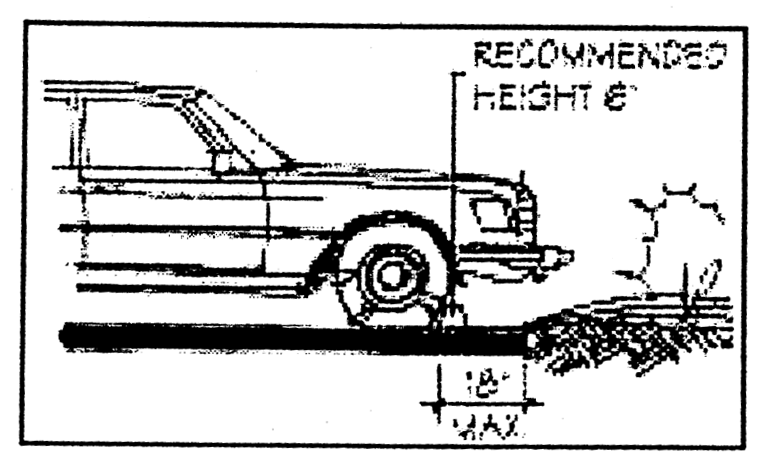
Wheel Stop Detail
(Ord. No. 31.156, 4-22-03)
Section 85-11.3. Applicable regulations.
Unless specifically included in the approved planned development map and the accompanying planned development text for the proposed planned development, or specifically waived by the township board, upon the recommendation of the planning commission, all regulations of the township's zoning ordinance and this title relative to lot size, lot width, yard area, structure height, setback, signs, parking and loading, landscaping, general provisions and other applicable regulations shall apply. In case of requirements or development performance standards that appear to be conflicting between other sections of the zoning ordinance and this section or the approved planned development map and the accompanying planned development text for the proposed planned development, this section or the approved planned development map and the accompanying planned development text for the proposed planned development shall control. In case of requirements or development performance standards that appear to be conflicting between this section and the approved planned development map and the accompanying planned development text for the proposed planned development, the approved planned development map and the accompanying planned development text for the proposed planned development shall control.
Section 85-11.4. Design considerations.
The planned development map and accompanying planned development text for a proposed planned development shall take into account the following specific design considerations, as they are necessary to ensure compliance with all applicable regulations and to ensure the compatibility of the project with adjoining properties and the general area in which the property is located.
1.
Perimeter buffers and setbacks.
2.
Stormwater surface drainage and utility design with respect to location, availability, ownership, and compatibility.
3.
Underground installation of utilities.
4.
Insulation of pedestrian ways from vehicular streets and ways.
5.
Achievement of integrated and harmonious development with respect to signs, lighting, landscaping, and construction materials.
6.
Noise reduction and visual screening mechanisms for adjoining residential uses.
7.
Ingress and egress to the property with respect to automotive and pedestrian safety and convenience, traffic flow and control, street capacity and emergency access.
8.
Off-street parking, loading, refuse, and other service areas with respect to ingress and egress and the potential effects of noise, glare, spill over lighting, vibration, and odor emanating from such facilities on adjoining properties and uses.
9.
Screening and buffering with respect to dimensions and character of site improvements.
10.
Yard areas and other open space.
11.
Density and intensity of development expressed in terms of percent of gross and net land area coverage and/or gross and net housing units per acre and the height of buildings and other structures.
12.
The preservation of natural resources and natural features.
Section 85-11.5. Application and processing procedures.
1.
Effects: The approval of a "PD" planned development rezoning application shall constitute an amendment of the zoning ordinance and the zoning map constituting a part of this title. An approval granted under this section, including all aspects of the planned development map and the accompanying planned development text and any conditions imposed shall constitute an inseparable part of the zoning ordinance. An applicant who receives approval from the township under this section shall not be required to apply for a rezoning under section 89-3 of this title.
2.
Preapplication conference: Prior to the submission of an application for "PD" planned development rezoning, the applicant shall meet with the township zoning administrator and/or designees, and such consultants as deemed appropriate. Failure to attend a preapplication conference or provide such information may result in nonacceptance of an application for processing. The applicant shall present at such conference, or conferences, a sketch of the proposed planned development, and the following information:
a.
A legal description of the property in question;
b.
The total number of acres to be included in the proposed planned development;
c.
A statement of the approximate number of residential units and/or the approximate number, type, and square footage of nonresidential units;
d.
The approximate number of acres to be occupied and/or devoted to or by each type of use;
e.
General proposed requirements for open space, street and pathway design, stormwater management, height limitations, setbacks, buffers, parking standards, loading standards, sign standards, and other development performance standards applicable to the proposed planned development;
f.
The number of acres to be preserved as open space or recreation space; and
g.
All known natural resources and natural features.
h.
Conceptual grading plan.
(Ord. No. 31.156, 4-22-03)
3.
Planned development map and accompanying planned development text—Submission and content: Following the above conference or conferences, copies of the proposed planned development map and accompanying planned development text and an application for a "PD" planned development rezoning request shall be submitted. The submission shall be made to the township clerk who shall present it to the township board for consideration, and referral to the planning commission, at a regular or special meeting. The application shall be accompanied by an application fee as determined by the township board's duly adopted "schedule of fees" to cover costs of processing the application. The proposed planned development map and accompanying planned development text and the application shall contain the following information, unless specifically waived by the township:
a.
Date, north arrow, and scale which shall not be more than 1" = 100'.
b.
Location sketch of the property in relation to the surrounding area.
c.
Legal description of the property, including common street addresses.
d.
Survey showing the size of the parcels.
e.
All existing lot or property lines with dimensions.
f.
General location of all existing buildings within 100 feet of the property lines.
g.
General location and size of all existing structures, streets, utilities, driveways, parking areas, and vegetation on the site.
h.
Preliminary site plan showing the general location and size of all proposed structures, streets, driveways, parking areas, open space areas, landscaped areas, sidewalks, and buffer areas on the site.
i.
All areas within the 100-year floodplain, wetland areas or bodies of water.
j.
Existing and proposed topographical contours at a minimum of two foot intervals.
k.
A narrative describing:
1)
The nature of the project.
2)
The proposed density, number and types of dwelling units if a residential element is included in the planned development.
3)
A statement describing how the proposed project meets the objectives of this section.
4)
A statement from a registered professional engineer describing how the proposed project will be served by public water, sanitary sewer, and storm drainage.
5)
Proof of ownership or legal interest in property.
l.
A rendering or pictorial presentation of the proposed development and its features.
m.
Proposed signage for the development.
(Ord. No. 31.156, 4-22-03)
4.
Public hearing: The planning commission or the township board, at a regular or special public meeting, shall set a time and place for a public hearing on the application and provide for the legal publishing and proper posting of notices of the time and date of such hearing in a newspaper of general circulation in the township, to be printed not more than 15 days nor less than five before the date of the hearing. Not less than 20 days notice of the time and place of such hearing shall also be given by mail to each electric, gas, pipeline, and telephone public utility company that registers its name and mailing address with the township for the purpose of receiving such notice and to each railroad operating within the district or zone affected. The township clerk shall give a notice of the proposed rezoning to the owner of the property in question, to all persons to whom any real property within 300 feet of the property in question is assessed, and to the occupants of all single and two-family dwellings within 300 feet thereof. The notice shall be delivered personally or by mail to the respective owners and tenants at the addresses shown on the last assessment roll. If the tenant's name is not known, the term "occupant" may be used. The notice and publication requirements described above supercede those found in section 89-3 of this title.
If the notice is delivered by mail, an affidavit of mailing shall be filed with the planning commission before the hearing. Such notices shall include the places and times at which the application and the proposed planned development map and accompanying planned development text may be examined, plus the following:
a.
The nature of the "PD" planned development rezoning requested.
b.
A description of the property which is the subject of the "PD" planned development rezoning request.
c.
The date, time and place where the "PD" planned development rezoning request will be considered.
d.
When and where written and oral comments will be received concerning the "PD" planned development rezoning request.
5.
Planned development map and accompanying planned development text—Planning commission review: The planning commission shall review the proposed planned development map and accompanying planned development text and shall make reasonable inquiries of the applicant.
The planning commission shall review the proposed planned development map and accompanying planned development text according to the provisions of this section and transmit its recommendations, including any suggestions for changes or modifications of the proposed planned development map and accompanying planned development text, to the township board.
Section 85-11.6. Standards for zoning approval.
1.
Standards. Following the public hearing and review of the proposed planned development map and accompanying planned development text, the planning commission shall recommend either approval, denial, or approval with conditions of the "PD" planned development rezoning request and proposed planned development map and accompanying planned development text, and forward its recommendation to the township board.
In making a recommendation for approval, the planning commission shall find that the proposed "PD" planned development rezoning request and the proposed planned development map and accompanying planned development text meet the intent of the "PD" planned development zone and the following standards:
a.
The uses proposed shall have a beneficial effect, in terms of public health, safety, welfare or convenience or any combination thereof, on present and potential surrounding land uses, and the uses proposed shall not overburden the public utility and circulation systems, surrounding properties, or the community as a whole. This beneficial effect for the township (not the developer) shall be one that could not be achieved under any other single zoning classification.
b.
The uses proposed shall be compatible amongst themselves, and with the majority of the surrounding land uses.
c.
The approval is warranted by the design and amenities incorporated in the development proposal.
d.
Landscaping shall be provided so as to insure that proposed uses will be adequately buffered from one another and from surrounding public and private property. The planning commission may, if deemed appropriate, recommend that a planned development provide more or less landscaping than that required by the zoning ordinance.
e.
Vehicular and pedestrian circulation, allowing safe, convenient, non-congested, and well-defined circulation to, from and within the development is provided.
Section 85-11.7. Township board approval.
After receiving the recommendation of the planning commission, the township board shall either approve, deny, or approve with conditions the "PD" planned development rezoning application and the proposed planned development map and accompanying planned development text in accordance with the requirements of the township's zoning ordinance and the standards for approval and conditions for a planned development as contained herein. An approval or an approval with conditions shall constitute an amendment of the zoning ordinance and the master plan constituting a part of this title. No building permit shall be issued for any portion of the planned development until the township has approved a final site development plan and received proof from the applicant of recording an affidavit with the Ingham County Register of Deeds as described in section 85-11.8 and UBC 97 106.4.3.
Where provisions of Michigan Public Act 288 of 1967, as amended shall apply, the applicant shall thereafter submit the information and plans as may be required by Act 288 and all other local procedures or regulations pertaining to platting approval.
Section 85-11.8. Effect of approval.
The "PD" planned development rezoning amendment, including the approved planned development map and accompanying planned development text, and all conditions imposed, if any, shall constitute the permitted land use and density authorization for the property. All uses not specifically identified in the approved planned development map and accompanying planned development text are disallowed and not permitted on the property. All improvements and uses shall be in conformity with this section, the zoning ordinance, and the approved planned development map and accompanying planned development text. Within ten business days of approval of the "PD" planned development rezoning application and the planned development map and accompanying planned development text by the township board, the applicant shall record an affidavit with the Ingham County Register of Deeds, which shall contains the following:
1.
Date of approval of the "PD" planned development zone by the township board.
2.
Legal description of the property.
3.
Description of the required green space along with a plan stating how this green space is to be maintained.
4.
A statement that the property will be developed in accordance with the approved planned development map and accompanying planned development text and any conditions imposed by the township board unless an amendment thereto is duly approved by the township board upon the request of the applicant or the applicant's successors or assigns.
5.
It shall be the responsibility of the owner and occupant of the property to maintain all parking, access facilities and public use areas in a safe and usable condition.
Section 85-11.9. Final site development plan.
After approval of the "PD" planned development rezoning and the planned development map and accompanying planned development text by the township board, the applicant shall submit a final site development plan for review and approval by the township board or its designee prior to starting any construction or improvement on any phase, parcel or site within the project.
Contents of final site development plan: The final site development plan for any phase, parcel or site within the project shall contain the same information required for the proposed planned development map and accompanying planned development text and shall also contain the following additional information, as well as information specifically requested by the planning commission in its review of proposed planned development map and accompanying planned development text:
1.
Location and size of all water, sanitary sewer, and storm sewer lines serving the development.
2.
Proposed contour lines at not greater than two-foot intervals.
3.
Proposed landscaping including type, number, and size of trees and shrubs.
4.
Location and design of signs and exterior lighting.
5.
Location of sidewalk, footpaths, or other pedestrian walkways.
6.
Distance of all buildings from lot lines, rights-of-way, and other principal buildings.
7.
Exterior architectural drawings noting building materials, height and area of buildings and accessory structures.
8.
Proposed phases of the project.
9.
The site plan information and data identified in the following sections of this title: 85-10.1(3)(b)(9) through (12); and 85-10.1(3)(b)(18) through (25).
Section 85-11.10. Standards for final site development plan approval.
Following review, the township board, or designee, shall either approve, deny, or approve with conditions the final site development plan.
In making a decision, the township board or its designee shall find that the proposed site development plan meets the intent of the "PD" planned development zone and the following standards:
1.
Required ingress and egress to the property and proposed structures, with particular reference to motor vehicle and pedestrian safety and convenience, traffic flow and control, and access in cases of fire, catastrophe, or emergency, is provided.
2.
Required off-street parking and loading areas, with particular attention to noise, glare, and odor effects of each use in the plan on adjoining properties and properties in the proposed development, is provided.
3.
Required sewer and water utility service and stormwater surface drainage, with reference to locations, availability, and compatibility, is provided.
4.
Required screening and buffering, with reference to type, dimensions, and character of buildings, is provided.
5.
Signs, if any, are compatible and do not cause an adverse impact on adjoining properties due to lighting relative to glare, traffic safety, and economic effect.
6.
Compliance with the site plan standards identified in the following sections of this title: 85-10.4(16) through (25).
Section 85-11.11. Conditions.
1.
In approving a final site development plan, the township board or its designee may impose reasonable conditions, including, but not limited to, conditions necessary to: ensure that public services and facilities affected by a proposed land use or activity will be capable of accommodating increased service and facility loads caused by the land use or activity; protect the natural environment and conserve natural resources and energy; ensure compatibility with adjacent uses of land; and promote the use of land in a socially and economically desirable manner. Conditions imposed shall meet all of the following requirements:
a.
They shall be designed to protect natural resources, the health, safety, and welfare of the citizens of the township, and the social and economic well being of those who will use the land use or activity under consideration, residents, and landowners immediately adjacent to the proposed land use or activity, and the community as a whole.
b.
They shall be related to the valid exercise of the police power and purposes of the township which are affected by the proposed use or activity.
c.
They shall be necessary to meet the intent and purpose of the zoning ordinance, be related to the standards established in this section for the land use or activity under consideration, and be necessary to ensure compliance with those standards.
2.
Any conditions imposed with respect to the approval of a final site development plan shall be recorded in the record of the approval action and shall remain unchanged except upon the mutual consent of the township board and the landowner. The township clerk shall maintain a record of conditions and any changes thereto. The final site development plan, as approved, shall act as a restriction upon the development of the subject phase, parcel or site, and all development thereon must conform to the final site development plan.
Section 85-11.12. Performance guarantees.
The township may require the land owner(s) to acquire and maintain a performance bond (from an insurance company licensed to do business in Michigan), bank letter of credit or similar guarantee satisfactory to the township board, in accordance with section 94-6, in order to ensure the completion of improvements required by the approved final site development plan.
Section 85-11.13. Modification of an approved planned development or an approved final site development plan.
Modifications to a final site development plan may be approved by mutual agreement of the applicant or its successor property owner and the township board or designee, provided the changes comply with all applicable requirements of this section and all other applicable township regulations or state law. Construction and modification of structures must follow the rules and regulations associated with receiving a building permit.
Minor modifications to an approved planned development map or the accompanying planned development text, including, but not limited to, a decrease in assigned density or intensity for a specific parcel, a change in land use designation from multifamily to single family or a change from any other use to open space or passive recreation, a change in infrastructure features of the planned development which are clearly beneficial to the occupants of the planned development or adjacent lands, or a change in land use designation from single family to multifamily with no increase in permitted site-specific density, shall be reviewed and, if appropriate, approved by the township board.
Major modifications to an approved planned development map or the accompanying planned development text, including, but not limited to, an increase in density or number of dwelling units, an increase in land area, or the addition of land uses not previously permitted, shall comply with the original approval procedures for a "PD" planned development rezoning application.
(Ord. No. 31.154, 9-14-00)
Section 85-12. - Commercial corridor overlay district.
Section 85-12.1 Intent. This section of the Charter Township of Lansing Code of Ordinances is meant to facilitate the revitalization and redevelopment of certain commercial roads within the Township. It recognizes the need for walkable, mixed-use, infill development and larger scale redevelopment and re-purposing of land along these urban corridors, and emphasizes the role of urban design in the creation of an attractive urban environment that fosters lasting economic development and community activity.
Section 85-12.2 Definitions.
Commercial corridor: A public roadway that has been so designated due to certain conditions including its classification as an urban minor or major arterial road and characterized by adjacent commercial, residential and/or industrial land uses.
Cut off lighting: Lighting that is shaded in a way that prevents any light from radiating above a horizontal plane that is parallel to the average finished grade of a site.
High density residential: residential land use developed at a density of greater than 20 dwelling units/acre of developable land.
Integrated stormwater management plan: A coordinated plan consisting of structural and nonstructural stormwater best management practices that meets water quality, channel protection, and flood management standards as set forth by local, state, and federal regulations.
Landscaping and street furniture area (LSFA): An area that is at least six feet in width for landscaping such as trees, shrubbery, vegetative groundcover and grass and furnished with amenities such as lighting, seating, planters or trash receptacles.
Live-work unit: Live/work units are dwelling units wherein each unit is designed to accommodate a small business and living quarters. A live-work unit may also consist of multiple unattached structures built on the same lot wherein at least one of the structures serves as a workshop, retail shop, studio, office or other nonresidential building that is used by resident(s) as a place of work. Live-work units shall meet the design standards applicable to mixed-use buildings.
Neighborhood street: Sometimes referred to by Federal Highway Administration functional classification as "urban local", "urban collector", or "local" streets, these roadways provide a high level of land access and convenient circulation within residential, commercial, industrial, and mixed use neighborhoods. Neighborhood streets typically have lower traffic volumes, and are tributary to larger, higher capacity arterial roadways.
Open space, private: An open, outdoor area accessible to and for the exclusive use of the residents of individual dwelling units; includes private patios, balconies, and decks.
Open space, private shared: An open, outdoor area accessible to and for the exclusive use of all residents of a multiple family housing development.
Open space, public: An open, outdoor area accessible to and for use by the general public.
Pedestrian clear area (PCA): An unobstructed pedestrian area measuring at least seven feet in width and eight feet in height.
Pedestrian zone (PZ): The general area that includes the PCA and LSFA.
Pedestrian zone amenity area (PZAA): An area with a maximum of 15 feet in width designated for landscaping, seating, public art, outdoor dining or similar purposes.
Public art: Original works created by an individual or group on display in the LSFA or PZAA for the purposes of self-expression and aesthetic enhancement of the corridor that does not also promote a commercial venue or interest.
Recreation, fitness, health and athletic clubs and facilities: Usually a commercial facility or establishment supported by dues paying members who pay fees in order to use exercise and fitness equipment and related facilities and amenities. Examples include gymnasiums, racquet clubs, martial arts studios, aquatic sports centers, ice rinks, indoor soccer fields, batting cages, and roller rinks. Facilities that provide wellness services exclusively are not included in this definition.
Section 85-12.3 Applicability. A commercial corridor overlay district (CCOD) shall be so designated by the Charter Township of Lansing Board of Trustees upon consultation with the planning commission and pursuant to the requirements of Public Act 110 of 2006 the Michigan zoning enabling act (MZEA). The provisions of this section shall serve as a supplement to the original zoning of each property located within the district. Where a conflict arises between the original zoning and the provisions of this subdivision, the CCOD shall control.
(1)
Corridor overlay boundaries. For the purposes of site design review (site plan review) and zoning, the commercial corridor overlay district shall be described by the exact geographic extent and boundaries depicted in Appendix A.
(2)
Applicability. Unless exempted in section 85-12.2(3) below, this subdivision is applicable to:
a.
The construction of any new structures or major expansion of any existing structures;
b.
Any change of an existing use of land or structure that affects site characteristics and/or function such that it requires site plan approval by the planning commission and township board of trustees according to section 85-10. Site plan review-purpose. Development activities that involve physical changes to a property and changes of use requiring site plan approval shall be brought into compliance with the commercial corridor overlay district to the maximum extent practical.
c.
Any party seeking site plan approval for alterations of site characteristics, conditions, or changes of use requiring administrative site plan approval as according to section 85-10.2 Administrative review may choose voluntarily to have the proposed modifications reviewed under this section or under the requirements of the existing zoning. If the modifications are reviewed under this section, the property shall thenceforth be regulated under this section.
(3)
Exempt activities. Development of temporary or transitional uses as described in section 85-12.4(3) Uses permitted, temporary transitional land use license; uses currently permitted by underlying zoning requirements shall be permitted to continue under the regulation of the underlying zoning as long as no physical changes or changes of use requiring site plan approval are proposed. Properties zoned PD planned development are exempt from the provisions of this section.
Section 85-12.4 Uses permitted. The specific uses permitted in the commercial corridor overlay district shall be the erection, construction, alteration, conversion or use of buildings and/or land for:
(1)
Uses permitted as of right:
a.
All uses permitted as of right, except those expressly prohibited in (2), in the "F" commercial zone, the "D" administrative zone, the "E" local business zone, and uses permitted by special permit listed in subsection 85-6.1(2), and the following specifically enumerated uses: Brewpubs and microbreweries or similar facility with a minimum of 1,000 square feet of bar or restaurant service area; offices and facilities for health and wellness practitioners; fitness and athletic clubs and facilities and dance studios; rummage sales and flea markets; childcare; home occupations as defined by Section 82-2(35); live work units; facilities for the production of artisanal foods and handicrafts including furniture, pottery, blown glass, provided that a minimum of 500 square feet of net usable floor area of the facility is devoted to retail sales of goods produced on site and provided that production activities will not create noxious fumes, unlawful noise as defined in chapter 54, extraordinary traffic or any other conditions that endanger the public or undermine or degrade public health and safety.
b.
High density residential uses.
c.
A vertical mix in a single building or multiple adjacent buildings of the aforementioned uses.
(2)
Prohibited uses: Filling stations, miniwarehousing or self-storage, car dealerships, warehousing where less than 20 percent of net first floor square footage is devoted to retail sales, freestanding communications towers, drive-through facilities, drive-in restaurants, freestanding billboards as described and regulated by section 102-2 "Advertising signs," contractor supply yards, and outdoor storage of materials and equipment not available for on premises retail sales, and adult entertainment theaters and stores. Any use of barbed-wire is prohibited.
(3)
Temporary transitional land use: Temporary transitional land uses including food carts, pop-up businesses, outdoor events, and farmers markets are permitted with an outdoor event or vendor license obtained from the zoning administrator.
Section 85-12.5 Site development and design standards. In order to promote the revitalization of commercial corridor overlay districts, site development and design standards shall encourage appropriate massing and placement of buildings; safe and efficient pedestrian and non-motorized access to individual sites and between individual sites and surrounding neighborhoods, transportation systems, and other destinations.
(1)
Pedestrian zone. The roadside (the area between a building's façade and the face of the road pan curb) is composed of a pedestrian zone (PZ) and an optional pedestrian zone amenity area (PZAA). The pedestrian zone shall consist of an unobstructed, pedestrian clear area (PCA) and landscaping and street furnishings area (LSFA) (see figure 1).
a.
The PCA shall be not less than seven feet in width and eight feet in height as measured horizontally from the building façade or edge of the pedestrian zone amenity area and vertically from the top of sidewalk pavement (see figure 1);
b.
Where feasible, the LSFA shall not be not be less than six feet' in width as measured from the edge of the PCA to the back of curb or edge of pavement of the public right-of-way. All light standards, tree grates, seating, trash receptacles, etc. shall be dark finished metal, stone, or other durable materials. This requirement does not apply to works of art as defined within this section.
c.
An optional pedestrian amenity area or public plaza (PZAA) of not more than 15 feet in width may be located between the pedestrian zone and building façade provided that the area is used for landscaping, seating, public art, outdoor dining, public assembly or similar purpose. Standards for street furnishing and landscaping are further described below in 85-12.5(2).
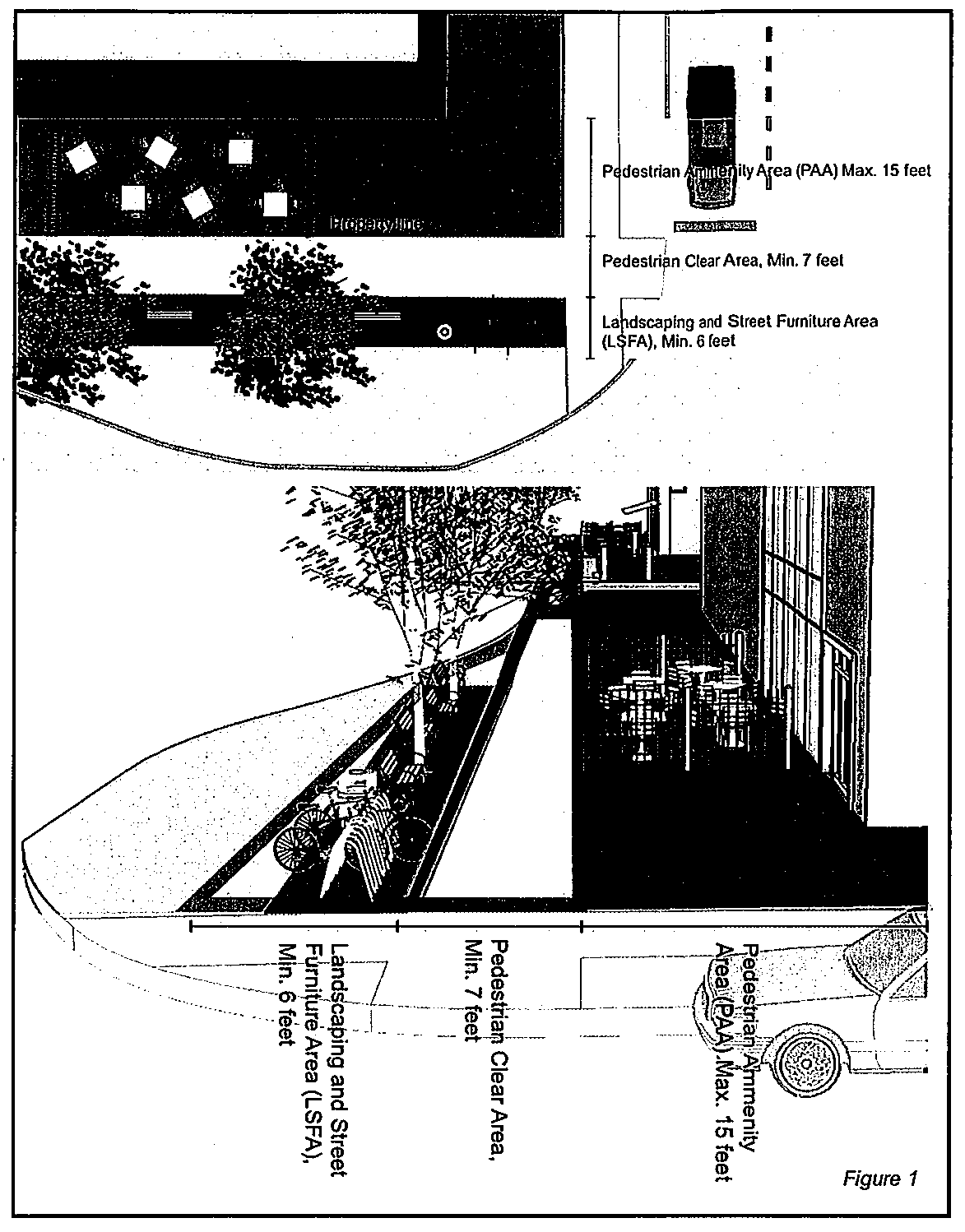
d.
When located on neighborhood streets and not the designated commercial corridor, buildings shall be constructed not less than ten feet and not more than 15 feet from the inside edge of the PZ. This front yard setback area shall not be used for parking except where parking is provided on a paved driveway. This setback area may be used for landscaping but shall otherwise be free of obstruction by any permanently affixed structures. Steps, ramp or similar accessibility measure may project a maximum of four feet into the setback area.
e.
A clear vision triangle (see figure 2) shall be maintained where roads, whether public or private, intersect, and whether there is traffic control or not. The clear vision triangle shall be determined using one of the following methods:
1.
A line extending 20 feet away from the corner of the property nearest the intersection (this point shall be considered the point of origin) along the property line adjacent and parallel to the outer edge (typically the edge of pavement) of the outer most travel lane; a second line extending 20 feet away from the same property corner (the point of origin) shall be drawn perpendicular to the first line; a third line which will form the hypotenuse shall be drawn connecting the termini of these two lines. The resulting triangular area is the clear vision triangle and shall be free of visual obstructions between the heights of three and seven feet.
2.
Alternatively, an applicant may undertake a "sight distance" study to determine the most effective location and dimensions of clear vision/sight triangles. Any such study shall be consistent AASHTO and other accepted best practices for calculating intersection and stopping sight distances. For intersections without traffic control, an approach sight triangles shall be determined; for intersections with traffic control a departure clear vision/sight triangle shall be determined.
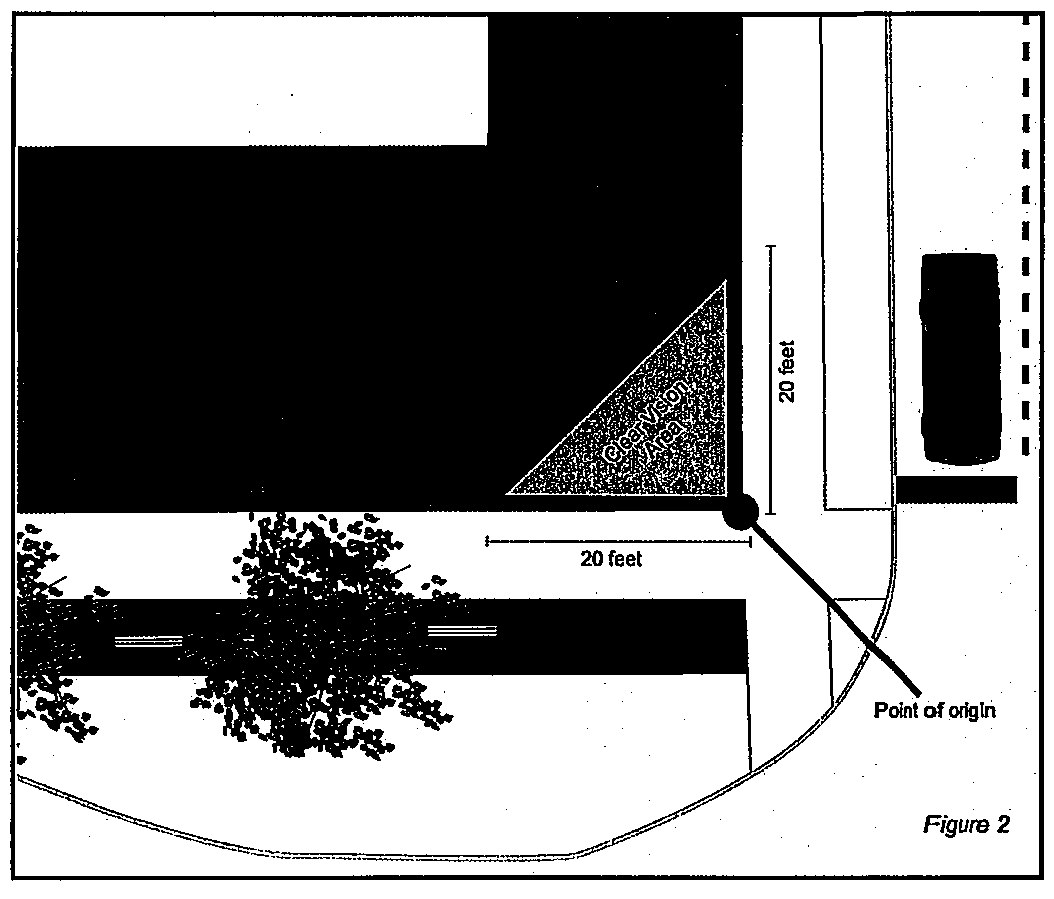
(2)
Landscaping-roadway frontages.
a.
All unpaved portions of the site shall be planted with grass, ground cover, shrubbery, or other suitable live plant material, which shall extend to any abutting street pavement edge. Seeded areas shall be maintained regularly so as to provide a healthy vegetative ground cover within 90 days after planting, or for dormant seeding, for the first 90 days of the next growing season.
b.
All plantings should be suitable to urban conditions. Site-specific conditions related to soils, sunlight, exposure to pollutants, etc. should be taken into account when selecting plantings.
c.
Clear sightlines between three and seven feet above the grade of the PCA and/or parking area shall be maintained to promote visibility and safety.
d.
All trees adjacent to the PCA shall not encroach upon the PCA.
e.
A minimum of one canopy tree shall be planted for each 40 lineal feet or portion thereof of public road frontage, plus, a minimum of one ornamental tree shall be planted for each 100 lineal feet or portion thereof of public road frontage, plus, a minimum of eight shrubs shall be planted for each 40 lineal feet or portion thereof of public road frontage. For the purpose of computing length of public road frontage, openings for driveways and sidewalks shall be counted. Trees and shrubs may be planted at uniform intervals, at random, or in groupings, as approved by the township. Required ornamental trees and shrub plantings may be waived if planting areas are used for the purposes of stormwater management and/or approved street furnishings.
(3)
Landscaping-offstreet parking. All off-street surface parking along a commercial corridor shall have a landscaped buffer conforming to requirements of this section. Buffer areas shall be counted toward requirements for interior landscape islands.
a.
The landscaped buffer shall be at least five feet in width and shall consist of permanent landscape elements such as architectural metal fencing, masonry walls, trees or other plantings meeting the standards set forth by 85-12.5(1) and (2).
b.
Clear sightlines between three and seven feet above the sidewalk top of pavement are to be maintained to promote visibility and safety.
c.
Off-street surface parking areas shall be provided with at least 30 square feet of interior landscaping per parking space. Such space shall be counted towards the minimum open space requirements of this section. Parking decks are exempt from this requirement.
d.
Landscape areas in parking lots shall meet the following dimensional standards:
1.
Each interior landscaped area will include at a minimum one canopy tree (minimum four-inch caliper at time of planting) and eight shrubs.
2.
Existing mature trees shall be retained whenever feasible.
3.
Not more than 15 continuous parking spaces shall be allowed in a row of parking without separation by a landscaped area or island with minimum dimensions of nine feet wide by 18 feet deep.
4.
Planting alternatives may be considered if they support an approved integrated stormwater management plan.
e.
Minimum requirements for landscape areas in parking lots may be waived or modified by the planning commission if they are part of an approved integrated stormwater management plan.
(4)
Bicycle parking.
a.
All non-residential developments which provide automobile parking facilities shall provide bicycle parking facilities (bike racks and similar devices) at a ratio of at least one bicycle parking space for every ten automobile parking spaces.
b.
Multi-family developments shall provide said facilities at a ratio of at least one bicycle parking space for every two multi-family units.
c.
No development, except a one or two-family developments, shall have fewer than three bicycle/moped parking spaces nor be required to exceed a maximum of 25 spaces.
d.
Bicycle spaces may be located within the LSFA, PZAA or other accessible location at a maximum distance of 50 feet from the main building entrance, or shall be located at least as close as the closest automobile parking space.
e.
Each space shall include a metal bicycle rack, stand, or similar device for securing bicycles with a user-supplied lock. Sheltered bicycle stalls or similar storage devices are strongly encouraged and may, at the discretion of the planning commission, be used to reduce total bicycle parking requirements for a site by as much as 50 percent of the original number required.
f.
Shared bicycle parking facilities, whether public or private, may be used to meet the requirements of this section provided that evidence of permanent access is submitted to and accepted by township staff or the planning commission as proof of access to such facilities.
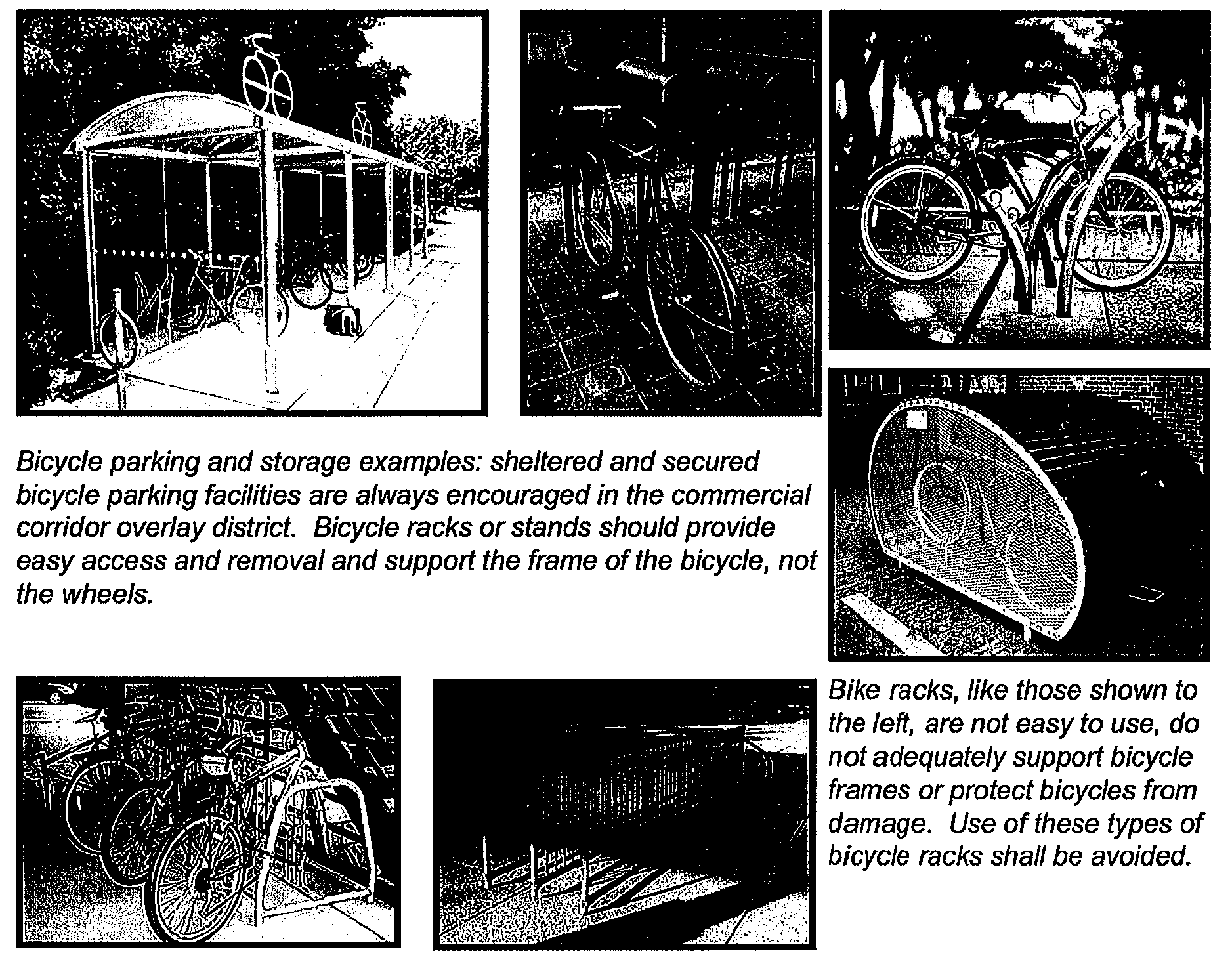
(5)
Location of utilities. Every reasonable effort shall be made to locate utilities underground or behind buildings. However, an application reviewed under this section shall not be penalized for placements of public utilities that do not comply with this provision when the utility owner prevents through action or inaction the relocation of the utility infrastructure to a preferred location.
(6)
Stormwater management facilities. Stormwater management facilities shall be provided onsite and/or offsite in accordance with local, state and federal stormwater management regulations and statutes.
(7)
Off-street parking. Off-street parking requirements are generally delineated in section 84-3. In order to discourage the construction of large surface parking lots along commercial corridors and nearby neighborhood streets and to mitigate negative impacts of these facilities on neighborhood character and aesthetic quality, the following additional provisions shall apply for properties located within the overlay district:
a.
Shared parking and offstreet parking reductions. Required offstreet parking may be reduced for individual, single use properties and mixed use properties according to the following:
1.
Required offstreet parking for all properties located within the overlay district as calculated using section 84-3.3 Amount of space, shall be reduced by 20 percent.
2.
For mixed-use buildings and multiple building mixed-use developments where two or more types of land uses share parking facilities, required offstreet parking may further be reduced according to the following computational method:
a.
Required offstreet parking for individual land uses within a mixed-use building or development shall be calculated based on requirements set forth in section 84-3.3, Amount of space.
b.
Using table 1 Shared Parking Reduction, multiply the number of spaces required by each individual use by the appropriate percentage for each of the six time periods (for example, "Weekdays from 2:00 a.m.—7:00 a.m., Weekends 6:00 p.m.—2:00 a.m., etc.).
c.
Sum the resulting numbers of required parking spaces in each column.
d.
The minimum number of spaces required shall be the highest number among these totals.
3.
Alternatively, an applicant may submit for review by the planning commission a shared parking study to justify reduced parking requirements based on different assumptions and methodology. The study shall be reviewed and accepted, accepted with conditions, or rejected by the planning commission or zoning administrator or director of planning.
4.
Multiple building mixed-use developments must provide documentation of shared parking access between separate properties. Such documentation may consist of a lease of not fewer than ten years in length, easement, or other legally binding contract made between affected property owners and accepted by the township as adequate proof of a durable, binding agreement. All such legal arrangements shall be filed and recorded by Ingham County Register of Deeds and evidence of proper filing shall be provided to the township zoning administrator prior to issuance of any permits, licenses, or certificates of occupancy.
Table 1. Shared Parking Reduction
b.
Parking lots shall be constructed behind principal buildings. Parking lots may be constructed beside principal buildings provided that not less than 50 percent of the net frontage length along the commercial corridor or local road consists of continuous building façade built to the edge of the pedestrian zone or pedestrian zone amenity area.
c.
Parking lots shall be connected to the public pedestrian way (usually the PCA) by a minimum five-foot wide sidewalk.
d.
Use of back-in angled parking is encouraged to improve safety for drivers, pedestrians, and bicyclists.
e.
Parking lots shall be separated from the pedestrian zone (PZ) by a landscaped buffer at least five feet in width and shall be composed of permanent landscape elements such as architectural metal fencing, masonry walls, trees or other plantings meeting the standards set forth by 85-.5(2) and (3).
f.
Installation of curb and gutter may be waived when interior landscaped areas are integrated into an approved stormwater management plan for the purposes of reducing stormwater runoff and increasing pretreatment of stormwater runoff. Total planting area may, at the discretion of the planning commission, be reduced by 20 percent with an approved stormwater management plan that meets local, state, and federal regulations, rules, and statutes for post construction channel protection and water quality.
g.
Parking lots shall be hard-surfaced with concrete or asphalt and meet the requirements of section 84-3, Off-street parking. The planning commission may approve alternative paving materials like pervious concrete or asphalt, pavers, etc. provided that any such application is a component of an approved stormwater management plan for the site.
h.
Parking lots shall be lighted from dusk until dawn using approved 100 percent cut-off lighting fixtures.
i.
Dimensions for parking spaces and parking lot drive aisles are described in following table:
Table 2. Parking Lot Dimensions
(8)
Lighting.
a.
Façade lighting that is integrated into and accentuates architectural features, such as principal entrances, fenestration, and signage, is recommended. Uniform floodlighting is not permitted.
b.
All outdoor lighting, including façade lighting, shall be 100% cut-off.
c.
Building entries, the pedestrian zone, and other heavily trafficked areas (including parking lots) shall be lighted between dusk and dawn to an average of four footcandles at grade not to exceed five footcandles or fall below 1.5 footcandles at grade.
d.
Directional luminaries may be used to illuminate flagpoles, signs, art works, etc. provided that they are aimed at the object and will not light neighboring properties, roadways, or distribute excessive light skyward.
(9)
Signage. Signage is an important means of advertisement, but also enables easy identification of destinations and should contribute to the architectural character of a building and district in general.
a.
Signage should be compatible with building architecture and features in scale, architectural style, theme, and finishes.
b.
Animated signs, tri-vision type signs, and similar signs as prohibited by section 102-7.3, Signs not permitted are prohibited herein.
c.
Grade level window signs are permitted but shall not obscure more than 50 percent of the total window area or more than 50 percent of any single storefront window. Windows signs shall never be designed or placed in a way that could impair the ability of public safety personnel in the effective performance of their duties.
d.
All buildings shall have the street address number clearly visible during daytime and nighttime hours from the pedestrian way and from vehicular travel lanes for each public entrance. Numbers shall be a minimum of four inches in height.
e.
Wall murals that are not used for advertising purposes are exempt from size restrictions provided that they do not obscure windows. Wall murals that contain or act as advertising shall not be painted or affixed to building facades, and may only be painted or affixed to the side or rear walls and shall not cover more than 20 percent of the gross surface area of a wall and shall not obscure windows.
f.
All signs require sign permits shall be permitted according to section 102-5 of the Township Code of Ordinances.
(10)
Open space requirements. Individual buildings and multiple building developments shall provide open space according to the following standards:
a.
Open space may consist of patios, yards, balconies, decks, parks, and other outdoor recreational facilities and landscaped and natural areas that are restricted to private access (private and private shared open space) or are open to the general public (public open space).
b.
Different land uses require different amounts of open space. Open space requirements shall be calculated using the following table:
Table 3. Required Open Space
c.
Offsite transfer of required open space. Required open space may be voluntarily transferred to an offsite location according to the standards listed in table 3, above, and the following:
1.
Offsite open space facilities must be located within one-quarter of a mile walking distance from the development. Offsite open space shall easily and safely accessible by foot.
2.
An approved site plan shall be required for all offsite open space facilities. Approval shall be obtained by the applicant simultaneously with a site plan reviewed under this section.
Section 85-12.6. Building design standards.
(1)
Building access and orientation. Primary pedestrian access to a building shall be easily identifiable and directly accessible from the public pedestrian thoroughfare (typically the pedestrian zone, see section 85-12.5(1) above). In no case shall primary pedestrian access across a parking lot be permitted. In cases where the primary pedestrian access to a building is not directly through the public pedestrian thoroughfare, a landscaped pedestrian pathway or plaza shall link the entrance to the public pedestrian thoroughfare. Where appropriate, covered or sheltered corridors and plazas are encouraged. In addition to these requirements, the following shall apply:
a.
All primary building entrances shall face the public road and pedestrian zone unless site conditions prevent it or architectural benefits can be derived from an alternative location.
b.
Buildings that front on two roadways may have a corner entrance.
c.
Doors shall not open into the PCA so as to obstruct it.
(2)
Active ground floor uses. Active uses shall occupy the ground floor level for a minimum depth of 25 feet along the commercial corridor frontage. "Active uses" are hereby defined as retail goods establishments, retail service establishments, food store establishments, hotel and entertainment venue lobbies, restaurants and bars, specialty food stores, indoor commercial recreation, performance entertainment venues, and cultural facilities. Exhibit windows and public art may also be acceptable for areas where active uses are not currently feasible.
(3)
Screening of equipment and utilities.
a.
All solid waste collection areas, receptacles, and mechanical equipment shall be screened from view by a solid, opaque wall or fence. This subsection shall not apply to trash cans located in the LSFA. The use of chain link fence for the purpose of screening is expressly forbidden.
b.
Rooftop mounted mechanical equipment shall be screened from view of a person standing on the far opposite side of the commercial corridor.
(4)
Maximum building height. Maximum building height for individual properties within the development area is depicted in Appendix B, Commercial Corridor Overlay District Height Regulating Plan. The following additional standards shall apply:
a.
Buildings exceeding the six stories shall be subject to a minimum stepback of 15 feet for floors or building areas above six floors or 60 feet (whichever is shorter).
b.
In instances where a proposed building with a height exceeding 40 feet is to be located adjacent to an existing building that is under three stories or 30 feet in its maximum height, there shall be an area of separation between the proposed and existing building. The area of separation shall be 75% of the average maximum height of the proposed building. This area of separation may only be used for parking, entry and circulation drives, landscaping and open space, or may be built to a maximum height of 40 feet and only then with a 20-foot wide area of separation that is free of any vertical structures between the existing and proposed building.
(5)
Awnings and canopies. Awnings and canopies can create visual interest, provide passers-by with refuge from inclement weather, and provide shade to building interiors thereby reducing the need for artificial cooling.
a.
No more than 50 percent of an awning or canopy may be used for business identification signage.
b.
Awnings may not project any more than three feet into the public right-of-way. Permission to encroach into the right-of-way may be required from the appropriate road agency.
c.
Awnings shall never encroach into the PCA.
Section 85-12.7. Mixed use. The development of a mix of compatible residential, commercial, and institutional uses within close proximity to each other is strongly encouraged within the commercial corridor overlay district. Mixed use development may be realized vertically through construction of individual mixed use buildings or horizontally through a siting of compatible single use buildings in close proximity to one another.
Appendix "A"
Commercial Corridor Overlay District Zone
A part of section 14 of township 4 north, range 2 west, Ingham County, Michigan more particularly described as:
Beginning at the northwest corner of lot 243 of Urban Number 1 Subdivision, thence east along the south right-of-way line of East Michigan Avenue to the northeast corner of lot 1 of Urbandale Subdivision, thence south along the west right-of-way line of Clippert Street to the southeast corner of lot 211 of Urbandale Subdivision, thence west along the north right-of-way line of East Kalamazoo Street to the southwest corner of lot 261 of Urbandale Number 1 Subdivision, thence north along the east right-of-way line of Mifflin Street to the northwest corner of lot 243 of Urbandale Number 1 Subdivision.
Appendix "B"
Appendix "B" Commercial Corridor Overlay District Height Regulating Plan
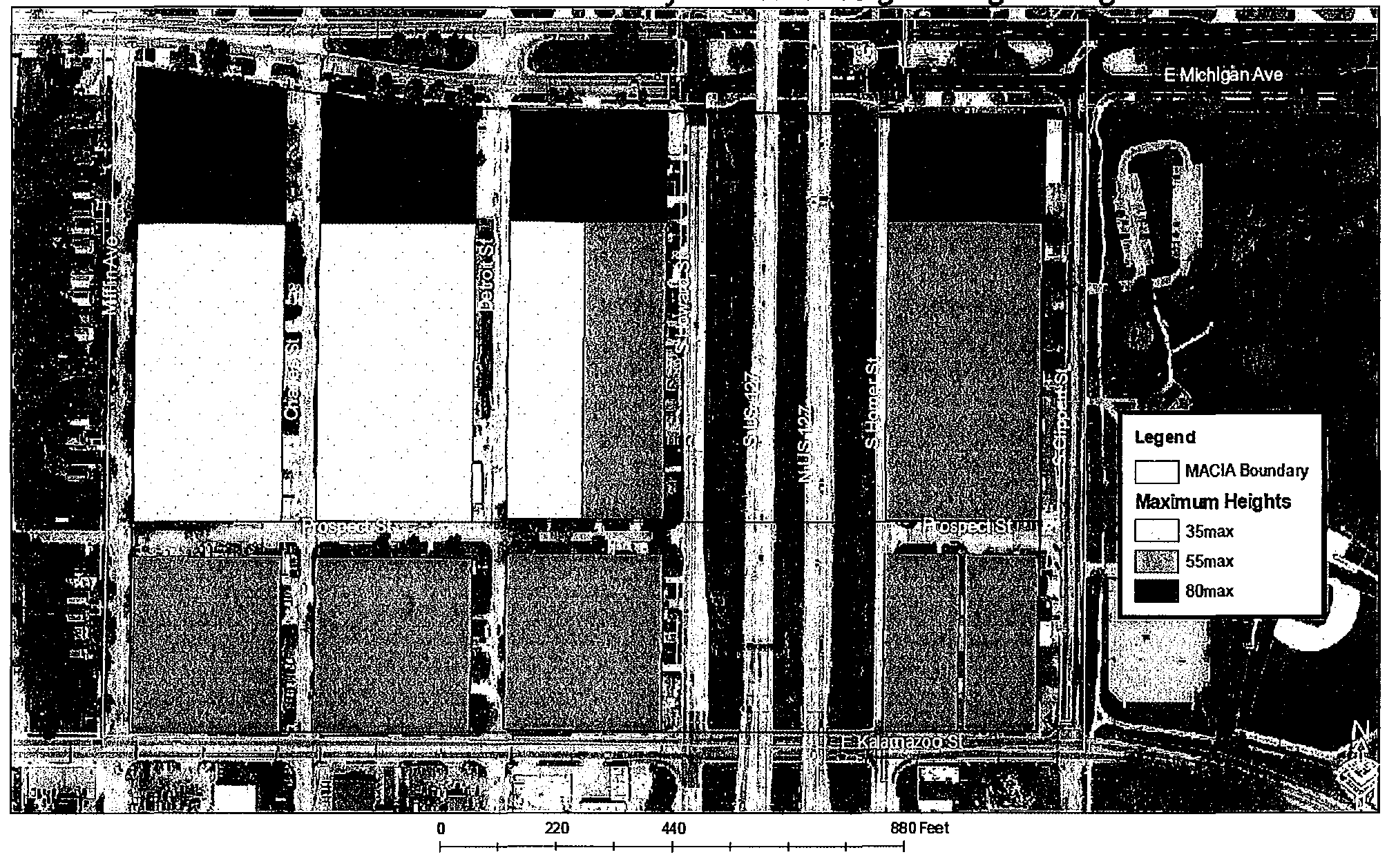
(Ord. No. 31.167, § 1, 8-27-13)

