


Lantana City Zoning Code
ARTICLE IV
- TOWN-WIDE REQUIREMENTS
Sec. 23-81. - General provisions.
(a)
One principal building per lot; entrance facing roadway. Within single-family residential districts (R1A, R1 and R3), only one (1) principal building and its accessory buildings shall occupy or be constructed upon any lot or lots or portions of lots that may be combined to meet the size required for each district. Within all zoning districts, the main entrance to the building or structure must face the street or roadway from which it has access. The street address for the property shall be based on the street toward which the front of the structure faces.
(b)
Waterfront lots.All property which is bordered by the inland waterway (Lake Worth) shall have a twenty-foot setback requirement from either the highwater line or the existing seawall, whichever is greater, and there shall be an additional setback requirement of three (3) feet at ground level for each story of any structure which exceeds two (2) stories in height. This setback requirement shall apply only to aboveground structures. A structure having vertical relief less than eight (8) inches above the prevailing surrounding grade of said structure shall not be considered to be aboveground for the purposes of this setback, and does not need to be landscaped. The prevailing surrounding grade shall be the average elevation of the ground within twenty-four (24) inches of the subject structure. The aforementioned elements shall still be subject to every other setback required in the underlying zoning district.
(c)
Accessory uses. Accessory uses in residential districts shall be constructed to conform with the building and site regulations in the district where the structure is to be located, provided, however, that all accessory uses shall be located only in the side or rear yard at least six (6) feet from the principal building.
(d)
Through lots (double frontage). On through lots, the required front yard shall be provided on each street.
(e)
Corner lots. See district and subdivision regulations. Additionally, on corner lots, at intersecting streets, there shall be no structure placed within a triangular area with the two (2) smaller sides measuring a minimum of fifteen (15) feet from the intersecting property lines. See Chapter 17.5 for definition of "corner lots."
(f)
Visibility at intersections. Visibility at all road intersections, shall not be obscured by the construction, placement, or maintenance of a structure, wall, fence, sign (except for traffic control signs installed by the Town or other governmental agency), berm, plant material (trees, palms, shrubs) or other visual obstruction between twenty-four (24) inches and nine (9) feet in height within a triangle beginning at the point where property lines meet at the corner, then twenty-five (25) feet along the front property line, thence diagonally to a point along the side property line twenty-five (25) feet from the point of beginning, and thence to the point of beginning. The only exception shall be a fence composed of material that will allow the transmission of light and air of no less than seventy-five (75) percent and no greater than four (4) feet in height if kept visually clear from any angle along the above-stated property lines. A chain-link fence meets that criteria a greater distance may be required in the event the Town determines traffic safety so requires. In the event the corner of an intersection is rounded, the measurement shall begin at the point the property lines would meet without rounding. (See Figure 23-8.1)
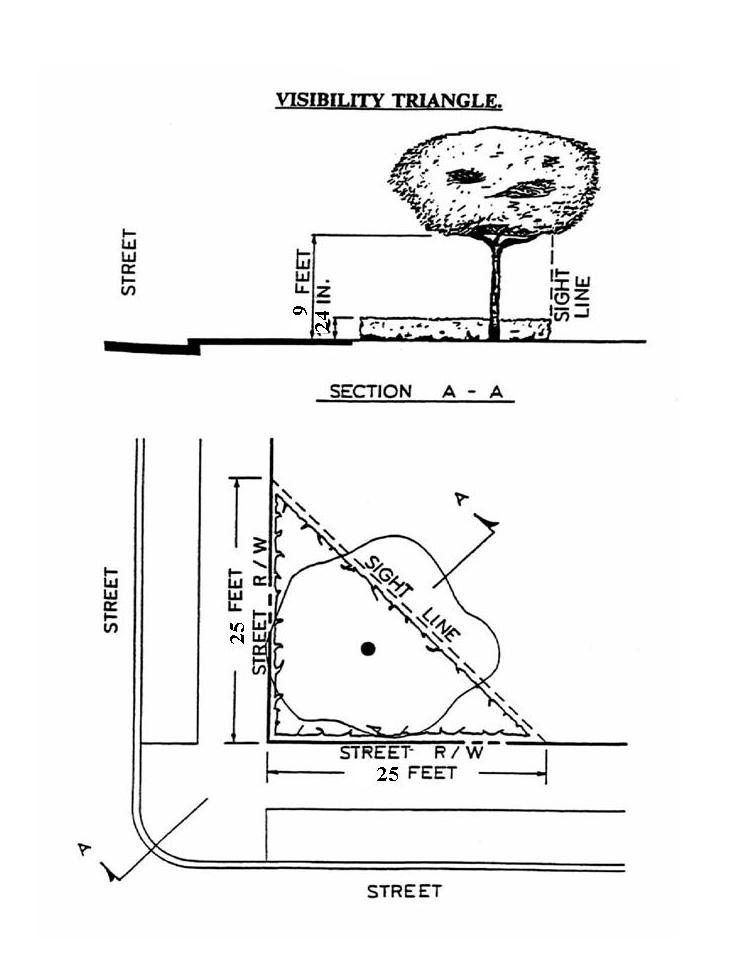
Figure 23-81.1
(g)
Height limitations.
(1)
General. Water, cooling and fire towers, radio and television towers of commercial nature, church spires, domes, cupolas, flagpoles, electrical and mechanical support systems, and similar structures, and their necessary mechanical appurtenances may be erected within a structure or on top of the structure, above the district height limitations provided in this chapter, after obtaining approval of the Town Council, based on their consideration of the standards for evaluating exceptions to district height; regulations set forth in paragraph (4) below.
(2)
Radio and T.V. antennae. Radio and television antennae are regulated according to the standards set forth in section 6-81 et seq. of the Town Code, as amended.
(3)
Satellite dish antennae. Satellite dish antennae are regulated to the standards set forth in section 6-66 et seq. of the Town Code, as amended.
(4)
Exceptions. In considering an application for an exception to the district height regulations, the Town Council shall make findings indicating the proposed exception has been studied and considered in relation to the following standards, where applicable:
a.
Whether the height exception will have an adverse effect on the existing and proposed land uses.
b.
Whether the height exception is necessary.
c.
Whether the height exception will severely reduce light and air in adjacent areas.
d.
Whether the height exception will be a deterrent to the improvement or development of adjacent property in accord with existing regulations.
e.
Whether the height exception will adversely affect property values in adjacent areas.
f.
Whether the height exception will adversely influence living conditions in the neighborhood.
g.
Whether the height exception will constitute a grant of special privilege to an individual owner as contrasted with the public welfare.
h.
Whether sufficient evidence has been presented to justify the need for a height exception.
(h)
Temporary buildings. Temporary buildings, such as models, offices and tool sheds used in conjunction with construction work only, may be permitted in any district after approval of the building department; the removal of same must be accomplished within thirty (30) days after construction ceases or is completed.
(i)
Public buildings. All publicly owned and operated buildings and properties may be permitted in any district by special exception as defined herein or as permitted use in the P district.
(j)
Walls, fences, shrubbery, height limitations. No wall, fence or other solid structure shall be erected or maintained, and no hedge, shrubbery, wall or other growth shall be maintained upon any property within the town in such a manner as to cause danger to traffic by obscuring the view, or in such manner as to impair visibility at street intersections. See subsections 23-81(e) and (f) hereinabove. All exposed structural supports for fencing shall face the owner's property.
(1)
In residential districts all walls, fences and other solid structures shall be limited to a height of four (4) feet above the lot level from the front property line back to the front building line and a height of six (6) feet elsewhere on the lot. An exception to this requirement is the waterfront property exception listed below in paragraph (2). Additionally, in the R1 and R1A residential districts driveway gates and their associated columns and supporting structures may be up to six (6) feet in height and architectural features and/or lights may extend another twenty-four (24) inches for a maximum of eight (8) feet in height. In all residential districts, fences shall be of standard industry-accepted designs including but not limited to board-on-board, shadow-box, chain-link, stucco, lattice and constructed of standard industry-accepted materials, including wood posts and slats, metal posts and chain-link, vinyl and masonry. The use of chain link fencing in the front setback area and within the minimum setback adjacent to a side street on corner lots shall be dark green or black vinyl coated and may be screened by a hedge of at least the same height. Shrubbery and hedge material may be allowed anywhere on the lot at a maximum height of twenty (20) feet so long as the shrubbery and/or hedge material does not create a traffic hazard or impair visibility as noted above in subsection 23-81(e) or (f); and so long as such shrubbery and/or hedge material is neatly maintained, trimmed and kept in a healthy condition.
Multifamily dwelling unit developments shall have a masonry wall along the rear and side property lines to a required height of six (6) feet, except such wall shall be limited to a maximum height of four (4) feet in the entire area bounded by the front property line back to the front building line. The masonry wall is subject to the following installation requirements:
a.
The top of the wall and all sides thereof must be properly finished with stucco or other masonry style color which is consistent with the architectural style and finish of the primary structure on the property; and
b.
The wall shall be landscaped with a hedge (initial planting shall be at least twenty-four (24) inches in height) and shall conform to the standards for Florida Number One or better, as given in "Grades and Standards for Nursery Plants", (Part I, 1963, and Part II, State of Florida, Department of Agriculture, Tallahassee, or equal thereto).
(2)
On waterfront property, walls, fences and hedge material shall not exceed four (4) feet in height above the lot level at the point of measurement for at least thirty (30) feet upland from the high water mark, seawall or bulkhead, except that open wire mesh or chain link fences will be permitted to a vertical height of six (6) feet, providing that no vines or shrubbery shall be permitted on said fences in excess of the aforementioned four-foot vertical measurement. All landscaping material shall be neatly maintained, trimmed and kept in a healthy condition.
(3)
In all districts other than residential and P-Public ownership, all walls, fences, shrubbery, hedge material or other such structures shall be limited to a height of four (4) feet above the lot level from the front property line back to the front building setback line; use of chain link or open mesh fencing in the front setback area shall be dark green or black vinyl coated. In areas outside the front setback area, chain link or open mesh fencing need not be vinyl coated and is limited to a maximum height of six (6) feet. All chain link or open mesh fences located to the rear of the front setback area must be screened from public view with a hedge the same height as the fence. Shrubbery and hedge material shall be neatly maintained, trimmed and kept in a healthy condition; and may not be allowed to create a visual obstruction or impair visibility at street intersections.
(4)
In the P-Public ownership zoning district, all shrubbery, hedge material, walls, fences, or other such structures shall be limited to a height of ten (10) feet above the lot level from the front property line back to the front building setback line. It is recommended and encouraged that chain link or open mesh fencing in the front setback area be dark green or black vinyl coated. In areas outside the front setback area, chain link or open mesh fencing need not be vinyl coated and is limited to a maximum height of ten (10) feet. Shrubbery and hedge material shall be neatly maintained, trimmed and kept in a healthy condition; and may not be allowed to create a visual obstruction or impair visibility at street intersections. Notwithstanding the foregoing, any municipally owned property or facility, regardless of the zoning district in which it is located, may be enclosed with a wall, fence, or other such structure, subject to the regulations set forth hereinabove if enclosing the property or facility is required by any federal, state, and/or local regulation or to protect the health, safety, and welfare of the public.
(5)
The town council may allow open wire mesh or chain link fences on land owned by the town, wherever situated, whenever such fences are deemed necessary to protect the town property, real or personal, from theft, waste, vandalism or other damage or destruction. All chain link fences should be screened up to six (6) feet in height to the extent as is reasonably practicable.
(6)
In all instances where a residential zoning district abuts a commercial or mixed-use zoning district, it shall be mandatory for the owner of the property zoned commercial to construct a masonry wall six (6) feet in height to ensure proper buffering for the adjacent residential property. The masonry wall is subject to the following installation requirements:
a.
The top of the wall and all sides thereof must be properly finished with stucco or other masonry style color which is consistent with the architectural style and finish of the primary structure on the property; and
b.
The wall shall be landscaped with a hedge (initial planting shall be at least twenty-four (24) inches in height and shall conform to the standards for Florida Number One or better, as given in "Grades and Standards for Nursery Plants", (Part I, 1963, and Part II, State of Florida, Department of Agriculture, Tallahassee, or equal thereto).
(7)
In all instances where a residential zoning district abuts an industrial zoning district, it shall be mandatory for the owner of the property zoned industrial to construct a masonry wall ten (10) feet in height to ensure proper buffering for the adjacent residential property. The masonry wall is subject to the following installation requirements:
a.
The top of the wall and all sides thereof must be properly finished with stucco; and
b.
The wall shall be landscaped with a hedge (initial planting shall be at least twenty-four (24) inches in height) and shall conform to the standards for Florida Number One or better, as given in "Grades and Standards for Nursery Plants", [Part I, 1963, and Part II, State of Florida, Department of Agriculture, Tallahassee, or equal thereto].
(k)
Projections into setback areas.
(1)
Chimneys. Chimneys may project into side and rear yards a distance not to exceed 24 inches, provided that a clear space of not less than 96 inches is left between such projection and the Lot Line adjacent.
(2)
Architectural features. No main walls of any building shall encroach on the front, side or rear setback areas, but architectural features such as canopies, cantilever slab projections (open balconies), cornices and similar features may project into the front, side and rear setbacks not more than twenty-four (24) inches, and there shall be not less than seven feet of clear headroom under any such projection. Eaves may project into the setbacks not more than thirty-six (36) inches.
(3)
Mechanical equipment in residential zoning districts. Mechanical equipment shall not be allowed within the required side setbacks for new construction in residential zoning districts, however existing mechanical equipment may be replaced in its existing location.
(l)
Lot coverage (see percentage allowed in each zoning district). Lot coverage shall be calculated to include the footprint of all above-grade structures under roof, and all swimming pools excluding, patio areas unless a screen enclosure is provided.
(m)
Utility installation. Within the single-family residential zoning district of R1-A, at the time of construction of any new buildings or structures located on any privately-owned property, such buildings or structures shall have an entirely underground location for all utility service lines, electrical distribution systems, wires and cables, which connect to and service such buildings or structures. This section shall apply to all new utilities located within town or rights-of-way within the town, as well as in easements or on private properties, except for restoration of service under emergency conditions, e.g., following a hurricane or similar disaster that damages overhead utility facilities.
(n)
Drainage features. Within the single-family residential zoning district of R1-A, at the time of construction of any new buildings or structures located on any privately-owned property, such buildings or structures shall provide adequate stormwater drainage through the installation of roof gutters and downspouts and run-off controls of swales and other methods.
(Ord. No. O-08-2010, § 1(Exh. A), 7-12-10; Ord. No. O-01-2018, § 1, 5-14-18; Ord. No. O-03-2018, § 1, 6-25-18; Ord. No. O-09-2023, § 1, 11-13-23; Ord. No. O-04-2024, § 1, 9-9-24)
Sec. 23-82. - Performance standards.
All uses located within the Town shall conform to the performance standards set forth below, and shall be constructed, maintained and operated so as not to be a nuisance or hazard to persons, animals, vegetation or property located on adjacent or nearby properties or rights-of-way; or to interfere with the reasonable use or enjoyment of adjacent or nearby property by reason of noise, vibration, smoke, dust or other particulate matter; toxic or noxious matters; odors, glare, heat or humidity; radiation, electromagnetic interference, tire or explosion hazard, liquid waste discharge or solid waste accumulation. Furthermore, no use shall be carried out so as to create any nuisance or hazard which is in violation of any applicable federal, state, county, or town law or permit, and all such laws and permits are hereby adopted as performance standards in these zoning regulations.
(a)
Noise. No use shall be carried out in any zoning district so as to create sound which is in violation of Chapter 12, Nuisances, of the Town Code, as amended.
(b)
Vibrations. No use shall be carried out in any zoning district so as to create inherently and recurrently generated ground vibrations which are perceptible without instruments at any point at or beyond the property lines of the property on which the use is located.
(c)
Smoke, dust, dirt or other particulate matter. No use shall be carried out within any zoning district so as to allow the emission of smoke, dust, dirt or other particulate matter which may cause damage to property or vegetation, discomfort or harm to persons or animals, or prevent the reasonable use and enjoyment of property and rights-of-way, at or beyond the property lines of the property on which the use is located. Furthermore, no use shall be carried out so as to allow the emission of any substances in violation of any federal, state, county or town laws or permits governing the emission of such substances.
(d)
Odors and fumes. No use shall be carried out in any district so as to allow the emission of objectionable or offensive odors or fumes in such concentration as to be readily perceptible at any point at or beyond the boundary of the district.
(e)
Toxic or noxious matter. No use shall be carried out in any zoning district so as to allow the discharge of any toxic or noxious matter in such concentration as to cause damage to property or vegetation, discomfort or harm to persons or animals, or prevent the reasonable use and enjoyment of property or rights-of-way, at or beyond the property line of the property on which the use is located; or to contaminate any public waters or any groundwater.
(f)
Fire and explosion hazards. No use shall be carried out in any zoning district so as to create a fire or explosion, hazard to adjacent or nearby property or rights-of-way, or any persons or property thereon. Furthermore, the storage, use or production of flammable or explosive materials shall be in conformance with the provisions of Chapter 8, Fire prevention and protection, of the Town Code, as amended.
(g)
Heat, humidity or glare. No use shall be carried out in any zoning district so as to produce heat, humidity or glare which is readily perceptible at any point at or beyond the property line of the property on which the use is located. Artificial lighting which is used to illuminate any property or use shall be directed away from any residential use so as not to create a nuisance to such residential uses.
(h)
Liquid waste. No use shall be carried out in any zoning district so as to dispose of liquid waste of any type, quantity or manner which is not in conformance with the provisions of Chapter 21, Utilities of the Town Code, as amended.
(i)
Solid waste. No use shall be carried out in any zoning district so as to allow the accumulation or disposal of solid waste which is not in conformance with Chapter 9, Garbage and refuse disposal, of the Town Code, as amended; or which would cause solid waste to be transferred in any manner to adjacent or nearby property or rights-of-way.
(j)
Electromagnetic interference. No use shall be carried out in any zoning district so as to create electromagnetic radiation which causes abnormal degradation of performance of any electromagnetic receptor of quality and proper design as defined by the principles and standards adopted by the Institute and Electrical and Electronics Engineers, or the Electronic Industries Association. Furthermore, no use shall be carried out in any zoning district so as to cause electromagnetic radiation which does not comply with the Federal Communications Commission regulations, or which causes objectionable electromagnetic interference with normal radio or television reception in any zoning district.
(Ord. No. O-08-2010, § 1(Exh. A), 7-12-10)
Sec. 23-83. - Airport protection zone.
(a)
Purpose and intent. The purpose of this section is to establish reasonable airport zoning regulations in order to implement the provisions of state and federal law relating to airport hazard areas and to provide for airspace protection and land use compatibility with airport operations.
(b)
Definitions. The following phrases, words and terms shall have the following meanings:
Aeronautical study means a Federal Aviation Administration study, conducted in accordance with the standards of 14 C.F.R. part 77, subpart C, and Federal Aviation Administration policy and guidance, on the effect of proposed construction or alteration upon the operation of air navigation facilities and the safe and efficient use of navigable airspace.
Airport means any area of land or water designed and set aside for the landing and taking off of aircraft and used or to be used in the interest of the public for such purpose.
Airport hazard means an obstruction to air navigation which affects the safe and efficient use of navigable airspace or the operation of planned or existing air navigation and communication facilities.
Airport hazard area means any area of land or water upon which an airport hazard might be established.
Airport layout plan means a set of scaled drawings that provides a graphic representation of the existing and future development plan of the airport and demonstrates the preservation and continuity of safety, utility, and efficiency of the airport.
Airport protection zoning regulations means airport zoning regulations governing airport hazards.
Department means the department of transportation as created under F.S. ch. 20.
Landfill has the same meaning as provided in F.S. ch. 403.
Obstruction means any existing or proposed object, terrain, or structure construction or alteration that exceeds the federal obstruction standards contained in 14 C.F.R. part 77, subpart C. The term includes:
(1)
Any object of natural growth or terrain;
(2)
Permanent or temporary construction or alteration, including equipment or materials used and any permanent or temporary apparatus; or
(3)
Alteration of any permanent or temporary existing structure by a change in the structure's height, including appurtenances, lateral dimensions, and equipment or materials used in the structure.
Person means any individual, firm, co-partnership, corporation, company, association, joint-stock association, or body politic, and includes any trustee, receiver, assignee, or other similar representative thereof.
Public-use airport means an airport, publicly or privately owned, licensed by the state, which is open for use by the public.
Runway protection zone means an area at ground level beyond the runway end to enhance the safety and protection of people and property on the ground.
Structure means any object constructed, erected, altered, or installed, including, but not limited to, buildings, towers, smokestacks, utility poles, power generation equipment, and overhead transmission lines.
Substantial modification means any repair, reconstruction, rehabilitation, or improvement of a structure when the actual cost of the repair, reconstruction, rehabilitation, or improvement of the structure equals or exceeds fifty (50) percent of the market value of the structure.
(c)
Airport protection overlay zones. In order to carry out the provisions of this section, there are hereby created and established certain "protected zones" that include all lands in the town lying beneath the primary, runway protection, horizontal, conical, approach and transitional surfaces as they apply to a particular public-use airport. The boundaries of the airport protection overlay zone shall apply to all zoning classifications established in chapter 23 of the Town Code of Ordinances. An area located in more than one (1) of the airport protection overlay zones is considered to be in the zone with the more restrictive height limitation. The airport protection overlay zones are hereby established and defined as follows:
(1)
Primary zone. A rectangular area located at each end of a runway, longitudinally centered on the runway. For hard surface runways, the primary surface extends two hundred (200) feet beyond each end. For runways without a hard surface, the primary zone ends at each runway end. The width depends on the existing or planned approach and runway type, as follows:
a.
Precision instrument runways: One thousand (1,000) feet.
b.
Non-precision instrument runways: Five hundred (500) feet.
c.
Public utility visual runways: Two hundred fifty (250) feet.
d.
Private utility visual runways: One hundred (100) feet.
No structure or obstruction that is not part of the landing and takeoff area and is of a greater height than the nearest point on the runway centerline will be permitted within the primary zone.
(2)
Runway protection zone. A trapezoidal area at ground level beginning two hundred (200) feet beyond the end of a runway and centered about the extended runway centerline, with the shortest side of the trapezoid closest to the runway. The runway protection zone dimension for a particular runway end is a function of the type of aircraft and approach visibility minimum associated with that runway end. Its width corresponds to that approach zone. Its length varies as follows:
a.
Precision instrument runways: Two thousand five hundred (2,500) feet.
b.
Non-precision instrument runways: One thousand (1,000) to one thousand seven hundred (1,700) feet.
c.
Public utility visual runways: One thousand (1,000) feet.
(3)
Horizontal zone. An area around each airport with an outer boundary, the perimeter of which is constructed by swinging arcs or specified radii from the center of each end of the primary zone of the airport's runways and connecting the adjacent arcs by lines tangent to those arcs. The radius for each arc for the horizontal surface is five thousand (5,000) feet for visual approach runways, and ten thousand (10,000) feet for all other approach types. The horizontal zone extends outward from the transitional zone to the edge of the conical zone. No structure or obstruction can extend one hundred fifty (150) feet above the established airport elevation.
(4)
Conical zone. The area extending outward from the periphery of the horizontal zone for a distance of four thousand (4,000) feet. Height limitations on structures or obstructions begin at one hundred fifty (150) feet above the established airport elevation at the inner edge, with permitted height increasing one (1) foot vertically for every twenty (20) feet of horizontal distance.
(5)
Approach zone. An area longitudinally centered on the extended runway centerline, and extending outward and upward from the end of the runway's primary surface. The approach surface begins at the end of the primary surface. An approach zone is designated for each runway based upon the type of approach available or planned for that runway end. Permitted height limitation within the approach zones is the same as the runway end height at the inner edge and increases with horizontal distance outward from the inner edge as follows:
a.
Precision instrument runways: Permitted height increases one (1) foot vertically for every fifty (50) feet horizontal distance for the first ten thousand (10,000) feet and then increases vertically for every forty (40) feet horizontal distance for an additional forty thousand (40,000) feet.
b.
Non-precision instrument runways: Permitted height increases one (1) foot vertically for every thirty-four (34) feet horizontal distance for a total distance of ten thousand (10,000) feet.
c.
Visual runways: Permitted height increases one (1) foot vertically for every twenty (20) feet horizontal distance for a total distance of five thousand (5,000) feet.
(6)
Transitional zone. The area extending outward and upward at a 7:1 slope from the sides of the primary zones and approach zones connecting them to the horizontal zone. Height limits within the transitional zone are the same as the primary zone or approach zone at the boundary line where it adjoins and increases at a rate of one (1) foot vertically for every seven (7) feet horizontally, extending out at right angles to the runway center line and extended center line for a distance of five thousand (5,000) feet.
(d)
Permitting, administration and enforcement.
(1)
Administration and enforcement. It shall be the duty of the town development services director or designee to administer and enforce the requirements prescribed herein within the territorial limits over which the town has jurisdiction through the permitting process.
(2)
Permit required. Any person proposing to construct, alter, or allow an obstruction in an airport hazard area, as determined by the Federal Aviation Administration, shall apply for a building permit. No permit shall be issued if it would allow the establishment or creation of an airport hazard or if it would permit a nonconforming obstruction to become a greater hazard to air navigation than it was when the applicable airport protection zoning regulation was adopted which allowed the establishment or creation of the obstruction, or than it is when the application for a permit is made.
(3)
Permit application. In addition to the standard submittal documents associated with a building or development permit application, permit applications under this section shall include documentation showing compliance with the federal requirement for notification of proposed construction or alteration of structures and a valid aeronautical study. All such applications shall be accompanied by the appropriate review fee established by council resolution.
(4)
Review criteria. The following criteria shall be considered when determining whether to issue or deny a permit:
a.
The safety of persons on the ground and in the air;
b.
The safe and efficient use of navigable airspace;
c.
The nature of the terrain and height of existing structures;
d.
The effect of the construction or alteration on the state licensing standards for a public-use airport contained in F.S. ch. 330 and rules adopted thereunder;
e.
The character of existing and planned flight operations and developments at public-use airports;
f.
Federal airways, visual flight rules, flyways and corridors, and instrument approaches as designed by the Federal Aviation Administration;
g.
The effect of the construction or alteration of an obstruction on the minimum descent altitude or the decision height at the affected airport; and
h.
The cumulative effects on navigable airspace of all existing obstructions and all known proposed obstructions in the area.
i.
Additional requirements adopted by the town or administrative agency pertinent to evaluation and protection of airspace and airport operations.
(5)
State department of transportation review. Upon receipt of a complete permit application, a copy of the application shall be provided to the state department of transportation aviation office by certified mail, return receipt requested, or by a delivery service that provides a receipt evidencing delivery. Pursuant to F.S. § 333.025(4), the department of transportation shall have fifteen (15) days to review the application and provide comments, if any, to the town, said time running concurrently with the review of the application by the town.
(6)
Obstruction marking and lighting. The owner of a permitted obstruction shall be required to install, operate, and maintain thereon, at his or her own expense, marking and lighting in conformance with the specific standards set forth by the Federal Aviation Administration.
(7)
Nonconforming uses. This section may not require the removal, lowering, or other change or alteration of any obstruction not conforming to the regulation when adopted or amended, or otherwise interfere with the continuance of any nonconforming use, except as provided in subsection 23-83(d)(2).
(8)
Abandonment. A nonconforming obstruction that has been abandoned or is more than eighty (80) percent torn down, destroyed, deteriorated, or decayed shall not be granted a permit if it would allow the obstruction to exceed the applicable height limit or otherwise deviate from the airport protection zoning regulations. Whether or not an application is made for a permit under this section, the owner of the nonconforming obstruction may be required, at his or her own expense, to lower, remove, reconstruct, alter, or equip such obstruction as may be necessary to conform to the current airport protection zoning regulations. If the owner of the nonconforming obstruction neglects or refuses to comply with such requirement for ten (10) days after notice, the town may proceed to have the obstruction so lowered, removed, reconstructed, altered, or equipped and assess the cost and expense thereof upon the owner of the obstruction or the land whereon it is or was located.
(9)
Variances and modifications. Unless otherwise provided in this section, a petition for variance from the requirements of this section shall be governed by the provisions of section 23-63.
(10)
Exemptions. Notwithstanding any other provisions herein, the following activities and structures shall be exempt from the permitting requirements of this section:
a.
Existing structures that received construction permits from the Federal Communications Commission that exceed federal obstruction standards before May 20, 1975. A permit is not required for any necessary replacement or repairs to such existing structures if the height and location are unchanged.
b.
Nonsubstantial improvements of existing residential structures and parcels, and nonresidential structures or parcels provided the principal use of the property has not been is continued for a period of no less than one hundred eighty (180) consecutive days.
c.
Cranes, construction equipment, and other temporary structures in use or in place for a period not to exceed eighteen (18) consecutive months are exempt from review by the state department of transportation, unless requested by the state department of transportation.
(e)
Landfill regulations.
(1)
New landfills shall not be located:
a.
Within ten thousand (10,000) feet from the nearest point of any runway used or planned to be used by turbine aircraft;
b.
Within five thousand (5,000) feet from the nearest point of any runway used by only nonturbine aircraft;
c.
Outside the perimeters defined in subparagraphs a. and b., but still within the lateral limits of the civil airport imaginary surfaces defined in 14 C.F.R. § 77.19. Such landfills shall be reviewed on a case-by-case basis.
(2)
The landfill operator of any landfill that is located and constructed in a manner that attracts or sustains hazardous bird movements from feeding, water, or roosting areas into or across the runways or approach and departure patterns of aircraft shall incorporate bird management techniques or other practices to minimize bird hazards to airborne aircraft.
(3)
Where an airport authority or other governing body operating a public-use airport has conducted a noise study in accordance with 14 C.F.R. part 150, or where a public-use airport owner has established noise contours pursuant to another public study approved by the Federal Aviation Administration, the prohibition of incompatible uses, as established in the noise study in 14 C.F.R. part 150, Appendix A or as a part of an alternative Federal Aviation Administration-approved public study, within the noise contours established by any of these studies, except if such uses are specifically contemplated by such study with appropriate mitigation or similar techniques described in the study.
(4)
Where an airport authority or other governing body operating a public-use airport has not conducted a noise study, the prohibition of residential construction and any educational facility, with the exception of aviation school facilities, within an area contiguous to the airport measuring one-half (½) the length of the longest runway on either side of and at the end of each runway centerline.
(5)
The restriction of new incompatible uses, activities, or substantial modifications to existing incompatible uses within runway protection zones.
(f)
Appeals and judicial review.
(1)
Any person, political subdivision or administrative agency, or joint airport zoning board that contends a decision or determination on a permit made under this section is an improper application of airport zoning regulations shall use the process established for administrative review as set forth in section 23-63 of this chapter.
(2)
The town council, in conformity with this section, may affirm, reverse, or modify the decision or determination on the permit or other determination from which the appeal is taken.
(3)
Pursuant to the requirements of F.S. ch. 333 any person, political subdivision, or joint airport zoning board affected by a decision of the town council may apply for judicial relief to the circuit court within thirty (30) days after rendition of the town council's decision. Review shall be by petition for writ of certiorari, which shall be governed by the Florida Rules of Appellate Procedure.
(Ord. No. O-11-2017, § 1, 9-25-17)