


Lantana City Zoning Code
ARTICLE VI
- SUPPLEMENTAL DISTRICT REGULATIONS
Sec. 23-130. - Downtown overlay design requirements.
(a)
Purpose and intent. The purpose of the downtown overlay design requirements is to provide a basis for evaluating redevelopment proposals and act as a guide for making decisions about public and private improvements within the downtown. The requirements promote the preservation and enhancement of the form, scale, and visual character that make the Lantana Downtown area unique within the Town and the region. It is the intent of the design requirements to ensure that each new building or public space will reinforce the Town center's unique identity.
These requirements will be used as an overlay on the existing zoning categories. The requirements are the site design and building design standards for each of the current zoning sub-areas defined in subsection (b) below.
In particular, the requirements are designed to support the following objectives in accordance with the Town of Lantana Comprehensive Plan:
•
Assure long-term economic vitality of the downtown area;
•
Create a vibrant mixed-use environment;
•
Create an aesthetically pleasing and vibrant pedestrian oriented town center;
•
Provide improved visual and physical connectivity between sub-areas;
•
Encourage the creation of exciting and inviting public urban spaces;
•
Develop an urban character that is unique to Lantana;
•
Provide interesting architectural design diversity within a continuity of urban design principals;
•
Provide safe, efficient, and aesthetically pleasing accommodations for vehicular access and parking; and
•
Provide incentives (road right-of-way, easements, etc.…) for older sites to encourage redevelopment.
(b)
Downtown overlay zone (DOZ) and sub-areas. The boundaries of the downtown overlay zone are: Lantana Road on the north; Pine Street on the south; Intracoastal Waterway on the east; and Dixie Highway on the west.
There are six (6) sub-areas within the downtown zone which are characterized by distinct uses, types of structures, scales of development intensity and density and architectural styles. These sub-areas are designated and generally described as follows: (See Figure 23-130.1)
(1)
Dixie Highway Corridor mixed use sub-area (DC)—A mixed-use area on the east side of Dixie Highway from between Pine Street and Lantana Road, except the properties at the Ocean Avenue intersection;
(2)
Cottage Commercial sub-area (CC)—A small-scale commercial area with retail shops, restaurants, offices with unique design criteria along Ocean Avenue between Oak Street and Lake Drive and including seven (7) lots south of Ocean Avenue on the west side of Oak Street;
(3)
North Lake Drive sub-area (NL)—A multifamily area with design criteria along the East side of North Lake Drive and including eight (8) lots along the west side of North Lake and four (4) lots fronting on Oak Street, between the alley north of Ocean Avenue and Lantana Road;
(4)
South Lake Drive sub-area (SL)—A single-family area along the East side of South Lake Drive;
(5)
Ocean Avenue mixed use sub-area (OMX)—A mixed-use area with design criteria located along the Ocean Avenue corridor from Lake Drive eastward to the Town's public park and boat ramp;
(6)
East Ocean Avenue public recreation sub-area (OPR)—A publicly-owned area along both sides of Ocean Avenue in which Sportsman Park and Bicentennial Park are located.
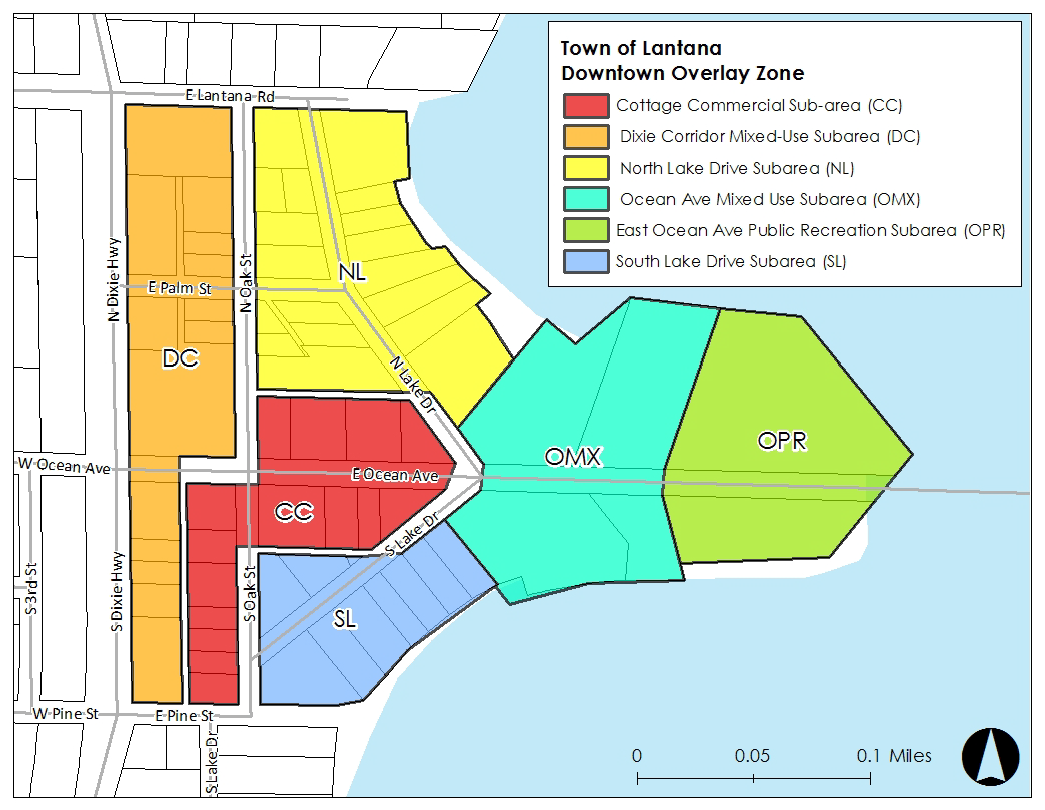
Fig. 23-130.1. Downtown Overlay Zone and sub-areas.
(c)
Applicability.
(1)
Applicability. All lots, lots of record and parcels located within the Downtown Overlay Zone (DOZ) shall be subject to the appropriate site design and building design requirements for the particular sub-area in which such properties are located and shall apply as follows:
a.
All new development;
b.
All renovations, additions or redevelopment to existing structures where the cost of such is greater than fifty (50) percent of the assessed improvement value of the parcel, indicated on the most recent tax roll of Palm Beach County Property Appraiser, or an increase in the square footage of the structure by more than twenty (20) percent of the square footage of the existing structure; and
c.
When the use of an existing structure ceases for one hundred eighty (180) consecutive days, or such use may be determined to be a discontinued or abandoned use by any other provision of the zoning code.
(2)
Invalid approvals. Invalid development orders or permits for projects, which have been revoked or have expired shall be subject to all applicable provisions of the Downtown Overlay Zone.
(3)
Conflict with other applicable regulations.
a.
When the provisions of the downtown overlay zone conflict with other jurisdictional regulations applicable to the site, the DOZ provisions shall prevail.
b.
Zoning regulations addressed within the individual jurisdiction regulations that are not addressed within the downtown overlay zone district remain applicable in the development or redevelopment of a site in the downtown overlay zone.
(d)
Area-wide requirements. There are some elements that should be consistent throughout the entire downtown overlay zone. These elements, which include building height, street level use, architecture styles, parking and circulation, service, refuse removal and delivery design, landscaping and signage, will provide continuity and consistency for all new development and redevelopment projects - both public and private. Notwithstanding the common elements, it is understood that some flexibility and case-by-case analysis will be required.
(1)
Maximum Allowable Building Height. (See Figure 23-130.2)
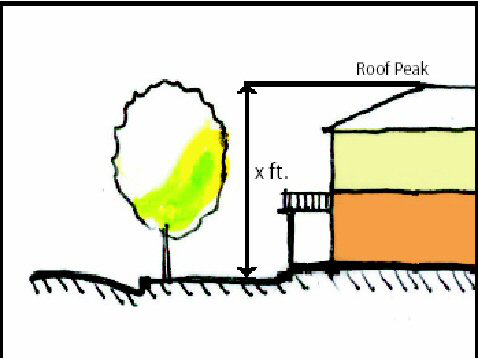
Fig. 23-130.2
(2)
Street level use (See Figure 23-130.3)
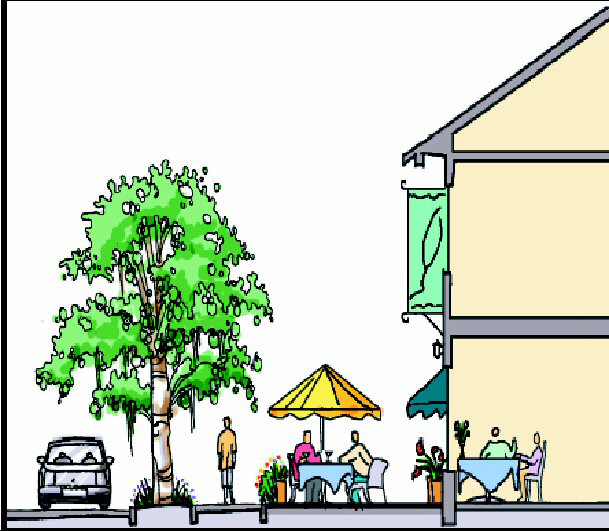
Fig. 23-130.3
•
The first floor of the commercial and mixed use buildings shall contain pedestrian oriented uses.
•
Retail activities should be oriented toward the street and have direct access to the streetscape area through storefront entries.
•
Take the "indoors" outdoors by spilling interior space (e.g. dining areas, small merchandise displays) onto the streetscape sidewalks and plazas.
(3)
General Building Design Requirements (See Figure 23-130.4)
a.
Building Walls. Buildings shall be designed to establish three bands of vertical composition as follows:
Base (1 story)
Middle (2nd, 3rd and upper level stories)
Top (Roof)
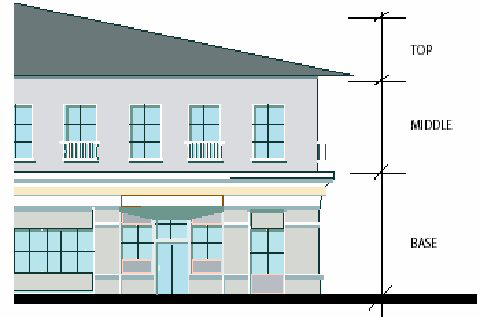
Fig.23-130.4
b.
Ground floor composition. The ground floor façade should contain a minimum of five of the façade design elements in accordance with the recommended architectural styles in each sub-area, including but not limited to:
•
Overhangs.
•
Arcade.
•
Raised cornice parapets over the doors.
•
Decorative plinth and kick plate detail.
•
Projected canopies.
•
Awnings.
•
Projecting eaves.
•
Decorative trusses and exposed rafter ends.
•
Double hung windows.
c.
Façade requirements. (See Figure 23-130.5)
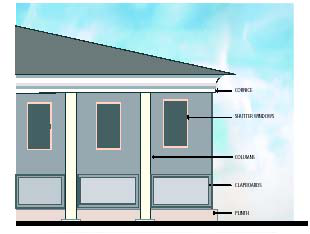
Fig. 23-130.5
Blank walls. In no case shall a blank wall (including parking garage sides) exist along any building elevation that exceeds an area of ten (10) feet vertically by twenty (20) feet horizontally.
Walls or portions of walls where windows are not provided shall have architectural treatment wherever they face adjacent streets or adjacent residential areas. At least three of the following elements shall be incorporated into each design to mitigate the visual impact of the blank wall areas: Fig. 23-130.5
•
Horizontal architectural banding at story breaks having a minimum of four (4) inches of relief from the wall.
•
Horizontal siding.
•
Vertical and diagonal clapboards.
•
Projecting canopies.
•
Projecting eaves.
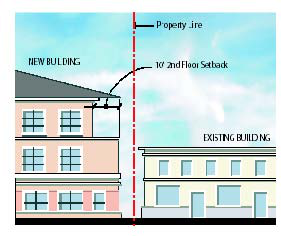
Fig. 23-130.6
d.
Façade Spacing. (See Figure 23-130.6)
•
There shall be a minimum setback of ten feet (10') between the 2nd and 3rd floors of the building.
•
There shall be a side setback adjacent to the property line of five feet (5') for buildings with a front façade longer than two hundred feet (200').
•
Buildings shall not exceed a continuous massing of more than one hundred feet (100') in length when such massing faces residential streets and shall not exceed one hundred fifty feet (150') when such massing faces mixed-use and/ commercial streets.
e.
Roof Treatment. Roofs should be an integral part of the architectural design and form of the buildings in the downtown area. (See Figure 23-130.7)
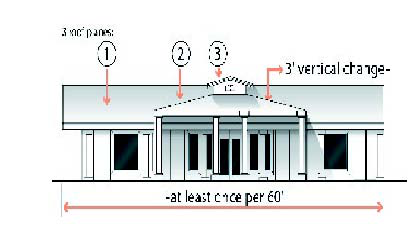
Fig. 23-130.7
1.
Overall roof design. Variations in roof lines shall be used to add interest to and reduce the massing of buildings. Roof features shall be in scale with building mass and shall complement the character of adjoining or adjacent buildings and neighborhoods. Roofing material shall be constructed of durable high quality materials in order to enhance the appearance and attractiveness of the community.
2.
Guideline: Roof edge and parapet treatments. For buildings with a sloping roof: At a minimum of two locations, the roof edge or parapet shall have a vertical change (minimum of three (3) feet) from the dominant roof design. At least one such change shall be located on a primary façade adjacent to a collector or arterial right of way.
f.
Architectural elements
•
Roof eaves. The roof eaves may encroach no more than six (6) feet on all setback lines
•
Balconies. Balconies may be built six (6) feet into the front and side vertical setbacks above 2nd floor
•
Awnings and canopies. Awnings and Canopies on the first floor may encroach six (6) feet into the setback if the bottom of the awning is ten (10) feet above the sidewalk
•
Columns, arches, piers, railings and balustrades. Columns and piers shall be spaced at intervals of no more than thirty (30) feet.
g.
Exterior materials.
The following materials are approved for exterior building construction:
•
Stucco;
•
Brick;
•
Concrete masonry units, e.g. hardiplank;
•
Stone; and
•
Wood, clapboard siding.
The following materials are specifically prohibited for exterior building construction:
•
Plastic siding;
•
Corrugated or reflective metal panels;
•
Tile;
•
Smooth or ribbed-faced concrete block;
•
Applied stone or faux-stone in ashlars or rubble look; and
•
Wood sheeting.
(4)
Required building styles. The primary goal of the architectural requirements is to ensure that each individual site design, architectural and streetscape project contribute to the positive image of the DOZ. The building elements outlined hereinbelow are inspired from the study of traditional buildings in the Town of Lantana and shall be incorporated to enhance the Town's unique and authentic character. The architect/developer may follow the variance procedure set forth in section 23-63(b) of the Town Zoning Code in order to propose innovative design solutions which may not satisfy the specific requirements of the DOZ.
All development or redevelopment projects proposed for the DOZ must have one (1) of the two (2) following architectural styles:
•
Florida Vernacular style.
•
Caribbean style.
a.
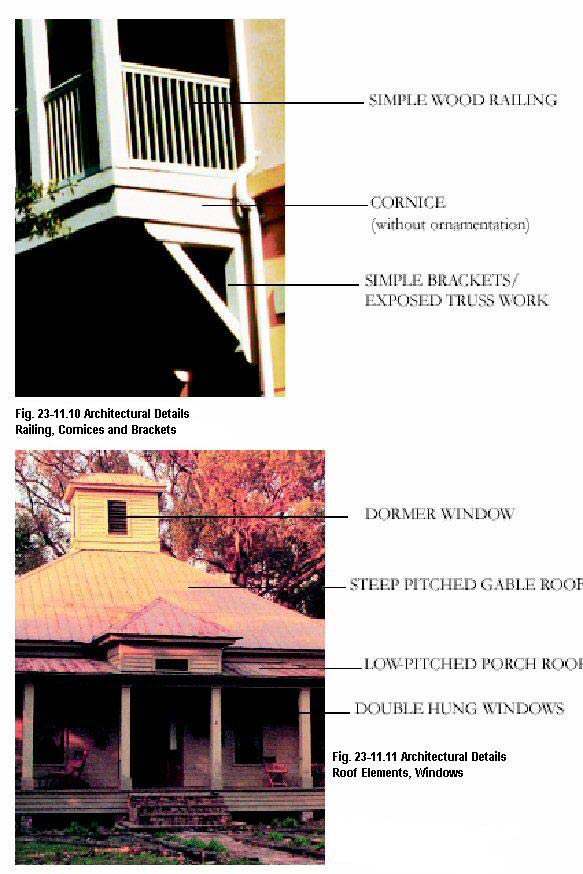
Florida Vernacular style. Florida Vernacular or 'Cracker' style refers to the traditional style of wood construction commonly experienced in residential dwellings and plantation homes. The architectural characteristics common to this typology are wood-frame construction, large attached front porch, steep roof, revealed fireplace, horizontal wood siding, double hung vertical windows and elevated first floor. This style is characterized by simple architectural elements with minimal ornamentation and detailing with an emphasis on energy conservation and efficiency. (Figures 23-130.8 and 23-130.9 depict the typical characteristics of a building in the Florida Vernacular Style.)
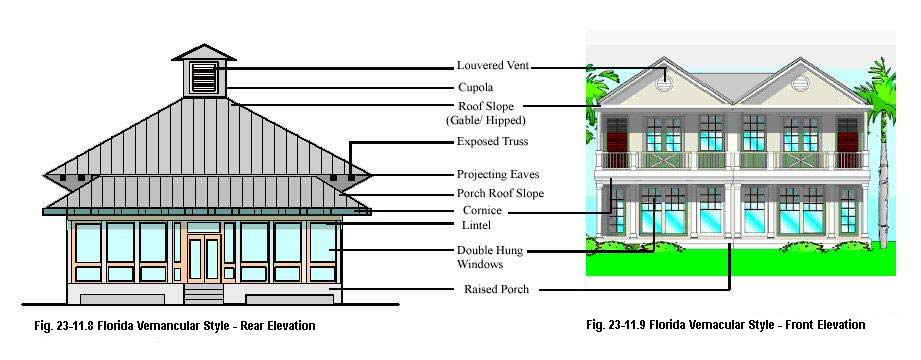
Florida Vernacular Style Characteristics
•
Plan: Regular, rectangular.
•
Material: Horizontal wood siding, Brick or smooth masonry.
•
Roof type: Steep gable, hip.
•
Roof surfacing: Metal or composition asbestos, shingles.
•
Details: Simple, jig-sawn patterns around porches and eaves, large attached front porch, revealed fireplace, double hung vertical window.
The façade should contain a minimum of five (5) of the following façade design elements for the Florida Vernacular Style (See Figures 23-130.10 and 23-130.11 for illustrations):
1.
Metal roofing materials.
2.
Steep pitched gabled and hipped roofs.
3.
Exposed truss work.
4.
Simple wood cornice.
5.
Double hung windows.
6.
Simple wood railings.
7.
Low-pitched roof porches.
8.
Wood frame construction.
9.
Dormer windows.
b.
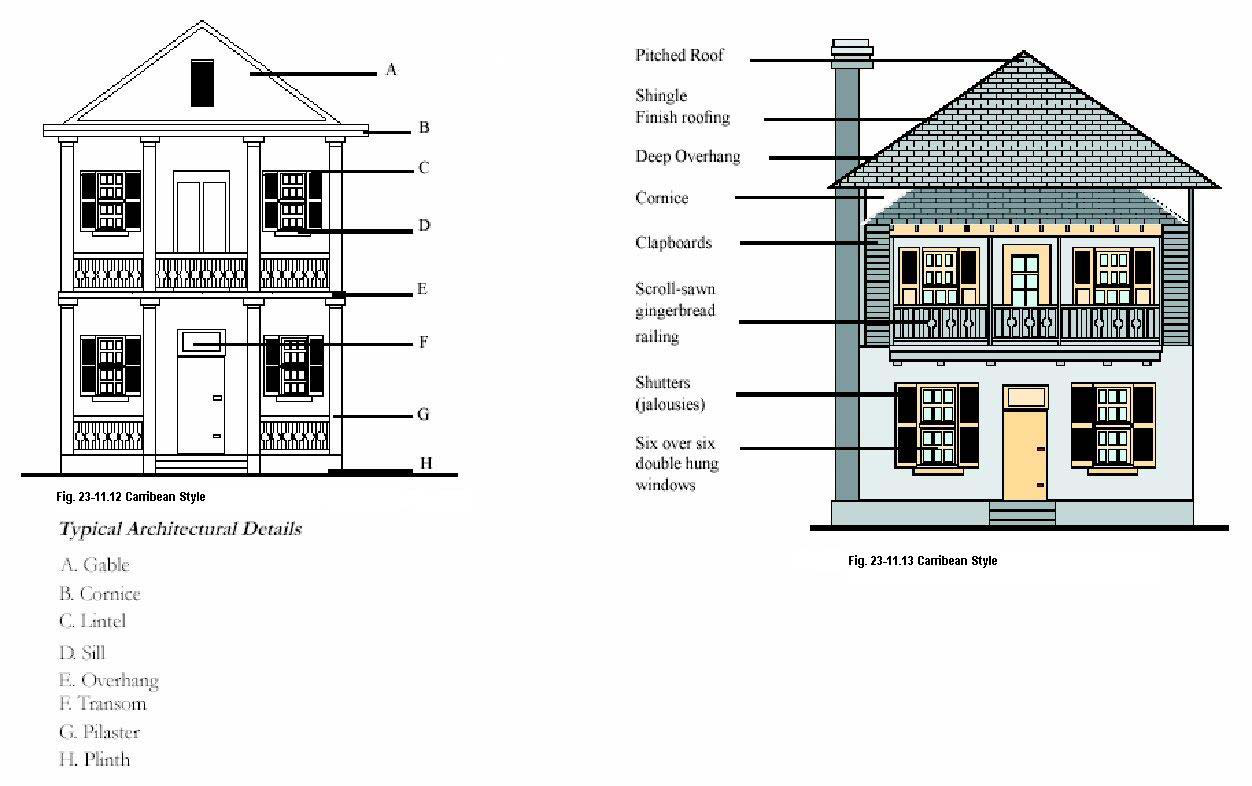
Caribbean Style. The Caribbean style is associated with symmetrical wooden or masonry facades and its characteristic elements include awnings and gable roof with overhanging eaves; wide porches with ornamental railings, balconies and metal seam roofing finish. This style often has multistory storied buildings with architectural elements suited to the region' climate including roof hatches for ventilation and window louvers. (See Figures 23-130.12 and 23-130.13)
Caribbean Style Characteristics:
•
Plan: Rectangular, regular or nearly square with large porches, balconies and courtyards.
•
Configuration: Raised about three (3) feet from the ground.
•
Foundation: Continuous brick or concrete.
•
Materials: Wood and brick masonry, Multi-colored stucco, horizontal siding.
•
Roof Type: Gabled sloping roofs supported on columns.
•
Roof surfacing: Tiles, shingles, slate or metal seam.
•
Details: Tall rectangular windows, high ceilings, decorative porch railings and balustrades, columns, centered door with windows on either side, jalousie windows and window canopies.
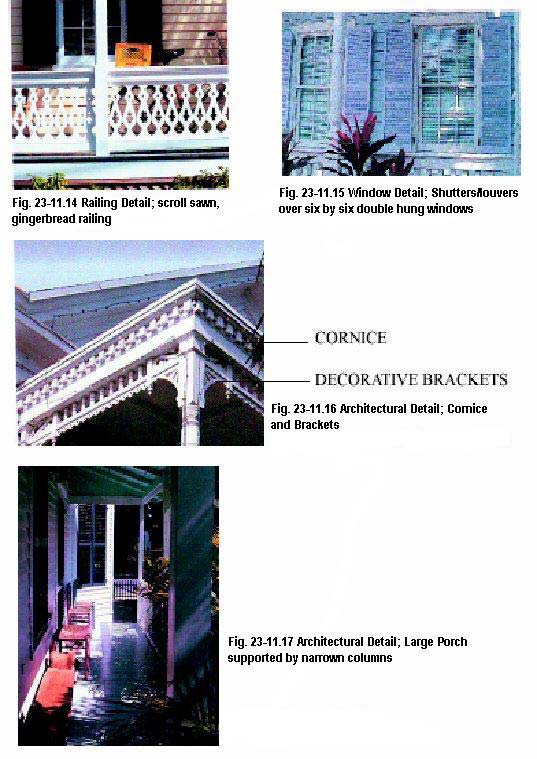
The façade should contain a minimum of five (5) of the following façade design elements for the Caribbean Style (See Figures 23-130.14—23-130.17 for illustrations):
1.
Tile/seam metal/slate roofing.
2.
Gabled roof supported on columns.
3.
Exposed truss work.
4.
Ornamental cornice.
5.
Double hung windows.
6.
Scroll sawn gingerbread/ornamental railing.
7.
Overhanging eaves
8.
Decorative brackets.
9.
Shutters/louvers.
10.
Large porch supported by narrow columns.
(5)
Parking and vehicular circulation requirements.
a.
Parking lot
1.
Generally parking should be to the rear of the property.
2.
Locate on-street parking in accordance with the Town of Lantana Downtown Master Plan.
3.
Parking lot design and layout as per section 23-131.
b.
Amount, mixed use, and stall size.
1.
In mixed use projects, the residential and commercial may share no more than seventy (70) percent of parking, provided the uses do not have over-lapping hours of primary use; i.e., business hours are typically 9:00 a.m. to 5:00 p.m., which would not overlap typical residential parking hours.
2.
On-street parking immediately adjacent to a project may count towards on-site parking requirements.
3.
In mixed-use areas, each required parking area may have the following mix of parking stall dimensions:
4.
Ten (10) percent of the parking stalls may be reduced to eight (8) feet in width to accommodate compact cars. All of these stalls must be grouped together.
5.
Ten (10) percent may be increased to twelve (12) feet in width to accommodate larger vehicles. All of these stalls must be grouped together.
c.
Vehicular circulation.
1.
Vehicular access shall be from side streets, rear streets, alleys, or adjacent properties. Where access from the front of the property is the only option, adjacent properties shall share driveways.
2.
Internal access drives should join together existing public streets and should line up with adjacent private drives.
(6)
Service, refuse and delivery design requirements layout and design criteria.
a.
Locate and screen service, loading, trash storage and truck parking so as to minimize visibility from the street/sidewalk and building entrances, preferably to the rear of buildings and accessed through an alley or secondary street. Screening may be accomplished using building mass, freestanding walls, and/or landscaping.
b.
All utility equipment shall be located, sized, and designed to be as inconspicuous as possible. All utility runs shall be located underground.
(7)
Landscape requirements. For landscape standards and requirements refer to Chapter 10.5, "Landscaping" of the Lantana Code of Ordinances.
(e)
Downtown overlay zone—Sub-area requirements.
(1)
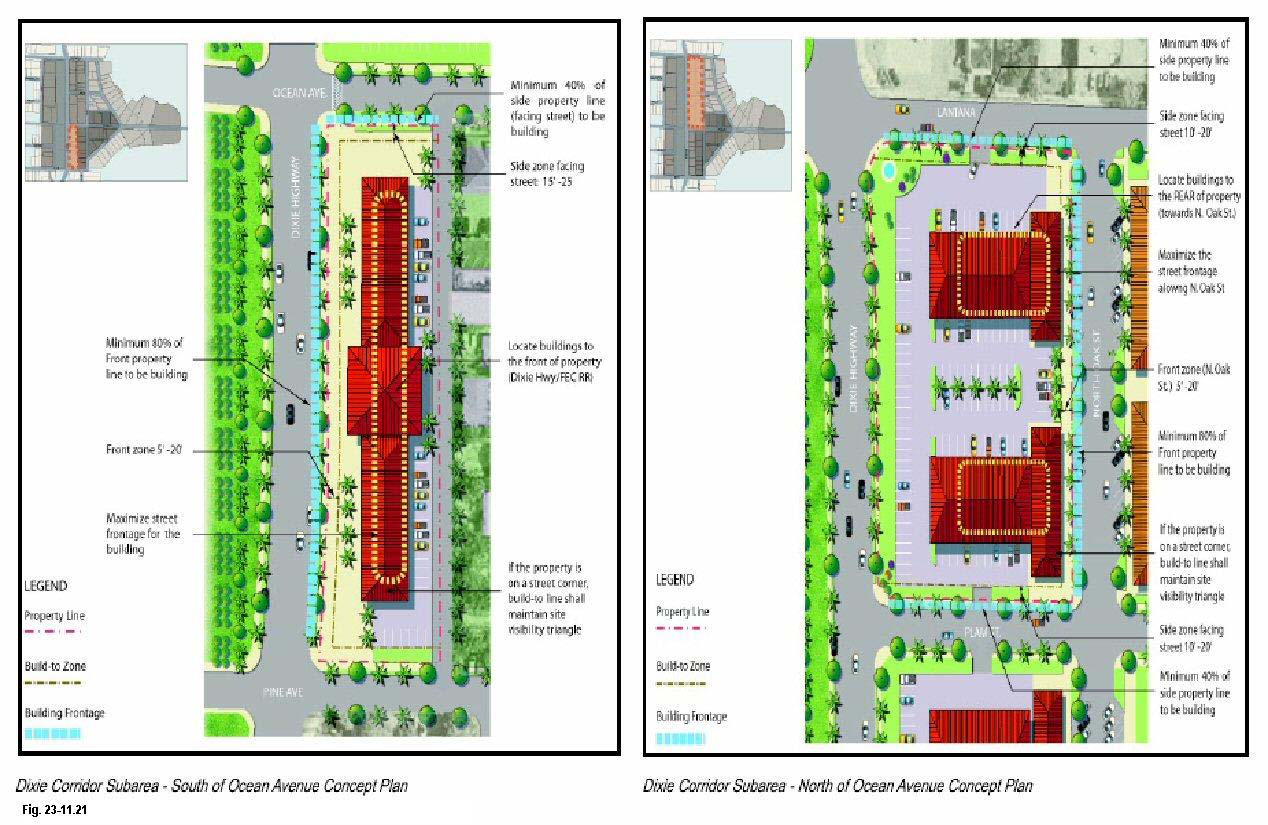
Dixie Corridor sub-area. (See Figure 23-130.21) Dixie Highway is the main north-south arterial roadway through Lantana; therefore, it reflects the values of its citizens more than any other place. The Dixie Corridor sub-area is designed to provide the Town with an attractive urban sub-area, which provides continuity for the Town center. As the major artery through the Town, it is essential that this corridor be of the highest quality in urban design. This sub-area also acts as the unifying sub-area, tying all other sub-areas together.
a.
Building placement.
1.
South of Ocean Avenue.
i.
Locate buildings to the front of the property (towards Dixie Highway).
ii.
If the property is on a street corner, the build-to line shall maintain the sight visibility triangle stipulated by section 23-8(f).
iii.
Maximize the street-frontage for the building.
2.
North of Ocean Avenue.
i.
Locate buildings to the rear of the property (towards N. Oak Street).
ii.
If the property is on a street corner, the build-to line shall maintain the sight visibility triangle stipulated by section 23-8(f).
iii.
Maximize the street-frontage along N. Oak Street.
iv.
Special treatment shall be required for the intersection of Lantana Road and Dixie Highway, including but not limited to public plazas, fountains, and additional landscape treatment.
b.
Building height: Thirty-five feet (35').
c.
Build-to line.
1.
South of Ocean Avenue.
i.
Front: Ten—Twenty feet (10'—20').
ii.
Side line facing street: Fifteen—Twenty-five (15'—25').
iii.
Rear line: None.
d.
Frontage requirements.
1.
South of Ocean Avenue.
i.
Front: Minimum of eighty (80) percent of the front property line to be building.
ii.
Side facing street: Minimum of forty (40) percent of the side property line to be building.
2.
North of Ocean Avenue.
i.
Front: Minimum of eighty (80) percent of the front property line to be building.
ii.
Side facing street: Minimum of forty (40) percent of the side property line to be building
e.
Barriers and buffers.
1.
There shall be no barriers or buffers between properties within the sub-area.
2.
Buffers between properties on the periphery of the master plan area or those adjacent to the sub-area shall follow existing land development regulation requirements.
(2)
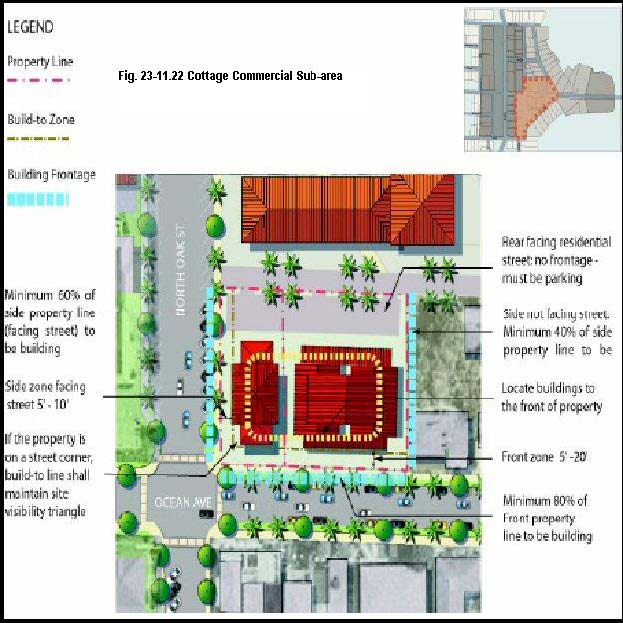
Cottage Commercial sub-area. (See Figure 23-130.22) The area currently consists of a mix of low intensity uses and is contemplated to continue as such. The Ocean Avenue sub-area will redevelop much the same, as it is now, single-story cottage style development for retail uses. The other areas throughout this sub-area will be a mix of multifamily and mixed use buildings, containing less intense commercial uses than those in the Dixie Corridor sub-area.
a.
Building placement.
1.
If the property is on a street corner, the build-to line shall maintain the sight visibility triangle stipulated by section 23-81(f).
2.
Street-frontage will be dictated by building architecture and building height. Single-story: Up to eighty (80) percent. Two-story: Up to sixty (60) percent.
b.
Building height: Twenty-five feet (25').
c.
Build-to line.
1.
Front line: Five—Twenty feet (5'—20').
2.
Side line facing street: Five—Ten feet (5'—10').
3.
Rear setback facing street (without parking): Five—Ten feet (5'—10').
d.
Frontage requirements.
1.
Front: Minimum of eighty (80) percent of the front property line to be building.
2.
Side facing street: Minimum of sixty (60) percent of the side property line to be building.
3.
Side not facing street: Minimum of sixty (60) percent of the side property line to be building.
4.
Rear frontage facing residential street: Maximum forty (40) percent of rear property line may contain structures.
e.
Barriers and buffers. There shall be no barriers or buffers between properties within the sub-area.
(3)
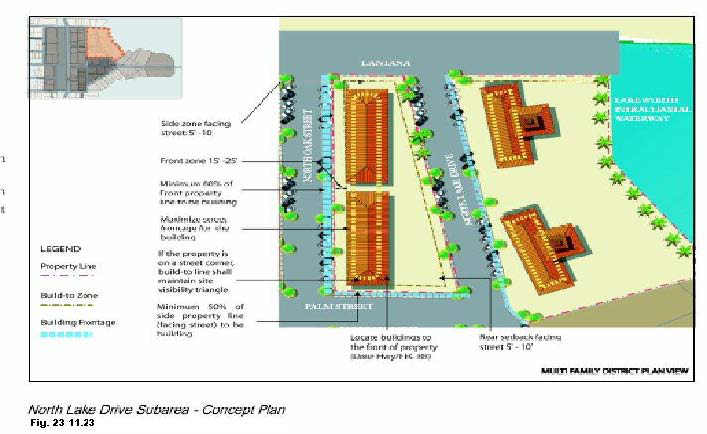
North Lake Drive sub-area. (See Figure 23-130.23) The area currently consists of a mix of single-family and low density multifamily residential units. It is anticipated that the area will accommodate multifamily uses at a density of fifteen (15) units per acre.
a.
Building Placement:
1.
Locate buildings to the front of the property (Oak and North Lake).
2.
If the property is on a street corner, the build-to line shall maintain the sight visibility triangle stipulated by section 23-81(f).
3.
Maximize the street-frontage for the building.
b.
Building height: Thirty-five feet (35').
c.
Build-to line.
1.
Front line: Five—Twenty feet (5'—20').
2.
Side line facing street: Five—Ten feet (5—10').
3.
Rear facing street (without parking): Five—Ten feet (5'—10').
d.
Frontage requirements:
1.
Front: Minimum of eighty (80) percent of the front property line to be building.
2.
Side facing street: Minimum of fifty (50) percent of the side property line to be building.
3.
Side not facing street: Minimum of fifty (50) percent of the side property line to be building.
4.
Rear frontage facing residential street: Maximum forty (40) percent of rear property line may contain structures.
e.
Barriers/buffers. There shall be no barriers or buffers between properties within the sub-area.
(4)
South Lake Drive sub-area. (See Figure 23-130.24)
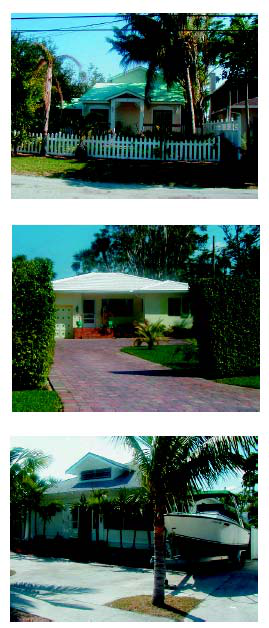
This sub-area is located along the south side of South Lake Drive. It consists of strictly single-family, residences with buildings no taller than three (3) stories or thirty-five (35) feet to the peak of the roof. Significant change within this sub-area is unlikely for the foreseeable future.
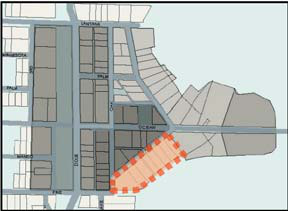
Fig. 23-130.24
(5)
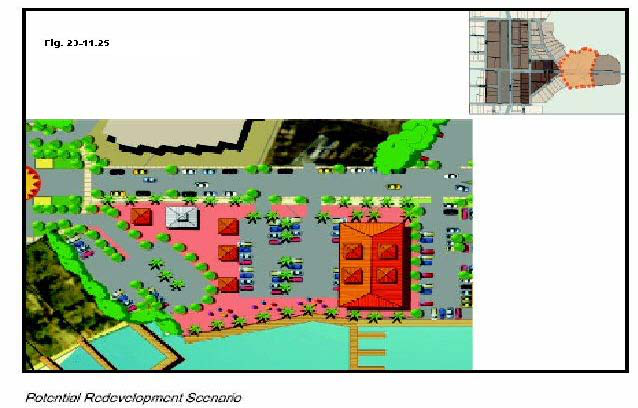
Ocean Avenue mixed use sub-area. (See Figure 23-130.25) The sub-area currently consists of a mix of commercial and residential uses and it is contemplated to continue as such. The area along Ocean Avenue will redevelop much the same as it is now, however, buildings will front the street rather than being set back, and all buildings will have a mix of uses associated with them.
a.
Building placement.
1.
Locate buildings to the front of the property.
2.
If the property is on a street corner, the build-to line shall maintain the sight visibility triangle stipulated by section 23-81(f).
3.
Maximize the street-frontage for the building.
b.
Building height: Thirty-five feet (35').
c.
Build-to line.
1.
South of Ocean Avenue.
i.
Front line: Ten—Twenty feet (10'—20').
ii.
Side line facing street: Fifteen—Twenty-five feet (15'—25').
2.
North of Ocean Avenue.
i.
Front line (N. Ocean Avenue): Five—Twenty feet (5'—20').
ii.
Side line facing street: Ten—Twenty feet (10'—20').
ii[i].
Rear line: None.
d.
Frontage requirements.
1.
South of Ocean Avenue.
i.
Front: Minimum of fifty (50) percent of the front property line to be building.
ii.
Side facing street: Minimum of forty (40) percent of the side property line to be building.
2.
North of Ocean Avenue.
i.
Front: Minimum of eighty (80) percent of the front property line to be building.
ii.
Side facing street: Minimum of forty (40) percent of the side property line to be building.
e.
Barriers and Buffers.
1.
South of Ocean Avenue: Buffers between adjacent sub-areas shall follow the existing zoning requirements.
2.
North of Ocean Avenue.
i.
There shall be a minimum of a ten (10) foot buffer between buildings.
ii.
Buffers between adjacent sub-areas shall follow the existing zoning requirements.
(6)
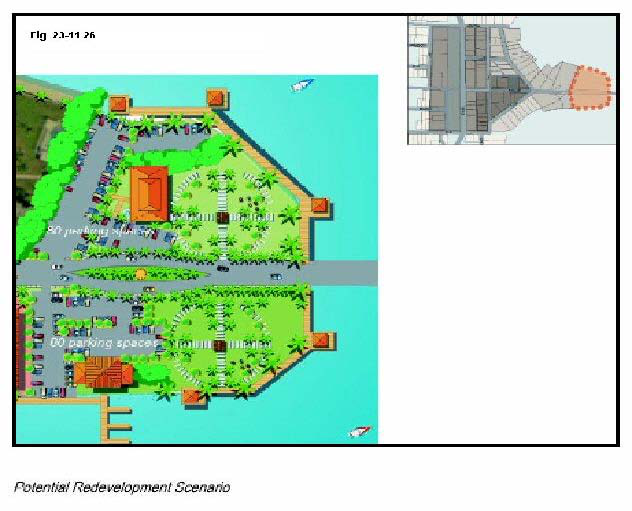
East Ocean Avenue Public Recreation sub-area. (See Figure 23-130.26) This sub-area is located along both sides of Ocean Avenue and consists of Sportsman's Park, a town owned boat ramp south of Ocean Avenue with access to waterfront, promenade, boardwalk, fishing and other recreational activities. This area shall remain a public space with the existing boat ramp and parking to remain in place until such time as an alternative public use is established.
a.
Building placement.
1.
Locate buildings to the center of the property.
2.
Access to East Ocean Avenue should dictate placement of parking and building.
b.
Building height: Thirty-five fee[t] (35').
c.
Build to zone: None.
d.
Frontage requirements: None.
e.
Barriers and buffers.
1.
There shall be no barriers or buffers between properties within the sub- area.
2.
Buffers between adjacent sub-areas shall follow the existing land development regulations.
(Ord. No. O-08-2010, § 1(Exh. A), 7-12-10; Ord. No. O-07-2020, § 2, 8-24-20)
Sec. 23-131. - Off-street parking and loading requirements.
(a)
Purpose and intent. It is the intent of this section to provide for the health, safety, welfare and convenience of the public by requiring each development to provide on-site space and facilities for the parking, loading, queuing and on-site vehicular circulation demand it generates. All other town regulations in conflict with the minimum requirements of this section are hereby superseded to the extent that most stringent shall apply.
(b)
General standards.
(1)
Minimum standards. A minimum amount of area for off-street parking, loading and queuing shall be provided, and continuously maintained upon all developed lands in the Town as provided in this section.
(2)
Access standards. Access to vehicular use areas shall conform to the standards established in this section.
(3)
Construction and design standards. Each vehicular use area shall be constructed and maintained according to the standards established in this section.
(4)
Parking design and relation to other uses. The design of vehicular use areas shall provide for logical, impediment free vehicular circulation and shall conform to the requirements of this section.
(5)
Engineering expertise required. Where the responsibilities of the development services director require engineering expertise, the director shall consult with a licensed engineer. All costs associated with such consultation shall be borne by the applicant.
(6)
Change of use. When the use of a portion or all of a structure or a lot, lot of record or parcel of land is changed, additional off-street parking facilities shall be provided to the extent that the off-street parking required for the new use exceeds the off-street parking for the previous use. Additionally, in accordance with the requirements of this section, no change or expansion of the use or structure on an existing site shall be permitted if such change results in either an increase in nonconformity (for sites already failing to satisfy the minimum off-street parking facilities requirements) or nonconformity with off-street parking facilities requirements.
(c)
Off-street parking.
(1)
Generally. The off-street parking standards of this section shall apply to all lands that are developed, to all lands on which a change of use occurs, or on which existing development is modified in any manner that changes or modifies the off-street parking requirements for that site. All off-street parking areas established by this section shall be continuously maintained according to the standards of this section.
(2)
Parking is an accessory use.
a.
Except as provided in subsection (c)(12) of this section (commercial lots), off-street parking shall be considered accessory to a principal land use.
b.
Except as provided in subsection (c)(8)a of this section (shared parking) and subsection (c)(8)c of this section (valet parking), all accessory off-street parking shall be provided upon the same lot as the principal land use.
(3)
Use of off-street parking. Off-street parking spaces shall be provided for the use of residents, customers, patrons and employees. Required parking spaces shall not be used for:
a.
Outdoor storage of vehicles, merchandise, inventory, goods and materials;
b.
Sale, repair or servicing of vehicles, appliances, or other items;
c.
Sale or display of merchandise, inventory goods or services;
Required off-street parking spaces shall be free from encroachment of all structures. The location of required off-street parking shall not interfere with normal traffic flow, queuing and backup space. Required parking stalls and aisles shall not be used to park commercial vehicles conducting any business in the parking lot. A portion of the required parking stalls may be used on a temporary basis pursuant to a special event permit issued by the development services department for the outdoor sale of goods, fairs and/or other temporary events.
d.
Overnight parking/storage of vehicles, appliances, or other items.
Required off-street parking spaces shall not be used for the overnight parking of vehicles or storage of merchandise, inventory, goods and/or materials.
(4)
Parking in driveways in residential zoning districts. Driveways may be counted to satisfy minimum off-street parking standards for dwelling units provided:
a.
The dwelling unit does not share the driveway with adjacent dwelling units; and
b.
Sufficient space is available on the driveway to satisfy the residential parking space dimensional requirements of subsection (c)(9)c.1 of this section.
(5)
Calculating minimum number of required off-street parking spaces.
a.
Multiple land uses. Except as provided in subsection (c)(8)a of this section (shared parking), when more than one land use occupies the same structure or lot, the total number of required parking spaces shall be the sum of the required off-street parking spaces for each land use as if provided separately.
b.
Fractional requirements. When the calculation of the number of required off-street parking spaces results in a fractional number, a fraction of one-half space or greater shall require one full additional space.
c.
Calculations based on number of employees or occupants. When the calculation of parking spaces is based in whole or in part upon the number of employees or persons occupying or residing on premises, the calculation of the minimum number of spaces shall be based upon the maximum number of employees or persons on duty or legally residing on the premises at any one time.
d.
Calculations based on number of seats. When the calculation of parking spaces is based in whole or in part upon the number of seats, each 22 inches of lineal length on a bench, pew, or similar seating facility shall be considered to be one seat.
e.
Calculations based on gross lot area. When the calculation of parking spaces is based upon gross lot area, the amount of lot area dedicated to off-street parking shall not be included in the calculation.
f.
Uncertainty or indefiniteness about a land use. If the standard for the number of parking spaces for a particular land use is not included in this section, the standards for the most nearly comparable land use shall be applied by the development services director. In making this determination, the development services shall consider such factors as evidence of actual parking demand for similar land uses and such other reliable traffic engineering and planning information which may be available.
g.
Additions to existing development. Off-street parking facilities shall be provided for any new building constructed, for any addition or enlargement of an existing building or use, or any change of occupancy or manner of operation that would result in additional parking spaces being required in excess of the number of existing parking spaces. The additional parking shall be required only for such addition, enlargement, or change, and not for the entire building or use.
h.
Inadequate information at the time of request for zoning action. The determination of the actual number of required off-street parking spaces may be delayed until the submission of certified building plans in the following instances:
1.
Where the formula for determining the minimum number of parking spaces is comprised of two or more different rates, and there is uncertainty about how some or all floor or lot area shall be used; or
2.
When it is unknown which portions of a structure are to be deleted from gross floor area to calculate gross leasable floor area.
If the added calculation of off-street parking spaces is delayed, an estimate of the number of required off-street parking spaces shall be accepted based on a preliminary plan using the applicable formula until the submission of certified building plans.
(6)
Retention of off-street parking spaces. Required off-street parking spaces shall not be reduced in size, eliminated or made unusable in any manner, except as provided in subsection (c)(8)a of this section (shared parking).
a.
Restriction to require off-street parking by fee. Except as provided in subsection (c)(8)a of this section (shared parking), subsection (c)(8)c of this section (valet parking), and subsection (c)(12) of this section (public, private or commercial lots), access to the minimum number of public parking spaces required by this section shall not be restricted by fees or other forms of compensation. Access to parking spaces provided in excess of the minimum standards of this section may be controlled by means of fees.
(7)
Minimum number of required off-street parking spaces by land use. Unless otherwise provided in this section, the minimum number of required off-street parking spaces for each land use is identified below in Schedule 23-131.1. A portion of the minimum number of required parking spaces may be used to satisfy the minimum number of required handicapped spaces required in subsection (c)(8)b of this section.
SCHEDULE 23-131.1 MINIMUM NUMBER OF OFF-STREET PARKING SPACES
Notes:
(1)
Loading area type "A" means Standard A, which requires one space for the first five thousand (5,000) square feet of gross floor area, plus one space for each additional thirty thousand (30,000) square feet.
Loading area type "B" means Standard B, which requires one space for the first ten thousand (10,000) square feet of gross floor area, plus one space for each additional fifteen thousand (15,000) square feet.
Loading area type "C" means Standard C, which requires one space for the first ten thousand (10,000) square feet of gross floor area, plus one space for each additional one hundred thousand (100,000) square feet.
(2)
Space within a carport or garage may be counted. No building permit may be issued to convert a carport or garage to living area without provision for adequate parking spaces in the driveway or a common parking lot. Space to park all vehicles must be provided on the lot. All required parking shall be paved.
(3)
Guest parking spaces may be grouped, provided that the spaces are located within three hundred (300) feet of the dwellings that they are intended to serve. Each space shall be provided with a wheel stop. All guest parking shall be prominently identified with an above grade sign or marking on the wheel stop.
(4)
Vehicles shall not be stored in view. A fence or vegetation may be used to screen the vehicles from view.
(5)
If a convenience store is associated with the service station, then one-half of the additional spaces will be adjacent to the store.
(6)
Based on warehouse space.
(7)
Such facilities shall provide clear ingress and egress and a convenient passenger drop-off area located adjacent to the building and out of the primary travel lanes.
(8)
If service is a direct service provider and is frequented on a daily basis by the general public, then four spaces per one thousand (1,000) square feet of customer service space shall be provided.
(8)
Special regulations for off-street parking.
a.
Combined parking. Shared parking shall be allowed with the approval of the developments services director, and shall be consistent with the following standards:
1.
General. All land uses which participate in a single shared parking plan shall be located on the same lot, or on lots which share a common boundary. The parking lot shall be developed and used as though the land uses on the lots were a single unit.
2.
Unity of title. A shared parking plan shall be enforced through unity of title.
3.
Open space reserved for parking for all land uses. Enough land shall be reserved as open space to provide for the combined parking requirements of each land use, or an alternate plan may be provided, such as a plan to convert an existing lot to a structure. If reserved as open space, the reserved area shall not be used for on-site retention of stormwater runoff nor be counted to fulfill any landscaping requirements of the Town Code of Ordinances. Additionally, preservation areas designated and protected by any government shall not be used to satisfy this reserve requirement. The reserved area shall be landscaped and maintained to present an orderly appearance.
4.
Combined parking study. A combined parking study acceptable to the development services director shall be submitted that clearly establishes which and what types of land uses will use the combined available spaces at what times of the day, week, month or year. The study shall:
i.
Be based on the Urban Land Institute's methodology for determining combined parking or other generally accepted methodology;
ii.
Address size and type of activities, composition of tenants, rate of turnover for proposed combined spaces, and the anticipated peak parking and traffic loads to be encountered;
iii.
Provide for reduction of paved area by not more than one-half (½) of the combined parking required for each use under subsection (c)(7) of this section;
iv.
Provide for reduction of any required handicapped spaces;
v.
Provide a plan to convert the open space reserved pursuant to subsection (c)(8)a.3 of this section to parking area. It may provide for construction of a parking structure to meet combined parking requirements; and
vi.
Be approved by the development services director based on feasibility of the land uses to use combined parking due to their particular peak parking and trip generation characteristics.
5.
Use change. Should any of the uses be changed, or the Town find that any of the conditions described in the approved shared parking study no longer exist, the owner of record shall have the option of submitting a revised parking study in accordance with the requirements of this section or providing on-site the required number of spaces for each use.
b.
Handicapped parking. All handicapped parking regulations shall be governed by F.S. §§ 316.1957 and 553.511, and any rules promulgated thereunder, and such parking shall be paved.
c.
Valet parking. Valet parking may be used upon any lot to satisfy, in part, off-street parking standards. The design of valet parking shall not cause customers who do not use the valet service to park off-premises or in the right-of-way or cause queuing in the right-of-way. In addition:
1.
Location of reserved stalls. Stalls reserved for valet parking may be located anywhere on site, except that handicapped parking spaces shall be the spaces located closest to the nearest accessible entrance of the building that the parking spaces are intended to serve.
2.
Valet parking permit required.A valet parking permit from the Town shall be obtained by anyone desiring to use a public area for valet parking. This includes, but is not limited to, use of a public area for the staging of valet operations or storage of vehicles for valet operations.
3.
Valet parking permit application process and requirements.
i.
Application process.
a.
Prospective valet operators shall submit an application for a revocable valet parking permit to the Town, accompanied by a nonrefundable application fee. The form of the application shall be supplied by the Town. A valet parking plan which accurately depicts the surrounding streets, parking spaces and other physical elements that will be in the immediate area of the valet operation, as well as a travel route diagram must be attached to the completed application form.
b.
If an application is denied, the applicant may resubmit a revised application within fourteen (14) business days which addresses those areas of concern which caused the application to be denied initially. An applicant may reapply at any time without prejudice upon payment of a new application fee.
ii.
Requirements for approval.
a.
The town shall issue a valet parking permit to an applicant or renew a valet parking permit, if applicable, based upon a determination that the requirements of this section have been or will be fully satisfied.
b.
Staging area. The staging area shall not be located:
1.
Closer than thirty (30) feet to the intersection of any two (2) or more streets;
2.
On the same town block as any other valet operation; or
3.
On the opposite town block face of any other valet operation.
4.
Within handicapped accessible spaces or diagonal or angled parking spaces. Only parallel parking spaces may be used for a staging area.
c.
Travel routes. Travel routes used for the transportation of vehicles between staging and storage areas shall comply with all traffic control regulations or devices and shall minimize any impediment to normal traffic flow.
d.
Attendants. An adequate number of attendants shall be provided to prevent any impediment to normal traffic flow or the illegal parking of vehicles.
e.
Insurance and indemnification.
1.
The applicant/valet operator shall submit certificates of insurance endorsed by a licensed insurance professional to the Town's risk manager evidencing coverage for each valet operation that meets the following requirements:
i.
Comprehensive general liability coverage and Worker's Compensation insurance, including Employer Liability Insurance with a minimum of one million dollars ($1,000,000.00) per incident with a two million dollars ($2,000,000.00) maximum aggregate and naming the Town of Lantana, its departments, agents, officials and employees as additional insureds;
ii.
If applicable, garage keepers liability coverage in the amount of one million dollars ($1,000,000.00) per occurrence.
iii.
Policies shall provide that coverage cannot be canceled, materially modified or nonrenewed without providing the Town at least thirty (30) days prior written notice; and shall be issued by companies rated A.M. Best A- or better per Best's Rating Guide, latest edition.
iv.
Said insurance coverage shall be considered as primary insurance over and above any other insurance or self-insurance available to the Town of Lantana and any other insurance or self-insurance available to the Town shall be considered secondary to or in excess of the insurance coverage provided by the applicant/valet operator.
2.
The valet operator shall give written notice to the Town within five (5) calendar days of the date on which total claims by any party against the valet operator reduce the aggregate amount of coverage below the amounts required by this section.
3.
A permit shall be automatically suspended without any requirement for action by the Town or notice to the valet operator for any period of time that any of the insurance required by this section is not in effect. In addition, the Town may cause the permit to be revoked for failure to maintain insurance pursuant to this section.
4.
Valet operators shall defend, indemnify and hold harmless the Town of Lantana and all of its officers, agents, and employees from and against all claims, liability, loss and expense, including reasonable costs, collection expenses, attorneys' fees, and court costs which may arise because of the negligence (whether active or passive), misconduct, or other fault, in whole or in part (whether joint, concurrent, or contributing), of the valet operators, its officers, agents or employees in performance or non-performance of its obligations under the Agreement.
f.
In addition to the requirements listed above, the Town shall consider the following when determining whether to approve, approve with conditions or deny a valet parking permit:
1.
Whether the applicant is delinquent in the payment of any town fees or charges and any outstanding fees due and payable for violations of the valet parking ordinance.
2.
Whether the operation of a valet service on the proposed site would substantially interfere with the use of public right-of-way by the general public or cause undue interference to movement of traffic or pose potential hazard to the public safety and welfare.
4.
Valet parking operational requirements.
i.
Vehicles shall only be received from or returned to patrons in the staging area designated in the valet operations travel plan. Vehicles shall only be stored in the designated storage area and shall be operated to minimize any impediment to normal traffic and pedestrian flow.
ii.
At the end of the hours of operation each day, all litter shall be removed from all parking spaces (and their immediate vicinity) which are used for storing vehicles, and from the Staging Area and its immediate vicinity.
iii.
Any car which has been improperly or illegally parked by a valet attendant resulting in the automobile being ticketed or towed shall have the ticket and/or towing fee paid by the valet operator within five (5) days of the ticket being issued and within twenty-four (24) hours of the car being removed by a towing company. Failure to resolve the above will result in permit suspension until proof of resolution has been made to the Town.
iv.
Attendant requirements. Each attendant shall be over the age of eighteen (18) years and possess a valid Florida Driver's License that has not been suspended, revoked or canceled. Attendants must wear a uniform and nametag at all times while on duty. Uniforms must include a collared shirt with sleeves, which clearly states the name of the valet operator. The nametag must provide the attendant's first name in letters no smaller than one-quarter (¼) inch and the name of valet operator.
v.
Equipment requirements. The valet parking station shall bear a sign, not to exceed the height and width of the valet parking station, conspicuously identifying, in letters not less than one and one-half (1½) inches tall, the name and telephone number of the valet operator, and the charge, if any, for the valet parking. No sign other than the one required to be mounted on the valet parking station shall be permitted on the valet parking station. The valet operator or attendants must keep copies of the valet permit and the valet parking plan at the valet parking station. The valet operator shall provide removable cones to be placed in the location as approved on the diagram submitted by the applicant for the valet parking permit. The cones must be white with reflective cone collars which meet all MUTCD requirements for nighttime visibility.
5.
Use of public parking areas.
a.
When a valet operator will utilize public right-of-way as a staging area for valet operations, the following shall apply:
1.
A fee will be charged for occupation of on-street parking spaces used as a staging area. The fee will be based on a daily rate per spaces, multiplied by the number of days annually that the spaces will be occupied. Fee shall be pre-paid for the rest of the term of the permit year at the time of application, and pre-paid annually thereafter.
2.
No refunds on unused portions of staging fee shall be refunded except if a Staging Area is unavailable for thirty (30) or more consecutive, uninterrupted days due to street, sidewalk or lane closures. Proof of continuous, uninterrupted closure must be provided by the valet operator and will be reviewed by the Town prior to release of the rebated fee.
3.
When a staging area makes use of on-street parking spaces which are metered, and the staging area is in use by the valet operator during the hours when the meter fee is still in effect, the meter fee may be neglected, in lieu of a pre-paid staging fee as indicated above.
b.
A valet service may lease town parking spaces in order to store vehicles subject to the following:
1.
The valet operator will be required to enter into a written agreement with the Town, pertaining to the proposed use, which shall be on such terms and conditions as the Town deems warranted.
2.
At no time shall access to any portion of the public parking lot be restricted for the purpose of the valet service without the prior written consent of the Town. The valet operator must provide the Town with a plan showing the proposed restrictions for prior review and approval.
3.
When a storage area makes use of off-street parking spaces which are metered, and the storage area is in use by the valet operator during the hours when the meter fee is still in effect, the meter fee may be neglected, in lieu of a pre-paid leasing fee as determined by the Town.
6.
Revocation of Permit. Any permit issued pursuant to this section may be revoked upon fourteen (14) business days' notice in the event the permit holder fails to comply with the requirements of this section or, alternatively, may be revoked by the Town for convenience upon 30 days' notice.
(9)
Dimensions and geometrics of parking areas.
a.
Minimum standards. The dimensions and geometrics of off-street parking areas shall conform to the minimum standards of this subsection.
b.
Rules for calculating dimensions. If proposed parking angles are not illustrated in Table 23-131.1 and Figure 23-131.1 below, dimensions shall be interpolated from the tables and approved by the development services director.
c.
Dimensions.
1.
Residential dwelling units.
i.
Dwelling units which do not share a common parking lot. Each parking space for dwelling units which do not share a common parking lot shall be a minimum of eight (8) feet wide and twenty (20) feet long. Parking spaces may be provided in a manner in which the stalls are side-by-side, end-to-end or not contiguous to each other.
ii.
Dwelling units which share a common parking lot. For dwelling units which share a common parking lot, parking stalls and aisles shall be the size provided in Table 23-131.1 below, using the "general" standard.
2.
Nonresidential land uses and residential land uses with combined parking lots. All nonresidential land uses and residential land uses with combined parking lots shall provide parking spaces that comply with the dimensional requirements shown in Table 23-131.1 and Figure 23-131.1. In Column (I) of Table 23-131.1.
i.
General. The term "general" applies to parking spaces designated to serve all commercial uses, except retail uses, and also residential uses with combined parking lots. Spaces to be reserved for use by disabled persons shall be governed by the rows labeled "handicapped".
ii.
Handicapped parking. All spaces marked and reserved for use by disabled persons shall be installed in accordance with the handicapped parking requirements of F.S. §§ 316.1955, 316.1957 and 553.511.
iii.
Queuing distance. A minimum queuing distance of twenty (20) feet is required between the property line and the first stall.
3.
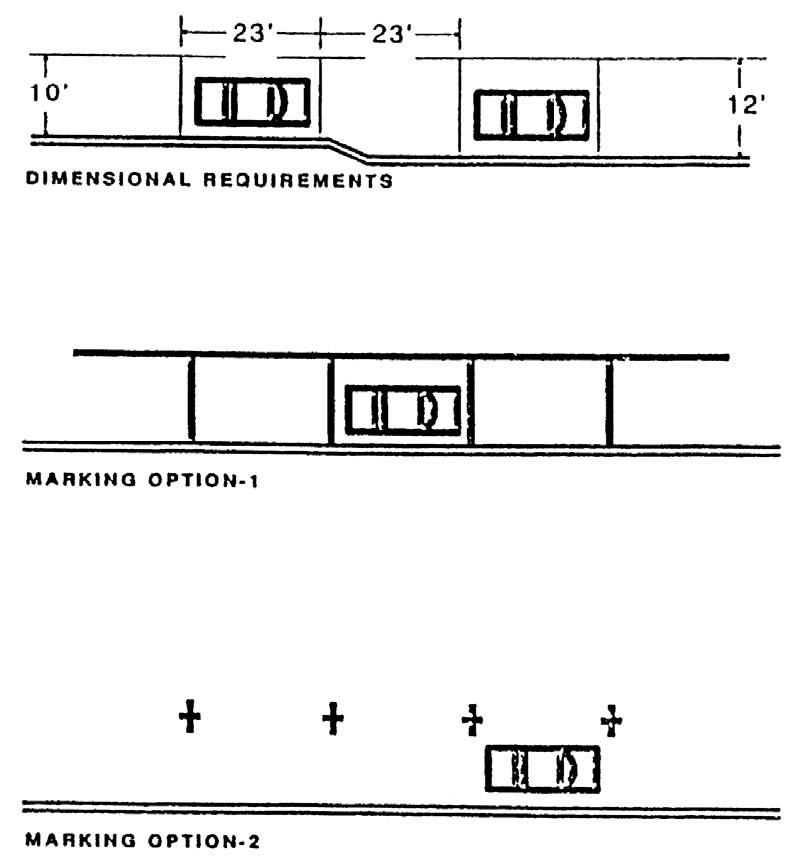
Parallel parking. Parallel parking spaces shall have minimum lengths of twenty-three (23) feet and minimum widths of ten feet (see Figure 23-131.2).
4.
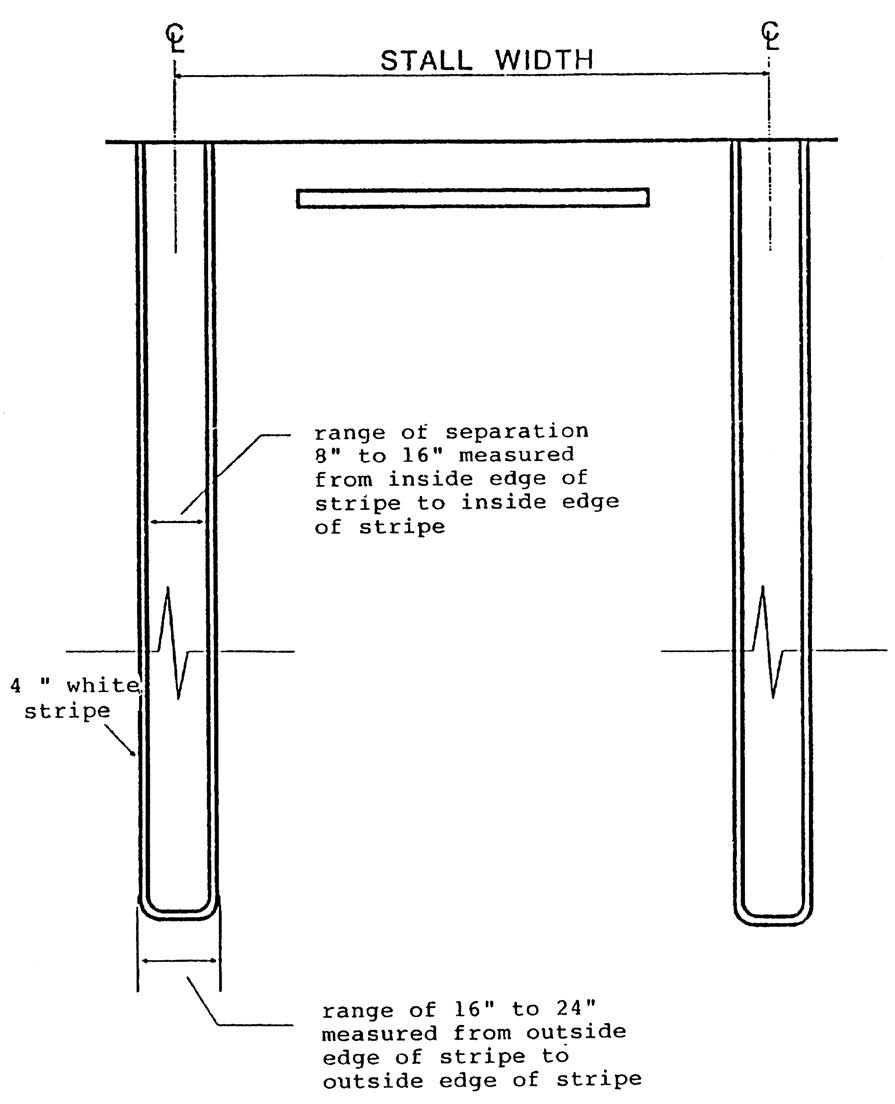
Measuring stall width. Where double striping is used to mark stalls, stall width shall be measured from the centerline of one set of stripes to the centerline of the other set of stripes.
TABLE 23-131.1
MINIMUM PARKING BAY DIMENSIONS FOR NONRESIDENTIAL AND RESIDENTIAL USES WITH COMBINED PARKING LOTS
1.
In Column (I) above, "general" applies to parking spaces designated to serve all commercial uses and also residential uses with combined parking lots. Spaces to be reserved for use by disabled persons shall be governed by the rows labeled "handicapped."
2.
Parking spaces designated for disabled persons (handicapped) shall be located adjacent to a five (5) foot wide designated access lane to an accessible route.
FIGURE 23-131.1
PARKING STALL SCHEMATIC
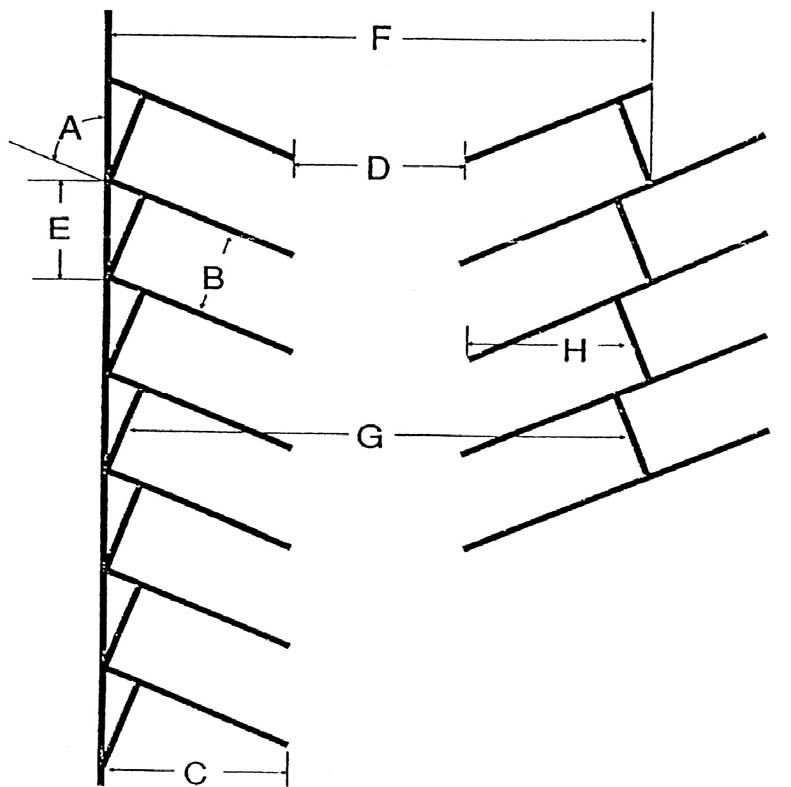
FIGURE 23-131.2
PARALLEL PARKING DIMENSIONAL REQUIREMENT AND MARKING OPTION
(10)
Construction and design of parking areas.
a.
General on-site circulation design standards.
1.
There shall be safe, adequate and convenient arrangement of pedestrian pathways, bikeways, roadways, driveways, and off-street parking and loading spaces within parking areas.
2.
Streets, pedestrian walks, parking areas and open space shall be designed as integral parts of an overall site design which shall be properly related to existing and proposed buildings, adjacent land uses and landscaped areas.
3.
The materials used in the design of paving, lighting fixtures, retaining walls, fences, curbs and benches shall be of good appearance, easily maintained and indicative of their function.
4.
Parking lots shall be maintained in a safe operating condition and in a manner as to not create a hazard or nuisance.
b.
Pedestrian circulation.
1.
Structures, vehicular circulation lanes, parking stalls, driveways, and open spaces shall be designed to provide logical, impediment-free pedestrian movement. The site shall be arranged so that pedestrians moving between buildings are not unnecessarily exposed to vehicular traffic.
2.
Paved, landscaped or comfortably graded pedestrian walks shall be provided along the lines of most intense use, particularly from building entrances to streets, parking areas and adjacent buildings.
3.
Where off-street parking spaces directly face a structure, and are not separated by an access aisle from the structure, a paved pedestrian walkway shall be provided between the front of the parking stall and the structure. The walkway shall be a minimum of four feet wide, exclusive of vehicle overhang, and shall be separated from the parking stall by concrete wheel stops or continuous curbing. Residential vehicular use areas are exempt from this requirement.
c.
Location of accessory parking. All accessory parking shall be located:
1.
Upon the same lot as the land use it is intended to serve; or
2.
Upon a lot which:
i.
Shares a common boundary with the principal land use;
ii.
Is properly zoned for accessory parking; and
iii.
Is subject to the same site plan and a unity of title as the land use the parking is intended to serve.
d.
Locations of on-site parking spaces.
1.
Unless otherwise provided in this section, parking spaces shall be located so that no spaces are more than six hundred (600) feet from the building or land use they are intended to serve. This requirement shall not apply to parking spaces for auditoriums, stadiums, assembly halls, gymnasiums, and other places of assembly; industrial, wholesaling and manufacturing establishments; and large-scale retail, wholesale, and consumer service uses of over five hundred thousand (500,000) square feet.
2.
There shall be no parking or storing of vehicles in the landscape buffer or the ultimate right-of-way.
3.
There shall be no parking of automobiles at the rear of a structure, unless a public pedestrian walk connects it to the front of the building or there exists an entrance or store in the rear. Such pedestrian accessway shall be a minimum of four (4) feet in width and shall be clearly marked. This requirement may be waived by the PRC upon demonstration by the applicant that no safety hazards will be created.
e.
Landscaping. All vehicular areas shall be landscaped as provided [in] Chapter 10.5 of the Code of Ordinances.
f.
Paving standards.
1.
Reviewed and approved the development services director. The proposed grading and construction of the off-street parking facilities shall be reviewed and approved by the development services director in consultation with the town engineer.
2.
Materials and methods. Unless otherwise provided in this subsection (c)(10)f, all vehicular use areas and specialized vehicular use areas shall be improved either with:
i.
A minimum of six-inch shellrock or limerock base with a one-inch hotplant mix asphaltic concrete surface; or
ii.
A base and surface material of equivalent durability. Pervious concrete and paver blocks are allowed.
iii.
No shell-rock, gravel, pea stone or similar materials are permitted.
3.
Maintenance of paved vehicular use areas. All vehicular use areas or specialized vehicular use areas shall be maintained in good condition to prevent any hazards such as cracked asphalt or potholes. Shell rock and gravel surfacing is not allowed.
4.
Wheel stops or curbing required. Wheel stops or continuous curbing shall be placed 2.5 feet back from walls, poles, structures, pedestrian walkways or landscaped areas. The area between any wheel stop and required landscaped strip may be grassed, rendering the paved stall area fifteen (15) feet to sixteen (16) feet in length, depending on the angle of parking provided.
g.
Drainage standards. Runoff from vehicular use areas shall be controlled and treated in accordance with all applicable agency requirements in effect at the time of permit application.
h.
Lighting. All vehicular use areas must meet the lighting standards contained in Chapter 6 of the Lantana Code of Ordinances.
i.
Signage and marking requirements.
1.
Marking. Except for parallel parking spaces, parking lots containing stalls for three (3) or more vehicles shall delineate each stall by double stripes on each side of the stall. All stripes shall be painted in white paint except for handicapped spaces which shall have blue stripes. The width of the painted stripe shall be four inches. The separation from inside edge of stripe to inside edge of stripe shall be no less than eight inches and no more than sixteen (16) inches. The effective width of the double stripes shall range from sixteen (16) inches to twenty-four (24) inches measured from outside edge of stripe to outside edge of stripe. (See Figure 23-131.3 for an example.) Marking of parallel parking spaces shall be as shown in either of the options in Figure 23-131.2.
2.
Signage. Traffic control signs and other pavement markings shall be installed and maintained as necessary to ensure safe and efficient traffic operation of all vehicular use areas. Such signage and marking shall be subject to the approval of the development services department and conform with the Manual on Uniform Traffic Control Devices, Federal Highway Administration, U.S. Department of Transportation, as adopted by the state department of transportation, as revised.
FIGURE 23-131.3
STRIPING REQUIREMENTS
j.
Ingress and egress to vehicular use areas.
1.
Ingress and egress. Each parking stall shall have appropriate access to a street or an alley. Only single-family, duplex and triplex dwelling units with separate unshared driveways shall be allowed backward egress from a driveway onto a local street. In all other cases, maneuvering and access aisle area shall be sufficient to permit vehicles to enter and leave the vehicular use area or specialized vehicular use area in a forward motion. The location and number of driveways shall be subject to approval by the development services director.
2.
Dimensions of ingress and egress areas. The dimensions listed below shall begin at the street and run the entire length of the driveway. This section does not apply to single-family, duplex and triplex residential land uses.
* Measured along right-of-way line at inner limit of curbed radius sweep or between radius and near edge of curbed island at least fifty (50) square feet in area. The minimum width applies principally to one-way driveways.
** On side of driveway exposed to entry or exit by right-turning vehicles. ;adv=6;
(11)
Queuing. In addition to meeting the requirements of subsection (c)(14) of this section, all drive-through establishments shall meet the standards listed below:
a.
Each queuing lane shall be clearly defined and designed so as not to conflict or interfere with other traffic using the site.
b.
A bypass lane a minimum of twelve (12) feet wide shall be provided if a one-way traffic flow pattern is used in the parking lot. The bypass lane shall be clearly designated and distinct from the queuing area.
c.
The minimum number of required queuing spaces, including the vehicle being serviced, shall be as provided in Schedule 23-131.2. Each queuing space shall be a minimum of ten (10) feet by twenty (20) feet in size. Unless otherwise indicated below, queuing shall be measured from the point of ultimate service to the rear of the queuing lane.
SCHEDULE 23-131.2
QUEUING REQUIREMENTS
(12)
Public, private or commercial parking lots.
a.
General. Where permitted by special exception, off-street parking lots and structures shall be allowed as the principal land use. Parking spaces may be rented for parking. No other business of any kind shall be conducted on the lot, including repair, service, washing, display or storage of vehicles or other goods. Review of applications for parking lots and structures shall consider the proposed operation of the lot. Requirements of this section, including signage, maneuvering, and backup distances may be varied, based on the proposed operation. The requirements of the Code of Ordinances related to lighting, surfacing and drainage may not be varied.
b.
Design. Plans for parking lots shall be drawn to an accurate scale and show the layout of the lot entrance and exits, parking stalls, drainage provisions, signs, surfacing, curbs or barriers, exits and entrances of properties located contiguous and directly across the street, and location and type of landscaping.
c.
Entrances and exits. The size of entrances and exits shall comply with this section and shall be located to present the least interference with traffic and the least nuisance on any adjacent street. The point of entrance control shall be located to provide three-car queuing internal to the site. The location, size and number of entrances and exits shall be subject to the approval of the development services director.
(13)
Requirements for parking structures.
a.
General. All public or private parking garages may be used to meet off-street parking requirements for any use or combination of uses, and such structures shall be considered accessory to the principal use, unless permitted to be the primary use by special exception. Garages shall be designed to meet or exceed the following minimum requirements and regulations. All public or private parking garages shall comply with the standards for surface parking lots with regard to marking, signage and minimum number of spaces to be provided.
b.
Review of plans by the development services director. The developments services director shall review and approve the proposed parking layout. In determining whether a proposed plan shall be approved, the developments services director shall apply the standards set forth in this subsection. In addition, the development services director shall consider the following information, which is to be supplied by the applicant:
1.
The number, location and associated internal and external vehicular reservoirs;
2.
Anticipated arrival and departure rates and times of day for vehicles using the parking structure;
3.
Type of control for outward and inbound traffic with the associated service rate per land;
4.
Driveway locations on contiguous property or property on the opposite side of the street;
5.
Information regarding the current and anticipated volume of traffic at adjacent intersections and on surrounding streets serving the parking structure driveways;
6.
Lot size and lot configurations, and safe sight distance; and
7.
Proposed land usage and the traffic characteristics of the land usage.
c.
Design standards.
1.
Module width requirements. The unobstructed distance between columns or walls measured at any point between the ends of the parking aisle shall be as specified in the following table:
* Requests for reductions of unobstructed distances will be considered if the stall and aisle dimensions specified in surface parking dimensions are met and the columns are not located at the rear of the parking stalls or interfere with the opening of doors.
2.
Minimum parking space widths. The minimum parking stall width shall be 8.5 feet provided that the minimum clear distances specified above are met.
3.
Ramp dimensions.
i.
Width. The width of ramps between parking levels and cross aisles at the ends of parking aisles shall be sixteen (16) feet for one-way operation and twenty-six (26) feet for two-way operation.
ii.
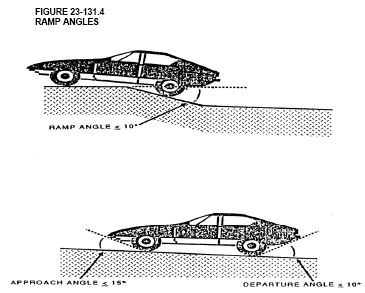
Angles. The maximum approach, departure, and ramp angles (as illustrated and defined in Figure 23-131.4) shall not exceed the values indicated below unless vertical curves (minimum = 1) are provided to connect the two (2) grades. The design of such vertical curves shall be subject to the review and approval of the development services director.
4.
Maximum floor grades. The maximum grade on floors with parking shall be six (6) percent maximum grade, and on floors without parking shall be twelve (12) percent.
5.
Stairways or elevators required. Stairways and elevators shall be made to separate vehicular and pedestrian movements between the various levels of multilevel parking structures.
6.
Minimum turning radii. The minimum vehicle turning inside radii shall be fifteen (15) feet.
7.
Lighting. Lighting of enclosed parking structures shall be provided to meet or exceed the following standards:
8.
Handicapped parking. Spaces designed and reserved for use by disabled persons shall be provided pursuant to subsection (c)(8)b of this section.
9.
Plans certified by registered engineer. All plans to construct parking structures shall be designed and certified by a registered engineer or architect. Plans shall be drawn to an accurate scale and show the structure's layout and that all of the minimum requirements for parking structures have been met.
(14)
Supplemental administrative requirements. At the time of the application for the first development order to be obtained for any use for which parking spaces are required to be constructed, a site plan for such parking facilities shall be submitted to the development services department. The site plan shall show requirements specific to the land use as outlined in this section, other sections of the land development code, and the following:
a.
Location, dimensions and elevations of all structures.
b.
Entrances and exits to all public and private roads and easements, showing all dimensions and sight distances at such entrances and exits and at corners of intersecting public roads.
c.
Interior traffic circulation and slope of ramps.
d.
Location and dimensions of all parking spaces and aisles, queuing lanes, loading areas and any specialized vehicular use areas.
e.
Location and dimensions of all stalls designed and reserved for disabled persons, and location of associated ramps.
f.
Directional markings, fire lanes, loading zones, and typical wheel stops or curbing.
g.
Location and dimensions of walls, fences and pedestrian walkway and methods and devices to screen the cars located in or on the parking structures from adjoining properties and from public roads.
h.
Location of required berms, retention areas, septic tanks, drainfields and lighting fixtures.
i.
Proposed and existing centerlines of adjacent rights-of-way and streets, right-of-way dimensions, lot dimensions and lot area.
j.
Any existing easements, including those used for drainage, utility limited access, ingress/egress and maintenance.
k.
Graphical representation of parking surface proposed to have grassed parking and enumeration in the site plan data table of the number of spaces to be grassed.
l.
Delineation of any area reserved as future parking provided for in an approved combined parking plan and enumeration in the site plan data table of the number of spaces for which open space has been reserved.
m.
A generalized landscape plan showing location and dimensions of proposed perimeter strips, buffers and interior features. A formal landscape plan application may be submitted at the same time or later and shall meet the requirements of Chapter 10.5, "Landscaping".
n.
Any other pertinent information that may be required to satisfy the rules and regulations of this and other applicable codes and ordinances or conditions of development approval.
(d)
Off-street loading standards.
(1)
Purpose and intent. At the time of the erection of any principal or accessory use or at the time and principal or accessory use is altered, enlarged or increased in capacity or intensity by adding floor area or volume, off-street loading space for the accommodation of trucks servicing the use shall be provided in accordance with this section and other applicable regulations of the this chapter.
(2)
Loading demand statement. All applications for new or increased use or capacity for nonresidential establishments shall include a statement outlining the land use's projected normal demands for loading and unloading, and a plan showing the location on the lot of the off-street loading space to be provided, in accordance with the provisions of this section.
(3)
Relationship to streets and off-street parking.
a.
A street or walkway shall not be used for loading or unloading materials.
b.
An off-street loading area shall not be used to satisfy any off-street parking requirements, and the location of the loading area shall not interfere with the free circulation of vehicles in the off-street parking area.
c.
Where loading areas are directly adjacent to or integrated with an off-street parking lot, the developments services director may require installation of physical barriers, such as curbing, fences, solid hedges, or other means for separation of loading areas from parking areas and pedestrian traffic.
(4)
No repair activities. No motor vehicle repair work, except emergency repair service, shall be permitted in any required off-street loading facility.
(5)
Mixed uses in one building. Where a building is used for more than one use and where the floor area used for each use is below the minimum for required loading spaces but the aggregate total floor area is greater than the minimum, then off-street loading space shall be provided as if the entire building were used for that use in the building for which the most spaces are required. In such cases, the development services department may make reasonable requirements for the location of required loading space.
(6)
Maximum requirements apply in cases of uncertainty. If there is uncertainty about the amount of loading space required by the provisions of this section as a result of indefiniteness about the proposed use of a building or land, the maximum requirement for the general type or use that is involved shall govern. Where the required number of loading spaces is not set forth for a particular use, and where there is no similar general type of use listed in this section, the development services director shall determine the basis for the number of spaces to be provided by determining the off-street loading demand for the most comparable land use.
(7)
Lighting. Lighting of off-street loading areas shall comply with section 23-131(c)(13)c.7 (off-street parking).
(8)
Landscaping. All off-street loading areas used for all uses shall be landscaped in accordance with Chapter 10.5, "Landscaping".
(9)
Minimum size, dimensions, and location of loading space. Loading space shall have the following minimum dimensions:
a.
Berth width. A single loading berth shall have a minimum width of fifteen (15) feet. Additional loading berths that lie alongside, contiguous to, and not separated from a first loading berth may be a minimum of twelve (12) feet in width.
b.
Berth length. All loading berths shall be a minimum of thirty-five (35) feet in length.
c.
Maneuvering apron. An area equal to the width and length of the berth shall be provided for vehicle maneuvering directly behind the loading berth it is intended to serve.
d.
Vertical clearance. A vertical clearance of a minimum of fifteen (15) feet shall be provided throughout the berth and maneuvering apron.
(10)
Location of loading space. Berths and related space shall be located directly adjacent to the building which requires designated loading space. Loading areas shall be proportionately distributed throughout the site.
(11)
Entrance and exits. Location and design of entrances and exits shall be in accordance with section 23-131(c).
(12)
Distances.
a.
Distance. No loading space or berth shall be located within forty (40) feet from the nearest point of the edge of pavement or curb of any two intersecting streets.
b.
Setback. The surfaced portions of all loading areas, excluding driveways, shall observe a twenty (20) foot setback from all front or side corner lines. When located at the rear of a building, a minimum of five-foot setback from all property under separate ownership or control shall be observed.
(13)
Drainage and maintenance. All loading areas shall be paved in accordance with the provisions of section 23-131(c).
(14)
Access marking. Each off-street loading space shall be provided with safe and convenient access to a street, without it being necessary to cross or enter any other required loading space. If any loading space is located contiguous to a street, ingress and egress to the street side shall be provided only through driveway openings. The dimension, location and construction of these driveways shall be designed in accordance with the provisions of section 23-131(c) (access driveways) and approved by the development services director. In addition, off-street loading spaces which have three (3) or more berths shall have individual spaces marked, and spaces shall be so arranged that maneuvering to and from a loading space shall be on the same lot unless approved by the development services director. Maneuvering shall be permitted in an alley upon the approval of the development services director if surrounding land uses are within a compatible zoning district.
(15)
Minimum required spaces; ratios. Minimum off-street loading spaces shall be in accordance with Schedule 23-131.1 above. When the calculation of loading spaces results in a fractional number, a fraction of one-half (½) spaces or greater shall require one full additional loading space.
a.
Standard A: One space for the first five thousand (5,000) square feet of gross floor area, plus one space for each additional thirty thousand (30,000) square feet.
b.
Standard B: One space for the first ten thousand (10,000) square feet of gross floor area, plus one space for each additional fifteen (15,000) square feet.
c.
Standard C: One (1) space for the first ten thousand (10,000) square feet of gross floor area, plus one space for each additional one hundred thousand (100,000) square feet.
d.
Standard D: For each congregate living facility or nursing home development containing twenty (20) or more beds, one space for each fifty (50) beds.
(16)
Reduction in required loading space. All required off-street loading spaces and their appurtenant aisles and driveways shall be deemed to be required space and shall not be encroached upon or reduced in any manner except upon approval by the development services director, and in the following circumstances:
a.
Reduction in number of berths.
1.
Change in use. The number of loading spaces may be proportionately reduced if the space is not needed is a result of a reduction in size or change in the nature of the land use to which loading spaces are served.
2.
Administrative reduction. For uses which contain less than ten thousand (10,000) square feet of total floor area, the development services director may waive or reduce the loading requirements whenever the character of the use is such as to make unnecessary the full provision of loading facilities and where such provision would impose an unreasonable hardship upon the use of the lot.
b.
Reduction on size of berth. Reduced stall dimensions shall be permitted upon a finding that all of the following standards have been met:
1.
The manner of operation proposed is such that stalls of the required dimensions are unnecessary because, the size, character and operation of the use will not regularly involve service by motor vehicles which require the dimensions of an off-street loading berth, such as, but not limited to the following uses: Bowling alleys and other recreational establishment, financial institutions, funeral chapel and funeral homes, nursing homes, offices, and personal service establishments;
2.
The land uses are likely to continue or to be succeeded by others for which the same stall dimensions will be adequate, or that any additional loading space necessary could be provided in a logical location without creating violations of other requirements of these regulations; and
3.
Any reduction provides for a minimum stall length of fifteen (15) feet, a stall width of at least twelve (12) feet, and a vertical clearance of ten feet.
(e)
Supplemental parking requirements.
(1)
Congregate living facilities.
a.
General requirements.
1.
Every congregate living facility shall provide adequate parking and circulation for residents, visitors and staff. The standards established in this subsection shall be considered the minimum necessary to achieve this goal.
2.
Unless otherwise provided in this chapter, all parking and vehicular use areas shall be paved.
3.
The bases for parking calculations shall be clearly stated on proposed site plans, including the maximum number of employees.
4.
Additional parking requirements may be imposed as a condition of approval of the special exception.
b.
Specific requirements. Every congregate living facility shall comply with the following requirements:
1.
A minimum of one parking space shall be provided for each four residents, plus one space for each employee on the shift of greatest employment.
2.
Adequate provision shall be made to reserve sufficient lot area to meet future parking requirements if the facility is converted to other uses. Protected vegetation in this reserve parking area shall be maintained as provided in the land development regulations governing the protection of natural resources. The boundaries of the reserve parking area shall be indicated on the project's site plan.
3.
Congregate living facilities shall establish a safe drop-off area for group transportation, such as vans or similar vehicles.
(2)
Mobile home park. Every mobile home park (MHP) shall comply with the following requirements:
a.
A minimum of two parking spaces for each dwelling unit and/or trailer lot shall be provided. If any mobile home park unit is clustered with other dwelling units on a parking lot, then parking shall be calculated to include guest parking at the rate of one-quarter (¼) space for each dwelling unit.
b.
Parking for recreational uses, within MHPs shall be determined based on the standards outlined in subsection (6) of this section regarding recreation facilities. Parking of vehicles on arterials or collectors is prohibited. Parked vehicles may not be backed out into any arterial or collector streets. Turning movements for vehicle orientation purposes must be accomplished prior to entering any collector, arterial or other street of high traffic volumes. Parking space dimensions shall be governed by section 23-131(c).
(3)
Planned development. Every planned residential, commercial or industrial development shall comply with the following requirements:
a.
Parking of vehicles on arterials or collectors is prohibited.
b.
Parked vehicles may not back out into any arterial or collector streets. Turning movements for vehicle orientation purpose must be accomplished prior to entering any street of high traffic volumes.
c.
Parking bay design shall be governed by section 23-131(c).
(4)
Commercial new and used motorcycle, automobile, truck, boat, mobile home, recreation vehicle sale and rental and repair facilities and lots. Every commercial new and used motorcycle, automobile, truck, boat, mobile home, recreation vehicle sale and rental and repair facilities and lots shall comply with the following requirements:
a.
Parking generally. Unless otherwise provided for in this section, all vehicular use areas and specialized vehicular use areas for display, sale, rent, or storage purposes shall comply with the requirements set forth in section 23-131(c). In addition, none of the above may be parked for any purpose in the area located between the base building line and the pavement edge of the public street.
b.
Motor vehicle display, sales, rental and storage. Motor vehicle dealerships may store vehicles outdoors on an improved parking surface without reference to parking stalls, backup distances, parking stall striping or wheel stops. For outdoor motor vehicle sales and display parking, signs and stall striping are not required, but in all other respects, outdoor sales and display parking shall conform to the provisions of section 23-131(c) regarding parking. Motor vehicles on display shall not be elevated. Parking for vehicle storage, sales or display may not be counted toward meeting the number of required off-street parking spaces to be provided for customers and employees. In addition, no motor vehicles may be parked for any purpose in the area located between the base building line and the paved edge of the public street.
c.
Customer and employee parking. Customer and employee parking shall be shown on a site plan and provided as follows: One space for each five hundred (500) square feet of enclosed gross floor area, plus one space per each four thousand five hundred (4,500) square feet of outdoor sales display and rental area, plus one space per service bay, plus one space per employee of the shift of largest employment. Customer parking shall be marked with an above grade sign and shall be physically separated from the motor vehicle sales, storage and display space. Customer parking shall be designated on the site plan. All vehicular use areas shall conform to the requirements of Chapter 10.5 regarding landscaping.
(5)
Office warehouse, commercial/light industrial "flex space". Every office warehouse shall comply with the following requirements. A minimum number of parking spaces shall be provided as follows:
a.
Customer parking. Four spaces for each one thousand (1,000) square feet of gross floor area of office, plus one space for each two thousand (2,000) square feet of gross floor area of warehouse, or fraction thereof.
b.
Employee parking. One space for each employee on the shift of greatest employment for buildings with a single employer and one space per unit for buildings with multiple units, each having an individual employer.
(6)
Recreation facilities, amusements and attractions and exhibits, public and private. All recreation facilities, amusements and attractions and exhibits, public and private, shall comply with the following requirements. For parking and loading, all uses authorized herein shall be subject to the procedural requirements of section 23-131(c) (parking) and section 23-131(d) (loading).
a.
Athletic fields. One space for every four bleacher seats or thirty (30) spaces per athletic field, whichever is greater.
b.
Outdoor attraction and recreation area. Ten spaces for each acre of outdoor attraction area, except for pool areas, golf courses and tennis courts, which shall be calculated as follows: One space per fifty (50) square feet of pool area; four per hole of golf course; and two (2) for each tennis or racquetball court.
c.
Privately operated recreation areas or structures for public and private use. For each one thousand (1,000) square feet of gross floor area, there shall be provided four parking spaces plus five spaces for each acre of outdoor attraction area.
(7)
Self-service storage facility. Every self-service storage facility shall comply with the following requirements. A minimum number of parking spaces shall be provided upon the site as follows:
a.
Employee and customer parking. One parking space for each employee on the shift of greatest employment.
b.
Customer parking. Two customer parking spaces located adjacent to the facility's leasing office, plus one additional customer parking space for every 200 storage bays.
c.
Interior parking. Interior parking shall be provided in the form of aisleways adjacent to the storage bays. These aisleways may be used both for circulation and temporary customer parking while using storage bays. The minimum width of these aisleways shall be as follows:
1.
If aisleways permit two-way traffic, thirty (30) feet;
2.
If aisleways permit only one-way traffic, twenty-one (21) feet.
d.
Marking of traffic flow. Prior to issuance of a certificate of occupancy, the one-way or two-way traffic flow patterns in aisleways shall be clearly marked. Marking shall consist at a minimum of use of standard directional signage and painted lane markings with arrows.
e.
Approval of internal turning radii. In order to ensure appropriate access and circulation by vehicles and emergency equipment, the internal turning radii of aisleways shall be approved by the development services department and the county fire department at the time of development permit review.
(8)
Marine facilities. Every marine facility shall comply with the following minimum parking requirements:
a.
Boatyard. One space for each wet slip, plus one space for each three dry storage compartments, plus one space per employee in the shift of greatest employment shall be provided.
b.
Marina. One space per two wet slips, plus one space for each three dry storage compartments shall be provided. If a boat launching ramp or service is provided, ten percent of all parking spaces must be large enough to accommodate motor vehicles with boat trailers.
c.
Yacht club. In addition to the requirements based on number of marina slips, parking for restaurant, lounge or other area of public assembly use shall be calculated separately.
d.
Charter and drift boats for fishing, diving and sightseeing. One (1) space for each four (4) accommodations.
(f)
Parking or storage of commercial vehicles or recreational vehicles.
(1)
Definitions.
a.
Commercial vehicle: Any vehicle listed below which either has outside lettering displaying information identifying a business or other nonpersonal use of any kind or which is defined by reference to the Florida Statutes as a:
1.
Truck (larger than a standard passenger van or passenger pick-up truck, as defined hereinbelow);
2.
Truck/tractor;
3.
Semitrailer;
4.
Trailer;
5.
Limousine;
6.
Bus; or
7.
Wrecker.
b.
Recreational vehicle: Any vehicle listed below and which may be further defined by reference to the Florida Statutes as a:
1.
Mobile home;
2.
Travel trailer;
3.
Camper trailer;
4.
Motorcoach or motorhome;
5.
Boat;
6.
Boat trailer;
7.
Ultralight aircraft;
8.
Airboat;
9.
Swamp buggy; or
10.
Personal watercraft.
c.
Passenger van or passenger pickup truck: A motor vehicle with a manufacturer's rating for cargo weight of one (1) ton or less (For example: Ford F-350, Chevrolet Silverado 3500, Dodge Ram 3500, etc.…).
d.
Screened: Screened means substantially hidden from view by a structure or other means, including but not limited to buildings, fences, walls, hedges and other landscaping material, or any combination thereof which is legally permissible in accordance with the Town of Lantana Code of Ordinances relative to height of fences, shrubbery, setbacks, etc.
(2)
Restrictions, generally.
a.
Parking of commercial vehicles and/or trucks on any public street, alley, thoroughfare or swale is strictly prohibited. Furthermore, such vehicles may not be parked on property zoned as commercial, industrial or mixed-use unless the owner and/or operator has business with an on-site use and then only with the express permission of the property owner or agent. Additionally, the vehicle may not obstruct others from using the site. Nothing herein contained shall be construed to prohibit the owners of a properly licensed business within the Town from parking their vehicles on their property which is zoned for commercial, industrial and/or mixed use, so long as such parking does not violate any other portion of the Town Code.
b.
Restrictions for the "R1" or "R1A" zoning districts. Commercial and recreational vehicles of the size and type listed hereinabove, are strictly prohibited from being stored or parked for any period of time between 10:00 p.m. and 6:00 a.m. on a public right-of-way adjacent to or on private property zoned "R1" or "R1A" except when parked under the following conditions:
1.
Vehicles parked in a manner providing that the vehicle shall be screened from view from any public street or roadway.
2.
Vehicles owned or operated by a physically impaired individual when a medical doctor has certified that the vehicle is necessary due to said physical impairment.
3.
Passenger vans and passenger pickup trucks when said vehicles have a manufacturer's rating for cargo weight of one (1) ton or less (For example: Ford F-350, Chevrolet Silverado 3500, Dodge Ram 3500, etc.…).
4.
Construction vehicles and trailers parked on property for which a building permit has been obtained from the Town and is still valid. Construction vehicles and trailers of any type may only remain on a property for which a valid building permit is in effect, during the period of time necessary to accomplish the specific task for which the construction vehicle or trailer has been brought to the property to accomplish. Upon the completion of the task all such construction vehicle and trailers used to accomplish the specific task shall [be] removed from the property without unreasonable delay. The building official, or his designee, shall assess the reasonableness of equipment usage and timeliness of its removal.
5.
Recreational vehicles parked for a period not to exceed twenty-four (24) hours or for which a temporary permit has been obtained from the Town, which temporary permits may only be issued for a five (5) day period no more than three (3) times a year for the same property location. The fee for such permit shall be set by resolution of the Town Council.
c.
Restrictions for the "R3" or "R15" zoning districts. Commercial and recreational vehicles of the size and type listed hereinabove, are strictly prohibited from being stored or parked for any period of time between 10:00 p.m. and 6:00 a.m. on a public right-of-way adjacent to or on private property zoned "R3" or "R15" except when parked under the following conditions:
1.
Any motor vehicle is permitted to be parked or stored entirely within a building on private property; and any recreational, non-commercial vehicle or trailer/boat combination may be parked on an asphalt or concrete surface/pavement which runs the length of the parked vehicle or trailer (i.e., concrete block pavers are permitted when placed along the length of the recreational vehicle or boat/trailer combination supporting such vehicle or trailer).
2.
Vehicles owned or operated by a physically impaired individual when a medical doctor has certified that the vehicle is necessary due to said physical impairment.
3.
Passenger vans and passenger pickup trucks when said vehicles have a manufacturer's rating for cargo weight of one (1) ton or less (For example: Ford F-350, Chevrolet Silverado 3500, Dodge Ram 3500, etc.…).
4.
Construction vehicles, and/or any trailers associated with construction, may be parked on property for which a building permit has been obtained from the Town and is still valid. However, such construction vehicles and trailers may only remain on a property for which a valid building permit is in effect, during the period of time necessary to accomplish the specific task for which the construction vehicle and/or trailer has been brought to the property to accomplish. Upon the completion of the task all such construction vehicles and trailers used to accomplish the specific task shall be removed from the property without unreasonable delay. The building official, or his designee, shall assess the reasonableness of equipment usage and timeliness of its removal.
(2)
Enforcement. The provisions of this section of the code shall be enforced by the method of code enforcement as specifically set forth in Chapter 2, "Administration" of the Town of Lantana Code of Ordinances and/or by any other method allowable by law.
(Ord. No. O-08-2010, § 1(Exh. A), 7-12-10; Ord. No. O-02-2022, § 1, 2-28-22; Ord. No. O-13-2023, § 3, 12-11-23; Ord. No. O-05-2025, § 2, 10-27-25)
Sec. 23-131.5. - Additional regulations for clinics.[4]
Clinics shall be subject to the following regulations additional regulations regardless of zoning district:
(a)
On-site dispensing of controlled substances that are identified in Schedules II, III, or IV in F.S. §§ 893.03, 893.035, or 893.0356, is strictly prohibited, unless otherwise expressly permitted by statutory or general law. However, the following are exempt from this prohibition:
1.
A health care practitioner when administering a controlled substance directly to a patient if the amount of the controlled substance is adequate to treat the patient during that particular treatment session.
2.
A health care practitioner when administering or dispensing a controlled substance to a person under the age of sixteen (16).
3.
A health care practitioner when dispensing a one-time, 72-hour emergency resupply of a controlled substance to a patient.
(b)
Additionally, the health care practitioner responsible for the operation or supervision of any clinic shall execute an affidavit acknowledging the regulations set forth hereinabove prior to payment of the required business tax, and annually thereafter upon renewal of same prior to the issuance of a business tax receipt. Failure or refusal to execute the required affidavit shall constitute prima facie evidence that the subject clinic is operating in violation of the code of ordinances, which may result in code enforcement action, revocation of business tax receipt, and/or any other actions permitted by law.
(Ord. No. O-3-2010, § 1, 3-8-10; Ord. No. O-13-2019, § 4, 5-13-19; Ord. No. O-17-2019, § 24, 11-25-19; Ord. No. O-02-2023, § 3, 6-12-23; Ord. No. O-05-2025, § 3, 10-27-25)
(See definition of Clinic in Chapter 17.5, Appendix 13 of Article XII, of the Town Code of Ordinances.)
Sec. 23-131.6. - Inpatient clinics—Prohibited.
Inpatient clinics are specifically and strictly prohibited in all zoning districts within the Town. An inpatient clinic is any business, entity, organization, and/or facility that meets the definition of a "clinic" (See section 23-1, Definition of terms.) in which the duration of services provided exceeds twenty-four (24) hours or is accompanied by overnight recuperation, recovery, and/or the provision of sleeping facilities whether provided on-site or at an affiliated site regardless of either site's location or proximity to one another.
(Ord. No. O-05-2025, § 4, 10-27-25)
Sec. 23-132. - Storage.
(a)
Legislative intent. It is the intent of the Town Council to provide for the public health, safety and welfare by establishing minimum standards for the use of permanent on-site storage units (sheds) and for the use and removal of temporary storage units within the Town.
(b)
Supplemental definitions. In addition to the definitions in this Code, the following supplemental definition shall also apply with respect to this section:
Temporary storage units (TSU). Temporary storage units (TSU) shall mean any portable, above-ground containers, including, but not limited to, non-licensed trailers and other containers customarily used for temporary storage of personal property, merchandise or materials. Temporary storage units are intended only to be used for short-term storage, notwithstanding the actual use utilized by the TSU end-user.
(c)
Portable storage units (PSU) regulations.
(1)
PSUs may be permitted in residential zoning subject to the following:
a.
District location standards. In residential zoning district, when there is no ongoing activity for which a building permit is required, PSU's shall be placed on either the driveway, approved parking areas or within the buildable portion of the lot. PSU's shall not be placed within any right-of-way, on top of any easement, obstruct any required parking area or drive aisle, on top of any landscape buffers or on any drainage areas.
b.
Duration. PSU's shall be allowed to be placed at a location for a period of no more than thirty (30) calendar days with a maximum of two (2) such placements per year for that property. A minimum of seven (7) days shall be required between any two (2) placements.
c.
At building site. In conjunction with a valid building permit, PSU's shall be located, whenever possible, in the rear or side yard for the duration of a valid building permit under the following conditions: the unit must meet setback requirement for structures in the applicable zoning district; the unit is screened from view; and the unit is properly secured via approved storm wind straps. When installed as part of a valid building permit, PSU's shall be removed prior to the issuance of a certificate of occupancy.
(2)
PSU's may be allowed in nonresidential zoning districts only as follows:
a.
District location standards. In nonresidential zoning district, PSU's shall only be allowed in conjunction with the issuance of a valid building permit and shall be located so as not to create a hazard for either pedestrian or vehicular traffic. PSU's shall not be placed within any right-of-way, on top of any easement, obstruct any required parking area or drive aisles, on top of any landscape buffers or on any drainage areas.
b.
At building site. PSU's shall only be allowed for the duration of a valid building permit, so long as the PSU is properly placed and secured via approve storm wind straps. When installed as part of a valid building permit, PSU's shall be removed prior to the issuance of a certificate of occupancy. PSU's shall not be used for the storage of materials or merchandise without a valid building permit.
(3)
Signage. All PSU's shall have the name, current phone number and address of the company supplying the PSU, placed on a sign that shall not exceed six (6) square feet in area. In addition, the necessary permit, as set forth hereinbelow in subsection (5) shall be prominently displayed on the PSU. No other signage may be placed on the PSU.
(4)
Shall not create a hazard. PSU's shall be secured at all times whenever loading or unloading is not actually occurring. No hazardous materials shall be stored in any PSU at any time.
(5)
Permit required. The placement of PSU's may be allowed only after securing written approval in the form of a permit from the Town after compliance with these regulations has been demonstrated by the applicant.
(6)
State of emergency or disaster. In case of a declared state of emergency or disaster, upon written application with good cause showing the building official may grant a PSU permit for a period not longer than six (6) months, irrespective of the time limits imposed by subsection (c)(1)b. hereinabove. Requests for one (1) additional extension up to six (6) months beyond the time granted by the building official may be granted by the Town Council upon written application with good cause showing.
(d)
Permanent storage unit (PSU) regulations.
(1)
Residential, commercial, mobile home park and waterfront districts:
a.
One (1) PSU is allowed as an accessory use in all residential, commercial, mobile home park, and waterfront zoning districts subject to the district regulations for that district.
b.
Shipping/cargo containers as PSUs are prohibited.
(2)
Industrial and mixed-use development districts. Three (3) PSUs are allowed as an accessory use in all industrial districts and in the mixed-use development district subject to the district regulations for that district.
(e)
Occupancy/dwelling of a TSU or PSU prohibited. The use or occupancy of a TSU or PSU for dwelling purposes is prohibited and is declared to be a blighting influence on the town.
(Ord. No. O-08-2010, § 1(Exh. A), 7-12-10; Ord. No. O-17-2019, § 25, 11-25-19)
Sec. 23-133. - Adult congregate living facilities; foster care facilities; community residential homes; child boarding homes, family day care facilities, and child care facilities.
(a)
The purpose of this section is to provide reasonable standards for the use of property as an adult congregate living facility, a foster care facility, a community residential home, and/or other group home facilities. Such facilities housing more than fourteen (14) residents may be allowed in the R15, C-1, MXD, and MI zoning districts by special exception, providing all standards and requirements have been met.
(b)
Those community residential homes housing six (6) or fewer residents which otherwise meet the definition of such homes as set forth in F.S. chapter 419, as amended, may be allowed in any residential zoning district provided that:
(1)
Such homes shall not be located within a radius of one thousand (1,000) feet of another existing such home with six (6) or fewer residents or within a radius of twelve hundred (1,200) feet of another such home which houses seven (7) to fourteen (14) residents; and
(2)
Such home must be licensed by the authorized licensing entities as set forth in F.S. ch. 419, prior to application being made for a certificate of occupancy and/or town business tax receipt and must meet all town building and fire codes for the proposed use before a C.O. or town business tax receipt may be issued.
(c)
A community residential home housing seven (7) to fourteen (14) residents as defined in F.S. ch. 419, as amended, may be allowed in multifamily zones after the notice requirements set forth in F.S. ch. 419, have been met and provided that:
(1)
Such home conforms to existing zoning regulations applicable to other multifamily uses in the area; and
(2)
Such home meets applicable licensing criteria established and determined by the authorized licensing entities as set forth in F.S. ch. 419, including requirements that the home be located to assure the safe care and supervision of all clients in the home; and
(3)
Such home does not result in such a concentration of community residential homes in the area in proximity to the site selected nor would it result in a combination of such homes with other residences in the community such that the nature and character of the area would be substantially altered. A home that is located within a radius of twelve hundred (1,200) feet of another existing community residential home in a multifamily zone shall be an over concentration of such homes that substantially alters the nature and character of the area. A home that is located within a radius of five hundred (500) feet of an area of single-family zoning substantially alters the nature and character of the area; and
(4)
Such home must be licensed by the authorized licensing entities as set forth in F.S. ch. 419, prior to application being made for a certificate of occupancy or town business tax receipt; and must meet all town building and fire codes for the proposed use before a C/O or town business tax receipt may be issued.
(d)
An institution, residence, private home, boarding home, home for the aged or other place, whether operating for profit or not, which undertakes through its ownership or management to provide for a period exceeding twenty-four (24) hours one (1) or more services for more than fourteen (14) residents, not related to the owner or administrator by blood or marriage, who require such services, shall be deemed an adult congregate living facility, a foster care facility, a community residential home with more than fourteen (14) residents or a group home facility if it formally or informally advertises to or solicits the public for residents or referrals and holds itself out to the public to be an establishment which regularly provides such services. "Personal services" means direct physical assistance with or supervision of the activities of daily living in addition to housing and food service, which include, but are not limited to, dressing ambulation, housekeeping, supervision, eating, supervision of self-administered medications, and assistance with securing health care from appropriate sources. The term "community residential home" is defined in F.S. ch. 419, specifically, and means a dwelling unit licensed to serve clients of the authorized licensing entities as set forth in F.S. ch. 419, which provides a living environment for seven (7) to fourteen (14) unrelated residents who operate as the functional equivalent of a family, including such supervision and care by supportive staff as may be necessary to meet the physical, emotional, and social needs of the residents.
(e)
The following minimum standards shall apply to a use of property as an adult congregate living facility, a foster care facility, a community residential home with more than fourteen (14) residents, or a group home as regulated herein or by F.S., chs. 393, 419 and 429. These standards shall be met regardless of the existence of lesser standards imposed by any other agency of government.
(1)
Lot area: The minimum lot area shall be eight thousand (8,000) square feet.
(2)
Frontage: The minimum frontage for the lot shall be seventy-five (75) feet.
(3)
Food preparation: The preparation of food shall be accomplished at a central kitchen facility. Meals will only be served to the residents in the designated dining area. Exceptions will be made only if a resident is ill, then a tray will be taken to their room. Individual rooms or suites shall in no case have kitchen facilities available for the preparation of food; however, a two and eight-tenths-cubic-foot refrigerator may be kept in the room.
(4)
Minimum leisure floor area: At least twenty (20) percent of the total floor area shall be devoted to a common area exclusive of halls or corridors, wherein a variety of recreational or therapeutic activities may occur.
(5)
Location: Adult congregate living facilities shall be allowed by special exception of the Town Council in the R15 residential zoning district (see section 23-95 of this Code) only and not in any other zoning district. Such facilities shall not be located on any arterial or major street. Access to the facility, should the facility require ambulance service, shall be from a collector street and in such a manner so as to minimize the adverse effects on adjacent property. The environment designed should be of a pronounced residential nature.
(6)
Property development regulations: Setbacks, building heights and lot coverage shall be the minimum for the districts within which the facility is located.
(7)
On-site parking areas: Safe and clear access to the facility and on-site parking spaces and driveway areas shall be provided in compliance with the provisions of section 23-131, Off-street parking requirements. There shall be provided on the site one (1) parking space for every administrator, one (1) space for each employee, and an additional space for every five (5) occupants permitted at the facility (or fraction thereof).
(8)
Signs and advertising: There shall be no on-site advertising of the existence of the adult congregate living facility except one (1) identification sign which shall not exceed two (2) feet in height and three (3) feet in width.
(f)
It shall be unlawful for any person to operate an adult congregate living facility, foster care home, or group home, as regulated herein, within the Town unless the licensing officer has issued a business tax receipt therefore. No business tax receipt shall be issued unless a permit has first been obtained from the authorized licensing entities as set forth in F.S. ch. 419, and any other permitting agency as required by general law or specifically pursuant to F.S. chs. 393, 419 or 429, and all the provisions of this section have been fulfilled. Permits obtained from other agencies shall not be deemed as compliance with this section.
(g)
Safety regulations in adult congregate living facilities, foster care facilities and group home facilities.
(1)
An adult congregate living facility, foster care home or other group home shall be deemed a health care residential custodial care facility (NFPA 101 as revised) for purposes of application of the fire protection code of the Town (adopted in section 8-76). Every facility shall conform to applicable codes and ordinances of the Town, including building, electrical and fire prevention codes, and shall be free from fire hazards and shall have adequate protection against fire and explosions. Facilities shall be equipped and operated in such a manner as to protect the residents from health and safety hazards and from other dangers inimical to their general well-being or moral welfare. Gas and oil-fire portable heaters and other dangerous appliances shall not be used in any adult congregate living facility. Standards of health and safety prescribed by the Palm Beach County Health Department, and any other county or state agency, shall be observed.
(2)
During operation of a licensed adult congregate living facility, foster care home, or other group home facility, any violation of a use restriction contained in this section regarding resident capacity, on-site deliveries, on-site parking spaces, compliance with applicable state and county regulations, or any other restrictions herein, shall be grounds for the revocation of or the refusal to renew an business tax receipt in the discretion of the Town Council.
(h)
Every licensee must provide adequate help to control and maintain the adult congregate living facility, foster care home and/or other group home facility in a proper manner with constant supervision to protect the residents therein. All personnel employed at such facility shall meet county and state regulations applicable to their qualifications for such employment.
(i)
Child boarding homes, family day care facilities, and child care facilities as defined by Chapter 77-620, Laws of Florida, are required to obtain a permit for the establishment, maintenance and operation of such facilities from the Child Care Facilities Board of Palm Beach County as established in this special act of the legislature.
(Ord. No. O-08-2010, § 1(Exh. A), 7-12-10; Ord. No. O-18-2012, § 3, 10-8-12)
Sec. 23-134. - Piers and docks.
(a)
Residential. All residential piers and docks to be constructed within the corporate limits of the Town must meet the following regulations and requirements:
(1)
No dock shall exceed one thousand (1,000) square feet in overall area.
(2)
The length of a dock or pier extending from the shore into any water shall not exceed twenty-five (25) percent of the width of the water body at the specific location of construction. However, regardless of the width of the water body, no dock shall exceed one hundred (100) feet in length as measured from the bulkhead line or mean high water line, unless the water depth at the one-hundred-foot mark is less than three and one-half (3½) feet at mean low tide or unless environmental preservation issues exist as determined by county, state and/or federal permitting agencies. Should the water depth be less than three and one-half (3½) feet at the one-hundred-foot mark at mean low tide or should environmental preservation issues exist which could be mitigated by lengthening the dock, then, in that case only, the dock may be extended to the minimum length necessary to achieve such depth at mean low tide or to mitigate the environmental concerns as required by the various permitting agencies.
(3)
No dock shall be located within two hundred (200) feet of an established navigable channel (Intracoastal Waterway) at the specific point of construction.
(4)
The width of the dock shall not exceed six (6) feet.
(5)
No pier or dock or mooring pilings extending from the shore shall be closer than twenty-five (25) feet from the joint property lines of immediately adjoining property owners. If the dock is a marginal dock (parallel and immediately adjacent to a bulkhead), the setback restriction shall be ten (10) feet.
(6)
The segment of any "T" or "L" which is lateral or approximately lateral to the shore shall be entered offshore of the tract of the upland owner; and such segment which is lateral or approximately lateral to the shore shall not in any event exceed thirty-five (35) feet in length nor ten (10) feet in width.
(7)
The terminal platform or "T" or "L" of any dock or pier shall be no larger than two hundred (200) square feet and no wider than ten (10) feet.
(8)
A fixed white light may be permanently attached to each dock terminal and may be illuminated from sundown to sunrise for security or safety but shall not light surrounding properties. Blinking or intermittent lights are prohibited.
(9)
Detailed construction drawings of the design of any dock or pier to be constructed under the provisions of this section shall be submitted to and approved by the Town building official. Such drawings shall be certified by a registered Florida engineer. Should the plans provide for a length in excess of one hundred (100) feet, such plans must be accompanied by certified documentation with respect to depth.
(10)
In no event shall the standards set forth in subsections (1) through (9) above be modified unless approval thereof is obtained from the appropriate governmental agencies, and a variance therefor is granted by the Town Council with recommendation from the zoning board of appeals, as set forth in section 23-63(b).
(11)
No floating structures, houseboats, live-aboards, seaplanes, and/or flying boats are allowed to be tied-up or otherwise secured to any pier or dock.
(12)
No dredging is allowed for new dock construction. Dredging is allowed for maintenance purposes.
(13)
Noncommercial use. Docks located in residential districts shall not be used for any commercial purpose. A commercial purpose includes but is not limited to providing access to any commercial enterprise, docking a boat for a fee or other consideration, fishing ventures for a fee or other consideration, marine salvage ventures, teaching or training of any marine-related activity such as boating, fishing or diving, and the sale of marine-related products, such as gasoline and oil, boat equipment, fishing equipment, and dividing equipment.
(b)
Commercial docks and/or marinas. All commercial docks to be constructed within the corporate limits of the Town shall meet the following regulations and requirements:
(1)
Allowed by special exception only within C1, C2, industrial or P zoning districts within the Town.
(2)
Applicant must provide proof of approval from all state and/or federal governmental agencies prior to submitting an application for special exception with the Town.
(3)
No dredging is allowed for dock or marina construction.
(4)
All new marinas must have adequate sewer pump-out facilities; for all renovations of existing marinas in excess of five thousand dollars ($5,000.00), sewage pump-out facilities must be provided.
(5)
All marinas or commercial docks must submit a discharge management contingency plan and a contamination prevention plan to the development services director for approval along with the application for special exception.
(6)
No floating structures, houseboats, live-aboards, seaplanes, and/or flying boats are allowed to be tied-up or otherwise secured to a pier or dock.
(c)
Boat lifts, boat lift covers. No boat lifts or boat lift covers shall hereafter be constructed, erected or structurally altered until a building permit has been issued by the building official. All boat lifts and boat lift covers shall comply with the regulations of the town building code and with any and all applicable building and health laws and ordinances. Each application for a building permit for a boat lift or boat lift cover shall be accompanied by a survey, in duplicate, drawn to scale, showing the actual dimensions of the pier or dock to be built upon or to which the boat lift is to be connected, the size of the boat lift or boat lift cover to be erected or structurally altered, its location on the pier or dock, and such other information as may be required to provide for the enforcement of these regulations.
(Ord. No. O-08-2010, § 1(Exh. A), 7-12-10; Ord. No. O-17-2019, § 26, 11-25-19; Ord. No. O-13-2021, § 1, 1-10-22; Ord. No. O-02-2025, § 1, 6-9-25)
Cross reference— Waterways, § 5-51 et seq.
Sec. 23-135. - Restaurant, open air.
(a)
Open air dining on private property, as accessory to a restaurant, provided that:
(1)
The operation of such business shall not interfere with the circulation of pedestrian or vehicular traffic on the adjoining streets, alleys or sidewalks.
(2)
Any open-air dining at a retail food establishment shall be in compliance with all state and local regulations and the applicant shall be required to submit a maintenance plan for review and approval by the City, and shall meet all requirements of this section.
(3)
The open-air dining area shall be unenclosed and shall be open except that it may be covered with a canvas cover or structural canopy.
(4)
All kitchen equipment used to service the open-air dining area shall be located within the kitchen of the primary restaurant or business.
(5)
The open-air dining area shall be kept in a neat and orderly appearance and shall be kept free from refuse and debris.
(Ord. No. O-08-2010, § 1(Exh. A), 7-12-10)
Sec. 23-136. - Junk yards, salvage yards, and scrap metal yards prohibited; limited open storage allowed as accessory uses in the industrial zoning district.
(a)
Open air junk yards, salvage yards, and/or scrap metal yards as hereinafter defined, whether operated as primary or accessory uses are hereby prohibited within the Town. Such storage uses, where otherwise permitted by this code, shall be permitted only when such use is entirely covered by a building conforming to the requirements of the building code of the Town. Within six (6) months from the adoption of this section, all open air junk yards, salvage yards, and/or scrap metal yards as hereinafter defined, shall be required to conform to the provisions hereof.
(b)
For the purposes of this section, "open air junk yard, salvage yard and/or scrap metal yard" shall mean any place where waste, discarded or salvaged materials are stored out in the open without being covered by any type of building or any place where such waste, discarded, or salvage materials are bought, exchanged, stored, based, cleaned, packed, disassembled or handled, including auto/wrecking yards and towing yards, and places or yards used for open storage of junked automobiles, discarded or salvaged materials, etc. The use of the premises for storage of non-operable machinery, equipment or automobiles for thirty (30) days or longer shall be prima facie evidence that the property is being used as a junk yard, salvage yard, and/or scrap metal yard, and such property shall be required to conform to the provisions of this section. Bona fide used car lots shall be exempt so long as the open storage of the used cars is strictly utilized for used cars in operable condition and is, in fact, a bona fide used car lot. Pawn shops and other establishments for the sale of used articles are allowed in certain zoning districts so long as they are operated entirely within a building.
(c)
Within six (6) months from the effective date hereof, the use of any premises within the Town for open air junk yards, salvage yards, and/or scrap metal yards as defined herein shall be discontinued, whether such use is presently being conducted as a nonconforming use, accessory use to a conforming primary use, or otherwise.
(d)
Open storage of lumber, materials for utilization in ship building, manufactured products being manufactured on site and/or materials necessary to be utilized in the manufacturing business which is a primary use on the site shall be allowed in the industrial zoning district as an accessory use to any primary use permitted therein.
(Ord. No. O-08-2010, § 1(Exh. A), 7-12-10)
Sec. 23-137. - Nonconforming status.
Within the districts established by this chapter or amendments that may later be adopted, there may exist lots, structures, uses of land and structure in combination, and characteristics of use which were lawful before this chapter was passed or amended, but which would be prohibited, regulated or restricted under the terms of this chapter or future amendment thereto. It is the intent of this chapter to permit these nonconformities to continue without increase in degree of nonconformity.
(Ord. No. O-08-2010, § 1(Exh. A), 7-12-10)
Sec. 23-138. - Previously issued building permits.
To avoid undue hardship, nothing in this chapter shall be deemed to require a change in the plans, construction or designated use of any building for which a lawful building permit has been issued prior to the effective date of adoption or amendment of this chapter, and upon which actual building construction has been carried on diligently. "Actual construction" is hereby defined to include the placing of construction materials in permanent position and fastened in a permanent manner pursuant to a building permit issued and unexpired at the adoption of this chapter. Where permitted demolition or removal of any existing building has been substantially commenced in preparation to rebuild, such demolition or removal shall be deemed to be actual construction, provided that work shall be carried on diligently and that no permits have expired.
(Ord. No. O-08-2010, § 1(Exh. A), 7-12-10)
Cross reference— Building permits, fees and inspections, § 6-36 et seq.
Sec. 23-139. - Nonconforming lots of record.
In any district, notwithstanding limitations imposed by other provisions of this chapter, a single-family dwelling and customary accessory buildings may be constructed on any single lot of record at the effective date of adoption or amendment of this chapter. Such lot must be in separate ownership and not of continuous frontage with other lots in the same ownership. This provision shall apply even though the lot fails to meet the requirements for area or width, or both, provided that other requirements not involving area or width, or both, of the lot shall conform to the regulations of the district in which such lot is located. Variance of setback requirements shall be obtained only through action of the zoning board of appeals, and final action thereon by the Town Council.
(Ord. No. O-08-2010, § 1(Exh. A), 7-12-10)
Sec. 23-140. - Nonconforming uses of land.
Where, at the effective date of adoption or amendment of this chapter, lawful use of land exists that is made no longer permissible under the terms of this chapter as enacted or amended, such use may be continued so long as it remains otherwise lawful, subject to the following provisions:
(a)
No such nonconforming use shall be enlarged or increased, nor extended to occupy a greater area of land than was occupied at the effective date of adoption or amendment of this chapter.
(b)
No such nonconforming use shall be moved in whole or in part to any other portion of the lot or parcel occupied by such use at the effective date of adoption or amendment of this chapter.
(c)
If any such nonconforming use of land ceases for any reason for a period of more than one hundred eighty (180) days, any subsequent use of such land shall conform to the regulations specified by this chapter for the district in which such land is located.
(Ord. No. O-08-2010, § 1(Exh. A), 7-12-10)
Sec. 23-141. - Nonconforming structures.
Where a lawful structure exists at the effective date of adoption or amendment of this chapter that could not be built under the terms of this chapter by reason of restrictions on area, lot coverage, height, yards or other characteristics of this structure or its location on the lot, such structure may be continued so long as it remains otherwise lawful subject to the following provisions:
(a)
No such structure may be enlarged or altered in any way which increases its nonconformity;
(b)
Should such structure be destroyed by any means to an extent of more than fifty (50) percent of its replacement cost at the time of destruction, as determined by the Town building official, it shall not be reconstructed except in conformity with the provisions of this chapter; except in cases of fire or act of God, in which case the structure may be replaced as it was originally constructed.
(c)
Should any structure be moved for any reason for any distance whatsoever, it shall thereafter conform to the regulations for the district in which it is located after it is moved.
(Ord. No. O-08-2010, § 1(Exh. A), 7-12-10)
Sec. 23-142. - Nonconforming uses of structures.
If a lawful use of a structure, or of a structure and premises in combination, exists at the effective date of adoption or amendment of this chapter that would not be allowed in the district under the terms of this chapter, the lawful use may be continued so long as it remains otherwise lawful, subject to the following provisions:
(a)
No existing structure devoted to a use not permitted by this chapter in the district in which it is located shall be enlarged, extended, constructed, reconstructed, moved, or structurally altered except in changing the use of the structure to a use permitted in the district in which it is located.
(b)
Any nonconforming use may be extended throughout any parts of a building which were manifestly arranged or designed for such use at the time of adoption or amendment of this chapter, but no such use shall be extended to occupy any land outside such building.
(c)
If no structural alterations are made, any nonconforming use of a structure, or structure and premises in combination, may be changed to another nonconforming use provided that the Town Council shall find that the proposed use is equally appropriate or more appropriate to the district than the existing nonconforming use. In permitting such change, the Town Council may require appropriate conditions and safeguards in accordance with the provisions of this chapter; further, the applicant must meet all general standards for special exceptions as specifically set forth in Article IV of this chapter.
(d)
Any structure or structure and land in combination, in or on which a nonconforming use is superseded by a permitted use, shall thereafter conform to the regulations for the district in which the structure is located and the nonconforming use may not thereafter be resumed.
(e)
When a nonconforming use of a structure, or structure and premises in combination, is discontinued or abandoned for one hundred eighty (180) days, the structure or structure and premises in combination, shall not thereafter be used, except in conformity with the regulations of the district in which it is located.
(Ord. No. O-08-2010, § 1(Exh. A), 7-12-10)
Sec. 23-143. - Repairs and maintenance.
On any building devoted in whole or in part to any nonconforming use, work may be done in any period of twelve (12) consecutive months on ordinary repairs, or on repair or replacement of nonbearing walls, fixtures, wiring or plumbing, to an extent not exceeding ten (10) percent of the current replacement value of the building. Nothing in this chapter shall be deemed to prevent the strengthening or restoring to a safe condition of any building or part thereof declared to be unsafe by any official charged with protecting the public safety, upon order of such official.
(Ord. No. O-08-2010, § 1(Exh. A), 7-12-10)
Sec. 23-144. - Uses under exception provisions not nonconforming uses.
Any use for which a special exception is permitted as provided in this chapter shall not be deemed a nonconforming use, but shall without further action be deemed a conforming use in such district, so long as all conditions of approval are met.
(Ord. No. O-08-2010, § 1(Exh. A), 7-12-10)
Sec. 23-145. - Exception to nonconforming structures; public acquisition.
The acquisition of a portion of any lot or tract of land for any public purpose by any public authority shall not cause any structure located upon the remaining land to become nonconforming if the same was a conforming structure prior to the acquisition.
(Ord. No. O-08-2010, § 1(Exh. A), 7-12-10)
Sec. 23-146. - Certificate of occupancy.
(a)
The town building official shall have the authority to issue a certificate of occupancy to the owner, his agent or to the general contractor after the portions of this section have been met to his satisfaction.
(b)
If the landscape requirements have not been met at the time that a certificate of occupancy is requested, the owner or his agent shall post with the Town a bond equal to one hundred (100) percent of the total value of materials, labor and other costs incidental to the installation of the required landscaping.
(Ord. No. O-08-2010, § 1(Exh. A), 7-12-10)
Sec. 23-147. - Occupancy regulation.
(a)
No more than one (1) family may occupy a single dwelling unit.
(b)
No more than one (1) family may occupy a single rooming unit.
(c)
Any person occupying a rooming unit or dwelling unit in violation of this section, or any person permitting a rooming unit or dwelling unit of which he is the record owner to be occupied in violation of this section, may be brought before the code enforcement board or special magistrate pursuant to those procedures set forth in Chapter 2, Article IV, as amended, and F.S. ch. 162 et seq., as amended. As an alternative method of enforcement, the Town may elect to enforce this provision through any available legal remedies, including filing suit in the circuit court for injunctive relief, abatement of nuisance, and/or assessment of penalties specifically set forth in section 1-12 of the Town Code.
(Ord. No. O-08-2010, § 1(Exh. A), 7-12-10; Ord. No. O-17-2019, § 27, 11-25-19)
Sec. 23-148. - Maximum occupancy restrictions.
(a)
Occupancy limitations. All dwelling units shall be subject to the following limitations on the number of occupants permitted to occupy a dwelling unit; and the occupancy of a dwelling unit by more persons than permitted as provided for hereinbelow shall, in and of itself be deemed to present a serious threat to the public health, safety and general welfare:
(1)
Dwelling units shall be arranged to provide privacy for their occupants to the greatest extent possible; and
(2)
Every habitable room shall be not less than eight feet in height from the floor to the ceiling throughout not less than one-half of the area of such room; and
(3)
The total of all habitable rooms in a dwelling unit should be such as to provide at least one hundred fifty (150) square feet of floor area for the first occupant thereof and at least one hundred (100) additional square feet of floor area per additional occupant; and
(4)
Every sleeping room shall contain at least eighty (80) square feet of floor area, exclusive of closets, bathrooms, etc., and every sleeping room occupied by more than one person shall contain at least forty (40) square feet of floor area for each occupant thereof. This provision shall not apply to sleeping rooms used exclusively by minor children (up to the age of 18) provided all other provisions of this section are met and provided each such sleeping room contain at least twenty-five (25) square feet of floor area for each minor child; and
(5)
Sleeping rooms shall not constitute the only means of access to other sleeping rooms or habitable spaces and shall not serve as the only means of egress from other habitable spaces. Exceptions to this requirement shall be for those units that contain fewer than two sleeping rooms; and
(6)
Every sleeping room shall have access to at least one (1) flush toilet and one (1) lavatory without passing through another sleeping room. Every sleeping room in a dwelling unit shall have access to at least one (1) flush toilet and lavatory located on the same or an adjacent story as the sleeping room. Every dwelling unit shall be equipped with at least one (1) flush toilet, one (1) lavatory and one (1) tub or shower for each six (6) persons or fraction thereof; and
(7)
Living rooms, dining rooms, kitchens, bathrooms and other, similar common, habitable spaces in the dwelling unit shall not be also used as sleeping rooms; except in the event that an efficiency unit or loft-style unit is designed to encompass all living functions in one, large area in addition to a separate bathroom facility.
(Ord. No. O-08-2010, § 1(Exh. A), 7-12-10)
Cross reference— Standard Housing Code adopted, § 6-16.
Sec. 23-149. - Prohibition of Medical Marijuana Center-Dispensing Facilities (MMTC-DF).
Medical Marijuana Treatment Center-Dispensing Facilities (MMTC-DF) are strictly and specifically prohibited in all zoning districts in the Town of Lantana.
(Ord. No. O-14-2017, § 2, 12-11-17)
Sec. 23-150. - Bicycle, moped, scooter and related device rentals prohibited.
The rental of bicycles, electric personal assistive mobility devices, micromobility devices, mopeds, motorized scooters or any such similar device is prohibited in all zoning districts in the Town of Lantana.
(Ord. No. O-04-2020, § 2, 3-23-20)