
Laredo City Zoning Code
ARTICLE V
PERFORMANCE STANDARDS
SECTION 24-82 - SIGNS AND OUTDOOR ADVERTISING
Repealed by Ordinance 2012-0-111, 9/4/12
Section 24-77.1 - DIMENSIONAL STANDARDS
Date: 11/22/93 (Amended 2/05/01, Ord. # 2001-O-036; 9/15/03, Ord. # 2003-O-217; 7/06/04, Ord. # 2004-O-157; 7/6/10, Ord. # 2010-O-084; 9/21/15, Ord. # 2015-O-126; 2/1/21)
(Ord. No. 2021-O-025, § 1, 2-1-21; Ord. No. 2023-O-055, § 2, 3-20-22; Ord. No. 2024-O-230 , § 1, 11-4-24; Ord. No. 2025-O-004, § 2, 1-28-25)
Section 24-77.2 - SUPPLEMENTARY PROVISIONS
(1)
Where the rear yard of a commercial or industrial building abuts a public street or alley a rear yard setback of not less than ten (10) feet is required.
(2)
The minimum lot width shall be measured at the front building setback line. In no event shall the lot width at the property line be less than twenty-four (24) feet.
(3)
In cases where the height of a proposed structure on a lot abutting a more restricted district is greater than that allowed in the more restricted district, then the minimum side and/or rear yard requirements for the structure in the less restricted district shall be increased by one (1) foot for every two (2) feet in height that the proposed structure exceeds the height requirement in the more restricted district up to a maximum of fifty feet ("50'-0").
(4)
In the areas defined as the CBD (Central Business District) or the AE (Arts and Entertainment District), no front building setback is required, provided however, that an eight foot (8'-0") unobstructed sidewalk shall be required for all new construction. Side or rear building setbacks shall not be required, except as required by Table 503 of the International Building Code.
(5)
Minimum lot area and width applies to all conversions and new construction. Setback and off-street parking requirements shall be met in all cases.
(6)
The Commission may modify the front and rear yard requirements of this ordinance, but only in the subdivision approval process, provided that all parking requirements are met.
(7)
Height Requirements:
(a)
The height regulations prescribed herein shall not apply to television and radio towers, church spires, belfries, monuments, water tanks, chimneys, or smokestacks and flag poles.
(8)
Front Yard Setback Requirements:
(a)
When existing buildings have been built closer to the front property line than the minimum requirements, a new building, or building extension may have a front yard setback requirement equal to the average depth of the existing structures along that block front, but not closer to the property line than fifty (50) percent of the front yard requirement of this section.
(b)
A porch or upper floor balcony, not enclosed (all sides open with walls not higher than three (3) feet), or similar terraces, porches, balconies, or chimneys may project into the front yard but not closer to the front property line than fifty (50) percent of the front yard setback requirement of this section.
(c)
Filling station pumps, pump islands, and accessory buildings may be located within a required yard provided they are not less than fifteen (15) feet from any street right-of-way line. Filling station pumps and pump islands shall not be closer than one hundred (100) feet from any residential district. The requirements of this subsection shall apply within the AE (Arts and Entertainment District) and the CBD (Central Business District).
(d)
Carports - Residential use carports not enclosed (three sides open with walls not higher than three (3) feet) may extend up to the front property line measured vertically subject to easements, site visibility, minimum parking requirements and utilities.
(9)
Side Yard Setback Requirements.
(a)
No accessory buildings shall be located less than two and one-half (2½) feet from the side lot line.
(b)
A carport, canopy, awning, other window shading, roof eaves or upper floor balcony, may extend into the required side yard if it is unenclosed and not less than two and one-half (2½) feet from any side lot line. Outside unenclosed stairways, enclosed porches, chimneys, or other solid projections shall not be located less than five (5) feet from the side lot line.
(10)
No garage or carport which receives access from the side yard on any corner lot shall be located less than twenty feet (20'-0") from the property line.
(11)
Rear Yard Setback Requirements.
(a)
Residential garages which are accessed from an alley located along the rear of the property shall be not less than eighteen (18) feet from the alley. No accessory building shall be less than two and one-half (2½) feet from the rear property line.
(b)
A porch, carport, or upper floor balcony, not enclosed (all sides open with walls not higher than three (3) feet), or similar terraces, porches, balconies, or chimneys may project into the rear yard but not closer to the rear property line than fifty (50) percent of the rear yard setback requirement of this section.
(c)
Fire escapes and outside unenclosed stairways may project up to five (5) feet into a rear yard requirement.
(12)
Development requirements pertaining to land near existing oil and gas wells and related storage facilities. No structure, including any public or private parking areas, shall be located within two hundred (200) feet from the vicinity of any existing wellhead or related facility used for the storage of oil, natural gas, or hydrocarbons. For all transmission lines of four (4) inches and greater in diameter, a fifty (50) feet no build zone shall be required and shall be based on a twenty-five (25) feet center line from the outermost edge of the transmission lines.
(Amended 5/5/86, Ord. #86-0078; Ord. No. 2019-O-130, § 24-77.2(8), 8/19/19)
Section 24-78.1 - PURPOSE
The purpose of this section is to provide the standard specifications required for the design and layout of off-street parking facilities in the City of Laredo. Said specifications are intended to provide for the minimum adequate level of internal vehicular movement and maneuvering, ingress and egress, and patron security and convenience.
Section 24-78.2 - GENERAL REQUIREMENTS
(a)
Commercial Parking. The general requirements for commercial off-street parking and loading facilities are as follows:
(1)
Commercial parking lots whether required by the provisions of this ordinance or not, shall be provided in accordance with the provisions of this section. Specifically, any outdoor space, or uncovered plot, place, lot, parcel, yard or enclosure or any portion thereof, where one or more vehicles may be parked, stored, housed or kept, for which any fee is made or which is used for the parking of non-commercial vehicles by the patrons, employees, or residents of businesses or commercial establishments or multi-family dwellings, or which is for the use of trailers, connected to tractors or not, or any other type of commercial vehicle (commercial parking lot) shall be paved and marked in accordance with subsection (e) of this section.
(2)
A building permit is required for the construction of a commercial off-street parking (commercial parking lot) if a building permit is not otherwise required for a building on the same tract, block or lot as the commercial parking lot. Construction plans for a commercial parking lot shall be submitted along with each application for a building permit for construction that includes a commercial parking lot.
(3)
Whenever a building or structure is constructed or its use is changed or its use enlarged by an increase in floor area, number of employees, number of dwelling units, seating capacity, or otherwise creating a need for an increase in the number of existing parking spaces, additional parking spaces shall be provided on the basis of the enlargement or change in compliance with this section.
(4)
All site plans submitted as part of an application for a building permit for a business shall include a parking plan. All construction plans for commercial parking lots shall include the proposed markings and paving material to be used. The site plan and construction plan for a commercial parking lot shall be made a part of the building permit upon the granting thereof. Failure to construct a commercial parking lot in accordance with the site plan and construction plan approved with the building permit shall be deemed a violation of this section.
(5)
The number of required parking spaces shall be calculated based on existing or proposed uses on site, both principle and accessory, and shall be calculated in accordance with their respective formulas, as stipulated in Section 24-78.3, entitled Parking Space Formulas.
(6)
Up to fifty percent (50%) of the minimum required parking spaces as calculated in subsection (5) above may be offset if the principle and accessory uses provide valet parking during times of operation provided that the total number of spaces on-site and valet facility cumulatively meets or exceeds the minimum required spaces.
(7)
Where the number of parking spaces required is based on occupancy loads, those loads shall be calculated according to Table 1004.1.1 of the International Building Code 2009.
(8)
Facilities owned or operated by the City of Laredo shall be exempt from all provisions contained in Laredo Land Development Code, Section 24-78, entitled Off Street Parking and Loading requirements.
However, if such off-street parking is provided, it shall be constructed in accordance with the provisions of Section 24-78.
(b)
Central Business District, and Art and Entertainment District, and Historic District Exemptions. Although encouraged to consider off-street parking for their customers and residents in their planning, customer and resident off-street parking is not a requirement of the individual businesses or residential uses located within the Saint Peter's Historic District, the Central Business District and the Arts and Entertainment District. However, if such off-street parking is provided, it shall be constructed in accordance with the provisions of Section 24-78. For Historic Districts, legal and adjacent on street parking shall be counted towards the total off-street parking requirements contained in Section 24-78. To be considered adjacent, the on-street parking must be located on right-of-way which fronts the site being considered. To be considered legal, the on-street parking must be on a street which allows long term public parking during business hours (whether metered or un-metered).
(c)
Parking Space Dimensional Requirements.
(1)
Parking space dimensional requirements shall be as indicated in Ordinance No. 90-O-107, entitled Parking Layout and Design Standards for Parking Lots, unless otherwise herein indicated. In cases of conflicting requirements, the stricter standard shall apply.
(2)
When off-street parking facilities are located adjacent to a public alley, one-half of the width of said alley may be assumed to be a portion of the maneuvering space requirements.
(3)
The dimensional standards for parking spaces required of single family dwellings, mobile homes, and duplexes, shall be eight (8) feet wide and sixteen (16) feet long. Stacking of spaces directly behind another and/or using concrete runners two (2) feet wide for each tire track, is permitted. All spaces for single family dwellings and duplexes shall be paved with concrete or brick.
(d)
Loading Space Requirements and Dimensions. A loading space shall have minimum dimensions of not less than ten (10) feet with apron and total offset as set forth in Ordinance No. 90-0-107 (Layout and Design Standards for Parking Lots), and a height of clearance of not less than fifteen (15) feet. One off-street loading space shall be provided and maintained on the same lot for every separate occupancy requiring pick-up and delivery of goods and having a modified gross floor area of over five thousand (5,000) square feet. One loading space shall be provided for each additional twenty thousand (20,000) square feet or major fraction thereof. For those businesses not required to have a loading space, any loading space constructed shall comply with minimum dimensions listed above.
(e)
Paving.
(1)
Commercial Parking Lots - All commercial parking lots specified under the Zoning Ordinance shall be paved in accordance with the specifications and standards set forth in the Zoning and other Ordinances of the City of Laredo, including but not limited to those standards set forth in Ordinance No. 90-O-107 (Parking Layout and Design and Standards for Parking Lots.)
The parking lanes, and spaces, shall be clearly marked by traffic paint, buttons or other materials (meeting specifications and standards set forth by the Texas Department of Highways as minimum standards for the suitability of such materials for the herein described purposes). Paving plans shall be a part of the building permit, and failure to construct paved parking in accordance with the building permit shall be a violation of this ordinance.
(2)
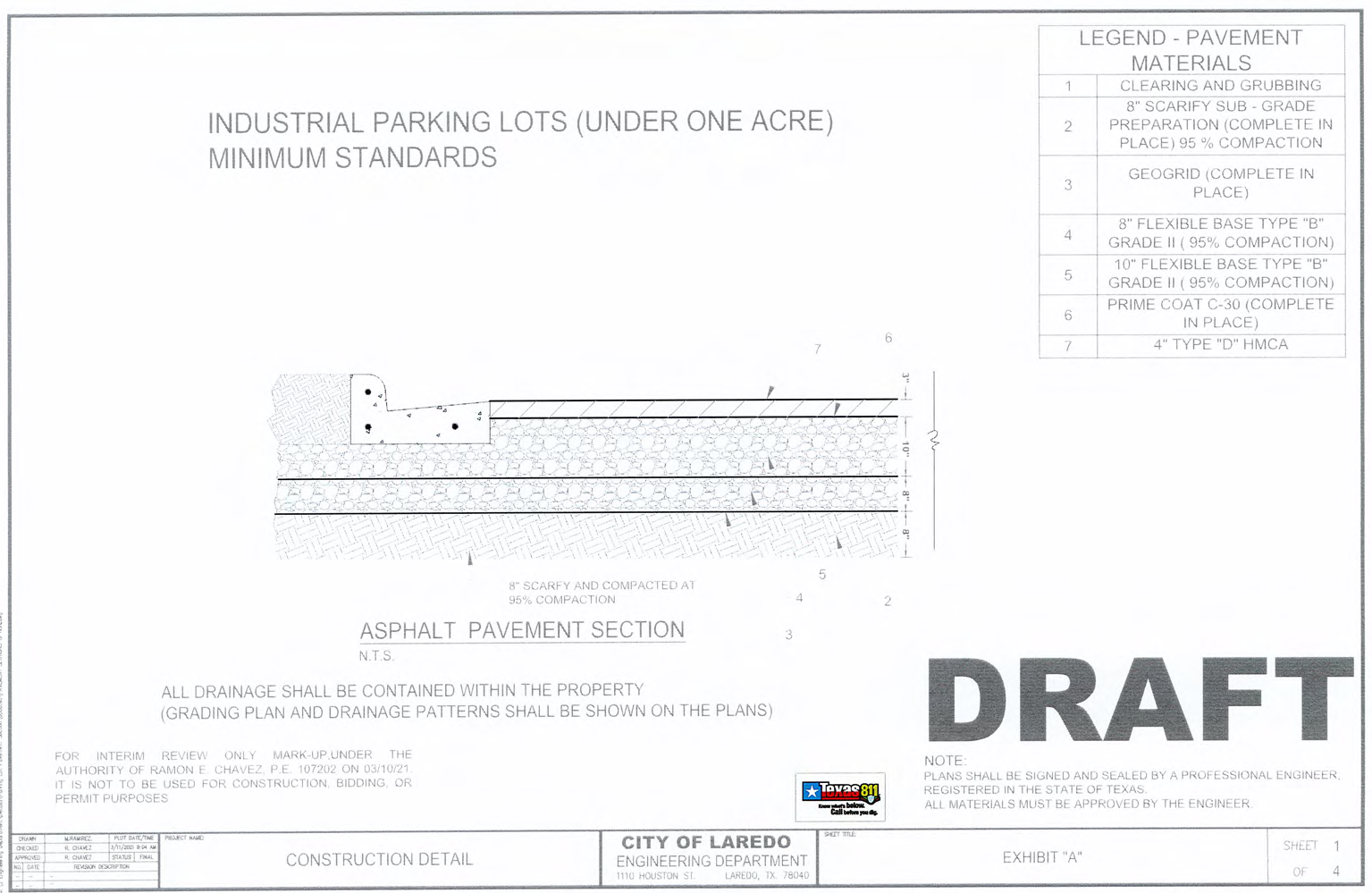
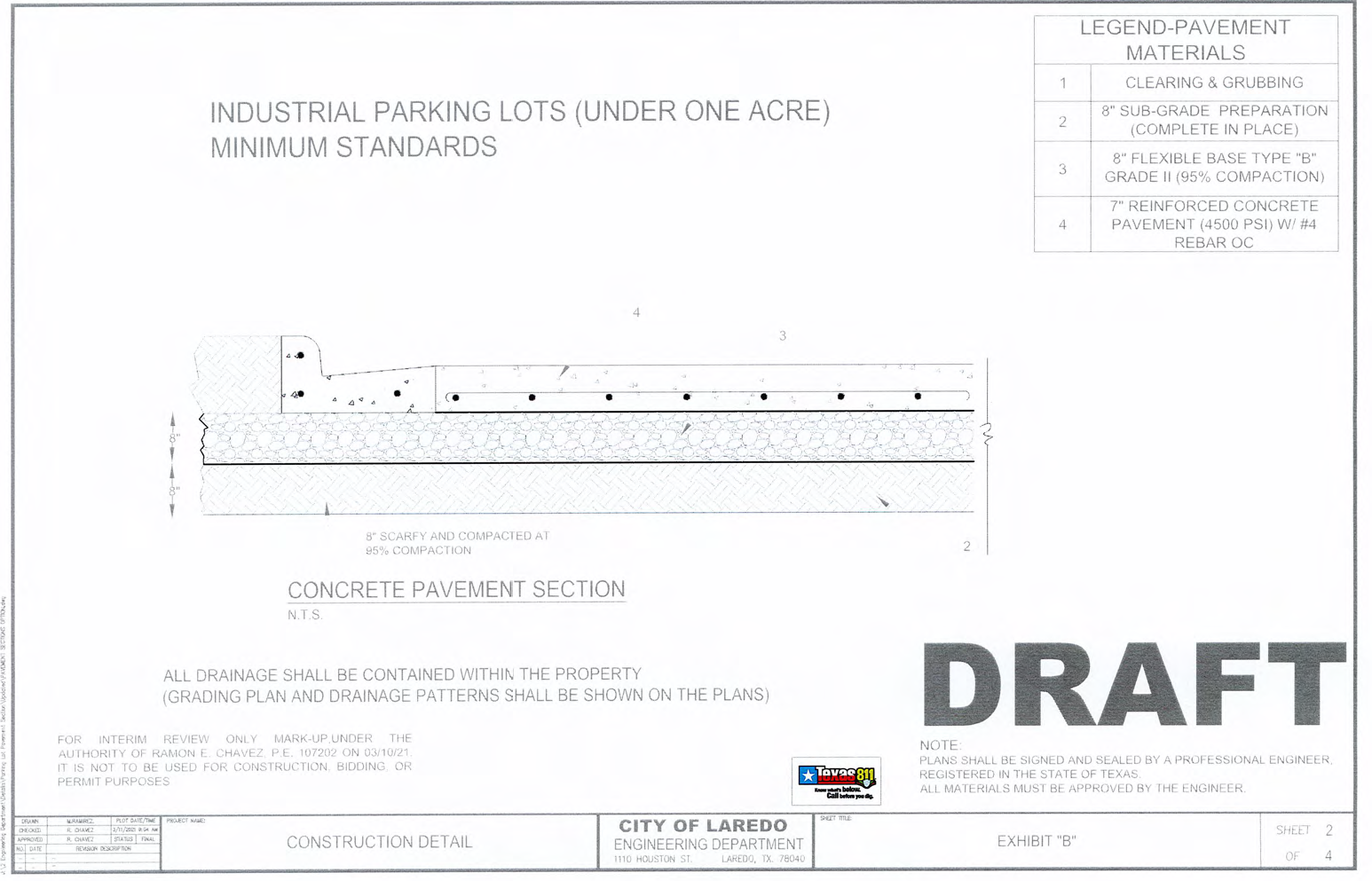
INDUSTRIAL PARKING LOTS UNDER 1 ACRE - Where the total operational area of the industrial parking lot amounts to less than one (1) acre, the specifications and materials used must meet one of the Industrial Parking Lot Design Minimum Standards as set forth in this Ordinance, attached as Exhibit A and Exhibit B (see end of section).
(a)
LOT DRAINAGE - All drainage runoff shall be contained within private property in accordance with the latest Stormwater Management Ordinance. Grading plan and drainage patterns shall be identified on the plans subject to review and approval from the Building Department.
(b)
All proposed parking lot improvements shall provide proof of field moisture density testing, asphalt depth, concrete compressive strengths reports or other reports meeting the minimum standards or as approved by the Licensed Professional Engineer of record prior to the issuance of either the certificate of occupancy or certificate of completion.
(c)
Property owner or lessee may elect to provide an alternate design, that uses the proposed material required by this Ordinance or material that is of equal or greater quality, by a licensed Professional Engineer in the State of Texas. If an alternate design is submitted final approval must be obtained from the Building Official.
(3)
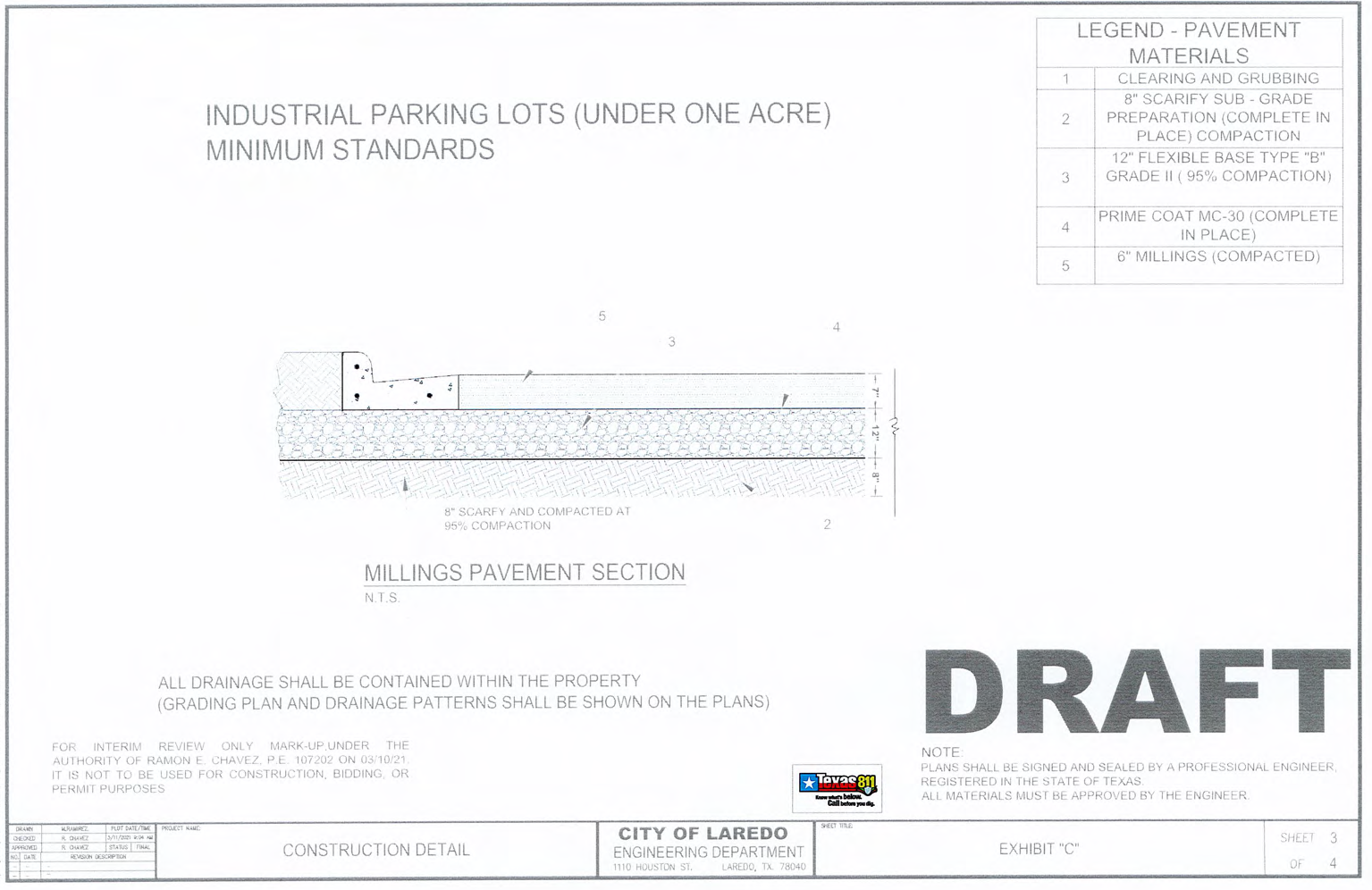
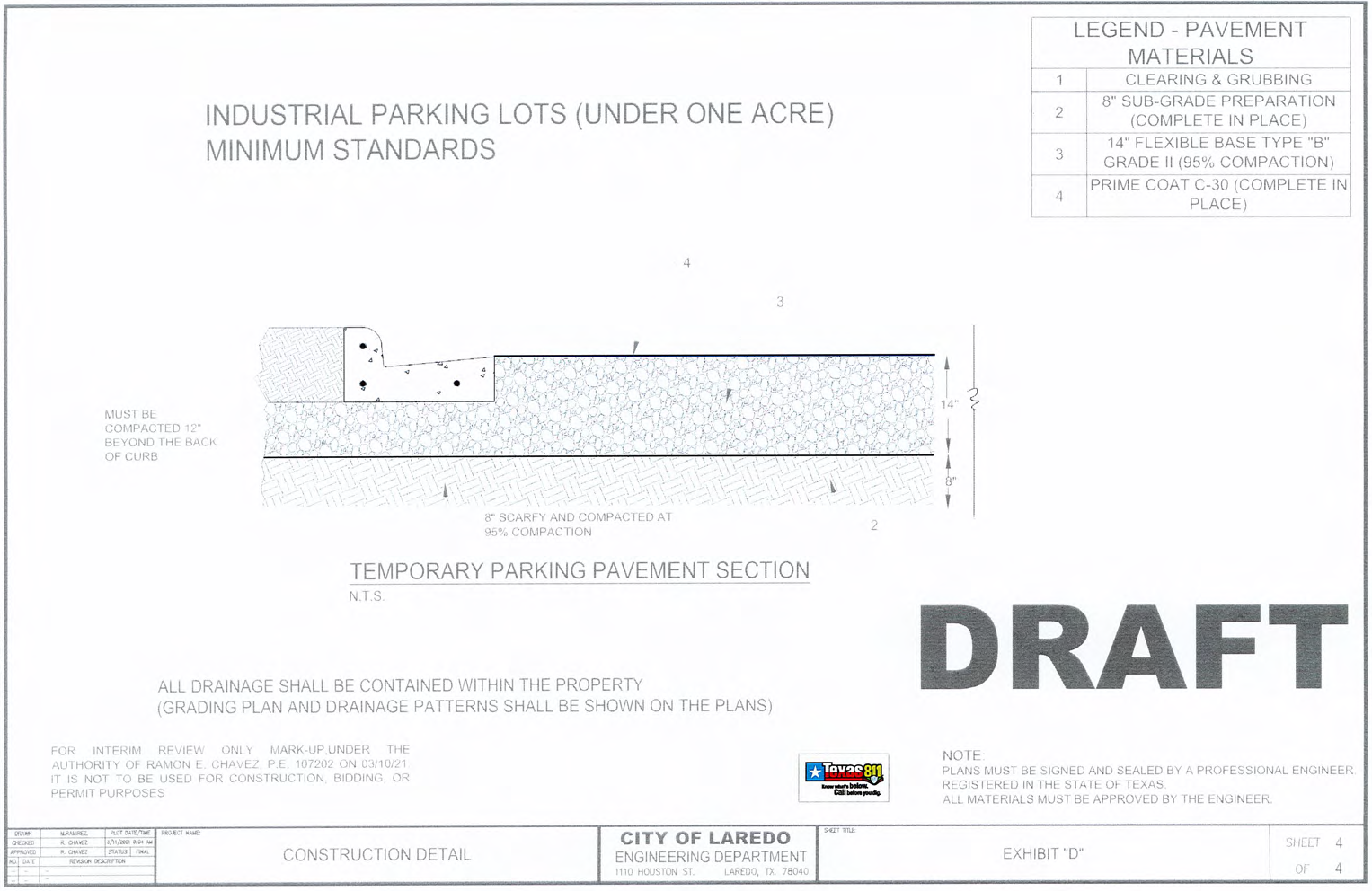
INDUSTRIAL PARKING LOTS OVER 1 ACRE - Where the total operational area of the industrial parking lot amounts to more than one (1) acre, the specifications and materials used must meet one of the Minimum Industrial Parking Lot Design Standards as set forth in this Ordinance, attached as Exhibit C and Exhibit D (see end of section).
(a)
Industrial parking lots that abut a residential district or development must meet the requirements established and set forth in Ordinance No. 90-O-107.
(b)
CONCRETE APRON - Concrete apron requirements will be provided at the entrance of the parking lot to address any staging requirements as determined to be needed for each site by the Traffic Safety Director or designee. Failure to construct the concrete apron after being informed by the Building Department shall be a violation of this ordinance.
(c)
LOT DRAINAGE - All drainage runoff shall be contained within private property in accordance with the latest approved Stormwater Management Ordinance. Grading plan and drainage patterns shall be identified on the plans subject to review and approval from the Building Department.
(d)
All proposed parking lot improvements shall provide proof of field compaction testing reports meeting the minimum standards or as approved by the licensed professional engineer of record prior to the issuance of either the certificate of occupancy or certificate of completion.
(e)
Property owner or lessee shall provide frequent or adequate maintenance for dust control and erosion control onto the public Right-of-Way.
(f)
Property owner or lessee may elect to provide an alternate design, that uses the proposed material required by this Ordinance or material that is of equal or greater quality, by a licensed Professional Engineer in the State of Texas. If an alternate design is submitted final approval must be obtained from the Building Official.
(4)
TIME LIMITATIONS AND COMPLIANCE - All industrial parking lots not presently in compliance with this Ordinance shall be required to comply with the provisions of this Ordinance within one (1) year from the effective date of this Ordinance. All newly constructed industrial parking lots from the effective date of this Ordinance shall construct the parking lot to comply with the provisions of this Ordinance or they shall be in violation of this Ordinance.
(f)
Drainage. All parking and loading areas shall provide for proper drainage of surface water to prevent ponding and the drainage of such water onto adjacent properties or walkways.
(g)
Trackage and Spillage Control; Penalties.
(1)
The owner of property used for parking and/or loading shall maintain such area in good condition without potholes and free of all dust, trash, and other debris.
(2)
The owner of property used for parking and/or loading shall take all reasonable precautions to prevent the trackage or spillage of mud, sediment, dust, debris, or construction materials on any public street, alley, or sidewalk. If trackage or spillage occurs, the property owner shall immediately and continuously, if necessary, use whatever method is required to keep the public property reasonably clean and free from trackage and spillage.
(3)
An individual violating a provision of this chapter commits a separate offense for each day they are not in compliance with this section. If it appears a person has violated or continues to violate any provision of this Ordinance, the City may petition a court of appropriate jurisdiction for injunctive relief and civil penalties.
(h)
Lighting. Any tract, block, or lot, or portion or portions thereof used for parking of vehicles for a fee or used for parking of vehicles by patrons of business or commercial establishment (commercial parking lot) if and when used during non-daylight hours shall illuminated such that the marking thereon is visible from the inside of an automobile parked thereon. Any lights used to illuminate a commercial parking lot shall be so arranged as to deflect the light away from adjoining residential property.
(i)
Location of Parking Spaces. The following regulations shall govern the location of off-street parking spaces and areas:
(1)
Parking spaces for all detached residential dwellings shall be located on the same lot as the use which they are intended to serve.
(2)
Parking spaces for apartments, dormitories, or similar residential uses shall be located not more than three hundred (300) feet from the principal use. Measurement shall be from the property line of the primary use to the driveway of the parking lot using definable pedestrian corridors and street crossings at designated crosswalks.
(3)
Parking spaces for commercial, industrial, or institutional uses shall be located not more than one thousand (1,000) feet from the principal use. Said one thousand (1,000) feet shall be measured from the driveway entrance of the principal use to the driveway entrance of the parking lot using definable pedestrian corridors and street crossings at designated crosswalks.
(4)
Where an increase in the number of parking spaces is required by a change in use or enlargement, or where such spaces are provided collectively or used jointly by two (2) or more activities or establishments, the required space may be located not to exceed one thousand (1,000) feet from the principle use. Measurement shall be made in the manner established in subsection (3) above.
(5)
No required parking areas can be provided for in a manner that will only be temporary. The business must have an interest (i.e., a lease agreement which shall be renewed or verified on an annual basis as a condition of authorization to continue the business and shall be in effect until the uses cease, title, or legal share) in off-premises parking.
(6)
In the R-O District, parking areas shall not be located in a manner that would destroy landscaping, such as trees, shrubs, lawns. In order to accomplish this, the parking space requirements of Section 24-78(p) may be modified by up to twenty-five percent (25%), and maneuvering space may be waived.
(j)
Disabled Vehicles. The parking of a non-operable vehicle shall not be permitted on public rights-of-way. These vehicles shall not be stored on any lot unless it is stored in an enclosed garage or other accessory building.
(k)
Joint Use of Parking Spaces (On-Site). Two (2) or more non-residential uses may jointly, having cooperatively entered into a recorded written agreement or contract to be in effect until the uses cease, provide and use parking spaces when their hours of operation do not overlap (meaning none of the uses sharing the facilities require the off-street parking facilities at the same time).
(l)
Wheel Blocks. Whenever a parking lot extends to a property line, wheel blocks or other suitable devices shall be installed to prevent any part of a parked vehicle from extending beyond the property line.
(m)
Access and Maneuvering Space Requirements. All parking areas, excluding single family or two family residences, shall be designed in such a manner that any vehicle leaving the parking area shall be traveling in a forward motion. Maneuvering space dimension shall be as provided in Section 24-78(c) of this section, and shall be off the public right-of-way. Access driveways for parking areas or loading spaces shall be located in such a way that any vehicle entering or leaving such area shall be clearly visible for a reasonable distance to any pedestrian or motorist approaching the access or driveway from a public or private street.
(n)
Width of Access Driveway in Business and Industrial Districts. The entrances and exits to the parking area shall be clearly marked. Entranceways or exits shall maintain the following minimum standards:
(1)
For one-way traffic, a minimum width of fourteen (14) feet is required.
(2)
Access driveways for two-way traffic shall have a minimum width of twenty four (24) feet, but not to exceed thirty (30) feet.
(3)
Parking areas having more than one aisle or driveway shall have directional signs or marking in each aisle or driveway.
(4)
On corner lots, in business or industrial districts, driveways shall be at least fifty (50) feet from the property corner nearest the intersection.
(o)
Parking Areas - Modifications. The Board may authorize or appeal a modification, reduction, or waiver of all of these parking requirements, except that when there is a change in use in a B-I or B-3 district (when such a new use requires additional parking), said additional parking requirements shall not be waived or reduced, nor shall maneuvering space requirements be waived or reduced, where access is to those major streets listed on the current, functional classification map of the City, unless in the R-O District. In no case shall there be an infringement on vehicular or pedestrian traffic safety. Adjoining residential areas shall be protected, and the variance shall be consistent with this ordinance and the City's Comprehensive Plan.
(AMENDED: Ordinance No. 90-O-88, 5/21/90; Ordinance No. 92-O-138, 7/6/92; Ordinance No. 2011-O-023, 2/22/11; Ord. No. 2021-O-122, §§ 1, 4, 6-21-21; Ord. No. 2022-O-177, § 1, 11-7-22)
Section 24-78.3 - PARKING SPACE FORMULAS
Where occupancy loads exceed the number of parking spaces required by this section by more than ten (10) percent, the occupancy load shall be reduced by the Building Official accordingly.
Section 24-78.4 - DESIGN AND CONSTRUCTION STANDARDS FOR EXISTING AND NEW OFF-STREET PARKING AREAS
(a)
Any existing or new off-street parking area not used in conjunction with a single family residence shall meet the construction and design standards for that type of off-street parking area as contained in the document entitled "Layout and Design Standards for Parking Lots," attached hereto as Exhibit A, and incorporated herein, within ninety (90) days of the effective date of this ordinance.
(b)
A building permit is required for the construction of any new, or on any existing, off-street parking area after the effective date of this ordinance unless one has already been issued therefor in conjunction with construction of a building on the same lot as the off-street parking area.
(c)
After the effective date of this ordinance, there shall be a certified survey of, and construction plans for, any proposed off-street parking area, or any existing off-street parking area on which construction is proposed. Such survey and construction plans shall be submitted to the Building Official as part of the building permit application. The certified survey and construction plans shall be reviewed and approved by the City Engineer and the city Building Official before the issuance of a building permit for the construction of or on the off-street parking area.
(d)
Foreword.
The purpose of this manual is to provide for standard specifications in the design and layout of off-street parking facilities.
The tendency when designing parking areas is to crowd as many car spaces as possible into the allotted space by reducing standards, such as narrower parking stalls and narrower aisles. The best design, however, should give full consideration to every design factor that improves access to and from the street; internal movement, maneuvering of cars, convenience or patrons and security of vehicles.
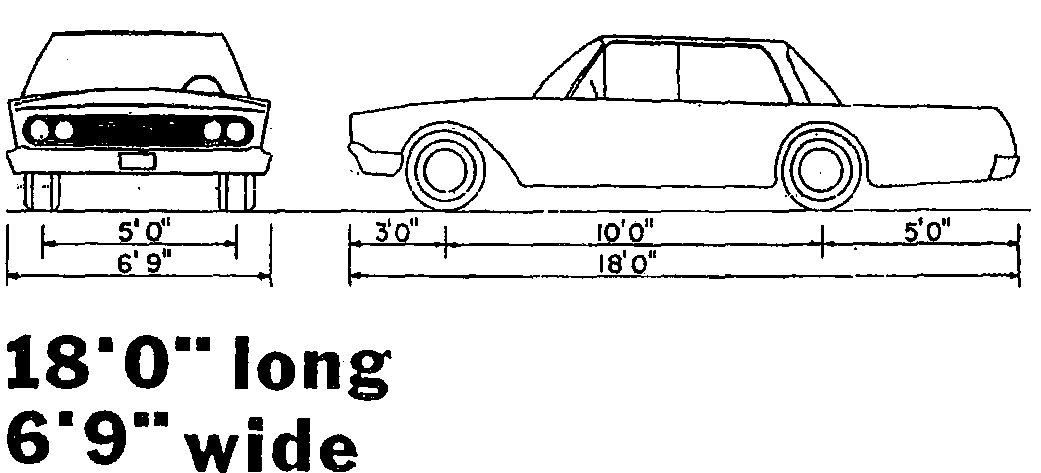
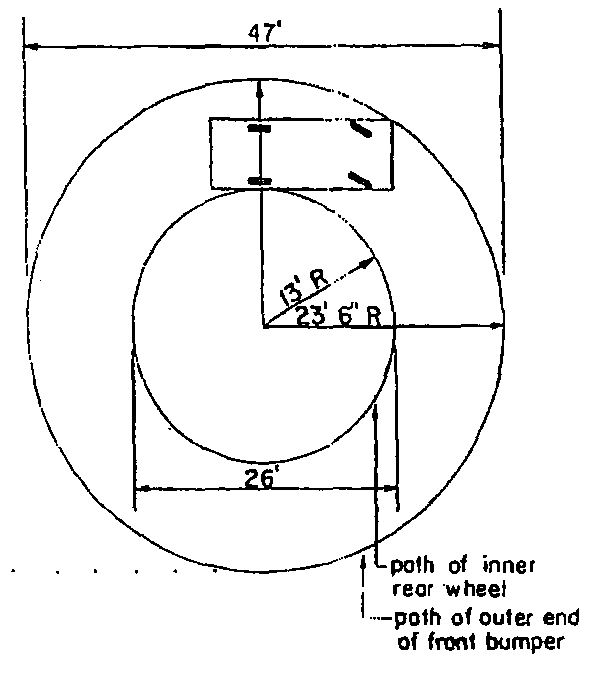
The average automobile is 18'-0" long and 6'-9" wide. Adding to these limits allowances for opening doors, the relative skill of drivers, the turning radius of the average automobile and a margin for safety, the following standards have been established. Parking areas built to these specifications will allow eighty (80) percent of all cars to park with relative ease in one maneuver. Some reduction in these standards may be necessary at times - but losses in efficiency will generally result,
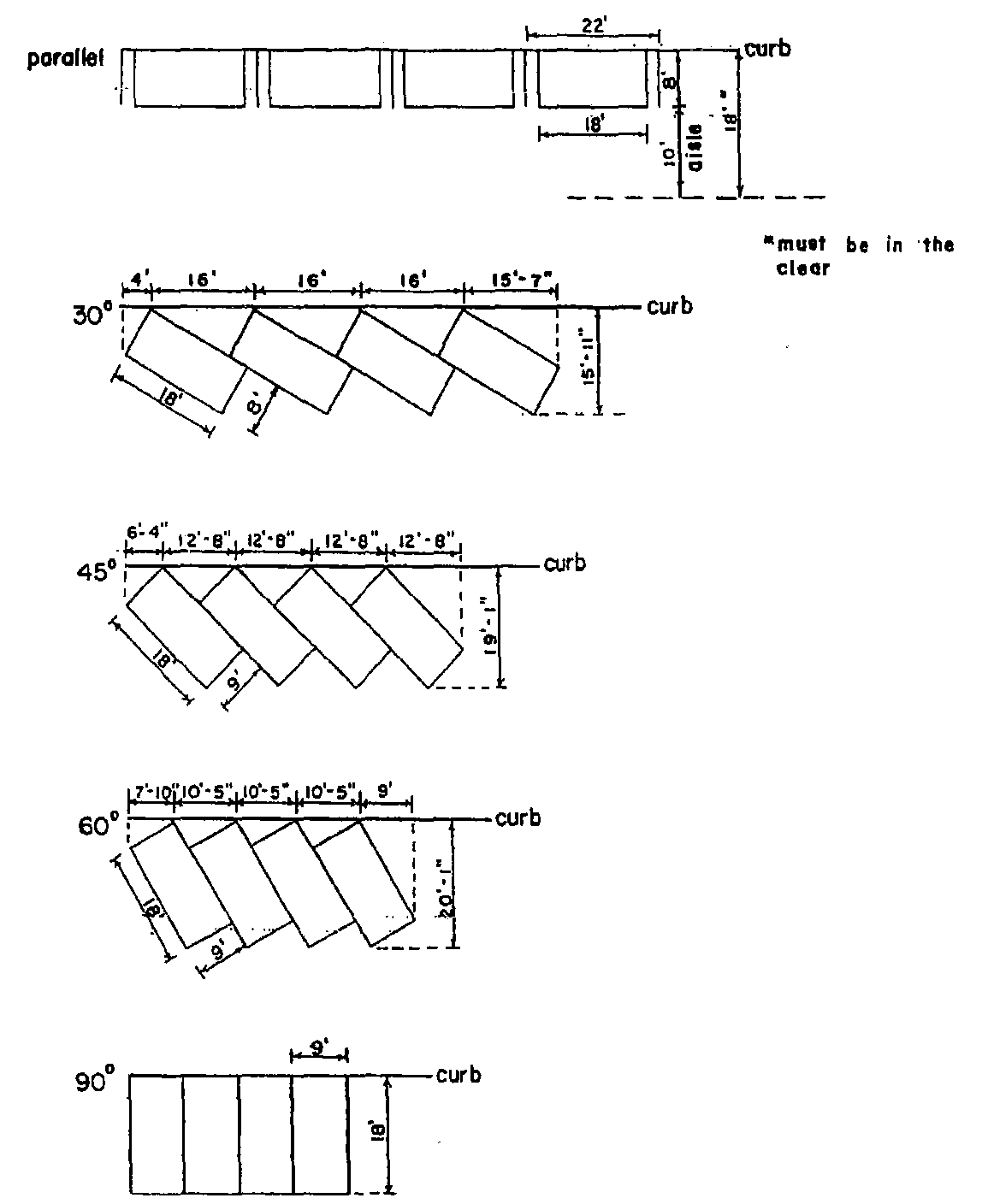
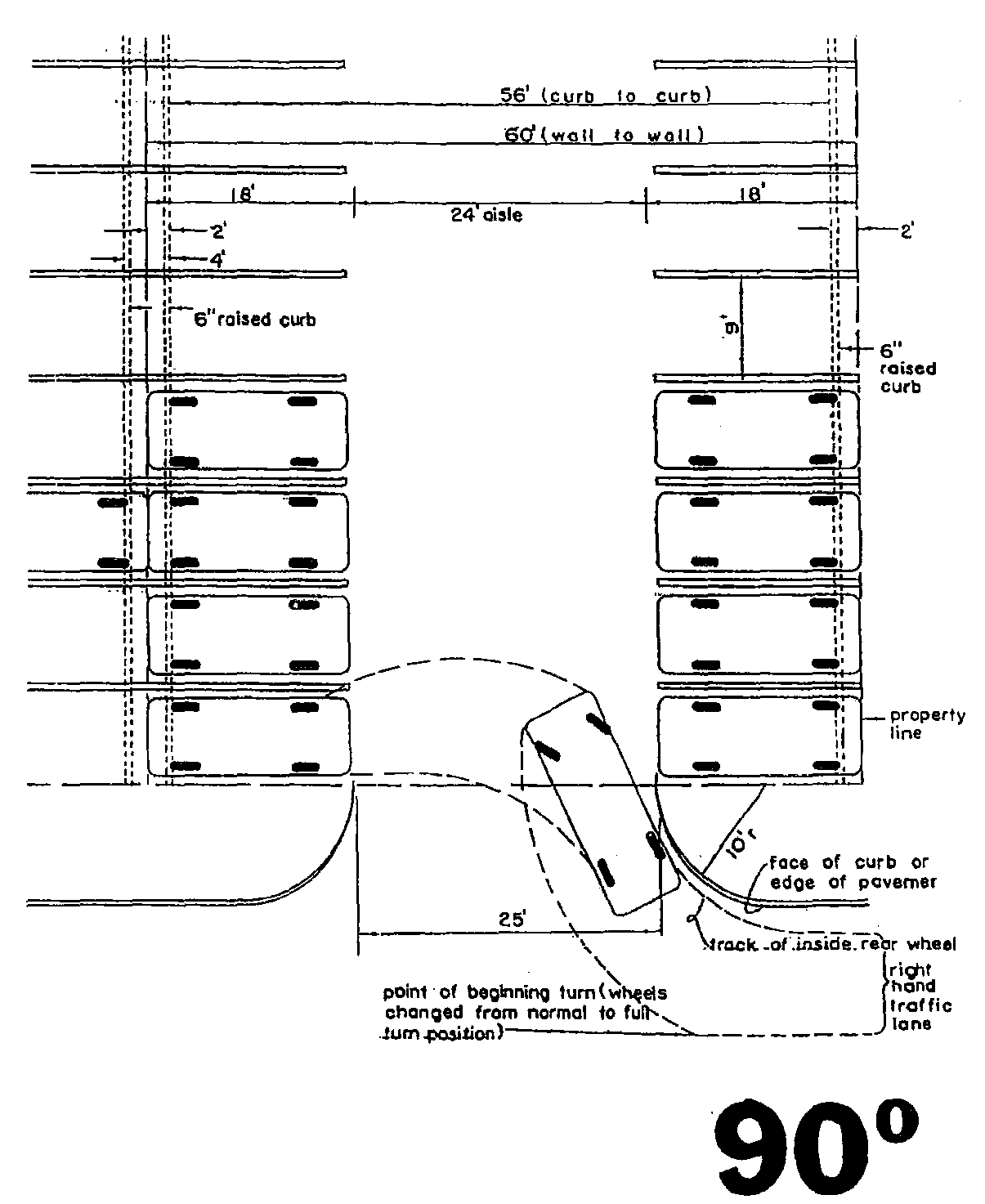
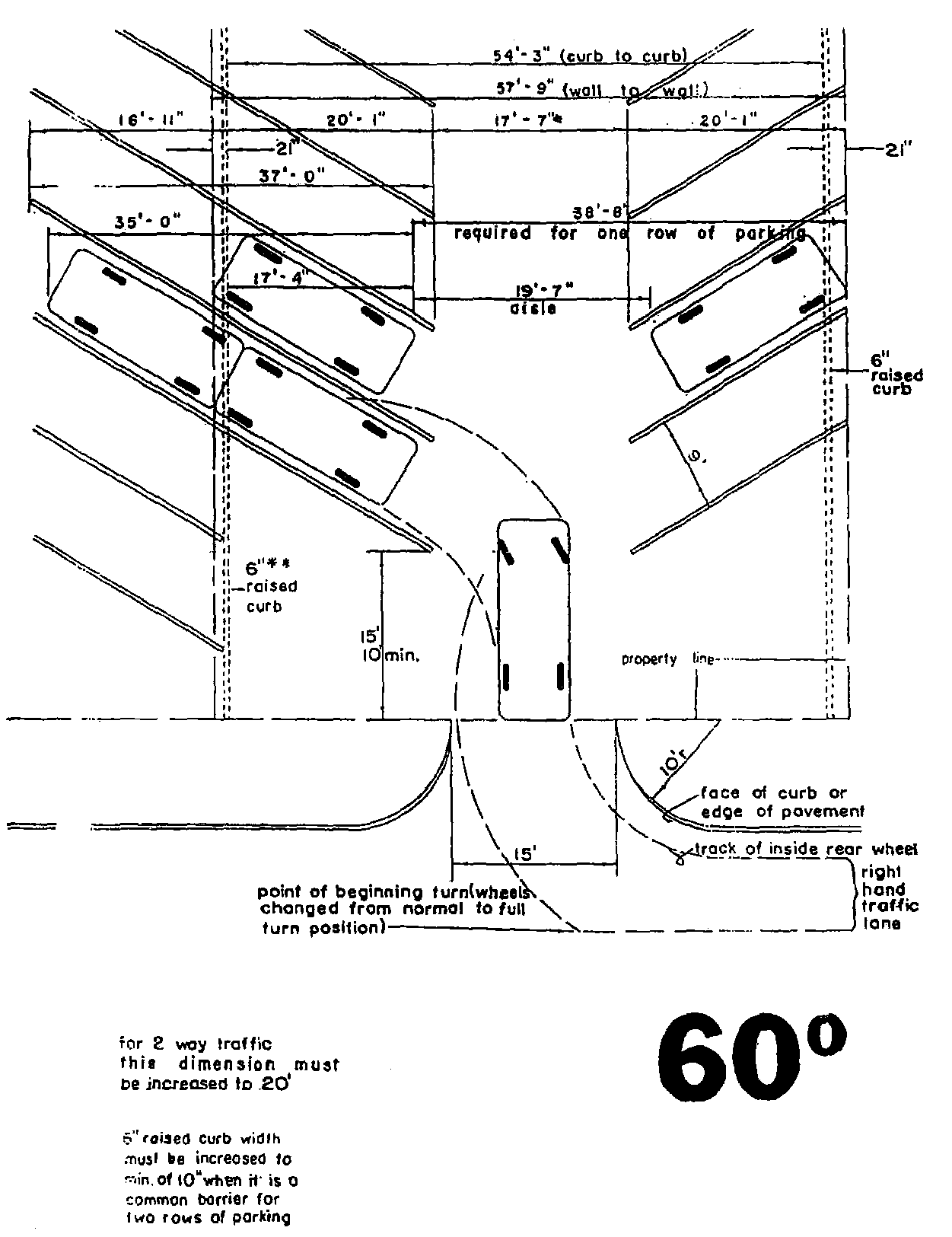
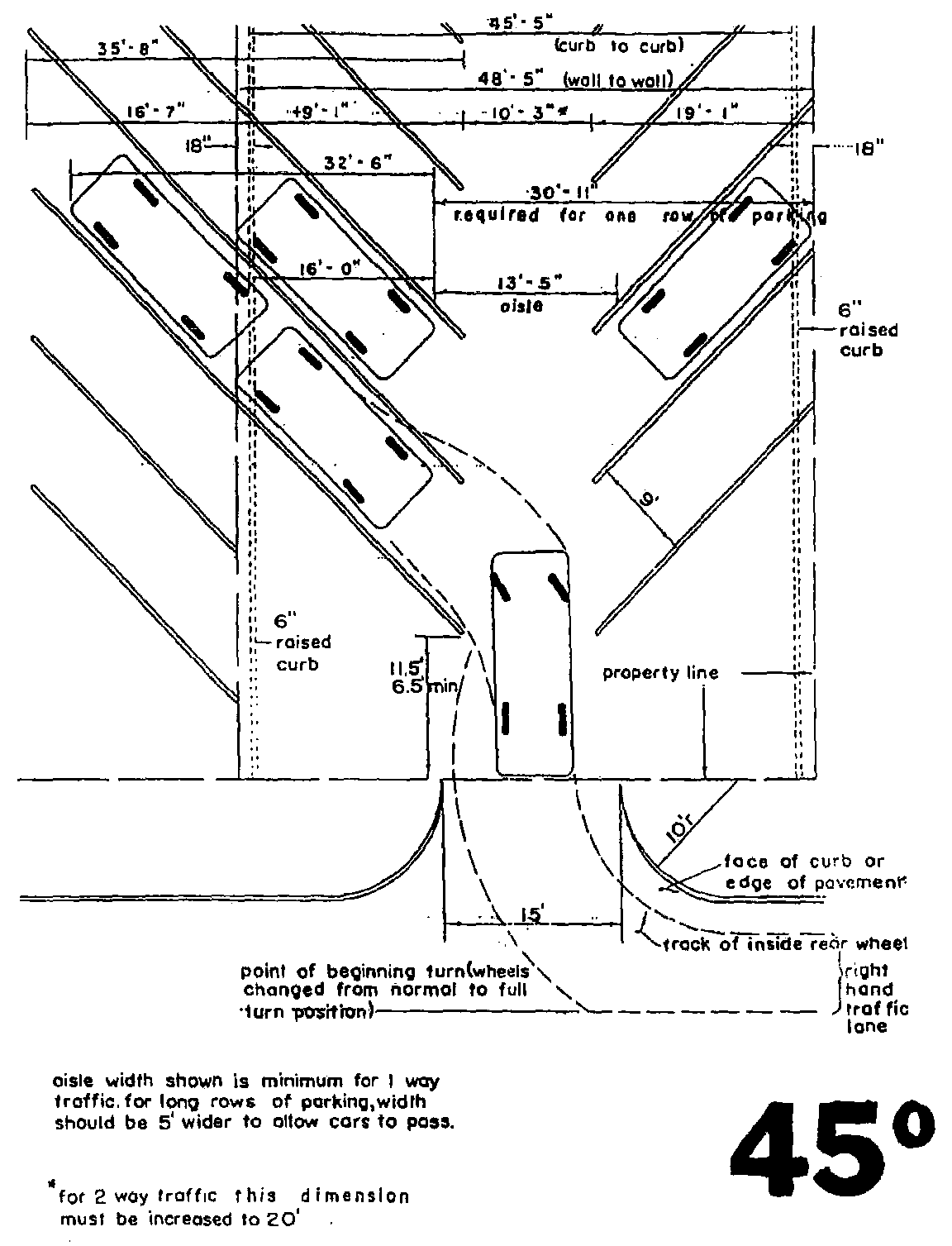
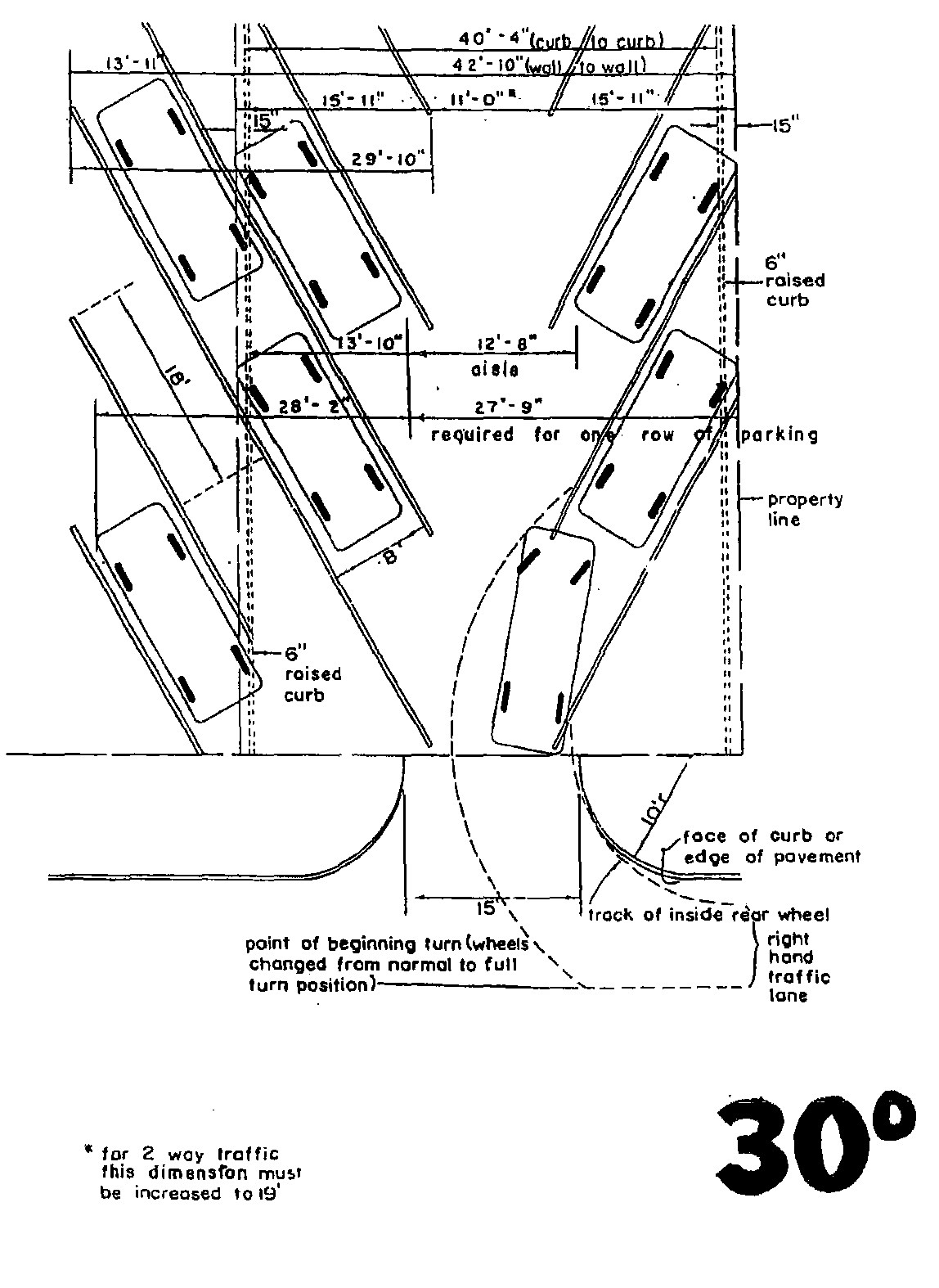
In the larger lots greatest economy of space can be accomplished by placing the stalls at right angles to the aisles (see figure for 90°). Acute-angle parking allows fewer stalls for a given length of curb or aisle than right-angle parking, but entrance is easier for drivers, and a definite advantage is that the aisle may be narrower and permits use of a lot too narrow for right-angle parking (see subsection (h), figures for 60°, 45°, and 30°).
Acute-angle parking requires that the first stall be placed a minimum distance from the property line or sidewalk. This is a safety measure to protect occupants of the sidewalk from vehicles backing out of the stall.
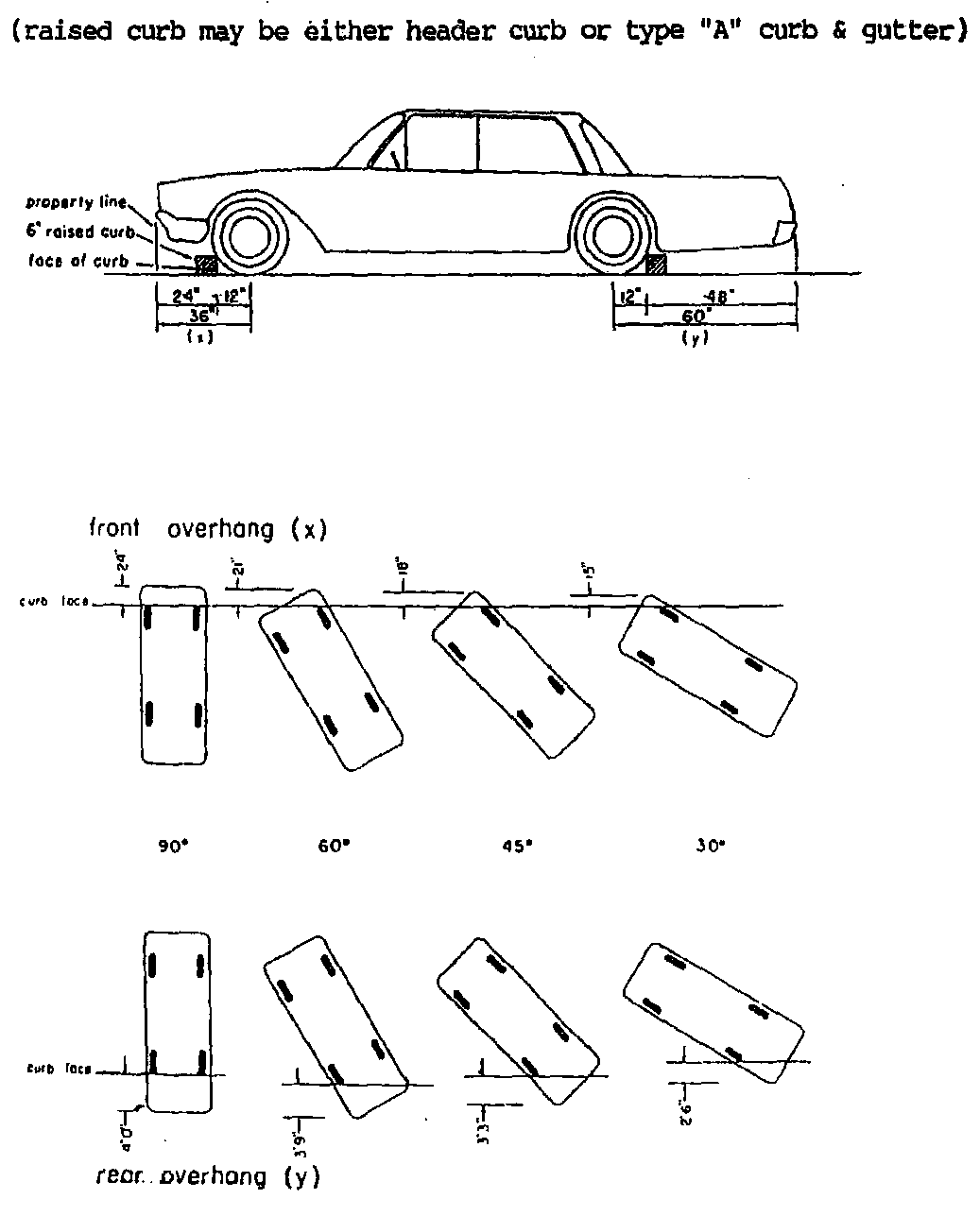
Barrier curbs are essential when parking heads into an adjoining property line or sidewalk. Their placement depends upon the angle for which the parking is planned (see subsection (h), overhand of average automobile).
Circulation of cars within facilities requires consideration of entrance and exit locations, width or aisles and the angle of parking. One-way, counterclockwise movement is desirable, where feasible and will reduce congestion.
Entrances and exits should be held to a minimum to reduce conflict with street and sidewalk traffic, but is highly desirable that exits and entrances be separated.
(e)
The average automobile is:
(f)
The turning circle for the average automobile is:
(g)
Space requirements for parking at various angles.
(h)
Overhang of average automobile parking against 6" raised curb at 30°, 45°, 60°, and 90°.
(i)
Methods of laying out of parking areas on 50' and 60' lots.
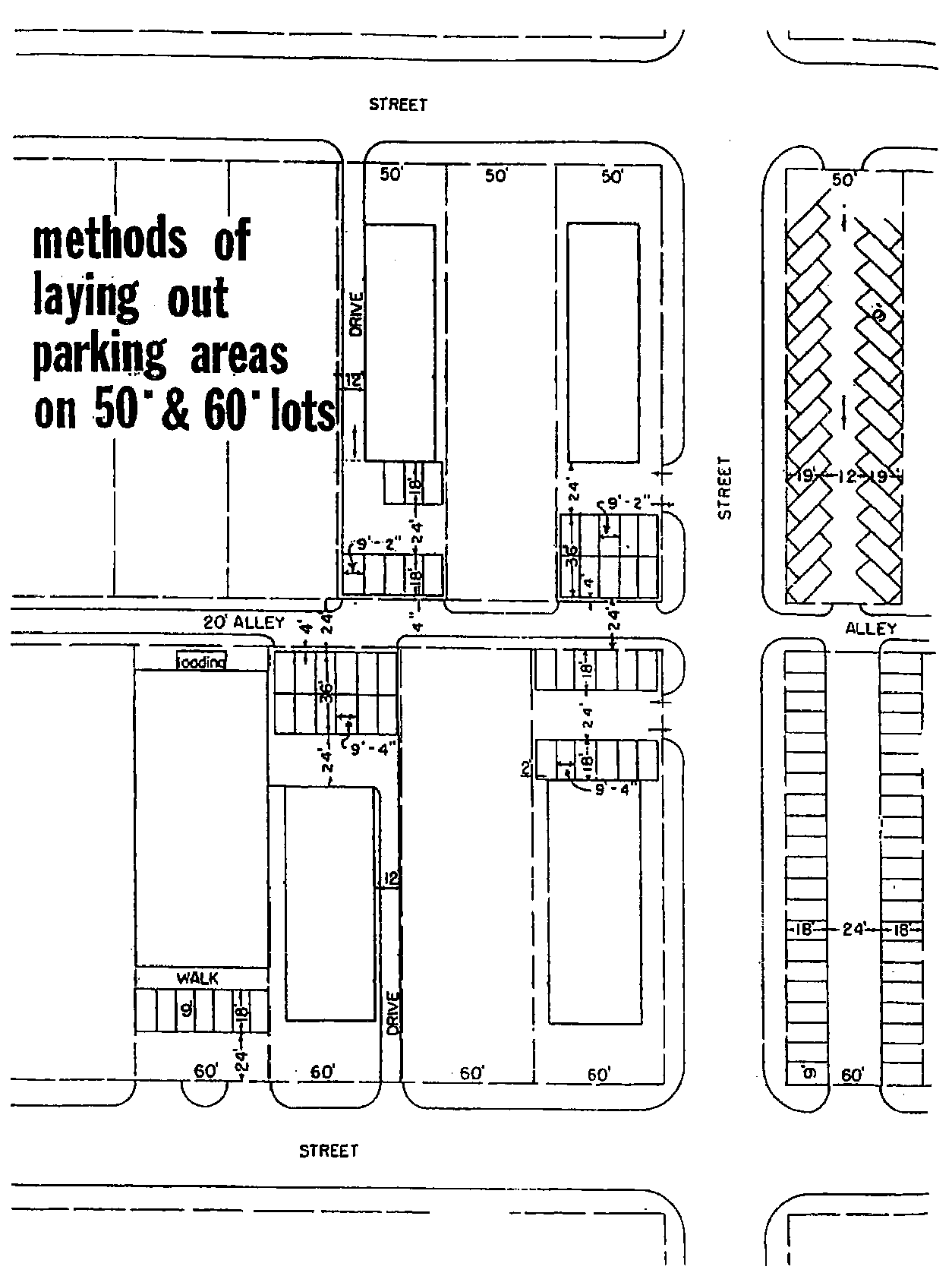
(j)
Methods for marking parking stalls.
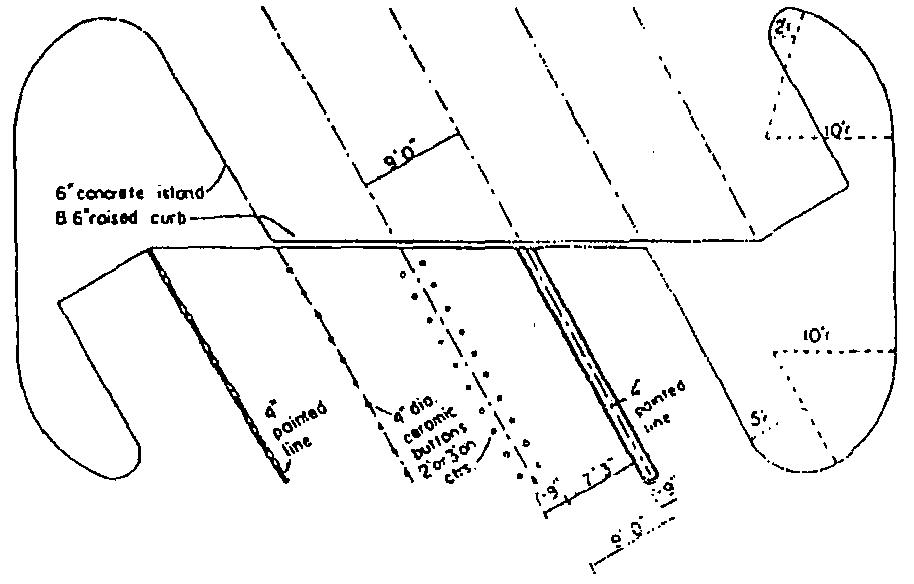
(k)
Driveways.
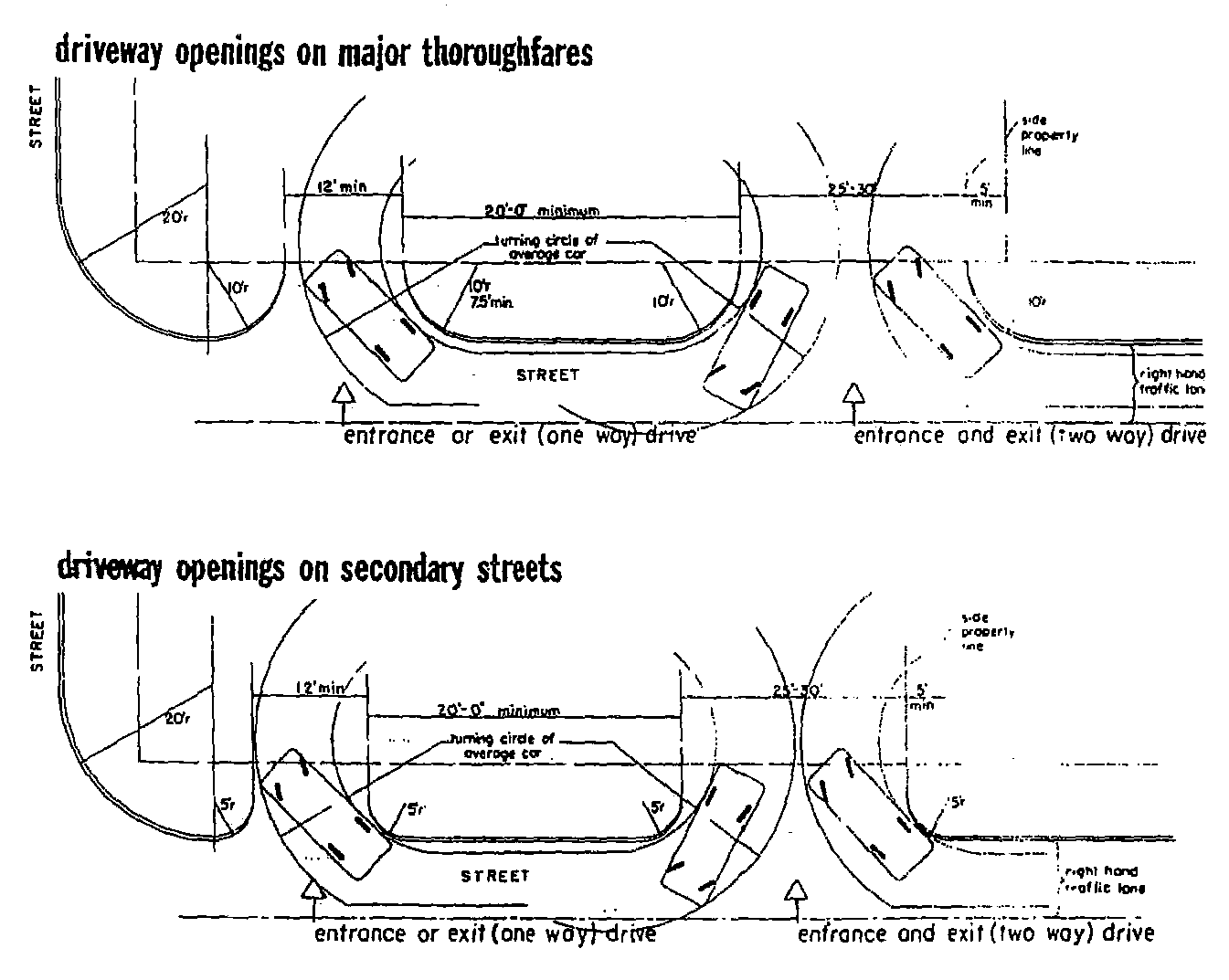
(l)
Driveway approaches.
(1)
Commercial Driveway Approaches. Walks, drives, curbs, gutters, pavements and appurtenances on public property and other facilities to provide access to premises used for other than residential purposes shall be constructed provided or repaired in accordance with the following standards and requirements:
a.
Width of Driveway Approach. The width of any commercial driveway approach shall be not less than twelve (12) feet nor more than forty (40) feet measured along the property line, except driveway approaches for motor vehicle docks within a building shall not exceed sixty (60) feet in width at the property line. Where more dock space is required, the driveway approaches shall be separated by a traffic island meeting the standards set out in subsection d. below.
(b)
Maximum Space to be Occupied By Driveway Approaches. Driveway approaches shall not occupy more than seventy (70) percent of the frontage abutting the roadway of the tract of ground devoted to one use which abuts the roadway.
c.
Number of Driveway Approaches Allowed. Not more than two (2) driveway approaches shall be permitted on any parcel of property with a frontage of one hundred fifty (150) feet or less. Additional openings, for parcels of property having a frontage of one hundred fifty (150) feet or less, may be permitted, after proof to the City Engineer of necessity and convenience to the public.
d.
Separation Between Driveway Approaches. When more than one driveway approach is required to serve a parcel of property, a traffic island shall separate the driveway approaches. The width of the traffic island at the property line shall be a minimum of twenty (20) feet. Where the grade at the property line is the same as the sidewalk a six-inch raised curb shall be constructed at the back of the traffic island along the property line and on private property. The raised curb shall be constructed so as to end twenty-four (24) inches from the intersection of the driveway approach with the property line.
e.
Premises Used as Motor Vehicle Service Stations or Parking Lots. Premises used as a motor vehicle service stations or parking lots shall have a six-inch raised curb or other approved traffic barrier along the entire street frontage except at the driveway approaches and access walks. The curb shall be placed so that automobile bumpers shall not extend over the sidewalk or public property.
(m)
Typical Truck Parking Stalls. An ordinance amending parking lot layout section, page 13, Ordinance No. 90-O-107 of the City of Laredo to change:
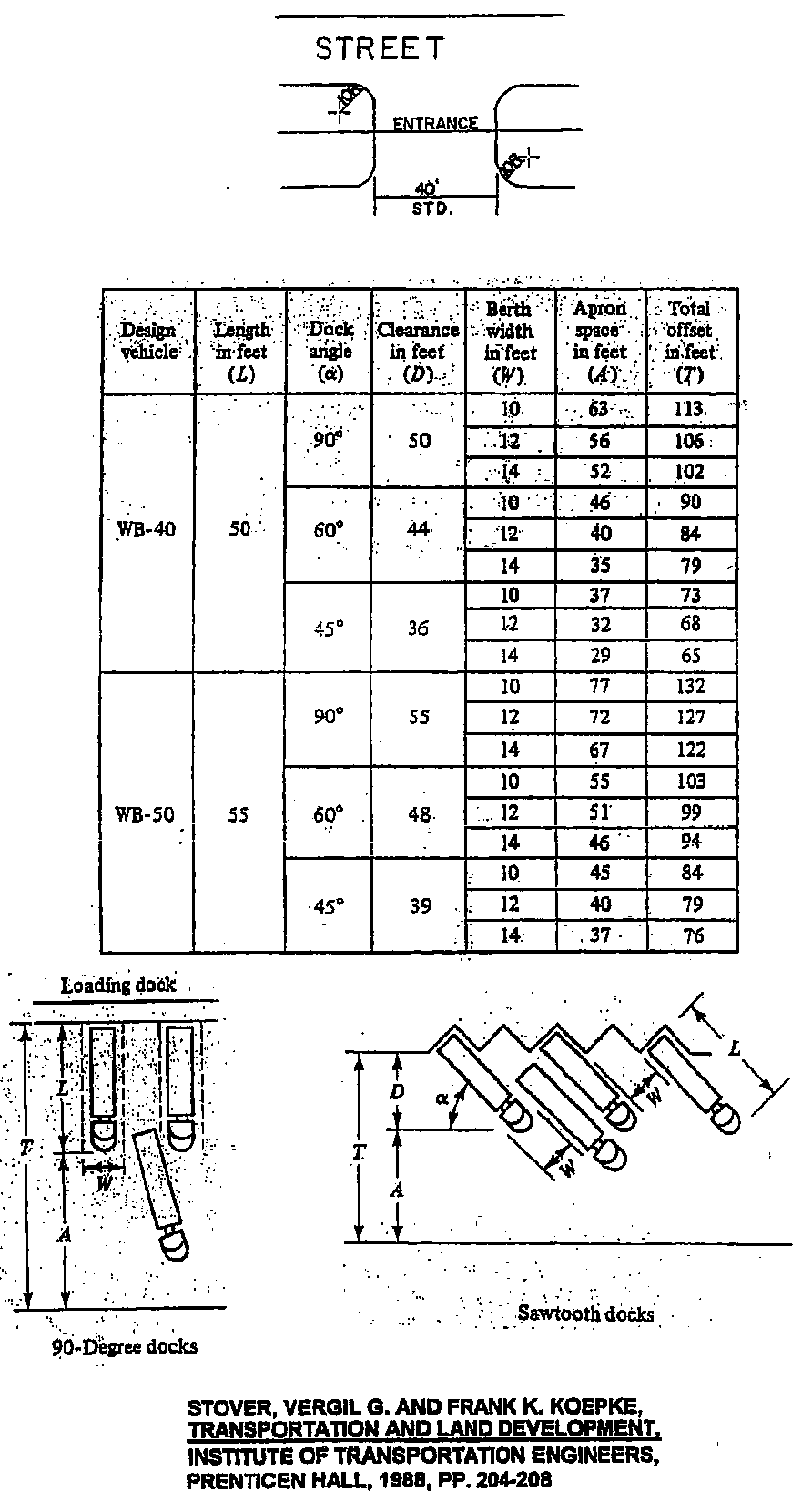
(n)
Concrete Pavement.
(1)
Typical Concrete Designs for Parking Areas.
(2)
Design Mix of Concrete for Parking Lots.
Cement content: 6 sacks per cubic yard.
Maximum size aggregate: 1½ inch.
Maximum slump: 4 inches.
Maximum water content: 7 gal./sack.
Entrained Air: 5% plus or minus 1%.
(3)
Estimating the Materials. The table gives the number of cubic yards of concrete in slabs of different thicknesses and areas. Multiply the slab length by its width to get the area in square feet. Then read quantity of concrete from the table for desired thickness.
Example:
The slab is 20×30 ft. and 4 in. thick. Find quantity of concrete needed.
Area = 20 × 30 ft. = 600 sq. ft.
Since the table does not go as high as 600 sq. ft., use the concrete quantity for 300 sq. ft. and multiply it by 2.
Quantity for 300 sq. ft. = 3.7 cu. yard.
2 × 3.7 = 7.4 cu. yard
CUBIC YARDS OF CONCRETE IN SLABS
(o)
Design Criteria. The plans and specifications in this folder were prepared by the Portland Cement Association for use in Texas.
The purpose of these plans and specifications is to provide a very simple method of constructing a concrete parking area. If curbs are not required, the words "integral curb" should be lined out or deleted.
These specifications are designed for use with ready-mixed concrete. Mix designs for the specified concrete are available from the ready mix producer. The producer will normally certify to the purchaser that he will furnish a concrete containing at least six (6) sacks of cement and no more than seven (7) gallons of water per sack, and with a compressive strength of 3,600 psi in twenty-eight (28) days. This certification eliminates the need for testing on small jobs. Care should be taken to insure that additional water is not added at the job site, causing the water-cement ratio to exceed seven (7) gallons per sack.
If test specimens are taken for small jobs, cylinders are generally used. Mix design data is usually available on compressive strength basis. The strength recommended in the accompanying specification has proven adequate in all parts of Texas.
The detail sheets give suggested joint layouts, although the contractor should be allowed to make minor changes in this jointing pattern if it will result in more economical construction and the changes do not exceed the maximum recommended. It is better to use too many joints than not enough. Care should be taken to insure that the one-inch minimum depth is obtained for each joint.
Most soils can be used as a sub-base for concrete with minimum preparation. It is important that the subgrade be thoroughly and uniformly wetted to a depth of about six (6) inches prior to placing concrete on it. It is also important that the subgrade be of uniform density to provide uniform support for the slab. Concrete pavement can be engineered to perform satisfactorily on any soil condition. Best performance is obtained, however, where subgrade support is reasonably uniform.
Many contractors elect to place about a two-inch layer of sand or its equivalent on the subgrade prior to placing. This is sometimes called fine grading. It allows a base over which to work and makes it easier to get a uniform thickness of concrete thereby reducing overrun.
Prior to setting forms, the subgrade should be checked for proper grade and alignment. Prior to placement of the concrete, forms should be checked for proper grade and alignment. The parking area should have a fall of at least ⅛ inch per foot in the direction of the desired drainage.
A complete and uniform coverage of curing compound can be obtained by applying the spray compound in one direction and then making a second application in a perpendicular direction.
The attached chart gives the recommended thickness for concrete parking areas. Use of these recommended thicknesses for concrete will result in pavements lasting as long as the building it serves (30, 40, 50 years or more).
(1)
Thickness Design Chart.
*D.S. - Distributed Steel #3 deformed bars on 24" centers both ways (or equivalent)
for light and medium
Distributed Steel #4 deformed bars on 24" centers both ways (or equivalent) for heavy
Light - Churches, schools, hospitals, office buildings, auditoriums, stadiums and apartment complexes.
Medium - Shopping centers, commercial areas. (If defined truck service drives are provided, shopping centers and commercial parking areas may be considered as light traffic, dependent on individual conditions. See load repetition chart.)
Heavy - Industrial.
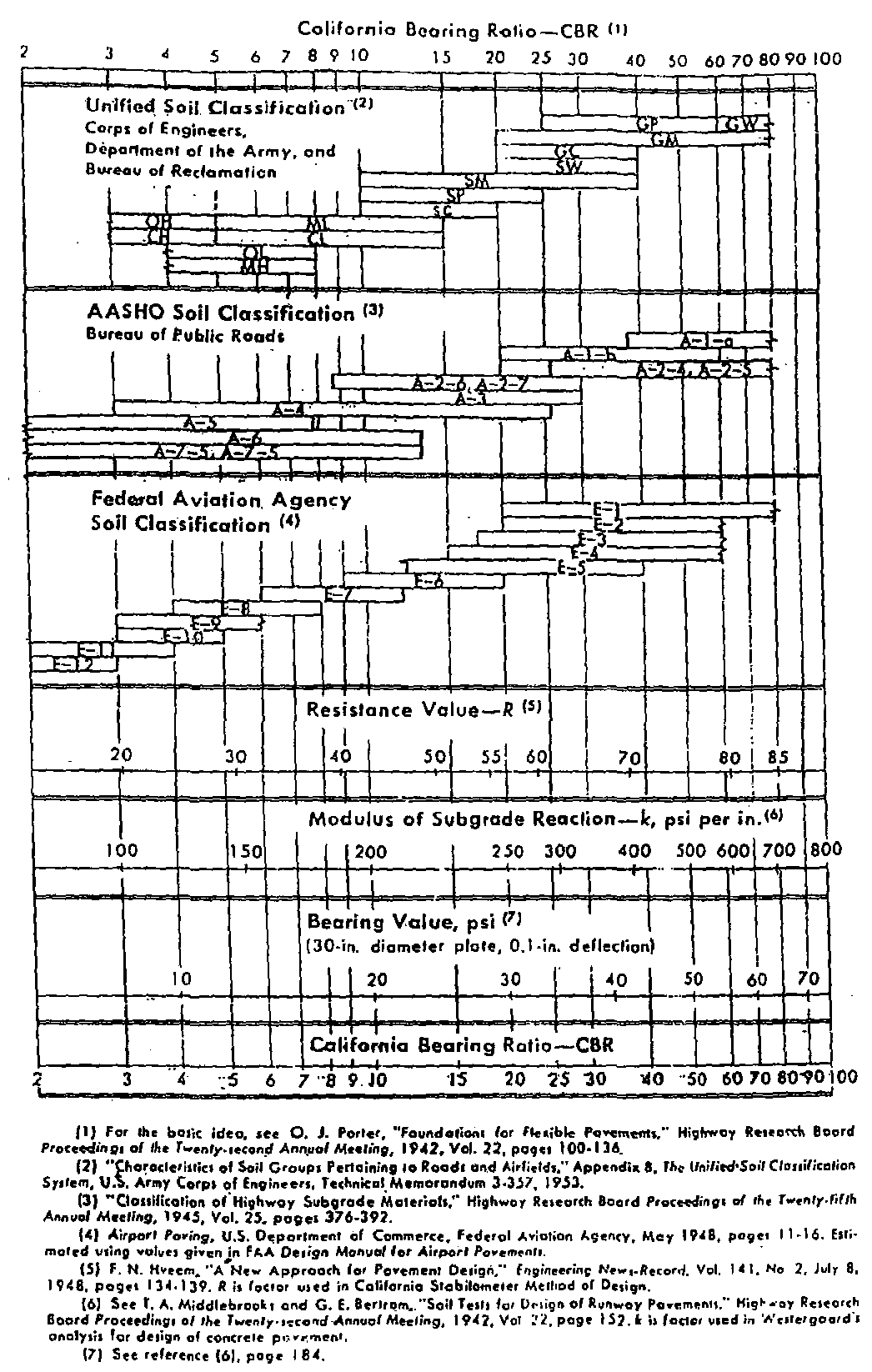
**See subsection (2), "PCA Soil Primer" for interrelationships of Soils Classifications.
(2)
Approximate interrelationships of soil classifications and bearing values.
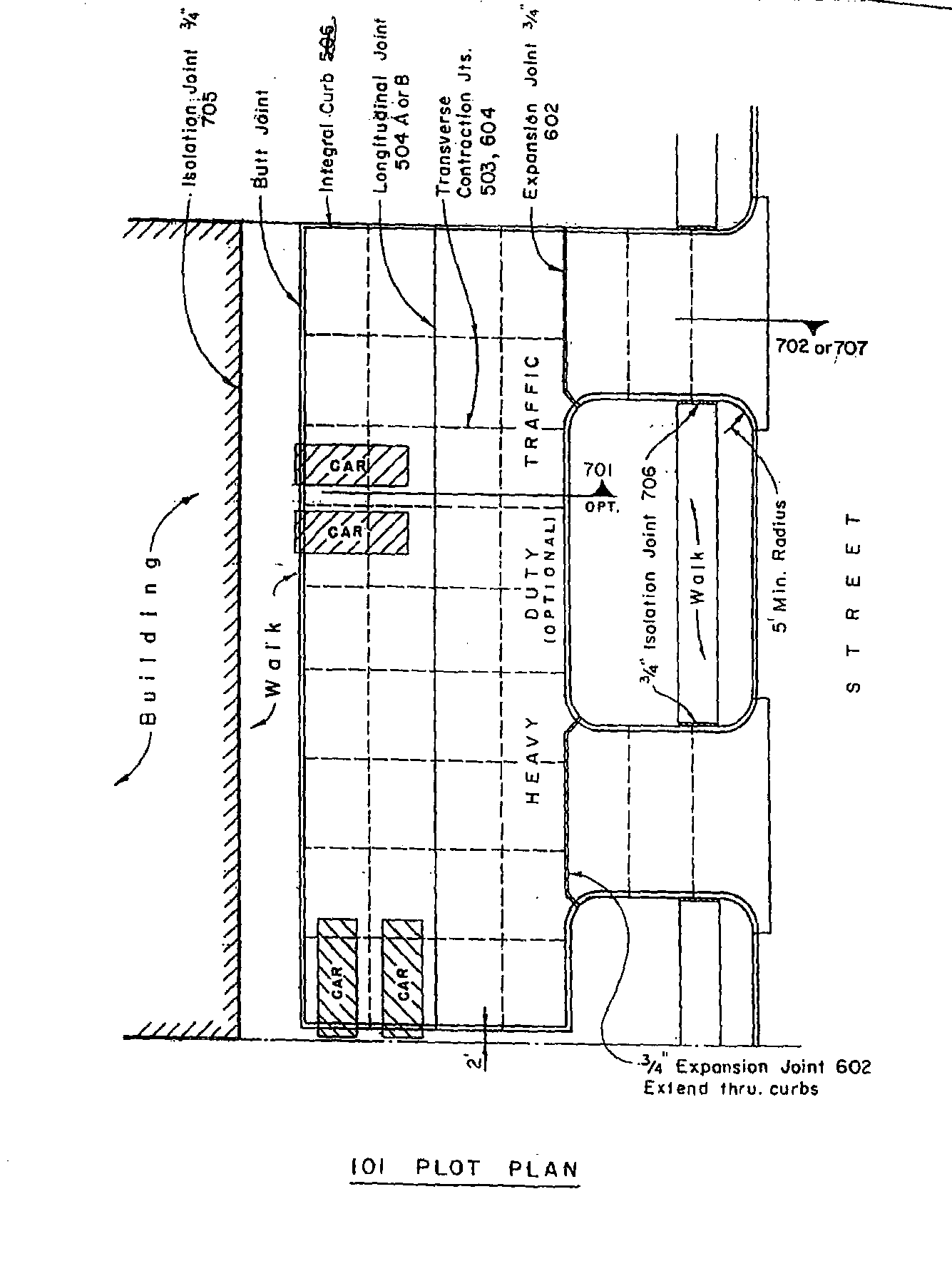
(3)
Typical Light Duty in and Out Parking With Heavy Duty drive.
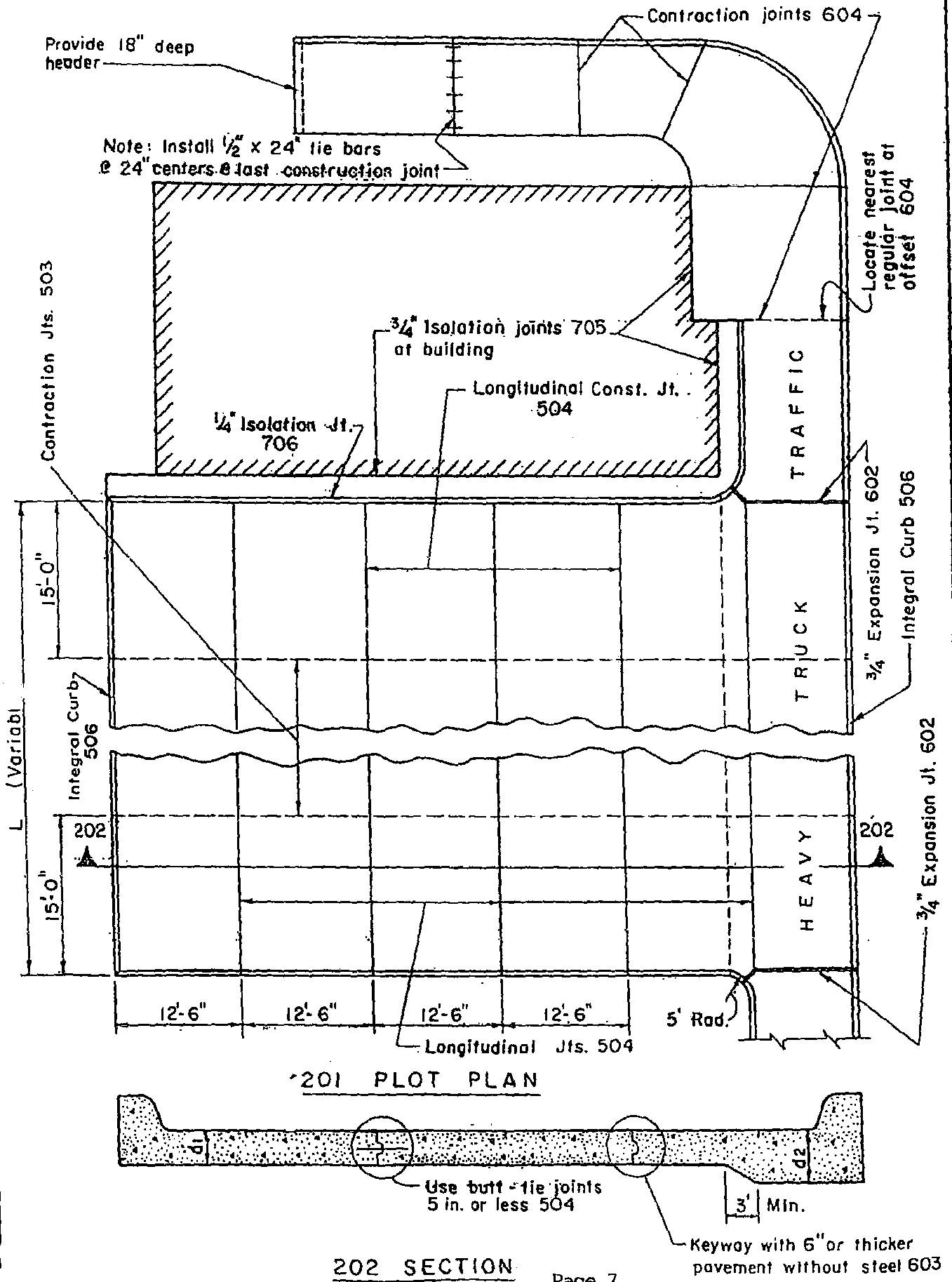
(4)
Typical Parking Lot With Heavy Duty Service Drive.
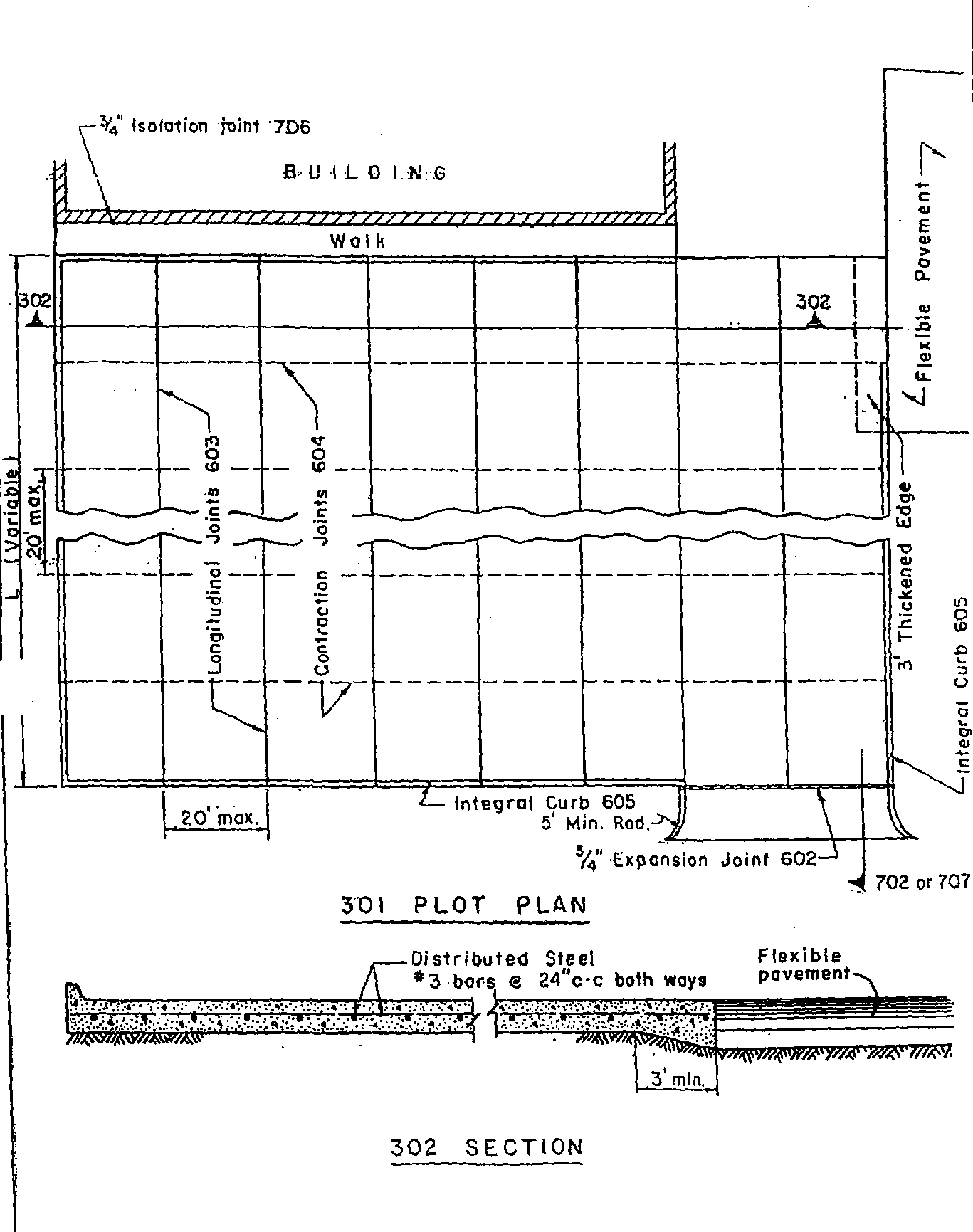
(5)
Typical Heavy Duty Layout Using Distributed Steel.
(6)
Confined Peripheral Reinforced Pavement.
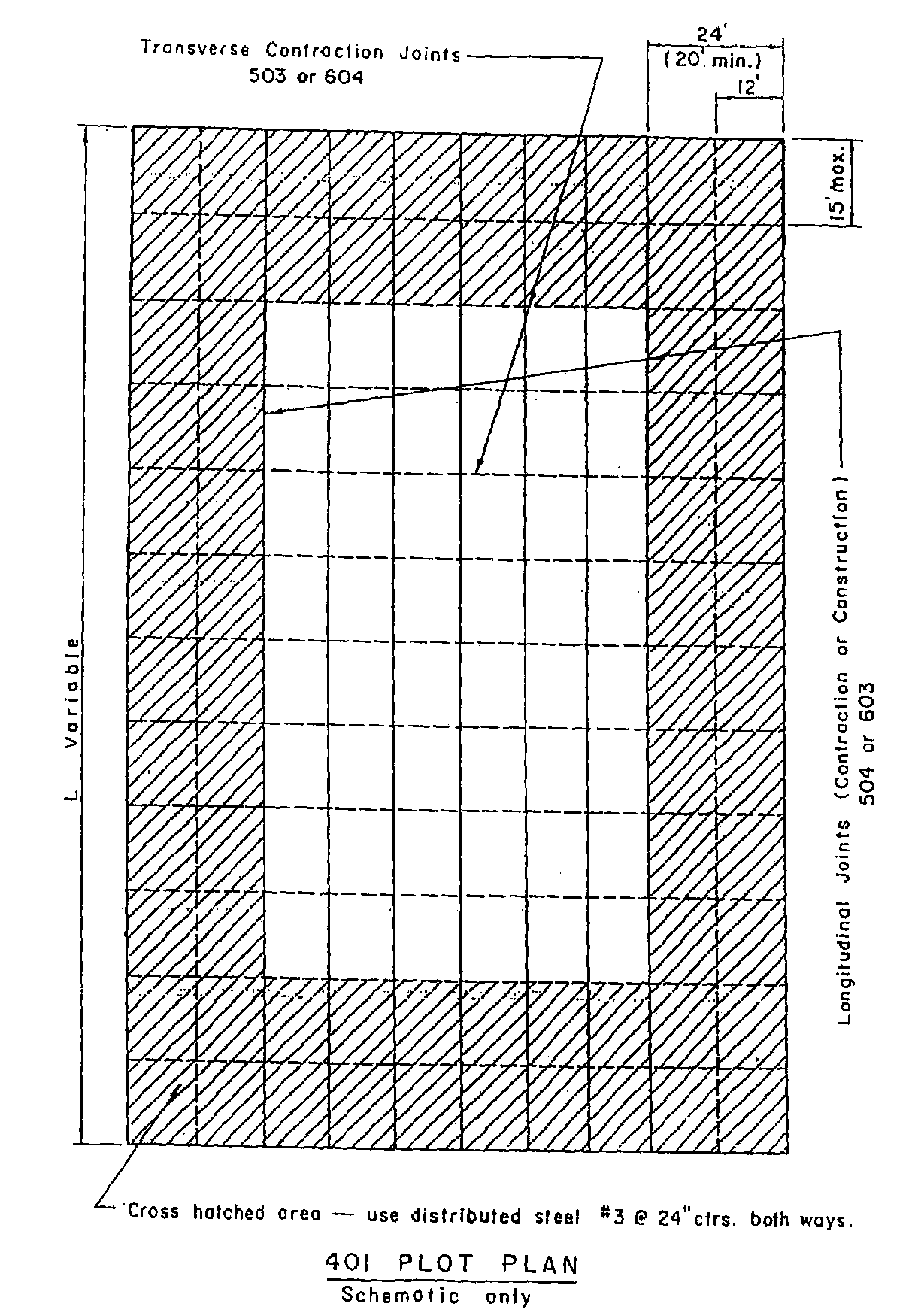
(7)
Light Duty Parking and Drive Details.
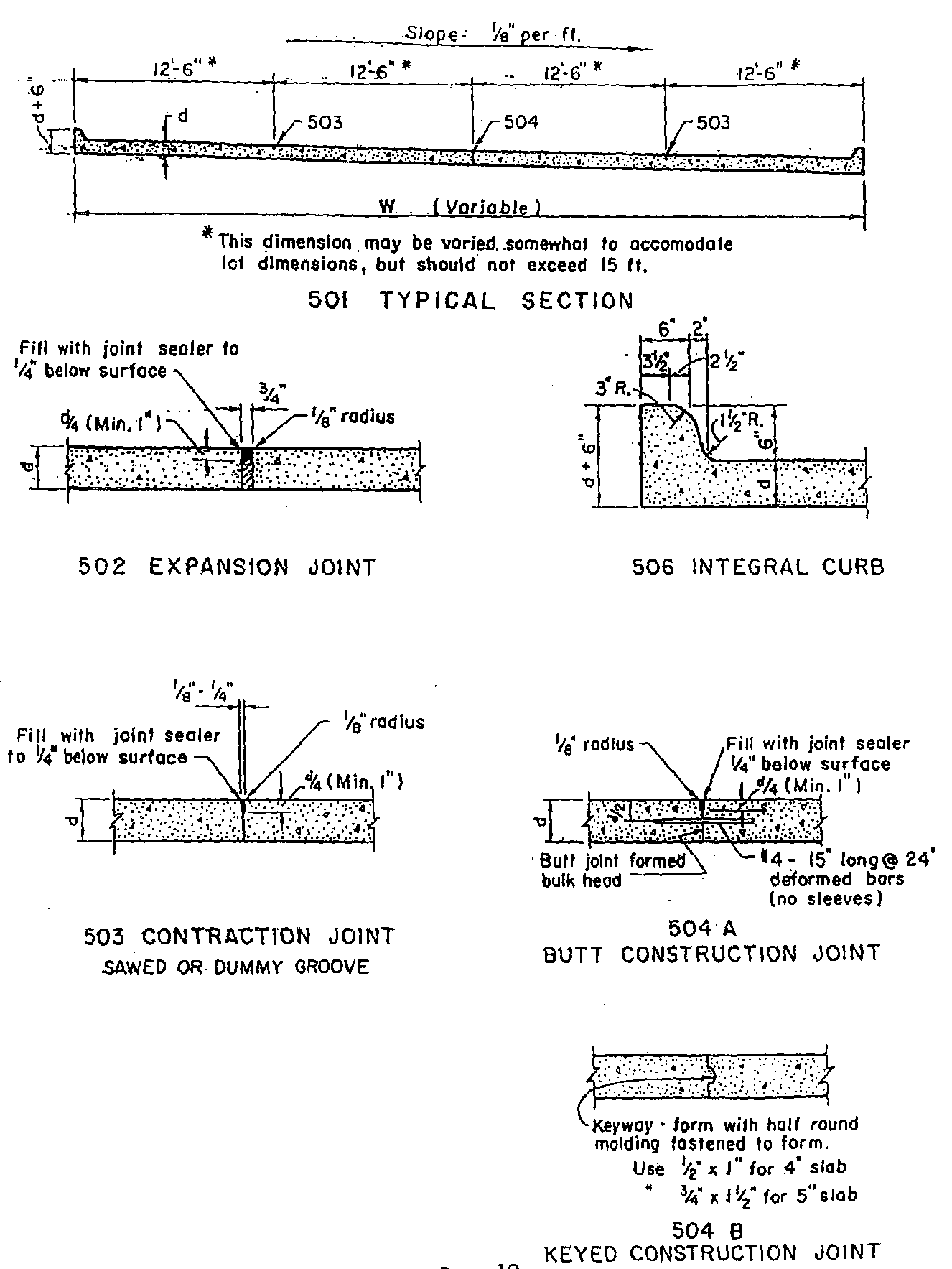
(8)
Medium and Heavy Pavement Details.
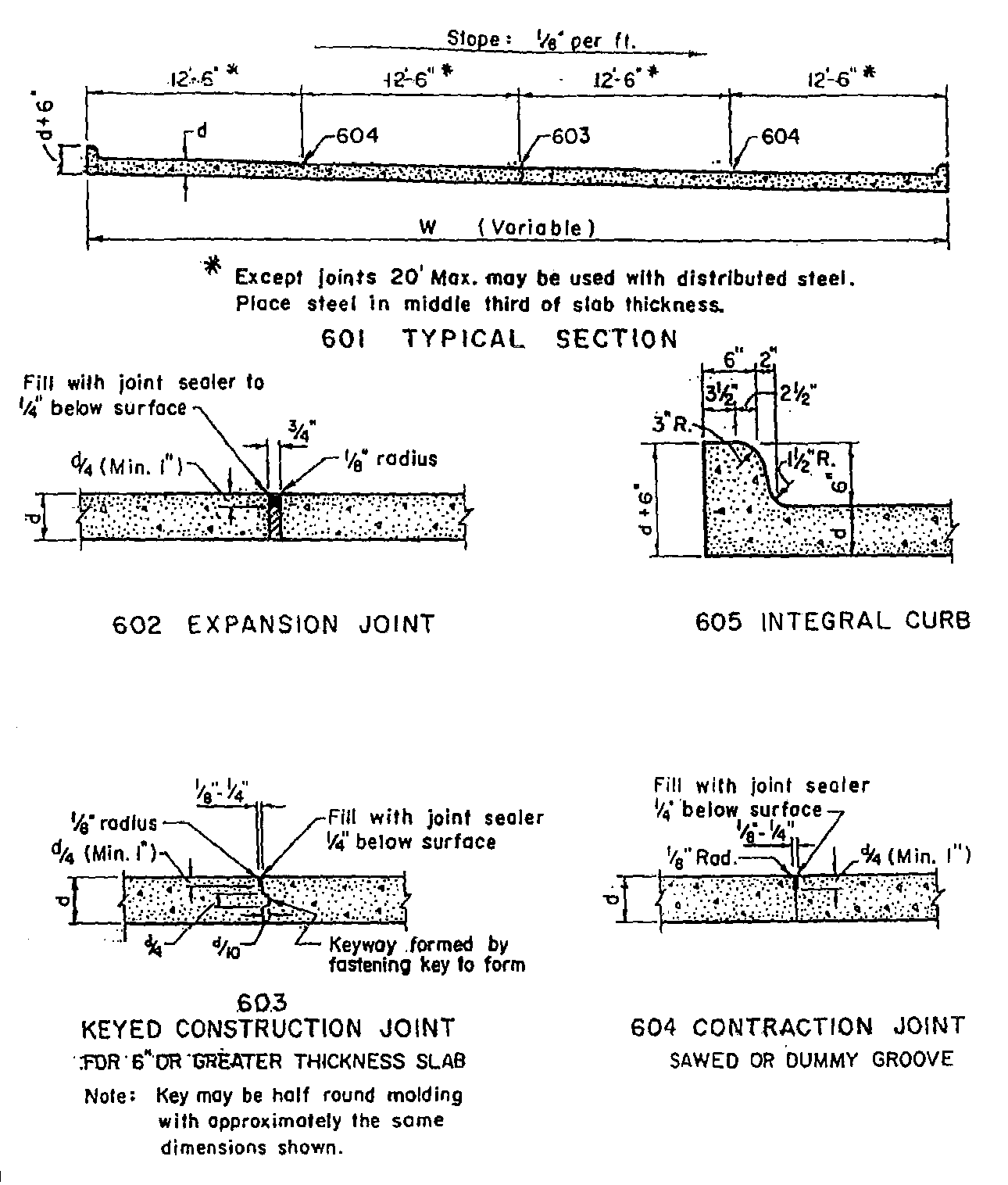
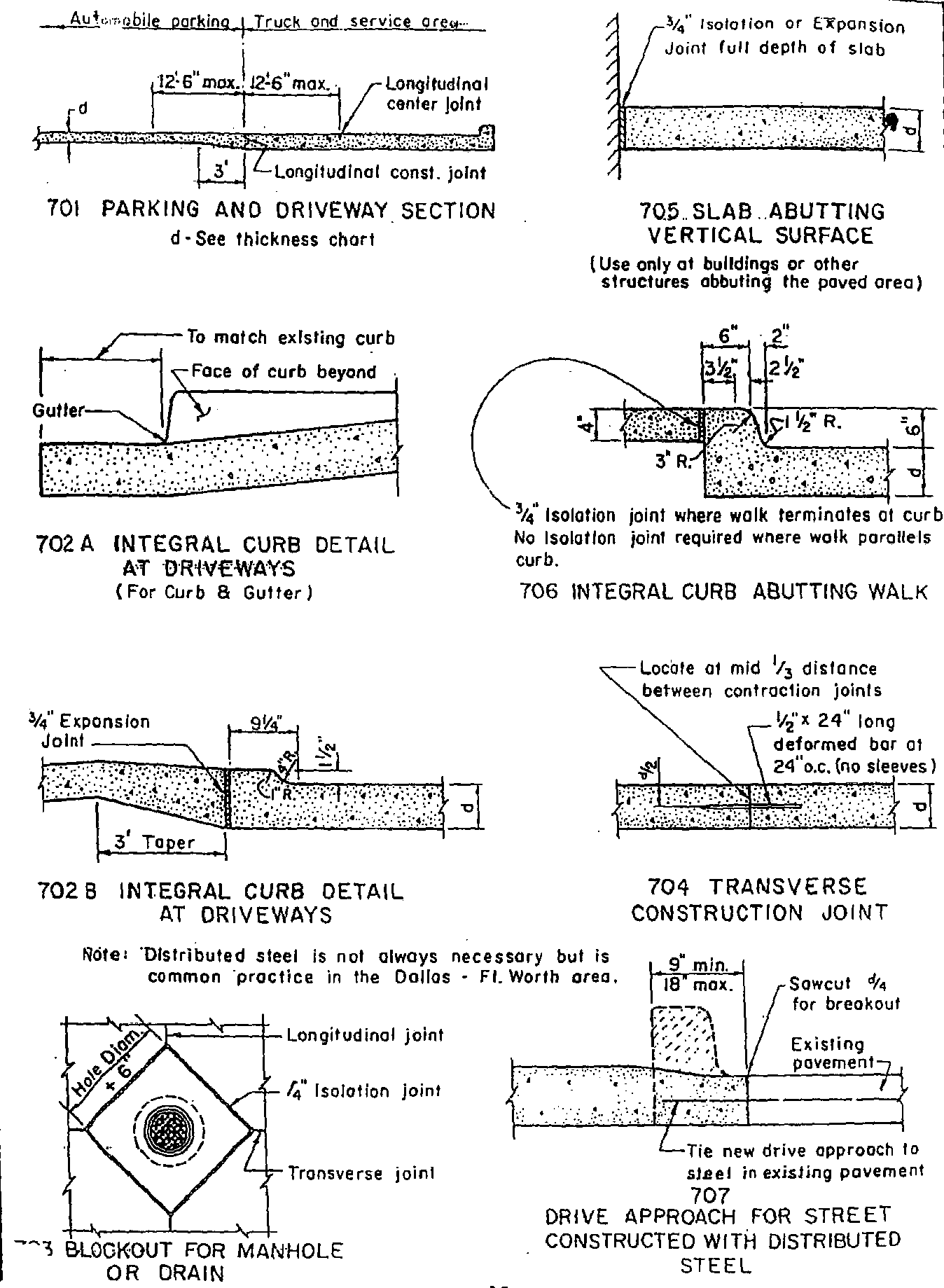
(9)
Special Details.
(p)
Bituminous Asphalt Pavement.
(1)
Bituminous Prime Coat.
a.
General.
Description: This item shall consist of an application of asphaltic material on the completed base course in accordance with these specifications and as directed by the Engineer.
b.
Material.
Cut Back Asphalt: The bituminous material shall conform to the following:
When distilled ASTM Method D-402, the distillate-off volume shall be as follows:
The residue when poured from the flash without cooling immediately upon reaching the maximum temperature specified, shall have the following characteristics:
The material shall be free from water.
MC-30 shall be applied uniformly at the rate of 0.25 gallons per square yard. At Contractor's option, appropriate emulsified asphalt, water mixture may be used in lieu of MC-30. Number of applications, mixture rate and depth of penetration shall be approved by Engineer prior to use of emulsified asphalt. Furnishing and placement of prime coat shall be subsidiary to pavement and flexible base construction.
c.
Construction Methods.
Application of Asphalt: Asphalt shall not be applied when the air temperature is below 50 F and is falling, and it may be applied when the air temperature is 40 F., and is rising, the temperature being taken in the shade and away from artificial heat. No asphalt shall be placed when general weather conditions in the opinion of the Engineer are not suitable.
All storage tanks, piping, retorts, booster tanks and distributors used in storing or handling asphalt shall be kept clean and in good operating condition at all times, and they shall be operated in such a manner that there will be no contamination of the asphalt with foreign material. Asphalt shall not be heated above 400 F. at any time and when applied, it shall be at a temperature of not less than 70 F., and not more than 150 F. The Engineer will select the temperature within 15 F. of the temperature selected. All asphalt heated above 400 F. will be rejected.
Before the application of asphalt, the surface of the base shall be cleaned of dirt, dust, or other deleterious matter by sweeping or other approved methods and if required by the Engineer, lightly sprinkled with water.
Asphalt shall be applied on the clean surface by an approved type of self-propelled pressure distributor so operated as to distribute the asphalt in the quantity specified evenly and smoothly under a pressure necessary for proper distribution. The Contractor shall provide all necessary facilities for determining the temperature of the asphalt in all the heating equipment and in the distributor for determining the rate at which it is applied and for insuring uniformity at the junction of two distributor loads. Asphalt shall be applied for the full width of the surface treatment in one application unless the width exceeds twenty-two (22) feet. No traffic or hauling will be permitted over the freshly applied asphalt.
(2)
Bituminous Tack Coat.
a.
Description. This item shall consist of an application of asphaltic material on the completed and prime base course or existing pavement in accordance with these specifications.
b.
Material.
Cut Back Asphalt: The bituminous material shall conform to the following:
The distillate, expressed as percent by volume of total distillate to 600 F., shall be as follows:
The residue, when poured from the flash without cooling, immediately upon reaching the maximum temperature specified, shall have the following characteristics:
The material shall be free from water.
RC-2 Cut back asphalt used for tack coat may upon written instructions from the Engineer, be further cut-back by the addition of not to exceed fifteen (15) percent by volume of an approved grade of gasoline.
c.
Construction Methods.
Application of Asphalt: Asphalt shall not be applied when the air temperature is below 50 F and is falling, and it may be applied when the air temperature is above 40 F and is rising, the temperature being taken in the shade and away from artificial heat.
All storage tanks, piping, retorts, booster tanks and distributors used in storing or handling asphalt shall be kept clean and in good operating condition at all times, and they shall be operated in such a manner that there will be no contamination of the asphalt with foreign material. Asphalt shall not be heated above 500 F., at any time and when applied, it shall be at a temperature of not less than 70 F., and not more than 150 F. All asphalt heated above 400 F. will be rejected.
Before the application of asphalt the surface of the base shall be cleaned of dirt, dust, or other deleterious matter by sweeping or other approved methods and lightly sprinkled with water.
Asphalt shall be applied on the clean surface by an approved type of self-propelled pressure distributor so operated as to distribute the asphalt in the quantity specified evenly and smoothly under a pressure necessary for proper distribution. Asphalt shall be applied for the full width of the surface treatment in one application unless the width exceeds twenty-two (22) feet. No traffic or hauling will be permitted over the freshly applied asphalt.
(3)
Flexible Base Course. Flexible base shall consist of a foundation course for surfacing, pavement, or other base courses; shall be composed of caliche and stone materials, and shall be constructed as herein specified in conformity with the typical sections shown on the plans.
a.
Materials. The material shall consist of argillaceous limestone, calcareous or calcareous clay particles with or without stone, conglomerate, gravel, sand or other granular materials. The material shall be type F (pit run caliche), conforming to Item No. 248 of the State Department of Highways and Public Transportation Specification, 1982. The plasticity index of caliche shall have a maximum of twelve (12) and a minimum of five (5). Stones greater than three (3) inches in any direction shall be removed during construction.
b.
Construction Methods. The flexible base material shall be placed on the approved subgrade in courses not to exceed the depth shown on plans. It shall be the responsibility of the Contractor that the required amount of material be delivered and uniformly spread and shaped. All material shall be moved from the place where it is dumped by cutting it windrows. After the material has been cut into windrows, it shall be sprinkled, spread and shaped, and rolled in proper sequence to prevent segregation and as necessary for required compaction.
The surface upon completion shall be smooth and in conformity with typical sections and to the established lines and grades. Any deviation in excess of one-fourth (¼) inch in cross section and in length of 16 feet measured longitudinally shall be corrected. All irregularities, depressions, or weak spots which develop shall be corrected.
Flexible base shall be compacted to an apparent dry density of not less than 90 percent (98%) of the maximum dry density as determined in accordance with Texas Department of Highways & Public Transportation 1982, Test Method Tex 113-E. Tests for density will be made within twenty-four (24) hours after compaction operations are completed. If the material fails to meet the density specified, it shall be reworked as necessary to meet the density required. Just prior to the placing of any succeeding course of flexible base or surfacing on a previously competed course, the density and moisture of the top four (4) inches of flexible base shall be checked and if test show the density to be more than two (2) percent (2%) below the specified minimum or the moisture content to be more than three percent (3%) above or below the optimum, the course shall be reworked as necessary to obtain the specified compaction and moisture content.
Should the base course due to any reason or cause lose the required density or finish before the surface is completed, it shall be recompacted, refinished and retested at the sole expense of the contractor.
(4)
Hot Mix Asphaltic Concrete Pavement.
Type D
a.
Description: This item shall consist of a base course, a leveling up course, a surface course or any combination of these courses as shown on the plans, each to be composed of a compacted mixture of mineral aggregate and asphaltic material. The mixture when designed and tested in accordance with these specifications and methods outlined in THD Bulletin C-14, shall have the 'following:
The pavement shall be constructed on the previously completed and approved subgrade, base, existing pavement, bituminous surface or in the case of a bridge, on the prepared floor slab, as herein specified and in accordance with the details shown on the plans.
b.
Materials: Materials used in Hot-Mix Asphaltic Concrete Pavement shall meet the requirements as set forth in Item 340 "Hot Mix Asphaltic Concrete Pavement" of the State Department of Highways and Public Transportation Specifications (1982).
Prior to laying any asphalt, contractor shall submit a Hot-Mix Asphaltic Concrete mix design for approval. He shall also submit written assurance that material stockpiles are sufficient to produce a mix consistent with the design for the duration of the project. If material source change occurs prior to completion. Contractor shall provide a revised mix design at no additional expense to the Owner.
The Contractor shall provide for quality control at the plant to ensure that paving material delivered to the site conforms to requirements of these specifications and the mix design.
c.
Construction Methods: Construction methods used in Hot-Mix Asphaltic Concrete Pavement shall meet the requirements as set forth in Item 340 "Hot-Mix Asphaltic Concrete Pavement" of the State Department of Highways and Public Transportation Specifications, 1982, with the following addition:
Application of Hot-Mix Asphaltic Concrete Pavement shall not begin unless the temperature is at least fifty (50) degrees Fahrenheit in the shade and rising.
d.
Equipment: Mixing plants that will not continuously produce a mixture meeting all of requirements of Item 340.04, in the State Department of Highways and Public Transportation Specifications, 1982, shall not be allowed.
DETAILS
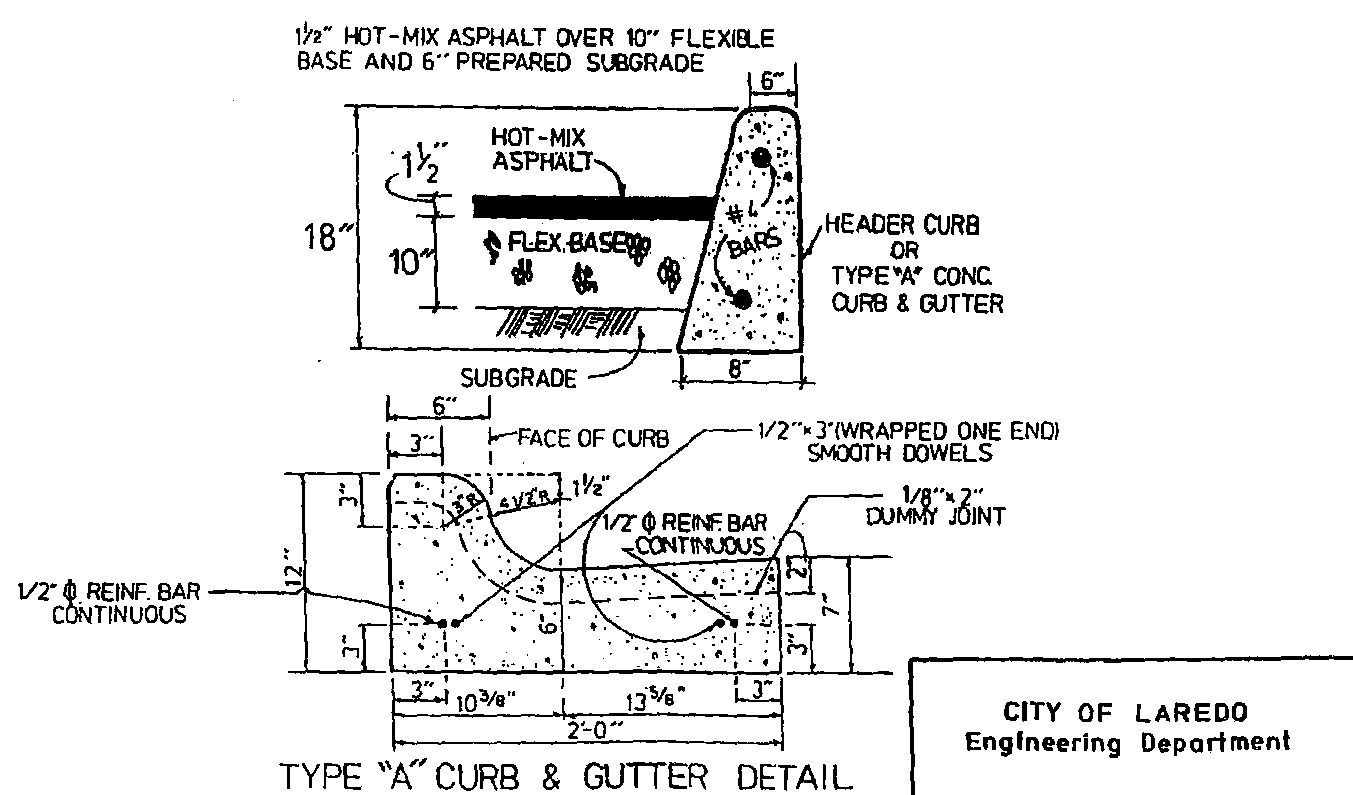
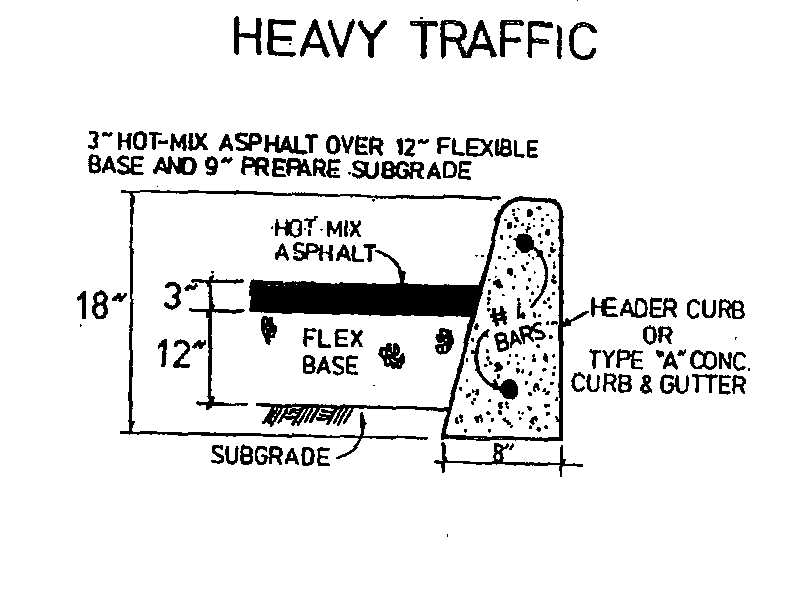
GENERAL NOTES: HOT-MIX ASPHALT-ITEM 340 STATE DEPARTMENT OF HIGHWAYS AND PUBLIC TRANSPORTATION (S.D.H.P.T.) REINFORCING STEEL = A.S.T.M. - A-615 GRADE 60 OR 40 BARS REQUIRING BENDING SHALL BE GRADE 40.
CONCRETE - 3000 PSI CONCRETE.
COMPACTION REQUIREMENT - SUBGRADE TO 95% MAXIMUM DENSITY IN ACCORDANCE WITH TEX 113-E (S.D.H.P.T.) FLEXIBLE BASE TO 98% MAXIMUM DENSITY IN ACCORDANCE WITH TEX 113-E (S.D.H.P.T.).
SURFACE SLOPE - MINIMUM 1% SLOPE ON PAVEMENT.
LIGHT TRAFFIC
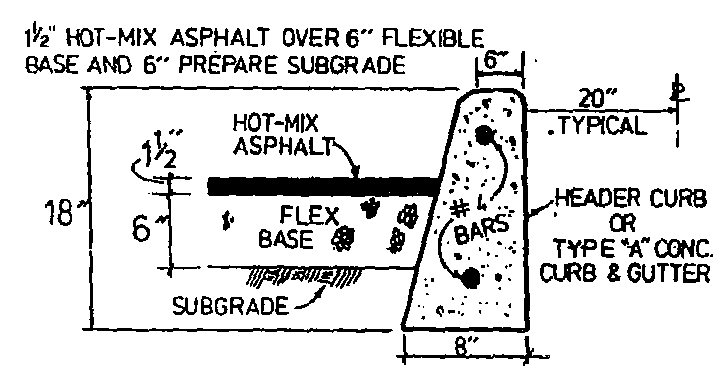
MEDIUM TRAFFIC
HEAVY TRAFFIC
(5)
Pavement Markings.
a.
Part I - General.
1.1
Description.
A.
Work included: Provide pavement marking in the types and arrangements shown on the Drawings, as specified herein, and as needed for a complete and proper installation.
1.2
Quality Assurance.
A.
Use adequate numbers of skilled workmen who are thoroughly trained and experienced in the necessary crafts and who are completely familiar with the specified requirements and the methods needed for proper performance of the work of this Section.
1.3
Submittals.
A.
Comply with pertinent provisions of Specifications and Drawings.
B.
Product Data: Within 60 calendar days after the Contractor has received the Owner's Notice to Proceed, submit:
1.
Materials list of items proposed to be provided under this Section;
2.
Manufacturer's specifications and other data needed to prove compliance with the specified requirements;
3.
Photographs, scale drawings, or other data acceptable to the Engineer, showing types of graphics proposed to be used.
1.4
Product Handling.
A.
Comply with pertinent provisions of Specifications and Drawings.
b.
Part 2 - Products.
2.1
Pavement Marking Paint.
A.
Provide paint specifically formulated for use as pavement marking in vehicles/trucks traffic-areas; and in the colors selected by the Engineer from standard colors of the approved manufacturer.
B.
Acceptable Products (or equal):
1.
"Traffic Paint" manufactured by J.E. Bauer Company.
2.
"Traffic Paint" manufactured by Tnemec.
3.
"Romark Traffic" manufactured by Glidden-Durkee.
4.
"Traffic and Zone Marking Paint" manufactured by PPG.
2.2
Other Materials.
A.
Provide other materials, not specifically described but required for a complete and proper installation, as selected by the Contractor subject to the approval of the Engineer.
c.
Part 3 - Execution.
3.1
Surface Conditions.
A.
Examine the areas and conditions under which work of this Section will be performed. Correct conditions detrimental to timely and proper completion of the work. Do not proceed until unsatisfactory conditions are corrected.
3.2
Application.
A.
Secure the Engineer's approval of graphics design and layout prior to start of application.
B.
Using proper masking, stencils, and application equipment recommended for the purpose by the manufacturer of the approved paint, apply the approved paint in strict accordance with its manufacturer's recommendations.
3.3
Protection.
A.
Provide traffic cones, barricades, and other devices needed to protect the paint until it is sufficiently dry to withstand traffic.
3.4
Cleanup.
A.
When paint is thoroughly dry, visually inspect the entire application, and:
1.
Touchup as required to provide clean, straight lines and surfaces throughout.
2.
Using a permanently opaque paint identical in color to the surface on which the paint was applied, block out and eliminate all traces of splashed, tracked, and/or spilled pavement marking paint from the background surfaces.
3.5
Handicapped.
A.
Label on curb parking spaces as indicated on Drawings "Handicapped". Accessible parking spaces shall be identified and reserved for the Handicapped by a sign incorporating the symbol of accessibility and places so that it will not be obscured by parked vehicles. The signage shall be of such size that it is legible from a distance that would be reasonable for the condition.
(6)
Lights for Parking Area.
a.
Description: This item shall govern for the materials and equipment the installation of the various types of lights for the parking area as shown on the plans.
The term "Lights" as used herein shall constitute the complete assemblage of parts, equipment and miscellaneous items, including foundations, erected as provided in the plans and in accordance with these specifications, forming a complete and independent lighting unit.
b.
Materials: All materials furnished, assembled, fabricated or installed under this item shall be new, and in strict accordance with the details shown on the plans.
The contractor shall furnish six sets of shop drawings of the complete assembly in accordance with the Item, "Lights for Parking Area" with certification that all materials used in the fabrication are in accordance with the plans and specifications. No work shall be performed in the shop prior to approval of the above drawings by the Engineers. Any purchase of material prior to fabrication authorization shall be at the Contractor's risk.
c.
Construction methods: Lights for parking area shall be fabricated and placed in accordance with the details and dimensions shown on the plans or as directed by the Engineer.
The careful erection and aligning of the poles furnished under this item shall be considered an essential feature of the installation of the assembly and shall be as near to true alignment as practicable.
All circuits shall test clear of faults, grounds and open circuits.
After satisfactory completion of the above tests and insulation resistance tests required, the illumination system shall be placed in operation. Final acceptance of the system will not be made until the system has operated satisfactorily for a period of 14 days (this includes energizing and de-energizing the lighting circuits at dusk and dawn). Final acceptance inspection of the system will be made at the end of a satisfactory 14-day test period.
Section 24-79.1 - FENCING AND SCREENING BETWEEN ZONING DISTRICTS REQUIRED
1.
All non-residential uses which abut or adjoin any residential property or zoning district, or which abut or adjoin a school, park, or church, shall provide an opaque fence or wall of not less than seven feet in height along all side or rear property lines which abut or adjoin such property. No screening fence shall be required for non-residential property adjoining vacant land in a non-residential zone.
Section 24-79.1.1 - R-1MH SINGLE FAMILY MANUFACTURED HOUSING DISTRICT
1.
The perimeter of the manufactured housing subdivision shall be buffered from all R-1, R-1A, RS and nonresidential subdivisions by an opaque masonry fence or wall of not less than seven (7) feet in height.
2.
No fencing or permanent wall or structure may be located within the front yard set back.
Section 24-79.1.3 - ADDITIONAL REQUIREMENTS FOR COMMERCIAL AND INDUSTRIAL DISTRICTS
1.
All outside operations and storage shall be screened from adjacent, more restrictive zoning districts with an opaque fence of seven (7) feet or higher.
2.
No junk or used appliance yard may be established within one thousand (1,000) feet of any Interstate or Federal Aid Primary Highways unless screened by means of an opaque fence or wall in such a manner as to effectively block all view of the junk or used appliance yard.
(As amended 2/26/90, Ord. #90-O-36 and 2/22/93 Ord. #93-O-229)
Section 24-79.2 - OTHER REQUIREMENTS
1.
All screening fences required under this section shall be constructed of brick, stone, masonry, cement, stucco, cinder block or pressure treated weather resistant lumber, and shall be structurally reinforced to resist wind damage. They shall be constructed in such a manner as to provide visual screening.
2.
Plywood, sheet metal, and corrugated steel fencing is prohibited.
3.
All fences shall test plumb and square at the time of installation.
4.
All fences shall be maintained by the property owner free of accumulations of trash, advertising, and graffiti.
5.
No fence exceeding four (4) feet in height shall be located within the front yard building setback along any collector, arterial or thoroughfare, nor less than eight (8) feet from the back of curb to provide for pedestrian circulation.
6.
Fences located along side and rear lots lines adjoining public streets shall not be located within the visibility triangle on any corner lot, and shall be set back from the curb line not less than eight (8) feet to provide for pedestrian circulation.
7.
No fence exceeding seven (7) feet in height or masonry wall exceeding thirty (30) inches in height shall be constructed without the issuance of a building permit.
Section 24-80.1 - GENERAL PROVISIONS
(A)
Scope of Chapter. This chapter contains model rules which the Texas Water Development Board (board) is required to adopt in accordance with Texas Water Code Section 16.343. Before an application for financial assistance from Economically Distressed Areas Program as Specified in Chapter 355, Subchapter B of the Texas Water Code or Chapter 363, Subchapter E of the same title may be considered by the board, the applicant shall provide documentation satisfactory in form and in substance that the municipality (ETJ) and county in which the applicant is located has adopted the necessary orders, ordinances or other rules that meet the requirements of the Model Subdivision rules contained in Chapter 16, Subchapter B of the Texas Water Code.
(B)
Purpose. The model rules provide the criteria for assuring that an adequate supply of safe drinking water and adequate safe sewer facilities are available to residential areas in accordance with state standards established by the Texas Department of Health and the TCEQ. The model rules prohibit the establishment of residential developments with lots of five acres or less without adequate water supply and sewer services, prohibit more than one single-family, detached dwelling to be located on each subdivision lot, and establish minimum setbacks to ensure proper operation of water supply and sewer services and to reduce the risk of fire hazards.
Section 24-80.2 - SUBDIVISION WITHIN THE EXTRATERRITORIAL JURISDICTION (ETJ) - PLAT REQUIRED.
(A)
The owner of a tract of land that divides the tract in any manner that creates two or more lots of five (5) acres or less intended for residential purposes must have a plat of the subdivision prepared. Lots of five (5) acres or less are presumed to be for residential purposes unless the land is restricted to non-residential uses on the final plat and duly noted in all deeds and contracts for deeds.
(B)
A division of a tract is defined as including a metes and bounds description, or any description of less than a whole parcel, in a deed of conveyance or in a contract for a deed, using a contract of sale or other executory contract, lease/purchase agreement, or using any other method to convey property.
(C)
Every plat creating two (2) or more lots of five (5) acres or less for residential purposes, located within the ETJ of the City of Laredo, shall comply with the standards of Section 24-80.3.
(D)
The final plat shall include on the plat or have attached to the plat by an engineering report, consistent with Section 364.52 of the Texas Administrative Code (TAC), bearing the signed and dated seal of a professional engineer registered in the State of Texas. The engineering report shall discuss the availability and methodology of providing water facilities and wastewater treatment to individual lots within the subdivision. A detailed cost estimate per lot acceptable to the Planning and Zoning Commission shall be provided for those unconstructed water supply and distribution facilities and wastewater collection and treatment facilities which are necessary to serve each lot of the subdivision. The plan shall include a construction schedule for each significant element needed to provide adequate water or wastewater facilities.
(E)
No subdivided land shall be sold or conveyed until the subdivider has received final approval by the Planning and Zoning Commission of the tract and has filed and recorded, with the County Clerk of Webb County, a legally approved plat.
Section 24-80.3 - SUBDIVISION WITHIN THE CORPORATE LIMITS OF THE CITY OF LAREDO - PLAT REQUIRED
(A)
The subdivision of a tract of land into two (2) or more lots of five (5) acres or less for residential purposes within the corporate limits of the City of Laredo shall, at a minimum, meet the standards established herein as well as those required in the Subdivision Ordinance of the City of Laredo for the filing of a plat.
Section 24-80.4 - FACILITY STANDARDS
The establishment of a residential development with two (2) or more lots of five (5) acres or less where the water supply and sewer services do not meet the minimum standards of this section is prohibited.
(A)
Public Water Systems.
(1)
Where drinking water is to be supplied to a subdivision by the City of Laredo, the water quality and system design, construction and operation shall meet the minimum criteria set forth in 25 TAC 337.201 - 337.212, "Rules and Regulations for Public Water Systems", and 25 TAC 337.1 - 337.18, "Drinking Water Standards Governing Drinking Water Quality and Reporting Requirements for Public Water Supply Systems."
(2)
Subdividers shall supply drinking water by connecting to the City of Laredo system. The written service agreement permitting the connection to the City of Laredo system shall calculate service charges based on the ultimate development and occupancy of the proposed subdivision for a minimum of thirty (30) years. The agreement must reflect that the subdivider has paid the cost of water meters and other necessary connection equipment, membership fees, water rights acquisition costs, or other fees associated with connection to the City of Laredo system so that service is available to each lot upon completion of construction of the water facilities described on the final plat.
(B)
Non-Public Water Systems.
(1)
Where individual wells or other non-public water systems are proposed for the supply of drinking water to residential establishments, the subdivider shall have prepared and provide a copy of a groundwater availability study that complies with the requirements of 30 TAC §§ 230.1 through 230.11 for water availability for public water supply systems and certifies the water quality of the water produced from the test well must meet the standards of water quality required for community water systems as set forth in 30 TAC Sections 290.104, 290.106, 290.108 and 290.109, either:
(a)
Without any treatment to the water; or
(b)
With treatment by an identified and commercially available water treatment system.
(2)
Individual water wells or non-public water systems that do not meet the water quality standards developed by the TCEQ and set out in 30 TAC Sections 290.104, 290.106, 290.108, and 290.109 shall be prohibited.
(C)
Transportation of Potable Water.
(1)
The conveyance of potable water by transport truck or other mobile device to supply the domestic needs of the subdivision is not an acceptable method, except on an emergency basis. Absence of a water system meeting the standards of these rules due to negligence of the subdivider does not constitute an emergency.
(D)
All water supply systems shall be consistent with the standards developed by the Commission and as set out in 30 TAC Chapter 290.
(E)
Wastewater Systems.
(1)
Organized Sewerage Facilities.
(a)
Subdividers who propose the development of an organized wastewater collection and treatment system other than the City of Laredo municipal system, shall obtain a permit to dispose of wastes from the TCEQ in accordance with 30 TAC Chapter 305 "Consolidated Permits" and obtain approval of engineering planning materials for such systems under 30 TAC Chapter 317 "Design Criteria for Sewerage Systems" from the TCEQ.
(b)
Subdividers who propose to dispose of wastewater by connecting to an existing permitted facility must provide a written agreement with the City of Laredo. The agreement must accommodate the total flow anticipated from the ultimate development and occupancy of the proposed subdivision for a minimum of thirty (30) years. This agreement must reflect that the subdivider has paid the cost of all fees associated with connection to the wastewater collection and treatment system so that service is available to each lot upon completion of construction of the wastewater facilities described on the final plat. Engineering plans for the proposed wastewater collection lines must comply with 30 TAC, Chapter 317 and 31 TAC, Section 364.33(a)(12).
(2)
On-site Sewerage Facilities.
(a)
No on-site wastewater disposal or septic system shall be permitted on any lot or tract which is less than one acre in size or within two hundred (200) feet of a public wastewater collection system. No on-site wastewater disposal system shall be permitted on any tract, regardless of size, where soil conditions, flood zones, topography, or other conditions do not permit both an undisturbed septic drain field and sufficient fallow, undisturbed land for a replacement drain field.
(b)
No on-site wastewater disposal or septic system shall be permitted within any 100-year flood zone identified by the Federal Emergency Management Agency on the Flood Insurance Rating Maps (FIRM).
(c)
On-site facilities which serve residential dwellings with anticipated wastewater generation of no greater than five thousand (5,000) gallons per day must comply with 30 TAC, Chapter 285 and be designed by a registered professional engineer or registered professional sanitarian.
(d)
Proposals for on-site sewerage facilities for the on-site disposal of sewage in the amount of five thousand (5,000) gallons per day or greater must comply with 30 TAC, Chapter 317 and be presented to the TCEQ for determination be presented to the Texas Commission of Environmental Quality for determination of the necessity for a wastewater permit from that agency. Each such disposal facility must be designed by a registered professional engineer.
(e)
On-site sewerage facilities not required to obtain a wastewater permit from the TCEQ must apply for and receive a permit from the City of Laredo Health Department or its authorized agent as required by the procedures established in 25 TAC, Sections 301.101 through 301.109.
(f)
On-site Sewage Disposal Near Lakes or water storage reservoirs. On-site sewerage facilities proposed near lakes or water storage reservoirs shall be licensed and installed in strict accordance with requirements established by the TCEQ in their rules 31 TAC Chapter 285.
(g)
On-site Wastewater Disposal in Recharge Zones. On-site sewerage facilities proposed within aquifer recharge zones must be licensed and installed in strict accordance with requirements established by the TCEQ and applicable Texas Department of Health regulations.
(h)
The TCEQ, the City of Laredo Health Department, or their authorized agents shall review proposals for on-site sewage disposal systems and make inspections of such systems as necessary to assure that the system is in compliance with Chapter 366 of the Texas Health and Safety Code and rules in 30 TAC Sections 285, and in particular Sections 285.4, 285.5, 285.30 through 285.39. In addition to the unsatisfactory on-site disposal systems listed in 30 TAC Section 285.3(b), pit privies and portable toilets are prohibited.
(i)
Pit privies, portable toilets, and on-site sewerage facilities that do not meet the wastewater treatment standards developed by TCEQ and set out in 30 TAC Chapter 285 are prohibited.
(F)
Graywater Systems for Reuse of Treated Wastewater.
(1)
Organized Sewerage Facilities. Any proposal for sewage collection, treatment and disposal systems which include graywater reuse shall meet minimum criteria of 30 TAC, Chapter 210 promulgated and administered by the TCEQ.
(2)
On-Site Sewerage Facilities. Any proposal for on-site sewage disposal which includes provisions for graywater use shall meet the minimum criteria of 30 TAC, Chapter 285.
(G)
Sludge Disposal. The disposal of sludge from water treatment and wastewater treatment facilities shall meet the criteria of 30 TAC, Chapter 312, and Chapter 317.
(H)
Setbacks. In areas outside the corporate city limits which lack water lines sized for fire protection, setbacks from private access easements, public or private roads and rights-of-way shall be a minimum of forty-five (45) feet from the centerline of such road, street, or easement. Setbacks from adjacent property lines shall be a minimum of five (5) feet for site built housing and seven (7) feet for any manufactured housing unit, and shall not conflict with separation or setback distances required by rules governing public utilities, on-site sewerage facilities, or drinking water supplies.
(I)
Number of Dwellings per Lot. No more than one single family detached dwelling shall be located on an individual lot or tract. A notation of this restriction shall be placed on the face of the approved final plat, in all deeds, and in all contracts for deed for real estate sold within the subdivision. Notice of this restriction must be given by the seller in writing to any purchaser prior to execution of any binding agreement for sale or conveyance of any real estate. Proposals which include multi-family residential shall include adequate, detailed planning materials as required for the determination of proper water and wastewater utility type and design.
(J)
Connection to Public Wastewater Collection System. As soon as a public wastewater system is available within two hundred (200) feet of the lot or tract, the lot or tract must be connected to the public wastewater collection system. Failure to properly connect to the public system within thirty (30) days of written notice by the City of Laredo shall void any water service agreement, and water service shall be suspended until proper connection to the wastewater collection system is in place.
Section 24-80.5 - ENFORCEMENT AND PENALTIES
(A)
If it appears that a violation or threat of a violation of Chapter 212, Subchapter B of the Texas Local Government Code or a plan, rule or ordinance adopted under Chapter 212, Subchapter B, or consistent with Subchapter B exists, the City of Laredo is entitled to appropriate injunctive relief against the person who committed, is committing or is threatening to commit the violation.
(B)
A suit for injunctive relief may be brought in the county in which the defendant resides, the county in which the violation or threat of violation occurs, or any county in which the City of Laredo is wholly or partly located.
(C)
A person commits an offense if the person violates Chapter 212, Subchapter B or a plan, rule, or ordinance adopted under Chapter 212, Subchapter B or consistent with Subchapter B within the limits of the City of Laredo. An offense under this section is a Class C misdemeanor. Each day the violation continues constitutes a separate offense.
(D)
Civil Penalty. A person who violates any rule adopted under this section pursuant to Section 16.343 of the Texas Water Code is subject to a civil penalty of not less than fifty dollars ($50.00) nor more than one thousand dollars ($1,000.00) for each violation and for each day of a conning violation but not in excess of five thousand dollars ($5,000.00) per day.
(E)
Damages. The City of Laredo may recover damages in an amount adequate for the City to undertake any construction or other activity to bring about compliance with a requirement established under this section.
(F)
Equitable Remedies. In addition to other remedies, the subdivider may be enjoined for the violation or threatened violation of any requirement of this section by suit for injunction and/or application for temporary injunction, and/or temporary restraining order duly filed by the City Attorney. In addition to enforcement by a political subdivision, the Texas Attorney General may bring suit to enforce a rule adopted under Section 16.350 of the Water Code, to recover the penalty provided by Section 16.352 of the water Code, to obtain injunctive relief to prevent the violation or continued violation of a political subdivision's rules, or to enforce the rules, recover the criminal penalty, and obtain injunctive relief.
Section 24-80.6 - CONFLICT OF INTEREST
(A)
Any member of the Commission who has a substantial interest in a subdivided tract shall file, before a vote or decision regarding the approval of a plat for the tract, an affidavit stating the nature and extent of the interest and shall abstain from further participation in the matter. The affidavit must be filed with the City Secretary of the City of Laredo.
(B)
For the purposes of this section a person with substantial interest is one who:
(1)
Has an equitable or legal ownership interest in the tract with a fair market value of two thousand five hundred dollars ($2,500.00) or more;
(2)
Acts as a developer of the tract;
(3)
Owns ten percent (10%) or more of the voting stock or shares of or owns either ten percent (10%) or more or five thousand dollars ($5,000.00) or more of the fair market value of a business entity that:
(a)
Has an equitable or legal ownership interest in the tract with a fair market value of two thousand five hundred dollars ($2,500.00) or more; or
(b)
Acts as a developer of the tract; or
(4)
Receives in a calendar year funds from a business entity described by Subsection (3) that exceed ten percent (10%) of the person's gross income for the previous year.
(C)
A person also is considered to have a substantial interest if he or she is related within the first degree by consanguinity or affinity to another person who, under Subsection (b), has a substantial interest in the tract.
(D)
For the purposes of this section, a tract includes the subdivided tract as a whole, not an individual lot.
(E)
The finding by a court of a violation of this section of these rules does not render voidable an action of the commission unless the measure would not have passed the commission without the vote of the member who violated this section.
(F)
A violation under this section is a Class A misdemeanor.
Section 24-80.7 - FINANCIAL GUARANTEES FOR IMPROVEMENTS
The requirements for posting a financial guarantee to ensure construction for improvements on a subdivision shall be provided as established in Section 2-4 of the Subdivision Ordinance No. (84-00-0006) of the City of Laredo.
Section 24-80.8 - CERTIFICATION OF COMPLIANCE FOR UTILITY CONNECTION APPLICATION FEE
The fee for processing an application for Certification of Compliance for Utility Connection shall be fifty dollars ($50.00).
Section 24-83.1 - STREET TREE PLANTING REQUIRED IN NEW SUBDIVISIONS
(1)
The owner or subdivider of property in new subdivisions shall plant, or require the planting of the total number of street trees (T) required under the following calculations, whichever is greatest:
(a)
T = (X × 2)/30 in the case of a street dedication plat and/or where the property to be platted lies adjacent to both sides of a public street. X will represent the length of the public street measured in linear feet at the centerline of the street or thoroughfare; or
(b)
T = X/30 where the property to be platted lies adjacent to only one side of a public street or thoroughfare. X shall represent the length of the public street or thoroughfare measured in linear feet at the centerline of the street and adjacent to the property; or
(c)
T = Y x 2 where the property is proposed to be platted into single-family residential lots. Y shall represent the number of single family residential lots included in the proposed plat.
(2)
Where the subdivider proposes that the trees required under this section are to be planted in conjunction with construction or development of the property, this requirement shall be noted on the plat. Such note shall not relieve the subdivider of the responsibility to plant trees along any collector or arterial where a new single family residential subdivision abuts a collector or arterial street along the rear property line of any single family residential lot.
(3)
The trees required under this section shall be planted within the public rights-of-way, within landscape or other reserves restricted for the purpose, or on private property within the ten (10) feet parallel and adjacent to a local street right-of-way, or on private non-residential property within twenty-five (25) feet parallel and adjacent to a major thoroughfare.
(4)
Median Planting.
(a)
Trees or shrubs planted within the median of a major arterial shall not be planted less than seventy-five (75) feet from the nose of the median.
(b)
Trees or shrubs planted within the median of a minor arterial shall not be planted less than fifty (50) feet from the nose of the median.
(c)
Trees or shrubs in any median shall not be planted less than fifty (50) feet from any mid-block opening in the median.
(d)
Trees or shrubs planted in the median shall not be planted less than five (5) feet from the back of the final approved design line for the curb, and trees shall be spaced at intervals of not less than thirty (30) feet.
(5)
Visibility Maintained.
(a)
Within the visibility triangle no shrub, tree, plant or structure shall be permitted with a height greater than twenty-four (24) inches measured from the centerline of the adjacent roadway.
(b)
Trees shall be kept trimmed at all times so that no branch or growth is less than ten (10) feet above the adjacent roadway measured from the centerline of that roadway.
Section 24-83.2 - STREET TREE PLANTING REQUIRED IN EXISTING SUBDIVISIONS
(1)
The planting of street trees is required as a condition of the issuance of a building permit in the City of Laredo, save and except permits issued for the reconstruction, modification or addition to property used for single family residential purposes, or the expansion of non-residential structures which do not exceed one thousand (1,000) square feet or twenty-five percent (25%) of an existing structure, whichever is more. Also excluded are those subdivisions approved before the effective date of this ordinance where the street tree or money-in-lieu of requirement has been met. The requirement for planting shall be as follows:
(a)
Two (2) trees per single family residential lot shall be planted within the public right-of-way, within a landscape or other reserve restricted for the purpose, or on private property within the ten (10) feet parallel and adjacent to a local street right-of-way.
(b)
One tree for each thirty (30) feet of non-residential or multi-family residential property abutting a public street right-of-way shall be planted. Trees shall be planted within the public rights-of-way, within landscape or other reserves restricted for the purpose, or on private property within the ten (10) feet parallel and adjacent to a local street right-of-way, or within twenty-five (25) feet parallel and adjacent to a major thoroughfare.
Section 24-83.3 - SURFACE PARKING LOT REQUIREMENTS
(1)
Number of Trees Required.
(a)
New surface parking lots with more than fifteen (15) parking spaces shall require one (1) eligible tree for every ten (10) parking spaces or fraction thereof. The trees shall be located within and/or on the perimeter of the parking lot.
(b)
Existing parking lots which are to be expanded to comply with the requirements of Section 24-78 of the Laredo Land Development Code "Off-Street Parking & Loading Requirements" and which, after such expansion, will contain more than fifteen (15) parking spaces, shall provide one (1) eligible tree for each ten (10) additional spaces or fraction thereof. The trees shall be located within and/or on the perimeter of the parking lot.
(c)
A permeable area with a radius of not less than three (3) feet measured from the trunk of each eligible tree shall be maintained, and each eligible tree shall be protected from automobiles by curbs or tire stops located at least three (3) feet from the trunk of the tree.
(2)
Parking surface areas adjacent to the public street right-of-way shall have shrubs planted at regular intervals along the perimeter of all parking surfaces adjacent to the right-of-way, exclusive of driveway entrances, pedestrian walkways and cutback areas. The shrubs shall be maintained at a height of no more than thirty-six (36) inches nor less than eighteen (18) inches. The number of shrubs required under this section shall be equal to the total number of street trees required under this section multiplied by four. Seventy-five percent (75%) or more of the required shrubs shall be planted along the perimeter of the parking surface.
Section 24-83.4 - TREE PRESERVATION CREDIT
(1)
In the event that the owner or subdivider of the property proposes to preserve existing healthy trees, credit toward the tree requirement shall be given at the rate of two (2) street trees for each existing tree actually preserved. The owner or subdivider shall propose reasonable measures calculated to ensure the continued survival of existing trees for which credit is claimed. Any eligible tree for which credit is claimed shall have a minimum caliper of six (6) inches.
(2)
The owner or subdivider of the property may request credit for the planting of up to fifty percent (50%) of the trees required under this code.
(3)
If the preserved tree dies the tree must be replaced with a minimum of a three-inch caliper tree.
Section 24-83.5 - Removal, Replanting, and Replacement of Protected Trees
(1)
All trees on public land within the city limits of Laredo with a caliper of eight (8) inches shall be considered protected trees.
(2)
Removal of Protected Trees.
(a)
No person or corporation shall remove or cause the removal of any protected tree on public land without first securing approval from the Tree Board as provided in subsections (i) and (ii).
(i)
When site plan approval is required by Building Services Department for any improvements on public land, the actual or schematic location of existing protected trees shall be shown on those site plans for review by the Tree Board. The Tree Board shall submit their order regarding the proposed plan within fourteen (14) days of the date the plans were received by the Board.
(ii)
The Tree Board shall review site plans for all improvement projects from any city, state, and federal government agency. The Tree Board's approval of these public projects shall constitute approval for the removal of any protected tree indicated on the project plans.
(b)
The Tree Board shall approve removal of a protected tree located on public property when it is shown that the tree is diseased, severely damaged, dead on the site, or constitutes a hazard. Removal of such protected trees may require replacement trees as deemed necessary by the Tree Board.
(c)
The Tree Board shall approve removal of a protected tree located on public property when the tree's location prevents reasonable access to the property or precludes reasonable and lawful use of the property. Removal of such protected trees may require replacement trees as deemed necessary by the Tree Board.
(d)
The Tree Board may approve the removal of a protected tree in connection with construction, maintenance, or repair of public facilities in or upon a public street, alley, right-of-way, greenbelt, or other public land under one or more of the following conditions:
(i)
The location of the tree prevents the opening of reasonable and necessary vehicular traffic lanes.
(ii)
The location of the tree prevents the construction of utility lines or drainage facilities which may not be feasibly rerouted.
(e)
Removal of such protected trees shall require replacement trees.
(3)
Replacement Trees.
(a)
Where replacement trees are required the specified criteria shall be followed:
(i)
The minimum diameter of replacement trees shall be no less than three (3) caliper inches, unless otherwise approved by the Tree Board.
(ii)
When it is found impractical to relocate or replace the removed trees on the same property, replacement may be made upon any public owned property, property of non-profit organizations, public parks, or rights-of-way, subject to the approval of the Tree Board.
(iii)
Tree species used for replacement shall conform with Appendix F-1 of the Laredo Land Development Code.
(4)
Any person aggrieved by the decision of the Tree Board may appeal the decision to the City Council by filing a written appeal, specifying the reasons thereof, within thirty (30) days of the time the order is issued.
Section 24-83.6 - SPECIAL REQUIREMENTS
(1)
Any tree on privately owned property that is found to be a nuisance shall receive a notice to abate such nuisance as described in Chapter 21 of the Code of Ordinances, City of Laredo.
(2)
All utility franchise holders shall present scheduled tree pruning plans to the Tree Board prior to the start of pruning work.
(3)
Unless specifically authorized by the Tree Board, no person shall remove, intentionally damage, mutilate, allow any gaseous liquid or solid substances which are harmful to protected trees, to come in contact with them; or set fire or permit any fire to burn when such fire or the heat thereof will injure ant portion of any protected tree.
(4)
All applicants for permits to work on public trees must comply with State and Local liability insurance requirements, workmen's compensation and safety codes.
Section 24-83.7 - VIOLATION AND PENALTY
(1)
Each destruction or removal of a protected tree, unless specifically permitted per this ordinance, shall be considered as a separate violation of this ordinance and shall be subject to penalty.
(2)
Any person, firm, or corporation violating or failing to comply with any of the provisions of this ordinance shall be guilty of a misdemeanor, and upon conviction thereof, shall be fined a sum of up to five hundred dollars ($500.00) per violation.
Section 24-83.8 - ALTERNATE PLANNING PROPOSALS
(1)
It is the intent of the City to provide an opportunity for the development of exceptional or unique landscape designs which cannot meet the express terms of this article. Special consideration shall be given to exceptional landscape designs which attempt to preserve and incorporate existing vegetation in excess of the minimum requirement and/or in innovative ways.
(2)
Applicants for approval of an alternate tree/shrub plan shall be entitled to demonstrate that the intent of this article can be more effectively met in whole or in part through an alternate tree/shrub plan. An alternate landscape plan shall be reviewed by the Planning and Zoning Commission and, if approved, shall be substituted in whole or in part for a landscape plan meeting the express terms of this section.
Section 24-83.9 - MONEY-IN-LIEU OF TREES
(1)
Up to thirty percent (30%) of the total planting requirements may be met by depositing, with the Parks and Recreation Department, a sum of money equal to the cost of the required trees and their planting. This money shall be placed in a special fund designated for the purposes of planting of eligible trees in city parks or public rights-of-way. The cost per tree shall be determined by the Tree Board on an annual basis. The remaining seventy percent (70%) of the trees shall be planted as required by this ordinance.
Section 24-83.10 - SELECTION AND MAINTENANCE
(1)
All trees and shrubs planted in accordance with this article shall be a native or naturalized species as recommended in Appendix F-1 - Recommended Trees for the Laredo Region, and shall be planted and maintained in accordance with the standards established in Section 24-83.10(3).
(2)
The list of native and naturalized trees and shrubs in Appendix F-1 is not all-inclusive and may be updated as needed by the Tree Board without formal amendment to this section.
(3)
General Planting and Maintenance Standards.
(a)
All trees shall be planted in holes two (2) to five (5) times wider than the rootball diameter. The depth of the hole should be no deeper than necessary to set the plant at the same depth it was in the nursery. All shrubs shall be planted in holes a minimum of six (6) inches wider on each side than their root spread, whether container grown or balled and burlapped. This enables the plant to extend the small roots in the first few weeks in the ground.
(b)
Place the tree or shrub in the hole. If the tree is container grown, pull the container away from the rootball. Do not pull the tree by its trunk. Pulling the tree out of the container by its trunk will damage the small roots within the ball. Place the tree or shrub in the center of the hole and adjust it so that it is straight and at the proper level.
(c)
For balled and burlapped plants pull the top and sides of the burlap away from the ball after the hole has been partially backfilled but before watering. Do not attempt to pull the burlap out from under the ball under any condition. All wire and surplus binding from the top and sides of the ball should be removed.
(d)
Backfill with the original soil and firm the soil until approximately two-thirds (⅔) full. Before completing, fill the hole with water and allow the soil to settle around the roots. After the water has been absorbed, add topsoil to bring up to grade and form a watering basin around the tree.
(e)
An earth basin, approximately four (4) inches in height, shall be formed around the tree or shrub pit to help retain water and protect the trunk from mower damage. Individual plant pits shall be completely encircled by the basin, except on steep slopes where the basin is formed on the downhill side to serve as a dam.
(f)
Trees taller than four (4) feet may need to be staked. Rubber hose shall be used to protect the tree from the staking wire.
(g)
The trees and shrubs must be watered immediately after planting and as needed during the first two (2) growing seasons. A thorough soaking is preferred over light, frequent soakings.
(h)
The entire area formed within the earth basin shall be filled with three (3) to four (4) inches of mulch to help conserve moisture and reduce competition from weeds.
(i)
All trees and shrubs shall be planted in individual holes with the exception of hedges. Hedges may be planted in a continuous trench as long as adequate room is allowed for root development.
(4)
Staking, Guying and Wrapping.
(a)
All evergreen and deciduous trees over four (4) feet tall need to be supported by an acceptable method to keep the tree trunk in an upright position immediately after planting. Bracing prevents the tree from being damaged by strong winds which loosens the soil around the base of the tree and injures the rooting system.
(b)
Trees shall be staked or guyed for a minimum of one (1) growing season. All bracing and tree supports should be eliminated as soon as the tree becomes self-supporting.
(c)
If the tree has sparse foliage and is exposed to full sun, the trunk shall be wrapped with an appropriate material to prevent sun scalding. Special tree wrap paper is available; however strips of burlap and aluminum foil will also protect the tree.
(5)
Irrigation Requirements.
(a)
The installation of a supplemental irrigation system is required to give the trees and shrubs an adequate amount of water without waste. All required landscaping shall be irrigated by either an underground sprinkling system, drip irrigation system or a hose attachment within one hundred (100) feet of the landscaped area.
(b)
The irrigation systems shall be designed and calibrated in order to thoroughly soak the root area of the plant area with the frequency necessary to establish newly planted trees and shrubs and to sustain their healthy growth.
(c)
The system used shall be designed to minimize the amount of spray that will fall on sidewalks, neighboring properties and adjacent buildings in order to achieve water conservation.
(d)
The property owner shall be responsible for irrigation as well as regular maintenance of the trees and shrubs.
Section 24-84.1 - DEFINITIONS
As used in this section, the following words and phrases are specifically defined:
Historic Property - shall mean a building or structure which has been designated as a locally significant historic landmark by the Historic District/Landmark Board, or which contributes to the significance of a historic district, or which has been designated as a Recorded Texas Landmark by the Texas Historical Commission, or which is listed on the National Register of Historic Places, or which is identified as a contributing property in a National Register Historic District.
Certification - shall mean certification by the Historic District/Landmark Board that the property is a "Historic Property" as defined in this section; that tax relief is necessary for the rehabilitation of the property; and that the plans for rehabilitation conform to the standards for historic preservation adopted by the Board.
Applicant - shall mean the owner or designated agent of an owner seeking exemption from the payment of ad valorem taxes for the rehabilitation of a historic property.
Certified Historic Rehabilitation Project - shall mean a certified project whose application for tax exemption for historic rehabilitation has been approved by the City Council.
Certified Rehabilitation Expenditures - shall mean any expenditures incurred in connection with the rehabilitation of a Certified Historic Rehabilitation Project that are properly chargeable to a capital account.
These expenditures do not include:
a)
Costs of acquiring the building or any interest therein.
b)
Enlargement costs which expand the total volume of the existing building, interior remodeling which increases floor space is not considered enlargement.
c)
New building construction costs.
City Council - shall mean the City Council of the City of Laredo.
Board - shall mean the Historic District/Landmark Board of the City of Laredo.
Non-residential structure - shall mean any structure to be used for non-residential purposes following rehabilitation, including industrial, commercial, or rental residential uses.
Rehabilitation - shall mean the act or process of upgrading an older building both structurally and mechanically while preserving its unique historic, architectural or cultural significance.
Residential structure - shall mean a structure to be used following rehabilitation for a single family residence by the owner.
Structure - shall mean a building, edifice, dwelling unit or other construction which is permanently affixed to the land and which is composed of discrete elements.
Substantial Rehabilitation - shall mean the repair or restoration to standards established by the Board whose value is not less than fifty percent (50%) of the value of the improvements to the property as established by the Webb County Central Appraisal District on the date that application for historic property tax relief is made.
Tax Assessor/Collector - shall mean the Tax Assessor/Collector of the City of Laredo.
Section 24-84.2 - PURPOSE
The purpose of this section is to encourage the preservation of the city's historic properties. These tax exemptions apply only to city property taxes and not to taxes owing to other taxing entities. Nothing in this ordinance relieves a person from the responsibility to apply each year to the Chief Appraiser of the Webb County Central Appraisal District for an exemption pursuant to the requirements of the Texas Property Tax Code.
Section 24-84.3 - APPLICATION
The owner or designated agent of a historic property may make sworn application to the Board on a form approved by the city containing the following information:
a.
The name, address and telephone number of the applicant.
b.
The legal description and physical address of the property.
c.
Information which establishes its eligibility for historic property tax exemption. In the event that the property seeks designation by the Board as a locally significant Historical Landmark or has been nominated as a Texas Historic Landmark, for the National Register of Historic Places, or as a contributing structure in a National Register Historic District, applicant shall submit documentation of such application for designation or nomination.
d.
Plans and specifications detailing the proposed substantial rehabilitation.
e.
Estimates of Certified Rehabilitation Expenditures with a statement that the cost of the proposed rehabilitation exceeds the value of existing improvements on the property by fifty percent (50%).
f.
Tax certificates indicating that all taxes have been paid.
g.
A notarized affidavit indicating the need for tax relief and a statement concerning the proposed use of the structure.
Section 24-84.4 - REVIEW BY THE BOARD
1.
The Board shall review the application for conformance with the adopted standards for Historic Preservation, and may request changes or alterations in the plans. The Board shall consider the following:
a.
The adherence to adopted design standards; and
b.
The requirement for substantial rehabilitation; and
c.
Proposed post rehabilitation use; and
d.
The need for tax relief for historic rehabilitation; and
e.
Conformance with the Comprehensive Plan.
If the Board finds that the application complies with the requirements of this chapter, the Board shall, following a public hearing, designate the proposed restoration as a Certified Historic Rehabilitation Project.
2.
The Board shall submit its findings to the City Council with a recommendation for the granting of tax relief.
Section 24-84.5 - REVIEW BY THE COUNCIL
1.
The Council shall review the recommendation of the Board concerning the proposed project, and if it determines, following notice and hearing, that the project is eligible for tax relief, and that the best interests of the citizens of the City of Laredo would be served by granting tax relief, Council shall certify the project, granting tax relief as follows:
a.
A residential structure shall be exempt from the payment of ad valorem taxes on the increased value accruing to the property following rehabilitation for a period of eight (8) years following the issuance of a certificate of occupancy by the City's Building Official. Transfer of ownership shall not cause the exemption to be revoked except as otherwise provided.
b.
The applicant owner of a non-residential structure shall be exempt from the payment of any ad valorem tax on the land and improvements which are an integral part of the Certified Historic Rehabilitation Project for a period of four (4) years following the issuance of a certificate of occupancy by the city's Building Official. Upon written application by the owner, an additional exemption on the enhanced value of the property following rehabilitation may be granted for a period not to exceed four (4) years. Transfer of ownership shall cause the exemption to lapse on the last day of the tax year in which the transfer occurs, unless the transfer of ownership is effected through devise or descent, or conveyed with a historic easement which qualifies as a charitable contribution under Section 170(f)(3) of the Internal Revenue Code.
c.
The exemption shall be effective on January 1 of the year following the date on which the Certificate of Occupancy was issued.
d.
The Council, upon the recommendation of the Board, may grant partial certification for projects which will be completed in phases because of the scale or complexity of the proposed restoration.
2.
Certified Historic Rehabilitation Projects which have been granted tax relief shall be issued a Certificate of Occupancy by the Building Official within twenty-four (24) months following the effective date of the ordinance granting such relief. Projects failing to meet this deadline shall be ineligible for the exemption of ad valorem taxes, unless an application for an extension of time is filed in writing with the City Secretary prior to the expiration of the twenty-four-month period. Council may approve an extension of time not to exceed twelve (12) months.
3.
The applicant owner shall present the Certificate of Occupancy, the Historic District/Landmark Board's order indicating the property is a Certified Historic Rehabilitation Project, and a letter from the Historic Preservation Officer verifying actual Certified Rehabilitation Expenditures and compliance with rehabilitation plans to the City of Laredo Tax Assessor/Collector to initiate the tax exemption process. The applicant owner shall present proof of application for exemption from the Webb County Appraisal District to the City of Laredo Tax Assessor/Collector on an annual basis to receive the tax exemption.
Section 24-84.6 - ADMINISTRATION
1.
The Historic Preservation Officer shall conduct an annual inspection to determine whether the property has been maintained in accordance with the approved preservation standards. If the property has deteriorated, been demolished or destroyed, or been modified or altered in a manner which has compromised its historical, architectural or cultural value, the Historic Preservation Officer shall notify the owner, the Historic District/Landmark Board, the Tax Assessor/Collector and the City Manager of his findings. The Historic District/Landmark Board shall consider the findings of the Historic Preservation Officer, and, following notice and hearing, act to revoke the exemption.
2.
The owner may appeal the revocation of exemption to the Council upon written application filed within sixty (60) days, stating the reasons why the exemption should not be revoked.
Section 24-84.7 - RECAPTURE
1.
Tax receipts and tax certificates for Certified Historic Rehabilitation Projects shall be clearly marked "Historic Property - subject to recapture of additional taxes under Section 24-84.7 of the Laredo Land Development Code."
2.
Each year during which the property is granted tax relief, the Tax Assessor/Collector shall note the valuation which would have been made and the taxes which would have been due had the property not qualified for tax relief under this section.
3.
If the exemption is revoked because the property was damaged or destroyed, or if taxes become delinquent, the property shall be subject to payment of all taxes, penalty and interest which would have been paid, absent the granting of an exemption under this section, which additional taxes shall be a lien on the property.
Section 24-85.1 - REQUIREMENTS IN NEW SUBDIVISIONS
The requirements for sidewalks in new subdivisions shall be as follows:
Section 24-85.2 - REQUIREMENTS IN ESTABLISHED SUBDIVISIONS
The requirements for sidewalks in subdivisions established by plat approval prior to July 1, 1995 shall be as follows:
Section 24-85.3 - SIDEWALK STANDARDS
Sidewalks shall be provided on both sides of all streets, including cul-de-sacs, in conformance with the American Disabilities Act (ADA) and the following standards:
(a)
Sidewalks shall be required of any development or structure for which a building permit is issued, except that such sidewalk shall be provided by the subdivider where a new single family residential subdivision abuts a collector or arterial street.
(b)
Sidewalks shall be provided along all public and private streets abutting any development or redevelopment and any addition to a non-residential structure exceeding five hundred (500) square feet in gross floor area.
(c)
Sidewalks shall be constructed immediately adjacent to the curb, except where the continuation of any existing sidewalk on adjacent property requires alternate placement.
(d)
Sidewalks shall be required as part of the platting improvements for the subdivision of land in the R1-MH (Single Family Manufactured Housing District) and R-3 (Mixed Residential District) zoning districts.
(e)
Sidewalks shall be constructed of four-inch concrete (2,500 psi) with #6 - 6×6 welded wire fabric.
(f)
It is expressly provided that all sidewalks within the Central Business District (CBD) shall have unobstructed sidewalks of not less than eight (8) feet in width.
(g)
Commercial development located along transit routes shall provide additional sidewalk width at established transit stops in accordance with the requirements of the transit operator based on the location of the transit stop.
(h)
Handicap ramps and driveway cuts shall conform to engineering design requirements established in Appendix G.
Section 24-85.4 - ALTERNATE PROPOSALS
The Planning and Zoning Commission may authorize alternative proposals for pedestrian circulation in certain circumstances. Application for alternate proposals shall be submitted as part of the preliminary plat.
Section 24-85.5 - EXCEPTIONS
(a)
Sidewalks shall not be required on local streets if the smallest lot in a new residential subdivision is no less than fifteen thousand (15,000) square feet in area.
(b)
Sidewalks shall not be required in industrial park developments exceeding ten (10) acres in size, where each lot within the development exceeds one (1) acre in size provided, however, that the sidewalks are required along public streets, industrial collectors and access roads abutting the development if necessary to provide direct pedestrian access from residential neighborhoods to transit, shopping or neighborhood schools as determined by the Planning and Zoning Commission.
(c)
Sidewalks shall not be required for replats in existing residential subdivisions where the total area being replatted does not exceed twenty thousand (20,000) square feet.
Section 24-85.6 - DOUBLE FRONTAGE LOTS
In the event double frontage lots are created for the purpose of separating residential property from principal arterials and collectors, the shoulder and sidewalk area of the arterial or collector shall conform to the following standards:
(1)
Street tree planting shall conform to the provisions established in Section 24-83, "Trees and Shrubs," of the Laredo Land Development Code.
(2)
No right of access shall be allowed from any arterial or collector.
(3)
The unpaved area of the shoulder, if proposed to be maintained by the City of Laredo, shall be overlaid with an impervious material or the developer shall provide a low maintenance landscape plan. In either event, the proposed plan shall be subject to the approval of the Planning and Zoning Commission in the preliminary plat. A pervious radius in compliance with Section 24-83.3.c of the Laredo Land Development Code for tree planting shall remain.

