
Laurens City Zoning Code
ARTICLE I
- IN GENERAL
Sec. 44-1.- Title of chapter.
This chapter shall be known and may be cited as "The Zoning Chapter of the City of Laurens, South Carolina."
(Ord. No. 01-05, § 46-1, 3-15-2005)
Sec. 44-2. - Authority of chapter.
This chapter is prepared pursuant to the authority conferred by S.C. Code 1976, § 6-7-710 et seq.
(Ord. No. 01-05, § 46-2, 3-15-2005)
Sec. 44-3. - Purpose of chapter.
The purposes of this chapter are to protect, promote and improve the public health, safety, morals, convenience, order, appearance, prosperity and the general welfare of the citizens of the city; to lessen congestion in the streets; to secure safety from fire, panic and other dangers; to provide adequate light and air; to prevent the overcrowding of land; to avoid undue concentration of population; and to facilitate the adequate provision of transportation, water, sewerage, schools, parks and other public requirements. The regulations of this chapter are made with reasonable consideration, among other things, of the character of each area and the peculiar suitability for particular uses, and with a view toward promoting desirable living conditions and sustaining stability of neighborhoods, protecting property against blight and depreciation, securing economy in governmental expenditures, conserving the value of land and buildings and encouraging the most appropriate use of land, buildings and structures.
(Ord. No. 01-05, § 46-3, 3-15-2005)
Sec. 44-4. - Definitions.
(a)
Interpretation. Words not defined herein shall have the meanings stated in the International codes adopted by the state building codes council, and any permissive technical codes adopted by the city. Words not defined in the International codes shall have the meanings in Webster's Tenth Edition Collegiate Dictionary, as revised.
(1)
Words in the present tense include the future tense. Words used in the singular include the plural, and words used in the plural include the singular.
(2)
The term "shall" is always mandatory.
(3)
The term "may" is permissive.
(4)
The term "person" includes a firm, association, organization, partnership, trust company, or corporation, as well as an individual.
(5)
The term "used" or "occupied," as applied to any land or building, shall be construed to imply that said land or building is in actual use or occupancy and shall be construed to include the terms "intended," "arranged," or "designed to be used or occupied."
(6)
The term "Council" refers to the Laurens City Council.
(b)
Terms defined. The following words, terms and phrases, when used in this chapter, shall have the meanings ascribed to them in this section, except where the context clearly indicates a different meaning:
Abutting means having a common border with, or being separated from, such common border by an easement.
Adult uses means any establishment or use which, as one of its principal purposes, sells, displays or exhibits materials, including books, magazines, movies, tapes, photographs, etc., which appeal to prurient interests, contain patently offensive depictions of sexual conduct, and have no serious literary, artistic, political or scientific value.
Bed and breakfast inn means any owner-occupied dwelling or portion thereof offering rooms and meals at breakfast to transient lodgers in return for compensation.
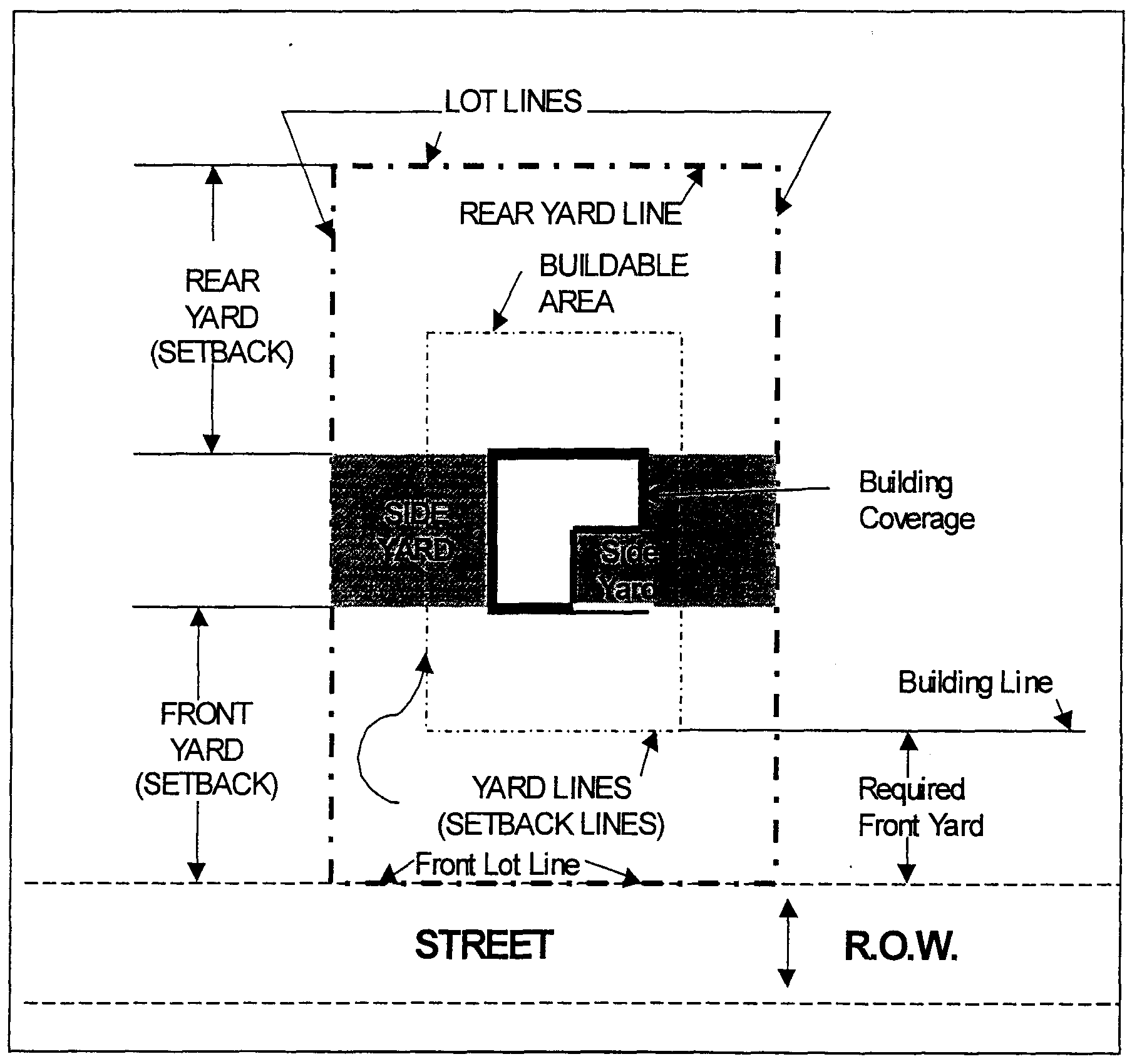
Buildable area means that portion of any lot which may be used or built upon in accordance with the regulations governing the zoning district within which the lot is located when the front, side and rear yard, open space, impervious surface and applicable buffer area requirements have been met.
Building means any structure put together for the support, shelter or enclosure of persons, animals and property.
Building, accessory, means a subordinate structure on the same lot as the principal or main building or use occupied or devoted to a use incidental to the principal use. Included in this definition are private garages, storage sheds, workshops, animal shelters, pool houses, etc., when detached from the principal building, and carports attached to the principal building when such structures are at least 75 percent open or unenclosed.
Building line means that line determined by meeting respective front, side and rear yard requirements.
Building, principal, means a building in which is conducted, or in which is intended to be conducted, the main or principal use of the lot on which it is located.
Canopy tree means a deciduous tree that forms the top layer of vegetation in a forest. Examples of such trees include oaks, hickories, maples, poplars and others.
Certificate of appropriateness means a document issued by the Laurens Historic Preservation Commission, following a prescribed review procedure, certifying that the proposed actions by an applicant are found to be acceptable in terms of design criteria relating to the individual property or the historic district.
Certificate of occupancy means a document issued by the administrator allowing the occupancy or use of a building and certifying that the structure or use has been constructed or will be used in compliance with all applicable provisions of this chapter and the building code.
Conditional use means a use of land or structure, which is expressly permitted in a district under conditions specified in this chapter. Certain uses of land provide accommodations consistent with or necessary to the purpose intended for each district, but differ in their general characteristics from the principal permitted activities and in their impact thereon.
Condominium means a unit in a multiunit structure owned by an individual who has use of all common areas associated with that structure.
Day care services include the following:
(1)
Family day care home means one in which care is given by a family member during the day only for one and not more than 12 children, including the day care parents' own children.
(2)
Child/adult day care residence means any home, center, agency or place, however styled, where children, elderly and other persons not related to the operator are received for custodial care, whether for compensation, reward or otherwise, during part or all of the day or night and upon any number of successive days or nights.
Density means the number of dwelling units per acre of land developed or used for residential purposes. Unless otherwise clearly stated, density requirements in this chapter are expressed in dwelling units per net acre; that is, per acre of land devoted to residential use and common open space exclusive of land utilized for streets, alleys, parks, playgrounds, school grounds or other public uses.
Domestic animal shelter means a pen, shelter, or structure where small domestic animals are boarded and kept.
Dwelling means a building or portion of a building arranged or designed to provide living quarters for one or more families.
Dwelling, apartment, means a single dwelling unit included in a multifamily dwelling, or in nonresidential use.
Dwelling, attached, means a one-family dwelling attached to two or more one-family dwellings by common vertical walls.
Dwelling, cluster, means a development design technique that concentrates buildings in specific areas on the site to allow the remaining land to be used for recreation, common open space and preservation of environmentally sensitive features. It is applied principally to single-family residential subdivisions that permit a reduction in lot area, provided that there is no increase in the number of lots permitted under a conventional subdivision and the resultant land area is devoted to open space.
Dwelling, group occupancy, means a building or portion of a building intended for occupancy by several unrelated persons. The term "group dwelling" includes the terms "roominghouse," "fraternity house" and "sorority house."
Dwelling, multifamily, means a dwelling designed for or occupied by five or more families living independently of each other, with the number of families in residence not exceeding the number of dwelling units provided.
Dwelling, patio house, means a single-family detached or semidetached unit. It is built on a small lot generally enclosed by walls, which provide privacy. The term is synonymous with zero lot line dwellings.
Dwelling, quadruplex, means a single building designed, constructed or reconstructed and used for four dwelling units, which are separated by common walls between the individual dwelling units.
Dwelling, residential designed manufactured home, means a single-family dwelling unit built according to the Federal Manufactured Housing Construction and Safety Standards (245 CFR 3280) HUD Code, June 15, 1976, and which:
(1)
Has a minimum width over 20 feet (multiple-section);
(2)
Has a minimum of 900 square feet of enclosed living area;
(3)
Has a minimum 5:12 roof pitch; and has a type of shingle commonly used in standard residential construction;
(4)
Is covered with an exterior material customarily used on site built homes, including aluminum lap siding, wood, masonite, or other materials similar to the exterior siding commonly used in standard residential construction; and
(5)
Has a roof overhang of not less than eight inches.
Dwelling, single-family, detached, means a detached dwelling of one unit, other than a mobile home, designed for or occupied exclusively by one family.
Dwelling, standard designed manufactured home, means a single-family dwelling unit built according to the Federal Manufactured Housing Construction and Safety Standards (24 CFR 3280) HUD Code, June 15, 1976, and which does not meet the definition of a Residential designed manufactured home.
Dwelling, townhouse, means a series of attached one-family dwelling units on separate lots, which may or may not have a common roof and are separated from each other by common vertical walls.
Dwelling, triplex, means a single building designed, constructed and used for three dwelling units, which are separated by common walls between the individual dwelling units.
Dwelling, two-family or duplex, means a single building designed, constructed and used for two dwelling units connected by a common wall.
Dwelling unit means a single unit providing complete, independent living facilities for one or more persons including permanent provisions for living, sleeping, eating, cooking and sanitation.
Dwelling, zero lot line, means a single-family detached unit, which instead of being centered on a lot, is placed against at least one of the side lot lines. The term is synonymous with patio house.
Exterior architectural features means architectural features, character, and general composition of the exterior of a structure or of a landmark, including, but not limited to, the kind and texture of the building material and the type, design, and character of windows, doors, light fixtures, signs, and appurtenant elements. For the purposes of this chapter, the term "exterior features" shall include the architectural style, general design, and general arrangement of the exterior of a building or other structure, including the kind and texture of the building material, the size and scale of the building, and the type and style of all windows, doors, light fixtures, signs and other appurtenant features. In the case of outdoor advertising signs, the term "exterior features" shall be construed to mean the style, material, size and location of all such signs. These "exterior features" may include historic signs and significant landscape, archaeological and natural features of the area.
Family means one or more persons related by blood, marriage, adoption, or guardianship, and not more than four persons not so related, except that mentally and physically handicapped persons for whom care is provided on a 24-hour basis shall be construed to be a family, in accord with the provisions of S.C. Code 1976, § 6-7-830.
Federal Manufactured Home Construction and Safety Standards means regulations promulgated by the Department of Housing and Urban Development (HUD) governing the design and construction, strength and durability, transportability, fire resistance, energy efficiency, and quality of manufactured housing. These standards also set performance requirements for heating, plumbing, air conditions, thermal, and electrical systems.
Floor area ratio means an intensity measure of land use derived at by dividing the total floor area of a building by the total site area.
Gross floor area (GFA) means the sum of the floor area for each of a building's stories, measured from the exterior limits of the faces of the structure, including the basement floor area. It does not include unenclosed porches or any floor space in an accessory building or in the principal building, which is designed for parking of motor vehicles.
Height means the vertical distance between the mean elevation at the finished grade along the front of the structure to the highest point of the structure or in the case of buildings to the highest point of a flat or mansard roof or to the mean height between eaves and ridge for a pitched roof.
Historic preservation plan means a document, formally adopted by the city council, containing goals and policies directing historic preservation activity within the city. (Each district maintains individual preservation plans.)
Historic property means any place (including an archaeological site or the location of a significant historical event), building, structure, work of art, fixture or similar object that has been individually designated by city council or designated as a contributing property within a historic district.
Home occupation means any occupation within a dwelling including a family day care home, and clearly incidental thereto, carried on by a member of the family residing on the premises, provided that:
(1)
No exterior indication of the use is evident other than a sign permitted by this chapter; and
(2)
The maximum floor area used for such occupation shall not exceed 600 square feet or 25 percent of the gross floor area.
Impervious surface means a surface that does not absorb water. All buildings, paved parking areas, driveways, roads, sidewalks and any areas in concrete and asphalt shall be considered impervious surfaces within this definition. In addition, other areas determined by the zoning administrator to be impervious, within the meaning of this definition, will be classed as impervious surfaces.
Impervious surface ratio means the measure of the intensity of land use. It is determined by dividing the total area of all impervious surfaces within the site by the total site area.
Integrity means the survival of a sufficient amount of a property's character-defining materials, design features and building fabric, in a manner that allows the observer to interpret the character of the property during its period of significance.
Landmark means a designation applied to an individual property (building, structure, road, or natural or manmade object) as a result of formal action by the city council.
Laurens Historic Register means a list of all districts and landmarks designated as historic by council under this chapter.
Lot means an area designated as a separate and distinct parcel of land on a legally recorded subdivision plat or in a legally recorded deed, as filed in the official records of the county courthouse. The terms "lot," "lot record," "lot of record," "property" or "tract," whenever used in this chapter, is interchangeable. The word "lot" includes the word "plot" or "parcel."
Lot area means the area contained within the boundary lines of a lot.
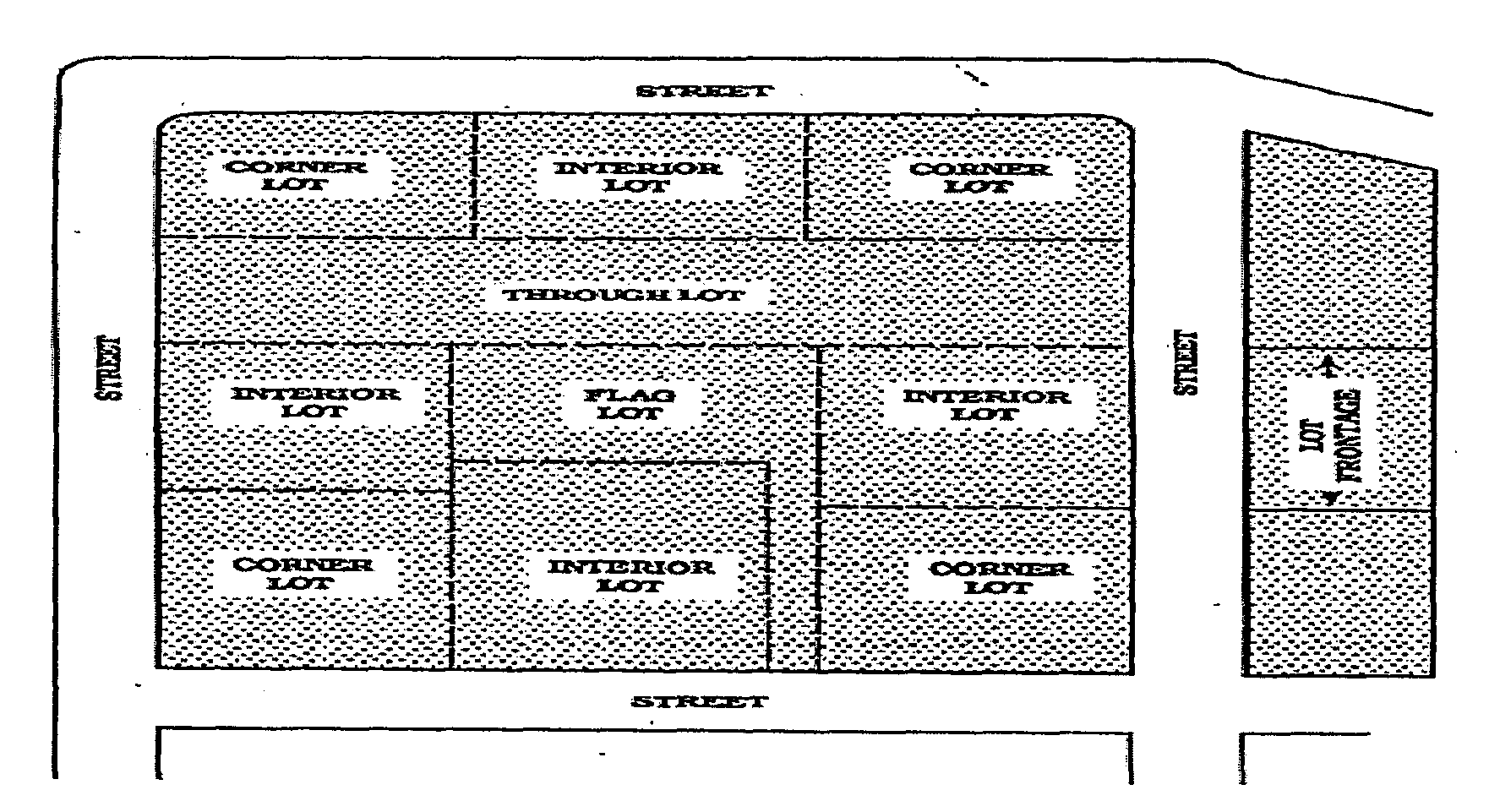
Lot, corner, means a lot located at the intersection of two or more streets.
Lot, depth, means the horizontal distance between front and rear lot lines.
Lot, double frontage, means a lot that has frontage on more than one street.
Lot line means a line bounding a lot that divides one lot from another or from a street or any other public or private space.
Lot, width of, or lot width means the distance between side lot lines measured at the front building line.
Manufactured home park means a lot or parcel with space, improvements and utilities for the long term parking of three or more mobile homes, which may include services and facilities for the residents.
Map or zoning map means the Official Zoning Map of Laurens, South Carolina.
Mini-warehouse means a building or group of buildings in a controlled access and fenced compound that contains individual compartmentalized and controlled access stalls or lockers for the dead storage.
Modular home or modular structure means a building including the necessary electrical, plumbing, heating, ventilating, and other service systems, manufactured off the site and transported to the point of use for installation or erection, with or without other specified components, as a finished building and not designed for ready removal to another site. This term is not to be limited to residential dwellings. When meeting the requirements of the Modular Building's Construction Act, in accordance with S.C. Code 1976, § 23-43-10, such building or structure may be located in any of the city's several zoning districts.
Nonresidential use means a principal use of land for other than residential purposes, i.e., commercial, industrial, institutional.
Open space ratio is a measure of the intensity of land use. It is arrived at by dividing the total amount of open space within the site by the total site area.
Open storage means any accessory storage in the open air and outside of a principal or main building or structure on a lot, including the storage of equipment, goods, raw or processed materials, or merchandise outside of any building or structure, but not including wrecking, junk or salvage materials, as defined by this chapter.
Planning commission refers to the Laurens City Planning Commission.
Recreational vehicle means a vehicular type portable structure without permanent foundation, which can be towed, hauled or driven, and primarily designed as temporary living accommodation for recreational, camping and travel use and including, but not limited to, travel trailers, truck campers, camping trailers and self-propelled motor homes.
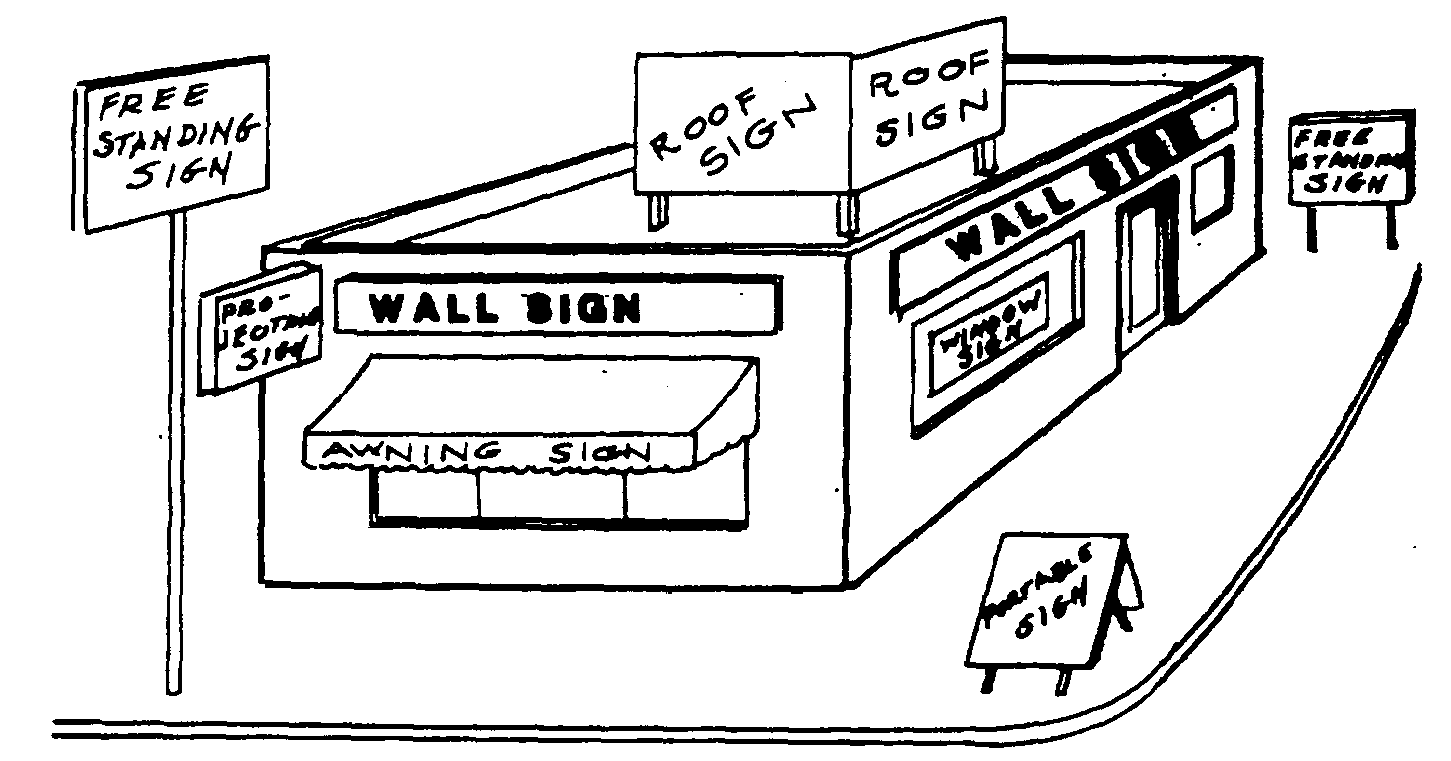
Sign means any object, device, display or structure, or part thereof, situated outdoors or indoors, which is used to advertise, identify, display, direct or attract attention to an object, person, institution, organization, business, product, service, event or location by any means, including words, letters, figures, design, symbols, fixtures, colors, illumination or projected images.
Sign, abandoned, means a sign structure not containing a sign for 120 continuous days or a sign not in use for 120 continuous days, or a sign advertising a business no longer occupying the site on which the sign exists, or to which it refers.
Sign, awning, canopy or marquee, means a sign that is mounted or painted on, or attached to, an awning, canopy or marquee.
Sign, building, means any sign attached to any part of a building.
Sign, changeable copy, means a sign or portion thereof with characters, letters or illustrations that can be changed or rearranged without altering the face or the surface of the sign. A sign on which the message changes more than eight times per day shall be considered an animated sign and not a changeable copy sign for purposes of this chapter. A sign on which the only copy that changes is an electronic or mechanical indication of time or temperature shall be considered a "time and temperature" portion of a sign and not a changeable copy sign for purposes of this chapter.
Sign, face, means the area or display surface used for the message.
Sign, freestanding, means any non-movable sign not affixed to a building.
Sign, identification, means a sign giving the nature, logo, trademark, or other identifying symbol; address; or any combination of the name, symbol, and address of a building, business, development, or establishment on the premises where it is located.
Sign, incidental, means a sign, generally informational, that has a purpose secondary to the use of the zone lot on which it is located, such as "no parking", "entrance", "loading only", "telephone", and other similar directives. No sign with a commercial message legible from a position off the zone lot on which the sign is located shall be considered incidental.
Sign, permanent, means a sign attached to a building, structure or the ground in some manner and made of materials intended for more than short-term use.
Sign, political, means a temporary sign announcing or supporting political candidates or issues in connection with any national, state or local election.
Sign, portable, means a sign that is designed to be transportable, but not limited by means of wheels.
Sign, projecting, means a sign that is wholly or partly dependent upon a building for support and which projects more than 12 inches from such building.
Sign, roof, means a sign that is mounted on the roof of a building or which is wholly dependent upon a building for support and which projects above the point of a building with a flat roof, the eave line of a building with a gambrel, gable or hip roof or the deck line of a building with a mansard roof.
Sign, temporary, means a sign or advertising display constructed of cloth, canvas, fabric, plywood or other light material and designed or intended to be displayed for a short period of time.
Sign, wall, means a sign painted on the wall of a building and has no sign structure.
Sign, window, means a sign that is applied or attached to the exterior or interior of a window or located in such manner within a building that it can be seen from the exterior of the structure through a window.
Significant with reference to a property, building or structure, means having aesthetic, architectural or historical qualities of critical importance to its consideration in connection with the designation of a property.
South Carolina Manufactured Housing Board is authorized by state statute to regulate the construction, repair, modification, installation, tie-down, hook-up, and sale of manufactured homes in South Carolina, which board has adopted for regulation of manufactured homes the Federal Manufactured Housing Construction and Safety Standards, promulgated by HUD, and contained in the Board's Manufactured Housing regulations.
Street means any public thoroughfare (drive, avenue, boulevard) or space more than 20 feet in right-of-way width that has been dedicated or deeded to the public for public use.
Street, arterial, means a public thoroughfare designed to move large volumes of traffic from one point to another.
Street, collector, means a public thoroughfare that filters traffic from local streets and conducts it to arterial streets or local traffic generators such as schools, recreation areas and public parks.
Street, local, means a public thoroughfare designed to provide access to property abutting the right-of-way.
Street, private, means a vehicular way not dedicated for public use or maintenance.
Structural alteration means any change in the supporting members of a construction, such as the bearing walls, beams or girders, or any change in the dimension or configuration of the roof or exterior walls of a building.
Under story tree means a small deciduous tree that forms the layer of vegetation under the canopy trees in a forest. Examples of such trees include dogwoods, sourwoods, fruit trees and others.
Use means the purpose or activity for which land or any building thereon is designed, arranged or intended, or for which it is occupied or maintained.
Use, principal, means the primary purpose for which land is used.
Used or occupied means, as applied to any land or building, that such land or building is in actual use or occupancy and shall be construed to include the words "intended," "arranged" or "designed to be used or occupied." An intended project shall be defined as one where substantial monies have been spent towards the goal of the project.
Variance means a modification of the area regulations of this chapter granted by the board of appeals where such modification will not be contrary to the public interest, and where, owing to conditions peculiar to the property owner, a literal enforcement of this chapter would result in unnecessary and undue hardship, and where such modification will not authorize a principal or accessory use of the property which is not permitted within the zoning district in which the property is located.
Wrecking, junk and salvage yards mean any land or structure used for a salvaging operation, including, but not limited to, the storage and sale of waste paper, rags, scrap metal, discarded materials, consumer goods, equipment and the collection, dismantlement, storage and salvage of ten or more unlicensed or inoperative vehicles; or a place where junk, waste, discarded or salvaged materials are bought, sold, exchanged, stored, baled, packed, disassembled or handled, including automobile wrecking yards, house wrecking and structural steel materials and equipment, but not including the purchase or storage of used furniture and household equipment, used cars in operable condition or used or salvaged materials as part of manufacturing operations.
Yard means an open space that lies between the principal or accessory buildings and the nearest lot line. Such yard is unoccupied and unobstructed from the ground upward except as may be specifically provided by this chapter.
Yard, front, means a yard extending the full width of the front of a lot between the front (street) right-of-way line or property line and the front building line.
Yard, rear, means a yard extending the full width of the lot in the area between the rear lot line and the rear building line.
Yard, required, means that part of a yard between a lot line and the minimum required building setback line, within which no structure shall be located except as provided by this chapter.
Yard, side, means a yard extending the full length of the lot in the area between the side lot line and a side building line.
Zoning board of appeals refers to the City of Laurens Board of Zoning Appeals.
Zoning district means the term applied to various geographical areas (districts) of the city for the purpose of interpreting the provisions of this chapter, as designated on the official zoning map for the city.
(Ord. No. 01-05, § 46-4, 3-15-2005)
Sec. 44-5. - Conflict with other laws.
Whenever the regulations of this chapter require a greater width or size of yards, or require a greater percentage of lot to be left unoccupied, or impose other more restrictive standards than are required in or under any other statutes, the requirements of this chapter shall govern. Whenever the provisions of any other statute require more restrictive standards than are required by this chapter, the provisions of such statute shall govern.
(Ord. No. 01-05, § 46-5, 3-15-2005)
Sec. 44-6. - Street access.
No building shall be erected, constructed, moved or located on a lot not having direct vehicular and pedestrian access to a publicly dedicated or publicly maintained street; except as provided for by the planned unit development district.
(Ord. No. 01-05, § 46-6, 3-15-2005)
Sec. 44-7. - Yard and setback modifications.
(a)
Corner lots. The setback from the street upon which the principal building will face shall be the minimum required front yard. The setback from the street upon which the side of the building will face also shall meet the minimum front yard requirements for the district within which the lot is located.
(b)
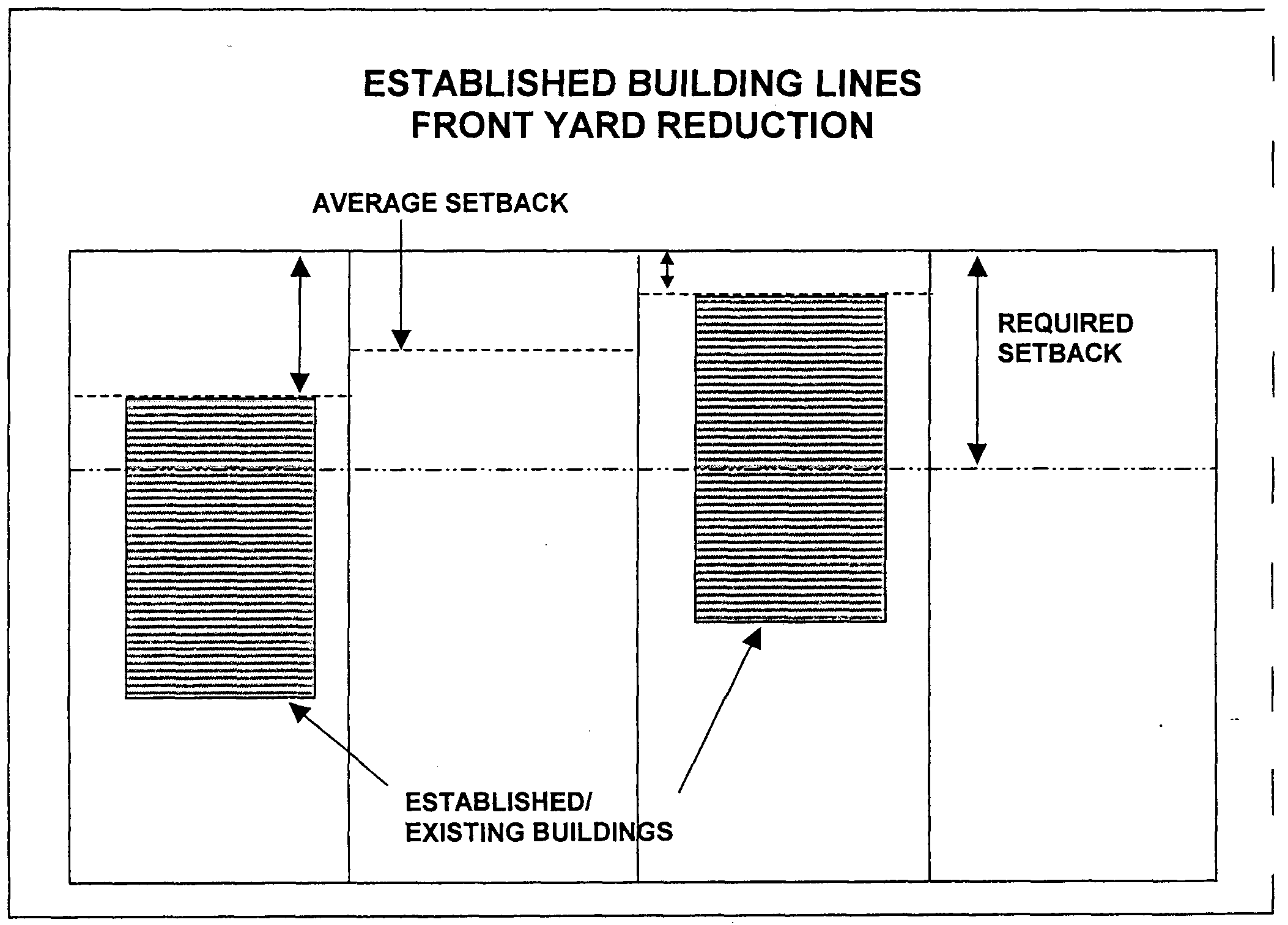
Partially developed areas. The front yard setback requirements for dwellings shall not apply on any lot where the average setback of existing buildings located wholly or in part within 200 feet on each side of such lot within the same block and zoning district and fronting on the same side of the street is less than the minimum required setback. In such cases, the setback on such lot may be less than the required setback, but not less than the average of the setbacks of the aforementioned existing buildings.
(c)
Through or double frontage lots. Front yard setbacks for double frontage lots shall be provided for both streets upon which the lot has frontage, and any accessory use shall be prohibited from the required front yard setback of the street upon which the principal building fronts.
(d)
Multiple buildings on lot. Whenever more than one main building is to be located on a lot, the required yards shall be maintained around the group of buildings and buildings shall be separated by a horizontal distance that is at least equal to the height of the highest adjacent building.
(e)
Railroad tracks. Structures within commercial and industrial districts adjacent to railroads may locate closer to the railroad right-of-way than the permitted side or rear yard setbacks of the respective zoning districts. However, the location must be in accordance with applicable railroad standards and conform to all other pertinent provisions of this chapter.
(Ord. No. 01-05, § 46-7, 3-15-2005)
Sec. 44-8. - Fences and projections into required yards and setbacks.
(a)
Open eaves, cornices and windowsills may project into any required setback a distance not to exceed 24 inches. Open uncovered porches or open fire escapes may project into a required yard a distance not to exceed five feet. Fences, walls and hedges may be erected in any required yard or setback area or along the edge of a property line, provided that no fence, wall or hedge located in a front yard setback area shall exceed four feet in height or eight feet in any other setback area or along any other property line, unless otherwise specified.
(b)
The administrator may approve a fence or wall higher than eight feet on the side or rear yard; provided, however, that assurances as to the safety of the fence or wall is submitted with the request for a permit to exceed the height requirements of this section. No exceptions shall be made in the front yard. However, nothing in this section shall be construed to prohibit the enclosure of a PUD or residential complex by a fence or wall of any height, subject only to approval for safety by the administrator.
(Ord. No. 01-05, § 46-8, 3-15-2005)
Sec. 44-9. - Exceptions to height limitations.
(a)
The height limitations of this chapter shall not apply to the following; provided, however, that such structures, excluding flag poles, shall be separated from any adjoining residential district by a distance equal to one foot for each two feet in height over the limit for the district within which the structure is located.
(b)
These features shall be erected to the minimum height necessary to accomplish the purpose they are intended to serve.
(Ord. No. 01-05, § 46-9, 3-15-2005)
Sec. 44-10. - Visibility at intersections.
On any corner lot in any district except the B-2 district, no planting shall be placed or maintained and no fence, building, wall or other structure shall be constructed after January 17, 1995, if such planting or structure thereby obstructs vision at any point between a height of 2.5 feet and ten feet above the upper face of the nearest curb (or street centerline if no curb exists) and within the triangular area bounded on two sides by the street right-of-way lines and on the third side by a straight line connecting points on the two street right-of-way lines.
(Ord. No. 01-05, § 46-10, 3-15-2005)
Sec. 44-11. - Accessory buildings and uses.
(a)
The number of accessory buildings shall not exceed two in any residential zoning district.
(b)
Accessory buildings in residential districts shall not be used for storage in connection with a trade.
(c)
Accessory buildings shall not exceed 50 percent of the gross floor area of the principal building or use.
(d)
No mobile or manufactured home or shipping container shall be used as an accessory building.
(e)
When located within the buildable area, accessory buildings may be constructed to a height of 20 feet. If located in a required setback area, said buildings shall not exceed 12 feet in height.
(f)
No accessory use shall occupy any part of a buffer area.
(g)
Unless modified by Table 1, accessory uses and structures shall observe the required setbacks applicable to the principal building or use, as set forth in Table 3.
(A) Fences and walls may be located in all required yards along any property line; provided the structure shall meet the visibility requirements of section 44-10; further provided that the structure shall not exceed six feet in height.
Opaque fences, when established in the front yard shall not exceed four feet in height.
BL = Required building setback line.
(Ord. No. 01-05, § 46-11, 3-15-2005)
Sec. 44-12. - Use of land and/or structures.
(a)
No land or structure shall be used or occupied, and no structure or portions thereof shall be constructed, erected, altered or moved, unless in conformity with all of the regulations specified for the district in which it is located.
(b)
No structure shall be erected or altered with greater height, size, bulk or other dimensions; to accommodate or house a greater number of families; to occupy a greater percentage of lot area; or to have narrower or smaller rear yards, front yards, side yards or other open spaces than required by this chapter or in any other manner contrary to the provisions of this chapter.
(c)
Except for the following uses and projects, no more than one principal building may be located upon a lot of record:
(1)
Institutional buildings;
(2)
Industrial buildings;
(3)
Multifamily dwellings;
(4)
Commercial buildings; and
(5)
Planned unit development projects.
Where more than one principal building is located on a lot, the required setbacks for the district shall be maintained along all property lines.
(d)
The minimum yards, parking spaces and open spaces required by the regulations of this chapter for each building existing on January 17, 1995, or for any building hereafter erected, shall not be encroached upon or considered as required yard or open space for any other building, except as otherwise provided in this section.
(Ord. No. 01-05, § 46-12, 3-15-2005)
Sec. 44-13. - Lot reduction.
No yard or lot existing on January 17, 1995, shall be reduced in dimension or area below the minimum requirements set forth in this chapter. Yards or lots created after January 17, 1995, shall meet at least the minimum requirements established by this chapter.
(Ord. No. 01-05, § 46-13, 3-15-2005)
Sec. 44-14. - Measurements.
(a)
Yards, setbacks, buildable area. The required front, side, and rear yards for individual lots, as set forth in Table 3 shall be measured inward toward the center of said lot from all points along the respective front, side, and rear property lines of the lot. Once the yard areas of a given lot have been established, the remaining area of the lot which is not included in any required front, side, or rear lot shall be known as the "buildable" area within which the approved structure shall be placed.
(b)
Height. The height of a building or structure shall be measured from the average grade elevation within 20 feet of the structure to the highest point of the building roof or structure.
(Ord. No. 01-05, § 46-14, 3-15-2005)
Sec. 44-15. - Nonconformities.
(a)
Defined. A nonconforming use, building or structure is one which was lawfully established prior to January 17, 1995, but which fails, by reason of such adoption, revision or amendment, to conform to the present requirements of this chapter.
(b)
Continuance. Nonconforming uses, buildings or structures are declared by this chapter to be incompatible with permitted construction in the districts in which they are located. However, to avoid undue hardship, the lawful use of any such use, building or structure at the time of the enactment, amendment or revision of this chapter may be continued even though such structure does not conform with the provisions of this chapter except that such nonconforming use, building, structure, or portions thereof, shall not be:
(1)
Reused or reoccupied after discontinuance of occupancy for six months, or in cases involving the settlement of an estate, one year. For purposes of this section, the term vacated or discontinued is synonymous with the removal of equipment, structures or other aspects of such nonconforming use, and discontinuance of electric power. When seeking relief under this section it shall be the responsibility of the owner, manager or tenant of a nonconforming use to establish existence of such use prior to the effective date of this chapter.
(2)
Reestablished, reoccupied or replaced with the same or similar use, structure or building, after physical removal or relocation from its original location at the time of enactment, amendment or revision of this chapter, except as provided herein.
(3)
Repaired, rebuilt or altered after any damage exceeding 50 percent of its market value at the time of destruction.
(c)
Enlargement or expansion. Enlargement or expansion of a nonconforming building, use or structure by no more than 20 percent shall be permitted; provided such enlargement shall meet all applicable setbacks, buffer area, and off-street parking requirements.
(d)
Replacement, repair and/or reconstruction.
(1)
The repair or alteration of a nonconforming use shall in no way increase the nonconformity of said use, except as otherwise permitted by subsection (c) of this section.
(2)
A building permit for the replacement or reconstruction of a nonconforming building or structure once removed, damaged or destroyed must be initiated within six months or forfeit the right of replacement.
(3)
Replacement may occur within the original building "footprint"; provided the replacement structure shall in no way increase the nonconformity of said use, except as otherwise permitted by subsection (c) of this section.
(4)
Replacement of a nonconforming mobile or manufactured home once removed from a lot or parcel shall be accomplished within 30 days of removal or forfeit nonconforming status, and if replaced shall not infringe on established setbacks, and shall meet in full the requirements of this chapter.
(e)
Exception. Where the owner of a lot on January 17, 1995, does not own sufficient land to enable him to conform to the dimensional requirements of this chapter, such lot may nonetheless be used as a building site, and the administrator is authorized to issue a permit for the use of the property; provided that such dimensional requirements are not reduced below the minimum specified in this chapter by more than 20 percent. If the dimensional requirements are reduced below the minimum specified in this chapter by more than 20 percent, the matter shall be taken up for review by the zoning board of appeals under normal review procedures.
(Ord. No. 01-05, § 46-15, 3-15-2005)
Sec. 44-16. - Zoning annexed property.
Whenever a petition for annexation is presented to the city, the mayor and council, upon the acceptance of such petition and the annexation of such area by ordinance, shall, by separate ordinance adopted at the same time, zone the area so annexed, without a public hearing.
(Ord. No. 01-05, § 46-16, 3-15-2005)

