
Laurens City Zoning Code
ARTICLE V
- BUFFERING, LANDSCAPING, COMMON OPEN SPACE AND TREE PROTECTION
Sec. 44-396. - General intent of article.
The regulations contained in this article are intended generally to ensure land use compatibility, to improve aesthetics and to ensure adequate provision of open space.
(Ord. No. 01-05, § 46-171, 3-15-2005)
Sec. 44-421. - Purpose.
The purpose of a buffer area is to ameliorate nuisances between adjacent land uses and streets, and promote land use compatibility. Additionally, the buffer area is designed to safeguard property values and preserve the character and integrity of the community.
(Ord. No. 01-05, § 46-186, 3-15-2005)
Sec. 44-422. - Definitions.
The following words, terms and phrases, when used in this division, shall have the meanings ascribed to them in this section, except where the context clearly indicates a different meaning:
Buffer area means a unit of yard, together with plantings, fences, walls and other screening devices required thereon.
(Ord. No. 01-05, § 46-187, 3-15-2005)
Sec. 44-423. - Location.
Buffer areas shall be located on the outer perimeter of a lot or parcel, extending to the lot or parcel boundary line. They shall not be located on any portion of an existing street or right-of-way; however, they may occupy part or all of any front, side or rear yard or setback required by this chapter. Where required, buffer areas and/or buffer area structures shall be developed as an integral part of the proposed use.
(Ord. No. 01-05, § 46-188, 3-15-2005)
Sec. 44-424. - Design standards.
This chapter requires three types of buffer areas: type A, type B and type C.
(1)
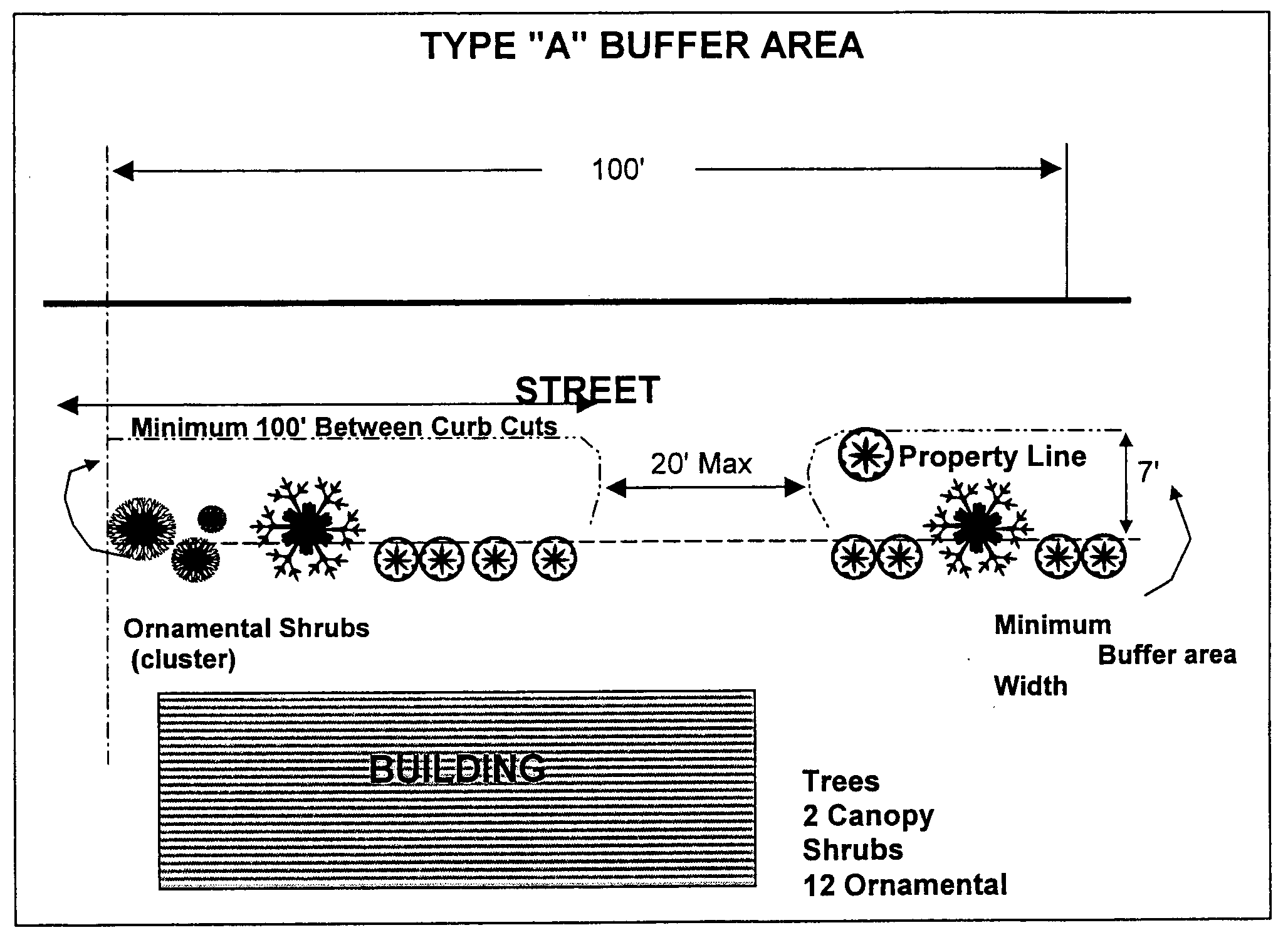
Type A buffer area. The type A buffer area consists of low density landscaping between a proposed use and the adjacent street, providing separation between the two. The buffer area shall be a minimum width of seven feet. Per 100 linear feet of frontage, the buffer area shall consist of a combination of 12 ornamental shrubs, two under story trees and landscaped grass areas, or other appropriate ground cover. The shrubs may be clustered to ensure their survival. An example site plan is illustrated by the following diagram:
(2)
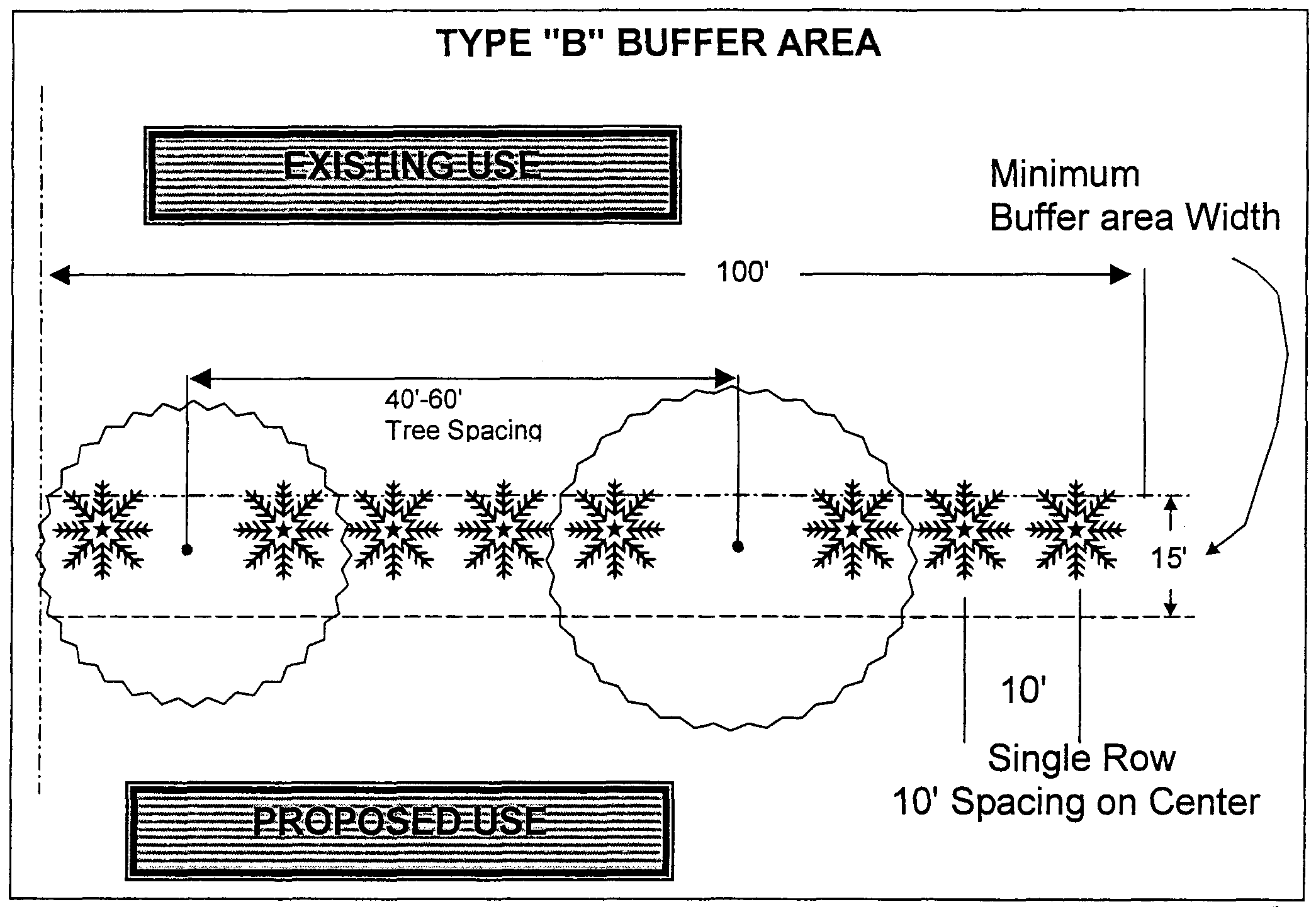
Type B buffer area. The type B buffer area is a medium density screen intended to block visual contact between uses and to create spatial separation. The buffer area shall be a minimum width of ten feet. Per 100 lineal feet, the screen shall consist of a combination of two deciduous trees planted 40 to 60 feet on center and eight evergreen plants ten feet on center. An example site plan is illustrated by the following diagram:
(3)
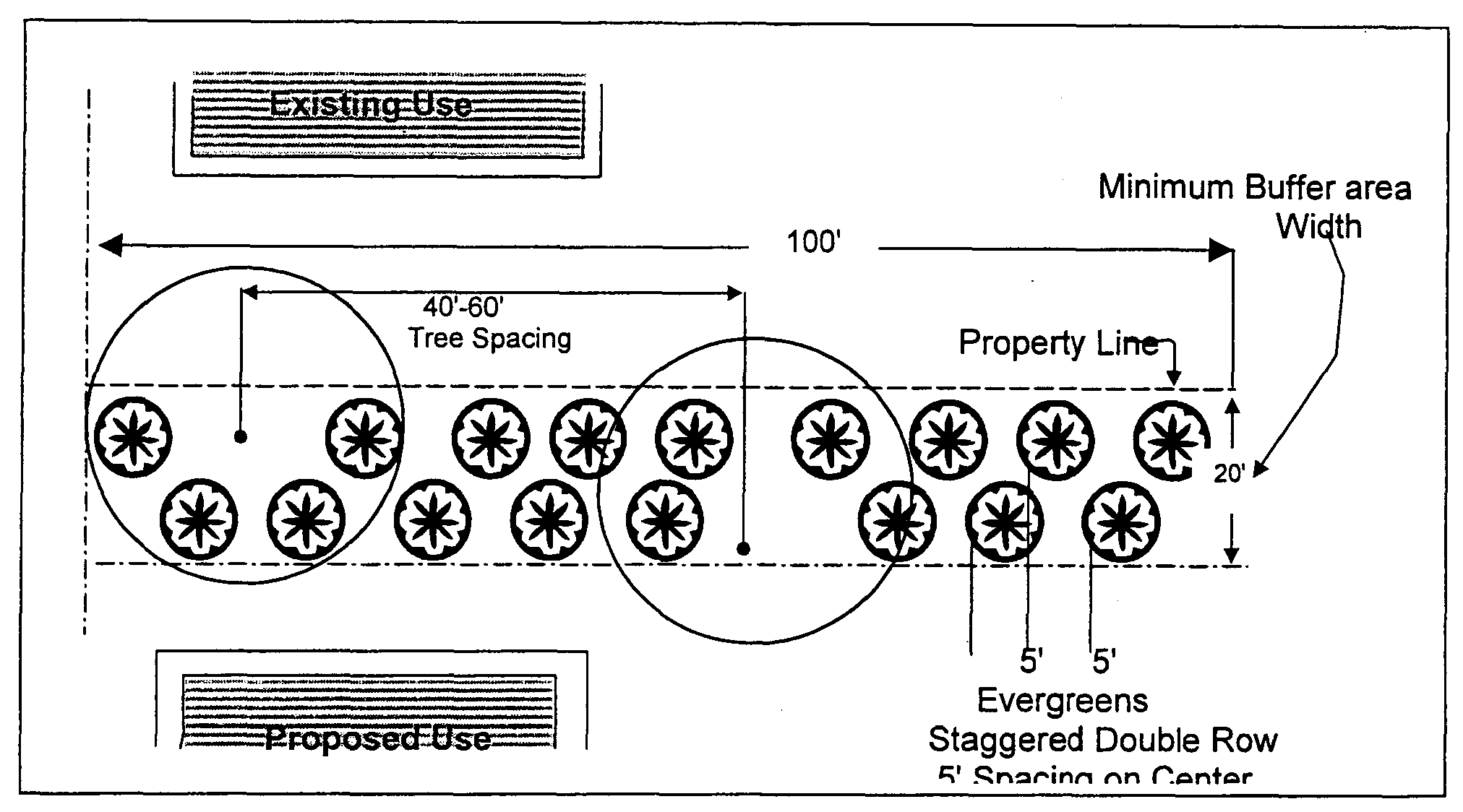
Type C buffer area. The type C buffer area is a high-density screen intended to exclude all visual contact between uses and to create a spatial separation. The buffer area shall be a minimum width of 20 feet. Per 100 lineal feet, the screen shall consist of a combination of two deciduous trees planted 40 to 60 feet on center and 17 evergreen plants or under story trees planted in a double-staggered row ten feet on center. An example site plan is illustrated by the following diagram:
(Ord. No. 01-05, § 46-189, 3-15-2005)
Sec. 44-425. - Determination of buffer area requirements.
Buffer areas shall be required under the following circumstances:
(1)
Type A buffer area required. Wherever a multifamily complex, mobile home park or nonresidential use is proposed, except in the B-2 central business district, a type A buffer area shall be provided along the street right-of-way boundary of the proposed use, separating it from the adjoining street.
(2)
Type B buffer area required. Wherever a mobile home park, travel trailer park, multifamily or townhouse project, mini-warehouse, institutional or commercial use is proposed for a site or lot adjoining a residential use in a residentially zoned district with no intervening public or private street or right-of-way of 18 feet or greater, a type B buffer area shall be provided along the boundary of the adjoining residential property line.
(3)
Type C buffer area required. Wherever an industrial, warehouse, outdoor storage or related use is proposed for a site or lot adjoining a residential use in a residentially zoned district with no intervening public or private street or right-of-way of 18 feet or greater, a type C buffer area shall be provided along the boundary of the residential property line.
(Ord. No. 01-05, § 46-190, 3-15-2005)
Sec. 44-426. - Buffer area specifications.
(a)
Minimum installation size. At installation or planting, all evergreen (under story) trees and/or shrubs used to fulfill buffer area requirements shall be not less than six feet in height, and all deciduous (canopy) trees shall be not less than eight feet in height, except for ornamental shrubs for type A buffer areas, which may be used.
(b)
Minimum mature size. At maturity, evergreen plant material used for screening shall form a continuous opaque screen averaging ten feet in height, and deciduous plant material used for screening shall average 25 feet in height.
(c)
Staggered planting. Where required, evergreen and deciduous plant material shall be planted in at least two rows and in an alternating fashion to form a continuous opaque screen of plant material.
(Ord. No. 01-05, § 46-191, 3-15-2005)
Sec. 44-427. - Substitutions.
The following substitutions shall satisfy the requirements of this division:
(1)
Existing plant materials. Existing trees of four inches or more in diameter, measured at two feet above the ground, within the required buffer area may be included in the computation of the required buffer area planting, with the approval of the administrator.
(2)
Fence or wall. Where, owing to existing land use, lot sizes, or configurations, topography, or circumstances peculiar to a given piece of property, the buffer area requirements of this division cannot reasonably be met, the developer may request and the planning commission may approve the substitution of appropriate screening, in the way of a fence or wall structure along the property line of the proposed use in accord with the following standards: A six-foot fence, as illustrated below, may be substituted for a type B buffer area, and an eight-foot fence may be substituted for a type C buffer area.
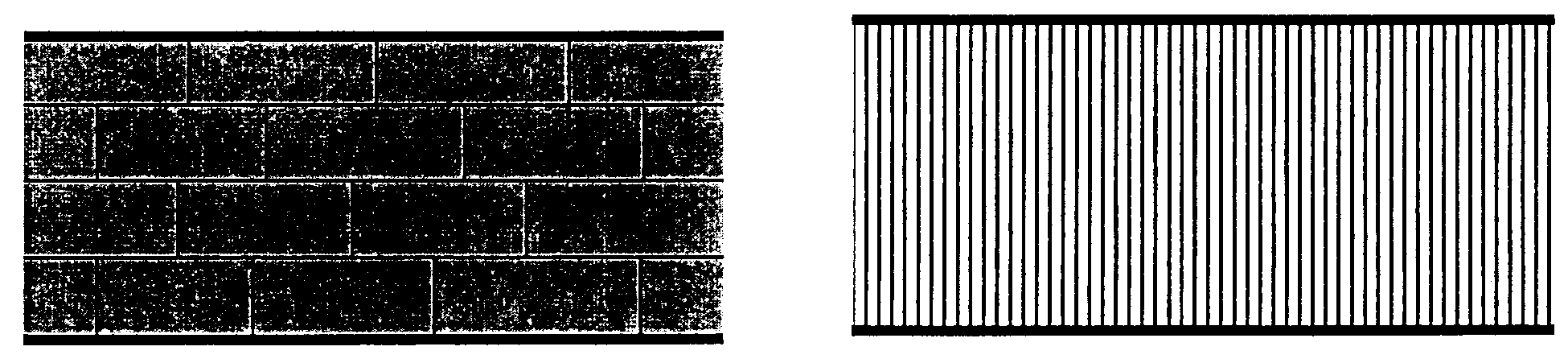
Fence and Wall Illustrations
(Ord. No. 01-05, § 46-192, 3-15-2005)
Sec. 44-428. - Responsibility.
It shall be the responsibility of the proposed new use to provide the buffer area where required by this chapter, except that no new detached single-family use shall be required to provide such buffer area.
(Ord. No. 01-05, § 46-193, 3-15-2005)
Sec. 44-429. - Required maintenance.
The maintenance of required buffer areas shall be the responsibility of the property owner, and all such areas shall be properly maintained so as to ensure continued buffering. Dead trees shall be removed; debris and litter shall be cleaned; and berms, fences and walls shall be maintained at all times. Failure to do so is a violation of this chapter, and may be remedied in the manner prescribed for other violations.
(Ord. No. 01-05, § 46-194, 3-15-2005)
Sec. 44-430. - Use of buffer areas.
A buffer area may be used for passive recreation; however, no plant material may be removed. All other uses are prohibited.
(Ord. No. 01-05, § 46-195, 3-15-2005)
Sec. 44-459. - Purpose.
The purpose of landscaping is to improve the appearance of vehicular use areas and property abutting public rights-of-way; to protect, preserve and promote the aesthetic appeal, scenic beauty, character and value of land; to promote public health and safety through the reduction of noise pollution, stormwater runoff, air pollution, visual pollution and artificial light glare.
(Ord. No. 01-05, § 46-211, 3-15-2005)
Sec. 44-460. - Definitions.
The following words, terms and phrases, when used in this division, shall have the meanings ascribed to them in this section, except where the context clearly indicates a different meaning:
Landscaping means a type of open space permanently devoted and maintained for the growing of shrubbery, grass, other plants and decorative features to the land.
(Ord. No. 01-05, § 46-212, 3-15-2005)
Sec. 44-461. - Where required.
Except in the B-2 district, no multifamily or nonresidential use shall hereafter be created or used unless landscaping is provided in accord with the provisions of this division. No existing building, structure or vehicular use area shall be expanded or enlarged unless the minimum landscaping required by the provisions of this division is provided to the extent of the alteration or expansion; landscaping not required for the existing use.
(Ord. No. 01-05, § 46-213, 3-15-2005)
Sec. 44-462. - Landscaping plan.
A landscaping plan shall be submitted as part of the application for a building permit. The plan shall:
(1)
Designate areas to be reserved for landscaping. The specific design of landscaping shall be sensitive to the physical and design characteristics of the site.
(2)
Indicate the location and dimensions of landscaped areas, plant materials, decorative features, etc.
(3)
Identify all existing trees 30 or more inches in circumference (measured at three feet above the ground) in required setback (yard) areas.
(Ord. No. 01-05, § 46-214, 3-15-2005)
Sec. 44-463. - Requirements.
Required landscaping shall be provided as follows:
(1)
Along the outer perimeter of a lot or parcel, where required by the buffer area provisions of this article, to separate incompatible land uses. The amount specified shall be as prescribed by division 2 of this article.
(2)
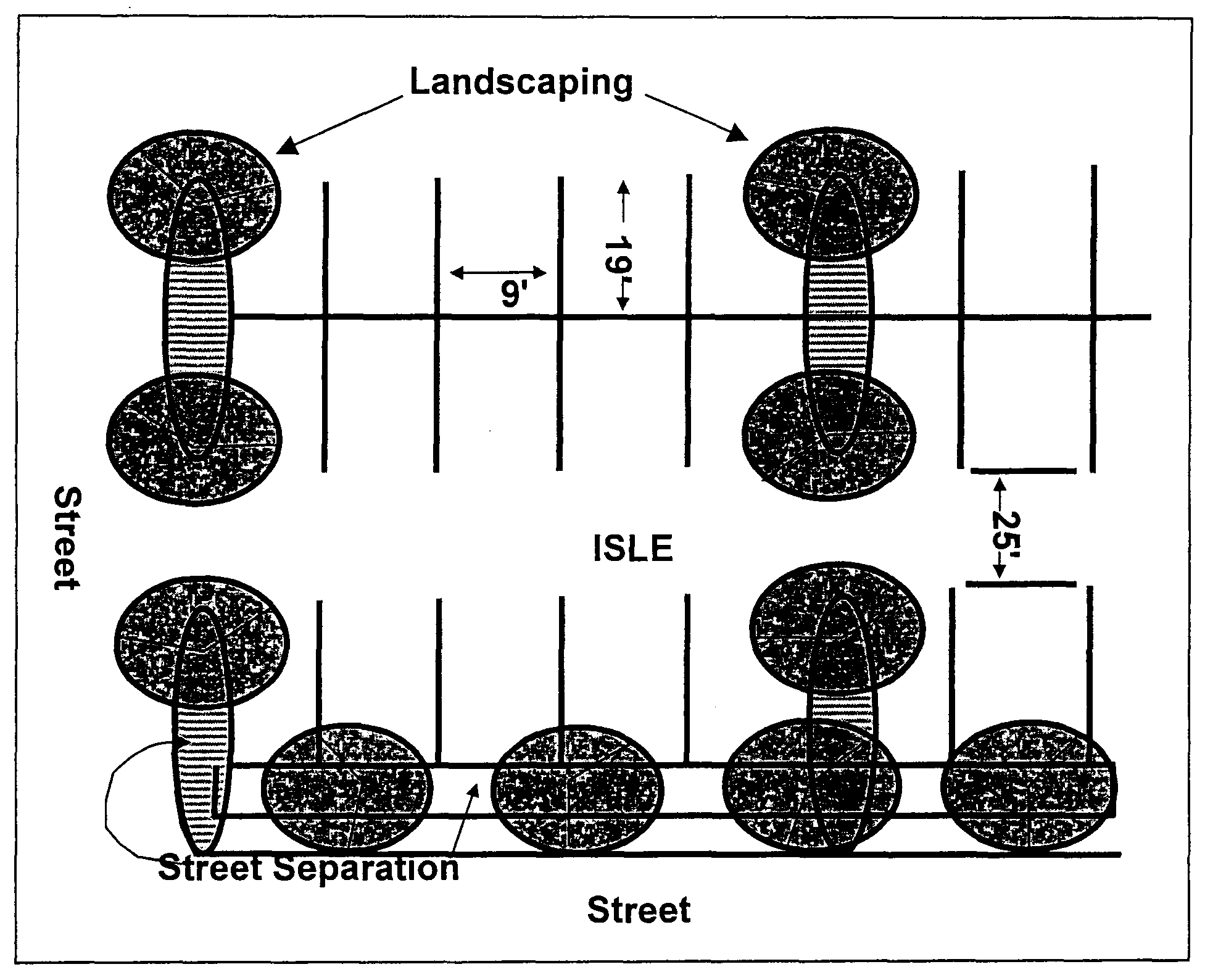
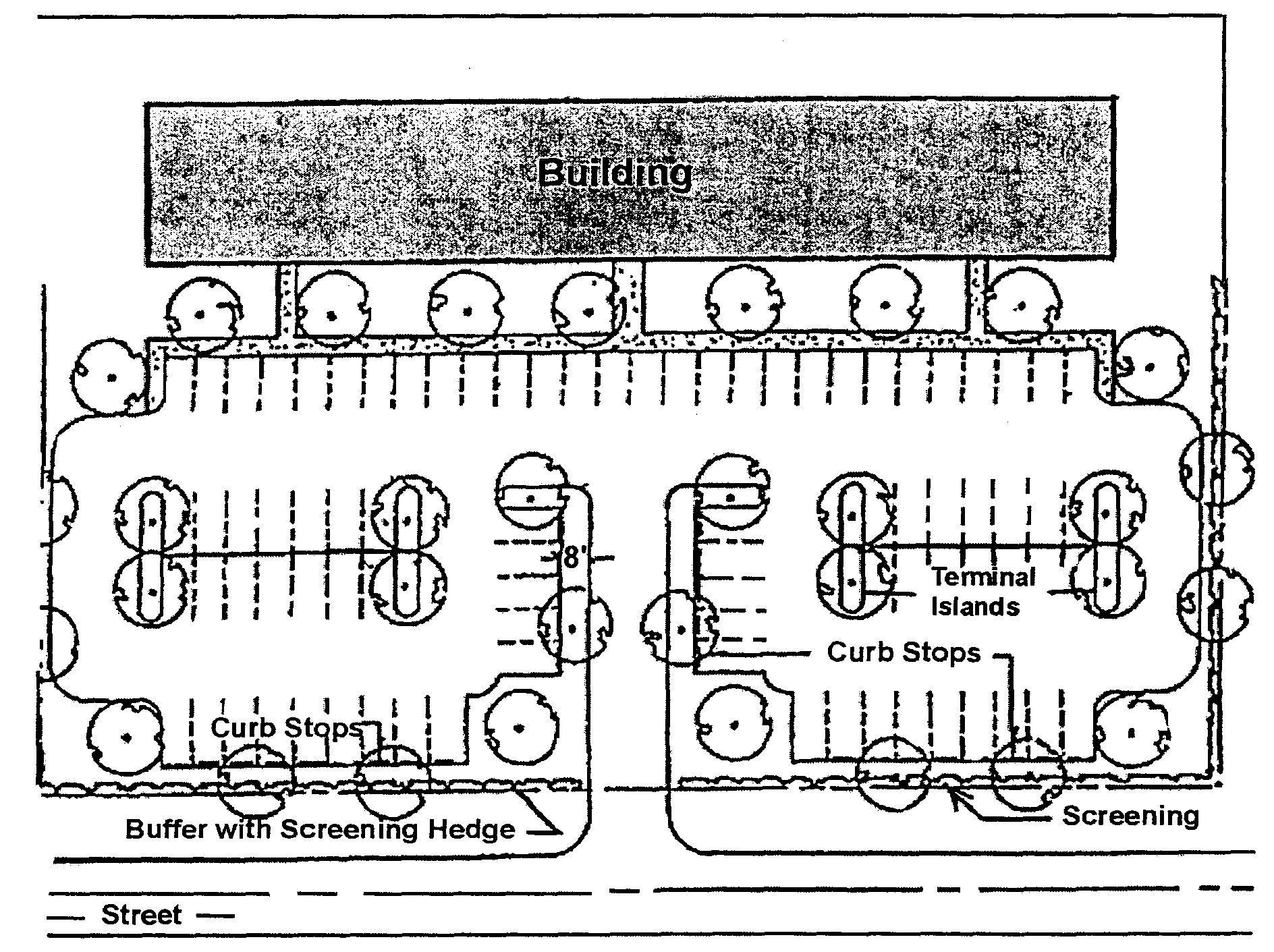
Within the interior, peninsula or island type landscaped areas shall be provided for any open vehicular use area containing 20 or more parking spaces. Landscaped areas shall be located in such a manner as to divide and break up the expanse of paving and at strategic points to guide travel flow and directions. Elsewhere, landscaped areas shall be designed to soften and complement the building site. At a minimum, interior lot landscaping shall be provided in the following amounts:
Buffer area landscaping may provide up to 50 percent of the above requirement. Landscaping along exterior building walls and structures is suggested to separate with greenery the building from the vehicular surface area.
(Ord. No. 01-05, § 46-215, 3-15-2005)
Sec. 44-495. - Purpose.
The purpose of this division is to ensure adequate open space for high intensity residential development; to integrate recreation, landscaping greenery and/or natural areas into such projects; to promote the health and safety of residents of such projects; and to compensate for the loss of open space inherent in single-family residential projects.
(Ord. No. 01-05, § 46-231, 3-15-2005)
Sec. 44-496. - Definitions.
The following words, terms and phrases, when used in this division, shall have the meanings ascribed to them in this section, except where the context clearly indicates a different meaning:
Common open space means land and/or water bodies used for recreation, amenity or buffer. It shall be freely accessible to all residents of a development, where required by this chapter. Open space shall not be occupied by buildings or structures, roads, parking or road right-of-way; nor shall it include the yards or lots of residential dwelling units required to meet minimum lot area or parking area requirements.
(Ord. No. 01-05, § 46-232, 3-15-2005)
Sec. 44-497. - Where required.
The following uses/projects shall provide open space and/or landscaping in the amounts prescribed:
Note: Landscaped open areas provided to meet the requirements of division 3 of this article may be applied toward meeting the above requirements if held in common ownership.
(1)
New sites. No new development, building or structure in connection with the above shall hereafter be erected or used unless common open space is provided in accord with the provisions of this division.
(2)
Existing sites. No existing development, building or structure in connection with the above shall be expanded or enlarged unless the minimum common open space required by the provisions of this division are provided to the extent of the alteration or expansion.
(Ord. No. 01-05, § 46-233, 3-15-2005)
Sec. 44-498. - Common open space plan.
Proposed uses and projects set forth in section 46-497 shall submit an open space or landscaping plan as part of the application for a building permit. The plan shall:
(1)
Designate areas to be reserved as open space. The specific design of open space shall be sensitive to the physical and design characteristics of the site.
(2)
Designate the type of open space which will be provided, and indicate the location of plant materials, decorative features, recreational facilities, etc.
(3)
Specify the manner in which common open space shall be perpetuated, maintained and administered.
(Ord. No. 01-05, § 46-234, 3-15-2005)
Sec. 44-499. - Types of common open space and required maintenance.
The types of common open space, which may be provided to satisfy the requirements of this chapter, together with the maintenance required for each, are as follows:
(1)
Natural areas. Natural areas are areas of undisturbed vegetation or areas replanted with vegetation after construction. Woodlands and wetlands are specific types of natural areas. Maintenance is limited to removal of litter, dead trees, plant materials and brush. Natural watercourses are to be maintained as free flowing and devoid of debris. Stream channels shall be maintained so as not to alter floodplain levels.
(2)
Recreational areas. Recreational areas are designed for specific active recreational uses such as tot lots, tennis courts, swimming pools, ball fields and similar uses. Recreational areas shall be accessible to all residents of the development. Maintenance is limited to ensuring that there exist no hazards, nuisances or unhealthy conditions.
(3)
Greenways. Greenways are linear green belts linking residential areas with other open space areas. These greenways may contain bicycle paths, footpaths and bridle paths. Connecting greenways between residences and recreational areas are encouraged. Maintenance is limited to a minimum of removal and avoidance of hazards, nuisances or unhealthy conditions.
(4)
Landscaped areas, lawns and required buffer yards. Landscaped areas, lawns and required buffer yards are approved, including creative landscaped areas with gravel and tile, so long as the tile does not occupy more than two percent of the required open space. Lawns, with or without trees and shrubs shall be watered regularly to ensure survival, and mowed regularly to ensure neatness. Landscaped areas shall be trimmed, cleaned and weeded regularly.
(Ord. No. 01-05, § 46-235, 3-15-2005)
Sec. 44-500. - Preservation of open space.
Land designated as common open space may not be separately sold, subdivided or developed. Open space areas shall be maintained so that their use and enjoyment as open space are not diminished or destroyed. Open space areas may be owned, preserved and maintained as required by this division by any of the following mechanisms or combinations thereof:
(1)
Dedication of and acceptance by the city.
(2)
Common ownership of the open space by a homeowner's association responsible for its maintenance.
(3)
Deed restricted, with open space and maintenance guarantees.
If any private owner of open space fails to maintain such space, the city may, in accordance with the open space plan and following reasonable notice, demand that deficiency of maintenance be corrected, and enter the open space to maintain the open space. The cost of such maintenance shall be charged to those persons having the primary responsibility for maintenance of the open space.
(Ord. No. 01-05, § 46-236, 3-15-2005)
Sec. 44-524. - Purpose.
The purpose of this division is to prevent the clear-cutting of building sites, a practice which destroys the balance of nature, leads to sedimentation and erosion, contributes to air and water pollution, and unnecessarily robs the community of valuable assets.
(Ord. No. 01-05, § 46-251, 3-15-2005)
Sec. 44-525. - Existing trees.
(a)
Because any healthy tree greater than 30 inches in circumference is a valuable natural resource, by virtue of its age and size and its contribution to the environment, all such trees shall be protected to the extent practical and feasible.
(b)
All existing trees, 30 or more inches in circumference, not in the proposed buildable area, shall be flagged and shown on the required plat or site plan for a building permit.
(c)
No more than 20 percent of such trees shall be felled and removed, except by order of the zoning board of appeals owing to unique circumstances surrounding the development of the property.
(d)
Where, due to unusual topographic conditions or circumstances peculiar to a given site, more than 20 percent of the trees to be preserved must be felled, replacement trees not less than 18 inches in circumference shall be planted in like number. To the extent possible, such trees shall be integrated into the required landscaping.
(Ord. No. 01-05, § 46-252, 3-15-2005)
Sec. 44-526. - Development precautions.
After the necessary development approvals have been granted, and before any site work has begun, the developer shall cause protected trees to be marked with a surveyor's flagging. During development, a minimum protective zone with a diameter of one foot per inch of tree diameter, shielded by suitable protective barriers, shall be established (erected) and maintained around all trees to be retained as required by this division.
(Ord. No. 01-05, § 46-253, 3-15-2005)

