
Leavenworth City Zoning Code
ARTICLE 4
- ZONING DISTRICTS AND STANDARDS
Sec. 4.01.- Purpose.
The standards set forth in this section establish the physical dimensions of each zoning district in these development regulations.
(Ord. No. 7996, § 1, 6-14-2016)
Sec. 4.02. - Establishment of districts and intent.
For the purpose of regulating and restricting the location and use of buildings and land for dwellings, business, industry, conservation, flood plain or other uses, the City of Leavenworth, Kansas, is divided into the following districts. The boundaries of zoning districts are indicated upon the most current "Official Zoning District Map" of the City of Leavenworth, Kansas, is made a part of this appendix. Copies of the zoning district map are filed in the office of the city clerk. In support of the comprehensive plan, each district has the specific intent statement indicated below.
A.
R1-25, Low Density Single Family Residential District. This district is intended to allow residential development at a low density. The principal land use is single-family dwelling with uses incidental or accessory thereto. The district also permits a variety of agricultural uses. There shall be only one principal structure per lot in this district.
B.
R1-9, Medium Density Single Family Residential District. This district is intended to allow medium density single-family residential development with smaller lots. There shall be only one principal structure per lot in this district.
C.
R1-7.5, Medium Single-Family Residential District. This district is intended to allow medium density single-family residential development. There shall be only one principal structure per lot in this district.
D.
R1-6, High Density Single Family Residential District. This district is intended to allow higher density residential development. There shall be only one principal structure per lot in this district.
E.
R-MF, Multiple Family Residential District. This district is intended to provide for development of multiple-family residential developments and allows a high population density. The district is residential in character and promotes a high quality environment through aesthetically oriented property development standards. This district is appropriate for many areas of the community and shall be located in accordance with the criteria established in the Leavenworth Comprehensive Land Use Plan. These districts need not be contiguous with other multiple family districts.
F.
R4-16, Medium Density Multiple Family Residential District. This district is intended to provide for development of multifamily dwellings up to four unit buildings in areas designated for medium density residential in the comprehensive land use plan on areas deemed appropriate and compatible based upon the existing development pattern. These districts do not need to be contiguous with other multiple family districts.
G.
RMX, Residential Mixed Use. The RMX district is intended to provide for high-density, multi-family residential dwellings along with a mix of appropriate neighborhood-serving commercial, civic, and other uses. This district allows for single-family detached homes, townhomes, duplexes, triplexes, and apartments. Commercial uses may be included in some residential structures pursuant to the appropriate design standards, or may be permitted as stand-alone structures. This district implements the North Neighborhood area as identified in the 2010 Northeast and Downtown Leavenworth Redevelopment Plan.
H.
MP, Mobile/Manufactured Home Park District. The purpose of this district is to provide low-density mobile/manufactured home park developments, which are compatible with the character of the surrounding neighborhood in which they are located. Mobile/manufactured home parks are considered as residential uses and should be located in areas where services and amenities are available such as those found in conventional residential areas. Mobile homes may be on leased spaces and may be permitted to be placed on permanent foundations.
I.
NBD, Neighborhood Business District. This district is intended to provide a center for convenience shopping in a residential neighborhood. This district provides for retail and service establishments, which supply commodities or perform services to meet the daily needs of the neighborhood, and shall be in locations where analysis of residential population demonstrates that such facilities are justified.
J.
OBD, Office Business District. The intent of this district is to allow office facilities for business and professional service uses. Density and intensity of use may be considered moderate and located in areas where analysis of residential consideration demonstrates that such facilities are justified (i.e., traffic, school, pedestrians, can be safely and efficiently accommodated.)
K.
CBD, Central Business District. The purpose of this district is to provide locations for a variety of commercial retail and service activities and wholesale and storage uses normally found in the core area of the city. These uses must be compatible to a dense commercially developed area and may serve local community or regional needs.
L.
GBD, General Business District. The purpose of this district is to provide locations for a variety of commercial, retail, and service activities serving the entire community but primarily include activities, which require large land areas or offer service to the motoring public.
M.
I-1, Light Industrial District. This district is to provide locations for a variety of less intense industrial, warehousing, and wholesale distribution uses. Commercial uses permitted in this district are generally those which serve the convenience of industrial establishments and their employees or those conducted in conjunction with manufacturing or wholesaling operations or those commercial uses requiring large land areas.
N.
I-2, Heavy Industrial District. The purpose of this district is to provide locations for basic or primary industries and related industrial activities. Many of these industries characteristically store bulk quantities of raw or scrap materials for processing to semi-finished or finished products. Commercial uses permitted in this district are generally those which serve the convenience of industrial establishments and their employees and those conducted in conjunction with a manufacturing or wholesaling operation or those commercial uses requiring large land areas.
O.
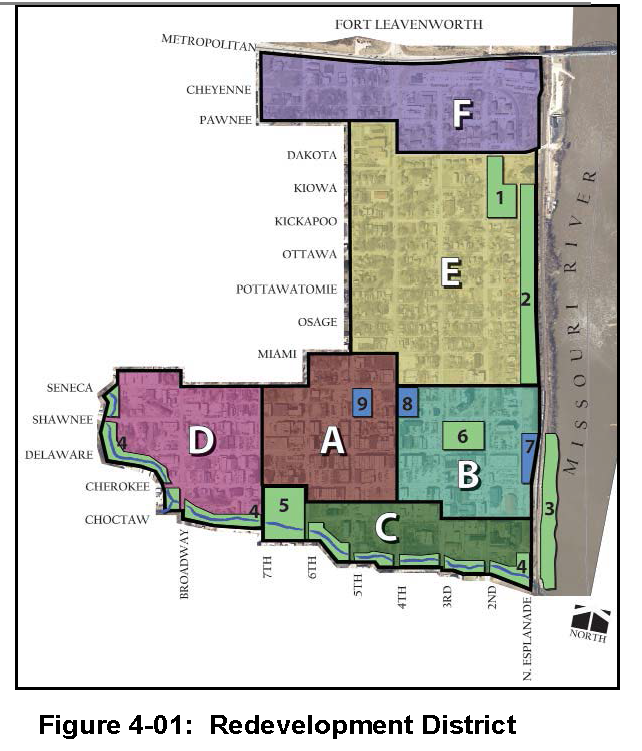
ROD, Redevelopment Overlay District. The purpose of the Redevelopment Overlay District ("ROD") is to facilitate the development of property in the downtown (Central Business District) and northeast Leavenworth in accordance with the 2010 Northeast and Downtown Leavenworth Redevelopment Plan ("Redevelopment Plan") with the highest possible levels of community and building design consistent with the healthy economic development and redevelopment of the plan area. The Redevelopment Overlay District includes three distinct subareas as identified below.
1.
Central Business District Subdistrict (CBD): The Central Business District subdistrict includes areas A, B, C, and D of figure 4-01.
2.
North Neighborhood Subdistrict (NN): The North Neighborhood subdistrict is area E of figure 4-01.
3.
North Gateway Subdistrict (NG): The North Gateway subdistrict is area F of figure 4-01.
4.
Arterials that form the boundaries of any of these districts shall be subject to the ROD standards on both sides of the arterial for the length of the boundary.
FIGURE 4-01. REDEVELOPMENT DISTRICT
(Ord. No. 7996, § 1, 6-14-2016; Ord. No. 8197, § 1, 10-11-2022)
Sec. 4.03. - Property development standards.
A.
Dimension table. Lot and building dimension standards for zoning districts shall be according to Table 4-01.
TABLE 4-01: ZONING DISTRICT DIMENSION STANDARDS
[1] Only with public water and sewer. See KDHE 4-2 and Leavenworth County Sanitary Code: minimum lot size is 2 acre without public water or sewer.
[ 2] Lots in the R-MF district shall have 3,000 square feet per dwelling unit.
[3] Lots in the R-4-16 district shall have 4,000 square feet per dwelling unit.
[4] There are no yard requirements in the CBD except that a 25-foot setback shall be provided on any side of a lot which abuts a residential district.
[5] There are no interior side yard requirements in the GBD except that a 25-foot setback shall be provided on any side of a lot which abuts a residential district.
[6] In the I-1 district a 25-foot setback shall be provided abutting any dedicated street or residential district.
[7] In the I-2 district a 100-foot setback shall be provided abutting residential district, unless the use was located and platted prior to adoption of these regulations in which case a 25-foot setback shall be provided. Setbacks abutting any dedicated street shall be 25 feet.
[8] Maximum lot coverage requirements shall be subject to stormwater quality and quantity requirements as determined by the public works department for individual projects.
[9] Any adjacent right-of-way width may not be counted towards the minimum lot width requirement.
B.
Dimension standards for RMX. The dimension standards for the RMX district shall be:
TABLE 4-02: DIMENSIONS FOR THE RESIDENTIAL MIXED-USE DISTRICT
[1] An RMX use abutting a residential district shall match the side yard setback standards of that district.
[2] When abutting a public street, alley, or public right-of-way. The rear setback for RMX abutting a residential district shall be 20 feet, regardless of the location of any street, alley, or ROW.
[3] Must meet setback requirements.
C.
Yard regulations.
1.
Front yards. In areas where parcels were created previous to the adoption of subdivision regulations in July 1966, where structures have been built observing a setback other than the setback required by the applicable zoning district, new structures shall observe the following setback:
a.
Front setbacks may be the average setback of all lots within 150 feet of either side of the lot, but along the same block.
b.
If only two buildings exist within 100 feet of either side of the lot, the front setback may be the average of those buildings.
2.
Structural projections. Every part of a required yard shall be open to the sky unobstructed, except:
a.
The ordinary projection of skylights, sills, belt courses, cornices, and ornamental features projecting not to exceed 12 inches.
b.
Open or lattice-enclosed fire escapes, fireproof outside stairways, and balconies opening upon fire towers projecting into a rear yard not more than five feet.
c.
The ordinary projection of chimneys and flues.
d.
The projection of roof overhangs up to four feet into any front or rear yard and two feet into any side yard. In no case may an overhang project into an easement.
e.
An open unenclosed deck or paved terrace may project into a required rear yard for a distance not exceeding ten feet, but no closer to the property than 15 feet in any case. A deck or paved terrace under this exception may not be more than 36 inches above grade surrounding the structure and shall be opened to the sky with no roof or wall structure (except reasonable railing).
f.
An open and unenclosed porch or stoop may project into a required front setback a distance not exceeding ten feet, but no closer to the property line than 15 feet in any case. A porch or stoop under this exception shall be no higher than the first-floor elevation of the front entry feature, may include a single-story roof structure integrated with the materials and style of the building, but shall only include support posts or pillars and railings or two walls up to three feet, but no windows, screens or other enclosures in the front-setback encroachment.
3.
Yard requirements for open land. If a lot is, or will be, occupied by a permitted use without structures, then the minimum setback and minimum side and rear yards that would otherwise be required for the lots shall be provided and maintained unless some other provision of these regulations requires or permits a different minimum front or side or rear yard setback. The front, side, and rear yards shall not be required on lots used for garden purposes without structures, or lots used for open public recreation areas. If the permitted use is the display of new or used automobiles or other vehicles for sale that display may be allowed in the front yard setback, except the first five feet thereof.
D.
Height regulations.
1.
In all districts, one additional foot of height above the specified height limitations shall be permitted for commercial or industrial buildings for each one foot of additional setback on all sides provided over the minimum requirements, if no such building exceeds 100 feet in height.
2.
Single-family, two-family, and multiple family dwellings in the residential districts may be increased in height by one foot for each one foot of additional setback on all sides, provided that no residential building may exceed 50 feet in height.
3.
Chimneys, cooling towers, elevator hothouses, fire towers, grain elevators, monuments, stacks, stage towers, or scenery lofts, tanks, water towers, ornamental towers, and spires, church steeples, radio and television towers or necessary mechanical appurtenances, usually required to be placed above the roof level and not intended for human occupancy, may be erected to a height not to exceed 25 percent above the maximum height for the district in which it is located.
E.
Accessory structures.
1.
No accessory buildings shall be erected in any required front or side yard, or at any other place forward of the main building line.
2.
No accessory structure except for permitted signs, fences, and permitted off-street parking shall be permitted in any required front or side yard.
3.
All accessory buildings in the rear yard shall maintain a three-foot setback from the side and rear property lines as measured from the nearest part of the structure, including any overhangs.
4.
If the accessory structure has a vehicular alley entrance the sum of the right-of-way width and the setback of the structure shall not be less than 20 feet.
5.
Accessory structures located elsewhere on the lot shall maintain setbacks applicable to the principal structure.
6.
All accessory buildings in residential districts shall be five feet from any primary building on the site. In all other zoning districts accessory structures and uses shall not occupy required setbacks and are not subject to size restrictions except that all other requirements of the development regulations must be met.
7.
All accessory structures shall be constructed from material customary to detached structures.
8.
In no case shall an accessory structure be constructed from materials or equipment originally designed for another use such as but not limited to packing crates or a part of a motor vehicle truck or trailer regardless if wheels, axles, etc., have been removed and the structures are placed on more permanent foundations.
9.
No shipping containers may be used as accessory buildings.
10.
Accessory structures which are equal to or more than 15 percent of the footprint of the main structure shall be architecturally compatible or complementary to the architectural style of the principal building, with similar materials, color, arrangement of massing, roof forms and other details and ornamentation.
(Ord. No. 7996, § 1, 6-14-2016; Ord. No. 8132, § 1, 7-14-2020; Ord. No. 8164, § 1, 6-8-2021; Ord. No. 8238, § 1, 3-12-2024)
Sec. 4.04. - Use standards.
A.
Permitted and special uses. Permitted and special uses for each zoning district are identified in appendix A use table.
B.
Accessory uses.
1.
Principal use required. Accessory uses are permitted in any zoning district in connection with any principal use which is permitted.
2.
Accessory uses. Accessory uses are a structure or use which:
a.
Is subordinate to and serves a principal building and principal use;
b.
Is subordinate in area, extent, or purpose of the principal use or building or building served;
c.
Contributes to the comfort, convenience or necessity of occupants, business or industry in the principal building or principal use served;
d.
Is located on the same lot as the principal building or principal use served; and
e.
The total square footage of all detached structures, including second stories of any such structures, functioning as accessory use in residential districts shall be less than the square footage of the primary use on the parcel. Agriculture buildings, as allowed by these regulations, may exceed the square footage of the primary use on the parcel. In determining square footage of the primary use (residential), attached garages and unfinished space shall not be counted.
f.
No more than two detached accessory structures shall be allowed per building lot or parcel whichever is larger in area. On parcels two acres or larger, three detached accessory structures shall be allowed. For these purposes, "detached accessory structures" means any detached garage, storage building, agriculture building, gazebo, or other such similar above-ground structure erected in conformance with these regulations.
3.
Permitted accessory uses. Any structure or use that complies with the terms of these development regulations may be allowed as an accessory use or structure (accessory structures and uses include, but are not limited to, the following list of examples); provided that in each case such structure must fit the general definition:
a.
Private garages or carports. Not to exceed the following capacity:
(1)
For single-family residences. A garage not to exceed 900 square feet on parcels less than one acre, and 1,200 square feet on parcels one acre or larger. Detached garages require construction of driveways to provide access in conformance with the parking provisions of the code.
(2)
For multi-family residence. Two cars per dwelling unit. Not to exceed 600 square feet per unit.
(3)
Requests for garages in excess of 900 square feet on parcels less than one acre and in excess of 1,200 square feet on parcels one acre or larger may be approved by the board of zoning appeals.
b.
Storage buildings. A structure for storage incidental to a permitted use provided no such structure that is accessory to a residential building shall exceed 250 square feet in gross floor area.
c.
Play structures. A child's playhouse, including tree houses.
d.
Pools and courts. An above-ground swimming pool, bathhouse, or tennis court provided it shall be a minimum of ten feet from all property lines, five feet from any primary building on the site, and complies with all applicable building codes contained in the adopted building code.
e.
Miscellaneous yard decor. Statuary, arbors, trellises, barbecue stoves, flagpoles, fences, walls, and hedges.
f.
Shelters. Fallout and tornado shelters, provided that they shall not be used for any principal or accessory use not permitted in the zoning district.
g.
Signs. Signs, when permitted by article 8, sign regulations.
h.
Parking. Off-street parking and loading spaces as required by these regulations.
i.
Recreational vehicles, campers, trailers, and boats. Storage of major recreational equipment, such as boats, boat trailers, camping trailers, converted buses or trucks, house trailers, provided such storage area is in accordance with all other requirements of these development regulations.
j.
Commercial accessories. Restaurants, drug stores, gift shops, swimming pools, tennis courts, clubs and lounges and newsstands when located in a permitted hotel, motel or office building.
k.
Supplemental employee services. Employee restaurants and cafeterias when located in a permitted business or manufacturing or industrial building.
l.
Office space. Offices for permitted business and industrial uses when the office is located on the same site as the business or industry to which it is an accessory.
m.
Retail sales. Retail sales in conjunction with permitted industrial uses when located on the same site as the industrial use.
n.
Indoor retail storage. The storage of retail merchandise when located within the same building as the principal retail business.
o.
Auto sales. The retail sale of automobile parts and used automobiles on a tract of land not to exceed one acre in area when located on the same site as and in conjunction with an automobile race track.
p.
Amateur radio towers. Amateur radio towers and antennae shall not exceed the height of 50 feet in residential districts. A tower and antennae must maintain a setback of one foot per one foot of height from all property lines and must be located in a side or rear yard of the principal structure and the owner of the tower and property maintains and shows proof of a current federal license as an amateur radio operator. The construction of the tower must follow the manufacturer's installation specifications.
q.
Agriculture buildings. In residential districts an agricultural accessory building not to exceed two percent of the total square footage of the lot on which is it located on parcels two acres or larger, up to a maximum of 3,400 square feet.
r.
Apiaries. In residential districts, bee hives or boxes may not be kept within 50 feet of any dwelling (except the dwelling of the owner of such bees), or within 15 feet of any lot line, sidewalk, alley, or other right-of-way. Notwithstanding, bees may be kept within 15 feet of a lot line, sidewalk, alley, or other right-of-way when a barrier at least six feet high is placed between the bee hives or boxes and the lot line, alley, or right-of-way which adequately impairs bee flight. No more than three hives shall be placed or kept in a location which is less than 200 feet from a house or other building used for residential purposes other than the residence of the keeper of such bees.
s.
Solar arrays. Subject to the provisions included in article 10, supplemental standards.
4.
Prohibited accessory uses. None of the following shall be permitted as an accessory use:
a.
Outdoor storage or overnight parking in a residential district of commercial trucks or trailers as defined herein, or other on, or off, road items exceeding 10,000 GVW (gross vehicle weight).
b.
Outdoor storage, of dismantled, inoperative and/or unlicensed motor vehicles; parking and/or storage of construction machinery and equipment, tracked or wheeled; farm machinery and/or equipment except as specifically permitted in district regulations in conjunction with a permitted use.
5.
Accessory uses permitted by special use permit. The following accessory uses shall only be permitted upon approval of a special use application by the city commission:
a.
Commercial communication towers and antennae. Including television and radio towers, transmitting and receiving towers, dishes, and appurtenances, subject to the provision included in article 10, Supplemental standards.
b.
Wind energy systems, subject to the provisions included in article 10, supplemental standards.
c.
Child care centers for seven or more children:
(1)
Shall not be located along an arterial street as designated on the major street plan map unless indirect vehicular access to that street, such as with a frontage road is available. The city planner, with the advice of the DRC, shall determine if the drop off and pick up arraignments of a childcare center or business appear safe. Appeal of any negative decision shall be to the city commission.
(2)
Shall provide at least 100 square feet of open space per child. This open space shall be 100 percent enclosed by a minimum four-foot high fence or wall.
(3)
Shall provide a loading zone capable of accommodating at least two automobiles for the easy picking up and discharging of passengers.
(4)
Shall conform to all requirements of the State of Kansas and shall acquire a State of Kansas child care center license.
(5)
All childcare centers operated in residential zoning districts shall be the only legal residence of the operator.
(6)
Childcare centers in residential districts may have one non-illuminated monument sign with no more than three square feet per side and a maximum of two sides, or one non-illuminated sign affixed to the structure of three square feet.
d.
Accessory dwelling units. Accessory dwelling units (ADUs) may be approved by special use permit in any residential zoning district subject to the following conditions:
(1)
Shall be compatible with the design of the principal dwelling unit.
(2)
Shall respect the general building scale and placement of structures to allow sharing of common space on the lot, such as driveways and yards.
(3)
Shall not have a separate driveway entrance from the street(s) to which the property is adjacent.
(4)
Shall be 900 square feet or smaller in size, not to exceed 33 percent of the floor area of the principal dwelling unit.
(5)
Either the principal dwelling unit or the accessory dwelling unit must be occupied by the owner of the premises.
(6)
Shall meet all building code requirements for a single-family dwelling unit.
(7)
Lots containing accessory dwelling units shall contain a minimum of two off-street parking spaces, exclusive of garage space.
e.
Massage therapy establishments as a home occupation. Massage therapy establishments as a home occupation may be allowed with issuance of a special use permit. Such establishments are subject to all requirements of home occupations as provided in these regulations, as well as all requirements for massage establishments as provided in the City Code, chapter 26, article III.
6.
Home occupations. A home occupation may be established provided:
a.
That no one, other than members of the immediate family residing on the premises, be employed;
b.
That no use will occupy more than 25 percent of the gross floor area on one floor nor more than 400 square feet of gross floor area;
c.
That a carport, garage, or any accessory structure may only be used for home occupations with issuance of a special use permit;
d.
That there shall be no use of material or mechanical equipment not recognized as being part of normal household or hobby use;
e.
Home occupations are allowed to display signage in accordance with section 8.08 of these development regulations.
f.
That no offensive noise, vibration, smoke, dust, odors, heat, or glare shall be produced;
g.
That the home occupation shall be conducted entirely within the principal residential building except with issuance of a special use permit;
h.
That no machinery or equipment shall be installed which interferes with radio or television reception, and which is not customarily incidental to the practice of such occupation or profession, but in no case shall any machine exceed one rated horsepower;
i.
That only one type of profession or occupation shall be permitted within the occupied dwelling or building;
j.
That two off-street parking spaces are provided; and
k.
That there is no keeping of stock in trade for on-site retail or wholesale trade or sales.
l.
Permitted home occupations shall not in any event be deemed to include:
(1)
Automobile and vehicular repair on any other than the property owner's personally owned and currently registered vehicle(s).
(2)
Antique sales.
(3)
Equipment rental business.
(4)
Stables, kennels, veterinarian services, pet shops, and animal hospitals.
(5)
Eating or drinking places.
(6)
Mortuaries and embalming establishments.
(7)
Private clubs, including fraternity and sorority houses.
(8)
Retail sales (over the counter).
(9)
Repair of home appliance and electronic equipment.
C.
Temporary uses permitted.
1.
Sidewalk sales. The retail sale of merchandise not within an enclosed structure shall be permitted for a period not to exceed three days and need not comply with the yard and setback requirements. Yard sales are permitted in the residential district after obtaining necessary permits from city clerk. Sidewalk sales are permitted in the commercial and industrial districts after obtaining necessary permits from the city clerk. No merchandise will be displayed in the vision clearance triangle and street right-of-way except in the central business district.
2.
Christmas tree sales. Christmas tree sales shall be permitted in any commercial or industrial district for a period not to exceed 60 days. Display of these need not comply with the yard and set-back requirements of these regulations, provided that no trees shall be displayed within the vision clearance triangle or in the street right-of-way except in the central business district.
3.
Contractor's office. Contractor's office and equipment sheds shall be permitted accessories to a construction project only during the duration of such project.
4.
Real estate offices. Real estate offices (containing no sleeping or cooking accommodations unless located in a model dwelling unit) shall be permitted incidental to a new housing development to continue only until the sale or lease of all dwelling units in the development.
5.
Carnivals and circuses. A carnival or circus shall be permitted, but only in an OBD, NBD, CBD, GBD, I-1, or I-2 District, and then only for a period that does not exceed three weeks. Such use need not comply with the front yard requirements, provided that structures or equipment which might block the view of operators of motor vehicles on the public streets shall conform to the requirements of the vision clearance triangle as defined by these regulations.
6.
Recreational vehicle storage.
a.
Storage.
(1)
Between April 1 and October 31, the storage and parking of major recreational equipment such as boats, boat trailers, pick-up campers or coaches, camping buses or converted trucks and tent trailers shall be allowed in the front and side yard. A maximum of two such recreational vehicles may be stored in the front or side yard of a property at any time. Any recreational vehicles stored in the front or side yard shall be located a minimum of ten feet from the curb or edge of any street, and a minimum of two feet from any interior side lot line and shall not block any sidewalk. All recreational vehicles must be stored or parked on a paved or aggregate block surface.
(2)
Between November 1 and March 31, the storage and parking of major recreational vehicles shall be prohibited in the front and side yard setbacks for a period in excess of 72 hours per month but may be stored or parked in a rear yard on a paved or aggregate block surface.
b.
RV occupation. No recreational equipment shall be utilized for living, sleeping, or housekeeping purposes when parked on a residential lot or in any location, not approved for such use, for a period in excess of 14 days per calendar year.
D.
Tiny homes.
1.
Tiny homes as defined herein, may be utilized as the primary dwelling structure on any residentially zoned lot. Tiny homes must follow all development standards of the zoning district in which they are located.
2.
Tiny homes must be placed on a permanent foundation, and must be connected to a public sewer and water system. Tiny homes must comply with all applicable building codes.
3.
Tiny homes may be utilized as accessory dwelling units (ADUs) in accordance with these regulations.
(Ord. No. 7996, § 1, 6-14-2016; Ord. No. 8028, § 1, 1-24-2017; Ord. No. 8063, § 1, 11-28-2017; Ord. No. 8097, § 1, 3-12-2019; Ord. No. 8132, § 1, 7-14-2020; Ord. No. 8164, § 1, 6-8-2021; Ord. No. 8197, § 1, 10-11-2022; Ord. No. 8238, § 1, 3-12-2024)
Sec. 4.05. - Redevelopment overlay district.
The following standards for the ROD district replace or supplement standards of the underlying district. These provisions address the physical relationship between development and adjacent properties, public streets, neighborhoods, and the natural environment in order to implement the redevelopment master plan vision for a more attractive, efficient, and livable community.
A.
Residential uses.
1.
Dwelling, live/work. In the CBD subdistrict, the residential living portion of the live/work unit is not permitted within the front half or front 30 feet of space, whichever is greater, on the first floor.
2.
Dwelling, residential. Residential dwelling units shall only be permitted in the CBD subdistrict as part of a vertical mixed-use building where the residential uses can be located either behind the front half or front 30 feet of space, whichever is greater, on the first floor or on the second or higher floors.
B.
Public and institutional uses.
1.
Arboretum or botanical garden.
a.
In all residential zone districts, the use shall abut an arterial or collector street.
b.
No sales are allowed except through gift shops that are approved accessory uses.
2.
Hospital/medical center.
a.
The application shall be accompanied by written proof that the proposal meets all federal, state, and county regulations.
b.
A minimum of 25 percent of the net lot area shall be provided in open space.
(1)
A minimum of three-fourths of the total open space requirement shall be provided as frontage open space to provide a setting for the building, visual continuity within the community, and a variety of spaces in the streetscape. The frontage open space shall not be required to exceed 50 square feet per one foot of public street frontage and shall not be less than 30 square feet per one foot of public street frontage.
(2)
The remainder of the required open space shall be provided in common open space.
c.
When the height of the building exceeds 50 feet, the following yard requirements shall apply:
(1)
A side or rear yard of not less than 100 feet shall be maintained where the side or rear of the lot abuts a single-family residential district or abuts an alley that is adjacent to a single-family residential district. The 100 feet may include the width of the alley.
(2)
A side or rear yard of not less than 75 feet shall be maintained where the side or rear of the lot abuts a multiple-family residential district or abuts an alley that is adjacent to a multiple-family residential district. The 75 feet may include the width of the alley.
(3)
On-street parking adjacent to a hospital may not be counted toward required off-street parking requirements.
3.
Library. In all residential zone districts, the use shall abut an arterial or collector street. Gift and coffee shops are permitted in libraries as accessory uses.
4.
Community services. In all residential zone districts, the use shall abut an arterial or collector street.
5.
Schools. All uses under the educational facilities category in [attachment A] table A1-1 shall have their principal vehicular entrance and exit on a local street or adjacent street with the lowest volume of traffic.
C.
Commercial uses.
1.
Bank or financial institution.
a.
Banks and financial institutions may be permitted as an accessory to a major retail sales establishment in the North Gateway subdistrict provided that the bank or financial institution is not in a separate, free-standing building.
b.
Banks or financial institutions that are located within 100 feet of a residential zoning district shall comply with the following requirements:
c.
The use shall be compatible with the neighborhood and shall not be detrimental to the same due to:
(1)
Increased automobile traffic;
(2)
Noise generated from within the site; or
(3)
Character of proposed building.
d.
The maximum gross floor area of the building shall be 4,000 square feet.
e.
If the bank is to include drive-through services, a maximum of two drive-through windows lanes shall be permitted along with a non-drive-through escape lane. The drive-through area shall be designed pursuant to article 5, off-street parking-vehicle stacking requirements and shall be screened either by site perimeter landscaping or a landscape buffer, whichever is applicable.
2.
Car wash. In the ROD, service bays facing a public street or a residential zoning district shall be screened to a height of at least eight feet as viewed from the facing public street or facing residential property line.
3.
Hotels. The following shall be provided:
a.
Building design.
(1)
Access to guest rooms shall be restricted exclusively to interior corridors, which shall be accessed via the main lobby of the building or entryways individually equipped with some form of security controlled access system.
(2)
The hotel shall install and maintain, in proper operating order, surveillance cameras in each interior hallway and lobby/lounge area, in the parking lots and at each exterior door along with lighting sufficient to support the camera's range of view but fully-shielded to prevent light spill-over in other locations. The cameras shall be placed to provide visibility to the front and rear exteriors of the building. Monitors shall be provided for security and other hotel personnel so that on-site activities may be viewed at all times. Surveillance cameras shall be in operation 24 hours per day and records of images recorded shall be kept a minimum of 30 days.
(3)
Building design shall meet the physical facility criteria for federal facilities established by the federal interagency security council.
b.
Interior design.
(1)
A minimum of 125 guest rooms.
(2)
An open and unobstructed lobby area (excluding the work area for hotel employees) which is designed as part of the check-in/check-out area for guests.
(3)
Two meeting rooms, each at least 2,000 square feet in size.
(4)
Recreation facilities including a swimming pool with and an exercise room.
(5)
A lounge area capable of hosting a required daily continental or better breakfast service.
c.
Guest services.
(1)
Daily housekeeping service.
(2)
On-site management 24 hours per day to provide check-in/check-out services, custodial and maintenance response, or other guest services.
(3)
Room service 24 hours a day.
(4)
A 24-hour business center featuring personal computers with internet access, facsimile and copy machines as well as photo copying and administrative services. Business centers shall be a minimum of 200 square feet with access provided via guest room key.
4.
Limited service hotels (motels). The following shall be provided:
a.
Building design.
(1)
Access to guest rooms shall be restricted exclusively to interior corridors, which shall be accessed via the main lobby of the building or entryways individually equipped with some form of security controlled access system.
(2)
The hotel shall install and maintain, in proper operating order, surveillance cameras in each interior hallway and lobby/lounge area, in the parking lots and at each exterior door along with lighting sufficient to support the camera's range of view but fully-shielded to prevent light spill-over in other locations. The cameras shall be placed to provide visibility to the front and rear exteriors of the building. Monitors shall be provided for security and other hotel personnel so that on-site activities may be viewed at all times. Surveillance cameras shall be in operation 24 hours per day and records of images recorded shall be kept a minimum of 30 days.
(3)
Building design shall meet the physical facility criteria for federal facilities established by the federal interagency security council.
b.
Interior design. The following shall be provided:
(1)
A minimum of 75 rooms;
(2)
An open and unobstructed lobby area (excluding the work area for hotel employees) which is designed as part of the check-in/check-out area for guests;
(3)
A lounge area capable of hosting a required daily continental or better breakfast service;
(4)
Two conference/meeting spaces each a minimum of 1,000 square feet; and
(5)
An exercise room with one exercise machine per 25 rooms or comparable recreation facilities.
c.
Guest services.
(1)
Daily housekeeping service.
(2)
On-site management 24 hours per day to provide check-in/check-out services, custodial and maintenance response, or other guest services.
(3)
A business center featuring personal computers with internet access, facsimile and copy machines open between 6:00 a.m. and 10:00 p.m. Business centers shall be a minimum of 100 square feet with access provided via guest room key.
5.
Residence hotels. The following shall be provided:
a.
Building design:
(1)
Access to guest rooms shall be restricted exclusively to interior corridors, which shall be accessed via the main lobby of the building or entryways individually equipped with some form of security controlled access system.
(2)
The hotel shall install and maintain, in proper operating order, surveillance cameras in each interior hallway and lobby area, in the parking lots and at each exterior door along with lighting sufficient to support the camera's range of view but fully-shielded to prevent light spill-over in other locations. The cameras shall be placed to provide visibility to the front and rear exteriors of the building. Monitors shall be provided for security and other hotel personnel so that on-site activities may be viewed at all times. Surveillance cameras shall be in operation 24 hours per day and records of images recorded shall be kept a minimum of 30 days.
(3)
Building design shall meet the physical facility criteria for federal facilities established by the federal interagency security council.
(4)
A minimum of 50 rooms.
b.
Interior design:
(1)
A lounge area capable of hosting a required daily continental or better breakfast service.
(2)
Two conference/meeting spaces each a minimum of 1,000 square feet.
(3)
An exercise room with one exercise machine per 25 rooms or comparable recreation facilities.
c.
Guest services:
(1)
Weekly housekeeping service.
(2)
On-site management 24 hours per day to provide check-in/check-out services, custodial and maintenance response, or other guest services.
(3)
On-site laundry facilities.
(4)
A business center featuring personal computers with internet access, facsimile and copy machines open between 6:00 a.m. and 10:00 p.m. Business centers shall be a minimum of 100 square feet with access provided via guest room key.
6.
Outdoor display and sales.
a.
Outdoor display and/or sales may be allowed as an accessory use for all commercial uses, if the display of such items does not impede the flow of pedestrian or vehicular traffic or create an unsafe condition. These provisions are not intended to apply to permanent outdoor display and sales, such as vehicle sales, that must be approved as part of the development site plan. The accessory outdoor display of goods shall meet all of the following requirements:
b.
Outdoor display or sale shall require approval of the director and may be subject to appropriate conditions set by the director to ensure compliance with the provisions of this section.
c.
Display of goods shall not be in drive aisles, loading zones, or fire lanes and shall not obstruct any entrance to the building.
d.
The total area for display or sale of goods in the front of the building shall be limited to an area that equals 25 percent or less than the display area for the principal building.
e.
The outdoor display area may be located in a parking lot if the parking available does not fall below 80 percent of the off-site parking required for the building.
f.
No goods shall be attached to a building's wall surface.
g.
The outdoor display area shall take place on an improved surface such as the sidewalk or pavement.
h.
No outdoor displays shall be allowed in required landscape areas.
i.
At least five feet along the parking lot side of the display shall be maintained free of obstruction to allow for pedestrian and handicap movement, such that handicapped pedestrians and others do not have to enter the parking lot or drive aisle to walk around the display.
7.
Retail sales establishment.
a.
The front half or 30 feet, whichever is greater, of any street-level storefront shall be limited to retail or retail-compatible use.
b.
Unless otherwise provided for in this ROD, retail sales establishments shall not maintain exterior display or storage.
c.
Retail sales establishments that sell large items (e.g., furniture, appliances, lumber, etc.) may be permitted in the north gateway subdistrict.
8.
Sidewalk cafe. In all subdistricts in which a sidewalk cafe is allowed, occupancy of a public sidewalk or parkway for a sidewalk cafe shall be permitted under the following conditions:
a.
The area of occupancy must be abutting and contiguous to the restaurant in which food preparation, sanitation, and related services for the sidewalk cafe will be performed.
b.
A sidewalk cafe may not be enclosed by fixed walls, unless such walls are necessary to comply with requirements to serve alcohol as described below, and shall be open to the air, except that it may have a canopy.
c.
An applicant for a sidewalk cafe with a license to serve alcohol shall require approval by the city clerk, the director, and the applicable state liquor-licensing agency. The applicant shall submit a request for a sidewalk cafe with alcohol service along with a dimensioned sketch of the requested cafe area that meets the design standards of this section and incorporates a 36- to 42-inch ornamental metal perimeter fence with a minimum 44-inch opening for ingress and egress. Fabric insert and chain-link fences are prohibited.
d.
There shall be unimpeded sidewalk remaining for pedestrian flow and sufficient to meet the requirements of the Americans with Disabilities Act from the face of the curb to the area of temporary occupancy.
e.
The sidewalk cafe shall be located a minimum of five feet from driveway and alleys, and ten feet from intersections.
f.
All curbs, alleys, sidewalks, and public rights-of-way adjacent to such occupation shall be kept in a clean and orderly condition.
g.
Any sidewalk cafe located adjacent to a residential district or use shall be screened by an opaque wall or fence that is six feet tall.
h.
In no case shall any permanent utilities be located in the public ROW located to serve outside facilities associated with the outdoor cafe.
9.
Industrial uses. All industrial uses shall be subject to the following standards:
a.
All traffic hazards shall be minimized;
b.
Lights shall be directed away from adjoining residential areas;
c.
Off-street loading areas shall be available as needed;
d.
No dust, smoke, fumes, gas, noxious odor, excessive noise, or other atmospheric effluent shall exceed in intensity at the boundary of the lot the conditions normally found in a residential neighborhood.
10.
Recycling center.
a.
The area used for recycling activities shall be limited to 500 square feet.
b.
Recyclables may be deposited in refuse-type containers, storage igloos, kiosks, or other containers.
c.
No processing of the recyclables shall take place except for the depositing of materials and the collection of materials for transport to a different recycling center or other location for sorting and processing.
d.
No household hazardous waste shall be accepted at a recycling center.
e.
The proposed recycling center cannot displace any required parking for the existing use.
f.
The operator of the recycling center shall be responsible for vermin control.
D.
Dimensional standards. Within the redevelopment overlay district, the base districts shall have the following dimensional requirements:
TABLE 4-03. REDEVELOPMENT OVERLAY DISTRICT DIMENSIONAL STANDARDS
[1] The contextual front setback standards of this article may be applicable.
[2] 25-foot minimum setback for side or rear yards that abut a residential lot line.
[3] No building shall be taller in height than its distance to a residential lot line or as permitted in the height restrictions herein.
1.
Contextual front building setbacks for infill development.
a.
The applicant shall use a contextual front setback when existing front setbacks on the same block are greater or less than that required by the underlying zoning.
b.
The front setback for the proposed development shall be set back no further from the primary street than the furthest front facade of the principal building on either of the two abutting lots in the same base zone district, and shall be located no closer to the primary street than the closest front facade of the principal structure on either of the two abutting lots in the same base zone district. Where there are no immediately abutting structures, the setback range shall be determined by the location of up to five structures on either side of the lot on the same side of the street, or as determined by the director.
(Ord. No. 7996, § 1, 6-14-2016)

