
Leon County Unincorporated
City Zoning Code
City Zoning Code
DIVISION 6
ZONING DISTRICTS AND OFFICIAL ZONING MAP
Subdivision VI. - Planned Unit Development, and Developments of Regional Impact[2]
Editor's note—Ord. No. 23-05, § 31, adopted February 21, 2023, amended the title of subdivision VI to read as herein set out. The former subdivision VI title pertained to Planned Unit Developments, Developments of Regional Impact, and Florida Quality Developments.
Sec. 10-6.601. - Purpose.
The purpose of this division is to establish the zoning districts which directly implement the Comprehensive Plan. Based on the policy and purposes of this division, the following districts are consistent with the land use element of the Comprehensive Plan, as amended.
(Code 1992, § 10-6.601; Ord. No. 07-20, § 2, 7-10-2007)
Sec. 10-6.602. - List of zoning districts.
(a)
For the purpose of this division, the county is hereby divided into districts designated as follows:
(b)
The districts are defined along with implementing standards and development regulations in division 6 of this article.
(Code 1992, § 10-6.602; Ord. No. 07-20, § 2, 7-10-2007; Ord. No. 09-13, § 1, 3-19-2009; Ord. No. 10-07, § 2, 3-23-2010)
Sec. 10-6.603. - Official zoning map.
(a)
Adopted. The county is hereby divided into zones, or districts, as shown on the official zoning map which, together with all explanatory matter thereon, is hereby adopted by reference and declared to be a part of this division.
(b)
District boundaries. Where uncertainty exists as to the boundaries of districts as shown on the official zoning map, the following rules shall apply:
(1)
Boundaries indicated as approximately following the centerline of streets, highways, or alleys shall be construed to follow such centerlines.
(2)
Boundaries indicated as approximately following urban service boundaries shall be construed as following such boundary lines.
(3)
Boundaries indicated as approximately following city and county jurisdictional limits shall be construed as following such city and county jurisdictional limits, but shall not change solely based upon any annexation of a parcel into the city.
(4)
Where district boundaries are indicated by specific dimensions, such specific dimensions shall control.
(5)
Boundaries indicated as following shorelines shall be construed to follow such shorelines, and in the event of change in the shoreline shall be construed as moving with the actual shoreline; boundaries indicated as approximately following the centerline of streams, rivers, canals, lakes or other bodies of water shall be construed to follow such centerlines as they exist from time to time.
(6)
Boundaries indicated as parallel to or extensions of features indicated in subsections (1) through (5) of this section shall be so construed. Distances not specifically indicated on the official zoning map or contained in the legal description contained in this division to amend the official zoning map shall be determined by the scale of the map.
(7)
Boundaries indicated as following parcel or subdivision boundaries shall be construed as following such parcel or subdivision boundaries.
(8)
Where physical features existing on the ground are at variance with those shown on the official zoning map, or in other circumstances not covered by subsections (1) through (7) of this section, the County Administrator or designee shall interpret the district boundaries. An affected property owner or agent shall have the right to appeal such decision to the Tallahassee-Leon County Planning Commission by filing a petition for formal proceeding together with the filing fee within 15 calendar days of the decision of the County Administrator or designee. Appeals shall be processed in accordance with, and are subject to the requirements, found in division 7, article VII of this chapter and the bylaws of the Tallahassee-Leon County Planning Commission.
(9)
In case of a street vacation, where a district boundary is indicated as following the right-of-way line at the edge of the street, such boundary shall be construed as moving to the former centerline of the street.
(Code 1992, § 10-6.603; Ord. No. 07-20, § 2, 7-10-2007)
Sec. 10-6.604. - Purpose and intent of zoning districts and development standards.
This division sets forth a complete description of each zoning district which comports with the Comprehensive Plan classifications. Within each district is:
(1)
A purpose and intent statement for the district as set forth in the Comprehensive Plan.
(2)
A list of allowable uses which meet the intent of the zoning district.
(3)
A series of schedules of allowable uses, schedule A, includes permitted (P), restricted (R), and special exception (S) uses, more narrowly reflecting district intent. If there is not a P, R, S, or PD in a cell, the use is not allowable within the district.
(4)
A series of schedules of land use development criteria relating use types to various factors; included are: schedule B, maximum allowable floor area standards and schedule C, minimum development standards.
(5)
A section on commercial site location standards as found in the Comprehensive Plan.
(6)
A description and buffer zone standards (section 10-7.522) is based on adjacencies and intensities.
(Code 1992, § 10-6.604; Ord. No. 07-20, § 2, 7-10-2007)
Sec. 10-6.611. - Special exception uses and restricted uses.
(a)
Applicability. Due to the nature of special exception uses tertiary, special criteria shall be applied to ensure compatibility of the proposed use with adjacent and nearby uses and developments:
(1)
If the proposed use is regulated by the supplemental regulations in division 8 of this article, the development review will include those specific requirements in division 8 of this article.
(2)
If the proposed use is not regulated by the supplemental regulations in division 8 of this article, such special exception uses shall include a statement with the application for site plan approval which addresses the following factors:
a.
Physical factors by which the environmental impact of the project on the site and adjacent site can be assessed.
b.
Scale and character compatibility factors by which the viability of the development in terms of use, scale, height, setbacks, open space and architectural design can be assessed.
c.
Relationship to other special exception in the vicinity of the subject site.
d.
Transportation access and location with respect to abutting transportation facilities. Unless otherwise specified, the development shall not access to or from any minor local street.
e.
Other factors as deemed appropriate by the County Administrator or designee, planning commission or Board of County Commissioners due to the nature of the proposed development.
(3)
Notwithstanding sections 10-7.403 and 10-7.404, all proposed special exception uses shall require review and approval by the Board of County Commissioners.
(b)
Regulations pertaining to special exception uses and restricted uses. In the review of any proposed restricted use for which specific restrictions are not elsewhere set forth in this subdivision, a determination shall be required to ensure that the requested use is consistent with the purpose and intent of the district in which it is proposed to be located; and that establishment of the proposed use would not be likely to interfere with the conduct of the principal activities intended to be accommodated within the district.
(Code 1992, § 10-6.611; Ord. No. 07-20, § 2, 7-10-2007)
Sec. 10-6.612. - Rural Zoning District.
*If subdivision is proposed to create the rural commercial parcel, then the remaining portion of the property shall meet the minimum lot size standards noted herein.
General notes:
(1)
If central sanitary sewer is not available, residential development shall provide no less than 0.50 acre of buildable area. Non-residential development and community service facilities located within the USA are limited to a maximum of 900 gallons of wastewater flow per day. Refer to Sanitary Sewer Policy 2.1.2 of the Comprehensive Plan for additional requirements.
(2)
Refer to the Environmental Management Act (EMA) for information pertaining to the regulation of environmental features (preservation/conservation features), stormwater management requirements, etc.
(3)
Refer to the concurrency management ordinance for information pertaining to the availability of capacity for certain public facilities (roads, schools, parks, etc.).
(Code 1992, § 10-6.612; Ord. No. 07-20, § 2, 7-10-2007; Ord. No. 08-17, § 2, 7-22-2008; Ord. No. 09-02, § 1, 1-15-2009; Ord. No. 14-14, § 1, 9-2-2014; Ord. No. 14-17, § 1, 12-9-2014; Ord. No. 15-08, § 2, 7-7-2015; Ord. No. 16-11, § 2, 7-12-2016; Ord. No. 21-12, § 1, 7-13-2021; Ord. No. 22-17, § 3, 6-14-2022)
Sec. 10-6.613. - Urban Fringe Zoning District.
(a)
Purpose and intent. The urban fringe district is intended to provide the opportunity for very low-density residential areas mixed with open space and agricultural activity on the periphery of the urban service area. The district allows for very low-density residential development of no greater than one unit on three acres of land, agricultural, and silvicultural activities. Residential development will also be allowed a gross density of one unit per three acres if developed as a conservation subdivision as described in section 10-7.204.
(1)
For sites developed under the previously available "25—75" clustering option, the remaining undeveloped portion (75 percent) may continue to be preserved as undisturbed open (green) space until such time as these sites are included in the urban service area and become eligible for development at urban densities. As an alternative, sites developed under the previously available "25—75" clustering option may seek to develop the undeveloped portion (75 percent) at the urban fringe densities described above prior to the sites inclusion in the urban service area. For either development option, review by the Board of County Commissioners shall be requested to authorize development of these undisturbed open (green) spaces.
(2)
To conveniently serve area residents, smaller scale, low-intensity commercial development is permitted in this district. To maximize efficiency in the development of agricultural and silvicultural resources located within this zoning district and surrounding areas, agriculturally and silviculturally related industrial activities, such as milling, are permitted. Community facilities are also permitted in this district.
(b)
Allowable uses. For the purpose of this subdivision, the following land use types are allowable in this zoning district and are controlled by the land use development standards of this subdivision, the Comprehensive Plan and schedules of permitted uses.
(1)
Low-density residential.
(2)
Agricultural.
(3)
Silvicultural.
(4)
Light industry—agriculturally and silviculturally related only.
(5)
Passive recreation.
(6)
Active recreation.
(7)
Minor commercial.
(8)
Neighborhood commercial.
(9)
Community services.
(10)
Light infrastructure.
(11)
Heavy infrastructure.
(c)
List of permitted uses. Some of the uses on these schedules are itemized according to the Standard Industrial Code (SIC). Allowable uses, appropriate permit level and applicable development and locational standards in the urban fringe district are as follows:
_____
Legend
P = Permitted use R = Restricted use S = Special exception
(d)
The maximum allowable gross square footage in the urban fringe district is as follows:
*Maximum 10,000 gross square feet, if located on a local street.
**Only one neighborhood commercial site (quadrant) will be permitted at the intersection of a major collector and arterial road. The maximum allowable commercial development permitted at the neighborhood commercial area located at the intersection of two major collectors is 50,000 square feet g.s.l.a.
(e)
The minimum development standards in the urban fringe district are as follows:
*This number applies to the perimeter setback only.
**Maximum percent impervious area of developable portion of site.
***This height applies to habitable portion of an industrial structure.
_____
(f)
Development standards. All proposed development shall meet the commercial site location standards (section 10-6.619); buffer zone standards (section 10-7.522); and the parking and loading requirements (subdivision 3, division 5, article VII of this chapter).
(g)
Restricted uses and special exception uses. If uses are restricted or are special exception uses according to the schedule of permitted uses, they will not be allowed unless they follow the general development guidelines for restricted uses or for special exceptions as provided in this subdivision. Specific restricted uses are addressed below.
(1)
Eating and drinking establishments (SIC 581). No drive-in or drive-thru facilities are permitted within this district.
(2)
Laundry, cleaning and garment services (SIC 721). Does not include dry cleaning plant operations; pick-up stations only.
(3)
Funeral services and crematoriums (SIC 726). This use requires 100 percent opacity buffer surrounding perimeter with exception of access point.
(4)
Camps and recreational vehicle parks (SIC 703). A site plan shall be submitted demonstrating protection of adjacent properties and public interest which shall include, but not be limited to the following
a.
Sanitary facilities shall be provided.
b.
Not more than ten campsites per acre shall be provided.
c.
Individual campsites, roadways, and accessory structures shall be located to meet the minimum building setback standards from the exterior property lines of the campground.
(5)
Heavy construction equipment rental and equipment rental and leasing (SIC 7353 and 7359). A plan must be submitted demonstrating protection of adjacent properties and public interest which shall include, but not be limited to the following:
a.
Such equipment rental and leasing must be associated with timbering and/or agribusiness.
b.
A plan of vehicular access to and from the site demonstrating that heavy trucks and equipment will not travel on that portion of a local or minor collector street with frontage containing residential land use, zoned for residential land use, or containing subdivision lots intended primarily for residential land use. For purposes of this requirement, local and minor collector streets shall be those identified in the Comprehensive Plan and the Tallahassee-Leon County Long Range Transportation Plan.
(6)
Mining activities.
a.
All mining activities as defined on the schedule of permitted uses must meet the specific development standards, as follows upon review and approval by the Board of County Commissioners following a duly noticed public hearing. This includes SIC items 144 and 145.
b.
A plan must be submitted demonstrating protection of adjacent properties and public interest which shall include, but not be limited to the following:
1.
The mining activity, all accessory uses and structures, internal roadways, and driveways onto the adjacent streets shall be setback a minimum of 100 feet from the perimeter property boundaries or 200 feet from the nearest off-site residence, residential zoning district, or subdivision intended primarily for residential land use, whichever distance is greater. This setback standard may be reduced if less of a setback is approved in writing by the adjacent property owner prior to site plan approval or if the adjacent property is also used as a mining activity.
2.
A plan of vehicular access to and from the site demonstrating that heavy trucks and equipment will not travel on that portion of a local or minor collector street with frontage containing residential land use, zoned for residential land use, or containing subdivision lots intended primarily for residential land use. For purposes of this requirement, local and minor collector streets shall be those identified in the local government Comprehensive Plan and the Tallahassee-Leon County Long Range Transportation Plan.
3.
A land reclamation plan shall be submitted demonstrating that upon termination of the activity the land shall be returned to a condition that will allow an effective reuse comparable to surrounding properties.
4.
Fencing requirement. All areas proposed for use, currently used, or previously used, in open-pit mining operations and/or construction and demolition debris disposal must be secured by a fence, unless the area is determined to be a reclaimed open-pit mine by the County Administrator or designee. The fence must be at least four feet in height with openings that will reject the passage of a seven-inch diameter sphere. The fence must be equipped with a gate which shall remain locked when workers or employees of the land owner or mining company are not present at the site. At every gate or access point, at least one sign must be posted which states, in at least four-inch tall letters, "Danger," "Keep Out," "No Trespassing," or similar language to indicate that there may be hazardous conditions on the premises.
(Code 1992, § 10-6.613; Ord. No. 07-20, § 2, 7-10-2007; Ord. No. 08-17, § 3, 7-22-2008; Ord. No. 09-02, § 2, 1-15-2009; Ord. No. 09-12, § 4, 3-19-2009; Ord. No. 12-01, § 1, 1-24-2012; Ord. No. 16-07, § 2, 5-10-2016)
Sec. 10-6.614. - High-Intensity Urban Activity Center.
(a)
Purpose and intent. The purpose and intent of the high-intensity urban activity center district is to establish an urban activity center providing for community wide or regional commercial activities located in proximity to multifamily housing and office employment centers. This district is intended to provide large scale commercial activities to serve the retail market of region as well as the community. The intense commercial nature of this district promotes the efficiency of the transportation system through consolidation of trips and discouragement of the unabated sprawl of commercial activities. Planned, integrated development is required to promote synergy between the different allowable land uses. An integrated pedestrian and bicycle access system shall be provided to afford safe and accessible foot and bike travel between the land uses. The district is intended to facilitate efficient traffic flow by allowing only land uses developed with comprehensively planned access, egress, and internal circulation systems. The district will also allow residential development of complimentary intensity of 16 to 45 dwelling units per gross acre.
(b)
Allowable uses. For the purpose of this subdivision, the following land use types are allowable in this zoning district and are controlled by the land use development standards of this subdivision, the Comprehensive Plan and schedules of permitted uses.
(1)
Minor commercial.
(2)
Neighborhood commercial.
(3)
Community commercial.
(4)
Regional commercial.
(5)
Highway commercial.
(6)
Minor office.
(7)
Major office.
(8)
Office park.
(9)
Medium-density residential.
(10)
High-density residential.
(11)
Passive recreation.
(12)
Active recreation.
(13)
Community services.
(14)
Light infrastructure.
(15)
Postsecondary.
(16)
Light industrial—minor.
(c)
List of permitted uses. Some of the uses on these schedules are itemized according to the Standard Industrial Code (SIC). Allowable uses, appropriate permit level and applicable development and locational standards in the high intensity urban activity center district are as follows:
Legend
P = Permitted use R = Restricted use S = Special exception
(d)
Maximum allowable floor area. The maximum allowable floor area in the high-intensity urban activity center district is as follows:
*Maximum of 10,000 gross square feet, if located on a local street.
**Only one neighborhood commercial site (quadrant) will be permitted at the intersection of a major collector and arterial road. The maximum allowable commercial development permitted at the neighborhood commercial area located at the intersection of two major collectors is 50,000 square feet g.s.l.a.
(e)
Minimum development standards. The minimum development standards in the high-intensity activity center district are as follows:
*May utilize fee in lieu provision of EMA/EMO.
_____
(f)
Development standards. All proposed development shall meet the commercial site location standards (section 10-6.619); buffer zone standards (section 10-7.522); and the parking and loading requirements (subdivision 3, division 5, article VII of this chapter).
(Code 1992, § 10-6.614; Ord. No. 07-20, § 2, 7-10-2007)
Sec. 10-6.615. - Rural Community.
(a)
Purpose and intent.
(1)
The purpose of the rural community district is to accommodate hamlets or villages that develop in an area that is surrounded by very-low-intensity rural land use. This district allows residential development up to four dwelling units per acre. Small to moderate sized commercial development is allowed in order to give local and surrounding rural residents access to basic shopping opportunities. This district is intended to allow for the creation and continued maintenance of villages rather than an urban neighborhood. As such it is not intended to function as a growth node or to contribute to urban sprawl. Central sewer and water systems designed for lower density service may be present or constructed.
(2)
The shops and services that may be located in this district will be limited in scale, function, and number. Commercial retail and office establishments located within this district will provide residents within the village/district with convenient access to necessary goods, groceries, and other essential items and services rather than attract shoppers from other parts of the community. Commercial establishments will be limited in size as well as in vehicular access and parking opportunities to ensure compatibility with the rural character of the village.
(b)
Allowable uses. For the purpose of this subdivision, the following land use types are allowable in this zoning district and are controlled by the land use development standards of this subdivision, the Comprehensive Plan and schedules of permitted uses.
(1)
Minor commercial.
(2)
Neighborhood commercial.
(3)
Low-density residential.
(4)
Passive recreation.
(5)
Active recreation.
(6)
Community services.
(7)
Light infrastructure.
(8)
Heavy infrastructure.
(9)
Postsecondary.
(10)
Light industrial—Minor (agricultural related only).
(c)
List of permitted uses. Some of the uses on these schedules are itemized according to the Standard Industrial Code (SIC). Allowable uses, appropriate permit level and applicable development and locational standards in the rural community district are as follows:
_____
Legend
P = Permitted use R = Restricted use S = Special exception
(d)
Maximum allowable gross square footage. The maximum allowable gross square footage in the rural community district is as follows:
*Maximum of 10,000 gross square feet, if located on a local street.
**Only one neighborhood commercial site (quadrant) will be permitted at the intersection of a major collector and arterial road. The maximum allowable commercial development permitted at the neighborhood commercial area located at the intersection of two major collectors is 50,000 square feet g.s.l.a.
(e)
Minimum development standards. The minimum development standards in the rural community district are as follows:
*This number applies to habitable portion of a structure.
**This number applies to the perimeter setback only.
***Maximum percent of impervious area of developable portion of site.
(f)
Development standards. All proposed development shall meet the commercial site location standards (section 10-6.619); buffer zone standards (section 10-7.522); and the parking and loading requirements (subdivision 3, division 5, article VII of this chapter).
(g)
Specific restrictions. If uses are restricted according to the schedule of permitted uses, they are not allowed unless they follow the general development guidelines for restricted uses as provided in this division. Specific restricted uses are addressed below.
Laundry, cleaning and garment services (SIC 721). Does not include dry cleaning plant operations; pick-up stations only.
(Code 1992, § 10-6.615; Ord. No. 07-20, § 2, 7-10-2007; Ord. No. 16-07, § 3, 5-10-2016)
Sec. 10-6.616. - Lake Protection.
| Development Standards | |||||||||
| 6. Minimum Lot or Site Size | 7. Minimum Building Setbacks | 8. Maximum Building Restrictions | |||||||
| Use Category | a. Lot or Site area | b. Lot Width | c. Lot Depth | a. Front | b. Side- Interior Lot | c. Side- Corner Lot | d. Rear | a. Building Size (excluding gross building floor area used for parking) | b. Building Height (excluding stories used for parking) |
| Conventional Residential | |||||||||
|
Single-family
detached dwellings | 2 acres | 80 feet | 100 feet | 25 feet | 15 feet on each side; or any combination of setbacks that equals at least 30 feet, provided that no such setback shall be less than 10 feet | 25 feet | 25 feet |
Not
applicable |
3
stories |
| Clustered Subdivision | |||||||||
|
Single-family
detached dwellings | 5,000 square feet | 40 feet | 100 feet |
15 feet; 10 feet w/alley-
loaded garage | 7.5 feet on each side; or any combination of setbacks that equals at least 15 feet, provided that no such setback shall be less than 5 feet | 15 feet |
15 feet; 10 feet w/alley-
loaded garage | Not applicable | 3 stories |
|
Single-family
attached dwellings | 3,750 square feet end unit; 2,400 square feet interior lot | 37.5 feet end unit; 25 feet interior lot | 80 feet |
15 feet; 10 feet w/alley-
loaded garage | Not applicable | 15 feet |
15 feet; 10 feet w/alley-
loaded garage | Maximum length: 8 units | 3 stories |
| Existing Non-Residential, Nonconforming Uses | |||||||||
| Lawfully established non-residential use; refer to additional standards noted in subsection 10 of this section | N/A | 60 feet | 100 feet | 25 feet | 7.5 feet on each side; or any combination of setbacks that equals at least 15 feet, provided that no such setback shall be less than 5 feet | 15 feet | 25 feet | 10,000 square feet of gross building floor area per acre | 3 stories |
| 9. Clustered Subdivision: 1. Density. The maximum gross density allowed for new residential development in the LP district is one dwelling unit per two gross acres. As an alternative to large-lot developments, a clustered subdivision shall be permitted within the lake protection zoning district. Clustered subdivisions shall: (a) Contain a minimum of 60 percent open space as a reserve area hereinafter referred to as the Clustered Subdivision Reserve Area (CSRA); (b) Be developed at a maximum density of two dwelling units per gross acre; (c) Be served by central water and sewer systems. 2. Design Principles for Clustered Subdivision Reserve Area (CSRA). The CSRA shall be selected first and designed according to the following steps for the identification and protection of natural resources. Notwithstanding the priority for designating areas to be included in the 60 percent provided herein, all clustered subdivisions under this section shall be consistent with all minimum environmental standards in Article IV of the Land Development Code and the Conservation Element of the Comprehensive Plan. The CSRA shall be formed utilizing the following process: (a) Step 1: Identification of Natural Features. Consistent with the requirements of Sec. 10-4.202(a)(1) & (2), the applicant shall conduct a Natural Features Inventory (NFI). (b) Step 2: CSRA map. Utilizing the NFI, the applicant shall prepare a map that depicts the proposed CSRA, comprising the primary, secondary, and tertiary CSRA features as described below in accordance with the following standards: 1. Primary CSRA features. (a) Features to be preserved. i. All Conservation and Preservation Areas, as defined in Sec. 10-4.202(a)(1)a. and b, shall be set aside and reserved for conservation credit towards the CSRA 60 percent open space; and ii. Protected portions of Lake Special Development Zones A and B, consistent with Sec. 10-4.323. (b) A significant presence of Conservation and Preservation Areas may require a CSRA greater than 60 percent. 2. Secondary CSRA features. (a) Features to be preserved. If the preservation of primary conservation areas does not reach the 60 percent threshold for area to be reserved, the following areas shall be included: i. Wooded areas; ii. Scenic corridors and views; and iii. Stormwater Management Facilities designed in a manner consistent with Section 10-4.350(c). 3. Tertiary CSRA features. (a) Features to be preserved. If the preservation of primary and secondary CSRA features does not reach the 60 percent threshold for area to be reserved, the following areas may be included: i. Other developable areas contiguous to primary or secondary CSRA features; and ii. Areas that could serve to connect existing greenways, trails, parks or recreation areas. 4. Clustered Subdivision Reserve Area Exclusions: The following shall not be included in the CSRA: (a) Required Buffers; (b) Active recreation; (c) Stormwater Conveyance Systems; (d) Utilities and other Infrastructure; (e) Required Landscape areas. | |||||||||
(c) Step 3: Layout. Design the CSRA as a single contiguous area with logical, straightforward
boundaries to eliminate fragmentation.
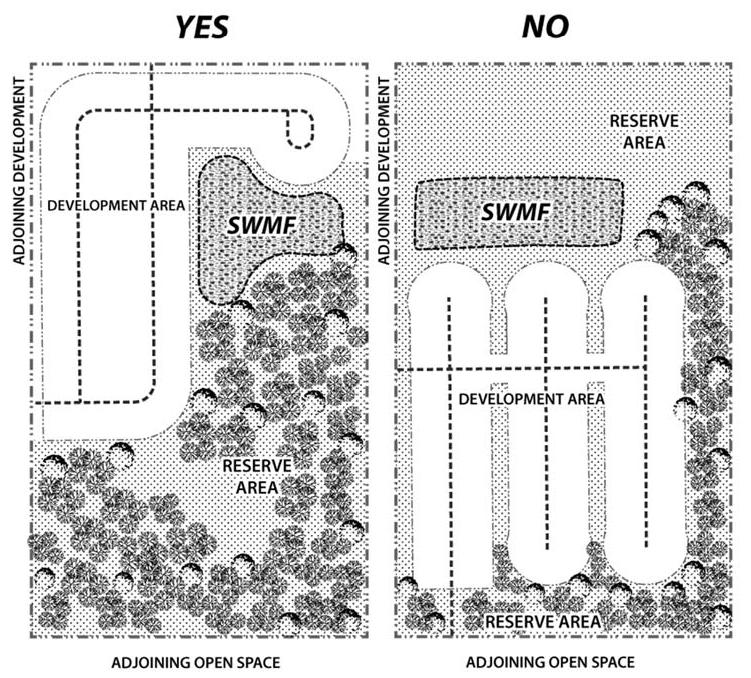 (d) Step 4: Mandatory Pre-submittal meeting. The applicant shall submit a conceptual
layout, whereas the CSRA area is shown as a single contiguous area with logical, straightforward
boundaries to eliminate fragmentation. DSEM staff shall review and provide feedback
at a scheduled pre-submittal meeting to:1. Identify potential site development issues;
and2. Provide an opportunity to discuss site development concepts, including the general
layout of CSRA and potential locations for proposed structures, utilities roads and
other development features.3. Design Principles for Clustered Subdivision Development Area. The development area shall be the area not set aside in the CSRA and shall comprise
no more than 40 percent of the total parcel. The development area shall be located
on the least environmentally sensitive or otherwise significant portions of the total
clustered subdivision parcel; and be shown as a single contiguous area with logical,
straightforward boundaries to eliminate fragmentation to the greatest extent practicable.
Design of the development area shall follow the procedural steps set forth below.(a)
Delineate areas of the site to be reserved due to their significant features and value
to the area's continued natural character in accordance with subsection 2 of this
section;
(d) Step 4: Mandatory Pre-submittal meeting. The applicant shall submit a conceptual
layout, whereas the CSRA area is shown as a single contiguous area with logical, straightforward
boundaries to eliminate fragmentation. DSEM staff shall review and provide feedback
at a scheduled pre-submittal meeting to:1. Identify potential site development issues;
and2. Provide an opportunity to discuss site development concepts, including the general
layout of CSRA and potential locations for proposed structures, utilities roads and
other development features.3. Design Principles for Clustered Subdivision Development Area. The development area shall be the area not set aside in the CSRA and shall comprise
no more than 40 percent of the total parcel. The development area shall be located
on the least environmentally sensitive or otherwise significant portions of the total
clustered subdivision parcel; and be shown as a single contiguous area with logical,
straightforward boundaries to eliminate fragmentation to the greatest extent practicable.
Design of the development area shall follow the procedural steps set forth below.(a)
Delineate areas of the site to be reserved due to their significant features and value
to the area's continued natural character in accordance with subsection 2 of this
section;
| |||||||||
|
(b) Determine the number of allowable lots;
(c) Locate potential development sites on the area of the tract not delineated as CSRA, with due consideration for topography, soil suitability for construction, and efficient service by public or central water and sewerage systems; (d) Align streets to serve residential sites, with due consideration for topography and connections to existing, planned or potential streets in adjacent areas, and align pedestrian trails if planned; (e) Delineate boundaries of individual residential lots where lot sizes and shapes, block sizes and shapes, and street networks and alignments shall be designed in accordance with accepted planning practices to produce a rational and economical system without undue clearing or grading. The lot arrangement, design and orientation shall be such that all lots will provide satisfactory building sites that are properly related to topography and the character of surrounding development, encourage a range of housing types and sizes, and provide safe and convenient vehicular access to public streets; and (f) Specific development and locational standards shall be subject to the minimum standards of the underlying land use category and base zoning district and shall be established at the time of development plan submittal. | |||||||||
| 10. Existing Nonconforming Non-Residential Uses: Existing non-residential uses within the lake protection land use category that meet all water quality and stormwater standards for their respective use, as specified within the land development regulations, will be considered permitted uses. | |||||||||
| 11. Sidewalks: Sidewalks shall be provided in the LP district consistent with the provisions of section 10-7.529. For clustered subdivisions, all required sidewalks shall connect to existing and proposed sidewalks to the maximum extent possible. Multi-use trails designed for non-motorized vehicles and pedestrians are also encouraged in the LP district to promote connectivity and to reduce automobile dependency. | |||||||||
| 12. Stormwater Management: Refer to section 10-4.301 for water quality treatment and volume control standards associated with development. Whenever possible. Low impact development (LID) techniques, as outlined in section 10-4.308, such as rain gardens and bio-retention swales are encouraged to allow stormwater infiltration to occur as close to the source as possible. A decentralized stormwater management design which disperses stormwater facilities across the site rather than to a centralized treatment facility is encouraged. | |||||||||
General notes:
(1)
If central sanitary sewer is not available, residential lots shall contain a minimum of 0.50 acres of contiguous buildable area. Non-residential development and community facilities are limited to a maximum of 900 gallons of wastewater flow per day. Refer to Sanitary Sewer Policy 2.1.12 of the Comprehensive Plan for additional requirements.
(2)
Residential lots in clustered subdivisions less than 60 feet in width shall be alley-loaded.
(3)
Refer to the Environmental Management Act (EMA) for information pertaining to the regulation of environmental features (preservation/conservation features), stormwater management requirements, etc.
(4)
Refer to the concurrency management ordinance for information pertaining to the availability of capacity for certain public facilities (roads, schools, parks, etc.).
(Code 1992, § 10-6.616; Ord. No. 07-20, § 2, 7-10-2007; Ord. No. 14-18, § 1, 12-9-2014; Ord. No. 15-10, § 1, 7-7-2015; Ord. No. 17-01, § 4, 1-24-2017; Ord. No. 23-07, § 1, 3-21-2023)
Sec. 10-6.617. - Residential Preservation (RP) Zoning District.
General notes:
1. If central sanitary sewer is not available, residential development is limited to a minimum of 0.50 acre lots.
2. Refer to the Environmental Management Act (EMA) for information pertaining to the regulation of environmental features (preservation/conservation features), stormwater management requirements, etc.
3. Refer to the Concurrency Management Ordinance for information pertaining to the availability of capacity for certain public facilities (roads, parks, etc.).
(Code 1992, § 10-6.617; Ord. No. 07-20, § 2, 7-10-2007; Ord. No. 16-07, § 4, 5-10-2016; Ord. No. 17-01, § 5, 1-24-2017; Ord. No. 18-17, § 1, 9-4-2018)
Sec. 10-6.618. - Lake Talquin Recreational/Urban Fringe.
(a)
Purpose and intent. The purpose and intent of the Lake Talquin recreational urban fringe district is to allow the same density as the urban fringe district through required clustering to protect environmentally sensitive areas. This area has unique characteristics in that it has developed to a large extent with weekend or vacation homes along the lake. In the future, a critical areas study will be performed for this area to ascertain the environmental impacts of future development as well to produce a strategy to provide services. Once this study has been completed the provisions of this district will be reassessed and this subdivision will be amended as appropriate.
(b)
Allowable uses. For the purpose of this subdivision, the following land use types are allowable in this zoning district and are controlled by the land use development standards of this subdivision, the Comprehensive Plan and schedules of permitted uses.
(1)
Minor commercial.
(2)
Neighborhood commercial.
(3)
Highway commercial.
(4)
Minor office.
(5)
Low-density residential.
(6)
Passive recreation.
(7)
Active recreation.
(8)
Community services.
(9)
Light infrastructure.
(10)
Heavy infrastructure.
(11)
Postsecondary.
(c)
List of permitted uses. Some of the uses on these schedules are itemized according to the Standard Industrial Code (SIC). Allowable uses, appropriate permit level and applicable development and locational standards in the Lake Talquin recreation urban fringe district are as follows:
_____
Legend
P = Permitted use R = Restricted use S = Special exception
(d)
Maximum allowable floor area. The maximum allowable floor area in the Lake Talquin urban fringe district is as follows:
*Maximum 10,000 gross square feet, if located on a local street.
**Only one neighborhood commercial site (quadrant) will be permitted at the intersection of a major collector and arterial road. The maximum allowable commercial development permitted at the neighborhood commercial area located at the intersection of two major collectors is 50,000 square feet g.s.l.a.
(e)
Minumum development standards. The minimum development standards in the Lake Talquin urban fringe district are as follows:
*This number applies to the perimeter setback only.
**Maximum percent impervious of developable portion of site.
***This height applies to habitable portion of an industrial structure.
_____
(f)
Development standards. All proposed development shall meet the commercial site location standards (section 10-6.619); buffer zone standards (section 10-7.522); and the parking and loading requirements (subdivision 3, division 5, article VII of this chapter).
(Code 1992, § 10-6.618; Ord. No. 07-20, § 2, 7-10-2007; Ord. No. 09-02, § 3, 1-15-2009; Ord. No. 16-07, § 5, 5-10-2016)
Sec. 10-6.619. - Commercial site location standards.
(a)
The provisions of this section apply to the following zoning districts: Urban fringe, activity center, rural community, Lake Talquin/urban fringe, and industrial. Commercial sites are determined through the use of site location standards. The intensity of the commercial use is dependent upon the land use category of the potential site and the classification of the immediate adjacent roads. Individual road classifications are depicted on map 14 of the Comprehensive Plan. The site location standard is intended to group commercial land use toward intersections to provide access and prevent strip commercialization.
(b)
Commercial classifications.
(1)
Minor commercial.
a.
Major function. Provide for sale of convenience goods and services to immediate residential area.
b.
Location.
1.
On or near the intersection (within 330 feet of the centerline of the intersection) of, local and arterial, collector and arterial, and collector and collector.
2.
May be located within planned unit development provided it is located and designed to meet commercial needs of the majority of the residents of the development.
3.
If on a local street, only one quadrant of the intersection shall be used for commercial purposes.
c.
Trade area. Generally within one mile and not considered as an attractor.
d.
Design standards.
1.
Compatible with adjacent uses.
2.
Adequate buffering, screening, landscaping and architectural treatment if integrated into neighborhood.
3.
Sufficient parking; properly designed and safe internal traffic circulation.
(2)
Neighborhood commercial.
a.
Major function. Provide for the sale of convenience goods and personal services such as food, drugs, sundries and hardware items to one or more neighborhoods.
b.
Leading tenants. Supermarket, drugstore and postal substation.
c.
Location. At the intersection of major collector and arterial or arterial and arterial. Only one neighborhood commercial development will be allowed within one-quarter mile of the centerline of the intersection of a major collector and arterial road.
(3)
Community commercial.
a.
Major function. Same functions of neighborhood commercial but on a large scale, provide for sale of retail goods such as clothing, variety items, appliances and furniture, hardware and home improvement items.
b.
Leading tenants. Supermarket, drug store, minor department store, home improvement center, variety or discount center.
c.
Location. Within one-quarter mile of the centerline of the intersection of arterials. Prohibited on designated canopy roads.
d.
Radius of trade area. Five miles or 15 to 20 minutes driving time. Service distinct geographical quadrants of three or more combinations of neighborhoods within community.
(4)
Regional commercial.
a.
Major function. Same functions of community center, provide full range and variety of shopping goods for comparative shopping such as general merchandise apparel, furniture and home furnishings.
b.
Leading tenants. One or more full-time department stores.
c.
Location. Integrated into local transportation system and accessible by combination of arterials, major collectors, expressways and interstate highways. Potential on-site and off-site transportation improvements needed to provide adequate ingress and egress. Prohibited on designated canopy roads.
d.
Radius of trade area. Regional.
e.
Site area. Minimum 35 acres.
f.
Range of gross floor area. Over 200,000 up to 1,000,000 square feet.
(5)
Highway commercial.
a.
Major function. Provide for consumer oriented retail services designed for drive-in convenience.
b.
Leading tenants. Fast food franchise, liquor store, automotive service (i.e., oil change), and convenience stores.
c.
Location. Access via a combination of arterials or major collectors or integrated into transportation network by comprehensive ingress and egress system. Parking within rear is encouraged.
d.
Radius of trade area. May serve immediate area but relies heavily on passerby traffic.
e.
Range of gross floor area. Up to 10,000 square feet.
f.
Design standards.
1.
Adequate setback.
2.
Aesthetic landscaping.
3.
Rear parking.
(Code 1992, § 10-6.619; Ord. No. 07-20, § 2, 7-10-2007; Ord. No. 14-14, § 2, 9-2-2014; Ord. No. 15-08, § 3, 7-7-2015; Ord. No. 17-01, § 6, 1-24-2017)
Sec. 10-6.631. - Suburban, Urban Residential, Urban Residential 2 and Bradfordville Mixed Use future land use map categories.
(a)
The land use element of the Tallahassee-Leon County Comprehensive Plan created Suburban, Urban Residential, Urban Residential 2 and Bradfordville Mixed Use future land use categories, which are shown as overlays to the future land use map. The following zoning districts are established within the Suburban, Urban Residential, Urban Residential 2 and Bradfordville Mixed Use overlays:
(1)
RA Residential Acre.
(2)
R-1 Single-Family Detached Residential District.
(3)
R-2 Single-Family Detached Residential District.
(4)
R-3 Single- and Two-Family Residential District.
(5)
R-4 Single-, Two-Family and Multifamily Residential District.
(6)
R-5 Manufactured Home and Single-Family Detached District.
(7)
MH Mobile Home Park District.
(8)
MR-1 Medium Density Residential District.
(9)
OR-1 Office Residential District.
(10)
OR-2 Office Residential District.
(11)
OR-3 Office Residential District.
(12)
OA-1 Airport Vicinity District.
(13)
C-1 Neighborhood Commercial District.
(14)
C-2 Neighborhood Commercial District.
(15)
CM Medical Arts Commercial District.
(16)
CP Commercial Parkway District.
(17)
UP-1 Urban Pedestrian District.
(18)
UP-2 Urban Pedestrian District.
(19)
M-1 Light Industrial District.
(20)
Planned Development.
(21)
OS Open Space District.
(22)
PUD Planned Unit Development District.
(23)
DRI Development of Regional Impact District.
(24)
IC Interchange Commercial.
(25)
BC-1 Bradfordville Commercial District.
(26)
BC-2 Bradfordville Commercial District.
(27)
BCS Bradfordville Commercial Services District.
(28)
BOR Bradfordville Office Residential District.
(b)
District intent, allowable uses and development standards for each of these districts are set forth in this subdivision.
(Code 1992, § 10-6.631; Ord. No. 07-20, § 2, 7-10-2007; Ord. No. 09-13, § 2, 3-19-2009)
_____
Sec. 10-6.632. - Development patterns.
The Comprehensive Plan establishes development patterns within the suburban future land use category. The chart below shows the zoning districts which were intended to implement these development patterns.
Development Patterns
Development Patterns
(Code 1992, § 10-6.632; Ord. No. 07-20, § 2, 7-10-2007; Ord. No. 09-33, § 2, 10-13-2009)
_____
Sec. 10-6.633. - Industrial District.
(a)
Purpose and intent: The purpose and intent of this district is to establish the appropriate location for the manufacturing, distribution, wholesaling, or storage of raw material, partially finished products or finished products characterized by one or more of the following attributes:
(1)
Potential for producing detectable off-site impacts—smoke, dust, dispersion of particulate matter, noxious or odorous gases, or any other air pollution;
(2)
Potential for producing detectable off-site water pollution, including thermal pollution;
(3)
The storage, manufacture, processing or distribution of any radioactive waste, explosive, or flammable materials;
(4)
The creation of noise or vibration not compatible with residential, agricultural, or commercial activities; or
(5)
Any use generating or storing, whether temporarily or permanently, more than 1,000 kg of hazardous waste per month.
a.
This district will accommodate land uses that have considerable impacts upon infrastructure and utilities; particularly upon: transportation (rail and highway systems), water, natural gas, wastewater treatment, and electricity. The location of this district and the standards required by this district will ensure that industrial uses will have access and facilities for truck and/or rail shipment, transfer, or delivery. This district is not intended to facilitate the shipment, transfer, or delivery of goods via passenger automobile traffic.
b.
This district will also allow industrial parks, transportation and communication facilities, as well as the manufacture, storage, or distribution of products unlikely to cause objectionable impacts to be detected off-site. Ancillary commercial uses, such as, offices, child care facilities, restaurants, designed and limited to serve persons working in the district are allowed. Other commercial and residential land uses are not allowed in this district; they would not be compatible with the uses that the district is intended for and would, in addition, have the potential to encroach upon or displace industrial uses, for which appropriate locations are at a premium.
(b)
Uses allowed in the district.
(1)
Permitted uses. These are the principal uses and activities allowed in this zoning district. This list of uses and activities is composed, to the extent possible, of major group classifications in the Standard Industrial Code (SIC). These major groups classifications are very broad; the SIC lists many other more specific industrial activities within these classes; unless specifically prohibited elsewhere in this section, these uses and activities are considered as permitted in this district. Other uses and activities not classified within the SIC, but appropriate for location within this district are also listed as permitted in this district. Further information concerning what uses are considered allowable in this district may be obtained by contacting the department of development support and environmental management.
a.
The following uses are permitted uses:
1.
#10 Metal mining.
2.
#13 Oil and gas extraction.
3.
#14 Mining and quarrying of nonmetallic minerals.
4.
#15 Building construction—general contractors and operative builders.
5.
#16 Heavy construction other than building construction contractors.
6.
#17 Construction—special trade contractors.
7.
#20 Food and kindred products—processing and manufacture.
8.
#21 Tobacco products—processing and manufacture.
9.
#22 Textile mill products—processing and manufacture.
10.
#23 Apparel and other finished products made from fabrics and similar materials—processing and manufacture.
11.
#24 Lumber and wood products, except furniture—cutting, milling, sawing, production, manufacture.
12.
#25 Furniture and fixtures—manufacture.
13.
#26 Paper and allied products—processing and manufacture.
14.
#27 Printing, publishing, and allied industries—publishing and publishing processes.
15.
#28 Chemicals and allied products—production.
16.
#30 Rubber and miscellaneous plastic products—manufacture.
17.
#31 Leather and leather products—processing and manufacture.
18.
#32 Stone, clay, glass, and concrete products—manufacture.
19.
#33 Primary metal industries—smelting, refining, manufacture.
20.
#34 Fabricated metal products, except machinery and transportation equipment—fabricating.
21.
#35 Industrial and commercial machinery and computer equipment—manufacture.
22.
#36 Electronic and other electrical equipment and components, except computer equipment—manufacture.
23.
#37 Transportation equipment—assembly and manufacture.
24.
#38 Measuring, analyzing, and controlling instruments; photographic, medical and optical goods; watches and clocks—manufacture.
25.
#39 Miscellaneous manufacturing industries.
26.
#40 Railroad transportation.
27.
#41 Local and suburban transit and interurban highway passenger transportation.
28.
#42 Motor freight transportation and warehousing.
29.
#43 United States Postal Service.
30.
#45 Transportation by air.
31.
#47 Transportation services.
32.
#48 Communications.
33.
#49 Electric, gas, and sanitary goods.
34.
#50 Wholesale trade—durable goods.
35.
#51 Wholesale trade—nondurable goods.
36.
#5984 Liquefied petroleum gas (bottled gas) dealers.
37.
#7211 Commercial power laundries.
38.
#7212 Garment pressing.
39.
#7213 Linen supply.
40.
#7216 Dry-cleaning plants.
41.
#7217 Carpet and upholstery cleaning.
42.
#7218 Industrial launderers.
43.
#7261 Funeral services and crematories.
44.
#7342 Disinfecting and pest control services.
45.
#7349 Building, cleaning and maintenance services.
46.
#735 Miscellaneous equipment rental and leasing.
47.
#7381 Armored car service; rental of dogs for protective services.
48.
#7384 Photofinishing laboratories.
49.
#7389 Auctioneering service on a commission or fee basis.
50.
#7389 Automobile recovery service.
51.
#7389 Field warehousing, not public warehousing.
52.
#7389 Packaging and labeling service; parcel packing.
53.
#7389 Recording studios.
54.
#7389 Repossession service.
55.
#7389 Water softener service.
56.
#7389 Window tinting.
57.
#7513 Truck rental and leasing; without drivers.
58.
#7519 Utility trailer and recreational vehicle rental.
59.
#966 Space research and technology.
60.
Biological research facilities.
61.
Chemical laboratories.
62.
Construction material storage and construction vehicle storage.
63.
Engineering laboratories.
64.
Farm vehicle sales, storage, repair, auction.
65.
Food research/testing facilities.
66.
Industrial laboratories.
67.
Laboratories, testing of products.
68.
Research laboratories.
69.
Storage yards.
70.
Testing facilities.
71.
Truck, bus, heavy equipment garages: maintenance, repair, motor pools.
72.
Trucking terminals.
73.
Warehouses.
b.
The following uses are permitted as conditional uses: #7389, Business Services, Not Elsewhere classified. The board may add additional uses within the #7389 industry number to the list of uses permitted in this district. These uses may be added through resolution of the board so long as the uses are consistent with the purpose and intent of this district and would not be likely to create incompatibilities with other uses permitted in this district.
c.
The following uses are permitted as accessory uses in this district:
1.
#581 Eating and drinking establishments. Allowed when located adjacent to a nonindustrial zoning district and not adjacent to any residential preservation zoning district or existing residential development, except when that development is a nonconforming land use. Such establishment may be no larger in size than 2,500 square feet, or may be located within the interior of any permitted use.
2.
#60 Depository institutions (banks/thrifts/credit unions, etc.). Allowed when located adjacent to a nonindustrial zoning district and not adjacent to any residential preservation zoning district or existing residential development, except when that development is a nonconforming land use. Such establishment may be no larger in size than 2,500 square feet, or may be located within the interior of any permitted use.
3.
#7363 Help supply services. Allowed when located adjacent to a nonindustrial zoning district and not adjacent to any residential preservation zoning district or existing residential development, except when that development is a nonconforming land use. Such establishment may be no larger in size than 2,500 square feet, or may be located within the interior of any permitted use.
4.
#7381 Security guard services. Allowed when located adjacent to a nonindustrial zoning district and not adjacent to any residential preservation zoning district or existing residential development, except when that development is a nonconforming use. Such establishment may be no larger in size than 2,500 square feet, or may be located within the interior of any permitted use.
5.
#835 Day care centers. Allowed as supplementary or accessory day care services as described in and regulated by section 10-6.811.
6.
Recreational amenities. Provided as an accessory to a permitted use established within the district for use by employees, management, and their guests.
(2)
The following uses are prohibited within this district:
a.
Landfilling.
b.
Permanent hazardous or toxic waste storage.
c.
Deep well injection of waste products.
d.
Biohazardous, hazardous, or toxic waste incineration.
e.
Wholesale outlets that sell to the general public are not permissible except for materials manufactured, or warehoused on-site. True wholesaling is permitted.
(c)
Development standards.
(1)
Height limitations.
a.
All measurements are from the average base elevation at ground level to highest point, except as noted.
b.
Habitable space (measured to highest floor elevation): 150 feet.
c.
Mechanical; water tower: 200 feet.
d.
Antennae, transmission tower; transponder station: no limitation except, proof of notification of the Administrator of the Federal Aviation Authority is required for proposed construction or alteration of any structure of 200 feet height or greater as required per the Federal Aviation Regulations part 77, subchapter B.
e.
Stack height limitations: 275 feet. A waiver may be obtained if following criteria are met:
1.
The height demonstrated by a fluid model or field study required and approved by the EPA, or the Department of Environmental Regulation which ensures that the emissions from a stack do not result in excessive concentrations of any air pollutant as a result of atmospheric downwash, wakes, or eddy effects created by the source itself, nearby structures, or nearby terrain features (the term "nearby" means as per F.A.C. ch. 17-2); and
2.
Proof of notification of the Administrator of the Federal Aviation Authority of proposed construction or alteration of any structure of 200 feet in height or greater as required per the Federal Aviation Regulations, part 77, subchapter B.
(2)
Setbacks and yard requirements.
a.
Structures fronting, having a corner side adjacent to, or otherwise adjoining streets or roadways that form zoning district boundaries shall be located no less than 50 feet from the property line along such roadway.
b.
Structures fronting on all other streets intended for public access shall be setback at least 20 feet from the property line along that street/roadway.
c.
Side setbacks from all other roadways/streets intended for public access should be setback at least 20 feet from the property line along such street/roadway.
d.
Access facilities intended primarily for loading/delivery of goods/materials and not to provide access by employees, customers and the general traveling public shall not be considered streets/roadways for the purpose of subsections (c)(2)a, b, and c of this section. Setbacks from such roadway/access facilities shall be sufficient to provide safe access.
e.
The required setback in all other instances shall be at least eight feet from the nearest property line.
(3)
Minimum lot size. 3,000 square feet.
(4)
Minimum lot frontage. 30 feet.
(5)
Minimum lot coverage.: All development in this district shall conform with applicable landscaping and natural area requirements and standards set forth in the EMA.
(6)
Maximum floor area ratio. Development in this district shall not be required to adhere to a maximum floor area ratio.
(7)
Open space standards. All development in this district shall comply with applicable open space requirements and standards set forth in the EMA.
(8)
Landscaping standards; visibility from other districts.
a.
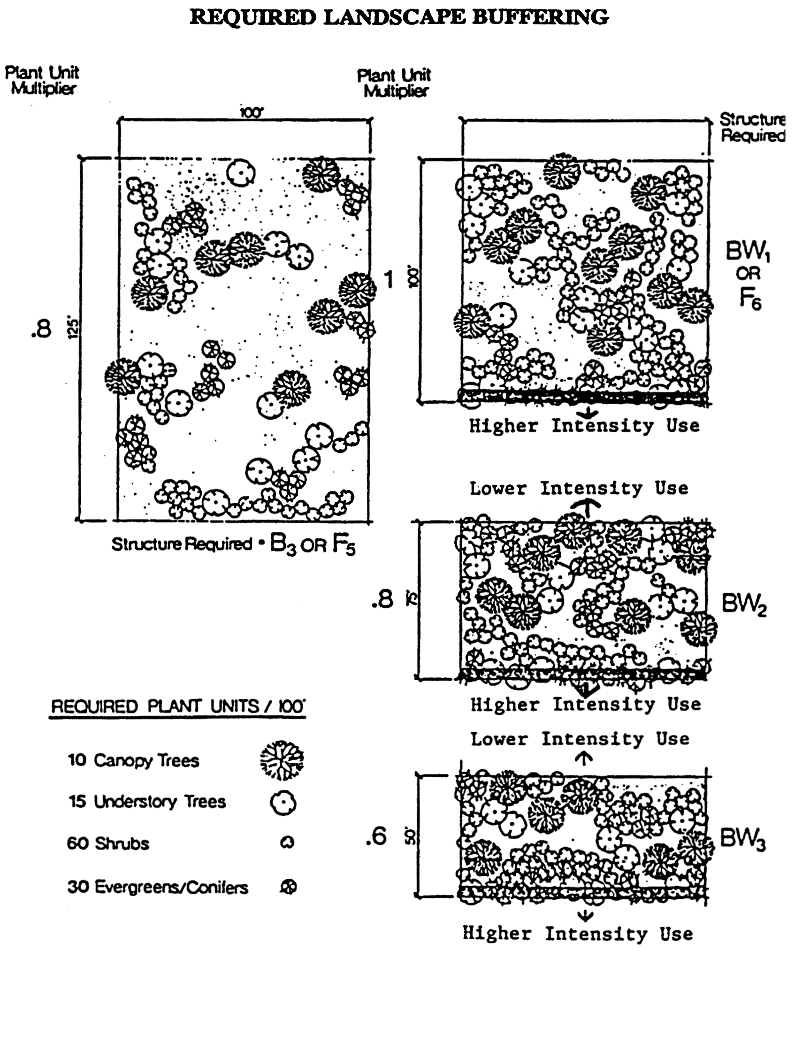
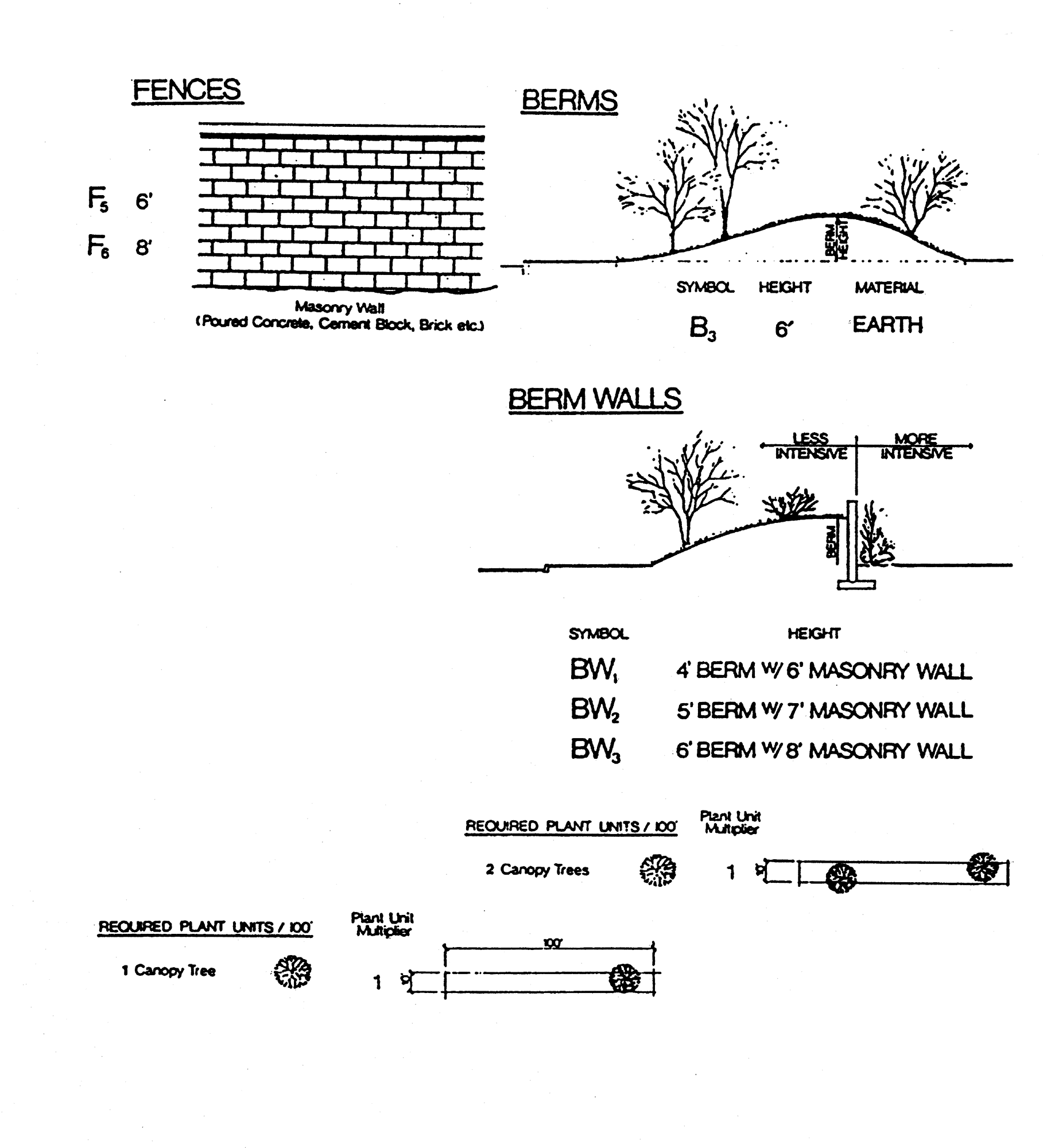
Buffering within the interior of the zoning district is not required; the provisions of section 10-7.522(d) are not applicable within the district. This district is intended to foster development of industrial uses and is not intended to protect nonindustrial uses from industrial uses.
b.
Except in those instances described in subsections c. and d. of this section, development in this district shall be required to place buffering between the industrial district land use and the adjoining district at the time of development of the industrial use. This buffer shall meet the standards depicted in section 10-7.522.
c.
Development in this district adjacent to another land use in another district shall be required to place buffering to at least Type A standards (see section 10-7.522) between the industrial land use and the adjoining district at the time of development of the industrial use when the adjacent use in the adjoining district is:
1.
A conforming use; and
2.
Is a use listed as a principal use in this industrial zoning district.
d.
In instances where an accessory use, as per subsection (b)(1)b of this section. Is established on the periphery of this district, buffering to at least Type B standards (see section 10-7.522) shall be placed between that use and the adjoining zoning district; except when the adjacent zoning district is located on the opposite side of a major collector roadway, arterial road, or limited access highway, railroad, or river in which case buffering shall be at least to Type A standards except at access points, where buffering shall not be required.
(9)
Fencing requirement: All areas proposed for use, currently used, or previously used, in open-pit mining operations and/or construction and demolition debris disposal must be secured by a fence, unless the area is determined to be a reclaimed open-pit mine by the County Administrator or designee. The fence must be at least four feet in height with openings that will reject the passage of a seven-inch diameter sphere. The fence must be equipped with a gate which shall remain locked when workers or employees of the land owner or mining company are not present at the site. At every gate or access point, at least one sign must be posted which states, in at least four-inch tall letters, "Danger," "Keep Out," "No Trespassing," or similar language to indicate that there may be hazardous conditions on the premises.
(d)
Parking requirements. See section 10-7.545, schedule 6-2(23) and (24).
(e)
Expansion of the district. Land shall be added to this zoning district through rezoning only upon the simultaneous and concurrent amendment of the future land use map of the Comprehensive Plan to reflect the designation of additional land for industrial use. Additional land may be added to this district only upon the satisfaction of one of two following requirements:
(1)
The land to be added is adjacent to present district boundaries; or
(2)
The area to be included is at least 60 acres in size. The following factors shall be considered in determining the appropriateness of proposed locations for inclusion in the industrial zoning district: access to electric, natural gas, central water, and central sewer infrastructure; access to major transportation facilities, such as, Tallahassee International Airport, Interstate 10, rail service, or arterial highways; proximity to institutions of higher learning; proximity to the source of raw product or natural resource; proximity to employment force; low potential for environmental degradation (little or no anticipated impacts upon established biological communities and any "listed" species, minimal need for topographic changes, limited potential for adverse human health impacts); and minimal potential for creating land use incompatibilities with existing or proposed development.
(Code 1992, § 10-6.633; Ord. No. 07-20, § 2, 7-10-2007; Ord. No. 08-17, § 4, 7-22-2008; Ord. No. 20-06, § 3, 4-28-2020)
Sec. 10-6.634. - RA Residential Acre District.
General notes:
(1)
If central sanitary sewer is not available, non-residential development is limited to a maximum of 900 gallons of wastewater flow per day. Community service facilities are limited to no more than 5,000 square feet, or a sewage flow not to exceed 900 gallons per day. Also, refer to Sanitary Sewer Policies 1.2.3 and 2.1.2 of the Utilities Element of the Comprehensive Plan for additional requirements.
(2)
Refer to the Environmental Management Act (EMA) for Information pertaining to the regulation of environmental features (preservation/conservation features), stormwater management requirements, etc.
(3)
Refer to the concurrency management ordinance for information pertaining to the availability of capacity for certain public facilities (roads, parks, etc.).
(Code 1992, § 10-6.634; Ord. No. 07-20, § 2, 7-10-2007; Ord. No. 09-13, § 4, 3-19-2009; Ord. No. 16-07, § 6, 5-10-2016; Ord. No. 23-05, § 3, 2-21-2023)
Sec. 10-6.635. - R-1 Single-Family Detached Residential District.
General notes:
(1)
If central sanitary sewer is not available, residential development is limited to a minimum of 0.50 acre lots and non-residential development is limited to a maximum of 900 gallons of wastewater flow per day. Community service facilities are limited to no more than 5,000 square feet, or a sewage flow not to exceed 900 gallons per day. Also, refer to Sanitary Sewer Policies 1.2.3 and 2.1.2 of the Utilities Element of the Comprehensive Plan for additional requirements.
(2)
Refer to the Environmental Management Act (EMA) for information pertaining to the regulation of environmental features (preservation/conservation features), stormwater management requirements, etc.
(3)
Refer to the concurrency management ordinance for information pertaining to the availability of capacity for certain public facilities (roads, parks, etc.).
(Ord. No. 07-20, § 2, 7-10-2007; Ord. No. 09-13, § 4, 3-19-2009; Ord. No. 23-05, § 4, 2-21-2023)
Sec. 10-6.636. - R-2 Single-Family Detached Residential District.
General notes:
(1)
If central sanitary sewer is not available, residential development is limited to a minimum of 0.50 acre lots and non-residential development is limited to a maximum of 900 gallons of wastewater flow per day. Community service facilities are limited to no more than 5,000 square feet, or a sewage flow not to exceed 900 gallons per day. Also, refer to Sanitary Sewer Policies 1.2.3 and 2.1.2 of the Utilities Element of the Comprehensive Plan for additional requirements.
(2)
Refer to the Environmental Management Act (EMA) for information pertaining to the regulation of environmental features (preservation/conservation features), stormwater management requirements, etc.
(3)
Refer to the concurrency management ordinance for information pertaining to the availability of capacity for certain public facilities (roads, parks, etc.).
(Code 1992, § 10-6.636; Ord. No. 07-20, § 2, 7-10-2007; Ord. No. 09-13, § 4, 3-19-2009; Ord. No. 23-05, § 5, 2-21-2023)
Sec. 10-6.637. - R-3 Single- and Two-Family Residential District.
General notes:
(1)
If central sanitary sewer is not available, residential development is limited to a minimum of 0.50 acre lots and non-residential development is limited to a maximum of 900 gallons of wastewater flow per day. Community service facilities are limited to no more than 5,000 square feet, or a sewage flow not to exceed 900 gallons per day. Also, refer to Sanitary Sewer Policies 1.2.3 and 2.1.2 of the Utilities Element of the Comprehensive Plan for additional requirements.
(2)
Refer to the Environmental Management Act (EMA) for information pertaining to the regulation of environmental features (preservation/conservation features), stormwater management requirements, etc.
(3)
Refer to the concurrency management ordinance for information pertaining to the availability of capacity for certain public facilities (roads, parks, etc.).
(Code 1992, § 10-6.637; Ord. No. 07-20, § 2, 7-10-2007; Ord. No. 09-13, § 4, 3-19-2009; Ord. No. 23-05, § 6, 2-21-2023)
Sec. 10-6.638. - R-4 Urban Residential District.
General notes:
(1)
If central sanitary sewer is not available, residential development is limited to a minimum of 0.50 acre lots and non-residential development is limited to a maximum of 900 gallons of wastewater flow per day. Community service facilities are limited to no more than 5,000 square feet, or a sewage flow not to exceed 900 gallons per day. Also, refer to Sanitary Sewer Policies 1.2.3 and 2.1.2 of the Utilities Element of the Comprehensive Plan for additional requirements.
(2)
Refer to the Environmental Management Act (EMA) for information pertaining to the regulation of environmental features (preservation/conservation features), stormwater management requirements, etc.
(3)
Refer to the concurrency management ordinance for information pertaining to the availability of capacity for certain public facilities (roads, parks, etc.).
(Code 1992, § 10-6.638; Ord. No. 07-20, § 2, 7-10-2007; Ord. No. 09-13, § 4, 3-19-2009; Ord. No. 23-05, § 7, 2-21-2023)
Sec. 10-6.639. - R-5 Manufactured Home and Single-Family Detached District.
General notes:
(1)
If central sanitary sewer is not available, residential development is limited to a minimum of 0.50 acre lots and non-residential development is limited to a maximum of 900 gallons of wastewater flow per day. Community service facilities are limited to no more than 5,000 square feet, or a sewage flow not to exceed 900 gallons per day. Also, refer to Sanitary Sewer Policies 1.2.3 and 2.1.2 of the Utilities Element of the Comprehensive Plan for additional requirements.
(2)
Refer to the Environmental Management Act (EMA) for information pertaining to the regulation of environmental features (preservation/conservation features), stormwater management requirements, etc.
(3)
Refer to the concurrency management ordinance for information pertaining to the availability of capacity for certain public facilities (roads, parks, etc.).
(Code 1992, § 10-6.639; Ord. No. 07-20, § 2, 7-10-2007; Ord. No. 09-13, § 4, 3-19-2009; Ord. No. 23-05, § 8, 2-21-2023)
Sec. 10-6.640. - MH Manufactured Home Park District.
General notes:
(1)
If central sanitary sewer is not available, residential development is limited to a minimum of 0.50-acre lots and non-residential development is limited to a maximum of 900 gallons of wastewater flow per day. Community service facilities are limited to no more than 5,000 square feet, or a sewage flow not to exceed 900 gallons per day. Also, refer to Sanitary Sewer Policies 1.2.3 and 2.1.2 of the Utilities Element of the Comprehensive Plan for additional requirements.
(2)
Refer to the Environmental Management Act (EMA) for information pertaining to the regulation of environmental features (preservation/conservation features), stormwater management requirements, etc.
(3)
Refer to the concurrency management ordinance for information pertaining to the availability of capacity for certain public facilities (roads, parks, etc.).
(Code 1992, § 10-6.640; Ord. No. 07-20, § 2, 7-10-2007; Ord. No. 09-13, § 4, 3-19-2009; Ord. No. 23-05, § 9, 2-21-2023)
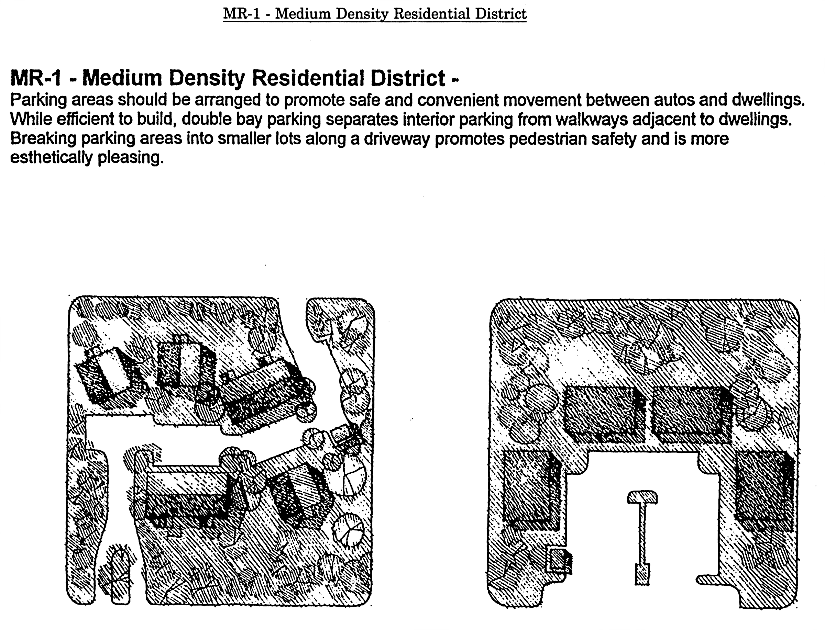
Sec. 10-6.641. - MR-1 Medium Density Residential District.
General notes:
(1)
If central sanitary sewer is not available, non-residential development is limited to a maximum of 900 gallons of wastewater flow per day. Community service facilities are limited to no more than 5,000 square feet, or a sewage flow not to exceed 900 gallons per day. Also, refer to Sanitary Sewer Policies 1.2.3 and 2.1.2 of the Utilities Element of the Comprehensive Plan for additional requirements.
(2)
Refer to the Environmental Management Act (EMA) for information pertaining to the regulation of environmental features (preservation/conservation features), stormwater management requirements, etc.
(3)
Refer to the concurrency management ordinance for information pertaining to the availability of capacity for certain public facilities (roads, parks, etc.).
(Code 1992, § 10-6.641; Ord. No. 97-12, § 26, 7-8-1997; Ord. No. 99-15, § 17, 5-25-1999; Ord. No. 07-20, § 2, 7-10-2007; Ord. No. 09-13, § 4, 3-19-2009; Ord. No. 23-05, § 10, 2-21-2023)
Sec. 10-6.642. - OR-1 Office Residential District.
General notes:
(1)
If central sanitary sewer is not available, residential development is limited to a minimum of 0.50-acre lots and non-residential development is limited to a maximum of 900 gallons of wastewater flow per day. Community service facilities are limited to no more than 5,000 square feet, or a sewage flow not to exceed 900 gallons per day. Also, refer to Sanitary Sewer Policies 1.2.3 and 2.1.2 of the Utilities Element of the Comprehensive Plan for additional requirements.
(2)
Refer to the Environmental Management Act (EMA) for information pertaining to the regulation of environmental features (preservation/conservation features), stormwater management requirements, etc.
(3)
Refer to the concurrent management ordinance for Information pertaining to the availability of capacity for certain public facilities (roads, parks, etc.).
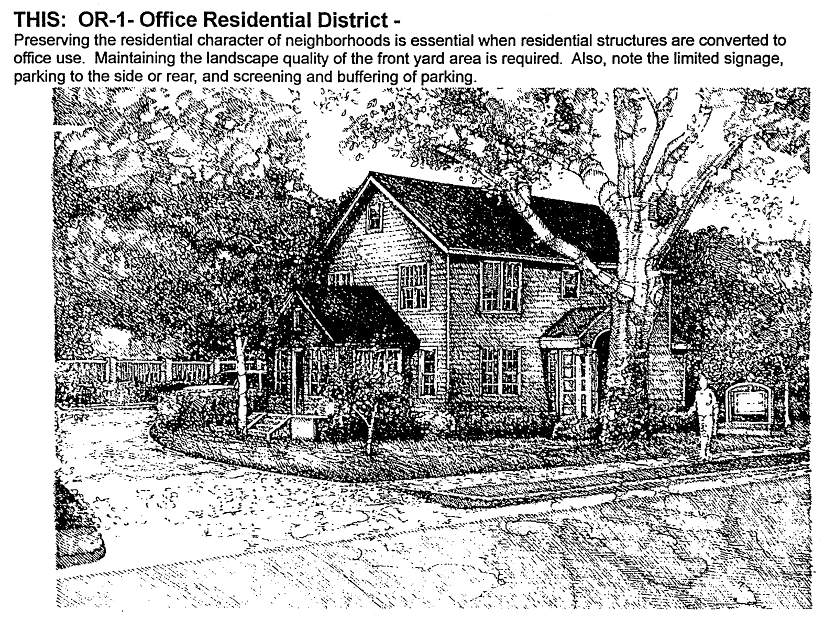
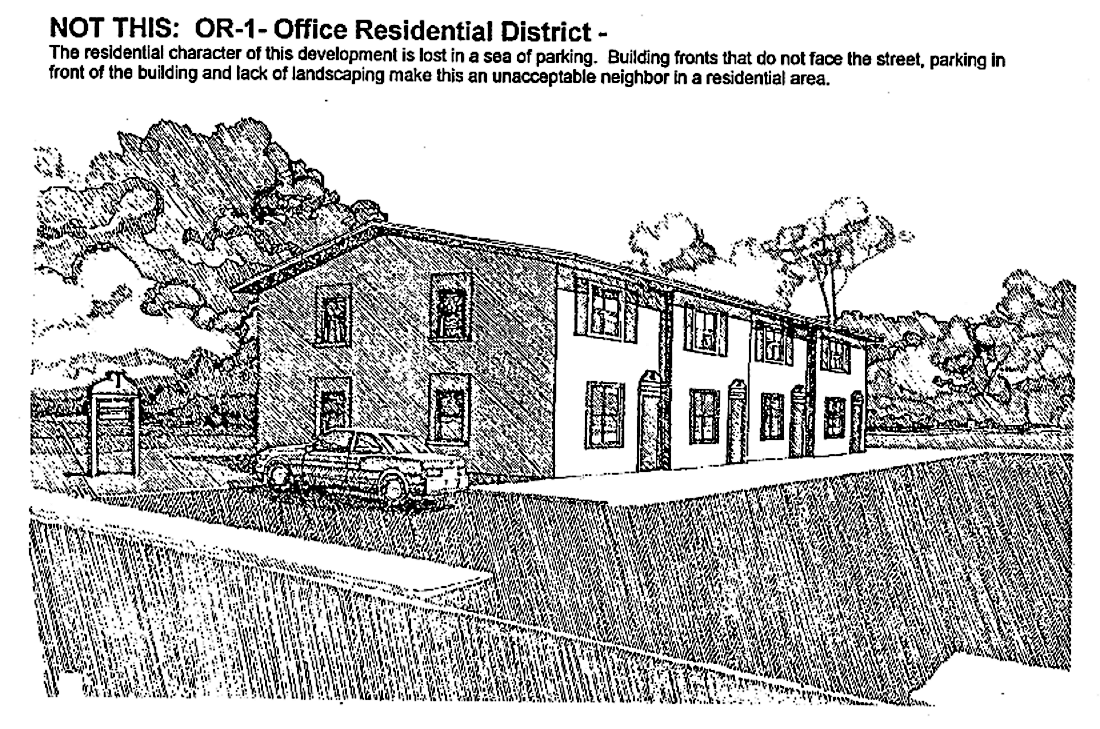
(Code 1992, § 10-6.642; Ord. No. 07-20, § 2, 7-10-2007; Ord. No. 09-13, § 4, 3-19-2009; Ord. No. 16-07, § 7, 5-10-2016; Ord. No. 23-05, § 11, 2-21-2023)
Sec. 10-6.643. - OR-2 Office Residential District.
General notes:
(1)
If central sanitary sewer is not available, residential development is limited to a minimum of 0.50-acre lots and non-residential development is limited to a maximum of 900 gallons of wastewater flow per day. Community service facilities are limited to no more than 5,000 square feet, or a sewage flow not to exceed 900 gallons per day. Also, refer to Sanitary Sewer Policies 1.2.3 and 2.1.2 of the Utilities Element of the Comprehensive Plan for additional requirements.
(2)
Refer to the Environmental Management Act (EMA) for information pertaining to the regulation of environmental features (preservation/conservation features), stormwater management requirements, etc.
(3)
Refer to the concurrent management ordinance for information pertaining to the availability of capacity for certain public facilities (roads, parks, etc.).
(Code 1992, § 10-6.643; Ord. No. 07-20, § 2, 7-10-2007; Ord. No. 09-13, § 4, 3-19-2009; Ord. No. 09-33, § 3, 10-13-2009; Ord. No. 16-07, § 8, 5-10-2016; Ord. No. 23-05, § 12, 2-21-2023)
Sec. 10-6.644. - OR-3 Office Residential District.
General notes:
(1)
If central sanitary sewer is not available, residential development is limited to a minimum of 0.50-acre lots and non-residential development is limited to a maximum of 900 gallons of wastewater flow per day. Community service facilities are limited to no more than 5,000 square feet, or a sewage flow not to exceed 900 gallons per day. Also, refer to Sanitary Sewer Policies 1.2.3 and 2.1.2 of the Utilities Element of the Comprehensive Plan for additional requirements.
(2)
Refer to the Environmental Management Act (EMA) for information pertaining to the regulation of environmental features (preservation/conservation features), stormwater management requirements, etc.
(3)
Refer to the concurrency management ordinance for information pertaining to the availability of capacity for certain public facilities (roads, parks, etc.).
(4)
In properties formerly designated as Mixed Use-C in the future land use map, the maximum non-residential gross building floor area is 40,000 square feet per acre and the maximum building height is six stories, if parking structures are provided for at least 50 percent of the parking spaces.
(Code 1992, § 10-6.644; Ord. No. 07-20, § 2, 7-10-2007; Ord. No. 09-13, § 4, 3-19-2009; Ord. No. 16-07, § 9, 5-10-2016; Ord. No. 23-05, § 13, 2-21-2023)
Sec. 10-6.645. - OA-1 Airport Vicinity District.
General notes:
(1)
If central sanitary sewer is not available, non-residential development is limited to a maximum of 900 gallons of wastewater flow per day. Community service facilities are limited to no more than 5,000 square feet, or a sewage flow not to exceed 900 gallons per day. Also, refer to Sanitary Sewer Policies 1.2.3 and 2.1.2 of the Utilities Element of the Comprehensive Plan for additional requirements.
(2)
Refer to the Environmental Management Act (EMA) for information pertaining to the regulation of environmental features (preservation/conservation features), stormwater management requirements, etc.
(3)
Refer to the concurrency management ordinance for information pertaining to the availability of capacity for certain public facilities (roads, parks, etc.).
(Code 1992, § 10-6.645; Ord. No. 07-20, § 2, 7-10-2007; Ord. No. 09-13, § 4, 3-19-2009; Ord. No. 23-05, § 14, 2-21-2023)
Sec. 10-6.646. - C-1 Neighborhood Commercial District.
General notes:
(1)
If central sanitary sewer is not available, residential development is limited to a minimum of 0.50-acre lots inside the urban service area, and non-residential development is limited to a maximum of 900 gallons of wastewater flow per day. Community service facilities are limited to no more than 5,000 square feet, or a sewage flow not to exceed 900 gallons per day. Also, refer to Sanitary Sewer Policies 1.2.3 and 2.1.2 of the Utilities Element of the Comprehensive Plan for additional requirements.
(2)
Refer to the Environmental Management Act (EMA) for information pertaining to the regulation of environmental features (preservation/conservation features), stormwater management requirements, etc.
(3)
Refer to the concurrency management ordinance for information pertaining to the availability of capacity for certain public facilities (roads, parks, etc.).
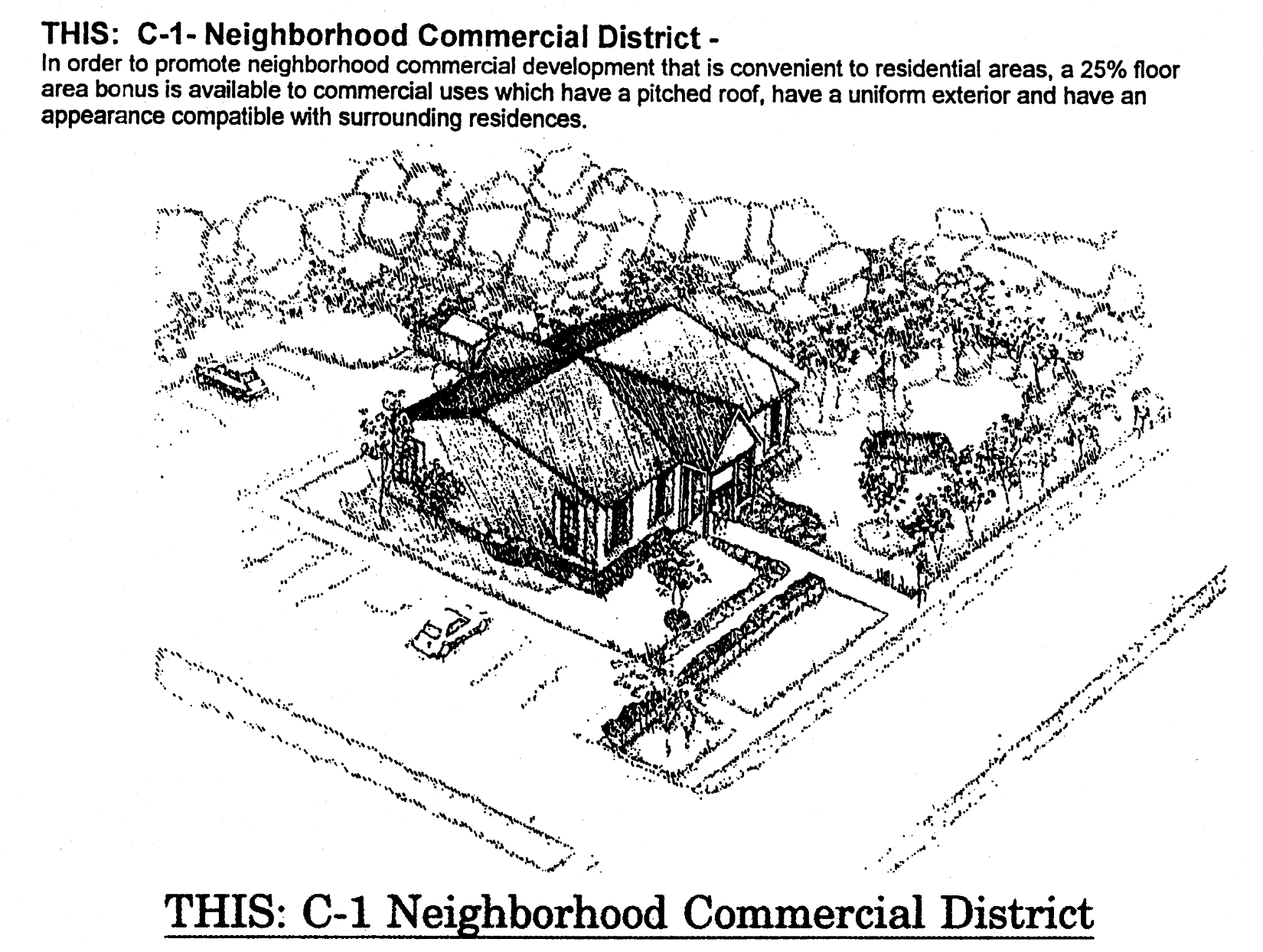
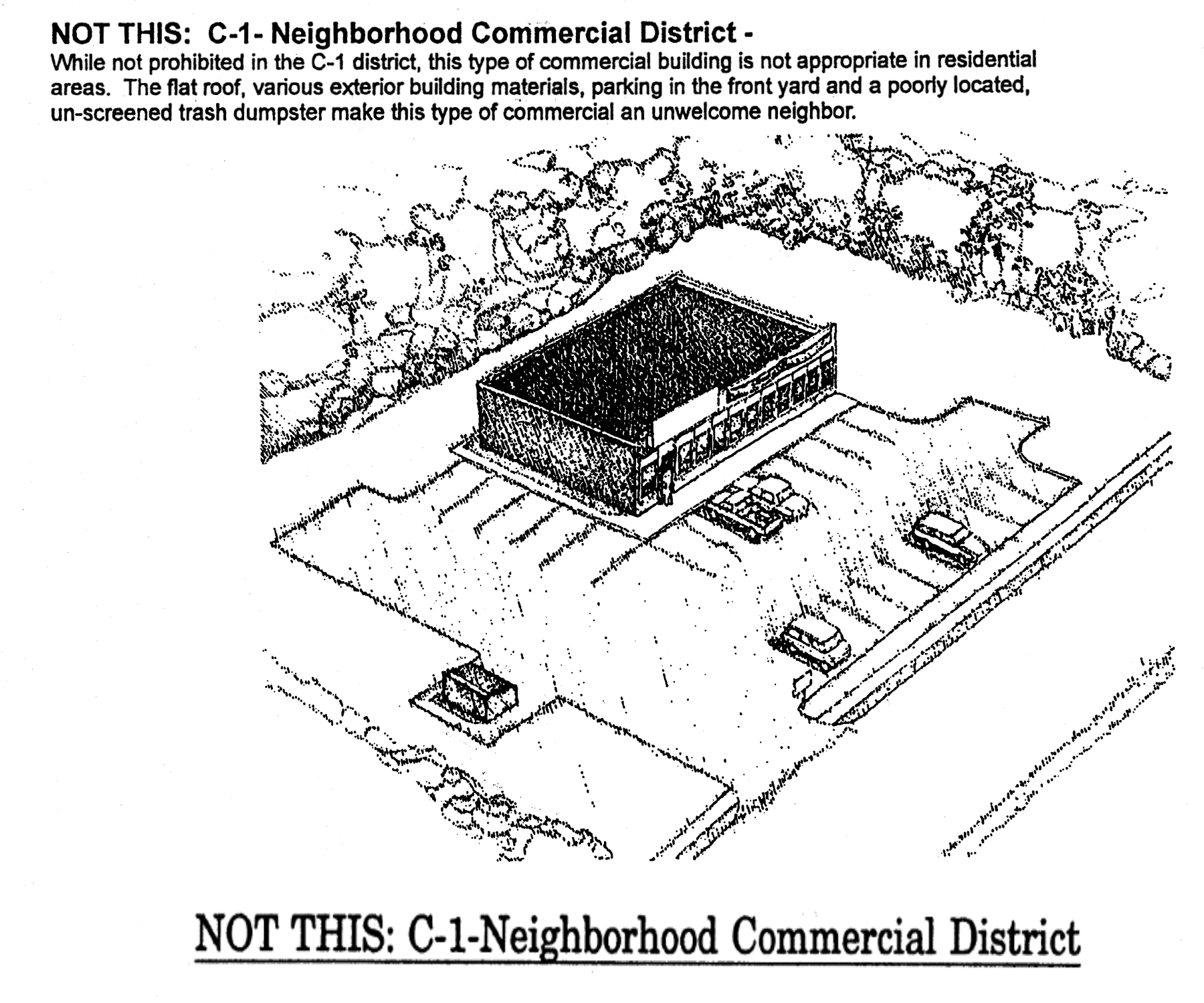
(Code 1992, § 10-6.646; Ord. No. 07-20, § 2, 7-10-2007; Ord. No. 09-13, § 4, 3-19-2009; Ord. No. 09-33, § 3, 10-13-2009; Ord. No. 23-05, § 15, 2-21-2023)
Sec. 10-6.647. - C-2 General Commercial District.
General notes:
(1)
If central sanitary sewer is not available, residential development is limited to a minimum of 0.50-acre lots and inside the urban service area non-residential development is limited to a maximum of 900 gallons of wastewater flow per day. Community service facilities are limited to no more than 5,000 square feet, or a sewage flow not to exceed 900 gallons per day. Also, refer to Sanitary Sewer Policies 1.2.3 and 2.1.2 of the Utilities Element of the Comprehensive Plan for additional requirements.
(2)
Refer to the Environmental Management Act (EMA) for information pertaining to the regulation of environmental features (preservation/conservation features), stormwater management requirements, etc.
(3)
Refer to the concurrency management ordinance for information pertaining to the availability of capacity for certain public facilities (roads, parks, etc.).
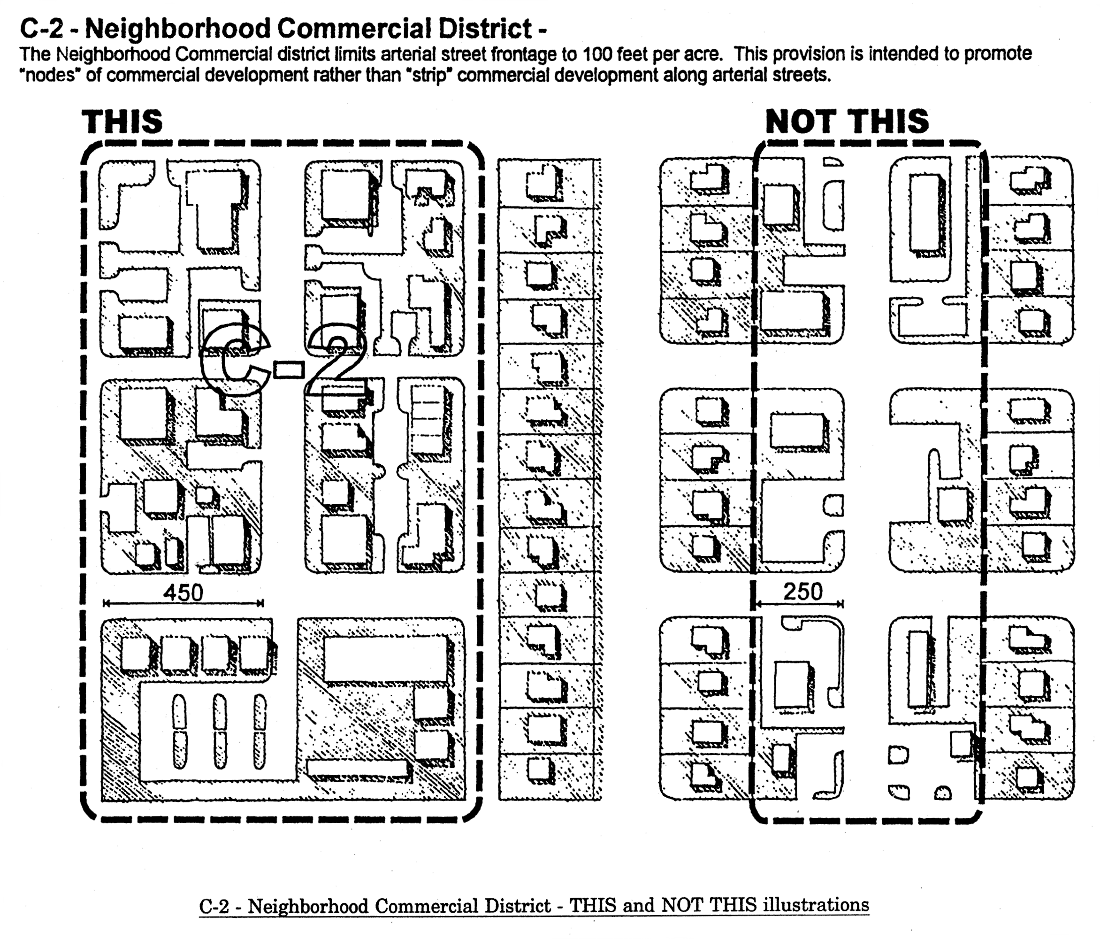
(Code 1992, § 10-6.647; Ord. No. 07-20, § 2, 7-10-2007; Ord. No. 09-13, § 4, 3-19-2009; Ord. No. 09-33, § 3, 10-13-2009; Ord. No. 16-07, § 10, 5-10-2016; Ord. No. 23-05, § 16, 2-21-2023)
Sec. 10-6.648. - CM Medical Arts Commercial District.
General notes:
(1)
If central sanitary sewer is not available, residential development is limited to a minimum of 0.50-acre lots and non-residential development is limited to a maximum of 900 gallons of wastewater flow per day. Community service facilities are limited to no more than 5,000 square feet, or a sewage flow not to exceed 900 gallons per day. Also, refer to Sanitary Sewer Policies 1.2.3 and 2.1.2 of the Utilities Element of the Comprehensive Plan for additional requirements.
(2)
Refer to the Environmental Management Act (EMA) for information pertaining to the regulation of environmental features (preservation/conservation features), stormwater management requirements, etc.
(3)
Refer to the concurrency management ordinance for information pertaining to the availability of capacity for certain public facilities (roads, parks, etc.).
(Code 1992, § 10-6.648; Ord. No. 07-20, § 2, 7-10-2007; Ord. No. 09-13, § 4, 3-19-2009; Ord. No. 23-05, § 17, 2-21-2023)
Sec. 10-6.649. - CP Commercial Parkway District.
General notes:
(1)
If central sanitary sewer is not available, residential development is limited to a minimum of 0.50-acre lots and non-residential development is limited to a maximum of 900 gallons of wastewater flow per day. Community service facilities are limited to no more than 5,000 square feet, or a sewage flow not to exceed 900 gallons per day. Also, refer to Sanitary Sewer Policies 1.2.3 and 2.1.2 of the Utilities Element of the Comprehensive Plan for additional requirements.
(2)
Refer to the Environmental Management Act (EMA) for information pertaining to the regulation of environmental features (preservation/conservation features), stormwater management requirements, etc.
(3)
Refer to the concurrency management ordinance for information pertaining to the availability of capacity for certain public facilities (roads, parts, etc.).
(Code 1992, § 10-6.649; Ord. No. 07-20, § 2, 7-10-2007; Ord. No. 08-27, § 1, 11-25-2008; Ord. No. 09-13, § 4, 3-19-2009; Ord. No. 17-01, § 7, 1-24-2017; Ord. No. 23-05, § 18, 2-21-2023)
Sec. 10-6.650. - UP-1 Urban Pedestrian District.
General notes:
(1)
If central sanitary sewer is not available, residential development is limited to a minimum of 0.50 acre lots and non-residential development is limited to a maximum of 900 gallons of wastewater flow per day. Community service facilities are limited to no more than 5,000 square feet, or a sewage flow not to exceed 900 gallons per day. Also, refer to Sanitary Sewer Policies 1.2.3 and 2.1.2 of the Utilities Element of the Comprehensive Plan for additional requirements.
(2)
Refer to the Environmental Management Act (EMA) for information pertaining to the regulation of environmental features (preservation/conservation features), stormwater management requirements, etc.
(3)
Refer to the concurrency management ordinance for information pertaining to the availability of capacity for certain public facilities (roads, parks, etc.).
(Code 1992, § 10-6.650; Ord. No. 07-20, § 2, 7-10-2007; Ord. No. 09-13, § 4, 3-19-2009; Ord. No. 16-07, § 11, 5-10-2016; Ord. No. 23-05, § 19, 2-21-2023)
Sec. 10-6.651. - UP-2 Urban Pedestrian District.
General notes:
(1)
If central sanitary sewer is not available, residential development is limited to a minimum of 0.50-acre lots and non-residential development is limited to a maximum of 900 gallons of wastewater flow per day. Community service facilities are limited to no more than 5,000 square feet, or a sewage flow not to exceed 900 gallons per day. Also, refer to Sanitary Sewer Policies 1.2.3 and 2.1.2 of the Utilities Element of the Comprehensive Plan for additional requirements.
(2)
Refer to the Environmental Management Act (EMA) for information pertaining to the regulation of environmental features (preservation/conservation features), stormwater management requirements, etc.
(3)
Refer to the concurrency management ordinance for information pertaining to the availability of capacity for certain public facilities (roads, parks, etc.).
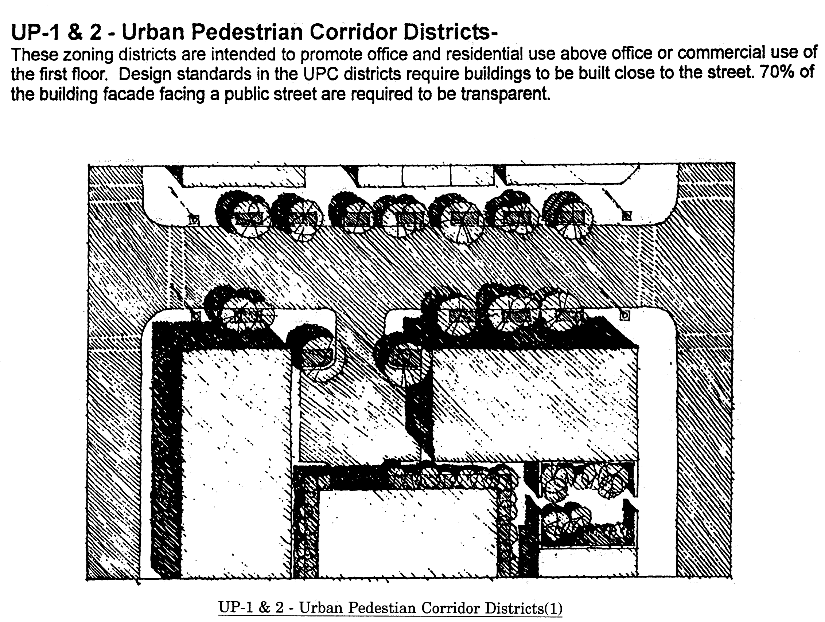
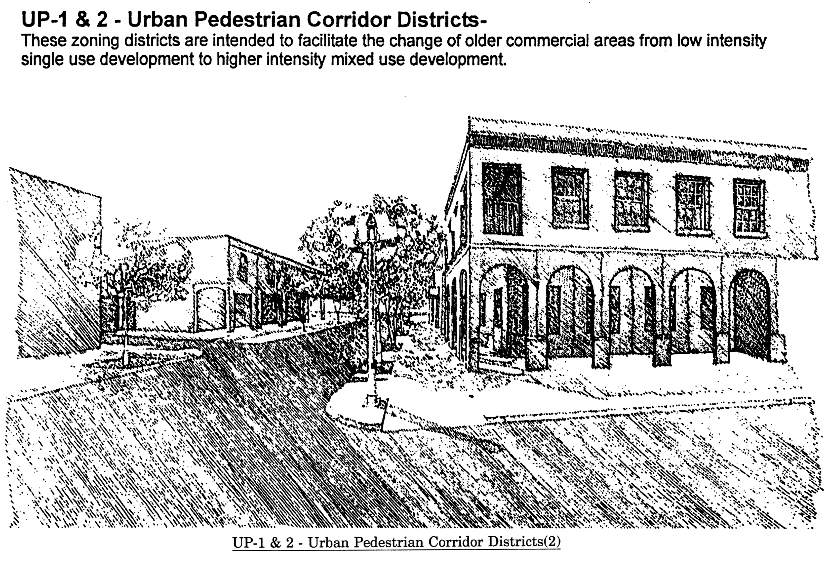
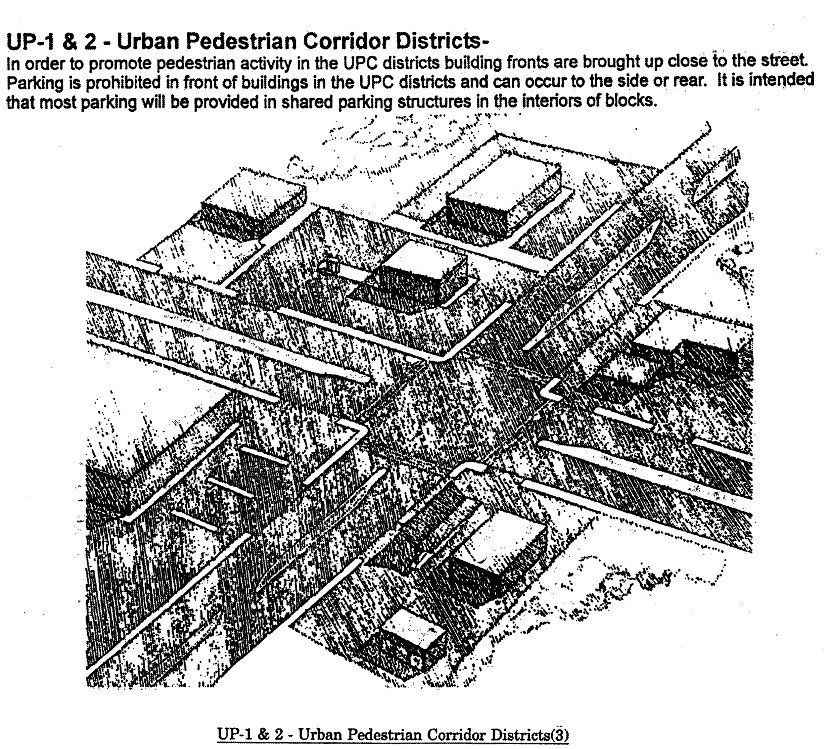
(Code 1992, § 10-6.651; Ord. No. 07-20, § 2, 7-10-2007; Ord. No. 09-13, § 4, 3-19-2009; Ord. No. 16-07, § 12, 5-10-2016; Ord. No. 23-05, § 20, 2-21-2023)
Sec. 10-6.652. - M-1 Light Industrial District.
General notes:
(1)
If central sanitary sewer is not available, residential development is limited to a minimum of 0.50-acre lots and non-residential development is limited to a maximum of 900 gallons of wastewater flow per day. Community service facilities are limited to no more than 5,000 square feet, or a sewage flow not to exceed 900 gallons per day. Also, refer to Sanitary Sewer Policies 1.2.3 and 2.1.2 of the Utilities Element of the Comprehensive Plan for additional requirements.
(2)
Refer to the Environmental Management Act (EMA) for information pertaining to the regulation of environmental features (preservation/conservation features), stormwater management requirements, etc.
(3)
Refer to the concurrency management ordinance for information pertaining to the availability of capacity for certain public facilities (roads, parks, etc.).
(Code 1992, § 10-6.652; Ord. No. 07-20, § 2, 7-10-2007; Ord. No. 08-17, § 5, 7-22-2008; Ord. No. 09-13, § 4, 3-19-2009; Ord. No. 13-06, § 3, 3-12-2013; Ord. No. 14-16, § 1, 11-18-2014; Ord. No. 23-05, § 21, 2-21-2023)
Sec. 10-6.653. - IC Interchange Commercial District.
General notes:
(1)
If central sanitary sewer is not available, residential development is limited to a minimum of 0.50-acre lots and non-residential development is limited to a maximum of 900 gallons of wastewater flow per day. Community service facilities are limited to no more than 5,000 square feet, or a sewage flow not to exceed 900 gallons per day. Also, refer to Sanitary Sewer Policies 1.2.3 and 2.1.2 of the Utilities Element of the Comprehensive Plan for additional requirements.
(2)
Refer to the Environmental Management Act (EMA) for information pertaining to the regulation of environmental features (preservation/conservation features), stormwater management requirements, etc.
(3)
Refer to the concurrency management ordinance for information pertaining to the availability of capacity for certain public facilities (roads, parks, etc.).
(Code 1992, § 10-6.653; Ord. No. 07-20, § 2, 7-10-2007; Ord. No. 09-13, § 4, 3-19-2009; Ord. No. 22-17, § 4, 6-14-2022; Ord. No. 23-05, § 22, 2-21-2023)
Sec. 10-6.654.1. - MCN Mahan Corridor Node District.
General notes:
1.
If central sanitary sewer is not available, residential development is limited to a minimum of 0.50 acre lots and non-residential development is limited to a maximum of 900 gallons of wastewater flow per day. Community service facilities are limited to no more than 5,000 square feet, or a sewage flow not to exceed 900 gallons per day. Also, refer to Sanitary Sewer Policies 1.2.3 and 2.1.2 of the Utilities Element of the Comprehensive Plan for additional requirements.
2.
Refer to the Environmental Management Act (EMA) for information pertaining to the regulation of environmental features (preservation/conservation features), stormwater management requirements, etc.
3.
Refer to the concurrency management ordinance for information pertaining to the availability of capacity for certain public facilities (roads, schools, parks, etc.).
(Code 1992, § 10-6.654.1; Ord. No. 10-07, § 3, 3-23-2010; Ord. No. 16-07, § 13, 5-10-2016; Ord. No. 22-17, § 5, 6-14-2022; Ord. No. 23-05, § 23, 2-21-2023)
Sec. 10-6.654.2. - MCR Mahan Corridor Ring District.
General notes:
1.
If central sanitary sewer is not available, residential development is limited to a minimum of 0.50-acre lots and non-residential development is limited to a maximum of 900 gallons of wastewater flow per day. Community service facilities are limited to no more than 5,000 square feet, or a sewage flow not to exceed 900 gallons per day. Also, refer to Sanitary Sewer Policies 1.2.3 and 2.1.2 of the Utilities Element of the Comprehensive Plan for additional requirements.
2.
Refer to the Environmental Management Act (EMA) for information pertaining to the regulation of environmental features (preservation/conservation features), stormwater management requirements, etc.
3.
Refer to the concurrency management ordinance for information pertaining to the availability of capacity for certain public facilities (roads, schools, parks, etc.).
(Code 1992, § 10-6.654.2; Ord. No. 10-07, § 3, 3-23-2010; Ord. No. 22-17, § 6, 6-14-2022; Ord. No. 23-05, § 24, 2-21-2023)
Sec. 10-6.655. - Neighborhood boundary office.
(a)
Purpose and intent. The purpose and intent of this district is to provide minor office opportunities and higher intensity residential land uses up to a maximum of eight dwelling units per acre. The district is intended to be located on the edges of existing or planned single-family neighborhoods fronting on arterial and collector roadways and provides a transition between the residential development and more intensive development. This zoning district is not intended to be applied to the interior of an existing neighborhood or in areas designated as lake protection on the future land use map of the Comprehensive Plan. The provisions of this district are intended to allow higher density residential development and non-residential development that is compatible in scale and design with adjoining residential neighborhoods. The maximum amount of non-residential square footage allowed per acre is 10,000 square feet, but additional criteria may further limit that amount. Design guidelines applicable to this district include building orientation, lighting criteria for non-residential use, street vehicular access requirements, fencing, buffering, and screening requirements, noise source restrictions, and solid waste container restrictions.
(b)
Allowable uses. For the purpose of this article, the following land use types are allowable in this zoning district and are controlled by the land use development standards of this article, the Comprehensive Plan and schedules of permitted uses.
(1)
Low density residential.
(2)
Minor office.
(3)
Community facilities and services.
(c)
List of permitted uses. The activity or use may be classified as principal, accessory, restricted, or not allowed.
General notes:
(1)
If central sanitary sewer is not available, residential development is limited to a minimum of 0.50-acre lots and inside the Urban Service Area, non-residential development is limited to a maximum of 900 gallons of wastewater flow per day. Community service facilities are limited to no more than 5,000 square feet, or a sewage flow not to exceed 900 gallons per day. Also, refer to Sanitary Sewer Policies 1.2.3 and 2.1.2 of the Utilities Element of the Comprehensive Plan for additional requirements.
(2)
Refer to the Environmental Management Act (EMA) for information pertaining to the regulation of environmental features (preservation/conservation features), stormwater management requirements, etc.
(3)
Refer to the concurrency management ordinance for information pertaining to the availability of capacity for certain public facilities (roads, parks, etc.).
(4)
If setbacks have been previously established by a preliminary plat or recorded plat, then setbacks that have been established shall apply except where approved by the development review committee.
(d)
Development standards. All proposed development shall meet the buffer zone standards (section 10-7.522); the parking and loading requirements (subdivision 3, division 5, article VII of this chapter) and the land use development criteria as specified below:
General notes:
(1)
If central sanitary sewer is not available, residential development is limited to a minimum of 0.50-acre lots and inside the Urban Service Area, non-residential development is limited to a maximum of 900 gallons of wastewater flow per day. Community service facilities are limited to no more than 5,000 square feet, or a sewage flow not to exceed 900 gallons per day. Also, refer to Sanitary Sewer Policies 1.2.3 and 2.1.2 of the Utilities Element of the Comprehensive Plan for additional requirements.
(2)
Refer to the Environmental Management Act (EMA) for information pertaining to the regulation of environmental features (preservation/conservation features), stormwater management requirements, etc.
(3)
Refer to the concurrency management: ordinance for information pertaining to the availability of capacity for certain public facilities (roads, parks, etc.).
(4)
If setbacks have been previously established by a preliminary plat or recorded plat, then setbacks that have been established shall apply except where approved by the development review committee.
(e)
Specific restrictions. If uses are restricted according to the scheduled of permitted uses, they must follow the general development guidelines for restricted uses as provided in this division.
(Code 1992, § 10-6.655; Ord. No. 07-20, § 2, 7-10-2007; Ord. No. 16-07, § 14, 5-10-2016; Ord. No. 22-17, § 7, 6-14-2022; Ord. No. 23-05, § 25, 2-21-2023)
Sec. 10-6.656. - PD Planned Development District.
General notes:
(1)
If central sanitary sewer is not available, residential development is limited to a minimum of 0.50-acre lots and inside the urban service area, non-residential development is limited to a maximum of 900 gallons of wastewater flow per day. Community service facilities are limited to no more than 5,000 square feet, or a sewage flow not to exceed 900 gallons per day. Also, refer to Sanitary Sewer Policies 1.2.3 and 2.1.2 of the Utilities Element of the Comprehensive Plan for additional requirements.
(2)
Refer to the Environmental Management Act (EMA) for information pertaining to the regulation of environmental features (preservation/conservation features), stormwater management requirements, etc.
(3)
Refer to the concurrency management ordinance for information pertaining to the availability of capacity for certain public facilities (roads, parks, etc.).
(Code 1992, § 10-6.656; Ord. No. 07-20, § 2, 7-10-2007; Ord. No. 09-13, § 4, 3-19-2009; Ord. No. 23-05, § 26, 2-21-2023)
Sec. 10-6.657. - M Mining District.
* Principal use to be implemented after the sand mine has closed and fulfilled reclamation conditions.
(Ord. No. 20-04, § 1, 3-10-2020)
Sec. 10-6.658. - OS Open Space District.
(Code 1992, § 10-6.658; Ord. No. 07-20, § 2, 7-10-2007)
Sec. 10-6.659. - Government Operational District.
General notes:
(1)
If central sanitary sewer is not available, non-residential development and community facilities are limited to a maximum of 900 gallons of wastewater flow per day. Refer to Sanitary Sewer Policy 2.1.12 of the Comprehensive Plan for additional requirements..
(2)
Refer to the Environmental Management Act (EMA) for information pertaining to the regulation of environmental features (preservation/conservation features), stormwater management requirements, etc.
(3)
Refer to the concurrency management ordinance for information pertaining to the availability of capacity for certain public facilities (roads, parks, etc.).
(Ord. No. 20-16, § 1, 7-14-2020)
Sec. 10-6.660. - Lake Protection Node Zoning District.
1 With the exception of vertical mixed-use buildings, one building per node as illustrated in Exhibits A-D may exceed a maximum building footprint of 20,000 sf, but in no case shall exceed a building footprint of 50,000 sf.
Figure 1: Drive-through Layout Examples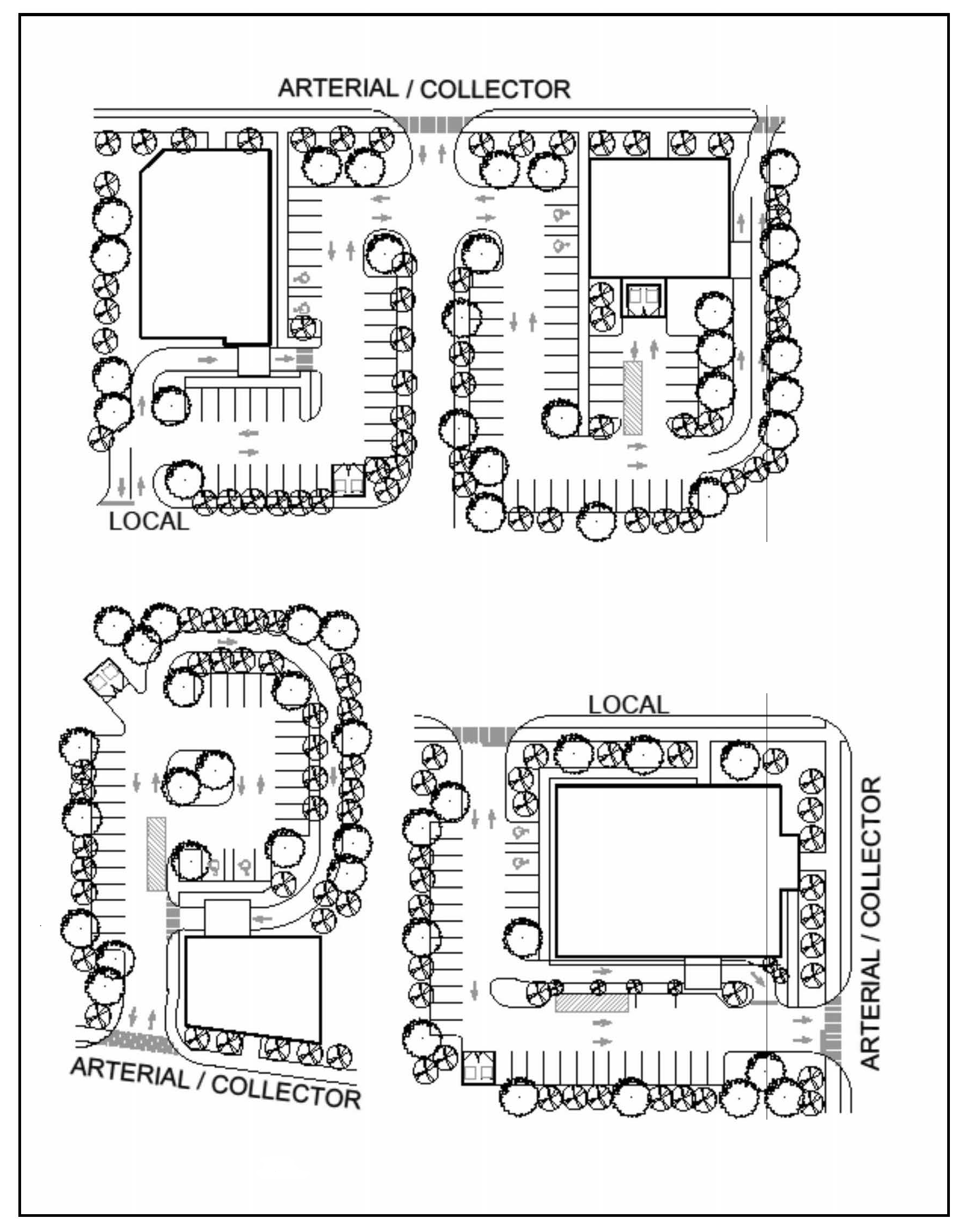
Figure 2: Main Street Layout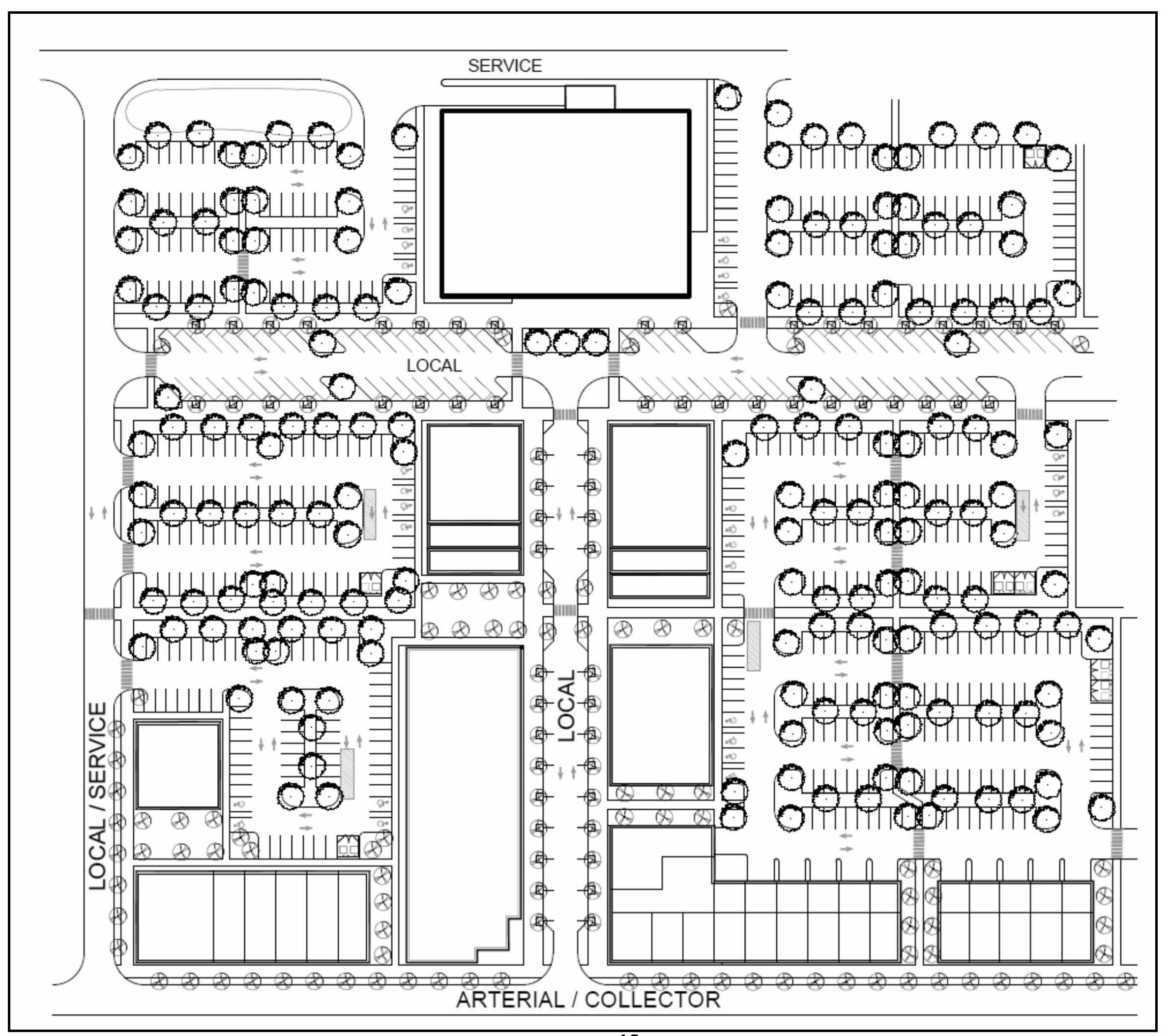
Figure 3. Streetscape Section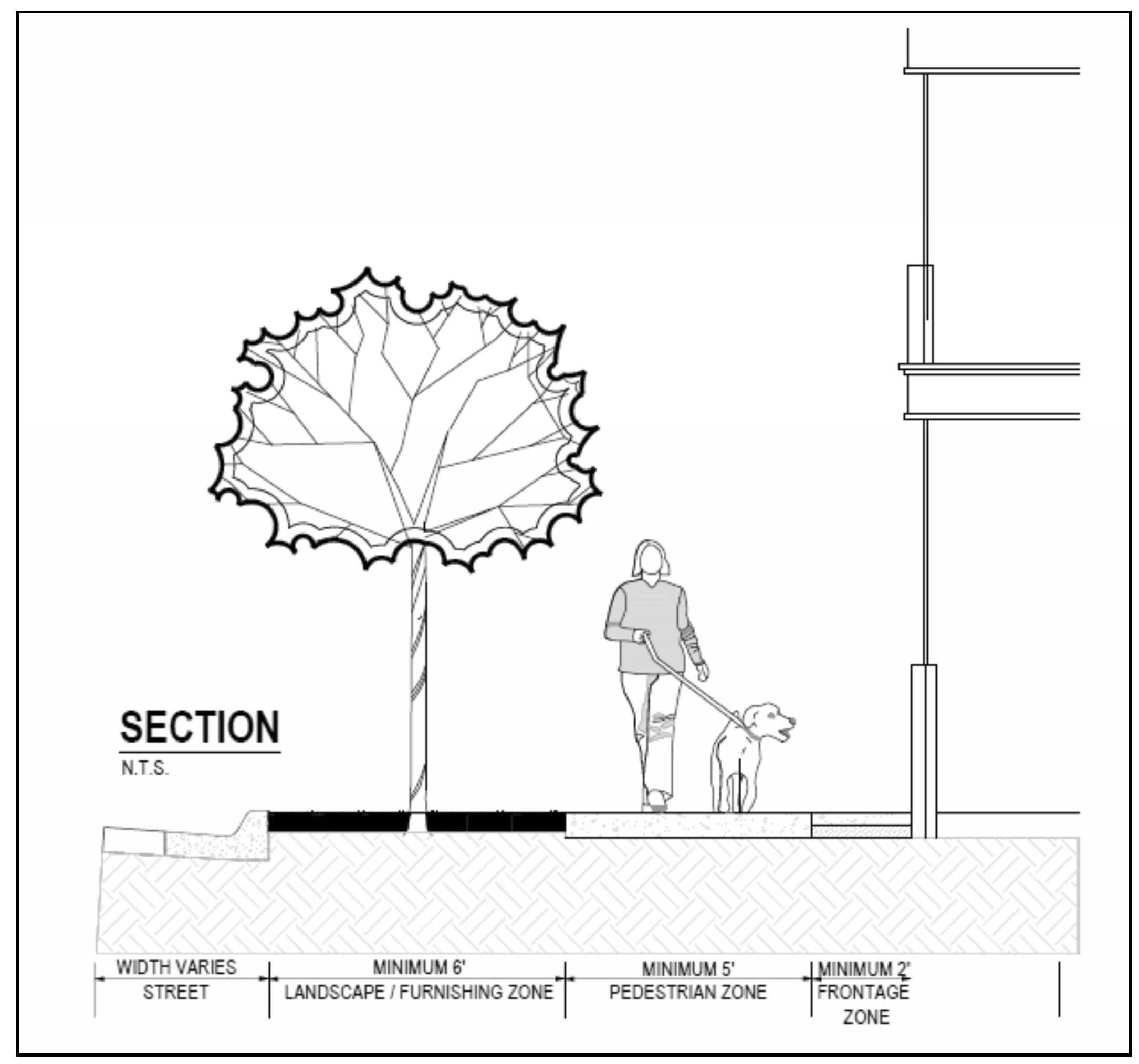
Figure 4. Commercial Streetscape Plan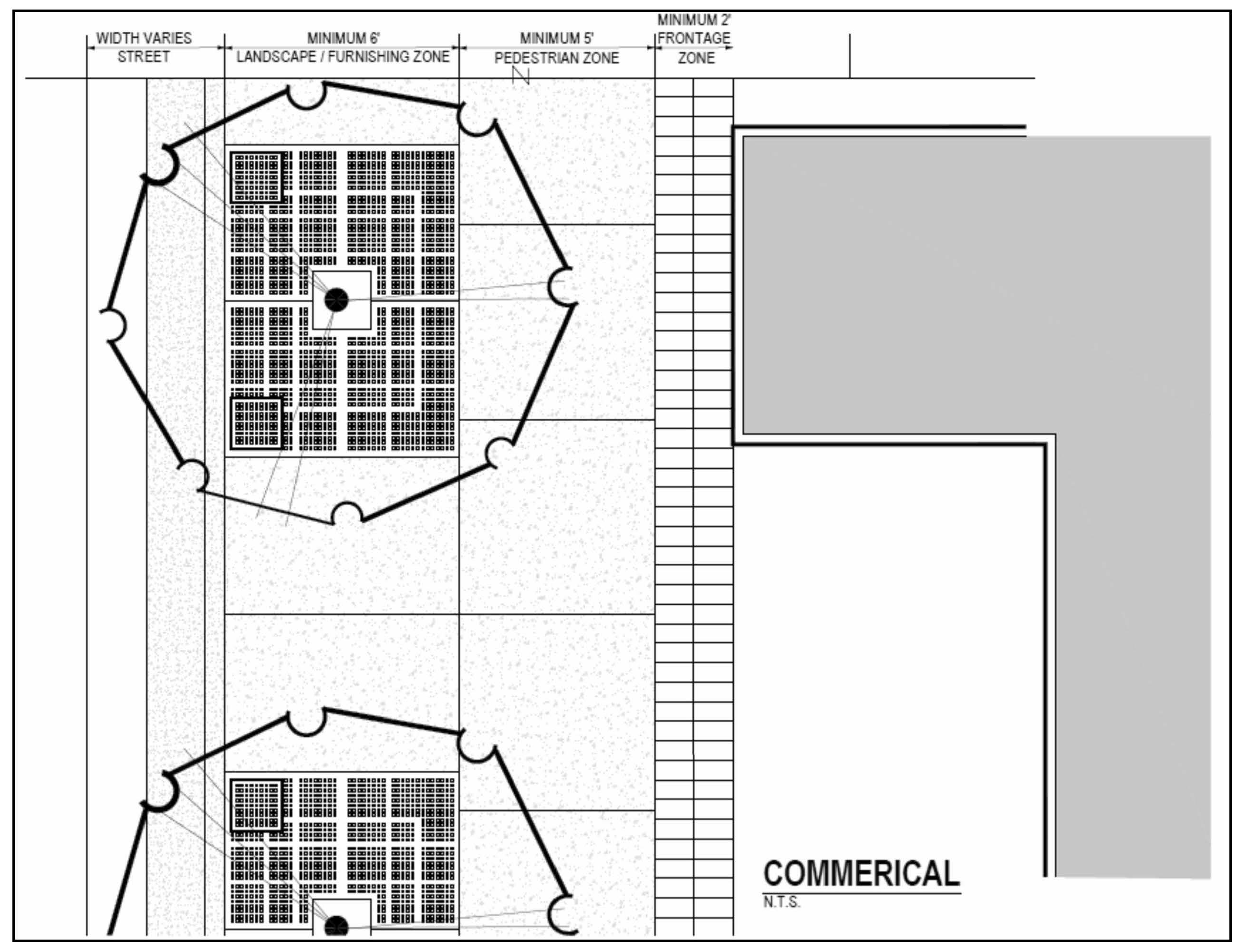
Figure 5: Residential Streetscape Plan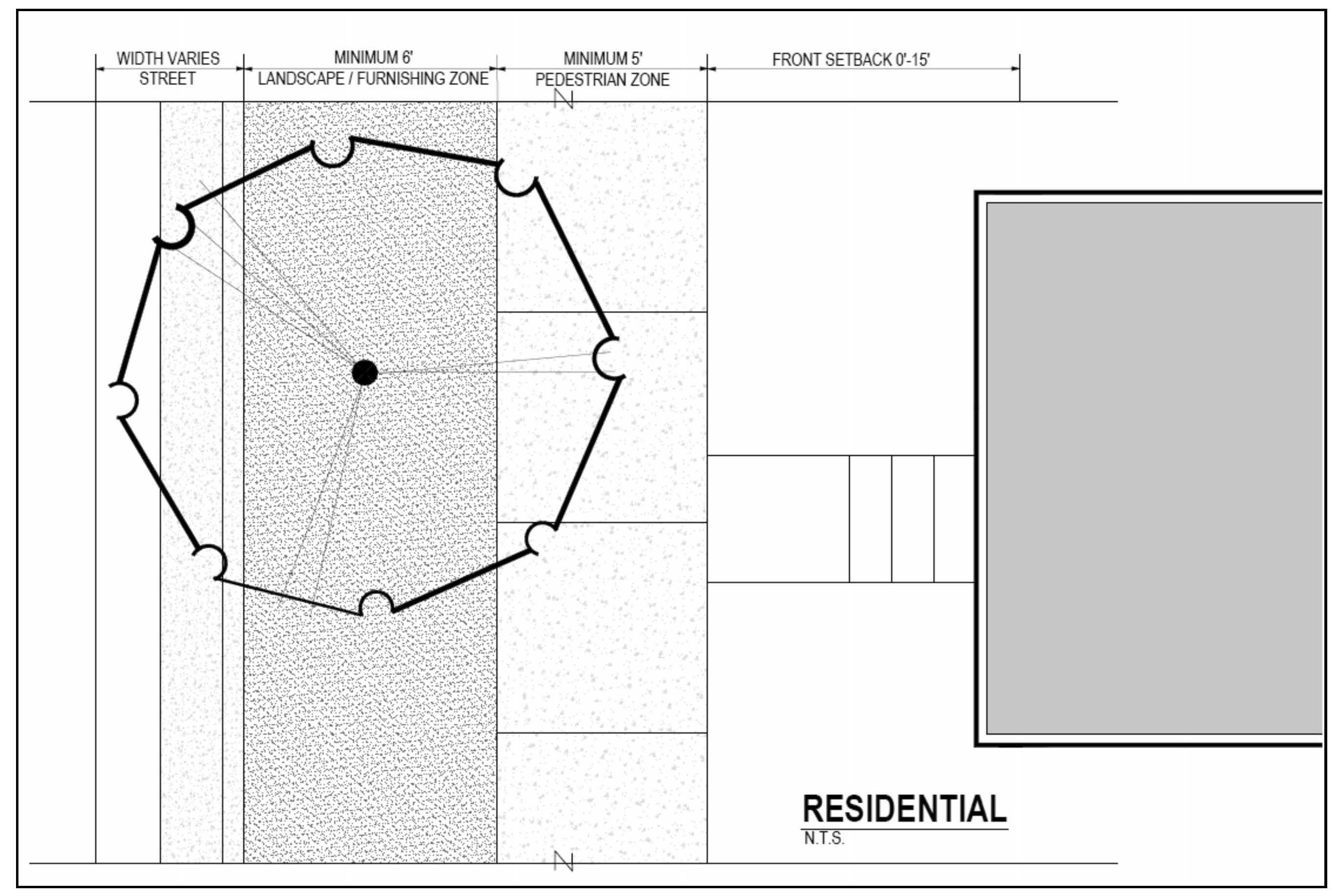
Figure 6: Building Design Examples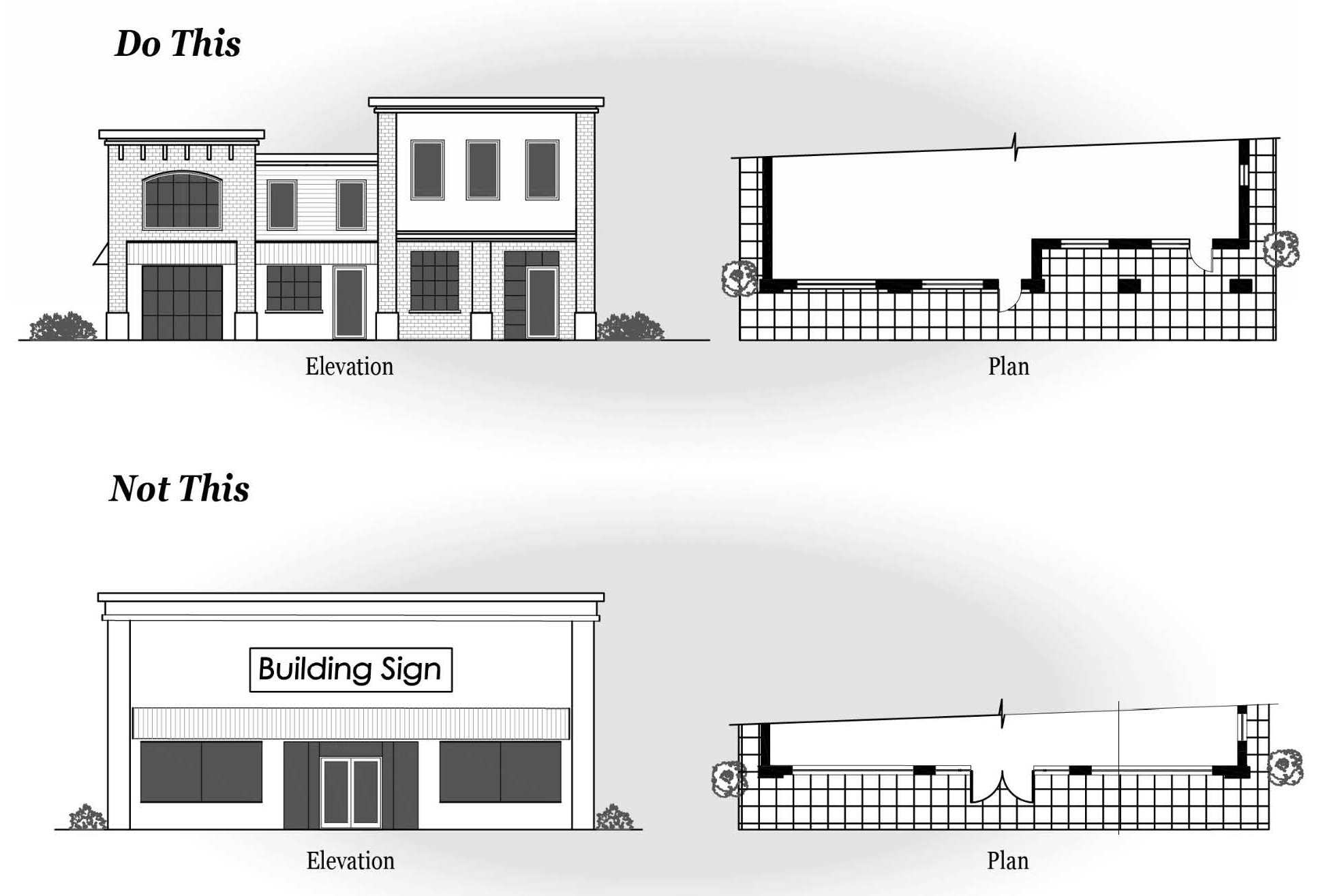
General notes:
(1)
Central sanitary sewer and water are required within LPN.
2.
Refer to the Environmental Management Act (EMA) for information pertaining to the regulation of environmental features (preservation/conservation features), stormwater management requirements, etc.
3.
Refer to the concurrency management ordinance for information pertaining to the availability of capacity for certain public facilities (roads, schools, parks, etc.).
4.
Development standards. All proposed development shall meet the buffer zone standards (section 10-7.522), and the parking and loading requirements (subdivision 3, division 5, article VII of this chapter).
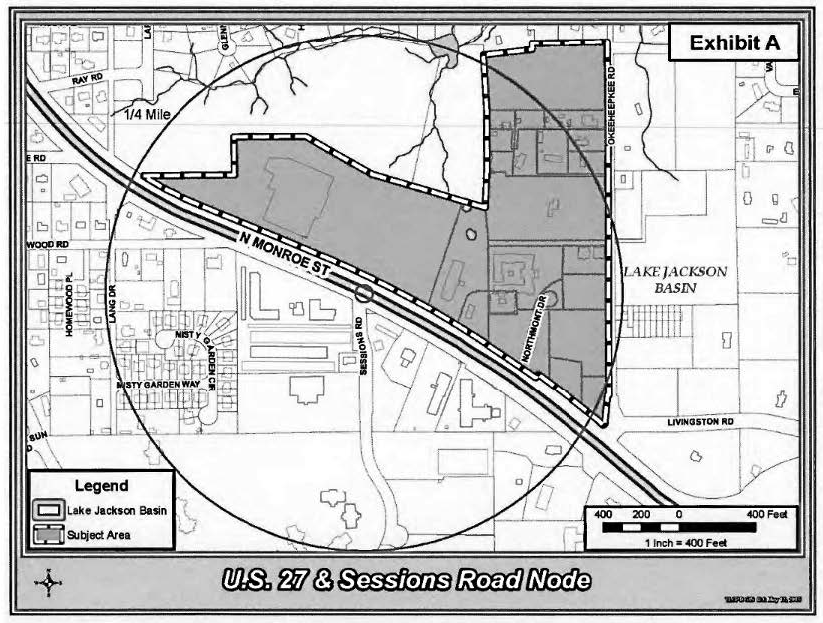
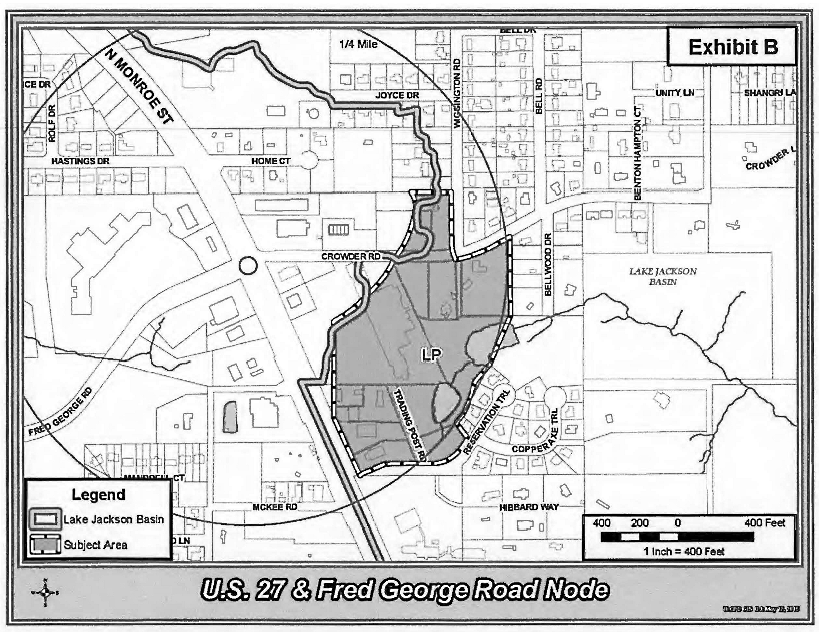
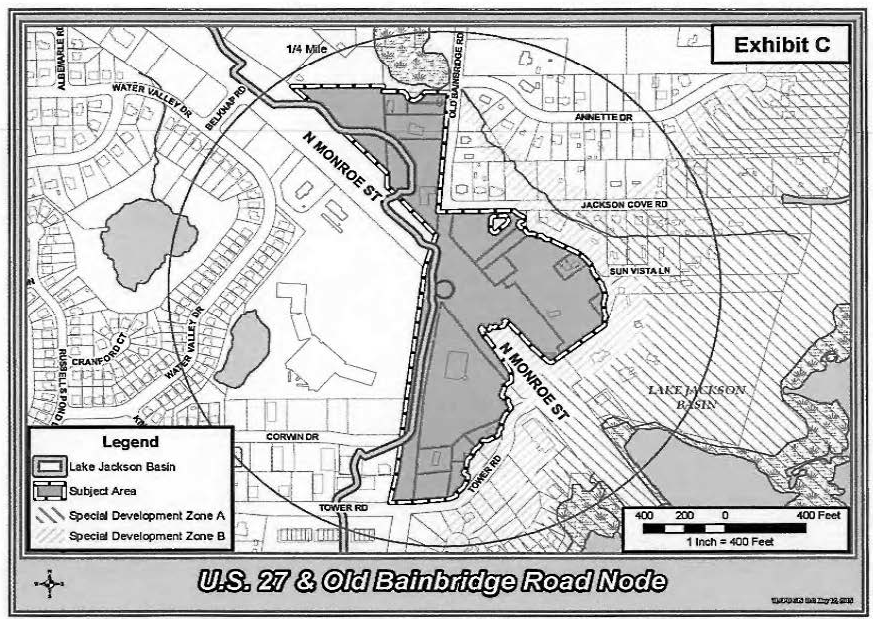
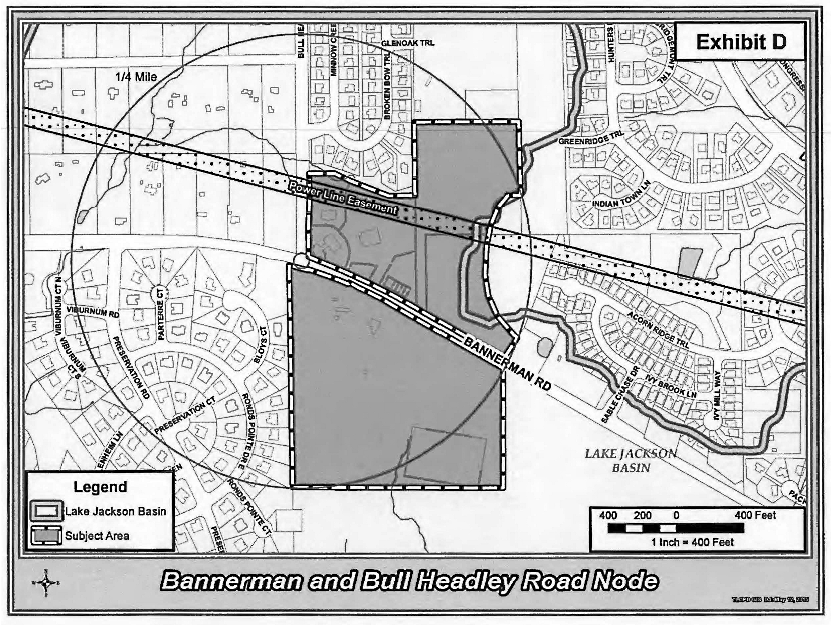
(Code 1992, § 10-6.660; Ord. No. 15-10, § 2, 7-7-2015; Ord. No. 20-10, § 1, 5-12-2020; Ord. No. 22-17, § 8, 6-14-2022)
Sec. 10-6.671. - Bradfordville Sector Plan.
(a)
Purpose and intent. The purpose and intent of this subdivision is to establish new standards for development in the Bradfordville Study Area so as to discourage urban sprawl; preserve the rural character of the area; protect and enhance the natural surface waterbodies in the area; eliminate potential stormwater problems in the area and reduce harm from flooding; maintain commercial services commensurate with population growth; provide for the development of a Bradfordville Commercial Center; establish design standards for development review; appropriately locate land uses; provide for an efficient and effective transportation system; ensure the availability of concurrent and adequate public facilities (including transportation, stormwater management, sewer, water, parks and open space); establish appropriate and necessary standards for the development and use of land in the Bradfordville Study Area; protect scenic viewsheds; protect historic resources; and establish appropriate design standards for development to protect the health, safety and welfare of current and future residents.
(b)
Findings.
(1)
The board hereby finds that the land uses, amount, rate, density and intensity of new development and all other aspects pertaining to development as set forth in the Bradfordville Sector Plan for the Bradfordville Study Area are compatible with and further the objectives, policies, land uses, and densities and intensities set forth in the Comprehensive Plan and are consistent with the Comprehensive Plan, including, but not limited to, the provisions relating to the Bradfordville Study Area.
(2)
The board hereby finds that the provisions contained in Ordinance No. 00-31, adopted July 11, 2000, amending the land development code of the county for the Bradfordville Study Area are consistent with the Comprehensive Plan and the Bradfordville Sector Plan.
(c)
Adoption of the Bradfordville Sector Plan. The board hereby adopts the Bradfordville Sector Plan as adopted July 11, 2000, by Ordinance No. 00-31, and incorporates said plan by reference.
(Code 1992, § 10-6.671; Ord. No. 07-20, § 2, 7-10-2007)
Sec. 10-6.672. - Bradfordville Mixed Use Overlay categories.
(a)
The land use element of the Tallahassee-Leon County Comprehensive Plan provides policies that recognize the special character of the Bradfordville area and directs the county to adopt land development regulations which discourage urban sprawl, preserve the character of the Bradfordville area, and provide adequate supply of facilities and services for the Bradfordville area. To implement these objectives a Bradfordville Mixed Use Future Land Use Overlay District is established. The following zoning districts are established within the Bradfordville Mixed Use Overlay District:
(1)
BC-1 Bradfordville Commercial District.
(2)
BC-2 Bradfordville Commercial District.
(3)
BCS Bradfordville Commercial Services District.
(4)
BOR Bradfordville Office Residential District.
(b)
Bradfordville Mixed Use Overlay intent, allowable uses and development standards are set forth in this subdivision.
(Code 1992, § 10-6.672; Ord. No. 07-20, § 2, 7-10-2007)
Sec. 10-6.673. - BC-1 Bradfordville Commercial Auto-Oriented District.
*Not all listed uses may be allowed. Refer to section 10-6.680 for a list of prohibited uses regardless of zoning district.
General notes:
(1)
If central sanitary sewer is not available, non-residential development is limited to a maximum of 900 gallons of wastewater flow per day. Community service facilities are limited to no more than 5,000 square feet, or a sewage flow not to exceed 900 gallons per day. Also, refer to Sanitary Sewer Policies 1.2.3 and 2.1.2 of the Utilities Element of the Comprehensive Plan for additional requirements.
(2)
Refer to the Environmental Management Act (EMA) for information pertaining to the regulation of environmental features (preservation/conservation features), stormwater management requirements, etc.
(3)
Refer to the concurrency management ordinance for information pertaining to the availability of capacity for certain public facilities (roads, parks, etc.).
(Code 1992, § 10-6.673; Ord. No. 07-20, § 2, 7-10-2007; Ord. No. 09-13, § 4, 3-19-2009; Ord. No. 15-03, § 2, 2-10-2015; Ord. No. 17-01, § 8, 1-24-2017; Ord. No. 20-06, § 4, 4-28-2020; Ord. No. 22-17, § 9, 6-14-2022; Ord. No. 23-05, § 27, 2-21-2023)
Sec. 10-6.674. - BC-2 Bradfordville Commercial Pedestrian-Oriented District.
*Not all listed uses may be allowed. Refer to section 10-6.680 for a list of prohibited uses regardless of zoning district.
General notes:
(1)
If central sanitary sewer is not available, non-residential development is limited to a maximum of 900 gallons of wastewater flow per day. Community service facilities are limited to no more than 5,000 square feet, or a sewage flow not to exceed 900 gallons per day. Also, refer to Sanitary Sewer Policies 1.2.3 and 2.1.2 of the Utilities Element of the Comprehensive Plan for additional requirements.
(2)
Refer to the Environmental Management Act (EMA) for information pertaining to the regulation of environmental features (preservation/conservation features), stormwater management requirements, etc.
3)
Refer to the concurrency management ordinance for information pertaining to the availability of capacity for certain public facilities (roads, parks, etc.).
(Code 1992, § 10-6.674; Ord. No. 07-20, § 2, 7-10-2007; Ord. No. 09-13, § 4, 3-19-2009; Ord. No. 15-03, § 3, 2-10-2015; Ord. No. 16-07, § 15, 5-10-2016; Ord. No. 20-06, § 5, 4-28-2020; Ord. No. 22-17, § 10, 6-14-2022; Ord. No. 23-05, § 28, 2-21-2023)
Sec. 10-6.675. - BCS Bradfordville Commercial Services District.
*Not all listed uses may be allowed. Refer to section 10-6.680 for a list of prohibited uses regardless of zoning district.
General notes:
(1)
If central sanitary sewer is not available, non-residential development is limited to a minimum of 0.50 acre lots and non-residential development is limited to a maximum of 900 gallons of wastewater flow per day. Community service facilities are limited to no more than 5,000 square feet, or a sewage flow not to exceed 900 gallons per day. Also, refer to Sanitary Sewer Policies 1.2.3 and 2.1.2 of the Utilities Element of the Comprehensive Plan for additional requirements.
(2)
Refer to the Environmental Management Act (EMA) for information pertaining to the regulation of environmental features (preservation conservation features), stormwater management requirements, etc.
(3)
Refer to the concurrency management ordinance for information pertaining to the availability of capacity for certain public facilities (roads, parks, etc.).
(Code 1992, § 10-6.675; Ord. No. 07-20, § 2, 7-10-2007; Ord. No. 09-13, § 4, 3-19-2009; Ord. No. 15-03, § 4, 2-10-2015; Ord. No. 17-01, § 9, 1-24-2017; Ord. No. 20-06, § 6, 4-28-2020; Ord. No. 22-17, § 11, 6-14-2022; Ord. No. 23-05, § 29, 2-21-2023)
Sec. 10-6.676. - BOR Bradfordville Office Residential District.
*Not all listed uses may be allowed. Refer to section 10-6.680 for a list of prohibited uses regardless of zoning district.
General notes:
(1)
If central sanitary sewer is not available, non-residential development is limited to a minimum of 0.50-acre lots and non-residential development is limited to a maximum of 900 gallons of wastewater flow per day. Community service facilities are limited to no more than 5,000 square feet, or a sewage flow not to exceed 900 gallons per day. Also, refer to Sanitary Sewer Policies 1.2.3 and 2.1.2 of the Utilities Element of the Comprehensive Plan for additional requirements.
(2)
Refer to the Environmental Management Act (EMA) for information pertaining to the regulation of environmental features (preservation conservation features), stormwater management requirements, etc.
(3)
Refer to the concurrency management ordinance for information pertaining to the availability of capacity for certain public facilities (roads, parks, etc.).
(Code 1992, § 10-6.676; Ord. No. 09-13, § 4, 3-19-2009; Ord. No. 15-03, § 5, 2-10-2015; Ord. No. 16-07, § 16, 5-10-2016; Ord. No. 17-01, § 10, 1-24-2017; Ord. No. 20-06, § 7, 4-28-2020; Ord. No. 22-17, § 12, 6-14-2022; Ord. No. 23-05, § 30, 2-21-2023)
Sec. 10-6.678. - Bradfordville Scenic Overlay District.
(a)
Purpose and intent. The scenic overlay district applies to unique natural environments within the county that warrant special protection. The district protects identified scenic viewsheds from development that would reduce property values and threaten natural resources through unnecessary destruction of vegetation.
(b)
Applicability. The scenic overlay district shall apply to the following areas:
(1)
Lake McBride. The provisions of the Lake McBride scenic overlay district shall apply to all development within the lake viewshed overlay as designated in figure 12 of the Bradfordville Sector Plan surrounding Lake McBride, except the following:
a.
Construction or alteration of an accessory structure to a single-family, single-family attached, or duplex residential structure if:
1.
Not more than one principal residential structure is maintained on a legal lot or tract; and
2.
The proposed improvement is not located in zone "A" of the Lake McBride Special Development Zone;
b.
Interior alteration of an existing building that does not increase the square footage, area, or height of the building;
c.
Construction of a fence that does not obstruct the flow of water;
d.
Clearing an area up to 15 feet wide for surveying and testing, unless a tree more than 12 inches in diameter is to be removed;
e.
Restoration of a damaged building that begins within 12 months of the date of the damage provided that the reconstruction does not increase the lot area or the impervious coverage or height of the building prior to its damage;
f.
Enclosure of an existing staircase or porch;
g.
Construction of an uncovered wooden ground level deck up to 5,000 square feet in size;
h.
Replacement of a roof where the building with the new roof will not exceed building height limits;
i.
Remodeling of an exterior facade if construction is limited to the addition of columns or awnings for windows or entrance ways;
j.
A sidewalk constructed on existing impervious cover;
k.
Modification of up to 3,000 square feet of a building or impervious cover on a developed site to make facilities accessible for persons with disabilities.
(c)
Development guidelines. Development within the scenic overlay district shall comply with the following standards:
(1)
Building height. Buildings in commercial, office and service districts shall not exceed 30 feet in height as measured from average grade. No other non-residential structures shall exceed 45 feet in height.
(2)
Building finish. Buildings and roofs shall be finished with non-reflective surfaces.
(3)
Clearing. No tree with a diameter of 12 inches DBH or greater shall be removed within the scenic overlay district without the written approval of the County Administrator or designee.
(4)
Lighting. Lighting fixtures shall direct light downward and shall not be mounted at a height in excess of 30 feet. The projected cone of light from a fixture shall not exceed 120 degrees. All lighting fixtures for non-residential development shall be designed so that the source of light is not directly visible from the lake.
(5)
Additional buffers. The property within the scenic overlay district, shall be surrounded by a 25-foot -wide vegetative buffer, broken only by authorized access points.
(Code 1992, § 10-6.678; Ord. No. 07-20, § 2, 7-10-2007; Ord. No. 14-01, § 2, 1-21-2014)
Sec. 10-6.679. - Bradfordville rural road designations.
(a)
Purpose and intent. The rural road designations herein are intended to further implement the provisions of the Bradfordville Sector Plan with regard to efforts of preservation and enhancement of the visual character of roads that serve to both delineate and reinforce the transition from urban and suburban areas to rural areas with in the Bradfordville Study Area.
(b)
Designation. The following roadway segments are hereby designated as rural roads:
(1)
Bradfordville Road, from its intersection with Velda Dairy Road to Centerville Road;
(2)
Roberts Road, from its intersection with Centerville Road to its termination;
(3)
Proctor Road, from its intersection with Thomasville Road to Roberts Road;
(4)
Greenville Road, from its intersection with Pisgah Church Road to Proctor Road; and
(5)
Pisgah Church Road, from its intersection with Bradfordville Road to its termination at Pisgah Church.
(c)
Development and regulatory requirements. The following provisions shall apply to all rural roads designated in subsection (b) of this section:
(1)
A maximum of two travel lanes is allowed, except that no road lanes existing on the effective date of the ordinance from which this section is derived shall be eliminated.
(2)
No curb and gutter construction shall be allowed.
(3)
All proposed dwelling units shall be setback a minimum of 75 feet from the centerline of any designated rural roads. This provision shall not apply where its application would not provide for the construction of a single-family home on a legal lot of record. All proposed infrastructure, which for the purpose of this section shall include all structures or groups of structures greater than 25 square feet, and shall include structures pertaining to television, telephone, and computer, shall be allowed within the 75-foot setback if they are screened with vegetation in such a manner as to buffer or camouflage their view from the designated rural road.
(4)
The county shall not remove vegetation within 75 feet of the centerline of any designated rural road, unless the county determines it is required to provide for the health, safety or welfare of the public.
(5)
No new off-site or advertising signs shall be allowed within 200 feet of the centerline of any designated rural road.
(Code 1992, § 10-6.679; Ord. No. 07-20, § 2, 7-10-2007)
Sec. 10-6.680. - Bradfordville Commercial Center District (BCCD).
(a)
Purpose and intent. The purpose and intent of the Bradfordville commercial center district (BCCD) is to provide development standards that implement the goals, objectives, and policies of the Tallahassee-Leon County Comprehensive Plan recognizing the special character of the Bradfordville Study Area. The BCCD district is provided to ensure that goods and services are provided primarily for the area residents rather than serving a regional market and providing development consistent with the character of the area. The BCCD district is also intended to provide more focused development reviews for projects associated with sensitive historical, cultural or environmental resources. The BCCD district is implemented by the following zoning districts: BC-1 Bradfordville commercial auto-oriented district, BC-2 Bradfordville Commercial Pedestrian-Oriented District, BCS Bradfordville Commercial Services District, BOR Bradfordville Office-Residential District, OS Open Space, and PUD Planned Unit Development. The BCCD boundary is defined in figure A. Expansion of this district shall be prohibited until a new commercial needs assessment has been completed in 2030.
(b)
Allowable uses. The uses permitted in the BCCD are those provided in the underlying zoning district. The overall intensity of development of land may not exceed that permitted by the underlying zoning district, unless granted a deviation in accordance with the deviation criteria of article I, and may be further reduced in accordance with special development and design standards set forth in this division. The following uses shall be prohibited regardless of the zoning district:
(1)
Automotive service and repair;
(2)
Towing, wrecking and recovery services;
(3)
Pawn shops;
(4)
Pest control services;
(5)
Cemeteries;
(6)
Crematoriums;
(7)
Dry cleaning plants;
(8)
Gun firing ranges;
(9)
Self-moving operations;
(10)
Wholesale building supplies.
Any development proposing warehousing, miniwarehousing, or self-storage shall require a Type C site plan review.
(c)
Development standards. Development standards are established in the underlying zoning district as set forth in this subdivision. Developments affecting land within the BCCD shall be subject to review pursuant to division 4, article VII of this chapter and shall comply with the following development standards:
(1)
Site analysis. A comprehensive site analysis is required before planning and design begins. The analysis should examine the site's physical properties, amenities, special problems, character, and the neighboring environment of the site.
(2)
Stormwater. Development or redevelopment of any property located within the BCCD shall be subject to compliance with the Bradfordville Stormwater Standards outlined in article IV of this chapter.
(3)
Roadway access standards. In order to protect the roadway capacity of Thomasville, Bannerman, and Bradfordville Roads, new direct access is prohibited along the arterial and collector roadways except as permitted in this division.
(4)
Site design. Building and site design shall comply with the Bradfordville Site and Building Standards Guidelines Manual adopted by the Board of County Commissioners. Low impact design alternatives shall be incorporated into all site and development plans within the BCCD district. Development within the overlay shall provide integration of the proposed use and development with the adjacent uses and developments including, but not limited to, access/egress, building and parking location/orientation, natural and landscaped areas. Development shall incorporate the existing natural features of the development site into site and development plans avoiding clearing of expansive naturally vegetated areas. Parking areas shall be buffered from all public roadways through placement of vegetation and/or topography or manmade structures.
(5)
Lighting. All building lighting and parking area lighting shall be downward directional. Lighting in parking areas shall be restricted to low mounted closely spaced fixtures to minimize glare.
(d)
Existing uses and structures. The provisions of this section and the implementing zoning districts shall not apply to any properties which have currently existing conforming uses and structures. However, expansion or redevelopment of existing sites shall be subject to this section and the implementing zoning districts.
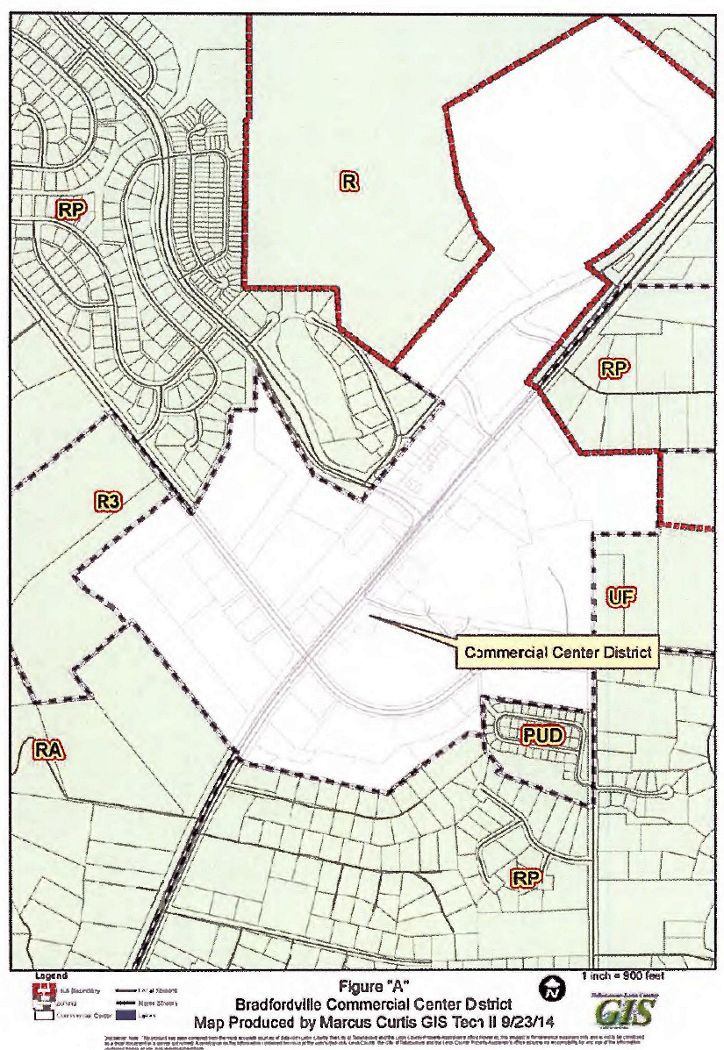
(Code 1992, § 10-6.680; Ord. No. 07-20, § 2, 7-10-2007; Ord. No. 13-06, § 4, 3-12-2013; Ord. No. 15-03, § 7, 2-10-2015; Ord. No. 20-06, § 8, 4-28-2020; Ord. No. 22-17, § 13, 6-14-2022)
Sec. 10-6.691. - Woodville Rural Community future land use map category.
(a)
The land use element of the Tallahassee-Leon County Comprehensive Plan establishes the Woodville Rural Community future land use category on the future land use map. The following zoning districts implement and are applicable within the Woodville Rural Community future land use category:
(1)
RA Residential Acre.
(2)
R-1 Single-Family Detached Residential District.
(3)
R-5 Manufactured Home and Single-Family Detached District.
(4)
RP Residential Preservation District.
(5)
MH Mobile Home Park District.
(6)
C-1 Neighborhood Commercial District.
(7)
C-2 Neighborhood Commercial District.
(8)
WC Woodville Commercial District.
(9)
OS Open Space District.
(10)
PUD Planned Unit Development District.
(b)
District intent, allowable uses and development standards for each of these districts are set forth in this subdivision.
(Code 1992, § 10-6.691; Ord. No. 07-20, § 2, 7-10-2007)
Sec. 10-6.692. - WC Woodville Commercial District.
General notes:
(1)
Refer to the Environmental Management Act (EMA) for information pertaining to the regulation of environmental features (preservation/conservation features), stormwater management requirements, etc.
(2)
Refer to concurrency management ordinance for information pertaining to the availability of capacity for certain public facilities (roads, parks, etc.).
General notes:
(1)
Refer to the Environmental Management Act (EMA) for information pertaining to the regulation of environmental features (preservation/conservation features), stormwater management requirements, etc.
(2)
Refer to the concurrency management ordinance for information pertaining to the availability of capacity for certain public facilities (roads, parks, etc.).
(Code 1992, § 10-6.692; Ord. No. 07-20, § 2, 7-10-2007)
Sec. 10-6.696. - Planned Unit Developments.
(a)
Specific uses required by the Comprehensive Plan to be developed as planned developments or planned unit developments.
(1)
Purpose and intent. The purpose and intent of this section is to provide for the required review of the uses specifically identified in the Comprehensive Plan as uses to be developed as planned developments or planned unit developments. These uses are ones which may have a potential adverse impact and therefore should be subject to additional review.
(2)
Allowable land uses. Those uses specifically identified in the goals, objectives, and policies, the land use categories and the land development use matrix shall be allowed.
(3)
Development standards. These uses shall be subject to review and approval by the Board of County Commissioners and any specific standards as shown in the Comprehensive Plan, these regulations, and other applicable codes or ordinances.
(b)
Planned unit development (PUD) zoning district requirements and procedures.
(1)
Purpose and intent of district.
a.
The PUD zoning district and associated concept plan may be used to establish types of development and arrangements of land uses that are consistent with the Comprehensive Plan, but which are not otherwise provided for or allowed in the zoning districts set out in this chapter. The range of uses and development intensities allowed within a particular PUD district, along with any corresponding development and design standards are established by an associated PUD concept plan. Subsequent development within the PUD district is implemented by the approval of one or more site and development plans, known as PUD final plans.
b.
The standards for creating a new PUD district and its associated concept plan set out herein are intended to promote flexibility of design and permit planned diversification and integration of uses and structures. The process set out herein allows the Board of County Commissioners to evaluate applications to establish new PUD districts and their associated concept plans, to make modifications to adopted concept plans, and to render final determination as to whether applications should be approved, approved with conditions, or denied. In addition, the Board of County Commissioners, may through approval with conditions, establish such additional limitations and regulations as it deems necessary to protect the public health, safety, and general welfare. Specifically, the PUD district is intended to:
1.
Promote more efficient and economic uses of land.
2.
Provide flexibility to meet changing needs, technologies, economics, and consumer preferences.
3.
Encourage uses of land which reduce transportation needs and which conserve energy and natural resources to the maximum extent possible.
4.
Preserve to the greatest extent possible, and utilize in a harmonious fashion, existing landscape features and amenities.
5.
Provide for more usable and suitably located recreational facilities, open spaces and scenic areas, either commonly owned or publicly owned, than would otherwise be provided under a conventional zoning district.
6.
Lower development and building costs by permitting smaller networks of utilities and streets and the use of more economical building types and shared facilities.
7.
Permit the combining and coordinating of land uses, building types, and building relationships within a planned development, which otherwise would not be provided under a conventional zoning district.
(2)
Planned unit development in residential preservation land use category. In addition to the provisions of this section, planned unit developments proposed for lots in a recorded or unrecorded residential subdivision zoned residential preservation and which directly abut an arterial or a major collector roadway shall be consistent with the provisions cited in section 10-6.617(a)(4). Planned unit developments proposed for interior lots in a recorded or unrecorded subdivision zoned residential preservation shall be consistent with the density of the existing residential development in the recorded or unrecorded subdivision as provided for in section 10-6.617(a)(2). For the purpose of this section, interior lots mean those lots within a recorded or unrecorded subdivision in the residential preservation zoning district having sole legal access via the roadway network internal to the subdivision and said roadway network was specifically constructed as part of the subdivision roadway network.
(3)
Establishment of a new PUD district and adoption of an associated concept plan.
a.
Eligibility for application. Applications for establishment of a new PUD zoning district shall demonstrate compliance with the following minimum eligibility criteria:
1.
Minimum area for a PUD zoning district. The minimum area required for an application to a PUD district shall be five acres, except where the proposed use is required to be approved as a planned unit development by the Comprehensive Plan wherein, there shall be no minimum area required.
2.
Configuration of the PUD zoning district. The PUD zoning district shall consist of a single discrete area of land of sufficient width and depth to accommodate the proposed use.
3.
Unified control/ownership. All properties included for the purpose of application to amend the official zoning map to create a PUD district shall be under the ownership or control of the applicant.
b.
Review process. The approval of a PUD zoning map amendment and associated concept plan application rests with the Board of County Commissioners. An application for a PUD zoning district shall include a PUD concept plan; a PUD zoning district shall not be established unless and until an associated implementing PUD concept plan is approved by the Board of County Commissioners. Review of an application for a PUD zoning map amendment and associated concept plan shall undergo the following sequence:
1.
Pre-application conference. An application for a pre-application conference shall be submitted in accordance with established policies and procedures.
2.
PUD concept plan application. A PUD concept plan application shall be submitted in accordance with the submittal requirements set forth in subsection (b)(3) of this section.
3.
Public notification. Public notice of the PUD concept plan shall be provided by publication in a newspaper of regular and general circulation. In addition, written notice shall be mailed to the current address of each owner of property located within 1,000 feet of the properties included in the application based upon the records of the county property appraiser's office, and to registered neighborhood associations.
4.
DRC meeting and recommendation. The development review committee shall review the PUD concept plan application to evaluate consistency with the Comprehensive Plan and compliance with applicable land development regulations adopted by the county. The DRC shall prepare an itemized list of written findings of fact that support a recommendation of approval, approval with conditions, or denial of the PUD concept plan. The written findings of the DRC shall be forwarded to the planning commission.
5.
Planning commission public hearing and recommendation. The planning commission shall conduct a public hearing on the PUD zoning map amendment and concept plan application and formulate findings supporting a recommendation to the Board of County Commissioners to approve, approve with conditions, or deny the application. The planning commission's recommendation shall be based upon the recommendation of the DRC, public testimony and findings made on the record at the public hearing. Quasi-judicial proceedings may be invoked pursuant to the provisions of division 9, article XI of this chapter.
6.
Board of County Commissioners public hearing and disposition. The Board of County Commissioners shall conduct a public hearing on the PUD zoning map amendment and concept plan application. The Board's final action approve, approve with conditions, or deny the application shall be based upon the recommendations of the planning commission and the DRC, public testimony, and findings made on the record at the public hearing. The decision of the Board of County Commissioners shall be supported by written findings. The decision of the Board of County Commissioners shall be final.
c.
Application content and submittal requirements.
1.
PUD concept plan. A PUD concept plan is a generalized plan that establishes the allowable land uses and the allowable development density or intensity ranges as well as any corresponding development and design standards for all lands within the PUD zoning district. A PUD concept plan may further establish separate subdistricts. The PUD concept plan may, for each subdistrict, establish a separate list of allowable uses and applicable standards, so long as those uses and standards are consistent with those established for the PUD district.
A PUD concept plan shall consist of the graphic and/or textual information itemized in subsections (b)(3)c.1.(i) through (iv) of this section. Adjustments to this information can be made at the pre-application conference.
(i)
A general plan for the use of all lands within the proposed PUD. Such plans shall indicate the general location of residential areas (including density and unit types), open space, parks, passive or scenic areas, and non-residential areas (including maximum building square footage and maximum height).
(ii)
A plan of vehicular and pedestrian circulation showing the general locations and right-of-way widths of roads, sidewalks, the capacity of the system and access points to the external and internal thoroughfare network. The conceptual vehicular plan for a PUD utilizing the provisions of section 10-6.617(a)(4) shall identify the functional classification of the roadway that will provide access to the proposed development.
(iii)
A summary of allowable development. The summary shall provide:
A.
The total acreage of the PUD district, and each subdistrict, as may be proposed;
B.
The acreage of areas proposed for specific land uses proposed to be allowed within the PUD district and PUD sub-districts proposed in the concept plan, as may be applicable;
C.
The acreage of open space or conservation areas not to be developed within the PUD district and PUD sub-districts proposed in the concept plan;
D.
The minimum and maximum allowable quantity of residential units to be allowed within the PUD district, and PUD sub-districts proposed in the concept plan, measured in residential dwelling units per acre;
E.
The minimum and maximum allowable residential density to be allowed within the PUD district, and PUD sub-districts proposed in the concept plan, measured in residential dwelling units per acre;
F.
The minimum and maximum allowable non-residential development intensity to be allowed within the PUD district, measured in gross building square footage; and,
G.
The minimum and maximum allowable non-residential development intensity to be allowed within the PUD district, measured in floor area ratio.
(iv)
Regulations and development standards for the PUD district and for each sub-district, including:
A.
An itemized list of uses proposed to be allowed in each the PUD district, or sub-districts, if any.
B.
The minimum and maximum residential densities for the PUD district and for any sub-districts.
C.
The minimum and maximum non-residential gross square footage and floor area ratios for the PUD district and for any sub-districts.
D.
Development and design standards governing the development of the PUD district and any sub-districts which shall, at a minimum, address: lot dimensions and size; building setbacks; building heights; dimensions of internal streets, sidewalks, and other transportation facilities (such standards may be conveyed through annotated diagrams); open space provision, off-street parking, buffering, and landscaping.
E.
The PUD concept plan may establish, for the PUD district or any sub-district therein, additional development and design standards for other development and design characteristics and elements, etc., so long as these standards are consistent with the Comprehensive Plan. The PUD concept plan may establish proprietary standards to regulate a particular development or design characteristic or element. In those instances where development or design standards are not specifically provided in the PUD concept plan, the standards set out in the land development code shall remain in force.
2.
A site conditions map that includes:
(i)
A legal description of the properties included in the application with an associated boundary survey signed and sealed by a registered state land surveyor.
(ii)
Name of the PUD; the owners of all properties included in the PUD district; the agent for the PUD application, and address and phone number of the agent; and date of drawing and of any subsequent revision.
(iii)
Scale, north arrow, and general location map showing relationship of the site to external uses, structures, and features.
3.
A natural features inventory approved by the department of development support and environmental management.
4.
A preliminary certificate of concurrency or appropriate documentation issued by the county department of development support and environmental management.
d.
Review criteria. In order to be approved, a proposed PUD zoning map amendment and concept plan application shall demonstrate satisfaction of the following criteria:
1.
Consistency with the Comprehensive Plan. The proposed PUD district shall be consistent with the Comprehensive Plan.
2.
Consistency with other ordinances. The proposed PUD district shall be consistent with all other ordinances adopted by the county, including, but not limited to, the applicable environmental and concurrency management ordinances.
3.
Consistency with purpose and intent of PUD district. An application for a PUD district shall include a narrative indicating how the proposed PUD district meets the purpose and intent of the PUD district, as set forth in subsection (a) of this section. The narrative shall specifically address the seven statements itemized in subsection (a) of this section.
(4)
Previously approved PUD districts and concept plans.
a.
Status of previously approved PUDs. Any PUD district approved prior to the effective date of the ordinance from which this subdivision is derived shall continue to be governed by the approved PUD plan and any agreements, terms, and conditions to which the approval may be subject and shall be designated PUD on the official zoning map
b.
Amendments to a PUD concept plan or PUD zoning districts. Whenever any application is made to substantially modify an approved PUD, or to undertake a new development on part or all of the property, the application shall be made under the terms and procedures of the PUD district set forth herein. Notwithstanding this provision, the County Administrator or designee may approve amendments to the PUD concept plan during the review of a PUD final development plan if said amendments are substantially minor in nature and do not affect the overall character of the PUD concept plan. The criteria that the County Administrator or designee shall use to determine if the proposed changes are not substantially minor in nature and effect the overall character of the PUD include, but are not limited to: a change in the overall number of residential dwelling units of ten percent or greater; a change in density of 15 percent or more; an increase of non-residential building square footage; a substantial decrease in the amount of acres devoted to common open space and/or natural area; a substantial change in the general location of the proposed land uses, including the common open space and/or natural areas; a substantial change in the location, design, or function of associated transportation facilities; and a substantial change in the location, design, type, or function of associated infrastructures.
c.
Eligibility for application for modification of a PUD concept plan or district.
1.
Minimum area for modification to an existing PUD zoning district or concept plan amendment: The minimum area required to be included in an application for amendment to a PUD district shall be the entire PUD zoning district; however, the County Administrator or designee, may allow an amendment of the official zoning map or the concept plan that affects or applies to only a portion of the land area included in the PUD district upon a finding that such amendment would not adversely impact the remainder of the district.
2.
Control/ownership.
(i)
All properties included for the purpose of application for modification to an existing PUD zoning district or concept plan amendment shall be under the ownership or control of the applicant; or
(ii)
An application may be made by the Board of County Commissioners.
(5)
PUD final plan. The PUD final plan is a site and development plan consistent with and intended to implement a PUD concept plan. The final plan may pertain to an entire PUD district or some portion of the land area included within that district. The appropriate level of site and development plan review for the PUD final plan, applicable submittal requirements, and procedural standards, including level of review, are those set forth in the site plan procedures of division 4, article VII of this chapter. In addition, the final vehicular plan for a PUD utilizing the provisions of section 10-6.617(a)(4) shall show consistency with the access provisions of section 10-6.617(a)(4) and subsection (b) of this section.
(6)
Joint concept and final PUD plan application. At the option of the applicant, a PUD concept plan may be reviewed simultaneously with a PUD final development plan. The submittal requirements of such a review shall be determined at the pre-application conference.
(Code 1992, § 10-6.696; Ord. No. 07-20, § 2, 7-10-2007; Ord. No. 08-04, § 2, 2-26-2008; Ord. No. 10-08, §§ 2—8, 3-23-2010; Ord. No. 14-10, § 18, 6-10-2014)
Sec. 10-6.697. - Development of Regional Impact (DRI) Zoning District requirements and procedures.
A development of regional impact (DRI) is a development which, because of its character, magnitude, or location, would have a substantial effect upon the health, safety or welfare of citizens of more than one county. Development standards in the DRI zoning district shall be those approved in the development order for the DRI. If no development standards were approved in the development order for the DRI, then development standards shall be established at the time that site plans and/or subdivision plats are submitted for review for each individual component of the DRI. Said development standards shall be consistent with the development standards of any previously approved site plan and/or subdivision in the DRI and the overall character of the DRI. Procedures for review and standards for approval of DRI's are found in F.S. ch. 380, and the rules promulgated thereunder. Applications for new DRI's shall follow the procedure set forth in section 10-7.406 and F.S. ch. 380. The procedures for review of the individual components of the DRI are set forth in article VII of this chapter. Prior to Board of County Commissioners consideration of any proposed change to an approved DRI, the planning commission shall review the proposed change or request for determination of substantial deviation at a public meeting and transmit its recommendation to the Board of County Commissioners for consideration. Prior to planning commission review, quasi-judicial proceedings may be invoked pursuant to the provisions of division 7, article VII of this chapter. Any DRI project approved prior the effective date of the ordinance from which this sudivision is derived shall continue to be governed by the approved DRI's development order and any agreements, terms, and conditions to which the approval may be subject and shall be designated DRI on the official zoning map for that portion of the DRI located in a Suburban, Urban Residential, Urban Residential 2 or Bradfordville Mixed Use future land use category.
(Code 1992, § 10-6.697; Ord. No. 07-20, § 2, 7-10-2007; Ord. No. 09-13, § 3, 3-19-2009)

