
Leslie City Zoning Code
ARTICLE IX
SIGNS
DIVISION 1. - GENERALLY[12]
Editor's note— Ord. No. 224, § 1, adopted May 18, 2021, amended Division 1 in its entirety to read as herein set out. Former Division 1, §§ 98-571—98-575, pertained to similar subject matter, and derived from Ord. No. 38, § 6.2.3, March 11, 1955; Ord. No. 80, § 1, August 18, 1980; Ord. No. 86, § 1, May 3, 1982.
DIVISION 2. - RESERVED[13]
Editor's note— Ord. No. 224, § 2, adopted May 18, 2021, repealed Division 2, § 98-591, which pertained to variances; approval by planning commission; variances and derived from Ord. No. 38, § 6.2.3, March 11, 1955; Ord. No. 80, § 1, August 18, 1980; Ord. No. 86, § 1, May 3, 1982; Ord. No. 177, § 1, October 2001.
DIVISION 3. - RESERVED[14]
Editor's note— Ord. No. 224, § 3, adopted May 18, 2021, repealed Division 3, §§ 98-611—98-618, which pertained to requirements; general sign requirements; signs permitted in residential districts, multiple and group housing development districts, commercial and industrial districts, highway service districts, agricultural districts; outdoor advertising signs; temporary signs and derived from Ord. No. 38, § 6.2.3, March 11, 1955; Ord. No. 80, § 1, August 18. 1980; Ord. No. 86, § 1, May 3, 1982; Ord. No. 103, § 1(6), May 2, 1988; Ord. No. 177, § 2, October 15, 2001; Ord. No. 2018-03, § 3, May 1, 2018. The user's attention is directed to § 98-571 et seq. for similar provisions.
Sec. 98-571. - Purpose and scope.
This chapter is intended to regulate and limit the construction, blight [height], erection, reconstruction, placement, size, and height of signs. A sign shall not, by reason of its size, location, construction, or manner of display, create a hazard, confuse or mislead traffic, or obstruct vision necessary for vehicular and pedestrian safety.
(Ord. No. 224, § 1, 5-18-2021)
Sec. 98-572. - Definitions.
The following definitions shall apply to this chapter.
(1)
Electronic display. A secondary element of a freestanding, ground, projecting or wall sign that consists of an array of lights, which allows for a display to be changed electronically.
(2)
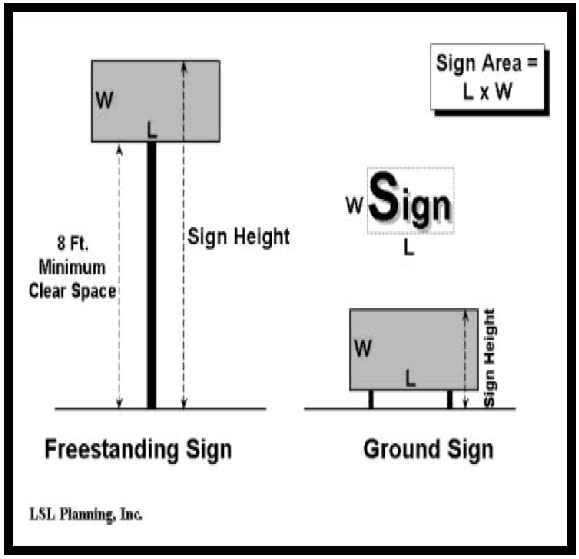
Freestanding sign. A sign structurally separate from and not attached to any building, which is attached directly to the ground surface in a permanent manner, or supported by one or more uprights, poles or braces attached to the ground surface in a permanent manner.
(3)
Government sign. Any sign erected by the city, county, state, or federal government.
(4)
Ground sign. A freestanding sign which is placed directly on the ground surface, without use of uprights, poles or other means to elevate the sign face above the surrounding grade.
(5)
Neon illumination. A secondary element of a wall or projecting sign that uses neon, argon, a similar gas or phosphors to fill tubing made of glass or similar material, which is charged with electricity and used to create illuminated elements of a sign, including lettering, symbols, images, shapes or accents.
(6)
Plat entry sign. A sign placed at the street entrance to a subdivision, mobile home park, industrial park, etc.
(7)
Portable sign. A sign primarily for temporary use, which is designed to be moved easily and is not permanently attached to the ground, a building or other structure. A portable sign may or may not have wheels and provision for towing behind a vehicle.
(8)
Projecting sign. A sign attached to the wall of a building, with the face of the sign in a plane approximately perpendicular to the plane of the wall.
(9)
Roof sign. A sign attached to and projecting from the roof surface of a building.
(10)
Sandwich board signs. A two sided sign which is not permanently attached to either a structure or the ground and which incorporates an "A" frame shape. Such signs may be placed on a private lot, private walkway or public sidewalk so long as they do not interfere with pedestrian traffic and only during the hours of operation for the entity which the sign advertises.
(11)
Sign. Any object or device (or part thereof) which is used to advertise, identify, display, or direct or attract attention by including words, letters, figures, designs, symbols, fixtures, colors, motion, illumination or images.
(12)
Special sign. A temporary sign established by a governmental agency, or charitable or other nonprofit organizations.
(13)
Temporary yard sign. A removable, light weight, and portable sign that because of its construction is intended to be displayed for a limited period of time and is not designed to be permanently affixed to the ground, building or structure.
(14)
Wall sign. A sign attached to the wall of a building with the face of the sign in a plane approximately parallel to the plane of such wall and not projecting from the wall more than six inches. A sign attached to or displayed upon an awning, marquee or canopy is also considered to be a wall sign.
(Ord. No. 224, § 1, 5-18-2021)
Sec. 98-573. - General provisions.
(a)
A sign not expressly permitted by this division is prohibited. Unless otherwise permitted in this chapter, a sign shall pertain to the use or lot on which it is located, with the exception of temporary signs as authorized in [subsection] (b), below.
(b)
Special signs may be erected by governmental agencies, charitable, or other nonprofit organizations on a temporary basis without a permit, but shall be subject to the following limitations:
(1)
No more than five signs shall be displayed at one time. They may not, without the prior permission of the zoning administrator be placed in any right-of-way or be placed within the setback side yard, clear vision area or other space required by applicable regulations.
(2)
The display of signs shall be limited to 23 days per occurrence.
(3)
Signs shall have a maximum size of 48 square feet in area, and a maximum height of five feet.
(4)
Any sign shall not be erected without prior notification to the zoning administrator.
(c)
Measurement of sign area and height.
(1)
The entire area within a circle, triangle or parallelogram enclosing the extreme limits of writing, representation, emblem, or any figure of similar character, together with any frame or other material or color forming an integral part of the display or used to differentiate such sign from the background against which it is placed; excluding the necessary supports or uprights on which such sign is placed, unless the supports or uprights contain writing, representation, emblems or any figure of similar character, in which case the area of such shall be computed within the total sign area.
(2)
Where a sign has two or more faces, the area of all faces shall be included in determining the area of the sign, except that where two such faces are placed back to back and are at no point more than two feet from one another, the area of the sign shall be taken as the area of one face if the two faces are of equal area, or as the area of the larger face if the two faces are of unequal area.
(3)
In the case of a sphere, the total surface area of the sphere shall be divided by two for purposes of determining sign area.
(4)
The height of any sign shall be measured from the mean grade.
(5)
A freestanding sign shall have a minimum ground clearance of eight feet as measured from the mean grade to the bottom of the sign.
(6)
For wall and roof signs on buildings with multiple tenants, the permitted number and area of signs shall be computed using the wall area or length applicable to the individual business being identified.
(d)
Signs in residential districts must be placed upon private property.
(e)
Signs shall be stationary, and shall contain no visible moving parts or images, or have the appearance of moving parts or images. Time and temperature numerals are exempt from this provision. There shall be no flashing, oscillating or intermittent illumination of any sign.
(f)
Signs shall be illuminated only by continuous indirect or direct lighting. All sign illumination shall be employed in such a manner so as to prevent intense or brilliant glares or rays of light from being directed at any street or any adjoining property.
(g)
No sign shall be placed within or above any public right-of-way or upon any utility pole except as otherwise permitted within the right-of-way of a state-designated highway in accordance with the regulations pertaining thereto, and except for projecting signs as permitted in this chapter.
(h)
The construction of any sign shall be such that it will withstand all wind and vibration forces which can be normally expected to occur in the vicinity. No sign shall be allowed to become unsightly through disrepair or action of the elements.
(i)
The zoning administrator may permit a sign location required by section 98-575 to be moved up to five feet in any direction, provided that all of the following requirements are met. Sign location changes not meeting these requirements shall require a variance.
(1)
The requested relocation is necessary because the location dictated by the Ordinance is not physically capable of accommodating the sign, provided that the conditions were already present at the time the sign is requested, and that the conditions were not created by an action of the applicant, owner, or lessee.
(2)
The relocated sign does not create a hazard to traffic, pedestrians, or adversely affect other signs or properties.
(3)
The new location is on the same property and does not encroach on any road right-of-way or access easement.
(4)
The sign is no greater in size or height than permitted by this chapter.
(j)
Nonconforming signs.
(1)
Signs lawfully erected prior to the date of adoption of this division, which do not meet the requirements of this division, may be continued except as otherwise provided.
(2)
A sign which is located on a site to which the sign no longer applies for a period of 60 days or more, and any sign which pertains to a time, event or purpose which no longer applies, shall be deemed to be abandoned.
(3)
Nonconforming signs larger, higher or located incorrectly on the site shall be removed once abandoned.
(4)
No nonconforming sign shall be changed to another nonconforming sign unless the new sign is at least reduced in size or height, depending on the nature of its nonconformity, by at least 50 percent of its nonconforming size or height.
(5)
No nonconforming sign shall be structurally altered so as to change the shape, type or size of the sign. Any structural alterations made shall only be in compliance with the requirements of section 98-575.
(k)
Removal of nonconforming signs.
(1)
The zoning administrator shall cause to be removed any nonconforming sign(s) and/or sign(s) erected without a permit pursuant to section 98-574.
(2)
The zoning administrator shall prepare a notice which shall describe the sign and specify the violation involved and provide that the sign be removed or the violation cured within ten days to avoid any penalty. If the owner fails to comply with this notice of violation, the zoning administrator may pursue action under article 1, section 98-5 of this chapter.
(3)
All notices mailed by the administrator shall be sent by certified mail. Any time periods provided in this section shall be deemed to commence on the date of the receipt of the certified mail.
(4)
Any person having an interest in the sign or the property may appeal the determination of the administrator ordering removal or compliance by filing a written notice of appeal with the city board of appeals within 30 days after the date of mailing the notice, or 30 days after receipt of the notice if the notice was not mailed.
(5)
If no appeal has been filed with 30 days after the date of mailing the notice, or 30 days after receipt of the notice if the notice was not mailed, and the violation has not been cured, the zoning administrator may take steps to remove the sign and allocate its costs under article 1, section 98-5 of this chapter.
(Ord. No. 224, § 1, 5-18-2021)
Sec. 98-574. - Sign permit required.
(a)
Except as noted in [subsection] (b), below, no sign shall be erected, placed, constructed, reconstructed, or modified except upon issuance of a permit by the zoning administrator. Application for permit shall be made by submitting the following information to the zoning administrator:
(1)
A completed application on a form provided by the city.
(2)
Payment of an application fee, which shall be non-refundable, and which shall be established from time to time by resolution of the city council.
(3)
Plans and specifications for the proposed sign, in detail sufficient to determine its compliance with the provisions of this chapter.
(b)
The following signs are exempt from the permit requirements of this chapter:
(1)
One sign per street address not exceeding two square feet in area.
(2)
Flags and insignia of a government except when displayed in connection with a commercial promotion. Flags and insignias must comply with the setback, side yard, height and other requirements applicable to main buildings. A maximum of three flags and insignias per lot shall be permitted.
(3)
Legal notices and government signs.
(4)
Integral decorative or architectural features of buildings, except letters, trademarks, moving parts or moving lights.
(5)
Signs not exceeding two square feet in area per sign on the interior portions of any lot.
(6)
Temporary yard signs per the requirement of section 98-575.
(Ord. No. 224, § 1, 5-18-2021)
Sec. 98-575. - Permitted signs.
(a)
The following signs and specifications are permitted in the noted zoning districts, as follows:
(b)
Outdoor advertising signs, commonly known as billboards, shall be permitted only under the following conditions:
(1)
Such signs are permitted only in B-2 highway service districts and M-1 industrial districts;
(2)
Such signs are required to have the same setback as other principal structures or buildings in the zone in which they are situated;
(3)
Where two or more outdoor advertising signs are along the frontage of a single street or highway, they shall not be less than 1,000 feet apart. A double face (back to back) or a V-type structure shall be considered a single sign;
(4)
The total surface area, facing in the same direction of any outdoor advertising sign shall not exceed 300 square feet;
(5)
No outdoor advertising sign shall be erected on the roof of any building, nor have one sign above another sign;
(6)
Such signs may be illuminated by reflected light only, provided the source of light is not directly visible and is so arranged to reflect away from the adjoining premises, and provided that such illumination shall not be so placed as to cause confusion or a hazard to traffic or conflict with traffic control signs or lights. No illumination involving the appearance of movement by reason of lighting arrangement or other such devices shall be permitted.
(7)
Such sign shall:
a.
Be harmonious with and in accordance with the intent, purposes and provision of this chapter;
b.
Be designed, constructed, operated, maintained and managed so as to be harmonious and appropriate in appearance with the existing or intended character of the general vicinity and so as to not change the essential character of the area;
c.
Not be hazardous or disturbing to existing or projected future uses.
(Ord. No. 224, § 1, 5-18-2021)

