
Lexington County Unincorporated
City Zoning Code
City Zoning Code
ARTICLE 2
APPLICATION OF REGULATIONS
21.00 - General Classification Rules
The purpose of this chapter is to classify all uses into a number of specially defined activities on the basis of common functional characteristics and similar compatibility with other uses. This classification system provides a basis for the regulation of these activities and their assignment to districts later in this chapter. Vacant land, itself, shall not constitute an activity type. In the event of conflicting interpretations, or uncertain references to a particular use, the Zoning Administrator will assign uses to the most appropriate activity category. Any disagreement with that assignment may be appealed to the Board of Zoning Appeals.
(Ord. No. 23-17, 6-25-2024)
21.10 - Description of principal activities
Advertising Signs are any signs, pictorial or otherwise, regardless of size or shape, which direct attention to businesses, commodities, attractions, professions, services, or entertainment conducted, sold, offered, manufactured, existing, or provided at locations other than on the premises where the signs are located or to which they are affixed. Such signs are sometimes called off-premise signs, and include, but are not limited to those signs commonly referred to as outdoor advertising signs, billboards, or poster boards.
Airports and landing strips, including heliports, consist of the runways, landing areas, and terminals only. Activities comprising other airport related uses shall be classified according to the specific activity as found within these descriptions.
Agricultural Operations include the keeping, grazing, or feeding of animals for animal products and/or animal increase or value increase; the raising of trees, vines, field, forage, or other plant crops intended to provide food or fiber; and/or the cultivation, for sale, of horticultural specialties such as flowers, shrubs, trees, turf, and/or bushes intended for ornamental or landscaping purposes. Notwithstanding any other provisions of this Ordinance, agricultural animal operations (ex. poultry and swine farms) are governed exclusively by state law and regulations of the Department of Health and Environmental Control (SCDHEC). Only structures shall be reviewed for the permitting of this activity. Office, retail, packaging, shipping, and other support activities affiliated with an agricultural operation must meet applicable requirements of the appropriate land use as defined within this Section of the Ordinance.
Boat Docks other than that allowed as an accessory use under Section 21.20, shall include wet storage of water craft, or dry storage where no structures are erected to house the water craft. Access to the water must be provided through a parcel carrying the appropriate zoning district designation. Ramps are allowed for entrance into the water provided they are used only for launching and retrieving those water craft having space either in the boat slips or in the dry storage area. Boat Docks shall be issued a zoning permit only after receiving a favorable response from all agencies having jurisdiction over such activities. A list of these agencies shall be maintained by the Zoning Administrator.
Bus and Transit Terminals.
Business Offices include traditional office-type environments recognized by professionals such as lawyers, architects, engineers, CPAs, real estate brokers and the like; clerical or goods brokerage services; banks, savings and loans, or other financial, consulting, or administrative activities; communication related services; book and newspaper publishing; multicopying, blueprinting, and custom printing; and other such activities where clientele are served on the premises with nothing other than a service rendered.
Cemeteries for the purpose of this ordinance, single burial sites shall not be considered a cemetery land use activity.
Child or Adult Day Care includes any facility for the regular care, supervision, or guidance of pre-teenage children, senior citizens, or adults with disabilities, which is subject to registration or licensing by the South Carolina Department of Social Services. Regular care, supervision, or guidance of no more than 6 such individuals may qualify as a Home Occupation under Section 21.22.
Churches temples, and other places of worship. Child day care and/or preschool activities shall be allowed as an accessory to churches, provided such activities are on-premise of the church and directly affiliated with the principal church activity.
Communication Towers (Limited) include those used for telephone transmittal. The buildings attendant to such use may be included in this activity as long as the size does not exceed 300 square feet.
Vegetation. Towers to preserve existing vegetation.
Illumination. Towers shall be illuminated only to the extent required by applicable federal or state statute or regulation.
Co-location. Satisfactory evidence shall be submitted that alternative towers, buildings, or other structures are not available for use within the communication tower site search area that are structurally capable of supporting the intended wireless communication antenna or meeting the necessary height criteria, or provide a location free of interference from other communication towers. The applicant for a new tower shall sign an instrument, maintained by the County, agreeing to encourage and promote the joint use of telecommunications towers within the County and, to that extent, committing that there shall be no unreasonable act or omission that would have the effect of excluding, obstructing or delaying joint use of any tower where fair and reasonable market compensation is offered for such use.
Color. Towers shall be light gray, except as otherwise required by applicable federal or state statute or regulation.
Fall zone letter required. A tower must be designed such that, in the event of structural failure, it would not fall within a public right-of-way or onto adjoining property. A signed letter from a registered professional structural engineer certifying to this will be required unless the setback exceeds the height of the tower.
Airport Height Control. Towers must meet applicable height regulations as determined by the Federal Aviation Administration (FAA) and/or South Carolina Aeronautics Commission for towers within proximity to or located within an airport approach, transition, or other overlay zone.
Communication Towers (Extensive) include those used for radio and television transmittal. The buildings attendant to such use may be incorporated into the Business Services activity.
Vegetation. Towers to preserve existing vegetation.
Illumination. Towers shall be illuminated only to the extent required by applicable federal or state statute or regulation.
Color. Towers shall be light gray, except as otherwise required by applicable federal or state statute or regulation.
Fall zone letter required. A tower must be designed such that, in the event of structural failure, it would not fall within a public right-of-way or onto adjoining property. A signed letter from a registered professional structural engineer certifying to this will be required unless the setback exceeds the height of the tower.
Airport Height Control. Towers must meet applicable height regulations as determined by the Federal Aviation Administration (FAA) and/or South Carolina Aeronautics Commission for towers within proximity to or located within an airport approach, transition, or other overlay zone.
Community Education activities include public, parochial, and private kindergartens, primary and secondary schools, colleges, junior colleges, technical education centers, and universities. Day care centers, stadiums, dormitories and other activities attendant to scholastic endeavors shall be dealt with as separate activity types, not to be included within the scope of this definition.
Construction Services include the storage of materials and equipment, including office area, used to operate a construction-type business. Construction Services activities may include the temporary on-site storage of construction and demolition debris limited to masonry-type products, concrete, asphalt, and like materials, provided the storage and recycling is located at an established facility, which includes an office and equipment storage; the debris is directly related to a project that the activity/business is currently involved with; the amount of unprocessed material does not exceed 6,000 cubic yards at any given time; 75 percent of the debris must be processed or recycled within a one year time frame; and all applicable buffering restrictions and performance standards are met for the principal activity. The owner and/or operator shall also supply documentation that such debris recycling is in compliance with SCDHEC as a Construction and Demolition (C&D) Debris Recycling Facility. The recycling of land clearing debris and/or yard waste is not an allowed accessory to Construction Services. In the event the before mentioned parameters cannot be met, the on-site storage and/or recycling of construction and/or land clearing debris shall constitute a landfill land use activity and be regulated as such (See "Landfills").
Detention Centers, prisons, or correctional institutions, but not halfway houses.
Essential Services include all facilities which provide power, communications, or personal health protection and emergency services as specified below. Any such facility owned and/or operated by the Irmo Fire District is exempt from the provisions of this Ordinance, provided all locations are approved by Lexington County Council.
Essential Services (Limited) shall include communication equipment installations and exchanges, natural gas substations, electric substations, neighborhood newspaper distribution centers, and post offices (excluding major mail processing centers).
Essential Services (Extensive) shall include government agency facilities, such as recycling stations, solid waste transfer stations, law enforcement stations, fire stations, ambulance substations, courts of law, and emergency communication stations.
Food Services include functions performed by restaurants or other establishments wherein prepared food or beverages are sold for take-out, home delivery, or on-site consumption. A drive-through operation is considered accessory to the performance of the activity. Food truck courts shall be regulated as a Food Service land use activity.
General Repair and Maintenance Services include activities such as appliance repair, furniture repair and/or refinishing, electronics repair, small engine repair, welding shops (excluding fabrication), and minor mechanical repairs. Work is completed primarily on-site, to include the storage of parts and items under repair.
General Retail (Limited) activities include the wholesale or retail sale or rental of goods or services customarily associated with clothing shops, convenience stores, drug stores, jewelry shops, florist shops, specialty gift shops, appliance stores, pet shops, hardware stores, garden supply shops, shoe stores, book stores, art studios, photography studios, stationary stores, and the like wherein the goods or services are offered at one location, either in the same building, in a series of buildings, or exterior sales, which, in the aggregate, do not exceed 5,000 square feet in size. This activity also includes the sale of tires, batteries and vehicle accessories wherein the storage and/or display of goods and materials is conducted inside the buildings. Portable sales units used in conjunction with seasonal sales or special events must be removed within 30 days of the end of the season or event.
General Retail (Extensive) activities include the wholesale or retail sale or rental of goods or services wherein a wide variety of such goods or services are offered at one location, either in the same building or in a series of buildings. General retail activities that are open 24 hours on any given day and/or dispense and/or sell petroleum products for immediate refueling of vehicles shall be included within this category.
Golf Courses include the playing course itself as well as the support activities essential to its operation such as a pro shop, food service, group assembly (for less than 500 participants), maintenance sheds, daylight driving range, and cart storage. Any other activity must meet the requirements of the appropriate category as defined in this section.
Group Assembly (Limited) activities include the provision of cultural, entertainment, educational, recreational, and athletic services to assembled groups of spectators or participants smaller than 250 in number. This activity includes clubs, lodges, and meeting halls. It also includes a single lane boat ramp access into a body of water provided it is not available to the general public. Parcels located on water may also support fishing piers, swimming areas, and courtesy docks provided no water craft are docked overnight. Overnight dry storage of water craft is allowed, but not in structures or on a waterfront parcel.
Group Assembly (Intermediate) activities include the provision of cultural, entertainment, educational, recreational, and athletic services to assembled groups of spectators or participants 250 in number but smaller than 5,000 in number. This activity includes clubs, lodges, meeting halls, and temporary fairs, circuses, and festivals. It also includes boat ramp access into a body of water provided it is not available to the general public.
Group Assembly (Extensive) activities include the provision of cultural, entertainment, educational, recreational, and athletic services to assembled groups of spectators or participants 5,000 or greater in number. This activity includes clubs, lodges, meeting halls, and temporary fairs, circuses, and festivals. It also includes boat ramp access into a body of water provided it is not available to the general public.
Group Housing activities include convents, monasteries, orphanages, membership lodging such as fraternity and sorority houses, halfway houses, residence hotels, residence halls, dormitories, and homes for the mentally and physically handicapped (except as specifically exempted in SC State Statute 6-29-770, as amended; these activities shall be included in the Residential Detached or Residential Attached activity types, as appropriate.) This activity does not include convalescent homes, nursing facilities, or retirement centers. (See also "Nursing Homes," "Retirement Centers.")
Hospitals include institutions providing primary health services and medical or surgical care to persons, primarily inpatients, suffering from illness, disease, injury, deformity, and other abnormal physical or mental conditions, and including, as an integral part of the institutions, related facilities such as laboratories, outpatient facilities, or training facilities.
Kennels, Catteries, and Stables include any person, establishment, partnership, corporation, or other legal entity that owns, keeps, harbors, or is custodian of domestic animals and/or domestic fowl kept or used for stud for which a fee is charged and/or for breeding purposes for which a fee is charged for the offspring, or for the purpose of commercial boarding, grooming, sale * , or training. Animal rescue and/or adoption facilities, whether operated for profit or as nonprofit organization, shall be included in this category. Private kennels or catteries maintained by a fancier to keep or train cats or dogs for noncommercial hunting or for breeding purposes in order to regularly participate in exhibition in shows or field trials, or obedience of performance trials at the AKC (American Kennel Club), UKC (United Kennel Club), or the CFA (Cat Fancier Association) licensed shows. Activities under this category shall not include livestock and other farm animals used in customary and normal agricultural husbandry practices or fancier's kennel or cattery or an Animal Hospital maintained by a licensed veterinarian.
* A pet shop, as defined as any person, partnership or corporation, whether operated separately or in connection with another business enterprise or other legal entity that buys or brokers any species of animal for resale as pets, shall be classified as General Retail (Limited) unless the activity is included within a larger General Retail (Extensive) activity.
Landfills include all of the following activities as defined by the South Carolina Department of Health and Environmental Control (SCDHEC) of the Lexington County Solid Waste Ordinance, now or in the future, and/or land use activities that collect and store solid waste material for immediate or future disposal. Landfills may consist of above and/or below ground waste storage. Landfills are classified as either limited, intermediate, or extensive and may include solid waste activities exempt from review by SCDHEC. Recycling activities which involve recovered materials, construction, demolition and/or land-clearing or yard debris are regulated in the same manner as the landfill classification within which they are listed, even if there is no landfill at the location of the recycling activity unless affiliated with a Construction Services land use activity and within the thresholds of such allowances (See "Construction Services"). Landfill activities must also comply with applicable provisions of the Lexington County Solid Waste Ordinance. Structurally filled areas, as approved by SCDHEC, shall not constitute a landfill.
Landfills (Limited) shall have a landfill area which does not exceed 4 acres and is operational for less than 2 years. This activity category does not include facilities such as municipal or industrial solid waste landfills or the disposal of hazardous materials, or the on-site processing of recovered materials, such as, construction, demolition, and/or land-clearing or yard debris for recycling.
Landfills (Intermediate) shall have a landfill area which does not exceed 12 acres. This activity category does not include the disposal of hazardous materials, but may include the on-site processing of recovered materials, such as, construction, demolition, and/or land-clearing or yard debris for recycling provided the amount of unprocessed material stored above ground does not exceed 10,000 cubic yards.
Landfills (Extensive) include all other landfills not included within the definition of Landfill (Limited) or Landfill (Intermediate). This activity category also includes the on-site processing of recovered materials, such as, construction, demolition, and/or land-clearing or yard debris for recycling.
Manufacturing (Limited) activities include, among others, the manufacturing, compounding, processing, assembling, packaging, treatment, fabrication, or storage of products and services where all portions of the activity are within an enclosed building and where the total building area does not exceed 10,000 square feet.
Manufacturing (Intermediate) includes any manufacturing activity where the total building area is greater than 10,000 SF in size. This activity may be located outside of a building.
Manufacturing (Extensive) includes all manufacturing activities associated with the following uses: arsenals, explosive and fireworks plants; atomic reactors; chemical manufacturing exceeding 1-ton per day; offal processing; paper, pulp, or other forest product mill; petroleum refining; waste disposal by incineration or other means; vehicle or craft production; and the like.
Marinas include public boat ramps, and wet or dry storage of water craft. Provisions for food service, convenience retailing (including petroleum dispensing), engine repair, etc., customarily associated with marinas shall be considered as separate principal activities according to the respective descriptions within this section. Access to the water must be provided through a parcel carrying the appropriate zoning district designation. Marinas shall be issued a zoning permit only after receiving a favorable response from all agencies having jurisdiction over such activities. A list of these agencies shall be maintained by the Zoning Administrator.
Medical Services include the therapeutic, preventative, or corrective personal treatment of people normally performed by physicians, dentists, or other practitioners, as well as medical testing and analysis services. This activity may include a public health clinic but would exclude any facilities providing extended or inpatient care. Veterinarian services are included within this category, excluding outdoor kennels and/or associated pet boarding.
Military Installations.
Mining includes the extraction or removal of minerals for sale, processing, or consumption even if the mining activity is not required to obtain a mining permit from the South Carolina Department of Health and Environmental Control (SCDHEC). It does not include grading, backfilling, plowing, or excavating areas for agriculture or on-site construction, nor does it include exploratory mining as defined by the SCDHEC. Borrow pits owned, operated, and/or managed by the South Carolina Department of Transportation (SCDOT) or the County of Lexington exclusively for road or infrastructure construction do not constitute a mining activity by this Ordinance; however, the extraction or removal of minerals from such borrow pits for the purposes not directly associated with SCDOT or County roadway project, will require the use to meet all applicable requirements for mining operations.
Mining (Limited) includes all mining operations where the mining area does not exceed 5 acres. This activity category does not permit on-site mineral processing, including but not limited to, milling, crushing, screening, washing, flotation, or refining. This activity category does not include chemical leaching of minerals, hard rock quarrying, or blasting.
Mining (Intermediate) includes all mining operations where the mining area does not exceed 25 acres. This category does not include the on-site mineral processing, chemical leaching of minerals, hard rock quarrying, or blasting.
Mining (Extensive) includes all other mining activities not included within the definition of Mining (Limited) or Mining (Intermediate), to include all mining activities that have on-site mineral processing, utilize chemical leaching of minerals, utilize hard rocky quarrying, and/or blasting, regardless of acreage.
Mini-Parks are recreational areas with no more than playground equipment, bicycle trails, pedestrian walking trails, and picnic facilities.
Mini-Warehouses include the operation of warehousing and storage wherein the storage capacity of individual units is less than 1000 square feet of floor area and individual keys are provided to lock each unit during the term of a rental agreement.
Mobile Home activities, also defined as manufactured homes, are transportable dwellings intended for permanent residential occupancy that are built entirely in a factory under federal construction and safety standards administered by the U.S. Department of Housing and Urban Development (HUD). They may be single- or multi-section, and are transported to the site and installed. This activity shall not include modular residential construction, as defined within the South Carolina Modular Buildings Construction Act. Modular residential construction shall be included in the Residential Detached or Residential Attached activity types, as appropriate.
Mobile Home or Tiny Home Parks Three or more mobile homes, tiny homes, mobile home spaces, or tiny home spaces that are located within 1,000 feet of one another and operated in any coordinated manner. The park may be located on a single parcel, or multiple parcels in the same or different ownership. For the purpose of this Ordinance, three mobile homes and/or tiny homes shall not be considered a mobile home or tiny home park if one of the three mobile homes and/or tiny homes are occupied by the property owner and is their legal residence. Additional mobile homes or tiny homes may be allowed by the Zoning Administrator without creating a mobile home or tiny home park, provided the mobile home or tiny is to be the primary residence for an immediate family member with special needs (i.e., disabled, handicapped, elderly, ill, or other special/dire circumstance) and other requirements of the Ordinance are met. Immediate family members may include grandparents, parents, spouses, siblings, children, grandchildren, and/or legal guardians. At such time the additional home is no longer utilized to house an immediate family member with special needs, the mobile home or tiny home must either be removed from the site within 60 days or the property(s) shall conform to the current requirements for a mobile home or tiny home park land use.
Mobile Home or Tiny Home Parks (Limited) The minimum size of an individual mobile home space in this type of development is 20,000 square feet.
Mobile Home or Tiny Parks (Extensive) The minimum size of an individual mobile home space in this type of development is 6000 square feet.
Natural Reserves and undeveloped open spaces include parks with minimum equipment, botanical gardens and arboretums, and the like.
Non-Assembly Cultural activities include public, parochial and private museums, art galleries, libraries, and observatories.
Nursing Homes include convalescent homes, convalescent hospitals and clinics. Skilled care is typically provided to residents/patients. (See also "Retirement Centers.")
Personal Convenience Services including barbering, laundromats, beauty care, dry cleaning, tattoo parlors, body piercing studios, and the repair of personal apparel, and similar items, but not including motor vehicles, structures, or engines.
Power Plants (non-atomic).
Radioactive Materials Handling includes the use, in any way, of significant amounts of radioactive or atomic material, to include atomic power plants or radioactive waste treatment or storage. Incidental amounts of such material incorporated into activities of scientific measurement or diagnostic practice shall not be included in this classification.
Railroad terminals and yards (freight and passenger).
Recycling Centers include the processing, collection, and/or temporary storage of consumer goods/materials, such as aluminum cans, newspaper, office paper, plastic bottles, glass bottles, cardboard, and similar-type materials, to be sold for the purpose of creating post-consumer use products. Materials collected on-site must be stored within designated bins or containers. This activity does not include the recycling of construction, demolition, and/or land-clearing or yard debris. Such recycling operations shall be regulated as landfills in accordance with the provisions of Article 9. This activity does not include the collection, storage, process, etc. of scrap metal or the wrecking, storage, dumping, sale, and/or dismantling of used/wrecked automobiles, vehicles, crafts, and trailers for their parts. (See "Salvage/Wrecking Yards and Scrap Operations") and Article 11.
Research Services are research activities of a scientific or industrial nature which are offered as an independent service, and do not include medical testing and analysis and routine product testing.
Residential Detached are single dwelling units (DUs) in a single structure which are surrounded by yards or other open area. In the event a single camper, recreational vehicle, or similar-type vehicle is to be utilized as a residential use, the applicable provisions of Residential Detached land use activities shall apply to include density and setbacks. Such vehicles shall have proper registration/licensing and conform to the Neighborhood Appearance District standards for vehicle parking and storage. (See "Transient Habitation" for additional provisions).
Residential Detached (Limited) are single dwelling units (DUs) in a single structure which are located within specific developments typically on smaller or reduced sized lots. This land use may be commonly referred to as a patio home, garden home, or courtyard home. For the purpose of this Ordinance, the exterior of Residential Detached (Limited) activities shall be predominately brick, stone, fiber cement, stucco or similar permanent material. Vinyl siding, concrete and/or cinder exteriors are not permissible for this land use activity. Single family or other detached residential uses that do not meet or conform to the criteria of this land use shall be regulated as a Residential Detached land use activity. * Reference Article 12 for specific regulations pertaining to Residential Detached (Limited) land use activities.
Residential Attached - Duplex are two dwelling units (DUs) in a single structure separated by a common wall.
Residential Attached - Multifamily are three or more dwelling units (DUs) typically located within a single or multiple structures, are generally multi-story, usually have common parking and amenity areas, and are referred to as apartments or condominiums.
Residential Attached - Townhouse a row of three or more attached dwelling units (DUs) in a single structure with each individual unit separated by a common wall that is located on a common property line. Each dwelling unit has an individual outside entrance. For the purpose of this ordinance, this land use activity cannot exceed two stories. Residential Attached land use activities consisting of three or more dwelling units that do not meet the criteria of this land use shall be regulated as Residential Attached - Multifamily.
Retirement Centers/Assisted Living Facilities include those long and/or short-term care complexes offering any combination of assisted living, memory care, medical/nursing care, and/or preventative care, with the ability to provide independent housing options. Independent housing may account for no more than 60 percent of the aggregate beds in all care categories located within a complex. This land use activity may supply additional support services for patients/residents/tenants such as but not limited to, light retail/personal services, food services, transportation services, wellness services, and/or medical services to include licensed nursing care. Activities may take place under one roof or in separate buildings. (See also "Nursing Homes.")
Salvage/Wrecking Yards activities include the dismantling or wrecking of used automobiles, vehicles, crafts and trailers, or the storage, sale, or dumping of dismantled or wrecked vehicles/crafts or their parts. The presence on any lot or parcel of land of two or more motor vehicles/crafts or bulk of two or more vehicles/crafts, which, for a period exceeding 90 days, have not been capable of operating under their own power, are not properly registered/licensed, and/or from which parts have been or are to be removed for reuse or sale, shall constitute prima-facie evidence of a salvage/wrecking yard. This activity shall include facilities storing wrecked vehicles/crafts and/or vehicles/crafts that have been deemed a total loss for a period exceeding 90 days.
Salvage/Wrecking Yards (Limited) include activities that are 2 acres or less in area.
Salvage/Wrecking Yards (Extensive) include activities that are greater than 2 acres in area.
Scrap Operations include the storage, processing, and/or sale of used or waste material or other items except when such activities are incidental to a manufacturing operation. (See also "Salvage Yard.") This activity does not include the recycling of recovered materials, such as construction, demolition, and/or land-clearing or yard debris for recycling. Such recycling operations shall be regulated as landfills in accordance with the provisions of Article 9. This activity must also comply with applicable provisions of the Lexington County Solid Waste Ordinance and may be subject to SCDHEC regulations.
Scrap Operations (Limited) include activities that are 2 acres or less in area.
Scrap Operations (Extensive) include activities that are greater than 2 acres in area.
Short-Term Rental, Non-Owner Occupied is a land use whereby the record owner of the property, who does not live on the property and does not have a legal residence classification, converts a dwelling unit into a fully functioning, private accommodations use, which includes cooking, living, sanitary, and sleeping facility within one dwelling unit. The rental unit is to be rented for a period between one (1) and 29 consecutive days.
Short-Term Rental, Owner Occupied is a land use whereby the record owner of a property, who is also a resident of the property and has a legal residence classification, uses one (1) or more rooms on the property for the purpose of providing sleeping accommodations for a period between one (1) and 29 consecutive days.
Solar Energy Systems are energy generating facility, which utilizes a series of ground mounted solar collector panels within an area for the generation of power or energy. This land use activity is commonly referred to as a solar farm. This land use activity does not include the installation of solar collection panels on the roofs of structures or solar collection panels intended to generate power or energy to individual entities.
Speculative Development includes nonresidential projects where specific activities are unknown at the time of development or individual tenants may not yet be identified. The following designations may be selected provided that individual tenants must meet all applicable requirements for their principal activity and be permitted separately before locating within the designated development.
Business Parks include nonresidential projects that are developed with the intent of housing activities such as those identified as "Business Offices," "Medical Services," and "Research Services."
Shopping Centers include nonresidential projects developed with the intent of housing activities such as "General Retail," "Food Services," "Business Offices," and "Personal Convenience Services."
Industrial Parks are those nonresidential projects developed with the intent of housing activities such as those identified as "Manufacturing," "Research Services," and "Transport and Warehousing."
Tiny Home activities are typically single-family type units, which may also be used for rental communities, which are generally 400 square feet of less in size, excluding lofts. Tiny home construction/manufacturing may consist as a site-built/stick built structure, modular unit, manufactured home (reference "Mobile Home"), recreational vehicle, or park model. Regardless of construction, Tiny Home land uses shall be regulated as an individual land use activity. Tiny Home subdivisions shall also comply with all standards for Mobile Home and Tiny Home Parks, as regulated within Article 7 of this Ordinance.
Towing and Impoundment Lot includes the temporary storage or impoundment of automobiles, vehicles, crafts and trailers, as part of a towing business, repossession activity, or other principal activities that temporarily impound automobiles, vehicle, crafts and/or trailers. This activity includes accessory activities such as parking, receiving, and dispatching of tow truck or wrecker equipment, but not the repair or sale of vehicles and/or their parts or activities that would be classified as Salvage/Wrecking Yards and Scrap Operations.
Trade Enterprises include services such as HVAC repair, plumbing, pest control, landscaping, and electrical repair where service is typically provided off-site, such as at a home or business. Storage on-site of items for parts, materials, and/or repair shall be less than 5,000 square feet in area. Such activities with on-site storage of 5,000 square feet in area or greater shall be considered a Construction Services land use activity.
Transient Habitation activities include lodging services to transient guests, such as camper parks, motels, hotels, etc., and include restaurants and certain attendant recreational activities as accessory thereto. The presence of 2 or more campers, recreational vehicles, or other similar vehicle or craft manufactured for habitation, or the use of such vehicles or craft for the purposes of short or long term rentals shall be considered Transient Habitation.
Transport and Warehousing activities include the operation of warehousing and storage, freight handling, shipping services and a building or area in which freight brought by truck or rail spur is assembled and/or stored for routing or reshipment, or in which semi-trailers, including tractor and/or trailer units and other trucks, are parked or stored in conjunction with a legitimately conducted shipping and/or receiving operation or on sites specifically for such parking or storage.
Transport and Warehousing (Limited) shall include the above where the total storage area is 5,000 square feet or less.
Transport and Warehousing (Extensive) shall include the above where the total storage area exceeds 5,000 square feet.
Transport Services include taxi services, non-emergency medical transport services, etc.
Undertaking activities and attendant facilities (including a crematorium).
Utilities include all facilities used for water and sewer treatment and storage except septic tanks and individual wells. Distribution and collection lines, lift stations and booster pumps, and wells for ground water systems are also not considered as principal activities for regulation by this Ordinance.
Vehicle Parking activities include surface, subsurface, and high-rise facilities which house automotive, vehicular, and craft parking and storage activities, excluding the parking and/or storage of commercial vehicles or equipment.
Vehicle Repair and/or Sales activities include the repair and tune-up of engines, transmissions, etc.; painting, body work, and major accessory installation for automobiles, vehicles, and crafts; the sale of goods and the provision of services which are generally required in the operation and maintenance of automobiles, vehicles, and crafts; and the wholesale or retail sale or rental of vehicles, crafts, and related equipment, to include automotive auctions.
Vehicle Servicing activities include self-service automotive washing establishments with no employees laboring on the premises, the washing and polishing of vehicles, and the sale and installation of electronic and minor automotive accessories.
Zoos include zoological gardens and petting zoos.
(Ord. No. 23-17, 6-25-2024)
21.20 - Accessory Activities
Each principal activity above shall be deemed to include activities customarily associated with and appropriate, incidental, and subordinate to the principal activity when located on the same lot and when meeting the further conditions set forth in Sections 21.21 and 21.22 below. Such accessory activities shall be controlled in the same manner as its associated principal activity except as otherwise provided in this Ordinance.
21.21 Partial List of Accessory Activities
Such accessory activities include, but are not limited to, the activities indicated below:
a.
Off-street parking, driveways, dumpsters, etc., serving the principal activity, whether located on the same lot or on a different lot, but only if the facilities involved are reserved for the residents, patrons, employees, or other persons participating in the principal activity.
b.
Residential occupancy in connection with a principal nonresidential activity on the same lot.
c.
Operation of a cafeteria for employees, residents, patrons, or others participating in the principal activity on the same lot.
d.
Production of goods for sale by a firm engaged in a principal commercial activity on the same lot, but only if:
1.
All goods so produced are sold at retail by the same firm on the same lot;
2.
Such production does not utilize more than 49 percent of the total floor area occupied by such firm on the same lot;
3.
Such production does not in any case occupy more than 2000 square feet of such floor area; and
4.
Such production occurs only in an enclosed building.
e.
Storage of goods sold by a firm engaged in a principal commercial activity on the same lot, provided such storage does not occupy more than 49 percent of the total floor area.
f.
Temporary 1-day sale of goods from a residential dwelling or other principal activity provided such sale does not occur more often than four times in any given year at the same location.
g.
Sale of personally owned vehicles or crafts from a residence, provided such activity does not occur more than four times per year, sale items are placed on the same property as the residence, the owner of such vehicles or crafts must reside at the residence, and the sale of such items is not coordinated through a dealer or broker service.
h.
Temporary 1-day or 2-day special events, such as concerts, cultural events, fund raising events, and the like, which are either located on vacant properties, not located on the same property as the principal activity, or not directly affiliated with the principal activity where the event is held, provided such activity does not occur more often than three times per year.
i.
Temporary construction, grading, and/or demolition activities which are necessary and incidental to the development or maintenance of a principal activity, utilities, or public infrastructure. The on-site grinding/recycling of construction debris shall be limited to the hours of 7:00 a.m. until 7:00 p.m. and shall be completed within 60 days of the initial construction, with the exception of public road projects, which are exempt from such provisions.
j.
Temporary conduct of a real estate office which is directly related to the development of a subdivision of five or more lots.
k.
Boat docks on waterfront parcels of Lake Murray supportive of residential uses not located within a platted residential subdivision that includes a lake-front amenity or dock. These may be common docks shared by no more than five dwelling units provided the boat slips number no more than five. For every dwelling unit on a non-waterfront parcel served by the common docks, there must be one dwelling unit located on a waterfront parcel served by the common docks.
l.
Vehicles without a current license plate and/or registration or vehicles under repair for longer than 30 days, are an allowed accessory activity to residential use only if fully screened from the road right-of-way and any surrounding properties and located on private property. Vehicles include cars, trucks, sport utility vehicles, crossovers, motorcycles, boats, watercraft, etc.
In the case of two vehicles on a property meeting this description, a cloth automotive cover may be used provided that it is designed and sold specifically for use as a car/truck/vehicle cover and is in excellent condition. A tarpaulin may not be used as screening. For multiple vehicles, total screening must be provided as described in Article 2, Section 23.40 Screening. The storage of such vehicles within an enclosed garage or carport shall also be acceptable.
m.
The repetitive parking of commercial-type vehicles shall be allowed as an accessory activity to a residential use only through compliance with the following restrictions or through a variance from the Board of Zoning Appeals. The parking of any vehicle shall not violate the vision clearance requirements of this Ordinance or be located within a road right-of-way. There are also no grandfathering provisions for any existing violations of these restrictions.
1.
Allowed without any restrictions:
Pickup - two-door
Pickup - four doors with extended cab
Pickup/truck - six wheels (dual rear wheels)
2.
Allowed if parked completely off the road right-of-way and properly licensed and/or registered:
Small van or mini-van used commercially (i.e., name on side, no windows)
Tour van
Privately-owned ambulance
Recreational vehicle and accessories
School bus
Garden or personal farm tractors and accessories and lawn mowers
3.
Allowed if parked beyond any setback lines imposed by this Ordinance:
Large step van
Individual tractor trailer - cab only
Tow truck, standard wrecker, or similar type vehicle
Commercial-type vehicles and/or equipment for "on-call" employees
(Such employees are considered on-call by an employer, and not self-employed; the storage of commercial vehicles does not exceed more than 48-hours within a one-week period; and the storage of such commercial vehicles does not violate private restrictions or covenants (ex. HOA restrictions).
4.
Allowed per residential use if completely screened from the road and all surrounding property:
Car carrier (flat-bed tilt)
Glass carrier
Tour minibus
Tractor trailer - cab and trailer
Tractor trailer - trailer only
Dump truck
Large van/truck - "moving van"
Flatbed truck - single chassis, tractor cab and trailer
Trailers with commercial materials
Backhoe
Such accessory activities shall not include any of the following:
The repetitive parking of the following commercial-type vehicles as an accessory activity to residential use. Since these activities are prohibited, a variance is not allowed as a method of relief from these restrictions, nor are there any grandfathering provisions for any existing violations.
Full size tour bus
Any vehicle hauling hazardous materials (e.g., pesticides, flammable liquids/gases)
Tanker truck containing hazardous or flammable liquid/gases
Motor grader, front-end loader, or other earthmoving equipment
Garbage truck
"Bucket" truck
(This list does not include yard and garden equipment not used commercially)
n.
Centralized mail kiosks, provided they conform to the United States Postal Service and all other federal, state, and local requirements.
o.
The temporary use of a single camper, recreational vehicle, or similar-type vehicle as a temporary residence in conjunction with a primary residential use, is an allowed accessory, provided the location complies with applicable density requirements, buffering restrictions of the principal activity, Section 21.21 1 and m of this Ordinance, Article 5 of this Ordinance, and the temporary residential use does not exceed a total aggregate time period of one (1) year.
In the event the temporary use is in conjunction with the construction of a primary residence or is necessary due to a total/partial loss of the existing primary residence, the allowed timeframe shall be consistent with the validity of the associated building permit, not to exceed 30 days following the final inspection or expiration of the building permit, whichever occurs first. The temporary use for a camper, recreational vehicle, or similar-type vehicle under this circumstance is exempt from the density requirements.
p.
Cargo, shipping, or similar-type storage containers used for storage are allowed, provided the storage container(s) are totally screened from all road rights-of-way and adjoining properties, comply with the buffering restrictions for the principal activity, and are not oriented between the main structure(s) and street (i.e., the front yard for residential uses). There are no restrictions for the use of such containers for temporary construction activities.
q.
Charitable donation containers shall be allowed on-site of the company or organization that owns and maintains the container. Allowed donation containers must display the name and address of the property owner and the name of any entity that benefits from the donations collected from the contents of the container. No more than two charitable donation containers may be displayed on-site at any time. Such containers shall also comply with the buffering restrictions for the principal activity for which they are located and comply with Section 23.51 of this Ordinance.
r.
The temporary storage of three or more vehicles that are inoperable, wrecked, de-titled, unregistered, and/or under repair is allowed for non-residential activities, regardless of the type of activity, provided such storage does not exceed 30 days and the vehicles are totally screened from all rights-of-way and adjoining properties. The storage of such vehicles shall comply with the buffering restrictions for the principal activity listed in Chapter 3 of this Ordinance. Vehicles, include cars, trucks, sport utility vehicles, crossovers, motorcycles, boats, watercraft, etc.
s.
Mobile food trucks that provide a temporary service are allowed at existing non-residential developments, provided the location is within the parameters of the development or for on-site construction activities. Food trucks located at a permanent location or food truck courts must meet applicable requirements for a Food Services activity.
t.
The exterior display of goods and/or merchandise commonly associated with flea markets, sidewalk sales, temporary vendors, clearance events, consignment stores, thrift stores, and the like, are allowed accessories to the principal retail activity, provided the location of the sale and items complies with the buffering restrictions for the principal activity and the goods and/or merchandise must be located within an enclosed structure or building overnight.
21.22 Home Occupations
Except as otherwise provided below (in items a. through h.), a home occupation is a business-type activity of a nonresidential nature which is based and/or performed within a dwelling unit, or within an accessory structure to a residence. A home occupation would also include an activity that is being based from a dwelling unit or within an accessory structure, but not performed within the dwelling unit or within a residential accessory structure. The owner/operator of the home occupation must reside at the residence. Any single commercial type vehicle being used for the home occupation must meet the requirements of Section 21.21 m, and will not count toward the actual square footage being used. However, a home occupation shall not be allowed for an activity with multiple commercial type vehicles that require screening. It shall not occupy more than 25 percent of the total floor area of such dwelling unit and in no event occupy more than 750 square feet of floor area. A home occupation shall not include the manufacture or repair of transportation related equipment; the temporary storage of wrecked, dismantled, unregistered, or other vehicles for sale; sexually oriented businesses; transient habitation activities (i.e., bed and breakfast); or animal impoundment activities (kennel) and shall be subject to the performance standards contained in this Ordinance as applicable. Home occupations shall require zoning permits in addition to those of their residential principal activities.
The following shall not be permitted as part of a home occupation unless an appropriate variance is granted by the Board of Zoning Appeals:
a.
Exterior displays, display of goods or chattels visible from the outside, or exhibit on the premises by any method which would indicate from the exterior that the dwelling unit, or accessory structure, is being utilized in whole or in part as a home occupation;
b.
Use, in connection with the home occupation, of any mechanical, chemical, or electrical device which would pose a potential hazard to the residential setting, and which may be considered to be an unusual piece of equipment in the residential environment;
c.
Storage of materials, goods, chattels, etc., outside of a principal or accessory building or other structure;
d.
External structural alterations not customary in residential buildings;
e.
Traffic generation substantially in excess of that which would normally be expected in a residential setting;
f.
Teaching of more than six pupils simultaneously; or
g.
Employment at the residence housing the home occupation of a person other than a resident of the dwelling unit.
The following shall not be permitted as part of a home occupation unless a special exception is granted by the Board of Zoning Appeals:
h.
Regular care, supervision, or guidance of more than six individuals (pre-teenage children, senior citizens, or adults with disabilities), counting those who live at the site of the home occupation. No special exception may be granted for a home occupation day care of more than 12 such individuals; nor may any special exception for a home occupation day care extend beyond the operator or site originally granted the special exception. No special exception may be granted for home occupation day care of both children and adults at the same location under this Ordinance.
However, home occupation day care is not subject to the 25 percent of the total floor area restriction, or the 750 square feet of floor area restriction imposed on other home occupations. Also, home occupation day care may be conducted outside on the premises using yard furnishings customary to the residential setting. Additional traffic generation from one delivery and one pick up of each individual each day shall be considered within the limitations of item "e" above. The Board of Zoning Appeals' deliberations shall include, but not limited to, the following items:
1.
The size of the residence and the outside recreation area;
2.
Parking and vehicular access to the residence and its ability to accommodate the drop-off and pick-up of the additional individuals;
3.
The stated opinions of the surrounding property owners; and
4.
If requested, the acceptability of having an employee ("caregiver" as defined by the South Carolina Department of Social Services) who is not a resident of the dwelling unit.
(Ord. No. 23-17, 6-25-2024)
21.30 - Permitted Uses by District
The columnar chart that follows describes the activities permitted within each district. This chart is based upon the list of principal activities defined in Section 21.10 of this Ordinance and the districts established in Section 11.40, and is subject to the following:
a.
The listing of a permitted activity within a district may be voided upon the application of the special overlay district regulations pertaining to airports found in Articles 4 of this Ordinance.
b.
The provisions of Chapters 2, 3, and 4 of this article shall apply in all districts to all listed activities as applicable. The application of these provisions may prohibit an activity from locating in a particular district.
c.
Within the Limited Restriction (LR) district, all activities except the following are permitted without review for compliance with the specific provisions of this Ordinance:
Extremely Hazardous Materials as regulated by Article 3
Landfills as regulated by Article 9
Mining Operations as regulated by Article 8
Mobile Home or Tiny Home Parks as regulated by Article 7
Salvage/Wrecking Yards or Scrap Operations as regulated by Article 11
Sexually Oriented Businesses as regulated by Article 10
21.31 Chart of Permitted Activities by District
Those activities that are marked by an asterisk ( * ) are allowed only when granted a special exception by the Board of Zoning Appeals as outlined in Article 17 of this Ordinance.
# The permitting of this activity in this district is allowed only if the Group Assembly (Limited) activity is a membership facility owned, operated, and used by the property owners in the surrounding residential area for which the facility is being established.
## The permitting of this activity in this district is allowed only if the Golf Course activity is part of a planned development that includes residential development as a part of its design.
☑ The permitting of this activity in this district is allowed only if the access to the activity is by an Arterial (A) or Collector (C) street.
% The zoning district shall allow for the principal residential land use activity occupied as a Short-Term Rental, unless prohibited within Article 13 of this Ordinance.
(Ord. No. 23-17, 6-25-2024)
22.00 - Street Classifications and Access
All streets on the Zoning Maps shall be designated as one of the following classifications as shown on the Right-of-Way Plan. The columnar chart which follows in Section 22.02 identifies the type of street required to provide access to each activity and the table listed in Section 22.30 lists the maximum residential density allowed to access each street.
Arterial (A): A street intended to accommodate all land use activities, including high density residential and intensive non-residential uses.
Collector (C): A street intended to accommodate most land use activities, including moderate to high density residential uses and non-residential uses.
Local (L): A street intended to accommodate a variety of land use activities, including low to moderate density residential uses and non-residential uses.
Residential Local Six (RL6): A local-type street intended to accommodate residential activities at six dwelling units per acre.
Residential Local Five (RL5): A local-type street intended to accommodate residential activities at five dwelling units per acre.
Residential Local Four (RL4): A local-type street intended to accommodate residential activities at four dwelling units per acre.
Residential Local Two (RL2): A local-type street intended to accommodate residential activities at two dwelling units per acre.
Residential Local One (RL1): A local-type street intended to accommodate residential activities at one dwelling unit per acre.
Limited Local (LL): Access to this type of street will be limited to those activities expected to generate traffic volumes equal to or less than residential detached developments at four dwelling units per acre and limited commercial and essential services.
Boulevard (B): A parkway-type street that contains or has the potential to contain a variety of design features intended to accommodate mixed use developments.
22.01 New Streets Created, Streets Relocated, and/or Streets Closed
Whenever new streets are added to the roadway system within the zoning jurisdiction of Lexington County, these streets shall be classified according to the criteria specified within this Section Roadways requiring street classifications shall be limited to approved public or privately maintained roads, as recognized and regulated by the Lexington County Subdivision Ordinance, Lexington County Land Development Manual, and Lexington County Public Works. Named driveways may be classified in the same manner as public and private roadways, upon request of the Lexington County Planning and GIS Department or Lexington County Council. Whenever a street is relocated, the current street classification shall remain with the relocation. Whenever a street is formally closed, the street classification of the closed street will no longer be valid and the Zoning Administrator will recommend the zoning district classification for the property, based upon the current zoning district boundaries and surrounding land uses. The Zoning Administrator, upon the approval and confirmation of the classifications by the Planning Commission, shall cause same to be placed upon the Zoning Map.
22.02 Chart of Permitted Access by Street Classification
The following chart designates the street classifications necessary to access each of the major activities. A principal activity which is restricted from access to a specific street classification may not locate where the activity is reachable only through the use of a street with such a restricted classification.
If a street right-of-way has been annexed by a municipality, the access necessary for a major activity will be determined by using the street classification in existence before the annexation.
There are limits placed on some activities allowed to access a Limited Local (LL) street classification. The last column in the chart describes the specific nature of these limits expressed in maximum number of dwelling units (DU) per exact acre.
* Access by this classification is allowed only if the Group Assembly (Limited) activity is a membership facility owned, operated, and used by the property owners in the surrounding residential area for which the facility is being established.
** Access by this classification is allowed only if the street is paved.
# Access by this classification is allowed only if the activity also has access to an Arterial or Collector street.
## Access by this classification is allowed only if the Golf Course activity is a part of a planned development that includes residential development as a part of its design.
⁁ Access by this classification for Agricultural Operations is allowed for existing uses established prior to the designation of the street classification. New or expansions to building/structures is permissible for such uses, provided it is within the scope of the current agricultural use. The existing agricultural use may be converted to another agricultural use (ex. pastureland to row crops, timber to roaming livestock, row crops to pastureland, and so forth), provided the conversion does not require permitting by SCDHEC, under DHEC R.61-43, swine and animal facilities.
& The basis of such approval is a demonstration by the applicant that the proposed activity will conform to all applicable zoning requirements including, but not limited to, parking, buffering restrictions, signage, noise, light/glare, exterior color, and architectural standards. In addition, the proposed activity shall conform to all architectural standards and access an existing paved road. The applicant must demonstrate the proposed activity will not create a substantial increase in traffic generation, which may require the need for a detailed traffic study. Zoning staff shall examine the proximity to other nonresidential activities, site plans, architectural designs, landscape plans, traffic impact studies, the location of the proposed activity in relation to prominent intersections, and other extraordinary conditions when reviewing proposed activities along Residential Local Streets. Properties located within a platted residential subdivision and/or where the activity will access an unpaved road are disallowed under these special circumstances.
% The street classification must allow access and the density of the principal residential land use activity for Short-Term Rentals, unless prohibited within Article 13 of this Ordinance.
Access for a Mining activity may be approved by Lexington County Council, regardless of street classification allowances, as outlined in Section 82.30.
(Ord. No. 23-17, 6-25-2024)
22.10 - Driveway and Street Restrictions
22.11 Vision Clearance
For the safety of the traveling and pedestrian public, all intersections will maintain a vision clearance triangle. These triangles must be kept clear of all vegetation, walls, or structures between a height of 2 ½ feet and 10 feet to provide for safer movement of motorists and pedestrians. Depending on the location, intersections must meet one of the following criteria:
a.
Intersections with stop signs must provide vision clearance by meeting intersection sight distance as described in Section 22.15.
b.
Intersections that either presently contain automated traffic control signals, or have the potential to become thus signalized in the future, shall provide vision clearance by meeting intersection sight distance as described in Section 22.15.
c.
All intersections must meet applicable vision clearance requirements as regulated by the South Carolina Department of Transportation or Lexington County Public Works.
22.12 Corner Clearance
Driveways shall be located in a manner to comply with the following minimum corner clearances measured from the intersection of the street right-of-way lines:
22.13 Driveway Location
There shall be only one driveway per road frontage allowed for each development parcel of land, except for residential land use activities as identified within this Section. Driveways and access point must also comply with the Lexington County Subdivision Ordinance and Lexington County Land Development Manual. That driveway shall be located in the following manner:
a.
The driveway is to be aligned with the other opposing roads or driveways unless such an alignment violates other provisions of this Ordinance.
b.
Driveway installation requires a favorable approval of an encroachment permit application to the South Carolina Department of Transportation or Lexington County Public Works, depending on which agency has maintenance responsibility for the road being accessed.
c.
For developments with expected high average daily traffic counts, the South Carolina Department of Transportation or Lexington County Public Works may require a more detailed access plan to be developed and implemented. Such a plan would be required to address the installation of improvements such as deceleration/acceleration lanes, traffic control devices, turn lanes, additional driveways, etc. The developer of the property may choose to prepare a traffic impact study to demonstrate the viability of various access improvements. If such a study is done, it must meet the criteria of the Institute of Transportation Engineers and shall be conducted by a qualified engineer. The developer must provide documentation that all necessary improvements required by the traffic impact study have been installed and approved by the appropriate permitting agency prior to the start of the new or expanding land use activity.
d.
Additional driveways may be allowed if the Lexington County Department of Emergency Services, or another federal, state, or local public safety agency, recommends additional access points for emergency ingress/egress and to ensure the safety of the general public.
Residential developments with 200 or more dwelling units shall provide two (2) street access points to the development. For instances where a full secondary access may not be permissible by SCDOT or Lexington County Public Works, a right in/right out or similar restricted access may be considered. Access must connect to streets that allow for the residential land use activity and the overall residential density.
Multiple parcels developed at the same time shall be required to create a plan for use of a single driveway for access. Out-parcels developed as part of a larger tract of land shall be required to use the single access created for the larger parcel.
Access must be by defined driveways. Continuous access along the road frontage is not allowed.
22.14 Parking Lot Connectivity
Adjoining parking lots shall be designed in a manner to allow them to be connected for vehicular traffic, where feasible and practical. Stub out driveways/cross access points are required between adjacent parcels/lots with traditional commercial and/or mixed-used land use activities to facilitate future connectivity. SCDOT, Lexington County Public Works, and/or Fire Code requirements related to connectivity shall also apply.
Land use activities that may have various security related measures and/or characteristics of the property or properties in question (ex. topography) shall be taken into consideration when determining feasibility and practicality of parking lot connectivity. In all instances, the applicant must provide supporting documentation for staff to consider in these circumstances. Parking lot connectivity shall also comply with applicable provisions of the Lexington County Subdivision Ordinance and Lexington County Land Development Manual.
22.15 Sight Distance
In an effort to provide the safest environment possible for the traveling public, driveways will be located at a point which provides optimum sight distance along the roadway. Depending on the location, driveways must meet one of the following criteria:
a.
Driveways on Arterial, Collector, Local, and Boulevard streets not in a residential subdivision shall be located in a manner that complies with South Carolina Department of Transportation or Lexington County Public Works sight distance requirements, depending on which agency has maintenance responsibility for the road being accessed. In the event the driveway access is to a privately maintained road, the sight distance requirements of Lexington County Public Works shall be met The responsible party for the land use activity must provide proof that sight distance requirements have been satisfied (i.e., encroachment permit, letter from permitting agency, final inspection report, or other acceptable means of documentation). For information purposes, sight distance shall be measured from a seeing height of 3½ feet to an object 4¼ feet in height. Sight triangles are obtained by measuring from a point 15 feet from the edge of the pavement of the road being accessed to the points providing the minimum intersection sight distance in each direction. These triangles must be kept clear of all vegetation, walls, or structures between a height of 2½ and 10 feet to provide for safe movement of motorists and pedestrians.
b.
Roads within residential subdivisions will be considered to have met road design standards for safe stopping sight distances, therefore providing safe driveway locations. This is measured from a seeing height of 3½ feet to an object 6 inches in height. However, where the road design does not meet these standards the Zoning Administrator shall have the authority to require that driveways be located at a point that provides the optimum sight distance along the road way.
c.
Additional measures required by the South Carolina Department of Transportation or Lexington County Public Works to obtain optimal sight distances (ex. sight distance easements, vegetation removal, etc.) must be met prior to the use of the driveway access.
22.20 Parking
Vehicular parking and storage shall comply with the following minimum requirements. For the purpose of this Ordinance, accessory off-street parking is considered a support function of the principal activity on a zone lot. If, for any reason, the required minimum parking spaces cannot be accommodated on the same lot as the principal activity, then the Board of Zoning Appeals may entertain a variance request to permit off-site parking provided such site is no more than 500 feet removed from the lot on which the principal activity is conducted.
An automotive parking space is determined to consist of a space no less than 9 feet by 18 feet for standard size vehicles and no less than 7 feet by 15 feet for compact cars if so marked. No more than 25 percent of the parking requirements of this Ordinance may be satisfied with compact car spaces.
When determining parking area requirements for uses other than a Detached Residential activity accessed by a Local street, portions of the public right-of-way or street may not be considered as permissible for maneuvering incidental to parking.
The required ratios of parking per activity shall be as indicated in the chart below. When an activity is composed of two or more separate uses, the parking ratios for each separate activity shall be calculated and applied in the aggregate to the entire tract. It is important to remember that these are minimums and therefore may not be adequate for a particular proposed activity.
For the purpose of this Ordinance, additional parking areas located within a residential development common area shall be regulated as a Group Assembly (Limited) land use and must conform to all applicable Lexington County development related ordinances and regulations.
22.30 Residential Density
Residential types of activities are subject to maximum density limits to support the contemplated activity. Density is to be measured as the total area of land within the property boundaries, including those which are permanently under water or subject to inundation, or which are contained in an easement, proposed roads, area dedicated for stormwater management, open space, amenity areas, or other similar grant of use. However, density calculations shall not include rights-of-way for existing roads or parcel boundaries below the 360 foot elevation of Lake Murray.
The allowable density of residential development shall be in accord with the following listings for the zoning districts and street classifications, the most restrictive of which shall apply, to include additional restrictions found is other Articles of this Ordinance. All Residential Detached, excluding Limited, Mobile Home, and Tiny Home land use activities shall have a maximum residential density of four (4) dwelling units per exact acre, unless the zoning district or street classification density allowance is more restrictive. Minimum lot areas are then established via this table in conjunction with adherence to the buffering restrictions of Article 2, Chapter 3 and requirements of the Lexington County Subdivision Ordinance, Lexington County Landscape and Open Space Ordinance, Lexington County Building Code Ordinance, and Lexington County Land Development Manual. Nothing contained herein shall be construed so as to circumvent the specific lot area requirements of SCDHEC regulations for individual wells and septic tanks.
Residential Detached (excluding Limited), Residential Attached - Duplex, Mobile Home, and Tiny Home Land Use Activities
All Other Residential Land Use Activities, to Include Recreational Vehicle Parks and/or Camper Parks as Regulated as a Transient Habitation Land Use Activity
In no instance shall a Residential Attached - Townhouse or Residential Attached - Multifamily development exceed 200 dwelling units, regardless of allowed density.
(Ord. No. 23-17, 6-25-2024)
22.40 - Minimum Residential Lot Size
Regardless of required density, setbacks, or other various developmental design standards, the following minimum lot sizes have been established for the creation or re-configuration of new parcels of land:
A lot in existence prior to the adoption of this Ordinance, which does not comply with the requirements of this section, shall be allowed to support one dwelling unit without regard to density or lot area, provided the activity complies with all other zoning requirements and any applicable health and safety standards. Minor lot line reconfiguration of lots in existence prior to the adoption of this Ordinance is allowed, provided the degree of nonconformity is not increased.
(Ord. No. 23-17, 6-25-2024)
23.00 - Purpose
Buffering restrictions are a key component of this Ordinance which strive to achieve compatibility of neighboring activities. To accomplish this goal, each principal activity classification has a separate set of recommended maximum buffering restrictions which address height, buffers, setbacks, and screening from surrounding properties and road rights-of-way. These principal activity categories will find themselves located in projects containing varying degrees of intensity depending on the layout, size, shape, design, etc., of the specific activity itself, the accessory activities, and the associated buildings and structures. Determination of the ideal buffering restrictions for each specific principal activity will be subject to a process outlined in this chapter. Likewise subdivisions and other new developments which may contain a variety of activities will be given internal flexibility with the application of these restrictions in order to achieve a maximum level of creativity in the formation of their project layout.
23.10 Height Regulations
Height regulations are based on the establishment of a height control slope. Initially, a 20-foot rise is permitted at the property line perpendicular to the property line. Then, based on the district concerned, and the activity involved, a height control slope is specified in terms of a ratio of vertical rise to horizontal distance. For example, a 2:1 ratio means that for every 2 feet of vertical rise, an additional 1 foot of horizontal distance is measured off into the interior of the property. The following diagram describes the nature of the height control slope:
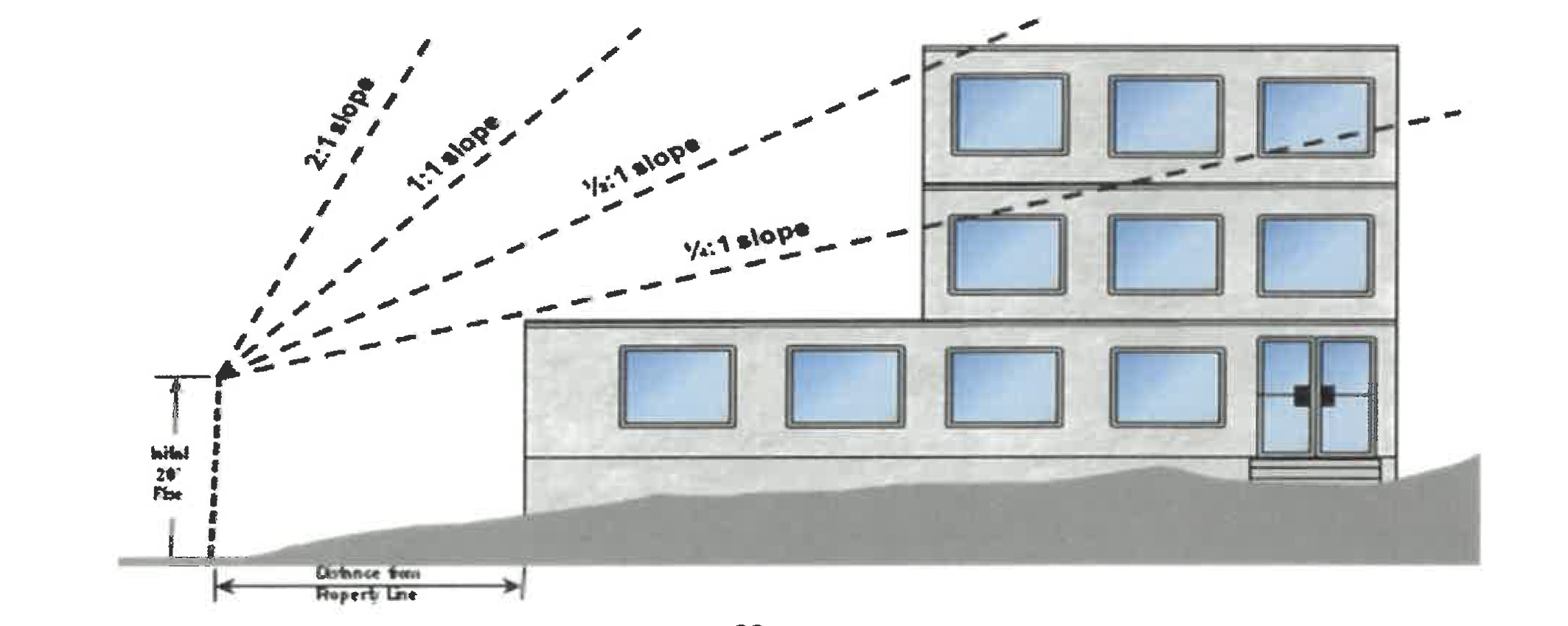
The International Residential Code for One- and Two-family Dwellings allows no more than three stories above-grade in height; therefore, any Residential Detached or Residential Attached (2 dwelling units) activity that meets a 5-foot setback from adjoining property is exempt from the height requirements of this section.
The following chart is published to assist in determining the maximum permissible structure height allowed with various height control slopes. Heights are listed in feet based upon an initial 20-foot rise at the property line.
A maximum of two above-ground stories are permitted in the LC district.
The chart in Section 23.50 lists the height requirements of this Ordinance by activity type and location.
23.11 Special Requirements for Waterfront Property
In order to protect the unique scenic vistas of significant waterways in Lexington County, special requirements are to be applied to the development of properties in the vicinity of the Saluda River, the Edisto River, the Congaree River, and Lake Murray. Where there are multiple methods for computing the allowed height for a building in this chapter, the most restrictive shall apply. The International Residential Code for One- and Two-family Dwellings allows no more than three stories above-grade in height; therefore, any Residential Detached or Residential Attached (2 dwelling units) activity is exempt from the Special Requirements for Waterfront Property.
Lake Murray: A special height control slope of ½:1 is to be used along the shores of Lake Murray where the regulated property is designated as a Restrictive Development District. If the property is designated as an Intensive Development District, then a height control slope of 2:1 shall apply. Along the shores of Lake Murray, the location of the initial 20-foot rise shall be considered to be the location of the 360-foot (mean sea level) contour or the waterfront property line, whichever is the least restrictive. All property within 1000 feet of the 360-foot contour and designated as a Restrictive Development District shall also comply with the following additional height restrictions which are based on the street classification providing access to the proposed activity:
Local (L) or Boulevard (B) street - No building taller than 70 feet is allowed. That height is measured from the average elevation of the building as it leaves the ground.
Collector (C) street - No building taller than 100 feet is allowed. That height is measured from the average elevation of the building as it leaves the ground.
Arterial (A) street - Height of buildings shall be determined by the other requirements from this chapter.
Congaree River: Because of the extremely varied terrain along the banks of this river, it is very difficult to determine the best elevation from which to measure the "initial 20-foot rise" referenced in Section 23.10. For this river, the beginning elevation for calculating the height control slope for the waterfront property line shall be uniform along the river bank. That elevation shall be the same as the highest elevation on the property that falls within 300 feet of the waterfront property line. A height control slope of 1:1 shall apply to this waterfront property line.
Saluda River: Because of the unique scenic character of the Saluda River, stricter height requirements apply to the adjacent lands. All buildings within 500 feet of the waterfront property lines shall not exceed 50 feet. Buildings farther than 500 feet but within 1,000 feet of the waterfront property lines shall not exceed 70 feet. That height is measured from the highest elevation of the building as it leaves the ground. For the purpose of this Ordinance, the Saluda River is considered to begin 4,000 feet downstream from its discharge point below the Lake Murray Dam.
Edisto River: Because of the unique "black water" aspects of the North Fork of the Edisto River, stricter height requirements apply to the adjacent lands. All buildings within 500 feet of the waterfront property lines shall not exceed 50 feet. That height is measured from the highest elevation of the building as it leaves the ground. For the purpose of this Ordinance, the Edisto River is considered to begin at the I-20 bridge crossing.
The average elevation as referenced in these regulations shall be computed by selecting the halfway point between the highest and lowest ground elevations surrounding the structure.
(Ord. No. 23-17, 6-25-2024)
23.20 - Buffer
A buffer is an area in which no activity is permitted other than necessary utility functions such as transmission lines, underground conduits, stormwater management devices, septic systems, etc. A single driveway access may encroach upon this buffer when that driveway location is the only possible point of access for the parcel. This area is described by a linear measurement from the property line inward and will vary depending on the nature of an activity and its location. The chart in Section 23.60 lists the required buffers. Land use activities where buffers are not required cannot encroach upon properties not approved for the activity or encroach upon a designated road right-of-way, unless otherwise permitted in this Ordinance. Required zoning buffers that are in a natural forested or wooded state shall remain as such, except for areas where necessary utilities and access must encroach upon this area. Buffer re-vegetation must conform to the provisions of the Lexington County Landscape and Open Space Ordinance. The Zoning Administrator may require buffers to be clearly delineated, by an approved material, for activities where the buffer area is likely to be encroached.
(Ord. No. 23-17, 6-25-2024)
23.30 - Setbacks
Setbacks delineate certain open spaces on lots. These spaces are linear distances measured from property lines inward. Buildings or other principal structures, or areas, comprising the principal activity of the lot may not encroach this space. A setback may accept an accessory activity, unless superseded by a buffer. Accessory buildings to residential activities must maintain a minimum 5-foot setback from adjoining property lines. The chart in Section 23.60 lists two types of setbacks based on the type of activity and location. They are measured either from a road right-of-way or an adjoining property line. Setbacks abutting existing roads shall be measured from the proposed right-of-way as shown in the Right-of-Way Plan if that width is greater than the existing right-of-way. However, for Residential Detached or Mobile Home activities being established on an existing dead-end road, which has limited potential for future widening, the existing road right-of-way shall be used. Mechanical equipment, steps, ramps, and/or landings necessary for building access, or other necessary utilities, attached to a principal structure shall not be taken into consideration when determining the setback. Land use activities where setbacks are not required cannot encroach upon properties not approved for the activity or encroach upon a designated road right-of-way, unless otherwise permitted in this Ordinance.
23.30 - Screening
Screening shall consist of natural vegetation and/or landscaped vegetation (including planted berms), walls, or fences designed to lessen the visual interaction between adjacent activities or accessories thereto. Vegetation used for screening must be evergreen, drought-tolerant, insect and disease resistant, and appropriate for the area. The two types of screening listed in the chart in Section 23.60 are total and partial, and are measured in linear feet. If the activity occurs within the designated distance of the property line, then the more restrictive screening is required to the extent of the combined linear distance of both the required total and partial screening. Total screening is defined as being visually opaque and must be adequately sized and placed to provide the necessary screen. Partial screening is defined as being approximately 50 percent visually opaque and shall include the protection of naturally forested, wooded and/or vegetated areas.
Required plantings for total screening must be a minimum of 6-feet in overall height at planting and should be installed in at least two staggered rows. Required plantings to supplement natural vegetation for partial screening must be a minimum of 4 to 5 feet in overall height at planting and may be installed in a single row. The spacing of such plantings will vary depending on the plant species/variety, planting conditions, required opacity, and size of plants at installation. Smaller sized plantings, consistent with parking lot screening requirements regulated by the Lexington Landscape and Open Space Ordinance, may be considered for partial screening that is required for properties across a street. All vegetation installed to meet applicable screening requirements must supply the necessary screening within three growing seasons following installation. Vegetative screening may be installed in conjunction with street, buffer, and/or parking lot landscaping required by the Lexington County Landscape and Open Space Ordinance.
The use of fencing, wall, or landscaped berms may be considered by the Zoning Administrator for larger areas that require total screening or for the screening vehicle, craft, and/or scrap impoundment areas of, allowed residential accessory vehicles, and like activities. In all cases, the materials, height, and type of screening must be approved by the Zoning Administrator with factors such as topography, surrounding land uses, development acreage, and immediate environment taken into consideration. Tarpaulins and weed-control mesh shall not be used for screening. All screening must be located on-site of the land use required to provide the screening and must conform to applicable requirements of the Lexington County Landscape and Open Space Ordinance.
(Ord. No. 23-17, 6-25-2024)
23.50 - Architectural Standards
The standards contained in this article are designed to improve the compatibility of adjoining activities, especially where a nonresidential activity is located adjacent to a residential activity or within a Restrictive Development District. Any portion of a new land use activity that adjoins and is within 100 feet of a designated Scenic Corridor 1 or 2, as listed within the Lexington County Landscape and Open Space Ordinance; any land use that adjoins and is within 100 feet of a street with the zoning street classification of Boulevard (B); or any land use actively seeking approval by special exception as noted within Section 22.02 of this Ordinance, shall comply with the following architectural standards.
Any activity meeting the following architectural standards will be allowed to reduce the buffering restrictions of this article by 50 percent, unless otherwise required by this Ordinance:
a.
Structures shall have an appearance that would be considered more of a residential than commercial style. They shall also have exterior elements that are created at a human scale.
b.
All structures will include the use of exterior materials that are commonly used for house construction in the area, such as brick, stucco, etc.
c.
Roofing design should generally be gabled rather than flat, mansard, etc., unless that is the residential roofing design in the area. For larger buildings where gabled roofing is not practicable, additional architectural features and/or decorative facades should be incorporated within the building design.
d.
Windows should generally be something other than solid expanses of glass. Smaller panes and windows with mullions, or other designs more compatible with the residential setting, would be expected as a part of the design.
e.
All accessory structures shall be designed with the same "residential pattern" as the primary structures. This would include accessory features such as porticos, sheds, canopies, equipment structures, other buildings, etc. Fencing shall also be consistent with a residential setting, to include wooden or vinyl privacy-type fencing and decorative fencing. For the purposes of this Section, cyclone fencing or chain link fencing shall not be considered.
f.
All building, structure, fence, wall, canopy, and sign construction shall use earth tone colors, similar to those illustrated in Section 26.55 of this Ordinance. The use of other colors may be considered, provided they are consistent with existing residential structures in the general area. The use of bright, neon, and/or fluorescent colors is prohibited.
g.
All business signs will meet the standards found in Section 26.55, which concerns signs on scenic corridors. Unless a more restrictive height limit is found in that section, business signs must be designed as "monument signs" that do not exceed a height of 10 feet. Wall signs shall be the minimum size necessary to be readable from the adjoining roadway and drive.
h.
A landscape plan must be approved that exceeds the requirements of the Lexington County Landscape and Open Space Ordinance by including shrubbery, ground cover, seasonal plantings, additional tree planting/preservation, etc., that enhances the site in the same way that it adds to the visual appeal of a residential setting.
23.51 Exterior Colors
In all districts, all exterior building, structure, wall, fence, and canopy construction which are visible from adjoining properties and road rights-of-way shall be earth tone in color, similar to those illustrated in Section 26.55 of this Ordinance. The use of other colors may be considered, provided they are consistent with existing residential structures in the general area.
The use of bright, vivid, or otherwise highlighting or contrasting colors may be used for trim, edging, identification signage, and the like, provided such features do not exceed 10 percent of the particular wall, façade, side, or face of the individual structure. These color allowances cannot be prorated, nor can the allowable area be substituted for allowable area on another wall, façade, side, or face.
Although painted murals are not regulated in Chapter 5 of this Ordinance, they shall also conform to the exterior color provisions. Agricultural operations, residential detached, residential attached (2 dwelling units), and individual mobile homes are exempt from these provisions.
In determining if a proposed development meets these architectural standards, the Zoning Administrator shall act as the initial evaluator and will be required to render a decision as to whether the proposed design meets the intent of this section of the Ordinance. Anyone disagreeing with that decision or seeking relief from these standards may file an appeal or special exception with the Board of Zoning Appeals which shall act as the final arbiter. The Board of Zoning Appeals shall take in consideration the stated opinions of the surrounding property owners, the surrounding design features and colors of surrounding structures and properties, visibility from surrounding properties and road rights-of-way, the condition of other properties in the immediate area, and any other extraordinary conditions or circumstances that may apply when deliberating a special exception request.
(Ord. No. 23-17, 6-25-2024)
23.60 - Chart of Maximum Buffering Restrictions
The columnar chart below lists the maximum buffering restrictions defined in this chapter as they apply to the list of principal activities. The procedure for determining the actual buffering restrictions that will apply to a particular project or site shall be as outlined in the following paragraphs.
A request for a zoning permit which utilizes the maximum buffering restrictions as published shall be approved with respect to the requirements of this chapter. A request for a zoning permit which proposes to utilize buffering restrictions less than the maximum numbers listed must employ the following procedure:
If the owner of any protected property wished to sanction the selection of a lesser specific restriction, to include business sign setback requirements from adjoining properties, such consent shall be noted on a form provided by Lexington County. This consent shall become valid only upon verification by the Zoning Administrator and attachment to the applicable zoning permit.
If the process outlined above does not produce the buffering restriction desired by the applicant requesting a zoning permit, the applicant may apply to the Board of Zoning Appeals for a decision following the variance procedures outlined in Chapter 2 of Article 17 - Administration. Once the Board renders a decision, the applicant may not utilize the process outlined in the previous paragraph unless significant aspects of the permit request have been modified or the ownership of the protected property has changed.
Following are general rules and special rules for interpreting the chart:
23.61 General Rules
1.
The restrictive (R) requirements in the chart apply to protected property lines within a Restrictive Development District or those which serve as the boundary between a Restrictive Development District and a Limited Restriction District, a municipality within Lexington County, or an adjacent county.
2.
The intensive (I) requirements in the chart apply to protected property lines within an Intensive Development District or those which serve as a boundary between an Intensive Development District and a Limited Restriction District, a municipality within Lexington County, or an adjacent county.
3.
For property lines which serve as the boundary between a Restrictive Development District and an Intensive Development District, the restrictive (R) requirements shall apply for the protection of property on the Restrictive Development District side of the boundary relative to land uses on the Intensive Development District side of the boundary. Similarly, the intensive (I) requirements shall apply for the protection of property on the Intensive Development District side of the boundary relative to land uses on the Restrictive Development District side of the boundary.
4.
When an activity is located on a parcel which is separated from surrounding protected property by existing road or railroad rights-of-way, by utility rights-of-way, by water bodies, or by other parcels, then the buffering restrictions applicable to that activity shall be measured across such separation from the protected property lines.
23.62 Special Rules
However, the general rules above for interpreting the chart shall be modified by the special rules below in items "1" through "6" where applicable.
1.
Grandfathered residential detached and mobile home uses within an Intensive Development District shall be afforded the restrictive (R) requirements in the chart relative to land uses on surrounding properties in the following manner:
Those portions of the property lines of a grandfathered residential detached or mobile home use which are within 100 feet of that use's principal activity [generally the building footprint(s)] shall be considered protected property lines to the extent of 100 percent of the restrictive (R) requirements in the chart relative to the applicable activity on the surrounding property.
Those portions of the property lines of a grandfathered residential detached or mobile home use which are within 200 feet of, but more than 100 feet from, that use's principal activity [generally the building footprint(s)] shall be considered protected property lines to the extent of 50 percent of the restrictive (R) requirements in the chart relative to the applicable activity on the surrounding property. This 50 percent level of protection shall be determined by halving the distances imposed for the height, buffer, setback from adjoining property, total screening, and partial screening requirements.
Those portions of the property lines of a grandfathered residential detached or mobile home use which are more than 200 feet from that use's principal activity [generally the building footprint(s)] shall be considered protected property lines to the extent of 100 percent of the intensive (I) requirements in the chart relative to the applicable activity on the surrounding property.
2.
Those portions of the property lines of a parcel within a Restrictive Development District which serve as the boundary between the Restrictive Development District and an Intensive Development District, and which have no grandfathered residential detached or mobile home use within 200 feet, shall be considered protected property lines to the extent of 50 percent of the restrictive (R) requirements in the chart relative to the applicable activity in the Intensive Development District. This 50 percent level of protection shall be determined by halving the distances imposed for the height, buffer, setback from adjoining property, total screening, and partial screening requirements.
3.
Notwithstanding special rules 1 and 2 above, certain portions of the property lines of a parcel within either a Restrictive Development District or an Intensive Development District, or both, upon which there is an existing nonresidential principal activity, shall be considered protected property lines only to the extent of 100 percent of the intensive (I) requirements in the chart relative to the applicable activity on the surrounding property. However, within a Restrictive Development District, all activities must meet 100 percent of the applicable restrictive (R) screening requirements and provide buffer landscaping, as regulated within the Lexington County Landscape and Open Space Ordinance.
4.
When a protected property line runs through or borders Lake Murray or at the primary channel of a river, then the distances imposed for the buffer, setback from adjoining property, total screening, and partial screening, but not height, requirements (as first determined by applying the general rules and special rules above) shall be measured such that each linear foot of traverse over the water impoundment shall count as only ½ foot toward the total distance imposed. On Lake Murray the water impoundment is considered to be that area bounded by the 360-foot contour (MSL). Since screening of activities on water surfaces is not feasible, the partial screening requirements will typically control the distance separation over water impoundments.
5.
All activities shall provide buffer landscaping as regulated within the Lexington County Landscape and Open Space Ordinance, relative to residential detached and mobile home activities already in use or permitted on adjoining properties also located in an Intensive Development District. In such cases the extent of this extra protection, if any, shall be determined in accordance with Special Rule #1. This requirement does apply to non-grandfathered residential detached and mobile home activities located across a road right-of-way.
6.
Activities that provide total screening using existing natural vegetation or provide total screening with vegetation when it is not required shall be eligible for a 50 percent reduction in buffer and setback requirements. Acceptability of the screening for this reduction shall be determined by the Zoning Administrator. The following activities are not eligible: Detention Centers, Recycling Centers, Salvage/Wrecking Yards and Scrap Operations, Mining, Landfills, Sexually Oriented Businesses, and Utility Substations.
7.
There shall be a minimum buffer width of 75 feet, unless greater as required under Section 23.60 of this Ordinance, for all new or expanding developments that adjoin existing Agricultural Operations, which have been in continuous operation for a period of seven (7) years prior to development. Existing Agricultural Operations which have discontinued active operation within this seven (7) year timeframe will not be afforded this extra protection. Exemptions to this added protection include land use activities currently and actively engaged as an Agricultural Operation; any other land use directly associated with the production, sales, shipping, storage, marketing, packaging, manufacturing, and/or distribution of commodities in conjunction with an active Agricultural Operation; individual Residential Detached, Residential Attached - Duplex, Residential Attached - Townhouse, individual Mobile Home, or individual Tiny Home; residential subdivisions with less than 10 lots; and residential subdivisions with average residential lot sizes of 1.5 acres in area.
Existing residential attached, mobile home or tiny home park, or tiny home activities are not subject to the extra protection afforded to residential uses noted within this Section of the Ordinance.
In all districts, all permitted activities shall comply with the Performance Standards contained in Chapter 4. For activities particularly associated with anticipated higher degrees of noise and light, the zoning application and site plan submittal shall address the proposed method(s) of compliance with the Performance Standards of this Ordinance.
(Ord. No. 23-17, 6-25-2024)
24.00 - General Rules
In all districts, any permitted activity shall comply with the performance standards contained in this chapter.
Performance standards are not applicable to noises generated from the broadcasting of music, live band performances, garbage collection, or motor vehicle engine noise from parking areas. These noises shall be considered nuisance noises and addressed in Lexington County Ordinance, Chapter 26, Article II, Noise.
In case of conflict between the performance standards set forth herein and regulations adopted by any other governmental agencies, the more restrictive shall apply. The same shall apply to a conflict with other requirements of this Ordinance.
For the purposes of determining the applicability of the provisions of this chapter only, an adjacent grandfathered residential use is a grandfathered residential use within 200 feet of the property line.
(Ord. No. 23-17, 6-25-2024)
24.10 - Noise
24.11 Definitions
Decibel: a unit of intensity of sound pressure. The decibel scale is a logarithmic scale of ratios of pressure with respect to a reference point pressure of 0.0002 microbars. It is abbreviated as "dB."
Frequency: the number of times that a sound pressure fluctuation completely repeats itself in one second of time. Frequency is designated in cycles per second and is abbreviated as "cps."
Impact Sound: a separate, distinct noise heard above normal, consistent noise or sound levels produced by an activity. Impact sounds may be produced by two or more objects (or parts of a machine) striking each other or various other means.
Noise: a subjective description of an undesirable or unwanted sound.
Overall Sound Level: total sound pressure level in the entire frequency spectrum between 20 and 20,000 cycles per second.
Sound: repeat fluctuations of atmospheric pressure which are audible to persons.
Sound Level Meter: an instrument to measure the overall sound level. It shall comply with applicable specifications of the American National Standards Institute (ANSI) and the International Electrotechnical Commission (IEC).
Steady State: a noise or vibration which is continuous such as from a fan or compressor.
24.12 Method of Measurement
For the purpose of measuring the intensity or frequency of sound, a sound level meter may be employed. Sound measurements shall utilize the peak intensity of sound, measured in decibels, the "A" frequency weighting and the "slow" response characteristic of a sound level meter conforming in all respects to ANSI standard S 1.4-1071, as revised, for Type 1 or Type 2 instruments and the EIC.
The microphone used to measure the intensity of a noise may be placed at any point on the exterior of the property line of the complaining party and shall be at least five (5) feet from any wall, fence, or structure and not less than three (3) feet above ground.
24.13 Maximum Permitted Sound Pressure Levels
Any operation or land use activity shall not create, assist in creating, permit, or permit the continuance of any noise in excess of 75 decibels (dB) for adjacent Restrictive Development Districts and adjacent grandfathered residential uses or any noise in excess of 85 decibels (dB) for adjacent Intensive Development Districts. Impact sounds shall not exceed 85 decibels (dB) for adjacent Restrictive Development Districts and adjacent grandfathered residential uses or 95 decibels (dB) for adjacent Intensive Development Districts. Between the hours of 7:00 p.m. and 7:00 a.m. all of the permissible noise levels indicated shall be reduced by 5 decibels. An independent analysis and the means to address excessive noise may be required by the Zoning Administrator prior to permitting of a new activity that may generate excessive noise or in the event an existing permitted activity potentially exceeds the allowances within this Section of the Ordinance.
24.14 Exemptions
The following activities are exempt from the provisions of this Section provided they conform to the specific conditions listed:
a.
Residential Accessory Activities: Noises generated as a result of accessory activities to residential living including, but not limited to, animal noise, lawn mowers, chain saws, string trimmers, etc.
b.
Audible Warning Devices: Noises attributable to audible warning devices required on vehicles by either the U.S. Occupational Safety and Health Administration (OSHA) or the U.S. Mining Safety and Health Administration (MSHA).
c.
Transportation and Vehicular Traffic: Noises not directly attributable to an activity located on the same parcel, such as transportation activities and traffic generated on public or privately maintained roads.
d.
Temporary Activities: Noise generated from construction, grading, and demolition activities which are necessary and incidental to the development of a principal activity or noise generated from activities not regulated by this Ordinance as described in Article 2, Chapter 1, Section 21.21 of this Ordinance.
e.
Agricultural Equipment Sporting Events: Events involving competitive showing, racing, or running of agricultural equipment are exempt only on Fridays and Saturdays between the hours of 12:00 p.m. and 9:00 p.m. and on Sundays between the hours of 1:00 p.m. and 6:00 p.m. The exemption for this category is limited to five (5) calendar days per year.
f.
School Cultural and Athletic Rehearsal/Practice Events: Extra-curricular rehearsal and/or practice held on school property are exempt between the hours of 7:00 a.m. and 7:00 p.m. This would commonly include activities such as the marching band, football, softball, soccer, etc.
g.
Regularly Scheduled School, Cultural, and Athletic Events: Extra-curricular activities held on school property are exempt during the hours of 10:00 a.m. to 11:00 p.m. This would commonly include activities such as marching band competitions and exhibitions; football, baseball, softball, and soccer games; track meets, etc.
h.
Annual Community-Sponsored Festivals: Festivals sponsored by local communities within the unincorporated areas of the County are exempt only between the hours of 9:00 a.m. and 12:00 a.m. The exemption for this category is limited to two (2) times per calendar year per sponsor/festival.
i.
Recreation Commission Sporting Events: Normal sporting events held at County Recreation Commission locations are exempt between the hours of 9:00 a.m. and 11:00 p.m.
j.
Social, Cultural, Historical and Fund Raising Events: Events held for the purpose of raising charitable funds, rallies for the promotion of community and cultural purposes, Civil and Revolutionary War re-enactments, scouting jamborees, and the like, are exempt between the hours of 10:00 a.m. and 10:00 p.m. The exemption for this category is limited to two (2) times per calendar year per sponsor/event.
Nothing in this Ordinance shall preclude the enforcement of Lexington County Ordinance, Chapter 26, Article II, Noise, in which any excessive noise may be addressed without regarding to the standards of this Section by the Lexington County Sheriffs Department. There are no grandfathering provisions for existing noise violations.
(Ord. No. 23-17, 6-25-2024)
24.20 - Toxic Matter and Hazardous Waste
24.21 Definitions
Toxic Matter: Materials or substances which, either singly or in combination with other materials or substances, through synergistic action, pose a threat to the health of human beings, either acutely or chronically.
Hazardous Waste: Materials or substances which are not biodegradable and which, due to such fact, pose a threat to living organisms through chemical contamination of the ecosystem.
24.22 Determination of Material Status
The determination that a material or substance is either toxic or poses a threat as a hazardous waste shall be based upon the listing published by the Environmental Protection Agency under the Toxic Substances Control Act of 1976 and the rules and regulations promulgated for identification of such by the SC Department of Health and Environmental Control (SCDHEC).
24.23 Compliance with Existing Statutes
Any facility proposing to locate within the jurisdiction of this Ordinance which would utilize toxic matter or produce hazardous waste in the process of manufacturing, fabricating, assembling, packaging or any related activity, shall provide to the Zoning Administrator for Lexington County documentation from all applicable SCDHEC Bureaus indicating compliance with the rules and regulations administered by those agencies. Only until such certification is received from SCDHEC shall the facility be permitted.
Nothing contained herein shall be intended to preempt or abrogate the requirement for a user of toxic matter or generator of hazardous waste to adhere to the administrative and procedural requirements of state or federal agencies with regard to environmental protection, or additional regulations contained within Article 3 of this Ordinance.
24.24 Special Requirements
Notwithstanding the requirements of state and federal agencies charged with the administration of the rules and regulations governing the operation of facilities utilizing toxic matter or generating or storing hazardous waste, any facility involved in such identified material shall provide an on-site containment area for the material so that a leak or spill is contained entirely on the facility's property and thus prevented from entering the surface or subsurface drainage system, man-made or natural, within the County. The review of the containment structure as to its design and acceptability shall remain with the Zoning Administrator who may rely upon the expertise provided by the County Land Development Division or any other agency as necessary to ascertain satisfaction that the proposed structure will provide compliance with the intent of this section.
24.25 List of Materials
Materials and substances considered as either toxic matter or hazardous waste shall be those contained within the listing published by the Environmental Protection Agency, as amended, under the provision of the Toxic Substances Control Act of 1976. A further listing of such materials is found in Regulation No. 61-79.1 of the Rules and Regulations of the State of South Carolina, appended to the 1976 Code of Laws, as amended.
24.30 Fire and Explosive Hazards
Activities involving the storage, utilization, or manufacture of materials or products which are considered detonable (non-atomic), flammable, or ignitable shall be subject to the rules and regulations of the South Carolina Department of Health and Environmental Control for such.
24.31 Particular Requirements for Lexington County
Vehicular fuels shall be stored in accordance with the following storage capacity limits:
Where above ground storage is proposed in excess of 100,000 gallons, a minimum distance of 500 feet shall be required from such storage to any property line.
(Ord. No. 23-17, 6-25-2024)
24.40 - Radioactive Materials
The manufacture, storage, or utilization of radioactive materials shall be in accord with the requirements of the South Carolina Department of Health and Environmental Control. Reference is made to Regulations 61-63 and 61-83 appended to the South Carolina Code of Laws, 1976, as amended. Pertinent activities shall also comply with Article 3 of this Ordinance.
(Ord. No. 23-17, 6-25-2024)
24.50 - Light and Glare
24.51 Definitions
Foot Candle: a unit of illumination. Technically, the illumination at all points 1 foot distant from a uniform point source of 1 candlepower.
Glare: the disturbing quality of direct illumination which, although not necessarily providing a measurable amount of light from a given vantage point, nonetheless is an attractive nuisance to the eye to the point of causing discomfort when viewed.
24.52 Limitation of Illumination
Any land use activity producing light from a non-mobile source, which includes the storage of inoperable vehicles, shall not cause illumination in excess of 1.0 foot candle when measured in a Restrictive Development District or across the protected property line of an adjacent grandfathered residential use.
24.53 Limitation of Glare
Any land use activity producing glare from a non-mobile source, which includes the storage of inoperable vehicles, shall be developed so that glare is not directed into a Restrictive Development District, across the protected property line of an adjacent grandfathered residential use, or into traffic lanes of public roads. Pole mounted lighting fixtures shall be located along so that the direction of the light is directed inward away from the property lines. All exterior lighting should be either shielded or recessed within an awning, eve, canopy, or in such manner to reduce excessive glare. Other measures, including, but not limited to, tinting, blinds, non-reflective backgrounds, or low wattage lighting may be necessary to meet these provisions.
24.54 Prohibited Forms of Light and Glare
The use of flashing, blinking, or strobe-type lights, or any type of pulsating or moving light, by an activity is prohibited in all districts; however, this Section is not intended to regulate seasonal and/or cultural decorations (i.e., holiday lighting).
25.00 - Intent and Purpose
The purpose of this chapter is intended to accomplish the following objectives:
a.
To encourage a high standard for signs to enhance the aesthetic appearance and attractiveness of the community, and to further create an environment that contributes to the ability of the community to attract economic development and growth.
b.
To ensure that signs are designed, constructed, installed, and maintained so that public safety and traffic safety are not compromised.
c.
To minimize distractions and obstructions-of-views that contributes to traffic hazards and endanger the public.
d.
To allow for adequate and effective signs for communicating identifications and promoting businesses.
e.
In the interest of public safety, the visibility of street name signs, street address information, and address numbers for use by emergency responders (fire, police, and medical) is of preeminent importance and should be considered during the placement of signs covered under this chapter.
(Ord. No. 23-17, 6-25-2024)
26.00 - Definitions
Advertising Signs. Any signs, pictorial or otherwise, regardless of size or shape, which direct attention to a business, commodity, attraction, profession, service, or entertainment conducted, sold, offered, manufactured, existing, or provided at a location other than on the premises where this sign is located or to which it is affixed. Such signs are sometimes called off-premise signs, and include, but are not limited to, those signs commonly referred to as outdoor advertising signs, billboards, or poster boards.
Audible Sign. Signs which emit any sound capable of being detected on a public road or adjoining property.
Banners. Signs intended to be hung either with or without a frame, possessing characters, letters, illustrations, or ornamentations applied to plastic or fabric of any kind, excluding flags and emblems of political, professional, religious, educational, governmental, or corporate organizations.
Business Signs. Any signs, pictorial or otherwise, regardless of size or shape, which direct attention to an activity, business, commodity, attraction, profession, service, or entertainment conducted, sold, offered, manufactured, existing, or provided on the premises where the sign is located or to which it is affixed. Such signs shall also include such representations painted on or otherwise affixed to any exterior portion of a business. Business signs are sometimes called on-premise signs.
Canopy Signs. Signs that are erected on a separate, freestanding roof-like covering.
Changeable Copy Signs. Signs on which message copy is changed manually through the utilization of attachable letters, numbers, symbols, and other similar characters or changeable pictorial panels. Poster panels and printed boards are not considered changeable copy signs.
Commercial Center. A commercial complex consisting of more than one retail, commercial, or office establishment grouped together, usually developed under one ownership or management, and generally sharing parking areas and vehicular entrances and exits.
Contractor's Signs. Signs displaying the names of the builders, contractors, architects, engineers, craftsmen, artisans, and similar information erected upon the premises of any work, construction, major repairs, or improvements.
Directory Signs. Signs that display information pertinent to the safety, legal responsibilities, or the well-being of the general public to include, but not limited to, warning, no trespassing, restrooms, public telephones, walkways, entrance and exit drives, traffic directions, addresses, and similar information.
Display Area. That area of a sign including the entire area within a regular geometric shape (square, rectangle, triangle, circle, or semicircle) or combination of regular geometric shapes enclosing all of the elements of informational or representational matter displayed, including blank masking or any surface shape intended to convey ideas, information, or meaning. The display area shall also include any painted portion, whether on a sign or building edifice, that serves as a part or all of a logo or other advertisement for any business product or activity. Frames or structural members not bearing informational or representational matter shall not be included in calculating the display area. For double-faced signs that are relatively parallel (forming an angle of 45 degrees or less) and supported by the same structure, the display area of the sign equals the total display area of the largest face. The display area of other multiple-faced signs equals the total display area of all faces.
Driveway Signs. Signs indicating the direction of travel for driveway ingress and/or egress.
Earth Tone. Color scheme that reflects a palette of natural colors found in rocks, soil, and vegetation. These colors are usually represented by muted shades of brown, tan, gray, green, and red.
Electronic Message Board. An electrical or electronic sign using digital technology or a pattern of lights to form various words or graphics which is capable of changing copy continuously.
Flag. A piece of durable fabric of distinctive design that is used as a symbol or decorative feature. Pennants do not qualify under this definition.
Flashing Signs. Signs that use blinking, intermittent, or flashing light source.
Freestanding Signs. Signs that are permanently secured in the ground and which are not attached to, supported by, or erected on a building or other structure having a principal function other than the support of such signs.
Illuminated Signs. Signs either internally or externally lighted by an artificial source.
Incidental Signs. Signs used in conjunction with equipment or other functional elements of a use or operation. These shall include, but not be limited to drive through window menu boards, and signs on automatic teller machines, gas pumps, vending machines, or newspaper delivery boxes.
Inflatable Signs. Any signs that are either expanded to their full dimensions or supported by gases contained with the sign parts, at a pressure greater than atmospheric pressure. Untethered airships are not considered to be inflatable signs. Also see Portable or Moveable Signs.
Moving Signs. Any sign that has movement caused by means other than the movement of air over the face of the sign or into the body of the sign. See Windblown Signs.
Off-Premise Signs. See Advertising Signs.
On-Premise Signs. See Business Signs.
Pennants. Any lightweight plastic, fabric, or other material, regardless of shape, whether or not containing a message of any kind, suspended from a rope, wire, or string, usually in a series, designed to move with the wind.
Political Campaign Signs. Signs announcing candidates seeking public office or relating to any election or public referendum.
Portable or Moveable Signs. Any signs that are not permanently attached to the ground, a structure, a frame, building, or other surface. Such signs include, but are not limited to, the following: trailer signs, signs mounted to and/or displayed from a parked vehicle, sandwich board signs, sidewalk or curb signs, push-in signs, temporary banners, decorative flags, and inflatable signs.
Projection Signs. Any signs or graphics that are projected on a wall, building, street, screen, or natural backdrop, originating from any projection device which would include, but not be limited to, laser lights, slide or video projections, and any other computer or electronic device.
Public Service Signs. Signs that display information relative to a public service activity including assisting the public in finding the location of such an activity. Such activities shall only include those which do not exist for the purpose of acquiring an income for the personal gain of the owner(s) or operator(s). They shall be limited to those activities that exist solely for the purpose of providing a desired service, pastime, endeavor, leisure interest, etc., for members of the general public. Public service activities shall include but are not limited to the following: churches, public education, recreation, cultural, entertainment, community clubs, and veterans clubs.
Real Estate Signs. Signs offering real estate for sale, rent, or lease.
Residential/Commercial/Industrial Subdivision and Residential Development Signs. Permanent signs displaying no information other than the name of the subdivision, group housing development, apartment/condominium complex, or mobile home park.
Seasonal Signs. On-Premise Signs advertising seasonal or holiday products or services.
Sign. Any device which informs or attracts attention.
Short-Term Information Signs. Signs such as garage sale, lost and found pets, civic, religious, or cultural event, and wedding and reception directions.
Sponsorship Signs. Signs employed by a school or by a civic, fraternal, religious, charitable or similar organization, which identifies the sponsor (by name, address and/or logo, crest, insignia, trademark or emblem only) of recreational or sports facilities provided on the premises where such signs are displayed. "Sponsorship Fence Signs" shall mean sponsorship signs affixed to permanent fencing. "Facility" shall mean the entire premises of an elementary or secondary school or a recreation or sports facility.
Street Frontage. That property line of a parcel that abuts a public or private road. In those cases where no property lines abut a road, 25 percent of the parcel's perimeter shall be a substituted measurement for street frontage for the purpose of calculating the maximum display area and number of freestanding signs allowed, as though that parcel had only one street frontage.
Temporary Signs. Signs which are not permanently installed in the ground or affixed to any structure or building, and which are erected or displayed for a period of time as allowed in this Ordinance.
Vehicular Signs. Signs on vehicles or trailers, which are in a street legal operating condition.
Wall Signs. Signs attached to the exterior wall of a building or structure.
Window Signs. Signs intended for viewing from the exterior of a window or door.
Windblown Signs. Any banner, device, or display designed to be moved by natural or artificially generated sources of air, which contains a written or pictorial message.
(Ord. No. 23-17, 6-25-2024)
26.10 - General Provisions
26.11 Zoning Permit
Zoning permits are required for the following temporary and permanent signs: portable or moveable signs; off-premise subdivision/development signs; freestanding business signs, including changeable copy signs, commercial center signs and electronic message boards; canopy signs; residential/commercial/industrial subdivision and development signs; wall signs; high rise building signs; and advertising signs.
26.12 Construction Standards
All signs shall comply with the appropriate provisions of the County's Building Code, and shall maintain clearances from all overhead electrical conductors in accordance with the National Electric Code, provided that no sign shall be installed within a 10-foot radius from any conductor. Temporary signs shall be erected or placed to remain in the intended location and not to become a safety hazard or litter problem. All signs shall comply with section 23.51 of this Ordinance for the use of bright or vivid colors, unless otherwise regulated or prohibited, such as projects along Scenic Corridors or those implementing Architectural Standards.
26.13 Unsafe or Hazardous Signs
No signs shall be erected or allowed to remain erected that, in the opinion of the County Building Official or Zoning Administrator, is structurally unsafe and constitutes a danger to the public safety. If any sign should become insecure, in danger of falling, or otherwise unsafe, the owner thereof or the person maintaining the sign shall immediately secure or remove the sign.
26.14 Maintenance
To ensure that signs are maintained in a safe and aesthetic manner, the following maintenance requirements shall apply to all signs:
a.
No signs shall be allowed to have more than 20 percent of its display area, reverse side, or structure missing or covered with disfigured, chipped, cracked, ripped, or peeling paint or poster paper for a period of more than 30 successive days.
b.
No sign shall be allowed to remain with a bent or broken display area, broken supports, loose appendages or struts, missing displays or cabinets, or stand more than 15 degrees away from the perpendicular for a period of more than 30 successive days.
c.
No sign shall be allowed to have weeds, trees, vines, or other wild vegetation growing upon it for a period of more than 30 successive days.
d.
No indirect or internally illuminated sign shall be allowed to have only partial illumination for a period of more than 30 successive days.
Any sign that fails to comply with the requirements above must be immediately removed by the owner of the property or the person responsible for the sign.
26.15 Public Right-of-Way
No portion of any sign shall overhang or encroach upon any public right-of-way.
26.16 Illuminated Signs
All illuminated signs must meet the performance standards related to light and glare as described in Article 2, Section 24.50.
26.20 - Exempt Signs
The following are not subject to these sign regulations:
a.
Signs not exceeding 1 square foot in area and bearing only property numbers, post office box numbers, or names of occupants on premises not having commercial connotations.
b.
The single flag or insignia of the United States or any other governmental or corporate entity, except when displayed in connection with commercial promotion.
c.
Legal notices or identification, public information signs, and directional signs erected as required by governmental bodies.
d.
Integral decorations or architectural features of buildings or grounds, except letters, trademarks, moving parts, or moving lights.
e.
Signs not exceeding 4 square feet in area directing and guiding traffic on private property.
f.
Wall identification signs and commemorative plaques not more than 4 square feet in area, memorial cornerstones or tablets providing information on building erection or commemorating a person or event.
g.
Signs which are not designed to be visible beyond the boundaries of the parcel on which they are located or from any public thoroughfare or right-of-way
h.
Incidental signs or trademarks or product names which are displayed as part of vending machines, dispensing machines, automatic teller machines, and gasoline pumps.
(Ord. No. 23-17, 6-25-2024)
26.30 - Prohibited Signs
26.31 Signs Imitating Traffic or Emergency Signals
No sign shall be allowed which imitates an official traffic sign or signal, or contains words or symbols displayed in a manner which might mislead or confuse drivers of vehicles, or which displays intermittent lights resembling the color, size, shape, or order of lights customarily used in traffic signals, on emergency vehicles, or on law enforcement vehicles, except as part of a permitted private or public traffic control sign.
26.32 Audible Signs
No sign shall be allowed which emits any sound capable of being detected on a public road or adjoining property.
26.33 Flashing Signs
No sign, including exempt signs and signs that do not require permitting, shall be allowed which utilizes flashing, blinking, or strobe-type lights, or any type of pulsating or moving light. Electronic message boards may only be used in accordance with the provisions of this chapter.
26.34 Moving Signs
No sign shall be allowed which moves or presents the illusion of movement in any manner, when such movement is provided by means other than movement generated from wind.
26.35 Signs Attached to or Painted on Selected Features
No sign shall be allowed which is attached to a utility pole, light pole, or street sign, or is attached to or painted on trees, rocks, or other natural objects.
(Ord. No. 23-17, 6-25-2024)
26.40 - Temporary Signs
In keeping with Section 25.00 Intent and Purpose, temporary signs that are in compliance with the requirements of Section 22.10 Driveway and Street Restrictions, Section 26.10 General Provisions, Section 175.00 Conflict with Other Laws, and all other applicable requirements of this Ordinance, shall be allowed.
a.
Banners Over Public Rights-of-Way
Banners spanning over public rights-of-way are allowed, subject to approval by the appropriate State DOT agency or appropriate local governmental (County or Municipal) agency responsible for maintenance of the right-of-way. Banners attached to existing utility poles shall require the approval of such utility agency.
b.
Contractors' Signs
Contractors' Signs displaying the names of the builders, contractors, architects, engineers, craftsmen, artisans, and similar information may be erected upon the premises of any work, construction, major repairs, improvements, or new development. The display area of such signs shall not exceed 32 square feet. Such signs shall be removed within 7 days of the completion of the work. Temporary signs advertising that a new activity is coming soon shall comply with the requirements of this category and may not be installed until a valid Zoning Permit has been issued for the activity.
c.
Political Campaign Signs
Signs announcing candidates seeking public office or relating to any election or public referendum shall be allowed. Such signs shall be placed only on private property with the property owner's permission, and removed within 7 days after the election or referendum. These signs do not have to be set back from road rights-of-way.
d.
Portable or Movable Signs
Portable or Movable Signs shall be permitted up to two separate times per year for a period not to exceed 30 consecutive days per occurrence. Portable signs must be located at least 20 feet from any adjoining business signs or advertising signs. Pennants are allowed only in conjunction with a permit under this section and are limited to two strands per 100 feet of road frontage. A strand is defined as being between two attachment points.
Individual business centers and commercial centers may have one portable sign per 200 feet of street frontage or portion thereof. Tenants are limited to one portable sign per occurrence. A parcel with frontage on different streets shall have the frontages regulated independently as to number of signs allowed. Multiple signs allowed on the same frontage of the same parcel must be located at least 200 feet apart. Private restrictive covenants and/or lease agreements for business centers and commercial centers may include more restrictive policies for these types of signs.
e.
Real Estate Signs
Real Estate Signs are temporary signs offering real estate for sale, rent, or lease. These signs do not have to be set back from road rights-of-way, but still must comply with the engineering criteria found in the Lexington County Land Development Manual and the driveway restrictions found in Section 22.10 of this Ordinance.
On-Premise - The real estate sign display area shall not exceed 6 square feet for individual parcels restricted for residential use only and 32 square feet for all other parcels. There may be only one sign per 200 feet of street frontage or portion thereof and such signs shall be removed within 7 days of the conveyance or lease of the property.
Off-Premise - Real estate signs not exceeding 4 square feet in area and 2½ feet in height are allowed off-premises, provided they are located on private property with the property owner's permission. These signs do not have to be set back from road rights-of-way. Such signs shall be removed within 7 days of the conveyance or lease of the property.
On-Premise Subdivision/Development Signs shall be allowed in addition to the permanent Subdivision/Development Signs provided they do not exceed 32 square feet, one per entrance, and are removed after 100 percent of the original lots, units, etc., have been sold or leased to a party no associated with a developer and/or builder in the development.
Off-Premise Subdivision/Development Signs shall be permitted provided they are located on private property with the property owner's permission and meet the following requirements:
1.
They must be located no further from the subdivision or development than the first intersection with an Arterial (A) street. If there are multiple directions to arrive at the project there may be multiple signs with the maximum distance allowed determined independently in each direction.
2.
These signs shall not contain more than 24 square feet in display area.
3.
The maximum height of the sign shall be 4 feet.
4.
These off-premise signs must be removed after 90 percent of the lots, units, etc., have been sold or leased.
5.
These off-premise signs advertising an individual development cannot be located closer than 300 feet from another permitted off-premise subdivision/development sign. No more than of these off-premise signs is allowed per parcel of land.
6.
Multiple subdivisions/developments desiring to share an off-premise sign must meet the same locational standards of this Section; however, the maximum height of the sign shall be 8 feet and the maximum display shall be 48 square feet, provided each development is represented with equal dimensions on the sign.
f.
Seasonal Signs
Seasonal Signs are on-premise signs advertising seasonal or holiday products or services. These signs shall not exceed 32 square feet in area and must be located on private property with the property owner's permission. There may be only one sign per 500 feet of street frontage or portion thereof and such signs must be removed within 7 days after the end of the season. These signs do not have to be setback from road rights-of-way.
g.
Short-Term Information Signs
Short-term Information Signs, such as garage sale, lost and found pets, temporary directional signs for civic, religious, community, or cultural activities, and wedding and reception directions, are allowed provided they are located on private property with the property owner's permission. These signs shall not exceed 12 square feet in size, are limited to no more than 7 consecutive days, and must be removed within 24 hours after the completion of the event. There may be only one sign per 500 feet of street frontage and these signs do not have to be set back from road rights-of-way.
h.
Sponsorship Signs
Sponsorship Signs are signs employed by a school or by a civic, fraternal, religious, charitable or similar organization, which identifies the sponsor (by name, address and/or logo, crest, insignia, trademark or emblem only) of recreational or sports facilities provided on the premises where such signs are displayed. "Sponsorship Fence Signs" shall mean sponsorship signs affixed to permanent fencing. "Facility" shall mean the entire premises of an elementary or secondary school or a recreation or a sports facility. These signs are intended to be used for a specific event or sporting season. They must meet all safety standards and local event/location restrictions imposed by the event committee, site owner, etc. Such signs intended to remain beyond the event or sporting season limitation shall be regulated as permanent signs under the appropriate definitions found in this Ordinance.
i.
Vehicular Signs
Vehicular Signs are signs on vehicles or trailers, which are in street legal operating condition. Signage, no matter how attached or painted, on a currently, properly licensed vehicle (motorized or not - including trailers) used in the everyday conduct of the business or activity that it is advertising, is allowed. Vehicles with such signage may be parked in normal designated parking places, but not on grassy areas, sidewalks, or other locations not normally available to customers or patrons of the business. Disabled or unlicensed vehicles, on which signage has been placed, shall be regulated as permanent signs under the appropriate definitions found in this Ordinance. Signs resting upon, mounted to and/or displayed from a parked vehicle, used other than as described above, shall be considered as Portable or Movable Signs.
(Ord. No. 23-17, 6-25-2024)
26.50 - Business Signs
26.51 Location
In all districts, any portion of a business sign must maintain at least a 10-foot setback from all property lines and the existing road right-of-way, unless otherwise specifically stated in this Ordinance. If the distance from the edge of the closest travel lane in the road to the right-of-way is greater than 20 feet, the 10-foot setback from the road right-of-way shall not apply. No sign shall be allowed to violate any of the requirements of Section 22.10 Driveway and Street Restrictions.
26.52 Maximum Display Area, Height, and Number of Signs
Individual businesses, commercial centers, and educational campuses may have one freestanding business sign per 500 feet of street frontage or portion thereof. These signs shall comply with the following height and display area requirements:
The maximum height allowed for business signs along roadways shall be measured from the elevation of the roadway, unless the elevation of the sign location is higher than the roadway. In those instances, the maximum height allowed shall be as listed in the chart above. This interpretation of allowed heights shall also be used in Section 26.55 Business Signs on Scenic Corridors.
Both the maximum static display area and the maximum changeable copy/electronic message board area may be utilized as part of each allowed individual or commercial center sign. However, the maximum display area per sign shall not be increased with any exchange or substitution of the allowable area for changeable copy or electronic message.
A parcel with frontage on different streets shall have the frontages regulated independently as to number of signs allowed.
A parcel with street access only by an easement over another parcel may consider that easement frontage as an allowed location for a business sign provided it is allowed by the easement agreement. A similar parcel that includes ownership of the strip of property which provides access may also consider that frontage as an allowed location for a business sign. In both situations, the signs must meet all of the requirements of this section including location restrictions.
Multiple signs allowed on the same frontage of the same parcel must be located at least 500 feet apart.
Permanent signs attached to fences or freestanding walls that are not attached to a building shall be considered a business sign. Such signs shall conform to all display, height, and setback requirements for business signs. The entire fence or wall area for which the sign is placed shall not be calculated as part of the display area, provided it serves as a frame or structural support and does not bear informational or representational matter.
Business and commercial center signs shall not utilize banners as a form of construction.
Changeable Copy Signs. Signs on which message copy is changed manually through the utilization of attachable letters, numbers, symbols, and other similar characters or changeable pictorial panels. Poster panels and printed boards are not considered changeable copy signs.
Commercial Center. A commercial complex consisting of more than one retail, commercial, or office establishment grouped together, usually developed under one ownership or management, and generally sharing parking areas and vehicular entrances and exits.
Educational Campus. An educational campus devoted to all or a portion of a K-12 education. It may also be the location of a campus for higher education or vocational training that generally involves an academic curriculum resulting in the awarding of a degree. It will commonly consist of multiple buildings and/or structures such as athletic facilities sharing parking areas and vehicular entrances and exits. Educational programs such as distance learning centers, satellite campuses, or continuing education and advanced degree schools housed in locations such as commercial centers, business parks, or stand-alone office buildings shall not be considered an educational campus
Electronic Message Board. An electrical or electronic sign using digital technology or a pattern of lights to form various words or graphics which is capable of changing copy continuously. Images displayed using digital technology must be static messages and the content shall not include animated, flashing, scrolling, or full-motion video elements. Static images may not be continuously changing in such a manner that the changes are prominently visible to the traveling public. Electronic Message Boards may change static messages once every 15 seconds provided the message does not change through flashing, scrolling, or any type of animation. All digital business signs shall have a method for controlling the illumination intensity or brilliance of the sign so that it shall not cause glare or impair the vision of motorists. These signs shall not exceed a maximum illumination of 7500 nits (candelas per square meter) during daylight hours and a maximum illumination of 500 nits between dusk to dawn as measured from the sign face. This illumination can be regulated either by an automatic dimmer and photo cell sensor or through the use of computerized controls that accurately replicates these maximum illumination requirements.
26.53 Specialty Signs
Canopy Signs are any signs which are erected on a separate, freestanding roof-like covering. Only business logos or names are allowed as canopy signs, with a maximum of one logo or name on each canopy face. A logo is the symbol or trademark of a company. No portion of a canopy sign shall be permitted above the top of the roof of the covering to which it is attached, or permitted to be lower than 8 feet above ground level. An owner of a business with a canopy connected to a building has the option of using either canopy or wall signage, but not both.
Directory Signs are signs containing no message, copy, announcement, or decoration other than instructions or directions to the public except for subordinate identity. Such signs include, but are not limited to, identifying the following: restrooms, public telephones, walkways, entrance and exit drives, freight entrances, and traffic directions. Information signs shall be allowed on business lots provided that no such sign shall exceed 10 square feet in display area and 4 feet in overall height. Directory signs shall not count toward the maximum number of signs allowable or the maximum display area of signs allowed.
Driveway Signs indicating the direction of travel on all one-way driveways. These signs must be above-ground signs, with a maximum height of 2½ feet, and located at the edge of the existing road right-of-way.
Public Service Signs are signs that display information relative to a public service activity including assisting the public in finding the location of such an activity. Such activities shall only include those which do not exist for the purpose of acquiring an income for the personal gain of the owner(s) or operator(s). They shall be limited to those activities that exist solely for the purpose of providing a desired service, pastime, endeavor, leisure interest, etc., for members of the general public. Public service activities shall include but are not limited to the following: churches, public education, recreation, cultural, entertainment, community clubs, non-profit organizations, and veterans clubs.
On-premise Public Service Signs shall comply with all of the requirements for Business Signs as found in this chapter of the Zoning Ordinance.
Off-premise Public Service Signs shall be allowed provided they are located on private property with the property owners' permission and meet the following requirements:
1.
They must be located no further from the public service activity than the first intersection with an Arterial (A) street. If there are multiple directions to arrive at the activity there may be multiple signs with the maximum distance allowed determined independently in each direction.
2.
These signs shall not contain more than 24 square feet in display area. The decorative structure on which the sign is displayed may not exceed 32 square feet.
3.
The maximum height of the sign and/or decorative structure shall be 5 feet.
Multiple public service activities desiring to place off-premise direction signs on the same property are encouraged to share a single sign structure. They must meet the same size and location requirements of this section, however, the maximum height of the sign structure may be 8 feet. Materials used should be of similar quality as the permanent on-site signs, i.e., painted plywood would not be acceptable. A second sign in the same location that is not sharing a sign structure may not obstruct the view of the first sign.
Residential/Commercial/Industrial Subdivision and Development Signs are permanent signs displaying no information other than the name of the subdivision, group housing development, apartment/condominium complex, business or industrial park, or mobile home or tiny home park. Such signs may be either single signs or gateway signs (paired signs on each side of an entrance). These signs shall not exceed 100 square feet each in display area, and shall not exceed a height of 8 feet. Within the same project, a single sign or pair of gateway signs must be at least 300 feet from another single sign or pair of gateway signs. Such signs shall also be exempt from the area and height limitations in Section 26.55 and the 10-foot setback restriction of Section 26.51, but still must comply with the engineering criteria found in the Lexington County Land Development Manual and the driveway restrictions found in Section 22.10 of this Ordinance. A sign can be located in a road right-of-way median if such sign complies with all engineering criteria found in the Lexington County Land Development Manual.
Wall Signs are signs attached to the exterior wall of a building or structure. Individual activities or businesses may erect one wall sign per wall. Individual tenants within a commercial center or similar multi-tenant building may erect only one wall sign, unless the tenant is located on the end-cap of the building, where that tenant may erect an additional wall sign. Such signs directly facing a street shall not exceed 15 percent of the area of the wall of the first story of the building or business to which it is attached. Such signs not directly facing a street shall not exceed 5 percent of the area of the wall of the first story of the building or business to which it is attached. A maximum of 12 feet in height can be used for the percentage measurements. No portion of a wall sign shall be permitted to project above the wall of the building to which it is attached except in the case of signs mounted to the roof in which case no portion shall project above the top of the roof. The wall sign information may be dispersed anywhere on the wall as long as the total display area of all information does not exceed the percentage requirements. A "mural" is a painting applied to a wall containing no advertisement for any business product or activity. A mural, as defined, will not be considered a wall sign.
Window Signs are signs attached to the interior and/or exterior of windows and doors and are intended for view from the exterior of the building or structure. Window signs cannot exceed 10 percent of the gross transparent window and door area of a building or structure.
26.54 High Rise Buildings
Buildings which exceed five stories in height shall be permitted to erect one wall sign per wall at the top story of the building. Such signs shall only identify the name of the building or the major tenant. The display area of such signs shall not exceed 2 percent of the area of the wall to which it is attached. Such signs shall be permitted in addition to the requirements of this chapter.
26.55 Business Signs on Scenic Corridors
The following additional restrictions shall apply on Scenic Corridors as defined in the Lexington County Landscape and Open Space Ordinance.
Illuminated signs, including changeable copy area, for individual businesses and commercial centers located in Scenic Corridors 1 and 2, shall meet one of the following conditions:
Internally illuminated signs must be constructed so that only letters, numbers, and/or logos are illuminated; shall not have light reflecting backgrounds or letters; and shall have a matte finish.
Externally illuminated signs shall have a steady stationary light source that is shielded and directed solely at the sign, shall have white light sources, and shall not have light reflecting backgrounds or letters.
Signs, including canopy, directory, and wall signs, located on Scenic Corridors shall not use any bright, neon, or fluorescent colors. Additionally, signs located on Scenic Corridors shall use only earth tone colors intended to be more harmonious and compatible with the surrounding natural environment. The only exception to this restriction shall be the display of a registered mark or logo, as exhibited in the certificate of registration issued by the United States Patent and Trademark Office. Freestanding business and commercial center signs along a Scenic Corridor 3 may use a white backing, provided the remainder of the sign conforms to the below color palette. The Board of Zoning Appeals will act as the final arbitrator for any special exceptions pertaining to scenic corridor color allowances. The Board of Zoning Appeals shall take in consideration the stated opinions of the surrounding property owners, the surrounding design features and colors of surrounding structures and signs, visibility from surrounding properties and road rights-of-way, the condition of other properties and signs in the immediate area, and any other extraordinary conditions or circumstances that may apply when deliberating a special exception request.
The following color palette shall be referenced when determining acceptable color schemes for business signs along designated Scenic Corridors. The Zoning Administrator may allow colors similar in nature to the below chart or other colors, including white, provided they are not bright in nature and are similar with the surrounding natural environment and/or consistent with existing residential structures in the general area.

If digital technology is used, it must replicate the appearance standards outlined above and the illumination standards found under the Electronic Message Boards in Section 26.52. Images displayed must be static messages and the content shall not include animated, flashing, scrolling, or full-motion video elements. Static images may not be continuously changing in such a manner that the changes are visible to the traveling public. However, it is permissible to change images to communicate new information; however, the electronic message boards may only change static messages once every 15 seconds.
(Ord. No. 23-17, 6-25-2024)
26.60 - Advertising Signs
This chart is a summary of many of the following restrictions concerning advertising signs:
26.61 Location
Advertising signs are identified as principal activities in this article and are therefore subject to all other provisions of this Ordinance. They shall be permitted only in the zoning districts where they are allowed, and only where they meet the street access requirements of this Ordinance. Regardless of the street access restrictions, advertising signs are allowed to locate on interstate highways, expressways, and frontage roads (except when classified RL4, RL5, or RL6) where their right-of-way is contiguous to an interstate highway or expressway; these signs, however, must be located within 200 feet of the right-of-way of the interstate or frontage road, if applicable. Advertising signs will not be allowed to locate in a portion of the County that is at least 75 percent surrounded by lands under the jurisdiction of a municipality, or on property within 2,000 feet of a municipal boundary, if that portion of the municipality prohibits the location of advertising signs. No advertising sign shall be allowed on Scenic Corridors 1 and 2, as defined in the Lexington County Landscape and Open Space Ordinance, or within 1,000 feet of the banks of the Saluda, Congaree, or Edisto Rivers. Advertising signs will also not be allowed on Arterial (A) streets with only two lanes unless the location of the sign meets the following criteria:
a.
There are at least two nonresidential activities on two separate locations in the Intensive Development District within 600 feet of the proposed sign,
b.
The nearest grandfathered residential use in the Intensive Development District is at least 600 feet from the sign, measured to the footprint of the actual residence, and
c.
The nearest non-grandfathered residential use in the Intensive Development District is at least 300 feet from the sign, measured to the footprint of the actual residence.
All portions of advertising signs must maintain at least a 10-foot setback from all property lines and the existing road right-of-way. If the distance from the edge of the closest travel lane to the right-of-way is greater than 20 feet, the 10-foot setback from the road right-of-way shall not apply. In some locations, the required minimum setbacks may be greater than this. Such signs shall also comply with all provisions of Section 22.10 Driveway and Street Restrictions.
To minimize the opportunity for visual distraction during vehicular merge operations, advertising signs will be restricted within the vicinity of interstate interchanges and rest areas. No advertising sign located along an interstate may be erected within 500 feet of an interchange or rest area. The interchange or rest area is considered to begin or end at the point where the pavement widens for an entrance or exit ramp/lane. When the entrance or exit ramp/lane is not on the same side of the road as the proposed advertising sign, the point of measurement shall be determined by identifying the location of the relative pavement widening and applying it to an identical point on the side of the road where the advertising sign is proposed to be located.
26.62 Maximum Display Area
The maximum display area for any adverting sign located along an interstate shall be 672 square feet plus a 10 percent allowance for copy extensions. A copy extension is the part of the copy which extends beyond the edge or border of the sign, sometimes called a "cut-out" or "drop-out." The maximum display area of advertising signs on any other highway shall be 288 square feet plus a 10 percent allowance for copy extensions, except for portions of Arterial (A) streets that have at least four lanes, which may have a maximum display area of 378 square feet plus a 10 percent allowance for copy extensions. Those designated portions must have the appropriate zoning district to support advertising signs.
26.63 Minimum Spacing
No advertising sign located along an interstate shall be permitted to locate within 2,000 feet of another sign on the same side of the roadway. For non-interstate highways, no advertising signs shall be permitted to locate within 1,000-foot radius of another advertising sign.
26.64 Maximum Height
Advertising signs along interstates shall be permitted to a height of 110 feet above the elevation of the highest travel lane at the location of the sign. The maximum height of advertising signs along other roadways shall not exceed 45 feet above the elevation of the roadway.
26.65 Minimum Height
There shall be no minimum height of the display surface for advertising signs located along interstates.
The minimum height of the display surface of advertising signs on Arterial streets shall be 25 feet above the elevation of the roadway.
26.66 Digital Technology
Advertising signs using digital technology which allows static images to be changed instantly must follow the following restrictions:
a.
Images displayed must be static messages and the content shall not include animated, flashing, scrolling, or full-motion video elements.
b.
The static images may be changed in succession at a rate no faster than once every 6 seconds.
c.
Spacing of digital faces of these signs which are visible from the same direction shall not be closer than 2,000 feet apart.
d.
All digital advertising signs shall have an automatic dimmer and a photo cell sensor to adjust the illumination intensity or brilliance of the sign so that it shall not cause glare or impair the vision of motorists. These signs shall not exceed a maximum illumination of 7,500 nits (candelas per square meter) during daylight hours and a maximum illumination of 500 nits between dusk to dawn as measured from the sign face.
26.67 South Carolina Code of Laws
The sign regulations contained in this Ordinance are supplemented by the requirements of the State of South Carolina Department of Transportation which regulates off-premise advertising signs on interstate and federal aid road systems. A permit from the State of South Carolina may contain some restrictions which are in addition to the requirements of this Ordinance. Issuance of a Lexington County Zoning Permit does not imply approval of, or constitute a privilege to violate, any other applicable state or local ordinances, codes, laws, or private restrictive covenants.
In the event an existing advertising sign must be removed due to roadway projects and/or right-of-way acquisition, affected advertising signs may be relocated within 500 feet of the current site, per State Statute 57-25-190 (E) as amended. Applicants shall provide documentation of the necessity to relocate, along with information relating to the new location, size, and measurements.
(Ord. No. 23-17, 6-25-2024)

