
Lincoln City Zoning Code
DIVISION III
DISTRICT REGULATIONS
18.10.010 - Suitability considered.
It is declared that the city council has given due and special consideration to the suitability of each and every district designated for the particular uses enumerated, the area requirements, densities and the appropriateness of the grouping and arrangement of the uses in relation to the general plan for the city.
(Ord. 357B §3.01.000, 1979)
18.10.020 - Compliance generally.
No building, structure, vehicle, sign or area in the city shall be used, nor shall any building, structure, sign or vehicle be erected, altered, moved, enlarged or stored in the city except as specifically provided in this title and subject to all the regulations and conditions enumerated in this title. No area shall be used in any manner so as to create problems inimical to the public health, safety or general welfare, or so as to have a detrimental effect on the use or value of property in the vicinity or within the city as a whole.
(Ord. 357B §3.01.010, 1979)
18.12.010 - Permitted uses.
Uses permitted in the R-1 district are as follows:
(1)
Single-family dwellings;
(2)
Accessory buildings as regulated by Section 18.36.050;
(3)
Home occupations as regulated by Chapter 18.62;
(4)
Accessory uses are regulated by Section 18.36.060;
(5)
ADUs as regulated by Chapter 18.37;
(6)
Transitional housing, defined in Health and Safety Code section 50675.2(h) as: buildings configured as rental housing developments, but operated under program requirements that call for termination of assistance and recirculation of the assisted unit to another eligible program recipient at some predetermined future point in time, which shall be no less than six months;
(7)
Supportive housing, defined in Health and Safety Code section 50675.14(b)(2) as: housing with no limit on length of stay, that is occupied by the target population, and that is linked to onsite or off-site services that assist the supportive housing resident in retaining the housing, improving his or her health status, and maximizing his or her ability to live and, when possible, work in the community;
(8)
Manufactured Home. In accordance with Government Code section 65852.3 (Local Manufactured Homes Zoning);
(9)
Signs as permitted by Title 16.
(Ord. No. 1080B, § 5(5.2A), 7-23-2024; Ord. No. 964B, § 3, 5-8-2018; Ord. No. 910B, § 2, 1-12-2016; Ord. No. 856B, § 3, 5-24-2011; Ord. 465B §1, 1984; Ord. 357B §3.02.000, 1979)
18.12.020 - Conditional uses.
The following uses are permitted in the R-1 district subject to issuance of a conditional use permit by the planning commission:
(1)
Public utility buildings and uses, excluding equipment yard, warehouses or repair shops;
(2)
Churches, schools, parks and playgrounds;
(3)
Other uses which, in the opinion of the planning commission, are of a similar nature.
(Ord. 357B §3.02.010, 1979)
18.12.025 - Accessory uses.
Emergency Generator. An emergency generator defined as a fixed device on a permanently mounted stand-by unit or combination of permanently mounted stand-by units, powered by natural gas for the purpose of temporarily supplying electricity for human occupancy in residential buildings that operates automatically as [a] secondary source of electrical power shall be permitted in accordance with the following requirements:
(1)
An emergency generator shall be used only during periods of power outages or for periodic testing and necessary maintenance operation and shall not be used to sell power back to a power company or for use by power customers during periods of peak demand.
(2)
Emergency generators shall be fueled by natural gas.
(3)
Emergency generators are not permitted on the roof of a building.
(4)
No emergency generator shall be installed prior to the issuance of a building permit.
(5)
Placement of an emergency generator shall be permitted a minimum five feet from any building or openable window and shall maintain three-feet of clearance from the generator and the adjacent property line.
(6)
Emergency generators are exempt from noise standards during periods of electrical power outages, including maintenance and periodic testing.
(7)
The operating specifications of an emergency generator for the purposes of providing power during power outages shall not exceed noise levels of 60 dBA CNEL and interior noise levels of 45 dBA CNEL.
Exception: Fuel powered portable emergency generators are permitted within the residential zone when providing temporary power to energize domestic appliances and tools. Portable generators shall not be connected to an electrical main or sub panel and not exceed the established noise standards as detailed in this provision.
Solar Energy System. A solar energy system as defined in Section 15.05.020A. shall be permitted if the solar energy system meets all of the following conditions:
(1)
The solar energy system shall be designed for the purpose of reducing on-site energy needs and shall be accessory to and incorporated into the development of an authorized use of the property.
(2)
The solar energy system shall only be permitted on the roof of a permitted principle structure or in the rear and side yard of the lot adjacent to a permitted structure.
(3)
The solar energy system shall conform to all set back requirements for the district in which the solar energy systems is located, unless the community development director or his designee identifies a safety concern requiring placement within the setback.
(4)
The solar energy system shall be designed to absorb light, have minimal glint and glare and to scatter the reflected light.
(Ord. No. 1013B, § 1, 6-9-2020; Ord. No. 1001B, § 1, 11-12-2019; Ord. No. 1000B, § 1, 10-8-2019; Ord. No. 996B, § 1, 8-13-2019; Ord. No. 923B, § 1, 9-27-2016)
18.12.030 - Height regulations.
(a)
The maximum height for principal buildings and structures in the R-1 district shall be 35 feet.
(b)
The maximum height for accessory buildings and structures in the R-1 district shall be 16 feet.
(Ord. 357B §3.02.020, 1977)
18.12.040 - Lot area.
The minimum area for each lot in the R-1 district shall be as follows:
(1)
Corner lot: 6,000 square feet;
(2)
Interior lot: 6,000 square feet.
(Ord. 357B § 3.02.030, 1979)
18.12.050 - Lot coverage.
The maximum lot coverage by all structures and buildings in the R-1 district shall not exceed 60 percent of the lot area.
(Ord. 748B § 1, 2003: Ord. 357B § 3.02.040, 1979)
18.12.060 - Lot width.
The minimum lot width in the R-1 district shall be as follows:
(1)
Corner lot: 50 feet;
(2)
Interior lot: 50 feet.
(Ord. 357B § 3.02.050, 1979)
18.12.070 - Yards.
No building or structure shall be erected or enlarged in the R-1 district after the adoption of the ordinance codified in this chapter unless the following yards are provided and maintained:
(1)
Front Yard. There shall be a front yard of not less than 20 feet in depth.
(2)
Rear Yard. For other than accessory buildings, there shall be a rear yard of not less than ten feet when structures are not adjacent to an alley. When adjacent to an alley, there shall be a rear yard of not less than five feet except as provided for in subsection 18.36.050(b). In addition, for all buildings and structures not less than 1,000 square feet shall remain uncovered on the rear one-third of each lot.
The rear yard setback for accessory buildings of 255 square feet in area or less: None required when the lot is adjacent to an alley, provided that for each one foot of rear yard setback provided an additional five square feet of building area is permitted up to a maximum of 15 additional square feet of building area; when not adjacent to an alley there shall be a rear yard setback of not less than five feet.
(3)
Side Yard. There shall be a side yard of not less than five feet.
(4)
Side Street Yard. On corner lots, there shall be a side street yard of not less than ten feet.
(5)
Yards on Rights-of-Way in General Plan. Front, side, side street or rear yards required for lots abutting a highway or street for which rights-of-way are established by the circulation element of the general plan shall be determined as provided in Section 18.42.020.
(Ord. 799B § 2, 2006; Ord. 498B § 2, 1987; Ord. 456 § 1, 1984; Ord. 357B § 3.02.060, 1979)
18.12.080 - Development standards for conditional uses.
Development standards for conditional uses in the R-1 district are as follows:
(1)
Minimum lot area: 10,000 square feet;
(2)
Minimum lot width: 100 feet;
(3)
Minimum front-yard depth: 25 feet;
(4)
Minimum rear-yard depth: 20 feet;
(5)
Maximum height of building or structure: 45 feet.
(Ord. 357B § 3.02.070, 1979)
18.12.090 - Minimum area of single-family residences.
(a)
The minimum area for each single-family residence in the R-1 district shall be 1,200 square feet, excluding the garage or carport.
(b)
This section shall apply only to single-family residences built on lands which have been subdivided pursuant to a tentative or parcel map which has been approved by the city council on or after the effective date of the ordinance codified in this title.
(Ord. 362B § 1, 1979: Ord. 357B § 3.02.080, 1979)
18.14.010 - Permitted uses.
Uses permitted in the R-2 district are as follows:
(1)
Single-family dwellings, subject to the regulations in Chapter 18.12;
(2)
Duplexes;
(3)
Triplexes;
(4)
Accessory buildings as regulated by Section 18.36.050;
(5)
Accessory uses are regulated by Section 18.36.060;
(6)
ADUs as regulated by Chapter 18.37;
(7)
Transitional housing, defined in Health and Safety Code section 50675.2(h) as: buildings configured as rental housing developments, but operated under program requirements that call for termination of assistance and recirculation of the assisted unit to another eligible program recipient at some predetermined future point in time, which shall be no less than six months;
(8)
Supportive housing, defined in Health and Safety Code section 50675.14(b)(2) as: housing with no limit on length of stay, that is occupied by the target population, and that is linked to on-site or off-site services that assist the supportive housing resident in retaining the housing, improving his or her health status, and maximizing his or her ability to live and, when possible, work in the community;
(9)
Signs as permitted by Title 16.
(Ord. No. 1080B, § 5(5.3A), 7-23-2024; Ord. No. 910B, § 2, 1-12-2016; Ord. No. 856B, § 4, 5-24-2011; Ord. 357B §3.03.000, 1979)
18.14.020 - Conditional uses.
The following uses are permitted in the R-2 district subject to issuance of a conditional use permit by the planning commission:
(1)
Churches, schools, parks and playgrounds;
(2)
Public utility buildings and uses, excluding equipment yards, warehouses or repair shops;
(3)
Other uses of a similar nature.
(Ord. 357B §3.03.010, 1979)
18.14.025 - Accessory uses.
Emergency Generator. An emergency generator defined as a fixed device on a permanently mounted stand-by unit or combination of permanently mounted stand-by units, powered by natural gas for the purpose of temporarily supplying electricity for human occupancy in residential buildings that operates automatically as [a] secondary source of electrical power shall be permitted in accordance with the following requirements:
(1)
An emergency generator shall be used only during periods of power outages or for periodic testing and necessary maintenance operation and shall not be used to sell power back to a power company or for use by power customers during periods of peak demand.
(2)
Emergency generators shall be fueled by natural gas.
(3)
Emergency generators are not permitted on the roof of a building.
(4)
No emergency generator shall be installed prior to the issuance of a building permit.
(5)
Placement of an emergency generator shall be permitted a minimum five feet from any building or openable window and shall maintain three-feet of clearance from the generator and the adjacent property line.
(6)
Emergency generators are exempt from noise standards during periods of electrical power outages, including maintenance and periodic testing.
(7)
The operating specifications of an emergency generator for the purposes of providing power during power outages shall not exceed noise levels of 60 dBA CNEL and interior noise levels of 45 dBA CNEL.
Exception: Fuel powered portable emergency generators are permitted within the residential zone when providing temporary power to energize domestic appliances and tools. Portable generators shall not be connected to an electrical main or sub panel and not exceed the established noise standards as detailed in this provision.
Solar Energy System. A solar energy system as defined in Section 15.05.020A. shall be permitted if the solar energy system meets all of the following conditions:
(1)
The solar energy system shall be designed for the purpose of reducing on-site energy needs and shall be accessory to and incorporated into the development of an authorized use of the property.
(2)
The solar energy system shall only be permitted on the roof of a permitted principle structure or in the rear and side yard of the lot adjacent to a permitted structure.
(3)
The solar energy system shall conform to all set back requirements for the district in which the solar energy system is located, unless the community development director or his designee identifies a safety concern requiring placement within the setback.
(4)
The solar energy system shall be designed to absorb light, have minimal glint and glare and to scatter the reflected light.
(Ord. No. 1013B, § 2, 6-9-2020; Ord. No. 1001B, § 2, 11-12-2019; Ord. No. 1000B, § 2, 10-8-2019; Ord. No. 996B, § 2, 8-13-2019; Ord. No. 923B, § 2, 9-27-2016)
18.14.030 - Height regulations.
(a)
The maximum height for principal buildings and structures in the R-2 district shall be 35 feet.
(b)
The maximum height for accessory buildings or structures in the R-2 district shall be 16 feet.
(Ord. 357B §3.03.020, 1979)
18.14.040 - Lot area.
The minimum area for each lot in the R-2 district shall be as follows:
(1)
Corner lot: 6,500 square feet;
(2)
Interior lot: 6,500 square feet.
(Ord. 357B §3.03.030, 1979)
18.14.050 - Lot area per duplex or triplex.
The minimum lot area in the R-2 district for a two-family unit shall be 6,500 square feet, and 7,500 square feet for a three-family unit.
(Ord. 357B §3.03.040, 1979)
18.14.060 - Lot coverage.
The maximum lot coverage by all structures and buildings in the R-2 district shall not exceed 50 percent of the lot area.
(Ord. 357B §3.03.050, 1979)
18.14.070 - Lot width.
The minimum lot width in the R-2 district shall be as follows:
(1)
Corner lot: 50 feet;
(2)
Interior lot: 50 feet.
(Ord. 357B §3.03.060, 1979)
18.14.080 - Yards.
No building or structure in the R-2 district shall, after the effective date of the ordinance codified in this title, be erected or enlarged unless the following yards are provided and maintained:
(1)
Front Yard. There shall be a front yard of not less than 25 feet in depth.
(2)
Rear Yard. There shall be a rear yard for each lot of not less than ten feet. In addition, not less than 1,000 square feet shall remain uncovered on the rear one-third of each lot.
(3)
Side Yard. There shall be a side yard of not less than five feet.
(4)
Courtyard. There shall be a minimum distance between buildings and between buildings and accessory buildings and uses of not less than 15 feet.
(5)
Side Street Yard. On corner lots, there shall be a side street yard of not less than ten feet.
(6)
Yards on Rights-of-way in General Plan. Front, side, side street or rear yards required for lots abutting a highway or street for which rights-of-way are established by the circulation element of the general plan shall be determined as provided in Section 18.42.020.
(Ord. 357B §3.03.070, 1979)
18.14.090 - Development standards for conditional uses.
Development standards for conditional uses in the R-2 district are as follows:
(1)
Minimum lot area: 10,000 square feet;
(2)
Minimum lot width: 100 feet;
(3)
Minimum front-yard depth: 25 feet;
(4)
Minimum rear-yard depth: 20 feet;
(5)
Maximum height of a building or structure: 45 feet.
(Ord. 357B §3.03.080, 1979)
18.16.010 - Permitted uses.
Uses permitted in the R-3 district are as follows:
(1)
Apartments;
(2)
Single-family dwellings, subject to the regulations of Chapter 18.12, duplexes and triplexes, subject to the regulation in Chapter 18.14;
(3)
Accessory buildings, subject to regulations in Section 18.36.050;
(4)
Accessory uses, subject to regulations in Section 18.36.060;
(5)
ADU as regulated by Chapter 18.37;
(6)
Transitional housing, defined as buildings configured as rental housing developments, but operated under program requirements that call for termination of assistance and recirculation of the assisted unit to another eligible program recipient at some predetermined future point in time, which shall be no less than six months;
(7)
Supportive housing, defined as housing with no limit on length of stay, that is occupied by the target population, and that is linked to on-site or off-site services that assist the supportive housing resident in retaining the housing, improving his or her health status, and maximizing his or her ability to live and, when possible, work in the community;
(8)
Mobile home park, manufactured housing community, as defined in the California Health and Safety Code section 18210.7 and section 18214, any area or tract of land where two or more lots are rented or leased, held out for rent or lease, or were formerly held out for rent or lease and later converted to a subdivision, cooperative, condominium, or other form of resident ownership, to accommodate manufactured homes, mobile homes, or recreational vehicles used for human habitation;
(9)
Boardinghouses, defined as: a structure in a residential zone wherein three or more individual rooms or suites of rooms with shared facilities such as kitchen, laundry, and bathrooms are rented or leased by the week, month, or year on a separate basis and one or more meals per day are provided to persons residing therein for compensation;
(10)
Group home, defined as: a facility which provides 24-hour care and supervision to children, provides services specified by the state of California Health and Human Service Agency, Department of Social Services to a specific client group, and maintains a structured environment, with such services provided at least in part by staff employed by the licensee. The care and supervision provided by a group home shall be nonmedical except as permitted by Welfare and Institutions Code section 17736(b). Since small family and foster family homes, by definition, care for six or fewer children only, any facility providing 24-hour care for seven or more children must be licensed as a group home;
(11)
Signs as permitted by Title 16.
(Ord. No. 1080B, § 5(5.4A), 7-23-2024; Ord. No. 910B, § 2, 1-12-2016; Ord. No. 880B, § 3, 3-26-2013; Ord. 856B, § 5, 5-24-2011; Ord. 803B § 1, 2006; Ord. 357B § 3.04.000, 1979)
18.16.020 - Conditional uses.
The following uses are permitted in the R-3 district subject to issuance of a conditional use permit by the planning commission:
(1)
Lodges;
(2)
Rest homes;
(3)
Clubhouses;
(4)
Churches, schools, parks, and playgrounds;
(5)
Public building (libraries, utilities, offices, fire stations, police stations, civic buildings, post offices and substations);
(6)
Townhouses, rowhouses, and condominiums;
(7)
Single room occupancy (SRO);
(8)
Other uses which, in the opinion of the planning commission, are of a similar nature to uses (1) through (7) above.
(Ord. No. 880B, § 4, 3-26-2013; Ord. 851B, § 2, 1-11-2011; Ord. 795B § 1, 2005: Ord. 778B § 2, 2004: Ord. 357B § 3.04.010, 1979)
18.16.025 - Accessory uses.
Emergency Generator. An emergency generator defined as a fixed device on a permanently mounted stand-by unit or combination of permanently mounted stand-by units, powered by natural gas for the purpose of temporarily supplying electricity for human occupancy in residential buildings that operates automatically as [a] secondary source of electrical power shall be permitted in accordance with the following requirements:
(1)
An emergency generator shall be used only during periods of power outages or for periodic testing and necessary maintenance operation and shall not be used to sell power back to a power company or for use by power customers during periods of peak demand.
(2)
Emergency generators shall be fueled by natural gas.
(3)
Emergency generators are not permitted on the roof of a building.
(4)
No emergency generator shall be installed prior to the issuance of a building permit.
(5)
Placement of an emergency generator shall be permitted a minimum five feet from any building or openable window and shall maintain three-feet of clearance from the generator and the adjacent property line.
(6)
Emergency generators are exempt from noise standards during periods of electrical power outages, including maintenance and periodic testing.
(7)
The operating specifications of an emergency generator for the purposes of providing power during power outages shall not exceed noise levels of 60 dBA CNEL and interior noise levels of 45 dBA CNEL.
Exception: Fuel powered portable emergency generators are permitted within the residential zone when providing temporary power to energize domestic appliances and tools. Portable generators shall not be connected to an electrical main or sub panel and not exceed the established noise standards as detailed in this provision.
Solar Energy System. A solar energy system as defined in section 15.05.020A. shall be permitted if the solar energy system meets all of the following conditions:
(1)
The solar energy system shall be designed for the purpose of reducing on-site energy needs and shall be accessory to and incorporated into the development of an authorized use of the property.
(2)
The solar energy system shall only be permitted on the roof of a permitted principle structure or in the rear and side yard of the lot adjacent to a permitted structure.
(3)
The solar energy system shall conform to all set back requirements for the district in which the solar energy system is located unless, the community development director or his designee identifies a safety concern requiring placement within the setback.
(4)
The solar energy system shall be designed to absorb light, have minimal glint and glare and to scatter the reflected light.
(Ord. No. 1013B, § 3, 6-9-2020; Ord. No. 1001B, § 3, 11-12-2019; Ord. No. 1000B, § 3, 10-8-2019; Ord. No. 996B, § 3, 8-13-2019; Ord. No. 923B, § 3, 9-27-2016)
18.16.030 - Height regulations.
(a)
The maximum height for principal buildings and structures in the R-3 district shall be 35 feet; provided, that an additional one foot in height may be added, to a maximum height of 50 feet, for each additional foot of side yard added to the minimum side yard requirement.
(b)
The maximum height for accessory buildings or structures in the R-3 district shall be 16 feet.
(Ord. 357B § 3.04.020, 1979)
18.16.040 - Lot area.
The minimum area for each lot in the R-3 district shall be as follows:
(1)
Corner lot: 8,500 square feet;
(2)
Interior lot: 8,500 square feet.
(Ord. 357B § 3.04.030, 1979)
18.16.050 - Lot area per unit.
The minimum lot area of a four-family unit in the R-3 district shall be 8,500 square feet, and for each additional unit an additional 1,000 square feet.
(Ord. 357B § 3.04.040, 1979)
18.16.060 - Lot coverage.
The maximum lot coverage by all structures and buildings in the R-3 district shall not exceed 60 percent of the lot area.
(Ord. 357B § 3.04.050, 1979)
18.16.070 - Lot width.
The minimum lot width in the R-3 district shall be as follows:
(1)
Corner lot: 68 feet;
(2)
Interior lot: 68 feet.
(Ord. 357B § 3.04.060, 1979)
18.16.080 - Yards.
No buildings or structures shall be erected or enlarged in the R-3 district after the effective date of the ordinance codified in this chapter unless the following yards are provided and maintained:
(1)
Front Yard. There shall be a front yard of not less than 25 feet in depth.
(2)
Rear Yard. There shall be a rear yard for each lot of not less than 15 feet.
(3)
Side Yard. There shall be a side yard of not less than five feet.
(4)
Courtyard. There shall be a minimum distance between buildings and between buildings and accessory buildings and uses of not less than 15 feet.
(5)
Side Street Yard. On corner lots, there shall be a side street yard of not less than ten feet.
(6)
Building Sites on Rights-of-way in General Plan. Front, side, side street or rear yards required for lots abutting a highway or street for which rights-of-way are established by the circulation element of the general plan shall be determined as provided in Section 18.42.020.
(Ord. 357B § 3.04.070, 1979)
18.16.090 - Development standards for conditional uses.
Development standards for conditional uses in the R-3 district shall be as follows:
(1)
Minimum lot area: 10,000 square feet;
(2)
Minimum lot width: 100 feet;
(3)
Minimum front-yard depth: 20 feet;
(4)
Minimum rear-yard depth: 20 feet;
(5)
Maximum height of a building or structure: 45 feet.
(Ord. 357B § 3.04.080, 1979)
18.16.100 - Performance standards for townhouses, rowhouses, and condominiums.
(a)
Townhouses, rowhouses, and condominiums will be subject to the following performance standards and will not be subject to the development standards set out in this chapter in Sections 18.16.030 through 18.16.090:
(1)
The maximum building height shall be three stories or 55 feet to accommodate architecturally enhanced upper stories and roof lines, and in the case of a garage with an accessory use, the maximum height shall be two stories or 35 feet.
(2)
The building shall be located between zero to 12.5 feet from the front property line, zero to ten feet from the street side property line, zero to ten feet from the interior side property line. No setback is required from the rear property line for the main building. A garage or ADU shall be set back a minimum of four feet from an alley. Different setback requirements may be considered due to public utility easements or other design factors when it is determined that such variations will result in a superior product.
(3)
The space between attached buildings shall be zero to ten feet and six to 15 feet if detached.
(4)
Building width shall be a minimum of 16 feet.
(5)
Second story bay windows, balconies, decorative eaves, or other architectural elements may encroach into the alley setback subject to city approval.
(6)
Garages and parking areas are encouraged to be located behind buildings. Alley access is encouraged.
(7)
Shared and/or phased parking solutions are encouraged. There shall be a minimum of two covered parking spaces per main unit and one parking space per ADU. The ADU space does not need to be covered and is subject to the standards set out in Section 18.37.060.
(8)
The city will establish the minimum lot size and dimensions as part of approving the conditional use permit.
(9)
Garages may have two stories. Interior stairwells are encouraged. Allowable uses for the second story of a garage are: ADU, bonus room, home occupation, storage, or play room.
(10)
ADUs must comply with the requirements set out in Chapter 18.37.
(b)
The above-referenced performance standards shall not be allowed and a conditional use permit for the townhouses, rowhouses, and condominiums shall not be approved if all of the following findings cannot be made:
(1)
That the height, setbacks, lot coverage, building massing, architectural style and quality, or other standard, makes a positive contribution to the overall character of the area and will be compatible with its surroundings;
(2)
That the standard will not result in unreasonable restrictions of light and air to adjacent properties or the public rights-of-way, or otherwise be detrimental to the public health, safety, and welfare; and
(3)
That the standard will support the city's housing policies and will result in a better overall project.
(Ord. No. 1080B, § 5(5.4B), 7-23-2024; Ord. 795B § 2, 2005)
18.16.200 - Performance standards for single room occupancy (SRO).
(a)
Definitions.
Single room occupancy facility - "single room occupancy facility (SRO facility)" means a property containing two or more single room occupancy (SRO) rooms.
Single room occupancy room (SRO Room) - "single room occupancy room (SRO room)" means a one-room living space intended for occupancy by not more than two persons as a place of permanent residence that is provided with individual or shared sanitary and bathing facilities and may or may not include individual or shared, full or partial, kitchen facilities.
(b)
All SRO facilities are subject to the performance standards from Section 18.16.200 and will be subject to the development standards set out in this chapter in Section 18.16.090.
(1)
Occupancy.
a.
SRO rooms shall be occupied by no more than two persons.
b.
SRO rooms shall be occupied as the primary resident of the tenant. Transient occupancy of SRO rooms shall not be allowed.
(2)
Proximity to transit and alternative transportation modality shall be considered and encouraged in the sitting of all SRO facilities.
(3)
Unit Size. SRO rooms shall be a minimum of 150 square feet in area and a maximum of 400 square feet in area.
(4)
Facilities.
a.
Kitchen. No kitchen facilities are required to be provided. Full or partial individual kitchen facilities may be provided for each room or one common (shared) kitchen/dining area may be provided if the developer/operator so desires.
b.
Bathrooms. Private bathroom facilities shall be provided within each unit to include, at a minimum, a toilet and wash basin. Bathtubs and/or shower facilities shall be provided but may be provided within individual rooms, or may be shared.
c.
Laundry Facilities. A common laundry area shall be provided at a rate of not less than one washer and one dryer for the first ten rooms, with one additional washer and one additional dryer provided for every five additional rooms or fraction thereof.
d.
Accessibility. Any and all common facilities shall be provided as fully accessible, to the satisfaction of the building official.
(5)
Manager's Office or Unit. An on-site management office or manager's unit shall be provided. "House rules," rules that every resident is required to follow, shall be submitted as part of the use permit application.
(6)
Parking. Parking for SRO facilities shall be provided one space for every one SRO room, plus one space for the management unit or office and one space for each employee, if any, on maximum shift.
(7)
Storage for Residents. A private, secured storage space of not less than 50 cubic feet per resident shall be provided. Storage space may be provided in private closet(s) accessible from individual SRO rooms; and/or as individually locked areas accessible from a common room; and/or within a separate on-site storage structure. Where storage space is provided within a separate structure, such structure shall provide for separate, locking storage spaces for each SRO room, and shall be of sufficient construction to protect stored items from weather.
(Ord. No. 880B, § 5, 3-26-2013)
18.18.010 - Permitted uses.
Uses permitted in the R-E district are as follows:
(1)
One single-family residential dwelling;
(2)
Golf course;
(3)
Country club;
(4)
Light agricultural uses on more than ten acres;
(5)
The keeping and/or raising of household pets for personal use only;
(6)
Accessory structures and uses located on the same site with and necessary for the operation of a permitted use;
(7)
ADUs as regulated by Chapter 18.37;
(8)
Signs as permitted by Title 16.
(Ord. No. 1080B, § 5(5.5A), 7-23-2024; Ord. No. 910B, § 2, 1-12-2016; Ord. 357B § 3.05.000, 1979)
18.18.020 - Conditional uses.
The following uses are permitted in the R-E district subject to issuance of a conditional use permit by the planning commission:
(1)
Agricultural crops, fruit trees, nut trees and vines;
(2)
Home occupations;
(3)
Other uses which the planning commission has determined are similar in nature.
(Ord. 357B § 3.05.010, 1979)
18.18.025 - Accessory uses.
Solar Energy System. A solar energy system as defined in section 15.05.020A. shall be permitted if the solar energy system meets all of the following conditions:
(1)
The solar energy system shall be designed for the purpose of reducing on-site energy needs and shall be accessory to and incorporated into the development of an authorized use of the property.
(2)
The solar energy system shall only be permitted on the roof of a permitted principle structure or in the rear and side yard of the lot adjacent to a permitted structure.
(3)
The solar energy system shall conform to all set back requirements for the district in which the solar energy system is located unless, the community development director or his designee identifies a safety concern requiring placement within the setback.
(4)
The solar energy system shall be designed to absorb light, have minimal glint and glare and to scatter the reflected light.
(Ord. No. 923B, § 4, 9-27-2016)
18.18.030 - Animals—Fencing—Storage.
Special requirements in the R-E district shall be as follows:
(1)
A maximum of four-hooved livestock may be kept on each lot. Horses or cattle shall be corralled and/or pastured on not less than 20,000 square feet per animal. Other hoofed animals shall be corralled and/or pastured on not less than 10,000 square feet per animal.
(2)
For the keeping of any poultry, other domesticated bird life, or small domesticated mammals, an area of 20,000 square feet shall be required for each.
(3)
Any accessory structures used as barns, stables or corrals shall not be less than 30 feet from any abutting property line nor less than 50 feet from any abutting dwelling unit. No animal shall be pastured within 30 feet of any dwelling or patio on abutting property.
(4)
Fencing (except wire) or agricultural structures shall not be constructed from used or salvaged materials.
(5)
Corrals, pens, feed areas and permanently fenced pasture shall be maintained free from litter, garbage and accumulations of manure.
(6)
Materials used and products stored shall be adequately housed, or screened so that the health, safety and welfare of persons occupying the property or adjacent properties will not be jeopardized.
(Ord. 357B §3.05.020, 1979)
18.18.040 - Height regulations.
(a)
The maximum height for principal buildings and structures in the R-E district shall be 35 feet.
(b)
The maximum height for accessory buildings or structures in the R-E district shall be 16 feet.
(Ord. 357B §3.05.030, 1979)
18.18.050 - Lot area.
The minimum area for each lot in the R-E district shall be as follows:
(1)
Corner lot: two and one-half acres;
(2)
Interior lot: two and one-half acres.
(Ord. 357B §3.05.040, 1979)
18.18.060 - Lot coverage.
The maximum lot coverage by all structures and buildings in the R-E district shall not exceed 30 percent of the lot area.
(Ord. 357B §3.05.050, 1979)
18.18.070 - Lot width.
The minimum lot width in the R-E district shall be as follows:
(1)
Corner lot: 100 feet;
(2)
Interior lot: 100 feet.
(Ord. 357B §3.05.060, 1979)
18.18.080 - Yards.
No building or structure in the R-E district shall, after the adoption of the ordinance codified in this title, be erected or enlarged unless the following yards are provided and maintained:
(1)
Front Yard. There shall be a front yard of not less than 25 feet in depth.
(2)
Rear Yard. There shall be a rear yard for each lot of not less than 20 feet.
(3)
Side Yard. There shall be a side yard on each side of all buildings of not less than ten feet.
(4)
Side Street Yard. On corner lots, there shall be a side street yard of not less than ten feet.
(5)
Building Sites on Rights-of-way in General Plan. Front, side, side street or rear yards required for lots abutting a highway or street for which rights-of-way are established by the circulation element of the general plan shall be determined as provided in Section 18.42.020.
(Ord. 357B §3.05.070, 1979)
18.18.090 - Dimensions of district.
The residential estate district shall not be created unless the following minimum area, depth and width of the district are provided:
(1)
Minimum district area: two and one-half acres;
(2)
Minimum district width: 100 feet;
(3)
Minimum district depth: 200 feet.
(Ord. 357B §3.05.080, 1979)
18.20.010 - Permitted uses.
Uses permitted in the B-P district shall be as follows:
(1)
Business and professional offices;
(2)
Personal service establishments entirely within a building;
(3)
Financial institutions (banks, title companies, savings and loan companies);
(4)
Accessory buildings, subject to regulations in Section 18.36.050;
(5)
Accessory uses, subject to regulations in Section 18.36.060;
(6)
ADUs as regulated by Chapter 18.37, only when a single-family dwelling exists on the lot or the single-family dwelling is proposed under 18.20.020—Conditional uses;
(7)
Other uses which, in the opinion of the planning commission has determined are of the same general character as those listed in this section and will not be obnoxious to abutting properties or detrimental to the area in which located;
(8)
Signs as permitted by Title 16.
(Ord. No. 1080B, § 5(5.6A), 7-23-2024; Ord. No. 910B, § 2, 1-12-2016Ord. 357B § 3.06.000, 1979)
18.20.020 - Conditional uses.
The following uses are permitted in the B-P district subject to issuance of a conditional use permit by the planning commission:
(1)
Single-family dwellings, subject to the regulations in Chapter 18.12;
(2)
Clinics;
(3)
Clubhouses;
(4)
Lodges;
(5)
Churches, schools, parks and playgrounds;
(6)
Public buildings (libraries, utilities, offices, fire stations, police stations, civic buildings, post offices and substations);
(7)
Bars, restaurants or coffee shops, if accessory to uses permitted in the district, and where entrance to such is from a lobby or court without direct access to a street or alley;
(8)
Ambulance services;
(9)
Funeral parlors and mortuaries;
(10)
Other uses of a similar nature.
(Ord. 483B § 1, 1986: Ord. 454B § 1, 1984: Ord. 357B § 3.06.010, 1979)
18.20.025 - Accessory uses.
Solar Energy System. A solar energy system as defined in section 15.05.020A. shall be permitted if the solar energy system meets all of the following conditions:
(1)
The solar energy system shall be designed for the purpose of reducing on-site energy needs and shall be accessory to and incorporated into the development of an authorized use of the property.
(2)
The solar energy system shall only be permitted on the roof of a permitted principle structure or in the rear and side yard of the lot adjacent to a permitted structure.
(3)
The solar energy system shall conform to all set back requirements for the district in which the solar energy system is located unless, the community development director or his designee identifies a safety concern requiring placement within the setback.
(4)
The solar energy system shall be designed to absorb light, have minimal glint and glare and to scatter the reflected light.
(Ord. No. 923B, § 5, 9-27-2016)
18.20.030 - Height regulations.
(a)
The maximum height for principal buildings and structures in the B-P district shall be 35 feet; provided, that an additional foot in height may be added, to a maximum height of 50 feet for each additional foot of side yard added to the minimum side yard requirement.
(b)
The maximum height for accessory buildings or structures in the B-P district shall be 16 feet.
(Ord. 357B § 3.06.020, 1979)
18.20.040 - Lot area.
The minimum area for each lot in the B-P district shall be as follows:
(1)
Corner lot: 6,250 square feet;
(2)
Interior lot: 6,250 square feet.
(Ord. 357B § 3.06.030, 1979)
18.20.050 - Lot area per unit.
The minimum lot area for a one-unit use in the B-P district shall be 6,250 square feet. The minimum lot area for a two-unit complex shall be 6,250 square feet, and for each additional unit an additional 1,000 square feet will be required.
(Ord. 357B § 3.06.040, 1979)
18.20.060 - Lot coverage.
The maximum lot coverage by all structures and buildings in the B-P district shall not exceed 60 percent of the lot area.
(Ord. 357B § 3.06.050, 1979)
18.20.070 - Lot width.
The minimum lot width in the B-P district shall be as follows:
(1)
Corner lot: 50 feet;
(2)
Interior lot: 50 feet.
(Ord. 357B § 3.06.060, 1979)
18.20.080 - Yards.
No building or structure shall, after the effective date of the ordinance codified in this title, be erected or enlarged in the B-P district unless the following yards are provided and maintained:
(1)
Front Yard. There shall be a front yard of not less than 20 feet in depth;
(2)
Rear Yard. There shall be a rear yard for each lot of not less than five feet except ten feet when adjacent to a residential district;
(3)
Side Yard. There shall be a side yard on each side of all buildings of not less than five feet;
(4)
Side Street Yard. On corner lots, there shall be a side street yard of not less than five feet;
(5)
Building Sites on Rights-of-way in General Plan. Front, side, side street and rear yards required for lots abutting a highway or street for which rights-of-way are established by the circulation element of the general plan shall be determined as provided in Section 18.42.020.
(Ord. 793B § 1, 2005; Ord. 738B § 1, 2003; Ord. 357B § 3.06.070, 1979)
18.20.090 - Development standards for conditional uses.
Development standards for conditional uses in the B-P district are as follows:
(1)
Minimum lot area: 10,000 square feet;
(2)
Minimum lot width: 100 feet;
(3)
Minimum front-yard depth: 20 feet;
(4)
Minimum rear-yard depth: 20 feet;
(5)
Maximum height of a building or structure: 45 feet.
(Ord. 357B § 3.06.080, 1979)
18.22.010 - Permitted uses.
Uses permitted in the C district are as follows:
(1)
Shopping center or mall;
(2)
Nursery, florist;
(3)
Quick-food establishment;
(4)
Newspaper stand;
(5)
Other collection facilities;
(6)
ADUs as regulated by Chapter 18.37, only when a multi-family dwelling structure exists on the lot or the multi-family dwelling structure is proposed under 18.22.030—Conditional uses;
(7)
Other uses which the planning commission has determined are of the same general character as those listed in this section and will not be obnoxious to abutting properties or detrimental to the area in which located;
(8)
Signs as permitted by Title 16.
(Ord. No. 1080B, § 5(5.7A), 7-23-2024; Ord. No. 910B, § 2, 1-12-2016; Ord. 500B § 2, 1987; Ord. 357B, § 3.07.000, 1979)
18.22.020 - Uses permitted within a building.
All of the following uses are permitted in the C district provided they are conducted entirely within a building or structure:
(1)
Animal hospital;
(2)
Apparel store;
(3)
Bakery;
(4)
Barbershop;
(5)
Book or periodical store;
(6)
Department store;
(7)
Drugstore;
(8)
Financial institutions (banks, title companies, savings and loan companies);
(9)
Food store;
(10)
Furniture store;
(11)
Gift shop;
(12)
Hardware store;
(13)
Household appliance store;
(14)
Jewelry store;
(15)
Kennel for the purposes of temporarily boarding not more than 20 dogs or cats, each for a period not to exceed 30 days;
(16)
Laundromat;
(17)
Laundry agencies;
(18)
Offices (professional, business and utility);
(19)
Personal service establishments;
(20)
Photographic studios;
(21)
Photographic supplies;
(22)
Record store;
(23)
The sale of beer and wine associated bona fide eating place (restaurant), as defined by the California Alcohol Beverage Type 41 license. Outdoor service of beer and wine is allowed associated with the bona fide eating place (restaurant) with a valid Type 41 ABC License and requires an easily identifiable visual delineation of what is considered the approved service area, to the satisfaction of the community development director;
(24)
Retail store incidental to any other use authorized by this section;
(25)
Salon;
(26)
Stationery store;
(27)
Tattoo parlors and/or body piercing establishments;
(28)
Theater;
(29)
Toy store;
(30)
Variety store;
(31)
Other uses which the planning commission has determined are of the same general character as those listed in this section and will not be obnoxious to abutting properties or detrimental to the area in which located.
(Ord. No. 1104B, § 8, 3-10-2026; Ord. No. 1078B, § 5A, 2-27-2024; Ord. No. 1018B, § 2, 10-27-2020; Ord. No. 964B, §§ 4, 5, 5-8-2018; Ord. No. 829B, § 2, 1-8-2008; Ord. 807B § 7, 2006; Ord. 454B § 2, 1984: Ord. 446B § 1, 1983: Ord. 357B § 3.07.010, 1979)
18.22.025 - Accessory uses.
Emergency Generator. An emergency generator defined as a fixed device on a permanently mounted stand-by unit or combination of permanently mounted stand-by units, powered by natural gas for the purpose of temporarily supplying electricity for human occupancy in commercial buildings that operates automatically as [a] secondary source of electrical power shall be permitted in accordance with the following requirements:
(1)
An emergency generator shall be used only during periods of power outages or for periodic testing and necessary maintenance operation and shall not be used to sell power back to a power company or for use by power customers during periods of peak demand.
(2)
Emergency generators shall be fueled by natural gas.
(3)
Emergency generators are not permitted on the roof of a building.
(4)
No emergency generator shall be installed prior to the issuance of a building permit.
(5)
Placement of an emergency generator shall be permitted a minimum five feet from any building or openable window and shall maintain three-feet of clearance from the generator and the adjacent property line.
(6)
Emergency generators are exempt from noise standards during periods of electrical power outages, including maintenance and periodic testing.
(7)
The operating specifications of an emergency generator for the purposes of providing power during power outages shall not exceed noise levels 65dBA (CNEL).
Exception: Fuel powered portable emergency generators are permitted in the commercial zone when providing temporary power to energize essential equipment, maintain operating hours and general maintenance. Portable generators shall not be connected to an electrical main or sub panel and not exceed the established noise standards as detailed in this provision.
Solar Energy System. A solar energy system as defined in section 15.05.020A. shall be permitted if the solar energy system meets all of the following conditions:
(1)
The solar energy system shall be designed for the purpose of reducing on-site energy needs and shall be accessory to and incorporated into the development of an authorized use of the property.
(2)
The solar energy system shall only be permitted on the roof of a permitted principle structure or in the rear and side yard of the lot adjacent to a permitted structure.
(3)
The solar energy system shall conform to all set back requirements for the district in which the solar energy system is located unless, the community development director or his designee identifies a safety concern requiring placement within the setback.
(4)
The solar energy system shall be designed to absorb light, have minimal glint and glare and to scatter the reflected light.
(Ord. No. 1013B, § 4, 6-9-2020; Ord. No. 1001B, § 4, 11-12-2019; Ord. No. 1000B, § 4, 10-8-2019; Ord. No. 996B, § 4, 8-13-2019; Ord. No. 923B, § 6, 9-27-2016)
18.22.030 - Conditional uses.
The following uses are permitted in the C district subject to issuance of a conditional use permit by the planning commission:
(1)
Apartments, hotels and motels, subject to the requirements of Chapter 18.16;
(2)
Ambulance services;
(3)
Automobile agencies (sales and service);
(4)
Automobile body and paint shop;
(5)
Automobile repair shop;
(6)
Bar;
(7)
Bowling alley;
(8)
Bus depot;
(9)
Heavy equipment sales and service;
(10)
Home improvement center;
(11)
Lumberyard;
(12)
Mortuary;
(13)
Outdoor storage, displays, sales, and rentals (including, but not limited to and by way of example only: propane tanks, rental kiosks, vending machines, clothing bins, and tires)
(14)
Parking lot;
(15)
Plumbing shop;
(16)
Public buildings (libraries, utilities, offices, fire stations, police stations, civic buildings, post offices and substations);
(17)
Service station (not including major repair or overhaul, when part of a shopping center);
(18)
Sheet metal shop;
(19)
Tire shop;
(20)
Video game center and arcade;
(21)
All uses involving the sale or consumption of alcoholic beverages not listed as a use permitted within a building within Section 18.22.020(23);
(22)
Other uses of a similar nature;
(23)
Pawnshops (per LMC 18.22.100);
(24)
Kennels utilizing outdoor facilities for the purposes of temporarily boarding not more than 20 dogs or cats each for a period not to exceed 30 days;
(25)
Condominiums and townhomes, subject to the requirements of Chapter 18.16;
(26)
All uses with an automobile "drive-thru." (not allowed in the Lincoln Downtown Area * ).
* Lincoln Downtown Area as defined by the Lincoln Downtown Urban Design Plan Redistricting Map—May 2004, or as amended.
(27)
Vehicle sales and service (excluding: engine replacement/overhaul, transmission repair).
(28)
Reverse vending machines (Subject to the provisions set forth in Chapter 18.35).
(29)
Small collection facilities (Subject to the provisions set forth in Chapter 18.35).
(Ord. No. 1104B, § 8, 3-10-2026; Ord. No. 1078B, § 5B, 2-27-2024; Ord. No. 1072B, § 5(5.1A), 12-12-2023; Ord. No. 1018B, § 2, 10-27-2020; Ord. No. 964B, §§ 6—8, 10, 5-8-2018; Ord. No. 934B, § 1, 1-10-2017; Ord. 807B § 3, 2006; Ord. 799B §§ 3, 4, 2006; Ord. 776B § 1, 2004; Ord. 518B § 2, 1989; Ord. 446B § 2, 1983: ; Ord. 357B § 3.07.020, 1979)
18.22.040 - Height regulations.
(a)
The maximum height for buildings and structures in the C district shall be 50 feet.
(b)
Civic Center Overlay Zone. For civic and public buildings located within the civic center overlay zone described in the map attached to the ordinance codified in this title and by this reference incorporated herein, the maximum building height shall be 75 feet.
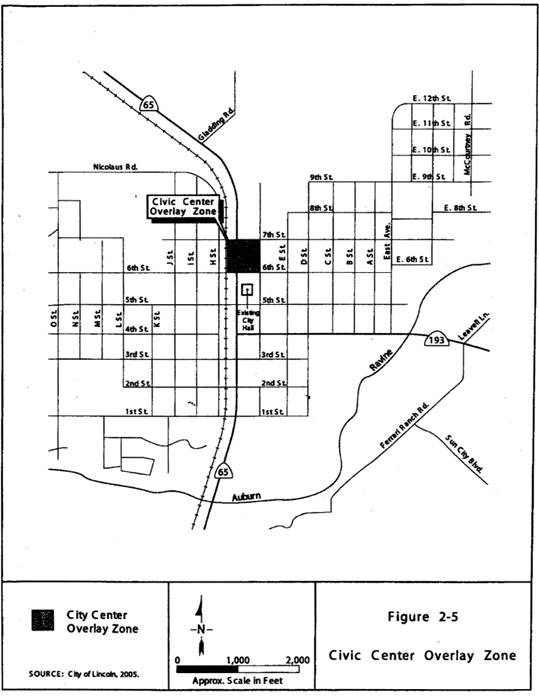
(Ord. 796B § 2, 2005: Ord. 357B § 3.07.030, 1979)
18.22.050 - Lot area.
The minimum area for each lot in the C district shall be as follows:
(1)
Corner lot: 2,500 square feet;
(2)
Interior lot: 2,500 square feet.
(Ord. 357B § 3.07.040, 1979)
18.22.060 - Lot coverage.
The maximum lot coverage by all buildings and structures in the C district shall not exceed 60 percent of the lot area.
(Ord. 357B § 3.07.050, 1979)
18.22.070 - Lot width.
The minimum lot width in the C district shall be as follows:
(1)
Corner lot: 25 feet;
(2)
Interior lot: 25 feet.
(Ord. 357B § 3.07.060, 1979)
18.22.080 - Yards.
No building or structure in the C district shall, after the effective date of the ordinance codified in this title, be erected or enlarged unless the following yards are provided and maintained:
(1)
Front Yard. No front yard is required except ten feet when adjacent to a residential district;
(2)
Rear Yard. No rear yard is required except ten feet when adjacent to a residential district;
(3)
Side Yard. No side yard is required except ten feet when adjacent to a residential district;
(4)
Side Street Yard. No side street yard is required except ten feet when adjacent to a residential district;
(5)
Building Sites on Rights-of-way in General Plan. Front, side, side street or rear yards required for lots abutting a highway or street for which rights-of-way are established by the circulation element of the general plan shall be determined as provided in Section 18.42.020.
(Ord. 799B § 5, 2006; Ord. 357B § 3.07.070, 1979)
18.22.090 - District dimensions.
The commercial district shall not be created unless the following minimum area, depth and width of the district are provided:
(1)
Minimum district area: one acre;
(2)
Minimum district width: 100 feet;
(3)
Minimum district depth: 100 feet.
(Ord. 357B § 3.07.080, 1979)
18.22.100 - Pawnshops.
In addition to any other restrictions imposed upon the issuance of conditional use permits, no pawnshops within the commercial district shall be placed, maintained, owned, or operated in any of the following locations:
(1)
On any lot directly abutting a residentially zoned lot or abutting a lot upon which a nonconforming residential use is located.
(2)
Within 500 feet of any parcel of real property upon which is located any of the following facilities:
a.
Any other pawnshop.
(Ord. 614B § 1, 1994: Ord. 518B § 3, 1989)
18.26.010 - Permitted uses.
Uses permitted in the L-I district shall be as follows:
(1)
Automobile body and paint shop;
(2)
Automobile repair shop;
(3)
Heavy equipment sales and service;
(4)
Tire shop;
(5)
Other uses which the planning commission has determined are similar in nature to others listed in this section;
(6)
Signs as permitted by Title 16;
(7)
Kennels for the purposes of temporarily boarding not more than 30 dogs or cats each for a period not to exceed 30 days.
(Ord. No. 1104B, § 9, 3-10-2026; Ord. No. 910B, § 2, 1-12-2016; Ord. 357B §3.09.000, 1979)
18.26.020 - Uses permitted within a building.
The following uses are permitted within the L-I district if they are conducted within a building, or surrounded by a solid fence of wood, masonry or similar new materials:
(1)
Automobile body manufacturing;
(2)
Boat building;
(3)
Bottling plant;
(4)
Building materials;
(5)
Cabinet shop;
(6)
Contractor's yards;
(7)
Emergency shelters; defined in section 50801(e) of the Health and Safety Code as "housing with minimal supportive services for homeless persons that is limited to occupancy of six months or less by a homeless person. No individual or household may be denied emergency shelter because of an inability to pay." Emergency shelters shall be subject to the following requirements:
a.
Emergency shelters shall be in compliance with all building codes, fire standards, and light industrial parking standards;
b.
The maximum occupancy shall not exceed 25 individuals;
c.
Emergency shelters shall provide on-site waiting and intake areas that are screened from public view;
d.
There shall be at least one staff member of the emergency shelter on site at all times while temporary residents are present;
e.
Security lights shall be provided to the satisfaction of the development services director;
f.
The applicant shall coordinate with the Lincoln police department to prepare a security plan for the facility, and shall provide the Lincoln police department with the name(s) and telephone number(s) of a responsible party(ies) to contact. The Lincoln police department may require the provision of on-site private security when the facility of [is] occupied if deemed necessary by the chief of police;
g.
Emergency shelters shall establish and maintain set hours for client intake/discharge. Said hours shall be posted at the entry to the facility; and
h.
Emergency shelters shall maintain a minimum 300-foot separation from other emergency shelters.
(8)
Feed and fuel yards;
(9)
Food processing;
(10)
Frozen food lockers;
(11)
Ice and cold storage;
(12)
Lumberyard;
(13)
Machine shop;
(14)
Warehousing;
(15)
Kennels for the purposes of temporarily boarding not more than 30 dogs or cats each for a period not to exceed 30 days.
(16)
Other uses which the planning commission has determined are similar in nature.
(Ord. No. 1104B, § 9, 3-10-2026; Ord. No. 855B, § 3, 5-24-2011; Ord. 357B §3.09.010, 1979)
18.26.025 - Accessory uses.
Emergency Generator. An emergency generator defined as a fixed device on a permanently mounted stand-by unit or combination of permanently mounted stand-by units, powered by an approved fire department power source for the purpose of temporarily supplying electricity for an industrial building that operates automatically as [a] secondary source of electrical power shall be permitted in accordance with the following requirements:
(1)
An emergency generator shall be used during periods of power outages or for periodic testing and necessary maintenance operation and shall not be used to sell power back to a power company or for use by power customers during periods of peak demand.
(2)
Emergency generators are not permitted on the roof of a building.
(3)
No emergency generator shall be installed prior to the issuance of a building permit.
(4)
Placement of an emergency generator shall be five feet from buildings and 15 feet from any property line.
(5)
Emergency generators are exempt from noise standards during periods of electrical power outages, including maintenance and periodic testing.
(6)
The operating specifications of an emergency generator for the purposes of providing power during power outages shall not exceed noise levels 70dBA (CNEL).
Solar Energy System. A solar energy system as defined in section 15.05.020A. shall be permitted if the solar energy system meets all of the following conditions:
(1)
The solar energy system shall be designed for the purpose of reducing on-site energy needs and shall be accessory to and incorporated into the development of an authorized use of the property.
(2)
The solar energy system shall only be permitted on the roof of a permitted principle structure or in the rear and side yard of the lot adjacent to a permitted structure.
(3)
The solar energy system shall conform to all set back requirements for the district in which the solar energy system is located unless, the community development director or his designee identifies a safety concern requiring placement within the setback.
(4)
The solar energy system shall be designed to absorb light, have minimal glint and glare and to scatter the reflected light.
(Ord. No. 1013B, § 5, 6-9-2020; Ord. No. 1001B, § 5, 11-12-2019; Ord. No. 1000B, § 5, 10-8-2019; Ord. No. 996B, § 5, 8-13-2019; Ord. No. 923B, § 8, 9-27-2016)
18.26.030 - Conditional uses.
The following uses are permitted subject to issuance of a conditional use permit by the planning commission:
(1)
Automobile wrecking yard;
(2)
Concrete batch plant;
(3)
Light manufacturing, fabrication, assembling, component manufacturing, small parts processing;
(4)
Mobile home sales and services;
(5)
Outdoor storage and sales;
(6)
Public utility service yard.
(7)
Recycling and redemption collection facilities, including reverse vending machine(s), small collection facilities, and recycling facilities (Subject to the provisions set forth in Chapter 18.35).
(8)
Kennels utilizing outdoor facilities for the purposes of temporarily boarding not more than 30 dogs or cats each for a period not to exceed 30 days.
(Ord. No. 1104B, § 9, 3-10-2026; Ord. No. 964B, § 11, 5-8-2018; Ord. 357B §3.09.020, 1979)
18.26.040 - Height regulations.
The maximum height for buildings and structures in the L-I district shall be 50 feet.
(Ord. 357B §3.09.030, 1979)
18.26.050 - Lot area.
The minimum lot area in the L-I district shall be as follows:
(1)
Corner lot: 10,000 square feet;
(2)
Interior lot: 10,000 square feet.
(Ord. 357B §3.09.040, 1979)
18.26.060 - Lot coverage.
The maximum lot coverage by all structures and buildings in the L-I district shall not exceed 50 percent of the lot area.
(Ord. 357B §3.09.050, 1979)
18.26.070 - Lot width.
The minimum lot width in the L-I district shall be as follows:
(1)
Corner lot: 100 feet;
(2)
Interior lot: 100 feet.
(Ord. 357B §3.09.060, 1979)
18.26.080 - Yards.
No building or structure in the L-I district shall, after the effective date of the ordinance codified in this title, be erected or enlarged unless the following yards are provided and maintained:
(1)
Front Yard. There shall be a front yard of not less than 25 feet in depth.
(2)
Rear Yard. There shall be a rear yard for each lot of not less than ten feet.
(3)
Side Yard. There shall be a side yard on each side of all buildings of not less than ten feet.
(4)
Side Street Yard. On corner lots, there shall be a side street yard of not less than ten feet.
(5)
Building Sites on Rights-of-way in General Plan. Front, side, side street or rear yards required for lots abutting a highway or street for which rights-of-way are established by the circulation element of the general plan shall be determined as provided in Section 18.42.020.
(Ord. 357B §3.09.070, 1979)
18.26.090 - District dimensions.
The light industrial district shall not be created unless the following minimum area, depth and width of the district are provided:
(1)
Minimum district area: one acre;
(2)
Minimum district width: 100 feet;
(3)
Minimum district depth: 100 feet.
(Ord. 357B §3.09.080, 1979)
18.28.010 - Permitted uses.
The following are permitted uses in the I district provided that they comply with all state and federal laws and city ordinances applicable to the regulation of obnoxious or offensive noise, smoke, dust, explosives, vibration, odors, bright or flashing lights, or any other nuisance factors:
(1)
Any use provided for as permitted or requiring a conditional use permit in the light industrial district;
(2)
Wholesale stores and storage;
(3)
Animal and fiber processing;
(4)
Mining and excavating;
(5)
Other uses which the planning commission has determined are similar in nature to those listed in this section;
(6)
Signs as permitted by Title 16.
(7)
Solar energy system (defined in Section 15.05.020A) - Consistent with the compatibility polices as set forth in the airport land use compatibility plan.
(Ord. No. 923B, § 11, 9-27-2016; Ord. No. 910B, § 2, 1-12-2016; Ord. 357B § 3.10.000, 1979)
18.28.015 - Accessory uses.
Emergency Generator. An emergency generator defined as a fixed device on a permanently mounted stand-by unit or combination of permanently mounted stand-by units, powered by an approved fire department power source for the purpose of temporarily supplying electricity for an industrial building that operates automatically as [a] secondary source of electrical power shall be permitted in accordance with the following requirements:
(1)
An emergency generator shall be used during periods of power outages or for periodic testing and necessary maintenance operation and shall not be used to sell power back to a power company or for use by power customers during periods of peak demand.
(2)
Emergency generators are not permitted on the roof of a building.
(3)
No emergency generator shall be installed prior to the issuance of a building permit.
(4)
Placement of an emergency generator shall be five feet from buildings and 15 feet from any property line.
(5)
Emergency generators are exempt from noise standards during periods of electrical power outages, including maintenance and periodic testing.
(6)
The operating specifications of an emergency generator for the purposes of providing power during power outages shall not exceed noise levels 70dBA (CNEL).
(Ord. No. 1013B, § 6, 6-9-2020; Ord. No. 1001B, § 6, 11-12-2019; Ord. No. 1000B, § 6, 10-8-2019; Ord. No. 996B, § 6, 8-13-2019)
18.28.020 - Conditional uses.
The following uses are permitted in the I district subject to issuance of a conditional use permit by the planning commission:
(1)
All uses in Section 18.28.010 which do not qualify as a permitted use because of some objectionable factor;
(2)
Acid storage, manufacturing;
(3)
Bituminous paving plants;
(4)
Inflammable liquid storage;
(5)
Lime or plaster of Paris;
(6)
Petroleum refining and petroleum or tar products manufacture;
(7)
Quarries;
(8)
Salvage yards;
(9)
Smelters;
(10)
Recycling and redemption collection facilities, including reverse vending machine(s), small collection facilities, and recycling facilities (Subject to the provisions set forth in Chapter 18.35).
(Ord. No. 964B, § 12, 5-8-2018; Ord. 357B § 3.10.010, 1979)
18.28.030 - Height regulations.
The maximum height for buildings and structures in the I district shall be 100 feet.
(Ord. 357B §3.10.020, 1979)
18.28.040 - Lot area.
The minimum area for each lot in the I district shall be as follows:
(1)
Corner lot: 10,000 square feet;
(2)
Interior lot: 10,000 square feet.
(Ord. 357B §3.10.030, 1979)
18.28.050 - Lot coverage.
The maximum lot coverage by all structures and buildings in the I district shall not exceed 75 percent of the lot area.
(Ord. 357B §3.10.040, 1979)
18.28.060 - Lot width.
The maximum lot width in the I district shall be as follows:
(1)
Corner lot: 100 feet;
(2)
Interior lot: 100 feet.
(Ord. 357B §3.10.050, 1979)
18.28.070 - Yards.
No building or structure shall be erected or enlarged in the I district after the effective date of the ordinance codified in this chapter unless the following yards are provided and maintained:
(1)
Front Yard. There shall be a front yard of not less than 25 feet in depth.
(2)
Rear Yard. There shall be a rear yard for each lot of not less than ten feet.
(3)
Side Yard. There shall be a side yard on each side of all buildings of not less than ten feet.
(4)
Side Street Yard. On corner lots, there shall be a side street yard of not less than ten feet.
(5)
Building Sites on Rights-of-way in General Plan. Front, side, side street or rear yards required for lots abutting a highway or street for which rights-of-way are established by the circulation element of the general plan shall be determined as provided in Section 18.42.020.
(Ord. 357B §3.10.060, 1979)
18.28.080 - Dimensions of district.
The industrial district shall not be created unless the following minimum area, depth and width of the district are provided:
(1)
Minimum district area: one acre;
(2)
Minimum district width: 100 feet;
(3)
Minimum district depth: 100 feet.
(Ord. 357B §3.10.070, 1979)
18.29.000 - Purpose.
Well-located and well-composed agricultural land is a major natural resource that cannot be made nor increased. This type of land is the source of essential food stuffs and fibers. An important aspect to this resource are lands within the city that are economically restricted to grazing and animal husbandry due to location, geological formation and chemical/organic composition. It is important to preserve both productive agricultural lands and grazing lands. The purpose, therefore, of this classification is to accomplish this objective by holding to high minimum area standards, permitting only such uses as are related to agricultural production or are similar thereto and by discouraging the encroachment of urban type development and especially that which would be marginal in character and disruptive of sound long range planning and economic factors. Reasonable consideration, however, shall be given by the city to rezoning of land in this classification at such time as the orderly development of the city and the general welfare necessitate development of portions of this land for residential and related uses.
(Ord. 555B §1(part), 1991)
18.29.010 - Permitted uses.
The following uses are permitted in the (A-D) agricultural district:
(1)
One single-family residence and accessory buildings;
(2)
ADUs as regulated by Chapter 18.37;
(3)
Agricultural corps and open field grazing;
(4)
Livestock, poultry and small animals provided:
a.
Any building, pen, cage aviary, animal run or area used to contain, house, confine or feed such animals or fowl shall not be located closer than 75 feet to any boundary property line of the premises, or any building containing a dwelling unit on the same premises,
b.
Any open-air storage of hay, straw, shavings or similar organic materials shall maintain a distance of not less than 35 feet from any boundary property line, and a distance of not less than 45 feet from any building containing a dwelling unit or accessory living quarters on the same premises;
(5)
Greenhouses, when incidental to agricultural uses on premises;
(6)
Marketing of products on the premises, provided:
a.
Only one stand shall be permitted on the premises and such stand shall contain not more than 500 square feet of floor area, and shall not be located in any required yard or open space on the premises;
(7)
Pasturing and grazing;
(8)
Public stables and riding academies provided:
a.
Any stable or barn shall not be located closer than 75 feet to any boundary property line, or to any building containing a dwelling unit on the same premises,
b.
Any corrals, exercise yards or rings shall maintain a distance of not less than 45 feet from any building containing a dwelling unit on the same premises,
c.
Any open-air storage of hay, straw, shavings or similar materials shall maintain a distance of not less than 35 feet from any boundary property line, and a distance of not less than 45 feet from any building containing a dwelling unit or accessory living quarters on the same premises.
(9)
Signs as permitted by Title 16.
(Ord. No. 1080B, § 5(5.8A), 7-23-2024; Ord. No. 910B, § 2, 1-12-2016; Ord. 555B §1(part), 1991)
18.29.020 - Conditional uses.
The following uses are permitted in the agricultural district subject to issuance of a conditional use permit by the planning commission:
(1)
Dairies;
(2)
Churches;
(3)
Country clubs and golf courses;
(4)
Kennels;
(5)
Animal hospitals or clinics.
(Ord. 555B §1(part), 1991)
18.29.025 - Accessory uses.
Emergency Generator. An emergency generator defined as a fixed device on a permanently mounted stand-by unit or combination of permanently mounted stand-by units, powered by natural gas for the purpose of temporarily supplying electricity for human occupancy in residential or accessory buildings that operates automatically as [a] secondary source of electrical power shall be permitted in accordance with the following requirements:
(1)
An emergency generator shall be used only during periods of power outages or for periodic testing and necessary maintenance operation and shall not be used to sell power back to a power company or for use by power customers during periods of peak demand.
(2)
Emergency generators shall be fueled by natural gas.
(3)
Emergency generators are not permitted on the roof of a building.
(4)
No emergency generator shall be installed prior to the issuance of a building permit.
(5)
Placement of an emergency generator shall be permitted a minimum five feet from any building or openable window and shall maintain three-feet of clearance from the generator and the adjacent property line.
(6)
Emergency generators are exempt from noise standards during periods of electrical power outages, including maintenance and periodic testing.
(7)
The operating specifications of an emergency generator for the purposes of providing power during power outages shall not exceed noise levels of 60 dBA CNEL and interior noise levels of 45 dBA CNEL.
Exception: Fuel powered portable emergency generators are permitted within the residential zone when providing temporary power to energize domestic appliances and tools. Portable generators shall not be connected to an electrical main or sub panel and not exceed the established noise standards as detailed in this provision.
Solar Energy System. A solar energy system as defined in section 15.05.020A. shall be permitted if the solar energy system meets all of the following conditions:
(1)
The solar energy system shall be designed for the purpose of reducing on-site energy needs and shall be accessory to and incorporated into the development of an authorized use of the property.
(2)
The solar energy system shall only be permitted on the roof of a permitted principle structure or in the rear and side yard of the lot adjacent to a permitted structure.
(3)
The solar energy system shall conform to all set back requirements for the district in which the solar energy system is located unless, the community development director or his designee identifies a safety concern requiring placement within the setback.
(4)
The solar energy system shall be designed to absorb light, have minimal glint and glare and to scatter the reflected light.
(Ord. No. 1013B, § 7, 6-9-2020; Ord. No. 1001B, § 7, 11-12-2019; Ord. No. 1000B, § 7, 10-8-2019; Ord. No. 996B, § 7, 8-13-2019; Ord. No. 923B, § 9, 9-27-2016)
18.29.030 - Height regulations.
The maximum height for buildings and structures in the agricultural district shall be 40 feet, except that barns and other specialized structures used for agricultural purposes may exceed the height limit provided such height will not conflict with other provisions of the zoning code.
(Ord. 555B §1(part), 1991)
18.29.040 - Lot area.
The minimum area for each lot in the agricultural district shall be as follows: ten acres.
(Ord. 555B §1(part), 1991)
18.29.060 - Lot width.
The minimum lot width for each lot in the agricultural district shall be not less than 300 feet.
(Ord. 555B §1(part), 1991)
18.29.070 - Yards.
No building or structure in the agricultural district shall, after the effective date of the ordinance codified in this chapter, be erected or enlarged unless the following yards are provided and maintained:
(1)
Front Yard. There shall be a front yard of not less than 35 feet.
(2)
Any building or structure, whether it be a main building or structure, or whether it be an accessory building or structure, shall observe a distance of not less than ten feet from any side or rear property line. Where a greater distance is required as a condition to the establishment of permitted building or use, such greater distance shall prevail.
(3)
The distance between a building containing a dwelling unit and any other buildings or structures on the same lot shall be not less than 20 feet. Where a greater distance is required as a condition to the establishment of a permitted use, such greater distance shall prevail.
(4)
Minimum district depth: 100 feet.
(Ord. 555B §1(part), 1991)
18.30.010 - Permitted uses.
The following uses are permitted in the O-S district:
(1)
Parks;
(2)
Playgrounds and playfields;
(3)
Public swimming pools;
(4)
Golf course;
(5)
Country club;
(6)
Schools;
(7)
Community centers;
(8)
Public buildings;
(9)
Signs as permitted by Title 16.
(Ord. No. 910B, § 2, 1-12-2016; Ord. 581B §1, 1992; Ord. 357B §3.11.000, 1979)
18.30.020 - Conditional uses.
The following uses are permitted in the O-S district subject to issuance of a conditional use permit by the planning commission:
(1)
Commercial uses accessory to permitted uses, such as refreshment stands, restaurants, sports equipment rental and sales, marinas;
(2)
Museums;
(3)
Art galleries;
(4)
Public utility substations;
(5)
Agricultural land.
(Ord. 357B §3.11.010, 1979)
18.30.025 - Accessory uses.
Solar Energy System. A solar energy system as defined in section 15.05.020A. shall be permitted if the solar energy system meets all of the following conditions:
(1)
The solar energy system shall be designed for the purpose of reducing on-site energy needs and shall be accessory to and incorporated into the development of an authorized use of the property.
(2)
The solar energy system shall only be permitted on the roof of a permitted principle structure or in the rear and side yard of the lot adjacent to a permitted structure.
(3)
The solar energy system shall conform to all set back requirements for the district in which the solar energy system is located unless, the community development director or his designee identifies a safety concern requiring placement within the setback.
(4)
The solar energy system shall be designed to absorb light, have minimal glint and glare and to scatter the reflected light.
(Ord. No. 923B, § 10, 9-27-2016)
18.30.030 - Height regulations.
The maximum height for buildings and structures in the O-S district shall be 40 feet.
(Ord. 357B §3.11.020, 1979)
18.30.040 - Lot area.
The minimum area for each lot in the O-S district shall be as follows:
(1)
Corner lot: 10,000 square feet;
(2)
Interior lot: 10,000 square feet.
(Ord. 357B §3.11.030, 1979)
18.30.050 - Lot coverage.
The maximum lot coverage by all structures and buildings in the O-S district shall not exceed 40 percent of the lot area.
(Ord. 357B §3.11.040, 1979)
18.30.060 - Lot width.
The minimum lot width in the O-S district shall be as follows:
(1)
Corner lot: 100 feet;
(2)
Interior lot: 100 feet.
(Ord. 357B §3.11.050, 1979)
18.30.070 - Yards.
No building or structure in the O-S district shall, after the effective date of the ordinance codified in this chapter, be erected or enlarged unless the following yards are provided and maintained:
(1)
Front Yard. There shall be a front yard of not less than 20 feet in depth.
(2)
Rear Yard. There shall be a rear yard for each lot of not less than ten feet.
(3)
Side Yard. There shall be a side yard on each side of all buildings of not less than ten feet.
(4)
Side Street Yard. On corner lots, there shall be a side street yard of not less than ten feet.
(5)
Building Sites on Rights-of-way in General Plan. Front, side, side street or rear yards required for lots abutting a highway or street for which proposed rights-of-way are established by the circulation element of the general plan shall be determined as provided in Section 18.42.020.
(Ord. 357B §3.11.060, 1979)
18.31.010 - Purpose and intent.
The purpose of this designation is to provide areas for public and quasi-public facilities for educational facilities, public buildings, cultural and institutional uses, general government operations, utility and public services, and facilities that serve the general public.
(Ord. No. 930B, § 1, 12-13-2016)
18.31.020 - Permitted uses.
The following uses are permitted in the PUB district:
(1)
City-owned facilities, including wastewater treatment and reclamation facilities, community centers, libraries, police and/or fire stations, trail systems, open space areas, and stormwater drainage facilities;
(2)
Uses and facilities, whether constructed publicly or privately, developed on city-owned land and intended for a purpose found by the city to be in the public interest;
(3)
Corporation yards, including storage of materials, and repair of equipment and vehicles operated by governmental entities;
(4)
County, state, and federally owned facilities;
(5)
Public schools;
(6)
Creation or preservation of wetland facility;
(7)
Community water storage, wells and associated facilities;
(8)
Solar energy facility (as outlined in Chapter 15).
(Ord. No. 930B, § 1, 12-13-2016)
18.31.030 - Conditional Uses
The following uses are permitted in the PUB district subject to the issuance of a conditional use permit by the planning commission:
(1)
Wind power production;
(2)
Telecommunications facility per Chapter 18.41;
(3)
Electrical substation;
(4)
Other uses, not listed under Section 18.31.020 or 18.31.030, which in the opinion of the community development director are of a similar and compatible nature to those uses described in this section.
(Ord. No. 930B, § 1, 12-13-2016)
18.31.040 - Building setbacks.
Front: 20 feet
Side: 20 feet
Rear: 20 feet
From adjacent residential zoning: 50 feet
(Ord. No. 930B, § 1, 12-13-2016)
18.31.050 - Building height regulation.
(a)
Thirty-five feet.
(b)
Water tank height shall be determined based upon capacity and hydrology conditions
(Ord. No. 930B, § 1, 12-13-2016)
18.31.060 - Lot area.
Minimum of one-half acre.
(Ord. No. 930B, § 1, 12-13-2016)
18.31.070 - Lot width.
One hundred feet minimum.
(Ord. No. 930B, § 1, 12-13-2016)
18.31.080 - Lot depth.
One hundred feet minimum.
(Ord. No. 930B, § 1, 12-13-2016)
18.31.090 - Design review.
(a)
New construction requires design review approval. The city council may determine that city council review may be substituted for design review for projects of community-wide or regional significance provided the city council determines:
(1)
Expedited review is required to accommodate city objectives; and
(2)
The project will not have a significant visual impact.
(b)
Remodel/addition to an existing building requires design review approval unless the community development director determines:
(1)
The design of the remodel or addition is consistent with the design of the primary structure; and
(2)
The remodel or addition will not have a significant visual impact.
(Ord. No. 930B, § 1, 12-13-2016)
18.31.100 - Lighting.
(a)
Light fixture heights should not exceed 12 feet when adjacent to residential uses. No ground-mounted light fixture shall exceed 25 feet in height.
(b)
All lighting shall be directed downward so that there will be no glare which will cause unreasonable annoyance to occupants of such property or otherwise interfere with the public health, safety, or welfare.
(Ord. No. 930B, § 1, 12-13-2016)
18.32.010 - Purpose.
This district is established to encourage and provide for a creative and more flexible approach to the use of land; to maximize the choices of types of living environments available to the people of the city; and to encourage more efficient allocation and maintenance of privately controlled common open space through the redistribution of overall densities where such a rearrangement is desirable and feasible.
(Ord. 375B §2(part), 1980: Ord. 357B §3.12.000, 1979)
18.32.020 - Means to accomplish purposes.
It is the intention of this chapter to carry out the purposes set forth in the preceding section by providing the means for greater creativity and flexibility in environmental design than is provided under the strict application of this title while protecting the public health, safety and welfare, and property values. Various land uses may be combined in a planned development to include combinations of residential, commercial, industrial, utility, institutional, educational, cultural, recreational and other uses, provided that combination of uses results in a balanced and stable environment.
(Ord. 375B §2(part), 1980: Ord. 357B §3.12.010, 1979)
18.32.030 - Size.
A planned development, or a unit thereof, shall be of sufficient size that its construction, marketing and operation is feasible as a complete unit independent of any subsequent unit. Generally, developments of less than ten acres are not acceptable.
(Ord. 375B §2 (part), 1980: Ord. 357B §3.12.020(1), 1979)
18.32.040 - Function of general development plan.
As provided in this chapter, the approved preliminary development plan for the property within the PD zone specifies the uses to which such property may be put, the locations of such uses, intensity of land use, and other criteria which constitute the development restrictions applicable to the property.
(Ord. 357B §3.12.020(2), 1979; Ord. 375B §2(part), 1975)
18.32.050 - Maintenance of common open space.
Where the planned development provides open space areas or recreation facilities which are privately owned, but commonly shared among the property owners, and such open space and/or recreation facilities are not maintained in a condition consistent with the approved development, the city may, at its option, cause such maintenance to be performed and assess the cost to the affected property owners or responsible homeowners' association, or cause a lien to be placed on the affected property, to be collected with the taxes thereon.
(Ord. 375B §2(part), 1980: Ord. 357B §3.12.020(3), 1979)
18.32.060 - Preliminary development plan—Purpose.
The purpose of the preliminary development plan is to show the overall development scheme for the affected area and to indicate the sequence in which individual portions of the area will be developed.
(Ord. 375B §2(part), 1980: Ord. 357B §3.12.030(1), 1979)
18.32.070 - Preliminary development plan—Initial submittal—Contents.
The developer shall submit to the planning department a preliminary development plan which shows the overall development scheme and indicates the sequence in which individual portions of the area will be developed. Such plan shall include:
(1)
Maps or drawings which may be schematic in form;
(2)
All interior property lines;
(3)
Land use, existing and proposed;
(4)
Location and size of existing streets and location of the proposed circulation system;
(5)
Name(s) of the owner, developer and consultant;
(6)
Public uses, including schools, parks, recreational areas and other open space, and method of maintaining public open space;
(7)
The use and general description of each different type of structure or building;
(8)
Written explanation of the nature of the proposed development and any deviations from regulations otherwise applicable to the property;
(9)
Generalized topography and proposed changes;
(10)
Utilities, existing and proposed, serving the area;
(11)
Vegetation and proposed changes;
(12)
Proposed sequence and schedule, or phasing, of development.
(Ord. 375B §2(part), 1980: Ord. 357B §3.12.030(2), 1979)
18.32.080 - Preliminary development plan—Planning commission consideration.
After review by the planning department, the proposed preliminary development plan shall be submitted to the planning commission as a proposed rezoning of the property to the PD zone. The commission shall follow the same procedures as in any rezoning, and shall have full authority to alter or modify the preliminary development plan.
(Ord. 375B §2(part), 1980: Ord. 357B §3.12.030(3), 1979)
18.32.090 - Preliminary development plan—City council consideration—General development plan.
The preliminary development plan shall be considered by the city council following the same procedures as in any rezoning. The city council may alter or modify the proposed preliminary development plan. If the rezoning is approved, the preliminary development plan becomes the development restrictions for the PD zone covered by the plan and thereafter shall be designated the "general development plan." The general development plan, as approved, shall consist of a map, together with relevant text materials, showing:
(1)
All land uses;
(2)
Intensity of land use as measured by units per acre, area coverage or other acceptable description;
(3)
Major circulation;
(4)
A division of the area to be developed into smaller areas, called "phases," and the sequences of their development, unless the entire plan is to be carried out simultaneously.
(Ord. 375B §2(part), 1980: Ord. 357B §3.12.040, 1979)
18.32.100 - Development permit required for each phase of development.
Each phase of the general development plan, or the entire general development plan if it is to be carried out simultaneously, shall be developed only after issuance of a development permit by the city council or planning commission as provided for in Section 18.32.130.
(Ord. 621B §1, 1994: Ord. 375B §2(part), 1980: Ord. 357B §3.12.050(1), 1979)
18.32.110 - Specific development plan—Required for permit—Contents.
A specific development plan shall be submitted to the planning commission with an application for a development permit. Such plan shall consist of a map and necessary textual materials showing:
(1)
The boundaries of the specific development plan;
(2)
The size and location of all public utility easements;
(3)
The exact location and width of all streets, sidewalks, bike trails, pedestrian paths or other areas used for the conveyance of vehicular, pedestrian, bicycle, equestrian or other traffic;
(4)
The typical location of individual residential structures and the actual location of multifamily, business and commercial structures;
(5)
The number of units per gross acre;
(6)
The general landscaping features;
(7)
The location and size of any proposed park or recreational area, and an indication of whether or not the same is to be publicly or privately owned;
(8)
The location of any public facilities, including but not limited to fire stations, school sites, utility substations or other facilities;
(9)
The location of parking areas;
(10)
The location and screening of refuse disposal areas;
(11)
Major points of vehicular access to and from multifamily, business and commercial structures;
(12)
The location and size of all fencing or screening;
(13)
A designation of the use of all open space, whether publicly or privately owned, and the person or group responsible for its maintenance;
(14)
The location and size of any proposed signs, exclusive of traffic-control and street signs;
(15)
Contour lines at intervals designated by the city engineer.
(Ord. 375B §2(part), 1980: Ord. 357B §3.12.050(2), 1979)
18.32.120 - Specific development plan—Supplemental information required.
In conjunction with the specific development plan map, there shall be submitted the following:
(1)
A preliminary grading plan;
(2)
For business or commercial areas, an economic feasibility study as to the need and projected use of such facilities;
(3)
Detail concerning the landscaping, including the type and size of plant materials to be used;
(4)
Such other and further information as the planning department or the planning commission may deem necessary.
(Ord. 375B §2(part), 1980: Ord. 357B §3.12.050(3), 1979)
18.32.130 - Development permit hearing—Planning commission.
A public hearing on the development permit for residential development shall be held by the planning commission after a completed application has been received and shall be noticed in the same manner as would be done for a rezone. After the close of public hearing, the planning commission shall forward to the city council a recommendation for approval, approval with conditions or disproval of the residential development permit. The planning commission shall not recommend approval unless it finds that the proposed development is consistent with the general development plan. A public hearing on the development permit for commercial, business and professional, and industrial development shall be held by the planning commission after a completed application has been received and shall be noticed in the same manner as would be done for a rezone. At the close of the public hearing, the planning commission may take action to approve, approve with conditions, or deny the permit. The planning commission shall not approve a commercial, business and professional, or industrial development permit unless it finds the proposed development consistent with the general development plan. No action by the city council shall be required for development permits involving industrial, business and professional, or commercial development.
(Ord. No. 964B, § 17, 5-8-2018; Ord. 621B §2, 1994: Ord. 375B §2(part), 1980: Ord. 357B §3.12.050(4), 1979)
18.32.140 - Development permit hearing—City council—Approval or disapproval.
Except as provided for in Section 18.32.130, a public hearing to consider the planning commission recommendation and the development permit shall be held by the city council and shall be noticed in the same manner as would be done for a rezone. After the close of the public hearing, the city council shall approve, approve with conditions or disapprove the development permit. A development permit shall not be approved unless the city council finds that the proposed development is consistent with the general development plan.
(Ord. 621B §3, 1994: Ord. 375B §2(part), 1980: Ord. 357B §3.12.050(5), 1979)
18.32.150 - Subdivision maps.
(a)
A tentative subdivision map may be processed simultaneously with a request for a development permit or after the approval thereof.
(b)
No development permit shall be valid until a final map, as defined by the Subdivision Map Act and implementing ordinances of the city, has been filed with the county recorder.
(Ord. 375B §2(part), 1980: Ord. 357B §3.12.060, 1979)
18.32.160 - Commencement of development.
Upon approval of a development permit, and compliance with other applicable regulations, development of the area covered by the specific development plan may commence, provided that all necessary building permits and other required entitlements are obtained.
(Ord. 375B §2(part), 1980: Ord. 357B §3.12.070, 1979)
18.32.170 - Development permit expiration and extensions.
(a)
A development permit not exercised within four years of approval shall expire and become void, unless a condition of approval specifies an alternative time expiration limit. An extension of time may be applied for in compliance with subsection (b).
(b)
The community development director may grant one extension of time for a period not exceeding two years, provided application for an extension is made prior to expiration of the original entitlement. Extension decisions are appealable to the applicable body above the specific decision maker (i.e., a community development director decision may be appealable to the planning commission).
(Ord. No. 1081B, § 5(5.1A), 8-27-2024; Ord. 375B §2(part), 1980: Ord. 357B §3.12.080, 1979)
18.33.010 - Purpose and intent.
The purpose of this designation is to preserve lands for park and recreational purposes to protect the physical, social, recreational, aesthetic, and economic resources of the city. The park district may be applied to public and private recreation facilities and is intended to be applied to larger parks especially community-wide facilities, but may also be applied to smaller neighborhood facilities when it is important, due to the planned facilities or natural features, to designate the site for park uses.
(Ord. No. 931B, § 1, 12-13-2016)
18.33.020 - Permitted uses.
The following uses are permitted in the park district:
(1)
Parks;
(2)
Community center;
(3)
Community activities;
(4)
Sports fields;
(5)
Hard courts;
(6)
Playgrounds;
(7)
Swimming pool/aquatics center;
(8)
Public buildings.
(Ord. No. 931B, § 1, 12-13-2016)
18.33.030 - Conditional uses.
The following uses are permitted in the park district subject to the issuance of a conditional use permit by the planning commission:
(1)
Golf course;
(2)
Equestrian facility;
(3)
Farmers market;
(4)
Private fitness classes;
(5)
Telecommunications facility per Chapter 18.41;
(6)
Commercial uses accessory to a permitted or conditional use, such as refreshment stands, restaurants, sports equipment rental and sales (including alcohol sales);
(7)
Other uses, not listed under Section 18.33.020 or Section 18.33.030, which in the opinion of the community development director are of a similar and compatible nature to those uses described in this section.
(Ord. No. 931B, § 1, 12-13-2016)
18.33.040 - Building setbacks.
Front: 20 feet.
Side: 20 feet.
Rear: 20 feet.
From adjacent residential zoning: 50 feet.
(Ord. No. 931B, § 1, 12-13-2016)
18.33.050 - Building height regulation.
Thirty-five feet.
(Ord. No. 931B, § 1, 12-13-2016)
18.33.060 - Lot area.
Minimum of one acre.
(Ord. No. 931B, § 1, 12-13-2016)
18.33.070 - Lot width.
One hundred feet minimum.
(Ord. No. 931B, § 1, 12-13-2016)
18.33.080 - Lot depth.
One hundred feet minimum.
(Ord. No. 931B, § 1, 12-13-2016)
18.33.090 - Design review.
(a)
New construction requires design review approval. The city council may determine that city council review may be substituted for design review for projects of community-wide or regional significance provided the city council determines:
(1)
Expedited review is required to accommodate City objectives; and
(2)
The project will not have a significant visual impact.
(b)
Remodel/addition to an existing building requires design review approval unless the community development director determines:
(1)
The design of the remodel or addition is consistent with the primary structure; and
(2)
The remodel or addition will not have a significant visual impact.
(Ord. No. 931B, § 1, 12-13-2016)

