
Lincoln City Zoning Code
DIVISION IV
USES, YARDS, HEIGHTS, PARKING, LOADING, RIDESHARING AND TRANSPORTATION PLANS
CHAPTER 18.37 - ACCESSORY DWELLING UNITS (ADU)[5]
Editor's note—Ord. No. 1099B, § 5, adopted September 23, 2025, repealed the former Chapter 18.37 §§ 18.37.008—18.37.100, and § 6(Exh. A) of said ordinance, enacted a new Chapter 18.37 as set out herein. The former Chapter 18.37 pertained to the same subject matter and derived from [Ord. No. 1080B, § 5(5.1B—5.1H, 5.1J—5.1N), July 23, 2024.
Article II. - Adult-Oriented Businesses[3]
Editor's note— Ord. No. 878B, § 4, adopted Jan. 22, 2013, amended Art. II, in its entirety to read as set out herein. Former Art. II pertained to sex oriented businesses and derived from Ord. 512B § 1(part), adopted in 1989.
Article IV. - Marijuana Regulation[4]
Editor's note— Ord. No. 948B, § 2, adopted September 26, 2017, repealed the former Arts. IV, and V, §§ 18.34.120—18.34.220, and enacted a new Art. IV as set out herein. The former Arts. IV and V pertained to similar subject matter and derived from Ord. 780B §2(part), adopted in 2004; and Ord. 785B §2(part), adopted in 2005; Ord. No. 882B, § 3, adopted May 28, 2013; Ord. No. 893B, § 2, adopted October 28, 2014; Ord. No. 914B, § 3, adopted July 26,2016.
18.35.000 - Purpose.
The purpose and intent of this chapter is to make the redemption and recycling of reusable materials convenient to the consumer in order to reduce litter and increase the recycling of reusable materials by providing for the permitting and regulating of recycling activities within the city.
(Ord. 500B §1(part), 1987)
18.35.010 - Definitions.
As used in this chapter:
(1)
"Administrative permit" means a permit issued by the director of community development pursuant to the requirements of Section 18.35.020 of this chapter.
(2)
"Collection facility" means a center for the acceptance by donation, redemption, or purpose of recyclable materials from the public. Such facility does not use power-driven processing equipment except as indicated in Section 18.35.040. Collection facilities may include the following:
a.
Reverse vending machine(s);
b.
Small collection facilities which occupy an area of not more than 500 square feet and may include:
1.
A mobile unit;
2.
Bulk reverse vending machines or a grouping of reverse vending machines occupying more than 50 square feet;
3.
Kiosk-type units which may include permanent structures; and
4.
Unattended containers placed for the donation of recyclable materials.
(3)
"Mobile recycling unit" means an automobile, truck, trailer, or van licensed by the department of motor vehicles which is used for the collection of recyclable materials. A mobile recycling unit also means the bins, boxes, or containers transported by trucks, vans, or trailers and used for the collection of recyclable materials.
(4)
"Recycling facility" means a center for the collection and/or processing of recyclable materials. A certified recycling facility or certified processor means a recycling facility certified by the California Department of Conservation as meeting the requirements of the California Beverage Container Recycling and Litter Reduction Act of 1986. A recycling facility does not include storage containers or processing activity located on the premises of a residential, commercial, or manufacturing use and used solely for the recycling of material generated by that residential property, business, or manufacturer. Recycling facilities include those facilities as set forth in the definition of "collection facilities" above.
(5)
"Recyclable material" means reusable material including but not limited to metals, glass, plastic, and paper which are intended for the reuse, remanufacture, or reconstitution for the purpose of using the altered form. Recyclable material does not include refuse or hazardous materials.
(6)
"Reverse vending machine(s)" is an automated mechanical device which accepts at least one or more types of empty beverage containers including but not limited to aluminum cans, glass and plastic bottles and issues a cash refund or a redeemable credit slip with a value of not less than the container's redemption value as determined by the state. A reverse vending machine may sort and process containers mechanically provided that the entire process is enclosed within the machine. In order to accept and temporarily store all three container types in a proportion commensurate with their relative redemption rate and to meet the requirements of certification as a recycling facility, multiple grouping of reverse vending machines may be necessary. A bulk reverse vending machine is a reverse vending machine that is larger than 50 square feet, is designed to accept more than one container at a time, and will pay by weight instead of by container.
(Ord. 500B §1(part), 1987)
18.35.020 - Permits required.
No person shall permit the placement, construction, or operation of any recycling facility without first obtaining a conditional use permit pursuant to the provisions set forth in this section and Chapter 18.56. The operation of a reverse vending machine and small collection facility as defined by this chapter shall require the issuance of a conditional use permit in accordance with the standards and criteria set forth in Section 18.35.040.
(Ord. 500B §1(part), 1987; Ord. No. 964B, § 13, 5-8-2018)
18.35.030 - Reserved.
Editor's note— Ord. No. 964B, § 14, adopted May 8, 2018, repealed § 18.35.030, which pertained to permits for multiple sites and derived from Ord. 500B §1(part), 1987.
18.35.040 - Criteria and standards for conditional use permits.
Those recycling facilities permitted with an administrative permit shall meet all of the applicable criteria and standards listed. The criteria and standards for recycling facilities are as follows:
(1)
Reverse Vending Machine(s). Reverse vending machines within a commercial structure may be permitted in all commercial and industrial districts with an administrative permit provided that they comply with the following standards:
a.
The facility shall be established in conjunction with a commercial use or community service facility which is in compliance with the zoning, building, and fire codes of the city.
b.
The facility shall be located within 30 feet of the entrance to the commercial structure and shall not obstruct pedestrian or vehicular circulation.
c.
Shall not occupy parking spaces required by the primary use.
d.
Shall occupy no more than 50 square feet of floor space per installation, including any protective enclosure, and shall be no more than eight feet in height.
e.
Shall be constructed and maintained with durable waterproof and rustproof material.
f.
Shall be clearly marked to identify the type of material to be deposited, operating instructions, and the identity and phone number of the operator or responsible person to call if the machine is inoperative.
g.
Shall have a sign area of a maximum of four square feet per machine exclusive of operating instructions.
h.
Shall be maintained in a clean, litter-free condition on a daily basis.
i.
Operating hours shall be at least the operating hours of the host use.
j.
Shall be illuminated to ensure comfortable and safe operation if operating hours are between dusk and dawn.
(2)
Small Collection Facilities. Small collection facilities may be sited in commercial and industrial districts with an administrative permit provided they comply with the following conditions:
a.
Shall be established in conjunction with an existing commercial use or community service facility which is in compliance with the zoning, building, and fire codes of the city.
b.
Shall be no larger than 500 square feet and occupy no more than five parking spaces not including space that will be periodically needed for removal of materials or exchange of containers.
c.
Shall be set back at least ten feet from any street line and shall not obstruct pedestrian or vehicular circulation. Specific locations for a facility shall be approved by the director of community development during the review of a permit.
d.
Shall accept only glass, metals, plastic containers, papers, and reusable items. Recyclable material does not include refuse or hazardous materials.
e.
Shall use no power-driven processing equipment except for reverse vending machines.
f.
Shall use containers that are constructed and maintained with durable waterproof and rustproof material, covered when site is not attended, secured from unauthorized entry or removal of material, and shall be of a capacity sufficient to accommodate materials collected and collection schedule.
g.
Shall store all recyclable material in containers or in the mobile unit vehicle and shall not leave materials outside of containers when attendant is not present.
h.
Shall be maintained free of litter and any other undesirable materials and mobile facilities at which truck or containers are removed at the end of each collection day shall be swept at the end of each collection day.
i.
Shall not exceed noise levels of 60 dBA as measured at the property line of residentially zoned or occupied property, otherwise shall not exceed 70 dBA.
j.
Attended facilities located within 100 feet of a property zoned or occupied for residential use shall operate only during the hours of 9:00 a.m. and 7:00 p.m.
k.
Containers for the 24-hour donation of materials shall be at least 30 feet from any property zoned or occupied for residential use.
l.
Containers shall be clearly marked to identify the type of material which may be deposited, the facility shall be clearly marked to identify the name and telephone number of the facility operator and the hours of operation, and display a notice stating that no material shall be left outside the recycling enclosure or containers.
m.
Signs may be provided as follows:
1.
Recycling facilities may have identification signs with a maximum of 20 percent per side or 16 square feet, whichever is larger;
2.
Signs must be consistent with the character of the location;
3.
Directional signs bearing no advertising message may be installed with the approval of the director of community development if the facility is not visible from the public right-of-way.
n.
The facility shall not impair the landscaping required by the city.
o.
No additional parking spaces will be required for customers of small collection facilities located at the established parking lot of a host use. One space will be provided for the attendant, if needed.
p.
Mobile recycling units shall have an area clearly marked to prohibit other vehicular parking during hours when the unit is scheduled to be present.
q.
Occupation of parking spaces by the facility and by the attendant may not reduce available parking spaces below the minimum number required for the primary host use unless all the following conditions exist: (a) The facility is located in a convenience zone or a potential convenience zone as designated by the California Department of Conservation; (b) A parking study shows that existing parking capacity is not already fully utilized during the time the recycling facility will be on the site; (c) The permit will be reconsidered at the end of 12 months. A reduction in available parking spaces in an established parking facility may then be allowed up to a maximum of five spaces.
r.
If the permit expires without renewal, the collection facility shall be removed from the site on the day following permit expiration.
(Ord. 500B §1(part), 1987; Ord. No. 964B, § 15, 5-8-2018)
18.35.050 - Reserved.
Editor's note— Ord. No. 964B, § 16, adopted May 8, 2018, repealed § 18.35.050, which pertained to permit renewal and derived from Ord. 500B §1 (part), 1987.
18.36.010 - Applicability.
The use regulations specified in the various districts in this title shall be subject to the general use regulations and exceptions in this chapter.
(Ord. 357B §4.02.000, 1979)
18.36.020 - Utility lines and facilities.
Subject to the provisions of Sections 18.36.021 through 19.36.025, public utility distribution and power-transmission lines and poles, and underground facilities for distribution of gas, water, communications, electricity and cable television, shall be allowed in all districts without limitations as to height or without obtaining a use permit therefor; providing, however, that all routes of proposed gas, water and electric-transmission lines shall be submitted to the city planning commission for its review and recommendation. Such recommendations shall be received prior to acquisition of rights-of-way.
(Ord. 480B §1, 1986: Ord. 357B §4.02.010, 1979)
18.36.021 - Purpose.
It is the intent of Sections 18.36.021 through 18.36.025 to implement in a single procedure section 12888.5 of the California Public Utilities Code and sections 53891 and 53896 of the California Government Code which authorize the city to review and to approve or disapprove the location and construction of facilities for the transmission of electrical energy, operating at 100,000 volts or more, such as substations, transmission lines and poles, and accessory structures, by the public utilities. It is the purpose of this section to provide for these facilities in the city's communities in the most compatible and least obtrusive manner, while part of the city. The procedural rules set forth herein are designed to insure that sufficient information is provided in a timely manner to allow the city to make a reasonable and informed decision on applications submitted.
(Ord. 480B §2(part), 1986)
18.36.023 - Definitions.
For purposes of Sections 18.36.023 through 18.36.025, the following definitions shall apply:
(1)
"Direct impact" means interference with the use or enjoyment of a person's property, real or personal, such as visual impacts, noise impacts, and interference with antenna reception.
(2)
"Feasible" means capable of being accomplished in a successful manner within a reasonable period of time, taking into account economic, environmental, social, and technological factors.
(3)
"High voltage transmission facilities" means electrical transmission lines, poles, accessory structures operated at the electrical potential of 100,000 volts or greater, and substations where at least one of the transmission lines connecting with the facility is operated at the electrical potential of 100,000 volts or greater.
(4)
"Public utility" means a municipal utility district as defined by section 11501 et seq. of the Public Utilities Code of California, and including but not limited to the Sacramento Municipal Utility District ("SMUD").
(5)
"Substation" means a facility which transforms electrical energy to a lesser voltage for the purposes of subregional or localized distribution, or which functions as a transition point from overhead to underground electrical transmission lines, or which acts as the point of convergence for two or more transmission lines.
(Ord. 480B §2(part), 1986)
18.36.025 - Procedure.
(a)
Location. High voltage transmission facilities may be located in any zone subject to the provisions of this section.
(b)
Permit Required. A transmission facilities permit is required to construct and locate a high voltage transmission facility in any zone. Application for a transmission facility permit shall be filed with the planning department and shall be subject to a filing and investigation fee. Transmission line fees shall be the same as conditional use permit fees; substation fees shall be the same as rezoning fees.
(c)
Information to Accompany Permit Application. An application for an environmental document prepared and certified pursuant to the California Environmental Quality Act, Public Resources Code section 21000 et seq., sufficient in detail to allow the planning commission and the city council to determine the exact nature and extent of the use. The application shall include, at a minimum, the following information:
(1)
The expected electrical requirements, as determined by the public utility of the areas within the district which will be affected by the project;
(2)
The locations and capacities of the high voltage transmission facilities proposed, together with a description of basic technical and design concepts that favor the selection of the chosen locations and a list of feasible alternative sites;
(3)
An assessment of the type and magnitude of the direct impacts of the proposed project and of each alternative;
(4)
Mitigation measures:
a.
The measures to be implemented by the public utility to compensate for or mitigate the direct and indirect impacts of the project; and
b.
Where any portion of a proposed project is adjacent to residentially zoned residentially used property or the Lincoln Airport, a discussion of feasible routing alternative.
5.
Any other information the planning director deems necessary to allow the planning commission and city council to determine the exact nature and extent of the proposed project and any impacts of the project.
(d)
Hearings.
(1)
Within 30 days after an application for a transmission facilities permit is filed and accepted as complete, the planning commission shall hold a public hearing thereon. The procedural requirements for the hearing shall be governed by Chapter 18.92 of the Lincoln Municipal Code; provided, that said hearing may be initiated by the permit applicant.
(2)
Mailed notice of the hearing shall be provided at least ten days prior to the hearing to the owners of all property within 400 feet of the property subject to the permit; provided, that if such mailed notice would result in notice to more than 250 persons, as an alternative to such mailed notice, notice may be given by placing an advertisement in a newspaper of general circulation within the area affected by the proposed facilities.
(3)
The planning commission shall recommend approval, approval of an alternative, or disapproval of the permit and transmit said recommendation to the city council.
(4)
Upon receipt of a recommendation on the permit from the planning commission, the city council shall set the matter for hearing and give notice thereof as provided in subsection 18.36.025(d)(2). The hearing shall be conducted within 60 days of the date the application and environmental document was filed and accepted as complete; and the city council shall adopt a resolution approving, approving an alternative, or disapproving the permit.
(e)
Review Criteria and Findings. The planning commission and the city council shall evaluate applications for transmission facilities permits in accordance with intent and purpose statement contained in Section 18.36.021 and any applicable land use plans and policies adopted by the city council. Any decision of the city council on a transmission facilities permit application shall be based on findings concerning:
(1)
The consistency of the proposed facilities with the city's general plan and applicable redevelopment and specific plans;
(2)
Whether there are feasible alternatives to the proposal; and
(3)
Such other factors related to the public health, safety, and welfare as are included within the policies set forth below for assessing transmission facilities permits.
(f)
Policies. The city adopts the following policies for reviewing transmission facilities permit applications:
(1)
To discourage within the city lattice towers along new transmission lines rights-of-way or along portions of existing right-of-way utilized for expansion of the transmission system.
(2)
To incorporate into a project mitigation measures appropriate to the site of a particular project and each transmission line segment of a project whenever feasible, such as undergrounding or rerouting transmission lines to reduce economic impacts, visual impacts and antenna reception interference, reducing the number of poles or towers used for a project, using landscaping to screen or soften the visual impacts of projects, and incorporating sound attenuation measures into projects.
(3)
To locate substations on other than local or collector streets.
(4)
The following routing preferences are adopted:
a.
Preference shall be given to the location of transmission lines in the rank order specified below:
1.
Within existing public utility transmission rights-of-way or rights-of-way anticipated for other projects proposed pursuant to Sections 18.36.021 through 18.36.025.
2.
Adjacent to railroads or adopted freeway routes.
3.
Adjacent to or through existing or planned agricultural uses.
4.
Along or adjacent to major arterial streets where existing or planned uses are commercial or industrial.
b.
Preference shall be given to the location of substations in the following rank order:
1.
Areas designated for industrial or commercial land uses in an adopted plan.
2.
Undeveloped areas designated for residential use in an adopted plan.
3.
Areas designated agricultural-urban reserve in an adopted plan.
4.
Sites designated for residential use in an adopted plan and surrounded by existing residential uses.
(Ord. 480B § 2(part), 1986)
18.36.030 - Mobile homes, boats, trailers and recreational vehicles.
Mobile homes, trailer coaches, camp cars, trailers or boats maintained on any lot, piece or parcel of land, other than a lawful commercial storage facility, mobile home park, trailer park or trailer court or compatible single-family lot as determined by Chapter 18.68, shall comply with the following conditions:
(1)
The vehicle, trailer or boat shall not be maintained in any required front yard or side street yard. The vehicle or boat shall be located behind a six-foot-high wall, fence or adequate landscaped screen within the side or rear yard.
(2)
The vehicle, trailer or boat shall be situated not closer than three feet to any main building.
(3)
The vehicle, trailer or boat shall not be used for sleeping quarters nor shall any sanitary or cooking facilities be used therein.
(Ord. No. 1088B, § 9, 6-10-2025; Ord. 730B § 4, 2003; Ord. 389B § 1, 1981: Ord. 357B § 4.02.020, 1979)
18.36.040 - Fences, hedges and walls.
Fences, hedges and walls may be erected in any district subject to the following conditions:
(1)
Fences, hedges and walls not exceeding six feet in height may occupy any side, side street or rear yard area, provided:
a.
That such fences, walls or hedges do not extend into any front yard;
b.
That in the case of a corner lot, fences, walls and hedges may extend to within five feet of the side street yard property line along a side street or into the portion of the rear yard abutting the side street yard.
c.
Fences, hedges and walls not exceeding four feet in height may occupy the front yard provided they obtain a city encroachment permit if so required by the city engineer.
(2)
Fences or structures exceeding six feet in height, for the purpose of enclosing commercial or industrial uses, or tennis courts and similar uses, when located on the rear half of a lot, may be erected subject to the obtaining of a conditional use permit as provided in Chapter 18.56. Fences around electric substations or other public facilities may exceed six feet in height without securing a conditional use permit.
(Ord. No. 824B, § 1, 10-23-2007; Ord. 799B § 6, 2006; Ord. 685B § 1, 2000; Ord. 357B § 4.02.030, 1979)
18.36.050 - Accessory buildings.
(a)
Where an accessory building is attached to the main building, it shall be made structurally a part of and have a common roof with the main building, and shall comply in all respects with the requirements of this title applicable to the main building. As defined in Section 18.36.060, an accessory structure located in any "R" district shall not be located within five feet of the side line of the lot or, in the case of a corner lot, within ten feet of the street side line.
(b)
A garage, attached or detached, which has vehicle access onto an alley shall not be located within ten feet of any alley. A garage, attached or detached, which is located adjacent to an alley but has no vehicle access to the alley may be located no closer than five feet to the alley.
(c)
Residential garage entrances opening onto a front or side street yard shall be located not less than 20 feet from the public street; provided that in the case of Hollywood drive from a side street yard (i.e., garage door is perpendicular to street), the minimum shall be ten feet from the public street.
(Ord. 799B § 7, 2006; Ord. 717B § 1, 2002: Ord. 498B § 1, 1987; Ord. 456B § 2, 1984; Ord. 357B § 4.02.040, 1979)
18.36.060 - Accessory uses.
Accessory uses are defined as uses incidental, related, appropriate and clearly subordinate to the main use of the lot or building, which do not alter the principal use of the lot or building or adversely affect other properties in the district. Such accessory uses are authorized in any district subject to the definitions set forth above.
(Ord. 357B § 4.02.050, 1979)
18.36.070 - Swimming pools.
(a)
Swimming pools in any "R" residential district shall be constructed only on the rear one-half of the lot or 50 feet from the front property line, whichever is less; such pools shall not be located closer than three feet from the rear lot line, not closer than three feet from any side lot line, nor closer than ten feet from any side street yard lot line. If an easement exists, it shall not be encroached upon.
(b)
Filter and heating systems for any pool shall not be located closer than five feet from any property line.
(c)
No pool shall occupy over 50 percent of the required rear yard of any multiple dwelling or dwelling group. Coverage by a swimming pool shall not be considered in measuring maximum lot coverage.
(Ord. 494B § 1, 1987: Ord. 357B § 4.02.060, 1979)
18.37.008 - Purpose.
This section is intended to implement the provisions of California Government Code Section 66313, in case of ambiguity, shall be interpreted to be consistent with such provisions. ADUs are allowed in areas where residential uses are allowed to contribute to the following City of Lincoln Housing Element goals.
•
Goal 1: Accommodate new housing to meet the needs of present and future Lincoln residents at all income levels.
•
Goal 3: Address special housing needs in Lincoln.
•
Goal 4: Promote equal housing opportunities.
(Ord. No. 1099B, § 6(Exh. A), 9-23-2025)
18.37.009 - Definitions.
(1)
"Accessory Dwelling Unit" (ADU) is a dwelling unit that is accessory to the primary residence and has complete independent living facilities for one or more persons. ADUs can be:
•
Detached: separate from the primary structure
•
Attached: attached to the primary structure
•
Converted existing space: conversion of an attached garage, bedroom, storage area, accessory structure, etc.
(2)
"Junior Accessory Dwelling Unit" (JADU) is a unit that is no more than 500 square feet in size and contained entirely within a single-family dwelling.
(3)
"Multifamily dwelling" means a structure containing two or more attached primary dwelling units on a single lot, not including ADUs or JADUs. Multiple detached single-family dwellings on the same lot are not a multifamily dwelling.
(4)
"Single-family dwelling" means a structure containing no more than one primary dwelling unit, not including ADUs or JADUs.
(Ord. No. 1099B, § 6(Exh. A), 9-23-2025)
18.37.010 - Permitted use.
An ADU and a JADU are permitted on any lot located within any zone where residential uses are permitted by-right or by conditional use provided a permit is obtained in accordance with the provisions of this chapter.
(Ord. No. 1099B, § 6(Exh. A), 9-23-2025)
18.37.020 - Administrative review.
(1)
Applications for ADUs and JADUs pursuant to this section shall be approved or denied ministerially as part of a building permit, without discretionary review or a hearing within 60 days from the date the city receives a complete application if there is an existing single-family or multifamily dwelling on the lot.
(2)
If the application to create an ADU or a JADU is submitted with a permit application to create a new single-family dwelling on the lot, the city may delay acting on the application for the ADU or the JADU until the city acts on the permit application to create the new single-family dwelling, but the application to create the ADU or JADU shall be considered without discretionary review or hearing. If the applicant requests a delay, the 60-day time period shall be tolled for the period of the delay.
(Ord. No. 1099B, § 6(Exh. A), 9-23-2025)
18.37.030 - General requirements.
(1)
Siting.
a.
An ADU shall be sited as follows:
i.
Within a proposed or existing single-family dwelling or an accessory structure to a single-family dwelling.
ii.
Within an existing multifamily dwelling, including attached garages, storage areas or similar uses, or an accessory structure.
iii.
Detached from, but located on the same lot as, a proposed or existing single-family dwelling, or an existing multifamily dwelling.
iv.
Attached to a proposed or existing single-family dwelling. A breezeway does not constitute an extension of the primary dwelling because a breezeway does not create a shared common wall between the two individual buildings.
b.
An ADU located within a multi-family dwelling structure may only be located within a portion of the structure not used as livable space, including, but not limited to, a storage room, boiler room, passageway, attic, basement, or garage, provided that each unit shall comply with state building standards for dwellings.
c.
A JADU shall be located entirely within a proposed or existing single-family dwelling structure including within an attached garage.
(2)
Density. ADUs or JADUs shall not be counted toward the allowable density provided by the general plan or zoning.
(3)
Number of Units. The maximum number of ADUs or JADUs permitted on each lot is provided by Table 18.37.030-1: Maximum Number of ADUs/JADUs Per Lot.
(4)
Non-Conforming Properties. Prior to construction of an ADU, the city may or may not require correction of a nonconforming zoning condition. No building code violation may exist on the lot on which the ADU is to be located.
(5)
Owner occupancy for JADUs. The property owner must reside in any single-family residence that includes a JADU. The owner may reside in either the JADU or the remaining portion of the single-family residence. However, owner-occupancy is not required if the owner is a government agency, land trust, or housing organization.
(6)
Sale and Rental of Units.
a.
Except as provided in Government Code Sections 66340, 66341, ADUs and JADUs may not be sold or otherwise conveyed separately from the primary residence.
b.
An ADU or JADU may not be rented for less than 31 consecutive days.
(7)
Deed Restriction. Approval for a JADU or ADU (if applicable) will be conditioned on the recordation of a deed restriction, which shall run with the land, and will be recorded by the city on the property where the unit is, or will be, located. The covenant shall be approved by the city attorney and the community development director. The property owner shall bear the cost of recording the deed restriction. The deed restriction shall include the following:
a.
For JADUs:
i.
A prohibition on the sale of the unit separate from the sale of the primary residence, including a statement that the deed restriction may be enforced against future purchasers.
ii.
A restriction on the size and attributes of the unit that conforms to Government Code Section 66313, including the owner-occupancy requirement pursuant to subsection 18.37.030(5).
(8)
Living Facilities.
a.
ADUs shall include complete independent living facility for one or more persons, including permanent provisions for living, sleeping, eating, cooking, and sanitation, including a kitchen and bathroom.
b.
JADUs shall include living facilities. This includes permanent provisions for living, sleeping, eating, and cooking (i.e. efficiency kitchen), as defined in Government Code Section 66313. JADUs may include a separate bathroom or may share it with the primary residence.
(9)
Separate Entrances. JADUs and ADUs located within or attached to a primary residence shall include a separate entrance from that of the primary residence. No passageway shall be required in conjunction with the construction of an ADU as defined by Government Code Section 66313.
(Ord. No. 1099B, § 6(Exh. A), 9-23-2025)
18.37.040 - Public facilities.
New ADUs or JADUs are prohibited if the city engineer determines the area has insufficient water or sewer service.
a.
New ADU or JADU built concurrently with primary dwelling:
i.
The city will require connection fees or capacity charge that shall be proportionate to the burden of the proposed ADU, based upon either its square feet or the number of its drainage fixture (DFU) values, as defined in the Uniform Plumbing Code adopted and published by the International Association of Plumbing and Mechanical Officials, upon the water or sewer system. This fee or charge shall not exceed the reasonable cost of providing this service.
b.
Existing primary dwelling:
i.
Attached ADU/JADU—The city will not require separate utility connection or connection fees.
ii.
Detached ADUs—The city may require a new or separate utility connection directly between the ADU and the utility. The connection may be subject to a connection fee or capacity charge that shall be proportionate to the burden of the proposed accessory dwelling unit, based upon either its square feet or the number of its drainage fixture unit (DFU) values, as defined in the Uniform Plumbing Code adopted and published by the International Association of Plumbing and Mechanical Officials, upon the water or sewer system. This fee or charge shall not exceed the reasonable cost of providing this service.
(Ord. No. 1099B, § 6(Exh. A), 9-23-2025)
18.37.050 - Development standards.
(1)
ADUs and JADUs shall comply with the development standards in Table 18.37.050-1: Development Standards for ADUs and JADUs.
(2)
Except as provided in Table 18.37.050-1, ADUs and JADUs shall comply with all building and development standards applicable to the primary residence on the same lot, including maximum lot coverage requirements, subject to 18.37.050(3) below.
(3)
If other development standards (such as lot coverage or open space) would prevent the approval of an ADU that is at least 800 square feet and 16 feet high, then the applicant is permitted an ADU that is up to 800 square feet and 16 feet high.
(4)
ADUs shall not be required to provide fire sprinklers if they are not required for the primary dwelling unit. The construction of an ADU shall not trigger a requirement for fire sprinklers to be installed in the existing primary dwelling.
(5)
Approval of an ADU or JADU shall not be contingent on the correction of nonconforming conditions on the subject property.
(6)
ADUs and JADUs must comply with the Building Code, Fire Code, Health and Safety Codes, and noise insulation standards applicable at the time the building permit for the ADU or JADU is issued.
(7)
Utility connections shall be established in accordance with Title 13—Public Services of the Lincoln Municipal Code. The city shall not require a separate utility connection between an ADU or JADU and the utility, or impose a related connection fee or capacity charge, for units located entirely within a primary dwelling, unless the ADU or JADU was constructed with a new single-family home.
(8)
If a manufactured home is used as an ADU, it shall comply with the standards of this section.
(Ord. No. 1099B, § 6(Exh. A), 9-23-2025)
18.37.060 - Parking requirement.
(1)
No additional off-street parking spaces are required for an ADU or JADU.
(Ord. No. 1099B, § 6(Exh. A), 9-23-2025)
18.37.070 - Architectural style.
The following architectural style standards apply to ADUs outlined in Government Code Section 66314 and are not applicable to ADUs created under Government Code Section 66323:
(1)
Exterior Finish Materials. The exterior materials must meet one of the following:
a.
Must be made from stucco, wood, composite boards, vinyl or aluminum products.
b.
If the ADU proposes siding, then it must be composed in a shingle pattern, or in a horizontal clapboard or shiplap pattern. The boards in the pattern must be six inches or less in width.
(2)
Roof Pitch. The pitch of the roof with the highest ridgeline must meet one of the following:
a.
The pitch of the roof with the highest ridgeline must be the same as the pitch of the roof with the highest ridgeline of the primary structure; or
b.
The pitch of the roof with the highest ridgeline must be at least 6/12.
(3)
Trim. The trim must meet one of the following:
a.
The trim around all windows and doors must be at least 3½ inches wide.
(4)
Windows. The windows on all street facing facades must meet the following:
a.
Each window must be square or vertical—At least as tall as it is wide.
(5)
Eaves. The eaves must meet one of the following:
a.
The eaves must project from the building walls at least one foot on all elevations; or
b.
If the primary structure has no eaves, no eaves are required.
(Ord. No. 1099B, § 6(Exh. A), 9-23-2025)
18.37.080 - Fees, exactions requirements.
(1)
For the purpose of the assessment of all fees and exactions consistent with this code, construction of an ADU shall be considered separate from that of the existing single-family dwelling on the lot, and the payment of fees and exactions for such ADU shall be in addition to those which may have been paid for the existing single-family dwelling except if the ADU meets the following criteria:
a.
Traffic impact mitigation fees and public facility fees shall not be imposed upon the development of an ADU less than 750 square feet.
b.
Traffic impact mitigation fees and public facility fees charged for an ADU of 750 square feet or more, the square footage in excess of the 750 square feet shall be charged proportionately in relation to the square footage of the primary dwelling unit.
c.
The city council may, by policy, provide for fee modifications, waivers or deferments.
(Ord. No. 1099B, § 6(Exh. A), 9-23-2025)
18.37.090 - Inspection authority.
A permit for ADUs and JADUs issued pursuant to this chapter shall be conditioned upon, and the applicant must agree to allow inspections of the site and proof of compliance with this chapter, and the requirements imposed in the granting of the permit, and other city codes, resolutions and ordinances.
(Ord. No. 1099B, § 6(Exh. A), 9-23-2025)
18.37.100 - Existing ADU or JADU.
This chapter shall in no way validate any existing illegal ADU or JADU. Correction of nonconforming zoning and/or building conditions may not be required to otherwise bring said ADU or JADU into compliance per Government Code Section 66332.
(Ord. No. 1099B, § 6(Exh. A), 9-23-2025)
18.38.010 - Applicability.
The area, yard and other regulations specified in this title in the various districts are subject to the general regulations in this chapter.
(Ord. 357B § 4.03.000, 1979)
18.38.020 - Substandard residential lots.
In any "R" district, a single-family dwelling may be erected on any lawfully created parcel of land, the area of which meets the requirements of this title. No structure shall be erected on any substandard lot if the parcel was acquired from the owner of record of contiguous property, or his transferee, after the adoption of the ordinance codified in this chapter. The width of yards for single-family dwellings constructed pursuant to this section may be reduced to ten percent of the width of the lot but in no instance less than three feet.
(Ord. 357B § 4.03.010, 1979)
18.38.030 - Distances between and around buildings.
Dwelling groups shall be constructed so that the following minimum distances are provided between buildings and between buildings and lot lines:
(1)
The sum of the height of any two adjacent buildings, divided by two, but in no case less than 15 feet, shall be maintained between main buildings.
(2)
A minimum of 15 feet shall be maintained between a side yard line and the access side of a single row of dwelling groups.
(Ord. 357B § 4.03.020, 1979)
18.38.040 - Garage or carport entrance orientation.
Except in the case of a single-family dwelling, any garage or carport required by the provisions of this division, or required by the conditions of any conditional use permit, shall be constructed so that no entrance or open side faces, or opens onto, a street contiguous to any lot or parcel, unless such entrance or open side can be closed by means of a door, or doors, or similar device, or is screened by a fence, hedge, wall or similar structure which is not more than 50 percent transparent.
(Ord. 357B § 4.03.030, 1979)
18.38.050 - Projection of porches, landings and stairways into yards.
Open, uncovered, raised porches, landing places or outside stairways may not project into any required side, front or rear yards.
(Ord. 357B § 4.03.040, 1979)
18.38.060 - Projection of architectural features into yards.
Architectural features on the main building, such as cornices, eaves, canopies and sills, may not extend more than two feet into any side yard or side street yard. Eaves and canopies may extend a maximum of three feet into the required front or rear yard.
(Ord. 357B § 4.03.050, 1979)
18.40.010 - Applicability—Chimneys, steeples and similar appurtenances.
The height regulations specified for the various districts in this title shall be subject to the height regulations and exceptions in this chapter. Exception: Where chimneys, silos, cubicles, flagpoles, monuments, gas storage holders, water tanks, church steeples and similar structures and mechanical appurtenances are permitted in the district, height limits may be exceeded upon the securing of a conditional use permit from the planning commission pursuant to the provisions in Chapter 18.56.
(Ord. 690B § 1, 2000: Ord. 357B § 4.04.000, 1979)
18.40.020 - Excessive height permitted when.
In any district in which the height limit is less than 75 feet, public and semipublic buildings, communication equipment buildings, schools, churches, hospitals, other institutions and commercial buildings permitted in such districts may be erected to a height not exceeding 75 feet upon securing a conditional use permit from the planning commission.
(Ord. 799B § 8, 2006: Ord. 357B § 4.04.010, 1979)
18.42.010 - Applicability.
Yard depth and similar regulations specified in this title for the various districts shall be subject to the regulations of this chapter.
(Ord. 357B §4.05.000, 1979)
18.42.020 - Measurement of setbacks.
The setback of all buildings and structures shall be determined by the exterior boundaries of the streets and highways and their proposed widenings and extensions as indicated in the circulation element of the general plan. The width of any street or highway which does not appear in the circulation element of the general plan shall be determined from the standards for street widths and improvements as prescribed in Title 17 of this code.
(Ord. 357B §4.05.010, 1979)
18.42.030 - Front setback where substandard adjoins.
In R-1 and R-2 districts, where four or more lots in a block have been improved with buildings at the time of the passage of the ordinance codified in this title, the minimum required front setback shall be an average of the setback on the improved lots, if the setbacks are less than the minimum requirements for the above districts.
(Ord. 357B §4.05.020, 1979)
18.43.010 - Purpose and intent.
The purpose and intent of this chapter is to reasonably regulate and provide a uniform and comprehensive set of standards and requirements for the orderly development, siting, installation, construction, collocation, modification, operation, maintenance, relocation, and removal of small cell facilities in the City of Lincoln's public right-of-way, consistent with applicable federal and state laws. Due to Section 704 of the Telecommunications Act of 1996 and subsequent Federal Communications Commission Orders, the city is prevented from taking into consideration all citizens' concerns with respect to the health effects of this technology.
Pursuant to 47 U.S.C. 332(c)(7), the city may not regulate the placement, construction, and modification of wireless service facilities on the basis of the environmental effects of radio frequency emissions to the extent that such facilities comply with the Federal Communications Commission's regulations concerning such emissions. To the extent permitted by federal law, this chapter seeks to protect and promote public safety, and community welfare, and preserve the city's character and aesthetic quality, while also providing wireless services. These regulations are further intended to:
A.
Require small cell facilities in the public right-of-way to have minimal impacts on the city's streets and sidewalks.
B.
Require small cell facilities in the public right-of-way to be designed to minimize adverse visual impacts.
These regulations are not intended to, and shall not be interpreted or applied to:
A.
Prohibit or effectively prohibit personal wireless services; or
B.
Unreasonably discriminate among wireless communications providers of functionally equivalent services; or
C.
Regulate the placement, construction, or modification of small cell facilities based on the environmental effects of radio frequency emissions to the extent that such facilities comply with all applicable FCC regulations concerning such emissions; or
D.
Prohibit or effectively prohibit any collocation or modification that the city may not deny under applicable California or federal law; or
E.
Preempt any applicable California or federal law.
(Ord. No. 1016B, § 2, 10-13-2020)
18.43.020 - Definitions.
A.
The following definitions only apply to this chapter and shall not be construed to define the same terms found in any other section of this code. As used in this chapter, the following terms shall have the meaning set forth below.
"Antenna" means a device or system of wires, poles, rods, dishes, discs, or similar devices used to transmit and/or receive radio or electromagnetic waves.
"Base station" means the same as defined in 47 C.F.R. §1.6100(b)(1), as may be amended or superseded.
"City" means the City of Lincoln.
"City Engineer" means the City Engineer of the City of Lincoln, or his or her designee.
"Code" means the City of Lincoln Municipal Code, as may be amended.
"Collocation" means the same as defined by the FCC in 47 CFR §I.6002(g), as may be amended or superseded. "CPUC" means the California Public Utilities Commission, or its duly appointed successor agency.
"Existing" means the same as defined by the FCC in 47 C.F.R. §1.6100(b)(5), as may be amended or superseded.
"FCC" means the Federal Communications Commission or its duly appointed successor agency.
"FCC shot clock" means the time frame within which the city generally must act on a given wireless application, as defined by the FCC and as may be amended or superseded.
"Incommode the public use" means to unreasonably hinder, impede, or obstruct the public use; or to unreasonably subject the public rise to inconvenience or discomfort, as used in California Public Utilities Code §7901.
"Permit" or "small cell wireless permit" means the small cell wireless permit issued by the public works department and/or community development department for any work required in the public right-of-way for the installation or in support or otherwise related to a small cell facility, consistent with the technical and aesthetic guidelines for small cell wireless facilities. This permit may functionally include the approval of various other city permits, if applicable, including a street opening permit, a concrete permit, an electrical permit, and an encroachment permit.
"Permitting guidelines" means the technical and aesthetic guidelines for small cell wireless facilities approved by the city council, and available on the city's website, consistent with this chapter. "Personal wireless service facilities" has the same meaning as provided in 47 U.S.C. § 332(c)(7)(C)(ii), as may be amended or superseded.
"Personal wireless services" has the same meaning as provided in 47 U.S.C. §332(c)(7)(C)(i), as may be amended or superseded.
"Public right-of-way" or "city right-of-way" means any public street, public way, public alley, or public place and the space on, above or below it, and all extensions thereof, and additions thereto, under the ownership or control of the City of Lincoln and in its jurisdiction.
"Public works director" means the Director of Public Works of the City of Lincoln or his or her designee.
"RF" means radio frequency.
"Section 6409(a)" means Section 6409(a) of the Middle-Class Tax Relief and Job Creation Act of 2012, Pub. L. No. 112-96, 126 Stat. 156, codified as 47 U.S.C. § 1455(a), as may be amended or superseded.
"Technical and aesthetic guidelines for small cell wireless facilities" means the aesthetic and design standards for small cell wireless facilities approved by the city council, consistent with this chapter.
"Small cell wireless facilities" or "facility(ies)" means the same as defined by the FCC in 47 C.F.R. §1.6002(1), as may be amended or superseded, regardless of whether these facilities are located on wooden or other utility poles owned by utility companies or city-owned poles.
"Stealth technologies/techniques" are camouflaging methods applied to wireless communications facilities which render them visually inconspicuous.
"Visual impact" means the placement or design of a wireless communications facility or the associated equipment such that they are not screened or shielded or are plainly visible and are likely to be noticeable or otherwise conspicuous.
"Wireless" mean any FCC-licensed or authorized wireless communications service transmitted over frequencies in the electromagnetic spectrum.
"Wireless communications facility(ies)" or "wireless facility(ies)" means an installation used to transmit signals over the air from facility to facility or from facility to user equipment for any wireless service and includes, but is not limited to, personal wireless services facilities. The term "wireless communications facilities" encompasses facilities that send, transmit, and/or receive radio frequency signals, AM/FM, microwave, and/or electromagnetic waves for the purpose of providing voice, data, images, or other information, including, but not limited to, cellular and/or digital telephone service, personal communications services, and paging services. Wireless communications facilities include, without limitation, antennas and all other types of equipment for the transmission or receipt of such signals; towers or similar structures built to support such equipment; equipment cabinets, base stations, generators, cables, conduits, and other accessory development and support features; and screening and concealment elements. Also referred to as a "facility (ies)."
"Wireless communications provider" is any company or organization that provides or who represents a company or organization that provides wireless communications services. (Also referred to as "service provider").
B.
Terms not defined in this section shall be interpreted to give this chapter its most reasonable meaning and application, consistent with applicable state and federal law.
(Ord. No. 1016B, § 2, 10-13-2020)
18.43.030 - Applicability.
A.
This chapter applies to:
1.
All applications to construct, install, operate, collocate, modify, reconstruct, relocate or otherwise deploy small cell wireless facilities within the public right-of-way, except as provided otherwise in this chapter below.
2.
All small cell facilities, including, without limitation, all new facilities, existing facilities, and modifications to existing facilities proposed after the effective date of this chapter.
B.
This chapter shall not apply to the following facilities:
1.
Facilities not proposed or currently located in the public right-of-way.
2.
Wireless communication facilities used solely for public safety purposes, installed and operated by authorized public safety agencies (e.g. county 911 emergency services, police, sheriff, fire departments, first responder medical services, hospitals, etc.) and any incorporating technologies including, but not limited to, city owned traffic operations technologies.
3.
Antennas and wireless communications facilities identified by the FCC or the CPUC as exempt from local regulations.
4.
Small cell wireless facilities that are suspended, whether embedded or attached, on communication cables or lines that are strung between existing utility poles in compliance with applicable safety codes.
(Ord. No. 1016B, § 2, 10-13-2020)
18.43.040 - Permit requirements.
A.
Small Cell Wireless Permit Required. Any applicant seeking to construct, install, modify, maintain or engage in an activity relating to a small cell facility in, on, under, or above the public right-of-way that is subject to this chapter, shall obtain a small cell wireless permit pursuant to the requirements of this chapter prior to conducting any work related to such wireless communications facility.
B.
Permit Application Form. The applicant shall submit a complete, duly executed small cell wireless permit application in a form approved by the public works department and/or community development department, which may be updated from time to time. The application will not be considered duly filed or complete unless submitted in accordance with the requirements of this chapter, the technical and aesthetic guidelines for small cell wireless facilities. Applicant must pay a permit application processing fee as set by the city's fee schedule at the time the application is submitted.
C.
City Pole License. For any small wireless facility proposed to be installed on a city pole controlled by the city and located within the public right-of-way, wireless communications providers are required to enter into a master license agreement in a form as approved by the city attorney, for the use of a city pole in a specified license area and pay a license fee subject to the city's fee schedule. Any applicant seeking a master license agreement shall additionally pay a master license agreement administrative fee subject to the city's fee schedule to reimburse the city for reasonable costs in connection with its preparation, review of, and action upon the request for such an agreement. The applicant seeking a license to use a city pole must also apply for a small cell wireless permit. The absence of a city-approved master license agreement shall be an independently sufficient basis to deny the application for the small cell wireless permit for a city pole.
D.
Encroachment Area. The permit will authorize the use of a particular location within the public right-of-way to perform work related to a small cell wireless facility, referred to as the encroachment area. The permit shall specify the encroachment area and an applicant must comply with all the requirements for the encroachment, in addition to other requirements consistent with this chapter, as a condition of approval of the permit.
E.
Other Permits. When a permit requires the approval of other city permits, the city engineer may review and approve such other applicable city permits, as part of the approval process for the permit. Except for these permits referenced herein or in the permitting guidelines, the applicant may be required to separately obtain other additional permits or approvals from the city, state, or federal agencies. Any permit granted under this chapter is subject to the conditions and/or requirements of permits or other approvals obtained from city, state, or federal agencies, unless expressly exempted by this chapter or by the city engineer.
F.
Fees. All required fees, security instruments, and cash deposits related to the permit, the master license agreement, the city pole license, and other required permits and approvals consistent with this chapter must be paid in full or be satisfied before the permit may be issued by the city. In addition, city may seek reimbursement of the actual reasonable costs related to licensing, permitting, and administering small cell wireless facilities in the public right-of-way at an applicable hourly rate as set by the city council. Failure to comply with this provision shall be a basis to deny, revoke, or terminate the permit, the master license or other applicable permit.
G.
Additional Procedures. The city council authorizes the public works director to establish forms and procedures relating to the implementation of this chapter; and determine the amount of and collect, as a condition of the completeness of any application, any fee established by city council relating to this chapter.
(Ord. No. 1016B, § 2, 10-13-2020)
18.43.050 - Required approvals.
A.
All small cell facilities in the public right-of-way shall:
1.
Comply with all applicable State and Federal laws including the federal Americans with Disabilities Act of 1990 (42 U.S.C. Sec. 12101 et seq.) and all applicable health and safety requirements, including Public Utilities Commission General Order 95, and as these rules may be amended or superseded.
2.
Be designed, modified, maintained or otherwise, to minimize visual, noise, impediments to access, and other impacts on the surrounding community and shall be planned, designed, located, and erected in accordance with the City of Lincoln.
Technical and aesthetic guidelines for small cell wireless facilities.
3.
Be consistent with Sections 7901 and 7901.1 of the Public Utilities Code.
4.
Comply with all applicable local and state building codes, including building code structural requirements and all applicable rules and laws, including the City of Lincoln Technical and Aesthetic Guidelines for Small Cell Wireless Facilities.
5.
Comply with all applicable federal RF exposure standards and exposure limits.
(Ord. No. 1016B, § 2, 10-13-2020)
18.43.060 - Review process.
A.
The city shall not approve any request for a permit except upon a complete and duly filed application on the then-current form prepared by the city. The application shall comply with this chapter and any other written rules and policies the city may adopt consistent with this chapter, including but not limited to, the City of Lincoln Technical and Aesthetic Guidelines for Small Cell Wireless Facilities.
B.
The city engineer shall review all applications for the permit. The review process shall include: review of a RF report, whereby the city shall the verify that the RF exposure compliance report is prepared and certified by a California Registered Electrical Engineer who concluded that the proposed facility and any cumulative emissions from adjacent areas will comply with applicable federal RF human exposure standards and limits; visual and aesthetics, noise, access, and public convenience considerations; and review to ensure compliance with the City of Lincoln Technical and Aesthetic Guidelines for Small Cell Wireless Facilities, and all other applicable laws.
C.
The permit shall be acted on within all processing timelines required by the FCC shot clocks, applicable state or federal laws, or other applicable timelines.
(Ord. No. 1016B, § 2, 10-13-2020)
18.43.070 - Approvals and denials; notices.
A.
Decision. The city engineer shall approve, conditionally approve, or deny a complete application for a small cell wireless facilities permit.
B.
Required Findings. The city engineer may approve or conditionally approve a complete permit application for a small cell facility when the city engineer finds:
1.
The proposed project meets the definition for a "small cell facility" as defined by the FCC;
2.
The applicant and/or the proposed facility complies with all applicable requirements of this chapter;
3.
The application is deemed complete by the city engineer, and complies with the permitting guidelines;
4.
The proposed project complies with all applicable design standards in the City of Lincoln Technical and Aesthetic Guidelines for Small Cell Wireless Facilities as determined by the city engineer;
5.
The applicant has demonstrated that the proposed project will be in compliance with all applicable health and safety regulations, which include without limitation the Americans with Disabilities Act and all FCC regulations and guidelines for human exposure to RF emissions;
6.
The proposed facility will not incommode the public use of the public right-of-way;
7.
The proposed construction plan and schedule will not unduly interfere with the public's use of the public right-of-way; and
8.
The proposed facility is in compliance with all federal and state standards and laws.
C.
Conditional Approvals; Denials Without Prejudice. Subject to any applicable federal or California laws, and the permitting guidelines, nothing in this chapter is intended to limit the ability of the city engineer to conditionally approve or deny without prejudice any application for a permit as may be necessary or appropriate to ensure compliance with this chapter.
D.
Decision Notices. Before the expiration of the applicable FCC shot clock, the city engineer shall notify the applicant pursuant to any FCC requirements.
E.
No Possessory Interest. No possessory interest is created by a permit.
(Ord. No. 1016B, § 2, 10-13-2020)
18.43.080 - Conditions of approval.
A.
Fees. The applicant for a small wireless facility shall be subject to all applicable fees and charges for small cell wireless facilities and the permit, which shall be determined by resolution adopted by the city council. If no resolution has been adopted, then the applicant must submit a signed written statement that acknowledges that the applicant will be required to reimburse the city for its reasonable costs incurred in connection with the application within ten days after the city issues a written demand for reimbursement. Applicant shall also be responsible for paying all electrical service costs associated with the small cell facility installation and operation.
B.
Inspection and Reporting. The permittee under the permit, when directed by the city, must perform an inspection of the facility and submit a report to the public works department on the condition of the facility to include any identified concerns and corrective action taken or to be taken. The permittee shall also maintain and repair the facility at its sole expense during its placement in the public right-of-way. The permittee must correct or repair the facility within 30 days after the city's notice for corrective action; after which the city reserves the right to take any action it deems necessary, which may include revocation of any applicable permit(s). The permittee is responsible for any costs associated with necessary actions performed by the city due to permittee's failure to comply with this section and with the City of Lincoln Technical and Aesthetic Guidelines for Small Cell Wireless Facilities. The permittee has the burden to demonstrate compliance with this chapter. The applicable permit(s) may be rescinded if construction is not substantially commenced within one year of the permit being granted, absent a showing of good cause. The applicant may not renew the permit or resubmit an application to develop a small cell facility at the same location for six months from date of rescission.
C.
Abandonment. Small cell facilities no longer used to provide service shall be removed by the last known owner of record of such facility, at the sole cost of said owner and to the satisfaction of the city.
D.
Existing Agreements. Existing agreements regarding the leasing or licensing of a city pole entered into before the operative date of this section remain in effect, subject to applicable termination provisions.
E.
The city may adopt a resolution to reserve capacity for future city uses on vertical infrastructure based on substantial evidence in the record.
(Ord. No. 1016B, § 2, 10-13-2020)
18.43.090 - Revocation.
Any permit or other authorized use of the public right-of-way granted under this chapter may be revoked or modified for cause in accordance with the provisions of this section.
A.
Revocation proceedings may be initiated by the city engineer.
B.
Action. The city engineer shall act on the proposed revocation after the time for any appeal has lapsed.
C.
Required Findings. The city engineer may revoke or modify the permit if it makes any of the following findings:
1.
The permittee obtained the approval by means of fraud or misrepresentation of a material fact;
2.
The permittee substantially expanded or altered the use or structure beyond what is set forth in the permit or substantially changed the installation's character;
3.
The use in question has ceased to exist or has been suspended or abandoned;
4.
Failure to comply with any condition of a permit issued;
5.
Failure to comply with this chapter;
6.
A substantive change of law affecting a utility's authority to occupy or use the public right-of-way or the city's ability to impose regulations relating to such occupation or use;
7.
A facility's interference with a city project which seeks to protect and promote public safety and health, and community welfare;
8.
A facility's interference with vehicular or pedestrian use of the public right-of-way; or
9.
Failure to make a safe and timely restoration of the public right-of-way.
D.
Notice of Action. The city engineer shall issue a written determination of revocation and mail the determination to the permittee within ten calendar days of such determination.
E.
A permittee whose permit or right has been revoked may have the revocation reviewed, upon written appeal as set forth in Title 18 - Chapter 18.43.
(Ord. No. 1016B, § 2, 10-13-2020)
18.43.100 - Appeals.
A.
Appeals from City Engineer's Decision. The applicant may file an appeal to the director of public works of any decision made by the city engineer in compliance with this chapter. The appeal shall be filed within two days of the city engineer's decision, with the city clerk in writing and accompanied by a filing fee in compliance with the city's schedule of fees and charges. The city manager, in his or her discretion, shall determine whether to affirm, set side, or modify the city engineer's decision appealed therefrom. Thereafter, the appellant shall be notified of the public works director's decision.
B.
Subject of the Appeal. As section 332(c)(7) of the Telecommunications Act preempts local decisions premised directly or indirectly on the environmental effects of radio frequency (RF) emissions to the extent such facilities comply with the FCC's regulations, appeals premised on environmental effects from RF emissions that are compliant with all applicable FCC regulations, will not be considered.
C.
The appeal timeline in this section may be adjusted by city staff as needed to comply with all processing timelines required by the FCC shot clocks, applicable state or federal laws, or other applicable timelines.
(Ord. No. 1016B, § 2, 10-13-2020)
18.43.110 - Attorneys' fees.
In the event the city determines that it is necessary to take legal action to enforce any of the requirements under this chapter or to revoke a permit, and such legal action is taken, the permittee shall be required to pay any and all costs of such legal action, including reasonable attorney's fees, incurred by the city, even if the matter is not prosecuted to a final judgment or is amicably resolved, unless the city should otherwise agree in writing with permittee to waive said fees or any part thereof. The foregoing shall not apply if the permittee prevails in the enforcement proceeding.
(Ord. No. 1016B, § 2, 10-13-2020)
18.43.120 - Review of ordinance.
Wireless communications technology is currently subject to rapid change. Innovations may render the need for specific sections of this chapter to be reviewed and revised. The city council may amend this chapter or its rules and policies by ordinance after a change to the FCC's regulations or standards, or any applicable state or federal laws.
(Ord. No. 1016B, § 2, 10-13-2020)
18.43.130 - Severability.
If any section or portion of this chapter is found to be invalid by a court of competent jurisdiction, such finding shall not affect the validity of the remainder of the chapter, which shall continue in full force and effect.
(Ord. No. 1016B, § 2, 10-13-2020)
18.34.010 - Use permit required—Issuance criteria.
All of the uses listed in this chapter, and all matters directly related thereto, are declared to be uses possessing characteristics of such unique and special form as to make impractical their inclusion in any class of use set forth in the districts defined in this title. Therefore, except as otherwise specified, the authority for a location or the operation of any of the uses designated in this chapter shall be subject to the issuance of a use permit in accordance with the provisions of Chapter 18.56 of this title. In addition to the criteria set forth in Chapter 18.56 of this title for determining whether or not a conditional use permit should be issued, the planning commission shall consider the following additional factors in determining whether the uses listed in this chapter will be incompatible with other uses permitted in the district and surrounding areas. Such factors are:
(1)
Damage or nuisance from noise, smoke, odor, dust or vibration;
(2)
Hazard from explosion, contamination or fire;
(3)
Hazard occasioned by unusual volume or character of traffic, or the congregating of a large number of people or vehicles.
(Ord. 715B §1, 2002: Ord. 357B §4.01.000, 1979)
18.34.020 - Special uses listed.
The following are designated as special uses:
(1)
Airports and landing fields;
(2)
Cemeteries;
(3)
Establishment of enterprises involving large assemblies of people or automobiles, including:
a.
Amusement park and racetracks;
b.
Circuses or carnivals;
c.
Recreational facilities, privately operated;
d.
Outdoor music concerts, exhibitions.
(4)
Hospitals, sanitariums;
(5)
Institutions of charitable nature;
(6)
Refuse disposal sites;
(7)
The mining of natural mineral resources, together with the necessary buildings and structures;
(8)
Removal or deposit of earth other than in connection with the construction of buildings, roadways or home or public improvements on the site.
(Ord. 357B §4.01.010, 1979)
18.34.030 - Purpose.
The city council finds that adult-oriented businesses have secondary effects, such as impacts on crime levels, property values, and on nearby retail businesses and residents, which the city seeks to avoid, mitigate, or prevent while balancing First Amendment rights with respect to these types of businesses Therefore, special regulation of these businesses is necessary to insure that these adverse effects will not contribute to the blighting or downgrading of the surrounding neighborhoods. The primary purpose of the regulation is to provide neutral time, place, and manner restrictions on adult-oriented businesses to prevent the concentration or clustering of these businesses in any one area.
(Ord. No. 878B, § 4, 1-22-2013)
18.34.040 - Definitions.
For the purposes of this chapter, the terms are defined by Section 5.44.010.
(Ord. No. 878B, § 4, 1-22-2013)
18.34.050 - Location of adult-oriented businesses.
(a)
Provided that the business complies with all other regulations of this section and Chapter 5.44 of the City's Municipal Code, adult-oriented businesses shall only be located, established or operated:
(1)
Within a light-industrial (L-I), light-industrial/planned development (L-I/PD) and industrial (I) districts;
(2)
At least 1,200 feet away from any area zoned or used for residential purposes;
(3)
At least 500 feet away from any other adult-oriented business;
(4)
At least 1,000 feet away from any public or private school site (developed or designated). For the purposes of this subsection, "designated" means a parcel that is general plan designated, zoned, or that has been conditionally permitted to conduct such use;
(5)
At least 1,000 feet away from any public park, or recreational area, or property zoned, planned or otherwise designated for such use by the city;
(6)
At least 1,000 feet away from any site used for assembly purposes by a religious organization.
(b)
Adult-oriented businesses shall not be located in any temporary or portable structures.
(c)
The determination as to whether the locational provisions of Section 18.34.030 disqualify an adult-oriented business from operation shall be conducted based upon the facts in existence on the date of the filing of an adult-oriented business license application or permit renewal application.
(d)
Distances required by this section shall be measured from parcel line to parcel line.
(Ord. No. 878B, § 4, 1-22-2013)
18.34.060 - Waiver of location provisions.
(a)
Any property owner or his authorized agent may apply for a waiver of any location provisions as set forth in Section 18.34.050. The city council, after receipt of the planning commission's recommendation and a hearing, may waive any locational provision, if the following findings are made:
(1)
That the proposed use will not be contrary to the public interest or injurious to nearby properties, and that the spirit and intent of this chapter will be observed;
(2)
That the proposed use will not enlarge or encourage the development of a skid row area or area of intense blight;
(3)
That the establishment of a regulated use in the area will not be contrary to any program of neighborhood conservation; nor, will it interfere with any program of urban renewal;
(4)
That all applicable regulations of this code will be observed.
(b)
The procedure for this hearing shall be the same as that provided for in Chapter 18.56 of this code for the issuance of conditional use permits.
(Ord. No. 878B, § 4, 1-22-2013)
18.34.070 - Development and operational standards.
In addition to the development standards in the underlying zoning district and in addition to other provisions of this code, the following development and operational standards apply to adult-oriented businesses:
(1)
Signs. Signs, advertisements, displays, or other promotional materials showing "specific sexual activities" or men and/or women in a state of nudity or partial nudity or displaying specified anatomical areas shall not be shown or exhibited so as to be discernible by the public beyond the walls of the building or portion thereof in which the adult-oriented business is conducted.
(2)
Noise. No loudspeakers or sound equipment shall be used by an adult-oriented business for amplification of sound to a level discernible by the public beyond the walls of the building or portion thereof in which the adult-oriented business is conducted.
(3)
Exterior Lighting. All exterior areas, including off-street parking areas and premises entries, of the adult-oriented business shall be illuminated from dusk to closing hours of operation with a lighting system which provides an average maintained horizontal illumination of one footcandle of light on parking surfaces and walkways. The lighting shall be maintained and evenly distributed at ground level with appropriate devices to screen, deflect or diffuse the lighting in such a manner as to prevent glare or reflected light from creating adverse impacts on adjoining and nearby public and private properties. Inoperable and/or broken lights shall be replaced within 72 hours.
(Ord. No. 878B, § 4, 1-22-2013)
18.34.080 - Severability.
If any section, subsection, paragraph, sentence, clause, or phrase of this chapter and the ordinance to which it is a part, or any part thereof is held for any reason to be unconstitutional, invalid, or ineffective by any court of competent jurisdiction, the remaining sections, subsections, paragraphs, sentences, clauses, and phrases shall not be affected thereby. The city council hereby declares that it would have adopted this chapter and the ordinance to which it is a part regardless of the fact that one or more sections, subsections, paragraphs, sentences, clauses, or phrases may be determined to be unconstitutional, invalid, or ineffective.
(Ord. No. 878B, § 4, 1-22-2013)
18.34.120 - Purpose.
It is the purpose and intent of this chapter to regulate personal cultivation and prohibit all commercial cultivation and sale of recreational and medical marijuana to the extent permissible by law in order to promote the health, safety, moral, and general welfare of the residents and businesses of the City of Lincoln.
(Ord. No. 948B, § 2, 9-26-2017)
18.34.130 - Definitions.
For the purposes of this chapter, the following definitions shall apply, unless the context clearly indicates otherwise. If a word is not defined in this chapter, the common and ordinary meaning of the word shall apply.
"Accessory structure" means a structure that is accessory to a principal residential structure and customarily a part thereof, which is clearly incidental and secondary to the principal structure and is significantly smaller in area than the principle structure and does not change the character of the principal structure or the principal use of the primary structure. An accessory structure must be a fully-enclosed space within a lawfully permitted building that complies with the California Building Code ("CBSC"), as adopted in the city of that has a complete roof, a foundation, slab or equivalent base to which the floor is secured by bolts or similar attachments, is secure against unauthorized entry, is accessible only through one or more lockable doors, and is not visible from a public right-of-way. Walls and roofs must be constructed of solid materials that cannot be easily broken through such as two inch by four inch nominal or thicker studs overlaid with three-eighths inch or thicker plywood or the equivalent. Plastic sheeting, regardless of gauge, or similar products do not satisfy this requirement. If indoor grow lights or air filtration systems are used, they must comply with the California building, electrical, and fire codes as adopted in the City of Lincoln and all provisions of this article. A garage, whether attached or detached and temporary buildings such as a temporary shed, greenhouse, pre-fabricated structures or other non-permanent and non-permitted structures are not accessory structures under this article.
"Authorized grower" means a person 21 years and older who is authorized by, and in compliance with state law to cultivate marijuana indoors for personal or medical use. Authorized grower also means a person 18 years and older who is a qualified patient, as that term is described in Health and Safety Code section 11362.77.
"Child care center" means any licensed child care center, daycare center, or child care home, or any preschool.
"Commercial marijuana business" includes the commercial cultivation, possession, manufacture, distribution, processing, storing, laboratory testing, labeling, distribution, delivery or sale of marijuana and marijuana products as provided for in Business and Professions Code section 26000, et seq.
"Cultivation" means the planting, growing, harvesting, drying, or processing of marijuana plants or any part thereof.
"Delivery of medical marijuana" means the commercial transfer of medical marijuana or cannabis products from a dispensary, up to an amount determined by the Bureau of Medical Cannabis Regulation, to a primary caregiver or qualified patient as defined in Section 11362.7 of the California Health and Safety Code, or a testing laboratory. Delivery also includes the use by a dispensary or any technology platform owned and controlled by the dispensary or independently licensed that enables qualified patients or primary caregivers to arrange for or facilitate the commercial transfer by a licensed dispensary of medical cannabis or medical cannabis products as defined in California Business and Professions Code section 19300.5(m).
"Legal parcel" means any parcel of real property that may be separately sold in compliance with the Subdivision Map Act (Section 66410, et seq. of the Government Code).
"Marijuana" shall mean any or all parts of the plant Cannabis sativa linnaeus, Cannabis indica, or Cannabis ruderalis, whether growing or not, the seeds thereof, the resin or separated resin, whether crude or purified, extracted from any part of the plant; and every compound, manufacture, salt, derivative, mixture, or preparation of the plant, its seeds or resin, including marijuana infused in foodstuff or other ingestible or consumable product containing marijuana. The term "marijuana" shall also include "medical marijuana" as defined in California Health and Safety Code section 11362.5 and "medical cannabis," "medical cannabis product" and "cannabis product" as defined in California Business and Professions Code section 19300.5(af).
"Marijuana dispensary" means any business, office, store, facility, location, retail storefront, or wholesale component of any establishment, cooperative or collective that delivers medical marijuana as defined in California Business and Professions Code section 19300.5(m), or as may be amended that dispenses, distributes, exchanges, transmits, transports, sells or provides marijuana to any person for any reason, including members of any medical marijuana cooperative or collective consistent with the purposes set forth in California Health and Safety Code section 11362.5, or as may be amended.
"Medical marijuana" means marijuana used for medical purposes in accordance with the Compassionate Use Act (Health and Safety Code § 11362.5) and the Medical Marijuana Program Act (Health and Safety § 11362.7 et. seq.)
"Mobile marijuana dispensary" means any clinic, cooperative, club, business, group or person which transports or delivers, or arranges the transportation or delivery, of medical marijuana or medical marijuana products to a person or entity. Mobile marijuana dispensary shall not include deliveries of medical marijuana made by a permitted, lawful marijuana dispensary, operating under state law and the provisions of this chapter, to a qualified patient or primary caregiver.
"Premises" means a single, legal parcel of property. Where contiguous legal parcels are under common ownership or control, such contiguous legal parcels shall constitute a single "premises" for purposes of this chapter.
"Primary caregiver" means a "primary caregiver" as defined in Section 11362.7(d) of the Health and Safety Code.
"Residential structure" means any building or portion thereof legally existing which contains living facilities, including provisions for sleeping, eating, cooking and sanitation on a premises or legal parcel located within a residential zoning district.
"Smoking" means inhaling, exhaling, burning or carrying any lighted combustible substance containing marijuana in any manner or in any form and use of electronic devices with electrical ignition or vaporization (e-cigarettes/cigars or similar devices) with marijuana or its byproducts in the device.
(Ord. No. 948B, § 2, 9-26-2017)
18.34.140 - Marijuana dispensaries and commercial marijuana businesses prohibited.
Any land use related to marijuana that is not specifically permitted in this article is hereby prohibited, including but not limited to marijuana dispensaries, including mobile marijuana dispensaries, and commercial marijuana businesses. Such uses are prohibited in all zones, districts, properties, and areas within the city. No person or entity shall operate or permit the operation of a marijuana dispensary or commercial marijuana business in or upon any public or private property or premises within the city. The city shall not issue, approve, or grant any permit, license, or other entitlement for the establishment or operation of a marijuana dispensary or commercial marijuana business in any zoning district.
(Ord. No. 948B, § 2, 9-26-2017)
18.34.150 - Marijuana delivery prohibited.
Delivery of marijuana and medical marijuana, as defined in Section 18.34.130, is prohibited and it shall be unlawful and violation of this chapter for any person to deliver marijuana within the city. This section does not prohibit the delivery of medical marijuana to qualified patients by their primary caregiver.
(Ord. No. 948B, § 2, 9-26-2017)
18.34.160 - Outdoor cultivation prohibited.
It is hereby declared to be unlawful, a public nuisance, and a violation of this chapter for any person owning, leasing, occupying, or having charge or possession of any parcel within any zoning district in the city to cause or allow such premises to be used for the outdoor cultivation of marijuana plants.
(Ord. No. 948B, § 2, 9-26-2017)
18.34.170 - Indoor cultivation for personal use.
Indoor cultivation of no more than six marijuana plants per household and in a total area of not greater than 50 square feet and only for personal, non-commercial use shall be permitted subject to the following conditions.
A.
Locations permitted.
1.
It is unlawful and a public nuisance for any person to cultivate marijuana inside any residential structure or accessory structure without a marijuana cultivation permit issued by the chief of police or his or her designee pursuant to Section 18.34.190 to ensure compliance with the requirements of this chapter.
2.
Cultivation of marijuana is prohibited in all zones within the city except the following residential zones: R-1 (Single-Family Residential), R-2 (Duplex Residential), R-3 (Multiple Residential), R-E (Residential Estate), LDR (Low-Density Residential), MDR (Medium-Density Residential) and HDR (High-Density Residential).
3.
There shall be no exterior visibility or evidence of marijuana cultivation outside the private residence or accessory structure from the public right-of-way, including, but not limited to, any marijuana plants, equipment used in the growing and cultivation operation, and any light emanating from cultivation lighting.
B.
Minimum standards. The indoor cultivation of non-commercial marijuana in a residential zone shall only be conducted within a private residential structure, or accessory structure conforming to the following minimum standards:
1.
No more than six marijuana plants in an area not greater than 50 square feet, are permitted for indoor personal cultivation within a residence or accessory structure. The total combined indoor cultivation on any parcel with a private residence and an accessory structure shall not exceed 50 square feet. For purposes of this ordinance the area used to cultivate marijuana shall be measured by the aggregate area of vegetative growth of live plants on the premises.
2.
The building official shall consult with the director of development services and chief of police, or his or her designee, in consideration of any building permit application seeking a building permit for the construction or alteration of any residence for the purposes of marijuana cultivation.
3.
Indoor grow lights shall not exceed one thousand two hundred (1,200) watts each and shall comply with the California Building, Electrical, and Fire Codes as adopted by the city. Gas products (including, without limitation, CO2, butane, propane, and natural gas), or generators shall not be used within any structure used for the cultivation of marijuana.
4.
The residence shall include a fully functional and usable kitchen, bathroom, and bedroom areas for their intended use by the resident authorized grower, and the premises shall not be used primarily or exclusively for marijuana cultivation.
5.
The authorized grower shall reside full-time in the residence where the marijuana cultivation occurs.
6.
Nothing in this chapter shall prohibit an owner of a residential structure or accessory structure from prohibiting the growing of marijuana on his or her property and as provided in Section 18.34.190, a property owner's written consent to the cultivation of marijuana at the premises, if different from the authorized grower is required.
7.
Marijuana cultivation for sale is prohibited.
8.
The area used for cultivating marijuana shall not be accessible to persons under 21 years old.
9.
A minimum set back of ten feet from the property line is required for an area in which marijuana is cultivated in a residential structure or accessory structure.
10.
Any fully enclosed and secure Accessory Structure or residential structure used for the cultivation of non-medical marijuana must have a ventilation and filtration system installed that shall prevent marijuana plant odors from exiting the interior of the structure and that shall comply with the building regulations of the City of Lincoln Municipal Code.
(Ord. No. 1088B, § 7, 6-10-2025; Ord. No. 948B, § 2, 9-26-2017)
18.34.190 - Cultivation permit.
Prior to commencing any marijuana cultivation, the person(s) owning, leasing, occupying, or having charge or possession of any legal parcel or premises where marijuana cultivation is proposed to occur must obtain a marijuana cultivation permit from the chief of police or his or her designee, to ensure compliance with the requirements of this Chapter.
A.
Permit requirements. The following information will be required with the initial permit application and subsequent permit extensions:
1.
The physical site address of where the marijuana will be cultivated.
2.
The name of each person owning, leasing, occupying, or having charge of any legal parcel or premises where marijuana will be cultivated.
3.
Property owner's written consent to the cultivation of marijuana at the premises, if different from the authorized grower.
B.
Permit duration. The initial permit shall be valid for two years, and thereafter may be extended in increments of two years upon the determination by the chief of police or his or her designee, to ensure the standards and conditions set forth in this article are being met.
C.
Adjudication of permits by the chief of police. The chief of police may deny an application for a marijuana cultivation permit, or extension thereof, that does not demonstrate satisfaction of the minimum requirements of this chapter.
D.
Permit fees. The city may establish, by resolution, a fee or fees required to be paid upon filing of an application for permit(s) as provided by this chapter, which fees shall not exceed the reasonable cost of administering this chapter.
(Ord. No. 948B, § 2, 9-26-2017)
18.34.200 - Enforcement.
Violations of this chapter shall constitute a public nuisance and may be enforced pursuant to the provisions of Chapters 1.16, 1.18, and 1.20, or any other applicable law. Violations of this chapter shall be subject to fines of not less than $500.00 per plant possessed in violation of this chapter, and as provided in Section 1.20.020(d) or as otherwise provided by city council resolution.
(Ord. No. 1088B, § 8, 6-10-2025; Ord. No. 948B, § 2, 9-26-2017)
18.41.010 - Purpose.
The purpose of this chapter is to provide uniform standards for the design, placement and permitting of wireless telecommunication facilities consistent with applicable federal requirements. The standards are intended to minimize the adverse visual impacts and operational effects of these facilities through appropriate design, siting and screening techniques while providing for the communication needs of residents, local businesses and governmental agencies.
(Ord. 690B §2 (part), 2000)
18.41.020 - Authority.
Wireless telecommunication facilities are regulated at the federal, state and local level. In February 1996, the Federal Government enacted the 1996 Telecommunications Act. This Act contains provisions concerning the placement of antenna structures and other facilities for use in providing personal wireless services. Specifically, Section 704 preserves the right of local agencies to regulate these facilities based on aesthetics, visual impacts and land use impacts.
(Ord. 690B §2 (part), 2000)
18.41.030 - Definitions.
For the purposes of this chapter, the following terms shall have the meanings set forth below, unless it is apparent from the context that a different meaning is intended:
(1)
"Antenna" means any system of wires, poles, rods, discs or other similar devices used for the transmission or reception of radio frequency electromagnetic waves when such system is external or attached to the exterior of a structure.
(2)
"Co-location" means the practice of sharing support structures and buildings by wireless telecommunications providers (either public or private).
(3)
"Façade mounted antenna" means an antenna that is directly attached to or affixed to any building façade.
(4)
"Flush mounted antenna" means an antenna mounted to a structure which does not project above the facade to which it is mounted, does not project more than 18 inches from the surface it is mounted to, and is a minimum of 15 feet above grade.
(5)
"Ground mounted antenna" means an antenna with its support structure placed directly on the ground.
(6)
"Lattice tower" means a three or more legged open structure designed and erected to support wireless telecommunication antennas and connecting appurtenances.
(7)
"Monopole" means a single pole structure (non-lattice) designed and erected to support wireless telecommunications antennas and connecting appurtenances.
(8)
"Panel antenna" means an antenna or array or antennas designed to concentrate a signal in a particular area. Panel antennas are typically flat, rectangular devices generally less than six square feet in size, although some types are larger. Also known as directional antennas.
(9)
"Roof mounted" means an antenna directly attached to the roof of an existing building, water tank, tower or structure other than a telecommunications tower.
(10)
"Stealthing" means improvements or treatments added to wireless telecommunications facility which mask or blend the proposed facility in to the existing structure or visual backdrop in a such a manner as to render it "minimally visible" to the casual observer. Stealthing may utilize, but does not require, concealment of all components of the wireless facility.
(11)
"Wireless telecommunication facility" means any structure, antenna, pole, equipment and related improvements which support the wireless telecommunications industry in the transmission and/ or reception of electromagnetic signals.
(Ord. 690B §2 (part), 2000)
18.41.040 - Overview.
Wireless telecommunications facilities that are generally considered to have minimal impacts or which are exempt from local review by state or federal statutes have been classified as exempt under this article and are not subject to discretionary review when in compliance with the development standards set forth herein. Other wireless telecommunication facilities that have the potential to create impacts have been categorized to allow for additional review. Unless listed below as exempt or prohibited, no wireless telecommunication facility shall be constructed without first obtaining the prescribed permit.
(Ord. 690B §2 (part), 2000)
18.41.050 - Pre-application.
Two pre-application meetings are recommended for all wireless telecommunications proposals. The first should take place at the earliest stage of site location research and should include a service area map and description of the type of antenna facility required. The second is recommended after the site is selected and should include a preliminary site plan and visual impact drawings. No fees are charged for review of material submitted at this stage.
(Ord. 690B §2 (part), 2000)
18.41.060 - Submittal requirements.
All applications for wireless telecommunication facilities shall be submitted to the community development department. The number and size of plans shall be determined by the community development director or his designee, who may waive certain requirements or require additional information based on specific project factors. Any submittal shall contain the following information:
(1)
Submittals shall include all application materials generally required for the type of permit sought (i.e., conditional use permit).
(2)
Site plan, including all facility related support and protection equipment. Plan shall also describe general project information including the type of facility, number of antennas, height to top of antenna(s), radio frequency range, wattage output of equipment, statement of compliance with current FCC requirements and a description of the anticipated maintenance program and back-up generator power testing schedule.
(3)
Elevations of all proposed wireless telecommunication structures and appurtenances, and composite elevations from the street(s) and view-sheds showing the proposed project and all buildings on the site.
(4)
Photo simulations, photomontage, story poles, elevations or other visual or graphic illustrations necessary to determine potential visual impact of the proposed project. Visual impact demonstration shall include accurate scale and coloration of the proposed facility.
(5)
Landscape plan that shows existing vegetation, vegetation to be removed and proposed plantings by type, size, location and method of irrigation. If deemed necessary, the community development director or his/her representative may require a registered arborist's report to document project impacts on existing vegetation. This report may recommend protective measures to be implemented during and after construction.
(6)
A geographic service area map with and without the proposed facility showing "hand-off" sites within the city planning area and distances between these sites. The map shall illustrate the geographic area the facility could be located in and all other existing sites that could be used for the proposed antenna location. The map shall also include all wireless telecommunication facilities of all telecommunication service providers within 1,000 feet of the proposed site.
(7)
Provide a discussion of and supporting information regarding alternative site selection and co-location opportunities in the service area. Each application shall demonstrate how the proposed facility satisfies the locational preference guidelines established by resolution. If the proposed location is not a preferred location, the application shall describe the preferred location sites within the geographic service area, a statement why each alternative site was rejected and a contact list used in the site selection process.
(8)
Provide noise and acoustical information for the base transceiver station(s) equipment buildings, and associated equipment such as air-conditioning units and back-up generators.
(9)
A cumulative impact analysis may be required for the proposed facility and other wireless telecommunication facilities on or near the project site. The analysis shall include the height of all existing and proposed wireless telecommunication facilities on or near the site, dimensions of all antennas and support equipment on or near the site, power rating for all existing and proposed back-up equipment and a report estimating the ambient radio frequency fields and cumulative electro-magnetic radiation at the proposed site.
(10)
Statement by the applicant of willingness to allow other carriers to co-locate on their facilities whenever technically and economically feasible and aesthetically desirable.
(Ord. 690B §2 (part), 2000)
18.41.070 - Exempt facilities.
The following wireless telecommunication facilities are exempt from discretionary review under this chapter, provided they meet the location and design requirements set forth below:
(1)
Interior and exterior facilities accessory to a residential use of a site, including, but not limited to, television antennas, satellite dishes and amateur radio facilities meeting the requirements set forth below.
a.
One satellite dish or other similarly scaled telecommunication device not exceeding one meter in diameter per dwelling unit. Satellite dishes and similar devises may not extend above the roof peak or parapet. Satellite dishes and similar devises placed on property zoned multi-family use shall not be located in such a manner as to result in visual clutter.
b.
Ground-mounted antennas and support structures shall not be located within the front or side yard setbacks.
c.
Antenna height shall not exceed the maximum allowable building height by more than ten feet.
(2)
Public safety facilities including transmitters, repeaters and remote cameras meeting the requirements set forth below.
a.
Facilities shall be located on existing public structures such as buildings, towers, bridges and light poles.
b.
Facilities shall be treated to match the supporting structure.
(3)
Wireless telecommunication facilities accessory to other public equipment such as irrigation controls, well monitoring and traffic signals.
(4)
Wireless telecommunication facilities erected and operated for emergency situations meeting the requirements set forth below:
a.
The facility shall be removed at the conclusion of the emergency.
(5)
Mobile facilities when placed on a site for less than 24 consecutive hours.
(6)
Facilities specifically exempted under state or federal law.
(Ord. 690B §2 (part), 2000)
18.41.080 - Class I facilities—Administrative design review.
Class 1 facilities as described below shall require an administrative design review approval from the community development director or his/her designee pursuant to Chapter 18.68 of this code and must meet the criteria as set forth in this section. The community development director or his/her designee shall have authority to approve an administrative design review application upon a determination that the criteria set forth in Section 18.41.080 has been met. Within ten days of receiving a complete application, the community development director will render a determination regarding the approval of the application. The director shall have the authority to approve, approve with conditions, or deny an application. The community development director may, at his or her discretion, schedule for review by the planning commission any application for approval. The planning commission shall have the authority to approve, approve with conditions or deny all applications for design review if so scheduled by the director. Class I facilities shall consist of the following:
(1)
Additional antennas on a tower for which a conditional use permit has been previously approved that allows co-location and meet the requirements set forth below.
a.
The tower was constructed and is operating in accordance with the requirements of the conditional use permit.
b.
The type and size of proposed antenna(s) is consistent with the requirements of the conditional use permit.
c.
The new antenna array does not exceed the height of the existing tower.
d.
The antenna array is the second or third grouping on the tower.
e.
The proposed array fits within the three-dimensional envelope of the existing tower and arrays.
f.
The proposed array does not include a microwave dish greater than one meter in diameter.
g.
The combined EMR for all arrays does not exceed state or federal standards.
h.
The new array does not require major modifications to the existing tower.
i.
The new array is consistent with the style and color of the existing tower and arrays.
j.
The new array does not contain graphics, lettering, signage, markings or advertisement except for necessary safety warnings required by law.
(2)
Facade mounted antennas in industrial zones meeting the requirements set forth below:
a.
The lowest part of the antenna shall be a minimum of 15 feet above grade.
b.
The antenna and mountings shall not project more than 18 inches from the building surface to which it is mounted.
c.
Antennas, connections and supports shall be treated to match the color scheme of the building.
d.
Antennas and connections shall not project above the mounting facade.
e.
Ground-mounted support equipment shall be undergrounded or screened from public view.
f.
Exterior electrical lines serving the equipment cabinet or building shall be undergrounded.
g.
If panel type antennas are proposed, the total square footage of all panels shall not exceed 25 square feet on any facade.
(3)
Wireless telecommunication facilities concealed from public view or fully integrated into the site architecture of non-residential structures to be constructed, renovated or remodeled.
(Ord. 690B §2 (part), 2000)
18.41.090 - Class II facilities—Design review.
Class II facilities as described below shall be reviewed in accordance with Chapter 18.64 of this code (Design Review) and must meet the criteria as set forth in this section. Class II facilities consist of the following:
(1)
Any exempted or Class I facility which does not meet the location and design standards of Sections 18.41.070 or 18.41.080, respectively;
(2)
Any mobile antenna when placed on a site for more than 24 hours, but less than 30 days meeting the requirements set forth below:
a.
Antenna vehicle/trailer shall be located only on an improved surface.
b.
Parking and access for support personnel shall be on an improved surface.
c.
Day and night safety marking shall be provided.
d.
The antenna vehicle/trailer and support parking shall not be located within a public right-of-way.
(3)
Roof-mounted facilities on non-residential structures meeting the requirements forth below:
a.
The facility and related equipment shall be fully screened from public view or architecturally integrated into the building design.
b.
Antennas shall match the color scheme of the building facade to which they are attached.
c.
Ground-mounted equipment shall be undergrounded or screened from public view.
d.
Antennas and support structures shall not exceed the allowable height limit for the zone or exceed the roof parapet by more than six feet, whichever is less.
(4)
Wireless telecommunication antennas on publicly owned or publicly utilized lands meeting the requirements set forth below:
a.
Antennas may be mounted on existing buildings or structures. Ground-mounted antennas shall not exceed 15 feet.
b.
The antennas shall be integrated into the site and/or structure design.
c.
Ground-mounted equipment shall be undergrounded or screened from public view.
d.
Parking and access shall be on an improved surface.
(5)
Replacement of previously approved towers in commercial and industrial zones meeting the requirements set below:
a.
The height of the new tower is equal to or less than the existing tower.
b.
If technological improvements or developments occur which allow the use of a materially smaller or a less visually obtrusive tower, the applicant may be required to upgrade the tower to minimize adverse impacts.
(6)
Placement of private carrier facilities on utility, signal or lighting structures within a public right-of-way or easement meeting the requirements set forth below:
a.
Antennas shall be treated to match the supporting structure.
b.
Antennas mounted in residential areas shall be no more than two feet in height and one foot in width. In all zones, antenna size shall be limited to the minimum functional size.
c.
Ground-mounted equipment shall be undergrounded or screened from public view.
d.
The city retains the right to deny an application for this type of wireless telecommunication facility based on aesthetic impacts alone.
(7)
Antenna arrays mounted on existing signs, water towers, sport field light towers and other similarly scaled structures meeting the requirements set forth below:
a.
Antennas shall be treated to match the supporting structure.
b.
Ground-mounted equipment shall be undergrounded or screened from public view.
c.
The city retains the right to deny an application for this type of wireless telecommunication facility based on aesthetic impacts alone.
(Ord. 690B §2 (part), 2000)
18.41.100 - Class III facilities—Conditional use permit.
Class III wireless as described below shall be reviewed in accordance with Chapter 18.56 of this code (Conditional Use Permits), and must meet the criteria as set forth in this section. Class III facilities shall consist of the following:
(1)
Any Class II facility which does not meet the location and design standards of Section 18.41.090;
(2)
Monopole or lattice tower facilities in any zone meeting the requirements set forth below:
a.
Monopoles and lattice towers shall be located and designed to minimize visual impacts. Towers located in high visibility locations shall incorporate "stealth" design techniques to disguise the tower as art/sculpture, clock tower, flagpole, tree or other appropriate and compatible visual form.
b.
Monopole and lattice towers shall be located on the rear half of the parcel, unless aesthetic benefit is achieved through an alternative location.
c.
New private monopoles and lattice towers shall not be located within 500 feet of residentially zoned or developed parcels.
d.
Monopoles and lattice towers shall generally not be permitted within 1,000 feet of an existing tower. This standard may be modified upon a finding by the planning commission that the cumulative visual impacts are not significant and that the tower is necessary to provide services not possible with co-location on an existing tower or structure in the service area. Independent review of the request, at the applicants cost, may be required by the director of community development.
e.
Monopoles and lattice towers shall be designed at the minimum functional height. Tower height shall generally not exceed the maximum height for buildings in the zoning district in which it is located by more than ten feet. This standard may be modified upon a finding by the planning commission that the cumulative visual impacts are not significant and that the height is necessary to provide services not possible with a tower meeting the height standard. Independent review of the request, at the applicant's cost may be required by the director of community development. If no maximum building height is established in this chapter, the height of the tower shall be reviewed for the visual impact on the surrounding land uses and the community.
f.
As a condition of approval for all monopoles and lattice towers, the applicant shall provide the city with a written commitment that they will allow other service providers to co-locate on towers where technically and economically feasible.
g.
Ground mounted equipment shall be undergrounded or screened from public view.
h.
Parking and access shall be on an improved surface.
(3)
Non-accessory wireless telecommunication facilities located on residentially developed land meeting the requirements set forth below:
a.
Wireless telecommunication facilities which are not accessory to single-family or two-family dwellings, shall not be permitted on lands zoned or developed for such use.
b.
Wireless telecommunication facilities shall be limited to building or facade mounted facilities which are integrated into the architectural design and treated to match the building.
c.
Wireless telecommunication facilities shall meet all state and federal requirements for health and safety pertaining to distance from sensitive receptors.
(4)
Wireless telecommunications facilities located on publicly owned lands not otherwise having local land use zoning, but lying within the jurisdiction of the city meeting the requirements set forth below:
a.
Monopole and lattice towers must be in compliance with the standards of subsection 18.41.100(2) of this chapter.
b.
Shall be subject to periodic review as established in Section 18.41.190 of this chapter.
c.
Ground-mounted equipment shall be underground or screened from public view.
d.
Parking and access shall be on an improved surface.
(5)
Other wireless telecommunication facilities not listed as exempt, permitted, or prohibited.
(Ord. 690B §2 (part), 2000)
18.41.110 - Prohibited facilities.
The following wireless telecommunication facilities shall be prohibited:
(1)
Wireless telecommunication facilities located within designated sensitive habitat areas such as habitat restoration areas. The department of community development shall maintain a map identifying such areas;
(2)
Wireless telecommunication facilities where the combined EMF/RF exceeds the state or federal standard;
(3)
Non-accessory wireless telecommunication facilities located on lands developed or zoned for single-family or duplex residential districts.
(Ord. 690B §2 (part), 2000)
18.41.120 - General standards.
(a)
In any instance where a wireless telecommunication facility requires design review approval under the ordinance codified in this chapter, the director of community development shall have the discretion to also require a conditional use permit upon finding that the facility may have significant negative impacts on surrounding properties or land uses.
(b)
If technological improvements or developments occur which allow the use of materially smaller or less visually obtrusive equipment, the service provider may be required to replace or upgrade an approved facility upon application for a new permit m order to minimize the facility's adverse impacts on land use compatibility and aesthetics.
(c)
Each service provider with a wireless telecommunication facility in the city shall obtain a city business license prior to initiation of service.
(Ord. 690B §2 (part), 2000)
18.41.130 - Location and design standards.
The city council may, by resolution, establish location and design guidelines for wireless telecommunication facilities. Such guidelines shall be consistent with the development standards established in this chapter and shall be considered and applied by the community development department and planning commission when considering applications for the development or replacement or wireless telecommunication facilities.
(Ord. 690B §2 (part), 2000)
18.41.140 - Height.
(a)
All wireless telecommunication facilities shall be designed to the minimum functional height required.
(b)
Unless otherwise noted in this chapter, wireless telecommunications facility height shall not exceed the maximum allowable building height for the zone in which the facility is located by more than ten feet. If no maximum building height is established in the this chapter, the height of the facility shall be reviewed for the visual impact on the surrounding land uses and the community.
(c)
The height of a wireless telecommunication tower shall be measured from the natural, undisturbed ground surface below the center of the base of said tower to the top of the tower itself or, if higher, the tip of the highest antenna or piece of equipment attached thereto.
(d)
The planning commission may approve an increase in height upon making the determination that the additional height is necessary to meet the technical requirements of the facility at a specific location and that the health, safety and general welfare of the public warrants the increase in height.
(Ord. 690B §2 (part), 2000)
18.41.150 - Landscaping.
(a)
Landscaping, wherever appropriate, shall be used as screening to reduce visual impacts of wireless communication facilities. Any proposed landscaping shall be visually compatible with existing vegetation m the vicinity.
(b)
Existing landscaping in the vicinity of a proposed wireless communication facility shall be protected from damage during and after construction. Submission of a tree protection plan may be required to ensure compliance with this requirement.
(c)
Off-site landscaping may be required to mitigate off-site impacts, subject to willing property owners. Additional landscaping may also be required in public rights-of-way to obscure visibly of wireless telecommunication facilities from passing motorists, bicyclists and pedestrians.
(Ord. 690B §2 (part), 2000)
18.41.160 - Public health and safety.
(a)
No wireless communication facility or combination of facilities shall generate, at any time, electromagnetic frequency radiation (EMF) or radio frequency radiation (RF) in excess of the FCC adopted standards for human exposure, as amended over time.
(b)
All wireless telecommunication facilities must meet or exceed current standards and regulations of the FAA, the FCC and any other agency of the federal government with the authority to regulate such facilities. If such standards and regulations are changed, the property owner or responsible party shall bring such facilities into compliance with such revised standards and regulations within six months of the effective date of such standards and regulations, unless a more stringent compliance schedule is mandated by the controlling agency. Any violation of this section is hereby deemed a public nuisance and shall constitute grounds for revocation of any permits and/or approvals granted under this chapter. Such violations shall also constitute grounds for abatement and removal of the wireless telecommunication facility by the city at the property owner's expense.
(c)
If it is found that wireless telecommunication facilities are or will be detrimental to the health, safety or welfare of persons working or residing near such facilities, then the service provider(s) shall be solely responsible for the removal, adjustment or replacement of the facilities. In no case shall the facility remain in operation if it is found to create a hazard to health, safety and welfare. A facility shall not be found to create a hazard to health, safety or welfare as a result of EMF or RF emissions from the facility so long as it meets all then current standards established by the FCC or other federal agency having jurisdiction.
(d)
The wireless telecommunication service provider shall submit a certification to the community development department from a licensed engineer in the field of EMF/RF emission, ten days after full power operation, and on two-year intervals after the initial certification, verifying that the facility is and has been operated within the then current applicable federal standards for EMF/RF emission standards. The report shall consider cumulative effects of co-located facilities and be written in plain English.
(Ord. 690B §2 (part), 2000)
18.41.170 - Noise.
(a)
Wireless telecommunication facilities, power sources, ventilation and cooling facilities shall not generate noise discernable beyond the property lines. Wireless telecommunication facilities located on occupied buildings shall not produce noise that is discernible to the building occupants.
(b)
Back-up generators shall only be operated during power outages and for testing and maintenance on weekends between the hours of 9:00 a.m. and 4:00 p.m.
(Ord. 690B §2 (part), 2000)
18.41.180 - Minimum performance standards.
(a)
Wireless telecommunication facilities shall not be operated in any manner that would cause interference with the city's emergency telecommunication system.
(b)
Fencing, barriers or other appropriate measures to restrict access to wireless telecommunication facilities shall be maintained.
(c)
The service provider(s) shall maintain all required warning and emergency contact signs at the wireless telecommunication site. The signs shall not include advertising and shall be posted in a manner to reduce visual clutter.
(d)
Lighting shall not be permitted on wireless telecommunication facilities unless required as a public safety measure. If lighting is required, the city may review the available lighting alternatives and approve the design that would cause the least disturbance to surrounding uses. Security lighting installed at wireless telecommunication facility sites shall only be operational when personnel are present.
(Ord. 690B §2 (part), 2000)
18.41.190 - Periodic review.
(a)
The city may conduct a periodic review of wireless communication facilities to consider whether or not the facility is conforming with the conditions of its discretionary approval or appropriate permits. The city shall consider whether or not the facility is conflicting with emerging land uses approved under the applicable general or specific plan. If the city concludes that adverse impacts to emerging land uses can be reduced through the use of new technology, or through the retirement of the current facility, the carriers shall work with the city to develop a plan for achieving these mitigation goals.
(b)
The city may impose a condition limiting the duration of any permit for a wireless telecommunication facility located on a property zoned other than industrial. As part of such condition, the city shall specify the threshold which would trigger termination of the permit following a duly noticed public hearing.
(Ord. 690B §2 (part), 2000)
18.41.200 - Implementation and monitoring costs.
(a)
The wireless telecommunication service provider or its successor(s) shall be responsible for the payment of all reasonable costs associated with monitoring the conditions of approval contained in any discretionary approval issued pursuant to this chapter of this title, including costs incurred by the city or any other appropriate agency. The community development department shall collect such costs on behalf of the city.
(Ord. 690B §2 (part), 2000)
18.41.210 - Transfer of operation.
Any carrier/service provider authorized by the city to operate a wireless telecommunication facility may assign the operation of the facility to another service provider licensed by the FCC provided that advanced notice of the transfer is given to the community development director and all conditions of approval for the subject facility are carried out by the new service provider. Notwithstanding the above, a service provider may transfer, without advanced notice, operation of a facility to its general partner or any party controlling or controlled by the existing service provider.
(Ord. 690B §2 (part), 2000)
18.41.220 - Abandonment.
If any wireless communication facility or attached wireless communication facility is not operated for a continuous period of six months, the service provider shall notify the community development director. A wireless communication facility shall be considered abandoned and shall be removed by the facility owner within the next six months and the site restored to its original setting. The city may, at its discretion, require the posting of a performance surety to cover the cost of the removal of abandoned facilities.
(Ord. 690B §2 (part), 2000)
18.41.230 - Revocation of permit.
Wireless telecommunication service providers shall fully comply with all conditions related to any permit or approval granted under this chapter. Failure to comply with any condition shall constitute grounds for revocation. If a condition violation is not remedied within a reasonable period, the community development director may schedule a public hearing before the planning commission to consider revocation of the permit or approval granted under this chapter. The planning commission revocation action may be appealed to the city council.
(Ord. 690B §2 (part), 2000)
18.41.240 - Severability.
If any action, subsequent sentence, clause or phrase of this chapter is, for any reason, held by a court of competent jurisdiction to be invalid or unconstitutional, such decision shall not affect the validity of remaining portions of this chapter.
(Ord. 690B §2 (part), 2000)
18.41.250 - Use of outside consultants.
From time to time the city may contract for the services of a qualified outside consultant to supplement staff in the review of proposed wireless telecommunication facilities. The use of outside consultants shall be at the applicant's expense. The cost of these services shall be in addition to all other applicable fees associated with the project, and shall be contracted for and administered by the city.
(Ord. 690B §2 (part), 2000)
18.41.260 - Appeals.
Any person dissatisfied with the decision to either approve or deny a development permit for the construction or modification of a wireless telecommunication facility, excluding exempt facilities, may file an appeal in accordance with Chapter 18.94 of this title.
(Ord. 690B §2(part), 2000)
18.44.010 - Accessible off-street parking required—Requirements minimal.
Accessible off-street parking shall be provided as set forth in this chapter for the uses specified within this title. These provisions are deemed the minimum requirements and nothing shall preclude the installation of more parking spaces.
(Ord. 387B § 1(part), 1981: Ord. 357B § 4.06.000, 1979)
18.44.020 - Number of spaces required—When required.
Off-street parking spaces shall be provided in connection with the erection or increase by units or dimensions, or the moving of any building or structure, in the amounts set out in this article.
(Ord. 387B § 1(part), 1981: Ord. 357B § 4.06.010, 1979)
18.44.030 - Residential uses.
Off-street parking spaces shall not be located in the required front-yard, side-yard, or rear-yard setback areas in residential districts, including R-1, R-2 and R-3 districts. Off-street parking shall be provided in the following manner:
(1)
Single-family dwellings shall provide an attached or detached two-car garage or carport. In those instances where rear-yard access is available, the garage or carport can be provided in the rear yard as long as such structures comply with all other provisions of Chapter 18.12. The two-car garage or carport shall have minimum interior dimensions of 20 feet by 20 feet. The garage door shall have a minimum opening of 16 feet.
Duplexes and multiple residential dwellings shall provide a two-car garage or carport per family unit.
(2)
Apartment and dwelling groups shall provide two parking spaces per one bedroom unit (one covered and one uncovered), two parking spaces per multiple bedroom unit to be located in a garage or carport and one guest parking space per every five units. The guest parking does not need to be located in a garage or carport.
(3)
Roominghouses shall provide one parking space per guestroom and an additional parking space for every two employees.
(4)
Resthomes shall provide one parking space for each bed and an additional parking space for every two employees.
(5)
Hospitals shall provide one parking space for each patient bed or 1,000 square feet and an additional parking space for every four employees.
(6)
Hotels and motels shall provide at least one parking space per each sleeping room, suite of rooms or housekeeping unit. If the hotel or motel is combined with other uses such as a restaurant or bar, the parking shall be determined by requiring at least 100 percent of the required parking for the principal use and the other uses shall provide, in addition, not less than 70 percent of the parking spaces which would otherwise be required if the uses were by themselves.
(Ord. 799B § 9, 2006; Ord. 746B § 1, 2003; Ord. 629B § 1, 1995; Ord. 387B § 1(part), 1981: Ord. 357B § 4.06.020, 1979)
18.44.040 - Business and professional offices—Personal-service uses.
Business and professional offices, and personal-service establishments, shall provide at least one parking space for each 300 square feet of gross floor area and an additional parking space for every two employees.
(Ord. 387B § 1(part), 1981: Ord. 357B § 4.06.030, 1979)
18.44.050 - Financial institutions.
Financial institutions shall provide one parking space for every 300 square feet of gross floor area and an additional parking space for every two employees.
(Ord. 387B § 1(part), 1981: Ord. 357B § 4.06.040, 1979)
18.44.060 - Service stations.
Service stations shall provide one parking space per 1,000 square feet of the total ground and building area used for sales and service.
(Ord. 387B § 1(part), 1981: Ord. 357B § 4.06.050, 1979)
18.44.070 - Theaters, restaurants and bars.
Theaters, restaurants and bars shall provide not less than one parking space for each five seats and an additional parking space for every two employees.
(Ord. 387B §1(part), 1981: Ord. 357B §4.06.060, 1979)
18.44.080 - Commercial uses.
Commercial uses conducted exclusively within a building shall provide one parking space for each 250 square feet of floor area.
(Ord. 387B §1(part), 1981: Ord. 357B §4.06.070, 1979)
18.44.085 - Health clubs/fitness centers.
Health clubs/fitness centers shall provide one space per 150 square feet of weight room, pool and spa; one space per 50 square feet of aerobics/martial arts area; one space per tanning/massage room; and two spaces per court (tennis/other racquet-type). Additional spaces for other uses such as retail areas, restaurants, and offices shall be calculated using one space per 300 feet of area with locker and dressing rooms being excluded. If the facility also has outdoor recreation areas, then the facility shall provide one space per 100 square feet of pool area and two spaces per court.
(Ord. 775B §1, 2004)
18.44.090 - Shopping centers.
Shopping centers shall provide one parking space for each 225 square feet of floor area.
(Ord. 387B §1(part), 1981: Ord. 357B §4.06.080, 1979)
18.44.100 - Churches—Funeral homes.
Churches and funeral homes shall provide one parking space per four seats, and one for every 40 square feet of floor area within the assembly area. In cases where benches or pews are being used, one seat would equate to 18 inches.
(Ord. 746B §2, 2003: Ord. 387B §1(part), 1981: Ord. 357B §4.06.090, 1979)
18.44.110 - Industrial uses.
For all industrial uses, one parking space shall be provided for each three employees, but in no case less than one parking space for each 1,000 square feet of gross floor area.
(Ord. 387B §1(part), 1981: Ord. 357B §4.06.100, 1979)
18.44.120 - Warehouse and storage buildings.
Warehouse and storage buildings shall provide at least one parking space for each employee plus one parking space for each company-operated vehicle, or one parking space for each 2,000 square feet of gross floor area whichever is greater.
(Ord. 387B §1(part), 1981: Ord. 357B §4.06.110, 1979)
18.44.130 - Halls—Places of public assembly.
For dancehalls, skating rinks, auditoriums, exhibition halls and similar places of public assembly where there is space for set-up seating or where there is no fixed seating, there shall be provided one parking space for each 100 square feet of floor area used for dancing, skating or assembly.
(Ord. 387B §1(part), 1981: Ord. 357B §4.06.120, 1979)
18.44.140 - Uncovered sales areas.
Uncovered sales areas such as for new or used automobile, boat or trailer sales, lumber or building material yards, plant nurseries or similar uses shall provide a minimum of five customer parking spaces for the first 5,000 square feet of uncovered sales area and three customer parking spaces for each additional 1,000 square feet of uncovered sales area. In addition, there shall be one parking space for each employee.
(Ord. 387B §1(part), 1981: Ord. 357B §4.06.130, 1979)
18.44.150 - Schools.
(a)
Elementary schools shall provide at least one parking space for each employee plus bus loading space for at least two school buses.
(b)
Junior high schools shall provide at least one parking space for every three seats in the main auditorium or assembly hall or one parking space for each employee plus off-street loading space for school buses.
(c)
High schools shall provide the greater of the following:
(1)
At least one parking space for each employee and one parking space for every three students in the eleventh and twelfth grades; or
(2)
At least one parking space for every three seats in the main auditorium or stadium, whichever is the greater.
(Ord. 387B §1(part), 1981: Ord. 357B §4.06.140, 1979)
18.44.160 - Uses not listed.
For uses not listed in this article, off-street parking requirements will be determined by the city planning department and planning commission as deemed necessary to provide for the transportation needs of the use and to promote the general welfare.
(Ord. 387B §1(part), 1981: Ord. 357B §4.06.150, 1979)
18.44.170 - Most restrictive regulations apply.
If more than one standard is applicable in any individual case, the more restrictive regulation shall apply.
(Ord. 387B §1 (part), 1981: Ord. 357B §4.06.160, 1979)
18.44.180 - Central business district—Requirements.
The central business district is described in the map attached to the ordinance codified in this title and by this reference incorporated herein. Uses within this district shall provide off-street parking in the following amounts:
(1)
Commercial Uses. For new construction, one parking space for each 400 square feet of floor area. For reconstruction, one parking space for each 800 square feet of floor area.
(2)
Shopping Centers. Such uses shall provide one parking space for each 250 square feet of floor area.
(3)
Business and Professional Offices and Personal Services. Such uses shall provide at least one parking space for each 400 square feet for new construction, and for reconstruction at least one parking space for each 800 square feet; and in either classification an additional parking space for every three employees.
(4)
Theaters, Restaurants and Bars. Such uses shall provide not less than one parking space for each five seats and an additional parking space for every two employees.
(5)
Service Stations. One parking space per 1,000 square feet of the total ground and building area used for sales and service.
(6)
Uses Not Listed in this Section. For uses within the central business district but not listed in this section, off-street parking requirements shall be determined by the city planning staff and planning commission as deemed necessary to provide for transportation needs in the central business district and to promote the general welfare.
(7)
More Restrictive Provisions to Apply. If more than one standard is applicable in any individual case, the more restrictive regulation governing the central business district shall apply.
(Ord. 387B §1(part), 1981: Ord. 357B §4.06.170, 1979)
18.44.190 - Central business district—Existing buildings—Enlargement.
If the off-street parking maintained on a lot in connection with a building or other structure located in the designated central business district existed at the time the ordinance amending these provisions was adopted is insufficient to meet the requirements of this chapter, or where no parking space has been provided, the provisions of this chapter shall not be construed to require the provision of additional parking or facilities.
However, such building or structure shall not be enlarged to create additional floor area, seating capacity or guestrooms, as the case may be, unless additional parking space is supplied and maintained to meet the requirements of this title for such additional floor area, seating capacity or guestrooms.
(Ord. 615B §1, 1994: Ord. 387B §1(part), 1981: Ord. 357B §4.06.180, 1979)
18.44.200 - Off-site facilities—In-lieu fee.
In any case where it is not physically possible to provide required parking on the property being developed, and when approved by the planning commission, the parking requirements may be satisfied by either or a combination of both of the following:
(1)
Provide the required parking on nearby property. Any plan submitted shall include a description of the alternative parking and a determination of the length of time such parking will be available for use;
(2)
Submit a cash payment in lieu of the required parking space. Such fee shall be equal to the cost of purchasing and developing the number of parking spaces required but not provided by the applicant. The city council shall set this fee by resolution. The council shall consider the cost of the newest public parking lot and any increases in such cost since construction in determining this fee.
(Ord. 387B §1(part), 1981: Ord. 357B §4.06.190, 1979)
18.44.210 - Mixed uses.
When the use is constructed in conjunction with other uses, the parking shall be determined by requiring at least 100 percent of the required parking for the principal use, and the other uses shall provide, in addition, not less than 70 percent of the parking spaces which would otherwise be required if they were used by themselves.
(Ord. 387B §1(part), 1981: Ord. 357B §4.06.200(1), 1979)
18.44.220 - Fractional spaces.
When units or measurements determining the number of required parking spaces results in requirements of a fractional space, any fraction up to one-half shall be disregarded, and fractions of one-half or over shall require one parking space.
(Ord. 387B §1(part), 1981: Ord. 357B §4.06.200(2), 1979)
18.44.230 - Seating capacity calculation.
In churches, sports arenas and other places of assembly in which patrons or spectators occupy benches, pews, booths or other similar seating facilities, each 20 inches of such seating shall be counted as one seat for the purpose of determining the requirements for off-street parking facilities pursuant to the provisions of this chapter.
(Ord. 387B §1(part), 1981: Ord. 357B §4.06.200(3), 1979)
18.44.240 - Dimensions and layout of spaces.
All off-street parking facilities provided pursuant to the provisions of this chapter shall comply with the minimum dimensions for off-street parking and maneuvering space as illustrated on the following page:
STANDARD CITY OFF-STREET PARKING DIAGRAM
Minimum dimensions for off-street parking shall be as follows:
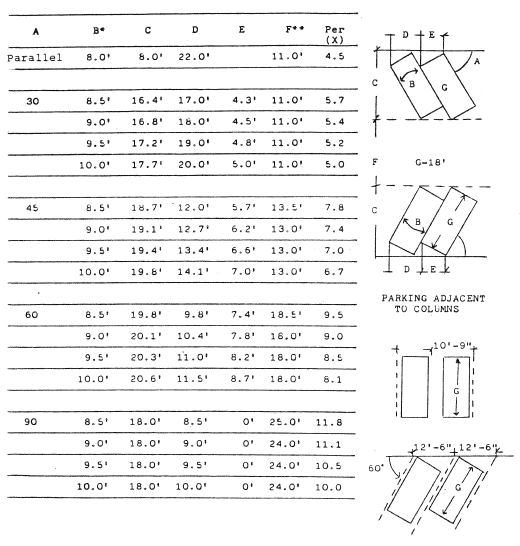
LEGEND
NOTES
Wider spaces are recommended for in-and-out customer parking and for cross-slopes over five percent; narrower spaces may be used for compact cars and employee parking. Parking dimensions should be selected to best serve the needs of customers, clients or employees using the parking spaces. Spaces narrower than nine feet in width are not recommended, and only in cases of unusual property constraints including size, shape, topography and location will the planning department consider such a request.
Within the range of minimum standards shown, the planning department shall have the authority to determine and approve the parking layout utilized for each parking lot based upon factors of traffic safety, customer/client convenience and the public welfare. The planning department shall also have the authority to establish and/or approve parking stalls and maneuvering area dimensions for parking angles other than those set forth in this section.
(Ord. 387B §1(part), 1981: Ord. 357B §4.06.220, 1979)
18.44.250 - Handicapped spaces.
Provision of handicapped parking stalls shall be determined as follows:
(Ord. 387B §1(part), 1981: Ord. 357B §4.06.230, 1979)
18.44.260 - Purpose of provisions—Applicability.
The purpose of this article is to provide safeguards to life, limb and property and to promote the public welfare by providing for the erection and maintenance of curbs or barriers near sidewalk areas and the surfacing and drainage of property which is utilized for:
(1)
Off-street parking areas;
(2)
Off-street loading and unloading areas;
(3)
Off-street pickup and delivery areas;
(4)
Storage, sale, rental and service areas for any type of mobile equipment, goods, materials or objects.
(Ord. 387B §1(part), 1981: Ord. 357B §4.06.210(1), 1979)
18.44.270 - Barriers required to prevent right-of-way encroachment.
Except at approved driveways, every off-street parking area, every off-street loading or unloading area, and every storage, sale, rental or service area for any type of mobile equipment, goods, materials or objects shall have erected and maintained thereon barriers which shall be so located as to prevent any portion of a parked vehicle, equipment or object from projecting into the public right-of-way. The required barriers shall be as follows:
(1)
For off-street parking areas, there shall be developed and maintained a buffer area between the parking area and the adjacent sidewalk or sidewalk area of not less than three feet in total width surrounded by a curbing not less than six inches in height and thickness.
(2)
For off-street loading or unloading or storage, sale, rental or service areas for any type of mobile equipment, goods, materials or objects, there shall be erected and maintained thereon, adjacent to the sidewalk or sidewalk area, a curb or barrier, at least six inches in height or thickness, of either concrete, wood, masonry, iron, steel or other suitable material.
(Ord. 387B §1(part), 1981: Ord. 357B §4.06.210(2), 1979)
18.44.280 - Surfacing—Grading—Drainage.
Every off-street parking area, every off-street loading or unloading area, and every storage, sale, rental or service area for any type of mobile equipment, goods, materials or objects shall be surfaced with hard, durable, plant-mix asphaltic paving at least two inches thick after compaction and four inches of aggregate base material or with Portland cement concrete paving at least three inches thick. Alternative hard surface materials, which in the opinion of the city engineer are of equal durability to asphalt/concrete may be approved by the city. All such areas shall be surfaced and graded as approved by the city engineer in such a manner as to provide the site with adequate drainage. No building permit shall be issued for any building with an accompanying parking or service area unless the surfacing and drainage plans for such areas have been approved by the city engineer.
(Ord. 629B §2, 1995: Ord. 387B §1(part), 1981: Ord. 357B §4.06.210(3), 1979)
18.44.290 - Approval required—Plans.
Every person desiring to establish, change or enlarge an off-street parking area, off-street loading or unloading area, or storage, sale, rental or service area for any type of equipment, goods, materials or objects shall make an application to the city engineer for the approval of such facilities. Such application shall be accompanied by three copies of the layout, grading and paving plans.
(Ord. 387B §1(part), 1981: Ord. 357B §4.06.210(4), 1979)
18.44.300 - Manner of entry and exit.
Except for single-family and two-family dwellings, no parking area or facility shall be developed and maintained which requires that vehicles back out over the sidewalk or sidewalk area into the adjacent street. All parking areas and facilities, except as otherwise provided in this section, shall be designed so that vehicles enter and exit the street right-of-way in a head-on manner, and that all traffic circulation occurs within the boundaries of the parking site.
(Ord. 387B §1(part), 1981: Ord. 357B §4.06.210(5), 1979)
18.44.310 - Fencing of parking areas abutting residential uses.
Wherever any portion of a parking area abuts property zoned for residential use, an approved solid fence shall be erected to a height not less than six feet as prescribed by the building inspector.
(Ord. 387B §1(part), 1981: Ord. 357B §4.06.210(6), 1979)
18.44.320 - Use of parking areas.
Parking areas shall be used for automobile parking only, with no sales, dead storage, repair work, dismantling or servicing of any kind.
(Ord. 387B §1(part), 1981: Ord. 357B §4.06.210(7), 1979)
18.44.330 - Lighting.
If lighting is provided, such lighting shall be arranged to reflect away from residential areas, public streets and highways.
(Ord. 387B §1(part), 1981: Ord. 357B §4.06.210(8), 1979)
18.45.010 - Ridesharing program established.
The Lincoln ridesharing program is established.
(Ord. 418B §1(part), 1982: Ord. 357B §11.01.000, 1979)
18.45.020 - Purpose.
The purpose and intent of the ridesharing program is to:
(1)
Reduce total vehicle emissions in the South Placer region by reducing the number of vehicular trips that might otherwise be generated by home-to-work commuting;
(2)
Reduce peak-hour traffic circulation in the South Placer region by reducing both the number of vehicular trips and the vehicular miles of travel that might otherwise be generated by home-to-work commuting.
(Ord. 418B §1(part), 1982: Ord. 357B §11.01.010, 1979)
18.45.030 - Objective of reducing commuter trips.
The fundamental objective of the ridesharing program as established by this chapter is to reduce the average number of vehicular trips for home-to-work commuting to 25 percent fewer trips than would occur if all such trips were made in single-occupant motor vehicles. Large employment facilities will be expected to accomplish a higher percentage of this reduction than small employment centers in recognition of the greater opportunity for rideshare matches at large employment facilities.
(Ord. 418B §1(part), 1982: Ord. 357B §11.01.020, 1979)
18.45.040 - Definitions.
As used in this chapter:
"Applicant" means an applicant for a conditional use permit, zoning change or tentative subdivision map for:
(1)
A new use or uses which, individually or collectively, may generate employment for 200 or more employees at a common work location; or
(2)
For the expansion of an existing project for a use or uses which, individually or collectively, after expansion, may generate both:
a.
Twenty percent more employment than the applicant's base-line employment, and
b.
Employ 200 or more employees at one common work location.
"Base-line employment" means the average number of employees employed at a common work location for the 12-month period ending on the effective date of the ordinance codified in this chapter as determined by the transportation coordinator.
"Carpool" means a motor vehicle occupied by two or more persons traveling together.
"Common work location" means either a single building or a group of buildings or work locations at a common site. "Commuter" means an employee who travels regularly to and from a facility.
"Commuter matching service" means any system for mapping and matching home and work locations of interested commuters to identify prospects for ridesharing.
"Major project controller" means every employer or common work location with 100 or more employees working at a single site for at least 20 hours per week.
"Peak-hour commuter" means any employee who travels regularly to and from a facility three or more days a week and arrives at or departs from the facility during the morning hours of 7:30 a.m. to 8:30 a.m. or the evening hours of 4:30 p.m. to 5:30 p.m.
"Project controller" means the lessor of a common work location whose tenants, individually or collectively, employ ten or more but less than 50 employees, or an employer who employs ten or more but less than 50 employees or the owner or operator of an educational facility which employs ten or more but less than 50 employees, or has more than 500 but less than 1,000 students enrolled in a secondary or higher level of school.
"Ridesharer" means any employee who commutes to and from his or her work location by any mode other than single-occupancy light-duty or medium-duty vehicle, motorcycle or moped.
"Sacramento Rideshare Program" means the commuter matching service and commuter information service operated by the CALTRANS-Sacramento Ridesharing Project.
"Shift of employment" means any group of employees who work at a common work location and who arrive and depart from work in a common time interval not greater than one hour.
"South Placer Transportation Coordinator or Transportation Coordinator" means the coordinator of transportation information and transportation plans, as established by the coordination agreement for the South Placer Task Force Relating to Highway 65, a joint powers agreement entered into by the county and the cities of Roseville, Rocklin and Lincoln, as it exists as of the effective date of the ordinance codified in this chapter and as it may thereafter be amended.
"Transportation Control Measure (TCM) Coordinator" means that individual assigned by the Placer County transportation commission to assist member jurisdictions in complying with the provisions of the trip reduction ordinances.
"Transportation plan" means the plan submitted by an applicant and approved by the city pursuant to Article 3 of this chapter (Section 18.45.090 et seq.).
(Ord. 604B §1, 1993; Ord. 418B §1(part), 1982: Ord. 357B Ch. 11 Art. 3, 1979)
18.45.050 - Other requirements unaffected.
No section or provision of this chapter shall preclude application of any other development standards, requirements or conditions of approval that may be imposed in the project review and approval procedures of the city.
(Ord. 418B §1(part), 1982: Ord. 357B §11.02.000, 1979)
18.45.060 - Incentives.
Every project controller and major project controller shall encourage ridesharing for tenants and employees by providing the following incentives to ridesharing:
(1)
Posting. Posting in a conspicuous place or places information materials provided by the transportation coordinator to encourage ridesharing. Informational materials may include:
a.
Current schedules, rates (including procedures for obtaining transit passes), and routes of mass transit service to the common work location or employment site,
b.
The location of all bicycle routes within at least a five-mile radius of the common work location or employment site,
c.
Posters or flyers encouraging the use of ridesharing and referrals to sources of information concerning ridesharing;
(2)
Commuter Matching Service. Disseminating annually to all tenants and employees, and to new tenants and new employees when hired, written information provided by the transportation coordinator regarding an area-wide commuter ridesharing matching service.
(Ord. 418B §1(part), 1982: Ord. 357B §11.04.000, 1979)
18.45.070 - Facilitation of use.
Every new major project controller and any existing project controller or major project controller who expands his work force from base-line employment by 20 percent or more and who, after expansion, employs 50 or more employees at a common work location, shall facilitate the tenants' or employees' use of an area-wide ridesharing program by:
(1)
Ridesharing Coordinator. Designating an employee or other appropriate person to serve as a ridesharing coordinator. The ridesharing coordinator's responsibilities shall include:
a.
Publicizing the availability of public transportation,
b.
Communicating employee or tenant transportation needs to the transportation coordinator,
c.
Assisting employees or tenants in forming carpools or vanpools,
d.
Maintaining a current employee and/or tenant transportation profile showing the distribution of employees and tenants by transportation mode,
e.
Conduct an annual commute survey as part of the annual reporting requirement;
(2)
Sacramento Rideshare Program. Using the Sacramento Rideshare Program, or an equivalent independent matching service;
(3)
Parking Facilities. Establish preferential parking facilities for carpools and vanpools, and provide parking for bicycles as follows:
a.
Preferential Parking. If a major project controller provides or subsidizes off-street parking facilities or spaces to any employee or tenant for the parking of motor vehicles used primarily for commuting between place of residence and the common work location or employment site, such major project controller shall provide guaranteed parking spaces for each carpool and vanpool in which its tenants or its employees participate, under more favorable terms and conditions than are afforded to parking of single-occupant motor vehicles. Parking spaces assigned to exclusive carpool or vanpool use shall be so designated with appropriate signing or pavement markings. Such parking shall be made available on request of any carpool or vanpool to the major project controller's ridesharing coordinator,
b.
Bicycle Parking Facilities. Bicycle parking facilities which will accommodate the parking and securing of bicycles shall be made available at the request of any tenant or employee whose primary mode of commuting is by bicycle, made to the major project controller's ridesharing coordinator.
(Ord. 604B §2, 1993; Ord. 418 §1(part), 1982: Ord. 357B §11.04.010, 1979)
18.45.080 - Applicability.
Notwithstanding the provisions of Division V of this title (Section 18.46.010 et seq.), all existing project controllers and major project controllers within the city shall comply with the provisions of this article immediately upon the effective date of the ordinance codified in this chapter. The provisions of this article shall also apply to all future project and major project controllers, including those subject to Article III of this chapter.
(Ord. 418B §1(part), 1982: Ord. 357B §11.04.030, 1979)
18.45.090 - Required when.
This article shall apply to every applicant for a conditional use permit, zoning change or tentative map for:
(1)
A new project which would allow a use or number of uses that, individually or collectively, would employ 100 or more employees at one common work location; or
(2)
The expansion of an existing project which would allow a use or uses that, individually or collectively, after expansion, may both:
a.
Generate employment for 100 or more employees; and
b.
Increase the total number of employees at the common work location by 20 percent or more from the applicant's base-line employment.
(Ord. 604B §§3, 4, 1993: Ord. 418B §1(part), 1982: Ord. 357B §11.05.000, 1979)
18.45.100 - Contents.
The applicant shall submit, along with any other required information, a transportation plan for the project. The transportation plan shall include the following:
(1)
Description. A description of the activity and operating characteristics of the proposed project (e.g., business hours and peak hours of traffic generation);
(2)
Estimate. An estimate of the commuting characteristics of the tenants and/or employees anticipated at the project site (e.g., travel distance and mode);
(3)
Mitigation Measures. Mitigation measures designed to achieve a reduction in the number of vehicle trips that would occur if all home-to-work trips by the anticipated tenants or employees were made in single-occupant vehicles. The applicant shall design a program to achieve a 30-percent reduction in vehicle trips. Such mitigation measures shall be selected by the applicant and may include, but are not limited to, the following:
a.
Payment of subsidies or provision of other incentives to carpoolers or vanpoolers,
b.
Payment of parking charges or absorption of vanpool operation expense for ridesharers,
c.
Payment of subsidies or provision of incentives for the use of transit or transportation by other than single-occupant motor vehicles,
d.
Provision of amenities, such as bicycle lockers, transit shelters, shuttle buses, etc., designed to enhance the use of other than single-occupancy motor vehicles,
e.
An adequate number of shower and personal locker facilities for regular bicycle commuters,
f.
A vanpool program consisting of a continuously outstanding offer to acquire a van or vans (by purchase, lease or otherwise), to obtain insurance and to make available to any group of at least eight employees a van for their use in a vanpool,
g.
Provisions for shifting of vehicle trips from the peak hour to the nonpeak hours. A reduction in vehicle trips per day shall be permitted and calculated in the following manner: The number of trips taken out of the peak hour, divided by the estimated total trips multiplied by 25 percent would equal the percent reduction of vehicle trips per day credited,
h.
Any other program the applicant may devise,
i.
Assistance in transportation plan preparation will be provided by the city through the transportation control measure (TCM) coordinator. A TCM coordinator will be provided to the city by the Placer County transportation commission. The TCM coordinator's tasks shall include: conducting an initial survey regarding employees' use of alternative transportation modes which all employers will be asked to participate in; conducting an annual commute survey as part of assisting the employer's annual reporting requirements.
(Ord. 604B §5, 1993; Ord. 418B §1(part), 1982: Ord. 357B §11.05.010, 1979)
18.45.110 - Administrative review and evaluation.
The transportation plan shall be referred to the transportation coordinator for review and evaluation of the proposed mitigation measures and for recommendation to the planning commission or the city council.
(Ord. 418B §1(part), 1982: Ord. 357B §11.05.020, 1979)
18.45.120 - Approval, modification or disapproval.
The planning commission or city council, as the case may be, shall review and evaluate the transportation plan and shall approve, modify and approve or disapprove the transportation plan as part of the review and approval process for the application under submission. No project application subject to the provisions of this article shall be approved without approval of the transportation plan. The transportation plan shall not be approved unless it is found to meet the trip-reduction objectives established in subsection 18.45.100(3).
(Ord. 418B §1(part), 1982: Ord. 357B §11.05.030, 1979)
18.45.130 - Compliance agreement.
As a condition of approval of the project, the city may require the applicant to enter into a written agreement with the city obligating the applicant to comply with the transportation plan. Such agreement shall be made to run with the land and bind all successors in interest of the applicant and shall constitute an equitable servitude on the property. Where appropriate, the city may require the agreement to include a provision for a penalty, in the event of breach by the applicant or a successor in interest, and, where the applicant is required to construct physical improvements on the project site, to include a provision for improvement security for the construction in a form approved by the city attorney.
(Ord. 418B §1(part), 1982: Ord. 357B §11.05.050, 1979)
18.45.140 - Compliance required for other approvals.
Compliance with the approved transportation plan shall be included as a condition of approval for the application under consideration, and may be included as a term of a development agreement between the city and the project applicant.
(Ord. 418B §1(part), 1982: Ord. 357B §11.05.070, 1979)
18.45.150 - Credit for ridesharing actions.
Actions required in Article II of this chapter may be credited in the transportation plan for their potential contribution to the trip-reduction objective as required by this article.
(Ord. 418B §1(part), 1982: Ord. 357B §11.05.080, 1979)
18.45.160 - Reduction of required parking spaces as trip reduction accomplished.
Parking space requirements for tenant or employee parking for the project may be reduced below the prevailing parking standard by a percentage of the total number of spaces required that is equivalent to the percentage of trip reduction that is to be achieved by the programs specified in the transportation plan. In no case shall parking space reduction exceed the prevailing parking requirements or standards relating to tenants or employees.
(Ord. 418B §1(part), 1982: Ord. 357B §11.05.090, 1979)
18.45.170 - Annual compliance report.
Each applicant subject to the requirements of this article, and all successors in interest of the applicant obligated to carry out the transportation plan or any part thereof, shall submit to the transportation coordinator a report by March 1st every year describing the transportation program. The report shall contain, at a minimum, the following information:
(1)
Description. A description of the measures taken to comply with this chapter, including an accounting of the resources expended on rideshare promotion activities;
(2)
Use. The average number of tenants and/or employees regularly arriving at and leaving the project site for the reporting period by each of the following methods of transportation:
a.
Single-passenger motor vehicles (including mopeds);
b.
Carpools;
c.
Van-type vehicles with eight or more commuters;
d.
Mass transit;
e.
Bicycles;
f.
All others.
(3)
Numbers. The total number of tenants and/or employees at the project site shall be included in the report;
(4)
The rideshare coordinator will be responsible for conducting an annual commute survey as part of the employer's annual reporting requirements.
(Ord. 604B §6, 1993; Ord. 418B §1(part), 1982: Ord. 357B §11.06.000, 1979)
18.45.180 - Responsibility of planning department.
The provisions of this article shall be administered and enforced by the city planning department.
(Ord. 418B §1 (part), 1982: Ord. 357B §11.07.030, 1979)
Editor's note— Ord. 418B added two sections numbered "11.07.030" to Ord. 357B. The other is codified as §18.45.220.
18.45.190 - Inspection and noncompliance notice—Ridesharing requirements.
(a)
The transportation coordinator shall periodically review compliance with the general requirements of Article II by on-site checks at the common work location or employment site.
(b)
In the event of noncompliance, the transportation coordinator shall report to the city planning director, who shall review the transportation coordinator's report. If the planning director determines that the project controller or major project controller is in noncompliance with the requirements of Article II, he or she shall issue a letter to the project controller specifying the points of noncompliance.
(Ord. 418B §1(part), 1982: Ord. 357B §11.07.000, 1979)
18.45.200 - Inspection and noncompliance notice—Transportation plans.
(a)
The planning director, with the assistance of the transportation coordinator, shall monitor the implementation of transportation plans required pursuant to Article III of this chapter. Monitoring shall occur through the reporting procedure required in Section 18.45.170, as well as by periodic on-site checks at the facility, and an annual review of compliance with the transportation plan.
(b)
If the planning director determines there is noncompliance with the requirements of the transportation plan, he or she shall issue a letter specifying the points of noncompliance.
(Ord. 418B §1(part), 1982: Ord. 357B §11.07.010, 1979)
18.45.210 - Compliance upon notice.
Upon receipt of a letter of noncompliance, the project controller, the major project controller, the applicant and all successors in interest of the applicant obligated to carry out the transportation plan or any part thereof, as the case may be, shall comply with the provisions of this chapter as set forth in the letter of noncompliance, unless an appeal is filed from the determination of the planning director as set forth in Section 18.96.010 of this code.
(Ord. 418B §1(part), 1982: Ord. 357B §11.07.020, 1979)
18.45.220 - Penalties for violation.
In the event of failure to comply with the requirements of this chapter or with the terms of a transportation plan required pursuant to this chapter, the city may impose the following penalties:
(1)
Any penalty which may be imposed under this title;
(2)
Any penalty as set forth in the transportation agreement plan, if any.
(Ord. 418B §1(part), 1982: Ord. 357B §11.07.030, 1979)
Editor's note— Ord. 418B added two sections numbered "11.07.030" to Ord. 357B. The other is codified as §18.45.180.

