
Linwood Township Anoka County
City Zoning Code
City Zoning Code
APPENDIX 1
ANOKA COUNTY SHORELAND ORDINANCE2
ORDINANCE #2022-1
Adopted by County Board Action on June 28, 2022
COUNTY OF ANOKA
Anoka County, Minnesota
SHORELAND MANAGEMENT ORDINANCE
Editor's note— Printed herein is the Anoka County Shoreland Ordinance, Ordinance Number 2022-1, adopted by the Anoka County Board on June 28, 2022, the provisions of which that are applicable to the Linwood Township are adopted by reference in Section 30-575 of this Code. State law references, headings and catchlines have been made uniform and conform to the style used in the Code. Amendments to this county ordinance are indicated by parenthetical history notes immediately following the amended provisions. The absence of a history note indicates that the provision remains unchanged from the original ordinance. Any corrections or additions made for clarity are indicated by brackets.
Sec. 1.1. - Statutory authorization.
This shoreland ordinance is adopted pursuant to the authorization and policies contained in Minnesota Statutes, Chapter 103F, Minnesota Regulations, Parts 6120.2500—6120.3900, and the planning and zoning enabling legislation in Minnesota Statutes, Chapter 394.
Sec. 1.2. - Policy.
The Legislature of Minnesota has delegated responsibility to local governments of the state to regulate the subdivision, use and development of the shorelands of public waters and thus preserve and enhance the quality of surface waters, conserve the economic and natural environmental values of shorelands, and provide for the wise use of waters and related land resources. This responsibility is hereby recognized by Anoka County.
Sec. 2.1. - Jurisdiction.
The provisions of this ordinance apply to the shorelands of all public waters located in the unincorporated areas of Anoka County, Minnesota for which there is no current Shoreland Ordinance, as identified in Section 4.1 of this Ordinance. Pursuant to Minnesota Rules Parts 6120.2500-6120.3900, no lake, pond, or flowage less than 25 acres in size in unincorporated areas need be regulated in a local government's shoreland regulations. A body of water created by a private user where there was no previous shoreland may, at the discretion of the governing body, be exempt from this ordinance.
Sec. 2.2. - Enforcement.
The Anoka County Public Health and Environmental Services Department is responsible for the administration and enforcement of this ordinance. Except for provisions otherwise specifically addressed herein, the provisions of the Anoka County Administrative Procedures Ordinance and any amendments thereto or successor ordinance, shall apply to the administration and enforcement of this Ordinance. For the purposes of this ordinance the term "Department" and in the Anoka County Administrative Procedures Ordinance, shall mean the Anoka County Public Health and Environmental Services Department.
Sec. 2.2.1. - Violations.
Any violation of the provisions of this ordinance or failure to comply with any of its requirements (including violations of conditions and safeguards established in connection with grants of variances or conditional uses) constitutes a misdemeanor and is punishable as defined by law and in the Administrative Procedures Ordinance. Violations of this ordinance can occur regardless of whether or not a permit is required for a regulated activity listed in Section 3.2 of this ordinance. In the event of a violation of this ordinance, the County may institute appropriate actions or proceedings to include injunctive relief to prevent, restrain, correct or abate such violations or threatened violations, and the County Attorney may institute such action.
Sec. 2.3. - Severability.
If any section, clause, provision, or portion of this ordinance is adjudged unconstitutional or invalid by a court of competent jurisdiction, the remainder of this ordinance shall not be affected thereby.
Sec. 2.4. - Abrogation and greater restrictions.
It is not intended by this ordinance to repeal, abrogate, or impair any existing easements, covenants, or deed restrictions. However, where this ordinance imposes greater restrictions, the provisions of this ordinance shall prevail. All other ordinances inconsistent with this ordinance are hereby repealed to the extent of the inconsistency only.
Sec. 2.5. - Definitions.
Unless specifically defined below, words or phrases used in this ordinance shall be interpreted to give them the same meaning they have in common usage and to give this ordinance its most reasonable application. For the purpose of this ordinance, the words "must" and "shall" are mandatory and not permissive. All distances, unless otherwise specified, are measured horizontally.
2.5.1
Accessory structure or facility. Any building or improvement subordinate to a principal use.
2.5.2
Animal feedlot. A facility as defined by Minnesota Rules, part 7020.0300.
2.5.3
Bluff. A topographic feature such as a hill, cliff, or embankment having the following characteristics:
A.
Part or all of the feature is located in a shoreland area;
B.
The slope must drain toward the waterbody.
C.
The slope rises at least 25 feet above the ordinary high water level;
D.
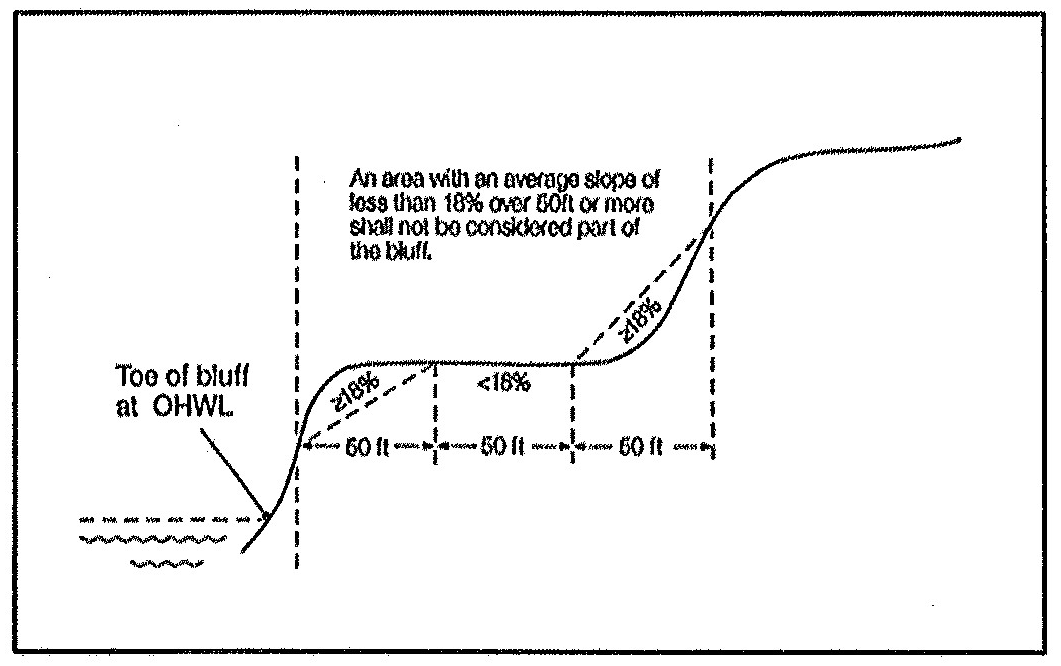
The grade of the slope from the toe of the bluff to a point 25 feet or more above the ordinary high water level averages 30 percent or greater (see Figure 1), except that an area with an average slope of less than 18 percent over a distance of at least 50 feet shall not be considered part of the bluff (see Figure 2).
Figure 1. Illustration of Bluff
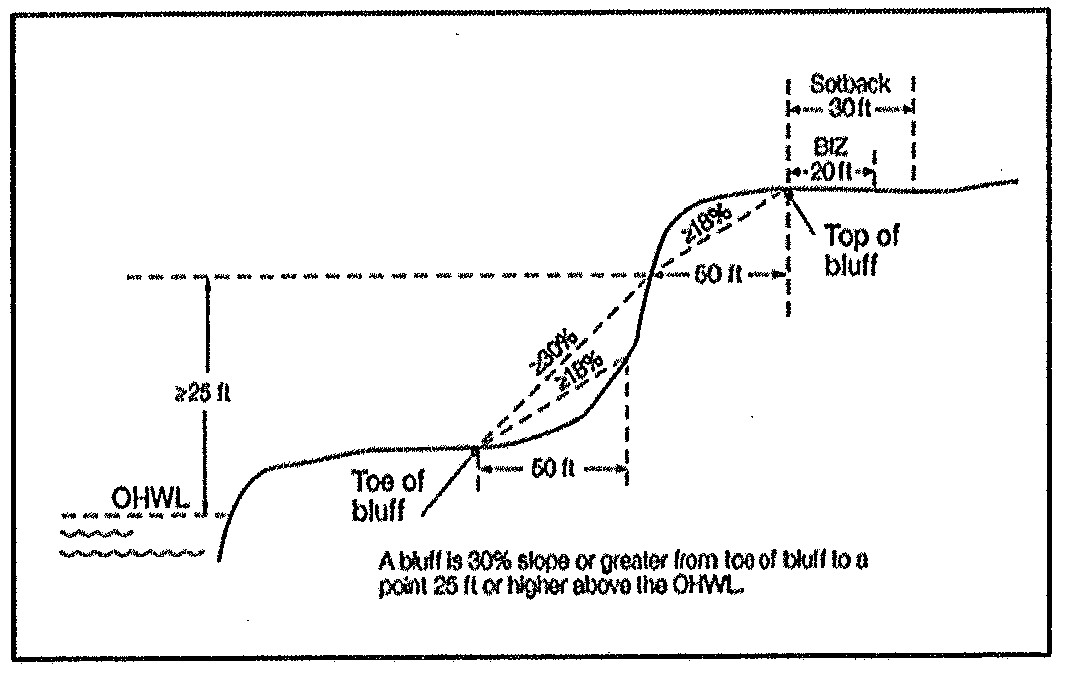
Figure 2. Exception to Bluff
2.5.4
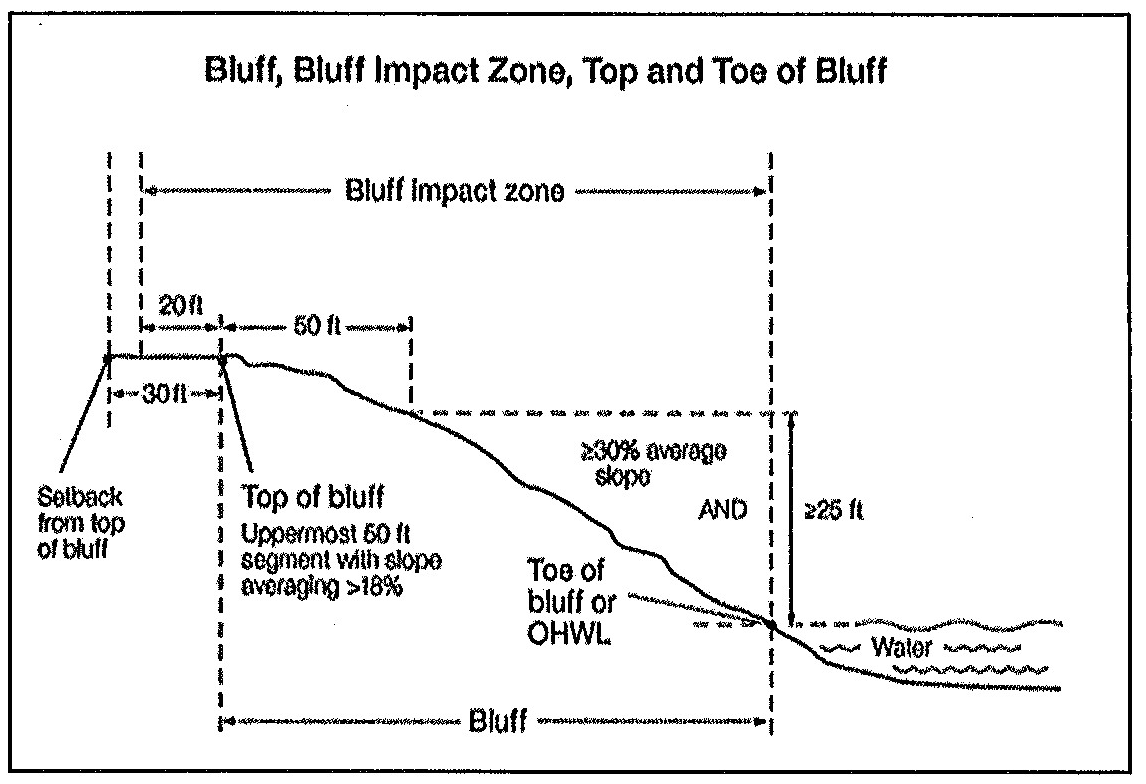
Bluff impact zone. A bluff and land located within 20 feet of the top of a bluff.
2.5.5
Bluff, toe of. The lower point of a 50-foot segment with an average slope exceeding 18 percent or the ordinary high water level, whichever is higher.
2.5.6
Bluff, top of. For the purposes of measuring setbacks, bluff impact zone, and administering vegetation management standards, the higher point of a 50-foot segment with an average slope exceeding 18 percent (see Figure 3).
Figure 3. Bluff, Bluff Impact Zone, Top and Toe of Bluff
2.5.7
Boathouse. A facility as defined by Minnesota Statutes Section 103G.245.
2.5.8
Buffer. A vegetative feature as defined by Minnesota Statutes, Section 103F.48.
2.5.9
Building line. A line parallel to a lot line or the ordinary high water level at the required setback beyond which a structure may not extend.
2.5.10
Commercial planned unit developments. Developments that provide transient, short-term lodging spaces, rooms, or parcels and their operations are essentially service-oriented. For example, hotel/motel accommodations, resorts, recreational vehicle and camping parks, and other primarily service-oriented activities are commercial planned unit developments.
2.5.11
Commercial use. The principal use of land or buildings for the sale, lease, rental, or trade of products, goods, and services.
2.5.12
Commissioner. The commissioner of the Department of Natural Resources.
2.5.13
Conditional use. A land use or development as defined by ordinance that would not be appropriate generally but may be allowed with appropriate restrictions upon a finding that certain conditions, as detailed in the applicable zoning ordinance, exist; the use or development conforms to the comprehensive land use plan of the community; and the use is compatible with the existing neighborhood.
2.5.14
Controlled access lot. A lot used to access public waters or as a recreation area for owners of nonriparian lots within the same subdivision containing the controlled access lot.
2.5.15
Deck. A horizontal, unenclosed platform with or without attached railings, seats, trellises, or other features, attached or functionally related to a principal use or site and at any point extending more than three feet above ground.
2.5.16
Duplex, triplex, and quad. A dwelling structure on a single lot, having two, three, and four units, respectively, attached by common walls and each unit equipped with separate sleeping, cooking, eating, living, and sanitation facilities.
2.5.17
Dwelling site. A designated location for residential use by one or more persons using temporary or movable shelter, including camping and recreational vehicle sites.
2.5.18
Dwelling unit. Any structure or portion of a structure, or other shelter designed as short- or long-term living quarters for one or more persons, including rental or timeshare accommodations such as motel, hotel, and resort rooms and cabins.
2.5.19
Extractive use. The use of land for surface or subsurface removal of sand, gravel, rock, industrial minerals, other nonmetallic minerals, and peat not regulated under Minnesota Statutes, Sections 93.44 to 93.51.
2.5.20
Forest land conversion. The clear cutting of forested lands to prepare for a new land use other than reestablishment of a subsequent forest stand.
2.5.21
Guest cottage. A structure used as a dwelling unit that may contain sleeping spaces and kitchen and bathroom facilities in addition to those provided in the primary dwelling unit on a lot.
2.5.22
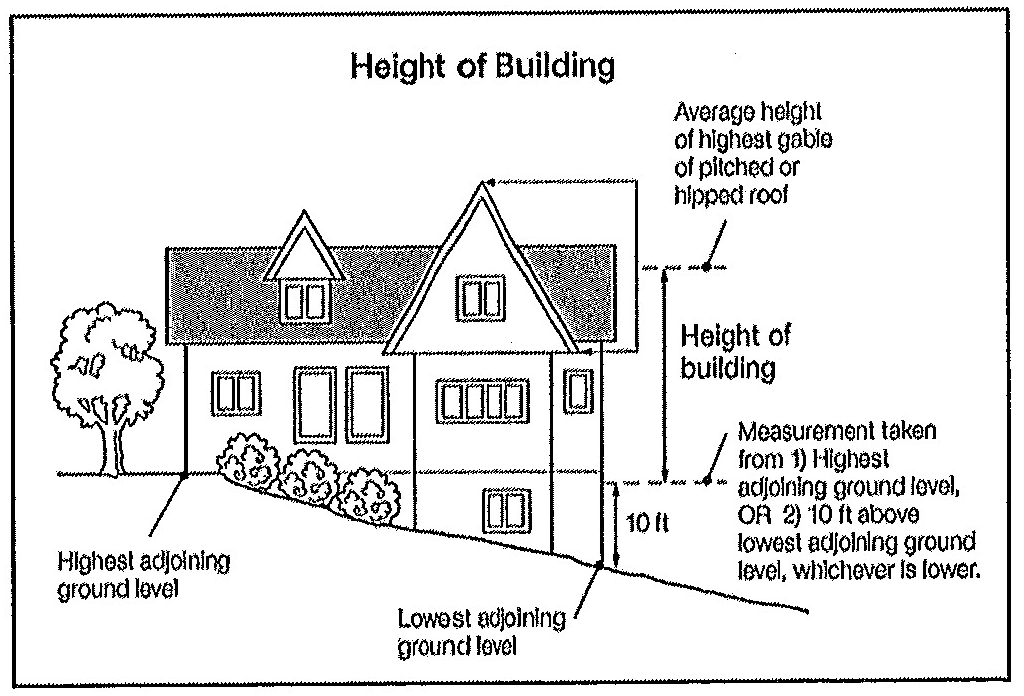
Height of building. The vertical distance between the highest adjoining ground level at the building or ten feet above the lowest adjoining ground level, whichever is lower, and the highest point of a flat roof or average height of the highest gable of a pitched or hipped roof (see Figure 4).
Figure 4. Height of Building
2.5.23
Impervious surface. A constructed hard surface that prevents or retards entry of water into the soil and causes water to run off the surface in greater quantities and at an increased rate of flow than prior to development, including rooftops; decks; sidewalks; patios; swimming pools; parking lots; concrete, asphalt, gravel driveways, or permeable pavers; and other similar surfaces.
2.5.24
Industrial use. The use of land or buildings for the production, manufacture, warehousing, storage, or transfer of goods, products, commodities, or other wholesale items.
2.5.25
Intensive vegetation clearing. The complete removal of trees or shrubs in a contiguous patch, strip, row, or block.
2.5.26
Lot. A parcel of land designated by plat, metes and bounds, registered land survey, auditors plot, or other accepted means and separated from other parcels or portions by said description for the purpose of sale, lease, or separation.
2.5.27
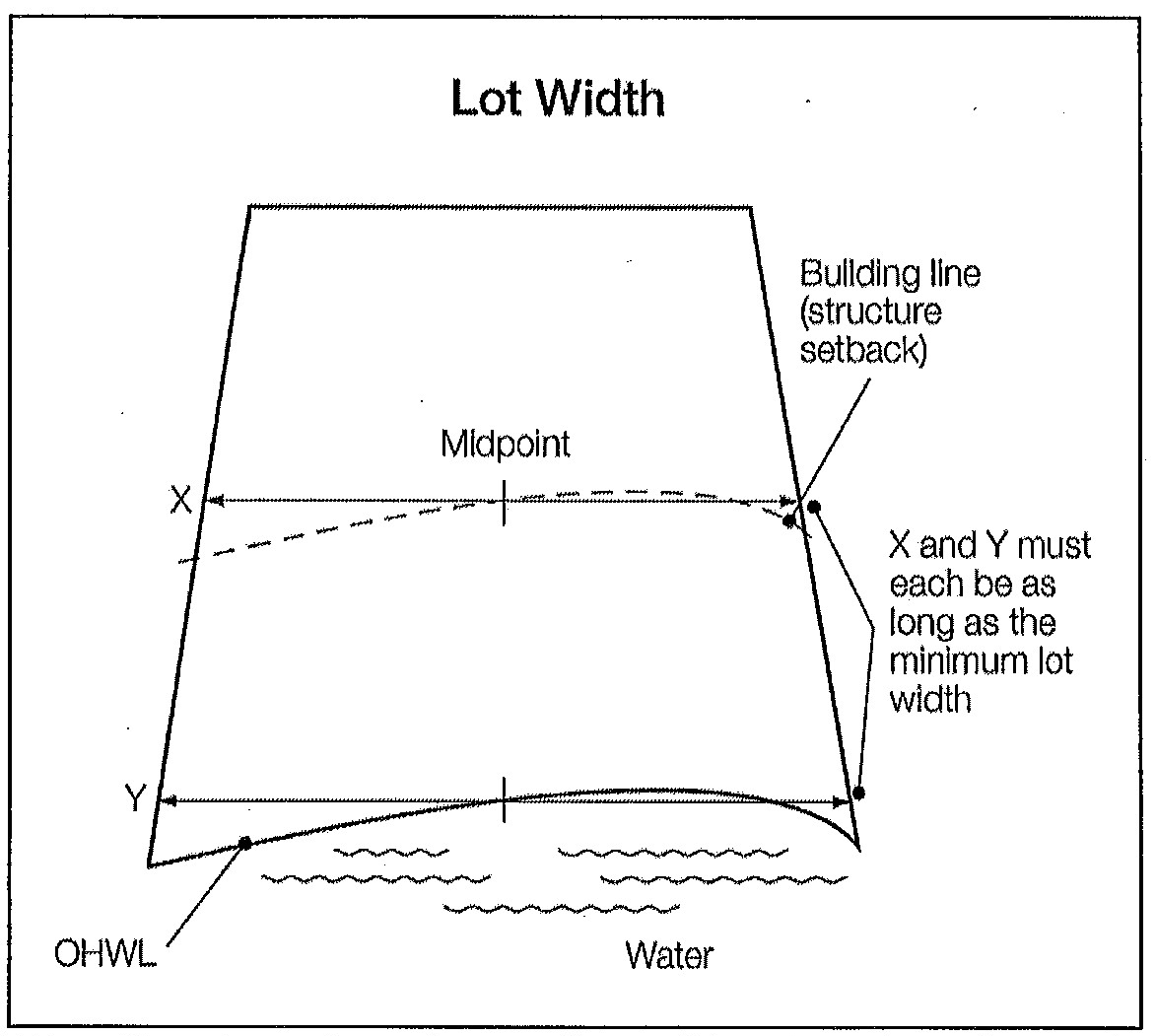
Lot width. The minimum distance between:
A.
Side lot lines measured at the midpoint of the building line; and
B.
Side lot lines at the ordinary high water level, if applicable (see Figure 5).
Figure 5. Lot Width
2.5.28
Metallic minerals and peat. "Metallic minerals and peat" has the meaning given under Minnesota Statutes, Sections 93.44 to 93.51.
2.5.29
Nonconformity. Any legal use, structure or parcel of land already in existence, recorded, or authorized before the adoption of official controls or amendments to those controls that would not have been permitted to become established under the terms of the official controls as now written.
2.5.30
Ordinary high water level. The boundary of public waters and wetlands and shall be an elevation delineating the highest water level which has been maintained for a sufficient period of time to leave evidence upon the landscape, commonly that point where the natural vegetation changes from predominantly aquatic to predominantly terrestrial. For watercourses, the ordinary high water level is the elevation of the top of the bank of the channel. For reservoirs and flowages, the ordinary high water level is the operating elevation of the normal summer pool.
2.5.31
Planned unit development. A type of development characterized by a unified site design for a number of dwelling units or dwelling sites on a parcel, whether for sale, rent, or lease, and also usually involving clustering of these units or sites to provide areas of common open space, density increases, and a mix of structure types and land uses. These developments may be organized and operated as condominiums, time-share condominiums, cooperatives, full fee ownership, commercial enterprises, or any combination of these, or cluster subdivisions of dwelling units, residential condominiums, townhouses, apartment buildings, dwelling grounds, recreational vehicle parks, resorts, hotels, motels, and conversions of structures and land uses to these uses.
2.5.32
Public waters. Any water as defined in Minnesota Statutes, Section 103G.005, Subd. 15, 15a.
2.5.33
Residential planned unit development. A use where the nature of residency is nontransient and the major or primary focus of the development is not service-oriented. For example, residential apartments, manufactured home parks, time-share condominiums, townhouses, cooperatives, and full fee ownership residences would be considered as residential planned unit developments. To qualify as a residential planned unit development, a development must contain at least five dwelling units or sites.
2.5.34
Resort. "Resort" has the meaning in Minnesota Statute, Section 103F.227.
2.5.35
Semipublic use. The use of land by a private, nonprofit organization to provide a public service that is ordinarily open to some persons outside the regular constituency of the organization.
2.5.36
Setback. The minimum horizontal distance between a structure, sewage treatment system, or other facility and an ordinary high water level, sewage treatment system, top of a bluff, road, highway, property line, or other facility.
2.5.37
Sewage treatment system. "Sewage treatment system" has the meaning given under Minnesota Rules, part 7080.1100, Subp. 82.
2.5.38
Sewer system. Pipelines or conduits, pumping stations, and force main, and all other construction, devices, appliances, or appurtenances used for conducting sewage or industrial waste or other wastes to a point of ultimate disposal.
2.5.39
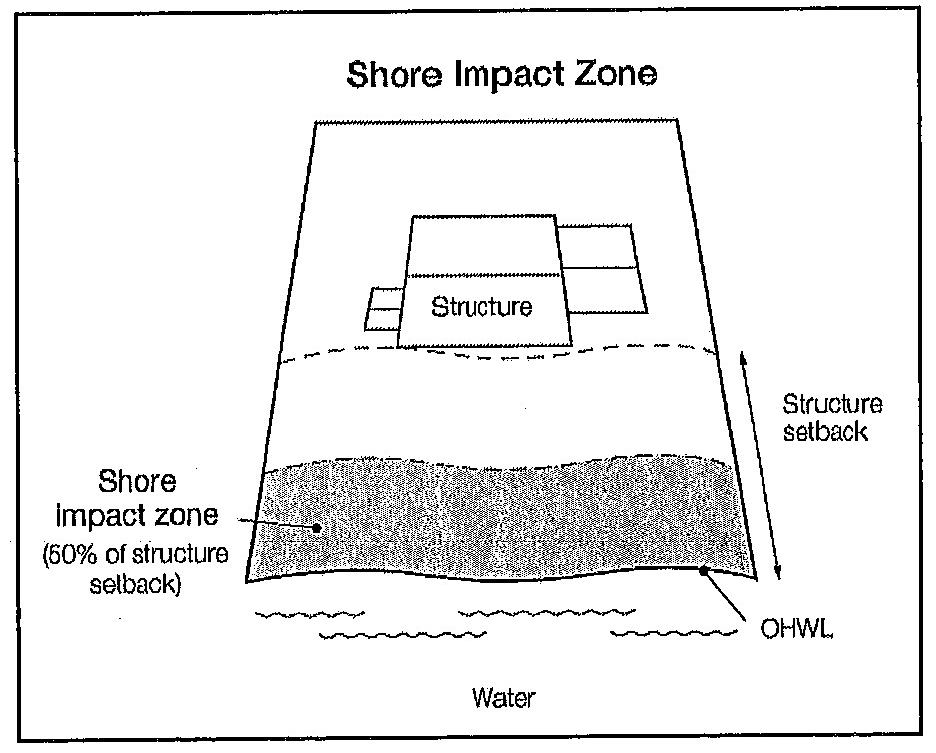
Shore impact zone. Land located between the ordinary high water level of a public water and a line parallel to it at a setback of 50 percent of the structure setback (see Figure 6).
Figure 6. Shore Impact Zone
2.5.40
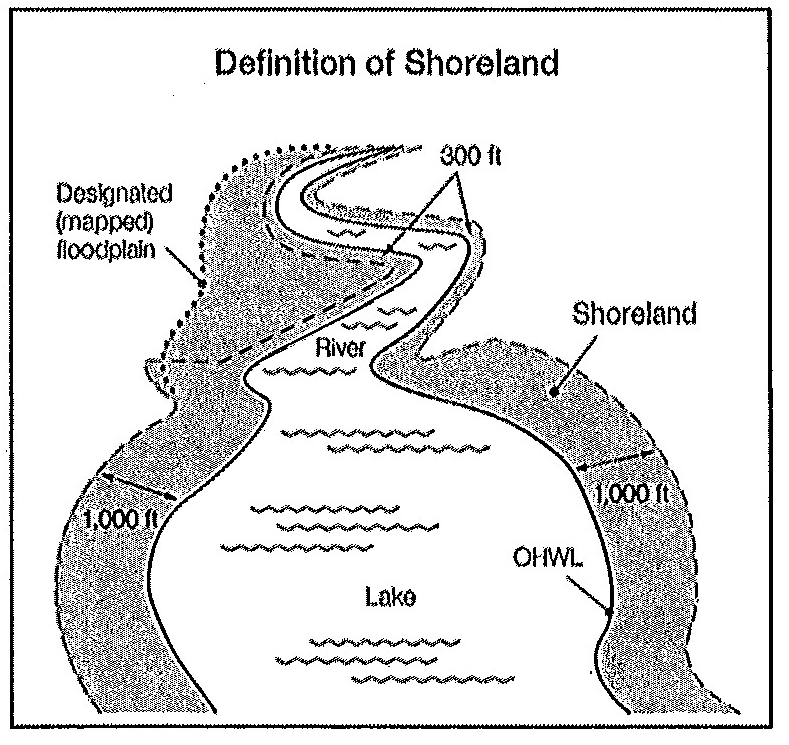
Shoreland. "Shoreland" means land located within the following distances from public waters: (see Figure 7)
A.
1,000 feet from the ordinary high water level of a lake, pond, or flowage; and
B.
300 feet from a river or stream, or the landward extent of a floodplain designated by the local floodplain ordinance on a river or stream, whichever is greater.
Figure 7. Definition of Shoreland
2.5.41
Shore recreation facilities. Swimming areas, docks, watercraft mooring areas and launching ramps and other water recreation facilities.
2.5.42
Significant historic site. Any archaeological site, standing structure, or other property that meets the criteria for eligibility to the National Register of Historic Places or is listed in the State Register of Historic Sites, or is determined to be an unplatted cemetery that falls under the provisions of Minnesota Statutes, § 307.08. A historic site meets these criteria if it is presently listed on either register or if it is determined to meet the qualifications for listing after review by the Minnesota state archaeologist or the director of the Minnesota Historical Society. All unplatted cemeteries are automatically considered to be significant historic sites.
2.5.43
Steep slope. Lands having average slopes over 12 percent, as measured over horizontal distances of 50 feet or more, which are not bluffs.
2.5.44
Structure. Any building or appurtenance, including decks, except aerial or underground utility lines, such as sewer, electric, telephone, telegraph, gas lines, towers, poles, and other supporting facilities.
2.5.45
Subdivision. Land that is divided for the purpose of sale, rent, or lease, including planned unit developments.
2.5.46
Suitability analysis. An evaluation of land to determine if it is appropriate for the proposed use. The analysis considers factors relevant to the proposed use and may include the following features: susceptibility to flooding; existence of wetlands; soils, erosion potential; slope steepness; water supply, sewage treatment capabilities; water depth, depth to groundwater and bedrock, vegetation, near-shore aquatic conditions unsuitable for water-based recreation; fish and wildlife habitat; presence of significant historic sites; or any other relevant feature of the natural land.
2.5.47
Variance. "Variance" means the same as that defined in Minnesota Statutes, Section 394.27 Subd. 7.
2.5.48
Water-oriented accessory structure or facility. A small, above ground building or other improvement, except stairways, fences, docks, and retaining walls, which, because of the relationship of its use to surface water, reasonably needs to be located closer to public waters than the normal structure setback. Examples of such structures and facilities include, watercraft and watercraft equipment storage structures, gazebos, screen houses, fish houses, pump houses, saunas, patios, and detached decks. Boathouses and boat storage structures given the meaning under Minnesota Statutes, Section 103G.245 are not a water-oriented accessory structures.
2.5.49
Water-dependent use. The use of land for commercial, industrial, public or semi-public purposes, where access to and use of a public water is an integral part of the normal conduct of operation. Marinas, resorts, and restaurants with transient docking facilities are examples of commercial uses typically found in shoreland areas.
2.5.50
Wetland. "Wetland" has the meaning given under Minnesota Rule, part 8420.0111.
Sec. 3.1. - Purpose.
The purpose of this Section is to identify administrative provisions to ensure the ordinance is administered consistent with its purpose when a shoreland as defined in this ordinance is not otherwise regulated by a local shoreland ordinance or other applicable building code.
Sec. 3.1.1. - Board of adjustment.
A.
A Board of Adjustment is hereby established and vested with such authority as hereinafter provided and as provided by Minnesota Statutes, Section 394.27. Such Board shall consist of at least three and not more than seven members, excluding any elected officer of the County or employee of the Board of County Commissioners. The Board members shall be appointed and removed as determined by action of the County Board of Commissioners.
B.
The Board of Adjustment shall elect a chairman and vice chairman from among its members. It shall adopt rules for the transaction of its business and shall keep a public record of its transactions, findings and determinations.
C.
The meetings of the Board of Adjustment shall be held at the call of the Chairman and at such other times as the Board in its rules of procedure may specify.
D.
The Board of Adjustment shall have the following powers:
(1)
To grant a variance as provided in this ordinance.
(2)
To interpret zoning district boundaries.
(3)
To permit the extension of a zoning district where the boundary lines thereof divides a lot in one ownership at the time of the passage of this ordinance, but such extension of any district shall not exceed 100 feet.
(4)
To grant conditional use permits as specified in this Ordinance.
E.
To hear and decide appeals from and to review any order, requirements, decision or determination made by an administrative official charged with enforcing this ordinance.
F.
Such appeal shall be taken in such time as shall be prescribed by the Board of Adjustment by general rule, by filing with the Board of Adjustment a notice of appeal specifying the grounds thereof. The Board of Adjustment shall fix a reasonable time for the hearing of the appeal and give due notice thereof to the appellant and the officer from whom the appeal is taken and decide the same within a reasonable time. The Board of Adjustment may reverse or affirm wholly or partly, or may modify the order, requirement, decision, or determination as in its opinion ought to be made in the premises and to that end shall have all the powers of the officer from whom the appeal was taken and may issue or direct the issuance of a permit. The reasons for the Board's decision shall be stated.
Sec. 3.2. - Permits.
3.2.1
A permit is required for the construction of buildings or building additions (including construction of decks and signs), the installation and/or alteration of sewage treatment systems, and those grading and filling activities not exempted by Section 8.3 of this ordinance.
3.2.2
A certificate of compliance, consistent with Minnesota Rules Chapter 7082.0700 Subp. 3, is required whenever a permit or variance of any type is required for any improvement on or use of the property. A sewage treatment system shall be considered compliant if the only deficiency is the system's improper setback from the ordinary high water level.
Sec. 3.3. - Application materials.
Application for permits and other zoning applications such as variances shall be made to the Department on the forms provided. The application shall include the necessary information so that the Department can evaluate how the application complies with the provisions of this ordinance.
Sec. 3.4. - Certificate of shoreland compliance.
The Department shall issue a certificate of compliance for each activity requiring a permit as specified in Section 3.2 of this ordinance. This certificate will specify that the use of land conforms to the requirements of this ordinance. Any use, arrangement, or construction at variance with that authorized by permit shall be deemed a violation of this ordinance and shall be punishable as provided in Section 2.2 of this ordinance.
Sec. 3.5. - Variances.
Variances may only be granted in accordance with Minnesota Statutes, Section 394.27 and are subject to the following:
3.5.1
A variance may not circumvent the general purposes and intent of this ordinance; and
3.5.2
For properties with existing sewage treatment systems, a certificate of compliance, consistent with Minnesota Rules Chapter 7082.0700 Subp. 3, is required for variance approval. A sewage treatment system shall be considered compliant if the only deficiency is the system's improper setback from the ordinary high water level.
Sec. 3.6. - Conditional uses.
All conditional uses in the shoreland area are subject to a thorough evaluation of the waterbody and the topographic, vegetation, and soil conditions to ensure:
3.6.1
The prevention of soil erosion or other possible pollution of public waters, both during and after construction;
3.6.2
The visibility of structures and other facilities as viewed from public waters is limited;
3.6.3
There is adequate water supply and on-site sewage treatment; and
3.6.4
The types, uses, and numbers of watercraft that the project will generate are compatible in relation to the suitability of public waters to safely accommodate these watercraft.
Sec. 3.7. - Mitigation.
3.7.1
In evaluating all variances, conditional uses, and building permit applications, the County shall require the property owner to address the following conditions, when related to and proportional to the impact, to meet the purpose of this ordinance, to protect adjacent properties, and the public interest:
A.
Advanced storm water runoff management treatment;
B.
Reducing impervious surfaces;
C.
Increasing setbacks from the ordinary high water level;
D.
Restoration of wetlands;
E.
Limiting vegetation removal and/or riparian vegetation restoration;
F.
Provisions for the location, design, and use of structures, sewage treatment systems, water supply systems, watercraft launching and docking areas, and parking areas; and
G.
Other conditions the zoning authority deems necessary.
3.7.2
In evaluating plans to construct sewage treatment systems, roads, driveways, structures, or other improvements on steep slopes, conditions to prevent erosion and to preserve existing vegetation screening of structures, vehicles, and other facilities as viewed from the surface of public waters assuming summer, leaf-on vegetation shall be attached to permits.
Sec. 3.8. - Nonconformities.
3.8.1
All legally established nonconformities as of the date of this ordinance may continue, but will be managed according to Minnesota Statutes, Sections 394.36 Subd. 5 and other regulations of this community for alterations and additions; repair after damage; discontinuance of use; and intensification of use.
3.8.2
All additions or expansions to the outside dimensions of an existing nonconforming structure must meet the setback, height, and other requirements of sections 5 to 8 of this ordinance. Any deviation from these requirements must be authorized by a variance.
Sec. 3.9. - Notifications to the department of natural resources.
3.9.1
All amendments to this shoreland ordinance must be submitted to the Department of Natural Resources for review and approval for compliance with the statewide shoreland management rules. Anoka County will submit the proposed ordinance amendments to the commissioner or the commissioner's designated representative at least 30 days before any scheduled public hearings.
3.9.2
All notices of public hearings to consider variances, ordinance amendments, or conditional uses under shoreland management controls must be sent to the commissioner or the commissioner's designated representative at least ten days before the hearings. Notices of hearings to consider proposed subdivisions/plats must include copies of the subdivision/plat.
3.9.3
All approved ordinance amendments and subdivisions/plats, and final decisions approving variances or conditional uses under local shoreland management controls must be sent to the commissioner or the commissioner's designated representative and postmarked within ten days of final action. When a variance is approved after the Department of Natural Resources has formally recommended denial in the hearing record, the notification of the approved variance shall also include the summary of the public record/testimony and the findings of facts and conclusions which supported the issuance of the variance.
3.9.4
Any request to change the shoreland management classification of public waters within Anoka County must be sent to the commissioner or the commissioner's designated representative for approval, and must include a resolution and supporting data as required by Minnesota Rules, part 6120.3000, subp.4.
3.9.5
Any request to reduce the boundaries of shorelands of public waters within Anoka County must be sent to the commissioner or the commissioner's designated representative for approval and must include a resolution and supporting data. The boundaries of shorelands may be reduced when the shoreland of water bodies with different classifications overlap. In these cases, the topographic divide between the water bodies shall be used for adjusting the boundaries.
Sec. 3.10. - Mandatory EAW.
An Environmental Assessment Worksheet consistent with Minnesota Rules, Chapter 4410 must be prepared for projects meeting the thresholds of Minnesota Rules, part 4410.4300, Subparts 19a, 20a, 25, 27, 28, 29, and 36a.
Sec. 4.1. - Shoreland classification system.
4.1.1
Purpose. To ensure that shoreland development on the public waters of Anoka County is regulated consistent with the classifications assigned by the commissioner under Minnesota Rules, Part 6120.3300.
4.1.2
The shoreland area for the waterbodies listed in Sections 4.1.3 and 4.1.4 are defined in Section 2.5.40.
4.1.3
Lakes are classified as follows:
A.
General development (GD);
B.
Recreational development (RD); and
C.
Natural environment (NE).
4.1.3
All public rivers and streams in the unincorporated areas of Anoka County shown on the Public Waters Inventory Map for Anoka County, a copy of which is adopted by reference, shall have a "Tributary" classification.
Sec. 4.2. - Land uses.
4.2.1
Purpose. To identify land uses that are compatible with the protection and preservation of shoreline resources in order to conserve the economic and environmental values of shoreland and sustain water quality.
4.2.2
Shoreland district land uses listed in sections 4.2.3 and 4.2.4 are regulated as:
A.
Permitted uses (P). These uses are allowed, provided all standards in this ordinance are followed;
B.
Conditional uses (C). These uses are allowed through a conditional use permit. The use must be evaluated according to the criteria in Section 3.6 of this ordinance and any additional conditions listed in this ordinance; and
C.
Not permitted uses (N). These uses are prohibited.
4.2.3
Land uses for lake classifications:
4.2.4
Land uses for river and stream classifications:
Sec. 5.1. - Commercial, industrial, public, and semipublic use standards.
5.1.1
Water-dependent uses may be located on parcels or lots with frontage on public waters provided that:
A.
The use complies with provisions of Section 7;
B.
The use is designed to incorporate topographic and vegetative screening of parking areas and structures;
C.
Uses that require short-term watercraft mooring for patrons must centralize these facilities and design them to avoid obstructions of navigation and to be the minimum size necessary to meet the need; and
D.
Uses that depend on patrons arriving by watercraft may use signs and lighting, provided that:
(1)
Signs placed in or on public waters must only convey directional information or safety messages and may only be placed by a public authority or under a permit issued by the county sheriff; and
(2)
Signs placed within the shore impact zone are:
(a)
No higher than ten feet above the ground, and no greater than 32 square feet in size; and
(b)
If illuminated by artificial lights, the lights must be shielded or directed to prevent illumination across public waters; and
(3)
Other lighting may be located within the shore impact zone or over public waters if it is used to illuminate potential safety hazards and is shielded or otherwise directed to prevent direct illumination across public waters. This does not preclude use of navigational lights.
5.1.2
Commercial, industrial, public, and semi-public uses that are not water-dependent must be located on lots or parcels without public waters frontage, or, if located on lots or parcels with public waters frontage, must either be set back double the ordinary high water level setback or be substantially screened from view from the water by vegetation or topography, assuming summer, leaf-on conditions.
Sec. 5.2. - Agriculture use standards.
5.2.1
Buffers.
A.
The shore impact zone for parcels with permitted agricultural land uses is equal to a line parallel to and 50 feet from the ordinary high water level.
B.
General cultivation farming, grazing, nurseries, horticulture, truck farming, sod farming, and wild crop harvesting are permitted uses if steep slopes and shore and bluff impact zones are maintained in perennial vegetation or operated under an approved conservation plan consistent with the field office technical guides of the local soil and water conservation district or the Natural Resource Conservation Service, and as approved by the local soil and water conservation district.
5.2.2
New animal feedlots are not allowed in shoreland. Modifications or expansions to existing feedlots ore resumption of old feedlots are conditional uses and must meet the following standards.
A.
Feedlots must be designed consistent with Minnesota Rules, Chapter 7020;
B.
Feedlots must not further encroach into the existing ordinary high water level setback or the bluff impact zone and must not expand to a capacity of 1,000 animal units or more; and,
C.
Old feedlots not currently in operation may resume operation consistent with Minnesota Statutes, Section 116.0711.
Sec. 5.3. - Forest management standards.
5.3.1
The harvesting of timber and associated reforestation must be conducted consistent with the applicable provisions of the Sustaining Minnesota Forest Resources: Voluntary Site-Level Forest Management Guidelines for Landowners, Loggers and Resource Managers.
5.3.2
Intensive vegetation clearing for forest land conversion to another use is a conditional use subject to an erosion control and sedimentation plan developed and approved by the soil and water conservation district.
Sec. 5.4. - Extractive use standards.
Extractive uses are conditional uses and must meet the following standards:
5.4.1
Site Development and Restoration Plan. A site development and restoration plan must be developed, approved, and followed over the course of operation. The plan must:
A.
Address dust, noise, possible pollutant discharges, hours and duration of operation, and anticipated vegetation and topographic alterations;
B.
Identify actions to be taken during operation to mitigate adverse environmental impacts, particularly erosion; and
C.
Clearly explain how the site will be rehabilitated after extractive activities end.
5.4.2
Setbacks for Processing Machinery. Processing machinery must meet structure setback standards from ordinary high water levels and from bluffs.
Sec. 5.5. - Metallic mining standards.
Mining of metallic minerals and peat is a conditional use provided in the provisions of Minnesota Statutes §§ 93.44 to 93.51 are satisfied.
Sec. 6.1. - Purpose.
To Establish dimensional and performance standards that protect shoreland resources from impacts of development.
Sec. 6.2. - Lot area and width standards.
After the effective date of this ordinance, all new lots must meet the minimum lot area and lot width requirements in Sections 6.2.5 and 6.2.6, subject to the following standards:
6.2.1
Only lands above the ordinary high water level can be used to meet lot area and width standards;
6.2.2
Lot width standards must be met at both the ordinary high water level and at the building line;
6.2.3
The sewer lot area dimensions can only be used if publicly owned sewer system service is available to the property and a connection is made thereto;
6.2.4
Residential subdivisions with dwelling unit densities exceeding those in sections 6.2.5 and 6.2.6 are allowed only if designed and approved as residential PUDs under Section 10 of this ordinance; and
6.2.5
Lake Minimum Lot Area and Width Standards:
A.
General development lake - No sewer.
B.
General development lake - Sewer.
C.
Recreational development lake - No sewer.
D.
Recreational development lake - Sewer.
E.
Natural Environment Lake - No sewer.
F.
Natural environment lake - Sewer.
6.2.6
River/Stream Minimum Lot Width Standards. There are no minimum lot area requirements for reivers and streams. The lot width standards in feet are:
Sec. 6.3. - Special residential lot provisions.
6.3.1
Unless restricted by local building codes, subdivisions of duplexes, triplexes and quads are conditional uses on Natural Environment Lakes and must also meet the following standards.
A.
Each building must be set back at least 200 feet from the ordinary high water level;
B.
Each building must have common sewage treatment and water systems in one location and serve all dwelling units in the building;
C.
Watercraft docking facilities for each lot must be centralized in one location and serve all dwelling units in the building; and
D.
No more than 25 percent of a lake's shoreline can be in duplex, triplex, or quad developments.
6.3.2
Unless restricted by local building codes, one guest cottage may be allowed on lots meeting or exceeding the duplex lot area and width dimensions presented in sections 6.2.5 and 6.2.6, provided the following standards are met:
A.
For lots exceeding the minimum lot dimensions of duplex lots, the guest cottage must be located within an area equal to the smallest duplex-sized lot that could be created including the principal dwelling unit;
B.
A guest cottage must not cover more than 700 square feet of land surface and must not exceed 15 feet in height; and
C.
A guest cottage must be located or designed to reduce its visibility as viewed from public waters and adjacent shorelands by vegetation, topography, increased setbacks or color, assuming summer leaf-on conditions.
6.3.3
Controlled access lots are permissible if created as part of a subdivision and in compliance with the following standards:
A.
The lot must meet the area and width requirements for residential lots, and be suitable for the intended uses of controlled access lots as provided in item D;
B.
If docking, mooring, or over-water storage of more than six watercraft is to be allowed at a controlled access lot, then the width of the lot (keeping the same lot depth) must be increased by a percentage of the requirements for riparian residential lots for each watercraft beyond six, consistent with the following table:
C.
The lot must be jointly owned by all purchasers of lots in the subdivision or by all purchasers of nonriparian lots in the subdivision who are provided riparian access rights on the access lot; and
D.
Covenants or other equally effective legal instruments must be developed that:
(1)
Specify which lot owners have authority to use the access lot;
(2)
Identify what activities are allowed. The activities may include watercraft launching, loading, storage, beaching, mooring, docking, swimming, sunbathing, or picnicking;
(3)
Limit the total number of vehicles allowed to be parked and the total number of watercraft allowed to be continuously moored, docked, or stored over water;
(4)
Require centralization of all common facilities and activities in the most suitable locations on the lot to minimize topographic and vegetation alterations; and
(5)
Require all parking areas, storage buildings, and other facilities to be screened by vegetation or topography as much as practical from view from the public water, assuming summer, leaf-on conditions.
Sec. 6.4. - Placement, height and design of structures.
6.4.1
OHWL Setback for Structures and Sewage Treatment Systems. When more than one setback applies to a site, structures and facilities must be located to meet all setbacks, and comply with the following OHWL setback provisions. The structure setback standards for sewered properties can only be used if publicly owned sewer system service is available.
A.
OHWL Setbacks. Structures, impervious surfaces, and sewage treatment systems must meet setbacks from the Ordinary High Water Level (OHWL), except that one water-oriented accessory structure or facility, designed in accordance with Section 7.3 of this ordinance, may be set back a minimum distance of ten feet from the OHWL.
B.
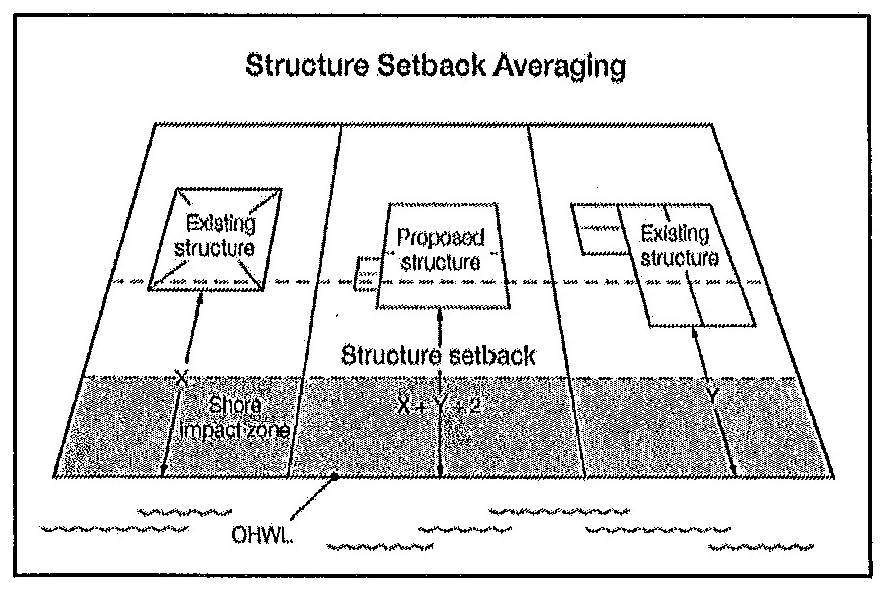
Setback averaging. Where structures exist on the adjoining lots on both sides of a proposed building site, structure setbacks may be altered without a variance to conform to the adjoining setbacks from the OHWL, provided the proposed structure is not located in a shore impact zone or in a bluff impact zone (see Figure 8).
Figure 8. Structure Setback Averaging
C.
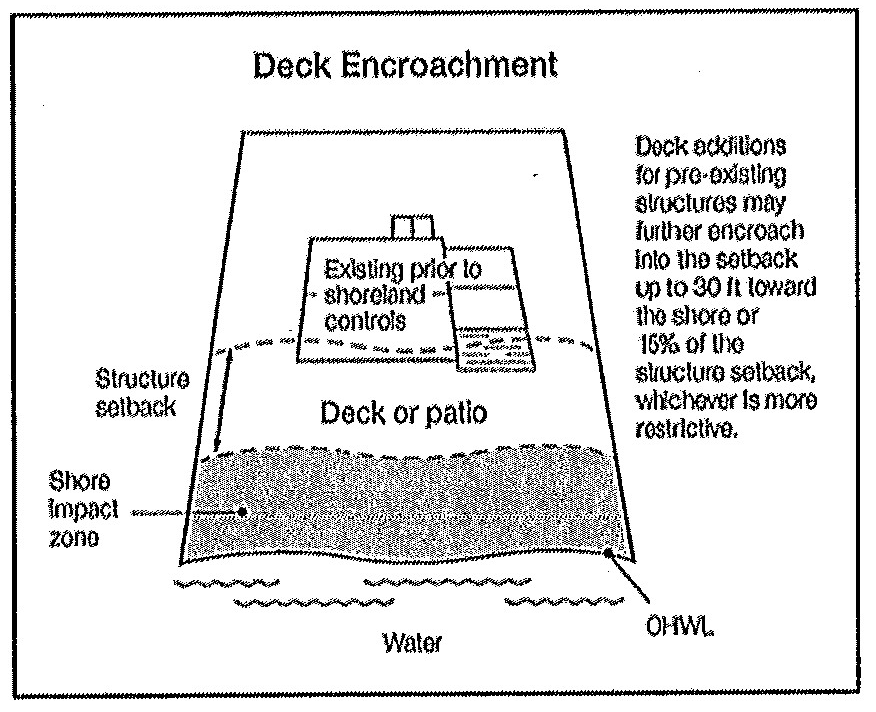
Setbacks of decks. Deck additions may be allowed without a variance to a structure not meeting the required setback from the ordinary high water level if all of the following criteria are met:
(1)
The structure existed on the date the structure setbacks were established;
(2)
A thorough evaluation of the property and structure reveals no reasonable location for a deck meeting or exceeding the existing ordinary high water level setback of the structure;
(3)
The deck encroachment toward the ordinary high water level does not exceed 15 percent of the existing setback of the structure from the ordinary high water level or is no closer than 30 feet from the OHWL, whichever is more restrictive; and
(4)
The deck is constructed primarily of wood, and is not roofed or screened (see Figure 9).
Figure 9. Deck Encroachment
D.
Additional structure setbacks. Unless setbacks established in local building codes are more restrictive, structures must also meet the following setbacks, regardless of the waterbody classification:
E.
Bluff Impact Zones. Structures, impervious surfaces and accessory facilities, except stairways and landings, must not be placed within bluff impact zones.
6.4.2
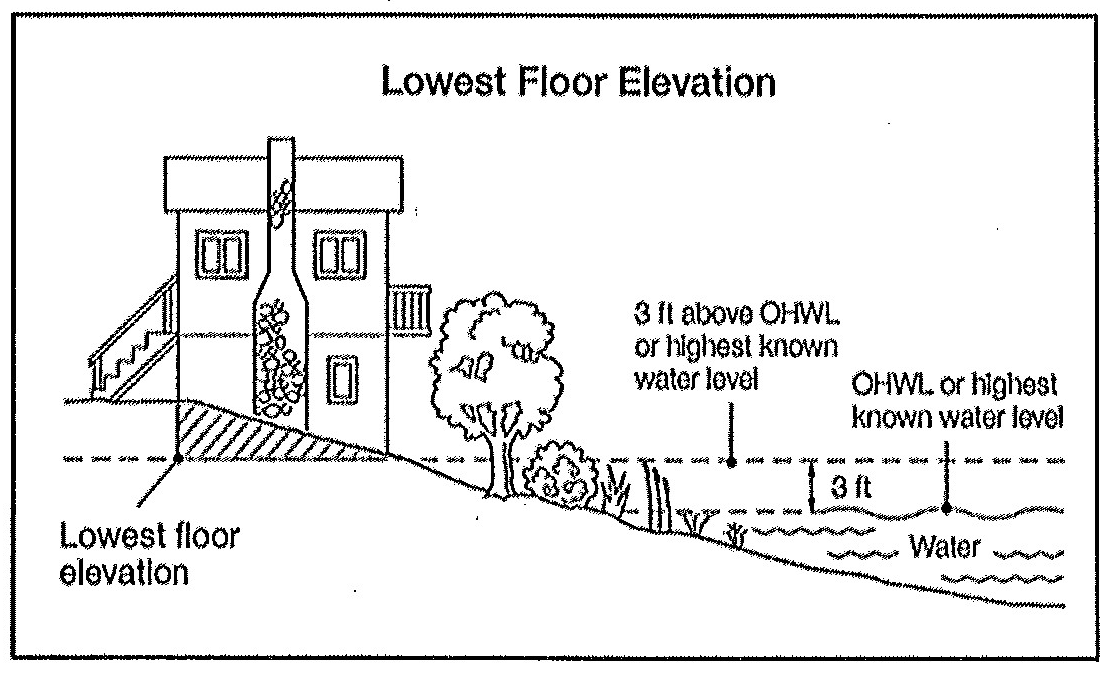
Lowest Floor Elevation.
A.
Determining elevations. Structures must be placed at an elevation consistent with the applicable floodplain regulatory elevations. Where these controls do not exist, the elevation to which the lowest floor, including basement, is placed or flood-proofed must be determined as follows:
(1)
For lakes, by placing the lowest floor at a level at least three feet above the highest known water level, or three feet above the ordinary high water level, whichever is higher (see Figure 10);
(2)
For rivers and streams, by placing the lowest floor at least three feet above the highest known flood elevation. If highest known flood elevation is not available, by placing the lowest floor at least three feet above the ordinary high water level (see Figure 10), or by conducting a technical evaluation to establish a flood protection elevation. Technical evaluations must be done by a qualified engineer or hydrologist consistent with Minnesota Rules, parts 6120.5000 to 6120.6200.
B.
Methods for placement.
(1)
In addition to the lowest floor, all service utilities must be elevated or water-tight to the elevation determined in part A.
(2)
If the structure is floodproofed, then it must be built to resist hydrostatic pressure through elevation methods such as blocks, pilings, filled stem walls, elevated concrete pad, internally flooded enclosed areas, or through other accepted engineering practices consistent with FEMA technical bulletins 1, 2 and 3.
Figure 10. Lowest Floor Elevation
6.4.3
Significant Historic Sites. No structure may be placed on a significant historic site in a manner that affects the values of the site unless adequate information about the site has been removed and documented in a public repository.
Sec. 6.5. - Water supply and sewage treatment.
6.5.1
Water supply. Any public or private supply of water for domestic purposes must meet or exceed standards for water quality of the Minnesota Department of Health and the Minnesota Pollution Control Agency.
6.5.2
Sewage treatment. Any premises used for human occupancy must be connected to a publicly-owned sewer system, where available or comply with Minnesota Rules, Chapters 7080—7081.
Sec. 7.1. - Placement and design of roads, driveways, and parking areas.
Public and private roads and parking areas must be designed to take advantage of natural vegetation and topography to achieve maximum screening as viewed from public waters and comply with the following standards:
7.1.1
Placed within bluff and shore impact Roads, driveways, and parking areas must meet structure setbacks and must not be zones, when other reasonable and feasible placement alternatives exist. If no alternatives exist, they may be placed within these areas, and must be designed to minimize adverse impacts;
7.1.2
Watercraft access ramps, approach roads, and access-related parking areas may be placed within shore impact zones provided the vegetative screening and erosion control conditions of this subpart are met;
7.1.3
Private facilities must comply with the grading and filling provisions of Section 8.3 of this ordinance; and
7.1.4
For public roads, driveways and parking areas, documentation must be provided by a qualified individual that they are designed and constructed to minimize and control erosion to public waters consistent with the field office technical guides of the local soil and water conservation district, or other applicable technical materials.
Sec. 7.2. - Stairways, lifts, and landings.
Stairways and lifts are the preferred alternative to major topographic alterations for achieving access up and down bluffs and steep slopes to shore areas. Stairways, lifts, and landings must meet the following design requirements:
7.2.1
Stairways and lifts must not exceed four feet in width on residential lots. Wider stairways may be used for commercial properties, public recreational uses, and planned unit developments;
7.2.2
Landings for stairways and lifts on residential lots must not exceed 32 square feet in area. Landings larger than 32 square feet may be used for commercial properties, public-space recreational uses, and planned unit developments by conditional use permit;
7.2.3
Canopies or roofs are not allowed on stairways, lifts, or landings;
7.2.4
Stairways, lifts, and landings may be either constructed above the ground on posts or pilings, or placed into the ground, provided they are designed and built in a manner that ensures control of soil erosion;
7.2.5
Stairways, lifts, and landings must be located in the most visually inconspicuous portions of lots, as viewed from the surface of the public water assuming summer, leaf-on conditions, whenever practical; and
7.2.6
Facilities such as ramps, lifts, or mobility paths for physically handicapped persons are also allowed for achieving access to shore areas, if they are consistent with the dimensional and performance standards of sub items 7.2.1 to 7.2.5 and the requirements of Minnesota Rules, Chapter 1341.
Sec. 7.3. - Water-oriented accessory structures or facilities.
Each residential lot may have one water-oriented accessory structure or facility if it complies with the following provisions:
7.3.1
The structure or facility must not exceed ten feet in height, exclusive of safety rails, and cannot occupy an area greater than 250 square feet. The structure or facility may include detached decks not exceeding eight feet above grade at any point or at-grade patios;
7.3.2
The structure or facility is not in the Bluff Impact Zone;
7.3.3
The setback of the structure or facility from the ordinary high water level must be at least ten feet;
7.3.4
The structure is not a boathouse or boat storage structure as defined under Minnesota Statutes, Section 103G.245;
7.3.5
The structure or facility must be treated to reduce visibility as viewed from public waters and adjacent shorelands by vegetation, topography, increased setbacks or color, assuming summer, leaf-on conditions;
7.3.6
The roof may be used as an open-air deck with safety rails, but must not be enclosed with a roof or sidewalls or used as a storage area;
7.3.7
The structure or facility must not be designed or used for human habitation and must not contain water supply or sewage treatment facilities;
7.3.8
As an alternative for general development and recreational development waterbodies, water-oriented accessory structures used solely for storage of watercraft and boating-related equipment may occupy an area up to 400 square feet provided the maximum width of the structure is 20 feet as measured parallel to the shoreline; and
7.3.9
Water-oriented accessory structures may have the lowest floor placed lower than the elevation specified in Section 6.4.2 if the structure is designed to accommodate internal flooding, constructed of flood-resistant materials to the elevation, electrical and mechanical equipment is placed above the elevation and, if long duration flooding is anticipated, the structure is built to withstand ice action and wind-driven waves and debris.
Sec. 8.1. - Purpose.
Alterations of vegetation and topography are regulated to prevent erosion into public waters, fix nutrients, preserve shoreland aesthetics, preserve historic values, prevent bank slumping, sustain water quality, and protect fish and wildlife habitat.
Sec. 8.2. - Vegetation management.
8.2.1
Removal or alteration of vegetation must comply with the provisions of this subsection except for:
A.
Vegetation alternation necessary for the construction of structures and sewage treatment systems under validly issued permits for these facilities;
B.
The construction of public roads and parking areas if consistent with Section 7.1 of the ordinance;
C.
Forest management uses consistent with Section 5.3 of this ordinance; and
D.
Agricultural uses consistent with Section 5.2 of this ordinance.
8.2.2
Intensive vegetation clearing in the shore and bluff impact zones and on steep slopes is prohibited. Intensive clearing outside of these areas is allowed if consistent with the forest management standards in Section 5.3 of this ordinance.
8.2.3
Limited clearing and trimming of trees and shrubs in the shore and bluff impact zones and on steep slopes, is allowed to provide a view to the water from the principal dwelling and to accommodate the placement of stairways and landings, picnic areas, access paths, livestock watering areas, beach and watercraft access areas, and permitted water-oriented accessory structures or facilities, provided that:
A.
The screening of structures, vehicles, or other facilities as viewed from the water, assuming summer, leaf-on conditions, is not substantially reduced;
B.
Existing shading of water surfaces along rivers is preserved;
C.
Cutting debris or slash shall be scattered and not mounded on the ground; and
D.
Perennial ground cover is retained.
8.2.4
Removal of trees, limbs, or branches that are dead, diseased, dying, or pose safety hazards is allowed without a permit.
8.2.5
Fertilizer and pesticide runoff into surface waters must be minimized through use of vegetation, topography or both.
Sec. 8.3. - Grading and filling.
8.3.1
Grading and filling activities must comply with the provisions of this subsection except for the construction of public roads and parking areas if consistent with Section 7.1 of this ordinance.
8.3.2
Permit Requirements.
A.
Grading, filling and excavations necessary for the construction of structures, sewage treatment systems, and driveways, if part of an approved permit, do not require a separate grading and filling permit. However, the standards in Section 8.3.3 of this ordinance must be incorporated into the permit.
B.
For all other work, including driveways not part of another permit, a grading and filling permit is required for:
(1)
the movement of more than ten cubic yards of material on steep slopes or within shore or bluff impact zones; and
(2)
the movement of more than 50 cubic yards of material outside of steep slopes and shore and bluff impact zones.
8.3.3
Grading, Filling and Excavation activities must meet the following standards:
A.
Grading or filling of any wetland must meet or exceed the wetland protection standards under Minnesota Rules, Chapter 8420 and any other permits, reviews, or approvals by other local state, or federal agencies such as watershed districts, the DNR or US Army Corps of Engineers;
B.
Land alterations must be designed and implemented to minimize the amount of erosion and sediment from entering surface waters during and after construction consistently by:
(1)
Limiting the amount and time of bare ground exposure;
(2)
Using temporary ground covers such as mulches or similar materials;
(3)
Establishing permanent vegetation cover as soon as possible;
(4)
Using sediment traps, vegetated buffer strips or other appropriate techniques;
(5)
Stabilizing altered areas to acceptable erosion control standards consistent with the field office technical guides of the soil and water conservation district;
(6)
Not placing fill or excavated material in a manner that creates unstable slopes. Plans to place fill or excavated material on steep slopes must be reviewed by qualified professionals for continued slope stability and must not create finished slopes of 30 percent or greater;
(7)
Fill or excavated material must not be placed in bluff impact zones;
(8)
Any alterations below the ordinary high water level of public waters must first be authorized by the commissioner under Minnesota Statutes, Section 103G;
(9)
Alterations of topography are only allowed if they are accessory to permitted or conditional uses and do not adversely affect adjacent or nearby properties; and
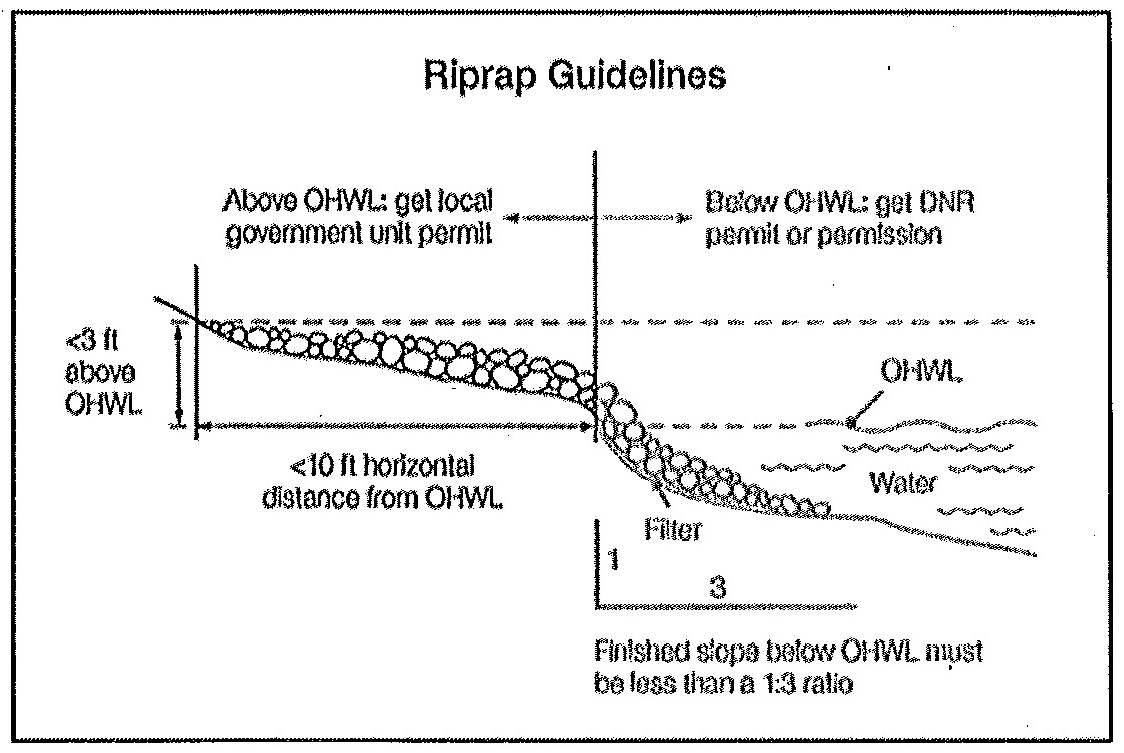
(10)
Placement of natural rock riprap, including associated grading of the shoreline and placement of a filter blanket, is permitted if:
(a)
the finished slope does not exceed three feet horizontal to one-foot vertical;
(b)
the landward extent of the riprap is within ten feet of the ordinary high water level; and
(c)
the height of the riprap above the ordinary high water level does not exceed three feet (see Figure 11).
Figure 11. Riprap Guidelines
8.3.4
Connections to public waters. Excavations to connect boat slips, canals, lagoons, and harbors to public waters require a public waters permit and must comply with Minnesota Rules, Chapter 6115.
Sec. 8.4. - Stormwater management.
8.4.1
General Standards:
A.
When possible, existing natural drainageways, and vegetated soil surfaces must be used to convey, store, filter, and retain stormwater runoff before discharge to public waters.
B.
Development must be planned and conducted in a manner that will minimize the extent of disturbed areas, runoff velocities, erosion potential, and reduce and delay runoff volumes. Disturbed areas must be stabilized as soon as possible and appropriate facilities or methods used to retain sediment on the site.
C.
When development density, topography, soils, and vegetation are not sufficient to adequately handle stormwater runoff, constructed facilities such as settling basins, skimming devices, dikes, waterways, ponds and infiltration may be used. Preference must be given to surface drainage, vegetation, and infiltration rather than buried pipes and man-made materials and facilities.
8.4.2
Specific Standards:
A.
The combined area of all buildings and impervious surfaces on a parcel of land may not exceed 25 percent of the total area of the parcel or 25 percent of the buildable area, whichever is more restrictive.
B.
When constructed facilities are used for stormwater management, documentation must be provided by a qualified individual that they are designed and installed consistent with the field office technical guide of the local soil and water conservation district or the Minnesota Stormwater Manual, as applicable.
C.
New constructed stormwater outfalls to public waters must be consistent with Minnesota Rules, part 6115.0231.
Sec. 9.1. - Purpose.
To ensure that new development minimizes impacts to shoreland resources and is safe and functional.
Sec. 9.2. - Land suitability.
Each lot created through subdivision, including planned unit developments authorized under Section 10 of this ordinance, must be suitable in its natural state for the proposed use with minimal alteration A suitability analysis must be conducted for each proposed subdivision, including planned unit developments, to determine if the subdivision is suitable in its natural state for the proposed use with minimal alteration and whether any feature of the land is likely to be harmful to the health, safety, or welfare of future residents of the proposed subdivision or of the community.
Sec. 9.3. - Consistency with other controls.
Subdivisions and each lot in a subdivision shall meet all official controls so that a variance is not needed later to use the lots for their intended purpose.
Sec. 9.4. - Water and sewer design standards.
9.4.1
A potable water supply and a sewage treatment system consistent with Minnesota Rules, Chapters 7080—7081 must be provided for every lot.
9.4.2
Each lot must include at least two soil treatment and dispersal areas that support systems described in Minnesota Rules, parts 7080.2200 to 7080.223 or site conditions described in part 7081.0270, subparts 3 to 7, as applicable.
9.4.3
Lots that would require use of holding tanks are prohibited.
Sec. 9.5. - Information requirements.
9.5.1
Topographic contours at ten-foot intervals or less from United States Geological Survey maps or more current sources, showing limiting site characteristics;
9.5.2
The surface water features required in Minnesota Statutes, Section 505.021, Subd. 1, to be shown on plats, obtained from United States Geological Survey quadrangle topographic maps or more current sources;
9.5.3
Adequate soils information to determine suitability for building and sewage treatment capabilities for every lot from the most current existing sources or from field investigations such as soil borings, percolation tests, or other methods;
9.5.4
Information regarding adequacy of domestic water supply; extent of anticipated vegetation and topographic alterations; near-shore aquatic conditions, including depths, types of bottom sediments, and aquatic vegetation; and proposed methods for controlling stormwater runoff and erosion, both during and after construction activities;
9.5.5
Location of 100-year flood plain areas and floodway districts from existing adopted maps or data; and
9.5.6
A line or contour representing the ordinary high water level, the "toe" and the "top" of bluffs, and the minimum building setback distances from the top of the bluff and the lake or stream.
Sec. 9.6. - Dedications.
When a land or easement dedication is a condition of subdivision approval, the approval must provide easements over natural drainage or ponding areas for management of stormwater and significant wetlands.
Sec. 9.7. - Platting.
All subdivisions that cumulatively create five or more lots or parcels that are 2½ acres or less in size shall be processed as a plat in accordance with Minnesota Statutes, Chapters 462.358 Subd. 3a and 505. No permit for construction of buildings or sewage treatment systems shall be issued for lots created after the adoption of this ordinance unless the lot was previously approved as part of a formal subdivision.
Sec. 9.8. - Controlled access lots.
Controlled access lots within a subdivision must meet or exceed the lot size criteria in Section 6.3.3 of this ordinance.
Sec. 10.1. - Purpose.
Unless prohibited by local building codes, this Section shall be utilized to protect and enhance the natural and scenic qualities of shoreland areas during and after development and redevelopment of high density residential and commercial uses.
Sec. 10.2. - Types of PUDs permissible.
Planned unit developments (PUDs) are allowed for new projects on undeveloped land, redevelopment of previously built sites, or conversions of existing buildings and land. Deviation from the minimum lot size standards of Section 6.2 of this ordinance is allowed if the standards in this Section are met.
Sec. 10.3. - Processing of PUDs.
Planned unit developments in the shoreland district must be processed as a conditional use and comply with the provisions of this section in addition to those standards outlined elsewhere in the zoning and subdivision regulations. When there is a conflict in requirements, the more stringent of the requirements shall be applied. An expansion to an existing commercial PUD involving six or less new dwelling units or sites since the date this ordinance was adopted is permissible as a permitted use provided the total project density does not exceed the allowable densities calculated in the project density evaluation procedures in Section 10.5. Approval cannot occur until all applicable environmental reviews are complete.
Sec. 10.4. - Application for a PUD.
The applicant for a PUD must submit the following documents prior to final action on the application request:
10.4.1
Site plan and/or plat showing:
A.
Locations of property boundaries;
B.
Surface water features;
C.
Existing and proposed structures and other facilities;
D.
Land alterations;
E.
Sewage treatment and water supply systems (where public systems will not be provided);
F.
Topographic contours at ten-foot intervals or less; and
G.
Identification of buildings and portions of the project that are residential, commercial, or a combination of the two (if project combines commercial and residential elements).
10.4.2
A property owner's association agreement (for residential PUD's) with mandatory membership, and consistent with Section 10.6 of this ordinance.
10.4.3
Deed restrictions, covenants, permanent easements or other instruments that:
A.
Address future vegetative and topographic alterations, construction of additional buildings, beaching of watercraft, and construction of commercial buildings in residential PUDs; and
B.
Ensure the long-term preservation and maintenance of open space in accordance with the criteria and analysis specified in Section 10.6 of this ordinance.
10.4.4
A master plan/site plan describing the project and showing floor plans for all commercial structures.
10.4.5
Additional documents necessary to explain how the PUD will be designed and will function.
Sec. 10.5. - Density determination.
Proposed new or expansions to existing planned unit developments must be evaluated using the following procedures.
10.5.1
Step 1. Identify Density Analysis Tiers. Divide the project parcel into tiers by drawing one or more lines parallel to the ordinary high water level at the following intervals, proceeding landward:
10.5.2
Step 2. Calculate Suitable Ara for Development. Calculate the suitable area within each tier by excluding all wetlands, bluffs or land below the ordinary high water level of public waters.
10.5.3
Step 3. Determine Base Density.
A.
For residential PUDs, divide the suitable area within each tier by the minimum single residential lot area for lakes to determine the allowable number of dwelling units, or base density, for each tier. For rivers, if a minimum lot area is not specified, divide the tier width by the minimum single residential lot width.
B.
For commercial PUDs:
(1)
Determine the average area for each dwelling unit or dwelling site within each tier. Include both existing and proposed dwelling units and sites in the calculation.
(a)
For dwelling units, determine the average inside living floor area of dwelling units in each tier. Do not include decks, patios, garages, or porches and basements, unless they are habitable space.
(b)
For dwelling sites (campgrounds), determine the area of each dwelling site as follows:
(i)
For manufactured homes, use the area of the manufactured home, if known, otherwise use 1,000 sf.
(ii)
For recreational vehicles, campers or tents, use 400 sf.
(2)
Select the appropriate floor area/dwelling site area ratio from the following table for the floor area or dwelling site area determined in Section 10.5.3 B. 1.
(3)
Multiply the suitable area within each tier determined in Section 10.5.2 by the floor area or dwelling site area ratio to yield the total floor area or dwelling site area for each tier to be used for dwelling units or dwelling sites.
(4)
Divide the total floor area or dwelling site area for each tier calculated in Section 10.5.3 B.3 by the average inside living floor area for dwelling units or dwelling site area determined in 10.5.3 B.1. This yields the allowable number of dwelling units or dwelling sites, or base density, for each tier.
10.5.4
Step 4. Determine if the Site can Accommodate Increased Density.
A.
The following increases to the dwelling unit or dwelling site base densities determined in Section 10.5.3 are allowed if the design criteria in Section 10.6 of this ordinance are satisfied as well as the standards in Section 10.5.4, item B:
B.
Structure setbacks from the ordinary high water level:
(1)
Are increased to at least 50 percent greater than the minimum setback; or
(2)
The impact on the waterbody is reduced an equivalent amount through vegetative management, topography, or additional acceptable means and the setback is at least 25 percent greater than the minimum setback.
Sec. 10.6. - Design criteria.
All PUDs must meet the following design criteria.
10.6.1
General Design Standards.
A.
All residential planned unit developments must contain at least five dwelling units or sites.
B.
On-site water supply and sewage treatment systems must be centralized and meet the standards in Section 6.5 of this ordinance. Sewage treatment systems must meet the setback standards of Section 6.4.1, item A of this ordinance.
C.
Dwelling units or dwelling sites must be clustered into one or more groups and located on suitable areas of the development.
D.
Dwelling units or dwelling sites must be designed and located to meet the dimensional standards in sections 6.4.1, and 6.4.2:
E.
Shore recreation facilities:
(1)
Must be centralized and located in areas suitable for them based on a suitability analysis.
(2)
The number of spaces provided for continuous beaching, mooring, or docking of watercraft must not exceed one for each allowable dwelling unit or site in the first tier (notwithstanding existing mooring sites in an existing commercially used harbor).
(3)
Launching ramp facilities, including a small dock for loading and unloading equipment, may be provided for use by occupants of dwelling units or sites located in other tiers.
F.
Structures, parking areas, and other facilities must be treated to reduce visibility as viewed from public waters and adjacent shorelands by vegetation, topography, increased setbacks, color, or other means acceptable to the local unit of government, assuming summer, leaf-on conditions. Vegetative and topographic screening must be preserved, if existing, or may be required to be provided.
G.
Accessory structures and facilities, except water oriented accessory structures, must meet the required structure setback and must be centralized.
H.
Water-oriented accessory structures and facilities may be allowed if they meet or exceed design standards contained in Section 7.3 of this ordinance and are centralized.
10.6.2
Open Space Requirements.
A.
Open space must constitute at least 50 percent of the total project area and must include:
(1)
Areas with physical characteristics unsuitable for development in their natural state;
(2)
Areas containing significant historic sites or unplatted cemeteries;
(3)
Portions of the shore impact zone preserved in its natural or existing state as follows:
(a)
For existing residential PUD's, at least 50 percent of the shore impact zone
(b)
For new residential PUDs, at least 70 percent of the shore impact zone.
(c)
For all commercial PUD's, at least 50 percent of the shore impact zone.
B.
Open space may include:
(1)
Outdoor recreational facilities for use by owners of dwelling units or sites, by guests staying in commercial dwelling units or sites, and by the general public;
(2)
Subsurface sewage treatment systems if the use of the space is restricted to avoid adverse impacts on the systems; and
(3)
Nonpublic water wetlands.
C.
Open space shall not include:
(1)
Dwelling sites or lots, unless owned in common by an owner's association;
(2)
Dwelling units or structures, except water-oriented accessory structures or facilities;
(3)
Road rights-of-way or land covered by road surfaces and parking areas;
(4)
Land below the OHWL of public waters; and
(5)
Commercial facilities or uses.
10.6.3
Open Space Maintenance and Administration Requirements.
A.
Open space preservation. The appearance of open space areas, including topography, vegetation, and allowable uses, must be preserved and maintained by use of deed restrictions, covenants, permanent easements, public dedication, or other equally effective and permanent means. The instruments must prohibit:
(1)
Commercial uses (for residential PUD's);
(2)
Vegetation and topographic alterations other than routine maintenance;
(3)
Construction of additional buildings or storage of vehicles and other materials; and
(4)
Uncontrolled beaching of watercraft.
B.
Development' organization and functioning. Unless an equally effective alternative community framework is established, all residential planned unit developments must use an owners association with the following features:
(1)
Membership must be mandatory for each dwelling unit or dwelling site owner and any successive owner;
(2)
Each member must pay a pro rata share of the association's expenses, and unpaid assessments can become liens on units or dwelling sites;
(3)
Assessments must be adjustable to accommodate changing conditions; and
(4)
The association must be responsible for insurance, taxes, and maintenance of all commonly owned property and facilities.
10.6.4
Erosion Control and Stormwater Management.
A.
Erosion control plans must be developed and must be consistent with the provisions of Section 8.3 of this ordinance. Erosion control plans approved by a soil and water conservation district may be required if project size and site physical characteristics warrant.
B.
Stormwater management facilities must be designed and constructed to manage expected quantities and qualities of stormwater runoff. For commercial PUDs, impervious surfaces within any tier must not exceed 25 percent of the tier area, except that 35 percent impervious surface coverage may be allowed in the first tier of general development lakes with an approved stormwater management plan and consistency with Section 8 of this ordinance.
Sec. 10.7. - Conversions.
Local governments may allow existing resorts or other land uses and facilities to be converted to residential PUDs if all of the following standards are met:
10.7.1
Proposed conversions must be evaluated using the same procedures for residential PUDs involving new construction. Inconsistencies between existing features of the development and these standards must be identified;
10.7.2
Deficiencies involving water supply and sewage treatment, structure color, impervious coverage, open space, and shore recreation facilities must be corrected as part of the conversion or as specified in the conditional use permit;
10.7.3
Shore and bluff impact zone deficiencies must be evaluated and reasonable improvements made as part of the conversion. These improvements must include, where applicable, the following:
A.
Removal of extraneous buildings, docks, or other facilities that no longer need to be located in shore or bluff impact zones;
B.
Remedial measures to correct erosion, improve vegetative cover and improve screening of buildings and other facilities as viewed from the water; and
C.
Conditions attached to existing dwelling units located in shore or bluff impact zones that preclude exterior expansions in any dimension or substantial alterations. The conditions must also provide for future relocation of dwelling units, where feasible, to other locations, meeting all setback and elevation requirements when they are rebuilt or replaced.
10.7.4
Existing dwelling unit or dwelling site densities that exceed standards in Section 10.5 of this ordinance may be allowed to continue but must not be allowed to be increased, either at the time of conversion or in the future. Efforts must be made during the conversion to limit impacts of high densities by requiring seasonal use, improving vegetative screening, centralizing shore recreation facilities, installing new sewage treatment systems, or other means.
Sec. 11.1. - Amending and repealing.
The enactment of this ordinance repeals and replaces Anoka County Ordinance No. 80-2, adopted on January 8, 1980; Ordinance No. 81-1 adopted on September 8, 1981; Ordinance No. 91-2 adopted on August 27, 1991, and Ordinance no. 92-1 adopted on January 14, 1992, Ordinance No. 2018-8 adopted on October 9, 2018, and Ordinance No. 2019-6 adopted on April 23, 2019.
Sec. 12.1. - Effective date.
This ordinance shall become effective upon approval by the Anoka County Board of Commissioners.
Ordinance No. 80-2, adopted on January 8, 1980;
Ordinance No. 81-1 adopted on September 8, 1981;
Ordinance No. 91-2 adopted on August 27, 1991;
Ordinance No. 92-1 adopted on January 14, 1992; and
Ordinance No. 2018-8 adopted on October 9, 2018; and
Ordinance No. 2019-6 adopted on April 23, 2019.
Adopted by the Board of Commissioners of Anoka County, Minnesota, the 28th day of June 2022.

