
Linwood Township Anoka County
City Zoning Code
City Zoning Code
ARTICLE IV
DISTRICTS AND DISTRICT REGULATIONS
Sec. 30-327. - Purpose.
(a)
The zoning districts are so designed to assist in carrying out the intents and purposes of the comprehensive plan.
(b)
The zoning districts are based upon the comprehensive plan which has the purpose of protecting the public health, safety, convenience and general welfare of the community and its citizens.
(Code 2004, § 807.06(subd. 1))
Sec. 30-328. - Establishment of districts.
For the purposes of this chapter, the town is hereby divided into the following zoning districts:
Town Zoning Districts
(Code 2004, § 807.06(subd. 1))
Sec. 30-329. - Zoning district map.
(a)
The location and boundaries of the districts as established by this chapter are set forth on the official zoning map which is adopted and incorporated herein by reference as part of this chapter and is on file in the office of the town clerk. The district boundary lines on said map are intended to follow street right-of-way lines, street centerlines or lot lines unless such boundary line is otherwise indicated on the map. In the case of unsubdivided property or in any case where street or lot lines are not used as boundaries, the district boundary lines shall be determined by use of dimensions or the scale appearing on the map.
(b)
All of the notations, references and other information shown thereon shall have the same force and effect as if fully set forth herein and are hereby made part of this chapter by reference and incorporated herein as fully as if set forth herein at length. Appeals from the building official, determinations and questions of doubt concerning the exact location of district boundary lines shall be heard by the board of adjustment and appeals.
(Code 2004, § 807.06(subd. 2))
Sec. 30-347. - Purpose.
The Residential-Agricultural (RA) District is intended to preserve productive land for agricultural use and prevent the premature absorption of such land for residential development. Designation of large portions of land within the town under this district will assist the town in planning for future growth in a consistent manner and prevent haphazard, leap-frog development.
(Code 2004, § 807.07(subd. 1))
Sec. 30-348. - Permitted uses.
The following uses are permitted in the Residential-Agricultural (RA) District:
(1)
Agricultural land uses.
(2)
Single-family detached residences.
(3)
Nurseries and greenhouses.
(4)
Seasonal produce stands for sale of agricultural products raised on the premises upon which the stand is located.
(5)
Underground communication lines, telephone lines and electric power transmission lines.
(6)
Wildlife, forest and wetland management.
(7)
Public parks and other public open space.
(8)
Essential government services.
(9)
Manufactured homes, on a temporary basis subject to article V, division 6, of this chapter.
(Code 2004, § 807.07(subd. 2))
Sec. 30-349. - Permitted accessory uses.
The following accessory uses are permitted in the Residential-Agricultural (R-A) District:
(1)
Any incidental machinery, structures or buildings necessary to the conduct of agricultural operations or other permitted uses.
(2)
One private garage (whether attached or detached), carports and parking spaces.
(3)
One accessory building other than private garage on a parcel that is less than six acres.
(4)
Up to three accessory buildings on a parcel six acres or larger.
(5)
One storage shed, up to 200 square feet.
(6)
One portable storage structure.
(7)
Private swimming pool, tennis court or other similar facility used by a single-family.
(8)
Rooftop/architecturally-integrated solar energy systems.
(9)
Ground mount solar energy systems on parcels greater than one acre.
(Code 2004, § 807.07(subd. 3); Ord. No. 178, § A, 4-23-2019)
Sec. 30-350. - Conditional uses.
(a)
The conditional uses in the Residential-Agricultural (RA) District are all the conditional uses as listed in this section which must comply with the provisions of article II, divisions 3 through 6, of this chapter and meet the intent of the comprehensive plan.
(b)
The following are the conditional uses:
(1)
Governmental and public regulated utility buildings and structures, substations and transmission lines necessary for the health, safety and general welfare of the community, provided that:
a.
When abutting a residential use in a residential use district, the property is screened and landscaped in compliance with section 30-1077.
b.
The provisions of sections 30-171 through 30-178 are considered and satisfactorily met.
(2)
Public or semi-public recreational buildings and neighborhood or community centers; public and private educational institutions limited to elementary, junior high and senior high schools; and places of worship such as churches and chapels, provided that:
a.
Adequate screening from abutting neighborhood residential uses and landscaping is provided in compliance with section 30-1077.
b.
Adequate off-street parking and access is provided on the site or on lots directly abutting directly across a public street to the principal use in compliance with article VI of this chapter and that such parking is adequately screened and landscaped from surrounding and abutting residential uses in compliance with section 30-1077.
c.
Adequate off-street loading and service entrances are provided and regulated where applicable by article VI of this chapter.
d.
The provisions of sections 30-171 through 30-178 are considered and satisfactorily met.
(3)
Commercial outdoor recreational areas including golf courses and country clubs, campgrounds and swimming pools and similar facilities, provided that:
a.
The principal use, function or activity is open, outdoor in character.
b.
Not more than five percent of the land area of the site be covered by buildings or structures.
c.
When abutting a residential use and a residential use district, the property is screened and landscaped in compliance with section 30-1077.
d.
The land area of the property containing such use or activity meets the minimum established for the district.
e.
The provisions of sections 30-171 through 30-178 are considered and satisfactorily met.
(4)
Commercial riding stables, animal hospitals with overnight care and similar uses, provided that:
a.
Any building in which animals are kept, whether roofed shelter or enclosed structures, shall be located a distance of 100 feet or more from any lot line.
b.
The animals shall, at a minimum, be kept in an enclosed pen or corral of sufficient height and strength to retain such animals. Said pen or corral may not be located closer than 100 feet from a lot line.
c.
The provisions of the state pollution control agency regulations SW 53(2) are complied with.
d.
All other applicable state and local regulations pertaining to nuisance, health and safety conditions, etc. are complied with.
e.
The provisions of sections 30-171 through 30-178 are considered and satisfactorily met.
(5)
Cemeteries, provided that:
a.
The site accesses on a minor arterial of this chapter.
b.
The site is landscaped in accordance with section 30-1078.
c.
The provisions of sections 30-171 through 30-178 are considered and satisfactorily met.
(Code 2004, § 807.07(subd. 4); Ord. No. 174, § C, 2-26-2019)
Sec. 30-351. - Interim permit uses.
The interim permit uses in the Residential-Agricultural (R-A) District are all the uses as listed in this section which must comply with the provisions of article II, divisions 3 through 6, of this chapter and meet the intent of the comprehensive plan.
(1)
Multifamily residential, provided that:
a.
Applicants and/or property owner meet all applicable requirements of the town's regulations for rental housing contained in chapter 8, article V.
b.
Adequate off-street parking and access is provided to the site or on lots directly abutting or directly across a public street to the dwelling.
c.
Adequate sanitary sewer service and plumbing facilities are serving all rental dwelling units.
(2)
Dog kennels and buildings where animals are kept, provided that:
a.
Any building in which animals are kept, whether roofed shelter or enclosed structures, shall be located a distance of 100 feet or more from any lot line.
b.
The animals shall, at a minimum, be kept in an enclosed pen or corral of sufficient height and strength to retain such animals. Said pen or corral may not be located closer than 100 feet from a lot line.
c.
The provisions of the state pollution control agency regulations are complied with.
d.
All other applicable state and local regulations pertaining to nuisance, health and safety conditions, etc., are complied with.
e.
The provisions of sections 30-171 through 30-178 are considered and satisfactorily met.
(3)
CSES/solar gardens, provided that all requirements for community solar energy systems contained in article VIII of this chapter are met.
(4)
Solar farm, providing that all requirements for solar farms contained in article VIII of this chapter are met.
(5)
Wireless communication antennas and towers.
(Ord. No. 168, § B(8.07.07(subd. 5)), 4-24-2018; Ord. No. 174, § D, 2-26-2019; Ord. No. 178, § D, 4-23-2019)
Sec. 30-376. - Purpose.
The Single-Family Residential (R-1) District is intended to preserve a residential atmosphere in the existing residential areas of the town which are currently developing or are almost fully developed.
(Code 2004, § 807.08(subd. 1))
Sec. 30-377. - Permitted uses.
The permitted uses in the Single-Family Residential (R-1) District are as follows:
(1)
Single-family detached residences, except manufactured homes.
(2)
Underground communication, telephone and electric power transmission lines.
(3)
Public parks and other public spaces.
(Code 2004, § 807.08(subd. 2))
Sec. 30-378. - Permitted accessory uses.
The following accessory uses are permitted in the Single-Family Residential (R-1) District:
(1)
One private garage (whether attached or detached), carport and parking spaces.
(2)
One accessory building or structure.
(3)
One storage shed, up to 200 square feet.
(4)
One portable storage structure
(5)
Private swimming pool, tennis court or other similar facility used by a single-family.
(6)
Rooftop/architecturally-integrated solar energy systems.
(7)
Ground mount solar energy systems, on parcels greater than one acre.
(Code 2004, § 807.08(subd. 3); Ord. No. 178, § B, 4-23-2019)
Sec. 30-379. - Interim permit uses.
All interim permit uses as listed in this section must comply with the provisions of article II, divisions 3 through 6, of this chapter and meet the intent of the comprehensive plan. The interim permit uses in the Single-Family Residential (R-1) District are as follows:
(1)
Multifamily residential, provided that:
a.
Applicants and/or property owner meet all applicable requirements of the town's regulations for rental housing contained in chapter 8, article V.
b.
Adequate off-street parking and access is provided to the site or on lots directly abutting or directly across a public street to the dwelling.
c.
Adequate sanitary sewer service and plumbing facilities are serving all rental dwelling units.
(2)
Dog kennels and buildings where animals are kept, provided that:
a.
Any building in which animals are kept, whether roofed shelter or enclosed structures, shall be located a distance of 100 feet or more from any lot line.
b.
The animals shall, at a minimum, be kept in an enclosed pen or corral of sufficient height and strength to retain such animals. Said pen or corral may not be located closer than 100 feet from a lot line.
c.
The provisions of the state pollution control agency regulations are complied with.
d.
All other applicable state and local regulations pertaining to nuisance, health and safety conditions, etc., are complied with.
e.
The provisions of sections 30-171 through 30-178 are considered and satisfactorily met.
(Ord. No. 168, § C(8.07.08(subd. 5)), 4-24-2018; Ord. No. 174, § E, 2-26-2019)
Sec. 30-521. - Purpose.
The General Business (B) District is intended to provide for a variety of business uses including service and retail in specifically identified areas within the town. Land available for business uses is based on the level of residential development that will occur over the next 20-year period and the types of business uses permitted are scaled to serve the needs of these residential areas only.
(Code 2004, § 807.10(subd. 1))
Sec. 30-522. - Permitted uses.
The following uses are permitted in a General Business (B) District:
(1)
Offices and medical clinics.
(2)
Clubs and lodges.
(3)
Mortuary or funeral homes.
(4)
Churches.
(5)
Government buildings such as town hall, police station, fire station, etc.
(6)
Commercial recreation.
(7)
Indoor recreation, such as movie theaters.
(8)
Restaurants, cafes and supper clubs.
(9)
Retail and service outlets.
(10)
Motorized vehicle sales and service (outside operation by conditional use only).
(11)
Essential services.
(12)
Liquor sales.
(13)
Cannabis retailer.
(14)
Lower-potency hemp edible retailer.
(Code 2004, § 807.10(subd. 2); Ord. No. 219, § 4, 12-26-2024)
Sec. 30-523. - Permitted accessory uses.
The following uses are permitted accessory uses in a General Business (B) District:
(1)
Off-street parking and loading facilities.
(2)
Any incidental repair, processing and storage necessary to conduct principal use, but not exceeding 30 percent of the floor space of the principal building.
(3)
Garages.
(4)
Rooftop/architecturally-integrated solar energy systems.
(5)
Ground mount solar energy systems, on parcels greater than one acre.
(Code 2004, § 807.10(subd. 3); Ord. No. 178, § C, 4-23-2019)
Sec. 30-524. - Conditional uses.
All conditional uses in a General Business (B) District as listed in this section must comply with the provisions of article II, divisions 3 through 6, of this chapter and meet the intent of the comprehensive plan.
(1)
Drive-in and convenience food establishments, provided that:
a.
The architectural appearance and functional plan of the building and site shall not be so dissimilar to the existing buildings or area as to cause impairment in property values or constitute a blighting influence within a reasonable distance of the lot.
b.
At the boundaries of a residential district, a strip of not less than five feet tall shall be landscaped and screened.
c.
Parking areas shall be screened from view of abutting residential districts.
d.
Vehicular access points shall be limited, shall create a minimum of conflict with through traffic movement, shall comply with article VI of this chapter and shall be subject to the approval of the town engineer.
e.
All lighting shall be hooded and so directed that the light source is not visible from the public right-of-way or from an abutting residence.
f.
The entire area shall have a drainage system subject to the approval of the town engineer.
g.
The entire area other than occupied by buildings or structures or plantings shall be surfaced with a material which will control dust and drainage and which is subject to the approval of the town engineer.
(2)
Car washes (drive through, mechanical and self-service), provided that:
a.
The architectural appearance and functional plan of the building and site shall not be so dissimilar to the existing buildings or area as to cause impairment in property values or constitute a blighting influence within a reasonable distance of the lot.
b.
Magazining or stacking space is constructed to accommodate that number of vehicles which can be washed during a maximum 30-minute period and shall be subject to the approval of the town engineer.
c.
At the boundaries of a residential district, a strip of not less than five feet shall be landscaped and screened.
d.
Each light standard island and all islands in the parking lot landscaped or covered.
e.
Parking or car magazine storage space shall be screened from view of abutting residential districts.
f.
The entire area other than occupied by the building or plantings shall be surfaced with material which will control dust and drainage which is subject to the approval of the town engineer.
g.
The entire area shall have a drainage system which is subject to the approval of the town engineer.
h.
All lighting shall be hooded and so directed that the light source is not visible from the public right-of-way or from an abutting residence.
i.
Vehicular access points shall be limited, shall create a minimum of conflict with through traffic movement and shall be subject to the approval of the town engineer.
(3)
Motor fuel station, auto repair-minor and tire and battery stores and service, provided that:
a.
Regardless of whether the dispensing, sale or offering for sale of motor fuels and/or oil is incidental to the conduct of the use or business, the standards and requirements imposed by this chapter for motor fuel stations shall apply. These standards and requirements are, however, in addition to other requirements which are imposed for other uses of the property.
b.
The architectural appearance and functional plan of the building and site shall not be so dissimilar to the existing buildings or area as to cause impairment in property values or constitute a blighting influence within a reasonable distance of the lot.
c.
The entire site, other than that taken up by a building, structure or plantings shall be surfaced with a material to control dust and drainage which is subject to the approval of the town engineer.
d.
A drainage system subject to the approval of the town engineer shall be installed.
e.
The lighting shall be accomplished in such a way as to have no direct source of light visible from adjacent land in residential use or from the public right-of-way.
f.
Wherever fuel pumps are to be installed, pump islands shall be installed.
g.
At the boundaries of a residential district, a strip of not less than five feet shall be landscaped and screened.
h.
Each light standard is landscaped.
i.
Parking or car magazine storage space shall be screened from view of abutting residential districts.
j.
Vehicular access points shall create a minimum of conflict with through traffic movement and shall be subject to the approval of the town engineer.
k.
Provisions are made to control and reduce noise.
(4)
Open and outdoor storage as a principal or accessory use, provided that:
a.
The area is fenced and screened from view of neighboring residential uses or if abutting on "R" district in compliance with section 30-1077.
b.
Storage is screened from view from the public right-of-way in compliance with section 30-1077.
c.
Storage area is grassed or surfaced to control dust.
d.
All lighting shall be hooded and so directed that the light source shall not be visible from the public right-of-way or from neighboring residences and shall be in compliance with section 30-1079.
e.
Does not take up parking space as required for conformity to this chapter.
f.
The provisions of sections 30-171 through 30-178 are considered and satisfactorily met.
(5)
Open or outdoor service, sale and rental as a principal or accessory use, provided that:
a.
Outside services, sales and equipment rental connected with the principal use is limited to 30 percent of the gross floor area of the principal use.
b.
Outside sales areas are fenced or screened from view of neighboring residential uses or an abutting "R" district in compliance with section 30-1077.
c.
All lighting shall be hooded and so directed that the light source shall not be visible from the public right-of-way or from neighboring residences and shall be in compliance with section 30-1079.
d.
The use does not take up parking space as required for conformity to this chapter.
e.
Sales area is grassed or surfaced to control dust.
f.
The provisions of sections 30-171 through 30-178 are considered and satisfactorily met.
(6)
Accessory, enclosed retail, rental or service activity other than that allowed as a permitted use or conditional use within this division, provided that:
a.
Such use does not constitute more than 30 percent of the lot area and not more than 50 percent of the gross floor area of the principal use.
b.
Adequate off-street parking and off-street loading in compliance with the requirements of article VI of this chapter is provided.
c.
The provisions of sections 30-171 through 30-178 are considered and satisfactorily met.
(7)
Self-service storage facilities (ministorage), provided that:
a.
It is unlawful for any person to construct, operate, or maintain a self-service storage facility, except in conformance with this chapter.
b.
Self-service storage facilities shall be on parcels of land two acres or more in size.
c.
Units are to be used for dead storage only. Units are not to be used for retailing, auto repair, human habitation, or any commercial activity.
d.
Combining office and/or retail space with a self-service storage facility may be allowed by conditional use permit.
e.
An on-site manager is allowed only where adequate sanitary facilities are provided through use of a septic system. Use of portable sanitary facilities does not fulfill this requirement.
f.
Storage of hazardous or flammable materials is prohibited.
g.
No exterior storage is allowed.
h.
The facility shall be secured by either the walls of the structure and/or fencing. All doors on the units shall face inward and away from the street and property lines.
i.
Only one entrance and exit to the facility is allowed for general public use. One additional emergency exit is allowed for each two acres of property.
j.
One off-street parking space is required for each 25 storage units. Interior drives must be wide enough to accommodate a parked car and traffic that must pass.
k.
The entire area other than occupied by the building or plantings shall be surfaced with material which will control dust and drainage which is subject to the approval of the town engineer.
l.
The entire area shall have a drainage system which is subject to the approval of the town engineer.
m.
All lighting shall be hooded and so directed that the light source is not visible from the public right-of-way or from an abutting residence.
n.
The provisions of sections 30-171 through 30-178 are considered and satisfactorily met.
(8)
Cannabis cultivator.
(9)
Cannabis delivery service.
(10)
Cannabis manufacturer.
(11)
Cannabis testing facility.
(12)
Cannabis transporter.
(13)
Cannabis wholesaler.
(Code 2004, § 807.10(subd. 4); Ord. No. 185, § A, 10-27-2020; Ord. No. 219, § 5, 12-26-2024)
Sec. 30-525. - Interim uses.
All interim uses in a general business (B) district as listed in this section must comply with the provisions of article II, divisions 4 through 6, of this chapter and meet the intent of the comprehensive plan. Wireless communications and towers, provided that all regulations of chapter 24, article VIII, are complied with and temporary cannabis events.
(Ord. No. 219, § 6, 12-26-2024)
Sec. 30-526. - Review of plans and specifications required; exceptions.
Plans and specifications for new buildings, additions to existing buildings, and site improvements to be constructed in the "B" General Business District must be reviewed and approved by the town board before issuance of any permit required for the same. This requirement, however, does not apply if the new construction or site improvement does not constitute a change in the use of the property.
(Code 2004, § 807.10(subd. 5))
Sec. 30-544. - Purpose.
The Environmental Protection (EP) District is intended to control development in those portions of the town located adjacent to creeks, lakes, lowlands and marsh areas. The "EP" district shall be superimposed over all protected areas regardless of existing zoning. Proposed uses shall comply, where appropriate, with the county shoreland management regulations and/or floodplain regulations and the town comprehensive plan.
(Code 2004, § 807.11(subd. 1))
Sec. 30-545. - Wetlands.
Where environmentally sensitive areas which are not regulated under the county ordinances are proposed for development and those areas include any watercourse, natural drainage system, water body or wetland that may be subject to periodic flooding, overflow or seasonally high water tables, the following regulations shall apply.
(Code 2004, § 807.11(subd. 2(intro. ¶)))
Sec. 30-546. - Permitted uses.
The following operations and uses are permitted within 50 feet of a delineated wetland [area] as a matter of right, subject to any other applicable code, ordinance or law:
(1)
Grazing, farming, nurseries, gardening and harvesting of crops.
(2)
Sustained yield forestry and tree farms.
(3)
Conservation of soil vegetation, water, fish and wildlife.
(4)
Scientific research and educational activities that teach principles of ecology and conservation.
(5)
Leisure activities such as hiking, nature studies, canoeing, boating, camping, water-skiing, skin-diving, horseback riding, field trails and general outdoor recreation including play and sporting areas that are not inconsistent with the intent of this chapter.
(6)
Essential services.
(Code 2004, § 807.11(subd. 2(1)); Ord. No. 199, § 1, 9-27-2022)
Sec. 30-547. - Prohibited uses.
Except as may hereinafter be conditionally permitted, it shall be unlawful for any person to perform the below activities within 50 feet of a delineated wetland.
(1)
Place, deposit or permit to be deposited, debris, fill or any material including structures into, within or upon any water body, watercourse or wetland, floodplain or natural drainage system.
(2)
Dig, dredge or in any other way alter or remove any material from water bodies, watercourses, wetlands, floodplains or natural drainage system.
(3)
Erect structures for human inhabitation.
(4)
Create ponds, dam or relocate any watercourse or change the natural drainage system.
(5)
Clear and/or cut trees or other vegetation.
(6)
Permanently store materials.
(7)
Erect signs.
(8)
Dispose of waste materials including, but not limited to, sewage, garbage, rubbish and other discarded materials.
(Code 2004, § 807.11(subd. 2(2)); Ord. No. 199, § 2, 9-27-2022)
Sec. 30-548. - Development regulations.
(a)
Conditional use permit application. Landowners or developers desiring to develop land or construct any dwelling or any other artificial obstruction on land located within 50 feet of any wetlands that are within the town shall first submit a conditional use permit application as regulated in article II, divisions 3 through 6, of this chapter and a plan of development, hereinafter referred to as a "wetlands systems impact plan," which shall set forth proposed provision for sediment control, water management, maintenance of landscaped features and any additional matters intended to improve or maintain the quality of the environment.
(b)
High water elevation. For lakes, ponds or flowages, no structure, except boat houses, piers and docks, shall be placed at an elevation such that the lowest floor, including basement floor, is less than three feet above the highest known water level. In those instances where sufficient data on known high water levels are not available, the elevation of the line of permanent shoreland vegetation shall be used as the estimated high water elevation. When fill is required to meet this elevation, the fill shall be allowed to stabilize and construction shall not begin until the property has been inspected by the building official.
(c)
Buffers. The wetland system impact plan shall identify wetland buffers. Wetland buffers shall be established adjacent to the delineated wetland boundary. The buffer shall be a minimum 16.5 foot wide perennially vegetated strip of land. Buffers shall meet the following standards:
(1)
Buffer shall be a perennial, unmowed vegetation creating continuous cover. Existing vegetation may be used.
(2)
The buffer width shall be a minimum of 16.5 feet wide.
(3)
In areas where vegetation is removed in the buffer area during construction, the buffer shall be reseeded with a native seed mix and the applicant is responsible for reseeding and maintenance for a period of three years or longer if the buffer has not established at the end of the three year maintenance period.
(4)
The buffer shall be within a drainage and utility easement. The applicant shall prepare the easement deed for review and approval by the town. The applicant shall record the approved deed in the county recorder's office.
(5)
No structures shall be allowed in the buffer area.
(d)
Buffer variances. Buffer variances may be granted in any of the following conditions:
(1)
Small wetlands where the entire wetland area is less than or equal to the area of wetland impact allowed without replacement, as de minimis, under the Minnesota Wetland Conservation Act.
(2)
Part of the required buffer is outside of the wetland's watershed. Due to topography near the wetland, runoff flows away from and never enters the wetland through surface flows. Variances shall only be for that portion of the buffer that would be outside of the wetland's watershed.
(3)
If drainage is redirected to an area where a buffer is feasible.
(4)
If the site is not generating stormwater or is using stormwater minimizing techniques that also provide habitat value such as rain gardens, vegetated swales, and other best management practices that replace the functions of the buffer.
(5)
If the applicant is protecting additional upland, beyond that required by other ordinances or control measures, to connect existing wildlife habitat.
(6)
Roads and other linear projects, except those created as part of new residential or commercial developments.
(7)
Subdivisions or developments that create less than three new lots.
(8)
Projects that disturb less than one acre of land and create less than 20,000 square feet of new impervious surface.
(Code 2004, § 807.11(subd. 2(3)); Ord. No. 199, § 3, 9-27-2022; Ord. No. 204, 11-22-2022)
Sec. 30-575. - Regulations adopted by reference.
The Anoka County Shoreland Management Ordinance printed herein as Appendix 1 to this chapter, and any amendment or replacement to thereto which apply to the town are hereby adopted by reference and incorporated in and made a part of hereof as if set out in full in this section.
(Ord. No. 208, § 2, 3-28-2023)
Editor's note— The Town of Linwood and Anoka County are currently parties to a joint powers agreement, hereby known as Anoka County Contract No. C0007197, which transfers the power to fully administer the Anoka County Shoreland Management Ordinance and any amendments thereto and provide services on behalf of Anoka County. The documents herein referred to are on file in the office of the town clerk.
State Law reference— Authority to adopt provisions by reference, M.S.A. § 471.62.
Sec. 30-599. - Created.
The floodplain management overlay district is created and is set out in chapter 14.
Sec. 30-402. - Purpose.
The purpose of the Manufactured Home Park (R-2) District is to provide a separate district for manufactured home parks, distinct from other residential areas.
(Code 2004, § 807.09(subd. 1))
Sec. 30-403. - Permitted uses.
The uses permitted in a Manufactured Home Park (R-2) District are Manufactured homes.
(Code 2004, § 807.09(subd. 2))
Sec. 30-404. - Permitted accessory uses.
The following are permitted accessory uses in a Manufactured Home Park (R-2) District:
(1)
Portable storage shed up to 200 square feet providing it meets all setback requirements.
(2)
Storm shelters.
(Code 2004, § 807.09(subd. 3))
Sec. 30-405. - Conditional uses.
There are no conditional uses permitted within a Manufactured Home Park (R-2) District.
(Code 2004, § 807.09(subd. 4))
Sec. 30-424. - Review procedures.
All informational elements as required in section 30-448 shall be submitted to the town in accordance with the normal time schedule outlined for zoning district amendments, whether or not the proposal requires a rezoning. Proposals for manufactured home park expansions on properly zoned land shall be reviewed for compliance with the applicable standards and requirements as contained in subdivision III of this division by all designated and official town review bodies.
(Code 2004, § 807.09(subd. 6))
Sec. 30-447. - General requirements.
(a)
All land area shall be:
(1)
Adequately drained.
(2)
Landscaped to control dust.
(3)
Clean and free from refuse, garbage, rubbish or debris.
(b)
No tents shall be used for other than recreational purposes in a manufactured home park.
(c)
There shall be no outdoor camping anywhere in a manufactured home park.
(d)
Access to manufactured home parks shall be as approved by the town.
(e)
All structures (fences, storage, cabana, etc.) shall require a building permit from the town building official.
(f)
The area beneath a manufactured home coach shall be enclosed except that such enclosure must have access for inspection.
(g)
Laundry and clothing shall be hung out to dry only on lines located in approved areas established and maintained exclusively for that purpose as identified on the manufactured home park site plan.
(h)
Where deemed necessary, a manufactured home park shall have an adequate central community building with the following features:
(1)
Laundry drying areas and machines.
(2)
Laundry washing machines.
(3)
Public toilets and lavatories.
Such buildings shall have adequate heating and be maintained in a safe, clean and sanitary condition.
(Code 2004, § 807.09(subd. 5(1)))
Sec. 30-448. - Site plan requirements.
The site plan shall contain:
(1)
Legal description and size in acres of the proposed manufactured home park.
(2)
Location and size of all manufactured home sites, dead storage areas, recreation areas, laundry drying areas, roadways, parking sites and all setback dimensions (parking spaces, exact manufactured home sites, etc.).
(3)
Detailed landscaping plans and specifications.
(4)
Plans for sanitary sewage disposal, surface drainage, water systems, electrical services and gas service.
(5)
Location and size of all streets abutting the manufactured home park and all driveways from such streets to the manufactured home park.
(6)
Road construction plans and specifications.
(7)
Plans for any and all structures.
(8)
Such other information as required or implied by these manufactured home park standards or requested by public officials.
(9)
Name and address of developer or developers.
(10)
Description of the method of disposing of garbage and refuse.
(11)
Detailed description of maintenance procedures and grounds supervision.
(12)
Details as to whether all of the area will be developed or a portion at a time.
(Code 2004, § 807.09(subd. 5(2)))
Sec. 30-449. - Park, home site size; setbacks.
(a)
Park size. The minimum area required for a manufactured home park designation shall be ten acres.
(b)
Individual manufactured home site size. The individual manufactured home site requirements for homes 14 feet wide or less is as follows:
(1)
General land area and use. Each manufactured home site shall contain at least 5,000 square feet of land area for the exclusive use of the occupant:
a.
Width. No less than 50 feet.
b.
Depth. No less than 100 feet.
(2)
Roadway frontage; site marking and numbering. Each manufactured home site shall have frontage on an approved roadway and the corner of each manufactured home site shall be marked and each site shall be numbered.
(c)
Individual home site requirements. The individual manufactured home site requirements for homes over 14 feet in width is as follows:
(1)
General land area and use. Each manufactured home site shall contain at least 6,500 square feet of land area for the exclusive use of the occupant:
a.
Width. No less than 65 feet.
b.
Depth. No less than 100 feet.
(2)
Roadway frontage; site marking and numbering. Each manufactured home site shall have frontage on an approved roadway and the corner of each manufactured home site shall be marked and each site shall be numbered.
(d)
Individual manufactured home unit site setbacks. No unit shall be parked closer than ten feet to its side lot lines nor closer than 30 feet to its front lot line, or within ten feet of its rear lot line.
(Code 2004, § 807.09(subd. 5(3)(A)—(D)))
Sec. 30-450. - Building requirements.
No structure shall exceed one story or 25 feet whichever is least.
(Code 2004, § 807.09(subd. 5(3)(E)))
Sec. 30-451. - Parking.
(a)
Each manufactured home site shall have off-street parking space for two automobiles.
(b)
Each manufactured home park shall maintain an off-street parking lot for guests of occupants in the amount of one space for each five coach sites.
(c)
Access drives off roads to all parking spaces and coach sites shall be hard surfaced according to specifications established by the town.
(Code 2004, § 807.09(subd. 5(3)(F)))
Sec. 30-452. - Utilities.
(a)
All manufactured homes shall be connected to a central water and sanitary sewer system approved by the state department of health and state PC(1).
(b)
All installations for disposal of surface/storm sewer water must be approved by the town.
(c)
All utility connections shall be as approved by the town.
(d)
The source of fuel for cooking, heating or other purposes at each manufactured home site shall be as approved by the town.
(e)
All utilities shall be underground; there shall be no overhead wires or supporting poles except those essential for street or other lighting purposes.
(f)
No obstruction shall be permitted that impedes the inspection of plumbing, electrical facilities and related manufactured home equipment.
(g)
The method of garbage, waste and trash disposal must be approved by the town.
(h)
The owner shall pay inspection and testing fees for utility service to the town.
(Code 2004, § 807.09(subd. 5(3)(G)))
Sec. 30-453. - Internal roads and streets.
(a)
Roads shall be hard surfaced as approved by the town.
(b)
All streets shall be developed with a roadbed of not less than 24 feet in width. If parking is permitted on the street, then the roadbed shall be at least 36 feet in width.
(c)
The park shall have a street lighting plan approved by the town.
(Code 2004, § 807.09(subd. 5(3)(H)))
Sec. 30-454. - Recreation.
(a)
All manufactured home parks shall have at least ten percent of the land area developed for recreational use (tennis courts, children's play equipment, swimming pool, golf green, etc.) developed and maintained at the owner/operator's expense.
(b)
In lieu of land dedication for public park purposes, a cash contribution shall be paid to the town.
(Code 2004, § 807.09(subd. 5(3)(I)))
Sec. 30-455. - Landscaping.
(a)
Each site shall be properly landscaped with trees, hedges, grass, fences, windbreaks and the like.
(b)
A compact hedge, redwood fence or landscaped area shall be installed around each manufactured home park and be maintained in first class condition at all times as approved.
(c)
All areas shall be landscaped in accordance with landscaping plan approved by the town.
(Code 2004, § 807.09(subd. 5(3)(J)))
Sec. 30-456. - Lighting.
(a)
Artificial light shall be maintained during all hours of darkness in all buildings containing public toilets, laundry equipment and the like.
(b)
The manufactured home park grounds shall be lighted as approved by the town from sunset to sunrise.
(Code 2004, § 807.09(subd. 5(3)(K)))
Sec. 30-457. - Storage.
Enclosed storage lockers (when provided) shall be located either adjacent to the manufactured home in a manufactured home park or at such other place in the park as to be convenient to the unit for which it is provided. Storage of large items such as boats, boat trailers, etc., shall be accommodated in a separate secured and screened area of the park.
(Code 2004, § 807.09(subd. 5(3)(L)))
Sec. 30-458. - General design standards.
For those items not specifically referenced, the design standards as established in the chapter 22, pertaining to subdivision and other land divisions, shall be utilized as for general development guidelines.
(Code 2004, § 807.09(subd. 5(3)(M)))
Sec. 30-459. - Registration of homeowners and occupants.
(a)
It shall be the duty of the operator of the manufactured home park to keep a record of all manufactured homeowners and occupants located within the park. The register shall contain the following information:
(1)
The name and address of each manufactured home occupant.
(2)
The name and address of the owner of each manufactured home.
(3)
The make, model, year and license number of each manufactured home.
(4)
The state, territory or county issuing such license.
(5)
The date of arrival and departure of each manufactured home.
(6)
The number and type of motor vehicles of residents in the park.
(b)
The park operator shall keep the register available for inspection at all times by authorized town, state and county officials, public health officials and other public offices whose duty necessitates acquisition of the information contained in the register. The register shall not be destroyed until after a period of three years following the date of departure of the registrant from the park.
(Code 2004, § 807.09(subd. 5(4)))
Sec. 30-460. - Maintenance.
The operator of any manufactured home park or a duly authorized attendant and/or caretaker shall be responsible at all times for keeping the manufactured home park, its facilities and equipment in a clean, orderly, operable and sanitary condition. The attendant or caretaker shall be answerable, along with said operator, for the violation of any provision of these regulations to which said operator is subject.
(Code 2004, § 807.09(subd. 5(5)))
Sec. 30-489. - Compliance with manufactured home building code.
State law requires that all manufactured home support systems shall comply with the manufactured home building code. This includes all manufactured homes new or used, that are installed or moved and re-installed at another location within this state.
(Code 2004, § 807.09(subd. 7(intro. ¶)))
Sec. 30-490. - Approved support system.
(a)
Footings. Footings shall be two, four-inch by eight-inch by 16-inch solid concrete blocks (or equivalent), laid parallel to the steel beam.
(b)
Piers. Piers shall be concrete blocks eight inches by eight inches by 16 inches with open cells placed vertically upon the footing. Single stacked blocks shall be placed perpendicular to steel beam. (See Figure 2)
(c)
Piers covers. Piers shall be covered with a two-inch by eight-inch by 16-inch wood or concrete cap. (See Figure 3). A four-inch by eight-inch by 16-inch solid concrete cap is also acceptable. (See Figure 4)
(d)
Pier limits. Piers are limited to 40 inches in height when single blocked. All corner piers over three blocks high shall be double blocked. All piers over 40 inches high shall be double blocked.
(e)
Elevated manufactured homes. When more than one-fourth of the area of a manufactured home is installed so that the bottom of the main frame members are more than three feet above ground level, the manufactured home stabilizing system shall be designed by a qualified registered professional engineer or architect and the installation shall be approved prior to installation by the authority having jurisdiction.
(f)
Clearance above ground. The bottom of the manufactured home main frame must be at least 12 inches above the ground in the area of the utility connections. Do not support the home on the wheels. The wheels must be up off the ground or removed.
(g)
Plates and shims. A wood plate not exceeding two inches in thickness may be used to fill the gap between the pier and the steel beam. Shim may be used up to one inch thick and at least four inches wide by six inches long. Shims shall be driven tight between the wood plate or pier and main frame.
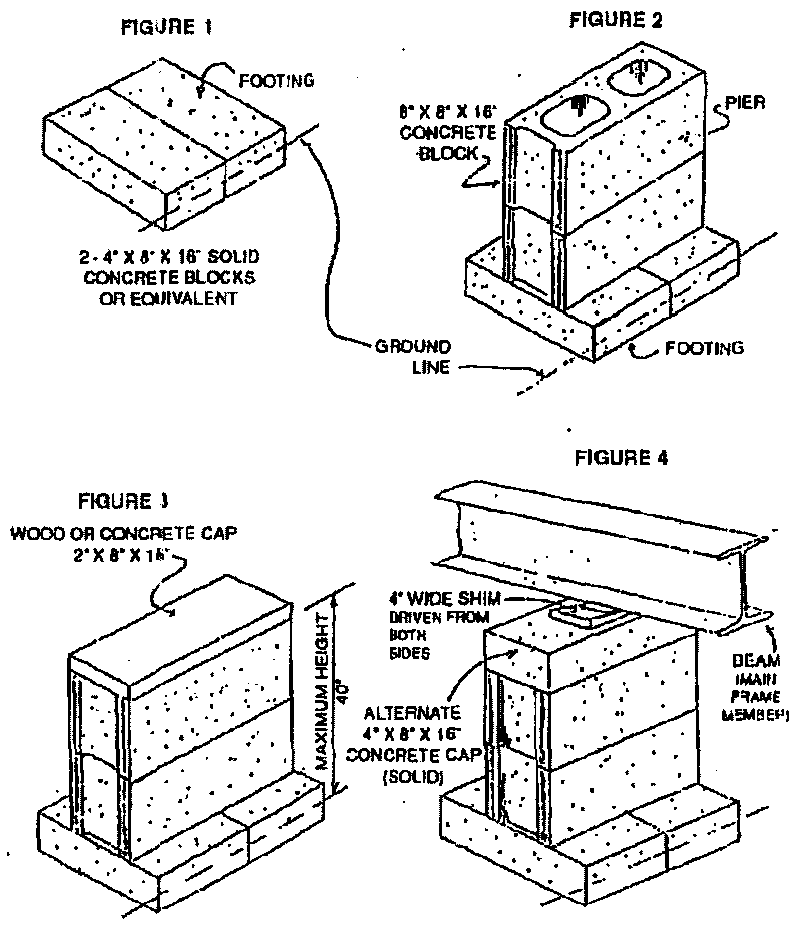
Piers Using Eight Inch Concrete Blocks With Cells Vertically Laid Loose. All Corner
Piers Over Three Blocks High Shall Be Double Blocked.
(Code 2004, 807.09(subd. 7(1)))
Sec. 30-491. - Tie down and anchoring requirements.
(a)
Tie down instructions.
(1)
Manufactured homes located in the United States must be securely anchored to the site in order to resist wind forces. A data plate located near the electrical panel distribution box indicates which structural zone your unit was designed for.
(2)
Moduline International products are furnished with tie-down attachment points, but do not include additional hardware necessary to complete the tie-down system. Approved tie-down equipment is available through your dealer or manufactured home supply stores.
(b)
General requirements for tie-down equipment.
(1)
Tie-down systems must consist of listed materials of adequate strength. Material specifications contained herein should be considered a minimum specification.
(2)
Galvanized cable or steel straps must have at least 4,725 pounds breaking strength.
(3)
Galvanized connection devices must have at least 4,725 pounds breaking strength.
(4)
Ground anchors should be installed per the manufacturer's recommendation and should withstand a minimum 4,725-pound pull.
(c)
Tie-down procedure. For your convenience the frame is stenciled "tie-down location" at each point that a tie-down is required for the zone your home was designed for. Attach tie-down equipment only after the coach is properly leveled.
(1)
Place ground anchors in line with each tie-down clip and below the perimeter edge of the coach. Do not install the anchors outside the perimeter of the coach in order to avoid interference with the skirting installation.
(2)
Attach tension devices and cables or strap to the anchors and the attachment clips.
(3)
Tighten all tie-downs until they become taut in an alternating pattern from one side of the coach to the other.
(4)
Periodical tightening and adjustment of the tie-downs may be necessary. A detailed tie-down system by "minute man anchors" is available as one system acceptable to Moduline International. There are many systems available which you may choose from, as long as they meet the general requirements listed in this section.
(Code 2004, § 807.09(subd. 7(2), (3)))

