
Little Rock City Zoning Code
ARTICLE VIII
OFF-STREET PARKING AND LOADING13
Cross reference— Landscaping of vehicular use areas, § 15-81 et seq.
Sec. 36-501.- Purpose and intent.
This article is designed to prevent or alleviate the congestion of the public streets and to promote the safety and welfare of the public. This article establishes herein minimum requirements for the off-street parking, loading and unloading of motor vehicles appropriate to each land use and its intensity in relation to other land uses.
(Code 1961, Ch. 43, § 8-101(a))
Sec. 36-502. - Required off-street parking.
(a)
When computation of the number of required off-street parking spaces results in a fractional space, the fraction shall be rounded down to the nearest whole space. No parking shall be allowed in the front yard required for any MF-6, MF-12, MF-18, MF-24, R-5, R-6 and O-1 district. In cases where property zoned for one (1) of these seven (7) districts has more than one (1) street frontage or exterior yard, only the designated front yard shall be reserved for landscaping. Any interior yard may be used in its entirety for required off-street parking.
(b)
The following shall constitute minimum standards for the provision of off-street parking spaces:
(1)
Residential uses.
a.
Single-family dwelling, 1.0 space per dwelling unit.
b.
Accessory dwelling, 1.0 space per unit. Accessory dwelling defined by section 36-204 (b)(1), no space per dwelling unit required.
1.
Elderly housing, 0.5 space per unit.
2.
Other, 1.5 spaces per unit.
c.
Rooming houses, dormitories, fraternities and sororities, boardinghouses (and similar uses and establishments), 0.5 space per sleeping accommodation.
d.
Hotels and motels, 1.0 space per guestroom, plus an additional ten (10) percent of the total of all parking spaces required for developments larger than twenty (20) rooms for employees and nonguest users patronizing meeting rooms, restaurants and other facilities.
e.
Mobile home park, 1.0 space per mobile home.
f.
Orphanage, 1.0 space per each five (5) sleeping accommodations plus one (1) per each full-time staff member.
(2)
Office and institutional uses.
a.
Hospitals, sanitariums, convalescent homes (and similar uses or establishments), 1.0 space for each one (1) bed.
b.
Medical clinics, 6.0 spaces per doctor or dentist.
c.
Auditoriums, arenas, theaters (and similar places of public assembly), 1.0 space for each five (5) seats.
d.
Churches (and other places of worship). One (1) space for every five (5) seats in new principal assembly areas or additions to currently existing structures. Choir seating and areas for folding chairs shall be counted. Twenty-four (24) inches on a pew shall be considered one (1) seat. Stacked parking may be authorized by the planning commission at the time of site plan reviews.
e.
Lodge halls, exhibition halls, clubs (and similar places of public assembly), 1.0 space per one hundred (100) square feet of gross floor area.
f.
Schools and educational institutions.
1.
Nursery, kindergarten and day care centers, 1.0 space per administrator, teacher and employee on the largest shift plus 1.0 space per facility vehicle plus 1.0 space per 10.0 persons of licensed capacity.
2.
Elementary (grades 1—5), 1.0 space per classroom plus 1.0 space for each teacher, employee and administrator on the largest shift. Stacking space for drop-off and pick-up shall be required on site. Stacking space shall be adequate to accommodate private vehicles and school buses.
3.
Middle (grades 1—8), 1.0 space per classroom plus 1.0 space for each teacher, employee and administrator on the largest shift. Stacking space for drop-off and pick-up shall be required on site. Stacking space shall be adequate to accommodate private vehicles and school buses.
4.
High (grades 9—12), 6.0 spaces per classroom plus 1.0 space for each teacher, employee and administrator on the largest shift. Stacking space shall be adequate to accommodate private vehicles and school buses.
5.
College, university, business college or trade school, 1.0 space for each three hundred (300) square feet of gross floor area, or one (1) space per four (4) students, whichever is greater.
6.
Dance school/studio, one (1) space per employee plus on-site loading and unloading spaces to be required at the rate of one (1) for each five (5) students, based on the maximum number of students at any one (1) time. Loading and unloading spaces may be provided in a drive-through lane with stacked stalls as may be approved by the public works department.
g.
Business and professional office (and similar use or establishment). One (1) space per five hundred (500) square feet of gross floor area. For structures larger than ten thousand (10,000) square feet, the above parking requirement shall be provided and the following percentage shall be taken of the remaining floor area:
Ten thousand (10,000) to twenty thousand (20,000) square feet, ninety-five (95) percent of parking requirement.
Twenty thousand one (20,001) to thirty thousand (30,000) square feet, ninety (90) percent of parking requirement.
Thirty thousand one (30,001) to forty thousand (40,000) square feet eighty-five (85) percent of parking requirement.
Forty thousand (40,000) square feet and up, eighty (80) percent of parking requirement.
(3)
Commercial uses.
a.
General business and retail sales (except as otherwise provided herein). One (1) space per four hundred (400) square feet of gross floor area up to ten thousand (10,000) square feet. For structures larger than ten thousand (10,000) square feet, the above parking requirement shall be provided and the following percentage shall be taken of the remaining gross floor area:
Ten thousand one (10,001) to twenty thousand (20,000) square feet, ninety-five (95) percent of parking requirement.
Twenty thousand one (20,001) to thirty thousand (30,000) square feet, ninety (90) percent of parking requirement.
Thirty thousand one (30,001) to forty thousand (40,000) square feet eighty-five (85) percent of parking requirement.
Forty thousand (40,000) square feet and up, eighty (80) percent of parking requirement.
Business uses with a mixture of sales space and stock warehousing may reduce the total off-street parking requirement in those instances where the floor area devoted to warehouse exceeds seventy (70) percent of the gross floor area. Such uses may compute the warehouse portion separately at the standard set for warehouse and storage in paragraph (4)b. of this section.
b.
Bowling alleys, 4.0 spaces for each lane.
c.
Restaurants (and similar establishments serving food and beverages), 1.0 space for each one hundred (100) square feet of gross floor area.
d.
Drive-in commercial facilities, in addition to the provisions of subparagraph a., above, drive-in commercial facilities (banks, restaurants and similar uses) shall provide not less than three (3) holding or stacking spaces for each service window.
e.
Food store, supermarkets and convenience-type grocery stores, 4.0 spaces plus one (1) space for each three hundred (300) square feet of gross floor area, exclusive of storage area.
f.
Personal service establishments (barber, beauty shops and similar uses), 1.0 space per two hundred (200) square feet of gross building area.
g.
Automotive services (service stations, garages, automobile washing facilities and similar uses), 5.0 spaces plus 1.0 space for each two hundred fifty (250) square feet of gross building area.
h.
Shopping centers. One (1) space for each three hundred (300) square feet of gross leasable floor area in new shopping centers or additions to existing shopping centers for which a building permit is obtained after March 17, 1987. This requirement shall be sufficient for all permitted uses in a shopping center, including new uses and conversions from one use to another use. Existing shopping centers may convert any permitted use to any other permitted use, provided that requirement of one (1) space for each three hundred (300) square feet of gross leasable area is met for the entire shopping center. If an existing shopping center seeks to convert an individual use to a new use which, in a separate commercial building, would require more parking than the most immediate past use and the shopping center does not meet the above requirement, conversions to the new use shall be subject to the same parking requirements as for separate commercial buildings. Such centers shall provide the number of parking spaces required for each separate use as specified in this article, except that nonconforming parking rights may be carried forward as provided in section 36-503.
i.
Funeral home with chapel services, one (1) parking space for each three (3) seats in the chapel. This requirement may be provided as stacked or end-to-end spaces in rows as required for funeral procession formation, except that ten (10) percent of the parking requirement shall be provided as marked parking spaces as required by the standards of section 36-511, Parking design.
(4)
Industrial uses.
a.
Manufacturing, processing and wholesaling (and similar uses or establishments), 1.0 space per six hundred (600) square feet of gross floor area.
b.
Warehouse and storage, 5.0 spaces plus 1.0 space per two thousand (2,000) square feet of gross floor area up to fifty thousand (50,000) square feet; then, in addition to the above requirement, one (1) space per ten thousand (10,000) square feet above fifty thousand (50,000) square feet or portion thereof.
(c)
The number of parking spaces required for a use not listed herein shall be the same as for a similar use which is listed. Appeals from the administrative judgement of the staff shall be filed with the board of adjustment. The content of the filing shall consist of: (1) A cover letter addressed to the chairman and members of the board of adjustment setting forth the request; (2) a copy of all pertinent graphic materials or correspondence. This filing shall occur within thirty (30) calendar days of the action by the staff.
(Code 1961, Ch. 43, § 8-101(b), (d); Ord. No. 15,247, § 1, 2-17-87; Ord. No. 15,553, § 1ll, ss, tt, 9-20-88; Ord. No. 15,571, § 1a, 11-1-88; Ord. No. 16,116, § 1(x), 11-19-91; Ord. No. 18,682, § 1(g), 5-21-02; Ord. No. 21,867, § 1, 5-19-20; Ord. No. 22,647, § 3, 8-19-25)
Sec. 36-503. - Combined facilities.
Off-street parking facilities required for two (2) or more uses located on the same building site may be combined and used jointly provided, however, that the total number of off-street parking spaces shall not be less than the sum of requirements for the various individual uses computed separately in accordance with the process set forth in this section. Those uses proposed for occupancy within an established development shall not occupy the site prior to the determination that the ordinance standard parking spaces available to the property for all uses meet the provisions of this section except that the number of spaces required for a previous legal use of any portion of the development shall be considered to be provided even if the spaces do not exist. Nonconforming parking rights may be carried forward to count as part of the parking requirement of a use replacing a previously established legal use.
(Code 1961, Ch. 43, § 8-101(c); Ord. No. 15,247, § 1, 2-17-87)
Sec. 36-504. - Off-street loading requirements.
(a)
In addition to all other requirements, all on the same premises with every building, structure or part thereof hereafter erected, established or enlarged and occupied for manufacturing, storage, warehouse, goods, display, department store, wholesale, market, hotel, laundry, drycleaning or other uses involving the receipt or distribution by vehicles of materials or merchandise, there shall be provided and maintained adequate space for standing, loading and unloading in order to avoid undue interference with public use of the street or alley.
(b)
Such space, unless otherwise adequately provided for, shall include a twelve-foot by thirty-foot loading space and fourteen-foot height clearance for every twenty thousand (20,000) square feet or fraction thereof in excess of five thousand (5,000) square feet of floor and land area used for the above-mentioned purposes.
(Code 1961, Ch. 43, § 8-101(e))
Sec. 36-505. - Use of right-of-way.
No portion of any public street right-of-way shall be considered as fulfilling or partially fulfilling the off-street parking requirements of this article. No parking "bays" shall be allowed, except for residential streets. All commercial off-street parking lots abutting collector and arterial streets shall be arranged so that ingress and egress is by forward motion of the vehicle (not applicable to single-family or two-family residences). For the purpose of parking in the rear yard, any public dedicated alley may be used in computing the maneuvering area.
(Code 1961, Ch. 43, § 8-101(f))
Sec. 36-506. - Expansions.
When a building or structure erected prior to or after the effective date of this chapter shall undergo any increase in number of dwelling units, gross floor area, seating capacity, number of employees or other unit of measure used in determining required parking facilities, and when the increase would result in a requirement for additional parking facilities, such additional facilities shall be accordingly, provided as a condition for obtaining a building permit or privilege license. In computing the number of spaces required for such a building, however, only the increase in unit of measure shall be considered.
(Code 1961, Ch. 43, § 8-101(g))
Sec. 36-507. - Location of off-street parking.
(a)
All parking spaces provided pursuant to this article shall be on the same lot with the building or within three hundred (300) feet thereof. The distance to any parking area as herein required shall be measured between the nearest point of the off-street parking facility and the nearest point of the building said parking area or facility is to serve. Off-site parking shall not exceed fifty (50) percent of the total number of spaces required by this article. All off-site parking shall be noted on the official zoning map so as to assure maintenance of the requirement.
(b)
When detached parking facilities or satellite parking lots are provided, they shall be located on property which is zoned to allow the principal use which this parking will serve. Parcels of land used as access to or from parking or loading areas for any land use shall conform to this requirement.
(Code 1961, Ch. 43, § 8-101(h); Ord. No. 15,571, § 1b, 11-1-88; Ord. No. 18,324, § 1(s), 8-1-00; Ord. No. 21,867, § 1, 5-19-20)
Sec. 36-508. - Pavement requirements.
Every parcel of land which after the effective date of this chapter is changed to a parking area, automobile, other vehicle or trailer sales or storage area or automobile or motor vehicle service station, garage or other vehicle use area shall be paved where subject to wheeled traffic. The minimum pavement requirement shall be one and one-half (1½) inches asphaltic concrete hot mix with a five-inch compacted base or a double surface treatment with a five-inch compacted base or a four-inch concrete slab and shall have appropriate bumper guards where needed. Asphalt roofing and by-products of its manufacture are expressly prohibited as a base course or as surfacing material on parking lots and/or drives.
Low impact development (LID) facilities and techniques are allowed to be used for parking lot design and construction, unless conditions make LID infeasible as determined by the director of public works or his/her designee. LID techniques for parking lot design include, but are not limited to, pervious surfacing and bioretention swales. Pervious surfacing may be an option for all or a portion of the vehicular use area depending on the use, soil conditions and associated vehicular traffic. Pervious surfacing includes, but is not limited to, paving blocks, pervious concrete and porous asphalt. The surface of the vehicular use area shall be maintained to comply with the approved plan.
(Code 1961, Ch. 43, § 8-101(i); Ord. No. 21,079, § 1, 8-4-15)
Sec. 36-509. - Permanency of spaces provided.
(a)
Any off-street parking or loading space established prior to the effective date of this chapter and which is used or intended to be used in connection with any main building, structure or use, or any spaces designed and intended to comply with the requirements of this chapter for any such main building or structure erected after such effective date, shall hereafter be maintained so long as said building or structure remains, unless the owner provides and maintains in another location an equivalent number of required spaces in conformance with the provisions of this chapter.
(b)
Any conveyance of such parking or loading space, or transfer of interest therein, by the owner of the property served thereby without a simultaneous conveyance or transfer of the property served thereby to the same grantee or transferee or without suitable provisions being made in another location for the maintenance of an equivalent number of required spaces in conformance with the provisions hereof shall be unlawful.
(Code 1961, Ch. 43, § 8-101(k))
Sec. 36-510. - Landscaping and screening requirements.
The landscaping and screening requirements set forth in chapter 15, article IV, shall be in full force and effect when erecting, constructing, enlarging or otherwise altering any vehicular use area.
Low impact development (LID) techniques are allowed when integrating stormwater management facilities.
(Code 1961, Ch. 43, § 8-101(l); Ord. No. 21,079, § 2, 8-4-15)
Sec. 36-511. - Parking design.
(a)
The following four (4) parking angles are allowed with their respective width and depth dimensions for stalls and maneuvering areas:
For purposes of compact-car space design, the width of spaces may be reduced to eight (8) feet, six (6) inches. This design dimension modification is permitted in those instances where a parking lot will consist of a minimum of twenty (20) parking spaces upon completion of the design whether located within a parking structure or an open parking surface. The maximum number of compact spaces permitted in any parking lot shall be limited to twenty (20) percent of the total spaces. Spaces shall be measured between centerlines of painted stripes. These spaces shall be properly signed or marked as compact-car use only. These dimensions are specifically prohibited for use in handicapped or loading-zone areas.
Within parking structures, compact spaces shall be permitted for all 45° and 60° angle parking spaces located on a one-way aisle or drive. All other parking spaces shall have a width of nine (9) feet.
(b)
The following diagram illustrates the parking space and maneuvering space used for the various parking designs:
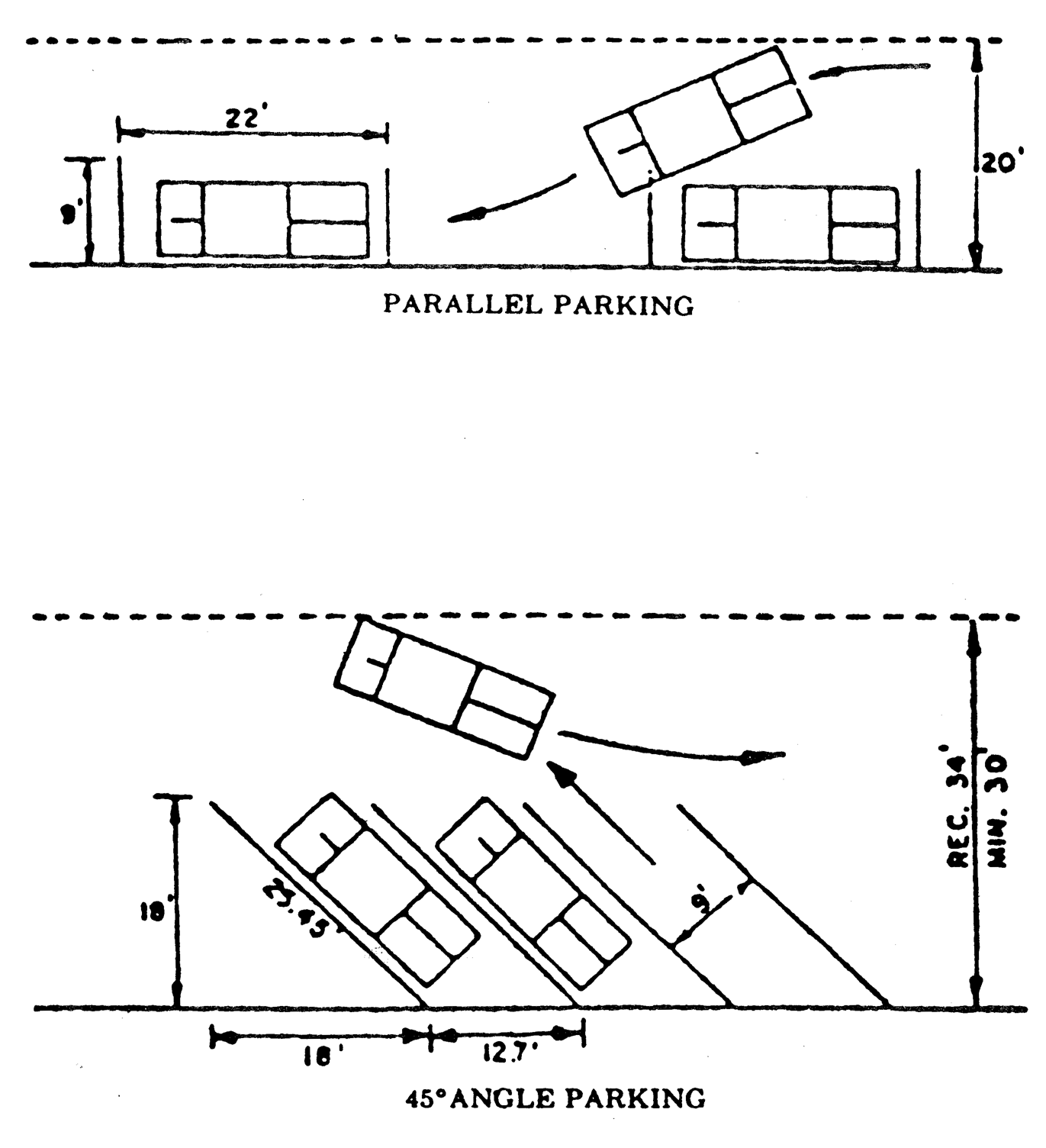
Angle Parking
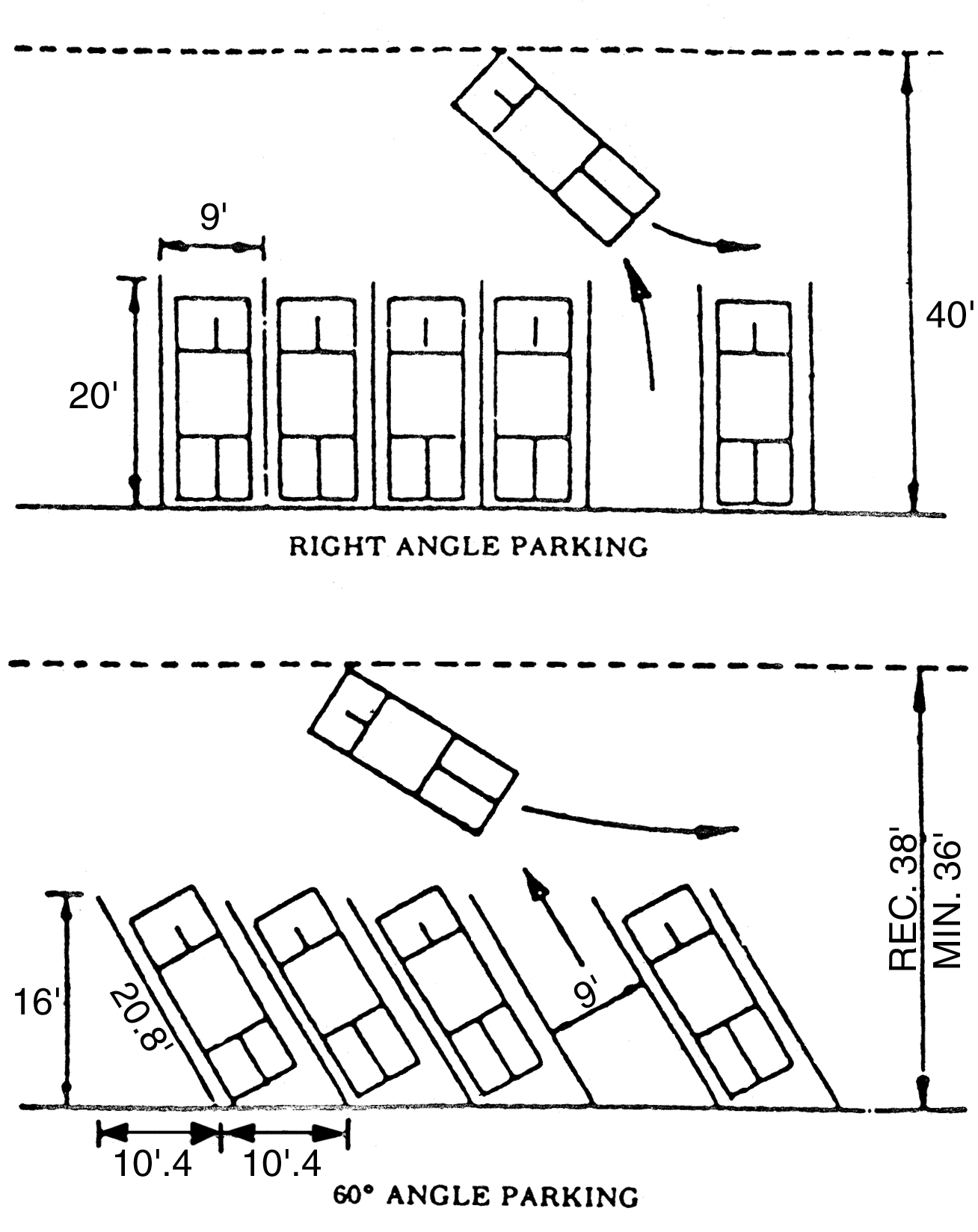
Angle Parking
(Code 1961, Ch. 43, § 8-101(j); Ord. No. 15,247, § 1, 2-17-87; Ord. No. 16,116, § 1(a), 11-19-91; Ord. No. 18,902, § 1(q), 7-15-03; Ord. No. 21,867, § 1, 5-19-20)
Sec. 36-512. - Commercial vehicle parking (prohibited).
(a)
Except as provided herein, no portion of any lot, tract or parcel of land zoned for residential usage, including districts "R-1" through "R-7a" and "MF-6" through "MF-24," shall be utilized for the parking of commercial vehicles with a load-carrying capacity of one (1) ton or greater.
(b)
For the purposes of this section, the following types of vehicles are expressly prohibited at any time:
(1)
All commercial tow vehicles or vehicle carriers.
(2)
Dump trucks, trash haulers, bulldozers and other earth haulers or excavation equipment.
(3)
Flatbed or stake bed trucks.
(4)
Trailers whose designed intent is storage or transport of material or equipment.
(5)
Trucks or buses used in inter- or intrastate commerce.
(6)
Vans, of one (1) ton or greater in load-carrying capacity.
(7)
School or church buses or vans of one (1) ton or greater in load-carrying capacity.
(8)
Street sweepers and vehicle-mounted vacuum devices intended for the cleaning of streets or parking lots.
(9)
Mobile canteen units.
(Ord. No. 15,842, § 1, 4-17-90; Ord. No. 15,905, §§ 1—3, 7-17-90; Ord. No. 16,341, § 1(cc), (dd), 1-19-93; Ord. No. 17,305, § 1(cc), 11-7-96; Ord. No. 21,168, § 1(c), 2-2-16)
Sec. 36-513. - Motor vehicle parking on residential properties.
(a)
Any portion of a lot, tract or parcel of land zoned for residential use may be utilized for the parking of motor vehicles unless prohibited by other provisions of the zoning ordinance.
(b)
For purposes of this section, "motor vehicle" means a passenger vehicle, truck, boat, camper, recreational vehicle, motorcycle, golf cart, all-terrain vehicle, trailer, or other similar vehicle. "Motor vehicle" does not include a motorized wheelchair, bicycle, tricycle or quadricycle. "Paved" means treated or covered with concrete, asphalt, pavers or other similar material and maintained in such a manner as to provide a mud-free and dustless surface.
(c)
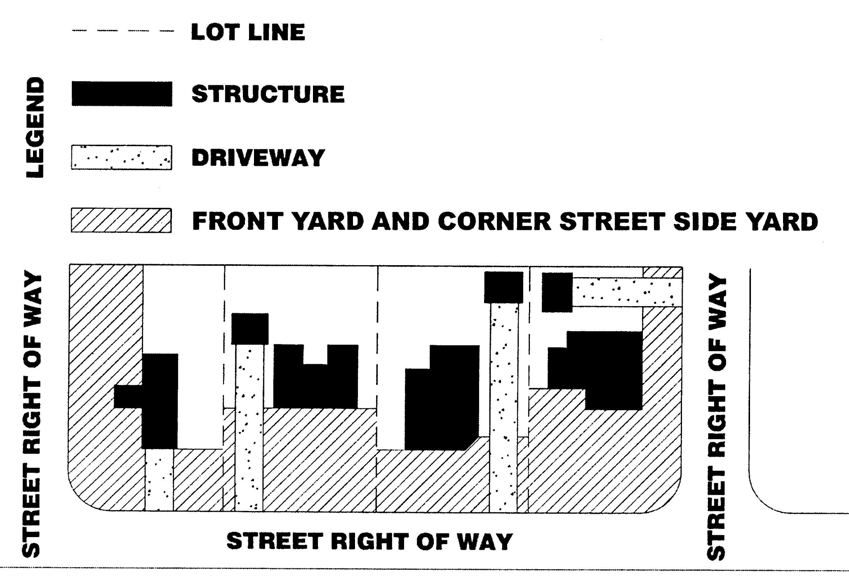
For purposes of this section, "front yard" and "corner street side yard" mean the open space between the pavement of the street and a line as established in this section, extending from one side of the lot to the opposite side of the lot.
As viewed from the street, the line shall start at a point on the left lot line, and shall extend parallel to the street to the nearest corner of the principal structure and then along the face of the principal structure to the right corner, and from that point on a line parallel to the street to a point on the right lot line (Figure 1).
(d)
No person, including any owner, tenant, manager, or occupant of property used as a residence, shall allow any person to, keep, store, or park any motor vehicle on any portion of a front yard or corner street side yard, as defined in subsection (c) of this section, except on a paved designated driveway area, an unpaved designated driveway area, or parking pad not to exceed twenty-five (25) percent of the front yard or corner street side yard. The unpaved, designated driveway area or parking pad must be surfaced with gravel or similar material or hard-packed in a manner that does not result in the creation of dust, mud, silt, or standing water. For purposes of this subsection:
(1)
A designated driveway area shall be defined as the clearly delineated and defined paved or unpaved path from the adjacent street to any garage or carport attached to the residence;
(2)
No more than twenty-five (25) percent of the front yard or corner street side yard shall be used for driveway and off-street parking purposes;
(3)
The restriction limiting parking area to twenty-five (25) percent of the front yard or corner street side yard shall not prohibit construction of a twenty (20) foot wide and twenty (20)-foot long driveway or driveway area;
(4)
The twenty-foot width limitation shall not apply to a paved or unpaved designated driveway, provided the driveway does not exceed the width of the garage or carport;
(5)
The twenty-foot length limitation shall not apply to a paved or unpaved designated driveway, provided the driveway does not exceed the distance from the adjacent street to the carport or garage;
(6)
The twenty-foot length limitation shall not apply to clearly delineated and defined paved or unpaved circular driveways;
(7)
Hard packed means any improved surface that is stabilized and provides appropriate dust control and limited permeability including pavers, concrete, asphalt, or other similar parking material;
(8)
Any parking pad that is not paved shall be delineated in some manner that clearly defines and identifies the boundaries of the parking area and does not exceed twenty-five (25) percent of the front yard or corner street side yard;
(9)
The provisions of this subsection shall not apply to special public events such as, but not limited to, football games at War Memorial Stadium, or the Arkansas State Fair and Livestock Exposition;
(10)
The provisions of this subsection shall not apply on nationally recognized holidays, or to special private events such as, but not limited to, a private party or reception, if the private event lasts no more than six (6) hours during one (1) calendar day;
(11)
Any individual seeking any additional paved or unpaved parking pad(s) may seek a variance pursuant to the guidelines in subsection (e); and
(12)
Any designated parking area shall comply with the obstruction provision of section 32-8 of the Code of Ordinances.
(e)
The board of adjustment may approve variances from the provisions established by this section provided the property owner can evidence a circumstance or hardship unique to the property. Applications to the board of adjustment for a variance shall consist of:
(1)
A cover letter addressed to the chairman and members of the board of adjustment setting forth the request;
(2)
A copy of all pertinent graphic materials or correspondence.
(f)
Nothing contained in this section is intended to nor shall be construed or interpreted to permit parking that is prohibited or restricted by any other provision of this Code.
(g)
No keeping, storing or parking of any motor vehicle in violation of this section shall be deemed to be nonconforming under article III of this chapter.
(h)
For purposes of this section, boats, boat trailers and camping trailers are prohibited from being parked/stored in the public right-of-way for a period exceeding twenty-four (24) hours. This does not include motorized or self-propelled recreational vehicles.
(Ord. No. 15,842, § 2, 4-17-90; Ord. No. 20,231, § 1, 3-2-10; Ord. No. 21,378, § 1, 3-21-17; Ord. No. 22,599, §§ 1, 2, 4-1-25)
Sec. 36-514. - Exclusion for public service and repair vehicles.
For the purposes of section 36-512, all vehicles engaged in public service work or repair services, such as utilities, drainage and/or street maintenance, delivery vehicles or contractors shall be exempt. This vehicle must be engaged in the service or repair rendered and not stored for use off-site. Further, any vehicle of a commercial nature that is on call for emergency service purposes, such as a utility repair van, shall be permitted at any time.
(Ord. No. 15,842, § 3, 4-17-90)
Sec. 36-515. - Variance.
The planning director may approve variances from the provisions established by section 36-512 provided the property owner can evidence a circumstance or hardship unique to the property. Appeals from the administrative judgement of the staff shall be filed with the board of adjustment. The content of the filing shall consist of: (1) a cover letter addressed to the chairman and members of the board of adjustment setting forth the request; (2) a copy of all pertinent graphic materials or correspondence. This filing shall occur within thirty (30) calendar days of the action by the staff.
(Ord. No. 15,842, § 4, 4-17-90; Ord. No. 16,116, § 1(y), 11-19-91)
Sec. 36-516. - Fences and walls.
(a)
Definition. In this section the words fence and wall are synonymous. Fence means a structure of wire, posts, boards, pickets or rails commonly used to border, secure or delineate a yard, field, lot or other land area.
(b)
Applicability. The provisions of this section shall apply to the placement of fences and walls upon both "use" and "zoned" sites. They may be erected so as to provide for expanded screening and fencing of nonconforming uses thereby reducing existing impact on adjacent properties. The residential, office, commercial and industrial standards below in subsections (e)(1), (2), and (3) are those districts set forth in article V of this chapter.
(c)
[Maintaining.] Except as provided herein no fence, wall, screen, hedge or other structure in the nature of a fence shall be erected or maintained in a position or placed so as to be dangerous or detrimental to the health or safety of the public or obstruct the view so as to endanger public traffic on a street.
(d)
Security fencing.
(1)
Barbed and razor wire fences. For purposes of this section the use of barbed, concertina wire or other types of wire specifically designed to inflict injury upon human contact is prohibited except when used at the top of fences at least six (6) feet above grade enclosing business or manufacturing premises. When such wire is used, it shall not extend outside the vertical plane of the enclosed property.
(2)
Electric fences. No electric fence shall be installed, operated or maintained except as provided in this subsection.
a.
Electric fences shall be constructed, maintained and operated in conformance with the specifications set forth in International Electrotechnical Commission Standard [No.] 60335-2-76.
b.
The electric charge produced by the fence upon contact shall not exceed energizer characteristics set forth in paragraph 22.108 and depicted in Figure 102 of International Electrotechnical Commission Standard No. 60335-2-76.
c.
Electric fences shall be completely surrounded on the side facing the property exterior by a nonelectrified fence or wall that is not less than six (6) feet in height and at least six (6) inches from the electric fence.
d.
Electric fences may be installed, operated or maintained only on industrial zoned properties with approved areas of outdoor storage or display.
e.
Electric fences shall be clearly identified with warning signs that read "Warning—Electric Fence" or similar terms and which are posted at intervals of not more than fifty (50) feet with at least one (1) sign on each exterior perimeter side of the fence.
f.
Each electric fence must have a switch or other approved device on the outside in the gate area to disarm the entire electric fence (for police and fire department access).
g.
No electric fence shall be installed until after certification from the planning and development department that the plans for the fence meet the requirements of this subsection and a permit is obtained for the fence.
(e)
[Height and area regulations.] Fences meeting zoning and subdivision ordinance setback requirements may be constructed to district height as permitted by this chapter 36. All others are as follows:
(1)
Residential fence and wall standards.
a.
Between a required building setback line and a street right-of-way, the maximum height shall be four (4) feet. Other fences may be erected to a maximum height of eight (8) feet.
b.
A decorative wall shall comply in the manner set forth for fences.
c.
A structural wall as defined in this chapter shall conform to the building setback required by the zoning district.
(2)
Office and commercial fence and wall standards.
a.
Between a required building setback line and a street right-of-way, the maximum height shall be six (6) feet. Other fences may be erected to a maximum height of eight (8) feet.
b.
A decorative wall shall comply in the manner set forth for fences.
c.
A structural wall as defined in this chapter shall conform to the building setback required by the district, except that those walls required to comply with benching on a cut or fill regulation of the City of Little Rock are exempt.
(3)
Industrial fence and wall standards.
a.
Between a required building setback line and a street right-of-way the maximum height shall be nine (9) feet. Other fences may be erected to a maximum height of nine (9) feet.
b.
A decorative wall shall comply in the manner set forth for fences.
c.
A structural wall as defined in this chapter shall conform to the building setback required by the district, except that those walls required to comply with benching on a cut or fill regulation of the City of Little Rock are exempt.
(f)
General provisions.
(1)
For purposes of erecting fences that are to serve as visual screening, plastic or metal slats woven into a chain-link fence are prohibited.
(2)
Any fence erected along a property line corner or within the fifty-foot triangle formed by the property line intersection shall comply with the obstruction provisions of section 32-8 of the Code of Ordinances.
(3)
All fences intended as screening fences to fulfill a code or site plan requirement shall place the decorative or face side toward the subject to be protected.
(4)
All fence or wall construction shall be placed in a manner that will not damage required landscape areas or obstruct access to utility easements.
(5)
Any fence, wall or other construction within public easements shall be constructed in a manner not to impede or otherwise restrict existing drainage patterns, both natural and man-made. No construction within a public easement is allowed without first obtaining required permits. Other ordinance requirements apply as found in section 36-176.
(6)
A fence erected for security or safety purposes shall not be construed to be expansion of a nonconforming use.
(7)
Support columns or support posts shall be permitted to exceed the allowable fence or wall height by no more than two (2) feet, including any ornamental features. Support columns or support posts shall have a maximum width of two (2) feet. There shall be a minimum distance of seven (7) feet six (6) inches between opposing faces of support columns or support posts which exceed the allowable fence or wall height, other than at gates or corners.
(g)
Appeals. Appeal of provisions of this section shall be to the board of adjustment.
(Ord. No. 17,234, § 1, 7-2-96; Ord. No. 18,324, § 1(aa), 8-1-00; Ord. No. 18,682, § 1(j)—(l), 5-21-02; Ord. No. 19,713, § 1(e), 3-6-07; Ord. No. 20,326, § 1(t), 9-21-10; Ord. No. 21,867, § 1, 5-19-20)

