
Livingston Parish City Zoning Code
CHAPTER 117
ZONING
Sec. 117-1.- General provisions.
[Reserved.]
(LPO 21-21, 8-26-2021; LPO 22-28, 6-23-2022)
Sec. 117-2. - Legislative intent.
(1)
The citizens of Livingston Parish, after completing a detailed planning process, have determined:
(a)
Livingston Parish is experiencing unprecedented growth in new residential and commercial development in the future. This growth far exceeds historical trends.
(b)
As a rural parish, Livingston Parish does not have an extensive infrastructure public investment to support development. If development is not carefully planned, the costs of roads, water systems, and sewer systems can quickly accelerate the pressure to raise taxes.
(c)
Livingston Parish occupies an extensive floodplain which can create serious construction and public safety problems with concentrated development.
(d)
If growth is not carefully managed, development may destroy the rural character of the parish. This character represents a valuable property right to the residents of the parish.
(2)
To protect property rights and manage public investments, the Parish Council has enacted this ordinance to establish a clear plan for growth in the parish.
(3)
The purpose of this ordinance is to protect public health and safety, increase property values, promote orderly development consistent with the character of the parish, and provide for the careful management of public investment and taxes.
(LPO 22-28, 6-23-2022)
Sec. 117-3. - Enactment.
Be it ordained by the Livingston Parish Council, pursuant to the authority of the Home Rule Charter powers granted by Louisiana Constitution article 6, section 5, wishes to exercise all its power allowed under the United States Constitution, the Louisiana Constitution, and R.S. 33:1236, as amended.
(LPO 22-28, 6-23-2022)
Sec. 117-4. - Jurisdiction.
(1)
The provisions of this ordinance shall apply to the unincorporated areas in Livingston Parish, Louisiana.
(2)
This ordinance shall be administered by the Livingston Parish Planning and Zoning Commission, established under Section 125-5: Livingston Parish Planning and Zoning Commission.
(LPO 22-28, 6-23-2022)
DIVISION 3.1 - (R-1.5) RESIDENTIAL - RURAL SINGLE FAMILY (INACTIVE)[2]
Editor's note—LPO 24-35, adopted February 27, 2025, amended the title of Div. 3.1 to read as herein set out. The former Div. 3.1 title pertained to (R-1.5) Residential - Rural Single Family.
DIVISION 5. - (R-3) GARDEN HOMES (INACTIVE)[3]
Editor's note—LPO 24-35, adopted February 27, 2025, amended the title of Div. 5 to read as herein set out. The former Div. 5 title pertained to (R-3) Garden Homes.
DIVISION 7. - (R-5) MULTI-FAMILY PLANNED UNIT DEVELOPMENT[4]
Editor's note—LPO 24-35, adopted February 27, 2025, amended the title of Div. 7 to read as herein set out. The former Div. 7 title pertained to (R-5) Residential - Multi-Family (Multi-Level Condominiums And Apartments).
DIVISION 8. - (MHP) MANUFACTURED HOME PARK[5]
Editor's note—LPO 24-35, adopted February 27, 2025, amended the title of Div. 8 to read as herein set out. The former Div. 8 title pertained to (MHP) Mobile Home Park.
DIVISION 9. - (MU) MIXED-USE PLANNED-UNIT DEVELOPMENT[6]
Editor's note—LPO 24-35, adopted February 27, 2025, amended the title of Div. 9 to read as herein set out. The former Div. 9 title pertained to (MU) Mixed-Use - Residential/Commercial.
DIVISION 10. - (SNB) SMALL NEIGHBORHOOD BUSINESS - SMALL BUSINESS[7]
Editor's note—LPO 24-35, adopted February 27, 2025, amended the Code by the repeal of former Div. 10, §§ 117-215, 117-216; said division pertained to (PDD) Planned Downtown Development - Mixed-Use Commercial/Residential and derived from LPO 21-21, adopted August 26, 2021. Former Divisions 11—18 have been renumbered, as herein set out, at the editor's discretion, for purposes of maintaining Code format.
DIVISION 11. - (C-1) LIGHT COMMERCIAL[8]
Editor's note—LPO 24-35, adopted February 27, 2025, contained provisions for renumbering former division 12, as herein set out. The title of newly renumbered Division 11 has been amended to read as herein set out; Former title pertained to (C-1) Commercial- Light Commercial.
DIVISION 12. - (C/I) - COMMERCIAL/LIGHT INDUSTRIAL[9]
Editor's note—LPO 24-35, adopted February 27, 2025, contained provisions for renumbering former division 13, as herein set out. The title of newly renumbered Division 12 has been amended to read as herein set out; Former title pertained to (C-2) Commercial- Heavy Commercial.
DIVISION 13. - (I-2) INDUSTRIAL - HEAVY INDUSTRIAL[10]
Editor's note—LPO 24-35, adopted February 27, 2025, amended the Code by the repeal of former Div. 14, §§ 117-255-117-257; said division pertained to (I-1) Industrial - Light Industrial and derived from LPO 21-21, adopted August 26, 2021. Former Division 15 has been amended, and renumbered as herein set out, at the editor's discretion, for purposes of maintaining Code format.
DIVISION 14. - (APT) AIRPORT - AIRPORT OVERLAY;[11]
Editor's note—LPO 24-35, adopted February 27, 2025, contained provisions for renumbering former division 16, as herein set out. The title of newly renumbered Division 14 has been amended to read as herein set out; Former title pertained to (APT) Airport - Airport.
DIVISION 15. - (HIST) - HISTORICAL BUILDINGS OVERLAY[12]
Editor's note—LPO 24-35, adopted February 27, 2025, contained provisions for renumbering former division 17, as herein set out. The title of newly renumbered Division 15 has been amended to read as herein set out; Former title pertained to (H-1) Historical - Historical Buildings.
DIVISION 16. - (RR) RIVERFRONT RESIDENTIAL[13]
Editor's note—LPO 24-35, adopted February 27, 2025, contained provisions for renumbering former division 18, as herein set out. The title of newly renumbered Division 16 has been amended to read as herein set out; Former title pertained to (UC) Unclassified - Residential and Commercial.
DIVISION 17. - (CO) CONSERVATION OVERLAY[14]
Editor's note—LPO 24-35, adopted February 27, 2025, contained provisions for the addition of Division 18, §§ 117-298—117-300; Said provisions have been renumbered as Division 17, §§ 117-300-117-302, as herein set out, and at the editor's discretion, for purposes of maintaining Code format.
DIVISION 6. - (ERP) EXPEDIATED RE-ZONING PERMIT - RESIDENTIAL, COMMERCIAL, INDUSTRIAL[15]
Editor's note—LPO 24-35, adopted February 27, 2025, renumbered the former Division 5, § 117-345, as Division 6 as set out herein.
Sec. 117-30. - Administrative official.
The administrative official shall be director of the planning and zoning department, or his designee as appointed by the Parish Council. He may be provided with the assistance of such other persons as necessary. If the director of the planning and zoning department finds that any of the provisions of these regulations are being violated, he shall notify in writing the persons responsible for such violation, indicating the nature of the violation and ordering the action necessary to correct it. He shall order discontinuance of illegal use of land, buildings, or structures; removal of illegal buildings or structures, or of additions, alterations, or structural changes thereto; discontinuance of any illegal work being done; or shall take other action authorized by these regulations to ensure compliance with or to prevent violation of its provisions.
(LPO 22-28, 6-23-2022)
Sec. 117-50. - Amendments or changes to the development regulations or district map.
(a)
The Parish Council may, from time to time, amend, supplement or change the regulations, restrictions, zoning districts, or boundaries as subsequently established in accordance with the provisions of this division.
(b)
No amendment, supplement or change of the development regulations shall become effective unless and until there shall have been held a public hearing in relations thereto before the planning and zoning commission at which parties in interest and citizens shall have had an opportunity to be fully heard.
(c)
Notice of such public hearings by the planning and zoning commission shall give the time and place of hearing and shall be published once a week in three (3) different weeks in the official journal of the Parish, together with a similar publication in a newspaper of general circulation in the area wherein the property is located, as determined by the Director of Planning and Development. At least thirty (30) days' notice of time and date of the public hearing shall be published in the official journal.
(LPO 22-28, 6-23-2022; LPO 22-65, 1-12-2023; LPO No. 23-29, 8-10-2023)
Sec. 117-51. - Amendments, changes, or variances.
Amendments, changes, or variances shall be initiated in the following ways:
(1)
By action of the Parish Council itself by introduction of an ordinance or by adoption of a resolution or motion;
(2)
Upon recommendation by the Planning and Zoning Commission, after determination by the Planning and Zoning Department Director that the amendment, or supplement or change to the regulations, restriction, zoning district or boundaries should be made.
(LPO 22-28, 6-23-2022)
Sec. 117-52. - Notice requirements.
(a)
Posted notice. For all proposed changes, except comprehensive zoning changes and text changes, a printed notice in bold type shall be posted for not less than ten (10) consecutive days prior to the public hearing conducted by the Parish Planning and Zoning Commission on signs not less than one (1) square foot in area, prepared, furnished, and placed by the director of planning and zoning or his designated appointee upon the principal and accessible rights-of-way adjoining the area proposed for a zoning change. Said signs shall contain the case number, the time and place of the public hearing as provided above. The Parish Council shall take no action until it has received the final reports of the Planning and Zoning Commission.
(b)
No such posting is required of the area within or adjoining an area to be affected by any proposed changes provided there is compliance with the publication requirement set above.
(c)
Comprehensive rezoning proposals need be posted under the requirements set out above only within the area to be affected in general geographic terms and need not list the specific zone proposed for all land within that area. The Planning and Zoning Commission may then adopt the final map after a public hearing on a ward of comprehensive rezoning area zoning change.
(d)
Mailed "abutter notice".
(1)
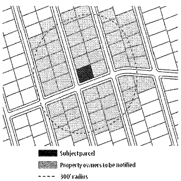
In addition to the above posted notice, notice setting forth the date, time, place and purpose of the public hearing, a general description of the proposal, and location of the subject property shall be mailed to all property owners by regular mail within three hundred (300') feet, measured radially from the lot lines of the subject property (as depicted in the figure below), as listed in the online GIS Parcel Viewer records of the Parish Assessor, at least twenty (20) calendar days before the public hearing by the Department of Planning and Development.
(2)
No amendment, supplement, or change to any zoning classification, regulation, map, district or boundary or denial by the Livingston Parish planning and zoning commission or Parish Council of any application, petition or other matter requiring notice shall be declared invalid by reason of any defect in the abutter notice described above. No further research, other than that provided for within this section shall be necessary, and no mistake in the assessor's records shall cause any action by the Livingston Parish Planning and Zoning Commission or Parish Council to be declared invalid.
(LPO 22-28, 6-23-2022; LPO No. 25-06, 5-8-2025)
Sec. 117-53. - Voting.
(a)
Any amendment that has failed to receive the approval of the Planning and Zoning Commission shall not be passed by the Parish Council except by the affirmative vote of a simple majority of the legislative body.
(b)
A final yea and nay vote shall have been taken on the proposal by the Parish Council within one hundred twenty-five (125) days dated from the introduction of an ordinance in correct form.
(c)
In case, however, of a protest against such change signed by the owner of twenty (20) percent or more either of the area of the lots included in such proposed change, or in those immediately adjacent, extending two hundred (200') feet from said lot, or those directly opposite thereto extending five hundred (500') feet from the street frontage of such opposite lots, such amendments shall not become effective except by the favorable vote of at least a simple majority of the governing body.
(d)
After published notice, the parish council may hold any public hearing required by this article or the state statutes pertaining to land use jointly with any public hearing required to be held by the Parish Planning Commission, but the Parish Council shall not take action until it has received the final report of the Zoning Commission.
(e)
Whenever a petition or application for a site or cumulative acreage of less than twenty (20) acres is filed requesting or proposing a zoning change to these regulations and said petition or application has been received, officially advertised and subsequently a public hearing has been held, the Parish Council shall not consider any further petition or application requesting or proposing such change for the same property within one (1) year from the date of the Parish Council's final action on said petition or application. The provisions of this subsection shall not apply in cases where the Parish Council wishes to consider a comprehensive zoning revision of an area.
(f)
Whenever a proposed change has been forwarded to the Parish Council with a recommendation for approval, and no protest or appeal has been filed with the Department of Planning and Development and permits as outlined in these regulations, the proposed change shall be placed upon the consent agenda for final adoption at the next appropriate Parish Council meeting.
(LPO 22-28, 6-23-2022)
Sec. 117-54. - Fees.
The fees to be collected for Zoning under this chapter shall be as provided in amounts as established by the Parish Council from time to time.
No permit or certificate shall be issued, and no inspection, public notice or other action relative to zoning, petitions for changes in zoning, or appeals shall be instituted until after such fees, costs and charges have been paid. When in accordance with the provisions of this section a fee is paid and application is filed, there shall be no return of any funds, regardless of the governing body's determination in the matter involved. In the event that the Planning Commission determines that the rezoning application was filed in error because the rezoning was not necessary or the landowner already had an established nonconforming use, then the Planning and Zoning Commission can recommend to the Council that the application fee be refunded.
(LPO 25-31, 1-22-2026)
Sec. 117-85. - Definition.
The following words, terms and phrases, when used in this Section, shall have the meanings ascribed to them in this Section, except where the context clearly indicates a different meaning:
Nonconformities: A nonconformity shall be defined as any existing use, lot, or structure that was established, but as a result of the adoption of, or amendments to this zoning ordinance and a Livingston Parish zoning map, does not meet the current standards of the ordinance or the adopted zoning map.
(LPO 23-06, 4-27-2023)
Sec. 117-86. - Nonconforming uses.
(a)
Nonconforming uses shall be those established existing uses of property that do not conform with the requirements of the zoning district in which they are located.
(b)
Existing and established nonconforming uses may be allowed to continue and be transferred.
(c)
Non existing non established nonconforming uses must meet the requirements of the zoning ordinance and zoning map.
(LPO 23-06, 4-27-2023)
Sec. 117-87. - Conditional uses.
Conditional uses are land uses permitted within a zoning district only with approval from the zoning authority, subject to conditions that mitigate potential impacts. Conditional uses are typically appropriate in the district but may create adverse effects on by-right uses if overly concentrated or situated improperly. For instance, while R-1 districts are primarily for single- family residential use, a convenience store (without gas) may be permitted as a conditional use to support nearby residents. This designation balances community needs with protections against disruptions such as noise, traffic, or activities incompatible with residential areas.
(LPO 24-35, 2-27-2025)
Sec. 117-95. - Nonconforming lots.
Nonconforming lots may be subdivided, developed, and permitted to conform to the requirements of the zoning district in which they are located.
(LPO 23-06, 4-27-2023)
Sec. 117-96. - Nonconforming structures.
Existing nonconforming structures, established previous to the adoption of this Division and Livingston Parish Zoning Map may be allowed to continue, be transferred, and may be permitted to be enlarged, extended, reconstructed, or structurally altered.
New structures must adhere to the zoning ordinance and/or zoning map.
(LPO 23-06, 4-27-2023)
Sec. 117-125. - Definitions.
The following words, terms and phrases, when used in this division, shall have the meanings ascribed to them in this section, except where the context clearly indicates a different meaning:
Accessory dwelling unit (ADU). A secondary, self-contained residential unit located on the same lot as a primary dwelling. Accessory dwelling units may be attached to the primary home, such as a garage apartment, or detached, as a separate structure. ADUs are typically smaller in size than the main residence and include independent living facilities, such as a kitchen, bathroom, and sleeping area. They are intended to provide additional housing options, often for family members, tenants, or caregivers, while maintaining the residential character of the property. In order to protect the character of the zones where ADUs are allowed, strict site requirements are in place in this code to ensure an appropriate density and setbacks are established for ADUs.
Accessory use. A secondary use of a building, structure, or parcel of land incidental to the primary use. Example: A single-family dwelling on a residential lot where the primary use is housing for a family, as opposed to an accessory use such as a home office.
Adult membership club. See gentlemen's club.
Adult video/book store/gift shop. A commercial establishment which has significant or substantial portion of its stock-in trade or derives a significant or substantial portion of its revenues or devotes a significant or substantial portion of its interior business or advertising, or maintains a substantial section of its sales or display space to books, magazines, movies, and other visual representations or paraphernalia characterized by an emphasis on explicit sexual content. The terms "adult video store," "adult gift shop," and "adult bookstore" shall also include a commercial establishment which regularly maintains one (1) or more "adult arcades."
Airbnb. See Small-scale overnight lodging. Apartment. See Multi-family dwelling
Attached house. A residential dwelling unit that shares one or more common walls with adjacent units, typically in the form of townhouses, condominiums, or row houses. Each attached home is individually owned, but the structure is designed with shared walls or other architectural features, often within a planned development or community. Attached houses may have their own private entrance, yard, or garage, and typically offer a higher density than detached single-family homes. For the purposes of this code, "attached houses" are one- or two-stories, and are typically more in line with the development style of "single- family" than "multi-family" residential, as defined below.
Bank. See Financial institution.
Bed and breakfast. A small, owner-occupied or owner-managed lodging establishment offering overnight accommodations and breakfast to guests, typically within a residential- style building. Bed and breakfasts provide a limited number of guest rooms and are intended for short-term stays, often in a home-like setting, with guest services that may include meals, housekeeping, and local hospitality. Bed and breakfasts are included in "small-scale overnight lodging."
Business services. A category of commercial establishments that provide support services to other businesses and individuals, typically involving professional, administrative, or technical assistance rather than retail sales of goods. Business services may include printing and copying centers, mailing and shipping services, equipment rental, staffing agencies, and business consulting. These establishments primarily serve local businesses and residents and may include limited on-site customer interactions.
Canning and bottling plants. Facilities involved in the production, preservation, and packaging of food and beverage products for commercial distribution. Food and beverage processing facilities often include moderate-scale industrial operations with a focus on health and safety standards and are typically suitable for medium- to high-intensity industrial zones.
Cemetery. A parcel of land designated and used for the burial of the deceased, including interment of human remains and cremains. Cemeteries may include graveyards, columbaria, mausoleums, memorial gardens, and other related structures or spaces.
Church. See House of worship.
Civic and municipal uses. Facilities or land used for government functions and public services that are essential to the operation of the community. Civic and municipal uses include city halls, courthouses, police and fire stations, libraries, and community centers.
Clinic. A facility offering outpatient medical, dental, psychiatric, or other health-related services to individuals, typically for diagnosis, treatment, or preventive care. Clinics may include primary care offices, urgent care centers, dental offices, physical therapy centers, and similar establishments but do not provide inpatient services or extensive diagnostic and surgical facilities like hospitals
Commercial parking lots and garages. See Parking lots and garages, commercial. Commercial self storage. See Self-storage, commercial.
Conditional use. A land use or structure that is permitted within a zoning district under specific conditions or restrictions and subject to review and approval by the zoning authority. Conditional uses are intended to ensure compatibility with surrounding uses and to mitigate any potential impacts.
Convenience store with gas. A retail establishment offering a limited range of everyday items, including groceries, snack foods, beverages, and other convenience goods, typically located in a single building of relatively small size. Convenience stores with gas may include accessory services such as vehicle maintenance, car washes, and retail sales of automotive products and these establishments may have fuel pumps.
Convenience store without gas. A retail establishment offering a limited range of everyday items, including groceries, snack foods, beverages, and other convenience goods, typically located in a single building of relatively small size. Convenience stores without gas shall not include fuel pumps.
Day care facility. A licensed facility providing care, supervision, and early childhood education for children, typically during standard working hours. Day care facilities may include indoor and outdoor play areas and are regulated by state and local standards for health and safety. For the purposes of this code, day care operations as accessory uses to a home are governed as "small businesses."
Distribution center. See Warehousing and distribution center. Educational facility see School.
Financial institution. A business establishment primarily engaged in financial transactions, including the management, investment, lending, and safekeeping of money. Financial institutions include banks, credit unions, savings and loan associations, and other entities offering services such as deposits, loans, investments, and currency exchange. These facilities may also provide automated teller machine (ATM) services and other customer banking amenities.
Garage, commercial. See Parking lots and garages, commercial. Gas station. See Convenience store with gas.
Gentlemen's club. A commercial establishment where adult entertainment is provided in the form of live performances, typically involving partial or full nudity.
Hazardous material storage. Facilities designated for the bulk storage and handling of hazardous materials, including flammable, corrosive, or toxic substances. Hazardous material storage requires strict environmental and safety controls due to potential risks and impacts, and such facilities are typically located in high-intensity industrial zones with specific regulatory oversight. Examples include petroleum storage facilities, liquid propane storage tanks, chemical storage facilities, and bulk fuel storage depots.
Heavy manufacturing and processing. Facilities focused on large-scale manufacturing, processing, or treatment of raw materials or goods, often involving heavy machinery and substantial environmental or operational impacts. Heavy industrial uses typically require zoning that can accommodate high levels of noise, emissions, and waste byproducts and are generally located in areas separated from residential or commercial zones. Examples include smelters (metal melting and purification), concrete plants (manufacturing of concrete products), chemical processing facilities, and large-scale manufacturing plants.
Home occupation. A business or professional service conducted entirely within a residential dwelling by its occupants, secondary to the use of the dwelling for residential purposes.
Home occupations may include services such as online sales, tutoring, small-scale arts and crafts production, and professional consulting, provided they do not substantially change the character of the dwelling or create disturbances for neighbors. Home occupations are generally limited in scope to avoid high levels of customer traffic, noise, or other impacts that could affect the residential nature of the area.
Hospital. A facility providing medical, surgical, psychiatric, and other health services for the treatment of individuals requiring inpatient or outpatient care. Hospitals are equipped with specialized staff, diagnostic equipment, and facilities for both acute and long-term medical care. This category does not include clinics, which are, primarily providing outpatient care. See Clinic for details.
Hotel. A commercial establishment offering accommodations, dining, and other guest services on a larger scale, typically with a significant number of rooms available for rent. Hotels are generally managed by dedicated staff and may provide a range of amenities, including restaurants, event spaces, fitness centers, and concierge services.
House of worship. A building or structure primarily used for religious ceremonies, worship services, and other activities associated with faith-based gatherings. A house of worship includes churches, temples, synagogues, mosques, parish houses, rectories, and similar places intended for communal religious practice. It may also include accessory uses such as fellowship halls, classrooms, offices for clergy, and areas for social outreach programs.
Indoor recreation facility. An enclosed facility designed for recreational, fitness, or entertainment activities that take place entirely indoors. Indoor recreation facilities may include amusement and activity centers such as trampoline parks, laser tag arenas, escape rooms, miniature golf courses, indoor climbing walls, and similar attractions. These facilities are typically open to the public or available for private rentals and are designed to accommodate groups of participants in a controlled, climate-protected environment.
Landfill. A site designated for the disposal of waste materials by burial, regulated to prevent environmental contamination and adverse health impacts. Landfills may be used for the disposal of municipal solid waste, construction debris, and other approved types of waste.
Large-scale overnight lodging. See Hotel.
Light manufacturing and processing. Facilities engaged in small- to medium-scale industrial activities involving the manufacturing, processing, assembly, or repair of goods or equipment, typically with moderate environmental impacts. Light industrial uses are generally compatible with lower-intensity industrial zones and may include activities that generate limited noise, traffic, or emissions. Examples include machine shops (where metal parts are cut and shaped), equipment and machinery repair shops, small-scale assembly plants, and custom fabrication shops.
Livestock. Domesticated animals raised for agricultural purposes, including but not limited to cattle, horses, sheep, goats, poultry, and swine. Livestock are typically housed and cared for on farms or ranches and may be subject to specific zoning restrictions in residential areas.
Major utility. Large-scale infrastructure systems and facilities that provide essential services to the public. Major utilities serve broad geographic areas and are generally located in designated zoning districts to minimize impacts on residential areas. Major utilities include electricity generation plants, water treatment facilities, and regional wastewater treatment facilities. Major utilities include communications towers; note that additional citing and sizing requirements for telecommunication towers are described in Section 130-1 of the Livingston Parish Code of Ordinances.
Manufactured homes. Manufactured homes are built in the controlled environment of a manufacturing plant and are transported in one or more sections on a permanent chassis. For the purposes of this code, references to "manufactured" or "mobile" homes indicate structures constructed according to the U.S. Department of Housing and Urban Development (HUD) Code. This federal code requires manufactured homes to be built on a permanent chassis, allowing them to be transported and potentially relocated. Unlike modular homes, manufactured homes follow HUD regulations and are not subject to state or local building codes. See Sec. 117-196 for site and structure provisions for manufactured/mobile homes.
Material storage yards. Outdoor or partially enclosed facilities dedicated to the storage, sale, or distribution of construction materials, equipment, or other goods. Material storage yards typically have moderate operational impacts and involve heavy vehicle traffic due to loading and unloading activities. These yards are compatible with medium-intensity industrial zones and are often located near construction or commercial areas. Examples include lumber yards (storage and sale of wood products), contractor yards (storage of construction equipment and materials), non-hazardous storage yards for building materials, and metal yards for bulk metal storage and distribution.
Memorial garden. See Cemetery.
Metal works and salvage operations. Facilities that specialize in metal processing or the dismantling and repurposing of various materials. These operations often include activities that produce noise, dust, or emissions and may involve the recycling of metals and other reusable materials. Metal works and salvage operations generally require specific environmental controls and are suitable for medium- to high-intensity industrial zones. Examples include metal fabrication shops (cutting, welding, and assembling metal structures), salvage yards (dismantling vehicles or appliances for parts), and recycling facilities specializing in metal processing.
Microbrewery. A small-scale brewery focused on producing limited quantities of craft beer, often for local distribution or on-site sales and consumption. Microbreweries typically have a production capacity of fewer than 15,000 barrels annually and may include a taproom or tasting area for direct customer sales. Unlike large-scale breweries, microbreweries emphasize unique or experimental brews and community-oriented operations, generally without large distribution networks or mass-market production.
Minor utility. Small-scale utility structures and facilities that provide essential services to local areas or neighborhoods. Minor utilities include neighborhood wastewater treatment facilities, neighborhood-scale electric substations, and telecommunications relay facilities, which are generally located close to the communities they serve. Neighborhood-scale electric substations are defined as substations designed to serve a limited residential area, with minimal visual and noise impacts, and that are appropriately scaled to integrate into residential neighborhoods. Larger substations, which may have significant visual, noise, or operational impacts, are not considered minor utilities and may require review as a conditional use or fall under the category of major utilities
Modular homes or modulars. Modular homes are factory-built residential structures constructed in sections, or modules, within a controlled manufacturing environment and assembled on-site. Unlike manufactured homes, modular homes are built to comply with the same state, local, or regional building codes as traditional site-built homes. Modular homes may be transported with or without a chassis, depending on installation requirements, and are generally intended to be permanently placed on a foundation. This distinction recognizes modular homes as structurally comparable to site-built homes, though they benefit from the efficiencies of off-site construction. See Sec. 117-196 for site and structure provisions for modular homes.
Multi-family dwelling. A building or complex consisting of multiple residential units, typically for rental purposes, where each unit is self-contained with its own living spaces, such as bedrooms, bathrooms, and kitchen. Apartments are usually located in larger buildings with shared common areas, and residents do not own their individual units. Multi- family dwellings may include both low-rise and high-rise buildings designed for high- density residential use, often with amenities like parking, laundry facilities, and recreational spaces.
Office. A building or portion of a building used for conducting business, professional, or administrative activities. Offices may include spaces for corporate headquarters, professional services (such as legal, accounting, or consulting), administrative functions, and other non-retail operations. Office facilities are generally designed to accommodate employees and clients in a setting that may include individual workspaces, meeting rooms, and reception areas.
Parking lots and garages, commercial. Facilities designed for the parking and temporary storage of vehicles, operated as a business that charges a fee for usage. Commercial parking lots and garages may include surface parking areas, multi-level parking structures, and automated parking systems. These facilities are generally open to the public or leased for specific users, such as employees or customers, and do not include vehicle maintenance or repair services as part of their primary function. For the purposes of the zoning code, commercial parking lots and garages will also include commercial parking and storage of boats in addition to automobiles.
Primary use. The main or predominant use of a building, structure, or parcel of land. Example: A single-family dwelling on a residential lot where the primary use is housing for a family, as opposed to an accessory use such as a home office.
Restaurant. An establishment where food and beverages are prepared, served, and consumed primarily on-site by customers. Restaurants may include a variety of dining formats, such as full-service, fast-casual, and quick-service, with seating areas for patrons. Some restaurants may also offer takeout, delivery, or drive-through services as secondary functions. This category may encompass establishments with or without alcohol service, depending on zoning regulations.
Retail. A category of establishments primarily engaged in the sale of goods and merchandise directly to consumers for personal or household use. Retail businesses may include stores, shops, and outlets offering a range of products such as clothing, electronics, groceries, furniture, and other consumer goods. These establishments typically involve direct, on-site customer interactions and may include ancillary services such as delivery or minor repairs associated with the goods sold.
School. A public or private institution that provides education, instruction, and training to children, adolescents, and/or adults. Schools include primary and secondary schools, colleges, universities, and vocational training centers, but do not include home schools or daycare facilities.
Self-storage, commercial. A facility offering secure, individual storage units or spaces rented to the public for personal or business use on a short- or long-term basis. Commercial self-storage facilities are typically used for storing personal belongings, furniture, equipment, and inventory, and are not intended for residential occupancy, manufacturing, or retail sales. Access to units may be provided via interior hallways or exterior doors, with varying levels of security and climate control.
Single-family dwelling, detached. For the purposes of this code, a single-family dwelling is a building designed for and occupied exclusively as a single residential unit by one family built on-site or in sections off-site (modular construction) to comply with state, local, and/or regional building codes applicable to traditional site-built homes. Single-family dwellings are permanently affixed to a foundation and do not include mobile or manufactured homes constructed on a chassis, nor do they adhere to the federal HUD Code for manufactured housing.
Small business. A commercial enterprise that operates on a small scale but is not restricted to a residential dwelling. A small business may be located in any appropriately zoned district, allowing it a larger operational scope than a home occupation, with potential for moderate customer traffic, signage, and visible business activities. Small businesses may include retail stores, service providers, small offices, and other enterprises that contribute to local commerce while adhering to zoning restrictions on size, impact, and use.
Small-scale overnight lodging. A category of lodging facilities that offer short-term accommodations in a smaller, often more personalized setting. Small-scale overnight lodging includes bed and breakfasts, boutique hotels, and short-term rentals (such as those available through platforms like Airbnb). These establishments typically have a limited number of guest rooms, are often owner-operated or managed on-site, and may provide minimal guest services compared to larger hotels, focusing on a home-like or unique hospitality experience. This category does not include hotels.
Synagogue. See House of worship. Temple. See House of worship.
Transportation facilities. Facilities designated for the storage, transfer, or maintenance of transportation vehicles and goods. Transportation facilities play a critical role in logistics and distribution networks and are often located near transportation corridors. They may accommodate high vehicle traffic and loading activities and are generally situated in industrial or high-intensity commercial zones. Examples include railroad yards (storing and sorting train cars), transportation terminals for trucks or buses, shipping and distribution hubs, and intermodal freight terminals.
Upper-story living. Residential units located on the upper floors of a mixed-use building, with commercial or non-residential uses occupying the ground floor. Upper-story living provides housing above retail, office, or other commercial spaces, allowing for a combination of residential and commercial activities within a single structure. This arrangement is designed to support walkable, mixed-use areas by integrating residential and commercial uses in close proximity.
Warehousing and distribution center. A facility primarily used for the storage, handling, and distribution of goods, products, or materials. Warehousing and distribution centers are designed to receive, store, and ship large quantities of goods, often supporting logistics and supply chain operations. These facilities may include loading docks, storage racks, and space for packaging or sorting items but do not typically engage in on-site retail sales to the general public. For the purposes of the zoning code, warehousing and distribution centers are categorized as small- or large-scale. Small-scale distribution centers are limited to 50,000 gross square feet of area per lot. Large-scale distribution centers are those with gross square feet of area per lot over fifty thousand (50,000) square feet.
(LPO 24-35, 2-27-2025)
Sec. 117-126. - Zoning map.
Livingston Parish Zoning Map
Adopted February 27, 2025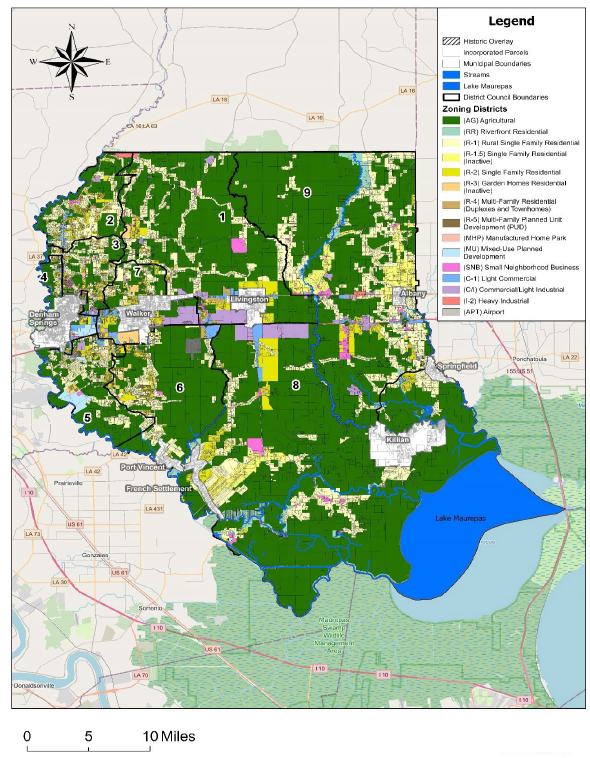
(LPO 24-35, 2-27-2025)
Sec. 117-135. - Purpose.
The purpose of (AG) is to promote the growth of agricultural development and is intended to protect farming, ranching and timberland harvesting. This district allows for low-density residential use, as well as select commercial and industrial uses that promote and are compatible with agricultural uses. All lots created by subdivision in AG shall be a minimum of three (3) acres.
(LPO 21-21, 8-26-2021; LPO 24-35, 2-27-2025)
Sec. 117-136. - Permitted uses.
(a)
Allowed primary uses:
(1)
Detached single-family dwellings
(2)
Manufactured/mobile homes and modular homes
(3)
Growing of crops (commercial and noncommercial)
(4)
Timberland harvesting
(5)
Livestock (commercial and noncommercial)
(6)
Major and/Minor utilities
(7)
Civic and municipal uses
(8)
Schools
(9)
Cemeteries and/or memorial gardens
(10)
Day care facilities
(11)
Convenience stores (without gas)
(12)
Houses of worship
(13)
Public parks, playgrounds, playfields, and parkways
(14)
Country clubs/golf courses.
(b)
Conditional primary uses:
(1)
Convenience stores with gas
(c)
Permitted accessory uses:
(1)
Home occupations and small business (see definitions)
(2)
Garages
(3)
Tennis courts, swimming pools, garden homes, tool sheds
(4)
Public parks, playgrounds, playfields, and parkways
(5)
Minor utilities
(6)
Microbreweries
(7)
Individual boat or camping trailer storage
(8)
Accessory dwelling units (ADUs): one ADU may be placed either within the principal building or an accessory building provided the ADU shall not exceed eight hundred (800') square feet
(d)
Not allowed.
(1)
Landfills
(2)
Gentlemen's clubs/private adult membership clubs
(3)
Adult video/book stores and adult gift shops
(LPO 21-21, 8-26-2021; LPO 24-35, 2-27-2025)
Sec. 117-137. - Site and structure provisions.
Minimum Lot Size (new subdivision): three (3) acres
Required Minimum Building Line Setbacks:
Front Yard: twenty-five (25') feet.
Rear Yard: twenty (20') feet.
Side Yard: All lots shall have a minimum seven (7') foot setback.
Lot width: one hundred sixty (160') feet at road frontage.
Manufactured and Mobile Homes: see standards of Sec. 125-181
(LPO 21-21, 8-26-2021; LPO 24-35, 2-27-2025)
Sec. 117-145. - Purpose.
The purpose of (R-1) is to permit low-density single family residential development on individual lots. This District also allows for small business and some agricultural uses. All lots created by subdivision in R-1 shall be a minimum of one (1) acre.
(LPO 21-21, 8-26-2021; LPO 22-31, 7-14-2022; LPO 24-35, 2-27-2025)
Sec. 117-146. - Permitted uses.
(a)
Permitted primary uses:
(1)
Detached single-family homes
(2)
Manufactured/mobile homes and modular homes
(3)
Minor utilities
(4)
Civic and municipal uses
(5)
Schools
(6)
Cemeteries and/or memorial gardens
(7)
Day care facilities
(8)
Hospitals and clinics
(9)
Houses of worship
(10)
Public parks and open spaces, playgrounds, playfields, and parkways
(11)
Country clubs/golf courses
(b)
Conditional primary uses.
(1)
Convenience stores without gas
(2)
Small businesses
(c)
Permitted accessory uses:
(1)
Home occupations (see definitions)
(2)
Individual boat or camping trailer storage
(3)
Tennis court, swimming pools, tool sheds, pergolas, barbecue ovens and similar accessory structures and uses customary to residential uses
(4)
Public parks and open spaces, playgrounds, playfields, and parkways
(5)
Accessory dwelling units (ADUs): one ADU may be placed either within the principal building or an accessory building provided the ADU shall not exceed eight hundred (800') square feet.
(d)
Not Allowed:
(1)
Landfills.
(2)
Gentlemen's clubs/private adult membership clubs.
(3)
Adult video/book stores and adult gift shops.
(LPO 21-21, 8-26-2021; LPO 22-31, 7-14-2022; LPO 24-35, 2-27-2025)
Sec. 117-147. - Site and structure provisions.
Minimum Lot Size (new subdivisions): one (1) acre
Minimum Lot Width: eighty (80') feet
Required Minimum Building Line Setbacks:
Front Yard: twenty-five (25') feet
Rear Yard: thirty (30') feet
Side Yard: seven (7') foot setback
Building Height: maximum thirty-five (35') feet.
Manufactured and Mobile Homes: see requirements of Sec. 125-181
(LPO 21-21, 8-26-2021; LPO 22-31, 7-14-2022; LPO 24-35, 2-27-2025)
Sec. 117-148. - Purpose.
The purpose of (R-1.5) is to permit low-density single family residential development on individual lots. This District also allows for small business and some agriculture uses. All lots in the development shall have a maximum density of two (2) housing units per acre with a minimum lot size of one half (.50) acre.
(LPO 22-32, 7-14-2022; LPO 24-35, 2-27-2025; LPO 25-09, 8-14-2025)
Sec. 117-149. - Permitted uses.
(a)
Permitted primary uses:
(1)
Detached single- family homes
(2)
Manufactured/mobile homes and modular homes
(b)
Conditional primary uses:
(1)Small
businesses
(2)
Minor utilities
(3)
Civic and municipal uses
(4)
Schools
(5)
Cemeteries and/or memorial gardens
(6)
Day care facilities
(7)
Convenience stores without gas
(8)
Clinics
(9)
Houses of worship
(10)
Public parks and open spaces, playgrounds, playfields, and parkways
(11)
Country clubs/golf courses
(12)
Small-scale maintenance and storage facilities for activities necessary for the upkeep of residential areas
(c)
Permitted accessory uses:
(1)
Home occupations
(2)
Individual boat or camping trailer storage
(3)
Tennis courts, swimming pools, tool sheds, pergolas, barbecue ovens and similar accessory structures and uses customary to residential uses
(4)
Public parks and open spaces, playgrounds, playfields, and parkways
(d)
Not Allowed:
(1)
Landfills
(2)
Gentlemen's clubs/private adult membership clubs
(3)
Adult video/book stores and adult gift shops
(LPO 22-32, 7-14-2022; LPO 24-35, 2-27-2025; LPO 25-09, 8-14-2025)
Sec. 117-150. - Site and structure provisions.
Maximum Density: 2 housing units per acre
Minimum Lot Size: one half (.50) acre
Minimum lot width: seventy (70') feet
Required Minimum Building Line Setbacks:
Front Yard: twenty-five (25') feet
Rear Yard: thirty (30') feet
Side Yard: seven (7') foot setback
Building Height: maximum thirty-five (35') feet.
Manufactured and Mobile Homes: See standards of Section 125-181
(LPO 22-32, 7-14-2022; LPO 24-35, 2-27-2025; LPO 25-09, 8-14-2025)
Sec. 117-155. - Purpose.
The purpose of (R-2) is to permit medium-density development of single family detached residential units in non-rural locations where supportive community infrastructure is available. All subdivision developments will have a maximum overall density of no more than three point seven five (3.75) housing units per one (1) acre.
(LPO 21-21, 8-26-2021; LPO 24-35, 2-27-2025; LPO 25-08, 7-24-2025)
Sec. 117-156. - Permitted uses.
(a)
Permitted primary uses:
(1)
Detached single-family homes
(2)
Minor utilities
(3)
Civic and municipal uses
(4)
Schools
(5)
Cemeteries and/or memorial parks
(6)
Day care facilities
(7)
Public parks and open spaces, playgrounds, playfields, and parkways
(8)
Country clubs/golf courses
(9)
Small-scale maintenance and storage facilities for activities necessary for the upkeep of residential areas
(10)
Hospitals and clinics
(11)
Houses of worship
(b)
Conditional primary uses:
(1)
Convenience stores without gas
(2)
Small businesses
(c)
Permitted accessory uses:
(1)
Home occupations
(2)
Individual boat or camper trailer storage
(3)
Tennis courts, swimming pools, tool sheds, pergolas, barbecue ovens and similar uses customary to residential uses
(4)
Public parks and open spaces, playgrounds, playfields, and parkways
(d)
Not allowed.
(1)
Landfills
(2)
Gentlemen's clubs/adult private membership clubs
(3)
Adult video/book stores and adult gift shops
(4)
Manufactured/mobile homes and modular homes.
(LPO 21-21, 8-26-2021; LPO 24-35, 2-27-2025; LPO 26-02, 3-26-2026)
Sec. 117-157. - Site and structure provisions.
Minimum Lot Area (new subdivisions): seven thousand two hundred (7,200 sq. ft.) square feet
Minimum Width: seventy (70') feet
Minimum Length: one hundred twenty (120') feet
Required Minimum Building Line Setbacks:
Front Yard: twenty-five (25') feet
Rear Yard: twenty (20') feet
Side Yard: A lot width of seventy (70') feet or more shall have a eight (8') foot setback
Building Height: maximum thirty-five (35') feet
(LPO 21-21, 8-26-2021; (LPO 24-35, 2-27-2025; LPO 25-08, 7-24-2025)
Sec. 117-165. - Purpose.
All lots in (R-3) will consist of standalone detached garden style homes on a reduced lot that orients outdoor activity to the rear patio. The garden home cannot be in a zero (0) lot-line configuration. All developments will have a maximum of no more than seven (7) housing units per acre.
Inactive status continues regulations for properties already zoned R-3 but does not allow any new rezonings to R-3. The higher density residential development allowed by R-3 is not consistent with the rural character of unincorporated Livingston Parish. Higher density development in the more rural parts of the Parish will stretch the Parish's limited road, police and fire service capacity without additional infrastructure investment.
(LPO 21-21, 8-26-2021; LPO 24-35, 2-27-2025)
Sec. 117-166. - Permitted uses.
(a)
Permitted primary uses:
(1)
Detached single-family homes
(2)
Minor utilities
(3)
Civic and municipal uses
(4)
Schools
(5)
Cemeteries and/or memorial parks
(6)
Day care facilities
(7)
Public parks and open spaces, playgrounds, playfields, and parkways
(8)
Country clubs/golf courses
(9)
Small-scale maintenance and storage facilities for activities necessary for the upkeep of residential areas
(10)
Hospitals and clinics
(11)
Houses of worship
(b)
Conditional primary uses:
(1)
Convenience stores without gas
(2)
Small businesses
(c)
Permitted accessory uses:
(1)
Tennis courts, swimming pools, tool sheds, pergolas, barbecue ovens and similar uses customary to residential uses
(2)
Home occupations
(3)
Public parks and open spaces, playgrounds, playfields, and parkways
(4)
Individual boat or camper trailer storage
(d)
Not allowed.
(1)
Landfills
(2)
Gentlemen's clubs/adult private membership clubs
(3)
Adult video/book stores and adult gift shops.
(LPO 21-21, 8-26-2021; LPO 24-35, 2-27-2025)
Sec. 117-167. - Site and structure provisions.
Minimum Lot Area: four thousand (4,000 sq. ft.) square feet
Minimum Width: forty (40') feet
Minimum Length: one hundred (100') feet
Required Minimum Building Line Setbacks:
Front Yard: twenty-five (25') feet
Rear Yard: twenty (20') feet
Side Yard: A lot width of sixty-five (65') feet or less shall have a six (6') foot setback
A lot width of sixty-five (65') feet or more shall have a seven (7') foot setback
Building Height: maximum thirty-five (35') feet
(LPO 21-21, 8-26-2021)
Sec. 117-175. - Purpose.
The purpose of (R-4) is to permit medium-density two-family (duplex) and single-family attached (row houses or townhomes) residential structures. R-4 allows for buildings up to two (2) stories in height. These individual attached buildings are usually structured in a row and often share a common roof and foundation. Each individual attached building will have its own outdoor space. Buildings must be compatible with surrounding residential developments. R-4 parcels should be sited in areas with appropriate infrastructure (e.g., utilities, sufficient roadway capacity, etc.) to support the density allowable so as not to induce negative impacts to the surrounding area.
(LPO 21-21, 8-26-2021; LPO 24-35, 2-27-2025)
Sec. 117-176. - Permitted uses.
(a)
Permitted primary uses:
(1)
Attached houses including duplexes, townhomes and row houses
(2)
Minor utilities
(3)
Civic and municipal uses
(4)
Schools
(5)
Cemeteries and/or memorial gardens
(6)
Day care facilities
(7)
Public parks and open spaces, playgrounds, playfields, and parkways
(8)
Country clubs/golf courses
(9)
Small-scale maintenance and storage facilities for activities necessary for the upkeep of residential areas
(10)
Hospitals and clinics
(11)
Houses of worship
(b)
Conditional primary uses:
(1)
Convenience stores without gas
(2)
Major utilities
(c)
Permitted accessory uses:
(1)
Bed and breakfasts and similar small-scale overnight lodging
(2)
Home occupations
(3)
Private garages
(4)
Tennis courts, swimming pools, tool sheds, pergolas, barbecue ovens and similar uses customary to residential uses
(5)
Public parks and open spaces, playgrounds, playfields, and parkways
(d)
Not allowed.
(1)
Landfills
(2)
Gentlemen's clubs/adult private membership clubs
(3)
Adult video/book stores and adult gift shops.
(LPO 21-21, 8-26-2021; LPO 24-35, 2-27-2025)
Sec. 117-177. - Site and structure provisions.
A minimum buffer zone of twenty-five (25') feet shall be established and maintained between a multi-family development and adjacent property or as approved by the Parish Council. No building or permanent structure shall be located within this buffer zone. The buffer zone may be used for parking, underground utilities, drainage, green area (landscaping and planting) and access.
The buffer zone shall also have an eight (8') foot-high solid wood, brick, or masonry fence between the R-4 multifamily unit(s) and any adjacent residential development.
A maximum of six (6) townhomes may be included in a single structure with units separated by fire walls. Landscaping and pedestrian paths must be provided between townhome structures.
Minimum Lot Area: two thousand (2,000') square feet
Minimum Width: twenty (20') feet
Minimum Length: one hundred (100') feet
Minimum Building Line Setbacks:
Front Yard: twenty feet (25') feet (may be used for parking)
Rear Yard: twenty-five (25') feet
Side Yard: seven (7') feet for duplex residential and between structures of multiple townhomes or row houses
Building Height: maximum thirty-five (35') feet
(LPO 21-21, 8-26-2021; LPO 24-35, 2-27-2025)
Sec. 117-185. - Purpose.
The purpose of (R-5) is to permit the use of multi-family high density residential developments. R-5 allows for the development of multi-level building structures divided into multiple units or dwellings with a minimum of three (3) acres per development. These buildings are surrounded by a common outdoor area or green space shared by tenants. Buildings must be compatible with surrounding residential developments. Zoning approval for R-5 development is site-specific, requiring detailed site concept plan review prior to zoning approval per the process and requirements of Section 127-10. R-5 parcels should be sited in areas with appropriate infrastructure (e.g., utilities, sufficient roadway capacity, etc.) to support the density allowable so as not to induce negative impacts to the surrounding area. To make best use of the R-5 which is intended to be high density rental housing must be part of a (MU) Mixed-Use Planned-Unit Development that includes uses such as shopping centers, malls, restaurants, stores and other retail businesses so that the high density residential provides a customer base for the surrounding businesses. If the proposed R-5 is within one (1) mile radius of the boundary line of an existing Planned Unit Development (PUD) with no more than fifty (50) units, it may be exempt from the Commercial Retail requirements of the R-5 Zoning category by determination from Planning and Development Department. All R-5 residential structures cannot be built before the completion of the Commercial requirements of the Planned Unit Development.
(LPO 21-21, 8-26-2021; LPO 24-35, 2-27-2025; LPO No. 25-17, 10-23-2025)
Sec. 117-186. - Permitted uses.
(a)
Permitted primary uses:
(1)
Attached home (see definition for clarity)
(2)
Multi-family dwelling) (see definition for clarity)
(3)
Minor utilities
(4)
Civic and municipal uses
(5)
Schools
(6)
Cemeteries and/or memorial gardens
(7)
Day care facilities
(8)
Convenience stores without gas)
(9)
Bed and breakfasts and similar small-scale overnight lodging
(10)
Public parks and open spaces, playgrounds, playfields, and parkways
(11)
Country clubs/golf courses
(12)
Small-scale maintenance and storage facilities for activities necessary for the upkeep of residential areas
(13)
Hospitals and clinics
(14)
Houses of worship
(b)
Conditional primary uses:
(1)
Convenience stores with gas
(2)
Major utilities
(c)
Permitted accessory uses:
(1)
Home occupations
(2)
Private garages
(3)
Tennis courts, swimming pools, tool sheds, pergolas, barbecue ovens and similar uses customary to residential uses
(4)
Coin operated laundry rooms
(5)
Public parks and open spaces, playgrounds, playfields, and parkways
(6)
Bed and breakfasts and similar small-scale overnight lodging
(d)
Not allowed:
(1)
Landfills
(2)
Gentlemen's clubs/adult private membership clubs
(3)
Adult video/book and adult gift shops
(LPO 21-21, 8-26-2021; LPO 24-35, 2-27-2025)
Sec. 117-187. - Site and structure provisions.
A minimum buffer zone of twenty-five (25') shall be established and maintained between a multifamily development and adjacent property or as approved by the Parish Council. No building or permanent structure shall be located within this buffer zone. The buffer zone may be used for parking, underground utilities, drainage, green area (landscaping and planting) and access. Site-specific master plan approval is required for all future multi-family zoning. See section 127.10 for detailed planned unit development concept and final plan standards and requirements.
The buffer zone shall also have an eight (8') foot-high solid wood, brick, or masonry fence between any residential and multifamily unit.
Multi-story units shall have a minimum buffer zone of fifty (50') feet or as approved by the Parish Council.
Required Building Line Setbacks:
No building shall be less than twenty-five (25') feet from any accessory structure or street
Building Height: maximum forty (40') feet.
(LPO 21-21, 8-26-2021; LPO 24-35, 2-27-2025)
Sec. 117-194. - Purpose.
The purpose of the manufactured home park district (MHP) is to provide minimum standards to safeguard public health, property, and public welfare in Livingston Parish by establishing standards for the placement of manufactured housing and mobile homes on individual lots or subdivision development lots in the parish and distinguishing between manufactured and mobile homes. A minimum of three (3) acres is required for each manufactured home park with a minimum frontage of two hundred (200') feet. A maximum density of seven and one-half (7.5) mobile home sites per one (1) acre shall be allowed.
(LPO 21-21, 8-26-2021; LPO 24-35, 2-27-2025)
Note— Formerly § 117-195.
Sec. 117-195. - Permitted uses.
(a)
Permitted primary uses:
(1)
Single-family residential use in manufactured or mobile home units.
(b)
Conditional primary uses: reserved.
(c)
Permitted accessory uses:
(1)
Home occupations (see definitions)
(2)
Individual boat or camping trailer storage
(3)
Tennis court, swimming pools, tool sheds, pergolas, barbecue ovens and similar accessory structures and uses customary to residential uses
(4)
Public parks and open spaces, playgrounds, playfields, and parkways
(d)
Not allowed:
(1)
Landfills
(2)
Gentlemen's clubs/adult private membership clubs
(3)
Adult video/book and adult gift shops.
(LPO 21-21, 8-26-2021; LPO 24-35, 2-27-2025)
Editor's note— LPO 24-35, adopted February 27, 2025, renumbered the former § 117-195 as § 117-194 and enacted a new § 117-195 as set out herein. The historical notation has been retained with the amended provisions for reference purposes.
Sec. 117-196. - Site and structure provisions.
See Parish Ordinance; Article XVI, Section 125-176—125-180.
(LPO 21-21, 8-26-2021; LPO 24-35, 2-27-2025)
Sec. 117-205. - Purpose.
The purpose of Mixed-Use (MU) is to promote the use of hotels/motels, multi-family residential, retail, service and commercial development in areas appropriately planned to accommodate such uses (e.g., Juban Crossing). This district should serve as a transition between Commercial/Industrial and Residential districts. Zoning approval for MU development is site-specific, requiring detailed site master plan review prior to zoning approval per the process and requirements of Section 127-10.
(LPO 21-21, 8-26-2021; LPO 24-35, 2-27-2025)
Sec. 117-206. - Permitted uses.
(a)
Permitted primary uses.
(1)
Detached single-family dwellings (see definition for clarity)
(2)
Attached homes (see definition for clarity)
(3)
Multi-family dwelling)s
(4)
Business services
(5)
All overnight lodging (including hotels/motels)
(6)
Civic, school and municipal uses
(7)
Parks and open spaces
(8)
Minor utilities
(9)
Day care facilities
(10)
Country clubs/golf courses
(11)
Hospitals and clinics
(12)
Offices
(13)
Financial institutions
(14)
Restaurants
(15)
Retail (except businesses whose primary revenue is derived from the sale of alcohol and/or tobacco)
(16)
Convenience stores without gas)
(17)
Cemeteries and/or memorial gardens
(18)
Houses of worship
(19)
Small-scale distribution centers
(b)
Conditional primary uses:
(1)
Convenience stores with gas
(c)
Permitted accessory uses.
(1)
Gardens (non-commercial)
(2)
Storage garages and parking lots solely for the use of occupants and guest of the premises
(3)
Major utilities
(4)
Minor utilities
(5)
Home occupations
(6)
Tennis courts, swimming pools, tool sheds, pergolas, barbecue ovens and similar accessory structures and uses customary to residential uses
(7)
Manufacturing of articles to be sold on the premises provided such manufacturing is incidental to the retail business (e.g., furniture)
(d)
Not allowed.
(1)
Landfills
(2)
Gentlemen's clubs/adult private membership clubs
(3)
Adult video/book stores and adult gift shops.
(LPO 21-21, 8-26-2021; LPO 24-35, 2-27-2025)
Sec. 117-207. - Site and structure provisions.
A minimum buffer zone of twenty-five (25') feet shall be established and maintained when adjacent to any other land use or as approved by the Parish Council. No building or permanent structure shall be located within the buffer zone. The buffer zone may be used for parking, underground utilities, drainage, green area (landscaping and planting) and access.
The buffer zone shall also have an eight (8') foot-high solid wood, brick, or masonry fence between any multi-family, commercial, institutional, religious, educational or public property adjacent to any residential development and maintained by property owner. Site-specific master plan approval is required for all future multi-family zoning. Usable space for a mixed-use development plan shall have a maximum of 40% dedicated to residential. See Section 127-10 for detailed planned unit development concept and final plan standards and requirements. The following standards apply specifically to development in MU.
Minimum Lot Area: nine thousand (9,000') square feet
Minimum Width: seventy-five (75') feet
Minimum Length: one hundred twenty (120') feet.
(LPO 21-21, 8-26-2021; LPO 24-35, 2-27-2025)
Sec. 117-225. - Purpose.
The purpose of (SNB) is to permit a limited range of commercial activity, primarily retail shopping, personal services and restaurants in close proximity to residential neighborhoods. Buildings shall be designed at a neighborhood scale and reflect the style and culture of the existing community and architecture.
(LPO 21-21, 8-26-2021)
Sec. 117-226. - Permitted uses.
(a)
Permitted primary uses:
(1)
Civic and municipal uses
(2)
Schools
(3)
Minor utilities
(4)
Day care facilities
(5)
Clinics
(6)
Offices
(7)
Small-scale overnight lodging (e.g., boutique hotels, bed and breakfasts)
(8)
Financial institutions
(9)
Business services
(10)
Retail (except businesses whose primary revenue is derived from the sale of alcohol and/or tobacco)
(11)
Restaurants
(12)
Convenience stores with/without gas
(13)
Cemeteries and/or memorial gardens
(14)
Major utilities (Parish water treatment facilities and electric sub-stations)
(15)
House and Places of worship
(16)
Public parks and open spaces, playgrounds, playfields, and parkways
(17)
Country clubs/golf courses
(18)
Small businesses (see definition)
(19)
Coin-operated laundry rooms
(b)
Conditional primary uses:
(1)
Convenience stores with gas
(2)
Businesses whose primary revenue is derived from the sale of alcohol and/or tobacco
(c)
Permitted accessory uses.
(1)
Tennis courts, swimming pools, tool sheds
(2)
Home occupations
(2)
Public parks and open spaces, playgrounds, playfields, and parkways
(3)
Manufacturing of articles to be sold on the premises provided such manufacturing is incidental to the retail business (e.g., furniture, microbreweries)
(d)
Not allowed.
(1)
Landfills
(2)
Gentlemen's clubs/adult private membership clubs
(3)
Adult video/book stores and adult gift shops
(4)
Sale of alcohol (primary revenue of business is alcohol/tobacco)
(LPO 21-21, 8-26-2021; LPO 24-35, 2-27-2025)
Sec. 117-227. - Site and structure provisions.
Minimum Lot Area: eleven thousand two hundred (11,200') square feet
Width: eighty (80') feet
Minimum Building Line Setbacks:
Front Yard: forty (40') feet or consistent with adjacent property front yard setbacks
Rear Yard: forty (40') feet
Side Yard: twenty (20') feet
Building Height: maximum two (2) stories or thirty-five (35') feet
(LPO 21-21, 8-26-2021; LPO 24-35, 2-27-2025)
Sec. 117-235. - Purpose.
The purpose of C-1 is to provide a variety of light commercial activities including warehousing and distribution. This promotes major retail, office and services that generate high traffic volume and require easy access to a major highway or interstate roads.
(LPO 21-21, 8-26-2021)
Sec. 117-236. - Permitted uses.
(a)
Permitted primary uses:
(1)
Civic and municipal uses
(2)
Schools
(3)
Major and/ minor utilities
(4)
Day care facilities
(5)
Hospitals and clinics
(6)
Offices
(7)
All overnight lodging (small-scale and hotels)
(8)
Business services
(9)
Financial institutions
(10)
Houses of worship
(11)
Retail (except businesses whose primary revenue is derived from the sale of alcohol and/or tobacco; see conditional use)
(12)
Restaurants
(13)
Convenience stores with or/ without gas
(14)
Commercial self-storage
(15)
Warehousing and distribution centers
(16)
All automobile and boat vehicle sales, rentals and services
(17)
Cemeteries and/or Memorial parks
(18)
Commercial parking lots and garages
(19)
Microbreweries
(20)
Small-scale distribution centers
(21)
Indoor recreation facilities
(22)
Public parks and open spaces, playgrounds, playfields, and parkways
(23)
Country clubs/golf courses
(24)
Small businesses (see definition)
(25)
Coin-operated laundry rooms
(b)
Conditional primary uses:
(1)
Businesses whose primary revenue is derived from the sale of alcohol and/or tobacco
(c)
Permitted accessory uses:
(1)
Minor utilities
(2)
Public parks and open spaces, playgrounds, playfields, and parkways
(3)
Tennis courts, swimming pools, tool sheds, pergolas
(4)
Manufacturing of articles to be sold on the premises provided such manufacturing is incidental to the retail business (e.g., furniture, )
(d)
Not allowed.
(1)
Landfills
(2)
Gentlemen's clubs/adult private membership clubs
(3)
Adult video/book stores and adult gift shops.
(LPO 21-21, 8-26-2021; LPO 24-35, 2-27-2025)
Sec. 117-237. - Site and structure provisions.
A minimum buffer zone of twenty-five (25') feet shall be established and maintained between the commercial, residential, light industrial, institutional, religious, educational or public property developments or as approved by the Parish Council. No building or permanent structure shall be located within this buffer zone. The buffer zone may be used for parking, underground utilities, drainage, green area (landscaping and planting) and access.
The buffer zone shall consist of an eight (8') foot solid wood, brick or masonry fence between the residential, commercial, light industrial, institutional, religious, educational or public developments adjacent to any residential development and maintained by property owner.
Minimum Lot
Area: six thousand five hundred (6,500') square feet
Width: sixty-five (65') feet
Max Height:
Three (3) stories or forty-five (45') feet
(LPO 21-21, 8-26-2021; LPO 24-35, 2-27-2025)
Sec. 117-245. - Purpose.
The purpose of C/I is to promote a variety of heavy commercial and light industrial activities along with warehousing and distribution. Due to high commercial traffic typically involved with these uses, properties in this district should be located on a major artery with easy access to interstate highways.
(LPO 21-21, 8-26-2021; LPO 24-35, 2-27-2025)
Sec. 117-246. - Permitted uses.
(a)
Permitted primary uses:
(1)
Civic and municipal uses
(2)
Schools
(3)
Major and /minor utilities
(4)
Day care facilities
(5)
Hospitals and clinics
(6)
Offices
(7)
All overnight lodging (small-scale and hotels)
(8)
Financial Institutions
(9)
Business services
(10)
Houses of worship
(11)
Retail (except businesses whose primary revenue is derived from the sale of alcohol and/or tobacco; see conditional uses)
(12)
Restaurants
(13)
Microbreweries
(14)
Convenience stores with or /without gas
(15)
Commercial self-storage
(16)
Warehousing and distribution centers (small- and large-scale)
(17)
All automobile and boat sales, rentals and service
(18)
Commercial parking lots and garages
(19)
Indoor recreation
(20)
Public parks and open spaces, playgrounds, playfields, and parkways
(21)
Country clubs/golf courses
(22)
Small businesses (see definition)
(23)
Coin-operated laundry rooms
(24)
Light manufacturing and processing (see definition)
(b)
Conditional primary uses:
(1)
Businesses whose primary revenue is derived from the sale of alcohol and/or tobacco
(c)
Permitted accessory uses:
(1)
Tool sheds and similar structures associated with property maintenance
(2)
Manufacturing of articles to be sold on the premises provided such manufacturing is incidental to the retail business (e.g., furniture,)
(d)
Not allowed.
(1)
Landfills
(2)
Gentlemen's clubs/adult private membership clubs
(3)
Adult video/book stores and adult gift shops.
(LPO 21-21, 8-26-2021; LPO 24-35, 2-27-2025)
Sec. 117-247. - Site and structure provisions.
A minimum of twenty-five (25') foot buffer zone shall be established and maintained between locations of any residential, commercial, light industrial, institutional, religious, educational or public property developments unless approved by the Parish Council. The buffer zone may be used for parking, underground utilities, drainage, green area (landscaping and planting) and access.
The buffer zone shall consist of an eight (8') foot-high solid wood, brick or masonry fence between the residential, commercial, light industrial, institutional, religious, educational or public property developments adjacent to any residential development and maintained by property owner.
Minimum Lot
Area: five thousand (5,000') square feet
Width: sixty-five (65') feet
Max Height:
Five (5) stories or sixty (60') feet
(LPO 21-21, 8-26-2021; LPO 24-35, 2-27-2025)
Sec. 117-265. - Purpose.
The purpose of I-2 is to permit heavy industrial manufacturing, fabricating, processing and wholesale distribution activities that are generally considered a nuisance or dangerous to nearby areas. All residential and most commercial uses are prohibited in this area. Because of high commercial traffic this district should be located on a major artery with easy access to an interstate road.
(LPO 21-21, 8-26-2021)
Sec. 117-266. - Permitted uses.
(a)
Permitted primary uses:
(1)
Light manufacturing and processing (see definition)
(2)
Heavy manufacturing and processing (see definition)
(3)
Metal works and salvage operations
(4)
Material storage yards
(5)
Transportation facilities (see definition)
(6)
Hazardous material storage
(7)
Canning and bottling operations
(8)
All commercial automobile and boat sales, rentals and service
(9)
Convenience stores with or /without gas
(10)
Warehousing and distribution centers (small- and large-scale)
(11)
Commercial parking lots and garages
(12)
Major and /minor utilities
(b)
Conditional primary uses:
(1)
Gentlemen's clubs/private adult membership clubs (requires Adult Entertainment permit, see Section 117-335)
(2)
Adult video/book stores and adult gift shops (requires Adult Entertainment permit, see Section 117-335)
(3)
Landfills and hazardous waste disposal and storage facilities (requires Landfill permit, see Section 117-336)
(4)
Commercial Mining (also requiring Commercial Mining permit, see Section 117-325)
(5)
Solar farms
(6)
Carbon capture and storage facilities
(c)
Permitted accessory uses:
(1)
Any structures clearly incidental to a principle structure on the same or contiguous lot with same ownership.
(2)
Accessory structures shall be separated from principle structures by ten (10') feet
(d)
Not allowed.
(1)
Public parks and open spaces, country clubs/golf courses, playgrounds, playfields, and parkways for the primary purpose of public congregation including recreation.
(LPO 21-21, 8-26-2021; LPO 24-35, 2-27-2025)
Sec. 117-267. - Site and structure provisions.
A minimum buffer zone of fifty (50') feet shall be established and maintained between any industrial, commercial and public property developments or as approved by the Parish Council. No building or permanent structure shall be located within this buffer zone. The buffer zone may be used as parking, underground utilities, drainage, green areas (landscaping and planting) and access.
Minimum Lot
Area: forty-three thousand five hundred sixty (43,560') square feet
Width: two hundred twenty-five (225') feet
(LPO 21-21, 8-26-2021; LPO 24-35, 2-27-2025)
Sec. 117-275. - Purpose.
The purpose of the Airport District (APT) is to promote development, business and growth that corresponds to the air travel industry while also promoting safe practices and procedures in the airport vicinity. APT also establishes certain zones and buffers of all land located in and around the airport for aircraft approach and clear zone planning. The APT district is comprised of different zones with varying levels of restriction as defined in Article II, Sec. 104-23 and copied below:
(1)
Utility Runway Visual Approach Zone
(2)
Utility Runway Non-Precision Instrument Approach Zone
(3)
Runway Larger Than Utility Visual Approach Zone
(4)
Runway Larger Than Utility with a Visibility Minimum Greater Than Three-Fourths Mile Non-precision Instrument Approach Zone
(5)
Runway Larger Than Utility with a Visibility Minimum as Low as Three-Fourths Mile Non-Precision Instrument Approach Zone
(6)
Precision Instrument Runway Approach Zone
(7)
Heliport Approach Zone
(8)
Transitional Zone
(9)
Heliport Transitional Zones
(10)
Horizontal Zone
(11)
Conical Zone
See Section 104-23 for zone descriptions.
(LPO 21-21, 8-26-2021; LPO 24-35, 2-27-2025)
Sec. 117-276. - Permitted uses.
(a)
Permitted uses.
(1)
See Section 105-44, 105-45, and 105-46 for land use restrictions relating to APT overlay.
(b)
Height limitations.
(1)
See Section 105-24 for height rules and regulations by zone.
(LPO 21-21, 8-26-2021; LPO 24-35, 2-27-2025)
Sec. 117-285. - Purpose.
The purpose of a Historic Buildings Overlay (HIST) is to promote the preservation of historical buildings at least fifty (50) years old or older. HIST also promotes the educational, cultural, economic and general welfare through the preservation and protection of all such buildings, sites, monuments, and structures of historic interest or importance through their protection, maintenance, and development as historic landmarks and their recognition as such in the history and traditions of the state and nation. Buildings included within a HIST overlay will adhere to the Historical Society's rules and regulations.
(LPO 21-21, 8-26-2021; LPO 24-35, 2-27-2025)
Sec. 117-286. - Permitted uses.
(a)
Allowed uses.
(1)
See Historical Society rules and regulations
(b)
Accessory uses.
(1)
See Historical Society for rules and regulations
(c)
Recreational uses.
(1)
See Historical Society for rules and regulations
(d)
Not allowed.
(1)
See Historical Society for rules and regulations
(2)
Landfills
(LPO 21-21, 8-26-2021)
Sec. 117-295. - Purpose.
The purpose of RR is to provide appropriate regulations in specific areas of Livingston Parish and allow for residential and commercial use in these areas where there are navigable waterways and/or historic patterns of waterfront development. The intent is to allow development of various land use types recognizing the unique character of waterfront properties in rural Livingston Parish. This zoning district shall primarily be applied to lots along linear waterways such as the Amite River, Colyell Creek, Blind River, and their associated tributaries and artificial canals/thruways. All new lots created by subdivision in this district shall be a minimum of a one half (1/2) acre.
(LPO 21-21, 8-26-2021; LPO 24-35, 2-27-2025)
Sec. 117-296. - Permitted uses.
(a)
Permitted primary uses:
(1)
Detached single-family homes
(2)
Manufactured/mobile homes and modulars
(3)
Minor utilities
(4)
Civic and municipal uses
(5)
Schools
(6)
Cemeteries and/or memorial gardens
(7)
Day care facilities
(8)
Houses of worship
(9)
Public parks and open spaces, playgrounds, playfields, and parkways
(10)
Country clubs/golf courses
(11)
Convenience stores without gas
(12)
Retail oriented to maritime, residential, and recreational uses
(13)
Commercial parking lots and storage
(14)
Small-scale maintenance and storage facilities for activities necessary for the upkeep of residential areas
(b)
Permitted conditional primary/accessory uses:
(1)
Convenience stores with gas
(2)
Major utilities
(c)
Permitted accessory uses:
(1)
Bed and breakfasts and similar small-scale overnight lodging
(2)
Home occupations
(3)
Flower and vegetable gardens (noncommercial)
(4)
Private garages
(5)
Tennis courts, swimming pools, tool sheds, pergolas, barbecue ovens and similar uses customary to residential uses
(6)
Public parks and open spaces, playgrounds, playfields, and parkways
(7)
Individual boat or camping trailer storage
(8)
Accessory dwelling units (ADUs): one ADU may be placed either within the principal building or an accessory building provided the ADU shall not exceed eight hundred (800') square feet.
(d)
Not allowed.
(1)
Landfills
(2)
Gentlemen's clubs/adult private membership clubs
(3)
Adult video/book stores and adult gift shops
(LPO 21-21, 8-26-2021; LPO 24-35, 2-27-2025)
Sec. 117-297. - Site and structure provisions.
Required minimum building line setbacks:
Front Yard (street side): twenty-five (25') feet
Rear Yard (waterfront side): forty (40') feet
Side Yard: seven (7') feet
Lot Size: one half (1/2 acre) acre
Width: Seventy (70') feet
(LPO 21-21, 8-26-2021; LPO 24-35, 2-27-2025)
Sec. 117-300. - Purpose.
The CO overlay is meant to provide additional protections on wetlands and other natural areas that serve as important resources for Livingston Parish's coastal protections and stormwater management.
(LPO 24-35, 2-27-2025)
Sec. 117-301. - Uses not allowable in conservation overlay.
TBD
(LPO 24-35, 2-27-2025)
Sec. 117-302. - Site and structure provisions in conservation overlay.
TBD
(LPO 24-35, 2-27-2025)
Sec. 117-305. - Purpose.
All Special Use Permits are subject to perform impact surveys concerning infrastructure (street, traffic, drainage, sewage) and public facilities (schools, parks, transportation and other public facilities) by the O/D/S as determined by the Parish Council. Upon completion of said surveys, the Parish Council will vote as to approve or not approve the specific special use permit.
(LPO 21-21, 8-26-2021)
Sec. 117-310. - Purpose.
This Shooting Range Permit is intended to regulate the establishment and operation of Outdoor Shooting Range Facilities. Due to their potential noise impacts and safety concerns, shooting range facilities merit careful review to minimize adverse effects on adjoining properties. This Chapter does not otherwise apply to the general discharge of firearms or the use of bows and arrows in accordance with all other applicable laws or regulations. This Chapter shall not include incidental target practice areas on private property.
(LPO 21-21, 8-26-2021)
Sec. 117-311. - Site and structure provisions.
Rules and Regulations; See Parish Ordinance, Amendments Secs. 9-32—9-43
(LPO 21-21, 8-26-2021)
Sec. 117-325. - Purpose.
The purpose of CM is to permit the commercial mining of dirt, sand and gravel. This permit shall meet the rules and regulations set forth by the Livingston Parish code of Ordinances and approved by the Parish Council.
(LPO 21-21, 8-26-2021)
Sec. 117-326. - Site and structure provisions.
Rules and Regulations; See Parish Ordinance, Amendments Secs. 9-111.1—9-111.9
(LPO 21-21, 8-26-2021)
Sec. 117-335. - Purpose.
The purpose of AE is to permit the use of adult book and video stores, adult gift shops, gentlemen's clubs and private adult membership clubs. This is a special use permit that must be overwhelmingly approved by the Parish Council with a unanimous vote and debated within an open meeting. Constituents must be notified one (1) month in advance of debate.
(LPO 21-21, 8-26-2021)
Secs. 117-341. - Purpose.
The purpose of LF is to permit the use of landfills and hazardous waste disposal and storage. This is a special use permit that must be overwhelmingly approved by the Parish Council with a unanimous vote and debated within an open meeting. Constituents must be notified one (1) month in advance of debate.
(LPO 24-35, 2-27-2025)
Sec. 117-345. - Purpose.
The purpose of LRRP is to permit an expedited residential, commercial or industrial development rezoning process within any zoned district for Parish residents and locally owned small businesses only. This is a special use permit that provides a faster, easier process for rezoning as opposed to the standard rezoning process when there is no opposition against the proposed use inside any particular district. This expedited permit is to be used by Livingston Parish residents and locally owned small businesses only and not for any person, business or entity residing outside the Parish. The permit must be approved by at least a 7-2 margin by the Parish Council and debated within an open meeting. Constituents must be notified in advance of the debate. This expedited permit should be written as an amendment in the zoning ordinance when approved.
(LPO 21-21, 8-26-2021)

