
Lochbuie City Zoning Code
ARTICLE IV
Development Standards
Sec. 19-4-105. - Lots.
(a)
Lot size, width (
 ), depth (
 ), shape and orientation and minimum building setback lines (
 ) shall be appropriate for the location of the subdivision and for the type of development
and use contemplated, and shall facilitate the placement of buildings with sufficient
access, outdoor space, privacy and view.
) shall be appropriate for the location of the subdivision and for the type of development
and use contemplated, and shall facilitate the placement of buildings with sufficient
access, outdoor space, privacy and view.
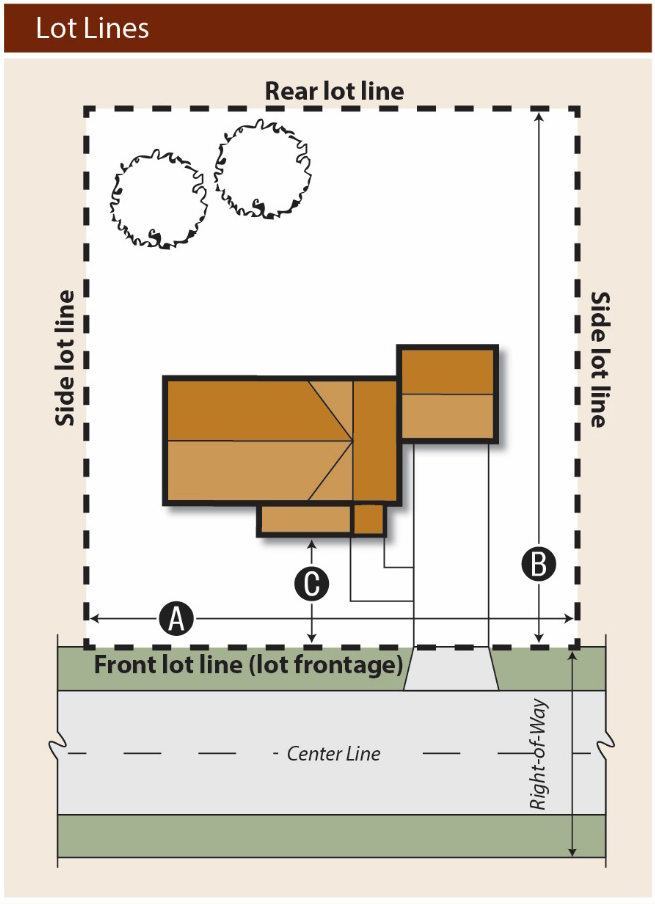
(1)
Generally, the depth of a lot shall not exceed three (3) times the lot frontage. Some deviation from this provision may be permissible for topographical and drainage purposes, but not for the purpose of splitting a large tract into deeper than normal lots so that the provision of streets for proper access to lots can be avoided.
(2)
Depth and width of properties reserved or laid out for commercial and industrial purposes shall be adequate to provide for off-street parking, landscaping or planting area, and loading areas required by the type of use and development contemplated.
(3)
In the case of wedge-shaped or flag-shaped lots, no lot shall be less than thirty (30) feet in width at the front property lines. Residential lots with narrow frontages may be required to have additional area on the lot, and/or common parking areas for the parking of personal vehicles.
(4)
Side lot lines shall be at substantially right angles to streets, or radial to curved streets. Some variation from this rule is permissible, but pointed or very irregular lots shall be avoided.
(b)
Double frontage and reverse frontage lots shall not be permitted, except that where essential to provide separation of residential properties from a highway, an arterial street or a railroad, lots may face on an interior street and back on such right-of-way. In that event a planting strip at least ten (10) feet in width shall be provided along the rear lot line. A statement dissolving right of access from individual lots to the arterial street shall be included with the final plat.
(c)
No single lot shall be divided by a municipal or county boundary line, road, alley or other lot.
(d)
Each lot shall be provided with satisfactory access to an existing public street.
(e)
Lot width and lot area shall not be less than that provided in Article 2 of this Chapter for the district in which the subdivision is located.
(Ord. 629 §1(Exh. A), 2017)
Sec. 19-4-110. - Blocks.
(a)
Blocks shall not exceed one thousand five hundred (1,500) feet in length nor be less than three hundred (300) feet in length. The length of blocks shall be considered to be the distance from street centerline to opposite street centerline and shall be measured through adjacent rear property lot lines or through the center of the block.
(b)
All blocks shall be abutted by one (1) or more streets. Access to the interior of blocks may be permitted in certain instances, in which case such alleys must be indicated on the plat.
(c)
Blocks shall be of sufficient width to permit two (2) tiers of lots of appropriate depth, except where an interior street parallels a highway, an arterial street or a railroad right-of-way.
(Ord. 629 §1(Exh. A), 2017)
Sec. 19-4-115. - Monuments and markers.
(a)
Permanent reference monuments shall be set on the external boundary of a subdivision, pursuant to C.R.S. Section 38-51-101.
(b)
Block and lot monuments shall be set pursuant to C.R.S. Section 38-51-101.
(c)
At least one (1) second order benchmark (Geodetic Survey Datum) shall be set (where practical to tie-in) within every subdivision or subsequent filing prior to submission of the final plat for recording.
(d)
The surveyor shall certify on the final plat that it conforms to these regulations and to all applicable state laws and that the monuments described in it have been placed as described. He or she shall affix his or her name and seal.
(Ord. 629 §1(Exh. A), 2017)
Sec. 19-4-120. - Easements.
(a)
Easements shall be provided for all utility lines, including but not limited to water, sewer, storm water, gas, electric, telephone and cable television. The location and width of all utility easements shall be subject to the approval of the Board of Trustees and of the utilities using the easement.
(b)
Easements shall be determined so as to provide efficient installation of utilities. Special guying easements at corners may be required. Public utility installations shall be so located as to permit multiple installations within the easements to avoid cross-connections, minimize trenching and adequately separate incompatible systems.
(c)
Where a development is traversed by a water course, drainageway or stream, there shall be provided a perpetual drainage easement conforming substantially with the lines of such watercourse, and of such width as necessary and adequate to carry off the predictable volume of storm water drainage from a twenty-five-year frequency storm as determined by the standard method for calculations used by the Corps of Engineers.
(Ord. 629 §1(Exh. A), 2017)
Sec. 19-4-125. - Streets.
(a)
The arrangement, extent, width, type and location of all streets shall be designed in relation to existing or planned streets, to topographic conditions, to public convenience and safety and to the proposed use of land to be served. All building sites shall have access to a public street.
(b)
Certain proposed streets, where appropriate, shall be extended to the boundary of the tract to be subdivided so as to provide for future connection to adjacent undeveloped land.
(c)
Where a subdivision abuts or contains an existing or proposed primary street or highway, the Board of Trustees may require service streets, reverse frontage lots with screen planting in a reservation strip along the rear property line, deep lots with rear service alleys abutting the primary street or highway, or such other treatment as may be necessary for adequate protection of residential properties and for separation of through and local traffic.
(d)
Where a subdivision borders on or contains a railroad right-of-way or limited access highway right-of-way, the Board of Trustees may require a street approximately parallel to and on each side of such right-of-way, at a distance suitable for the appropriate use of the intervening land. Such distance shall be determined with due regard for the requirements of approach grades and future grade separations.
(e)
Right-of-way width. Streets have the following minimum right-of-way widths:
(1)
Freeways: two hundred fifty (250) feet.
(2)
Major arterials: one hundred forty (140) feet.
(3)
Minor arterials: one hundred (100) feet.
(4)
Collector streets: eighty (80) feet.
(5)
Local streets and service roads: sixty (60) feet.
(f)
No more than two (2) streets shall intersect at one (1) point. Streets shall intersect at ninety degrees (90°), except where this may be impractical.
(1)
Two (2) streets meeting a third street from opposite sides shall meet at the same point, or their centerlines shall be offset at least three hundred (300) feet. This requirement shall not apply to the alignment of opposing cul-de-sac streets, provided the cul-de-sacs are one hundred (100) feet or less.
(2)
Collector streets shall not intersect major arterial streets at intervals of less than one thousand three hundred twenty (1,320) feet (¼ mile).
(g)
Street curvature and alignment.
(1)
To ensure adequate sight distances, when street roadway lines deflect more than five degrees (5°), connection shall be made by horizontal curves.
(2)
The minimum centerline radii for local streets shall be one hundred (100) feet; for collector streets two hundred (200) feet; and for all other streets, four hundred (400) feet.
(3)
On collectors and major streets, a minimum tangent of one hundred (100) feet shall be required between a curve and a street intersection; a minimum tangent of one hundred (100) feet shall be required between reverse curves.
(4)
Cross streets which cannot be directly aligned at intersections shall be separated by a horizontal off-set of not less than one hundred twenty-five (125) feet between centerlines, provided that this requirement shall not apply to the alignment of short, opposing closed-end streets.
(5)
Where a horizontal curve occurs on a grade of over five percent (5%), the maximum allowable percent of grade on the curve shall be reduced by one-half percent (0.5%) for each fifty (50) feet that the curve radius is less than four hundred (400) feet.
(6)
Street grades shall not exceed two percent (2.0%) for a distance extending at least seventy-five (75) feet in each direction from a street intersection.
(h)
Cul-de-sac streets. Permanent cul-de-sac streets up to a maximum length of six hundred (600) feet may be permitted and must be provided with a right-of-way at the turnaround of sixty-five (65) feet radius and the outside curb or pavement edge radius must be fifty-five (55) feet or more.
(i)
Stub streets. Stub streets or extension of new streets must be provided to connect to existing stub streets for an efficient street system.
(1)
Not more than six (6) lots shall front on a stub street except where a temporary turnaround is provided.
(2)
When more than six (6) lots front on a stub street and a temporary turnaround is required, such turnaround shall have a minimum outside radius of forty (40) feet.
(j)
Dead-end streets (not cul-de-sacs or stub streets) shall not be permitted.
(k)
Half streets. Half streets shall not be permitted unless:
(1)
They are required to complete a half street already in existence; or
(2)
The subdivider obtains for the Town a dedication from the abutting landowner of the other one-half (½) of the street; and
(3)
The subdivider obtains from the abutting landowner an agreement in a form satisfactory to the Town which guarantees the cost of the improvements and construction of the same on the half street within a time suitable to the Town; and
(4)
The subdivider guarantees the construction of the improvements on the half street which he or she is dedicating.
(l)
Perimeter streets. When the plat dedicates a street which ends on the plat or is on the perimeter of the plat, the subdivider shall convey the last foot of the street on the terminal end or outside border of the plat to the Town in fee simple, and such shall be designated as "outlots;" the Town shall put the same to public use for public road and access purposes when, within its sole and absolute discretion, it deems advisable.
(m)
All streets shall be designed and constructed in accordance with the Town of Lochbuie Standard Specifications for Public Improvements, adopted as a separate regulation and as amended from time to time.
Sec. 19-4-130. - Alleys.
(a)
Access to the interior of blocks may be permitted in certain instances, in which case such alleys shall be indicated on a subdivision plat.
(b)
All alleys shall be designed and constructed in accordance with the Town of Lochbuie Standard Specifications for Public Improvements, adopted as a separate regulation and as amended from time to time.
(Ord. 629 §1(Exh. A), 2017)
Sec. 19-4-135. - Sidewalks and trails.
(a)
Sidewalks. Where a proposed development lies within the corporate limits of the Town, the Town shall require sidewalks to be installed on each side of the street.
(1)
All sidewalks shall be a minimum of four (4) feet wide in residential zone districts, a minimum of eight (8) feet wide in commercial zone districts, and meet current ADA requirements. Replacement of existing sidewalks shall be to the width of the adjacent or connecting sidewalk.
(2)
The closest edge of sidewalks adjacent to a collector or arterial street shall be placed at least five (5) feet from the curb line.
(3)
Where blocks exceed one thousand (1,000) feet in length, pedestrian rights-of-way of not less than fifteen (15) feet in width shall be provided through blocks where needed for adequate pedestrian circulation. Improved walks of not less than ten (10) feet in width shall be placed within the pedestrian rights-of-way.
(b)
Trails. Trails shall be integrated with existing and planned sidewalks and trails in accordance with the Town's Comprehensive Plan.
(1)
Trails shall have a minimum width of eight (8) feet concrete surface, with a four (4) foot wide crushed refined gravel path on one side.
(2)
Trails with alternative surfaces and narrower widths may be approved in those instances where such trails are secondary to existing or proposed trails, and do not serve as connector to the Town's trail system.
(c)
All sidewalks and trails shall be designed and constructed in accordance with the Town of Lochbuie Standard Specifications for Public Improvements, adopted as a separate regulation and as amended from time to time. All sidewalks and trails shall conform to the Americans with Disabilities Act.
(Ord. 629 §1(Exh. A), 2017)
Sec. 19-4-140. - Natural features.
(a)
The design and development of a site or subdivision shall preserve, insofar as it is possible, the natural terrain, natural drainage, existing topsoil, unusual rock formations, lakes, rivers, streams and trees.
(b)
Significant vegetation, including dominant or mature trees and shrubs, shall be retained where possible. When regenerating sites, replacement trees or shrubs shall be selected from indigenous species native to the region. Provisions shall be made to provide adequate hydration and appropriate soil for the replacement trees to ensure successful growth.
(c)
Land subject to hazardous conditions such as mine subsidence, shallow water table, open quarries, floods, undermining, and polluted or non-potable water supply shall not be subdivided until the hazards have been eliminated or mitigated.
(d)
No development, use, fill, construction, excavation, embankment, or alteration on or over any portion of a geologic hazard area shall be permitted which would result in dangers to life or property.
(Ord. 629 §1(Exh. A), 2017)
Sec. 19-4-145. - Storm drainage.
(a)
Drainage areas shall be left in a natural state unless approved by the Board of Trustees, and no encroachment shall be made on the natural channel. A plan to prevent water pollution shall be submitted and adhered to wherever any modification of topography is required during construction within one hundred (100) feet of any stream, irrigation ditch or drainage channel.
(b)
Complete drainage systems for the entire subdivision or development shall be designed by a professional engineer licensed in the State of Colorado and qualified to perform such work.
(1)
The drainage system shall be designed to consider the drainage basin as a whole and shall accommodate not only runoff from the subdivision or development but also, where applicable, the runoff from those areas adjacent to and upstream from the subdivision or development, as well as its effects on lands downstream.
(2)
If the final plat is to be presented in sections, a general drainage plan for the entire area shall be presented with the first section and appropriate development stages for the drainage system for each section shall be indicated.
(c)
The preliminary drainage report to be included with preliminary submittal materials shall include but not be limited to the following items:
(1)
An analysis of overall drainage considerations which will include a map of the major watershed in which the development is located; the analysis shall proceed downstream to a major stream such as the South Platte River; and it must identify areas off-site of the development from which drainage water will enter the development.
(2)
Identification of all nearby irrigation ditches, reservoirs or other irrigation facilities which will affect or be affected by drainage area.
(3)
Peak flows for drainage entering and leaving the development for the two-year and one-hundred-year storms. A clear statement of and justifications for the assumptions upon which the flows are based shall be presented. These flows shall be computed for the existing and fully developed conditions of the site.
(4)
Details of the relationship of the proposed drainage facilities to other drainage facilities in adjacent developments and letters from owners of areas which will be affected by stormwater release from the site shall be included.
(d)
The final drainage report to be included with final submittal materials shall include all of the above preliminary material in addition to the following:
(1)
Street capacities and flow calculations at critical street sections for two-year and one-hundred-year storm runoff.
(2)
Backwater profiles for open channel for two-year and one-hundred-year storm runoff.
(3)
Results of culvert design calculations.
(4)
Inflow and outflow design hydrographs for detention facilities and stage-volume curves, outlet rating curves, and spillway rating curves.
(e)
No subdivision or any part thereof shall be approved if proposed cuts, fills, structures or other features within the proposed subdivision will, individually or collectively, significantly increase flood flows, heights, or damages.
(f)
All water courses crossed by streets or alleys shall be provided with adequate and permanent culverts of a size, type and material approved by the Town. Culverts on existing streets shall be enlarged wherever necessary by reason of diverted or increased concentration of drainage.
(g)
Adequate drainage facilities shall be installed prior to construction of any buildings.
(h)
All drainage facilities shall be designed and constructed in accordance with the Town of Lochbuie Standard Specifications for Public Improvements, and any South Beebe Draw Metropolitan District standards, adopted as separate regulations and as amended from time to time.
Sec. 19-4-150. - Flood control.
(a)
All subdivision applications including the placement of manufactured home parks and subdivisions shall be reasonably safe from flooding. If a subdivision or other development application is in a flood-prone area, the proposal shall minimize flood damage.
(b)
All applications for the development of subdivisions including the placement of manufactured home parks and subdivisions shall meet floodplain development permit requirements of Section 19-5-230, Section 19-5-240, and the provisions of this Section.
(c)
Base flood elevation data shall be generated for subdivision applications and other proposed development including the placement of manufactured home parks and subdivisions which are greater than fifty (50) lots or five (5) acres, whichever is lesser, if not otherwise provided, pursuant to Section 19-5-220 or Section 19-5-310.
(d)
All subdivision applications, including the placement of manufactured home parks and subdivisions, shall have adequate drainage provided to reduce exposure to flood hazards.
(e)
All subdivision applications, including the placement of manufactured home parks and subdivisions, shall have public utilities and facilities such as sewer, gas, electrical and water systems located and constructed to minimize or eliminate flood damage.
(Ord. 629 §1(Exh. A), 2017)
Sec. 19-4-155. - Irrigation ditches.
(a)
Existing irrigation ditches shall be incorporated within a site plan in a manner such that their function is not impaired.
(b)
The ditches shall be protected from encroachment and may be fenced in a manner acceptable to the ditch company.
(c)
A minimum twenty-five (25) foot lot setback shall be required from the edge of an irrigation ditch easement or right-of-way.
(Ord. 629 §1(Exh. A), 2017)
Sec. 19-4-160. - Water.
(a)
All lots shall be connected to the Town water system.
(b)
All water utility facilities shall be designed and constructed in accordance with the Town of Lochbuie Standard Specifications for Public Improvements, adopted as a separate regulation and as amended from time to time.
(c)
Water rights shall be dedicated as required by Chapter 13 of the Town Municipal Code.
(Ord. 629 §1(Exh. A), 2017)
Sec. 19-4-165. - Fire protection.
Every development served by a public water system shall include a system of fire hydrants sufficient to provide adequate fire protection for the buildings located or intended to be located within such subdivision.
(Ord. 629 §1(Exh. A), 2017)
Sec. 19-4-170. - Sanitary sewer.
(a)
Each lot within a subdivision shall be connected to the Town wastewater collection system.
(b)
All sanitary sewer utility facilities shall be designed and constructed in accordance with the Town of Lochbuie Standard Specifications for Public Improvements, adopted as a separate regulation and as amended from time to time.
(Ord. 629 §1(Exh. A), 2017)
Sec. 19-4-175. - Utilities.
(a)
All gas, electric, telephone, cable television or other utility lines placed within the public right-of-way or dedicated easements shall be approved by the Town Administrator as to location.
(b)
Telephone lines, electric lines and other like utility services shall be placed underground.
(1)
Transformers, switching boxes, terminal boxes, meter cabinets, pedestals, ducts, street lighting and other facilities necessarily appurtenant to such underground utilities shall be placed underground or on the surface but not on utility poles.
(2)
Electric transmission and distribution feeder lines, communication long distance trunk and feeder lines and necessary appurtenances thereto may be placed above ground.
(3)
Such facilities shall be placed within easements or public streets, as herein provided, or upon private easements or rights-of-way provided for particular facilities.
(c)
The developer shall make the necessary arrangements, including any construction or installation charges, with each of the serving utilities for the installation of utility facilities.
(Ord. 629 §1(Exh. A), 2017)
Sec. 19-4-180. - Landscaping and screening.
(a)
Landscape plan required. A detailed landscape plan (including irrigation, plant and material specifications) for any development requiring site plan approval shall be prepared by a licensed landscape architect and submitted to the Town prior to the issuance of building permits.
(b)
Business and commercial development landscaping. Landscape improvement shall be designed to enhance the overall appearance of the development and integrate the project with adjacent land uses and into the surrounding neighborhood. A minimum of fifteen percent (15%) of the site (gross) shall be landscaped areas. Landscaped walkways, plazas and other hardscape elements within the site may be considered landscape improvements on a case-by-case basis.
(c)
Parking lot landscaping. Parking lot landscaping is intended to break up large expanses of pavement, create shade, enhance the overall appearance of the project, and buffer views of parking lots from adjacent streets and developments. Parking lot landscaping requirements are in addition to any other landscaping that may be required for the site. All parking lots with ten (10) spaces or more, on a single lot shall be subject to the following requirements:
(1)
A minimum of one (1) tree per fifteen (15) parking spaces, to be placed in islands that are a minimum of ten (10) feet wide, and shall use the landscaping to break up large expanses of pavement and to create a tree canopy for summer shade.
(2)
A minimum of one (1) shrub per parking space, to be grouped in landscape islands or around the parking lot perimeter.
(3)
Shrubs and ornamental grasses in planting areas less than ten (10) feet wide.
(4)
Minimum landscape setback to parking lots, thirty (30) feet from arterial rights-of-way or fifteen (15) feet from any other street rights-of-way either public or private. The purpose of the setback is to provide a buffer between the street and parking areas and to screen the parking from the street. The setback, on streets other than arterials, may be reduced to ten (10) feet if used in combination with an articulated masonry or stone decorative wall with trees and shrubs on both sides of the wall to soften its appearance. The minimum landscape setback to parking lots from primary internal drive circulation routes in a multi-building complex shall be ten (10) feet.
(d)
Buffer between land uses.
(1)
Buffering between land uses is intended to integrate adjacent land uses and provide seamless transitions from one (1) use to another through building orientations and access, landscaping, appropriate architectural elements and non-buildable buffer areas.
(2)
Special consideration shall be given to adjacent land uses of different intensities. It shall be the responsibility of the developer of the more intensive use to ensure that the transition from one (1) use to another is attractive and functional and minimizes conflicts between the current and planned uses. It is also the responsibility of the developer of the higher intensity use to demonstrate that the uses will be compatible. This can be accomplished through the effective use of shared access and parking, appropriate building orientation and setbacks, landscaping, architectural treatment, buffer areas and limited use of fencing and screening walls. Special consideration shall be given by the Town to the impact of aesthetics, noise, lighting and traffic. Under no circumstances shall a fence be the only screening material used as a buffer between land uses.
(e)
Location and screening of required loading and service areas.
(1)
Loading docks, solid waste facilities, recycling facilities and other service areas shall be placed to the rear or side of buildings in visually unobtrusive locations. Screening, buffering and landscaping shall be incorporated to prevent direct view of the loading areas and their driveways from adjacent properties or from the public right-of-way. Screening and landscaping shall also prevent spillover glare, noise or exhaust fumes. Screening and buffering shall be achieved through walls, architectural features and landscaping and shall be visually impervious. Recesses in the building or depressed access ramps may be used.
(2)
Businesses, such as home improvement and/or garden supply center stores, must use enamel, black chain-link or other adequate fence to enclose areas where items, such as plants, lumber and other materials for sale, are stored outdoors.
(3)
Loading areas (including vehicles being loaded), service and storage areas visible from the public right-of-way or adjacent property must be screened with an opaque screen that is an integral part of the building architecture or by landscaping. Tires, used building materials and chain-link fencing, with or without slats, are not acceptable screening materials.
(4)
Dumpsters. All dumpsters shall be screened to prevent them from being visible to persons on the property, visiting the property or traveling on public streets, sidewalks or other public ways. Screening will be constructed of masonry, brick, stucco or comparable material and shall conceal the dumpsters from view on no less than three (3) sides. The use of chain-link or wooden fencing as screening is not allowed.
(Ord. 629 §1(Exh. A), 2017)
Sec. 19-4-185. - Lighting.
(a)
A lighting plan that creates an attractive lighting system that enhances visibility and safety, while minimizing glare and contrast, shall be submitted as part of a site plan application. The lighting plan shall include a photometric plan and provide for exterior lighting that is functional, aesthetically pleasing and complementary to the architectural style of the buildings.
(b)
Exterior lighting shall be evaluated in the development review process to ensure that the functional and security needs of the project are met in a way that does not adversely affect the adjacent properties or neighborhood. Review will include the light source, the level and hours of use, as well as the overall need for illumination and effects of the lighting on adjacent property owners and the neighborhood.
(c)
The style of lights shall be consistent with the style and character of architecture proposed on the site. Light fixtures that illuminate signage shall be compatible with the architecture of the building on which they are placed.
(d)
Light sources shall be concealed or shielded to the greatest extent possible so as to minimize the potential for glare and diffusion on adjacent properties or public roadways. All lights shall be directed downward and the light source shall be equipped with cut-off devices so that it will not be visible from any adjacent property and to ensure that ambient skyward light is eliminated.
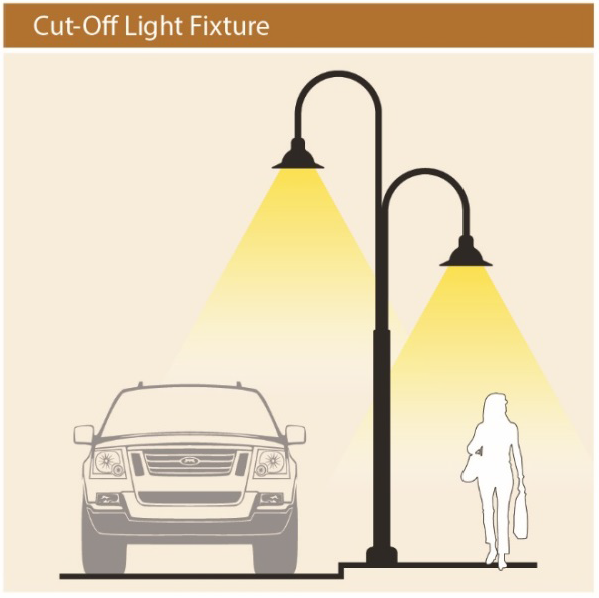
(1)
Any light source or lamp that emits more than nine hundred (900) lumens (13 watt compact fluorescent or 60 watt incandescent) shall be concealed or shielded with an IESNA full cut-off style fixture with an angle not exceeding ninety (90) degrees to minimize the potential for glare and unnecessary diffusion on adjacent property. For purposes of this standard, "cutoff angle" is defined as the angle formed by a line drawn from the direction of light rays at the light source and a line perpendicular to the ground from the light source above from which no light is emitted.
(2)
In no case shall exterior lighting add more than one (1) foot-candle to illumination levels at any point off-site.
(e)
Maximum lighting level uniformity (maximum to minimum) for residential parking lots shall be 15:1 and for nonresidential 10:1.
(f)
Accent and flagpole lighting shall be permitted to be directed upward only when the light source is shielded and not visible from any adjacent property. Light fixtures installed under canopies, awnings, overhangs and the like shall be fully recessed.
(g)
All parking lot lighting fixtures and exterior building lights, except those required for security purposes, shall be extinguished within one (1) hour after the conclusion of business hours and remain extinguished until one (1) hour prior to the beginning of business hours. If a portion of a parking lot is to be used after dark, only that portion shall be lighted.
(h)
Lighting within any lot that unnecessarily illuminates any other lot, and substantially interferes with the use or enjoyment of such other lot, is prohibited. Lighting unnecessarily illuminates another lot if it clearly exceeds the guidelines set forth in this Section, if the light shines directly into a residence or if the guidelines set forth in this Section could reasonably be achieved in a manner that would not substantially interfere with the use or enjoyment of neighboring properties.
(i)
Height standards for lighting; nonresidential. Light fixtures shall be mounted on concrete, fiberglass or painted metal poles no higher than twenty-five (25) feet from the ground, unless a greater height, not to exceed the maximum building height in the applicable zone district, is approved by the Board of Trustees through the site plan review process. Lighting mounted on a building or structure shall not exceed the height of the building or structure. Bollard-type lighting fixtures shall be between three (3) or four (4) feet high.
Sec. 19-4-190. - Vision clearance.
(a)
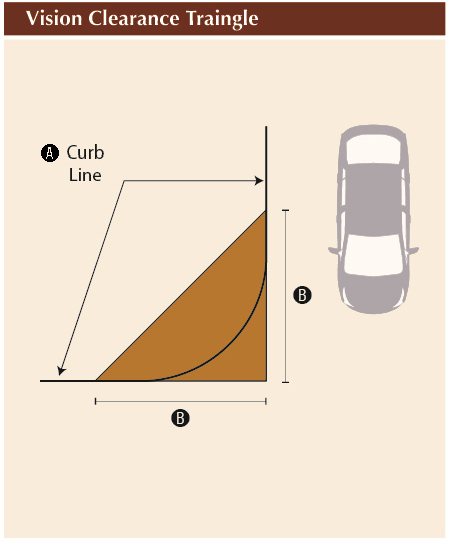
In order to provide safe sight lines at street intersections, a vision clearance triangle shall be maintained at all public and private street intersections.
(b)
The vision clearance triangle shall be described as that area lying within a triangle
with its corners formed by the intersection of the extended curb lines of two (2)
intersecting streets, and the points along the two (2) curb lines (
) located fifty (50) feet back from the point of intersection of the extended curb
lines (
).
(c)
The vision clearance triangle shall be kept clear of all objects higher than thirty (30) inches that could obstruct view. The following exceptions are allowed:
(1)
Street signs, traffic lights, streetlights, fire hydrants and similar public facilities.
(2)
Street trees that are a deciduous variety, with the lowest branch and foliage at least eight (8) feet above the road surface.
(Ord. 629 §1(Exh. A), 2017)
Sec. 19-4-195. - Building design.
(a)
General. Except as otherwise provided herein, any land surface and any work or improvements upon any non-residential property or mixed use development within the Town shall be erected, removed, restored, altered or demolished in such a manner so as to maintain, protect and complement the existing character and qualities of buildings, structures and properties. All construction is subject to the requirements of any building code adopted by the Town and any other applicable ordinances or provisions of the Town Municipal Code.
(b)
Design of developments with internal orientation. In multiple-building developments, primary building entrances should face walkways, plazas or courtyards that have direct, continuous linkage to the street without making people walk through parking lots. While it may be necessary for direct pedestrian walkways to cross drive aisles, those driveway crossings must place priority on the pedestrian access. Continuous driveway aisles located directly at the front of a building are discouraged.
(c)
Connections. Where it is not possible or appropriate to extend the Town street system and sidewalks directly into the development, or bring the building adjacent to a Town sidewalk, building groups shall be designed to create direct connections to adjacent land uses.
(d)
Requirement for four-sided design. A building's special architectural features and treatments shall not be restricted to a single façade. All sides of a building open to view by the public, whether viewed from public or private property, shall display a level of quality and architectural interest that generally matches that of the front façade.
(e)
Building form. The design of all buildings shall employ textured surfaces, projections, recesses, shadow lines, color, window patterns, overhangs, reveals, changes in parapet heights and similar architectural features to avoid monolithic shapes and surfaces and emphasize building entries. Designs shall not contain unbroken walls of seventy-five (75) feet or greater in length. Buildings having single walls greater than seventy-five (75) feet in length shall incorporate one (1) or more of the following elements for every seventy-five (75) feet.
(1)
Changes in color, graphic patterning, changes in texture, or changes in material;
(2)
Projections, recesses and reveals;
(3)
Windows and fenestration;
(4)
Arcades and pergolas;
(5)
Towers;
(6)
Gable projections;
(7)
Horizontal/vertical breaks; or
(8)
Other similar techniques.
(f)
Exterior building materials and colors. Intense, bright or fluorescent colors shall not be used as the predominant color on any wall or roof of any primary or accessory structure. These colors may be used only as building accent colors.
(g)
Maintenance. The development building owner, association or occupant shall maintain the landscaping within the adjacent road right-of-way in accordance with Town regulations.
(Ord. 629 §1(Exh. A), 2017)
Sec. 19-4-200. - Residential, commercial, and mixed use setbacks from permitted or existing oil & gas operations locations
(a)
Pre-Production Phase: For Colorado Oil and Gas Commission ("COGCC") permitted well sites where all permitted wells have not entered completions, no new residential, commercial, or mixed use shall be allowed within one thousand feet (1,000) of such well site, to include, but not be limited to, school facilities, hospitals, medical clinics, senior living or assisted living facilities, or state licensed daycares. Measurements shall be taken from the closest edge of the well site as such term is defined in Division 5 of Article VII of Chapter 19.
(b)
Production Phase: For COGCC permitted oil and gas production facilities, as such term is defined below, where all permitted wells have entered completions, or the permit has otherwise lapsed, been revoked, or forfeited and is not subject to renewal or reissuance:
(1)
No new residential, commercial, or mixed uses, including without limitation, school facilities, hospitals, medical clinics, senior living facilities, assisted living facilities, or state licensed daycares may be operated on any lot unless such lot is platted to conform to the following minimum setbacks from such COGCC permitted oil and gas production facilities:
(2)
Measurements shall be taken from the closest edge of the "oil and gas production facility" which term is defined to only include well heads, compressors, separators, treatment facilities, tank batteries, and emission control devices.
(c)
Post-production Phase:
(1)
For COGCC permitted oil and gas production facilities where all permitted wells have been abandoned, no building or structure may be placed within fifty (50) feet of the abandoned well.
(2)
Vacation of Existing Easements. No easement may be vacated for a previous or existing well, flowline, or gathering line, unless documentation is provided to the Town demonstrating such well, flowline, or gathering line has been vacated in compliance with all applicable Colorado Oil and Gas Conservation Commission regulations.
(d)
Plat requirements. The following information shall be included on all preliminary and final plats:
(1)
All oil and gas production facilities, and location of any oil and gas wells, flowlines, and gathering lines, access roads, and any associated easements;
(2)
The reception number, date, and recording location of all relevant surface use agreements;
(3)
The location of any plugged and abandoned oil and gas wells;
(4)
The location of any flowlines and gathering lines that are still in service; and
(5)
A plat designation showing location of flowlines, gathering lines, and abandoned wells, and a note expressly prohibiting any habitable building or structure within fifty (50) feet of such facilities.
(Ord. 665 §1, 2021)
Sec. 19-4-210. - General parking requirements.
(a)
At the time of the erection of a new structure or at the time of enlargement or change in use of an existing structure within the Town, off-street parking spaces shall be provided as specified in this Division.
(1)
No building permit or other permit shall be issued until plans are presented that show the location of parking spaces as well as property that is and will remain available for exclusive use as off-street parking and loading space.
(2)
The subsequent use of property for which the building permit is issued shall be conditional upon the unqualified continuance and availability of the amount of parking and loading space required by this Division.
(b)
All uses other than single-family residential dwellings and two-family dwellings shall be required to submit a site plan indicating the location and dimensions of off-street parking spaces.
(1)
Off-street parking spaces for dwellings shall be located on the same lot as the principal use or structure. Parking spaces in residential zone districts shall not be located in the front yard setback area except for parking for single-family and two family dwellings. Required spaces shall be located not further than three hundred (300) feet from the buildings or use they are intended to serve, measured by means of pedestrian access from the building or use to the parking area.
(2)
Where square feet are specified, the area measured shall be the floor area measured as defined by Section 19-7-520, except for warehouses or other commercial storage areas in which case the floor area shall be determined by the measurements of the perimeter of the outside of the building wall on each level.
(c)
A paved driveway or other paved parking space(s) shall be designated in either the front yard or side yard of a residential property. The total aggregate parking and/or driveway shall be lesser of thirty-five percent (35%) of the front yard area or thirty (30) linear feet of the lot frontage.
(d)
The provision and maintenance of off-street parking, loading and stacking spaces is a continuing obligation of the property owner. No parking shall be eliminated for an existing use if it reduces the required number of parking spaces below the minimum requirements of this Division.
(1)
Should the owner or occupant of any lot or building change the use to which the lot or building is put, thereby increasing off-street parking or loading requirements, it shall be unlawful and a violation of this Division to begin or maintain such altered use until such time as the increased off-street parking, loading or stacking requirements are complied with.
(2)
Required parking spaces shall be available for the parking of operable passenger automobiles, trucks, or motorcycles of residents, customers, patrons and employees, and shall not be used for the storage of vehicles or materials or the parking of trucks used in conducting the business or use.
(Ord. 629 §1(Exh. A), 2017)
Sec. 19-4-220. - Parking space requirements.
(a)
Unless specifically exempted or variations are permitted in accordance with these regulations, all land uses in the Town shall include, at a minimum, the number of vehicle off-street parking spaces specified in Table 4.1.
(b)
When one (1) building or land use is planned to include a combination of different uses, including accessory uses, the minimum parking requirement will be determined by applying the above requirements and standards to each use and structure, resulting in a total parking requirement for the property. The minimum number of parking spaces required shall be the sum of the requirements for each separate use.
(c)
For specific uses not listed, the Town Administrator shall determine the appropriate number of parking spaces required based upon the type of activity, intensity, number of employees and similarity to listed uses.
(Ord. 629 §1(Exh. A), 2017)
Sec. 19-4-230. - Shared parking facilities.
The overall number of parking spaces serving multiple uses in close proximity to one another may be significantly reduced through shared parking arrangement, provided that:
(a)
The parking spaces are within three hundred (300) feet of the property, except that the distance is extended to one thousand (1,000) feet for employee parking;
(b)
Based on information supplied by the applicant, the Town Administrator, or other sources, the aggregate parking demands at the highest use time is less than the total parking spaces required; and
(c)
A copy of a recorded agreement by owners involved in such joint use is presented to the Town Administrator. Should the agreement expire or otherwise terminate, the use for which the shared parking was provided shall terminate and no owner shall maintain such use without 1) a substitute parking agreement, approved by the Town Administrator, or 2) the use is brought into compliance with the parking regulations of this Article.
(Ord. 629 §1(Exh. A), 2017)
Sec. 19-4-240. - Deferral of parking requirements.
The Town Administrator may consider deferral of parking requirements where the need for off-street parking is lessened due to unusual characteristics of use, and reliable data is available to establish that there is not a present need for additional parking.
(a)
The Town Administrator may authorize the deferral of construction of not more than fifty percent (50%) of the required off-street parking spaces and may set such conditions as necessary to guarantee provision of such deferred parking spaces at such time as the Town Administrator determines such additional parking spaces are needed.
(b)
The land area required for provision of deferred parking spaces shall be maintained and reserved and shall be landscaped pursuant to a plan approved by the Town Administrator, which shall demonstrate that the deferred spaces, when improved, will meet all requirements of this Division.
(Ord. 629 §1(Exh. A), 2017)
Sec. 19-4-250. - Modification of parking requirements.
The Town Administrator may increase or decrease the required number of off-street parking spaces in consideration of the following factors:
(a)
Expected number of cars owned by occupants of dwellings in a planned unit development;
(b)
Parking needs of any non-dwelling uses; and
(c)
Varying time period of use.
(Ord. 629 §1(Exh. A), 2017)
Sec. 19-4-260. - Loading requirements.
The number, size and other requirements for off-street loading spaces shall be as specified below. Where the use of the premises is not specifically mentioned, loading requirements shall be determined by the Town Administrator based on requirements for similar uses, expected demand generated by the proposed use, and other information from appropriate traffic engineering and planning criteria.
(a)
A minimum loading area of three hundred (300) square feet shall be provided for all commercial or industrial uses that have a building area in excess of two thousand (2,000) square feet, with the exception of office and similar uses.
(b)
Buildings or structures to be built or substantially altered which receive and distribute material or merchandise by truck shall provide and maintain off-street loading berths in sufficient number and size to adequately handle the needs of the particular use.
(c)
Off-street parking areas used to fulfill the requirements of this Division shall not be used for loading and unloading operations except during periods of the day when not required to take care of parking needs.
(Ord. 629 §1(Exh. A), 2017)
Sec. 19-4-270. - Stacking requirements.
The purpose of stacking space requirements is to promote public safety by alleviating on-site and off-site traffic congestion that might otherwise result from the operation of a drive-up or drive-through facility. For all applicable drive-up or drive-through uses, the following off-street stacking requirements shall apply:
(a)
Stacking spaces may be located anywhere on the building site, provided that traffic impacts on and off site are minimized and the location does not create negative impacts on adjacent properties due to noise, light or other factors.
(1)
A stacking space at a drive-in or drive-through window, menu board, order station, designated drop-off zone, or service bay is considered to be a stacking space.
(2)
An area reserved for stacking spaces may not double as a circulation driveway, maneuvering area, or off-street parking space.
(b)
A stacking space shall be calculated to be a minimum of eight and one-half (8.5) feet wide and eighteen (18) feet long.
(c)
A driveway designed for continuous forward flow of passenger vehicles for the purpose of loading and unloading children shall be located on the site of any school having a capacity greater than twenty-five (25) students.
(d)
Drive-in or drive-through facility shall comply with the minimum stacking space standards specified in Table 4.2:
(Ord. 629 §1(Exh. A), 2017)
Sec. 19-4-280. - Design requirements.
Parking and loading areas shall be designed in accordance with the following requirements and the requirements of the Town of Lochbuie Standard Specifications for Public Improvements:
(a)
Surfaces. All off-street parking spaces and maneuvering areas shall be surfaced with asphalt or concrete material.
(b)
Access requirements and service drives.
(1)
Service drives to off-street parking shall be designed and constructed to facilitate the flow of traffic, and to provide maximum safety of traffic access and egress and maximum safety for pedestrians and vehicular traffic on the site. The number of service drives shall be limited to the minimum that will allow the property to accommodate the traffic to be anticipated.
(2)
Service drives shall not be more than twenty-four (24) feet in width and shall be clearly and permanently marked and defined through the use of rails, fences, walls or other barriers or markers on frontage not occupied by service drives.
(3)
Service drives on the same lot frontage shall be separated by a minimum length of curb of thirty (30) feet. For every one (1) foot by which the lot frontage exceeds one hundred (100) feet, the minimum required length of curb separation shall be increased by one (1) foot for every five (5) feet of property length beyond one hundred (100) feet, up to a maximum requirement of two hundred (200) feet. In the case of a corner lot, service drives shall not be located closer than fifty (50) feet to the intersecting curb and gutter flow lines.
(4)
The access to a service drive from a street shall be located not closer than fifteen (15) feet to a side lot line, except that a common service drive to two (2) adjacent properties with width not exceeding twenty-four (24) feet may be provided at the common lot line.
(5)
Access onto any State highway will require an access permit from the Colorado Department of Transportation.
(c)
Parking space minimum dimensions. The minimum parking space requirements are listed in Table 4.3.
| Table 4.3 Parking Stall Dimensions and Layout | ||||||
|---|---|---|---|---|---|---|
| | |  |  |  |  |
|
Parking
Angle |
Curb Length
(Feet) |
Stall Length
(Feet) |
One-Way Aisle Width
(Feet) |
Two-Way Aisle Width
(Feet) |
One-Way Bay Width
(Feet) |
Two-Way Bay Width
(Feet) |
| 0° | 23.0 | 8.0 | 12.0 | 20.0 | 20.0 | 36.0 |
| 30° | 18.0 | 18.0 | 12.0 | 20.0 | 48.0 | 56.0 |
| 45° | 13.0 | 20.0 | 13.0 | 20.0 | 53.0 | 60.0 |
| 60° | 10.5 | 21.0 | 18.0 | 22.0 | 60.0 | 64.0 |
| 90° |
9.0
9.5 10.0 | 20.0 | 24.0 | 24.0 | 64.0 | 64.0 |
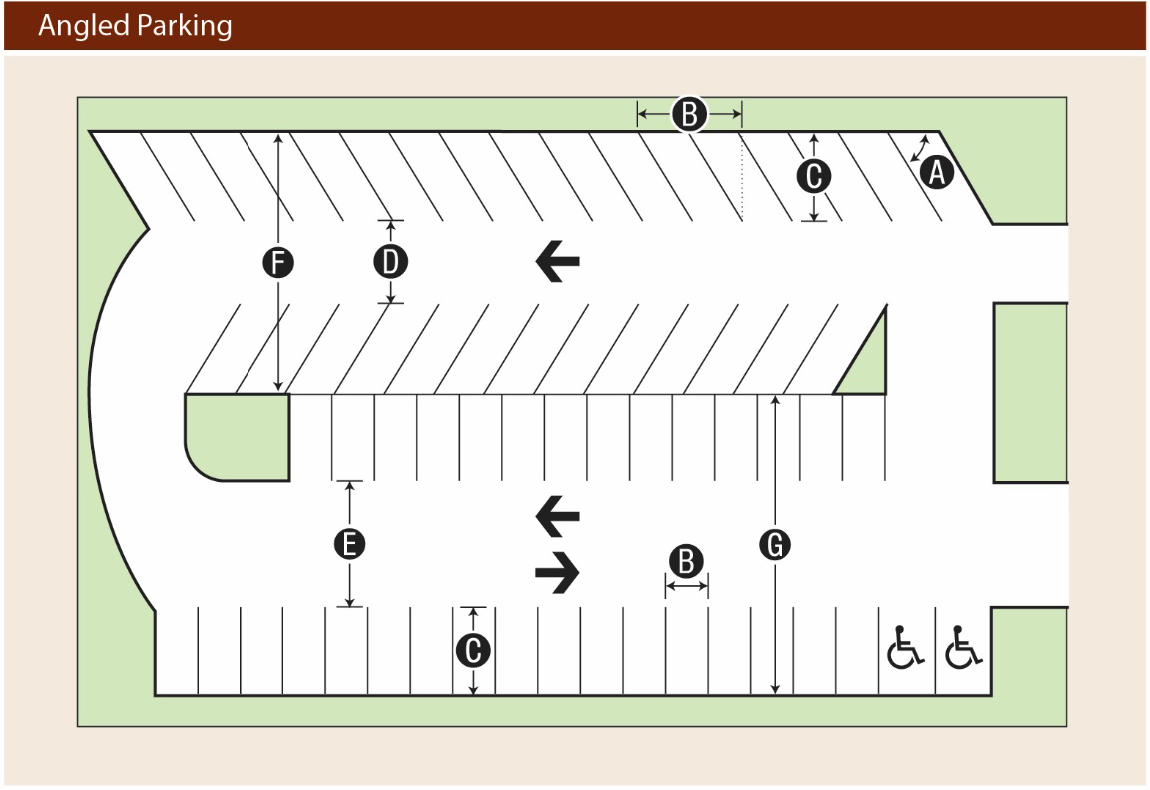 | ||||||
(1)
Where larger vehicles may be frequent users of the parking facilities, it is appropriate to increase the parking stall dimensions according to the dimensions and turning characteristics of the vehicle.
(2)
Parking aisles shall be designed to accommodate the turning characteristics of the vehicles that will most commonly use the parking facilities. Dead-end parking aisles are prohibited without provision of an adequate turn around. Aisles should not exceed three hundred (300) feet to three hundred fifty (350) feet length without a break in circulation.
(d)
A maximum of twenty percent (20%) of a parking lot containing five (5) or more spaces may be used for compact cars.
(e)
All area to be considered as off-street parking shall be unobstructed and free of other uses.
(f)
Unobstructed access to and from a street shall be provided for all off-street parking spaces.
(g)
Handicap parking requirements. A portion of the required off-street parking spaces shall be specifically designated, located and reserved for use by persons with physical disabilities in accordance with the requirements specified in the Americans with Disabilities Act (ADA). Information on these requirements can be obtained at 1-800-514-0301 or at www.accessboard.gov.
(1)
The required handicap spacing requirements are listed in Table 4.4.
(2)
The maximum grades in the areas designated for handicap parking shall be two percent (2%) or less.
(3)
One (1) in every eight (8) handicapped accessible spaces, but not less than one (1), shall be served by an access aisle ninety-six (96) inches in width. The minimum aisle width on all other handicapped parking spaces shall be sixty (60) inches.
(4)
If a curb ramp is located where pedestrians must walk across the ramp, or where it is not protected by handrails or guardrails, it shall have flared sides: the maximum slope of the flare shall be 1:10. Curb ramps with returned curbs may be used where pedestrians would not normally walk across the ramp.
(h)
Construction standards. All construction shall be required to meet the standards specified in the Town of Lochbuie Standard Specifications for Public Improvements.
(Ord. 629 §1(Exh. A), 2017)
Sec. 19-4-310. - Purpose.
The purpose of this Division is to establish general restrictions on the construction, establishment or building of fences, walls, hedges or other similar structures, and further to eliminate nonconforming fences, hedges, walls or other similar structures in an orderly fashion.
(Ord. 629 §1(Exh. A), 2017)
Sec. 19-4-320. - General application; permits.
(a)
A fence shall be defined as any fence, wall or hedge, but shall not include retaining walls, which are regulated under the building codes adopted by the Town by reference.
(b)
No person, firm or corporation shall erect, construct, enlarge, alter or move any fence in the Town without first obtaining a fence permit from the Building Department, pursuant to this Section. Applications for fences shall include submittals of construction designs and materials for approval by the Building Department in accordance with this Division.
(c)
The regulation of this Division applies only to those fences that are physically located or intended to serve as a boundary between adjoining properties or as a barrier or enclosure of greater than fifteen percent (15%) of the area of a particular zone lot.
(d)
No fence permit shall be issued by the Building Department unless the applicant for such permit demonstrates compliance with the provisions of this Division.
(e)
Fees for fence permits issued pursuant to this Section shall be set by the Board of Trustees to cover the costs of inspections and administration of this Section, and may be amended as necessary by the Board of Trustees. Fees shall be paid by the applicant prior to the issuance of the fence permit.
(f)
On corner lots, the erection of any fence, wall, hedge or plants over thirty (30) inches from the top of the curb which obstruct a motor vehicle operator's view shall not be permitted within a triangle measured from the point of intersection of the lot lines abutting the street a distance of fifty (50) feet along each such lot line.
(Ord. 629 §1(Exh. A), 2017)
Sec. 19-4-330. - Maintenance.
Hedges shall be kept trimmed and will not be permitted to extend beyond the maximum height limitations. Dilapidated, unsightly, dangerous fences or fences causing traffic sight hazards shall be removed when so ordered by the Building Inspector, when determination is made that such removal is required in order to protect the health, safety, welfare, and property enjoyment of the citizens of the Town.
(Ord. 629 §1(Exh. A), 2017)
Sec. 19-4-340. - Prohibited fences; requirements for materials.
(a)
Materials used for fences shall be durable and of a character commonly used in outdoor fencing applications, including, without limitation, durable wood that is treated or of a weather-resistant species, ornamental wrought iron or powder-coated aluminum, vinyl, composite materials or masonry. For other materials, the Building Department shall require an applicant to submit manufacturer's documentation that an intended use of the material is for outdoor fencing. In no event shall scrap lumber, plywood, tree branches, tree trunks, sheet metal, plastic or fiberglass sheets, barbed wire, spikes, nails or other comparable sharp points be permitted as fence components.
(b)
No fence shall be erected so as to extend beyond the owner's property line. If fences are permitted on public easements or across ditches, the following regulations shall apply:
(1)
The fence must be constructed so that drainage shall not be obstructed.
(2)
If it is necessary to remove such fence for maintenance or other purpose, removal and/or replacement of such fence or other improvements shall be the responsibility of the property owner, unless otherwise provided in the easement.
(c)
Use of electrical charging. Only where the zoning permits, it shall be permissible to add electrical charging to fences which are constructed, or maintained in the Town under the following circumstances:
(1)
That the electrical charging wire shall be posted on the device typically called standouts, which will hold such electrically charged wire at least six (6) inches away from the main fence and the electrically charged wire shall be used only in conjunction with the construction of another permissible fence that such standouts and other supports shall be used which are insulated to protect the transmissible electricity to the other approved fence, or on a self-contained system inside the boundaries of the permissible fence.
(2)
That such electrically charged wire shall carry only twelve (12) volts from an Underwriters Laboratory (UL) approved electrical source with a safety breaker which will terminate the electricity after the grounding of such electrically charged wire pursuant to UL rules.
(3)
That the person in control of the premises who erects or maintains such electrically charged wire in conjunction with another permissible fence shall obtain a permit for the same, and shall permit periodic inspection to determine that such electrical-producing source is UL approved and contains the appropriate breaker for safety to humans.
(4)
That such standouts shall be located on the inside of the authorized fence.
(5)
That this exemption for electrification of fences shall apply only to lots of one (1) acre or more.
(6)
That, if it is determined that such electrical source or electrical charging fence or wire is not UL approved nor contains the appropriate breaker or is found to be inoperable or in such condition as to create a hazard as determined solely by the Building Inspector, the person erecting or maintaining such electrically charged wires shall remove the same or provide an approved electrical source.
(d)
Barbed wire fences prohibited. It is unlawful for any person to construct or maintain within the Town any fence, cellar or window guard containing barbs, barbed wire, sharpened nails, or any other pointed or sharpened thing or metallic substance.
Sec. 19-4-350. - Residential requirements.
Fences, walls or hedges used for any purpose on residential sites in residential districts shall conform to the following:
(a)
Fence height maximum:
(1)
From the front property line to the front building line, three (3) feet solid, measured from the top of the curb (except above mentioned restriction on corner lots): three and one-half (3½) feet if open mesh.
(2)
From the front building line of the dwelling to the rear lot line: six (6) feet.
(3)
Across the rear lot line: six (6) feet.
(4)
In the event the Building Department deems it necessary for the general health, safety, welfare and enjoyment of property of citizens, an eight-foot fence may be required to separate single-family residential dwellings abutting multi-family dwellings, or commercial or industrial property.
(b)
Setbacks. Setbacks from public sidewalks (and in any case shall not extend beyond the owner's property line) shall be eighteen (18) inches.
(c)
Reverse corner lots. Reverse corner lots shall conform to the fence requirements of the lots adjacent to said reverse corner lot. The lot lines of said reverse corner lot adjacent to street right-of-way shall be held to the fencing restrictions of a front property line.
(d)
Fences adjacent to parks and open space. All fences constructed adjacent to a public park or dedicated open space area shall be constructed of open wooden rails, and be no higher than four (4) feet.
(Ord. 629 §1(Exh. A), 2017)
Sec. 19-4-360. - Commercial and industrial districts.
(a)
No fence of any type more than twelve (12) inches in height shall be permitted within any required landscaping area, nor shall any closed fence (one [1] prevention view) enclose any landscaping area or front setback area.
(b)
The maximum height of any fence within a commercial or industrial zone is ninety-six (96) inches (eight feet), which may include not more than four (4) strands of barbed wire forming the top of the fence which may be placed at a forty-five-degree angle. Fencing consisting of only barbed wire is prohibited.
(Ord. 629 §1(Exh. A), 2017)
Sec. 19-4-370. - Fencing during development.
(a)
Land under development where buildings are being constructed for uses allowed in the relevant district may be surrounded by a chain link fence a minimum of seventy-two (72) inches and a maximum of ninety-six (96) inches in height, to include not more than four (4) strands of barbed wire at a forty-five-degree angle. The fence from top to bottom shall be installed within the property lines of the development surrounded.
(b)
Gates into the fence enclosure may be provided as needed; however, not closer than one hundred (100) feet from the corner of the intersection of the developed street property lines, except where this distance does not exist. The gates shall be removed upon completion of the project and the issuance of the occupancy permits.
(Ord. 629 §1(Exh. A), 2017)

