
Lochbuie City Zoning Code
ARTICLE VII
Supplemental Regulations
Division 3 - Oil and Gas Operations[2]
Sec. 19-7-110. - Intent and purpose.
This Division is intended to regulate the planning, development, construction, preservation, and maintenance of parks, open space, and trails throughout the Town. Parks, open space, and trail regulations are intended to preserve natural areas and resources, preserve scenic views, provide access to open areas and recreational opportunities, create public health benefits, and generally enhance the quality of life for residents. Particular emphasis should be placed on providing a diversity of parks, trails, and open space opportunities that serve residents of all ages and abilities and that are accessible from a variety of locations within the community. The purpose of this Division is to require the dedication and/or payment to provide public facilities and services made necessary as a consequence of the development of land, in an amount roughly proportional to the impact of the development upon such public facilities and services.
(Ord. 629 §1(Exh. A), 2017)
Sec. 19-7-115. - Park land dedication and park construction.
(a)
Purpose. This Section is intended to provide lands and construction of parks or, in lieu thereof, the Neighborhood Park Land and Construction Cost Fee for park demand generated by new residential subdivisions. In general, the dedicated lands shall be suitable for the development of parks. Where no suitable land is available or is required by the Town, a Neighborhood Park Land and Construction Cost Fee may be substituted at the Town's discretion.
(b)
Applicability. As a part of the application for development of any area zoned and to be used for residential purposes in the Town, the Applicant shall be required to:
(1)
Dedicate a portion of land toward a community goal of three (3) acres of park land per one thousand (1,000) residents; or
(2)
Pay the Neighborhood Park Land and Construction Cost Fee pursuant to Section 19-7-130.
(c)
Amount of park land to be dedicated. The amount of park land dedicated shall not be less than three (3) acres of park land per zoning one thousand (1,000) residents, unless the Board of Trustees makes an individualized finding that supports an alternate dedication requirement. Any such alternate dedication requirement shall be reasonably related to the impacts upon the Town's parks and recreation system that will be generated by the residents and users of the subject development.
(d)
Park land characteristics, construction and maintenance.
(1)
Standard criteria for pocket, neighborhood, and community parks. To the maximum extent reasonably practicable, park land to be dedicated shall be generally consistent with the standard characteristics of parks identified in the Town's Comprehensive Plan.
(2)
Pocket parks. Pocket parks provide opportunities for passive outdoor recreation at a sub neighborhood scale. Pocket parks shall be located within one-quarter (¼) mile of the residences they are intended to serve and may include lawn areas, picnic shelters and tables, play equipment, artwork or other amenities that are appropriate for the demographics and types of activities that the neighborhood may desire. Pocket parks shall be:
a.
One-quarter (¼) acre to two (2) acres in size;
b.
Centrally located within neighborhoods served;
c.
Bordered on at least one (1) side by public streets (excluding collector and arterial streets) to provide easy public access, visual surveillance, and parking;
d.
Accessible from the surrounding neighborhoods using sidewalks and/or trails;
e.
Owned and maintained by an HOA or metropolitan district;
f.
Platted with a dedicated public access easement; and
g.
Constructed to Town of Lochbuie Standard Specifications for Public Improvements.
(3)
Neighborhood parks characteristics. Neighborhood parks shall provide places for recreation and gathering places within approximately one-half (½) mile of most residences being served. Neighborhood parks may include multi-use lawn areas, picnic areas, playground equipment, small court games, community gardens and playing fields and facilities as appropriate. Neighborhood parks shall be:
a.
Of a size determined by Subsection 115(c)(2) above, but not less than a minimum size of seven (7) acres;
b.
Centrally located within or adjacent to the neighborhood(s) served;
c.
Bordered on at least two (2) sides by public streets (excluding arterial streets) to provide easy public access, visual surveillance and parking; and
d.
Accessible from surrounding neighborhoods by sidewalks and/or trails.
(4)
Neighborhood parks: design, ownership and maintenance.
a.
At the time of preliminary plat approval, the developer shall provide the Town with a master design plan for the neighborhood park, which shall include all of the park's amenities. The amenities included within the master design plan shall be selected by the developer from a list of approved amenities provided by the Town. The master design plan shall be subject to, and contingent upon, approval and acceptance by the Town. The developer shall construct the neighborhood park in accordance with the Town approved and accepted master design plan. Construction of the neighborhood park shall be at the sole expense of the developer as an obligation of, and as part of, the development of the residential subdivision. The developer shall additionally be responsible for the cost of grading, grass, irrigation and water taps and raw water fees for the neighborhood park. The developer shall connect the park's irrigation system to the Town's water system and pay the fees and costs associated therewith.
b.
Neighborhood parks shall be owned by the Town. Maintenance of Neighborhood parks shall be the responsibility of the applicant, developer, HOA, or metropolitan district until such time as the Board of Trustees' acceptance of the Neighborhood park improvements, following their completion of the construction by the developer. A formal resolution shall be passed by the Board of Trustees to specify the effective date for transfer of maintenance responsibility to the Town unless otherwise specified in a contractual agreement.
(5)
Community parks: characteristics. Community parks serve multiple neighborhoods and focus on the recreational needs of the whole community. They provide opportunities for organized recreational activities as well as community events and gatherings. Community parks shall be:
a.
A minimum size of thirty (30) acres;
b.
Sited in an area level enough to accommodate play fields or recreational facilities as needed;
c.
Designed to maintain a balance between programmed sports facilities and other community activity areas, such as performance areas, festival spaces, gardens, water features, etc., that have broad appeal to the community;
d.
Accessible from a collector or arterial street; and
e.
Integrated into the Town's trail system.
(6)
Community parks: design, ownership and maintenance.
a.
Community Parks shall be owned by the Town. Maintenance of community parks shall be the responsibility of the applicant, developer, HOA, or Metropolitan District until such time as the Board of Trustees resolves to design and construct the park or upon final construction acceptance of park improvements, if built by the developer. A formal resolution shall be passed by the Board of Trustees to specify the effective date for transfer of maintenance responsibility to the Town unless otherwise specified in the public improvements agreement under Section 19-7-170; and
b.
The Town shall typically be responsible for design and construction of community parks, however, the Town may designate the applicant to design and construct the community park. The Town shall designate what amenities shall be placed in the park and the maximum cost of the park improvements. The community park shall be constructed to the Town of Lochbuie Standard Specifications for Public Improvements.
(Ord. 629 §1(Exh. A), 2017)
Sec. 19-7-120. - Criteria for park land dedications.
Except as otherwise required at the time of preliminary plat approval or by the Board of Trustees on acceptance of the dedication at final plat, all dedications of land under this Division shall meet the following criteria. These criteria should be considered general guidelines to ensure that dedicated land is suitable for park development.
(a)
Aggregate parcel. The dedicated park land shall form a contiguous parcel of land, except where the Board of Trustees determines that two (2) or more parcels would be in the best interest of the public, given the type and distribution of open spaces needed to adequately serve the proposed development. In such cases, the Board of Trustees may require that such parcels be connected by a dedicated strip of land at least thirty (30) feet in width.
(b)
Usability. At least seventy-five percent (75%) of the dedicated land shall be well-drained, level, and suitable for playing fields and recreational facilities. No part of such seventy-five percent (75%) shall be within any designated floodplain or floodway of the Town.
(c)
Connectivity. All dedicated land shall, to the maximum extent reasonably feasible, be linked to parks, open space, and trails or adjacent parcels to form a connected system throughout the Town.
(d)
Environmental considerations. All parks should be located, designed, constructed, and maintained to minimize local, regional, and global environmental impacts as provided in the Town's Comprehensive Plan.
(e)
Water rights. Water rights sufficient to irrigate and serve the intended uses of the dedicated park land shall be transferred to the Town prior to the recordation of the final plat.
(f)
Areas not eligible. Lands within the following areas shall not be accepted for park land dedication:
(1)
Private yards;
(2)
Public or private streets or rights-of-way not intended for park, open space, or trail-related purposes;
(3)
Open parking areas and driveways for dwelling units not intended for park, open space, or trail-related purposes;
(4)
Streetscape or landscape buffers and median strips;
(5)
Major utility easements over thirty (30) feet wide;
(6)
Oil and gas well sites and setbacks;
(7)
Storm water detention and water quality ponds greater than five (5) feet deep with slopes greater than 5:1;
(8)
Mine shafts and associated setbacks; and
(9)
Irrigation ditches and storm water channels.
(g)
The Board of Trustees and the Town Administrator may take into account the extent to which satisfactory dedication arrangements were made at the time of annexation or previous subdivision of the same property.
Sec. 19-7-125. - Procedure for dedication of park land.
(a)
The dedication of park land shall be reviewed and approved as part of the preliminary plat. The developer shall designate on the preliminary plat and final plat the area or areas of land to be dedicated pursuant to this Division.
(b)
Unless otherwise stipulated in a development agreement, the conveyance of dedicated land to the Town shall be by warranty deed, and the title shall be free and clear of all liens and encumbrances, including real property taxes prorated to the time of conveyance. The owner shall provide the Town with title insurance for the property. The deed shall be submitted no later than thirty (30) days after the approval of a final plat, or as directed by the Town Administrator.
(Ord. 629 §1(Exh. A), 2017)
Sec. 19-7-130. - Neighborhood park land and development construction cost fee.
(a)
Applicability.
(1)
When an area greater than five (5) acres is required to be dedicated in a part of Town that already has sufficient park land, the Board of Trustees shall have the right to require payment of the Neighborhood Park Land and Construction Cost Fee rather than require a land dedication and construction of the park, in the interests of the public health, safety and welfare.
(2)
Redevelopment of properties that previously dedicated land, constructed a park, paid fees in lieu, or paid the Neighborhood Park Land and Construction Cost Fee are exempt from paying an additional Neighborhood Park Land and Construction Cost Fee or making additional land dedication.
(b)
Payment into Parks Capital Fund. In instances where payment of a Neighborhood Park Land and Construction Cost Fee is to be made in place of a required land dedication and park construction, the Neighborhood Park Land and Construction Cost Fee shall be paid into a Town Parks Capital Fund in an amount equal to the value of the area of land required to be dedicated and the cost of construction of the park. The value of the land shall be based upon an appraisal by a competent, independent appraiser selected by the Town and the developer. The appraiser shall determine the average per-acre current market value of the entire tract being subdivided, including any improvements or utilities installed at the time of appraisal except buildings or structures. The per-acre current market value shall be multiplied by the number of acres that would be dedicated under Section 19-7-115(c) to determine the amount of the payment. The Neighborhood Park Land and Construction Cost Fee payment by the developer shall be made prior to and as a condition of recordation of the final plat.
(c)
Administration of Parks Capital Fund. The Parks Capital Fund will be administered by the Town to provide a demonstrable benefit to contributing developments, provided that the establishment of all public parks shall be within the discretion of the Board of Trustees. The money paid by the developer will be expended exclusively to establish and construct park land that generally benefits the proposed development. The money shall be properly expended by the Town or returned to the developer within seven (7) years of the date of final plat recordation, unless there is a planned use for the funds through appropriation, the Town's long-range capital improvement plan or other long-range capital planning process. The Town shall account for all money deposited to the fund, which may be expended for such purposes as acquisition of land, construction of improvements, and purchase of equipment for the relevant park.
(Ord. 629 §1(Exh. A), 2017)
Sec. 19-7-135. - Open space and trail dedications.
(a)
Intent. Broad views and rolling agricultural lands are abundant and contribute significantly to the Town's character; however, many of these lands are planned for future development in the Town's Comprehensive Plan. In addition to providing land for trails, open space can help direct growth, maintain rural character, protect sensitive environmental areas, scenic views and historic resources, and provide opportunities for education, wildlife protection and observation, hiking, and other passive and active recreation activities for existing and future the Town residents.
(b)
Applicability. As a part of the application for development of any area zoned and to be used for single-family, duplex, or multi-family residential purposes in the Town, the applicant shall be required to dedicate:
(1)
A portion of land toward a community goal of four (4) acres of open space per one thousand (1,000) residents; or
(2)
Pay an in lieu fee pursuant to Section 19-7-150.
(c)
Amount of open space to be dedicated. The amount of open space to be dedicated shall not be less than four (4) acres of open space land per one thousand (1,000) residents, unless the Board of Trustees makes an individualized finding that supports an alternate dedication requirement. Any such alternate dedication requirement shall be reasonably related to the impacts upon the Town's open space system that will be generated by the residents and users of the subject development.
(Ord. 629 §1(Exh. A), 2017)
Sec. 19-7-140. - Characteristics of open space to be dedicated.
(a)
Standard criteria for open space. Open space is characterized as undeveloped land that is permanently maintained in a natural or agricultural state. Open space land shall have the following characteristics:
(1)
A minimum of ten (10) contiguous acres;
(2)
To the maximum extent reasonably feasible, a location that is contiguous with or connected to adjacent open space or parks;
(3)
Is, generally, unencumbered by utility lines, built structures, and paved surfaces;
(4)
If the Town has not approved the open space dedication for agricultural purposes, then the property shall be covered with native vegetation and generally free of weeds and other noxious plants and trees. If land being dedicated is not in a native condition acceptable to the Town, then applicant shall be responsible for restoration of the property to native vegetation before the Town accepts it for maintenance; and
(5)
Typically, open space shall be owned and maintained by the Town. The Town may consider a conservation easement of all or a portion of the dedicated open space as an alternative. Approval of a conservation easement shall be at the discretion of the Board of Trustees.
(b)
Permissible functions/use. Open space shall serve one (1) or more of the following functions:
(1)
Preserving rural/agricultural land;
(2)
Producing crops for revenue;
(3)
Protecting significant archeological, historic and cultural resources;
(4)
Providing aquatic, wetland and riparian habitat and buffers;
(5)
Providing hedgerows, feeding, cover, breeding, foraging and nesting habitat;
(6)
Preserving native wildlife habitat and their migration and travel corridors;
(7)
Creating and preserving pastoral-scenic views to mountains, plains, and agricultural lands;
(8)
Providing corridors and natural area destinations;
(9)
Providing passive recreational lands and trails;
(10)
Providing environmental education opportunities;
(11)
Shaping growth; protecting landmark topographic features; and
(12)
Protecting the public from natural and geologic hazards; providing visual and physical linkages between community resources. Clearing of underbrush and debris and the provision of walks, fountains, fences, and other similar features are permitted within open space.
(c)
Resource preservation. To the maximum extent reasonably feasible, where significant natural and scenic resource assets exist on a property, the subdivider, developer, or owner shall give priority to their preservation as open space. In reviewing the proposed location of open space areas, the Town Administrator shall use all applicable plans, maps, and reports to determine whether significant resources exist on a proposed site that should be protected, with priority being given to the following areas (which are not listed in a particular order):
(1)
Flood hazard areas;
(2)
Lakes, rivers, creeks, wetlands, stream/riparian corridors, and similar features;
(3)
Wildlife habitat and migration corridors; and
(4)
Native and specimen trees and plants.
(d)
Design standards.
(1)
Open space shall not consist solely of undevelopable or "left- over" pieces of the site, but shall be designed as an integral part of the overall development plan, incorporating identified environmentally and historically significant components of the site.
(2)
Open space shall be organized to create continuous, integrated systems that physically and visually connect with the following features dedicated or identified in the Town of Lochbuie Comprehensive Plan:
a.
Parks or greenways;
b.
School sites;
c.
Historic, cultural, or archeological sites and features; or
d.
Trail and open space systems.
(3)
Open space shall be unobstructed by utility lines, built structures, or paved areas (other than trails).
(4)
To maintain strong visual and physical linkages, to the maximum extent reasonably feasible open space shall not be less than thirty (30) feet in width at the point of connection to adjacent lands or uses as described above. Where topography or other site features would prevent the above standard from being met, the point of connection may be reduced to less than thirty (30) feet for short distances at the discretion of the Town.
(5)
Trail corridors outside of open space areas shall have a minimum corridor width of thirty (30) feet.
(e)
Water rights. Water rights sufficient to serve the intended uses of the dedicated open space shall be transferred to the Town prior to the recordation of the final plat.
(f)
Environmental considerations. All open space and trails should be located, designed, and maintained to minimize local, regional, and global environmental impacts as provided in the Town of Lochbuie Comprehensive Plan.
(g)
Areas not eligible. Lands within the following areas shall not be counted towards required open space dedication:
(1)
Private yards;
(2)
Public or private streets or rights-of-way not intended for open space related purposes;
(3)
Open parking areas and driveways for dwelling units;
(4)
Pocket, neighborhood, and community parks;
(5)
Land covered by structures not intended solely for recreational uses;
(6)
Streetscape or landscape buffers;
(7)
Median strips;
(8)
Oil and gas well sites and required buffers; and
(9)
Storm water channels, detention and water quality ponds greater than five (5) feet deep with slopes greater than 5:1.
(Ord. 629 §1(Exh. A), 2017)
Sec. 19-7-145. - Procedure for dedication of open space.
(a)
The dedication of open space shall be reviewed and approved as part of the preliminary plat. The developer shall designate on the preliminary plat and final plat the area or areas of land to be dedicated pursuant to this Section.
(b)
The conveyance of dedicated land to the Town shall be by warranty deed, or conservation easement agreement and the title shall be free and clear of all liens and encumbrances, including real property taxes prorated to the time of conveyance. The owner shall pay for and provide the Town with title insurance for the property. The deed shall be submitted no later than thirty (30) days after the approval of a final plat.
(Ord. 629 §1(Exh. A), 2017)
Sec. 19-7-150. - Payment of fees in lieu of open space dedication.
(a)
Applicability.
(1)
Development of an area smaller than five (5) acres for open space purposes usually is impractical from the Town's perspective. If a development would be required under this Section to dedicate less than five (5) acres as open space, the Town in its discretion may require the developer to pay cash in lieu of land pursuant to this Subsection.
(2)
When an area greater than five (5) acres is required to be dedicated in a part of Town that already has sufficient open space (as specified in the Town of Lochbuie Comprehensive Plan). The Board of Trustees shall have the right to require payment of cash in-lieu of land dedication in the interests of the public health, safety and welfare.
(b)
Payment into Trails and Natural Areas Fund. In instances where payment of fee is to be made in lieu of open space land dedication, the fee in lieu of land shall be paid into the Trails and Natural Areas Fund. The open space dedication payment by the developer shall be made prior to the recordation of the final plat.
(c)
Administration of Trails and Natural Areas Fund. The Trails and Natural Areas Fund shall be administered by the Town to provide a demonstrable benefit to contributing developments, provided that the establishment of all public open space or trail systems shall be within the discretion of the Board of Trustees. The money paid by the developer will be expended to establish an open space site that generally benefits the proposed development. The money shall be properly expended by the Town or returned to the developer within seven (7) years of the date of final plat recordation. The Town shall account for all money deposited to the Trails and Natural Areas Fund, which may be expended for such purposes as acquisition of land, construction of improvements, and purchase of equipment for the relevant park/open space area.
(Ord. 629 §1(Exh. A), 2017)
Sec. 19-7-155. - Reservation of land for schools and public agencies.
(a)
If requested by a public agency, the Board of Trustees may require a developer to reserve land areas sufficient for development of school or other public agency facilities. A public agency includes the State of Colorado, any political subdivision thereof, or a school district, or special district.
(b)
Land reserved shall, by the nature of its natural topography, soil condition and connecting utilities, lend itself to development of the desired facility.
(c)
Land reserved for public agencies other than public schools may be purchased by the public agency upon such terms and conditions as the agency and the developer agree, within ninety (90) days following approval of the final plat.
(d)
Land reserved for public schools shall be accepted by the school district on or before ninety (90) days following approval of the final plat, and if not so accepted, shall revert to the developer.
(Ord. 629 §1(Exh. A), 2017)
Sec. 19-7-160. - Public improvements required; acceptance.
(a)
As a part of the review of all developments, the application shall be reviewed to determine whether or not the proposed development will require the installation or construction of public improvements, such as street paving, curbs, gutters, sidewalks, drainage facilities or other public improvements.
(b)
If the reviewing body (Town Administrator or Board of Trustees, as appropriate) determines that the proposed development makes necessary any such public improvements, a condition shall be inserted in the development approval which shall require the construction of such public improvements by the permittee, and the dedication thereof to the Town. The cost of such improvements shall be borne by the permittee, and the construction thereof shall be at the sole cost, risk and expense of the permittee, subject to the provisions of any applicable Town ordinance, regulation or policy. All such improvements are to be constructed in full compliance with the Town's engineering regulations, design standards and construction specifications as may be adopted from time to time.
(c)
Commercial development dedication requirements. The developer shall dedicate and convey to the Town by means of final plat dedication or acceptable warranty deed, such facilities and easements as determined by the Town Administrator, at locations designated by the Town, to be used for public facilities and services made necessary as a result of the development.
(d)
Developer calculations. The developer shall have the option, in its sole discretion, to accept the Town's calculation of the required dedication, or to perform such studies as necessary to demonstrate the actual impact of the development upon public services and facilities, and the resulting appropriate dedication or contribution in lieu of the same.
(e)
All roads and streets to be constructed and dedicated to the Town shall be paved. Topsoil shall be removed and a minimum of four (4) inches of compacted base and two (2) inches of asphalt provided. All dedicated streets and roads shall be guaranteed for two (2) years. The Town will provide, upon request, construction requirements for roads, including more stringent construction requirements for collector and arterial streets.
(f)
Ornamental street lighting and associated underground street lighting supply circuits shall be installed if required by the final plat approval. The minimum requirement shall be seven-thousand-lumen lamps at a maximum spacing of four hundred (400) feet. The street lighting plan specifying the number, kind and approximate location of street lights must be included on the final plat.
(g)
One (1) street tree of one-and-one-half-inch (1½) caliper shall be provided for each lot of seventy-foot frontage or less and at least two (2) trees for every lot in excess of seventy-foot frontage. For corner lots, at least one (1) tree shall be required for each street. The trees shall be located so as not to interfere with sight distance at driveways. The Town shall furnish a list of acceptable trees.
(h)
Approval of a subdivision by the Town shall not constitute an acceptance by the Town of the roads, streets, alleys, bicycle paths or other public lands for maintenance as indicated for dedication on the plat. The dedication of any of these lands and improvements for public use of any nature within the Town shall be accepted by the Board of Trustees only by specific action of the Board and shall be accepted according to the public improvements agreement required by Section 19-7-170.
Sec. 19-7-165. - Construction guarantee, warranty.
Prior to the Town's acceptance of any improvement, the applicant shall provide the Town with a written warranty of work in a form acceptable to the Town Administrator (which warranty may be part of the public improvements agreement) with respect to the improvements to be constructed, warranting that the work will be free of all defects in design, materials and construction, and will remain serviceable for a period of two (2) years after completion and acceptance by the Town.
(Ord. 629 §1(Exh. A), 2017)
Sec. 19-7-170. - Public improvements agreement required.
The Town shall not approve a subdivision or development, for which public dedications and/or improvements will be required, until a public improvements agreement and related documents, setting forth financial arrangements to secure the actual construction of required public improvements has been executed between the applicant or developer and the Town, substantially in the form attached as Appendix Three. The Town Administrator, on a case-by-case basis, may require that an applicant for a conditional use or building permit enter into a public improvements agreement using the form attached as Appendix Three with such modifications and deletions as appropriate for the particular project.
(Ord. 629 §1(Exh. A), 2017)
Sec. 19-7-175. - Land dedication calculation options for parks and open space.
In lieu of the acreage dedications required by this Section, the applicant may conduct an independent study, at its sole cost, of the park and open space needs generated by the proposed development. Such study may combine those two (2) categories or recommend separate dedication amounts for parks, and for open space. The Town shall consider, and may, but is not required to, adopt the study recommendations, in whole or in part, as the required parks and/or open space dedication for the project.
(Ord. 629 §1(Exh. A), 2017)
Sec. 19-7-205. - General requirements for all uses.
(a)
All service, fabrication and repair operations shall be conducted within a building.
(b)
All applicable environmental standards of the State of Colorado or the United States government shall be complied with at all times.
(c)
Property owners shall maintain all structures, including buildings, paved areas, accessory buildings and signs, in the manner required to protect the health and safety of users, occupants, and the general public. The property shall be deemed substandard when it displays evidence of a substantial number of dilapidated conditions.
(d)
The storage of combustible materials shall be not less than twenty (20) feet from any interior lot line, and a roadway shall be provided, graded, surfaced, and maintained from the street to the rear of the property to permit free access of fire trucks at any time.
(e)
No materials or wastes shall be deposited upon a subject lot in such form or manner that they may be transferred off the lot by natural causes or forces. All waste materials shall be stored in an enclosed area and shall be accessible to service vehicles.
(f)
Wastes which might cause fumes or dust or which constitute a fire hazard or which may be edible by or otherwise be attractive to rodents or insects shall be stored only in closed containers in required enclosures.
(g)
Trash enclosure location shall be subject to the approval of the Town. Trash enclosure shall be of masonry construction or approved alternate material.
(h)
Manufacturing operations or industrial uses, when permitted in a zone district, are subject to the following limitations:
(1)
No manufacturing operation or industrial use shall create any danger to safety in any area of the Town.
(2)
No manufacturing operation or industrial use shall pollute the environment.
(3)
No manufacturing operation or industrial use shall create substantial amounts of offensive noise, vibration, smoke, dust, odors, heat, glare or other objectionable influences.
(4)
Uses which are customarily incidental and accessory to the principal uses shall be permitted; however, residential uses, except caretakers' quarters, are expressly prohibited.
(Ord. 629 §1(Exh. A), 2017)
Sec. 19-7-210. - Animal husbandry.
(a)
In the agricultural and rural residential zone districts, the minimum lot size required to keep domestic hoofed livestock, small livestock or fowl shall be one (1) acre.
(b)
In the rural residential zone districts, no property owner or mortgagee shall keep more than three (3) animal units per lot.
(c)
In the rural residential zone districts, no property owner or mortgagee shall keep more than fifteen (15) fowl or ten (10) small livestock or a combination of twenty (20) total fowl and small livestock on the lot.
(d)
Two (2) animals under six (6) months of age, or not weaned, may be kept without counting toward the number of animal units permitted for each lot.
(e)
In the rural residential zone districts, no domestic hoofed livestock, small livestock, fowl or household pets are to be raised for commercial purposes. The offering for sale of an animal or fowl, domiciled on the lot, under six (6) months of age or not weaned, shall be permitted. Kennels, boarding facilities and commercial activities are not allowed.
(f)
Although the entire lot may be fenced, a corral must be provided where domestic hoofed livestock will be penned and fed. The corral shall be adequate in size for the number of animals enclosed. Drainage facilities and improvements in corral areas must be approved by the Town.
(g)
In the agricultural and rural residential zone districts, a containment area for small livestock shall be required and be not closer than twenty-five (25) feet to any property line on the lot.
(h)
In the agricultural and rural residential zone districts, a containment area for fowl shall be required and be not closer than fifty (50) feet to any property line on the lot.
(i)
In the agricultural and rural residential zone districts, livestock may be kept, provided that the following standards are met:
(1)
The bases and floors of all pens, sheds, stables, corrals or any other enclosure used for animal units shall be cleaned twice weekly by removal of manure and all animal wastes. All manure shall be removed or incorporated into the soil on a regular basis such that the manure does not draw flies or other insects or cause noxious odors. If manure is stockpiled for composting or delivery to local farms, that manure must be managed in accordance with Colorado State University Small Acreage Fact Sheet #11: Managing Mud and Manure.
(2)
Adequate overflow drainage for drinking facilities shall be provided to prevent the saturation of soil on adjacent property.
(3)
Spillage and leftover materials from livestock feedings must be removed or so disposed of as to prevent fly, bird or rodent propagation or the creation of odors.
(4)
Adequate drainage facilities or improvements shall be constructed to protect any adjacent bodies of water from pollution.
Sec. 19-7-215. - Home occupations.
(a)
Home occupations allowed by right. A home occupation may include, but is not limited to, the following subject to the criteria specified in Subsection (b) of this Section:
(1)
Office for the conduct of a business or profession.
(2)
Artist or craft studio.
(3)
Family child care home.
(4)
Dress-making or millinery work.
(5)
Beauty parlor limited to one (1) client at a time.
(6)
Teaching no more than one (1) pupil at a time.
(7)
Dog breeding, provided that such business conforms to the restrictions of Section 7-6-10 of this Code by limiting the population of dogs over the age of three (3) months on the property to no more than two (2) at a time, and only within an Agricultural or Rural Residential zoning district.
(b)
The renting of rooms to not more than two (2) persons per dwelling. A home occupation, as specified in Subsection (a), may be conducted as an accessory use in any dwelling or associated accessory building provided the following standards are satisfied:
(1)
No persons other than family members residing in the dwelling are to be engaged in the business or home occupation.
(2)
Such operation shall be clearly incidental and secondary to the use of the dwelling for dwelling purposes and shall not change the character thereof.
(3)
The total area used for the home occupation shall not exceed more than twenty-five percent (25%) of the combined total floor area of the dwelling unit and any accessory buildings, including but not limited to the basement, garage and upper floors of the dwelling unit.
(4)
There shall be no exterior signs or advertising the area of which exceeds one (1) square foot.
(5)
There shall be only incidental sale of stocks, supplies or products conducted on the premises.
(6)
There shall be no exterior storage on the premises of material or equipment used as a part of the home occupation.
(7)
There shall be no offensive noise, vibration, smoke, dust, odors, electrical interference, heat or glare noticeable at or beyond the property line.
(8)
The home occupation shall not generate trash in excess of the volume or type generated by other residential uses within the same or a similar neighborhood.
(9)
All home occupations shall comply with all applicable federal, state and local laws.
(10)
The home occupation will not require or result in a demand for utility services or capacity, or any other public service including police services, in a degree or amount substantially greater than the demand generated by other residential uses within the same or similar neighborhood.
(11)
No additional off-street parking can be created on the premises for the home occupation.
(12)
No commercial vehicle can be used in conjunction with the home occupation. A commercial vehicle means a vehicle having a combined gross vehicle weight rating greater than twelve thousand (12,000) pounds designed for transportation of commodities, merchandise, produce, freight, animals or passengers and operated in conjunction with a home occupation.
(c)
A home occupation shall not be interpreted to include the following or other related or similar types of commercial enterprises: dance studios, photo studios, animal hospitals or clinics, medical or dental clinics, mortuaries, any type of store, sales display showrooms, restaurants, repair or painting of automobiles, motorcycles, trailers, boats and other vehicles, welding or metal fabrication shops, equipment rental, repair of power equipment, repair of large appliances, dispatching of vehicles to and from residential premises, including but not limited to taxi services, towing services and the like, the sale of firearms and animal grooming parlors.
(d)
Nothing in this Section shall be construed to relieve any person or business from its obligation to obtain and maintain any applicable license, permit, registration or other authorization required by the federal, state or county government, or any agency or board thereof, to engage in the home occupation.
(Ord. 629 §1(Exh. A), 2017)
Sec. 19-7-220. - Group homes.
(a)
Number of Persons Permitted. A group home with no more than eight (8) handicapped or disabled residents, as defined in Section 19-7-520, is an allowed use in the zone districts as indicated in Section 19-2-230. Additional necessary persons required for the care and supervision of the permitted number of handicapped or disabled persons are allowed. Group homes with more than eight (8) handicapped or disabled residents will require a special use permit, which shall be reviewed and processed as an application for a reasonable accommodation under the requirements and standards of the Fair Housing Amendments Act (FHAA), specifically, 42 U.S.C. 3604(f)(3)(B). A group home shall not include any person required to register as a sex offender pursuant to C.R.S. Section 18-3-412.5, as amended, unless related by blood, marriage or adoption or in foster care.
(b)
Compliance with State and local requirements.
(1)
The group home shall maintain compliance with applicable building codes, fire codes, and health codes based upon the occupancy classification and number of residents and necessary persons for care of the residents.
(2)
The group home shall comply with the parking standards of this title. All commercial components, such as parking lots and playgrounds, shall be screened and buffered from neighboring residences and uses.
(3)
Copies of any applicable current state or local certifications, licenses or permits for the group home shall be maintained on the premises.
(c)
Compliance with federal requirements. A group home for handicapped or disabled persons shall quarterly, and otherwise upon request by the Town Administrator, provide evidence and/or demonstrate that the residents in the group home are handicapped or disabled individuals and entitled to protection under the FHAA, Americans with Disabilities Act (ADA), or the federal Rehabilitation Act.
(d)
Meetings and gatherings. Meetings or gatherings on-site at a group home for handicapped or disabled persons that are consistent with a normal residential family setting are allowed and shall only be for residents, family of residents, and necessary persons required for the support, care and supervision of the handicapped or disabled persons. This does not permit conducting ministerial activities of any private or public organization or agency or permit types of treatment activities or the rendering of services in a manner substantially inconsistent with the activities otherwise permitted in the particular zoning district. See C.R.S. § 31-23-303(2)(c).
(Ord. 629 §1(Exh. A), 2017)
Sec. 19-7-225. - Marijuana.
It is unlawful for any person to operate, cause to be operated or permit to be operated marijuana cultivation facilities, marijuana product manufacturing facilities, marijuana testing facilities, or retail marijuana stores in the Town.
(Ord. 629 §1(Exh. A), 2017)
Sec. 19-7-230. - Medical marijuana.
It is unlawful for any person to operate, cause to be operated or permit to be operated a medical marijuana center, an optional premises cultivation operation or a medical marijuana-infused products manufacturing facility in the Town.
(Ord. 629 §1(Exh. A), 2017)
Sec. 19-7-235. - Eligible telecommunication facilities request.
(a)
The review of an eligible telecommunication facility request, as defined in Section 19-7-520, shall be subject to the following procedures:
(1)
An applicant for an eligible telecommunications facility request shall be required to submit only such documentation and information as is reasonably necessary to determine whether a proposed modification would substantially change the physical dimensions of an eligible tower or base station. The applicant shall not be required to demonstrate a need or business case for the proposed modification or collocation.
(2)
The Town Administrator shall review the application to determine whether the application qualifies as an eligible telecommunications facility request.
(3)
When an application is incomplete, the Town Administrator shall provide written notice to the applicant within thirty (30) calendar days, specifically identifying all missing documents or information.
(4)
If an application remains incomplete after a supplemental submission, the Town Administrator shall notify the applicant within ten (10) calendar days. Second or subsequent notices of incompleteness may not require the production of documents or information that were not requested in the original notice of incompleteness.
(5)
An eligible telecommunications facilities request shall be approved or denied by the Town within sixty (60) calendar days of the date of the Town's receipt of the completed application. This time period may be tolled only by mutual agreement or when an application is incomplete.
(6)
If the Town fails to approve or deny an eligible telecommunications facility request within sixty (60) calendar days of the date of the Town's receipt of the completed application (accounting for any tolling), the request shall be deemed granted; provided that this automatic approval shall become effective only upon the Town's receipt of written notification from the applicant after the review period has expired (accounting for any tolling) indicating that the application has been deemed granted.
(b)
Approval of an eligible telecommunications facility request shall be subject to the following provisions:
(1)
The Town Administrator shall approve an eligible telecommunications facility request that does not substantially change the physical dimensions of an eligible tower or base station.
(2)
The Town Administrator may approve an eligible telecommunications facility request that substantially changes the physical dimensions of a tower or base station if it complies with the remainder of this Section.
(3)
The Town Administrator may condition the approval of an eligible telecommunications facility request on compliance with generally applicable building, structural, electrical and safety codes or with other laws codifying objective standards reasonably related to public health and safety.
(c)
Denial of an eligible telecommunications facility request shall be in writing and shall include the reasons for denial.
(Ord. 629 §1(Exh. A), 2017)
Sec. 19-7-240. - Accessory Dwelling Units (ADUs).
(a)
Use permitted; limitations.
(1)
ADU's shall be allowed in all zone districts that permit a one-household or single-family dwelling unit as a permitted use-by-right.
(2)
Only one ADU is permitted per lot and only in conjunction with a new or existing single-family dwelling unit.
(3)
An ADU shall not be subdivided or otherwise segregated in ownership from the principal building.
(4)
Either the principal building or the ADU must be occupied by the owner of the property on which the principal building and ADU are located, when a home-based business license application for the short-term rental of either structure (or portions thereof), subject to Section 19-7-215, is submitted to the Town.
(b)
General requirements.
(1)
The total square footage of an ADU shall not exceed the smaller of one thousand (1,000) square feet or the total square footage of the principal building (excluding any garage area).
(2)
Notwithstanding the area limits set forth in Subsection (b)(1), an ADU can be the same size as an entire single floor within a principal building, but only if necessary to promote efficient use all of the floor area and to relieve unnecessary hardship in adhering to the area limits, provided that all other standards of this Section are met.
(3)
ADUs shall conform to all setback, height and any other associated zoning district standards or regulations, except that the rear setback shall be the same as other accessory units (sheds and the like) or five (5) feet, whichever is greater.
(4)
One (1) off-street parking space per accessory dwelling unit shall be provided if:
a.
One (1) or more parking spaces are required for the primary dwelling unit by the underlying zone district;
b.
A driveway, garage, or other parking spot for ADU-related parking doesn't exist; and
c.
The parcel on which the ADU will be located is on a parcel where on-street parking is prohibited.
(5)
Only one (1) entrance on the front of the principal building is permitted, except where design, site layout, and construction considerations significantly hinder other options. Additional entrances are permitted on the side and rear of the principal structure.
(6)
Additions to an existing principal structure or the development of a newly constructed detached ADU shall be designed consistent with the existing facade, roof pitch, siding, and windows of the principal building.
(d)
Review and approval process.
(1)
All applications for accessory dwelling units are subject to administrative building permit review and approval, pursuant to all applicable building and fire codes, as adopted by the Town. As a part of this process, plot plans submitted with building permit applications will be reviewed for compliance with this section.
Sec. 19-7-250. - Motor vehicle-related sales and service operations.
(a)
Landscaping, buffering and screening. All uses listed in Section 19-2-230 of the Town Code, Schedule of principal uses, under the heading "Motor Vehicle Related Sales and Service Operations" shall provide landscaping, buffering and screening in compliance with the following.
(1)
Buffering shall comply with the requirements of Section 19-4-180. At a minimum, a masonry wall at least six (6) feet in height shall be provided along all lot lines adjacent to a residential district.
(2)
At least fifteen percent (15%) of the site shall be landscaped and conform to Section 19-4-180. In addition, all landscaped areas shall be permanently maintained and a landscaped planter with a minimum inside width of six (6) feet and enclosed within a six-inch-high curb shall be provided along the front and street side property lines, except for vehicular circulation openings. A landscaping buffer with a minimum inside width of at least three (3) feet shall be provided along all other property lines.
(3)
Additional screening and landscaping may be required where necessary to prevent visual impacts on adjacent properties.
(b)
Application review and findings for approval. The decision-making authority shall only approve a conditional use permit for any use listed in Section 19-2-230 of the Town Code, Schedule of principal uses, under the heading "Motor Vehicle Related Sales and Service Operations," if it finds that all the following are met:
(1)
The project is designed so that form and scale are harmonious and consistent with the character of the specific site, the adjacent uses and structures, and the surrounding neighborhood.
(2)
The site design, including the location and number of driveways, will promote safe and efficient on-site and off-site traffic circulation.
(3)
Service bay openings, if any, are designed to minimize the visual intrusion on surrounding streets and properties.
(4)
Lighting is designed to be low-profile, indirect or diffused and to avoid adverse impacts on surrounding uses.
(5)
The washing facility, if any, will not have an adverse impact on water supply and quality.
(c)
Conditions of approval. Conditions of approval for any use listed in Section 19-2-230 of the Town Code, Schedule of principal uses, under the heading "Motor Vehicle Related Sales and Service Operations," may include limitations on operational characteristics of the use; restrictions on outdoor storage and display, location of pump islands, canopies and service bay openings; and/or requirements for buffering, screening, lighting, planting areas, litter control or other site elements.
(d)
Motor vehicle/equipment sales and rentals. Motor vehicle repair, major or minor, is permitted as an accessory use for motor vehicle/equipment sales and rentals that offer maintenance and servicing of the type of vehicles sold on site.
(e)
Motor vehicle service or repair uses. In addition to other applicable standards of this section, any uses that involve motor vehicle repair or service, whether major and minor, as well as any other uses, such as motor vehicle/equipment sales and rentals or motor vehicle fueling/gasoline stations or truck stops, that perform auto servicing as an accessory activity, are subject to the following standards.
(1)
Noise. All body and fender work or similar noise-generating activity shall be conducted within an enclosed masonry or similar building with sound-attenuating construction to absorb noise. Air compressors and other service equipment shall be located inside a building.
(2)
Work areas. All work shall be conducted within an enclosed building except pumping motor vehicle fluids, checking and supplementing various fluids, and mechanical inspection and adjustments not involving any disassembly.
(3)
Vehicle storage. Vehicles being worked on or awaiting service or pick-up shall be stored within an enclosed building or in a parking lot on the property that is screened. Unattended vehicles may not be parked or stored on the sidewalk adjoining the property, in the street, or in any portion of the public right-of-way within the Town.
(4)
Litter. The premises shall be kept in an orderly condition at all times. No used or discarded automotive parts or equipment or permanently disabled, junked, or wrecked vehicles may be stored outside a building.
(f)
Motor vehicle wash uses. In addition to all other applicable standards of this section, motor vehicle wash facilities are subject to the following standards.
(1)
Facilities. No building or structure shall be located within thirty (30) feet of any public street or within twenty-five (25) feet of any interior property line of a residential district. Vehicle lanes for car wash openings shall be screened from public streets to a height of forty (40) inches. Screening devices shall consist of walls and/or berms with supplemental plant materials.
(2)
Hours of operation. Motor vehicle wash facilities are limited to 7:00 a.m. to 9:00 p.m., seven (7) days a week. When abutting a residential district, the hours of operation shall be between 8:00 a.m. to 8:00 p.m., seven (7) days a week.
(3)
Stacking lane for each wash bay. There shall be stacking lane of eight (8) vehicles for each wash bay.
(4)
There shall be a drying area on the exit side of each wash bay.
(g)
Motor vehicle fueling/gasoline stations and truck stops. In addition to other applicable standards of this section, motor vehicle fueling/gasoline stations, truck stops and any other commercial uses that include fuel pumps for retail sales of gasoline or other petroleum products or fuels sold through fuel pumps are subject to the following standards. The development standards in this Subsection are intended to supplement the standards in the underlying zoning district for motor vehicle fueling/gasoline station and truck stop uses and the requirements of Section 19-7-205. In the event of conflict between these standards and the underlying zoning district standards, the provisions of this Subsection shall apply.
(1)
Motor vehicle fueling/gasoline stations and truck stops uses shall at all times comply with all applicable state and federal regulations regarding site design, pricing signs, containment, maintenance, and operations.
(2)
Lot size. Maximum lot size for a motor vehicle fueling/gas station is as set forth in the definitions in Section 19-7-250. Minimum lot size to accommodate a motor vehicle fueling/gasoline station and/or truck stop is fifteen thousand square feet (15,000 ft 2 ) or .34 acre.
(3)
Lot coverage. Maximum lot coverage (buildings, pavement, etc.) for a motor vehicle fueling/gasoline station and/or truck stop (including canopies) is seventy percent (70%) of the total lot size. No more than twenty percent (20%) of the total lot area shall be covered by canopy.
(4)
Pump islands and canopies setback. Pump islands and the edge of canopies shall be located a minimum of twenty-five (25) feet from any property line to the nearest edge of the pump island.
(5)
Setback from residential. All pump islands, edge of canopies, buildings, including surrounding sidewalk, auto care equipment such as tire inflators and vent pipes or other equipment emitting fumes or noise must be placed internal within the property such that there is a three hundred-foot setback to the edge of any property line zoned for residential use, or has entitlements in place to allow for residential use.
(6)
Internal circulation. The internal circulation system shall allow for vehicle stacking without blocking ingress and egress on and off the site. The pump island(s) shall be situated to provide stacking space for a minimum of two (2) vehicles behind the vehicle parked at the pump closest to the entrance and/or exit driveway. The town may consider deviations from this requirement through the conditional use design review process.
(7)
Building and canopy design. Motor vehicle fueling/gas station and truck stop buildings and/or canopies shall be designed for architectural compatibility with the surrounding area. The maximum height for all fueling/gas station and truck stop buildings shall be twenty-five (25) feet. In order to reduce the visual impact of the canopy structure and corresponding lighting, the maximum height of the canopy clearance shall be sixteen (16) feet and the maximum width of the canopy fascia shall be thirty (30) inches. Canopy fascia shall match the color and texture of the primary building. See figure 19-7-250(g).1.
FUELING STATION/TRUCK STOP BUILDING AND CANOPY DESIGN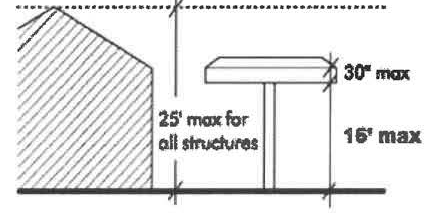
(8)
Additional landscaping requirements. In addition to the landscaping requirements set forth in Subsection (a) of this Section:
a.
Trees along all street frontages shall be a combination of deciduous and evergreen species, a minimum of twenty-four-inch box in size, planted no farther apart on center than the mature diameter of the proposed species.
b.
Shrubs planted along all street frontages shall be a minimum five (5) gallon size and a minimum continuous overall height of thirty (30) inches, measured from the finished grade of on-site pavement abutting the planter.
(9)
Lighting. In addition to the lighting provisions of Section 19-4-185, canopy lighting shall be recessed so that the luminaire does not extend below the surface of the underside of the canopy.
(10)
Noise. All outdoor noise generators associated with the business, including without limitation, trash collection and disposal activities, shall be identified by the applicant during conditional use permit review and may require the submittal of a professional noise analysis to quantify noise sources. Unless otherwise agreed in a recorded conditional use permit, all outdoor speakers and video/audio pump stations and sound signals associated with such service and air compressors from tire inflators shall be limited to the hours of 7:00 a.m. to 9:00 p.m. daily.
(11)
Orderliness. The premises shall be kept in an orderly condition at all times. No used or discarded automotive parts or equipment or permanently disabled, junked, or wrecked vehicles may be stored outside a building.
(12)
Truck idling. Truck stops shall prohibit the idling of the engines of tractor trucks or similar heavy commercial vehicles for any period in excess of one hour in any twenty-four-hour period.
(13)
Work areas. All work shall be conducted within an enclosed building except pumping motor vehicle fluids, checking and supplementing various fluids, and mechanical inspection and adjustments not involving any disassembly.
(14)
Abandonment. Any motor vehicle fueling/gasoline stations, truck stop or other commercial use that includes fuel pumps for retail sales of gasoline or other petroleum products or fuels sold through fuel pumps shall be dismantled and the site cleared within twelve (12) months subsequent to the close of the last business day.
(15)
Existing motor vehicle fueling/gasoline stations, truck stops and motor vehicle washes are subject to the requirements for nonconforming uses set forth in Section 19-2-235.
Sec. 19-7-260. - Storage uses and warehousing and distribution.
In addition to other applicable standards of this Article VII, all uses listed under the category of "Storage" and "warehousing and distribution" (under Industrial Uses category) as listed in the Schedule of Principal Uses of Section 19-2-230 are subject to the following standards. The development standards in this Section are intended to supplement the standards in the underlying zoning district for such uses and the requirements of Section 19-7-205. In the event of conflict between these standards and the underlying zoning district standards, the provisions of this Section shall apply.
(a)
Maximum parcel coverage of the storage, warehouse or distribution buildings and pavement is seventy percent (70%).
(b)
No permanent or temporary residential use is permitted within any structure or otherwise on the site, other than a caretaker unit for the designated on-site manager/caretaker.
(c)
Landscaping, buffering and screening shall be provided and maintained as follows:
1.
Buffering shall comply with the requirements of Section 19-4-180. At a minimum, a masonry wall at least six (6) feet in height shall be provided along all lot lines adjacent to a residential district.
2.
At least thirty percent (30%) of the site shall be landscaped and conform to Section 19-4-180. In addition, all landscaped areas shall be permanently maintained and a landscaped planter with a minimum inside width of six (6) feet and enclosed within a six-inch-high curb shall be provided along the front and street side property lines, except for vehicular circulation openings. A landscaping buffer with a minimum inside width of at least three (3) feet shall be provided along all other property lines.
3.
Landscaping shall be designed, installed and maintained to screen and break up the view of the building façade. Additional screening and landscaping may be required where necessary to prevent visual impacts on adjacent properties.
(d)
Noise. All outdoor noise generation associated with the business shall be identified by the applicant during conditional use permit review and may require the submittal of a professional noise analysis to quantify noise sources. The Town may condition the approval of the use on an adequate noise mitigation plan that will be implemented and maintained at all times.
(e)
Lighting. Lighting must be designed, installed and maintained to be low-profile, indirect or diffused to avoid adverse impacts on surrounding uses. All exterior lighting on the site and interior lighting that emanates through glass or openings to the outside of any building on the site shall be identified by the applicant during conditional use permit review and require the submittal of a professional lighting plan that complies with the standards set forth in this Code.
(f)
Architectural design. Vehicle docks and access points shall be oriented away from street frontage. Façades in excess of fifty (50) feet in length must incorporate architectural features or treatments to diminish apparent building mass. In addition, other techniques shall be incorporated for the purpose of reducing the apparent massing and scale of buildings. The following techniques should be used to accomplish this requirement; additional techniques proposed by the applicant may be considered:
1.
Variations in façade color, texture, or both.
2.
Variations in roof forms and heights of roof elements.
3.
Compositions that emphasize floor lines, or otherwise express rhythms and patterns of windows, columns, and other architectural features.
4.
Express the position of each floor in the external design. Terracing, articulated structural elements, a change in materials, or the use of belt courses or similar horizontal trim bands of contrasting color and/or materials can be used to define floor lines.
5.
Use windows, trellises, wall articulation, arcades, material changes, awnings or other features to avoid blank walls at ground floor levels.
6.
The use of materials relatable to human proportions, such as brick, tile, modular stone, stucco, glass and decorative tiles.
7.
Columns, pilasters, canopies, porticos, awnings, brackets, arches or other such architectural features.
8.
Windows revealing or accentuating indoor amenities and activities.
(g)
Storage of hazardous or flammable materials is not permitted unless otherwise agreed in a recorded conditional use permit and only in conformity with such permit.
(h)
Traffic. A traffic study shall be conducted to determine projected daily and peak-hour traffic generation, and the Town may require off-site or on-site street improvements if necessary to redress traffic concerns.
(i)
Personal storage units.
1.
Facility operating hours shall be limited to 7:00 a.m. to 9:00 p.m. daily.
2.
No outside storage of customer goods shall be permitted.
3.
An on-site manager shall be available at all times during the facility's established operating hours.
4.
Operators of self-storage units must maintain an up to date log of the lessees or owners to contain customer's name, driver's license, address, home and work numbers, e-mail addresses, and the name and contact information for a secondary contact in the event the lessee or owner cannot be reached.
5.
Customers shall not be permitted to operate a business or equipment within a self-storage unit.
6.
The size of a personal storage unit shall not exceed five hundred (500) square feet.
7.
A security plan shall be submitted that demonstrates that the use security cameras, security gate and keypad, and office-monitoring screen.
(j)
Application review and findings for approval. The decision-making authority shall only approve a conditional use permit for any use listed in Section 19-2-230 of the Town Code, Schedule of Principal Uses, under the heading "Storage" and warehousing and distribution (under Industrial Uses within such Schedule) if it finds that all the following are met:
1.
The project meets all requirements of the Code and is designed so that form and scale are harmonious and consistent with the character of the specific site, the adjacent uses and structures, and the surrounding neighborhood.
2.
The site design, including access points, parking and driving aisles, will promote safe and efficient on-site and off-site traffic circulation.
(k)
Conditions of approval. Conditions of approval for any use listed in Section 19-2-230 of the Town Code, Schedule of principal uses, under the heading "Storage" and warehousing and distribution (under Industrial Uses within such Schedule) may include limitations on operational characteristics of the use such as, without limitation, hours of operations; restrictions on outdoor storage and display, and/or requirements for buffering, screening, lighting, planting areas, or other site elements, in order to avoid adverse impacts on adjacent lots or the surrounding area.
(Ord. 662 §3, 10-6-20)
Sec. 19-7-270. - Manufactured and mobile homes.
Manufactured homes, as defined at Section 19-7-520, must comply with all design and construction standards contained in that definition and as described at Section 31-23-301(5)(a), C.R.S., as well as applicable portions of Article 5 of this Chapter (Flood Damage Protection). The placement of any mobile home, as defined in Section 19-7-520 of this Code, on any lot, tract or parcel of real property in the Town, is prohibited on and after the effective date of Ordinance No 666, which is July 9, 2021.
(Ord. 666 §1, 2021)
Sec. 19-7-280. - Food trucks.
(a)
Permit required. It is unlawful for any person to operate a food truck, as defined in this Article, within the corporate limits of the Town, without first obtaining a food truck permit as provided in this Section, which permit shall be considered a temporary use permit. All food truck operations must at all times comply with the permit application and requirements and any conditions attached to such permit.
(1)
No preapplication conference is required for a food truck temporary use permit. Completeness review and application referral for such permit applications shall be performed by the Town Clerk or Town Clerk designee.
(2)
All food trucks are required to obtain a location specific permit as provided in this Article. Any person who arranges for, or allows, one (1) or more food trucks to operate at a special event must obtain a food truck permit under this Article. Upon issuance of such food truck permit, the food truck operator(s) vending at said special event shall be relieved of the obligation to obtain individual permits under this Article in order to operate as part of said event. Each permittee shall prominently display a copy of the food truck permit issued hereunder in a location readily visible to the public on each food truck at the special event.
(3)
Documentation of regulatory approval as a retail food establishment by the Weld County Department of Health and Environment (or Tri-County Health for areas within Adams County) is required. The Town Clerk may request and require such additional information or documentation as he/she deems necessary in order to consider the application and make the required determinations as set forth in this Article. The timeframe for review of any application shall be extended during the pendency of any such request for additional information.
(4)
A separate business license as may otherwise be required under Article 1 of this Chapter 6 shall not be required of any person engaged in operating a food truck who has first obtained a food truck permit as provided in this Article.
(b)
Application for food truck permit; permit modifications.
(1)
The form of the application for a food truck permit shall be as furnished by the Town Clerk or Town Clerk designee and may be amended from time to time.
(2)
The applicant/permittee shall be obligated to provide the Town with an electronic mail address for receipt of notices which shall be functioning at all times when a permit is pending or during the applicable permitted times for food truck operations.
(3)
An application for a food truck permit under this Article shall be submitted to the Town Clerk's Office no less than eight (8) business days prior to the first day of the proposed operation.
(4)
All applicants for a food truck permit under this Article must provide their Colorado-issued sales tax license number as part of the application and acknowledge the obligation to collect and remit the Town sales tax whenever operating within the town limits.
(5)
A food truck permit issued under this Article is valid for a time period not to exceed sixty (60) days. Any requests for extensions to this maximum time period shall be reviewed by the Town Clerk or designee based on the specific circumstances of the proposed food truck permit application. One (1) extension per food truck permit may be granted up to sixty (60) additional days.
(6)
All applications and issued permits will define the location and allowed operating date(s) and time(s) for food truck vending as well as information on the proposed orientation and size of any food truck, equipment (including without limitation any litter disposal cans, canopies and/or tables) and will describe how customers will queue and be served.
(7)
Applications for a food truck permit will not be accepted or thereafter processed unless complete and all required supporting documents and submissions have been received by the Town Clerk. The Town Clerk or designee, in the Town Clerk's or designee's sole discretion, may waive the submission of any document upon the prior request of the applicant.
(8)
The fees to be paid to the Town for the issuance, modification, renewal or extension of any food truck permit pursuant to this Article shall be set by the resolution of the Town Board of Trustees and shall remain in effect until such resolution is amended by action of the Town Board of Trustees.
(9)
A request for a modification of a food truck permit shall be submitted to the Town Clerk or Town Clerk designee and shall meet all of the requirements and be reviewed in the same manner as an application for a new permit.
(c)
Food truck permit processing procedures.
(1)
Applications for a food truck permit shall be considered individually and in chronological order as established by the date of receipt of a properly completed application. The Town Clerk or designee may limit the number of permits issued for any given location or date or time in order to avoid congestion or obstruction of access or circulation.
(2)
An application for a food truck permit will be processed as follows:
a.
Application review. Upon receipt of an application, the Town Clerk or designee will conduct an internal review and may forward copies of the application to any pertinent internal and external agencies for review and comment.
b.
Complete application. Within two (2) business days of the filing of an application, a determination shall be made whether the application is complete according to the application requirements. The applicant shall be notified of any deficiencies in completeness of the application and shall be granted a reasonable time in which to cure said deficiencies.
c.
Review by applicable departments and agencies. Upon determination of a complete application, the application shall be distributed for review to the applicable departments and agencies that serve the Town. Any comments from the Town or departments or agencies that serve the Town shall be returned to the applicant within ten (10) business days of a complete application determination.
d.
Decision. If no revisions to the application are required by the reviewing departments or agencies, the Town Clerk or designee shall grant approval or denial of the application within six (6) business days after a complete application determination. A delay in decision, for any reason, shall not be deemed grounds for approval of the application.
(d)
Revocations.
(1)
A food truck permit may be revoked under the authority of the Town Administrator in the event that the Administrator finds that:
a.
the permittee fails to operate in conformity with an issued permit or has violated any of the terms of the provisions pertaining to his or her permit; or
b.
the food truck operations are operated in an unsanitary manner, obstruct traffic or pedestrians, cause undue congestion or crowds, or an accumulation of litter; or
c.
the Town receives substantiated complaints regarding nuisance effects of the food truck operations, to include, without limitation, excessive crowds, noise, fumes, smells or light incompatible with the surrounding area from which the food truck is operated; or
d.
a fact or condition exists which, if it has existed or had been known to exist at the time of the application for such permit, would have warranted the refusal of the issuance of such permit.
(2)
The Town Administrator may revoke any food truck permit issued by the Town immediately upon providing notice to the permittee by e-mail at the e-mail address required to be kept current with the Town or upon personal service of a notice of revocation to the place of operations of the permittee (during operations) stating the revocation and in general the grounds therefor.
(3)
A permittee may appeal a decision of the Town Administrator to the Board of Trustees at the next available regular meeting of such Board. The permittee shall have the burden of proving at such appeal that the Town Administrator abused his/her discretion in revoking the permit. The decision of the Board of Trustees shall be final.
(e)
Restrictions for operation within the public right-of-way. All food truck operators operating within the public right-of-way within the Town shall adhere to the following restrictions:
(1)
All posted parking requirements or restrictions shall be adhered to.
(2)
No permittee shall operate for more than five (5) hours in one (1) location within a twenty-four (24) hour time period, unless otherwise granted approval by issuance of a permit specifically allowing such operation.
(3)
Each permittee shall provide for waste collection and shall pick up and dispose of any paper, cardboard, wood or plastic containers, wrappers, or any litter that is deposited within twenty-five (25) feet of the food truck, permitted location, or within twenty-five (25) feet of the point of any sale or transaction, including litter that is not a direct result of the food truck operations. The permittee shall carry a suitable container for the placement of such litter by customers or other persons.
(4)
Other than a suitable container for placement of litter, no permittee shall set up any structures, canopies, tables, chairs, or other equipment that is not attached to the food truck.
(5)
Each permittee shall maintain in safe condition any food truck, vehicle, structure, device, or any other similar item described in the food truck permit, so as not to create an unreasonable risk of harm to the person or property of others.
(6)
No permittee shall leave unattended any food truck while in the public right-of-way.
(7)
A food truck shall not obstruct the movement of pedestrians or other vehicles and shall not be:
a.
Stopped on any road or street such as to obstruct any traffic for any period of time;
b.
Parked or placed within fifty (50) feet of any intersection;
c.
Parked or placed within twenty (20) feet of any marked crosswalk.
(8)
Each permittee may only operate in areas where parallel parking is allowed and must serve the public from the sidewalk and not from the street or adjacent parking spaces.
(9)
No permittee shall operate within two hundred (200) feet of a Town park without first obtaining written approval from the Town Public Works Operations Manager. Said written approval must be available for inspection at any time during vending operations.
(f)
Restrictions for operations outside the public right-of-way. All food truck operators operating on land that is not considered public right-of-way, including, but not limited to, private property, public parks, and school district property, shall adhere to the following restrictions:
(1)
All permittees must have written permission from the property owner for the parcel on which the vending will take place. Said written permission must be submitted with the application and be available for inspection at any time while vending operations are taking place.
(2)
All permittees applying to operate within a residential zone which is governed by a homeowners' association must provide proof of approval of such homeowners' association with the permit application.
(3)
Each permittee shall provide for waste collection and shall pick up and dispose of any paper, cardboard, wood or plastic containers, wrappers, or any litter that is deposited within twenty-five (25) feet of the food truck, permitted location, or within twenty-five (25) feet of the point of any sale or transaction, including litter that is not a direct result of the operations of the food truck. The permittee shall carry a suitable container for the placement of such litter by customers or other persons.
(4)
Other than a suitable container for placement of litter, no permittee shall set up any structures, canopies, tables, chairs, or other equipment that is not attached to the food truck unless the permittee has specifically identified such in the food truck permit application, the property owner has agreed to placement of such equipment, and the permit allows such placement.
(5)
All food truck vendors operating in public parks must receive written permission from the Town Public Works Operations Manager, to be submitted with the corresponding permit application and be available for inspection at any time while vending operations are taking place.
(Ord. 667 §5, 2021)
Sec. 19-7-290. - Restrictions on parking or storage of certain vehicles on private property within residential zones.
(a)
Definitions. As used in this Section:
(1)
"Bus" means a motor vehicle designed to seat more than sixteen (16) passengers and used for the transportation of persons, regardless of compensation, including, but not limited to, motor vehicles operated for profit by governmental agencies and motor vehicles used for the transportation of children to and from school.
(2)
"Camper" means non-wheeled, detachable vehicular equipment that weighs over five hundred (500) pounds, used for temporary or permanent habitation, which has no independent motor power and that is capable of being placed on a vehicle but is not capable of being towed.
(3)
"Camping Trailer" means a trailer constructed to provide temporary occupancy as a dwelling or sleeping place for one (1) or more persons.
(4)
"Commercial Vehicle" means:
a.
Any self-propelled or towed vehicle bearing a commercial license plate or having a manufacturer's gross vehicle weight rating or gross combination rating often thousand one pounds (10,001) or more, which vehicle is used in commerce or is designed to transport sixteen (16) or more passengers, including the driver, unless such vehicle is a bus as defined in this Subsection; and
b.
Any motor vehicle designed or equipped to transport other motor vehicles from place to place by means of winches, cables, pulleys, or other equipment for towing, pulling, or lifting.
(5)
"Commercial utility trailer" means a utility trailer used in commerce.
(6)
"Load(ed) and/or Unload(ed)" means the uninterrupted activity of continuously moving material, equipment, goods or other items of personal property from or to a vehicle.
(7)
"Mobile home" means a non-motorized vehicle designed to be permanently affixed to land to be used for occupancy as a dwelling or sleeping place for one (1) or more persons, but which is constructed to allow it to be transported upon streets and highways.
(8)
"Motor home" means a motorized vehicle designed to provide temporary occupancy as a dwelling or sleeping place for one (1) or more persons and which is intended to be transported upon streets and highways, but excluding pick-up trucks with attached campers
(9)
"Occupancy" or "occupy" shall include, but is not limited to, personal or human occupancy of any kind to include inhabiting, living in, or lodging in, regardless of time.
(10)
"Operable condition" means in a condition that would allow its normal operation, with functioning headlights, inflated tires, current license plates or tags, and not partially dismantled, lifted on jacks, blocks or other structures.
(11)
"Recreational trailer" means a trailer used and operated for any purpose other than a predominantly commercial purpose, such as a boat trailer or snowmobile trailer.
(12)
"Recreational vehicle" means a means a motor home or camping trailer and does not include campers or mobile homes.
(13)
"Rendering Services" means commercial activities carried on in connection with the business purpose of the vehicle, such as making deliveries, service calls, accepting articles for removal or delivery, and related commercial activities.
(14)
"Residential District" means the R-1, R-2, R-3, RR and MU zone districts and the residential areas of any planned unit development within the Town.
(15)
"Semi-Tractor" means a motor vehicle with a manufacturer's gross combination weight rating (GCWR) in excess of twenty-six thousand and one (26,001) pounds, which is designed and commonly used to draw a semi-trailer and its cargo load over the public roadways.
(16)
"Semi-Trailer" means a wheeled vehicle, the empty weight of which is more than two thousand (2,000) pounds or the length of which is greater than twenty-five (25) feet, which has no motor power and is designed to be used in conjunction with a semi-tractor so that some part of its own weight and that of its cargo load rests upon such semi-tractor.
(17)
"Trailer" means a recreational trailer and a utility trailer.
(18)
"Truck" means a motor vehicle exceeding eight (8) feet in width, twenty-five (25) feet in length or ten (10) feet in height, excluding motor homes.
(19)
"Utility trailer" means a trailer built or designed to be used for transporting equipment, goods, materials, junk, debris, construction materials and like items.
(b)
Storage or parking of recreational vehicles, recreational trailers or utility trailers, whether or not attached to a motorized vehicle, or campers unattached to a motor vehicle, or boats whether or not attached to a recreational trailer, within a residential district of the Town shall be prohibited, except if all the following conditions are satisfied:
(1)
The parcel on which such vehicle is parked or stored must contain a residential structure which is occupied.
(2)
A combination of no more than three (3) recreational vehicles, recreational trailers or utility trailers, whether or not attached to a motorized vehicle, or campers unattached to a motor vehicle, or boats whether or not attached to a recreational trailer may be located on one (1) parcel at any time.
(3)
No more than one (1) of any recreational vehicle, recreational trailer or utility trailer, whether or not attached to a motorized vehicle, or camper unattached to a motor vehicle, or boat whether or not attached to a recreational trailer may be located in front of the front building line of the main residential structure or visible from the street in the side yard on any parcel at any time.
(4)
Storage or parking of such vehicle(s) within the side yard area is permitted with a one-foot setback from the side property line.
(5)
The registered owner of any such vehicle(s) stored on the property must either be the owner of the property or use the property as his/her primary residence.
(6)
If located in the front or side yard, storage or parking of such vehicle(s) must be located on an approved surfaced area. Surfaced area must consist of asphalt, concrete, gravel, pavers, road base, crushed concrete or like materials approved by the Town. Parking area must remain free of weeds, grass or other vegetation.
(7)
Such vehicle(s) shall not be occupied for sleeping or lived in permanently or temporarily.
(8)
Coverings such as tarps or cloth screens are not permitted. Fitted covers are permitted and may be used as long as they are specifically designed for a recreational vehicle. All fitted covers shall be maintained in good condition.
(9)
All such stored or parked vehicles and trailers must be in operable condition and display current registration. The wheels shall not be removed except for temporary repair or maintenance.
(10)
Repairs and maintenance of such vehicles shall not be permitted on a residential parcel with the exception of provisioning, cleaning, replacement of tires, batteries, spark plugs or other minor repairs which shall not involve exchange of engine parts, transmission, mechanical components, paint or body work. Recreational vehicles may contain enclosed storage associated with the use of the vehicle. All other storage must be out of public view.
(11)
Open trailers must remain empty and free of debris and storage unless in active use. Tarps or like coverings are not permitted. Enclosed trailers may contain storage associated with the use of the vehicle. All other storage must be out of public view.
(12)
Recreational vehicles with "slides" must keep the "slides" closed at all times unless in active use.
(13)
Such vehicles shall not be parked or stored in any manner that encroaches upon the public sidewalks or streets, including any equipment associated with the vehicle or trailer.
(c)
Access to front, side or rear area storage. The person storing any recreational vehicle, recreational trailer or utility trailer as may be permitted hereunder shall access the side or rear yard storage areas from the existing driveway only.
(d)
Commercial vehicle private property storage: No bus, commercial vehicle, semi-tractor, or semi-trailer, shall be parked or stored upon private property in any residential district of the Town, whether attached to a motor vehicle or not, with the exception of a bus, commercial vehicle, semi-tractor, or semi-trailer being loaded or unloaded, or prepared for storage; but such loading and unloading and preparation for storage shall not in any event exceed forty-eight (48) hours.
(Ord. 668 §1, 2021)
Sec. 19-7-305. - Purpose and intent.
(a)
This Division is enacted to provide for the safety, and preserve the health, safety and welfare of the present and future residents of the Town.
(b)
This Division is enacted pursuant to the home rule authority, land use authority, and the police powers of the Town.
(Ord. 649 §2, 2020)
Sec. 19-7-310. - Scope and applicability.
(a)
Subject to the provisions of this Division, no oil and gas well site shall be initiated in any manner within the Town prior to issuance of an oil and gas permit.
(b)
Nothing in these regulations shall be construed to diminish the applicability of the other development-related codes of the Town, including requirements for building permits and grading permits. These regulations are supplemental to the zoning regulations contained in the Land Development Code.
(c)
The Board of Trustees shall adopt by separate resolution the Oil and Gas Best Management Practices ("BMP"). The BMP Document will be posted on the Town's website. The Board of Trustees may by resolution update the Oil and Gas BMP Document as necessary to reflect changes in technology, state regulation, and industry practices.
(d)
Where, in any specific case, the requirements of any other Division within the Land Development Code or the regulations of any state or federal agency are in conflict with this Division, the more restrictive requirements shall be imposed.
(Ord. 649 §2, 2020)
Sec. 19-7-315. - Oil and gas permit required.
(a)
New oil and gas facilities.
(1)
It shall be unlawful for any person to drill a new well, construct a new facility or install new accessory equipment or structure within the corporate limits of the Town, unless an oil and gas permit has been obtained pursuant to this Division. A separate oil and gas permit shall be required for each well or production site that has not been previously permitted under this Division except as outlined in Section 19-7-315(b) and (c) below.
(2)
It shall be unlawful for any person to operate a well, facility or accessory equipment or structure within the corporate limits of the Town, except in compliance with the terms and conditions of the oil and gas permit.
(3)
If more than one (1) well or production site is proposed at the same time, the applicant may submit one (1) application for multiple wells and facilities; however, a separate fee shall be required for each well site included in the application. The Town will issue a multiple oil and gas operations permit that notes the name and location of each well or production site.
(4)
Any such permit issued pursuant to this Division shall encompass within its authorization the right for the Operator, his or her agent, employee, subcontractor or independent contractor or any other persons to perform that work necessary in the drilling, completion or maintenance operations.
(5)
For the purpose of this Division, the installation of tanks, heaters, separators and other accessory drilling or production equipment shall be construed as extensions to oil and gas wells and shall accordingly be subject to the same applications, review, permit, regulations, and standards. The application for these accessories when intended to be installed at the same time as the oil or gas well may be merged with an application for an oil or gas permit and shall not require an additional permit fee.
(b)
Legacy oil and gas facilities. By enactment of this Division, the Town hereby approves any well, equipment or facility drilled or constructed prior to the enactment of this Section or that occurred prior to annexation of additional acreage within the Town.
(c)
Modification to existing oil and gas facilities. Any proposed change made to an oil and gas facility must be reviewed by the Building Department and must receive permission through one (1) of the following.
(1)
Change of operations permit. Modifications to a legacy oil and gas facility must receive a change of operations permit. Such change of operations application will be administratively reviewed and granted so long as the location comes into substantial compliance with all regulations and BMPs required to protect public health, safety, welfare and the environment.
(2)
Amendment of an oil and gas permit. The oil and gas permit is limited to the facilities as shown in the approved permit plans. To the extent the applicant desires, after initial completion of a well, to place additional equipment on a tank battery or wellhead location, which was not shown in the approved plan, the applicant must, except in a situation where additional temporary equipment is necessary for a period of fourteen (14) days or less, submit a revised site and operating plan to the Town depicting any changes from the approved oil and gas permit. If the staff concludes that the proposed change will not cause additional adverse impacts to public health, safety or welfare or the environment, the amendment of the oil and gas permit can be accomplished administratively. Upon receipt of the amended site plan and operating plan, the Town shall issue a revised oil and gas permit as provided in this Division. In the event the staff concludes the proposed change would cause an additional adverse impact to public health, safety, welfare or the environment, the proposed amendment will trigger new notice and require a new oil and gas permit subject to these regulations.
(3)
Plugging and abandonment permit. The plugging and abandoning of a well site or pipeline requires a plugging and abandonment permit. The permit will be issued administratively and will not require a public hearing.
(d)
Terms and conditions of the oil and gas permit.
(1)
The term of the oil and gas permit shall be for two (2) years except as otherwise stated herein. Upon issuance of a COGCC surface location permit allowing drilling or operations on the well site that is the subject of the Town's permit, the term of the oil and gas permit shall automatically be extended to become coterminous with the COGCC issued permit (including individual well permits) unless the oil and gas permit has otherwise expired, lapsed, revoked, forfeited, abandoned, or otherwise terminated.
(2)
Upon issuance of an oil and gas permit, and notwithstanding any other provision in this Code, the total number of wells approved in the oil and gas permit must be drilled and completed within three (3) years of permit approval. Failure to do so shall constitute the forfeiture of the authorization and right to drill any undrilled wells. Authority to drill forfeited wells can only be obtained by amending the existing oil and gas permit or issuance of a new oil and gas permit.
(3)
If requested by the applicant, the Town Administrator may grant a one-time extension for a period of up to one (1) year if:
a.
The permit has not yet expired;
b.
The permit recipient has proceeded with due diligence and in good faith; and
c.
Conditions have not changed so substantially as to warrant a new application.
(4)
The oil and gas permit shall automatically expire with the abandonment and reclamation of the associated well.
(5)
The granting of an oil and gas permit shall not relieve the operator or owner of a well, production site, pipeline or gathering line from otherwise complying with all applicable regulatory requirements of the Town, the state, or the United States.
(6)
Within thirty (30) days after the well is completed and equipped, the applicant shall provide to the Town as-built drawings showing all facilities, pipelines, flow lines and gathering lines which the applicant has placed on the land subject to this permit. These as-built drawings shall be the same as submitted to the COGCC.
(7)
The oil and gas permit and/or change of operations permit required by this Section is in addition to any permit which may be required by any other provision of this Code or by any other governmental agency.
(Ord. 649 §2, 2020)
Sec. 19-7-320. - Oil and gas permit application submittal requirements.
(a)
Initial application form and authorization. Every application for an oil and gas permit issued pursuant to this Division shall be in writing on a form supplied by the Town, signed by the operator, or some person duly authorized to sign on his or her behalf, and filed with the Building Department. If no form is available, operator may file in its own format the following information that shall be submitted:
(1)
The operator's name and address and, if the operator is a corporation, the state of incorporation and, if the operator is a partnership, the names and addresses of the general partners;
(2)
The name, address, telephone number, fax number and e-mail address of the individual designated by the operator to receive notices;
(3)
The aliquot legal description of the property to be used for the oil/gas operation and the assessor's parcel number for the property. Property recorded by plat shall also be identified by subdivision name and block and lot numbers;
(4)
The well name(s);
(5)
The mineral lessee's name(s) and address;
(6)
The name and address of the representative with supervisory authority over the oil and gas operation site activities and a twenty-four-hour emergency phone number;
(7)
The name and address of the surface owner or owners; and
(8)
The name, address and telephone number of the person or firm designated by the operator to file the oil and gas permit application and prepare the site plan and related exhibits.
(b)
Fees and financial assurances. Every applicant shall provide the following fees and financial assurances:
(1)
Application fee. Every application shall include a required fee in the amount of ten thousand dollars ($10,000.00).
(2)
Cost reimbursement agreement. Every applicant shall submit a signed cost reimbursement agreement provided by the Town, but such reimbursement agreement shall only apply to the use by the Town for outside consultants to review the application, if necessary. The application fee and required cost reimbursement agreement must be received by the Building Department in order to process the application.
(3)
Insurance. Prior to commencement of any work, the operator will provide liability and insurance under the conditions, and in the amounts, necessary to protect against the risks and liabilities associated with the proposed activity.
(4)
Financial assurance. Prior to the commencement of any work, including well pad construction at any permitted well site, operator will provide the Town with a single surety applicable for all well sites in the form of a letter of credit in the amount of three million dollars ($3,000,000.00) to insure the immediate availability of finances for any costs incurred by the Town following a financial setback of the operator.
a.
Financial setback shall be defined as the operator filing for protection under the bankruptcy laws, making an assignment for the benefit of creditors, appointing or suffering appointment of a receiver or trustee over its property, filing a petition under any bankruptcy or insolvency act or having any such petition filed against it which is not discharged within ninety (90) days of the filing thereof.
b.
Operator shall notify the Town of the existence of a financial setback within five (5) business days of the financial setback.
c.
The letter of credit shall remain in effect until all drilling operations at all new wells have been completed, and all well sites for which work has commenced are in the production phase, without exception.
d.
Upon the occurrence of a financial setback, the Town may call upon the surety effective immediately upon written notice to the operator for the purpose associated with the need to secure well sites, associated well site lands and infrastructure or as a demonstrated need to protect the public welfare and safety.
e.
This financial assurance provision in a form accepted by the Town is not a substitute for any bonding required by the state regulatory agencies for plugging and abandoning wells.
f.
The Operator shall comply with all state regulatory agencies bonding requirements.
g.
The letter of credit shall be released within ten (10) business days of Operator's written request following completion of the last well site and the wells have been turned to production.
(5)
Inspection fees. Operator shall reimburse the Town for all inspection costs reasonably incurred to inspect the well sites to determine compliance with this agreement and any permits issued by the Town. Such fees shall include actual costs incurred by the Town, including employee time, employee supervision, necessary equipment rental, and overhead. Where a well is plugged and abandoned, no fees will be imposed thereafter.
(6)
Road improvements and maintenance agreement. Operator must sign an agreement to pay for ongoing road repair and maintenance costs attributable to its operations. The Town will conduct periodic impact assessments with the operator to determine the extent of any damage accruing to the road caused by the operator's activities. Operator may conduct baseline road condition assessments with a third-party contractor to define existing road conditions. Operator will pay the Town for the cost of the actual repairs for the assessed damage or else arrange and pay the cost of such repairs itself with a contractor acceptable to the Town.
(c)
Substantive application. Upon having submitted the materials and fee required, an application for an oil and gas permit pursuant to this Section shall be filed with the Building Department and shall include the following information:
(1)
Site plan. The site plan shall be submitted on one (1) or more plats or maps, at a scale not less than one (1) inch to fifty (50) feet, showing the following information:
a.
A site plan of the proposed operation showing the location of all improvements and equipment, including the location of the proposed wells and other facilities, and including, but not limited to, pumps, motors, electrical power lines, tanks, flowlines, gathering lines, compressors, separators and storage sheds. All existing tank batteries and transmission and gathering lines within one thousand (1,000) feet of the well site shall also be shown.
b.
The location of layout, including, without limitation, the position of the drilling equipment and related facilities and structures, if applicable.
c.
The location and description of all existing improvements and structures within one thousand (1,000) feet of the well, as well as proof that the new well or production site meets all applicable COGCC and Town setback requirements.
d.
Existing utility easements and other rights-of-way of record, if any, within a radius of one thousand (1,000) feet of the proposed well.
e.
The location of existing irrigation or drainage ditches within one thousand (1,000) feet of the well site or production site, if any.
f.
The applicant's drainage and erosion control plans for the well site or production site, if applicable. The applicant may submit the plan required by COGCC to meet this requirement.
g.
Location of access roads in accordance with the provisions of Section 19-7-355.
h.
The location of existing oil and gas wells as reflected in COGCC records within a one thousand-foot radius of the proposed location for the well and existing lease boundaries.
i.
The names of abutting subdivisions or the names of owners of abutting, unplatted property within five hundred (500) feet of the proposed of the well site or production site.
j.
The date the site plan was prepared and any revision numbers to the site plan, when applicable.
k.
The location of existing wildlife and nature areas within one thousand (1,000) feet of the well site or production site, if any.
l.
The location of the well site or production site in relation to existing lease boundaries.
m.
A true north arrow.
(2)
Traffic control plan. In compliance with the description in the Oil and Gas BMP Document, the operator shall prepare a plan showing public and private roads that traverse and/or provide access to the proposed operation and a plan showing the estimated number of vehicle trips per day for each type of vehicle, proposed transportation routes to and from the site, and measures to mitigate adverse impacts to traffic patterns and safety caused by the proposed operation.
a.
A vendor selected by operator from a list of vendors that is pre-approved by the Town shall prepare a Traffic Impact Study which shall clearly identify and distinguish impacts to Town roads and bridges related to facility construction, operations and ongoing new traffic generation. Traffic impact studies shall be prepared in accordance with Town standards and requirements or other guidelines found in the Applicable Code. The study shall include a traffic mitigation plan addressing transportation impacts that will typically include, but not be limited to, a plan for traffic control, the receipt of all necessary permits, ongoing roadway maintenance and improving or reconstructing Town roads, including providing financial assurance.
b.
The map showing all proposed transportation routes for access to and from the well site shall include those routes used for construction equipment and well drilling, completion and reworking equipment from the well/production site to the to the corporate limits of the Town.
c.
All transportation routes which access the state highway system shall be required to obtain necessary Colorado Department of Transportation (CDOT) access permits.
(3)
Written narrative. The applicant shall refer to the Oil and Gas BMP Document for additional details on the following submittals and plans:
a.
A title block or heading containing the operator's and surface owner's names and addresses, the well name and the legal description of the well/production site location.
b.
Copies of the approved or submitted COGCC forms 1A, and 2 or 2A or 10, as applicable. If the applicant has not received approval from COGCC, the Town shall process the application conditioned on proof of an approved COGCC permit.
c.
An operating plan.
d.
A copy of the surface use agreement or acknowledgement, including reception number, that a surface use agreement has been recorded with the applicable County Clerk and Recorder's Office.
e.
A list of all permits or approvals obtained or yet to be obtained from local, state or federal agencies, including any exceptions or variances that are required.
f.
Emergency response plan. Operator shall prepare an emergency response plan that is mutually acceptable to the operator and the appropriate fire protection district and the Police Department that includes a list of local telephone numbers of public and private entities and individuals to be notified in the event of an emergency, the location of the well and provisions for access by emergency response entities. The applicant must provide a commitment to serve ("will serve") letter from the authority having jurisdiction for providing emergency services (fire protection and emergency medical services) for that facility.
g.
A plan for weed control at the well site.
h.
A sanitary facilities plan that complies with COGCC regulations.
i.
Verification of ownership of the mineral interest.
j.
Nuisance prevention plan. Operator shall prepare a plan to manage noise, light and odor to prevent nuisance. Noise and odors shall be kept at or below the levels that would constitute a nuisance. The plan must include a baseline noise study as well as noise modeling of equipment proposed for the site for drilling and completions.
k.
Electrification plan. Operator shall identify all sources of electricity that will be brought to or used at the well site during all phases, including drilling, completion and production.
l.
Air quality mitigation plan. Operator shall prepare an air quality mitigation plan which includes baseline air quality testing and a modeling assessment of air quality impacts of a related project per the BMP Document and a plan and schedule to maintain air quality, including a plan to minimize VOC emissions in compliance with the BMPs.
m.
Waste management plan. Operator shall prepare a waste management plan that identifies the projected waste from the site and plans for disposal of such waste.
n.
Hazardous materials management plan. Operator shall prepare a hazardous materials management plan that identifies all hazardous materials that will be brought on site, how they will be transported and used, and measures to prevent any release of those materials.
o.
Water quality monitoring plan. Operator shall prepare a plan that describes the steps it will take to provide water quality monitoring to demonstrate no water quality degradation of surface or ground water.
p.
Spill prevention, control, and countermeasure plan. Operator shall prepare a plan which describes spill prevention and mitigation practices.
q.
Stormwater pollution prevention and erosion control plan. Operator shall prepare a plan to minimize impacts to surface waters from erosion, sediment, and other sources of non-point pollution. The stormwater control plan required by COGCC Rule 1002(f) may be provided to establish compliance with this provision.
r.
Interim reclamation plan. Operator shall prepare a plan, including a written description of the species, character and density of existing vegetation on the well site, a summary of the potential impacts to vegetation as a result of the proposed oil and gas operations, and proposed replanting and mitigation to address these impacts. The plan shall include any COGCC required interim reclamation procedures and shall include the means by which vegetation will be watered and maintained.
s.
Dust mitigation plan. Operator shall prepare a plan to control dust in an effort to minimize visible dust emissions from roadways or from completion operations.
t.
Wetlands Protection Plan. Operator shall prepare a plan, if applicable, demonstrating the oil and gas operations shall, to the maximum extent practicable, avoid causing degradation to wetlands within the Town.
u.
Floodplains and floodways. Oil and gas facilities are prohibited in the floodway. A floodplain permit is required if any operations are within the floodplain.
v.
Visual mitigation plan. Operator shall prepare a plan that will consider fencing materials, berming, and use of existing vegetation and natural contours to the maximum extent practicable. The visual mitigation plan shall require photographic simulations.
w.
Landscaping plan. Operator shall prepare a plan that shall be coordinated with the Town and the surface owner and, depending on access to water, may be staged to accommodate surface development. Landscaping plans should use drought tolerant species that are native and less desirable to wildlife and suitable for the climate and soil conditions of the area. An irrigation plan may be required where buffering is accomplished with vegetation.
x.
Site security plan. Operator shall prepare a plan for each well site. Each plan for a well site shall be reviewed by operator on a yearly basis and will be updated, as necessary. The Town may request a review and update of the plan, at its sole discretion.
y.
Request for waiver of location requirements in Section 19-7-365.
(Ord. 649 §2, 2020)
Sec. 19-7-325. - Oil and gas permit process for new oil and gas operations.
All oil and gas operations are conditional uses and will go through the conditional use permitting process as described in Section 19-2-210 to receive an oil and gas permit. Where terms of this Section conflict with other standards in the Land Development Code, the provisions of this Section shall apply.
(a)
Step 1: Pre-application conference. The applicant shall attend a pre-application conference with a representative from the Town. The purpose of the meeting is to discuss the oil and gas permit submittal requirements and review process. Town staff will review the list of best management practices that may be required to reduce or eliminate impacts to public health, safety, welfare or the environment. The staff also has discretion to require an alternative location analysis that must be completed prior to submittal of an application for an oil and gas permit.
(1)
The applicant shall prepare and submit a preliminary site analysis to the Town for review at the pre-application conference. The preliminary site analysis shall include the following information:
a.
All drilling and spacing units proposed by the applicant within one thousand five hundred (1,500) feet of the Town's municipal boundaries;
b.
The proposed site for the oil and gas location and all features defined below, completely contained within, or within one-quarter (¼) mile of all drilling and spacing units proposed by the applicant;
c.
Any existing residential, platted residential, or property currently entitled for residential use, not including properties zoned agricultural over five (5) acres in size;
d.
Properties designated for future residential in the Town's adopted Comprehensive Plan, including mixed use;
e.
Any facility classified as a high occupancy building unit as defined by the COGCC;
f.
Any public or private recreation facilities;
g.
Outdoor venues, playgrounds, permanent sports fields, amphitheaters, or other similar place of public assembly;
h.
Public or private parks, not including trails;
i.
Senior living or assisted living facilities;
j.
Areas within the FEMA 100-Year Floodplain boundary;
k.
The centerline of all USGS perennial and intermittent streams;
l.
Reservoirs and public water supply wells;
m.
Wetlands; and
n.
Sensitive wildlife areas.
(2)
If required by staff, the applicant will be required to submit an alternative location analysis. The applicant shall analyze all potential sites that can reasonably access the mineral resources within the proposed drilling and spacing unit. The following information shall be provided for each site:
a.
General narrative description of the site;
b.
Why the particular site is proposed;
c.
A summary of the off-site impacts that may be associated with that particular site; and
d.
Proposed truck traffic routes, pipeline routes, and access roads for each site.
(3)
Staff will review all proposed locations in order to determine if there is a suitable location that would adequately protect public health, safety, welfare, and the environment. Each proposed location shall be evaluated against the following criteria to determine if it is a suitable location:
a.
Whether the location would comply with siting requirements in Section 19-7-365;
b.
Whether mineral extraction is technically possible and reasonable from the location;
c.
The proposed facility will not result in a substantial or undue adverse effect on adjacent property, the character of the neighborhood, traffic conditions, parking, public improvements, either as they presently exist or as they may exist in the future;
d.
A proposed site's conformance with the Town's adopted Comprehensive Plan, and any other applicable adopted plans;
e.
The ability to utilize pipelines and consolidate facilities with other planned drilling and spacing units proposed within the Town's municipal boundaries; and
f.
Landowner's willingness to accommodate a surface use location. Previous execution of a surface use agreement between any landowner and operator shall not automatically deem a proposed site as the preferred alternative; and
g.
Impact on nearby environmental resources such as water bodies.
(4)
If a suitable location is identified, staff will recommend the operator proceed with an oil and gas permit application. If a suitable location is not identified or is unavailable, staff will recommend that the operator evaluate other locations or may recommend denial if an oil and gas permit application is submitted.
(b)
Step 2: Application submittal. After the pre-application conference and the submittal of an alternative location analysis (if necessary) the applicant may submit an oil and gas permit application to the Town Administrator or designee. The application must meet the submittal requirements of Section 19-7-320 (c).
(c)
Step 3: Staff review for completeness. Within a reasonable period of time, not to exceed ten (10) business days, Town staff shall either certify that the application is complete and in compliance with all submittal requirements or reject it as incomplete and notify the applicant of any deficiencies. The applicant shall then correct any deficiencies in the application package, if necessary, and resubmit the required number of copies of the amended application to the Town. This is not a substantive review of the application submitted.
(d)
Step 4: Referral agencies notified. Upon receipt of a completed application, the Town shall forward the application to the appropriate referral agencies. The referral information shall include the time and place of the public hearing, the nature of the hearing, the location of the subject property and the applicant's name. At minimum, the application shall be referred to Adams or Weld County, the Police Department, and the applicable Fire District. Referral agencies shall be provided thirty (30) days to respond with any comments. After such thirty-day period, the Town may proceed on the application whether to not the Town has received comments from the notified referral agencies.
(e)
Step 5: Staff review and comments. Town staff shall review the application for compliance with this Section and all other applicable federal, state and Town regulations and standards. A summary of this review, including referral comments, and proposed conditions of approval, shall be sent to the applicant.
(f)
Step 6: Applicant response. The applicant shall address all of the Town staff comments and any referral agency comments, then submit the following to the Town:
(1)
Written correspondence explaining how all of the comments have been addressed; and
(2)
Revised maps and other documents, as necessary.
(g)
Step 7: Final staff review and report to Board of Trustees.
(1)
Town staff will complete a final review of the resubmitted materials and then prepare a report to the Board of Trustees explaining how the application is or is not consistent with the review criteria and applicable Town ordinances, regulations and standards.
(2)
Conditions of approval. Staff may propose a list of conditions of approval, including requiring the use of best management practices, to reduce or eliminate impacts to public health, safety, welfare, or the environment. The Oil and Gas Best Management Practices Document ("BMP Document") will be maintained on the Town's website. In proposing conditions of approval from such best management practices or other sources, the staff shall consider the following factors, among other considerations:
a.
Site-specific factors of the proposed new oil and gas location;
b.
The extent the best management practices can be used to prevent significant degradation of the health, safety, and welfare of area residents and the Town of Lochbuie;
c.
The extent to which conditions of approval will promote the use of existing facilities and reduction of new surface disturbance;
d.
The extent to which legally accessible and technologically feasible alternative sites exist for the proposed new oil and gas location; and
e.
The extent to which the proposed oil and gas location is within land used for residential, industrial, commercial, agricultural, or other purposes.
(h)
Step 8: Public hearing schedule and notification process. The Town shall:
(1)
Publish notice of the public hearing for the oil and gas permit in a newspaper of general circulation in the Town at least fifteen (15) days before the scheduled hearing date.
(2)
Posting of notice. Notice of the hearing shall be posted by the applicant on each street adjoining the property involved for a period of at least fifteen (15) continuous days prior to the date of the hearing. An affidavit of posting signed by the applicant shall constitute prima facie evidence of fulfillment of the required posting. The expense of such posting and affidavit shall be paid by the applicant. The sign shall be professionally made or hand-stenciled with dimensions as shown; enamel or weatherproofed painted letters; white background on sturdy backing; minimum size as shown below; on two (2) posts as shown below; and six (6) feet from the edge of the street pavement.
(3)
Mailed notices shall be sent via first class mail to all property owners within one thousand (1,000) feet of the subject property, as measured from property boundaries.
(i)
Step 9: Review by Board of Trustees.
(1)
A public hearing on the requested oil and gas permit shall be held by the Board of Trustees at a regular or special meeting of the Board of Trustees. Applicants shall provide the following notice of the hearing and present proof of such publication, posting and mailing to the Town Clerk at least seven (7) days before the hearing and at the beginning of the public hearing to be made a part of the record of the hearing. Notice of the public hearing shall be published by posting and by publication one (1) time in a newspaper of general circulation in the Town not less than fifteen (15) days before the date of the hearing. Notice shall be given to the property owners abutting the property or within one thousand (1,000) feet of the property, and to the Town's service providers, the County, special districts and referral agencies as deemed appropriate by the Town. Said notice shall be given by first-class mail not less than fifteen (15) days before the date of the hearing.
(2)
The Board of Trustees shall use the criteria for review in this Section and, if applicable, the criteria for a location waiver. To arrive at its decision, the Board of Trustees shall consider evidence presented in the application and at the public hearing which establishes compliance consistent with the criteria below and any recommendations of the staff, if applicable. Following the conclusion of the public hearing, the Board of Trustees shall, by written resolution, render its decision to approve, deny or conditionally approve the application, or it may take the matter under advisement until an announced date certain, not to exceed fifteen (15) days from the date of the hearing, at which time it shall render its decision by written resolution. The written resolution shall be prepared by the Town Attorney and shall set forth the findings of the Board of Trustees.
(3)
Criteria for review. At a public hearing, the Board of Trustees shall review the application for the oil and gas permit for compliance with the following criteria:
a.
All application requirements of Section 19-7-320 are met.
b.
The application complies with the location restrictions provided in Section 19-7-365 unless a waiver is obtained.
c.
The application substantially complies with the provisions and practices in the BMP Document.
d.
The proposed facility will not result in a substantial or undue adverse effect on adjacent property, the character of the neighborhood, traffic conditions, parking, public improvements, either as they presently exist or as they may exist in the future;
e.
The proposed use is in conformance with the Town of Lochbuie Comprehensive Plan or other local planning documents; and
f.
The proposed use will not significantly degrade the environment or public health, safety and welfare.
(4)
Criteria for a location waiver.
a.
A waiver of the location restrictions in Section 19-7-365 may be granted only under the following conditions:
1.
The location satisfies the other criteria for review in this Section;
2.
Extraordinary hardships or practical difficulties result from strict compliance with the zoning restriction; and
3.
Protection of public health, safety, and welfare are served to a greater extent by a waiver to strict adherence to the location requirements in Section 19-7-365.
(5)
For the purposes of judicial review, the Board of Trustees' final action or decision on an application shall be deemed to have been made as of the date upon which the Board of Trustees executes the written resolution, which shall constitute the final decision of the Board of Trustees.
(Ord. 649 §2, 2020)
Sec. 19-7-330. - Oil and gas permit order.
Prior to commencement of operations for which an oil and gas permit has been approved, an oil and gas permit order shall be obtained from the Town. The Town shall issue the oil and gas permit order within a reasonable time upon receipt of the following:
(a)
A copy of the resolution of the Board of Trustees approving an oil and gas permit;
(b)
Proof of compliance with any conditions placed in the resolution of the Board of Trustees approving an oil and gas permit;
(c)
A copy of the approved site plan;
(d)
A copy of an approved oversize or overweight vehicle or load permit issued by the Town pursuant to Section 19-7-360, if applicable;
(e)
Copies of any necessary state or federal permits issued for the operation if not previously submitted; and
(f)
Copies of all COGCC permits.
(Ord. 649 §2, 2020)
Sec. 19-7-335. - Transfer of operator or new operator.
As required by COGCC, the operator shall notify the Town, in writing, of any sale, assignment, transfer, conveyance or exchange by said operator of a well's property and equipment within ten (10) calendar days after such sale, assignment, transfer, conveyance or exchange. The notice shall provide a map indicating the location of the properties and equipment involved in the transaction. Any change in tenancy, ownership, or management shall require modification to the approved permit. Such modification will be approved so long as the new operator complies with the following:
(a)
The new operator must certify that it will comply with all aspects of the existing oil and gas permit.
(b)
The new operator demonstrates adequate insurance and posts financial assurances required of the previous operator.
(c)
The location is in compliance with all applicable local and state regulations and permits.
(Ord. 649 §2, 2020)
Sec. 19-7-340. - Inspections.
In recognition of the potential impacts associated with oil and gas facilities, all wells and accessory equipment and structures may be examined by the inspectors of the Town at reasonable times to determine compliance with applicable provisions of the Land Use Code, the International Fire Code, the International Building Code, and all other applicable standards.
(a)
The Town reserves the right in its discretion to make spot inspections or to inspect without notice in the event of an issue potentially involving an immediate risk to public health, safety, welfare, the environment, or wildlife, or damage to the property of another.
(b)
For the purpose of implementing and enforcing the provisions of this Section, the inspector and other authorized personnel have the right to enter upon private property.
(c)
The Town may use the information collected on the inspections to enforce the requirements of this Section.
(d)
The Town may also report this information to appropriate state and federal officials, including, but not limited to, information regarding alleged violations of state and federal rules.
(e)
Upon request, operator shall make available to Town all records required to be maintained by these regulations or to show compliance with these regulations, and the rules and regulations promulgated by the COGCC and the Colorado Department of Public Health and Environment (CDPHE), including permits, Air Pollutant Emission Notices (APENs) and other documents required to be maintained by the COGCC, CDPHE and these regulations.
(Ord. 649 §2, 2020)
Sec. 19-7-345. - Building permits.
In addition to any other requirements of this Section, building permits must be obtained for all aboveground structures to which the applicable Town Building Codes apply.
(Ord. 649 §2, 2020)
Sec. 19-7-350. - Use tax.
All operators must conform to applicable provisions of this Code relating to taxation, if any.
(Ord. 649 §2, 2020)
Sec. 19-7-355. - Access roads.
All private roads used to provide access to the tank batteries or the well site shall be improved and maintained according to the following standards so long as such standards are consistent with the surface owner's requests or the terms of a private surface use agreement with the surface owner, and does not damage adjacent properties. Access roads to facilities and well sites shall conform to the following minimum standards:
(a)
All access roads must be in conformance with the Town's standards and specifications. A graded gravel roadway having a prepared subgrade and an aggregate base course surface a minimum of six (6) inches thick, compacted to a minimum density of ninety-five percent (95%) of the maximum density as determined in accordance with generally accepted engineering sampling and testing procedures. The aggregate material, at a minimum, shall meet the requirements for Class 3, aggregate base course as specified for aggregate base course materials in the Colorado Department of Transportation's Standard Specifications for Road and Bridge Construction, latest edition. A geotechnical report and pavement design will be submitted to the Town for approval.
(b)
All access roads shall be graded so as to provide drainage from the roadway surface and constructed to allow for cross-drainage of waterways (such as roadside swales, gulches, rivers, creeks and the like) by means of an adequate culvert pipe. Adequacy of the pipe is subject to approval of the Town.
(c)
All access roads shall be maintained so as to provide a passable roadway free of ruts and dust at all times.
(d)
All access roads must be improved as a hard surface (concrete or asphalt) for the first one hundred (100) feet from the public road, unless public road is not already a hard surface, in which case, operator shall meet the current standards of the public road.
(e)
If an access road intersects with a pedestrian trail or walk, the operator shall pave the access road as a hard surface (concrete or asphalt) a distance of one hundred (100) feet either side of the trail or walk, unless the trail or walk is not already a hard surface, in which case, operator shall meet the current standards of the trail or walk. If necessary, operator shall replace the trail or walk to address the weight load requirements of the vehicles accessing the well and production sites.
(f)
Temporary access roads associated with the operations will be reclaimed and reseeded to the original state within sixty (60) days after discontinued use of the temporary access roads. An exception to temporary access road construction standards and specifications may be made upon agreement of the parties where circumstances warrant a departure given future development needs.
(Ord. 649 §2, 2020)
Sec. 19-7-360. - Oversize or overweight vehicle or load permit.
An oversize or overweight vehicle or load permit shall be required for all oversize or overweight vehicles or loads as defined in Sections 42-4-501 through 42-4-511, C.R.S., which use Town streets. Said permit, if required, shall be obtained from the Town prior to such use. The applicant shall comply with all Town and state regulations regarding weight limitations on streets within the Town, and the applicant shall minimize oversize or overweight vehicle traffic on streets within the Town.
(Ord. 649 §2, 2020)
Sec. 19-7-365. - Location restrictions.
(a)
Well sites may only be located within the following non-residential zoning districts without obtaining a waiver: Agricultural (A), Industrial (IN), and Light Industrial (LI).
(b)
Well sites proposed within Town limits shall be at least one thousand (1,000) feet from the following unless a waiver is obtained:
(1)
The property line of any existing or platted residences, schools, future school facilities, hospitals, medical clinics, senior living or assisted living facilities, or state licensed daycares; and
(2)
Public parks or neighborhood parks, not including trails or Town-designated open space.
(c)
Well sites proposed within Town limits shall be at least five hundred (500) feet from the following:
(1)
Public water supply wells; and
(2)
Existing and approved future reservoirs.
(d)
Violation of any federal, state or local laws or regulations shall be a violation of this Section.
(e)
The well and tank battery shall comply with all applicable federal, state and local laws and regulations when located in a floodway or a 100-year floodplain area.
(f)
All equipment at well sites located within a 100-year floodplain shall be anchored as necessary to prevent flotation, lateral movement or collapse or shall be surrounded by a berm with a top elevation at least one (1) foot above the level of a 100-year flood.
(g)
Any activity or equipment at any well site within a 100-year floodplain shall comply with applicable Town Floodplain Regulations and the Federal Emergency Management Act and shall not endanger the eligibility of residents of the Town to obtain federal flood insurance.
(Ord. 649 §2, 2020)
Sec. 19-7-370. - Violations, enforcement and penalties.
(a)
Unlawful to construct or install unapproved oil and gas facilities.
(1)
Except as otherwise provided in this Section, it is unlawful to construct, install or cause to be constructed or installed any oil and gas well or production site within the Town unless approval of an oil and gas permit has been granted by the Board of Trustees. The unlawful drilling or redrilling of any well or the production therefrom is a violation of this Section.
(2)
It is unlawful to fail to obtain an oil and gas permit or change of operations permit where one is required pursuant to this Section.
(3)
It is unlawful to provide false, misleading, deceptive or inaccurate information and/or documentation in an application for an oil and gas permit or change of operations permit. Except as otherwise provided in this Section, it is unlawful for the applicant to provide information and/or documentation upon which the approval of an oil and gas permit was based, which the applicant, its agents, servants or employees knew or reasonably should have known was materially false, misleading, deceptive or inaccurate.
(b)
Penalty. Any person convicted of a violation of any of the acts enumerated in Subsections (1), (2) and (3) above, or who commits any act or omission in violation of any provision of this Section, or of the conditions and requirements of the oil and gas permit, may be punished by a fine in an amount not to exceed two thousand six hundred fifty dollars ($2,650.00), (as such amount is adjusted for inflation beginning January 1, 2020, and on January 1 of each year thereafter based on the annual percentage change in the United States Department of Labor, Bureau of Labor Statistics, Consumer Price Index for Denver-Boulder, all items, all urban consumers, or its successor index) for each day that the violation continues, each such day considered and held to be a separate and distinct offense.
(c)
Civil action. In case any well, production site, building or structure is or is proposed to be erected, constructed, reconstructed, maintained, altered or used, or any land is, or is proposed to be, used in violation of any provision of this Section or the conditions and requirements of the oil and gas permit or any change of operations permit, the Town Attorney, in addition to the other remedies provided by law, ordinance or resolution, may institute an injunction, mandamus, abatement or other appropriate action or proceeding to prevent, enjoin, abate or remove such unlawful erection, construction, reconstruction, maintenance, alteration or use.
(d)
Recovery of fees. Should the Town prevail in any action for legal or equitable relief for a violation of the provisions of this Section, in addition to any other penalties or remedies which may be available, the Town shall be entitled to recover any damages, costs of action, expert witness fees, and reasonable attorneys' fees incurred.
(Ord. 649 §2, 2020)
Sec. 19-7-410. - Water conservation.
Landscaping shall be designed to incorporate water conserving materials and techniques through the application of xeriscape landscaping principles. Xeriscape landscaping principles do not include or allow artificial turf or plants, mulched or gravel (including crushed rock, etc.) beds or areas without landscape plant material, bare ground, weed infested surfaces or any landscaping that does not comply with the standards of this Section. Xeriscape landscaping principles shall include all of the following:
(a)
Grouping plants with similar water and sunlight requirements together.
(b)
Limiting the application of turf to appropriate high-use areas with high visibility and functional needs.
(c)
Use of low-water demanding plants and turf where suitable.
(d)
Use of automatic irrigation systems, designed and operated to conserve water.
(e)
Incorporation of soil amendments, where appropriate.
(f)
Use of mulches.
(g)
Planting appropriate materials suited to the soil and climate.
(Ord. 629 §1(Exh. A), 2017)
Sec. 19-7-420. - Solar energy systems.
(a)
All accessory solar energy systems, small solar energy systems and large solar energy systems, as defined in Section 19-7-520, shall be reviewed pursuant to the following procedures:
(1)
Accessory Solar Energy Systems and Small Solar Energy Systems shall be reviewed by the Town Administrator for compliance with the requirements of this Section.
(2)
Large solar energy systems are only permitted as a conditional use in the agricultural or open space zoning districts.
(b)
Accessory solar energy systems and small solar energy systems.
(1)
Building-mounted systems:
a.
The solar energy system components must be mounted as flush to the roof or structure as practicable.
b.
The solar energy system may not extend above the roofline for pitched roofs.
c.
Solar collectors installed on flat roofs may be raised up to a maximum of six (6) feet above the height of the building and shall be set back a minimum of three (3) feet from the edge of the roof.
(2)
Ground-mounted systems:
a.
Maximum height: fifteen (15) feet.
b.
Maximum total area: ten percent (10%) of the lot's gross area.
(c)
Large solar energy systems.
(1)
Minimum lot size: ten (10) acres.
(2)
Maximum height: twenty-five (25) feet.
(d)
Abandonment. It is the responsibility of the property owner to remove all obsolete or abandoned solar energy systems within six (6) months of cessation of operations.
(Ord. 629 §1(Exh. A), 2017)
Sec. 19-7-430. - Wind energy conversion systems (WECS).
(a)
All proposed WECS facilities, as defined in Section 19-7-520, shall be reviewed pursuant to the following procedures:
(1)
Building or structure-mounted WECS facilities shall be reviewed by the Town Administrator for compliance with the requirements of this Section.
(2)
Freestanding WECS facilities must receive approval as a conditional use in all zoning districts.
(b)
No more than one (1) building or structure-mounted or freestanding WECS facility may be constructed or maintained upon a property in single ownership.
(c)
Building or structure-mounted WECS facilities shall be subject to the following requirements:
(1)
Such facilities shall be compatible with and colored to match the building or structure to which they are attached.
(2)
The maximum protrusion of such facilities from the building or structure face to which they are attached shall be two (2) feet. In no case shall such facilities extend into the public-right-of-way.
(3)
Building or structure mounted WECS shall extend no more than ten (10) feet above the highest point of the building or structure to which they are attached.
(d)
Standards for approval of a freestanding WECS facility:
(1)
The tower shall not constitute a hazard to aircraft.
(2)
The tower shall be placed on the property to contain on site all ice-fall or debris from tower failure.
(3)
The tower shall have the least practicable adverse visual impact on the environment. Screening, landscaping and/or exterior building finishes and colors shall be compatible with the existing character of the site and adjacent properties.
(4)
No WECS facility shall exceed the height limit applicable to the underlying zone district in which such facility is located.
(5)
The proposed tower shall comply with all applicable federal and state regulations.
(6)
The design of the proposed tower shall ensure structural integrity. The proposed tower shall have adequate measures to discourage unauthorized climbing and to ensure the security thereof.
(7)
All reasonably possible sites for the tower have been considered, and the proposed site is the most appropriate and available site from a land use perspective.
(8)
The minimum lot size for a WECS facility shall be two (2) acres.
(e)
The construction and use of a WECS facility shall not cause interference to other adjacent WECS facilities.
(f)
WECS facilities which are abandoned for greater than six (6) months shall be removed by the WECS facility owner, within thirty (30) days of the expiration of such time limit.
(Ord. 629 §1(Exh. A), 2017)
Sec. 19-7-510. - Word usage.
When not inconsistent with the content, words used in the present tense include the future; words in the singular number include the plural number; words in the plural number include the singular number; and the masculine includes the feminine. The word shall is mandatory, while the word may is permissive.
(Ord. 629 §1(Exh. A), 2017)
Sec. 19-7-520. - Words and terms.
The words and phrases used in this Chapter shall have the meanings defined below:
100-year flood means a flood having a recurrence interval that has a one-percent chance of being equaled or exceeded during any given year (1-percent-annual-chance flood). The term does not imply that the flood will necessarily happen once every one hundred (100) years.
100-year floodplain means the area of land susceptible to being inundated as a result of the occurrence of a 100-year flood.
500-year flood means a flood having a recurrence interval that has a 0.2-percent chance of being equaled or exceeded during any given year (0.2-percent-chance-annual-flood). The term does not imply that the flood will necessarily happen once every five hundred (500) years.
500-year floodplain means the area of land susceptible to being inundated as a result of the occurrence of a 500-year flood.
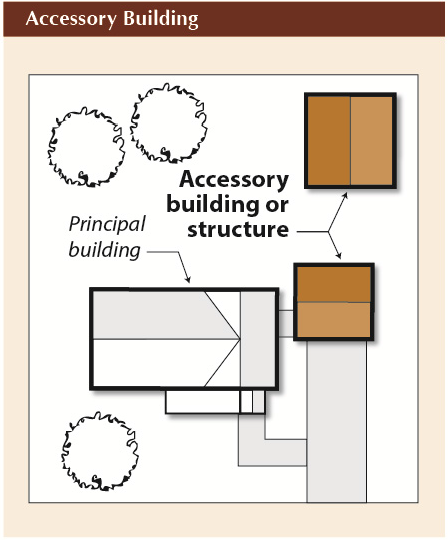
Abandonment means the termination of an incorporeal interest in land or property rights and/or the temporary or permanent discontinuation of use of an exploration hole or oil and gas well in excess of one hundred twenty (120) days.
Accessory building means a subordinate building or structure, the use of which is customarily incidental to that of the main building or to the main use of the land, which is located on the same lot (or on a contiguous lot in the same ownership) with the main building or use. Accessory buildings are only permitted when they are incidental or accessory to an existing and permitted principal or conditional use.
Accessory Dwelling Unit (ADU) means an apartment integrated within a single-family dwelling, or located in a detached accessory building or structure located on the same lot as a single family dwelling. For purposes of calculating residential density, each ADU shall count as one-half (½) dwelling unit.
Accessory use means a subordinate use, clearly incidental and related to the main structure, building or use of land and located on the same lot (or on a contiguous lot in the same ownership) as that of the main structure, building or use.
Addition means any activity that expands the enclosed footprint or increases the square footage of an existing structure.
Adult-oriented use means a use of property where the principal use, or a significant or substantial adjunct to another use, of the property is the sale, rental, display or other offering of live entertainment, dancing or material which is distinguished or characterized by its emphasis on depicting, exhibiting, describing or relating to specified sexual activities or specified anatomical areas as the primary attraction to the premises, including but not limited to:
(a)
Adult arcade means any place to which the public is permitted or invited wherein coin-operated, slug-operated or electronically, electrically or mechanically controlled still or motion picture machines, projectors or other image-producing devices are maintained to show images to five (5) or fewer persons per machine at any one (1) time, and where the images so displayed are distinguished or characterized by the depicting or describing of specified sexual activities or specified anatomical areas.
(b)
Adult bookstore or adult video store means a place where books, magazines, motion pictures, prints, photographs, periodicals, video or audio recordings, novelties and devices or any of these things, which have as their primary or dominant theme matter depicting, illustrating, describing or relating to specified sexual activities or specified anatomical areas, are sold or offered for sale to adults and includes a place with only a portion or section of its area set aside for the display or sale of such material to adults, except that any place, otherwise included within this definition, that derives not more than ten percent (10%) of its gross income from the sale of such material shall be exempt from the provisions of this Section so long as such material is kept in a location where it is not visible and shall not be a self-service item for the customers of such place.
(c)
Adult cabaret means a nightclub, bar, restaurant or similar business which regularly features:
(1)
Persons who appear in a state of nudity;
(2)
Live performances which are characterized by the exposure of specified anatomical areas or by specified sexual activities; or
(3)
Films, motion pictures, video cassettes, slides or other photographic reproductions which are characterized by the depiction or description of specified sexual activities or specified anatomical areas.
(d)
Adult motel means a hotel, motel or similar business which offers private rooms to the public and provides patrons with live performances or closed-circuit television transmissions, films, motion pictures, video cassettes, slides or other photographic reproductions which are characterized by the depiction or description of specified sexual activities or specified anatomical areas.
(e)
Adult motion picture theater means a business where films, motion pictures, video cassettes, slides or similar photographic reproductions are regularly shown which are characterized by the depiction or description of specified sexual activities or specified anatomical areas.
(f)
Adult theater means a theater, concert hall, auditorium or similar business which regularly features persons who appear in a state of nudity or live performances which are characterized by the exposure of specified anatomical areas or by specified sexual activities.
(g)
Adult photo studio means any establishment which, upon payment of a fee, provides photographic equipment and/or models for the purpose of photographing specified anatomical areas.
(h)
Peep booth means a viewing room, other than a private room, of less than one hundred fifty (150) square feet of floor space upon the premises of a sexually oriented business where there are exhibited photographs, films, motion pictures, video reproductions, slides or other visual representations which depict or describe specified sexual activities or specified anatomical areas.
(i)
Private room means a room in an adult motel that is not a peep booth, has a bed in the room, has a bath in the room or adjacent to the room, and is used primarily for lodging.
(j)
Sexual encounter establishment means a business or commercial establishment which, as one (1) of its primary business purposes, offers for any form of consideration a place where two (2) or more persons may congregate, associate or consort for the purpose of specified sexual activities or the exposure of specified anatomical areas, when one (1) or more of the persons exposes any specified anatomical area.
(k)
Sexually oriented business means an adult arcade, adult bookstore, adult video store, adult cabaret, adult motel, adult motion picture theater, adult theater, sexual encounter establishment or other similar business and includes:
(1)
The opening or commencement of any sexually oriented business as a new business;
(2)
The conversion of an existing business, whether or not a sexually oriented business, to a sexually oriented business;
(3)
The addition of any sexually oriented business to any other existing sexually oriented business;
(4)
The relocation of any sexually oriented business; or
(5)
The continuation of a sexually oriented business in existence on the effective date of the initial ordinance codified herein.
(l)
Specified anatomical areas means:
(1)
Less than completely and opaquely covered: human genitals, pubic region, buttocks and female breast below a point above the top of the areola.
(2)
Human male genitals in a discernibly turgid state even if completely and opaquely covered.
(m)
Specified sexual activities means acts, simulated acts, exhibitions, representation, depictions or descriptions of:
(1)
Human genitals in a state of sexual stimulation or arousal.
(2)
Fondling or other erotic touching of human genitals, pubic region, buttocks or female breast.
(3)
Intrusion, however slight, of any object, any part of an animal's body, or any part of a person's body into the genital or anal openings of any person's body or into the body of an animal.
(4)
Cunnilingus, fellatio, analingus, masturbation, bestiality, lewd exhibition of genitals or excretory function.
(5)
Flagellation, mutilation or torture for the purposes of sexual arousal, gratification or abuse.
(n)
Stage means a raised floor or platform at least three (3) feet above the surrounding floor measured perpendicularly from the edge of the stage to the surrounding floor and at least thirty-six (36) square feet in area.
Alley means a public way permanently reserved as a secondary means of access to abutting property.
Alluvial fan flooding means a fan-shaped sediment deposit formed by a stream that flows from a steep mountain valley or gorge onto a plain or the junction of a tributary stream with the main stream. Alluvial fans contain active stream channels and boulder bars, and recently abandoned channels. Alluvial fans are predominantly formed by alluvial deposits and are modified by infrequent sheet flood, channel avulsions and other stream processes.
Annexation means the act of attaching, adding, joining or uniting a parcel of land to the legal entity known as the Town of Lochbuie.
Animal unit means the following: one (1) animal unit equals one (1) of any of the following domestic hoofed livestock: horses, cows, mules, llamas, alpacas, ostriches, emus or other hard-hoofed animals. One (1) animal unit equals any three (3) of the following: sheep or goats.
Animals, dangerous, includes bulls, buffalo and other wild/exotic animals are not included in the definition of animal unit.
Approved means approved by the Board of Trustees. Approved type or approved design is and includes improvements, equipment or facilities of a type or design approved by the Board of Trustees.
Appurtenant means belonging to, accessory or incident to, adjunct, appended, annexed to or used in conjunction with.
Aquifer means a water-bearing layer of sand, gravel or porous rock.
Area of shallow flooding means a designated Zone AO or AH on the FIRM with a one-percent chance or greater annual chance of flooding to an average depth of one (1) to three (3) feet where a clearly defined channel does not exist, where the path of flooding is unpredictable and where velocity flow may be evident. Such flooding is characterized by ponding or sheet flow.
Assisted living facility means a residential facility that provides meals and assistance with daily activities, such as dressing, grooming, and bathing, for the elderly or adults who are unable to manage these activities themselves.
Banner means a temporary sign having characters, letters, illustrations or ornamentations applied to flexible material (e.g., vinyl, plastic, canvas, cloth, fabric or other lightweight non-rigid material) with only such material for a backing, which projects from, hangs from or is affixed to a building or structure. Banners include pennants, cable-hung banners and wave banners.
Bar or tavern means an establishment providing or dispensing fermented malt beverages and/or malt, vinous or spirituous liquors, and in which the sale of food products such as sandwiches or light snacks is secondary.
Barrel means forty-two (42) (U.S.) gallons of oil at 60°F atmospheric pressure.
Base flood elevation (BFE) means the elevation shown on a FEMA Flood Insurance Rate Map for Zones AE, AH, A1-A30, AR, AR/A, AR/AE, AR/A1-A30, AR/AH, AR/AO, V1-V30, and VE that indicates the water surface elevation resulting from a flood that has a one-percent (1%) chance of equaling or exceeding that level in any given year.
Base station means a structure or equipment, other than a tower, at a fixed location that enables FCC licensed or authorized wireless communications between user equipment and a communications network. The term includes any equipment associated with wireless communications services, including radio receivers, antennas, coaxial or fiber optic cable, regular and backup power supplies and comparable equipment, regardless of technological configuration (inclusive of Distributed Antenna Systems and small cell networks). The term also includes any structure, other than a tower, to which any of the equipment described herein is attached.
Basement means any area of a building having its floor sub-grade (below ground level) on all sides.
Bed and breakfast means an establishment operated in a private residence or portion thereof, which provides temporary accommodations to overnight guests for a fee and which is occupied by the operator of such establishment.
Best Management Practices (BMPS) means, they relate to oil and gas operations, technologies and practices listed in the Town's adopted best management practices for oil and gas facilities, also known as the BMP Document. BMPS are designed to prevent or reduce impacts caused by oil and gas operations to air, water, soil, or biological resources, and to minimize adverse impacts to public health, safety and welfare, including the environment and wildlife resources.
Block means a parcel of land bounded on all sides by a street or streets.
Board means the Board of Trustees of the Town.
Boarding and rooming house means a building or portion thereof which is principally used to accommodate, for compensation, five (5) or more boarders or roomers, not including members of the occupant's immediate family who might be occupying such building. The compensation shall include compensation in money, services or other things of value.
Brewpub means an establishment that makes its own beer and sells at least fifty percent (50%) on the premises.
Building means any structure built for the shelter or enclosure of persons, animals, chattels or property of any kind, and not including advertising sign boards or fences.
Building height means the vertical distance measured from the established curb level to the highest point of the underside of the ceiling beams for a flat roof; to the deck line for a mansard roof; and to the mean level of the underside of the rafters between the eaves and the ridge for a gable, hip or gambrel roof; chimneys, spires, towers, elevator penthouses, tanks and similar projections other than signs shall not be included in calculating the height.
Business office means a place of business where clerical or professional duties are performed.
Business support services means establishments engaged in the sale, rental or repair of equipment, services and supplies used by office, professional and service establishments to businesses rather than individuals; excluding however, automotive, construction and farm equipment. Typical uses include staffing, office space, printing and copying, among other uses.
Call centers means central locations for high-volume calls where customers' and other telephone calls are handled by an organization, sometimes with computer automation. Call centers are used as mail-order catalog centers, telemarketing call centers, help desks and organizations that use the telephone to sell or service products or services.
Change in land use includes expansion of an existing use.
Channel means the physical confine of stream or waterway consisting of a bed and stream banks, existing in a variety of geometries.
Channelization means the artificial creation, enlargement or realignment of a stream channel.
Child care center means a facility that is not a residence, is licensed by the State, and is maintained for the whole or part of a day for the care of children under the age of sixteen (16) years not related to the owner, operator or manager thereof, whether such facility is operated with or without compensation for such care and with or without stated educational purposes pursuant to C.R.S. Section 26-6-102(1)(6); including without limitation facilities commonly known as day care centers, day nurseries, nursery schools, kindergartens, preschools, play groups, day camps, summer camps and centers for developmentally disabled children, except that the term shall not apply to any kindergarten maintained in connection with a public, private or parochial elementary school system.
Church or place of worship and assembly means a building containing a hall, auditorium or other suitable room or rooms used for the purpose of conducting religious or other services or meetings of the occupants of such structure. Church or place of worship and assembly shall include churches, synagogues or the like, but shall not include buildings used for commercial endeavors, including, but not limited to, commercial motion picture houses or stage productions.
Code of Federal Regulations (CFR) means the codification of the general and permanent rules published in the Federal Register by the Federal Government.
COGCC means the Colorado Oil and Gas Conservation Commission.
Completion of a well means that a well is completed, for the purposes of these regulations, when it has been made physically capable of production.
Conditional Letter of Map Revision (CLOMR) means FEMA's comment on a proposed project, which does not revise an effective floodplain map that would, upon construction, affect the hydrologic or hydraulic characteristics of a flooding source and thus result in the modification of the existing regulatory floodplain.
Conservation standards means guidelines and specifications for soil and water conservation practices and management enumerated in the Technical Guide prepared by the USDA Soil Conservation Service, adopted by the County Soil and Water Conservation District supervisors, and containing suitable alternatives for the use and treatment of land based upon its capabilities from which the landowner selects that alternative which best meets his or her needs in developing his or her soil and water conservation plan.
Consumer means any person contacted as a potential purchaser, lessee or renter, as well as one who actually purchases, leases or rents property in the subdivision.
Control of access means the condition where the right of the owners or occupants of abutting land or other persons to access, light air or view in connection with a highway is fully or partially controlled by public authority.
Copy means the wording, symbols, figures or images on a sign.
Corral means a fenced open-air enclosure or pen where animals are kept.
County Clerk and Recorder means the Weld County Clerk and Recorder and Adams County Clerk and Recorder as applicable.
Critical facility means a structure or related infrastructure, but not the land on which it is situated, as specified in Rule 6 of the Rules and Regulations for Regulatory Floodplains in Colorado, that if flooded may result in significant hazards to public health and safety or interrupt essential services and operations for the Town at any time before, during and after a flood.
Crosswalk or walkway means a right-of-way dedicated to public use, to facilitate pedestrian access through a subdivision block.
Dedicate or dedication means to appropriate an interest in land or water to some public use, made by the owner, and accepted for such use by or on behalf of the public.
Digital Flood Insurance Rate Map (DFIRM) means FEMA digital floodplain map, which serves as the "regulatory floodplain map" for insurance and floodplain management purposes.
Disposition means a contract of sale resulting in the transfer of equitable title to an interest in subdivided land; an option to purchase an interest in subdivided land; a lease or an assignment of an interest in subdivided land; or any other conveyance of an interest in subdivided land which is not made pursuant to one (1) of the foregoing.
Drilling and spacing unit as defined by C.R.S. §34-60-116(2), means a "common source of supply" of oil and gas that may be targeted by one (1) or more oil and gas wells or as amended by COGCC rule or statute.
Drive-through business means any establishment, building or structure where service is provided to the customer from an automobile service window with access provided by a drive-through lane incorporated into the site design.
Driveway means a constructed access serving one (1) or more properties and abutting to a public or private road.
Dwelling means a building or portion thereof which is used as the private residence or sleeping place of one (1) or more human beings, but not including hotels, motels, tourist courts, resort cabins, clubs or hospitals.
Dwelling, multiple-family means a building containing three (3) or more dwelling units, including what is commonly known as an apartment building, but not including group, row or townhouses, hotels, motels, condominiums, fraternity and sorority houses and similar group accommodations.
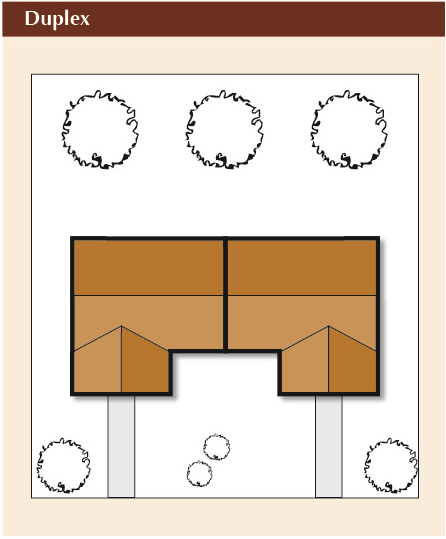
Dwelling, single-family shall mean a detached building having accommodations for and occupied exclusively by one (1) family.
Dwelling, two-family means a residential building containing dwelling units, each of which primary ground floor has access to the outside and which are attached to each other by party walls without openings. The term is intended primarily for such dwelling types as duplexes.
Dwelling unit means any structure or part thereof designed to be occupied as the living quarters of a single family or housekeeping unit.
Easement means a right to land generally established in a real estate deed or on a recorded plat to permit the use of land by the public, a corporation or particular persons for specified uses.
Elevated building means a non-basement building (i) built, in the case of a building in Zones A1-30, AE, A, A99, AO, AH, B, C, X, and D, to have the top of the elevated floor above the ground level by means of pilings, columns (posts and piers), or shear walls parallel to the flow of the water and (ii) adequately anchored so as not to impair the structural integrity of the building during a flood of up to the magnitude of the base flood. In the case of Zones A1-30, AE, A, A99, AO, AH, B, C, X, and D, "elevated building" also includes a building elevated by means of fill or solid foundation perimeter walls with openings sufficient to facilitate the unimpeded movement of flood waters.
Eligible telecommunications facility request means a request for approval of the modification of an existing tower or base station that involves the collocation of new transmission equipment, the removal of transmission equipment, or the replacement of transmission equipment.
Evidence means any map, table, chart, contract or any other document or testimony prepared or certified by a qualified person to attest to a specific claim or condition, which evidence must be relevant and competent and must support the position maintained by the subdivision.
Existing manufactured home park or subdivision means a manufactured home park or subdivision for which the construction of facilities for servicing the lots on which the manufactured homes are to be affixed (including, at a minimum, the installation of utilities, the construction of streets, and either final site grading or the pouring of concrete pads) is completed before the effective date of this Article.
Expansion to an existing manufactured home park or subdivision means the preparation of additional sites by the construction of facilities for servicing the lots on which the manufactured homes are to be affixed (including the installation of utilities, the construction of streets, and either final site grading or the pouring of concrete pads).
Family means an individual or two (2) or more persons related by blood or marriage; or a group of not to exceed five (5) unrelated persons (excluding servants) living together as a single housekeeping unit in a dwelling unit.
Family child care home means a facility licensed as such by the State for child care in a place of residence of a family or person for the purpose of providing less than twenty-four-hour care for children under the age of eighteen (18) years who are not related to the head of such home.
Farmer's market means a space and/or structure used primarily for the sale of foodstuffs by the grower.
Federal register means the official daily publication for Rules, proposed Rules, and notices of Federal agencies and organizations, as well as executive orders and other presidential documents.
FEMA means Federal Emergency Management Agency, the agency responsible for administering the NFIP.
Financial services institution means a facility engaged in deposit banking or extending credit in the form of loans.
Flood or flooding means a general and temporary condition of partial or complete inundation of normally dry land areas from:
(a)
The overflow of water from channels and reservoir spillways;
(b)
The unusual and rapid accumulation or runoff of surface waters from any source; or
(c)
Mudslides or mudflows that occur from excess surface water that is combined with mud or other debris that is sufficiently fluid so as to flow over the surface of normally dry land areas (such as earth carried by a current of water and deposited along the path of the current).
Flood control structure means a physical structure designed and built expressly or partially for the purpose of reducing, redirecting, or guiding flood flows along a particular waterway. These specialized flood modifying works are those constructed in conformance with sound engineering standards.
Flood Insurance Rate Map (FIRM) means an official map on which FEMA has delineated both the SFHAs and the risk premium zones applicable to the Town.
Flood Insurance Study (FIS) means the official report provided by the Federal Emergency Management Agency. The report contains the FIRM as well as flood profiles for studied flooding sources that can be used to determine BFEs for some areas.
Floodplain or flood-prone area means any land area susceptible to being inundated as the result of a flood, including the area of land over which floodwater would flow from the spillway of a reservoir.
Floodplain Administrator means the Town Administrator or designee.
Floodplain development permit means a permit required before construction or development begins within any SFHA. If FEMA has not defined the SFHA within the Town, the Town shall require permits for all proposed construction or other development in the Town including the placement of manufactured homes, so that it may determine whether such construction or other development is proposed within flood-prone areas. Permits are required to ensure that proposed development projects meet the requirements of the NFIP and this Article.
Floodplain management means the operation of an overall program of corrective and preventive measures for reducing flood damage, including, but not limited to, emergency preparedness plans, flood control works and floodplain management regulations.
Floodplain management regulations means zoning ordinances, subdivision regulations, building codes, health regulations, special purpose ordinances (such as floodplain ordinances, grading ordinances and erosion control ordinances) and other applications of police power which provide standards for the purpose of flood damage prevention and reduction.
Floodproofing means any combination of structural and/or non-structural additions, changes, or adjustments to structures which reduce or eliminate flood damage to real estate or improved real property, water and sanitary facilities, structures and their contents.
Floodway (regulatory floodway) means the channel of a river or other watercourse and adjacent land areas that must be reserved to discharge the base flood without cumulatively increasing the water surface elevation more than a designated height. The Colorado statewide standard for the designated height to be used for all newly studied reaches is six (6) inches. LOMRs to existing floodway delineations may continue to use the floodway criteria in place at the time of the existing floodway delineation.
Floor area means, for the purposes of determining the floor area ratio, conversions of existing structures and maximum size of business establishments, the sum of the gross horizontal areas of several floors measured in square feet, including the basement floor, but not including the cellar floor of the building, measured from the exterior faces of the exterior walls or from the center line of walls separating two (2) buildings. The floor area of a building shall also include elevator shafts and stairwells at each floor; floor space used for mechanical equipment, except equipment open or enclosed located on the roof; penthouse; attic space having headroom of seven (7) feet ten (10) inches or more; interior balconies and mezzanines; enclosed porches; and floor area devoted to accessory uses, provided that any space devoted to off-street parking or loading shall not be included in floor area.
Floor area ratio means the numerical value obtained through dividing the gross floor area of a building by the net lot area on which such building is located.
Flowlines means, as it relates to oil and gas operations, those segments of pipe from the wellhead downstream through the production facilities ending at: in the case of gas lines, the gas metering equipment; or in the case of oil lines the oil loading point or lact unit; or in the case of water lines, the water loading point, the point of discharge to a pit, the injection wellhead, or the permitted surface water discharge point.
Food shall mean any product sold for human consumption, the sale of which is not prohibited by law.
Food catering means an establishment that prepares food to be served at a different location.
Food truck shall mean any motorized or non-motorized vehicle, trailer, kiosk, pushcart, or other nonpermanent structure or device from which outdoor vending of food for immediate consumption occurs; however, "food truck" shall not include mobile food vending of pre-packaged food for immediate consumption that does not operate for more than fifteen (15) minutes at any one (1) location within two (2) blocks of a prior location within Town within any twenty-four-hour period, such as a pre-packaged ice cream truck.
Fowl includes, but is not limited to, chickens, ducks, turkeys, geese, guineas, pigeons, birds and other like fowl.
Freeboard means the vertical distance in feet above a predicted water surface elevation intended to provide a margin of safety to compensate for unknown factors that could contribute to flood heights greater than the height calculated for a selected size flood such as debris blockage of bridge openings and the increased runoff due to urbanization of the watershed.
Functionally dependent use means a use which cannot perform its intended purpose unless it is located or carried out in close proximity to water, including only docking facilities, port facilities that are necessary for the loading and unloading of cargo or passengers, and ship building and ship repair facilities, but excluding long-term storage or related manufacturing facilities.
Funeral home means a building used for the preparation of the deceased for burial or cremation, for the display of the deceased and/or for ceremonies or services related thereto, including cremation and the storage of caskets, funeral urns, funeral vehicle and other funeral supplies.
Future school facility, as it relates to oil and gas operations, means a school facility that is not yet built, but that the school or school governing body plans to build and use for students and staff within four (4) years of the date of the preapplication conference. In order to be considered a future school facility, the Town Administrator must be provided compelling evidence that the school is planned and will be built within four (4) years.
Garage means a building or portion of a principal building on the same lot that is used for the storage only of private, passenger motor vehicles.
Gas means the gaseous components or vapors occurring in or derived from petroleum or natural gas.
Gas well means a well having a pressure and volume of gas, and taking into account its proximity to market, as can be utilized commercially.
Gathering line means a pipeline and equipment described below that transports gas from a production facility (ordinarily commencing downstream of the final production separator at the inlet flange of the custody transfer meter) to a natural gas processing plant or transmission line or main. The term "gathering line" includes valves, metering equipment, communication equipment cathodic protection facilities, and pig launchers and receivers, but does not include, dehydrators, treaters, tanks separators, or compressors located downstream of the final production facilities and upstream of the natural gas processing plants, transmission lines, or main lines.
Height (of a sign) means the vertical distance measured from the highest point of the sign structure, to the grade of the adjacent street (at the flow line of the gutter or edge of the nearest travel lane if no gutter exists) or the surface grade beneath the sign, whichever is less.
Highest adjacent grade means the highest natural elevation of the ground surface prior to construction next to the proposed walls of a structure.
Historic structure means any structure that is:
(a)
Listed individually in the National Register of Historic Places (a listing maintained by the Department of Interior) or preliminarily determined by the Secretary of the Interior as meeting the requirements for individual listing on the National Register;
(b)
Certified or preliminarily determined by the Secretary of the Interior as contributing to the historical significance of a registered historic district or a district preliminarily determined by the Secretary to qualify as a registered historic district;
(c)
Individually listed on a state inventory of historic places in states with historic preservation programs which have been approved by the Secretary of Interior; or
(d)
Individually listed on a local inventory of historic places in communities with historic preservation programs that have been certified either:
(1)
By an approved state program as determined by the Secretary of the Interior or;
(2)
Directly by the Secretary of the Interior in states without approved programs.
Home occupation means a lawfully established commercial or business operation for which a home occupation license has been properly issued by the Town to the residential homeowner or lessee in accordance with Chapter 6 of this Code.
Hospital means an institution providing health services primarily for human in-patient medical or surgical care for the sick or injured and including related facilities such as laboratories, out-patient departments, training and central services facilities and staff offices.
Household pet means those small animals customarily permitted to be kept in dwellings for company and pleasure, including, but not limited to, dogs, cats and common house birds. Animals generally considered wild and nondomesticated as a species are excluded.
Junk means any manufactured good, appliances, fixtures, furniture, machinery, motor vehicle or trailer which is abandoned, demolished, dismantled, so worn or deteriorated or in such condition to be unusable in its existing state, salvage materials, strap metal, scrap material, waste, bottles, tin cans, paper, boxes, crates, rags, used lumber and building material, motor vehicle and machinery parts and used tires.
Keep means to harbor, confine or be in possession of.
Kennel means a facility licensed to house dogs, cats or other household pets overnight and/or where breeding, training and/or selling of animals is conducted as the primary business.
Land use plan means a plan for guiding and controlling the future growth, protection and development of the Town, affording adequate facilities for housing and other land uses, transportation and circulation, comfort, convenience, public health, safety and general welfare of its population and any amendment or extension of such a plan.
Landowner means any owner of a legal or equitable interest in real property, and includes the heirs, successors and assigns of such ownership interests.
Lateral sewer means a sewer which discharges into another sewer and has only building sewers tributary to it.
Lease means any grant for permissive use, which results in the creation of a landlord-tenant or lessor-lessee relationship.
Legacy oil and gas facility means any well, equipment or facility drilled or constructed prior to 2020 or that occurred prior to annexation of additional acreage within the Town.
Letter of Map Revision (LOMR) means FEMA's official revision of an effective FIRM, or FBFM, or both. LOMRs are generally based on the implementation of physical measures that affect the hydrologic or hydraulic characteristics of a flooding source and thus result in the modification of the existing regulatory floodway, the effective BFEs, or the SFHA.
Letter of Map Revision Based on Fill (LOMR-F) means FEMA's modification of the SFHA shown on the FIRM based on the placement of fill outside the existing regulatory floodway.
Levee means a man-made embankment, usually earthen, designed and constructed in accordance with sound engineering practices to contain, control or divert the flow of water so as to provide protection from temporary flooding. For a levee structure to be reflected on the FIRMs as providing flood protection, the levee structure must meet the requirements set forth in 44 CFR 65.10.
Levee system means a flood protection system which consists of a levee or levees and associated structures, such as closure and drainage devices, which are constructed and operated in accordance with sound engineering practices.
Livestock means horses, mules, cattle, burros, swine, sheep, goats and/or rabbits.
Livestock, small shall include but not be limited to rabbits, chinchillas and similar animals.
Lodge means the meeting place or land used for the activities of an association of persons for the promotion of some nonprofit common objective, such as literature, science, politics and good fellowship and not accessory to, operated as or in connection with a tavern, eating place or other place open to the public, which meets periodically and is limited to members, with not more than one-third (⅓) of the gross floor area of the club or lodge used for residential occupancy. The branch of an organization, especially a fraternal organization or the body of members of such a branch.
Lot means the unit into which land is divided on a subdivision plat or deed, with the intention of offering such unit for sale, lease or separate use, either as an undeveloped or developed site, regardless of how it is conveyed. When not so platted in a recorded subdivision, a lot means a parcel of real property abutting upon at least one (1) public street and held under separate ownership. Lot shall also mean parcel, plot, site or any similar term.
Lot area means the total horizontal area within the lot lines of a lot.
Lot line, front means the property line dividing a lot from a street. On a corner lot only one (1) street line shall be considered as a front line and the shorter street frontage shall be considered the front line.
Lot line, rear means the line opposite the front lot line.
Lot line, side means any lot lines other than front lot lines or rear lot lines.
Lot, width of means the distance parallel to the front lot line measured between side lot lines through that part of the building or structure where the lot is narrowest.
Lowest floor means the lowest floor of the lowest enclosed area used for living purposes such as working, storage, sleeping, cooking and eating, or recreation or any combination thereof, including any floor that could be converted to such a use such as a basement or crawl space. The lowest floor is a determinate for the flood insurance premium for a building, home or business. An unfinished or flood resistant enclosure, usable solely for parking or vehicles, building access or storage in an area other than a basement area is not considered a building's lowest floor; provided that such enclosure is not built so as to render the structure in violation of the applicable non-elevation design requirement of Section 60.3 of the NFIP regulations.
Maintenance means, for the purposes of Article VI, the cleaning, painting, repair or replacement of defective parts of a sign in a manner that does not alter the basic copy, design or structure of the sign.
Maintenance means, for purposes of Article VII Division 4, includes the repair and replacement of parts of a structure where the same does not alter or lessen the strength or stability of the structure; also, operations conducted during the production stage involving any form of repair work.
Manufactured home shall mean a single family dwelling which:
(a)
Is partially or entirely manufactured in a factory;
(b)
Is not less than twenty-four (24) feet in width and thirty-six (36) feet in length;
(c)
Is installed on an engineered permanent foundation;
(d)
Has brick, wood, or cosmetically equivalent exterior siding and a pitched roof of not less than 3.5/12;
(e)
Conforms to the Climatic and Geographic Design Criteria set forth in Table 301.2 of the International Residential Code (2018 edition) as adopted and amended by the Town in Section 18-1-20(d)(13) of this Code; and
(f)
Is certified pursuant to the "National Manufactured Housing Construction and Safety Standards Act of 1974." 42 USC 5401 et. seq., as amended.
Manufacturing, fabrication and assembly operations means a manufacturing establishment primarily engaged in the fabrication or assembly of products from prestructured materials or components. Because of the nature of its operations and products, little or no noise, odor, vibration, glare and/or air and water pollution is produced and, therefore, there is minimal impact on surrounding properties.
Marijuana cultivation facilities, marijuana product manufacturing facilities, marijuana testing facilities, or retail marijuana stores shall have the meanings as set forth in Section 16 to Article XVIII of the Colorado Constitution as the same may, from time to time, be amended.
Mean sea level means, for purposes of the NFIP, the NAVD of 1988 or other datum, to which BFEs shown on a FIRM are referenced.
Medical and dental offices or clinics means an establishment operated by one (1) or more duly licensed members of the human health care professions, including, but not limited to, physicians, dentists, chiropractors, psychiatrists and osteopaths, where patients are not lodged overnight but are admitted for examination and/or treatment.
Medical marijuana center, medical marijuana-infused products manufacturer and optional premises cultivation operation shall have the same meanings as set forth in the Colorado Medical Marijuana Code, Article 43.3 of Title 12, C.R.S.
Message hold time means the time interval a static message must remain on the display before transitioning to another message.
Mixed-use building means a building designed, planned and constructed as a unit, used partially for residential use and partly for commercial uses, including, but not limited to, office, retail, public uses, personal services or entertainment uses.
Mobile home shall mean a transportable dwelling unit built on a permanent chassis with attached undercarriage consisting of springs, axles, wheels and hubs, and which is suitable for year-round occupancy and contains the same water supply, waste disposal and electrical conveniences as immobile housing. A mobile home is designed to be transported on streets to the place where it is to be occupied as a dwelling unit and may or may not be attached to a permanent foundation. The term mobile home shall not include travel trailers, campers or self-contained motor homes or camper busses.
Motel or hotel means a building designed for occupancy as the temporary abiding place (thirty [30] days or less) of individuals who are lodged with or without meals, and with such building having six (6) or more guest rooms.
Motor vehicle/equipment sales and rentals means rentals, sales and related servicing of new and used automobiles, recreational vehicles, boats, trucks (limited to a capacity of not more than one-and-one-half [1½] tons), vans and sport utility vehicles, motorcycles, motor scooter, mopeds, all-terrain vehicles, snowmobiles, go-carts, utility trailers and similar items.
Motor vehicle/equipment storage means the assembling or standing of damaged or impounded vehicles for indeterminate periods of time. Such use shall not include the wrecking, dismantling or repairing of vehicles.
Motor vehicle fueling/gasoline station means any building, land area, premises or portion thereof, where gasoline or other petroleum products or fuels are sold through fuel pumps, to include gasoline stations that are part of a convenience store or other retail use, and a place where light maintenance activities such as engine tune-ups, lubrication, minor repairs and carburetor cleaning may also be conducted. Motor vehicle fueling/gasoline station shall not include truck stops or premises where heavy automobile maintenance activities such as engine overhaul, automobile painting and body fender work are conducted. If a gasoline station is included as part of any other use, such as a convenience store or warehouse retail store, the standards and use restrictions for gasoline stations shall apply. This use shall not include a separate diesel fueling island or pumps. Diesel fuel dispensers must be incorporated into the gas dispenser pumps. Maximum lot size for this use is 1.75 acres unless the use is incidental to a larger retail use such as a grocery store or warehouse store (but not a convenience store) as the principal use.
Motor vehicle repair (major) means any building or portion thereof, where heavy maintenance activities such as engine overhaul, automobile/truck painting, body or fender work, welding or the like are conducted. Such use shall not include the sale of fuel, gasoline or petroleum products.
Motor vehicle repair (minor) means the use of any building, land area, premises or portion thereof, where light maintenance activities such as engine tune-ups, lubrication, carburetor cleaning, brake repair, or the like are conducted.
Motor vehicle wash means facilities where motor vehicles are washed, cleaned and/or waxed by hand or with manually operated equipment or automatic machinery.
Mover means the drilling contractor or trucking contractor actually transporting the drilling rig for the operator.
Municipality includes an incorporated City or Town.
National Cooperative Soil Survey means the soil survey conducted by the U.S. Department of Agriculture in cooperation with the State Agricultural Experiment Station and other federal and state agencies.
National Flood Insurance Program (NFIP) means FEMA's program of flood insurance coverage and floodplain management administered in conjunction with the Robert T. Stafford Relief and Emergency Assistance Act.
New manufactured home park means a manufactured home park or subdivision for which the construction of facilities for servicing the lots on which the manufactured homes are to be affixed (including at a minimum, the installation of utilities, the construction of streets, and either final site grading or the pouring of concrete pads) is completed on or after the effective date of this Article.
Nightclub means a bar or tavern containing more than one hundred (100) square feet of dance floor area.
No-rise certification means a record of the results of an engineering analysis conducted to determine whether a project will increase flood heights in a floodway, which must be supported by technical data and signed by a registered Colorado Professional Engineer. The supporting technical data should be based on the standard step-backwater computer model used to develop the 100-year floodway shown on the FIRM or FBFM.
Nonconforming building means a building, structure or portion thereof conflicting with the provisions of this Chapter applicable to the zone in which it is situated.
Nonconforming use means the use of a structure or premises conflicting with the provisions of this Chapter.
Obstruction means any dam, wall, wharf, embankment, levee, dike, pile abutment, projection, excavation, channel rectification, bridge, conduit, culvert, building, wire, fence, rock, gravel, refuse, fill, structure or matter in, along, across or projecting into any channel, watercourse or regulatory flood hazard area which may impede, retard or change the direction of the flow of water, either in itself or by catching or collecting debris carried by such water, or that is placed where the flow of water might carry the same downstream to the damage of life or property.
Office, business means an office for professionals such as physicians, dentists, lawyers, architects, engineers, artists, musicians, designers, teachers, accountants and others who through training are qualified to perform services of a professional nature and where no storage or sale of merchandise exists, except as accessory to the professional services.
Off-street parking space means the space required to park one (1) passenger vehicle, which space shall be not less than two hundred (200) square feet in area, exclusive of access drives on private land.
Oil includes petroleum, and petroleum includes oil.
Oil and gas means oil or gas, or both oil and gas.
Oil and gas facility means equipment, buildings, structures, or improvements associated with or required for the operation of a well site, pipeline, or compressor facility. facilities include, but are not limited to, well sites, production facilities, production sites, treatment facilities, access roads, well pads, tank batteries, pits, and flowlines.
Oil and Gas Inspector means an individual assigned to perform the duties of Oil and Gas Inspector as defined herein.
Oil and gas operation(s) or operation(s) means exploration for oil and gas, including the drilling of test bores; the siting; drilling; deepening, completion recompletion, reworking, or abandonment of an oil and gas well; production operations related to any such well including the installation of flowlines and gathering systems; the generation, transportation, storage and treatment of oil and gas; any construction, site preparation, or reclamation activities associated with such operations; and any oil and gas facility, oil and gas well site or location, production site or other facility, site or location upon or within which any of the foregoing are conducted, operated, installed, constructed, generated treated or located.
Oil and gas permit means any permit issued by the Town that allows an operator to conduct oil and gas well operations.
Oil and gas pipeline means a flowline, gathering line, or transmission line that transports oil and gas off of a well site.
Oil and gas well means a hole drilled into the earth for the purpose of exploring for or extracting oil, gas, or other hydrocarbon substances.
Oil well means a bored hole from which petroleum is obtained by pumping or by natural flow.
Open space means open space on a building site, exclusive of space devoted to vehicular streets, drives and parking areas, and including pedestrian ways, space for active and passive recreation and landscaping.
Operator means the person, whether proprietor, lessee or independent contractor, actually in charge and control of the drilling, maintenance, operation or pumping of a well or lease.
Outdoor storage means the keeping, in an unroofed area, of any equipment, goods, junk, material, merchandise or vehicles in the same place for more than twenty-four (24) hours. Containers and semi-trailers may not be used for residential or storage uses except on construction sites.
Overall density means the number of dwelling units per acre over the area of the subdivision, including roads and other public improvements in land area.
Owner of interest means a person who owns a legal or equitable interest in the subsurface mineral rights or leasehold.
Parking garage means an off-street parking area within a building.
Parking lot means off-street parking area or vehicular use area.
Parks and open space means any land or water area with its surface open to the sky, which serves specific uses of: providing park and recreation opportunities, conserving natural areas and environmental resources, structuring urban development form, and protecting areas of agricultural, archeological or historical significance. Open space shall not be considered synonymous with vacant or unused land but serves important urban function. Usable open space shall exclude areas used for off-street parking, off-street loading, service driveways and setbacks from oil and gas wells and their appurtenances or other hazards to the public.
Patient and primary caregiver shall have the same meanings as set forth in Article XVIII, Section 14(1) of the Colorado Constitution.
Permanent monument means any structure of masonry and/or metal permanently placed on or in the ground, including those expressly placed for surveying reference.
Permittee shall mean a person who has been issued a food truck permit under the provisions of this Article.
Person means an individual, partnership, corporation, association, unincorporated organization, trust or any other legal or commercial entity, including a joint venture or affiliated ownership. The word person also means a municipality or state agency.
Personal service establishment means shops primarily engaged in providing services generally involving the care of the person, such person's apparel or rendering services such as laundry or dry-cleaning retail outlets, portrait/photographic studios, beauty or barber shops, employment service or mailing, printing and copy shops.
Personal service establishment < 5,000 square feet, other means a personal services establishment, or any combination of personal services establishments, in a single building occupying more than five thousand (5,000) gross square feet of floor area. Excludes other personal service businesses listed in Section 19-2-230.
Personal service establishment 5,000—25,000 square feet, other means a personal services establishment, or any combination of personal services establishments, in a single building occupying more than five thousand (5,000) gross square feet of floor area yet less than twenty-five thousand (25,000) gross square feet of floor area. Excludes other personal service businesses listed in Section 19-2-230.
Personal service establishment > 25,000 square feet, other means a personal services establishment, or any combination of personal services establishments, in a single building occupying more than twenty-five thousand (25,000) gross square feet of floor area. Excludes other personal services businesses listed in Section 19-2-230.
Personal storage units (mini-storage) means a building or group of buildings divided into multiple individual separate access storage units, which are rented or sold as a condominium for the storage of personal and small business property.
Pharmacy means a retail shop where medicine and other articles are sold.
Planned unit development means a unified development in single ownership or control, which is subdivided and developed according to a master plan and where the specific requirements of a given district may be modified.
Planning Commission means the Planning Commission of the Town.
Plant nursery and greenhouse means any land or structure used primarily to raise trees, shrubs, flowers or other plants for sale or for transplanting.
Plat, final means a map and support materials of certain described land prepared in accordance with subdivision regulations as an instrument for recording of real estate interests with the County Clerk and Recorder.
Plat, preliminary means the map or maps of a proposed subdivision and specific supporting materials, drawn and submitted in accordance with the requirements of this Chapter, to permit the evaluation of the proposal prior to detailed engineering and design.
Plugging means the act of placing cement or other materials in the drilling bore to prevent migration of oil, gas, water or other material from the excavation level in which it originally occurred. Plugging is done for oil and gas wells and exploration holes.
Pollution means the contamination or other alteration of the physical, chemical or biological properties of any ground, air, water or visual aesthetics of the Town, including changes in temperature, taste, color, turbidity or odor of such resources or such discharge of any liquid, gaseous, solid, radioactive or other substance into or onto any such resources of the Town as will or is likely to create a nuisance or render these resources harmful, detrimental or injurious to public health, safety or welfare, to domestic, commercial, industrial, agricultural, recreational or other beneficial uses, or to livestock, wild animals, birds, fish or other aquatic life.
Poultry means chickens, ducks, geese and/or pigeons.
Preapplication conference means a conference at which a sketch map or maps of a proposed subdivision along with supporting material, prepared and submitted in accordance with the requirements of this Chapter, are presented by the subdivider to the Town's staff and members of the Board of Trustees who may want to attend, to evaluate feasibility and design characteristics at an early stage in the planning.
Principal use means the main use of land or of a structure as distinguished from a temporary or accessory use.
Production means the oil or gas well development stage when marketable oil and gas is being brought to the surface.
Production site means, as it relates to oil and gas operations, the surface area immediately surrounding proposed or existing production equipment, or other accessory equipment necessary for oil and gas production activities, including the fenced, walled, or enclosed area of the facility during the production phase, exclusive of transmission and gathering pipelines.
Property means all real property subject to land use regulation by the Town.
Public facilities means those constructed facilities, including, but not limited to, transportation systems or facilities, water systems or facilities, wastewater systems or facilities, storm drainage systems or facilities, fire, police and emergency systems or facilities, electric, gas telecommunication utilities or facilities and publicly owned building or facilities.
Public right-of-way shall mean all streets, roadways, bikeways, sidewalks, and all other areas reserved for present or future use by the public, as matter of right, for the purpose of vehicular or pedestrian travel.
Public sewer means municipal or Town-operated or quasi-municipal (such as a sanitation district) trunk outfall lines and treatment facility for wastewater.
Public water supply well means a well or system of wells that provide water via piping or other constructed conveyances for human consumption to at least fifteen (15) service connections or serves an average of at least twenty-five (25) people for at least sixty (60) days each year.
Recreation facility, indoor means a place where recreation activities occur completely within an enclosed structure, including, but not limited to, bowling alleys, skating rinks, pool halls, video and pinball parlors.
Recreation facility, outdoor means a place with outdoor activities, including, but not limited to, miniature golf, batting cages, water slides, skateboard parks, driving ranges and go-cart tracks.
Recreational vehicle means a vehicle which is:
(a)
Built on a single chassis;
(b)
Four hundred (400) square feet or less when measured at the largest horizontal projections;
(c)
Designed to be self-propelled or permanently towable by a light duty truck; and
(d)
Designed primarily not for use as a permanent dwelling but as temporary living quarters for recreational, camping, travel, or seasonal use.
Redrilling means the deepening of an existing oil well or otherwise drilling beyond the extremities of the existing well casing. The provisions of this Article relating to drilling shall be equally applicable to redrilling.
Reservation means a legal obligation to keep property free from development for a stated period of time, not involving any transfer of property rights.
Restaurant means any establishment in which the principal business is the sale of food and beverages to customers in a ready-to-consume state.
Restoration of site means the reclamation or restoration of the drill site to its original condition, or as nearly so as practicable, as required by these regulations.
Resubdivision means the changing of any existing lot or lots of any subdivision plat previously recorded with the County Clerk and Recorder.
Retail business < 5,000 square feet, other means a retail establishment, or any combination of retail establishments, in a single building occupying more than five thousand (5,000) gross square feet of floor area. Excludes other retail businesses listed in Section 19-2-230.
Retail business 5,000—25,000 square feet, other means a retail establishment, or any combination of retail establishments, in a single building occupying more than five thousand (5,000) gross square feet of floor area yet less than twenty-five thousand (25,000) gross square feet of floor area. Excludes other retail businesses listed in Section 19-2-230.
Retail business > 25,000 square feet, other means a retail establishment, or any combination of retail establishments, in a single building occupying more than twenty-five thousand (25,000) gross square feet of floor area. Excludes other retail businesses listed in Section 19-2-230.
Reverse frontage lots means lots which front on one (1) public street and back on another.
Rework means any operation subsequent to drilling that involves deepening, redrilling, plugging or permanently altering in any manner the casing of a well or its function.
Right-of-way means that portion of land dedicated to public use for street way and/or path and/or utility purposes.
Roadway means that portion of the street right-of-way designed for vehicular traffic.
Roof line means the highest point on any building where an exterior wall encloses usable floor area, including floor area provided for housing mechanical equipment.
Room means an unsubdivided portion of the interior of a dwelling unit, excluding bathrooms, kitchens, closets, hallways and service porches.
Sanitation District means the Lochbuie Water and Sanitation District.
School, private means a preschool, elementary, secondary, post-secondary, vocational or technical school that is established, conducted and primarily supported by a nongovernmental agency.
School, public means a tax-supported school that is controlled and operated by the School District and/or taxing district (i.e., Jr. College District, Board of Regents, etc.).
Sign means any written copy, display, illustration, insignia or illumination which is displayed or placed in view of the general public, and shall include every detached sign and every sign attached to or forming a component part of any marquee, canopy, awning, pole, vehicle or other object, whether stationary or movable.
Sign, animated means any sign which uses movement or change of lighting to depict action or to create a special effect or scene. Such motion does not refer to transition methods or duration of changing copy.
Sign, awning means a sign permanently affixed to a sheet of canvas or other material stretched on a frame and used to keep the sun or rain off a storefront, window, doorway, or deck.
Sign, canopy means a sign permanently affixed to a roofed shelter covering a sidewalk, driveway or other similar area which shelter may be wholly supported by a building or may be wholly or partially supported by columns, poles or braces extended from the ground.
Sign, changeable copy sign (automatic) means a sign on which the copy changes electronically or mechanically by remote or automatic means. An automatic changeable copy sign is also known as an electronic message center.
Sign, changeable copy (manual) means a sign on which copy is changed manually.
Sign, directional means any sign on a lot that directs the movement or placement of pedestrian or vehicular traffic with or without reference to, or inclusion of, the name of a product sold or service performed on the lot or in a building, structure or business enterprise occupying the same.
Sign face means an exterior display surface of a sign including nonstructural trim, yet exclusive of the supporting structure.
Sign, flashing means a sign which contains an intermittent or sequential flashing light source used primarily to attract attention. Such motion does not refer to transition methods or duration of changing copy.
Sign, freestanding means any sign supported by structures or supports that are placed on or anchored in the ground and are not attached to any building or structure.
Sign, home occupation means a sign identifying a use conducted principally within a dwelling unit and carried on by the inhabitants thereof.
Sign, illuminated means a sign with an artificial light source incorporated internally or externally for the purpose of illuminating the sign.
Sign, incidental means a small sign affixed to a building or structure, machine, equipment, fence, gate, wall, gasoline pump, public telephone, or utility cabinet.
Sign, inflatable means a balloon, blimp or other inflated object used for attracting attention.
Sign, marquee means any sign made a part of marquee and designed to have changeable copy.
Sign, monument means a permanent freestanding sign supported by, or integrated into, a base or pedestal at least seventy-five percent (75%) of the sign width.
Sign, neon means a sign consisting of glass tubing, bent to form letters, symbols, or other shapes and illuminated by neon or a similar gas through which an electrical voltage is discharged.
Sign, nonconforming means:
(a)
A sign which was erected legally but which does not comply with subsequently enacted sign restrictions and regulations; or
(b)
A sign which does not conform to the sign regulation requirements but for which a special permit has been issued.
Sign, permanent means any sign constructed of durable materials and affixed, lettered, attached to or placed upon a fixed, non-movable, non-portable supporting structure.
Sign, pole means a permanent freestanding sign supported by one (1) or more poles or pylons.
Sign, portable means a moveable sign that is not permanently affixed to a building, structure, or the ground. Portable signs include signs mounted on trailers, wheeled carriers, or frames that are designed to be placed onto a surface without being secured to it.
Sign, projecting means a sign which is attached perpendicular to the wall of a building or structure.
Sign, roof means a sign mounted on top of a building roof.
Sign, rotating means a sign in which the sign itself or any portion of the sign moves in a revolving or similar manner. Such motion does not refer to transition methods or duration of changing copy.
Sign, sidewalk means a type of portable sign that is intended to be placed on a hard surface, most commonly a sidewalk. These signs include A-frame signs, signs that are suspended from the top member of an A-frame, signs with weighted bases, and comparable signs.
Sign, site means a temporary freestanding sign constructed of vinyl, plastic, wood or metal and designed or intended to be displayed for a limited period of time on a vacant lot or a lot under construction.
Sign, swing means a sign that is suspended from a horizontal support (a swing post) that is attached to a vertical support mounted in the ground. A swing sign may also include riders.
Sign, temporary means any sign which based upon is materials, location and/or means of construction, e.g., light fabric, cardboard, wallboard, plywood, paper or other light materials, with or without a frame, intended or designed to be displayed for a limited period of time.
Sign, traffic control means a sign erected in a public right-of-way by an authorized governmental agency for the purposes of traffic regulation and safety.
Sign, wall means any sign painted on or affixed to the wall of a building or structure, or any sign consisting of cut-out letters or devices affixed to a wall with no background defined on the wall in such a manner that the wall forms the background surface of the sign.
Sign, wayfinding means a sign authorized by a governmental body for placement in the public right-of-way that is designed to orient and navigate the general public from place to place.
Sign, window means a sign which is applied or attached to either the interior or exterior of a window and intended to be viewed from outside the building or structure.
Sign, yard means a temporary portable sign constructed of paper, vinyl, plastic, wood, metal or other comparable material, and designed or intended to be displayed for a limited period of time on a lot with one (1) or more existing permanent structures.
Site specific development plan means only the following:
(a)
A conditional use approved pursuant to Section 19-2-210.
(b)
A final subdivision plat approved pursuant to Section 19-3-230, including major subdivisions, minor subdivisions, resubdivisions, and division of property into condominium or townhouse units.
(c)
A PUD-Plan approved pursuant to Section 19-2-165.
(d)
A site plan approved pursuant to Section 19-1-210 or Section 19-2-165.
(e)
The following are specifically excluded from, and shall not constitute, a site specific development plan: variances issued by the Board of Adjustment, sketch plans, preliminary plans, preliminary plats, annexation ordinances, annexation agreements, business licenses, floodway or floodplain permits, franchises, temporary use permits, any Comprehensive Plan element, creation of improvement districts, zoning or rezoning, final architectural plans, or final construction drawings and related documents specifying materials and methods for construction of improvements.
Solar energy system, accessory means a device or facility that converts the sun's radiant energy into thermal, chemical, mechanical, or electric energy and has a combined name plate DC rating of less than fifteen (15) kilowatts, and includes the equivalent kilowatt measurement of energy for systems other than photovoltaic.
Solar energy system, large means a device or facility that converts the sun's radiant energy into thermal, chemical, mechanical, or electric energy and has a combined name plate DC rating of greater than five hundred (500) kilowatts, and includes the equivalent kilowatt measurement of energy for systems other than photovoltaic.
Solar energy system, small means a device or facility that converts the sun's radiant energy into thermal, chemical, mechanical, or electric energy and has a combined name plate DC rating of fifteen (15) kilowatts to five hundred (500) kilowatts, and includes the equivalent kilowatt measurement of energy for systems other than photovoltaic.
Special Flood Hazard Area (SFHA) means the land in the floodplain within the Town subject to a one percent (1%) or greater chance of flooding in any given year, i.e., the 100-year floodplain.
Stable means any building, structure or shed, whether or not entirely or partially enclosed by a roof and/or walls, in which animals are kept. Stables must meet State of Colorado regulations regarding animal husbandry.
Staff means any person, whether publicly or privately employed, who provides administrative, planning, engineering or other services to the Town at the Town's request.
Start of construction means the date the initial building permit was issued, provided the actual start of construction, repair, reconstruction, rehabilitation, addition, placement, or other improvement was within one hundred eighty (180) days of the permit date. The actual start means either the first placement of permanent construction of a structure on a site, such as the pouring of slab or footings, the installation of piles, the construction of columns, or any work beyond the stage of excavation; or the placement of a manufactured home on a foundation. Permanent construction does not include land preparation, such as clearing, grading and filling; nor does it include the installation of streets and/or walkways; nor does it include excavation for basement, footings, piers or foundations or the erection of temporary forms; nor does it include the installation on the property of accessory buildings, such as garages or sheds not occupied as dwelling units or not part of the main structure. For a substantial improvement, the "start of construction" means the first alteration of any wall, ceiling, floor, or other structural part of a building, whether or not that alteration affects the external dimensions of the building.
Strata means a single sedimentary rock bed or layer.
Street means any way for vehicular traffic, however designated, shown upon a plat heretofore approved pursuant to law or approved by official action; the term street includes the land between street lines, whether improved or unimproved, and may comprise pavement, shoulders, gutters, sidewalks, parking areas and other areas within the right-of-way. For the purpose of this Chapter, streets shall be classified as defined below:
(a)
Expressway/freeway means a divided multilane major regional highway, including interstate highways, designed to carry very large volumes of vehicular traffic, with full control of access and all intersections grade separated. An expressway is a divided multilane arterial for through traffic with controlled access and with some crossings at grade.
(b)
Arterial means a continuous access-controlled street designed to carry high volumes of vehicular traffic over long distances in a direct manner with crossings at grade.
(c)
Collector means a vicinity-wide continuous access street designed to collect or distribute vehicular traffic from one (1) or more residential or nonresidential areas and their local streets to or from arterials.
(d)
Local street means a street designed to carry vehicular traffic from one (1) or more abutting individual residential or nonresidential units to or from a collector.
(e)
Cul-de-sac means a short dead-end street terminating in a vehicular turnaround area.
(f)
Half street means a street parallel and continuous to a property line and of lesser right-of-way width than is required for minor or major streets.
(g)
Service road means a street paralleling and abutting a major street to provide access to adjacent property so that each adjacent lot will not have direct access to the major street.
(h)
Stub street means a street extending from within a subdivision boundary and terminating there with no permanent vehicular turnaround. Stub streets are provided to permit adjacent undeveloped parcels of land to be developed later with an adjacent connecting street system.
Street right-of-way means that portion of land dedicated to public use for roadway and utility purposes.
String means a continuous length of connected sections of casing, liner, drill pipe or tubing run into the well, including all attached equipment.
Structure means anything constructed or erected, which required location on the ground or attached to something having a location on the ground, but not including fences or walls used as fences less than six (6) feet in height, poles, lines, cables or other transmission or distribution facilities of public utilities.
Structure means, for purposes of Article VII Division 4, that which is built or constructed; a tank, edifice or building of any kind, except temporary structures used in the actual drilling, development or rework operations.
Subdivider or developer means any person, firm, partnership, joint venture, association or corporation who shall participate as owner, promoter, developer or sales agent in the planning, platting, development, promotion, sale or lease of a subdivision.
Subdivision means any parcel of land which is to be used for condominiums, apartments or any other multiple-dwelling units, unless such land was previously subdivided and the filing accompanying such subdivision complied with Town regulations, applicable to subdivisions of substantially the same density, or the division of a lot, tract or parcel of land into two (2) or more lots, plats, sites or other divisions of land for the purpose, whether immediate or future, of sale or of building development. It includes resubdivision and, when appropriate to the context, relates to the process of subdividing or to the land or territory subdivided. It also includes subdivision of large lots into smaller lots which still conform to the requirements of Chapter 16 of this Code.
(a)
Unless the method of disposition is adopted for the purpose of evading this Chapter, the terms subdivision and subdivided land, as defined above, shall not apply to any division of land:
(1)
Which is created by order of any court in the State or by operation of law;
(2)
Which is created by a lien, mortgage, deed of trust or any other security instrument;
(3)
Which is created by a security or unit of interest in any investment trust regulated under the laws of the State or any other interest in an investment entity;
(4)
Which creates cemetery lots;
(5)
Which creates an interest or interests in oil, gas, minerals or water which are now or hereafter severed from the surface ownership of real property;
(6)
Which is created by the acquisition of an interest in land in the name of a husband and wife or other persons in joint tenancy, or as tenants in common and any such interest shall be deemed for purposes of this Subsection as only one (1) interest; or
(7)
Which is required to satisfy public land dedication requirements.
(b)
The Board of Trustees may, pursuant to this Chapter, exempt from this definition of subdivision any division of land if the Board determines that such division is not within the purposes of this Chapter.
Subdivision improvements agreement means one (1) or more security arrangements which may be accepted by the Board of Trustees to secure the construction of such public improvements as are required by this Chapter within the subdivision and shall include collateral such as, but not limited to, performance or property bonds, private or public escrow agreements, loan commitments, assignments of receivables, liens on property, deposits of certified funds or other similar surety agreements.
Substantial change means a modification to an existing tower or base station under the following circumstances:
(a)
A substantial change in the height of an existing tower or base station occurs as follows:
(1)
For a tower outside a public right-of-way, when the height of the tower is increased by more than ten percent (10%), or by the height of one (1) additional antenna array with separation from the nearest existing antenna not to exceed twenty (20) feet, whichever is greater.
(2)
For a tower located in a public right-of-way or for a base station, when the height of the structure increases by more than ten percent (10%) or by more than ten (10) feet, whichever is greater.
(b)
Changes in height are measured as follows:
(1)
When deployments are separated horizontally, changes in height shall be measured from the original support structure, not from the height of any existing telecommunications equipment.
(2)
When deployments are separated vertically, changes in height shall be measured from the height of the tower or base station, including any appurtenances, as the tower or base station existed on February 22, 2012.
(c)
A substantial change in the width of an existing tower or base station occurs as follows:
(1)
For a tower outside of public rights-of-way, when the addition of an appurtenance to the body of the tower protrudes from the edge of the tower more than twenty (20) feet, or more than the width of the tower structure at the level of the appurtenance, whichever is greater.
(2)
For a tower located in a public right-of-way or for a base station, when the addition of an appurtenance to the body of the structure would protrude from the edge of the structure by more than six (6) feet.
(d)
A substantial change also occurs for an existing tower in a public right-of-way or an existing base station as follows:
(1)
When the change involves the installation of any new equipment cabinets on the ground, if no ground cabinets presently exist; or
(2)
When the change involves the installation of ground cabinets that are more than ten percent (10%) larger in height or overall volume than any existing ground cabinets.
(e)
A substantial change also occurs for any existing tower or base station when any of the following are found:
(1)
When the change involves installation of more than the standard number of new equipment cabinets for the technology involved, or more than four (4) new cabinets, whichever is less.
(2)
When the change entails any excavation or deployment outside the current site.
(3)
When the change would defeat the concealment elements of the eligible structure.
(4)
When the change does not comply with conditions associated with the original siting approval of the construction or modification of the tower, base station or base station equipment. This limitation does not apply if the non-compliance is due to an increase in height, increase in width, addition of cabinets, or new excavation that would not exceed the thresholds identified in above.
Substantial damage means damage of any origin sustained by a structure whereby the cost of restoring the structure to its before-damaged condition would equal or exceed fifty percent (50%) of the market value of the structure just prior to when the damage occurred.
Substantial improvement means any reconstruction, rehabilitation, addition, or other improvement of a structure, the cost of which equals or exceeds fifty percent (50%) of the market value of the structure before "Start of Construction" of the improvement. The value of the structure shall be determined by the local jurisdiction having land use authority in the area of interest. This includes structures which have incurred "Substantial Damage," regardless of the actual repair work performed. The term does not, however, include either:
(a)
Any project for improvement of a structure to correct existing violations of state or local health, sanitary, or safety code specifications which have been identified by the local code enforcement official and which are the minimum necessary conditions; or
(b)
Any alteration of a historic structure provided that the alteration will not preclude the structure's continued designation as a historic structure.
Supply yard means an outdoor facility used by a vendor and/or manufacturer for the storage of inventory.
Surface use agreement shall mean an agreement or contract between an operator and the owner of real property addressing property interests or property use in relation to a specific location for a well, multi-well site, production facility, pipeline or any other oil and gas facility.
Suspended operations means the approved, temporary suspension of drilling or redrilling operations pending a resumption of operations or abandonment.
Swine shall include all members of the swine family and are not allowed in this district.
Tank means a container, covered or uncovered, used in conjunction with the drilling or production of an oil well, for holding or storing liquids at or near atmospheric pressure.
Temporary use means a use intended for a limited duration.
Threshold Planning Quantity (TPQ) means a quantity designated for each chemical on the list of extremely hazardous substances that triggers notification by facilities to the State that such facilities are subject to emergency planning requirements.
Tower means a structure built for the sole or primary purpose of supporting any FCC licensed or authorized antennas and their associated facilities, including structures that are constructed for wireless communication services including, but not limited to, private, broadcast and public safety services, as well as unlicensed wireless services and fixed wireless services such as microwave backhaul and the associated site.
Town means the Town of Lochbuie, Colorado.
Town Administrator means the Town Administrator of Lochbuie, Colorado or his or her designee.
Town block shall mean the smallest area that is completely surrounded by public rights-of-way, or access easements that act as public rights-of-way, not to include alleys.
Town Board means the Town Board of Lochbuie, Colorado.
Town Planning Commission or Planning Commission means the Planning Commission of the Town.
Transit facility means a meeting point of several routes or lines or of different modes of transportation. It is located on or off the street and is designed to handle the movement of transit units (vehicles or trains) and the boarding, alighting and transferring of passengers between routes, lines or different modes.
Transition duration means the time interval it takes the display to change from one complete static message to another complete static message.
Transition method means a visual effect applied to a message to transition from one message to the next. Transition methods include:
(a)
Dissolve — a frame effect accomplished by varying the light intensity or pattern, where the first frame gradually appears to dissipate and lose legibility simultaneously with the gradual appearance and legibility of the second frame.
(b)
Fade — a frame effect accomplished by varying the light intensity, where the first frame gradually reduces intensity to the point of not being legible (i.e., fading to black) and the subsequent frame gradually increases intensity to the point of legibility.
Treatment facilities means any plant, equipment or other works used for the purpose of treating, separating or stabilizing any substance produced from a well.
Truck stop means any building, land area, premises or portion thereof, designed to serve or accommodate fueling by two (2) or more tractor trucks or similar heavy commercial vehicles simultaneously that may (but does not always) include related facilities including, but not limited to, restaurant(s), rest area(s), and/or parking for tractor trucks or similar heavy commercial vehicles.
Use means the purpose for which land or a building is designed, arranged or intended, or for which either is or may be occupied or maintained.
Variance means a grant of relief to a person from the requirement of this Article when specific enforcement would result in unnecessary hardship, to permit construction or development in a manner otherwise prohibited by this Article.
Vested property right means the right to undertake and complete the development and use of property under the terms and conditions of a site specific development plan.
Veterinary facilities, small animal clinic means any facility maintained by or for the use of a licensed veterinarian in the diagnosis, treatment or prevention of animal diseases wherein the animals are limited to dogs, cats or other comparable household pets and wherein the overnight care of said animals is prohibited except when necessary in the medical treatment of the animal.
Veterinary hospital means any facility which is maintained by or for the use of a licensed veterinarian in the diagnosis, treatment or prevention of animal diseases.
Violation means the failure of a structure or other development to be fully compliant with this Article. A structure or other development without the elevation certificate, other certifications, or other evidence of is presumed to be in violation until such time as that documentation is provided.
Water surface elevation means the height, in relation to the NAVD of 1988 (or other datum, where specified), of floods of various magnitudes and frequencies in floodplains.
Well means a well or hole drilled into the earth for the purpose of exploring for or extracting from the earth oil, gas or other hydrocarbon substances; a well or hole in the earth by means of and through which oil, gas and other hydrocarbon substances are extracted, produced or capable of being produced from the earth; or a well or hole for the purpose of secondary recovery or disposal thereof.
Well site means, as it relates to oil and gas operations, a definable area where an operator has disturbed or intends to disturb the land surface in order to locate an oil and gas well facility and includes a production site.
Wholesale trade means an establishment primarily engaged in selling durable and nondurable goods to retailers, to industrial, commercial, institutional, farm, building trade contractors or professional business uses or to other wholesalers. Activities may include physically assembling, sorting and grading goods into large lots and breaking bulk for redistribution in smaller lots in such a way as to have a minimal impact on surrounding properties.
Wind Energy Conversion System (WECS) means an electrical generating facility comprised of one (1) or more wind turbines and accessory facilities which operate by converting the kinetic energy of wind into electrical energy. The energy maybe used on-site or distributed into the electrical grid.
Working interest means an interest held in lands by virtue of fee title, including lands held in trust, a lease, operating agreement or otherwise, under which the owner of such interest has the right to drill for, develop and produce oil and gas. A working interest shall be deemed vested in the owner thereof, even though his or her right to drill or produce may be delegated to an operator under a drilling and operating agreement, unit agreement or other type of operating agreement.
Working interest owner means a person owning a working interest.
Workshop and custom small industry means a facility wherein goods are produced or repaired by hand, using hand tools or small-scale equipment, including small engine repair, furniture making and restoring, upholstering, restoration of antiques and other art objects or other similar uses.
Yard means an open space, other than a court, on a lot, unoccupied and unobstructed from the ground upward, except as otherwise provided in this Chapter.
Yard, front means a yard extending across the full width of the lot between the front lot line and the nearest line or point of the building.
Yard, rear means a yard extending across the full width of the lot between the rear lot line and the nearest line or point of the building.
Yard, side means a yard extending from the front yard to the rear yard between the side lot line and the nearest line or point of the building or accessory building attached thereto.
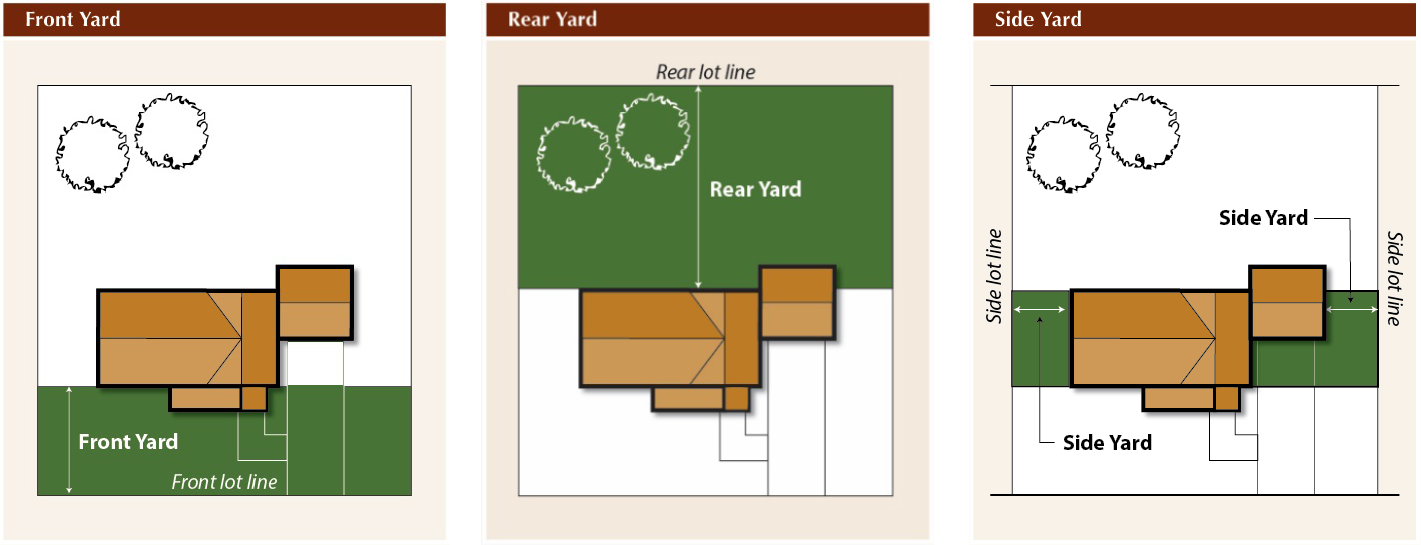
(Ord. 629 §1(Exh. A), 2017; Ord. 649 §3, 2020; Ord. 650 §20, 2020; Ord. 652 §2, 2020; Ord. 656 §2, 2020; Ord. 662 §2, 2020; Ord. 666 §2, 2021; Ord. 667 §6, 2021; Ord. 675 §3, 2022; Ord. 705 §3, 2025)

