
Lodi City Zoning Code
ARTICLE 3
- SITE PLANNING AND GENERAL DEVELOPMENT STANDARDS
Chapter 17.34 - SIGNS[2]
Editor's note— Ord. No. 1922, § 1, adopted July 6, 2016, repealed the former Ch. 17.34, §§ 17.34.010—17.34.130, and enacted a new Ch. 17.34 as set out herein. The former Ch. 17.34 pertained to similar subject matter and derived from Ord. No. 1869, § 2, adopted February 20, 2013.
17.30.010 - Purpose of chapter.
The purpose of this chapter is to protect public health, safety, and welfare by:
A.
Preserving and enhancing the visual character of the community, and providing cooling shade;
B.
Enhancing well-designed structures and increasing compatibility between abutting land uses and public rights-of-way by providing landscape screening and buffers; and
C.
Provide for the conservation and safeguard of water resources through the efficient use of water, appropriate use of plant materials, and regular maintenance of landscaped areas.
(Ord. No. 1869, § 2, 2-20-2013)
17.30.020 - Applicability.
A.
Landscaping Required. The provisions of this chapter apply to all new proposed development. An addition to a structure that is twenty-five percent or more of the floor area of the existing structure, and any change of use, shall require that the entire parcel be brought into compliance with the requirements of this chapter. In the case of an existing use, if the amount of required landscaping cannot be accommodated because of physical constraints on the site, (e.g., structures, parking, circulation, etc.) the applicant shall provide whatever additional landscaping the site can accommodate towards meeting the landscape requirements of this chapter.
B.
Other Requirements. Standards for the provision of landscaping within the public right-of-way are located in Article 5 (Subdivisions).
(Ord. No. 1869, § 2, 2-20-2013)
17.30.030 - Landscape plan approval requirements.
A.
Preliminary Landscape Plan. A preliminary landscape plan shall be submitted as part of an application for a land use entitlement for new development, except for single family on individual lots, or the significant expansion or redevelopment of an existing use as determined by the director.
B.
Final Landscape Plan. Following approval of the land use entitlement, a final landscape plan shall be submitted as part of the application for a building permit. Final plans shall be approved by the director prior to the start of on-site construction or soil disturbance and prior to the issuance of a building permit.
C.
Content. Preliminary landscape plans and final landscape plans shall contain information as specified in the instructions for preparing landscape plans provided by the department.
D.
Review and Approval. After initial application, the director shall review each preliminary landscape plan and final landscape plan to verify its compliance with the provisions of this chapter. The director may approve the submittal in compliance with this chapter, or may disapprove or require changes to a submittal if it is not in compliance.
E.
Statement of Surety. When required by the director, a statement of surety in the form of cash, performance bond, letter of credit, or certificate of deposit, in an amount equal to one hundred fifty percent of the total value of all plant materials, irrigation, installation, and maintenance shall be posted with the city for a two-year period. The director may require statements of surety for phased development projects, a legitimate delay in landscape installation due to seasonal requirements (including adverse weather conditions) and similar circumstances where it may not be advisable or desirable to install all of a project's landscaping before occupancy of the site.
F.
Minor Changes to Approved Plans. Landscape plan approval may include the director authorizing minor changes from the requirements of this chapter.
(Ord. No. 1869, § 2, 2-20-2013)
17.30.040 - Landscape location requirements.
Landscaping shall be provided in the locations specified below except for single-family uses.
A.
Setbacks. All setback and open space areas required by this development code, and easements for utilities, and drainage courses shall be landscaped, except where it is determined by the director that landscaping is not necessary to fulfill the purposes of this chapter.
B.
Unused Areas. All areas of a project site not intended for a specific use, including pad sites in shopping centers held for future development, shall be landscaped unless it is determined by the director that landscaping is not necessary to fulfill the purposes of this chapter.
C.
Parking Areas. Parking areas shall be landscaped in compliance with the following requirements:
1.
Landscape Materials. Landscaping materials shall be provided throughout the parking lot area using a combination of trees, shrubs, and ground cover.
2.
Curbing. Areas containing plant materials shall be bordered by a concrete curb at least six inches high and six inches wide. Alternative barrier design to protect landscaped areas from damage by vehicles may be approved by the director.
3.
Location of Landscaping. Parking lot landscaping shall be located so that pedestrians are not required to cross landscaped areas to reach building entrances from parked cars. This should be achieved through proper orientation of the landscaped fingers and islands.
4.
Bumper Overhang Areas. To increase the parking lot landscaped area, a maximum of two feet of the parking stall depth may be landscaped with low-growth, hearty materials in lieu of paving, allowing a two-foot bumper overhang while maintaining the required parking dimensions.
5.
Perimeter Parking Lot Landscaping.
a.
Adjacent to Streets. Parking areas for nonresidential uses adjoining a public street shall be designed to provide a landscaped planting strip between the street right-of-way and parking area equal in depth to the setback required by the zoning district or ten feet, whichever is greater. Required parking areas for residential uses shall not be located within the required setback areas.
The landscaping shall be designed and maintained to screen cars from view from the street and shall be a height of between thirty and forty-two inches. Screening materials may include a combination of plant materials, earth berms, solid masonry walls, raised planters, or other screening devices to meet the intent of this requirement. Shade trees shall be provided at a minimum rate of one for every thirty linear feet of landscaped area.
b.
Adjacent to Side or Rear Property Lines. Parking areas for nonresidential uses shall provide a perimeter landscaped strip at least five feet wide (inside dimension) where the facility adjoins a side or rear property line. The perimeter landscaped strip may include a required yard or buffer area. Trees shall be provided at the rate of one for each thirty linear feet of landscaped area.
c.
Adjacent to Structures. When parking areas are located adjacent to nonresidential structures, a minimum five-foot wide landscape strip shall be provided adjacent to the structure.
d.
Adjacent to Residential Use. Parking areas for nonresidential uses adjoining residential uses shall provide a landscaped buffer yard with a minimum ten-foot width between the parking area and the common property line bordering the residential use. A solid masonry wall or fence and landscape buffer shall be provided along the property line to address land use compatibility issues such as nuisance noise and light or glare. Trees shall be provided at the rate of one for each thirty linear feet of landscaped area.
6.
Interior Parking Lot Landscaping.
a.
Minimum Area of Landscaping. A minimum of five percent of the total off-street parking area shall be landscaped with trees, shrubs, and ground cover. The perimeter landscaping required by subsection (C)(5) of this section shall not be considered part of the required parking lot landscaping.
b.
Planter Dimensions. Planters with trees shall have a minimum interior dimension of five feet. All ends of parking lanes shall be separated from drive aisles by landscaped islands or other means approved by the director.
c.
Larger Projects. Parking lots with more than one hundred fifty spaces shall provide a concentration of landscape elements at primary entrances, including specimen trees, flowering plants, and enhanced paving.
(Ord. No. 1869, § 2, 2-20-2013)
17.30.050 - Residential front and street side yard landscape requirements.
The following landscape requirements apply to all residential properties:
A.
Hardscape. No more than fifty percent of the front and street side yard area, visible from the public right of way, may be paved with hardscape materials such as concrete, asphalt, pavers, etc.
B.
Landscape. Any portion of the front and street side yard, visible from the public right of way, that is not covered with a hardscape material must be landscaped with grass, annuals, perennials, groundcover, shrubs, trees, other recognized landscape materials, and any design elements such as planters, rocks, mulch and similar element when integrated as part of the landscape. Living vegetation must cover at least seventy-five percent of the landscaped yard areas.
C.
Maintenance. All landscaped yard areas must be irrigated, mowed, trimmed and maintained as often as necessary to prevent overgrowth and blight. No dirt yards shall be allowed. No junk, debris or similar materials may be stored in the front or street side yard area.
(Ord. No. 1869, § 2, 2-20-2013)
17.30.060 - Maintenance of landscape areas.
A.
Maintenance Required. All landscaped areas shall be maintained in a healthful and sound condition at all times. Irrigation systems and their components shall be maintained in a fully functional manner consistent with the originally approved design and the provisions of this chapter. Regular maintenance shall include checking, adjusting, and repairing irrigation equipment; resetting automatic controllers; aerating and dethatching turf areas; adding/replenishing mulch, fertilizer, and soil amendments and dead or deceased plants; pruning; and weeding all landscaped areas.
B.
Water Waste Prohibited. Water waste in existing developments resulting from inefficient landscape irrigation leading to excessive runoff, low head drainage, overspray, and other similar conditions where water flows onto adjacent property, nonirrigated areas, walks, roadways, or structures is prohibited.
(Ord. No. 1869, § 2, 2-20-2013)
17.30.070 - Water efficient landscape requirements.
A.
Applicability.
1.
The water efficient landscape requirements shall apply to all of the following landscape projects:
a.
New construction projects with an aggregate landscape area equal to or greater than five hundred square feet requiring a building or landscape permit, plan check or design review;
b.
Rehabilitated landscape projects with an aggregate landscape area equal to or greater than two thousand five hundred square feet requiring a building or landscape permit, plan check, or design review;
c.
Existing landscapes limited to Sections 17.30.070U., V. and W.; and
d.
Cemeteries. Recognizing the special landscape management needs of cemeteries, new and rehabilitated cemeteries are limited to Sections 17.30.070G., N. and O.; and existing cemeteries are limited to Sections 17.30.070U., V. and W.
2.
Any project with an aggregate landscape area of two thousand five hundred square feet or less may comply with the performance requirements of this ordinance or conform to the prescriptive measures contained in California Code of Regulations Title 23, Chapter 2.7, § 495 Appendix D.
3.
For projects using treated or untreated graywater or rainwater captured on site, any lot or parcel within the project that has less than two thousand five hundred square feet of landscape and meets the lot or parcel's landscape water requirement (estimated total water use) entirely with treated or untreated graywater or through stored rainwater captured on site is subject only to California Code of Regulations Title 23, Chapter 2.7, § 495 Appendix D section (5).
4.
The water efficient landscape requirements do not apply to:
a.
Registered local, state or federal historical sites;
b.
Ecological restoration projects that do not require a permanent irrigation system;
c.
Mined-land reclamation projects that do not require a permanent irrigation system; or
d.
Existing plant collections, as part of botanical gardens and arboretums open to the public.
B.
Definitions. The terms used in the water efficient landscape requirements have the meaning set forth below:
"Applied water" means the portion of water supplied by the irrigation system to the landscape.
"Automatic irrigation controller" means a timing device used to remotely control valves that operate an irrigation system. Automatic irrigation controllers are able to self-adjust and schedule irrigation events using either evapotranspiration (weather-based) or soil moisture data.
"Backflow prevention device" means a safety device used to prevent pollution or contamination of the water supply due to the reverse flow of water from the irrigation system.
"Certificate of completion" means the document required under Section 17.30.070L.
"Certified irrigation designer" means a person certified to design irrigation systems by an accredited academic institution, a professional trade organization, or other program, such as the US Environmental Protection Agency's WaterSense Irrigation Designer Certification Program and Irrigation Association's Certified Irrigation Designer Program.
"Certified landscape irrigation auditor" means a person certified to perform landscape irrigation audits by an accredited academic institution, a professional trade organization, or other program such as the US Environmental Protection Agency's WaterSense Irrigation Auditor Certification Program and Irrigation Association's Certified Landscape Irrigation Auditor Program.
"Check valve" or "anti-drain valve" means a valve located under a sprinkler head, or other location in the irrigation system, to hold water in the system to prevent drainage from sprinkler heads when the sprinkler is off.
"Common interest developments" means community apartment projects, condominium projects, planned developments, and stock cooperatives per Civil Code Section 1351.
"Compost" means the safe and stable product of controlled biologic decomposition of organic materials that is beneficial to plant growth.
"Conversion factor (0.62)" means the number that converts acre-inches per acre per year to gallons per square foot per year.
"Distribution uniformity" means the measure of the uniformity of irrigation water over a defined area.
"Drip irrigation" means any non-spray low volume irrigation system utilizing emission devices with a flow rate measured in gallons per hour. Low volume irrigation systems are specifically designed to apply small volumes of water slowly at or near the root zone of plants.
"Ecological restoration project" means a project where the site is intentionally altered to establish a defined, indigenous, historic ecosystem.
"Effective precipitation" or "usable rainfall," "(EPPT)" means the portion of total precipitation which becomes available for plant growth.
"Emitter" means a drip irrigation emission device that delivers water slowly from the system to the soil.
"Established landscape" means the point at which plants in the landscape have developed significant root growth into the soil. Typically, most plants are established after one or two years of growth.
"Establishment period of the plants" means the first year after installing the plant in the landscape or the first two years if irrigation will be terminated after establishment. Typically, most plants are established after one or two years of growth. Native habitat mitigation areas and trees may need three to five years for establishment.
"Estimated total water use," "(ETWU)" means the total water used for the landscape as described in Section 17.30.070G.
"ET adjustment factor" (ETAF) means a factor of 0.55 for residential areas and 0.45 for non-residential areas that, when applied to reference evapotranspiration, adjusts for plant factors and irrigation efficiency, two major influences upon the amount of water that needs to be applied to the landscape. The ETAF for new and existing (non-rehabilitated) special landscape area shall not exceed 1.0. The ETAF for existing non-rehabilitated landscapes is 0.8.
"Evapotranspiration rate" means the quantity of water evaporated from adjacent soil and other surfaces and transpired by plants during a specified time.
"Flow rate" means the rate at which water flows through pipes, valves and emission devices, measured in gallons per minute, gallons per hour, or cubic feet per second.
"Flow sensor" means an inline device installed at the supply point of the irrigation system that produces a repeatable signal proportional to flow rate. Flow sensors must be connected to an automatic irrigation controller, or flow monitor capable of receiving flow signals and operating master valves. This combination flow sensor/controller may also function as a landscape water meter or submeter.
"Friable" means a soil condition that is easily crumbled or loosely compacted down to a minimum depth per planting material requirements, whereby the root structure of newly-planted material will be allowed to spread unimpeded.
"Fuel modification plan guidelines" means guidelines from a local fire authority to assist residents and businesses that are developing land or building structures in a fire hazard severity zone.
"Graywater" means untreated wastewater that has not been contaminated by any toilet discharge, has not been affected by infectious, contaminated, or unhealthy bodily wastes, and does not present a threat from contamination by unhealthful processing, manufacturing, or operating wastes. "Graywater" includes, but is not limited to, wastewater from bathtubs, showers, bathroom washbasins, clothes washing machines, and laundry tubs, but does not include wastewater from kitchen sinks or dishwashers. Health and Safety Code Section 17922.12.
"Hardscapes" means any durable material (pervious and non-pervious).
"Hydrozone" means a portion of the landscaped area having plants with similar water needs and rooting depth. A hydrozone may be irrigated or non-irrigated.
"Infiltration rate" means the rate of water entry into the soil expressed as a depth of water per unit of time (e.g., inches per hour).
"Invasive plant species" means species of plants not historically found in California that spread outside cultivated areas and can damage environmental or economic resources. Invasive species may be regulated by county agricultural agencies as noxious species. Lists of invasive plants are maintained at the California Invasive Plant Inventory and USDA Invasive and Noxious Weeds.
"Irrigation audit" means an in-depth evaluation of the performance of an irrigation system conducted by a certified landscape irrigation auditor. An irrigation audit includes, but is not limited to: inspection, system tune-up, system test with distribution uniformity or emission uniformity, reporting overspray or runoff that causes overland flow, and preparation of an irrigation schedule. The audit must be conducted in a manner consistent with the Irrigation Association's Landscape Irrigation Auditor Certification program or other U.S. Environmental Protection Agency "Watersense" labeled auditing program.
"Irrigation efficiency," "(IE)" means the measurement of the amount of water beneficially used divided by the amount of water applied. Irrigation efficiency is derived from measurements and estimates of irrigation system characteristics and management practices. The irrigation efficiency for purposes of the water efficient landscape requirements are 0.75 for overhead spray devices and 0.81 for drip systems.
"Irrigation survey" means an evaluation of an irrigation system that is less detailed than an irrigation audit. An irrigation survey includes, but is not limited to: inspection, system test, and written recommendations to improve performance of the irrigation system.
"Irrigation water use analysis" means an analysis of water-use data based on meter readings and billing data.
"Landscape architect" means a person who holds a license to practice landscape architecture in the state of California pursuant to Business and Professions Code Section 5615.
"Landscape area" means all the planting areas, turf areas, and water features in a landscape design plan subject to the maximum applied water allowance calculation. The landscape area does not include footprints of buildings or structures, sidewalks, driveways, parking lots, decks, patios, gravel or stone walks, other pervious or non-pervious hardscapes, and other non-irrigated areas designated for non-development (e.g., open spaces and existing native vegetation).
"Landscape contractor" means a person licensed by the state of California to construct, maintain, repair, install, or subcontract the development of landscape systems.
"Landscape documentation package" means the documents required under Section 17.30.070F.
"Landscape project" means total area of landscape in a project as defined in "landscape area" for the purposes of the water efficient landscape requirements, meeting requirements under Section 17.30.070A.
"Landscape water meter" means an inline device installed at the irrigation supply point that measures the flow of water into the irrigation system and is connected to a totalizer to record water use.
"Lateral line" means the water delivery pipeline that supplies water to the emitters or sprinklers from the valve.
"Local water purveyor" means any entity, including a public agency, city, county, or private water company, that provides retail water service.
"Low volume irrigation" means the application of irrigation water at low pressure through a system of tubing or lateral lines and low-volume emitters such as drip, drip lines, and bubblers. Low volume irrigation systems are specifically designed to apply small volumes of water slowly at or near the root zone of plants.
"Main line" means the pressurized pipeline that delivers water from the water source to the valve or outlet.
"Master shut-off valve" is an automatic valve installed at the irrigation supply point which controls water flow into the irrigation system. When this valve is closed, water will not be supplied to the irrigation system. A master valve will greatly reduce any water loss due to a leaky station valve.
"Maximum applied water allowance," "(MAWA)" means the upper limit of annual applied water for the established landscaped area as specified in Section 17.30.070G. It is based upon the area's reference evapotranspiration, the ET adjustment factor, and the size of the landscape area. The estimated total water use shall not exceed the maximum applied water allowance. Special landscape areas, including recreation areas, areas permanently and solely dedicated to edible plants, such as orchards and vegetable gardens, and areas irrigated with recycled water are subject to the MAWA with an ETAF not to exceed 1.0. MAWA = (ETo) (0.62) [(ETAF x LA) + ((1-ETAF) x SLA)].
"Median" is an area between opposing lanes of traffic that may be unplanted or planted with trees, shrubs, perennials, and ornamental grasses.
"Microclimate" means the climate of a small, specific area that may contrast with the climate of the overall landscape area due to factors such as wind, sun exposure, plant density, or proximity to reflective surfaces.
"Mined-land reclamation projects" means any surface mining operation with a reclamation plan approved in accordance with the Surface Mining and Reclamation Act of 1975.
"Mulch" means any organic material such as leaves, bark, straw, compost, or inorganic mineral materials such as rocks, gravel, and decomposed granite left loose and applied to the soil surface for the beneficial purposes of reducing evaporation, suppressing weeds, moderating soil temperature, and preventing soil erosion.
"New construction" means, for the purposes of this title, a new building with a landscape or other new landscape, such as a park, playground, or greenbelt without an associated building.
"Non-residential landscape" means landscapes in commercial, institutional, industrial, and public settings that may have areas designated for recreation or public assembly. It also includes portions of common areas of common interest developments with designated recreational areas.
"Operating pressure" means the pressure at which the parts of an irrigation system are designed by the manufacturer to operate.
"Overhead sprinkler irrigation systems" means systems that deliver water through the air (e.g., spray heads and rotors).
"Overspray" means the irrigation water which is delivered beyond the target area.
"Permit" means an authorizing document issued by local agencies for new construction or rehabilitated landscapes.
"Pervious" means any surface or material that allows the passage of water through the material and into the underlying soil.
"Plant factor" or "plant water use factor" is a factor, when multiplied by ETo, estimates the amount of water needed by plants. For purposes of this title, the plant factor range for very low water use plants is 0 to 0.1, the plant factor range for low water use plants is 0.1 to 0.3, the plant factor range for moderate water use plants is 0.4 to 0.6, and the plant factor range for high water use plants is 0.7 to 1.0. Plant factors cited in this title are derived from the publication "water use classification of landscape species." Plant factors may also be obtained from horticultural researchers from academic institutions or professional associations as approved by the California Department of Water Resources (DWR).
"Project applicant" means the individual or entity submitting a landscape documentation package required under Section 17.30.070F., to request a permit, plan check, or design review from the city of Lodi. A project applicant may be the property owner or his or her designee.
"Rain sensor" or "rain sensing shutoff device" means a component which automatically suspends an irrigation event when it rains.
"Record drawing" or "as-builts" means a set of reproducible drawings which show significant changes in the work made during construction and which are usually based on drawings marked up in the field and other data furnished by the contractor.
"Recreational area" means areas, excluding private single-family residential areas, designated for active play, recreation or public assembly in parks, sports fields, picnic grounds, amphitheaters or golf course tees, fairways, roughs, surrounds and greens where turf provides a playing surface.
"Recycled water," "reclaimed water," or "treated sewage effluent water" means treated or recycled waste water of a quality suitable for non-potable uses such as landscape irrigation and water features. This water is not intended for human consumption.
"Reference evapotranspiration" or "ETo" means a standard measurement of environmental parameters which affect the water use of plants. ETo is expressed in inches per day, month, or year, and is an estimate of the evapotranspiration of a large field of four- to seven-inch tall, cool-season grass that is well watered. Reference evapotranspiration is used as the basis of determining the maximum applied water allowance so that regional differences in climate can be accommodated.
"Regional water efficient landscape ordinance" means a local ordinance adopted by two or more local agencies, water suppliers and other stakeholders for implementing a consistent set of landscape provisions throughout a geographical region. Regional ordinances are strongly encouraged to provide a consistent framework for the landscape industry and applicants to adhere to.
"Rehabilitated landscape" means any re-landscaping project that requires a permit, plan check, or design review, meets the requirements of Section 17.30.070A., and the modified landscape area is equal to or greater than two thousand five hundred square feet.
"Residential landscape" means landscapes surrounding single or multifamily homes.
"Runoff" means water which is not absorbed by the soil or landscape to which it is applied and flows from the landscape area. For example, runoff may result from water that is applied at too great a rate (application rate exceeds infiltration rate) or when there is a slope.
"Soil moisture sensing device" or "soil moisture sensor" means a device that measures the amount of water in the soil. The device may also suspend or initiate an irrigation event.
"Soil texture" means the classification of soil based on its percentage of sand, silt, and clay.
"Special landscape area" (SLA) means an area of the landscape dedicated solely to edible plants, recreational areas, areas irrigated with recycled water, or water features using recycled.
"Sprinkler head" means a device which delivers water through a nozzle.
"Static water pressure" means the pipeline or municipal water supply pressure when water is not flowing.
"Station" means an area served by one valve or by a set of valves that operate simultaneously.
"Submeter" means a metering device to measure water applied to the landscape that is installed after the primary utility water meter.
"Swing joint" means an irrigation component that provides a flexible, leak-free connection between the emission device and lateral pipeline to allow movement in any direction and to prevent equipment damage.
"Turf" means a ground cover surface of mowed grass. Annual bluegrass, Kentucky bluegrass, Perennial ryegrass, Red fescue, and Tall fescue are cool-season grasses. Bermudagrass, Kikuyugrass, Seashore Paspalum, St. Augustinegrass, Zoysiagrass, and Buffalo grass are warm-season grasses.
"Valve" means a device used to control the flow of water in the irrigation system.
"Water conserving plant species" means a plant species identified as having a very low or low plant factor.
"Water feature" means a design element where open water performs an aesthetic or recreational function. Water features include ponds, lakes, waterfalls, fountains, artificial streams, spas, and swimming pools (where water is artificially supplied). The surface area of water features is included in the high water use hydrozone of the landscape area. Constructed wetlands used for on-site wastewater treatment or stormwater best management practices that are not irrigated and used solely for water treatment or stormwater retention are not water features and, therefore, are not subject to the water budget calculation.
"Watering window" means the time of day irrigation is allowed.
"WUCOLS" means the Water Use Classification of Landscape Species published by the University of California Cooperative Extension, the Department of Water Resources 2014 edition.
C.
Provisions for New Construction or Rehabilitated Landscapes. The city of Lodi may designate by mutual agreement, another agency, such as a water purveyor, to implement some or all of the requirements contained in the water efficient landscape requirements. The city may collaborate with water purveyors to define each entity's specific responsibilities relating to this title.
D.
Compliance with Landscape Documentation Package.
1.
Prior to construction, the city shall:
a.
Provide the project applicant with the ordinance and procedures for permits, plan checks, or design reviews;
b.
Review the landscape documentation package submitted by the project applicant;
c.
Approve or deny the landscape documentation package;
d.
Issue a permit or approve the plan check or design review for the project applicant; and
e.
Upon approval of the landscape documentation package, submit a copy of the water efficient landscape worksheet to the local water purveyor.
2.
Prior to construction, the project applicant shall:
a.
Submit a landscape documentation package to the city.
3.
Upon approval of the landscape documentation package by the city, the project applicant shall:
a.
Receive a permit or approval of the plan check or design review and record the date of the permit in the certificate of completion;
b.
Submit a copy of the approved landscape documentation package, along with the record drawings, and any other information to the property owner or his/her designee; and
c.
Submit a copy of the water efficient landscape worksheet to the local water purveyor.
E.
Penalties. The city may identify penalties to the project for non-compliance with the water efficient landscape requirements.
F.
Elements of the Landscape Documentation Package. The landscape documentation package shall include the following six elements:
1.
Project information:
a.
Date;
b.
Project applicant;
c.
Project address (if available, parcel and/or lot number(s));
d.
Total landscape area (square feet);
e.
Project type (e.g., new, rehabilitated, public, private, cemetery, homeowner-installed);
f.
Water supply type (e.g., potable, recycled, well) and identify the local retail water purveyor if the applicant is not served by a private well;
g.
Checklist of all documents in landscape documentation package;
h.
Project contacts to include contact information for the project applicant and property owner; and
i.
Applicant signature and date with statement: "I agree to comply with the requirements of the Water Efficient Landscape Requirements and submit a complete Landscape Documentation Package".
2.
Water efficient landscape worksheet:
a.
Hydrozone information table;
b.
Water budget calculations:
i.
Maximum applied water allowance (MAWA); and
ii.
Estimated total water use (ETWU).
3.
Soil management report.
4.
Landscape design plan.
5.
Irrigation design plan.
6.
Grading design plan.
G.
Water Efficient Landscape Worksheet.
1.
A project applicant shall complete the water efficient landscape worksheet which contains information on the plant factor, irrigation method, irrigation efficiency, and area associated with each hydrozone. Calculations are then made to show that the evapotranspiration adjustment factor (ETAF) for the landscape project does not exceed a factor of 0.55 for residential areas and 0.45 for non- residential areas, exclusive of special landscape areas. The ETAF for a landscape project is based on the plant factors and irrigation methods selected. The maximum applied water allowance is calculated based on the maximum ETAF allowed (0.55 for residential areas and 0.45 for non-residential areas) and expressed as annual gallons required. The estimated total water use (ETWU) is calculated based on the plants used and irrigation method selected for the landscape design. ETWU must be below the MAWA.
In calculating the maximum applied water allowance and estimated total water use, a project applicant shall use the ETo values from the reference evapotranspiration table below. For geographic areas not covered in California Code of Regulations Title 23, Chapter 2.7, § 495 Appendix A, use data from other cities located nearby in the same reference evapotranspiration zone, as found in the CIMIS Reference Evapotranspiration Zones Map, Department of Water Resources, 1999.
*The values in this table were derived from:
1) California Irrigation Management Information System (CIMIS);
2) Reference EvapoTranspiration Zones Map, UC Dept. of Land, Air & Water Resources and California Dept of Water Resources 1999;
3) Reference Evapotranspiration for California, University of California, Department of Agriculture and Natural Resources (1987) Bulletin 1922; and
4) Determining Daily Reference Evapotranspiration, Cooperative Extension UC Division of Agriculture and Natural Resources (1987), Publication Leaflet 21426.
2.
Water budget calculations shall adhere to the following requirements:
a.
The plant factor used shall be from WUCOLS or from horticultural researchers with academic institutions or professional associations as approved by the California Department of Water Resources (DWR). The plant factor ranges from 0 to 0.1 for very low water using plants, 0.1 to 0.3 for low water use plants, from 0.4 to 0.6 for moderate water use plants, and from 0.7 to 1.0 for high water use plants.
b.
All water features shall be included in the high water use hydrozone and temporarily irrigated areas shall be included in the low water use hydrozone.
c.
All special landscape areas shall be identified and their water use calculated as shown in California Code of Regulations Title 23, Chapter 2.7, § 495 Appendix B.
d.
ETAF for new and existing (non-rehabilitated) special landscape areas shall not exceed 1.0.
H.
Soil Management Report. In order to reduce runoff and encourage healthy plant growth, a soil management report shall be completed by the project applicant, or his/her designee, as follows:
1.
Submit soil samples to a laboratory for analysis and recommendations.
a.
Soil sampling shall be conducted in accordance with laboratory protocol, including protocols regarding adequate sampling depth for the intended plants.
b.
The soil analysis shall include:
i.
Soil texture;
ii.
Infiltration rate determined by laboratory test or soil texture infiltration rate table;
iii.
pH;
iv.
Total soluble salts;
v.
Sodium;
vi.
Percent organic matter; and
vii.
Recommendations.
c.
In projects with multiple landscape installations (i.e., production home developments) a soil sampling rate of one in seven lots or approximately fifteen percent will satisfy this requirement. Large landscape projects shall sample at a rate equivalent to one in seven lots.
2.
The project applicant, or his/her designee, shall comply with one of the following:
a.
If significant mass grading is not planned, the soil analysis report shall be submitted to the city as part of the landscape documentation package; or
b.
If significant mass grading is planned, the soil analysis report shall be submitted to the city as part of the certificate of completion.
3.
The soil analysis report shall be made available, in a timely manner, to the professionals preparing the landscape design plans and irrigation design plans to make any necessary adjustments to the design plans.
4.
The project applicant, or his/her designee, shall submit documentation verifying implementation of soil analysis report recommendations to the city with certificate of completion.
I.
Landscape Design Plan.
1.
For the efficient use of water, a landscape shall be carefully designed and planned for the intended function of the project. A landscape design plan meeting the following design criteria shall be submitted as part of the landscape documentation package.
a.
Plant Material.
i.
Any plant may be selected for the landscape, providing the estimated total water use in the landscape area does not exceed the maximum applied water allowance. Methods to achieve water efficiency shall include one or more of the following:
(A)
Protection and preservation of native species and natural vegetation;
(B)
Selection of water-conserving plant, tree and turf species, especially local native plants;
(C)
Selection of plants based on local climate suitability, disease and pest resistance;
(D)
Selection of trees based on applicable city tree ordinances or tree shading guidelines, and size at maturity as appropriate for the planting area;
(E)
Selection of plants from city and regional landscape program plant lists; and
(F)
Selection of plants from local fuel modification plan guidelines.
ii.
Each hydrozone shall have plant materials with similar water use, with the exception of hydrozones with plants of mixed water use, as specified in Section 17.30.070J.1.b.iv.
iii.
Plants shall be selected and planted appropriately based upon their adaptability to the climatic, geologic, and topographical conditions of the project site. Methods to achieve water efficiency shall include one or more of the following:
(A)
Use the sunset western climate zone system which takes into account temperature, humidity, elevation, terrain, latitude, and varying degrees of continental and marine influence on local climate;
(B)
Recognize the horticultural attributes of plants (i.e., mature plant size, invasive surface roots) to minimize damage to property or infrastructure [e.g., buildings, sidewalks, power lines]; allow for adequate soil volume for healthy root growth; and
(C)
Consider the solar orientation for plant placement to maximize summer shade and winter solar gain.
iv.
Turf is not allowed on slopes greater than twenty-five percent where the toe of the slope is adjacent to an impermeable hardscape and where twenty-five percent means one foot of vertical elevation change for every four feet of horizontal length (rise divided by run multiplied by one hundred equals slope percent).
v.
High water use plants, characterized by a plant factor of 0.7 to 1.0, are prohibited in street medians
vi.
A landscape design plan for projects in fire-prone areas shall address fire safety and prevention. A defensible space or zone around a building or structure is required per Public Resources Code Sections 4291(a) and (b). Avoid fire-prone plant materials and highly flammable mulches. Refer to the local fuel modification plan guidelines.
vii.
The use of invasive plant species, such as those listed by the California Invasive Plant Council, is strongly discouraged.
viii.
The architectural guidelines of a common interest development, which include community apartment projects, condominiums, planned developments, and stock cooperatives, shall not prohibit or include conditions that have the effect of prohibiting the use of low-water use plants as a group.
b.
Water Features.
i.
Recirculating water systems shall be used for water features.
ii.
Where available, recycled water shall be used as a source for decorative water features.
iii.
Surface area of a water feature shall be included in the high water use hydrozone area of the water budget calculation.
iv.
Pool and spa covers are highly recommended.
c.
Soil Preparation, Mulch, and Amendments.
i.
Prior to the planting of any materials, compacted soils shall be transformed to a friable condition. On engineered slopes, only amended planting holes need meet this requirement.
ii.
Soil amendments shall be incorporated according to recommendations of the soil report and what is appropriate for the plants selected (see California Code of Regulations Title 23, Chapter 2.7, § 492.5).
iii.
For landscape installations, compost at a rate of a minimum of four cubic yards per one thousand square feet of permeable area shall be incorporated to a depth of six inches into the soil. Soils with greater than six percent organic matter in the top six inches of soil are exempt from adding compost and tilling.
iv.
A minimum three-inch layer of mulch shall be applied on all exposed soil surfaces of planting areas except in turf areas, creeping or rooting groundcovers, or direct seeding applications where mulch is contraindicated. To provide habitat for beneficial insects and other wildlife, up to five percent of the landscape area may be left without mulch. Designated insect habitat must be included in the landscape design plan as such.
v.
Stabilizing mulching products shall be used on slopes that meet current engineering standards.
vi
The mulching portion of the seed/mulch slurry in hydro-seeded applications shall meet the mulching requirement.
vii.
Organic mulch materials made from recycled or post-consumer products shall take precedence over inorganic materials or virgin forest products unless the recycled post-consumer organic products are not locally available. Organic mulches are not required where prohibited by local fuel modification plan guidelines or other applicable local ordinances.
2.
The landscape design plan, at a minimum, shall:
a.
Delineate and label each hydrozone by number, letter, or other method;
b.
Identify each hydrozone as low, moderate, high water, or mixed water use. Temporarily irrigated areas of the landscape shall be included in the low water use hydrozone for the water budget calculation;
c.
Identify recreational areas;
d.
Identify areas permanently and solely dedicated to edible plants;
e.
Identify areas irrigated with recycled water;
f.
Identify type of mulch and application depth;
g.
Identify soil amendments, type, and quantity;
h.
Identify type and surface area of water features;
i.
Identify hardscapes (pervious and non-pervious);
j.
Identify location and installation details, and twenty-four-hour retention or infiltration capacity of any applicable stormwater best management practices that encourage on-site retention and infiltration of stormwater. Project applicants shall refer to the local agency or regional water quality control board for information on any applicable stormwater technical requirements. Stormwater best management practices are encouraged in the landscape design plan and examples (see Section 17.30.070S.).
k.
Identify any applicable rain harvesting or catchment technologies as discussed in Section 17.30.070S. and their twenty-four-hour retention or infiltration capacity;
l.
Identify any applicable graywater discharge piping, system components and area(s) of distribution;
m.
Contain the following statement: "I have complied with the criteria of the Water Efficient Landscape Requirements and applied them for the efficient use of water in the landscape design plan"; and
n.
Bear the signature of a licensed landscape architect, licensed landscape contractor, or any other person authorized to design a landscape.
J.
Irrigation Design Plan.
1.
This section applies to landscaped areas requiring permanent irrigation, not areas that require temporary irrigation solely for the plant establishment period. For the efficient use of water, an irrigation system shall meet all the requirements listed in this section and the manufacturers' recommendations. The irrigation system and its related components shall be planned and designed to allow for proper installation, management, and maintenance. An irrigation design plan meeting the following design criteria shall be submitted as part of the landscape documentation package.
a.
System.
i.
Landscape water meters, defined as either a dedicated water service meter or private submeter, shall be installed for all non-residential irrigated landscapes of one thousand square feet but not more than five thousand square feet (the level at which Water Code Section 535 applies) and residential irrigated landscapes of five thousand square feet or greater. A landscape water meter may be either:
(A)
A customer service meter dedicated to landscape use provided by the local water purveyor; or
(B)
A privately-owned meter or submeter.
ii.
Automatic irrigation controllers utilizing either evapotranspiration or soil moisture sensor data utilizing non-volatile memory shall be required for irrigation scheduling in all irrigation systems.
iii.
If the water pressure is below or exceeds the recommended pressure of the specified irrigation devices, the installation of a pressure regulating device is required to ensure that the dynamic pressure at each emission device is within the manufacturer's recommended pressure range for optimal performance.
(A)
If the static pressure is above or below the required dynamic pressure of the irrigation system, pressure-regulating devices such as inline pressure regulators, booster pumps, or other devices shall be installed to meet the required dynamic pressure of the irrigation system.
(B)
Static water pressure, dynamic or operating pressure, and flow reading of the water supply shall be measured at the point of connection. These pressure and flow measurements shall be conducted at the design stage. If the measurements are not available at the design stage, the measurements shall be conducted at installation.
iv.
Sensors (rain, freeze, wind, etc.), either integral or auxiliary, that suspend or alter irrigation operation during unfavorable weather conditions shall be required on all irrigation systems, as appropriate for local climatic conditions. Irrigation should be avoided during windy or freezing weather or during rain.
v.
Manual shut-off valves (such as a gate valve, ball valve, or butterfly valve) shall be required, as close as possible to the point of connection of the water supply, to minimize water loss in case of an emergency (such as a main line break) or routine repair.
vi.
Backflow prevention devices shall be required to protect the water supply from contamination by the irrigation system. A project applicant shall refer to the applicable city code (i.e., public health) for additional backflow prevention requirements.
vii.
Flow sensors that detect high flow conditions created by system damage or malfunction are required for all non-residential landscapes and residential landscapes of five thousand square feet or larger.
viii.
Master shut-off valves are required on all projects except landscapes that make use of technologies that allow for the individual control of sprinklers that are individually pressurized in a system equipped with low-pressure shut-down features.
ix.
The irrigation system shall be designed to prevent runoff, low head drainage, overspray, or other similar conditions where irrigation water flows onto non-targeted areas, such as adjacent property, non-irrigated areas, hardscapes, roadways, or structures.
x.
Relevant information from the soil management plan, such as soil type and infiltration rate, shall be utilized when designing irrigation systems.
xi.
The design of the irrigation system shall conform to the hydrozones of the landscape design plan.
xii.
The irrigation system must be designed and installed to meet, at a minimum, the irrigation efficiency criteria as described in Section 17.30.070G. regarding the maximum applied water allowance.
xiii.
All irrigation emission devices must meet the requirements set in the American National Standards Institute (ANSI) standard, American Society of Agricultural and Biological Engineers'/International Code Council's (ASABE/ICC) 802-2014 "Landscape Irrigation Sprinkler and Emitter Standard." All sprinkler heads installed in the landscape must document a distribution uniformity low quarter of 0.65 or higher using the protocol defined in ASABE/ICC 802-2014.
xiv.
It is highly recommended that the project applicant or city inquire with the local water purveyor about peak water operating demands (on the water supply system) or water restrictions that may impact the effectiveness of the irrigation system.
xv.
In mulched planting areas, the use of low volume irrigation is required to maximize water infiltration into the root zone.
xvi.
Sprinkler heads and other emission devices shall have matched precipitation rates, unless otherwise directed by the manufacturer's recommendations.
xvii.
Head-to-head coverage is recommended. However, sprinkler spacing shall be designed to achieve the highest possible distribution uniformity using the manufacturer's recommendations.
xviii.
Swing joints or other riser-protection components are required on all risers subject to damage that are adjacent to hardscapes or in high traffic areas of turfgrass.
xix.
Check valves or anti-drain valves are required systems on all sprinkler heads where low point drainage could occur.
xx.
Areas less than ten feet in width in any direction shall be irrigated with subsurface irrigation or other means that produce no runoff or overspray.
xxi.
Overhead irrigation shall not be permitted within twenty-four inches of any non-permeable surface. Allowable irrigation within the setback from non-permeable surfaces may include drip, drip line, or other low flow non-spray technology. The setback area may be planted or unplanted. The surfacing of the setback may be mulch, gravel, or other porous material. These restrictions may be modified if:
(A)
The landscape area is adjacent to permeable surfacing and no runoff occurs;
(B)
The adjacent non-permeable surfaces are designed and constructed to drain entirely to landscaping; or
(C)
The irrigation designer specifies an alternative design or technology, as part of the landscape documentation package and clearly demonstrates strict adherence to irrigation system design criteria in Section 17.30.070J.1.a.ix. Prevention of overspray and runoff must be confirmed during the irrigation audit.
xxii.
Slopes greater than twenty-five percent shall not be irrigated with an irrigation system with an application rate exceeding 0.75 inches per hour. This restriction may be modified if the landscape designer specifies an alternative design or technology, as part of the landscape documentation package, and clearly demonstrates no runoff or erosion will occur. Prevention of runoff and erosion must be confirmed during the irrigation audit.
b.
Hydrozone.
i.
Each valve shall irrigate a hydrozone with similar site, slope, sun exposure, soil conditions, and plant materials with similar water use.
ii.
Sprinkler heads and other emission devices shall be selected based on what is appropriate for the plant type within that hydrozone.
iii.
Where feasible, trees shall be placed on separate valves from shrubs, groundcovers, and turf to facilitate the appropriate irrigation of trees. The mature size and extent of the root zone shall be considered when designing irrigation for trees.
iv.
Individual hydrozones that mix plants of moderate and low water use, or moderate and high water use, may be allowed if:
(A)
Plant factor calculation is based on the proportions of the respective plant water uses and their plant factor; or
(B)
The plant factor of the higher water using plant is used for calculations.
v.
Individual hydrozones that mix high and low water use plants shall not be permitted.
vi.
On the landscape design plan and irrigation design plan, hydrozone areas shall be designated by number, letter, or other designation. On the irrigation design plan, designate the areas irrigated by each valve, and assign a number to each valve. Use this valve number in the Hydrozone Information Table (see California Code of Regulations Title 23, Chapter 2.7, § 495 Appendix B, Section A). This table can also assist with the irrigation audit and programming the controller.
2.
The irrigation design plan, at a minimum, shall contain:
a.
Location and size of separate water meters for landscape;
b.
Location, type and size of all components of the irrigation system, including controllers, main and lateral lines, valves, sprinkler heads, moisture sensing devices, rain switches, quick couplers, pressure regulators, and backflow prevention devices;
c.
Static water pressure at the point of connection to the public water supply;
d.
Flow rate (gallons per minute), application rate (inches per hour), and design operating pressure (pressure per square inch) for each station;
e.
Recycled water irrigation systems as specified in Section 17.30.070Q.;
f.
The following statement: "I have complied with the criteria of the ordinance and applied them accordingly for the efficient use of water in the irrigation design plan"; and
g.
The signature of a licensed landscape architect, certified irrigation designer, licensed landscape contractor, or any other person authorized to design an irrigation system.
K.
Grading Design Plan. For the efficient use of water, grading of a project site shall be designed to minimize soil erosion, runoff, and water waste. A grading plan shall be submitted as part of the landscape documentation package. A comprehensive grading plan prepared by a civil engineer for other city permits satisfies this requirement.
1.
The project applicant shall submit a landscape grading plan that indicates finished configurations and elevations of the landscape area including:
a.
Height of graded slopes;
b.
Drainage patterns;
c.
Pad elevations;
d.
Finish grade; and
e.
Stormwater retention improvements, if applicable.
2.
To prevent excessive erosion and runoff, it is highly recommended that project applicants:
a.
Grade so that all irrigation and normal rainfall remains within property lines and does not drain on to non-permeable hardscapes;
b.
Avoid disruption of natural drainage patterns and undisturbed soil; and
c.
Avoid soil compaction in landscape areas.
3.
The grading design plan shall contain the following statement: "I have complied with the criteria of the Water Efficient Landscape Requirements and applied them accordingly for the efficient use of water in the grading design plan" and shall bear the signature of a licensed professional as authorized by law.
L.
Certificate of Completion.
1.
The certificate of completion shall include the following six elements:
a.
Project information sheet that contains:
i.
Date;
ii.
Project name;
iii.
Project applicant name, telephone, and mailing address;
iv.
Project address and location; and
v.
Property owner name, telephone, and mailing address.
b.
Certification by either the signer of the landscape design plan, the signer of the irrigation design plan, or the licensed landscape contractor that the landscape project has been installed per the approved landscape documentation package.
i.
Where there have been significant changes made in the field during construction, these "as-built" or record drawings shall be included with the certification.
ii.
A diagram of the irrigation plan showing hydrozones shall be kept with the irrigation controller for subsequent management purposes.
c.
Irrigation scheduling parameters used to set the controller (see Section 17.30.070M.);
d.
Landscape and irrigation maintenance schedule (see Section 17.30.070N.);
e.
Irrigation audit report (see Section 17.30.070O.); and
f.
Soil management report, if not submitted with landscape documentation package, and documentation verifying implementation of soil report recommendations (see Section 17.30.070H.).
2.
The project applicant shall:
a.
Submit the signed certificate of completion to the city for review; and
b.
Ensure that copies of the approved certificate of completion are submitted to the local water purveyor and property owner or his or her designee.
3.
The city shall:
a.
Receive the signed certificate of completion from the project applicant; and
b.
Approve or deny the certificate of completion. If the certificate of completion is denied, the city shall provide information to the project applicant regarding reapplication, appeal, or other assistance.
M.
Irrigation Scheduling. For the efficient use of water, all irrigation schedules shall be developed, managed, and evaluated to utilize the minimum amount of water required to maintain plant health. Irrigation schedules shall meet the following criteria:
1.
Irrigation scheduling shall be regulated by automatic irrigation controllers.
2.
Overhead irrigation shall be scheduled between eight p.m. and ten a.m. unless weather conditions prevent it. If allowable hours of irrigation differ from the local water purveyor, the stricter of the two shall apply. Operation of the irrigation system outside the normal watering window is allowed for auditing and system maintenance.
3.
For implementation of the irrigation schedule, particular attention must be paid to irrigation run times, emission device, flow rate, and current reference evapotranspiration, so that applied water meets the estimated total water use. Total annual applied water shall be less than or equal to maximum applied water allowance (MAWA). Actual irrigation schedules shall be regulated by automatic irrigation controllers using current reference evapotranspiration data (e.g., CIMIS) or soil moisture sensor data.
4.
Parameters used to set the automatic controller shall be developed and submitted for each of the following:
a.
The plant establishment period;
b.
The established landscape; and
c.
Temporarily irrigated areas.
5.
Each irrigation schedule shall consider for each station all of the following that apply:
a.
Irrigation interval (days between irrigation);
b.
Irrigation run times (hours or minutes per irrigation event to avoid runoff);
c.
Number of cycle starts required for each irrigation event to avoid runoff;
d.
Amount of applied water scheduled to be applied on a monthly basis;
e.
Application rate setting;
f.
Root depth setting;
g.
Plant type setting;
h.
Soil type;
i.
Slope factor setting;
j.
Shade factor setting; and
k.
Irrigation uniformity or efficiency setting.
N.
Landscape and Irrigation Maintenance Schedule.
1.
Landscapes shall be maintained to ensure water use efficiency. A regular maintenance schedule shall be submitted with the certificate of completion.
2.
A regular maintenance schedule shall include, but not be limited to, routine inspection; auditing, adjustment and repair of the irrigation system and its components; aerating and dethatching turf areas; topdressing with compost; replenishing mulch; fertilizing; pruning; weeding in all landscape areas; and removing obstructions to emission devices. Operation of the irrigation system outside the normal watering window is allowed for auditing and system maintenance.
3.
Repair of all irrigation equipment shall be done with the originally-installed components or their equivalents or with components with greater efficiency.
4.
A project applicant is encouraged to implement established landscape industry sustainable best practices for all landscape maintenance activities.
O.
Irrigation Audit, Irrigation Survey, and Irrigation Water Use Analysis.
1.
All landscape irrigation audits shall be conducted by a local agency landscape irrigation auditor or a third party certified landscape irrigation auditor. Landscape audits shall not be conducted by the person who designed the landscape or installed the landscape.
2.
In large projects or projects with multiple landscape installations (i.e., production home developments), an auditing rate of one in seven lots or approximately fifteen percent will satisfy this requirement.
3.
For new construction and rehabilitated landscape projects, as described in Section 17.30.070A.:
a.
The project applicant shall submit an irrigation audit report with the certificate of completion to the city that may include, but is not limited to: inspection, system tune-up, system test with distribution uniformity, reporting overspray or run off that causes overland flow, and preparation of an irrigation schedule, including configuring irrigation controllers with application rate, soil types, plant factors, slope, exposure and any other factors necessary for accurate programming; and
b.
The city shall administer programs that may include, but not be limited to, irrigation water use analysis, irrigation audits, and irrigation surveys for compliance with the maximum applied water allowance.
P.
Irrigation Efficiency. For the purpose of determining estimated total water use, average irrigation efficiency is assumed to be 0.75 for overhead spray devices and 0.81 for drip system devices.
Q.
Recycled Water.
1.
The installation of recycled water irrigation systems shall allow for the current and future use of recycled water.
2.
All recycled water irrigation systems shall be designed and operated in accordance with all applicable city and state laws.
3.
Landscapes using recycled water are considered special landscape areas. The ET adjustment factor for new and existing (non-rehabilitated) special landscape areas shall not exceed 1.0.
R.
Graywater Systems.
1.
Graywater systems promote the efficient use of water and are encouraged to assist in on-site landscape irrigation. All graywater systems shall conform to the California Plumbing Code (Title 24, Part 5, Chapter 16) and any applicable local ordinance standards. Refer to Section 17.30.010D. for the applicability of this ordinance to landscape areas less than two thousand five hundred square feet with the estimated total water use met entirely by graywater.
S.
Stormwater Management and Rainwater Retention.
1.
Stormwater management practices minimize runoff and increase infiltration which recharges groundwater and improves water quality. Implementing stormwater best management practices into the landscape and grading design plans to minimize rainwater runoff and to increase on-site retention and infiltration are encouraged.
2.
Project applicants shall refer to the city or regional water quality control board for information on any applicable stormwater technical requirements.
3.
All planted landscape areas are required to have friable soil to maximize water retention and infiltration. Refer to California Code of Regulations Title 23, Chapter 2.7, § 492.6(a).
4.
It is strongly recommended that landscape areas be designed for capture and infiltration capacity that is sufficient to prevent runoff from impervious surfaces (i.e., roof and paved areas) from either: (1) the one inch, twenty-four-hour rain event or (2) the eighty-fifth percentile, twenty-four-hour rain event, and/or additional capacity as required by any applicable local, regional, state or federal regulation.
5.
It is recommended that storm water projects incorporate any of the following elements to improve on-site storm water and dry weather runoff capture and use:
a.
Grade impervious surfaces, such as driveways, during construction to drain to vegetated areas.
b.
Minimize the area of impervious surfaces such as paved areas, roof and concrete driveways.
c.
Incorporate pervious or porous surfaces (e.g., gravel, permeable pavers or blocks, pervious or porous concrete) that minimize runoff.
d.
Direct runoff from paved surfaces and roof areas into planting beds or landscaped areas to maximize site water capture and reuse.
e.
Incorporate rain gardens, cisterns, and other rain harvesting or catchment systems.
f.
Incorporate infiltration beds, swales, basins and drywells to capture storm water and dry weather runoff and increase percolation into the soil.
g.
Consider constructed wetlands and ponds that retain water, equalize excess flow, and filter pollutants.
T.
Public Education.
1.
Publications. Education is a critical component to promote the efficient use of water in landscapes. The use of appropriate principles of design, installation, management and maintenance that save water is encouraged in the community.
a.
The city shall provide information to owners of permitted renovations and new, single-family residential homes regarding the design, installation, management, and maintenance of water efficient landscapes based on a water budget.
2.
Model Homes. All model homes shall be landscaped and use signs and written information to demonstrate the principles of water efficient landscapes described in this title.
a.
Signs shall be used to identify the model as an example of a water efficient landscape featuring elements such as hydrozones, irrigation equipment, and others that contribute to the overall water efficient theme. Signage shall include information about the site water use as designed per the local ordinance; specify who designed and installed the water efficient landscape; and demonstrate low water use approaches to landscaping such as using native plants, graywater systems, and rainwater catchment systems.
b.
Information shall be provided about designing, installing, managing, and maintaining water efficient landscapes.
U.
Provisions for Existing Landscapes. The city may by mutual agreement designate another agency, such as a water purveyor, to implement some or all of the requirements contained in this title. Local agencies may collaborate with water purveyors to define each entity's specific responsibilities relating to this title.
V.
Irrigation Audit, Irrigation Survey, and Irrigation Water Use Analysis.
1.
This section shall apply to all existing landscapes that were installed before December 1, 2015 and are over one acre in size.
a.
For all landscapes that have a water meter, the city shall administer programs that may include, but not be limited to, irrigation water use analyses, irrigation surveys, and irrigation audits to evaluate water use and provide recommendations as necessary to reduce landscape water use to a level that does not exceed the maximum applied water allowance for existing landscapes. The maximum applied water allowance for existing landscapes shall be calculated as: MAWA = (0.8) (ETo)(LA)(0.62).
b.
For all landscapes that do not have a meter, the city shall administer programs that may include, but not be limited to, irrigation surveys and irrigation audits to evaluate water use and provide recommendations as necessary in order to prevent water waste.
2.
All landscape irrigation audits shall be conducted by a certified landscape irrigation auditor.
W.
Water Waste Prevention.
1.
The city shall prevent water waste resulting from inefficient landscape irrigation by prohibiting runoff from leaving the target landscape due to low head drainage, overspray, or other similar conditions where water flows onto adjacent property, non-irrigated areas, walks, roadways, parking lots, or structures. Penalties for violation of these prohibitions shall be established locally.
2.
Restrictions regarding overspray and runoff may be modified if:
a.
The landscape area is adjacent to permeable surfacing and no runoff occurs; or
b.
The adjacent non-permeable surfaces are designed and constructed to drain entirely to landscaping.
X.
Effective Precipitation. The city considers effective precipitation (twenty-five percent of annual precipitation) in tracking water use and uses the following equation to calculate maximum applied water allowance:
MAWA= (ETo - Eppt) (0.62) [(0.7 x LA) + (0.3 x SLA)] for residential areas.
MAWA= (ETo - Eppt) (0.62) [(0.45 x LA) + (0.55 x SLA)] for non-residential areas.
(Ord. No. 1929, § 1, 10-19-2016)
Editor's note— Ord. No. 1929, § 1, adopted Oct. 19, 2019, repealed the former § 17.30.070, and enacted a new § 17.30.070 as set out herein. The former § 17.30.070 pertained to similar subject matter and derived from Ord. No. 1869, § 2, adopted Feb. 20, 2013.
17.32.010 - Purpose of chapter.
This chapter establishes regulations to ensure that sufficient off-street parking facilities are provided for all uses and that parking facilities are properly designed, attractive, and meet the needs of specific uses.
(Ord. No. 1869, § 2, 2-20-2013)
17.32.020 - Applicability.
Every use and structure, including a change or expansion of a use or structure shall provide parking and loading areas in compliance with the provisions of this chapter. A use shall not be commenced and structures shall not be occupied until improvements required by this chapter are satisfactorily completed.
(Ord. No. 1869, § 2, 2-20-2013)
17.32.030 - General parking regulations.
A.
Parking and Loading Spaces to be Permanent. Parking and loading spaces shall be permanently available, marked and maintained for parking or loading purposes for the use they are intended to serve. The director may approve the temporary reduction of parking or loading spaces in conjunction with a seasonal or intermittent use.
B.
Parking and Loading to be Unrestricted. Owners, lessees, tenants, or persons having control of the operation of a premises for which parking or loading spaces are required shall not prevent or restrict authorized persons from using these spaces.
C.
Parking Area Use. Required off-street parking areas shall be used exclusively for the temporary parking of vehicles and shall not be used for the sale, lease, display, repair, or storage of vehicles, trailers, boats, campers, mobile homes, merchandise, or equipment, or for any other use not authorized by the provisions of this zoning ordinance.
D.
Commercial Vehicle Parking in Residential Districts. Vehicles that are strictly commercial in nature, such as tow trucks, ambulances, mini-buses, large delivery and/or service trucks, or similar vehicles with a gross load capacity greater than one and one-half tons shall not be allowed to park on private property in residential zones unless the vehicle is placed out of public view and located behind the designated front setback line, or for the immediate loading or unloading of goods or people.
E.
Recreational Vehicle (RV) Parking. No recreational vehicle shall be parked for overnight occupancy except within an approved recreational vehicle park, or where authorized with temporary use permit approval as a temporary dwelling during construction on the same site.
(Ord. No. 1869, § 2, 2-20-2013)
17.32.040 - Number of parking spaces required.
Each use shall provide at least the minimum number of parking spaces required by this chapter.
A.
Parking Requirements by Land Use. Each land use shall be provided the number of parking spaces required by Table 3-1, except where a greater number of spaces are required or an exception has been granted through land use permit approval. In any case where Table 3-1 establishes a parking requirement based on the floor area of a use (e.g. one space per one thousand square feet), the floor area shall be construed to mean gross floor area.
B.
Expansion of Structure, Change in Use. When an existing nonresidential structure is enlarged or when a change in use requires more parking than is presently provided, additional parking spaces shall be required only for the addition, enlargement, change or expansion of use, and not for the entire structure, as determined by the director.
C.
Multi-Tenant Sites. A site with multiple tenants shall provide the aggregate number of parking spaces required for each separate use, except where:
1.
The site was developed comprehensively as a shopping center, the parking ratio shall be the required number of spaces for the shopping center. In this case, the parking requirement will be based on the center as a whole regardless of individual uses as provided in Table 3-1; or
2.
The site qualifies for shared parking in compliance with Section 17.30.050 (Adjustments to Parking Requirements).
D.
Uses Not Listed. Land uses not specifically listed in Table 3-1, shall provide parking as required by the director. The director shall use the requirements of Table 3-1 as a guide in determining the minimum number of parking spaces to be provided.
E.
Excessive Parking. The parking standards established in this chapter are both minimum and maximum standards. Parking spaces in excess of these standards may only be approved in conjunction with SPARC review, a use permit, or planned development permit for the project, and when additional landscaping and pedestrian improvements are also provided.
F.
Bench or Bleacher Seating. Where fixed seating is provided (e.g., benches or bleachers), a seat shall be construed to be twenty-two inches of bench space for the purpose of calculating the number of required parking spaces.
G.
Calculation. Any fraction shall be rounded up to nearest whole number.
H.
A single use with accessory components may be required to provide parking for each component, at the director's discretion. For example, a hotel with a gift shop shall provide space for both program elements.
Notes:
(1) Guest parking spaces shall be clearly marked for guest parking only and shall be evenly dispersed throughout the development site. Signs shall be provided at appropriate locations to direct visitors to guest parking locations.
(Ord. No. 1869, § 2, 2-20-2013; Ord. No. 2030, § 6, 3-19-2025)
17.32.050 - Adjustments to parking requirements.
Where two or more adjacent nonresidential uses have distinct and differing peak parking usage periods, (e.g. a theater and a bank), a reduction in the required number of parking spaces may be allowed through use permit approval. Approval shall also require a recorded covenant running with the land, recorded by the owner of the parking lot, guaranteeing that the required parking will be maintained exclusively for the use served for the duration of the use.
A.
Reduction of required parking. The review authority may reduce the number of parking spaces required through the granting of a use permit in compliance with the following:
1.
Quantitative information provided by the applicant that documents the need for fewer spaces (e.g., sales receipts, documentation of customer frequency, information on parking standards required for the proposed land use by other cities, etc.);
2.
The use or project design creates an integrated whole wherein the parking reduction will not adversely affect other businesses or uses on the same property or within the boundaries of the project; or
3.
The proposed parking requirement is consistent with other uses of similar intensity established elsewhere in the parking regulations and does not represent a grant of special privilege inconsistent with the intent of the parking regulations to provide adequate and consistent levels of parking for similar uses throughout the city.
(Ord. No. 1869, § 2, 2-20-2013)
17.32.060 - Disabled/handicapped parking requirements.
Parking areas shall include parking spaces accessible to the disabled in the following manner:
A.
Number of Spaces and Design Standards. Parking spaces for the disabled shall be provided in compliance with the California Building Code and the Federal Accessibility Guidelines. Disabled accessible parking spaces shall count toward fulfilling the parking requirements of this chapter.
B.
Residential Multi-Family Uses. For each dwelling unit required to be designed to accommodate the physically handicapped or required to be made adaptable for the physically handicapped, the required parking shall be provided in compliance with the California Building Code.
(Ord. No. 1869, § 2, 2-20-2013)
17.32.070 - Parking design standards.
Parking areas shall be designed and constructed in compliance with the following standards:
A.
Location of Parking Areas.
1.
Required off-street parking shall be located on the same parcel as the uses served; except with use permit approval, parking may be located on a parcel in the vicinity of the parcel served subject to a recorded covenant running with the land, recorded by the owner of the parking lot, guaranteeing that the required parking will be maintained exclusively for the use or activity served for the duration of the use or activity.
2.
Required parking areas shall not be located in a required front or street side setback.
3.
Within the downtown, no new parking areas, or curb cuts to serve a parking area shall be installed on School Street. Where possible, new parking areas and/or structures should be located to the rear of buildings and accessed from side streets or alleys.
B.
Access to Parking Areas and Parking Spaces.
1.
Access to Parking Lots. Parking lots shall be designed to prevent access at any point other than at designated access drives.
2.
Parking Space Location. In order to provide adequate queuing area, no parking space shall be located within the required landscape setbacks measured from the property line, except for single-family homes and duplexes. See Figure 3-1.
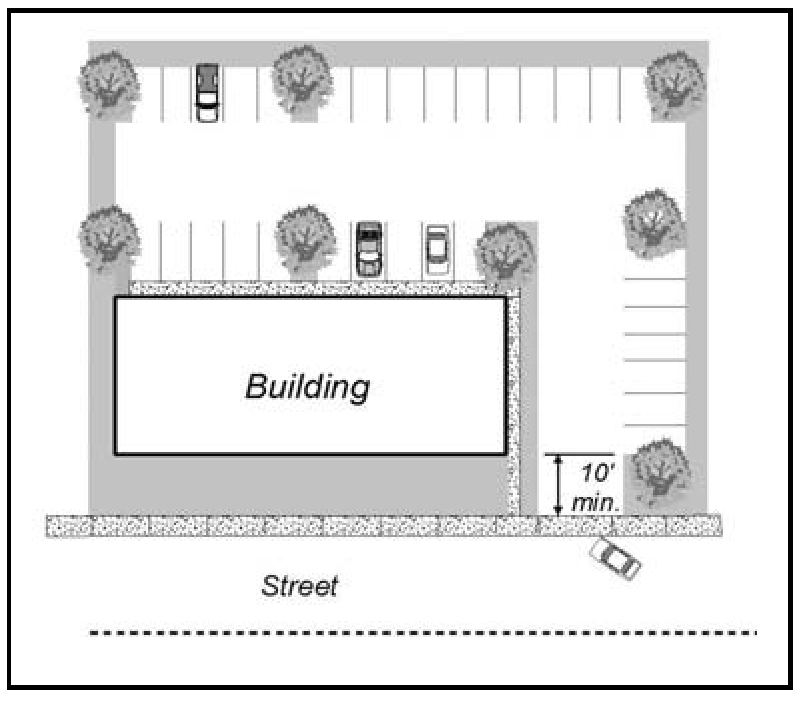
Figure 3-1 - Queuing Area
3.
Internal Maneuvering Area. Parking areas shall provide suitable maneuvering room so that vehicles enter the street in a forward direction, except for single-family homes and duplexes.
4.
Vertical Clearance. A minimum unobstructed clearance height of fourteen feet shall be maintained above areas accessible to vehicles in non-residential parking facilities.
C.
Access to Adjacent Sites. Applicants for nonresidential developments are encouraged to provide shared vehicle and pedestrian access to adjacent nonresidential properties for convenience, safety and efficient circulation. A joint access agreement guaranteeing the continued availability of the shared access between the properties and running with the land shall be recorded by the owners of the abutting properties, as approved by the director.
D.
Parking Space and Lot Dimensions.
1.
Parking spaces within carports and garages. Parking spaces within carports and garages shall have minimum clear dimensions of twenty feet in length by ten feet in width per space.
2.
Standard Parking Spaces. Minimum parking space dimensions shall be as described in Figure 3-2 and the notes that follow the figure.
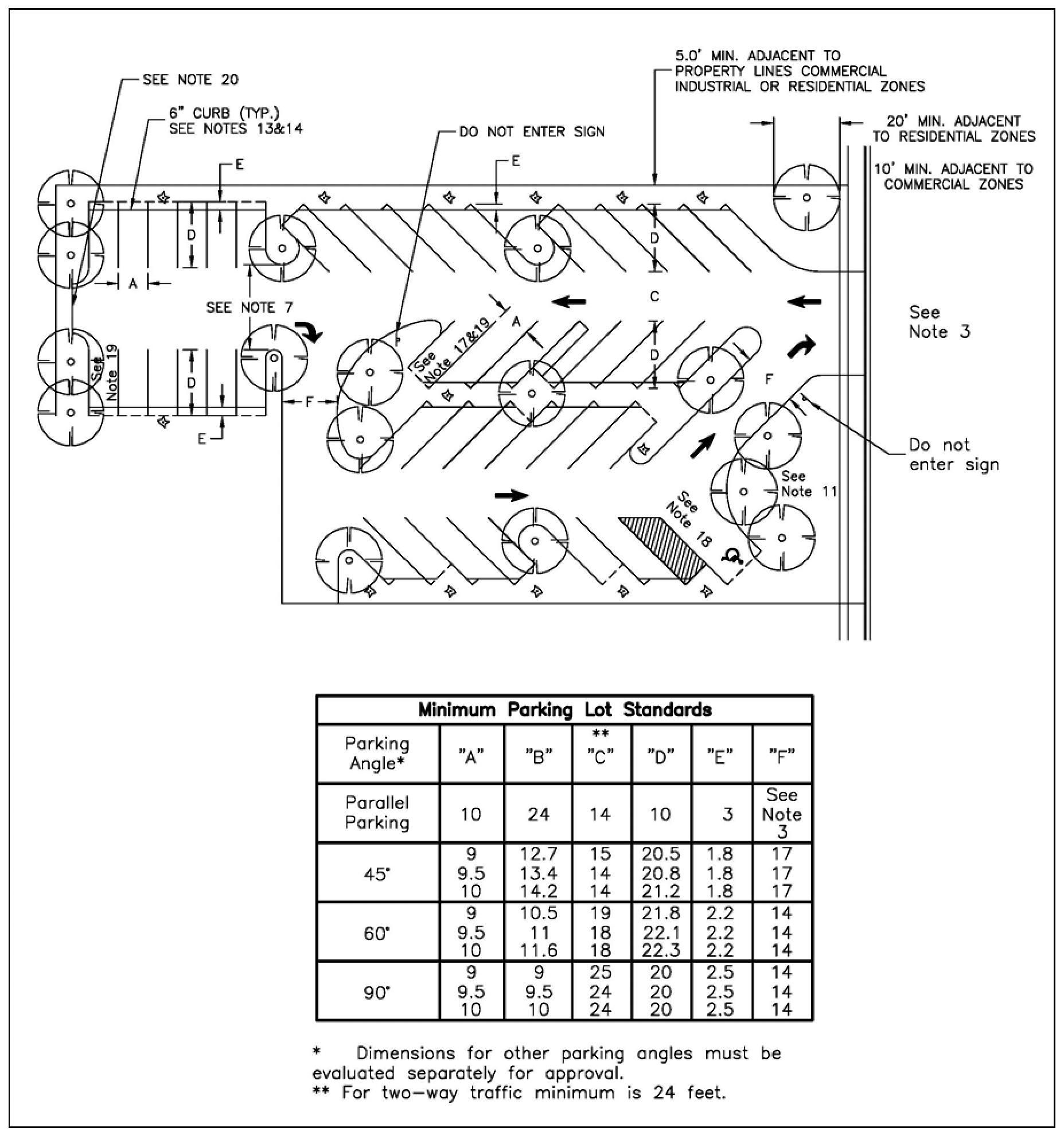
Figure 3-2 - Standard Parking Stall Dimensions (continued on next page)
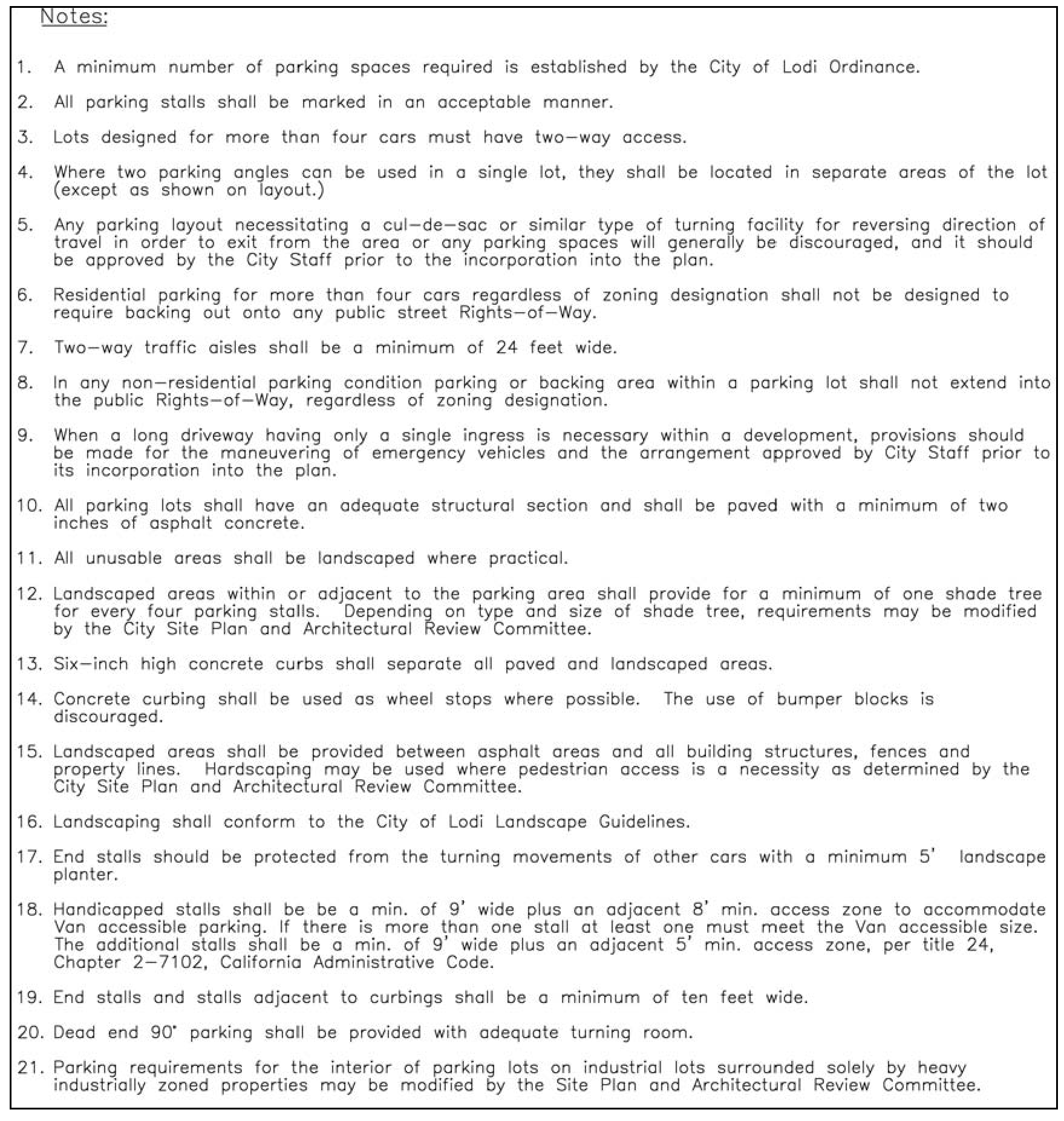
Figure 3-2 - Standard Parking Stall Dimensions (continued)
3.
Compact Parking Spaces. Parking areas containing a minimum of twenty or more parking spaces may include a maximum of fifteen percent of the total number of parking spaces for compact cars. These spaces shall be designated and distributed throughout the lot. Dimensions of compact parking spaces shall be no smaller than six inches less than a standard stall in width and two feet less than a standard stall in depth.
E.
Curbing and Wheel Stops.
1.
Curbing. Continuous concrete curbing at least six inches high and six inches wide shall be provided along the edges of parking spaces adjacent to fences, walls, other structures, and landscaping.
a.
Alternative barrier designs may be approved by the director.
b.
Parking spaces adjacent to landscaped areas or other obstructions shall incorporate an additional curbing width of twelve inches (for a total of eighteen inches) to provide a place to stand while exiting and entering vehicles.
c.
Curbing shall be placed within the parking space a minimum of two feet from the front of the space.
2.
Wheel Stops. Wheel stops other than continuous concrete curbing shall be prohibited except in work areas, and parking areas not open to the public.
3.
Bumper Overhang. To increase the parking lot landscaped area, a maximum of two feet of the parking stall depth may be landscaped with low-growth, hearty materials in lieu of paving, allowing a two-foot bumper overhang while maintaining the required parking dimensions.
F.
Directional Arrows and Signs.
1.
Parking spaces, aisles, approach lanes and maneuvering areas shall be clearly marked with directional arrows and lines to ensure the safe and efficient flow of vehicles.
2.
The director may require the installation of traffic signs in addition to directional arrows to ensure the safe and efficient flow of vehicles in a parking facility.
G.
Driveways.
1.
Width. Maximum driveway width shall be thirty-five feet for standard driveways and fifty-six feet for special driveways unless specifically approved otherwise by the city engineer for high truck volumes or other factors.
The total width of commercial and industrial driveways shall not exceed sixty percent of the frontage.
The minimum width of a single driveway shall be twelve feet and twenty-four feet for a driveway serving a parking lot with two-way aisle. Additional driveway width may be required on collectors and arterial streets particularly where there is no parking and a travel lane is adjacent to the curb.
Standard driveway width is measured at the curb line and includes only the depressed section. Special driveway width is measured between curbs behind property side. Width of a raised medians separating in and out traffic is not included in the width.
2.
Distances from Curb Returns. Commercial, industrial or other high volume driveways on arterials and major collectors shall be located as far as practical from the nearest curb return and may be prohibited within one hundred feet where the intersection is signalized, is planned for signalization, or intersection capacity is critical. At other locations, the top of the driveway transition shall be at least ten feet from the nearest curb return provided the return meets current standards for radius and location. At streets to be widened or improved, the above distances shall be measured from the ultimate location of the curb return.
At alleys, the driveway transition shall be permitted no closer than ten feet from the projected intersecting alley curb face, and no closer than three feet from the nearest ally curb return.
H.
Grades of Driveways and Parking Areas.
1.
Driveways. Driveways shall not exceed a maximum grade of positive ten percent or negative six percent measured along the driveway centerline. Where there is a change in the slope of the driveway, it shall be demonstrated that vehicles will be able to pass over the change in slope without interference with an average vehicle's undercarriage.
2.
Parking Areas. Parking areas shall have a maximum grade of seven percent, measured in any direction.
I.
Landscaping. Parking area landscaping shall be provided in compliance with Chapter 17.30 (Landscaping).
J.
Lighting. Parking areas shall have lighting capable of providing adequate illumination for security and safety. Lighting standards shall be energy-efficient and in scale with the height and use of the on-site structures. All illumination, including security lighting, shall be directed downward, away from adjacent properties and public rights-of-way. Lighting location shall take into account the location and expected mature characteristics of on-site landscape materials.
K.
Residential Guest Parking. Guest parking for multi-family residential uses shall be designated and restricted for the exclusive use of the guests with appropriate signs and pavement markings.
L.
Striping and Identification. Parking spaces shall be clearly outlined with four-inch wide lines painted on the surface of the parking facility. Circulation aisles, approach lanes, and turning areas shall be clearly marked with directional arrows and lines to ensure safe traffic movement.
M.
Surfacing. Parking spaces, driveways, maneuvering areas, and outdoor storage areas shall be paved with asphalt, concrete, masonry or concrete paving units, and permanently maintained. The use of rock, decomposed granite, turfstone, etc., is not allowed for required parking and driveway areas.
(Ord. No. 1869, § 2, 2-20-2013)
17.32.080 - Driveways and site access.
A.
Distance from Street Corners. Driveways to parking areas, except single family residential and duplex driveways, shall be located as far as practical from the nearest curb return and may be prohibited within one hundred feet where the intersection is signalized, is planned for signalization, or intersection capacity is critical. At other locations, the top of the driveway transition shall be at least ten feet from the nearest curb return provided the return meets current standards for radius and location. At streets to be widened or improved, the above distances shall be measured from the ultimate location of the curb return. At alleys, the driveway transition shall be permitted no closer than ten feet from the projected intersecting alley curb face, and no closer than three feet from the nearest ally curb return. Exceptions to this standard may be approved by the city engineer.
B.
Driveway Spacing. Driveways shall be separated along the street frontage as follows:
1.
Single-family and Duplex Residential Development. Driveways shall be separated by at least six feet, unless a shared, single driveway is approved by the director. The six-foot separation does not include the transition or wing sections on each side of the driveway approach.
2.
Multi-family and Nonresidential Development. Where two or more driveways serve the same or adjacent multi-family or nonresidential development, the centerline of the driveways shall be separated by a minimum of two hundred feet.
C.
Drive Aisles.
1.
Single-family Uses.
a.
Each single-family dwelling shall provide a continuous paved driveway from the street to the required parking area. Driveways shall be kept free and clear of stored materials, including inoperable vehicles.
2.
Multi-family and Nonresidential Uses. Drive aisles within multi-family residential and nonresidential parking areas shall be designed and constructed in compliance with Figure 3-8.
D.
Drive-through Facilities. Retail or service uses providing drive-in/drive through facilities shall be designed and operated to effectively mitigate problems of traffic congestion, excessive pavement, litter, noise, and unsightliness.
1.
Clearance from Obstruction. The nearest edge of a driveway apron or curb return shall be at least five feet from the nearest property line, centerline of a fire hydrant, utility pole, traffic signal, light standard, or other similar facility.
2.
Visibility. Drive aisles shall be designed and located so that adequate visibility is ensured for pedestrians, bicyclists, and motorists when entering individual parking spaces, circulating within a parking facility, and entering or leaving a parking facility.
a.
Aisle Design.
i.
The entrance/exit of any drive-through aisle shall be at least fifty feet from an intersection of public rights-of-way (measured at the closest intersecting curbs) and at least twenty-five feet from the edge of any driveway on an adjoining parcel.
ii.
Drive-through aisles shall be designed with a minimum twelve-foot interior radius at curves and a minimum twelve-foot width.
b.
Stacking Area. A clearly identified area shall be provided for vehicles waiting for drive-through service that is physically separated from other on-site traffic circulation.
i.
The stacking area shall accommodate a minimum of eight cars for each drive-through window in addition to the vehicle(s) receiving service.
ii.
The stacking area shall be located at and before the menu board, teller window, etc.
iii.
Separation of the stacking area from other traffic shall be by concrete curbing or paint striping on at least one side of the lane.
iv.
Stacking areas parallel to streets or public rights-of-way shall be discouraged.
c.
Walkways. Pedestrian walkways should not intersect the drive-through aisles, but where they do, they shall have clear visibility and shall be emphasized by enhanced paving.
3.
Screening. An opaque screen consisting of plant material and a solid masonry wall, a minimum of six feet in height, shall be constructed on each property line that is adjoining a residentially zoned/occupied parcel. The design of the wall and the proposed construction materials shall be subject to the approval of the director.
4.
Signs.
a.
Directional Signs. Each entrance to, and exit from, any drive aisle shall be clearly marked to show the direction of traffic flow by signs and pavement markings.
b.
Menu Boards. Menu boards shall not exceed a maximum height of six feet, and shall face away from public rights-of-way. Outdoor speakers shall be located at least fifty feet from any residentially zoned/occupied parcel.
(Ord. No. 1869, § 2, 2-20-2013)
17.32.090 - Bicycle parking.
A.
Applicability. Bicycle parking shall be provided for all multi-family and nonresidential uses in compliance with Table 3-2.
1.
For each ten bicycle parking stalls provided, there shall be permitted a reduction of one required automobile parking stall to a maximum of fifteen percent of the required automobile parking stalls, at the discretion of the community development director or planning commission (depending on who is the review authority).
B.
Bicycle Parking Design and Devices. Bicycle stalls shall be improved in accordance with the following requirements:
1.
Provided with a device to be approved by the city and capable of supporting a bicycle in an upright or hanging position and having a means that will enable a user to lock a bicycle to such a device.
2.
Areas containing stalls shall be surfaced with hardscape or paving.
3.
When located within a parking area, spaces shall be protected by curbs, fences, planter areas, bumpers, or similar barriers for the mutual protection of bikes, automobiles and pedestrians, unless deemed by the city to be unnecessary.
(Ord. No. 1869, § 2, 2-20-2013)
17.32.100 - Loading space standards.
Loading spaces shall be designed and constructed as follows:
A.
Location. Loading spaces shall be located based on the operating characteristics of the proposed use:
1.
As near as possible to the main structure and limited to the rear two-thirds of the parcel, if feasible;
2.
Loading facilities shall be discouraged from facing streets. Where not possible to do otherwise, ensure that the loading facility is screened from adjacent streets as much as possible;
3.
To ensure that loading and unloading takes place on-site and in no case within adjacent public rights-of-way or other traffic areas on-site;
4.
To ensure that vehicular maneuvers occur on-site; and
5.
To avoid adverse impacts upon neighboring residential properties.
B.
Dimensions. Loading spaces shall be not less than twelve feet in width, forty-five feet in length, with fourteen feet of vertical clearance.
C.
Lighting. Loading areas shall have lighting capable of providing adequate illumination for security and safety. Lighting standards shall be energy-efficient and in scale with the height and use of adjacent structures. Lighting shall be designed to prevent spillage of light to adjacent properties.
D.
Loading Doors and Gates. Loading bays and roll-up doors shall be painted to blend with the exterior structure walls. Loading bays and doors, and related trucks shall be adequately screened from view from adjacent streets as determined by the review authority.
E.
Loading Ramps. Plans for loading ramps or truck wells shall be accompanied by a profile drawing showing the ramp, ramp transitions and overhead clearances.
F.
Screening. Loading areas abutting residentially zoned parcels shall be screened in compliance with Section 17.30.060 (Screening).
G.
Striping. Loading areas shall be striped indicating the loading spaces and identifying the spaces for "loading only." The striping shall be permanently maintained by the property owner/tenant in a clear and visible manner at all times.
(Ord. No. 1869, § 2, 2-20-2013)
17.32.110 - Parking and circulation design guidelines.
A.
General Design Considerations. The primary design considerations for parking lot layout and site access are safety and efficiency, minimizing the visual impact of large paved areas, reinforcing the street environment, integrating parking into overall site development, and maximizing pedestrian orientation by means of lighting, landscape, hardscape, and parking layout.
1.
Factors to Consider. The following factors should be considered in the design and development of off-street parking areas:
a.
Ingress and egress with consideration to possible conflicts with vehicular and pedestrian traffic;
b.
Intra-parking lot pedestrian and vehicular conflicts;
c.
Reinforcing the street edge and a pedestrian environment;
d.
On-site circulation and service vehicle zones;
e.
Overall configuration and appearance of the parking area;
f.
Promoting compatibility with adjacent land uses;
g.
Minimizing opportunities for crime and undesirable activities through natural surveillance, access control and activity support;
h.
Potential to connect parking lot with neighboring properties;
i.
Shading the parking lot by means of canopy trees and other landscaping;
j.
Creating a sense of spatial organization and experiential meaning through the layout of the design of the parking lot;
k.
Reducing heat gain by shading pavement and employing light-colored pavement and walls; and
l.
Maximizing on-site percolation and minimizing runoff to storm drains.
2.
Location of Parking Lots. Parking lots should not occupy street frontages, and should be located behind buildings to the maximum extent feasible, so that the street frontage in both residential and non-residential areas remains pedestrian-oriented.
3.
Relationship to Adjacent Buildings. Parking areas should be separated from buildings by either a raised concrete walkway or landscaped strip. If space allows, parking stalls directly abutting buildings should be avoided.
4.
Pedestrian-friendly Features. Lighting, landscaping, hardscape, fencing, parking layout and pedestrian paths should all contribute to the strength and clarity of the parking lot as a deliberate and thorough design.
B.
Access and Entries.
1.
Pedestrian and vehicular entrances must be clearly identified and easily accessible to minimize pedestrian and vehicle conflicts. Entrances to parking lots should be from alleys, or between buildings, retaining the street frontage for buildings and locating parking to the rear of buildings, or to the side where no other alternative is available. The use of enhanced paving, landscaping, and special architectural features and details is encouraged to distinguish entrances.
2.
Where a parking cannot be located other than adjacent to a public street, the facility should include a point of entry and clear and safe access for pedestrians from the lot, to the on-street sidewalk, to the sidewalk entrance of the building.
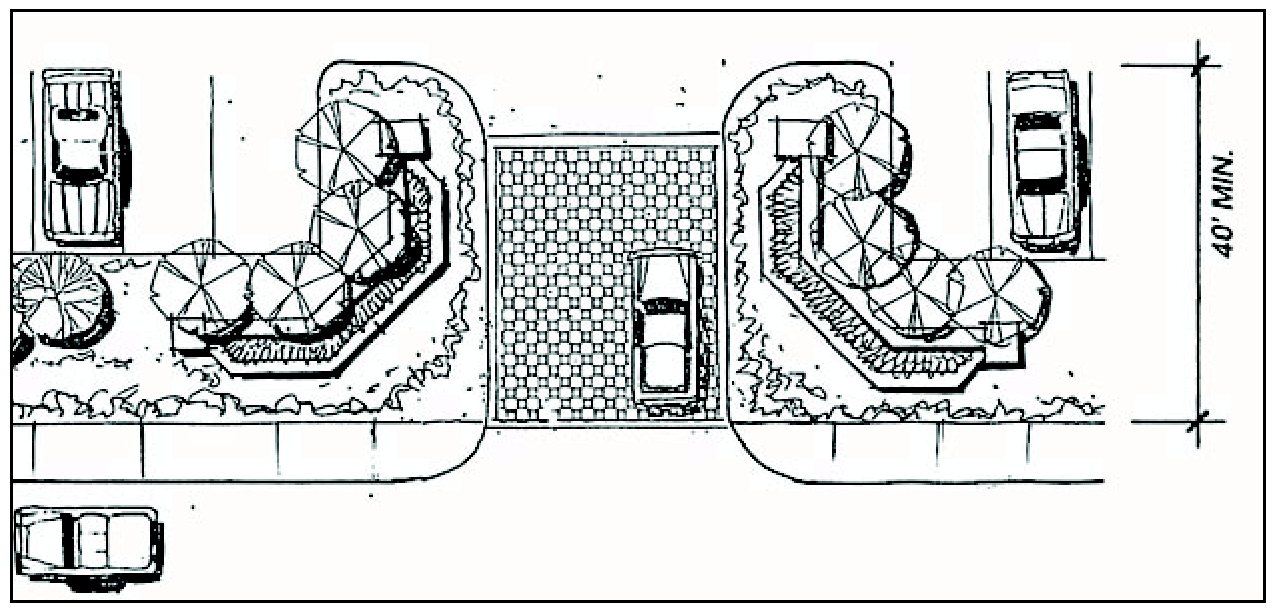
Figure 3-3 - Enhanced Parking Lot Facility
C.
Lighting. Carefully designed lighting is an essential element of good parking lot design. The placement, type, height number and bulb type of lights should all contribute to a coherent lighting design (see lighting under commercial guidelines).
D.
Hardscape.
1.
A well thought-out selection and composition of hardscape materials can help to order space and reinforce the relationship of the parking lot to its surroundings and to the buildings it serves. Entrance and exit areas, areas that are the central focus of the parking lot design, major axis and areas that act as forecourts for entrances may be suitable locations for special paving materials such as brick or stamped asphalt.
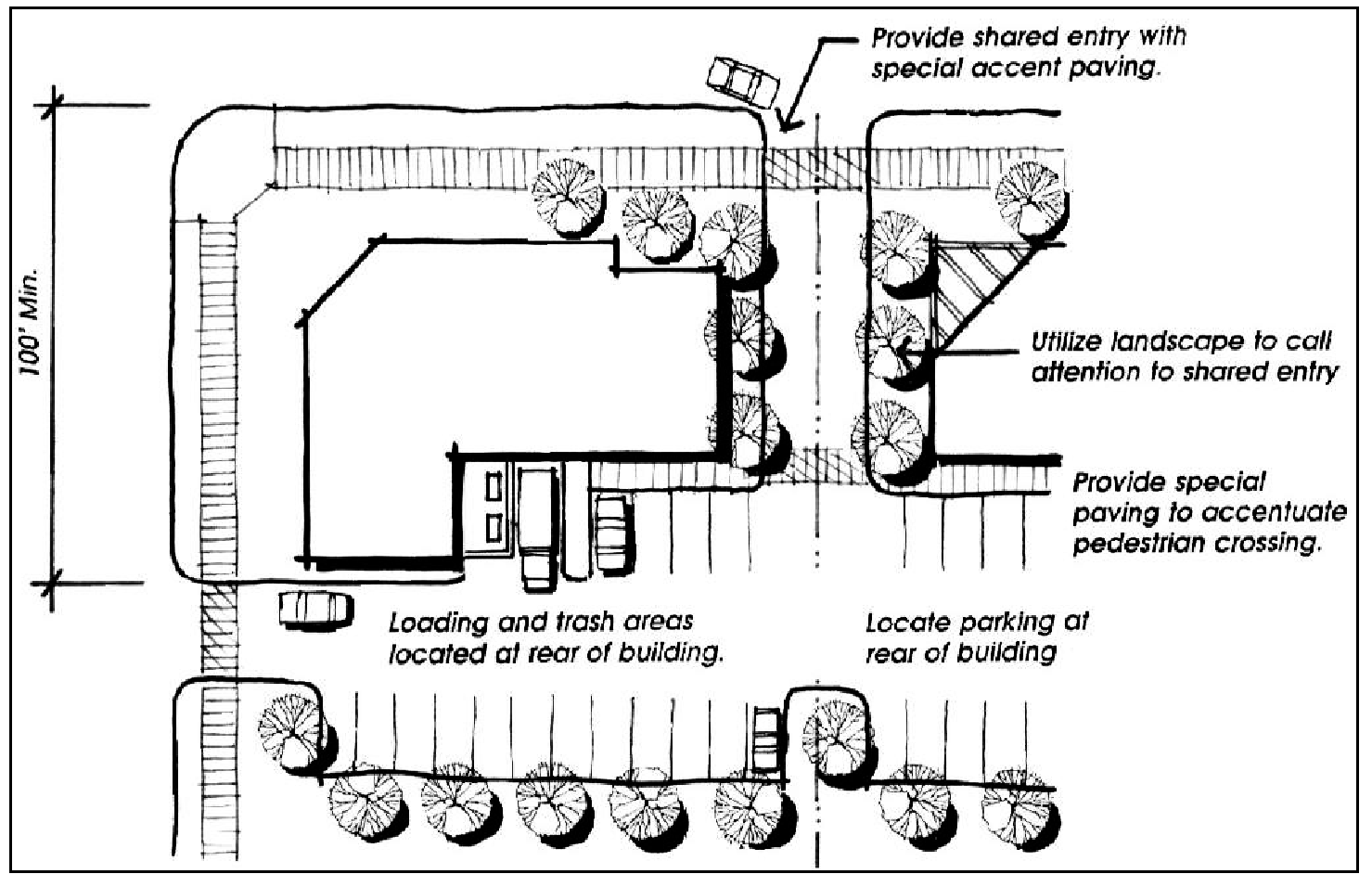
Figure 3-4 - Hardscape Materials
2.
Limit curb cuts for driveways opening to public streets. Common shared access driveways which provide access to more than one site are encouraged to reduce the number of driveway entries along commercial streets.
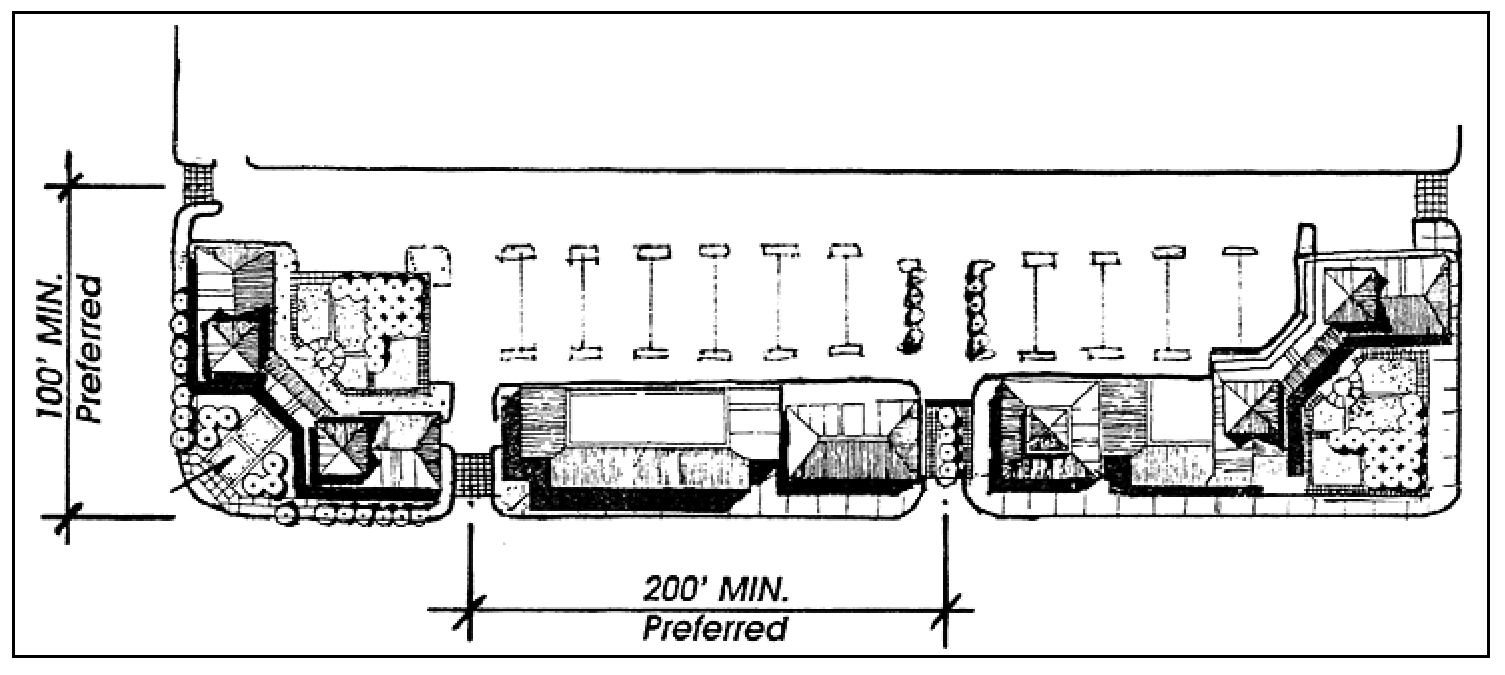
Figure 3-5 - Spacing or Driveway Curb Cuts
3.
Design parking areas so that pedestrians walk parallel to moving cars. Minimize the need for the pedestrian to cross parking aisles and landscape areas.
4.
Access for service vehicles, trash collection and storage areas should be located on alleys where alleys exist.
E.
Circulation.
1.
Separate vehicular and pedestrian circulation systems should be provided where possible. The layout of parking areas should be designed so that pedestrians walk parallel to moving cars, minimizing the need to walk between parked cars or to cross parking aisles and landscape areas.
2.
Pedestrian linkages between uses in commercial developments should be emphasized. Parking lot designs should include walkways and planting that help direct pedestrians comfortably and safely to their destinations.
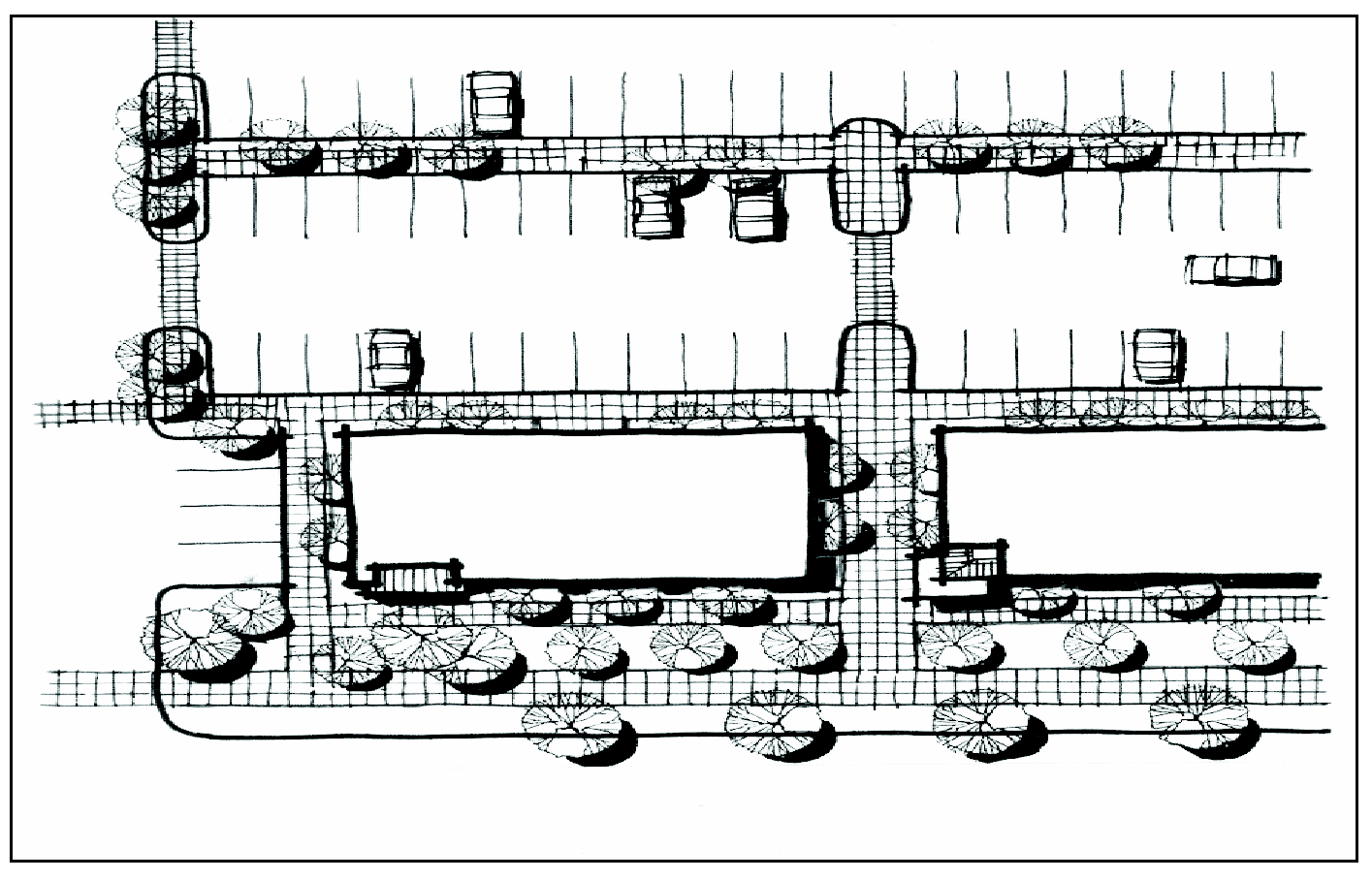
Figure 3-6 - Pedestrian Connections
3.
Parking aisles should be separated from primary vehicle circulation routes whenever possible.
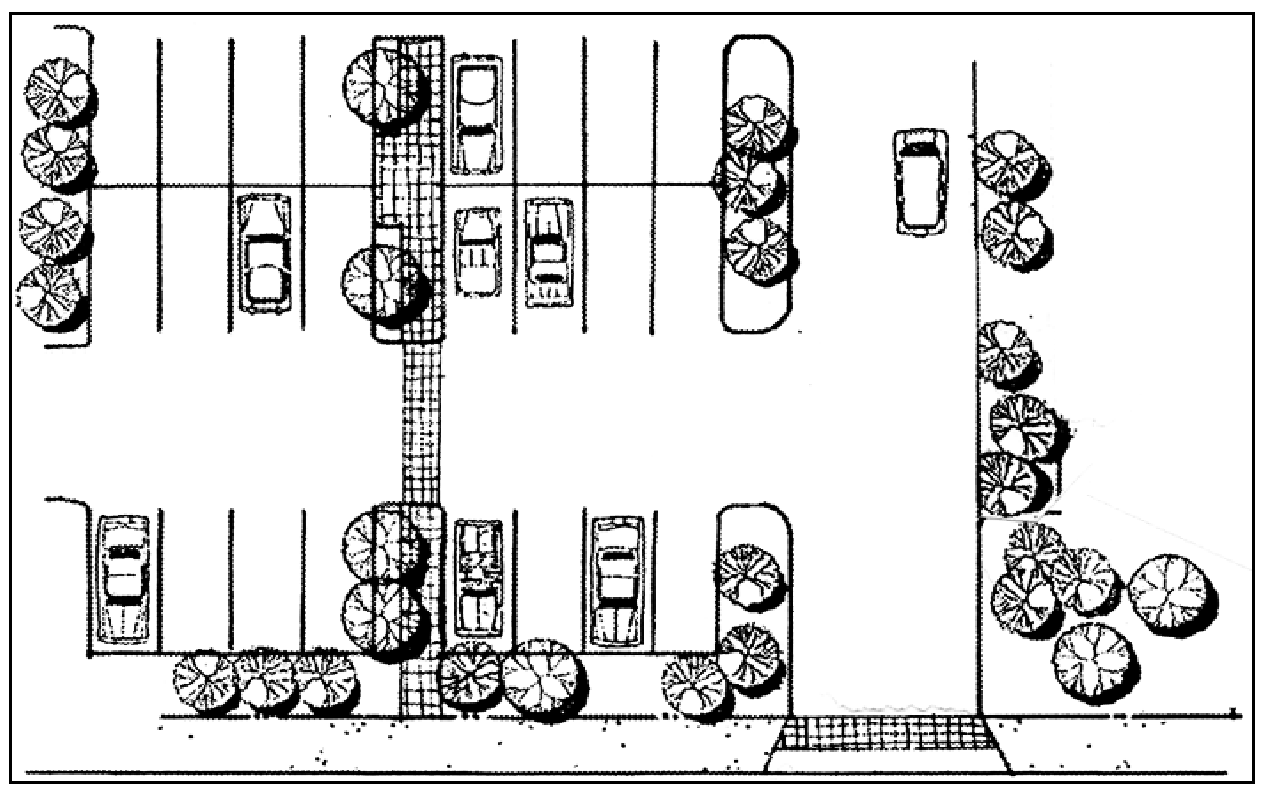
Figure 3-7 - Separate Circulation from Parking Areas
4.
Where parking areas are connected, interior circulation should allow for a similar direction of travel and parking spaces in all areas to reduce conflict at points of connection.
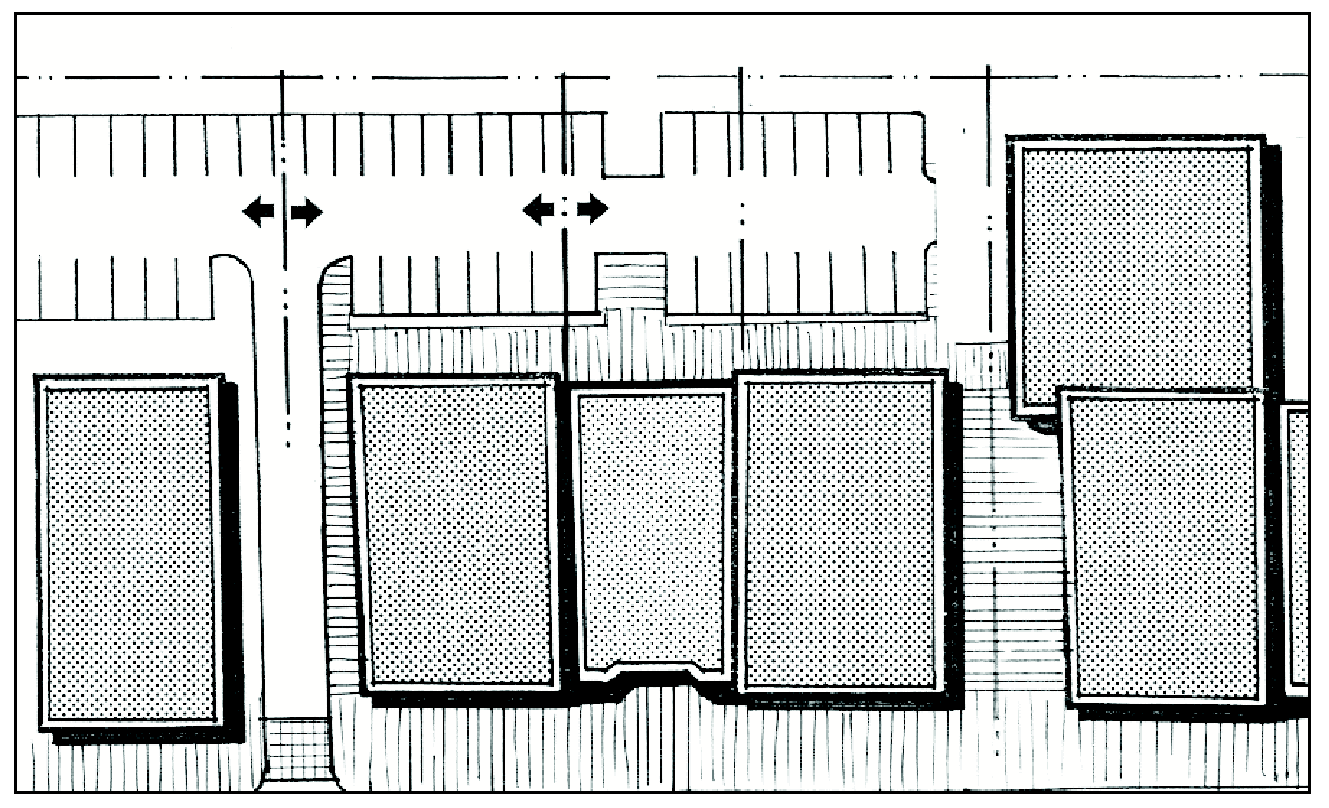
Figure 3-8 - Shared Parking Access
F.
Landscaping, Screening, and Buffering.
1.
Parking facilities should be landscaped with the following objectives in mind:
a.
Visually break up large paved areas with landscaping;
b.
Maximize distribution of landscaping;
c.
Promote compatibility and function as a "good neighbor;"
d.
Consider the use of trees planted at regular distances as a grove; and,
e.
Reduce the amount of storm water run-off resulting from the lot; and
f.
Shade fifty percent of the asphalt area within five years from time of installation.
2.
If a parking lot must be located adjacent to a street, the lot should be landscaped to soften the visual impact of parked vehicles from the public right-of-way. Screening should consist of a combination of low walls and landscape materials. The objective is to strike a balance between screening parked automobiles and facilitate safety through natural surveillance opportunities.
3.
As long as an open surveillance zone is maintained between thirty-two and six feet above grade, landscaping should be used in combination with walls and fences.
4.
Planting areas adjacent to parking areas, drives or walks should be protected by curbing where necessary, while allowing for drainage of surface water into permeable surface areas. See Figure 3-9.
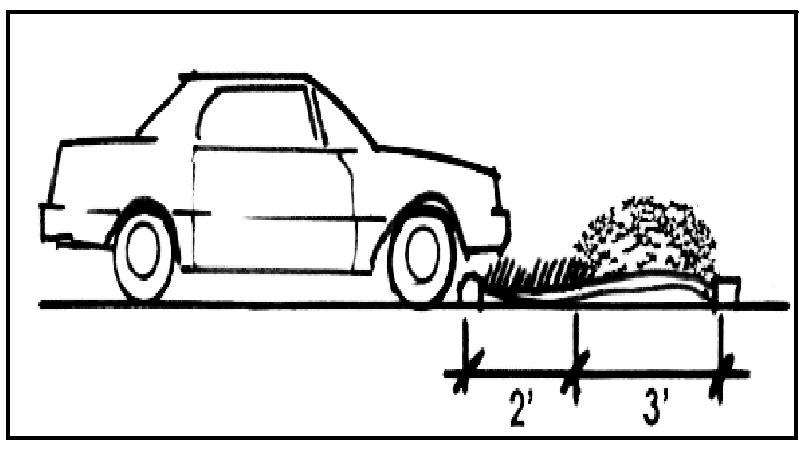
Figure 3-9 - Protect Landscaping
5.
Both perimeter and interior landscaping should incorporate canopy-type trees. The location and spacing of trees is dependent on the type of tree used, but the overall effect should be of a relatively consistent tree cover which will shade the pavement and vehicles. See Figure 3-10.
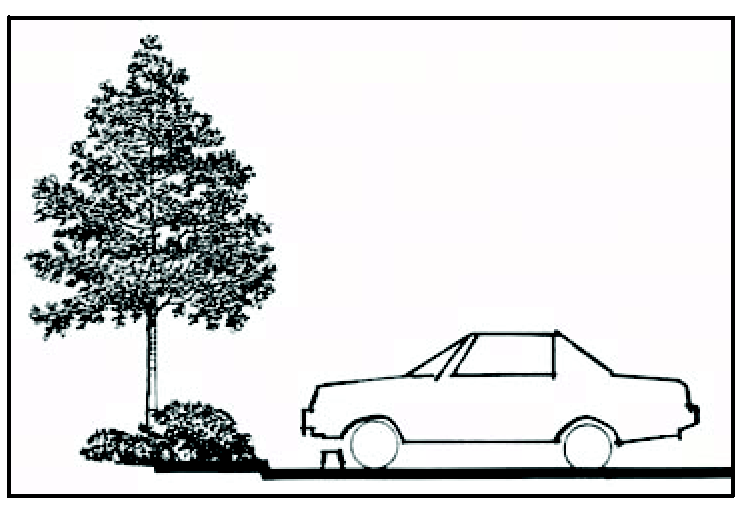
Figure 3-10 - Tree Cover
6.
Reduce conflicts between trees, lighting and signage by coordinating location of trees, light poles and signs. The maximum height of lights shall be lower than the typical pruning height of the tree used. The use of monument signs is highly encouraged to reduce tree/sign conflicts.
7.
All trees indicated on plans shall be planted and no change of species is allowed unless approved by the director.
8.
Planter areas shall have increased soil volume and reduced compaction to an appropriate level set by the submitted plans. The use of structural soil mix under paving to retain parking space while increasing soil volume is highly encouraged.
9.
Tree well and planting islands shall have a minimum dimension of eight feet and be excavated to a depth of three feet and filled with amended soil as necessary.
10.
Stakes shall be removed from trees as soon as the tree can support itself.
11.
The pruning of parking lot trees early in order to train their growth is encouraged.
12.
Tree care should be performed under the supervision of a certified arborist.
13.
If a tree is removed, it must be replaced with a tree of equivalent size and value.
(Ord. No. 1869, § 2, 2-20-2013)
17.34.010 - Purpose of chapter.
The city finds that signage, regardless of content or purpose, draws the visual attention of the public, and thereby creates a traffic safety hazard and degrades the aesthetic quality of the environment. The regulations established by this chapter are intended to address these issues by regulating the placement, quality, materials, size, and number of signs allowed within the city, and to require the proper maintenance of signs. The purposes of these limitations and requirements are to:
A.
Enhance commerce within the community by providing for signs that will allow the public to easily identify uses and premises, and regulating signs on the basis of their physical design, location, and proportions;
B.
Preserve and enhance the aesthetic, traffic safety, and environmental values of the community, and commercial, office, and industrial districts, while at the same time providing a channel of communication to the public;
C.
Limit commercial signage to on-site locations to keep the proliferation of this signage to a more aesthetic proportion, and protect existing businesses from visual encroachment from new signage on neighboring properties;
D.
Avoid traffic safety hazards to motorists and pedestrians caused by visual distractions and obstructions;
E.
Promote the aesthetic quality of the community by providing for signs that enhance the attractiveness of the city as a place to live, work, and shop; and
F.
Safeguard and protect the public health, safety, and general welfare.
(Ord. No. 1922, § 1, 7-6-2016)
17.34.020 - Applicability.
A.
Signs Regulated. The requirements and development standards in this chapter shall apply to all signs in all zoning districts except signs that are less than thirty-three percent of a window surface.
B.
Applicability to Sign Content. The provisions of this chapter do not regulate the message content of signs (sign copy), regardless of whether the message content is commercial or noncommercial.
(Ord. No. 1922, § 1, 7-6-2016)
17.34.030 - Sign permit requirements.
No sign shall be installed, constructed, or altered unless it is first approved in compliance with this section.
A.
Fees and Plans Required. An application for a sign permit shall be filed and processed in compliance with Chapter 17.50 (Application Filing and Processing). The application shall also include architectural elevations and plans of all proposed signs drawn to scale, with all dimensions noted, and include any additional information and materials as required by the department.
B.
Design Review and Approval. The director shall review all sign permit applications and approve only those found to be in substantial conformance with the design review criteria provided in Section 17.34.050 (General Requirements for All Signs). The director may require conditions of approval as are reasonably necessary to achieve the purposes of this chapter.
The director may refer sign permit applications to SPARC for action, either on the individual sign permit, or as part of a development project that is otherwise subject to SPARC review.
C.
Master Sign Program.
1.
When Required. A master sign program shall be approved by the director (or by SPARC upon referral by the director) prior to the issuance of any sign permit for:
a.
A new nonresidential project with four or more tenants; and
b.
Major rehabilitation work on an existing nonresidential project with four or more tenants that involves exterior remodeling. For the purposes of this chapter, major rehabilitation means adding more than fifty percent to the gross floor area of the building/buildings, or exterior redesign of more than fifty percent of the length of any facade within the project.
All signs installed or replaced within the nonresidential project shall comply with the approved master sign program.
2.
Content of Program. A master sign program shall provide standards for the uniform style, size, placement, and color palette of signs within the proposed nonresidential project.
3.
Revisions. Revisions to a master sign program may be approved by the director if he or she first determines that the revision is minor and that the intent of the original approval, and any applicable conditions are not affected. A new sign permit shall be obtained for revisions that would substantially deviate from the original approval.
D.
Time Limit for Action. A sign permit or a master sign program shall be approved or disapproved by the review authority within fifteen working days of the application being accepted as complete in compliance with Section 17.38.060 (Initial Application Review). A sign that is submitted in full compliance with an approved master sign program shall be approved within five working days of the application being accepted as complete.
E.
Signs and Sign Changes Allowed Without a Sign Permit. The following do not require a sign permit, provided that they comply with Section 17.34.050 (General Requirements for All Signs), and any required building permit is obtained.
1.
Nonstructural Modifications and Maintenance.
a.
Modifications or replacement to a face of a cabinet sign.
b.
Nonstructural modifications of the face, design, or color of an existing sign, provided that the modifications comply with any applicable master sign program approved in compliance with subsection C of this section.
c.
The normal maintenance of signs.
2.
Temporary Signs. Temporary signs in compliance with Section 17.34.070(D).
(Ord. No. 1922, § 1, 7-6-2016)
17.34.040 - Prohibited signs.
The following types of signs and devices shall be specifically prohibited:
A.
A sign in conjunction with a home occupation permit;
B.
Abandoned signs;
C.
Animated signs, including electronic message display signs, and variable intensity, blinking, or flashing signs; except time and temp signs (except in accordance with Section 17.34.070(F), (Programmable Electronic Signs);
D.
Balloons and other inflatable devices;
E.
Moving signs;
F.
Permanent off-site signs;
G.
Pennants, except as allowed for temporary periods by Section 17.34.070;
H.
Roof signs;
I.
Because of the city's compelling interest in ensuring traffic safety, signs that simulate in color, size, or design, any traffic control sign or signal, or that make use of words, symbols, or characters in a manner that interferes with, misleads or confuses pedestrian or vehicular traffic;
J.
Signs attached to or suspended from a vehicle parked within a public right-of-way, or in a location on private property that is visible from a public right-of-way, except a sign painted directly upon, magnetically affixed to, or permanently affixed to the body or other integral part of the vehicle;
K.
Temporary and portable signs, except as allowed by Section 17.34.070;
L.
Poorly maintained signs;
M.
Signs in public right-of-way or affixed to city property; and
N.
Signs which advertise activities illegal under federal, state, or local laws, rules, or regulations.
(Ord. No. 1922, § 1, 7-6-2016)
17.34.050 - General requirements for all signs.
A.
Sign Area. The measurement of sign area to determine compliance with the sign area limitations of this chapter shall occur as follows:
1.
The surface area of a sign shall be calculated by enclosing the extreme limits of all framing, writing, logo, representation, emblem, or other display within a single continuous perimeter composed of squares or rectangles with no more than eight lines. See Figure 3-11.
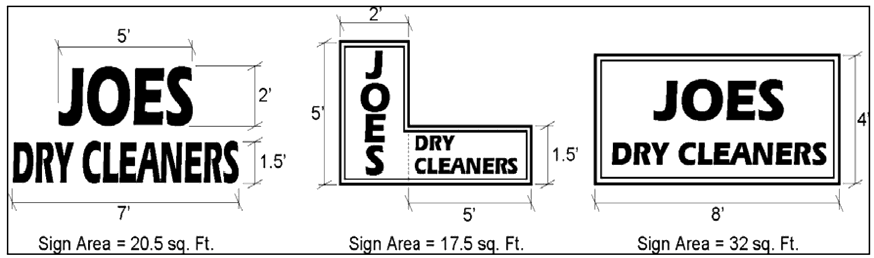
Figure 3-11 - Sign Area Measurement
2.
Supporting framework or bracing that is clearly incidental to the display itself shall not be computed as sign area.
3.
For freestanding signs all readable surfaces visible from a public right-of-way shall be counted in sign area calculations.
4.
Where a sign consists of one or more three-dimensional objects (i.e., balls, cubes, clusters of objects, sculpture or statue-like trademarks), the sign area shall be measured as their maximum projection upon a vertical plane.
5.
For signs that incorporate time and temperature devices, the area of these devices shall not be included in the total area of the sign.
B.
Sign Height. Sign height shall be measured as the vertical distance from the finished grade adjacent to the base of the sign structure to the highest point of the structure, where finished grade does not include fill, planters, or other material artificially placed to allow increased sign height.
C.
Sign Location Requirements.
1.
All signs identifying an occupant, business, or use shall be located on the same site as the occupant, business, or use, except as otherwise allowed by this chapter.
2.
Signage allowed on one building or frontage shall not be transferred to another building or frontage.
3.
Each sign, including a sign located on a temporary or portable building, shall be subject to the requirements of this chapter.
4.
No sign shall be located within the public right-of-way, except as otherwise allowed by this chapter.
5.
A sign for the purpose of construction, sales, or leasing are permitted within a required setback area, provided it is:
a.
Located within a permanently maintained landscaped planter area having an area at least twice that of the sign area;
b.
Not closer than ten feet from any property line and ten feet from any access driveway; and
c.
Not within a radius of twenty feet of the intersection of the rights-of-way of two intersecting streets.
6.
The location of all signs shall be evaluated to ensure:
a.
That the setback is appropriate for the height and area of a freestanding or projecting sign;
b.
That flush or projecting signs relate to the architectural design of the building. Signs that cover windows, or that spill over natural boundaries and architectural features shall be discouraged;
c.
That signs do not unreasonably block the sight lines of existing signs on adjacent properties; and
d.
Pedestrian and vehicular safety.
7.
A freestanding sign may be placed only on a site frontage adjoining a public street.
8.
No freestanding sign shall be closer than seventy-five feet to another freestanding sign, to ensure adequate visibility for all signs. The director may waive this requirement where parcel width and/or the locations of existing signs on adjacent properties would make the seventy-five-foot separation impractical.
D.
Design Criteria for Signs. The following design criteria shall be used in reviewing the design of individual signs. Substantial conformance with each of the following design criteria shall be required before a sign permit or building permit can be approved.
1.
Color. Colors on signs and structural members should be harmonious with one another and reflective of the dominant colors of the building or buildings being identified. Contrasting colors may be utilized if the overall effect of the sign is still compatible with the building colors and prevailing colors in the surrounding neighborhood (where a theme can be identified).
2.
Materials and Structure.
a.
Sign materials (including those for framing and support) should be representative of the type and scale of materials used on the building or buildings which the sign identifies. Insofar as possible, sign materials should match the materials used on the building and on other signs.
b.
Materials selected for permanent signs shall be durable and capable of withstanding weathering over the life of the sign with reasonable maintenance.
c.
The size of the structural members (e.g. columns, crossbeams, and braces) should be proportional to the sign panel they are supporting. In general, fewer larger supporting members are preferable to many smaller supports.
d.
The use of individual letters incorporated into the building design is encouraged, rather than signs with background and framing other than the building wall.
e.
The use of reflective materials or surfaces may be approved only where the review authority determines that they will not distract motorists or create other hazards, and should be minimized in all cases.
f.
Wall signs shall not project from the surface upon which they are attached more than required for construction purpose and in no case more than twelve inches.
g.
Wall signs shall not project above the eave line or the edge of the roof of a building.
E.
Copy Design Guidelines. The city does not regulate the message content (copy) of signs; however, the following are principles of copy design and layout that can enhance the readability and attractiveness of signs. Copy design and layout consistent with these principles is encouraged, but not required.
1.
Sign copy should relate only to the name and/or nature of the business or commercial center.
2.
Permanent signs that advertise continuous sales, special prices, etc. should be avoided.
3.
Information should be conveyed briefly or by logo, symbol, or other graphic manner. The intent should be to increase the readability of the sign and thereby enhance the identity of the business.
4.
Freestanding signs should contain the street address of the parcel or the range of addresses for a multi-tenant center.
F.
Illumination of Signs. The artificial illumination of signs, either from an internal or external source, shall be designed to minimize light and glare on surrounding rights-of-way and properties.
1.
External light sources shall be directed and shielded to limit direct illumination of any object other than the sign.
2.
The light from an illuminated sign shall not be of an intensity or brightness that will interfere with the reasonable enjoyment of residential properties. In areas with low ambient nighttime illumination levels (e.g., residential neighborhoods or business districts with little or no illuminated signing) applicants shall be encouraged to use light, illuminated copy against dark or opaque backgrounds.
3.
Signs shall not have blinking, flashing, or fluttering lights or other illuminating devices that have a changing light intensity, brightness or color, except as otherwise allowed in Section 17.34.070 (Programmable Electronic Signs).
4.
Colored lights shall not be used at a location or in a manner so as to be confused or construed as traffic control devices.
5.
Neither the direct nor reflected light from primary light sources shall create a hazard to operators of motor vehicles.
6.
Incandescent lamps shall not be visible from a public right-of-way or adjacent property.
7.
Light sources shall utilize energy efficient fixtures to the greatest extent possible.
G.
Maintenance of Signs. Signs and supporting hardware, including temporary signs, shall be maintained in good repair and functioning properly at all times. Repairs to signs shall be of equal or better in quality of materials and design as the original sign. Signs which are not properly maintained and are dilapidated shall be deemed to be a public nuisance, and may be abated in compliance with Lodi Municipal Code.
When existing signs are removed or replaced, all brackets, poles, and other supports that are no longer required shall be removed. Unpainted areas shall be painted to match the adjacent portion of the building or sign support structure.
H.
Signs on Public Property. No signs are allowed on public property, except for the following:
1.
A public sign erected by or on behalf of the city or other public entity to post legal notices, identify public property, convey public information, or direct or regulate pedestrian or vehicular traffic.
2.
An informational sign of a public utility or transit company regarding its poles, lines, pipes, facilities, or routes.
3.
An emergency warning sign erected by the city or other public entity, a public utility company, or contractor doing authorized or permitted work on public property.
4.
Signs constructed by the city to direct persons to specific districts, regions, or public facilities.
5.
Banner signs on city property (e.g., light poles in downtown area or along major corridors).
6.
Advertising signs on transit, police, parks and other city property (e.g. city facilities, including but not limited to transit shelters, buses, park facilities, and Hutchins Street Square).
(Ord. No. 1922, § 1, 7-6-2016)
17.34.060 - Zoning district sign standards.
Only the signs and sign area authorized by this section shall be allowed unless otherwise expressly provided in this section or Section 17.34.070 (Standards for Specific Types of Signs).
A.
Residential Zoning Districts. Signs within the residential zoning districts shall comply with the following standards:
1.
Size and Type of Signs Allowed. Each parcel in the residential zoning districts may be permitted signs as follows:
a.
One nameplate not exceeding one square foot in area identifying the occupant of a residence. No building permit is required;
b.
One identification sign for apartment and institutional use, not exceeding forty-eight square feet in area;
c.
One unlighted sign not exceeding six square feet in area that advertises the sale or rental of the premises. No building permit is required;
d.
A bulletin board, not exceeding twenty square feet in area, upon the issuance of a use permit by the planning commission;
e.
One sign not exceeding one hundred square feet in area on the site of a construction project or new subdivision, that indicates the nature of the development or identifies the persons involved in the construction; which may be placed on the site prior to or during the development activities;
f.
One unlighted, noncommercial sign not exceeding six square feet in area; and
g.
A warning or no trespassing sign not exceeding six square feet in area. No building permit is required.
2.
Setback Requirements. Each sign shall be set back at least ten feet from all property lines.
3.
Height Limit. No building mounted sign shall exceed a height of twenty feet. No freestanding sign shall exceed a height of eight feet, sign plus base.
B.
Commercial and industrial zoning district sign standards. Each proposed sign shall comply with the following standards for the applicable zoning district.
1.
CC District. Each sign within the CC zoning district shall comply with the following standards:
a.
General Specifications and Requirements.
i.
Sign content should be limited to the tenant's name and primary graphic logo;
ii.
Notwithstanding the following sign provisions, tenants may utilize standard corporate logos and/or prototypical signage graphics, if used in a majority of the tenant's California stores subject to approval of the city of Lodi;
iii.
All signage on the building fascia, with exception of certain logo/graphics, shall be of indirectly lit individual channel letters or dimensional letters in accordance with the definitions below. No cabinet signs shall be permitted. Signage illumination shall not include flashing, moving or scintillating effects;
iv.
Channel letters are to be defined as individual channel letters or as connected channels that may be composed of script letters with connected serifs, or a non-script letters that are connected by heavy outlines into an integrated shape or "channel box". Secondary channel boxes containing a logo mark or underlining the primary text and containing a secondary message shall be permitted. Illumination may be with either LEDs or neon;
v.
Dimensional letters are to be made of one-half-inch thick clear acrylic or one and one-half-inch thick aluminum;
vi.
All signs must be dimensional. Signs painted directly onto the building shall not be permitted;
vii.
Painted wall graphics or murals that are thematic to the overall shopping center and do not provide any specific tenant identification shall be allowed subject to prior approval by the city of Lodi. The thematic wall graphics or murals shall be counted as signs or sign area with respect to the building on which graphic or mural is painted;
viii.
Signs may not come within one foot of the top, bottom or sides of the building elevation or fascia upon which a sign is located. In no case may a sign extend beyond the roof parapet or adjacent building eave line. Signs are not allowed on or against any roof structures. Architectural tower features on buildings may be considered for tenant identification signs subject to specific sign design approval by the city of Lodi;
ix.
Exposed channel letter raceways are prohibited. All channel letter signs must be mounted directly to the building surface or be mounted upon a decorative architectural background feature subject to specific sign design approval by the landlord and the city of Lodi;
x.
Tenant signs will be no larger than seventy-five percent of fascia height, with a maximum width of seventy-five percent of tenant's frontage;
xi.
All signs are to be laid out so as to be proportionate to the area in which it is placed, as well as comply with the square footage limitations. They should also be centered at the appropriate location on the elevation so it would be balanced with the buildings as a whole. (Not necessarily centered on the tenant space);
xii.
Each tenant may have signage upon the front and rear elevations subject to size area limitations. End cap tenants may also have signage on their side elevations subject to size area limitations. Pad tenants may have signage on all elevations facing a public street or parking area subject to the size area limitations;
xiii.
Colors shall be consistent with the theme of the shopping center;
xiv.
Temporary wall signs, pennants, flags, over-roof signs, inflatable displays, exposed neon, or sandwich boards are prohibited. Temporary banners advertising specials or sales may be allowed in accordance with the city code; and
xv.
Window signs, other than the permanent window graphics, will not be allowed. These signs include neon signs, fiber optic/neon simulated plastic signs and border neon.
b.
Freestanding Signs. The design of the multi-tenant pylon signs, multi-tenant monument signs and center identification monument sign shall be commensurate with the architecture of the shopping center.
i.
Freeway Information Area Signage.
(A)
One pylon sign, no higher than sixty-five feet, shall be permitted along the freeway frontage. The sign shall identify multiple tenants within the shopping center; and
(B)
The pylon sign shall have a maximum of seven hundred twenty square feet of tenant identification and thirty-two square feet of shopping center identity.
ii.
Center Identification Sign. One center identification sign, no higher than eight feet, shall be permitted. The sign shall be a single-sided, identifying the entrance to the center. No tenant names shall be displayed on the identification sign.
iii.
Monument Signs.
(A)
One multi-tenant monument sign, no higher than twelve feet, shall be permitted. A shopping center of ten acres or more may have two monument signs. These signs may have two-sided panels to identify multiple tenants within the shopping center; and
(B)
The monument signs shall have a maximum of eighty-four square feet of tenant identification and eight square feet of shopping center identity.
c.
Tenant Signage. The sign program regulates the total allowed signage each tenant may have, based upon the frontages of each store. Tenant signage shall not exceed the total allowed maximum signage per tenant.
i.
Tenants shall be allowed two square feet of signage per lineal foot of frontage for the front elevation and two square feet of signage multiplied by seventy-five percent per lineal foot of frontage for side (end caps) and rear elevations;
ii.
The signs may either be internally illuminated plex-faced channel letters or halo illuminated fabricated aluminum reverse pan channel letters; and
iii.
Single pad tenants shall be allowed one wall sign per each business frontage facing a street, pedestrian plaza and/or parking lot. The total allowed sign area shall be two square feet of signage per lineal foot of frontage for the front elevation and two square feet of signage multiplied by seventy-five percent per lineal foot of frontage for side and rear elevations.
3.
GC and Industrial Districts. Each sign within the GC and industrial zoning districts shall comply with the following standards:
a.
Size and Types of Signs Allowed. All signs located on parcels in the GC or any industrial zoning district shall meet the following requirements:
i.
The total allowed sign area for all signs on a parcel, including building-mounted and freestanding signs, shall be equal to one square foot of sign area per linear foot of all street frontages on adjacent public or private streets.
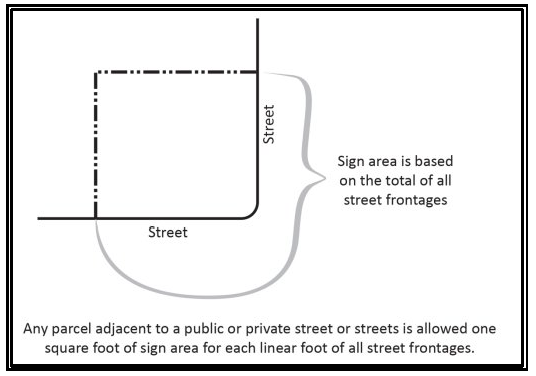
Example: A corner parcel with two frontages of two hundred linear feet each would be allowed a total of four hundred square feet of signage:
200 frontage + 200 frontage = 400 square feet of sign area
For parcels with a "flag lot" configuration, frontage shall be measured based on the width of the lot used for setback measurement per Section 17.14.060.C.1.b of this Code.
ii.
The total allowed sign area may be divided among building-mounted and freestanding signs, provided that the size standards in this section are not exceeded.
Example: A parcel with a total of four hundred square feet of sign area could have one eighty-four-square-foot monument sign and three hundred sixteen square feet of building-mounted signs:
400 square feet of total sign area - 84 square-foot monument sign = 316 square feet of building mounted signs (400 - 84 = 316)
-OR-
400 square feet of total sign area can be used entirely for 400 square feet of building-mounted signs
iii.
The sign area for building-mounted signage in a building containing multiple tenant spaces shall be apportioned based on the building frontage of each space, measured at the front entrance to each space, as shown in the example below.
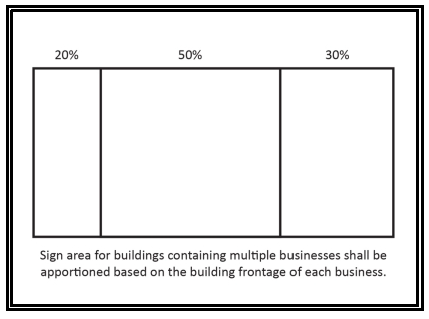
Example: In the example illustrated above, and assuming that four hundred square feet of sign area was to be used for building-mounted signs, each space would be assigned sign area as follows:
50% of building frontage = 50% of 400 square feet = 200 square feet of building sign
30% of building frontage = 30% of 400 square feet = 120 square feet of building sign
30% of building frontage = 20% of 400 square feet = 80 square feet of building sign
iv.
Building-mounted signs for each tenant may be placed on all exterior walls which enclose the tenant's space. For a single-tenant building, this will be all exterior walls.
Tenants in a multi-tenant building are limited to placing signs on their exterior walls.
v.
No individual building-mounted sign shall exceed four hundred eighty square feet in size.
vi.
Each parcel is permitted to have one freestanding monument sign, subject to the following:
(A)
The area of the freestanding sign shall be counted toward the maximum sign area for the parcel.
(B)
The sign may identify all businesses on the parcel.
(C)
If multiple tenants are shown on the sign, the area per tenant may be assigned as desired by the owner of the sign. It is not required that individual tenants be shown on a freestanding sign.
(D)
The sign shall not contain an electronic reader board.
(E)
The sign may be externally illuminated or may have backlit letters mounted on an opaque background. Internally illuminated freestanding signs are prohibited.
(F)
Maximum area for the freestanding sign shall be calculated as the gross square footage of the parcel divided by two thousand one hundred seventy-eight, up to a maximum sign size of three hundred square feet. Example:
43,560 square foot parcel: 43,560/2,178 = 20 square feet
871,200 square foot parcel (20 acres): 871,200/2,178 = 400 square feet, but limited to maximum of 300 square feet
b.
Off-premises Signs. Off-premises signs are prohibited, with the exception of those that legally existed prior to the adoption of this development code.
c.
Setback Requirements. Each sign shall be set back at least two feet from the property line.
d.
Height Limit. No sign shall exceed the following height limits, as applicable.
i.
Building-mounted Signs. A building-mounted sign shall not exceed the height limit of the building or thirty-five feet, whichever is less.
ii.
Freestanding Signs. A freestanding sign shall not exceed the height of the tallest building on the site.
iii.
Freeway Information Area.
(A)
A freeway information (FI) area is established to include an area bounded: on the west by a line drawn fifty feet west of the west right-of-way line or Cherokee Lane or five hundred feet west of the west right-of-way line of the U.S. Highway 50-99 freeway, whichever is greater; and on the east by a line drawn five hundred feet east of the east right-of-way line of the U.S. Highway 50-99 freeway; and on the north and south by the then-current city limits.
(B)
A sign within the FI area shall not exceed a height of seventy-five feet.
C.
Mixed Use Zoning District Sign Standards. The regulation of the location, size, type and number of signs permitted shall be governed by the provisions of this section.
1.
Downtown Mixed Use and Mixed Use Center Districts. Each sign within the DMU and MCE zoning districts shall comply with the following standards:
Signs must be more than just a way to relay information; they must be an architectural extension of a building. The objective of the standards and guidelines is not to create uniformity, but to eliminate those elements that result in a cluttered and unattractive physical environment. Few outward features of a business display the owner's confidence and quality as well as signage. These basic parameters provide for creative signs that may still be as varied and different as the businesses they represent.
a.
Permitted Sign Types.
i.
Flush-Mounted or Painted Wall Signs. Cabinet "canned" signs shall be prohibited.
ii.
Projecting Signs. Provided:
(A)
They leave no less than eight clear above the finished grade, and extend no more than four feet out from the wall;
(B)
They are not mounted above the first floor.
iii.
Awning and Canopy Signs. Awnings are primarily for shade and secondarily a sign location. Letters and graphics are limited to vertical surfaces and shall not exceed fifty percent of the surface area. Internally illuminated vinyl awnings are not permitted.
iv.
Free Standing Signs. Pole-mounted and/or other forms of free standing signs shall not be permitted in the downtown district. Exceptions, subject to city review are:
(A)
Directory Signs or Kiosks. These may be considered for sidewalk locations; those for private arcades or buildings should be on private property, located in publicly accessible courts, accessways, or passages.
(B)
Portable Signs. Menu boards for restaurants, etc. provided they are stored indoors after hours of operation and not placed to obstruct the public sidewalk.
b.
Sign Size.
i.
Building Mounted Signs. The maximum area for each permitted sign type or any combination thereof shall be one square foot per one linear foot of tenant street frontage. Maximum sign length shall not exceed seventy-five percent of the tenant space frontage.
ii.
Free Standing Signs. Per city review.
c.
Exemptions.
i.
Temporary signs as set forth in Section 17.34.070(D).
ii.
Permanent Signs. In addition to those permitted above shall be limited to:
(A)
Existing built-in signs that are integral to the building design.
(B)
Painted window signs that cover a maximum of twenty-five percent of the window area.
(C)
Any sign identifying hours of operation that have an area of less than three square feet.
d.
Sign Maintenance. High levels of maintenance are essential if investment in the downtown is to be encouraged. Because signs are meant to be seen, maintenance is especially important.
i.
Paint. Signs shall be retained in good condition, with touch-up or repainted as needed. Peeling paint should be replaced promptly.
ii.
Repair. Damaged signs and poles shall be repaired promptly or removed.
iii.
Illumination. Bulbs and fixtures shall be replaced promptly if they burn out or are broken.
iv.
Awnings. Awnings that are damaged and/or faded shall be repaired or replaced promptly.
e.
Architectural Compatibility. A building's architectural style and overall proportions should guide the design of signs. Signs should be located on the facade in areas designed for this function; e.g. a recessed or framed area between the first and second floor, or a parapet panel between shopfront and roofline.
f.
Sign Types.
i.
Flush-mounted and painted wall signs should align with major architectural elements, such as doors and windows. Ornamental elements, such as moldings, pilasters, arches, clerestory windows, roof eaves, or cornice lines should be used as a frame.
(A)
Relationship to Cornice or Roof Line. Signs should not extend above the cornice line or into or above roof areas, unless they function as an integral part of the roof design. For example:
(1)
A sign board may extend above the cornice line of an otherwise flat-topped building if it is designed as a parapet in keeping with the style of the rest of the building.
(2)
A sign board may extend above an existing parapet, if it is located to function as an accent to the basic parapet design.
ii.
Projecting Signs.
(A)
Proportion. Projecting signs with vertically-oriented messages should be slender in appearance, with a proportion of at least two to one, height to width. Projecting signs with horizontally-oriented messages may be rectangular or square; if located below an awning or canopy as a hanging "blade" sign, they should also be slender, proportioned two to one width to height.
(B)
Structural Support. Should be an attractive addition to the overall design of the sign and/or building. Ornamental metal is recommended. Wooden supports are also appropriate if designed to complement the sign; however, undetailed, standard-size lumber should not be used.
(C)
Relationship to Cornice or Roof Line. Projecting signs should not extend above the cornice line or into the roof area, unless they are an integral part of a completely new facade design or a faithful accent to existing architectural details or forms. Projection signs should not extend above the eave line of a sloped roof.
iii.
Awning and Canopy Signs.
(A)
Color. Combinations for awning or canopy signs should be simple. Lettering color and background color should contrast for legibility. Subtle bands of color are appropriate for awnings; more complex patterns or textures should generally not be used.
(B)
Location of Message—Awnings. Lettering should not appear on the sloped or curved portion. Information may be located on the valance (the front vertical portion).
(C)
Location of Message—Canopies. Signs on canopies should be in the form of letters or a signboard integrated with the canopy fascia, or freestanding letters mounted on top and extending above the fascia.
iv.
Other Sign Types.
(A)
Figurative signs shaped to reflect the silhouette of a particular object (for example, a key, a coffee cup, etc.) are encouraged. These may be wall-mounted or projecting, but should reflect guidelines for the specific type of sign as listed above.
v.
Not Allowed.
(A)
"Canned" signs are internally illuminated plastic panels within a sheet metal box enclosure. They should not be used. Inexpensive canned signs use a limited range of colors and lettering types, and tend to have no relationship to the architecture of the building.
(B)
Illuminated vinyl awning signs are more appropriate for "commercial strip areas" and shall not be used.
g.
Materials. Recommendations are:
i.
Signboards of wood or metal, with painted or engraved letters, or mounted letters of wood or metal.
ii.
Silhouette or Figurative Signs. Three-dimensional letters, symbols, and/or ornamental figures made of wood or metal.
iii.
Custom Neon. Exterior-mounted on a signboard or metal support frame or enclosure, or interior-mounted behind clerestory or display windows.
iv.
Fabric awnings such as canvas with painted or applied lettering; plastic or vinyl awnings should not be used.
h.
Lighting. Recommendations are:
i.
Backlit with lighting inside and behind projecting lettering.
ii.
Top or bottom lit with single or multiple spotlights.
2.
Mixed Use Corridor District. Each sign within the MCO zoning district shall comply with the following standards:
a.
General Specifications and Requirements. Signs within the MCO zoning district shall comply with the general specifications and requirements identified in development code Section 17.34.060 (B)(1)(a).
b.
Free-standing Signs. The design of the multi-tenant pylon signs, multi-tenant monument signs and center identification monument sign shall be commensurate with the architecture of the development.
i.
Center Identification Sign. One center identification sign, no higher than eight feet, shall be permitted. The sign shall be a single-sided, identifying the entrance to the center. No tenant names shall be displayed on the identification sign.
ii.
Monument Signs.
(A)
One multi-tenant monument sign, no higher than twelve feet, shall be permitted. A shopping center of ten acres or more may have two monument signs. These signs may have two-sided panels to identify multiple tenants within the shopping center; and
(B)
The monument signs shall have a maximum of eighty-four square feet of tenant identification and eight square foot of shopping center identity.
c.
Tenant Signage. The sign program regulates the total allowed signage each tenant may have, based upon the frontages of each store. Tenant signage shall not exceed the total allowed maximum signage per tenant.
i.
Tenants shall be allowed two square feet of signage per lineal foot of frontage for the front elevation and two square feet of signage multiplied by seventy-five percent per lineal foot of frontage for side (end caps) and rear elevations.
ii.
The signs may either be internally illuminated plex-faced channel letters or halo illuminated fabricated aluminum reverse pan channel letters.
iii.
Single pad tenants shall be allowed one wall sign per each business frontage facing a street, pedestrian plaza and/or parking lot. The total allowed sign area shall be two square feet of signage per lineal foot of frontage for the front elevation and two square feet of signage multiplied by seventy-five percent per lineal foot of frontage for side and rear elevations.
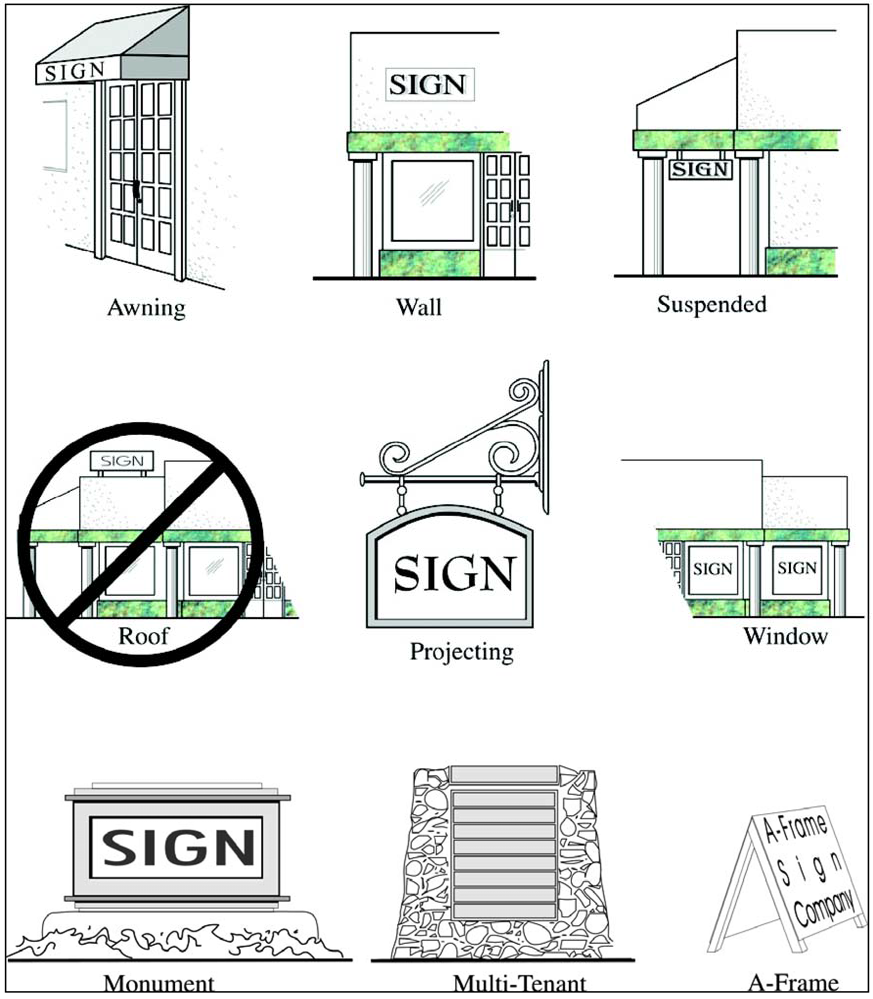
Figure 3-12—Examples of Sign Types
(Ord. No. 1922, § 1, 7-6-2016; Ord. No. 2003, § 2, 7-20-2022)
17.34.070 - Standards for specific types of signs.
Proposed signs shall comply with the following standards where applicable, in addition to the sign area and height limitations, and other requirements of Section 17.34.060 (Zoning District Sign Standards), and all other applicable provisions of this chapter.
A.
Awning Signs. The following standards apply to awning signs in all zoning districts where allowed by Section 17.34.060 (Zoning District Sign Standards).
1.
Signs on awnings are limited to ground level and second story occupancies only.
2.
Awnings shall not be internally illuminated. Indirect lighting may be allowed. Translucent awning materials are prohibited.
3.
Awnings are primarily for shade and secondarily a sign location. Letters and graphics shall be limited to vertical surfaces and shall not exceed fifty percent of the surface area. Internally illuminated vinyl awnings are not permitted.
B.
Freeway-adjacent Outdoor Advertising Signs.
1.
Definitions. For the purposes of this subsection, the terms "advertising structure," "advertising display," "freeway," "highway," "landscaped freeway," "person," "sign," and "to place" shall be defined in compliance with Business and Professions Code Section 5200 et seq. (the California Outdoor Advertising Act).
2.
Prohibited for Freeway Viewing. No advertising display shall be placed or maintained on property adjacent to a freeway regardless of the applicable zoning district if the advertising display is designed to be viewed primarily by persons traveling on the freeway.
3.
Exemptions. The prohibition in subsection (C)(2) of this section shall not apply to advertising displays or structures placed upon property for the purpose of advertising the sale or lease of the property upon which the sign is placed.
4.
Size. The advertising display or structure shall not exceed four hundred eighty square feet.
C.
Projecting Signs. Projecting signs shall comply with the following standards:
1.
Proportion. Projecting signs with vertically-oriented messages should be slender in appearance, with a proportion of at least two to one, height to width. Projecting signs with horizontally-oriented messages may be rectangular or square; if located below an awning or canopy as a hanging "blade" sign, they should also be slender, proportioned two to one width to height.
2.
Structural support should be an attractive addition to the overall design of the sign and/or building. Ornamental metal is recommended. Wooden supports are also appropriate if designed to complement the sign; however, undetailed, standard-size lumber should not be used.
3.
Relationship to Cornice or Roof Line. Projecting signs should not extend above the cornice line or into the roof area, unless they are an integral part of a completely new facade design or a faithful accent to existing architectural details or forms. Projection signs should not extend above the eave line of a sloped roof.
D.
Temporary Signs. Temporary signs are allowed in all zoning districts subject to the following requirements. Temporary signs include banner signs, paintings, markings and writings.
1.
Residential Zoning District On-site Signs.
a.
Maximum Area. Sign area shall not exceed six square feet.
b.
Number. No more than four temporary on-site signs shall be placed on any parcel.
c.
Duration. Temporary signs shall be removed within ten days of the termination of the event with which they are associated. Any sign which has been in place longer than a period of six months shall be subject to the applicable standards regulating permanent signage.
d.
Placement. Temporary signs shall not present a physical danger to persons or property. No temporary sign shall be placed, affixed, painted, marked, or written in a manner that obstructs either vehicular traffic (either by physical obstruction or obstruction of sight lines) or pedestrian traffic. No temporary sign shall be placed, affixed, painted, marked, or written upon any public property or public right-of-way including but not limited to any public building, sidewalk, crosswalk, curb, fence, wall, public playground equipment, and/or facilities, street lamp post, utility pole, hydrant, tree, street or traffic signs, parkways (e.g. the area between curb and sidewalk) or medians.
2.
Commercial and Industrial Zoning District On-site Signs.
a.
Maximum Area. Sign area shall not exceed thirty-two square feet per sign face.
b.
Number. Each parcel shall be allowed a minimum of four temporary on-site signs, plus one additional temporary on-site sign for each two hundred feet of lineal street frontage per parcel. Properties with multiple tenants or businesses shall be allowed no more than four additional temporary on-site signs per tenant or business.
c.
Duration. Temporary signs shall be removed within ten days of the termination of the event with which they are associated. Any sign which has been in place longer than a period of six months shall be subject to the applicable standards regulating permanent signage.
d.
Placement. Temporary signs shall not present a physical danger to persons or property. No temporary sign shall be placed, affixed, painted, marked, or written in a manner that obstructs either vehicular traffic (either by physical obstruction or obstruction of sight lines) or pedestrian traffic. No temporary sign shall be placed, affixed, painted, marked, or written upon any public property or right-of-way including but not limited to any public building, sidewalk, crosswalk, curb, fence, wall, public playground equipment, and/or facilities, street lamp post, utility pole, hydrant, tree, street or traffic signs, parkways (e.g. the area between curb and sidewalk) or medians.
E.
Window Signs. The following standards apply to window signs in all zoning districts where allowed:
1.
Window signs shall be allowed only on windows located on the ground level and second story of a building frontage.
2.
Permanent and temporary signs shall not occupy more than twenty percent of the total window area.
3.
Signage shall consist of individual letters, logos, or symbols applied to the glass surface; however, neon signs with transparent backgrounds may be hung inside the window glass line.
F.
Programmable Electronic Signs. The following standards apply to programmable electronic signs, except freeway oriented electronic billboards (Section 17.34.070(G) (standards for specific types of signs)), and electronic message signs on city property (Section 17.34.070(H) (standards for specific types of signs)), which are regulated separately.
1.
All programmable electronic signs require the issuance of a use permit. The city may impose site-specific conditions on the installation or operation of a programmable electronic sign in addition to the limits in this section, based on the sign's location and adjacent uses.
2.
Programmable electronic signs shall not exceed forty-eight square feet of total sign area in any zoning district, and shall comply with the location and height requirements for signs in the underlying zoning district.
3.
Electronic display area shall be included in the calculation of sign area.
4.
The content of programmable electronic signs shall be limited to non-commercial or on-site commercial messages. Programmable electronic signs shall not be used for off-site commercial messages.
5.
The following operational standards apply to all programmable electronic signs:
G.
Freeway Oriented Electronic Billboard. The following apply to freeway oriented electronic billboards:
1.
No more than two freeway oriented electronic billboards shall be allowed within the city.
2.
Freeway oriented electronic billboards shall be located on private property.
3.
Freeway oriented electronic billboards are exempt from the prohibition of permanent off-site signs, and may display advertising or messages for businesses, events, etc., which are not on the same parcel as the sign.
4.
All design standards and specifications shall be identified in a development agreement with the city, which shall be approved by the city council.
5.
The design standards and specifications shall include a specific design for the sign, including dimensions, materials, colors, and architecture. The specific design shall be subject to review by the site plan and architectural review committee.
H.
Electronic Message Signs on City Property. This sign type is intended to provide for the location of electronic message signs incorporating an illuminated LED panel at city-owned facilities throughout Lodi. Electronic message signs on city property are subject to the following:
1.
Locations. Electronic message signs on city property shall be placed only on city-owned or city-controlled property, regardless of the zoning of the property.
2.
Sign Type. Electronic message signs on city property must be one of the following types.
a.
Monument (ground-mounted on a base)
b.
Pole (elevated above the ground on a central support)
c.
Building-mounted (affixed to a building)
3.
Brightness. The following standards apply to the brightness of electronic message signs on city property:
a.
Maximum brightness of the LED panel for any sign is seven thousand five hundred nits.
b.
Brightness must be controlled to automatically adjust the sign to respond to ambient lighting conditions and reduce glare and spillover to adjacent properties.
c.
A lower maximum lighting level may be imposed through the Conditional Use Permit for an individual sign.
4.
Enclosures and Supports. Sign enclosures and supports must be designed to be compatible with the architecture of buildings on the site.
5.
Number and Spacing of Signs.
a.
Any number of signs may be placed on a parcel, subject to approval by the planning commission.
b.
No specific spacing is required between signs, except that the planning commission may impose a spacing requirement based on site-specific circumstances as part of the review of the conditional use permit for an individual sign.
6.
Height, Size, Hours of Operation, and Other Standards. Standards for the various types of electronic message signs on city property are as follows.
a.
Monument Sign.
i.
Maximum height is ten feet, including the height of the sign base.
ii.
Maximum screen size is four feet high by eight feet wide.
iii.
Sign may be single or double-sided. Size for a double-sided sign is calculated by measuring one sign face.
b.
Pole Sign.
i.
Maximum height is twenty feet. The maximum height to the bottom of the LED panel shall not exceed twelve feet.
ii.
The maximum screen size is six feet high by twelve feet wide.
iii.
The sign support must be at least one-third the width of the sign face.
c.
Building-mounted.
i.
The sign must be mounted to a vertical surface, such as a building wall or other architectural feature, provided that the top of the sign may not be more than forty-five feet above the ground at the base of the wall.
ii.
The sign may not project over the top of the wall on which the sign is placed.
iii.
Maximum screen size is eight feet high by sixteen feet wide.
d.
Hours of Operation.
i.
Sign operation shall be limited to the hours 6:00 a.m. to 10:00 p.m., unless different hours are established as part of the conditional use permit for the sign.
e.
Content.
i.
The city may require that a reasonable amount of display time is provided to the city free of charge to allow the city to provide information to the public about civic events, city public information messages, emergency information, and the like.
ii.
Electronic message signs on city property are not subject to any prohibition on off-site signs contained in this Code and may display commercial messages for businesses and activities not located on the site.
f.
Conditions of approval may include dimensional and operational standards which are more stringent than those specified in this section if needed to address site-specific conditions.
7.
Approval Process.
a.
All electronic message signs on city property require a conditional use permit, which shall be reviewed and approved per Section 17.40.040 of this Zoning Code. An application for a conditional use permit for an electronic message signs on city property may be denied if the city, in light of evidence in the record, determines that the proposed sign is not appropriate for the proposed location.
b.
All electronic message signs on city property require site plan and architectural review approval by the site plan and architectural review committee, per Section 17.40.020 of this Zoning Code.
(Ord. No. 1922, § 1, 7-6-2016; Ord. No. 1990, § 1, 1-19-2022; Ord. No. 2003, § 2, 7-20-2022; Ord. No. 2017, § 1, 8-16-2023)
17.34.080 - Exceptions to sign area standards.
The director or other applicable review authority may grant an administrative deviation to the allowed area of a sign in compliance with Section 17.40.050 (Variations and Administrative Deviations) if it is first determined that:
A.
The position or setback of the building on the site requires additional area for effective signing. The exception may increase the allowed sign area by up to twenty-five percent; or
B.
The exceptional size of the structures, uses, or site requires additional sign area for effective identification from major approaches to the site. The exception may increase the allowed sign area by up to twenty-five percent; or
C.
The name of the business or use to be identified is exceptionally long, so that sign readability would be impaired by crowding words into the allowable sign area. The exception may increase the allowed sign area by up to twenty-five percent; or
D.
Signing proposed is indistinguishable from the architecture itself (supergraphic design) or achieves the level of sculptural art.
(Ord. No. 1922, § 1, 7-6-2016)
17.34.090 - Sign maintenance.
All signs within the city shall be maintained in good condition and repair, as follows:
A.
Awnings. Awnings that are damaged and/or faded shall be promptly repaired or replaced.
B.
Illumination. Bulbs and fixtures shall be promptly replaced if they burn out or are broken.
C.
Paint. The paint on each sign shall be maintained in good condition, with touch-up or repainting as needed. Peeling paint should be promptly replaced.
D.
Repair. A damaged sign and/or pole shall be promptly repaired, or removed from the site.
(Ord. No. 1922, § 1, 7-6-2016)
17.34.100 - Nonconforming signs.
A nonconforming sign is any permanent or temporary sign that was legally established and maintained in compliance with the provisions of all applicable laws in effect at the time of original installation but that does not now comply with the provisions of this development code.
A.
General Requirements. A nonconforming sign may not be:
1.
Changed to another nonconforming sign;
2.
Structurally altered to extend its useful life;
3.
Expanded;
4.
Re-established after a business is discontinued for sixty days; or
5.
Re-established after damage or destruction to fifty percent or more of the value of the sign, or its components, as determined by the building official.
B.
Abatement. Signs not conforming to the provisions of this chapter shall be brought into compliance or removed upon the following circumstances:
1.
Abandonment. Any discontinuance or abandonment of a nonconforming sign shall result in a loss of legal nonconforming status of the sign.
2.
Modification. Any proposed modification to the non-conforming sign structure or copy shall result in a loss of legal nonconforming status of the sign.
(Ord. No. 1922, § 1, 7-6-2016)
17.34.110 - Violations and abatement.
A.
Public Nuisance Declared by Director. Any sign erected or maintained contrary to the provisions of this chapter may be declared to be a public nuisance by the director and proceedings for its removal may take place in compliance with Chapter 17.76 (Enforcement).
B.
Removal of Abandoned Sign, Sign Shell, and Support Structures. A sign, sign shell, and support structures shall be removed by the owner or lessee of the premises upon which the sign is located when the business that it advertises is no longer conducted on the premises. If the owner or lessee fails to remove the sign and sign shell, the director shall give the owner thirty days written notice to remove it. Upon failure to comply with the notice, the director may have the sign removed at the owner's expense. Proceedings for the removal of signs and/or support structures shall comply with Chapter 17.76 (Enforcement).
(Ord. No. 1922, § 1, 7-6-2016)
17.34.120 - Judicial review.
Any permit issued or denied in compliance with this chapter shall be subject to expedited judicial review in accordance with the time limits set forth in Code of Civil Procedure, Section 1094.8 et seq.
(Ord. No. 1922, § 1, 7-6-2016)
17.34.130 - Sign design guidelines.
The following guidelines should be considered in the design of all signs within Lodi. These guidelines are intended to complement other requirements in the previous sections of this chapter:
A.
Design Compatibility.
1.
Creative Design Encouraged. Signs should make a positive contribution to the general appearance of the street and commercial area in which they are located. A well-designed sign can be a major asset to a building.
2.
Proportionate Size and Scale. The scale of signs should be appropriate for the building on which they are placed and the area in which they are located. The size and shape of a sign should be in proportion with the scale of the structure.
3.
Integrate Signs with the Building. Signs should not obscure architectural features. Their design should be integrated with the design of the building. A well-designed building facade or storefront is created by the careful coordination of sign and architectural design and over-all color scheme. Signs in multiple tenant buildings should be designed to complement or enhance the other signs in the building.
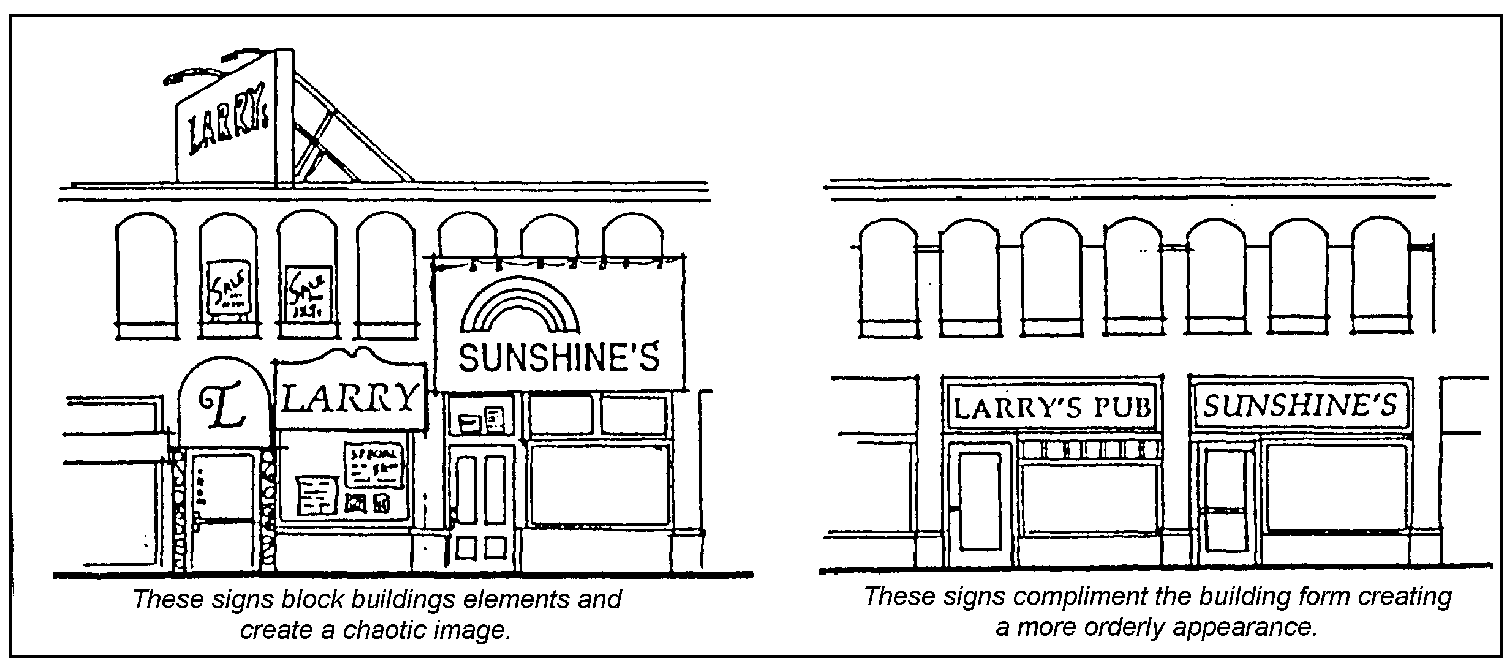
Figure 3-13—Design Compatibility
4.
Reduce Sign Impact. Because residential and commercial uses generally exist in close proximity, signs should be designed and located so that they have little or no impact on adjacent residential neighborhoods.
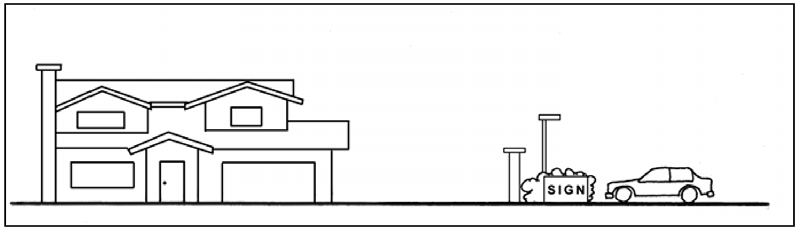
Figure 3-14—Reduce Sign Impact
5.
Sign Placement. Place wall signs to establish facade rhythm, scale and proportion where facade rhythm does not otherwise exist. On buildings that have a monolithic or plain facade, signs can establish or continue appropriate design rhythm, scale, and proportion.
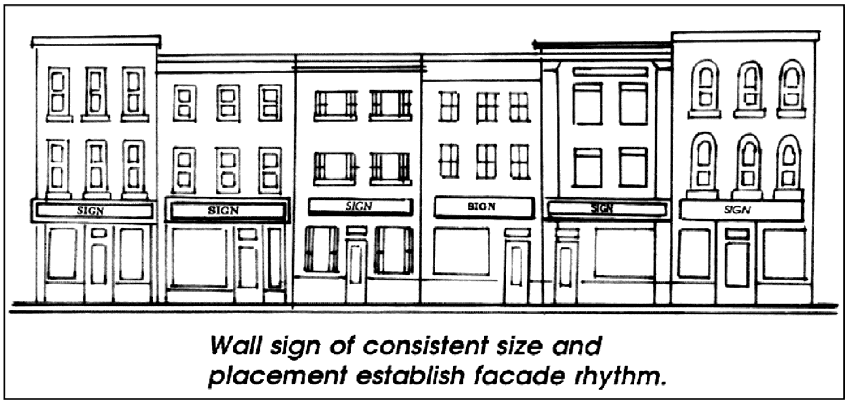
Figure 3-15—Sign Placement
6.
Pedestrian-oriented Signs are Encouraged. It is desirable and encouraged to include a pedestrian-oriented sign as one of the permitted signs for a business. Pedestrian-oriented signs are signs that are designed for and directed toward pedestrians so that they can easily and comfortably read the sign as they stand adjacent to the business.
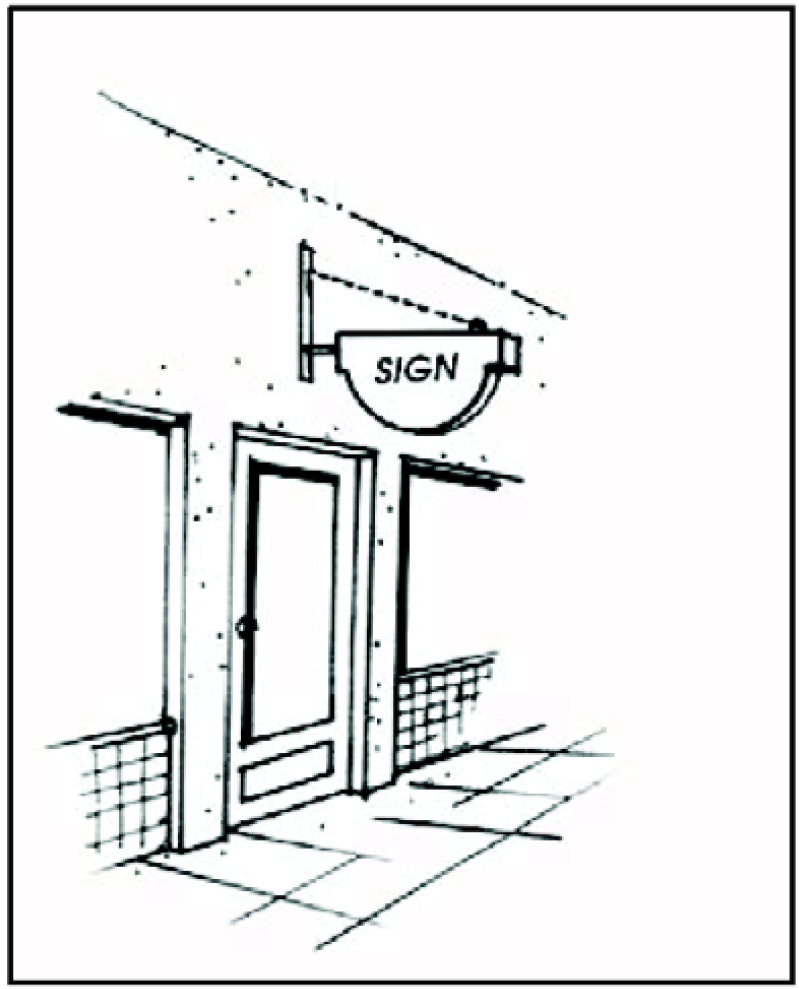
Figure 3-16—Pedestrian-Oriented Sign
7.
Use Individual Letters. As an alternative to an attached sign, lettering may be painted directly on the building facade. However, signs should not be painted directly over ornamental and architectural features or over brick and stone surfaces of buildings.
B.
Color.
1.
Select Colors Carefully. Color is one of the most important aspects of visual communication. It can be used to catch the eye or to communicate ideas or feelings. Colors should be selected to contribute to legibility and design integrity. Even the most carefully thought out sign may be unattractive and a poor communicator because of poor color selection. Too many colors used thoughtlessly can confuse and negate the message of a sign.
2.
Use Contrasting Colors. Contrast is an important influence on the legibility of signs. A substantial contrast should be provided between the color and material of the background and the letters or symbols to make the sign easier to read in both day and night. Light letters on a dark background or dark letters on a light background are most legible.

Figure 3-17—Contrasting Letters and Background
3.
Avoid Using Too Many Colors. Colors or color combinations that interfere with legibility of the sign copy or that interfere with viewer identification of other signs should be avoided. Small accents of several colors may make a sign unique and attractive, but the competition of large areas of many different colors often decreases readability.
4.
Use Complementary Colors. Sign colors should complement the colors used on the structures and the project as a whole.
C.
Materials.
1.
Sign Materials. The following sign materials are recommended:
a.
Wood (carved, sandblasted, etched, and properly sealed, primed and painted, or stained).
b.
Metal (formed, etched, cast, engraved, and properly primed and painted or factory-coated to protect against corrosion).
c.
High density pre-formed foam or similar material. New materials may be very appropriate if properly designed in a manner consistent with these guidelines, and painted or otherwise finished to compliment the architecture.
d.
Custom neon tubing, in the form of graphics or lettering, may be incorporated into several allowed sign types.
2.
Compatibility of Materials. Sign materials should be compatible with the design of the face of the facade where they are placed. The selected materials should contribute to the legibility of the sign. For example, glossy finishes are often difficult to read because of glare and reflections.
3.
Appropriate Materials. Paper and cloth signs are not suitable for exterior use (except on awnings) because they deteriorate quickly. Paper and cloth signs are appropriate for interior temporary use only. The use of interior signs on paper or cloth should be the result of careful thinking about readability and the image of the business.
D.
Sign Legibility. An effective sign should do more than attract attention, it should communicate a message. Usually, this is a question of the readability of words and phrases. The most significant influence on legibility is lettering.
1.
Pedestrian-oriented Signs. Make signs smaller if they are oriented to pedestrians. The pedestrian-oriented sign is usually read from a distance of fifteen to twenty feet; the vehicle-oriented sign is viewed from a much greater distance. The closer a sign's viewing distance, the smaller that sign need be. See Table 3-3.
2.
Use a Brief Message. A brief message should be used whenever possible. The fewer the words, the more effective the sign. A sign with a brief, succinct message is easier to read and looks more attractive. Evaluate each word. If the word does not contribute directly to the basic message of the sign, it detracts from it and probably should be deleted.
3.
Space Letters and Words Carefully. Letters and words should not be spaced too closely. Crowding of letters, words or lines will make any sign more difficult to read. Conversely, over-spacing these elements causes the viewer to read each item individually, again obscuring the message. As a general rule, letters should not occupy more than seventy-five percent of sign panel area.
4.
Use Symbols and Logos. Symbols and logos can be used in place of words wherever appropriate. Pictographic images will usually register more quickly in the viewer's mind than a written message.

Figure 3-18—Use of Symbols/Logos
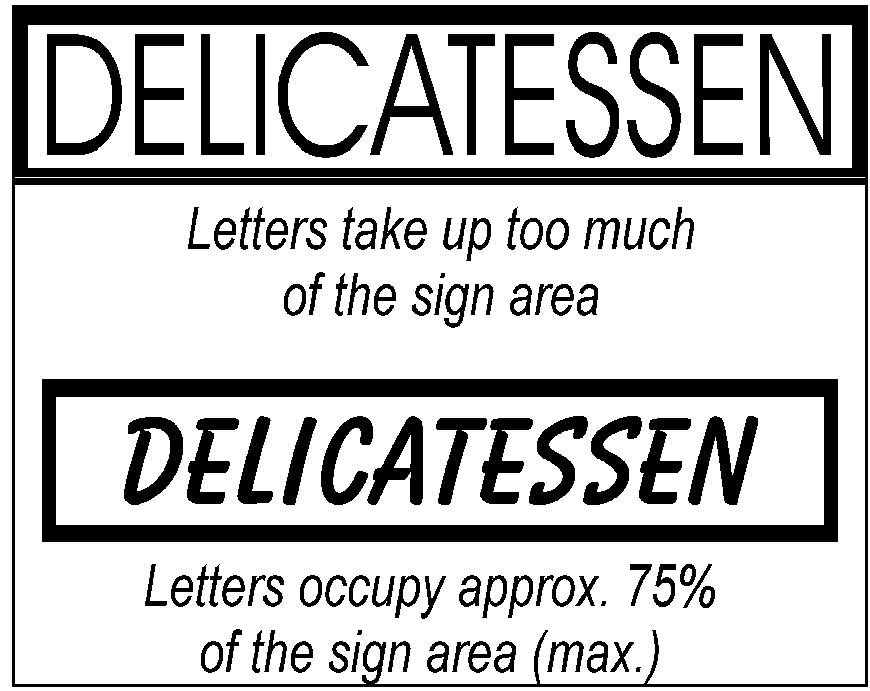
Figure 3-19—Letter Spacing
5.
Limit the Number of Letter Styles. The number of lettering styles should be limited in order to increase legibility. A general rule to follow is to limit the number of different letter types to no more than two for small signs and three for larger signs. Intricate typefaces and symbols that are difficult to read reduce the sign's ability to communicate.
E.
Sign Illumination. The possible illumination of a sign should be carefully considered. Like color, illumination can provide more effective visual communication, or can confuse the message. Imaginative and innovative lighting techniques for signs are encouraged.
1.
Use Illumination Only if Necessary. Consider if the sign needs to be lighted at all. Lights in the window display may be sufficient to identify the business. This is particularly true if good window graphics are used. Often, nearby street lights provide ample illumination of a sign after dark.
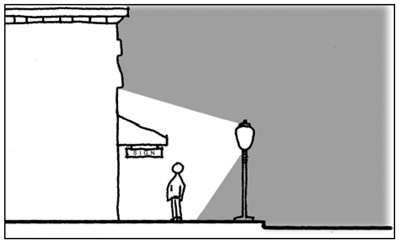
Figure 3-20—Use of Existing Illumination
2.
Use a Direct Light Source. If the sign can be illuminated by a direct source of light (e.g., spotlight), this is usually the best arrangement because the sign will appear to be better integrated with the building's architecture. Light fixtures supported in front of the structure cast light on the sign and generally a portion of the face of the structure as well. Direct lighting emphasizes the continuity of the structure's surface, and signs become an integral part of the facade. Direct lighting is also appropriate because it produces a more intimate ambiance on the street. The lighting of signs should be considered as an element in a building's overall lighting design.
3.
Shield the Light Source. Whenever direct lighting fixtures are used (fluorescent or incandescent), care should be taken to properly shield the light source to prevent glare from spilling over into residential areas and any public right-of-way. Signs should be lighted only to the minimum level required for nighttime readability.
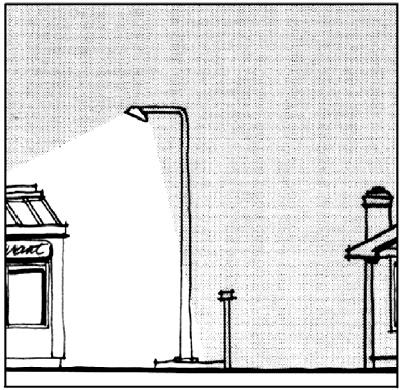
Figure 3-21—Shielded Light Source
4.
Back-lighted Signs. Back-lighted, solid letters are encouraged. Signs consisting of opaque individually cut letters mounted directly on a structure (push-through letters) can often use a distinctive element of the structure's facade as a backdrop, thereby providing a better integration of the sign with the structure.

Figure 3-22—Back-Lighted Signs
(Ord. No. 1922, § 1, 7-6-2016)
17.36.010 - Purpose of chapter.
This chapter provides site planning and development standards for land uses that are allowed by Article 2 (Land Use and Development Standards) in individual or multiple zoning districts, and for activities that require special standards to mitigate potential impacts.
(Ord. No. 1869, § 2, 2-20-2013)
17.36.020 - Applicability.
Land uses and activities covered by this chapter shall comply with the provisions applicable to the specific use, in addition to all other applicable provisions of this development code.
A.
Where Allowed. The uses that are subject to the standards in this chapter shall be located in compliance with the requirements of Article 2 (Land Use and Development Standards).
B.
Land Use Permit Requirements. The uses that are subject to the standards in this chapter shall be authorized by the land use permit required by Article 2, except where a land use permit requirement is established by this chapter for a specific use.
(Ord. No. 1869, § 2, 2-20-2013)
17.36.030 - Child day care facilities.
This section provides location and operational standards for child day care facilities, in compliance with state law and in a manner that recognizes the needs of child care operators and minimizes effects on adjoining properties. These standards apply in addition to the other provisions of this development code and the requirements of the California Department of Social Services. Licensing by the Department of Social Services is required for all facilities.
The establishment of a child day care facility shall comply with Article 2 (Land Use and Development Standards), and the following criteria and standards:
A.
Small family day care homes (eight or fewer children). Allowed within a single-family residence located in a residential zoning district.
B.
Large family day care homes (nine to fourteen children). Allowed within a single-family residence located in a residential zoning district subject to a minor use permit. The review of the minor use permit will be based upon compliance with the following standards:
1.
The facility shall comply with all applicable state and fire codes.
2.
Location Requirements. A separation of three hundred feet shall be required from any other large family day care home.
3.
Fencing. A six-foot high fence or wall shall be constructed on all property lines or around the outdoor activity areas, except in the front yard or within a traffic safety visibility area.
4.
Noise Standards. The facility shall not exceed city noise limits as established by the city's general plan.
5.
Outdoor Lighting. On-site exterior lighting shall be allowed for safety purposes only, shall consist of low wattage fixtures, and shall be directed downward and shielded.
6.
Parking. Parking shall be provided in compliance with Chapter 17.32 (Parking Standards).
7.
Swimming Pools/Spas Prohibited. No swimming pool/spa shall be installed on the site after establishment of the family day care center, due to the high risk and human safety considerations. Any pool/spa existing on the site prior to application for approval of a family day care center shall be removed prior to establishment of the use, unless the director determines that adequate, secure separation exists between the pool/spa and the facilities used by the children.
C.
Child Day Care Centers (Fifteen or More Children). Allowed in the zoning districts determined by Article 2 (Land Use and Development Standards), subject to use permit approval, in compliance with Section 17.40.040 and the following standards:
1.
Standards for Child Day Care Centers. The following standards shall apply to child day care centers:
a.
Size. The minimum parcel size for a child day care center shall be ten thousand square feet;
b.
Parking. Off-street parking shall be as determined through use permit approval, but shall be a minimum of one space per employee, plus one space for each five children.
c.
Pick-up and Drop-off Zone. A safe area for picking up and dropping off children shall be provided. This activity shall only be allowed in a driveway, in an approved parking area, or in an area with direct access to the facility.
d.
Noise. Potential noise sources shall be identified during the use permit process, and noise attenuation and sound dampening shall be addressed. Noise levels shall be in compliance with the most recent guidelines of the noise element of the general plan.
e.
Outdoor Lighting. On-site exterior lighting shall be allowed for safety purposes only, shall consist of low wattage fixtures, and shall be directed downward and shielded.
f.
Fencing. A six-foot high fence or wall shall be constructed on all property lines or around the outdoor activity areas, except in the front yard or within a traffic safety visibility area.
g.
Alternative Standards. Alternatives to the standards of this section may be authorized through the use permit approval if the review authority determines that:
i.
The intent of these standards is met; and
ii.
There will be no detriment to surrounding properties or residents.
(Ord. No. 1869, § 2, 2-20-2013)
17.36.040 - Residential care facilities and senior apartments.
A.
Applicability. Residential care facilities shall be allowed as follows:
1.
Residential Care Facility with Six or Fewer Residents. Allowed within a single-family residence located in a residential zoning district.
2.
Residential Care Facility with Seven or More Residents. Allowed as described in Article 2 (Land Use, General Development Standards, Design Guidelines) subject to a use permit. The review of the use permit will be based upon compliance with the following standards:
a.
Limitation on Impacts. The use shall not create impacts on surrounding properties neighborhoods that are no more significant than would be caused by standard multi-family rental projects.
b.
Parking Reduction. The review authority may grant a reduction in off-street parking requirements for a residential care facility, provided that the project shall include the following when a parking reduction is proposed:
i.
A minimum of five percent of the total indoor floor area shall be devoted to educational, recreational, and social facilities (e.g., library, multi-purpose common room, recreation room, TV room); and
ii.
Common laundry facilities of sufficient number and accessibility, consistent with the number of living units.
c.
Location Requirements. A separation of three hundred feet shall be required from any other residential care facility.
3.
Project Changes. If a residential care facility approved in compliance with this section is changed to another use (for example, the project converts to a conventional unrestricted multi-family project), the project shall be modified to meet all applicable standards of this development code.
B.
Senior Apartments and Independent Living Centers. Senior apartments and independent living centers are multi-family residential projects reserved for senior citizens, where common facilities may be provided (for example, recreation areas), but where each dwelling unit has individual living, sleeping, bathing, and kitchen facilities.
1.
General Design Standards. Senior apartments and independent living centers shall comply with the provisions of Chapter 17.18 (Residential Zoning Districts), except as otherwise provided by this section.
2.
Off-street Parking. Off-street parking shall comply with Chapter 17.32 (Off-Street Parking and Loading). The review authority may restrict the total number of resident cars to be parked on-site or designate specified on-site parking spaces for employee or visitor parking only.
3.
Additional Uses. Additional facilities, including skilled nursing and/or intermediate care facilities, and personal services (for example, beauty salon, physical therapy) may be allowed through use permit approval, without requiring additional parking, provided that these facilities shall only be for the private use of project residents.
(Ord. No. 1869, § 2, 2-20-2013)
17.36.050 - Residential density bonus.
A.
Purpose. The residential density bonus provisions of this code are adopted pursuant to the provisions of California Government Code Sections 65915—65918. The purpose of adopting this chapter is to encourage affordable housing by providing the incentive of increased density and such other incentives provided by this chapter.
B.
Definitions.
1.
"Approving authority" is as defined in this development code.
2.
"Child care facility" means a child day care facility other than a family day care home, including, but not limited to, infant centers, preschools, extended day care facilities, and school-age child care centers.
3.
"Density bonus" means an increase in density over the otherwise maximum allowable residential density under the applicable general plan designation as of the date of filing of an application for density bonus with city.
4.
"Development" standard means the site, development, or construction standards and/or conditions of approval that apply to a residential development.
5.
"Housing development" means one or more groups of projects for residential units constructed within a large lot parcel. For the purposes of this chapter, "housing development" also includes a subdivision or common interest development as defined in Section 1351 of the Civil Code and consists of residential units or unimproved residential lots.
6.
"Incentive" means a reduction in site development standards or a modification of zoning code requirements or architectural design requirements that exceed the minimum building standards approved by the California Building Standards Commission. An incentive can be requested by the applicant for purposes of reducing the cost of development to make the project financially feasible. The term "incentive" includes the term "concession" as that term is used in California Government Code Sections 65915—65918.
7.
"Low income" is defined as less than eighty percent of the area median income, as defined by Section 50079.5 of the California Health and Safety Code.
8.
"Low income unit" is defined as a unit with an affordable rent or payment that does not exceed thirty percent of sixty percent of area median income adjusted for family size appropriate for the unit.
9.
"Moderate income" is defined as less than one hundred twenty percent of the area median income, as defined in Section 50093 of the California Health and Safety Code.
10.
"Moderate income unit" is defined as a unit with an affordable rent or payment that does not exceed thirty-five percent of one hundred ten percent of area median income adjusted for family size appropriate for the unit.
11.
"Very low income" is defined as less than fifty percent of the area median income, as defined in Section 50105 of the California Health and Safety Code.
12.
"Very low income unit" is defined as a unit with an affordable rent or payment that does not exceed thirty percent of fifty percent of the area median income, adjusted for family size appropriate for the unit.
13.
"Senior citizen housing development" is defined as a housing project where residency is restricted to persons sixty-two years of age or older, or fifty-five years of age or older in a Senior Citizen Housing Development per Sections 51.3 and 51.12 of the California Civil Code.
C.
Application Requirements. A density bonus may be approved pursuant to a request for approval of a density bonus, provided the request complies with the provisions of this chapter. Each application for a density bonus request shall be accompanied by the following:
1.
A site plan that identifies all units in the project including the location of the affordable units and the bonus units.
2.
A narrative briefly describing the housing development and shall include information on:
a.
The number of units permitted under the general plan;
b.
The total number of units proposed in the project;
c.
The number of affordable and/or senior units;
d.
The number of bonus units requested based on Table 3-5;
e.
A breakdown of units proposed for very low, low, moderate income, senior citizen, and/or market rate units; and
f.
Any requested incentive(s), including an explanation as to why the incentive(s) is required for the housing development.
3.
Information indicating that appropriate and sufficient infrastructure capacity is available to serve the bonus units.
4.
Any such additional information in support of a request for a density bonus as may be requested by the director.
D.
Eligibility for Bonus. A developer of a housing development containing five or more units may qualify for a density bonus and at least one other incentive as provided by this chapter if the developer does one of the following:
1.
Agrees to construct and maintain at least five percent of the units dedicated to very low income households;
2.
Agrees to construct and maintain at least ten percent of the units dedicated to lower income households;
3.
Agrees to construct and maintain at least ten percent of the units in a common interest development (as defined in Section 1351 of the California Civil Code) dedicated to Moderate Income households, provided that all units in the development are offered to the public for purchase;
4.
Agrees to construct and maintain a senior citizen housing development as defined in Section 17.36.040 of this chapter;
5.
Includes a qualifying child care facility as described in Section 17.36.030 of this chapter in addition to providing housing as described in subsections (D)(1)—(D)(3) of this section.
E.
Density Bonus Calculation and Allowance.
1.
State Law Preemption. Pursuant to state law, the granting of a density bonus or the granting of a density bonus together with an incentive(s) shall not be interpreted, in and of itself, to require a general plan amendment, specific plan amendment, rezone, or other discretionary approvals.
2.
Density Bonus Calculation. An applicant must choose a density bonus from only one applicable affordability category in below subsection 3 and may not combine categories with the exception of child care facilities, which may be combined with an affordable housing development, for an additional density bonus up to a combined maximum of thirty-five percent.
3.
Density Bonus Allowance. In calculating the number of units required for very low, low and moderate income households, the density bonus units shall not be included. In no event shall a density bonus exceed thirty-five percent. A housing development that satisfies all applicable provisions of this chapter shall be allowed the density bonuses as described in Table 3-4:
F.
Eligibility and Application Requirements for Incentives.
1.
Available Incentives. A housing development qualifying for a density bonus may be entitled to at least one incentive. Incentives may include, but are not limited to:
a.
A reduction in site development standards such as:
i.
Reduced minimum lot sizes and/or dimensions;
ii.
Reduced minimum lot setbacks;
iii.
Reduced minimum outdoor and/or private outdoor living area;
iv.
Increased maximum lot coverage;
v.
Increased maximum building height and/or stories;
vi.
Reduced on-site parking requirements;
vii.
Reduced street standards.
b.
A reduction in architectural design requirements.
c.
A density bonus greater than the amount required by this chapter.
d.
Other regulatory incentives proposed by the developer or the city, which result in identifiable, financially sufficient, and actual cost reductions.
e.
If an applicant qualifies for a density bonus pursuant to this chapter, the applicant may request, in addition to any requested incentive(s), a reduced parking requirement be applied to the project in place of the city's current parking requirements. The parking requirement is inclusive of handicapped and guest parking for the entire housing development, but shall not include on-street parking spaces in the count towards the parking requirement.
G.
Child Care Facilities.
1.
Child Care Facility Density Bonus. When an applicant proposes to construct a housing development that is eligible for a density bonus under this chapter and California Government Code Section 65917.5, and includes a child care facility that will be located on the premises or adjacent to the housing development, the city shall grant either:
a.
An additional density bonus that is an amount determined by the director; or
b.
An additional incentive that contributes significantly to the economic feasibility of the construction of the child care facility.
2.
Child Care Facility Requirements. The city shall require, as a condition of approving the housing development, that the following occur:
a.
The Child care facility shall remain in operation for a period of time that is as long as or longer than the period of time during which the affordable units are required to remain affordable per this chapter; and
b.
Of the children who attend the child care facility, the children of very low income households, low income households or families of moderate income households shall equal a percentage that is equal to or greater than the percentage of affordable units in the housing development that are required for very low, low or families of moderate income households.
3.
Child Care Facility Criteria. The city shall not be required to provide a density bonus or incentive for a child care facility if it finds, based upon substantial evidence, that the community has adequate child care facilities.
H.
General Guidelines.
1.
Location of Bonus Units. As required by California Government Code Section 65915(g), the location of density bonus units within the qualifying housing development may be at the discretion of the developer, and need not be in the same area of the project where the units for the low income households are located as long as the density bonus units are located within the same housing development.
2.
Infrastructure and Supply Capacity. Criteria to be considered in analyzing the requested bonus will include the availability and capacity of infrastructure (water, sewer, storm drain, road capacity, etc.) and water supply to accommodate the additional density.
I.
Findings for Approval for Density Bonus and/or Incentive(s).
1.
Density Bonus Approval. The following finding shall be made by the approving authority in order to approve a density bonus request:
a.
The density bonus request meets the requirements of this chapter.
2.
Density Bonus Approval with Incentive(s). The following findings shall be made by the approving authority in order to approve a density bonus and incentive(s) request:
a.
The density bonus request meets the requirements of this chapter;
b.
The incentive is required in order to provide affordable housing; and
c.
Approval of the incentive(s) will have no specific adverse impacts upon health, safety, or the physical environment or on any real property that is listed in the California Register of Historical Resources and for which there is no feasible method to satisfactorily mitigate or avoid the specific adverse impact without rendering the development unaffordable to very low, low, and moderate income households.
3.
Denial of a Request for an Incentive(s). The approving authority shall make the following findings prior to disallowing an incentive (in the case where an accompanying density bonus may be approved, or in the case of where an incentive(s) is requested for senior housing or child care facility):
a.
That the incentive is not necessary in order to provide for affordable housing costs or for rents for the targeted units to be set as specified in this chapter.
b.
That the incentive would result in specific adverse impacts upon health, safety, or the physical environment or on any real property that is listed in the California Register of Historical Resources and for which there is no feasible method to satisfactorily mitigate or avoid the specific adverse impact without rendering the development unaffordable to very low, low, and moderate income households.
J.
Affordable Housing Agreement Required.
1.
Agreement Required. In approving a density bonus, the associated permit or tentative map shall require that an affordable housing agreement, or other form of agreement as approved by the city attorney, effectuating the terms of affordability of the development be executed prior to effectuation of the permit or recordation of the final map or issuance of a building permit.
2.
Continued Availability. The density bonus request shall include the procedures proposed by the developer to maintain the continued affordability of all affordable income density bonus units and shall be evidenced by an affordable housing agreement as follows:
a.
An applicant shall agree to, and the city shall ensure, continued affordability of all very low and low income units that qualified the applicant for the award of the density bonus for thirty years or a longer period of time if required by the construction or mortgage financing assistance program, mortgage insurance program, or rental subsidy program. Rents for the lower income density bonus units shall be set at an affordable rent as defined in Section 17.36.050(B) of this chapter. Owner-occupied units shall be available at an affordable housing cost as defined in Section 17.36.050(B) of this chapter.
b.
An applicant shall agree to, and the city shall ensure that, the initial occupants of the moderate income units are directly related to the receipt of the density bonus in the common interest development as defined in Section 1351 of the California Civil Code, are persons and families of moderate income, as defined in Section 17.36.050(B) of this chapter and that the units are offered at an affordable housing cost, as that cost is defined in Section 17.36.050(B) of this chapter. The city shall enforce an equity-sharing agreement unless it is in conflict with the requirements of another public funding source or law. The following apply to the equity-sharing agreement:
i.
Upon resale, the seller of the unit shall retain the value of any improvements, the down payment, and the seller's proportionate share of appreciation. The city shall recapture any initial subsidy and its proportionate share of appreciation, which shall then be used within three years for any of the purposes described in subdivision (e) of Section 33334.2 of the California Health and Safety Code that promote homeownership.
ii.
For purposes of this subdivision, the city's initial subsidy shall be equal to the fair market value of the home at the time of initial sale minus the initial sale price to the moderate-income household plus the amount of any down payment assistance or mortgage assistance. If upon resale the market value is lower than the initial market value, then the value at the time of the resale shall be used as the initial market value.
iii.
For purposes of this subdivision, the city's proportionate share of appreciation shall be equal to the ratio of the initial subsidy to the fair market value of the home at the time of initial sale.
(Ord. No. 1869, § 2, 2-20-2013)
17.36.060 - Home occupations.
The following standards for home occupations are intended to provide reasonable opportunities for employment within the home, while avoiding changes to the residential character of a dwelling that accommodates a home occupation, or the surrounding neighborhood, where allowed by Article 2 (Land Use and Development Standards):
A.
Business License Required. A home occupation shall require a city business license.
B.
Limitations on Use. The following are examples of business activities that may be approved as home occupations, and uses that are prohibited as home occupations:
1.
Uses allowed as Home Occupations. The following and other uses determined by the director to be similar may be approved by the director in compliance with this section:
a.
Art and craft work (ceramics, painting, photography, sculpture, etc.);
b.
Tailors, sewing, etc.; and
c.
Office-only uses, including an office for an architect, attorney, consultant, counselor, insurance agent, planner, tutor, writer, etc., and electronic commerce.
2.
Uses Prohibited as Home Occupations. The following are examples of business activities that are not incidental to or compatible with residential activities, and are, therefore, prohibited as home occupations:
a.
Adult entertainment activities/businesses;
b.
Animal hospitals and boarding facilities;
c.
Automotive and other vehicle repair and service (body or mechanical), painting, storage, or upholstery, or the repair, reconditioning, servicing, or manufacture of any internal combustion or diesel engines, or of any motor vehicle, including automobiles, boats, motorcycles, or trucks;
d.
Contractor's and other storage yards;
e.
Dismantling, junk, or scrap yards;
f.
Fitness/health facilities (except that one-on-one personal trainers may be allowed);
g.
Medical clinics, laboratories, or doctor's offices;
h.
Personal services as defined in Article 7 (Definitions), except that licensed massage therapy and physical therapy may be allowed as home occupations in compliance with this section;
i.
Parking on, or dispatching from the site any vehicle used in conjunction with an automobile wrecking or towing service, or with a taxi or similar passenger or delivery service, whether based on the site or elsewhere;
j.
On-site sales, except that mail order businesses may be allowed where there is no stock-in-trade on the site;
k.
Uses that require explosives or highly combustible or toxic materials;
l.
Welding and machine shop operations;
m.
Wood cutting businesses;
n.
Barber/beauty/nail shops;
o.
Dance/night clubs;
p.
Food preparation for commercial purposes;
q.
Fortune telling (psychics);
r.
Photography studios (not including photo processing);
s.
Plant nursery;
t.
Retail or wholesale sales of products stored at the residence, except that mail order businesses may be allowed where there is no stock-in-trade on the site; and
u.
Other uses the director determines to be similar to those listed above.
C.
Operating Standards. Home occupations shall comply with all of the following operating standards:
1.
Accessory Use. The home occupation shall be clearly secondary to the full-time use of the property as a residence.
2.
Location of Home Occupation Activities. All home occupation activities shall be confined to one room within the primary dwelling, which shall not occupy more than twenty-five percent of the gross floor area of the ground floor. A garage or other enclosed accessory structure may be used for home occupation purposes only if required off-street parking spaces are continually maintained. Horticulture activities may be conducted outdoors, but only on the rear one-third of the site.
3.
Visibility. The use shall not require any exterior modification to the structure not customarily found in a dwelling, nor shall the home occupation activity be visible from a public right-of-way, or from neighboring residential properties.
4.
Signs. No signs are permitted in conjunction with the use, other than one name plate, not exceeding one square foot in area, and only if attached flush to a wall of the structure. There shall be no advertising signs.
5.
Safety. Activities conducted and equipment or material used shall not change the fire safety or occupancy classifications of the premises. The use shall not employ the storage of explosive, flammable, or hazardous materials beyond those normally associated with a residential use.
6.
Off-site Effects. No home occupation activity shall create dust, electrical interference, fumes, gas, glare, light, noise, odor, smoke, toxic/hazardous materials, vibration, or other hazards or nuisances as determined by the director.
7.
Outdoor Display or Storage. There shall be no window display or outdoor storage or display of equipment, materials, or supplies associated with the home occupation. Tools or equipment connected with the business shall be operated so as to be imperceptible at or beyond the property line.
8.
Employees. A home occupation shall have no on-site employees other than full-time residents of the dwelling.
9.
Client/customer visits. The home occupation shall involve no on-site clients except for:
a.
Home occupations in live/work units;
b.
Tutoring or instruction of children by appointment; and
c.
Applicants with a demonstrated mobility handicap.
10.
Motor Vehicles. There shall be no motor vehicles used or kept on the premises, except residents' passenger vehicles, and/or one pickup truck, van, or similar vehicle not exceeding one and one-half-ton carrying capacity. The home occupation shall not involve the use of commercial vehicles for delivery of materials to or from the premises in a manner different from normal residential usage, except for FedEx, UPS, or USPS-type home deliveries/pick-ups. The commission may authorize other types and/or additional vehicles with use permit approval.
11.
Utility Service Modifications. No utility service to the dwelling shall be modified solely to accommodate a home occupation, other than as required for normal residential use.
D.
Home Working Operations. Small-scale commercial wood and metal working may be authorized by minor use permit as a home occupation, provided that the review authority may require conditions of approval limiting hours of operation, noise levels, and/or any other aspect of the operation, to ensure compatibility with on-site and adjacent residential uses.
(Ord. No. 1869, § 2, 2-20-2013)
17.36.070 - Mobile home parks.
A proposed mobile home park shall comply with the following minimum standards. The review authority may impose additional, more restrictive, requirements in the interest of public health, safety, and welfare, to the extent allowed by state law.
A.
Overall Mobile Home Park Site Standards. The site for the mobile home park shall comply with the following standards:
1.
Minimum Site Area: Twenty acres.
2.
Maximum Density: Ten units per acre.
3.
Boundary Landscape Building Setback. Each park shall provide a building setback and a planting strip of at least ten feet in width where trees shall be planted and where general screening and/or a fence shall be provided. Where any portion of the park fronts on a public street or right-of-way, the setback shall be twenty-five feet.
4.
Perimeter Wall/Fence. A six-foot high solid masonry wall shall be provided around the entire perimeter of the mobile home park subject to the setback requirements of this section.
5.
Parking. Parking shall be provided in compliance with Chapter 17.32 (Parking and Loading).
6.
Recreational Vehicle Parking. A supplemental parking area for recreational vehicles may be allowed as part of the use permit approval for the project.
7.
Accessory Uses. A mobile home park may contain accessory retail and service uses for the convenience of the residents provided that these uses shall be specifically authorized by the park use permit.
B.
Individual Mobile Home Site Standards. Each individual mobile home site shall comply with the following standards:
1.
Minimum Site Area. Individual mobile home sites and contiguous public walkway areas shall contain a minimum of three thousand square feet of area for a single-wide mobile home unit and four thousand square feet for a double-wide mobile home.
2.
Parcel Dimensions. Individual mobile home parcels shall be a minimum of forty feet in width and seventy feet in length.
3.
Setbacks. Individual mobile homes shall be set back five feet from all lot lines, including front and rear, except for any side or rear line abutting the mobile home park property line, in which case the minimum setback shall be twenty-five feet.
4.
Carport. Each mobile home site shall be provided an individual carport, with its location and design as approved through the mobile home park use permit.
(Ord. No. 1869, § 2, 2-20-2013)
17.36.080 - Outdoor display and retail activities.
A.
Accessory Outdoor Display. Outdoor displays incidental and complementary to an allowed use on commercially or publicly zoned parcels shall comply with the following standards:
1.
An outdoor display shall be:
a.
Appropriately located and designed in a manner and color to be compatible with the adjacent structures;
b.
Approved with a defined fixed location that does not disrupt the normal function of the site or its circulation, and does not encroach upon driveways, landscaped areas, parking spaces, or any public right-of-way except in the DMU zone with encroachment permit approval. No display shall obstruct traffic safety sight areas or otherwise create hazards for vehicle or pedestrian traffic;
c.
Directly related to a business occupying a permanent structure on the site;
d.
Limited to on-site locations; provided that a display within the DMU zone may extend into or enter over any public sidewalk by a maximum of two feet, where authorized by an encroachment permit;
e.
Managed so that display structures and goods are maintained at all times in a clean and neat condition, and in good repair;
f.
Placed so that the clear space for the passage of pedestrians is not reduced to less than six feet. Any placement on a public sidewalk or otherwise within a public right-of-way shall be prohibited, except within the downtown where such placement shall require encroachment permit approval;
g.
Placed to not block structure entrances and on-site driveways; and
h.
Portable and removed from public view at the close of each business day.
2.
Outdoor displays shall not be:
a.
Placed so as to impede or interfere with the reasonable use of the store front windows for display purposes; and
b.
Placed in front of a business that does not normally sell the items on display.
3.
Signs. The outdoor display shall not involve signs other than those normally allowed for the subject use by Chapter 17.34 (Signs).
B.
Newsstands and Flower Stands.
1.
Location Requirements. News and flower stands shall:
a.
Be located parallel and adjacent to the wall of a structure, and shall not extend over any public sidewalk except within the DMU zoning district. Freestanding news and flower stands are allowed only as roofed kiosks;
b.
Not be located:
i.
Within three feet of a display window of any structure abutting the sidewalk, or so as to interfere with or restrict the reasonable use of the window for display purposes;
iii.
Within one thousand feet of another news or flower stand, or florist, provided that this requirement may be reduced by the director if the proposed use is determined not to be detrimental to public safety and welfare.
2.
Design and Construction Requirements.
a.
Stands shall be soundly constructed of wood, metal, or other suitable permanent material, and designed in a manner and color to be compatible with the adjacent structures whether opened or closed. Security doors shall be designed as an integral part of the structure.
b.
Shelving shall not exceed eight feet in height nor two feet in depth.
3.
Maintenance. The news or flower stand shall be maintained in a clean and neat condition and in good repair, at all times.
4.
Signs.
a.
Stands shall not be used for advertising or publicity purposes. Signs shall be for identification only, with size and design in compliance with Chapter 17.34 (Signs).
b.
The owners or operators of the outdoor news or flower stand shall display, in a place readily visible to the public, a telephone number and address where the owners may be reached.
5.
Parking. In approving an outdoor news or flower stand, the director shall determine that some on-site parking or adequate on-street or other public parking is available in a commercial zoning district within a reasonable distance of the stand.
6.
Additional Product Sales. In addition to the sale of newspapers, magazines, and other periodicals, for newsstands, and flowers and plants, for flower stands, the owners or operators may sell other related accessory products, not to exceed ten percent of the total merchandise displayed.
7.
Encroachment Permit. If a news or flower stand is proposed within a public right-of-way, the owners or operators shall apply for an encroachment permit from the public works department before applying for approval of the stand by the department.
8.
Hours of Operation. Hours of operation of news and flower stands shall be determined by the director and shall be posted on-site.
(Ord. No. 1869, § 2, 2-20-2013)
17.36.090 - Outdoor storage.
This section provides standards for the establishment of outdoor storage areas, in compliance with Article 2 (Land Use and Development Standards).
A.
Location. Storage areas shall be limited to areas not designated for parking, setbacks, or landscaping.
B.
Enclosure Required. An outdoor area used for storage shall be completely enclosed by a solid masonry wall and solid gate. The director may allow the substitution of a fence or hedge, after determining that the substitution will adequately comply with the provisions of this section. The required fence or wall shall:
1.
Be not less than six feet;
2.
Incorporate design elements to limit easy climbing and access by unauthorized persons;
3.
Walls abutting a right-of-way shall comply with Section 17.14.100 (Walls, Fences, and Hedges); and
4.
Be subject to approval by the director.
C.
Operations. All raw materials, equipment, or finished products stored or displayed shall:
1.
Be stored in a manner that they cannot be blown by wind from the enclosed storage area;
2.
Except in the M zoning district, not be stored above the height of the enclosing wall or fence within ten feet of the wall or fence (fence height shall comply with Section 17.14.100);
3.
Not be placed or allowed to remain outside the enclosed storage area; and
4.
Be stored on a surface paved with asphalt or concrete.
D.
Maintenance. All portions of outside storage and display areas shall have provisions for adequate drainage, and shall be continuously maintained.
(Ord. No. 1869, § 2, 2-20-2013)
17.36.100 - Recreational vehicle parks.
The location, development and operation of a recreational vehicle (RV) park shall comply with the following requirements:
A.
Minimum Site Area. The site for an RV park shall be a minimum of one acre, when not part of a mobile home park.
B.
Maximum Density. The number of RV spaces in a park shall not exceed fifteen units per acre of site area.
C.
Parking Space Area and Width. Each RV space shall be at least one thousand eight hundred square feet in area, and a minimum width of thirty feet.
D.
Setbacks. Each recreational vehicle space shall be located a minimum of five feet from any side property line and ten feet from any rear property line.
E.
Screening. A minimum twenty-five-foot wide landscaped buffer area shall be provided along all public streets adjoining the park. A minimum ten-foot wide landscaped buffer area shall be provided along all interior property lines. No RV space shall encroach into the landscaped buffer areas.
F.
Parking. One parking spur shall be provided for each RV space. The maximum grade for the last twenty-five feet of any spur shall be two percent. At least seventy percent of all spurs shall be designed to accommodate both a motor vehicle (e.g., auto, truck, etc.) and a trailer. Parking spurs shall not be located closer together than forty feet on center.
G.
Roadways. Each RV space shall abut and have direct access to a roadway of at least twenty-four feet in width, which shall be surfaced with asphaltic concrete, or an appropriate alternative approved by the review authority.
H.
Signs.
1.
Sign Program. An overall sign program shall be prepared for each RV park, including any proposed free-standing signs and signs on structures. The plan may also provide for internal signs (those not visible from off-site roadways or adjoining property) that are strictly directional in nature.
2.
Allowable Signs and Sign Area. An RV park shall be allowed up to eighty square feet of sign area visible from external roadways and adjoining property, consisting of up to two free-standing signs and one wall sign.
a.
A single sign shall not exceed forty square feet in total area.
b.
The maximum height of a free-standing sign shall be twenty-five feet.
I.
Accessory Commercial Uses. An RV park may provide commercial uses for the convenience of campers as approved by the review authority, provided that the uses shall not occupy more than five hundred square feet for each fifty spaces.
J.
Manager's Quarters. Living quarters may be provided for the use of a caretaker or manager. The living quarters may be either a mobile home or permanent dwelling unit.
(Ord. No. 1869, § 2, 2-20-2013)
17.36.110 - Recycling facilities.
This section provides locational and operational standards for the establishment of various types and sizes of commercial recycling facilities, in compliance with Article 2 (Land Use and Development Standards). Recycling facilities shall comply with the following standards:
A.
Reverse Vending Machines. Reverse vending machines shall comply with the following standards:
1.
Accessory Use Only. The machines shall be installed as an accessory use in compliance with the applicable provisions of this development code, and shall not require additional parking.
2.
Location Requirements. If located outside of a structure, the machines shall not occupy required parking spaces, and shall be constructed of durable waterproof and rustproof materials.
3.
Maximum Size. When located outdoors, the area occupied by the machines shall not exceed fifty square feet, including any protective enclosure, nor eight feet in height.
4.
Signs. Signs shall not exceed a maximum area of four square feet for each machine, exclusive of operating instructions.
5.
Hours of Operation. The machines shall have operating hours which are consistent with the operating hours of the primary use.
6.
Lighting. The machines shall be illuminated when needed to ensure comfortable and safe operation.
B.
Small Collection Facilities. Small collection facilities shall comply with the following standards:
1.
Location Requirements. Small collection facilities shall:
a.
Not be located within fifty feet of any parcel zoned or occupied for residential use; and
b.
Be set back at least ten feet from any public right-of-way, and not obstruct vehicular or pedestrian circulation.
2.
Maximum Size. A small collection facility shall not occupy more than three hundred fifty square feet nor three parking spaces, not including space that would be periodically needed for the removal of materials or exchange of containers.
3.
Appearance of Facility. Collection containers and site fencing shall be of a color and design that is compatible and harmonious with the surrounding uses and neighborhoods.
4.
Operating Standards. Small collection facilities shall:
a.
Not use power-driven processing equipment, except for reverse vending machines;
b.
Accept only glass, metal or plastic containers, paper, and reusable items; and
c.
Use containers that are constructed with durable waterproof and rustproof material(s), secured from unauthorized removal of material, and shall be of a capacity sufficient to accommodate materials collected and the collection schedule.
5.
Signs. Signs may be provided as follows:
a.
Identification signs are allowed with a maximum area of fifteen percent for each side of the structure or twelve square feet, whichever is greater. In the case of a wheeled facility, the side shall be measured from the ground to the top of the container;
b.
Signs shall be both compatible and harmonious with the character of their location; and
c.
Directional signs, consistent with Chapter 17.34 (Signs) and without advertising message, may be approved by the director if found necessary to facilitate traffic circulation, or if the facility is not visible from the public right-of-way.
6.
Parking Requirements.
a.
No additional parking space shall be required for customers of a small collection facility located in the established parking lot of the main use. One space shall be provided for the attendant, if needed.
b.
Mobile recycling units shall have an area clearly marked to prohibit other vehicular parking during hours when the mobile unit is scheduled to be present; and
c.
Use of parking spaces by the patrons and the attendant shall not reduce available parking spaces below the minimum number required for the main use unless a parking study shows that existing capacity is not fully utilized during the time the recycling facility would be on the site.
C.
Large Collection Facilities. A collection facility that is larger than three hundred fifty square feet, or on a separate parcel not accessory to a primary use, shall comply with the following standards:
1.
Location Requirements. The facility shall not abut a parcel zoned for residential use.
2.
Container Location. Any containers provided for "after hours" donation of recyclable materials shall be permanently located at least one hundred feet from any residential zoning district, constructed of sturdy, rustproof material(s), have sufficient capacity to accommodate materials collected, and be secured from unauthorized entry or removal of materials; and
3.
Screening. The facility shall be screened from public rights-of-way, by solid masonry walls or located within an enclosed structure.
4.
Setbacks, Landscaping. Structure setbacks and landscaping shall be provided as required for the applicable zoning district.
5.
Outdoor Storage. Exterior storage of material shall be in sturdy containers that are secured and maintained in good condition. Storage, excluding truck trailers, shall not be visible above the height of the required solid masonry walls.
6.
Operating Standards.
a.
The site shall be maintained clean, sanitary, and free of litter and any other undesirable materials, and shall be cleaned of loose debris on a daily basis;
b.
Dust, fumes, odor, smoke, or vibration, above ambient levels, shall not be detectable on adjoining parcels.
D.
Processing Facilities. Processing facilities shall comply with the following standards:
1.
Location Requirements. The facility shall not abut a parcel zoned or occupied for residential use.
2.
Limitation on Use. Light processing facilities are limited to baling, briquetting, compacting, crushing, grinding, shredding, and sorting of source-separated recyclable materials and repairing of reusable materials.
3.
Maximum Size.
a.
A light processing facility shall not exceed forty-five thousand square feet of floor or ground area, may have up to an average of two outbound truck shipments of material each day, and shall not bale, compact, or shred ferrous metals, other than beverage and food containers;
b.
A heavy processing facility exceeds the standards for a light processing facility, and may perform functions not allowed at light processing facilities.
4.
Container Location. Containers provided for "after hours" donation of recyclable materials shall be permanently located at least one hundred feet from any residential zoning district, constructed of sturdy, rustproof materials, have sufficient capacity to accommodate materials collected, and be secured from unauthorized entry or removal of the materials.
5.
Screening. The facility shall be screened from public rights-of-way, by solid masonry walls or located within an enclosed structure.
6.
Outdoor Storage. Exterior storage of material shall be in sturdy containers or enclosures that are secured and maintained in good condition. Storage, excluding truck trailers, shall not be visible above the height of the required solid masonry walls.
7.
Operating Standards. Dust, fumes, odor, smoke, or vibration, above ambient levels, shall not be detectable on adjoining parcels.
(Ord. No. 1869, § 2, 2-20-2013)
17.36.120 - Residential accessory uses and structures.
Where allowed in the applicable zoning district by Article 2 (Land Use and Development Standards), residential accessory uses and structures shall comply with the following criteria and standards:
A.
Relationship of Accessory Use or Structure to the Main use. Accessory uses and structures shall be incidental to and not alter the main use or character of the site.
B.
Timing of Installation. An accessory structure shall be constructed concurrent with or subsequent to the construction of a main structure on the property unless a use permit is first obtained in compliance with Section 17.40.040 (Use Permits).
C.
Location. The location of all accessory structures shall comply with all applicable California Building Code standards, and the following requirements:
1.
A structure greater than thirty inches in height above finished grade and attached to a main structure shall comply with the requirements for the main structure. A detached structure (deck or patio) greater than thirty inches in height shall not be constructed in a required setback unless director approval is first obtained;
2.
An accessory structure greater than one hundred twenty square feet shall not be closer than three feet to any other accessory structure on the same property, and shall comply with all other requirements of the applicable zoning district. An accessory structure shall not be located within a required front yard setback and shall maintain side and rear setbacks of at least five feet;
3.
An accessory structure that is one hundred twenty square feet or less shall not be located closer than three feet to a rear or side property line;
4.
An accessory structure shall not be located in a required front yard, except that decorative garden structures (e.g., small trellis or archway) shall be allowed.
D.
Maximum Number of Accessory Structures. A maximum of two accessory structures shall be allowed on any residentially zoned or residentially used property unless site plan and architectural approval is first obtained.
E.
Height Limitations.
1.
The height of an accessory structure that is one hundred twenty square feet or less shall not exceed eight feet unless site plan and architectural approval is first obtained in compliance with Section 17.40.020 (Site Plan and Architectural Approval). The height of an accessory structure with a floor area greater than one hundred twenty square feet shall comply with the height limits of the applicable zoning district;
2.
An accessory structure that is primarily a narrow, vertical element (e.g., flag pole, ham radio antenna, etc.) may be allowed to exceed the six foot height limit within the front or rear yard setback.
F.
Coverage and Size Limitations. Accessory structures may occupy up to a maximum of twenty-five percent of a required side yard and up to a maximum of thirty percent of a required rear yard; provided that the aggregate site coverage for all structures on a parcel shall not exceed the maximum allowed in the applicable specific zoning district by Section 17.18.040 (Residential Zoning District General Development Standards).
G.
Prohibited Uses and Activities.
1.
Outdoor Vehicle Repair. No vehicle repair activities shall be conducted outdoors within a residential zone.
2.
Electrical Service. A parcel developed with a single-family dwelling shall have only one electrical service panel. Separate electrical service shall not be provided any accessory structure or guest house.
(Ord. No. 1869, § 2, 2-20-2013)
17.36.130 - Accessory dwelling units.
A.
Purpose and Intent. This section establishes regulations and a ministerial review process for accessory dwelling units. Accessory dwelling units are intended to expand housing opportunities for low income and moderate income or elderly households by increasing the number of rental units available within existing neighborhoods while maintaining the architectural character of the area.
B.
Applicability. This section applies to all accessory dwelling units, including junior accessory dwelling units, as defined in subsection F below.
C.
Where Permitted. Accessory dwelling units are permitted by right in any zoning district which permits single-family or multi-family homes.
D.
General Plan and Zones Allowed.
1.
In accordance with Government Code section 65852.2, as may be amended from time to time, any ADU or JADU that conforms with the requirements of this section shall be deemed to be consistent with the general plan designation and zoning for the parcel, regardless of any limitations on residential density imposed by the general plan or zoning. An ADU or JADU shall not be counted when determining residential density for conformance with the general plan or this Code.
2.
ADUs and JADUs shall be allowed in all areas zoned to allow single-family and multi-family residential uses in compliance with the development standards set forth in this section.
E.
Permits and Approval.
1.
Ministerial Action. Approval or denial of an accessory dwelling unit or junior accessory dwelling unit is a ministerial action and subject to compliance with the standards in this section.
2.
Building Permit. All accessory dwelling unit or junior accessory dwelling units shall require a building permit, subject to all the standard application and processing fees and procedures that apply to building permits generally. No other separate planning-related permit is required.
3.
Issuance of Permit. The city shall issue a building permit for an accessory dwelling unit within sixty calendar days from the date on which the city received a completed submittal package application for a location that includes an existing primary dwelling, unless either:
a.
The applicant requests a delay, in which case the sixty-day time period is put on hold for the period of the requested delay; or
b.
The application to create an accessory dwelling unit or junior accessory dwelling unit is submitted with an application to create a new single-unit dwelling on the parcel. The city may delay acting on the permit application for the accessory dwelling unit or junior accessory dwelling unit until the city acts on the permit application to create the new single-unit dwelling.
F.
Definitions. The following words and phrases shall, for the purposes of this chapter, have the meanings respectively ascribed to them by this section, as follows:
1.
"Accessory Dwelling Unit or ADU." An attached or a detached residential dwelling unit that provides complete independent living facilities for one or more persons and is located on a lot with a proposed or existing primary dwelling. It shall include permanent provisions for living, sleeping, eating, cooking, and sanitation and shall be constructed on the same parcel as the single-family or multifamily dwelling unit that is the primary dwelling unit or will be situated. An accessory dwelling unit also includes the following: (a) an efficiency unit, as defined in Section 17958.1 of the Health and Safety Code, as may be amended from time to time, and (b) a manufactured home, as defined in Section 18007 of the Health and Safety Code, as may be amended from time to time. This definition shall be interpreted as consistent with and including the definition of accessory dwelling unit found in Government Code Section 65852.2, as may be amended from time to time.
2.
"Efficiency Kitchen." A cooking facility that includes all of the following:
a.
A portable appliance for cooking.
b.
A food preparation counter.
c.
Food storage cabinets that are of reasonable size in relation to the size of the JADU.
3.
"Efficiency Unit." As defined in Section 17958.1 of the Health and Safety Code, as may be amended from time to time.
4.
"Junior Accessory Dwelling Unit" or "JADU." A junior accessory dwelling unit means a unit that is contained entirely within a single-unit primary dwelling. This definition shall be interpreted as consistent with and including the definition of junior accessory dwelling unit found in Government Code Section 65852.22, as may be amended from time to time.
5.
"Living Area." The interior habitable area of a dwelling unit, including basements and attics, but does not include a detached garage or any accessory structure. This definition shall be interpreted as consistent with and including the definition of living area found in Government Code Section 65852.2, as may be amended from time to time.
6.
"Passageway." A pathway that is unobstructed clear to the sky and extends from a street or alley to one entrance of the accessory dwelling unit. This definition shall be interpreted as consistent with and including the definition of passageway found in Government Code Section 65852.2, as may be amended from time to time.
7.
"Primary Dwelling." An existing or proposed residential structure on a lot with an accessory dwelling unit.
8.
"Public Transit." A location, including, but not limited to, a bus stop or train station, where the public may access buses, trains, and other forms of transportation that charge set fares, run on fixed routes, and are available to the public.
9.
"Single-unit and multi-unit." Single-unit means the same as a single-family dwelling and multi-unit means multi-family dwellings with two or more units.
10.
"Tandem Parking." Two or more automobiles parked on a driveway or in any other location on a parcel, lined up behind one another.
G.
Types of Accessory Dwelling Units. The following are the two types of accessory dwelling units:
1.
Accessory dwelling unit, both attached and detached, shall meet all of the characteristics as described below for each subtype:
a.
Attached ADU.
i.
Attached to an existing or proposed primary dwelling, such as through a shared wall, floor, or ceiling, including attached garages, storage areas or similar uses, or within an accessory structure.
ii.
Created by converting a portion of an existing primary dwelling, by constructing a new primary dwelling with an integral accessory dwelling unit, or by constructing an addition to an existing primary dwelling.
b.
Detached ADU.
i.
Physically detached or separated from the primary dwelling.
ii.
May include a second-story addition above an existing detached structure.
iii.
Can be new construction or the conversion or expansion of an existing structure.
c.
Junior Accessory Dwelling Unit. An attached accessory dwelling unit that is a unit that meets the specified criteria below.
i.
Maximum of five hundred square feet in size.
ii.
Contained entirely within a single-unit primary dwelling.
iii.
Has a separate entrance from the main entrance to the primary dwelling.
iv.
Has a bathroom that is either in the junior ADU or in the primary dwelling.
v.
Includes an efficiency kitchen.
vi.
May include separate sanitation facilities or may share sanitation facilities with the primary dwelling.
H.
Number of Accessory Dwelling Units or Junior Accessory Dwelling Units Per Lot or Parcel in Zones Which Allow Single Family Homes. The following number of accessory dwelling units shall apply in all zoning districts that allow single family homes as a permitted use:
1.
One attached or detached accessory dwelling unit shall be allowed on a parcel with a primary dwelling unit.
2.
One junior accessory dwelling unit shall be allowed on a parcel with primary dwelling.
3.
Up to one attached or detached accessory dwelling unit and one junior accessory dwelling unit shall be allowed on a single parcel.
I.
Type and Number of Accessory Dwelling Units Per Lot with an Existing Multi-Family Home. The following apply to accessory dwelling units in all zoning districts that allow multi-family homes as a permitted use:
1.
Attached accessory dwelling units.
a.
At least one ADU shall be allowed within an existing multi-family dwelling, and a total of up to twenty-five percent of the number of units within an existing multi-family dwelling shall be allowed.
b.
Attached accessory dwelling units in a multi-family development may be created only through the conversion of parts of existing multifamily dwelling structures that are not used as livable space, including, but not limited to, storage rooms, boiler rooms, passageways, attics, basements, or garages.
2.
Detached Accessory Dwelling Units. Up to two detached accessory dwelling units shall be allowed on a parcel with existing multi-family structures, subject to compliance with the development standards for detached accessory dwelling units in this section.
J.
Development Standards for Accessory Dwelling Units. The following standards apply to all types of accessory dwelling units.
1.
Attached Accessory Dwelling Units.
a.
Location. Attached accessory dwelling units shall be located on the same lot or parcel as an existing or proposed primary dwelling unit and be attached to the primary dwelling unit by at least one wall or by a ceiling (above or below the primary dwelling unit) on a lot that is zoned to allow single-family or multifamily dwelling residential use and includes a proposed or existing dwelling.
b.
Size. The total floor area of an attached accessory dwelling unit shall not exceed right hundred fifty square feet for a one-bedroom unit or one thousand square feet for an accessory dwelling unit that provides more than one bedroom. The total floor area of an attached accessory dwelling unit shall not exceed fifty percent of the primary dwelling square footage. These limits do not include up to one hundred fifty square feet of area added to the primary dwelling for the sole purpose of providing ingress and egress to the accessory dwelling unit.
c.
Setbacks.
i.
Front yard setback will follow the zoning district standard for the primary dwelling.
ii.
Side yard setback will be a minimum of four feet.
iii.
Rear yard setback will be a minimum of four feet.
iv.
No setback shall be required for an existing living area or accessory structure or a structure constructed in the same location and to the same dimensions as an existing structure that is converted to an accessory dwelling unit or to a portion of an accessory dwelling unit.
d.
Height. All attached ADUs shall comply with the zoning district standard for the height of the primary dwelling.
e.
Access. An attached accessory dwelling unit shall have direct exterior access separate from the main entrance to the primary dwelling.
f.
Design. Accessory dwelling units shall incorporate the architectural style, materials, and colors of the primary dwelling unit. Variation in style, materials and colors may be approved where staff determines the accessory dwelling unit design is compatible with and complimentary to the primary dwelling unit.
g.
Passageway. No passageway shall be required in conjunction with the construction of an accessory dwelling unit.
h.
Fire Sprinklers. An attached accessory dwelling unit shall not be required to provide fire sprinklers if they are not required for the primary dwelling.
i.
Landscape. Landscaped areas within setbacks shall meet the requirements of this Code.
j.
Deed restriction. Before permit issuance, the city shall be provided with a copy of the recorded deed restriction for a junior accessory dwelling unit, which shall run with the land, using the city's form pursuant to Government Code Section 65852.2, as may be amended from time to time.
k.
Allowed ADU. No provisions within this section, including lot coverage or legal nonconformity, shall preclude an attached minimum eight hundred square foot accessory dwelling unit that is at least sixteen feet in height with four-foot side yard and rear yard setbacks, and that is constructed in compliance with all other development standards.
2.
Detached Accessory Dwelling Unit Development Standards.
a.
Location. Detached accessory dwelling unit shall be located on the same lot or parcel as an existing or proposed primary dwelling on a lot that is zoned to allow single-family or multifamily dwelling residential use.
b.
Size. A detached accessory dwelling unit shall not exceed eight hundred fifty square feet for a one-bedroom unit or one thousand square feet for an accessory dwelling unit that provides more than one bedroom.
c.
Setbacks.
i.
Front yard setback shall comply with the zoning district standard for the primary dwelling. A detached ADU shall not be located between the primary dwelling unit and the front lot line.
ii.
Side yard shall be a minimum of four feet.
iii.
Rear yard shall be a minimum of four feet.
d.
Height. The maximum height of an accessory dwelling unit shall be sixteen feet for new structures built specifically as an accessory dwelling unit. Existing structures taller than sixteen feet can be converted to an accessory dwelling unit where the accessory dwelling unit is consistent with all other requirements of this section.
e.
Design. Accessory dwelling units shall incorporate the architectural style, materials, and colors of the primary dwelling unit. Variation in style, materials and colors may be approved where staff determines the accessory dwelling unit design is compatible with and complimentary to the primary dwelling unit.
f.
Passageway. No passageway shall be required in conjunction with the construction of an accessory dwelling unit.
g.
Fire Sprinklers. A detached accessory dwelling unit shall not be required to provide fire sprinklers if they are not required for the primary dwelling.
h.
Landscape. All setback areas shall be landscaped as required by this Code.
i.
Deed Restriction. Before permit issuance, the city shall be provided with a copy of the recorded deed restriction, which shall run with the land, using the city's form pursuant to Government Code Section 65852.2, as may be amended from time to time.
j.
Building Separation. An accessory dwelling unit shall comply with the building separation requirements of the underlying zone, but in no case shall said requirement prohibit an accessory dwelling unit that is a minimum of eight hundred square feet, maximum of sixteen feet in height with four-foot side and rear yard setbacks.
k.
Authorized ADU. No provisions within this section, including lot coverage or legal nonconformity, shall preclude a detached minimum eight hundred square foot accessory dwelling unit that is at least sixteen feet in height with four-foot side yard and rear yard setbacks, and that is constructed in compliance with all other development standards.
3.
Junior Accessory Dwelling Unit Development Standards.
a.
Location. Shall be within the walls of the primary single-family residence, including an attached garage, of the primary dwelling unit by at least one wall or by a ceiling. The junior accessory dwelling unit may be located above or below the primary dwelling unit.
b.
Size. The JADU shall be not exceed a maximum of five hundred square feet of living area.
c.
Setbacks. If the primary dwelling unit is expanded for the sole purpose of providing ingress and egress to the junior accessory dwelling unit, the addition shall maintain setbacks of four feet from side and rear yards or the same setback as the existing structure, whichever is less. The front setback shall comply with the zoning district for the primary structure.
d.
Access. A junior accessory dwelling unit shall have a separate entrance separate from the main entrance to the primary dwelling.
e.
Kitchen. Each junior accessory dwelling unit shall include at least an efficiency kitchen.
f.
Utilities.
i.
A junior accessory dwelling unit shall not be considered a separate or new dwelling unit for the purposes of calculating connection fees or capacity charges for utilities, including water, sewer, or power service, or impact fees.
ii.
No new or separate utility connection between the junior accessory dwelling unit and the utility shall be required, although the property owner may voluntarily install a submeter for the junior accessory dwelling unit.
iii.
Any utility charges or fees shall be consistent with state law.
g.
Parking. No additional off-street parking is required for a junior accessory dwelling unit.
h.
Owner Occupancy Requirements and Deed Restriction.
i.
A person with legal or equitable title to the primary dwelling shall reside on the property in either the primary dwelling or junior accessory dwelling unit as that person's legal domicile and permanent residence.
ii.
The owner occupancy requirement does not apply if the property is entirely owned by a governmental agency, land trust, or non-profit housing organization.
iii.
Prior to issuance of a building permit for a junior accessory dwelling unit, a deed restriction shall be recorded in the chain of title of the primary single-unit property. The form of the deed restriction shall be reviewed by the city attorney pursuant to Government Code Section 65852.2, as may be amended from time to time.
iv.
The deed restriction shall run with the land and shall be enforced against future property owners.
K.
Impact Fees.
1.
Impact Fee Requirements.
a.
No impact fees shall be charged for a junior accessory dwelling unit. A junior accessory dwelling unit shall not be considered a separate or new dwelling unit for the purposes of calculating impact fees, connection fees, or capacity charges for utilities.
b.
No city-imposed impact fees shall be charged for an accessory dwelling unit that is less than seven hundred fifty square feet in size.
c.
For accessory dwelling units seven hundred fifty square feet or larger, city-imposed impact fees shall be charged proportionately in relation to the square footage of the primary dwelling.
d.
An ADU may be subject to connection fees or capacity charges levied by a local agency, special district, or water corporation.
L.
Required Parking for Accessory Dwelling Units.
1.
Number of Parking Spaces. Parking for accessory dwelling units shall be provided per the following:
a.
One off-street parking space, covered or uncovered, is required for each attached or detached accessory dwelling unit. These spaces may be provided as tandem parking on a driveway.
b.
Notwithstanding any other section, no off-street parking is required for an attached or detached accessory dwelling unit if one or more of the following applies:
i.
The accessory dwelling unit is located within one-half mile walking distance of public transit.
ii.
The accessory dwelling unit is part of the proposed or existing primary residence or an accessory structure.
iii.
The accessory dwelling unit is located within an architecturally and historically significant historic district.
iv.
When on-street parking permits are required but not offered to the occupant of the accessory dwelling unit.
v.
When there is a car share vehicle within one block of the accessory dwelling unit.
c.
Off-street parking shall be provided outside setback areas, unless no feasible location is available outside of setback areas, in which case parking is allowed in setback areas.
d.
Tandem parking is allowed as off-street parking for accessory dwelling units.
2.
When a garage, carport, or covered parking structure is demolished to allow for the construction of an accessory dwelling unit or for the conversion of a structure to an accessory dwelling unit or junior accessory dwelling unit, it shall not be required to be replaced.
3.
Guest parking spaces shall not be required for accessory dwelling units or junior accessory dwelling units under any circumstances.
(Ord. No. 1987, § 2, 11-17-2021)
Editor's note— Ord. No. 1987, § 2, adopted Nov. 17, 2021, repealed the former § 17.36.130, and enacted a new § 17.36.130 as set out herein. The former § 17.36.130 pertained to second dwelling units and derived from Ord. No. 1869, § 2, adopted Feb. 20, 2013.
17.36.140 - Telecommunications facilities.
A.
Purpose. The purpose of these regulations is to provide for the establishment of wireless communication facilities to protect the public health, safety, the general welfare and quality of life. These regulations are intended to supersede applicable provisions of the Lodi Municipal Code pertaining to wireless communication facilities and to establish flexible requirements for their governance which recognize the unique land use distribution and aesthetic characteristics of the city of Lodi.
B.
Definitions.
1.
"Antenna" means a device used in communications which transmits or receives radio signals.
2.
"Building-mounted" means mounted to the side of a building to the facade of a building, or to the side of another structure such as a water tank, church steeple, freestanding sign, or similar structure, but not to include the roof or any structure.
3.
"California Public Utilities Commission (CPUC)" means the government agency which regulates the terms and condition of public utilities in the state of California.
4.
"Cell site" means a geographical area with a radius of two to eight miles that contains both transmitting and receiving antennas.
5.
"Cellular" means an analog or digital wireless communication technology that is based on a system of interconnected neighboring cell sites, each of which contains antennas.
6.
"Certificate of public convenience and necessity" means a certificate issued by the California Public Utilities Commission.
7.
"Co-location" means the locating of wireless communications equipment from more than one provider on a single building-mounted, roof-mounted or ground-mounted wireless communication facility.
8.
"Ground-mounted" means mounted to a pole, monopole, lattice tower or other freestanding structure specifically constructed for the purpose of supporting an antenna.
9.
"Monopole" means a structure composed of a single spire used to support antennas or related equipment.
10.
"Mounted" means attached or supported.
11.
"Personal communication services" means digital low-power, high-frequency wireless radio communication technology that has the capacity for multiple communications services and will provide a system in which calls will be routed to individuals, regardless of location.
12.
"Public wireless communication facility" means a wireless communication facility that has been granted a certificate of public convenience and necessity or a wireless registration number by the CPUC.
13.
"Roof-mounted" means mounted above the eave line of a building.
14.
"Stealth facility" means any communication facility which is designed to blend into the surrounding environment, typically one that is architecturally integrated into a building or other concealing structure, and shall include and mean any concealed antenna.
15.
"Wireless communication facility" means a structure that supports commercial antennas, microwave dishes and/or other related equipment that sends and/or receives radio frequency signals.
C.
Applicability. All wireless communication facilities shall be required to comply with the regulations and guidelines contained herein.
D.
Development Regulation and Criteria.
1.
General Policy. As part of the application process, applicants for wireless communication facilities shall provide written documentation demonstrating a good faith effort to locate facilities in accordance with the following guidelines:
a.
Where possible, the applicant shall use stealth facilities or antennas that are architecturally integrated with a building or structure so as not to be recognized as an antenna.
b.
Faculties should be located where existing vegetation, buildings, or other structures provide the greatest amount of screening.
c.
Ground-mounted wireless facilities should be located in close proximity to existing above-ground utilities, such as electrical substations, utility poles, light poles, water tanks, or trees of comparable height.
d.
Wireless communication facilities shall be located in the following order of preference:
i.
Co-located with other wireless communication providers on existing poles.
ii.
Located on an existing structure such as a building or tower.
iii.
Located in an industrially zoned district.
2.
Locational Criteria.
a.
Wireless communication facilities shall be allowed within the M zone subject to the review and approval of a minor use permit.
b.
Wireless communication facilities shall be allowed within the CC and GC zones subject to the review and approval of a use permit.
c.
In no case may a wireless communication facility be established within two hundred feet of any property used for residential purpose or two hundred feet from any residentially zoned property.
3.
Development and Design Standards.
a.
Height. All zoning requirements relative to height shall apply to a wireless communication facility. However, a ten-foot height bonus may be permitted to provide for co-locations.
b.
Facilities shall be located to minimize views from the public right-of-way by siting them behind tall buildings or placing them near existing tall trees.
c.
Wireless communication facilities shall not bear any signs or advertising devices other than certification, warning or other required seals or legally required signs.
d.
All accessory equipment associated with the operation of a facility shall be located within a building enclosure or underground vault subject to city approval. If the equipment is to be located above ground, it shall be visually compatible with surrounding buildings and include sufficient landscaping to screen the structure from public view.
e.
Wireless communication facilities shall have subdued colors and use non-reflective materials which blend with surrounding materials and colors.
f.
Poles shall be designed to prevent unauthorized climbing.
(Ord. No. 1869, § 2, 2-20-2013)
17.36.150 - Small Cell Wireless Telecommunication Facilities in the Public Right-of-Way.
A.
Purpose and Intent. The purpose of this section is to establish policies and procedures for the placement of small wireless telecommunication facilities in the public right-of-way within the city's jurisdiction. The placement of wireless telecommunication facilities outside of the public right-of-way is regulated elsewhere in this code.
This section is also intended to manage the approval process for small wireless telecommunication facilities in the public right-of-way so as to promote the expansion of wireless service and coverage within the city to serve residents and businesses.
This section is intended to impose reasonable time, place and manner regulations upon the installation of wireless telecommunication facilities within the public right-of-way pursuant to Public Utilities Code section 7901.1, to prevent interference with the use of the public right-of-way for travel or other lawful uses of the public right-of-way, prevent visual and physical obstructions that create safety hazards, minimize damage to the city's pavement, and protect the aesthetics and character of the locations where wireless telecommunications facilities are installed.
B.
Definitions. The following words and phrases shall, for the purposes of this section, have the following meanings:
1.
"Antenna" means communications equipment that transmits or receives electromagnetic radio frequency signals used in the provision of wireless services.
2.
"Collocate" means to install, mount, maintain, modify, operate, or replace wireless telecommunications facilities on an existing pole. "Collocation" has a corresponding meaning.
3.
"Day" means calendar day.
4.
"Director" means the public works director or his or her designee, or the director of electric utility or his or her designee. The "public works director" shall be the "director" for all installations which do not include infrastructure under the control of the Lodi Electric Utility. The "director of electric utility" shall be the "director" for all installations on infrastructure under the control of the Lodi Electric Facility.
5.
"Large wireless telecommunications facility" means wireless telecommunications facility which exceeds either of the maximum sizes for a "small wireless telecommunications facility."
6.
"Master license agreement" means an agreement between the city and a wireless telecommunications provider including, among other terms, the details of approved designs for small wireless telecommunications facilities to be installed by the provider.
7.
"Parkway" means that area between the sidewalk and the curb of any street, and where there is no sidewalk, that area between the edge of the roadway and the property line adjacent thereto. Parkway shall also include any area within a roadway, which is not open to vehicular travel.
8.
"Person" means an individual, corporation, limited liability company, partnership, association, trust, or other entity or organization, including the city.
9.
"Public sidewalk" means any surface dedicated to the use of pedestrians by license, easement, operation of law or by grant to the city.
10.
"Public right-of-way" or "right-of-way" means any public street, public way, or public place, and the space on, above or below it, and all extensions thereof, and additions thereto, under the jurisdiction of the city.
11.
"Public street" means all of that area dedicated to public use for public street and sidewalk purposes and includes, but is not limited to, roadways, parkways, landscape areas, alleys and sidewalks.
12.
"Small wireless telecommunications facility" means those facilities defined by 47 C.F.R. Section 1.6002(l) as may be amended, and subject to the regulations as set forth in this Section 17.36.150.
13.
"Vertical support structure" means poles and non-decorative streetlight standards owned by the city of Lodi onto which are mounted streetlights, telecommunications cables, and electrical distribution and supply lines.
14.
"Wireless telecommunications facility" means equipment at a fixed location that enables wireless communications between user equipment and a communications network, including: (i) equipment associated with wireless communications; and (ii) radio transceivers, antennas, coaxial or fiberoptic cable, regular and backup power supplies, and comparable equipment, regardless of technological configuration. The term includes small wireless telecommunications facilities. The term does not include: (i) the structure or improvements on, under, or within which the equipment is collocated; or (ii) coaxial or fiber-optic cable that is between wireless support structures or utility poles or that is otherwise not immediately adjacent to or directly associated with a particular antenna.
15.
"Wireless telecommunications provider" means a company operating wireless telecommunication facilities.
C.
Permissible Facilities.
1.
Small Wireless Telecommunications Facilities. Small wireless telecommunications facilities that wholly or partially rest upon, in, or over the public right-of-way are allowed with a permit from the city and subject to compliance with all provisions of this section.
All other wireless telecommunications facilities are disfavored within the public right-of-way. Wireless telecommunication facilities which do not meet the criteria for "small wireless telecommunications facility" are allowed in the public right-of-way subject to the permit requirements in Chapter 12.04 of this code.
Notwithstanding the foregoing, the director may modify the application requirements as determined appropriate for a proposed right-of-way installation, including, but not limited to, requiring submission of certificate of public convenience and necessity from the California Public Utilities Commission in lieu of a lease or other agreement.
D.
Small Wireless Telecommunications Facility Application.
1.
Eligibility. A small wireless telecommunications facility may be located in the public right-of-way subject to the permit requirements in Chapter 12.04 of this code and the application requirements of this section.
2.
Permissible Locations. A small wireless telecommunications facility may be located on any existing city-owned pole or other vertical infrastructure in the right-of-way, as defined above, including, but not limited to, streetlights, provided that the city and owner of the small wireless telecommunication facility have entered into a master license agreement for the installation of the facility on the city asset, and the facility is in compliance with all of the terms and conditions of the license agreement.
3.
Application Submittal. An application shall be made to the director on such form as required by the city and shall contain all of the following information:
a.
If the proposed facility does not substantially conform to a previously-approved design for small wireless telecommunications facilities, an explanation as to why conforming to a previously-approved design is not feasible and demonstrating that the proposed facility will not create a negative aesthetic impact to the area;
b.
If the proposed facility will not be collocated on an existing pole or other vertical support structure, information demonstrating that either:
i.
No existing pole or other vertical support structure in the vicinity of the proposed location is available to the applicant, or
ii.
Utilizing an existing pole or other available vertical support structure would result in greater public safety or aesthetic impacts than the proposed new facility.
iii.
Information required by the submittal requirements of the city's small cell design and deployment standards.
Within thirty days of receiving an application, the city must determine and notify the applicant whether the application is complete, unless a shorter period of time is required by state or federal laws or regulations, and if incomplete must specify in writing what information is missing.
4.
Application Approval. The director shall approve an application for a standard permit within sixty days of the submittal of an application containing all of the items required by paragraph C of this section if the director makes all of the following findings:
a.
The proposed facility meets the definition of a small wireless telecommunications facility;
b.
The proposed facility complies with the city's small cell design and deployment standards and the standards contained in Section 17.36.150(E), and is not reasonably likely to endanger the safety of persons or property, interfere with or impede the flow of pedestrian or vehicular traffic, or interfere with existing uses and facilities in the vicinity;
c.
If the proposed facility does not substantially conform to a previously-approved design, that the design of the proposed facility is aesthetically consistent with its surroundings and visually unobtrusive; and
d.
If the proposed facility will not be collocated on an existing pole or other vertical support structure, that no existing support structure is reasonably available to the applicant or that the proposed facility will have lesser impacts than if it were collocated on an existing support structure.
5.
Excavation Permit Required. If the installation of the proposed wireless telecommunications facility involves excavation of the public right-of-way, an excavation permit must also be obtained pursuant to this code.
E.
Standards.
1.
Lodi Electric Utility Department Standards. The Lodi Electric Utility Department may develop and administer small cell design and deployment standards for small cell facilities proposed to be installed within Lodi City limits. These standards may address subjects related to placement of small cell facilities including pole availability, location, and pole loading, general and specific requirements for placement of small wireless facilities equipment and aesthetics, radio frequency matters, standard conditions and maintenance obligations, examples of designs which have been previously approved, and submittal requirements.
2.
Location Standards.
a.
No person shall install, use or maintain any wireless telecommunications facility which projects onto, in or over any part of the roadway of any public street or which rests, wholly or in part, upon, along or over any portion of the roadway of any public street.
b.
No person shall install, use or maintain any wireless telecommunications facility which in whole or in part rests upon, in or over any public sidewalk or parkway, when such installation, use or maintenance endangers or is reasonably likely to endanger the safety of persons or property. Nor shall any wireless telecommunications facility unreasonably interfere with or impede the flow of pedestrian or vehicular traffic including any legally parked or stopped vehicle, the ingress into or egress from any residence or place of business, the use of poles, posts, traffic signs or signals, hydrants, mailboxes, permitted sidewalk dining, permitted street furniture or other objects permitted at or near said location.
3.
Installation Standards.
a.
The wireless telecommunications facility shall be colored to blend with other streetscape or surrounding features to the extent feasible.
b.
In the event the parkway and/or roadway adjacent to the applicant's wireless telecommunications facility is disturbed or altered in the process of installation, the applicant shall restore the parkway to the condition in which it existed prior to installation.
c.
No modifications to an above-ground wireless telecommunications facility, including those related to size, color, and shape of the housing, may be made by the applicant without first having obtained approval from the Director.
d.
The applicant shall place all existing or proposed equipment cabinets or other equipment not mounted to pole below ground whenever feasible. Where equipment is ground-mounted, the equipment shall be setback at least two feet from the edge of the sidewalk and shall be screened from public view, to the extent feasible.
e.
All equipment and facilities installed shall comply with the Americans with Disabilities Act for proper clearance distances.
f.
The applicant shall obtain the director's approval of a tree protection plan prepared by a certified arborist for the installation of any wireless telecommunications facility located within the canopy of a street tree or within a minimum of a ten-foot radius of the base of such a tree. Depending on site-specific criteria (e.g. location of tree, size and type of tree, etc.), a radius greater than ten feet may be required by the director.
g.
No wireless telecommunications facility may be illuminated unless specifically required by the Federal Aviation Administration or other governmental agencies.
h.
An antenna array shall not extend over seven feet beyond the top of the pole, unless additional height is required to comply with California Public Utilities Commission General Order 95 or any subsequent orders of the CPUC, or unless authorized by a preapproved design.
i.
Panel antennas shall utilize brackets that allow no more than a four-inch extension from the pole, unless additional extension is required to comply with California Public Utilities Commission General Order 95 or any subsequent orders of the CPUC, or unless authorized by a preapproved design. Panel antennas shall not exceed the height of the pole unless such design is part of a preapproved design.
j.
If an applicant proposes to replace an existing pole in order to accommodate their telecommunications facility, the replacement pole or other material shall match the appearance of the original surroundings to the extent feasible and shall be approved by the director.
k.
No new pole may be installed in the public right-of-way that is more than ten percent taller than the average height of existing poles in the right-of-way in the vicinity of the installation, as determined by the director.
4.
Maintenance Standards.
a.
The permittee shall provide on-going maintenance of its ground mounted, at-grade or above-grade wireless telecommunications facilities, including ensuring the facilities are reasonably free of:
i.
General dirt and grease;
ii.
Chipped, faded, peeling, and cracked paint, or on all visible painted areas;
iii.
Visible rust or corrosion;
iv.
Cracks, dents, blemishes, and discoloration;
v.
Graffiti, bills, stickers, advertisements, etc.;
vi.
Broken and misshapen structural parts;
vii.
Exposed wires; and,
viii.
Any damage from any cause including, but not limited to, vandalism.
b.
Wireless telecommunications facilities shall be maintained such that they comply at all times with the noise regulations set forth in this code.
c.
All ground-mounted, at-grade, and above-ground wireless telecommunications facilities shall be properly maintained in accordance with the following procedures:
i.
All necessary repairs, including graffiti removal, shall be completed by the applicant within forty-eight hours after discovery of the need for such repairs or in receiving notification from the director.
ii.
The applicant shall provide routine maintenance within ten working days after receiving notification from the director.
iii.
The applicant shall replace ground-mounted, at-grade, and above ground wireless telecommunications facilities, in kind, if routine or emergency maintenance is not sufficient to return the equipment to the condition at the time of installation.
5.
Hold Harmless Agreement. Every permittee, and person on a shared permit, must agree to defend, indemnify, and hold harmless the city of Lodi, its city council, officers, and employees to the maximum extent permitted by law, from any loss or liability or damage, including expenses and costs, for bodily or personal injury, and for property damage sustained by any person as a result of the installation, use, or maintenance of the applicant's facilities.
6.
Insurance Required. Every permittee agrees to maintain public liability insurance, naming the city as an additional insured, in an amount that meets or exceeds the minimum levels and standards of liability insurance and claims reserve, established by the city's risk manager. This requirement may be satisfied through self-insurance or an insurance policy from an insurer admitted in California.
F.
Removal and Relocation.
1.
Emergency Removal. The city retains the right and privilege to cut or move any wireless telecommunications facility located within the public right-of-way of the city, as the city may determine to be necessary, appropriate or useful in response to any public health or safety emergency. If circumstances permit, the city shall notify the permittee and provide the permittee an opportunity to move its own facilities prior to cutting or removing facility, and shall notify the permittee after cutting or removing a small wireless telecommunications facility.
2.
Removal of Facility for Public Improvement. Within ninety days following written notice from the City, a permittee shall, at its own expense, protect, support, temporarily or permanently disconnect, remove, relocate, change or alter the position of any wireless telecommunications facility within the public right-of-way whenever the city has determined that such removal, relocation, change or alteration, is reasonably necessary for the construction, repair, maintenance, or installation of any city improvement in or upon, or the operations of the city in or upon, the public right-of-way.
3.
Abandonment of Facilities. The permittee shall notify the city within ninety days of the abandonment of a wireless telecommunications facility within the public right-of-way. Following receipt of such notice the city may direct the permittee to remove all or any portion of the facility if the city, or any of its departments, determines that such removal will be in the best interest of the public health, safety and welfare.
4.
Damage and Repair. The city may require a permittee to repair all damage to the public right-of-way caused by the activities of the permittee and return the public right-of-way to its functional equivalence before the damage. If the permittee fails to make the repairs within ninety days after written notice, the city may affect those repairs and charge the permittee the reasonable, documented cost of such repairs.
G.
Modifications.
1.
Any proposed modification to an existing wireless telecommunication facility in the public right-of-way shall be reviewed and approved subject to the standard permit procedure of this section, unless the applicant claims that the requested modification is subject to the requirements of Section 6409(a) of the Spectrum Act (codified at 47 U.S.C. 1455(a)) and the regulations implementing Section 6409(a) (47 CFR 1.40001), which require the city to approve "any eligible facilities request for modification of an eligible support structure that does not substantially change the physical dimension of such structure."
2.
Any person seeking city approval of a modification claimed to be subject to the requirements of Section 6409(a) shall submit to the city an application for modification that is accompanied by information demonstrating that the proposed modification meets the eligibility requirements under Section 6409(a). No additional information or documentation shall be required of applicants claiming coverage under Section 6409(a). The director shall approve any requested modification that the Director determines meets the eligibility requirements of Section 6409(a) within the same timeframes provided for in the standard permit procedure in this section.
H.
Master License Agreement.
1.
Master license agreement, in a form approved by the city, is required to install, maintain, and operate wireless communication facilities on existing vertical infrastructure in the public right-of-way. Each wireless telecommunications provider shall enter into a separate master license agreement.
2.
A master license agreement shall include any information and terms deemed necessary by the city, including agreement terms, limitations, responsibilities of each party, enforcement, etc.
3.
A master license agreement may include or refer to city-approved designs for typical small cell installations in order to allow the streamlined processing of small cell applications.
4.
A master license agreement shall require approval by the city council. Amendments to an existing master license agreement may be made only by the city council unless otherwise provided in the agreement.
I.
Enforcement. This section may be enforced in any manner authorized under the law, including, but not limited to, enforcement via civil, criminal or administrative actions. Remedies under this section are in addition to and do not supersede or limit any and all other remedies, civil, criminal or administrative. The remedies provided for herein shall be cumulative and not exclusive.
(Ord. No. 1988, § 1, 12-1-2021)
17.36.160 - Two Unit Urban Residential Development.
A.
Purpose. This section is adopted in accordance with California Government Code Sections 65852.21 and 66411.7, also known as Senate Bill 9 (SB-9). The purpose of this section is to establish development standards for development pursuant to SB-9.
B.
Term of Effect. This section is applicable only while California Government Code sections 65852.21 and 66411.7 created by SB 9 remain in effect.
C.
Definitions. The following terms used in this section are as defined in Chapter 17.78 of this Code:
1.
Car share;
2.
Duplex;
3.
Tenant; and
4.
Two unit urban residential development.
As used this section, "dwelling unit" refers to any unit which is not an accessory dwelling unit as defined in this Code.
D.
Applicable Zones and Projects. The provisions of this section apply to all lots in the RLD zoning district.
E.
Ministerial Approval and Findings. Two unit urban residential development is subject to staff review and approval only, subject to the objective criteria and standards of this chapter.
Two unit urban residential development which meets all the criteria listed in this section shall be approved unless the building official makes a written finding, based upon a preponderance off the evidence, that:
1.
The proposed development would have a specific adverse impact, as defined and determined in paragraph (2) of subdivision (d) of Government Code Section 65589.5, upon public health and safety or the physical environment and that there no feasible method to satisfactorily mitigate or avoid the impact; or
2.
The proposed development would not comply with all of the criteria for approval per this section.
F.
Criteria for Approval. A proposed two unit urban residential Development shall be approved if it meets all the following criteria:
1.
The two unit urban residential development would not require the demolition or alteration of housing that is subject to a recorded covenant, ordinance, or law that restricts rents to levels affordable to persons and families of moderate, low, or very low income; or that is subject to any form of rent or price control;
2.
The two unit urban residential development would not require the demolition or alteration of housing that has been occupied by a tenant in the last three years;
3.
If any existing dwelling unit(s) is proposed to be demolished, would comply with the replacement housing provisions of Government Code Section 66300(d);
4.
The parcel proposed for two unit urban residential development is located in the RLD (low density residential) zone;
5.
The parcel proposed for two unit urban residential development is not located within a historic district, is not included on the State Historic Resources Inventory, and is not within a site that is designated or listed as a city landmark or historic property or district pursuant to a city ordinance;
6.
The parcel proposed for two unit urban residential development is not a parcel on which an owner of residential real property exercised rights under California Government Code section 7060 et seq. to withdraw accommodations from rent or lease within fifteen years before the date the application is submitted;
7.
The parcel proposed for two unit urban residential development is not located on prime farmland or farmland of statewide importance as further defined in Government Code section 65913.4(a)(6)(B);
8.
The parcel proposed for two unit urban residential development is not located on wetlands as defined in the United States Fish and Wildlife Service Manual, Part 660 FW 2 (June 21, 1993);
9.
The parcel proposed for two unit urban residential development is not located on a hazardous waste site that is listed pursuant to Section 65962.5 or a hazardous waste site designated by the department of toxic pursuant to Section 25356 of the Health and Safety Code, unless the state department of public health, state water resources control board, or department of toxic substances control has cleared the site for residential use or residential mixed uses;
10.
The parcel proposed for two unit urban residential development is not located in a special flood hazard area subject to induction by the one percent annual chance flood (one hundred-year flood) or regulatory floodway as determined by FEMA. This criteria shall not apply if either of the following are met:
a.
The site has been subject to a letter of map revision prepared by FEMA and issued to the city; or
b.
The site meets FEMA requirements necessary to meet minimum flood plain management criteria of the Nation Flood Insurance Program as further spelled out in Government Code section 65913.4 (a)(6)(G)(ii);
11.
The proposed two unit urban residential development would not create a nonconforming condition related to the placement of buildings or to any other development standard of this zoning code, except as specified in this Chapter;
12.
The proposed two unit urban residential development would not create an unmitigated adverse impact to the city's sewer, stormwater, or other infrastructure systems that would violate city standards, policies, or conditions protecting public health and safety;
13.
A signed affidavit has been provided in accordance with Section 17.55.110; and
14.
The application complies with all provisions of Government Code Section 66411.7.
G.
Development Standards. The following development standards shall apply to all two unit urban residential development, except to the extent that they would preclude the construction of two dwelling units of at least eight hundred square feet each. Any modifications of development standards shall be the minimum modification necessary to avoid physically precluding the construction of two SB-9 Units of eight hundred square feet each on each parcel.
Standards for typical residential development are found in Chapter 17.18 of this Code.
Standards for typical accessory dwelling units are found in Section 17.36.130 of this Code.
1.
Number of Dwelling Units Allowed.
a.
A maximum of two dwelling units may be built on a single lot created using the urban lot split provisions of this Code. Dwelling units and accessory dwelling units both count toward the maximum number of units on lots created using the urban lot split provisions of this Code.
b.
A maximum of two dwelling units may be built on a single lot which was not created using the urban lot split provisions of this Code. Only primary dwelling units count toward the maximum number of units on lots which were not created using the urban lot split provisions of this Code.
2.
Number of Accessory Dwelling Units Allowed. Accessory dwelling units may be built pursuant to Section 17.36.130 of this Code and in conformance with the maximum number of units specified in this section.
3.
Maximum Floor Area. No maximum floor area is specified by this section.
4.
Height. Maximum height shall be per the RLD zoning district standard for primary structures.
5.
Setbacks.
a.
Front yard setback: Per the zoning district setback requirements for a primary structure.
b.
Side and rear yard: Four feet, except for an existing structure or structure constructed at the same location and to the same dimensions as an existing structure.
6.
Site Coverage. Site coverage and maximum coverage in a front yard area shall be per the standards for the RLD zoning district. Coverage calculations shall include all structures, including all SB-9 Units and all nonhabitable accessory structures.
7.
Open Space. Ten percent of the lot shall be dedicated for common open space and shall provide amenities such as but not limited to gardening, outdoor seating or furniture, playground equipment, patio, and/or outdoor grill appliance.
8.
Landscaping. Landscaping shall be provided required by the RLD zoning district.
9.
Design.
a.
If a primary dwelling unit exists on the parcel, any new dwelling unit constructed on the parcel pursuant to this section shall use the same architectural style, materials, and colors as the existing unit.
b.
All units built on a vacant parcel shall use the same architectural style, materials, and colors.
c.
Accessory Dwelling Units shall be designed in conformance with the requirements of this Code for ADUs.
10.
Parking. A minimum of one off-street parking space shall be provided for each dwelling unit, unless the following apply, in which case no off-street parking is required:
a.
The parcel is located within one-half mile walking distance of either a high-quality transit corridor, as defined in subdivision (b) of Section 21155 of the Public Resources Code, or a major transit stop, as defined in Section 21064.3 of the Public Resources Code; or
b.
There is a car share vehicle located within one block of the parcel.
11.
Nonhabitable Accessory Structures. Development of nonhabitable accessory structures as dwelling units shall be per the standards for accessory structures in the RLD zoning district.
H.
Additional Requirements.
1.
Short-Term Rentals Prohibited. Any dwelling unit or accessory dwelling unit constructed per this section, if offered for rental, shall be rented for a minimum term of thirty-one consecutive days and shall not be used for short-term rentals.
2.
Building and Safety Regulation.
a.
The city may deny the construction of dwelling units or accessory dwelling units per this section if the building official makes a written finding, based upon a preponderance of the evidence, that the proposed dwelling unit(s) would have a specific, adverse impact, as defined and determined in paragraph (2) of subdivision (d) of Government Code Section 65589.5, upon public health and safety or the physical environment and that there is no feasible method to satisfactorily mitigate or avoid the impact.
b.
An application shall not be rejected solely because it proposes adjacent or connected structures, provided that the structures meet applicable building code standards and are sufficient to allow separate conveyance.
c.
Utility connections shall be provided per city standards.
d.
All applications shall comply with the city's standards, policies, or conditions protecting public health and safety of the sewer and stormwater infrastructure systems.
I.
Application Requirements. Applications for two unit residential development shall include:
1.
All information required by the planning department, as shown on official city application forms;
2.
An affidavit shall be filed to verify information regarding the rental or ownership history of any pre-existing dwelling units or accessory dwelling units; and
3.
Each applicant for a two unit residential development shall provide a signed affidavit stating that they intend to occupy one of the housing units as their principal residence for a minimum of three years from the date of the approval of the development, unless the applicant is a "community land trust," as defined in clause (ii) of subparagraph (C) of paragraph (11) of subdivision (a) of Section 402.1 of the Revenue and Taxation Code, or is a "qualified nonprofit corporation" as described in Section 214.15 of the Revenue and Taxation Code.
(Ord. No. 2013, § 1, 12-7-2022)
17.36.170 - Parking facilities/vehicle storage.
Where allowed in the applicable zoning district by Article 2 (Land Use and Development Standards), Parking facilities/vehicle storage may not engage in auto dismantling and shall comply with the following development standards:
A.
A minimum ten-foot wide landscape setback shall be provided along all street frontages and freeway rights-of-way. If the parking facility/vehicle storage yard utilizes an existing building with less than ten feet between the building and any right-of-way, the provided setback shall be landscaped.
B.
All outdoor storage areas shall be screened by a minimum six-foot high solid fence or masonry wall around the entire perimeter of the outdoor storage area.
C.
All parking facility/vehicle storage yards shall be a minimum of five hundred feet from any residential use, school or childcare center. The distance shall be measured from the nearest portion of the parking facility/vehicle storage yard to the nearest portion of the residential, school, or childcare center parcel.
(Ord. No. 2022, § 5, 1-17-2024)
17.36.180 - Auto sales and rental.
Where allowed in the applicable zoning district by Article 2 (Land Use and Development Standards), Auto sales and rental shall comply with the following development standards:
A.
All auto and vehicles sales/leasing/rental lots shall be subject to the development standards for off-street parking facilities in compliance with Chapter 17.32 (Parking and Loading), except for interior parking lot landscaping (Section 17.30.040(C)(6)) in areas where cars that are for sale/lease/rent are displayed.
(Ord. No. 2022, § 6, 1-17-2024)
17.36.190 - Storage Indoor (mini-storage facilities).
This section provides development and operational standards for the establishment of mini-storage or personal storage facilities in nonresidential zoning districts where they are allowed in compliance with the provisions of Article 2 (Zoning Districts Land Use and Development Standards).
A.
Limitations on location.
1.
A mini-storage facility shall be approved only on arterial streets as designated in the Transportation Element of the General Plan.
2.
All mini-storage facilities shall be a minimum of five hundred feet from any residential use, measured from the edge of the parcel.
3.
No mini-storage facility may be permitted within one-quarter mile radius of another mini-storage facility, measured from the edge of the parcel.
B.
Development standards. Each mini-storage project shall comply with all of the following standards.
1.
Parcel Size. The minimum parcel size shall be twenty thousand square feet.
2.
Setbacks. Each building shall be set back a minimum of twenty-five feet from an arterial street right-of-way when located in a commercial zoning district, and shall be set back a minimum of twenty feet from all other streets, unless a plotted building setback line would require a greater setback.
3.
Perimeter Wall. A solid masonry wall shall be provided around the perimeter of the facility in compliance with Section 17.14.080 (Screening).
4.
Landscaping. In compliance with Chapter 17.30 (Landscaping), landscaping shall be provided between perimeter walls and street side property lines to effectively screen the perimeter wall and reduce the visual impact of long, flat wall surfaces.
5.
Architectural Compatibility. The facility, including perimeter walls, shall be designed to be architecturally compatible with the surrounding land uses. A variety of techniques shall be used to disguise or mitigate the visual presence of the mini-storage facility, such as blending elements of pedestrian-scale retail storefront components into the façade of the building including reliefs, murals, landscaping, transparent display windows, or windows affording views into retail, office, or lobby space.
6.
Aisles. Aisles shall be a minimum of twenty-five feet in width between structures to provide unobstructed and safe circulation.
7.
Site Paved. Except for structures and landscaping, the site shall be entirely paved in compliance with the city's standard specifications and plans.
8.
Business Activity. No business activity of any kind shall be conducted on the site, other than:
a.
The rental of storage spaces for inactive storage use;
b.
The sale of incidental storage supplies (e.g., packing boxes, wrapping paper);
c.
The sale of unclaimed items; and
d.
The rental of up to three personal moving vehicles, provided they are screened from the public right-of-way and incidental to the mini-storage facility.
9.
Storage Enclosed. All storage shall be located within a fully-enclosed structure(s).
10.
Hazardous Material. Flammable or otherwise hazardous materials shall not be stored on-premises.
11.
Lights. Lighting shall not reflect on any residentially zoned property and conform with Section 17.14.070 (Lighting).
12.
Manager/Caretaker Quarters. Residential quarters for a manager or caretaker may be provided in the development.
13.
Parking. Parking shall be provided in compliance with Chapter 17.32 (Parking and Loading).
(Ord. No. 2022, § 7, 1-17-2024)
17.36.200 - Food truck parks.
A.
Applicability. Food Truck Park as Primary Use. This Section shall apply to the operation of food truck parks operating as the primary use at a private property on a permanent basis (seven days per week) or a recurring basis (three or less days per week). Food truck parks operating on private property for a one-time event held over seven consecutive days or less see Section 17.40.030 (Temporary use permits). Mobile vendors not operating in a food truck park shall comply with Chapter 9.18 (Vending on Streets, Sidewalks and Private Property).
1.
Food Truck Park Permitting Requirements. The following provides permit requirements for using private property to maintain and operate food truck parks as a primary use on a recurring or permanent basis.
2.
Limit. No more than three food truck parks (as a primary use or accessory use) shall be located within the incorporated city of Lodi. This limit will be reviewed periodically for possible adjustments.
3.
Vender Permit Cap. The Vender Permit Cap shall not apply to motorized food trucks that operate only at approved food truck parks.
4.
Development Standards.
a.
Minimum Gross Area.
i.
Food truck pod or hub, food truck plaza—Five thousand square feet.
ii.
Food truck park/commissary co-location—Ten thousand square feet.
b.
Off-Street Parking Requirements.
i.
Food truck park off-street parking requirements shall comply with Section 17.32.070 (Parking design standards).
ii.
Off-street parking for customers shall be provided at the ratio of two (2) parking spaces per maximum number of motorized food wagons permitted on-site (exclusive of spaces provided for motorized food wagons). However, an alternative parking plan may be approved by the Community Development Director.
iii.
For food truck park/commissary co-locations, an additional two parking spaces per maximum number of motorized food wagon for food wagon workers in addition to required customer parking.
iv.
Each motorized food wagon shall be located on a paved stall.
v.
Motorized food wagons shall be a minimum of ten feet from buildings on adjacent properties.
c.
Bicycle Parking. Bicycle parking is required pursuant to Section 17.32.090 (Bicycle parking).
d.
Seating.
i.
Seating (eating area) is required for food truck hubs, food truck plazas, and food truck park/commissary co-locations at the rate of three seats per motorized food wagon. Seating is not required for food truck pods.
ii.
Provided seating must be arranged or situated so that it does not create a hazard to pedestrians or encroach on a required building exit, vehicle travel lane, driveway, or any public street.
e.
Restroom Facilities. Food truck parks and food truck park/commissary co-locations must provide permanent on-site restrooms for both the food truck park vendors and patrons.
i.
A minimum of one restroom facility shall be provided which is ADA accessible for food truck parks up to nine trucks.
ii.
At least one additional restroom facility shall be provided for food truck parks with ten or more trucks.
f.
Electrical Service. At least one electrical outlet for each designated motorized food wagon parking space is required. Electrical outlets are not required for food truck pods.
g.
Paved Surface. Parking spaces, driveways, maneuvering aisles and turnaround areas shall be paved. Food truck parks are prohibited on undeveloped lots.
h.
Landscaping. Landscaping is required pursuant to Chapter 17.30 (Landscaping). The Community Development Director may allow for alternative compliance as it pertains to landscaping requirements.
i.
Access. Ingress and egress are required pursuant to Section 17.32.080 (Driveways and site access). Adequate vehicular and pedestrian circulation is required.
j.
Solid Waste/Recyclable Materials Storage.
i.
Solid waste/recyclable materials storage is pursuant to Section 17.14.090 (Solid waste collection and storage areas).
k.
Lighting. Lighting fixtures shall be installed to ensure user safety and arranged to not cast light onto adjoining properties. Lighting fixtures shall be permanent and shall be consistent with Section 17.14.070 (Lighting).
l.
Fencing: If perimeter fencing is installed, it shall comply with Section 17.14.100 (Walls, fences and hedges).
m.
Signage. Food truck park and food truck park/commissary co-location signage shall comply with Section 17.34.060 (Zoning district sign standards). Each motorized food truck may have one "A-frame" sign, not to exceed three feet in height, immediately adjacent to their vehicle for the purpose of displaying a menu or special advertisement.
5.
Operations.
a.
Minimum Number of Food Wagons. Minimum number of motorized food wagons shall be two.
b.
Hours of Operations. Food Truck Parks shall be prohibited from operating between the hours of 10:00 p.m. to 7:00 a.m., including set up and clean up.
c.
Space Between Motorized Food Wagons: There should be at least ten feet of clearance between all individual motorized food wagons. The Community Development Director may approve alternative layouts where the motorized food wagons are closer than ten feet from each other.
d.
Truck Storage. Motorized food wagons shall not be stored at the food truck park and must return to their commissary daily, with exception of the food truck park/commissary co-locations.
e.
Noise. Food truck park and food truck park/commissary co-location noise shall comply with Chapter 9.24 (Noise Regulation).
f.
Discharge of Wastewater. Gray Water and Fats, Oils and Grease (FOG). Motorized food wagons are prohibited from draining or spilling of wastewater, gray water and/or fats, oils, and grease into the storm drain system or on the ground.
g.
Maintenance/Cleanup. Property maintenance is required pursuant to Chapter 15.30 (Property Maintenance and the Designation of Certain Kinds of Nuisances).
h.
Waste Receptacle. At least one waste receptacle shall be provided for each mobile food vending vehicle and shall be emptied whenever full and at park closing.
i.
Alcohol Sales.
i.
Alcohol sales shall not occur from motorized food wagons.
ii.
Food truck park or food truck park/commissary co-location owners/operators may apply for an on-sale alcoholic beverage sales use permit in accordance with Chapter 17.20 (Commercial Zoning Districts), Chapter 17.22 (Mixed Use Zoning Districts) and Chapter 17.24 (Industrial Zoning Districts).
j.
Products Sold. Food parks are for the sale of food and beverage products only.
k.
Operator Responsibility for Motorized Food Wagon Compliance. The property owner or property owner's authorized agent is responsible to ensure that all motorized food wagons and vendors operating at the food truck park have obtained the necessary San Joaquin County Environmental Health Permit, and city of Lodi permit to operate a vending operation.
l.
Designated Manager. There must be a designated manager of the site who is responsible for the orderly setup of motorized food wagons, the cleanliness of the site, and the site's compliance with all rules and regulations during business hours. For Contact information for the designated manager shall be made available to City staff upon approval of the park by the Lodi Planning Commission or the Community Development Director and as needed thereafter if personnel changes.
6.
Additional Conditions.
a.
The Planning Commission or Community Development Director may impose additional conditions that are more restrictive than allowed in this Section to ensure safe operations and avoid adverse impacts to adjacent uses.
B.
Applicability. Food Truck Park as Accessory Use. This Section shall apply to the operation of food truck parks operating as an accessory use on a private property. Food truck parks that are the primary use of the site shall comply with the provisions of the above standards (Section 17.36.210.A).
1.
Food Truck Park Permitting Requirements. The following provides permit requirements for using private property to maintain and operate food truck parks as an accessory use.
2.
Vender Permit Cap. The Vender Permit Cap shall not apply to motorized food trucks that operate only at approved food truck parks.
3.
Development Standards.
a.
Siting.
i.
Temporary fencing, bollards, or similar barriers shall be required to delineate the food truck park site.
ii.
The food truck park shall not be located on required parking for the primary use of the property.
b.
Parking.
i.
See off-street parking requirements Section 17.36.210.A.4.b.
ii.
Excess available parking may be allocated to the requirements of the food truck park.
c.
Restrooms. A minimum of one restroom facility shall be provided which is ADA accessible.
i.
Portable restroom facilities must be serviced during nonbusiness hours.
d.
Pedestrian Protections. Temporary pedestrian protections shall be provided.
e.
Paved Surface. Food truck parks shall be located on a paved surface.
4.
Operations. Food truck parks that are accessory uses shall comply with the operation standards listed in Section 17.36.210.A.5.
5.
Additional Conditions.
a.
The Planning Commission or Community Development Director may impose additional conditions or conditions that are more restrictive than allowed in this Section to ensure safe operations and avoid adverse impacts to adjacent uses.
C.
Revocation. A use permit issued pursuant to this article shall be subject to suspension, revocation, or modification for the violation of any provisions of this Code or for any grounds which would warrant the denial of the issuance of such original permit. The Community Development Director (Director) may issue a notice of violation for any failure to comply with any requirement of this article or any condition of the permit. Such notice shall set forth the action necessary to come into compliance and a time frame for compliance. If the noncompliance is not abated, corrected, or rectified within the time specified by the Director in said notice, the Director may revoke, suspend, or modify the permit, upon thirty days' notice. If the Director decides to revoke or suspend the permit, the operator shall cease operation of the short-term rental immediately.
(Ord. No. 2030, § 7, 3-19-2025)
17.36.220 - Gas stations (fueling stations).
This section provides development and operational standards for the establishment of gas stations in nonresidential zoning districts where they are allowed in compliance with the provisions of Article 2 (Zoning Districts Land Use and Development Standards).
A.
Limitations on location.
1.
A gas station shall be approved only on arterial streets as designated in the Transportation Element of the General Plan.
2.
All gas stations shall be a minimum of five hundred feet from any residential use, measured from the edge of the parcel.
B.
Development standards. Each gas station project shall comply with all of the following standards.
1.
Parcel Size. The minimum parcel size shall be fifteen thousand square feet.
2.
Street Frontage. The minimum street frontage shall be one hundred fifty feet on at least one arterial street.
3.
Pump islands. Pump islands shall be located:
a.
A minimum of eighteen feet from any property line to the nearest edge of the pump island; however, a canopy or roof structure over a pump island may be constructed within five feet of a street side property line;
b.
A minimum of twenty-eight feet from pump island to pump island or pump island to any structure; and
c.
A minimum of thirty-eight feet from the pump island to the nearest parking stalls.
4.
Access. There shall be no more than two vehicular access points to/from the public right-of-way.
5.
Vehicle Stacking. A vehicle stacking distance of at least thirty-eight feet (two car lengths) shall be required on site for each pump aisle measured from each end of the pump. The stacking area shall not interfere with access to the site or with internal parking.
6.
Fuel delivery. A parking area for fuel delivery trucks shall be provided which does not interfere with vehicle circulation or parking.
7.
Perimeter Wall. A parcel containing a gas station that abuts or adjoins a parcel developed with or zoned for residential property shall provide an eight-foot tall decorative solid masonry wall along the common property line, compatible with on-premises development and adjacent properties. When the wall reaches the established front yard setback line of a residentially zoned parcel adjoining or directly across the alley from the service station, that portion of the wall shall decrease to a height of three feet. This wall shall be constructed at the time the gas station receives an entitlement for any on-premises improvements/modifications costing more than twenty-five percent of the appraised value of the structure, as shown in the County Assessor's records, or twenty-five thousand dollars, whichever is less.
8.
Landscaping. In compliance with Chapter 17.30 (Landscaping), landscaping shall be provided between perimeter walls and street side property lines to effectively screen the perimeter wall and reduce the visual impact of long, flat wall surfaces. Additional landscaping may be required to screen the gas station from adjacent properties.
9.
Modification or expansion of existing gas stations. Where an existing gas station adjoins property in a residential zoning district, and eight-foot tall decorative masonry wall shall be constructed along the common property line at the time the gas station receives an entitlement for any on-premises improvements/modifications costing more than twenty-five percent of the appraised value of the structure, as shown in the County Assessor's records, or twenty-five thousand dollars, whichever is less. The masonry wall shall be compatible with on-premises development and adjacent properties. When the wall reaches the established front yard setback line of a residentially zoned parcel adjoining or directly across the alley from the service station, the wall shall decrease to a height of three feet.
(Ord. No. 2030, § 8, 3-19-2025)

