
Lomita City Zoning Code
PART 6
- GENERAL STANDARDS OF DEVELOPMENT
Article 63. - Reserved[24]
Editor's note— Ord. No. 724, § 2(pt. 3), adopted May 18, 2009, repealed art. 63, which pertained to yards and derived from Ord. No. 298, § 2, adopted May 7, 1979; Ord. No. 411, § 3, adopted Dec. 15, 1986; Ord. No. 423, §§ I, II, adopted Dec. 7, 1987; Ord. No. 498, s; 2, adopted July 20, 1992; Ord. No. 569, § 5, adopted Nov. 18, 1986; and Ord. No. 672, pt. 1, adopted Dec. 6, 2004.
Article 65. - Adequate Highways and Streets[26]
Cross reference— Curb, gutter and sidewalk construction, § 10-5.01 et seq.
Article 66. - Off-Street Parking, Storage and Loading[27]
Editor's note— Section 1 of Ord. No. 475, adopted Feb. 4, 1991, repealed former art. 66, §§ 11-1.66.01—11-1.66.06, and added a new art. 66, §§ 11-1.66.01—11.1.66.10. The Article was formerly derived from Ord. Nos. 276, 381, 391, 407, 410 and 440.
Sec. 11-1.60.01. - Intent and purpose.
The specific and detailed development standards included in this chapter are supplementary provisions intended to provide clarification and amplification of the provisions and standards governing development in each zone.
Sec. 11-1.60.02. - Conformity to development standards.
The development standards contained in this chapter shall govern all the uses, buildings and structures in every zone; and except as otherwise provided in this chapter, no building, structure or use may hereafter be constructed, established, altered, enlarged, moved onto, operated, occupied or maintained on a lot or parcel of land unless such building, structure or use conforms to the standards of development for the zone in which it is located.
Sec. 11-1.60.03. - Maintenance of required facilities.
All physical facilities required in this chapter, such as buildings and structures, paving, fences, walls and landscaping, shall be kept and maintained in a neat, clean, orderly, operable and usable condition.
Sec. 11-1.60.04. - Nuisances.
(1)
Noise or Sound: Any existing or proposed use, or portions thereof, generating sounds that constitute a nuisance or hazard on any adjacent property due to the intermittence, beat frequency or shrillness of the sounds shall have the source of the noise or sound muffled or controlled in such manner as will prevent the issuance, continuance or recurrence of the disturbance. Construction work shall be exempt from this requirement during the period of construction while a valid building permit is in force, but shall be subject to the noise ordinance of the city's municipal code.
(2)
Neither the provisions of this chapter nor the granting of any permit provided for in this chapter authorizes or legalizes the maintenance of any public or private nuisance.
(Ord. No. 498, § 2, 7-20-92)
Sec. 11-1.60.05. - Equal terms.
The City intends to regulate on equal terms all similar land uses that generate the same potential impacts. The development standards in this Chapter shall be interpreted and applied in a manner consistent with this intent.
(Ord. No. 748, § 2(pt. 18), 1-17-12)
Sec. 11-1.61.01. - Intent and purposes.
Cities and counties must divert fifty (50) percent of all solid waste by January 1, 2000, through source reduction, recycling, and composting activities.
Diverting fifty (50) percent of all solid waste requires the participation of the residential, commercial, industrial, and public sectors.
The lack of adequate areas for collecting and loading recyclable materials that are compatible with surrounding land uses is a significant impediment to diverting solid waste and constitutes an urgent need for state and local agencies to address access to solid waste for source reduction, recycling, and composting activities. This ordinance has been developed to meet that need. Solid waste materials storage areas are related to the recyclable materials and, therefore, the requirements for solid waste storage are incorporated in this Article.
(Ord. No. 527, § 3, 11-21-94)
Sec. 11-1.61.02. - Applicability.
This Article shall be applicable to all projects meeting the following conditions:
(1)
Any new project for which a building permit is required for a commercial, industrial, or institutional building, or residential building having five (5) or more living units, where solid waste is collected and loaded and any residential project where solid waste is collected and loaded in a location serving five (5) or more living units.
(2)
Any new public facility where solid waste is collected and loaded and any improvements for areas of a public facility used for collecting and loading solid waste.
(3)
Subdivisions or tracts of single-family detached homes if, within such subdivisions or tracts there is an area where solid waste is collected and loaded in a location which serves five (5) or more living units. In such instances, recycling areas as specified in this ordinance are only required to serve the needs of the living units which utilize the solid waste collection and loading area.
(4)
For existing developments, recycling and solid waste storage areas shall be provided when one (1) or more of the following occurs:
(a)
The existing waste collection area is being modified.
(b)
Modifications to the development add thirty (30) percent or more to the existing floor area and are conducted within a twelve-month period. This provision shall not apply to single family detached homes.
(c)
Recyclable materials shall not be stored outside of an enclosure.
(Ord. No. 527, § 3, 11-21-94)
Sec. 11-1.61.03. - Solid waste and recyclable materials storage areas for residential uses.
(1)
For multiple family developments containing less than five (5) units, solid waste and recyclable materials storage area shall be required. Location and size of said area shall be reviewed and approved by the planning director and/or the planning commission.
(2)
For multiple family developments containing five (5) or more units, solid waste storage area shall be provided pursuant to the guidelines developed by the Los Angeles County Building and Safety Department. The area for storing and loading recyclable material plus the area for solid waste storage shall be one hundred fifty (150) percent of the area required for solid waste storage only.
(a)
Solid waste and recyclable materials storage areas shall be screened by a six-foot-high solid masonry wall on all sides except on the side of the opening, which shall have a six-foot-high opaque gate kept in good repair. Such storage facility shall be located as not to interfere with or obstruct the visibility of pedestrian and vehicular traffic. To the extent possible, the recycling receptacles and the solid waste receptacles shall be located in the same enclosure.
(b)
A sign clearly identifying all recycling and solid waste collection and loading areas, including the materials accepted shall be posted in or adjacent to the recycling and/or solid waste collection area.
(c)
Location, type and placement of receptacles and enclosure shall be subject to approval by the planning director. However, they may not be located in the required parking area or the required front, side or rear setback, except as otherwise provided herein:
(i)
Existing enclosures located in any minimum required setback areas may be enlarged in order to comply with the recycling requirements. The proposed addition shall not exceed thirty (30) square feet for developments of up to twelve (12) units, and fifty (50) square feet for developments of over twelve (12) units.
(ii)
In order for existing developments to meet the recycling and waste storage area requirements, the development may use one (1) unenclosed parking space, subject to review and approval by the planning director and provided that there remains at least four (4) other unenclosed spaces for the development. Such converted space shall be adequately marked for storage of recycling and solid waste materials.
(iii)
A variance from the above requirements may be applied for subject to Article 70 of Lomita Zoning Ordinance.
(3)
Developers and property owners of all residential developments, regardless of the number of dwelling units, are encouraged to include recycling areas or systems within residences. Recommended internal storage space for individual living units for recyclable materials is three (3) cubic feet.
(4)
Occupants of single family homes shall handle recyclables and trash as provided in Title V, Chapter 3 (Integrated Waste Management) of the Lomita Municipal Code unless the subdivider provides a waste storage area for five (5) or more units. Trash, recyclables and their containers shall not be stored in the front yard setback area or in the public right-of-way except as permitted in Title V, Chapter 3.
(Ord. No. 527, § 3, 11-21-94; Ord. No. 733, § 2(pt. 2), 9-7-10)
Sec. 11-1.61.04. - Solid waste and recyclable materials storage area for commercial, institutional, industrial and other non-residential uses.
(1)
For commercial and other non-residential developments, solid waste storage area shall be provided pursuant to the guidelines developed by the Los Angeles County Building and Safety Department. The area for storing and loading recyclable materials plus the area for solid waste storage shall be one hundred fifty (150) percent of the area required for solid waste storage only.
(2)
Solid waste and recyclable materials storage areas shall be screened by a six-foot-high solid masonry wall on all sides except on the side of the opening which shall have a six-foot-high opaque gate kept in good repair. Such storage facility shall be located so as not to interfere with or obstruct the visibility of pedestrians and vehicular traffic. To the extent possible, the recycling receptacles and the solid waste receptacles shall be located in the same enclosure.
(3)
A sign clearly identifying all recycling and solid waste collection and loading areas, including the materials accepted, shall be posted in or adjacent to the recycling and/or solid waste collection area.
(4)
Location, type and placement of receptacles and enclosures shall be subject to approval by the planning director. However, they may not be located in a required parking space, required setback or landscaped areas, except as otherwise provided herein:
(a)
Existing enclosures located in any required setback or landscaped areas may be enlarged in order to comply with the recycling requirements. The proposed addition shall not exceed fifty (50) square feet. If additional storage area is needed, such area shall be developed elsewhere on the lot, subject to approval by the planning director and/or planning commission.
(b)
In order for existing developments to meet the recycling and waste storage area requirements, the existing development may use one (1) parking space, subject to review and approval by the planning director and provided that there remains at least seven (7) required parking spaces for the development. Such converted space shall be adequately marked for recycling and storage of waste.
(5)
Developers and property owners of all non-residential developments are encouraged to include recycling areas or systems for each tenant. Recommended internal storage space for recyclable materials is three (3) cubic feet for an office use; one (1) cubic yard per five thousand (5,000) square feet for a restaurant and one (1) cubic yard per eight thousand (8,000) square feet of retail area. Internal storage space in lieu of outside recyclable storage areas may be approved by the planning director.
(6)
A variance from the above requirements may be applied for subject to Article 70 of the Lomita Zoning Ordinance.
(Ord. No. 527, § 3, 11-21-94; Ord. No. 733, § 2(pt. 2), 9-7-10)
Sec. 11-1.64.01. - Findings pursuant to Government Code section 65850(g).
The city council finds that this Article, in addition to the general police power authority of cities to enact measures to promote the health, safety, peace, and welfare of its residents, is adopted in accordance with Government Code section 65850(g). The city council finds that the authority to adopt this Article pursuant to Government Code section 65850(g) is independent of the city's police powers to regulate adult-oriented businesses and that the city council would have adopted this Article, and each section, paragraph, subsection, sentence, or phrase or part thereof, irrespective of any express authority provided by Government Code section 65850(g).
(Ord. No. 576, § 8, 2-18-97)
Sec. 11-1.64.02. - Findings.
It is the purpose and intent of this Article to provide for the reasonable and uniform regulation of adult-oriented businesses in the city. It is recognized that adult-oriented businesses have a serious deleterious effect upon adjacent areas, as well as the areas in which they are located. It is therefor the purpose of this Article to establish criteria and standards for the establishment and conduct of adult-oriented businesses which will protect the public health, safety, and welfare, preserve locally recognized values of community appearance, minimize the potential for nuisances related to the operation of adult-oriented businesses, and maintain local property values.
It is the purpose and intent of this Article to establish proper regulations and to provide for a reasonable number of appropriately located sites for adult-oriented businesses within the city, based upon the following findings:
(1)
The following studies that substantiate the adverse, secondary effects of adult-oriented businesses were reviewed by the City of Lomita:
Austin, Texas: 1986
Indianapolis, Indiana: 1984
Los Angeles, California: 1977
Phoenix, Arizona: 1979
St. Paul, Minnesota: 1989
Garden Grove, California: 1991
Upland, California: 1992
Santa Maria, California: 1993
(2)
Based on the foregoing studies and the other evidence presented, the city council of the City of Lomita finds that:
a.
Adult-oriented businesses are linked to increases in the crime rates of those areas in which they are located and that surround them; and,
b.
Both the proximity of adult-oriented businesses to sensitive land uses and the concentration of adult-oriented businesses tend to result in the blighting and downgrading of the areas in which they are located.
(3)
The studies conducted in various communities in other jurisdictions have demonstrated that the proximity and concentration of adult-oriented businesses adjacent to residential zones, schools, parks and recreational uses, religious uses, etc., or other adult-oriented businesses can cause other businesses and residents to move elsewhere.
(4)
The studies conducted in various communities in other jurisdictions have demonstrated that adult-oriented businesses are linked to increases in the crime rates and blighting of those areas in which they are located and that surround them.
(5)
The special regulation of adult-oriented businesses is necessary to ensure that their adverse secondary effects will not contribute to an increase in the crime rates or the blighting or downgrading of the areas in which they are located or surrounding areas. The need for the special regulation is based on the recognition that adult-oriented businesses have serious objectionable operational characteristics, particularly when several of them are concentrated under certain circumstances or located in proximity with sensitive uses such as residential zones, schools, parks and recreational uses, religious uses, etc., thereby having a deleterious effect upon the adjacent areas.
(6)
It is the purpose and intent of these special regulations to prevent the concentration or location of adult-oriented businesses in a manner that would create such adverse secondary effects. Thus, in order to protect and preserve the public health, safety, and welfare of the citizenry, especially including minors, the special regulation of the time, place, and manner of the location and operation of adult-oriented businesses is necessary.
(7)
The protection and preservation of the public health, safety, and welfare require that certain distances be maintained between adult-oriented businesses and residential zones, schools, parks and recreational uses, religious uses, etc., and other adult-oriented businesses.
(8)
The need to regulate the proximity of adult-oriented businesses to sensitive land uses such as residential zones, schools, parks and recreational uses, religious uses, etc., and other adult-oriented businesses is documented in studies conducted by other jurisdictions as listed elsewhere in this section.
(9)
The report of the State of Minnesota Attorney General's Working Group on the regulation of Sexually Oriented Businesses dated June 6, 1986, indicates that:
a.
Community impacts of sexually oriented businesses are primarily a function of two (2) variables, proximity to residential areas and concentration. Property values are directly affected within a small radius, typically one block, of the location of a sexually-oriented business. Concentration may compound depression of property values and may lead to an increase of crime sufficient to change the quality of life and perceived desirability of property in a neighborhood; and,
b.
The impacts of sexually-oriented businesses are exacerbated when they are located near each other. When sexually oriented businesses have multiple uses (i.e. theater, bookstore, nude dancing, peep booths), one building can have the impact of several separate businesses.
(10)
In consideration of the findings of the report of the State of Minnesota Attorney General's Working Group on the Regulation of Sexually-Oriented Businesses dated June 6, 1986, it is appropriate to prohibit the concentration of multiple adult-oriented businesses within one building in order to mitigate the compounded adverse secondary effects associated with such concentrations as described above.
(11)
The provisions of this Article have neither the purpose nor effect of imposing a limitation or restriction on the content of any communicative materials, including sexually-oriented materials, that are protected by the First Amendment of the United States Constitution and the relevant provisions of the California State Constitution.
(12)
The proposed parking standards are necessary in the interests of the public health, safety, and welfare to provide for an appropriate amount of off-street parking.
(Ord. No. 576, § 8, 2-18-97)
Sec. 11-1.64.03. - Definitions—Adult-oriented business.
An `adult-oriented business' is any business where employees, independent contractors, or patrons expose `specified anatomical areas' or engage in `specified sexual activities,' or any business which offers to its patrons services or entertainment characterized by an emphasis on matter depicting, exposing, describing, discussing, or relating to `specified sexual activities' or `specified anatomical areas.'
Adult-oriented businesses do not include bona fide medical establishments operated by properly licensed and registered medical personnel with appropriate medical credentials for the treatment of patients. Adult-oriented businesses also do not include athletic or exercise facilities where `specified anatomical areas' may be exposed within a single-sex locker room or similar facility used for changing clothing where such exposure is primarily done in conjunction with changing or showering either prior to or after use of the athletic or exercise facilities. An adult-oriented business also does not include a bona fide `theater,' as defined herein.
Adult-oriented businesses do not include those uses or activities, the regulation of which is preempted by state law. Adult-oriented businesses shall also include any business establishment or concern which, as a regular and substantial course of conduct provides or allows performers, models, actors, actresses, employees, or independent contractors to appear in any place in attire which does not opaquely cover `specified anatomical areas.'
In determining whether a use is an adult-oriented business, only conduct or activities which constitute a regular and substantial course of conduct shall be considered. `Substantial' conduct includes any use which has a significant portion of its floor area, stock-in-trade, entertainment/performance, or revenue derived from material characterized by an emphasis on matters depicting, exposing, describing, discussing, or relating to `specified sexual activities' or `specified anatomical areas." Isolated instances of conduct or activities described in this section as characterizing an adult-oriented business shall not be considered except where such activities, taken together, constitute a regular and substantial course of conduct.
Adult-oriented businesses include, but are not limited to, the following:
(1)
Adult arcade. An `adult arcade' shall mean any place to which the public is permitted or invited wherein coin-operated or slug-operated, or electronically, electrically, or mechanically controlled still or motion picture machines, projections, or other image-producing devices are maintained to show images to five (5) or fewer persons per machine at any one time, and where the images so displayed are distinguished or characterized by the depicting or describing of `specified sexual activities' or `specified anatomical areas.'
(2)
Adult bookstore. `Adult bookstore' is an establishment which has, as a substantial portion of its stock-in-trade, a majority of its floor area, or a majority of its revenue derived from and offering for sale for any form of consideration, any one (1) or more of the following:
a.
Books, magazines, periodicals, or other printed matter, photographs, films, motion pictures, video cassettes, slides, or other visual representations which are characterized by an emphasis upon the depiction or description of `specified anatomical areas' or `specified sexual activities;'
b.
Instruments, devices, or paraphernalia which are designed for use in connection with `specified sexual activities;' or,
c.
Goods which are replicas of, or which simulate, `specified anatomical areas,' or goods which are designed to be placed on or in `specified anatomical areas,' or to be used in conjunction with `specified sexual activities' to cause sexual excitement.
(3)
Adult cabaret. An `adult cabaret' is a bar, nightclub, lounge, restaurant, juice bar, or similar establishment or concern which features as a regular and substantial course of conduct any type of live entertainment, films, motion pictures, videos, slides, other photographic reproductions, or other oral, written, or visual representations which are characterized by an emphasis on matter depicting, describing, or relating to `specified sexual activities' or `specified anatomical areas,' including dancers, strippers, or similar entertainers who expose `specified anatomical areas' of their bodies or simulate or engage in `specified sexual activities.'
(4)
Adult motel. An `adult motel' means a hotel, motel, or similar commercial establishment which:
a.
Offers accommodations to the public for any form of consideration; provides patrons with closed circuit television transmissions or other medium, films, motion pictures, video cassettes, slides, or other photographic reproductions which are characterized or distinguished by the depiction or description of `specified sexual activities' or `specified anatomical areas' and has a sign visible from the public right-of-way which advertises the availability of this adult type of photographic reproductions; or,
b.
Offers or advertises a sleeping room for rent for a period of time that is less than ten (10) hours in a twenty-four-hour period; or,
c.
Allows a tenant or occupant of a sleeping room to sub-rent the room for a period of time that is less than ten (10) hours in a twenty-four-hour period.
(5)
Adult motion picture theater. An `adult motion picture theater' shall mean a commercial establishment where, for any form of consideration, films, motion pictures, video cassettes, slides, or similar photographic reproductions are regularly shown which are characterized by the depictions or description of `specified sexual activities' or `specified anatomical areas.'
(6)
Adult tanning salon. An `adult tanning salon' or `parlor' shall mean a business establishment where patrons receive tanning services in groups of two (2) or more and where patrons, employees, or independent contractors thereof of the establishment expose specified anatomical areas. `Adult tanning salon' or `parlor' shall also include a business establishment where a patron and an employee or independent contractor thereof of the establishment are nude or expose `specified anatomical areas.' An `adult tanning salon' or `parlor' shall also include a business establishment where the employees or independent contractors thereof are nude or expose `specified anatomical areas.'
(7)
Adult theater. An `adult theater' is any place, building, enclosure, theater, concert hall, auditorium, or structure, partially or entirely used for live performances or presentations, which place, building, enclosure, theater, concert hall, auditorium, or structure is used for presenting matter characterized by an emphasis on depicting, exposing, describing, or relating to `specified sexual activities' or `specified anatomical areas' for observation by patrons thereon. Such place shall also include an adult theater wherein persons are regularly featured appearing in a state of nudity or giving live performances which are characterized by the exposure of `specified sexual activities' or by `specified anatomical areas.' An `adult theater' shall not mean a bona fide `theater.'
(8)
Reserved.
(9)
Nude model studio. A `nude model studio' means any place where a person who appears in a state of nudity or displays `specified anatomical areas' is provided to be conversed with or be observed, sketched, drawn, painted, sculptured, photographed, or similarly depicted by other persons, for any form of consideration. Nude model studio shall not include any classroom of any school licensed under state law to provide art education, while such classroom is being used in a manner consistent with such state license.
(10)
Sex supermarket/sex mini-mall. A `sex supermarket/sex mini-mall' shall mean the establishment or operation of more than one type of adult-oriented business or use as defined in this title within the same building.
(11)
Sexual encounter center. `Sexual encounter center' means a business or commercial enterprise that, as one of its primary business purposes, offers for any form of consideration:
a.
Physical contact in the form of wrestling or tumbling between persons of the same or opposite sex when either or both of them are nude, semi-nude, or displaying or exposing `specified anatomical areas'; or,
b.
Activities between male and female persons and/or persons of the same sex when one (1) or more of the persons is in a state of nudity or is semi-nude.
(12)
Sexual novelty store. A `sexual novelty store' is an establishment having, as a substantial portion of its stock-in-trade, a majority of its floor area, or a majority of its revenue derived from goods which are replicas of, or which simulate, `specified anatomical areas,' or `specified sexual activities,' or goods which are designed to be placed on or in `specified anatomical areas,' or to be used in conjunction with `specified sexual activities,' to cause sexual excitement, including, but not limited to: dildos, auto sucks, sexually oriented vibrators, edible underwear, benwa balls, inflatable orifices, anatomical balloons with orifices, simulated and battery operated vaginas.
(13)
Sexually-oriented business. A `sexually-oriented business' is any business, where employees or independent contractors or patrons expose `specified anatomical areas' or engage in or simulate `specified sexual activities,' or any business which offers to its patrons services or entertainment characterized by an emphasis on matter depicting, exposing, describing, discussing, or relating to `specified sexual activities' or `specified anatomical areas.'
(14)
Theater. A `theater' shall mean a theater, concert hall, or similar establishment that is primarily devoted to the production of artistic dance, literary, dramatic, or comedic performances on stage. If any such performance depicts, exposes, describes, or relates to `specified sexual activities' or `specified anatomical areas,' the theater shall be an adult-oriented business unless one or more of the following is true:
a.
In every single regular performance, any emphasis on matters depicting, exposing, describing, or relating to `specified sexual activities' or `specified anatomical areas' is on an occasional or incidental basis; or,
b.
The performance is primarily devoted to a verbal presentation and the spoken emphasis on matters depicting, describing, or relating to `specified sexual activities' or `specified anatomical areas' is not a significant portion of the entire verbal display; or,
c.
The performance is primarily devoted to a visual presentation and the emphasis on matters depicting, exposing, describing, or relating to `specified sexual activities' or `specified anatomical areas' is not intended to appeal to prurient or sexual interests.
(Ord. No. 576, § 8, 2-18-97)
Sec. 11-1.64.04. - Definitions.
In addition to the terms defined in sections 11-1.64.03 and 11-1.64.05, the following words and phrases shall have the meaning set forth below:
(1)
Appeal. Wherever reference to an `appeal' is being filed or available to be filed, such right of appeal shall also include the right to appeal administrative determinations made by the city manager/designee pursuant to this Article to the planning commission and city council. Wherever the term `appeal' is used hereunder — including any time limit to act on an appeal, such term shall also mean a complete appeal being filed which includes all identified information and payment of any appeal fee.
(2)
Couch dance or couch dancing. The term `couch dance' or `couch dancing' shall also include `chair dancing' and `table dancing' and shall mean an employee or independent contractor of an adult-oriented business intentionally touching any patron while engaged in the display or exposure of any `specified anatomical area' or while simulating any `specified sexual activity.' A `couch dance' shall also include an employee or an independent contractor of an adult-oriented business performing off-stage and within six (6) feet of any patron while engaged in the display or exposure of any `specified anatomical area' or while simulating any `specified sexual activity.'
(3)
Straddle dance or straddle dancing. The term `straddle dance' or `straddle dancing' shall have the same meaning as `couch dance' or `couch dancing' as defined in subsection (2) above.
(4)
Establishment. An `establishment' means and includes any of the following:
a.
The opening or commencement of any adult-oriented business as a new business;
b.
The conversion of an existing business, whether or not an adult-oriented business, to any adult-oriented business;
c.
The addition of any adult-oriented business to any other existing adult-oriented business; or to another existing non-adult-oriented business, with or without expansion of floor area;
d.
The relocation of any adult-oriented business; or,
e.
The expansion or enlargement of the premises by ten (10) percent or more of the existing floor area.
(5)
Nudity or a state of nudity. `Nudity' or a `state of nudity' means the appearance of a human bare buttock, anus, male genitals, female genitals, or female breast.
(6)
Private viewing area. `Private viewing area' means an area or areas in an adult-oriented business designed to accommodate no more than five (5) or less patrons or customers for purposes of viewing or watching a performance, picture, show, film, videotape, slide, movie, or other presentation. No private viewing areas shall be established, maintained, or authorized, and there shall be no doors, curtains, stalls, or other enclosures creating a private viewing area.
(7)
School. `School' means any public or private educational institution which is run by the state or a subdivision thereof or which is licensed by the State of California to offer day care, nursery care, pre-school, elementary, or secondary academic instruction — including day care, nursery, kindergartens, elementary schools, middle or junior high schools, and high schools.
(8)
Semi-nude. `Semi-nude' means a state of dress in which clothing, including supporting straps or devices, covers no more than the genitals, pubic region, and areolae of the female breast.
(9)
Sensitive use. `Sensitive use' means any county or city zone or land use district — including those within planned communities — which contain the words `residence,' `residential,' or `rural living,' within its title; any church, chapel, religious institution, or similar place of worship; any cemetery, or similar facility; any school, nursery, or day care center; or any park, playground, or property zoned, planned, or otherwise designated for such use by city or county action or by city or county acceptance of dedications for such use.
(10)
Specified criminal act. A `specified criminal act' shall also mean `specified criminal acts' and include sexual crimes against children; sexual abuse; rape; or crimes connected with another adult-oriented business including, but not limited to, the distribution of obscenity; violations involving the distribution, display, or sale of material harmful to minors; prostitution; or pandering. `Specified criminal acts' shall exclude those acts which are authorized or required to be kept confidential pursuant to Welfare and Institutions Code §§ 600 through 900.
(Ord. No. 576, § 8, 2-18-97; Ord. No. 699, § 1, 4-2-07)
Sec. 11-1.64.05. - Definitions—Specified anatomical areas and specified sexual activities.
The following words and phrases when used in this Article shall have the meaning set forth below:
(1)
Specified anatomical areas. `Specified anatomical areas' shall include any of the following human anatomical areas:
a.
Less than completely and opaquely covered genitals, pubic regions, buttocks, anuses, or female breasts below a point immediately above the top of the areolae; or,
b.
Human male genitals in a discernibly turgid state, even if completely and opaquely covered.
(b)
Specified sexual activities. `Specified sexual activities' include all of the following:
a.
The fondling or other erotic touching of the following human anatomical areas: genitals, pubic regions, buttocks, anuses, or female breasts;
b.
Human sex acts, normal or perverted, actual or simulated, including intercourse, oral copulation, or sodomy;
c.
Human masturbation, actual or simulated;
d.
The actual or simulated infliction of pain by one human upon another; or by an individual upon himself or herself, for the purpose of the sexual gratification or release of either individual, as a result of flagellation, beating, striking, or touching of an erogenous zone, including without limitation, the thigh, genitals, buttock, pubic region, or, if such person is a female, a breast;
e.
Sexual intercourse, actual or simulated, between a human being and an animal; or,
f.
Excretory functions as part of or in connection with any of the activities set forth in (a) through (e), above.
(Ord. No. 576, § 8, 2-18-97)
Sec. 11-1.64.06. - Adult use planning permit—Adult-oriented business—Application.
In order to operate an adult-oriented business within this city, the applicant or proprietor of the business must obtain the license required by Chapter 4, Title 6, Article 2 and any other license required by chapter 6 of this Code and an adult use planning permit as required herein. It shall be unlawful and a misdemeanor, subject to punishment in accordance with section 1-2.01et seq. of this Code, for an owner, operator, manager, employee, or independent contractor to operate an adult-oriented business without possessing an adult use planning permit required by this Article and any license required by chapter 6 of this Code. In order for the application to be deemed or determined complete, the applicant shall pay the filing fee as set by resolution of the city council for an adult use planning permit. All applicants for such permit, in addition to any application or documents required to be filed pursuant to the provisions of this title, shall file a written, signed, and verified application on a form provided by the planning director evidencing the following:
(1)
The name and permanent address of the applicant.
(2)
The name and business address of the applicant. If the applicant is a corporation, the applicant shall provide the name and the State of Incorporation. The corporate name shall be exactly as set forth in its Articles of Incorporation and the applicant shall show the name and address of each of the officers, directors, and controlling stockholders owning no less than ten (10) percent of the stock of the corporation. If the applicant is a partnership, the application shall show the name and address of each of the partners, including limited partners.
(3)
Location and address of the proposed adult-oriented business.
(4)
Legal description of the subject property.
(5)
A detailed description of the manner of providing proposed entertainment, including type of entertainment and the number of persons engaged in the entertainment.
(6)
Proposed hours of operation.
(7)
A floor plan showing where the specific entertainment uses are proposed to be conducted within the building, with sufficient detail to demonstrate compliance with the requirements of this Article and Title 6, Chapter 4, Article 2 hereof.
(8)
A site plan.
(9)
The name or names of the person or persons having responsibility for the management or supervision of the applicant's business and of any entertainment.
(10)
Statement of the nature and character of the applicant's business if any, to be carried on in conjunction with such entertainment.
(11)
If the applicant is other than the legal owner of the property, evidence that the applicant has either the consent of the legal owner or the right to submit an application.
(12)
Two (2) sets of mailing labels containing the names and mailing addresses of all owners of real property as shown on the latest equalized assessment roll within three-hundred (300) feet of the applicant's proposed business.
Notwithstanding the fact that an application filed hereunder may be a `public record' under Government Code Section 6250 et seq., certain portions of such application contain information vital to the effective administration and enforcement of the licensing and/or permit scheme established herein which is personal, private, confidential, or the disclosure of which could expose the applicant to a risk of harm. Such information includes, but is not limited to, the applicant's residence address and telephone number, the applicant's date of birth and/or, age, the applicant's driver's license and/or social security number, and/or personal financial data. The city council in adopting the application and licensing and/or permit system set forth herein has determined in accordance with Government Code Section 6255 that the public interest in disclosure of the information set forth above is outweighed by the public interest in achieving compliance with this Article by ensuring that the applicant's privacy, confidentiality, or security interests are protected. The city clerk shall cause to be obliterated from any copy of a completed license application made available to any member of the public, the information set forth above.
(Ord. No. 576, § 8, 2-18-97)
Sec. 11-1.64.07. - Timeline for land use review and decisions concerning adult use planning permit.
(a)
The planning commission shall approve or disapprove the completed adult use planning permit application within forty-five (45) days of its acceptance as complete by the planning director, unless extended upon the written consent of the planning director and the applicant. This forty-five day review period shall be used by the city staff, planning commission, and governmental agencies to complete the following necessary steps in the approval process:
(1)
Within two (2) working days of receipt of the completed application, the planning director shall determine whether the proposed use is subject to an exemption from the California Environmental Quality Act, (`CEQA Exemption Review'); and,
(2)
Within the balance of the processing period, the planning director shall prepare an initial study and draft negative declaration, if appropriate, pursuant to the California Environmental Quality Act; and,
(3)
Prepare public notice of the consideration of the negative declaration and the notice of public hearing on the permit application; and,
(4)
Submit applicant fingerprints using the priority processing procedure [25] to the state department of justice for criminal history background check so that results may be obtained prior to the public hearing on the proposed permit application; and,
(5)
Within thirty (30) days of the city's receipt of the completed application: the following agencies and departments shall have completed their inspections and reviews of the proposed use and information contained in the application:
a.
County health department;
b.
Local fire authority;
c.
Planning department for zoning compliance;
d.
City building and safety staff; and,
e.
The designated head of the law enforcement entity providing police services to the city for criminal history purposes and site security issues for the individuals involved.
In the event that any of the aforesaid agencies or departments does not complete its inspection and/or review within thirty (30) days of receipt of the completed application by the city, that agency or department shall be deemed to have waived that agency's or department's right to inspect or review the proposed use and approval and that agency's or department's approval shall not be necessary to grant the applicant an adult use planning permit.
(6)
Within forty-five (45) days of receipt of the completed application by the city, the planning commission shall conduct a noticed hearing on the application for an adult use planning permit and shall approve the application if the application meets the requirements of sections 11-1.64.09, 11-1.64.15 and 11-1.64.16 hereof and shall deny the application if any of the findings set forth in sections 11-1.64.09, 11-1.64.15 and 11-1.64.16 hereof cannot be made. The planning commission shall issue its decision within seven (7) days of opening the public hearing. However, in no event shall the planning commission fail to approve or deny the application within fifty-two (52) days of receipt of the completed application, unless consent to a later deadline is given in writing by the applicant to the planning director. If the planning commission fails to approve or deny the application within fifty-two (52) days, or the extension thereof, of the receipt of the completed application, the application shall be deemed approved by the planning commission entitling the applicant to engage in the proposed use, subject to the remaining provisions of this Article (including the filing of an appeal by an interested party under section 11-1.64.08 hereof) and all other applicable laws and ordinances.
(b)
In the event the information requested for the investigation is not available prior to the granting of the permit, the city or planning commission shall, if the application otherwise meets the requirements of this Code, issue the permit. Should information later obtained materially vary from that contained in the application, such variance shall be cause to revoke the permit. Any permit issued prior to the city receiving the information necessary for investigation shall state clearly on its face that the license is subject to suspension or revocation pursuant to 6-4.22.09 through 6-4.22.11 of this Code.
(Ord. No. 576, § 8, 2-18-97)
Results guaranteed by the state to be issued within seventeen (17) days of submittal.
Sec. 11-1.64.08. - Appeals to the city council.
(a)
If the application for an adult use planning permit is denied by the planning commission, the applicant shall have fifteen (15) days from the date of receipt of written notification of the denial in which to appeal the decision to the city council. If appealed, notice of the hearing before the city council shall be mailed to the applicant and the property owners within three hundred (300) feet of the proposed business and the hearing shall be held at the earliest possible date authorized by law, but in no event later than thirty-five (35) days from the date of the planning commission's action to approve, or deny the application or from the date the application was deemed approved. The city council shall act on the appeal within forty-five (45) days from the date the application was approved, deemed approved, or denied by the planning commission. Otherwise, the application shall be deemed approved and the applicant shall be entitled to engage in the proposed use subject to the remaining provisions of this Article and all other applicable laws and city ordinances or regulations.
(b)
If the application for an adult use planning permit is approved or deemed approved by the planning commission's action or failure to act, such action or inaction may be appealed by the applicant or any aggrieved party by filing a notice of appeal with the city clerk within fifteen (15) days of the date of the application's approval or deemed approval. Such appeal shall be scheduled and heard in accordance with the time limits of this section.
(Ord. No. 576, § 8, 2-18-97)
Sec. 11-1.64.09. - Planning commission and city council findings requiring application approval.
(a)
The planning commission, or city council on appeal, shall approve the application for an adult use planning permit unless it is unable to make one or more of the following findings:
(1)
That all applicable filing fees have been paid.
(2)
That the applicant is not overdue in payment to the city of any fees, fines, or penalties assessed against or imposed in relation to an existing or former adult-oriented business.
(3)
That the building, structure, equipment, and location used by the business for which an adult use planning permit is required complies with the requirements and standards of the health, building, zoning, fire, and safety laws of the State of California, the local fire authority, and the City of Lomita.
(4)
That the conduct of the adult-oriented business as proposed by the applicant, if permitted, will comply with all applicable laws; including but not limited to, the city's building, zoning, fire, and health and safety regulations.
(5)
Reserved.
(6)
That the use is permitted in the zone, district, or area in which it is proposed to be located and is in conformity with the applicable development standards of that zone, district, or area—including the provision of required parking.
(7)
That the use is in conformity with the locational criteria set forth in sections 11-1.64.15 and 11-1.64.16 of this Code.
(8)
That the design of the site and the proposed improvements are in compliance with all applicable design provisions of section 11-1.64.16 of this Code.
(9)
That the proposed conduct of the adult-oriented business is in compliance with all applicable performance standards of section 11-1.64.16 of this Code.
(10)
That the applicant, his or her employee, agent, partner, director, officer, controlling stockholder, or manager has not knowingly made any false, misleading, or fraudulent statement of material fact in the application for a permit or license, or in any report or record required to be filed with city or county.
(11)
That on the date that the business for which a permit is required herein commences, or thereafter, there shall be a responsible person on the premises to act as manager at all times during which the adult-oriented business is open.
(12)
That the applicant is eighteen (18) years of age or older.
(13)
That an applicant has not been convicted of a `specified criminal act' for which:
a.
Less than two (2) years have elapsed since the date of conviction or the date of release from confinement, whichever is the later date, if the conviction is of a misdemeanor offense for the `specified criminal acts' which are sexual crimes against children; sexual abuse; rape; or crimes connected with another adult-oriented business including, but not limited to, distribution of obscenity; distribution, display, or sale of material harmful to minors; prostitution; or pandering.
b.
Less than five (5) yeas have elapsed since the date of conviction or the date of release from confinement, whichever is the later date, if the conviction is of a felony offense; for the `specified criminal acts' which are sexual crimes against children; sexual abuse; rape; or crimes connected with another adult-oriented business including, but not limited to, distribution of obscenity; distribution, display, or sale of material harmful to minors; prostitution; or pandering.
c.
Less than five (5) years have elapsed since the date of conviction or the date of release from confinement, whichever is the later date, if the convictions are of two (2) or more misdemeanors for the `specified criminal acts' which are sexual crimes against children; sexual abuse; rape; or crimes connected with another adult-oriented business including, but not limited to, distribution of obscenity; distribution, display, or sale of material harmful to minors; prostitution; or pandering; conviction of any such offense occurring within twenty-four (24) months prior to application.
d.
The fact that a conviction is being appealed shall have no effect on disqualification of the applicant.
e.
An applicant who has been convicted of any of the above described `specified criminal acts' may qualify to own, operate, or manage an adult-oriented business only when the required time period has elapsed.
(14)
That the proposed use is consistent with the city's general plan.
(b)
In acting on the application for an adult use planning permit, the planning commission or city council on appeal shall not consider information authorized or required to be kept confidential pursuant to Welfare and Institutions Code Sections 600 to 900.
(c)
In the event the planning commission, or the city council on appeal, denies an adult use planning permit application, the business, if operating, shall cease its operations as an adult-oriented business and no further activities regulated by this Article or Title 6, Chapter 4, Article 2 of the Lomita Municipal Code shall be conducted on the premises unless and until an adult use planning permit and a license required by Title 6, Chapter 4, Article 2 of the Lomita Municipal Code is obtained.
(Ord. No. 576, § 8, 2-18-97)
Sec. 11-1.64.10. - Reservation of right to review adult use planning permit—Changed conditions.
Any adult use planning permit granted or approved hereunder shall be granted or approved with the city and its city council and planning commission retaining and reserving the right and jurisdiction to review and modify the adult use planning permit—including the conditions of approval—based on changed circumstances. Changed circumstances include, but are not limited to, the modification of the business, the change in scope, emphasis, size, or nature of the business, and the expansion, alteration, of change of use. The reservation of the right to review any permit granted or approval hereunder by the city, city council, and planning commission is in addition to, and not in lieu of, the right of the city, city council, and planning commission to review and revoke or modify any permit granted or approved hereunder for any violations of the conditions imposed on such permit.
(Ord. No. 576, § 8, 2-18-97)
Sec. 11-1.64.11. - Applicability and nonconforming period.
All design and performance standards set forth in this Article are deemed to be necessary for the protection of the public health, safety, and welfare and shall be applicable and govern all existing and proposed adult-oriented businesses and shall immediately apply to any proposed adult-oriented business upon adoption and passage of this Article.
(1)
In the event that there is an adult-oriented business lawfully in existence prior to the adoption of this Article and is not in compliance with the design and performance standards of this Article, any such adult-oriented business shall conform to all design and performance standards as specified in section 11-1.64.16(d) and (e) within six (6) months of the effective date of this Article.
(Ord. No. 576, § 8, 2-18-97)
Sec. 11-1.64.12. - Extension of nonconforming use amortization period (adult-oriented businesses).
(a)
An application for extension of the amortization period for an adult-oriented business which is a nonconforming use shall be made as provided herein.
(b)
The owner of the property on which an adult-oriented business is located or the owner of the adult-oriented business who desires to extend the amortization period must apply for approval of an extension not later than six (6) months prior to expiration of the amortization period, unless the planning director determines that good cause is shown for late filing of the application. Such application shall be made in writing on a form as prescribed by the planning director and shall be accompanied by the required fee as established by resolution of the city council. The party requesting the extension of the amortization period shall bear the burden of proof in establishing that the amortization period established by section 11-1.64.11 of the Lomita Municipal Code is unreasonable and that the requested extension is a reasonable amortization period for the owner to receive a fair rate of return on the investment in the business. The party applying for the extension shall furthermore be required in order to meet its burden of proof to submit the documentation set forth in this section.
(c)
Not later than thirty (30) days after submittal of an application to extend the amortization period, the planning director shall notify the applicant, in writing, if the application is not complete. A complete application shall include:
(1)
The applicant's signature;
(2)
A written request for an extension of the amortization period which shall include information relevant to the factors listed in subsection (f) below and shall identify the term of the requested extension;
(3)
The required fees;
(4)
A mailing list and two (2) sets of gummed labels with the names, addresses, and tax assessor parcel numbers of all owners of real property within a radius of three-hundred (300) feet from the external boundaries of the property on which the adult-oriented business is located; and,
(5)
A tax assessor's parcel map identifying the properties to be notified within the three-hundred-foot radius.
If the application is not complete, the planning director shall specify in writing those parts which are incomplete and shall identify the manner by which the application can be made complete. If a written determination is not provided to the applicant within thirty (30) calendar days after it is submitted, the application shall be deemed complete.
(d)
The planning commission shall hold a noticed public hearing on the request for an extension.
(e)
Reserved.
(f)
Criteria and findings. In determining whether to grant an extension of the amortization period for an adult-oriented business which is a nonconforming use, and in determining the appropriate length of such an extension, the planning commission shall consider the amount of investment in the business, the opportunities for relocation to a legally permissible site, the costs of relocation, the effects of the business on the surrounding area, and the following additional factors:
(1)
The present actual and depreciated value of business improvements;
(2)
The applicable Internal Revenue Service depreciation schedule or functional non-confidential equivalents;
(3)
The remaining useful life of the business improvements;
(4)
The remaining lease term;
(5)
The ability of the business and/or land owner to change the use to a conforming use; and,
(6)
The date upon which the property owner and/or business operator received notice of the nonconforming status of the adult-oriented business and the amortization requirements.
(g)
The planning commission, or city council on appeal, shall receive and consider evidence presented by the applicant and any other persons, and shall make findings that the amortization period it establishes is reasonable in view of the evidence and the criteria set forth above.
(Ord. No. 576, § 8, 2-18-97)
Sec. 11-1.64.13. - Continuation of nonconforming buildings and uses.
(a)
Any nonconforming building lawfully in existence prior to the adoption of this Article may be continued and maintained, except as provided in this Article, provided there are no structural alterations, except as provided in this Article.
(b)
Any nonconforming use lawfully in existence prior to the adoption of this Article may be continued, except as provided in this Article, provided that the use shall not be increased, enlarged, extended, or altered, except as provided in this Article.
(Ord. No. 576, § 8, 2-18-97)
Sec. 11-1.64.14. - Removal or alterations of nonconforming uses.
The following provisions shall apply to adult-oriented businesses:
(1)
Any adult-oriented business which is a nonconforming use on the date this Article becomes effective, shall be subject to an amortization period of three (3) years, and any adult-oriented business which becomes a nonconforming use after the effective date of this Article shall be subject to an amortization period of three (3) years commencing on the date the use becomes nonconforming.
(2)
The owner of any adult-oriented business which is a nonconforming use may apply for extension of the amortization period, pursuant to section 11-1.64.12 of this Code. Such application shall be made prior to the expiration of the amortization period unless the reviewing authority determines that good cause is shown for late filing of the application.
(3)
Upon the conclusion of the amortization period, any adult-oriented business which is a nonconforming use shall cease all business operations and all signs, advertising, and displays relating to said business shall be removed within thirty (30) days.
(Ord. No. 576, § 8, 2-18-97)
Sec. 11-1.64.15. - General provisions.
Adult-oriented businesses shall only be permitted to be established in the Commercial General (C-G) and Light Manufacturing-Commercial (M-C) zones subject to the location and design standards specified by this Article and the requirement of an adult use planning permit as otherwise provided in this Code.
Notwithstanding the above, nothing in this Article prohibits the location of adult oriented businesses in all C-G and M-C zones, wherein such businesses are located within enclosed buildings, such as buildings with controlled access and/or inner courts, or in frontages not directly viewable from public streets or surrounding sensitive uses as defined in section 11-1.64.16(a). Such businesses are only exempted from the location requirements contained in subsection 11-1.64.16(a) and subsection 11-1.64.16(b).
(Ord. No. 576, § 8, 2-18-97; Ord. No. 581, § 4, 8-18-97)
Sec. 11-1.64.16. - Location, design, and performance standards.
(a)
Locational standards — Sensitive uses. An adult-oriented business shall not be established or located with the following proximity to a sensitive use:
(1)
Within two hundred and fifty (250) feet of any lot upon which there is located any residence whether such use is within or outside the incorporated area of the city; or any property located in a residential or agricultural zone, or equivalent zone in any other jurisdiction; and
(2)
Within two hundred and fifty (250) feet of any church, chapel, religious institution, or similar place of worship whether such use is within or outside the incorporated area of the city; and
(3)
Within three hundred (300) feet of any cemetery, or similar facility;
(4)
Within three hundred (300) feet of any school, nursery, or day care center whether such use is within or outside the incorporated area of the city; and,
(5)
Within three hundred (300) feet of any park, or playground, or property zoned, planned, or otherwise designated for such use by city or county action or by city or county acceptance of dedications for such use.
(b)
Locational standards — Distance between adult-oriented businesses. An adult-oriented business shall not be established or located within six hundred (600) feet of an existing adult-oriented business. If two (2) or more existing adult-oriented businesses are located in closer proximity to each other than six hundred (600) feet, then in determining which of the businesses is or are nonconforming, preference shall be given to the order of the respective lengths of continuous uninterrupted operation of the businesses.
(c)
Locational standards — Measurement of distance. For the purposes of this section, all distances shall be measured in a straight line, without regard to intervening structures, from the nearest point of the building, or structure in which the adult-oriented business is or will be located to the nearest property line of any land use, land use district, or zone described in subsection (a) above, or to the nearest point of the building or structure or part thereof if less than the entire structure is occupied by or proposed to be occupied by an adult-oriented business in which an existing adult-oriented business described in subsection (b), above, is located.
(d)
Design standards.
(1)
All building openings, entries, and windows shall be located, covered, or screened to prevent viewing the interior from any exterior area.
(2)
No partitions between subdivisions of a room, portion, or part of a building, structure, or premises — including restrooms — may have an aperture, hole, slit, or other opening or gap which is designed or otherwise constructed to encourage, permit, or allow sexual activity between persons on either side of the partition.
(3)
Each adult-oriented business shall have a business entrance separate from any other non-adult business located in the same building.
(4)
The maximum occupancy load, fire exits, fire lanes, and fire suppression equipment shall be regulated, designed, and provided in accordance with the regulations and standards of the local authority and the city's building department.
(5)
Any adult-oriented business in which live entertainment is performed, whether or not such performers are appropriately licensed as required by this Code, shall have such performances only conducted on a stage or on a platform that is raised eighteen (18) inches and which has a rail which does not allow patrons to be any closer to the performers than six (6) feet. Said rail shall be at least forty-two (42) inches in height and shall be installed around the perimeter of the stage or platform.
(6)
Any adult-oriented business shall be designed such that an administrator's station is provided for the purpose of supervising activities within the business and such that an administrator in the administrator's station can view the entire interior of the business to which the public is allowed access, excepting restrooms.
(7)
Any viewing room or area shall be visible from the administrator's station and such view shall not be obscured or obstructed by any wall, curtain, door, any other structure, or by any display of merchandise.
(8)
No private viewing areas as defined herein shall be permitted or shown on any design for an adult-oriented business.
(e)
Performance standards. The establishment of an adult-oriented business shall comply with the applicable site development standards—including parking—of the zone, district, or area in which the adult-oriented business is located, the building code, fire code, and the health and safety code of the city. In addition, adult-oriented businesses shall comply with the following performance standards:
(1)
At all times, the maintenance and operation of an adult-oriented business shall be in accordance with the design standards set forth in subsection (d) above.
(2)
The building entrance to the adult-oriented business shall be clearly and legibly posted with a notice indicating that minors are precluded from entering the premises.
(3)
A manager shall be on duty on the premises during all times that the adult-oriented business is open to the public.
(4)
Any viewing room shall be visible from the manager's station of the adult-oriented business, and visibility of the entire viewing room from the manager's station shall be neither obscured nor obstructed by any curtain, door, wall, or other structure.
(5)
All exterior areas of adult-oriented businesses, including buildings, landscaping, and parking areas, shall be maintained in a clean and orderly manner free of trash, weeds, and debris.
(6)
No special events, promotions, concerts, or similar activities which are likely to increase the parking demand at the location of the adult-oriented business shall occur unless the permit-holder has obtained a special events permit from the city as would be required by all other types of businesses within the city.
(7)
No adult-oriented business excepting an adult motel, shall operate between the hours of 11:00 p.m. and 10:00 a.m. No owner, operator, manager, employee, or independent contractor of an adult-oriented business, except an adult motel, regardless of whether or not a permit has been issued for said business under the provisions of this Code, shall allow such business to remain open for business, or no owner, operator, manager, or employee of an adult-oriented business shall permit any employee or independent contractor to engage in a performance, solicit a performance, make a sale, solicit a sale, provide a service, or solicit a service between the hours of 11:00 p.m. and 10:00 a.m.
(8)
Off-street parking shall be provided for the adult-oriented business on-site and as specified for the zone, district, or area in which the business is located in accordance with the parking provisions of Lomita Municipal Code and as follows:
a.
Adult theater, adult cabaret, adult motion theater, or adult arcade. One parking space shall be provided for every two (2) seats in a viewing room, or one parking space shall be provided for every two (2) occupants per the allowable occupant load as established by the chief building official and/or the fire marshal, whichever standard is greater. In addition, one parking space shall be provided for each employee or independent contractor on the maximum shift.
(9)
Any person who operates or causes to be operated an adult-oriented business, other than an adult motel and regardless of whether or not an adult-oriented business license has been issued to said business under this Code, which exhibits on the premises in a viewing room or viewing area of less than one-hundred-fifty (150) square feet of floor space, a film, video cassette, or other video reproduction which depicts `specified sexual activities' or `specified anatomical areas,' shall comply with the following requirements:
a.
Upon application for an adult-oriented business license, the application shall be accompanied by a diagram of the premises showing a plan thereof specifying the location of one or more manager's stations, the location of all overhead lighting fixtures, and designating any portion of the premises in which patrons shall not be permitted. A manager's station(s) shall not exceed thirty-two (32) square feet of floor area.
b.
No alteration in the configuration or location of a manager's station shall be made without the prior written approval of the planning director.
c.
It is the duty of the permit holder to ensure that at least one employee is on duty and situated at each manager's station at all times that any patron is present inside the premises.
d.
The interior of the premises shall be configured in such a manner that there is an unobstructed view from a manager's station of every area of the premises to which any patron is permitted access for any purpose, excluding restrooms. Restrooms shall not contain video reproduction equipment. If the premises has two (2) or more manager's stations designed, then the interior of the premises shall be configured in such a manner that there is an unobstructed view of each area of the premises to which any patron is permitted access for any purpose from at least one of the manager's stations. The view required in this subsection shall be by direct line of sight from the manager's station.
e.
It shall be the duty of the permit holder and any employees or independent contractors present on the premises to insure that the view area specified in subsection (d) above remains unobstructed by any doors, walls, merchandise, display racks, or other materials at all times and to insure that no patron is permitted access to any area of the premises which has been designated as an area in which patrons shall not be permitted in the application filed pursuant to this Article.
(10)
An on-site security program shall be prepared and implemented including the following items:
a.
All off-street parking areas and building entries serving the adult-oriented business shall be illuminated during all hours of operation with a lighting system designed to provide an average maintained horizontal illumination of one (1) foot candle of light on the parking surface and/or walkway. This required lighting level is established in order to provide sufficient illumination of the parking areas and walkways serving the adult-oriented business for the personal safety of patrons and employees and to reduce the incidence of vandalism and theft. The lighting shall be shown on the required site or plot plan. The required lighting shall remain on for at least thirty (30) minutes after the closing time of the adult-oriented business to promote safety for employees thereof.
b.
All off-street parking areas shall have a security system provided that visually records and retains activities in the parking lot for at least a forty-eight-hour period for the purposes of promoting safety and identifying violators.
c.
All interior portions of the adult-oriented business, except those areas devoted to mini-motion or motion pictures, shall be illuminated during all hours of operation with a lighting system designed to provide a minimum maintained horizontal illumination of not less than two (2) foot candles of light.
d.
For adult-oriented businesses which exceed an occupant load of one-hundred twenty-five (125) persons, the provision of on-site security personnel shall be required during all business hours pursuant to a plan to be reviewed and approved for adequacy by the designated head of the law enforcement entity providing law enforcement services to the city. Security personnel shall be licensed in accordance with the California Business and Professions Code, to the satisfaction of the designated head of the entity providing law enforcement services to the city.
(11)
Adult motion picture theater/adult arcade.
a.
A manager's station shall be located near the main entrance and the station shall be provided with an unobstructed view of all motion picture or arcade viewing areas.
b.
No adult motion picture theater or adult arcade shall be maintained or operated unless the complete interior of the adult motion picture theater or adult arcade is visible upon entrance to such premises. No partially or fully enclosed booths or partially or fully concealed booths shall be maintained.
c.
Maximum number of devices. No person shall operate an adult motion picture theater or adult arcade in which the number of image producing devices exceeds the maximum occupancy load permitted in any room or partitioned portion of a room in which an image producing device is located.
(12)
Adult hotel/motel.
a.
Evidence that a sleeping room in a hotel, motel, or a similar commercial establishment has been rented or sub-rented and vacated two (2) or more times in a period of time that is less than ten (10) hours within a twenty-four-hour period on a recurring basis creates a rebuttable presumption that the establishment is an adult hotel/motel as that term is defined in this Article.
b.
A person is in violation of the provisions of this Article if such person rents or sub-rents a sleeping room at a location without an adult-oriented business license and an adult use planning permit to a person or persons and within ten (10) hours thereafter rents or sub-rents the same room to another person(s), or sub-rents the same room to the prior renter.
(13)
No advertising sign or structure, advertisement, display, or other promotional material depicting `specified anatomical areas' or `specified sexual activities' or displaying instruments, devices, or paraphernalia designed for use in connection with `specific sexual activities,' shall be shown or exhibited so as to be visible from any exterior area.
(14)
No loudspeaker or sound equipment audible to persons in any public exterior area shall be used in connection with an adult-oriented business, and the business shall be so conducted that sounds associated with the business are not emitted into any public exterior area.
(Ord. No. 576, § 8, 2-18-97; Ord. No. 590, § 1, 5-4-98)
Sec. 11-1.64.17. - Couch dancing/straddle dancing and other sexual and related activities prohibited.
For purposes of this section, `couch dancing' or `straddle dancing' shall be defined as an employee or independent contractor of the adult-oriented business intentionally touching any patron or coming within six (6) feet of any patron while engaged in the display or exposure of any `specified anatomical area,' or while simulating any `specified sexual activity.'
(1)
No person shall operate or cause to be operated an adult-oriented business, regardless of whether or not a permit has been issued under this Code, knowingly, or with reason to know, permitting, suffering, or allowing any employee or independent contractor:
a.
To engage in a couch dance or straddle dance with a patron at the business;
b.
To contract or otherwise agree with a patron to engage in a couch dance or straddle dance with a person at the business;
c.
To intentionally touch any patron at an adult-oriented business while engaged in the display or exposure of an `specified anatomical area' or engaged in or simulating a `specified sexual activity.'
d.
To voluntarily be within six (6) feet of any patron while engaged in the display or exposure of any `specified anatomical area' or engaged in or simulating a `specified sexual activity.'
e.
To violate any provision of section 6-4.22.15 of this Code.
(2)
No employee or independent contractor of an adult-oriented business, regardless of whether or not a permit has been issued for said business under this Article, shall:
a.
Engage in a couch dance or straddle dance with a patron at the business.
b.
Contract or otherwise agree to engage in a couch dance or straddle dance with a patron at the business.
c.
Engage in the display or exposure of any `specified anatomical area' or engage in or simulate a `specified sexual activity' while intentionally touching a patron at the adult-oriented business.
d.
Engage in the display or exposure of any `specified anatomical area' or engage in or simulate a `specified sexual activity' closer than six (6) feet from any patron.
e.
Engage in a performance, solicit a performance, make a sale, solicit a sale, provide a service, or solicit a service between the hours of 2:00 a.m. and 10:00 a.m.
f.
Violate any provision of section 6-1.22.15 of this Code.
(3)
No person at any adult-oriented business, regardless of whether or not said business is permitted under this Code, shall intentionally touch an employee or independent contractor who is displaying or exposing any `specified anatomical area' or engaging in or simulating a `specified sexual activity' at the adult-oriented business.
(4)
No person at any adult-oriented business, regardless of whether or not said business is permitted under this Code, shall engage in a couch dance or straddle dance with an employee or independent contractor at the business who is displaying or exposing any `specified anatomical area' or engaging in or simulating a `specified sexual activity.'
(5)
No person at any adult-oriented business, regardless of whether or not a permit has been issued for said business under this Article, shall violate any provision of section 6-1.22.15 of this Code.
(6)
No waiter(s) or waitress(es) at an adult-oriented business, regardless of whether or not a permit has been issued for said business under this Article, shall appear on the premises in the nude, semi-nude, or display or expose `specified anatomical areas.'
(Ord. No. 576, § 8, 2-18-97)
Sec. 11-1.64.18. - Establishment of an adult-oriented business.
The establishment of an adult-oriented business shall include any of the following:
(1)
The opening or commencement of operation of any such business as a new business.
(2)
The conversion of any existing business, (whether or not an adult-oriented business), to any adult-oriented business.
(3)
The addition of any adult-oriented business to any existing adult-oriented businesses if the addition results in enlargement of the place of business. For the purposes of this paragraph, enlargement shall mean an increase in the size of the building within which the business is conducted by either construction or use of an adjacent building or any portion thereof, whether located on the same or an adjacent lot or parcel of land.
(Ord. No. 576, § 8, 2-18-97)
Sec. 11-1.64.19. - Fees.
The adult use planning permit application fee and appeal of a decision pertaining to an adult use planning permit application and the application fee for an extension of a nonconforming adult-oriented business shall be subject to the payment of a fee as set by resolution of the city council.
(Ord. No. 576, § 8, 2-18-97)
Sec. 11-1.65.01. - Dedication and improvement.
Unless otherwise provided in this Article, no building or structure shall be used on any lot or parcel of land any portion of which abuts upon a major highway, secondary highway or local street which is located on the same side of the centerline as such lot or parcel of land has been dedicated and improved as provided in this Article.
Sec. 11-1.65.04. - Improvements.
Before a building or structure subject to the provisions of this Article may be used, curbs, gutters, sidewalks, paving and drainage structures where required, shall be constructed at the grade and at the location specified by and in compliance with the standards of the city engineer.
Sec. 11-1.65.06. - Agreement to improve.
In lieu of the required improvements, the city council may accept from any responsible person an agreement to make such improvements. Said improvements shall be completed within the time specified in the agreement to improve.
Sec. 11-1.65.07. - Existing structures.
This Article does not apply to the use, alteration or enlargement of an existing building or structure or the erection of one (1) or more buildings accessory thereto, or both, on the same lot or parcel of land, if the total value of such alteration, enlargement, or construction does not exceed half of the current market value of all existing buildings on such lot or parcel of land.
Sec. 11-1.65.08. - Modifications.
(1)
The commission may grant a modification to the provisions of this Article and relieve the applicant either from compliance with all or a portion of the provisions thereof if it finds:
(a)
Property adjoining on both sides of the subject property is developed with lawfully existing buildings or structures which, were they not already existing, would be subject to the provisions of this Article, and the requirements to dedicate, pave or improve would require a greater width than is the highway or street in front of the said existing buildings or structures on said adjoining properties; or
(b)
The lot or parcel of land adjoins a major or secondary highway, parkway or street for a distance of one hundred (100) feet or more and less than half of said lot or parcel of land is to be used for such building or structure or occupied by such use.
(2)
The city council may grant a modification to the provisions of this Article and relieve the applicant either from compliance with all or a portion of the provisions thereof if they find:
(a)
There is in existence or under negotiation a contract between the city and a contractor to install the required improvements; or
(b)
The required improvements are included in a budgeted city project or within an approved assessment district; or
(c)
The city engineer is unable to furnish grades within a reasonable time; or
(d)
The required construction would create a drainage or traffic problem; or
(e)
The construction will be isolated from a continuous roadway which may not be improved for many years; or
(f)
There are in existence partial improvements satisfactory to the city engineer and he deems construction of additional improvements to be unnecessary or constitute an unreasonable hardship. All requests for modification shall be subject to the provisions of Article 70, "Zoning Ordinance Administration."
(Ord. No. 733, § 2(pt. 2), 9-7-10)
Sec. 11-1.66.01. - Intent and purpose.
The purpose of this article is to provide adequate off-street parking to meet the present and future traffic needs generated by the expanding population of the city and surrounding areas.
All property, regardless of location and use, is harmed by inadequate off-street parking facilities. As a result, cars parked on the street create a safety hazard, impede the flow of traffic, and delay firefighting equipment. The provision of adequate off-street parking benefits the property owner by adding security and stability to his property, and benefits the neighborhood by relieving congestion and allowing the streets to be used as traffic movers.
(Ord. No. 475, § 1, 2-4-91; Ord. No. 839, § 13, 9-6-22)
Sec. 11-1.66.02. - Definitions.
For the purpose of this article, unless otherwise apparent from the context, the following words and phrases used in this article are defined in article 15, definitions of the zoning ordinance: designated parking space, driveway, floor area, garage, gross floor area, landscaping, loading area, off-street parking, parking area, parking lot, parking aisle, parking space, shared parking space, short-term parking space, turnaround area and turning radius.
(Ord. No. 475, § 1, 2-4-91; Ord. No. 839, § 13, 9-6-22; Ord. No. 847, § 4(B), 4-18-23)
Sec. 11-1.66.03. - Downtown Lomita and Neighborhood Commercial zoned properties abutting Narbonne Avenue exemption.
(A)
Applicability. The exemptions in subsection (B) apply to any downtown commercial (DC) zoned properties, and neighborhood commercial (NC) zoned properties abutting Narbonne Avenue, with primary commercial buildings built prior to June 30, 1964, unless:
(1)
Improvements that have taken place since June 30, 1964 to a building occupied by the primary use of the lot exceeding the provisions in sections 11-1.70.17(E), (F), and (G) of this Code; or
(2)
Any additions to these buildings or structures or any outdoor expansion of use, except to permit outdoor seating for restaurants in an area that does not reduce required parking spaces or adversely affect circulation. Parking requirements in section 11-1.66.04 apply to any additions or expansion.
(B)
General requirements.
(1)
Applicable properties are not required to meet the minimum parking requirements in Article 66, but are rather required to maintain the existing, lawfully established parking spaces. If any parking spaces were unlawfully removed, these spaces are required to be reinstated.
(2)
Applicable properties are authorized to preserve existing parking spaces and circulation and can be occupied by permitted or conditionally permitted uses without having to add any new parking spaces.
(Ord. No. 887, § 5(Exh. A), 5-19-26)
Editor's note— Ord. No. 887, § 5(Exh. A), adopted May 19, 2026, renumbered the former §§ 11-1.66.03—11-1.66.08 as §§ 11-1.66.04—11-1.66.09 and enacted a new § 11-1.66.03 as set out herein. The historical notation has been retained with the amended provisions for reference purposes.
Sec. 11-1.66.04. - Parking requirements.
For the purpose of this article, unless otherwise stated, all requirements shall be calculated based on gross floor area.
(Ord. No. 475, § 1, 2-4-91; Ord. No. 498, § 2, 7-20-92; Ord. No. 529, §§ 1—4, 11-21-94; Ord. No. 568, § 1, 10-21-96; Ord. No. 606, § 2, 5-3-99; Ord. No. 665, pt. 1, 6-21-04; Ord. No. 748, § 2(pt. 19), 1-17-12; Ord. No. 757, § 2, 6-3-13; Ord. No. 787, § 6, 5-2-17; Ord. No. 798, § 4, 5-15-18; Ord. No. 819, § 2, 12-1-20; Ord. No. 828, § 4, 1-18-22; Ord. No. 839, § 13, 9-6-22; Ord. No. 845, § 4(I), 3-21-23; Ord. No. 887, § 5(Exh. A), 5-19-26)
Editor's note— See editor's note, § 11-1.66.03.
Sec. 11-1.66.05. - Loading.
The following off-street loading spaces shall be provided and continuously maintained for all commercial uses. The loading spaces shall be not less than twelve (12) feet wide, thirty (30) feet long and have a vertical clearance of fourteen (14) feet. Office buildings shall be exempt from these requirements.
(A)
Total Square Feet of
Building Space (in
gross floor area)Loading Spaces Required
(B)
All loading spaces shall be separate, striped spaces in addition to the required parking spaces and not located within any required parking area, including aisles, backout areas or driveways.
(C)
No loading space shall be located within twenty-five (25) feet of a residential use.
(D)
Loading vehicles shall not be stored/parked in the loading space or anywhere in the parking area in excess of forty-eight (48) hours.
(E)
Planning commission may waive or modify loading space requirement subject to the provisions for "Modifications" (section 11-1.70.08) and "Site plan review" (section 11-1.70.07).
(Ord. No. 475, § 1, 2-4-91; Ord. No. 839, § 13, 9-6-22; Ord. No. 887, § 5(Exh. A), 5-19-26)
Editor's note— See editor's note, § 11-1.66.03.
Sec. 11-1.66.06. - General provisions.
(A)
Off-street parking facilities shall be provided for any new building constructed and any addition or expansion of an existing building in order to meet the demand of all activities on the lot. Additional off-street parking facilities shall not be required for minor additions to buildings located in commercial and manufacturing zones. A minor addition or expansion shall mean a change in use, expansion of use, or building addition which would increase the required number of parking spaces by ten (10) percent or less.
(B)
Any use of property or building, both commercial and residential, which is nonconforming as to the off-street parking facilities may be continued in the same manner; except that for additions or enlargements of any existing building or use, or any change of occupancy or manner of operation that would increase the number of parking spaces required, additional parking spaces shall be required for the expanded portion of the building and use, unless a minor conditional use permit is granted by the planning commission or the city council.
(C)
A certificate of occupancy for any new use, structure or premises shall not be granted until all of the required parking facilities, landscaping and other requirements of this article have been completed.
(D)
Parking spaces within a commercial development shall not be designated for the exclusive use of any individual tenant, except as follows:
(1)
Any commercial development with parking spaces in excess of the required parking may designate excess parking spaces for the exclusive use of a tenant(s).
(2)
A commercial development that does not have parking spaces in excess of the required parking and is located on a parcel with over fifty thousand (50,000) square feet of property area may designate up to seven and one-half (7.5) percent of the total number of approved parking spaces for the exclusive use of a tenant(s).
(3)
A commercial development that does not have parking spaces in excess of the required parking and is located on a parcel with no more than fifty thousand (50,000) square feet of property area may designate up to of the five (5) percent of the total number of approved parking spaces for the exclusive use of a tenant(s).
(E)
Commercial developments may designate up to five (5) percent of the available parking spaces for short-term parking but no more than eight (8) spaces. Short-term parking shall not exceed thirty (30) minutes. The property owner may limit the timeframe that the parking spaces are available only for short-term parking.
(F)
When calculating the number of parking spaces required, fractional space requirements totaling 0.5 or above shall be rounded up to the next whole space after calculating the total number of required spaces.
(G)
Any off-street parking or loading facility which is permitted but not required shall comply with all provisions of this article in respect to location, design, improvement and operation.
(H)
No repair or servicing of automobiles and other vehicles shall be conducted in the parking area of a commercial development.
(I)
Areas for collection and loading of solid waste and recyclable materials shall be required pursuant to article 61, solid waste and recyclable materials collection and loading areas.
(J)
If a building, structure or improvement requiring parking is located upon a separate recorded lot or overlaps the lot line of a separate lot from that upon which the parking is located, there shall be a lot merger covenant recorded in the office of the county recorder, pursuant to article 55 of the zoning ordinance.
(K)
Bicycle parking shall be provided in compliance with the California Green Building Standards Code.
(L)
Designated parking spaces for low-emitting, fuel-efficient and carpool/van pool vehicles shall be provided and marked as required by the California Green Building Standards Code.
(M)
Parking spaces for electric vehicles (EV) and/or (EV) charging equipment shall be provided as required by the California Green Building Standards Code.
(Ord. No. 475, § 1, 2-4-91; Ord. No. 527, § 2, 11-21-94; Ord. No. 839, § 13, 9-6-22; Ord. No. 847, § 4(C, D), 4-18-23; Ord. No. 887, § 5(Exh. A), 5-19-26)
Editor's note— See editor's note, § 11-1.66.03.
Sec. 11-1.66.07. - Landscaping.
(A)
Required parking facilities for three (3) or more vehicles, in the commercial and industrial zones, shall contain landscaping to cover not less than six (6) percent of the area not occupied by structure(s). The planning commission as part of the review of a site plan, conditional use permit or zone variance application may modify the landscape coverage requirement where the subject property is already substantially developed, where little or no new building coverage is proposed and where the six (6) percent requirement would be a hardship. However, the landscape coverage shall not be modified to be less than the existing coverage except by approval of a zone variance.
(B)
Both perimeter and nonperimeter landscaping shall be provided. Planting areas shall be distributed throughout the lot as evenly as possible.
(C)
A full-coverage permanent automatic irrigation system shall be installed.
(D)
All plantings shall be permanently and regularly maintained not less than twice a month and shall be free of debris and weeds.
(E)
All interior planting areas shall have a minimum width of three (3) feet.
(F)
A five-foot planting bed or berm shall be provided along the entire frontage of the property (except for driveways and pedestrian walkways). On corner lots such landscaping shall be placed along both street sides of the lot.
(G)
On lots over ten thousand (10,000) square feet, the perimeter landscaping shall not be counted towards meeting the requirement for landscaping.
(H)
One tree (thirty-six (36) inch box) shall be provided for each six (6) parking spaces and shall be evenly distributed within the interior parking facility.
(I)
One tree (thirty-six (36) inch box) shall be provided for each thirty (30) feet of a building frontage when the building is adjacent to the landscaped perimeter berm. One tree per fifty (50) feet of a building frontage shall be required when the building is recessed and not adjacent to the perimeter landscaping. The arrangement of such trees may be evenly spaced along the building frontage or be clustered, subject to approval by the planning commission as part of the site plan review process.
(J)
The type of trees and vegetation used shall be approved by the director of community development and/or planning commission.
(K)
Trees and vegetation shall be replaced if they are found to be in a deteriorating or diseased condition.
(L)
All landscaped areas shall be separated by a standard six-inch-high concrete curb from vehicle parking or maneuvering areas.
(Ord. No. 475, § 1, 2-4-91; Ord. No. 494, § 1, 3-16-92; Ord. No. 839, § 13, 9-6-22; Ord. No. 887, § 5(Exh. A), 5-19-26)
Editor's note— See editor's note, § 11-1.66.03.
Sec. 11-1.66.08. - Required dimensions and parking lot design.
(A)
Design of parking spaces:
(1)
Parking spaces arranged at ninety (90) degrees to parking aisles shall be not less than set forth:
Type of Use
Dimensions
(2)
Parking spaces adjacent to buildings, fences, walls, trash enclosures and similar structures shall be ten (10) feet wide.
(3)
Each parking space in a residential garage shall be ten (10) feet wide, twenty (20) feet long, and have a vertical clearance of a minimum of seven (7) feet except when otherwise required by the building code, or as modified by the director of community development and/or planning commission.
(4)
Parking spaces for other than ninety-degree angles shall be constructed in accordance with the attached figures.
(5)
Compact parking spaces.
a.
Subject to the director of community development and/or the planning commission, parking lots containing twenty (20) or more parking spaces may substitute standard spaces with compact spaces for up to thirty (30) percent of the total parking spaces required.
b.
Designation. Each compact space shall be clearly labeled "COMPACT."
c.
Location. Compact spaces shall be evenly distributed throughout the parking lot and may not be located within twenty-five (25) feet of a ramp, driveway or ground floor pedestrian entrance. Compact spaces shall not be located adjacent to retaining walls or other formidable barriers which prevent adequate vehicle overhang.
d.
Compact spaces cannot be used to fulfill the off-street parking requirements of residential developments/uses. Except, compact spaces may be used for up to thirty (30) percent of the total required guest parking when more than ten (10) guest parking spaces are required.
(6)
Motorcycle stalls may be used as an option to utilize areas that would otherwise not be of adequate size for conventional stalls. Each motorcycle stall shall be clearly labeled "MOTORCYCLE." Unless otherwise determined by the director of community development or planning commission, motorcycle stalls shall not count toward the number of required parking spaces.
(B)
Parking aisle:
(1)
Parking aisles for ninety-degree spaces shall be a minimum of twenty-five (25) feet wide. Parking aisles for other than ninety-degree parking shall be in accordance with the attached figures [following this section].
(2)
A ten-foot-wide turnaround area shall be provided at the end of a single access parking aisle. Said area shall be clear, unobstructed and free of any storage, debris and other materials or vehicles and shall be marked "NO PARKING" (figure P3).
(3)
The clearance between a detached rear garage and the house shall be a minimum of twenty-five (25) feet when the house overlaps the parking entrance of the garage by ten (10) feet or more. The clearance can be reduced by one foot for each foot overlap less than ten (10) feet (figure P4).
(C)
Driveways and driveway depressions: The following dimensions for driveways and driveway depressions are required by the Los Angeles County Fire Department. Unless modified by the fire department, director of community development and/or planning commission, the dimensions shall be as follows:
(1)
Residential:
a.
For two (2) or less units constructed on a lot or parcel of ground, no portion of which is more than one hundred fifty (150) feet from a dedicated street or private and future street, a driveway and driveway depression not less than twelve (12) feet wide, but not to exceed sixteen (16) feet in width for a two-car garage, is required. For an attached three-car garage or larger, located at the front of the building, a twenty-foot-wide driveway and driveway depression may be provided.
b.
For two (2) or less units constructed on a lot or parcel of land, any portion of which is more than one hundred fifty (150) feet from a dedicated street or private and future street, a driveway and driveway depression twenty (20) feet in width shall be provided.
c.
For three (3) or more units constructed on a lot or parcel of land, any portion of which is less than one hundred (150) feet from a dedicated street or private and future street, a driveway and driveway depression twenty (20) feet in width shall be provided.
d.
For three (3) or more units constructed on a lot or parcel of land, any portion of which is more than one hundred fifty (150) feet from a dedicated street or private and future street, a driveway and driveway depression twenty-six (26) feet in width shall be provided.
e.
The required driveways shall be unobstructed in width and clear to the sky. Driveways and driveway landscaping shall be designed to maintain visibility and minimize interference with passing pedestrians. Landscaping adjacent to a driveway and the walls of the building shall be designed not to interfere with motorists' views of the sidewalk and pedestrians' views of vehicles exiting the project.
f.
Off-street parking areas and driveways shall be paved, graded and drained in a manner to improve permeability and disposal of all surface water.
1.
Alternative surfaces for parking and loading areas may be approved by the director of community development and public works director pursuant to site plan review, provided that the material used meets aesthetic standards as determined by the director of community development, and improves drainage and permeability.
(2)
Nonresidential:
a.
The minimum required driveway and driveway depression for one-way vehicular traffic shall be fifteen (15) feet in width where structures are located within one hundred fifty (150) feet from a dedicated street or private and future street and a minimum of twenty (20) feet where structures are located one hundred fifty (150) or more feet from said street.
b.
The minimum required driveway and driveway depression for two-way vehicular traffic shall be twenty (20) feet wide where structures are located within one hundred fifty (150) feet from a dedicated street or private and future street and minimum of twenty-six (26) feet where structures are located one hundred fifty (150) or more feet from said street, except as specified below.
c.
A thirty-foot-wide driveway and driveway depression for two-way vehicular traffic shall be required on major thoroughfares, including Pacific Coast Highway, Lomita Boulevard, Narbonne Avenue, Western Avenue and Palos Verdes Drive North.
d.
The required driveways shall be unobstructed in width and clear to the sky.
e.
Driveway approaches, for both commercial and residential developments, shall be constructed pursuant to the specifications of the Los Angeles County Public Works Department. Further, whenever feasible, the curb return adjacent to the driveway depression shall exceed the standard requirements.
Parking Illustration
× = Stall Not Accessible in Certain Layouts
Parking layout dimensions (in feet) for nine (9) feet × nineteen (19) feet stalls at various angles
Parking
Principles,
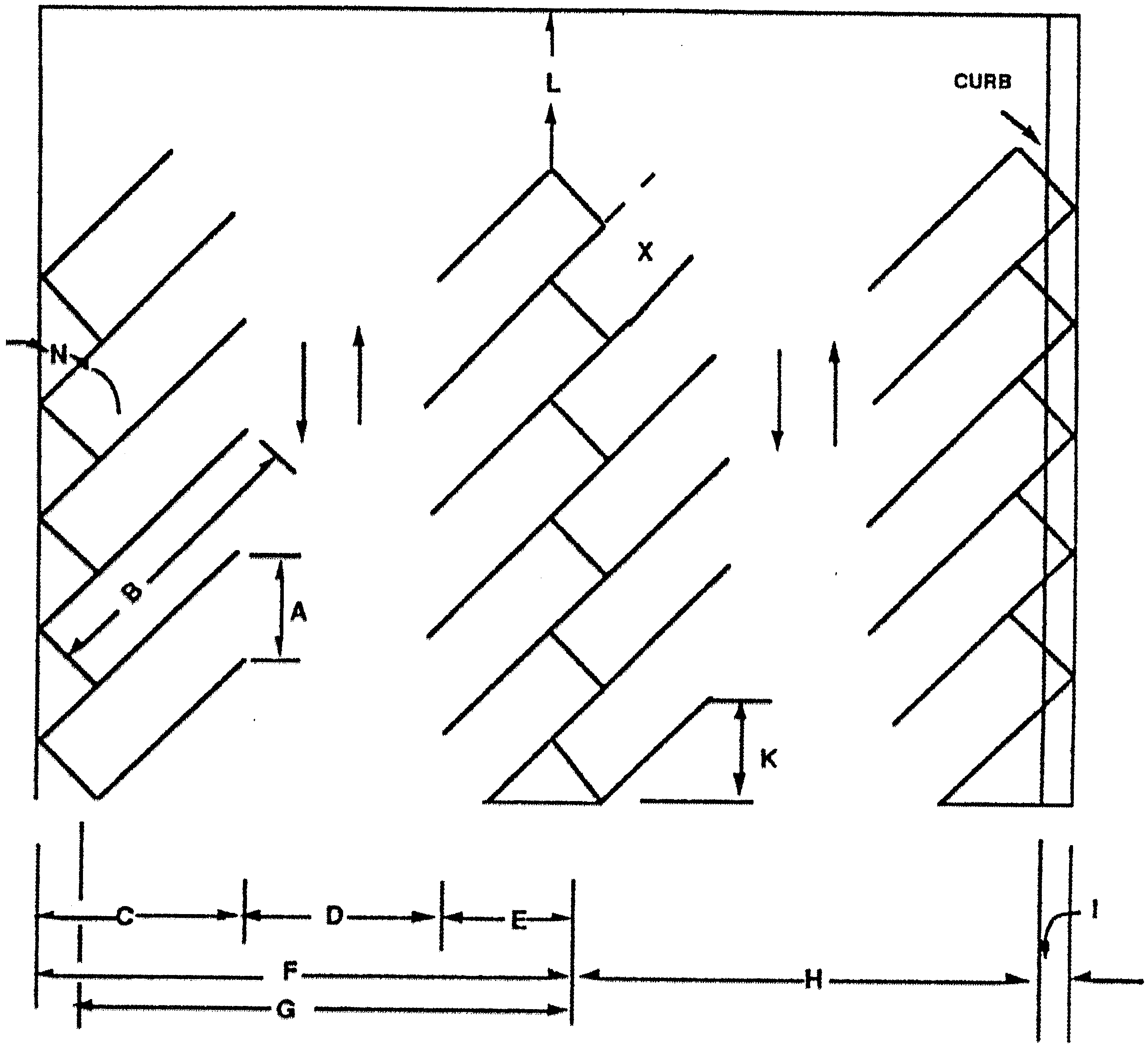
Parking Illustration
Parking layout dimensions (in feet) for nine (9) feet × nineteen (19) feet stalls at various angles
Parking
Principles,
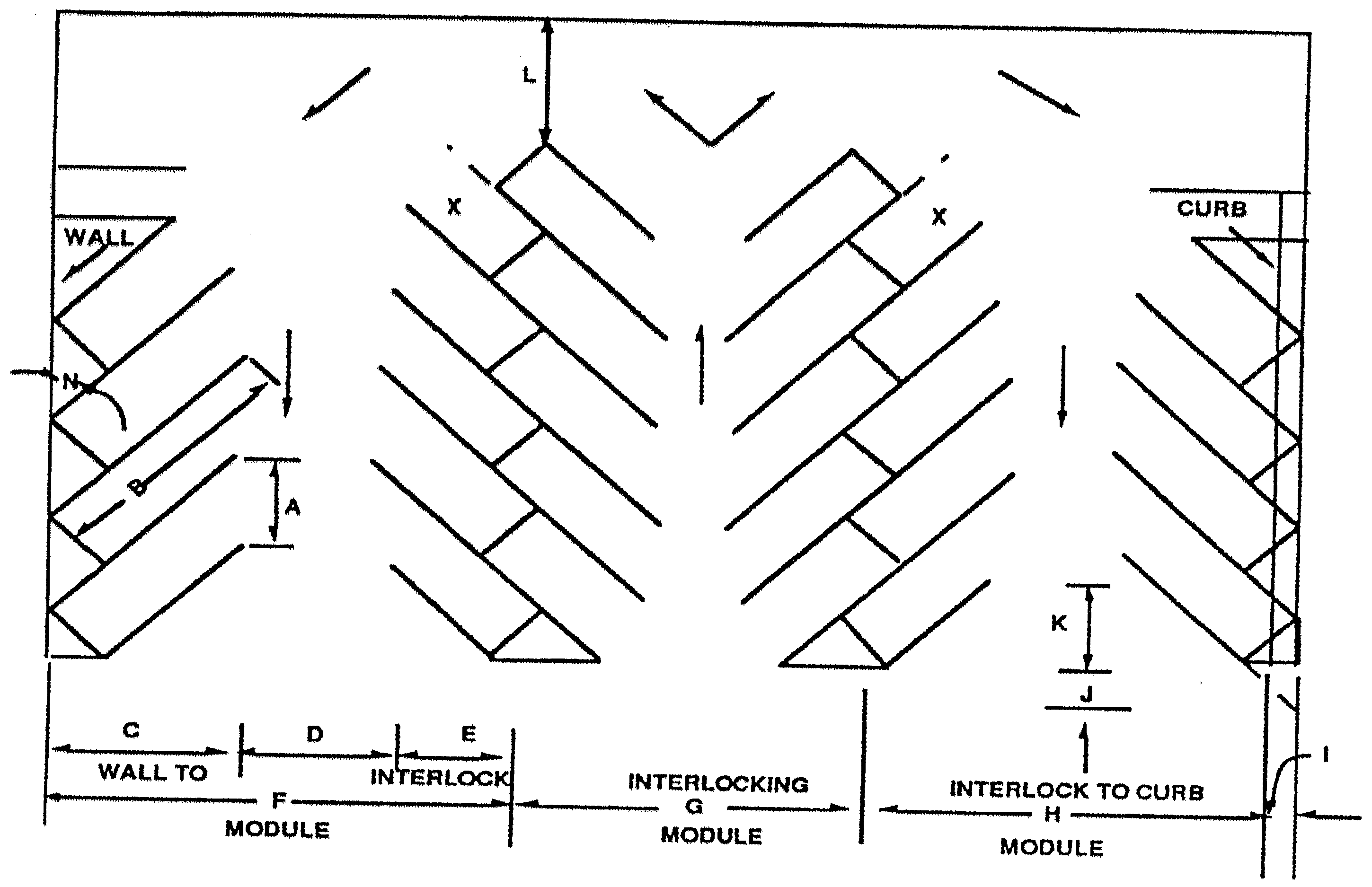
Parking Illustration
× = Stall Not Accessible in Certain Layouts
Parking layout dimensions (in feet) for nine (9) feet × nineteen (19) feet stalls at various angles
Parking
Principles,
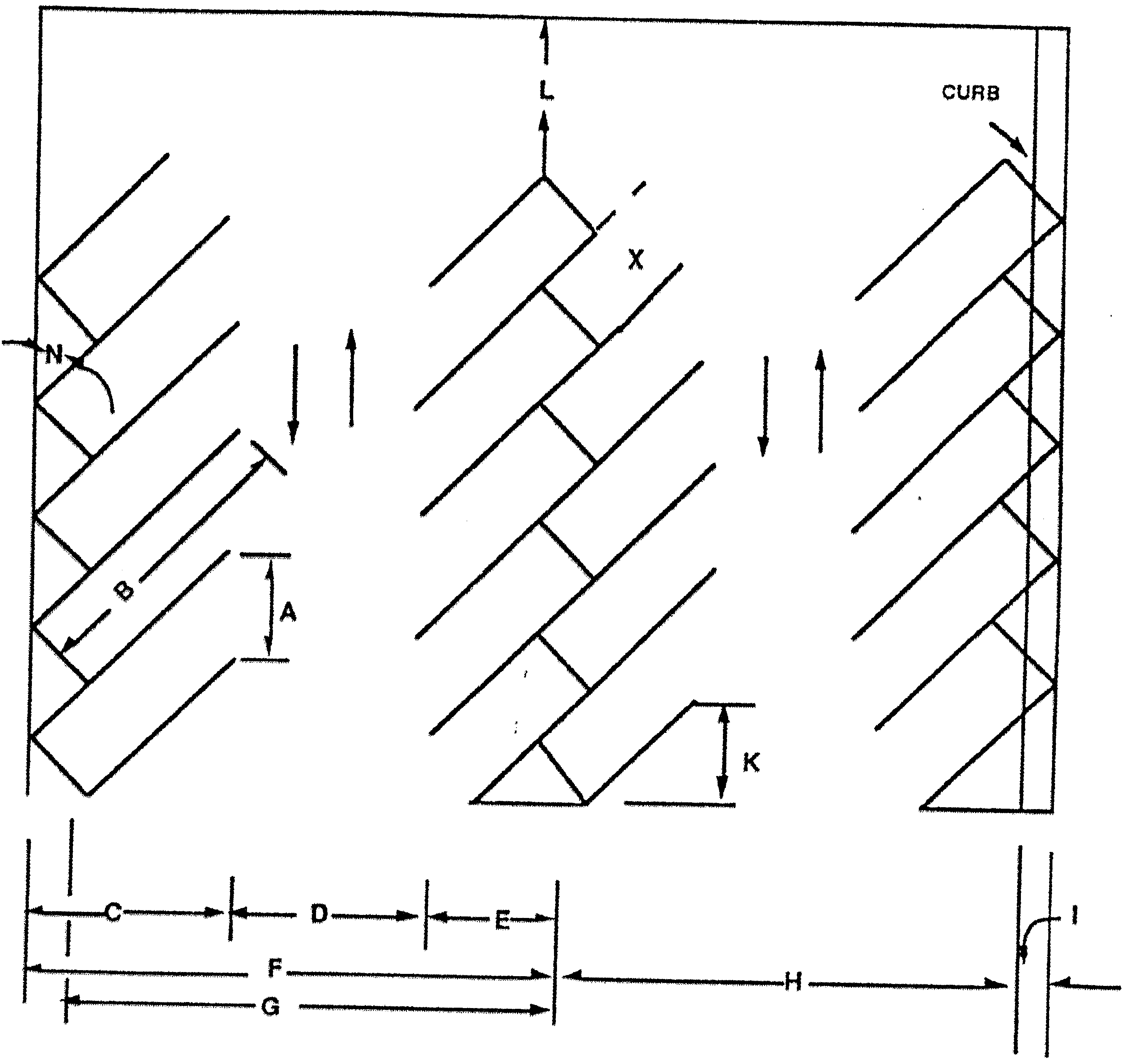
Parking Illustration
Parking layout dimensions (in feet) for nine (9) feet × twenty (20) feet stalls at various angles
Parking
Principles,
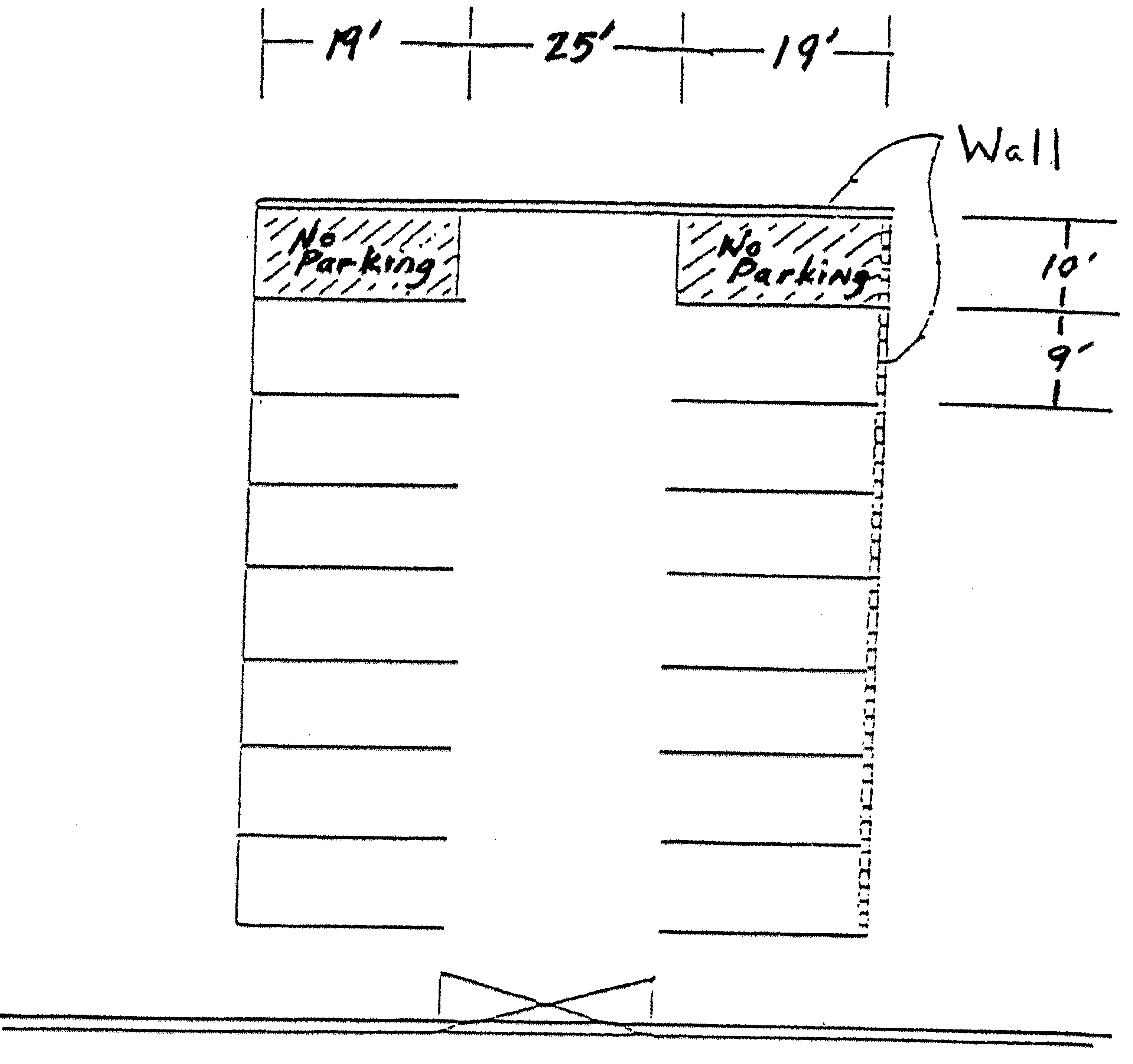
Parking Illustration
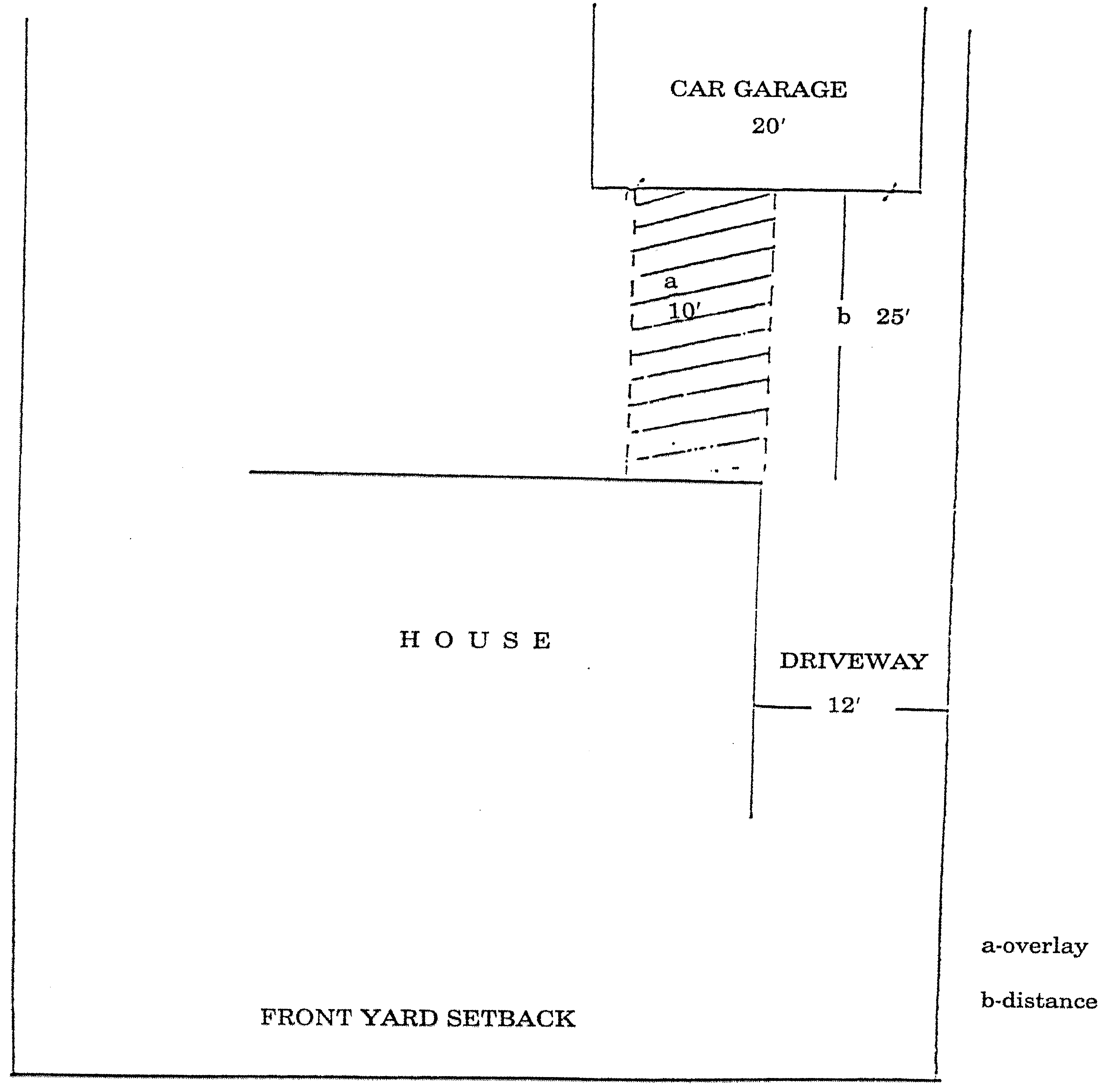
Figure P4. Distance Between House and Detached Rear Garage
(Ord. No. 475, § 1, 2-4-91; Ord. No. 839, § 13, 9-6-22; Ord. No. 887, § 5(Exh. A), 5-19-26)
Editor's note— See editor's note, § 11-1.66.03.
Sec. 11-1.66.09. - Standards for developing parking facilities.
The following development standards shall be the minimum required for parking facilities:
(A)
Except for single-family parking facility, parking spaces shall be arranged to permit vehicular traffic to move into and out of a parking area without backing onto a street, sidewalk or highway, except that an alley may be used for turning into and out of a parking space.
(B)
The entrances and exits to parking areas shall be clearly marked. One-way driveways shall have directional signs placed on the pavement.
(C)
All parking spaces shall be double striped to facilitate the movement in and out of the parking stall.
(D)
Parking areas and spaces in a commercial garage or "tucked" under a building shall have a vertical clearance of not less than eight (8) feet, two (2) inches.
(E)
Columns, pillars and other obstructions in a parking facility shall not encroach into the required dimensions of any parking space, aisle or driveway.
(F)
Handicapped parking spaces shall be provided, marked and posted as required by the state.
(G)
Wheel stops shall be provided for all parking spaces and located to prevent encroachment of cars over walkways, sidewalks, landscaped areas, etc. Wheel stops shall not be required in residential garages.
(H)
Commercial subterranean garages, fully or partially underground, and aboveground commercial parking structures shall be subject to planning commission review and approval. Said garages shall be subject to design standards, setbacks and landscaping requirements as determined by the planning commission, and shall at minimum meet the requirements of this article. The height of the garages above the average natural grade and/or garage and structure above it shall not exceed the maximum allowed height of the zone in which such garage is located.
(I)
Where a commercial development or parking facility is adjacent to a residential zone or use, a solid masonry wall not less than six (6) feet in height shall be constructed along the lot line adjacent to said zone or use, except that said wall shall step down to a maximum of forty-two (42) inches in height for a distance equal to the required front setback of an adjoining residential use.
(J)
Where a wall of a commercial facility is constructed along a commercial driveway, said wall shall step down to a maximum of forty-two (42) inches in height for a distance of ten (10) feet from the property line.
(K)
Where a commercial or a residential driveway is proposed along an existing wall/fence which is more than forty-two (42) inches high, the design of such driveway shall be satisfactory to the city. Further, it shall be located so that visibility of the vehicular and pedestrian traffic is not compromised.
(L)
Where fences or walls are constructed for commercial parking areas along the front property line of an interior lot, or front and side property line on a corner lot, such wall or fence shall not exceed forty-two (42) inches in height. The height of such wall or fence for auto-related uses, contractor's yards and similar uses shall be determined by the planning commission.
(M)
Where plants are used along property lines of commercial developments for screening, such plants shall be maintained at a height not to exceed the height of walls or fences permitted in the same location, unless otherwise approved by the planning commission.
(N)
Lighting of parking and driveway areas shall be required. It shall be arranged so as to reflect the light away from any adjoining property. The lights shall be of energy efficient type, and be vandal resistant.
(O)
All parking facilities, including parking spaces, aisles, driveways, etc., shall be constructed pursuant to Los Angeles County specifications.
(Ord. No. 475, § 1, 2-4-91; Ord. No. 763, § 2, 1-6-14; Ord. No. 839, § 13, 9-6-22; Ord. No. 887, § 5(Exh. A), 5-19-26)
Editor's note— See editor's note, § 11-1.66.03.
Sec. 11-1.66.10. - Location of parking, storage and loading facilities.
(A)
Ownership: Property on which required parking is established shall be under the same ownership as the use it is intended to serve, except as specified in section 11-1.66.11(B). Any joint ownership resulting from the establishment of collective parking facilities, as provided herein, shall be construed as complying with this provision.
(B)
Residential uses:
(1)
Required parking facilities for residential uses as specified in subsection (A) of section 11-1.66.04 (parking requirements) shall be located on the same lot or parcel of land as the use the parking facilities are intended to serve. Such facilities shall be conveniently accessible.
(2)
Storage and/or parking of detached camper tops/shells, dismantled and inoperative vehicles and other auto and recreation equipment items shall not be permitted in the front-yard area. In addition, storage in the front-yard area of any materials (construction, lumber, metals, plastic, etc.), fixtures, appliances, machines, trash or waste, or other materials which are not customarily considered as decorative landscaping features are hereby prohibited.
(3)
Storage and/or parking of boats, trailers, other vehicles and similar equipment as well as camper tops, auto- and recreation-related and domestic items in the rear and side yard areas shall be screened by a solid wall or opaque fence six (6) feet high to minimize any undesirable appearance from the street and surrounding properties. On the street side of corner lots, no storage and/or parking shall be permitted closer to the street than the required front yard setback of the adjacent interior lot.
(4)
Parking pads or spaces other than a driveway shall not be permitted in the front-yard area unless they have been reviewed and approved by the director of community development and/or the planning commission pursuant to article 70, "Zoning ordinance administration." Only recreation equipment and/or operable vehicles may be stored/parked on such approved pads.
(5)
Storage of any commercial or construction equipment, materials, or nursery stock or storage and/or parking of boats, house trailers, camper trailers, detached camper tops, vehicles or dismantled vehicles and similar items on vacant lots shall not be permitted, except for materials and equipment being used for construction on the premises where a valid building permit has been issued or applied for.
(6)
House trailers, motor homes, mobile homes, campers, boats and similar uses shall not be occupied or used as a dwelling unit in any land use district unless located in a trailer or mobile home park which has been approved by the City of Lomita.
(7)
Operative automobiles and motor vehicles may be parked or stored in the front yard setback area only on an approved driveway which leads directly to a garage.
(8)
Dismantled and/or inoperative vehicles may not be parked or stored in a location which prevents access to an approved driveway leading to a garage and shall be screened by a solid wall or opaque fence six (6) feet high to minimize any undesirable aesthetic impacts from the street and surrounding properties. On the street side of corner lots, storage and/or parking of dismantled and inoperative vehicles shall not be permitted closer to the street than the required front yard setback of the adjacent interior lot.
(C)
Uses other than residential:
(1)
Parking facilities: Required parking facilities for uses other than residential shall be located in compliance with one of the following options, unless a minor conditional use permit for shared parking or off-site parking is granted by the planning commission or the city council as specified in section (section 11-1.66.11(B).
a.
On the same lot or parcel of land as the use such parking facilities are intended to serve; or
b.
On a lot or parcel of land held under joint ownership, provided such parking facilities are located adjoining the use or uses served and contiguous for a distance not less than twenty (20) feet; [or]
c.
On a parcel of land separated only by an alley from the lot or parcel of land which the use or uses served are located provided:
1.
That said lots or parcels of land are in the same or joint ownership and separated only by an alley; and
2.
That said lots or parcels of land would be contiguous if not separated by said alley, for a distance of not less than twenty (20) feet; and
3.
That the direct vehicular passage between said lots or parcels of land would be possible in conformance with section 11-1.66.08; and
4.
That such parking facilities are in close proximity to the actual use or uses served.
(2)
Storage of any commercial or construction equipment, materials, or nursery stock or storage and/or parking of boats, house trailers, camper trailers, detached camper tops, vehicles or dismantled vehicles on vacant lots shall not be permitted, except for materials and equipment being used for construction on the premises where a valid building permit has been issued or applied for, and where such use has been approved pursuant to the Lomita Zoning Ordinance.
(3)
Storage and/or parking of bins, steel or other storage containers, except for loading vehicles as permitted in section 11-1.66.05(D) and recycling containers, is hereby prohibited.
(4)
Reduction or encroachment:
a.
Land within the right-of-way of a proposed street or highway, or within the planned ultimate right-of-way of a street or highway proposed to be widened, shall not be used to provide required parking or loading facilities.
b.
Required parking or loading facilities may not be reduced or encroached upon except upon approval by the planning commission and subject to the provisions of article 72, "Variances and conditional use permits."
(5)
Combined parking or loading facilities:
a.
Required parking facilities may be provided collectively for two (2) or more buildings or uses located on separate lots or parcels of land provided a minor conditional use permit for shared parking or off-site parking is granted by the planning commission or the city council as specified in section (section 11-1.66.11(B).
b.
Parking and loading facilities designated for one use may not be counted or considered as also providing required parking or loading facilities for any other use, unless a minor conditional use permit for shared parking is granted by the planning commission or the city council as specified in section (section 11-1.66.11(B)).
(Ord. No. 498, § 2, 7-20-92; Ord. No. 701, § 2(pt. 1), 6-4-07; Ord. No. 733, § 2(pt. 2), 9-7-10; Ord. No. 839, § 13, 9-6-22; Ord. No. 887, § 5(Exh. A), 5-19-26)
Editor's note— Ord. No. 887, § 5(Exh. A), adopted May 19, 2026, repealed § 11-1.66.10 and renumbered § 11-1.66.09 as § 11-1.66.10. Former § 11-1.66.10 pertained to approval procedures and derived from Ord. No. 475, § 1, 2-4-91; Ord. No. 733, § 2(pt. 2), adopted Sept. 7, 2010; and Ord. No. 839, § 13, adopted Sept. 6, 2022.
Sec. 11-1.66.11. - Approval procedures.
(A)
A site plan shall be submitted to the planning division pursuant to the provisions of article 70, "Administration," for any parking facilities with three (3) or more motor vehicles, except parking for single-family residences. The site plan shall contain a detailed parking arrangement, accurately dimensioned, showing individual parking spaces, aisles and driveways, adequate ingress and egress, and all other requirements of this article.
(B)
Provisions for parking space reduction, shared parking and off-site parking. A minor conditional use permit for parking space reduction, shared parking and off-site parking may be allowed in commercial zones, and a parking space reduction may be allowed for senior citizen and multi-family housing development.
(1)
Applicability. A minor conditional use permit may be approved for:
a.
A reduction in the number of spaces specified in section 11-1.66.03;
b.
Shared provision of parking serving more than one use;
c.
Off-site provision of parking; or
d.
Any combination of the above, subject to specific findings and conditions of approval.
(2)
Findings. In addition to the findings in section 11-1.70.09 for a minor conditional use permit, the findings below shall be made in consideration of a parking space reduction, shared parking and off-site parking.
a.
In regard to a reduction in parking spaces for commercial zones that:
1.
There is clear and convincing evidence that the parking demand will be less than the requirement in section 11-1.66.03. In reaching a decision, the planning commission shall consider survey data submitted by an applicant or collected at the applicant's request and expense; and
2.
That the probable long-term occupancy of the building or structure, based on its design, will not generate additional parking demand.
b.
In regards to reduction in parking spaces for senior citizen and multi-family housing development that:
1.
The intent of the parking regulations, in compliance with all other applicable provisions of this chapter, is met; and
2.
Sufficient parking would be provided to serve the use intended and potential future uses of the subject parcel.
c.
In regard to shared or off-site parking for commercial zones that:
1.
The peak hour parking demand from all uses does not coincide and/or the uses are such that the hours of operation are different for various portions of the business;
2.
The quantity, circulation and location of parking provided will equal or exceed the level that can be expected if shared or off-site parking is not provided;
3.
The adjacent or nearby properties will not be adversely affected relative to parking;
4.
The proposed traffic circulation will not be detrimental to the health, safety and welfare of residents residing or working in or adjacent to the neighborhood; and
5.
The off-site parking is within a three hundred (300) feet legal distance or suitable distance subject to planning commission approval of the premises upon which the building or use is located.
(3)
Agreement. As a condition of such minor conditional use permit approval the planning commission shall require a written agreement between landowner(s) and the city, in a form satisfactory to the city attorney, which shall include:
a.
A guarantee that there will be no substantial alteration in the uses that will create a greater demand for parking;
b.
A guarantee among the landowner(s) for access to and use of the shared or off-site parking facilities;
c.
Remedies in the event that there is a change in use on the property or in the event that the shared or off-site parking is lost;
d.
A provision that the city may require parking facilities in addition to those originally approved, after notice and hearing, upon a finding by the planning commission that adequate parking to serve the use(s) has not been provided; and
e.
A provision stating that the city, acting through the planning commission, may, for due cause and upon notice and hearing, modify, amend, or unilaterally terminate the agreement at any time.
(4)
Notwithstanding the foregoing, if such parking reduction, shared parking or off-site parking request also includes other discretionary actions to be considered by the city council, the planning commission shall make a recommendation to city council in conjunction with such other discretionary actions. The city council, in considering the parking request, shall make such findings and include necessary conditions as provided in this section.
(Ord. No. 887, § 5(Exh. A), 5-19-26)
Sec. 11-1.67.01. - Intent and purpose.
The intent and purpose of this chapter is to discourage indiscriminate and unregulated erection and maintenance of signs and other visual media which tend to create a garish, gaudy, and unsafe atmosphere and which tend to be out of harmony with the goals and objectives of the community, and it shall also be the purpose of this chapter to:
(1)
Assure that all signs are designed, erected and maintained in a manner to enhance, rather than detract from, the ultimate design and appearance of the City of Lomita;
(2)
Protect the public safety by prohibiting the installation and maintenance of signs which distract motorists' attention from traffic signs and signals;
(3)
Program for the orderly removal and replacement of unused signs which tend to have a detrimental effect upon the physical, social, and economic well-being of a community.
Therefore, in order to safeguard the public health, safety and general welfare of the citizens of the City of Lomita, it is necessary that the provisions of this Article classify all signs and regulate the size, location, motion, animation, and method of illumination of all signs erected and maintained now and hereafter within the City of Lomita.
Sec. 11-1.67.02. - Definitions.
For the purpose of this chapter, the words and phrases set forth shall have the meaning ascribed to them, as follows:
(1)
Abandoned sign shall mean any sign which pertains to a time, place, event, or purpose which no longer retains a business license or has ceased to exist for a period of thirty (30) days; or was erected for an occupant and unused by present occupant for a continuous period of thirty (30) days.
(2)
Area of sign shall include the entire area within any type of perimeter or border which may enclose the outer limits of any writing, representation, emblem, figure or character, including all open space. The area of the sign having no such perimeter or border shall be computed by enclosing the entire area within a parallelogram or triangle of the smallest size sufficient to cover the entire area of the sign and computing the area of the parallelogram or triangle. Decorative panels or face plates considered an integral part of the building design shall not be included as sign area.
When each letter of a sign is mounted individually against the face of a building and said letters are more than one (1) foot apart, the area of each letter and its background face plate, if any, shall be computed separately as a portion of the total permitted wall sign area.
Sign area for double-faced signs that comply with the requirements of this section shall be computed for one (1) face only; provided, however, that when the angle between the planes of the faces exceeds forty-five (45) degrees, the total area of both faces shall be included in the sign area.
(2.3)
Banner shall mean any cloth, plastic, paper or similar lightweight material used for advertising purposes mounted to a structure, pole, line, vehicle, any framing or tree.
(2.4)
Beacon sign shall mean a type of directional sign providing information or directions for motorists to onsite parking or loading.
(2.5)
Bench sign shall mean a sign located on any part of the surface of a bench or seat placed on or adjacent to a public right-of-way.
(3)
Billboard or outdoor advertising sign shall mean any sign or signs used in soliciting public support or directing public attention to the sale, lease, or hire or use of any objects, products, services or functions which are not produced, sold or otherwise available on the premises where such sign is erected or maintained.
(4)
Business identification sign shall mean a sign containing the name of the business, or the names of the businesses, to which it pertains and the name of the products or services sold or offered by such business or businesses on the premises on which the sign is located.
(5)
Building identification sign shall mean a sign containing any of the following information, and no more; the name of the building, any portion of which is located on the same site area on which the sign is located, and the address of such building.
(6)
Building frontage shall mean that portion of the building wall which faces a street. Alleys twenty-five (25) feet or less in width shall not qualify as streets.
(7)
Business door nameplate shall mean a sign containing the name of the businesses on the premises, and/or the street address and number only, and shall be affixed to the door of each individual business or adjacent thereto.
(8)
Construction sign shall mean a sign listing the names, addresses and telephone numbers of those individuals, businesses or contractors directly connected with the construction project.
(8.5)
Designated space sign shall mean a sign identifying a specific parking space for a particular business use.
(9)
Face of building shall mean the wall of a building, including the parapet, fronting on a street, but excluding any appurtenances such as projecting fins, columns, pilasters, canopies, marquees, showcases or decorations.
(9.5)
Fence sign shall mean a sign which is mounted, painted, or otherwise placed on a wall, fence or gate, other than a building wall (see snipe signs).
(10)
Flashing or scintillating sign shall mean any sign, including but not limited to, flashing riders, arrows and other similar attachments, which by method or manner of illumination or lighting, flashes on or off, winks or blinks with varying light intensity, shows motion or creates the illusion of being on or off, excepting, however, the numerals only of signs indicating time and temperature.
(11)
Freestanding sign (pole sign) shall mean a sign which is supported by one (1) or more uprights, poles, walls or other structural forms when utilizing each as a primary holding brace.
(11.5)
Governmental sign shall mean any sign erected and maintained pursuant to any governmental action, function, regulation or public utility operation.
(12)
Guide signs shall mean all signs and sign structures which serve as direction guides to recognized areas of regional importance and patronage within the city. To clarify and define such areas, the following criteria shall apply:
(a)
Recreation and entertainment facilities of regional importance.
(b)
Regional and community shopping centers maintaining a minimum of three hundred (300) parking spaces in the immediate vicinity.
(c)
Entertainment centers, civic centers, post offices and other public building.
(d)
Any recognized historical landmark, museum or center for the performing arts.
(e)
Public, quasi-public and institutional centers.
(13)
Location shall mean a lot, site or premises, building, wall, or any place whatsoever upon which a sign is erected, constructed or maintained.
(14)
Lot or parcel frontage shall mean the lineal distance of the lot line or parcel line which is directly adjacent to a public street.
(15)
Marquee or message board shall mean a changeable copy sign advertising particular events or products for a usually short period of time. Said sign may be freestanding, projecting, or a wall-type sign, but not including billboards. The changeable copy portion of the sign shall not be greater than fifty (50) percent of the area per face, excepting theaters, religious facilities, schools, and other public institutions.
(16)
Mural shall mean a large painting, picture or decoration which is applied directly to a wall and which usually depicts a scene or an event.
(17)
No-peddling sign shall mean and include phrases such as "No Peddling, Selling or Soliciting"; "No Trespassing"; and signs of similar nature and message.
(18)
Parapet wall shall mean that part of any wall entirely above the roof or eave line, but not to exceed six (6) feet in height above the roof or eave line.
(19)
Parcel or lot of real property shall mean in this chapter, for the purpose of determining sign requirements, any parcel or lot of real property owned separately from any other parcel or lot.
(20)
Parking entrance and exit signs shall mean directions to the flow of traffic into and out of a parking area and, in addition to the permitted sign area, one (1) exit and/or one (1) entrance sign shall also be permitted at each driveway in close proximity to the vehicle entrance or exit of the premises. Copy on the signs to be limited to the word "Entrance" or "Exit," or other single instruction pertaining to vehicular movement.
(20.5)
Pennants shall mean narrow, long, relatively small flags often triangular used for signaling attention or for identification and shall include streamers and ribbons.
(21)
Permanent sign shall mean any sign which is not classed as a temporary sign.
(21.5)
Political sign shall mean a sign identifying either a candidate for public office or an issue relating to a forthcoming election intended to be displayed on temporary basis.
(22)
Projecting sign or perpendicular attached sign shall mean any sign supported on the wall of a building or structure and projecting out therefrom more than one (1) foot.
(23)
Roof sign shall mean a sign which is affixed to the roof of a building or projects above the parapet wall of the building on which it is located.
(24)
Real estate sign shall mean a sign relating to the sale, lease, rental or other disposition of the real property on which the sign is located and shall be temporary in nature.
(25)
Residential nameplate shall mean a sign identifying only the name and/or house number of the occupant of the premises.
(26)
Rotating or revolving sign shall mean any sign, all or a portion of which rotates, moves or appears to move, in some manner by mechanical, electrical, natural or other means.
(26.5)
Short-term parking sign shall mean a sign identifying a short-term parking space.
(27)
Sign shall mean any name, figure, character, outline, spectacle, display, delineation, announcement, signboard, device, appliance, a combination thereof, or any other thing of similar nature to attract attention outdoors or on the face or wall of any building, and shall include all parts, portions, units and material composing the same, together with the frame background, and support or anchorage therefor as the case may be, but shall not include official notices authorized by a court, public body or public officer, nor directional, warning or information signs authorized by federal, state or municipal authority.
(27.5)
Snipe sign shall mean a temporary sign fastened to trees, poles, fences, utility boxes or any other structures which would normally not contain signs.
(28)
Special sign or advertising device shall mean any sign, device or display which is not specifically defined herein.
(29)
Streamers. See Pennants.
(29.5)
Temporary sign shall mean any sign constructed of cloth, vinyl, canvas, light fabric, paper, cardboard, wallboard, or other light material with or without frame, intended to be displayed or used for a short period of time as set forth in this Article. Snipe signs, banners, political signs, construction and real estate signs, certain window signs, portable signs and signs of similar nature shall be considered temporary signs.
(30)
Wall sign shall mean a sign which is affixed to an exterior wall of any building and which projects not more than one (1) foot from the building wall, and which does not project above the parapet wall of the building to which it is affixed. A sign painted on the face, side or rear wall of a building shall be considered as a wall sign. The face of the sign and the lettering shall be parallel to the wall of the building.
(31)
Window sign shall mean any sign posted, painted, applied, attached or affixed in or on any window or glass surface exposed to public view and any interior sign which faces any glass surface exposed to public view.
(Ord. No. 306, § 4, 12-17-79; Ord. No. 562, § 1, 5-20-96; Ord. No. 748, § 2(pt. 20), 1-17-12; Ord. No. 847, § 4(E), 4-18-23)
Sec. 11-1.67.03. - General conditions.
(A)
Generally. The following provisions shall apply to all zones within the City of Lomita:
(a)
Traffic control:
(1)
No person shall place, maintain or display upon, or in view of, any highway, street or alley, any unofficial sign, signal or device, or any sign, signal or device which purports to be, or is an imitation of, or resembles, an official traffic sign or signal, or which attempts to direct the movement of traffic, or which conceals from view any official traffic sign or signal.
(2)
No person shall place or maintain or display upon, or in view of, any highway, street or alley, any light of any color of such brilliance as to blind or dazzle the vision of drivers upon said highway, street or alley, nor shall any light be placed in such position as to prevent the driver of a vehicle from readily recognizing any official traffic sign or signal.
(b)
Signs on vehicles: No person shall erect or maintain a sign which is attached to, suspended from, or supported in whole or in part by any vehicle, whether self-propelled or towed. A sign will be allowed if painted directly upon, or permanently affixed to, the body or integral part of the vehicle or permanent decoration, identification or display, if such vehicle is used regularly in the business to which the sign pertains, for purposes other than as an advertising device, and such sign shall conform to the limitations set forth in the California Vehicle Code, excluding only public carrier buses and trains.
(c)
Maintenance. Signs and awnings, including all supporting hardware, shall be structurally safe, clean, free of visible defects, and functioning properly at all times. Awnings shall be maintained in a clean condition and faded or torn fabric shall be replaced. Repairs shall be equal to or better in quality of materials and design than the original sign or awning.
(d)
Sign copy. Sign copy shall be limited to the name of the business, the name of the products or services sold or offered, and the business address. This requirement does not apply to temporary signs or directional signs.
(e)
Unless otherwise specified, all signs shall be reviewed by the planning director before they are installed or placed on any property.
(f)
Use of English language letters and Arabic numerals.
(1)
Any business establishment located in an area zoned to permit an on-premises sign, including but not limited to, an office-professional zone, commercial zone, industrial or manufacturing zone, and any place of public assembly, including but not limited to, a meeting hall, auditorium, club house, assembly hall, shall maintain one or more on-premises signs that shall comply with the provisions of this section.
(2)
For the purposes of this section, the "on-premises sign" means a sign used for any of the following purposes:
(i)
To advertise the sale or lease of the property upon which the sign is placed.
(ii)
To designate the name of the occupant of the premises or to identify the premises by name or street address.
(iii)
To advertise the business conducted or services rendered or the goods produced or sold upon the property upon which the sign is placed, including any such sign placed upon the same side of the street or highway and within one thousand (1,000) feet of the property or within one thousand (1,000) feet of the entrance to the site at which the business is conducted or services are rendered or goods are produced or sold.
(3)
Any business or place of public assembly mentioned in subsection (1) of this section shall have, at a minimum, at least one (1) conspicuous sign setting forth the trade name of the business or the name of the place of public assembly and the street address number in English letters and Arabic numerals, respectively. The letters and numerals on any such sign shall be large enough to be readable from a distance of one hundred (100) feet.
(4)
An on-premises sign shall be deemed to satisfy the requirements of subsection (3) of this section if it sets forth the street address number and either the name or business of the owner or occupant of the premises or the nature of the business conducted, services available or rendered, or the goods produced, sold or available for sale upon the premises, in the English language and/or Arabic numerals, or a combination thereof. Furthermore, the English language letters and Arabic numerals shall appear reading from the left of the sign, and that in the event there is to be only one sign or designation for the name or number of the business, or the name of the owner, or occupant of the premises or the nature of the business conducted on the premises, services available or rendered, or the goods produced, sold or available for sale upon the premises, that sign shall be in English language letters and/or Arabic numerals.
(5)
Any business or place of public assembly mentioned in subsection (1) of this section shall have six (6) months from August 7, 2000, the effective date of the ordinance codified in this section to comply.
(g)
Substitution clause. Notwithstanding any other provision of this Code, any noncommercial copy may be substituted for any commercial copy on any sign permitted by this Code. If noncommercial copy is substituted, the resulting sign will continue to be treated as the original commercial sign under this Code and will not be deemed or treated as an off-premises sign. The content of any noncommercial copy on any sign otherwise permitted by this Code may be changed without complying with any provisions of this Code normally required for sign copy or design approval.
(B)
Commercial Zones. The following provisions shall apply to all commercial zones and the M-C Zone within the City of Lomita:
(a)
Permit required; fee:
(1)
No person shall have, place or erect a sign as defined in this chapter in a commercial zone or M-C Zone of the City of Lomita without first obtaining a permit from the city clerk.
(2)
The city council shall, from time to time, fix the amount of the required permit fee by resolution.
(Ord. No. 306, § 1, 12-17-79; Ord. No. 617, § 2, 3-6-00; Ord. No. 627, § 1, 8-7-00; Ord. No. 672, pt. 2, 12-6-04; Ord. No. 748, § 2(pt. 21), 1-17-12)
Sec. 11-1.67.04. - Sign regulations for specific zones.
No person shall install, erect or maintain any sign in any zone in the City of Lomita except as permitted herein:
(1)
R-1 Zone, Single-family Residential:
(a)
One (1) residential nameplate sign, not to exceed two (2) square feet in area, identifying the occupant of the premises; said sign may be illuminated.
(b)
One (1) unlighted real estate sign not to exceed four (4) square feet in area, offering the premises for sale, rental, lease, or for inspection by the public, and one (1) additional square foot of sign area for riders attached to the sign; sign to be removed within ten (10) days of sale, lease or rental of property.
(c)
Unlighted construction sign, as defined in this chapter, not to exceed sixteen (16) square feet in area; sign or signs to be removed prior to final inspection by the building department.
(d)
One (1) unlighted no-peddling sign, as defined in this chapter, not to exceed seventy-two (72) square inches in area.
(2)
R-V Zone, Residential Variable:
(a)
On a lot or parcel containing three (3) or less dwelling units, only those signs permitted in the R-1 Zone.
(b)
On a lot or parcel containing four (4) or more dwelling units, one (1) building identification sign flush against the wall of the building and not projecting above the parapet wall. Signs may be illuminated only by spotlighting or silhouette lighting directed toward the face of the building. Interior illuminated signs shall not be permitted.
(i)
Size of building identification sign permitted: One (1) square foot of total sign area for each dwelling unit located on the lot or parcel. Signs not to exceed two (2) in number, provided the combined area of both signs does not exceed the total allowable sign area of twenty-four (24) square feet. No permitted identification sign shall be required to be less than ten (10) square feet in area.
(ii)
Real estate sign: One (1) unlighted sign of a maximum area of twelve (12) square feet and with a maximum of four (4) feet in any dimension, offering the premises for sale, lease, rental, or for inspection by the public.
(iii)
Construction sign: Unlighted construction sign, or signs, as defined in this section, not to exceed a total area of thirty-two (32) square feet. Sign, or signs, to be removed prior to final inspection by the building department.
(iv)
One (1) unlighted no-peddling sign as defined in this chapter, not to exceed seventy-two (72) square inches in area.
(3)
Reserved.
(4)
C-G, Commercial General and C-R, Commercial, Retail:
(a)
Wall signs:
(i)
Front wall signs flush against the face of the building and not projecting more than one-foot therefrom shall be permitted a total sign area not to exceed fifteen (15) percent of the area of the front wall of the building.
(ii)
Rear wall signs flush against the rear wall of the building and not projecting more than one-foot therefrom shall only be permitted if the rear wall of the building faces a street, parking area, or pedestrian mall and shall not exceed ten (10) percent of said rear wall in total sign area.
(iii)
Side wall signs flush against the side wall of the building and not projecting more than one-foot therefrom shall be permitted a total sign area not to exceed seven and one-half (7½) percent of said side wall.
(iv)
Buildings located on corner lots, or parcels with two (2) frontages, shall be permitted a total sign area not to exceed fifteen (15) percent of the area of the building wall facing each frontage.
(b)
Hanging signs, suspended signs and other canopy signs:
(i)
Signs supported or suspended from the underside of an awning, canopy, or parapet of a building shall be a minimum of eight (8) feet vertical distance from the sidewalk grade and at approximately a ninety-degree angle to the face of the building.
(ii)
Said sign shall be centered between the face of the building and the outer edge of the awning, canopy, or parapet.
(iii)
Maximum area of sign shall be determined by the following:
a.
The length of said sign shall not exceed two-thirds (⅔) of the length of the projecting of the awning, canopy, or parapet.
b.
Said sign shall not exceed two (2) feet in height.
(c)
Freestanding or pole signs:
(i)
A planned shopping center or service center having three (3) or more stores and sharing a common parking area shall be permitted one freestanding or pole sign with a maximum sign area per face of one square foot for each lineal foot or lot or parcel frontage.
(ii)
The maximum sign area permitted under any condition shall not be more than two hundred (200) square feet per face for any freestanding or pole sign. Not more than two (2) sign faces shall be parallel, with a maximum distance of eighteen (18) inches between the faces. However, no permitted freestanding or pole sign shall be required to be less than thirty-five (35) square feet in area per face. Freestanding or pole signs are not to exceed thirty (30) feet in height above grade level, nor to be less than ten (10) feet above grade, and shall not project more than three (3) feet over public rights-of-way.
(iii)
One freestanding or pole sign shall be permitted for a fueling service station, with the maximum sign area per face not to exceed one-half (½) square foot of sign area for each foot of lot or parcel frontage. Lots or parcels on a corner, or with double frontages, may count only the largest frontage for determination of sign area. The use of light-emitting diodes (LEDs) for signage displaying the current price of gasoline shall be permitted subject to the requirements in section 11-1.67.05(b).
(iv)
One freestanding or pole sign may be permitted subject to review and approval by the planning commission for each of the following uses when not a part of an above-described planned shopping center, service center, or automotive service station, with the maximum sign area permitted per face not to exceed one square foot for each lineal foot of lot or parcel frontage:
a.
New and used automobile, boat, camper, trailer and motorcycle sales.
b.
Hotels and motor hotels.
c.
Restaurants, drive-in restaurants, drive-in dairies and car washes with fifty (50) feet or more of street frontage.
(v)
Business door nameplate, not to exceed two (2) square feet in area, and to contain the name and address of the business only and shall be affixed to the door of each individual business or immediately adjacent thereto.
(vi)
Parking lot signs.
a.
Entrance and exit signs, not to exceed five (5) square feet in area per face.
b.
Designated parking space signs, one permitted per designated space.
(1)
Sign maximum size: six (6) square feet, of which up to four (4) square feet is allowed for branding or logos per face, with a maximum height of six (6) feet above the parking lot surface.
(2)
If present, exposed concrete bases shall be covered with decorative stone, stucco, brick, tile, or a natural veneer that matches the building's facade.
c.
Beacon parking signs may be installed to facilitate traffic circulation associated with designated parking, provided such signs comply with the following requirements:
(1)
No more than two (2) signs shall be permitted per property.
(2)
Sign maximum size: two (2) feet by two (2) feet in plan, with a maximum height of twelve (12) feet above the parking lot surface.
(3)
Up to three (3) square feet per face is permitted for branding or logos.
(4)
If present, exposed concrete bases shall be covered with decorative stone, brick, tile, stucco, or a natural veneer that matches the building's facade.
(5)
May be illuminated provided the luminance is stationary and no more than 0.3 foot-candles above ambient light conditions, or the level recommended by the Illuminating Engineering Society of North America (IESNA) for the specific size and location of the sign, whichever is less.
d.
Short-term parking space signs may be installed to facilitate parking space turnover. The sign shall have:
(1)
A maximum size of eighteen (18) inches by eighteen (18) inches, with no more than a one inch thickness.
(2)
The maximum time within which a particular vehicle may occupy a particular parking space and, if applicable, any designated timeframe.
e.
All types of parking lot signs shall be installed outside of each parking space's required minimum dimensions.
(vii)
One unlighted no-peddling sign, not to exceed seventy-two (72) square inches in area.
(d)
Projecting signs shall be ninety (90) degrees to the front face of the building and not project more than three (3) feet over the public right-of-way, nor five (5) feet above the roof line or parapet wall of the building. Sign area per face of a projecting sign shall not exceed one square foot for each lineal foot of building frontage.
(e)
Signs which may be permitted subject to the review and approval by the planning commission:
(i)
Roof signs. Roof signs shall have a maximum sign area per face of one square foot for each lineal foot of lot or parcel frontage. Lots or parcels located on a corner or with double frontage may count only the largest frontage for determining sign area.
a.
The maximum sign area permitted under any condition shall not be more than one hundred (100) square feet per face for any roof sign, may not exceed ten (10) feet in height above the roof line nor thirty-five (35) feet in height above the ground; nor project more than twelve (12) inches out from the building or structure.
b.
Roof sign supports shall be architecturally attractive or screened from view.
(ii)
Freestanding or pole signs shall not otherwise be permitted in this chapter.
(5)
M-C, Light Manufacturing and Commercial:
(a)
Wall signs:
(i)
Front wall signs flush against the face of the building and not projecting more than one (1) foot therefrom shall be permitted a total sign area not to exceed ten (10) percent of the area of the total building wall.
(ii)
Buildings located on corner lots, or parcels with two (2) street frontages, shall be permitted a total sign area not to exceed ten (10) percent of the area of the building wall facing each frontage.
(b)
Freestanding or pole signs:
(i)
One (1) sign is permitted for each two hundred fifty (250) feet of lot or parcel frontage on a public street.
(ii)
One (1) sign may be permitted for a lot or parcel having less than two hundred fifty (250) feet frontage on a public street.
(iii)
Sign area per face is to be permitted on the basis of one (1) square foot of sign area for each front foot of lot or parcel frontage, but not to exceed two hundred (200) square feet of sign area per face.
(iv)
All other standards for freestanding or pole signs specified in the commercial zones shall be complied with.
(c)
Business door nameplates, not to exceed four (4) square feet in area, may be affixed to, or fastened in close proximity to, each door or gate leading onto the premises.
(d)
The following signs, as defined in this chapter, and subject to the requirements stated for commercial zones shall be permitted:
(i)
Repealed.
(ii)
Repealed.
(iii)
Parking entrance and exit signs.
(iv)
No-peddling signs.
(e)
Roof signs by review and approval of the planning commission.
(6)
D-C, Downtown Commercial:
(a)
Allowed sign area: Each building or tenant space shall be allowed the amount of sign area indicated below.
(i)
Front wall signs: The total area of all signs on a front building wall shall not exceed one and one half (1.5) square feet of sign area for each linear foot of building wall or building frontage assigned to a tenant. The maximum front wall sign area for any building or tenant space shall be forty (40) square feet. Signs are intended for ground floor businesses only, except window signs, which may be used by second floor businesses.
(ii)
Rear and side wall signs: The total area of all signs on a rear or side building wall shall not exceed one (1) square foot of sign area for each linear foot of building wall or tenant space facing a street, parking lot, pedestrian walkway, or alley. The maximum area for a sign on a rear or side facing building wall or tenant space shall be ten (10) square feet. Signs are intended for ground floor businesses only, except window signs, which may be used by second floor businesses.
(b)
Wall signs:
(i)
Signs shall be located only on building wall frontages along streets, alleys, parking lots, or other rights-of-way.
(ii)
Signs shall not project from the surface upon which they are attached more than required for construction purposes and in no case more than 12 inches.
(iii)
Signs shall not project above the eave of a roof or top of parapet wall.
(iv)
Signs shall not be placed to obstruct any portion of a window or door.
(c)
Projecting signs:
(i)
The maximum area for projecting signs shall be calculated in conjunction with the total amount of sign area allowed for the entire building wall or tenant space. The maximum area for each sign face shall be twenty (20) square feet.
(ii)
Signs shall be located only on the wall frontage with the primary entrance to the business;
(iii)
A clear distance of eight (8) feet shall be maintained from the lowest point of the projecting sign to the ground below; for projecting signs over public driveways, alleys, and thoroughfares a clear distance of fifteen (15) feet shall be maintained from the lowest point of the projecting sign to the ground;
(iv)
Signs shall project at ninety (90) degrees from the front face of the building wall and shall not project more than three (3) feet over the public right-of-way; and
(v)
Signs shall not project above the upper most part of the parapet on a flat roof or above the eave on a pitched roof.
(d)
Awning signs:
(i)
The maximum area for awning signs shall be calculated in conjunction with the aggregate sign area allowed for the entire building wall or tenant space;
(ii)
Signs on awnings are limited to ground level occupancies only;
(iii)
A clear distance of eight (8) feet shall be maintained from the lowest part of an awning sign to the ground below;
(iv)
Awnings shall not be lighted from under the awning (back-lit) so that the awning appears internally illuminated. Lighting placed under the awning and directed downwards so as not to illuminate the awning is allowed.
(v)
Sign copy on awnings shall be limited to a maximum twelve (12) inch valence and end flaps only. Lettering shall not exceed eight (8) inches in height.
(e)
Pedestrian-oriented signs:
(i)
Signs may be either suspended from a decorative bracket or mounted flat against a wall;
(ii)
The maximum area of each sign face shall be four (4) square feet which shall be included in the aggregate sign area allowed for the building wall or tenant space;
(iii)
Only one pedestrian-oriented sign shall be allowed for each use/occupancy. Signs shall be located near the main entrance to the business;
(iv)
A clear distance of eight (8) feet shall be maintained from the lowest point of the suspended sign to the ground below. For suspended signs over public driveways, alleys, and thoroughfares, a clear distance of fourteen (14) feet shall be maintained from the lowest point of the projecting sign to the ground;
(v)
Mounting hardware and brackets shall be decorative iron; and
(vi)
The use of logos, symbols, or figures in addition to, or instead of written words is strongly encouraged.
(f)
Window signs:
(i)
Signs shall be allowed only on windows located on the ground level and second story;
(ii)
Signs shall be permanently painted or mounted on the inside of windows and doors; and
(iii)
Signs shall not occupy more than twenty-five (25) percent of any individual window area including permanent and temporary signs. The area of window signs shall be included within the aggregate sign area allowed for the building wall or tenant space.
(iv)
Business owners may paint or otherwise install decorative features around the edges of windows. The planning director shall determine whether these features are part of a window sign or architectural in nature.
(g)
Directional signs.
(i)
Directional signs are intended to provide directions for motorists entering a site from a public right-of-way to on-site parking or loading.
(ii)
Directional signs shall not contain any advertising message but may contain the name of business.
(iii)
The maximum sign area shall be two (2) square feet and the maximum height shall be four (4) feet.
(iv)
The number and location of directional signs shall be at the discretion of the director of planning.
(h)
Directory signs:
(i)
Each building with three (3) or more tenants may have one directory sign for the purpose of providing the name of the tenants in the building in addition to other allowed signs;
(ii)
The area of the sign shall not exceed eight (8) square feet or a height of six (6) feet;
(iii)
Directory signs may be either wall mounted or freestanding. If freestanding, signs shall not interfere with pedestrian or vehicular circulation or visibility; and
(iv)
The height of each individual nameplate on the directory may be a maximum of six (6) inches in height.
(i)
Nameplate signs:
(i)
Each tenant or use may have one nameplate sign for the main and secondary entrance; in addition to other allowed signs;
(ii)
Signs shall be mounted on, or near the entrance to the business; and
(iii)
The maximum sign area shall be one (1) square foot.
(iv)
The maximum area for nameplate signs shall be calculated in conjunction with the aggregate sign area allowed for the entire building wall or tenant space.
(j)
Reserved.
(k)
Neon signs and architectural lighting:
(i)
A maximum of two (2) neon signs shall be allowed for each business;
(ii)
Neon signs and linear neon tubing used for architectural lighting shall be UL (Underwriters Laboratories) listed with a maximum twenty (20) amps per circuit and be designed to accommodate an automatic dimmer in order to reduce the brightness of the neon;
(iii)
Neon tubing shall not exceed one-half ½ inch in diameter;
(iv)
Neon tubing shall not be combined with any reflective materials (e.g., mirrors, polished metal, highly-glazed tiles, or other similar materials); and
(v)
When used as an architectural element, neon tubing shall be used only to reinforce specific architectural elements of the structure and shall not be used to outline windows and to draw attention to the building or use.
(l)
Temporary signs:
(i)
All signs listed in section 11-1.67.06 with the following exceptions:
(a)
Window signs. Temporary window signs shall meet all of the requirements of section 11-1.67.06(C)(1) but shall not cover more than twenty-five (25) percent of the glass area of any individual window. Permanent window signs shall also be counted towards the maximum twenty-five (25) percent window coverage allowance.
(b)
Promotional banner signs. Temporary promotional banner signs shall meet all of the requirements of section 11-1.67.06(C)(6) but no single banner shall exceed twenty-four (24) square feet in area.
(ii)
Portable (A-frame) signs. The use of small pedestrian-oriented portable A-frame or sandwich board signs is permitted in the D-C zoning district, subject to the approval of a sign permit and the following requirements:
(a)
A portable sign is any sign or advertising device that rests on the ground and is not designed to be permanently attached to a building or permanently anchored to the ground. This includes A-frame or sandwich board signs, but does not include temporary banners, posters, and similar signs made of nonpermanent materials.
(b)
No business shall be allowed to have more than one portable sign.
(c)
Portable signs may have a maximum sign area of eight (8) square feet. The maximum height shall be four (4) feet and the maximum width shall be two (2) feet. The planning director may allow increases of up to twenty (20) percent over the above maximum standards to accommodate signs of outstanding design and unique character.
(d)
Portable signs may be located on private property or within the public right-of-way, provided they do not interfere with pedestrian movement or wheelchair access. A minimum access width of four (4) feet shall be maintained along all sidewalks and building entrances accessible to the public.
(e)
Portable signs shall be utilized only during regular business hours and shall be removed during nonbusiness hours.
(f)
Portable signs shall not be illuminated.
(g)
Portable signs are to be maintained in a neat, orderly fashion so as not to constitute an unsightly appearance or a public nuisance. Signs shall be constructed of durable, weather-resistant materials and be professional in appearance in a manner meeting the approval of the planning director. If such signs are not maintained, the property owner or business owner shall remove them immediately upon notice by the planning director.
(h)
A sign permit application for a portable sign to be located on public property shall be accompanied by a certificate of insurance in an amount as specified by resolution of the city council. Unapproved signs and signs not maintained to the above standards shall be subject to immediate removal by the City from the right of way.
(i)
When more than one portable sign is requested on a property, the property owner shall determine the locations where the signs may be placed. In any case a portable sign shall not be placed nearer than ten (10) feet as measured parallel to the street to another portable sign.
(j)
Portable signs shall not advertise products or services not available at the location of the sign whether the sign is on private property or in the public right of way.
(m)
Prohibited signs: The following signs are prohibited in the D-C zoning district.
(i)
All signs listed in section 11-1.67.05.
(ii)
Cabinet (can) signs with translucent plastic face panels that are internally illuminated so that the entire sign face is illuminated. Cabinet signs with opaque faces that allow only the lettering portion of the sign to be illuminated are allowed.
(iii)
Changeable copy signs, including electronic reader board signs.
(iv)
Inflated signs, balloons, and figures.
(v)
Roof-mounted signs.
(vi)
Freestanding pole signs.
(vii)
Notices, placards, bills, posters, cards, stickers, banners, signs, advertising, or other devices designed to attract the attention of the public that are posted or otherwise affixed upon any street, street furniture, right-of-way, public sidewalk, crosswalk, curb, lamppost, hydrant, tree, alley, telephone pole, public telephone, or lighting system, or other public alarm or communication system.
(n)
Special provisions:
(i)
Exceptions to sign standards. An applicant may request approval of a sign permit for a creative sign to authorize signs that may deviate from the standards of this Article but comply with the provisions of this subsection. The purpose of granting an exception from the standards of this Article is to encourage signs of unique design that exhibit a high degree of creativity, imagination, and inventiveness.
(a)
Planning commission approval required. A sign permit application for a creative sign shall be subject to approval by the planning commission. A sign permit application for a creative sign shall include all information and materials required by the planning department and a filing fee set by the city's fee resolution.
(b)
Design criteria. In approving an application for a creative sign, the planning director shall ensure that a proposed sign meets the following design criteria:
The sign shall:
(1)
Constitute a substantial aesthetic improvement to the site and shall have a positive visual impact on the surrounding area.
(2)
Be of unique design and exhibit a high degree of creativity, imagination, inventiveness, and spirit; and
(3)
Provide strong graphic character through the imaginative use of graphics, color, texture, quality materials, scale, and proportion.
The sign shall contain at least one of the following elements:
(1)
Classic historic design style;
(2)
Creative image reflecting current or historic character of downtown Lomita; or
(3)
Inventive representation of the use, or name, of the business.
(ii)
Use of design guidelines. The city may adopt design guidelines for the purpose of assisting development applicants in understanding the city's expectations for quality development including signs. When such design guidelines are adopted, the planning director, or other approval body as appropriate, shall refer to and utilize the guidelines in rendering a decision on a particular sign permit application.
(iii)
Historic signs. Signs that have been identified by the city as having historic or cultural significance may be exempt from the requirements of this Article subject to approval of the planning commission and the following conditions:
(a)
All parts of the exempted historic sign including neon tubes, incandescent lights and shields, and sign faces shall be maintained in a functioning condition as historically intended.
(b)
Parts of historic signs originally designed to flash or move may be allowed to continue to flash or move. There shall be no alterations to the historic pattern, speed, or direction of flashing or moving elements.
(c)
The wording or image of an historic sign may be altered only if such alterations do not substantially change the historic style, scale, height, type of material, or dimensions of the historic sign.
(Ord. No. 165, §§ 1, 2(l), (m), 5-6-74; Ord. No. 306, § 2, 12-17-79; Ord. No. 407, § 2, 9-15-86; Ord. No. 562, § 2, 5-20-96; Ord. No. 617, § 1, 3-6-00; Ord. No. 757, § 2, 6-3-13; Ord. No. 845, § 4(S, T), 3-21-23; Ord. No. 847, § 4(F), 4-18-23; Ord. No. 855, § 4(B), 9-5-23)
Sec. 11-1.67.05. - Prohibited signs and sign restrictions.
(a)
The following types of signs, as defined herein, are prohibited in all zones within the City of Lomita:
(1)
Rotating, flashing, scintillating signs and any other signs indicating motion or change of light intensity. Lights or systems of lights which rotate, flash, change intensity or indicate motion and which are placed or installed on faces, walls or roofs of business places are also prohibited by this section.
The city council may by minute action temporarily suspend enforcement of this provision for civic or other special events or observances.
(2)
Rectangle signs which are freestanding, "A-frame" or "sandwich" signs or other similar-type portable signs, which are either carried or freestanding.
(b)
LED signs are permitted as follows:
(1)
Freestanding signs for fueling service stations are permitted to use LEDs to display the current price of gasoline only.
(i)
The LEDs shall be monochromatic, utilizing a dark background with the prices lit in a single color.
(ii)
The area of the LED portion of the sign shall not exceed thirty-five (35) square feet.
(2)
Other LED signage shall be permitted only by review and approval by the planning commission.
(c)
Repealed.
(d)
Signs painted on a wall, face or other exterior of any building shall be considered wall signs and shall be subject to all requirements of this chapter.
(e)
Repealed.
(f)
Abandoned signs, as defined in this chapter, must be removed, and signs painted on the face or exterior walls of a building are to be painted out within ninety (90) days after the sign is abandoned, as herein defined, or within ninety (90) days after the occupant has left the premises, whichever first occurs. If change of occupancy occurs in less than ninety (90) days, no business license will be issued until the new occupant removes or utilizes the former sign or signs and paints out signs not identifying the current business.
(g)
Signs required by law: The provisions and conditions herein shall not be construed to prohibit or otherwise include any notice, announcement or advertisement prescribed or required by law in any case, or any notice posted by any lawful officer or agent.
(h)
Guide signs, as defined in this chapter, may be allowed for each qualified user and may be allowed on public rights-of-way. Guide signs shall be subject to the approval of the planning commission.
(i)
No sign shall be permitted to encroach on any public right-of-way except as permitted by this chapter.
(j)
Churches, schools and hospitals located in residential zones may be permitted one (1) unlighted wall sign not to exceed twenty (20) square feet for each face of the building fronting on a public right-of-way. In addition, one (1) freestanding, message-board-type sign, not exceeding ten (10) square feet in area and not exceeding six (6) feet in overall height.
(k)
Business and professional office buildings having fifty (50) percent or more of the offices or suites with entrances directly to the outside of the building may be permitted a freestanding directory sign subject to the approval of the planning commission. Directory signs mounted flush against the face of the building shall be treated the same as a wall sign.
(l)
Special signs and advertising devices which are determined not to be similar to signs defined in this chapter shall be permitted only by sign review and approval by the planning commission.
(m)
Signs existing prior to the effective date of this chapter and not conforming to the requirements of this chapter shall be permitted replacement of letters, normal maintenance, and replacement of sign and structure when less than fifty (50) percent partially destroyed by fire or acts of God; provided, however, that all such signs shall be removed within ten (10) years of the effective date of this chapter. If any owner or individual responsible for a nonconforming sign desires to continue its use beyond the amortization period, an annual fee shall be required as follows:
(1)
For the first year following the conclusion of the amortization period, the fee shall be one-half the cost of the annual business license fee for the business involved.
(2)
For the second year following the conclusion of the amortization period, the fee shall be equal to the cost of the annual business license fee for the business involved.
(3)
For the third and each succeeding year following the conclusion of the amortization period, the fee shall be calculated by adding the cost of the annual business license fee to the previous year's fee.
(n)
Billboards and other outdoor advertising signs, as defined in this chapter, are not permitted in any zone. Such signs existing in the M-C Zone prior to the effective date of this amendment [Ordinance No. 306, adopted December 17, 1979] shall be permitted replacement of letters, normal maintenance, and replacement of sign and structure when less than fifty (50) percent is partially destroyed by fire or acts of God; provided, however, that all such signs shall be removed within one (1) year of the effective date of this amendment [Ordinance No. 306, adopted December 17, 1979].
(o)
Reserved.
(p)
Business and professional office buildings shall be required to erect and maintain a street address sign in close proximity to the main street entrance of the building. Each sign shall have numbers of not less than four (4) inches in height and shall not exceed a total area of two (2) square feet.
(Ord. No. 306, § 3, 12-17-79; Ord. No. 504, § 1, 10-19-92; Ord. No. 552, § 1, 9-5-95; Ord. No. 562, § 2, 5-20-96; Ord. No. 757, § 2, 6-3-13; Ord. No. 855, § 4(C), 9-5-23)
Sec. 11-1.67.06. - Permitted temporary signs in other than residential zones.
(a)
General requirements: The following temporary signs may be permitted subject to the approval of the planning director or a designated representative. The applicant shall submit a written request to the planning director for any temporary sign, except as otherwise specified, indicating the type and size of sign, display dates and location. Should a temporary sign be displayed or erected without first submitting a written request, the city shall cause the sign to be abated subject to section 1-2.01 of the Municipal Code.
All temporary signs shall be aesthetically pleasing and shall be maintained in good condition at all times. Failure to remove the temporary sign(s) after expiration of the permitted time period and failure to maintain the sign(s) in good condition will result in the city causing the sign(s) to be abated subject to section 1-2.01 of the Lomita Municipal Code.
(b)
Location of temporary signs: All temporary signs and devices shall be mounted on the wall of the building, unless otherwise specified. They shall be limited to the height of the building to which they are attached or which they are advertising. Temporary signs shall not be located off-site or advertise a business, product, real estate, events, construction or any other item located off site except where permissible for civic events and for political candidates. Temporary signs shall not be located in a public right-of-way.
(c)
Permitted temporary signs:
(1)
Window sign(s) placed on the glass surface of a building may be either temporary or permanent. However, it may not cover more than thirty-five (35) percent of the total glass surface area. Such signs may be changed out and are not subject to the written request requirement. Signs not larger than two (2) square feet and indicating hours of operation, address, "open" and "closed" are not to be calculated towards the allowable size of the window signs.
(2)
Construction sign - one nonilluminated banner or other sign not to exceed thirty-two (32) square feet in area. On corner lots, two (2) such signs may be installed, one for each frontage, for a total combined area not to exceed forty-eight (48) square feet. However, neither one of such signs may exceed thirty-two (32) square feet in area. Such sign(s) may be free-standing and may remain on the property for one (1) year. Thereafter, the applicant shall submit annually an application for permission to continue displaying the temporary construction sign(s). In case there is very little or no construction activity on the site within any one year, the planning director may determine that such an extension is not warranted. Said sign(s) shall be removed prior to the issuance of an occupancy permit by the department of building and safety.
(3)
Real estate sign - one non-illuminated banner sign per business, mounted on the wall of the building, not to exceed thirty-two (32) square feet in area, offering the premises for sale, lease or rental. On corner lots, two (2) such signs may be placed not to exceed forty-eight (48) square feet of combined area. However, neither one of the banner signs may exceed thirty-two (32) square feet in area. In addition, one free standing real estate sign not to exceed thirty-two (32) square feet may be permitted. Said signs shall be removed within ten (10) days of sale, lease or rental. Real estate banner signs may remain on the property for one hundred twenty (120) days per calendar year. Should an additional time be required, the applicant shall request such an extension in writing to the planning director. The free sanding sign may remain on the property on an as needed basis.
(4)
Civic event signs limited to religious, charitable, educational, cultural or civic events-each business or use may display one such sign, in addition to the allowable temporary and window signs. Such sign shall not be larger than six (6) square feet in area and may be displayed for fifteen (15) days prior to the event and be removed within ten (10) days afterwards. The city shall proceed with abatement procedures should the sign become a nuisance and/or in non-compliance with this subsection.
Civic event signs may be located anywhere within a private property. In addition, nonprofit organizations may install a banner(s) across city or state right-of-way subject to the requirements of the planning director.
(5)
Political signs, either free-standing or window sign may be displayed up to ninety (90) days prior to the elections and shall be removed within ten (10) days afterwards. Political signs are not subject to the written request requirement. Should the signs not be removed within the specified time frame, city staff shall remove the signs and charge the cost of removal to the candidate.
(6)
Temporary promotional banner sign advertising a product, new business, new management, sale or grand opening—one such sign may be displayed per business subject to the general requirements in section 11-1.67.06(a). Such sign shall not exceed thirty-two (32) square feet in size; shall be mounted on the face of the building, shall not occupy a portion of other business nor be placed off-site or above the roof line. Businesses having two (2) frontages may place two (2) such signs, one for each frontage, not to exceed a total of forty-eight (48) square feet of combined area. However, neither one of the banners may exceed thirty-two (32) square feet in area. Promotional banners may be displayed up to one hundred twenty (120) days per calendar year, but no longer than sixty (60) consecutive days at any one time, and a minimum of thirty (30) days before the next time the banner is displayed. Said banner shall be kept in good condition at all times. There shall be no extensions granted past the one hundred twenty (120) days.
(7)
Temporary devices such as flags, streamers, pennants, and balloons are permitted, except for metallic or mylar balloons, giant inflatables such as hot air balloon signs or promotional display balloons, subject to the general requirements in section 11-1.67.06(a), for a maximum of four (4) events per calendar year not to exceed a total of ten (10) days per event. Events may not be combined or consecutive.
(a)
Automobile, boat or motorcycle dealerships may display pennants or flags or pleated fan signs for a continuous basis in their outdoor display area. Such devices may not be placed in a public right-of-way.
(8)
Holiday displays - in addition to the allowed temporary signs and window signs, holiday decorations including string lights may be displayed between forty-five (45) days prior to and fifteen (15) days after December 25. Such display shall be placed against the glass or building surface and not project above the roof line. Holiday displays are not subject to the written request requirement. However, the city may abate such display should it become a nuisance and/or in non-compliance with this subsection. Holiday displays may not advertise a product, sale or other promotional message.
(9)
Bench signs-subject to approval of the planning director.
(Ord. No. 562, § 2, 5-20-96)
Sec. 11-1.68.01. - Performance standards.
In addition to Article 60, the following performance standards shall apply to all existing or proposed uses or portion thereof, permitted in each zone where such use is located.
(Ord. No. 498, § 2, 7-20-92)
Sec. 11-1.68.02. - Fence, wall, gate, and other screening device height standards in commercial zones.
Except as otherwise permitted in this chapter, the following requirements apply to fences, walls, gates, and other screening devices:
a.
Fences, walls, gates, and other screening devices within the front yard or along the frontage of any property in a commercial zone shall not exceed forty-two (42) inches in height.
b.
Fences, walls, gates, and other screening devices along rear and interior side property lines shall not exceed six (6) feet in height.
c.
Fences, walls, gates, and other screening devices shall be erected to not create visual obstruction of vehicular and pedestrian traffic.
d.
The height shall be measured from the side with the higher finished grade.
e.
Deviations from height requirements may be made subject to "site plan review" and "modification" approval per article 70 of this chapter.
(Ord. No. 813, § 2, 7-7-20)
Editor's note—
Ord. No. 724, § 2(pt. 3), adopted May 18, 2009, repealed § 11-1.68.02, which pertained
to fences and walls and derived from Ord. No. 454, § 1, adopted Dec. 4, 1989; and
Ord. No. 591, § 1, adopted May 4, 1998.
Subsequently, Ord. No. 813, § 2, adopted July 7, 2020, enacted new provisions to read as herein set out.
Sec. 11-1.68.03. - Landscaping.
In all areas subject to landscaping as required herein, the landscaping shall be developed in accordance with the provisions of this Article, Article 66, "Off-Street Parking, Storage and Loading", and Article 70, "Zoning Ordinance Administration".
1.
Dimension: Three (3) feet shall be the minimum horizontal width of any required landscaping area or any form of fixed planter box, unless specified otherwise in the zone in which such landscaping is located.
2.
Screening: Where plants are used for screening, such screening shall consist of the use of evergreen shrubs, closely spaced and maintained at a height not to exceed the heights of walls permitted in the same location.
3.
Maintenance: Required landscaped areas and landscaping shall be maintained in a neat, clean and healthful condition. This shall include proper pruning, mowing of lawns, weeding, removal of litter, fertilizing, replacement of plants when necessary, and the regular watering of all plantings. Property owners shall regularly trim trees, shrubs and other similar landscape material adjacent to public sidewalks and streets to maintain adequate clearance for pedestrian and vehicular traffic.
4.
Residential front yards: Except as otherwise provided in this chapter, builders shall landscape the front yards of residential buildings and property owners shall maintain the front yards of said dwellings to the satisfaction of the city. "To the satisfaction of the city" shall mean that the city has approved the landscape materials and irrigation system and that at least fifty (50) percent of the front yard is landscaped.
(Ord. No. 498, § 2, 7-20-92; Ord. No. 660, § 1, 10-20-03; Ord. No. 733, § 2(pt. 2), 9-7-10)
Sec. 11-1.68.04. - Assembly halls.
In all zones where assembly halls are permitted, the following development standards are required for new assembly halls:
(1)
Parking Lot Facilities:
(a)
Landscaping for parking lots for new assembly halls shall be provided as required in Article 66.
(b)
A six-foot-high perimeter masonry wall shall be required adjacent to residential uses. Walls adjacent to commercial or industrial uses shall be required at the discretion of the planning commission.
(2)
Religious facilities legally existing on Jan. 7, 1991, shall not be declared nonconforming with reference to standards contained in this section. Additions to such religious facilities may be approved by the planning commission.
(Ord. No. 473, § 1, 1-7-91; Ord. No. 748, § 2(pt. 22), 1-17-12)
Sec. 11-1.68.05. - Illumination of glass and outlining of buildings in commercial and manufacturing zones.
Neon tubing, color bands, string lights, outline lighting of buildings when used to accent any glass surfaces or illuminate the outline of a building and which do not display a written message or is not in any way connected to a business name, sign or product shall be considered architectural embellishment and may be permitted subject to the following provisions:
(1)
All architectural features and embellishments shall be reviewed and approved by the planning director.
(2)
Drawings showing elevations and locations of such features including type of lighting and color shall be submitted to the planning director.
(3)
An electrical permit shall be required and all electrical components to lights shall be UL certified and installed per installation specifications.
(4)
Each phase of the system that requires inspection shall be left open and uncovered until approved by the building inspector.
(5)
For illuminated architectural features including neon tubing, string lights, outline lighting and similar devices, only one (1) such band/tube may be strung to outline either the roof line or other part of the outside of the building.
(6)
In windows or any glass surface, only one (1) /tube per such surface may be permitted.
(7)
The use of neon tubing, string lights and similar devices shall not be combined with other reflecting materials such as mirrors, polished metals and other similar materials.
(8)
Neon tubing, string lights or other illuminated architectural embellishments shall be designed to accommodate a dimmer.
(9)
Neon tubing, string lights and other illuminated architectural embellishments shall not blink, move, rotate or indicate any motion except when permitted for holiday displays.
(10)
The colors used should be compatible with the colors of the building, signs and other elements of the subject property and properties adjacent thereto.
(11)
Planning commission review/determination shall be required under the site plan review process for requests which do not meet the above conditions.
(Ord. No. 551, § 2, 8-7-95)
Sec. 11-1.68.06. - Outdoor dining.
(1)
Purpose. The purpose of this section is to permit and encourage outdoor dining that is compatible with other uses of the public sidewalk and surrounding land uses. Outdoor dining encourages a pedestrian-oriented environment and helps to create a visually attractive atmosphere and streetscape.
(2)
Permit required.
(a)
A permit shall be required for outdoor dining on public property.
(b)
A conditional use permit amendment may be required, within the community development director's discretion, for a business to expand operations beyond that specified by the existing, valid conditional use permit.
(3)
Location.
(a)
Outdoor dining may be considered for a business located within any commercial zone on adjacent private or public property.
(b)
Outdoor dining within the public right-of-way shall not be permitted along state highways (Pacific Coast Highway-SR 1 and Western Avenue-SR 213) unless approval is granted by Caltrans.
(c)
Outdoor dining is only permitted at businesses with a full kitchen.
(4)
Procedure/review. The community development director shall consider all applications for outdoor dining. Applications for outdoor dining within the public right-of-way shall also be reviewed by the public works director.
(5)
Application submittal requirements.
(a)
Completion of a general planning application form requesting outdoor dining.
(b)
For outdoor dining in the public right-of-way, a revocable license agreement shall be signed by the property and/or business owners.
(c)
A dimensioned site plan indicating location of tables, chairs, etc. and size in square feet of the outdoor dining area.
(d)
A photo(s)/elevation of proposed tables, chairs, temporary walls, planters, etc. shall be submitted with the application for city review.
(e)
The business and property owner shall acknowledge the city's right to enter the encroachment area to inspect, replace, repair, or maintain public facilities above, on, or under the right-of-way and the business and property owner expressly waives any and all claims for damages to its encroachment resulting from such actions.
(f)
Other information as required by the community development director.
(g)
Should a permit for outdoor dining be approved, a final inspection shall be made by the city's code enforcement officer to verify compliance with the approved plans.
(h)
An administrative application fee set by resolution of the city council for an outdoor dining encroachment permit shall be paid to the city.
(6)
Development standards.
(a)
The outdoor dining area shall be located in a manner which will not interfere with visibility, vehicular or pedestrian mobility, or access to city or public utility facilities. The determination of whether an outdoor dining area or any part thereof interferes shall be made by the public works director at the time of application review based on the characteristics of each proposed site.
(b)
The outdoor dining area and its ingress and egress shall be designed in compliance with applicable law, including, but not limited to, the Americans with Disabilities Act.
(c)
The outdoor dining area shall be located adjacent to the business. A business may only use a portion of an adjacent business' frontage to expand its outdoor dining area if it submits a letter signed by the current property owner agreeing to the use of the frontage.
(d)
A minimum sidewalk width of six (6) feet shall be maintained for pedestrians.
(e)
Off-street parking shall be provided at one parking space for each one hundred fifty (150) square feet of outdoor dining area.
(f)
Any parking space located within three (3) feet of the outdoor dining area shall include a wheel stop.
(g)
For outdoor dining within the public right-of-way, the dining infrastructure shall be temporary, such that all tables and chairs may be removed daily. Planters, fencing, and other lines of demarcation between the outdoor dining area and pedestrian path of travel are allowed only if the materials can easily be removed at the request of the city for special events or required maintenance. The height of these installations shall not exceed three (3) feet from the pedestrian surface to the top of the planter or other physical barrier.
(h)
The design, quality, materials, and colors used for chairs, tables, lighting and other similar items shall complement the architectural style and colors used on the adjacent building.
(i)
Canopies attached to the building or the ground are only permitted over private property, may extend no further than the outer limits of the approved outdoor dining area, and must be approved only by the planning commission through site plan review pursuant to title XI, chapter 1, article 70 of this Code.
(j)
Umbrellas are permitted only if they do not obstruct the public right-of-way or walkway and do not contain advertising. Umbrella material shall be fire-retardant or fire-resistant material. A tent or other temporary shelter is not permitted.
(k)
Portable heaters are permitted if outdoor-approved, located in accordance with the manufacturer's recommendations, and located at least two (2) feet from the edge of any umbrella canvas, tree foliage, or any other flammable object or material. Heaters are not operated under umbrellas.
(l)
Lighting is required for an outdoor dining area in operation after sunset. Any lighting fixtures must be decorative and complement the architectural character of the building and area. Lights mounted on the building shall not cause direct glare or other visual obstruction to pedestrians or vehicle drivers along the street and public walkway, and must illuminate only the outdoor dining area and sidewalk area.
(m)
Trash facilities and any utility infrastructure shall be screened from public view.
(n)
The outdoor dining hours of operation shall not extend beyond the hours of operation of the associated restaurant.
(o)
The outdoor dining area must comply with the noise limits provided in section 4-4.04 of this Code.
(p)
Outdoor cooking, live music, and other uses beyond customer dining are not permitted without prior city approval of a special event permit regardless of the number of expected attendees.
(q)
Smoking is prohibited in all outdoor dining areas. Violators may be subject to a fine.
(r)
The sidewalk and all items associated with the outdoor dining permit shall be maintained in a clean and orderly condition, free of litter, debris, and graffiti. Any graffiti shall be removed within forty-eight (48) hours.
(7)
Denial, revocation, or appeal of permit.
(a)
The decision of the community development director may be appealed to the planning commission within fifteen (15) days of the date of the decision.
(b)
Violations of the standards within this section shall be cause for the city to revoke the outdoor dining permit. The community development director shall provide notice to an affected business owner for all revocations with reasons for the revocation stated therein. The business owner may make a written request to the community development director for reconsideration of the outdoor dining permit and the actions proposed to correct any violations. The community development director may consider the request or defer action to the planning commission.
(Ord. No. 568, § 2, 10-21-96; Ord. No. 679, pt. 1, 10-3-05; Ord. No. 853, § 4(A), 5-16-23)
Sec. 11-1.68.07. - Hotels and motor inns.
In all zones where hotels and motor inns are permitted, the following development standards are required for new facilities and for existing facilities proposed for expansion:
(1)
Lot area and street frontage.
a.
A minimum lot area of three (3) acres is required.
b.
A minimum street frontage of five hundred (500) feet is required. On a corner parcel the main street frontage must be at least three hundred sixty (360) feet long.
(2)
Rental units. All hotels and motor inns shall have at least one hundred (100) sleeping units. A manager's living unit shall count as one (1) unit. The planning commission may approve cooking facilities for a portion of the sleeping rooms but the rooms shall not be intended or used for longterm residential purposes.
(3)
Accessory facilities.
a.
A full-service restaurant with a minimum occupant load of one hundred (100) persons is required.
b.
Meeting rooms and/or banquet rooms with a cumulative occupant load of two hundred (200) persons are required.
c.
The planning commission may permit other accessory facilities such as, but not limited to, beauty shops, swimming pools and gift shops.
(4)
Setbacks.
a.
The main building shall maintain a landscaped setback of ten (10) feet from a highway right-of-way. For each floor or story above the first floor an additional five (5) feet of landscaped setback is required. The planning commission may approve single-story encroachments into this setback by portions of a main building, which may contain a restaurant, gift shop or other accessory uses. Sleeping rooms shall not be allowed within ten (10) feet of a highway right-of-way.
b.
There shall be a landscaped street side setback of at least five (5) feet from the right-of-way.
c.
No building or part of a building used for a hotel or motor inn shall be nearer than twenty-five (25) feet to the property line of a residentially used or residentially zoned property. For each floor or story above the first floor an additional five (5) feet of separation is required. No setback is required from commercially used property except as required by the building code or the fire code.
d.
A landscape plan in compliance with the city's water conservation ordinance shall be required.
(5)
Parking. Parking facilities including driveway aisles and approaches, lighting and landscaping shall be provided as required in Article 66.
(6)
Insulation. Hotels and motels facing Pacific Coast Highway shall provide insulation necessary to limit highway and other ambient noise within the sleeping rooms to 65 dB CNEL or less.
(7)
Architecture.
a.
Buildings must have consistent materials and details on all sides. Detailing of doors, windows, eaves and other features must be the same on all sides of the buildings.
b.
The planning commission shall approve an acceptable architectural device to screen air conditioning equipment, antennas and similar rooftop mechanical equipment.
c.
Street facades should have both vertical and horizontal articulation achieved through columns, arches, windows, balconies, crowns and other similar features.
d.
The use of awnings, trellises and arbors to accent a building design is encouraged.
(8)
Trash facilities. Trash facilities shall be in located in the building or completely enclosed and located so as to not cause adverse noise and odor impacts for neighboring properties. The area devoted to trash facilities shall be sufficient for separating recyclable materials.
(Ord. No. 637, § 4, 3-19-01)
Sec. 11-1.68.08. - Thrift stores.
In all zones where thrift stores are permitted, the following development standards are required for new facilities and for existing facilities proposed for expansion:
(1)
The use shall be located at least one thousand (1,000) feet from all existing thrift stores.
(2)
The storefront windows shall be permanently maintained as displays of merchandise in a professional and attractive manner (i.e., unsightly clothing racks and displays shall not be placed adjacent to the windows).
(3)
The subject property shall be maintained free of trash and debris.
(4)
A designated area inside the building will be established for the receipt, sorting and processing of goods and donated goods will only be accepted during regular business hours.
(5)
Signage prohibiting dumping of merchandise during non-business hours shall be installed in conspicuous locations to the satisfaction of the community development director or his/her designee indicating penalties and fines for such activity.
(Ord. No. 696, pt. 7, 12-18-06)
Sec. 11-1.68.09. - Emergency shelters.
1.
Each resident shall be provided a minimum of seventy-five (75) gross square feet of personal living space per person, not including space for common areas.
2.
Off-street parking shall be provided at a rate of one (1) parking space per five (5) adult beds, plus one (1) parking space per employee on the largest shift. The facility shall also provide secure bicycle parking.
3.
Outdoor activities such as recreation, drop-off and pick-up of residents, or similar activities may be conducted at the facility. Staging for drop-off, intake, and pick-up should take place inside a building, at a rear or side entrance, or inner courtyard. Emergency shelter plans must show the size and location of any proposed waiting or resident intake areas, interior or exterior.
4.
Hours of intake shall be between the hours of 3:00 p.m. to 9:00 p.m. No release before 7:00 a.m.
5.
Prior to commencing operation, the emergency shelter provider must have a written management plan, which shall be approved by the Community Development Director. The management plan must include, but is not limited to, provisions for staff training, resident identification process, neighborhood outreach, policies regarding pets, the timing and placement of outdoor activities, temporary storage of residents' personal belongings, safety and security, loitering control, management of outdoor areas, screening of residents to ensure compatibility with services provided at the facility, and training, counseling and social service programs for residents, as applicable.
6.
The operator of the facility shall provide, at the City's request, an annual report of the use of the facility and determination of compliance with the City's development standards for the use.
7.
No more than one (1) emergency shelter is permitted within a radius of three hundred (300) feet from another emergency shelter.
8.
Individual occupancy in an emergency shelter is limited to ninety (90) days in any twelve-month period.
9.
Exterior lighting shall be provided at all building entrances and outdoor activity areas, and shall be activated between sunset and sunrise of each day. All exterior lighting shall by approved by the Community Development Director.
10.
Each emergency shelter shall have an on-site management office, with at least one (1) employee present at all times the emergency shelter is in operation or is occupied by at least one (1) resident.
11.
Each emergency shelter shall have on-site security employees, with at least one (1) security employee present at all times the emergency shelter is in operation or is occupied by at least one (1) resident.
12.
A Security Plan shall be submitted to the LA County Sheriff's Department (Lomita Division) for approval and must be approved before the facility begins operation and annually thereafter.
13.
Facilities must provide a storage area for refuse and recyclables that is enclosed by a six-foot high landscape screen, solid wall or fence, which is accessible to collection vehicles on one (1) side. It must be large enough to accommodate the number of bins that are required to provide the facility with sufficient service so as to avoid the overflow of material outside of the bins provided.
14.
The emergency shelter facility may provide one (1) or more of the following specific facilities and services, including but not limited to:
a.
Commercial kitchen facilities designed and operated in compliance with the California Retail Food Code;
b.
Dining area;
c.
Laundry;
d.
Recreation room;
e.
Support services (e.g., training, counseling); and
f.
Child Care Facilities.
15.
Applications for emergency shelters shall be submitted to the Community Development Director, and if the application meets all applicable standards, including design, development, and any other state or local requirement, the application shall be approved administratively by the Director.
(Ord. No. 759, § 2, 7-1-13)
Sec. 11-1.68.10. - Single-room occupancy units (SRO).
1.
Management. A single-room occupancy management plan shall be submitted to, reviewed, and approved by the Community Development Director. The management plan shall be comprehensive and contain management policies and operations, rental procedures and rates, maintenance plans, residency and guest rules and procedures, security procedures, and staffing needs, including job descriptions. A 24-hour resident manager shall be provided for any single-room occupancy use with five (5) or more units.
2.
Off-street parking must be provided at a rate of one (1) parking space per two (2) units, inclusive of guest parking.
3.
The building shall contain a minimum of two hundred fifty (250) square feet of common space such as recreation areas, lounges, and living spaces. An additional ten (10) square feet of common space is required per rooming unit over eleven (11). Bathrooms, laundries, hallways, the main lobby, vending areas, and kitchens shall not be counted as common space.
4.
Garbage receptacles are to be provided by the property owner. Garbage receptacles must be located on the lot or property in a manner that does not hinder access to any required off-street parking or loading spaces.
5.
Each unit shall be provided a kitchen sink with a garbage disposal, serviced with hot and cold water, and a counter top measuring a minimum of eighteen (18) inches wide by twenty-four (24) inches deep. If each individual unit is not provided with a minimum of a refrigerator and a microwave oven, a complete kitchen facility available for residents shall be provided on each floor of the structure.
6.
For each unit a private toilet in an enclosed compartment with a door shall be provided. This compartment shall be a minimum of fifteen (15) square feet. If private bathing facilities are not provided for each unit, shared shower or bathtub facilities shall be provided at a ratio of one (1) for every five (5) units or fraction thereof. The shared shower or bathtub facility shall be on the same floor as the units it is intended to serve and shall be accessible from a common area or hallway. Each shared shower or bathtub facility shall be provided with an interior lockable door.
(Ord. No. 759, § 2, 7-1-13)
Sec. 11-1.68.11. - Low-barrier navigation centers.
In all zones where low barrier navigation centers (hereafter referred to as "LBNCs," and each singularly an "LBNC") are permitted, the following development standards are required for new facilities and for existing facilities proposed for expansion:
(1)
Separation. No LBNC may be established or operated at any location that is less than one thousand (1,000) feet from another LBNC.
(2)
Operational services. As required by Government Code section 65662, each LBNC must satisfy all of the following:
a.
It offers services to connect people to permanent housing through a services plan that identifies services staffing.
b.
It is linked to a coordinated entry system, so that staff in the interim facility or staff who co-locate in the facility may conduct assessments and provide services to connect people to permanent housing. "Coordinated entry system" means a centralized or coordinated assessment system developed pursuant to section 576.400(d) or section 578.7(a)(8), as applicable, of title 24 of the Code of Federal Regulations, as those sections read on January 1, 2020, and any related requirements, designed to coordinate program participant intake, assessment, and referrals.
c.
It complies with chapter 6.5 (commencing with section 8255) of division 8 of the Welfare and Institutions Code.
d.
It has a system for entering information regarding client stays, client demographics, client income, and exit destination through the local homeless management information system as defined by section 578.3 of title 24 of the Code of Federal Regulations.
(3)
On-site personnel. Each LBNC must provide both of the following:
a.
At least one qualified on-site manager at all times for each twenty (20) occupants; and
b.
At least one qualified attendant at all times for each twenty (20) occupants.
(4)
Floor area; beds. The maximum number of beds per LBNC may not exceed one bed for every fifty (50) square feet of floor area used for sleeping purposes.
(5)
Objective development standards. Low barrier navigation centers must comply with all objective site, design, and construction standards included in title 15 (buildings and construction), title 16 (subdivisions), and title 17 (zoning) of this Code as well as any objective design guidelines included in applicable specific plans or otherwise adopted by the city council.
(6)
Application. LBNC applications will be reviewed and processed ministerially—without discretionary review or a hearing—in accordance with the timelines set forth in Government Code section 65664, as it may be amended from time to time.
(7)
Sunset.
a.
Subject to subsection (7)(2) below, this section shall remain in effect until January 1, 2027, and as of that date is repealed.
b.
If the legislature amends Government Code section 65668 to extend the effective date of Government Code section 65660 et seq., then this section shall remain in effect until the date on which Government Code section 65660 et seq. is repealed.
(Ord. No. 845, § 4(D), 3-21-23)
Sec. 11-1.68.12. - Murals.
(a)
A mural shall be permitted within any zoning district only by site plan review and approval by the planning commission and must comply with the following requirements:
(1)
Murals may not interfere with pedestrian or traveler safety.
(2)
Murals shall not be used to advertise a particular business establishment or property and shall not include trademarks, company logos, or advertising copy, except logos which are determined by the planning commission to have historical significance.
(b)
Murals are not considered signage thus are not subject to the maximum sign area.
(c)
As part of its review of a mural, the planning commission shall:
(1)
Establish appropriate requirements for the use of long-lasting paint, ultraviolet coating protection, and/or a medium preventative of vandalism, theft, and weather impact.
(2)
Require provisions for alterations and maintenance, including a required minimum length of time for maintenance, otherwise the property owner is subject to the administrative citations and penalties provisions in title 1, chapter 5 of this Code.
(3)
Establish insurance requirements.
(Ord. No. 855, § 4(D), 9-5-23)

