
Loves Park City Zoning Code
ARTICLE VI
SIGNS6
Editor's note— Ord. No. 3724-11, § 1, adopted July 11, 2011, repealed the former Art. VI, §§ 102-281—102-287, and enacted a new Art. VI as set out herein. The former Art. VI pertained to signs and derived from Ord. No. 795, §§ 1100—1104, 5-13-74; Ord. No. 1127, § 1, 4-14-80; Ord. No. 1397, § 1, 10-11-83; Ord. No. 1420, §§ 3—6, 3-12-84; Ord. No. 1421, §§ 2—5, 3-12-84; Ord. No. 2474-98, § 4, 5, 3-2-98; Ord. No. 2562-98, § 2, 11-2-98; Ord. No. 2713-00, §§ 1, 2, 4-10-00; Ord. No. 2893-02, § 1, 5-28-02; Ord. No. 3006-03, § 1, 7-14-03; Ord. No. 3716-11, § 1, 6-13-2011.
Sec. 102-281.- Purpose.
(a)
The purpose of this article is to create the legal framework for a comprehensive but balanced system of informative street graphics, and thereby facilitates an easy and pleasant communication between people and their environment. With this purpose in mind, it is the intention of this article to authorize the use of signs which are:
(1)
Compatible with their surroundings;
(2)
Appropriate to the type of activity to which they pertain;
(3)
Expressive to the identity of individual proprietors or the community as a whole;
(4)
Legible in the circumstances in which they are seen; and
(5)
Safely located with the respect to passing vehicular and pedestrian traffic.
(b)
Therefore, it is also the intent of this article to regulate signs in terms of their location, dimensions, and densities, thereby prohibiting the use of signs which:
(1)
Prevent or inhibit adequate light, air, ventilation;
(2)
Inhibit the safety of vehicular or pedestrian traffic by actual physical or visual impairment or obstruction; and
(3)
Detract from the aesthetics of the location, area, and community as a whole.
(c)
No person shall erect, maintain or alter a sign in the city except in compliance with this chapter.
(d)
For the purpose of this article, the following terms shall be classified as:
Abandoned sign means a sign which no longer correctly identifies or directs, advertises a business lessor, owner, product or activity conducted on premises when in fact such business, etc., is no longer available at that location.
Advertising device means an advertising sign, billboard, or poster panel which directs attention to a business, commodity, service or entertainment not exclusively related to the premises where such advertising device is located or to which it is affixed, but does not include those advertising signs, billboards, or poster panels which direct attention to the business on the premises or to a brand name of a product or commodity with which the business is specifically identified and which is sold on the premises.
Advertising sign means a sign which directs attention to a commodity, service, or entertainment not exclusively related to the premises where such sign is located or to which it is affixed.
Attached sign means a sign which directs attention to a business or profession conducted or to a commodity, service, or entertainment sold or offered upon the premises on which such sign is located or to which it is affixed.
Attention-getting device means any pennant, flag, banner, spinner, streamer, searchlight, walking advertiser, inflatable, ribbon and similar device or ornamentation designed for purposes of attracting attention, promotion or advertising.
Awning means an overhanging roof-like structure stretched over a frame to provide shelter or shade. It may be constructed of canvas or other materials, permanent or collapsible.
Banner means a temporary sign composed of flexible material either enclosed or not enclosed in a rigid frame.
Billboard means any structure on which lettered, figured, or pictorial matter is displayed for advertising a business, service, or entertainment which is not conducted on the land upon which the structure is located or products not primarily sold, manufactured, processed or fabricated on such land. This definition includes stationary mobile signs as defined herein.
Business sign means a sign which directs attention to a business or profession conducted or to a commodity, service, or entertainment sold or offered upon the premises on which such sign is located or to which it is affixed.
Directional sign means any sign which serves solely to designate the location or direction of any place or area. Such signs shall direct pedestrian or vehicular traffic to a specific area of a lot or parcel and shall not include names and/or identity of any establishment.
Electronic graphic display billboard means a billboard defined by a small number of matrix elements using different combinations of light emitting diodes (LED's), fiber optics, light bulbs or other illumination devices within the display area.
Flag/pennant means a piece of cloth, varying in size, shape, color, and design, usually attached at one edge to a staff or cord, and used as the symbol of a nation, state, or organization.
Flashing sign means an illuminated sign on which the artificial light is not maintained stationary or constant in intensity and color at all times in which such sign is in use. For the purpose of this chapter, a moving, illuminated sign shall be considered a flashing sign.
Freestanding sign means a sign which is supported by one or more uprights or braces in or upon the ground.
Gross area of sign means the entire area within a single continuous perimeter enclosing the extreme limits of such sign, and in no case passing through or between any adjacent elements of same. However, such perimeter shall not include any structural elements lying outside of such sign and not forming an integral part of display.
Inflatable sign means any display capable of being expended by air or other gas and used on a permanent or temporary basis to advertise a product or event.
Memorial sign/tablet means a sign or tablet memorializing a person, place, event, or structure.
Mobile sign means any sign built upon a chassis, wheels, flatbed or similar device designed to be transported or towed from one location to another. Any sign not permanently affixed to a wall, or permanently installed in the ground by anchoring below the frost line or installed in concrete.
Moving sign means a permanent, streaming, whirling disc, or other moving device attracting attention.
Permanent sign means a sign permanently affixed to a building, structure or ground in accordance with all applicable codes and regulations.
Political campaign sign means a temporary sign announcing or supporting political candidates or issues in connection with any national, state or local election.
Portable sign means a sign which is not permanently affixed to a building, or to the ground, so that such sign may be readily moved from place to place, including banner signs and teepee signs.
Poster/placard/poster panel means a paperboard sign or notice posted or affixed temporarily in a public place.
Projecting sign means a sign attached to the building which extends more than 18 inches from the face of such building.
Ribbon means a woven strip or band of fine material, as silk or rayon, varying in width and finished off at the edges.
Rummage/garage sale sign means a sign advertising the sale of used household goods by a person other than a merchant of those items at a residence or other property at which no routine for-profit activity is conducted.
Sign means any identification, description, illustration, or device illuminated or non-illuminated which is visible from any public place or is located on private property and exposed to the public, and which directs attention to a product, service, place, activity, person, institution, business, or solicitation, including any permanently installed or situated merchandise; or any emblem, painting, banner, pennant, placard, floating or illuminated device, or temporary sign designed to advertise, identify or convey information, with the exception of national flags. For the purpose of removal, signs shall also include all sign structures.
Sign structure means an arrangement of parts to which a sign is permanently affixed, including pylons.
Spinners/streamers means any lightweight plastic, fabric, or other material, whether or not containing a message of any kind, suspended from a rope, wire or string, usually in series, designed to move in wind.
Stationary mobile sign means a mobile sign that is parked or otherwise stationary with the intent to remain stationary for more than 15 minutes.
Vehicle sign means a sign or advertisement posted on a vehicle, either permanently or temporarily.
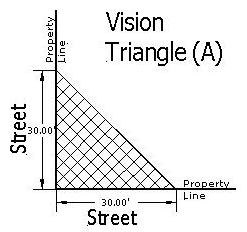
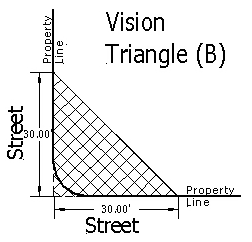
Vision triangle means the area created by drawing an imaginary line between points 30 feet back from where the property lines meet at two intersecting streets (vision triangle A). A vision triangle shall also be required where two perpendicular property lines do not form an intersecting angle. In this case, the projection of such property lines will be extended to a point of intersection, thereby, creating the vision triangle (vision triangle B).
 |  |
Walking advertiser sign means a sign attached to a human for the purpose of advertising or otherwise drawing attention to an individual, business, commodity, service or product. This can also include a person dressed in costume for the purpose of advertising or drawing attention to an individual, business, commodity, service or product.
Window sign means a permanent or temporary sign that is applied or attached to the interior of a window, which may be seen through the window from the exterior of the structure.
(Ord. No. 3724-11, § 1, 7-11-11; Ord. No. 4265-19, § 1, 4-22-19)
Sec. 102-282. - Required conditions.
(a)
Signs shall be classified in accordance with the regulations under each zoning district as set forth in this article.
(b)
In those districts where limitations are imposed by this chapter on the projection of signs from the face of any building or structure, such limitations shall not apply to identification marquee or canopy signs indicating only the name of the building or principal product or service available therein, provided that any identification sign located on a marquee or canopy shall be affixed flat to the surface thereof or suspended within and below the outer marquee or canopy limits except that no such suspended sign shall be lower than eight feet above the ground or surface over which the marquee or canopy is constructed. Further, no other sign shall extend beyond the limits of the marquee or canopy.
(c)
Signs on awnings shall be exempt from the limitations imposed by this chapter on the projection of signs from the face of the wall of any building or structure, provided that any sign located on an awning shall be affixed flat to the surface thereof, and shall indicate only the name, address, and/or the type of business of the establishment. Further, no such sign shall extend vertically or horizontally beyond the limits of the awning.
(d)
The area of each sign face shall be used in the calculation of permitted signage available for a sign.
(e)
No flashing sign of any type shall be permitted to be erected within 150 feet of an adjoining residential boundary line if such sign would be visible from such district.
(f)
No sign shall be painted, pasted or similarly posted directly on the surface of any wall, nor shall any sign be permitted to be placed on any wall, fence or standard facing the side of any adjoining lot located in any residential district.
(g)
All signs shall be erected within property lines of premises upon which they are located, except that signs attached to building facades in commercial and industrial districts may project no more than 36 inches from the face or wall of such building structure. All supporting members shall be concealed within the sign. No such sign shall suspend lower than eight feet above grade.
(h)
The following shall apply to all freestanding business signs:
(1)
All freestanding signs shall be erected within the property lines of the premises upon which they are located. No portion of a freestanding sign shall extend into, be erected, or placed in the right-of-way.
(2)
All structural pylons, supports, and sign base shall be set back ten feet from the property line and adhere to the sign requirements set forth within the zoning district.
(3)
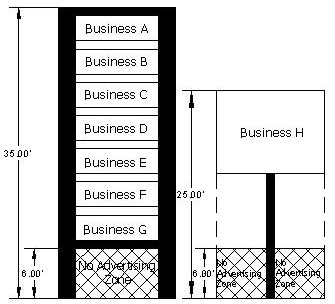
No portion of a freestanding sign shall suspend lower than six feet above grade in the area between the property line and the required ten-foot setback line and may not be placed within the vision triangle on a corner property for a distance of 30 feet from the intersecting property lines.
(i)
Individual directional signs designating entrances, exits and conditions of use of parking facilities accessory to the main use of the premises may be maintained provided they are located within the property lines of the zoning lot and do not exceed 24 square feet.
(j)
The following types of signs and attention-getting devices are prohibited unless they are specifically permitted by other sections of this chapter:
(1)
Signs which constitute a hazard to public health and safety, including, but not limited to, signs which interfere with, mislead, or confuse traffic by reason of placement, size, coloring, illumination, or singularly contain words such as, "stop", "look", "danger", "yield", or any similar words, phrases, symbols, lights, or characters commonly used to control traffic. No sign may imitate, resemble or obscure a traffic control device nor hide from view or interfere with the movement of traffic.
(2)
Vehicle signs, which are advertising or business signs attached to a motor vehicle or semi-trailer which is parked and placed in position for the primary purpose of displaying same to the public.
(3)
Temporary signs and attention-getting devices except as allowed and regulated under subsection (n), below.
(4)
Signs which contain statements, works or pictures of an obscene, indecent or immoral character, which will offend public morals and decency.
(5)
Advertise an activity, business, product or service no longer conducted on the premises upon which the sign is located.
(6)
Temporary signs or attention-getting devices that contain or consist of banners, posters, placards, pennants, ribbons, feather flags, streamers, strings of light bulbs or flags, a-frame signs, poster panels, spinners, signs attached to or on vehicles, inflatables or other similar devices.
(7)
Advertising signs and devices which direct attention to a business, commodity, service, entertainment or attraction sold, offered or existing elsewhere than upon the same lot where such sign is displayed unless they are specifically permitted by other sections of this chapter.
(k)
Signs and sign structures attached to the wall of any building shall not extend more than six feet above the roofline.
(l)
The following types of permanent signs are permitted within zoning districts as hereafter provided, and additionally, are not subject to permit except, however, that they shall meet any requirements incorporated in the following description:
(1)
Signs of a duly constituted governmental body, including traffic and similar regulatory devices, legal notices or warnings at railroad crossings.
(2)
Flags or emblems of political, civic, charitable, educational or religious organizations subject to the regulation and permission of the enforcing official.
(3)
Memorial signs or tablets.
(4)
Small signs displayed for the direction or convenience of the public, including signs which identify restrooms, freight entrances or the like, with a total surface area not exceeding ten square feet on any zoning lot, subject to the regulation and permission of the enforcing official.
(m)
The following types of temporary signs and attention-getting devices are permitted within zoning districts as hereafter provided, and additionally, are not subject to permit unless illuminated. They shall, however, meet any requirements incorporated in the following description:
(1)
Advertising signs in which the intent is not to relay a message or advertise beyond the extent of the property lines are allowed and do not require permits when the intent of the sign is for pedestrian traffic within the immediate vicinity. These signs cannot exceed six square feet per face and may not be placed on public sidewalks, right-of-ways, required parking, travel lanes, ingress/egress easements, or impede the Americans with Disabilities Act compliance.
(2)
Real estate signs not extending outside the property line and not more than 32 square feet per face in commercial zoning and industrial zoning districts and not more than one sign per lot frontage not to exceed five square feet in area per face in the RU, R1, R2, and R3A residential districts, and 12 square feet in the R3 and R4 districts.
(3)
Temporary signs denoting architect, engineer, or contractor when placed on construction sites and not exceeding 64 square feet in area, subject to regulation and permission of the enforcing official. Signs shall be removed within 14 days of the date when the building is turned over to the owner or when the construction is completed, whichever shall occur first.
(4)
Rummage sale or garage sale signs not exceeding five square feet in area. In addition, no such sign shall be displayed for more than five days, and shall not be on public property. Sign shall be immediately removed the day the sale ends.
(5)
Political campaign signs or posters announcing candidate seeking public office and/or political issues, and date pertinent thereto, not exceeding 32 square feet in area. Political signs shall not be displayed for more than 60 days and shall be removed within 72 hours after election. The signs shall not be placed on public property.
(6)
Window promotional signs not exceeding 50 percent of the total surface area of each window.
(7)
Signs required by a regulation of any governmental body having jurisdiction.
(8)
Developers' signs and off premises identification signs, no larger than 64 square feet, that advertise the intended use, sale, lease, rental or development of land and/or buildings on any particular premises, or directing attention to the location and/or opening of a residential subdivision, commercial, industrial or institutional development.
(9)
Temporary signs and attention-getting devices promoting special community activities, special events, or activities of nonprofit organizations are allowed. These activities may include an annual or semi-annual campaign special, unique or limited activity or service; a sign announcing an annual or semi-annual campaign, drive or event of a civic, philanthropic, educational, nonprofit or religious organization; indoor and outdoor art, craft and plant shows; Christmas tree sales; carnivals, circuses, fairs, rodeos and parades. Such temporary signs and attention-getting devices promoting the above events are allowed for 30 days prior to the event and must be removed within 72 hours after the occurrence of the event, and are subject to the following location restrictions:
a.
Set back from all property lines a distance of at least ten feet.
b.
No closer than one foot to any sidewalk.
c.
May not be placed within the vision triangle on a corner property for a distance of 30 feet from the intersecting property lines.
d.
May not face a parcel zoned residential with common lot lines.
(n)
All temporary signs and attention-getting devices, including banners, posters, placards, poster panels, inflatables, or other similar devices approved by the enforcing official, require a permit from the zoning office and are subject to the following regulations. The enforcing official has the right to revoke temporary signage permits that are in violation of the required conditions.
(1)
A single temporary sign or attention-getting device is permitted for a consecutive 30-day period during the first six months of business opening to promote grand openings, or for a consecutive 30-day period prior to a business closing. Such sign or attention-getting device may not advertise products or services, and should only direct attention to a grand opening or closing. Permits are required.
(2)
A single temporary sign or attention getting device is permitted, per business, for a consecutive 14-day period, not more than two times per calendar year, for the purpose of advertising special sales events or promotions. Permits are required.
(3)
Temporary signs and attention getting devices require a permit and may only be placed in the following locations:
a.
On an existing sign structure so that such sign or attention-getting device meets all sign height and location requirements for the zoning district in which it is located.
b.
On a building so that such sign or attention-getting device does not project out from the building or above the roof line.
c.
Not permitted in residential zoning districts.
d.
May not face a parcel zoned residential with common lot lines.
|
Illustration depicts temporary signage placement for signs within ten feet of a property
line with street frontage
|  |
(4)
Inflatables require a permit and may only be placed in the following locations:
a.
On an existing sign structure so that such inflatable meets all sign height and location requirements for the zoning district in which it is located.
b.
On the roof of the building or canopy in which the business is located.
c.
On the property in which the business is located, within the building setbacks, provided such inflatable does not reduce the required parking, ingress/egress, travel lanes, or impede the Americans with Disability Act compliance.
d.
May not face a parcel zoned residential with common lot lines.
(5)
No temporary signs or attention-getting devices shall be permitted with lights that flash, blink, or vary in intensity, and no temporary sign or attention-getting device shall be permitted with red, yellow, amber, or green lights.
(6)
All temporary signs and attention-getting devices must be anchored and supported in a manner which reasonably prevents the possibility of the signs becoming hazards to the public health and safety as determined by the enforcing official.
(7)
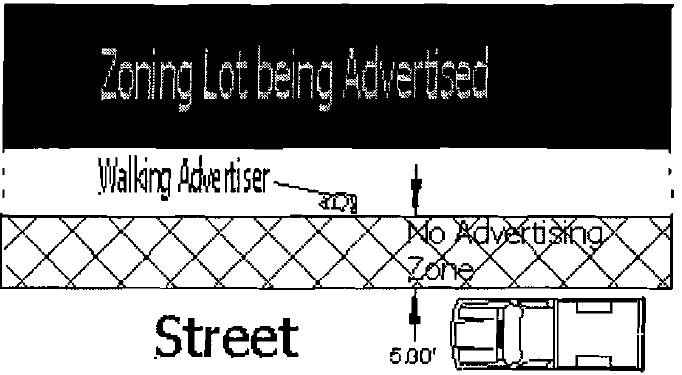
Temporary signs and attention-getting devices are not allowed on people for the purpose of outdoor advertising. Signage that is a permanent part of a person or mascot's costume is allowed and is subject to the following conditions for walking advertisers:
a.
Walking advertisers must remain on the zoning lot in which the business is located or in a location up to five feet away from the roadway adjacent to the zoning lot in which the business is located.
b.
Walking advertisers may not reduce the required parking, ingress/egress, travel lanes, impede the Americans with Disability Act compliance, or be located in the vision triangle on a corner property for a distance of 30 feet from the intersecting property lines.
c.
Permits are required and are subject to the allowances listed in subsection (n)(2) of this section.
d.
In instances of grand openings or closings, one walking advertiser is allowed in conjunction with one temporary sign or attention-getting device. Permits are required and are subject to the allowances listed in subsection (n)(1) of this section.
(8)
Temporary signs, attention-getting devices, and walking advertiser permit applications shall be accompanied by a detailed site plan, description of signage, and fee as prescribed by a fee schedule adopted by the city council.
(Ord. No. 3724-11, § 1, 7-11-11; Ord. No. 4187-17, 11-13-17; Ord. No. 4485-22, 6-13-22)
Sec. 102-283. - Residential districts.
In the residential districts, signs shall be regulated as follows:
(1)
Residential uses. Residential uses shall meet the following regulations:
a.
Single-family dwellings. For each dwelling unit, nameplates and identification signs indicating the name and address of the occupant not exceeding a total of two square feet in area. On a corner zoning lot, nameplates for identification signs shall be permitted for each dwelling unit, on each street side, but shall not impede the vision triangle.
b.
Multiple-family dwellings. For each multiple-family dwelling, identification signs indicating only the name and address of the building and the name of the management not exceeding a total of 32 square feet in area. Such signs may not be closer than eight feet to any other zoning lot. On a corner zoning lot, identification signs may be permitted on each street side, but shall not impede the vision triangle.
c.
No sign shall project higher than one story or 15 feet above the curb level, whichever is lower.
(2)
Nonresidential uses. Nonresidential uses shall meet the following requirements:
a.
Church bulletins, cemeteries, educational institutions, recreation and social facilities and other similar uses. Identification signs not exceeding a total of 64 square feet in area. Such signs may not be closer than eight feet to any other zoning lot. On a corner zoning lot, identification signs may be permitted on each street side.
b.
Agricultural projects. Signs advertising the sale of agricultural products grown or produced on the property not exceeding a total 16 square feet in area.
c.
Projection and height. No sign when attached to the wall of a building or structure shall project more than 18 inches from the wall to which it is attached. No sign shall project higher than one story or 20 feet above the curb level, whichever is lower.
(3)
For sale or for rent signs. In the RU, R1 and R2 residential districts no sign shall exceed five square feet in area. In the R3 and R4 residential districts no sign shall exceed 32 square feet in area. In all residential districts no sign shall be placed closer than eight feet to any other zoning lot.
(4)
Advertising signs. Advertising signs shall be prohibited in the residential districts.
(Ord. No. 3724-11, § 1, 7-11-11)
Sec. 102-284. - Commercial districts.
In the commercial districts, signs shall be regulated as follows:
(1)
CN district. In the CN district business signs are permitted in accordance with the following conditions:
a.
Residential uses. The regulations covering the use of signs for residential buildings in the CN district shall be the same as in the residential districts.
b.
Nonresidential uses. In the CN district non-flashing business signs are permitted, subject to the following conditions:
1.
Area. The gross area in square feet of all business signs on a zoning lot shall not exceed one times the linear feet of a street frontage on such zoning lot, and no more than 50 percent of this gross area shall be in a freestanding business sign shall be permitted for each street frontage of a zoning lot, except as provided in subsection (1)c. of this section.
2.
Projection. No sign when attached to the wall of a building or structure shall project more than 36 inches from the face of the wall of such building or structure.
3.
Height. No free standing sign shall project higher than eight feet above curb level.
c.
Advertising signs. Advertising signs shall be prohibited in the CN districts.
(2)
CR, CG and CO districts. In the CR, CG, and CO districts, business signs are permitted subject to the following provisions:
a.
Business signs.
1.
The gross area in square feet of all business signs on a zoning lot shall not exceed three times the linear feet of street frontage on such zoning lot.
2.
No more than 75 percent of the gross sign area, as indicated in subsection (2)a1 of this section shall be in a freestanding sign.
3.
Only one freestanding sign shall be permitted per zoning lot, except when a business has more than one frontage. The restrictions on the number of signs and sign area shall apply independently to each frontage; however, the maximum allowable sign area shall apply to only one frontage at the applicant's option and the maximum allowable sign area on any other frontage shall be one times that frontage. Excess area cannot be transferred from one frontage to another.
4.
No sign when attached to the wall of a building or structure shall project more than 60 inches from the face of the wall of such building.
5.
All freestanding signs shall not project higher than what is allowed, based on the linear feet of street frontage of the location where the sign is being placed:
a.
Linear feet of street frontage less than or equal to 200 feet, the maximum allowable height of a freestanding sign is eight feet above grade level, or above the adjacent roadway as measured from the top of the curb nearest the freestanding sign location, whichever is taller.
b.
Linear feet of street frontage greater than 200 feet and less than or equal to 400 feet, the maximum allowable height of a freestanding sign is 15 feet above curb level, or above the adjacent roadway as measured from the top of the curb nearest the freestanding sign location, whichever is taller.
c.
Linear feet of street frontage greater than 400 feet, the maximum allowable height of a freestanding sign is 25 feet above curb level, or above the adjacent roadway as measured from the top of the curb nearest the freestanding sign location, whichever is taller.
Commercial lots that have multiple businesses may exceed the maximum allowable freestanding sign height, based on the linear feet of street frontage (a, b, or c above), two feet per additional business. The maximum allowable height of the freestanding sign for commercial lots with multiple businesses shall not exceed 35 feet.
6.
A freestanding sign or base shall be enclosed, and pole supports shall not be visible. The material for the sign base shall include a base constructed of brick, stone, or masonry materials, and be matched in type and color to these materials used on the buildings on the premises if such materials are present. The area of the sign base shall be no less than 50 percent of the width of the sign.
7.
All freestanding business signs shall provide landscaping, which shall include some combination of live planted shrubs and flowers. The landscaped area shall be mounded or elevated, and protected from automobile traffic by curbing or some other effective barrier to the passage of automobiles. The base for the landscaped area shall be masonry materials and/or be matched in type and color to the materials used on the buildings on the premises if such materials are present.
8.
Existing signs may be refaced if using the existing frame. Signs that have been structurally altered by fire, act of God, by accident, or signs that are altered in size or additions to the existing structure shall be required to comply with subsections 102-284(2)a.5., 6. and 7.
9.
Electronic graphic display or digital signs are only permitted in CR and CG zoning districts, or for educational, religious, and governmental institutions.
a.
Electronic graphic display or digital signs shall not exceed a total of 64 square feet, and any off-site advertising is only permitted by special use permit.
b.
No more than one electronic graphic display or digital sign is permitted on a zoning lot for a single business use subject to subsection (2)a.10.
10.
Operation of electronic graphic display or digital signs.
a.
All illumination may consist of full color or monochrome, but shall not be overly vivid.
b.
The message shall not flash, scroll or scintillate.
c.
Illumination representing movement or animation shall be prohibited.
d.
Any message shall be displayed for a minimum of ten seconds. And, the electronic graphic display or digital sign shall be equipped with photosensitive equipment which automatically adjusts the brightness and contrast of the sign in direct relation to the ambient outdoor illumination, so as not to create a traffic hazard for operation of motor vehicles, or create a nuisance.
e.
Electronic graphic display or digital signs shall comply with subsections 102-282(j)(1), (4), (5) and (7).
f.
Existing electronic graphic display or digital signs, pre-dating the adoption of this section, shall be permitted to be repaired.
(Ord. No. 3724-11, § 1, 7-11-11; Ord. No. 4187-17, 11-13-17; Ord. No. 4733-25, 8-20-25)
Sec. 102-285. - Industrial districts.
In the industrial district, signs shall be regulated as follows:
IL, IG and IH districts. In the IL and IG districts, business signs are permitted subject to the same conditions as the CR and CG districts.
(Ord. No. 3724-11, § 1, 7-11-11)
Sec. 102-286. - Oversize signs to require council approval.
A special use permit is required for any outdoor signs over 600 square feet, or any outdoor sign of an irregular shape.
(Ord. No. 3724-11, § 1, 7-11-11)
Sec. 102-287. - Inspection, maintenance and enforcement.
(a)
Inspection. Signs for which a permit is required may be inspected periodically by the enforcement officer or his agents, for compliance with this chapter and other codes of the city.
(b)
Maintenance. All signs and components thereof shall be kept in good repair and in safe, neat, clean and attractive condition.
(c)
Enforcement.
(1)
Permanent signs. The enforcement officer or his agents may order the removal of any sign erected or maintained in violation of this chapter. He shall prepare a notice which shall describe the sign and specify the violation involved, and which shall state that if the sign is not removed or the violation corrected within 15 days, the sign shall be removed by the city. Such notice may be mailed by certified mail, or hand delivered, with a return receipt required in either case. Any time period provided in this section shall commence on the date of receipt of the notice, as attested by the date of the return receipt. All costs incurred by the city in removing such a sign shall be paid by the sign owner.
(2)
Any signs erected in public right-of-way, in violation of this chapter, shall be considered public property and shall be summarily removed and disposed of. Garage sale signs, real estate signs, political and public issue signs, and any other signs not requiring a permit that are erected or maintained on private property in violation of this chapter shall be subject to a three-day notice to remove, under the procedure described in subsection (c)(1) of this section.
(3)
Temporary signs and attention-getting devices not described in subsection (c)(2) of this section which are in violation of the provisions set forth in section 102-282 of this article are subject to the following enforcement:
a.
First offense. Written warning provided by enforcing official which shall state that sign(s) must be removed or a permit obtained subject to the conditions of section 102-282 of this article within 72 hours.
b.
Failure to comply with subsection (c)(3)a. of this section or a second offense will result in the permit fee to be doubled.
c.
Continued violations of subsections (c)(3)a. or (c)(3)b. of this section will result in forfeiture of the right to obtain temporary signage or attention-getting device permits for one calendar year and the matter will be referred to an administrative hearing where the city will seek the maximum fine of up to $10,000.00 plus hearing fees.
(d)
Emergency. The enforcement officer or his agents may remove a sign immediately and without notice when, in his opinion, the condition of the sign or structure is defective or dangerous or the placement of the sign is dangerous so as to present an immediate threat to the safety of the public. Any sign removed shall be at the expense of the owner of the sign or the owner of the property, and shall become the property of the city, and may be disposed of in any manner deemed appropriate and authorized by state statute.
(e)
Abandoned signs. Abandoned signs shall be removed by the owner or lessee of the premises upon which the sign is located within ten days from the date on which it is determined to be such an abandoned sign. If the owner or lessee fails to remove the sign, the enforcement officer shall proceed as set forth in subsection (c)(1) of this section. Failure to remove the sign after service of the written notice as in subsection (c)(1) of this section shall be just cause for the enforcement officer to act as provided in subsection (d) of this section.
(Ord. No. 3724-11, § 1, 7-11-11)
Sec. 102-288. - Billboards.
(a)
Purpose and intent. The city recognizes that billboards are, by their nature, different in scope and purpose from other types of signage in the city. Among other matters, billboards advertise or communicate goods, services, or messages not conducted, sold, or generated on the lot where the billboard is located. Billboards are significantly larger in size than other types of signage allowed in the city and their principal purpose is to dramatically attract the attention of the travelling public. The potential impact of a billboard on adjacent areas is significantly greater than other types of signage. Newer technologies permit billboards to change electronically, utilizing LED or digital type signage. These new technologies have the potential impact of adversely dominating the environment in which they operate due to the light spillover, and light pollution, unless regulated in a reasonable fashion. The intent of this section is to establish size, location, and operating standards and regulations for the modification or alteration of existing billboards, addressing those utilizing these new technologies in order to minimize the secondary effects that can accompany the unregulated display of these types of signs. By regulating the modification or alterations to existing billboards the city is: protecting the character and repose of adjacent areas (with a principal focus on residential neighborhoods), protecting property values in all areas of the city, and reducing traffic and similar hazards caused by undue distractions. The regulations implemented here are intended to generate more attention and advertise more information in less space.
(b)
Billboard regulations.
(1)
The total number of billboards shall not exceed the total number of billboards legally existing in the commercial and industrial districts on the adoption date of the ordinance from which this section derived. All replacement billboards shall comply with the regulations of this section.
(2)
Billboards are permitted to be replaced on a billboard-by-billboard basis. The total square foot area of a proposed billboard shall not exceed the total square foot area of a removed billboard.
(3)
Upon removal of an existing billboard, excluding those billboards located within residential districts, the city shall credit the billboard owner the right to obtain one replacement billboard. The credited replacement billboard shall not exceed the number of sign faces and the amount of square footage of the removed billboard. The removal of two single sign face billboards may be credited towards obtaining a double-face billboard (back to back).
(4)
Maximum height of a sign structure including sign face shall be 35 feet above the natural grade of the ground on which the billboard is located with a minimum ground clearance of ten feet.
(5)
Maximum size is 382 square feet. Billboards shall be a minimum of 72 square feet.
(c)
Location and separation requirements.
(1)
Only one, double-faced billboard is permitted per zoning lot. A double-faced sign constitutes two billboards for the purpose of this section.
(2)
Signs must be spaced a minimum of 1,000 feet apart, as measured in a direct line in any direction from where a billboard is proposed or located, and ½ mile down any right-of-way from where a billboard is proposed or located.
(3)
Billboards shall be placed so as not to be in a direct line to block the view of signage on adjacent property from adjacent rights-of-way. All applications for billboard alteration or relocation shall be certified by the applicant as meeting this provision.
(4)
Billboards shall not be located closer than 25 feet from an intersection corner measured from the corner of the property lines.
(5)
Billboards may not be located closer than 200 feet to a residential district or any public park measured in any direction from where the billboard is proposed or located.
(6)
All permit applications for the construction and erection of a billboard shall be accompanied by a survey prepared by a registered land surveyor identifying the placement of the proposed billboard and location of all structures and signage located on the property.
(d)
Special use. The city council, at their discretion, may, following a hearing by the zoning board, grant a special use permit. A special use permit is required for the following:
(1)
Billboards greater than 382 square feet up to 680 square feet.
(2)
The modification or replacement of an existing, legally nonconforming or conforming billboard to an electronic graphic display billboard should the council determine that the findings of fact in subsection (3) below have been satisfied, and the location, size and design of the proposed billboard will not have a detrimental effect on the privacy, use, light or enjoyment of any nearby properties. Additionally, requires the removal of a minimum of two existing billboards, with a double-faced billboard accounting for two separate billboards.
(3)
For the zoning board to recommend an approval of a special use permit, it must find that each of the following items are met:
a.
The establishment, maintenance or operation of the special use permit will not be detrimental to or endanger the public health, safety, morals, comfort or general welfare.
b.
The special use permit will not be injurious to the use and enjoyment of other property in the immediate vicinity nor substantially diminish or impair property values within the neighborhood.
c.
The establishment of the special use will not impede the normal or orderly development and improvement of the surrounding property for uses permitted in the district.
d.
The special use must, in all other respects, conform to the applicable regulations of the district in which it is located.
(e)
Nonconforming billboards. All billboards existing at the time of adoption of the ordinance from which this section derived that do not conform to the provisions herein shall be considered nonconforming and may continue as hereinafter prescribed:
(1)
If the structure or size of the sign is altered in any way, the alterations must be made towards compliance with this section.
(2)
If the sign fails to meet the standards of the International Property Maintenance Code as adopted by the city, based on inspection, the sign must be brought into compliance with the ordinance or removed.
(3)
Nonconforming billboards that are not self-illuminated at the time of adoption of the ordinance from which this section derived shall not be permitted to be illuminated.
(f)
Removal of billboards.
(1)
Whenever the zoning officer finds that any billboard on the authorized list is abandoned and whether or not it has deteriorated more than 50 percent, the zoning officer shall notify the owner thereof and order said billboard be removed within 30 days. All billboards ordered to be removed shall be stricken from the authorized list of billboards and shall not be credited a replacement billboard. The term abandoned shall include sign faces that have not had active advertising for a period of four months or greater, (active advertising does not include the self-advertising of the billboard owner or company). The city will provide notice of impending abandonment which will allow 30 calendar days for the billboard owner to remedy said abandonment or provide evidence on non-abandonment within ten calendar days of the notice. Any new billboards shall comply with the requirements of this section.
(2)
Whenever the city finds that any billboard on the authorized list is in structural disrepair and whether or not it has deteriorated more than 50 percent, the zoning officer shall notify the owner thereof and order him to repair the billboard within a specified amount of time not less than ten calendar days unless the condition requiring repairs is endangering the public, at which time repairs may be required immediately. If the city finds that the billboard has not been repaired within the specified time in the repair notice, the zoning officer shall notify the owner of the billboard and the owner of real property on which said billboard is located to remove the billboard from the property within 30 days. All billboards ordered to be removed shall be stricken from the authorized list of billboards and shall not be credited a replacement billboard.
(g)
Billboard license required.
(1)
All billboards are required to be licensed and registered with the city and the billboard owner shall file a business registration form and license application and said application shall be accompanied by a payment in accordance with section 102-289.
(2)
All billboards shall renew said license annually in accordance to the regulations above by January 31 of each subsequent year.
(3)
Upon the approval of a billboard permit, construction of the billboard and final inspection with approval by the city of each relocated billboard, the billboard owner, within 15 days, shall apply for a billboard license for said billboard.
(4)
All billboards licensed by the city shall be required to post an identification tag provided by the city with the corresponding license number on the tag.
(5)
Failure to obtain a current license will result in the billboard being determined as abandoned.
(6)
The city will compile and maintain an authorized list of billboards within the city. The city will inspect each billboard annually and as needed to ensure that the provisions of this section are enforced.
(h)
Mobile signs.
(1)
Stationary mobile signs are billboards as defined in this chapter and must submit to all applicable regulations including, but not limited to, licensing requirements and the limitation placed on the total number of billboards within the city limits.
(Ord. No. 4265-19, § 2, 4-22-19)

