
Loxahatchee Groves City Zoning Code
PART III
SUPPLEMENTAL REGULATIONS
Article 85 - LANDSCAPING[1]
Editor's note— Ord. No. 2018-09 , § 3(Exh. A), adopted Sept. 7, 2018, repealed the former Art. 85, §§ 85-005—85-075. Exhibit B of said ordinance enacted a new Art. 85 as set out herein. The former Art. 85 pertained to similar subject matter and derived from the Unified Land Development Code adopted on November 16, 2010.
Cross reference— Native tree preservation and invasive exotic removal, § 87-005 et seq.
Article 87 - NATIVE TREE PRESERVATION AND INVASIVE EXOTIC REMOVAL[1]
Editor's note— Ord. No. 2019-03 , § 3(Exh. A), adopted July 9, 2019, repealed the former Art. 87, §§ 87-005—87-040. Exhibit B of said ordinance enacted a new Art. 87 as set out herein. The former Art. 87 pertained to native tree preservation, soil stabilization and invasive exotic removal and derived from Ord. No. 2010-008, § 2(Exh. A, §§ 1—8), adopted Oct. 5, 2010.
Cross reference— Landscaping, § 85-005 et seq.
Section 45-005.- Purpose and intent.
(A)
The purpose and intent of this article is to:
(1)
Establish and define minimum standards for the proper care and maintenance of public and private properties within the Town of Loxahatchee Groves including the canals contiguous to such lands.
(2)
Provide an environment visually free of inoperable and unregistered vehicles and vessels; derelict aircraft; litter; garbage; debris; trash; unmaintained buildings or structures.
(3)
Encourage property owners to take reasonable precautions to prevent, discourage, or eliminate unauthorized dumping of vehicles and vessels, derelict aircraft, litter, garbage, debris, and trash.
(4)
Require owners of real and personal property to be responsible for the costs of removal of inoperable and unregistered vehicles and vessels, derelict aircraft, litter, garbage, debris, trash, and proper maintenance of buildings and structures.
(5)
Protect the public's health, safety and welfare and enhance property values and the quality of life in the Town.
(B)
This article shall not be construed to:
(1)
Prohibit the collection of garbage or recyclable materials in authorized receptacles for collection by authorized garbage and trash collectors.
(2)
Prohibit, restrict, regulate, or otherwise limit any activity of a bona fide agricultural use provided that the activity has not been determined to be a nuisance pursuant to Article 50, "Public nuisances" and the activity is regulated through implemented best management practices or interim measures developed by the Florida Department of Environmental Protection, the Florida Department of Agriculture and Consumer Services, or water management districts and adopted under F.S. ch. 120, as may be amended from time to time, as part of a statewide or regional program.
Section 45-010. - Duty to maintain property.
(A)
It shall be the responsibility of all property owners in the Town to maintain their property free of uncontained litter, garbage, non-vegetative debris and trash.
(B)
A maximum of three inoperable and unregistered vehicles and/or derelict aircraft, and other junk items may be kept on residential property only in a manner so that the junk is not visible from other public or private property and does not create a health, safety or environmental hazard. Such storage shall only be permitted as an accessory use and all inoperable and unregistered vehicles shall have all of their fluids drained and properly disposed. Any additional number of inoperable and unregistered vehicles or derelict aircraft above three shall be stored in a completely enclosed structure.
(C)
It shall be the responsibility of all property owners of developed land to maintain buildings or structures on their property in a state of good repair. "State of good repair" shall mean the following:
(1)
Color. All residential buildings and structures shall be maintained free of graffiti and free of obvious defects that may affect the health, safety and welfare of the community.
(2)
Doors and windows. All door and window openings of all buildings and structures in any zoning district shall be covered by windows and doors that are in working order with no obvious defects that may affect the health, safety and welfare of the community. This regulation shall not apply to barns, which shall be exempt from this provision.
(3)
Materials. Any accessory structure on a plot shall be maintained free of visual disrepair, including but not limited to, bent, broken, cut or missing materials.
Section 50-005.- Purpose and intent.
The purpose and intent of this section is to regulate possible nuisances, such as excessive noise, visual detractions or eyesores, odors, vibration, and outdoor lighting which could interfere with the peaceful enjoyment of land.
Section 50-010. - Excessive noise.
(A)
The following are prohibited in the Town in that such activities create excessive noise.
(1)
Any use, activity or operation which generates a sound level of 55 dB or greater on any surrounding property between the hours of 7:00 a.m. and 10:00 p.m.
(2)
Any use, activity, or operation which generates a sound level of 50 dB on any surrounding property between the hours of 10:00 p.m. and 7:00 a.m.
(3)
Any use, activity or operation that creates a sound level in excess of the foregoing limits for more than ten percent of any time period of not less than ten minutes, shall be a violation of these regulations.
(B)
Sound Level Measurement Compliance shall be determined using a Type 2 or equivalent sound level meter using the A Weighting Scale in accordance with the standards of the American National Standards Institute (ANSI). All measurements shall be made with a sound meter at the required structural setbacks of the property of the landowner filing the complaint.
(C)
The following exceptions apply:
(1)
Outdoor events (operating with a valid permit)
(2)
Government sanctioned activities (e.g., parades, Town celebrations)
(3)
Temporary, Portable Generators used only during periods of electrical power outages in utility distribution systems maintained by the utility service provider.
(4)
Sound generated from motor vehicles legally operating on any public right-of-way regulated by F.S. ch. 316, (Uniform Traffic Control Law).
Section 50-015. - Visual detractions or eyesores.
(A)
The following are prohibited as public nuisances in that such items create a visual detraction or eyesore to the community, create an attractive nuisance to children, lead to the further accumulation of junk, garbage, trash, litter and debris, contribute to the deterioration of both residential and nonresidential areas, or jeopardize the public's health, safety or welfare.
(1)
Unauthorized storage and dumping of junk vehicles and vessels, derelict aircraft, junk items, debris, garbage, trash and litter.
(2)
All buildings and structures maintained in a state of obvious poor repair.
(3)
Any operation in which the following conditions exist:
a.
The presence of untreated or improperly treated human waste, garbage, offal, dead animals, dangerous waste materials, or gases that are harmful to human or animal life.
b.
The presence of improperly built or improperly maintained septic tanks or toilets.
c.
The keeping of diseased animals that are dangerous to human health, unless such animals are kept in accordance with a current state or federal disease control program.
d.
The presence of unsanitary places where animals are slaughtered, which may give rise to diseases that are harmful to human or animal life.
Section 50-020. - Vibration.
In all districts, no use shall operate nor any activity take place so as to produce vibration noticeable by a person of reasonable sensitivity at the property line, including bass emanating from audio speakers.
Section 50-025. - Objectionable odors.
No person shall cause, suffer, allow or commit the discharge of air pollutants which contribute to an objectionable odor in accordance with Rule 62-296.320(2) F.A.C., as may be amended from time to time.
Section 50-030. - Outdoor lighting.
(A)
Purpose and intent. The purpose and intent of this section is to preserve, protect, and enhance the lawful nighttime use and enjoyment of any and all property through the use of appropriate lighting practices and systems. Furthermore, it is to preserve the rural character of the Town of Loxahatchee Groves and promote the health, safety and welfare of the residents by establishing maximum intensities of lighting and controlling glare from lighting fixtures. The provisions of this section shall apply to all outdoor lighting from an artificial light source.
(B)
Definitions. In addition to terms defined in Article 10, "Definitions, Abbreviations, and Construction of Terms", the following words, terms and phrases, when used in this article, shall have the meanings ascribed to them in this subsection, except where the context clearly indicates a different meaning. In the absence of a specific technical definition, words and phrases shall have those definitions and meanings as provided by the Illuminating Engineering Society of North America.
(1)
Athletic field lighting. Any lighting greater than 35 feet in height utilized to illuminate sports facilities.
(2)
Area light. Light that produces more than 1,800 lumens.
(3)
Cutoff, full. A lighting fixture that emits zero percent of its light above 90 degrees and only ten percent above 80 degrees from horizontal.
(4)
Floodlight. Any light that produces no more than 1,800 lumens in a broad beam designed to saturate or illuminate a given area with light. Generally, flood lights produce from 1,000 to 1,800 lumens. Floodlights are directional fixtures.
(5)
Glare. The sensation produced by lighting that results in annoyance, discomfort or a reduction of visual performance and visibility, and includes direct and reflected glare. All directional fixtures and any fixture with an output of more than 1,800 lumens that is visible, either directly or by reflection, from adjacent properties or streets shall be considered to cause glare.
(6)
Open air parking. Open air parking shall be synonymous with the term vehicular use area, as defined in ULDC Section 85-015(EE).
(7)
Outdoor lighting. Lighting located outside of an enclosed building, or otherwise installed in a manner that lights any area other than the inside of an enclosed building.
(8)
Residential and agricultural recreational lighting. Fixtures of a type or intensity designed or used to light sports courts or equestrian riding areas.
(9)
Spotlight. Any lighting assembly designed to direct the output of a contained lamp in a specific, narrow and focused beam, with a reflector located external to the lamp. Spotlights are directional fixtures.
(10)
Stadium lighting. See the definition for "athletic field lighting."
(11)
Temporary lighting. Portable lights used for a special purpose, on a temporary and rare or infrequent basis, limited to motor vehicle lights during the normal operation of the vehicles, emergency services lights and handheld flashlights and spotlights.
(12)
Uplighting. Light projected above the horizontal plane formed by the top of fixture.
(C)
Prohibited outdoor lighting. The following types of outdoor lighting are not permitted in the Town of Loxahatchee Groves.
(1)
Uplighting, unless limited to 1,000 lumens and either shielded by an architectural overhang or landscape element or used to illuminate the flag of the United States of America.
(2)
Area lights other than those with full cutoff fixtures.
(3)
Lighting that results in glare onto adjacent properties or streets.
(4)
Athletic field lighting.
(5)
Street lights within residential zoning districts, except as determined necessary by the Town Council to protect public health, safety and welfare based upon consideration of traffic volumes and roadway conditions.
(D)
Outdoor lighting standards. All applications for a development permit, submitted after the effective date of this Code, shall comply with the following standards.
(1)
The overspill of light originating from any plot, regardless of zoning, onto any other plot or street located within a residential zoning district in the Town shall not exceed one-tenth horizontal foot-candle measured at grade level at the property line.
(2)
All non-residential/non-agricultural (Refer to Section 85-015(U) for definition) open air parking areas shall be lighted in compliance with the minimum standards established by the Illuminating Engineering Society of North America, using cutoff lighting with a maximum height of 25 feet. For purposes of this provision, "vehicular use area" does not include streets.
(3)
Vegetation screens shall not be employed as the primary means for controlling glare. Glare control shall be achieved primarily through the use of cutoff fixtures, shields and baffles, and the appropriate application of fixture mounting height, lighting intensity, placement and angle.
(4)
For development in districts other than Agricultural Residential, electrical feeds for all pole mounted fixtures installed after the effective date of this Code shall run underground, not overhead.
(5)
Open air parking lighting shall be controlled by automatic devices that extinguish the lighting between 11:00 p.m. and dawn.
(6)
Outdoor lighting for non-exempt agricultural or residential uses that exceeds 1,800 lumens per fixture shall be full cutoff fixtures, unless otherwise permitted by the Town prior to installation.
(7)
Outdoor lighting for non-exempt agricultural or residential uses that exceeds 1,800 lumens per fixture and all residential and non-exempt agricultural recreational lighting shall be approved by the Town prior to installation, in accordance with the procedures set forth for outdoor lighting permits for nonresidential uses set forth in Section (F) below.
(E)
Nonconforming outdoor lighting. Nonconforming outdoor lighting legally installed prior to November 1, 2010 is exempt from this section, except that approval of any application for a development permit that seeks to increase the existing total square footage of structures on a residential plot by 50 percent or more shall require that all lighting on site be brought into compliance with these regulations. Lighting illegally installed that does not conform to all of the provisions of this section shall come into compliance within one years of the effective date of these regulations
(F)
Outdoor lighting permits for non-residential/non-agricultural uses. All outdoor lighting on non-residential/non-agricultural plots of greater than 4,000 lumens (separate fixture or combined) per plot shall be approved by the Town prior to installation.
(1)
Application. The application for an outdoor lighting permit shall be accompanied by a photometric plan, prepared by a licensed engineer, in sufficient detail to demonstrate compliance with these regulations, including mounting heights, fixture specifications, and isofootcandle plots for individual fixture installations or a ten by ten-foot luminance grid for multiple fixture installations. All photometric plans shall overlay a site plan showing all structures, vehicular use areas (open air parking areas) and walkways. The plan shall also show all on-site and off-site existing and proposed trees within 25 feet of any existing or proposed open air parking area light fixture along the property line that abuts a residential zoning district
(2)
Prior to final inspection and the subsequent issuance of a final approval of any outdoor lighting, a letter of compliance from a registered professional engineer shall be provided to the Town stating that the installation has been field checked and meets the requirements of these regulations.
(G)
[Inspection.] The Town reserves the right to conduct a post-installation nighttime inspection to verify compliance with the requirements of this section, and if appropriate, to require remedial action at no expense to the Town.
(H)
Maintenance. Lighting fixtures and ancillary equipment shall be maintained so as to always meet the requirements of this section.
( Ord. No. 2019-06 , § 3(Exh. A), 10-15-2019)
Section 50-035. - Roadside and trail vegetative nuisance prohibited.
(A)
All property owners within the Town are prohibited from allowing vegetation on their property from impacting any public road or Town Council designated equestrian trail within the Town.
(B)
All property owners within the Town shall be responsible for maintaining vegetation on their property in such a manner that the vegetation does not:
(1)
Grow over the graded or paved portion of any public roadway within the Town; or,
(2)
Grow over any Town Council designated equestrian trail within the Town.
( Ord. No. 2017-16 , § 2, 10-3-2017)
Section 55-005.- Purpose and findings.
The Town finds that alcoholic beverage establishments, which because of their very nature, are recognized as having serious objectionable characteristics particularly when several of them are concentrated in any given location, thereby having a deleterious effect upon adjacent properties. Special regulation of these uses is necessary to ensure that these adverse effects will not contribute to the blighting and downgrading of surrounding properties. The regulations contained in this article shall apply in addition to other requirements or limitations of this Code.
Section 55-010. - Separation requirements.
Alcoholic beverage establishments shall be located at least 750 linear feet from any other such establishment, education center, place of worship, or child care center.
(A)
Distance separation requirements shall not apply if one or both of the two establishments are an alcoholic beverage establishment within a principal use; or an alcoholic beverage establishment operated as part of a permitted outdoor event.
(B)
The required distance separation shall be measured and computed by following a straight line from the nearest point of the existing building or structure, or part thereof, in which any other such establishment, education center, place of worship or child care center is located or has received approval to locate, to the nearest point of the building or structure, or part thereof, in which an alcoholic beverage establishment is proposed to be located.
(C)
For the purpose of determining the distance between alcoholic beverage establishments and places of worship, educational centers, child care centers, and other alcoholic beverage establishments, the applicant for such use shall furnish a certified survey from a land surveyor registered in the State of Florida, indicating the distance between the proposed establishment and any place of worship, education center, child care center and any existing alcoholic beverage establishment. The survey shall indicate the shortest distance as measured and computed in the manner set forth herein. In case there are no places of worship, educational centers, child care centers or existing alcoholic beverage establishments within the distances set forth herein, the survey shall so certify.
(D)
If the proposed establishment is to be located within a single building or structure containing multiple tenants, which includes an existing alcoholic beverage establishment, educational center, place of worship or child care center, the required distances shall be measured and computed by utilizing the main entrances of the proposed establishment and the existing alcoholic beverage establishment, educational center, place of worship or child care center therein.
Section 55-015. - Existing alcoholic beverage establishments.
(A)
Where an alcoholic beverage establishment is located in conformity with the provisions of this article, the subsequent locating of a place of worship, educational center or child care center within 750 linear feet of the existing alcoholic beverage establishment shall not be construed to cause such establishment to be in violation of this article or to be considered a nonconforming use.
(B)
Except as provided above, any existing alcoholic beverage establishment which does not conform to the provisions of this article but which conformed to the regulations in effect when such establishment began operating and which was approved through the issuance of a zoning certificate, certificate of use or occupational license shall be considered a legal nonconforming use, subject to the provisions of Article 75, "Nonconforming Uses, Structures, and Plots."
Section 60-005.- Purpose and intent.
The regulations and requirements of this section are intended to achieve the following:
(A)
Promote the health, safety and general welfare of the citizens by regulating the siting of telecommunications towers and antennas within the Town; and ensure compliance with all applicable federal statutory requirements;
(B)
Provide for the appropriate location and development of telecommunications towers and antennas within the Town;
(C)
Minimize adverse visual effects of telecommunications towers and antennas through careful design, siting, landscaping, screening and innovative camouflaging techniques;
(D)
Avoid potential damage to adjacent properties from tower failure through engineering and careful siting of tower structures; and
(E)
Protect residential areas and land uses from potential adverse impacts of telecommunication towers and antennas by maximizing use of any new or existing telecommunications towers through shared use, i.e., co-location, and combining to reduce the number of towers needed.
Section 60-010. - Definitions.
The following words, terms and phrases, when used in this section, shall have the meaning ascribed to them in this section, except where the context clearly indicates a different meaning:
(A)
Accessory use. A use incidental to, subordinate to, and subservient to the main use of the property.
(B)
Antenna. A transmitting and/or receiving device and/or relays used for wireless services that radiates or captures electromagnetic waves, including directional antennas, such as panel and microwave dish antennas, and omni-directional antennas, such as whips, excluding radar antennas, amateur radio antennas and satellite earth stations.
(C)
Antenna support structure. Any building or structure, other than a tower, that can be used for location of telecommunications facilities.
(D)
Combined antenna. An antenna or an array of antennas designed and utilized to provide services for more than one carrier.
(E)
Extraordinary conditions. Subsequent to a hurricane, flood, or other natural hazard or subsequent to a defective finding on a previous inspection.
(F)
Guyed tower. A telecommunications tower that is supported, in whole or in part, by guy wires and ground anchors.
(G)
Master Microcell facility. A telecommunications facility consisting of an antenna (as defined above) and related equipment which is located either on a telecommunications tower or affixed to a structure in some fashion for the provision of wireless services.
(H)
Microwave dish antenna. A dish-like antenna used to link wireless service sites together by wireless transmission of voice or data.
(I)
Monopole tower. A telecommunications tower consisting of a single pole or spire self-supported by a permanent foundation, constructed without guy wires and ground anchors.
(J)
Panel antenna. An array of antennas designed to concentrate a radio signal in a particular area.
(K)
Roofline. The overall ridge line of the structure which does not include cupolas, elevator towers, clock towers or other features that are permitted to exceed the maximum height of the structure.
(L)
Self-support lattice tower. A tapered structure broad at the base and narrower at the top consisting of cross-members and diagonal bracing and without guyed support.
(M)
Stealth facility. Any telecommunications facility which is designed to blend into the surrounding environment. Examples of stealth facilities include architecturally screened roof mounted antennas, antennas integrated into architectural elements, and telecommunication and/or wireless services towers designed to look like light poles, flag poles, power poles, trees or other similar structures.
(N)
Stealth/camouflaged monopole. A telecommunication tower consisting of a single pole or spire self-supported by a permanent foundation, constructed without guy wires and ground anchors and designed to blend into the surrounding environment. Examples of stealth/camouflaged monopole towers telecommunication and/or wireless services towers designed to look like light poles, flag poles, power poles or trees.
(O)
Telecommunication facility. A combination of equipment which is located either upon a telecommunication tower or a structure which includes some form of antenna for the purpose of transmitting and receiving wireless services.
(P)
Telecommunications tower. A stealth/camouflaged monopole, monopole, self support/lattice, or guyed tower, constructed as a free-standing structure, containing one or more antennas, used in the provision of wireless services, excluding radar towers, amateur radio support structures licensed by the Federal Communications Commission (FCC), private home use of satellite dishes and television antennas and satellite earth stations installed in accordance with applicable needs.
(Q)
Whip antenna. A cylindrical antenna that transmits and/or receives signals in 360 degrees.
Section 60-015. - Hierarchy of siting freestanding telecommunication towers.
(A)
Freestanding telecommunication towers shall be located in the following order of hierarchy:
(1)
Town owned property (within any zoning district).
(2)
Institutional and Public Facilities (IPF) zoning district.
(3)
Commercial Low (CL) zoning district.
(4)
Commercial Low Office (CLO) zoning district.
(5)
Agricultural Residential (AR) zoning district.
Section 60-020. - Siting of towers on Town owned property.
(A)
Town owned property within any zoning district shall take preference over any other property. Freestanding telecommunications towers shall be deemed a permitted use on any Town owned property in accordance with an executed lease agreement acceptable to the Town. The Town shall have no obligation whatsoever to execute such lease even if the applicant can meet the criteria set forth herein.
(B)
If the proposed site is other than Town owned property, the applicant shall provide an affidavit that demonstrates a need for the placement of the facility at that location and describes why any higher option in the hierarchy cannot be used in order to justify the selection of a location type lower in the hierarchy.
(C)
The Town may, as appropriate, to protect its property and the public interest establish additional requirements beyond the minimum requirements of a permit for Town owned property. Setback and distance requirements in the Town Code may be, modified to the extent necessary to provide for the public interest as determined by the Town Council. This provision further does not preclude the Town from issuing a letter of interest for the purposes of leasing sites on designated Town property for the construction and installation of telecommunications facilities. For designated Town owned property, the Town will encourage the installation of telecommunications facilities which have a minimal impact on the surrounding areas and are consistent with the development of the affected area.
Section 60-025. - Minimum standards for development of towers.
All telecommunications towers must meet the following minimum standards:
(A)
Tower types. To minimize adverse visual impacts, tower types shall be selected based upon the following hierarchy:
(1)
Stealth/camouflaged monopole.
(2)
Monopole.
(3)
Self-support/lattice tower.
(B)
Not permitted. Guyed towers shall not be permitted.
(C)
Selection based on hierarchy. The applicant shall be required to demonstrate, in a technical manner acceptable to the Town Council why each option in the hierarchy cannot be used for the particular application in order to justify the selection of a tower type lower in the hierarchy.
(D)
Capability of collocation. No new tower shall be built, constructed or erected in the Town unless such tower is capable of accommodating, at a future date, additional telecommunications facilities owned by other persons and the tower owners agree to comply with Section 60-075, "Existing towers." All new towers shall be designed and built to accommodate multiple users; at a minimum, stealth/camouflaged monopole and monopole towers shall be able to accommodate three users and at a minimum, self-support/lattice towers shall be able to accommodate four users. As wireless technology advances, applicants may be required to construct facilities utilizing advancing technologies including, but not limited to, combined antennas when determined necessary for health, safety, welfare, aesthetics, and compatible with provider's technical, capacity and coverage requirements. The applicant shall state in any application for permit that it will, as a condition of issuance of the permit, accommodate antenna facilities of other providers, on a nondiscriminatory basis on terms which are reasonable in the industry unless the applicant can affirmatively demonstrate, based on verifiable objective data, why it cannot do so. Refusal to continually comply with this obligation shall be a violation of this ordinance and shall be grounds for revoking applicant's permit.
(E)
Non-interference. The construction and placement of any tower shall not unnecessarily interfere with public safety communications and the usual customary transmission of or reception of radio and television service enjoyed by surrounding residential and nonresidential properties. In order to verify that this requirement has been met, a statement shall be prepared by a radio frequency (RF) licensed professional engineer or a radio frequency engineer who has at least a four year engineering degree, identifying any interference that may result from the proposed construction and placement of a telecommunications tower.
(F)
Access. A parcel of land upon which a tower is located must provide access during normal business hours to at least one paved or compacted and stabilized vehicle parking space adjacent to each tower location. Access to the tower shall be through a locked gate.
(G)
Emission standards. All proposed telecommunication towers shall comply with current radio frequency emissions standards of the Federal Communications Commission or other legally regulating body. Each application for a telecommunications tower may be required to include a statement that there is no objection from federal or state agencies that may regulate telecommunications tower siting, design and construction in order to verify that this requirement has been met.
Section 60-030. - Height, setbacks and related location requirements.
(A)
The height of a telecommunication tower shall not exceed 150 feet not including non-structural lightning rods and required safety lightning. Tower height shall be measured from the crown of the road of the nearest public street.
(B)
Telecommunication towers shall at a minimum conform with the setback established for the underlying zoning district.
(C)
Stealth/camouflaged monopole, monopole, or self-support/lattice telecommunication towers shall not be permitted in proximity to any plot in the Agricultural Residential (AR) zoning district that is within four times the height of the tower. By way of illustration, if the Tower is 150 feet, it must be at least 600 feet from any Agricultural Residential plot of land.
(D)
All buildings and other structures to be located on the same property as a telecommunications tower shall conform with the setbacks established for the underlying zoning district.
(E)
Waiver. This provision may be waived where it is determined that based upon site, location or facility, such waiver is in the best interest of the health, safety, welfare or aesthetics of the Town or compliance with other regulations, and in the best interest of telecommunication service to the community. Any waiver shall require four affirmative votes of the Town Council.
Section 60-035. - Buffering.
(A)
An eight foot high fence or wall, as measured from the finished grade of the site, shall be required around the tower and any accessory buildings or structures. In no case shall barbed wire or razor wire fencing be permitted.
(B)
Landscaping, consistent with the requirements of Section 85-050(B) shall be installed around the entire outside perimeter of any fence or wall. Additional landscaping may be required around the perimeter of a fence or wall and around any or all anchors or supports if deemed necessary to buffer in order to enhance compatibility with adjacent residential and nonresidential land uses.
(C)
Landscaping consistent with said Section 85-045 shall be installed around any accessory buildings or structures.
Section 60-040. - High voltage, "No Trespassing" and other warning signs.
(A)
If high voltage is necessary for the operation of the telecommunications tower or any accessory structures, "HIGH VOLTAGE-DANGER" warning signs shall be permanently attached to the fence or wall and shall be placed no more than 40 feet apart.
(B)
"NO TRESPASSING" warning signs shall be permanently attached to the fence or wall and shall be spaced no more than 40 feet apart.
(C)
The letter for the "HIGH VOLTAGE-DANGER" and "NO TRESPASSING" warning signs shall be at least six inches in height. The two warning signs may be combined into one sign. The warning signs shall be installed at least five feet above the finished grade of the fence.
(D)
The warning signs may be attached to freestanding poles if the content of the signs may be obstructed by landscaping.
(E)
Signs noting Federal Registration (if required) shall be attached to the tower structure in compliance with federal regulation.
Section 60-045. - Equipment storage.
Mobile or immobile equipment not used in direct support of a telecommunications facility shall not be stored or parked on the site of the telecommunications facility, unless repairs to the facility are being made. Portable emergency generators may be temporarily located at a telecommunications facility in the event of a power outage but must be removed upon resumption of power. Portable "crank-up" or otherwise mobile telecommunications facilities may not be located at a telecommunications facility. Nothing in this section shall preclude the placement of a permanent generator onsite provided that the generator meets the criteria set forth in the Town Code and is in compliance with the Florida Building Code, as amended.
Section 60-050. - Removal of abandoned or unused facilities.
All abandoned or unused telecommunications tower facilities shall be removed by the tower owner/operator within 90 days of the cessation of use. A tower shall be considered abandoned if use has been discontinued for 180 consecutive days. Telecommunications towers being utilized for other purposes, including but not limited to light standards and power poles, may be exempt from this provision where superseded by the requirements of other county, state or federal regulatory agencies.
Section 60-055. - Signs and advertising.
The use of any portion of a tower for signs or advertising purposes, including but not limited to a company name, banners, streamers, religious icons etc., shall be strictly prohibited.
Section 60-060. - Accessory buildings or structures.
All accessory buildings or structures shall meet all building design standards as listed in the Town Code and in accordance with the provisions of the Florida Building Code, as amended. All accessory buildings or structures shall require a building permit.
Section 60-065. - Colors.
Except where superseded by the requirements of other county, state, or federal regulatory agencies possessing jurisdiction over telecommunications towers, telecommunications towers shall be painted or constructed in neutral colors, designed to blend into the surrounding environment, such as non-contrasting gray.
Section 60-070. - Inspection report required.
(A)
Telecommunication tower owners shall submit a report to the Town Manager certifying structural and electrical integrity every two years.
(B)
Inspections shall be conducted by an engineer licensed to practice in the State of Florida. The results of such inspections shall be provided to the Town Manager. Based upon the results of an inspection, the Town Manager may require repair or removal of a telecommunication tower.
(C)
The Town may conduct periodic inspections with the cost of such inspection paid by the tower owner of the telecommunications tower(s) to ensure structural and electrical integrity. The owner of the telecommunication tower may be required by the Town to have more frequent inspections if there is evidence that the tower has a safety problem or is exposed to extraordinary conditions.
Section 60-075. - Existing towers.
(A)
All telecommunications towers existing before the adoption of this Code which do not meet the requirements of this ordinance shall be considered legally nonconforming under this section and allowed to continue their legal usage as they presently exist, with the exception of Federal regulations relating to the health and safety of exposure levels as defined by the Occupational Safety and Health Act as amended and radio frequency (RF) exposure levels as defined by Federal Communications Commission regulations. Any modification of a legal nonconforming tower must be submitted for review as required herein for modifications, however, approval shall be granted by the Town Council. New construction other than routine maintenance on an existing telecommunications tower shall comply with the requirements of this section.
(B)
Notwithstanding the above provisions of this section, telecommunications antennas may be placed on existing towers with sufficient loading capacity after approval by the Town Manager. The capacity shall be certified by an engineer licensed to practice in the State of Florida.
(C)
Any owner of land upon whose parcel of land a tower is located, which contains additional capacity for installation or co-location of telecommunications facilities, shall allow other persons to install or co-locate telecommunications facilities on such a tower subject to reasonable terms and conditions negotiated between the parties and subject to the terms of the original tower agreement.
(D)
An existing tower may be modified to accommodate co-location of additional telecommunications facilities as follows:
(1)
Application for a development permit shall be made to the Town Manager who shall have the authority to issue a development permit without further approval by the Town Council.
(2)
The total height of the modified tower and telecommunications facilities attached thereto shall not exceed the pre-modification height approved for that location.
(3)
A tower that is being rebuilt to accommodate the co-location of additional telecommunications facilities may be moved on site subject to the setback requirements of the zoning district where the tower is located.
(4)
Additional antennas, communication dishes and similar receiving or transmission devices proposed for attachment to an existing telecommunications tower, shall require review of the Town Council. The application for approval to install additional antennas shall include certification from an engineer registered in Florida indicating that the additional device installed will not adversely affect the structural integrity of the tower. A visual impact analysis shall be included as part of the application for approval to install one or more additional devices to an existing tower. However, addition of up to two antennas per sector, of similar profile to those existing on an existing antenna sectorized "platform", shall not require review of the Town Council. Applicants must still demonstrate the structural integrity of the tower with the additional antennas to the Town prior to construction.
Section 60-080. - Application and fee requirements.
(A)
Permit required. Construction without Town permit is prohibited. No construction shall be started until a permit to construct has been granted by the Town Manager. At the time of filing the construction drawings and documents referred to herein, the developer or owner or applicant as the case may be shall provide a detailed cost analysis of the cost of construction of the telecommunications facilities covered by this section. The applicant, developer, or owner as the case may be shall pay the Town permit fees in accordance with the Schedule of permit fees, of the Town Code.
(B)
Application fee required. A filing fee in an amount necessary to cover the costs for the processing of the application shall be submitted for site development approval. In addition, a biennial inspection fee in the amount necessary to cover the costs of the inspection process is due to the Town at the time of inspection.
(C)
Prior to the issuance of a building, electrical, engineering or a construction permit, a site development plan shall be presented to the Town Council. If, however, the proposed tower is located on Town property, a site development plan shall be presented to the Town Manager only prior to the issuance of a building, electrical, or a construction permit since the lease agreement which includes the site development plan will be reviewed by the Town Council prior to the actual submittal of a site development plan application. Each application for a proposed telecommunications tower shall include all requirements for site development plan approval as required in other sections of the Town Code. To help ensure compatibility with surrounding land uses, each application for a proposed communication tower shall include the following information:
(1)
The exact location of the proposed tower location on a Town of Loxahatchee Groves Official Zoning Map;
(2)
The maximum height of the tower;
(3)
The location of the proposed tower, placed upon an aerial photograph possessing a scale of not more than one inch equals 300 feet, indicating all adjacent land uses within a radius of 3,000 feet from a property line of the proposed tower location site;
(4)
The names, addresses and telephone numbers of all owners of other towers or antenna support structures within the search area of the proposed new tower site, including Town owned property;
(5)
Written documentation that the applicant made diligent but unsuccessful efforts for permission to install or co-locate the applicant's telecommunications facilities on all Town owned towers or antenna support structures located within the search area of the proposed tower site;
(6)
Written documentation that the applicant made diligent but unsuccessful efforts for permission to install or co-locate the applicant's telecommunications facilities on all towers or antenna support structures owned by other persons located within the search area of the proposed tower site;
(7)
A delineation of the search area needed for the coverage or capacity;
(8)
A line of sight analysis which shall include the following information:
a.
An identification of significant existing natural and man-made features adjacent to the proposed tower location, to indicate those features that will provide buffering for adjacent properties and public rights-of-way;
b.
A statement as to the potential visual and aesthetic impacts of the proposed tower on all adjacent residential zoning districts;
c.
An identification of specific points, measured 2,000 feet north of the proposed tower, 2,000 feet south of the proposed tower, and 2,000 feet east and west of the proposed tower from which the line of sight analysis is presented or the closest accessible public property from each of the above delineated points;
d.
A graphic illustration of the visual impact of the proposed tower, at a scale that does not exceed five degrees of horizontal distance, presented from specific points identified within the line of sight analysis;
(9)
A report shall be submitted, prepared by a licensed professional engineer, which describes the tower height and design, including a cross-section of the structure; through rational engineering analysis demonstrates the tower's compliance with applicable standards as set forth in the Florida Building Code, as amended; and describes the tower's capacity, including number and type of antennas and dishes it can accommodate;
(10)
Proof of adequate insurance coverage acceptable by the Town for any potential damage caused by the tower. A 30 day notice of cancellation of insurance to the Town is required.
(11)
Such other additional information as may be reasonably required by Town staff to fully review and evaluate the potential impact of the proposed tower, including:
a.
The existing cell sites (latitude, longitude, power levels) to which this proposed site will be a handoff candidate;
b.
An RF plot indicating the coverage of existing sites, and that of the proposed site;
c.
Antenna heights and power levels of proposed site;
d.
A written affidavit stating why the proposed site is necessary for their communications service (e.g., for coverage capacity, hole-filling, etc.) and a statement that there are no existing alternative sites within the provided search area, and there are no alternative technologies available which could provide the proposed service enhancement without the tower. Town staff may utilize the services of a registered professional engineer or a radio frequency engineer who has at least a four year engineering degree to confirm the statements made above. The cost of same shall be borne by the applicant.
Section 60-085. - Public notification and project completion.
(A)
Notice of public notification. Notice of an application for a telecommunications tower shall be sent via certified mail to all property owners within a 1,500 foot radius of the affected property. The applicant shall provide the notification mailing labels and shall pay the Town's costs for the preparation of the notification letters and the mailing as well as the cost of the certified mailing.
(B)
Time limit on project completion. Once a telecommunications tower is approved by the Town, a building permit application shall be submitted within six months.
Section 60-090. - Maintenance.
(A)
Providers shall at all times employ ordinary and reasonable care and shall install and maintain in use nothing less than commonly accepted methods and devices for preventing failures and accidents which are likely to cause damage, injuries, or nuisances to the public.
(B)
Providers shall install and maintain towers, telecommunications facilities, wires, cables, fixtures and other equipment in substantial compliance with the requirements of the National Electric Safety Code and all FCC, state and local regulations, and in such manner that will not interfere with the use of other property.
(C)
All towers, telecommunications facilities and antenna support structures shall at all times be kept and maintained in good condition, order, and repair so that the same shall not menace or endanger the life or property of any person.
(D)
All maintenance or construction on a tower, telecommunications facilities or antenna support structure shall be performed as provided by law.
(E)
All towers shall maintain compliance with current radio frequency emissions standards of the FCC.
(F)
In the event any portion of the use of the tower is discontinued by any provider, that provider shall provide written notice to the Town of its intent to discontinue use and the date when the use shall be discontinued.
Section 60-095. - Antennas not located on telecommunications towers.
(A)
Stealth and non-stealth rooftop or building-mounted antennas not exceeding 20 feet above roofline and not exceeding ten feet above maximum height of applicable zoning district shall be permitted in the following order of hierarchy.
(1)
Town owned property (within any zoning district).
(2)
Institutional and Public Facilities (IPF) zoning district.
(3)
Commercial Low (CL) zoning district.
(4)
Commercial Low Office (CLO) zoning district.
(5)
Agricultural Residential (AR) zoning district.
(B)
The approval of any antenna not located on telecommunications towers shall be subject to site plan review by the Town Manager or a designee with a showing that the minimum standards as specified in this ordinance have been met with a final approval by the Town Council.
(C)
Town owned property shall take preference over privately owned property. If the proposed site is other than Town owned property, the applicant shall provide an affidavit that demonstrates a need for the placement of the facility at that location and describes why any higher option in the hierarchy cannot be used in order to justify the selection of a location type lower in the hierarchy.
(1)
Stealth and non-stealth rooftop or building-mounted antennas shall be deemed a permitted use on any Town owned property in accordance with an executed lease agreement acceptable to the Town. The Town shall have no obligation whatsoever to execute such lease even if the applicant can meet the criteria set forth herein. The Town may, as appropriate, to protect its property and the public interest, establish additional requirements beyond the minimum requirements of a permit for Town owned property. Setback and distance requirements in the Town Code may be modified to the extent necessary to provide for the public interest as determined by the Town Council. This provision further does not preclude the Town from issuing a letter of interest for the purposes of leasing sites on designated Town property for the construction and installation of telecommunications facilities. For designated Town owned property, the Town will encourage the installation of telecommunications facilities which have a minimal impact on the surrounding areas and are consistent with the development of the affected area.
(D)
Minimum standards. Buildings or rooftop antennas shall be subject to the following standards:
(1)
No commercial advertising or religious icons shall be allowed on an antenna;
(2)
No signals, lights, or illumination shall be permitted on an antenna, unless required by the Federal Communications Commission or the Federal Aviation Administration;
(3)
Any related unmanned equipment building shall not contain more than 750 square feet of gross floor area or be more than 12 feet in height; and
(4)
If the equipment building is located on the roof of the building, the area of the equipment building shall not occupy more than 25 percent of the roof area;
(5)
Each application shall contain a rendering or photograph of the antenna including, but not limited to, colors and screening devices. This shall be subject to administrative approval for consistency with the definition of stealth facility.
(6)
Antennas shall only be permitted on buildings which are at least two stories in height.
(7)
Antennas may not exceed more than ten feet above the highest point of a roof. Stealth antennas attached to but not above rooftop structures shall be exempt from this provision.
(8)
Antennas and related equipment buildings shall be located or screened to minimize the visual impact of the antenna upon adjacent properties and shall be of the material or color which matches the exterior of the building or structure upon which it is situated.
(9)
When located on building façade, building mounted antennas shall be painted and texturized to match the existing building.
(10)
Requirements in this section may be waived where it is determined that based upon site, location or facility, such waiver is in the best interest of the health, safety, welfare or aesthetics of the Town and in the best interest of telecommunication service to the community.
(E)
Antenna types. To minimize adverse visual impacts, antenna types shall be selected based upon the following hierarchy:
(1)
Panel.
(2)
Dish.
(3)
Whip.
If non-stealth antenna(s) is proposed, the applicant shall be required to demonstrate, in a technical manner acceptable to the Town, why each option in the hierarchy cannot be used for the particular application in order to justify the selection of an antenna type lower in the hierarchy. This does not preclude a combination of the various types of antennas.
(F)
Antenna dimensions. A statement shall be submitted, prepared by a professional registered engineer licensed to practice in the State of Florida, or a radio frequency engineer who has at least a four year engineering degree, who is competent to evaluate suitability of antennas types, to certify the need for required dimensions.
(G)
Aircraft hazard. Prior to the issuance of a building permit, the application shall provide evidence that the telecommunications towers or antennas are in compliance with Federal Aviation Administration (FAA) regulations. Where an antenna will not exceed the highest point of the existing structure upon which it is mounted, such evidence shall not be required.
Section 60-100. - Shared use of communication towers.
(A)
Notwithstanding any other provision of this article, to minimize adverse visual impacts associated with the proliferation and clustering of telecommunication towers, co-location of facilities on existing or new towers shall be encouraged by:
(1)
Only issuing permits to approved shared facilities at locations where it appears there may be more demand for towers than the property can reasonably accommodate; or
(2)
Giving preference to approved shared facilities over other facilities in authorizing use at particular locations.
(B)
No development approval to develop, build, construct, or erect a tower pursuant to this section shall be granted to any person on the basis that it is economically unfeasible for such person to co-locate or install its telecommunications facilities on a tower or antenna support structure owned by another person.
(C)
Co-location of communication antennas by more than one provider on existing or new telecommunications tower shall take precedence over the construction of a new single-use telecommunications towers. Accordingly, each application for a telecommunications tower shall include the following:
(1)
A written evaluation of the feasibility of sharing a telecommunication tower, if appropriate telecommunications towers are available. The evaluation shall analyze one or more of the following factors:
a.
Structural capacity of the towers;
b.
Radio frequency interference;
c.
Geographical search area requirements;
d.
Mechanical or electrical incompatibility;
e.
Inability or ability to locate equipment on the tower or towers;
f.
Availability of towers for co-location;
g.
Any restrictions or limitations of the Federal Communications Commission that would preclude the shared use of the tower;
h.
Additional information requested by Town.
(2)
The Town may deny an application if an available co-location is feasible and the application is not for such co-location.
(3)
For any telecommunications tower approved for shared use, the owner of the tower shall provide notice via certified mail of the location of the telecommunications tower and sharing capabilities to all other wireless tower users in Palm Beach County.
(4)
The owner of any telecommunications tower approved for shared use shall cooperate and negotiate fairly with all other possible tower users regarding co-location leases.
(5)
Requirements in this section may be waived where it is determined that based upon site, location, or facility, such waiver is in the best interest of the health, safety, welfare, or aesthetics of the Town and in the best interest of telecommunication service to the community. Any waiver shall require four affirmative votes of the Town Council.
(D)
Co-location application fee required. A filing fee in the amount necessary to process the co-location application shall be submitted upon the application for co-location approval.
Section 60-105. - Satellite receiving antenna (SRA).
(A)
Definition. Satellite receiving antenna means a round dish-like antenna larger than one meter (39.37 inches), intended to receive signals from orbiting or geo-stationary satellites and other sources, or to link wireless service sites together by wireless transmission of voice or data.
(B)
Residential standards. Any SRA located on residential property shall be restricted to residential use.
(C)
Nonresidential standards. All SRAs shall meet the following standards.
(1)
All SRAs shall be ground-mounted and located in the rear yard so as not to be visible from any public right-of-way.
(2)
A SRA may not be located in the rear yard if the rear lot line abuts a public right-of-way or lands zoned residential.
(3)
Landscaping including shrubs a minimum of 36 inches on all sides, an opaque screen (i.e., wood fence, translucent mesh, etc.) or both shall be incorporated on any dish located in a rear yard.
(4)
No SRA shall exceed 20 feet in height measured from grade. No dish shall exceed 15 feet in diameter.
(5)
Nonresidential SRAs may be considered for roof installation provided that it is screened by parapets that appear to be an integral part of the building so that not more than 25 percent of the antenna height is visible from grade level of adjacent property and adjacent public or private right-of-way.
(6)
All SRAs shall not be light reflective. Dish antennas shall not have any sign copy on them nor shall they be illuminated.
(7)
Each person wishing to place SRAs in nonresidential zoned property shall make application to development review committee as a conditional use and same shall be granted or denied by the Town Council of the Town of Loxahatchee Groves.
(8)
There shall be no more than one antenna as described in paragraph (A) on any plot. However, where business is licensed by the Town as a dealer of electronic equipment, such business may have two antennas as described in paragraph (A) for their plot.
Section 60-110. - Payment to the Town for telecommunication towers and antennas.
All monies received for the leasing of Town property for telecommunication towers and antennas shall be deposited in the Town's general fund.
Section 60-115. - Waiver.
Any provision of this section may be waived by the Town Council where it is determined that based upon site, location or facility, such waiver is in the best interest of the health, safety, welfare or aesthetics of the Town or compliance with other regulations, and in the best interest of telecommunication service to the community. Any waiver shall require four affirmative votes of the Town Council.
Section 65-005.- Purpose and intent.
The purpose and intent of this article is to protect, and provide regulatory relief for, reasonable agricultural activities conducted on farm land in the Town as consistent with the Florida Right to Farm Act (823.14, F.S.).
Section 65-010. - Determination of valid agricultural use.
Any property owner who seeks the regulatory relief provided for an agricultural use as defined herein, must either provide documentation to the Town from the Palm Beach County Property Appraiser's Office demonstrating that the property is currently classified as agriculture pursuant to F.S. § 193.461, as may be amended from time to time, or as an alternative, demonstrate to the Town Council that the use is agricultural, as defined herein. Once documentation is provided, the Town shall maintain an on-going record of such use and assume that each property continues to maintain its agricultural status unless a claim is made otherwise. If a claim is made otherwise, the property owner shall demonstrate the use is agricultural as provided for in this section.
Section 65-015. - Nonagricultural uses and structures on properties with a bona fide agricultural use.
Nonagricultural uses and structures on properties with a valid agricultural use shall not qualify for modifications or exceptions to the Code based on agricultural status unless specifically stated otherwise.
Section 70-005.- Purpose and intent.
The purpose and intent of this article is to protect adjacent properties from stormwater flooding caused by the improper use or care of swales and culverts.
Section 70-010. - Use of rights-of-way and swales.
A Town permit is required for any use of any rights-of-way and swales that involves installation; erection, placement or removal of any structure, object or landscaping material; earthwork; grading; paving; physical occupation; any activity that would obstruct or alter drainage; and/or any commercial or business use, including but not limited to, use of rights-of-way and swales to grow or store plants or material incidental to a plant nursery or other agricultural use for wholesale or retail.
Section 70-015. - Maintenance of swales and culverts.
It shall be the duty of each property owner to maintain swales and culverts adjacent to their property in a manner that is free of vegetative overgrowth, rocks and debris.
Section 70-020. - Drainage to be contained on site.
All plots and parcels of land shall be required to maintain all stormwater on site, or convey stormwater runoff in a legally permissible manner.
Section 70-025. - Culverts required.
All properties shall be required to provide a culvert under each driveway connection to the road to facilitate the flow of stormwater. Culverts shall be a minimum of 15 inches in diameter.
Section 75-005.- Purpose and intent.
The purpose and intent of this article is to regulate and limit the development and continued existence of lawfully established uses, structures and plots established on or after October 1, 2006, that do not conform to the requirements of these regulations. The provisions of this article are designed to generally curtail substantial investment in nonconformities and bring about their eventual elimination in order to preserve the integrity of these regulations. Any nonconforming use, structure or plot that does not conform to the requirements of this Code and that lawfully existed as of the effective date of these regulations, and any use, structure or plot that has become nonconforming as a result of the adoption of these regulations or any subsequent amendment hereto may be continued or maintained only in accordance with the terms of this article as well as all other provisions in this Code pertaining to nonconformities. Where a period of time is specified in this article, or in any other article of this Code, for the removal or discontinuance of nonconforming structures or uses, said period shall be computed from the effective date of such reclassification or change of regulations.
Section 75-010. - Uses and structures existing as of October 1, 2006.
Notwithstanding other provisions contained in this article, all uses, structures and plots of land that were legal and conforming to the Palm Beach County Unified Land Development Code as of October 1, 2006, shall be deemed to be legal and conforming to the these regulations, as may be amended from time to time. The existence of uses and structures, as well as their legality and their conformity to the Palm Beach County Unified Land Development Code as of October 1, 2006, shall be subject to verification by the Town Council, and the burden of proof shall be borne by the property owner. If, however, such use is abandoned for a period of 180 consecutive days or more, the use of the property shall be required to conform to all other provisions of these regulations.
For purposes of this section, the term "abandoned" shall mean the willful and intentional discontinuance of a use, and shall not include any discontinuance resulting from a natural disaster.
Section 75-012. - Uses and structures existing as of October 1, 2017.
Notwithstanding other provisions contained in this article, and subject to this paragraph, all uses, structures and plots of land that were legal and conforming to the Loxahatchee Groves Unified Land Development Code as of October 1, 2017, shall be deemed to be legal and conforming to the these regulations, as may be amended from time to time. Any such uses with any approvals by Town Council shall be deemed legal and conforming; otherwise, the existence of uses and structures, as well as their legality and their conformity to the Loxahatchee Groves Unified Land Development Code as of October 1, 2017, shall be subject to verification by the Town Council, and the burden of proof shall be borne by the property owner. If, however, such use is abandoned for a period of 180 consecutive days or more, the use of the property shall be required to conform to all other provisions of these regulations.
For purposes of this section, the term "abandoned" shall mean the willful and intentional discontinuance of a use, and shall not include any discontinuance resulting from a natural disaster.
( Ord. No. 2017-15 , § 6(Exh. D), 12-5-2017)
Section 75-015. - Determination of a nonconformity.
The Town Council shall make a determination as to the existence of a nonconformity based upon evidence furnished by the applicant for the determination. Town staff may make use of affidavits and investigation as necessary, however, the applicant shall bear the burden of proof that the property is entitled to nonconforming status.
The question as to whether a nonconforming use exists shall be a question of fact, and the determination of Town staff may be appealed pursuant to the procedures of Article 145, "Administrative Appeals."
Section 75-020. - Nonconforming uses.
(A)
Extension of nonconforming use of structure. The nonconforming use of a structure may be extended throughout any part of the structure clearly designed for such use but not so used at the effective date of the ordinance that created the nonconforming use. Any nonconforming use that occupied a portion of a structure not originally designed or intended for such use shall not be extended to any other part of the structure or any other structure on the plot.
(B)
Extension of nonconforming use of land. The nonconforming use of land shall not be extended or moved to any area on the plot not so used at the effective date of the ordinance that created the nonconforming use.
(C)
Repair, alteration, enlargement of structures used for nonconforming uses. No structure utilized for a nonconforming use shall be enlarged, extended or structurally altered, unless the use is changed to one which complies with the provisions of this Code, provided that repairs and maintenance may be carried out in any one year period in an amount not to exceed 25 percent of the assessed value of the structure for that year, and further provided that such work does not increase the cubical content of the structure nor the floor area devoted to the nonconforming use, nor increase the number of dwelling units. Improvements specifically required by this Code, for example, bringing the site into compliance with Article 85, "Landscaping," shall be exempt from this subsection. Nothing herein shall prevent compliance with applicable laws or statutes relative to the safety and sanitation of a structure occupied by a nonconforming use.
(D)
Discontinuation of nonconforming use of land. If for any reason a nonconforming use of land ceases or is discontinued for a period of more than six months, the land shall not thereafter be used for a nonconforming use. Maintenance of a local business tax receipt for the nonconforming use shall not in and of itself be considered proof that the use has been in continuous operation.
(E)
Discontinuation of nonconforming use of a structure. If for any reason the nonconforming use of a structure ceases or is discontinued for a period of six months or more, the structure shall not thereafter be used for a nonconforming use. Maintenance of a local business tax receipt for the nonconforming use shall not in and of itself be considered proof that the use has been in continuous operation.
(F)
Reconstruction. If any structure in which there is a nonconforming use is damaged by fire, flood, explosion, collapse, wind, war, other catastrophe, or demolition to such an extent that the cost of rebuilding, repair and reconstruction will exceed 51 percent of the current county tax-assessed value of the structure, it shall not be again reconstructed and used except in full conformity with the regulations of the zoning district in which it is located.
(G)
Uses that are nonconforming due to density. Uses that become nonconforming due to adoption of density requirements in this Code may be repaired, replaced, or restored to the same density despite any event where the structure is damaged, destroyed or redeveloped so as to require substantial improvement.
Section 75-025. - Nonconforming structures.
(A)
Additions, extensions or alterations of nonconforming structures. Any additions, extensions or alterations to such existing nonconforming structures shall comply with all applicable provisions of this Code.
(B)
Reconstruction. In the event any nonconforming structure is damaged or destroyed by fire, flood, explosion, collapse, wind, war, other catastrophe, or demolition, such that the cost of repair or replacement would exceed 51 percent of the current county tax-assessed value of the structure, the structure and its associated on-site improvements shall not be reconstructed unless the structure and its associated on-site improvements will be in conformance with all requirements of this Code, except that nonconforming single-family dwelling units on residential plots, inclusive of accessory pools and structures over 250 square feet permanently located on slabs, may be reconstructed to the same dimensional requirements as the original structure, provided the original foundation is to be utilized.
(C)
Discontinuance of use. If the use of a nonconforming structure for a conforming nonresidential use ceases for any reason for a period of six months or more, the structure shall not thereafter be occupied, unless the structure and accessory plot improvements comply with all Code requirements. Maintenance of an occupational license for the nonconforming use shall not in and of itself be considered proof that the use has been in continuous operation.
Section 75-030. - Nonconforming plots of record.
(A)
A nonconforming plot of record may be used for any use permitted by the zoning district within which the plot is located, provided the plot complies with all development standards except for required plot size and dimensions, and provided that specific uses required to have different plot area or dimensional requirements than generally required for other uses within the same zoning district, shall not be permitted on a nonconforming plot of record that does not comply with said plot size and dimensional requirements, unless the Town grants a variance for the size, setback, or dimensional requirement pursuant to the procedures and standards of Article 150, "Variances."
(B)
In order to ensure the reasonable use of property, the revised development standards shall apply to nonconforming lots of record in the Agricultural Residential Zoning District as follows:
(1)
Setbacks. Setbacks for new development or redevelopment of a primary or accessory structure on a nonconforming plot of record may be reduced as follows; provided, however, that the resultant setbacks shall not be more restrictive than the setback requirements of Palm Beach County as of November 16, 2010:
a.
Nonconforming plots of one acre or less: All required setbacks may be reduced by 50 percent.
b.
Nonconforming plots of between one and five acres: All required setbacks may be reduced by 25 percent.
(2)
Plot coverage. The combined area of all buildings and roofed structures on a nonconforming plot of record may be increased as follows:
a.
Nonconforming plots of one acre or less: Maximum plot coverage may be increased by five percent of plot area.
b.
Nonconforming plots of between one and two acres: Maximum plot coverage may be increased by two percent of plot area.
(3)
Pervious area. The minimum pervious area for new development and redevelopment of a nonconforming plot of record may be reduced as follows:
a.
Nonconforming plots of less than one acre: Required pervious area may be reduced by an additional five percent of plot area.
( Ord. No. 2018-11 , § 2(Exh. A), 9-18-2018)
Section 75-035. - Historical Legacy Uses as of October 1, 2006.
Certain uses that were in existence as of October 1, 2006 are not contained in the table of permitted uses for the Agricultural Residential (AR) zoning district. Such uses, referred to as "Historical Legacy Uses", may be allowed to continue to exist, subject to following:
(A)
The applicant shall have the burden of proof to demonstrate that the use was in existence on the property as of October 1, 2006; and
(B)
The applicant shall apply for a Category B Special Exception pursuant to Section 170-010(B) of this Code; and
(C)
A historical legacy use shall comply with either of the following criteria: (1) Be located on a property owned by a resident with a homestead exemption within the Town; or (2) be located on a separate property within the Town, either contiguous or non-contiguous to the homesteaded property. In either case, the business owner's homestead exemption shall have been in effect and the historical legacy business shall have been in continuous operation within the Town since October 1, 2006.
(D)
The use does not present a threat to public health or safety.
(E)
The property upon which the use is located is not currently the subject of a Town code enforcement action, with the exception of a property containing a use that qualifies for a Historical Legacy Category B Special Exception.
(F)
The owner-operator has submitted an affidavit: (1) certifying compliance with Sections (A)—(E) above (2) limiting the continued operation of the use to both the Parcel Control Number (PCN) and operator; (3) agreeing not to diversify the existing business; (4) agreeing that no signs visible from the road which advertise or promote the use will be erected on the property; (5) agreeing to maintain, and provide a copy to the Town, an active annual local business tax receipt; (6) acknowledging that, in the event of the transfer of the property to a new owner the right to operate the use shall cease; (7) acknowledging that, in the event of the owner's loss of his or her homestead exemption on the property, the right to operate the use shall cease; and (8) agreeing to conditions imposed by Town Staff including, but not limited to, access, parking, hours of operation, noise generation, location of the business activities upon the property, number of on-site employees, clients or customers allowed, deliveries, waste disposal, proof of insurance, etc.
(G)
The owner-operator has undergone a review and inspection by the Town to determine compliance with Sections (A)—(F) above.
(H)
The following uses are not eligible for approval under this section:
(1)
Adult entertainment establishment, as defined in Section 10-015: Definitions.
(2)
Recreational vehicle or mobile home park, where parking spaces are rented or sold and provided with one or more of the following services: potable water, electrical and/or sewage disposal.
(3)
Junk dealer, as defined in Section 17-75(a) of the Palm Beach County Code of Ordinances.
(4)
Additional uses determined by Town staff to be non-compliant with Articles 45: Property Maintenance and Article 50: Public Nuisances.
(I)
All Historical Legacy Special Exception B approvals by the Town Manager shall be placed on Consent Agenda for Town Council acceptance.
(Ord. No. 2013-11, § 2(Exh. A), 3-18-2014)
Section 80-005.- Purpose and intent.
Certain uses may be harmonious under special conditions and in specific locations within a zoning district, but may not be appropriate under the general conditions of the zoning district regulations as stated. These uses are set forth in this article subject to specific limitations intended to protect the health, safety, and welfare, ensure compatibility with adjacent properties, contribute to the community as a whole, comply with the policies and objectives of the Town of Loxahatchee Groves Comprehensive Plan, and provide flexibility of design.
Section 80-010. - Compliance with conditions.
The permitted conditional uses listed in this article shall not be subject to waiver of any provision of this article by the Town Council.
Section 80-015. - Home offices.
Home offices as defined in Article 10, "Definitions, Abbreviations, and Construction of Terms" shall be permitted in all residential zoning districts subject to the following limitations:
(A)
Commercial vehicles associated with the home office in all residential districts shall be subject to Section 20-010(G).
(B)
No sign or any other evidence of the existence of the home office shall be visible from the exterior of the dwelling unit.
(C)
The property must have a homestead exemption.
Section 80-020. - Residential enterprise.
Residential enterprises as defined in Article 10, "Definitions, Abbreviations, and Construction of Terms" shall be permitted in all residential zoning districts as a use accessory to a principal residential use and subject to the following limitations:
(A)
Resident of property. The plot on which a residential enterprise is located shall be occupied by the owner who shall provide proof of a homestead exemption within one year of establishing the residential enterprise.
(B)
Size of property. Residential enterprises shall be permitted on properties of five acres or more in size.
(C)
Location of residential enterprise. A residential enterprise shall be conducted only within an accessory building on the property where the main dwelling is located, and not within the dwelling.
(D)
Number of accessory buildings. There shall be a maximum of two accessory buildings used for a residential enterprise.
(E)
Size of accessory buildings. The total floor area ratio (F.A.R.) of all accessory buildings used for a residential enterprise shall not exceed 0.01.
(F)
Appearance of accessory buildings. The accessory buildings used for a residential enterprise shall be in the same style and have the same architectural appearance as the principal residential use.
(G)
Employees or contractors. In addition to any person(s) who are the residents of the property, there shall be a maximum of two outside employees or contractors who assist with the residential enterprise.
(H)
Clients or customers. No client or customer shall be allowed on the premises to transact business of any nature.
(I)
Delivery. Merchandise or goods shall be shipped by way of the U.S. Postal Service, United Parcel Service, Federal Express or similar small package carrier. If other commercial carriers are required, the residential enterprise shall be deemed to require a Special Exception pursuant to Article 170.
(J)
Commercial vehicles. Commercial vehicles associated with the residential enterprise shall be subject to Section 20-010(G).
(K)
[Adult entertainment.] Adult entertainment or the production of adult entertainment materials is prohibited.
Exceptions to the foregoing limitations shall be subject to approval by the Town Council, and such requests shall be considered in conjunction with the criteria set forth in Section 170-025(A) for Special Exceptions.
Section 80-025. - Special event permits.
(A)
[Issuance.] Permits for certain special events may be issued subject to the granting of a Special Exception and subject to compliance with this section.
(B)
Minimum site requirements. All special events shall require a minimum of five acres of open space with not less than 200 feet of street frontage on a public right-of-way.
(C)
Setbacks. No activity, temporary tent, mechanical device, temporary sanitary facility, or animal associated with any special event shall be closer than 300 feet from any surrounding residential plot, nor closer than 100 feet from a street line.
(D)
Access. Vehicular access onto any plot used for a special event shall be only from a public street as specified in subsection (B), above.
(E)
Parking. Event parking shall comply with the requirements of Article 95, "Parking and Loading" insofar as the amount of spaces required, minimum parking space size, and minimum aisle widths. All parking spaces may be on an unpaved surface. Temporary barriers, guides, signs, and other temporary markings shall be erected and placed around and within the parking area to facilitate safe and efficient vehicular traffic flow on site.
(F)
Lighting. Temporary lighting used to illuminate the special event after dusk shall be designed and arranged to reflect away from adjacent properties and away from any street, and shall comply with Section 50-030, "Outdoor Lighting."
(G)
Temporary structures, exhibits, and mechanical riding devices. Temporary structures, exhibits, and mechanical riding devices shall be permitted in conjunction with special events subject to permit and inspection requirements of all applicable town, county and state agencies. No temporary structure shall be used for living quarters. All such structures, exhibits, and mechanical riding devices shall be removed from the premises within three days after the conclusion of the event.
(H)
Signs. One temporary sign advertising the event may be erected on the plot where the event will be held not more than 14 days prior to the event. Such signs shall be no larger than 24 square feet in sign area and no higher than ten feet above the ground, and shall observe the site distance triangle requirement of Article 105, "Sight Distance." The sign shall be removed by the permit holder within three days of the conclusion of the special event.
(I)
Frequency and duration. No special event shall be permitted for a period of time exceeding three consecutive days, except that rodeos shall be limited to a maximum of three consecutive days. A total of three special events can be permitted within a calendar year on any given property. Hours of operation of any event shall be limited to 9:00 a.m. to 10:00 p.m., Sunday through Thursday, and 9:00 a.m. to midnight on Friday and Saturday. Any additional time shall require approval by the Town Council, and such requests shall be considered in conjunction with the criteria set forth in Section 170-025(A) for Special Exceptions.
(J)
Liability insurance. Before any permit for a special event is issued, the applicant must provide a certificate showing proof of a public premises liability and product liability insurance policy that provides coverage in the amount of $1,000,000.00. The policy must name the Town as an additional insured and must be issued by an insurance company authorized by the Florida Department of Insurance to do business in the State of Florida. The policy must be approved by the Town Attorney prior to issuance of any special event permit.
(K)
Performance bond. Before any permit for a special event is issued, a performance bond or similar security acceptable to the Town and naming the Town as beneficiary in the sum of $1,000.00, shall be executed by the applicant, as principal, and a surety company authorized to do business in the State of Florida and on the list of the United States Treasury. Such security must be approved by the Town Attorney, and shall be in effect for the duration of the special event and for six months subsequent to the end of the event. The security shall be released at the conclusion of the six month time period upon submittal of an affidavit from the applicant that all conditions of the security have been met. The conditions of such security shall be that:
(1)
The applicant shall comply fully with all the provisions of the Town of Loxahatchee Groves Code of Ordinances and all applicable county, state or federal laws regarding the sale of goods as permitted;
(2)
The applicant will pay all judgments rendered against said applicant for any violation of said laws; and
(3)
The applicant will pay all judgments and costs that may be recovered against said applicant by any persons for damage from any misrepresentation or deceptive practice during the transacting of such business.
(L)
Plans. A plan, drawn to scale, shall be submitted to the Town as part of the Special Exception application indicating the following:
(1)
Plot dimensions;
(2)
Adjoining streets and points of access to the plot;
(3)
Location of all activities and temporary structures and setbacks from plot lines;
(4)
Location and use of any permanent structures and uses existing on the plot;
(5)
Location and amount of existing off-street parking areas, proposed temporary additional off-street parking areas and aisles, including dimensions, location of traffic markings, and signs.
(6)
Location and number of any loud speakers and description of any use of them (i.e. music, announcements);
(7)
Location and number of temporary restroom facilities; and
(8)
Description of proposed waste management for both trash and portable toilet facilities.
(M)
Permit applications. A permit application shall be submitted to the Town Manager, at least 30 days prior to the special event. The permit application shall include the following:
(1)
The name and address of the applicant;
(2)
The address and legal description of the plot where the event will be held;
(3)
The dates and hours of the event;
(4)
The type of event and sponsor, if any;
(5)
The plan required by subsection (L) above;
(6)
An executed performance bond as required in subsection (K) above;
(7)
Proof of insurance as required in subsection (J) above;
(8)
Notarized authorization of all property owners of record or their authorized agent, for use of the property for the special event;
(9)
Proof that the Palm Beach Sheriff's Office or other security officials will be present during the event for safety, security and to direct traffic.
(10)
A notarized affidavit of proof of posting the notice sign required by subsection (Q) herein;
(11)
The applicable processing and inspection fee, in accordance with the fee schedule in effect;
(12)
Proof of notification of the event to all contiguous properties and the written consent of the contiguous owners;
(13)
Cleanup and site restoration plan.
(N)
Agency reviews. Prior to issuance of a permit for a special event, the following entities, as deemed appropriate on a case-by-case basis, shall review and approve the event in accordance with applicable statutes, ordinances and codes:
(1)
Town Manager;
(2)
Town Attorney;
(3)
Health Department (State of Florida) if approval is required;
(4)
Department of Agriculture (State of Florida) (if food service is to be provided) if approval is required;
(5)
Fire Marshal;
(6)
Building Official;
(7)
Palm Beach County Sheriff's Office; and
(8)
Town's current waste collector.
(O)
Permit issuance. Once the Town Manager confirms that the application and plot are in compliance with this section and any other applicable code, statute or ordinance, the application shall be placed on the next available Town Council agenda for consideration as a Special Exception. Upon approval by the Town Council, the Town Manager shall issue the permit upon payment by the applicant of a cleanup deposit in the amount of $1,000.00 to the Town to guarantee site restoration. The permit must be posted on the plot for the duration of the outdoor event.
(P)
Site restoration. The permit holder shall be responsible for restoring the plot to its original condition within seven days after the end of the special event. Failure to restore the site to its original condition shall result in forfeiture of the cleanup deposit to the Town. The cleanup deposit shall be used for restoration of the location.
(Q)
Posting of notice. The applicant must post a sign of sufficient size at least 30 days prior to the beginning date of the special event in a visible location on each street frontage to inform the public of the dates and nature of the special event which will be held on the property.
(R)
[Exceptions.] Exceptions for not-for-profit corporations holding events on their own property.
(1)
Not-for profit corporations which hold outdoor events on their own property shall be subject to all of the requirements set forth above, except the requirements for obtaining a performance bond (subsection (K)), a cleanup deposit (subsection (O)) and posting of notice (subsection (Q)).
( Ord. No. 2017-15 , § 4(Exh. C), 12-5-2017)
Section 80-030. - Holiday wayside stands.
(A)
[Permit issued.] Permits for holiday wayside stands may be issued for the following holidays for the maximum time periods specified:
(B)
[Application.] An application for a holiday wayside stand permit shall be filed with the Town Manager at least 30 days prior to commencement of the sales period for Halloween and Christmas and at least 60 days prior to commencement of the sales period for Independence Day. The application shall contain the following:
(1)
The notarized signature of the applicant;
(2)
The names and permanent addresses of all persons responsible for the management or supervision of the holiday wayside stand; the local address of such person or persons while engaged in such business; the capacity in which such person will act (that is, whether as proprietor, agent or otherwise);
(3)
The name and address of the person, firm or corporation for whose account the business will be conducted, if any; and if a corporation, under the laws of that state in which it is incorporated and the name and address of its registered agent in the State of Florida; and the federal employer's identification number (EIN) or social security number of the business owner;
(4)
The exact address and legal description of the property where the holiday wayside stand will be located;
(5)
Proof of a State of Florida sales tax number;
(6)
Written, notarized permission from all owners of record of the property, or authorized agent of the owner, where the holiday wayside stand will be located;
(7)
Proof of a public premises liability insurance policy that provides coverage in the amount of $1,000,000.00 at each sales location, naming the Town as an additional insured, and is issued by an insurance company authorized by the Florida Department of Insurance to do business in the State of Florida. The policy must be approved by the Town Attorney;
(8)
A performance bond or similar security acceptable to the Town naming the Town as beneficiary in the sum of $1,000.00 executed by the applicant, as principal, and a surety company authorized to do business in the State of Florida and on the list of the United States Treasury. Such security shall be approved by the Town Attorney, and shall be in effect for the duration of the sales period and for six months subsequent to the end of the sales period. The security shall be released at the conclusion of the six month time period upon submittal of an affidavit from the applicant that all conditions of the security have been met. The conditions of such security shall be that:
a.
The applicant shall comply fully with all the provisions of the Town of Loxahatchee Groves Code of Ordinances and all applicable county, state, or federal laws regarding the sale of goods as permitted;
b.
The applicant will pay all judgments rendered against said applicant for any violation of said laws; and
c.
The applicant will pay all judgments and costs that may be recovered against the applicant by any persons for damage from any misrepresentation or deceptive practice during the transacting of such business.
(9)
Not-for-profit corporations which have holiday wayside stands on their own property, for other than the sale of pyrotechnical items, shall not be subject to the requirements for obtaining a performance bond and a cleanup deposit.
(C)
Number of permits. No permittee shall be issued more than two permits per event. For the purpose of this subsection, permittee shall be deemed the same if any one principal in the legal entity under which the permittee is operating is identical regardless of the structure of the legal entity. At any given location permitted under this section, there shall be a maximum of one holiday wayside stand. Each individual sales location shall require a separate permit.
(D)
Permitted locations. Locations for sales of merchandise permitted under this section are subject to the following restrictions:
(1)
The right to sell pyrotechnical items shall be governed by the laws in place as of March 8, 2007, until such time as the moratorium in Chapter 2007-67 is repealed or expires. At such time, pyrotechnical items may only be sold at locations within a commercial zoning district. Such sales shall not be permitted in areas located within 50 feet of any fuel storage facility or any area required to provide parking in connection with a restaurant or lounge.
(2)
Pyrotechnical items may be sold only if each sales location has been approved by the Fire Marshal.
(3)
Halloween and Christmas items may be sold at locations within a commercial zoning district, as well as from any property owned by a nonprofit organization, provided the nonprofit organization is conducting the holiday wayside stand operations for charitable or fund-raising purposes and the purpose is specifically indicated on the permit application.
(4)
There shall be a minimum of 1,000 feet between any two locations permitted under this section. For purposes of determining which permit application of two or more applications proposing sites within 1,000 feet of one another shall be approved, the date and time each completed application is accepted for processing shall determine the priority.
(E)
Conditions of permits.
(1)
A permittee must, at the time the permit is issued, pay to the Town a cleanup deposit fee of $1,000.00. The deposit will be returned if the permittee restores the permitted location to its original presale condition within one week subsequent to the end of the sales period. Otherwise, the deposit will be retained by the Town and used to restore the location.
(2)
The permit issued pursuant to this section shall be posted conspicuously at the sales location.
(3)
No permit for the sale of pyrotechnical items may be issued unless such items may be lawfully sold pursuant to F.S. ch. 791.
(4)
One temporary structure for overnight storage of merchandise shall be permitted at each sales location, subject to compliance with all applicable codes and permit requirements. No temporary structure shall be used for temporary living quarters. Temporary storage structures shall be removed not more than one week after the end of the sales period.
(F)
Signs. One four-by-eight foot sign on each side of the plot abutting a public street shall be permitted in connection with an approved holiday wayside stand during the sales period. Such signs shall comply with all applicable codes, including permitting requirements.
Section 80-035. - Yard sales.
On any plot used for residential purposes, three yard sales may be held in a calendar year by the residents of the plot to sell their personal belongings to the public. Each yard sale may be for a maximum of three consecutive days. Signs may not exceed two square feet in size and shall be exempt from permit requirements. The signs shall not be displayed more than one day prior to the yard sale. Signs shall be removed the next day after the end of the yard sale. In the event the signs are not removed in a timely manner, the Town shall remove the signs and a fine of $100.00 per sign shall be charged to resident holding the yard sale.
Section 80-040. - Archery ranges.
Target areas for archery ranges shall provide sufficient separation and barriers sufficient to preclude any intrusion of such activities (including noise above nuisance levels) upon adjacent properties.
(Ord. No. 2014-05, § 4, 6-3-2014)
Section 80-045. - Reserved.
Editor's note— Ord. No. 2015-01 , § 7, adopted Feb. 3, 2015, repealed § 80-045, which pertained to exhibition of class I and class II wildlife and derived from the Unified Land Development Code adopted on November 16, 2010.
Section 80-050. - Reserved.
Editor's note— Ord. No. 2015-01 , § 8, adopted Feb. 3, 2015, repealed § 80-050, which pertained to aviculture and derived from the Unified Land Development Code adopted on November 16, 2010.
Section 80-055. - Reserved.
Editor's note— Ord. No. 2017-15 , § 4(Exh. C), adopted Dec. 5, 2017, repealed § 80-055, which pertained to commercial chipping and mulching and derived from the Unified Land Development Code adopted on November 16, 2010.
Section 80-060. - Reserved.
Editor's note— Ord. No. 2017-15 , § 4(Exh. C), adopted Dec. 5, 2017, repealed § 80-060, which pertained to rescued animal care and derived from Ord. No. 2013-03, § 2(Att. A), adopted June 18, 2013.
Section 80-065. - Modular home or factory-built home.
(A)
The Florida Building Code and Florida Fire Prevention and Life Safety Codes shall be the minimum construction requirements governing the manufacture, design, construction, erection, alteration, modification, repair, and demolition of a manufactured home.
(B)
Open construction, defined as any building, building component, assembly, subassembly, or system where all portions can be readily inspected at the building site without disassembly thereof, damage thereto, or destruction thereof, shall be subject to local permitting and inspection processes.
(C)
On-site erection and assembly, including foundation, anchoring, and electrical and plumbing systems shall be subject to local permitting and inspection processes.
(D)
A modular or factory built home shall be connected to and served by permitted utilities, including potable water, wastewater, and electrical systems and be served by the Town solid waste disposal provider.
(E)
A contractor licensed within the State of Florida to do this type of work shall install a modular or factory-built home.
( Ord. No. 2017-15 , § 4(Exh. C), 12-5-2017)
Section 80-070. - Manufactured home.
(A)
A contractor licensed within the State of Florida to do this type of work shall install a manufactured home.
(B)
A manufactured home shall be connected to and served by permitted utilities, including potable water, wastewater, and electrical systems and be served by the Town solid waste disposal provider.
(C)
Onsite erection and assembly, including foundation, anchoring, and electrical and plumbing systems, shall be subject to local permitting and inspection processes.
(D)
The owner of a property upon which a manufactured home is located shall declare the manufactured home as real property by submitting a completed DR-402 Form (Declaration of Mobile Home as Real Property) to the Palm Beach County Property Appraiser and delivering the related approval to the Palm Beach County Tax Collector. Upon approval, the property owner shall display a Real Property (RP) decal on the manufactured home.
( Ord. No. 2017-15 , § 4(Exh. C), 12-5-2017)
Section 80-075. - Limited access indoor self-storage facility.
Limited access indoor self-storage facility as defined in Article 10, "Definitions, Abbreviations, and Construction of Terms" shall be permitted in the Commercial Low (CL) zoning district subject to a Category A Special Exception approval and compliance with the following conditional use standards and criteria:
(A)
Use(s). A limited access indoor self-storage facility shall consist of storage bays with direct access only from the interior corridors of the building. A management office is an allowed accessory use.
(B)
Locational requirement.
(1)
A limited access indoor self-storage facility shall have direct frontage and vehicular access to Southern Boulevard or the frontage road along Southern Boulevard.
(2)
There shall be a minimum separation of two miles between limited access (indoor) self-storage developments.
(C)
Site and building design.
(1)
Maximum site dimensions. A limited access indoor self-storage facility site shall be limited to a maximum of 250-feet of street frontage along the Southern Boulevard right-of-way and 500 feet of depth from the Southern Boulevard right-of-way.
(2)
Architecture. Architectural design shall comply with the Rural Vista Guidelines.
(3)
Building height. Building height (excluding parapets and architectural or mechanical features) shall not exceed 35 feet from finished grade.
(4)
Maximum plot coverage. Maximum plot coverage of all buildings and roofed structures shall not be more than 30 percent of the gross site area.
(5)
Maximum floor area. Maximum floor area shall be determined with each application and regulated by applying the building height, maximum plot coverage and minimum pervious area, per subsections (3), (4), and (5) to the subject property provided that ULDC required minimum building setbacks, landscape buffers, minimum required parking, circulation and loading standards, and site infrastructure, including access, drainage and utilities requirements can be complied with.
(6)
Minimum pervious area. The minimum pervious area shall be 30 percent of the plot.
(7)
Lighting and security plan. At time of site plan application, a lighting (photometric) plan and security plan shall be required and at least include details for the following:
a.
24-hour security cameras, alarm system, use of gates with keypads and security lighting.
b.
Site lighting used to illuminate the site after dusk shall be designed and arranged to reflect away from adjacent properties and away from any street, and shall comply with ULDC Section 50-030, "Outdoor lighting."
(8)
Signs. One monument sign advertising the self-storage facility business may be erected on the plot frontage that abuts an arterial road right-of-way and complies with ULDC Section 90-035. Such signage shall observe the site distance triangle requirement of Article 105, "Sight Distance."
(9)
Prohibited uses.
a.
The storage of flammable, hazardous or explosive materials, goods or products shall be prohibited.
b.
On site caretakers or any residential use.
c.
Businesses shall not operate within self-storage facility storage units.
d.
Outdoor storage of vehicles, recreational vehicles, boats, merchandise, business, household or other personal goods shall be prohibited.
(10)
[Landscaping.] Landscaping shall comply with ULDC Article 85 Landscaping, including incorporation of an incompatible perimeter landscape buffer, per Section 85-060(B)(1) if the self-storage facility abuts, or is separated from an Agricultural Residential zoning district by a public or private road, street, right-of-way canal.
( Ord. No. 2021-02 , § 2(Att. A), 5-4-2021)
Section 85-005.- Application of these regulations.
The regulations of this article shall be applied in conjunction with Article 87, "Native Tree Preservation and Invasive Exotic Removal."
( Ord. No. 2018-09 , § 3(Exh. B), 9-7-2018)
Section 85-010. - Purpose and intent.
The purpose and intent of this article is as follows:
(A)
Appearance. To improve the aesthetic appearance of development through landscaping that adds color, texture, shape, visual context, or otherwise enhances the natural and built environment.
(B)
Environment. To improve the natural environment by reducing and reversing air, noise, heat, and chemical pollution through the biological filtering capacities of trees and other vegetation; promoting energy conservation through the creation of shade, reducing heat gain in or on buildings or paved areas; reducing the temperature of the microclimate through the process of evapotranspiration; and encouraging wildlife habitat.
(C)
Water conservation. To promote water conservation by maintaining permeable land area essential to surface water management and aquifer recharge, encouraging the limited use of fresh water resources through the use of native and drought tolerant plants, and encouraging the use of water conserving irrigation practices and landscape installation standards.
(D)
Preservation and character. To encourage the preservation and planting of native trees and vegetation as part of landscape design to preserve native habitat and appearance, and to reinforce the character of the Town of Loxahatchee Groves.
(E)
Compatibility. To improve the compatibility of otherwise incompatible land uses in relative proximity through the use of landscape buffers.
(F)
Land values. To maintain and increase the value of land by requiring minimum landscaping which, when properly installed and maintained, becomes a capital asset.
(G)
Human values. To provide physical and psychological benefits to persons and to reduce noise and glare by softening the harsher visual aspects of development.
(H)
Removal of prohibited plant species. To require the initial eradication of and control the ongoing removal of prohibited plant species which have become nuisances because of their tendency to disrupt or destroy native ecosystems.
( Ord. No. 2018-09 , § 3(Exh. B), 9-7-2018)
Section 85-015. - Definitions.
In addition to the definitions set forth under Article 10, "Definitions, Abbreviations, and Construction of Terms," the following definitions shall apply to this article:
(A)
Accessway. A private vehicular roadway intersecting a public right-of-way.
(B)
Applicant. The owner or the authorized agent of the subject property.
(C)
Berm. A linear man-made earthen mound not exceeding a 3:1 slope measured from the highest point to grade. A berm shall be constructed of clean fill as defined by the Florida Department of Environmental Protection, excluding block, brick, tile and glass.
(D)
Caliper. Thickness of a tree.
(E)
Canopy. The upper portion of a tree consisting of limbs, branches and leaves.
(F)
Canopy spread. The longest horizontal distance between the tips of limbs across the crown of a tree.
(G)
Clear trunk. The distance between the top of the root ball along the vertical trunk or trunks of a tree to the point at which lateral branching or fronds begin.
(H)
Clear wood. The portion of the palm trunk which is mature hardwood measured from the top of the root ball to the base of green terminal growth or fronds.
(I)
Crown. The branches, leaves and reproductive structures extending from the trunk of a tree.
(J)
Diameter Breast Height (DBH). The diameter of the tree trunk(s) measured at four and one-half feet above grade.
(K)
Disturbed land/ground. Any land where the original natural vegetation has been removed, displaced, overtaken or raked.
(L)
Functional landscaping. The combination of living and nonliving materials that, when installed or planted, creates an ongoing system providing aesthetic and environmental enhancement to a particular site and surrounding area.
(M)
Groundcover. A low-growing plant that, by the nature of its growth characteristics, completely covers the ground and does not usually exceed two feet in height.
(N)
Hedge. A row of evenly spaced shrubs planted to form a continuous, unbroken visual screen.
(O)
Interior open space. The portion of the site not including areas defined as vehicular use areas, areas preserved as ecological communities, areas required to be landscaped adjacent to public rights-of-way and abutting property, areas occupied by existing structures to remain, and areas to be occupied by proposed structures.
(P)
Irrigation. The method of supplying plant materials with water other than by natural rainfall.
(Q)
Landscape/landscaping.
(1)
When used as a noun, this term shall mean living plant materials such as grasses, groundcover, shrubs, vines, trees or palms and nonliving durable materials commonly used in environmental design such as, but not limited to, rocks, pebbles, sand, walls or fences, aesthetic grading or mounding, but excluding paving and structures.
(2)
When used as a verb, this term shall mean the process of installing or planting materials commonly used in landscaping or environmental design.
(R)
Landscape buffer. That portion of a lot not covered by buildings, pavement, parking, or access and service areas that is established as a landscaped open space area for the purpose of screening and separating a use that is potentially incompatible with an abutting use.
(S)
Mulch. Organic material such as wood chips, pine straw or bark placed on the soil to reduce evaporation, prevent soil erosion, control weeds and enrich the soil.
(T)
Native plant species. Plant species scientifically documented to be indigenous to the ecological communities of South Florida.
(U)
Nonresidential/nonagricultural land uses. Uses permitted in the Town's Commercial Low (CL), Commercial Low Office (CLO), and Institutional and Public Facilities (IPF) zoning districts and uses that are not residential or agriculture in the Town's Agricultural Residential (AR) zoning district.
(V)
Preferred plant species. Plant species scientifically documented to be indigenous to the ecological communities of South Florida and included on the list of locally indigenous species maintained by the Town.
(W)
Planting soil. A medium composed of up to 50 percent muck or horticulturally acceptable organic material.
(X)
Shrub. A woody plant usually with several stems produced from the base.
(Y)
Site-specific plant materials. The use of plant species selected to minimize supplemental irrigation, fertilization and pest control.
(Z)
Tree. A self-supporting, woody perennial plant, usually with one vertical stem or main trunk, which naturally develops a distinct, elevated crown and provides, at maturity, natural characteristics of the species.
(AA)
Turf. The upper layer of soil matted with roots of grass and covered by viable grass blades.
(BB)
Understory. The vegetation layer, including plants growing between the tree canopy and ground cover.
(CC)
Vegetation. Angiosperms, gymnosperms, ferns and mosses.
(DD)
Vehicular encroachment. Any protrusion of a motor vehicle outside of the boundaries of a vehicular use area into a landscape area.
(EE)
Vehicular use area. Areas used for the display or parking of any type of vehicle, boat or construction equipment, whether self-propelled or not, and all land upon which such vehicles traverse.
(FF)
Vehicular use area landscape strip. A strip of land not covered by buildings, pavement, parking, or access and service areas measured inward from an abutting street line to a vehicular use area.
(GG)
Vine. Any plant with a long, slender stem that trails or creeps on the ground or climbs by winding itself on a support.
(HH)
Xeriscape. A landscaping method that maximizes the conservation of water by use of site-appropriate plants and an efficient watering system.
( Ord. No. 2018-09 , § 3(Exh. B), 9-7-2018)
Section 85-020. - Plant material.
(A)
Trees. Trees, unless specifically directed in another section of this Article, shall be of a species having an average mature crown of greater than 25 feet and having trunk(s) that can be maintained with over six feet of clear wood. Palm trees may be substituted by grouping three palms together to create the equivalent of a 25 foot crown spread. Such a grouping, however, shall count as one tree towards meeting tree requirements and shall have a minimum of eight feet of clear wood. In addition, the following is required.
(1)
Size at time of planting. Trees that are six to eight inch caliper planted 20 to 25 feet on center shall be a minimum overall height of 20 to 24 feet, a minimum trunk diameter of six to eight inches and six feet of clear trunk. Minimum canopy spread shall be characteristic of the species at such height requirements, but no less than 16 to 18 feet.
(2)
Tree variety. On projects requiring more than ten trees, a minimum of two species shall be used.
(3)
Prohibited tree species. Certain tree species shall not be planted as either required or optional landscaping and, in addition, these species shall be removed from all construction sites A list of prohibited tree species shall be created and maintained by the Town.
(5)
Existing vegetation credit. Credit for existing native trees preserved on a site may be granted toward meeting the tree requirements of any landscaping provisions of this article based upon the results of a land clearing permit issued by the Town pursuant to Article 87, "Native Tree Preservation, Soil Stabilization and Exotic Removal." No credit, however, will be granted for any type of fruit tree or any preserved trees that are in extremely poor condition or declining health.
(B)
Shrubs. Shrubs shall be of a species having an average mature height of three feet or greater (unless otherwise specified) and shall be maintained at no less than 24 to 30 inches in height at all times.
(1)
Size at time of planting. Shrubs, planted in 3-gallon containers, shall be a minimum of 24 to 30 inches in height, and a minimum 14 inch spread.
(2)
Spacing. All shrubs shall be planted a minimum 24 inches on center, based upon the species natural spread.
(C)
Hedges. Hedges shall be of a species having an average mature height of four to six feet and shall be maintained at no less than four in height at all times.
(1)
Size at time of planting. Hedges planted in 7- or 10-gallon containers shall be a minimum of three to four feet in height with a 24 to 30 inch spread.
(2)
Spacing. All hedges shall be planted a minimum of 36 inches on center.
(3)
Required buffers and landscape strips. Required buffer hedges and landscape strips shall be planted and maintained so as to form a continuous, unbroken and solid visual screen. The hedge material shall be capable of reaching and being maintained at its required height within one year of planting.
(D)
Vines. Vines planted in conjunction with fences, visual screens, and walls to meet landscape buffer requirements shall be supported in height for a minimum of five feet and planted at no less than ten foot intervals.
(E)
Groundcover. Groundcovers shall be planted in a minimum one gallon container with a minimum of 50 percent coverage, four to six inches in height, and a four to six inch spread, a minimum 12 inches on center.
(F)
Turf. All turf areas shall be sodded using species suitable as permanent lawns in Palm Beach County, including St. Augustine, Bahia, and their cultivars. Sod shall be clean and visibly free of weeds, noxious pests and diseases. Large turf areas not subject to erosion, such as playfields, and areas to be used for livestock and equestrian areas, may be grassed with methods other than sod using permanent species suitable for Palm Beach County.
(G)
Topsoil. Topsoil shall be clear and reasonably free of construction debris, weeds and rocks. The topsoil for all planting areas shall be composed of a horticulturally acceptable organic material.
( Ord. No. 2018-09 , § 3(Exh. B), 9-7-2018)
Section 85-025. - Nonconforming landscaping.
(A)
Residential properties. All nonconforming, residential plots shall comply with this article prior to the issuance of a Certificate of Occupancy for any new construction exceeding the lowest of either 51 percent of the square footage of the existing dwelling, or 3,000 square feet.
(B)
Non-residential/nonagricultural properties. All nonconforming, nonresidential properties shall comply with this article to the maximum extent possible prior to the issuance of a Certificate of Occupancy for any improvement requiring a site plan modification or new site plan. Maximum extent possible shall not be construed to require a variance or a creation or exacerbation of a nonconformity.
( Ord. No. 2018-09 , § 3(Exh. B), 9-7-2018)
Section 85-030. - Sight distance for landscaping adjacent to street intersections and points of access.
Placement of landscaping materials shall observe the sight distance requirements of Article 105, "Sight Distance."
( Ord. No. 2018-09 , § 3(Exh. B), 9-7-2018)
Section 85-035. - Landscaping within public and private right-of-way or sight distance triangle.
(1)
Installation of trees and shrubs within any public right-of-way, private street and swale requires Town approval.
(2)
Within any sight distance triangle (Refer to Exhibit 1), as defined in Section 105-005(A), it shall not be permissible to install, set out or maintain, or to allow the installation, setting out or maintenance of wall, hedge shrubbery, tree, earth mound, natural growth or other obstruction of any kind which obstructs cross-visibility at a level between 30 inches and eight feet above the level of the center of the adjacent intersection except that:
a.
Fences or walls within the site triangle can be constructed in a manner as to provide adequate cross-visibility over or through the structure between 30 inches and eight feet in height above the driving surface.
b.
Trees having limbs and foliage can be trimmed in such a manner that no limbs or foliage extend into the area between 30 inches and eight feet above the level of the center of the adjacent intersection.
( Ord. No. 2018-09 , § 3(Exh. B), 9-7-2018)
Editor's note— Exhibit 1, referenced above, is not set out herein, but is on file and available for inspection in the town offices.
Section 85-040. - Landscaping requirements for agricultural uses.
Plots, or portions thereof, with an agriculture use, as defined in Florida Statutes Section 604.50 are exempt from the requirements of this article, to the extent that the requirement prohibits, restricts, or otherwise limits a generally accepted farming practice, and provided that any portion of the plot containing a house or any structure for which a building permit is issued after the effective date of these regulations, and not used primarily for farming purposes, shall comply with the requirements of this article. A plot, or portions thereof, whose intended use is agriculture, but is not currently being used for such purpose, is subject to ULDC Article 87 Native Tree Preservation, Soil Stabilization and Invasive Exotic Removal, Section 87-030(D) Mitigation deferrals.
( Ord. No. 2018-09 , § 3(Exh. B), 9-7-2018)
Section 85-045. - Landscape requirements for individual single-family residences.
All new single-family dwellings for which a building permit is issued after the effective date of these regulations shall conform to the following minimum landscaping requirements:
(A)
Professional landscape plans shall not be required for individual single-family residential plots.
(B)
Tree requirements. A minimum of three trees (meeting Section 85-020, "Plant material" requirements) of two different species shall be planted per lot, plus one tree per every 3,000 square feet of lot area that is not part of an agricultural use. However, there shall be no more than 12 trees required per acre of lot area.
(C)
Shrub requirements. A minimum of ten shrubs (meeting Section 85-020, "Plant material" requirements) shall be planted per lot, plus three shrubs per every 3,000 square feet of lot area that is not part of an agricultural use. However, there shall be no more than 36 shrubs required per acre of lot area. Credit for the preservation of native understory shall be granted toward meeting up to 50 percent of the shrub requirement at a rate of 25 feet of preserved understory per one shrub.
(D)
Turf and xeriscape requirements. Turf and/or xeriscape shall be used, as applicable, but is not required, to extend beyond a 50-foot radius around the residence. The remainder of the property must be maintained, either in its natural state, or as an agricultural use. This area, however, may not contain any invasive species as identified in Section 85-20(3), which must be removed from the site.
(E)
Landscape design. A minimum of two trees and three shrubs shall be required in the front of the plot unless it is not possible as determined by the Town Manager. Shrubs shall also be incorporated in a manner on the site so as to be a visual screen for mechanical equipment or other accessories to the residence, as permitted by the Town Unified Land Development Regulations.
(F)
Required landscape schedule and location map. Individual single-family residences shall submit a landscape schedule and location map, sketched on a copy of a survey or site plan to accompany a building permit application. The landscape schedule shall include acceptable plant material choices to be chosen by the applicant, stating quantity, size, and quality of plant material, including planting specifications, as required by Sections (B), (C), (D), and (E), above. Requested credit for any existing vegetation shall be calculated by the applicant (as provided for in Section 85-020, "Plant material") and included in the landscape schedule and location map.
( Ord. No. 2018-09 , § 3(Exh. B), 9-7-2018)
Section 85-050. - Landscape plan requirements for non-residential/non-agricultural land uses.
(A)
Professional landscape plans shall be required for all proposed non-residential/non-agricultural developments.
(B)
Landscape plans shall be submitted with all site plan and site plan modification applications, and any building permit application that requires additional landscaping, or which may affect or conflict with on-site landscaping, including but not limited to, permits for parking lot lighting, addition or relocation of impervious area, and drainage improvements.
(C)
Landscape plans shall be prepared by a Florida registered landscape architect, or other person authorized pursuant to F.S. Chapter 481, Part II, as amended.
(D)
Landscape plans shall be no larger than 24 by 36 inches and include the following information.
(1)
A minimum scale of one inch equals 20 feet.
(2)
Tree survey indicating the type (common and scientific name), quality, and location of existing vegetation.
(3)
Trees to be removed or relocated with proposed relocations shown on plan.
(4)
Location of existing and proposed structures, site improvements and uses, water bodies, dimensioned and referenced to property lines.
(5)
Existing and proposed site elevations, grades and major contours, including water retention areas. No landscaping shall be indicated in retention areas.
(6)
Location of existing or proposed utilities and easements, including drainage easements, drainage features, drainfields and septic tanks, underground utilities and overhead power lines. No landscaping shall be indicated within utility easements.
(7)
Location of all landscape material to be used, including height, caliper and canopy spread of species at time of planting.
(8)
Proposed landscape material schedule listing all vegetation according to its scientific and common name, their quantity and size, and degree of drought tolerance (as determined by the South Florida Water Management District Xeriscape Plant Guide II, as amended) and indication of whether native to South Florida.
(9)
Spacing of plant material where a given spacing is required by Code, including but not limited to, center to center distance between individual shrubs, and center to center distance between trees within landscape buffers.
(10)
Description of landscape installation and removed or relocated trees protection best management practices to be utilized.
(11)
A Town land clearing permit application per Article 87 Native Tree Preservation, Soil Stabilization and Invasive Exotic Removal, including an inventory of trees to be removed, if existing vegetation is to be removed or relocated.
(12)
Illustrations, including area calculations, of the locations of the following: vehicle use area; interior open space; and impervious area.
(E)
If an irrigation system is to be installed, an irrigation plan shall be submitted along with a landscape plan which meets the following requirements.
(1)
Landscape Plan Requirements (1) through (6), above.
(2)
Main or well location, size and specifications, including appropriate permits.
(3)
Valve location, size and specifications.
(4)
Pump location, size and specifications or water source.
(5)
Backflow prevention device type and specifications.
(6)
Controller locations and specifications.
(7)
Zone layout plan (minimum scale 1" = 20') indicating head type, specifications and spacing; methods used to achieve compliance with xeriscape principles as required by F.S. § 125.568, as amended. The plan shall provide 100% coverage with a minimum fifty-percent overlap.
(F)
Quality. Plant materials used in accordance with this article shall conform to the standards for Florida Fancy or Grade One, or better, as provided for in the most current edition of Grades and Standards for Nursery Plants, 2nd edition, Feb. 1998, State of Florida Department of Agriculture and Consumer Services, as amended.
(G)
Native vegetation required. Fifty percent of all vegetation required by this article to be planted, excluding all turfgrass, shall be from the Town's List of Preferred Plant Species, with the balance indigenous to South Florida.
(H)
Preserved/created ecological communities. Plots of two acres or more shall preserve, or create if there is no longer an existing ecological community, a minimum of three percent of the plot to be planted and maintained as an ecological community, pursuant to the conservation goals, objectives and policies of the Town of Loxahatchee Groves Comprehensive Plan, as may be amended from time to time. The ecological community shall be selected from the list of native plant communities identified by the Florida Plant Society. Plots that consist of two to five acres may incorporate an ecological community into the landscape buffer or interior landscaping requirements. For plots of five acres or greater, this shall constitute an additional requirement. An ecological community environment shall be selected from the preferred community list provided by the Town.
(I)
Xeriscape. All landscape designs in the Town shall incorporate the principles of xeriscaping. These include the following, which shall be noted on the landscape plans if applicable:
(1)
Soil improvements. Improve the soil with organic materials prior to the installation of any irrigation system.
(2)
Efficient irrigation. Plan irrigation system according to water needs and group planting according to water requirements. Irrigation design shall also include efficiency technologies (i.e. rain shut-off valve, moisture sensor, electric or hydraulic solenoid valves).
(3)
Drought tolerant plants.
(4)
Mulches. Place mulch directly on the soil or on a breathable or biodegradable material. Use around trees, shrubs, and in the planting beds.
(5)
Appropriate maintenance best management practices. Use proper mowing, pruning, and weeding techniques and limit the use of fertilizer and pest control to further water savings.
( Ord. No. 2018-09 , § 3(Exh. B), 9-7-2018)
Section 85-055. - Landscape requirements for non-residential/non-agricultural interior open spaces, vehicular use areas, and vehicular use area landscape strips.
All non-residential/non-agricultural (refer to definition) plots shall conform to the following requirements:
(A)
Shrub and tree requirements. Shrubs and trees shall be planted in non-residential/non-agricultural developments to meet the requirements of Section 85-020 unless otherwise stated below.
(B)
Additional interior open space requirements.
(1)
Groundcover, pursuant to Section 85-20(E), and shrubs, pursuant to Section 85-020(B), shall be installed to cover all interior open space areas not covered by paving or structures. No substance that prevents water percolation shall be used in areas not approved for paving or structures.
(2)
Primary structures shall be treated with landscaping to enhance the appearance of the structure and to screen any unattractive or unsightly appearance, with a minimum of 40 percent of the lineal frontage of the structure being planted with shrubs at a minimum of two and one-half feet in height.
(C)
Additional vehicular use area requirements. For sites that contain a vehicular use area, the following shall be provided: (1) parking lot divider strips; and (2) single or double terminal islands.
(1)
Perpendicular divider strips (Ref: Exhibit 2) shall be provided between parking bays in which any two facing parking rows contain more than ten parking spaces.
a.
Shall run perpendicular to the long dimension of the parking space and shall be a minimum of eight feet in width, exclusive of walkways and vehicular encroachment where wheel stops are used. If vehicular encroachment is controlled by a curb rather than wheel stops, the minimum width of dividing strip shall be nine feet, exclusive of walkways and curbing.
b.
There shall be a minimum of one tree planted on center for every 20 lineal feet of the strip planted with one shrub and one ground cover for every two lineal feet and planted with sod. At time of planting, each tree shall be 18 feet to 20 feet in height and four inch to six inch caliper with a minimum six feet of clear trunk and 14 foot to 16 foot spread.
c.
Pedestrian cross access shall be provided within the dividing strips within 30 to 50 foot intervals.
(2)
Parallel divider strips (Ref: Exhibit 2) shall be provided between parallel rows of parking spaces.
a.
The dividing strip shall run parallel to the long dimension of the parking spaces and shall be provided after each row of ten parking spaces. This dividing strip shall be at least eight feet wide, exclusive of walkways and curbing, and shall run the length of two parking spaces back-to-back.
b.
There shall be a minimum of two trees in each dividing strip planted with one shrub and one (1) ground cover for every two lineal feet and planted with sod.
(3)
Single terminal islands. There shall be landscaped starters provided at the beginning and end of each parking row.
a.
Each terminal island shall be at least the length of one parking space.
b.
Each starter shall be at least eight feet wide, exclusive of walkways and curbing.
c.
Each shall contain at minimum one tree meeting the requirements of Section 85-055(C).1.b, and contain one shrub and/or one ground cover for every two lineal feet.
(4)
Double terminal islands:
a.
Each terminal island shall be at least the length of two parking spaces.
b.
Each starter shall be at least eight feet wide, exclusive of walkways and curbing.
c.
Each shall contain at minimum two trees and contain one shrub and/or one ground cover for every two lineal feet.
(5)
Curbing:
a.
Curbing shall be incorporated into all interior portions of vehicle use areas and interior landscape areas and inner perimeter of buffer yard areas.
b.
Curbing may extend two feet into each standard, 20 foot long parking stall for an allowable two foot bumper overhang onto the perpendicular divider strips or perimeter landscape buffer as a replacement or alternative method of preventing damage to plant material through the replacement of wheel-stops. If vehicular encroachment is controlled by a curb rather than a wheelstop adjacent to a perimeter landscape buffer, the required minimum width of the perimeter landscape buffer shall be increased by an additional two feet to allow for such vehicle overhang, exclusive of walkways and curbing.
c.
Wheel-stops, if chosen to be installed by the applicant, shall be required to be placed or permanently mounted two feet from the end of each standard, 20 foot long parking stall.
d.
Mountable curb may only be used in conjunction with wheel-stops.
e.
Weep holes or breaks should be provided through curbs or other appropriate means shall be provided for storm water runoff to be absorbed by landscape areas.
f.
Catch basins for stormwater runoff shall be encouraged to be located within grassy areas.
(D)
Additional vehicular use area landscape strip requirements. On the site of a building or lot providing a vehicular use area where such area will not be entirely screened visually by an intervening building or structure from any abutting street, a vehicular use area landscaped strip of land at least 25 feet in depth adjacent to arterial or collector roads and 25 feet in depth adjacent to local streets, measured inward from the abutting street right-of-way toward the vehicular use area, shall be provided. This landscape strip shall not be counted toward meeting the landscape requirement for interior open space or vehicular use area.
(1)
The vehicular use area landscape strip shall contain one tree for each 20 to 25 feet of interface between the vehicular use area and the street right-of-way. Trees may be clustered, consistent with Section 85-020, but no closer than the mature canopy of the species.
(2)
The remainder of the required landscape area shall be landscaped with turfgrass, groundcover or other landscape treatment, excluding paving or other impervious material.
(3)
Public streets. Trees used in the required landscaping adjacent to a public street are subject to approval by the Town so that the character of the public street can be maintained.
(E)
[Accessways.] Necessary accessways from a street or adjoining property through all such landscaping buffers and barriers shall be permitted, and such accessways may be subtracted from the lineal dimension used to determine the number of trees required. Otherwise, the required landscape buffers and materials required therein shall be continuous and unperforated.
(F)
Screening of equipment. Dumpsters, mechanical equipment and electrical transformers shall be screened on at least three sides by landscape material that is a minimum of four feet in height at time of planting. Such screening shall not interfere with normal operation of equipment.
(G)
Signs. All freestanding sign installations require the installation and establishment of plant material to enhance the structure, at a minimum of one shrub on each side of the sign for every two lineal feet of sign structure width; and ground cover, a minimum of five feet around the perimeter of the sign base, designed in such a manner so as to not block the message on the sign.
(H)
Existing vegetation. Requested credit for any existing vegetation (as provided in Section 85-020, "Plant material") shall be calculated and submitted along with landscape plans.
(I)
Tree mitigation.
(1)
Mitigation. Mitigation, through tree replacement as specified under this section, shall be required for the removal of native trees that are three inch DBH or greater. A tree replacement table identifying and quantifying all replacement trees to be installed shall be submitted with the permit application. The tree replacement plan shall also identify the size of each replacement tree and location for installation. The tree replacement plans shall maximize tree and vegetative buffering between properties. Tree replacement can be done by the landowner.
(2)
Tree replacement. Removed native trees shall be mitigated through replacement in accordance with the Tree Replacement [Table], shown below. For relocated trees which die within one year of relocation, the replacement value shall be that as shown in the Tree Replacement Table. Those trees less than six inches DBH shall be replaced with the same size tree as the relocated tree.
(a)
Replacement trees greater than 30 feet tall in Table A-2 shall be at least ten feet in height and two and one-half inches DBH. Replacement trees less than 30 [feet] tall shall be at least ten inches in height and one and one-half inches DBH. Palm replacement trees shall have an overall height of no less than ten feet and approved for Zone 10a.
(b)
Tree mitigation may be addressed by the use of Florida Friendly Landscaping and/or the introduction of wetlands and upland pines areas and may include mid size and smaller trees.
(c)
All replacement trees shall consist of native vegetation indigenous to the area, and have an appropriately sized root ball and be free of disease, defects or damage that will prohibit the tree from attaining its natural growth habit. Pine trees that are selected as replacement trees shall be South Florida Slash Pine trees only. Five-gallon container native trees may be used for mitigation.
(d)
If the required replacement trees cannot be purchased within 60 miles of the parcel, an alternate replacement may be approved by the Town.
(e)
At least 50 percent of the trees planted as mitigation shall be the same species as the trees removed.
(f)
All replacement plants specified in the general permit are required to be accepted prior to the release of the Certificate of Occupancy, unless otherwise approved by the Town.
(g)
Monitoring time frames for all replacement plants specified in the general permit shall be established as permit conditions.
(h)
Mitigation vegetation, other than trees, may be approved by the Town providing the vegetation is native and indigenous to the area.
(i)
For parcels that have a conservation easement requirement from the SFWMD, where the dedication of upland buffers around a wetland is included as wetland mitigation, any trees installed within the dedication upland buffer may apply to the tree replacements required in Table A-2.
(j)
All replacement trees must survive at least within one year of planting and must be replaced as often as necessary for the replacement to live beyond one year.
(j)
Specimen or champion trees are not subject to cutting, relocation or mitigation without approval of the Town Council.
(3)
Mitigation waivers. Mitigation requirements may be waived for residential single family properties for the clearing area of the house pad and attached structures, the septic system, driveway and a 50 foot buffer area around the house. This shall be determined by the Town on a case-by-case basis, after determination that the parcel owner is providing a building location that minimizes impacts to native vegetation to maximum extent practicable.
(4)
Mitigation deferrals. The Town shall provide for a parcel to be cleared for agriculture use consistent with state requirements without concurrent mitigation. The cost to comply with the requirement to quantify the complete tree mitigation specification or a tree survey may be a deterrent to agriculture in some cases. The Town may shall require that the parcel owner record a restrictive covenant on a Town approved form limiting the parcel to agriculture use, and requiring the parcel owner to make a cash donation to the Loxahatchee Groves Tree Mitigation Trust Fund, or to mitigate in accordance with Table A-2 at the time of a zoning or land use change. The restrictive covenant shall include language quantifying the complete tree mitigation specifications required at the time of conversion. Any restrictions presently in place by county or state must be included.
(5)
Alternative mitigation. Alternative mitigation proposals that meet the purpose and intent of this article may also be submitted and will be reviewed on a case-by-case basis. Alternative mitigation proposals require approval by the Town Council prior to issuance of a general permit. Any alternative mitigation which is proposed must remain within the Town.
(6)
Mitigation for violations. When native trees that are three inches DBH or greater are removed or are damaged without a permit, or when trees that were to be preserved in place are damaged or destroyed by activities conducted with a permit, those native trees shall be replaced at double the rate shown in the Table A-2 and may be subject to additional fines at the discretion of the Town Council.
( Ord. No. 2018-09 , § 3(Exh. B), 9-7-2018)
Editor's note— Exhibit 2, referenced above, is not set out herein, but is on file and available for inspection in the town offices.
Section 85-060. - Perimeter landscape buffer requirements for non-residential/non-agricultural perimeters.
(A)
Applicability. The perimeters of all non-residential and non-agricultural uses and plots shall conform to the minimum landscaping requirements hereinafter provided.
(B)
Incompatible use perimeters. Any non-residential/non-agricultural use that is contiguous to, or separated only by a canal right-of-way from, a residential zoning district or parks and recreation zoning district, shall provide an incompatibility perimeter landscape buffer along the entirety of the common plot line which meets the following:
(1)
The incompatibility perimeter landscape buffer shall be no less than six feet in height for the purposes of screening and buffering the non-residential/non-agricultural use from the residential use or parks and recreation use.
(2)
The incompatibility perimeter landscape buffer shall be a wall or berm and wall or other opaque, durable landscape barrier approved by the Town, and shall be placed along the inside perimeter of the common property line. If such durable barrier is a wall, the barrier shall be set back from the property line a distance of five feet to allow for the planting and maintenance of trees, per Section 85-20(A) along the outside edge of such wall. Incompatibility perimeter landscape buffers containing a berm and wall shall be a minimum of ten feet in width and comply with Section 85-020(B).
(3)
The Town Council may require an incompatibility perimeter landscape buffer eight feet in height if the additional height would more effectively screen the nonresidential/nonagricultural buildings and associated improvements from adjacent residential or parks and recreation uses. In making this determination, the Town Council shall consider the height and setbacks of buildings and resulting site lines of adjacent uses, potential noise impact from the proposed use, the type and effectiveness of the incompatibility perimeter landscape buffer proposed, and other such relevant factors the Council deems appropriate for determining the appropriate height of the buffer.
(4)
Where a required incompatibility perimeter landscape buffer would abut an existing wall on adjoining property, it shall be desirable to avoid the creation of parallel walls and/or a non-accessible, ineffective strip of land running between parallel walls. In this event, a proposed perimeter buffer shall not contain a nonliving barrier.
(5)
It is strongly encouraged that incompatibility perimeter landscape buffers be designed with soft edges (rather than hard or strictly linear) requiring less maintenance and using gradual transitions in plant texture, height, and width to reinforce the rural character of the Town.
(C)
Compatible use perimeters. Any non-residential/non-agricultural use that is contiguous to, or separated only by a canal right-of-way from, another non-residential/non-agricultural use, shall provide a compatibility perimeter landscape buffer along the entirety of the common plot line which meets the following:
(1)
The compatibility perimeter landscape buffer shall be no less than eight feet in width measured inward from the common property line.
(2)
The compatibility perimeter landscape buffer. Compatibility perimeter landscape buffers shall consist of one hedge meeting the requirements of Section 85-20(C) and trees meeting the requirements of Section 85-20(A)(1).
( Ord. No. 2018-09 , § 3(Exh. B), 9-7-2018)
Section 85-065. - Installation of landscaping and irrigation.
All landscaping and irrigation shall be installed according to accepted planting procedures and as described below.
(A)
Excluding palm trees, all trees and shrubs shall be planted with a minimum of six inches of topsoil and mulch around and beneath the root ball.
(B)
The need for guying and staking shall be determined in the landscape plan planting details. by a certified landscape inspector or arborist. If guying and staking is employed, the use of nails, wire or rope, or any other method which damages the trees or palm, is prohibited. All plants shall be installed so that the top of the root ball remains even with the soil grade.
(C)
All landscape irrigation systems shall be designed to minimize application of water to impervious areas, be installed with an automatic controlling device such as a timer, and be installed with a rain sensor device or switch which will override the irrigation cycle of the sprinkler system when adequate rainfall has occurred, pursuant to F.S. § 373.62, as amended from time to time.
(D)
Inspections of site for landscape installation. Prior to the installation of landscaping and irrigation, a pre-inspection shall be required prior to the initial certificate of occupancy to determine site conditions and appropriate use and selection of landscape material. A final landscape inspection, based upon an "as-built" landscape plan, shall be required prior to the final certificate of occupancy. If no field changes to the approved landscape plan have been made, a certified and dated copy of the approved landscape plan may be submitted as the "as-built" landscape plan.
(E)
No plants shall be planted in a utility easement. Any plants planted adjacent to a utility easement shall meet Florida Power and Light planting guidelines.
( Ord. No. 2018-09 , § 3(Exh. B), 9-7-2018)
Section 85-070. - Maintenance of landscaped areas.
(A)
An owner of land subject to Sections 85-050 and 85-055 shall be responsible for the maintenance of said land and landscaping so as to present a healthy, vigorous appearance. All landscaped areas shall be sufficiently fertilized and irrigated to maintain the plant material in a healthy condition.
(1)
A minimum of three inches of clean, weed-free, organic mulch shall be maintained at all times over all areas originally mulched. Turfgrass shall be mowed regularly.
(2)
Irrigation systems shall be maintained to eliminate water loss due to damaged, missing or improperly operating sprinkler heads, emitters, pipes and all other portions of the irrigation system.
(3)
Preserved/created ecological communities shall be maintained in a natural state.
(4)
Property owners are responsible for ensuring that landscaping required pursuant to this article, or installed in compliance with the landscape requirements previously in effect, is maintained in Florida Fancy or Grade One condition. If landscaping is found to be in a state of decline, dead or missing, it must be replaced with equivalent landscape material. If total replacement is required, species conforming to this article shall be used. If any preserved vegetation dies, which vegetation is needed to satisfy current landscape code requirements, such vegetation shall be replaced with the same landscape material selected from nursery-grown native stock only.
(B)
No individual shall deny the right, or impede the ability of a utility company to enter private property for the purpose of entering a utility easement to remove or prune a plant or tree that is interfering with or impeding the utility company's ability to deliver safe and reliable utility services, nor shall an individual refuse to permit a utility company to remove or prune, when on private property, a plant or tree that is interfering with or impeding the utility company's ability to deliver safe and reliable utility services.
(C)
Property owners are required to install and maintain landscaping in such a manner that it does not interfere with, disrupt, impede, prevent, or alter the flow of a utility.
( Ord. No. 2018-09 , § 3(Exh. B), 9-7-2018)
Section 87-005.- Purpose and intent.
(A)
Purpose. The purpose of this section is to implement the policies of the Future Land Use and Conservation Elements in the Town of Loxahatchee Groves Comprehensive Plan by establishing an administrative review and permitting process to prohibit the unnecessary removal or destruction of native trees and requires the removal of certain invasive, non-native plant species by:
(1)
Limiting the removal of native trees from a site until the approval of a site development plan.
(2)
Preserving and incorporating specimen trees into the site design.
(3)
Prohibiting speculative clearing and clear cutting.
(4)
Providing protection for individual trees located outside preserve areas.
(5)
Requiring the removal of invasive, non-native plants prior to occupancy or use of a parcel.
(6)
Protecting exposed and disturbed soils from stormwater or wind forces.
(7)
Encouraging procedures to minimize siltation and sedimentation from disturbed and exposed soil surfaces.
(B)
Intent. It is the intent of the Town to protect the health, safety, and welfare of its residents by encouraging the protection of native trees. The minimum standards of this section help achieve this goal by:
(1)
Conserving natural resources. Existing trees individually, in significant grouping, or in natural ecosystems, are essential elements of the Town's environmental heritage.
(2)
Serving functional values. Trees serve a number of invaluable environmental, economic, social, educational, and aesthetic functions, including:
(a)
Maintaining air quality through photosynthesis.
(b)
Maintaining permeable land areas for aquifer recharge and surface water filtration.
(c)
Reducing and reversing air, noise, heat, and water pollution.
(d)
Promoting energy conservation through the creation of shade, reducing heat gain in or on buildings or paved areas, and reducing the temperature of the microclimate through evapotranspiration.
(e)
Reducing erosion by stabilizing the soil.
(f)
Providing habitat and corridors for wildlife.
(g)
Serving as educational, aesthetic, historic, and cultural resources.
(h)
Buffering and providing a transition area between otherwise incompatible types of development.
(i)
Increasing economic value of land by serving as a capital asset in site design.
(j)
Promoting the use of plant species native to South Florida through relocation and installation.
(3)
Preventing destructive land development practices. The land clearing practices of grubbing or speculative clearing of lots without an approved site development plan or a comparable preservation management plan may result in the removal of native trees that may have otherwise been preserved or relocated.
( Ord. No. 2019-03 , § 3(Exh. B), 7-9-2019)
Section 87-010. - Applicability.
(A)
The provisions of this section shall apply to all property within the Town of Loxahatchee Groves. This section is intended to complement and not conflict with other Town, state, and federal environmental regulations. However, in cases of conflict, the more restrictive regulations shall apply to the extent of the conflict.
(B)
The Town shall have regulatory authority over the alteration, abuse or removal of non-native and native upland trees, and the stabilization of exposed soil surface areas.
(C)
No person may conduct a tree removal operation unless such operation is exempted by, or expressly approved by this Article.
( Ord. No. 2019-03 , § 3(Exh. B), 7-9-2019)
Section 87-015. - Definitions.
For the purpose of this article the definitions in this section shall apply unless the context clearly indicates or requires a different meaning. In construing the provisions of this article, if no definition is provided herein and when context will permit, publications recognized as authoritative in the scientific and engineering fields shall apply. Such publications shall include: "Dig Manual" by the State of Florida, "ANSI A300-Trees, Shrubs and Other Woody Plant Maintenance—Standard Practices" by the American National Standards Institute, "Grades and Standards for Nursery Plants—Parts I and II" by the Florida Department of Agriculture, and Chapter 62 of the Florida Administrative Code.
Agriculture. Agriculture includes those uses conducted on lands which are engaged in farming as defined in F.S. § 823.14(3), as follows: "Farm means the land, buildings, support facilities, machinery, and other appurtenances used in the production of farm or aguaculture products.
Caliper. Thickness of a tree.
Canopy. The upper portion of a tree consisting of limbs, branches and leaves.
Canopy spread. The longest horizontal distance between the tips of limbs across the crown of a tree.
Champion tree. A champion tree is the largest tree of its species within the state as recognized by the Florida Department of Agriculture's Division of Forestry based on trunk circumference, vertical tree height, and average crown spread.
Clear cut or clear. Removal of all native trees from a site.
Clear trunk. The distance between the top of the root ball along the vertical trunk or trunks of a tree to the point at which lateral branching or fronds begin.
Clear wood. The portion of a palm trunk which is mature hardwood measured from the top of the root ball to the base of green terminal growth or fronds.
Crown. The branches, leaves and reproductive structures extending from the trunk of a tree.
Crown spread. The average distance of the diameter of the extent of the upper portion of a tree,
Diameter breast height (DBH). The diameter of the trunk of a tree measured at four and one-half feet above grade.
Effectively destroy. To purposefully cause, allow, or permit any act which will cause a tree to die.
Ground cover. A low-growing plant that, by the nature of its growth characteristics, completely covers the ground and does not usually exceed two feet in height.
Grubbing. Removal of roots that remain in the soil after clearing of a site.
Hatracking. The cutting back of limbs to the extent that trees are damaged to the extent that they will never regrow a natural canopy and must be replaced.
Invasive non-native vegetation. For the purposes of this article, those species included but in a list maintained by the Town shall be recognized as invasive non-native vegetation within the Town.
Land clearing. The removal of trees, shrubs, and/or undergrowth by stripping or any other process, with the intention of preparing real property for development, as defined in F.S. Section 380.04. Land clearing shall not include the selective removal of non-native tree and shrub species when the soil is left relatively undisturbed, the removal of dead or nuisance trees; or normal mowing operations.
Mulch. Organic material such as wood chips, pine straw or bark placed on the soil to reduce evaporation, prevent soil erosion, control weeds and enrich the soil.
Native plant species. Plant species scientifically documented to be indigenous to the ecological communities of South Florida.
Natural destruction. Destruction of a tree by naturally occurring diseases such as Pine Boars, etc., or acts of nature such as storm events or lighting strikes.
Nonresidential/nonagricultural land uses. Uses permitted in the Town's Commercial Low (CL), Commercial Low Office (CLO), and Institutional and Public Facilities (IPF) zoning districts and uses that are not residential or agriculture in the Town's Agricultural Residential (AR) zoning district.
Preferred plant species. Plant species scientifically documented to be indigenous to the ecological communities of South Florida and included on the list of locally indigenous species maintained by the Town.
Prohibited invasive non-native vegetation. For the purposes of this article, those species included in a list maintained by the Town shall be recognized as invasive non-native vegetation within the Town.
Specimen tree. A tree that has attained an age where its size, stature, health, and appearance contributes to the aesthetics of the Town. Trunk sizes designating specimen stature of the most commonly found native trees are identified on the Specimen Tree List compiled and maintained by the Town of Loxahatchee Groves. Other trees are specimen trees, if the trunk has attained a diameter of at least 33 percent of that of the State of Florida Division of Forestry's listed State of Florida champion for the applicable tree.
Speculative clearing. Clear cutting or clearing of non-exempt trees on a site without a permit or waiver issued by the Town.
Tree. A self-supporting woody perennial plant, usually with one vertical stem or main trunk which naturally develops a distinct, elevated crown and provides, at maturity, natural characteristics of the species.
Understory. The vegetation layer, including plants growing between the tree canopy and ground cover.
Wetland, jurisdictional. A jurisdictional wetland is defined in subsection F.S. Section 373.019(25), as may be amended.
( Ord. No. 2019-03 , § 3(Exh. B), 7-9-2019)
Section 87-020. - Exempt activities.
The following activities are exempt from these requirements:
(A)
Land surveying. The minimal removal of trees or understory by a Florida licensed land surveyor necessary for the performance of his or her duties provided the swath cleared shall not exceed five feet in width and hand clearing shall be used to remove vegetation. If survey lines greater than five feet in width are required, the Town shall be notified, and a permit shall be required.
(B)
Utilities and easements. Any alteration to design specification, pursuant to the direction of public or private utility organizations or agencies, water control district, or water management district within drainage easements where such activity has received all required construction and/or operating permits.
(C)
Management plan activities. Alterations or activities associated with the adopted management plan for government-maintained parks, recreation areas, wildlife-management areas, conservation areas, and preserves.
(D)
Enhancements and restoration. The removal of trees by the Town, Palm Beach County, the State of Florida, or their agents, for the purposes of environmental enhancement or environmental restoration.
(E)
Natural emergencies. The provisions of this section may be suspended or waived by the Town Manager or designee during a period of officially declared emergency, such as a hurricane, a windstorm, a tropical storm, flood, or other similar disaster.
(F)
Forest management activities. Selective tree removal for forest management activities as defined in the current Forest Management Plan as approved by the Florida Division of Forestry for that specific site.
(G)
Botanical gardens, botanical research centers, or licensed commercial or wholesale nurseries. Following the approved initial clearing of the site for one of these activities, subsequent harvesting or other plant removal shall not require a tree removal permit.
(H)
Agricultural operations. Clearing that is part of the on-going activities of an existing agricultural operation including the maintenance and upkeep of agricultural and pasture lands. Initial clearing of a parcel not previously used for these purposes is not an exempt activity. Assignment of an Agricultural Residential (AR) zoning designation to a property does not, in itself, qualify said property for an exemption under this Article.
(I)
Dead and hazard trees. Removal of dead or hazard trees that constitute a peril to life or property
(J)
Alteration of trees pursuant to an adopted management plan. For government maintained parks, recreation areas, wildlife management areas, conservation areas and preserves, subject to review and comment by the Town, excluding new construction or parcel improvement.
(K)
Tree pruning. Pruning of all trees in accordance with the American National Standards Institute (ANSI) A300, to allow for healthy growth and to promote safety.
(L)
Routine landscape maintenance. Mowing, hedging, hedge trimming, and ongoing gardening operations or "bush hog" type mowing operations in areas that are regularly maintained.
(M)
Conservation or preservation area management. Subject to review and comment by the Town, management activities in areas designated by deed restriction, plat, restrictive covenant, or conservation easement dedicated to a public entity or approved private conservation group for preservation provided the activity furthers the natural values and functions of the ecological communities present, such as clearing firebreaks for prescribed burns or construction of fences; and the preserve area has a preserve management plan approved by the Town, or another governmental entity.
(N)
Removal of prohibited invasive non-native and dead trees. Trees included on the list of Prohibited Invasive Non-Native Trees maintained by the Town.
(O)
Removal of trees within a "sight distance triangle". Trees within the site distance triangle of a site, as defined in Section 105-005, Sight distance triangle, of the Unified Land Development Code.
( Ord. No. 2019-03 , § 3(Exh. B), 7-9-2019)
Section 87-025. - Agricultural Residential (AR) zoning district tree removal waivers.
(A)
A landowner in the Agricultural Residential (AR) zoning district may apply for approval by the Town of a tree removal waiver for the following activities within a property containing an existing legal use or a vacant parcel whose proposed use is legal. The Waiver may be approved by the Town on a case-by-case basis, after determination that the parcel owner is providing a building location that minimizes impacts to native trees to maximum extent practicable. Additional clearing activities may be required by the Town to obtain a tree removal permit. A tree survey is not required in order to apply for a tree removal waiver.
(1)
The minimal removal of native trees or understory necessary to install a fence, provided that the path cleared for the fence does not exceed five feet in width, with an additional five feet, not to exceed a total of ten feet, in cases where a total of five feet is not physically possible, as determined by Town staff.
(2)
Clearing required for the house pad and attached structures, the septic system, driveway and a 50-foot cleared buffer area around the house.
(3)
Clearing required for building accessory structures, including a 30-foot cleared buffer around such structures.
(4)
Pruning and removal of trees within a utility easement, for maintenance and where the trees are interfering with services provided by a utility. Including public utility, water control, water management, and road right-of-way activities within utility and drainage easements.
(5)
Wetland mitigation or enhancement activities conducted pursuant to a permit from the South Florida Water Management District or the Florida Department of Environmental Protection under Chapter 62-312, F.A.C. as amended. A copy of the permit shall be attached to the Waiver granted by the Town.
(6)
Parcels of vacant land shall be allowed to remove overgrown herbaceous understory vegetation to preserve tree canopy in areas where natural fire has been suppressed and where a prescribed burn would not be feasible.
(7)
One-time removal of up to five non-specimen native trees on an existing developed property.
(B)
No healthy native trees that have two inches DBH or greater are to be removed or damaged unless exempted under Section 87-020 or permitted under Section 87-030 Tree Removal Permits or a tree removal waiver.
( Ord. No. 2019-03 , § 3(Exh. B), 7-9-2019)
Section 87-030. - Tree removal permits.
A landowner may apply for approval by the Town of a tree removal permit within a property containing an existing legal use or a vacant parcel whose proposed use is legal. A tree removal permit shall be required for the removal of all trees unless exempt under Section 87-020 or awarded a tree removal waiver by the Town under Section 87-025.
(A)
General application requirements. The following general application requirements apply to all applications.
(1)
Permit applications shall be made on forms provided by the Town.
(2)
An application shall not be deemed complete until the application fee and all information necessary to understand the extent, nature and potential impacts of a proposed project are received by the Town. Application information may include, but is not limited to:
a.
A completed application form with the signature of the parcel owner, or authorized agent of the parcel owner with agent authorization letter;
b.
A description of the work to be performed;
c.
Parcel information including legal description and a location map;
d.
Identification of the type, size and location of native trees that are two inches DBH and greater to be removed with representative color photographs; and
e.
A tree replacement or tree relocation table, if applicable.
(3)
Fees. Permit application filing fees shall be required, as established by a Resolution of the Town Council. Fees shall be non-refundable and non-transferable. An additional amount may be required where projects require specific detailed processing assistance by the Town, or where plans significantly change after initial review pursuant to the Town's cost recovery policies. Application fees and cost recovery amounts paid by check shall be payable to the Town of Loxahatchee Groves.
(4)
Inspections. An application for a tree removal permit constitutes consent by the property owner and/or applicant for the Town to conduct site inspections in furtherance of this article on the subject property, pursuant to permit requirements.
(B)
Existing development. The property owner of an existing development shall submit a tree removal permit application to the Town, along with the associated review fee and any additional cost recovery amount established by the Council. The property owner shall submit any additional information the Town Manager, or designee deems necessary to complete the review of the application. Applications to remove more than five native trees shall include a tree survey.
(C)
Proposed development. As part of the site plan or building permit review process, the applicant for a proposed development shall include a tree survey of all native trees located within the proposed development area(s), or areas to be cleared. For any tree(s) that are to be removed or relocated, the applicant shall submit a tree removal permit or waiver application along with a copy of the tree survey that indicates the current location of and proposed method of mitigation for the tree(s) to be mitigated.
(D)
Criteria for review. A tree removal permit for existing or proposed development shall be issued if one or more of the following criteria are evidenced in the application:
(1)
The trees interfere with utility services.
(2)
The trees create unsafe vision clearance for pedestrian and vehicular traffic.
(3)
The trees are located in the buildable area of the site, unreasonably restrict the permitted use, and cannot be relocated on site due to viability, age, type, or size.
(E)
Permit conditions. The Town may include, but not be limited to the following permit conditions with the approval of a permit.
(1)
Conditions reasonably necessary to protect the environmental integrity of any on-site or adjacent wetlands, mitigation areas and preserve areas, and to prevent potential harm to native plant and animal species.
(2)
Conditions for vegetation debris removal.
(3)
The use of barriers and flagging during construction to establish appropriate setbacks to protect and preserve existing native vegetation.
(4)
Conditions reasonably necessary to stabilize exposed and disturbed land surfaces.
(5)
A performance guarantee in an amount equal 110 percent of the cost of the required tree mitigation for tree removal on vacant lands.
(F)
Issuance and expiration.
(1)
Tree removal permit applications shall be reviewed and approved according to the Category B Special Exception procedure pursuant to ULDC Article 170, Special Exception Uses.
(2)
Existing development. Tree removal permits will be issued following review and approval of the application.
(3)
Proposed development. Tree removal permits shall be issued concurrent with an application for a building permit or other site development permit where trees are affected.
(4)
Expiration. Tree removal permits shall expire 120 days after the date of issuance unless extended by a condition of approval of the tree removal permit. Any work not completed within the standard or extended period shall require submission of a new tree removal permit application and associated review fees. The Town Manager or designee may administratively approve an additional extension in conjunction with an approved development order.
( Ord. No. 2019-03 , § 3(Exh. B), 7-9-2019)
Section 87-035. - Tree protection standards.
(A)
Prohibition on speculative clearing. Clearing or grubbing of a site is prohibited, unless allowed under Sections 87-020, 87-025, or 87-030.
(B)
Preservation of native trees.
(1)
Native trees, on a list compiled and maintained by the Town, shall be maintained on site and in their existing locations unless otherwise permitted by this Article or any other applicable Code provisions.
(2)
In the event a native tree is to be relocated on a proposed development site, the tree may be relocated to one of the following areas on the site (listed in order of preference): preserve area, buffer, interior landscaping, or other area on-site authorized in the tree removal permit by a condition(s) of approval.
(3)
In the event a native tree cannot be maintained or relocated on site, the tree may be relocated to an off site property included on the Town's list of approved native tree recipients.
(4)
Hatracking, as defined herein, of trees is prohibited.
(C)
Land clearing standards. The landowner shall take all reasonable measures during land clearing activities to avoid damage to trees and other native vegetation designated to remain, and to protect exposed and disturbed soils from stormwater and wind forces.
(1)
Best management practices shall be implemented to protect exposed and disturbed soils from stormwater or wind forces during construction activities.
(2)
Removal of existing native vegetation shall be limited to that area necessary to implement an approved project.
(3)
Development projects shall be designed to maximize removals from areas dominated by invasive non-native vegetation.
(4)
Native trees in the footprint of the proposed development that can reasonably be transplanted with an anticipated high degree of success should be incorporated into other areas on the parcel to the maximum extent practicable. If movement is not practical, trees shall be mitigated (See Section 87-035(C) Mitigation).
(5)
All exposed and disturbed surfaces shall be mulched, seeded, sodded, vegetated or otherwise stabilized by the time of Certificate of Occupancy or final inspection. Failure to stabilize disturbed surfaces, as well as the removal of vegetation resulting in on-site or off-site erosion (sedimentation or siltation or both) or the windblown loss of soil shall be deemed a violation of this article.
(C)
Mitigation.
(1)
Mitigation. Mitigation, through tree replacement as specified under this section, shall be required for the removal of native trees that are two inch DBH or greater. A tree replacement table identifying and quantifying all replacement trees to be mitigated shall be submitted with the permit application. The tree replacement plan shall also identify the size of each replacement tree and location for installation. The tree replacement plans shall maximize tree and vegetative buffering between properties. Tree replacement can be done by the landowner.
(2)
Tree replacement. Removed native trees shall be mitigated through replacement in accordance with the Tree Replacement Table, shown below. For relocated trees which die within one year of relocation, the replacement value shall be that as shown in the Tree Replacement Table. Those trees less than six inches DBH shall be replaced with the same size tree as the relocated tree.
(a)
All replacement trees shall consist of native trees indigenous to the area, and have an appropriately sized root ball and be free of disease, defects or damage that will prohibit the tree from attaining its natural growth habit. Pine trees that are selected as replacement trees shall be South Florida Slash Pine trees only.
(b)
If the required replacement trees cannot be purchased within 60 miles of the parcel, an alternate replacement may be approved by the Town.
(c)
At least 50 percent of the trees planted as mitigation shall be the same species as the trees removed.
(d)
All replacement plants specified in the tree removal permit are required to be accepted prior to the release of the Certificate of Occupancy, unless otherwise approved by the Town.
(e)
Monitoring time frames for all replacement plants specified in the tree removal permit shall be established as permit conditions.
(f)
Mitigation vegetation, other than trees, may be approved by the Town providing the vegetation is native and indigenous to the area.
(g)
For parcels that have a conservation easement requirement from the SFWMD or the Town, where the dedication of upland buffers around a wetland is included as wetland mitigation, any trees installed within the dedication upland buffer may apply to the tree replacements required in the Tree Replacement Table.
(h)
All replacement trees must survive at least within one year of planting and must be replaced as often as necessary for the replacement to live beyond one year.
(i)
Specimen trees are not subject to cutting, relocation or mitigation without approval of the Town Council.
(3)
Mitigation waivers. Mitigation requirements may be waived by the Town per Section 87-025.
(4)
Agricultural mitigation. The Town shall provide for a parcel to be cleared for a proposed agriculture use consistent with state requirements without concurrent complete mitigation. Further, the cost to comply with the requirement to quantify the complete tree mitigation specification or a tree survey may be a deterrent to agriculture in some cases. In such case, an alternative tree survey and mitigation specification may be approved by the Town.
In combination with a mitigation specification, including the cost to mitigate, the Town shall require that the parcel owner:
(a)
File a tree removal permit affidavit with the Town and record a Declaration of Restrictive Covenant on Town approved forms limiting the parcel to agriculture use, and requiring the parcel owner to make a cash donation to the Loxahatchee Groves Tree Mitigation Trust Fund, or to mitigate in accordance with the Tree Replacement Table at the time of a change to a non-agricultural use. The tree removal permit affidavit shall include language quantifying the complete tree mitigation specifications, including costs, required at the time of conversion. Any restrictions presently in place by county or state must be included.
(b)
Make an initial non-refundable cash contribution to the Loxahatchee Groves Tree Mitigation Trust Fund according to the following schedule included in the tree mitigation specifications: For parcels five acres or less—2% of the mitigation costs; for parcels of 5.01 to 20 acres—5% of the tree mitigation costs; and parcels of 20.01 acres and more—10% of the tree mitigation costs.
(c)
File an amended tree removal permit application, subject to mitigation requirements per Sections (C)(1) and (2) above, for those portions of the property not assigned an agriculture Use Code by the Palm Beach County Appraiser.
(5)
Alternative mitigation. Alternative mitigation proposals that meet the purpose and intent of this article may also be submitted and will be reviewed on a case-by-case basis. Alternative mitigation proposals require approval by the Town Council prior to issuance of a tree removal permit. Any alternative mitigation which is proposed must remain within the Town.
(6)
Mitigation for violations. When native trees that are two inches DBH or greater are removed or are damaged without a permit, or when trees that were to be preserved in place are damaged or destroyed by activities conducted with a permit, those native trees shall be replaced at double the rate shown in the Tree Replacement Table, according to a tree restoration plan approved by the Town, and may be subject to additional fines at the discretion of the Town Council.
(7)
Nonresidential/nonagricultural land uses. If any native trees cannot be preserved, relocated or mitigated on site and off site relocation or mitigation on a property on the Town maintained list of approved sites is not possible, then a fee-in-lieu equivalent to three times the retail value of each tree, plus installation costs, shall be required for each native tree not preserved, relocated, or mitigated on the property or relocated or mitigated off-site. This fee shall be paid to the Town and used for the installation of native trees on publicly-owned land within the Town.
(8)
Residential land uses greater than two acres in size. If any native trees cannot be preserved, relocated, or mitigated on site and off site mitigation within the Town is not possible, then a fee-in-lieu equivalent to three times the retail value of each tree shall be required for each native tree not preserved, relocated, or mitigated on the property or mitigated off-site to properties on the list of approved native tree recipients maintained by the Town. This fee shall be paid to the Town and used for the installation of native trees on publicly-owned land, or other land within the Town, as determined by the Town Council. Non-conforming lots of less than two acres in size are exempt from this requirement.
(D)
Tree credits. Native trees preserved, relocated, or mitigated on site may be credited towards meeting the landscaping requirements of Article 85 Landscaping. Preserved or relocated trees shall be credited at replacement rates in the Tree Replacement Table.
(E)
Removal of prohibited invasive, non-native plants. All prohibited invasive, non-native plant species on the list maintained by the Town shall be removed from the site prior to issuance of a certificate of occupancy.
(F)
Protection of preserved/relocated trees during construction. In order to protect preserved and relocated trees from damage during construction, the following measures shall be implemented:
(1)
No excess soil, additional fill, equipment, liquids, or construction debris shall be placed within the drip line of any tree preserved in its original location.
(2)
No attachments or wires other than those of a protective or non-damaging nature shall be attached to any tree.
(3)
No soil shall be removed from within the drip line of any tree to remain in its original location, unless otherwise authorized by the tree removal permit.
(4)
Protective barriers shall be installed and maintained for the period of time described in the Landscape Plan required by Section 85-050, Landscape plans, on a nonresidential/nonagricultural construction site.
(G)
Nonresidential/nonagricultural tree management plan. Native trees preserved on a proposed development site shall be protected by a tree management plan. The tree management plan shall be submitted as part of a site plan approval application and shall be subject to review and approval by the Town Council. The tree management plan shall be incorporated into the site plan approval and shall include provisions for:
(1)
Replacement of trees damaged during construction and those that do not survive the first year following transplantation.
(2)
Submission trees.
(3)
Proper maintenance of preserved trees.
( Ord. No. 2019-03 , § 3(Exh. B), 7-9-2019)
Section 87-040. - Specimen trees.
Trees that have attained the size and stature to meet the "specimen" designation are trees that are an important natural resource of the Town and deserve special protection. All applications for development approval shall comply with the conditions and requirements of this subsection.
(A)
Specimen tree list. The following list includes the most commonly found native trees in Palm Beach County with the specimen size trunk diameter at breast height (DBH) and circumference calculations in inches:
(B)
Non-specimen trees. The following trees are not considered specimen trees:
(1)
Trees listed in the Specimen Tree Trunk DBH and Circumference Table that do not meet the specimen trunk size criteria.
(2)
Native trees not listed in the Specimen Tree Trunk DBH and Circumference Table.
(3)
Non-native fruit trees that are cultivated or grown for the specific purpose of producing edible fruit, such as citrus, avocados, mangos.
(4)
Invasive, non-native plant species on the list maintained by the Town.
(5)
All non-native, multi-trunk palms.
(C)
Requirements. All sites proposed for development containing specimen trees shall comply with the following conditions shall be developed to incorporate specimen trees in place in the site design to the greatest extent possible:
(1)
Site plans, building plans or tree removal permits, including those for proposed residential use shall be developed to incorporate specimen trees in place in the site design to the greatest extent possible.
(2)
Specimen trees on nonagricultural/nonresidential sites shall be relocated on site if there is no construction alternative that allows incorporation of the tree into the site design.
(3)
If specimen tree on a nonagricultural/nonresidential site cannot be preserved in place, or relocated on site, then the specimen tree can be relocated off site.
(4)
Relocated specimen trees shall be provided with irrigation, mulching, and other means to ensure survivorship. If relocated specimen trees do not survive, they shall be replaced with native tree species on a one-for-one or DBH inch-by-inch basis, whichever maintains the greatest amount of tree canopy.
(5)
Trees planted in mitigation shall comply with the requirements in the Specimen Tree Trunk DBH and Circumference Table.
(6)
If on-site mitigation is not possible on a nonagricultural/nonresidential site, off-site mitigation within the Town shall be required consistent with the requirements of Section 87-035(C)(7).
(7)
If any specimen trees cannot be preserved, relocated, or mitigated on a nonagricultural/nonresidential site and off-site mitigation within the Town is not possible, then a fee-in-lieu equivalent to three times the retail value of each tree, plus installation costs shall be required for each specimen tree not preserved, relocated, or mitigated on the property or mitigated off-site. This fee shall be paid to the Town and used for the installation of specimen species trees on publicly-owned land within the Town, or sites on the list of approved native tree recipients maintained by the Town.
(D)
Agricultural requirements. All proposed agricultural development containing specimen trees shall be developed to incorporate specimen trees in place in the site design to the greatest extent possible. Agriculture uses are encouraged to incorporate existing specimen trees or mitigate for their removal.
( Ord. No. 2019-03 , § 3(Exh. B), 7-9-2019)
Section 87-045. - Other jurisdiction approvals.
(A)
Prior to applying for a permit from the Town, the property owner must obtain all required permits and authorizations from external agencies having jurisdiction for the proposed work.
(B)
The property owner is subject to and must ensure compliance to the water quality rules and standards as set forth in Chapter 62.302, of the Florida Administrative Code (F.A.C.). When applicable, the property owner shall obtain a wetlands determination and any required environmental resource permit from the South Florida Water Management District or the Florida Department of Environmental Protection.
( Ord. No. 2019-03 , § 3(Exh. B), 7-9-2019)
Section 87-050. - Appeals.
An applicant may appeal a final determination made by the Town Manager, or designee to the Town Council.
( Ord. No. 2019-03 , § 3(Exh. B), 7-9-2019)
Section 87-055. - Enforcement.
(A)
Enforcement. Violations of this section shall be subject to enforcement procedures in Chapter 162, Florida Statutes, including code enforcement process, fines, and Special Magistrate, and supplemental Town code enforcement procedures. Additionally, violations may be subject to abatement procedures and/or may be subject to any other means of enforcement allowed by law, including Subsection (c) herein.
(B)
Violations. It shall be a violation of this section to remove any tree without first obtaining a tree removal permit or tree removal waiver from the Town unless expressly exempt under the provisions of Section 87-020.
(1)
The removal of any tree, in violation of this section, shall constitute a separate violation. Each day a violation exists for such unlawful removal shall constitute a separate violation.
(2)
Removal of each additional tree in violation of this section shall constitute a separate violation. Each day a violation exists for such unlawful removal shall constitute a separate violation.
(C)
Penalties. In addition to code enforcement and fines imposed through the process, the following may be applied to any violations of this Article.
(1)
Native trees.
(a)
Replacement. The violator shall be required to mitigate for the removed tree(s) pursuant to the provisions of Section 87-035 above. A tree restoration plan shall be submitted to the Town for review and approval. Once approved, the violator shall post a bond, letter of credit, or cash equivalent in an amount equivalent to the costs for implementing the tree restoration plan.
(b)
Mitigation. Mitigation per Section 87-035(C)(6) shall be required.
(c)
Suspension of review. If a tree restoration plan for unlawfully removed native trees is not approved and bonded within 30 days following notice of violation, the Town may suspend issuance of further permits for the property (including building permits, inspections, and Business Tax Receipts.
(d)
Liens. If, after 60 days of the notice of violation a tree restoration plan has not been approved and bonded, the Town may place a lien on the property in an amount equal to the sum of any unpaid fines and the reasonable costs for replacing and installing the unlawfully removed tree(s) on public property.
(2)
Specimen trees. The amount of the fines assessed in each Specimen Tree case shall be the maximum permitted by law.
( Ord. No. 2019-03 , § 3(Exh. B), 7-9-2019)
Section 87-060. - Variation from minimum property development regulations.
In order to accommodate the preservation of native and specimen trees, the Town Council may provide the following incentives: (1) Waive up to 20 percent of a required property line setback standard on a nonresidential/nonagricultural land use which does not abut a residential land use; or (2) Waive up to ten percent of the required parking spaces, or permit a portion of the required standard spaces to be reduced in size, for nonagricultural/nonresidential development. If the applicant has requested a variance to either of these standards for other reasons, the decision to allow a further waiver for preservation purposes shall be made by the Town Council.
( Ord. No. 2019-03 , § 3(Exh. B), 7-9-2019)
Section 90-005.- Purpose and intent.
The purpose of this section is to establish standards for the placement and use of signs and other advertising consistent with State of Florida and Federal law. These standards are designed to protect the health and safety of the Town of Loxahatchee Groves and to assist in the promotion of local businesses and industries. Specifically, this section is intended to:
(A)
Identification. Promote and aid in the identification, location, and advertisement of goods and services, and the use of signs for free speech;
(B)
Aesthetics. Preserve the unique character of the Town and protect the Town from visual blight;
(C)
Compatibility. Make signs compatible with the overall objectives of the Plan and protect property values by ensuring compatibility with surrounding land uses;
(D)
Safety. Promote general safety and protect the general public from damage or injury caused by, or partially attributed to, the distractions, hazards, and obstructions that result from improperly designed or located signs.
Section 90-010. - Definitions.
In addition to terms defined in Article 10, "Definitions, Abbreviations, and Construction of Terms," the following words, terms and phrases, when used in this article, shall have the meanings ascribed to them in this section, except where the context clearly indicates a different meaning.
Abandoned sign. Any sign, except a billboard sign, which no longer pertains to any person, organization, product, service, activity or business located on or available at the premises where such sign is displayed; any sign, except a billboard sign, which no longer contains a message; and/or any sign in a state of disrepair.
Aggregate frontage.
a.
Interior plots: The actual lineal street frontage;
b.
Through plots: The total actual lineal street frontage on both streets;
c.
Corner plots: The sum of the straight line lineal distances along both streets extended beyond corner chords, radius and turn lanes to the point of intersection;
d.
Interrupted corner plots: The sum of the actual street frontages exclusive of outparcels.
Animated sign. A sign designed to utilize motion of any part by any means, including wind power, or designed to display changing colors, flashing, oscillating or intermittent lighting, electronic messages or moving images, or which emits visible smoke, vapor, particles, noise or sounds. The definition of animated sign shall not include changeable copy signs, as defined herein.
Area of sign. The total area of each sign face which may be used to display copy, including background, but not including the frame and structural supporting elements. Where a sign is composed of individual letters, characters or symbols applied directly to a building, canopy, marquee, mansard, fascia, facade, parapet, awning, wall or fence, the area of the sign shall be the smallest rectangle, triangle or circle which will enclose all of the letters, characters or symbols. The area of a double-faced sign shall be the total area of each sign face.
Awning or umbrella. A shelter made of fabric, plastic, vinyl or other non-rigid material supported by a metal frame.
Awning sign. A type of sign that is painted, stitched, stamped, perforated or otherwise affixed to an awning or umbrella.
Balloon sign. A type of sign that is temporary, three-dimensional, and usually made of non-rigid material, inflated by air or other means to a point of semi-rigidity and used for advertising purposes, with or without copy.
Banner or pennant sign. A type of sign, with or without a frame and with or without characters, letters, symbols or illustrations, made of cloth, fabric, paper, vinyl, plastic or other non-rigid material for the purpose of gaining the attention of persons.
Bench sign. Any sign painted on or affixed to a bench or to a shelter for persons awaiting public transportation.
Billboard sign. A type of sign which directs attention to a business, commodity, service, product, activity or ideology not conducted, sold, offered, available or propounded on the premises where such sign is located and the copy of which is intended to be changed periodically.
Building frontage. The wall extending the length of the building or lease lines of any building, the legal use of which is one of commercial or industrial enterprise and including the location of public entrance(s) to the establishment.
Building identification sign. A mandatory sign providing the address of the structure, dwelling unit, or business to which it is attached. All building identification signs must be attached to the structure and easily identifiable. Building identification signs for non-residential structures may be in the form of an awning sign.
Building wall sign. A type of sign where its entire area is displayed upon or attached to any part of the exterior of a building wall, facade or parapet, approximately parallel to and not more than 12 inches from the face of the wall upon which it is displayed or attached.
Cabinet sign. Any sign, other than a banner or pennant sign, which is designed so that the sign face is enclosed, bordered or contained within a boxlike structure or cabinet, frame or other similar device. This definition shall not include individual channel letters.
Campaign sign. See "opinion sign."
Canopy. A permanent, unenclosed shelter attached to and extending from a building or a free-standing permanent shelter.
Canopy sign. A type of sign that is painted on or otherwise affixed to the fascia of a canopy, marquee or mansard roof.
Changeable copy sign. A sign designed in a manner that allows the copy to be changed either manually, electronically or by any other method through the use of attachable letters, numbers, symbols or changeable pictorial panels, and other similar characters, or through internal rotating or moveable parts which can change the visual message without altering the sign face.
Copy. The linguistic or graphic content of a sign, either in permanent or removable form.
Directional sign. A sign, with or without a directional arrow, designed to direct the public to a facility or service or to direct and control traffic, such as entrance and exit signs, and which does not contain any other commercial advertising.
Directory sign. A sign, which may consist of an index, designed to provide the names of tenants in an office building, shopping center or other multi-tenant complex.
Double-faced sign. A sign with two sign faces which are parallel and less than three feet of each other or are not parallel but are connected and within 45 degrees of each other. See diagram.
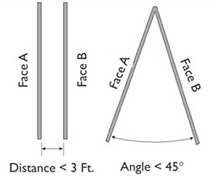
Façade. That portion of any exterior building elevation extending from grade to the top of the parapet wall or eaves along the entire width of the business establishment building frontage.
Fascia. The flat, outside horizontal member of a cornice, roof, soffit, canopy or marquee.
Fence or wall sign. A type of sign attached to and erected parallel to the face of or painted on a fence or free-standing wall and supported solely by such fence or free-standing wall.
Flag. A piece of fabric, often attached to a staff, containing distinctive colors, patterns or symbols, identifying a government or political subdivision.
Frontage. The total distance along any street line.
Garage sale sign. A sign designed to advertise the sale of personal property by the person or family conducting the sale in, at or upon residentially zoned or residentially used property. Garage sale signs shall include lawn sales, yard sales or any similar designation.
General information sign. A sign designed to provide information on the location of facilities or a warning to the public regarding the premises where the sign is located, such as entrance or exit signs, caution, no trespassing, no parking, tow-away zone, parking in rear, disabled parking, restrooms, etc., and containing no commercial advertising.
Grand opening sign. A temporary sign designed to announce the opening of a newly licensed business not previously conducted at the location by the same person(s).
Hanging wood frame sign. A type of sign hung or suspended from a free-standing wood frame, such frame being not higher than five feet, nor wider than four feet.
Holiday or seasonal signage. The temporary lighting, garlands, wreaths or other decorations relating to a particular regional or nationally recognized holiday and containing no advertising.
Identification sign. A sign designed to provide the name, owner, address, use, and/or service of a particular activity located on the premises where such sign is displayed.
Illuminated sign. Any sign having characters, letters, figures, designs or outlines illuminated by electric lights or luminous tubes designed for that purpose, whether or not said lights or tubes are physically attached to the sign.
Interior sign. Any type of sign located inside a building which is not clearly visible from and not intended to be seen from the exterior of the building.
Internal illumination. A light source concealed or contained within the sign which becomes visible by shining through a translucent surface.
Menu sign. A sign designed to indicate the food items, products, services or activities provided on the premises. Such signs are commonly, but not necessarily, associated with fast-food restaurants at the entrance to drive-through facilities.
Mobile sign. Any type of sign not permanently attached to a wall or the ground or any other approved supporting structure, or a sign designed to be transported, such as signs transported by wheels, mobile billboards, sandwich signs, sidewalk signs, curb signs, and unanchored signs.
Monument sign. A type of freestanding sign supported by an internal structural framework or integrated into a solid structural feature other than support poles. In order to qualify as a monument sign, the supporting structure shall not be less in width than 50 percent of the sign face, inclusive of any box, cabinet, or frame.
Mural. A graphic, artistic representation painted on a wall, not including graffiti, which contains no advertisement or relationship to any product, service or activity provided, offered or available on the premises.
Neon sign. A type of sign formed by luminous or gaseous tubes in any configuration.
Nonconforming sign. A sign or advertising structure which was lawfully erected and maintained prior to the current provisions of this Code regulating signs, which by its height, type, design, square foot area, location, use or structural support does not conform to the requirements of this article.
Off-premises sign. A sign, other than a billboard, designed to direct attention to a business, commodity, service, product or activity not conducted, sold, offered or available on the premises where such sign is located.
Opinion sign. A sign designed to containing language, wording or an expression not related to the economic interests of the speaker and its audience, such speech generally considered to be ideological, political or of a public interest nature; or a sign indicating belief concerning an issue, name, cause or affiliation, including signs advertising political parties or any political information.
Outdoor event sign. A temporary sign designed to identify an outdoor event which is of general interest to the community.
Panel sign. A type of sign having the sign face or faces supported between two columns or poles, with no open area between such columns or poles.
Parapet. A false front or wall extension above the roof line of a building.
Permanent sign. Any sign which, when installed, is intended for permanent use. For the purposes of this article, any sign with an intended use in excess of six months from the date of installation shall be deemed a permanent sign.
Pole sign. A type of free-standing sign erected upon a pole or poles which are visible and wholly independent of any building or other structure for support.
Projecting sign. A type of sign attached to and supported by a building or other structure and which extends at any angle therefrom.
Public service sign. A type of sign erected by a governmental authority, within or immediately adjacent to a right-of-way, indicating the location of public or governmentally owned facilities, such as airports, public transportation, hospitals, schools, parks or indicating street names or other messages of public concern.
Real estate sign. A temporary sign designed to indicate a property which is for rent, sale or lease, including signs pointing to a property which is open for inspection by a potential purchaser (open house sign) or a sign indicating "shown by appointment only" or "sold."
Roof sign. A type of sign erected above the roofline or parapet, or any sign placed on rooftop structures.
Sign. Every device, frame, letter, figure, graphic, character, mark, permanently fixed object, ornamentation, plane, point, design, picture, logo, stroke, stripe, symbol, trademark, reading matter or other representation for visual communication that is used for the purpose of bringing the subject thereof to the attention of others.
Sign face. The part of a sign, visible from one direction, that is or can be used for communication purposes, including any background material, panel, trim, color or direct or self-illumination used that differentiates the sign from the building, structure, backdrop surface or object upon which or against which it is placed.
Sign width. The horizontal distance, in lineal feet, measured along the lower edge of a sign cabinet, box, frame or other surface containing a sign face.
Sign structure. Any structure erected for the purpose of supporting a sign, including decorative cover and/or frame.
Snipe sign. A sign of any material, including paper, cardboard, wood or metal, which is tacked, nailed, pasted, glued or otherwise affixed to a pole, tree, stake, fence, structure, building, trailer, dumpster or other object, with the message thereon not applicable to the present use of the premises upon which the sign is located.
Subdivision sign. A sign designed to indicate the name of a subdivision or neighborhood or other residential development.
Temporary sign. Any sign, other than a snipe sign, with an intended use of six months or less.
Traffic control sign. Any sign designed to control traffic on public streets or private property, such as speed limit, stop, caution, one-way, do not enter, tow-away zone or no parking signs.
Window sign. A sign designed to be located in a window or other transparent surface, or within a building or other enclosed structure which is visible from the exterior through a window or other opening intended to attract the attention of the public. This term shall not include merchandise located in a window or interior signs.
Section 90-015. - Prohibited signs.
The following types of signs are prohibited in the Town of Loxahatchee Groves unless specifically permitted by Section 90-050, "Promotional signs."
(A)
Animated signs;
(B)
Balloon signs;
(C)
Banner or pennant signs;
(D)
Bench signs;
(E)
Billboards;
(F)
Mobile signs;
(G)
Pole signs;
(H)
Projecting signs;
(I)
Roof signs;
(J)
Snipe signs;
(K)
Strip lighting.
Section 90-020. - Temporary signs.
The following types of signs are permitted in the Town of Loxahatchee Groves on a temporary basis:
(A)
Garage sale sign;
(B)
Project sign;
(C)
Real estate sign;
(D)
Seasonal or holiday signage.
(E)
Other signs, including opinion signs, to be used on a temporary basis.
Section 90-025. - General provisions for all signs.
This section establishes the physical standards and requirements applicable to all signs including flags and the districts in which they are located. More detailed standards applicable to specific types of signs follow this section.
(A)
Setbacks. All signs shall be setback a minimum of five feet from the property line.
(B)
Materials. All permanent signs shall be made of durable materials not subject to rapid deterioration.
(C)
Lighting.
(1)
All sign lighting is restricted to the hours of operation of the entity or establishment with which the sign is associated.
(2)
All sign lighting shall be properly shielded to prevent glare on adjacent streets or properties.
(3)
Illumination shall be constant and shall not consist of flashing or animated lights.
(4)
Exception. Holiday signage shall be exempt from the lighting requirements above.
(D)
Maintenance. Every sign, together with its framework, braces, angles, or other supports, shall be well maintained in appearance and in a good and safe condition. The sign shall be properly secured, supported, and braced, and able to withstand wind pressures as required by the applicable building code or any other regulatory code or ordinance in effect within the Town limits. In the event that an attached sign is removed, all anchor holes shall be filled and covered, by the owner of the property, in a manner that renders the anchor holes non-discernable with the wall.
(E)
Design and placement. All permanent signs shall be limited to a maximum of two faces (double-faced). All signs shall not be placed in such a position or manner as to obstruct or interfere, either physically or visually, with any fire alarm or police alarm, and shall not project over a public street, trail, or other public right-of-way unless approved by the Town Council.
(F)
Sign message. Any sign authorized by this article may contain a non-commercial message provided that sign language or graphics do not contain obscenities.
Section 90-030. - Computing sign area.
The methodology for computing sign area for all sign types shall be as follows:
(A)
Single-faced signs. Single-faced signs shall measure the sign area to include the entire area within a single continuous perimeter composed of squares or rectangles that enclose the extreme limits of all sign elements including, but not limited to, sign structures or borders, written copy, logos, symbols, illustrations, and contrasting colored background and materials, unless stated otherwise herein. Supporting structures such as poles, sign bases, decorative elements, details, columns are not included in the sign area calculation
(B)
Double-faced signs. Double-faced signs shall be counted as a single-faced sign. Where the faces are not equal in size, the larger face shall be used as the bases for calculating sign area.
Section 90-035. - Computing sign height.
Sign height shall be measured from the lowest height of the adjacent ground. The height of the nearest adjacent roadway crown shall be used if the sign is placed on a mound or berm.
Section 90-040. - Standards by sign type and zoning district.
(A)
The following signs are permitted in the Agricultural Residential (AR) zoning district subject to the requirements below. All signs in residentially zoned districts shall not be illuminated unless it is holiday signage.
(1)
Mandatory building identification sign:
(2)
Garage sale sign:
(3)
Real estate sign:
(4)
Seasonal or holiday signage:
(5)
Opinion sign:
(B)
The following signs are permitted in the Commercial Low (CL) and the Commercial Low Office (CLO) zoning districts. All signs, other than holiday signage, shall be illuminated by back lighting (halo or silhouette) or external lighting only.
(1)
Mandatory building identification sign:
(2)
Awning sign:
(3)
Building wall sign:
a.
Individual building as outparcel or stand-alone building:
b.
Shopping center or other multi-tenant center:
(4)
Canopy sign:
(5)
Monument or panel sign:
a.
Individual building as outparcel or stand-alone building:
b.
Shopping center or other multi-tenant center:
(6)
Real estate or project sign:
(7)
Window sign:
(8)
Holiday signage:
(9)
Opinion sign:
(C)
The following signs are permitted in the Institutional and Public Facilities (IPF) zoning district. All signs, other than holiday signage, shall be illuminated by back lighting (halo or silhouette) or external lighting only.
(1)
Mandatory building identification sign:
(2)
Awning sign:
(3)
Monument or panel sign:
(4)
Real estate or project sign:
(5)
Seasonal or holiday signage:
(6)
Window sign:
(7)
Opinion sign:
(D)
The following signs are permitted in the Parks and Recreation (PR) zoning district. All signs, other than holiday signage, shall be illuminated by back lighting (halo or silhouette) or external lighting only.
(1)
Mandatory building identification sign:
(2)
Awning sign:
(3)
Monument or panel sign:
(4)
Real estate or project sign:
(5)
Seasonal or holiday signage:
(6)
Opinion sign:
(E)
The following signs are permitted in the Conservation (CN) zoning district. All signs, other than holiday signage, shall be illuminated by back lighting (halo or silhouette) or external lighting only.
(1)
Mandatory building identification sign:
(2)
Monument or panel sign:
(3)
Opinion sign:
Section 90-045. - Temporary signs.
(A)
A permit as required in Section 05-040 shall be obtained for any temporary sign six square feet or larger in size.
(B)
No more than four temporary signs shall be erected per plot for any period of time.
(C)
Temporary signs shall not be larger or higher than any permanent sign permitted on the premises where the sign will be located.
(D)
No temporary sign shall be placed on public property or in a public ingress/egress easement. Signs placed in violation of this provision shall be considered abandoned and shall be subject to removal without notice by the Town.
(E)
Lighting of temporary signs is prohibited.
(F)
Unless otherwise stated, temporary signs shall be removed within six months from the date that the sign was erected.
Section 90-050. - Promotional signs.
(A)
The following promotional signs are permitted in the Commercial Low (CL), Commercial Low Office (CLO), Institutional and Public Facilities (IPF), Parks and Recreation (PR) zoning districts subject to the following standards.
(1)
Balloon sign:
(2)
Banner or pennant sign:
(3)
Mobile sign:
(B)
A permit as required in Section 05-040 shall be obtained for any promotional sign.
(C)
No permit shall be issued for a period exceeding 14 consecutive days.
(D)
No more than four such permits shall be issued to any one establishment in any one calendar year.
(E)
No permit shall be issued for promotional signs within 28 consecutive days of the issuance of any previous promotional sign permit for the same establishment on the same plot.
(F)
All promotion signs shall be illuminated by external lighting only.
(G)
All promotional signs shall be setback a minimum of 50 feet from any adjacent residential zoning district.
Section 90-055. - Billboards.
(A)
The Town shall uphold and continue the prohibition on billboards and similar off-site signs instituted by Palm Beach County, however, this prohibition shall not restrict the repair, maintenance, relocation, or replacement of billboards constructed consistent with applicable codes and permit procedures prior to November 15, 1988, and included within the Palm Beach County billboard stipulated settlement agreement and billboard survey (approved February 6, 1996). The stipulated settlement agreement referred to herein shall be the primary source of information for implementing the intent and purpose of the regulations governing billboards and similar off-site signs.
(B)
All further rights, responsibilities, exceptions, requirements, and rules concerning the permitting and amortization of billboards and similar off-site signs shall be outlined in Chapter H of Article 8 of the Palm Beach County Code, as amended, and hereby adopted by the Town of Loxahatchee Groves.
Section 90-060. - Flags.
Flags in residential zoning districts are permitted up to six feet in area and may be mounted on a flag pole not exceeding 15 feet in height. Flags in non-residential zoning districts are permitted up to 144 feet in area and may be mounted on a flag pole not exceeding 50 feet in height. A maximum of four flags are permitted per each plot of land.
Section 90-065. - Landscaping around signage.
All signage shall be surrounded by landscaping which meets the requirements of Section 85-045, "Landscape requirements for interior open space."
Section 90-070. - Sign permit requirements.
(A)
No permanent sign, promotional sign, billboard, or temporary sign larger than six square feet in area or height, shall be placed or altered on any plot until a permit has been issued by the Town consistent with Section 05-040.
(B)
Sign permit applications shall, at a minimum, contain and be accompanied by the following:
(1)
An indication of the specific type of sign and design;
(2)
The address and legal description of the plot where the sign will be located;
(3)
A sign plan, drawn to scale, showing the dimensions, square foot area, sign face, copy, height of letters, height of sign, colors, lighting, and the sign structure;
(4)
The location and type of all other signs on the same plot;
(5)
A copy of the master signage plan for the development, if applicable;
(6)
For building wall signs, the building frontage and height of the building wall, parapet, or facade of the building;
(7)
For window signs, the area of such windows to be used for signs;
(8)
An indication of the landscaping to surround the proposed sign.
(C)
Permit issuance. If, upon review, it is determined that an application is in accordance with the provisions of this article, a permit shall be issued in accordance with Section 05-040 of this Code. Fees for permits shall be in accordance with the schedule established by the Town.
(D)
Signs erected without permits.
(1)
Signs that were not lawfully permitted and do not comply shall be removed immediately upon receipt of notice from Town Code compliance personnel.
(2)
Signs that were not lawfully permitted but which comply fully with this article shall require a permit within 30 days from receipt of notice from Town Code compliance personnel.
(E)
Permit revocation. Permits for signs may be revoked by Town Code compliance personnel if it is determined that any sign fails to comply with the terms of this article and the owner of such sign fails to bring the sign into conformity within 30 days from receipt of any written notice of noncompliance. Revocation of a sign permit shall require removal of the sign in violation.
(F)
Permit exemptions. Permits shall not be required for the following signs:
(1)
Temporary signs six feet in area or height or less;
(2)
Holiday signage;
(3)
Murals;
(4)
Flags;
(5)
Public service signs;
(6)
Traffic control signs;
(7)
Any sign on a plot, or portion of a plot, used as a farm and pertaining to farm activities.
Section 90-075. - Nonconforming signs.
(A)
Any permanent sign, excluding billboards and similar signs which are governed by Section 90-055, that was legally erected but does not conform to all provisions of this article shall come into compliance within five years of the effective date of these regulations, except that permanent signs must immediately comply should any of the following events transpire:
(1)
A change of copy is required on a sign pertaining to a single entity;
(2)
A change of copy is required for 50 percent or more of a sign pertaining to multiple entities.
(3)
The sign is abandoned as defined in Section 90-010, "Definitions."
(4)
The sign must be relocated for any reason.
(5)
The permit for the sign expires.
(B)
Nonconforming signs may be refurbished or repaired provided no structural alterations are involved.
(C)
Signs or sign structures which were never lawfully permitted shall not be determined as legally nonconforming signs and shall be subject to immediate removal without the benefit of any amortization period.
Section 91-005.- Requirements and exceptions.
In all new residential development and other land development projects in any zoning district within the Town, all utility lines, including but not limited to, those required for electrical power distribution, telephone and telegraph communications, cable television, internet, street lighting, electrical distribution system, including service lines to individual properties necessary to serve the development under consideration, shall be installed underground. Telephone and cable television utility lines may be attached to Florida Power and Light electrical transmission facilities when such are allowed by the provisions of this section. Appurtenances such as transformer boxes, pedestal-mounted terminal boxes and meter cabinets may be placed above ground on a level concrete slab and shall be located in such a manner as to minimize noise effects upon the surrounding residential properties. All underground wires shall be buried a minimum of 18 inches below the finished ground line.
( Ord. No. 2017-20 , § 2, 1-16-2018)
Section 91-010. - Easements.
Recorded easements shall be provided for the installation of all underground utilities facilities, in conformance with such size and location of easements as may be determined by the utility provider to be compatible with the requirements of all utility companies involved with respect to a particular utility service.
( Ord. No. 2017-20 , § 2, 1-16-2018)
Section 91-015. - Arrangements with persons furnishing utility services.
(A)
The owner or developer shall make the necessary financial compensation and other arrangements for the underground installation with each of the franchised utilities that are involved with respect to a particular development.
(B)
For any project requiring site plan approval, the owner or developer shall submit written evidence of a satisfactory arrangement with each of the franchised utilities involved with respect to a particular development before the final site development plan of the project is submitted to the Planning Board for its consideration. For any project not requiring site plan approval, the written evidence of a satisfactory arrangement with each of the franchised utilities involved shall be submitted prior to the issuance of any building permits for any structure that is part of the development.
( Ord. No. 2017-20 , § 2, 1-16-2018)

