
Loxahatchee Groves City Zoning Code
PART IV
PARKING AND LOADING, ACCESS AND SUBDIVISION, SIGHT DISTANCE
Section 100-005. - Local and collector roadways, generally.
(A)
The design of all local streets and collectors shall preserve the unique, rural character of the Town and discourage non-resident traffic in residential areas. In part this shall be achieved by ensuring that all local roadways and collectors be constructed of a width, design, and materials deemed acceptable by the Town of Loxahatchee Groves Town Council.
(B)
The maximum speed limit on all local streets and collectors within the Town boundaries; except Southern Boulevard, Okeechobee Boulevard, and Folsom Road; is 25 miles per hour.
( Ord. No. 2021-07 , § 2, 9-8-2021)
Section 100-010. - Access to County and State roadways.
(A)
Access to County- or State-owned roadways shall be designed pursuant to the Palm Beach County Land Development Code and approved by the Florida Department of Transportation (FDOT), Palm Beach County, or any other applicable regulating agency, and the Town.
Section 100-015. - Access to collector and arterial roadways.
(A)
When the rear of a residential plot abuts a collector or arterial roadway, a non-vehicular access line shall be provided along the entire interface of the plot and collector or arterial roadway to clearly designate the plot's intended and rightful access.
(B)
When a residential plot has frontage on both a local roadway and a collector roadway, the plot shall only gain access from the local roadway, and a non-vehicular line shall be provided along the entire interface of the plot and collector or arterial roadway to clearly designate the local road as the residential plot's intended access.
Section 100-020. - Separation requirements.
No driveway entrance serving any plot within the Town shall be located closer than 50 feet of a roadway intersection. Additionally, on collector and arterial roadways, driveway entrances shall be located no closer than 100 feet apart, unless this requirement would prevent an existing plot from obtaining legal access to the roadway, in which case, the maximum separation distance required to gain legal access to the property in full conformance with this Code shall be used.
Section 100-025. - Number of driveways.
In order to provide the least interference to the traffic flow on public streets, and to preserve the spacious character of the Town, the number and location of driveways shall be regulated as follows:
(A)
One driveway shall be permitted for ingress and egress purposes to a single property or development.
(B)
Two driveways serving a single property may be permitted provided that the property is at least one acre in size and the minimum spacing between the two driveways on the same plot equals or exceeds 50 feet.
(C)
Three driveways serving a single property may be permitted provided that the property is at least one acre in size and has frontage on two public streets. No more than two driveways shall be located on any single roadway, however, and the minimum driveway distance spacing between any two driveways on the same plot must be equal to or greater than 50 feet.
Section 100-030. - Driveway requirements.
(A)
The minimum and maximum width of driveways shall be as follows:
* Unless driveway is required for emergency vehicle access in which case the minimum width shall be 18 feet.
(B)
Existing driveway approaches shall not be relocated, altered, or reconstructed without approval for relocation, alteration, or reconstruction of such driveway approaches. When the use of any driveway approach is changed, making any portion or all of the driveway approach unnecessary, the developer of the abutting property shall obtain a permit from the Town Engineer to abandon the driveway approach and shall, replace all necessary swales and landscape cover at his own expense.
(C)
The maximum slope of a driveway immediately beyond the ultimate right-of-way line shall not change in excess of five percent for either angle of approach or break over angle. Variations from this standard shall be permitted if adherence to this standard would cause incompatibility with existing swales.
Section 100-035. - Access to development.
All developable plots shall have direct, legal access from a publicly dedicated street, except as follows.
(A)
Private streets. A plot which does not have direct, legal access from a publicly dedicated street can be developed provided that it has direct, legal access via a private street. A permanent access easement over the entire private right-of-way shall be granted to the Town for service and emergency vehicles and for maintenance of public and semi public utilities. The private street shall be constructed and meet the standards of Section 100-045, "Minimum standards for public and private streets."
(B)
Private ingress/egress easement. A plot which does not have direct, legal access from a publicly dedicated street can be developed provided that it has direct, legal access via a private ingress/egress easement, subject to the following requirements:
(1)
Individual access to a landlocked parcel. One landlocked parcel may be accessed via an ingress/egress easement at least 15 feet wide, with a minimum of a ten-foot wide travel surface connecting the landlocked parcel to a public street through an intervening lot or parcel. All travel surfaces, and land adjacent to, shall be constructed and sloped in a manner that prevents stormwater from draining onto, and becoming a nuisance to, adjacent properties. Furthermore, this individual access arrangement shall meet the requirements of Section 100-040, "Private ingress/egress arrangements."
(2)
Shared access to multiple landlocked parcels. Up to four parcels may be accessed via an ingress/egress easement at least 25 feet wide, with a minimum 15-foot wide travel surface connecting the landlocked parcels to a public street through an intervening lot or parcel. All travel surfaces, and land adjacent to, shall be constructed and sloped in a manner that prevents stormwater from draining onto, and becoming a nuisance to, adjacent properties. Furthermore, this shared access arrangement shall meet the requirements of Section 100-040, "Private ingress/egress arrangements."
Section 100-040. - Private ingress/egress arrangements.
All individual and shared access to landlocked parcels shall meet the following requirements:
(1)
The ingress/egress easement shall provide for access by emergency vehicles and government officials, employees, or contractual service providers during the course of their official duties.
(2)
All property owners utilizing an individual or shared access easement shall enter into an agreement defining the rights and responsibilities of the parties in regards to the maintenance of the access easement and shall record such agreement in the Public Records of Palm Beach County, Florida.
(3)
The developer and property owner shall enter into, and shall record in the Public Records of Palm Beach County, Florida, a Declaration of Restrictive Covenants for Private Roadways and Access in a form approved by the Town Attorney, which shall, in part, indemnify and hold harmless the Town and its agents for the construction of an access easement, which is less than the access easement set forth in Section 100-045, "Minimum standards for public and private streets."
(4)
The permissibility of an ingress/egress arrangement pursuant to Section 100-035,"Access to development" is conditioned upon no further subdivision being possible that would require dedication and construction of a public or private street in lieu of an ingress/egress easement.
(5)
The address of all properties without direct, legal access to a public road shall be displayed at the public street entrance of the ingress/egress easement and again at the entrance to each property from the driveway.
(6)
The maximum length of an ingress/egress easement pursuant to Section 100-035,"Access to development" shall be one-quarter mile (1,320 feet).
(7)
Private ingress/egress arrangements shall not provide ingress to and egress from areas within the Town from and to areas outside of the Town's corporate limits. Any ingress to and egress from areas within the Town from and to areas outside of the Town's corporate limits must be through a publicly dedicated street.
( Ord. No. 2021-04 , § 2, 6-15-2021)
Section 100-045. - Minimum standards for public and private streets.
The design and construction of public and private streets shall be in accordance with acceptable engineering principles. The design and construction of required improvements shall, at a minimum, be in accordance with current Town standards, including those contained in this article. Should a developer elect to provide improvements of a type or design proposed to equal or exceed the minimum requirements, standards for design and construction of such improvements shall be submitted for approval and evaluated for adequacy on an individual basis by the Town Engineer.
(A)
Local roadway design standards. The design of all local roadways (public and private) shall be as follows:
(1)
Volume. Typical volume of local roadways shall be between zero and 2,000 vehicles per day.
(2)
Access. Local roadways shall provide primary access to residential and agricultural properties and limited commercial development. Cut-through traffic is to be discouraged. Other than connecting to Okeechobee Boulevard or Southern Boulevard, local roadways shall not provide access to or from areas outside the Town's corporate limits.
(3)
Design speed. Local roadways shall be designed for travel at a maximum of 30 miles per hour.
(4)
Required right-of-way dedication. The minimum right-of-way dedication for all new local roadways shall be 30 feet, however, at the discretion of the Town Engineer, this minimum may be increased in order to provide sufficient drainage, canal maintenance, or to implement the Loxahatchee Groves Master Roadway, Equestrian and Greenway Plan, 2009 (MREG, 2009).
(5)
Construction of roadway. The entire width of the right-of-way shall be demucked before construction of the roadbed begins. No material of FDOT Class A-5, A-7 or A-8 shall be allowed. All material supporting the roadway and shoulders shall have a minimum load bearing ratio (LBR) of 40. The top 12 inches of the undisturbed soil shall be compacted to 100 percent of maximum dry density as per AASHTO T-99-C. Unless otherwise approved by the Town Engineer, lime rock or shell rock bases shall be at least six inches thick and shall have a minimum LBR of 100. Base material shall be compacted to a density of not less than 98 percent of maximum density as determined by AASHTO T-180. Roadway surface shall consist of at least a three-inch layer of open graded emulsified mix (OGEM) or a surface material of equivalent durability, as certified by an engineer.
(6)
On-street parking. Parking on local roadways is prohibited.
(7)
Traffic calming. The Town Council shall have the authority to approve traffic calming devices.
(8)
Turnaround. Any local roadway that does not conclude as an intersection of another roadway shall provide a turnaround of adequate dimension, as determined by the Town Engineer, to allow for the successful maneuvering and redirection of large vehicles such as emergency service and refuse collection vehicles.
(9)
Other. Traffic signals, curbs, turn lanes, medians and sidewalks shall not be provided unless specifically required by the Town Engineer.
(10)
[Governed by District.] Standards for roadways under the jurisdiction of the Loxahatchee Groves Water Control District shall be governed by standards developed by the District.
( Ord. No. 2021-04 , § 3, 6-15-2021)
Section 100-050. - Roadway signage.
All roadway signs shall conform to the "Manual on Uniform Traffic Control Devices" and shall be approved by the Town Engineer.
Section 100-055. - Subdivision of lots.
The lot arrangement and design of subdivisions shall be such that all lots will provide satisfactory and desirable building sites, properly related to topography and to the character of the area. Lot dimensions and areas shall not be less than those specified by the applicable zoning regulations.
Section 100-060. - Installation of improvements; improvement agreements, and bonding for improvements.
(A)
Improvements required. A developer shall be responsible for all roadway and drainage improvements for those roadways lying within or adjacent to the proposed development and necessary to provide access and accommodate the traffic generated by the development.
(1)
On-site improvements. A developer shall be required to bond for and construct the on-site improvements required by the provisions of this article and any additional improvements necessary for traffic safety, including, but not limited to the following: pavement, rock base, fill, curbs, gutters, guardrail, shoulder areas, swales, roadside recovery areas, bridges, drainage outlets, catch basins, drainage pipes, culverts, drainage ditches, and traffic signs.
(2)
Off-site improvements. A developer shall be required to bond for and construct the roadway and roadway drainage improvements on property adjacent to the proposed development necessary to connect the new development to an existing adequately constructed adjacent street system, and provide drainage improvements as required.
(3)
At the Town Manager's discretion, the Town may accept alternative forms of fund securitization.
(4)
The Town Manager may waive the fund securitization requirements of this section when the Manager determines that such fund securitization is not necessary to ensure that the improvements are constructed in a timely manner, that the Town will be able to recoup the cost of any improvements it constructs should a developer default on its responsibilities, and that public health and safety will not be compromised.
(B)
Installation required. All improvements required from the developer as a condition to the approval of an application for a development order shall be installed and completed before the issuance of any Certificate of Occupancy, except as provided in subsection (C), below.
(C)
Improvement agreements. At the discretion of the Town Manager, the applicant may provide, in a form acceptable to the Town Council, a recordable agreement which includes all of the required improvements and the date of completion as an alternative to all required improvements being installed and completed prior to the issuance of a development permit, and provided that all other applicable requirements of this Code are met. Any non-standard agreement or security proposed by a developer pursuant to this subsection shall be considered for approval by the Town Council. Improvement agreements may be secured by lien, cash bond, surety bond executed by a company authorized to do business in the State of Florida, or an irrevocable letter of credit. The amount of the security shall be sufficient to ensure the completion of all required improvements, and providing for and securing to the public the actual construction and installation of said required improvements, within a reasonable period of time or before issuance of building permits or certificates of occupancy as required by the Town Council and expressed in the bond or other security. The Council may also approve standard form agreements and securities for the installation of improvements, which do not require individual approval by the Town Council. A standard form agreement and security presented by a developer shall be approved by the Town Attorney prior to plat recordation, recordation of an agreement to place or amend the note on a plat, recordation of a document amending the non-vehicular access line, or the issuance of a development order for a site plan. Town Attorney approval is required for all such agreements.
(D)
Enforcement. The Town Council is authorized to enforce such bonds, security deposits or other collateral agreements by appropriate legal proceedings. If the required improvements have not been completed prior to issuance of a certificate of occupancy or as otherwise specifically indicated in the terms of such bond or other security, the Town Council may thereupon declare the bond or other security to be in default and require that all the improvements be installed, regardless of the extent of the development at the time the bond or other security is declared to be in default. In addition to the Town Council's authority to enforce agreements under this subsection, no certificate of occupancy shall be issued prior to the actual construction and installation of improvements provided for in the agreement, unless expressly authorized in the agreement.
(E)
Bonds to other regulatory entities. With respect to improvements required by this article, where such improvements are required by and bonded to any other appropriate unit of local government or regulatory entity, the Town Council shall not require duplicate bonds or additional bonds unless it determines that the bond or security already required is inadequate to assure completion of such required improvements. Where such improvements are not required by and bonded to any other appropriate unit of government or regulatory entity, said security shall be payable to the Town.
(F)
Bonding required improvements. The amount necessary to secure required paving, grading and drainage improvements and water and sewer improvements, and all other improvements required under the ULDC shall be based upon approved plans for those improvements, a registered professional engineer's cost estimates submitted by the applicant and approved by the Town Engineer, or cost estimates developed by the Town Engineer. Security amounts for the required improvements shall be submitted to the Town Engineer prior to Town issuance of the development order for which the improvements are required. Security amounts for the required improvements shall be submitted to the Town Engineer for approval prior to submittal of any improvement agreement. Security amounts shall be approved based on the following procedure:
(1)
Engineer's cost estimate. The applicant may submit an engineer's cost estimate for each of the required improvements listed in the staff report, utilizing the approved and current unit prices available from the Town Engineer.
(2)
Cost estimate by the Town Engineer. The applicant may submit a written request for the Town Engineer to prepare a cost estimate for each of the required improvements listed in the staff report. The cost to the Town for the preparation of the estimate shall be reimbursed by the applicant.
(3)
Submittal of plans. An applicant may submit engineering plans for the required improvements listed in the staff report. Required improvement plans shall conform to the minimum design and construction standards of this Code. When the plans and supporting documents provide sufficient information for the Town Engineer to make a determination, the Town Engineer shall calculate and issue an approved security amount for the required improvements. Upon receipt of the approved security amount, the Town Engineer shall approve the construction plans, and the applicant shall obtain all necessary permits.
(4)
[Security.] When the security is based upon a registered professional engineer's cost estimates or cost estimates developed by the Town Engineer, the applicant shall provide security in an amount which is 25 percent greater than the estimated cost. The security document shall provide for approval of improvement plans by the Town prior to commencement of construction or issuance of the first building permit, whichever first occurs. Failure to submit said improvement plans shall be deemed a default of the obligation secured and the security document shall provide for said default. No security shall be accepted nor construction commenced until the provisions set forth in this section have been satisfied.
Section 105-005. - Sight distance triangle.
(A)
The Town hereby establishes a mandatory sight distance triangle for the purposes of ensuring adequate cross visibility at the following types of intersections:
(1)
Intersection of driveway and street. Where a driveway intersects a street, the triangular area of property on both sides of a driveway, measured ten feet from the intersection, and on the street line, measured ten feet from the intersection, shall form two legs of the sight distance triangle, and the third side being a line connecting the ends of the two other sides.
(2)
Intersection of trail and street. Where a trail intersects a street, the triangular area of property on both sides of a trail, measured ten feet from the intersection, and on the street line, measured ten feet from the intersection, shall form two legs of the sight distance triangle, and the third side being a line connecting the ends of the two other sides.
(3)
Intersection of two streets. Where two streets intersect, the triangular area of property on all sides of the intersection, measured 25 feet from the intersection, and on the street line, measured 25 feet from the intersection, shall form two legs of the sight distance triangle, and the third side being a line connecting the ends of the two other sides.
(B)
Within any sight distance triangle described in paragraph (A), above, it shall not be permissible to install, set out or maintain, or to allow the installation, setting out or maintenance of, either temporarily or permanently, any vehicular parking space, sign, fence or wall, hedge, shrubbery, tree, earth mound, natural growth or other obstruction of any kind which obstructs cross-visibility at a level between 30 inches and eight feet above the level of the center of the adjacent intersection except that:
(1)
Fences or walls within the sight triangle can be constructed in such a manner as to provide adequate cross-visibility over or through the structure between 30 inches and eight feet in height above the driving surface.
(2)
Trees having limbs and foliage can be trimmed in such a manner that no limbs or foliage extend into the area between 30 inches and eight feet above the level of the center of the adjacent intersection.
(3)
Fire hydrants and public utility poles are permissible.
(4)
Street markers and traffic control devices are permissible.
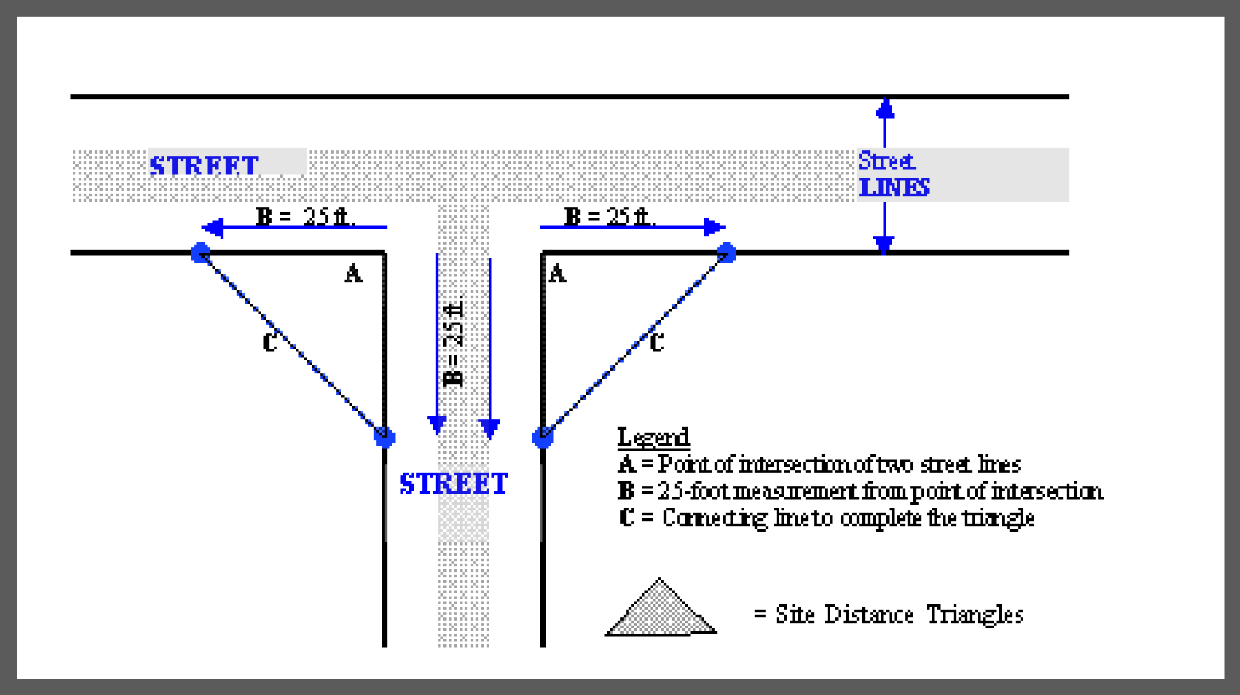
Example of Site Distance Triangle
Section 95-005. - Applicability.
The standards of this article shall apply to all new development in the Town of Loxahatchee Groves except buildings and structures on portions of plots occupied by a bona fide agricultural use.
Section 95-010. - Minimum parking space requirements.
The minimum parking requirements for each use is outlined below, however, for uses not specifically listed, the parking requirements for the most similar use shall be used as determined by the Town Manager. When the number of required parking spaces results in a fractional space, any such fraction shall require a full parking space. In the case of mixed uses (not including shopping centers), the total requirement for parking spaces shall be the sum of the various uses computed separately. In stadiums, sports arenas, religious facilities, bars and other places of assembly in which occupants utilize benches, pews, stools or other similar seating facilities, every 20 lineal inches of such seating shall be counted as one seat for the purpose of computing parking requirements. Every building, use or structure which complies with the parking requirements of this article may provide additional parking spaces as needed.
(A)
Residential uses:
(B)
Commercial uses:
(C)
Civic uses:
(D)
Agricultural uses:
(E)
Recreational uses:
(Ord. No. 2014-05, § 5, 6-3-2014)
Section 95-015. - Use of required parking facilities.
Parking spaces required and approved in conformance with this article may be used only for parking of vehicles of owners, tenants, employees and customers utilizing the building or site served by such required parking space. The following uses and activities are prohibited in required parking facilities:
(A)
Parking to serve an off-site building, except as provided under Section 95-035, "Shared parking facilities," below.
(B)
Storage, repair or commercial display of any vehicles, equipment or merchandise;
(C)
Parking or storage of commercial vehicles owned, operated or used in the business of a commercial occupant of a building between the hours of 8:00 a.m. and 5:00 p.m.;
(D)
Parking of any vehicle, which due to its size, shape, contents or location, creates an obstruction or public safety hazard or which cannot be contained within a single designated parking space.
Section 95-020. - Maintenance of parking facilities.
(A)
All parking facilities required by this article shall be maintained and continued as an accessory use as long as the primary use with which the parking facilities are associated continues to exist.
(B)
When any structure is modernized, altered or repaired, and provided there is no increase in floor area, capacity, density, or change of use or occupancy, no additional parking space shall be required.
(C)
When any structure is changed in use or occupancy, or is increased in floor area, capacity, density, any additional parking space required by this article for the new use or additional floor area, capacity or density over and above what would be required for the existing use, floor area, capacity or density shall be provided. For the purpose of this section, a change of use or occupancy may include a change from one category of parking requirements to another such category under Section 95-010, "Minimum parking space requirements."
(D)
Any change of use or occupancy, or any increase in floor area, capacity or density pursuant to subsection (C) above, that would result in more than a 50 percent increase of parking spaces, shall require the entire property to be brought into full conformance with the requirements of this article, as a condition of the issuance of any site plan approval or permit required for such changes.
(E)
It shall be unlawful for any owner or operator of any building, structure or use affected by this article to discontinue, change or dispense with the required parking facilities, apart from the discontinuance of such structure or use, without establishing alternative vehicle parking facilities which meet the requirements of this article. Additionally, it shall be unlawful for any person to occupy such building or structure for any purpose without providing the parking facilities to meet the requirements of, and be in compliance with this article. Failure to maintain the required parking facilities in accordance with this article shall constitute grounds for revocation of any certificate of use and occupational license issued for use of the premises, and mandatory cessation of the use.
(F)
It shall be unlawful to use any part of private or public property for parking or storage of vehicles which is not constructed, designated and maintained in compliance with this article.
Section 95-025. - Size of parking spaces.
The minimum size of a parking space shall be as follows:
Standard space: Eleven feet by 22½ feet.
Parallel space: Eleven feet by 27½ feet.
Handicap space: Fourteen feet by 22½ feet.
Section 95-030. - Combined parking facilities.
Nothing in this article shall be construed to prevent collective provision for, or joint use of, parking facilities for two or more buildings or uses by two or more owners or operations, provided that the total of such parking spaces when combined or used together shall not be less than the sum of the requirements of the several individual uses computed separately in accordance with this article. In such cases, a recorded agreement shall be executed in the same manner as provided for in Section 95-035, below.
Section 95-035. - Shared parking facilities.
Required parking spaces may be permitted to be utilized for meeting the parking requirements of two or more separate permitted uses when it is clearly established by the applicant that the different uses will utilize the spaces at different times of the day, week, month or year, such as an office sharing spaces with a dinner-only restaurant, such that the total number of parking spaces required by this article for each use is fully available during the operation of each use. A recordable covenant, with the correct legal description, shall be submitted by the owners of the property and all businesses or tenants involved in a form acceptable to the Town Attorney. The covenant shall be recorded in the public records of Palm Beach County at the applicant's expense, and shall run with the land. The covenant shall provide that the use or portion of a use, that requires the shared parking in order to obtain the necessary permits or licenses, shall cease and terminate upon any change in the uses' respective schedules of operation that results in conflicting or overlapping usage of the parking facilities, and that no use may be made of that portion of the property until the required parking facilities are available and provided. The covenant shall also provide that the Town may collect attorneys' fees if litigation is necessary to enforce the requirements of this section.
Section 95-040. - Location of required parking facilities.
All required parking facilities shall be located on the same plot or parcel of land such facilities are intended to serve. No required parking space may be located in front of any overhead garage door or other loading area in a nonresidential building, except self storage warehouses.
Section 95-045. - Nonconforming parking facilities.
(A)
Residential properties. All nonconforming, residential plots shall comply with this article prior to the issuance of a Certificate of Occupancy for any new construction exceeding the lowest of either 25 percent of the square footage of the existing dwelling, or 1,000 square feet.
(B)
Non-residential properties. All nonconforming, nonresidential properties shall comply with this article to the maximum extent possible prior to the issuance of a Certificate of Occupancy for any improvement requiring a site plan modification or new site plan. Maximum extent possible shall not be construed to require a variance or a creation or exacerbation of a nonconformity.
Section 95-050. - Minimum loading space requirements.
The minimum loading space requirements for each use is outlined below, however, for uses not specifically mentioned, the loading requirements for the most similar use shall be used as determined by the Town Manager. When the number of required loading space results in a fractional space, any such fraction shall require a full loading space.
Section 95-055. - Use of loading spaces.
No area or facilities supplied to meet parking requirements for a use shall be utilized for or be deemed to meet the requirements of this article for loading facilities.
Section 95-060. - Shared loading facilities.
Nothing in this section shall prevent the collective, joint or shared provision of loading facilities for two or more buildings or uses on the same site, provided that such loading facilities are sufficient in size and capacity for the combined requirements of the buildings or uses and are located and arranged as to be usable.
Section 95-065. - Maintenance of loading spaces.
(A)
There shall be provided and maintained adequate space for loading and unloading of materials, goods or things, and for delivery and shipping on the same plot with every structure that is hereafter erected or created, so that vehicles for these services may use this space without interfering with the public use of streets, alleys and parking areas by pedestrians and vehicles. The loading facility shall be designed to accommodate both the parking of and maneuvering of the design vehicle exclusive of those areas designated for aisles, driveways or parking stalls.
(B)
Where any structure is enlarged or any use is extended so that the size of the resulting occupancy comes within the scope of this section, the full amount of loading space shall be supplied and maintained for the structure or use in its enlarged or extended size.
(C)
Where the use of a structure or land or any part thereof is changed to a use requiring loading space under this section, the full amount of loading space shall be supplied and maintained to comply with this section.
Section 95-070. - Size of loading spaces.
For the purposes of this section, a loading space shall be an area at the grade level at least 12 feet wide by 45 feet long with a 14 foot vertical clearance, except that for plots containing an aggregate amount of less than 10,000 square feet of gross floor area of buildings, and for office buildings and banks, a loading space may be ten feet in width by 25 feet long.
Section 95-075. - Location of loading spaces.
Each loading space shall be directly accessible from a street, alley or driveway without crossing or entering any other required loading space, shall be clearly marked as to purpose, and shall be arranged for convenient and safe ingress and egress by motor truck and/or trailer combination. Loading spaces shall not be located in a parking aisle and shall not be more than 30 feet from the building which the loading space serves. Any pedestrian walkway crossing ingress and egress to a loading space shall be clearly marked.
Section 95-080. - Nonconforming loading facilities.
All nonconforming properties shall comply with this article to the maximum extent possible prior to the issuance of a Certificate of Occupancy for any improvement requiring a site plan modification or new site plan. Maximum extent possible shall not be construed to require a variance or a creation or exacerbation of a nonconformity.
Section 95-085. - Minimum requirements for drive-through establishments.
In addition to meeting the minimum parking and loading standards of this article, all drive-thru establishments shall provide queuing spaces as outlined below.
* In addition to these requirements, one additional queuing space shall also be provided after the point of service for all uses.
Section 95-090. - Size of queuing spaces.
Each queuing space shall be a minimum of nine by 20 feet. Queuing shall be measured from the front of the vehicle located at the point of service to the rear of the queuing lane.
Section 95-095. - Queuing by-pass lane.
All drive-thru facilities shall provide a minimum of ten feet wide by-pass lane before or around the point of service unless the queuing lane is adjacent to a vehicular use area which functions as a by-pass lane. The by-pass lane shall be clearly designated and distinct from the queuing area.
Section 95-100. - Design of parking areas.
(A)
Parking dimensions. Angled spaces in self-parking facilities shall be designed according to, and shall not be smaller than, the minimum required dimensions as depicted below, which have been formulated to accommodate full-sized pick up trucks.
* Dimensions are for one-way direction movement. Two-way direction movement requires a minimum of 28 feet, regardless of parking angle and dimensions given in the table, above.
(B)
Drive aisles. Drive aisles shall have a minimum width of 12 feet for one-way traffic and 24 feet for two-way traffic. If a parking aisle requires access for emergency vehicles, garbage trucks, or trucks move to or from a loading area, that particular parking aisle shall be at least 24 feet wide.
(C)
Ingress/egress driveway. The minimum distance from the ultimate street line at any ingress or egress driveway to any interior drive aisle or parking stall with direct access to such driveway shall be 22 feet in order to accommodate at least one vehicle within the ingress/egress driveway without blocking parking stalls or interior drive aisle. Shopping centers and other similar uses may require additional distance as determined by the Town Engineer and based on any available traffic study.
(D)
Setback requirements. Single-family residential driveways shall be setback from any property line by at least five feet. All other driveways, drive aisles, parking areas and other impervious areas including walkways shall be setback from any property line by at least ten feet.
(E)
Wheel stops and curbing. Parking stalls which abut sidewalks or structures shall be designed with wheel stops or contiguous curbing to help prevent accidental human injury or property damage. The required wheel stops or curbing shall be located at least two and one-half feet from any sidewalk or structure.
Section 95-105. - Placement of parking areas.
All parking areas, including drive aisles and queuing spaces, for non-residential land uses shall be placed at least 15 feet away from any equestrian trail/greenway travel surface constructed or planned in the Town's adopted Master Roadway, Equestrian and Greenway Plan, as amended.
Section 95-110. - Access to parking areas.
(A)
All required parking areas shall be directly accessible from a public street, private street, or recorded ingress and egress easement. All parking spaces shall be accessible without driving over or through any other parking space, except for single-family dwellings. No parking shall be designed to permit backout parking onto a public right-of-way, nor shall parking spaces be located so as to require backing onto or across a sidewalk, greenway, or trail except for single-family dwellings.
(B)
Any parking lot which exceeds 60 parking stalls shall be designed with at least one two-way directional loop system connecting the entrance to the parking space area and the principal building. Other innovative designs may be approved in lieu of this requirement.
(C)
A driveway which is only wide enough for one-way traffic access shall not be used for two-way access.
(D)
All required parking stalls shall have direct and unobstructed access from a parking aisle.
(E)
No parking stall shall directly abut an ingress/egress driveway.
(F)
All parking aisles shall connect to an ingress/egress driveway.
Section 95-115. - Construction of parking areas.
(A)
Subgrade, base and surface materials. Unless specifically permitted in subsection (B), below, all parking areas shall have the top 12 inches of undisturbed soil compacted to 100 percent of maximum dry density as per AASHTO T-99-C. Parking areas shall be constructed with the following materials:
(1)
A minimum of six inch shellrock or limerock base with at least a three-inch layer of open graded emulsified mix (OGEM) or a surface material of equivalent durability as detailed in the Rural Vista Guidelines, as adopted; or
(2)
A base and surface material of equivalent durability, as certified by an engineer.
(B)
Grass parking. Grass parking shall be permitted subject to the following standards.
(1)
Only parking spaces provided for peak hour demand may be allowed as grass parking;
(2)
A grass parking area shall not include any existing or proposed landscaped area, surface water management area or easement, other than a utility easement;
(3)
Handicap parking shall not be located in a grass parking area;
(4)
No grass parking area shall be counted towards meeting minimum open space or landscape standards.
(C)
Drainage. All parking areas shall be constructed in a manner that prevents stormwater from draining onto, and becoming a nuisance to, adjacent properties.
Section 95-120. - Maintenance of constructed materials.
All paving surfaces shall be maintained in a smooth and well-graded condition. Grassed parking surfaces shall be maintained in their entirety with viable turf cover. If at any time it is determined that a grass parking area does not meet the standards established in this article, the property shall be required to restore the grass surface or utilize an alternative material permitted by this Code.
Section 95-125. - Plans.
New parking and loading areas and modifications to existing parking and loading areas shall require site plan approval pursuant to Article 155, "Site Plans."

